SB 1442: Discrimination: regulations and enforcement.
- Session Year: 2015-2016
- House: Senate
- Latest Version Date: 2016-09-30
Existing law prohibits discrimination in employment, housing, and eligibility for government programs and benefits based upon specified personal characteristics. Under existing law, the Department of Fair Employment and Housing within the Business, Consumer Services, and Housing Agency is charged with enforcement of civil rights violations, including discrimination. Existing law requires the department and other state agencies that administer programs or activities funded by the state or that receive financial assistance from the state and that enter into contracts for services to be provided to the public, as specified, to promulgate regulations to prohibit discrimination.
This bill would reorganize various statutes regarding discrimination. The bill would also remove the requirement that those state agencies promulgate regulations to prohibit discrimination under these provisions and would require the investigation and enforcement of the above-described antidiscrimination provisions to be performed by the department. The bill would require that specified regulations implementing these provisions be transferred to the portion of the California Code of Regulations that is under the authority of the department and would authorize the department to add to, amend, or repeal the regulations, as necessary.
Existing law authorizes the provision of housing for homeless youth, as defined, and occupies the field of regulation of housing for homeless youth.
This bill would reorganize these provisions by making them part of the California Fair Employment and Housing Act. The bill would also make conforming changes.
This bill would incorporate additional changes to Section 12930 of the Government Code, proposed by AB 2707, to be operative only if AB 2707 and this bill are both chaptered and become effective on or before January 1, 2017, and this bill is chaptered last.
Existing law prohibits discrimination in employment, housing, and eligibility for government programs and benefits based upon specified personal characteristics. Under existing law, the Department of Fair Employment and Housing within the Business, Consumer Services, and Housing Agency is charged with enforcement of civil rights violations, including discrimination. Existing law authorizes requires the department and other state agencies that administer programs or activities funded by the state or that receive financial assistance from the state and that enter into contracts for services to be provided to the public, as specified, to promulgate regulations to prohibit discrimination.
This bill would reorganize various statutes regarding discrimination. The bill would also remove the authority of requirement that those state agencies to promulgate regulations to prohibit discrimination under these provisions and would require the investigation and enforcement of the above-described antidiscrimination provisions to be performed by the department. The bill would require that specified regulations implementing these provisions be transferred to the portion of the California Code of Regulations that is under the authority of the department. department and would authorize the department to add to, amend, or repeal the regulations, as necessary.
Existing law authorizes the provision of housing for homeless youth, as defined, and occupies the field of regulation of housing for homeless youth.
This bill would reorganize these provisions by making them part of the California Fair Employment and Housing Act. The bill would also make conforming changes.
Existing law prohibits discrimination in employment, housing, and eligibility for government programs and benefits based upon specified personal characteristics. Under existing law, the Department of Fair Employment and Housing within the Business, Consumer Services, and Housing Agency, Agency is charged with enforcement of civil rights violations, including discrimination. Existing law authorizes the department, department and other state agencies that administer programs or activities funded by the state or that receive financial assistance from the state and that enter into contracts for services to be provided to the public, as specified, to promulgate regulations to prohibit discrimination.
This bill would reorganize various statutes regarding discrimination. The bill would also remove the authority of those state agencies to promulgate regulations to prohibit discrimination and would require the investigation and enforcement of the above-described antidiscrimination provisions to be performed by the department. The bill would require that specified regulations implementing these provisions be transferred to the portion of the California Code of Regulations that is under the authority of the department.
Existing law authorizes the provision of housing for homeless youth, as defined, and occupies the field of regulation of housing for homeless youth. This
This bill would reorganize these provisions by making them part of the California Fair Employment and Housing Act. The bill would also make conforming changes.
Existing law prohibits discrimination in employment, housing, and eligibility for government programs and benefits based upon specified personal characteristics. Under existing law, the Department of Fair Employment and Housing within the Business, Consumer Services, and Housing Agency, is charged with enforcement of civil rights violations, including discrimination. Existing law authorizes the department, and other state agencies that administer programs or activities funded by the state or that receive financial assistance from the state and that enter into contracts for services to be provided to the public, as specified, to promulgate regulations to prohibit discrimination.
This bill would reorganize various statutes regarding discrimination. The bill would also remove the authority of those state agencies to promulgate regulations to prohibit discrimination and would require the investigation and enforcement of the above-described antidiscrimination provisions to be performed by to the department.
Existing law authorizes the provision of housing for homeless youth, as defined, and occupies the field of regulation of housing for homeless youth. This bill would reorganize these provisions by making them part of the Fair Employment and Housing Act. The bill would also make conforming changes.
(a)(1)The Legislature finds and declares that subdivision (a) of Section 31 of Article I of the California Constitution prohibits state and local government agencies from discriminating against or granting preferential treatment to any individual or group on the basis of race, sex, color, ethnicity, or national origin in the operation of public employment, public education, and public contracting. The Legislature finds that this prohibition does not prevent governmental agencies from engaging in inclusive public sector outreach and recruitment programs that, as a component of general recruitment, may include, but not be limited to, focused outreach and recruitment of minority groups and women if any group is underrepresented in entry level positions of a public sector employer.
(2)The Legislature also finds and declares that increasing the number of businesses that participate in the bidding process in public contracting results in more vigorous competition, and thus assists state and local agencies in obtaining the desired quality of work at a lower cost.
(3)It is the intent of this section that all governmental agencies shall engage in general recruitment and outreach programs to all individuals, including persons who are economically disadvantaged.
(b)For purposes of this section, underrepresentation shall be determined by comparing the minority group or the number of women at the governmental agency with that groups representation in the current civilian labor force in the jurisdiction of the governmental agency.
(c)State government employment shall use current state civilian labor force data to implement this section.
(d)It is the intent of this section to allow public sector employers to conduct outreach efforts with a goal of supplementing word-of-mouth recruitment that should result in increasing diversity of the public sector workforce.
(e)The type of recruitment activities allowed would include, but not be limited to, placement of job announcements in the following media instruments:
(1)General circulation newspapers, general circulation publications, and general market radio and television stations, including electronic media.
(2)Local and regional community newspapers.
(3)Newspapers, publications, and radio and television stations that provide information in languages other than English and whose primary audience is residents of minority and low-income communities.
(4)Publications, including electronic media, that are distributed to the general market and to newspapers, publications, and radio and television stations whose primary audience is comprised of minority groups or women.
(5)Recruitment booths at job fairs or conferences oriented to both the general market and the economically disadvantaged as well as those events drawing a significant participation by minorities or women.
7401.(a)The Governors Task Force on Diversity and Outreach, in its August 1, 2000, report, concluded that data on minority business participation is not currently available, and that lack of useful data on minority business participation in state contracting is an overarching issue to be addressed.
(b)In contracting for and procuring goods, services, information technology, construction, architecture, and engineering consulting, and other consulting services, state and local departments and agencies are authorized to engage in focused outreach activities in addition to general outreach, for purposes of increasing participation by Californias small business sector and increasing diversity in the states contracting and procurement activities.
(c)Outreach activities may include, but are not limited to, the following:
(1)Invitations to bid distributed by state and local departments and agencies to state and local small business and trade associations and chambers of commerce, including ethnic chambers of commerce, and other business and professional associations, including professional minority, women, and disabled veteran-owned businesses and professional groups and associations, as appropriate.
(2)Publication of advertising concerning state and local contracting and procurement opportunities in trade papers and other publications focusing on small business enterprises, including publications and newspapers in languages other than English and those whose primary readership is minority, women, or disabled veteran-owned businesses.
(3)Outreach by small business advocates in each state or local government department or agency to state and local small business and trade associations and chambers of commerce, including ethnic chambers of commerce, and other business and professional associations, including professional minority, women, and disabled veteran-owned businesses and professional groups and associations, as appropriate.
SEC. 3.Chapter 18.1 (commencing with Section 7405) is added to Division 7 of Title 1 of the Government Code, to read:18.1.Electronic and Information Technology7405.The Legislature finds and declares that the ability to utilize electronic or information technology is often an essential function for successful employment in the current work world.
(a)In order to improve accessibility of existing technology, and therefore increase the successful employment of individuals with disabilities, particularly blind and visually impaired and deaf and hard-of-hearing persons, state governmental entities, in developing, procuring, maintaining, or using electronic or information technology, either indirectly or through the use of state funds by other entities, shall comply with the accessibility requirements of Section 508 of the federal Rehabilitation Act of 1973, as amended (29 U.S.C. Sec. 794d), and regulations implementing that act as set forth in Part 1194 of Title 36 of the Federal Code of Regulations.
(b)Any entity that contracts with a state or local entity subject to Section 11135 for the provision of electronic or information technology or for the provision of related services shall agree to respond to, and resolve any complaint regarding accessibility of, its products or services that is brought to the attention of the entity.
SEC. 4.Section 11135 of the Government Code is amended to read:11135.(a)No person in the State of California shall, on the basis of sex, race, color, religion, ancestry, national origin, ethnic group identification, age, mental disability, physical disability, medical condition, genetic information, marital status, or sexual orientation, be unlawfully denied full and equal access to the benefits of, or be unlawfully subjected to discrimination under, any program or activity that is conducted, operated, or administered by the state or by any state agency, is funded directly by the state, or receives any financial assistance from the state. Notwithstanding Section 11000, this section applies to the California State University.
(b)With respect to discrimination on the basis of disability, programs and activities subject to subdivision (a) shall meet the protections and prohibitions contained in Section 202 of the federal Americans with Disabilities Act of 1990 (42 U.S.C. Sec. 12132), and the federal rules and regulations adopted in implementation thereof, except that if the laws of this state prescribe stronger protections and prohibitions, the programs and activities subject to subdivision (a) shall be subject to the stronger protections and prohibitions.
(c)The protected bases referenced in this section have the same meanings as those terms are defined in Section 12926.
(d)The protected bases used in this section include a perception that a person has any of those characteristics or that the person is associated with a person who has, or is perceived to have, any of those characteristics.
SEC. 5.Section 11136 of the Government Code is amended to read:11136.Whenever a state agency that administers a program or activity that is funded directly by the state or receives any financial assistance from the state has reasonable cause to believe that a contractor, grantee, or local agency has violated the provisions of Section 11135, Part 2.8 (commencing with Section 12900) of this code, Section 51, 51.5, 51.7, 54, 54.1, or 54.2 of the Civil Code, or any regulation adopted to implement these sections or Article 1 (commencing with Section 12960) of Chapter 7 of this code, the head of the state agency, or his or her designee, shall notify the contractor, grantee, or local agency of such violation and shall submit a complaint detailing the alleged violations to the Department of Fair Employment and Housing for investigation and determination pursuant to Article 1 (commencing with Section 12960) of Chapter 7 of this code.
SEC. 6.Section 11137 of the Government Code is amended to read:11137.If it is determined that a contractor, grantee, or local agency has violated the provisions of this article, pursuant to the process described in Section 11136, the state agency that administers the program or activity involved shall take action to curtail state funding in whole or in part to such contractor, grantee, or local agency.
SEC. 7.Section 11138 of the Government Code is repealed.SEC. 8.Section 11139 of the Government Code is amended to read:11139.The prohibitions and sanctions imposed by this article are in addition to any other prohibitions and sanctions imposed by law.
This article shall not be interpreted in a manner that would frustrate its purpose.
This article shall not be interpreted in a manner that would undermine lawful programs which benefit members of the protected bases described in Section 11135.
This article and regulations adopted pursuant to this article may be enforced by a civil action for equitable relief, which shall be independent of any other rights and remedies.
SEC. 9.Section 11139.3 of the Government Code is repealed.SEC. 10.Section 11139.5 of the Government Code is repealed.SEC. 11.Section 11139.6 of the Government Code is repealed.SEC. 12.Section 11139.7 of the Government Code is repealed.SEC. 13.Section 12930 of the Government Code, as amended by Chapter 63 of the Statutes of 2016, is amended to read:12930.The department shall have the following functions, powers, and duties:
(a)To establish and maintain a principal office and any other offices within the state as are necessary to carry out the purposes of this part.
(b)To meet and function at any place within the state.
(c)To appoint attorneys, investigators, conciliators, mediators, and other employees as it may deem necessary, fix their compensation within the limitations provided by law, and prescribe their duties.
(d)To obtain upon request and utilize the services of all governmental departments and agencies and, in addition, with respect to housing discrimination, of conciliation councils.
(e)To adopt, promulgate, amend, and rescind suitable procedural rules and regulations to carry out the investigation, prosecution, and dispute resolution functions and duties of the department pursuant to this part.
(f)(1)To receive, investigate, conciliate, mediate, and prosecute complaints alleging practices made unlawful pursuant to Chapter 6 (commencing with Section 12940).
(2)To receive, investigate, conciliate, mediate, and prosecute complaints alleging a violation of Section 51, 51.5, 51.7, 54, 54.1, or 54.2 of the Civil Code. The remedies and procedures of this part shall be independent of any other remedy or procedure that might apply.
(3)To receive, investigate, conciliate, mediate, and prosecute complaints alleging, and to bring civil actions pursuant to Section 52.5 of the Civil Code for, a violation of Section 236.1 of the Penal Code. Damages awarded in any action brought by the department pursuant to Section 52.5 of the Civil Code shall be awarded to the person harmed by the violation of Section 236.1 of the Penal Code. Costs and attorneys fees awarded in any action brought by the department pursuant to Section 52.5 of the Civil Code shall be awarded to the department. The remedies and procedures of this part shall be independent of any other remedy or procedure that might apply.
(4)To receive, investigate, conciliate, mediate, and prosecute complaints alleging practices made unlawful pursuant to Article 9.5 (commencing with Section 11135) of Chapter 1 of Part 1, except for complaints relating to educational equity brought under Chapter 2 (commencing with Section 200) of Part 1 of Division 1 of Title 1 of the Education Code and investigated pursuant to the procedures set forth in Subchapter 5.1 of Title 5 of the California Code of Regulations, and not otherwise within the jurisdiction of the department.
(A)Nothing in this part prevents the director or his or her authorized representative, in his or her discretion, from making, signing, and filing a complaint pursuant to Section 12960 or 12961 alleging practices made unlawful under Section 11135.
(B)Remedies available to the department in conciliating, mediating, and prosecuting complaints alleging these practices are the same as those available to the department in conciliating, mediating, and prosecuting complaints alleging violations of Article 1 (commencing with Section 12940) of Chapter 6.
(g)In connection with any matter under investigation or in question before the department pursuant to a complaint filed under Section 12960, 12961, or 12980:
(1)To issue subpoenas to require the attendance and testimony of witnesses and the production of books, records, documents, and physical materials.
(2)To administer oaths, examine witnesses under oath and take evidence, and take depositions and affidavits.
(3)To issue written interrogatories.
(4)To request the production for inspection and copying of books, records, documents, and physical materials.
(5)To petition the superior courts to compel the appearance and testimony of witnesses, the production of books, records, documents, and physical materials, and the answering of interrogatories.
(h)To bring civil actions pursuant to Section 12965 or 12981 and to prosecute those civil actions before state and federal trial courts.
(i)To issue those publications and those results of investigations and research as in its judgment will tend to promote good will and minimize or eliminate discrimination in employment on the bases enumerated in this part and discrimination in housing because of race, religious creed, color, sex, gender, gender identity, gender expression, marital status, national origin, ancestry, familial status, disability, genetic information, or sexual orientation.
(j)To investigate, approve, certify, decertify, monitor, and enforce nondiscrimination programs proposed by a contractor to be engaged in pursuant to Section 12990.
(k)To render annually to the Governor and to the Legislature a written report of its activities and of its recommendations.
(l)To conduct mediations at any time after a complaint is filed pursuant to Section 12960, 12961, or 12980. The department may end mediation at any time.
(m)The following shall apply with respect to any accusation pending before the former Fair Employment and Housing Commission on or after January 1, 2013:
(1)If an accusation issued under former Section 12965 includes a prayer either for damages for emotional injuries as a component of actual damages, or for administrative fines, or both, or if an accusation is amended for the purpose of adding a prayer either for damages for emotional injuries as a component of actual damages, or for administrative fines, or both, with the consent of the party accused of engaging in unlawful practices, the department may withdraw an accusation and bring a civil action in superior court.
(2)If an accusation was issued under former Section 12981, with the consent of the aggrieved party filing the complaint an aggrieved person on whose behalf a complaint is filed, or the party accused of engaging in unlawful practices, the department may withdraw the accusation and bring a civil action in superior court.
(3)Where removal to court is not feasible, the department shall retain the services of the Office of Administrative Hearings to adjudicate the administrative action pursuant to Sections 11370.3 and 11502.
(n)On any Section 1094.5 Code of Civil Procedure challenge to a decision of the former Fair Employment and Housing Commission pending on or after January 1, 2013, the director or his or her designee shall consult with the Attorney General regarding the defense of that writ petition.
SEC. 13.5.Section 12930 of the Government Code, as amended by Chapter 63 of the Statutes of 2016, is amended to read:12930.The department shall have the following functions, powers, and duties:
(a)To establish and maintain a principal office and any other offices within the state as are necessary to carry out the purposes of this part.
(b)To meet and function at any place within the state.
(c)To appoint attorneys, investigators, conciliators, mediators, and other employees as it may deem necessary, fix their compensation within the limitations provided by law, and prescribe their duties.
(d)To obtain upon request and utilize the services of all governmental departments and agencies and, in addition, with respect to housing discrimination, of conciliation councils.
(e)To adopt, promulgate, amend, and rescind suitable procedural rules and regulations to carry out the investigation, prosecution, and dispute resolution functions and duties of the department pursuant to this part.
(f)(1)To receive, investigate, conciliate, mediate, and prosecute complaints alleging practices made unlawful pursuant to Chapter 6 (commencing with Section 12940).
(2)To receive, investigate, conciliate, mediate, and prosecute complaints alleging a violation of Section 51, 51.5, 51.7, 51.14, 54, 54.1, or 54.2 of the Civil Code. The remedies and procedures of this part shall be independent of any other remedy or procedure that might apply.
(3)To receive, investigate, conciliate, mediate, and prosecute complaints alleging, and to bring civil actions pursuant to Section 52.5 of the Civil Code for, a violation of Section 236.1 of the Penal Code. Damages awarded in any action brought by the department pursuant to Section 52.5 of the Civil Code shall be awarded to the person harmed by the violation of Section 236.1 of the Penal Code. Costs and attorneys fees awarded in any action brought by the department pursuant to Section 52.5 of the Civil Code shall be awarded to the department. The remedies and procedures of this part shall be independent of any other remedy or procedure that might apply.
(4)To receive, investigate, conciliate, mediate, and prosecute complaints alleging practices made unlawful pursuant to Article 9.5 (commencing with Section 11135) of Chapter 1 of Part 1, except for complaints relating to educational equity brought under Chapter 2 (commencing with Section 200) of Part 1 of Division 1 of Title 1 of the Education Code and investigated pursuant to the procedures set forth in Subchapter 5.1 of Title 5 of the California Code of Regulations, and not otherwise within the jurisdiction of the department.
(A)Nothing in this part prevents the director or his or her authorized representative, in his or her discretion, from making, signing, and filing a complaint pursuant to Section 12960 or 12961 alleging practices made unlawful under Section 11135.
(B)Remedies available to the department in conciliating, mediating, and prosecuting complaints alleging these practices are the same as those available to the department in conciliating, mediating, and prosecuting complaints alleging violations of Article 1 (commencing with Section 12940) of Chapter 6.
(g)In connection with any matter under investigation or in question before the department pursuant to a complaint filed under Section 12960, 12961, or 12980:
(1)To issue subpoenas to require the attendance and testimony of witnesses and the production of books, records, documents, and physical materials.
(2)To administer oaths, examine witnesses under oath and take evidence, and take depositions and affidavits.
(3)To issue written interrogatories.
(4)To request the production for inspection and copying of books, records, documents, and physical materials.
(5)To petition the superior courts to compel the appearance and testimony of witnesses, the production of books, records, documents, and physical materials, and the answering of interrogatories.
(h)To bring civil actions pursuant to Section 12965 or 12981 and to prosecute those civil actions before state and federal trial courts.
(i)To issue those publications and those results of investigations and research as in its judgment will tend to promote good will and minimize or eliminate discrimination in employment on the bases enumerated in this part and discrimination in housing because of race, religious creed, color, sex, gender, gender identity, gender expression, marital status, national origin, ancestry, familial status, disability, genetic information, or sexual orientation.
(j)To investigate, approve, certify, decertify, monitor, and enforce nondiscrimination programs proposed by a contractor to be engaged in pursuant to Section 12990.
(k)To render annually to the Governor and to the Legislature a written report of its activities and of its recommendations.
(l)To conduct mediations at any time after a complaint is filed pursuant to Section 12960, 12961, or 12980. The department may end mediation at any time.
(m)The following shall apply with respect to any accusation pending before the former Fair Employment and Housing Commission on or after January 1, 2013:
(1)If an accusation issued under former Section 12965 includes a prayer either for damages for emotional injuries as a component of actual damages, or for administrative fines, or both, or if an accusation is amended for the purpose of adding a prayer either for damages for emotional injuries as a component of actual damages, or for administrative fines, or both, with the consent of the party accused of engaging in unlawful practices, the department may withdraw an accusation and bring a civil action in superior court.
(2)If an accusation was issued under former Section 12981, with the consent of the aggrieved party filing the complaint an aggrieved person on whose behalf a complaint is filed, or the party accused of engaging in unlawful practices, the department may withdraw the accusation and bring a civil action in superior court.
(3)Where removal to court is not feasible, the department shall retain the services of the Office of Administrative Hearings to adjudicate the administrative action pursuant to Sections 11370.3 and 11502.
(n)On any Section 1094.5 Code of Civil Procedure challenge to a decision of the former Fair Employment and Housing Commission pending on or after January 1, 2013, the director or his or her designee shall consult with the Attorney General regarding the defense of that writ petition.
SEC. 14.Section 12935 of the Government Code is amended to read:12935.The council shall have the following functions, powers, and duties:
(a)To adopt, promulgate, amend, and rescind suitable rules, regulations, and standards that do either of the following:
(1)Interpret, implement, and apply all provisions of this part, Article 9.5 (commencing with Section 11135) of Chapter 1 of Part 1 of Division 3 of Title 2 of this code, and Sections 51, 51.5, 51.7, 54, 54.1, and 54.2 of the Civil Code.
(A)As of January 1, 2017, Chapter 1 (commencing with Section 98000), Chapter 2 (commencing with Section 98100), and Chapter 3 (commencing with Section 98200) of Division 8 of Title 22 of the California Code of Regulations shall be transferred from the portion of the California Code of Regulations that is under the authority of the California Health and Human Services Agency to the portion of the California Code of Regulations that is under the authority of the department, and upon transfer shall be deemed adopted by the council.
(B)The council shall, within existing resources and pursuant to Chapter 3.5 (commencing with Section 11340), adopt additional regulations, as necessary, and amend or repeal, as necessary, regulations transferred to the department from the California Health and Human Services Agency relating to Article 9.5 (commencing with Section 11135) of Chapter 1 of Part 1.
(2)Carry out all other functions and duties of the council pursuant to this part.
(b)To meet at any place within the state and function in any office of the department.
(c)To create or provide technical assistance to any advisory agencies and conciliation councils, local or otherwise, as in its judgment will aid in effectuating the purposes of this part, and to empower them to study the problems of discrimination in all or specific fields of human relationships or in particular instances of employment discrimination on the bases enumerated in this part or in specific instances of housing discrimination on the bases enumerated in this part and to foster, through community effort or otherwise, good will, cooperation, and conciliation among the groups and elements of the population of the state and to make recommendations to the Fair Employment and Housing Council for the development of policies and procedures in general except for procedural rules and regulations that carry out the investigation, prosecution, and dispute resolution functions and duties of the department. These advisory agencies and conciliation councils shall be composed of representative citizens, serving without pay.
(d)To hold hearings, issue publications, results of inquiries and research, and reports to the Governor and the Legislature that, in its judgment, will tend to aid in effectuating the purpose of this part, promote good will, cooperation and conciliation, and minimize or eliminate unlawful discrimination, or advance civil rights in the State of California.
SEC. 15.Section 12957 is added to the Government Code, to read:12957.(a)It is the policy of this state and the purpose of this section to facilitate and support the development and operation of housing for homeless youth.
(b)The provision of housing for homeless youth is hereby authorized and shall not be considered unlawful age discrimination, notwithstanding any other provision of law, including, but not limited to, Sections 51, 51.2, and 51.10 of the Civil Code, Sections 11135, 12920, and 12955 of this code, Chapter 11.5 (commencing with Section 50800) of Part 2 of Division 31 of the Health and Safety Code, and local housing or age discrimination ordinances.
(c)This section shall not be construed to permit discrimination against families with children.
(d)This section shall occupy the field of regulation of housing for homeless youth by any local public entity, including, but not limited to, a city, county, and city and county.
(e)For purposes of this section, the following definitions shall apply:
(1)At risk of becoming homeless means facing eviction or termination of ones current housing situation.
(2)Homeless youth means either of the following:
(A)A person who is not older than 24 years of age, and meets one of the following conditions:
(i)Is homeless or at risk of becoming homeless.
(ii)Is no longer eligible for foster care on the basis of age.
(iii)Has run away from home.
(B)A person who is younger than 18 years of age, who is emancipated pursuant to Part 6 (commencing with Section 7000) of Division 11 of the Family Code, and who is homeless or at risk of becoming homeless.
(3)Housing for homeless youth means emergency, transitional, or permanent housing tied to supportive services that assist homeless youth in stabilizing their lives and developing the skills and resources they need to make a successful transition to independent, self-sufficient adulthood.
SEC. 16.Section 13.5 of this bill incorporates amendments to Section 12930 of the Government Code proposed by both this bill and Assembly Bill 2707. It shall only become operative if (1) both bills are enacted and become effective on or before January 1, 2017, (2) each bill amends Section 12930 of the Government Code, and (3) this bill is enacted after Assembly Bill 2707, in which case Section 13 of this bill shall not become operative.
(a)(1)The Legislature finds and declares that subdivision (a) of Section 31 of Article I of the California Constitution prohibits state and local government agencies from discriminating against or granting preferential treatment to any individual or group on the basis of race, sex, color, ethnicity, or national origin in the operation of public employment, public education, and public contracting. The Legislature finds that this prohibition does not prevent governmental agencies from engaging in inclusive public sector outreach and recruitment programs that, as a component of general recruitment, may include, but not be limited to, focused outreach and recruitment of minority groups and women if any group is underrepresented in entry level positions of a public sector employer.
(2)The Legislature also finds and declares that increasing the number of businesses that participate in the bidding process in public contracting results in more vigorous competition, and thus assists state and local agencies in obtaining the desired quality of work at a lower cost.
(3)It is the intent of this section that all governmental agencies shall engage in general recruitment and outreach programs to all individuals, including persons who are economically disadvantaged.
(b)For purposes of this section, underrepresentation shall be determined by comparing the minority group or the number of women at the governmental agency with that groups representation in the current civilian labor force in the jurisdiction of the governmental agency.
(c)State government employment shall use current state civilian labor force data to implement this section.
(d)It is the intent of this section to allow public sector employers to conduct outreach efforts with a goal of supplementing word-of-mouth recruitment that should result in increasing diversity of the public sector workforce.
(e)The type of recruitment activities allowed would include, but not be limited to, placement of job announcements in the following media instruments:
(1)General circulation newspapers, general circulation publications, and general market radio and television stations, including electronic media.
(2)Local and regional community newspapers.
(3)Newspapers, publications, and radio and television stations that provide information in languages other than English and whose primary audience is residents of minority and low-income communities.
(4)Publications, including electronic media, that are distributed to the general market and to newspapers, publications, and radio and television stations whose primary audience is comprised of minority groups or women.
(5)Recruitment booths at job fairs or conferences oriented to both the general market and the economically disadvantaged as well as those events drawing a significant participation by minorities or women.
7401.(a)The Governors Task Force on Diversity and Outreach, in its August 1, 2000, report, concluded that data on minority business participation is not currently available, and that lack of useful data on minority business participation in state contracting is an overarching issue to be addressed.
(b)In contracting for and procuring goods, services, information technology, construction, architecture, and engineering consulting, and other consulting services, state and local departments and agencies are authorized to engage in focused outreach activities in addition to general outreach, for purposes of increasing participation by Californias small business sector and increasing diversity in the states contracting and procurement activities.
(c)Outreach activities may include, but are not limited to, the following:
(1)Invitations to bid distributed by state and local departments and agencies to state and local small business and trade associations and chambers of commerce, including ethnic chambers of commerce, and other business and professional associations, including professional minority, women, and disabled veteran-owned businesses and professional groups and associations, as appropriate.
(2)Publication of advertising concerning state and local contracting and procurement opportunities in trade papers and other publications focusing on small business enterprises, including publications and newspapers in languages other than English and those whose primary readership is minority, women, or disabled veteran-owned businesses.
(3)Outreach by small business advocates in each state or local government department or agency to state and local small business and trade associations and chambers of commerce, including ethnic chambers of commerce, and other business and professional associations, including professional minority, women, and disabled veteran-owned businesses and professional groups and associations, as appropriate.
SEC. 3.Chapter 18.1 (commencing with Section 7405) is added to Division 7 of Title 1 of the Government Code, to read:18.1.Electronic and Information Technology7405.The Legislature finds and declares that the ability to utilize electronic or information technology is often an essential function for successful employment in the current work world.
(a)In order to improve accessibility of existing technology, and therefore increase the successful employment of individuals with disabilities, particularly blind and visually impaired and deaf and hard-of-hearing persons, state governmental entities, in developing, procuring, maintaining, or using electronic or information technology, either indirectly or through the use of state funds by other entities, shall comply with the accessibility requirements of Section 508 of the federal Rehabilitation Act of 1973, as amended (29 U.S.C. Sec. 794d), and regulations implementing that act as set forth in Part 1194 of Title 36 of the Federal Code of Regulations.
(b)Any entity that contracts with a state or local entity subject to Section 11135 for the provision of electronic or information technology or for the provision of related services shall agree to respond to, and resolve any complaint regarding accessibility of, its products or services that is brought to the attention of the entity.
SEC. 4.Section 11135 of the Government Code is amended to read:11135.(a)No person in the State of California shall, on the basis of sex, race, color, religion, ancestry, national origin, ethnic group identification, age, mental disability, physical disability, medical condition, genetic information, marital status, or sexual orientation, be unlawfully denied full and equal access to the benefits of, or be unlawfully subjected to discrimination under, any program or activity that is conducted, operated, or administered by the state or by any state agency, is funded directly by the state, or receives any financial assistance from the state. Notwithstanding Section 11000, this section applies to the California State University.
(b)With respect to discrimination on the basis of disability, programs and activities subject to subdivision (a) shall meet the protections and prohibitions contained in Section 202 of the federal Americans with Disabilities Act of 1990 (42 U.S.C. Sec. 12132), and the federal rules and regulations adopted in implementation thereof, except that if the laws of this state prescribe stronger protections and prohibitions, the programs and activities subject to subdivision (a) shall be subject to the stronger protections and prohibitions.
(c)The protected bases referenced in this section have the same meanings as those terms are defined in Section 12926.
(d)The protected bases used in this section include a perception that a person has any of those characteristics or that the person is associated with a person who has, or is perceived to have, any of those characteristics.
SEC. 5.Section 11136 of the Government Code is amended to read:11136.Whenever a state agency that administers a program or activity that is funded directly by the state or receives any financial assistance from the state has reasonable cause to believe that a contractor, grantee, or local agency has violated the provisions of Section 11135, Part 2.8 (commencing with Section 12900) of this code, Section 51, 51.5, 51.7, 54, 54.1, or 54.2 of the Civil Code, or any regulation adopted to implement these sections or Article 1 (commencing with Section 12960) of Chapter 7 of this code, the head of the state agency, or his or her designee, shall notify the contractor, grantee, or local agency of such violation and shall submit a complaint detailing the alleged violations to the Department of Fair Employment and Housing for investigation and determination pursuant to Article 1 (commencing with Section 12960) of Chapter 7 of this code.
SEC. 6.Section 11137 of the Government Code is amended to read:11137.If it is determined that a contractor, grantee, or local agency has violated the provisions of this article, pursuant to the process described in Section 11136, the state agency that administers the program or activity involved shall take action to curtail state funding in whole or in part to such contractor, grantee, or local agency.
SEC. 7.Section 11138 of the Government Code is repealed.SEC. 8.Section 11139 of the Government Code is amended to read:11139.The prohibitions and sanctions imposed by this article are in addition to any other prohibitions and sanctions imposed by law.
This article shall not be interpreted in a manner that would frustrate its purpose.
This article shall not be interpreted in a manner that would undermine lawful programs which benefit members of the protected bases described in Section 11135.
This article and regulations adopted pursuant to this article may be enforced by a civil action for equitable relief, which shall be independent of any other rights and remedies.
SEC. 9.Section 11139.3 of the Government Code is repealed.SEC. 10.Section 11139.5 of the Government Code is repealed.SEC. 11.Section 11139.6 of the Government Code is repealed.SEC. 12.Section 11139.7 of the Government Code is repealed.SEC. 13.Section 12930 of the Government Code is amended to read:12930.The department shall have the following functions, powers, and duties:
(a)To establish and maintain a principal office and any other offices within the state as are necessary to carry out the purposes of this part.
(b)To meet and function at any place within the state.
(c)To appoint attorneys, investigators, conciliators, mediators, and other employees as it may deem necessary, fix their compensation within the limitations provided by law, and prescribe their duties.
(d)To obtain upon request and utilize the services of all governmental departments and agencies and, in addition, with respect to housing discrimination, of conciliation councils.
(e)To adopt, promulgate, amend, and rescind suitable procedural rules and regulations to carry out the investigation, prosecution, and dispute resolution functions and duties of the department pursuant to this part.
(f)(1)To receive, investigate, conciliate, mediate, and prosecute complaints alleging practices made unlawful pursuant to Chapter 6 (commencing with Section 12940).
(2)To receive, investigate, conciliate, mediate, and prosecute complaints alleging a violation of Section 51, 51.5, 51.7, 54, 54.1, or 54.2 of the Civil Code. The remedies and procedures of this part shall be independent of any other remedy or procedure that might apply.
(3)To receive, investigate, conciliate, mediate, and prosecute complaints alleging practices made unlawful pursuant to Article 9.5 (commencing with Section 11135) of Chapter 1 of Part 1, except for complaints relating to educational equity brought under Chapter 2 (commencing with Section 200) of Part 1 of Division 1 of Title 1 of the Education Code and investigated pursuant to the procedures set forth in Subchapter 5.1 of Title 5 of the California Code of Regulations, and not otherwise within the jurisdiction of the department.
(A)Nothing in this part prevents the director or his or her authorized representative, in his or her discretion, from making, signing, and filing a complaint pursuant to Section 12960 or 12961 alleging practices made unlawful under Section 11135.
(B)Remedies available to the department in conciliating, mediating, and prosecuting complaints alleging these practices are the same as those available to the department in conciliating, mediating, and prosecuting complaints alleging violations of Article 1 (commencing with Section 12940) of Chapter 6.
(g)In connection with any matter under investigation or in question before the department pursuant to a complaint filed under Section 12960, 12961, or 12980:
(1)To issue subpoenas to require the attendance and testimony of witnesses and the production of books, records, documents, and physical materials.
(2)To administer oaths, examine witnesses under oath and take evidence, and take depositions and affidavits.
(3)To issue written interrogatories.
(4)To request the production for inspection and copying of books, records, documents, and physical materials.
(5)To petition the superior courts to compel the appearance and testimony of witnesses, the production of books, records, documents, and physical materials, and the answering of interrogatories.
(h)To bring civil actions pursuant to Section 12965 or 12981 and to prosecute those civil actions before state and federal trial courts.
(i)To issue those publications and those results of investigations and research as in its judgment will tend to promote good will and minimize or eliminate discrimination in employment on the bases enumerated in this part and discrimination in housing because of race, religious creed, color, sex, gender, gender identity, gender expression, marital status, national origin, ancestry, familial status, disability, genetic information, or sexual orientation.
(j)To investigate, approve, certify, decertify, monitor, and enforce nondiscrimination programs proposed by a contractor to be engaged in pursuant to Section 12990.
(k)To render annually to the Governor and to the Legislature a written report of its activities and of its recommendations.
(l)To conduct mediations at any time after a complaint is filed pursuant to Section 12960, 12961, or 12980. The department may end mediation at any time.
(m)The following shall apply with respect to any accusation pending before the former Fair Employment and Housing Commission on or after January 1, 2013:
(1)If an accusation issued under former Section 12965 includes a prayer either for damages for emotional injuries as a component of actual damages, or for administrative fines, or both, or if an accusation is amended for the purpose of adding a prayer either for damages for emotional injuries as a component of actual damages, or for administrative fines, or both, with the consent of the party accused of engaging in unlawful practices, the department may withdraw an accusation and bring a civil action in superior court.
(2)If an accusation was issued under former Section 12981, with the consent of the aggrieved party filing the complaint an aggrieved person on whose behalf a complaint is filed, or the party accused of engaging in unlawful practices, the department may withdraw the accusation and bring a civil action in superior court.
(3)Where removal to court is not feasible, the department shall retain the services of the Office of Administrative Hearings to adjudicate the administrative action pursuant to Sections 11370.3 and 11502.
(n)On any Section 1094.5 Code of Civil Procedure challenge to a decision of the former Fair Employment and Housing Commission pending on or after January 1, 2013, the director or his or her designee shall consult with the Attorney General regarding the defense of that writ petition.
SEC. 13.Section 12930 of the Government Code, as amended by Chapter 63 of the Statutes of 2016, is amended to read:12930.The department shall have the following functions, powers, and duties:
(a)To establish and maintain a principal office and any other offices within the state as are necessary to carry out the purposes of this part.
(b)To meet and function at any place within the state.
(c)To appoint attorneys, investigators, conciliators, mediators, and other employees as it may deem necessary, fix their compensation within the limitations provided by law, and prescribe their duties.
(d)To obtain upon request and utilize the services of all governmental departments and agencies and, in addition, with respect to housing discrimination, of conciliation councils.
(e)To adopt, promulgate, amend, and rescind suitable procedural rules and regulations to carry out the investigation, prosecution, and dispute resolution functions and duties of the department pursuant to this part.
(f)(1)To receive, investigate, conciliate, mediate, and prosecute complaints alleging practices made unlawful pursuant to Chapter 6 (commencing with Section 12940).
(2)To receive, investigate, conciliate, mediate, and prosecute complaints alleging a violation of Section 51, 51.5, 51.7, 54, 54.1, or 54.2 of the Civil Code. The remedies and procedures of this part shall be independent of any other remedy or procedure that might apply.
(3)To receive, investigate, conciliate, mediate, and prosecute complaints alleging, and to bring civil actions pursuant to Section 52.5 of the Civil Code for, a violation of Section 236.1 of the Penal Code. Damages awarded in any action brought by the department pursuant to Section 52.5 of the Civil Code shall be awarded to the person harmed by the violation of Section 236.1 of the Penal Code. Costs and attorneys fees awarded in any action brought by the department pursuant to Section 52.5 of the Civil Code shall be awarded to the department. The remedies and procedures of this part shall be independent of any other remedy or procedure that might apply.
(4)To receive, investigate, conciliate, mediate, and prosecute complaints alleging practices made unlawful pursuant to Article 9.5 (commencing with Section 11135) of Chapter 1 of Part 1, except for complaints relating to educational equity brought under Chapter 2 (commencing with Section 200) of Part 1 of Division 1 of Title 1 of the Education Code and investigated pursuant to the procedures set forth in Subchapter 5.1 of Title 5 of the California Code of Regulations, and not otherwise within the jurisdiction of the department.
(A)Nothing in this part prevents the director or his or her authorized representative, in his or her discretion, from making, signing, and filing a complaint pursuant to Section 12960 or 12961 alleging practices made unlawful under Section 11135.
(B)Remedies available to the department in conciliating, mediating, and prosecuting complaints alleging these practices are the same as those available to the department in conciliating, mediating, and prosecuting complaints alleging violations of Article 1 (commencing with Section 12940) of Chapter 6.
(g)In connection with any matter under investigation or in question before the department pursuant to a complaint filed under Section 12960, 12961, or 12980:
(1)To issue subpoenas to require the attendance and testimony of witnesses and the production of books, records, documents, and physical materials.
(2)To administer oaths, examine witnesses under oath and take evidence, and take depositions and affidavits.
(3)To issue written interrogatories.
(4)To request the production for inspection and copying of books, records, documents, and physical materials.
(5)To petition the superior courts to compel the appearance and testimony of witnesses, the production of books, records, documents, and physical materials, and the answering of interrogatories.
(h)To bring civil actions pursuant to Section 12965 or 12981 and to prosecute those civil actions before state and federal trial courts.
(i)To issue those publications and those results of investigations and research as in its judgment will tend to promote good will and minimize or eliminate discrimination in employment on the bases enumerated in this part and discrimination in housing because of race, religious creed, color, sex, gender, gender identity, gender expression, marital status, national origin, ancestry, familial status, disability, genetic information, or sexual orientation.
(j)To investigate, approve, certify, decertify, monitor, and enforce nondiscrimination programs proposed by a contractor to be engaged in pursuant to Section 12990.
(k)To render annually to the Governor and to the Legislature a written report of its activities and of its recommendations.
(l)To conduct mediations at any time after a complaint is filed pursuant to Section 12960, 12961, or 12980. The department may end mediation at any time.
(m)The following shall apply with respect to any accusation pending before the former Fair Employment and Housing Commission on or after January 1, 2013:
(1)If an accusation issued under former Section 12965 includes a prayer either for damages for emotional injuries as a component of actual damages, or for administrative fines, or both, or if an accusation is amended for the purpose of adding a prayer either for damages for emotional injuries as a component of actual damages, or for administrative fines, or both, with the consent of the party accused of engaging in unlawful practices, the department may withdraw an accusation and bring a civil action in superior court.
(2)If an accusation was issued under former Section 12981, with the consent of the aggrieved party filing the complaint an aggrieved person on whose behalf a complaint is filed, or the party accused of engaging in unlawful practices, the department may withdraw the accusation and bring a civil action in superior court.
(3)Where removal to court is not feasible, the department shall retain the services of the Office of Administrative Hearings to adjudicate the administrative action pursuant to Sections 11370.3 and 11502.
(n)On any Section 1094.5 Code of Civil Procedure challenge to a decision of the former Fair Employment and Housing Commission pending on or after January 1, 2013, the director or his or her designee shall consult with the Attorney General regarding the defense of that writ petition.
SEC. 13.5.Section 12930 of the Government Code, as amended by Chapter 63 of the Statutes of 2016, is amended to read:12930.The department shall have the following functions, powers, and duties:
(a)To establish and maintain a principal office and any other offices within the state as are necessary to carry out the purposes of this part.
(b)To meet and function at any place within the state.
(c)To appoint attorneys, investigators, conciliators, mediators, and other employees as it may deem necessary, fix their compensation within the limitations provided by law, and prescribe their duties.
(d)To obtain upon request and utilize the services of all governmental departments and agencies and, in addition, with respect to housing discrimination, of conciliation councils.
(e)To adopt, promulgate, amend, and rescind suitable procedural rules and regulations to carry out the investigation, prosecution, and dispute resolution functions and duties of the department pursuant to this part.
(f)(1)To receive, investigate, conciliate, mediate, and prosecute complaints alleging practices made unlawful pursuant to Chapter 6 (commencing with Section 12940).
(2)To receive, investigate, conciliate, mediate, and prosecute complaints alleging a violation of Section 51, 51.5, 51.7, 51.14, 54, 54.1, or 54.2 of the Civil Code. The remedies and procedures of this part shall be independent of any other remedy or procedure that might apply.
(3)To receive, investigate, conciliate, mediate, and prosecute complaints alleging, and to bring civil actions pursuant to Section 52.5 of the Civil Code for, a violation of Section 236.1 of the Penal Code. Damages awarded in any action brought by the department pursuant to Section 52.5 of the Civil Code shall be awarded to the person harmed by the violation of Section 236.1 of the Penal Code. Costs and attorneys fees awarded in any action brought by the department pursuant to Section 52.5 of the Civil Code shall be awarded to the department. The remedies and procedures of this part shall be independent of any other remedy or procedure that might apply.
(4)To receive, investigate, conciliate, mediate, and prosecute complaints alleging practices made unlawful pursuant to Article 9.5 (commencing with Section 11135) of Chapter 1 of Part 1, except for complaints relating to educational equity brought under Chapter 2 (commencing with Section 200) of Part 1 of Division 1 of Title 1 of the Education Code and investigated pursuant to the procedures set forth in Subchapter 5.1 of Title 5 of the California Code of Regulations, and not otherwise within the jurisdiction of the department.
(A)Nothing in this part prevents the director or his or her authorized representative, in his or her discretion, from making, signing, and filing a complaint pursuant to Section 12960 or 12961 alleging practices made unlawful under Section 11135.
(B)Remedies available to the department in conciliating, mediating, and prosecuting complaints alleging these practices are the same as those available to the department in conciliating, mediating, and prosecuting complaints alleging violations of Article 1 (commencing with Section 12940) of Chapter 6.
(g)In connection with any matter under investigation or in question before the department pursuant to a complaint filed under Section 12960, 12961, or 12980:
(1)To issue subpoenas to require the attendance and testimony of witnesses and the production of books, records, documents, and physical materials.
(2)To administer oaths, examine witnesses under oath and take evidence, and take depositions and affidavits.
(3)To issue written interrogatories.
(4)To request the production for inspection and copying of books, records, documents, and physical materials.
(5)To petition the superior courts to compel the appearance and testimony of witnesses, the production of books, records, documents, and physical materials, and the answering of interrogatories.
(h)To bring civil actions pursuant to Section 12965 or 12981 and to prosecute those civil actions before state and federal trial courts.
(i)To issue those publications and those results of investigations and research as in its judgment will tend to promote good will and minimize or eliminate discrimination in employment on the bases enumerated in this part and discrimination in housing because of race, religious creed, color, sex, gender, gender identity, gender expression, marital status, national origin, ancestry, familial status, disability, genetic information, or sexual orientation.
(j)To investigate, approve, certify, decertify, monitor, and enforce nondiscrimination programs proposed by a contractor to be engaged in pursuant to Section 12990.
(k)To render annually to the Governor and to the Legislature a written report of its activities and of its recommendations.
(l)To conduct mediations at any time after a complaint is filed pursuant to Section 12960, 12961, or 12980. The department may end mediation at any time.
(m)The following shall apply with respect to any accusation pending before the former Fair Employment and Housing Commission on or after January 1, 2013:
(1)If an accusation issued under former Section 12965 includes a prayer either for damages for emotional injuries as a component of actual damages, or for administrative fines, or both, or if an accusation is amended for the purpose of adding a prayer either for damages for emotional injuries as a component of actual damages, or for administrative fines, or both, with the consent of the party accused of engaging in unlawful practices, the department may withdraw an accusation and bring a civil action in superior court.
(2)If an accusation was issued under former Section 12981, with the consent of the aggrieved party filing the complaint an aggrieved person on whose behalf a complaint is filed, or the party accused of engaging in unlawful practices, the department may withdraw the accusation and bring a civil action in superior court.
(3)Where removal to court is not feasible, the department shall retain the services of the Office of Administrative Hearings to adjudicate the administrative action pursuant to Sections 11370.3 and 11502.
(n)On any Section 1094.5 Code of Civil Procedure challenge to a decision of the former Fair Employment and Housing Commission pending on or after January 1, 2013, the director or his or her designee shall consult with the Attorney General regarding the defense of that writ petition.
SEC. 14.Section 12935 of the Government Code is amended to read:12935.The council shall have the following functions, powers, and duties:
(a)To adopt, promulgate, amend, and rescind suitable rules, regulations, and standards that do either of the following:
(1)Interpret, implement, and apply all provisions of this part, Article 9.5 (commencing with Section 11135) of Chapter 1 of Part 1 of Division 3 of Title 2 of this code, and Sections 51, 51.5, 51.7, 54, 54.1, and 54.2 of the Civil Code.
(A)As of January 1, 2017, Chapter 1 (commencing with Section 98000), Chapter 2 (commencing with Section 98100), and Chapter 3 (commencing with Section 98200) of Division 8 of Title 22 of the California Code of Regulations shall be transferred from the portion of the California Code of Regulations that is under the authority of the California Health and Human Services Agency to the portion of the California Code of Regulations that is under the authority of the department, and upon transfer shall be deemed adopted by the council.
(B)The council shall, within existing resources and pursuant to Chapter 3.5 (commencing with Section 11340), adopt additional regulations, as necessary, and amend or repeal, as necessary, regulations transferred to the department from the California Health and Human Services Agency relating to Article 9.5 (commencing with Section 11135) of Chapter 1 of Part 1.
(2)Carry out all other functions and duties of the council pursuant to this part.
(b)To meet at any place within the state and function in any office of the department.
(c)To create or provide technical assistance to any advisory agencies and conciliation councils, local or otherwise, as in its judgment will aid in effectuating the purposes of this part, and to empower them to study the problems of discrimination in all or specific fields of human relationships or in particular instances of employment discrimination on the bases enumerated in this part or in specific instances of housing discrimination on the bases enumerated in this part and to foster, through community effort or otherwise, good will, cooperation, and conciliation among the groups and elements of the population of the state and to make recommendations to the Fair Employment and Housing Council for the development of policies and procedures in general except for procedural rules and regulations that carry out the investigation, prosecution, and dispute resolution functions and duties of the department. These advisory agencies and conciliation councils shall be composed of representative citizens, serving without pay.
(d)To hold hearings, issue publications, results of inquiries and research, and reports to the Governor and the Legislature that, in its judgment, will tend to aid in effectuating the purpose of this part, promote good will, cooperation and conciliation, and minimize or eliminate unlawful discrimination, or advance civil rights in the State of California.
SEC. 15.Section 12957 is added to the Government Code, to read:12957.(a)It is the policy of this state and the purpose of this section to facilitate and support the development and operation of housing for homeless youth.
(b)The provision of housing for homeless youth is hereby authorized and shall not be considered unlawful age discrimination, notwithstanding any other provision of law, including, but not limited to, Sections 51, 51.2, and 51.10 of the Civil Code, Sections 11135, 12920, and 12955 of this code, Chapter 11.5 (commencing with Section 50800) of Part 2 of Division 31 of the Health and Safety Code, and local housing or age discrimination ordinances.
(c)This section shall not be construed to permit discrimination against families with children.
(d)This section shall occupy the field of regulation of housing for homeless youth by any local public entity, including, but not limited to, a city, county, and city and county.
(e)For purposes of this section, the following definitions shall apply:
(1)At risk of becoming homeless means facing eviction or termination of ones current housing situation.
(2)Homeless youth means either of the following:
(A)A person who is not older than 24 years of age, and meets one of the following conditions:
(i)Is homeless or at risk of becoming homeless.
(ii)Is no longer eligible for foster care on the basis of age.
(iii)Has run away from home.
(B)A person who is younger than 18 years of age, who is emancipated pursuant to Part 6 (commencing with Section 7000) of Division 11 of the Family Code, and who is homeless or at risk of becoming homeless.
(3)Housing for homeless youth means emergency, transitional, or permanent housing tied to supportive services that assist homeless youth in stabilizing their lives and developing the skills and resources they need to make a successful transition to independent, self-sufficient adulthood.
SEC. 16.Section 13.5 of this bill incorporates amendments to Section 12930 of the Government Code proposed by both this bill and AB 2707. It shall only become operative if (1) both bills are enacted and become effective on or before January 1, 2017, (2) each bill amends Section 12930 of the Government Code, and (3) this bill is enacted after AB 2707, in which case Section 13 of this bill shall not become operative.
(a)(1)The Legislature finds and declares that subdivision (a) of Section 31 of Article I of the California Constitution prohibits state and local government agencies from discriminating against or granting preferential treatment to any individual or group on the basis of race, sex, color, ethnicity, or national origin in the operation of public employment, public education, and public contracting. The Legislature finds that this prohibition does not prevent governmental agencies from engaging in inclusive public sector outreach and recruitment programs that, as a component of general recruitment, may include, but not be limited to, focused outreach and recruitment of minority groups and women if any group is underrepresented in entry level positions of a public sector employer.
(2)The Legislature also finds and declares that increasing the number of businesses that participate in the bidding process in public contracting results in more vigorous competition, and thus assists state and local agencies in obtaining the desired quality of work at a lower cost.
(3)It is the intent of this section that all governmental agencies shall engage in general recruitment and outreach programs to all individuals, including persons who are economically disadvantaged.
(b)For purposes of this section, underrepresentation shall be determined by comparing the minority group or the number of women at the governmental agency with that groups representation in the current civilian labor force in the jurisdiction of the governmental agency.
(c)State government employment shall use current state civilian labor force data to implement this section.
(d)It is the intent of this section to allow public sector employers to conduct outreach efforts with a goal of supplementing word-of-mouth recruitment that should result in increasing diversity of the public sector workforce.
(e)The type of recruitment activities allowed would include, but not be limited to, placement of job announcements in the following media instruments:
(1)General circulation newspapers, general circulation publications, and general market radio and television stations, including electronic media.
(2)Local and regional community newspapers.
(3)Newspapers, publications, and radio and television stations that provide information in languages other than English and whose primary audience is residents of minority and low-income communities.
(4)Publications, including electronic media, that are distributed to the general market and to newspapers, publications, and radio and television stations whose primary audience is comprised of minority groups or women.
(5)Recruitment booths at job fairs or conferences oriented to both the general market and the economically disadvantaged as well as those events drawing a significant participation by minorities or women.
7401.(a)The Governors Task Force on Diversity and Outreach, in its August 1, 2000, report, concluded that data on minority business participation is not currently available, and that lack of useful data on minority business participation in state contracting is an overarching issue to be addressed.
(b)In contracting for and procuring goods, services, information technology, construction, architecture, and engineering consulting, and other consulting services, state and local departments and agencies are authorized to engage in focused outreach activities in addition to general outreach, for purposes of increasing participation by Californias small business sector and increasing diversity in the states contracting and procurement activities.
(c)Outreach activities may include, but are not limited to, the following:
(1)Invitations to bid distributed by state and local departments and agencies to state and local small business and trade associations and chambers of commerce, including ethnic chambers of commerce, and other business and professional associations, including professional minority, women, and disabled veteran-owned businesses and professional groups and associations, as appropriate.
(2)Publication of advertising concerning state and local contracting and procurement opportunities in trade papers and other publications focusing on small business enterprises, including publications and newspapers in languages other than English and those whose primary readership is minority, women, or disabled veteran-owned businesses.
(3)Outreach by small business advocates in each state or local government department or agency to state and local small business and trade associations and chambers of commerce, including ethnic chambers of commerce, and other business and professional associations, including professional minority, women, and disabled veteran-owned businesses and professional groups and associations, as appropriate.
SEC. 3.Chapter 18.1 (commencing with Section 7405) is added to Division 7 of Title 1 of the Government Code, to read:18.1.Electronic and Information Technology7405.The Legislature finds and declares that the ability to utilize electronic or information technology is often an essential function for successful employment in the current work world.
(a)In order to improve accessibility of existing technology, and therefore increase the successful employment of individuals with disabilities, particularly blind and visually impaired and deaf and hard-of-hearing persons, state governmental entities, in developing, procuring, maintaining, or using electronic or information technology, either indirectly or through the use of state funds by other entities, shall comply with the accessibility requirements of Section 508 of the federal Rehabilitation Act of 1973, as amended (29 U.S.C. Sec. 794d), and regulations implementing that act as set forth in Part 1194 of Title 36 of the Federal Code of Regulations.
(b)Any entity that contracts with a state or local entity subject to Section 11135 for the provision of electronic or information technology or for the provision of related services shall agree to respond to, and resolve any complaint regarding accessibility of, its products or services that is brought to the attention of the entity.
SEC. 4.Section 11135 of the Government Code is amended to read:11135.(a)No person in the State of California shall, on the basis of sex, race, color, religion, ancestry, national origin, age, mental disability, physical disability, medical condition, genetic information, marital status, or sexual orientation, be unlawfully denied full and equal access to the benefits of, or be unlawfully subjected to discrimination under, any program or activity that is conducted, operated, or administered by the state or by any state agency, is funded directly by the state, or receives any financial assistance from the state. Notwithstanding Section 11000, this section applies to the California State University.
(b)With respect to discrimination on the basis of disability, programs and activities subject to subdivision (a) shall meet the protections and prohibitions contained in Section 202 of the federal Americans with Disabilities Act of 1990 (42 U.S.C. Sec. 12132), and the federal rules and regulations adopted in implementation thereof, except that if the laws of this state prescribe stronger protections and prohibitions, the programs and activities subject to subdivision (a) shall be subject to the stronger protections and prohibitions.
(c)The protected bases referenced in this section have the same meanings as those terms are defined in Section 12926.
(d)The protected bases used in this section include a perception that a person has any of those characteristics or that the person is associated with a person who has, or is perceived to have, any of those characteristics.
SEC. 5.Section 11136 of the Government Code is amended to read:11136.Whenever a state agency that administers a program or activity that is funded directly by the state or receives any financial assistance from the state has reasonable cause to believe that a contractor, grantee, or local agency has violated the provisions of Section 11135, Part 2.8 (commencing with Section 12900) of this code, Section 51, 51.5, 51.7, 54, 54.1, or 54.2 of the Civil Code, or any regulation adopted to implement these sections or Article 1 (commencing with Section 12960) of Chapter 7 of this code, the head of the state agency, or his or her designee, shall notify the contractor, grantee, or local agency of such violation and shall submit a complaint detailing the alleged violations to the Department of Fair Employment and Housing for investigation and determination pursuant to Article 1 (commencing with Section 12960) of Chapter 7 of this code.
SEC. 6.Section 11137 of the Government Code is amended to read:11137.If it is determined that a contractor, grantee, or local agency has violated the provisions of this article, pursuant to the process described in Section 11136, the state agency that administers the program or activity involved shall take action to curtail state funding in whole or in part to such contractor, grantee, or local agency.
SEC. 7.Section 11138 of the Government Code is repealed.SEC. 8.Section 11139 of the Government Code is amended to read:11139.The prohibitions and sanctions imposed by this article are in addition to any other prohibitions and sanctions imposed by law.
This article shall not be interpreted in a manner that would frustrate its purpose.
This article shall not be interpreted in a manner that would undermine lawful programs which benefit members of the protected bases described in Section 11135.
This article and regulations adopted pursuant to this article may be enforced by a civil action for equitable relief, which shall be independent of any other rights and remedies.
SEC. 9.Section 11139.3 of the Government Code is repealed.SEC. 10.Section 11139.5 of the Government Code is repealed.SEC. 11.Section 11139.6 of the Government Code is repealed.SEC. 12.Section 11139.7 of the Government Code is repealed.SEC. 13.Section 12930 of the Government Code is amended to read:12930.The department shall have the following functions, powers, and duties:
(a)To establish and maintain a principal office and any other offices within the state as are necessary to carry out the purposes of this part.
(b)To meet and function at any place within the state.
(c)To appoint attorneys, investigators, conciliators, mediators, and other employees as it may deem necessary, fix their compensation within the limitations provided by law, and prescribe their duties.
(d)To obtain upon request and utilize the services of all governmental departments and agencies and, in addition, with respect to housing discrimination, of conciliation councils.
(e)To adopt, promulgate, amend, and rescind suitable procedural rules and regulations to carry out the investigation, prosecution, and dispute resolution functions and duties of the department pursuant to this part.
(f)(1)To receive, investigate, conciliate, mediate, and prosecute complaints alleging practices made unlawful pursuant to Chapter 6 (commencing with Section 12940).
(2)To receive, investigate, conciliate, mediate, and prosecute complaints alleging a violation of Section 51, 51.5, 51.7, 54, 54.1, or 54.2 of the Civil Code. The remedies and procedures of this part shall be independent of any other remedy or procedure that might apply.
(3)To receive, investigate, conciliate, mediate, and prosecute complaints alleging practices made unlawful pursuant to Article 9.5 (commencing with Section 11135) of Chapter 1 of Part 1, except for complaints relating to educational equity brought under Chapter 2 (commencing with Section 200) of Part 1 of Division 1 of Title 1 of the Education Code and investigated pursuant to the procedures set forth in Subchapter 5.1 of Title 5 of the California Code of Regulations, and not otherwise within the jurisdiction of the department.
(A)Nothing in this part prevents the director or his or her authorized representative, in his or her discretion, from making, signing, and filing a complaint pursuant to Section 12960 or 12961 alleging practices made unlawful under Section 11135.
(B)Remedies available to the department in conciliating, mediating, and prosecuting complaints alleging these practices are the same as those available to the department in conciliating, mediating, and prosecuting complaints alleging violations of Article 1 (commencing with Section 12940) of Chapter 6.
(g)In connection with any matter under investigation or in question before the department pursuant to a complaint filed under Section 12960, 12961, or 12980:
(1)To issue subpoenas to require the attendance and testimony of witnesses and the production of books, records, documents, and physical materials.
(2)To administer oaths, examine witnesses under oath and take evidence, and take depositions and affidavits.
(3)To issue written interrogatories.
(4)To request the production for inspection and copying of books, records, documents, and physical materials.
(5)To petition the superior courts to compel the appearance and testimony of witnesses, the production of books, records, documents, and physical materials, and the answering of interrogatories.
(h)To bring civil actions pursuant to Section 12965 or 12981 and to prosecute those civil actions before state and federal trial courts.
(i)To issue those publications and those results of investigations and research as in its judgment will tend to promote good will and minimize or eliminate discrimination in employment on the bases enumerated in this part and discrimination in housing because of race, religious creed, color, sex, gender, gender identity, gender expression, marital status, national origin, ancestry, familial status, disability, genetic information, or sexual orientation.
(j)To investigate, approve, certify, decertify, monitor, and enforce nondiscrimination programs proposed by a contractor to be engaged in pursuant to Section 12990.
(k)To render annually to the Governor and to the Legislature a written report of its activities and of its recommendations.
(l)To conduct mediations at any time after a complaint is filed pursuant to Section 12960, 12961, or 12980. The department may end mediation at any time.
(m)The following shall apply with respect to any accusation pending before the former Fair Employment and Housing Commission on or after January 1, 2013:
(1)If an accusation issued under former Section 12965 includes a prayer either for damages for emotional injuries as a component of actual damages, or for administrative fines, or both, or if an accusation is amended for the purpose of adding a prayer either for damages for emotional injuries as a component of actual damages, or for administrative fines, or both, with the consent of the party accused of engaging in unlawful practices, the department may withdraw an accusation and bring a civil action in superior court.
(2)If an accusation was issued under former Section 12981, with the consent of the aggrieved party filing the complaint an aggrieved person on whose behalf a complaint is filed, or the party accused of engaging in unlawful practices, the department may withdraw the accusation and bring a civil action in superior court.
(3)Where removal to court is not feasible, the department shall retain the services of the Office of Administrative Hearings to adjudicate the administrative action pursuant to Sections 11370.3 and 11502.
(n)On any Section 1094.5 Code of Civil Procedure challenge to a decision of the former Fair Employment and Housing Commission pending on or after January 1, 2013, the director or his or her designee shall consult with the Attorney General regarding the defense of that writ petition.
SEC. 14.Section 12935 of the Government Code is amended to read:12935.The council shall have the following functions, powers, and duties:
(a)To adopt, promulgate, amend, and rescind suitable rules, regulations, and standards that do either of the following:
(1)Interpret, implement, and apply all provisions of this part, Article 9.5 (commencing with Section 11135) of Chapter 1 of Part 1 of Division 3 of Title 2 of this code, and Sections 51, 51.5, 51.7, 54, 54.1, and 54.2 of the Civil Code.
(A)As of January 1, 2017, Chapter 1 (commencing with Section 98000), Chapter 2 (commencing with Section 98100), and Chapter 3 (commencing with Section 98200) of Division 8 of Title 22 of the California Code of Regulations shall be transferred from the portion of the California Code of Regulations that is under the authority of the California Health and Human Services Agency to the portion of the California Code of Regulations that is under the authority of the department department, and upon transfer shall be deemed adopted by the council.
(B)The council shall, within existing resources, adopt, amend, or repeal resources and pursuant to Chapter 3.5 (commencing with Section 11340), adopt additional regulations, as necessary, and amend or repeal, as necessary, regulations transferred to the department from the California Health and Human Services Agency relating to Article 9.5 (commencing with Section 11135) of Chapter 1 of Part 1.
(2)Carry out all other functions and duties of the council pursuant to this part.
(b)To meet at any place within the state and function in any office of the department.
(c)To create or provide technical assistance to any advisory agencies and conciliation councils, local or otherwise, as in its judgment will aid in effectuating the purposes of this part, and to empower them to study the problems of discrimination in all or specific fields of human relationships or in particular instances of employment discrimination on the bases enumerated in this part or in specific instances of housing discrimination on the bases enumerated in this part and to foster, through community effort or otherwise, good will, cooperation, and conciliation among the groups and elements of the population of the state and to make recommendations to the Fair Employment and Housing Council for the development of policies and procedures in general except for procedural rules and regulations that carry out the investigation, prosecution, and dispute resolution functions and duties of the department. These advisory agencies and conciliation councils shall be composed of representative citizens, serving without pay.
(d)To hold hearings, issue publications, results of inquiries and research, and reports to the Governor and the Legislature that, in its judgment, will tend to aid in effectuating the purpose of this part, promote good will, cooperation and conciliation, and minimize or eliminate unlawful discrimination, or advance civil rights in the State of California.
SEC. 15.Section 12957 is added to the Government Code, to read:12957.(a)It is the policy of this state and the purpose of this section to facilitate and support the development and operation of housing for homeless youth.
(b)The provision of housing for homeless youth is hereby authorized and shall not be considered unlawful age discrimination, notwithstanding any other provision of law, including, but not limited to, Sections 51, 51.2, and 51.10 of the Civil Code, Sections 11135, 12920, and 12955 of this code, Chapter 11.5 (commencing with Section 50800) of Part 2 of Division 31 of the Health and Safety Code, and local housing or age discrimination ordinances.
(c)This section shall not be construed to permit discrimination against families with children.
(d)This section shall occupy the field of regulation of housing for homeless youth by any local public entity, including, but not limited to, a city, county, and city and county.
(e)For purposes of this section, the following definitions shall apply:
(1)At risk of becoming homeless means facing eviction or termination of ones current housing situation.
(2)Homeless youth means either of the following:
(A)A person who is not older than 24 years of age, and meets one of the following conditions:
(i)Is homeless or at risk of becoming homeless.
(ii)Is no longer eligible for foster care on the basis of age.
(iii)Has run away from home.
(B)A person who is younger than 18 years of age, who is emancipated pursuant to Part 6 (commencing with Section 7000) of Division 11 of the Family Code, and who is homeless or at risk of becoming homeless.
(3)Housing for homeless youth means emergency, transitional, or permanent housing tied to supportive services that assist homeless youth in stabilizing their lives and developing the skills and resources they need to make a successful transition to independent, self-sufficient adulthood.
(a)(1)The Legislature finds and declares that subdivision (a) of Section 31 of Article I of the California Constitution prohibits state and local government agencies from discriminating against or granting preferential treatment to any individual or group on the basis of race, sex, color, ethnicity, or national origin in the operation of public employment, public education, and public contracting. The Legislature finds that this prohibition does not prevent governmental agencies from engaging in inclusive public sector outreach and recruitment programs that, as a component of general recruitment, may include, but not be limited to, focused outreach and recruitment of minority groups and women if any group is underrepresented in entry level positions of a public sector employer.
(2)The Legislature also finds and declares that increasing the number of businesses that participate in the bidding process in public contracting results in more vigorous competition, and thus assists state and local agencies in obtaining the desired quality of work at a lower cost.
(3)It is the intent of this section that all governmental agencies shall engage in general recruitment and outreach programs to all individuals, including persons who are economically disadvantaged.
(b)For purposes of this section, underrepresentation shall be determined by comparing the minority group or the number of women at the governmental agency with that groups representation in the current civilian labor force in the jurisdiction of the governmental agency.
(c)State government employment shall use current state civilian labor force data to implement this section.
(d)It is the intent of this section to allow public sector employers to conduct outreach efforts with a goal of supplementing word-of-mouth recruitment that should result in increasing diversity of the public sector workforce.
(e)The type of recruitment activities allowed would include, but not be limited to, placement of job announcements in the following media instruments:
(1)General circulation newspapers, general circulation publications, and general market radio and television stations, including electronic media.
(2)Local and regional community newspapers.
(3)Newspapers, publications, and radio and television stations that provide information in languages other than English and whose primary audience is residents of minority and low-income communities.
(4)Publications, including electronic media, that are distributed to the general market and to newspapers, publications, and radio and television stations whose primary audience is comprised of minority groups or women.
(5)Recruitment booths at job fairs or conferences oriented to both the general market and the economically disadvantaged as well as those events drawing a significant participation by minorities or women.
7401.(a)The Governors Task Force on Diversity and Outreach, in its August 1, 2000, report, concluded that data on minority business participation is not currently available, and that lack of useful data on minority business participation in state contracting is an overarching issue to be addressed.
(b)In contracting for and procuring goods, services, information technology, construction, architecture, and engineering consulting, and other consulting services, state and local departments and agencies are authorized to engage in focused outreach activities in addition to general outreach, for purposes of increasing participation by Californias small business sector and increasing diversity in the states contracting and procurement activities.
(c)Outreach activities may include, but are not limited to, the following:
(1)Invitations to bid distributed by state and local departments and agencies to state and local small business and trade associations and chambers of commerce, including ethnic chambers of commerce, and other business and professional associations, including professional minority, women, and disabled veteran-owned businesses and professional groups and associations, as appropriate.
(2)Publication of advertising concerning state and local contracting and procurement opportunities in trade papers and other publications focusing on small business enterprises, including publications and newspapers in languages other than English and those whose primary readership is minority, women, or disabled veteran-owned businesses.
(3)Outreach by small business advocates in each state or local government department or agency to state and local small business and trade associations and chambers of commerce, including ethnic chambers of commerce, and other business and professional associations, including professional minority, women, and disabled veteran-owned businesses and professional groups and associations, as appropriate.
SEC. 3.Chapter 18.1 (commencing with Section 7405) is added to Division 7 of Title 1 of the Government Code, to read:18.1.Electronic and Information Technology7405.The Legislature finds and declares that the ability to utilize electronic or information technology is often an essential function for successful employment in the current work world.
(a)In order to improve accessibility of existing technology, and therefore increase the successful employment of individuals with disabilities, particularly blind and visually impaired and deaf and hard-of-hearing persons, state governmental entities, in developing, procuring, maintaining, or using electronic or information technology, either indirectly or through the use of state funds by other entities, shall comply with the accessibility requirements of Section 508 of the federal Rehabilitation Act of 1973, as amended (29 U.S.C. Sec. 794d), and regulations implementing that act as set forth in Part 1194 of Title 36 of the Federal Code of Regulations.
(b)Any entity that contracts with a state or local entity subject to Section 11135 for the provision of electronic or information technology or for the provision of related services shall agree to respond to, and resolve any complaint regarding accessibility of, its products or services that is brought to the attention of the entity.
SEC. 4.Section 11135 of the Government Code is amended to read:11135.(a)No person in the State of California shall, on the basis of sex, race, color, religion, ancestry, national origin, age, mental disability, physical disability, medical condition, genetic information, marital status, or sexual orientation, be unlawfully denied full and equal access to the benefits of, or be unlawfully subjected to discrimination under, any program or activity that is conducted, operated, or administered by the state or by any state agency, is funded directly by the state, or receives any financial assistance from the state. Notwithstanding Section 11000, this section applies to the California State University.
(b)With respect to discrimination on the basis of disability, programs and activities subject to subdivision (a) shall meet the protections and prohibitions contained in Section 202 of the federal Americans with Disabilities Act of 1990 (42 U.S.C. Sec. 12132), and the federal rules and regulations adopted in implementation thereof, except that if the laws of this state prescribe stronger protections and prohibitions, the programs and activities subject to subdivision (a) shall be subject to the stronger protections and prohibitions.
(c)The protected bases referenced in this section have the same meanings as those terms are defined in Section 12926.
(d)The protected bases used in this section include a perception that a person has any of those characteristics or that the person is associated with a person who has, or is perceived to have, any of those characteristics.
SEC. 5.Section 11136 of the Government Code is amended to read:11136.Whenever a state agency that administers a program or activity that is funded directly by the state or receives any financial assistance from the state has reasonable cause to believe that a contractor, grantee, or local agency has violated the provisions of Section 11135, Part 2.8 (commencing with Section 12900) of this code, Section 51, 51.5, 51.7, 54, 54.1, or 54.2 of the Civil Code, or any regulation adopted to implement these sections or Article 1 (commencing with Section 12960) of Chapter 7 of this code, the head of the state agency, or his or her designee, shall notify the contractor, grantee, or local agency of such violation and shall submit a complaint detailing the alleged violations to the Department of Fair Employment and Housing for investigation and determination pursuant to Article 1 (commencing with Section 12960) of Chapter 7 of this code.
SEC. 6.Section 11137 of the Government Code is amended to read:11137.If it is determined that a contractor, grantee, or local agency has violated the provisions of this article, pursuant to the process described in Section 11136, the state agency that administers the program or activity involved shall take action to curtail state funding in whole or in part to such contractor, grantee, or local agency.
SEC. 7.Section 11138 of the Government Code is repealed.SEC. 8.Section 11139 of the Government Code is amended to read:11139.The prohibitions and sanctions imposed by this article are in addition to any other prohibitions and sanctions imposed by law.
This article shall not be interpreted in a manner that would frustrate its purpose.
This article shall not be interpreted in a manner that would undermine lawful programs which benefit members of the protected bases described in Section 11135.
This article and regulations adopted pursuant to this article may be enforced by a civil action for equitable relief, which shall be independent of any other rights and remedies.
SEC. 9.Section 11139.3 of the Government Code is repealed.SEC. 10.Section 11139.5 of the Government Code is repealed.SEC. 11.Section 11139.6 of the Government Code is repealed.SEC. 12.Section 11139.7 of the Government Code is repealed.SEC. 13.Section 12930 of the Government Code is amended to read:12930.The department shall have the following functions, powers, and duties:
(a)To establish and maintain a principal office and any other offices within the state as are necessary to carry out the purposes of this part.
(b)To meet and function at any place within the state.
(c)To appoint attorneys, investigators, conciliators, mediators, and other employees as it may deem necessary, fix their compensation within the limitations provided by law, and prescribe their duties.
(d)To obtain upon request and utilize the services of all governmental departments and agencies and, in addition, with respect to housing discrimination, of conciliation councils.
(e)To adopt, promulgate, amend, and rescind suitable procedural rules and regulations to carry out the investigation, prosecution, and dispute resolution functions and duties of the department pursuant to this part.
(f)(1)To receive, investigate, conciliate, mediate, and prosecute complaints alleging practices made unlawful pursuant to Chapter 6 (commencing with Section 12940).
(2)To receive, investigate, conciliate, mediate, and prosecute complaints alleging a violation of Section 51, 51.5, 51.7, 54, 54.1, or 54.2 of the Civil Code. The remedies and procedures of this part shall be independent of any other remedy or procedure that might apply.
(3)To receive, investigate, conciliate, mediate, and prosecute complaints alleging practices made unlawful pursuant to Article 9.5 (commencing with Section 11135) of Chapter 1 of Part 1, except for complaints relating to educational equity brought under Chapter 2 (commencing with Section 200) of Part 1 of Division 1 of Title 1 of the Education Code and investigated pursuant to the procedures set forth in Subchapter 5.1 of Title 5 of the California Code of Regulations, and not otherwise within the jurisdiction of the department.
(A)Nothing in this part prevents the director or his or her authorized representative, in his or her discretion, from making, signing, and filing a complaint pursuant to Section 12960 or 12961 alleging practices made unlawful under Section 11135.
(B)Remedies available to the department in conciliating, mediating, and prosecuting complaints alleging these practices are the same as those available to the department in conciliating, mediating, and prosecuting complaints alleging violations of Article 1 (commencing with Section 12940) of Chapter 6.
(g)In connection with any matter under investigation or in question before the department pursuant to a complaint filed under Section 12960, 12961, or 12980:
(1)To issue subpoenas to require the attendance and testimony of witnesses and the production of books, records, documents, and physical materials.
(2)To administer oaths, examine witnesses under oath and take evidence, and take depositions and affidavits.
(3)To issue written interrogatories.
(4)To request the production for inspection and copying of books, records, documents, and physical materials.
(5)To petition the superior courts to compel the appearance and testimony of witnesses, the production of books, records, documents, and physical materials, and the answering of interrogatories.
(h)To bring civil actions pursuant to Section 12965 or 12981 and to prosecute those civil actions before state and federal trial courts.
(i)To issue those publications and those results of investigations and research as in its judgment will tend to promote good will and minimize or eliminate discrimination in employment on the bases enumerated in this part and discrimination in housing because of race, religious creed, color, sex, gender, gender identity, gender expression, marital status, national origin, ancestry, familial status, disability, genetic information, or sexual orientation.
(j)To investigate, approve, certify, decertify, monitor, and enforce nondiscrimination programs proposed by a contractor to be engaged in pursuant to Section 12990.
(k)To render annually to the Governor and to the Legislature a written report of its activities and of its recommendations.
(l)To conduct mediations at any time after a complaint is filed pursuant to Section 12960, 12961, or 12980. The department may end mediation at any time.
(m)The following shall apply with respect to any accusation pending before the former Fair Employment and Housing Commission on or after January 1, 2013:
(1)If an accusation issued under former Section 12965 includes a prayer either for damages for emotional injuries as a component of actual damages, or for administrative fines, or both, or if an accusation is amended for the purpose of adding a prayer either for damages for emotional injuries as a component of actual damages, or for administrative fines, or both, with the consent of the party accused of engaging in unlawful practices, the department may withdraw an accusation and bring a civil action in superior court.
(2)If an accusation was issued under former Section 12981, with the consent of the aggrieved party filing the complaint an aggrieved person on whose behalf a complaint is filed, or the party accused of engaging in unlawful practices, the department may withdraw the accusation and bring a civil action in superior court.
(3)Where removal to court is not feasible, the department shall retain the services of the Office of Administrative Hearings to adjudicate the administrative action pursuant to Sections 11370.3 and 11502.
(n)On any Section 1094.5 Code of Civil Procedure challenge to a decision of the former Fair Employment and Housing Commission pending on or after January 1, 2013, the director or his or her designee shall consult with the Attorney General regarding the defense of that writ petition.
SEC. 14.Section 12935 of the Government Code is amended to read:12935.The council shall have the following functions, powers, and duties:
(a)To adopt, promulgate, amend, and rescind suitable rules, regulations, and standards that do either of the following:
(1)Interpret, implement, and apply all provisions of this part, Article 9.5 (commencing with Section 11135) of Chapter 1 of Part 1 of Division 3 of Title 2 of this code, and Sections 51, 51.5, 51.7, 54, 54.1, and 54.2 of the Civil Code.
(A)Chapter 1 (commencing with Section 98000), Chapter 2 (commencing with Section 98100), and Chapter 3 (commencing with Section 98200) of Division 8 of Title 22 of the California Code of Regulations shall be transferred from the portion of the California Code of Regulations that is under the authority of the California Health and Human Services Agency to the portion of the California Code of Regulations that is under the authority of the department.
(B)The council shall, within existing resources, adopt, amend, or repeal regulations transferred to the department from the California Health and Human Services Agency relating to Article 9.5 (commencing with Section 11135) of Chapter 1 of Part 1.
(2)Carry out all other functions and duties of the council pursuant to this part.
(b)To meet at any place within the state and function in any office of the department.
(c)To create or provide technical assistance to any advisory agencies and conciliation councils, local or otherwise, as in its judgment will aid in effectuating the purposes of this part, and to empower them to study the problems of discrimination in all or specific fields of human relationships or in particular instances of employment discrimination on the bases enumerated in this part or in specific instances of housing discrimination on the bases enumerated in this part and to foster, through community effort or otherwise, good will, cooperation, and conciliation among the groups and elements of the population of the state and to make recommendations to the Fair Employment and Housing Council for the development of policies and procedures in general except for procedural rules and regulations that carry out the investigation, prosecution, and dispute resolution functions and duties of the department. These advisory agencies and conciliation councils shall be composed of representative citizens, serving without pay.
(d)To hold hearings, issue publications, results of inquiries and research, and reports to the Governor and the Legislature that, in its judgment, will tend to aid in effectuating the purpose of this part, promote good will, cooperation and conciliation, and minimize or eliminate unlawful discrimination, or advance civil rights in the State of California.
SEC. 15.Section 12957 is added to the Government Code, to read:12957.(a)It is the policy of this state and the purpose of this section to facilitate and support the development and operation of housing for homeless youth.
(b)The provision of housing for homeless youth is hereby authorized and shall not be considered unlawful age discrimination, notwithstanding any other provision of law, including, but not limited to, Sections 51, 51.2, and 51.10 of the Civil Code, Sections 11135, 12920, and 12955 of this code, Chapter 11.5 (commencing with Section 50800) of Part 2 of Division 31 of the Health and Safety Code, and local housing or age discrimination ordinances.
(c)This section shall not be construed to permit discrimination against families with children.
(d)This section shall occupy the field of regulation of housing for homeless youth by any local public entity, including, but not limited to, a city, county, and city and county.
(e)For purposes of this section, the following definitions shall apply:
(1)At risk of becoming homeless means facing eviction or termination of ones current housing situation.
(2)Homeless youth means either of the following:
(A)A person who is not older than 24 years of age, and meets one of the following conditions:
(i)Is homeless or at risk of becoming homeless.
(ii)Is no longer eligible for foster care on the basis of age.
(iii)Has run away from home.
(B)A person who is younger than 18 years of age, who is emancipated pursuant to Part 6 (commencing with Section 7000) of Division 11 of the Family Code, and who is homeless or at risk of becoming homeless.
(3)Housing for homeless youth means emergency, transitional, or permanent housing tied to supportive services that assist homeless youth in stabilizing their lives and developing the skills and resources they need to make a successful transition to independent, self-sufficient adulthood.
(a)(1)The Legislature finds and declares that subdivision (a) of Section 31 of Article I of the California Constitution prohibits state and local government agencies from discriminating against or granting preferential treatment to any individual or group on the basis of race, sex, color, ethnicity, or national origin in the operation of public employment, public education, and public contracting. The Legislature finds that this prohibition does not prevent governmental agencies from engaging in inclusive public sector outreach and recruitment programs that, as a component of general recruitment, may include, but not be limited to, focused outreach and recruitment of minority groups and women if any group is underrepresented in entry level positions of a public sector employer.
(2)The Legislature also finds and declares that increasing the number of businesses that participate in the bidding process in public contracting results in more vigorous competition, and thus assists state and local agencies in obtaining the desired quality of work at a lower cost.
(3)It is the intent of this section that all governmental agencies shall engage in general recruitment and outreach programs to all individuals, including persons who are economically disadvantaged.
(b)For purposes of this section, underrepresentation shall be determined by comparing the minority group or the number of women at the governmental agency with that groups representation in the current civilian labor force in the jurisdiction of the governmental agency.
(c)State government employment shall use current state civilian labor force data to implement this section.
(d)It is the intent of this section to allow public sector employers to conduct outreach efforts with a goal of supplementing word-of-mouth recruitment that should result in increasing diversity of the public sector workforce.
(e)The type of recruitment activities allowed would include, but not be limited to, placement of job announcements in the following media instruments:
(1)General circulation newspapers, general circulation publications, and general market radio and television stations, including electronic media.
(2)Local and regional community newspapers.
(3)Newspapers, publications, and radio and television stations that provide information in languages other than English and whose primary audience is residents of minority and low-income communities.
(4)Publications, including electronic media, that are distributed to the general market and to newspapers, publications, and radio and television stations whose primary audience is comprised of minority groups or women.
(5)Recruitment booths at job fairs or conferences oriented to both the general market and the economically disadvantaged as well as those events drawing a significant participation by minorities or women.
7401.(a)The Governors Task Force on Diversity and Outreach, in its August 1, 2000, report, concluded that data on minority business participation is not currently available, and that lack of useful data on minority business participation in state contracting is an overarching issue to be addressed.
(b)In contracting for and procuring goods, services, information technology, construction, architecture, and engineering consulting, and other consulting services, state and local departments and agencies are authorized to engage in focused outreach activities in addition to general outreach, for purposes of increasing participation by Californias small business sector and increasing diversity in the states contracting and procurement activities.
(c)Outreach activities may include, but are not limited to, the following:
(1)Invitations to bid distributed by state and local departments and agencies to state and local small business and trade associations and chambers of commerce, including ethnic chambers of commerce, and other business and professional associations, including professional minority, women, and disabled veteran-owned business businesses and professional groups and associations, as appropriate.
(2)Publication of advertising concerning state and local contracting and procurement opportunities in trade papers and other publications focusing on small business enterprises, including publications and newspapers in languages other than English and those whose primary readership is minority, women, or disabled veteran-owned businesses.
(3)Outreach by small business advocates in each state or local government department or agency to state and local small business and trade associations and chambers of commerce, including ethnic chambers of commerce, and other business and professional associations, including professional minority, women, and disabled veteran-owned business businesses and professional groups and associations, as appropriate.
SEC. 3.Chapter 18.1 (commencing with Section 7405) is added to Division 7 of Title 1 of the Government Code, to read:18.1.Electronic and Information Technology7405.The Legislature finds and declares that the ability to utilize electronic or information technology is often an essential function for successful employment in the current work world.
(a)In order to improve accessibility of existing technology, and therefore increase the successful employment of individuals with disabilities, particularly blind and visually impaired and deaf and hard-of-hearing persons, state governmental entities, in developing, procuring, maintaining, or using electronic or information technology, either indirectly or through the use of state funds by other entities, shall comply with the accessibility requirements of Section 508 of the federal Rehabilitation Act of 1973, as amended (29 U.S.C. Sec. 794d), and regulations implementing that act as set forth in Part 1194 of Title 36 of the Federal Code of Regulations.
(b)Any entity that contracts with a state or local entity subject to Section 11135 for the provision of electronic or information technology or for the provision of related services shall agree to respond to, and resolve any complaint regarding accessibility of, its products or services that is brought to the attention of the entity.
SEC. 4.Section 11135 of the Government Code is amended to read:11135.(a)No person in the State of California shall, on the basis of sex, race, color, religion, ancestry, national origin, age, disability, mental disability, physical disability, medical condition, genetic information, marital status, or sexual orientation, be unlawfully denied full and equal access to the benefits of, or be unlawfully subjected to discrimination under, any program or activity that is conducted, operated, or administered by the state or by any state agency, is funded directly by the state, or receives any financial assistance from the state. Notwithstanding Section 11000, this section applies to the California State University.
(b)With respect to discrimination on the basis of disability, programs and activities subject to subdivision (a) shall meet the protections and prohibitions contained in Section 202 of the federal Americans with Disabilities Act of 1990 (42 U.S.C. Sec. 12132), and the federal rules and regulations adopted in implementation thereof, except that if the laws of this state prescribe stronger protections and prohibitions, the programs and activities subject to subdivision (a) shall be subject to the stronger protections and prohibitions.
(c)The protected bases referenced in this section have the same meanings as those terms are defined in Section 12926.
(d) The protected bases used in this section include a perception that a person has any of those characteristics or that the person is associated with a person who has, or is perceived to have, any of those characteristics.
SEC. 5.Section 11136 of the Government Code is amended to read:11136.Whenever a state agency that administers a program or activity that is funded directly by the state or receives any financial assistance from the state, state has reasonable cause to believe that a contractor, grantee, or local agency has violated the provisions of Section 11135, Part 2.8 (commencing with Section 12900) of this code, Section 51, 51.5, 51.7, 54, 54.1, or 54.2 of the Civil Code, or any regulation adopted to implement these sections, sections or Article 1 (commencing with Section 12960) of Chapter 7 of this code. code, the head of the state agency, or his or her designee, shall notify the contractor, grantee, or local agency of such violation and shall submit a complaint detailing the alleged violations to the Department of Fair Employment and Housing for investigation and determination pursuant to Article 1 (commencing with Section 12460) 12960) of Chapter 7 of this code.
SEC. 6.Section 11137 of the Government Code is amended to read:11137.If it is determined that a contractor, grantee, or local agency has violated the provisions of this article, pursuant to the process described in Section 11136, the state agency that administers the program or activity involved shall take action to curtail state funding in whole or in part to such contractor, grantee, or local agency.
SEC. 7.Section 11138 of the Government Code is repealed.SEC. 8.Section 11139 of the Government Code is amended to read:11139.The prohibitions and sanctions imposed by this article are in addition to any other prohibitions and sanctions imposed by law.
This article shall not be interpreted in a manner that would frustrate its purpose.
This article shall not be interpreted in a manner that would undermine lawful programs which benefit members of the protected bases described in Section 11135.
This article and regulations adopted pursuant to this article may be enforced by a civil action for equitable relief, which shall be independent of any other rights and remedies.
SEC. 9.Section 11139.3 of the Government Code is repealed.SEC. 10.Section 11139.5 of the Government Code is repealed.SEC. 11.Section 11139.6 of the Government Code is repealed.SEC. 12.Section 11139.7 of the Government Code is repealed.SEC. 13.Section 12930 of the Government Code is amended to read:12930.The department shall have the following functions, powers, and duties:
(a)To establish and maintain a principal office and any other offices within the state as are necessary to carry out the purposes of this part.
(b)To meet and function at any place within the state.
(c)To appoint attorneys, investigators, conciliators, mediators, and other employees as it may deem necessary, fix their compensation within the limitations provided by law, and prescribe their duties.
(d)To obtain upon request and utilize the services of all governmental departments and agencies and, in addition, with respect to housing discrimination, of conciliation councils.
(e)To adopt, promulgate, amend, and rescind suitable procedural rules and regulations to carry out the investigation, prosecution, and dispute resolution functions and duties of the department pursuant to this part.
(f)(1)To receive, investigate, conciliate, mediate, and prosecute complaints alleging practices made unlawful pursuant to Chapter 6 (commencing with Section 12940).
(2)To receive, investigate, conciliate, mediate, and prosecute complaints alleging a violation of Section 51, 51.5, 51.7, 54, 54.1, or 54.2 of the Civil Code. The remedies and procedures of this part shall be independent of any other remedy or procedure that might apply.
(3)To receive, investigate, conciliate, mediate, and prosecute complaints alleging practices made unlawful pursuant to Article 9.5 (commencing with Section 11135) of Chapter 1 of Part 1, except for complaints relating to educational equity brought under Chapter 2 (commencing with Section 200) of Part 1 of Division 1 of Title 1 of the Education Code and investigated pursuant to the procedures set forth in Subchapter 5.1 of Title 5 of the California Code of Regulations, and not otherwise within the jurisdiction of the department.
(A)Nothing in this part prevents the director or his or her authorized representative, in his or her discretion, from making, signing, and filing a complaint pursuant to Section 12960 or 12961 alleging practices made unlawful under Section 11135.
(B)Remedies available to the department in conciliating, mediating, and prosecuting complaints alleging these practices are the same as those available to the department in conciliating, mediating, and prosecuting complaints alleging violations of Article 1 (commencing with Section 12940) of Chapter 6.
(g)In connection with any matter under investigation or in question before the department pursuant to a complaint filed under Section 12960, 12961, or 12980:
(1)To issue subpoenas to require the attendance and testimony of witnesses and the production of books, records, documents, and physical materials.
(2)To administer oaths, examine witnesses under oath and take evidence, and take depositions and affidavits.
(3)To issue written interrogatories.
(4)To request the production for inspection and copying of books, records, documents, and physical materials.
(5)To petition the superior courts to compel the appearance and testimony of witnesses, the production of books, records, documents, and physical materials, and the answering of interrogatories.
(h)To bring civil actions pursuant to Section 12965 or 12981 and to prosecute those civil actions before state and federal trial courts.
(i)To issue those publications and those results of investigations and research as in its judgment will tend to promote good will and minimize or eliminate discrimination in employment on the bases enumerated in this part and discrimination in housing because of race, religious creed, color, sex, gender, gender identity, gender expression, marital status, national origin, ancestry, familial status, disability, genetic information, or sexual orientation.
(j)To investigate, approve, certify, decertify, monitor, and enforce nondiscrimination programs proposed by a contractor to be engaged in pursuant to Section 12990.
(k)To render annually to the Governor and to the Legislature a written report of its activities and of its recommendations.
(l)To conduct mediations at any time after a complaint is filed pursuant to Section 12960, 12961, or 12980. The department may end mediation at any time.
(m)The following shall apply with respect to any accusation pending before the former Fair Employment and Housing Commission on or after January 1, 2013:
(1)If an accusation issued under former Section 12965 includes a prayer either for damages for emotional injuries as a component of actual damages, or for administrative fines, or both, or if an accusation is amended for the purpose of adding a prayer either for damages for emotional injuries as a component of actual damages, or for administrative fines, or both, with the consent of the party accused of engaging in unlawful practices, the department may withdraw an accusation and bring a civil action in superior court.
(2)If an accusation was issued under former Section 12981, with the consent of the aggrieved party filing the complaint an aggrieved person on whose behalf a complaint is filed, or the party accused of engaging in unlawful practices, the department may withdraw the accusation and bring a civil action in superior court.
(3)Where removal to court is not feasible, the department shall retain the services of the Office of Administrative Hearings to adjudicate the administrative action pursuant to Sections 11370.3 and 11502.
(n)On any Section 1094.5 Code of Civil Procedure challenge to a decision of the former Fair Employment and Housing Commission pending on or after January 1, 2013, the director or his or her designee shall consult with the Attorney General regarding the defense of that writ petition.
SEC. 14.Section 12935 of the Government Code is amended to read:12935.The council shall have the following functions, powers, and duties:
(a)To adopt, promulgate, amend, and rescind suitable rules, regulations, and standards that do either of the following:
(1)Interpret, implement, and apply all provisions of this part, Article 9.5 (commencing with Section 11135) of Chapter 1 of Part 1 of this code, and Sections 51, 51.5, 51.7, 54, 54.1, and 54.2 of the Civil Code.
(2)Carry out all other functions and duties of the council pursuant to this part.
(b)To meet at any place within the state and function in any office of the department.
(c)To create or provide technical assistance to any advisory agencies and conciliation councils, local or otherwise, as in its judgment will aid in effectuating the purposes of this part, and to empower them to study the problems of discrimination in all or specific fields of human relationships or in particular instances of employment discrimination on the bases enumerated in this part or in specific instances of housing discrimination on the bases enumerated in this part and to foster, through community effort or otherwise, good will, cooperation, and conciliation among the groups and elements of the population of the state and to make recommendations to the Fair Employment and Housing Council for the development of policies and procedures in general except for procedural rules and regulations that carry out the investigation, prosecution, and dispute resolution functions and duties of the department. These advisory agencies and conciliation councils shall be composed of representative citizens, serving without pay.
(d)To hold hearings, issue publications, results of inquiries and research, and reports to the Governor and the Legislature that, in its judgment, will tend to aid in the effectuating the purpose of this part, promote good will, cooperation and conciliation, and minimize or eliminate unlawful discrimination, or advance civil rights in the State of California.
SEC. 15.Section 12957 is added to the Government Code, to read:12957.(a)It is the policy of this state and the purpose of this section to facilitate and support the development and operation of housing for homeless youth.
(b)The provision of housing for homeless youth is hereby authorized and shall not be considered unlawful age discrimination, notwithstanding any other provision of law, including, but not limited to, Sections 51, 51.2, and 51.10 of the Civil Code, Sections 11135, 12920, and 12955 of this code, Chapter 11.5 (commencing with Section 50800) of Part 2 of Division 31 of the Health and Safety Code, and local housing or age discrimination ordinances.
(c)This section shall not be construed to permit discrimination against families with children.
(d)This section shall occupy the field of regulation of housing for homeless youth by any local public entity, including, but not limited to, a city, county, and city and county.
(e)For purposes of this section, the following definitions shall apply:
(1)At risk of becoming homeless means facing eviction or termination of ones current housing situation.
(2)Homeless youth means either of the following:
(A)A person who is not older than 24 years of age, and meets one of the following conditions:
(i)Is homeless or at risk of becoming homeless.
(ii)Is no longer eligible for foster care on the basis of age.
(iii)Has run away from home.
(B)A person who is younger than 18 years of age, who is emancipated pursuant to Part 6 (commencing with Section 7000) of Division 11 of the Family Code, and who is homeless or at risk of becoming homeless.
(3)Housing for homeless youth means emergency, transitional, or permanent housing tied to supportive services that assist homeless youth in stabilizing their lives and developing the skills and resources they need to make a successful transition to independent, self-sufficient adulthood.
The provisions of this chapter shall be implemented pursuant to existing regulations and procedures promulgated pursuant to Section 11138 of the Government Code, governing the filing and handling of written complaints of prohibited discrimination.
SEC. 2.Chapter 18 (commencing with Section 7400) is added to Division 7 of Title 1 of the Government Code, to read:18.Bidding and Outreach Programs7400.(a)(1)The Legislature finds and declares that subdivision (a) of Section 31 of Article I of the California Constitution prohibits state and local government agencies from discriminating against or granting preferential treatment to any individual or group on the basis of race, sex, color, ethnicity, or national origin in the operation of public employment, public education, and public contracting. The Legislature finds that this prohibition does not prevent governmental agencies from engaging in inclusive public sector outreach and recruitment programs that, as a component of general recruitment, may include, but not be limited to, focused outreach and recruitment of minority groups and women if any group is underrepresented in entry level positions of a public sector employer.
(2)The Legislature also finds and declares that increasing the number of businesses that participate in the bidding process in public contracting results in more vigorous competition, and thus assists state and local agencies in obtaining the desired quality of work at a lower cost.
(3)It is the intent of this section that all governmental agencies shall engage in general recruitment and outreach programs to all individuals, including persons who are economically disadvantaged.
(b)For purposes of this section, underrepresentation shall be determined by comparing the minority group or the number of women at the governmental agency with that groups representation in the current civilian labor force in the jurisdiction of the governmental agency.
(c)State government employment shall use current state civilian labor force data to implement this section.
(d)It is the intent of this section to allow public sector employers to conduct outreach efforts with a goal of supplementing word-of-mouth recruitment that should result in increasing diversity of the public sector workforce.
(e)The type of recruitment activities allowed would include, but not be limited to, placement of job announcements in the following media instruments:
(1)General circulation newspapers, general circulation publications, and general market radio and television stations, including electronic media.
(2)Local and regional community newspapers.
(3)Newspapers, publications, and radio and television stations that provide information in languages other than English and whose primary audience is residents of minority and low-income communities.
(4)Publications, including electronic media, that are distributed to the general market and to newspapers, publications, and radio and television stations whose primary audience is comprised of minority groups or women.
(5)Recruitment booths at job fairs or conferences oriented to both the general market and the economically disadvantaged as well as those events drawing a significant participation by minorities or women.
7401.(a)The Governors Task Force on Diversity and Outreach, in its August 1, 2000, report, concluded that data on minority business participation is not currently available, and that lack of useful data on minority business participation in state contracting is an overarching issue to be addressed.
(b)In contracting for and procuring goods, services, information technology, construction, architecture, and engineering consulting, and other consulting services, state and local departments and agencies are authorized to engage in focused outreach activities in addition to general outreach, for purposes of increasing participation by Californias small business sector and increasing diversity in the states contracting and procurement activities.
(c)Outreach activities may include, but are not limited to, the following:
(1)Invitations to bid distributed by state and local departments and agencies to state and local small business and trade associations and chambers of commerce, including ethnic chambers of commerce, and other business and professional associations, including professional minority, women, and disabled veteran-owned business and professional groups and associations, as appropriate.
(2)Publication of advertising concerning state and local contracting and procurement opportunities in trade papers and other publications focusing on small business enterprises, including publications and newspapers in languages other than English and those whose primary readership is minority, women, or disabled veteran-owned businesses.
(3)Outreach by small business advocates in each state or local government department or agency to state and local small business and trade associations and chambers of commerce, including ethnic chambers of commerce, and other business and professional associations, including professional minority, women, and disabled veteran-owned business and professional groups and associations, as appropriate.
SEC. 3.Chapter 18.1 (commencing with Section 7405) is added to Division 7 of Title 1 of the Government Code, to read:18.1.Electronic and Information Technology7405.The Legislature finds and declares that the ability to utilize electronic or information technology is often an essential function for successful employment in the current work world.
(a)In order to improve accessibility of existing technology, and therefore increase the successful employment of individuals with disabilities, particularly blind and visually impaired and deaf and hard-of-hearing persons, state governmental entities, in developing, procuring, maintaining, or using electronic or information technology, either indirectly or through the use of state funds by other entities, shall comply with the accessibility requirements of Section 508 of the federal Rehabilitation Act of 1973, as amended (29 U.S.C. Sec. 794d), and regulations implementing that act as set forth in Part 1194 of Title 36 of the Federal Code of Regulations.
(b)Any entity that contracts with a state or local entity subject to Section 11135 for the provision of electronic or information technology or for the provision of related services shall agree to respond to, and resolve any complaint regarding accessibility of, its products or services that is brought to the attention of the entity.
SEC. 4.Section 11135 of the Government Code is amended to read:11135.(a)No person in the State of California shall, on the basis of race, national origin, ethnic group identification, religion, age, sex, sexual orientation, color, genetic information, or disability, sex, race, color, religion, ancestry, national origin, age, disability, medical condition, genetic information, marital status, or sexual orientation, be unlawfully denied full and equal access to the benefits of, or be unlawfully subjected to discrimination under, any program or activity that is conducted, operated, or administered by the state or by any state agency, is funded directly by the state, or receives any financial assistance from the state. Notwithstanding Section 11000, this section applies to the California State University.
(b)With respect to discrimination on the basis of disability, programs and activities subject to subdivision (a) shall meet the protections and prohibitions contained in Section 202 of the federal Americans with Disabilities Act of 1990 (42 U.S.C. Sec. 12132), and the federal rules and regulations adopted in implementation thereof, except that if the laws of this state prescribe stronger protections and prohibitions, the programs and activities subject to subdivision (a) shall be subject to the stronger protections and prohibitions.
(c)(1)As used in this section, disability means any mental or physical disability, as defined in Section 12926.
(2)The Legislature finds and declares that the amendments made to this act are declarative of existing law. The Legislature further finds and declares that in enacting Senate Bill 105 of the 200102 Regular Session (Chapter 1102 of the Statutes of 2002), it was the intention of the Legislature to apply subdivision (d) to the California State University in the same manner that subdivisions (a), (b), and (c) already applied to the California State University, notwithstanding Section 11000. In clarifying that the California State University is subject to paragraph (2) of subdivision (d), it is not the intention of the Legislature to increase the cost of developing or procuring electronic and information technology. The California State University shall, however, in determining the cost of developing or procuring electronic or information technology, consider whether technology that meets the standards applicable pursuant to paragraph (2) of subdivision (d) will reduce the long-term cost incurred by the California State University in providing access or accommodations to future users of this technology who are persons with disabilities, as required by existing law, including this section, Title II of the federal Americans with Disabilities Act of 1990 (42 U.S.C. Sec. 12101 and following), and Section 504 of the Rehabilitation Act of 1973 (29 U.S.C. Sec. 794).
(d)(1)The Legislature finds and declares that the ability to utilize electronic or information technology is often an essential function for successful employment in the current work world.
(2)In order to improve accessibility of existing technology, and therefore increase the successful employment of individuals with disabilities, particularly blind and visually impaired and deaf and hard-of-hearing persons, state governmental entities, in developing, procuring, maintaining, or using electronic or information technology, either indirectly or through the use of state funds by other entities, shall comply with the accessibility requirements of Section 508 of the federal Rehabilitation Act of 1973, as amended (29 U.S.C. Sec. 794d), and regulations implementing that act as set forth in Part 1194 of Title 36 of the Federal Code of Regulations.
(3)Any entity that contracts with a state or local entity subject to this section for the provision of electronic or information technology or for the provision of related services shall agree to respond to, and resolve any complaint regarding accessibility of its products or services that is brought to the attention of the entity.
(e)As used in this section, sex and sexual orientation have the same meanings as those terms are defined in subdivisions (q) and (r) of Section 12926.
(f)As used in this section, race, national origin, ethnic group identification, religion, age, sex, sexual orientation, color, or disability includes
(c)The protected bases referenced in this section have the same meanings as those terms are defined in Section 12926.
(d) The protected bases used in this section include a perception that a person has any of those characteristics or that the person is associated with a person who has, or is perceived to have, any of those characteristics.
(g)As used in this section, genetic information has the same definition as in paragraph (2) of subdivision (e) of Section 51 of the Civil Code.
SEC. 5.Section 11136 of the Government Code is amended to read:11136.Whenever a state agency that administers a program or activity that is funded directly by the state or receives any financial assistance from the state, has reasonable cause to believe that a contractor, grantee, or local agency has violated the provisions of Section 11135, Part 2.8 (commencing with Section 12900) of this code, Section 51, 51.5, 51.7, 54, 54.1, or 54.2 of the Civil Code, or any regulation adopted to implement such section, these sections, Article 1 (commencing with Section 12960) of Chapter 7 of this code. the head of the state agency agency, or his or her designee, shall notify the contractor, grantee, or local agency of such violation and shall, after considering all relevant evidence, determine whether there is probable cause to believe that a violation of the provisions of Section 11135, or any regulation adopted to implement such section, has occurred. In the event that it is determined that there is probable cause to believe that the provisions of Section 11135, or any regulation adopted to implement such section, have been violated, the head of the state agency shall cause to be instituted a hearing conducted pursuant to the provisions of Chapter 5 (commencing with Section 11500) of this part to determine whether a violation has occurred. shall submit a complaint detailing the alleged violations to the Department of Fair Employment and Housing for investigation and determination pursuant to Article 1 (commencing with Section 12460) of Chapter 7 of this code.
SEC. 6.Section 11137 of the Government Code is amended to read:11137.If it is determined that a contractor, grantee, or local agency has violated the provisions of this article, pursuant to the process described in Section 11136, the state agency that administers the program or activity involved shall take action to curtail state funding in whole or in part to such contractor, grantee, or local agency.
SEC. 7.Section 11138 of the Government Code is repealed.11138.Each state agency that administers a program or activity that is funded directly by the state or receives any financial assistance from the state and that enters into contracts for the performance of services to be provided to the public in an aggregate amount in excess of one hundred thousand dollars ($100,000) per year shall, in accordance with the provisions of Chapter 4.5 (commencing with Section 11371) of this part, adopt such rules and regulations as are necessary to carry out the purpose and provisions of this article.
SEC. 8.Section 11139 of the Government Code is amended to read:11139.The prohibitions and sanctions imposed by this article are in addition to any other prohibitions and sanctions imposed by law.
This article shall not be interpreted in a manner that would frustrate its purpose.
This article shall not be interpreted in a manner that would adversely affect undermine lawful programs which benefit the disabled, the aged, minorities, and women. members of the protected bases described in Section 11135.
This article and regulations adopted pursuant to this article may be enforced by a civil action for equitable relief, which shall be independent of any other rights and remedies.
SEC. 9.Section 11139.3 of the Government Code is repealed.11139.3.(a)It is the policy of this state and the purpose of this section to facilitate and support the development and operation of housing for homeless youth.
(b)The provision of housing for homeless youth is hereby authorized and shall not be considered unlawful age discrimination, notwithstanding any other provision of law, including, but not limited to, Sections 51, 51.2, and 51.10 of the Civil Code, Sections 11135, 12920, and 12955 of this code, Chapter 11.5 (commencing with Section 50800) of Part 2 of Division 31 of the Health and Safety Code, and local housing or age discrimination ordinances.
(c)This section shall not be construed to permit discrimination against families with children.
(d)This section shall occupy the field of regulation of housing for homeless youth by any local public entity, including, but not limited to, a city, county, and city and county.
(e)For purposes of this section, the following definitions shall apply:
(1)At risk of becoming homeless means facing eviction or termination of ones current housing situation.
(2)Homeless youth means either of the following:
(A)A person who is not older than 24 years of age, and meets one of the following conditions:
(i)Is homeless or at risk of becoming homeless.
(ii)Is no longer eligible for foster care on the basis of age.
(iii)Has run away from home.
(B)A person who is less than 18 years of age who is emancipated pursuant to Part 6 (commencing with Section 7000) of Division 1 of the Family Code and who is homeless or at risk of becoming homeless.
(3)Housing for homeless youth means emergency, transitional, or permanent housing tied to supportive services that assist homeless youth in stabilizing their lives and developing the skills and resources they need to make a successful transition to independent, self-sufficient adulthood.
SEC. 10.Section 11139.5 of the Government Code is repealed.11139.5.The Secretary of California Health and Human Services, with the advice and concurrence of the Fair Employment and Housing Council of the Department of Fair Employment and Housing, shall establish standards for determining which persons are protected by this article and standards for determining what practices are discriminatory. The secretary, with the cooperation of the Fair Employment and Housing Council of the Department of Fair Employment and Housing, shall assist state agencies in coordinating their programs and activities and shall consult with such agencies, as necessary, so that consistent policies, practices, and procedures are adopted with respect to the enforcement of the provisions of the article.
SEC. 11.Section 11139.6 of the Government Code is repealed.11139.6.(a)(1)The Legislature finds and declares that subdivision (a) of Section 31 of Article I of the California Constitution prohibits state and local government agencies from discriminating against or granting preferential treatment to any individual or group on the basis of race, sex, color, ethnicity, or national origin in the operation of public employment, public education, and public contracting. The Legislature finds that this prohibition does not prevent governmental agencies from engaging in inclusive public sector outreach and recruitment programs that, as a component of general recruitment, may include, but not be limited to, focused outreach and recruitment of minority groups and women if any group is underrepresented in entry level positions of a public sector employer.
(2)The Legislature also finds and declares that increasing the number of businesses that participate in the bidding process in public contracting results in more vigorous competition, and thus assists state and local agencies in obtaining the desired quality of work at a lower cost.
(3)It is the intent of this section that all governmental agencies shall engage in general recruitment and outreach programs to all individuals, including persons who are economically disadvantaged.
(b)For purposes of this section, underrepresentation shall be determined by comparing the minority group or the number of women at the governmental agency with that groups representation in the current civilian labor force in the jurisdiction of the governmental agency.
(c)State government employment shall use current state civilian labor force data to implement this section.
(d)It is the intent of this section to allow public sector employers to conduct outreach efforts with a goal of supplementing word-of-mouth recruitment that should result in increasing diversity of the public sector workforce.
(e)The type of recruitment activities allowed would include, but not be limited to, placement of job announcements in the following media instruments:
(1)General circulation newspapers, general circulation publications, and general market radio and television stations, including electronic media.
(2)Local and regional community newspapers.
(3)Newspapers, publications, and radio and television stations that provide information in languages other than English and whose primary audience is residents of minority and low-income communities.
(4)Publications, including electronic media, that are distributed to the general market and to newspapers, publications, and radio and television stations whose primary audience is comprised of minority groups or women.
(5)Recruitment booths at job fairs or conferences oriented to both the general market and the economically disadvantaged as well as those events drawing a significant participation by minorities or women.
SEC. 12.Section 11139.7 of the Government Code is repealed.11139.7.(a)The Governors Task Force on Diversity and Outreach, in its August 1, 2000, report, concluded that data on minority business participation is not currently available, and that lack of useful data on minority business participation in state contracting is an overarching issue to be addressed.
(b)In contracting for and procuring goods, services, information technology, construction, architecture, and engineering consulting, and other consulting services, state and local departments and agencies are authorized to engage in focused outreach activities in addition to general outreach, for purposes of increasing participation by Californias small business sector and increasing diversity in the states contracting and procurement activities.
(c)Outreach activities may include, but are not limited to, the following:
(1)Invitations to bid distributed by state and local departments and agencies to state and local small business and trade associations and chambers of commerce, including ethnic chambers of commerce, and other business and professional associations, including professional minority, women, and disabled veteran-owned business and professional groups and associations, as appropriate.
(2)Publication of advertising concerning state and local contracting and procurement opportunities in trade papers and other publications focusing on small business enterprises, including publications and newspapers in languages other than English and those whose primary readership is minority, women, or disabled veteran-owned businesses.
(3)Outreach by small business advocates in each state or local government department or agency to state and local small business and trade associations and chambers of commerce, including ethnic chambers of commerce, and other business and professional associations, including professional minority, women, and disabled veteran-owned business and professional groups and associations, as appropriate.
SEC. 13.Section 12930 of the Government Code is amended to read:12930.The department shall have the following functions, powers, and duties:
(a)To establish and maintain a principal office and any other offices within the state as are necessary to carry out the purposes of this part.
(b)To meet and function at any place within the state.
(c)To appoint attorneys, investigators, conciliators, mediators, and other employees as it may deem necessary, fix their compensation within the limitations provided by law, and prescribe their duties.
(d)To obtain upon request and utilize the services of all governmental departments and agencies and, in addition, with respect to housing discrimination, of conciliation councils.
(e)To adopt, promulgate, amend, and rescind suitable procedural rules and regulations to carry out the investigation, prosecution, and dispute resolution functions and duties of the department pursuant to this part.
(f)(1)To receive, investigate, conciliate, mediate, and prosecute complaints alleging practices made unlawful pursuant to Chapter 6 (commencing with Section 12940).
(2)To receive, investigate, conciliate, mediate, and prosecute complaints alleging a violation of Section 51, 51.5, 51.7, 54, 54.1, or 54.2 of the Civil Code. The remedies and procedures of this part shall be independent of any other remedy or procedure that might apply.
(3)To receive, investigate, conciliate, mediate, and prosecute complaints alleging practices made unlawful pursuant to Article 9.5 (commencing with Section 11135) of Chapter 1 of Part 1, except for complaints relating to educational equity brought under Chapter 2 (commencing with Section 200) of Part 1 of Division 1 of Title 1 of the Education Code and investigated pursuant to the procedures set forth in Subchapter 5.1 of Title 5 of the California Code of Regulations, and not otherwise within the jurisdiction of the department.
(A)Nothing in this part prevents the director or his or her authorized representative, in his or her discretion, from making, signing, and filing a complaint pursuant to Section 12960 or 12961 alleging practices made unlawful under Section 11135.
(B)Remedies available to the department in conciliating, mediating, and prosecuting complaints alleging these practices are the same as those available to the department in conciliating, mediating, and prosecuting complaints alleging violations of Article 1 (commencing with Section 12940) of Chapter 6.
(g)In connection with any matter under investigation or in question before the department pursuant to a complaint filed under Section 12960, 12961, or 12980:
(1)To issue subpoenas to require the attendance and testimony of witnesses and the production of books, records, documents, and physical materials.
(2)To administer oaths, examine witnesses under oath and take evidence, and take depositions and affidavits.
(3)To issue written interrogatories.
(4)To request the production for inspection and copying of books, records, documents, and physical materials.
(5)To petition the superior courts to compel the appearance and testimony of witnesses, the production of books, records, documents, and physical materials, and the answering of interrogatories.
(h)To bring civil actions pursuant to Section 12965 or 12981 and to prosecute those civil actions before state and federal trial courts.
(i)To issue those publications and those results of investigations and research as in its judgment will tend to promote good will and minimize or eliminate discrimination in employment on the bases enumerated in this part and discrimination in housing because of race, religious creed, color, sex, gender, gender identity, gender expression, marital status, national origin, ancestry, familial status, disability, genetic information, or sexual orientation.
(j)To investigate, approve, certify, decertify, monitor, and enforce nondiscrimination programs proposed by a contractor to be engaged in pursuant to Section 12990.
(k)To render annually to the Governor and to the Legislature a written report of its activities and of its recommendations.
(l)To conduct mediations at any time after a complaint is filed pursuant to Section 12960, 12961, or 12980. The department may end mediation at any time.
(m)The following shall apply with respect to any accusation pending before the former Fair Employment and Housing Commission on or after January 1, 2013:
(1)If an accusation issued under former Section 12965 includes a prayer either for damages for emotional injuries as a component of actual damages, or for administrative fines, or both, or if an accusation is amended for the purpose of adding a prayer either for damages for emotional injuries as a component of actual damages, or for administrative fines, or both, with the consent of the party accused of engaging in unlawful practices, the department may withdraw an accusation and bring a civil action in superior court.
(2)If an accusation was issued under former Section 12981, with the consent of the aggrieved party filing the complaint an aggrieved person on whose behalf a complaint is filed, or the party accused of engaging in unlawful practices, the department may withdraw the accusation and bring a civil action in superior court.
(3)Where removal to court is not feasible, the department shall retain the services of the Office of Administrative Hearings to adjudicate the administrative action pursuant to Sections 11370.3 and 11502.
(n)On any Section 1094.5 Code of Civil Procedure challenge to a decision of the former Fair Employment and Housing Commission pending on or after January 1, 2013, the director or his or her designee shall consult with the Attorney General regarding the defense of that writ petition.
SEC. 14.Section 12935 of the Government Code is amended to read:12935.The council shall have the following functions, powers, and duties:
(a)To adopt, promulgate, amend, and rescind suitable rules, regulations, and standards that do either of the following:
(1)Interpret, implement, and apply all provisions of this part. part, Article 9.5 (commencing with Section 11135) of Chapter 1 of Part 1 of this code, and Sections 51, 51.5, 51.7, 54, 54.1, and 54.2 of the Civil Code.
(2)Carry out all other functions and duties of the council pursuant to this part.
(3)
(b)To meet at any place within the state and function in any office of the department.
(b)
(c)To create or provide technical assistance to any advisory agencies and conciliation councils, local or otherwise, as in its judgment will aid in effectuating the purposes of this part, and to empower them to study the problems of discrimination in all or specific fields of human relationships or in particular instances of employment discrimination on the bases enumerated in this part or in specific instances of housing discrimination on the bases enumerated in this part and to foster, through community effort or otherwise, good will, cooperation, and conciliation among the groups and elements of the population of the state and to make recommendations to the Fair Employment and Housing Council for the development of policies and procedures in general except for procedural rules and regulations that carry out the investigation, prosecution, and dispute resolution functions and duties of the department. These advisory agencies and conciliation councils shall be composed of representative citizens, serving without pay.
(c)
(d)To hold hearings, issue publications, results of inquiries and research, and reports to the Governor and the Legislature that, in its judgment, will tend to aid in the effectuating the purpose of this part, promote good will, cooperation and conciliation, and minimize or eliminate unlawful discrimination, or advance civil rights in the State of California.
SEC. 15.Section 12957 is added to the Government Code, to read:12957.(a)It is the policy of this state and the purpose of this section to facilitate and support the development and operation of housing for homeless youth.
(b)The provision of housing for homeless youth is hereby authorized and shall not be considered unlawful age discrimination, notwithstanding any other provision of law, including, but not limited to, Sections 51, 51.2, and 51.10 of the Civil Code, Sections 11135, 12920, and 12955 of this code, Chapter 11.5 (commencing with Section 50800) of Part 2 of Division 31 of the Health and Safety Code, and local housing or age discrimination ordinances.
(c)This section shall not be construed to permit discrimination against families with children.
(d)This section shall occupy the field of regulation of housing for homeless youth by any local public entity, including, but not limited to, a city, county, and city and county.
(e)For purposes of this section, the following definitions shall apply:
(1)At risk of becoming homeless means facing eviction or termination of ones current housing situation.
(2)Homeless youth means either of the following:
(A)A person who is not older than 24 years of age, and meets one of the following conditions:
(i)Is homeless or at risk of becoming homeless.
(ii)Is no longer eligible for foster care on the basis of age.
(iii)Has run away from home.
(B)A person who is younger than 18 years of age, who is emancipated pursuant to Part 6 (commencing with Section 7000) of Division 11 of the Family Code, and who is homeless or at risk of becoming homeless.
(3)Housing for homeless youth means emergency, transitional, or permanent housing tied to supportive services that assist homeless youth in stabilizing their lives and developing the skills and resources they need to make a successful transition to independent, self-sufficient adulthood.
|
Date
|
Status
|
|---|---|
| Aug 31, 2016 | Enrolled and presented to the Governor at 6 p.m. |
| Aug 25, 2016 | Assembly amendments concurred in. (Ayes 39. Noes 0. Page 5431.) Ordered to engrossing and enrolling. |
| Aug 25, 2016 | Assembly amendments concurred in. (Ayes 39. Noes 0.) Ordered to engrossing and enrolling. |
| Aug 23, 2016 | Ordered to special consent calendar. |
| Aug 19, 2016 | In Senate. Concurrence in Assembly amendments pending. |
| Aug 18, 2016 | Read third time. Passed. (Ayes 79. Noes 0. Page 5904.) Ordered to the Senate. |
| Aug 18, 2016 | Read third time. Passed. Ordered to the Senate. |
| Aug 11, 2016 | From consent calendar on motion of Assembly Member Waldron. |
| Aug 11, 2016 | Ordered to third reading. |
| Aug 11, 2016 | From consent calendar on motion of Assembly Member Cooper. |
| Aug 9, 2016 | Read second time. Ordered to consent calendar. |
| Aug 8, 2016 | Read second time and amended. Ordered to second reading. |
| Aug 4, 2016 | From committee: Do pass as amended. Ordered to consent calendar. (Ayes 20. Noes 0.) (August 3). |
| Jun 29, 2016 | Read second time and amended. Re-referred to Com. on APPR. |
| Jun 28, 2016 | From committee: Do pass as amended and re-refer to Com. on APPR. (Ayes 10. Noes 0.) (June 28). |
| Jun 21, 2016 | From committee with author's amendments. Read second time and amended. Re-referred to Com. on JUD. |
| Jun 16, 2016 | June 21 hearing postponed by committee. |
| Jun 6, 2016 | Referred to Com. on JUD. |
| May 26, 2016 | Read third time. Passed. (Ayes 39. Noes 0. Page 3956.) Ordered to the Assembly. |
| May 26, 2016 | In Assembly. Read first time. Held at Desk. |
| May 26, 2016 | Read third time. Passed. (Ayes 39. Noes 0.) Ordered to the Assembly. |
| May 17, 2016 | Read second time. Ordered to third reading. |
| May 16, 2016 | From committee: Be ordered to second reading pursuant to Senate Rule 28.8. |
| May 6, 2016 | Set for hearing May 16. |
| Apr 26, 2016 | Read second time and amended. Re-referred to Com. on APPR. |
| Apr 25, 2016 | From committee: Do pass as amended and re-refer to Com. on APPR. with recommendation: To consent calendar. (Ayes 7. Noes 0. Page 3611.) (April 19). |
| Apr 25, 2016 | From committee: Do pass as amended and re-refer to Com. on APPR. with recommendation: To consent calendar. (Ayes 7. Noes 0.) (April 19). |
| Apr 14, 2016 | Set for hearing April 19. |
| Apr 12, 2016 | From committee: Do pass and re-refer to Com. on JUD. (Ayes 12. Noes 0. Page 3494.) (April 12). Re-referred to Com. on JUD. |
| Apr 12, 2016 | From committee: Do pass and re-refer to Com. on JUD. (Ayes 12. Noes 0.) (April 12). Re-referred to Com. on JUD. |
| Mar 15, 2016 | Set for hearing April 12. |
| Mar 10, 2016 | Referred to Coms. on G.O. and JUD. |
| Feb 22, 2016 | Read first time. |
| Feb 22, 2016 | From printer. May be acted upon on or after March 23. |
| Feb 19, 2016 | Introduced. To Com. on RLS. for assignment. To print. |
|
Date
|
Description
|
Location
|
Votes
|
|
|---|---|---|---|---|
| Aug 25, 2016 | Special Consent SB1442 Liu | Senate Floor |
Passed |
|
| Aug 18, 2016 | SB 1442 Liu Senate Third Reading By RIDLEY-THOMAS | Assembly Floor |
Passed |
|
| Aug 3, 2016 | Do pass as amended. To Consent Calendar. | Assembly Standing Committee on Appropriations |
Passed |
|
| Jun 28, 2016 | Do pass as amended and be re-referred to the Committee on [Appropriations] | Assembly Standing Committee on Judiciary |
Passed |
|
| May 26, 2016 | Senate 3rd Reading SB1442 Liu | Senate Floor |
Passed |
|
| Apr 19, 2016 | Do pass as amended, but first amend, and re-refer to the Committee on [Appropriations] with the recommendation: To Consent Calendar | Senate Standing Committee on Judiciary |
Passed |
|
| Apr 12, 2016 | Do pass, but first be re-referred to the Committee on [Judiciary] | Senate Standing Committee on Governmental Organization |
Passed |
This list shows positions taken on this bill by organizations on the date displayed, which is linked to the original source.
Positions by individuals are not included.
Office of Senate Floor Analyses (916) 651-1520 Fax: (916) 327-4478 | SB |
UNFINISHED BUSINESS
Bill No: SB 1442
:
SENATE GOVERNMENTAL ORG. COMMITTEE: 12-0, 4/12/16
AYES: Hall, Berryhill, Block, Gaines, Galgiani, Glazer, Hernandez, Hill, Hueso, Lara, McGuire, Vidak
NO VOTE RECORDED: Runner
SENATE JUDICIARY COMMITTEE: 7-0, 4/19/16
AYES: Jackson, Moorlach, Anderson, Hertzberg, Leno, Monning, Wieckowski
SENATE APPROPRIATIONS COMMITTEE: Senate Rule 28.8
SENATE FLOOR: 39-0, 5/26/16
AYES: Allen, Anderson, Bates, Beall, Berryhill, Block, Cannella, De León, Fuller, Gaines, Galgiani, Glazer, Hall, Hancock, Hernandez, Hertzberg, Hill, Hueso, Huff, Jackson, Lara, Leno, Leyva, Liu, McGuire, Mendoza, Mitchell, Monning, Moorlach, Morrell, Nguyen, Nielsen, Pan, Pavley, Roth, Stone, Vidak, Wieckowski, Wolk
NO VOTE RECORDED: Runner
ASSEMBLY FLOOR: 79-0, 8/18/16 - See last page for vote
SOURCE: California Department of Fair Employment and Housing
DIGEST: This bill reorganizes and consolidates various statutes regarding discrimination. In addition, this bill removes the authority of various state agencies to promulgate regulations to prohibit discrimination and requires investigation and enforcement of antidiscrimination provisions to be performed by the Department of Fair Employment and Housing (DFEH).
Assembly Amendments (1) require that specified regulations implementing provisions in this bill be transferred to the portion of the California Code of Regulations that is under the authority of DFEH and authorize DFEH to add to, amend, or repeal the regulations as necessary; and (2) specify that additional changes to Section of 12930 of the Government Code, proposed by AB 2707 (Ridley-Thomas, 2016), will be operative only if AB 2707 and this bill are both chaptered and become effective, and this bill is chaptered last.
ANALYSIS:
Existing law:
- Prohibits discrimination in employment, housing, and eligibility for government programs and benefits based upon specified personal characteristics.
- Specifies that the DFEH within the Business, Consumer Services, and Housing Agency, is charged with enforcement of civil rights violations, including discrimination.
- Authorizes the DFEH, and other state agencies that administer programs or activities funded by the state or that receive financial assistance from the state and that enter into contracts for services to be provided to the public, as specified, to promulgate regulations to prohibit discrimination.
- Specifies that it is the policy of the state to facilitate and support the development and operation of housing for homeless youth.
This bill:
- Reorganizes and consolidates various statutes regarding discrimination.
- Removes the authority of various state agencies to promulgate regulations to prohibit discrimination and requires the investigation and enforcement of antidiscrimination provisions to be performed by the DFEH.
- Reorganizes the regulation of housing for homeless youth under the Fair Employment and Housing Act.
- Requires certain portions of the California Code of Regulations under the authority of the California Health and Human Services Agency shall be transferred to the portions of the California Code of Regulations under the Jurisdiction of DFEH and specifies that, upon transfer, those regulations shall be deemed adopted by the Fair Employment and Housing Council of the DFEH and authorizes DFEH to adopt, amend, or repeal those regulations as necessary.
- Specifies that additional changes to Section of 12930 of the Government Code, proposed by AB 2707, will be operative only if AB 2707 and this bill are both chaptered and become effective, and this bill is chaptered last.
Background
Purpose of the bill. According to the author, “various Government Code sections prohibit discrimination in state-funded programs, however many of the forms of discrimination prohibited by those code sections are also prohibited in various other existing statutes. One of these sections, Government Code Section 11135, requires the Secretary of the Health and Human Services Agency to administer parts of the anti-discrimination provisions and requires nearly every state department to adopt its own regulations.”
The author argues that, “the state entity with expertise in enforcing anti-discrimination laws is the DFEH, which makes it the most logical choice to administer Section 11135.”
California Department of Fair Employment and Housing. The DFEH is the largest state civil rights agency in the country. Its mission is to protect Californians from employment, housing and public accommodation discrimination, and hate violence.
The DFEH’s statutory mandate is to protect the people of California from employment, housing and public accommodation discrimination and hate violence pursuant to the California Fair Employment and Housing Act, Unruh Civil Rights Act, Disabled Persons Act, and Ralph Civil Rights Act. The DFEH has jurisdiction over both private and public entities operating within the State of California, including corporate entities, private sector contracts granted by the State of California, and all state departments and local governments.
The DFEH receives and investigates discrimination complaints in its five district offices throughout California. The district offices handle employment, housing, public accommodations, and hate violence cases, along with a special investigations unit which focuses on systemic discrimination cases statewide.
Related/Prior Legislation
AB 2707 (Ridley-Thomas, 2016) prohibits “consumer racial profiling,” as defined. (Pending on the Assembly Floor)
SB 703 (Leno, Chapter 578, Statutes of 2015) added a new section of law to the Public Contract Code that prohibits a state agency from entering into contracts for the acquisition of goods or services of $100,000 or more with a contractor that discriminates between employees on the basis of gender identity in the provision of benefits.
FISCAL EFFECT: Appropriation: Fiscal Com.: Local:
According to the Assembly Appropriations Committee, any additional costs to DFEH, for modifying regulations and administering what would likely be a small number of additional claims, would be minor and absorbable, and would be offset to some extent by the efficiencies gained in consolidating the specified responsibilities within DFEH.
California Department of Fair Employment and Housing (source)
California Health and Human Services Agency
Legal Aid Society – Employment Law Center
OPPOSITION: (Verified 8/18/16)
None received
ARGUMENTS IN SUPPORT: According to the DFEH, “the DFEH is the state agency responsible for enforcing California’s civil rights laws. However, Government Code Section 11135 requires the Secretary of the Health and Human Services Agency to administer certain anti-discrimination provisions and requires nearly each state department to adopt its own regulations implementing Section 11135. This structure is inefficient because the Health and Human Services Agency is not otherwise charged with civil rights enforcement and because departments are required to create duplicative regulatory schemes to interpret their Section 11135 obligations. Senate Bill 1442 creates a logical and efficient mechanism for implementing the laws prohibiting discrimination in state-funded programs by giving the DFEH authority to investigate, mediate and prosecute Section 11135 complaints in the same manner it handles other discrimination claims.”
ASSEMBLY FLOOR: 79-0, 8/18/16
AYES: Achadjian, Alejo, Travis Allen, Arambula, Atkins, Baker, Bigelow, Bloom, Bonilla, Bonta, Brough, Brown, Burke, Calderon, Campos, Chang, Chau, Chávez, Chiu, Chu, Cooley, Cooper, Dababneh, Dahle, Daly, Dodd, Eggman, Frazier, Beth Gaines, Gallagher, Cristina Garcia, Eduardo Garcia, Gatto, Gipson, Gomez, Gonzalez, Gordon, Gray, Grove, Hadley, Harper, Holden, Irwin, Jones, Jones-Sawyer, Kim, Lackey, Levine, Linder, Lopez, Low, Maienschein, Mathis, Mayes, McCarty, Medina, Melendez, Mullin, Nazarian, Obernolte, O'Donnell, Olsen, Patterson, Quirk, Ridley-Thomas, Rodriguez, Salas, Santiago, Steinorth, Mark Stone, Thurmond, Ting, Wagner, Waldron, Weber, Wilk, Williams, Wood, Rendon
NO VOTE RECORDED: Roger Hernández
8/19/16 19:37:15
**** END ****
SENATE THIRD READING
STR Bill Id:SB 1442
Author:(Liu)
As Amended Ver:August 8, 2016
Majority vote
SENATE VOTE: 39-0
Committee | Votes | Ayes | Noes |
Judiciary | 10-0 | Mark Stone, Wagner, Alejo, Chau, Chiu, Gallagher, Cristina Garcia, Holden, Maienschein, Ting |
|
Appropriations | 20-0 | Gonzalez, Bigelow, Bloom, Bonilla, Bonta, Calderon, Chang, Daly, Eggman, Gallagher, Eduardo Garcia, Holden, Jones, Obernolte, Quirk, Santiago, Wagner, Weber, Wood, Chau |
|
SUMMARY: Reorganizes, replaces, and relocates various anti-discrimination statutes and moves the authority to promulgate regulations that implement those statutes from various state agencies to the Department of Fair Employment and Housing. Specifically this bill:
- Repeals and reorganizes various anti-discrimination statutes and transfers the authority to promulgate the rules and regulations that implement those statutes from the California Health and Human Services Agency (CHHSA) and other state agencies to the Department of Fair Employment and Housing (DFEH).
- Specifies that, as of January 1, 2017, certain portions of the California Code of Regulations under the authority of the California Health and Human Services Agency shall be transferred to the portions of the California Code of Regulations under the jurisdiction of FEHA and specifies that, upon transfer, those regulations shall be deemed adopted by the Fair Employment and Housing Council of the DFEH (Council).
- Requires the Council, within existing resources, to adopt additional regulations, as necessary, and to amend or repeal, as necessary, the regulations transferred to the DFEH from CHHSA, as specified.
- Clarifies, consistent with other statutes, that discrimination based on a person's "disability" includes discrimination based on either a mental or physical disability.
EXISTING LAW:
- Provides, under the Unruh Civil Rights Act, that persons within the jurisdiction of this state are free and equal, and no matter what their sex, race, color, religion, ancestry, national origin, disability, medical condition, genetic information, marital status, sexual orientation, citizenship, primary language, or immigration status, are entitled to the full and equal accommodations, advantages, facilities, privileges, or services in all business establishments of every kind whatsoever. (Civil Code Section 51.)
- Provides that no person in this state shall, on the basis of race, national origin, ethnic group identification, religion, age, sex, sexual orientation, color, genetic information, or disability, be unlawfully denied full and equal access to the benefits of, or be unlawfully be subject to discrimination under, any program or activity that is conducted, operated, or administered by the state or by any state agency, is funded directly by the state, or receives any financial assistance from the state. (Government Code Section 11135.)
- Requires each state agency that administers a program or activity that is funded directly by the state or receives any financial assistance from the state and provides services to the public, as specified, to adopt such rules and regulations as are necessary to carry out the purpose and provisions of specified anti-discrimination provisions in the Government Code. (Government Code Section 11138.)
- Requires the Secretary of California Health and Human Services (Secretary), with the advice and concurrence of the Council, to establish standards for determining which persons are protected by anti-discrimination provisions in the Government Code and standards for determining what practices are discriminatory. Specifies that the Secretary and the Council shall assist state agencies in coordinating their programs and activities as necessary so that consistent policies, practices, and procedures are adopted with respect to the anti-discrimination provisions of the Government Code. (Government Code Section 11139.5.)
- Makes it an unlawful employment practice, subject to certain exceptions, for an employer because of the race, religious creed, color, national origin, ancestry, physical disability, mental disability, medical condition, genetic information, marital status, sex, gender, gender identity, gender expression, age, sexual orientation, or military and veteran status of any person, to refuse to hire or employ the person or to refuse to select the person for a training program leading to employment, or to bar or to discharge the person from employment or from a training program leading to employment, or to discriminate against the person in compensation or in terms, conditions, or privileges of employment. (Government Code Section 12940.)
FISCAL EFFECT: According to the Assembly Appropriation committee, any additional costs to DFEH, for modifying regulations and administering what would likely be a small number of additional claims, would be minor and absorbable, and would be offset to some extent by the efficiencies gained in consolidating the specified responsibilities within DFEH.
COMMENTS: This bill, which is sponsored by the Department of Fair Employment and Housing (DFEH), seeks to reorganize various anti-discrimination statutes in California and consolidate the authority to promulgate rules and regulations pursuant to these statutes within DFEH, and more specifically within the Fair Employment and Housing Council of DFEH (Council), which, under existing law, is given the power and duty to adopt, promulgate, amend, and rescind rules and regulations consistent with the anti-discrimination provisions in Fair Employment and Housing Act (FEHA). According to the author, the problem with existing law is that that anti-discrimination provisions are spread across different statutes and "nearly each state agency [is required] to adopt its own implementing regulations." The author points out that DFEH is "the state entity with the expertise in enforcing anti-discrimination laws...which makes it the more logical choice" to administer the anti-discrimination statutes relating to state-funded programs. This bill will correct this deficiency in existing law by centralizing rule-making, investigation, and enforcement power squarely within the jurisdiction of DFEH. In order to ensure continuity in the transfer of these regulations, the bill specifies that upon transfer the regulations shall also be "deemed adopted" by the Council.
Bill Does not Change Substantive Law or Create Any New Rights: The author and sponsor point out that SB 1442 "does not create a new right of action or expand existing rights." That is, the purpose of this measure is simply to reorganize the statutory framework and transfer portions of the Code of Regulations from one jurisdiction to another, but the bill seeks to do that by keeping the substance of existing rights, remedies, and regulations intact. Nor is the bill intended to change the law regarding administrative exhaustion, which is not required under Government Code Section 11135, but which generally is required under FEHA. This bill, however, does change existing language in one instance, but this is merely a clarification of existing law. Specifically, some anti-discrimination statutes list "disability" as one of the protected characteristics, while others list both "mental disability" and "physical disability." Substantively this does not make a difference, because "disability" has generally been construed as a broader term that encompasses both mental and physical disabilities. Indeed, Government Code Section 11135(a) uses the term "disability" in its list of protected characteristics, but a later subdivision in the same section defines "disability" to mean "any mental or physical disability, as defined in Section 12926." This bill will simply clarify this by using both terms in Section 11135.
Analysis Prepared by: Thomas Clark / JUD. / (916) 319-2334 FN: 0003981
Date of Hearing: August 3, 2016
ASSEMBLY COMMITTEE ON APPROPRIATIONS
Lorena Gonzalez, Chair
SBPCA Bill Id:SB 1442
Author:(Liu) – As Amended Ver:June 29, 2016
Policy Committee: | Judiciary | Vote: | 10 - 0 |
|
| ||
|
|
Urgency: No State Mandated Local Program: No Reimbursable: No
SUMMARY:
This bill reorganizes, replaces, and relocates various anti-discrimination statutes involving the provision of state services and programs, and moves the authority to promulgate regulations that implement those statutes from various state agencies to the Department of Fair Employment and Housing (DFEH). Specifically, this bill:
- Repeals and reorganizes various anti-discrimination statutes and transfers the authority to promulgate the rules and regulations that implement those statutes from the California Health and Human Services Agency (CHHSA) and other state agencies to the DFEH.
- Specifies that, as of January 1, 2017, certain portions of the California Code of Regulations under the authority of the CHHSA, must be transferred to the portions of the California Code of Regulations under the jurisdiction of DFEH, and specifies that, upon transfer, those regulations shall be deemed adopted by the Fair Employment and Housing Council (Council) of the DFEH.
- Requires the Council, within existing resources, to adopt additional regulations, as necessary, and to amend or repeal, as necessary, the regulations transferred to the DFEH from CHHSA, as specified.
FISCAL EFFECT:
Any additional costs to DFEH, for modifying regulations and administering what would likely be a small number of additional claims, would be minor and absorbable, and would be offset to some extent by the efficiencies gained in consolidating the specified responsibilities within DFEH.
COMMENTS:
- Background. Although the Unruh Civil Rights Act and the Fair Employment and Housing Act (FEHA) are the state’s primary statutes prohibiting discrimination on the basis of race, gender, religion, sexual orientation, and other protected characteristics, many other statutes prohibit other forms of discrimination in programs administered by other state agencies. Most notably, for purposes of this bill, Government Code Section 11135 provides that no person shall be denied equal access to the benefits of, or subjected to discrimination by, any program administered or funded by the state, on the basis of sex, race, religion, sexual orientation or any other protected characteristic.
While the Unruh Act prohibits discrimination in business establishments and FEHA prohibits discrimination in employment and housing, Section 11135 prohibits discrimination related to government programs and benefits. A subsequent provision of the Government Code requires each state agency that administers a state-funded program to develop rules and regulations consistent with the purpose of Section 11335. Another provision requires the CHSSA, in concurrence with the DFEH, to develop standards for determining which persons are protected by Section 11135 and which practices constitute discrimination.
- Purpose. According to the sponsor (DFEH), the existing framework has created a patchwork of overlapping and redundant administrative rules and regulations spread across different codes. This bill seeks to maintain the substance of these rules and regulations while reorganizing various anti-discrimination provisions and consolidating rule-making, investigation, and enforcement within DFEH. Because DFEH is "the state entity with the most expertise in enforcing anti-discrimination laws," the author believes that it is also "the most logical choice to administer Section 11135."
Analysis Prepared by: Chuck Nicol / APPR. / (916) 319-2081
Date of Hearing: June 28, 2016
ASSEMBLY COMMITTEE ON JUDICIARY
Mark Stone, Chair
SBPCA Bill Id:SB 1442
Author:(Liu) – As Amended Ver:June 21, 2016
As Proposed to be Amended
SENATE VOTE: 39-0
SUBJECT: Discrimination: regulations and enforcement
KEY ISSUE: should the statutes prohibiting discriminaiton in various contexts be reorganized in order to clarify and consolidate rulemaking, investigatory, and enforcement powers within the department of Fair Employment and Housing?
SYNOPSIS
Although the Unruh Civil Rights Act and the Fair Employment and Housing Act (FEHA) are the state’s primary statutes prohibiting discrimination on the basis of race, gender, religion, sexual orientation, and other protected characteristics, many other statutes prohibit other forms of discrimination in programs administered by other state agencies. Most notably for purposes of this bill, Government Code Section 11135 provides that no person shall be denied equal access to the benefits of, or subjected to discrimination by, any program administered or funded by the state, on the basis of sex, race, religion, sexual orientation or any other protected characteristic. While the Unruh Act prohibits discrimination in business establishments and FEHA prohibits discrimination in employment and housing, Section 11135 prohibits discrimination related to government programs and benefits. A subsequent provision of the Government Code requires each state agency that administers a state-funded program to develop rules and regulations consistent with the purpose of Section 11335. Another provision requires the California Health and Human Services Agency (CHSSA), in concurrence with the Department of Fair Employment and Housing (DFEH), to develop standards for determining which persons are protected by Section 11135 and which practices constitute discrimination. According to DFEH, the sponsor of this legislation, the existing framework has created a patchwork of overlapping and redundant administrative rules and regulations spread across different codes. This bill seeks to maintain the substance of these rules and regulations while reorganizing various anti-discrimination provisions and consolidating rule-making, investigation, and enforcement within DFEH. Because DFEH is "the state entity with the most expertise in enforcing anti-discrimination laws," the author believes that it is also "the most logical choice to administer Section 11135." Although the bill has not faced any absolute or unqualified opposition, a number of groups have expressed concern that certain anti-discrimination rules may be lost in translation and have conditioned their support on the author taking amendments to ensure the continuity of existing regulations. The bill was recently amended to address these concerns; however, the author will take additional amendments in this Committee to further ensure continuity of existing laws and regulations. In is unclear whether these amendments will address the concerns of all groups. The amendments are reflected in the summary and analysis below.
SUMMARY: Reorganizes, replaces, and relocates various anti-discrimination statutes and moves the authority to promulgate regulations that implement those statutes from various state agencies to the Department of Fair Employment and Housing. Specifically this bill:
- Repeals and reorganizes various anti-discrimination statutes and transfers the authority to promulgate the rules and regulations that implement those statutes from the California Health and Human Services Agency (CHHSA) and other state agencies to the Department of Fair Employment and Housing (DFEH).
- Specifies that, as of January 1, 2017, certain portions of the California Code of Regulations under the authority of the California Health and Human Services Agency shall be transferred to the portions of the California Code of Regulations under the jurisdiction of FEHA and specifies that, upon transfer, those regulations shall be deemed adopted by the Fair Employment and Housing Council of the DFEH (Council).
- Requires the Council, within existing resources, to adopt additional regulations, as necessary, and to amend or repeal, as necessary, the regulations transferred to the DFEH from CHHSA, as specified.
- Clarifies, consistent with other statutes, that discrimination based on a person's "disability" includes discrimination based on either a mental or physical disability.
- Changes "ethnic group identification" in one section of the Government Code to "ancestry" in order to be consistent with all other anti-discrimination statutes.
EXISTING LAW:
- Provides, under the Unruh Civil Rights Act, that persons within the jurisdiction of this state are free and equal, and no matter what their sex, race, color, religion, ancestry, national origin, disability, medical condition, genetic information, marital status, sexual orientation, citizenship, primary language, or immigration status, are entitled to the full and equal accommodations, advantages, facilities, privileges, or services in all business establishments of every kind whatsoever. (Civil Code Section 51.)
- Provides that no person in this state shall, on the basis of race, national origin, ethnic group identification, religion, age, sex, sexual orientation, color, genetic information, or disability, be unlawfully denied full and equal access to the benefits of, or be unlawfully be subject to discrimination under, any program or activity that is conducted, operated, or administered by the state or by any state agency, is funded directly by the state, or receives any financial assistance from the state. (Government Code Section 11135.)
- Requires each state agency that administers a program or activity that is funded directly by the state or receives any financial assistance from the state and provides services to the public, as specified, to adopt such rules and regulations as are necessary to carry out the purpose and provisions of specified anti-discrimination provisions in the Government Code. (Government Code Section 11138.)
- Requires the Secretary of California Health and Human Services (Secretary), with the advice and concurrence of Fair Employment and Housing Council of the Department of Fair Employment and Housing (Council), to establish standards for determining which persons are protected by anti-discrimination provisions in the Government Code and standards for determining what practices are discriminatory. Specifies that the Secretary and the Council shall assist state agencies in coordinating their programs and activities as necessary so that consistent policies, practices, and procedures are adopted with respect to the anti-discrimination provisions of the Government Code. (Government Code Section 11139.5.)
- Makes it an unlawful employment practice, subject to certain exceptions, for an employer because of the race, religious creed, color, national origin, ancestry, physical disability, mental disability, medical condition, genetic information, marital status, sex, gender, gender identity, gender expression, age, sexual orientation, or military and veteran status of any person, to refuse to hire or employ the person or to refuse to select the person for a training program leading to employment, or to bar or to discharge the person from employment or from a training program leading to employment, or to discriminate against the person in compensation or in terms, conditions, or privileges of employment. (Government Code Section 12940.)
FISCAL EFFECT: As currently in print this bill is keyed fiscal.
COMMENTS: This bill, which is sponsored by the Department of Fair Employment and Housing (DFEH), seeks to reorganize various anti-discrimination statutes in California and consolidate the authority to promulgate rules and regulations pursuant to these statutes within DFEH, and more specifically within the Fair Employment and Housing Council of DFEH (Council), which, under existing law, is given the power and duty to adopt, promulgate, amend, and rescind rules and regulations consistent with the anti-discrimination provisions in Fair Employment and Housing Act (FEHA). According to the author, the problem with existing law is that that anti-discrimination provisions are spread across different statutes and "nearly each state agency [is required] to adopt its own implementing regulations." The author points out that DFEH is "the state entity with the expertise in enforcing anti-discrimination laws . . . which makes it the more logical choice" to administer the anti-discrimination statutes relating to state-funded programs. This bill will correct this deficiency in existing law by centralizing rule-making, investigation, and enforcement power squarely within the jurisdiction of DFEH.
Background: California has an array of statutes that prohibit discrimination based on certain enumerated "protected characteristics" (e.g. sex, race, religion, sexual orientation, etc.) in various spheres of social and political life. For example, the Unruh Civil Rights Act prohibits discrimination based on protected characteristics in business establishments. FEHA prohibits discrimination in employment and housing. The Government Code, commencing with Section 11135, prohibits discrimination in government-operated and state-funded program and services. Originally, these statutes prohibited discrimination primarily on the basis of sex, race, color, national origin, and religion. In more recent years, the list of protected characteristics has expanded to include discrimination based on mental or physical disability, medical condition, genetic information, marital status, sexual orientation, gender identity, citizenship, primary language, or immigration status. In addition to the fact that the anti-discrimination laws are spread across multiple statutes, the provisions relating to discrimination in government-operated and state-funded programs (Government Code Section 11135 et seq.), requires every state agency that administers a government-operated or state-funded program to develop its own rules and regulations so that those programs are administered consistent with state anti-discrimination law. According DFEH – the sponsor – this measure will create an effective and efficient mechanism for implementing the state's anti-discrimination goals by consolidating rule-making and enforcement authority within DFEH.
Interactions of Different Anti-Discrimination Laws: In theory, the Unruh Act, FEHA, and Government Section 11135 target different forms of discrimination in different contexts: business establishments, employment and housing, and government programs and services. In reality, the lines are not always so clearly drawn. For example, Section 11135 was added in 1977 in order to prevent discrimination in state-funded programs and activities. Most directly, Section 11135 is implicated where, for example, a public welfare agency discriminates against a person because of his or her religion, but it would also apply to a private, non-profit entity that received a state grant that discriminated against a program participant because of his or her race. Another example might include a private college that benefits from state assistance in the form Cal Grants and discriminates against students based on sexual orientation. But Section 11135 could apply to forms of discrimination that are also prohibited under the Unruh Act or FEHA. For example, to cite an example provided by DFEH, if a state agency contracted with a private commercial vendor that discriminated against employees or subcontractors on the basis of race or gender, the employees could have a claim under FEHA; the subcontractor would have claims under the Unruh Act; and the state could take action against the contractor (such as cancelling the contract) under Government Section 11135. The complexities of such interactions and the mushiness of statutory boundaries illustrate, according to the author and sponsor, the value of a centralized mechanism for rule-making and enforcement over conduct that will not always neatly fall under the jurisdiction of a single agency or even implicate a single anti-discrimination statute.
Bill Does not Change Substantive Law or Create Any New Rights: The author and sponsor point out that SB 1442 "does not create a new right of action or expand existing rights." That is, the purpose of this measure is simply to reorganize the statutory framework and transfer portions of the Code of Regulations from one jurisdiction to another, but the bill seeks to do that by keeping the substance of existing rights, remedies, and regulations intact. The bill does change language in two instances, but these are merely clarifications of existing law. For example, some anti-discrimination statutes list "disability" as one of the protected characteristics, while others list both "mental disability" and "physical disability." Substantively this does not make a difference, because "disability" has generally been construed as a broader term that encompasses both mental and physical disabilities. Indeed, subdivision (a) of Government Code Section 11135 uses the term "disability" in its list of protected characteristics, but a later subdivision in the same section defines "disability" to mean "any mental or physical disability, as defined in Section 12926." Similarly, the bill changes the term "ethnic group identification" to "ancestry" in one section, but this is not meant to entail a substantive change but rather the use of the term that is used in all of the other statutes. (One might argue that "ethnic group identification" is more meaningful and current than "ancestry," but, be that as it may, "ethnic group identification" is used in only one section while "ancestry" is used in all others. Indeed, there is an inherent vagueness in all of these socially and historically constructed concepts, and throughout the anti-discrimination statutes multiple terms are used in a single section even though they overlap in practice and have no clear meanings or boundaries between them; for example, "race," "ethnicity," "color," "national origin," and "ancestry" might mean virtually the same thing in one context, but have different meanings and connotations in another context.).
ARGUMENTS IN SUPPORT: According to the sponsor, DFEH, this measure will "delete obsolete and redundant provisions from the California Code and create an effective, centralized mechanism for implementing laws prohibiting discrimination in state-funded programs." DFEH notes that, under existing law, while DFEH is the state agency with primary responsibility for enforcing California's anti-discrimination and civil rights laws, Government Code Section 1135 et seq. requires the Secretary of Health and Human Services to administer certain anti-discrimination provisions and "requires nearly each state department to adopt its own regulations implementing Section 1135." According to DFEH, this "structure is inefficient because [those other agencies are] not otherwise charged with civil rights enforcement and because departments are required to create duplicative regulatory schemes to interpret their 11135 obligations." DFEH believes, however, that SB 1442 "creates a logical and efficient mechanism for implementing the laws prohibiting discrimination in state-funded programs by giving [DFEH] authority to investigate, mediate and prosecute Section 11135 complaints in the same manner it handles other discrimination claims."
CONCERNS AND ARGUMENTS IN OPPOSITION UNLESS AMENDED: Although no group has taken an absolute or unqualified "oppose" position on this bill, a number of groups have expressed concerns that have caused them to take either a "support if amended" position or "oppose unless amended" position. All of the groups share a common concern with the fate of existing rules and regulations during any transitionary period. For example Disability Rights California and the Legal Aid Society-Employment Law Center both generally support this bill, but only if amended to ensure that no existing protections will be lost and to create "an orderly process to transition from existing regulations to new ones." Although the most recent amendment to this bill addressed this issue, it did not, apparently, remove all concern. The bill, as proposed to be amended today in this Committee, will make it clear that, as of January 1, 2017, upon transfer of the regulations from CHHSA and other state agencies to DFEH, the transferred regulations shall be "deemed to be adopted" by the Council. The Council could then, as it is empowered to do under existing law, adopt additional regulations, or amend or repeal the transferred and adopted regulations, in the manner provided under existing law. This amendment will ensure that the transferred regulations will be "deemed adopted" automatically upon transfer, by operation of the statute, which should prevent any gap in which no regulations are in effect. Any regulations that are not transferred to DFEH will remain in effect. That is, this bill will not – indeed it cannot – delete anything from the Code of Regulations. Only a state agency authorized by statute can do that. It is unclear whether these amendments will address this concern or change the position of the groups that raised it.
The Center on Race, Poverty, & the Environment (CRPE) opposes this bill unless amended to address the continuity issue, but it also raises several additional concerns as well. CRPE's letter primarily stresses the important role that Section 11135, in conjunction with other civil rights and environmental statutes, is "such a critical component in helping to achieve environmental justice in our state." CPRE argues that "unlike other areas of civil rights, such as employment and housing discrimination, environmental justice has no backstop or duplicative statutory authority upon which to rely for the protections afforded by Government Code Section 11135. Therefore, any roll-back of protections in [Section 11135] . . . will have a direct and negative impact on communities of color and the ability of environmental justice advocates to enforce compliance with California's civil rights protections." Although CRPE does not identify specifically what parts of Section 11135 further the cause of environmental justice. Rather, similar to concerns expressed by other groups, CRPE fears that this bill will remove authority of some state agencies, including Cal EPA, to implement Section 11135 in the environmental justice context. CRPE apparently believes that centralizing investigation and enforcement powers within DFEH could weaken or undermine work being done by other agencies. The crux of CRPE's concern seems to be that beneficial regulations adopted by other agencies might not be subsequently adopted by DFEH. It is not clear whether the recent amendments, including the refinements to those amendments that the author will take today, will be sufficient to remove CRPE's opposition. Finally, CRPE also objects to changing "ethnic group identification" to "ancestry" in Section 11135. CRPE argues that "ethnic group identification" is a broader term that includes "ancestry," but that it also connotes other "racial, cultural, and linguistic characteristics" that apparently could be the basis of discrimination but that are not covered by existing protected characteristics.
Proposed Author Amendments: In order to make it clear that when regulations are transferred to DFEH, they will automatically be "deemed adopted" by the Council of the DFEH, the author will take the following amendments in this Committee:
- On page 9 beginning on line 37 amend sub-paragraph (A) to read as follows:
(A) As of January 1, 2017, Chapter 1 (commencing with Section 98000), Chapter 2 (commencing with Section 98100), and Chapter 3 (commencing with Section 98200) of Division 8 of Title 22 of the California Code of Regulations shall be transferred from the portion of the California Code of Regulations that is under the authority of the California Health and Human Services Agency to the portion of the California Code of Regulations that is under the authority of the department, and upon transfer shall be deemed adopted by the council.
- On page 10 beginning on line 5 amend sub-paragraph (B) to read as follows:
(B) The council shall, within existing resources, adopt additional regulations, as necessary, and amend, or repeal, as necessary, regulations transferred to the department from the California Health and Human Services Agency relating to Article 9.5 (commencing with Section 11135) of Chapter 1 of Part 1.
REGISTERED SUPPORT / OPPOSITION:
Support
California Department of Fair Employment and Housing (sponsor)
California Health and Human Services Agency
Disability Rights California (if amended, to previous version)
Legal Aid Society – Employment Law Center (if amended, to previous version)
Opposition
Center on Race, Poverty, & the Environment (unless amended, to previous version)
Analysis Prepared by: Thomas Clark / JUD. / (916) 319-2334
Office of Senate Floor Analyses (916) 651-1520 Fax: (916) 327-4478 | SB |
THIRD READING
Bill No: SB 1442
:
SENATE GOVERNMENTAL ORG. COMMITTEE: 12-0, 4/12/16
AYES: Hall, Berryhill, Block, Gaines, Galgiani, Glazer, Hernandez, Hill, Hueso, Lara, McGuire, Vidak
NO VOTE RECORDED: Runner
SENATE JUDICIARY COMMITTEE: 7-0, 4/19/16
AYES: Jackson, Moorlach, Anderson, Hertzberg, Leno, Monning, Wieckowski
SENATE APPROPRIATIONS COMMITTEE: Senate Rule 28.8
SOURCE: California Department of Fair Employment and Housing
DIGEST: This bill reorganizes and consolidates various statutes regarding discrimination. In addition, this bill removes the authority of various state agencies to promulgate regulations to prohibit discrimination and requires investigation and enforcement of antidiscrimination provisions to be performed by the Department of Fair Employment and Housing (DFEH).
Existing law:
- Prohibits discrimination in employment, housing, and eligibility for government programs and benefits based upon specified personal characteristics.
- Specifies that the DFEH within the Business, Consumer Services, and Housing Agency, is charged with enforcement of civil rights violations, including discrimination.
- Authorizes the DFEH, and other state agencies that administer programs or activities funded by the state or that receive financial assistance from the state and that enter into contracts for services to be provided to the public, as specified, to promulgate regulations to prohibit discrimination.
- Specifies that it is the policy of the state to facilitate and support the development and operation of housing for homeless youth.
This bill:
- Reorganizes and consolidates various statutes regarding discrimination.
- Removes the authority of various state agencies to promulgate regulations to prohibit discrimination and requires the investigation and enforcement of antidiscrimination provisions to be performed by the DFEH.
- Reorganizes the regulation of housing for homeless youth under the Fair Employment and Housing Act.
Background
Purpose of the bill. According to the author, “various Government Code sections prohibit discrimination in state-funded programs, however many of the forms of discrimination prohibited by those code sections are also prohibited in various other existing statutes. One of these sections, Government Code Section 11135, requires the Secretary of the Health and Human Services Agency to administer parts of the anti-discrimination provisions and requires nearly every state department to adopt its own regulations.”
The author argues that, “the state entity with expertise in enforcing anti-discrimination laws is the DFEH, which makes it the most logical choice to administer Section 11135.”
California Department of Fair Employment and Housing. The DFEH is the largest state civil rights agency in the country. Its mission is to protect Californians from employment, housing and public accommodation discrimination, and hate violence.
The DFEH’s statutory mandate is to protect the people of California from employment, housing and public accommodation discrimination and hate violence pursuant to the California Fair Employment and Housing Act, Unruh Civil Rights Act, Disabled Persons Act, and Ralph Civil Rights Act. The DFEH has jurisdiction over both private and public entities operating within the State of California, including corporate entities, private sector contracts granted by the State of California, and all state departments and local governments.
The DFEH receives and investigates discrimination complaints in its five district offices throughout California. The district offices handle employment, housing, public accommodations, and hate violence cases, along with a special investigations unit which focuses on systemic discrimination cases statewide.
Prior/Related Legislation
SB 703 (Leno, Chapter 578, Statutes of 2015) added a new section of law to the Public Contract Code that prohibits a state agency from entering into contracts for the acquisition of goods or services of $100,000 or more with a contractor that discriminates between employees on the basis of gender identity in the provision of benefits.
FISCAL EFFECT: Appropriation: Fiscal Com.: Local:
California Department of Fair Employment and Housing (source)
California Health and Human Services Agency
Legal Aid Society – Employment Law Center
OPPOSITION: (Verified 5/17/16)
None received
ARGUMENTS IN SUPPORT: According to the DFEH, “the DFEH is the state agency responsible for enforcing California’s civil rights laws. However, Government Code Section 11135 requires the Secretary of the Health and Human Services Agency to administer certain anti-discrimination provisions and requires nearly each state department to adopt its own regulations implementing Section 11135. This structure is inefficient because the Health and Human Services Agency is not otherwise charged with civil rights enforcement and because departments are required to create duplicative regulatory schemes to interpret their Section 11135 obligations. Senate Bill 1442 creates a logical and efficient mechanism for implementing the laws prohibiting discrimination in state-funded programs by giving the DFEH authority to investigate, mediate and prosecute Section 11135 complaints in the same manner it handles other discrimination claims.”
5/18/16 16:28:10
**** END ****
Senator Hannah-Beth Jackson, Chair
2015-2016 Regular Session
Bill No: SB 1442 (Author:Liu)
Version: February 19, 2016
Hearing Date: April 19, 2016
Fiscal: Yes
Urgency: No
Consultant: RD
SUBJECT
Discrimination: regulations and enforcement
DESCRIPTION
Existing law prohibits discrimination in the conduct, operation, or administration of state or state-funded programs or activities on the basis of race, national origin, ethnic group identification, religion, age, sex, sexual orientation, color, genetic information, or disability. Existing law requires the Secretary of the Health and Human Services Agency to administer this anti-discrimination law and requires state agencies to adopt their own regulations implementing the law, as specified.
This bill would instead require the Department of Fair Employment and Housing to investigate and enforce this anti-discrimination law, and to issue rules and regulations as specified. This bill would make other clarifying changes to reorganize, simplify, and streamline the anti-discrimination statutes for state or state-funded programs and activities.
BACKGROUND
Various statutes, such as the Fair Employment and Housing Act (FEHA) and the Unruh Civil Rights Act, prohibit discrimination in employment, housing, public accommodation, and services provided by business establishments on the basis of specified personal characteristics, such as sex, race, color, religion, ancestry, national origin, age, disability, medical condition, genetic information, marital status, or sexual orientation. (See Gov. Code Sec. 12920 et seq. for FEHA; Civ. Code Sec. 51 for Unruh Civil Rights Act). Separately, Section 11135 of the Government Code specifically prohibits discrimination on the basis of many of these same characteristics in the conduct, operation, or administration of any program or activity that is by the state or by any state agency, funded directly by the state, or receives any financial assistance from the state.
State and local governments provide many important services and programs. These include police and fire protection, recreational programs, social services, health care clinics, and public schools. Because Section 11135 covers not only the state, but also state agencies and any program or activity at the local level that receives funding from the state, it also affects contractors with the state, where the services provided locally are funded directly by the state, or where the contractor receives any financial assistance from the state. To provide examples, some of the programs affected by Section 11135 include: Medi-Cal, State Disability Insurance, CalWORKS, food stamp programs, Unemployment Insurance, Workers’ Compensation, financial aid programs administered by the University of California or the California State University, child support services programs, services for veterans, legal services programs, home loan assistance programs, licensing of businesses, government contracting and procurement activities, and voter registration.
This bill seeks to place the investigation and enforcement authority of this provision within the Department of Fair Employment and Housing, which already enforces similar provisions under FEHA and Unruh. This bill would also make other technical and clarifying changes throughout Section 11135 and related provisions to reorganize, simplify, and streamline the state non-discrimination statutes.
This bill was heard in the Senate Governmental Organization Committee on April 12, 2016, and passed out on a vote of 12-0.
CHANGES TO EXISTING LAW
- Existing law, the Fair Employment and Housing Act (FEHA), prohibits discrimination in housing and employment on the basis of race, religious creed, color, national origin, ancestry, physical disability, mental disability, medical condition, genetic information, marital status, sex, gender, gender identity, gender expression, age, sexual orientation, or military and veteran status. (Gov. Code Sec. 12920 et seq.)
Existing law, FEHA, provides specific definitions for various protected bases (Gov. Code Sec. 12926) and further provides that “race, religious creed, color, national origin, ancestry, physical disability, mental disability, medical condition, genetic information, marital status, sex, age, sexual orientation, or military and veteran status” includes a perception that the person has any of those characteristics or that the person is associated with a person who has, or is perceived to have, any of those characteristics. (Gov. Code Sec. 12926(o).)
Existing law, the Unruh Civil Rights Act, provides that all persons in California are free and equal, and regardless of a person’s sex, race, color, religion, ancestry, national origin, disability, medical condition, genetic information, marital status, sexual orientation, citizenship, primary language, or immigration status, everyone is entitled to the full and equal accommodations, advantages, facilities, privileges, or services in all business establishments. (Civ. Code Sec. 51.)
Existing law, the Unruh Civil Rights Act, provides definitions for various protected bases and imports certain definitions from FEHA. (Civ. Code Sec. 51(e).) The Unruh Civil Rights Act, further provides that “sex, race, color, religion, ancestry, national origin, disability, medical condition, genetic information, marital status, sexual orientation, citizenship, primary language, or immigration status” includes a perception that the person has any particular characteristic or characteristics within the listed categories or that the person is associated with a person who has, or is perceived to have, any particular characteristic or characteristics within the listed categories. (Civ. Code Sec. 51(e)(6).)
Existing law, Section 11135 of the Government Code, prohibits any person in this state from being unlawfully denied, on the basis of race, national origin, ethnic group identification, religion, age, sex, sexual orientation, color, genetic information, or disability, full and equal access to the benefits of, or the unlawful discrimination under, any program or activity that is conducted, operated, or administered by the state or by any state agency, is funded directly by the state, or receives any financial assistance from the state. (Gov. Code Sec. 11135(a).)
Existing law, Section 11135, imports various definitions from FEHA and the Unruh Civil Rights Act for certain protected bases, including “disability,” “sex or sexual orientation,” and “genetic information.” (Gov. Code Sec. 11135(c)(1), (e), (g).) Existing law provides, for these purposes, that “race, national origin, ethnic group identification, religion, age, sex, sexual orientation, color, or disability” includes a perception that a person has any of those characteristics or that the person is associated with a person who has, or is perceived to have, any of those characteristics. (Gov. Code Sec. 11135(f).)
Existing law provides that the prohibitions and sanctions imposed for violating this anti-discrimination statute are in addition to any other prohibitions and sanctions imposed by law. Existing law, in relevant part, provides that this anti-discrimination article (Gov. Code Sec. 11135 et seq.) shall not be interpreted in a manner that would adversely affect lawful programs which benefit the disabled, the aged, minorities, and women, and that this article and its implementing regulations may be enforced by a civil action for equitable relief, which may be independent of any other rights and remedies. (Gov. Code Sec. 11139.)
This bill would amend the list of characteristics upon which discrimination in the conduct, operation, or administration of state or state-funded programs or activities is prohibited to also prohibit discrimination on the basis of ancestry, medical condition, and marital status.
This bill would repeal the provisions defining terms in Section 11135, above, and, instead, provide that the protected bases referenced in Section 11135 have the same meanings as those terms are defined under FEHA, as specified.
This bill would, instead, provide that these laws shall not be interpreted in a manner that would undermine lawful programs which benefit members of the protected bases above.
- Existing law provides that in enacting SB 105 (Burton, Ch. 1102, Stats. 2002), it was the intention of the Legislature to apply to California State Universities (CSUs) certain provisions that relate to improving accessibility of existing technology to increase the successful employment of individuals with disabilities, as specified. (Gov. Code Sec. 11135(c)(2).)
Existing law provides that it is the policy of this state to facilitate and support the development and operation of housing for homeless youth, and authorizes the provision of housing for homeless youth, as specified. (Gov. Code Sec. 11139.3.)
This bill would repeal legislative intent language in Section 11135 relating to the application of specified technology provisions to CSUs.
This bill would repeal and recast the above provisions relating to the policy of this state to facilitate and support the development and operation of housing for homeless youth to fall under FEHA.
This bill would repeal and recast various other provisions that authorize governmental agencies to engage in various outreach and recruitment programs and activities for minority groups to increase diversity in public employment and public contracting, and that relate to improving the accessibility of technology to increase the successful employment of individuals with disabilities, as specified.
- Existing law requires each state agency that administers a state funded program or activity and that enters into contracts for the performance of services to be provided to the public in the aggregate amount in excess of $100,000 per year to adopt such rules and regulations as are necessary to carry out the purpose and provisions of Section 11135 et seq., as specified. (Gov. Code Sec. 11138.)
Existing law requires that the Secretary of the California Health and Human Services (CHHS), with the advice and concurrence of the Fair Employment and Housing Council of the DFEH, establish standards for determining which persons are protected by this article prohibiting discrimination in state or state-funded programs and activities, as well as standards for determining which practices are discriminatory. The Secretary, with the cooperation of the council, is required to assist state agencies in coordinating their programs and activities and to consult with such agencies, as necessary, so that consistent policies, practices, and procedures are adopted with respect to the enforcement provisions of this anti-discrimination law. (Gov. Code Sec. 11139.5.)
Existing law requires any state agency administering a state funded program or activity that has reasonable cause to believe that a contractor, grantee, or local agency has violated the anti-discrimination provisions of Section 11135, above, to notify the contractor, grantee, or local agency of such violation. Existing law requires the state agency, after considering all relevant evidence, to determine whether there is probable cause to believe that a violation of that law, or its implementing regulations, have occurred, and, if so, to cause a hearing to be conducted, as specified. (Gov. Code Sec. 11136.)
This bill would, instead, require that the agency submit a complaint detailing the alleged violations to the Department of Fair Employment and Housing for investigation and determination pursuant to specified law.
This bill would repeal the statute requiring the Secretary of CHHS to administer Section 11135 et seq., and would also repeal the requirement that each state agency that administers a state funded program or activity and enters into contracts of a specified size to individually develop rules and regulations to implement the article.
- Existing law specifies the functions, powers, and duties of DFEH, which include, among other things, to receive, investigate, conciliate, mediate, and prosecute complaints alleging practices made unlawful pursuant to FEHA and other specified civil rights laws, including the Unruh Civil Rights Act. (Gov. Code Sec. 12930(f).) Existing law provides that the Fair Employment and Housing Council of the DFEH has specified functions, powers, and duties, including to adopt, promulgate, amend, and rescind suitable rules, regulations and standards that interpret, implement, and apply all provisions of FEHA. (Gov. Code Sec. 12935(a)(1).)
This bill would add that DFEH has the function, power, and duty to receive, investigate, conciliate, mediate, and prosecute complaints alleging practices made unlawful pursuant to Section 11135 et seq., except for complaints brought under specified educational equity laws for K-12 schools and investigated pursuant to specified regulations, and not otherwise within the jurisdiction of the DFEH.
This bill would provide that nothing in the above prevents the director of DFEH or his or her authorized representative, in his or her discretion, from making, signing, and filing a complaint pursuant to certain FEHA enforcement provisions, alleging practices made unlawful under Section 11135.
This bill would provide that the remedies available to DFEH in conciliating, mediating, and prosecuting complaints alleging these practices (in violation of Section 11135) are the same as those available to the department in conciliating, mediating, and prosecuting complaints alleging violations of FEHA’s anti-discrimination provisions.
This bill would add that the Fair Employment and Housing Council of the DFEH has the power and duty to adopt, promulgate, amend, and rescind suitable rules, regulations and standards that interpret, implement, and apply all provisions of Section 11135 et seq., and specified civil rights laws, including the Unruh Civil Rights Act.
- Existing law requires educational equity in K-12 schools, as specified. Specifically, existing law provides that it is the policy of the State of California to afford all persons in public schools, regardless of their disability, gender, gender identity, gender expression, nationality, race or ethnicity, religion, sexual orientation, or any other characteristic that is contained in the definition of hate crimes, as specified, equal rights and opportunities in the educational institutions of the state. The purpose of the educational equity laws is to prohibit acts that are contrary to that policy and to provide remedies therefor. (Ed. Code Sec. 200.) Existing law provides that no person shall be subjected to discrimination on these bases in any program or activity conducted by an educational institution that receives, or benefits from, state financial assistance. (Ed. Code Sec. 220.)
Existing law provides that these laws requiring educational equity in K-12 schools shall be implemented pursuant to existing regulations and procedures promulgated pursuant to the Government Code Section 11138 (which requires nearly each state agency to adopt rules and regulations to implement Section 11135), governing the filing and handling of written complaints of prohibited discrimination. (Ed. Code Sec. 261.)
This bill would repeal the provision, above, providing for the implementation of the state’s K-12 educational equity laws pursuant to the rules and regulations adopted by each agency for the implementation of Section 11135.
COMMENT
1. Stated need for the bill
According to the author:
Government Code sections 11135-11139.7 prohibit discrimination in state-funded programs; however, many of the forms of discrimination prohibited by these sections are also prohibited by other existing statutes. Consequently, section 11135, et seq. (“section 11135”) is, in large part, redundant or obsolete. In addition, section 11135 requires the Secretary of the Health and Human Services Agency to administer parts of the anti-discrimination provisions, and requires nearly each state department to adopt its own regulations implementing section 11135. But the state entity with expertise in enforcing anti-discrimination laws is the Department of Fair Employment and Housing, which makes it the more logical choice to administer section 11135. In addition, almost all departments are out of compliance with section 11135’s rulemaking requirement, which could expose the state to liability. Therefore, existing law fails to provide for the effective implementation and enforcement of those activities prohibited by section 11135 that are not already prohibited by other laws.
SB 1442 amends existing law to delete redundant provisions and create an effective, centralized mechanism for implementing the laws prohibiting discrimination in state-funded programs.
2. Bill moves investigation and enforcement authority for Section 11135 to the Department of Fair Employment and Housing
As noted in the Background, existing law prohibits discrimination in employment, housing, and public accommodation and services provided by business establishments on the basis of specified characteristics, such as race, sex, sexual orientation, age, religion, national origin, or disability, under the Fair Employment and Housing Act (FEHA) and the Unruh Civil Rights Act. (See Gov. Code Sec. 12920 et seq.; Civ. Code Sec. 51). Separately, Section 11135 of the Government Code specifically prohibits discrimination in the conduct, operation or administration of state or state-funded programs or activities on the basis of race, national origin, ethnic group identification, religion, age, sex, sexual orientation, color, genetic information, or disability.
Whereas the Department of Fair Employment and Housing (DFEH) is charged with enforcing anti-discrimination and civil rights violations under both FEHA and the Unruh Civil Rights Act, existing law, in contrast, charges the Secretary of Health and Human Services to administer Section 11135’s anti-discrimination law and requires each state agency, as specified, to adopt such rules and regulations as are necessary to carry out the purpose and provisions of that section, prohibiting discrimination on the basis of certain protected characteristics in the conduct, operation, or administration of state or state-funded programs or activities.
This bill now places the authority for investigation and enforcement of Section 11135’s anti-discrimination laws under DFEH and gives authority to the Fair Employment and Housing Council of DFEH to promulgate rules and regulations as are necessary to implement the law. As stated by DFEH, the sponsor of this bill:
The Department of Fair Employment and Housing is the state agency responsible for enforcing California's civil rights laws. However, Government Code section 11135 et seq. requires the Secretary of the Health and Human Services Agency to administer certain anti-discrimination provisions and requires nearly each state department to adopt its own regulations implementing section 11135. This structure is inefficient because the Health and Human Services Agency is not otherwise charged with civil rights enforcement and because departments are required to create duplicative regulatory schemes to interpret their 11135 obligations. Senate Bill 1442 creates a logical and efficient mechanism for implementing the laws prohibiting discrimination in state-funded programs by giving the Department of Fair Employment and Housing authority to investigate, mediate and prosecute section 11135 complaints in the same manner it handles other discrimination claims.
3. Protected characteristics
Over the years, various bills have sought to harmonize these various anti-discrimination laws to ensure that each statute protects against discrimination on the same list of protected characteristics. (See Prior Legislation.) Currently, both FEHA and the Unruh Civil Rights Act prohibit against discrimination on the basis of sex, race, color, religion, ancestry, national origin, age, disability, medical condition, genetic information, marital status, or sexual orientation, though Unruh also prohibits discrimination on the basis of citizenship, primary language, or immigration status. Section 11135 of the Government Code, prohibiting discrimination in the conduct, operation, or administration of any state or state-funded program or activity, prohibits discrimination on all of the same characteristics as FEHA, except for ancestry, medical condition, or marital status. This bill would now ensure that Section 11135 prohibits discrimination on the same bases as FEHA by adding “ancestry,” “medical condition,” and “marital status.”
Staff notes that there remains one minor difference between the FEHA list of protected bases, and the Section 11135 protected bases. Namely, FEHA prohibits discrimination on the basis of “mental disability” and “physical disability,” whereas Section 11135 prohibits discrimination on the basis of “disability.” Under current law, there is no substantive difference despite the use of different terminology because Section 11135 specifically defines “disability” to mean “any mental disability or physical disability, as defined” under FEHA. Under this bill, however, confusion could arise because this bill would otherwise repeal the Section 11135 definitions of protected bases—including the definition of “disability” – and replace them with a general cross-reference to the section defining the protected bases under FEHA, which does not include a correlating definition for the term “disability.” (See Gov. Code Sec. 12926 definitions.) This issue can be avoided by further updating the terminology in Section 11135 to match the FEHA terminology related to disability. Accordingly, the author offers the following amendment to replace reference to “disability” as a protected basis in Section 11135 with the terms “mental disability” and “physical disability” to avoid any confusion:
Author’s Amendment
On page 5, line 17, strike “disability,” and insert “mental disability, physical disability”
4. “Adversely affect” standard
Current law, Section 11139 of the Government Code, specifically prohibits the anti-discrimination provisions of Section 11135 from being interpreted in a manner that would adversely affect lawful programs which benefit the disabled, the aged, minorities, and women. This bill would now change that provision to prohibit Section 11135 from being interpreted in a manner that would undermine lawful programs which benefit the protected classes, more generally. Disability Rights California, in a “support if amended” letter, writes that they are concerned that a change in Section 11139 from “adversely affect” to “undermine” standard could be detrimental.
Staff notes that, arguably, the “undermine” standard is more protective than existing law, not less, but that the expansion of this protection for programs benefiting the disabled, aged, minorities, and women, to all protected bases could potentially result in a weaker protection for those specific classes currently listed.
The sponsor writes in response to this concern that by “clarifying in Section 11139 that no lawful program designed to ‘benefit members of the protected bases described in Section 11135’ should be undermined advances the ability of organizations and institutions to better serve all groups including the disabled, the aged, minorities, and women. This section of law was last amended in 2001, predating recent advancements made on marriage equality and other LGBT rights. The LGBT community is just one example of a group not called out in Section 11139 that can and should benefit from its protections.”
5. Technical amendments
The author offers the following technical amendments to (1) correct a cross-reference to FEHA’s enforcement provisions, and (2) to make other non-substantive changes:
Author’s amendments:
(1) On page 7, line 28, strike “12460” and insert “12960”
(2) On page 4, lines 12 and 25, strike “business” and insert “businesses”
On page 7, line 17, strike “state,” and insert “state”
On page 7, line 22, after “section,” insert “or”
On page 7, line 23, strike “code.” and insert “code,”
On page 15, line 28, strike “the”
Support: Disability Rights California (support if amended)
Opposition: None Known
HISTORY
Source: Department of Fair Employment and Housing
Related Pending Legislation: None Known
Prior Legislation:
SB 600 (Pan, Ch. 282, Stats. 2015) expressly added citizenship, primary language, and immigration status to the Unruh Civil Rights Act’s list of protected classes, except as specified. The bill also specified that the inclusion of these classifications under Unruh does not constitute a change in, but is declaratory of, existing law.
SB 559 (Padilla, Ch. 261, Stats. 2011), in relevant part, added “genetic information” to the list of characteristics on which discrimination may not be based under FEHA, the Unruh Civil Rights Act, and Section 11135.
SB 1441 (Keuhl, Ch. 182, Stats. 2006) added “sexual orientation” to the characteristics on which discrimination may not be based in the conduct, operation, or administration of any state or state-funded program or activity under Section 11135. The bill also incorporated the FEHA definition of “sex” and “sexual orientation” into Section 11135 and clarified that the perception of any of the characteristics listed in the anti-discrimination statute is also covered.
SB 105 (Burton, Ch. 1102, Stats. 2002) required governmental entities to provide access to assistive technology, pursuant to the ADA.
SB 302 (Kuehl, Ch. 784, Stats. 2003) made Section 11135 provisions applicable to CSUs.
AB 196 (Leno, Ch. 164, Stats. 2003) imported the hate crimes statutes’ definition of “gender” into FEHA.
Prior Vote: Senate Governmental Organization Committee (Ayes 12, Noes 0)
**************
SENATE COMMITTEE ON GOVERNMENTAL ORGANIZATION
Senator Isadore Hall, III
Chair
2015 - 2016 Regular
Bill No: 1442 Hearing Date: 4/12/2016
Author: | |||
Version: | 2/19/2016 Introduced | ||
Urgency: | No | Fiscal: | Yes |
Consultant: | Felipe Lopez | ||
SUBJECT: Discrimination: regulations and enforcement
DIGEST: This bill reorganizes and consolidates various statutes regarding discrimination. In addition, the bill removes the authority of various state agencies to promulgate regulations to prohibit discrimination and would require investigation and enforcement of antidiscrimination provisions to be performed by the Department of Fair Employment and Housing (DFEH).
ANALYSIS:
Existing law:
- Prohibits discrimination in employment, housing, and eligibility for government programs and benefits based upon specified personal characteristics.
- Specifies that the DFEH within the Business, Consumer Services, and Housing Agency, is charged with enforcement of civil rights violations, including discrimination.
- Authorizes the DFEH, and other state agencies that administer programs or activities funded by the state or that receive financial assistance from the state and that enter into contracts for services to be provided to the public, as specified, to promulgate regulations to prohibit discrimination.
- Specifies that it is the policy of the State to facilitate and support the development and operation of housing for homeless youth.
This bill:
- Reorganizes and consolidates various statutes regarding discrimination.
- Removes the authority of various state agencies to promulgate regulations to prohibit discrimination and requires the investigation and enforcement of antidiscrimination provisions to be performed by the DFEH.
- Reorganizes the regulation of housing for homeless youth under the Fair Employment and Housing Act.
Background
Purpose of the bill. According to the author, “various Government Code sections prohibit discrimination in state-funded programs, however many of the forms of discrimination prohibited by those code sections are also prohibited in various other existing statutes. One of these sections, Government Code Section 11135, requires the Secretary of the Health and Human Services Agency to administer parts of the anti-discrimination provisions and requires nearly every state department to adopt its own regulations.”
The author argues that, “the state entity with expertise in enforcing anti-discrimination laws is the DFEH, which makes it the most logical choice to administer Section 11135.”
California Department of Fair Employment and Housing. The California Department of Fair Employment and Housing is the largest state civil rights agency in the country. Its mission is to protect Californians from employment, housing and public accommodation discrimination, and hate violence.
The DFEH was established by the Legislature in 1959 as the Division of Fair Employment Practices and was initially part of the Department of Industrial Relations. In 1980, the DFEH was established as an independent department charged with enforcing California’s comprehensive employment, housing, public accommodations and public service non-discrimination laws, as well as the State’s bias-related hate violence law.
The DFEH’s statutory mandate is to protect the people of California from employment, housing and public accommodations discrimination and hate violence pursuant to the California Fair Employment and Housing Act, Unruh Civil Rights Act, Disabled Persons Act, and Ralph Civil Rights Act. The DFEH has jurisdiction over both private and public entities operating within the State of California, including corporate entities, private sector contracts granted by the State of California, and all State departments and local governments.
The DFEH receives and investigates discrimination complaints in its five district offices throughout California. The district offices handle employment, housing, public accommodations, and hate violence cases, along with a special investigations unit which focuses on systemic discrimination cases statewide.
In addition, there are three legal offices which prosecute cases. The DFEH routinely provides technical assistance to employers, business establishments and housing providers regarding their responsibilities under the law. The DFEH is part of the Business, Consumer Services and Housing Agency and is administered by a Director appointed by the Governor.
Prior/Related Legislation
SB 703 (Leno, Chapter 578, Statutes of 2015) added a new section of law to the Public Contract Code that prohibits a state agency form entering into contracts for the acquisition of goods or services of $100,000 or more with a contractor that discriminates between employees on the basis of gender identity in the provision of benefits.
AB 1586 (Koretz Chapter 421, Statutes of 2005) prohibited plans and insurers from denying an individual a plan contract or policy, or coverage for a benefit included in the contract policy, based on the person’s sex, as defined.
AB 2208 (Kehoe, Chapter 488, Statutes of 2004) required a health care service plan and a health insurer to provide coverage to the registered domestic partner of an employee, subscriber, insured, or policyholder that is equal to the coverage it provides to the spouse of those persons.
AB 17 (Kehoe, Chapter 752, Statutes of 2003) prohibited a state agency from entering into a contract for the acquisition of goods or services in the amount of $100,000 or more with a contractor who, in the provision of benefits, discriminates between employees with spouses and employees with domestic partners, or discriminates between the domestic partners and spouses of those employees, except under specified circumstances.
FISCAL EFFECT: Appropriation: Fiscal Com.: Local:
SUPPORT:
California Department of Fair Employment and Housing (Sponsor)
Disability Rights of California (If amended)
OPPOSITION:
None received
ARGUMENTS IN SUPPORT: According to the DFEH, “the DFEH is the state agency responsible for enforcing California’s civil rights laws. However, Government Code Section 11135 requires the Secretary of the Health and Human Services Agency to administer certain anti-discrimination provisions and requires nearly each state department to adopt its own regulations implementing Section 11135. This structure is inefficient because the Health and Human Services Agency is not otherwise charged with civil rights enforcement and because departments are required to create duplicative regulatory schemes to interpret their Section 11135 obligations. Senate Bill 1442 creates a logical and efficient mechanism for implementing the laws prohibiting discrimination in state-funded programs by giving the DFEH authority to investigate, mediate and prosecute Section 11135 complaints in the same manner it handles other discrimination claims.”
DUAL REFERRAL: Senate Judiciary Committee
Discussed in Hearing
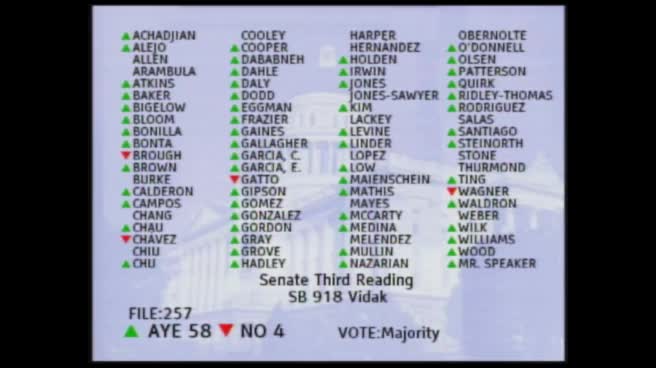 1MIN
Assembly Floor
 1MIN
Senate Floor
 6MIN
Senate Standing Committee on Governmental Organization
Bill Author
Bill Co-Author(s):