SB 1449: Personal income tax: credit for taxes paid.
- Session Year: 2015-2016
- House: Senate
- Latest Version Date: 2016-05-02
The Personal Income Tax Law allows a credit against the net tax imposed by that law to residents for specified taxes paid to another state on income derived from sources within that state. That law requires income derived from sources within that state to be determined by applying nonresident sourcing rules for determining income from sources within this state.
This bill would, instead, require the apportionment and allocation rules of the other state to be used to determine the source of income derived from that state if doing so will either maintain or increase the amount of the credit that a taxpayer is allowed. state.
This bill would take effect immediately as a tax levy.
The Personal Income Tax Law allows a credit against the net tax imposed by that law to residents for specified taxes paid to another state on income derived from sources within that state. That law requires income derived from sources within that state to be determined by applying nonresident sourcing rules for determining income from sources within this state.
This bill would, instead, require the apportionment and allocation rules of the other state to be used to determine the source of income derived from that state, to the extent that state if doing so will either maintain or increase the amount of the credit that a taxpayer is allowed.
This bill would take effect immediately as a tax levy.
The Personal Income Tax Law allows a credit against the net tax imposed by that law to residents for specified taxes paid to another state on income derived from sources within that state. That law requires income derived from sources within that state to be determined by applying nonresident sourcing rules for determining income from sources within this state.
This bill would, instead, require the apportionment and allocation rules of the other state to be used to determine the source of income derived from that state, to the extent that doing so will either maintain or increase the amount of the credit that a taxpayer is allowed.
This bill would take effect immediately as a tax levy.
It is the intent of the Legislature to do the following:
(a)Require that the Other State Tax Credit be administered in a manner to help prevent California residents from being subject to taxation on more than 100 percent of their income.
(b)Modify existing law to prevent the risk of there being an impermissible burden on interstate commerce resulting from the potential burden of multiple taxation.
SEC. 2.Section 18001 of the Revenue and Taxation Code is amended to read:18001.(a)Subject to the following conditions, residents shall be allowed a credit against the net tax (as defined by Section 17039) for net income taxes imposed by and paid to another state (not including any preference, alternative, or minimum tax comparable to the tax imposed by Section 17062) on income taxable under this part:
(1)The credit shall be allowed only for taxes paid to the other state (not including any preference, alternative, or minimum tax comparable to the tax imposed by Section 17062) on income derived from sources within that state which is taxable under its laws irrespective of the residence or domicile of the recipient.
This paragraph shall not apply to residents to whom subdivision (b) of Section 17014 applies.
(2)The credit shall not be allowed if the other state allows residents of this state a credit against the taxes imposed by that state (not including any preference, alternative, or minimum tax comparable to the tax imposed by Section 17062) for net tax (as defined by Section 17039) paid or payable under this part.
(3)The credit shall not exceed the proportion of the net tax (as defined by Section 17039) payable under this part as the income subject to tax in the other state (not including any preference, alternative, or minimum tax comparable to the tax imposed by Section 17062) and also taxable under this part bears to the taxpayers entire income upon which the net tax (as defined by Section 17039) is imposed by this part.
(4)No credit shall be allowed under this section for any tax imposed by Section 17062.
(b)For purposes of this section, the amount of net income taxes paid to another state shall include the taxpayers pro rata share of any taxes on, or according to, or measured by, income or profits paid or accrued, which were paid by an S corporation, as provided by Section 18006.
(c)(1)For purposes of this section, income derived from sources within that state shall be determined by applying the nonresident sourcing rules for determining income from sources within this state, as specified in Chapter 11 (commencing with Section 17951), and the regulations thereunder, except that the apportionment and allocation rules of the other state shall apply in lieu of Article 2 (commencing with Section 25120) of Chapter 17 of Part 11.
(2)The changes made in paragraph (1) by the act adding this paragraph shall apply if it will either maintain or increase the amount of the credit that a taxpayer is allowed.
SEC. 3.This act provides for a tax levy within the meaning of Article IV of the Constitution and shall go into immediate effect.
It is the intent of the Legislature to do the following:
(a)Require that the Other State Tax Credit be administered in a manner to help prevent California residents from being subject to taxation on more than 100 percent of their income.
(b)Modify existing law to prevent the risk of there being an impermissible burden on interstate commerce resulting from the potential burden of multiple taxation.
SEC. 2.Section 18001 of the Revenue and Taxation Code is amended to read:18001.(a)Subject to the following conditions, residents shall be allowed a credit against the net tax (as defined by Section 17039) for net income taxes imposed by and paid to another state (not including any preference, alternative, or minimum tax comparable to the tax imposed by Section 17062) on income taxable under this part:
(1)The credit shall be allowed only for taxes paid to the other state (not including any preference, alternative, or minimum tax comparable to the tax imposed by Section 17062) on income derived from sources within that state which is taxable under its laws irrespective of the residence or domicile of the recipient.
This paragraph shall not apply to residents to whom subdivision (b) of Section 17014 applies.
(2)The credit shall not be allowed if the other state allows residents of this state a credit against the taxes imposed by that state (not including any preference, alternative, or minimum tax comparable to the tax imposed by Section 17062) for net tax (as defined by Section 17039) paid or payable under this part.
(3)The credit shall not exceed the proportion of the net tax (as defined by Section 17039) payable under this part as the income subject to tax in the other state (not including any preference, alternative, or minimum tax comparable to the tax imposed by Section 17062) and also taxable under this part bears to the taxpayers entire income upon which the net tax (as defined by Section 17039) is imposed by this part.
(4)No credit shall be allowed under this section for any tax imposed by Section 17062.
(b)For purposes of this section, the amount of net income taxes paid to another state shall include the taxpayers pro rata share of any taxes on, or according to, or measured by, income or profits paid or accrued, which were paid by an S corporation, as provided by Section 18006.
(c)(1)For purposes of this section, income derived from sources within that state shall be determined by applying the nonresident sourcing rules for determining income from sources within this state, as specified in Chapter 11 (commencing with Section 17951), and the regulations thereunder, except that the apportionment and allocation rules of the other state shall apply in lieu of Article 2 (commencing with Section 25120) of Chapter 17 of Part 11.
(2)The changes made in paragraph (1) by the act adding this paragraph shall apply only to the extent that if it will either maintain or increase the amount of the credit that a taxpayer is allowed.
SEC. 3.This act provides for a tax levy within the meaning of Article IV of the Constitution and shall go into immediate effect.
It is the intent of the Legislature to do the following:
(a)Require that the Other State Tax Credit be administered in a manner to help prevent California residents from being subject to taxation on more than 100 percent of their income.
(b)Modify existing law to prevent the risk of there being an impermissible burden on interstate commerce resulting from the potential burden of multiple taxation.
SEC. 2.Section 18001 of the Revenue and Taxation Code is amended to read:18001.(a)Subject to the following conditions, residents shall be allowed a credit against the net tax (as defined by Section 17039) for net income taxes imposed by and paid to another state (not including any preference, alternative, or minimum tax comparable to the tax imposed by Section 17062) on income taxable under this part:
(1)The credit shall be allowed only for taxes paid to the other state (not including any preference, alternative, or minimum tax comparable to the tax imposed by Section 17062) on income derived from sources within that state which is taxable under its laws irrespective of the residence or domicile of the recipient.
This paragraph shall not apply to residents to whom subdivision (b) of Section 17014 applies.
(2)The credit shall not be allowed if the other state allows residents of this state a credit against the taxes imposed by that state (not including any preference, alternative, or minimum tax comparable to the tax imposed by Section 17062) for net tax (as defined by Section 17039) paid or payable under this part.
(3)The credit shall not exceed the proportion of the net tax (as defined by Section 17039) payable under this part as the income subject to tax in the other state (not including any preference, alternative, or minimum tax comparable to the tax imposed by Section 17062) and also taxable under this part bears to the taxpayers entire income upon which the net tax (as defined by Section 17039) is imposed by this part.
(4)No credit shall be allowed under this section for any tax imposed by Section 17062.
(b)For purposes of this section, the amount of net income taxes paid to another state shall include the taxpayers pro rata share of any taxes on, or according to, or measured by, income or profits paid or accrued, which were paid by an S corporation, as provided by Section 18006.
(c)(1)For purposes of this section, income derived from sources within that state shall be determined by applying the nonresident sourcing rules for determining income from sources within this state, as specified in Chapter 11 (commencing with Section 17951), and the regulations thereunder. thereunder, except that the apportionment and allocation rules of the other state shall apply in lieu of Article 2 (commencing with Section 25120) of Chapter 17 of Part 11.
(2)The changes made in paragraph (1) by the act adding this paragraph shall apply only to the extent that it will either maintain or increase the amount of the credit that a taxpayer is allowed.
SEC. 3.This act provides for a tax levy within the meaning of Article IV of the Constitution and shall go into immediate effect.
|
Date
|
Status
|
|---|---|
| May 27, 2016 | May 27 hearing: Held in committee and under submission. |
| May 20, 2016 | Set for hearing May 27. |
| May 9, 2016 | May 9 hearing: Placed on APPR. suspense file. |
| May 2, 2016 | From committee with author's amendments. Read second time and amended. Re-referred to Com. on APPR. |
| Apr 29, 2016 | Set for hearing May 9. |
| Apr 27, 2016 | From committee: Do pass and re-refer to Com. on APPR. (Ayes 7. Noes 0. Page 3699.) (April 27). Re-referred to Com. on APPR. |
| Apr 27, 2016 | From committee: Do pass and re-refer to Com. on APPR. (Ayes 7. Noes 0.) (April 27). Re-referred to Com. on APPR. |
| Apr 18, 2016 | From committee with author's amendments. Read second time and amended. Re-referred to Com. on GOV. & F. |
| Apr 5, 2016 | Set for hearing April 27. |
| Mar 10, 2016 | Referred to Com. on GOV. & F. |
| Feb 22, 2016 | Read first time. |
| Feb 22, 2016 | From printer. May be acted upon on or after March 23. |
| Feb 19, 2016 | Introduced. To Com. on RLS. for assignment. To print. |
|
Date
|
Description
|
Location
|
Votes
|
|
|---|---|---|---|---|
| May 9, 2016 | Placed on suspense file | Senate Standing Committee on Appropriations |
Passed |
|
| Apr 27, 2016 | Do pass, but first be re-referred to the Committee on [Appropriations] | Senate Standing Committee on Governance and Finance |
Passed |
This list shows positions taken on this bill by organizations on the date displayed, which is linked to the original source.
Positions by individuals are not included.
SENATE COMMITTEE ON
Senator Ricardo Lara, Chair
2015 - 2016 Regular Session
SB 1449 (Nguyen) - Personal income tax: credit for taxes paid
Version: | Policy Vote: |
Urgency: | Mandate: |
Hearing Date: | Consultant: |
This bill meets the criteria for referral to the Suspense File.
Bill Summary:
SB 1449 would require multistate taxpayers, when calculating the other state tax credit (OSTC), to use the apportionment and allocation rules of the other state in which the taxpayer paid the tax.
Fiscal Impact:
The Franchise Tax Board (FTB) estimates the revenue impact of this bill as follows: for every one percent of taxpayers impacted, there would be a revenue loss of roughly $8.8 million (General Fund). FTB’s costs to implement the bill have yet to be determined.
Background:
California taxes its residents on all income regardless of source, including income from residents performing services outside of the State. Part-year residents pay tax on all income generated while they are a resident, including from sources outside the State. Nonresidents pay tax based on all income from California sources. The State applies various sourcing rules to certain items of nonresident income for retirees, nonresident salespeople’s commissions, performances by athletes and entertainers, professional services like attorneys and physicians, officers of corporations, and operators of trucks, trains, and ships.
In some instances, taxpayers are taxed by both California and another state on the same income. California and many other states allow a nonrefundable credit against the personal income tax for taxes paid to other states. The purpose of the credit, known as the OSTC, is to avoid double taxation. Even though it is a credit against the personal income tax, taxpayers calculate California OSTC using laws, regulations, and rules from its Corporation Tax, such as its formula for apportioning corporate income by using only the sales factor, and assigning the sales of intangibles to the State where the property is used. Thus, the California OSTC is not calculated using the rules in place in the other states where the taxpayer does business. Because rules for assigning or apportioning income vary from state to state, a taxpayer’s OSTC in California can be less than the actual tax paid; however, California does not allow an OSTC that exceeds the actual amount of taxes paid to the other state.
In summary, for purposes of calculating the OSTC, California’s sourcing principles apply even though the results may be contrary to the other states’ principles. The following describes the sourcing principles of various types of income:
- Compensation for services rendered by employees or independent contractors has a source where the services are performed.
- Income from tangible personal property and real estate has a source where the property is located.
- Income from intangible personal property (such as interest and dividends) generally has a source where the owner resides.
- Business income has a source where the business is conducted.
Proposed Law:
This bill would require California residents to apply the other state’s sourcing rules, instead of California’s sourcing rules, when calculating the OSTC.
Staff Comments:
FTB cites that a lack of available data precludes it from estimating the frequency and amount of credits that would be impacted by this bill. Instead, FTB estimates that for every one percent of taxpayers impacted, the measure would result in a revenue loss of approximately $8.8 million.
-- END --
SENATE COMMITTEE ON GOVERNANCE AND FINANCE
Senator Robert M. Hertzberg, Chair
2015 - 2016 Regular
Bill No: | SB 1449 | Hearing Date: | 4/27/16 |
Author: | Nguyen | Tax Levy: | Yes |
Version: | 4/18/16 | Fiscal: | Yes |
Consultant: | Grinnell | ||
Personal income tax: credit for taxes paid
Requires multistate taxpayers when calculating the other state tax credit to use the apportionment and allocation rules of the state in which the taxpayer paid the tax.
Background
California taxes its residents on all income regardless of source, including income from residents performing services outside California. Part-year residents pay tax on all income generated while they are a resident, again including from sources outside the state. Nonresidents pay tax based on all income from California sources. California applies various sourcing rules to certain items of nonresident income for retirees, nonresident salespeople’s commissions, performances by athletes and entertainers, professional services like attorneys and physicians, officers of corporations, and operators of trucks, trains, and ships.
California and many other states allow a nonrefundable credit against the personal income tax for taxes paid to other states to avoid double taxation, known as the “other state tax credit” (OSTC). Even though it’s a credit against the personal income tax, taxpayers calculate California OSTC using laws, regulations, and rules from its Corporation Tax, such as its formula for apportioning corporate income by using only the sales factor, and assigning the sales of intangibles to the state where the property is used, and not the rules in place in the other states where the taxpayer does business. Because rules for assigning or apportioning income vary from state to state, a taxpayer’s OSTC in California can be less than the actual tax paid; however, California does not allow an OSTC that exceeds the actual amount of taxes paid to the other state.
One significant difference is the standards for sourcing sales of intangible property, like sales of services of royalties from licensing intellectual property. California mostly requires taxpayers to include sales of intangibles in their California sales factor to the state where the customer uses it (market-based sourcing), but many other states allocate the same sales from intangibles like services to the location of the income producing activity (cost-of-performance sourcing). For example, consider a California resident taxpayer who developed an intangible service in “State B,” and only sells here and in State B, with total sales of $200,000 equally split between the two states. This taxpayer:
- Includes $200,000 in sales in her State B income under costs of performance sourcing because the service was developed there, and pays $20,000 in tax at State B’s tax rate of 10%, thereby generating an OSTC.
- Calculates California tax based on that half of sales to customers in California ($100,000) based on market based sourcing, to be further reduced by her State B OSTC.
- Recalculates and claims on the return only $10,000 of OSTC ($100,000 times 10%), because California requires the taxpayer to use California’s rules for sourcing intangibles
As a result, more than 100% of the taxpayer’s income is subject to tax. Similar differences can occur because of other apportionment and allocation provisions, such as income from sales of interests in partnerships. However, a different fact pattern could result in less than 100% of income subject to tax, depending on the laws and rules in states outside California in which the taxpayer does business. The author wants to modify California’s OSTC to prevent the possibility of double-taxation.
Proposed Law
Senate Bill 1449 requires taxpayers when calculating their other state tax credit to use the apportionment and allocation rules of the other state, not California’s, when doing so will either maintain or increase the amount of credit a taxpayer is allowed. The measure also makes legislative findings and declarations supporting its purposes, including preventing residents from being subject to tax on more than 100% of their income, and precluding any risk from current law being an impermissible burden on interstate commerce.
State Revenue Impact
FTB states that SB 1449’s revenue impact is unknown due to a lack of available data, but estimates that for every one percent of taxpayers impacted, the measure would result in a revenue loss of approximately $8.8 million.
Comments
1. Purpose of the bill. According to the author, “SB 1449 will reform the current calculation of the Other State Tax Credit (OSTC) to prevent Californians with income from other states from being double taxed. This bill would change the current calculation of the OSTC to simply allow credit for the income taxes actually paid to another state, instead of requiring these taxpayers to calculate the income that would have been paid in the other state, if it was subject to California’s apportionment and allocation rules.”
2. Rough justice. State corporation income taxes have always been challenged by multi-state and multinational taxpayers, resulting in a line of court cases, regulations, and statutes where each state seeks to both levy a tax that reflects the corporation’s true demand for public services a state must provide, and ensures fairness, especially compared to the state’s tax treatment of wholly in-state companies. Consistent with federal requirements, each state sets its own apportionment formulas, allocation rules, and other state tax credit calculations, according to its own priorities and values. Absent future federal preemption, each state’s business tax regime will always differ to some degree, so the goal of taxing 100% of a multistate taxpayer’s income, no more or no less, is highly unlikely to happen anytime soon. SB 1449 results in a tax reduction for many of these firms; however, the Legislature enacted California’s rules based on its values, and they continue to be one of the nation’s most effective to limit corporations from shifting its tax base. The Committee may wish to consider whether SB 1449 is consistent with California’s policies regarding corporate taxation.
3. Winning. SB 1449 requires taxpayers to make two OSTC calculations: first, using California laws and rules, and second, using those of the state where they paid the tax that gave rise to the OSTC. The measure then requires the taxpayer to use whichever calculation either maintains or increases the OSTC amount, and therefore provides the greater taxpayer benefit. However, having to complete both calculations means the measure doesn’t reduce the current administrative burden on the taxpayer and FTB. The bill could instead require other states laws and rules be applied when calculating the OSTC regardless of whether it increased or maintained the amount of credit. That way, there would be no need to calculate using California’s system, but doing so would likely increase a tax on any taxpayer for purposes of Section Three of Article XIIIA of the California Constitution, which requires a 2/3 vote of each house of the Legislature.
4. Wynning. The United States Constitution, federal law enacted by Congress pursuant to the Commerce Clause, and case law, determine the limits on state taxing authority. While these limits haven’t changed significantly in recent years, the United States Supreme Court decided Maryland Comptroller of the Treasury v. Wynne in May, 2015, holding that Maryland’s tax scheme unconstitutional, using the internal consistency test, which courts have used in several cases to determine whether a state’s tax system discriminates against interstate commerce. That test requires the court to imagine a state of affairs where every state in the Union adopted an identical tax scheme, and determine whether the state imposes a higher tax burden on commerce that crosses state lines than commerce that stays entirely within one state. While the court’s decision in Wynne made clear that states must offer other state tax credits to the extent they tax residents’ out-of-state income, the decision was specific only to Maryland, and said that states could comply in different ways. The decision does not appear to require California to change its credit in any way, because internal consistency is not violated if all states calculated their credits using their own rules. However, a future court could enhance the holding in Wynne to require a full offset of taxes paid to other states whenever states choose to tax its residents’ out-of-state income.
Support and Opposition
(4/21/16)
Support: California Chamber of Commerce, California Taxpayers Association, Taxation Section of the Business Law Section of the State Bar of California.
Opposition: California Tax Reform Association.
-- END --
Discussed in Hearing
 15MIN
Assembly Standing Committee on Public Safety
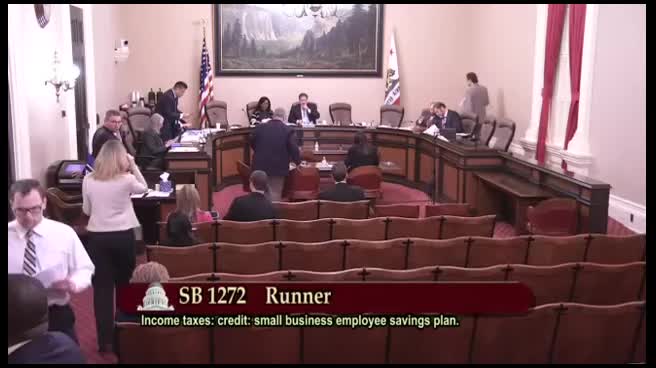 5MIN
Senate Standing Committee on Governance and Finance
Bill Author

Bill Co-Author(s):