SB 15: Postsecondary education: financial aid: Graduation Incentive Grant program.
- Session Year: 2015-2016
- House: Senate
- Latest Version Date: 2015-03-25
The
(1)The Cal Grant Program establishes the Cal Grant A and B Entitlement awards, the California Community College Transfer Entitlement awards, the Competitive Cal Grant A and B awards, the Cal Grant C awards, and the Cal Grant T awards under the administration of the Student Aid Commission, and establishes eligibility requirements for awards under these programs for participating students attending qualifying institutions. Existing law establishes the total number of Competitive Cal Grant A and B awards granted annually at 22,500 and the maximum tuition award amount for each Cal Grant A and B award for new students attending private nonprofit postsecondary educational institution at $9,084 for the 201415 award year and $8,056 for the 201516 award year and each award year thereafter.
This bill would increase the total number of Competitive Cal Grant A and B awards granted annually to 30,000 and would increase the maximum tuition award amount for Cal Grant A and B for students at private nonprofit postsecondary schools educational institutions to $9,084 for the 201516 award year and each award year thereafter.
(2)Existing law establishes the California State University, under the administration of the Trustees of the California State University, and the University of California, under the administration of the Regents of the University of California, as 2 of the segments of public postsecondary education in this state.
This bill would establish, commencing with the 201516 academic year, the Competitive Graduation Incentive Grant Award program to provide eligible matriculating undergraduate students of California State University with financial need attending a campus of the California State University with additional financial aid over a 3-year period, for up to 3 college years, as specified. The bill would specify the eligibility criteria and the award amounts of the Graduation Incentive Grant program. The bill would require the California State University to make an annual report, containing specified data about the program, to the Legislature. The program would only be operative in a fiscal year if the Trustees of the California State University determine that sufficient funding has been provided for purposes of the program for that fiscal year in the annual Budget Act or another statute.
The bill would express the intent of the Legislature to appropriate funds, for the 201516 fiscal year, to the University of California to eliminate a specified tuition increase and to appropriate funds to both the University of California and the California State University to provide additional course offerings and support services for students.
The Cal Grant Program establishes the Cal Grant A and B Entitlement awards, the California Community College Transfer Entitlement awards, the Competitive Cal Grant A and B awards, the Cal Grant C awards, and the Cal Grant T awards under the administration of the Student Aid Commission, and establishes eligibility requirements for awards under these programs for participating students attending qualifying institutions. Existing law establishes the total number of Competitive Cal Grant A and B awards granted annually at 22,500 and the maximum tuition award amount for each Cal Grant A and B award for new students attending private nonprofit postsecondary educational institution at $9,084 for the 201415 award year and $8,056 for the 201516 award year and each award year thereafter.
This bill would increase the total number of Competitive Cal Grant A and B awards granted annually to 30,000 and would increase the maximum tuition award amount for Cal Grant A and B for students at private nonprofit postsecondary schools to $9,084 for the 201516 award year and each award year thereafter.
This bill would establish, commencing with the 201516 academic year, the Competitive Incentive Grant Award to provide students with financial need attending a campus of the California State University with additional financial aid over a 3-year period, as specified.
(a)The Legislature finds and declares all of the following:
(1)According to the
(a)The Public Policy Institute of California, California reports that, in 2025, 41 percent of jobs will require at least a bachelors degree. However, if current trends persists, persist, only 35 percent of working-age California adults will have a bachelors degree by 2025. Without more students entering and completing a college degree, California will not meet workforce demands.
(2)According to the
(b)State General Fund support for the California State University and the University of California has dropped from 11 percent to 8 percent of the total state budget.
(c)The Public Policy Institute of California, California reports that in-state full tuition at the University of California and the California State University has risen more dramatically than at other public universities in other states over the past decade. From 2004 to 2103, 2013, the average tuition at the University of California and the California State University has more than doubled. California must make college more affordable and accessible for all of its students.
(3) According to
(d)A report by the Campaign for College Opportunity, Opportunity confirms that an individual between 25 and 64 years of age who completes at least a bachelor of arts degree can anticipate earning an additional one million three hundred thousand dollars ($1,300,000) in wages and salary.
(4)
(e)According to the State Higher Education Executive Officers, enrolling in 15 credit hours per term is the number one predictor of student success.
(5)According to the Campaign for College Opportunity, if a California State University student enrolls in less than 15 credits per semester or takes time off, he or she will take longer than the expected four years to earn a bachelors degree that requires 120 credits.
(6)According to the Campaign for College Opportunity, the increased cost of tuition to attend a California State University may have caused more students to work, or work more hours, to pay for school. Research
(f)College students who complete 30 semester units or the equivalent per year can earn a 120-unit degree in four years.
(g)Research has demonstrated that working behavior is a significant contributor to delayed time to earning a degree. Essentially, students are a student is forced to choose between either working to earn money or taking additional courses to progress in earning their a degree.
(b)It is the intent of the Legislature, in the 201516 fiscal year, to appropriate funds to the Regents of the University of California for the following purposes:
(1)Eliminate the five-percent tuition increase adopted by the Regents of the University of California in November 2014.
(2)Provide additional course offerings for students to complete a bachelors degree in four years or less.
(3)Provide support services to students to aid them in completing a bachelors degree in four years of less.
SEC. 2.Section 69432 of the Education Code is amended to read:69432.(a)Cal Grant Program awards shall be known as Cal Grant A Entitlement Awards, Cal Grant B Entitlement Awards, California Community College Transfer Entitlement Awards, Competitive Cal Grant A and B Awards, Cal Grant C Awards, and Cal Grant T Awards.
(b)Maximum award amounts for students at independent institutions and for Cal Grant C and T awards shall be identified in the annual Budget Act. Maximum award amounts for Cal Grant A and B awards for students attending public institutions shall be referenced in the annual Budget Act.
(c)(1)Notwithstanding subdivision (b), and subdivision (c) of Section 66021.2, commencing with the 201314 award year, the maximum tuition award amounts for Cal Grant A and B awards for students attending private for-profit and nonprofit postsecondary educational institutions shall be as follows:
(A)Four thousand dollars ($4,000) for new recipients attending private for-profit postsecondary educational institutions.
(B)Nine thousand eighty-four dollars ($9,084) for new recipients attending private nonprofit postsecondary educational institutions.
(2)The renewal award amount for a student whose initial award is subject to a maximum award amount specified in this subdivision shall be calculated pursuant to paragraph (2) of subdivision (a) of Section 69433.
(3)Notwithstanding subparagraph (A) of paragraph (1), new recipients attending private for-profit postsecondary educational institutions that are accredited by the Western Association of Schools and Colleges as of July 1, 2012, shall have the same maximum tuition award amounts as are set forth in subparagraph (B) of paragraph (1).
SEC. 3.Section 69437 of the Education Code is amended to read:69437.(a)Commencing with the 200102 academic year, and each academic year thereafter, there shall be established the Competitive Cal Grant A and B award program for students who did not receive a Cal Grant A or B entitlement award pursuant to Article 2 (commencing with Section 69434), Article 3 (commencing with Section 69435), or Article 4 (commencing with Section 69436). Awards made under this section are not entitlements. The submission of an application by a student under this section shall not entitle that student to an award. The selection of students under this article shall be determined pursuant to subdivision (c) and other relevant criteria established by the commission.
(b)A total of 30,000 Cal Grant A and B awards shall be granted annually under this article on a competitive basis for applicants who meet the general eligibility criteria established in Article 1 (commencing with Section 69430) and the priorities established by the commission pursuant to subdivision (c).
(1)Fifty percent of the awards referenced in this subdivision are available to all students, including California community college students, who meet the financial need and academic requirements established pursuant to this article. A student enrolling at a qualifying baccalaureate degree granting institution shall apply by the March 2 deadline. A California community college student is eligible to apply at the March 2 or the September 2 deadline.
(2)Fifty percent of the awards referenced in this subdivision are reserved for students who will be enrolled at a California community college. The commission shall establish a second application deadline of September 2 for community college students to apply for these awards effective with the fall term or semester of the 200102 academic year.
(3)If any awards are not distributed pursuant to paragraphs (1) and (2) upon initial allocation of the awards under this article, the commission shall make awards to as many eligible students as possible, beginning with the students with the lowest expected family contribution and highest academic merit, consistent with the criteria adopted by the commission pursuant to subdivision (c), as practicable without exceeding an annual cumulative total of 30,000 awards.
(c)(1)On or before February 1, 2001, acting pursuant to a public hearing process that is consistent with the Bagley-Keene Open Meeting Act (Article 9 (commencing with Section 11120) of Chapter 1 of Part 1 of Division 3 of Title 2 of the Government Code), the commission shall establish selection criteria for Cal Grant A and B awards under the competitive program that give special consideration to disadvantaged students, taking into consideration those financial, educational, cultural, language, home, community, environmental, and other conditions that hamper a students access to, and ability to persist in, postsecondary education programs.
(2)Additional consideration shall be given to each of the following:
(A)Students who graduated from high school or its equivalent prior to the 200001 academic year. This subparagraph shall not be applicable after the 200405 academic year.
(B)Students pursuing Cal Grant B awards who reestablish their grade point averages.
(C)Students who did not receive awards pursuant to Article 2 (commencing with Section 69434), Article 3 (commencing with Section 69435), or Article 4 (commencing with Section 69436).
(d)All other students who meet the eligibility requirements pursuant to Article 1 (commencing with Section 69430) are eligible to compete for an award pursuant to this article.
SEC. 4.Article 23 24 (commencing with Section 70030) 70045) is added to Chapter 2 of Part 42 of Division 5 of Title 3 of the Education Code, to read:23.24.Competitive Incentive Grant Award Graduation Incentive Grant Program70030.For purposes of this article, student with financial need means a student attending a campus of the California State University who has demonstrated a need for a state, federal, or institutional financial aid to pay for tuition.
70045.For purposes of this article, the following shall apply:
(a)Academic discipline is determined by grouping academic programs by areas of study for California State University systemwide reporting.
(b)Academic year means the total of two consecutive semesters or three quarters, commencing with the opening of the fall term. Each semester or quarter is approximately the same length.
(c)Associate degree for transfer means an associate degree established according to the criteria established in Section 66746.
(d)Award year means one college year, or the equivalent, of attendance at a qualifying institution.
(e)A college year is equivalent to the 12 consecutive months of an academic year and the following summer.
(f)Cost of attendance means the students tuition and fees, books and supplies, room, board, transportation expenses, and any other student expenses used to calculate a students financial need for purposes of federal Title IV student aid programs.
(g)Expected family contribution means a students expected family contribution calculated according to the federal methodology pursuant to subdivision (a) of Section 69506 (as established by Title IV of the federal Higher Education Act of 1965, as amended (20 U.S.C. Sec. 1070 et seq.)).
(h)Financial need means a students financial need calculated pursuant to the federal financial need methodology (as established by Title IV of the federal Higher Education Act of 1965, as amended (20 U.S.C. Sec. 1070 et seq.)).
(i)Satisfactory academic progress means satisfaction of those criteria required by applicable federal standards published in Title 34 of the Code of Federal Regulations. A participating institution may adopt regulations defining satisfactory academic progress in a manner that is consistent with those federal standards.
70031.70046.(a)Commencing with the 201516 academic year, there shall be established the Competitive Graduation Incentive Grant Award program for California State University matriculated undergraduate students with financial need. The grant shall be awarded beginning in the 201516 academic year, and for each academic year thereafter. The purpose of the grant award is to provide those students with additional financial aid to offset their total cost of education, including the costs of housing, textbooks, and transportation.
(b)A matriculated undergraduate student attending the California State University may receive a grant award under the Graduation Incentive Grant program if the student satisfies all of the following requirements:
(1)The student is a California resident or is exempt from paying nonresident tuition under Section 68130.5.
(2)The student is determined by the participating institution to have an expected family contribution of not more than twelve thousand dollars ($12,000) after filing a Free Application for Federal Student Aid or California Dream Application in a timely manner.
(3)The student maintains satisfactory academic progress at the participating institution, as determined by the institution.
(4)The student is not incarcerated.
(5)The student is not in default on any student loan and has not failed to repay a federal or state student grant where required to do so.
(6)The student has enrolled in at least 12 semester units or the equivalent in each term for which the grant is received.
(7)The student has a declared major.
(b)
(c)The Competitive Graduation Incentive Grant Award award shall be allocated to a student awarded annually to an eligible matriculated undergraduate California State University student with financial need over a three-year period for up to three college years, as follows:
(1)One thousand dollars ($1,000) if the student completes 30 semester units or 45 quarter units by the end of his or her first academic college year.
(2)One thousand five hundred dollars ($1,500) if the student completes 60 semester or 90 quarter units by the end of his or her second academic college year.
(3)Two thousand dollars ($2,000) if the student completes 90 semester units or 135 quarter units by the end of his or her third academic college year.
(d)A student who transfers to the California State University with an associate degree for transfer shall be eligible to receive a Graduation Incentive Grant award in the first academic year of enrollment at the university. A student who transfers to the California State University without an associate degree for transfer shall be eligible to receive a Graduation Incentive Grant upon completion of his or her first college year at the university and the requisite number of units, as indicated in subdivision (c). For purposes of the grant award, the college year of a transfer student shall be counted from that students initial matriculation at a postsecondary educational institution.
(e)(1)To the extent practicable, a Graduation Incentive Grant award shall be awarded at the same time as a recipients overall financial aid package.
(2)The Graduation Incentive Grant shall be considered a supplemental grant, and shall not supplant any other grant or scholarship aid including, but not necessarily limited to, federal grants, Cal Grant awards, institutional grants, merit-based scholarships, and athletic scholarships.
(3)A Graduation Incentive Grant award, or a portion thereof, shall not cause a students total grant or scholarship aid, including a grant received pursuant to this article, to exceed the total cost of attendance for that student.
(4)A Graduation Incentive Grant award shall be awarded to an eligible student on a year-to-year basis, contingent on the provision of adequate state funding and the maintenance of that students eligibility. A students receipt of a grant in one academic year provides no assurance that the student will receive a grant in a subsequent academic year.
(f)(1)Each campus of the California State University shall administer the Graduation Incentive Grant program in accordance with the criteria established in this section.
(2)The Trustees of the California State University may adopt regulations to administer the Graduation Incentive Grant program established pursuant to this article.
70047.(a)On or before April 1, 2017, and on or before April 1 of each year thereafter, the California State University shall report all of the following to the Legislature:
(1)The number of students who successfully completed 30 semester units or 45 quarter units, 60 semester units or 90 quarter units, 90 semester or 135 quarter units, and 120 semester or 180 quarter units during the immediately preceding college year.
(2)The number of first-time freshmen who successfully completed 30 semester or 45 quarter units during the immediately preceding college year, and the number of first-time freshmen who enroll in the subsequent college year with fewer than 30 semester or 45 quarter units.
(3)The number of transfer students who successfully qualified for the Graduation Incentive Grant award, disaggregated by associate degree for transfer recipients and students who transferred without holding an associate degree for transfer.
(4)The number of eligible students who successfully met the unit completion requirements of the Graduation Incentive Grant program.
(5)The average grade point average of Graduation Incentive Grant award recipients, reported by college year.
(6)Information reported pursuant to this section shall be disaggregated by academic discipline, race, ethnicity, gender, and socioeconomic status.
(b)Reports made pursuant to this section shall comply with Section 9795 of the Government Code.
70048.This article shall not be operative in a fiscal year unless the trustees determine that sufficient funding has been provided for purposes of this article for that fiscal year in the annual Budget Act or another statute. Any funding allocated for the purpose of awarding Graduation Incentive Grant awards under this article shall be considered supplemental to the operating budget of the California State University.
SEC. 5.It is the intent of the Legislature to do both of the following to support higher education in California for the 201516 fiscal year:
(a)Appropriate funds to the Regents of the University of California for the 201516 fiscal year to eliminate the 5 percent tuition increase adopted by the regents in November 2014.
(b)Appropriate funding to the University of California and the California State University to do both of the following:
(1)Provide additional course offerings for students to complete a bachelors degree in four years or less.
(2)Provide support services to students to aid them in completing a bachelors degree in four years or less.
TextPage 1.(a)The Legislature finds and declares all of the following:
(1)According to the Public Policy Institute of California, in 2025, 41 percent of jobs will require at least a bachelors degree. However, if current trends persists, only 35 percent of working-age California adults will have a bachelors degree by 2025. Without more students entering and completing a college degree, California will not meet workforce demands.
(2)According to the Public Policy Institute of California, in-state full tuition at the University of California and the California State University has risen more dramatically than at other public universities in other states over the past decade. From 2004 to 2103, the average tuition at the University of California and the California State University has more than doubled. California must make college more affordable and accessible for all of its students.
(3)According to the Campaign for College Opportunity, an individual between 25 and 64 years of age who completes at least a bachelor of arts degree can anticipate earning an additional one million three hundred thousand dollars ($1,300,000) in wages and salary.
(4)According to the State Education Executive Officers, enrolling in 15 credit hours per term is the number one predictor of student success.
(5)According to the Campaign for College Opportunity, if a California State University student enrolls in less than 15 credits per semester or takes time off, he or she will take longer than the expected four years to earn a bachelors degree that requires 120 credits.
(6)According to the Campaign for College Opportunity, the increased cost of tuition to attend a California State University may have caused more students to work, or work more hours, to pay for school. Research has demonstrated that working behavior is a significant contributor to delayed time to earning a degree. Essentially, students are forced to choose between either working to earn money or taking additional courses to progress in earning their degree.
(b)It is the intent of the Legislature, in the 201516 fiscal year, to appropriate funds to the Regents of the University of California for the following purposes:
(1)Eliminate the five-percent tuition increase adopted by the Regents of the University of California in November 2014.
(2)Provide additional course offerings for students to complete a bachelors degree in four years or less.
(3)Provide support services to students to aid them in completing a bachelors degree in four years of less.
SEC. 2.Section 69432 of the Education Code is amended to read:69432.(a)Cal Grant Program awards shall be known as Cal Grant A Entitlement Awards, Cal Grant B Entitlement Awards, California Community College Transfer Entitlement Awards, Competitive Cal Grant A and B Awards, Cal Grant C Awards, and Cal Grant T Awards.
(b)Maximum award amounts for students at independent institutions and for Cal Grant C and T awards shall be identified in the annual Budget Act. Maximum award amounts for Cal Grant A and B awards for students attending public institutions shall be referenced in the annual Budget Act.
(c)(1)Notwithstanding subdivision (b), and subdivision (c) of Section 66021.2, commencing with the 201314 award year, the maximum tuition award amounts for Cal Grant A and B awards for students attending private for-profit and nonprofit postsecondary educational institutions shall be as follows:
(A)Four thousand dollars ($4,000) for new recipients attending private for-profit postsecondary educational institutions.
(B)For the 201415 award year, nine Nine thousand eighty-four dollars ($9,084) for new recipients attending private nonprofit postsecondary educational institutions. For the 201516 award year and each award year thereafter, eight thousand fifty-six dollars ($8,056) for new recipients attending private nonprofit postsecondary educational institutions.
(2)The renewal award amount for a student whose initial award is subject to a maximum award amount specified in this subdivision shall be calculated pursuant to paragraph (2) of subdivision (a) of Section 69433.
(3)Notwithstanding subparagraph (A) of paragraph (1), new recipients attending private for-profit postsecondary educational institutions that are accredited by the Western Association of Schools and Colleges as of July 1, 2012, shall have the same maximum tuition award amounts as are set forth in subparagraph (B) of paragraph (1).
SEC. 3.Section 69437 of the Education Code is amended to read:69437.(a)Commencing with the 200102 academic year, and each academic year thereafter, there shall be established the Competitive Cal Grant A and B award program for students who did not receive a Cal Grant A or B entitlement award pursuant to Article 2 (commencing with Section 69434), Article 3 (commencing with Section 69435), or Article 4 (commencing with Section 69436). Awards made under this section are not entitlements. The submission of an application by a student under this section shall not entitle that student to an award. The selection of students under this article shall be determined pursuant to subdivision (c) and other relevant criteria established by the commission.
(b)A total of 22,500 30,000 Cal Grant A and B awards shall be granted annually under this article on a competitive basis for applicants who meet the general eligibility criteria established in Article 1 (commencing with Section 69430) and the priorities established by the commission pursuant to subdivision (c).
(1)Fifty percent of the awards referenced in this subdivision are available to all students, including California community college students, who meet the financial need and academic requirements established pursuant to this article. A student enrolling at a qualifying baccalaureate degree granting institution shall apply by the March 2 deadline. A California community college student is eligible to apply at the March 2 or the September 2 deadline.
(2)Fifty percent of the awards referenced in this subdivision are reserved for students who will be enrolled at a California community college. The commission shall establish a second application deadline of September 2 for community college students to apply for these awards effective with the fall term or semester of the 200102 academic year.
(3)If any awards are not distributed pursuant to paragraphs (1) and (2) upon initial allocation of the awards under this article, the commission shall make awards to as many eligible students as possible, beginning with the students with the lowest expected family contribution and highest academic merit, consistent with the criteria adopted by the commission pursuant to subdivision (c), as practicable without exceeding an annual cumulative total of 22,500 30,000 awards.
(c)(1)On or before February 1, 2001, acting pursuant to a public hearing process that is consistent with the Bagley-Keene Open Meeting Act (Article 9 (commencing with Section 11120) of Chapter 1 of Part 1 of Division 3 of Title 2 of the Government Code), the commission shall establish selection criteria for Cal Grant A and B awards under the competitive program that give special consideration to disadvantaged students, taking into consideration those financial, educational, cultural, language, home, community, environmental, and other conditions that hamper a students access to, and ability to persist in, postsecondary education programs.
(2)Additional consideration shall be given to each of the following:
(A)Students who graduated from high school or its equivalent prior to the 200001 academic year. This subparagraph shall not be applicable after the 200405 academic year.
(B)Students pursuing Cal Grant B awards who reestablish their grade point averages.
(C)Students who did not receive awards pursuant to Article 2 (commencing with Section 69434), Article 3 (commencing with Section 69435), or Article 4 (commencing with Section 69436).
(d)All other students who meet the eligibility requirements pursuant to Article 1 (commencing with Section 69430) are eligible to compete for an award pursuant to this article.
SEC. 4.Article 23 (commencing with Section 70030) is added to Chapter 2 of Part 42 of Division 5 of Title 3 of the Education Code, to read:23.Competitive Incentive Grant Award70030.For purposes of this article, student with financial need means a student attending a campus of the California State University who has demonstrated a need for a state, federal, or institutional financial aid to pay for tuition.
70031.(a)Commencing with the 201516 academic year, there shall be established the Competitive Incentive Grant Award for students with financial need. The purpose of the grant award is to provide those students with additional financial aid to offset their total cost of education, including the costs of housing, textbooks, and transportation.
(b)The Competitive Incentive Grant Award shall be allocated to a student with financial need over a three-year period as follows:
(1)One thousand dollars ($1,000) if the student completes 30 units by the end of his or her first academic year.
(2)One thousand five hundred dollars ($1,500) if the student completes 60 units by the end of his or her second academic year.
(3)Two thousand dollars ($2,000) if the student completes 90 units by the end of his or her third academic year.
|
Date
|
Status
|
|---|---|
| Jun 15, 2015 | Referred to Com. on HIGHER ED. |
| Jun 2, 2015 | In Assembly. Read first time. Held at Desk. |
| Jun 2, 2015 | Read third time. Passed. (Ayes 37. Noes 1. Page 1243.) Ordered to the Assembly. |
| Jun 2, 2015 | Read third time. Passed. (Ayes 37. Noes 1.) Ordered to the Assembly. |
| May 28, 2015 | Read second time. Ordered to third reading. |
| May 28, 2015 | From committee: Do pass. (Ayes 5. Noes 0. Page 1145.) (May 28). |
| May 28, 2015 | From committee: Do pass. (Ayes 5. Noes 0.) (May 28). |
| May 23, 2015 | Set for hearing May 28. |
| May 11, 2015 | May 11 hearing: Placed on APPR. suspense file. |
| May 1, 2015 | Set for hearing May 11. |
| Apr 8, 2015 | From committee: Do pass and re-refer to Com. on APPR. (Ayes 8. Noes 0. Page 521.) (April 8). Re-referred to Com. on APPR. |
| Mar 25, 2015 | (Corrected March 27). |
| Mar 25, 2015 | From committee with author's amendments. Read second time and amended. Re-referred to Com. on ED. |
| Mar 20, 2015 | Set for hearing April 8. |
| Mar 16, 2015 | March 25 hearing postponed by committee. |
| Mar 13, 2015 | Set for hearing March 25. |
| Jan 15, 2015 | Referred to Com. on ED. |
| Dec 2, 2014 | From printer. May be acted upon on or after January 1. |
| Dec 1, 2014 | Introduced. Read first time. To Com. on RLS. for assignment. To print. |
|
Date
|
Description
|
Location
|
Votes
|
|
|---|---|---|---|---|
| Jun 2, 2015 | Senate 3rd Reading SB15 Block | Senate Floor |
Passed |
|
| May 28, 2015 | Do pass | Senate Standing Committee on Appropriations |
Passed |
|
| May 11, 2015 | Placed on suspense file | Senate Standing Committee on Appropriations |
Passed |
|
| Apr 8, 2015 | Do pass, but first be re-referred to the Committee on [Appropriations] | Senate Standing Committee on Education |
Passed |
This list shows positions taken on this bill by organizations on the date displayed, which is linked to the original source.
Positions by individuals are not included.
SB 15
Page 6
|
Office of Senate Floor Analyses (916) 651-1520 Fax: (916) 327-4478 |
THIRD READING
Bill No: SB 15
Amended: 3/25/15
SENATE EDUCATION COMMITTEE: 8-0, 4/8/15
AYES: Liu, Huff, Block, Hancock, Leyva, Mendoza, Pan, Vidak
SENATE APPROPRIATIONS COMMITTEE: 5-0, 5/28/15
AYES: Lara, Beall, Hill, Leyva, Mendoza
SUBJECT: Postsecondary education: financial aid: Graduation Incentive Grant program
DIGEST: This bill statutorily establishes the Cal Grant award at $9,084 for recipients attending private postsecondary education institutions accredited by Western Association of Schools and Colleges (WASC), increases the number of statutorily authorized competitive Cal Grant awards from 22,500 to 30,000, and establishes a Graduation Incentive Grant program for undergraduate students at the California State University (CSU).
Existing law:
Authorizes the Cal Grant Program, administered by the California Student Aid Commission, to provide grants to financially needy students to attend college. The program consists of the Cal Grant A, Cal Grant B, and Cal Grant C programs, and eligibility is based upon financial need, grade point average, California residency, and other eligibility criteria, as specified in Education Code § 69433.9. (Education Code 69430-69433.9)
Includes both the Entitlement and the Competitive Cal Grant awards. Under the Competitive program, the state provides a maximum of 22,500 Cal Grant A and B awards to applicants who meet financial, academic, and general program eligibility requirements. Half of these awards are reserved for students enrolled at a community college and who met the September 2 application deadline. (Education Code § 69437-§ 69437.7)
Provides for a long-term Cal Grant policy that requires that the maximum Cal Grant A award and the Cal Grant B award, for students attending each respective segment, equal the amount of the mandatory systemwide fees at the University of California (UC) and the CSU, as specified. This policy also requires that the maximum Cal Grant award for students attending nonpublic institutions equal the tuition award level established in the Budget Act of 2000, or the amount as adjusted in subsequent annual budget acts. (EC § 66021.2)
Sets, notwithstanding the provisions of EC 66021.2, current law, enacted through the 2012 budget, the maximum amount of the Cal Grant award for students who attend private postsecondary institutions. Beginning in the 2013-14 award year, this amount is $4,000 for new recipients attending private for-profit institutions. For new recipients attending private non-profit or for-profit institutions accredited by WASC, the amount is set at $9,084 for the 2013-14 award year and $8,056 for 2014-15. The scheduled reduction in 2014-15 was postponed for one year but is currently proposed to be reduced to $8,056 for the 2015-16 budget year. (EC § 69432)
This bill:
Permanently restores the Cal Grant annual award amount to $9,084 for recipients attending a private postsecondary education institution accredited by WASC and deletes the scheduled reduction to $8,056 for new recipients in the 2015-16 award year.
Increases the number of statutorily authorized competitive Cal Grant Awards from 22,500 to 30,000 annually.
Establishes the Graduation Incentive Grant (GIG) Program to be awarded beginning in the 2015-16 academic year to matriculated undergraduate students with financial need at the CSU. Specifically it:
Clarifies that the purpose of the award is to provide additional financial aid to offset the total cost of education, including the cost of housing, textbooks and transportation.
Requires, in order to be eligible, that a student:
Be a matriculated undergraduate at the CSU.
Be a California resident or be exempt from non-resident tuition as the result of the provisions of AB 540 (Firebaugh, Chapter 814, Statutes of 2001).
Have an expected family contribution (EFC) of no more than $12,000, to be determined as specified.
Be enrolled in at least 12 semester units (or equivalent), have a declared major and maintain satisfactory academic progress at the participating institution.
Not be incarcerated, in default on any student loan, or have failed to repay a state or federal grant if so required.
Outlines the specific grant amounts and unit requirements for an award annually as $1,000 if 30 semester units (45 quarter units) are completed the first year, $1,500 if 60 semester units (90 quarter units) are completed the second year, $2,000 if 90 semester units (135 quarter units) are completed the third year.
Establishes specific eligibility requirements for transfer students. Specifically it:
Requires that a student who transfers with an Associate Degree for Transfer be eligible to receive an award in the first academic year of enrollment at the CSU.
Makes other transfer students eligible to receive an award after completing their first college year at the CSU.
Requires awarding of the GIG Program at the same time as the overall financial aid package, clarifies that the GIG is a supplemental grant, prohibits its supplanting of any other grants or scholarships, and prohibits the GIG from resulting in total grant or scholarship aid from exceeding a student’s total cost of attendance.
Authorizes the CSU Trustees to adopt regulations to administer the GIG.
Requires, by April 1, 2017, annual reporting on the GIG program, and specifically requires that the CSU:
Report to the Legislature on the number of students overall completing the required number of units in the year prior, the number of first-time freshman and transfer students (disaggregated by Associate for Transfer degree recipients and other transfer degree recipients) successfully completing the required units and qualifying for the GIG award, the number of eligible students who successfully meet the unit requirements of the program, as well as the average grade point average of GIG recipients.
Disaggregate the data by discipline, race, ethnicity, gender and socioeconomic status.
Provides that the program requirements are not operative in a fiscal year unless the Trustees determine that sufficient funding has been provided for the program, and requires that funding for the program be considered supplemental to the CSU’s operating budget.
Declares the Legislature’s intent to appropriate funds in the 2015-16 fiscal year to:
Eliminate the 5 percent tuition increase adopted by the UC Regents in 2014.
Provide additional course offerings and support services for students to complete a bachelor’s degree in four years or less at both the CSU and UC.
Comments
Need for the bill. In December 2014, the Senate announced a comprehensive plan for higher education in California. The stated purpose of the plan is to establish higher education policies that promote affordability, access, and completion for California students. In addition to providing direct assistance to students to afford college and finish their degrees, the plan includes additional funding for the UC and the CSU to support enrollment growth, provide more course offerings, and increase student support services. While several of these objectives are proposed to be met through the budget process, this bill contains the policy changes necessary to implement and support the plan. These include the elimination of the cut to the Cal Grant award for recipients attending WASC accredited non-public institutions in California, an increase in the total number of annual competitive Cal Grant awards, and the establishment of a new grant program to incentivize timely degree completion at the CSU.
Intent language. Successful implementation of the GIG Program requires the availability of courses in which students can enroll. In addition, support services are necessary to ensure that students can successfully complete the increased unit loads, and that they understand the importance of their course taking patterns and the degree applicability of the units they complete. This bill declares the intent of the Legislature to appropriate funding in the 2015-16 fiscal year to ensure the provision of course sections and support services for CSU students to complete their degrees within four years
FISCAL EFFECT: Appropriation: No Fiscal Com.: Yes Local: No
According to the Senate Appropriations Committee:
This bill results in increased annual state costs in the hundreds of millions General Fund.
According to the author’s office, this bill reflects a portion of a broader higher education plan that is estimated to result in General Fund costs of $158 million in 2015-16; $111 million in 20016-17; and $66 million in 2017-18 after taking into account other items being proposed and discussed in the budget process.
American Federation of State, County and Municipal Employees, AFL-CIO
Asian Americans Advancing Justice
Association of Independent California Colleges and Universities
California Baptist University
California Community United Institute
California Federation of Teachers
California State University
Campaign for College Opportunity
Education Trust West
Hispanas Organized for Political Equity
LA’s Promise
Los Angeles Area Chamber of Commerce
Los Angeles Community College District
Los Rios Community College District
National Association of Social Workers, California Chapter
North Bay Leadership Council
San Diego Christian College
San Francisco Chamber of Commerce
South Orange Community College District
Southern California College Access Network
The Education Trust-West
University of San Diego
University of Southern California
University of the Pacific
OPPOSITION: (Verified 5/28/15)
None received
Prepared by: Kathleen Chavira / ED. / (916) 651-4105
5/31/15 11:26:04
**** END ****
SB 15 (Block) Page 3 of 3
SENATE COMMITTEE ON APPROPRIATIONS
Senator Ricardo Lara, Chair
2015 - 2016 Regular Session
SB 15 (Block) - Postsecondary education: financial aid: Graduation Incentive Grant program
|
|
Version: March 25, 2015 |
Policy Vote: ED. 8 - 0 |
Urgency: No |
Mandate: No |
Hearing Date: May 11, 2015 |
Consultant: Jillian Kissee |
This bill meets the criteria for referral to the Suspense File.
Bill Summary:
This bill statutorily establishes the maximum Cal Grant award at $9,084 for recipients attending private postsecondary education institutions accredited by Western Association of Schools and Colleges (WASC); increases the number of statutorily authorized competitive Cal Grant awards from 22,500 to 30,000; and establishes a Graduation Incentive Grant program for undergraduate students at the California State University (CSU).
This bill also provides legislative intent to provide additional funding to the University of California (UC) to eliminate tuition increases previously adopted by the Board of Regents in November 2014. In addition, the bill declares the intent of the Legislature to provide additional funding for UC and CSU for additional course offerings and support services.
Fiscal Impact:
This bill results in increased annual state costs in the hundreds of millions General Fund. (see staff comments)
According to the author’s office, this bill reflects a portion of a broader higher education plan that is estimated to result in General Fund costs of $158 million in 2015-16; $111 million in 20016-17; and $66 million in 2017-18 after taking into account other items being proposed and discussed in the budget process.
Background:
Existing law authorizes the Cal Grant Program, administered by the California Student Aid Commission, to provide grants to students in financial need to attend college. The program consists of the Cal Grant A, Cal Grant B, and Cal Grant C programs, and eligibility is based upon financial need, grade point average, California residency, and other eligibility criteria, as specified. (Education Code 69430-69433.9)
Existing law includes both the Entitlement and the Competitive Cal Grant awards. Under the Competitive program, the state provides a maximum of 22,500 Cal Grant A and B awards to applicants who meet financial, academic, and general program eligibility requirements. Half of these awards are reserved for students enrolled at a community college and meet a specified deadline. (EC § 69437-§ 69437.7)
Current law also sets the maximum amount of the Cal Grant award for students who attend private postsecondary institutions. For new recipients attending private for-profit institutions, this amount is $4,000. For new recipients attending private non-profit or for-profit institutions accredited by WASC, the amount is set at $9,084 for the 2014-15 award year and $8,056 for 2015-16. (EC § 69432)
Proposed Law:
Graduation Incentive Grant Program: This bill establishes a new incentive grant program for eligible CSU undergraduate students with financial need beginning in the 2015-16 academic year. Some criteria by which a student may qualify for a grant include that the student: (1) is a California resident or exempt from paying nonresident tuition, as specified; (2) has an expected family contribution of not more than $12,000 after filing a Free Application for Federal Student Aid or California Dream Application; (3) maintains satisfactory academic progress, as determined by the CSU; (4) has enrolled in at least 12 semester units in each term for which the grant is received; and (5) has declared a major.
The grant provides $1,000 if a student completes 30 semester units by the end of the first year; $1,500 if the student completes 60 semester units by the end of the second year; and $2,000 if the student completes 90 semester units by the end of the third year. This bill also includes corresponding equivalent quarter units for each year.
This bill requires the grant to be considered supplemental and to not supplant any other grant or scholarship aid. The bill provides that the grant is awarded on a year-to-year basis, contingent upon adequate state funding and maintenance of the student’s eligibility. This bill prohibits the grant award program from being operative in a fiscal year unless the CSU Trustees determine that sufficient funding has been provided for the fiscal year in the annual Budget Act or other statute. The grant award must be considered supplemental to the operating budget of the CSU.
Cal
Grant Awards: This bill eliminates the 11 percent reduction in
Cal Grant A and B awards for new recipients attending private
nonprofit postsecondary educational institutions scheduled for the
2015-16 award year. It also increases the number of Competitive Cal
Grant A and B awards to be awarded annually by 7,500.
Reporting Requirement: This bill also requires the CSU to report various items to the Legislature by April 1, 2017, including: (1) the number of students who successfully completed 30 semester units, 60 semester units, 90 semester units, and 120 semester units in the previous year; (2) the number of first-time freshman who successfully completed 30 semester units in the first year and the number of first-time freshman who enroll in the subsequent college year with fewer than 30 semester units; (3) the number of transfer students who qualified for the grant award, as specified; (4) the number of eligible students who met the unit completion requirements of the grant award; and (5) the average grade point average of the grant award recipients.
Legislative Intent to Provide Additional Funding: Finally this bill includes Legislative intent to: (1) appropriate funds to the UC Regents for the 2015-16 fiscal year to eliminate the 5 percent tuition increase adopted by the Regents in November 2014 and (2) appropriate funding to UC and CSU for additional course offerings and support services to aid students in completing a bachelor’s degree in four years or less.
Staff Comments:
This bill contains four main components that drive increases in state costs:
Incentive Grant for CSU Students: Costs in 2015-16 of $48 million and by 2017-18 there is estimated to be ongoing costs of $100 million. To the extent this grant encourages more eligible students to stay on track according the grant requirements, costs for the grant program could increase.
Maintain Cal Grant awards for students at nonprofit colleges at current level: Costs in 2015-16 of $9 million and by 2018-19 estimated ongoing costs of $29 million at full implementation.
Increase the number of competitive Cal Grant awards from 22,500 to 30,000: Costs in 2015-16 of $22 million and by full implementation in 2018-19, ongoing costs of $54 million.
Expand student support services and course offerings for UC and CSU: Ongoing costs of $150 million ($50 million of which is attributed to course offerings).
Staff
notes to the extent incentive grants, support services, or course
offerings reduce the time it takes for students to earn a degree,
associated potential savings could offset a portion of these costs.
In December 2014, the Senate announced a
comprehensive plan for higher education in California. The stated
purpose of the plan is to establish higher education policies that
promote affordability, access, and completion for California
students. Some of these objectives are proposed to be met through
the budget process, such as enrollment growth and identifying
additional sources of revenue. This bill contains the policy changes
necessary to implement and support the plan. Therefore, staff notes
that under this broader plan, increases in General Fund are
anticipated to be $158 million in 2015-16; $111 million in 20016-17;
and $66 million in 2017-18.
-- END --
SB 15 (Block) Page 9 of 9
SENATE COMMITTEE ON EDUCATION
Senator Carol Liu, Chair
2015 - 2016 Regular
Bill No: SB 15
Author: |
Block |
||
Version: |
March 25, 2015 Hearing Date: April 8, 2015 |
||
Urgency: |
No |
Fiscal: |
Yes |
Consultant: |
Kathleen Chavira |
||
Subject: Postsecondary education: financial aid
SUMMARY
This bill statutorily establishes the Cal Grant award at $9,084 for recipients attending private postsecondary education institutions accredited by Western Association of Schools and Colleges (WASC), increases the number of statutorily authorized competitive Cal Grant awards from 22,500 to 30,000, and establishes a Graduation Incentive Grant program for undergraduate students at the California State University.
BACKGROUND
Existing law authorizes the Cal Grant Program, administered by the California Student Aid Commission, to provide grants to financially needy students to attend college. The program consists of the Cal Grant A, Cal Grant B, and Cal Grant C programs, and eligibility is based upon financial need, grade point average, California residency, and other eligibility criteria, as specified in Education Code § 69433.9.
(Education Code 69430-69433.9)
Existing law includes both the Entitlement and the Competitive Cal Grant awards. Under the Competitive program, the state provides a maximum of 22,500 Cal Grant A and B awards to applicants who meet financial, academic, and general program eligibility requirements. Half of these awards are reserved for students enrolled at a community college and who met the September 2 application deadline.
(Education Code § 69437-§ 69437.7)
Current law provides for a long-term Cal Grant policy that requires that the maximum Cal Grant A award and the Cal Grant B award, for students attending each respective segment, equal the amount of the mandatory systemwide fees at the University of California and the California State University, as specified. This policy also requires that the maximum Cal Grant award for students attending nonpublic institutions equal the tuition award level established in the Budget Act of 2000, or the amount as adjusted in subsequent annual budget acts. (EC § 66021.2)
Notwithstanding the provisions of EC 66021.2, current law, enacted through the 2012 budget, sets the maximum amount of the Cal Grant award for students who attend private postsecondary institutions. Beginning in the 2013-14 award year, this amount is $4,000 for new recipients attending private for-profit institutions. For new recipients attending private non-profit or for-profit institutions accredited by WASC, the amount is set at $9,084 for the 2013-14 award year and $8,056 for 2014-15. The scheduled reduction in 2014-15 was postponed for one year but is currently proposed to be reduced to $8,056 for the 2015-16 budget year. (EC § 69432)
ANALYSIS
This bill:
Permanently restores the Cal Grant annual award amount to $9,084 for recipients attending a private postsecondary education institution accredited by WASC and deletes the scheduled reduction to $8,056 for new recipients in the 2015-16 award year.
Increases the number of statutorily authorized competitive Cal Grant Awards from 22,500 to 30,000 annually.
Establishes the Graduation Incentive Grant (GIG) Program to be awarded beginning in the 2015-16 academic year to matriculated undergraduate students with financial need at the California State University (CSU). Specifically it:
Clarifies that the purpose of the award is to provide additional financial aid to offset the total cost of education, including the cost of housing, textbooks and transportation.
Requires, in order to be eligible, that a student:
Be a matriculated undergraduate at the CSU.
Be a California resident or be exempt from non-resident tuition as the result of the provisions of AB 540.
Have an expected family contribution (EFC) of no more than $12,000, to be determined as specified.
Be enrolled in at least 12 semester units (or equivalent), have a declared major and maintain satisfactory academic progress at the participating institution.
Not be incarcerated, in default on any student loan, or have failed to repay a state or federal grant if so required.
Outlines the specific grant amounts and unit requirements for an award annually as $1,000 if 30 semester units (45 quarter units) are completed the first year, $1,500 if 60 semester units (90 quarter units) are completed the second year, $2,000 if 90 semester units (135 quarter units) are completed the third year.
Establishes specific eligibility requirements for transfer students. Specifically it:
Requires that a student who transfers with an Associate Degree for Transfer be eligible to receive an award in the first academic year of enrollment at the California State University (CSU).
Makes other transfer students eligible to receive an award after completing their first college year at the CSU.
Requires awarding of the Graduation Incentive Grant (GIG) Program at
the same time as the overall financial aid package, clarifies that the GIG
is a supplemental grant, prohibits its supplanting of any other grants or
scholarships, and prohibits the GIG from resulting in total grant or scholarship aid from exceeding a student’s total cost of attendance.
Authorizes the CSU Trustees to adopt regulations to administer the GIG.
Requires, by April 1, 2017, annual reporting on the GIG program, and specifically requires that the CSU:
Report to the Legislature on the number of students overall completing the required number of units in the year prior, the number of first-time freshman and transfer students (disaggregated by Associate for Transfer degree recipients and other transfer degree recipients) successfully completing the required units and qualifying for the GIG award, the number of eligible students who successfully meet the unit requirements of the program, as well as the average grade point average of GIG recipients.
Disaggregate the data by discipline, race, ethnicity, gender and socioeconomic status.
Provides that the program requirements are not operative in a fiscal year unless the Trustees determine that sufficient funding has been provided for the program, and requires that funding for the program be considered supplemental to the CSU’s operating budget.
Declares the Legislature’s intent to appropriate funds in the 2015-16 fiscal year to:
Eliminate the 5 percent tuition increase adopted by the Regents in 2014.
Provide additional course offerings and support services for students to complete a bachelor’s degree in four years or less at both the CSU and UC.
STAFF
COMMENTS
Need for the bill. In December 2014, the Senate announced a comprehensive plan for higher education in California. The stated purpose of the plan is to establish higher education policies that promote affordability, access, and completion for California students. In addition to providing direct assistance to students to afford college and finish their degrees, the plan includes additional funding for the UC and the CSU to support enrollment growth, provide more course offerings, and increase student support services. While several of these objectives are proposed to be met through the budget process, this bill contains the policy changes necessary to implement and support the plan. These include the elimination of the cut to the Cal Grant award for recipients attending Western Association of Schools and Colleges (WASC) accredited non-public institutions in California, an increase in the total number of annual competitive Cal Grant awards, and the establishment of a new grant program to incentivize timely degree completion at the CSU.
The Graduation Incentive Grant. According to the author, the grant program established by this bill is based upon the experience of several universities that have adopted policies to incentivize students to take 15 units per term in an effort to expedite completion. According to a 2013 report by Complete College America, The Game Changers: Are states implementing the best reforms to get more college graduates?, the University of Hawaii’s “A 15 to Finish” campaign educated students on the benefits of taking 15 units per semester and increased the number of freshmen enrolling at that level from 15 percent to 24 percent systemwide, and from 38 percent to 56 percent at its flagship campus. Additionally, Adams State University in Colorado increased the number of credits taken by its students by 11 percent in two years after offering $500 incentive scholarships to students who completed 30 credits per year.
According to the CSU, in 2013-14, 50 percent of the almost 392,000 enrolled students were full-time students, but enrolled in only 12-14 units (35 percent were enrolled for 15 units or more). While 12-14 units meets the “full-time” requirements for financial aid eligibility, a CSU student must complete an average of 15 units each semester in order to be on pace to graduate within four years. It appears many students forgo the additional units in order to accommodate time to work to meet the costs of their education, while some students are unaware that completing 15 units each semester is necessary to graduate within four years.
This bill proposes to improve completion rates at the CSU by incentivizing students to enroll in the requisite number of units necessary to complete their degrees within four years.
Why is it important? Aside from benefitting the state through increased access and more efficient movement of students through the CSU system, accelerating degree completion also reduces the overall cost of higher education for students and families. In The Real Cost of College: Time and Credits to Degree in California, the Campaign for College Opportunity reports that every additional year of enrollment in college increases the total cost by more than $26,000 in tuition, fees, books, and living expenses, as well as more than $22,000 in lost lifetime wages. A CSU student who takes six years to earn a bachelor’s degree will spend an additional $58,000 more on tuition, fees, books and other expenses, and will earn $52,900 less, over his/her lifetime, than someone who graduated in four years. As a result of these additional two years, this student would incur $110,900 in extra expenses and lost wages.
According to the CSU Academic Sustainability Plan (prepared by the CSU as required by the Budget Act of 2014) current 4-year graduation rates for the Fall 2009 cohort of students are 17.3 percent for all students and 10.8 percent for students receiving Pell grants. The projected 4-year graduation rate for the Fall 2013 cohort is 18.5 percent for all students and 11.2 percent for students receiving Pell grants.
This bill provides an additional tool for the CSU to address the specific policy objective of improving completion rates.
Who is eligible? This bill outlines various eligibility criteria for the Graduation Incentive Grant (GIG) Program including a financial need determination based upon expected family contribution (EFC). The EFC is also the basis for determining eligibility for the State University Grants program (SUG) which provides need-based grants to CSU undergraduates, post-baccalaureate, and graduate students. According to the CSU, the systemwide priority for SUG awards is an EFC of $4,000 or less, which equates to an average annual parental adjusted gross income of $20,245. This bill establishes an EFC of $12,000 to be eligible for the GIG which equates to an adjusted gross income of $92,000. In addition to the traditionally low-income students who would be eligible for the GIG, this program would offer an option for assistance to students and families with moderate to middle incomes.
The bill also extends eligibility for the GIG upon enrollment to students who complete the Associate Transfer Degree, ostensibly to acknowledge that the student has opted for a streamlined transfer program that has accelerated their progress through the community colleges and will get them through the CSU more expeditiously than other transfer routes.
This bill proposes to increase both affordability and access by expanding eligibility for aid and the overall assistance available to meet the total costs of attendance for CSU students and families.
Is there a need? The following reports highlight the increasing costs of higher education in California and the need to provide additional assistance to both lower and middle-income families to meet the total cost of college attendance.
Higher Education in California: Student Costs, a 2014 report by the Public Policy Institute of California, notes that in-state tuition at the UC and CSU has risen more dramatically than at other public universities in other states over the past decade. At the same time, federal, state, and institutional grant and scholarship programs that help make college affordable for students from lower- and middle-income families expanded. The report notes that, on average, students from families with incomes of less than $75,000 who receive federal financial aid pay little to no tuition at either CSU or UC, and even families making up to $110,000 pay less than full tuition if they receive federal financial aid of some kind. However, the report finds that the total amount a student pays for college can far exceed the cost of tuition as students pay for room and board, books, and related educational and living expenses. In 2011–2012, the estimated average price of attendance at the CSU was $19,267, of which only 34 percent ($6,486) was tuition.
CSU Preliminary Institutional Financial Aid Report, 2014-15, issued by the CSU in March 2015, reports that the aggregate cost of attendance for undergraduates at the CSU in 2015-16 was $21,000. When financial aid resources are not adequate to meet the full amount necessary to meet the total cost of attendance, a student is said to have “unmet need.” This can occur when a student does not work the requisite number of hours to earn full work-study awarded, elects not to borrow, or decreases their costs (by sharing an apartment with several roommates, for example). In 2015-16, the aggregate outstanding unmet need for CSU students was $7,786. In addition, the CSU reports that in 2013-14, 80 percent of undergraduate financial aid recipients had their tuition fees fully covered by grants or waiver, while 48 percent of CSU students graduated with an average loan debt of $15,657.
This bill proposes to address affordability by providing an additional source of grant funding to meet costs other than tuition/fees for students who already receive grants and scholarships for this purpose. In addition, students who do not currently receive state or institutional grant assistance would be eligible for the GIG to assist with their costs of attendance.
Intent language. Successful implementation of the Graduation Incentive Grant (GIG) Program requires the availability of courses in which students can enroll. In addition, support services are necessary to ensure that students can successfully complete the increased unit loads, and that they understand the importance of their course taking patterns and the degree applicability of the units they complete. This bill declares the intent of the Legislature to appropriate funding in the 2015-16 fiscal year to ensure the provision of course sections and support services for CSU students to complete their degrees within four years
Why increase the Cal Grant award for non-public institutions? The primary purpose for restoring the Cal Grant award amount is to ensure the continued access of students to Western Association of Schools and Colleges (WASC) accredited non-public institutions in California. Below is a summary of information about the sector and the Cal Grant recipients it serves.
WASC accredited non-public institutions. The institutions that would benefit from the provisions of this bill are generally members of the Association of Independent California Colleges and Universities (AICCU) which represents 75 private, nonprofit, WASC accredited colleges and universities. These institutions include research universities, liberal arts colleges, religiously affiliated institutions, and specialized colleges and universities that focus on the arts, theater and music.
The AICCU reports that their member institutions enroll over 320,000 students, comprised of 184,000 undergraduate students and 144,000 graduate students. AICCU institutions award over 50% of all graduate degrees in California and approximately 21% of the baccalaureate degrees. The sector produces 40% of the teaching credentials, 65% of the legal professional degrees, 39% of the business degrees, 43% of the heath degrees and 27% of the engineering degrees in the state. California residents make up approximately 70% of the undergraduate population.
Who is served? According to the Association of Independent California Colleges and Universities (AICCU), Cal Grant students at their member institutions are overwhelmingly the first in their families to go to college and from historically underrepresented groups in higher education. AICCU reports that data collected over the years has consistently demonstrated that Cal Grant students graduate at a higher level than the general student population in the sector even with the barriers they confront. According to the AICCU's survey of their member institutions, 62% of their Cal Grant students graduate in 4-years (similar to the 4-year rate at the UC) and 63% are first generation college students.
Approximately 41% of the Cal Grant population at AICCU institutions is Latino, 27% Caucasian, 17% Asian and Pacific Islander, 7% African American. Based upon data from the California Student Aid Commission, the average family income for Cal Grant A students is $41,300 and $16,523 for Cal B Students (CSAC data). The average institutional aid award to a Cal Grant student is $15,059. The AICCU reports that the independent sector educates over 28,000 California students through the Cal Grant program.
The following are examples of the AICCU member institutions and the proportion of their students who are Cal Grant recipients:
Cal Baptist University - Riverside (33.5%)
Holy Names College - Oakland (31.8%)
La Sierra University - Riverside (38.7%)
Mills College - Oakland (38.4%)
Mount St. Mary's - Los Angeles (54%)
Simpson University - Redding (38.6%)
University of the Pacific - Stockton (41.6%)
William Jessup University - Rocklin (36.1%)
According to the AICCU, for the majority of their member institutions, who are tuition dependent, as Cal Grant award amounts are reduced, their options are to increase loan or work contributions, leave a gap in the financial aid package for families to address, or to reduce their enrollment of low-income students.
This bill proposes to increase access and affordability of higher education in California by restoring the amount of the Cal Grant award at these private institutions to the levels in place prior to the cuts implemented via budget action.
Increasing the number of Competitive Grants. According to an April 2013 report by The Institute for College Access & Success (TICAS), Strengthening Cal Grants to Better Serve Today's Students, in 2010-11 the majority of Cal Grant recipients (72%) received grants as a high school entitlement award, 5% received transfer entitlement awards, and competitive awards went to 18% of all Cal Grant recipients. According to the TICAS report, many otherwise eligible applicants miss the application deadline or enroll well after they have graduated from high school, and these are particular concerns for the lowest income students who miss timely application because they are unaware of the financial aid that is available. For these students the alternative would be a Competitive Cal Grant.
However, as noted in the background of this analysis, only 22,500 Competitive Cal Grants are statutorily authorized annually. According to TICAS, in the 2012-13 Cal Grant award cycle, there was only one competitive Cal Grant available for every 17 eligible applicants.
This bill would propose to increase both access and affordability by increasing the number of Competitive Cal Grants authorized annually by 7,500 awards.
SUPPORT
American Federation of State, County and Municipal Employees, AFL-CIO
Asian Americans Advancing Justice
Association of Independent California Colleges and Universities
California Baptist University
California Community United Institute
California Federation of Teachers
California State University
Campaign for College Opportunity
Education Trust West
Los Angeles Area Chamber of Commerce
Los Angeles Community College District
Los Rios Community College District
National Association of Social Workers, California Chapter
North Bay Leadership Council
San Diego Christian College
San Francisco Chamber of Commerce
South Orange Community College District
Southern California College Access Network
University of San Diego
University of Southern California
University of the Pacific
OPPOSITION
None received.
-- END --
Discussed in Hearing
View Older Hearings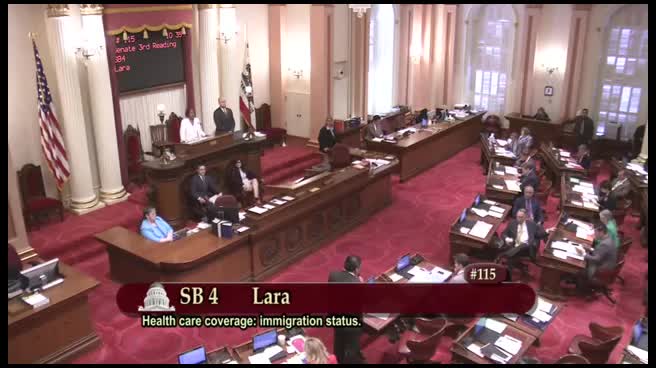



Bill Co-Author(s):