AB 1352: Deferred entry of judgment: withdrawal of plea.
- Session Year: 2015-2016
- House: Assembly
- Latest Version Date: 2015-10-08
Existing law allows judgment to be deferred with respect to a defendant who is charged with certain crimes involving possession of controlled substances and who meets certain criteria, including that he or she has no prior convictions for any offense involving controlled substances and has had no felony convictions within the 5 years prior, as specified. Existing law prohibits the record pertaining to an arrest resulting in successful completion of a deferred entry of judgment program from being used in any way that could result in the denial of any employment, benefit, license, or certificate.
This bill would require a court to allow a defendant who was granted deferred entry of judgment on or after January 1, 1997, who has performed satisfactorily during the period in which deferred entry of judgment was granted, and for whom the criminal charge or charges were dismissed, as specified, to withdraw his or her plea and enter a plea of not guilty, and would require the court to dismiss the complaint or information against the defendant. If court records showing the case resolution are no longer available, the bill would require that the defendants declaration, under penalty of perjury, that the charges were dismissed after he or she completed the requirements, be presumed to be true if the defendant submits a copy of his or her state summary criminal history information that either shows that the defendant successfully completed the deferred entry of judgment program or that the record does not show a final disposition. By expanding the application of the crime of perjury, the bill would impose a state-mandated local program.
The California Constitution requires the state to reimburse local agencies and school districts for certain costs mandated by the state. Statutory provisions establish procedures for making that reimbursement.
This bill would provide that no reimbursement is required by this act for a specified reason.
Existing law allows judgment to be deferred with respect to a defendant who is charged with certain crimes involving possession of controlled substances and who meets certain criteria, including that he or she has no prior convictions for any offense involving controlled substances and has had no felony convictions within the 5 years prior, as specified. Existing law prohibits the record pertaining to an arrest resulting in successful completion of a deferred entry of judgment program from being used in any way that could result in the denial of any employment, benefit, license, or certificate.
This bill would require a court to allow a defendant who was granted deferred entry of judgment on or after January 1, 1997, who has performed satisfactorily during the period in which deferred entry of judgment was granted, and for whom the criminal charge or charges were dismissed, as specified, to withdraw his or her plea and enter a plea of not guilty, and would require the court to dismiss the complaint or information against the defendant. If court records showing the case resolution are no longer available, the bill would require that the defendants declaration, under penalty of perjury, that the charges were dismissed after he or she completed the requirements, be presumed to be true. true if the defendant submits a copy of his or her state summary criminal history information that either shows that the defendant successfully completed the deferred entry of judgment program or that the record does not show a final disposition. By expanding the application of the crime of perjury, the bill would impose a state-mandated local program.
The California Constitution requires the state to reimburse local agencies and school districts for certain costs mandated by the state. Statutory provisions establish procedures for making that reimbursement.
This bill would provide that no reimbursement is required by this act for a specified reason.
Existing law allows judgment to be deferred with respect to a defendant who is charged with certain crimes involving possession of controlled substances and who meets certain criteria, including that he or she has no prior convictions for any offense involving controlled substances and has had no felony convictions within the 5 years prior, as specified. Existing law prohibits the record pertaining to an arrest resulting in successful completion of a deferred entry of judgment program from being used in any way that could result in the denial of employment, benefit, license, or certificate.
This bill would require a court to allow a defendant who was granted deferred entry of judgment on or after January 1, 1997, after pleading guilty or nolo contendere to the charged offense January 1, 1997, who has performed satisfactorily during the period in which deferred entry of judgment was granted, and for whom the criminal charge or charges were dismissed, as specified, to withdraw his or her plea and enter a plea of not guilty, and would require the court to dismiss the complaint or information against the defendant, if the defendant performed satisfactorily during the deferred entry of judgment period and the defendant attests that the plea may result in the denial or loss to the defendant of any employment, benefit, license, or certificate, including, but not limited to, causing a noncitizen defendant to potentially be found inadmissable, deportable, or subject to any other kind of adverse immigration consequence. The bill would require the Judicial Council to develop a form to allow the defendant to make this attestation. Pursuant to the bill, the completion, signing, and submission of the form with specified documentation would be presumed to satisfy the requirement for the withdrawal of the plea and dismissal of the complaint. defendant. If court records showing the case resolution are no longer available, the bill would require that the defendants declaration, under penalty of perjury, that the charges were dismissed after he or she completed the requirements, be presumed to be true. By expanding the application of the crime of perjury, the bill would impose a state-mandated local program.
The California Constitution requires the state to reimburse local agencies and school districts for certain costs mandated by the state. Statutory provisions establish procedures for making that reimbursement.
This bill would provide that no reimbursement is required by this act for a specified reason.
Existing law allows judgment to be deferred with respect to a defendant who is charged with certain crimes involving possession of controlled substances and who meets certain criteria, including that he or she has no prior convictions for any offense involving controlled substances and has had no felony convictions within the 5 years prior, as specified. Existing law prohibits the record pertaining to an arrest resulting in successful completion of a deferred entry of judgment program from being used in any way that could result in the denial of employment, benefit, license, or certificate.
This bill would require a court to allow a defendant who was granted deferred entry of judgment on or after January 1, 1997, after pleading guilty or nolo contendere to the charged offense, to withdraw his or her plea and enter a plea of not guilty, and would require the court to dismiss the complaint or information against the defendant, if the defendant performed satisfactorily during the deferred entry of judgment period and the defendant shows attests that the plea may result in the denial or loss to the defendant of any employment, benefit, license, or certificate, including, but not limited to, causing a noncitizen defendant to potentially be found inadmissable, deportable, or subject to any other kind of adverse immigration consequence. The bill would require the Judicial Council to develop a form to allow the defendant to make this attestation. Pursuant to the bill, the completion, signing, and submission of the form with specified documentation would be presumed to satisfy the requirement for the withdrawal of the plea and dismissal of the complaint.
Existing law allows judgment to be deferred with respect to a defendant who is charged with certain crimes involving possession of controlled substances and who meets certain criteria, including that he or she has no prior convictions for any offense involving controlled substances and has had no felony convictions within the 5 years prior, as specified. Existing law prohibits the record pertaining to an arrest resulting in successful completion of a deferred entry of judgment program from being used in any way that could result in the denial of employment, benefit, license, or certificate.
This bill would require a court to allow a defendant who was granted deferred entry of judgment on or after January 1, 1997, after pleading guilty or nolo contendere to the charged offense, to withdraw his or her plea and enter a plea of not guilty, and would require the court to dismiss the complaint or information against the defendant, if the charges were dismissed after the defendant performed satisfactorily during the deferred entry of judgment period and the defendant shows that the plea may result in the denial or loss to the defendant of any employment, benefit, license, or certificate, including, but not limited to, causing a noncitizen defendant to potentially be found inadmissable, deportable, or subject to any other kind of adverse immigration consequence.
Existing law allows judgment to be deferred with respect to a defendant who is charged with certain crimes involving possession of controlled substances and who meets certain criteria, including that he or she has no prior convictions for any offense involving controlled substances and has had no felony convictions within the 5 years prior, as specified. Existing law prohibits the record pertaining to an arrest resulting in successful completion of a deferred entry of judgment program from being used in any way that could result in the denial of employment, benefit, license, or certificate.
This bill would require a court to allow a defendant who was granted deferred entry of judgment on or after January 1, 1997, after pleading guilty or nolo contendere to the charged offense, to withdraw his or her plea and enter a plea of not guilty if the charges were dismissed after the defendant performed satisfactorily during the deferred entry of judgment period and the defendant shows that the plea may result in the denial or loss to the defendant of any employment, benefit, license, or certificate, including, but not limited to, causing a noncitizen defendant to potentially be found inadmissable, deportable, or subject to any other kind of adverse immigration consequence.
(a)(1)The Legislature finds and declares that the statement in Section 1000.4, that successful completion of a deferred entry of judgment program shall not, without the defendants consent, be used in any way that could result in the denial of any employment, benefit, license, or certificate constitutes misinformation about the actual consequences of making a plea in the case of some defendants, including all noncitizen defendants, because the disposition of the case may cause adverse consequences, including adverse immigration consequences.
(2)Accordingly, the Legislature finds and declares that based on this misinformation and the potential harm, the defendants prior plea is invalid.
(b)For the above-specified reason, in any case in which a defendant was granted deferred entry of judgment on or after January 1, 1997, has performed satisfactorily during the period in which deferred entry of judgment was granted, and for whom the criminal charge or charges were dismissed pursuant to Section 1000.3, the court shall, upon request of the defendant, permit the defendant to withdraw the plea of guilty or nolo contendere and enter a plea of not guilty, and the court shall dismiss the complaint or information against the defendant. If court records showing the case resolution are no longer available, the defendants declaration, under penalty of perjury, that the charges were dismissed after he or she completed the requirements for deferred entry of judgment, shall be presumed to be true if the defendant has submitted a copy of his or her state summary criminal history information maintained by the Department of Justice that either shows that the defendant successfully completed the deferred entry of judgment program or that the record is incomplete in that it does not show a final disposition. For purposes of this section, a final disposition means that the state summary criminal history information shows either a dismissal after completion of the program or a sentence after termination of the program.
SEC. 2.No reimbursement is required by this act pursuant to Section 6 of Article XIIIB of the California Constitution because the only costs that may be incurred by a local agency or school district will be incurred because this act creates a new crime or infraction, eliminates a crime or infraction, or changes the penalty for a crime or infraction, within the meaning of Section 17556 of the Government Code, or changes the definition of a crime within the meaning of Section 6 of Article XIIIB of the California Constitution.
(a)(1)The Legislature finds and declares that the statement in Section 1000.4, that successful completion of a deferred entry of judgment program shall not, without the defendants consent, be used in any way that could result in the denial of any employment, benefit, license, or certificate constitutes misinformation about the actual consequences of making a plea in the case of some defendants, including all noncitizen defendants, because the disposition of the case may cause adverse consequences, including adverse immigration consequences.
(2)Accordingly, the Legislature finds and declares that based on this misinformation and the potential harm, the defendants prior plea is invalid.
(b)For the above-specified reason, in any case in which a defendant was granted deferred entry of judgment on or after January 1, 1997, has performed satisfactorily during the period in which deferred entry of judgment was granted, and for whom the criminal charge or charges were dismissed pursuant to Section 1000.3, the court shall, upon request of the defendant, permit the defendant to withdraw the plea of guilty or nolo contendere and enter a plea of not guilty, and the court shall dismiss the complaint or information against the defendant. If court records showing the case resolution are no longer available, the defendants declaration, under penalty of perjury, that the charges were dismissed after he or she completed the requirements for deferred entry of judgment, shall be presumed to be true. true if the defendant has submitted a copy of his or her state summary criminal history information maintained by the Department of Justice that either shows that the defendant successfully completed the deferred entry of judgment program or that the record is incomplete in that it does not show a final disposition. For purposes of this section, a final disposition means that the state summary criminal history information shows either a dismissal after completion of the program or a sentence after termination of the program.
SEC. 2.No reimbursement is required by this act pursuant to Section 6 of Article XIIIB of the California Constitution because the only costs that may be incurred by a local agency or school district will be incurred because this act creates a new crime or infraction, eliminates a crime or infraction, or changes the penalty for a crime or infraction, within the meaning of Section 17556 of the Government Code, or changes the definition of a crime within the meaning of Section 6 of Article XIIIB of the California Constitution.
(a)(1)The Legislature finds and declares that the statement in Section 1000.4, that successful completion of a deferred entry of judgment program shall not, without the defendants consent, be used in any way that could result in the denial of any employment, benefit, license, or certificate constitutes misinformation about the actual consequences of making a plea in the case of some defendants, including all noncitizen defendants, because the disposition of the case may cause adverse consequences, including adverse immigration consequences.
(2)Accordingly, the Legislature finds and declares that based on this misinformation and the potential harm, the defendants prior plea is invalid.
(b)In any case in which a defendant was granted deferred entry of judgment on or after January 1, 1997, after pleading guilty or nolo contendere to the charged offense, the defendant shall be permitted by the court to withdraw the plea of guilty or nolo contendere and enter a plea of not guilty, and thereafter the court shall dismiss the complaint or information against the defendant, if the defendant attests to both of the following:
(1)The charges were dismissed after the defendant performed satisfactorily during the deferred entry of judgment period.
(2)The plea of guilty or nolo contendere may result in the denial or loss to the defendant of any employment, benefit, license, or certificate, including, but not limited to, causing a noncitizen defendant to potentially be found inadmissable, deportable, or subject to any other kind of adverse immigration consequence.
(c)The Judicial Council shall, by June 1, 2016, develop a form that allows a defendant to attest to the information described in paragraphs (1) and (2) of subdivision (b).
(d)The defendant shall submit documentation of the dismissal of charges or satisfactory participation in, or completion of, diversion programming. The completion, signing, and submission by the defendant of the form described in subdivision (c) with the documentation specified in this subdivision shall be presumed to satisfy the requirements for withdrawal of the plea and dismissal of the complaint or information against the defendant.
(b)For the above-specified reason, in any case in which a defendant was granted deferred entry of judgment on or after January 1, 1997, has performed satisfactorily during the period in which deferred entry of judgment was granted, and for whom the criminal charge or charges were dismissed pursuant to Section 1000.3, the court shall, upon request of the defendant, permit the defendant to withdraw the plea of guilty or nolo contendere and enter a plea of not guilty, and the court shall dismiss the complaint or information against the defendant. If court records showing the case resolution are no longer available, the defendants declaration, under penalty of perjury, that the charges were dismissed after he or she completed the requirements for deferred entry of judgment, shall be presumed to be true.
SEC. 2.No reimbursement is required by this act pursuant to Section 6 of Article XIIIB of the California Constitution because the only costs that may be incurred by a local agency or school district will be incurred because this act creates a new crime or infraction, eliminates a crime or infraction, or changes the penalty for a crime or infraction, within the meaning of Section 17556 of the Government Code, or changes the definition of a crime within the meaning of Section 6 of Article XIIIB of the California Constitution.
(a)(1)The Legislature finds and declares that the statement in Section 1000.4, that successful completion of a deferred entry of judgment program shall not, without the defendants consent, be used in any way that could result in the denial of any employment, benefit, license, or certificate constitutes misinformation about the actual consequences of making a plea in the case of some defendants, including all noncitizen defendants, because the disposition of the case may cause adverse consequences, including adverse immigration consequences.
(2)Accordingly, the Legislature finds and declares that based on this misinformation and the potential harm, the defendants prior plea is invalid.
(b)In any case in which a defendant was granted deferred entry of judgment on or after January 1, 1997, after pleading guilty or nolo contendere to the charged offense, the defendant shall be permitted by the court to withdraw the plea of guilty or nolo contendere and enter a plea of not guilty, and thereafter the court shall dismiss the complaint or information against the defendant, if the defendant shows attests to both of the following:
(1)The charges were dismissed after the defendant performed satisfactorily during the deferred entry of judgment period.
(2)The plea of guilty or nolo contendere may result in the denial or loss to the defendant of any employment, benefit, license, or certificate, including, but not limited to, causing a noncitizen defendant to potentially be found inadmissable, deportable, or subject to any other kind of adverse immigration consequence.
(c)The Judicial Council shall, by June 1, 2016, develop a form that allows a defendant to attest to the information described in paragraphs (1) and (2) of subdivision (b).
(d)The defendant shall submit documentation of the dismissal of charges or satisfactory participation in, or completion of, diversion programming. The completion, signing, and submission by the defendant of the form described in subdivision (c) with the documentation specified in this subdivision shall be presumed to satisfy the requirements for withdrawal of the plea and dismissal of the complaint or information against the defendant.
(a)(1)The Legislature finds and declares that the statement in Section 1000.4, that successful completion of a deferred entry of judgment program shall not, without the defendants consent, be used in any way that could result in the denial of any employment, benefit, license, or certificate constitutes misinformation about the actual consequences of making a plea in the case of some defendants, including all noncitizen defendants, because the disposition of the case may cause adverse consequences, including adverse immigration consequences.
(2)Accordingly, the Legislature finds and declares that based on this misinformation and the potential harm, the defendants prior plea is invalid.
(b)In any case in which a defendant was granted deferred entry of judgment on or after January 1, 1997, after pleading guilty or nolo contendere to the charged offense, the defendant shall be permitted by the court to withdraw the plea of guilty or nolo contendere and enter a plea of not guilty, and thereafter the court shall dismiss the complaint or information against the defendant, if the defendant shows both of the following:
(1)The charges were dismissed after the defendant performed satisfactorily during the deferred entry of judgment period.
(2)The plea of guilty or nolo contendere may result in the denial or loss to the defendant of any employment, benefit, license, or certificate, including, but not limited to, causing a noncitizen defendant to potentially be found inadmissable, deportable, or subject to any other kind of adverse immigration consequence.
(a)(1)The Legislature finds and declares that the statement in Section 1000.4, that successful completion of a deferred entry of judgment program shall not, without the defendants consent, be used in any way that could result in the denial of any employment, benefit, license, or certificate constitutes misinformation about the actual consequences of making a plea in the case of some defendants, including all noncitizen defendants, because the disposition of the case may cause adverse consequences, including adverse immigration consequences.
(2)Accordingly, the Legislature finds and declares that based on this misinformation and the potential harm, the defendants prior plea is invalid.
(b)In any case in which a defendant was granted deferred entry of judgment on or after January 1, 1997, after pleading guilty or nolo contendere to the charged offense, the defendant shall be permitted by the court to withdraw the plea of guilty or nolo contendere and enter a plea of not guilty if the defendant shows both of the following:
(1)The charges were dismissed after the defendant performed satisfactorily during the deferred entry of judgment period.
(2)The plea of guilty or nolo contendere may result in the denial or loss to the defendant of any employment, benefit, license, or certificate, including, but not limited to, causing a noncitizen defendant to potentially be found inadmissable, deportable, or subject to any other kind of adverse immigration consequence.
|
Date
|
Status
|
|---|---|
| Oct 8, 2015 | Chaptered by Secretary of State - Chapter 646, Statutes of 2015. |
| Oct 8, 2015 | Approved by the Governor. |
| Sep 25, 2015 | Enrolled and presented to the Governor at 2 p.m. |
| Sep 11, 2015 | Read third time. Passed. Ordered to the Assembly. (Ayes 22. Noes 15. Page 2742.). |
| Sep 11, 2015 | Senate amendments concurred in. To Engrossing and Enrolling. (Ayes 43. Noes 32. Page 3174.). |
| Sep 11, 2015 | Assembly Rule 63 suspended. (Page 3169.) |
| Sep 11, 2015 | Senate amendments concurred in. To Engrossing and Enrolling. (Ayes 43. Noes 32.). |
| Sep 11, 2015 | In Assembly. Concurrence in Senate amendments pending. |
| Sep 11, 2015 | Read third time. Passed. Ordered to the Assembly. |
| Sep 11, 2015 | Assembly Rule 63 suspended. |
| Sep 11, 2015 | Senate amendments concurred in. To Engrossing and Enrolling. |
| Sep 10, 2015 | Ordered to third reading. |
| Sep 10, 2015 | Withdrawn from committee. |
| Sep 9, 2015 | Senate Rule 29.3(b) suspended. (Ayes 27. Noes 6. Page 2647.) |
| Sep 9, 2015 | (Ayes 27. Noes 6. Page 2646.) |
| Sep 9, 2015 | From committee chair, with author's amendments: Amend, and re-refer to committee. Read second time, amended, and re-referred to Com. on RLS. |
| Sep 9, 2015 | Senate Rule 29.3(b) suspended. (Ayes 27. Noes 6.) |
| Sep 9, 2015 | (Ayes 27. Noes 6.) |
| Sep 9, 2015 | Re-referred to Com. on RLS. |
| Sep 4, 2015 | Read second time. Ordered to third reading. |
| Sep 3, 2015 | Read third time and amended. Ordered to second reading. |
| Aug 31, 2015 | Read second time. Ordered to third reading. |
| Aug 27, 2015 | From committee: Do pass. (Ayes 5. Noes 2.) (August 27). |
| Aug 17, 2015 | In committee: Referred to APPR. suspense file. |
| Jul 15, 2015 | From committee: Do pass and re-refer to Com. on APPR. (Ayes 5. Noes 2.) (July 14). Re-referred to Com. on APPR. |
| Jun 30, 2015 | In committee: Set, first hearing. Hearing canceled at the request of author. |
| Jun 17, 2015 | In committee: Hearing postponed by committee. |
| May 19, 2015 | From committee chair, with author's amendments: Amend, and re-refer to committee. Read second time, amended, and re-referred to Com. on PUB. S. |
| May 14, 2015 | Referred to Com. on PUB. S. |
| May 4, 2015 | Read third time. Passed. Ordered to the Senate. (Ayes 42. Noes 33. Page 1257.) |
| May 4, 2015 | In Senate. Read first time. To Com. on RLS. for assignment. |
| Apr 28, 2015 | Read second time. Ordered to third reading. |
| Apr 27, 2015 | Read second time and amended. Ordered returned to second reading. |
| Apr 23, 2015 | From committee: Amend, and do pass as amended. (Ayes 5. Noes 2.) (April 21). |
| Mar 23, 2015 | Referred to Com. on PUB. S. |
| Mar 2, 2015 | Read first time. |
| Mar 1, 2015 | From printer. May be heard in committee March 31. |
| Feb 27, 2015 | Introduced. To print. |
|
Date
|
Description
|
Location
|
Votes
|
|
|---|---|---|---|---|
| Sep 11, 2015 | AB 1352 EGGMAN Concurrence in Senate Amendments | Assembly Floor |
Passed |
|
| Sep 11, 2015 | Assembly 3rd Reading AB1352 Eggman By Lara | Senate Floor |
Passed |
|
| Aug 27, 2015 | Do pass | Senate Standing Committee on Appropriations |
Passed |
|
| Aug 17, 2015 | Placed on suspense file | Senate Standing Committee on Appropriations |
Passed |
|
| Jul 14, 2015 | Do pass, but first be re-referred to the Committee on [Appropriations] | Senate Standing Committee on Public Safety |
Passed |
|
| May 4, 2015 | AB 1352 EGGMAN Assembly Third Reading | Assembly Floor |
Passed |
|
| Apr 21, 2015 | Do pass as amended. | Assembly Standing Committee on Public Safety |
Passed |
This list shows positions taken on this bill by organizations on the date displayed, which is linked to the original source.
Positions by individuals are not included.
AB 1352
Page 8
|
Office of Senate Floor Analyses (916) 651-1520 Fax: (916) 327-4478 |
THIRD READING
Bill No: AB 1352
Amended: 9/9/15 in Senate
SENATE PUBLIC SAFETY COMMITTEE: 5-2, 7/14/15
AYES: Hancock, Glazer, Leno, Liu, Monning
NOES: Anderson, Stone
SENATE APPROPRIATIONS COMMITTEE: 5-2, 8/27/15
AYES: Lara, Beall, Hill, Leyva, Mendoza
NOES: Bates, Nielsen
ASSEMBLY FLOOR: 42-33, 5/4/15 - See last page for vote
SUBJECT: Deferred entry of judgment: withdrawal of plea
SOURCE: American Civil Liberties Union of California
Coalition for Humane Immigrant Rights of Los Angeles
Mexican American Legal Defense and Education Fund
National Council of La Raza
DIGEST: This bill 1) allows any person who successfully completed a deferred entry of judgment (DEJ) drug treatment program and obtained dismissal of the underlying drug charges to withdraw the plea of guilty or no contest as to which judgment was deferred; 2) provides that if the court records are unavailable, the defendant’s declaration that he or she completed DEJ and obtained dismissal of the underlying charge shall be presumed to be true if the defendant submits his or her Department of Justice (DOJ) criminal history information showing successful completion of DEJ or that the record is incomplete in not showing a final disposition; and 3) includes legislative findings that the statutory provision stating that successful completion of DEJ shall not be used so as to deny a person any employment or benefit constitutes misinformation, as the plea underlying DEJ can result in adverse consequences, including deportation.
Senate Floor Amendments of 9/9/15 (1) provide that successful completion of DEJ and eligibility for withdrawal of the underlying plea shall be established through the court records; (2) provide that if the records are not available, the defendant’s declaration under penalty of perjury that he or she successfully complete DEJ shall be presumed true if he or she presents the court with his or her DOJ criminal history information; and (3) eliminate a requirement the person specify that he or she may be denied a benefit or suffer some harm because of the plea.
Senate Floor Amendments of 9/3/15 (1) simplify and specify the process under which a person may withdraw the guilty or no contest plea he or she gave as a condition of being placed in DEJ. Specifically, the amendments establish eligibility for withdrawal of the plea through the court records; (2) provide that if the records are not available, the defendant’s declaration under penalty of perjury that he or she successfully complete DEJ; and (3) eliminate a requirement the person specify that he or she may be denied a benefit or suffer some harm because of the plea.
Existing law:
Provides that a defendant may qualify for DEJ of specified non-violent drug possession offenses if the following apply to the defendant:
The defendant has no prior controlled substance convictions;
The offense charged did not of violence or threatened violence;
There is no evidence of a non-eligible drug violation;
The defendant has never failed to complete probation or parole;
The defendant's record does not indicate that he or she has participated in drug diversion or DEJ within the prior five years; and
The defendant has no prior felony conviction within five years prior to the alleged commission of the charged offense. (Pen. Code § 1000, subd. (a).)
States that a prosecutor has a duty to determine whether a defendant is eligible for DEJ. The prosecuting attorney shall file with the court a declaration in writing or state for the record the grounds upon which the determination is based, and shall make this information available to the defendant and his or her attorney. This procedure is intended to allow the court to set the hearing for DEJ at the arraignment. (Pen. Code § 1000, subd. (b).)
Requires that all DEJ referrals for DEJ shall be made only to programs that have been certified by the county drug program administrator, or to programs that provide services at no cost to the participant and have been deemed by the court and the county drug program administrator to be credible and effective. The defendant may request to be referred to a program in any county, as long as that program meets the specified criteria. (Pen. Code § 1000, subd. (c).)
Requires the court to hold a hearing and, after consideration of any information relevant to its decision, to determine if the defendant consents to further proceedings and if the defendant should be granted DEJ. If the court does not find that the defendant would benefit by DEJ, or if the defendant does not consent to participate, the proceedings shall continue as in any other case. DEJ shall be granted for no less than 18 months, but no longer than three years. Progress reports shall be filed by the probation department as directed by the court. (Pen. Code § 1000.2.)
Requires, if the defendant has performed satisfactorily in the DEJ program, the criminal charge or charges shall be dismissed. If the defendant does not perform satisfactorily, the court shall find the defendant guilty pursuant to his or her plea, enter judgment and set a sentencing hearing. (Pen. Code § 1000.3.)
States that upon successful completion of DEJ, the arrest that led to the defendant’s plea shall be deemed to have never occurred. The defendant may state that he or she was not arrested or granted DEJ for the offense, except as specified for employment as a peace officer. A record pertaining to an arrest resulting in successful completion of a DEJ program shall not, without the defendant’s consent, be used in any way that could result in the denial of any employment, benefit, license, or certificate. (Pen. Code § 1000.4, subd. (a).)
Authorizes counties to establish and conduct a preguilty plea drug court program wherein criminal proceedings are suspended without a plea of guilty for designated defendants. The presiding judge, the district attorney and the public defender must agree to establish a preguilty plea diversion program. If the defendant is not performing satisfactorily in the program, the court may reinstate criminal proceedings. If the defendant has performed satisfactorily during the period of the preguilty plea program, at the end of that period, the criminal charge or charges shall be dismissed. (Pen. Code § 1000.5.)
Provides that where a defendant has fulfilled the terms of probation, or been discharged from probation, the defendant shall, if he or she is not then serving a sentence for any offense, on probation for any offense, or charged with any offense, be granted the following relief: The court shall dismiss the conviction or allow the defendant to withdraw his or her guilty plea. The court shall then dismiss the accusations against the defendant. Where the person has successfully completed probation, but he or she did not fulfill all terms of probation throughout the probationary term, the court may grant the relief in the interests of justice. (Pen. Code § 1203.4, subd. (a).)
Provides that a person who was convicted of a felony and served a felony jail sentence pursuant to Penal Code Section 1170, subdivision (h), may apply for dismissal of his her conviction or withdrawal of his or her plea in the underlying case, in the discretion of the court and in the interests of justice. (Pen. Code § 1203.41.)
Provides that the court may not dismiss the conviction of a person who served a felony jail sentence until one year after the petitioner’s completion of the sentence, provided that the petitioner is not under community supervision or serving a sentence for a criminal offense. (Pen. Code § 1203.41.)
Specifies that a non-citizen may be deported if he or she has been convicted of a violation of any law or regulation of a state, the United States, or a foreign country relating to a controlled substance, other than possession for one's own use of 30 grams or less of marijuana. (8 U.S.C.S. § 1227, subd. (a)(2)(B)(i).)
Provides that a defendant’s plea of guilty is valid only where it is knowingly and voluntary made. In order that a defendant’s plea be knowing, the defendant must understand and explicitly waive his or her constitutional rights to a jury trial, confront witnesses and the Fifth Amendment privilege against self-incrimination. The defendant may withdraw a plea that was not knowingly and voluntarily made. (Boykin v. Alabama (1969) 395 U.S. 238; In re Tahl (1969) 1 Cal.3rd 122, 130.)
Provides that in accepting a plea of guilty or no-contest, the court must advise the defendant that if he or she is not a citizen, the plea may result in adverse immigration consequences. (Pen. Cod § 1016.5)
Provides that an attorney for a criminal defendant must advise a defendant of the consequences of a plea of guilty or no contest, including adverse immigration consequences. (Padilla v. Kentucky (2010) 130 S.Ct.1473)
This bill:
States the following legislative findings and declarations:
The statement in Penal Code Section 1000.4, that "successful completion of a DEJ program shall not, without the defendant's consent, be used in any way that could result in the denial of any employment, benefit, license, or certificate" constitutes misinformation about the actual consequences of the plea underlying DEJ.
Specifically, the plea may cause adverse consequences, including adverse immigration consequences.
Because of this misinformation and the potential harm of the plea, the defendant's prior plea is invalid.
Provides that where a defendant was granted DEJ for drug education or treatment after January 1, 1997, successfully completed DEJ and obtained dismissal of the charges the court shall permit the defendant to withdraw the plea underlying the defendant’s admission into DEJ.
Provides that if the relevant court DEJ records are unavailable, the defendant’s declaration that he or she successfully completed DEJ and obtained dismissal of the charges for which judgment was deferred shall be presumed to be true if the defendant submits his or her DOJ criminal history information showing that he successful completion of DEJ, or that the records are incomplete in not showing a final disposition.
Background
Expungement of a crime is the removal of a conviction from a person's criminal record. (United States v. Hayden (9th Cir. 2001) 255 F.3d 768, 771.) In California, Penal Code Section 1203.4 is typically referred to as the expungement statute. Defendants who have successfully completed probation may petition the court to set aside a guilty verdict or permit withdrawal of the guilty or nolo contendere plea and dismiss the complaint, accusation, or information. However, Penal Code Section 1203.4 does not actually expunge the defendant's records. The prior conviction may still be used in a "subsequent prosecution of the defendant for any other offense," and if plead and proven, "shall have the same effect as if probation had not been granted or the accusation or information dismissed." (Pen. Code, § 1203.4, subd. (a).) Instead, the record will state that the case was dismissed. The records remain fully public. Further, a Section 1203.4 dismissal does not constitute "expungement" under the Federal Sentencing Guidelines, and thus may be considered a prior conviction when calculating a defendant's criminal history. (Hayden, supra, 255 F3d at p. 774.)
To constitute an actual expungement, the withdrawal of the plea and dismissal of the case must not be allowed to be used for any purpose. Because immigration is the purview of the federal government, state laws cannot mandate what the federal government can consider in immigration proceedings. However, the state can craft a statute that avoids or minimizes a person's exposure to adverse immigration consequences. One of the circumstances that may trigger deportation proceedings is a conviction related to controlled substances. (8 U.S.C.S. § 1227, subd. (a)(2)(B)(i).) This bill allows a person to withdraw a guilty or nolo contendere plea that exposes the person to adverse immigration consequences and requires the court thereafter to dismiss the case. The intent is that the person would not have a "conviction" as interpreted under federal law to authorize deportation. However, it is unclear whether the withdrawal of a plea would prevent the federal government from accessing the records of the original plea for immigration purposes.
In a DEJ program, a defendant enters a guilty plea, but entry of judgment on the plea is deferred pending successful completion of a program. If the defendant successfully completes DEJ, the arrest shall be deemed to never have occurred. The Legislature intended the benefits and protections of a successful completion of DEJ be given the broadest possible application. (B.W. v. Board of Med. Quality Assurance (1985) 169 Cal.App. 3d 219.) A defendant who completes DEJ and has his or her case dismissed cannot have the offense used against him or her to deny any employment benefit, license or certificate unless the defendant consents to the release of his or her record. (Pen. Code § 1000.3.)
FISCAL EFFECT: Appropriation: No Fiscal Com.: Yes Local: Yes
According to the Senate Appropriations Committee, potentially significant increase in trial court costs (General Fund*) for new petitions to dismiss pleas of guilty and nolo contendere submitted for cases granted DEJ retroactive to January 1, 1997.
*Trial Court Trust Fund
American Civil Liberties Union of California (co-source)
Coalition for Humane Immigrant Rights of Los Angeles (co-source)
Mexican American Legal Defense and Education Fund (co-source)
National Council of La Raza (co-source)
African Advocacy Network
Asian Americans Advancing Justice
Asian Law Alliance
California Attorneys for Criminal Justice
California Immigrant Policy Center
California Partnership
California Public Defenders Association
California Rural Legal Assistance Foundation
Californians for Safety and Justice
Californians United for a Responsible Budget
Central American Resource Center – Los Angeles
Chinese for Affirmative Action
Community United Against Violence
Congregations Building Community
Del Sol Group
Dolores Street Community Services
Faith in Action Kern County
Friends Committee on Legislation of California
Harvey Milk LGBT Democratic Club
Human Rights Watch
Immigration Action Group
Institute for Justice
Lawyers' Committee for Civil Rights of the San Francisco Bay Area
Legal Services for Prisoners with Children
Los Angeles Regional Reentry Partnership
Justice Not Jails
MAAC
Mujeres Unidas y Activas
National Association of Social Workers – California Chapter
National Day Laborer Organizing Network
National Immigration Law Center
Pangea Legal Services
PICO California
Placer People of Faith
Presente.org
Progressive Christians Uniting
Red Mexicana de Lideres y Organizaciones Migrantes
Santa Clara County Public Defender's Office
Silicon Valley De-Bug
Solutions for Immigrants
William C. Velasquez Institute
Vital Immigrant Defense Advocacy and Services
California District Attorneys Association
California State Board of Pharmacy
California State Sheriffs’ Association
ASSEMBLY FLOOR: 42-33, 5/4/15
AYES: Alejo, Bloom, Bonta, Brown, Burke, Calderon, Chau, Chiu, Chu, Cooley, Dodd, Eggman, Frazier, Cristina Garcia, Eduardo Garcia, Gipson, Gomez, Gonzalez, Gordon, Roger Hernández, Holden, Jones-Sawyer, Levine, Lopez, Low, McCarty, Medina, Mullin, Nazarian, O'Donnell, Quirk, Rendon, Rodriguez, Salas, Santiago, Mark Stone, Thurmond, Ting, Weber, Williams, Wood, Atkins
NOES: Achadjian, Travis Allen, Baker, Bigelow, Bonilla, Brough, Chang, Chávez, Cooper, Dababneh, Beth Gaines, Gallagher, Gatto, Gray, Grove, Hadley, Harper, Irwin, Jones, Kim, Lackey, Linder, Maienschein, Mathis, Mayes, Melendez, Obernolte, Olsen, Patterson, Steinorth, Wagner, Waldron, Wilk
NO VOTE RECORDED: Campos, Dahle, Daly, Perea, Ridley-Thomas
Prepared by: Jerome McGuire / PUB. S. /
9/11/15 12:01:39
**** END ****
AB 1352
Page 3
(Without Reference to File)
CONCURRENCE IN SENATE AMENDMENTS
AB 1352
(Eggman)
As Amended September 9, 2015
Majority vote
ASSEMBLY: |
42-33 |
(May 4, 2015) |
SENATE: |
|
(September 11, 2015) |
(vote not available)
Original Committee Reference: PUB. S.
SUMMARY: Requires the court to permit a defendant, who was granted deferred entry of judgment (DEJ) on or after January 1, 1997, and who has performed satisfactorily during the period in which DEJ was granted and for whom the criminal charge or charges were dismissed, to withdraw his or her plea and enter a plea of not guilty.
The Senate amendments:
Provide if court records showing the case resolution are no longer available, the defendant's declaration, under penalty of perjury, that the charges were dismissed after he or she completed the requirements for DEJ, shall be presumed to be true if the defendant has submitted a copy of his or her state summary criminal history information maintained by the Department of Justice that either shows that the defendant successfully completed the deferred entry of judgment program or that the record is incomplete in that it does not show a final disposition.
State that for purposes of this bill, a final disposition means that the state summary criminal history information shows either a dismissal after completion of the program or a sentence after termination of the program.
Delete the provision that required the defendant to submit documentation of the dismissal of charges or satisfactory participation in, or completion of diversion programming.
Delete the provision that required Judicial Council to develop the necessary form to be completed and submitted by the defendant.
Make technical, nonsubstantive changes.
EXISTING LAW:
Provides that a defendant may qualify for DEJ of specified non-violent drug possession offenses if the following apply to the defendant:
The defendant has no prior conviction for any offense involving controlled substances;
The offense charged did not involve a crime of violence or threatened violence;
There is no evidence of a violation relating to narcotics or restricted dangerous drugs other than a violation of the specified deferrable drug offenses;
The defendant's record does not indicate that probation or parole has ever been revoked without thereafter being completed;
The defendant's record does not indicate that he or she has successfully completed or been terminated from diversion or deferred entry of judgment pursuant to this chapter within five years prior to the alleged commission of the charged offense;
The defendant has no prior felony conviction within five years prior to the alleged commission of the charged offense.
States that upon successful completion of a DEJ program, the arrest upon which the judgment was deferred shall be deemed to have never occurred. The defendant may indicate in response to any question concerning his or her prior criminal record that he or she was not arrested or granted deferred entry of judgment for the offense, except as specified for employment as a peace officer. A record pertaining to an arrest resulting in successful completion of a DEJ program shall not, without the defendant's consent, be used in any way that could result in the denial of any employment, benefit, license, or certificate.
States that in any case in which: a) a defendant has fulfilled the conditions of probation for the entire period of probation, or b) has been discharged prior to the termination of the period of probation, or c) in any other case in which a court, in its discretion and the interests of justice, determines that a defendant should be granted the relief available under this section, the defendant shall, at any time after the termination of the period of probation, if he or she is not then serving a sentence for any offense, on probation for any offense, or charged with the commission of any offense, be permitted by the court to withdraw his or her plea of guilty or plea of nolo contendere and enter a plea of not guilty; or, if he or she has been convicted after a plea of not guilty, the court shall set aside the verdict of guilty; and, in either case, the court shall thereupon dismiss the accusations or information against the defendant.
Provides circumstances that allow non-citizens to be deported, which include having been convicted of a violation of (or a conspiracy or attempt to violate) any law or regulation of a state, the United States, or a foreign country relating to a controlled substance as defined, other than a single offense involving possession for one's own use of 30 grams or less of marijuana.
AS PASSED BY THE ASSEMBLY, this bill required the court to allow a defendant to withdraw his or her guilty or nolo contendere plea in order to avoid specified adverse consequences if certain conditions are met:
Provided in any case in which a defendant was granted DEJ, on or after January 1, 1997, after pleading guilty or nolo contendere to the charged offense, the defendant shall be permitted by the court to withdraw the plea of guilty or nolo contendere and enter a plea of not guilty if the defendant shows both of the following:
The charges were dismissed after the defendant performed satisfactorily during the DEJ period; and,
The plea may result in the denial or loss to the defendant of any employment, benefit, license, or certificate, including, but not limited to, causing a noncitizen defendant to potentially be found inadmissable, deportable, or subject to any other kind of adverse immigration consequence.
Required the court to dismiss the complaint or information against the defendant.
Stated the Legislative finding that the statement in Penal Code Section 1000.4, that "successful completion of a DEJ program shall not, without the defendant's consent, be used in any way that could result in the denial of any employment, benefit, license, or certificate" constitutes misinformation about the actual consequences of making a plea in the case of some defendants, including all noncitizen defendants, because the disposition of the case may cause adverse consequences, including adverse immigration consequences.
Declared based upon this misinformation and the potential harm, the defendant's prior plea is invalid.
FISCAL EFFECT: According to the Senate Appropriations Committee, potentially significant increase in trial court costs (General Fund*) for new petitions to dismiss pleas of guilty and nolo contendere submitted for cases granted DEJ retroactive to January 1, 1997.
*Trial Court Trust Fund
COMMENTS: According to the author, "AB 1352 provides a minor expungement procedure to prevent the needless disruption of thousands of California families. The expungement proposed by this bill does not retroactively change the effect of the person's DEJ disposition under California law. Instead, it will eliminate the disposition as a conviction for federal immigration purposes. It also will make right the injustice inadvertently committed against the immigrant defendants who relied upon PC [Section] 1000.4 in deciding to enter a guilty plea.
"This bill will prevent terrible harm to California families and immigrant communities. The last several years have seen mass deportations from the U.S. [United States]. Of deportations based on criminal conviction, the largest number has been for minor, non-trafficking drug offenses. This especially affects California, the nation's most immigrant-rich state, where one out of two children lives in a household headed by at least one foreign born person (and the great majority of the children are U.S. citizens). Deportation of a parent devastates a family emotionally and economically and can drain state resources as U.S. citizen children go into foster care, homes go into foreclosure, and remaining citizen family seek public benefits."
Analysis Prepared by: Stella Choe / PUB. S. / (916) 319-3744 FN: 0002428
AB 1352
Page 8
|
Office of Senate Floor Analyses (916) 651-1520 Fax: (916) 327-4478 |
THIRD READING
Bill No: AB 1352
Amended: 9/9/15 in Senate
SENATE PUBLIC SAFETY COMMITTEE: 5-2, 7/14/15
AYES: Hancock, Glazer, Leno, Liu, Monning
NOES: Anderson, Stone
SENATE APPROPRIATIONS COMMITTEE: 5-2, 8/27/15
AYES: Lara, Beall, Hill, Leyva, Mendoza
NOES: Bates, Nielsen
ASSEMBLY FLOOR: 42-33, 5/4/15 - See last page for vote
SUBJECT: Deferred entry of judgment: withdrawal of plea
SOURCE: American Civil Liberties Union of California
Coalition for Humane Immigrant Rights of Los Angeles
Mexican American Legal Defense and Education Fund
National Council of La Raza
DIGEST: This bill 1) allows any person who successfully completed a deferred entry of judgment (DEJ) drug treatment program and obtained dismissal of the underlying drug charges to withdraw the plea of guilty or no contest as to which judgment was deferred; 2) provides that if the court records are unavailable, the defendant’s declaration that he or she completed DEJ and obtained dismissal of the underlying charge shall be presumed to be true if the defendant submits his or her Department of Justice (DOJ) criminal history information showing successful completion of DEJ or that the record is incomplete in not showing a final disposition; and 3) includes legislative findings that the statutory provision stating that successful completion of DEJ shall not be used so as to deny a person any employment or benefit constitutes misinformation, as the plea underlying DEJ can result in adverse consequences, including deportation.
Senate Floor Amendments of 9/9/15 (1) provide that successful completion of DEJ and eligibility for withdrawal of the underlying plea shall be established through the court records; (2) provide that if the records are not available, the defendant’s declaration under penalty of perjury that he or she successfully complete DEJ shall be presumed true if he or she presents the court with his or her DOJ criminal history information; and (3) eliminate a requirement the person specify that he or she may be denied a benefit or suffer some harm because of the plea.
Senate Floor Amendments of 9/3/15 (1) simplify and specify the process under which a person may withdraw the guilty or no contest plea he or she gave as a condition of being placed in DEJ. Specifically, the amendments establish eligibility for withdrawal of the plea through the court records; (2) provide that if the records are not available, the defendant’s declaration under penalty of perjury that he or she successfully complete DEJ; and (3) eliminate a requirement the person specify that he or she may be denied a benefit or suffer some harm because of the plea.
Existing law:
Provides that a defendant may qualify for DEJ of specified non-violent drug possession offenses if the following apply to the defendant:
The defendant has no prior controlled substance convictions;
The offense charged did not of violence or threatened violence;
There is no evidence of a non-eligible drug violation;
The defendant has never failed to complete probation or parole;
The defendant's record does not indicate that he or she has participated in drug diversion or DEJ within the prior five years; and
The defendant has no prior felony conviction within five years prior to the alleged commission of the charged offense. (Pen. Code § 1000, subd. (a).)
States that a prosecutor has a duty to determine whether a defendant is eligible for DEJ. The prosecuting attorney shall file with the court a declaration in writing or state for the record the grounds upon which the determination is based, and shall make this information available to the defendant and his or her attorney. This procedure is intended to allow the court to set the hearing for DEJ at the arraignment. (Pen. Code § 1000, subd. (b).)
Requires that all DEJ referrals for DEJ shall be made only to programs that have been certified by the county drug program administrator, or to programs that provide services at no cost to the participant and have been deemed by the court and the county drug program administrator to be credible and effective. The defendant may request to be referred to a program in any county, as long as that program meets the specified criteria. (Pen. Code § 1000, subd. (c).)
Requires the court to hold a hearing and, after consideration of any information relevant to its decision, to determine if the defendant consents to further proceedings and if the defendant should be granted DEJ. If the court does not find that the defendant would benefit by DEJ, or if the defendant does not consent to participate, the proceedings shall continue as in any other case. DEJ shall be granted for no less than 18 months, but no longer than three years. Progress reports shall be filed by the probation department as directed by the court. (Pen. Code § 1000.2.)
Requires, if the defendant has performed satisfactorily in the DEJ program, the criminal charge or charges shall be dismissed. If the defendant does not perform satisfactorily, the court shall find the defendant guilty pursuant to his or her plea, enter judgment and set a sentencing hearing. (Pen. Code § 1000.3.)
States that upon successful completion of DEJ, the arrest that led to the defendant’s plea shall be deemed to have never occurred. The defendant may state that he or she was not arrested or granted DEJ for the offense, except as specified for employment as a peace officer. A record pertaining to an arrest resulting in successful completion of a DEJ program shall not, without the defendant’s consent, be used in any way that could result in the denial of any employment, benefit, license, or certificate. (Pen. Code § 1000.4, subd. (a).)
Authorizes counties to establish and conduct a preguilty plea drug court program wherein criminal proceedings are suspended without a plea of guilty for designated defendants. The presiding judge, the district attorney and the public defender must agree to establish a preguilty plea diversion program. If the defendant is not performing satisfactorily in the program, the court may reinstate criminal proceedings. If the defendant has performed satisfactorily during the period of the preguilty plea program, at the end of that period, the criminal charge or charges shall be dismissed. (Pen. Code § 1000.5.)
Provides that where a defendant has fulfilled the terms of probation, or been discharged from probation, the defendant shall, if he or she is not then serving a sentence for any offense, on probation for any offense, or charged with any offense, be granted the following relief: The court shall dismiss the conviction or allow the defendant to withdraw his or her guilty plea. The court shall then dismiss the accusations against the defendant. Where the person has successfully completed probation, but he or she did not fulfill all terms of probation throughout the probationary term, the court may grant the relief in the interests of justice. (Pen. Code § 1203.4, subd. (a).)
Provides that a person who was convicted of a felony and served a felony jail sentence pursuant to Penal Code Section 1170, subdivision (h), may apply for dismissal of his her conviction or withdrawal of his or her plea in the underlying case, in the discretion of the court and in the interests of justice. (Pen. Code § 1203.41.)
Provides that the court may not dismiss the conviction of a person who served a felony jail sentence until one year after the petitioner’s completion of the sentence, provided that the petitioner is not under community supervision or serving a sentence for a criminal offense. (Pen. Code § 1203.41.)
Specifies that a non-citizen may be deported if he or she has been convicted of a violation of any law or regulation of a state, the United States, or a foreign country relating to a controlled substance, other than possession for one's own use of 30 grams or less of marijuana. (8 U.S.C.S. § 1227, subd. (a)(2)(B)(i).)
Provides that a defendant’s plea of guilty is valid only where it is knowingly and voluntary made. In order that a defendant’s plea be knowing, the defendant must understand and explicitly waive his or her constitutional rights to a jury trial, confront witnesses and the Fifth Amendment privilege against self-incrimination. The defendant may withdraw a plea that was not knowingly and voluntarily made. (Boykin v. Alabama (1969) 395 U.S. 238; In re Tahl (1969) 1 Cal.3rd 122, 130.)
Provides that in accepting a plea of guilty or no-contest, the court must advise the defendant that if he or she is not a citizen, the plea may result in adverse immigration consequences. (Pen. Cod § 1016.5)
Provides that an attorney for a criminal defendant must advise a defendant of the consequences of a plea of guilty or no contest, including adverse immigration consequences. (Padilla v. Kentucky (2010) 130 S.Ct.1473)
This bill:
States the following legislative findings and declarations:
The statement in Penal Code Section 1000.4, that "successful completion of a DEJ program shall not, without the defendant's consent, be used in any way that could result in the denial of any employment, benefit, license, or certificate" constitutes misinformation about the actual consequences of the plea underlying DEJ.
Specifically, the plea may cause adverse consequences, including adverse immigration consequences.
Because of this misinformation and the potential harm of the plea, the defendant's prior plea is invalid.
Provides that where a defendant was granted DEJ for drug education or treatment after January 1, 1997, successfully completed DEJ and obtained dismissal of the charges the court shall permit the defendant to withdraw the plea underlying the defendant’s admission into DEJ.
3) Provides that if the relevant court DEJ records are unavailable, the defendant’s declaration that he or she successfully completed DEJ and obtained dismissal of the charges for which judgment was deferred shall be presumed to be true if the defendant submits his or her DOJ criminal history information showing that he successful completion of DEJ, or that the records are incomplete in not showing a final disposition.
Background
Expungement of a crime is the removal of a conviction from a person's criminal record. (United States v. Hayden (9th Cir. 2001) 255 F.3d 768, 771.) In California, Penal Code Section 1203.4 is typically referred to as the expungement statute. Defendants who have successfully completed probation may petition the court to set aside a guilty verdict or permit withdrawal of the guilty or nolo contendere plea and dismiss the complaint, accusation, or information. However, Penal Code Section 1203.4 does not actually expunge the defendant's records. The prior conviction may still be used in a "subsequent prosecution of the defendant for any other offense," and if plead and proven, "shall have the same effect as if probation had not been granted or the accusation or information dismissed." (Pen. Code, § 1203.4, subd. (a).) Instead, the record will state that the case was dismissed. The records remain fully public. Further, a Section 1203.4 dismissal does not constitute "expungement" under the Federal Sentencing Guidelines, and thus may be considered a prior conviction when calculating a defendant's criminal history. (Hayden, supra, 255 F3d at p. 774.)
To constitute an actual expungement, the withdrawal of the plea and dismissal of the case must not be allowed to be used for any purpose. Because immigration is the purview of the federal government, state laws cannot mandate what the federal government can consider in immigration proceedings. However, the state can craft a statute that avoids or minimizes a person's exposure to adverse immigration consequences. One of the circumstances that may trigger deportation proceedings is a conviction related to controlled substances. (8 U.S.C.S. § 1227, subd. (a)(2)(B)(i).) This bill allows a person to withdraw a guilty or nolo contendere plea that exposes the person to adverse immigration consequences and requires the court thereafter to dismiss the case. The intent is that the person would not have a "conviction" as interpreted under federal law to authorize deportation. However, it is unclear whether the withdrawal of a plea would prevent the federal government from accessing the records of the original plea for immigration purposes.
In a DEJ program, a defendant enters a guilty plea, but entry of judgment on the plea is deferred pending successful completion of a program. If the defendant successfully completes DEJ, the arrest shall be deemed to never have occurred. The Legislature intended the benefits and protections of a successful completion of DEJ be given the broadest possible application. (B.W. v. Board of Med. Quality Assurance (1985) 169 Cal.App. 3d 219.) A defendant who completes DEJ and has his or her case dismissed cannot have the offense used against him or her to deny any employment benefit, license or certificate unless the defendant consents to the release of his or her record. (Pen. Code § 1000.3.)
FISCAL EFFECT: Appropriation: No Fiscal Com.: Yes Local: Yes
According to the Senate Appropriations Committee, potentially significant increase in trial court costs (General Fund*) for new petitions to dismiss pleas of guilty and nolo contendere submitted for cases granted DEJ retroactive to January 1, 1997.
*Trial Court Trust Fund
American Civil Liberties Union of California (co-source)
Coalition for Humane Immigrant Rights of Los Angeles (co-source)
Mexican American Legal Defense and Education Fund (co-source)
National Council of La Raza (co-source)
African Advocacy Network
Asian Americans Advancing Justice
Asian Law Alliance
California Attorneys for Criminal Justice
California Immigrant Policy Center
California Partnership
California Public Defenders Association
California Rural Legal Assistance Foundation
Californians for Safety and Justice
Californians United for a Responsible Budget
Central American Resource Center – Los Angeles
Chinese for Affirmative Action
Community United Against Violence
Congregations Building Community
Del Sol Group
Dolores Street Community Services
Faith in Action Kern County
Friends Committee on Legislation of California
Harvey Milk LGBT Democratic Club
Human Rights Watch
Immigration Action Group
Institute for Justice
Lawyers' Committee for Civil Rights of the San Francisco Bay Area
Legal Services for Prisoners with Children
Los Angeles Regional Reentry Partnership
Justice Not Jails
MAAC
Mujeres Unidas y Activas
National Association of Social Workers – California Chapter
National Day Laborer Organizing Network
National Immigration Law Center
Pangea Legal Services
PICO California
Placer People of Faith
Presente.org
Progressive Christians Uniting
Red Mexicana de Lideres y Organizaciones Migrantes
Santa Clara County Public Defender's Office
Silicon Valley De-Bug
Solutions for Immigrants
William C. Velasquez Institute
Vital Immigrant Defense Advocacy and Services
California District Attorneys Association
California State Board of Pharmacy
California State Sheriffs’ Association
ASSEMBLY FLOOR: 42-33, 5/4/15
AYES: Alejo, Bloom, Bonta, Brown, Burke, Calderon, Chau, Chiu, Chu, Cooley, Dodd, Eggman, Frazier, Cristina Garcia, Eduardo Garcia, Gipson, Gomez, Gonzalez, Gordon, Roger Hernández, Holden, Jones-Sawyer, Levine, Lopez, Low, McCarty, Medina, Mullin, Nazarian, O'Donnell, Quirk, Rendon, Rodriguez, Salas, Santiago, Mark Stone, Thurmond, Ting, Weber, Williams, Wood, Atkins
NOES: Achadjian, Travis Allen, Baker, Bigelow, Bonilla, Brough, Chang, Chávez, Cooper, Dababneh, Beth Gaines, Gallagher, Gatto, Gray, Grove, Hadley, Harper, Irwin, Jones, Kim, Lackey, Linder, Maienschein, Mathis, Mayes, Melendez, Obernolte, Olsen, Patterson, Steinorth, Wagner, Waldron, Wilk
NO VOTE RECORDED: Campos, Dahle, Daly, Perea, Ridley-Thomas
Prepared by: Jerome McGuire / PUB. S. /
9/10/15 23:17:23
**** END ****
AB 1352
Page 8
|
Office of Senate Floor Analyses (916) 651-1520 Fax: (916) 327-4478 |
THIRD READING
Bill No: AB 1352
Amended: 9/3/15 in Senate
SENATE PUBLIC SAFETY COMMITTEE: 5-2, 7/14/15
AYES: Hancock, Glazer, Leno, Liu, Monning
NOES: Anderson, Stone
SENATE APPROPRIATIONS COMMITTEE: 5-2, 8/27/15
AYES: Lara, Beall, Hill, Leyva, Mendoza
NOES: Bates, Nielsen
ASSEMBLY FLOOR: 42-33, 5/4/15 - See last page for vote
SUBJECT: Deferred entry of judgment: withdrawal of plea
SOURCE: American Civil Liberties Union of California
Coalition for Humane Immigrant Rights of Los Angeles
Mexican American Legal Defense and Education Fund
National Council of La Raza
DIGEST: This bill allows any person who has successfully completed a deferred entry of judgment (DEJ) treatment program to obtain dismissal of the plea upon which DEJ was granted, on the basis that the guilty or no-contest plea underlying DEJ may result in a denial of employment benefit, license or certificate, or have adverse immigration consequences, in conflict with the statement in the governing statute that the plea shall not result in “denial of any employment, benefit, license, or certificate.”
Senate Floor Amendments of 9/3/15 (1) simplify and specify the process under which a person may withdraw the guilty or no contest plea he or she gave as a condition of being placed in DEJ. Specifically, the amendments establish eligibility for withdrawal of the plea through the court records; (2) provide that if the records are not available, the defendant’s declaration under penalty of perjury that he or she successfully complete DEJ; and (3) eliminate a requirement the person specify that he or she may be denied a benefit or suffer some harm because of the plea.
Existing law:
Provides that a defendant may qualify for DEJ of specified non-violent drug possession offenses if the following apply to the defendant:
The defendant has no prior controlled substance convictions;
The offense charged did not of violence or threatened violence;
There is no evidence of a drug violation other than a violation of the specified deferrable drug offenses;
The defendant's probation or parole has never been revoked without thereafter being completed;
The defendant's record does not indicate that he or she has participated in drug diversion or DEJ within five years prior to the alleged commission of the charged offense;
The defendant has no prior felony conviction within five years prior to the alleged commission of the charged offense. (Pen. Code § 1000, subd. (a).)
States that a prosecutor has a duty to determine whether a defendant is eligible for DEJ. The prosecuting attorney shall file with the court a declaration in writing or state for the record the grounds upon which the determination is based, and shall make this information available to the defendant and his or her attorney. This procedure is intended to allow the court to set the hearing for DEJ at the arraignment. (Pen. Code § 1000, subd. (b).)
Requires that all DEJ referrals for DEJ shall be made only to programs that have been certified by the county drug program administrator, or to programs that provide services at no cost to the participant and have been deemed by the court and the county drug program administrator to be credible and effective. The defendant may request to be referred to a program in any county, as long as that program meets the specified criteria. (Pen. Code § 1000, subd. (c).)
Requires the court to hold a hearing and, after consideration of any information relevant to its decision, to determine if the defendant consents to further proceedings and if the defendant should be granted DEJ. If the court does not find that the defendant would benefit by DEJ, or if the defendant does not consent to participate, the proceedings shall continue as in any other case. DEJ shall be granted for no less than 18 months, but no longer than three years. Progress reports shall be filed by the probation department as directed by the court. (Pen. Code § 1000.2.)
Requires, if the defendant has performed satisfactorily in the DEJ program, the criminal charge or charges shall be dismissed. If the defendant does not perform satisfactorily, the court shall find the defendant guilty pursuant to his or her plea, enter judgment and set a sentencing hearing. (Pen. Code § 1000.3.)
States that upon successful completion of DEJ, the arrest that led to the defendant’s plea shall be deemed to have never occurred. The defendant may state that he or she was not arrested or granted DEJ for the offense, except as specified for employment as a peace officer. A record pertaining to an arrest resulting in successful completion of a DEJ program shall not, without the defendant’s consent, be used in any way that could result in the denial of any employment, benefit, license, or certificate. (Pen. Code § 1000.4, subd. (a).)
Authorizes counties to establish and conduct a preguilty plea drug court program wherein criminal proceedings are suspended without a plea of guilty for designated defendants. The presiding judge, the district attorney and the public defender must agree to establish a preguilty plea diversion program. If the defendant is not performing satisfactorily in the program, the court may reinstate criminal proceedings. If the defendant has performed satisfactorily during the period of the preguilty plea program, at the end of that period, the criminal charge or charges shall be dismissed. (Pen. Code § 1000.5.)
Provides that where a defendant has fulfilled the terms of probation, or been discharged from probation, the defendant shall, if he or she is not then serving a sentence for any offense, on probation for any offense, or charged with any offense, be granted the following relief: The court shall dismiss the conviction or allow the defendant to withdraw his or her guilty plea. The court shall then dismiss the accusations against the defendant. Where the person has successfully completed probation, but he or she did not fulfill all terms of probation throughout the probationary term, the court may grant the relief in the interests of justice. (Pen. Code § 1203.4, subd. (a).)
Provides that a person who was convicted of a felony and served a felony jail sentence pursuant to Penal Code Section 1170, subdivision (h), may apply for dismissal of his her conviction or withdrawal of his or her plea in the underlying case, in the discretion of the court and in the interests of justice. (Pen. Code § 1203.41.)
Provides that the court may not dismiss the conviction of a person who served a felony jail sentence until one year after the petitioner’s completion of the sentence, provided that the petitioner is not under community supervision or serving a sentence for a criminal offense. (Pen. Code § 1203.41.)
Specifies that a non-citizen may be deported if he or she has been convicted of a violation of any law or regulation of a state, the United States, or a foreign country relating to a controlled substance, other than possession for one's own use of 30 grams or less of marijuana. (8 U.S.C.S. § 1227, subd. (a)(2)(B)(i).)
Provides that a defendant’s plea of guilty is valid only where it is knowingly and voluntary made. In order that a defendant’s plea be knowing, the defendant must understand and explicitly waive his or her constitutional rights to a jury trial, confront witnesses and the Fifth Amendment privilege against self-incrimination. The defendant may withdraw a plea that was not knowingly and voluntarily made. (Boykin v. Alabama (1969) 395 U.S. 238; In re Tahl (1969) 1 Cal.3rd 122, 130.)
Provides that in accepting a plea of guilty or no-contest, the court must advise the defendant that if he or she is not a citizen, the plea may result in adverse immigration consequences. (Pen. Cod § 1016.5)
Provides that an attorney for a criminal defendant must advise a defendant of the consequences of a plea of guilty or no contest, including adverse immigration consequences. (Padilla v. Kentucky (2010) 130 S.Ct.1473)
This bill:
States the following legislative findings and declarations:
The statement in Penal Code Section 1000.4, that "successful completion of a DEJ program shall not, without the defendant's consent, be used in any way that could result in the denial of any employment, benefit, license, or certificate" constitutes misinformation about the actual consequences of the plea underlying DEJ.
Specifically, in the case of some defendants, including all noncitizen defendants, the disposition of the case may cause adverse consequences, including adverse immigration consequences.
Because of this misinformation and the potential harm of the plea, the defendant's prior plea is invalid.
Provides that where a defendant, on or after January 1, 1997, was admitted to DEJ after pleading guilty or no contendere to a qualifying drug offense, and the defendant successfully completed DEJ and obtained dismissal of the charge, he or she shall be permitted by the court to withdraw the plea of guilty or nolo contendere and enter a plea of not guilty.
Provides that if the records establishing resolution of the defendant’s prior DEJ matter are not available, the defendant’s declaration under penalty of perjury that the charges were dismissed after successful completion of DEJ, shall be presumed to be true.
Background
Expungement of a crime is the removal of a conviction from a person's criminal record. (United States v. Hayden (9th Cir. 2001) 255 F.3d 768, 771.) In California, Penal Code Section 1203.4 is typically referred to as the expungement statute. Defendants who have successfully completed probation may petition the court to set aside a guilty verdict or permit withdrawal of the guilty or nolo contendere plea and dismiss the complaint, accusation, or information. However, Penal Code Section 1203.4 does not actually expunge the defendant's records. The prior conviction may still be used in a "subsequent prosecution of the defendant for any other offense," and if plead and proven, "shall have the same effect as if probation had not been granted or the accusation or information dismissed." (Pen. Code, § 1203.4, subd. (a).) Instead, the record will state that the case was dismissed. The records remain fully public. Further, a Section 1203.4 dismissal does not constitute "expungement" under the Federal Sentencing Guidelines, and thus may be considered a prior conviction when calculating a defendant's criminal history. (Hayden, supra, 255 F3d at p. 774.)
To constitute an actual expungement, the withdrawal of the plea and dismissal of the case must not be allowed to be used for any purpose. Because immigration is the purview of the federal government, state laws cannot mandate what the federal government can consider in immigration proceedings. However, the state can craft a statute that avoids or minimizes a person's exposure to adverse immigration consequences. One of the circumstances that may trigger deportation proceedings is a conviction related to controlled substances. (8 U.S.C.S. § 1227, subd. (a)(2)(B)(i).) This bill allows a person to withdraw a guilty or nolo contendere plea that exposes the person to adverse immigration consequences and requires the court thereafter to dismiss the case. The intent is that the person would not have a "conviction" as interpreted under federal law to authorize deportation. However, this bill is silent as to whether, after the underlying plea is withdrawn, the records are expunged or completely erased from a person's record. Therefore, it is unclear whether the withdrawal of a plea under this bill prevents the federal government from accessing the records of the original plea for immigration purposes.
In a DEJ program, a defendant enters a guilty plea, but entry of judgment on the plea is deferred pending successful completion of a program. If the defendant successfully completes DEJ, the arrest shall be deemed to never have occurred. The Legislature intended the benefits and protections of a successful completion of DEJ be given the broadest possible application. (B.W. v. Board of Med. Quality Assurance (1985) 169 Cal.App. 3d 219.) A defendant who completes DEJ and has his or her case dismissed cannot have the offense used against him or her to deny any employment benefit, license or certificate unless the defendant consents to the release of his or her record. (Pen. Code § 1000.3.)
FISCAL EFFECT: Appropriation: No Fiscal Com.: Yes Local: Yes
According to the Senate Appropriations Committee, potentially significant increase in trial court costs (General Fund*) for new petitions to dismiss pleas of guilty and nolo contendere submitted for cases granted DEJ retroactive to January 1, 1997.
*Trial Court Trust Fund
American Civil Liberties Union of California (co-source)
Coalition for Humane Immigrant Rights of Los Angeles (co-source)
Mexican American Legal Defense and Education Fund (co-source)
National Council of La Raza (co-source)
African Advocacy Network
Asian Americans Advancing Justice
Asian Law Alliance
California Attorneys for Criminal Justice
California Immigrant Policy Center
California Partnership
California Public Defenders Association
California Rural Legal Assistance Foundation
Californians for Safety and Justice
Californians United for a Responsible Budget
Central American Resource Center – Los Angeles
Chinese for Affirmative Action
Community United Against Violence
Congregations Building Community
Del Sol Group
Dolores Street Community Services
Faith in Action Kern County
Friends Committee on Legislation of California
Harvey Milk LGBT Democratic Club
Human Rights Watch
Immigration Action Group
Institute for Justice
Lawyers' Committee for Civil Rights of the San Francisco Bay Area
Legal Services for Prisoners with Children
Los Angeles Regional Reentry Partnership
Justice Not Jails
MAAC
Mujeres Unidas y Activas
National Association of Social Workers – California Chapter
National Day Laborer Organizing Network
National Immigration Law Center
Pangea Legal Services
PICO California
Placer People of Faith
Presente.org
Progressive Christians Uniting
Red Mexicana de Lideres y Organizaciones Migrantes
Santa Clara County Public Defender's Office
Silicon Valley De-Bug
Solutions for Immigrants
William C. Velasquez Institute
Vital Immigrant Defense Advocacy and Services
California District Attorneys Association
California State Board of Pharmacy
California State Sheriffs’ Association
ASSEMBLY FLOOR: 42-33, 5/4/15
AYES: Alejo, Bloom, Bonta, Brown, Burke, Calderon, Chau, Chiu, Chu, Cooley, Dodd, Eggman, Frazier, Cristina Garcia, Eduardo Garcia, Gipson, Gomez, Gonzalez, Gordon, Roger Hernández, Holden, Jones-Sawyer, Levine, Lopez, Low, McCarty, Medina, Mullin, Nazarian, O'Donnell, Quirk, Rendon, Rodriguez, Salas, Santiago, Mark Stone, Thurmond, Ting, Weber, Williams, Wood, Atkins
NOES: Achadjian, Travis Allen, Baker, Bigelow, Bonilla, Brough, Chang, Chávez, Cooper, Dababneh, Beth Gaines, Gallagher, Gatto, Gray, Grove, Hadley, Harper, Irwin, Jones, Kim, Lackey, Linder, Maienschein, Mathis, Mayes, Melendez, Obernolte, Olsen, Patterson, Steinorth, Wagner, Waldron, Wilk
NO VOTE RECORDED: Campos, Dahle, Daly, Perea, Ridley-Thomas
Prepared by: Jerome McGuire / PUB. S. /
9/4/15 19:09:22
**** END ****
AB 1352
Page 8
|
Office of Senate Floor Analyses (916) 651-1520 Fax: (916) 327-4478 |
THIRD READING
Bill No: AB 1352
Amended: 5/19/15 in Senate
SENATE PUBLIC SAFETY COMMITTEE: 5-2, 7/14/15
AYES: Hancock, Glazer, Leno, Liu, Monning
NOES: Anderson, Stone
SENATE APPROPRIATIONS COMMITTEE: 5-2, 8/27/15
AYES: Lara, Beall, Hill, Leyva, Mendoza
NOES: Bates, Nielsen
ASSEMBLY FLOOR: 42-33, 5/4/15 - See last page for vote
SUBJECT: Deferred entry of judgment: withdrawal of plea
SOURCE: American Civil Liberties Union of California
Coalition for Humane Immigrant Rights of Los Angeles
Mexican American Legal Defense and Education Fund
National Council of La Raza
DIGEST: This bill allows any person who has successfully completed a deferred entry of judgment (DEJ) treatment program to obtain dismissal of the plea upon which DEJ was granted, on the basis that the guilty or no-contest plea underlying DEJ may result in a denial of employment benefit, license or certificate, or have adverse immigration consequences, in conflict with the statement in the governing statute that the plea shall not result in “denial of any employment, benefit, license, or certificate.”
Existing law:
Provides that a defendant may qualify for DEJ of specified non-violent drug possession offenses if the following apply to the defendant:
The defendant has no prior controlled substance convictions;
The offense charged did not of violence or threatened violence;
There is no evidence of a drug violation other than a violation of the specified deferrable drug offenses;
The defendant's probation or parole has never been revoked without thereafter being completed;
The defendant's record does not indicate that he or she has participated in drug diversion or DEJ within five years prior to the alleged commission of the charged offense;
The defendant has no prior felony conviction within five years prior to the alleged commission of the charged offense. (Pen. Code § 1000, subd. (a).)
States that a prosecutor has a duty to determine whether a defendant is eligible for DEJ. The prosecuting attorney shall file with the court a declaration in writing or state for the record the grounds upon which the determination is based, and shall make this information available to the defendant and his or her attorney. This procedure is intended to allow the court to set the hearing for DEJ at the arraignment. (Pen. Code § 1000, subd. (b).)
Requires that all DEJ referrals for DEJ shall be made only to programs that have been certified by the county drug program administrator, or to programs that provide services at no cost to the participant and have been deemed by the court and the county drug program administrator to be credible and effective. The defendant may request to be referred to a program in any county, as long as that program meets the specified criteria. (Pen. Code § 1000, subd. (c).)
Requires the court to hold a hearing and, after consideration of any information relevant to its decision, to determine if the defendant consents to further proceedings and if the defendant should be granted DEJ. If the court does not find that the defendant would benefit by DEJ, or if the defendant does not consent to participate, the proceedings shall continue as in any other case. DEJ shall be granted for no less than 18 months, but no longer than three years. Progress reports shall be filed by the probation department as directed by the court. (Pen. Code § 1000.2.)
Requires, if the defendant has performed satisfactorily in the DEJ program, the criminal charge or charges shall be dismissed. If the defendant does not perform satisfactorily, the court shall find the defendant guilty pursuant to his or her plea, enter judgment and set a sentencing hearing. (Pen. Code § 1000.3.)
States that upon successful completion of DEJ, the arrest that led to the defendant’s plea shall be deemed to have never occurred. The defendant may state that he or she was not arrested or granted DEJ for the offense, except as specified for employment as a peace officer. A record pertaining to an arrest resulting in successful completion of a DEJ program shall not, without the defendant’s consent, be used in any way that could result in the denial of any employment, benefit, license, or certificate. (Pen. Code § 1000.4, subd. (a).)
Authorizes counties to establish and conduct a preguilty plea drug court program wherein criminal proceedings are suspended without a plea of guilty for designated defendants. The presiding judge, the district attorney and the public defender must agree to establish a preguilty plea diversion program. If the defendant is not performing satisfactorily in the program, the court may reinstate criminal proceedings. If the defendant has performed satisfactorily during the period of the preguilty plea program, at the end of that period, the criminal charge or charges shall be dismissed. (Pen. Code § 1000.5.)
Provides that where a defendant has fulfilled the terms of probation, or been discharged from probation, the defendant shall, if he or she is not then serving a sentence for any offense, on probation for any offense, or charged with any offense, be granted the following relief: The court shall dismiss the conviction or allow the defendant to withdraw his or her guilty plea. The court shall then dismiss the accusations against the defendant. Where the person has successfully completed probation, but he or she did not fulfill all terms of probation throughout the probationary term, the court may grant the relief in the interests of justice. (Pen. Code § 1203.4, subd. (a).)
Provides that a person who was convicted of a felony and served a felony jail sentence pursuant to Penal Code Section 1170, subdivision (h), may apply for dismissal of his her conviction or withdrawal of his or her plea in the underlying case, in the discretion of the court and in the interests of justice. (Pen. Code § 1203.41.)
Provides that the court may not dismiss the conviction of a person who served a felony jail sentence until one year after the petitioner’s completion of the sentence, provided that the petitioner is not under community supervision or serving a sentence for a criminal offense. (Pen. Code § 1203.41.)
Specifies that a non-citizen may be deported if he or she has been convicted of a violation of any law or regulation of a state, the United States, or a foreign country relating to a controlled substance, other than possession for one's own use of 30 grams or less of marijuana. (8 U.S.C.S. § 1227, subd. (a)(2)(B)(i).)
Provides that a defendant’s plea of guilty is valid only where it is knowingly and voluntary made. In order that a defendant’s plea be knowing, the defendant must understand and explicitly waive his or her constitutional rights to a jury trial, confront witnesses and the Fifth Amendment privilege against self-incrimination. The defendant may withdraw a plea that was not knowingly and voluntarily made. (Boykin v. Alabama (1969) 395 U.S. 238; In re Tahl (1969) 1 Cal.3rd 122, 130.)
Provides that in accepting a plea of guilty or no-contest, the court must advise the defendant that if he or she is not a citizen, the plea may result in adverse immigration consequences. (Pen. Cod § 1016.5)
Provides that an attorney for a criminal defendant must advise a defendant of the consequences of a plea of guilty or no contest, including adverse immigration consequences. (Padilla v. Kentucky (2010) 130 S.Ct.1473)
This bill:
Provides that in any case in which a defendant was DEJ, on or after January 1, 1997, after pleading guilty or nolo contendere to the charged offense, the defendant shall be permitted by the court to withdraw the plea of guilty or nolo contendere and enter a plea of not guilty if the defendant attests to both of the following:
The charges were dismissed after the defendant performed satisfactorily during the DEJ period; and,
The plea may result in the denial or loss to the defendant of any employment, benefit, license, or certificate, including, but not limited to, causing a noncitizen defendant to potentially be found inadmissible, deportable, or subject to any other kind of adverse immigration consequence.
Directs the Judicial Council to develop a form for use by persons seeking the relief authorized by this bill to attest to the information required for such relief.
Requires a defendant seeking relief under this bill to submit documentation, as specified, of dismissal of charges pursuant to successful completion of DEJ, in addition to attesting to information required for relief.
Requires the court to dismiss the complaint or information against the defendant if the defendant shows that he or she performed satisfactorily under DEJ and that the plea underlying DEJ may result in a denial of employment benefit, license or certificate, or have adverse immigration consequences.
States the following legislative findings and declarations:
The statement in Penal Code Section 1000.4, that "successful completion of a DEJ program shall not, without the defendant's consent, be used in any way that could result in the denial of any employment, benefit, license, or certificate" constitutes misinformation about the actual consequences of the plea underlying DEJ.
Specifically, in the case of some defendants, including all noncitizen defendants, the disposition of the case may cause adverse consequences, including adverse immigration consequences.
Because of this misinformation and the potential harm of the plea, the defendant's prior plea is invalid.
Background
The expungement of a record is the removal of a conviction from a person's criminal record. (United States v. Hayden (9th Cir. 2001) 255 F.3d 768, 771.) In California, Penal Code Section 1203.4 is the statute typically referred to as the expungement statute. Defendants who have successfully completed probation may petition the court to set aside a guilty verdict or permit withdrawal of the guilty or nolo contendere plea and dismiss the complaint, accusation, or information. However, Penal Code Section 1203.4 does not actually provide expungement of the defendant's records. The prior conviction may still be used in a "subsequent prosecution of the defendant for any other offense," and if plead and proven, "shall have the same effect as if probation had not been granted or the accusation or information dismissed." (Pen. Code, § 1203.4, subd. (a).) Instead, there will be an entry made on the record that the case was dismissed. The records remain fully a public document. Further, a dismissal under Section 1203.4 does not constitute "expungement" as defined in the Federal Sentencing Guidelines, and therefore may be considered as a prior conviction when calculating a defendant's criminal history. (Hayden, supra, 255 F3d at p. 774.)
In order to constitute an actual expungement, the withdrawal of the plea and dismissal of the case must not be allowed to be used for any purpose. Because immigration is the purview of the federal government, state laws cannot mandate what the federal government can consider in immigration proceedings. However, the state can craft a statute that avoids or minimizes a person's exposure to adverse immigration consequences. One of the circumstances that may trigger deportation proceedings is a conviction related to controlled substances. (8 U.S.C.S. § 1227, subd. (a)(2)(B)(i).) This bill allows a person to withdraw a guilty or nolo contendere plea that exposed the person to adverse immigration consequences and requires the court thereafter to dismiss the case. The intended outcome is that the person would not have a "conviction" as interpreted under federal law to cause the person to be deported. However, this bill is silent as to whether, after the case is re-dismissed, the records are expunged or completely erased from a person's record. Therefore, it is unclear whether the dismissal created under this bill prevents the federal government from accessing those records for immigration purposes.
In a DEJ program, a defendant enters a guilty plea, but entry of judgment on the plea is deferred pending successful completion of a program. If the defendant successfully completes DEJ, the arrest shall be deemed to never have occurred. The Legislature intended the benefits and protections of a successful completion of DEJ be given the broadest possible application. (B.W. v. Board of Med. Quality Assurance (1985) 169 Cal.App. 3d 219.) A defendant who completes DEJ and has his or her case dismissed cannot have the offense used against him or her to deny any employment benefit, license or certificate unless the defendant consents to the release of his or her record. (Pen. Code § 1000.3.)
The purpose of dismissal upon successful completion of DEJ is to allow offenders to avoid the adverse consequences and stigma of a criminal conviction so that they can get or retain jobs and become or remain productive members of society. However, a dismissal after completion of a DEJ program for a drug offense may subject a non-citizen to immigration consequences such as deportation. (Paredes-Urrestarazu v. U.S. INS (9th Cir. 1994) 36 F3d. 801.)
This bill requires a court to allow a defendant to withdraw his or her guilty or nolo contendere plea upon a showing that charges were dismissed after successful completion of DEJ period, and that the plea may lead to a denial of a benefit, including adverse immigration consequences. A defendant's lack of knowledge of immigration consequences can constitute good cause to withdraw a guilty plea. (People v. Superior Court (Giron) (1974) 11 Cal. 3d 793.)
This bill grants a court limited jurisdiction to accept the withdrawal of a guilty or nolo contendere plea by a person whose underlying case was dismissed after successful completion of DEJ. To qualify for this relief, the defendant must show that the plea may result in the denial or loss of any employment, benefit, license, or certificate, including adverse immigration consequences such as deportation.
FISCAL EFFECT: Appropriation: No Fiscal Com.: Yes Local: No
According to the Senate Appropriations Committee, potentially significant increase in trial court costs (General Fund*) for new petitions to dismiss pleas of guilty and nolo contendere submitted for cases granted DEJ retroactive to January 1, 1997.
*Trial Court Trust Fund
American Civil Liberties Union of California (co-source)
Coalition for Humane Immigrant Rights of Los Angeles (co-source)
Mexican American Legal Defense and Education Fund (co-source)
National Council of La Raza (co-source)
African Advocacy Network
Asian Americans Advancing Justice
Asian Law Alliance
California Attorneys for Criminal Justice
California Immigrant Policy Center
California Partnership
California Public Defenders Association
California Rural Legal Assistance Foundation
Californians for Safety and Justice
Californians United for a Responsible Budget
Central American Resource Center – Los Angeles
Chinese for Affirmative Action
Community United Against Violence
Congregations Building Community
Del Sol Group; Dolores Street Community Services
Faith in Action Kern County
Friends Committee on Legislation of California
Harvey Milk LGBT Democratic Club
Human Rights Watch
Immigration Action Group; Institute for Justice
Lawyers' Committee for Civil Rights of the San Francisco Bay Area
Legal Services for Prisoners with Children
Los Angeles Regional Reentry Partnership
Justice Not Jails
MAAC
Mujeres Unidas y Activas
National Association of Social Workers – California Chapter
National Day Laborer Organizing Network
National Immigration Law Center
Pangea Legal Services
PICO California
Placer People of Faith
Presente.org
Progressive Christians Uniting
Red Mexicana de Lideres y Organizaciones Migrantes
Santa Clara County Public Defender's Office
Silicon Valley De-Bug
Solutions for Immigrants
William C. Velasquez Institute
Vital Immigrant Defense Advocacy and Services
OPPOSITION: (Verified 8/28/15)
California District Attorneys Association
California State Board of Pharmacy
California State Sheriffs’ Association
ASSEMBLY FLOOR: 42-33, 5/4/15
AYES: Alejo, Bloom, Bonta, Brown, Burke, Calderon, Chau, Chiu, Chu, Cooley, Dodd, Eggman, Frazier, Cristina Garcia, Eduardo Garcia, Gipson, Gomez, Gonzalez, Gordon, Roger Hernández, Holden, Jones-Sawyer, Levine, Lopez, Low, McCarty, Medina, Mullin, Nazarian, O'Donnell, Quirk, Rendon, Rodriguez, Salas, Santiago, Mark Stone, Thurmond, Ting, Weber, Williams, Wood, Atkins
NOES: Achadjian, Travis Allen, Baker, Bigelow, Bonilla, Brough, Chang, Chávez, Cooper, Dababneh, Beth Gaines, Gallagher, Gatto, Gray, Grove, Hadley, Harper, Irwin, Jones, Kim, Lackey, Linder, Maienschein, Mathis, Mayes, Melendez, Obernolte, Olsen, Patterson, Steinorth, Wagner, Waldron, Wilk
NO VOTE RECORDED: Campos, Dahle, Daly, Perea, Ridley-Thomas
Prepared by: Jerome McGuire / PUB. S. /
8/31/15 18:48:03
AB 1352 (Eggman) Page 3 of 3
SENATE COMMITTEE ON APPROPRIATIONS
Senator Ricardo Lara, Chair
2015 - 2016 Regular Session
AB 1352 (Eggman) - Deferred entry of judgment: withdrawal of plea
|
|
Version: May 19, 2015 |
Policy Vote: PUB. S. 5 - 2 |
Urgency: No |
Mandate: No |
Hearing Date: August 17, 2015 |
Consultant: Jolie Onodera |
This bill meets the criteria for referral to the Suspense File.
Bill Summary:
AB 1352 would require a court to allow a defendant who was granted deferred entry of judgment (DEJ) on or after January 1, 1997, after pleading guilty or nolo contendere to the charged offense, to obtain dismissal of the plea upon which the DEJ was granted if the defendant performed satisfactorily during the DEJ period and the defendant attests that the plea may result in the denial or loss of any employment, benefit, license, or certificate, as specified.
Fiscal Impact:
Potentially significant increase in trial court costs (General Fund*) for new petitions to dismiss pleas of guilty and nolo contendere submitted for cases granted DEJ retroactive to January 1, 1997.
*Trial Court Trust Fund
Background:
Existing law provides that a defendant may qualify for DEJ of specified non-violent drug possession offenses subject to the following criteria:
The defendant has no prior convictions for any offense involving controlled substances.
The offense charged did not involve a crime of violence or threatened violence.
There is no evidence of a violation relating to narcotics or restricted dangerous drugs other than a violation of the specified deferrable drug offenses.
The defendant's record does not indicate that probation or parole has ever been revoked without thereafter being completed.
The defendant's record does not indicate that he or she has successfully completed or been terminated from diversion or DEJ within five years prior to the alleged commission of the charged offense.
The defendant has no prior felony conviction within five years prior to the alleged commission of the charged offense. (Penal Code (PC) § 1000 (a).)
Existing law requires the court to hold a hearing and determine if the defendant consents to further proceedings and if the defendant should be granted DEJ. If the court does not find that the defendant would benefit by DEJ, or if the defendant does not consent to participate, the proceedings are required to continue as in any other case. Under existing law, DEJ is granted for no less than 18 months, but no longer than three years. (PC § 1000.2.)
With regard to issues related to immigration, a conviction for possession of controlled substances, even if dismissed, could potentially prompt deportation proceedings or prevent an individual from becoming a U.S. citizen. This bill seeks to reduce the potential for such adverse immigration consequences.
Proposed Law:
This bill provides that in any case in which a defendant was granted DEJ, on or after January 1, 1997, after pleading guilty or nolo contendere to the charged offense, a defendant shall be permitted by the court to withdraw the plea of guilty or nolo contendere and enter a plea of not guilty if the defendant attests to both of the following:
The charges were dismissed after the defendant performed satisfactorily during the DEJ period.
The plea may result in the denial or loss to the defendant of any employment, benefit, license, or certificate, including, but not limited to, causing a noncitizen defendant to potentially be found inadmissible, deportable, or subject to any other kind of adverse immigration consequence.
This bill directs the Judicial Council to develop a form for use by persons seeking the relief authorized by this bill to attest to the information required for such relief. Additionally, this bill:
Requires a defendant seeking relief under this bill to submit documentation, as specified, of dismissal of charges pursuant to successful completion of DEJ, in addition to attesting to information required for relief.
Requires the court to dismiss the complaint or information against the defendant if the defendant shows that he or she performed satisfactorily under DEJ and that the plea underlying DEJ may result in a denial of employment benefit, license or certificate, or have adverse immigration consequences.
Provides legislative findings and declarations that state, “The statement in PC § 1000.4, that "successful completion of a DEJ program shall not, without the defendant's consent, be used in any way that could result in the denial of any employment, benefit, license, or certificate," constitutes misinformation about the actual consequences of the plea underlying DEJ. Specifically, in the case of some defendants, including all noncitizen defendants, the disposition of the case may cause adverse consequences, including adverse immigration consequences. Accordingly, the Legislature finds and declares that based on this misinformation and the potential harm of the plea, the defendant's prior plea is invalid.”
Related Legislation:
AB 1351 (Eggman) 2015 would convert the existing system of DEJ to pretrial diversion. This bill is scheduled to be heard today by this Committee.
Staff Comments:
The Judicial Council could potentially incur significant new workload for requests for dismissal of pleas for defendants granted DEJ on or after January 1, 1997, after pleading guilty or nolo contendere to a charged offense, as specified. In the absence of available data indicating how many individuals will request relief offered by the bill, however, the extent of the fiscal impact is unknown but potentially significant and in excess of hundreds of thousands of dollars annually.
-- END --
AB 1352 (Eggman ) Page 9 of 9
SENATE COMMITTEE ON PUBLIC SAFETY
Senator Loni Hancock, Chair
2015 - 2016 Regular
Bill No: AB 1352 Hearing Date: July 14, 2015
Author: |
Eggman |
||
Version: |
May 19, 2015 |
||
Urgency: |
No |
Fiscal: |
Yes |
Consultant: |
JM |
||
Subject: Deferred Entry of Judgment: Withdrawal of Plea
HISTORY
Source: Drug Policy Alliance; Immigrant Legal Resource Center
Prior Legislation: SB 1369 (Kopp), Chapter 1132, Statutes of 1996
Support: American Civil Liberties Union of California (Co-Sponsor); Coalition for Humane Immigrant Rights of Los Angeles (Co-Sponsor); Mexican American Legal Defense and Education Fund (MALDEF) (Co-Sponsor); National Council of La Raza (Co-Sponsor); African Advocacy Network; Asian Americans Advancing Justice – Asian Law Caucus; Asian Americans Advancing Justice – L.A.; Asian Law Alliance; California Attorneys for Criminal Justice; California Immigrant Policy Center; California Partnership; California Public Defenders Association; California Rural Legal Assistance Foundation; Californians for Safety and Justice; Californians United for a Responsible Budget; Central American Resource Center – Los Angeles; Chinese for Affirmative Action; Community United Against Violence; Congregations Building Community; Del Sol Group; Dolores Street Community Services; Faith in Action Kern County; Friends Committee on Legislation of California; Harvey Milk LGBT Democratic Club; Human Rights Watch; Immigration Action Group; Institute for Justice; Lawyers' Committee for Civil Rights of the San Francisco Bay Area; Legal Services for Prisoners with Children; Los Angeles Regional Reentry Partnership; Justice Not Jails; MAAC; Mujeres Unidas y Activas; National Association of Social Workers – California Chapter; National Day Laborer Organizing Network; National Immigration Law Center; Pangea Legal Services; PICO California; Placer People of Faith; Presente.org; Progressive Christians Uniting; Red Mexicana de Lideres y Organizaciones Migrantes; Santa Clara County Public Defender's Office; Silicon Valley De-Bug; Solutions for Immigrants William C. Velasquez Institute; Vital Immigrant Defense Advocacy and Services (VIDAS); One private individual
Opposition: California
District Attorneys Association; California State Board of
Pharmacy;
California State Sheriffs’ Association
Assembly Floor Vote: 42 - 33
PURPOSE
The purpose of this bill is to allow any person who has successfully completed a deferred entry of judgment (DEJ) treatment program to obtain dismissal of the plea upon which DEJ was granted, on the basis that the guilty or no-contest plea underlying DEJ may result in a denial of employment benefit, license or certificate, or have adverse immigration consequences, in conflict with the statement in the governing statute that the plea shall not result in “denial of any employment, benefit, license, or certificate.”
Existing law:
Provides
that a defendant may qualify for DEJ of specified non-violent drug
possession offenses if the following apply to the defendant:
The defendant has no prior conviction for any offense involving controlled substances;
The offense charged did not involve a crime of violence or threatened violence;
There is no evidence of a violation relating to narcotics or restricted dangerous drugs other than a violation of the specified deferrable drug offenses;
The defendant's record does not indicate that probation or parole has ever been revoked without thereafter being completed;
The defendant's record does not indicate that he or she has successfully completed or been terminated from diversion or deferred entry of judgment pursuant to this chapter within five years prior to the alleged commission of the charged offense;
The defendant has no prior felony conviction within five years prior to the alleged commission of the charged offense. (Pen. Code § 1000, subd. (a).)
States
that a prosecutor has a duty to determine whether a defendant is
eligible for DEJ. The prosecuting attorney shall file with the court
a declaration in writing or state for the record the grounds upon
which the determination is based, and shall make this information
available to the defendant and his or her attorney. This procedure
is intended to allow the court to set the hearing for DEJ at the
arraignment. (Pen. Code § 1000, subd. (b).)
Requires
that all DEJ referrals for DEJ shall be made only to programs that
have been certified by the county drug program administrator, or to
programs that provide services at no cost to the participant and have
been deemed by the court and the county drug program administrator to
be credible and effective. The defendant may request to be referred
to a program in any county, as long as that program meets the
criteria specified. (Pen. Code § 1000, subd. (c).)
Provides
that the court shall hold a hearing and, after consideration of any
information relevant to its decision, shall determine if the
defendant consents to further proceedings and if the defendant should
be granted DEJ. If the court does not find that the defendant would
be benefit by deferred entry of judgment, or if the defendant does
not consent to participate, the proceedings shall continue as in any
other case. Deferred entry of judgment shall be granted for no less
than 18 months, but no longer than three years. Progress reports
shall be filed by the probation department as directed by the court.
(Pen. Code § 1000.2.)
Requires,
if the defendant has performed satisfactorily in the DEJ program, the
criminal charge or charges shall be dismissed. If the defendant does
not perform satisfactorily, the court shall find the defendant guilty
pursuant to his or her plea, enter judgment and set a sentencing
hearing. (Pen. Code § 1000.3.)
States
that upon successful completion of DEJ, the arrest that led to the
defendant’s plea shall be deemed to have never occurred. The
defendant may state that he or she was not arrested or granted
deferred entry of judgment for the offense, except as specified for
employment as a peace officer. A record pertaining to an arrest
resulting in successful completion of a DEJ program shall not,
without the defendant’s consent, be used in any way that could
result in the denial of any employment, benefit, license, or
certificate. (Pen. Code § 1000.4, subd. (a).)
Authorizes
counties to establish and conduct a preguilty plea drug court program
wherein criminal proceedings are suspended without a plea of guilty
for designated defendants. The presiding judge, the district
attorney and the public defender must agree to establish a preguilty
plea diversion program. If the defendant is not performing
satisfactorily in the program, the court may reinstate criminal
proceedings. If the defendant has performed satisfactorily during
the period of the preguilty plea program, at the end of that period,
the criminal charge or charges shall be dismissed. (Pen. Code §
1000.5.)
Provides that where a defendant has fulfilled the terms of probation, or been discharged from probation, the defendant shall, if he or she is not then serving a sentence for any offense, on probation for any offense, or charged with any offense, be granted the following relief: The court shall dismiss the conviction or allow the defendant to withdraw his or her guilty plea. The court shall then dismiss the accusations against the defendant. Where the person has successfully completed probation, but he or she did not fulfill all terms of probation throughout the probationary term, the court may grant the relief in the interests of justice. (Pen. Code
§ 1203.4, subd. (a).)
Provides that a person who was convicted of a felony and served a felony jail sentence pursuant to Penal Code Section 1170, subdivision (h), may apply for dismissal of his her conviction or withdrawal of his or her plea in the underlying case, in the discretion of the court and in the interests of justice. (Pen. Code § 1203.41.)
Provides that the court may only dismiss the conviction of person who served a felony jail sentence after the lapse of one year following the petitioner’s completion of the sentence, provided that the petitioner is not under post-release community supervision pursuant to realignment or is not serving a sentence for, on probation for, or charged with the commission of any offense. (Pen. Code § 1203.41.)
Specifies that a non-citizen may be deported if he or she has been convicted of a violation of any law or regulation of a state, the United States, or a foreign country relating to a controlled substance, as defined, other than a single offense involving possession for one's own use of 30 grams or less of marijuana. (8 U.S.C.S. § 1227, subd. (a)(2)(B)(i).)
Provides that a defendant’s plea of guilty is valid only where it is knowingly and voluntary made. In order that a defendant’s plea be knowing, the defendant must understand and explicitly waive his or her constitutional rights to a jury trial, confront witnesses and the 5th Amendment privilege against self-incrimination. The defendant may withdraw a plea that was not knowingly and voluntarily made. (Boykin v. Alabama (1969) 395 U.S. 238; In re Tahl (1969) 1 Cal.3rd 122, 130.)
Provides that in accepting a plea of guilty or no-contest, the court must advise the defendant that if he or she is not a citizen, the plea may result in adverse immigration consequences. (Pen. Cod § 1016.5) Section 1016.5 does not refer to programs or statutes under which a defendant’s arrest or conviction would be dismissed.
Provides that in order to provide effective assistance of counsel under the 6th Amendment, an attorney for a criminal defendant must advise a defendant of the consequences of a plea of guilty or no contest. Specifically, failure to advise a defendant of the possible adverse immigration consequences of a plea constitutes ineffective assistance of counsel that may be prejudicial. Prejudice in this context essentially means that in the absence of the incorrect advice, the defendant would not have entered the plea. (Padilla v. Kentucky (2010) 130 S.Ct.1473
This
bill:
Provides that in any case in which a defendant was granted deferred entry of judgment (DEJ), on or after January 1, 1997, after pleading guilty or nolo contendere to the charged offense, the defendant shall be permitted by the court to withdraw the plea of guilty or nolo contendere and enter a plea of not guilty if the defendant attests to and both of the following:
The charges were dismissed after the defendant performed satisfactorily during the DEJ period; and,
The plea may result in the denial or loss to the defendant of any employment, benefit, license, or certificate, including, but not limited to, causing a noncitizen defendant to potentially be found inadmissible, deportable, or subject to any other kind of adverse immigration consequence.
Directs the Judicial Council to develop a form for use by persons seeking the relief authorized by this bill to attest to the information required for such relief.
Requires a defendant seeking relief under this bill to submit documentation, as specified, of dismissal of charges pursuant to successful completion of DEJ, in addition to attesting to information required for relief.
Requires
the court to dismiss the complaint or information against the
defendant if the defendant shows that he or she performed
satisfactorily under DEJ and that the plea underlying DEJ may result
in a denial of employment benefit, license or certificate, or have
adverse immigration consequences.
States the following legislative findings and declarations:
The statement in Penal Code Section 1000.4, that "successful completion of a DEJ program shall not, without the defendant's consent, be used in any way that could result in the denial of any employment, benefit, license, or certificate" constitutes misinformation about the actual consequences of the plea underlying DEJ.
Specifically, in the case of some defendants, including all noncitizen defendants, the disposition of the case may cause adverse consequences, including adverse immigration consequences.
Because of this misinformation and the potential harm of the plea, the defendant's prior plea is invalid.
RECEIVERSHIP/OVERCROWDING CRISIS AGGRAVATION
For the past eight years, this Committee has scrutinized legislation referred to its jurisdiction for any potential impact on prison overcrowding. Mindful of the United States Supreme Court ruling and federal court orders relating to the state’s ability to provide a constitutional level of health care to its inmate population and the related issue of prison overcrowding, this Committee has applied its “ROCA” policy as a content-neutral, provisional measure necessary to ensure that the Legislature does not erode progress in reducing prison overcrowding.
On February 10, 2014, the federal court ordered California to reduce its in-state adult institution population to 137.5% of design capacity by February 28, 2016, as follows:
143% of design bed capacity by June 30, 2014;
141.5% of design bed capacity by February 28, 2015; and,
137.5% of design bed capacity by February 28, 2016.
In February of this year the administration reported that as “of February 11, 2015, 112,993 inmates were housed in the State’s 34 adult institutions, which amounts to 136.6% of design bed capacity, and 8,828 inmates were housed in out-of-state facilities. This current population is now below the court-ordered reduction to 137.5% of design bed capacity.”( Defendants’ February 2015 Status Report In Response To February 10, 2014 Order, 2:90-cv-00520 KJM DAD PC, 3-Judge Court, Coleman v. Brown, Plata v. Brown (fn. omitted).
While significant gains have been made in reducing the prison population, the state now must stabilize these advances and demonstrate to the federal court that California has in place the “durable solution” to prison overcrowding “consistently demanded” by the court. (Opinion Re: Order Granting in Part and Denying in Part Defendants’ Request For Extension of December 31, 2013 Deadline, NO. 2:90-cv-0520 LKK DAD (PC), 3-Judge Court, Coleman v. Brown, Plata v. Brown (2-10-14). The Committee’s consideration of bills that may impact the prison population therefore will be informed by the following questions:
Whether a proposal erodes a measure which has contributed to reducing the prison population;
Whether a proposal addresses a major area of public safety or criminal activity for which there is no other reasonable, appropriate remedy;
Whether a proposal addresses a crime which is directly dangerous to the physical safety of others for which there is no other reasonably appropriate sanction;
Whether a proposal corrects a constitutional problem or legislative drafting error; and
Whether a proposal proposes penalties which are proportionate, and cannot be achieved through any other reasonably appropriate remedy.
COMMENTS
Need for This Bill
According to the author:
AB 1352 provides a minor
expungement procedure to prevent the needless disruption of thousands
of California families. The expungement proposed by this bill does
not retroactively change the effect of the person's DEJ disposition
under California law. Instead, it will eliminate the disposition as
a conviction for federal immigration purposes. It also will make
right the injustice inadvertently committed against the immigrant
defendants who relied upon PC 1000.4 in deciding to enter a guilty
plea.
This bill will prevent terrible harm to California
families and immigrant communities. The last several years have seen
mass deportations from the U.S. Of deportations based on criminal
conviction, the largest number has been for minor, non-trafficking
drug offenses. This especially affects California, the nation's most
immigrant-rich state, where one out of two children lives in a
household headed by at least one foreign born person (and the great
majority of the children are U.S. citizens). Deportation of a parent
devastates a family emotionally and economically and can drain state
resources as U.S. citizen children go into foster care, homes go into
foreclosure, and remaining citizen family seek public benefits.
True Expungement of Conviction in Contrast with Dismissal Granted Under Penal Code Section 1203.4
To "expunge" is to erase or destroy. The expungement of a record is the removal of a conviction from a person's criminal record. (United States v. Hayden (9th Cir. 2001) 255 F.3d 768, 771.) In California, Penal Code section 1203.4 is the statute typically referred to as the expungement statute. Defendants who have successfully completed probation can petition the court to set aside a guilty verdict or permit withdrawal of the guilty or nolo contendere plea and dismiss the complaint, accusation, or information. (Pen. Code, §1203.4.) However, the relief under Penal Code section 1203.4 does not actually provide expungement of the defendant's records. The prior conviction may still be used in a "subsequent prosecution of the defendant for any other offense," and if plead and proven, "shall have the same effect as if probation had not been granted or the accusation or information dismissed." (Pen. Code, § 1203.4, subd. (a).) Instead, there will be an entry made on the record that states that the case was dismissed. The records still remain fully a public document.
A
dismissal under section 1203.4 does not constitute "expungement"
as defined in the Federal Sentencing Guidelines, and therefore may be
considered as a prior conviction when calculating a defendant's
criminal history.
(Hayden,
supra, 255 F3d at p.
774.) In Hayden,
the court looked at the specific language contained in 1203.4 to find
that because the statute expressly authorizes the dismissed case to
be used as a prior conviction in a subsequent prosecution, it is
clear that the prior conviction is not expunged or erased so it could
be considered for federal immigration purposes. (Id.
at p. 772.)
In
order to constitute an actual expungement, the withdrawal of the plea
and dismissal of the case must not be allowed to be used for any
purpose. Because immigration is the purview of the federal
government, state laws cannot mandate what the federal government can
consider in immigration proceedings. However, the state can craft a
statute that avoids or minimizes a person's exposure to adverse
immigration consequences. One of the circumstances that may trigger
deportation proceedings is a conviction related to controlled
substances. (8 U.S.C.S. § 1227, subd. (a)(2)(B)(i).) This bill
allows a person to withdraw a guilty or nolo contendere plea that
exposed the person to adverse immigration consequences and requires
the court thereafter to dismiss the case. The intended outcome is
that the person would not have a "conviction" as
interpreted under federal law to cause the person to be deported.
However, the bill is silent as to whether, after the case is
re-dismissed, the records are expunged or completely erased from a
person's record. Therefore, it is unclear whether the dismissal
created under this bill prevents the federal government from
accessing those records for immigration purposes.
Deferred Entry of Judgment
In
a DEJ program, a defendant enters a guilty plea, but entry of
judgment on the plea is deferred pending successful completion of a
program. If the defendant successfully completes DEJ, the arrest
shall be deemed to never have occurred. The Legislature intended the
benefits and protections of a successful completion of DEJ be given
the broadest possible application. (B.W.
v. Board of Med. Quality Assurance
(1985) 169 Cal.App. 3d 219.) A defendant who completes DEJ and has
his or her case dismissed cannot have the offense used against him or
her to deny any employment benefit, license or certificate unless the
defendant consents to the release of his or her record. (Pen. Code §
1000.3.)
The most common form of DEJ allows non-violent
drug offenders to participate in drug treatment programming and
probation supervision rather than being subject to sentencing,
imprisonment and other consequences of conviction. The purpose of
dismissal upon successful completion of DEJ is to allow offenders to
avoid the adverse consequences and stigma of a criminal conviction so
that they can get or retain jobs and become or remain productive
members of society. However, a dismissal after completion of a DEJ
program for a drug offense may subject a non-citizen to immigration
consequences such as deportation. (Paredes-Urrestarazu
v. U.S. INS (9th Cir.
1994) 36 F3d. 801.)
This bill requires a court to allow
a defendant to withdraw his or her guilty or nolo contendere plea
upon a showing that charges were dismissed after successful
completion of DEJ period, and that the plea may lead to a denial of a
benefit, including adverse immigration consequences. A defendant's
lack of knowledge of immigration consequences can constitute good
cause to withdraw a guilty plea. (People
v. Superior Court
(Giron)
(1974) 11 Cal. 3d 793.)
Withdrawal of a Plea from a Dismissed Case
This bill grants a court limited jurisdiction to accept the withdrawal of a guilty or nolo contendere plea by a person whose underlying case was dismissed after successful completion of DEJ. To qualify for this relief, the defendant must show that the plea may result in the denial or loss of any employment, benefit, license, or certificate, including adverse immigration consequences such as deportation.
The limited jurisdiction of a court over a dismissed case was confirmed in the context of another drug-treatment law. In People v. Delong (2002), 101 Cal. App. 4th 482, the defendant successfully completed drug treatment pursuant to a SACPA1 program. Thereafter, her conviction was set aside and the court dismissed the complaint against her. The statute authorizing the dismissal states that "the conviction is deemed never to have occurred" and the defendant is "released from all penalties and disabilities" resulting from the conviction. (Id., at p. 491; Pen. Code § 1210.1, subd. (e)(1).) DeLong subsequently appealed her conviction and the prosecution argued that the appeal was moot because the case had been dismissed. The court held that the appeal was not moot because the conviction continues to exist for certain purposes, and the defendant "continues to suffer disadvantageous and prejudicial collateral consequences therefrom. . ." (Id., at pp. 491-492) Similarly, in cases dismissed pursuant to DEJ, the conviction continues to exist for certain purposes and may disadvantage the defendant, even though the defendant is advised that the completion of the program "shall not, without the defendant's consent, be used in any way that could result in the denial of any employment, benefit, license, or certificate." (Pen. Code § 1000.4, subd. (a).)
5.
Argument in Support
The American Civil Liberties Union argues in support:
AB 1352 will allow persons who have successfully completed deferred entry of judgment for minor drug offenses to expunge the guilty plea from their record. AB 1352 will eliminate the harsh and unintended federal consequences that flow from minor drug offenses, including deportation. This bill will keep California families together, support the law’s rehabilitation goals, and promote equal justice.
Current California law provides for deferred entry of judgment (DEJ) for minor drug offenses. Under the program, a defendant is required to plead guilty, waive his or her right to a speedy trial, and complete a drug treatment program. If the defendant successfully completes the program, the charges against the defendant are dismissed. Participants are told that once the charges are dismissed, there will be no conviction for any purpose, the arrest will be deemed never to have occurred, and they will not be denied any legal benefit based on the disposition.
Unfortunately, the dismissal of
the charges following completion of deferred entry of judgment does
not, in fact, protect defendants from certain federal consequences.
This is because the guilty plea remains on their record and counts as
a “conviction” for certain purposes under federal law. Even for
U.S. citizens, these guilty pleas can carry long-term negative
consequences, including loss of federal housing and educational
benefits. For noncitizens, the consequences can be immediate and
devastating, including deportation, mandatory detention, and
permanent separation from families.
This is particularly devastating to families in California, which is the most immigrant-rich state in America. One out of every four persons living in the state is foreign-born. Half of California’s children live in households headed by at least one foreign-born parent – and the majority of these children are U.S. citizens. It is estimated that 50,000 parents of California U.S. citizen children were deported in a little over two years, leaving many children parentless. Deportation due to minor drug offenses destroys California families.
6. Argument in Opposition
The California District Attorneys Association argues in opposition:
We must object, on principle, to the idea of allowing people to withdraw pleas (some dating back nearly 20 years) that were obtained lawfully as a condition of their participation in a deferred entry of judgment program. California law, and the Sixth Amendment of the Constitution, provides many safeguards to ensure that defendants are made aware of the potential consequences before entering a guilty plea.
Beyond the constitutional right to effective defense counsel, who has an obligation to ensure that a defendant understands the terms and ramifications of a plea, Penal Code 1016.5 already requires the court to administer an advisement to the defendant about potential adverse immigration consequences prior to accepting a guilty plea.
Allowing defendants to petition the court for this form of relief, simply because those consequences ultimately occurred, would create tremendous workload issues within the criminal justice system in terms of calendaring and preparing for hearings. By making this remedy available to anyone who was granted deferred entry of judgment since 1997, tens of thousands of individuals will be eligible for a determination on whether they may withdraw their pleas – many of whom have suffered no adverse consequences at all.
For those whose pleas may trigger some immigration action, certainly any adverse consequences – immigration, employment, or otherwise – would have already been suffered in the intervening 18 years. Conversely, if those adverse consequences have not yet occurred, perhaps the problem that AB 1352 seeks to address is not as prevalent as initially thought.
-- END –
1 The Substance Abuse and Crime Prevention Act of 2000 - Proposition 36.
AB 1352 (Eggman ) Page 9 of 9
SENATE COMMITTEE ON PUBLIC SAFETY
Senator Loni Hancock, Chair
2015 - 2016 Regular
Bill No: AB 1352 Hearing Date: June 30, 2015
Author: |
Eggman |
||
Version: |
May 19, 2015 |
||
Urgency: |
No |
Fiscal: |
Yes |
Consultant: |
JM |
||
Subject: Deferred Entry of Judgment: Withdrawal of Plea
HISTORY
Source: Drug Policy Alliance; Immigrant Legal Resource Center
Prior Legislation: SB 1369 (Kopp), Chapter 1132, Statutes of 1996
Support: American Civil Liberties Union of California (Co-Sponsor); Coalition for Humane Immigrant Rights of Los Angeles (Co-Sponsor); Mexican American Legal Defense and Education Fund (MALDEF) (Co-Sponsor); National Council of La Raza (Co-Sponsor); African Advocacy Network; Asian Americans Advancing Justice – Asian Law Caucus; Asian Americans Advancing Justice – L.A.; Asian Law Alliance; California Attorneys for Criminal Justice; California Immigrant Policy Center; California Partnership; California Public Defenders Association; California Rural Legal Assistance Foundation; Californians for Safety and Justice; Californians United for a Responsible Budget; Central American Resource Center – Los Angeles; Chinese for Affirmative Action; Community United Against Violence; Congregations Building Community; Del Sol Group; Dolores Street Community Services; Faith in Action Kern County; Friends Committee on Legislation of California; Harvey Milk LGBT Democratic Club; Human Rights Watch; Immigration Action Group; Institute for Justice; Lawyers' Committee for Civil Rights of the San Francisco Bay Area; Legal Services for Prisoners with Children; Los Angeles Regional Reentry Partnership; Justice Not Jails; MAAC; Mujeres Unidas y Activas; National Association of Social Workers – California Chapter; National Day Laborer Organizing Network; National Immigration Law Center; Pangea Legal Services; PICO California; Placer People of Faith; Presente.org; Progressive Christians Uniting; Red Mexicana de Lideres y Organizaciones Migrantes; Santa Clara County Public Defender's Office; Silicon Valley De-Bug; Solutions for Immigrants William C. Velasquez Institute; Vital Immigrant Defense Advocacy and Services (VIDAS); One private individual
Opposition: California
District Attorneys Association; California State Board of
Pharmacy;
California State Sheriffs’ Association
Assembly Floor Vote: 42 - 33
PURPOSE
The purpose of this bill is to allow any person who has successfully completed a deferred entry of judgment (DEJ) treatment program to obtain dismissal of the plea upon which DEJ was granted, on the basis that the guilty or no-contest plea underlying DEJ may result in a denial of employment benefit, license or certificate, or have adverse immigration consequences, in conflict with the statement in the governing statute that the plea shall not result in “denial of any employment, benefit, license, or certificate.”
Existing law:
Provides
that a defendant may qualify for DEJ of specified non-violent drug
possession offenses if the following apply to the defendant:
The defendant has no prior conviction for any offense involving controlled substances;
The offense charged did not involve a crime of violence or threatened violence;
There is no evidence of a violation relating to narcotics or restricted dangerous drugs other than a violation of the specified deferrable drug offenses;
The defendant's record does not indicate that probation or parole has ever been revoked without thereafter being completed;
The defendant's record does not indicate that he or she has successfully completed or been terminated from diversion or deferred entry of judgment pursuant to this chapter within five years prior to the alleged commission of the charged offense;
The defendant has no prior felony conviction within five years prior to the alleged commission of the charged offense. (Pen. Code § 1000, subd. (a).)
States
that a prosecutor has a duty to determine whether a defendant is
eligible for DEJ. The prosecuting attorney shall file with the court
a declaration in writing or state for the record the grounds upon
which the determination is based, and shall make this information
available to the defendant and his or her attorney. This procedure
is intended to allow the court to set the hearing for DEJ at the
arraignment. (Pen. Code § 1000, subd. (b).)
Requires
that all DEJ referrals for DEJ shall be made only to programs that
have been certified by the county drug program administrator, or to
programs that provide services at no cost to the participant and have
been deemed by the court and the county drug program administrator to
be credible and effective. The defendant may request to be referred
to a program in any county, as long as that program meets the
criteria specified. (Pen. Code § 1000, subd. (c).)
Provides
that the court shall hold a hearing and, after consideration of any
information relevant to its decision, shall determine if the
defendant consents to further proceedings and if the defendant should
be granted DEJ. If the court does not find that the defendant would
be benefit by deferred entry of judgment, or if the defendant does
not consent to participate, the proceedings shall continue as in any
other case. Deferred entry of judgment shall be granted for no less
than 18 months, but no longer than three years. Progress reports
shall be filed by the probation department as directed by the court.
(Pen. Code § 1000.2.)
Requires,
if the defendant has performed satisfactorily in the DEJ program, the
criminal charge or charges shall be dismissed. If the defendant does
not perform satisfactorily, the court shall find the defendant guilty
pursuant to his or her plea, enter judgment and set a sentencing
hearing. (Pen. Code § 1000.3.)
States
that upon successful completion of DEJ, the arrest that led to the
defendant’s plea shall be deemed to have never occurred. The
defendant may state that he or she was not arrested or granted
deferred entry of judgment for the offense, except as specified for
employment as a peace officer. A record pertaining to an arrest
resulting in successful completion of a DEJ program shall not,
without the defendant’s consent, be used in any way that could
result in the denial of any employment, benefit, license, or
certificate. (Pen. Code § 1000.4, subd. (a).)
Authorizes
counties to establish and conduct a preguilty plea drug court program
wherein criminal proceedings are suspended without a plea of guilty
for designated defendants. The presiding judge, the district
attorney and the public defender must agree to establish a preguilty
plea diversion program. If the defendant is not performing
satisfactorily in the program, the court may reinstate criminal
proceedings. If the defendant has performed satisfactorily during
the period of the preguilty plea program, at the end of that period,
the criminal charge or charges shall be dismissed. (Pen. Code §
1000.5.)
Provides that where a defendant has fulfilled the terms of probation, or been discharged from probation, the defendant shall, if he or she is not then serving a sentence for any offense, on probation for any offense, or charged with any offense, be granted the following relief: The court shall dismiss the conviction or allow the defendant to withdraw his or her guilty plea. The court shall then dismiss the accusations against the defendant. Where the person has successfully completed probation, but he or she did not fulfill all terms of probation throughout the probationary term, the court may grant the relief in the interests of justice. (Pen. Code
§ 1203.4, subd. (a).)
Provides that a person who was convicted of a felony and served a felony jail sentence pursuant to Penal Code Section 1170, subdivision (h), may apply for dismissal of his her conviction or withdrawal of his or her plea in the underlying case, in the discretion of the court and in the interests of justice. (Pen. Code § 1203.41.)
Provides that the court may only dismiss the conviction of person who served a felony jail sentence after the lapse of one year following the petitioner’s completion of the sentence, provided that the petitioner is not under post-release community supervision pursuant to realignment or is not serving a sentence for, on probation for, or charged with the commission of any offense. (Pen. Code § 1203.41.)
Specifies that a non-citizen may be deported if he or she has been convicted of a violation of any law or regulation of a state, the United States, or a foreign country relating to a controlled substance, as defined, other than a single offense involving possession for one's own use of 30 grams or less of marijuana. (8 U.S.C.S. § 1227, subd. (a)(2)(B)(i).)
Provides that a defendant’s plea of guilty is valid only where it is knowingly and voluntary made. In order that a defendant’s plea be knowing, the defendant must understand and explicitly waive his or her constitutional rights to a jury trial, confront witnesses and the 5th Amendment privilege against self-incrimination. The defendant may withdraw a plea that was not knowingly and voluntarily made. (Boykin v. Alabama (1969) 395 U.S. 238; In re Tahl (1969) 1 Cal.3rd 122, 130.)
Provides that in accepting a plea of guilty or no-contest, the court must advise the defendant that if he or she is not a citizen, the plea may result in adverse immigration consequences. (Pen. Cod § 1016.5) Section 1016.5 does not refer to programs or statutes under which a defendant’s arrest or conviction would be dismissed.
Provides that in order to provide effective assistance of counsel under the 6th Amendment, an attorney for a criminal defendant must advise a defendant of the consequences of a plea of guilty or no contest. Specifically, failure to advise a defendant of the possible adverse immigration consequences of a plea constitutes ineffective assistance of counsel that may be prejudicial. Prejudice in this context essentially means that in the absence of the incorrect advice, the defendant would not have entered the plea. (Padilla v. Kentucky (2010) 130 S.Ct.1473
This
bill:
Provides that in any case in which a defendant was granted deferred entry of judgment (DEJ), on or after January 1, 1997, after pleading guilty or nolo contendere to the charged offense, the defendant shall be permitted by the court to withdraw the plea of guilty or nolo contendere and enter a plea of not guilty if the defendant attests to and both of the following:
The charges were dismissed after the defendant performed satisfactorily during the DEJ period; and,
The plea may result in the denial or loss to the defendant of any employment, benefit, license, or certificate, including, but not limited to, causing a noncitizen defendant to potentially be found inadmissible, deportable, or subject to any other kind of adverse immigration consequence.
Directs the Judicial Council to develop a form for use by persons seeking the relief authorized by this bill to attest to the information required for such relief.
Requires a defendant seeking relief under this bill to submit documentation, as specified, of dismissal of charges pursuant to successful completion of DEJ, in addition to attesting to information required for relief.
Requires
the court to dismiss the complaint or information against the
defendant if the defendant shows that he or she performed
satisfactorily under DEJ and that the plea underlying DEJ may result
in a denial of employment benefit, license or certificate, or have
adverse immigration consequences.
States the following legislative findings and declarations:
The statement in Penal Code Section 1000.4, that "successful completion of a DEJ program shall not, without the defendant's consent, be used in any way that could result in the denial of any employment, benefit, license, or certificate" constitutes misinformation about the actual consequences of the plea underlying DEJ.
Specifically, in the case of some defendants, including all noncitizen defendants, the disposition of the case may cause adverse consequences, including adverse immigration consequences.
Because of this misinformation and the potential harm of the plea, the defendant's prior plea is invalid.
RECEIVERSHIP/OVERCROWDING CRISIS AGGRAVATION
For the past eight years, this Committee has scrutinized legislation referred to its jurisdiction for any potential impact on prison overcrowding. Mindful of the United States Supreme Court ruling and federal court orders relating to the state’s ability to provide a constitutional level of health care to its inmate population and the related issue of prison overcrowding, this Committee has applied its “ROCA” policy as a content-neutral, provisional measure necessary to ensure that the Legislature does not erode progress in reducing prison overcrowding.
On February 10, 2014, the federal court ordered California to reduce its in-state adult institution population to 137.5% of design capacity by February 28, 2016, as follows:
143% of design bed capacity by June 30, 2014;
141.5% of design bed capacity by February 28, 2015; and,
137.5% of design bed capacity by February 28, 2016.
In February of this year the administration reported that as “of February 11, 2015, 112,993 inmates were housed in the State’s 34 adult institutions, which amounts to 136.6% of design bed capacity, and 8,828 inmates were housed in out-of-state facilities. This current population is now below the court-ordered reduction to 137.5% of design bed capacity.”( Defendants’ February 2015 Status Report In Response To February 10, 2014 Order, 2:90-cv-00520 KJM DAD PC, 3-Judge Court, Coleman v. Brown, Plata v. Brown (fn. omitted).
While significant gains have been made in reducing the prison population, the state now must stabilize these advances and demonstrate to the federal court that California has in place the “durable solution” to prison overcrowding “consistently demanded” by the court. (Opinion Re: Order Granting in Part and Denying in Part Defendants’ Request For Extension of December 31, 2013 Deadline, NO. 2:90-cv-0520 LKK DAD (PC), 3-Judge Court, Coleman v. Brown, Plata v. Brown (2-10-14). The Committee’s consideration of bills that may impact the prison population therefore will be informed by the following questions:
Whether a proposal erodes a measure which has contributed to reducing the prison population;
Whether a proposal addresses a major area of public safety or criminal activity for which there is no other reasonable, appropriate remedy;
Whether a proposal addresses a crime which is directly dangerous to the physical safety of others for which there is no other reasonably appropriate sanction;
Whether a proposal corrects a constitutional problem or legislative drafting error; and
Whether a proposal proposes penalties which are proportionate, and cannot be achieved through any other reasonably appropriate remedy.
COMMENTS
Need for This Bill
According to the author:
AB 1352 provides a minor
expungement procedure to prevent the needless disruption of thousands
of California families. The expungement proposed by this bill does
not retroactively change the effect of the person's DEJ disposition
under California law. Instead, it will eliminate the disposition as
a conviction for federal immigration purposes. It also will make
right the injustice inadvertently committed against the immigrant
defendants who relied upon PC 1000.4 in deciding to enter a guilty
plea.
This bill will prevent terrible harm to California
families and immigrant communities. The last several years have seen
mass deportations from the U.S. Of deportations based on criminal
conviction, the largest number has been for minor, non-trafficking
drug offenses. This especially affects California, the nation's most
immigrant-rich state, where one out of two children lives in a
household headed by at least one foreign born person (and the great
majority of the children are U.S. citizens). Deportation of a parent
devastates a family emotionally and economically and can drain state
resources as U.S. citizen children go into foster care, homes go into
foreclosure, and remaining citizen family seek public benefits.
True Expungement of Conviction in Contrast with Dismissal Granted Under Penal Code Section 1203.4
To "expunge" is to erase or destroy. The expungement of a record is the removal of a conviction from a person's criminal record. (United States v. Hayden (9th Cir. 2001) 255 F.3d 768, 771.) In California, Penal Code section 1203.4 is the statute typically referred to as the expungement statute. Defendants who have successfully completed probation can petition the court to set aside a guilty verdict or permit withdrawal of the guilty or nolo contendere plea and dismiss the complaint, accusation, or information. (Pen. Code, §1203.4.) However, the relief under Penal Code section 1203.4 does not actually provide expungement of the defendant's records. The prior conviction may still be used in a "subsequent prosecution of the defendant for any other offense," and if plead and proven, "shall have the same effect as if probation had not been granted or the accusation or information dismissed." (Pen. Code, § 1203.4, subd. (a).) Instead, there will be an entry made on the record that states that the case was dismissed. The records still remain fully a public document.
A
dismissal under section 1203.4 does not constitute "expungement"
as defined in the Federal Sentencing Guidelines, and therefore may be
considered as a prior conviction when calculating a defendant's
criminal history.
(Hayden,
supra, 255 F3d at p.
774.) In Hayden,
the court looked at the specific language contained in 1203.4 to find
that because the statute expressly authorizes the dismissed case to
be used as a prior conviction in a subsequent prosecution, it is
clear that the prior conviction is not expunged or erased so it could
be considered for federal immigration purposes. (Id.
at p. 772.)
In
order to constitute an actual expungement, the withdrawal of the plea
and dismissal of the case must not be allowed to be used for any
purpose. Because immigration is the purview of the federal
government, state laws cannot mandate what the federal government can
consider in immigration proceedings. However, the state can craft a
statute that avoids or minimizes a person's exposure to adverse
immigration consequences. One of the circumstances that may trigger
deportation proceedings is a conviction related to controlled
substances. (8 U.S.C.S. § 1227, subd. (a)(2)(B)(i).) This bill
allows a person to withdraw a guilty or nolo contendere plea that
exposed the person to adverse immigration consequences and requires
the court thereafter to dismiss the case. The intended outcome is
that the person would not have a "conviction" as
interpreted under federal law to cause the person to be deported.
However, the bill is silent as to whether, after the case is
re-dismissed, the records are expunged or completely erased from a
person's record. Therefore, it is unclear whether the dismissal
created under this bill prevents the federal government from
accessing those records for immigration purposes.
Deferred Entry of Judgment
In
a DEJ program, a defendant enters a guilty plea, but entry of
judgment on the plea is deferred pending successful completion of a
program. If the defendant successfully completes DEJ, the arrest
shall be deemed to never have occurred. The Legislature intended the
benefits and protections of a successful completion of DEJ be given
the broadest possible application. (B.W.
v. Board of Med. Quality Assurance
(1985) 169 Cal.App. 3d 219.) A defendant who completes DEJ and has
his or her case dismissed cannot have the offense used against him or
her to deny any employment benefit, license or certificate unless the
defendant consents to the release of his or her record. (Pen. Code §
1000.3.)
The most common form of DEJ allows non-violent
drug offenders to participate in drug treatment programming and
probation supervision rather than being subject to sentencing,
imprisonment and other consequences of conviction. The purpose of
dismissal upon successful completion of DEJ is to allow offenders to
avoid the adverse consequences and stigma of a criminal conviction so
that they can get or retain jobs and become or remain productive
members of society. However, a dismissal after completion of a DEJ
program for a drug offense may subject a non-citizen to immigration
consequences such as deportation. (Paredes-Urrestarazu
v. U.S. INS (9th Cir.
1994) 36 F3d. 801.)
This bill requires a court to allow
a defendant to withdraw his or her guilty or nolo contendere plea
upon a showing that charges were dismissed after successful
completion of DEJ period, and that the plea may lead to a denial of a
benefit, including adverse immigration consequences. A defendant's
lack of knowledge of immigration consequences can constitute good
cause to withdraw a guilty plea. (People
v. Superior Court
(Giron)
(1974) 11 Cal. 3d 793.)
Withdrawal of a Plea from a Dismissed Case
This bill grants a court limited jurisdiction to accept the withdrawal of a guilty or nolo contendere plea by a person whose underlying case was dismissed after successful completion of DEJ. To qualify for this relief, the defendant must show that the plea may result in the denial or loss of any employment, benefit, license, or certificate, including adverse immigration consequences such as deportation.
The limited jurisdiction of a court over a dismissed case was confirmed in the context of another drug-treatment law. In People v. Delong (2002), 101 Cal. App. 4th 482, the defendant successfully completed drug treatment pursuant to a SACPA1 program. Thereafter, her conviction was set aside and the court dismissed the complaint against her. The statute authorizing the dismissal states that "the conviction is deemed never to have occurred" and the defendant is "released from all penalties and disabilities" resulting from the conviction. (Id., at p. 491; Pen. Code § 1210.1, subd. (e)(1).) DeLong subsequently appealed her conviction and the prosecution argued that the appeal was moot because the case had been dismissed. The court held that the appeal was not moot because the conviction continues to exist for certain purposes, and the defendant "continues to suffer disadvantageous and prejudicial collateral consequences therefrom. . ." (Id., at pp. 491-492) Similarly, in cases dismissed pursuant to DEJ, the conviction continues to exist for certain purposes and may disadvantage the defendant, even though the defendant is advised that the completion of the program "shall not, without the defendant's consent, be used in any way that could result in the denial of any employment, benefit, license, or certificate." (Pen. Code § 1000.4, subd. (a).)
5.
Argument in Support
The American Civil Liberties Union argues in support:
AB 1352 will allow persons who have successfully completed deferred entry of judgment for minor drug offenses to expunge the guilty plea from their record. AB 1352 will eliminate the harsh and unintended federal consequences that flow from minor drug offenses, including deportation. This bill will keep California families together, support the law’s rehabilitation goals, and promote equal justice.
Current California law provides for deferred entry of judgment (DEJ) for minor drug offenses. Under the program, a defendant is required to plead guilty, waive his or her right to a speedy trial, and complete a drug treatment program. If the defendant successfully completes the program, the charges against the defendant are dismissed. Participants are told that once the charges are dismissed, there will be no conviction for any purpose, the arrest will be deemed never to have occurred, and they will not be denied any legal benefit based on the disposition.
Unfortunately, the dismissal of
the charges following completion of deferred entry of judgment does
not, in fact, protect defendants from certain federal consequences.
This is because the guilty plea remains on their record and counts as
a “conviction” for certain purposes under federal law. Even for
U.S. citizens, these guilty pleas can carry long-term negative
consequences, including loss of federal housing and educational
benefits. For noncitizens, the consequences can be immediate and
devastating, including deportation, mandatory detention, and
permanent separation from families.
This is particularly devastating to families in California, which is the most immigrant-rich state in America. One out of every four persons living in the state is foreign-born. Half of California’s children live in households headed by at least one foreign-born parent – and the majority of these children are U.S. citizens. It is estimated that 50,000 parents of California U.S. citizen children were deported in a little over two years, leaving many children parentless. Deportation due to minor drug offenses destroys California families.
6. Argument in Opposition
The California District Attorneys Association argues in opposition:
We must object, on principle, to the idea of allowing people to withdraw pleas (some dating back nearly 20 years) that were obtained lawfully as a condition of their participation in a deferred entry of judgment program. California law, and the Sixth Amendment of the Constitution, provides many safeguards to ensure that defendants are made aware of the potential consequences before entering a guilty plea.
Beyond the constitutional right to effective defense counsel, who has an obligation to ensure that a defendant understands the terms and ramifications of a plea, Penal Code 1016.5 already requires the court to administer an advisement to the defendant about potential adverse immigration consequences prior to accepting a guilty plea.
Allowing defendants to petition the court for this form of relief, simply because those consequences ultimately occurred, would create tremendous workload issues within the criminal justice system in terms of calendaring and preparing for hearings. By making this remedy available to anyone who was granted deferred entry of judgment since 1997, tens of thousands of individuals will be eligible for a determination on whether they may withdraw their pleas – many of whom have suffered no adverse consequences at all.
For those whose pleas may trigger some immigration action, certainly any adverse consequences – immigration, employment, or otherwise – would have already been suffered in the intervening 18 years. Conversely, if those adverse consequences have not yet occurred, perhaps the problem that AB 1352 seeks to address is not as prevalent as initially thought.
-- END –
1 The Substance Abuse and Crime Prevention Act of 2000 - Proposition 36.
AB 1352
Page 3
ASSEMBLY THIRD READING
AB 1352
(Eggman)
As Amended April 27, 2015
Majority vote
Committee |
Votes |
Ayes |
Noes |
Public Safety |
5-2 |
Quirk, Jones-Sawyer, Low, Santiago, Thurmond |
Melendez, Lackey |
SUMMARY:
Requires the court to allow a defendant to withdraw his or her guilty or nolo contendere plea in order to avoid specified adverse consequences if certain conditions are met. Specifically, this bill:
Provides in any case in which a defendant was granted deferred entry of judgment (DEJ), on or after January 1, 1997, after pleading guilty or nolo contendere to the charged offense, the defendant shall be permitted by the court to withdraw the plea of guilty or nolo contendere and enter a plea of not guilty if the defendant shows both of the following:
The charges were dismissed after the defendant performed satisfactorily during the DEJ period; and,
The plea may result in the denial or loss to the defendant of any employment, benefit, license, or certificate, including, but not limited to, causing a noncitizen defendant to potentially be found inadmissable, deportable, or subject to any other kind of adverse immigration consequence.
Requires the court to dismiss the complaint or information against the defendant.
States the Legislative finding that the statement in Penal Code (PC) Section 1000.4, that "successful completion of a DEJ program shall not, without the defendant's consent, be used in any way that could result in the denial of any employment, benefit, license, or certificate" constitutes misinformation about the actual consequences of making a plea in the case of some defendants, including all noncitizen defendants, because the disposition of the case may cause adverse consequences, including adverse immigration consequences.
Declares based upon this misinformation and the potential harm, the defendant's prior plea is invalid.
EXISTING LAW:
Provides that a defendant may qualify for DEJ of specified non-violent drug possession offenses if the following apply to the defendant:
The defendant has no prior conviction for any offense involving controlled substances;
The offense charged did not involve a crime of violence or threatened violence;
There is no evidence of a violation relating to narcotics or restricted dangerous drugs other than a violation of the specified deferrable drug offenses;
The defendant's record does not indicate that probation or parole has ever been revoked without thereafter being completed;
The defendant's record does not indicate that he or she has successfully completed or been terminated from diversion or deferred entry of judgment pursuant to this chapter within five years prior to the alleged commission of the charged offense;
The defendant has no prior felony conviction within five years prior to the alleged commission of the charged offense.
States a prosecutor has a duty to review files to decide whether the defendant is eligible for DEJ. The prosecuting attorney shall file with the court a declaration in writing or state for the record the grounds upon which the determination is based, and shall make this information available to the defendant and his or her attorney. This procedure is intended to allow the court to set the hearing for DEJ at the arraignment.
Requires all referrals for DEJ granted by the court pursuant to this chapter to be made only to programs that have been certified by the county drug program administrator, or to programs that provide services at no cost to the participant and have been deemed by the court and the county drug program administrator to be credible and effective. The defendant may request to be referred to a program in any county, as long as that program meets the criteria specified.
Provides that the court shall hold a hearing and, after consideration of any information relevant to its decision, shall determine if the defendant consents to further proceedings and if the defendant should be granted DEJ. If the court does not deem the defendant a person who would be benefited by deferred entry of judgment, or if the defendant does not consent to participate, the proceedings shall continue as in any other case. The period during which deferred entry of judgment is granted shall be for no less than 18 months nor longer than three years. Progress reports shall be filed by the probation department with the court as directed by the court.
Requires, if the defendant has performed satisfactorily during the period in which DEJ was granted, at the end of that period, the criminal charge or charges to be dismissed. If the defendant does not perform satisfactorily, DEJ may be terminated and the defendant may be sentenced as he or she would for a conviction.
States that upon successful completion of a DEJ program, the arrest upon which the judgment was deferred shall be deemed to have never occurred. The defendant may indicate in response to any question concerning his or her prior criminal record that he or she was not arrested or granted deferred entry of judgment for the offense, except as specified for employment as a peace officer. A record pertaining to an arrest resulting in successful completion of a DEJ program shall not, without the defendant's consent, be used in any way that could result in the denial of any employment, benefit, license, or certificate.
Authorizes counties to establish and conduct a preguilty plea drug court program wherein criminal proceedings are suspended without a plea of guilty for designated defendants if so agreed upon in writing by the presiding judge of the superior court, or a judge designated by the presiding judge, together with the district attorney and the public defender. If the defendant is not performing satisfactorily in the program, the court may reinstate criminal proceedings. If the defendant has performed satisfactorily during the period of the preguilty plea program, at the end of that period, the criminal charge or charges shall be dismissed.
States that in any case in which: (a) a defendant has fulfilled the conditions of probation for the entire period of probation, or (b) has been discharged prior to the termination of the period of probation, or (c) in any other case in which a court, in its discretion and the interests of justice, determines that a defendant should be granted the relief available under this section, the defendant shall, at any time after the termination of the period of probation, if he or she is not then serving a sentence for any offense, on probation for any offense, or charged with the commission of any offense, be permitted by the court to withdraw his or her plea of guilty or plea of nolo contendere and enter a plea of not guilty; or, if he or she has been convicted after a plea of not guilty, the court shall set aside the verdict of guilty; and, in either case, the court shall thereupon dismiss the accusations or information against the defendant.
EXISTING LAW: Provides circumstances that allow non-citizens to be deported, which include having been convicted of a violation of (or a conspiracy or attempt to violate) any law or regulation of a state, the United States, or a foreign country relating to a controlled substance as defined, other than a single offense involving possession for one's own use of 30 grams or less of marijuana.
FISCAL EFFECT:
Unknown. This bill is keyed non-fiscal by the Legislative Counsel.
COMMENTS:
According to the author, "AB 1352 provides a minor expungement procedure to prevent the needless disruption of thousands of California families. The expungement proposed by this bill does not retroactively change the effect of the person's DEJ disposition under California law. Instead, it will eliminate the disposition as a conviction for federal immigration purposes. It also will make right the injustice inadvertently committed against the immigrant defendants who relied upon PC [Section] 1000.4 in deciding to enter a guilty plea.
"This bill will prevent terrible harm to California families and immigrant communities. The last several years have seen mass deportations from the U.S. [United States]. Of deportations based on criminal conviction, the largest number has been for minor, non-trafficking drug offenses. This especially affects California, the nation's most immigrant-rich state, where one out of two children lives in a household headed by at least one foreign born person (and the great majority of the children are U.S. citizens). Deportation of a parent devastates a family emotionally and economically and can drain state resources as U.S. citizen children go into foster care, homes go into foreclosure, and remaining citizen family seek public benefits."
Analysis Prepared by: Stella Choe / PUB. S. / (916) 319-3744 FN: 0000187
AB 1352
Page 8
Date of Hearing: April 21, 2015
Counsel: Stella Choe
ASSEMBLY COMMITTEE ON PUBLIC SAFETY
Bill Quirk, Chair
AB 1352
(Eggman) – As Introduced February 27, 2015
As Proposed to be Amended in Committee
SUMMARY:
Requires the court to allow a defendant to withdraw his or her guilty
or nolo contendere plea in order to avoid specified adverse
consequences if certain conditions are met. Specifically, this
bill:
Provides in any case in which a defendant was granted deferred entry of judgment (DEJ), on or after January 1, 1997, after pleading guilty or nolo contendere to the charged offense, the defendant shall be permitted by the court to withdraw the plea of guilty or nolo contendere and enter a plea of not guilty if the defendant shows both of the following:
The charges were dismissed after the defendant performed satisfactorily during the DEJ period; and,
The plea may result in the denial or loss to the defendant of any employment, benefit, license, or certificate, including, but not limited to, causing a noncitizen defendant to potentially be found inadmissable, deportable, or subject to any other kind of adverse immigration consequence.
Requires the court to dismiss the complaint or information against the defendant.
States the Legislative finding that the statement in Penal Code Section 1000.4, that "successful completion of a DEJ program shall not, without the defendant's consent, be used in any way that could result in the denial of any employment, benefit, license, or certificate" constitutes misinformation about the actual consequences of making a plea in the case of some defendants, including all noncitizen defendants, because the disposition of the case may cause adverse consequences, including adverse immigration consequences.
Declares based upon this misinformation and the potential harm, the defendant's prior plea is invalid.
EXISTING LAW:
Provides that a defendant may qualify for DEJ of specified non-violent drug possession offenses if the following apply to the defendant:
The defendant has no prior conviction for any offense involving controlled substances;
The offense charged did not involve a crime of violence or threatened violence;
There is no evidence of a violation relating to narcotics or restricted dangerous drugs other than a violation of the specified deferrable drug offenses;
The defendant's record does not indicate that probation or parole has ever been revoked without thereafter being completed;
The defendant's record does not indicate that he or she has successfully completed or been terminated from diversion or deferred entry of judgment pursuant to this chapter within five years prior to the alleged commission of the charged offense;
The defendant has no prior felony conviction within five years prior to the alleged commission of the charged offense. (Pen. Code, § 1000, subd. (a).)
States a prosecutor has a duty to review files to decide whether the defendant is eligible for DEJ. The prosecuting attorney shall file with the court a declaration in writing or state for the record the grounds upon which the determination is based, and shall make this information available to the defendant and his or her attorney. This procedure is intended to allow the court to set the hearing for DEJ at the arraignment. (Pen. Code, § 1000, subd. (b).)
Requires all referrals for DEJ granted by the court pursuant to this chapter to be made only to programs that have been certified by the county drug program administrator, or to programs that provide services at no cost to the participant and have been deemed by the court and the county drug program administrator to be credible and effective. The defendant may request to be referred to a program in any county, as long as that program meets the criteria specified. (Pen. Code, § 1000, subd. (c).)
Provides that the court shall hold a hearing and, after consideration of any information relevant to its decision, shall determine if the defendant consents to further proceedings and if the defendant should be granted DEJ. If the court does not deem the defendant a person who would be benefited by deferred entry of judgment, or if the defendant does not consent to participate, the proceedings shall continue as in any other case. The period during which deferred entry of judgment is granted shall be for no less than 18 months nor longer than three years. Progress reports shall be filed by the probation department with the court as directed by the court. (Pen. Code, § 1000.2.)
Requires, if the defendant has performed satisfactorily during the period in which DEJ was granted, at the end of that period, the criminal charge or charges to be dismissed. If the defendant does not perform satisfactorily, DEJ may be terminated and the defendant may be sentenced as he or she would for a conviction. (Pen. Code, § 1000.3.)
States that upon successful completion of a DEJ program, the arrest upon which the judgment was deferred shall be deemed to have never occurred. The defendant may indicate in response to any question concerning his or her prior criminal record that he or she was not arrested or granted deferred entry of judgment for the offense, except as specified for employment as a peace officer. A record pertaining to an arrest resulting in successful completion of a DEJ program shall not, without the defendant’s consent, be used in any way that could result in the denial of any employment, benefit, license, or certificate. (Pen. Code, § 1000.4, subd. (a).)
Authorizes counties to establish and conduct a preguilty plea drug court program wherein criminal proceedings are suspended without a plea of guilty for designated defendants if so agreed upon in writing by the presiding judge of the superior court, or a judge designated by the presiding judge, together with the district attorney and the public defender. If the defendant is not performing satisfactorily in the program, the court may reinstate criminal proceedings. If the defendant has performed satisfactorily during the period of the preguilty plea program, at the end of that period, the criminal charge or charges shall be dismissed. (Pen. Code, § 1000.5.)
States that in any case in which (a) a defendant has fulfilled the conditions of probation for the entire period of probation, or (b) has been discharged prior to the termination of the period of probation, or (c) in any other case in which a court, in its discretion and the interests of justice, determines that a defendant should be granted the relief available under this section, the defendant shall, at any time after the termination of the period of probation, if he or she is not then serving a sentence for any offense, on probation for any offense, or charged with the commission of any offense, be permitted by the court to withdraw his or her plea of guilty or plea of nolo contendere and enter a plea of not guilty; or, if he or she has been convicted after a plea of not guilty, the court shall set aside the verdict of guilty; and, in either case, the court shall thereupon dismiss the accusations or information against the defendant. (Pen. Code, § 1203.4, subd. (a).)
EXISTING
LAW: Provides circumstances that allow non-citizens to be
deported, which include having been convicted of a violation of (or a
conspiracy or attempt to violate) any law or regulation of a State,
the United States, or a foreign country relating to a controlled
substance as defined, other than a single offense involving
possession for one's own use of 30 grams or less of marijuana. (8
U.S.C.S. § 1227, subd. (a)(2)(B)(i).)
FISCAL EFFECT:
Unknown
COMMENTS:
Author's Statement: According to the author, "AB 1352 provides a minor expungement procedure to prevent the needless disruption of thousands of California families. The expungement proposed by this bill does not retroactively change the effect of the person's DEJ disposition under California law. Instead, it will eliminate the disposition as a conviction for federal immigration purposes. It also will make right the injustice inadvertently committed against the immigrant defendants who relied upon PC 1000.4 in deciding to enter a guilty plea.
"This bill will prevent terrible harm to California families and immigrant communities. The last several years have seen mass deportations from the U.S. Of deportations based on criminal conviction, the largest number has been for minor, non-trafficking drug offenses. This especially affects California, the nation's most immigrant-rich state, where one out of two children lives in a household headed by at least one foreign born person (and the great majority of the children are U.S. citizens). Deportation of a parent devastates a family emotionally and economically and can drain state resources as U.S. citizen children go into foster care, homes go into foreclosure, and remaining citizen family seek public benefits."
Expungement Relief Generally: To "expunge" is to erase or destroy. The expungement of a record is the removal of a conviction from a person's criminal record. (United States v. Hayden (9th Cir. 2001) 255 F.3d 768, 771.) In California, Penal Code section 1203.4 is the statute typically referred to as the expungement statute. Defendants who have successfully completed probation (including early discharge) can petition the court to set aside a guilty verdict or permit withdrawal of the guilty or nolo contendere plea and dismiss the complaint, accusation, or information. (Pen. Code, §1203.4.) However, the relief under Penal Code section 1203.4 does not actually provide expungement of the defendant's records. The prior conviction may still be used in a "subsequent prosecution of the defendant for any other offense," and if plead and proven, "shall have the same effect as if probation had not been granted or the accusation or information dismissed." (Pen. Code, § 1203.4, subd. (a).) Instead, there will be an entry made on the record that states that the case was dismissed. The records still remain fully a public document.
A dismissal under section 1203.4 does not constitute "expungement"
as defined in the Federal Sentencing Guidelines, and therefore may be
considered as a prior conviction when calculating a defendant's
criminal history. (Hayden, supra, 255 F3d at p. 774.)
In Hayden, the court looked at the specific language contained
in 1203.4 to find that because the statute expressly authorizes the
dismissed case to be used as a prior conviction in a subsequent
prosecution, it is clear that the prior conviction is not expunged or
erased so it could be considered for federal immigration purposes.
(Id. at p. 772.)
In order to constitute an
actual expungement, the withdrawal of the plea and dismissal of the
case must not be allowed to be used for any purpose. Because
immigration is the purview of the federal government, state laws
cannot mandate what the federal government can consider in
immigration proceedings. However, the state can craft a statute that
avoids or minimizes a person's exposure to adverse immigration
consequences. One of the circumstances that may trigger deportation
proceedings is a conviction related to controlled substances. (8
U.S.C.S. § 1227, subd. (a)(2)(B)(i).) This bill allows a person to
withdraw a guilty or nolo contendere plea that exposed the person to
adverse immigration consequences and requires the court thereafter to
dismiss the case. The intended outcome is that the person would not
have a "conviction" as interpreted under federal law to
cause the person to be deported. However, the bill is silent as to
whether, after the case is re-dismissed, the records are expunged or
completely erased from a person's record. Therefore, it is unclear
whether the dismissal created under this bill prevents the federal
government from accessing those records for immigration purposes.
Deferred Entry of Judgment: Participation in a DEJ program requires a defendant must enter a guilty plea and entry of judgment on the defendant's guilty plea is deferred pending successful completion of a program or other conditions. If the defendant successfully completes DEJ, the arrest shall be deemed to never have occurred. The Legislature intended the benefits and protections of a successful completion of DEJ be given the broadest possible application. (B.W. v. Board of Med. Quality Assurance (1985) 169 Cal.App. 3d 219.) A defendant who completes DEJ and has his or her case dismissed cannot have the offense used against him or her to deny any employment benefit, license or certificate unless the defendant consents to the release of his or her record. (Pen. Code, § 1000.3.)
DEJ provides an opportunity for non-violent drug offenders to participate in drug treatment programming and probation supervision rather than being imprisoned. The purpose of dismissal upon successful completion of DEJ is to allow offenders to take advantage of having a clean record so that they can get or retain jobs become, or remain, productive members of society. However, a dismissal after completion of a DEJ program for a drug related offense may subject an immigrant defendant to immigration consequences such as deportation. (Paredes-Urrestarazu v. U.S. INS (9th Cir. 1994) 36 F3d. 801.)
This bill requires a court to allow a defendant to withdraw his or her guilty or nolo contendere plea upon a showing that charges were dismissed after the defendant performed satisfactorily during the DEJ period and that the plea may lead to a denial of a benefit, including adverse immigration consequences. A defendant's lack of knowledge of immigration consequences can constitute good cause to withdraw a guilty plea. (People v. Superior Court (Giron) (1974) 11 Cal. 3d 793.)
Withdrawal of a Plea on a Dismissed Case: This bill creates a statutory mechanism for the court to assume jurisdiction in a case for the limited purpose of authorizing the person to withdraw his or her guilty or nolo contendere plea if it is shown that their case was dismissed after successful completion of DEJ, and that the plea may result in the denial or loss to the defendant of any employment, benefit, license, or certificate, including adverse immigration consequences such as deportation.
This bill applies to cases that have already been dismissed. A court may have jurisdiction over a case that has been dismissed. In People v. Delong (2002), 101 Cal. App. 4th 482, the defendant successfully completed drug treatment and the terms of probation pursuant to Proposition 36. Thereafter her conviction was set aside and the court dismissed the complaint against the defendant. The statute authorizing the dismissal states that "the conviction is deemed never to have occurred" and the defendant is "released from all penalties and disabilities" resulting from the conviction. (Id. at p. 491; Pen. Code, § 1210.1, subd. (e)(1).) The defendant subsequently appealed her conviction and the prosecution argued that the appeal was moot because the case had been dismissed. The court held that the appeal was not moot because the conviction continues to exist for certain purposes, and the defendant "continues to suffer disadvantageous and prejudicial collateral consequences therefrom. . ." (Id. at pp. 491-492) Similarly, in cases dismissed pursuant to DEJ, the conviction continues to exist for certain purposes and may disadvantage the defendant, even though the defendant is advised that the completion of the program "shall not, without the defendant's consent, be used in any way that could result in the denial of any employment, benefit, license, or certificate." (Pen. Code, § 1000.4, subd. (a).)
Proposed Amendments: This bill is being considered as proposed to be amended. The proposed amendments require the court, after the defendant has withdrawn his or her plea, to dismiss the complaint or information. The bill as currently written does not direct the court on how to proceed after the defendant has withdrawn his or her plea. Without stating that the necessary outcome, the case would remain open and without a disposition. Therefore, the amendments require the court to re-dismiss the case.
Argument in Support: According to the American Civil Liberties Union of California, the co-sponsor of this bill "Current California law provides for deferred entry of judgment (DEJ) for minor drug offenses. Under the program, a defendant is required to plead guilty, waive his or her right to a speedy trial, and complete a drug treatment program. If the defendant successfully completes the program, the charges against the defendant are dismissed. Participants are told that once the charges are dismissed, there will be no conviction for any purpose, the arrest will be deemed never to have occurred, and they will not be denied any legal benefit based on the disposition whatsoever.
"Unfortunately, the dismissal of the charges following
completion of deferred entry of judgement does not, in fact, protect
defendants from certain federal consequences. This is because the
guilty plea remains on their record and counts as a “conviction”
for certain purposes under federal law. Even for U.S. citizens,
these guilty pleas can carry long-term negative consequences,
including loss of federal housing and educational benefits. For
noncitizens, the consequences can be immediate and devastating,
including deportation, mandatory detention, and permanent separation
from families.
. . .
"AB 1352 adds to our
existing expungement process a means for people who have successfully
completed DEJ to remove the guilty plea from their record. The
expungement provision will permit people to withdraw their plea in a
manner that immigration authorities will accept. This expungement
will not retroactively change the effect of California DEJ
dispositions because under state law, the person already is deemed to
have no conviction or even arrest. Instead, this bill provides a
technical withdrawal of a guilty plea to meet federal standards, in
order to prevent the needless and unfair destruction of California
families."
Argument in Opposition: According to the California District Attorneys Association, "Beyond the constitutional right to effective defense counsel, which has an obligation to ensure that a defendant understands the terms and ramifications of a plea, Penal Code 1016.5 already requires the court to administer an advisement to the defendant about potential adverse immigration consequences prior to accepting a guilty plea.
"Allowing defendants to petition the court for this form
of relief, simply because those consequences ultimately occurred,
would create tremendous workload issues within the criminal justice
system in terms of calendaring and preparing for hearings. By making
this remedy available to anyone who was granted deferred entry of
judgment since 1997, tens of thousands of individuals will be
eligible for a determination on whether they may withdraw their pleas
– many of whom have suffered no adverse consequences at all.
"For those whose pleas may trigger some immigration action,
certainly any adverse consequences – immigration, employment, or
otherwise – would have already been suffered in the intervening 18
years. Conversely, if those adverse consequences have not yet
occurred, perhaps the problem that AB 1352 seeks to address is not as
prevalent as initially thought."
Related Legislation:
AB 813 (Gonzalez) would create an avenue of post-conviction relief for a person to vacate a conviction or sentence based on error damaging the petitioner's ability to meaningfully understand, defend against, or knowingly accept the immigration consequences of the conviction. AB 813 will be heard by this Committee today.
AB 1351 (Eggman) would change the existing drug DEJ program to a pretrial drug diversion program. AB 1351 will be heard by this Committee today.
REGISTERED SUPPORT / OPPOSITION:
Support
Drug Policy Alliance (Sponsor)
Immigrant Legal Resource Center (Sponsor)
American Civil Liberties Union of California (Co-Sponsor)
Coalition for Humane Immigrant Rights of Los Angeles (Co-Sponsor)
Mexican American Legal Defense and Education Fund (MALDEF) (Co-Sponsor)
National Council of La Raza (Co-Sponsor)
African Advocacy Network
Asian Americans Advancing Justice – Asian Law Caucus
Asian Americans Advancing Justice – L.A.
Asian
Law Alliance
California Attorneys for Criminal Justice
California Immigrant Policy Center
California
Partnership
California Public Defenders Association
California Rural Legal Assistance Foundation
Californians for Safety and Justice
Californians United for a Responsible Budget
Central American Resource Center – Los Angeles
Chinese for Affirmative Action
Community United Against Violence
Congregations Building Community
Del Sol Group
Dolores Street Community Services
Faith in Action Kern County
Harvey Milk LGBT Democratic Club
Human Rights Watch
Immigration Action Group
Institute for Justice
Lawyers' Committee for Civil Rights of the San Francisco Bay Area
Legal Services for Prisoners with Children
Los Angeles Regional Reentry Partnership
Justice Not Jails
MAAC
Mujeres Unidas y Activas
National Association of Social Workers – California Chapter
National
Day Laborer Organizing Network
National Immigration Law Center
Pangea Legal Services
PICO California
Placer People of Faith
Presente.org
Progressive Christians Uniting
Red Mexicana de Lideres y Organizaciones Migrantes
Santa Clara County Public Defender's Office
Silicon Valley De-Bug
Solutions for Immigrants
William C. Velasquez Institute
Vital Immigrant Defense Advocacy and Services (VIDAS)
One private individual
Opposition
California
District Attorneys Association
California State Sheriffs'
Association
Analysis Prepared by:
Stella Choe / PUB. S. / (916) 319-3744
Discussed in Hearing
 2MIN
Assembly Floor
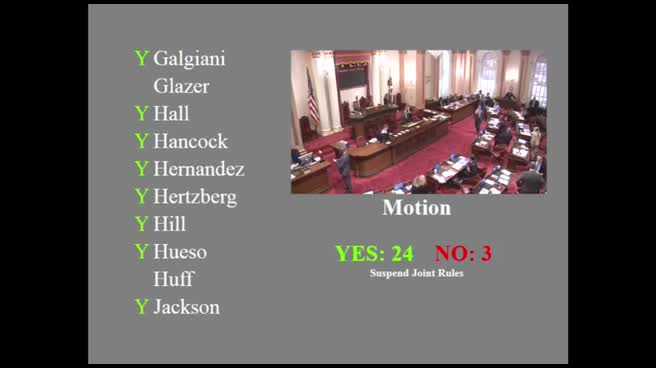 2MIN
Senate Floor
 22SEC
Senate Standing Committee on Appropriations
 2MIN
Assembly Floor
Bill Author

Bill Co-Author(s):