AB 1358: School facilities: design-build contracts.
- Session Year: 2015-2016
- House: Assembly
- Latest Version Date: 2015-10-10
Existing law authorizes the governing board of a school district, until January 1, 2020, and upon a determination by the governing board of the school district that it is in the best interest of the school district, to enter into a design-build contract for both the design and construction of a school facility if that expenditure exceeds $2,500,000, as provided.
This bill would make those provisions inoperative on July 1, 2016, and as of that date would instead authorize, until January 1, 2025, a school district, with the approval of the governing board of the school district, to procure design-build contracts for public works projects in excess of $1,000,000, awarding the contract to either the low bid or the best value, as provided. The bill would require specified information to be verified under penalty of perjury. By expanding the crime of perjury, the bill would impose a state-mandated local program.
The California Constitution requires the state to reimburse local agencies and school districts for certain costs mandated by the state. Statutory provisions establish procedures for making that reimbursement.
This bill would provide that no reimbursement is required by this act for a specified reason.
Existing law authorizes the governing board of a school district, until January 1, 2020, and upon a determination by the governing board of the school district that it is in the best interest of the school district, to enter into a design-build contract for both the design and construction of a school facility if that expenditure exceeds $2,500,000, as provided.
This bill would repeal make those provisions and inoperative on July 1, 2016, and as of that date would instead authorize, until January 1, 2025, a school district, with the approval of the governing board of the school district, to procure design-build contracts for public works projects in excess of $1,000,000, awarding the contract to either the low bid or the best value, as provided. The bill would require specified information to be verified under penalty of perjury. By expanding the crime of perjury, the bill would impose a state-mandated local program.
The California Constitution requires the state to reimburse local agencies and school districts for certain costs mandated by the state. Statutory provisions establish procedures for making that reimbursement.
This bill would provide that no reimbursement is required by this act for a specified reason.
Existing law authorizes the governing board of a school district, until January 1, 2020, upon a determination by the governing board of the school district that it is in the best interest of the school district, to enter into a design-build contract for both the design and construction of a school facility if that expenditure exceeds $2,500,000, as provided.
This bill would repeal those provisions and would instead authorize, until January 1, 2025, a school district, with the approval of the governing board of the school district, to procure design-build contracts for public works projects in excess of $1,000,000, awarding the contract to either the low bid or the best value, as provided. The bill would require specified information to be verified under penalty of perjury. By expanding the crime of perjury, the bill would impose a state-mandated local program.
The California Constitution requires the state to reimburse local agencies and school districts for certain costs mandated by the state. Statutory provisions establish procedures for making that reimbursement.
This bill would provide that no reimbursement is required by this act for a specified reason.
This chapter shall become inoperative on July 1, 2016, and, as of January 1, 2017, is repealed, unless a later enacted statute, that becomes operative on or before January 1, 2017, deletes or extends the dates on which it becomes inoperative and is repealed.
SEC. 2.Chapter 2.5 (commencing with Section 17250.10) is added to Part 10.5 of Division 1 of Title 1 of the Education Code, to read:2.5.Design-Build Contracts17250.10.(a)The Legislature finds and declares that the design-build method of project delivery, using a best value procurement methodology, has been authorized for various agencies that have reported benefits from those projects, including reduced project costs, expedited project completion, and design features that are not achievable through the traditional design-bid-build method.
(b)It is the intent of the Legislature that:
(1)This chapter provide general authorization for school districts to use the design-build method for projects.
(2)This chapter shall not be deemed to express a preference for the design-build method over other procurement methodologies.
17250.15.For purposes of this chapter, the following definitions apply:
(a)(1)Best value means a value determined by evaluation of objective criteria that may include, but are not limited to, price, features, functions, life-cycle costs, experience, and past performance.
(2)A best value determination may involve the selection of the lowest cost proposal meeting the interests of the school district and the objectives of the project, selection of the best proposal for a stipulated sum established by the procuring school district, or a tradeoff between price and other factors.
(b)Construction subcontract means a subcontract awarded by the design-build entity to a subcontractor that will perform work or labor or will render service to the design-build entity in or about the construction of the work or improvement, or a subcontractor licensed by the state which, under subcontract to the design-build entity, specially fabricates and installs a portion of the work or improvement according to detailed drawings contained in the plans and specifications produced by the design-build team.
(c)Design-build means a project delivery process in which both the design and construction of a project are procured from a single entity.
(d)Design-build entity means a corporation, limited liability company, partnership, joint venture, or other legal entity that is able to provide appropriately licensed contracting, architectural, and engineering services, as needed, pursuant to a design-build contract.
(e)(1)Design-build team means the design-build entity and the individuals or other entities identified by the design-build entity as members of its team.
(2)Members shall include the general contractor and, if utilized in the design of the project, all electrical, mechanical, and plumbing contractors.
(f)Project means the construction of any school facility.
17250.20.(a)A school district, with approval of its governing board, may procure design-build contracts for projects in excess of one million dollars ($1,000,000), awarding the contract to either the low bid or the best value.
(b)The school district shall develop guidelines for a standard organizational conflict-of-interest policy, consistent with applicable law, regarding the ability of a person or entity that performs services for the school district relating to the solicitation of a design-build project, to submit a proposal as a design-build entity, or to join a design-build team. This conflict-of-interest policy shall apply to each school district entering into design-build contracts authorized under this chapter.
(c)This chapter shall apply to bid requests issued on or after July 1, 2016.
17250.25.The procurement process for design-build projects shall progress as follows:
(a)(1)The school district shall prepare a set of documents setting forth the scope and estimated price of the project. The documents may include, but are not limited to, the size, type, and desired design character of the project, performance specifications covering the quality of materials, equipment, workmanship, preliminary plans or building layouts, or any other information deemed necessary to describe adequately the school districts needs. The performance specifications and any plans shall be prepared by a design professional who is duly licensed and registered in California.
(2)The documents shall not include a design-build-operate contract for a project. The documents, however, may include operations during a training or transition period, but shall not include long-term operations for a project.
(b)The school district shall prepare and issue a request for qualifications in order to prequalify, or develop a short-list of, the design-build entities whose proposals shall be evaluated for final selection. The request for qualifications shall include, but is not limited to, all of the following elements:
(1)Identification of the basic scope and needs of the project or contract, the expected cost range, the methodology that will be used by the school district to evaluate proposals, the procedure for final selection of the design-build entity, and any other information deemed necessary by the school district to inform interested parties of the contracting opportunity.
(2)Significant factors that the school district reasonably expects to consider in evaluating qualifications, including technical design and construction expertise, acceptable safety record, and all other nonprice-related factors.
(3)A standard template request for statements of qualifications prepared by the school district. In preparing the standard template, the school district may consult with the construction industry, the building trades and surety industry, and other school districts interested in using the authorization provided by this chapter. The template shall require the following information:
(A)If the design-build entity is a privately held corporation, limited liability company, partnership, or joint venture, a listing of all of the shareholders, partners, or members known at the time of statement of qualification submission who will perform work on the project.
(B)Evidence that the members of the design-build team have completed, or demonstrated the experience, competency, capability, and capacity to complete, projects of similar size, scope, or complexity, and that the proposed key personnel have sufficient experience and training to competently manage and complete the design and construction of the project, and a financial statement that ensures that the design-build entity has the capacity to complete the project.
(C)The licenses, registration, and credentials required to design and construct the project, including, but not limited to, information on the revocation or suspension of any license, credential, or registration.
(D)Evidence that establishes that the design-build entity has the capacity to obtain all required payment and performance bonding, liability insurance, and errors and omissions insurance.
(E)Information concerning workers compensation experience history and a worker safety program.
(F)If the proposed design-build entity is a corporation, limited liability company, partnership, joint venture, or other legal entity, a copy of the organizational documents or agreement committing to form the organization.
(G)An acceptable safety record. A proposers safety record shall be deemed acceptable if its experience modification rate for the most recent three-year period is an average of 1.00 or less, and its average total recordable injury or illness rate and average lost work rate for the most recent three-year period does not exceed the applicable statistical standards for its business category, or if the proposer is a party to an alternative dispute resolution system, as provided for in Section 3201.5 of the Labor Code.
(4)(A)The information required under this subdivision shall be certified under penalty of perjury by the design-build entity and its general partners or joint venture members.
(B)Information required under this subdivision that is not otherwise a public record under the California Public Records Act (Chapter 3.5 (commencing with Section 6250) of Division 7 of Title 1 of the Government Code) shall not be open to public inspection.
(c)A design-build entity shall not be prequalified or shortlisted unless the entity provides an enforceable commitment to the school district that the entity and its subcontractors at every tier will use a skilled and trained workforce to perform all work on the project or contract that falls within an apprenticeable occupation in the building and construction trades.
(1)For purposes of this subdivision:
(A)Apprenticeable occupation means an occupation for which the Chief of the Division of Apprenticeship Standards had approved an apprenticeship program pursuant to Section 3075 of the Labor Code before January 1, 2014.
(B)Skilled and trained workforce means a workforce that meets all of the following conditions:
(i)All the workers are either skilled journeypersons or apprentices registered in an apprenticeship program approved by the Chief of the Division of Apprenticeship Standards.
(ii)(I)As of July 1, 2016, at least 20 percent of the skilled journeypersons employed to perform work on the contract or project by the entity and each of its subcontractors at every tier are graduates of an apprenticeship program for the applicable occupation that was either approved by the Chief of the Division of Apprenticeship Standards pursuant to Section 3075 of the Labor Code or located outside California and approved for federal purposes pursuant to the apprenticeship regulations adopted by the federal Secretary of Labor.
(II)As of July 1, 2017, at least 30 percent of the skilled journeypersons employed to perform work on the contract or project by the entity and each of its subcontractors at every tier are graduates of an apprenticeship program for the applicable occupation that was either approved by the Chief of the Division of Apprenticeship Standards pursuant to Section 3075 of the Labor Code or located outside California and approved for federal purposes pursuant to the apprenticeship regulations adopted by the federal Secretary of Labor.
(III)As of July 1, 2018, at least 40 percent of the skilled journeypersons employed to perform work on the contract or project by the entity and each of its subcontractors at every tier are graduates of an apprenticeship program for the applicable occupation that was either approved by the Chief of the Division of Apprenticeship Standards pursuant to Section 3075 of the Labor Code or located outside California and approved for federal purposes pursuant to the apprenticeship regulations adopted by the federal Secretary of Labor.
(IV)As of July 1, 2019, at least 50 percent of the skilled journeypersons employed to perform work on the contract or project by the entity and each of its subcontractors at every tier are graduates of an apprenticeship program for the applicable occupation that was either approved by the Chief of the Division of Apprenticeship Standards pursuant to Section 3075 of the Labor Code or located outside California and approved for federal purposes pursuant to the apprenticeship regulations adopted by the federal Secretary of Labor.
(V)As of July 1, 2020, at least 60 percent of the skilled journeypersons employed to perform work on the contract or project by the entity and each of its subcontractors at every tier are graduates of an apprenticeship program for the applicable occupation that was either approved by the Chief of the Division of Apprenticeship Standards pursuant to Section 3075 of the Labor Code or located outside California and approved for federal purposes pursuant to the apprenticeship regulations adopted by the federal Secretary of Labor.
(iii)For an apprenticeable occupation in which no apprenticeship program had been approved by the Chief of the Division of Apprenticeship Standards before January 1, 1995, up to one-half of the graduation percentage requirements of clause (ii) may be satisfied by skilled journeypersons who commenced working in the apprenticeable occupation prior to the chiefs approval of an apprenticeship program for that occupation in the county in which the project is located.
(C)Skilled journeyperson means a worker who either:
(i)Graduated from an apprenticeship program for the applicable occupation that was approved by the Chief of the Division of Apprenticeship Standards or located outside California and approved for federal purposes pursuant to the apprenticeship regulations adopted by the federal Secretary of Labor.
(ii)Has at least as many hours of on-the-job experience in the applicable occupation as would be required to graduate from an apprenticeship program for the applicable occupation that is approved by the chief.
(2)An entitys commitment that a skilled and trained workforce will be used to perform the project or contract may be established by any of the following:
(A)The entitys agreement with the school district that the entity and its subcontractors at every tier will comply with the requirements of this subdivision and that the entity will provide the school district with evidence, on a monthly basis while the project or contract is being performed, that the entity and its subcontractors are complying with the requirements of this subdivision.
(B)If the school district has entered into a project labor agreement that will bind all contractors and subcontractors performing work on the project or contract and that includes the requirements of this subdivision, the entitys agreement that it will become a party to that project labor agreement.
(C)Evidence that the entity has entered into a project labor agreement that includes the requirements of this subdivision and that will bind the entity and all its subcontractors at every tier performing the project or contract.
(d)Based on the documents prepared as described in subdivision (a), the school district shall prepare a request for proposals that invites prequalified or short-listed entities to submit competitive sealed proposals in the manner prescribed by the school district. The request for proposals shall include, but need not be limited to, the following elements:
(1)Identification of the basic scope and needs of the project or contract, the estimated cost of the project, the methodology that will be used by the school district to evaluate proposals, whether the contract will be awarded on the basis of low bid or best value, and any other information deemed necessary by the school district to inform interested parties of the contracting opportunity.
(2)Significant factors that the school district reasonably expects to consider in evaluating proposals, including, but not limited to, cost or price and all nonprice-related factors.
(3)The relative importance or the weight assigned to each of the factors identified in the request for proposals.
(4)Where a best value selection method is used, the school district may reserve the right to request proposal revisions and hold discussions and negotiations with responsive proposers, in which case the school district shall so specify in the request for proposals and shall publish separately or incorporate into the request for proposals applicable procedures to be observed by the school district to ensure that any discussions or negotiations are conducted in good faith.
(e)For those projects utilizing low bid as the final selection method, the competitive bidding process shall result in lump-sum bids by the prequalified or short-listed design-build entities, and awards shall be made to the design-build entity that is the lowest responsible bidder.
(f)For those projects utilizing best value as a selection method, the design-build competition shall progress as follows:
(1)Competitive proposals shall be evaluated by using only the criteria and selection procedures specifically identified in the request for proposals. The following minimum factors, however, shall be weighted as deemed appropriate by the school district:
(A)Price, unless a stipulated sum is specified.
(B)Technical design and construction expertise.
(C)Life-cycle costs over 15 or more years.
(2)Pursuant to subdivision (d), the school district may hold discussions or negotiations with responsive proposers using the process articulated in the school districts request for proposals.
(3)When the evaluation is complete, the responsive proposers shall be ranked based on a determination of value provided, provided that no more than three proposers are required to be ranked.
(4)The award of the contract shall be made to the responsible design-build entity whose proposal is determined by the school district to have offered the best value to the public.
(5)Notwithstanding any other provision of law, upon issuance of a contract award, the school district shall publicly announce its award, identifying the design-build entity to which the award is made, along with a statement regarding the basis of the award.
(6)The statement regarding the school districts contract award, described in paragraph (5), and the contract file shall provide sufficient information to satisfy an external audit.
17250.30.(a)The design-build entity shall provide payment and performance bonds for the project in the form and in the amount required by the school district, and issued by a California admitted surety. The amount of the payment bond shall not be less than the amount of the performance bond.
(b)The design-build contract shall require errors and omissions insurance coverage for the design elements of the project.
(c)The school district shall develop a standard form of payment and performance bond for its design-build projects.
17250.35.The school district, in each design-build request for proposals, may identify specific types of subcontractors that must be included in the design-build entity statement of qualifications and proposal. All construction subcontractors that are identified in the proposal shall be afforded all the protections of Chapter 4 (commencing with Section 4100) of Part 1 of Division 2 of the Public Contract Code.
(a)Following award of the design-build contract, the design-build entity shall proceed as follows in awarding construction subcontracts with a value exceeding one-half of 1 percent of the contract price allocable to construction work:
(1)Provide public notice of availability of work to be subcontracted in accordance with the publication requirements applicable to the competitive bidding process of the school district, including a fixed date and time on which qualifications statements, bids, or proposals will be due.
(2)Establish reasonable qualification criteria and standards.
(3)Award the subcontract either on a best value basis or to the lowest responsible bidder. The process may include prequalification or short-listing. The foregoing process does not apply to construction subcontractors listed in the original proposal. Subcontractors awarded construction subcontracts under this subdivision shall be afforded all the protections of Chapter 4 (commencing with Section 4100) of Part 1 of Division 2 of the Public Contract Code.
17250.40.(a)If the school district elects to award a project pursuant to this chapter, retention proceeds withheld by the school district from the design-build entity shall not exceed 5 percent.
(b)In a contract between the design-build entity and a subcontractor, and in a contract between a subcontractor and any subcontractor thereunder, the percentage of the retention proceeds withheld may not exceed the percentage specified in the contract between the school district agency and the design-build entity. If the design-build entity provides written notice to any subcontractor that is not a member of the design-build entity, prior to or at the time the bid is requested, that a bond may be required and the subcontractor subsequently is unable or refuses to furnish a bond to the design-build entity, then the design-build entity may withhold retention proceeds in excess of the percentage specified in the contract between the school district and the design-build entity from any payment made by the design-build entity to the subcontractor.
17250.45.Nothing in this chapter affects, expands, alters, or limits any rights or remedies otherwise available at law.
17250.50.This chapter shall become operative on July 1, 2016.
17250.55.This chapter shall remain in effect only until January 1, 2025, and as of that date is repealed, unless a later enacted statute, that takes effect before January 1, 2025, deletes or extends that date.
SEC. 3.Section 4 of Chapter 421 of the Statutes of 2001, as amended by Section 5 of Chapter 736 of the Statutes of 2012, is repealed.SEC. 4.No reimbursement is required by this act pursuant to Section 6 of Article XIIIB of the California Constitution because the only costs that may be incurred by a local agency or school district will be incurred because this act creates a new crime or infraction, eliminates a crime or infraction, or changes the penalty for a crime or infraction, within the meaning of Section 17556 of the Government Code, or changes the definition of a crime within the meaning of Section 6 of Article XIIIB of the California Constitution.
This chapter shall become inoperative on July 1, 2016, and, as of January 1, 2017, is repealed, unless a later enacted statute, that becomes operative on or before January 1, 2017, deletes or extends the dates on which it becomes inoperative and is repealed.
SEC. 2.Chapter 2.5 (commencing with Section 17250.10) is added to Part 10.5 of Division 1 of Title 1 of the Education Code, to read:2.5.Design-Build Contracts17250.10.(a)The Legislature finds and declares that the design-build method of project delivery, using a best value procurement methodology, has been authorized for various agencies that have reported benefits from those projects, including reduced project costs, expedited project completion, and design features that are not achievable through the traditional design-bid-build method.
(b)It is the intent of the Legislature that:
(1)This chapter provide general authorization for school districts to use the design-build method for projects.
(2)This chapter shall not be deemed to express a preference for the design-build method over other procurement methodologies.
17250.15.For purposes of this chapter, the following definitions apply:
(a)(1)Best value means a value determined by evaluation of objective criteria that may include, but are not limited to, price, features, functions, life-cycle costs, experience, and past performance.
(2)A best value determination may involve the selection of the lowest cost proposal meeting the interests of the school district and the objectives of the project, selection of the best proposal for a stipulated sum established by the procuring school district, or a tradeoff between price and other factors.
(b)Construction subcontract means a subcontract awarded by the design-build entity to a subcontractor that will perform work or labor or will render service to the design-build entity in or about the construction of the work or improvement, or a subcontractor licensed by the state which, under subcontract to the design-build entity, specially fabricates and installs a portion of the work or improvement according to detailed drawings contained in the plans and specifications produced by the design-build team.
(c)Design-build means a project delivery process in which both the design and construction of a project are procured from a single entity.
(d)Design-build entity means a corporation, limited liability company, partnership, joint venture, or other legal entity that is able to provide appropriately licensed contracting, architectural, and engineering services, as needed, pursuant to a design-build contract.
(e)(1)Design-build team means the design-build entity and the individuals or other entities identified by the design-build entity as members of its team.
(2)Members shall include the general contractor and, if utilized in the design of the project, all electrical, mechanical, and plumbing contractors.
(f)Project means the construction of any school facility.
17250.20.(a)A school district, with approval of its governing board, may procure design-build contracts for projects in excess of one million dollars ($1,000,000), awarding the contract to either the low bid or the best value.
(b)The school district shall develop guidelines for a standard organizational conflict-of-interest policy, consistent with applicable law, regarding the ability of a person or entity that performs services for the school district relating to the solicitation of a design-build project, to submit a proposal as a design-build entity, or to join a design-build team. This conflict-of-interest policy shall apply to each school district entering into design-build contracts authorized under this chapter.
(c)This chapter shall apply to bid requests issued on or after July 1, 2016.
17250.25.The procurement process for design-build projects shall progress as follows:
(a)(1)The school district shall prepare a set of documents setting forth the scope and estimated price of the project. The documents may include, but are not limited to, the size, type, and desired design character of the project, performance specifications covering the quality of materials, equipment, workmanship, preliminary plans or building layouts, or any other information deemed necessary to describe adequately the school districts needs. The performance specifications and any plans shall be prepared by a design professional who is duly licensed and registered in California.
(2)The documents shall not include a design-build-operate contract for a project. The documents, however, may include operations during a training or transition period, but shall not include long-term operations for a project.
(b)The school district shall prepare and issue a request for qualifications in order to prequalify, or develop a short-list of, the design-build entities whose proposals shall be evaluated for final selection. The request for qualifications shall include, but is not limited to, all of the following elements:
(1)Identification of the basic scope and needs of the project or contract, the expected cost range, the methodology that will be used by the school district to evaluate proposals, the procedure for final selection of the design-build entity, and any other information deemed necessary by the school district to inform interested parties of the contracting opportunity.
(2)Significant factors that the school district reasonably expects to consider in evaluating qualifications, including technical design and construction expertise, acceptable safety record, and all other nonprice-related factors.
(3)A standard template request for statements of qualifications prepared by the school district. In preparing the standard template, the school district may consult with the construction industry, the building trades and surety industry, and other school districts interested in using the authorization provided by this chapter. The template shall require the following information:
(A)If the design-build entity is a privately held corporation, limited liability company, partnership, or joint venture, a listing of all of the shareholders, partners, or members known at the time of statement of qualification submission who will perform work on the project.
(B)Evidence that the members of the design-build team have completed, or demonstrated the experience, competency, capability, and capacity to complete, projects of similar size, scope, or complexity, and that the proposed key personnel have sufficient experience and training to competently manage and complete the design and construction of the project, and a financial statement that ensures that the design-build entity has the capacity to complete the project.
(C)The licenses, registration, and credentials required to design and construct the project, including, but not limited to, information on the revocation or suspension of any license, credential, or registration.
(D)Evidence that establishes that the design-build entity has the capacity to obtain all required payment and performance bonding, liability insurance, and errors and omissions insurance.
(E)Information concerning workers compensation experience history and a worker safety program.
(F)If the proposed design-build entity is a corporation, limited liability company, partnership, joint venture, or other legal entity, a copy of the organizational documents or agreement committing to form the organization.
(G)An acceptable safety record. A proposers safety record shall be deemed acceptable if its experience modification rate for the most recent three-year period is an average of 1.00 or less, and its average total recordable injury or illness rate and average lost work rate for the most recent three-year period does not exceed the applicable statistical standards for its business category, or if the proposer is a party to an alternative dispute resolution system, as provided for in Section 3201.5 of the Labor Code.
(4)(A)The information required under this subdivision shall be certified under penalty of perjury by the design-build entity and its general partners or joint venture members.
(B)Information required under this subdivision that is not otherwise a public record under the California Public Records Act (Chapter 3.5 (commencing with Section 6250) of Division 7 of Title 1 of the Government Code) shall not be open to public inspection.
(c)A design-build entity shall not be prequalified or shortlisted unless the entity provides an enforceable commitment to the school district that the entity and its subcontractors at every tier will use a skilled and trained workforce to perform all work on the project or contract that falls within an apprenticeable occupation in the building and construction trades.
(1)For purposes of this subdivision:
(A)Apprenticeable occupation means an occupation for which the Chief of the Division of Apprenticeship Standards had approved an apprenticeship program pursuant to Section 3075 of the Labor Code before January 1, 2014.
(B)Skilled and trained workforce means a workforce that meets all of the following conditions:
(i)All the workers are either skilled journeypersons or apprentices registered in an apprenticeship program approved by the Chief of the Division of Apprenticeship Standards.
(ii)(I)As of January July 1, 2016, at least 20 percent of the skilled journeypersons employed to perform work on the contract or project by the entity and each of its subcontractors at every tier are graduates of an apprenticeship program for the applicable occupation that was either approved by the Chief of the Division of Apprenticeship Standards pursuant to Section 3075 of the Labor Code or located outside California and approved for federal purposes pursuant to the apprenticeship regulations adopted by the federal Secretary of Labor.
(II)As of January July 1, 2017, at least 30 percent of the skilled journeypersons employed to perform work on the contract or project by the entity and each of its subcontractors at every tier are graduates of an apprenticeship program for the applicable occupation that was either approved by the Chief of the Division of Apprenticeship Standards pursuant to Section 3075 of the Labor Code or located outside California and approved for federal purposes pursuant to the apprenticeship regulations adopted by the federal Secretary of Labor.
(III)As of January July 1, 2018, at least 40 percent of the skilled journeypersons employed to perform work on the contract or project by the entity and each of its subcontractors at every tier are graduates of an apprenticeship program for the applicable occupation that was either approved by the Chief of the Division of Apprenticeship Standards pursuant to Section 3075 of the Labor Code or located outside California and approved for federal purposes pursuant to the apprenticeship regulations adopted by the federal Secretary of Labor.
(IV)As of January July 1, 2019, at least 50 percent of the skilled journeypersons employed to perform work on the contract or project by the entity and each of its subcontractors at every tier are graduates of an apprenticeship program for the applicable occupation that was either approved by the Chief of the Division of Apprenticeship Standards pursuant to Section 3075 of the Labor Code or located outside California and approved for federal purposes pursuant to the apprenticeship regulations adopted by the federal Secretary of Labor.
(V)As of January July 1, 2020, at least 60 percent of the skilled journeypersons employed to perform work on the contract or project by the entity and each of its subcontractors at every tier are graduates of an apprenticeship program for the applicable occupation that was either approved by the Chief of the Division of Apprenticeship Standards pursuant to Section 3075 of the Labor Code or located outside California and approved for federal purposes pursuant to the apprenticeship regulations adopted by the federal Secretary of Labor.
(iii)For an apprenticeable occupation in which no apprenticeship program had been approved by the Chief of the Division of Apprenticeship Standards before January 1, 1995, up to one-half of the graduation percentage requirements of clause (ii) may be satisfied by skilled journeypersons who commenced working in the apprenticeable occupation prior to the chiefs approval of an apprenticeship program for that occupation in the county in which the project is located.
(C)Skilled journeyperson means a worker who either:
(i)Graduated from an apprenticeship program for the applicable occupation that was approved by the Chief of the Division of Apprenticeship Standards or located outside California and approved for federal purposes pursuant to the apprenticeship regulations adopted by the federal Secretary of Labor.
(ii)Has at least as many hours of on-the-job experience in the applicable occupation as would be required to graduate from an apprenticeship program for the applicable occupation that is approved by the chief.
(2)An entitys commitment that a skilled and trained workforce will be used to perform the project or contract may be established by any of the following:
(A)The entitys agreement with the school district that the entity and its subcontractors at every tier will comply with the requirements of this subdivision and that the entity will provide the school district with evidence, on a monthly basis while the project or contract is being performed, that the entity and its subcontractors are complying with the requirements of this subdivision.
(B)If the school district has entered into a project labor agreement that will bind all contractors and subcontractors performing work on the project or contract and that includes the requirements of this subdivision, the entitys agreement that it will become a party to that project labor agreement.
(C)Evidence that the entity has entered into a project labor agreement that includes the requirements of this subdivision and that will bind the entity and all its subcontractors at every tier performing the project or contract.
(d)Based on the documents prepared as described in subdivision (a), the school district shall prepare a request for proposals that invites prequalified or short-listed entities to submit competitive sealed proposals in the manner prescribed by the school district. The request for proposals shall include, but need not be limited to, the following elements:
(1)Identification of the basic scope and needs of the project or contract, the estimated cost of the project, the methodology that will be used by the school district to evaluate proposals, whether the contract will be awarded on the basis of low bid or best value, and any other information deemed necessary by the school district to inform interested parties of the contracting opportunity.
(2)Significant factors that the school district reasonably expects to consider in evaluating proposals, including, but not limited to, cost or price and all nonprice-related factors.
(3)The relative importance or the weight assigned to each of the factors identified in the request for proposals.
(4)Where a best value selection method is used, the school district may reserve the right to request proposal revisions and hold discussions and negotiations with responsive proposers, in which case the school district shall so specify in the request for proposals and shall publish separately or incorporate into the request for proposals applicable procedures to be observed by the school district to ensure that any discussions or negotiations are conducted in good faith.
(e)For those projects utilizing low bid as the final selection method, the competitive bidding process shall result in lump-sum bids by the prequalified or short-listed design-build entities, and awards shall be made to the design-build entity that is the lowest responsible bidder.
(f)For those projects utilizing best value as a selection method, the design-build competition shall progress as follows:
(1)Competitive proposals shall be evaluated by using only the criteria and selection procedures specifically identified in the request for proposals. The following minimum factors, however, shall be weighted as deemed appropriate by the school district:
(A)Price, unless a stipulated sum is specified.
(B)Technical design and construction expertise.
(C)Life-cycle costs over 15 or more years.
(2)Pursuant to subdivision (d), the school district may hold discussions or negotiations with responsive proposers using the process articulated in the school districts request for proposals.
(3)When the evaluation is complete, the responsive proposers shall be ranked based on a determination of value provided, provided that no more than three proposers are required to be ranked.
(4)The award of the contract shall be made to the responsible design-build entity whose proposal is determined by the school district to have offered the best value to the public.
(5)Notwithstanding any other provision of law, upon issuance of a contract award, the school district shall publicly announce its award, identifying the design-build entity to which the award is made, along with a statement regarding the basis of the award.
(6)The statement regarding the school districts contract award, described in paragraph (5), and the contract file shall provide sufficient information to satisfy an external audit.
17250.30.(a)The design-build entity shall provide payment and performance bonds for the project in the form and in the amount required by the school district, and issued by a California admitted surety. The amount of the payment bond shall not be less than the amount of the performance bond.
(b)The design-build contract shall require errors and omissions insurance coverage for the design elements of the project.
(c)The school district shall develop a standard form of payment and performance bond for its design-build projects.
17250.35.The school district, in each design-build request for proposals, may identify specific types of subcontractors that must be included in the design-build entity statement of qualifications and proposal. All construction subcontractors that are identified in the proposal shall be afforded all the protections of Chapter 4 (commencing with Section 4100) of Part 1 of Division 2 of the Public Contract Code.
(a)Following award of the design-build contract, the design-build entity shall proceed as follows in awarding construction subcontracts with a value exceeding one-half of 1 percent of the contract price allocable to construction work:
(1)Provide public notice of availability of work to be subcontracted in accordance with the publication requirements applicable to the competitive bidding process of the school district, including a fixed date and time on which qualifications statements, bids, or proposals will be due.
(2)Establish reasonable qualification criteria and standards.
(3)Award the subcontract either on a best value basis or to the lowest responsible bidder. The process may include prequalification or short-listing. The foregoing process does not apply to construction subcontractors listed in the original proposal. Subcontractors awarded construction subcontracts under this subdivision shall be afforded all the protections of Chapter 4 (commencing with Section 4100) of Part 1 of Division 2 of the Public Contract Code.
17250.40.(a)If the school district elects to award a project pursuant to this chapter, retention proceeds withheld by the school district from the design-build entity shall not exceed 5 percent.
(b)In a contract between the design-build entity and a subcontractor, and in a contract between a subcontractor and any subcontractor thereunder, the percentage of the retention proceeds withheld may not exceed the percentage specified in the contract between the school district agency and the design-build entity. If the design-build entity provides written notice to any subcontractor that is not a member of the design-build entity, prior to or at the time the bid is requested, that a bond may be required and the subcontractor subsequently is unable or refuses to furnish a bond to the design-build entity, then the design-build entity may withhold retention proceeds in excess of the percentage specified in the contract between the school district and the design-build entity from any payment made by the design-build entity to the subcontractor.
17250.45.Nothing in this chapter affects, expands, alters, or limits any rights or remedies otherwise available at law.
17250.50.This chapter shall become operative on July 1, 2016.
17250.50.17250.55.This chapter shall remain in effect only until January 1, 2025, and as of that date is repealed, unless a later enacted statute, that takes effect before January 1, 2025, deletes or extends that date.
SEC. 3.Section 4 of Chapter 421 of the Statutes of 2001, as amended by Section 5 of Chapter 736 of the Statutes of 2012, is repealed.Sec. 4.This act shall remain in effect only until January 1, 2020, and as of that date is repealed, unless a later enacted statute, that is enacted before January 1, 2020, deletes or extends that date.
SEC. 3.SEC. 4.No reimbursement is required by this act pursuant to Section 6 of Article XIIIB of the California Constitution because the only costs that may be incurred by a local agency or school district will be incurred because this act creates a new crime or infraction, eliminates a crime or infraction, or changes the penalty for a crime or infraction, within the meaning of Section 17556 of the Government Code, or changes the definition of a crime within the meaning of Section 6 of Article XIIIB of the California Constitution.
(a)The Legislature finds and declares that the design-build method of project delivery, using a best value procurement methodology, has been authorized for various agencies that have reported benefits from those projects, including reduced project costs, expedited project completion, and design features that are not achievable through the traditional design-bid-build method.
(b)It is the intent of the Legislature that:
(1)This chapter provide general authorization for school districts to use the design-build method for projects.
(2)This chapter shall not be deemed to express a preference for the design-build method over other procurement methodologies.
17250.15.For purposes of this chapter, the following definitions apply:
(a)(1)Best value means a value determined by evaluation of objective criteria that may include, but are not limited to, price, features, functions, life-cycle costs, experience, and past performance.
(2)A best value determination may involve the selection of the lowest cost proposal meeting the interests of the school district and the objectives of the project, selection of the best proposal for a stipulated sum established by the procuring school district, or a tradeoff between price and other factors.
(b)Construction subcontract means a subcontract awarded by the design-build entity to a subcontractor that will perform work or labor or will render service to the design-build entity in or about the construction of the work or improvement, or a subcontractor licensed by the state which, under subcontract to the design-build entity, specially fabricates and installs a portion of the work or improvement according to detailed drawings contained in the plans and specifications produced by the design-build team.
(c)Design-build means a project delivery process in which both the design and construction of a project are procured from a single entity.
(d)Design-build entity means a corporation, limited liability company, partnership, joint venture, or other legal entity that is able to provide appropriately licensed contracting, architectural, and engineering services, as needed, pursuant to a design-build contract.
(e)(1)Design-build team means the design-build entity and the individuals or other entities identified by the design-build entity as members of its team.
(2)Members shall include the general contractor and, if utilized in the design of the project, all electrical, mechanical, and plumbing contractors.
(f)Project means the construction of any school facility.
17250.20.(a)A school district, with approval of its governing board, may procure design-build contracts for projects in excess of one million dollars ($1,000,000), awarding the contract to either the low bid or the best value.
(b)The school district shall develop guidelines for a standard organizational conflict-of-interest policy, consistent with applicable law, regarding the ability of a person or entity that performs services for the school district relating to the solicitation of a design-build project, to submit a proposal as a design-build entity, or to join a design-build team. This conflict-of-interest policy shall apply to each school district entering into design-build contracts authorized under this chapter.
17250.25.The procurement process for design-build projects shall progress as follows:
(a)(1)The school district shall prepare a set of documents setting forth the scope and estimated price of the project. The documents may include, but are not limited to, the size, type, and desired design character of the project, performance specifications covering the quality of materials, equipment, workmanship, preliminary plans or building layouts, or any other information deemed necessary to describe adequately the school districts needs. The performance specifications and any plans shall be prepared by a design professional who is duly licensed and registered in California.
(2)The documents shall not include a design-build-operate contract for a project. The documents, however, may include operations during a training or transition period, but shall not include long-term operations for a project.
(b)The school district shall prepare and issue a request for qualifications in order to prequalify, or develop a short-list of, the design-build entities whose proposals shall be evaluated for final selection. The request for qualifications shall include, but is not limited to, all of the following elements:
(1)Identification of the basic scope and needs of the project or contract, the expected cost range, the methodology that will be used by the school district to evaluate proposals, the procedure for final selection of the design-build entity, and any other information deemed necessary by the school district to inform interested parties of the contracting opportunity.
(2)Significant factors that the school district reasonably expects to consider in evaluating qualifications, including technical design and construction expertise, acceptable safety record, and all other nonprice-related factors.
(3)A standard template request for statements of qualifications prepared by the school district. In preparing the standard template, the school district may consult with the construction industry, the building trades and surety industry, and other school districts interested in using the authorization provided by this chapter. The template shall require the following information:
(A)If the design-build entity is a privately held corporation, limited liability company, partnership, or joint venture, a listing of all of the shareholders, partners, or members known at the time of statement of qualification submission who will perform work on the project.
(B)Evidence that the members of the design-build team have completed, or demonstrated the experience, competency, capability, and capacity to complete, projects of similar size, scope, or complexity, and that the proposed key personnel have sufficient experience and training to competently manage and complete the design and construction of the project, and a financial statement that ensures that the design-build entity has the capacity to complete the project.
(C)The licenses, registration, and credentials required to design and construct the project, including, but not limited to, information on the revocation or suspension of any license, credential, or registration.
(D)Evidence that establishes that the design-build entity has the capacity to obtain all required payment and performance bonding, liability insurance, and errors and omissions insurance.
(E)Information concerning workers compensation experience history and a worker safety program.
(F)If the proposed design-build entity is a corporation, limited liability company, partnership, joint venture, or other legal entity, a copy of the organizational documents or agreement committing to form the organization.
(G)An acceptable safety record. A proposers safety record shall be deemed acceptable if its experience modification rate for the most recent three-year period is an average of 1.00 or less, and its average total recordable injury or illness rate and average lost work rate for the most recent three-year period does not exceed the applicable statistical standards for its business category, or if the proposer is a party to an alternative dispute resolution system, as provided for in Section 3201.5 of the Labor Code.
(4)(A)The information required under this subdivision shall be certified under penalty of perjury by the design-build entity and its general partners or joint venture members.
(B)Information required under this subdivision that is not otherwise a public record under the California Public Records Act (Chapter 3.5 (commencing with Section 6250) of Division 7 of Title 1 of the Government Code) shall not be open to public inspection.
(c)A design-build entity shall not be prequalified or shortlisted unless the entity provides an enforceable commitment to the school district that the entity and its subcontractors at every tier will use a skilled and trained workforce to perform all work on the project or contract that falls within an apprenticeable occupation in the building and construction trades.
(1)For purposes of this subdivision:
(A)Apprenticeable occupation means an occupation for which the Chief of the Division of Apprenticeship Standards had approved an apprenticeship program pursuant to Section 3075 of the Labor Code before January 1, 2014.
(B)Skilled and trained workforce means a workforce that meets all of the following conditions:
(i)All the workers are either skilled journeypersons or apprentices registered in an apprenticeship program approved by the Chief of the Division of Apprenticeship Standards.
(ii)(I)As of January 1, 2016, at least 20 percent of the skilled journeypersons employed to perform work on the contract or project by the entity and each of its subcontractors at every tier are graduates of an apprenticeship program for the applicable occupation that was either approved by the Chief of the Division of Apprenticeship Standards pursuant to Section 3075 of the Labor Code or located outside California and approved for federal purposes pursuant to the apprenticeship regulations adopted by the federal Secretary of Labor.
(II)As of January 1, 2017, at least 30 percent of the skilled journeypersons employed to perform work on the contract or project by the entity and each of its subcontractors at every tier are graduates of an apprenticeship program for the applicable occupation that was either approved by the Chief of the Division of Apprenticeship Standards pursuant to Section 3075 of the Labor Code or located outside California and approved for federal purposes pursuant to the apprenticeship regulations adopted by the federal Secretary of Labor.
(III)As of January 1, 2018, at least 40 percent of the skilled journeypersons employed to perform work on the contract or project by the entity and each of its subcontractors at every tier are graduates of an apprenticeship program for the applicable occupation that was either approved by the Chief of the Division of Apprenticeship Standards pursuant to Section 3075 of the Labor Code or located outside California and approved for federal purposes pursuant to the apprenticeship regulations adopted by the federal Secretary of Labor.
(IV)As of January 1, 2019, at least 50 percent of the skilled journeypersons employed to perform work on the contract or project by the entity and each of its subcontractors at every tier are graduates of an apprenticeship program for the applicable occupation that was either approved by the Chief of the Division of Apprenticeship Standards pursuant to Section 3075 of the Labor Code or located outside California and approved for federal purposes pursuant to the apprenticeship regulations adopted by the federal Secretary of Labor.
(V)As of January 1, 2020, at least 60 percent of the skilled journeypersons employed to perform work on the contract or project by the entity and each of its subcontractors at every tier are graduates of an apprenticeship program for the applicable occupation that was either approved by the Chief of the Division of Apprenticeship Standards pursuant to Section 3075 of the Labor Code or located outside California and approved for federal purposes pursuant to the apprenticeship regulations adopted by the federal Secretary of Labor.
(iii)For an apprenticeable occupation in which no apprenticeship program had been approved by the Chief of the Division of Apprenticeship Standards before January 1, 1995, up to one-half of the graduation percentage requirements of clause (ii) may be satisfied by skilled journeypersons who commenced working in the apprenticeable occupation prior to the chiefs approval of an apprenticeship program for that occupation in the county in which the project is located.
(C)Skilled journeyperson means a worker who either:
(i)Graduated from an apprenticeship program for the applicable occupation that was approved by the Chief of the Division of Apprenticeship Standards or located outside California and approved for federal purposes pursuant to the apprenticeship regulations adopted by the federal Secretary of Labor.
(ii)Has at least as many hours of on-the-job experience in the applicable occupation as would be required to graduate from an apprenticeship program for the applicable occupation that is approved by the chief.
(2)An entitys commitment that a skilled and trained workforce will be used to perform the project or contract may be established by any of the following:
(A)The entitys agreement with the school district that the entity and its subcontractors at every tier will comply with the requirements of this subdivision and that the entity will provide the school district with evidence, on a monthly basis while the project or contract is being performed, that the entity and its subcontractors are complying with the requirements of this subdivision.
(B)If the school district has entered into a project labor agreement that will bind all contractors and subcontractors performing work on the project or contract and that includes the requirements of this subdivision, the entitys agreement that it will become a party to that project labor agreement.
(C)Evidence that the entity has entered into a project labor agreement that includes the requirements of this subdivision and that will bind the entity and all its subcontractors at every tier performing the project or contract.
(d)Based on the documents prepared as described in subdivision (a), the school district shall prepare a request for proposals that invites prequalified or short-listed entities to submit competitive sealed proposals in the manner prescribed by the school district. The request for proposals shall include, but need not be limited to, the following elements:
(1)Identification of the basic scope and needs of the project or contract, the estimated cost of the project, the methodology that will be used by the school district to evaluate proposals, whether the contract will be awarded on the basis of low bid or best value, and any other information deemed necessary by the school district to inform interested parties of the contracting opportunity.
(2)Significant factors that the school district reasonably expects to consider in evaluating proposals, including, but not limited to, cost or price and all nonprice-related factors.
(3)The relative importance or the weight assigned to each of the factors identified in the request for proposals.
(4)Where a best value selection method is used, the school district may reserve the right to request proposal revisions and hold discussions and negotiations with responsive proposers, in which case the school district shall so specify in the request for proposals and shall publish separately or incorporate into the request for proposals applicable procedures to be observed by the school district to ensure that any discussions or negotiations are conducted in good faith.
(e)For those projects utilizing low bid as the final selection method, the competitive bidding process shall result in lump-sum bids by the prequalified or short-listed design-build entities, and awards shall be made to the design-build entity that is the lowest responsible bidder.
(f)For those projects utilizing best value as a selection method, the design-build competition shall progress as follows:
(1)Competitive proposals shall be evaluated by using only the criteria and selection procedures specifically identified in the request for proposals. The following minimum factors, however, shall be weighted as deemed appropriate by the school district:
(A)Price, unless a stipulated sum is specified.
(B)Technical design and construction expertise.
(C)Life-cycle costs over 15 or more years.
(2)Pursuant to subdivision (d), the school district may hold discussions or negotiations with responsive proposers using the process articulated in the school districts request for proposals.
(3)When the evaluation is complete, the responsive proposers shall be ranked based on a determination of value provided, provided that no more than three proposers are required to be ranked.
(4)The award of the contract shall be made to the responsible design-build entity whose proposal is determined by the school district to have offered the best value to the public.
(5)Notwithstanding any other provision of law, upon issuance of a contract award, the school district shall publicly announce its award, identifying the design-build entity to which the award is made, along with a statement regarding the basis of the award.
(6)The statement regarding the school districts contract award, described in paragraph (5), and the contract file shall provide sufficient information to satisfy an external audit.
17250.30.(a)The design-build entity shall provide payment and performance bonds for the project in the form and in the amount required by the school district, and issued by a California admitted surety. The amount of the payment bond shall not be less than the amount of the performance bond.
(b)The design-build contract shall require errors and omissions insurance coverage for the design elements of the project.
(c)The school district shall develop a standard form of payment and performance bond for its design-build projects.
17250.35.The school district, in each design-build request for proposals, may identify specific types of subcontractors that must be included in the design-build entity statement of qualifications and proposal. All construction subcontractors that are identified in the proposal shall be afforded all the protections of Chapter 4 (commencing with Section 4100) of Part 1 of Division 2 of the Public Contract Code.
(a)Following award of the design-build contract, the design-build entity shall proceed as follows in awarding construction subcontracts with a value exceeding one-half of 1 percent of the contract price allocable to construction work:
(1)Provide public notice of availability of work to be subcontracted in accordance with the publication requirements applicable to the competitive bidding process of the school district, including a fixed date and time on which qualifications statements, bids, or proposals will be due.
(2)Establish reasonable qualification criteria and standards.
(3)Award the subcontract either on a best value basis or to the lowest responsible bidder. The process may include prequalification or short-listing. The foregoing process does not apply to construction subcontractors listed in the original proposal. Subcontractors awarded construction subcontracts under this subdivision shall be afforded all the protections of Chapter 4 (commencing with Section 4100) of Part 1 of Division 2 of the Public Contract Code.
17250.40.(a)If the school district elects to award a project pursuant to this chapter, retention proceeds withheld by the school district from the design-build entity shall not exceed 5 percent.
(b)In a contract between the design-build entity and a subcontractor, and in a contract between a subcontractor and any subcontractor thereunder, the percentage of the retention proceeds withheld may not exceed the percentage specified in the contract between the school district agency and the design-build entity. If the design-build entity provides written notice to any subcontractor that is not a member of the design-build entity, prior to or at the time the bid is requested, that a bond may be required and the subcontractor subsequently is unable or refuses to furnish a bond to the design-build entity, then the design-build entity may withhold retention proceeds in excess of the percentage specified in the contract between the school district and the design-build entity from any payment made by the design-build entity to the subcontractor.
17250.45.Nothing in this chapter affects, expands, alters, or limits any rights or remedies otherwise available at law.
17250.50.This chapter shall remain in effect only until January 1, 2025, and as of that date is repealed, unless a later enacted statute, that takes effect before January 1, 2025, deletes or extends that date.
SEC. 3.No reimbursement is required by this act pursuant to Section 6 of Article XIIIB of the California Constitution because the only costs that may be incurred by a local agency or school district will be incurred because this act creates a new crime or infraction, eliminates a crime or infraction, or changes the penalty for a crime or infraction, within the meaning of Section 17556 of the Government Code, or changes the definition of a crime within the meaning of Section 6 of Article XIIIB of the California Constitution.
|
Date
|
Status
|
|---|---|
| Oct 10, 2015 | Chaptered by Secretary of State - Chapter 752, Statutes of 2015. |
| Oct 10, 2015 | Approved by the Governor. |
| Sep 16, 2015 | Enrolled and presented to the Governor at 4 p.m. |
| Sep 2, 2015 | Senate amendments concurred in. To Engrossing and Enrolling. (Ayes 59. Noes 21. Page 2775.). |
| Sep 2, 2015 | Senate amendments concurred in. To Engrossing and Enrolling. (Ayes 59. Noes 21.). |
| Aug 31, 2015 | Read third time. Passed. Ordered to the Assembly. (Ayes 27. Noes 13. Page 2296.). |
| Aug 31, 2015 | In Assembly. Concurrence in Senate amendments pending. May be considered on or after September 2 pursuant to Assembly Rule 77. |
| Aug 31, 2015 | Read third time. Passed. Ordered to the Assembly. |
| Aug 19, 2015 | Read second time. Ordered to third reading. |
| Aug 18, 2015 | From committee: Do pass. (Ayes 5. Noes 2.) (August 17). |
| Jul 9, 2015 | Read second time and amended. Re-referred to Com. on APPR. |
| Jul 8, 2015 | From committee: Amend, and do pass as amended and re-refer to Com. on APPR. (Ayes 5. Noes 2.) (July 1). |
| Jun 11, 2015 | Referred to Com. on ED. |
| May 14, 2015 | In Senate. Read first time. To Com. on RLS. for assignment. |
| May 14, 2015 | Read third time. Passed. Ordered to the Senate. (Ayes 63. Noes 16. Page 1439.) |
| May 14, 2015 | Read third time. Passed. Ordered to the Senate. |
| May 7, 2015 | Read second time. Ordered to third reading. |
| May 6, 2015 | From committee: Do pass. (Ayes 12. Noes 5.) (May 6). |
| Apr 23, 2015 | From committee: Do pass and re-refer to Com. on APPR. (Ayes 5. Noes 2.) (April 22). Re-referred to Com. on APPR. |
| Mar 23, 2015 | Referred to Com. on ED. |
| Mar 2, 2015 | Read first time. |
| Mar 1, 2015 | From printer. May be heard in committee March 31. |
| Feb 27, 2015 | Introduced. To print. |
|
Date
|
Description
|
Location
|
Votes
|
|
|---|---|---|---|---|
| Sep 2, 2015 | AB 1358 DABABNEH Concurrence in Senate Amendments | Assembly Floor |
Passed |
|
| Aug 31, 2015 | Assembly 3rd Reading AB1358 Dababneh By Wolk | Senate Floor |
Passed |
|
| Aug 17, 2015 | Do pass | Senate Standing Committee on Appropriations |
Passed |
|
| Jul 1, 2015 | Do pass as amended, but first amend, and re-refer to the Committee on [Appropriations] | Senate Standing Committee on Education |
Passed |
|
| May 14, 2015 | AB 1358 DABABNEH Assembly Third Reading | Assembly Floor |
Passed |
|
| May 6, 2015 | Do pass. | Assembly Standing Committee on Appropriations |
Passed |
|
| Apr 22, 2015 | Do pass and be re-referred to the Committee on [Appropriations] | Assembly Standing Committee on Education |
Passed |
This list shows positions taken on this bill by organizations on the date displayed, which is linked to the original source.
Positions by individuals are not included.
AB 1358
Page 8
CONCURRENCE IN SENATE AMENDMENTS
AB 1358
(Dababneh)
As Amended July 9, 2015
Majority vote
ASSEMBLY: |
63-16 |
(May 14, 2015) |
SENATE: |
27-13 |
(August 31, 2015) |
Original Committee Reference: ED.
SUMMARY: Aligns the process for school districts awarding contracts through the design-build method with the design-build process established for state and local agencies. Specifically, this bill:
Repeals the existing provisions authorizing and governing the design-build procurement process for school districts on July 1, 2016.
Authorizes a school district, with approval of its governing board, to procure design-build contracts for school construction projects in excess of $1 million, and award the contract through the low bid or the best value method for bid requests issued on or after July 1, 2016.
Definitions:
Establishes the following definitions:
"Best value" means a value determined by evaluation of objective criteria that may include, but are not limited to, price, features, functions, life-cycle costs, experience, and past performance. A best value determination may involve the selection of the lowest cost proposal meeting the interests of the school district and the objectives of the project, selection of the best proposal for a stipulated sum established by the procuring school district, or a tradeoff between price and other factors.
"Construction subcontract" means a subcontract awarded by the design-build entity to a subcontractor that will perform work or labor or will render service to the design-build entity in or about the construction of the work or improvement, or a subcontractor licensed by the state which, under subcontract to the design-build entity, specially fabricates and installs a portion of the work or improvement according to detailed drawings contained in the plans and specifications produced by the design-build team.
"Design-build" means a project delivery process in which both the design and construction of a project are procured from a single entity.
"Design-build entity" means a corporation, limited liability company, partnership, joint venture, or other legal entity that is able to provide appropriately licensed contracting, architectural, and engineering services, as needed, pursuant to a design-build contract.
"Design-build team" means the design-build entity and the individuals or other entities identified by the design-build entity as members of its team. Members shall include the general contractor and, if utilized in the design of the project, all electrical, mechanical, and plumbing contractors.
"Project" means the construction of any school facility.
Guidelines and Documents:
Requires the school district to develop guidelines for a standard organizational conflict-of-interest policy, consistent with applicable law, regarding the ability of a person or entity that performs services for the school district relating to the solicitation of a design-build project, to submit a proposal as a design-build entity, or to join a design-build team.
Requires the school district to prepare a set of documents setting forth the scope and estimated price of the project. The documents may include, but are not limited to, the size, type, and desired design character of the project, performance specifications covering the quality of materials, equipment, workmanship, preliminary plans or building layouts, or any other information deemed necessary to describe adequately the school district's needs. The performance specifications and any plans shall be prepared by a design professional who is duly licensed and registered in California.
Prohibits the documents from including a design-build-operate contract for a project. The documents, however, may include operations during a training or transition period, but shall not include long-term operations for a project.
Prequalification:
Requires the school district to prepare and issue a request for qualifications in order to prequalify, or develop a short-list of, the design-build entities whose proposals shall be evaluated for final selection. The request for qualifications shall include, but not be limited to, the following:
Identification of the basic scope and needs of the project or contract, the expected cost range, the methodology that will be used by the school district to evaluate proposals, the procedure for final selection of the design-build entity, and any other information deemed necessary by the school district to inform interested parties of the contracting opportunity.
Significant factors that the school district reasonably expects to consider in evaluating qualifications, including technical design and construction expertise, acceptable safety record, and all other nonprice-related factors.
A standard template request for statements of qualifications prepared by the school district. In preparing the standard template, the school district may consult with the construction industry, the building trades and surety industry, and other school districts interested in using the authorization provided by this bill. The template shall require the following information: i) a listing of all shareholders, partners, including, a copy of the organizational documents or agreement committing to form the organization; ii) evidence of ability to complete the project of similar size, scope or complexity; iii) licenses, bonds and insurance; iv) information regarding workers' compensation history and worker safety program; and, v) an acceptable safety record, as specified.
Requires all information to be verified under oath.
Specifies that information required that is not otherwise a public record under the California Public Records Act shall not be open to public inspection.
Specifies that a design-build entity shall not be prequalified or shortlisted unless the entity provides an enforceable commitment to the school district that the entity and its subcontractors at every tier will use a skilled and trained workforce to perform all work on the project or contract that falls within an apprenticeable occupation in the building and construction trades.
Defines "apprenticeable occupation" as an occupation for which the Chief of the Division of Apprenticeship Standards (DAS) of the Department of Industrial Relations had approved an apprenticeship program before January 1, 2014.
Defines "skilled and trained workforce" as a workforce that meets all of the following conditions:
All workers are either skilled journeypersons or apprentices registered in an apprenticeship program approved by the Chief of the DAS.
Individuals and subcontractors at every tier employed to perform work on the contract or project are comprised of skilled journeypersons that are graduates of an apprenticeship program approved by the Chief of the DAS or located outside California and approved for federal purposes pursuant to the apprenticeship regulations adopted by the federal Secretary of Labor, meeting the specified percentages and timeline:
At least 20% by July 1, 2016.
At least 30% by July 1, 2017.
At least 40% by July 1, 2018.
At least 50% by July 1, 2019.
At least 60% by July 1, 2020.
Specifies that for an apprenticeable occupation in which no apprenticeship program had been approved by the Chief of DAS before January 1, 1995, up to one-half of the graduation percentage requirements may be satisfied by skilled journeypersons who commenced working in the apprenticeable occupation prior to the chief's approval of an apprenticeship program for that occupation in the county in which the project is located.
Defines "skilled journeyperson" as a worker who either: i) graduated from an apprenticeship program that was approved by the Chief of DAS or located outside California and approved for federal purposes pursuant to apprenticeship regulations adopted by the Secretary of Labor, or ii) has at least as many hours of on-the-job experience in an applicable occupation as would be required to graduate from an apprenticeship program for the applicable occupation that is approved by the Chief of DAS.
Provides that an entity's commitment that a skilled and trained workforce will be used to perform the project or contract may be established by any of the following:
The entity's agreement with the school district that the entity and its subcontractors at every tier will comply with the requirements of this bill and that the entity will provide the school district with evidence, on a monthly basis while the project or contract is being performed, that the entity and its subcontractors are complying with the requirements of this bill.
If the school district has entered into a project labor agreement that will bind all contractors and subcontractors performing work on the project or contract and that includes the requirements of this bill, the entity's agreement that it will become a party to that project labor agreement.
Evidence that the entity has entered into a project labor agreement that includes the requirements of this bill and that will bind the entity and all its subcontractors at every tier performing the project or contract.
Request for proposals:
Requires the school district to prepare a request for proposals that invites prequalified or short-listed entities to submit competitive sealed proposals in the manner prescribed by the school district. The request for proposals shall include, but need not be limited to, the following elements:
Identification of the basic scope and needs of the project or contract, the estimated cost of the project, the methodology that will be used by the school district to evaluate proposals, whether the contract will be awarded on the basis of low bid or best value, and any other information deemed necessary by the school district to inform interested parties of the contracting opportunity.
Significant factors that the school district reasonably expects to consider in evaluating proposals, including, but not limited to, cost or price and all non-price-related factors.
The relative importance or the weight assigned to each of the factors identified in the request for proposals.
Where a best value selection method is used, the school district may reserve the right to request proposal revisions and hold discussions and negotiations with responsive proposers, in which case the school district shall so specify in the request for proposals and shall publish separately or incorporate into the request for proposals applicable procedures to be observed by the school district to ensure that any discussions or negotiations are conducted in good faith.
For those projects utilizing low bid as the final selection method, the competitive bidding process shall result in lump-sum bids by the prequalified or short-listed design-build entities, and awards shall be made to the design-build entity that is the lowest responsible bidder.
Requires projects utilizing best value as a selection method to follow a specified process that requires proposals to be evaluated by using only the criteria and selection procedures specifically identified in the request for proposal, with the following minimum factors that must be weighted as deemed appropriate by the awarding entity: i) price; ii) technical design and construction experience; and, iii) life-cycle costs over 15 or more years.
Award of the contract:
Authorizes the school district to hold discussions or negotiations with responsive proposers, and requires proposers to be ranked based on a determination of value provided, with a limit of three proposers required to be ranked, as specified.
Requires the award of the contract to be made to the responsible design-build entity whose proposal is determined to have offered the best value to the public, and requires the school district to publicly announce its award, as specified.
Other specifications:
Requires the design-build entity to provide payment and performance bonds for the project in the form and in the amount required by the awarding authority, and issued by a California admitted surety. The amount of the payment bond shall not be less than the amount of the performance bond.
Requires the design-build contract to provide errors and omissions insurance coverage for the design elements of the project.
Requires the school district to develop a standard form of payment and performance bond for its design-build projects.
Authorizes the school district, in each design-build request for proposals, to identify specific types of subcontractors that must be included in the design-build entity statement of qualifications and proposal and outlines procedures for awarding subcontracts with a value exceeding 0.5% of the contract price allocable to construction work. Provides all subcontractors that are identified in the proposal to be afforded protections under the Subletting and Subcontracting Fair Practices Act.
Provides that the retention proceeds withheld by the school district from the design-build entity shall not exceed 5%, and the retention proceeds withheld between the design-build entity and any subcontractor may not exceed the percentage specified in the contract between the school district and the design-build entity.
Provides that nothing in this bill affects, expands, alters, or limits any rights or remedies otherwise available by law.
Sunsets on January 1, 2025, and as of that date is repealed, unless a later enacted statute, that takes effect before January 1, 2025, deletes or extends that date.
The Senate amendments change the repeal date of the current authorization for school districts to use design-build and the implementation date of this bill from January 1, 2016, to July 1, 2016, and make conforming date changes throughout this bill. The Senate amendments also reinstate existing law expressing the intent of the Legislature to enable school districts to use safe and effective options for building and modernizing school facilities.
FISCAL EFFECT: According to the Senate Appropriations Committee, the costs of this bill are unknown as it makes changes to the current design-build procurement process that could result in both savings and additional costs to local contract costs. This bill is not anticipated to have a significant fiscal impact at the state level. The Department of General Services indicates the costs associated with implementing this bill are minor and absorbable.
COMMENTS: Background. Under current law, K-12 school districts are required to competitively bid any public works contract over $15,000 and award the contract to the lowest responsible bidder. Under this process, a school district would first hire an architect to design a school facility and then issue a bid for the construction phase, awarding the contract to the lowest bidder. This process is commonly called "design-bid-build". AB 1402 (Simitian), Chapter 421, Statutes of 2001, established a process called "design-build" that enables a school district to issue a bid for both the design and construction of projects over $10 million and authorizes school districts to consider factors other than cost. AB 1402 had an initial sunset of January 1, 2007, and required the Legislative Analyst's Office to submit a report with information on the experiences of districts that used the design-build process and make recommendations to the Legislature. The sunset was extended to January 1, 2010, in 2006 (AB 127 (Núñez), Chapter 35, Statutes of 2006).
The author introduced another bill in 2002, AB 1000 (Simitian), Chapter 637, Statutes of 2002, authorizing three California Community Colleges (CCC) districts to utilize design-build contracts for projects over $10 million with a sunset of January 1, 2008. SB 614 (Simitian), Chapter 471, Statutes of 2007, reduced the threshold for eligible K-12 and CCC projects from $10 million to $2.5 million, extended the authority to all CCC districts, and extended the sunset dates for both K-12 and CCCs to January 1, 2014. SB 1509 extended the sunset to January 1, 2020.
Design-build. Under a design-build process, a K-12, CCC district, or other public or private agency issues a bid for both design and construction of a facility. A general contractor may collaborate with an architect/engineer to submit a proposal, or a general contractor may submit the proposal and subcontract with an architect/engineer. Prior to using a design-build process for a project, a school district must make written findings that using the design-build method for the project will meet at least one of the following objectives: reduce comparable project costs, expedite the project's completions, or provide features not achievable through the traditional design-bid-build process. The school district must also establish a process to prequalify design-build entities using a standard questionnaire developed by the Department of Industrial Relations. The questionnaire requires contractors to provide detailed information regarding the company and its financial status, including whether the company has been in bankruptcy or involved in a civil lawsuit, licensing information, prior contracting experience (whether the contractor has completed other public works projects), whether the contractor has been involved or has been found to have violated any federal, state or local laws, and whether the contractor has violated any labor and health and safety laws, including prevailing wage.
Rather than selecting the contractor based solely on the lowest offer, a school district may use criteria in addition to cost, which may include qualification, experience, proposed design approach, life cycle costs, project features and project functions. Based on the criteria selected by a governing board, the proposals are scored and awarded to the bidder whose proposal is considered to be the best value to the school district. Under a design-bid-build process, the architect works independently on the design of the facility. Once construction begins, any problems identified by the contractor must be resolved, frequently with the school district acting as the mediator. Under design-build, the architect and contractor are working together from the beginning of the project, thereby reducing conflicts, delays, and additional costs during the construction phase. Design-build contracting can expedite the construction of a project, avoid conflicts between architects/engineers and contractors, and according to experiences from school and CCC districts, reduce costs by reducing change orders once construction begins.
In addition to K-12 schools and CCC districts, a number of design-build authorizations have been given to various cities and counties, state building projects, and transit districts. Last year, SB 785 (Wolk), Chapter 931, Statutes of 2014, repealed the authorization for a number of state and local agencies and enacted uniform provisions for the Department of General Services, the California Department of Corrections and Rehabilitation, and specified local agencies using the design-build method. SB 785 did not include the authorization for school districts.
What does this bill do? This bill repeals the provisions authorizing school districts to utilize the design-build method and instead re-establishes provisions that are more aligned to SB 785. The premise and the basic structure of the current authorization for school districts and this bill are very similar. The differences between the existing process and this bill include:
This bill lowers the threshold for participation from $2.5 million to $1 million; thereby expanding the pool of projects eligible to be awarded through a design-build method.
This bill extends the sunset from January 1, 2020, to January 1, 2025, consistent with the sunset established for SB 785.
This bill deletes the provision requiring a school district governing board to make written findings of the benefits by using the design-build process for a particular project prior to exercising the authority to use design-build (e.g., will reduce project costs or expedite the project's completion).
The process for issuing a request for proposal under the current authorization is more prescriptive than the process established by this bill. For example, under the existing process, 50% of the factors used for best value selection must include price, technical expertise, life-cycle costs over 15 years or more, skilled labor force availability and acceptable safety record. This bill requires only price, technical design and construction expertise, and life-cycle costs over 15 or more years to be required factors in the evaluation and gives districts the authority to determine the weight of each factor.
This bill and the current authorization require the use of registered apprentices. However, this bill requires the employment of specified percentages of skilled journeypersons who are graduates of state approved apprenticeship programs by specified dates.
The existing process requires a project inspector. This bill does not include a project inspector.
Arguments in support. The State Building and Construction Trades Council, the sponsor of the bill, states, "School construction projects should be built to the highest standard using a skilled and trained workforce. Because there are limited funds available to school districts for construction it is critical that these projects be done on time and done right the first time. AB 1358 achieves these goals and aligns the statutes for school design-build to the comprehensive legislation on design-build that included cities, counties, transit and special districts (SB 785 Wolk-2014)."
Arguments in opposition. The Air Conditioning Trade Association, the Associated Builders and Contractors – San Diego, the Plumbing-Heating-Cooling Contractors Association of California, and the Western Electrical Contractors Association have an oppose unless amended position. These organizations oppose the provision allowing an entity to show its commitment to hiring a skilled and trained workforce through a project labor agreement.
Analysis Prepared by: Sophia Kwong Kim / ED. / (916) 319-2087 FN: 0001373
AB 1358
Page 8
|
Office of Senate Floor Analyses (916) 651-1520 Fax: (916) 327-4478 |
THIRD READING
Bill No: AB 1358
Amended: 7/9/15 in Senate
SENATE EDUCATION COMMITTEE: 5-2, 7/1/15
AYES: Liu, Leyva, Mendoza, Monning, Pan
NOES: Runner, Vidak
NO VOTE RECORDED: Block, Hancock
SENATE APPROPRIATIONS COMMITTEE: 5-2, 8/17/15
AYES: Lara, Beall, Hill, Leyva, Mendoza
NOES: Bates, Nielsen
ASSEMBLY FLOOR: 63-16, 5/14/15 - See last page for vote
SUBJECT: School facilities: design-build contracts
DIGEST: This bill, beginning July 1, 2016, repeals the existing design-build authority for school districts and re-establishes the authority to generally align with that which exists for other state and local agencies, establishes extensive new skilled workforce requirements, reduces the threshold for its use from $2.5 million to $1 million, and sunsets this authority on January 1, 2025.
Existing law:
Authorizes a school district governing board to enter into a design-build contract for the design and construction of a school facility for projects in excess of two million five hundred thousand dollars ($2,500,000) if, after evaluating traditional design-bid-build and design-build processes in a public meeting, the governing board makes written findings that use of the design-build process on a specific project will either:
Reduce comparable project costs.
Expedite the project's completion.
Provide features not achievable through the traditional design-bid-build method.
Establishes specific procedures for the progression of a K-12 school facility design-build project, outlines the specific elements to be included in a request for proposal (including significant factors, subfactors, methodology, rating and weighting schemes for evaluating proposals), and establishes, among other things, pre-qualification, bonding, and labor compliance program requirements. (Education Code § 17250.10 - § 17250.50)
Provides parallel authority, procedures and requirements for community college district governing boards to conduct design-build projects. (EC § 81700 - § 81708)
Sunsets the authority of K-12 and community college districts to use design-bid procurement on January 1, 2020.
This bill:
Deletes and revises the existing authority of a school district to use a design-build procurement process for public works projects.
Reduces the threshold for entering into a design-build contract for K-12 school facility projects from $2.5 million to $1 million.
Establishes the authority, procedures, bond and subcontractor requirements, performance criteria and design standards, to enter into design-build contracts consistent with prior statute except for the following changes:
Adds new definitions for “design-build team,” “Construction subcontract,” and “project.”
Eliminates the requirement that a school district governing board make specified written findings prior to using the authority.
Requires adoption of a conflict-of-interest policy by the school district.
Implements a less prescriptive process for issuing a request for proposal and grants districts greater discretion to determine and assign weight to factors for best value selection.
Eliminates the requirements for a project inspector.
Requires that a design-build entity must meet specified skilled and trained workforce requirements to be prequalified or shortlisted for design-build contracts and establishes the following skilled workforce requirements and related definitions:
“Skilled journeyperson” as a worker who either graduated from an applicable apprenticeship program which met specified state or federal approval requirements, or had at least as many hours of on-the-job experience in an applicable occupation as would be required for graduation from a state-approved apprenticeship program.
“Apprenticeable occupation” as an occupation for which the Chief of the Division of Apprenticeship Standards of the Department of Industrial Relations had approved an apprenticeship program before January 1, 2014.
“Skilled and trained workforce” as a workforce in which all the workers are skilled journeypersons or apprentices registered in an apprenticeship program approved by the Chief of the Division of Apprenticeship Standards of the Department of Industrial Relations and establishes the following phased-in implementation of the proportion of skilled journeypersons and subcontractors, employed at every tier, that must be approved apprenticeship program graduates to meet the condition of having a “skilled and trained workforce”:
At least 20% by January 1, 2016.
At least 30% by January 1, 2017.
At least 40% by January 1, 2018.
At least 50% by January 1, 2019.
At least 60% by January 1, 2020.
Provides that, for an apprenticeable occupation with no approved program prior to January 1, 1995, up to one-half of the apprenticeship program graduate percentage requirements may be met by skilled journeypersons who commenced work in the occupation prior to the approval of an applicable apprentice program in the county of the project’s location.
Prohibits the prequalification or shortlisting of a best value entity absent an enforceable commitment to use a skilled and trained workforce for all work on the project/contract as applicable and provides that this commitment may be established by:
An agreement between the entity and the school district governing board to comply with these requirements and the provision of monthly evidence demonstrating such compliance during the performance of the project/contract.
A project labor agreement (PLA), entered into by the school district governing board, that includes these requirements and that binds all contractors/subcontractors working on the project/contract and agreement by the entity to become a party to the PLA.
Evidence that the entity has entered into a PLA that includes these requirements and that binds the entity and all its subcontractors at every tier performing the project/contract.
Extends the sunset on the authority to use design-bid from January 1, 2020 to January 1, 2025.
Comments
Need for the bill. According to the author this bill aligns the statutes authorizing school districts to use design-build with those recently adopted as applicable to the use of design-build by cities, counties, transit and special districts. According to the sponsor, requiring the use of a skilled workforce ensures on-time project delivery, on or under budget, and incentivizes the use of local workers who are graduates of apprenticeship programs.
What is design-build? There are two primary construction delivery systems used in the public and private sectors, “design-bid-build” and “design-build.”
Current law requires that school districts award construction contracts over $15,000 to the lowest responsible bidder. Current law also allows contracts for architectural services to be awarded on the basis of demonstrated competence and professional qualifications to be performed at a fair and reasonable price (not necessarily lowest bidder). These laws have meant that schools (and most public construction work) have been built using a “design-bid-build” methodology wherein a separate contract is awarded for the design work by an architect and another contract is awarded to the lowest responsible bidder for the construction.
In the 1990’s, the state began the enactment of various legislation authorizing state and local entities to use a “design-build” system under specified circumstances. Under this approach a single contract is awarded to a professional team, a “design-build” entity, to conduct both types of work. Rather than awarding such a contract to the lowest responsible bidder, it may be awarded on the basis of the experience and qualifications of the competitors, or on a determination that a particular competitor provides the best value to the project.
The authority for design-bid was first implemented for school districts by AB 1402 (Simitian, Chapter 421, Statutes of 2001), and though originally set to sunset in 2007, was extended to 2010 by AB 127 (Nunez, Chapter 35, Statutes of 2006), this authority is currently extended until 2020 as the result of the enactment of SB 1509 (Simitian, Chapter 736, Statutes of 2012).
Related Legislative Analyst’s Office (LAO) reports. In February 2005, the LAO issued a report on Design-Build: An Alternative Construction System in which it reported its consolidated findings on design-build across several public works sectors. Among other things, the LAO recommended that the state adopt a single statute applying to all public entities, design-build be available as an option and not a replacement for “design-bid-build” and that no cost threshold be imposed on the authority to use design-build. The LAO also noted that disadvantages of design-bid included a limited assurance of quality control since the building is not typically defined in detail at the time of entering into the contract, and a more subjective process for awarding contracts and evaluating qualifications and experience, as well as limited access for small contractors without the range of experience of larger, long-established firms.
In January 2010, the LAO presented a summary of reports received from California counties that had completed construction projects using the design-build delivery method, as required under the legislation extending design-build authority to county governments (Public Contract Code Section 20133). The LAO noted that although difficult to draw conclusions from the reports received about the effectiveness of design-build compared to other project delivery methods, there was no evidence to discourage the Legislature from granting design-build authority to local agencies on an ongoing basis. The LAO also recommended that the Legislature consider, among other things, creating a uniform design-build statute.
Uniform provisions for design-build authority. SB 785 (Wolk, Chapter 931, Statutes of 2014) repealed existing law authorizing the Department of General Services, the Department of Corrections and Rehabilitation, and specified local agencies to use the design-build procurement process and enacted more uniform provisions authorizing these entities to utilize this procurement process for public works projects. SB 785 also added a sunset date of January 1, 2025, on these design-bid authorizations. This bill generally establishes these same provisions as applicable to school districts.
How is the new authority different? Generally, the basic structure of the statute remains very similar as regards most definitions, procedures, and bond and subcontractor requirements. Consistent with the provisions of SB 785 (Wolk, 2014), the threshold for entering into a design-build contract for K-12 school facility projects is reduced to $1 million and design-bid authority sunsets in 2025. Additionally, a school district no longer has to make written findings of the benefits of design-bid prior to its use, the process for issuing a request for proposals sis less prescriptive, no project inspector is required, and the requirements for use of a skilled workforce are more extensive.
Apprenticeship programs. According to the Department of Industrial Relations (DIR), apprenticeship programs combine training on the job with related and supplemental instruction at school. Each program operates under apprenticeship training standards agreed to by labor and/or management in accordance with State and Federal laws. The period of training is from 1 to 6 years, depending upon the trade with most programs being about 4 years. Apprentices attend classes of related technical instruction, giving apprentices a comprehensive understanding of the theoretical aspects of their work. In most cases this means attending classes at night 4 hours each week, for at least 108 hours a year. Instruction includes such subjects as safety laws and regulations, mathematics, drafting, blueprint reading and other sciences connected with the trade.
In March 2015, the Legislative Analyst's Office reported that there are more than 50,000 apprentices registered in 47 trades, with the vast majority in the construction trades and public safety. The recently adopted 2015-16 State Budget increased funding for Apprenticeship Programs by $29 million.
FISCAL EFFECT: Appropriation: No Fiscal Com.: Yes Local: Yes
According to the Senate Appropriations Committee, the Department of General Services indicates the costs associated with implementing this bill are minor and absorbable. The ultimate costs of this bill are unknown as it makes changes to the current design-build procurement process that could result in both savings and additional costs to local contract costs. This bill is not anticipated to have a significant fiscal impact at the state level.
Air Conditioning Sheet Metal Association
Air-conditioning & Refrigeration Contractors Association
California Legislative Conference of the Plumbing, Heating and Piping Industry
Finishing Contractors Association of Southern California
National Electrical Contractors Association – California Chapters
Northern California Allied Trades
State Building and Construction Trades Council
United Contractors
Wall and Ceiling Alliance
OPPOSITION: (Verified 8/19/15)
Air Conditioning Trade Association
American Fire Sprinkler Association
Associated Builders and Contractors – San Diego Chapter
Associated Builders and Contractors
Golden State Builders Exchanges
Plumbing-Hearing-Cooling Contractors Association of California
Western Electrical Contractors Association
ASSEMBLY FLOOR: 63-16, 5/14/15
AYES: Achadjian, Alejo, Bloom, Bonilla, Bonta, Brown, Burke, Calderon, Campos, Chang, Chau, Chiu, Chu, Cooley, Cooper, Dababneh, Dahle, Daly, Dodd, Eggman, Frazier, Cristina Garcia, Eduardo Garcia, Gatto, Gipson, Gomez, Gonzalez, Gordon, Gray, Roger Hernández, Holden, Irwin, Jones-Sawyer, Lackey, Levine, Linder, Lopez, Low, Maienschein, Mayes, McCarty, Medina, Mullin, Nazarian, O'Donnell, Olsen, Perea, Quirk, Rendon, Ridley-Thomas, Rodriguez, Salas, Santiago, Steinorth, Mark Stone, Thurmond, Ting, Wagner, Weber, Wilk, Williams, Wood, Atkins
NOES: Travis Allen, Baker, Bigelow, Brough, Chávez, Beth Gaines, Gallagher, Grove, Harper, Jones, Kim, Mathis, Melendez, Obernolte, Patterson, Waldron
NO VOTE RECORDED: Hadley
Prepared by: Kathleen Chavira / ED. / (916) 651-4105
8/19/15 20:45:32
**** END ****
AB 1358 (Dababneh) Page 5 of 5
SENATE COMMITTEE ON APPROPRIATIONS
Senator Ricardo Lara, Chair
2015 - 2016 Regular Session
AB 1358 (Dababneh) - School facilities: design-build contracts.
|
|
Version: July 9, 2015 |
Policy Vote: ED. 5 - 2 |
Urgency: No |
Mandate: Yes |
Hearing Date: August 17, 2015 |
Consultant: Jillian Kissee |
This bill does not meet the criteria for referral to the Suspense File.
Bill Summary:
This bill repeals the existing design-build authority for school districts and reestablishes the authority to generally align with that which exists for other state and local agencies, establish extensive new skilled workforce requirements, reduce the threshold for its use from $2.5 million to $1 million, and to sunset this authority on January 1, 2025.
Fiscal Impact:
Ultimately, the costs of this bill are unknown as it makes changes to the current design-build procurement process that could result in both savings and additional costs to local contract costs. This bill is not anticipated to have a significant fiscal impact at the state level. See staff comments.
The Department of General Services indicates the costs associated with implementing this bill are minor and absorbable.
Background:
There are two primary construction delivery systems used in the public and private sectors, “design-bid-build” and “design-build.”
Current law requires that school districts award construction contracts over $15,000 to the lowest responsible bidder. Current law also allows contracts for architectural services to be awarded on the basis of demonstrated competence and professional qualifications to be performed at a fair and reasonable price (not necessarily lowest bidder). These laws have meant that schools (and most public construction work) have been built using a “design-bid-build” methodology wherein a separate contract is awarded for the design work by an architect and another contract is awarded to the lowest responsible bidder for the construction.
Existing law authorizes a school district governing board, as an alternative to the “design-bid-build” methodology, to enter into a design-build contract for the design and construction of a school facility for projects in excess of $2.5 million if, after evaluating traditional design-bid-build and design-build processes in a public meeting, the governing board makes written findings that use of the design-build process on a specific project will either: (1) reduce comparable project costs; (2) expedite the project's completion, or (3) provide features not achievable through the traditional design-bid-build method. Rather than awarding such a contract to the lowest responsible bidder, it may be awarded on the basis of the experience and qualifications of the competitors, or on a determination that a particular competitor provides the best value to the project.
Proposed Law:
This bill deletes and revises the existing authority of a school district to use a design-build procurement process for public works projects effective as of July 1, 2016 until January 1, 2025.
It
provides Legislative intent to provide general authorization for
school districts to use the design-build method for projects. A
“design-build” project is defined as a delivery process in which
both the design and construction of a project are procured from a
single entity.
This
bill reduces the threshold for entering into a design-build contract
for K-12 school facility projects from $2.5 million to $1 million.
Procurement
Process
Prequalification Process
The
school district is required to prepare a set of documents setting
forth the scope and estimated price of the project. The school
district is required to issue a request for qualifications to
prequalify or develop a shortlist of the entities whose proposals
will be evaluated for final selection that must include minimum
elements such as:
Identification of the basic scope and needs of the project or contract, the expected cost range, and methodology used to evaluate proposals;
Factors that the school district will use in evaluating qualifications, including technical design and construction expertise and an acceptable safety record;
A standard template request for statements of qualifications prepared by the school district including information such as the type of legal entity of the proposed design-build entity; evidence that the design-build team has demonstrated the experience, training, and financial capacity to necessary to manage and complete the design and construction of the project; the appropriate licenses; evidence that the design-build entity has the capacity to obtain all required payment and performance bonding, and insurance; information regarding workers’ compensation experience history; and an acceptable safety record. This information must be certified under penalty of perjury by the design-build entity, as specified.
A design-build entity is prohibited from being prequalified unless it provides an enforceable commitment to the school district that it, and its subcontractors, will use a skilled and trained workforce, as described below.
Request for
Proposal Process
Based on this information, the school
district is required to prepare a request for proposal (RFP) that
invites prequalified or shortlisted entities to submit competitive
sealed proposals. The RFP must also include information such as
whether the contract will be awarded on the basis of low bid or best
value.
For projects using best value as a selection method, the proposals must be evaluated by using only the criteria and selection procedures identified in the RFP and must weigh the following minimum factors: price, technical design and construction expertise, and life-cycle costs over 15 years or more.
The award of the contract must be made to the responsible design-build entity whose proposal is determined by the school district to have offered the best value to the public and publically announce the award.
Skilled and Trained Workforce Requirements
Similar to current law, this bill defines “skilled and trained workforce” as a workforce in which all the workers are skilled journeypersons or apprentices registered in an apprenticeship program approved by the Chief of the Division of Apprenticeship Standards of the Department of Industrial Relations. However, this bill goes further by implementing the following phased-in proportion of skilled journeypersons and subcontractors that are apprenticeship program graduates:
At least 20 percent by July 1, 2016.
At least 30 percent by July 1, 2017.
At least 40 percent by July 1, 2018.
At least 50 percent by July 1, 2019.
At least 60 percent by July 1, 2020.
This
bill defines “skilled journeyperson” as a worker who either
graduated from an applicable apprenticeship program which met
specified state or federal approval requirements, or had at least as
many hours of on-the-job experience in an applicable occupation as
would be required for graduation from a state-approved apprenticeship
program.
An
entity may establish its commitment that a skilled and trained
workforce will be used by any of the following:
An agreement between the entity and the school district to comply with these requirements and the provision of monthly evidence demonstrating such compliance during the performance of the project or contract.
A project labor agreement (PLA), entered into by the school district that includes these requirements and that binds all contractors and subcontractors working on the project or contract and agreement by the entity to become a party to the PLA.
Evidence that the entity has entered into a PLA that includes these requirements and that binds the entity and all its subcontractors at every tier performing the project or contract.
Related Legislation:
This Committee has heard other bills that implement similar skilled workforce requirements as elements of the authority to use procurement methods other than design-bid-build. These include:
AB 566
(O’Donnell) which, among other things, establishes similar skilled
workforce requirements for lease/leaseback and lease-to-own
procurement contracts. AB 566 is currently enrolled.
AB 1185 (Ridley-Thomas) establishes similar skilled workforce requirements as a component of a pilot program to authorize the Los Angeles Unified School District to use a best value procurement method for public projects that exceed $1 million. AB 1185 is pending in this Committee.
Staff Comments:
Ultimately, the effect that this bill will have on school facility contracts beginning in July 1, 2016 is unknown due to a number of factors. The “design-build” method is an alternative to the traditional “design-bid-build” method which, based on school district needs, they may choose to pursue for public works construction. Any fiscal impact on the state may be realized as a cost pressure to provide state facility funding to the extent local contract costs increase. However, this bill changes the design-build process in ways that could result in both savings and increased costs, making the overall impact undeterminable. Future decisions on whether to access this procurement method over the traditional will be ultimately depend on school districts’ determinations of which method best meets their needs, including financial needs.
This bill is very similar in premise and basic structure to the design-build method established in current law, but has a few notable differences. The prescribed percentage of skilled and trained workforce required to carry out the work of the project will likely drive increases to contract costs as the percentage increases over the years. However, this bill also allows a school district to no longer have to make written findings of the benefits of design-bid prior to its use; it makes the process for issuing a request for proposals less prescriptive, and no longer requires a project inspector. These changes could result in efficiencies as compared to the design-build method established in current law.
Lowering the project threshold for design-build school construction projects from $2.5 million to $1 million could result in more projects being awarded according to “best value” which may not have the lowest bid price. Therefore, the cost of school public works projects may increase as compared to if those projects were otherwise procured though the traditional design-bid-build method and subject to the lowest bid price. On the other hand, overall contracting costs may be lower to the extent that efficiencies are gained by using the design-build method on more projects.
To the extent the net impact of the changes to the design-build method established by this bill increases contract costs at the local level, it could create pressure to increase the per-pupil grant amount allocated to school districts with school facility bond funds if a future state school facility bond is approved by voters. To the extent the per-pupil grant amount increases, less funding would be available for other projects. However, it is unknown whether a new bond would be approved and if it was, whether the per-pupil amount would increase. To gain perspective on the current utilization of design-build projects, according to the Office of Public School Construction’s tracking of self-reported data on project delivery method of School Facility Programs (not locally-funded projects), of the known projects since 2005, 70 have been design-build out of 3,496.
-- END --
AB 1358 (Dababneh) Page 6 of 6
SENATE COMMITTEE ON EDUCATION
Senator Carol Liu, Chair
2015 - 2016 Regular
Bill No: AB 1358
Author: |
Dababneh |
||
Version: |
February 27, 2015 Hearing Date July 1, 2015 |
||
Urgency: |
No |
Fiscal: |
Yes |
Consultant: |
Kathleen Chavira |
||
Subject: School facilities: design-build contracts
SUMMARY
This bill repeals the existing design-build authority for school districts and re-establishes the authority to generally align with that which exists for other state and local agencies, establish extensive new skilled workforce requirements, reduce the threshold for its use from $2.5 million to $1 million, and to sunset this authority on January 1, 2025.
BACKGROUND
Existing law authorizes a school district governing board to enter into a design-build contract for the design and construction of a school facility for projects in excess of two million five hundred thousand dollars ($2,500,000) if, after evaluating traditional design-bid-build and design-build processes in a public meeting, the governing board makes written findings that use of the design-build process on a specific project will either:
Reduce comparable project costs.
Expedite the project's completion.
Provide features not achievable through the traditional design-bid-build method.
Existing law establishes specific procedures for the progression of a K-12 school facility design-build project, outlines the specific elements to be included in a request for proposal (including significant factors, subfactors, methodology, rating and weighting schemes for evaluating proposals), and establishes, among other things, pre-qualification, bonding, and labor compliance program requirements.
(Education Code § 17250.10 - § 17250.50)
Existing law also provides parallel authority, procedures and requirements for community college district governing boards to conduct design-build projects.
(EC § 81700 - § 81708)
Existing law sunsets the authority of K-12 and community college districts to use design-bid procurement on January 1, 2020.
ANALYSIS
This bill:
Deletes and revises the existing authority of a school district to use a design-build procurement process for public works projects.
Reduces the threshold for entering into a design-build contract for K-12 school facility projects from $2.5 million to $1 million.
Establishes the authority, procedures, bond and subcontractor requirements, performance criteria and design standards, to enter into design-build contracts consistent with prior statute except for the following changes:
Adds new definitions for “design-build team,” “Construction subcontract,” and “project.”
Eliminates the requirement that a school district governing board make specified written findings prior to using the authority.
Requires adoption of a conflict-of-interest policy by the school district.
Implements a less prescriptive process for issuing a request for proposal and grants districts greater discretion to determine and assign weight to factors for best value selection.
Eliminates the requirements for a project inspector.
Requires that a design-build entity must meet specified skilled and trained workforce requirements to be prequalified or shortlisted for design-build contracts and establishes the following skilled workforce requirements and related definitions:
“Skilled journeyperson” as a worker who either graduated from an applicable apprenticeship program which met specified state or federal approval requirements, or had at least as many hours of on-the-job experience in an applicable occupation as would be required for graduation from a state-approved apprenticeship program.
“Apprenticeable occupation” as an occupation for which the Chief of the Division of Apprenticeship Standards of the Department of Industrial Relations had approved an apprenticeship program before January 1, 2014.
“Skilled and trained workforce” as a workforce in which all the workers are skilled journeypersons or apprentices registered in an apprenticeship program approved by the Chief of the Division of Apprenticeship Standards of the Department of Industrial Relations and establishes the following phased-in implementation of the proportion of skilled journeypersons and subcontractors, employed at every tier, that must be approved apprenticeship program graduates to meet the condition of having a “skilled and trained workforce”:
At least 20% by January 1, 2016.
At least 30% by January 1, 2017.
At least 40% by January 1, 2018.
At least 50% by January 1, 2019.
At least 60% by January 1, 2020.
Provides that, for an apprenticeable occupation with no approved program prior to January 1, 1995, up to one-half of the apprenticeship program graduate percentage requirements may be met by skilled journeypersons who commenced work in the occupation prior to the approval of an applicable apprentice program in the county of the project’s location.
Prohibits the prequalification or shortlisting of a best value entity absent an enforceable commitment to use a skilled and trained workforce for all work on the project/contract as applicable and provides that this commitment may be established by:
An agreement between the entity and the school district governing board to comply with these requirements and the provision of monthly evidence demonstrating such compliance during the performance of the project/contract.
A project labor agreement (PLA), entered into by the school district governing board, that includes these requirements and that binds all contractors/subcontractors working on the project/contract and agreement by the entity to become a party to the PLA.
Evidence that the entity has entered into a PLA that includes these requirements and that binds the entity and all its subcontractors at every tier performing the project/contract.
Extends the sunset on the authority to use design-bid from January 1, 2020 to January 1, 2025.
STAFF
COMMENTS
Need for the bill. According to the author this bill aligns the statutes authorizing school districts to use design-build with those recently adopted as applicable to the use of design-build by cities, counties, transit and special districts. According to the sponsor, requiring the use of a skilled workforce ensures on-time project delivery, on or under budget, and incentivizes the use of local workers who are graduates of apprenticeship programs.
What is design-build? There are two primary construction delivery systems used in the public and private sectors, “design-bid-build” and “design-build.”
Current law requires that school districts award construction contracts over $15,000 to the lowest responsible bidder. Current law also allows contracts for architectural services to be awarded on the basis of demonstrated competence and professional qualifications to be performed at a fair and reasonable price (not necessarily lowest bidder). These laws have meant that schools (and most public construction work) have been built using a “design-bid-build” methodology wherein a separate contract is awarded for the design work by an architect and another contract is awarded to the lowest responsible bidder for the construction.
In the 1990’s, the state began the enactment of various legislation authorizing state and local entities to use a “design-build” system under specified circumstances. Under this approach a single contract is awarded to a professional team, a “design-build” entity, to conduct both types of work. Rather than awarding such a contract to the lowest responsible bidder, it may be awarded on the basis of the experience and qualifications of the competitors, or on a determination that a particular competitor provides the best value to the project.
The authority for design-bid was first implemented for school districts by AB 1402 (Simitian, Chapter 421, Statutes of 2001), and though originally set to sunset in 2007, was extended to 2010 by AB 127 (Nunez, Chapter 35, Statutes of 2006), this authority is currently extended until 2020 as the result of the enactment of SB 1509 (Simitian, Chapter 736, Statutes of 2012).
Related Legislative Analyst’s Office (LAO) reports. In February 2005, the LAO issued a report on Design-Build: An Alternative Construction System in which it reported its consolidated findings on design-build across several public works sectors. Among other things, the LAO recommended that the state adopt a single statute applying to all public entities, design-build be available as an option and not a replacement for “design-bid-build” and that no cost threshold be imposed on the authority to use design-build. The LAO also noted that disadvantages of design-bid included a limited assurance of quality control since the building is not typically defined in detail at the time of entering into the contract, and a more subjective process for awarding contracts and evaluating qualifications and experience, as well as limited access for small contractors without the range of experience of larger, long-established firms.
In January 2010, the LAO presented a summary of reports received from California counties that had completed construction projects using the design-build delivery method, as required under the legislation extending design-build authority to county governments (Public Contract Code Section 20133). The LAO noted that although difficult to draw conclusions from the reports received about the effectiveness of design-build compared to other project delivery methods, there was no evidence to discourage the Legislature from granting design-build authority to local agencies on an ongoing basis. The LAO also recommended that the Legislature consider, among other things, creating a uniform design-build statute.
Uniform provisions for design-build authority. SB 785 (Wolk, Chapter 931, Statutes of 2014) repealed existing law authorizing the Department of General Services, the Department of Corrections and Rehabilitation, and specified local agencies to use the design-build procurement process and enacted more uniform provisions authorizing these entities to utilize this procurement process for public works projects. SB 785 also added a sunset date of January 1, 2025, on these design-bid authorizations. This bill generally establishes these same provisions as applicable to school districts.
How is the new authority different? Generally, the basic structure of the statute remains very similar as regards most definitions, procedures, and bond and subcontractor requirements. Consistent with the provisions of SB 785 (Wolk, 2014), the threshold for entering into a design-build contract for K-12 school facility projects is reduced to $1 million and design-bid authority sunsets in 2025. Additionally, a school district no longer has to make written findings of the benefits of design-bid prior to its use, the process for issuing a request for proposals sis less prescriptive, no project inspector is required, and the requirements for use of a skilled workforce are more extensive.
Apprenticeship programs. According to the Department of Industrial Relations (DIR), apprenticeship programs combine training on the job with related and supplemental instruction at school. Each program operates under apprenticeship training standards agreed to by labor and/or management in accordance with State and Federal laws. The period of training is from 1 to 6 years, depending upon the trade with most programs being about 4 years. Apprentices attend classes of related technical instruction, giving apprentices a comprehensive understanding of the theoretical aspects of their work. In most cases this means attending classes at night 4 hours each week, for at least 108 hours a year. Instruction includes such subjects as safety laws and regulations, mathematics, drafting, blueprint reading and other sciences connected with the trade.
In March 2015, the Legislative Analyst's Office reported that there are more than 50,000 apprentices registered in 47 trades, with the vast majority in the construction trades and public safety. The recently adopted 2015-16 State Budget increased funding for Apprenticeship Programs by $29 million.
Notwithstanding this infusion of funds to support and expand apprenticeship education programs, concerns have been raised about the ability of school districts to meet the annual targets within the timelines established. In response, the author has proposed an amendment to delay implementation of the bill’s provisions to apply to bid requests issued on or after July 1, 2016. Staff recommends the bill be so amended.
Similar legislation. The provisions of this bill relative to a skilled workforce are very similar to recently adopted provisions regarding the use of a design-build method for awarding public works contracts by state and local agencies (SB 785, Chapter 931, Statutes of 2014), as well as contracts for the construction, alteration, demolition, installation, repair, or maintenance work at petroleum refineries (SB 54, Chapter 795, Statutes of 2013). In addition, this Committee has heard other bills this session which implement similar skilled workforce requirements as elements of the authority to use procurement methods other than design-bid-build. These include:
AB 566 (O’Donnell) which, among other things, establishes similar skilled workforce requirements for lease/leaseback and lease to own procurement contracts. AB 566 was heard and passed by this Committee on June 10, 2015, by a vote of 6-2 and is currently awaiting action in the Senate Appropriations Committee.
AB 1185 (Ridley-Thomas) establishes similar skilled workforce requirements as a component of a pilot program to authorize the Los Angeles Unified School District (LAUSD) to use a best value procurement method, before December 31, 2020, for public projects that exceed $1 million. AB 1185 was heard and passed by this Committee on June 17, 2015, by a vote of 6-2 and is currently awaiting action in the Senate Appropriations Committee.
SUPPORT
Air Conditioning Sheet Metal Association
Air-conditioning & Refrigeration Contractors Association
California Labor Federation
California Legislative Conference of the Plumbing, Heating and Piping Industry
California State Association of Electrical Workers
California State Pipe Trades Council
Finishing Contractors Association of Southern California
National Electrical Contractors Association – California Chapters
State Building and Construction Trades Council
United Contractors
Wall and Ceiling Alliance
Western States Council of Sheet Metal Workers
OPPOSITION
Air Conditioning Trade Association
Airtight Heating and Sheet Metal
Associated Builders and Contractors – San Diego Chapter
Associated Builders and Contractors of California
California School Boards Association
Forcum/Mackey Construction Inc.
Fortuna Iron
National Right to Work Committee
O&M Industries
Plumbing-Hearing-Cooling Contractors Association of California
Western Electrical Contractors Association
-- END --
AB 1358
Page 7
ASSEMBLY THIRD READING
AB 1358
(Dababneh)
As Introduced February 27, 2015
Majority vote
Committee |
Votes |
Ayes |
Noes |
Education |
5-2 |
O'Donnell, McCarty, Santiago, Thurmond, Weber |
Chávez, Kim |
Appropriations |
12-5 |
Gomez, Bloom, Bonta, Calderon, Daly, Eggman, Eduardo Garcia, Holden, Quirk, Rendon, Weber, Wood |
Bigelow, Chang, Gallagher, Jones, Wagner |
SUMMARY: Aligns the process for school districts awarding contracts through the design-build method with the process established for state and local agencies. Specifically, this bill:
Repeals the existing provisions authorizing and governing the design-build procurement process for school districts.
Authorizes a school district, with approval of its governing board, to procure design-build contracts for school construction projects in excess of $1 million, and award the contract through the low bid or the best value method.
Definitions:
Establishes the following definitions:
"Best value" means a value determined by evaluation of objective criteria that may include, but are not limited to, price, features, functions, life-cycle costs, experience, and past performance. A best value determination may involve the selection of the lowest cost proposal meeting the interests of the school district and the objectives of the project, selection of the best proposal for a stipulated sum established by the procuring school district, or a tradeoff between price and other factors.
"Construction subcontract" means a subcontract awarded by the design-build entity to a subcontractor that will perform work or labor or will render service to the design-build entity in or about the construction of the work or improvement, or a subcontractor licensed by the state which, under subcontract to the design-build entity, specially fabricates and installs a portion of the work or improvement according to detailed drawings contained in the plans and specifications produced by the design-build team.
"Design-build" means a project delivery process in which both the design and construction of a project are procured from a single entity.
"Design-build entity" means a corporation, limited liability company, partnership, joint venture, or other legal entity that is able to provide appropriately licensed contracting, architectural, and engineering services, as needed, pursuant to a design-build contract.
"Design-build team" means the design-build entity and the individuals or other entities identified by the design-build entity as members of its team. Members shall include the general contractor and, if utilized in the design of the project, all electrical, mechanical, and plumbing contractors.
"Project" means the construction of any school facility.
Guidelines and Documents:
Requires the school district to develop guidelines for a standard organizational conflict-of-interest policy, consistent with applicable law, regarding the ability of a person or entity that performs services for the school district relating to the solicitation of a design-build project, to submit a proposal as a design-build entity, or to join a design-build team.
Requires the school district to prepare a set of documents setting forth the scope and estimated price of the project. The documents may include, but are not limited to, the size, type, and desired design character of the project, performance specifications covering the quality of materials, equipment, workmanship, preliminary plans or building layouts, or any other information deemed necessary to describe adequately the school district’s needs. The performance specifications and any plans shall be prepared by a design professional who is duly licensed and registered in California.
Prohibits the documents from including a design-build-operate contract for a project. The documents, however, may include operations during a training or transition period, but shall not include long-term operations for a project.
Prequalification:
Requires the school district to prepare and issue a request for qualifications in order to prequalify, or develop a short-list of, the design-build entities whose proposals shall be evaluated for final selection. The request for qualifications shall include, but not be limited to, the following:
Identification of the basic scope and needs of the project or contract, the expected cost range, the methodology that will be used by the school district to evaluate proposals, the procedure for final selection of the design-build entity, and any other information deemed necessary by the school district to inform interested parties of the contracting opportunity.
Significant factors that the school district reasonably expects to consider in evaluating qualifications, including technical design and construction expertise, acceptable safety record, and all other nonprice-related factors.
A standard template request for statements of qualifications prepared by the school district. In preparing the standard template, the school district may consult with the construction industry, the building trades and surety industry, and other school districts interested in using the authorization provided by this bill. The template shall require the following information: 1) a listing of all shareholders, partners, including, a copy of the organizational documents or agreement committing to form the organization; 2) evidence of ability to complete the project of similar size, scope or complexity; 3) licenses, bonds and insurance; 4) information regarding workers' compensation history and worker safety program; and, 5) an acceptable safety record, as specified.
Requires all information to be verified under oath.
Specifies that information required that is not otherwise a public record under the California Public Records Act shall not be open to public inspection.
Specifies that a design-build entity shall not be prequalified or shortlisted unless the entity provides an enforceable commitment to the school district that the entity and its subcontractors at every tier will use a skilled and trained workforce to perform all work on the project or contract that falls within an apprenticeable occupation in the building and construction trades.
Defines "apprenticeable occupation" as an occupation for which the Chief of the Division of Apprenticeship Standards (DAS) of the Department of Industrial Relations had approved an apprenticeship program before January 1, 2014.
Defines "skilled and trained workforce" as a workforce that meets all of the following conditions:
All workers are either skilled journeypersons or apprentices registered in an apprenticeship program approved by the Chief of the DAS.
Individuals and subcontractors at every tier employed to perform work on the contract or project are comprised of skilled journeypersons that are graduates of an apprenticeship program approved by the Chief of the DAS or located outside California and approved for federal purposes pursuant to the apprenticeship regulations adopted by the federal Secretary of Labor, meeting the specified percentages and timeline:
At least 20% by January 1, 2016.
At least 30% by January 1, 2017.
At least 40% by January 1, 2018.
At least 50% by January 1, 2019.
At least 60% by January 1, 2020.
Specifies that for an apprenticeable occupation in which no apprenticeship program had been approved by the Chief of DAS before January 1, 1995, up to one-half of the graduation percentage requirements may be satisfied by skilled journeypersons who commenced working in the apprenticeable occupation prior to the chief's approval of an apprenticeship program for that occupation in the county in which the project is located.
Defines "skilled journeyperson" as a worker who either: 1) graduated from an apprenticeship program that was approved by the Chief of DAS or located outside California and approved for federal purposes pursuant to apprenticeship regulations adopted by the Secretary of Labor, or 2) has at least as many hours of on-the-job experience in an applicable occupation as would be required to graduate from an apprenticeship program for the applicable occupation that is approved by the chief.
Provides that an entity's commitment that a skilled and trained workforce will be used to perform the project or contract may be established by any of the following:
The entity's agreement with the school district that the entity and its subcontractors at every tier will comply with the requirements of this bill and that the entity will provide the school district with evidence, on a monthly basis while the project or contract is being performed, that the entity and its subcontractors are complying with the requirements of this bill.
If the school district has entered into a project labor agreement that will bind all contractors and subcontractors performing work on the project or contract and that includes the requirements of this bill, the entity’s agreement that it will become a party to that project labor agreement.
Evidence that the entity has entered into a project labor agreement that includes the requirements of this bill and that will bind the entity and all its subcontractors at every tier performing the project or contract.
Request for proposals:
Requires the school district to prepare a request for proposals that invites prequalified or short-listed entities to submit competitive sealed proposals in the manner prescribed by the school district. The request for proposals shall include, but need not be limited to, the following elements:
Identification of the basic scope and needs of the project or contract, the estimated cost of the project, the methodology that will be used by the school district to evaluate proposals, whether the contract will be awarded on the basis of low bid or best value, and any other information deemed necessary by the school district to inform interested parties of the contracting opportunity.
Significant factors that the school district reasonably expects to consider in evaluating proposals, including, but not limited to, cost or price and all non-price-related factors.
The relative importance or the weight assigned to each of the factors identified in the request for proposals.
Where a best value selection method is used, the school district may reserve the right to request proposal revisions and hold discussions and negotiations with responsive proposers, in which case the school district shall so specify in the request for proposals and shall publish separately or incorporate into the request for proposals applicable procedures to be observed by the school district to ensure that any discussions or negotiations are conducted in good faith.
For those projects utilizing low bid as the final selection method, the competitive bidding process shall result in lump-sum bids by the prequalified or short-listed design-build entities, and awards shall be made to the design-build entity that is the lowest responsible bidder.
Requires projects utilizing best value as a selection method to follow a specified process that requires proposals to be evaluated by using only the criteria and selection procedures specifically identified in the request for proposal, with the following minimum factors that must be weighted as deemed appropriate by the awarding entity: 1) price; 2) technical design and construction experience; and, 3) life-cycle costs over 15 or more years.
Award of the contract:
Authorizes the school district to hold discussions or negotiations with responsive proposers, and requires proposers to be ranked based on a determination of value provided, with a limit of three proposers required to be ranked, as specified.
Requires the award of the contract to be made to the responsible design-build entity whose proposal is determined to have offered the best value to the public, and requires the school district to publicly announce its award, as specified.
Other specifications:
Requires the design-build entity to provide payment and performance bonds for the project in the form and in the amount required by the awarding authority, and issued by a California admitted surety. The amount of the payment bond shall not be less than the amount of the performance bond.
Requires the design-build contract to provide errors and omissions insurance coverage for the design elements of the project.
Requires the school district to develop a standard form of payment and performance bond for its design-build projects.
Authorizes the school district, in each design-build request for proposals, to identify specific types of subcontractors that must be included in the design-build entity statement of qualifications and proposal and outlines procedures for awarding subcontracts with a value exceeding 0.5% of the contract price allocable to construction work. Provides all subcontractors that are identified in the proposal to be afforded protections under the Subletting and Subcontracting Fair Practices Act.
Provides that the retention proceeds withheld by the school district from the design-build entity shall not exceed 5%, and the retention proceeds withheld between the design-build entity and any subcontractor may not exceed the percentage specified in the contract between the school district and the design-build entity.
Provides that nothing in this bill affects, expands, alters, or limits any rights or remedies otherwise available by law.
Sunsets on January 1, 2025, and as of that date is repealed, unless a later enacted statute, that takes effect before January 1, 2025, deletes or extends that date.
FISCAL EFFECT: According to the Assembly Appropriations Committee, no direct costs as use of the design-build process is voluntary and should result in potential savings. Presumably K-12 districts will choose design-build for a specific project upon determining a potential for savings in terms of project schedule and/or costs.
COMMENTS: Background. Under current law, K-12 school districts are required to competitively bid any public works contract over $15,000 and award the contract to the lowest responsible bidder. Under this process, a school district would first hire an architect to design a school facility and then issue a bid for the construction phase, awarding the contract to the lowest bidder. This process is commonly called "design-bid-build". AB 1402 (Simitian), Chapter 421, Statutes of 2001, established a process called "design-build" that enables a school district to issue a bid for both the design and construction of projects over $10 million and authorizes school districts to consider factors other than cost. AB 1402 had an initial sunset of January 1, 2007, and required the Legislative Analyst's Office to submit a report with information on the experiences of districts that used the design-build process and make recommendations to the Legislature. The sunset was extended to January 1, 2010, in 2006 (AB 127 (Núñez), Chapter 35, Statutes of 2006).
The author introduced another bill in 2002, AB 1000 (Simitian), Chapter 637, Statutes of 2002, authorizing three California Community Colleges (CCC) districts to utilize design-build contracts for projects over $10 million with a sunset of January 1, 2008. SB 614 (Simitian), Chapter 471, Statutes of 2007, reduced the threshold for eligible K-12 and CCC projects from $10 million to $2.5 million, extended the authority to all CCC districts, and extended the sunset dates for both K-12 and CCCs to January 1, 2014. SB 1509 extended the sunset to January 1, 2020.
Design-build. Under a design-build process, a K-12, CCC district, or other public or private agency issues a bid for both design and construction of a facility. A general contractor may collaborate with an architect/engineer to submit a proposal, or a general contractor may submit the proposal and subcontract with an architect/engineer. Prior to using a design-build process for a project, a school district must make written findings that using the design-build method for the project will meet at least one of the following objectives: reduce comparable project costs, expedite the project's completions, or provide features not achievable through the traditional design-bid-build process. The school district must also establish a process to prequalify design-build entities using a standard questionnaire developed by the Department of Industrial Relations. The questionnaire requires contractors to provide detailed information regarding the company and its financial status, including whether the company has been in bankruptcy or involved in a civil lawsuit, licensing information, prior contracting experience (whether the contractor has completed other public works projects), whether the contractor has been involved or has been found to have violated any federal, state or local laws, and whether the contractor has violated any labor and health and safety laws, including prevailing wage.
Rather than selecting the contractor based solely on the lowest offer, a school district may use criteria in addition to cost, which may include qualification, experience, proposed design approach, life cycle costs, project features and project functions. Based on the criteria selected by a governing board, the proposals are scored and awarded to the bidder whose proposal is considered to be the best value to the school district. Under a design-bid-build process, the architect works independently on the design of the facility. Once construction begins, any problems identified by the contractor must be resolved, frequently with the school district acting as the mediator. Under design-build, the architect and contractor are working together from the beginning of the project, thereby reducing conflicts, delays, and additional costs during the construction phase. Design-build contracting can expedite the construction of a project, avoid conflicts between architects/engineers and contractors, and according to experiences from school and CCC districts, reduce costs by reducing change orders once construction begins.
In addition to K-12 schools and CCC districts, a number of design-build authorizations have been given to various cities and counties, state building projects, and transit districts. Last year, SB 785 (Wolk), Chapter 931, Statutes of 2014, repealed the authorization for a number of state and local agencies and enacted uniform provisions for the Department of General Services, the California Department of Corrections and Rehabilitation, and specified local agencies using the design-build method. SB 785 did not include the authorization for school districts.
What does this bill do? This bill repeals the provisions authorizing school districts to utilize the design-build method and instead re-establishes provisions that are more aligned to SB 785. The premise and the basic structure of the current authorization for school districts and this bill are very similar. The differences between the existing process and this bill include:
This bill lowers the threshold for participation from $2.5 million to $1 million; thereby expanding the pool of projects eligible to be awarded through a design-build method.
This bill extends the sunset from January 1, 2020, to January 1, 2025, consistent with the sunset established for SB 785.
This bill deletes the provision requiring a school district governing board to make written findings of the benefits by using the design-build process for a particular project prior to exercising the authority to use design-build (e.g., will reduce project costs or expedite the project's completion).
The process for issuing a request for proposal under the current authorization is more prescriptive than the process established by this bill. For example, under the existing process, 50% of the factors used for best value selection must include price, technical expertise, life-cycle costs over 15 years or more, skilled labor force availability and acceptable safety record. This bill requires only price, technical design and construction expertise, and life-cycle costs over 15 or more years to be required factors in the evaluation and gives districts the authority to determine the weight of each factor.
This bill and the current authorization require the use of registered apprentices. However, this bill requires the employment of specified percentages of skilled journeypersons who are graduates of state approved apprenticeship programs by specified dates.
The existing process requires a project inspector. This bill does not include a project inspector.
Arguments in support. The State Building and Construction Trades Council, the sponsor of the bill, states, "School construction projects should be built to the highest standard using a skilled and trained workforce. Because there are limited funds available to school districts for construction it is critical that these projects be done on time and done right the first time. AB 1358 achieves these goals and aligns the statutes for school design-build to the comprehensive legislation on design-build that included cities, counties, transit and special districts (SB 785 Wolk-2014)."
Arguments in opposition. The Air Conditioning Trade Association, the Associated Builders and Contractors – San Diego, the Plumbing-Heating-Cooling Contractors Association of California, and the Western Electrical Contractors Association have an oppose unless amended position. These organizations oppose the provision allowing an entity to show its commitment to hiring a skilled and trained workforce through a project labor agreement.
Analysis Prepared by: Sophia Kwong Kim / ED. / (916) 319-2087 FN: 0000335
AB 1358
Page 2
Date of Hearing: May 6, 2015
ASSEMBLY COMMITTEE ON APPROPRIATIONS
Jimmy Gomez, Chair
AB 1358
(Dababneh) – As Introduced February 27, 2015
Policy Committee: |
Education |
Vote: |
5 - 2 |
|
|
|
|
|
|
|
|
Urgency: No State Mandated Local Program: Yes Reimbursable: No
SUMMARY:
This bill aligns the process for school districts awarding contracts through the design-build method with the process established for state and local agencies, thereby allowing a school district to procure design-build contracts for school construction projects in excess of $1 million, and award the contract through the low bid or the best value method.
FISCAL EFFECT:
No direct costs as use of the design-build process is voluntary and should result in potential savings. Presumably K-12 districts will choose design-build for a specific project upon determining a potential for savings in terms of project schedule and/or costs.
COMMENTS:
Background. There are two primary construction delivery systems used in the public and private sectors: the traditional design-bid-build method and the more recently used design-build method. Under design-bid-build, an architect/engineering firm is first awarded a design contract based on subjective criteria. After detailed project plans and specifications are completed, a contract for the construction work, which accounts for over 80% of the project's costs, is awarded to the lowest responsible bidder based on competitive bidding. Under design-build, the public agency enters into a single contract with an entity responsible for both project design and construction.
Legislation in 2001 authorized the design-build process for all K-12 school districts and three community college districts, plus five projects in other community college districts, but only for projects where total costs were at least $10 million. K-12 districts were authorized to use this process until January 1, 2007, while the five community college districts were authorized through January 1, 2008. Proposition 1D extended these sunset dates until 2010 and 2011, respectively. SB 614 (Simitian), Chapter 471, Statutes of 2007, lowered the threshold for using design-build from $10 million to $2 million, extended the authority for design-build to all CCC districts, and extended the sunset dates for both K-12 and CCC district authorization until January 1, 2014. In 2012, legislation extended this sunset through January 1, 2020.
In addition to K-12 schools and CCC districts, a number of design-build authorizations have been given to various cities and counties, state building projects, and transit districts. Last year, SB 785 (Wolk), Chapter 931, Statutes of 2014, repealed the authorization for a number of state and local agencies and enacted uniform provisions for the Department of General Services, the California Department of Corrections and Rehabilitation, and specified local agencies using the design-build method. SB 785 did not include the authorization for school districts.
Purpose. This bill repeals the provisions authorizing school districts to utilize the design-build method and instead re-establishes provisions that are aligned to SB 785. The premise and the basic structure of the current authorization for school districts and this bill are very similar. The differences between the existing process for school districts and this bill are as follows:
The threshold for participation is lowered from $2.5 million to $1 million; thereby expanding the pool of projects eligible to be awarded through a design-build method.
The sunset is extended from January 1, 2020 to January 1, 2025, consistent with the sunset established for SB 785.
This bill deletes the provision requiring a school district governing board to make written findings of the benefits by using the design-build process for a particular project prior to exercising the authority to use design-build (e.g., will reduce project costs or expedite the project's completion).
The process for issuing a request for proposal under the current authorization is more prescriptive than the process established by this bill. For example, under the existing process, 50% of the factors used for best value selection must include price, technical expertise, life-cycle costs over 15 years or more, skilled labor force availability and acceptable safety record. This bill requires only price, technical design and construction expertise, and life-cycle costs over 15 or more years to be required factors in the evaluation and gives districts the authority to determine the weight of each factor.
This bill and the current authorization require the use of registered apprentices. However, this bill requires the employment of specified percentages of skilled journeypersons who are graduates of state approved apprenticeship programs by specified dates.
The existing process requires a project inspector. This bill does not include a project inspector.
Analysis Prepared by: Misty Feusahrens / APPR. / (916) 319-2081
AB 1358
Page 9
Date of Hearing: April 22, 2015
ASSEMBLY COMMITTEE ON EDUCATION
Patrick O'Donnell, Chair
AB 1358
(Dababneh) – As Introduced February 27, 2015
SUBJECT: School facilities: design-build contracts
SUMMARY: Aligns the process for school districts awarding contracts through the design-build method with the process established for state and local agencies. Specifically, this bill:
Repeals the existing provisions authorizing and governing the design-build procurement process for school districts.
Authorizes a school district, with approval of its governing board, to procure design-build contracts for school construction projects in excess of $1 million, and award the contract through the low bid or the best value method.
Finds and declares that there are reported benefits from the design-build method of project delivery, using a best value procurement methodology, including reduced project costs, expedited project completion and design features that are not achievable through the traditional design-bid-build method.
Definitions:
Establishes the following definitions:
“Best value” means a value determined by evaluation of objective criteria that may include, but are not limited to, price, features, functions, life-cycle costs, experience, and past performance. A best value determination may involve the selection of the lowest cost proposal meeting the interests of the school district and the objectives of the project, selection of the best proposal for a stipulated sum established by the procuring school district, or a tradeoff between price and other factors.
“Construction subcontract” means a subcontract awarded by the design-build entity to a subcontractor that will perform work or labor or will render service to the design-build entity in or about the construction of the work or improvement, or a subcontractor licensed by the state which, under subcontract to the design-build entity, specially fabricates and installs a portion of the work or improvement according to detailed drawings contained in the plans and specifications produced by the design-build team.
“Design-build” means a project delivery process in which both the design and construction of a project are procured from a single entity.
“Design-build entity” means a corporation, limited liability company, partnership, joint venture, or other legal entity that is able to provide appropriately licensed contracting, architectural, and engineering services, as needed, pursuant to a design-build contract.
“Design-build team” means the design-build entity and the individuals or other entities identified by the design-build entity as members of its team. Members shall include the general contractor and, if utilized in the design of the project, all electrical, mechanical, and plumbing contractors.
“Project” means the construction of any school facility.
Guidelines and Documents:
Requires the school district to develop guidelines for a standard organizational conflict-of-interest policy, consistent with applicable law, regarding the ability of a person or entity that performs services for the school district relating to the solicitation of a design-build project, to submit a proposal as a design-build entity, or to join a design-build team.
Requires the school district to prepare a set of documents setting forth the scope and estimated price of the project. The documents may include, but are not limited to, the size, type, and desired design character of the project, performance specifications covering the quality of materials, equipment, workmanship, preliminary plans or building layouts, or any other information deemed necessary to describe adequately the school district’s needs. The performance specifications and any plans shall be prepared by a design professional who is duly licensed and registered in California.
Prohibits the documents from including a design-build-operate contract for a project. The documents, however, may include operations during a training or transition period, but shall not include long-term operations for a project.
Prequalification:
Requires the school district to prepare and issue a request for qualifications in order to prequalify, or develop a short-list of, the design-build entities whose proposals shall be evaluated for final selection. The request for qualifications shall include, but not be limited to, the following:
Identification of the basic scope and needs of the project or contract, the expected cost range, the methodology that will be used by the school district to evaluate proposals, the procedure for final selection of the design-build entity, and any other information deemed necessary by the school district to inform interested parties of the contracting opportunity.
Significant factors that the school district reasonably expects to consider in evaluating qualifications, including technical design and construction expertise, acceptable safety record, and all other nonprice-related factors.
A standard template request for statements of qualifications prepared by the school district. In preparing the standard template, the school district may consult with the construction industry, the building trades and surety industry, and other school districts interested in using the authorization provided by this bill. The template shall require the following information: 1) a listing of all shareholders, partners, including, a copy of the organizational documents or agreement committing to form the organization; 2) evidence of ability to complete the project of similar size, scope or complexity; 3) licenses, bonds and insurance; 4) information regarding workers' compensation history and worker safety program; 5) an acceptable safety record, as specified.
Requires all information to be verified under oath.
Specifies that information required that is not otherwise a public record under the California Public Records Act shall not be open to public inspection.
Specifies that a design-build entity shall not be prequalified or shortlisted unless the entity provides an enforceable commitment to the school district that the entity and its subcontractors at every tier will use a skilled and trained workforce to perform all work on the project or contract that falls within an apprenticeable occupation in the building and construction trades.
Defines "apprenticeable occupation" as an occupation for which the Chief of the Division of Apprenticeship Standards (DAS) of the Department of Industrial Relations had approved an apprenticeship program before January 1, 2014.
Defines "skilled and trained workforce" as a workforce that meets all of the following conditions:
All workers are either skilled journeypersons or apprentices registered in an apprenticeship program approved by the Chief of the DAS.
Individuals and subcontractors at every tier employed to perform work on the contract or project are comprised of skilled journeypersons that are graduates of an apprenticeship program approved by the Chief of the DAS or located outside California and approved for federal purposes pursuant to the apprenticeship regulations adopted by the federal Secretary of Labor, meeting the specified percentages and timeline:
At least 20% by January 1, 2016.
At least 30% by January 1, 2017.
At least 40% by January 1, 2018.
At least 50% by January 1, 2019.
At least 60% by January 1, 2020.
Specifies that for an apprenticeable occupation in which no apprenticeship program had been approved by the Chief of DAS before January 1, 1995, up to one-half of the graduation percentage requirements may be satisfied by skilled journeypersons who commenced working in the apprenticable occupation prior to the chief's approval of an apprenticeship program for that occupation in the county in which the project is located.
Defines "skilled journeyperson" as a worker who either: 1) graduated from an apprenticeship program that was approved by the chief of DAS or located outside California and approved for federal purposes pursuant to apprenticeship regulations adopted by the Secretary of Labor, or 2) has at least as many hours of on-the-job experience in an applicable occupation as would be required to graduate from an apprenticeship program for the applicable occupation that is approved by the chief.
Provides that an entity's commitment that a skilled and trained workforce will be used to perform the project or contract may be established by any of the following:
The entity’s agreement with the school district that the entity and its subcontractors at every tier will comply with the requirements of this bill and that the entity will provide the school district with evidence, on a monthly basis while the project or contract is being performed, that the entity and its subcontractors are complying with the requirements of this bill.
If the school district has entered into a project labor agreement that will bind all contractors and subcontractors performing work on the project or contract and that includes the requirements of this bill, the entity’s agreement that it will become a party to that project labor agreement.
Evidence that the entity has entered into a project labor agreement that includes the requirements of this bill and that will bind the entity and all its subcontractors at every tier performing the project or contract.
Request for proposals:
Requires the school district to prepare a request for proposals that invites prequalified or short-listed entities to submit competitive sealed proposals in the manner prescribed by the school district. The request for proposals shall include, but need not be limited to, the following elements:
Identification of the basic scope and needs of the project or contract, the estimated cost of the project, the methodology that will be used by the school district to evaluate proposals, whether the contract will be awarded on the basis of low bid or best value, and any other information deemed necessary by the school district to inform interested parties of the contracting opportunity.
Significant factors that the school district reasonably expects to consider in evaluating proposals, including, but not limited to, cost or price and all nonprice-related factors.
The relative importance or the weight assigned to each of the factors identified in the request for proposals.
Where a best value selection method is used, the school district may reserve the right to request proposal revisions and hold discussions and negotiations with responsive proposers, in which case the school district shall so specify in the request for proposals and shall publish separately or incorporate into the request for proposals applicable procedures to be observed by the school district to ensure that any discussions or negotiations are conducted in good faith.
For those projects utilizing low bid as the final selection method, the competitive bidding process shall result in lump-sum bids by the prequalified or short-listed design-build entities, and awards shall be made to the design-build entity that is the lowest responsible bidder.
Requires projects utilizing best value as a selection method to follow a specified process that requires proposals to be evaluated by using only the criteria and selection procedures specifically identified in the request for proposal, with the following minimum factors that must be weighted as deemed appropriate by the awarding entity: 1) price; 2) technical design and construction experience; and, 3) life-cycle costs over 15 or more years.
Award of the contract:
Authorizes the school district to hold discussions or negotiations with responsive proposers, and requires proposers to be ranked based on a determination of value provided, with a limit of three proposers required to be ranked, as specified.
Requires the award of the contract to be made to the responsible design-build entity whose proposal is determined to have offered the best value to the public, and requires the school district to publicly announce its award, as specified.
Requires the design-build entity to provide payment and performance bonds for the project in the form and in the amount required by the awarding authority, and issued by a California admitted surety. The amount of the payment bond shall not be less than the amount of the performance bond.
Requires the design-build contract to provide errors and omissions insurance coverage for the design elements of the project.
Requires the school district to develop a standard form of payment and performance bond for its design-build projects.
Authorizes the school district, in each design-build request for proposals, to identify specific types of subcontractors that must be included in the design-build entity statement of qualifications and proposal and outlines procedures for awarding subcontracts with a value exceeding 0.5% of the contract price allocable to construction work. Provides all subcontractors that are identified in the proposal to be afforded protections under the Subletting and Subcontracting Fair Practices Act.
Provides that the retention proceeds withheld by the school district from the design-build entity shall not exceed 5%, and the retention proceeds withheld between the design-build entity and any subcontractor may not exceed the percentage specified in the contract between the school district and the design-build entity.
Provides that nothing in this bill affects, expands, alters, or limits any rights or remedies otherwise available by law.
Sunsets on January 1, 2025, and as of that date is repealed, unless a later enacted statute, that takes effect before January 1, 2025, deletes or extends that date.
EXISTING LAW:
Establishes a process, until January 1, 2020, for school district governing boards to enter into a design-build contract for both the design and construction of education facility projects over $2.5 million. (Education Code (EC) Section 17250.20)
Specifies the elements required to be included in a design-build request for proposal (including significant factors, subfactors, methodology, rating and weighting schemes for evaluating proposals) and establishes, among others, prequalification, bonding and labor compliance program requirements (EC Sections 17250.10 – 17250.50)
Requires the governing board of a school district to competitively bid and award to the lowest bidder contracts involving the following:
An expenditure of $50,000 or more for the purchase of equipment, materials, or supplies, services (except for construction services), and repairs.
An expenditure of $15,000 or more for a public contract project defined as construction, reconstruction, erection, alteration, renovation, improvement, demolition, repair, painting or repainting of any publicly owned, leased, or operated facility. (Public Contract Code (PCC) Sections 20111 and 22002)
Authorizes the governing board of a school district to require each prospective bidder for a contract to participate in a prequalification process that includes the submission of a standardized questionnaire and financial statement in a form established by the district, including a complete statement of the prospective bidder's financial ability and experience in performing public works. (PCC 20111)
FISCAL EFFECT: The Legislative Counsel has keyed this bill as a state-mandated local program.
COMMENTS: Background. Under current law, K-12 school districts are required to competitively bid any public works contract over $15,000 and award the contract to the lowest responsible bidder. Under this process, a school district would first hire an architect to design a school facility and then issue a bid for the construction phase, awarding the contract to the lowest bidder. This process is commonly called "design-bid-build". AB 1402 (Simitian), Chapter 421, Statutes of 2001 established a process called "design-build" that enables a school district to issue a bid for both the design and construction of projects over $10 million and authorizes school districts to consider factors other than cost. AB 1402 had an initial sunset of January 1, 2007 and required the Legislative Analyst's Office (LAO) to submit a report with information on the experiences of districts that used the design-build process and make recommendations to the Legislature. The sunset was extended to January 1, 2010 in 2006 (AB 127 (Nunez), Chapter 35, Statutes of 2006).
The author introduced another bill in 2002, AB 1000 (Simitian), Chapter 637, Statutes of 2002, authorizing three California Community Colleges (CCC) districts to utilize design-build contracts for projects over $10 million with a sunset of January 1, 2008. SB 614 (Simitian), Chapter 471, Statutes of 2007, reduced the threshold for eligible K-12 and CCC projects from $10 million to $2.5 million, extended the authority to all CCC districts, and extended the sunset dates for both K-12 and CCCs to January 1, 2014. SB 1509 extended the sunset to January 1, 2020.
Design-build. Under a design-build process, a K-12, CCC district, or other public or private agency issues a bid for both design and construction of a facility. A general contractor may collaborate with an architect/engineer to submit a proposal, or a general contractor may submit the proposal and subcontract with an architect/engineer. Prior to using a design-build process for a project, a school district must make written findings that using the design-build method for the project will meet at least one of the following objectives: reduce comparable project costs, expedite the project's completions, or provide features not achievable through the traditional design-bid-build process. The school district must also establish a process to prequalify design-build entities using a standard questionnaire developed by the Department of Industrial Relations. The questionnaire requires contractors to provide detailed information regarding the company and its financial status, including whether the company has been in bankruptcy or involved in a civil lawsuit, licensing information, prior contracting experience (whether the contractor has completed other public works projects), whether the contractor has been involved or has been found to have violated any federal, state or local laws, and whether the contractor has violated any labor and health and safety laws, including prevailing wage.
Rather than selecting the contractor based solely on the lowest offer, a school district may use criteria in addition to cost, which may include qualification, experience, proposed design approach, life cycle costs, project features and project functions. Based on the criteria selected by a governing board, the proposals are scored and awarded to the bidder whose proposal is considered to be the best value to the school district. Under a design-bid-build process, the architect works independently on the design of the facility. Once construction begins, any problems identified by the contractor must be resolved, frequently with the school district acting as the mediator. Under design-build, the architect and contractor are working together from the beginning of the project, thereby reducing conflicts, delays, and additional costs during the construction phase. Design-build contracting can expedite the construction of a project, avoid conflicts between architects/engineers and contractors, and according to experiences from school and CCC districts, reduce costs by reducing change orders once construction begins.
In addition to K-12 schools and CCC districts, a number of design-build authorizations have been given to various cities and counties, state building projects, and transit districts. Last year, SB 785 (Wolk), Chapter 931, Statutes of 2014, repealed the authorization for a number of state and local agencies and enacted uniform provisions for the Department of General Services, the California Department of Corrections and Rehabilitation, and specified local agencies using the design-build method. SB 785 did not include the authorization for school districts.
What does this bill do? This bill repeals the provisions authorizing school districts to utilize the design-build method and instead re-establishes provisions that are more aligned to SB 785. The premise and the basic structure of the current authorization for school districts and this bill are very similar. The differences between the existing process and this bill include:
This bill lowers the threshold for participation from $2.5 million to $1 million; thereby expanding the pool of projects eligible to be awarded through a design-build method.
This bill extends the sunset from January 1, 2020 to January 1, 2025, consistent with the sunset established for SB 785.
This bill deletes the provision requiring a school district governing board to make written findings of the benefits by using the design-build process for a particular project prior to exercising the authority to use design-build (e.g., will reduce project costs or expedite the project's completion).
The process for issuing a request for proposal under the current authorization is more prescriptive than the process established by this bill. For example, under the existing process, 50% of the factors used for best value selection must include price, technical expertise, life-cycle costs over 15 years or more, skilled labor force availability and acceptable safety record. This bill requires only price, technical design and construction expertise, and life-cycle costs over 15 or more years to be required factors in the evaluation and gives districts the authority to determine the weight of each factor.
This bill and the current authorization require the use of registered apprentices. However, this bill requires the employment of specified percentages of skilled journeypersons who are graduates of state approved apprenticeship programs by specified dates.
The existing process requires a project inspector. This bill does not include a project inspector.
Legislative Analyst's Office's (LAO) report. In February 2005, the LAO issued a report titled Design-Build: An Alternative Construction System in which it reported its consolidated findings on design-build across several public works sectors. The LAO report was based on reports provided by entities authorized to use design-build contracting and had difficulty finding conclusive evidence as to the benefits of the design-build method. However, the LAO reported that the entities that experimented with design-build were generally pleased with the process and outcomes. The LAO concluded that design-build is a useful alternative delivery method, but made the following recommendations:
The state should adopt a single statute applying to all public entities (state and local governments and education institutions);
Design-build should be available as an option and not a replacement for design-bid-build;
Contracts for most of the project costs should be objectively awarded based on competitive bidding;
No cost threshold should be imposed on the authority to use design-build;
Access for small and newly established contractors should be assured by requiring that design build contracts be awarded to contractors with experience and qualifications that are consistent with the needs of the project, rather than limited to the biggest and longest-established firms. (The LAO made this recommendation due to considerations of qualification and experience in awarding design-build contracts, which may disadvantage small, newly established contractors, who do not have the range of experience of more established firms); and,
The authority should only be granted to construct buildings and directly related infrastructure given the more complex issues associated with transportation, public transit, and water resources facilities.
Arguments in support. The State Building and Construction Trades Council, the sponsor of the bill, states, "School construction projects should be built to the highest standard using a skilled and trained workforce. Because there are limited funds available to school districts for construction it is critical that these projects be done on time and done right the first time. AB 1358 achieves these goals and aligns the statutes for school design-build to the comprehensive legislation on design-build that included cities, counties, transit and special districts (SB 785 Wolk-2014)."
Arguments in opposition. The Air Conditioning Trade Association, the Associated Builders and Contractors – San Diego, the Plumbing-Heating-Cooling Contractors Association of California, and the Western Electrical Contractors Association have an oppose unless amended position. These organizations oppose the provision allowing an entity to show its commitment to hiring a skilled and trained workforce through a project labor agreement. The letter submitted on behalf of all of the organizations does not specify the amendment they are seeking.
Related legislation. AB 975 (Frazier), pending in the Assembly Local Government Committee, prohibits a public agency from disqualifying or otherwise penalizing a prospective bidder in the prequalification and rating system if the bidder is or has been involved in any court claims.
Prior related legislation. SB 785 (Wolk), Chapter 931, Statutes of 2014, aligned the design-build process for the Department of General Services, the California Department of Corrections and Rehabilitation, and several local agencies.
SB 1509 (Simitian), Chapter 736, Statutes of 2012, extended the sunset for K-12 and CCC authorization to use design-build from January 1, 2014 to January 1, 2020.
REGISTERED SUPPORT / OPPOSITION:
Support
State Building and Construction Trades Council (sponsor)
Air-Conditioning & Refrigeration Contractors Association
Air Conditioning Sheet Metal Association
California Chapters of the National Electrical Contractors Association
California Labor Federation
California Legislative Conference of the Plumbing, Heating and Piping Industry
California State Association of Electrical Workers
California State Pipe Trades Council
Finishing Contractors Association of Southern California
Western States Council of Sheet Metal Workers
Opposition
Air Conditioning Trade Association (unless amended)
Associated Builders and Contractors – San Diego (unless amended)
Plumbing-Heating-Cooling Contractors Association of California (unless amended)
Western Electrical Contractors Association (unless amended)
Analysis Prepared by: Sophia Kwong Kim / ED. / (916) 319-2087
Discussed in Hearing
 48SEC
Assembly Floor
 2MIN
Senate Floor
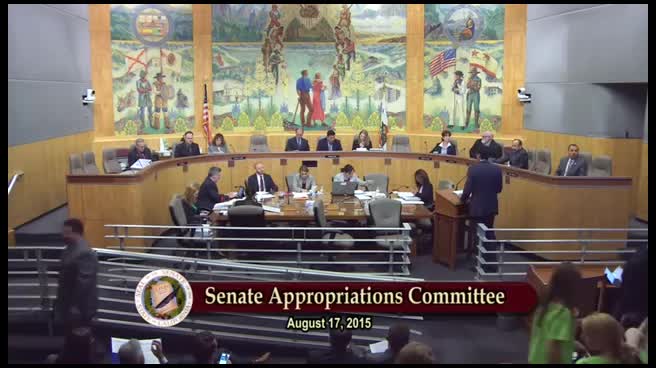 12MIN
Senate Standing Committee on Appropriations
 9MIN
Senate Standing Committee on Education
 1MIN
Assembly Floor
 4MIN
Assembly Standing Committee on Appropriations
 6MIN
Assembly Standing Committee on Education
Bill Author

Bill Co-Author(s):