SB 350: Clean Energy and Pollution Reduction Act of 2015.
- Session Year: 2015-2016
- House: Senate
- Latest Version Date: 2015-10-07
(1)Under existing law, the Public Utilities Commission (PUC) has regulatory jurisdiction over public utilities, including electrical corporations, community choice aggregators, and electric service providers, while local publicly owned electric utilities are under the direction of their governing boards. Existing law imposes various regulations on public utilities and local publicly owned electric utilities. Existing law establishes the California Renewables Portfolio Standards (RPS) Program, which is codified in the Public Utilities Act, with the target to increase the amount of electricity generated per year from eligible renewable energy resources to an amount that equals at least 33% of the total electricity sold to retail customers per year by December 31, 2020. Under existing law, a violation of the Public Utilities Act is a crime.
This bill would require that the amount of electricity generated and sold to retail customers per year from eligible renewable energy resources be increased to 50% by December 31, 2030, as provided. The bill would make other revisions to the RPS Program and to certain other requirements on public utilities and publicly owned electric utilities.
Because certain of the above provisions are codified in the Public Utilities Act, this bill would impose a state-mandated local program by expanding the definition of a crime or establishing a new crime.
(2)Existing law requires the PUC to identify cost-effective electricity efficiency savings and establish efficiency targets for an electrical corporation to achieve, and to identify cost-effective natural gas efficiency savings and establish efficiency targets for a gas corporation to achieve. Existing law requires a local publicly owned electric utility to identify all potential achievable cost-effective electricity efficiency savings and to establish annual targets for energy efficiency savings and demand reduction for the next 10-year period.
This bill would require the State Energy Resources Conservation and Development Commission to establish annual targets for statewide energy efficiency savings and demand reduction that will achieve a cumulative doubling of statewide energy efficiency savings in electricity and natural gas final end uses of retail customers by January 1, 2030. The bill would require the PUC to establish efficiency targets for electrical and gas corporations consistent with this goal. The bill would require local publicly owned electric utilities to establish annual targets for energy efficiency savings and demand reduction consistent with this goal.
(3)The existing restructuring of the electrical industry within the Public Utilities Act provides for the establishment of the Independent System Operator (ISO) and requires the ISO to ensure efficient and reliable operation of the electrical transmission grid. Existing law prohibits the ISO from entering into a multistate entity or regional organization unless the ISO receives approval from the Electricity Oversight Board. Existing law states the intent of the Legislature to provide for the evolution of the ISO into a regional organization to promote the development of regional electricity transmission markets in the western states.
This bill would provide for the transformation of the ISO into a regional organization, with the approval of the Legislature, pursuant to a specified process.
(4)The California Constitution requires the state to reimburse local agencies and school districts for certain costs mandated by the state. Statutory provisions establish procedures for making that reimbursement.
This bill would provide that no reimbursement is required by this act for a specified reason.
(1)Under existing law, the Public Utilities Commission (PUC) has regulatory jurisdiction over public utilities, including electrical corporations, community choice aggregators, and electric service providers, while local publicly owned electric utilities are under the direction of their governing boards. Existing law imposes various regulations on public utilities and local publicly owned electric utilities. Existing law establishes the California Renewables Portfolio Standards (RPS) Program, which is codified in the Public Utilities Act, with the target to increase the amount of electricity generated per year from eligible renewable energy resources to an amount that equals at least 33% of the total electricity sold to retail customers per year by December 31, 2020. Under existing law, a violation of the Public Utilities Act is a crime.
This bill would require that the amount of electricity generated and sold to retail customer customers per year from eligible renewable energy resources be increased to 50% by December 31, 2030, as provided. The bill would make other revisions to the RPS Program and to certain other requirements on public utilities and publicly owned electric utilities.
Because certain of the above provisions are codified in the Public Utilities Act, this bill would impose a state-mandated local program by expanding the definition of a crime or establishing a new crime.
(2)Existing law requires the State Air Resources Board to adopt and implement various standards related to emissions from motor vehicles.
This bill would require those standards to be in furtherance of achieving a reduction in petroleum use in motor vehicles by 50% by January 1, 2030. The bill would require the state board to take certain actions, as provided, to further this goal.
(3)
(2)Existing law requires the PUC to identify cost-effective electricity efficiency savings and establish efficiency targets for an electrical corporation to achieve, and to identify cost-effective natural gas efficiency savings and establish efficiency targets for a gas corporation to achieve. Existing law requires a local publicly owned electric utility to identify all potential achievable cost-effective electricity efficiency savings and to establish annual targets for energy efficiency savings and demand reduction for the next 10-year period.
This bill would require the State Energy Resources Conservation and Development Commission to establish annual targets for statewide energy efficiency savings and demand reduction that will achieve a cumulative doubling of statewide energy efficiency savings in electricity and natural gas final end uses of retail customers by January 1, 2030. The bill would require the PUC to establish efficiency targets for electrical and gas corporations consistent with this goal. The bill would require local publicly owned electric utilities to establish annual targets for energy efficiency savings and demand reduction consistent with this goal.
(4)
(3)The existing restructuring of the electrical industry within the Public Utilities Act provides for the establishment of the Independent System Operator (ISO) and requires the ISO to ensure efficient and reliable operation of the electrical transmission grid. Existing law prohibits the ISO from entering into a multistate entity or regional organization unless the ISO receives approval from the Electricity Oversight Board. Existing law states the intent of the Legislature to provide for the evolution of the ISO into a regional organization to promote the development of regional electricity transmission markets in the western states.
This bill would state the intent of the Legislature to enact legislation to provide for the evolution transformation of the ISO into a regional organization. organization, with the approval of the Legislature, pursuant to a specified process.
(5)
(4)The California Constitution requires the state to reimburse local agencies and school districts for certain costs mandated by the state. Statutory provisions establish procedures for making that reimbursement.
This bill would provide that no reimbursement is required by this act for a specified reason.
(1)Under existing law, the Public Utilities Commission (PUC) has regulatory jurisdiction over public utilities, including electrical corporations, community choice aggregators, and electric service providers, while local publicly owned electric utilities are under the direction of their governing boards. Existing law imposes various regulations on public utilities and local publicly owned electric utilities. Existing law establishes the California Renewables Portfolio Standards (RPS) Program, which is codified in the Public Utilities Act, with the target to increase the amount of electricity generated per year from eligible renewable energy resources to an amount that equals at least 33% of the total electricity sold to retail customers per year by December 31, 2020. Under existing law, a violation of the Public Utilities Act is a crime.
This bill would require that the amount of electricity generated and sold to retail customer per year from eligible renewable energy resources be increased to 50% by December 31, 2030, as provided. The bill would make other revisions to the RPS Program and to certain other requirements on public utilities and publicly owned electric utilities.
Because certain of the above provisions are codified in the Public Utilities Act, this bill would impose a state-mandated local program by expanding the definition of a crime or establishing a new crime.
(2)Existing law requires the State Air Resources Board to adopt and implement various standards related to emissions from motor vehicles.
This bill would require those standards to be in furtherance of achieving a reduction in petroleum use in motor vehicles by 50% by January 1, 2030. The bill would require the state board to take certain actions, as provided, to further this goal.
(3)Existing law requires the PUC to identify cost-effective electricity efficiency savings and establish efficiency targets for an electrical corporation to achieve, and to identify cost-effective natural gas efficiency savings and establish efficiency targets for a gas corporation to achieve. Existing law requires a local publicly owned electric utility to identify all potential achievable cost-effective electricity efficiency savings and to establish annual targets for energy efficiency savings and demand reduction for the next 10-year period.
This bill would require the State Energy Resources Conservation and Development Commission to establish annual targets for statewide energy efficiency savings and demand reduction that will achieve a cumulative doubling of statewide energy efficiency savings in electricity and natural gas final end uses of retail customers by January 1, 2030. The bill would require the PUC to establish efficiency targets for electrical and gas corporations consistent with this goal. The bill would require local publicly owned electric utilities to establish annual targets for energy efficiency savings and demand reduction consistent with this goal.
(4)The existing restructuring of the electrical industry within the Public Utilities Act provides for the establishment of the Independent System Operator (ISO) and requires the ISO to ensure efficient and reliable operation of the electrical transmission grid. Existing law prohibits the ISO from entering into a multistate entity or regional organization unless the ISO receives approval from the Electricity Oversight Board. Existing law states the intent of the Legislature to provide for the evolution of the ISO into a regional organization to promote the development of regional electricity transmission markets in the western states.
This bill would state the intent of the Legislature to enact legislation to provide for the evolution of the ISO into a regional organization.
(5)The California Constitution requires the state to reimburse local agencies and school districts for certain costs mandated by the state. Statutory provisions establish procedures for making that reimbursement.
This bill would provide that no reimbursement is required by this act for a specified reason.
(1)Under existing law, the Public Utilities Commission (PUC) has regulatory authority over public utilities, including electrical corporations, as defined, while local publicly owned electric utilities, as defined, are under the direction of their governing boards. Under existing law, a violation of the Public Utilities Act is a crime.
Existing law establishes the California Renewables Portfolio Standard (RPS) Program, which is codified in the Public Utilities Act, with the target to increase the amount of electricity generated per year from eligible renewable energy resources to an amount that equals at least 33% of the total electricity sold to retail customers in California per year by December 31, 2020. Existing law requires the PUC, by January 1, 2012, to establish the quantity of electricity products from eligible renewable energy resources to be procured by each retail seller for specified compliance periods, sufficient to ensure that the procurement of electricity products from eligible renewable energy resources achieves 25% of retail sales by December 31, 2016, and 33% of retail sales by December 31, 2020, and that retail sellers procure not less than 33% of retail sales in all subsequent years. For these purposes, a retail seller is defined to include electrical corporations, electric service providers, and community choice aggregators. The RPS Program requires an electrical corporation to submit to the PUC, for its approval, a renewable energy procurement plan. Existing law includes as an eligible renewable energy resource a specified facility engaged in the combustion of municipal solid waste.
Existing law makes the requirements of the RPS Program applicable to a local publicly owned electric utility, as defined, except that the utilitys governing board is responsible for implementation of those requirements, instead of the PUC, and certain enforcement authority with respect to local publicly owned electric utilities is given to the State Energy Resources Conservation and Development Commission (Energy Commission) and State Air Resources Board, instead of the PUC.
This bill would require that the amount of electricity generated per year from eligible renewable energy resources be increased to an amount equal to at least 50% by December 31, 2030, and would require the PUC, by January 1, 2017, to establish the quantity of electricity products from eligible renewable energy resources to be procured by each retail seller for specified compliance periods sufficient to ensure that the procurement of electricity products from eligible renewable energy resources achieves 50% of retail sales by December 31, 2030. The bill would require the governing boards of local publicly owned electric utilities to ensure that specified quantities of electricity products from eligible renewable energy resources be procured for specified compliance periods to ensure that the procurement of electricity products from eligible renewable energy resources achieve 50% of retail sales by December 31, 2030. The bill would exclude all facilities engaged in the combustion of municipal solid waste from being eligible renewable energy resources. The bill would require community choice aggregators and electric service providers to prepare and submit renewable energy procurement plans. The bill would revise other aspects of the RPS Program, including, among other things, the enforcement provisions and would require penalties collected from retail sellers for noncompliance to be deposited in the Electric Program Investment Charge Fund. The bill would require the PUC to direct electrical corporations to include in their proposed procurement plans a strategy for procuring a diverse portfolio of resources that provide a reliable electricity supply. The bill would require the PUC and the Energy Commission to take certain actions in furtherance of meeting the states clean energy and pollution reduction objectives.
This bill would authorize the PUC to authorize a procurement entity, and would authorize a local publicly owned utility, to procure an unspecified percentage of retail sales of onsite generation meeting certain requirements within the area served by the procurement entity to serve local electricity needs.
Existing law requires the PUC, in cooperation with specified entities, to evaluate and implement policies to promote development of equipment and infrastructure needed to facilitate the use of electricity and natural gas to fuel low-emission vehicles. Existing law requires those policies to prohibit utilities from passing the costs and expenses related to programs for the development of that equipment or infrastructure through to ratepayers unless the PUC finds and determines that those programs are in the interest of ratepayers. Existing law defines interests of the ratepayers for this purpose.
This bill would revise the definition of interests of the ratepayers. The bill would require the PUC, in consultation with specified entities, to direct electric corporations to propose multiyear programs and investments to accelerate widespread transportation electrification as a means to achieve certain goals. The bill would require the commission to review data concerning current and future electric transportation adoption rates and charging infrastructure utilization rates no less than every 3 years.
Because the above provisions are codified in the Public Utilities Act, a violation of these provisions would impose a state-mandated local program by expanding the definition of a crime or establishing a new crime.
By placing additional requirements upon local publicly owned electric utilities, this bill would impose a state-mandated local program.
(2)Existing law requires the State Air Resources Board to adopt and implement various standards related to emissions from motor vehicles.
This bill would require those standards to be in furtherance of achieving a reduction in petroleum use in motor vehicles by 50% by January 1, 2030. The bill would require the state board, by January 1, 2017, to prepare a strategy and implementation plan to achieve this reduction.
Existing law requires the State Air Resources Board to adopt greenhouse gas emission limits and emissions reduction measures, by regulations, to achieve the maximum technologically feasible and cost-effective reductions in greenhouse gas emissions in furtherance of achieving the statewide greenhouse gas emissions limit. Existing law requires the state board, in adoption regulations, to, among other things, design the regulations to include distribution of emissions allowance, where appropriate, to minimize the costs and maximize total benefits to California.
The Charge Ahead California Initiative states goals of, among other things, placing in service at least 1,000,000 zero-emission and near-zero-emission vehicles by January 1, 2023, and increasing access for disadvantaged, low-income, and moderate-income communities and consumers to zero-emission and near-zero-emission vehicles.
This bill would require the state board to identify and adopt appropriate policies to remove regulatory disincentives facing retail sellers and local publicly owned electric utilities from facilitating the achievement of greenhouse gas emissions reduction in other sectors through increased investments in transportation and building electrification that includes allocation of greenhouse gas emissions allowances to retail sellers and local publicly owned electric utilities to account for increased greenhouse gas emissions in the electric sector from transportation electrification.
(3)Existing law states the policy of the state to exploit all practicable and cost-effective conservation and improvements in the efficiency of energy use and distribution, and to achieve energy security, diversity of supply sources, and competitiveness of transportation energy markets based on the least environmental and economic costs.
This bill would additionally state the policy of the state to exploit those conservation and improvements in furtherance of reducing petroleum use in the transportation sector by 50% by January 1, 2030. The bill would state the policy of the state to encourage transportation electrification to achieve ambient air quality standards and the states climate goals.
(4)Existing law requires the Energy Commission to establish a regulatory proceeding to develop and implement a comprehensive program to achieve greater energy savings in Californias existing residential and nonresidential building stock and to periodically update criteria for the program.
This bill would require the Energy Commission, by January 1, 2017, and at least once every 3 years thereafter, to adopt an update to the program in furtherance of achieving a doubling of energy efficiency in buildings by January 1, 2030. The bill would require the Energy Commission to adopt, implement, and enforce certain policy regarding ratepayer-funded energy efficiency programs.
(5)The California Constitution requires the state to reimburse local agencies and school districts for certain costs mandated by the state. Statutory provisions establish procedures for making that reimbursement.
This bill would provide that no reimbursement is required by this act for specified reasons.
(1)Under existing law, the Public Utilities Commission (PUC) has regulatory authority over public utilities, including electrical corporations, as defined, while local publicly owned electric utilities, as defined, are under the direction of their governing boards. Under existing law, a violation of the Public Utilities Act is a crime.
Existing law establishes the California Renewables Portfolio Standard (RPS) Program, which is codified in the Public Utilities Act and expresses the intent of the Legislature that Act, with the target to increase the amount of electricity generated per year from eligible renewable energy resources be increased to an amount that equals at least 33% of the total electricity sold to retail customers in California per year by December 31, 2020. Existing law requires the PUC, by January 1, 2012, to establish the quantity of electricity products from eligible renewable energy resources to be procured by each retail seller for specified compliance periods, sufficient to ensure that the procurement of electricity products from eligible renewable energy resources achieves 25% of retail sales by December 31, 2016, and 33% of retail sales by December 31, 2020, and that retail sellers procure not less than 33% of retail sales in all subsequent years. For these purposes, a retail seller is defined to include electrical corporations, electric service providers, and community choice aggregators. The RPS Program requires an electrical corporation to submit to the PUC, for its approval, a renewable energy procurement plan. Existing law includes as an eligible renewable energy resource a specified facility engaged in the combustion of municipal solid waste.
Existing law makes the requirements of the RPS Program applicable to a local publicly owned electric utilities, utility, as defined, except that the utilitys governing board is responsible for implementation of those requirements, instead of the PUC, and certain enforcement authority with respect to local publicly owned electric utilities is given to the State Energy Resources Conservation and Development Commission (Energy Commission) and State Air Resources Board, instead of the PUC.
This bill would additionally express the intent of the Legislature for the purposes of the RPS Program require that the amount of electricity generated per year from eligible renewable energy resources be increased to an amount equal to at least 50% by December 31, 2030, and would require the PUC, by January 1, 2017, to establish the quantity of electricity products from eligible renewable energy resources to be procured by each retail seller for specified compliance periods sufficient to ensure that the procurement of electricity products from eligible renewable energy resources achieves 50% of retail sales by December 31, 2030. The bill would require the governing boards of local publicly owned electric utilities to ensure that specified quantities of electricity products from eligible renewable energy resources to be procured for specified compliance periods to ensure that the procurement of electricity products from eligible renewable energy resources achieve 50% of retail sales by December 31, 2030. The bill would exclude all facilities engaged in the combustion of municipal solid waste from being eligible renewable energy resources. The bill would require community choice aggregators and electric service providers to prepare and submit renewable energy procurement plans. The bill would revise other aspects of the RPS Program, including, among other things, the enforcement provisions and would require penalties collected from retail sellers for noncompliance to be deposited in the Electric Program Investment Charge Fund. The bill would require the PUC to direct electrical corporations to include in their proposed procurement plans a strategy for procuring a diverse portfolio of resources that provide a reliable electricity supply. The bill would require the PUC and the Energy Commission to take certain actions in furtherance of meeting the states clean energy and pollution reduction objectives.
This bill would authorize the PUC to authorize a procurement entity, and would authorize a local publicly owned utility, to procure an unspecified percentage of retail sales of onsite generation meeting certain requirements within the area served by the procurement entity to serve local electricity needs.
Existing law requires the PUC, in cooperation with specified entities, to evaluate and implement policies to promote development of equipment and infrastructure needed to facilitate the use of electricity and natural gas to fuel low-emission vehicles. Existing law requires those policies to prohibit utilities from passing the costs and expenses related to programs for the development of that equipment or infrastructure through to ratepayers unless the PUC finds and determines that those programs are in the interest of ratepayers. Existing law defines interests of the ratepayers for this purpose.
This bill would revise the definition of interests of the ratepayers. The bill would require the PUC, in consultation with specified entities, to direct electric corporations to propose multiyear programs and investments to accelerate widespread transportation electrification as a means to achieve certain goals. The bill would require the commission to review data concerning current and future electric transportation adoption rates and charging infrastructure utilization rates no less than every 3 years.
Because the above provisions are codified in the Public Utilities Act, a violation of these provisions would impose a state-mandated local program by expanding the definition of a crime or establishing a new crime.
By placing additional requirements upon local publicly owned electric utilities, this bill would impose a state-mandated local program.
(2)Existing law requires the State Air Resources Board to adopt and implement various standards related to emissions from motor vehicles.
This bill would require those standards to be in furtherance of achieving a reduction in petroleum use in motor vehicles by 50% by January 1, 2030. The bill would require the state board, by January 1, 2017, to prepare a strategy and implementation plan to achieve this reduction.
Existing law requires the State Air Resources Board to adopt greenhouse gas emission limits and emissions reduction measures, by regulations, to achieve the maximum technologically feasible and cost-effective reductions in greenhouse gas emissions in furtherance of achieving the statewide greenhouse gas emissions limit. Existing law requires the state board, in adoption regulations, to, among other things, design the regulations to include distribution of emissions allowance, where appropriate, to minimize the costs and maximize total benefits to California.
The Charge Ahead California Initiative states goals of, among other things, placing in service at least 1,000,000 zero-emission and near-zero-emission vehicles by January 1, 2023, and increasing access for disadvantaged, low-income, and moderate-income communities and consumers to zero-emission and near-zero-emission vehicles.
This bill would require the state board to identify and adopt appropriate policies to remove regulatory disincentives facing retail sellers and local publicly owned electric utilities from facilitating the achievement of greenhouse gas emissions reduction in other sectors through increased investments in transportation and building electrification that includes allocation of greenhouse gas emissions allowances to retail sellers and local publicly owned electric utilities to account for increased greenhouse gas emissions in the electric sector from transportation electrification.
(3)Existing law states the policy of the state to exploit all practicable and cost-effective conservation and improvements in the efficiency of energy use and distribution, and to achieve energy security, diversity of supply sources, and competitiveness of transportation energy markets based on the least environmental and economic costs.
This bill would additionally state the policy of the state to exploit those conservation and improvements in furtherance of reducing petroleum use in the transportation sector by 50% by January 1, 2030. The bill would state the policy of the state to encourage transportation electrification natural gas vehicles as a short-term measure, fuel cell vehicles, and transportation innovations as means to achieve certain to achieve ambient air quality standards and the states climate goals.
(4)Existing law requires the Energy Commission to establish a regulatory proceeding to develop and implement a comprehensive program to achieve greater energy savings in Californias existing residential and nonresidential building stock and to periodically update criteria for the program.
This bill would require the Energy Commission, by January 1, 2017, and at least once every 3 years thereafter, to adopt an update to the program in furtherance of achieving a doubling of energy efficiency in buildings by January 1, 2030. The bill would require the Energy Commission to adopt, implement, and enforce certain policy regarding ratepayer-funded energy efficiency programs.
(5)The California Constitution requires the state to reimburse local agencies and school districts for certain costs mandated by the state. Statutory provisions establish procedures for making that reimbursement.
This bill would provide that no reimbursement is required by this act for specified reasons.
(1)Under existing law, the Public Utilities Commission (PUC) has regulatory authority over public utilities, including electrical corporations, as defined, while local publicly owned electric utilities, as defined, are under the direction of their governing boards. Under existing law, a violation of the Public Utilities Act is a crime.
Existing law establishes the California Renewables Portfolio Standard (RPS) program, Program, which is codified in the Public Utilities Act and expresses the intent of the Legislature that the amount of electricity generated per year from eligible renewable energy resources be increased to an amount that equals at least 33% of the total electricity sold to retail customers in California per year by December 31, 2020. Existing law requires the PUC, by January 1, 2012, to establish the quantity of electricity products from eligible renewable energy resources to be procured by each retail seller for specified compliance periods, sufficient to ensure that the procurement of electricity products from eligible renewable energy resources achieves 25% of retail sales by December 31, 2016, and 33% of retail sales by December 31, 2020, and that retail sellers procure not less than 33% of retail sales in all subsequent years. Existing law includes as an eligible renewable energy resources resource a specified facility engaged in the combustion of municipal solid waste.
Existing law makes the requirements of the RPS program Program applicable to local publicly owned electric utilities, except that the utilitys governing board is responsible for implementation of those requirements, instead of the PUC, and certain enforcement authority with respect to local publicly owned electric utilities is given to the State Energy Resources Conservation and Development Commission (Energy Commission) and State Air Resources Board, instead of the PUC.
This bill would additionally express the intent of the Legislature for the purposes of the RPS program Program that the amount of electricity generated per year from eligible renewable energy resources be increased to an amount equal to at least 50% by December 31, 2030, and would require the PUC, by January 1, 2017, to establish the quantity of electricity products from eligible renewable energy resources to be procured by each retail seller for specified compliance periods sufficient to ensure that the procurement of electricity products from eligible renewable energy resources achieves 50% of retail sales by December 31, 2030. The bill would require the governing boards of local publicly owned electric utilities to ensure that specified quantities of electricity products from eligible renewable energy resources to be procured for specified compliance periods to ensure that the procurement of electricity products from eligible renewable energy resources achieve 50% of retail sales by December 31, 2030. The bill would exclude all facilities engaged in the combustion of municipal solid waste from being eligible renewable energy resources. The bill would require community choice aggregators and electric service providers to prepare and submit renewable energy procurement plans. The bill would revise other aspects of the RPS program, Program, including, among other things, the enforcement provisions and would require penalties collected from retail sellers for noncompliance to be deposited in the Electric Program Investment Charge Fund. The bill would require the PUC to direct electrical corporations to include in their proposed procurement plans a strategy for procuring a diverse portfolio of resources that provide a reliable electricity supply. The bill would require the PUC and the Energy Commission to take certain actions in furtherance of meeting the states clean energy and pollution reduction objectives.
This bill would authorize the PUC to authorize a procurement entity, and would authorize a local publicly owned utility, to procure an unspecified percentage of retail sales of onsite generation meeting certain requirements within the area served by the procurement entity to serve local electricity needs.
Existing law requires the PUC, in cooperation with specified entities, to evaluate and implement policies to promote development of equipment and infrastructure needed to facilitate the use of electricity and natural gas to fuel low-emission vehicles. Existing law requires those policies to prohibit utilities from passing the costs and expenses related to programs for the development of that equipment or infrastructure through to ratepayers unless the PUC finds and determines that those programs are in the interest of ratepayers. Existing law defines interests of the ratepayers for this purpose.
This bill would revise the definition of interests of the ratepayers. The bill would require the PUC, in consultation with specified entities, to direct electric corporations to propose multiyear programs and investments to accelerate widespread transportation electrification as a means to achieve certain goals. The bill would require the commission to review data concerning current and future electric transportation adoption rates and charging infrastructure utilization rates no less than every 3 years.
(2)Under existing law, a violation of the RPS program is a crime.
Because the above provisions of this bill would expand the RPS program, are codified in the Public Utilities Act, a violation of these provisions would impose a state-mandated local program by expanding the definition of a crime or establishing a new crime.
(3)By
By placing additional requirements upon local publicly owned electric utilities, this bill would impose a state-mandated local program.
(4)
(2)Existing law requires the State Air Resources Board to adopt and implement various standards related to emissions from motor vehicles.
This bill would require those standards to be in furtherance of achieving a reduction in petroleum use in motor vehicles by 50% by January 1, 2030. The bill would require the state board, by January 1, 2017, to prepare a strategy and implementation plan to achieve this reduction.
Existing law requires the State Air Resources Board to adopt greenhouse gas emission limits and emissions reduction measures, by regulations, to achieve the maximum technologically feasible and cost-effective reductions in greenhouse gas emissions in furtherance of achieving the statewide greenhouse gas emissions limit. Existing law requires the state board, in adoption regulations, to, among other things, design the regulations to include distribution of emissions allowance, where appropriate, to minimize the costs and maximize total benefits to California.
The Charge Ahead California Initiative states goals of, among other things, placing in service at least 1,000,000 zero-emission and near-zero-emission vehicles by January 1, 2023, and increasing access for disadvantaged, low-income, and moderate-income communities and consumers to zero-emission and near-zero-emission vehicles.
This bill would require the state board to identify and adopt appropriate policies to remove regulatory disincentives facing retail sellers from facilitating the achievement of greenhouse gas emissions reduction in other sectors through increased investments in transportation and building electrification that includes allocation of greenhouse gas emissions allowances to retail sellers to account for increased greenhouse gas emissions in the electric sector from transportation electrification.
(5)
(3)Existing law states the policy of the state to exploit all practicable and cost-effective conservation and improvements in the efficiency of energy use and distribution, and to achieve energy security, diversity of supply sources, and competitiveness of transportation energy markets based on the least environmental and economic costs.
This bill would additionally state the policy of the state to exploit those conservation and improvements in furtherance of reducing petroleum use in the transportation sector by 50% by January 1, 2030. The bill would state the policy of the state to encourage transportation electrification natural gas vehicles as a short-term measure, fuel cell vehicles, and transportation innovations as means to achieve certain goals.
(6)
(4)Existing law requires the Energy Commission to establish a regulatory proceeding to develop and implement a comprehensive program to achieve greater energy savings in Californias existing residential and nonresidential building stock and to periodically update criteria for the program.
This bill would require the Energy Commission, by January 1, 2017, and at least once every 3 years thereafter, to adopt an update to the program in furtherance of achieving a doubling of energy efficiency in buildings by January 1, 2030. The bill would require the Energy Commission to adopt, implement, and enforce certain policy regarding ratepayer-funded energy efficiency programs.
(7)
(5)The California Constitution requires the state to reimburse local agencies and school districts for certain costs mandated by the state. Statutory provisions establish procedures for making that reimbursement.
This bill would provide that no reimbursement is required by this act for a specified reasons.
(1)Under existing law, the Public Utilities Commission (PUC) has regulatory authority over public utilities, including electrical corporations, as defined, while local publicly owned electric utilities, as defined, are under the direction of their governing boards.
Existing law establishes the California Renewables Portfolio Standard (RPS) program, which expresses the intent of the Legislature that the amount of electricity generated per year from eligible renewable energy resources be increased to an amount that equals at least 33% of the total electricity sold to retail customers in California per year by December 31, 2020. Existing law requires the PUC, by January 1, 2012, to establish the quantity of electricity products from eligible renewable energy resources to be procured by each retail seller for specified compliance periods, sufficient to ensure that the procurement of electricity products from eligible renewable energy resources achieves 25% of retail sales by December 31, 2016, and 33% of retail sales by December 31, 2020, and that retail sellers procure not less than 33% of retail sales in all subsequent years. Existing law includes as an eligible renewable energy resources a specified facility engaged in the combustion of municipal solid waste.
Existing law makes the requirements of the RPS program applicable to local publicly owned electric utilities, except that the utilitys governing board is responsible for implementation of those requirements, instead of the PUC, and certain enforcement authority with respect to local publicly owned electric utilities is given to the State Energy Resources Conservation and Development Commission (Energy Commission) and State Air Resources Board, instead of the PUC.
This bill would additionally express the intent of the Legislature for the purposes of the RPS program that the amount of electricity generated per year from eligible renewable energy resources be increased to an amount equal to at least 50% by December 31, 2030, and would require the PUC, by January 1, 2017, to establish the quantity of electricity products from eligible renewable energy resources be procured by each retail seller for specified compliance periods sufficient to ensure that the procurement of electricity products from eligible renewable energy resources achieves 50% of retail sales by December 31, 2030. The bill would require the governing boards of local publicly owned electric utilities to ensure that specified quantities of electricity products from eligible renewable energy resources to be procured for specified compliance periods to ensure that the procurement of electricity products from eligible renewable energy resources achieve 50% of retail sales by December 31, 2030. The bill would exclude all facilities engaged in the combustion of municipal solid waste from being eligible renewable energy resources. The bill would require community choice aggregators and electric service providers to prepare and submit renewable energy procurement plans. The bill would revise other aspects of the RPS program, including, among other things, the enforcement provisions and would require penalties collected for noncompliance to be deposited in the Electric Program Investment Charge Fund. The bill would require the PUC to direct electrical corporations to include in their proposed procurement plans a strategy for procuring a diverse portfolio of resources that provide a reliable electricity supply. The bill would require the PUC and the Energy Commission to take certain actions in furtherance of meeting the states clean energy and pollution reduction objectives.
(2)Under existing law, a violation of the RPS program is a crime.
Because the provisions of this bill would expand the RPS program, a violation of these provisions would impose a state-mandated local program by expanding the definition of a crime.
(3)By placing additional requirements upon local publicly owned electric utilities, this bill would impose a state-mandated local program.
(4)Existing law requires the State Air Resources Board to adopt and implement various standards related to emissions from motor vehicles.
This bill would require those standards to be in furtherance of achieving a reduction in petroleum use in motor vehicles by 50% by January 1, 2030.
(5)Existing law states the policy of the state to exploit all practicable and cost-effective conservation and improvements in the efficiency of energy use and distribution, and to achieve energy security, diversity of supply sources, and competitiveness of transportation energy markets based on the least environmental and economic costs.
This bill would additionally state the policy of the state to exploit those conservation and improvements in furtherance of reducing petroleum use in the transportation sector by 50% by January 1, 2030.
(6)Existing law requires the Energy Commission to establish a regulatory proceeding to develop and implement a comprehensive program to achieve greater energy savings in Californias existing residential and nonresidential building stock and to periodically update criteria for the program.
This bill would require the Energy Commission, by January 1, 2017, and at least once every 3 years thereafter, to adopt an update to the program in furtherance of achieving a doubling of energy efficiency in buildings by January 1, 2030.
(7)The California Constitution requires the state to reimburse local agencies and school districts for certain costs mandated by the state. Statutory provisions establish procedures for making that reimbursement.
This bill would provide that no reimbursement is required by this act for a specified reasons.
This act shall be known and may be cited as the Clean Energy and Pollution Reduction Act of 2015.
SEC. 2.(a)The Legislature finds and declares that the Governor has called for a new set of objectives in clean energy, clean air, and pollution reduction for 2030 and beyond. Those objectives include the following:
(1)To increase from 33 percent to 50 percent, the procurement of our electricity from renewable sources.
(2)To double the energy efficiency savings in electricity and natural gas final end uses of retail customers through energy efficiency and conservation.
(b)It is the intent of the Legislature in enacting this act to codify the targets described under subdivision (a) to ensure they are permanent, enforceable, and quantifiable.
SEC. 3.Section 44258.5 is added to the Health and Safety Code, to read:44258.5.(a)For the purposes of this section, the following terms mean the following:
(1)Local publicly owned electric utility has the same meaning as defined in Section 224.3 of the Public Utilities Code.
(2)Retail seller has the same meaning as set forth in Section 399.12 of the Public Utilities Code.
(3)Transportation electrification has the same meaning as set forth in Section 237.5 of the Public Utilities Code.
(b)The state board shall identify and adopt appropriate policies, rules, or regulations to remove regulatory disincentives preventing retail sellers and local publicly owned electric utilities from facilitating the achievement of greenhouse gas emission reductions in other sectors through increased investments in transportation electrification. Policies to be considered shall include, but are not limited to, an allocation of greenhouse gas emissions allowances to retail sellers and local publicly owned electric utilities, or other regulatory mechanisms, to account for increased greenhouse gas emissions in the electric sector from transportation electrification.
SEC. 4.Section 1720 of the Labor Code is amended to read:1720.(a)As used in this chapter, public works means:
(1)Construction, alteration, demolition, installation, or repair work done under contract and paid for in whole or in part out of public funds, except work done directly by any public utility company pursuant to order of the Public Utilities Commission or other public authority. For purposes of this paragraph, construction includes work performed during the design and preconstruction phases of construction, including, but not limited to, inspection and land surveying work, and work performed during the postconstruction phases of construction, including, but not limited to, all cleanup work at the jobsite. For purposes of this paragraph, installation includes, but is not limited to, the assembly and disassembly of freestanding and affixed modular office systems.
(2)Work done for irrigation, utility, reclamation, and improvement districts, and other districts of this type. Public work does not include the operation of the irrigation or drainage system of any irrigation or reclamation district, except as used in Section 1778 relating to retaining wages.
(3)Street, sewer, or other improvement work done under the direction and supervision or by the authority of any officer or public body of the state, or of any political subdivision or district thereof, whether the political subdivision or district operates under a freeholders charter or not.
(4)The laying of carpet done under a building lease-maintenance contract and paid for out of public funds.
(5)The laying of carpet in a public building done under contract and paid for in whole or in part out of public funds.
(6)Public transportation demonstration projects authorized pursuant to Section 143 of the Streets and Highways Code.
(7)(A)Infrastructure project grants from the California Advanced Services Fund pursuant to Section 281 of the Public Utilities Code.
(B)For purposes of this paragraph, the Public Utilities Commission is not the awarding body or the body awarding the contract, as defined in Section 1722.
(b)For purposes of this section, paid for in whole or in part out of public funds means all of the following:
(1)The payment of money or the equivalent of money by the state or political subdivision directly to or on behalf of the public works contractor, subcontractor, or developer.
(2)Performance of construction work by the state or political subdivision in execution of the project.
(3)Transfer by the state or political subdivision of an asset of value for less than fair market price.
(4)Fees, costs, rents, insurance or bond premiums, loans, interest rates, or other obligations that would normally be required in the execution of the contract, that are paid, reduced, charged at less than fair market value, waived, or forgiven by the state or political subdivision.
(5)Money loaned by the state or political subdivision that is to be repaid on a contingent basis.
(6)Credits that are applied by the state or political subdivision against repayment obligations to the state or political subdivision.
(c)Notwithstanding subdivision (b):
(1)Private residential projects built on private property are not subject to the requirements of this chapter unless the projects are built pursuant to an agreement with a state agency, redevelopment agency, or local public housing authority.
(2)If the state or a political subdivision requires a private developer to perform construction, alteration, demolition, installation, or repair work on a public work of improvement as a condition of regulatory approval of an otherwise private development project, and the state or political subdivision contributes no more money, or the equivalent of money, to the overall project than is required to perform this public improvement work, and the state or political subdivision maintains no proprietary interest in the overall project, then only the public improvement work shall thereby become subject to this chapter.
(3)If the state or a political subdivision reimburses a private developer for costs that would normally be borne by the public, or provides directly or indirectly a public subsidy to a private development project that is de minimis in the context of the project, an otherwise private development project shall not thereby become subject to the requirements of this chapter.
(4)The construction or rehabilitation of affordable housing units for low- or moderate-income persons pursuant to paragraph (5) or (7) of subdivision (e) of Section 33334.2 of the Health and Safety Code that are paid for solely with moneys from the Low and Moderate Income Housing Fund established pursuant to Section 33334.3 of the Health and Safety Code or that are paid for by a combination of private funds and funds available pursuant to Section 33334.2 or 33334.3 of the Health and Safety Code do not constitute a project that is paid for in whole or in part out of public funds.
(5)Unless otherwise required by a public funding program, the construction or rehabilitation of privately owned residential projects is not subject to the requirements of this chapter if one or more of the following conditions are met:
(A)The project is a self-help housing project in which no fewer than 500 hours of construction work associated with the homes are to be performed by the home buyers.
(B)The project consists of rehabilitation or expansion work associated with a facility operated on a not-for-profit basis as temporary or transitional housing for homeless persons with a total project cost of less than twenty-five thousand dollars ($25,000).
(C)Assistance is provided to a household as either mortgage assistance, downpayment assistance, or for the rehabilitation of a single-family home.
(D)The project consists of new construction, expansion, or rehabilitation work associated with a facility developed by a nonprofit organization to be operated on a not-for-profit basis to provide emergency or transitional shelter and ancillary services and assistance to homeless adults and children. The nonprofit organization operating the project shall provide, at no profit, not less than 50 percent of the total project cost from nonpublic sources, excluding real property that is transferred or leased. Total project cost includes the value of donated labor, materials, architectural, and engineering services.
(E)The public participation in the project that would otherwise meet the criteria of subdivision (b) is public funding in the form of below-market interest rate loans for a project in which occupancy of at least 40 percent of the units is restricted for at least 20 years, by deed or regulatory agreement, to individuals or families earning no more than 80 percent of the area median income.
(d)Notwithstanding any provision of this section to the contrary, the following projects shall not, solely by reason of this section, be subject to the requirements of this chapter:
(1)Qualified residential rental projects, as defined by Section 142(d) of the Internal Revenue Code, financed in whole or in part through the issuance of bonds that receive allocation of a portion of the state ceiling pursuant to Chapter 11.8 (commencing with Section 8869.80) of Division 1 of Title 2 of the Government Code on or before December 31, 2003.
(2)Single-family residential projects financed in whole or in part through the issuance of qualified mortgage revenue bonds or qualified veterans mortgage bonds, as defined by Section 143 of the Internal Revenue Code, or with mortgage credit certificates under a Qualified Mortgage Credit Certificate Program, as defined by Section 25 of the Internal Revenue Code, that receive allocation of a portion of the state ceiling pursuant to Chapter 11.8 (commencing with Section 8869.80) of Division 1 of Title 2 of the Government Code on or before December 31, 2003.
(3)Low-income housing projects that are allocated federal or state low-income housing tax credits pursuant to Section 42 of the Internal Revenue Code, Chapter 3.6 (commencing with Section 50199.4) of Part 1 of Division 31 of the Health and Safety Code, or Section 12206, 17058, or 23610.5 of the Revenue and Taxation Code, on or before December 31, 2003.
(e)Notwithstanding paragraph (1) of subdivision (a), construction, alteration, demolition, installation, or repair work on the electric transmission system located in California constitutes a public works project for the purposes of this chapter.
(f)If a statute, other than this section, or a regulation, other than a regulation adopted pursuant to this section, or an ordinance or a contract applies this chapter to a project, the exclusions set forth in subdivision (d) do not apply to that project.
(g)For purposes of this section, references to the Internal Revenue Code mean the Internal Revenue Code of 1986, as amended, and include the corresponding predecessor sections of the Internal Revenue Code of 1954, as amended.
(h)The amendments made to this section by either Chapter 938 of the Statutes of 2001 or the act adding this subdivision shall not be construed to preempt local ordinances requiring the payment of prevailing wages on housing projects.
SEC. 5.Section 25302.2 is added to the Public Resources Code, to read:25302.2.As part of the 2019 edition of the integrated energy policy report, the commission shall evaluate the actual energy efficiency savings, as defined in Section 25310, from negative therm interactive effects generated as a result of electricity efficiency improvements.
SEC. 6.Section 25310 of the Public Resources Code is amended to read:25310.(a)For purposes of this section, the following terms have the following meanings:
(1)End use means the purpose for which energy is used, including, but not limited to, heating, cooling, or lighting, or class of energy uses upon which an energy efficiency program is focused, typically categorized by equipment purpose, equipment energy use intensity, or building type.
(2)Energy efficiency savings means reduced electricity or natural gas usage produced either by the installation of an energy efficiency measure or the adoption of an energy efficiency practice that maintains at least the same level of end-use service or by conservation actions that reduce energy use by reducing the quantity of baseline energy services demanded.
(b)On or before November 1, 2007, and by November 1 of every third year thereafter, the commission in consultation with the Public Utilities Commission and local publicly owned electric utilities, in a public process that allows input from other stakeholders, shall develop a statewide estimate of all potentially achievable cost-effective electricity and natural gas efficiency savings and establish targets for statewide annual energy efficiency savings and demand reduction for the next 10-year period. The commission shall base its estimate at least in part on information developed pursuant to Sections 454.55, 454.56, 715, 9505, 9615, and 9615.5 of the Public Utilities Code. The commission shall, for each electrical corporation and each gas corporation, include in the integrated energy policy report, a comparison of the public utilitys annual targets established pursuant to Sections 454.55 and 454.56, and the public utilitys actual energy efficiency savings and demand reductions.
(c)(1)On or before November 1, 2017, the commission, in collaboration with the Public Utilities Commission and local publicly owned electric utilities, in a public process that allows input from other stakeholders, shall establish annual targets for statewide energy efficiency savings and demand reduction that will achieve a cumulative doubling of statewide energy efficiency savings in electricity and natural gas final end uses of retail customers by January 1, 2030. The commission shall base the targets on a doubling of the midcase estimate of additional achievable energy efficiency savings, as contained in the California Energy Demand Updated Forecast, 2015-2025, adopted by the commission, extended to 2030 using an average annual growth rate, and the targets adopted by local publicly owned electric utilities pursuant to Section 9505 of the Public Utilities Code, extended to 2030 using an average annual growth rate, to the extent doing so is cost effective, feasible, and will not adversely impact public health and safety.
(2)The commission may establish targets for the purposes of paragraph (1) that aggregate energy efficiency savings from both electricity and natural gas final end uses. Before establishing aggregate targets, the commission shall, in a public process that allows input from other stakeholders, adopt a methodology for aggregating electricity and natural gas final end-use energy efficiency savings in a consistent manner based on source of energy reduction and other relevant factors.
(3)In establishing the targets pursuant to paragraph (1), the commission shall assess the hourly and seasonal impact on statewide and local electricity demand.
(4)In assessing the feasibility and cost-effectiveness of energy efficiency savings for the purposes of paragraph (1), the commission and the Public Utilities Commission shall consider the results of energy efficiency potential studies that are not restricted by previous levels of utility energy efficiency savings.
(5)The energy efficiency savings and demand reduction reported for the purposes of achieving the targets established pursuant to paragraph (1) shall be measured taking into consideration the overall reduction in normalized metered electricity and natural gas consumption where these measurement techniques are feasible and cost effective.
(d)The targets established in subdivision (c) may be achieved through energy efficiency savings and demand reduction resulting from a variety of programs that include, but are not limited to, the following:
(1)Appliance and building energy efficiency standards developed and adopted pursuant to Section 25402.
(2)A comprehensive program to achieve greater energy efficiency savings in Californias existing residential and nonresidential building stock pursuant to Section 25943.
(3)Programs funded and authorized pursuant to the California Clean Energy Job Creation Act (Division 16.3 (commencing with Section 26200)).
(4)Programs funded by the Greenhouse Gas Reduction Fund established pursuant to Section 16428.8 of the Government Code.
(5)Programs funded and authorized pursuant to this division.
(6)Programs of electrical or gas corporations, or community choice aggregators, that provide financial incentives, rebates, technical assistance, and support to their customers to increase energy efficiency, authorized by the Public Utilities Commission.
(7)Programs of local publicly owned electric utilities that provide financial incentives, rebates, technical assistance, and support to their customers to increase energy efficiency pursuant to Section 385 of the Public Utilities Code.
(8)Programs of electrical or gas corporations, local publicly owned electric utilities, or community choice aggregators, that achieve energy efficiency savings through operational, behavioral, and retrocommissioning activities.
(9)Programs that save energy in final end uses by reducing distribution feeder service voltage, known as conservation voltage reduction.
(10)Programs that save energy in final end uses by using cleaner fuels to reduce greenhouse gas emissions as measured on a lifecycle basis from the provision of energy services.
(11)Property Assessed Clean Energy (PACE) programs.
(e)Beginning with the 2019 edition of the integrated energy policy report and every two years thereafter, the commission shall provide recommendations and an update on progress toward achieving a doubling of energy efficiency savings in electricity and natural gas final end uses of retail customers by January 1, 2030, pursuant to paragraph (1) of subdivision (c). The commission shall also include with the recommendations and update both of the following:
(1)An assessment of the effect of energy efficiency savings on electricity demand statewide, in local service territories, and on an hourly and seasonal basis.
(2)Specific strategies for, and an update on, progress toward maximizing the contribution of energy efficiency savings in disadvantaged communities identified pursuant to Section 39711 of the Health and Safety Code.
SEC. 7.Section 25327 is added to the Public Resources Code, to read:25327.(a)The Legislature finds and declares all of the following:
(1)There is insufficient information available to fully realize the potential of solar photovoltaic energy generation to serve low-income customers, including those in disadvantaged communities.
(2)There is insufficient understanding of the barriers to access for low-income customers to all forms of renewable energy being generated in the state.
(3)There is insufficient understanding of the barriers to access for low-income customers to energy efficiency investments.
(4)There is insufficient understanding of the barriers to access for low-income customers to zero-emission and near-zero-emission transportation options.
(b)On or before January 1, 2017, the commission, with input from relevant state agencies and the public, shall conduct and complete a study on both of the following:
(1)Barriers to, and opportunities for, solar photovoltaic energy generation as well as barriers to, and opportunities for, access to other renewable energy by low-income customers.
(2)Barriers to contracting opportunities for local small businesses in disadvantaged communities.
(c)On or before January 1, 2017, the commission, with input from relevant state agencies and the public, shall develop and publish a study on barriers for low-income customers to energy efficiency and weatherization investments, including those in disadvantaged communities, as well as recommendations on how to increase access to energy efficiency and weatherization investments to low-income customers.
(d)On or before January 1, 2017, the State Air Resources Board, in consultation with the commission and with input from relevant state agencies and the public, shall develop and publish a study on barriers for low-income customers to zero-emission and near-zero-emission transportation options, including those in disadvantaged communities, as well as recommendations on how to increase access to zero-emission and near-zero-emission transportation options to low-income customers, including those in disadvantaged communities.
SEC. 8.Section 25943 of the Public Resources Code is amended to read:25943.(a)(1)By March 1, 2010, the commission shall establish a regulatory proceeding to develop and implement a comprehensive program to achieve greater energy savings in Californias existing residential and nonresidential building stock. This program shall comprise a complementary portfolio of techniques, applications, and practices that will achieve greater energy efficiency in existing residential and nonresidential structures that fall significantly below the current standards in Title 24 of the California Code of Regulations, as determined by the commission.
(2)The comprehensive program may include, but need not be limited to, a broad range of energy assessments, building benchmarking, energy rating, cost-effective energy efficiency improvements, public and private sector energy efficiency financing options, public outreach and education efforts, and green workforce training.
(3)The commission shall adopt, implement, and enforce a responsible contractor policy for use across all ratepayer-funded energy efficiency programs that involve installation or maintenance, or both installation and maintenance, by building contractors to ensure that retrofits meet high-quality performance standards and reduce energy savings lost or foregone due to poor-quality workmanship.
(4)The commission, in consultation with the Public Utilities Commission, shall establish consumer protection guidelines for energy efficiency products and services.
(b)To develop and implement the program specified in subdivision (a), the commission shall do both of the following:
(1)Coordinate with the Public Utilities Commission and consult with representatives from the Bureau of Real Estate, the Department of Housing and Community Development, investor-owned and publicly owned utilities, local governments, real estate licensees, commercial and homebuilders, commercial property owners, small businesses, mortgage lenders, financial institutions, home appraisers, inspectors, energy rating organizations, consumer groups, environmental and environmental justice groups, and other entities the commission deems appropriate.
(2)Hold at least three public hearings in geographically diverse locations throughout the state.
(c)In developing the requirements for the program specified in subdivision (a), the commission shall consider all of the following:
(1)The amount of annual and peak energy savings, greenhouse gas emission reductions, and projected customer utility bill savings that will accrue from the program.
(2)The most cost-effective means and reasonable timeframes to achieve the goals of the program.
(3)The various climatic zones within the state.
(4)An appropriate method to inform and educate the public about the need for, benefits of, and environmental impacts of, the comprehensive energy efficiency program.
(5)The most effective way to report the energy assessment results and the corresponding energy efficiency improvements to the owner of the residential or nonresidential building, including, among other things, the following:
(A)Prioritizing the identified energy efficiency improvements.
(B)The payback period or cost-effectiveness of each improvement identified.
(C)The various incentives, loans, grants, and rebates offered to finance the improvements.
(D)Available financing options including all of the following:
(i)Mortgages or sales agreement components.
(ii)On-bill financing.
(iii)Contractual property tax assessments.
(iv)Home warranties.
(6)Existing statutory and regulatory requirements to achieve energy efficiency savings and greenhouse gas emission reductions.
(7)A broad range of implementation approaches, including both utility and nonutility administration of energy efficiency programs, especially the use of not-for-profit and community-based organizations that assist with deployment in disadvantaged communities identified pursuant to Section 39711 of the Health and Safety Code.
(8)Workforce development and job training for residents in disadvantaged communities, including veterans, at-risk youth, and members of the state and local community conservation corps.
(9)Any other considerations deemed appropriate by the commission.
(d)The program developed pursuant to this section shall do all of the following:
(1)Minimize the overall costs of establishing and implementing the comprehensive energy efficiency program requirements.
(2)Ensure, for residential buildings, that the energy efficiency assessments, ratings, or improvements do not unreasonably or unnecessarily affect the home purchasing process or the ability of individuals to rent housing. A transfer of property subject to the program implemented pursuant to this section shall not be invalidated solely because of the failure of a person to comply with a provision of the program.
(3)Ensure, for nonresidential buildings, that the energy improvements do not have an undue economic impact on California businesses.
(4)Determine, for residential buildings, the appropriateness of the Home Energy Rating System (HERS) program to support the goals of this section and whether there are a sufficient number of HERS-certified raters available to meet the program requirements.
(5)Determine, for nonresidential structures, the availability of an appropriate cost-effective energy efficiency assessment system and whether there are a sufficient number of certified raters or auditors available to meet the program requirements.
(6)Coordinate with the California Workforce Investment Board, the Employment Training Panel, the California Community Colleges, and other entities to ensure a qualified, well-trained workforce is available to implement the program requirements.
(7)Promote greater project penetration in disadvantaged communities identified pursuant to Section 39711 of the Health and Safety Code, including the deployment of energy efficiency surveys and audits, energy efficiency retrofits and upgrades, weatherization, and followup project inspections by state-certified community conservation corps and other community-based workforce development organizations that serve residents of disadvantaged communities, including veterans and disadvantaged youth.
(8)Coordinate with, and avoid duplication of, existing proceedings of the Public Utilities Commission and programs administered by utilities.
(e)A home energy rating or energy assessment service does not meet the requirements of this section unless the service has been certified by the commission to be in compliance with the program criteria developed pursuant to this section and is in conformity with other applicable elements of the program.
(f)(1)The commission shall periodically update the criteria and adopt any revision that, in its judgment, is necessary to improve or refine program requirements after receiving public input.
(2)On or before January 1, 2017, and at least once every three years thereafter, the commission shall adopt an update to the program in furtherance of achieving a cumulative doubling of statewide energy efficiency savings in electricity and natural gas final end uses of retail customers by January 1, 2030.
(g)Before implementing an element of the program developed pursuant to subdivision (a) that requires the expansion of statutory authority of the commission or the Public Utilities Commission, the commission and the Public Utilities Commission shall obtain legislative approval for the expansion of their authorities.
(h)The commission shall report on the status of the program in the integrated energy policy report pursuant to Section 25302.
(i)The commission shall fund activities undertaken pursuant to this section from the Federal Trust Fund consistent with the federal American Recovery and Reinvestment Act of 2009 (Public Law 111-5) or other sources of nonstate funds available to the commission for the purposes of this section.
(j)For purposes of this section, the following terms mean the following:
(1)Energy assessment means a determination of an energy users energy consumption level, relative efficiency compared to other users, and opportunities to achieve greater efficiency or improve energy resource utilization.
(2)Energy efficiency means delivering equal or more services with less energy input from an energy source.
SEC. 9.Section 237.5 is added to the Public Utilities Code, to read:237.5.Transportation electrification means the use of electricity from external sources of electrical power, including the electrical grid, for all or part of vehicles, vessels, trains, boats, or other equipment that are mobile sources of air pollution and greenhouse gases and the related programs and charging and propulsion infrastructure investments to enable and encourage this use of electricity.
SEC. 10.Section 337 of the Public Utilities Code is amended to read:337.(a)The Independent System Operator governing board shall be composed of a five-member independent governing board of directors appointed by the Governor and subject to confirmation by the Senate. Any reference in this chapter or in any other provision of law to the Independent System Operator governing board means the independent governing board appointed under this subdivision.
(b)A member of the independent governing board appointed under subdivision (a) may not be affiliated with any actual or potential participant in any market administered by the Independent System Operator.
(c)(1)All appointments shall be for three-year terms.
(2)There is no limit on the number of terms that may be served by any member.
(d)The Oversight Board shall require the articles of incorporation and bylaws of the Independent System Operator to be revised in accordance with this section, and shall make filings with the Federal Energy Regulatory Commission as the Oversight Board determines to be necessary.
(e)For the purposes of the initial appointments to the Independent System Operator governing board, as provided in subdivision (a), the Governor shall appoint one member to a one-year term, two members to a two-year term, and two members to a three-year term.
(f)This section becomes inoperative on the date on which the governance modifications set forth in Section 359.5 become effective and is repealed on January 1 of the following year.
SEC. 11.Section 352 of the Public Utilities Code is amended to read:352.(a)The Independent System Operator may not enter into a multistate entity or a regional organization as authorized in Section 359 unless that entry is approved by the Oversight Board.
(b)This section becomes inoperative on the date on which the governance modifications set forth in Section 359.5 become effective and is repealed on January 1 of the following year.
SEC. 12.Section 359 of the Public Utilities Code is amended to read:359.(a)It is the intent of the Legislature to provide for the evolution of the Independent System Operator into a regional organization to promote the development of regional electricity transmission markets in the western states and to improve the access of consumers served by the Independent System Operator to those markets.
(b)The preferred means by which the voluntary evolution described in subdivision (a) should occur is through the adoption of a regional compact or other comparable agreement among cooperating party states, the retail customers of which states would reside within the geographic territories served by the Independent System Operator.
(c)The agreement described in subdivision (b) should provide for all of the following:
(1)An equitable process for the appointment or confirmation by party states of members of the governing boards of the Independent System Operator.
(2)A respecification of the size, structure, representation, eligible membership, nominating procedures, and member terms of service of the governing boards of the Independent System Operator.
(3)Mechanisms by which each party state, jointly or separately, can oversee effectively the actions of the Independent System Operator as those actions relate to the assurance of electricity system reliability within the party state and to matters that affect electricity sales to the retail customers of the party state or otherwise affect the general welfare of the electricity consumers and the general public of the party state.
(4)The adherence by publicly owned and investor-owned utilities located in party states to enforceable standards and protocols to protect the reliability of the interconnected regional transmission and distribution systems.
(d)(1)Except for paragraphs (2) and (3), this section becomes inoperative on January 1, 2016.
(2)This section becomes operative on January 1, 2019, if Article 5.5 (commencing with Section 359.5) becomes inoperative on that date.
(3)If the governance modifications set forth in Section 359.5 become effective, this article is repealed on January 1 of the year following the effective date of the governance modifications.
SEC. 13.Article 5.5 (commencing with Section 359.5) is added to Chapter 2.3 of Part 1 of Division 1 of the Public Utilities Code, to read:5.5.Transformation of the Independent System Operator359.5.(a)It is the intent of the Legislature to provide for the transformation of the Independent System Operator into a regional organization to promote the development of regional electricity transmission markets in the western states and to improve the access of consumers served by the Independent System Operator to those markets, and that the transformation should only occur where it is in the best interests of California and its ratepayers.
(b)The transformation of the Independent System Operator into a regional organization shall not alter its obligations to the state or to electricity consumers within the state or its obligations to comply with state laws. The Independent System Operator shall retain its obligations set forth in Section 345.5, shall maintain the standards for open meetings and public access to corporate records as set forth in Section 345.5, and shall facilitate effective tracking and reporting mechanisms in support of state enforcement of Division 25.5 (commencing with Section 38500) of the Health and Safety Code.
(c)The voluntary transformation described in subdivision (a) shall occur through additional transmission owners joining the Independent System Operator with approval from their own state or local regulatory authorities, as applicable.
(d)Modifications to the Independent System Operator governance structure, through changes to its bylaws or other corporate governance documents, would be needed to allow this transformation.
(e)The Independent System Operator shall prepare the governance modifications needed as described in subdivision (d), but they shall not become effective until all of the following occur:
(1)The Independent System Operator conducts one or more studies of the impacts of a regional market enabled by the proposed governance modifications, including overall benefits to ratepayers, including the creation or retention of jobs and other benefits to the California economy, environmental impacts in California and elsewhere, impacts in disadvantaged communities, emissions of greenhouse gases and other air pollutants, and reliability and integration of renewable energy resources. The modeling, including all assumptions underlying the modeling, shall be made available for public review.
(2)The commission, Energy Commission, and State Air Resources Board jointly hold at least one public workshop where the Independent System Operator presents the proposed governance modifications and the results of the studies described in paragraph (1). The related Independent System Operator documents shall be made public before the workshop.
(3)The Independent System Operator submits to the Governor the studies described in paragraph (1) and revised bylaws or other corporate governance documents setting forth the proposed modifications to its governance structure.
(4)The Governor transmits to the Legislature the studies described in paragraph (1) and revised bylaws or other corporate governance documents setting forth the proposed modifications to its governance structure, no later than December 31, 2017.
(5)The Legislature enacts a statute implementing the revised governance changes.
(f)The Independent System Operator shall expeditiously adopt the modifications to its governance structure enacted by the Legislature pursuant to paragraph (5) of subdivision (e) so that the modifications become effective before new transmission owners from outside California complete the process of joining the Independent System Operator.
(g)The revised governance structure shall not alter or abridge the contractual rights of a transmission owner to withdraw from participation in the Independent System Operator.
(h)One year after the seating of the new, revised governing board of the Independent System Operator pursuant to the modifications of its governance structure, and every two years thereafter, the Independent System Operator shall prepare a report to the states within the areas it serves documenting its furtherance of applicable state and federal laws and regulations affecting the electric industry.
(i)This article is repealed on January 1, 2019, if a statute implementing the governance modifications has not become effective on or before January 1, 2019.
SEC. 14.Section 365.2 is added to the Public Utilities Code, to read:365.2.The commission shall ensure that bundled retail customers of an electrical corporation do not experience any cost increases as a result of retail customers of an electrical corporation electing to receive service from other providers. The commission shall also ensure that departing load does not experience any cost increases as a result of an allocation of costs that were not incurred on behalf of the departing load.
SEC. 15.Section 366.3 is added to the Public Utilities Code, to read:366.3.Bundled retail customers of an electrical corporation shall not experience any cost increase as a result of the implementation of a community choice aggregator program. The commission shall also ensure that departing load does not experience any cost increases as a result of an allocation of costs that were not incurred on behalf of the departing load.
SEC. 16.Section 399.4 of the Public Utilities Code is amended to read:399.4.(a)(1)In order to ensure that prudent investments in energy efficiency continue to be made that produce cost-effective energy savings, reduce customer demand, and contribute to the safe and reliable operation of the electric distribution grid, it is the policy of this state and the intent of the Legislature that the commission shall continue to administer cost-effective energy efficiency programs authorized pursuant to existing statutory authority.
(2)As used in this section, the term energy efficiency includes, but is not limited to, cost-effective activities to achieve peak load reduction that improve end-use efficiency, lower customers bills, and reduce system needs.
(b)(1)Any rebates or incentives offered by a public utility for an energy efficiency improvement or installation of energy efficient components, equipment, or appliances in buildings shall be provided only if the recipient of the rebate or incentive certifies that the improvement or installation has complied with any applicable permitting requirements and, if a contractor performed the installation or improvement, that the contractor holds the appropriate license for the work performed.
(2)This subdivision does not imply or create authority or responsibility, or expand existing authority or responsibility, of a public utility for the enforcement of the building energy and water efficiency standards adopted pursuant to subdivision (a) or (b) of Section 25402 of the Public Resources Code, or appliance efficiency standards and certification requirements adopted pursuant to subdivision (c) of Section 25402 of the Public Resources Code.
(c)The commission, in evaluating energy efficiency investments under its existing statutory authority, shall also ensure that local and regional interests, multifamily dwellings, and energy service industry capabilities are incorporated into program portfolio design and that local governments, community-based organizations, and energy efficiency service providers are encouraged to participate in program implementation where appropriate.
(d)The commission, in a new or existing proceeding, shall review and update its policies governing energy efficiency programs funded by utility customers to facilitate achieving the targets established pursuant to subdivision (c) of Section 25310 of the Public Resources Code. In updating its policies, the commission shall, at a minimum, do all of the following:
(1)Authorize market transformation programs with appropriate levels of funding to achieve deeper energy efficiency savings.
(2)Authorize pay for performance programs that link incentives directly to measured energy savings. As part of pay for performance programs authorized by the commission, customers should be reasonably compensated for developing and implementing an energy efficiency plan, with a portion of their incentive reserved pending post project measurement results.
(3)Authorize programs to achieve deeper savings through operational, behavioral, and retrocommissioning activities.
(4)Ensure that customers have certainty in the values and methodology used to determine energy efficiency incentives by basing the amount of any incentives provided by gas and electrical corporations on the values and methodology contained in the executed customer agreement. Incentive payments shall be based on measured results.
SEC. 17.Section 399.11 of the Public Utilities Code is amended to read:399.11.The Legislature finds and declares all of the following:
(a)In order to attain a target of generating 20 percent of total retail sales of electricity in California from eligible renewable energy resources by December 31, 2013, 33 percent by December 31, 2020, and 50 percent by December 31, 2030, it is the intent of the Legislature that the commission and the Energy Commission implement the California Renewables Portfolio Standard Program described in this article.
(b)Achieving the renewables portfolio standard through the procurement of various electricity products from eligible renewable energy resources is intended to provide unique benefits to California, including all of the following, each of which independently justifies the program:
(1)Displacing fossil fuel consumption within the state.
(2)Adding new electrical generating facilities in the transmission network within the Western Electricity Coordinating Council service area.
(3)Reducing air pollution in the state.
(4)Meeting the states climate change goals by reducing emissions of greenhouse gases associated with electrical generation.
(5)Promoting stable retail rates for electric service.
(6)Meeting the states need for a diversified and balanced energy generation portfolio.
(7)Assistance with meeting the states resource adequacy requirements.
(8)Contributing to the safe and reliable operation of the electrical grid, including providing predictable electrical supply, voltage support, lower line losses, and congestion relief.
(9)Implementing the states transmission and land use planning activities related to development of eligible renewable energy resources.
(c)The California Renewables Portfolio Standard Program is intended to complement the Renewable Energy Resources Program administered by the Energy Commission and established pursuant to Chapter 8.6 (commencing with Section 25740) of Division 15 of the Public Resources Code.
(d)New and modified electric transmission facilities may be necessary to facilitate the state achieving its renewables portfolio standard targets.
(e)(1)Supplying electricity to California end-use customers that is generated by eligible renewable energy resources is necessary to improve Californias air quality and public health, and the commission shall ensure rates are just and reasonable, and are not significantly affected by the procurement requirements of this article. This electricity may be generated anywhere in the interconnected grid that includes many states, and areas of both Canada and Mexico.
(2)This article requires generating resources located outside of California that are able to supply that electricity to California end-use customers to be treated identically to generating resources located within the state, without discrimination.
(3)California electrical corporations have already executed, and the commission has approved, power purchase agreements with eligible renewable energy resources located outside of California that will supply electricity to California end-use customers. These resources will fully count toward meeting the renewables portfolio standard procurement requirements.
SEC. 18.Section 399.12 of the Public Utilities Code is amended to read:399.12.For purposes of this article, the following terms have the following meanings:
(a)Conduit hydroelectric facility means a facility for the generation of electricity that uses only the hydroelectric potential of an existing pipe, ditch, flume, siphon, tunnel, canal, or other manmade conduit that is operated to distribute water for a beneficial use.
(b)Balancing authority means the responsible entity that integrates resource plans ahead of time, maintains load-interchange generation balance within a balancing authority area, and supports interconnection frequency in real time.
(c)Balancing authority area means the collection of generation, transmission, and loads within the metered boundaries of the area within which the balancing authority maintains the electrical load-resource balance.
(d)California balancing authority is a balancing authority with control over a balancing authority area primarily located in this state and operating for retail sellers and local publicly owned electric utilities subject to the requirements of this article and includes the Independent System Operator (ISO) and a local publicly owned electric utility operating a transmission grid that is not under the operational control of the ISO. A California balancing authority is responsible for the operation of the transmission grid within its metered boundaries which is not limited by the political boundaries of the State of California.
(e)Eligible renewable energy resource means an electrical generating facility that meets the definition of a renewable electrical generation facility in Section 25741 of the Public Resources Code, subject to the following:
(1)(A)An existing small hydroelectric generation facility of 30 megawatts or less shall be eligible only if a retail seller or local publicly owned electric utility procured the electricity from the facility as of December 31, 2005. A new hydroelectric facility that commences generation of electricity after December 31, 2005, is not an eligible renewable energy resource if it will cause an adverse impact on instream beneficial uses or cause a change in the volume or timing of streamflow.
(B)Notwithstanding subparagraph (A), a conduit hydroelectric facility of 30 megawatts or less that commenced operation before January 1, 2006, is an eligible renewable energy resource. A conduit hydroelectric facility of 30 megawatts or less that commences operation after December 31, 2005, is an eligible renewable energy resource so long as it does not cause an adverse impact on instream beneficial uses or cause a change in the volume or timing of streamflow.
(C)A facility approved by the governing board of a local publicly owned electric utility prior to June 1, 2010, for procurement to satisfy renewable energy procurement obligations adopted pursuant to former Section 387, shall be certified as an eligible renewable energy resource by the Energy Commission pursuant to this article, if the facility is a renewable electrical generation facility as defined in Section 25741 of the Public Resources Code.
(D)(i)A small hydroelectric generation unit with a nameplate capacity not exceeding 40 megawatts that is operated as part of a water supply or conveyance system is an eligible renewable energy resource only for the retail seller or local publicly owned electric utility that procured the electricity from the unit as of December 31, 2005. No unit shall be eligible pursuant to this subparagraph if an application for certification is submitted to the Energy Commission after January 1, 2013. Only one retail seller or local publicly owned electric utility shall be deemed to have procured electricity from a given unit as of December 31, 2005.
(ii)Notwithstanding clause (i), a local publicly owned electric utility that meets the criteria of subdivision (j) of Section 399.30 may sell to another local publicly owned electric utility electricity from small hydroelectric generation units that qualify as eligible renewable energy resources under clause (i), and that electricity may be used by the local publicly owned electric utility that purchased the electricity to meet its renewables portfolio standard procurement requirements. The total of all those sales from the utility shall be no greater than 100,000 megawatthours of electricity.
(iii)The amendments made to this subdivision by the act adding this subparagraph are intended to clarify existing law and apply from December 10, 2011.
(2)(A)A facility engaged in the combustion of municipal solid waste shall not be considered an eligible renewable energy resource.
(B)Subparagraph (A) does not apply to contracts entered into before January 1, 2017, for the procurement of renewable energy resources from a facility located in Stanislaus County that was operational prior to September 26, 1996.
(f)Procure means to acquire through ownership or contract.
(g)Procurement entity means any person or corporation authorized by the commission to enter into contracts to procure eligible renewable energy resources on behalf of customers of a retail seller pursuant to subdivision (f) of Section 399.13.
(h)(1)Renewable energy credit means a certificate of proof associated with the generation of electricity from an eligible renewable energy resource, issued through the accounting system established by the Energy Commission pursuant to Section 399.25, that one unit of electricity was generated and delivered by an eligible renewable energy resource.
(2)Renewable energy credit includes all renewable and environmental attributes associated with the production of electricity from the eligible renewable energy resource, except for an emissions reduction credit issued pursuant to Section 40709 of the Health and Safety Code and any credits or payments associated with the reduction of solid waste and treatment benefits created by the utilization of biomass or biogas fuels.
(3)(A)Electricity generated by an eligible renewable energy resource attributable to the use of nonrenewable fuels, beyond a de minimis quantity used to generate electricity in the same process through which the facility converts renewable fuel to electricity, shall not result in the creation of a renewable energy credit. The Energy Commission shall set the de minimis quantity of nonrenewable fuels for each renewable energy technology at a level of no more than 2 percent of the total quantity of fuel used by the technology to generate electricity. The Energy Commission may adjust the de minimis quantity for an individual facility, up to a maximum of 5 percent, if it finds that all of the following conditions are met:
(i)The facility demonstrates that the higher quantity of nonrenewable fuel will lead to an increase in generation from the eligible renewable energy facility that is significantly greater than generation from the nonrenewable fuel alone.
(ii)The facility demonstrates that the higher quantity of nonrenewable fuels will reduce the variability of its electrical output in a manner that results in net environmental benefits to the state.
(iii)The higher quantity of nonrenewable fuel is limited to either natural gas or hydrogen derived by reformation of a fossil fuel.
(B)Electricity generated by a small hydroelectric generation facility shall not result in the creation of a renewable energy credit unless the facility meets the requirements of subparagraph (A) or (D) of paragraph (1) of subdivision (e).
(C)Electricity generated by a conduit hydroelectric generation facility shall not result in the creation of a renewable energy credit unless the facility meets the requirements of subparagraph (B) of paragraph (1) of subdivision (e).
(D)Electricity generated by a facility engaged in the combustion of municipal solid waste shall not result in the creation of a renewable energy credit. This subparagraph does not apply to renewable energy credits that were generated before January 1, 2017, by a facility engaged in the combustion of municipal solid waste located in Stanislaus County that was operational prior to September 26, 1996, and sold pursuant to contacts entered into before January 1, 2017.
(i)Renewables portfolio standard means the specified percentage of electricity generated by eligible renewable energy resources that a retail seller or a local publicly owned electric utility is required to procure pursuant to this article.
(j)Retail seller means an entity engaged in the retail sale of electricity to end-use customers located within the state, including any of the following:
(1)An electrical corporation, as defined in Section 218.
(2)A community choice aggregator. A community choice aggregator shall participate in the renewables portfolio standard program subject to the same terms and conditions applicable to an electrical corporation.
(3)An electric service provider, as defined in Section 218.3. The electric service provider shall be subject to the same terms and conditions applicable to an electrical corporation pursuant to this article. This paragraph does not impair a contract entered into between an electric service provider and a retail customer prior to the suspension of direct access by the commission pursuant to Section 80110 of the Water Code.
(4)Retail seller does not include any of the following:
(A)A corporation or person employing cogeneration technology or producing electricity consistent with subdivision (b) of Section 218.
(B)The Department of Water Resources acting in its capacity pursuant to Division 27 (commencing with Section 80000) of the Water Code.
(C)A local publicly owned electric utility.
(k)WECC means the Western Electricity Coordinating Council of the North American Electric Reliability Corporation, or a successor to the corporation.
SEC. 19.Section 399.13 of the Public Utilities Code is amended to read:399.13.(a)(1)The commission shall direct each electrical corporation to annually prepare a renewable energy procurement plan that includes the matter in paragraph (5), to satisfy its obligations under the renewables portfolio standard. To the extent feasible, this procurement plan shall be proposed, reviewed, and adopted by the commission as part of, and pursuant to, a general procurement plan process. The commission shall require each electrical corporation to review and update its renewable energy procurement plan as it determines to be necessary. The commission shall require all other retail sellers to prepare and submit renewable energy procurement plans that address the requirements identified in paragraph (5).
(2)Every electrical corporation that owns electrical transmission facilities shall annually prepare, as part of the Federal Energy Regulatory Commission Order 890 process, and submit to the commission, a report identifying any electrical transmission facility, upgrade, or enhancement that is reasonably necessary to achieve the renewables portfolio standard procurement requirements of this article. Each report shall look forward at least five years and, to ensure that adequate investments are made in a timely manner, shall include a preliminary schedule when an application for a certificate of public convenience and necessity will be made, pursuant to Chapter 5 (commencing with Section 1001), for any electrical transmission facility identified as being reasonably necessary to achieve the renewable energy resources procurement requirements of this article. Each electrical corporation that owns electrical transmission facilities shall ensure that project-specific interconnection studies are completed in a timely manner.
(3)The commission shall direct each retail seller to prepare and submit an annual compliance report that includes all of the following:
(A)The current status and progress made during the prior year toward procurement of eligible renewable energy resources as a percentage of retail sales, including, if applicable, the status of any necessary siting and permitting approvals from federal, state, and local agencies for those eligible renewable energy resources procured by the retail seller, and the current status of compliance with the portfolio content requirements of subdivision (c) of Section 399.16, including procurement of eligible renewable energy resources located outside the state and within the WECC and unbundled renewable energy credits.
(B)If the retail seller is an electrical corporation, the current status and progress made during the prior year toward construction of, and upgrades to, transmission and distribution facilities and other electrical system components it owns to interconnect eligible renewable energy resources and to supply the electricity generated by those resources to load, including the status of planning, siting, and permitting transmission facilities by federal, state, and local agencies.
(C)Recommendations to remove impediments to making progress toward achieving the renewable energy resources procurement requirements established pursuant to this article.
(4)The commission shall adopt, by rulemaking, all of the following:
(A)A process that provides criteria for the rank ordering and selection of least-cost and best-fit eligible renewable energy resources to comply with the California Renewables Portfolio Standard Program obligations on a total cost and best-fit basis. This process shall take into account all of the following:
(i)Estimates of indirect costs associated with needed transmission investments.
(ii)The cost impact of procuring the eligible renewable energy resources on the electrical corporations electricity portfolio.
(iii)The viability of the project to construct and reliably operate the eligible renewable energy resource, including the developers experience, the feasibility of the technology used to generate electricity, and the risk that the facility will not be built, or that construction will be delayed, with the result that electricity will not be supplied as required by the contract.
(iv)Workforce recruitment, training, and retention efforts, including the employment growth associated with the construction and operation of eligible renewable energy resources and goals for recruitment and training of women, minorities, and disabled veterans.
(v)(I)Estimates of electrical corporation expenses resulting from integrating and operating eligible renewable energy resources, including, but not limited to, any additional wholesale energy and capacity costs associated with integrating each eligible renewable resource.
(II)No later than December 31, 2015, the commission shall approve a methodology for determining the integration costs described in subclause (I).
(vi)Consideration of any statewide greenhouse gas emissions limit established pursuant to the California Global Warming Solutions Act of 2006 (Division 25.5 (commencing with Section 38500) of the Health and Safety Code).
(vii)Consideration of capacity and system reliability of the eligible renewable energy resource to ensure grid reliability.
(B)Rules permitting retail sellers to accumulate, beginning January 1, 2011, excess procurement in one compliance period to be applied to any subsequent compliance period. The rules shall apply equally to all retail sellers. In determining the quantity of excess procurement for the applicable compliance period, the commission shall retain the rules adopted by the commission and in effect as of January 1, 2015, for the compliance period specified in subparagraphs (A) to (C), inclusive, of paragraph (1) of subdivision (b) of Section 399.15. For any subsequent compliance period, the rules shall allow the following:
(i)For electricity products meeting the portfolio content requirements of paragraph (1) of subdivision (b) of Section 399.16, contracts of any duration may count as excess procurement.
(ii)Electricity products meeting the portfolio content requirements of paragraph (2) or (3) of subdivision (b) of Section 399.16 shall not be counted as excess procurement. Contracts of any duration for electricity products meeting the portfolio content requirements of paragraph (2) or (3) of subdivision (b) of Section 399.16 that are credited towards a compliance period shall not be deducted from a retail sellers procurement for purposes of calculating excess procurement.
(iii)If a retail seller notifies the commission that it will comply with the provisions of subdivision (b) for the compliance period beginning January 1, 2017, the provisions of clauses (i) and (ii) shall take effect for that retail seller for that compliance period.
(C)Standard terms and conditions to be used by all electrical corporations in contracting for eligible renewable energy resources, including performance requirements for renewable generators. A contract for the purchase of electricity generated by an eligible renewable energy resource, at a minimum, shall include the renewable energy credits associated with all electricity generation specified under the contract. The standard terms and conditions shall include the requirement that, no later than six months after the commissions approval of an electricity purchase agreement entered into pursuant to this article, the following information about the agreement shall be disclosed by the commission: party names, resource type, project location, and project capacity.
(D)An appropriate minimum margin of procurement above the minimum procurement level necessary to comply with the renewables portfolio standard to mitigate the risk that renewable projects planned or under contract are delayed or canceled. This paragraph does not preclude an electrical corporation from voluntarily proposing a margin of procurement above the appropriate minimum margin established by the commission.
(5)Consistent with the goal of increasing Californias reliance on eligible renewable energy resources, the renewable energy procurement plan shall include all of the following:
(A)An assessment of annual or multiyear portfolio supplies and demand to determine the optimal mix of eligible renewable energy resources with deliverability characteristics that may include peaking, dispatchable, baseload, firm, and as-available capacity.
(B)Potential compliance delays related to the conditions described in paragraph (5) of subdivision (b) of Section 399.15.
(C)A bid solicitation setting forth the need for eligible renewable energy resources of each deliverability characteristic, required online dates, and locational preferences, if any.
(D)A status update on the development schedule of all eligible renewable energy resources currently under contract.
(E)Consideration of mechanisms for price adjustments associated with the costs of key components for eligible renewable energy resource projects with online dates more than 24 months after the date of contract execution.
(F)An assessment of the risk that an eligible renewable energy resource will not be built, or that construction will be delayed, with the result that electricity will not be delivered as required by the contract.
(6)In soliciting and procuring eligible renewable energy resources, each electrical corporation shall offer contracts of no less than 10 years duration, unless the commission approves of a contract of shorter duration.
(7)In soliciting and procuring eligible renewable energy resources for California-based projects, each electrical corporation shall give preference to renewable energy projects that provide environmental and economic benefits to communities afflicted with poverty or high unemployment, or that suffer from high emission levels of toxic air contaminants, criteria air pollutants, and greenhouse gases.
(8)In soliciting and procuring eligible renewable energy resources, each retail seller shall consider the best-fit attributes of resource types that ensure a balanced resource mix to maintain the reliability of the electrical grid.
(b)A retail seller may enter into a combination of long- and short-term contracts for electricity and associated renewable energy credits. Beginning January 1, 2021, at least 65 percent of the procurement a retail seller counts toward the renewables portfolio standard requirement of each compliance period shall be from its contracts of 10 years or more in duration or in its ownership or ownership agreements for eligible renewable energy resources.
(c)The commission shall review and accept, modify, or reject each electrical corporations renewable energy resource procurement plan prior to the commencement of renewable energy procurement pursuant to this article by an electrical corporation. The commission shall assess adherence to the approved renewable energy resource procurement plans in determining compliance with the obligations of this article.
(d)Unless previously preapproved by the commission, an electrical corporation shall submit a contract for the generation of an eligible renewable energy resource to the commission for review and approval consistent with an approved renewable energy resource procurement plan. If the commission determines that the bid prices are elevated due to a lack of effective competition among the bidders, the commission shall direct the electrical corporation to renegotiate the contracts or conduct a new solicitation.
(e)If an electrical corporation fails to comply with a commission order adopting a renewable energy resource procurement plan, the commission shall exercise its authority to require compliance.
(f)(1)The commission may authorize a procurement entity to enter into contracts on behalf of customers of a retail seller for electricity products from eligible renewable energy resources to satisfy the retail sellers renewables portfolio standard procurement requirements. The commission shall not require any person or corporation to act as a procurement entity or require any party to purchase eligible renewable energy resources from a procurement entity.
(2)Subject to review and approval by the commission, the procurement entity shall be permitted to recover reasonable administrative and procurement costs through the retail rates of end-use customers that are served by the procurement entity and are directly benefiting from the procurement of eligible renewable energy resources.
(g)Procurement and administrative costs associated with contracts entered into by an electrical corporation for eligible renewable energy resources pursuant to this article and approved by the commission are reasonable and prudent and shall be recoverable in rates.
(h)Construction, alteration, demolition, installation, and repair work on an eligible renewable energy resource that receives production incentives pursuant to Section 25742 of the Public Resources Code, including work performed to qualify, receive, or maintain production incentives, are public works for the purposes of Chapter 1 (commencing with Section 1720) of Part 7 of Division 2 of the Labor Code.
SEC. 20.Section 399.15 of the Public Utilities Code is amended to read:399.15.(a)In order to fulfill unmet long-term resource needs, the commission shall establish a renewables portfolio standard requiring all retail sellers to procure a minimum quantity of electricity products from eligible renewable energy resources as a specified percentage of total kilowatthours sold to their retail end-use customers each compliance period to achieve the targets established under this article. For any retail seller procuring at least 14 percent of retail sales from eligible renewable energy resources in 2010, the deficits associated with any previous renewables portfolio standard shall not be added to any procurement requirement pursuant to this article.
(b)The commission shall implement renewables portfolio standard procurement requirements only as follows:
(1)Each retail seller shall procure a minimum quantity of eligible renewable energy resources for each of the following compliance periods:
(A)January 1, 2011, to December 31, 2013, inclusive.
(B)January 1, 2014, to December 31, 2016, inclusive.
(C)January 1, 2017, to December 31, 2020, inclusive.
(D)January 1, 2021, to December 31, 2024, inclusive.
(E)January 1, 2025, to December 31, 2027, inclusive.
(F)January 1, 2028, to December 31, 2030, inclusive.
(2)(A)No later than January 1, 2017, the commission shall establish the quantity of electricity products from eligible renewable energy resources to be procured by the retail seller for each compliance period. These quantities shall be established in the same manner for all retail sellers and result in the same percentages used to establish compliance period quantities for all retail sellers.
(B)In establishing quantities for the compliance period from January 1, 2011, to December 31, 2013, inclusive, the commission shall require procurement for each retail seller equal to an average of 20 percent of retail sales. For the following compliance periods, the quantities shall reflect reasonable progress in each of the intervening years sufficient to ensure that the procurement of electricity products from eligible renewable energy resources achieves 25 percent of retail sales by December 31, 2016, 33 percent by December 31, 2020, 40 percent by December 31, 2024, 45 percent by December 31, 2027, and 50 percent by December 31, 2030. The commission shall establish appropriate three-year compliance periods for all subsequent years that require retail sellers to procure not less than 50 percent of retail sales of electricity products from eligible renewable energy resources.
(C)Retail sellers shall be obligated to procure no less than the quantities associated with all intervening years by the end of each compliance period. Retail sellers shall not be required to demonstrate a specific quantity of procurement for any individual intervening year.
(3)The commission may require the procurement of eligible renewable energy resources in excess of the quantities specified in paragraph (2).
(4)Only for purposes of establishing the renewables portfolio standard procurement requirements of paragraph (1) and determining the quantities pursuant to paragraph (2), the commission shall include all electricity sold to retail customers by the Department of Water Resources pursuant to Division 27 (commencing with Section 80000) of the Water Code in the calculation of retail sales by an electrical corporation.
(5)The commission shall waive enforcement of this section if it finds that the retail seller has demonstrated any of the following conditions are beyond the control of the retail seller and will prevent compliance:
(A)There is inadequate transmission capacity to allow for sufficient electricity to be delivered from proposed eligible renewable energy resource projects using the current operational protocols of the Independent System Operator. In making its findings relative to the existence of this condition with respect to a retail seller that owns transmission lines, the commission shall consider both of the following:
(i)Whether the retail seller has undertaken, in a timely fashion, reasonable measures under its control and consistent with its obligations under local, state, and federal laws and regulations, to develop and construct new transmission lines or upgrades to existing lines intended to transmit electricity generated by eligible renewable energy resources. In determining the reasonableness of a retail sellers actions, the commission shall consider the retail sellers expectations for full-cost recovery for these transmission lines and upgrades.
(ii)Whether the retail seller has taken all reasonable operational measures to maximize cost-effective deliveries of electricity from eligible renewable energy resources in advance of transmission availability.
(B)Permitting, interconnection, or other circumstances that delay procured eligible renewable energy resource projects, or there is an insufficient supply of eligible renewable energy resources available to the retail seller. In making a finding that this condition prevents timely compliance, the commission shall consider whether the retail seller has done all of the following:
(i)Prudently managed portfolio risks, including relying on a sufficient number of viable projects.
(ii)Sought to develop one of the following: its own eligible renewable energy resources, transmission to interconnect to eligible renewable energy resources, or energy storage used to integrate eligible renewable energy resources. This clause shall not require an electrical corporation to pursue development of eligible renewable energy resources pursuant to Section 399.14.
(iii)Procured an appropriate minimum margin of procurement above the minimum procurement level necessary to comply with the renewables portfolio standard to compensate for foreseeable delays or insufficient supply.
(iv)Taken reasonable measures, under the control of the retail seller, to procure cost-effective distributed generation and allowable unbundled renewable energy credits.
(C)Unanticipated curtailment of eligible renewable energy resources if the waiver would not result in an increase in greenhouse gas emissions.
(D)Unanticipated increase in retail sales due to transportation electrification. In making a finding that this condition prevents timely compliance, the commission shall consider all of the following:
(i)Whether transportation electrification significantly exceeded forecasts in that retail sellers service territory based on the best and most recently available information filed with the State Air Resources Board, the Energy Commission, or other state agency.
(ii)Whether the retail seller has taken reasonable measures to procure sufficient resources to account for unanticipated increases in retail sales due to transportation electrification.
(6)If the commission waives the compliance requirements of this section, the commission shall establish additional reporting requirements on the retail seller to demonstrate that all reasonable actions under the control of the retail seller are taken in each of the intervening years sufficient to satisfy future procurement requirements.
(7)The commission shall not waive enforcement pursuant to this section, unless the retail seller demonstrates that it has taken all reasonable actions under its control, as set forth in paragraph (5), to achieve full compliance.
(8)If a retail seller fails to procure sufficient eligible renewable energy resources to comply with a procurement requirement pursuant to paragraphs (1) and (2) and fails to obtain an order from the commission waiving enforcement pursuant to paragraph (5), the commission shall assess penalties for noncompliance. A schedule of penalties shall be adopted by the commission that shall be comparable for electrical corporations and other retail sellers. For electrical corporations, the cost of any penalties shall not be collected in rates. Any penalties collected under this article shall be deposited into the Electric Program Investment Charge Fund and used for the purposes described in Chapter 8.1 (commencing with Section 25710) of Division 15 of the Public Resources Code.
(9)Deficits associated with the compliance period shall not be added to a future compliance period.
(c)The commission shall establish a limitation for each electrical corporation on the procurement expenditures for all eligible renewable energy resources used to comply with the renewables portfolio standard. This limitation shall be set at a level that prevents disproportionate rate impacts.
(d)If the cost limitation for an electrical corporation is insufficient to support the projected costs of meeting the renewables portfolio standard procurement requirements, the electrical corporation may refrain from entering into new contracts or constructing facilities beyond the quantity that can be procured within the limitation, unless eligible renewable energy resources can be procured without exceeding a de minimis increase in rates, consistent with the long-term procurement plan established for the electrical corporation pursuant to Section 454.5.
(e)(1)The commission shall monitor the status of the cost limitation for each electrical corporation in order to ensure compliance with this article.
(2)If the commission determines that an electrical corporation may exceed its cost limitation prior to achieving the renewables portfolio standard procurement requirements, the commission shall do both of the following within 60 days of making that determination:
(A)Investigate and identify the reasons why the electrical corporation may exceed its annual cost limitation.
(B)Notify the appropriate policy and fiscal committees of the Legislature that the electrical corporation may exceed its cost limitation, and include the reasons why the electrical corporation may exceed its cost limitation.
(f)The establishment of a renewables portfolio standard shall not constitute implementation by the commission of the federal Public Utility Regulatory Policies Act of 1978 (Public Law 95-617).
SEC. 21.Section 399.16 of the Public Utilities Code is amended to read:399.16.(a)Various electricity products from eligible renewable energy resources located within the WECC transmission network service area shall be eligible to comply with the renewables portfolio standard procurement requirements in Section 399.15. These electricity products may be differentiated by their impacts on the operation of the grid in supplying electricity, as well as meeting the requirements of this article.
(b)Consistent with the goals of procuring the least-cost and best-fit electricity products from eligible renewable energy resources that meet project viability principles adopted by the commission pursuant to paragraph (4) of subdivision (a) of Section 399.13 and that provide the benefits set forth in Section 399.11, a balanced portfolio of eligible renewable energy resources shall be procured consisting of the following portfolio content categories:
(1)Eligible renewable energy resource electricity products that meet either of the following criteria:
(A)Have a first point of interconnection with a California balancing authority, have a first point of interconnection with distribution facilities used to serve end users within a California balancing authority area, or are scheduled from the eligible renewable energy resource into a California balancing authority without substituting electricity from another source. The use of another source to provide real-time ancillary services required to maintain an hourly or subhourly import schedule into a California balancing authority shall be permitted, but only the fraction of the schedule actually generated by the eligible renewable energy resource shall count toward this portfolio content category.
(B)Have an agreement to dynamically transfer electricity to a California balancing authority.
(2)Firmed and shaped eligible renewable energy resource electricity products providing incremental electricity and scheduled into a California balancing authority.
(3)Eligible renewable energy resource electricity products, or any fraction of the electricity generated, including unbundled renewable energy credits, that do not qualify under the criteria of paragraph (1) or (2).
(c)In order to achieve a balanced portfolio, all retail sellers shall meet the following requirements for all procurement credited toward each compliance period:
(1)Not less than 50 percent for the compliance period ending December 31, 2013, 65 percent for the compliance period ending December 31, 2016, and 75 percent for each compliance period thereafter, of the eligible renewable energy resource electricity products associated with contracts executed after June 1, 2010, shall meet the product content requirements of paragraph (1) of subdivision (b).
(2)Not more than 25 percent for the compliance period ending December 31, 2013, 15 percent for the compliance period ending December 31, 2016, and 10 percent for each compliance period thereafter, of the eligible renewable energy resource electricity products associated with contracts executed after June 1, 2010, shall meet the product content requirements of paragraph (3) of subdivision (b).
(3)Any renewable energy resources contracts executed on or after June 1, 2010, not subject to the limitations of paragraph (1) or (2), shall meet the product content requirements of paragraph (2) of subdivision (b).
(4)For purposes of electric service providers only, the restrictions in this subdivision on crediting eligible renewable energy resource electricity products to each compliance period shall apply to contracts executed after January 13, 2011.
(d)Any contract or ownership agreement originally executed prior to June 1, 2010, shall count in full toward the procurement requirements established pursuant to this article, if all of the following conditions are met:
(1)The renewable energy resource was eligible under the rules in place as of the date when the contract was executed.
(2)For an electrical corporation, the contract has been approved by the commission, even if that approval occurs after June 1, 2010.
(3)Any contract amendments or modifications occurring after June 1, 2010, do not increase the nameplate capacity or expected quantities of annual generation, or substitute a different renewable energy resource. The duration of the contract may be extended if the original contract specified a procurement commitment of 15 or more years.
(e)A retail seller may apply to the commission for a reduction of a procurement content requirement of subdivision (c). The commission may reduce a procurement content requirement of subdivision (c) to the extent the retail seller demonstrates that it cannot comply with that subdivision because of conditions beyond the control of the retail seller as provided in paragraph (5) of subdivision (b) of Section 399.15. The commission shall not, under any circumstance, reduce the obligation specified in paragraph (1) of subdivision (c) below 65 percent for any compliance period obligation after December 31, 2016.
SEC. 22.Section 399.18 of the Public Utilities Code is amended to read:399.18.(a)This section applies to an electrical corporation that as of January 1, 2010, met either of the following conditions:
(1)Served 30,000 or fewer customer accounts in California and had issued at least four solicitations for eligible renewable energy resources prior to June 1, 2010.
(2)Had 1,000 or fewer customer accounts in California and was not connected to any transmission system or to the Independent System Operator.
(b)For an electrical corporation or its successor, electricity products from eligible renewable energy resources may be used for compliance with this article, notwithstanding any procurement content limitation in Section 399.16, provided that all of the following conditions are met:
(1)The electrical corporation or its successor participates in, and complies with, the accounting system administered by the Energy Commission pursuant to subdivision (b) of Section 399.25.
(2)The Energy Commission verifies that the electricity generated by the facility is eligible to meet the requirements of Section 399.15.
(3)The electrical corporation continues to satisfy either of the conditions described in subdivision (a).
SEC. 23.Section 399.21 of the Public Utilities Code is amended to read:399.21.(a)The commission, by rule, shall authorize the use of renewable energy credits to satisfy the renewables portfolio standard procurement requirements established pursuant to this article, subject to the following conditions:
(1)The commission and the Energy Commission shall ensure that the tracking system established pursuant to subdivision (c) of Section 399.25, is operational, is capable of independently verifying that electricity earning the credit is generated by an eligible renewable energy resource, and can ensure that renewable energy credits shall not be double counted by any seller of electricity within the service territory of the WECC.
(2)Each renewable energy credit shall be counted only once for compliance with the renewables portfolio standard of this state or any other state, or for verifying retail product claims in this state or any other state.
(3)All revenues received by an electrical corporation for the sale of a renewable energy credit shall be credited to the benefit of ratepayers.
(4)Renewable energy credits shall not be created for electricity generated pursuant to any electricity purchase contract with a retail seller or a local publicly owned electric utility executed before January 1, 2005, unless the contract contains explicit terms and conditions specifying the ownership or disposition of those credits. Procurement under those contracts shall be tracked through the accounting system described in subdivision (b) of Section 399.25 and included in the quantity of eligible renewable energy resources of the purchasing retail seller pursuant to Section 399.15.
(5)Renewable energy credits shall not be created for electricity generated under any electricity purchase contract executed after January 1, 2005, pursuant to the federal Public Utility Regulatory Policies Act of 1978 (16 U.S.C. Sec. 2601 et seq.). Procurement under the electricity purchase contracts shall be tracked through the accounting system implemented by the Energy Commission pursuant to subdivision (b) of Section 399.25 and count toward the renewables portfolio standard procurement requirements of the purchasing retail seller.
(6)Nothing in the amendments to this article made by the Clean Energy and Pollution Reduction Act of 2015 (Senate Bill 350 of the 201516 Regular Session) is intended to change commission Decision 11-12-052 regarding the classification of renewable energy credits from generation on the customer side of the meter.
(7)A renewable energy credit shall not be eligible for compliance with a renewables portfolio standard procurement requirement unless it is retired in the tracking system established pursuant to subdivision (c) of Section 399.25 by the retail seller or local publicly owned electric utility within 36 months from the initial date of generation of the associated electricity.
(b)The commission shall allow an electrical corporation to recover the reasonable costs of purchasing, selling, and administering renewable energy credit contracts in rates.
SEC. 24.Section 399.30 of the Public Utilities Code is amended to read:399.30.(a)(1)To fulfill unmet long-term generation resource needs, each local publicly owned electric utility shall adopt and implement a renewable energy resources procurement plan that requires the utility to procure a minimum quantity of electricity products from eligible renewable energy resources, including renewable energy credits, as a specified percentage of total kilowatthours sold to the utilitys retail end-use customers, each compliance period, to achieve the targets of subdivision (c).
(2)Beginning January 1, 2019, a local publicly owned electric utility subject to Section 9621 shall incorporate the renewable energy resources procurement plan required by this section as part of a broader integrated resource plan developed and adopted pursuant to Section 9621.
(b)The governing board shall implement procurement targets for a local publicly owned electric utility that require the utility to procure a minimum quantity of eligible renewable energy resources for each of the following compliance periods:
(1)January 1, 2011, to December 31, 2013, inclusive.
(2)January 1, 2014, to December 31, 2016, inclusive.
(3)January 1, 2017, to December 31, 2020, inclusive.
(4)January 1, 2021, to December 31, 2024, inclusive.
(5)January 1, 2025, to December 31, 2027, inclusive.
(6)January 1, 2028, to December 31, 2030, inclusive.
(c)The governing board of a local publicly owned electric utility shall ensure all of the following:
(1)The quantities of eligible renewable energy resources to be procured for the compliance period from January 1, 2011, to December 31, 2013, inclusive, are equal to an average of 20 percent of retail sales.
(2)The quantities of eligible renewable energy resources to be procured for all other compliance periods reflect reasonable progress in each of the intervening years sufficient to ensure that the procurement of electricity products from eligible renewable energy resources achieves 25 percent of retail sales by December 31, 2016, 33 percent by December 31, 2020, 40 percent by December 31, 2024, 45 percent by December 31, 2027, and 50 percent by December 31, 2030. The Energy Commission shall establish appropriate multiyear compliance periods for all subsequent years that require the local publicly owned electric utility to procure not less than 50 percent of retail sales of electricity products from eligible renewable energy resources.
(3)A local publicly owned electric utility shall adopt procurement requirements consistent with Section 399.16.
(4)Beginning January 1, 2014, in calculating the procurement requirements under this article, a local publicly owned electric utility may exclude from its total retail sales the kilowatthours generated by an eligible renewable energy resource that is credited to a participating customer pursuant to a voluntary green pricing or shared renewable generation program. Any exclusion shall be limited to electricity products that do not meet the portfolio content criteria set forth in paragraph (2) or (3) of subdivision (b) of Section 399.16. Any renewable energy credits associated with electricity credited to a participating customer shall not be used for compliance with procurement requirements under this article, shall be retired on behalf of the participating customer, and shall not be further sold, transferred, or otherwise monetized for any purpose. To the extent possible for generation that is excluded from retail sales under this subdivision, a local publicly owned electric utility shall seek to procure those eligible renewable energy resources that are located in reasonable proximity to program participants.
(d)(1)The governing board of a local publicly owned electric utility shall adopt procurement requirements consistent with subparagraph (B) of paragraph (4) of subdivision (a) of, and subdivision (b) of, Section 399.13.
(2)The governing board of a local publicly owned electric utility may adopt the following measures:
(A)Conditions that allow for delaying timely compliance consistent with subdivision (b) of Section 399.15.
(B)Cost limitations for procurement expenditures consistent with subdivision (c) of Section 399.15.
(e)The governing board of the local publicly owned electric utility shall adopt a program for the enforcement of this article. The program shall be adopted at a publicly noticed meeting offering all interested parties an opportunity to comment. Not less than 30 days notice shall be given to the public of any meeting held for purposes of adopting the program. Not less than 10 days notice shall be given to the public before any meeting is held to make a substantive change to the program.
(f)(1)Each local publicly owned electric utility shall annually post notice, in accordance with Chapter 9 (commencing with Section 54950) of Part 1 of Division 2 of Title 5 of the Government Code, whenever its governing body will deliberate in public on its renewable energy resources procurement plan.
(2)Contemporaneous with the posting of the notice of a public meeting to consider the renewable energy resources procurement plan, the local publicly owned electric utility shall notify the Energy Commission of the date, time, and location of the meeting in order to enable the Energy Commission to post the information on its Internet Web site. This requirement is satisfied if the local publicly owned electric utility provides the uniform resource locator (URL) that links to this information.
(3)Upon distribution to its governing body of information related to its renewable energy resources procurement status and future plans, for its consideration at a noticed public meeting, the local publicly owned electric utility shall make that information available to the public and shall provide the Energy Commission with an electronic copy of the documents for posting on the Energy Commissions Internet Web site. This requirement is satisfied if the local publicly owned electric utility provides the uniform resource locator (URL) that links to the documents or information regarding other manners of access to the documents.
(g)A public utility district that receives all of its electricity pursuant to a preference right adopted and authorized by the United States Congress pursuant to Section 4 of the Trinity River Division Act of August 12, 1955 (Public Law 84-386) shall be in compliance with the renewable energy procurement requirements of this article.
(h)For a local publicly owned electric utility that was in existence on or before January 1, 2009, that provides retail electric service to 15,000 or fewer customer accounts in California, and is interconnected to a balancing authority located outside this state but within the WECC, an eligible renewable energy resource includes a facility that is located outside California that is connected to the WECC transmission system, if all of the following conditions are met:
(1)The electricity generated by the facility is procured by the local publicly owned electric utility, is delivered to the balancing authority area in which the local publicly owned electric utility is located, and is not used to fulfill renewable energy procurement requirements of other states.
(2)The local publicly owned electric utility participates in, and complies with, the accounting system administered by the Energy Commission pursuant to this article.
(3)The Energy Commission verifies that the electricity generated by the facility is eligible to meet the renewables portfolio standard procurement requirements.
(i)Notwithstanding subdivision (a), for a local publicly owned electric utility that is a joint powers authority of districts established pursuant to state law on or before January 1, 2005, that furnish electric services other than to residential customers, and is formed pursuant to the Irrigation District Law (Division 11 (commencing with Section 20500) of the Water Code), the percentage of total kilowatthours sold to the districts retail end-use customers, upon which the renewables portfolio standard procurement requirements in subdivision (b) are calculated, shall be based on the authoritys average retail sales over the previous seven years. If the authority has not furnished electric service for seven years, then the calculation shall be based on average retail sales over the number of completed years during which the authority has provided electric service.
(j)A local publicly owned electric utility in a city and county that only receives greater than 67 percent of its electricity sources from hydroelectric generation located within the state that it owns and operates, and that does not meet the definition of a renewable electrical generation facility pursuant to Section 25741 of the Public Resources Code, shall be required to procure eligible renewable energy resources, including renewable energy credits, to meet only the electricity demands unsatisfied by its hydroelectric generation in any given year, in order to satisfy its renewable energy procurement requirements.
(k)(1)A local publicly owned electric utility that receives greater than 50 percent of its annual retail sales from its own hydroelectric generation that is not an eligible renewable energy resource shall not be required to procure additional eligible renewable energy resources in excess of either of the following:
(A)The portion of its retail sales not supplied by its own hydroelectric generation. For these purposes, retail sales supplied by an increase in hydroelectric generation resulting from an increase in the amount of water stored by a dam because the dam is enlarged or otherwise modified after December 31, 2012, shall not count as being retail sales supplied by the utilitys own hydroelectric generation.
(B)The cost limitation adopted pursuant to this section.
(2)For the purposes of this subdivision, hydroelectric generation means electricity generated from a hydroelectric facility that satisfies all of the following:
(A)Is owned solely and operated by the local publicly owned electric utility as of 1967.
(B)Serves a local publicly owned electric utility with a distribution system demand of less than 150 megawatts.
(C)Involves a contract in which an electrical corporation receives the benefit of the electric generation through June of 2014, at which time the benefit reverts back to the ownership and control of the local publicly owned electric utility.
(D)Has a maximum penstock flow capacity of no more than 3,200 cubic feet per second and includes a regulating reservoir with a small hydroelectric generation facility producing fewer than 20 megawatts with a maximum penstock flow capacity of no more than 3,000 cubic feet per second.
(3)This subdivision does not reduce or eliminate any renewable procurement requirement for any compliance period ending prior to January 1, 2014.
(4)This subdivision does not require a local publicly owned electric utility to purchase additional eligible renewable energy resources in excess of the procurement requirements of subdivision (c).
(l)(1)(A)For purposes of this subdivision, large hydroelectric generation means electricity generated from a hydroelectric facility that is not an eligible renewable energy resource and provides electricity to a local publicly owned electric utility from facilities owned by the federal government as a part of the federal Central Valley Project or a joint powers agency formed and created pursuant to Chapter 5 (commencing with Section 6500) of Division 7 of Title 1 of the Government Code.
(B)Large hydroelectric generation does not include any resource that meets the definition of hydroelectric generation set forth in subdivision (k).
(2)If, during a year within a compliance period set forth in subdivision (b), a local publicly owned electric utility receives greater than 50 percent of its retail sales from large hydroelectric generation, it is not required to procure eligible renewable energy resources that exceed the lesser of the following for that year:
(A)The portion of the local publicly owned electric utility retail sales unsatisfied by the local publicly owned electric utilitys large hydroelectric generation.
(B)The soft target adopted by the Energy Commission for the intervening year of the relevant compliance period.
(3)Except for an existing agreement effective as of January 1, 2015, or extension or renewal of that agreement, any new procurement commitment shall not be eligible to count towards the determination that the local publicly owned electric utility receives more than 50 percent of its retail sales from large hydroelectric generation in any year.
(4)The Energy Commission shall adjust the total quantities of eligible renewable energy resources to be procured by a local publicly owned electric utility for a compliance period to reflect any reductions required pursuant to paragraph (2).
(5)This subdivision does not modify the compliance obligation of a local publicly owned electric utility to satisfy the requirements of subdivision (c) of Section 399.16.
(m)(1)(A)For purposes of this subdivision, unavoidable long-term contracts and ownership agreements means commitments for electricity from a coal-fired powerplant, located outside the state, originally entered into by a local publicly owned electric utility before June 1, 2010, that is not subsequently modified to result in an extension of the duration of the agreement or result in an increase in total quantities of energy delivered during any compliance period set forth in subdivision (b).
(B)The governing board of a local publicly owned electric utility shall demonstrate in its renewable energy resources procurement plan required pursuant to subdivision (f) that any cancellation or divestment of the commitment would result in significant economic harm to its retail customers that cannot be substantially mitigated through resale, transfer to another entity, early closure of the facility, or other feasible measures.
(2)For the compliance period set forth in paragraph (4) of subdivision (b), a local publicly owned electric utility meeting the requirement of subparagraph (B) of paragraph (1) may adjust its renewable energy procurement targets to ensure that the procurement of additional electricity from eligible renewable energy resources, in combination with the procurement of electricity from unavoidable long-term contracts and ownership agreements, does not exceed the total retail sales of the local publicly owned electric utility during that compliance period. The local publicly owned electric utility may limit its procurement of eligible renewable energy resources for that compliance period to no less than an average of 33 percent of its retail sales.
(3)The Energy Commission shall approve any reductions in procurement targets proposed by a local publicly owned electric utility if it determines that the requirements of this subdivision are satisfied.
(n)A local publicly owned electric utility shall retain discretion over both of the following:
(1)The mix of eligible renewable energy resources procured by the utility and those additional generation resources procured by the utility for purposes of ensuring resource adequacy and reliability.
(2)The reasonable costs incurred by the utility for eligible renewable energy resources owned by the utility.
(o)The Energy Commission shall adopt regulations specifying procedures for enforcement of this article. The regulations shall include a public process under which the Energy Commission may issue a notice of violation and correction against a local publicly owned electric utility for failure to comply with this article, and for referral of violations to the State Air Resources Board for penalties pursuant to subdivision (n).
(p)(1)Upon a determination by the Energy Commission that a local publicly owned electric utility has failed to comply with this article, the Energy Commission shall refer the failure to comply with this article to the State Air Resources Board, which may impose penalties to enforce this article consistent with Part 6 (commencing with Section 38580) of Division 25.5 of the Health and Safety Code. Any penalties imposed shall be comparable to those adopted by the commission for noncompliance by retail sellers.
(2)Any penalties collected by the State Air Resources Board pursuant to this article shall be deposited in the Air Pollution Control Fund and, upon appropriation by the Legislature, shall be expended for reducing emissions of air pollution or greenhouse gases within the same geographic area as the local publicly owned electric utility.
SEC. 25.Article 17 (commencing with Section 400) is added to Chapter 2.3 of Part 1 of Division 1 of the Public Utilities Code, to read:17.Clean Energy and Pollution Reduction400.The commission and the Energy Commission shall do all of the following in furtherance of meeting the states clean energy and pollution reduction objectives:
(a)Take into account the use of distributed generation to the extent that it provides economic and environmental benefits in disadvantaged communities as identified pursuant to Section 39711 of the Health and Safety Code.
(b)Take into account the opportunities to decrease costs and increase benefits, including pollution reduction and grid integration, using renewable and nonrenewable technologies with zero or lowest feasible emissions of greenhouse gases, criteria pollutants, and toxic air contaminants onsite in proceedings associated with meeting the objectives.
(c)Where feasible, authorize procurement of resources to provide grid reliability services that minimize reliance on system power and fossil fuel resources and, where feasible, cost effective, and consistent with other state policy objectives, increase the use of large- and small-scale energy storage with a variety of technologies, targeted energy efficiency, demand response, including, but not limited to, automated demand response, eligible renewable energy resources, or other renewable and nonrenewable technologies with zero or lowest feasible emissions of greenhouse gases, criteria pollutants, and toxic air contaminants onsite to protect system reliability.
(d)Review technology incentive, research, development, deployment, and market facilitation programs overseen by the commission and the Energy Commission and make recommendations to advance state clean energy and pollution reduction objectives and provide benefits to disadvantaged communities as identified pursuant to Section 39711 of the Health and Safety Code.
(e)To the extent feasible, give first priority to the manufacture and deployment of clean energy and pollution reduction technologies that create employment opportunities, including high wage, highly skilled employment opportunities, and increased investment in the state.
(f)Establish a publicly available tracking system to provide up-to-date information on progress toward meeting the clean energy and pollution reduction goals of the Clean Energy and Pollution Reduction Act of 2015.
(g)Establish an advisory group consisting of representatives from disadvantaged communities identified in Section 39711 of the Health and Safety Code. The advisory group shall review and provide advice on programs proposed to achieve clean energy and pollution reduction and determine whether those proposed programs will be effective and useful in disadvantaged communities.
SEC. 26.Section 454.51 is added to the Public Utilities Code, to read:454.51.The commission shall do all of the following:
(a)Identify a diverse and balanced portfolio of resources needed to ensure a reliable electricity supply that provides optimal integration of renewable energy in a cost-effective manner. The portfolio shall rely upon zero carbon-emitting resources to the maximum extent reasonable and be designed to achieve any statewide greenhouse gas emissions limit established pursuant to the California Global Warming Solutions Act of 2006 (Division 25.5 (commencing with Section 38500) of the Health and Safety Code) or any successor legislation.
(b)Direct each electrical corporation to include, as part of its proposed procurement plan, a strategy for procuring best-fit and least-cost resources to satisfy the portfolio needs identified by the commission pursuant to subdivision (a).
(c)Ensure that the net costs of any incremental renewable energy integration resources procured by an electrical corporation to satisfy the need identified in subdivision (a) are allocated on a fully nonbypassable basis consistent with the treatment of costs identified in paragraph (2) of subdivision (c) of Section 365.1.
(d)Permit community choice aggregators to submit proposals for satisfying their portion of the renewable integration need identified in subdivision (a). If the commission finds this need is best met through long-term procurement commitments for resources, community choice aggregators shall also be required to make long-term commitments for resources. The commission shall approve proposals pursuant to this subdivision if it finds all of the following:
(1)The resources proposed by a community choice aggregator will provide equivalent integration of renewable energy.
(2)The resources proposed by a community choice aggregator will promote the efficient achievement of state energy policy objectives, including reductions in greenhouse gas emissions.
(3)Bundled customers of an electrical corporation will be indifferent from the approval of the community choice aggregator proposals.
(4)All costs resulting from nonperformance will be borne by the electrical corporation or community choice aggregator responsible for them.
SEC. 27.Section 454.52 is added to the Public Utilities Code, to read:454.52.(a)(1)Commencing in 2017, and to be updated regularly thereafter, the commission shall adopt a process for each load-serving entity, as defined in Section 380, to file an integrated resource plan, and a schedule for periodic updates to the plan, to ensure that load-serving entities do the following:
(A)Meet the greenhouse gas emissions reduction targets established by the State Air Resources Board, in coordination with the commission and the Energy Commission, for the electricity sector and each load-serving entity that reflect the electricity sectors percentage in achieving the economywide greenhouse gas emissions reductions of 40 percent from 1990 levels by 2030.
(B)Procure at least 50 percent eligible renewable energy resources by December 31, 2030, consistent with Article 16 (commencing with Section 399.11) of Chapter 2.3.
(C)Enable each electrical corporation to fulfill its obligation to serve its customers at just and reasonable rates.
(D)Minimize impacts on ratepayers bills.
(E)Ensure system and local reliability.
(F)Strengthen the diversity, sustainability, and resilience of the bulk transmission and distribution systems, and local communities.
(G)Enhance distribution systems and demand-side energy management.
(H)Minimize localized air pollutants and other greenhouse gas emissions, with early priority on disadvantaged communities identified pursuant to Section 39711 of the Health and Safety Code.
(2)(A)The commission may authorize all source procurement for electrical corporations that includes various resource types including demand-side resources, supply side resources, and resources that may be either demand-side resources or supply side resources, taking into account the differing electrical corporations geographic service areas, to ensure that each load-serving entity meets the goals set forth in paragraph (1).
(B)The commission may approve procurement of resource types that will reduce overall greenhouse gas emissions from the electricity sector and meet the other goals specified in paragraph (1), but due to the nature of the technology or fuel source may not compete favorably in price against other resources over the time period of the integrated resource plan.
(b)(1)Each load-serving entity shall prepare and file an integrated resource plan consistent with paragraph (2) of subdivision (a) on a time schedule directed by the commission and subject to commission review.
(2)Each electrical corporations plan shall follow the provisions of Section 454.5.
(3)The plan of a community choice aggregator shall be submitted to its governing board for approval and provided to the commission for certification, consistent with paragraph (5) of subdivision (a) of Section 366.2, and shall achieve the following:
(A)Economic, reliability, environmental, security, and other benefits and performance characteristics that are consistent with the goals set forth in paragraph (1) of subdivision (a).
(B)A diversified procurement portfolio consisting of both short-term and long-term electricity and electricity-related and demand reduction products.
(C)The resource adequacy requirements established pursuant to Section 380.
(4)The plan of an electric service provider shall achieve the goals set forth in paragraph (1) of subdivision (a) through a diversified portfolio consisting of both short-term and long-term electricity, electricity-related, and demand reduction products.
(c)To the extent that additional procurement is authorized for the electrical corporation in the integrated resource plan or the procurement process authorized pursuant to Section 454.5, the commission shall ensure that the costs are allocated in a fair and equitable manner to all customers consistent with 454.51, that there is no cost-shifting among customers of load-serving entities, and that community choice aggregators may self-provide renewable integration resources consistent with Section 454.51.
(d)In order to eliminate redundancy and increase efficiency, the process adopted pursuant to subdivision (a) shall incorporate, and not duplicate, any other planning processes of the commission.
SEC. 28.Section 454.55 of the Public Utilities Code is amended to read:454.55.(a)The commission, in consultation with the Energy Commission, shall identify all potentially achievable cost-effective electricity efficiency savings and establish efficiency targets for an electrical corporation to achieve, pursuant to Section 454.5, consistent with the targets established pursuant to subdivision (c) of Section 25310 of the Public Resources Code.
(1)By July 1, 2018, and every four years thereafter, each electrical corporation shall report on its progress toward achieving the targets established pursuant to subdivision (a).
(2)By July 1, 2019, and every four years thereafter, the commission shall, pursuant to Section 9795 of the Government Code, report to the Legislature on the progress toward achieving the targets established pursuant to subdivision (a). The commission shall include specific strategies for, and an update on, progress toward maximizing the contribution of electricity efficiency savings in disadvantaged communities identified pursuant to Section 39711 of the Health and Safety Code.
(b)(1)By December 31, 2023, the commission shall, in a new or existing proceeding, undertake a comprehensive review of the feasibility, costs, barriers, and benefits of achieving a cumulative doubling of energy efficiency savings and demand reduction by 2030 pursuant to subdivision (c) of Section 25310 of the Public Resources Code.
(2)Notwithstanding subdivision (c) of Section 25310 of the Public Resources Code, if the commission concludes the targets established for electrical corporations to achieve pursuant to subdivision (a) are not cost effective, feasible, or pose potential adverse impacts to public health and safety, the commission shall revise the targets to the level that optimizes the amount of energy efficiency savings and demand reduction and shall modify, revise, or update its policies as needed to address barriers preventing achievement of those targets.
SEC. 29.Section 454.56 of the Public Utilities Code is amended to read:454.56.(a)The commission, in consultation with the Energy Commission, shall identify all potentially achievable cost-effective natural gas efficiency savings and establish efficiency targets for the gas corporation to achieve, consistent with the targets established pursuant to subdivision (c) of Section 25310 of the Public Resources Code.
(b)A gas corporation shall first meet its unmet resource needs through all available natural gas efficiency and demand reduction resources that are cost effective, reliable, and feasible.
(c)By July 1, 2018, and every four years thereafter, each gas corporation shall report on its progress toward achieving the targets established pursuant to subdivision (a).
(d)By July 1, 2019, and every four years thereafter, the commission shall, pursuant to Section 9795 of the Government Code, report to the Legislature on the progress toward achieving the targets establish pursuant to subdivision (a). The commission shall include specific strategies for, and an update on, progress toward maximizing the contribution of energy efficiency savings in disadvantaged communities identified pursuant to Section 39711 of the Health and Safety Code.
(e)Notwithstanding subdivision (c) of Section 25310 of the Public Resources Code, if the commission concludes in its review pursuant to paragraph (1) of subdivision (b) of Section 454.55 that the targets established for gas corporations to achieve pursuant to subdivision (a) are not cost effective, feasible, or pose potential adverse impacts to public health and safety, the commission shall revise the targets to the level that maximizes the amount of energy efficiency savings and demand reduction and shall modify, revise, or update its policies as needed to address barriers preventing achievement of those targets.
SEC. 30.Section 701.1 of the Public Utilities Code is amended to read:701.1.(a)(1)The Legislature finds and declares that, in addition to other ratepayer protection objectives, a principal goal of electric and natural gas utilities resource planning and investment shall be to minimize the cost to society of the reliable energy services that are provided by natural gas and electricity, and to improve the environment and to encourage the diversity of energy sources through improvements in energy efficiency, development of renewable energy resources, such as wind, solar, biomass, and geothermal energy, and widespread transportation electrification.
(2)The amendment made to this subdivision by the Clean Energy and Pollution Reduction Act of 2015 does not expand the authority of the commission beyond that provided by other law.
(b)The Legislature further finds and declares that, in addition to any appropriate investments in energy production, electrical and natural gas utilities should seek to exploit all practicable and cost-effective conservation and improvements in the efficiency of energy use and distribution that offer equivalent or better system reliability, and which are not being exploited by any other entity.
(c)In calculating the cost-effectiveness of energy resources, including conservation and load management options, the commission shall include, in addition to other ratepayer protection objectives, a value for any costs and benefits to the environment, including air quality. The commission shall ensure that any values it develops pursuant to this section are consistent with values developed by the State Energy Resources Conservation and Development Commission pursuant to Section 25000.1 of the Public Resources Code. However, if the commission determines that a value developed pursuant to this subdivision is not consistent with a value developed by the State Energy Resources Conservation and Development Commission pursuant to subdivision (c) of Section 25000.1 of the Public Resources Code, the commission may nonetheless use this value if, in the appropriate record of its proceedings, it states its reasons for using the value it has selected.
(d)In determining the emission values associated with the current operating capacity of existing electric powerplants pursuant to subdivision (c), the commission shall adhere to the following protocol in determining values for air quality costs and benefits to the environment. If the commission finds that an air pollutant that is subject to regulation is a component of residual emissions from an electric powerplant and that the owner of that powerplant is either of the following:
(1)Using a tradable emission allowance, right, or offset for that pollutant, which (A) has been approved by the air quality district regulating the powerplant, (B) is consistent with federal and state law, and (C) has been obtained, authorized, or acquired in a market-based system.
(2)Paying a tax per measured unit of that pollutant.
The commission shall not assign a value or cost to that residual pollutant for the current operating capacity of that powerplant because the alternative protocol for dealing with the pollutant operates to internalize its cost for the purpose of planning for and acquiring new generating resources.
(e)(1)The values determined pursuant to subdivision (c) to represent costs and benefits to the environment shall not be used by the commission, in and of themselves, to require early decommissioning or retirement of an electric utility powerplant that complies with applicable prevailing environmental regulations.
(2)Further, the environmental values determined pursuant to subdivision (c) shall not be used by the commission in a manner which, when those values are aggregated, will result in advancing an electric utilitys need for new powerplant capacity by more than 15 months.
(f)This subdivision shall apply whenever a powerplant bid solicitation is required by the commission for an electric utility and a portion of the amount of new powerplant capacity, which is the subject of the bid solicitation, is the result of the commissions use of environmental values to advance that electric utilitys need for new powerplant capacity in the manner authorized by paragraph (2) of subdivision (e). The affected electric utility may propose to the commission any combination of alternatives to that portion of the new powerplant capacity that is the result of the commissions use of environmental values as authorized by paragraph (2) of subdivision (c). The commission shall approve an alternative in place of the new powerplant capacity if it finds all of the following:
(1)The alternative has been approved by the relevant air quality district.
(2)The alternative is consistent with federal and state law.
(3)The alternative will result in needed system reliability for the electric utility at least equivalent to that which would result from bidding for new powerplant capacity.
(4)The alternative will result in reducing system operating costs for the electric utility over those which would result from the process of bidding for new powerplant capacity.
(5)The alternative will result in equivalent or better environmental improvements at a lower cost than would result from bidding for new powerplant capacity.
(g)This section does not require an electric utility to alter the dispatch of its powerplants for environmental purposes.
(h)This section does not preclude an electric utility from submitting to the commission any combination of alternatives to meet a commission-identified need for new capacity, if the submission is otherwise authorized by the commission.
(i)This section does not change or alter any provision of commission decision 92-04-045, dated April 22, 1992.
SEC. 31.Section 740.8 of the Public Utilities Code is amended to read:740.8.As used in Section 740.3 or 740.12, interests of ratepayers, short- or long-term, mean direct benefits that are specific to ratepayers, consistent with both of the following:
(a)Safer, more reliable, or less costly gas or electrical service, consistent with Section 451, including electrical service that is safer, more reliable, or less costly due to either improved use of the electric system or improved integration of renewable energy generation.
(b)Any one of the following:
(1)Improvement in energy efficiency of travel.
(2)Reduction of health and environmental impacts from air pollution.
(3)Reduction of greenhouse gas emissions related to electricity and natural gas production and use.
(4)Increased use of alternative fuels.
(5)Creating high-quality jobs or other economic benefits, including in disadvantaged communities identified pursuant to Section 39711 of the Health and Safety Code.
SEC. 32.Section 740.12 is added to the Public Utilities Code, to read:740.12.(a)(1)The Legislature finds and declares all of the following:
(A)Advanced clean vehicles and fuels are needed to reduce petroleum use, to meet air quality standards, to improve public health, and to achieve greenhouse gas emissions reduction goals.
(B)Widespread transportation electrification is needed to achieve the goals of the Charge Ahead California Initiative (Chapter 8.5 (commencing with Section 44258) of Part 5 of Division 26 of the Health and Safety Code).
(C)Widespread transportation electrification requires increased access for disadvantaged communities, low- and moderate-income communities, and other consumers of zero-emission and near-zero-emission vehicles, and increased use of those vehicles in those communities and by other consumers to enhance air quality, lower greenhouse gases emissions, and promote overall benefits to those communities and other consumers.
(D)Reducing emissions of greenhouse gases to 40 percent below 1990 levels by 2030 and to 80 percent below 1990 levels by 2050 will require widespread transportation electrification.
(E)Widespread transportation electrification requires electrical corporations to increase access to the use of electricity as a transportation fuel.
(F)Widespread transportation electrification should stimulate innovation and competition, enable consumer options in charging equipment and services, attract private capital investments, and create high-quality jobs for Californians, where technologically feasible.
(G)Deploying electric vehicles should assist in grid management, integrating generation from eligible renewable energy resources, and reducing fuel costs for vehicle drivers who charge in a manner consistent with electrical grid conditions.
(H)Deploying electric vehicle charging infrastructure should facilitate increased sales of electric vehicles by making charging easily accessible and should provide the opportunity to access electricity as a fuel that is cleaner and less costly than gasoline or other fossil fuels in public and private locations.
(I)According to the State Alternative Fuels Plan analysis by the Energy Commission and the State Air Resources Board, light-, medium-, and heavy-duty vehicle electrification results in approximately 70 percent fewer greenhouse gases emitted, over 85 percent fewer ozone-forming air pollutants emitted, and 100 percent fewer petroleum used. These reductions will become larger as renewable generation increases.
(2)It is the policy of the state and the intent of the Legislature to encourage transportation electrification as a means to achieve ambient air quality standards and the states climate goals. Agencies designing and implementing regulations, guidelines, plans, and funding programs to reduce greenhouse gas emissions shall take the findings described in paragraph (1) into account.
(b)The commission, in consultation with the State Air Resources Board and the Energy Commission, shall direct electrical corporations to file applications for programs and investments to accelerate widespread transportation electrification to reduce dependence on petroleum, meet air quality standards, achieve the goals set forth in the Charge Ahead California Initiative (Chapter 8.5 (commencing with Section 44258) of Part 5 of Division 26 of the Health and Safety Code), and reduce emissions of greenhouse gases to 40 percent below 1990 levels by 2030 and to 80 percent below 1990 levels by 2050. Programs proposed by electrical corporations shall seek to minimize overall costs and maximize overall benefits. The commission shall approve, or modify and approve, programs and investments in transportation electrification, including those that deploy charging infrastructure, via a reasonable cost recovery mechanism, if they are consistent with this section, do not unfairly compete with nonutility enterprises as required under Section 740.3, include performance accountability measures, and are in the interests of ratepayers as defined in Section 740.8.
(c)The commission shall review data concerning current and future electric transportation adoption and charging infrastructure utilization prior to authorizing an electrical corporation to collect new program costs related to transportation electrification in customer rates. If market barriers unrelated to the investment made by an electric corporation prevent electric transportation from adequately utilizing available charging infrastructure, the commission shall not permit additional investments in transportation electrification without a reasonable showing that the investments would not result in long-term stranded costs recoverable from ratepayers.
(d)This section applies to an application to the commission for transportation electrification programs and investments if one of the following conditions is met:
(1)The application is filed on or after January 1, 2016.
(2)The application is filed before January 1, 2016, but has an evidentiary hearing scheduled on or after July 1, 2016.
SEC. 33.Section 9505 of the Public Utilities Code is amended to read:9505.(a)By March 15, 2013, and by March 15 of each year thereafter, each local publicly owned electric utility shall report to the Energy Commission and to its customers all of the following:
(1)Its investments in energy efficiency and demand reduction programs.
(2)A description of each energy efficiency and demand reduction program, program expenditures, the cost-effectiveness of each program, and expected and actual energy efficiency savings and demand reduction results that reflect the intent of the Legislature to encourage energy savings and reductions in emissions of greenhouse gases resulting from providing service to existing residential and nonresidential buildings, while taking into consideration the effect of the program on rates, reliability, and financial resources.
(3)The sources for funding of its energy efficiency and demand reduction programs.
(4)The methodologies and input assumptions used to determine the cost-effectiveness of its energy efficiency and demand reduction programs.
(5)A comparison of the local publicly owned electric utilitys annual targets established pursuant to subdivision (b) and the local publicly owned electric utilitys reported electricity efficiency savings and demand reductions.
(b)By March 15, 2013, and by March 15 of every fourth year thereafter, each local publicly owned electric utility shall identify all potentially achievable cost-effective electricity efficiency savings and shall establish annual targets for energy efficiency savings and demand reduction for the next 10-year period, consistent with the annual targets established by the Energy Commission pursuant to subdivision (c) of Section 25310 of the Public Resources Code. A local publicly owned electric utilitys determination of potentially achievable cost-effective electricity efficiency savings shall be made without regard to previous minimum investments undertaken pursuant to Section 385. A local publicly owned electric utility shall treat investments made to achieve energy efficiency savings and demand reduction targets as procurement investments.
(c)Within 60 days of establishing annual targets pursuant to subdivision (b), each local publicly owned electric utility shall report those targets to the Energy Commission, and the basis for establishing those targets.
(d)Each local publicly owned electric utility shall make available to its customers and to the Energy Commission the results of any independent evaluation that measures and verifies the energy efficiency savings and the reduction in energy demand achieved by its energy efficiency and demand reduction programs.
SEC. 34.Section 9620 of the Public Utilities Code is amended to read:9620.(a)Each local publicly owned electric utility serving end-use customers, shall prudently plan for and procure resources that are adequate to meet its planning reserve margin and peak demand and operating reserves, sufficient to provide reliable electric service to its customers. Customer generation located on the customers site or providing electric service through arrangements authorized by Section 218, shall not be subject to these requirements if the customer generation, or the load it serves, meets one of the following criteria:
(1)It takes standby service from the local publicly owned electric utility on a rate schedule that provides for adequate backup planning and operating reserves for the standby customer class.
(2)It is not physically interconnected to the electric transmission or distribution grid, so that, if the customer generation fails, backup power is not supplied from the electricity grid.
(3)There is physical assurance that the load served by the customer generation will be curtailed concurrently and commensurately with an outage of the customer generation.
(b)Each local publicly owned electric utility serving end-use customers shall, at a minimum, meet the most recent minimum planning reserve and reliability criteria approved by the Board of Trustees of the Western Systems Coordinating Council or the Western Electricity Coordinating Council.
(c)Each local publicly owned electric utility shall prudently plan for and procure energy storage systems that are adequate to meet the requirements of Section 2836.
(d)A local publicly owned electric utility serving end-use customers shall, upon request, provide the Energy Commission with any information the Energy Commission determines is necessary to evaluate the progress made by the local publicly owned electric utility in meeting the requirements of this section, consistent with the annual targets established pursuant to subdivision (c) of Section 25310 of the Public Resources Code.
(e)The Energy Commission shall report to the Legislature, to be included in each integrated energy policy report prepared pursuant to Section 25302 of the Public Resources Code, regarding the progress made by each local publicly owned electric utility serving end-use customers in meeting the requirements of this section.
SEC. 35.Section 9621 is added to the Public Utilities Code, to read:9621.(a)This section shall apply to a local publicly owned electric utility with an annual electrical demand exceeding 700 gigawatthours, as determined on a three-year average commencing January 1, 2013.
(b)On or before January 1, 2019, the governing board of a local publicly owned electric utility shall adopt an integrated resource plan and a process for updating the plan at least once every five years to ensure the utility achieves all of the following:
(1)Meets the greenhouse gas emissions reduction targets established by the State Air Resources Board, in coordination with the commission and the Energy Commission, for the electricity sector and each local publicly-owned electric utility that reflect the electricity sectors percentage in achieving the economywide greenhouse gas emissions reductions of 40 percent from 1990 levels by 2030.
(2)Ensures procurement of at least 50 percent eligible renewable energy resources by 2030 consistent with Article 16 (commencing with Section 399.11) of Chapter 2.3.
(3)Meets the goals specified in subparagraphs (C) to (H), inclusive, of paragraph (1) of subdivision (a) of Section 454.52.
(c)(1)The integrated resource plan shall address procurement for the following:
(A)Energy efficiency and demand response resources pursuant to Section 9615.
(B)Energy storage requirements pursuant to Chapter 7.7 (commencing with Section 2835) of Part 2 of Division 1.
(C)Transportation electrification.
(D)A diversified procurement portfolio consisting of both short-term and long-term electricity, electricity-related, and demand response products.
(E)The resource adequacy requirements established pursuant to Section 9620.
(2)(A)The governing board of the local publicly owned electric utility may authorize all source procurement that includes various resource types, including demand-side resources, supply side resources, and resources that may be either demand-side resources or supply side resources, to ensure that the local publicly owned electric utility procures the optimum resource mix that meets the objectives of subdivision (b).
(B)The governing board may authorize procurement of resource types that will reduce overall greenhouse gas emissions from the electricity sector and meet the other goals specified in subdivision (b), but due to the nature of the technology or fuel source may not compete favorably in price against other resources over the time period of the integrated resource plan.
(d)A local publicly owned electric utility shall satisfy the notice and public disclosure requirements of subdivision (f) of Section 399.30 with respect to any integrated resource plan or plan update it considers.
SEC. 36.Section 9622 is added to the Public Utilities Code, to read:9622.(a)Integrated resource plans and plan updates adopted pursuant to Section 9621 shall be submitted to the Energy Commission.
(b)The Energy Commission shall review the integrated resource plans and plan updates. If the Energy Commission determines an integrated resource plan or plan update is inconsistent with the requirements of Section 9621, the Energy Commission shall provide recommendations to correct the deficiencies.
(c)The Energy Commission may adopt guidelines to govern the submission of information and data and reports needed to support the Energy Commissions review of the utilitys integrated resource plan pursuant to this section at a publicly noticed meeting offering all interested parties an opportunity to comment. The Energy Commission shall provide written public notice of not less than 30 days for the initial adoption of guidelines and not less than 10 days for the subsequent adoption of substantive changes. Notwithstanding any other law, any guidelines adopted pursuant to this section shall be exempt from the requirements of Chapter 3.5 (commencing with Section 11340) of Part 1 of Division 3 of Title 2 of the Government Code.
SEC. 37.No reimbursement is required by this act pursuant to Section 6 of Article XIIIB of the California Constitution because the only costs that may be incurred by a local agency or school district will be incurred because this act creates a new crime or infraction, eliminates a crime or infraction, or changes the penalty for a crime or infraction, within the meaning of Section 17556 of the Government Code, or changes the definition of a crime within the meaning of Section 6 of Article XIIIB of the California Constitution.
SEC. 38.The provisions of this act are severable. If any provision of this act or its application is held invalid, that invalidity shall not affect other provisions or applications that can be given effect without the invalid provision or application.
This act shall be known and may be cited as the Clean Energy and Pollution Reduction Act of 2015.
SEC. 2.(a)The Legislature finds and declares that the Governor has called for a new set of objectives in clean energy, clean air, and pollution reduction for 2030 and beyond. Those objectives consist of include the following:
(1)To increase from 33 percent to 50 percent, the procurement of our electricity from renewable sources.
(2)To reduce todays petroleum use in cars and trucks by up to 50 percent.
(3)To double the energy savings in electricity and natural gas final end uses of retail customers through energy efficiency and conservation.
(b)The Legislature further finds and declares that in order for California to achieve its statewide greenhouse gas emissions limits and reduce petroleum use in motor vehicles by 50 percent by January 1, 2030, it will be necessary to improve and expand access to all of the following:
(1)Advanced clean vehicle technologies.
(2)Clean, low-carbon fuels.
(3)Transportation choices that reduce vehicle miles traveled.
(2)To double the energy efficiency savings in electricity and natural gas final end uses of retail customers through energy efficiency and conservation.
(c)
(b)It is the intent of the Legislature in enacting this act to codify the targets described under subdivision (a) to ensure they are permanent, enforceable, and quantifiable.
SEC. 3.Section 39628 is added to the Health and Safety Code, to read:39628.(a)By July 1, 2016, the state board, in collaboration with the Department of Transportation, the State Energy Resources Conservation and Development Commission, and the Governors Office of Business and Economic Development, in a public process that allows input from other stakeholders, shall develop an integrated action plan that establishes targets to improve freight efficiency, transition to zero-emission technologies, and increase the competitiveness of Californias freight system.
(b)The action plan shall identify state policies, programs, and investments to achieve the targets described in subdivision (a) and shall be informed by existing state strategies, including the California Freight Mobility Plan, the Sustainable Freight: Pathways to Zero and Near-Zero Emissions plan, and the integrated energy policy report prepared pursuant to Section 25302 of the Public Resources Code.
SEC. 4.Section 43013 of the Health and Safety Code is amended to read:43013.(a)The state board shall adopt and implement motor vehicle emission standards, in-use performance standards, and motor vehicle fuel specifications for the control of air contaminants and sources of air pollution which the state board has found to be necessary, cost effective, and technologically feasible, to carry out the purposes of this division and in furtherance of achieving a reduction in petroleum use in motor vehicles by 50 percent by January 1, 2030, unless preempted by federal law.
(b)The state board shall, consistent with subdivision (a), adopt standards and regulations for light-duty and heavy-duty motor vehicles, medium-duty motor vehicles, as determined and specified by the state board, portable fuel containers and spouts, and off-road or nonvehicle engine categories, including, but not limited to, off-highway motorcycles, off-highway vehicles, construction equipment, farm equipment, utility engines, locomotives, and, to the extent permitted by federal law, marine vessels.
(c)Prior to adopting standards and regulations for farm equipment, the state board shall hold a public hearing and find and determine that the standards and regulations are necessary, cost effective, and technologically feasible. The state board shall also consider the technological effects of emission control standards on the cost, fuel consumption, and performance characteristics of mobile farm equipment.
(d)Notwithstanding subdivision (b), the state board shall not adopt any standard or regulation affecting locomotives until the final study required under Section 5 of Chapter 1326 of the Statutes of 1987 has been completed and submitted to the Governor and Legislature.
(e)Prior to adopting or amending any standard or regulation relating to motor vehicle fuel specifications pursuant to this section, the state board shall, after consultation with public or private entities that would be significantly impacted as described in paragraph (2) of subdivision (f), do both of the following:
(1)Determine the cost-effectiveness of the adoption or amendment of the standard or regulation. The cost-effectiveness shall be compared on an incremental basis with other mobile source control methods and options.
(2)Based on a preponderance of scientific and engineering data in the record, determine the technological feasibility of the adoption or amendment of the standard or regulation. That determination shall include, but is not limited to, the availability, effectiveness, reliability, and safety expected of the proposed technology in an application that is representative of the proposed use.
(f)Prior to adopting or amending any motor vehicle fuel specification pursuant to this section, the state board shall do both of the following:
(1)To the extent feasible, quantitatively document the significant impacts of the proposed standard or specification on affected segments of the states economy. The economic analysis shall include, but is not limited to, the significant impacts of any change on motor vehicle fuel efficiency, the existing motor vehicle fuel distribution system, the competitive position of the affected segment relative to border states, and the cost to consumers.
(2)Consult with public or private entities that would be significantly impacted to identify those investigative or preventive actions that may be necessary to ensure consumer acceptance, product availability, acceptable performance, and equipment reliability. The significantly impacted parties shall include, but are not limited to, fuel manufacturers, fuel distributors, independent marketers, vehicle manufacturers, and fuel users.
(g)To the extent that there is any conflict between the information required to be prepared by the state board pursuant to subdivision (f) and information required to be prepared by the state board pursuant to Chapter 3.5 (commencing with Section 11340) of Part 1 of Division 3 of Title 2 of the Government Code, the requirements established under subdivision (f) shall prevail.
(h)It is the intent of the Legislature that the state board act as expeditiously as is feasible to reduce nitrogen oxide emissions from diesel vehicles, marine vessels, and other categories of vehicular and mobile sources which significantly contribute to air pollution problems.
SEC. 5.Section 43013.5 is added to the Health and Safety Code, to read:43013.5.The state board shall ensure any updates to the regional greenhouse gas emission reduction targets pursuant to clause (iv) of subparagraph (A) of paragraph (2) of subdivision (b) of Section 65080 of the Government Code are consistent with achieving a 50-percent reduction in petroleum use in motor vehicles by January 1, 2030.
SEC. 6.SEC. 3.Section 44258.5 is added to the Health and Safety Code, to read:44258.5.(a)For the purposes of this section, the following terms mean the following:
(1)Local publicly owned electric utility has the same meaning as defined in Section 224.3 of the Public Utilities Code.
(2)Retail seller has the same meaning as set forth in Section 399.12 of the Public Utilities Code.
(3)Transportation electrification has the same meaning as set forth in Section 237.5 of the Public Utilities Code.
(b)The state board shall identify and adopt appropriate policies, rules, or regulations to remove regulatory disincentives preventing retail sellers and local publicly owned electric utilities from facilitating the achievement of greenhouse gas emission reductions in other sectors through increased investments in transportation electrification. Policies to be considered shall include, but are not limited to, an allocation of greenhouse gas emissions allowances to retail sellers and local publicly owned electric utilities, or other regulatory mechanisms, to account for increased greenhouse gas emissions in the electric sector from transportation electrification.
SEC. 7.SEC. 4.Section 1720 of the Labor Code is amended to read:1720.(a)As used in this chapter, public works means:
(1)Construction, alteration, demolition, installation, or repair work done under contract and paid for in whole or in part out of public funds, except work done directly by any public utility company pursuant to order of the Public Utilities Commission or other public authority. For purposes of this paragraph, construction includes work performed during the design and preconstruction phases of construction, including, but not limited to, inspection and land surveying work, and work performed during the postconstruction phases of construction, including, but not limited to, all cleanup work at the jobsite. For purposes of this paragraph, installation includes, but is not limited to, the assembly and disassembly of freestanding and affixed modular office systems.
(2)Work done for irrigation, utility, reclamation, and improvement districts, and other districts of this type. Public work does not include the operation of the irrigation or drainage system of any irrigation or reclamation district, except as used in Section 1778 relating to retaining wages.
(3)Street, sewer, or other improvement work done under the direction and supervision or by the authority of any officer or public body of the state, or of any political subdivision or district thereof, whether the political subdivision or district operates under a freeholders charter or not.
(4)The laying of carpet done under a building lease-maintenance contract and paid for out of public funds.
(5)The laying of carpet in a public building done under contract and paid for in whole or in part out of public funds.
(6)Public transportation demonstration projects authorized pursuant to Section 143 of the Streets and Highways Code.
(7)(A)Infrastructure project grants from the California Advanced Services Fund pursuant to Section 281 of the Public Utilities Code.
(B)For purposes of this paragraph, the Public Utilities Commission is not the awarding body or the body awarding the contract, as defined in Section 1722.
(b)For purposes of this section, paid for in whole or in part out of public funds means all of the following:
(1)The payment of money or the equivalent of money by the state or political subdivision directly to or on behalf of the public works contractor, subcontractor, or developer.
(2)Performance of construction work by the state or political subdivision in execution of the project.
(3)Transfer by the state or political subdivision of an asset of value for less than fair market price.
(4)Fees, costs, rents, insurance or bond premiums, loans, interest rates, or other obligations that would normally be required in the execution of the contract, that are paid, reduced, charged at less than fair market value, waived, or forgiven by the state or political subdivision.
(5)Money loaned by the state or political subdivision that is to be repaid on a contingent basis.
(6)Credits that are applied by the state or political subdivision against repayment obligations to the state or political subdivision.
(c)Notwithstanding subdivision (b):
(1)Private residential projects built on private property are not subject to the requirements of this chapter unless the projects are built pursuant to an agreement with a state agency, redevelopment agency, or local public housing authority.
(2)If the state or a political subdivision requires a private developer to perform construction, alteration, demolition, installation, or repair work on a public work of improvement as a condition of regulatory approval of an otherwise private development project, and the state or political subdivision contributes no more money, or the equivalent of money, to the overall project than is required to perform this public improvement work, and the state or political subdivision maintains no proprietary interest in the overall project, then only the public improvement work shall thereby become subject to this chapter.
(3)If the state or a political subdivision reimburses a private developer for costs that would normally be borne by the public, or provides directly or indirectly a public subsidy to a private development project that is de minimis in the context of the project, an otherwise private development project shall not thereby become subject to the requirements of this chapter.
(4)The construction or rehabilitation of affordable housing units for low- or moderate-income persons pursuant to paragraph (5) or (7) of subdivision (e) of Section 33334.2 of the Health and Safety Code that are paid for solely with moneys from the Low and Moderate Income Housing Fund established pursuant to Section 33334.3 of the Health and Safety Code or that are paid for by a combination of private funds and funds available pursuant to Section 33334.2 or 33334.3 of the Health and Safety Code do not constitute a project that is paid for in whole or in part out of public funds.
(5)Unless otherwise required by a public funding program, the construction or rehabilitation of privately owned residential projects is not subject to the requirements of this chapter if one or more of the following conditions are met:
(A)The project is a self-help housing project in which no fewer than 500 hours of construction work associated with the homes are to be performed by the home buyers.
(B)The project consists of rehabilitation or expansion work associated with a facility operated on a not-for-profit basis as temporary or transitional housing for homeless persons with a total project cost of less than twenty-five thousand dollars ($25,000).
(C)Assistance is provided to a household as either mortgage assistance, downpayment assistance, or for the rehabilitation of a single-family home.
(D)The project consists of new construction, expansion, or rehabilitation work associated with a facility developed by a nonprofit organization to be operated on a not-for-profit basis to provide emergency or transitional shelter and ancillary services and assistance to homeless adults and children. The nonprofit organization operating the project shall provide, at no profit, not less than 50 percent of the total project cost from nonpublic sources, excluding real property that is transferred or leased. Total project cost includes the value of donated labor, materials, architectural, and engineering services.
(E)The public participation in the project that would otherwise meet the criteria of subdivision (b) is public funding in the form of below-market interest rate loans for a project in which occupancy of at least 40 percent of the units is restricted for at least 20 years, by deed or regulatory agreement, to individuals or families earning no more than 80 percent of the area median income.
(d)Notwithstanding any provision of this section to the contrary, the following projects shall not, solely by reason of this section, be subject to the requirements of this chapter:
(1)Qualified residential rental projects, as defined by Section 142(d) of the Internal Revenue Code, financed in whole or in part through the issuance of bonds that receive allocation of a portion of the state ceiling pursuant to Chapter 11.8 (commencing with Section 8869.80) of Division 1 of Title 2 of the Government Code on or before December 31, 2003.
(2)Single-family residential projects financed in whole or in part through the issuance of qualified mortgage revenue bonds or qualified veterans mortgage bonds, as defined by Section 143 of the Internal Revenue Code, or with mortgage credit certificates under a Qualified Mortgage Credit Certificate Program, as defined by Section 25 of the Internal Revenue Code, that receive allocation of a portion of the state ceiling pursuant to Chapter 11.8 (commencing with Section 8869.80) of Division 1 of Title 2 of the Government Code on or before December 31, 2003.
(3)Low-income housing projects that are allocated federal or state low-income housing tax credits pursuant to Section 42 of the Internal Revenue Code, Chapter 3.6 (commencing with Section 50199.4) of Part 1 of Division 31 of the Health and Safety Code, or Section 12206, 17058, or 23610.5 of the Revenue and Taxation Code, on or before December 31, 2003.
(e)Notwithstanding paragraph (1) of subdivision (a), construction, alteration, demolition, installation, or repair work on the electric transmission system located in California constitutes a public works project for the purposes of this chapter.
(f)If a statute, other than this section, or a regulation, other than a regulation adopted pursuant to this section, or an ordinance or a contract applies this chapter to a project, the exclusions set forth in subdivision (d) do not apply to that project.
(g)For purposes of this section, references to the Internal Revenue Code mean the Internal Revenue Code of 1986, as amended, and include the corresponding predecessor sections of the Internal Revenue Code of 1954, as amended.
(h)The amendments made to this section by either Chapter 938 of the Statutes of 2001 or the act adding this subdivision shall not be construed to preempt local ordinances requiring the payment of prevailing wages on housing projects.
SEC. 8.Section 25000.5 of the Public Resources Code is amended to read:25000.5.(a)The Legislature finds and declares that overdependence on the production, marketing, and consumption of petroleum based fuels as an energy resource in the transportation sector is a threat to the energy security of the state due to continuing market and supply uncertainties. In addition, petroleum use as an energy resource contributes substantially to the following public health and environmental problems: air pollution, acid rain, global warming, and the degradation of Californias marine environment and fisheries.
(b)Therefore, it is the policy of this state to fully evaluate the economic and environmental costs of petroleum use, and the economic and environmental costs of other transportation fuels and options, including the costs and values of environmental impacts, and to establish a state transportation energy policy that results in the least environmental and economic cost to the state. In pursuing the least environmental and economic cost strategy, it is the policy of the state to exploit all practicable and cost-effective energy conservation measures and improvements in the efficiency of energy use and distribution, and to achieve energy security, diversity of supply sources, and competitiveness of transportation energy markets based on the least environmental and economic cost, in furtherance of reducing petroleum use in the transportation sector by 50 percent by January 1, 2030.
(c)It is also the policy of this state to minimize the economic and environmental costs due to the use of petroleum-based and other transportation fuels by state agencies. In implementing a least-cost economic and environmental strategy for state fleets, it is the policy of the state to implement practicable and cost-effective measures, including, but not necessarily limited to, the purchase of the cleanest and most efficient automobiles and replacement tires, the use of alternative fuels in its fleets, and other conservation measures.
(d)For the purposes of this section, petroleum based fuels means fuels derived from liquid unrefined crude oil, including natural gas liquids, liquefied petroleum gas, or the energy fraction of methyl tertiary-butyl ether (MTBE) or other ethers that is not attributed to natural gas.
SEC. 9.SEC. 5.Section 25302.2 is added to the Public Resources Code, to read:25302.2.As part of he the 2019 edition of the integrated energy policy report, the commission shall evaluate the actual energy efficiency savings, as defined in Section 25310, from negative therm interactive effects generated as a result of electricity efficiency improvements.
SEC. 10.SEC. 6.Section 25310 of the Public Resources Code is amended to read:25310.(a)For purposes of this section, the following terms have the following meanings:
(1)End use means the purpose for which energy is used, including, but not limited to, heating, cooling, or lighting, or class of energy uses upon which an energy efficiency program is focused, typically categorized by equipment purpose, equipment energy use intensity, or building type.
(2)Energy efficiency savings means reduced electricity or natural gas usage produced either by the installation of an energy efficiency measure or the adoption of an energy efficiency practice that maintains at least the same level of end-use service or by conservation actions that reduce energy use by reducing the quantity or quality of baseline energy services demanded.
(b)On or before November 1, 2007, and by November 1 of every third year thereafter, the commission in consultation with the Public Utilities Commission and local publicly owned electric utilities, in a public process that allows input from other stakeholders, shall develop a statewide estimate of all potentially achievable cost-effective electricity and natural gas efficiency savings and establish targets for statewide annual energy efficiency savings and demand reduction for the next 10-year period. The commission shall base its estimate at least in part on information developed pursuant to Sections 454.55, 454.56, 715, 9505, 9615, and 9615.5 of the Public Utilities Code. The commission shall, for each electrical corporation and each gas corporation, include in the integrated energy policy report, a comparison of the public utilitys annual targets established pursuant to Sections 454.55 and 454.56, and the public utilitys actual energy efficiency savings and demand reductions.
(c)(1)On or before November 1, 2017, the commission, in collaboration with the Public Utilities Commission and local publicly owned electric utilities, in a public process that allows input from other stakeholders, shall establish annual targets for statewide energy efficiency savings and demand reduction that will achieve a cumulative doubling of statewide energy efficiency savings in electricity and natural gas final end uses of retail customers by January 1, 2030. The commission shall base the targets on a doubling of the midcase estimate of additional achievable energy efficiency savings, as contained in the California Energy Demand Updated Forecast, 2015-2025, adopted by the commission, extended to 2030 using an average annual growth rate, and the targets adopted by local publicly owned electric utilities pursuant to Section 9505 of the Public Utilities Code, extended to 2030 using an average annual growth rate, to the extent doing so is cost effective, feasible, and will not adversely impact public health and safety.
(2)The commission may establish targets for the purposes of paragraph (1) that aggregate energy efficiency savings from both electricity and natural gas final end uses. Before establishing aggregate targets, the commission shall, in a public process that allows input from other stakeholders, adopt a methodology for aggregating electricity and natural gas final end-use energy efficiency savings in a consistent manner based on source of energy reduction and other relevant factors.
(3)In establishing the targets pursuant to paragraph (1), the commission shall assess the hourly and seasonal impact on statewide and local electricity demand.
(4)In assessing the feasibility and cost-effectiveness of energy efficiency savings for the purposes of paragraph (1), the commission and the Public Utilities Commission shall consider the results of energy efficiency potential studies that are not restricted by previous levels of utility energy efficiency savings.
(5)The energy efficiency savings and demand reduction reported for the purposes of achieving the targets established pursuant to paragraph (1) shall be measured taking into consideration the overall reduction in normalized metered electricity and natural gas consumption where these measurement techniques are feasible and cost effective.
(d)The targets established in subdivision (c) may be achieved through energy efficiency savings and demand reduction resulting from a variety of programs that include, but are not limited to, the following:
(1)Appliance and building energy efficiency standards developed and adopted pursuant to Section 25402.
(2)A comprehensive program to achieve greater energy efficiency savings in Californias existing residential and nonresidential building stock pursuant to Section 25943.
(3)Programs funded and authorized pursuant to the California Clean Energy Job Creation Act (Division 16.3 (commencing with Section 26200)).
(4)Programs funded by the Greenhouse Gas Reduction Fund established pursuant to Section 16428.8 of the Government Code.
(5)Programs funded and authorized pursuant to this division.
(6)Programs of electrical or gas corporations corporations, or community choice aggregators, that provide financial incentives, rebates, technical assistance, and support to their customers to increase energy efficiency, authorized by the Public Utilities Commission.
(7)Programs of local publicly owned electric utilities that provide financial incentives, rebates, technical assistance, and support to their customers to increase energy efficiency pursuant to Section 385 of the Public Utilities Code.
(8)Programs of electrical or gas corporations, or local publicly owned electric utilities utilities, or community choice aggregators, that achieve energy efficiency savings through operational, behavioral, and retrocommissioning activities.
(9)Programs that save energy in final end uses by reducing distribution feeder service voltage, known as conservation voltage reduction.
(10)Programs that save energy in final end uses by using cleaner fuels to reduce greenhouse gas emissions as measured on a lifecycle basis from the provision of energy services.
(11)Property Assessed Clean Energy (PACE) programs.
(e)Beginning with the 2019 edition of the integrated energy policy report and every two years thereafter, the commission shall provide recommendations and an update on progress toward achieving a doubling of energy efficiency savings in electricity and natural gas final end uses of retail customers by January 1, 2030, pursuant to paragraph (1) of subdivision (c). The commission shall also include with the recommendations and update both of the following:
(1)An assessment of the effect of energy efficiency savings on electricity demand statewide, in local service territories, and on an hourly and seasonal basis.
(2)Specific strategies for, and an update on, progress toward maximizing the contribution of energy efficiency savings in disadvantaged communities identified pursuant to Section 39711 of the Health and Safety Code.
SEC. 11.SEC. 7.Section 25327 is added to the Public Resources Code, to read:25327.(a)The Legislature finds and declares all of the following:
(1)There is insufficient information available to fully realize the potential of solar photovoltaic energy generation to serve low-income customers, including those in disadvantaged communities.
(2)There is insufficient understanding of the barriers to access for low-income customers to all forms of renewable energy being generated in the state.
(3)There is insufficient understanding of the barriers to access for low-income customers to energy efficiency investments.
(4)There is insufficient understanding of the barriers to access for low-income customers to zero-emission and near-zero-emission transportation options.
(b)On or before January 1, 2017, the commission, with input from relevant state agencies and the public, shall conduct and complete a study on both of the following:
(1)Barriers to, and opportunities for, solar photovoltaic energy generation as well as barriers to, and opportunities for, access to other renewable energy by low-income customers.
(2)Barriers to contracting opportunities for local small businesses in disadvantaged communities.
(c)On or before January 1, 2017, the commission, with input from relevant state agencies and the public, shall develop and publish a study on barriers for low-income customers to energy efficiency and weatherization investments, particularly including those in disadvantaged communities, as well as recommendations on how to increase access to energy efficiency and weatherization investments to low-income customers.
(d)On or before January 1, 2017, the State Air Resources Board, in consultation with the commission and with input from relevant state agencies and the public, shall develop and publish a study on barriers for low-income customers to zero-emission and near-zero-emission transportation options, particularly including those in disadvantaged communities, as well as recommendations on how to increase access to zero-emission and near-zero-emission transportation options to low-income customers customers, including those in disadvantaged communities.
SEC. 12.SEC. 8.Section 25943 of the Public Resources Code is amended to read:25943.(a)(1)By March 1, 2010, the commission shall establish a regulatory proceeding to develop and implement a comprehensive program to achieve greater energy savings in Californias existing residential and nonresidential building stock. This program shall comprise a complementary portfolio of techniques, applications, and practices that will achieve greater energy efficiency in existing residential and nonresidential structures that fall significantly below the current standards in Title 24 of the California Code of Regulations, as determined by the commission.
(2)The comprehensive program may include, but need not be limited to, a broad range of energy assessments, building benchmarking, energy rating, cost-effective energy efficiency improvements, public and private sector energy efficiency financing options, public outreach and education efforts, and green workforce training.
(3)The commission shall adopt, implement, and enforce a responsible contractor policy for use across all ratepayer-funded energy efficiency programs that involve installation or maintenance, or both installation and maintenance, by building contractors to ensure that retrofits meet high-quality performance standards and reduce energy savings lost or foregone due to poor-quality workmanship.
(4)The commission, in consultation with the Public Utilities Commission, shall establish consumer protection guidelines for energy efficiency products and services.
(b)To develop and implement the program specified in subdivision (a), the commission shall do both of the following:
(1)Coordinate with the Public Utilities Commission and consult with representatives from the Bureau of Real Estate, the Department of Housing and Community Development, investor-owned and publicly owned utilities, local governments, real estate licensees, commercial and homebuilders, commercial property owners, small businesses, mortgage lenders, financial institutions, home appraisers, inspectors, energy rating organizations, consumer groups, environmental and environmental justice groups, and other entities the commission deems appropriate.
(2)Hold at least three public hearings in geographically diverse locations throughout the state.
(c)In developing the requirements for the program specified in subdivision (a), the commission shall consider all of the following:
(1)The amount of annual and peak energy savings, greenhouse gas emission reductions, and projected customer utility bill savings that will accrue from the program.
(2)The most cost-effective means and reasonable timeframes to achieve the goals of the program.
(3)The various climatic zones within the state.
(4)An appropriate method to inform and educate the public about the need for, benefits of, and environmental impacts of, the comprehensive energy efficiency program.
(5)The most effective way to report the energy assessment results and the corresponding energy efficiency improvements to the owner of the residential or nonresidential building, including, among other things, the following:
(A)Prioritizing the identified energy efficiency improvements.
(B)The payback period or cost-effectiveness of each improvement identified.
(C)The various incentives, loans, grants, and rebates offered to finance the improvements.
(D)Available financing options including all of the following:
(i)Mortgages or sales agreement components.
(ii)On-bill financing.
(iii)Contractual property tax assessments.
(iv)Home warranties.
(6)Existing statutory and regulatory requirements to achieve energy efficiency savings and greenhouse gas emission reductions.
(7)A broad range of implementation approaches, including both utility and nonutility administration of energy efficiency programs, especially the use of not-for-profit and community-based organizations that assist with deployment in disadvantaged communities identified pursuant to Section 39711 of the Health and Safety Code.
(8)Workforce development and job training for residents in disadvantaged communities, including veterans, at-risk youth, and members of the state and local community conservation corps.
(9)Any other considerations deemed appropriate by the commission.
(d)The program developed pursuant to this section shall do all of the following:
(1)Minimize the overall costs of establishing and implementing the comprehensive energy efficiency program requirements.
(2)Ensure, for residential buildings, that the energy efficiency assessments, ratings, or improvements do not unreasonably or unnecessarily affect the home purchasing process or the ability of individuals to rent housing. A transfer of property subject to the program implemented pursuant to this section shall not be invalidated solely because of the failure of a person to comply with a provision of the program.
(3)Ensure, for nonresidential buildings, that the energy improvements do not have an undue economic impact on California businesses.
(4)Determine, for residential buildings, the appropriateness of the Home Energy Rating System (HERS) program to support the goals of this section and whether there are a sufficient number of HERS-certified raters available to meet the program requirements.
(5)Determine, for nonresidential structures, the availability of an appropriate cost-effective energy efficiency assessment system and whether there are a sufficient number of certified raters or auditors available to meet the program requirements.
(6)Coordinate with the California Workforce Investment Board, the Employment Training Panel, the California Community Colleges, and other entities to ensure a qualified, well-trained workforce is available to implement the program requirements.
(7)Promote greater project penetration in disadvantaged communities identified pursuant to Section 39711 of the Health and Safety Code, including the deployment of energy efficiency surveys and audits, energy efficiency retrofits and upgrades, weatherization, and followup project inspections by state-certified community conservation corps and other community-based workforce development organizations that serve residents of disadvantaged communities, including veterans and disadvantaged youth.
(8)Coordinate with, and avoid duplication of, existing proceedings of the Public Utilities Commission and programs administered by utilities.
(e)A home energy rating or energy assessment service does not meet the requirements of this section unless the service has been certified by the commission to be in compliance with the program criteria developed pursuant to this section and is in conformity with other applicable elements of the program.
(f)(1)The commission shall periodically update the criteria and adopt any revision that, in its judgment, is necessary to improve or refine program requirements after receiving public input.
(2)On or before January 1, 2017, and at least once every three years thereafter, the commission shall adopt an update to the program in furtherance of achieving a cumulative doubling of statewide energy efficiency savings in electricity and natural gas final end uses of retail customers by January 1, 2030.
(g)Before implementing an element of the program developed pursuant to subdivision (a) that requires the expansion of statutory authority of the commission or the Public Utilities Commission, the commission and the Public Utilities Commission shall obtain legislative approval for the expansion of their authorities.
(h)The commission shall report on the status of the program in the integrated energy policy report pursuant to Section 25302.
(i)The commission shall fund activities undertaken pursuant to this section from the Federal Trust Fund consistent with the federal American Recovery and Reinvestment Act of 2009 (Public Law 111-5) or other sources of nonstate funds available to the commission for the purposes of this section.
(j)For purposes of this section, the following terms mean the following:
(1)Energy assessment means a determination of an energy users energy consumption level, relative efficiency compared to other users, and opportunities to achieve greater efficiency or improve energy resource utilization.
(2)Energy efficiency means delivering equal or more services with less energy input from an energy source.
SEC. 13.SEC. 9.Section 237.5 is added to the Public Utilities Code, to read:237.5.Transportation electrification means the use of electricity from external sources of electrical power, including the electrical grid, for all or part of vehicles, vessels, trains, boats, or other equipment that are mobile sources of air pollution and greenhouse gases and the related programs and charging and propulsion infrastructure investments to enable and encourage this use of electricity.
SEC. 10.Section 337 of the Public Utilities Code is amended to read:337.(a)The Independent System Operator governing board shall be composed of a five-member independent governing board of directors appointed by the Governor and subject to confirmation by the Senate. Any reference in this chapter or in any other provision of law to the Independent System Operator governing board means the independent governing board appointed under this subdivision.
(b)A member of the independent governing board appointed under subdivision (a) may not be affiliated with any actual or potential participant in any market administered by the Independent System Operator.
(c)(1)All appointments shall be for three-year terms.
(2)There is no limit on the number of terms that may be served by any member.
(d)The Oversight Board shall require the articles of incorporation and bylaws of the Independent System Operator to be revised in accordance with this section, and shall make filings with the Federal Energy Regulatory Commission as the Oversight Board determines to be necessary.
(e)For the purposes of the initial appointments to the Independent System Operator governing board, as provided in subdivision (a), the Governor shall appoint one member to a one-year term, two members to a two-year term, and two members to a three-year term.
(f)This section becomes inoperative on the date on which the governance modifications set forth in Section 359.5 become effective and is repealed on January 1 of the following year.
SEC. 11.Section 352 of the Public Utilities Code is amended to read:352.(a)The Independent System Operator may not enter into a multistate entity or a regional organization as authorized in Section 359 unless that entry is approved by the Oversight Board.
(b)This section becomes inoperative on the date on which the governance modifications set forth in Section 359.5 become effective and is repealed on January 1 of the following year.
SEC. 12.Section 359 of the Public Utilities Code is amended to read:359.(a)It is the intent of the Legislature to provide for the evolution of the Independent System Operator and the Power Exchange into a regional organizations organization to promote the development of regional electricity transmission markets in the western states and to improve the access of consumers served by the Independent System Operator and the Power Exchange to those markets.
(b)The preferred means by which the voluntary evolution described in subdivision (a) should occur is through the adoption of a regional compact or other comparable agreement among cooperating party states, the retail customers of which states would reside within the geographic territories served by the Independent System Operator and the Power Exchange. Operator.
(c)The agreement described in subdivision (b) should provide for all of the following:
(1)An equitable process for the appointment or confirmation by party states of members of the governing boards of the Independent System Operator and the Power Exchange. Operator.
(2)A respecification of the size, structure, representation, eligible membership, nominating procedures, and member terms of service of the governing boards of the Independent System Operator and the Power Exchange. Operator.
(3)Mechanisms by which each party state, jointly or separately, can oversee effectively the actions of the Independent System Operator and the Power Exchange as those actions relate to the assurance of electricity system reliability within the party state and to matters that affect electricity sales to the retail customers of the party state or otherwise affect the general welfare of the electricity consumers and the general public of the party state.
(4)The adherence by publicly owned and investor-owned utilities located in party states to enforceable standards and protocols to protect the reliability of the interconnected regional transmission and distribution systems.
(d)(1)Except for paragraphs (2) and (3), this section becomes inoperative on January 1, 2016.
(2)This section becomes operative on January 1, 2019, if Article 5.5 (commencing with Section 359.5) becomes inoperative on that date.
(3)If the governance modifications set forth in Section 359.5 become effective, this article is repealed on January 1 of the year following the effective date of the governance modifications.
SEC. 14.SEC. 13.Article 5.5 (commencing with Section 359.5) is added to Chapter 2.3 of Part 1 of Division 1 of the Public Utilities Code, to read:5.5.Regional Organization Transformation of the Independent System Operator359.5.It is the intent of the Legislature to enact legislation to provide for the evolution of the Independent System Operator into a regional organization, to promote the development of regional electricity transmission markets in the western states, and to improve the access of consumers served by the Independent System Operator to those markets, and that the evolution should occur where it is in the best interests of California ratepayers.
359.5.(a)It is the intent of the Legislature to provide for the transformation of the Independent System Operator into a regional organization to promote the development of regional electricity transmission markets in the western states and to improve the access of consumers served by the Independent System Operator to those markets, and that the transformation should only occur where it is in the best interests of California and its ratepayers.
(b)The transformation of the Independent System Operator into a regional organization shall not alter its obligations to the state or to electricity consumers within the state or its obligations to comply with state laws. The Independent System Operator shall retain its obligations set forth in Section 345.5, shall maintain the standards for open meetings and public access to corporate records as set forth in Section 345.5, and shall facilitate effective tracking and reporting mechanisms in support of state enforcement of Division 25.5 (commencing with Section 38500) of the Health and Safety Code.
(c)The voluntary transformation described in subdivision (a) shall occur through additional transmission owners joining the Independent System Operator with approval from their own state or local regulatory authorities, as applicable.
(d)Modifications to the Independent System Operator governance structure, through changes to its bylaws or other corporate governance documents, would be needed to allow this transformation.
(e)The Independent System Operator shall prepare the governance modifications needed as described in subdivision (d), but they shall not become effective until all of the following occur:
(1)The Independent System Operator conducts one or more studies of the impacts of a regional market enabled by the proposed governance modifications, including overall benefits to ratepayers, including the creation or retention of jobs and other benefits to the California economy, environmental impacts in California and elsewhere, impacts in disadvantaged communities, emissions of greenhouse gases and other air pollutants, and reliability and integration of renewable energy resources. The modeling, including all assumptions underlying the modeling, shall be made available for public review.
(2)The commission, Energy Commission, and State Air Resources Board jointly hold at least one public workshop where the Independent System Operator presents the proposed governance modifications and the results of the studies described in paragraph (1). The related Independent System Operator documents shall be made public before the workshop.
(3)The Independent System Operator submits to the Governor the studies described in paragraph (1) and revised bylaws or other corporate governance documents setting forth the proposed modifications to its governance structure.
(4)The Governor transmits to the Legislature the studies described in paragraph (1) and revised bylaws or other corporate governance documents setting forth the proposed modifications to its governance structure, no later than December 31, 2017.
(5)The Legislature enacts a statute implementing the revised governance changes.
(f)The Independent System Operator shall expeditiously adopt the modifications to its governance structure enacted by the Legislature pursuant to paragraph (5) of subdivision (e) so that the modifications become effective before new transmission owners from outside California complete the process of joining the Independent System Operator.
(g)The revised governance structure shall not alter or abridge the contractual rights of a transmission owner to withdraw from participation in the Independent System Operator.
(h)One year after the seating of the new, revised governing board of the Independent System Operator pursuant to the modifications of its governance structure, and every two years thereafter, the Independent System Operator shall prepare a report to the states within the areas it serves documenting its furtherance of applicable state and federal laws and regulations affecting the electric industry.
(i)This article is repealed on January 1, 2019, if a statute implementing the governance modifications has not become effective on or before January 1, 2019.
SEC. 15.SEC. 14.Section 365.2 is added to the Public Utilities Code, to read:365.2.The commission shall ensure that bundled retail customers of an electrical corporation do not experience any cost increases as a result of retail customers of an electrical corporation customers electing to receive service from other providers. The commission shall also ensure that departing load does not experience any cost increases as a result of an allocation of costs that were not incurred on behalf of, or that do not benefit, of the departing load.
SEC. 16.SEC. 15.Section 366.3 is added to the Public Utilities Code, to read:366.3.Bundled retail customers of an electrical corporation shall not experience any cost increase as a result of the implementation of a community choice aggregator program. The commission shall also ensure that departing load does not experience any cost increases as a result of an allocation of costs that were not incurred on behalf of, or do not benefit, of the departing load.
SEC. 17.SEC. 16.Section 399.4 of the Public Utilities Code is amended to read:399.4.(a)(1)In order to ensure that prudent investments in energy efficiency continue to be made that produce cost-effective energy savings, reduce customer demand, and contribute to the safe and reliable operation of the electric distribution grid, it is the policy of this state and the intent of the Legislature that the commission shall continue to administer cost-effective energy efficiency programs authorized pursuant to existing statutory authority.
(2)As used in this section, the term energy efficiency includes, but is not limited to, cost-effective activities to achieve peak load reduction that improve end-use efficiency, lower customers bills, and reduce system needs.
(b)(1)Any rebates or incentives offered by a public utility for an energy efficiency improvement or installation of energy efficient components, equipment, or appliances in buildings shall be provided only if the recipient of the rebate or incentive certifies that the improvement or installation has complied with any applicable permitting requirements and, if a contractor performed the installation or improvement, that the contractor holds the appropriate license for the work performed.
(2)This subdivision does not imply or create authority or responsibility, or expand existing authority or responsibility, of a public utility for the enforcement of the building energy and water efficiency standards adopted pursuant to subdivision (a) or (b) of Section 25402 of the Public Resources Code, or appliance efficiency standards and certification requirements adopted pursuant to subdivision (c) of Section 25402 of the Public Resources Code.
(c)The commission, in evaluating energy efficiency investments under its existing statutory authority, shall also ensure that local and regional interests, multifamily dwellings, and energy service industry capabilities are incorporated into program portfolio design and that local governments, community-based organizations, and energy efficiency service providers are encouraged to participate in program implementation where appropriate.
(d)The commission, in a new or existing proceeding, shall review and update its policies governing energy efficiency programs funded by utility customers to facilitate achieving the targets established pursuant to subdivision (c) of Section 25310 of the Public Resources Code. In updating its policies, the commission shall, at a minimum, do all of the following:
(1)Ensure that customers may use incentives and rebates provided by gas and electrical corporations to help bring buildings from existing conditions to, or above, code or other applicable standards.
(2)Evaluate program benefits as the net present value of avoided costs of the supply-side resources avoided or deferred in assessing the cost-effectiveness of energy efficiency savings for purposes of achieving the targets established pursuant to subdivision (c) of Section 25310 of the Public Resources Code.
(3)
(1)Authorize market transformation programs with appropriate levels of funding to achieve deeper energy efficiency savings.
(4)
(2)Authorize pay for performance programs that link incentives directly to measured energy savings. As part of pay for performance programs authorized by the commission, customers should be reasonably compensated for developing and implementing an energy efficiency plan, with a portion of their incentive reserved pending post project measurement results.
(5)
(3)Authorize programs to achieve deeper savings through operational, behavioral, and retrocommissioning activities.
(6)
(4)Ensure that customers have certainty in the values and methodology used to determine energy efficiency incentives by basing the amount of any incentives provided by gas and electrical corporations on the values and methodology contained in the executed customer agreement. Incentive payments shall be based on measured results.
SEC. 18.SEC. 17.Section 399.11 of the Public Utilities Code is amended to read:399.11.The Legislature finds and declares all of the following:
(a)In order to attain a target of generating 20 percent of total retail sales of electricity in California from eligible renewable energy resources by December 31, 2013, 33 percent by December 31, 2020, and 50 percent by December 31, 2030, it is the intent of the Legislature that the commission and the Energy Commission implement the California Renewables Portfolio Standard Program described in this article.
(b)Achieving the renewables portfolio standard through the procurement of various electricity products from eligible renewable energy resources is intended to provide unique benefits to California, including all of the following, each of which independently justifies the program:
(1)Displacing fossil fuel consumption within the state.
(2)Adding new electrical generating facilities in the transmission network within the Western Electricity Coordinating Council service area.
(3)Reducing air pollution in the state.
(4)Meeting the states climate change goals by reducing emissions of greenhouse gases associated with electrical generation.
(5)Promoting stable retail rates for electric service.
(6)Meeting the states need for a diversified and balanced energy generation portfolio.
(7)Assistance with meeting the states resource adequacy requirements.
(8)Contributing to the safe and reliable operation of the electrical grid, including providing predictable electrical supply, voltage support, lower line losses, and congestion relief.
(9)Implementing the states transmission and land use planning activities related to development of eligible renewable energy resources.
(c)The California Renewables Portfolio Standard Program is intended to complement the Renewable Energy Resources Program administered by the Energy Commission and established pursuant to Chapter 8.6 (commencing with Section 25740) of Division 15 of the Public Resources Code.
(d)New and modified electric transmission facilities may be necessary to facilitate the state achieving its renewables portfolio standard targets.
(e)(1)Supplying electricity to California end-use customers that is generated by eligible renewable energy resources is necessary to improve Californias air quality and public health, and the commission shall ensure rates are just and reasonable, and are not significantly affected by the procurement requirements of this article. This electricity may be generated anywhere in the interconnected grid that includes many states, and areas of both Canada and Mexico.
(2)This article requires generating resources located outside of California that are able to supply that electricity to California end-use customers to be treated identically to generating resources located within the state, without discrimination.
(3)California electrical corporations have already executed, and the commission has approved, power purchase agreements with eligible renewable energy resources located outside of California that will supply electricity to California end-use customers. These resources will fully count toward meeting the renewables portfolio standard procurement requirements.
SEC. 19.SEC. 18.Section 399.12 of the Public Utilities Code is amended to read:399.12.For purposes of this article, the following terms have the following meanings:
(a)Conduit hydroelectric facility means a facility for the generation of electricity that uses only the hydroelectric potential of an existing pipe, ditch, flume, siphon, tunnel, canal, or other manmade conduit that is operated to distribute water for a beneficial use.
(b)Balancing authority means the responsible entity that integrates resource plans ahead of time, maintains load-interchange generation balance within a balancing authority area, and supports interconnection frequency in real time.
(c)Balancing authority area means the collection of generation, transmission, and loads within the metered boundaries of the area within which the balancing authority maintains the electrical load-resource balance.
(d)California balancing authority is a balancing authority with control over a balancing authority area primarily located in this state and operating for retail sellers and local publicly owned electric utilities subject to the requirements of this article and includes the Independent System Operator (ISO) and a local publicly owned electric utility operating a transmission grid that is not under the operational control of the ISO. A California balancing authority is responsible for the operation of the transmission grid within its metered boundaries which is not limited by the political boundaries of the State of California.
(e)Eligible renewable energy resource means an electrical generating facility that meets the definition of a renewable electrical generation facility in Section 25741 of the Public Resources Code, subject to the following:
(1)(A)An existing small hydroelectric generation facility of 30 megawatts or less shall be eligible only if a retail seller or local publicly owned electric utility procured the electricity from the facility as of December 31, 2005. A new hydroelectric facility that commences generation of electricity after December 31, 2005, is not an eligible renewable energy resource if it will cause an adverse impact on instream beneficial uses or cause a change in the volume or timing of streamflow.
(B)Notwithstanding subparagraph (A), a conduit hydroelectric facility of 30 megawatts or less that commenced operation before January 1, 2006, is an eligible renewable energy resource. A conduit hydroelectric facility of 30 megawatts or less that commences operation after December 31, 2005, is an eligible renewable energy resource so long as it does not cause an adverse impact on instream beneficial uses or cause a change in the volume or timing of streamflow.
(C)A facility approved by the governing board of a local publicly owned electric utility prior to June 1, 2010, for procurement to satisfy renewable energy procurement obligations adopted pursuant to former Section 387, shall be certified as an eligible renewable energy resource by the Energy Commission pursuant to this article, if the facility is a renewable electrical generation facility as defined in Section 25741 of the Public Resources Code.
(D)(i)A small hydroelectric generation unit with a nameplate capacity not exceeding 40 megawatts that is operated as part of a water supply or conveyance system is an eligible renewable energy resource only for the retail seller or local publicly owned electric utility that procured the electricity from the unit as of December 31, 2005. No unit shall be eligible pursuant to this subparagraph if an application for certification is submitted to the Energy Commission after January 1, 2013. Only one retail seller or local publicly owned electric utility shall be deemed to have procured electricity from a given unit as of December 31, 2005.
(ii)Notwithstanding clause (i), a local publicly owned electric utility that meets the criteria of subdivision (j) of Section 399.30 may sell to another local publicly owned electric utility electricity from small hydroelectric generation units that qualify as eligible renewable energy resources under clause (i), and that electricity may be used by the local publicly owned electric utility that purchased the electricity to meet its renewables portfolio standard procurement requirements. The total of all those sales from the utility shall be no greater than 100,000 megawatthours of electricity.
(iii)The amendments made to this subdivision by the act adding this subparagraph are intended to clarify existing law and apply from December 10, 2011.
(2)(A)A facility engaged in the combustion of municipal solid waste shall not be considered an eligible renewable energy resource.
(B)Subparagraph (A) does not apply to contracts entered into before January 1, 2016, 2017, for the procurement of renewable energy resources from a facility located in Stanislaus County that was operational prior to September 26, 1996.
(f)Procure means to acquire through ownership or contract.
(g)Procurement entity means any person or corporation authorized by the commission to enter into contracts to procure eligible renewable energy resources on behalf of customers of a retail seller pursuant to subdivision (f) of Section 399.13.
(h)(1)Renewable energy credit means a certificate of proof associated with the generation of electricity from an eligible renewable energy resource, issued through the accounting system established by the Energy Commission pursuant to Section 399.25, that one unit of electricity was generated and delivered by an eligible renewable energy resource.
(2)Renewable energy credit includes all renewable and environmental attributes associated with the production of electricity from the eligible renewable energy resource, except for an emissions reduction credit issued pursuant to Section 40709 of the Health and Safety Code and any credits or payments associated with the reduction of solid waste and treatment benefits created by the utilization of biomass or biogas fuels.
(3)(A)Electricity generated by an eligible renewable energy resource attributable to the use of nonrenewable fuels, beyond a de minimis quantity used to generate electricity in the same process through which the facility converts renewable fuel to electricity, shall not result in the creation of a renewable energy credit. The Energy Commission shall set the de minimis quantity of nonrenewable fuels for each renewable energy technology at a level of no more than 2 percent of the total quantity of fuel used by the technology to generate electricity. The Energy Commission may adjust the de minimis quantity for an individual facility, up to a maximum of 5 percent, if it finds that all of the following conditions are met:
(i)The facility demonstrates that the higher quantity of nonrenewable fuel will lead to an increase in generation from the eligible renewable energy facility that is significantly greater than generation from the nonrenewable fuel alone.
(ii)The facility demonstrates that the higher quantity of nonrenewable fuels will reduce the variability of its electrical output in a manner that results in net environmental benefits to the state.
(iii)The higher quantity of nonrenewable fuel is limited to either natural gas or hydrogen derived by reformation of a fossil fuel.
(B)Electricity generated by a small hydroelectric generation facility shall not result in the creation of a renewable energy credit unless the facility meets the requirements of subparagraph (A) or (D) of paragraph (1) of subdivision (e).
(C)Electricity generated by a conduit hydroelectric generation facility shall not result in the creation of a renewable energy credit unless the facility meets the requirements of subparagraph (B) of paragraph (1) of subdivision (e).
(D)Electricity generated by a facility engaged in the combustion of municipal solid waste shall not result in the creation of a renewable energy credit. This subparagraph does not apply to renewable energy credits that were generated before January 1, 2016, 2017, by a facility engaged in the combustion of municipal solid waste located in Stanislaus County that was operational prior to September 26, 1996, and sold pursuant to contacts entered into before January 1, 2016. 2017.
(i)Renewables portfolio standard means the specified percentage of electricity generated by eligible renewable energy resources that a retail seller or a local publicly owned electric utility is required to procure pursuant to this article.
(j)Retail seller means an entity engaged in the retail sale of electricity to end-use customers located within the state, including any of the following:
(1)An electrical corporation, as defined in Section 218.
(2)A community choice aggregator. A community choice aggregator shall participate in the renewables portfolio standard program subject to the same terms and conditions applicable to an electrical corporation.
(3)An electric service provider, as defined in Section 218.3. The electric service provider shall be subject to the same terms and conditions applicable to an electrical corporation pursuant to this article. This paragraph does not impair a contract entered into between an electric service provider and a retail customer prior to the suspension of direct access by the commission pursuant to Section 80110 of the Water Code.
(4)Retail seller does not include any of the following:
(A)A corporation or person employing cogeneration technology or producing electricity consistent with subdivision (b) of Section 218.
(B)The Department of Water Resources acting in its capacity pursuant to Division 27 (commencing with Section 80000) of the Water Code.
(C)A local publicly owned electric utility.
(k)WECC means the Western Electricity Coordinating Council of the North American Electric Reliability Corporation, or a successor to the corporation.
SEC. 20.SEC. 19.Section 399.13 of the Public Utilities Code is amended to read:399.13.(a)(1)The commission shall direct each electrical corporation to annually prepare a renewable energy procurement plan that includes the matter in paragraph (5), to satisfy its obligations under the renewables portfolio standard. To the extent feasible, this procurement plan shall be proposed, reviewed, and adopted by the commission as part of, and pursuant to, a general procurement plan process. The commission shall require each electrical corporation to review and update its renewable energy procurement plan as it determines to be necessary. The commission shall require all other retail sellers to prepare and submit renewable energy procurement plans that address the requirements identified in paragraph (5).
(2)Every electrical corporation that owns electrical transmission facilities shall annually prepare, as part of the Federal Energy Regulatory Commission Order 890 process, and submit to the commission, a report identifying any electrical transmission facility, upgrade, or enhancement that is reasonably necessary to achieve the renewables portfolio standard procurement requirements of this article. Each report shall look forward at least five years and, to ensure that adequate investments are made in a timely manner, shall include a preliminary schedule when an application for a certificate of public convenience and necessity will be made, pursuant to Chapter 5 (commencing with Section 1001), for any electrical transmission facility identified as being reasonably necessary to achieve the renewable energy resources procurement requirements of this article. Each electrical corporation that owns electrical transmission facilities shall ensure that project-specific interconnection studies are completed in a timely manner.
(3)The commission shall direct each retail seller to prepare and submit an annual compliance report that includes all of the following:
(A)The current status and progress made during the prior year toward procurement of eligible renewable energy resources as a percentage of retail sales, including, if applicable, the status of any necessary siting and permitting approvals from federal, state, and local agencies for those eligible renewable energy resources procured by the retail seller, and the current status of compliance with the portfolio content requirements of subdivision (c) of Section 399.16, including procurement of eligible renewable energy resources located outside the state and within the WECC and unbundled renewable energy credits.
(B)If the retail seller is an electrical corporation, the current status and progress made during the prior year toward construction of, and upgrades to, transmission and distribution facilities and other electrical system components it owns to interconnect eligible renewable energy resources and to supply the electricity generated by those resources to load, including the status of planning, siting, and permitting transmission facilities by federal, state, and local agencies.
(C)Recommendations to remove impediments to making progress toward achieving the renewable energy resources procurement requirements established pursuant to this article.
(4)The commission shall adopt, by rulemaking, all of the following:
(A)A process that provides criteria for the rank ordering and selection of least-cost and best-fit eligible renewable energy resources to comply with the California Renewables Portfolio Standard Program obligations on a total cost and best-fit basis. This process shall take into account all of the following:
(i)Estimates of indirect costs associated with needed transmission investments.
(ii)The cost impact of procuring the eligible renewable energy resources on the electrical corporations electricity portfolio.
(iii)The viability of the project to construct and reliably operate the eligible renewable energy resource, including the developers experience, the feasibility of the technology used to generate electricity, and the risk that the facility will not be built, or that construction will be delayed, with the result that electricity will not be supplied as required by the contract.
(iv)Workforce recruitment, training, and retention efforts, including the employment growth associated with the construction and operation of eligible renewable energy resources and goals for recruitment and training of women, minorities, and disabled veterans.
(v)(I)Estimates of electrical corporation expenses resulting from integrating and operating eligible renewable energy resources, including, but not limited to, any additional wholesale energy and capacity costs associated with integrating each eligible renewable resource.
(II)No later than December 31, 2015, the commission shall approve a methodology for determining the integration costs described in subclause (I).
(vi)Consideration of any statewide greenhouse gas emissions limit established pursuant to the California Global Warming Solutions Act of 2006 (Division 25.5 (commencing with Section 38500) of the Health and Safety Code).
(vii)Consideration of capacity and system reliability of the eligible renewable energy resource to ensure grid reliability.
(B)Rules permitting retail sellers to accumulate, beginning January 1, 2011, excess procurement in one compliance period to be applied to any subsequent compliance period. The rules shall apply equally to all retail sellers. In determining the quantity of excess procurement for the applicable compliance period, the commission shall retain the rules adopted by the commission and in effect as of January 1, 2015, for the compliance period specified in subparagraphs (A) to (C), inclusive, of paragraph (1) of subdivision (b) of Section 399.15. For any subsequent compliance period, the rules shall allow the following:
(i)For electricity products meeting the portfolio content requirements of paragraph (1) of subdivision (b) of Section 399.16, contracts of any duration may count as excess procurement.
(ii)Electricity products meeting the portfolio content requirements of paragraph (2) or (3) of subdivision (b) of Section 399.16 shall not be counted as excess procurement. Contracts of any duration for electricity products meeting the portfolio content requirements of paragraph (2) or (3) of subdivision (b) of Section 399.16 that are credited towards a compliance period shall not be deducted from a retail sellers procurement for purposes of calculating excess procurement.
(iii)If a retail seller notifies the commission that it will comply with the provisions of subdivision (b) of Section 399.13 for the compliance period beginning January 1, 2017, the provisions of clauses (i) and (ii) shall take effect for that retail seller for that compliance period.
(C)Standard terms and conditions to be used by all electrical corporations in contracting for eligible renewable energy resources, including performance requirements for renewable generators. A contract for the purchase of electricity generated by an eligible renewable energy resource, at a minimum, shall include the renewable energy credits associated with all electricity generation specified under the contract. The standard terms and conditions shall include the requirement that, no later than six months after the commissions approval of an electricity purchase agreement entered into pursuant to this article, the following information about the agreement shall be disclosed by the commission: party names, resource type, project location, and project capacity.
(D)An appropriate minimum margin of procurement above the minimum procurement level necessary to comply with the renewables portfolio standard to mitigate the risk that renewable projects planned or under contract are delayed or canceled. This paragraph does not preclude an electrical corporation from voluntarily proposing a margin of procurement above the appropriate minimum margin established by the commission.
(5)Consistent with the goal of increasing Californias reliance on eligible renewable energy resources, the renewable energy procurement plan shall include all of the following:
(A)An assessment of annual or multiyear portfolio supplies and demand to determine the optimal mix of eligible renewable energy resources with deliverability characteristics that may include peaking, dispatchable, baseload, firm, and as-available capacity.
(B)Potential compliance delays related to the conditions described in paragraph (5) of subdivision (b) of Section 399.15.
(C)A bid solicitation setting forth the need for eligible renewable energy resources of each deliverability characteristic, required online dates, and locational preferences, if any.
(D)A status update on the development schedule of all eligible renewable energy resources currently under contract.
(E)Consideration of mechanisms for price adjustments associated with the costs of key components for eligible renewable energy resource projects with online dates more than 24 months after the date of contract execution.
(F)An assessment of the risk that an eligible renewable energy resource will not be built, or that construction will be delayed, with the result that electricity will not be delivered as required by the contract.
(6)In soliciting and procuring eligible renewable energy resources, each electrical corporation shall offer contracts of no less than 10 years duration, unless the commission approves of a contract of shorter duration.
(7)In soliciting and procuring eligible renewable energy resources for California-based projects, each electrical corporation shall give preference to renewable energy projects that provide environmental and economic benefits to communities afflicted with poverty or high unemployment, or that suffer from high emission levels of toxic air contaminants, criteria air pollutants, and greenhouse gases.
(8)In soliciting and procuring eligible renewable energy resources, each retail seller shall consider the best-fit attributes of resource types that ensure a balanced resource mix to maintain the reliability of the electrical grid.
(b)A retail seller may enter into a combination of long- and short-term contracts for electricity and associated renewable energy credits. Beginning January 1, 2021, at least 65 percent of the procurement a retail seller counts toward the renewables portfolio standard requirement of each compliance period shall be from its contracts of 10 years or more in duration. duration or in its ownership or ownership agreements for eligible renewable energy resources.
(c)The commission shall review and accept, modify, or reject each retail sellers electrical corporations renewable energy resource procurement plan prior to the commencement of renewable energy procurement pursuant to this article by a retail seller. an electrical corporation. The commission shall assess adherence to the approved renewable energy resource procurement plans in determining compliance with the obligations of this article.
(d)Unless previously preapproved by the commission, an electrical corporation shall submit a contract for the generation of an eligible renewable energy resource to the commission for review and approval consistent with an approved renewable energy resource procurement plan. If the commission determines that the bid prices are elevated due to a lack of effective competition among the bidders, the commission shall direct the electrical corporation to renegotiate the contracts or conduct a new solicitation.
(e)If an electrical corporation fails to comply with a commission order adopting a renewable energy resource procurement plan, the commission shall exercise its authority to require compliance.
(f)(1)The commission may authorize a procurement entity to enter into contracts on behalf of customers of a retail seller for electricity products from eligible renewable energy resources to satisfy the retail sellers renewables portfolio standard procurement requirements. The commission shall not require any person or corporation to act as a procurement entity or require any party to purchase eligible renewable energy resources from a procurement entity.
(2)Subject to review and approval by the commission, the procurement entity shall be permitted to recover reasonable administrative and procurement costs through the retail rates of end-use customers that are served by the procurement entity and are directly benefiting from the procurement of eligible renewable energy resources.
(g)Procurement and administrative costs associated with contracts entered into by an electrical corporation for eligible renewable energy resources pursuant to this article and approved by the commission are reasonable and prudent and shall be recoverable in rates.
(h)Construction, alteration, demolition, installation, and repair work on an eligible renewable energy resource that receives production incentives pursuant to Section 25742 of the Public Resources Code, including work performed to qualify, receive, or maintain production incentives, are public works for the purposes of Chapter 1 (commencing with Section 1720) of Part 7 of Division 2 of the Labor Code.
SEC. 21.SEC. 20.Section 399.15 of the Public Utilities Code is amended to read:399.15.(a)In order to fulfill unmet long-term resource needs, the commission shall establish a renewables portfolio standard requiring all retail sellers to procure a minimum quantity of electricity products from eligible renewable energy resources as a specified percentage of total kilowatthours sold to their retail end-use customers each compliance period to achieve the targets established under this article. For any retail seller procuring at least 14 percent of retail sales from eligible renewable energy resources in 2010, the deficits associated with any previous renewables portfolio standard shall not be added to any procurement requirement pursuant to this article.
(b)The commission shall implement renewables portfolio standard procurement requirements only as follows:
(1)Each retail seller shall procure a minimum quantity of eligible renewable energy resources for each of the following compliance periods:
(A)January 1, 2011, to December 31, 2013, inclusive.
(B)January 1, 2014, to December 31, 2016, inclusive.
(C)January 1, 2017, to December 31, 2020, inclusive.
(D)January 1, 2021, to December 31, 2024, inclusive.
(E)January 1, 2025, to December 31, 2027, inclusive.
(F)January 1, 2028, to December 31, 2030, inclusive.
(2)(A)No later than January 1, 2017, the commission shall establish the quantity of electricity products from eligible renewable energy resources to be procured by the retail seller for each compliance period. These quantities shall be established in the same manner for all retail sellers and result in the same percentages used to establish compliance period quantities for all retail sellers. For purposes of calculating renewables portfolio standard procurement requirements, electricity production used to serve onsite load from a resource located behind a customers meter shall reduce the retail sales of the retail seller serving that customer.
(B)In establishing quantities for the compliance period from January 1, 2011, to December 31, 2013, inclusive, the commission shall require procurement for each retail seller equal to an average of 20 percent of retail sales. For the following compliance periods, the quantities shall reflect reasonable progress in each of the intervening years sufficient to ensure that the procurement of electricity products from eligible renewable energy resources achieves 25 percent of retail sales by December 31, 2016, 33 percent by December 31, 2020, 40 percent by December 31, 2024, 45 percent by December 31, 2027, and 50 percent by December 31, 2030. The commission shall establish appropriate multiyear three-year compliance periods for all subsequent years that require retail sellers to procure not less than 50 percent of retail sales of electricity products from eligible renewable energy resources.
(C)Retail sellers shall be obligated to procure no less than the quantities associated with all intervening years by the end of each compliance period. Retail sellers shall not be required to demonstrate a specific quantity of procurement for any individual intervening year.
(3)The commission may require the procurement of eligible renewable energy resources in excess of the quantities specified in paragraph (2).
(4)Only for purposes of establishing the renewables portfolio standard procurement requirements of paragraph (1) and determining the quantities pursuant to paragraph (2), the commission shall include all electricity sold to retail customers by the Department of Water Resources pursuant to Division 27 (commencing with Section 80000) of the Water Code in the calculation of retail sales by an electrical corporation.
(5)The commission shall waive enforcement of this section if it finds that the retail seller has demonstrated any of the following conditions are beyond the control of the retail seller and will prevent compliance:
(A)There is inadequate transmission capacity to allow for sufficient electricity to be delivered from proposed eligible renewable energy resource projects using the current operational protocols of the Independent System Operator. In making its findings relative to the existence of this condition with respect to a retail seller that owns transmission lines, the commission shall consider both of the following:
(i)Whether the retail seller has undertaken, in a timely fashion, reasonable measures under its control and consistent with its obligations under local, state, and federal laws and regulations, to develop and construct new transmission lines or upgrades to existing lines intended to transmit electricity generated by eligible renewable energy resources. In determining the reasonableness of a retail sellers actions, the commission shall consider the retail sellers expectations for full-cost recovery for these transmission lines and upgrades.
(ii)Whether the retail seller has taken all reasonable operational measures to maximize cost-effective deliveries of electricity from eligible renewable energy resources in advance of transmission availability.
(B)Permitting, interconnection, or other circumstances that delay procured eligible renewable energy resource projects, or there is an insufficient supply of eligible renewable energy resources available to the retail seller. In making a finding that this condition prevents timely compliance, the commission shall consider whether the retail seller has done all of the following:
(i)Prudently managed portfolio risks, including relying on a sufficient number of viable projects.
(ii)Sought to develop one of the following: its own eligible renewable energy resources, transmission to interconnect to eligible renewable energy resources, or energy storage used to integrate eligible renewable energy resources. This clause shall not require an electrical corporation to pursue development of eligible renewable energy resources pursuant to Section 399.14.
(iii)Procured an appropriate minimum margin of procurement above the minimum procurement level necessary to comply with the renewables portfolio standard to compensate for foreseeable delays or insufficient supply.
(iv)Taken reasonable measures, under the control of the retail seller, to procure cost-effective distributed generation and allowable unbundled renewable energy credits.
(C)Unanticipated curtailment of eligible renewable energy resources if the waiver would not result in an increase in greenhouse gas emissions.
(D)Unanticipated increase in retail sales due to transportation electrification. In making a finding that this condition prevents timely compliance, the commission shall consider all of the following:
(i)Whether transportation electrification significantly exceeded forecasts in that retail sellers service territory based on the best and most recently available information filed with the State Air Resources Board, the Energy Commission, or other state agency.
(ii)Whether the retail seller has taken reasonable measures to procure sufficient resources to account for unanticipated increases in retail sales due to transportation electrification.
(6)If the commission waives the compliance requirements of this section, the commission shall establish additional reporting requirements on the retail seller to demonstrate that all reasonable actions under the control of the retail seller are taken in each of the intervening years sufficient to satisfy future procurement requirements.
(7)The commission shall not waive enforcement pursuant to this section, unless the retail seller demonstrates that it has taken all reasonable actions under its control, as set forth in paragraph (5), to achieve full compliance.
(8)If a retail seller fails to procure sufficient eligible renewable energy resources to comply with a procurement requirement pursuant to paragraphs (1) and (2) and fails to obtain an order from the commission waiving enforcement pursuant to paragraph (5), the commission shall assess penalties for noncompliance. A schedule of penalties shall be adopted by the commission that shall be comparable for electrical corporations and other retail sellers. For electrical corporations, the cost of any penalties shall not be collected in rates. Any penalties collected under this article shall be deposited into the Electric Program Investment Charge Fund and used for the purposes described in Chapter 8.1 (commencing with Section 25710) of Division 15 of the Public Resources Code.
(9)Deficits associated with the compliance period shall not be added to a future compliance period.
(c)The commission shall establish a limitation for each electrical corporation on the procurement expenditures for all eligible renewable energy resources used to comply with the renewables portfolio standard. This limitation shall be set at a level that prevents disproportionate rate impacts.
(d)If the cost limitation for an electrical corporation is insufficient to support the projected costs of meeting the renewables portfolio standard procurement requirements, the electrical corporation may refrain from entering into new contracts or constructing facilities beyond the quantity that can be procured within the limitation, unless eligible renewable energy resources can be procured without exceeding a de minimis increase in rates, consistent with the long-term procurement plan established for the electrical corporation pursuant to Section 454.5.
(e)(1)The commission shall monitor the status of the cost limitation for each electrical corporation in order to ensure compliance with this article.
(2)If the commission determines that an electrical corporation may exceed its cost limitation prior to achieving the renewables portfolio standard procurement requirements, the commission shall do both of the following within 60 days of making that determination:
(A)Investigate and identify the reasons why the electrical corporation may exceed its annual cost limitation.
(B)Notify the appropriate policy and fiscal committees of the Legislature that the electrical corporation may exceed its cost limitation, and include the reasons why the electrical corporation may exceed its cost limitation.
(f)The establishment of a renewables portfolio standard shall not constitute implementation by the commission of the federal Public Utility Regulatory Policies Act of 1978 (Public Law 95-617).
SEC. 22.SEC. 21.Section 399.16 of the Public Utilities Code is amended to read:399.16.(a)Various electricity products from eligible renewable energy resources located within the WECC transmission network service area shall be eligible to comply with the renewables portfolio standard procurement requirements in Section 399.15. These electricity products may be differentiated by their impacts on the operation of the grid in supplying electricity, as well as meeting the requirements of this article.
(b)Consistent with the goals of procuring the least-cost and best-fit electricity products from eligible renewable energy resources that meet project viability principles adopted by the commission pursuant to paragraph (4) of subdivision (a) of Section 399.13 and that provide the benefits set forth in Section 399.11, a balanced portfolio of eligible renewable energy resources shall be procured consisting of the following portfolio content categories:
(1)Eligible renewable energy resource electricity products that meet either of the following criteria:
(A)Have a first point of interconnection with a California balancing authority, have a first point of interconnection with distribution facilities used to serve end users within a California balancing authority area, or are scheduled from the eligible renewable energy resource into a California balancing authority without substituting electricity from another source. The use of another source to provide real-time ancillary services required to maintain an hourly or subhourly import schedule into a California balancing authority shall be permitted, but only the fraction of the schedule actually generated by the eligible renewable energy resource shall count toward this portfolio content category.
(B)Have an agreement to dynamically transfer electricity to a California balancing authority.
(2)Firmed and shaped eligible renewable energy resource electricity products providing incremental electricity and scheduled into a California balancing authority.
(3)Eligible renewable energy resource electricity products, or any fraction of the electricity generated, including unbundled renewable energy credits, that do not qualify under the criteria of paragraph (1) or (2).
(c)In order to achieve a balanced portfolio, all retail sellers shall meet the following requirements for all procurement credited toward each compliance period:
(1)Not less than 50 percent for the compliance period ending December 31, 2013, 65 percent for the compliance period ending December 31, 2016, and 75 percent for each compliance period thereafter, of the eligible renewable energy resource electricity products associated with contracts executed after June 1, 2010, shall meet the product content requirements of paragraph (1) of subdivision (b).
(2)Not more than 25 percent for the compliance period ending December 31, 2013, 15 percent for the compliance period ending December 31, 2016, and 10 percent for each compliance period thereafter, of the eligible renewable energy resource electricity products associated with contracts executed after June 1, 2010, shall meet the product content requirements of paragraph (3) of subdivision (b).
(3)Any renewable energy resources contracts executed on or after June 1, 2010, not subject to the limitations of paragraph (1) or (2), shall meet the product content requirements of paragraph (2) of subdivision (b).
(4)For purposes of electric service providers only, the restrictions in this subdivision on crediting eligible renewable energy resource electricity products to each compliance period shall apply to contracts executed after January 13, 2011.
(d)Any contract or ownership agreement originally executed prior to June 1, 2010, shall count in full toward the procurement requirements established pursuant to this article, if all of the following conditions are met:
(1)The renewable energy resource was eligible under the rules in place as of the date when the contract was executed.
(2)For an electrical corporation, the contract has been approved by the commission, even if that approval occurs after June 1, 2010.
(3)Any contract amendments or modifications occurring after June 1, 2010, do not increase the nameplate capacity or expected quantities of annual generation, or substitute a different renewable energy resource. The duration of the contract may be extended if the original contract specified a procurement commitment of 15 or more years.
(e)A retail seller may apply to the commission for a reduction of a procurement content requirement of subdivision (c). The commission may reduce a procurement content requirement of subdivision (c) to the extent the retail seller demonstrates that it cannot comply with that subdivision because of conditions beyond the control of the retail seller as provided in paragraph (5) of subdivision (b) of Section 399.15. The commission shall not, under any circumstance, reduce the obligation specified in paragraph (1) of subdivision (c) below 65 percent for any compliance period obligation after December 31, 2016.
SEC. 23.SEC. 22.Section 399.18 of the Public Utilities Code is amended to read:399.18.(a)This section applies to an electrical corporation that as of January 1, 2010, met either of the following conditions:
(1)Served 30,000 or fewer customer accounts in California and had issued at least four solicitations for eligible renewable energy resources prior to June 1, 2010.
(2)Had 1,000 or fewer customer accounts in California and was not connected to any transmission system or to the Independent System Operator.
(b)For an electrical corporation or its successor, electricity products from eligible renewable energy resources may be used for compliance with this article, notwithstanding any procurement content limitation in Section 399.16, provided that all of the following conditions are met:
(1)The electrical corporation or its successor participates in, and complies with, the accounting system administered by the Energy Commission pursuant to subdivision (b) of Section 399.25.
(2)The Energy Commission verifies that the electricity generated by the facility is eligible to meet the requirements of Section 399.15.
(3)The electrical corporation continues to satisfy either of the conditions described in subdivision (a).
SEC. 24.SEC. 23.Section 399.21 of the Public Utilities Code is amended to read:399.21.(a)The commission, by rule, shall authorize the use of renewable energy credits to satisfy the renewables portfolio standard procurement requirements established pursuant to this article, subject to the following conditions:
(1)The commission and the Energy Commission shall ensure that the tracking system established pursuant to subdivision (c) of Section 399.25, is operational, is capable of independently verifying that electricity earning the credit is generated by an eligible renewable energy resource, and can ensure that renewable energy credits shall not be double counted by any seller of electricity within the service territory of the WECC.
(2)Each renewable energy credit shall be counted only once for compliance with the renewables portfolio standard of this state or any other state, or for verifying retail product claims in this state or any other state.
(3)All revenues received by an electrical corporation for the sale of a renewable energy credit shall be credited to the benefit of ratepayers.
(4)Renewable energy credits shall not be created for electricity generated pursuant to any electricity purchase contract with a retail seller or a local publicly owned electric utility executed before January 1, 2005, unless the contract contains explicit terms and conditions specifying the ownership or disposition of those credits. Procurement under those contracts shall be tracked through the accounting system described in subdivision (b) of Section 399.25 and included in the quantity of eligible renewable energy resources of the purchasing retail seller pursuant to Section 399.15.
(5)Renewable energy credits shall not be created for electricity generated under any electricity purchase contract executed after January 1, 2005, pursuant to the federal Public Utility Regulatory Policies Act of 1978 (16 U.S.C. Sec. 2601 et seq.). Procurement under the electricity purchase contracts shall be tracked through the accounting system implemented by the Energy Commission pursuant to subdivision (b) of Section 399.25 and count toward the renewables portfolio standard procurement requirements of the purchasing retail seller.
(6)Beginning January 1, 2021, renewable energy credits shall not be created for any electricity generated by an eligible renewable energy resource located behind a customers meter that operates in parallel with the electrical grid and is used to offset onsite loads.
(6)Nothing in the amendments to this article made by the Clean Energy and Pollution Reduction Act of 2015 (Senate Bill 350 of the 201516 Regular Session) is intended to change commission Decision 11-12-052 regarding the classification of renewable energy credits from generation on the customer side of the meter.
(7)A renewable energy credit shall not be eligible for compliance with a renewables portfolio standard procurement requirement unless it is retired in the tracking system established pursuant to subdivision (c) of Section 399.25 by the retail seller or local publicly owned electric utility within 36 months from the initial date of generation of the associated electricity.
(b)The commission shall allow an electrical corporation to recover the reasonable costs of purchasing, selling, and administering renewable energy credit contracts in rates.
SEC. 25.SEC. 24.Section 399.30 of the Public Utilities Code is amended to read:399.30.(a)(1)To fulfill unmet long-term generation resource needs, each local publicly owned electric utility shall adopt and implement a renewable energy resources procurement plan that requires the utility to procure a minimum quantity of electricity products from eligible renewable energy resources, including renewable energy credits, as a specified percentage of total kilowatthours sold to the utilitys retail end-use customers, each compliance period, to achieve the targets of subdivision (c).
(2)Beginning January 1, 2019, a local publicly owned electric utility subject to Section 9621 shall incorporate the renewable energy resources procurement plan required by this section as part of a broader integrated resource plan developed and adopted pursuant to Section 9621.
(b)The governing board shall implement procurement targets for a local publicly owned electric utility that require the utility to procure a minimum quantity of eligible renewable energy resources for each of the following compliance periods:
(1)January 1, 2011, to December 31, 2013, inclusive.
(2)January 1, 2014, to December 31, 2016, inclusive.
(3)January 1, 2017, to December 31, 2020, inclusive.
(4)January 1, 2021, to December 31, 2024, inclusive.
(5)January 1, 2025, to December 31, 2027, inclusive.
(6)January 1, 2028, to December 31, 2030, inclusive.
(c)The governing board of a local publicly owned electric utility shall ensure all of the following:
(1)The quantities of eligible renewable energy resources to be procured for the compliance period from January 1, 2011, to December 31, 2013, inclusive, are equal to an average of 20 percent of retail sales.
(2)The quantities of eligible renewable energy resources to be procured for all other compliance periods reflect reasonable progress in each of the intervening years sufficient to ensure that the procurement of electricity products from eligible renewable energy resources achieves 25 percent of retail sales by December 31, 2016, 33 percent by December 31, 2020, 40 percent by December 31, 2024, 45 percent by December 31, 2027, and 50 percent by December 31, 2030. The Energy Commission shall establish appropriate multiyear compliance periods for all subsequent years that require the local publicly owned electric utility to procure not less than 50 percent of retail sales of electricity products from eligible renewable energy resources. For purposes of calculating renewables portfolio standard procurement requirements, electricity production used to serve onsite load from a resource located behind a customers meter shall reduce the retail sales of the local publicly owned electric utility serving that customer.
(3)A local publicly owned electric utility shall adopt procurement requirements consistent with Section 399.16.
(4)Beginning January 1, 2014, in calculating the procurement requirements under this article, a local publicly owned electric utility may exclude from its total retail sales the kilowatthours generated by an eligible renewable energy resource that is credited to a participating customer pursuant to a voluntary green pricing or shared renewable generation program. Any exclusion shall be limited to electricity products that do not meet the portfolio content criteria set forth in paragraph (2) or (3) of subdivision (b) of Section 399.16. Any renewable energy credits associated with electricity credited to a participating customer shall not be used for compliance with procurement requirements under this article, shall be retired on behalf of the participating customer, and shall not be further sold, transferred, or otherwise monetized for any purpose. To the extent possible for generation that is excluded from retail sales under this subdivision, a local publicly owned electric utility shall seek to procure those eligible renewable energy resources that are located in reasonable proximity to program participants.
(d)(1)The governing board of a local publicly owned electric utility shall adopt procurement requirements consistent with subparagraph (B) of paragraph (4) of subdivision (a) of, and subdivision (b) of, Section 399.13.
(2)The governing board of a local publicly owned electric utility may adopt the following measures:
(A)Conditions that allow for delaying timely compliance consistent with subdivision (b) of Section 399.15.
(B)Cost limitations for procurement expenditures consistent with subdivision (c) of Section 399.15.
(e)The governing board of the local publicly owned electric utility shall adopt a program for the enforcement of this article. The program shall be adopted at a publicly noticed meeting offering all interested parties an opportunity to comment. Not less than 30 days notice shall be given to the public of any meeting held for purposes of adopting the program. Not less than 10 days notice shall be given to the public before any meeting is held to make a substantive change to the program.
(f)(1)Each local publicly owned electric utility shall annually post notice, in accordance with Chapter 9 (commencing with Section 54950) of Part 1 of Division 2 of Title 5 of the Government Code, whenever its governing body will deliberate in public on its renewable energy resources procurement plan.
(2)Contemporaneous with the posting of the notice of a public meeting to consider the renewable energy resources procurement plan, the local publicly owned electric utility shall notify the Energy Commission of the date, time, and location of the meeting in order to enable the Energy Commission to post the information on its Internet Web site. This requirement is satisfied if the local publicly owned electric utility provides the uniform resource locator (URL) that links to this information.
(3)Upon distribution to its governing body of information related to its renewable energy resources procurement status and future plans, for its consideration at a noticed public meeting, the local publicly owned electric utility shall make that information available to the public and shall provide the Energy Commission with an electronic copy of the documents for posting on the Energy Commissions Internet Web site. This requirement is satisfied if the local publicly owned electric utility provides the uniform resource locator (URL) that links to the documents or information regarding other manners of access to the documents.
(g)A public utility district that receives all of its electricity pursuant to a preference right adopted and authorized by the United States Congress pursuant to Section 4 of the Trinity River Division Act of August 12, 1955 (Public Law 84-386) shall be in compliance with the renewable energy procurement requirements of this article.
(h)For a local publicly owned electric utility that was in existence on or before January 1, 2009, that provides retail electric service to 15,000 or fewer customer accounts in California, and is interconnected to a balancing authority located outside this state but within the WECC, an eligible renewable energy resource includes a facility that is located outside California that is connected to the WECC transmission system, if all of the following conditions are met:
(1)The electricity generated by the facility is procured by the local publicly owned electric utility, is delivered to the balancing authority area in which the local publicly owned electric utility is located, and is not used to fulfill renewable energy procurement requirements of other states.
(2)The local publicly owned electric utility participates in, and complies with, the accounting system administered by the Energy Commission pursuant to this article.
(3)The Energy Commission verifies that the electricity generated by the facility is eligible to meet the renewables portfolio standard procurement requirements.
(i)Notwithstanding subdivision (a), for a local publicly owned electric utility that is a joint powers authority of districts established pursuant to state law on or before January 1, 2005, that furnish electric services other than to residential customers, and is formed pursuant to the Irrigation District Law (Division 11 (commencing with Section 20500) of the Water Code), the percentage of total kilowatthours sold to the districts retail end-use customers, upon which the renewables portfolio standard procurement requirements in subdivision (b) are calculated, shall be based on the authoritys average retail sales over the previous seven years. If the authority has not furnished electric service for seven years, then the calculation shall be based on average retail sales over the number of completed years during which the authority has provided electric service.
(j)A local publicly owned electric utility in a city and county that only receives greater than 67 percent of its electricity sources from hydroelectric generation located within the state that it owns and operates, and that does not meet the definition of a renewable electrical generation facility pursuant to Section 25741 of the Public Resources Code, shall be required to procure eligible renewable energy resources, including renewable energy credits, to meet only the electricity demands unsatisfied by its hydroelectric generation in any given year, in order to satisfy its renewable energy procurement requirements.
(k)(1)A local publicly owned electric utility that receives greater than 50 percent of its annual retail sales from its own hydroelectric generation that is not an eligible renewable energy resource shall not be required to procure additional eligible renewable energy resources in excess of either of the following:
(A)The portion of its retail sales not supplied by its own hydroelectric generation. For these purposes, retail sales supplied by an increase in hydroelectric generation resulting from an increase in the amount of water stored by a dam because the dam is enlarged or otherwise modified after December 31, 2012, shall not count as being retail sales supplied by the utilitys own hydroelectric generation.
(B)The cost limitation adopted pursuant to this section.
(2)For the purposes of this subdivision, hydroelectric generation means electricity generated from a hydroelectric facility that satisfies all of the following:
(A)Is owned solely and operated by the local publicly owned electric utility as of 1967.
(B)Serves a local publicly owned electric utility with a distribution system demand of less than 150 megawatts.
(C)Involves a contract in which an electrical corporation receives the benefit of the electric generation through June of 2014, at which time the benefit reverts back to the ownership and control of the local publicly owned electric utility.
(D)Has a maximum penstock flow capacity of no more than 3,200 cubic feet per second and includes a regulating reservoir with a small hydroelectric generation facility producing fewer than 20 megawatts with a maximum penstock flow capacity of no more than 3,000 cubic feet per second.
(3)This subdivision does not reduce or eliminate any renewable procurement requirement for any compliance period ending prior to January 1, 2014.
(4)This subdivision does not require a local publicly owned electric utility to purchase additional eligible renewable energy resources in excess of the procurement requirements of subdivision (c).
(l)(1)(A)For purposes of this subdivision, large hydroelectric generation means electricity generated from a hydroelectric facility that is not an eligible renewable energy resource and provides electricity to a local publicly owned electric utility from facilities owned by the federal government as a part of the federal Central Valley Project or a joint powers agency formed and created pursuant to Chapter 5 (commencing with Section 6500) of Division 7 of Title 1 of the Government Code.
(B)Large hydroelectric generation does not include any resource that meets the definition of hydroelectric generation set forth in subdivision (k).
(2)If, during a year within a compliance period set forth in subdivision (b), a local publicly owned electric utility receives greater than 50 percent of its retail sales from large hydroelectric generation, it is not required to procure eligible renewable energy resources that exceed the lesser of the following for that year:
(A)The portion of the local publicly owned electric utility retail sales unsatisfied by the local publicly owned electric utilitys large hydroelectric generation.
(B)The soft target adopted by the Energy Commission for the intervening year of the relevant compliance period.
(3)Except for an existing agreement effective as of January 1, 2015, or extension or renewal of that agreement, any new procurement commitment shall not be eligible to count towards the determination that the local publicly owned electric utility receives more than 50 percent of its retail sales from large hydroelectric generation in any year.
(4)The Energy Commission shall adjust the total quantities of eligible renewable energy resources to be procured by a local publicly owned electric utility for a compliance period to reflect any reductions required pursuant to paragraph (2).
(5)This subdivision does not modify the compliance obligation of a local publicly owned electric utility to satisfy the requirements of subdivision (c) of Section 399.16.
(m)(1)(A)For purposes of this subdivision, unavoidable long-term contracts and ownership agreements means commitments for electricity from a coal-fired powerplant, located outside the state, originally entered into by a local publicly owned electric utility before June 1, 2010, that is not subsequently modified to result in an extension of the duration of the agreement or result in an increase in total quantities of energy delivered during any compliance period set forth in subdivision (b).
(B)The governing board of a local publicly owned electric utility shall demonstrate in its renewable energy resources procurement plan required pursuant to subdivision (f) that any cancellation or divestment of the commitment would result in significant economic harm to its retail customers that cannot be substantially mitigated through resale, transfer to another entity, early closure of the facility, or other feasible measures.
(2)For the compliance period set forth in paragraph (4) of subdivision (b), a local publicly owned electric utility meeting the requirement of subparagraph (B) of paragraph (1) may adjust its renewable energy procurement targets to ensure that the procurement of additional electricity from eligible renewable energy resources, in combination with the procurement of electricity from unavoidable long-term contracts and ownership agreements, does not exceed the total retail sales of the local publicly owned electric utility during that compliance period. The local publicly owned electric utility may limit its procurement of eligible renewable energy resources for that compliance period to no less than an average of 33 percent of its retail sales.
(3)The Energy Commission shall approve any reductions in procurement targets proposed by a local publicly owned electric utility if it determines that the requirements of this subdivision are satisfied.
(n)A local publicly owned electric utility shall retain discretion over both of the following:
(1)The mix of eligible renewable energy resources procured by the utility and those additional generation resources procured by the utility for purposes of ensuring resource adequacy and reliability.
(2)The reasonable costs incurred by the utility for eligible renewable energy resources owned by the utility.
(o)The Energy Commission shall adopt regulations specifying procedures for enforcement of this article. The regulations shall include a public process under which the Energy Commission may issue a notice of violation and correction against a local publicly owned electric utility for failure to comply with this article, and for referral of violations to the State Air Resources Board for penalties pursuant to subdivision (n).
(p)(1)Upon a determination by the Energy Commission that a local publicly owned electric utility has failed to comply with this article, the Energy Commission shall refer the failure to comply with this article to the State Air Resources Board, which may impose penalties to enforce this article consistent with Part 6 (commencing with Section 38580) of Division 25.5 of the Health and Safety Code. Any penalties imposed shall be comparable to those adopted by the commission for noncompliance by retail sellers.
(2)Any penalties collected by the State Air Resources Board pursuant to this article shall be deposited in the Air Pollution Control Fund and, upon appropriation by the Legislature, shall be expended for reducing emissions of air pollution or greenhouse gases within the same geographic area as the local publicly owned electric utility.
SEC. 26.SEC. 25.Article 17 (commencing with Section 400) is added to Chapter 2.3 of Part 1 of Division 1 of the Public Utilities Code, to read:17.Clean Energy and Pollution Reduction400.The commission and the Energy Commission shall do all of the following in furtherance of meeting the states clean energy and pollution reduction objectives:
(a)Take into account the use of distributed generation to the extent that it provides economic and environmental benefits in disadvantaged communities as identified pursuant to Section 39711 of the Health and Safety Code.
(b)Take into account the opportunities to decrease costs and increase benefits, including pollution reduction and grid integration, using renewable and nonrenewable technologies with zero or lowest feasible emissions of greenhouse gases, criteria pollutant emissions, pollutants, and toxic air contaminants onsite in proceedings associated with meeting the objectives.
(c)Where feasible, authorize procurement of resources to provide grid reliability services that minimize reliance on system power and fossil fuel resources and, where feasible, cost effective, and consistent with other state policy objectives, increase the use of large- and small-scale energy storage with a variety of technologies, targeted energy efficiency, demand response, including, but not limited to, automated demand response, eligible renewable energy resources, or other renewable and nonrenewable technologies with zero or lowest feasible emissions of greenhouse gases, criteria pollutant emissions, pollutants, and toxic air contaminants onsite to protect system reliability.
(d)Review technology incentive, research, development, deployment, and market facilitation programs overseen by the commission and the Energy Commission and make recommendations to advance state clean energy and pollution reduction objectives and provide benefits to disadvantaged communities as identified pursuant to Section 39711 of the Health and Safety Code.
(e)To the extent feasible, give first priority to the manufacture and deployment of clean energy and pollution reduction technologies that create employment opportunities, including high wage, highly skilled employment opportunities, and increased investment in the state.
(f)Establish a publicly available tracking system to provide up-to-date information on progress toward meeting the clean energy and pollution reduction goals of the Clean Energy and Pollution Reduction Act of 2015.
(g)Establish an advisory group consisting of representatives from disadvantaged communities identified in Section 39711 of the Health and Safety Code. The advisory group shall review and provide advice on programs proposed to achieve clean energy and pollution reduction and determine whether those proposed programs will be effective and useful in disadvantaged communities.
SEC. 27.SEC. 26.Section 454.51 is added to the Public Utilities Code, to read:454.51.The commission shall do all of the following:
(a)Identify a diverse and balanced portfolio of resources needed to ensure a reliable electricity supply that provides optimal integration of renewable energy in a cost-effective manner. The portfolio shall rely upon zero carbon-emitting resources to the maximum extent reasonable and be designed to achieve any statewide greenhouse gas emissions limit established pursuant to the California Global Warming Solutions Act of 2006 (Division 25.5 (commencing with Section 38500) of the Health and Safety Code) or any successor legislation.
(b)Direct each electrical corporation to include, as part of its proposed procurement plan, a strategy for procuring best-fit and least-cost resources to satisfy the portfolio needs identified by the commission pursuant to subdivision (a).
(c)Ensure that the net costs of any incremental renewable energy integration resources procured by an electrical corporation to satisfy the need identified in subdivision (a) are allocated on a fully nonbypassable basis consistent with the treatment of costs identified in paragraph (2) of subdivision (c) of Section 365.1.
(d)Permit community choice aggregators to submit proposals for satisfying their portion of the renewable integration need identified in subdivision (a). If the commission finds this need is best met through long-term procurement commitments for resources, community choice aggregators shall also be required to make long-term commitments for resources. The commission shall approve those proposals pursuant to this subdivision if it finds all of the following:
(1)The resources proposed by a community choice aggregator will provide equivalent integration of renewable energy.
(2)The resources proposed by a community choice aggregator will promote the efficient achievement of state energy policy objectives, including reductions in greenhouse gas emissions.
(3)Bundled customers of an electrical corporation will be indifferent from the approval of the community choice aggregator proposals.
(4)All costs resulting from nonperformance will be borne by the electric corporation, electric service provider, electrical corporation or community choice aggregator responsible for them.
SEC. 28.SEC. 27.Section 454.52 is added to the Public Utilities Code, to read:454.52.(a)(1)Commencing in 2017, and to be updated regularly thereafter, the commission shall adopt a process for each load-serving entity, as defined in Section 380, to file an integrated resource plan, and a schedule for periodic updates to the plan, to ensure that load-serving entities do the following:
(A)Meet the greenhouse gas emissions reduction targets established by the State Air Resources Board, in coordination with the commission and the Energy Commission, for the electricity sector and each load-serving entity that reflect the electricity sectors role percentage in achieving the economywide greenhouse gas emissions reductions of 40 percent from 1990 levels by 2030.
(B)Procure at least 50 percent eligible renewable energy resources by December 31, 2030, consistent with Article 16 (commencing with Section 399.11) of Chapter 2.3.
(C)Enable each electrical corporation to fulfill its obligation to serve its customers at just and reasonable rates.
(D)Minimize impacts on ratepayers bills.
(E)Ensure system and local reliability.
(F)Strengthen the diversity, sustainability, and resilience of the bulk transmission and distribution systems, and local communities.
(G)Enhance distribution systems and demand-side energy management.
(H)Minimize localized air pollutants and other greenhouse gas emissions, with early priority on disadvantaged communities identified pursuant to Section 39711 of the Health and Safety Code.
(2)(A)The commission may authorize all source procurement for electrical corporations that includes various resource types including demand-side resources, supply side resources, and resources that may be either demand-side resources or supply side resources resources, taking into account the differing electrical corporations geographic service areas, to ensure that each load-serving entity meets the goals set forth in paragraph (1).
(B)The commission may approve procurement of resource types that will reduce overall greenhouse gas emissions from the electricity sector and meet the other goals specified in paragraph (1), but due to the nature of the technology or fuel source may not compete favorably in price against other resources over the time period of the integrated resource plan.
(b)(1)Each load-serving entity shall prepare and file an integrated resource plan consistent with paragraph (2) of subdivision (a) on a time schedule directed by the commission and subject to commission review.
(2)Each electrical corporations plan shall be consistent with follow the provisions of Section 454.5.
(3)The plan of a community choice aggregator or an electric service provider, shall be submitted to its governing board for approval and provided to the commission for certification, consistent with paragraph (5) of subdivision (a) of Section 366.2, and shall achieve the following:
(A)Economic, reliability, environmental, security, and other benefits and performance characteristics that are consistent with the goals set forth in paragraph (1) of subdivision (a).
(B)A diversified procurement portfolio consisting of both short-term and long-term electricity and electricity-related and demand reduction products.
(C)The resource adequacy requirements established pursuant to Section 380.
(4)The plan of an electric service provider shall achieve the goals set forth in paragraph (1) of subdivision (a) through a diversified portfolio consisting of both short-term and long-term electricity, electricity-related, and demand reduction products.
(c)To the extent that additional procurement is authorized for the electrical corporation in the integrated resource plan or the procurement process authorized pursuant to Section 454.5, the commission shall ensure that the renewable integration costs are allocated in a fair and equitable manner to all customers consistent with 454.51, that there is no cost-shifting among customers of load-serving entities, and that community choice aggregators may self provide these self-provide renewable integration resources consistent with Section 454.51.
(d)The In order to eliminate redundancy and increase efficiency, the process adopted pursuant to subdivision (a) shall incorporate, and not duplicate, any other planning processes of the commission.
SEC. 29.SEC. 28.Section 454.55 of the Public Utilities Code is amended to read:454.55.(a)The commission, in consultation with the Energy Commission, shall identify all potentially achievable cost-effective electricity efficiency savings and establish efficiency targets for an electrical corporation to achieve, pursuant to Section 454.5, consistent with the targets established pursuant to subdivision (c) of Section 25310 of the Public Resources Code.
(1)By July 1, 2018, and every four years thereafter, each electrical corporation shall report on its progress toward achieving the targets established pursuant to subdivision (a).
(2)By July 1, 2019, and every four years thereafter, the commission shall, pursuant to Section 9795 of the Government Code, report to the Legislature on the progress toward achieving the targets established pursuant to subdivision (a). The commission shall include specific strategies for, and an update on, progress toward maximizing the contribution of electricity efficiency savings in disadvantaged communities identified pursuant to Section 39711 of the Health and Safety Code.
(b)(1)By December 31, 2023, the commission shall, in a new or existing proceeding, undertake a comprehensive review of the feasibility, costs, barriers, and benefits of achieving a cumulative doubling of energy efficiency savings and demand reduction by 2030 pursuant to subdivision (c) of Section 25310 of the Public Resources Code.
(2)Notwithstanding subdivision (c) of Section 25310 of the Public Resources Code, if the commission concludes the targets established for electrical corporations to achieve pursuant to subdivision (a) are not cost effective, feasible, or pose potential adverse impacts to public health and safety, the commission shall revise the targets to the level that optimizes the amount of energy efficiency savings and demand reduction and shall modify, revise, or update its policies as needed to address barriers preventing achievement of those targets.
SEC. 30.SEC. 29.Section 454.56 of the Public Utilities Code is amended to read:454.56.(a)The commission, in consultation with the Energy Commission, shall identify all potentially achievable cost-effective natural gas efficiency savings and establish efficiency targets for the gas corporation to achieve, consistent with the targets established pursuant to subdivision (c) of Section 25310 of the Public Resources Code.
(b)A gas corporation shall first meet its unmet resource needs through all available natural gas efficiency and demand reduction resources that are cost effective, reliable, and feasible.
(c)By July 1, 2018, and every four years thereafter, each natural gas corporation shall report on its progress toward achieving the targets established pursuant to subdivision (a).
(d)By July 1, 2019, and every four years thereafter, the commission shall, pursuant to Section 9795 of the Government Code, report to the Legislature on the progress toward achieving the targets establish pursuant to subdivision (a). The commission shall include specific strategies for, and an update on, progress toward maximizing the contribution of energy efficiency savings in disadvantaged communities identified pursuant to Section 39711 of the Health and Safety Code.
(e)Notwithstanding subdivision (c) of Section 25310 of the Public Resources Code, if the commission concludes in its review pursuant to paragraph (1) of subdivision (b) of Section 454.55 that the targets established for gas corporations to achieve pursuant to subdivision (a) are not cost effective, feasible, or pose potential adverse impacts to public health and safety, the commission shall revise the targets to the level that maximizes the amount of energy efficiency savings and demand reduction and shall modify, revise, or update its policies as needed to address barriers preventing achievement of those targets.
SEC. 31.Section 636 is added to the Public Utilities Code, to read:636.In a procurement plan adopted by an electrical corporation or a local publicly owned electric utility, the electrical corporation or local publicly owned electric utility shall give consideration to both of the following:
(a)Any statewide greenhouse gas emissions limit established pursuant to the California Global Warming Solutions Act of 2006 (Division 25.5 (commencing with Section 38500) of the Health and Safety Code).
(b)Capacity and system reliability to ensure grid reliability.
SEC. 32.SEC. 30.Section 701.1 of the Public Utilities Code is amended to read:701.1.(a)(1)The Legislature finds and declares that, in addition to other ratepayer protection objectives, a principal goal of electric and natural gas utilities resource planning and investment shall be to minimize the cost to society of the reliable energy services that are provided by natural gas and electricity, and to improve the environment and to encourage the diversity of energy sources through improvements in energy efficiency, development of renewable energy resources, such as wind, solar, biomass, and geothermal energy, and widespread transportation electrification.
(2)The amendment made to this subdivision by the Clean Energy and Pollution Reduction Act of 2015 does not expand the authority of the commission beyond that provided by other law.
(b)The Legislature further finds and declares that, in addition to any appropriate investments in energy production, electrical and natural gas utilities should seek to exploit all practicable and cost-effective conservation and improvements in the efficiency of energy use and distribution that offer equivalent or better system reliability, and which are not being exploited by any other entity.
(c)In calculating the cost-effectiveness of energy resources, including conservation and load management options, the commission shall include, in addition to other ratepayer protection objectives, a value for any costs and benefits to the environment, including air quality. The commission shall ensure that any values it develops pursuant to this section are consistent with values developed by the State Energy Resources Conservation and Development Commission pursuant to Section 25000.1 of the Public Resources Code. However, if the commission determines that a value developed pursuant to this subdivision is not consistent with a value developed by the State Energy Resources Conservation and Development Commission pursuant to subdivision (c) of Section 25000.1 of the Public Resources Code, the commission may nonetheless use this value if, in the appropriate record of its proceedings, it states its reasons for using the value it has selected.
(d)In determining the emission values associated with the current operating capacity of existing electric powerplants pursuant to subdivision (c), the commission shall adhere to the following protocol in determining values for air quality costs and benefits to the environment. If the commission finds that an air pollutant that is subject to regulation is a component of residual emissions from an electric powerplant and that the owner of that powerplant is either of the following:
(1)Using a tradable emission allowance, right, or offset for that pollutant, which (A) has been approved by the air quality district regulating the powerplant, (B) is consistent with federal and state law, and (C) has been obtained, authorized, or acquired in a market-based system.
(2)Paying a tax per measured unit of that pollutant.
The commission shall not assign a value or cost to that residual pollutant for the current operating capacity of that powerplant because the alternative protocol for dealing with the pollutant operates to internalize its cost for the purpose of planning for and acquiring new generating resources.
(e)(1)The values determined pursuant to subdivision (c) to represent costs and benefits to the environment shall not be used by the commission, in and of themselves, to require early decommissioning or retirement of an electric utility powerplant that complies with applicable prevailing environmental regulations.
(2)Further, the environmental values determined pursuant to subdivision (c) shall not be used by the commission in a manner which, when those values are aggregated, will result in advancing an electric utilitys need for new powerplant capacity by more than 15 months.
(f)This subdivision shall apply whenever a powerplant bid solicitation is required by the commission for an electric utility and a portion of the amount of new powerplant capacity, which is the subject of the bid solicitation, is the result of the commissions use of environmental values to advance that electric utilitys need for new powerplant capacity in the manner authorized by paragraph (2) of subdivision (e). The affected electric utility may propose to the commission any combination of alternatives to that portion of the new powerplant capacity that is the result of the commissions use of environmental values as authorized by paragraph (2) of subdivision (c). The commission shall approve an alternative in place of the new powerplant capacity if it finds all of the following:
(1)The alternative has been approved by the relevant air quality district.
(2)The alternative is consistent with federal and state law.
(3)The alternative will result in needed system reliability for the electric utility at least equivalent to that which would result from bidding for new powerplant capacity.
(4)The alternative will result in reducing system operating costs for the electric utility over those which would result from the process of bidding for new powerplant capacity.
(5)The alternative will result in equivalent or better environmental improvements at a lower cost than would result from bidding for new powerplant capacity.
(g)This section does not require an electric utility to alter the dispatch of its powerplants for environmental purposes.
(h)This section does not preclude an electric utility from submitting to the commission any combination of alternatives to meet a commission-identified need for new capacity, if the submission is otherwise authorized by the commission.
(i)This section does not change or alter any provision of commission decision 92-04-045, dated April 22, 1992.
SEC. 33.SEC. 31.Section 740.8 of the Public Utilities Code is amended to read:740.8.As used in Section 740.3 or 740.12, interests of ratepayers, short- or long-term, mean direct benefits that are specific to ratepayers, consistent with both of the following:
(a)Safer, more reliable, or less costly gas or electrical service, consistent with Section 451, including electrical service that is safer, more reliable, or less costly due to either improved use of the electric system or improved integration of renewable energy generation.
(b)Any one of the following:
(1)Improvement in energy efficiency of travel.
(2)Reduction of health and environmental impacts from air pollution.
(3)Reduction of greenhouse gas emissions related to electricity and natural gas production and use.
(4)Increased use of alternative fuels.
(5)Creating high-quality jobs or other economic benefits, including in disadvantaged communities identified pursuant to Section 39711 of the Health and Safety Code.
SEC. 34.SEC. 32.Section 740.12 is added to the Public Utilities Code, to read:740.12.(a)(1)The Legislature finds and declares all of the following:
(A)Advanced clean vehicles and fuels are needed to reduce petroleum use, to meet air quality standards, to improve public health, and to achieve greenhouse gas emissions reduction goals.
(B)Widespread transportation electrification is needed to achieve the goals of the Charge Ahead California Initiative (Chapter 8.5 (commencing with Section 44258) of Part 5 of Division 26 of the Health and Safety Code).
(C)Widespread transportation electrification requires increased access for disadvantaged communities, low- and moderate-income communities, and other consumers of zero-emission and near-zero-emission vehicles, and increased use of those vehicles in those communities and by other consumers to enhance air quality, lower greenhouse gases emissions, and promote overall benefits to those communities and other consumers.
(D)Reducing emissions of greenhouse gases to 40 percent below 1990 levels by 2030 and to 80 percent below 1990 levels by 2050 will require widespread transportation electrification.
(E)Widespread transportation electrification requires electrical corporations to increase access to the use of electricity as a transportation fuel.
(F)Widespread transportation electrification should stimulate innovation and competition, enable consumer options in charging equipment and services, attract private capital investments, and create high-quality jobs for Californians, where technologically feasible.
(G)Deploying electric vehicles should assist in grid management, integrating generation from eligible renewable energy resources, and reducing fuel costs for vehicle drivers who charge in a manner consistent with electrical grid conditions.
(H)Deploying electric vehicle charging infrastructure should facilitate increased sales of electric vehicles by making charging easily accessible and should provide the opportunity to access electricity as a fuel that is cleaner and less costly than gasoline or other fossil fuels in public and private locations.
(I)According to the State Alternative Fuels Plan analysis by the Energy Commission and the State Air Resources Board, light-, medium-, and heavy-duty vehicle electrification results in approximately 70 percent fewer greenhouse gases emitted, over 85 percent fewer ozone-forming air pollutants emitted, and 100 percent fewer petroleum used. These reductions will become larger as renewable generation increases.
(2)It is the policy of the state and the intent of the Legislature to encourage transportation electrification as a means to achieve ambient air quality standards and the states climate goals. Agencies designing and implementing regulations, guidelines, plans, and funding programs to reduce greenhouse gas emissions shall take the findings described in paragraph (1) into account.
(b)The commission, in consultation with the State Air Resources Board and the Energy Commission, shall direct electrical corporations to file applications for programs and investments to accelerate widespread transportation electrification to reduce dependence on petroleum, meet air quality standards, achieve the goals set forth in the Charge Ahead California Initiative (Chapter 8.5 (commencing with Section 44258) of Part 5 of Division 26 of the Health and Safety Code), and reduce emissions of greenhouse gases to 40 percent below 1990 levels by 2030 and to 80 percent below 1990 levels by 2050. Programs proposed by electrical corporations shall seek to minimize overall costs and maximize overall benefits. The commission shall approve, or modify and approve, programs and investments in transportation electrification, including those that deploy charging infrastructure infrastructure, via a reasonable cost recovery mechanism, if they are consistent with this section, do not unfairly compete with nonutility enterprises as required under Section 740.3, include performance accountability measures, and are in the interests of ratepayers as defined in Section 740.8.
(c)The commission shall review data concerning current and future electric transportation adoption and charging infrastructure utilization prior to authorizing an electrical corporation to collect new program costs related to transportation electrification in customer rates. If market barriers unrelated to the investment made by an electric corporation prevent electric transportation from adequately utilizing available charging infrastructure, the commission shall not permit additional investments in transportation electrification without a reasonable showing that the investments would not result in long-term stranded costs recoverable from ratepayers.
(d)This section applies to an application to the commission for transportation electrification programs and investments if one of the following conditions is met:
(1)The application is filed on or after January 1, 2016.
(2)The application is filed before January 1, 2016, but has an evidentiary hearing scheduled on or after July 1, 2016.
SEC. 36.SEC. 33.Section 9505 of the Public Utilities Code is amended to read:9505.(a)By March 15, 2013, and by March 15 of each year thereafter, each local publicly owned electric utility shall report to the Energy Commission and to its customers all of the following:
(1)Its investments in energy efficiency and demand reduction programs.
(2)A description of each energy efficiency and demand reduction program, program expenditures, the cost-effectiveness of each program, and expected and actual energy efficiency savings and demand reduction results that reflect the intent of the Legislature to encourage energy savings and reductions in emissions of greenhouse gases resulting from providing service to existing residential and nonresidential buildings, while taking into consideration the effect of the program on rates, reliability, and financial resources.
(3)The sources for funding of its energy efficiency and demand reduction programs.
(4)The methodologies and input assumptions used to determine the cost-effectiveness of its energy efficiency and demand reduction programs.
(5)A comparison of the local publicly owned electric utilitys annual targets established pursuant to subdivision (b) and the local publicly owned electric utilitys reported electricity efficiency savings and demand reductions.
(b)By March 15, 2013, and by March 15 of every fourth year thereafter, each local publicly owned electric utility shall identify all potentially achievable cost-effective electricity efficiency savings and shall establish annual targets for energy efficiency savings and demand reduction for the next 10-year period, consistent with the annual targets established by the Energy Commission pursuant to subdivision (c) of Section 25310 of the Public Resources Code. A local publicly owned electric utilitys determination of potentially achievable cost-effective electricity efficiency savings shall be made without regard to previous minimum investments undertaken pursuant to Section 385. A local publicly owned electric utility shall treat investments made to achieve energy efficiency savings and demand reduction targets as procurement investments.
(c)Within 60 days of establishing annual targets pursuant to subdivision (b), each local publicly owned electric utility shall report those targets to the Energy Commission, and the basis for establishing those targets.
(d)Each local publicly owned electric utility shall make available to its customers and to the Energy Commission the results of any independent evaluation that measures and verifies the energy efficiency savings and the reduction in energy demand achieved by its energy efficiency and demand reduction programs.
SEC. 37.SEC. 34.Section 9620 of the Public Utilities Code is amended to read:9620.(a)Each local publicly owned electric utility serving end-use customers, shall prudently plan for and procure resources that are adequate to meet its planning reserve margin and peak demand and operating reserves, sufficient to provide reliable electric service to its customers. Customer generation located on the customers site or providing electric service through arrangements authorized by Section 218, shall not be subject to these requirements if the customer generation, or the load it serves, meets one of the following criteria:
(1)It takes standby service from the local publicly owned electric utility on a rate schedule that provides for adequate backup planning and operating reserves for the standby customer class.
(2)It is not physically interconnected to the electric transmission or distribution grid, so that, if the customer generation fails, backup power is not supplied from the electricity grid.
(3)There is physical assurance that the load served by the customer generation will be curtailed concurrently and commensurately with an outage of the customer generation.
(b)Each local publicly owned electric utility serving end-use customers shall, at a minimum, meet the most recent minimum planning reserve and reliability criteria approved by the Board of Trustees of the Western Systems Coordinating Council or the Western Electricity Coordinating Council.
(c)Each local publicly owned electric utility shall prudently plan for and procure energy storage systems that are adequate to meet the requirements of Section 2836.
(d)A local publicly owned electric utility serving end-use customers shall, upon request, provide the Energy Commission with any information the Energy Commission determines is necessary to evaluate the progress made by the local publicly owned electric utility in meeting the requirements of this section, consistent with the annual targets established pursuant to subdivision (c) of Section 25310 of the Public Resources Code.
(e)The Energy Commission shall report to the Legislature, to be included in each integrated energy policy report prepared pursuant to Section 25302 of the Public Resources Code, regarding the progress made by each local publicly owned electric utility serving end-use customers in meeting the requirements of this section.
SEC. 38.SEC. 35.Section 9621 is added to the Public Utilities Code, to read:9621.(a)This section shall apply to a local publicly owned electric utility with an annual electrical demand exceeding 700 gigawatthours, as determined on a three-year average commencing January 1, 2013.
(b)On or before January 1, 2019, the governing board of a local publicly owned electric utility shall adopt an integrated resource plan and a process for updating the plan at least once every five years to ensure the utility achieves all of the following:
(1)Meets the greenhouse gas emissions reduction targets established by the State Air Resources Board, in coordination with the commission and the Energy Commission, for the electricity sector and each local publicly-owned electric utility that reflect the electricity sectors role percentage in achieving the economywide greenhouse gas emissions reductions of 40 percent from 1990 levels by 2030.
(2)Ensures procurement of at least 50 percent eligible renewable energy resources by 2030 consistent with Article 16 (commencing with Section 399.11) of Chapter 2.3.
(3)Meets the goals specified in subparagraphs (C) to (H), inclusive, of paragraph (1) of subdivision (a) of Section 454.52.
(c)(1)The integrated resource plan shall address procurement for the following:
(A)Energy efficiency and demand response resources pursuant to Section 9615.
(B)Energy storage requirements pursuant to Chapter 7.7 (commencing with Section 2835) of Part 2 of Division 1.
(C)Transportation electrification.
(D)A diversified procurement portfolio consisting of both short-term and long-term electricity, electricity-related, and demand response products.
(E)The resource adequacy requirements established pursuant to Section 9620.
(2)(A)The governing board of the local publicly owned electric utility may authorize all source procurement that includes various resource types, including demand-side resources, supply side resources, and resources that may be either demand-side resources or supply side resources, to ensure that the local publicly owned electric utility procures the optimum resource mix that meets the objectives of subdivision (b).
(B)The governing board may authorize procurement of resource types that will reduce overall greenhouse gas emissions from the electricity sector and meet the other goals specified in paragraph (1) of subdivision (a) of Section 454.52, subdivision (b), but due to the nature of the technology or fuel source may not compete favorably in price against other resources over the time period of the integrated resource plan.
(d)A local publicly owned electric utility shall satisfy the notice and public disclosure requirements of subdivision (f) of Section 399.30 with respect to any integrated resource plan or plan update it considers.
SEC. 39.SEC. 36.Section 9622 is added to the Public Utilities Code, to read:9622.(a)Integrated resource plans and plan updates adopted pursuant to Section 9621 shall be submitted to the Energy Commission.
(b)The Energy Commission shall review the integrated resource plans and plan updates. If the Energy Commission determines an integrated resource plan or plan update is inconsistent with the requirements of Section 9621, the Energy Commission shall provide recommendations to correct the deficiencies.
(c)The Energy Commission may adopt guidelines to govern the submission of information and data and reports needed to support the Energy Commissions review of the utilitys integrated resource plan pursuant to this section at a publicly noticed meeting offering all interested parties an opportunity to comment. The Energy Commission shall provide written public notice of not less than 30 days for the initial adoption of guidelines and not less than 10 days for the subsequent adoption of substantive changes. Notwithstanding any other law, any guidelines adopted pursuant to this section shall be exempt from the requirements of Chapter 3.5 (commencing with Section 11340) of Part 1 of Division 3 of Title 2 of the Government Code.
SEC. 40.No reimbursement is required by this act pursuant to Section 6 of Article XIIIB of the California Constitution because a local agency or school district has the authority to levy service charges, fees, or assessments sufficient to pay for the program or level of service mandated by this act or because costs that may be incurred by a local agency or school district will be incurred because this act creates a new crime or infraction, eliminates a crime or infraction, or changes the penalty for a crime or infraction, within the meaning of Section 17556 of the Government Code, or changes the definition of a crime within the meaning of Section 6 of Article XIIIB of the California Constitution.
SEC. 37.No reimbursement is required by this act pursuant to Section 6 of Article XIIIB of the California Constitution because the only costs that may be incurred by a local agency or school district will be incurred because this act creates a new crime or infraction, eliminates a crime or infraction, or changes the penalty for a crime or infraction, within the meaning of Section 17556 of the Government Code, or changes the definition of a crime within the meaning of Section 6 of Article XIIIB of the California Constitution.
SEC. 41.SEC. 38.The provisions of this act are severable. If any provision of this act or its application is held invalid, that invalidity shall not affect other provisions or applications that can be given effect without the invalid provision or application.
HeadingLine 2.This act shall be known and may be cited as the Clean Energy and Pollution Reduction Act of 2015.
SEC. 2.(a)The Legislature finds and declares that the Governor has called for a new set of objectives in clean energy, clean air, and pollution reduction for 2030 and beyond. Those objectives consist of the following:
(1)To increase from 33 percent to 50 percent, the procurement of our electricity from renewable sources.
(2)To reduce todays petroleum use in cars and trucks by up to 50 percent.
(3)To double the efficiency of existing buildings. energy savings in electricity and natural gas final end uses of retail customers through energy efficiency and conservation.
(b)The Legislature further finds and declares that in order for California to achieve its statewide greenhouse gas emissions limits and reduce petroleum use in motor vehicles by 50 percent by January 1, 2030, it will be necessary to improve and expand access to all of the following:
(1)Advanced clean vehicle technologies.
(2)Clean, low-carbon fuels.
(3)Transportation choices that reduce vehicle miles traveled.
(b)
(c)It is the intent of the Legislature in enacting this act to codify the targets described under subdivision (a) to ensure they are permanent, enforceable, and quantifiable.
SEC. 3.Section 39628 is added to the Health and Safety Code, to read:39628.(a)By July 1, 2016, the state board, in collaboration with the Department of Transportation, the State Energy Resources Conservation and Development Commission, and the Governors Office of Business and Economic Development, in a public process that allows input from other stakeholders, shall develop an integrated action plan that establishes targets to improve freight efficiency, transition to zero-emission technologies, and increase the competitiveness of Californias freight system.
(b)The action plan shall identify state policies, programs, and investments to achieve the targets described in subdivision (a) and shall be informed by existing state strategies, including the California Freight Mobility Plan, the Sustainable Freight: Pathways to Zero and Near-Zero Emissions plan, and the integrated energy policy report prepared pursuant to Section 25302 of the Public Resources Code.
SEC. 3.SEC. 4.Section 43013 of the Health and Safety Code is amended to read:43013.(a)The state board shall adopt and implement motor vehicle emission standards, in-use performance standards, and motor vehicle fuel specifications for the control of air contaminants and sources of air pollution which the state board has found to be necessary, cost effective, and technologically feasible, to carry out the purposes of this division and in furtherance of achieving a reduction in petroleum use in motor vehicles by 50 percent by January 1, 2030, unless preempted by federal law.
(b)The state board shall, consistent with subdivision (a), adopt standards and regulations for light-duty and heavy-duty motor vehicles, medium-duty motor vehicles, as determined and specified by the state board, portable fuel containers and spouts, and off-road or nonvehicle engine categories, including, but not limited to, off-highway motorcycles, off-highway vehicles, construction equipment, farm equipment, utility engines, locomotives, and, to the extent permitted by federal law, marine vessels.
(c)Prior to adopting standards and regulations for farm equipment, the state board shall hold a public hearing and find and determine that the standards and regulations are necessary, cost effective, and technologically feasible. The state board shall also consider the technological effects of emission control standards on the cost, fuel consumption, and performance characteristics of mobile farm equipment.
(d)Notwithstanding subdivision (b), the state board shall not adopt any standard or regulation affecting locomotives until the final study required under Section 5 of Chapter 1326 of the Statutes of 1987 has been completed and submitted to the Governor and Legislature.
(e)Prior to adopting or amending any standard or regulation relating to motor vehicle fuel specifications pursuant to this section, the state board shall, after consultation with public or private entities that would be significantly impacted as described in paragraph (2) of subdivision (f), do both of the following:
(1)Determine the cost-effectiveness of the adoption or amendment of the standard or regulation. The cost-effectiveness shall be compared on an incremental basis with other mobile source control methods and options.
(2)Based on a preponderance of scientific and engineering data in the record, determine the technological feasibility of the adoption or amendment of the standard or regulation. That determination shall include, but is not limited to, the availability, effectiveness, reliability, and safety expected of the proposed technology in an application that is representative of the proposed use.
(f)Prior to adopting or amending any motor vehicle fuel specification pursuant to this section, the state board shall do both of the following:
(1)To the extent feasible, quantitatively document the significant impacts of the proposed standard or specification on affected segments of the states economy. The economic analysis shall include, but is not limited to, the significant impacts of any change on motor vehicle fuel efficiency, the existing motor vehicle fuel distribution system, the competitive position of the affected segment relative to border states, and the cost to consumers.
(2)Consult with public or private entities that would be significantly impacted to identify those investigative or preventive actions that may be necessary to ensure consumer acceptance, product availability, acceptable performance, and equipment reliability. The significantly impacted parties shall include, but are not limited to, fuel manufacturers, fuel distributors, independent marketers, vehicle manufacturers, and fuel users.
(g)(1)No later than January 1, 2017, the state board, after one or more public workshops, shall prepare a strategy and implementation plan to achieve a reduction in petroleum use in motor vehicles by 50 percent by January 1, 2030, and provide a copy of the strategy and plan to the appropriate policy committees of the Legislature.
(2)
Beginning January 1, 2020, and every three years thereafter, the state board shall provide an update to the strategy and plan that reflects any changes made to the strategy and plan.
(h)
(g)To the extent that there is any conflict between the information required to be prepared by the state board pursuant to subdivision (f) and information required to be prepared by the state board pursuant to Chapter 3.5 (commencing with Section 11340) of Part 1 of Division 3 of Title 2 of the Government Code, the requirements established under subdivision (f) shall prevail.
(i)
(h)It is the intent of the Legislature that the state board act as expeditiously as is feasible to reduce nitrogen oxide emissions from diesel vehicles, marine vessels, and other categories of vehicular and mobile sources which significantly contribute to air pollution problems.
SEC. 5.Section 43013.5 is added to the Health and Safety Code, to read:43013.5.The state board shall ensure any updates to the regional greenhouse gas emission reduction targets pursuant to clause (iv) of subparagraph (A) of paragraph (2) of subdivision (b) of Section 65080 of the Government Code are consistent with achieving a 50-percent reduction in petroleum use in motor vehicles by January 1, 2030.
SEC. 4.SEC. 6.Section 44258.5 is added to the Health and Safety Code, to read:44258.5.(a)For the purposes of this section, the following terms mean the following:
(1)Local publicly owned electric utility has the same meaning as defined in Section 224.3 of the Public Utilities Code.
(2)Retail seller has the same meaning as set forth in Section 399.12 of the Public Utilities Code.
(3)Transportation electrification has the same meaning as set forth in Section 237.5 of the Public Utilities Code.
(b)The state board shall identify and adopt appropriate policies policies, rules, or regulations to remove regulatory disincentives facing preventing retail sellers and local publicly owned electric utilities from facilitating the achievement of greenhouse gas emission reductions in other sectors through increased investments in transportation electrification. Those policies Policies to be considered shall include, but are not limited to, an allocation of greenhouse gas emissions allowances to retail sellers and local publicly owned electric utilities utilities, or other regulatory mechanisms, to account for increased greenhouse gas emissions in the electric sector from transportation electrification.
SEC. 7.Section 1720 of the Labor Code is amended to read:1720.(a)As used in this chapter, public works means:
(1)Construction, alteration, demolition, installation, or repair work done under contract and paid for in whole or in part out of public funds, except work done directly by any public utility company pursuant to order of the Public Utilities Commission or other public authority. For purposes of this paragraph, construction includes work performed during the design and preconstruction phases of construction, including, but not limited to, inspection and land surveying work, and work performed during the postconstruction phases of construction, including, but not limited to, all cleanup work at the jobsite. For purposes of this paragraph, installation includes, but is not limited to, the assembly and disassembly of freestanding and affixed modular office systems.
(2)Work done for irrigation, utility, reclamation, and improvement districts, and other districts of this type. Public work does not include the operation of the irrigation or drainage system of any irrigation or reclamation district, except as used in Section 1778 relating to retaining wages.
(3)Street, sewer, or other improvement work done under the direction and supervision or by the authority of any officer or public body of the state, or of any political subdivision or district thereof, whether the political subdivision or district operates under a freeholders charter or not.
(4)The laying of carpet done under a building lease-maintenance contract and paid for out of public funds.
(5)The laying of carpet in a public building done under contract and paid for in whole or in part out of public funds.
(6)Public transportation demonstration projects authorized pursuant to Section 143 of the Streets and Highways Code.
(7)(A)Infrastructure project grants from the California Advanced Services Fund pursuant to Section 281 of the Public Utilities Code.
(B)For purposes of this paragraph, the Public Utilities Commission is not the awarding body or the body awarding the contract, as defined in Section 1722.
(b)For purposes of this section, paid for in whole or in part out of public funds means all of the following:
(1)The payment of money or the equivalent of money by the state or political subdivision directly to or on behalf of the public works contractor, subcontractor, or developer.
(2)Performance of construction work by the state or political subdivision in execution of the project.
(3)Transfer by the state or political subdivision of an asset of value for less than fair market price.
(4)Fees, costs, rents, insurance or bond premiums, loans, interest rates, or other obligations that would normally be required in the execution of the contract, that are paid, reduced, charged at less than fair market value, waived, or forgiven by the state or political subdivision.
(5)Money loaned by the state or political subdivision that is to be repaid on a contingent basis.
(6)Credits that are applied by the state or political subdivision against repayment obligations to the state or political subdivision.
(c)Notwithstanding subdivision (b):
(1)Private residential projects built on private property are not subject to the requirements of this chapter unless the projects are built pursuant to an agreement with a state agency, redevelopment agency, or local public housing authority.
(2)If the state or a political subdivision requires a private developer to perform construction, alteration, demolition, installation, or repair work on a public work of improvement as a condition of regulatory approval of an otherwise private development project, and the state or political subdivision contributes no more money, or the equivalent of money, to the overall project than is required to perform this public improvement work, and the state or political subdivision maintains no proprietary interest in the overall project, then only the public improvement work shall thereby become subject to this chapter.
(3)If the state or a political subdivision reimburses a private developer for costs that would normally be borne by the public, or provides directly or indirectly a public subsidy to a private development project that is de minimis in the context of the project, an otherwise private development project shall not thereby become subject to the requirements of this chapter.
(4)The construction or rehabilitation of affordable housing units for low- or moderate-income persons pursuant to paragraph (5) or (7) of subdivision (e) of Section 33334.2 of the Health and Safety Code that are paid for solely with moneys from the Low and Moderate Income Housing Fund established pursuant to Section 33334.3 of the Health and Safety Code or that are paid for by a combination of private funds and funds available pursuant to Section 33334.2 or 33334.3 of the Health and Safety Code do not constitute a project that is paid for in whole or in part out of public funds.
(5)Unless otherwise required by a public funding program, the construction or rehabilitation of privately owned residential projects is not subject to the requirements of this chapter if one or more of the following conditions are met:
(A)The project is a self-help housing project in which no fewer than 500 hours of construction work associated with the homes are to be performed by the home buyers.
(B)The project consists of rehabilitation or expansion work associated with a facility operated on a not-for-profit basis as temporary or transitional housing for homeless persons with a total project cost of less than twenty-five thousand dollars ($25,000).
(C)Assistance is provided to a household as either mortgage assistance, downpayment assistance, or for the rehabilitation of a single-family home.
(D)The project consists of new construction, expansion, or rehabilitation work associated with a facility developed by a nonprofit organization to be operated on a not-for-profit basis to provide emergency or transitional shelter and ancillary services and assistance to homeless adults and children. The nonprofit organization operating the project shall provide, at no profit, not less than 50 percent of the total project cost from nonpublic sources, excluding real property that is transferred or leased. Total project cost includes the value of donated labor, materials, architectural, and engineering services.
(E)The public participation in the project that would otherwise meet the criteria of subdivision (b) is public funding in the form of below-market interest rate loans for a project in which occupancy of at least 40 percent of the units is restricted for at least 20 years, by deed or regulatory agreement, to individuals or families earning no more than 80 percent of the area median income.
(d)Notwithstanding any provision of this section to the contrary, the following projects shall not, solely by reason of this section, be subject to the requirements of this chapter:
(1)Qualified residential rental projects, as defined by Section 142(d) of the Internal Revenue Code, financed in whole or in part through the issuance of bonds that receive allocation of a portion of the state ceiling pursuant to Chapter 11.8 (commencing with Section 8869.80) of Division 1 of Title 2 of the Government Code on or before December 31, 2003.
(2)Single-family residential projects financed in whole or in part through the issuance of qualified mortgage revenue bonds or qualified veterans mortgage bonds, as defined by Section 143 of the Internal Revenue Code, or with mortgage credit certificates under a Qualified Mortgage Credit Certificate Program, as defined by Section 25 of the Internal Revenue Code, that receive allocation of a portion of the state ceiling pursuant to Chapter 11.8 (commencing with Section 8869.80) of Division 1 of Title 2 of the Government Code on or before December 31, 2003.
(3)Low-income housing projects that are allocated federal or state low-income housing tax credits pursuant to Section 42 of the Internal Revenue Code, Chapter 3.6 (commencing with Section 50199.4) of Part 1 of Division 31 of the Health and Safety Code, or Section 12206, 17058, or 23610.5 of the Revenue and Taxation Code, on or before December 31, 2003.
(e)Notwithstanding paragraph (1) of subdivision (a), construction, alteration, demolition, installation, or repair work on the electric transmission system located in California constitutes a public works project for the purposes of this chapter.
(e)
(f)If a statute, other than this section, or a regulation, other than a regulation adopted pursuant to this section, or an ordinance or a contract applies this chapter to a project, the exclusions set forth in subdivision (d) do not apply to that project.
(f)
(g)For purposes of this section, references to the Internal Revenue Code mean the Internal Revenue Code of 1986, as amended, and include the corresponding predecessor sections of the Internal Revenue Code of 1954, as amended.
(g)
(h)The amendments made to this section by either Chapter 938 of the Statutes of 2001 or the act adding this subdivision shall not be construed to preempt local ordinances requiring the payment of prevailing wages on housing projects.
SEC. 5.SEC. 8.Section 25000.5 of the Public Resources Code is amended to read:25000.5.(a)The Legislature finds and declares that overdependence on the production, marketing, and consumption of petroleum based fuels as an energy resource in the transportation sector is a threat to the energy security of the state due to continuing market and supply uncertainties. In addition, petroleum use as an energy resource contributes substantially to the following public health and environmental problems: air pollution, acid rain, global warming, and the degradation of Californias marine environment and fisheries.
(b)Therefore, it is the policy of this state to fully evaluate the economic and environmental costs of petroleum use, and the economic and environmental costs of other transportation fuels and options, including the costs and values of environmental impacts, and to establish a state transportation energy policy that results in the least environmental and economic cost to the state. In pursuing the least environmental and economic cost strategy, it is the policy of the state to exploit all practicable and cost-effective energy conservation measures and improvements in the efficiency of energy use and distribution, and to achieve energy security, diversity of supply sources, and competitiveness of transportation energy markets based on the least environmental and economic cost, and in furtherance of reducing petroleum use in the transportation sector by 50 percent by January 1, 2030.
(c)It is also the policy of this state to minimize the economic and environmental costs due to the use of petroleum-based and other transportation fuels by state agencies. In implementing a least-cost economic and environmental strategy for state fleets, it is the policy of the state to implement practicable and cost-effective measures, including, but not necessarily limited to, the purchase of the cleanest and most efficient automobiles and replacement tires, the use of alternative fuels in its fleets, and other conservation measures.
(d)For the purposes of this section, petroleum based fuels means fuels derived from liquid unrefined crude oil, including natural gas liquids, liquefied petroleum gas, or the energy fraction of methyl tertiary-butyl ether (MTBE) or other ethers that is not attributed to natural gas.
SEC. 9.Section 25302.2 is added to the Public Resources Code, to read:25302.2.As part of he 2019 edition of the integrated energy policy report, the commission shall evaluate the actual energy efficiency savings, as defined in Section 25310, from negative therm interactive effects generated as a result of electricity efficiency improvements.
SEC. 10.Section 25310 of the Public Resources Code is amended to read:25310.On (a)For purposes of this section, the following terms have the following meanings:
(1)End use means the purpose for which energy is used, including, but not limited to, heating, cooling, or lighting, or class of energy uses upon which an energy efficiency program is focused, typically categorized by equipment purpose, equipment energy use intensity, or building type.
(2)Energy efficiency savings means reduced electricity or natural gas usage produced either by the installation of an energy efficiency measure or the adoption of an energy efficiency practice that maintains at least the same level of end-use service or by conservation actions that reduce energy use by reducing the quantity or quality of baseline energy services demanded.
(b)On or before November 1, 2007, and by November 1 of every third year thereafter, the commission in consultation with the Public Utilities Commission and local publicly owned electric utilities, in a public process that allows input from other stakeholders, shall develop a statewide estimate of all potentially achievable cost-effective electricity and natural gas efficiency savings and establish targets for statewide annual energy efficiency savings and demand reduction for the next 10-year period. The commission shall base its estimate at least in part on information developed pursuant to Sections 454.55, 454.56, 715, 9505, 9615, and 9615.5 of the Public Utilities Code. The commission shall, for each electrical corporation and each gas corporation, include in the integrated energy policy report, a comparison of the public utilitys annual targets established pursuant to Sections 454.55 and 454.56, and the public utilitys actual energy efficiency savings and demand reductions.
(c)(1)On or before November 1, 2017, the commission, in collaboration with the Public Utilities Commission and local publicly owned electric utilities, in a public process that allows input from other stakeholders, shall establish annual targets for statewide energy efficiency savings and demand reduction that will achieve a cumulative doubling of statewide energy efficiency savings in electricity and natural gas final end uses of retail customers by January 1, 2030. The commission shall base the targets on a doubling of the midcase estimate of additional achievable energy efficiency savings, as contained in the California Energy Demand Updated Forecast, 2015-2025, adopted by the commission, extended to 2030 using an average annual growth rate, and the targets adopted by local publicly owned electric utilities pursuant to Section 9505 of the Public Utilities Code, extended to 2030 using an average annual growth rate, to the extent doing so is cost effective, feasible, and will not adversely impact public health and safety.
(2)The commission may establish targets for the purposes of paragraph (1) that aggregate energy efficiency savings from both electricity and natural gas final end uses. Before establishing aggregate targets, the commission shall, in a public process that allows input from other stakeholders, adopt a methodology for aggregating electricity and natural gas final end-use energy efficiency savings in a consistent manner based on source of energy reduction and other relevant factors.
(3)In establishing the targets pursuant to paragraph (1), the commission shall assess the hourly and seasonal impact on statewide and local electricity demand.
(4)In assessing the feasibility and cost-effectiveness of energy efficiency savings for the purposes of paragraph (1), the commission and the Public Utilities Commission shall consider the results of energy efficiency potential studies that are not restricted by previous levels of utility energy efficiency savings.
(5)The energy efficiency savings and demand reduction reported for the purposes of achieving the targets established pursuant to paragraph (1) shall be measured taking into consideration the overall reduction in normalized metered electricity and natural gas consumption where these measurement techniques are feasible and cost effective.
(d)The targets established in subdivision (c) may be achieved through energy efficiency savings and demand reduction resulting from a variety of programs that include, but are not limited to, the following:
(1)Appliance and building energy efficiency standards developed and adopted pursuant to Section 25402.
(2)A comprehensive program to achieve greater energy efficiency savings in Californias existing residential and nonresidential building stock pursuant to Section 25943.
(3)Programs funded and authorized pursuant to the California Clean Energy Job Creation Act (Division 16.3 (commencing with Section 26200)).
(4)Programs funded by the Greenhouse Gas Reduction Fund established pursuant to Section 16428.8 of the Government Code.
(5)Programs funded and authorized pursuant to this division.
(6)Programs of electrical or gas corporations that provide financial incentives, rebates, technical assistance, and support to their customers to increase energy efficiency, authorized by the Public Utilities Commission.
(7)Programs of local publicly owned electric utilities that provide financial incentives, rebates, technical assistance, and support to their customers to increase energy efficiency pursuant to Section 385 of the Public Utilities Code.
(8)Programs of electrical or gas corporations, or local publicly owned electric utilities that achieve energy efficiency savings through operational, behavioral, and retrocommissioning activities.
(9)Programs that save energy in final end uses by reducing distribution feeder service voltage, known as conservation voltage reduction.
(10)Programs that save energy in final end uses by using cleaner fuels to reduce greenhouse gas emissions as measured on a lifecycle basis from the provision of energy services.
(11)Property Assessed Clean Energy (PACE) programs.
(e)Beginning with the 2019 edition of the integrated energy policy report and every two years thereafter, the commission shall provide recommendations and an update on progress toward achieving a doubling of energy efficiency savings in electricity and natural gas final end uses of retail customers by January 1, 2030, pursuant to paragraph (1) of subdivision (c). The commission shall also include with the recommendations and update both of the following:
(1)An assessment of the effect of energy efficiency savings on electricity demand statewide, in local service territories, and on an hourly and seasonal basis.
(2)Specific strategies for, and an update on, progress toward maximizing the contribution of energy efficiency savings in disadvantaged communities identified pursuant to Section 39711 of the Health and Safety Code.
SEC. 11.Section 25327 is added to the Public Resources Code, to read:25327.(a)The Legislature finds and declares all of the following:
(1)There is insufficient information available to fully realize the potential of solar photovoltaic energy generation in disadvantaged communities.
(2)There is insufficient understanding of the barriers to access for low-income customers to all forms of renewable energy being generated in the state.
(3)There is insufficient understanding of the barriers to access for low-income customers to energy efficiency investments.
(4)There is insufficient understanding of the barriers to access for low-income customers to zero-emission and near-zero-emission transportation options.
(b)On or before January 1, 2017, the commission, with input from relevant state agencies and the public, shall conduct and complete a study on both of the following:
(1)Barriers to, and opportunities for, solar photovoltaic energy generation as well as barriers to, and opportunities for, access to other renewable energy by low-income customers.
(2)Barriers to contracting opportunities for local small businesses in disadvantaged communities.
(c)On or before January 1, 2017, the commission, with input from relevant state agencies and the public, shall develop and publish a study on barriers for low-income customers to energy efficiency and weatherization investments, particularly in disadvantaged communities, as well as recommendations on how to increase access to energy efficiency and weatherization investments to low-income customers.
(d)On or before January 1, 2017, the State Air Resources Board, in consultation with the commission and with input from relevant state agencies and the public, shall develop and publish a study on barriers for low-income customers to zero-emission and near-zero-emission transportation options, particularly in disadvantaged communities, as well as recommendations on how to increase access to zero-emission and near-zero-emission transportation options to low-income customers in disadvantaged communities.
SEC. 6.SEC. 12.Section 25943 of the Public Resources Code is amended to read:25943.(a)(1)By March 1, 2010, the commission shall establish a regulatory proceeding to develop and implement a comprehensive program to achieve greater energy savings in Californias existing residential and nonresidential building stock. This program shall comprise a complementary portfolio of techniques, applications, and practices that will achieve greater energy efficiency in existing residential and nonresidential structures that fall significantly below the current standards in Title 24 of the California Code of Regulations, as determined by the commission.
(2)The comprehensive program may include, but need not be limited to, a broad range of energy assessments, building benchmarking, energy rating, cost-effective energy efficiency improvements, public and private sector energy efficiency financing options, public outreach and education efforts, and green workforce training.
(3)The commission shall adopt, implement, and enforce a responsible contractor policy for use across all ratepayer-funded energy efficiency programs that involve installation or maintenance, or both installation and maintenance, by building contractors to ensure that retrofits meet high-quality performance standards and reduce energy savings lost or foregone due to poor-quality workmanship.
(4)The commission, in consultation with the Public Utilities Commission, shall establish consumer protection guidelines for energy efficiency products and services.
(b)To develop and implement the program specified in subdivision (a), the commission shall do both of the following:
(1)Coordinate with the Public Utilities Commission and consult with representatives from the Bureau of Real Estate, the Department of Housing and Community Development, investor-owned and publicly owned utilities, local governments, real estate licensees, commercial and homebuilders, commercial property owners, small businesses, mortgage lenders, financial institutions, home appraisers, inspectors, energy rating organizations, consumer groups, environmental and environmental justice groups, and other entities the commission deems appropriate.
(2)Hold at least three public hearings in geographically diverse locations throughout the state.
(c)In developing the requirements for the program specified in subdivision (a), the commission shall consider all of the following:
(1)The amount of annual and peak energy savings, greenhouse gas emission reductions, and projected customer utility bill savings that will accrue from the program.
(2)The most cost-effective means and reasonable timeframes to achieve the goals of the program.
(3)The various climatic zones within the state.
(4)An appropriate method to inform and educate the public about the need for, benefits of, and environmental impacts of, the comprehensive energy efficiency program.
(5)The most effective way to report the energy assessment results and the corresponding energy efficiency improvements to the owner of the residential or nonresidential building, including, among other things, the following:
(A)Prioritizing the identified energy efficiency improvements.
(B)The payback period or cost-effectiveness of each improvement identified.
(C)The various incentives, loans, grants, and rebates offered to finance the improvements.
(D)Available financing options including all of the following:
(i)Mortgages or sales agreement components.
(ii)On-bill financing.
(iii)Contractual property tax assessments.
(iv)Home warranties.
(6)Existing statutory and regulatory requirements to achieve energy efficiency savings and greenhouse gas emission reductions.
(7)A broad range of implementation approaches, including both utility and nonutility administration of energy efficiency programs. programs, especially the use of not-for-profit and community-based organizations that assist with deployment in disadvantaged communities identified pursuant to Section 39711 of the Health and Safety Code.
(8)Workforce development and job training for residents in disadvantaged communities, including veterans, at-risk youth, and members of the state and local community conservation corps.
(8)
(9)Any other considerations deemed appropriate by the commission.
(d)The program developed pursuant to this section shall do all of the following:
(1)Minimize the overall costs of establishing and implementing the comprehensive energy efficiency program requirements.
(2)Ensure, for residential buildings, that the energy efficiency assessments, ratings, or improvements do not unreasonably or unnecessarily affect the home purchasing process or the ability of individuals to rent housing. A transfer of property subject to the program implemented pursuant to this section shall not be invalidated solely because of the failure of a person to comply with a provision of the program.
(3)Ensure, for nonresidential buildings, that the energy improvements do not have an undue economic impact on California businesses.
(4)Determine, for residential buildings, the appropriateness of the Home Energy Rating System (HERS) program to support the goals of this section and whether there are a sufficient number of HERS-certified raters available to meet the program requirements.
(5)Determine, for nonresidential structures, the availability of an appropriate cost-effective energy efficiency assessment system and whether there are a sufficient number of certified raters or auditors available to meet the program requirements.
(6)Coordinate with the California Workforce Investment Board, the Employment Training Panel, the California Community Colleges, and other entities to ensure a qualified, well-trained workforce is available to implement the program requirements.
(7)Promote greater project penetration in disadvantaged communities identified pursuant to Section 39711 of the Health and Safety Code, including the deployment of energy efficiency surveys and audits, energy efficiency retrofits and upgrades, weatherization, and followup project inspections by state-certified community conservation corps and other community-based workforce development organizations that serve residents of disadvantaged communities, including veterans and disadvantaged youth.
(7)
(8)Coordinate with, and avoid duplication of, existing proceedings of the Public Utilities Commission and programs administered by utilities.
(e)A home energy rating or energy assessment service does not meet the requirements of this section unless the service has been certified by the commission to be in compliance with the program criteria developed pursuant to this section and is in conformity with other applicable elements of the program.
(f)(1)The commission shall periodically update the criteria and adopt any revision that, in its judgment, is necessary to improve or refine program requirements after receiving public input.
(2)On or before January 1, 2017, and at least once every three years thereafter, the commission shall adopt an update to the program in furtherance of achieving an overall doubling of the energy efficiency of buildings a cumulative doubling of statewide energy efficiency savings in electricity and natural gas final end uses of retail customers by January 1, 2030.
(g)Before implementing an element of the program developed pursuant to subdivision (a) that requires the expansion of statutory authority of the commission or the Public Utilities Commission, the commission and the Public Utilities Commission shall obtain legislative approval for the expansion of their authorities.
(h)The commission shall report on the status of the program in the integrated energy policy report pursuant to Section 25302.
(i)The commission shall fund activities undertaken pursuant to this section from the Federal Trust Fund consistent with the federal American Recovery and Reinvestment Act of 2009 (Public Law 111-5) or other sources of nonstate funds available to the commission for the purposes of this section.
(j)For purposes of this section, the following terms mean the following:
(1)Energy assessment means a determination of an energy users energy consumption level, relative efficiency compared to other users, and opportunities to achieve greater efficiency or improve energy resource utilization.
(2)Energy efficiency means delivering equal or more services with less energy input from an energy source.
SEC. 7.SEC. 13.Section 237.5 is added to the Public Utilities Code, to read:237.5.Transportation electrification means the use of electricity from the electrical grid to power external sources of electrical power, including the electrical grid, for all or part of vehicles, vessels, trains, boats, or other equipment that are mobile sources of air pollution and greenhouse gases. gases and the related programs and charging and propulsion infrastructure investments to enable and encourage this use of electricity.
SEC. 14.Article 5.5 (commencing with Section 359.5) is added to Chapter 2.3 of Part 1 of Division 1 of the Public Utilities Code, to read:5.5.Regional Organization359.5.It is the intent of the Legislature to enact legislation to provide for the evolution of the Independent System Operator into a regional organization, to promote the development of regional electricity transmission markets in the western states, and to improve the access of consumers served by the Independent System Operator to those markets, and that the evolution should occur where it is in the best interests of California ratepayers.
SEC. 15.Section 365.2 is added to the Public Utilities Code, to read:365.2.The commission shall ensure that bundled retail customers of an electrical corporation do not experience any cost increases as a result of retail customers of an electrical corporation customers electing to receive service from other providers. The commission shall also ensure that departing load does not experience any cost increases as a result of an allocation of costs that were not incurred on behalf of, or that do not benefit, the departing load.
SEC. 16.Section 366.3 is added to the Public Utilities Code, to read:366.3.Bundled retail customers of an electrical corporation shall not experience any cost increase as a result of the implementation of a community choice aggregator program. The commission shall also ensure that departing load does not experience any cost increases as a result of an allocation of costs that were not incurred on behalf of, or do not benefit, the departing load.
SEC. 17.Section 399.4 of the Public Utilities Code is amended to read:399.4.(a)(1)In order to ensure that prudent investments in energy efficiency continue to be made that produce cost-effective energy savings, reduce customer demand, and contribute to the safe and reliable operation of the electric distribution grid, it is the policy of this state and the intent of the Legislature that the commission shall continue to administer cost-effective energy efficiency programs authorized pursuant to existing statutory authority.
(2)As used in this section, the term energy efficiency includes, but is not limited to, cost-effective activities to achieve peak load reduction that improve end-use efficiency, lower customers bills, and reduce system needs.
(b)(1)Any rebates or incentives offered by a public utility for an energy efficiency improvement or installation of energy efficient components, equipment, or appliances in buildings shall be provided only if the recipient of the rebate or incentive certifies that the improvement or installation has complied with any applicable permitting requirements and, if a contractor performed the installation or improvement, that the contractor holds the appropriate license for the work performed.
(2)This subdivision does not imply or create authority or responsibility, or expand existing authority or responsibility, of a public utility for the enforcement of the building energy and water efficiency standards adopted pursuant to subdivision (a) or (b) of Section 25402 of the Public Resources Code, or appliance efficiency standards and certification requirements adopted pursuant to subdivision (c) of Section 25402 of the Public Resources Code.
(c)The commission, in evaluating energy efficiency investments under its existing statutory authority, shall also ensure that local and regional interests, multifamily dwellings, and energy service industry capabilities are incorporated into program portfolio design and that local governments, community-based organizations, and energy efficiency service providers are encouraged to participate in program implementation where appropriate.
(d)The commission, in a new or existing proceeding, shall review and update its policies governing energy efficiency programs funded by utility customers to facilitate achieving the targets established pursuant to subdivision (c) of Section 25310 of the Public Resources Code. In updating its policies, the commission shall, at a minimum, do all of the following:
(1)Ensure that customers may use incentives and rebates provided by gas and electrical corporations to help bring buildings from existing conditions to, or above, code or other applicable standards.
(2)Evaluate program benefits as the net present value of avoided costs of the supply-side resources avoided or deferred in assessing the cost-effectiveness of energy efficiency savings for purposes of achieving the targets established pursuant to subdivision (c) of Section 25310 of the Public Resources Code.
(3)Authorize market transformation programs with appropriate levels of funding to achieve deeper energy efficiency savings.
(4)Authorize pay for performance programs that link incentives directly to measured energy savings. As part of pay for performance programs authorized by the commission, customers should be reasonably compensated for developing and implementing an energy efficiency plan, with a portion of their incentive reserved pending post project measurement results.
(5)Authorize programs to achieve deeper savings through operational, behavioral, and retrocommissioning activities.
(6)Ensure that customers have certainty in the values and methodology used to determine energy efficiency incentives by basing the amount of any incentives provided by gas and electrical corporations on the values and methodology contained in the executed customer agreement. Incentive payments shall be based on measured results.
SEC. 8.SEC. 18.Section 399.11 of the Public Utilities Code is amended to read:399.11.The Legislature finds and declares all of the following:
(a)In order to attain a target of generating 20 percent of total retail sales of electricity in California from eligible renewable energy resources by December 31, 2013, 33 percent by December 31, 2020, and 50 percent by December 31, 2030, it is the intent of the Legislature that the commission and the Energy Commission implement the California Renewables Portfolio Standard Program described in this article.
(b)Achieving the renewables portfolio standard through the procurement of various electricity products from eligible renewable energy resources is intended to provide unique benefits to California, including all of the following, each of which independently justifies the program:
(1)Displacing fossil fuel consumption within the state.
(2)Adding new electrical generating facilities in the transmission network within the Western Electricity Coordinating Council service area.
(3)Reducing air pollution in the state.
(4)Meeting the states climate change goals by reducing emissions of greenhouse gases associated with electrical generation.
(5)Promoting stable retail rates for electric service.
(6)Meeting the states need for a diversified and balanced energy generation portfolio.
(7)Assistance with meeting the states resource adequacy requirements.
(8)Contributing to the safe and reliable operation of the electrical grid, including providing predictable electrical supply, voltage support, lower line losses, and congestion relief.
(9)Implementing the states transmission and land use planning activities related to development of eligible renewable energy resources.
(c)The California Renewables Portfolio Standard Program is intended to complement the Renewable Energy Resources Program administered by the Energy Commission and established pursuant to Chapter 8.6 (commencing with Section 25740) of Division 15 of the Public Resources Code.
(d)New and modified electric transmission facilities may be necessary to facilitate the state achieving its renewables portfolio standard targets.
(e)(1)Supplying electricity to California end-use customers that is generated by eligible renewable energy resources is necessary to improve Californias air quality and public health, and the commission shall ensure rates are just and reasonable, and are not significantly affected by the procurement requirements of this article. This electricity may be generated anywhere in the interconnected grid that includes many states, and areas of both Canada and Mexico.
(2)This article requires generating resources located outside of California that are able to supply that electricity to California end-use customers to be treated identically to generating resources located within the state, without discrimination.
(3)California electrical corporations have already executed, and the commission has approved, power purchase agreements with eligible renewable energy resources located outside of California that will supply electricity to California end-use customers. These resources will fully count toward meeting the renewables portfolio standard procurement requirements.
SEC. 9.SEC. 19.Section 399.12 of the Public Utilities Code is amended to read:399.12.For purposes of this article, the following terms have the following meanings:
(a)Conduit hydroelectric facility means a facility for the generation of electricity that uses only the hydroelectric potential of an existing pipe, ditch, flume, siphon, tunnel, canal, or other manmade conduit that is operated to distribute water for a beneficial use.
(b)Balancing authority means the responsible entity that integrates resource plans ahead of time, maintains load-interchange generation balance within a balancing authority area, and supports interconnection frequency in real time.
(c)Balancing authority area means the collection of generation, transmission, and loads within the metered boundaries of the area within which the balancing authority maintains the electrical load-resource balance.
(d)California balancing authority is a balancing authority with control over a balancing authority area primarily located in this state and operating for retail sellers and local publicly owned electric utilities subject to the requirements of this article and includes the Independent System Operator (ISO) and a local publicly owned electric utility operating a transmission grid that is not under the operational control of the ISO. A California balancing authority is responsible for the operation of the transmission grid within its metered boundaries which may not be is not limited by the political boundaries of the State of California.
(e)Eligible renewable energy resource means an electrical generating facility that meets the definition of a renewable electrical generation facility in Section 25741 of the Public Resources Code, subject to the following:
(1)(A)An existing small hydroelectric generation facility of 30 megawatts or less shall be eligible only if a retail seller or local publicly owned electric utility procured the electricity from the facility as of December 31, 2005. A new hydroelectric facility that commences generation of electricity after December 31, 2005, is not an eligible renewable energy resource if it will cause an adverse impact on instream beneficial uses or cause a change in the volume or timing of streamflow.
(B)Notwithstanding subparagraph (A), a conduit hydroelectric facility of 30 megawatts or less that commenced operation before January 1, 2006, is an eligible renewable energy resource. A conduit hydroelectric facility of 30 megawatts or less that commences operation after December 31, 2005, is an eligible renewable energy resource so long as it does not cause an adverse impact on instream beneficial uses or cause a change in the volume or timing of streamflow.
(C)A facility approved by the governing board of a local publicly owned electric utility prior to June 1, 2010, for procurement to satisfy renewable energy procurement obligations adopted pursuant to former Section 387, shall be certified as an eligible renewable energy resource by the Energy Commission pursuant to this article, if the facility is a renewable electrical generation facility as defined in Section 25741 of the Public Resources Code.
(D)(i)A small hydroelectric generation unit with a nameplate capacity not exceeding 40 megawatts that is operated as part of a water supply or conveyance system is an eligible renewable energy resource only for the retail seller or local publicly owned electric utility that procured the electricity from the unit as of December 31, 2005. No unit shall be eligible pursuant to this subparagraph if an application for certification is submitted to the Energy Commission after January 1, 2013. Only one retail seller or local publicly owned electric utility shall be deemed to have procured electricity from a given unit as of December 31, 2005.
(ii)Notwithstanding clause (i), a local publicly owned electric utility that meets the criteria of subdivision (j) of Section 399.30 may sell to another local publicly owned electric utility electricity from small hydroelectric generation units that qualify as eligible renewable energy resources under clause (i), and that electricity may be used by the local publicly owned electric utility that purchased the electricity to meet its renewables portfolio standard procurement requirements. The total of all those sales from the utility shall be no greater than 100,000 megawatthours of electricity.
(iii)The amendments made to this subdivision by the act adding this subparagraph are intended to clarify existing law and apply from December 10, 2011.
(2)(A)A facility engaged in the combustion of municipal solid waste shall not be considered an eligible renewable energy resource.
(B)Subparagraph (A) does not apply to contracts entered into before January 1, 2016, for the procurement of renewable energy resources from a facility located in Stanislaus County that was operational prior to September 26, 1996.
(f)Procure means to acquire through ownership or contract.
(g)Procurement entity means any person or corporation authorized by the commission to enter into contracts to procure eligible renewable energy resources on behalf of customers of a retail seller pursuant to subdivision (f) of Section 399.13.
(h)(1)Renewable energy credit means a certificate of proof associated with the generation of electricity from an eligible renewable energy resource, issued through the accounting system established by the Energy Commission pursuant to Section 399.25, that one unit of electricity was generated and delivered by an eligible renewable energy resource.
(2)Renewable energy credit includes all renewable and environmental attributes associated with the production of electricity from the eligible renewable energy resource, except for an emissions reduction credit issued pursuant to Section 40709 of the Health and Safety Code and any credits or payments associated with the reduction of solid waste and treatment benefits created by the utilization of biomass or biogas fuels.
(3)(A)Electricity generated by an eligible renewable energy resource attributable to the use of nonrenewable fuels, beyond a de minimis quantity used to generate electricity in the same process through which the facility converts renewable fuel to electricity, shall not result in the creation of a renewable energy credit. The Energy Commission shall set the de minimis quantity of nonrenewable fuels for each renewable energy technology at a level of no more than 2 percent of the total quantity of fuel used by the technology to generate electricity. The Energy Commission may adjust the de minimis quantity for an individual facility, up to a maximum of 5 percent, if it finds that all of the following conditions are met:
(i)The facility demonstrates that the higher quantity of nonrenewable fuel will lead to an increase in generation from the eligible renewable energy facility that is significantly greater than generation from the nonrenewable fuel alone.
(ii)The facility demonstrates that the higher quantity of nonrenewable fuels will reduce the variability of its electrical output in a manner that results in net environmental benefits to the state.
(iii)The higher quantity of nonrenewable fuel is limited to either natural gas or hydrogen derived by reformation of a fossil fuel.
(B)Electricity generated by a small hydroelectric generation facility shall not result in the creation of a renewable energy credit unless the facility meets the requirements of subparagraph (A) or (D) of paragraph (1) of subdivision (e).
(C)Electricity generated by a conduit hydroelectric generation facility shall not result in the creation of a renewable energy credit unless the facility meets the requirements of subparagraph (B) of paragraph (1) of subdivision (e).
(D)Electricity generated by a facility engaged in the combustion of municipal solid waste shall not result in the creation of a renewable energy credit. This subparagraph does not apply to renewable energy credits that were generated before January 1, 2016, by a facility engaged in the combustion of municipal solid waste located in Stanislaus County that was operational prior to September 26, 1996, and sold pursuant to contacts entered into before January 1, 2016.
(i)Renewables portfolio standard means the specified percentage of electricity generated by eligible renewable energy resources that a retail seller or a local publicly owned electric utility is required to procure pursuant to this article.
(j)Retail seller means an entity engaged in the retail sale of electricity to end-use customers located within the state, including any of the following:
(1)An electrical corporation, as defined in Section 218.
(2)A community choice aggregator. A community choice aggregator shall participate in the renewables portfolio standard program subject to the same terms and conditions applicable to an electrical corporation.
(3)An electric service provider, as defined in Section 218.3. The electric service provider shall be subject to the same terms and conditions applicable to an electrical corporation pursuant to this article. This paragraph does not impair a contract entered into between an electric service provider and a retail customer prior to the suspension of direct access by the commission pursuant to Section 80110 of the Water Code.
(4)Retail seller does not include any of the following:
(A)A corporation or person employing cogeneration technology or producing electricity consistent with subdivision (b) of Section 218.
(B)The Department of Water Resources acting in its capacity pursuant to Division 27 (commencing with Section 80000) of the Water Code.
(C)A local publicly owned electric utility.
(k)WECC means the Western Electricity Coordinating Council of the North American Electric Reliability Corporation, or a successor to the corporation.
SEC. 10.SEC. 20.Section 399.13 of the Public Utilities Code is amended to read:399.13.(a)(1)The commission shall direct each electrical corporation to annually prepare a renewable energy procurement plan that includes the matter in paragraph (5), to satisfy its obligations under the renewables portfolio standard. To the extent feasible, this procurement plan shall be proposed, reviewed, and adopted by the commission as part of, and pursuant to, a general procurement plan process. The commission shall require each electrical corporation to review and update its renewable energy procurement plan as it determines to be necessary. The commission shall require all other retail sellers to prepare and submit renewable energy procurement plans that address the requirements identified in paragraph (5).
(2)Every electrical corporation that owns electrical transmission facilities shall annually prepare, as part of the Federal Energy Regulatory Commission Order 890 process, and submit to the commission, a report identifying any electrical transmission facility, upgrade, or enhancement that is reasonably necessary to achieve the renewables portfolio standard procurement requirements of this article. Each report shall look forward at least five years and, to ensure that adequate investments are made in a timely manner, shall include a preliminary schedule when an application for a certificate of public convenience and necessity will be made, pursuant to Chapter 5 (commencing with Section 1001), for any electrical transmission facility identified as being reasonably necessary to achieve the renewable energy resources procurement requirements of this article. Each electrical corporation that owns electrical transmission facilities shall ensure that project-specific interconnection studies are completed in a timely manner.
(3)The commission shall direct each retail seller to prepare and submit an annual compliance report that includes all of the following:
(A)The current status and progress made during the prior year toward procurement of eligible renewable energy resources as a percentage of retail sales, including, if applicable, the status of any necessary siting and permitting approvals from federal, state, and local agencies for those eligible renewable energy resources procured by the retail seller, and the current status of compliance with the portfolio content requirements of subdivision (c) of Section 399.16, including procurement of eligible renewable energy resources located outside the state and within the WECC and unbundled renewable energy credits.
(B)If the retail seller is an electrical corporation, the current status and progress made during the prior year toward construction of, and upgrades to, transmission and distribution facilities and other electrical system components it owns to interconnect eligible renewable energy resources and to supply the electricity generated by those resources to load, including the status of planning, siting, and permitting transmission facilities by federal, state, and local agencies.
(C)Recommendations to remove impediments to making progress toward achieving the renewable energy resources procurement requirements established pursuant to this article.
(4)The commission shall adopt, by rulemaking, all of the following:
(A)A process that provides criteria for the rank ordering and selection of least-cost and best-fit eligible renewable energy resources to comply with the California Renewables Portfolio Standard Program obligations on a total cost and best-fit basis. This process shall take into account all of the following:
(i)Estimates of indirect costs associated with needed transmission investments.
(ii)The cost impact of procuring the eligible renewable energy resources on the electrical corporations electricity portfolio.
(iii)The viability of the project to construct and reliably operate the eligible renewable energy resource, including the developers experience, the feasibility of the technology used to generate electricity, and the risk that the facility will not be built, or that construction will be delayed, with the result that electricity will not be supplied as required by the contract.
(iv)Workforce recruitment, training, and retention efforts, including the employment growth associated with the construction and operation of eligible renewable energy resources and goals for recruitment and training of women, minorities, and disabled veterans.
(v)(I)Estimates of electrical corporation expenses resulting from integrating and operating eligible renewable energy resources, including, but not limited to, any additional wholesale energy and capacity costs associated with integrating each eligible renewable resource.
(II)No later than December 31, 2015, the commission shall approve a methodology for determining the integration costs described in subclause (I).
(vi)Consideration of any statewide greenhouse gas emissions limit established pursuant to the California Global Warming Solutions Act of 2006 (Division 25.5 (commencing with Section 38500) of the Health and Safety Code).
(vii)Consideration of capacity and system reliability of the eligible renewable energy resource to ensure grid reliability.
(B)Rules permitting retail sellers to accumulate, beginning January 1, 2011, excess procurement in one compliance period to be applied to any subsequent compliance period. The rules shall apply equally to all retail sellers. In determining the quantity of excess procurement for the applicable compliance period, the commission shall deduct from actual procurement quantities the total amount of procurement associated with contracts of less than 10 years in duration and electricity products meeting the portfolio content of paragraph (3) of subdivision (b) of Section 399.16. retain the rules adopted by the commission and in effect as of January 1, 2015, for the compliance period specified in subparagraphs (A) to (C), inclusive, of paragraph (1) of subdivision (b) of Section 399.15. For any subsequent compliance period, the rules shall allow the following:
(i)For electricity products meeting the portfolio content requirements of paragraph (1) of subdivision (b) of Section 399.16, contracts of any duration may count as excess procurement.
(ii)Electricity products meeting the portfolio content requirements of paragraph (2) or (3) of subdivision (b) of Section 399.16 shall not be counted as excess procurement. Contracts of any duration for electricity products meeting the portfolio content requirements of paragraph (2) or (3) of subdivision (b) of Section 399.16 that are credited towards a compliance period shall not be deducted from a retail sellers procurement for purposes of calculating excess procurement.
(iii)If a retail seller notifies the commission that it will comply with the provisions of subdivision (b) of Section 399.13 for the compliance period beginning January 1, 2017, the provisions of clauses (i) and (ii) shall take effect for that retail seller for that compliance period.
(C)Standard terms and conditions to be used by all electrical corporations in contracting for eligible renewable energy resources, including performance requirements for renewable generators. A contract for the purchase of electricity generated by an eligible renewable energy resource, at a minimum, shall include the renewable energy credits associated with all electricity generation specified under the contract. The standard terms and conditions shall include the requirement that, no later than six months after the commissions approval of an electricity purchase agreement entered into pursuant to this article, the following information about the agreement shall be disclosed by the commission: party names, resource type, project location, and project capacity.
(D)An appropriate minimum margin of procurement above the minimum procurement level necessary to comply with the renewables portfolio standard to mitigate the risk that renewable projects planned or under contract are delayed or canceled. This paragraph does not preclude an electrical corporation from voluntarily proposing a margin of procurement above the appropriate minimum margin established by the commission.
(5)Consistent with the goal of increasing Californias reliance on eligible renewable energy resources, the renewable energy procurement plan shall include all of the following:
(A)An assessment of annual or multiyear portfolio supplies and demand to determine the optimal mix of eligible renewable energy resources with deliverability characteristics that may include peaking, dispatchable, baseload, firm, and as-available capacity.
(B)Potential compliance delays related to the conditions described in paragraph (5) of subdivision (b) of Section 399.15.
(C)A bid solicitation setting forth the need for eligible renewable energy resources of each deliverability characteristic, required online dates, and locational preferences, if any.
(D)A status update on the development schedule of all eligible renewable energy resources currently under contract.
(E)Consideration of mechanisms for price adjustments associated with the costs of key components for eligible renewable energy resource projects with online dates more than 24 months after the date of contract execution.
(F)An assessment of the risk that an eligible renewable energy resource will not be built, or that construction will be delayed, with the result that electricity will not be delivered as required by the contract.
(6)In soliciting and procuring eligible renewable energy resources, each electrical corporation shall offer contracts of no less than 10 years duration, unless the commission approves of a contract of shorter duration.
(7)In soliciting and procuring eligible renewable energy resources for California-based projects, each electrical corporation shall give preference to renewable energy projects that provide environmental and economic benefits to communities afflicted with poverty or high unemployment, or that suffer from high emission levels of toxic air contaminants, criteria air pollutants, and greenhouse gases.
(8)In soliciting and procuring eligible renewable energy resources, each retail seller shall consider the best-fit attributes of resource types that ensure a balanced resource mix to maintain the reliability of the electrical grid.
(b)A retail seller may enter into a combination of long- and short-term contracts for electricity and associated renewable energy credits. The commission may authorize a retail seller to enter into a contract of less than 10 years duration with an eligible renewable energy resource, if the commission has established, for each retail seller, minimum quantities of eligible renewable energy resources to be procured through contracts of at least 10 years duration. Beginning January 1, 2021, at least 65 percent of the procurement a retail seller counts toward the renewables portfolio standard requirement of each compliance period shall be from its contracts of 10 years or more in duration.
(c)The commission shall review and accept, modify, or reject each electrical corporations retail sellers renewable energy resource procurement plan prior to the commencement of renewable energy procurement pursuant to this article by an electrical corporation. a retail seller. The commission shall assess adherence to the approved renewable energy resource procurement plans in determining compliance with the obligations of this article.
(d)Unless previously preapproved by the commission, an electrical corporation shall submit a contract for the generation of an eligible renewable energy resource to the commission for review and approval consistent with an approved renewable energy resource procurement plan. If the commission determines that the bid prices are elevated due to a lack of effective competition among the bidders, the commission shall direct the electrical corporation to renegotiate the contracts or conduct a new solicitation.
(e)If an electrical corporation fails to comply with a commission order adopting a renewable energy resource procurement plan, the commission shall exercise its authority to require compliance.
(f)(1)The commission may authorize a procurement entity to enter into contracts on behalf of customers of a retail seller for electricity products from eligible renewable energy resources to satisfy the retail sellers renewables portfolio standard procurement requirements. The commission shall not require any person or corporation to act as a procurement entity or require any party to purchase eligible renewable energy resources from a procurement entity.
(2)Subject to review and approval by the commission, the procurement entity shall be permitted to recover reasonable administrative and procurement costs through the retail rates of end-use customers that are served by the procurement entity and are directly benefiting from the procurement of eligible renewable energy resources.
(3)The commission may authorize a procurement entity to procure ____ percent of retail sales of onsite generation within the area served by the procurement entity to serve local electricity needs. Onsite renewable generation shall be eligible renewable energy resources certified by the Energy Commission pursuant to Section 399.25 with a tracking system described in subdivision (c) of Section 399.25. Estimation of energy production from onsite generation shall not be used to demonstrate compliance with this article.
(g)Procurement and administrative costs associated with contracts entered into by an electrical corporation for eligible renewable energy resources pursuant to this article and approved by the commission are reasonable and prudent and shall be recoverable in rates.
(h)Construction, alteration, demolition, installation, and repair work on an eligible renewable energy resource that receives production incentives pursuant to Section 25742 of the Public Resources Code, including work performed to qualify, receive, or maintain production incentives, are public works for the purposes of Chapter 1 (commencing with Section 1720) of Part 7 of Division 2 of the Labor Code.
SEC. 11.SEC. 21.Section 399.15 of the Public Utilities Code is amended to read:399.15.(a)In order to fulfill unmet long-term resource needs, the commission shall establish a renewables portfolio standard requiring all retail sellers to procure a minimum quantity of electricity products from eligible renewable energy resources as a specified percentage of total kilowatthours sold to their retail end-use customers each compliance period to achieve the targets established under this article. For any retail seller procuring at least 14 percent of retail sales from eligible renewable energy resources in 2010, the deficits associated with any previous renewables portfolio standard shall not be added to any procurement requirement pursuant to this article.
(b)The commission shall implement renewables portfolio standard procurement requirements only as follows:
(1)Each retail seller shall procure a minimum quantity of eligible renewable energy resources for each of the following compliance periods:
(A)January 1, 2011, to December 31, 2013, inclusive.
(B)January 1, 2014, to December 31, 2016, inclusive.
(C)January 1, 2017, to December 31, 2020, inclusive.
(D)January 1, 2021, to December 31, 2024, inclusive.
(E)January 1, 2025, to December 31, 2027, inclusive.
(F)January 1, 2028, to December 31, 2030, inclusive.
(2)(A)No later than January 1, 2017, the commission shall establish the quantity of electricity products from eligible renewable energy resources to be procured by the retail seller for each compliance period. These quantities shall be established in the same manner for all retail sellers and result in the same percentages used to establish compliance period quantities for all retail sellers. For purposes of calculating renewables portfolio standard procurement requirements, electricity production used to serve onsite load from a resource located behind a customers meter shall reduce the retail sales of the retail seller serving that customer.
(B)In establishing quantities for the compliance period from January 1, 2011, to December 31, 2013, inclusive, the commission shall require procurement for each retail seller equal to an average of 20 percent of retail sales. For the following compliance periods, the quantities shall reflect reasonable progress in each of the intervening years sufficient to ensure that the procurement of electricity products from eligible renewable energy resources achieves 25 percent of retail sales by December 31, 2016, 33 percent by December 31, 2020, 40 percent by December 31, 2024, 45 percent by December 31, 2027, and 50 percent by December 31, 2030. The commission shall establish appropriate multiyear compliance periods for all subsequent years that require retail sellers to procure not less than 50 percent of retail sales of electricity products from eligible renewable energy resources.
(C)Retail sellers shall be obligated to procure no less than the quantities associated with all intervening years by the end of each compliance period. Retail sellers shall not be required to demonstrate a specific quantity of procurement for any individual intervening year.
(3)The commission may require the procurement of eligible renewable energy resources in excess of the quantities specified in paragraph (2).
(4)Only for purposes of establishing the renewables portfolio standard procurement requirements of paragraph (1) and determining the quantities pursuant to paragraph (2), the commission shall include all electricity sold to retail customers by the Department of Water Resources pursuant to Division 27 (commencing with Section 80000) of the Water Code in the calculation of retail sales by an electrical corporation.
(5)The commission shall waive enforcement of this section if it finds that the retail seller has demonstrated any of the following conditions are beyond the control of the retail seller and will prevent compliance:
(A)There is inadequate transmission capacity to allow for sufficient electricity to be delivered from proposed eligible renewable energy resource projects using the current operational protocols of the Independent System Operator. In making its findings relative to the existence of this condition with respect to a retail seller that owns transmission lines, the commission shall consider both of the following:
(i)Whether the retail seller has undertaken, in a timely fashion, reasonable measures under its control and consistent with its obligations under local, state, and federal laws and regulations, to develop and construct new transmission lines or upgrades to existing lines intended to transmit electricity generated by eligible renewable energy resources. In determining the reasonableness of a retail sellers actions, the commission shall consider the retail sellers expectations for full-cost recovery for these transmission lines and upgrades.
(ii)Whether the retail seller has taken all reasonable operational measures to maximize cost-effective deliveries of electricity from eligible renewable energy resources in advance of transmission availability.
(B)Permitting, interconnection, or other circumstances that delay procured eligible renewable energy resource projects, or there is an insufficient supply of eligible renewable energy resources available to the retail seller. In making a finding that this condition prevents timely compliance, the commission shall consider whether the retail seller has done all of the following:
(i)Prudently managed portfolio risks, including relying on a sufficient number of viable projects.
(ii)Sought to develop one of the following: its own eligible renewable energy resources, transmission to interconnect to eligible renewable energy resources, or energy storage used to integrate eligible renewable energy resources. This clause shall not require an electrical corporation to pursue development of eligible renewable energy resources pursuant to Section 399.14.
(iii)Procured an appropriate minimum margin of procurement above the minimum procurement level necessary to comply with the renewables portfolio standard to compensate for foreseeable delays or insufficient supply.
(iv)Taken reasonable measures, under the control of the retail seller, to procure cost-effective distributed generation and allowable unbundled renewable energy credits.
(C)Unanticipated curtailment of eligible renewable energy resources if the waiver would not result in an increase in greenhouse gas emissions.
(D)Unanticipated increase in retail sales due to transportation electrification. In making a finding that this condition prevents timely compliance, the commission shall consider all of the following:
(i)Whether transportation electrification significantly exceeded forecasts in that retail sellers service territory based on the best and most recently available information filed with the State Air Resources Board, the Energy Commission, or other state agency.
(ii)Whether the retail seller has taken reasonable measures to procure sufficient resources to account for unanticipated increases in retail sales due to transportation electrification.
(6)If the commission waives the compliance requirements of this section, the commission shall establish additional reporting requirements on the retail seller to demonstrate that all reasonable actions under the control of the retail seller are taken in each of the intervening years sufficient to satisfy future procurement requirements.
(7)The commission shall not waive enforcement pursuant to this section, unless the retail seller demonstrates that it has taken all reasonable actions under its control, as set forth in paragraph (5), to achieve full compliance.
(8)If a retail seller fails to procure sufficient eligible renewable energy resources to comply with a procurement requirement pursuant to paragraphs (1) and (2) and fails to obtain an order from the commission waiving enforcement pursuant to paragraph (5), the commission shall assess penalties for noncompliance. A schedule of penalties shall be adopted by the commission that shall be comparable for electrical corporations and other retail sellers. For electrical corporations, the cost of any penalties shall not be collected in rates. Any penalties collected under this article shall be deposited into the Electric Program Investment Charge Fund and used for the purposes described in Chapter 8.1 (commencing with Section 25710) of Division 15 of the Public Resources Code.
(9)Deficits associated with the compliance period shall not be added to a future compliance period.
(c)The commission shall establish a limitation for each electrical corporation on the procurement expenditures for all eligible renewable energy resources used to comply with the renewables portfolio standard. This limitation shall be set at a level that prevents disproportionate rate impacts.
(d)If the cost limitation for an electrical corporation is insufficient to support the projected costs of meeting the renewables portfolio standard procurement requirements, the electrical corporation may refrain from entering into new contracts or constructing facilities beyond the quantity that can be procured within the limitation, unless eligible renewable energy resources can be procured without exceeding a de minimis increase in rates, consistent with the long-term procurement plan established for the electrical corporation pursuant to Section 454.5.
(e)(1)The commission shall monitor the status of the cost limitation for each electrical corporation in order to ensure compliance with this article.
(2)If the commission determines that an electrical corporation may exceed its cost limitation prior to achieving the renewables portfolio standard procurement requirements, the commission shall do both of the following within 60 days of making that determination:
(A)Investigate and identify the reasons why the electrical corporation may exceed its annual cost limitation.
(B)Notify the appropriate policy and fiscal committees of the Legislature that the electrical corporation may exceed its cost limitation, and include the reasons why the electrical corporation may exceed its cost limitation.
(f)The establishment of a renewables portfolio standard shall not constitute implementation by the commission of the federal Public Utility Regulatory Policies Act of 1978 (Public Law 95-617).
SEC. 12.SEC. 22.Section 399.16 of the Public Utilities Code is amended to read:399.16.(a)Various electricity products from eligible renewable energy resources located within the WECC transmission network service area shall be eligible to comply with the renewables portfolio standard procurement requirements in Section 399.15. These electricity products may be differentiated by their impacts on the operation of the grid in supplying electricity, as well as meeting the requirements of this article.
(b)Consistent with the goals of procuring the least-cost and best-fit electricity products from eligible renewable energy resources that meet project viability principles adopted by the commission pursuant to paragraph (4) of subdivision (a) of Section 399.13 and that provide the benefits set forth in Section 399.11, a balanced portfolio of eligible renewable energy resources shall be procured consisting of the following portfolio content categories:
(1)Eligible renewable energy resource electricity products that meet either of the following criteria:
(A)Have a first point of interconnection with a California balancing authority, have a first point of interconnection with distribution facilities used to serve end users within a California balancing authority area, or are scheduled from the eligible renewable energy resource into a California balancing authority without substituting electricity from another source. The use of another source to provide real-time ancillary services required to maintain an hourly or subhourly import schedule into a California balancing authority shall be permitted, but only the fraction of the schedule actually generated by the eligible renewable energy resource shall count toward this portfolio content category.
(B)Have an agreement to dynamically transfer electricity to a California balancing authority.
(2)Firmed and shaped eligible renewable energy resource electricity products providing incremental electricity and scheduled into a California balancing authority.
(3)Eligible renewable energy resource electricity products, or any fraction of the electricity generated, including unbundled renewable energy credits, that do not qualify under the criteria of paragraph (1) or (2).
(c)In order to achieve a balanced portfolio, all retail sellers shall meet the following requirements for all procurement credited toward each compliance period:
(1)Not less than 50 percent for the compliance period ending December 31, 2013, 65 percent for the compliance period ending December 31, 2016, and 75 percent for the compliance period ending December 31, 2020, each compliance period thereafter, of the eligible renewable energy resource electricity products associated with contracts executed after June 1, 2010, shall meet the product content requirements of paragraph (1) of subdivision (b). Each retail seller shall continue to satisfy the product content requirements applicable to procurement quantities associated with the compliance period ending December 31, 2020, and ensure that, for compliance periods ending after December 31, 2020, not less than 75 percent of the incremental renewable procurement requirements in each compliance period shall be satisfied with eligible renewable energy resource electricity products meeting the requirements of paragraph (1) of subdivision (b).
(2)Not more than 25 percent for the compliance period ending December 31, 2013, 15 percent for the compliance period ending December 31, 2016, and 10 percent for the compliance period ending December 31, 2020, each compliance period thereafter, of the eligible renewable energy resource electricity products associated with contracts executed after June 1, 2010, shall meet the product content requirements of paragraph (3) of subdivision (b). For the compliance periods ending after December 31, 2020, not more than 10 percent of the incremental renewable procurement requirements in each compliance period shall be satisfied with eligible renewable energy resource electricity products meeting the requirements of paragraph (3) of subdivision (b).
(3)Any renewable energy resources contracts executed on or after June 1, 2010, not subject to the limitations of paragraph (1) or (2), shall meet the product content requirements of paragraph (2) of subdivision (b).
(4)For purposes of electric service providers only, the restrictions in this subdivision on crediting eligible renewable energy resource electricity products to each compliance period shall apply to contracts executed after January 13, 2011.
(d)Any contract or ownership agreement originally executed prior to June 1, 2010, shall count in full toward the procurement requirements established pursuant to this article, if all of the following conditions are met:
(1)The renewable energy resource was eligible under the rules in place as of the date when the contract was executed.
(2)For an electrical corporation, the contract has been approved by the commission, even if that approval occurs after June 1, 2010.
(3)Any contract amendments or modifications occurring after June 1, 2010, do not increase the nameplate capacity or expected quantities of annual generation, or substitute a different renewable energy resource. The duration of the contract may be extended if the original contract specified a procurement commitment of 15 or more years.
(e)A retail seller may apply to the commission for a reduction of a procurement content requirement of subdivision (c). The commission may reduce a procurement content requirement of subdivision (c) to the extent the retail seller demonstrates that it cannot comply with that subdivision because of conditions beyond the control of the retail seller as provided in paragraph (5) of subdivision (b) of Section 399.15. The commission shall not, under any circumstance, reduce the obligation specified in paragraph (1) of subdivision (c) below 65 percent for any compliance period obligation after December 31, 2016.
SEC. 13.SEC. 23.Section 399.18 of the Public Utilities Code is amended to read:399.18.(a)This section applies to an electrical corporation that as of January 1, 2010, met either of the following conditions:
(1)Served 30,000 or fewer customer accounts in California and had issued at least four solicitations for eligible renewable energy resources prior to June 1, 2010.
(2)Had 1,000 or fewer customer accounts in California and was not connected to any transmission system or to the Independent System Operator.
(b)For an electrical corporation or its successor, electricity products from eligible renewable energy resources may be used for compliance with this article, notwithstanding any procurement content limitation in Section 399.16, provided that all of the following conditions are met:
(1)The electrical corporation or its successor participates in, and complies with, the accounting system administered by the Energy Commission pursuant to subdivision (b) of Section 399.25.
(2)The Energy Commission verifies that the electricity generated by the facility is eligible to meet the requirements of Section 399.15.
(3)The electrical corporation continues to satisfy either of the conditions described in subdivision (a).
SEC. 14.SEC. 24.Section 399.21 of the Public Utilities Code is amended to read:399.21.(a)The commission, by rule, shall authorize the use of renewable energy credits to satisfy the renewables portfolio standard procurement requirements established pursuant to this article, subject to the following conditions:
(1)The commission and the Energy Commission shall ensure that the tracking system established pursuant to subdivision (c) of Section 399.25, is operational, is capable of independently verifying that electricity earning the credit is generated by an eligible renewable energy resource, and can ensure that renewable energy credits shall not be double counted by any seller of electricity within the service territory of the WECC.
(2)Each renewable energy credit shall be counted only once for compliance with the renewables portfolio standard of this state or any other state, or for verifying retail product claims in this state or any other state.
(3)All revenues received by an electrical corporation for the sale of a renewable energy credit shall be credited to the benefit of ratepayers.
(4)Renewable energy credits shall not be created for electricity generated pursuant to any electricity purchase contract with a retail seller or a local publicly owned electric utility executed before January 1, 2005, unless the contract contains explicit terms and conditions specifying the ownership or disposition of those credits. Procurement under those contracts shall be tracked through the accounting system described in subdivision (b) of Section 399.25 and included in the quantity of eligible renewable energy resources of the purchasing retail seller pursuant to Section 399.15.
(5)Renewable energy credits shall not be created for electricity generated under any electricity purchase contract executed after January 1, 2005, pursuant to the federal Public Utility Regulatory Policies Act of 1978 (16 U.S.C. Sec. 2601 et seq.). Procurement under the electricity purchase contracts shall be tracked through the accounting system implemented by the Energy Commission pursuant to subdivision (b) of Section 399.25 and count toward the renewables portfolio standard procurement requirements of the purchasing retail seller.
(6)Beginning January 1, 2021, renewable energy credits shall not be created for any electricity generated by an eligible renewable energy resource located behind a customers meter that operates in parallel with the electrical grid and is used to offset onsite loads.
(6)
(7)A renewable energy credit shall not be eligible for compliance with a renewables portfolio standard procurement requirement unless it is retired in the tracking system established pursuant to subdivision (c) of Section 399.25 by the retail seller or local publicly owned electric utility within 36 months from the initial date of generation of the associated electricity.
(b)The commission shall allow an electrical corporation to recover the reasonable costs of purchasing, selling, and administering renewable energy credit contracts in rates.
SEC. 15.SEC. 25.Section 399.30 of the Public Utilities Code is amended to read:399.30.(a)(1)To fulfill unmet long-term generation resource needs, each local publicly owned electric utility shall adopt and implement a renewable energy resources procurement plan that requires the utility to procure a minimum quantity of electricity products from eligible renewable energy resources, including renewable energy credits, as a specified percentage of total kilowatthours sold to the utilitys retail end-use customers, each compliance period, to achieve the targets of subdivision (c).
(2) Beginning January 1, 2019, a local publicly owned electric utility subject to Section 9621 shall incorporate the renewable energy resources procurement plan required by this section as part of a broader integrated resource plan developed and adopted pursuant to Section 9621.
(b)The governing board shall implement procurement targets for a local publicly owned electric utility that require the utility to procure a minimum quantity of eligible renewable energy resources for each of the following compliance periods:
(1)January 1, 2011, to December 31, 2013, inclusive.
(2)January 1, 2014, to December 31, 2016, inclusive.
(3)January 1, 2017, to December 31, 2020, inclusive.
(4)January 1, 2021, to December 31, 2024, inclusive.
(5)January 1, 2025, to December 31, 2027, inclusive.
(6)January 1, 2028, to December 31, 2030, inclusive.
(c)The governing board of a local publicly owned electric utility shall ensure all of the following:
(1)The quantities of eligible renewable energy resources to be procured for the compliance period from January 1, 2011, to December 31, 2013, inclusive, are equal to an average of 20 percent of retail sales.
(2)The quantities of eligible renewable energy resources to be procured for all other compliance periods reflect reasonable progress in each of the intervening years sufficient to ensure that the procurement of electricity products from eligible renewable energy resources achieves 25 percent of retail sales by December 31, 2016, 33 percent by December 31, 2020, 40 percent by December 31, 2024, 45 percent by December 31, 2027, and 50 percent by December 31, 2030. The Energy Commission shall establish appropriate multiyear compliance periods for all subsequent years that require the local publicly owned electric utility to procure not less than 50 percent of retail sales of electricity products from eligible renewable energy resources. For purposes of calculating renewables portfolio standard procurement requirements, electricity production used to serve onsite load from a resource located behind a customers meter shall reduce the retail sales of the local publicly owned electric utility serving that customer.
(3)A local publicly owned electric utility shall adopt procurement requirements consistent with Section 399.16.
(4)A local publicly owned electric utility may procure ____ percent of retail sales of onsite generation within the area served by that utility to serve local electricity needs. Onsite renewable generation shall be eligible renewable energy resources certified by the Energy Commission pursuant to Section 399.25 with a tracking system described in subdivision (c) of Section 399.25. Estimation of energy production from onsite generation shall not be used to demonstrate compliance with this article.
(4)Beginning January 1, 2014, in calculating the procurement requirements under this article, a local publicly owned electric utility may exclude from its total retail sales the kilowatthours generated by an eligible renewable energy resource that is credited to a participating customer pursuant to a voluntary green pricing or shared renewable generation program. Any exclusion shall be limited to electricity products that do not meet the portfolio content criteria set forth in paragraph (2) or (3) of subdivision (b) of Section 399.16. Any renewable energy credits associated with electricity credited to a participating customer shall not be used for compliance with procurement requirements under this article, shall be retired on behalf of the participating customer, and shall not be further sold, transferred, or otherwise monetized for any purpose. To the extent possible for generation that is excluded from retail sales under this subdivision, a local publicly owned electric utility shall seek to procure those eligible renewable energy resources that are located in reasonable proximity to program participants.
(d)(1)The governing board of a local publicly owned electric utility shall adopt procurement requirements consistent with subparagraph (B) of paragraph (4) of subdivision (a) of, and subdivision (b) of, Section 399.13.
(d)
(2)The governing board of a local publicly owned electric utility may adopt the following measures:
(1)Rules permitting the utility to apply excess procurement in one compliance period to subsequent compliance periods in the same manner as allowed for retail sellers pursuant to Section 399.13.
(2)
(A)Conditions that allow for delaying timely compliance consistent with subdivision (b) of Section 399.15.
(3)
(B)Cost limitations for procurement expenditures consistent with subdivision (c) of Section 399.15.
(e)The governing board of the local publicly owned electric utility shall adopt a program for the enforcement of this article. The program shall be adopted at a publicly noticed meeting offering all interested parties an opportunity to comment. Not less than 30 days notice shall be given to the public of any meeting held for purposes of adopting the program. Not less than 10 days notice shall be given to the public before any meeting is held to make a substantive change to the program.
(f)(1)Each local publicly owned electric utility shall annually post notice, in accordance with Chapter 9 (commencing with Section 54950) of Part 1 of Division 2 of Title 5 of the Government Code, whenever its governing body will deliberate in public on its renewable energy resources procurement plan.
(2)Contemporaneous with the posting of the notice of a public meeting to consider the renewable energy resources procurement plan, the local publicly owned electric utility shall notify the Energy Commission of the date, time, and location of the meeting in order to enable the Energy Commission to post the information on its Internet Web site. This requirement is satisfied if the local publicly owned electric utility provides the uniform resource locator (URL) that links to this information.
(3)Upon distribution to its governing body of information related to its renewable energy resources procurement status and future plans, for its consideration at a noticed public meeting, the local publicly owned electric utility shall make that information available to the public and shall provide the Energy Commission with an electronic copy of the documents for posting on the Energy Commissions Internet Web site. This requirement is satisfied if the local publicly owned electric utility provides the uniform resource locator (URL) that links to the documents or information regarding other manners of access to the documents.
(g)A public utility district that receives all of its electricity pursuant to a preference right adopted and authorized by the United States Congress pursuant to Section 4 of the Trinity River Division Act of August 12, 1955 (Public Law 84-386) shall be in compliance with the renewable energy procurement requirements of this article.
(h)For a local publicly owned electric utility that was in existence on or before January 1, 2009, that provides retail electric service to 15,000 or fewer customer accounts in California, and is interconnected to a balancing authority located outside this state but within the WECC, an eligible renewable energy resource includes a facility that is located outside California that is connected to the WECC transmission system, if all of the following conditions are met:
(1)The electricity generated by the facility is procured by the local publicly owned electric utility, is delivered to the balancing authority area in which the local publicly owned electric utility is located, and is not used to fulfill renewable energy procurement requirements of other states.
(2)The local publicly owned electric utility participates in, and complies with, the accounting system administered by the Energy Commission pursuant to this article.
(3)The Energy Commission verifies that the electricity generated by the facility is eligible to meet the renewables portfolio standard procurement requirements.
(i)Notwithstanding subdivision (a), for a local publicly owned electric utility that is a joint powers authority of districts established pursuant to state law on or before January 1, 2005, that furnish electric services other than to residential customers, and is formed pursuant to the Irrigation District Law (Division 11 (commencing with Section 20500) of the Water Code), the percentage of total kilowatthours sold to the districts retail end-use customers, upon which the renewables portfolio standard procurement requirements in subdivision (b) are calculated, shall be based on the authoritys average retail sales over the previous seven years. If the authority has not furnished electric service for seven years, then the calculation shall be based on average retail sales over the number of completed years during which the authority has provided electric service.
(j)A local publicly owned electric utility in a city and county that only receives greater than 67 percent of its electricity sources from hydroelectric generation located within the state that it owns and operates, and that does not meet the definition of a renewable electrical generation facility pursuant to Section 25741 of the Public Resources Code, shall be required to procure eligible renewable energy resources, including renewable energy credits, to meet only the electricity demands unsatisfied by its hydroelectric generation in any given year, in order to satisfy its renewable energy procurement requirements.
(k)(1)A local publicly owned electric utility that receives greater than 50 percent of its annual retail sales from its own hydroelectric generation that is not an eligible renewable energy resource shall not be required to procure additional eligible renewable energy resources in excess of either of the following:
(A)The portion of its retail sales not supplied by its own hydroelectric generation. For these purposes, retail sales supplied by an increase in hydroelectric generation resulting from an increase in the amount of water stored by a dam because the dam is enlarged or otherwise modified after December 31, 2012, shall not count as being retail sales supplied by the utilitys own hydroelectric generation.
(B)The cost limitation adopted pursuant to this section.
(2)For the purposes of this subdivision, hydroelectric generation means electricity generated from a hydroelectric facility that satisfies all of the following:
(A)Is owned solely and operated by the local publicly owned electric utility as of 1967.
(B)Serves a local publicly owned electric utility with a distribution system demand of less than 150 megawatts.
(C)Involves a contract in which an electrical corporation receives the benefit of the electric generation through June of 2014, at which time the benefit reverts back to the ownership and control of the local publicly owned electric utility.
(D)Has a maximum penstock flow capacity of no more than 3,200 cubic feet per second and includes a regulating reservoir with a small hydroelectric generation facility producing fewer than 20 megawatts with a maximum penstock flow capacity of no more than 3,000 cubic feet per second.
(3)This subdivision does not reduce or eliminate any renewable procurement requirement for any compliance period ending prior to January 1, 2014.
(4)This subdivision does not require a local publicly owned electric utility to purchase additional eligible renewable energy resources in excess of the procurement requirements of subdivision (c).
(l)(1)(A)For purposes of this subdivision, large hydroelectric generation means electricity generated from a hydroelectric facility that is not an eligible renewable energy resource and provides electricity to a local publicly owned electric utility from facilities owned by the federal government as a part of the federal Central Valley Project or a joint powers agency formed and created pursuant to Chapter 5 (commencing with Section 6500) of Division 7 of Title 1 of the Government Code.
(B)Large hydroelectric generation does not include any resource that meets the definition of hydroelectric generation set forth in subdivision (k).
(2)If, during a year within a compliance period set forth in subdivision (b), a local publicly owned electric utility receives greater than 50 percent of its retail sales from large hydroelectric generation, it is not required to procure eligible renewable energy resources that exceed the lesser of the following for that year:
(A)The portion of the local publicly owned electric utility retail sales unsatisfied by the local publicly owned electric utilitys large hydroelectric generation.
(B)The soft target adopted by the Energy Commission for the intervening year of the relevant compliance period.
(3)Except for an existing agreement effective as of January 1, 2015, or extension or renewal of that agreement, any new procurement commitment shall not be eligible to count towards the determination that the local publicly owned electric utility receives more than 50 percent of its retail sales from large hydroelectric generation in any year.
(4)The Energy Commission shall adjust the total quantities of eligible renewable energy resources to be procured by a local publicly owned electric utility for a compliance period to reflect any reductions required pursuant to paragraph (2).
(5)This subdivision does not modify the compliance obligation of a local publicly owned electric utility to satisfy the requirements of subdivision (c) of Section 399.16.
(m)(1)(A)For purposes of this subdivision, unavoidable long-term contracts and ownership agreements means commitments for electricity from a coal-fired powerplant, located outside the state, originally entered into by a local publicly owned electric utility before June 1, 2010, that is not subsequently modified to result in an extension of the duration of the agreement or result in an increase in total quantities of energy delivered during any compliance period set forth in subdivision (b).
(B)The governing board of a local publicly owned electric utility shall demonstrate in its renewable energy resources procurement plan required pursuant to subdivision (f) that any cancellation or divestment of the commitment would result in significant economic harm to its retail customers that cannot be substantially mitigated through resale, transfer to another entity, early closure of the facility, or other feasible measures.
(2)For the compliance period set forth in paragraph (4) of subdivision (b), a local publicly owned electric utility meeting the requirement of subparagraph (B) of paragraph (1) may adjust its renewable energy procurement targets to ensure that the procurement of additional electricity from eligible renewable energy resources, in combination with the procurement of electricity from unavoidable long-term contracts and ownership agreements, does not exceed the total retail sales of the local publicly owned electric utility during that compliance period. The local publicly owned electric utility may limit its procurement of eligible renewable energy resources for that compliance period to no less than an average of 33 percent of its retail sales.
(3)The Energy Commission shall approve any reductions in procurement targets proposed by a local publicly owned electric utility if it determines that the requirements of this subdivision are satisfied.
(l)
(n)A local publicly owned electric utility shall retain discretion over both of the following:
(1)The mix of eligible renewable energy resources procured by the utility and those additional generation resources procured by the utility for purposes of ensuring resource adequacy and reliability.
(2)The reasonable costs incurred by the utility for eligible renewable energy resources owned by the utility.
(m)
(o)The Energy Commission shall adopt regulations specifying procedures for enforcement of this article. The regulations shall include a public process under which the Energy Commission may issue a notice of violation and correction against a local publicly owned electric utility for failure to comply with this article, and for referral of violations to the State Air Resources Board for penalties pursuant to subdivision (n).
(n)
(p)(1)Upon a determination by the Energy Commission that a local publicly owned electric utility has failed to comply with this article, the Energy Commission shall refer the failure to comply with this article to the State Air Resources Board, which may impose penalties to enforce this article consistent with Part 6 (commencing with Section 38580) of Division 25.5 of the Health and Safety Code. Any penalties imposed shall be comparable to those adopted by the commission for noncompliance by retail sellers.
(2)Any penalties collected by the State Air Resources Board pursuant to this article shall be deposited in the Air Pollution Control Fund and, upon appropriation by the Legislature, shall be expended for reducing emissions of air pollution or greenhouse gases within the same geographic area as the local publicly owned electric utility.
SEC. 16.SEC. 26.Article 17 (commencing with Section 400) is added to Chapter 2.3 of Part 1 of Division 1 of the Public Utilities Code, to read:17.Clean Energy and Pollution Reduction400.The commission and the Energy Commission shall do all of the following in furtherance of meeting the states clean energy and pollution reduction objectives:
(a)Take into account the use of distributed generation to the extent that it provides economic and environmental benefits in disadvantaged communities as identified pursuant to Section 39711 of the Health and Safety Code.
(b)Take into account the opportunities to decrease costs and increase benefits, including pollution reduction and grid integration, using technologies with zero or lowest feasible emissions of greenhouse gases, criteria pollutant emissions, and toxic air contaminants onsite greenhouse gas emissions in proceedings associated with meeting the objectives.
(c)Where feasible, authorize procurement of resources to provide grid reliability services that minimize reliance on system power and fossil fuel resources and, where feasible, cost-effective, cost effective, and consistent with other state policy objectives, increase the use of large- and small-scale energy storage with a variety of technologies, targeted energy efficiency, demand response, including, but not limited to, automated demand response, eligible renewable energy resources, or other technologies with zero or lowest feasible emissions of greenhouse gases, criteria pollutant emissions, and toxic air contaminants onsite greenhouse gas emissions to protect system reliability.
(d)Review technology incentive, research, development, deployment, and market facilitation programs overseen by the commission and the Energy Commission and make recommendations to advance state clean energy and pollution reduction objectives and provide benefits to disadvantaged communities as identified pursuant to Section 39711 of the Health and Safety Code.
(e)To the extent feasible, give first priority to the manufacture and deployment of clean energy and pollution reduction technologies that create employment opportunities, including high wage, highly skilled employment opportunities, and increased investment in the state.
(f)Establish a publicly available tracking system to provide up-to-date information on progress toward meeting the clean energy and pollution reduction goals of the Clean Energy and Pollution Reduction Act of 2015.
(g)Establish an advisory group consisting of representatives from disadvantaged communities identified in Section 39711 of the Health and Safety Code. The advisory group shall review and provide advice on programs proposed to achieve clean energy and pollution reduction and determine whether those proposed programs will be effective and useful in disadvantaged communities.
SEC. 17.SEC. 27.Section 454.51 is added to the Public Utilities Code, to read:454.51.The commission shall direct each electrical corporation to include in its proposed procurement plan a strategy for procuring a diverse portfolio of resources that provide a reliable electricity supply, including renewable energy integration needs, using zero carbon-emitting resources to the maximum extent reasonable. The net capacity costs of those resources shall be allocated on a fully nonbypassable basis consistent with the treatment of costs identified in paragraph (2) of subdivision (c) of Section 365.1.
454.51.The commission shall do all of the following:
(a)Identify a diverse and balanced portfolio of resources needed to ensure a reliable electricity supply that provides optimal integration of renewable energy in a cost-effective manner. The portfolio shall rely upon zero carbon-emitting resources to the maximum extent reasonable and be designed to achieve any statewide greenhouse gas emissions limit established pursuant to the California Global Warming Solutions Act of 2006 (Division 25.5 (commencing with Section 38500) of the Health and Safety Code) or any successor legislation.
(b)Direct each electrical corporation to include, as part of its proposed procurement plan, a strategy for procuring best-fit and least-cost resources to satisfy the portfolio needs identified by the commission pursuant to subdivision (a).
(c)Ensure that the net costs of any incremental renewable energy integration resources procured by an electrical corporation to satisfy the need identified in subdivision (a) are allocated on a fully nonbypassable basis consistent with the treatment of costs identified in paragraph (2) of subdivision (c) of Section 365.1.
(d)Permit community choice aggregators to submit proposals for satisfying their portion of the renewable integration need identified in subdivision (a). If the commission finds this need is best met through long-term procurement commitments for resources, community choice aggregators shall also be required to make long-term commitments for resources. The commission shall approve those proposals if it finds all of the following:
(1)The resources proposed by a community choice aggregator will provide equivalent integration of renewable energy.
(2)The resources proposed by a community choice aggregator will promote the efficient achievement of state energy policy objectives, including reductions in greenhouse gas emissions.
(3)Bundled customers of an electrical corporation will be indifferent from the approval of the community choice aggregator proposals.
(4)All costs resulting from nonperformance will be borne by the electric corporation, electric service provider, or community choice aggregator responsible for them.
SEC. 28.Section 454.52 is added to the Public Utilities Code, to read:454.52.(a)(1)Commencing in 2017, and to be updated regularly thereafter, the commission shall adopt a process for each load-serving entity, as defined in Section 380, to file an integrated resource plan, and a schedule for periodic updates to the plan, to ensure that load-serving entities do the following:
(A)Meet the greenhouse gas emissions reduction targets established by the State Air Resources Board, in coordination with the commission and the Energy Commission, for the electricity sector and each load-serving entity that reflect the electricity sectors role in achieving economywide greenhouse gas emissions reductions of 40 percent from 1990 levels by 2030.
(B)Procure at least 50 percent eligible renewable energy resources by December 31, 2030, consistent with Article 16 (commencing with Section 399.11) of Chapter 2.3.
(C)Enable each electrical corporation to fulfill its obligation to serve its customers at just and reasonable rates.
(D)Minimize impacts on ratepayers bills.
(E)Ensure system and local reliability.
(F)Strengthen the diversity, sustainability, and resilience of the bulk transmission and distribution systems, and local communities.
(G)Enhance distribution systems and demand-side energy management.
(H)Minimize localized air pollutants and other greenhouse gas emissions, with early priority on disadvantaged communities identified pursuant to Section 39711 of the Health and Safety Code.
(2)(A)The commission may authorize all source procurement that includes various resource types including demand-side resources, supply side resources, and resources that may be either demand-side resources or supply side resources to ensure that each load-serving entity meets the goals set forth in paragraph (1).
(B)The commission may approve procurement of resource types that will reduce overall greenhouse gas emissions from the electricity sector and meet the other goals specified in paragraph (1), but due to the nature of the technology or fuel source may not compete favorably in price against other resources over the time period of the integrated resource plan.
(b)(1)Each load-serving entity shall prepare and file an integrated resource plan consistent with paragraph (2) of subdivision (a) on a time schedule directed by the commission and subject to commission review.
(2)Each electrical corporations plan shall be consistent with Section 454.5.
(3)The plan of a community choice aggregator or an electric service provider, consistent with paragraph (5) of subdivision (a) of Section 366.2, shall achieve the following:
(A)Economic, reliability, environmental, security, and other benefits and performance characteristics that are consistent with the goals set forth in paragraph (1) of subdivision (a).
(B)A diversified procurement portfolio consisting of both short-term and long-term electricity and electricity-related and demand reduction products.
(C)The resource adequacy requirements established pursuant to Section 380.
(c)To the extent that additional procurement is authorized for the electrical corporation in the integrated resource plan or the procurement process authorized pursuant to Section 454.5, the commission shall ensure that the renewable integration costs are allocated in a fair and equitable manner to all customers consistent with 454.51, that there is no cost-shifting among customers of load-serving entities, and that community choice aggregators may self provide these resources consistent with Section 454.51.
(d)The process adopted pursuant to subdivision (a) shall incorporate, and not duplicate, any other planning processes of the commission.
SEC. 29.Section 454.55 of the Public Utilities Code is amended to read:454.55.(a)The commission, in consultation with the State Energy Resources Conservation and Development Energy Commission, shall identify all potentially achievable cost-effective electricity efficiency savings and establish efficiency targets for an electrical corporation to achieve achieve, pursuant to Section 454.5. 454.5, consistent with the targets established pursuant to subdivision (c) of Section 25310 of the Public Resources Code.
(1)By July 1, 2018, and every four years thereafter, each electrical corporation shall report on its progress toward achieving the targets established pursuant to subdivision (a).
(2)By July 1, 2019, and every four years thereafter, the commission shall, pursuant to Section 9795 of the Government Code, report to the Legislature on the progress toward achieving the targets established pursuant to subdivision (a). The commission shall include specific strategies for, and an update on, progress toward maximizing the contribution of electricity efficiency savings in disadvantaged communities identified pursuant to Section 39711 of the Health and Safety Code.
(b)(1)By December 31, 2023, the commission shall, in a new or existing proceeding, undertake a comprehensive review of the feasibility, costs, barriers, and benefits of achieving a cumulative doubling of energy efficiency savings and demand reduction by 2030 pursuant to subdivision (c) of Section 25310 of the Public Resources Code.
(2)Notwithstanding subdivision (c) of Section 25310 of the Public Resources Code, if the commission concludes the targets established for electrical corporations to achieve pursuant to subdivision (a) are not cost effective, feasible, or pose potential adverse impacts to public health and safety, the commission shall revise the targets to the level that optimizes the amount of energy efficiency savings and demand reduction and shall modify, revise, or update its policies as needed to address barriers preventing achievement of those targets.
SEC. 30.Section 454.56 of the Public Utilities Code is amended to read:454.56.(a)The commission, in consultation with the State Energy Resources Conservation and Development Energy Commission, shall identify all potentially achievable cost-effective natural gas efficiency savings and establish efficiency targets for the gas corporation to achieve. achieve, consistent with the targets established pursuant to subdivision (c) of Section 25310 of the Public Resources Code.
(b)A gas corporation shall first meet its unmet resource needs through all available natural gas efficiency and demand reduction resources that are cost effective, reliable, and feasible.
(c)By July 1, 2018, and every four years thereafter, each natural gas corporation shall report on its progress toward achieving the targets established pursuant to subdivision (a).
(d)By July 1, 2019, and every four years thereafter, the commission shall, pursuant to Section 9795 of the Government Code, report to the Legislature on the progress toward achieving the targets establish pursuant to subdivision (a). The commission shall include specific strategies for, and an update on, progress toward maximizing the contribution of energy efficiency savings in disadvantaged communities identified pursuant to Section 39711 of the Health and Safety Code.
(e)Notwithstanding subdivision (c) of Section 25310 of the Public Resources Code, if the commission concludes in its review pursuant to paragraph (1) of subdivision (b) of Section 454.55 that the targets established for gas corporations to achieve pursuant to subdivision (a) are not cost effective, feasible, or pose potential adverse impacts to public health and safety, the commission shall revise the targets to the level that maximizes the amount of energy efficiency savings and demand reduction and shall modify, revise, or update its policies as needed to address barriers preventing achievement of those targets.
SEC. 31.Section 636 is added to the Public Utilities Code, to read:636.In a procurement plan adopted by an electrical corporation or a local publicly owned electric utility, the electrical corporation or local publicly owned electric utility shall give consideration to both of the following:
(a)Any statewide greenhouse gas emissions limit established pursuant to the California Global Warming Solutions Act of 2006 (Division 25.5 (commencing with Section 38500) of the Health and Safety Code).
(b)Capacity and system reliability to ensure grid reliability.
SEC. 18.SEC. 32.Section 701.1 of the Public Utilities Code is amended to read:701.1.(a)(1)The Legislature finds and declares that, in addition to other ratepayer protection objectives, a principal goal of electric and natural gas utilities resource planning and investment shall be to minimize the cost to society of the reliable energy services that are provided by natural gas and electricity, and to improve the environment and to encourage the diversity of energy sources through improvements in energy efficiency and efficiency, development of renewable energy resources, such as wind, solar, biomass, and geothermal energy, and widespread transportation electrification.
(2)The amendment made to this subdivision by the Clean Energy and Pollution Reduction Act of 2015 does not expand the authority of the commission beyond that provided by other law.
(b)The Legislature further finds and declares that, in addition to any appropriate investments in energy production, electrical and natural gas utilities should seek to exploit all practicable and cost-effective conservation and improvements in the efficiency of energy use and distribution that offer equivalent or better system reliability, and which are not being exploited by any other entity.
(c)In calculating the cost effectiveness cost-effectiveness of energy resources, including conservation and load management options, the commission shall include, in addition to other ratepayer protection objectives, a value for any costs and benefits to the environment, including air quality. The commission shall ensure that any values it develops pursuant to this section are consistent with values developed by the State Energy Resources Conservation and Development Commission pursuant to Section 25000.1 of the Public Resources Code. However, if the commission determines that a value developed pursuant to this subdivision is not consistent with a value developed by the State Energy Resources Conservation and Development Commission pursuant to subdivision (c) of Section 25000.1 of the Public Resources Code, the commission may nonetheless use this value if, in the appropriate record of its proceedings, it states its reasons for using the value it has selected.
(d)In determining the emission values associated with the current operating capacity of existing electric powerplants pursuant to subdivision (c), the commission shall adhere to the following protocol in determining values for air quality costs and benefits to the environment. If the commission finds that an air pollutant that is subject to regulation is a component of residual emissions from an electric powerplant and that the owner of that powerplant is either of the following:
(1)Using a tradable emission allowance, right, or offset for that pollutant, which (A) has been approved by the air quality district regulating the powerplant, (B) is consistent with federal and state law, and (C) has been obtained, authorized, or acquired in a market-based system.
(2)Paying a tax per measured unit of that pollutant.
The commission shall not assign a value or cost to that residual pollutant for the current operating capacity of that powerplant because the alternative protocol for dealing with the pollutant operates to internalize its cost for the purpose of planning for and acquiring new generating resources.
(e)(1)The values determined pursuant to subdivision (c) to represent costs and benefits to the environment shall not be used by the commission, in and of themselves, to require early decommissioning or retirement of an electric utility powerplant that complies with applicable prevailing environmental regulations.
(2)Further, the environmental values determined pursuant to subdivision (c) shall not be used by the commission in a manner which, when those values are aggregated, will result in advancing an electric utilitys need for new powerplant capacity by more than 15 months.
(f)This subdivision shall apply whenever a powerplant bid solicitation is required by the commission for an electric utility and a portion of the amount of new powerplant capacity, which is the subject of the bid solicitation, is the result of the commissions use of environmental values to advance that electric utilitys need for new powerplant capacity in the manner authorized by paragraph (2) of subdivision (e). The affected electric utility may propose to the commission any combination of alternatives to that portion of the new powerplant capacity that is the result of the commissions use of environmental values as authorized by paragraph (2) of subdivision (c). The commission shall approve an alternative in place of the new powerplant capacity if it finds all of the following:
(1)The alternative has been approved by the relevant air quality district.
(2)The alternative is consistent with federal and state law.
(3)The alternative will result in needed system reliability for the electric utility at least equivalent to that which would result from bidding for new powerplant capacity.
(4)The alternative will result in reducing system operating costs for the electric utility over those which would result from the process of bidding for new powerplant capacity.
(5)The alternative will result in equivalent or better environmental improvements at a lower cost than would result from bidding for new powerplant capacity.
(g)This section does not require an electric utility to alter the dispatch of its powerplants for environmental purposes.
(h)This section does not preclude an electric utility from submitting to the commission any combination of alternatives to meet a commission-identified need for new capacity, if the submission is otherwise authorized by the commission.
(i)This section does not change or alter any provision of commission decision 92-04-045, dated April 22, 1992.
SEC. 19.SEC. 33.Section 740.8 of the Public Utilities Code is amended to read:740.8.As used in Section 740.3, 740.3 or 740.12, interests of ratepayers, short- or long-term, mean direct benefits that are specific to ratepayers in the form of any of the following: ratepayers, consistent with both of the following:
(a)Safer, more reliable, or less costly gas or electrical service, consistent with Section 451. 451, including electrical service that is safer, more reliable, or less costly due to either improved use of the electric system or improved integration of renewable energy generation.
(b)More efficient use of the electric system.
(c)Improve integration of renewable energy generation.
(d)Activities that both directly benefit ratepayers and that promote at least
(b)Any one of the following:
(1)Energy efficiency.
(1)Improvement in energy efficiency of travel.
(2)Reduction of health and environmental impacts from air pollution.
(3)Reduction of greenhouse gas emissions related to electricity and natural gas production and use.
(4)Increased use of alternative fuels.
(5)Creating high-quality jobs or other economic benefits, including in disadvantaged communities identified pursuant to Section 39711 of the Health and Safety Code.
SEC. 20.SEC. 34.Section 740.12 is added to the Public Utilities Code, to read:740.12.(a)(1)The Legislature finds and declares all of the following:
(A)Advanced clean vehicles and fuels are needed to reduce petroleum use, to meet air quality standards, to improve public health, and to achieve greenhouse gas emissions reduction goals.
(B)Widespread transportation electrification is needed to achieve the goals of the Charge Ahead California Initiative (Chapter 8.5 (commencing with Section 44258) of Part 5 of Division 26 of the Health and Safety Code).
(C)Widespread transportation electrification requires increased access for disadvantaged communities, low- and moderate-income communities, and other consumers of zero-emission and near-zero-emission vehicles, and increased use of those vehicles in those communities and by other consumers to enhance air quality, lower greenhouse gases emissions, and promote overall benefits to those communities and other consumers.
(C)
(D)Reducing emissions of greenhouse gases to 40 percent below 1990 levels by 2030 and to 80 percent below 1990 levels by 2050 will require widespread transportation electrification.
(D)
(E)Widespread transportation electrification requires electrical corporations to increase access to the use of electricity as a transportation fuel.
(F)Widespread transportation electrification should stimulate innovation and competition, attract private capital investments, and create high-quality jobs for Californians, where technologically feasible.
(E)
(G)Deploying electric vehicles should assist in grid management, integrating generation from eligible renewable energy resources and reduce resources, and reducing fuel costs for vehicle drivers who charge in a manner consistent with electrical grid conditions.
(F)
(H)Deploying electric vehicle charging infrastructure should facilitate increased sales of electric vehicles by making charging easily accessible and should provide the opportunity to access electricity as a fuel that is cleaner and less costly than gasoline or other fossil fuels. fuels in public and private locations.
(G)
(I)According to the State Alternative Fuels Plan analysis by the Energy Commission and the State Air Resources Board, light-, medium-, and heavy-duty vehicle electrification results in approximately 70 percent fewer greenhouse gases emitted, over 85 percent fewer ozone-forming air pollutants emitted, and 100 percent fewer petroleum used. These reductions will become larger as renewable generation increases.
(2)It is the policy of the state and the intent of the Legislature to encourage transportation electrification as a means to achieve ambient air quality standards and the states climate goals. Agencies designing and implementing regulations, guidelines, plans, and funding programs to reduce greenhouse gas emissions should shall take the finding findings described in subparagraph (G) of paragraph (1) into account.
(b)The commission, in consultation with the State Air Resources Board and the Energy Commission, shall direct electrical corporations to propose multiyear file applications for programs and investments to accelerate widespread transportation electrification to reduce dependence on petroleum, meet air quality standards, achieve the goals set forth in the Charge Ahead California Initiative (Chapter 8.5 (commencing with Section 44258) of Part 5 of Division 26 of the Health and Safety Code), and reduce emissions of greenhouse gases to 40 percent below 1990 levels by 2030 and to 80 percent below 1990 levels by 2050. Programs proposed by electrical corporations shall seek to minimize overall costs and maximize overall benefits. The commission shall approve approve, or modify and approve, programs and investments in transportation electrification, including those that deploy charging infrastructure, as distribution system costs, infrastructure via a reasonable cost recovery mechanism, if they are consistent with this section and section, do not unfairly compete with nonutility enterprises as required under Section 740.3, include performance accountability measures, and are in the interests of ratepayers as defined in Section 740.3. 740.8.
(c)The commission shall review data concerning current and future electric transportation adoption rates and charging infrastructure utilization rates no less than every three years and prior to any further authorization for authorizing an electrical corporation to collect additional new program costs related to transportation electrification in ratepayer customer rates. If market barriers unrelated to the investment made by an electric corporation prevent electric transportation from adequately utilizing available charging infrastructure, the commission shall not permit additional investments in transportation electrification without adequate assurance a reasonable showing that the investments would not result in long-term stranded costs recoverable from ratepayers.
(d)This section applies to an application to the commission for transportation electrification programs and investments if one of the following conditions is met:
(1)The application is filed on or after January 1, 2016.
(2)The application is filed before January 1, 2016, but has an evidentiary hearing scheduled on or after July 1, 2016.
SEC. 36.Section 9505 of the Public Utilities Code is amended to read:9505.(a)By March 15, 2013, and by March 15 of each year thereafter, each local publicly owned electric utility shall report to the Energy Commission and to its customers all of the following:
(1)Its investments in energy efficiency and demand reduction programs.
(2)A description of each energy efficiency and demand reduction program, program expenditures, the cost-effectiveness of each program, and expected and actual energy efficiency savings and demand reduction results that reflect the intent of the Legislature to encourage energy savings and reductions in emissions of greenhouse gases resulting from providing service to existing residential and nonresidential buildings, while taking into consideration the effect of the program on rates, reliability, and financial resources.
(3)The sources for funding of its energy efficiency and demand reduction programs.
(4)The methodologies and input assumptions used to determine the cost-effectiveness of its energy efficiency and demand reduction programs.
(5)A comparison of the local publicly owned electric utilitys annual targets established pursuant to subdivision (b) and the local publicly owned electric utilitys reported electricity efficiency savings and demand reductions.
(b)By March 15, 2013, and by March 15 of every fourth year thereafter, each local publicly owned electric utility shall identify all potentially achievable cost-effective electricity efficiency savings and shall establish annual targets for energy efficiency savings and demand reduction for the next 10-year period. period, consistent with the annual targets established by the Energy Commission pursuant to subdivision (c) of Section 25310 of the Public Resources Code. A local publicly owned electric utilitys determination of potentially achievable cost-effective electricity efficiency savings shall be made without regard to previous minimum investments undertaken pursuant to Section 385. A local publicly owned electric utility shall treat investments made to achieve energy efficiency savings and demand reduction targets as procurement investments.
(c)Within 60 days of establishing annual targets pursuant to subdivision (b), each local publicly owned electric utility shall report those targets to the Energy Commission, and the basis for establishing those targets.
(d)Each local publicly owned electric utility shall make available to its customers and to the Energy Commission the results of any independent evaluation that measures and verifies the energy efficiency savings and the reduction in energy demand achieved by its energy efficiency and demand reduction programs.
SEC. 37.Section 9620 of the Public Utilities Code is amended to read:9620.(a)Each local publicly owned electric utility serving end-use customers, shall prudently plan for and procure resources that are adequate to meet its planning reserve margin and peak demand and operating reserves, sufficient to provide reliable electric service to its customers. Customer generation located on the customers site or providing electric service through arrangements authorized by Section 218, shall not be subject to these requirements if the customer generation, or the load it serves, meets one of the following criteria:
(1)It takes standby service from the local publicly owned electric utility on a rate schedule that provides for adequate backup planning and operating reserves for the standby customer class.
(2)It is not physically interconnected to the electric transmission or distribution grid, so that, if the customer generation fails, backup power is not supplied from the electricity grid.
(3)There is physical assurance that the load served by the customer generation will be curtailed concurrently and commensurately with an outage of the customer generation.
(b)Each local publicly owned electric utility serving end-use customers shall, at a minimum, meet the most recent minimum planning reserve and reliability criteria approved by the Board of Trustees of the Western Systems Coordinating Council or the Western Electricity Coordinating Council.
(c)Each local publicly owned electric utility shall prudently plan for and procure energy storage systems that are adequate to meet the requirements of Section 2836.
(d)A local publicly owned electric utility serving end-use customers shall, upon request, provide the Energy Commission with any information the Energy Commission determines is necessary to evaluate the progress made by the local publicly owned electric utility in meeting the requirements of this section. section, consistent with the annual targets established pursuant to subdivision (c) of Section 25310 of the Public Resources Code.
(e)The Energy Commission shall report to the Legislature, to be included in each integrated energy policy report prepared pursuant to Section 25302 of the Public Resources Code, regarding the progress made by each local publicly owned electric utility serving end-use customers in meeting the requirements of this section.
SEC. 38.Section 9621 is added to the Public Utilities Code, to read:9621.(a)This section shall apply to a local publicly owned electric utility with an annual electrical demand exceeding 700 gigawatthours, as determined on a three-year average commencing January 1, 2013.
(b)On or before January 1, 2019, the governing board of a local publicly owned electric utility shall adopt an integrated resource plan and a process for updating the plan at least once every five years to ensure the utility achieves all of the following:
(1)Meets the greenhouse gas emissions reduction targets established by the State Air Resources Board, in coordination with the commission and the Energy Commission, for the electricity sector and each local publicly-owned electric utility that reflect the electricity sectors role in achieving economywide greenhouse gas emissions reductions of 40 percent from 1990 levels by 2030.
(2)Ensures procurement of at least 50 percent eligible renewable energy resources by 2030 consistent with Article 16 (commencing with Section 399.11) of Chapter 2.3.
(3)Meets the goals specified in subparagraphs (C) to (H), inclusive, of paragraph (1) of subdivision (a) of Section 454.52.
(c)(1)The integrated resource plan shall address procurement for the following:
(A)Energy efficiency and demand response resources pursuant to Section 9615.
(B)Energy storage requirements pursuant to Chapter 7.7 (commencing with Section 2835) of Part 2 of Division 1.
(C)Transportation electrification.
(D)A diversified procurement portfolio consisting of both short-term and long-term electricity, electricity-related, and demand response products.
(E)The resource adequacy requirements established pursuant to Section 9620.
(2)(A)The governing board of the local publicly owned electric utility may authorize all source procurement that includes various resource types, including demand-side resources, supply side resources, and resources that may be either demand-side resources or supply side resources, to ensure that the local publicly owned electric utility procures the optimum resource mix that meets the objectives of subdivision (b).
(B)The governing board may authorize procurement of resource types that will reduce overall greenhouse gas emissions from the electricity sector and meet the other goals specified in paragraph (1) of subdivision (a) of Section 454.52, but due to the nature of the technology or fuel source may not compete favorably in price against other resources over the time period of the integrated resource plan.
(d)A local publicly owned electric utility shall satisfy the notice and public disclosure requirements of subdivision (f) of Section 399.30 with respect to any integrated resource plan or plan update it considers.
SEC. 39.Section 9622 is added to the Public Utilities Code, to read:9622.(a)Integrated resource plans and plan updates adopted pursuant to Section 9621 shall be submitted to the Energy Commission.
(b)The Energy Commission shall review the integrated resource plans and plan updates. If the Energy Commission determines an integrated resource plan or plan update is inconsistent with the requirements of Section 9621, the Energy Commission shall provide recommendations to correct the deficiencies.
(c)The Energy Commission may adopt guidelines to govern the submission of information and data and reports needed to support the Energy Commissions review of the utilitys integrated resource plan pursuant to this section at a publicly noticed meeting offering all interested parties an opportunity to comment. The Energy Commission shall provide written public notice of not less than 30 days for the initial adoption of guidelines and not less than 10 days for the subsequent adoption of substantive changes. Notwithstanding any other law, any guidelines adopted pursuant to this section shall be exempt from the requirements of Chapter 3.5 (commencing with Section 11340) of Part 1 of Division 3 of Title 2 of the Government Code.
SEC. 21.SEC. 40.No reimbursement is required by this act pursuant to Section 6 of Article XIIIB of the California Constitution because a local agency or school district has the authority to levy service charges, fees, or assessments sufficient to pay for the program or level of service mandated by this act or because costs that may be incurred by a local agency or school district will be incurred because this act creates a new crime or infraction, eliminates a crime or infraction, or changes the penalty for a crime or infraction, within the meaning of Section 17556 of the Government Code, or changes the definition of a crime within the meaning of Section 6 of Article XIIIB of the California Constitution.
SEC. 41.The provisions of this act are severable. If any provision of this act or its application is held invalid, that invalidity shall not affect other provisions or applications that can be given effect without the invalid provision or application.
This act shall be known and may be cited as the Clean Energy and Pollution Reduction Act of 2015.
SEC. 2.(a)The Legislature finds and declares that the Governor has called for a new set of objectives in clean energy, clean air, and pollution reduction for 2030 and beyond. Those objectives consist of the following:
(1)To increase from 33 percent to 50 percent, the procurement of our electricity from renewable sources.
(2)To reduce todays petroleum use in cars and trucks by up to 50 percent.
(3)To double the efficiency of existing buildings.
(b)It is the intent of the Legislature in enacting this act to codify the targets described under subdivision (a) to ensure they are permanent, enforceable, and quantifiable.
SEC. 3.Section 43013 of the Health and Safety Code is amended to read:43013.(a)The state board shall adopt and implement motor vehicle emission standards, in-use performance standards, and motor vehicle fuel specifications for the control of air contaminants and sources of air pollution which the state board has found to be necessary, cost effective, and technologically feasible, to carry out the purposes of this division and in furtherance of achieving a reduction in petroleum use in motor vehicles by 50 percent by January 1, 2030, unless preempted by federal law.
(b)The state board shall, consistent with subdivision (a), adopt standards and regulations for light-duty and heavy-duty motor vehicles, medium-duty motor vehicles, as determined and specified by the state board, portable fuel containers and spouts, and off-road or nonvehicle engine categories, including, but not limited to, off-highway motorcycles, off-highway vehicles, construction equipment, farm equipment, utility engines, locomotives, and, to the extent permitted by federal law, marine vessels.
(c)Prior to adopting standards and regulations for farm equipment, the state board shall hold a public hearing and find and determine that the standards and regulations are necessary, cost effective, and technologically feasible. The state board shall also consider the technological effects of emission control standards on the cost, fuel consumption, and performance characteristics of mobile farm equipment.
(d)Notwithstanding subdivision (b), the state board shall not adopt any standard or regulation affecting locomotives until the final study required under Section 5 of Chapter 1326 of the Statutes of 1987 has been completed and submitted to the Governor and Legislature.
(e)Prior to adopting or amending any standard or regulation relating to motor vehicle fuel specifications pursuant to this section, the state board shall, after consultation with public or private entities that would be significantly impacted as described in paragraph (2) of subdivision (f), do both of the following:
(1)Determine the cost-effectiveness of the adoption or amendment of the standard or regulation. The cost-effectiveness shall be compared on an incremental basis with other mobile source control methods and options.
(2)Based on a preponderance of scientific and engineering data in the record, determine the technological feasibility of the adoption or amendment of the standard or regulation. That determination shall include, but is not limited to, the availability, effectiveness, reliability, and safety expected of the proposed technology in an application that is representative of the proposed use.
(f)Prior to adopting or amending any motor vehicle fuel specification pursuant to this section, the state board shall do both of the following:
(1)To the extent feasible, quantitatively document the significant impacts of the proposed standard or specification on affected segments of the states economy. The economic analysis shall include, but is not limited to, the significant impacts of any change on motor vehicle fuel efficiency, the existing motor vehicle fuel distribution system, the competitive position of the affected segment relative to border states, and the cost to consumers.
(2)Consult with public or private entities that would be significantly impacted to identify those investigative or preventive actions that may be necessary to ensure consumer acceptance, product availability, acceptable performance, and equipment reliability. The significantly impacted parties shall include, but are not limited to, fuel manufacturers, fuel distributors, independent marketers, vehicle manufacturers, and fuel users.
(g)(1)No later than January 1, 2017, the state board, after one or more public workshops, shall prepare a strategy and implementation plan to achieve a reduction in petroleum use in motor vehicles by 50 percent by January 1, 2030, and provide a copy of the strategy and plan to the appropriate policy committees of the Legislature.
(2)Beginning January 1, 2020, and every three years thereafter, the state board shall provide an update to the strategy and plan that reflects any changes made to the strategy and plan.
(h)To the extent that there is any conflict between the information required to be prepared by the state board pursuant to subdivision (f) and information required to be prepared by the state board pursuant to Chapter 3.5 (commencing with Section 11340) of Part 1 of Division 3 of Title 2 of the Government Code, the requirements established under subdivision (f) shall prevail.
(i)It is the intent of the Legislature that the state board act as expeditiously as is feasible to reduce nitrogen oxide emissions from diesel vehicles, marine vessels, and other categories of vehicular and mobile sources which significantly contribute to air pollution problems.
SEC. 4.Section 44258.5 is added to the Health and Safety Code, to read:44258.5.(a)For the purposes of this section, the following terms mean the following:
(1)Local publicly owned electric utility has the same meaning as defined in Section 224.3 of the Public Utilities Code.
(1)
(2)Retail seller has the same meaning as set forth in Section 399.12 of the Public Utilities Code.
(2)
(3)Transportation electrification has the same meaning as set forth in Section 237.5 of the Public Utilities Code.
(b)The state board shall identify and adopt appropriate policies to remove regulatory disincentives facing retail sellers and local publicly owned electric utilities from facilitating the achievement of greenhouse gas emission reductions in other sectors through increased investments in transportation electrification. Those policies shall include, but are not limited to, an allocation of greenhouse gas emissions allowances to retail sellers and local publicly owned electric utilities to account for increased greenhouse gas emissions in the electric sector from transportation electrification.
SEC. 5.Section 25000.5 of the Public Resources Code is amended to read:25000.5.(a)The Legislature finds and declares that overdependence on the production, marketing, and consumption of petroleum based fuels as an energy resource in the transportation sector is a threat to the energy security of the state due to continuing market and supply uncertainties. In addition, petroleum use as an energy resource contributes substantially to the following public health and environmental problems: air pollution, acid rain, global warming, and the degradation of Californias marine environment and fisheries.
(b)Therefore, it is the policy of this state to fully evaluate the economic and environmental costs of petroleum use, and the economic and environmental costs of other transportation fuels and options, including the costs and values of environmental impacts, and to establish a state transportation energy policy that results in the least environmental and economic cost to the state. In pursuing the least environmental and economic cost strategy, it is the policy of the state to exploit all practicable and cost-effective conservation and improvements in the efficiency of energy use and distribution, and to achieve energy security, diversity of supply sources, and competitiveness of transportation energy markets based on the least environmental and economic cost, and in furtherance of reducing petroleum use in the transportation sector by 50 percent by January 1, 2030.
(c)It is also the policy of this state to minimize the economic and environmental costs due to the use of petroleum-based and other transportation fuels by state agencies. In implementing a least-cost economic and environmental strategy for state fleets, it is the policy of the state to implement practicable and cost-effective measures, including, but not necessarily limited to, the purchase of the cleanest and most efficient automobiles and replacement tires, the use of alternative fuels in its fleets, and other conservation measures.
(d)For the purposes of this section, petroleum based fuels means fuels derived from liquid unrefined crude oil, including natural gas liquids, liquefied petroleum gas, or the energy fraction of methyl tertiary-butyl ether (MTBE) or other ethers that is not attributed to natural gas.
SEC. 6.Section 25943 of the Public Resources Code is amended to read:25943.(a)(1)By March 1, 2010, the commission shall establish a regulatory proceeding to develop and implement a comprehensive program to achieve greater energy savings in Californias existing residential and nonresidential building stock. This program shall comprise a complementary portfolio of techniques, applications, and practices that will achieve greater energy efficiency in existing residential and nonresidential structures that fall significantly below the current standards in Title 24 of the California Code of Regulations, as determined by the commission.
(2)The comprehensive program may include, but need not be limited to, a broad range of energy assessments, building benchmarking, energy rating, cost-effective energy efficiency improvements, public and private sector energy efficiency financing options, public outreach and education efforts, and green workforce training.
(3)The commission shall adopt, implement, and enforce a responsible contractor policy for use across all ratepayer-funded energy efficiency programs that involve installation or maintenance, or both installation and maintenance, by building contractors to ensure that retrofits meet high-quality performance standards and reduce energy savings lost or foregone due to poor-quality workmanship.
(b)To develop and implement the program specified in subdivision (a), the commission shall do both of the following:
(1)Coordinate with the Public Utilities Commission and consult with representatives from the Bureau of Real Estate, the Department of Housing and Community Development, investor-owned and publicly owned utilities, local governments, real estate licensees, commercial and homebuilders, commercial property owners, small businesses, mortgage lenders, financial institutions, home appraisers, inspectors, energy rating organizations, consumer groups, environmental and environmental justice groups, and other entities the commission deems appropriate.
(2)Hold at least three public hearings in geographically diverse locations throughout the state.
(c)In developing the requirements for the program specified in subdivision (a), the commission shall consider all of the following:
(1)The amount of annual and peak energy savings, greenhouse gas emission reductions, and projected customer utility bill savings that will accrue from the program.
(2)The most cost-effective means and reasonable timeframes to achieve the goals of the program.
(3)The various climatic zones within the state.
(4)An appropriate method to inform and educate the public about the need for, benefits of, and environmental impacts of, the comprehensive energy efficiency program.
(5)The most effective way to report the energy assessment results and the corresponding energy efficiency improvements to the owner of the residential or nonresidential building, including, among other things, the following:
(A)Prioritizing the identified energy efficiency improvements.
(B)The payback period or cost-effectiveness of each improvement identified.
(C)The various incentives, loans, grants, and rebates offered to finance the improvements.
(D)Available financing options including all of the following:
(i)Mortgages or sales agreement components.
(ii)On-bill financing.
(iii)Contractual property tax assessments.
(iv)Home warranties.
(6)Existing statutory and regulatory requirements to achieve energy efficiency savings and greenhouse gas emission reductions.
(7)A broad range of implementation approaches, including both utility and nonutility administration of energy efficiency programs.
(8)Any other considerations deemed appropriate by the commission.
(d)The program developed pursuant to this section shall do all of the following:
(1)Minimize the overall costs of establishing and implementing the comprehensive energy efficiency program requirements.
(2)Ensure, for residential buildings, that the energy efficiency assessments, ratings, or improvements do not unreasonably or unnecessarily affect the home purchasing process or the ability of individuals to rent housing. A transfer of property subject to the program implemented pursuant to this section shall not be invalidated solely because of the failure of a person to comply with a provision of the program.
(3)Ensure, for nonresidential buildings, that the energy improvements do not have an undue economic impact on California businesses.
(4)Determine, for residential buildings, the appropriateness of the Home Energy Rating System (HERS) program to support the goals of this section and whether there are a sufficient number of HERS-certified raters available to meet the program requirements.
(5)Determine, for nonresidential structures, the availability of an appropriate cost-effective energy efficiency assessment system and whether there are a sufficient number of certified raters or auditors available to meet the program requirements.
(6)Coordinate with the California Workforce Investment Board, the Employment Training Panel, the California Community Colleges, and other entities to ensure a qualified, well-trained workforce is available to implement the program requirements.
(7)Coordinate with, and avoid duplication of, existing proceedings of the Public Utilities Commission and programs administered by utilities.
(e)A home energy rating or energy assessment service does not meet the requirements of this section unless the service has been certified by the commission to be in compliance with the program criteria developed pursuant to this section and is in conformity with other applicable elements of the program.
(f)(1)The commission shall periodically update the criteria and adopt any revision that, in its judgment, is necessary to improve or refine program requirements after receiving public input.
(2)On or before January 1, 2017, and at least once every three years thereafter, the commission shall adopt an update to the program in furtherance of achieving an overall doubling of the energy efficiency of buildings by January 1, 2030.
(g)Before implementing an element of the program developed pursuant to subdivision (a) that requires the expansion of statutory authority of the commission or the Public Utilities Commission, the commission and the Public Utilities Commission shall obtain legislative approval for the expansion of their authorities.
(h)The commission shall report on the status of the program in the integrated energy policy report pursuant to Section 25302.
(i)The commission shall fund activities undertaken pursuant to this section from the Federal Trust Fund consistent with the federal American Recovery and Reinvestment Act of 2009 (Public Law 111-5) or other sources of nonstate funds available to the commission for the purposes of this section.
(j)For purposes of this section, the following terms mean the following:
(1)Energy assessment means a determination of an energy users energy consumption level, relative efficiency compared to other users, and opportunities to achieve greater efficiency or improve energy resource utilization.
(2)Energy efficiency means delivering equal or more services with less energy input from an energy source.
SEC. 7.Section 237.5 is added to the Public Utilities Code, to read:237.5.Transportation electrification means the use of electricity from the electric electrical grid to power all or part of vehicles, vessels, trains, boats, or other equipment that are mobile sources of air pollution and greenhouse gases.
SEC. 8.Section 399.11 of the Public Utilities Code is amended to read:399.11.The Legislature finds and declares all of the following:
(a)In order to attain a target of generating 20 percent of total retail sales of electricity in California from eligible renewable energy resources by December 31, 2013, 33 percent by December 31, 2020, and 50 percent by December 31, 2030, it is the intent of the Legislature that the commission and the Energy Commission implement the California Renewables Portfolio Standard Program described in this article.
(b)Achieving the renewables portfolio standard through the procurement of various electricity products from eligible renewable energy resources is intended to provide unique benefits to California, including all of the following, each of which independently justifies the program:
(1)Displacing fossil fuel consumption within the state.
(2)Adding new electrical generating facilities in the transmission network within the Western Electricity Coordinating Council service area.
(3)Reducing air pollution in the state.
(4)Meeting the states climate change goals by reducing emissions of greenhouse gases associated with electrical generation.
(5)Promoting stable retail rates for electric service.
(6)Meeting the states need for a diversified and balanced energy generation portfolio.
(7)Assistance with meeting the states resource adequacy requirements.
(8)Contributing to the safe and reliable operation of the electrical grid, including providing predictable electrical supply, voltage support, lower line losses, and congestion relief.
(9)Implementing the states transmission and land use planning activities related to development of eligible renewable energy resources.
(c)The California Renewables Portfolio Standard Program is intended to complement the Renewable Energy Resources Program administered by the Energy Commission and established pursuant to Chapter 8.6 (commencing with Section 25740) of Division 15 of the Public Resources Code.
(d)New and modified electric transmission facilities may be necessary to facilitate the state achieving its renewables portfolio standard targets.
(e)(1)Supplying electricity to California end-use customers that is generated by eligible renewable energy resources is necessary to improve Californias air quality and public health, and the commission shall ensure rates are just and reasonable, and are not significantly affected by the procurement requirements of this article. This electricity may be generated anywhere in the interconnected grid that includes many states, and areas of both Canada and Mexico.
(2)This article requires generating resources located outside of California that are able to supply that electricity to California end-use customers to be treated identically to generating resources located within the state, without discrimination.
(3)California electrical corporations have already executed, and the commission has approved, power purchase agreements with eligible renewable energy resources located outside of California that will supply electricity to California end-use customers. These resources will fully count toward meeting the renewables portfolio standard procurement requirements.
SEC. 9.Section 399.12 of the Public Utilities Code is amended to read:399.12.For purposes of this article, the following terms have the following meanings:
(a)Conduit hydroelectric facility means a facility for the generation of electricity that uses only the hydroelectric potential of an existing pipe, ditch, flume, siphon, tunnel, canal, or other manmade conduit that is operated to distribute water for a beneficial use.
(b)Balancing authority means the responsible entity that integrates resource plans ahead of time, maintains load-interchange generation balance within a balancing authority area, and supports interconnection frequency in real time.
(c)Balancing authority area means the collection of generation, transmission, and loads within the metered boundaries of the area within which the balancing authority maintains the electrical load-resource balance.
(d)California balancing authority is a balancing authority with control over a balancing authority area primarily located in this state and operating for retail sellers and local publicly owned electric utilities subject to the requirements of this article and includes the Independent System Operator (ISO) and a local publicly owned electric utility operating a transmission grid that is not under the operational control of the ISO. A California balancing authority is responsible for the operation of the transmission grid within its metered boundaries which may not be limited by the political boundaries of the State of California.
(e)Eligible renewable energy resource means an electrical generating facility that meets the definition of a renewable electrical generation facility in Section 25741 of the Public Resources Code, subject to the following:
(1)(A)An existing small hydroelectric generation facility of 30 megawatts or less shall be eligible only if a retail seller or local publicly owned electric utility procured the electricity from the facility as of December 31, 2005. A new hydroelectric facility that commences generation of electricity after December 31, 2005, is not an eligible renewable energy resource if it will cause an adverse impact on instream beneficial uses or cause a change in the volume or timing of streamflow.
(B)Notwithstanding subparagraph (A), a conduit hydroelectric facility of 30 megawatts or less that commenced operation before January 1, 2006, is an eligible renewable energy resource. A conduit hydroelectric facility of 30 megawatts or less that commences operation after December 31, 2005, is an eligible renewable energy resource so long as it does not cause an adverse impact on instream beneficial uses or cause a change in the volume or timing of streamflow.
(C)A facility approved by the governing board of a local publicly owned electric utility prior to June 1, 2010, for procurement to satisfy renewable energy procurement obligations adopted pursuant to former Section 387, shall be certified as an eligible renewable energy resource by the Energy Commission pursuant to this article, if the facility is a renewable electrical generation facility as defined in Section 25741 of the Public Resources Code.
(D)(i)A small hydroelectric generation unit with a nameplate capacity not exceeding 40 megawatts that is operated as part of a water supply or conveyance system is an eligible renewable energy resource only for the retail seller or local publicly owned electric utility that procured the electricity from the unit as of December 31, 2005. No unit shall be eligible pursuant to this subparagraph if an application for certification is submitted to the Energy Commission after January 1, 2013. Only one retail seller or local publicly owned electric utility shall be deemed to have procured electricity from a given unit as of December 31, 2005.
(ii)Notwithstanding clause (i), a local publicly owned electric utility that meets the criteria of subdivision (j) of Section 399.30 may sell to another local publicly owned electric utility electricity from small hydroelectric generation units that qualify as eligible renewable energy resources under clause (i), and that electricity may be used by the local publicly owned electric utility that purchased the electricity to meet its renewables portfolio standard procurement requirements. The total of all those sales from the utility shall be no greater than 100,000 megawatthours of electricity.
(iii)The amendments made to this subdivision by the act adding this subparagraph are intended to clarify existing law and apply from December 10, 2011.
(2)(A)A facility engaged in the combustion of municipal solid waste shall not be considered an eligible renewable energy resource.
(B)Subparagraph (A) does not apply to contracts entered into before January 1, 2016, for the procurement of renewable energy resources from a facility located in Stanislaus County that was operational prior to September 26, 1996.
(f)Procure means to acquire through ownership or contract.
(g)Procurement entity means any person or corporation authorized by the commission to enter into contracts to procure eligible renewable energy resources on behalf of customers of a retail seller pursuant to subdivision (f) of Section 399.13.
(h)(1)Renewable energy credit means a certificate of proof associated with the generation of electricity from an eligible renewable energy resource, issued through the accounting system established by the Energy Commission pursuant to Section 399.25, that one unit of electricity was generated and delivered by an eligible renewable energy resource.
(2)Renewable energy credit includes all renewable and environmental attributes associated with the production of electricity from the eligible renewable energy resource, except for an emissions reduction credit issued pursuant to Section 40709 of the Health and Safety Code and any credits or payments associated with the reduction of solid waste and treatment benefits created by the utilization of biomass or biogas fuels.
(3)(A)Electricity generated by an eligible renewable energy resource attributable to the use of nonrenewable fuels, beyond a de minimis quantity used to generate electricity in the same process through which the facility converts renewable fuel to electricity, shall not result in the creation of a renewable energy credit. The Energy Commission shall set the de minimis quantity of nonrenewable fuels for each renewable energy technology at a level of no more than 2 percent of the total quantity of fuel used by the technology to generate electricity. The Energy Commission may adjust the de minimis quantity for an individual facility, up to a maximum of 5 percent, if it finds that all of the following conditions are met:
(i)The facility demonstrates that the higher quantity of nonrenewable fuel will lead to an increase in generation from the eligible renewable energy facility that is significantly greater than generation from the nonrenewable fuel alone.
(ii)The facility demonstrates that the higher quantity of nonrenewable fuels will reduce the variability of its electrical output in a manner that results in net environmental benefits to the state.
(iii)The higher quantity of nonrenewable fuel is limited to either natural gas or hydrogen derived by reformation of a fossil fuel.
(B)Electricity generated by a small hydroelectric generation facility shall not result in the creation of a renewable energy credit unless the facility meets the requirements of subparagraph (A) or (D) of paragraph (1) of subdivision (e).
(C)Electricity generated by a conduit hydroelectric generation facility shall not result in the creation of a renewable energy credit unless the facility meets the requirements of subparagraph (B) of paragraph (1) of subdivision (e).
(D)Electricity generated by a facility engaged in the combustion of municipal solid waste shall not result in the creation of a renewable energy credit. This subparagraph does not apply to renewable energy credits that were generated before January 1, 2016, by a facility engaged in the combustion of municipal solid waste located in Stanislaus County that was operational prior to September 26, 1996, and sold pursuant to contacts entered into before January 1, 2016.
(i)Renewables portfolio standard means the specified percentage of electricity generated by eligible renewable energy resources that a retail seller or a local publicly owned electric utility is required to procure pursuant to this article.
(j)Retail seller means an entity engaged in the retail sale of electricity to end-use customers located within the state, including any of the following:
(1)An electrical corporation, as defined in Section 218.
(2)A community choice aggregator. A community choice aggregator shall participate in the renewables portfolio standard program subject to the same terms and conditions applicable to an electrical corporation.
(3)An electric service provider, as defined in Section 218.3. The electric service provider shall be subject to the same terms and conditions applicable to an electrical corporation pursuant to this article. This paragraph does not impair a contract entered into between an electric service provider and a retail customer prior to the suspension of direct access by the commission pursuant to Section 80110 of the Water Code.
(4)Retail seller does not include any of the following:
(A)A corporation or person employing cogeneration technology or producing electricity consistent with subdivision (b) of Section 218.
(B)The Department of Water Resources acting in its capacity pursuant to Division 27 (commencing with Section 80000) of the Water Code.
(C)A local publicly owned electric utility.
(k)WECC means the Western Electricity Coordinating Council of the North American Electric Reliability Corporation, or a successor to the corporation.
SEC. 10.Section 399.13 of the Public Utilities Code is amended to read:399.13.(a)(1)The commission shall direct each electrical corporation to annually prepare a renewable energy procurement plan that includes the matter in paragraph (5), to satisfy its obligations under the renewables portfolio standard. To the extent feasible, this procurement plan shall be proposed, reviewed, and adopted by the commission as part of, and pursuant to, a general procurement plan process. The commission shall require each electrical corporation to review and update its renewable energy procurement plan as it determines to be necessary. The commission shall require all other retail sellers to prepare and submit renewable energy procurement plans that address the requirements identified in paragraph (5).
(2)Every electrical corporation that owns electrical transmission facilities shall annually prepare, as part of the Federal Energy Regulatory Commission Order 890 process, and submit to the commission, a report identifying any electrical transmission facility, upgrade, or enhancement that is reasonably necessary to achieve the renewables portfolio standard procurement requirements of this article. Each report shall look forward at least five years and, to ensure that adequate investments are made in a timely manner, shall include a preliminary schedule when an application for a certificate of public convenience and necessity will be made, pursuant to Chapter 5 (commencing with Section 1001), for any electrical transmission facility identified as being reasonably necessary to achieve the renewable energy resources procurement requirements of this article. Each electrical corporation that owns electrical transmission facilities shall ensure that project-specific interconnection studies are completed in a timely manner.
(3)The commission shall direct each retail seller to prepare and submit an annual compliance report that includes all of the following:
(A)The current status and progress made during the prior year toward procurement of eligible renewable energy resources as a percentage of retail sales, including, if applicable, the status of any necessary siting and permitting approvals from federal, state, and local agencies for those eligible renewable energy resources procured by the retail seller, and the current status of compliance with the portfolio content requirements of subdivision (c) of Section 399.16, including procurement of eligible renewable energy resources located outside the state and within the WECC and unbundled renewable energy credits.
(B)If the retail seller is an electrical corporation, the current status and progress made during the prior year toward construction of, and upgrades to, transmission and distribution facilities and other electrical system components it owns to interconnect eligible renewable energy resources and to supply the electricity generated by those resources to load, including the status of planning, siting, and permitting transmission facilities by federal, state, and local agencies.
(C)Recommendations to remove impediments to making progress toward achieving the renewable energy resources procurement requirements established pursuant to this article.
(4)The commission shall adopt, by rulemaking, all of the following:
(A)A process that provides criteria for the rank ordering and selection of least-cost and best-fit eligible renewable energy resources to comply with the California Renewables Portfolio Standard Program obligations on a total cost basis. This process shall take into account all of the following:
(i)Estimates of indirect costs associated with needed transmission investments.
(ii)The cost impact of procuring the eligible renewable energy resources on the electrical corporations electricity portfolio.
(iii)The viability of the project to construct and reliably operate the eligible renewable energy resource, including the developers experience, the feasibility of the technology used to generate electricity, and the risk that the facility will not be built, or that construction will be delayed, with the result that electricity will not be supplied as required by the contract.
(iv)Workforce recruitment, training, and retention efforts, including the employment growth associated with the construction and operation of eligible renewable energy resources and goals for recruitment and training of women, minorities, and disabled veterans.
(v)(I)Estimates of electrical corporation expenses resulting from integrating and operating eligible renewable energy resources, including, but not limited to, any additional wholesale energy and capacity costs associated with integrating each eligible renewable resource.
(II)No later than December 31, 2015, the commission shall approve a methodology for determining the integration costs described in subclause (I).
(B)Rules permitting retail sellers to accumulate, beginning January 1, 2011, excess procurement in one compliance period to be applied to any subsequent compliance period. The rules shall apply equally to all retail sellers. In determining the quantity of excess procurement for the applicable compliance period, the commission shall deduct from actual procurement quantities the total amount of procurement associated with contracts of less than 10 years in duration and electricity products meeting the portfolio content of paragraph (3) of subdivision (b) of Section 399.16.
(C)Standard terms and conditions to be used by all electrical corporations in contracting for eligible renewable energy resources, including performance requirements for renewable generators. A contract for the purchase of electricity generated by an eligible renewable energy resource, at a minimum, shall include the renewable energy credits associated with all electricity generation specified under the contract. The standard terms and conditions shall include the requirement that, no later than six months after the commissions approval of an electricity purchase agreement entered into pursuant to this article, the following information about the agreement shall be disclosed by the commission: party names, resource type, project location, and project capacity.
(D)An appropriate minimum margin of procurement above the minimum procurement level necessary to comply with the renewables portfolio standard to mitigate the risk that renewable projects planned or under contract are delayed or canceled. This paragraph does not preclude an electrical corporation from voluntarily proposing a margin of procurement above the appropriate minimum margin established by the commission.
(5)Consistent with the goal of increasing Californias reliance on eligible renewable energy resources, the renewable energy procurement plan shall include all of the following:
(A)An assessment of annual or multiyear portfolio supplies and demand to determine the optimal mix of eligible renewable energy resources with deliverability characteristics that may include peaking, dispatchable, baseload, firm, and as-available capacity.
(B)Potential compliance delays related to the conditions described in paragraph (5) of subdivision (b) of Section 399.15.
(C)A bid solicitation setting forth the need for eligible renewable energy resources of each deliverability characteristic, required online dates, and locational preferences, if any.
(D)A status update on the development schedule of all eligible renewable energy resources currently under contract.
(E)Consideration of mechanisms for price adjustments associated with the costs of key components for eligible renewable energy resource projects with online dates more than 24 months after the date of contract execution.
(F)An assessment of the risk that an eligible renewable energy resource will not be built, or that construction will be delayed, with the result that electricity will not be delivered as required by the contract.
(6)In soliciting and procuring eligible renewable energy resources, each electrical corporation shall offer contracts of no less than 10 years duration, unless the commission approves of a contract of shorter duration.
(7)In soliciting and procuring eligible renewable energy resources for California-based projects, each electrical corporation shall give preference to renewable energy projects that provide environmental and economic benefits to communities afflicted with poverty or high unemployment, or that suffer from high emission levels of toxic air contaminants, criteria air pollutants, and greenhouse gases.
(b)A retail seller may enter into a combination of long- and short-term contracts for electricity and associated renewable energy credits. The commission may authorize a retail seller to enter into a contract of less than 10 years duration with an eligible renewable energy resource, if the commission has established, for each retail seller, minimum quantities of eligible renewable energy resources to be procured through contracts of at least 10 years duration.
(c)The commission shall review and accept, modify, or reject each electrical corporations renewable energy resource procurement plan prior to the commencement of renewable energy procurement pursuant to this article by an electrical corporation.
(d)Unless previously preapproved by the commission, an electrical corporation shall submit a contract for the generation of an eligible renewable energy resource to the commission for review and approval consistent with an approved renewable energy resource procurement plan. If the commission determines that the bid prices are elevated due to a lack of effective competition among the bidders, the commission shall direct the electrical corporation to renegotiate the contracts or conduct a new solicitation.
(e)If an electrical corporation fails to comply with a commission order adopting a renewable energy resource procurement plan, the commission shall exercise its authority to require compliance.
(f)(1)The commission may authorize a procurement entity to enter into contracts on behalf of customers of a retail seller for electricity products from eligible renewable energy resources to satisfy the retail sellers renewables portfolio standard procurement requirements. The commission shall not require any person or corporation to act as a procurement entity or require any party to purchase eligible renewable energy resources from a procurement entity.
(2)Subject to review and approval by the commission, the procurement entity shall be permitted to recover reasonable administrative and procurement costs through the retail rates of end-use customers that are served by the procurement entity and are directly benefiting from the procurement of eligible renewable energy resources.
(3)The commission may authorize a procurement entity to procure ____ percent of retail sales of onsite generation within the area served by the procurement entity to serve local electricity needs. Onsite renewable generation shall be eligible renewable energy resources certified by the Energy Commission pursuant to Section 399.25 with a tracking system described in subdivision (c) of Section 399.25. Estimation of energy production from onsite generation shall not be used to demonstrate compliance with this article.
(g)Procurement and administrative costs associated with contracts entered into by an electrical corporation for eligible renewable energy resources pursuant to this article and approved by the commission are reasonable and prudent and shall be recoverable in rates.
(h)Construction, alteration, demolition, installation, and repair work on an eligible renewable energy resource that receives production incentives pursuant to Section 25742 of the Public Resources Code, including work performed to qualify, receive, or maintain production incentives, are public works for the purposes of Chapter 1 (commencing with Section 1720) of Part 7 of Division 2 of the Labor Code.
SEC. 11.Section 399.15 of the Public Utilities Code is amended to read:399.15.(a)In order to fulfill unmet long-term resource needs, the commission shall establish a renewables portfolio standard requiring all retail sellers to procure a minimum quantity of electricity products from eligible renewable energy resources as a specified percentage of total kilowatthours sold to their retail end-use customers each compliance period to achieve the targets established under this article. For any retail seller procuring at least 14 percent of retail sales from eligible renewable energy resources in 2010, the deficits associated with any previous renewables portfolio standard shall not be added to any procurement requirement pursuant to this article.
(b)The commission shall implement renewables portfolio standard procurement requirements only as follows:
(1)Each retail seller shall procure a minimum quantity of eligible renewable energy resources for each of the following compliance periods:
(A)January 1, 2011, to December 31, 2013, inclusive.
(B)January 1, 2014, to December 31, 2016, inclusive.
(C)January 1, 2017, to December 31, 2020, inclusive.
(D)January 1, 2021, to December 31, 2024, inclusive.
(E)January 1, 2025, to December 31, 2027, inclusive.
(F)January 1, 2028, to December 31, 2030, inclusive.
(2)(A)No later than January 1, 2017, the commission shall establish the quantity of electricity products from eligible renewable energy resources to be procured by the retail seller for each compliance period. These quantities shall be established in the same manner for all retail sellers and result in the same percentages used to establish compliance period quantities for all retail sellers.
(B)In establishing quantities for the compliance period from January 1, 2011, to December 31, 2013, inclusive, the commission shall require procurement for each retail seller equal to an average of 20 percent of retail sales. For the following compliance periods, the quantities shall reflect reasonable progress in each of the intervening years sufficient to ensure that the procurement of electricity products from eligible renewable energy resources achieves 25 percent of retail sales by December 31, 2016, 33 percent by December 31, 2020, 40 percent by December 31, 2024, 45 percent by December 31, 2027, and 50 percent by December 31, 2030. The commission shall establish appropriate multiyear compliance periods for all subsequent years that require retail sellers to procure not less than 50 percent of retail sales of electricity products from eligible renewable energy resources.
(C)Retail sellers shall be obligated to procure no less than the quantities associated with all intervening years by the end of each compliance period. Retail sellers shall not be required to demonstrate a specific quantity of procurement for any individual intervening year.
(3)The commission may require the procurement of eligible renewable energy resources in excess of the quantities specified in paragraph (2).
(4)Only for purposes of establishing the renewables portfolio standard procurement requirements of paragraph (1) and determining the quantities pursuant to paragraph (2), the commission shall include all electricity sold to retail customers by the Department of Water Resources pursuant to Division 27 (commencing with Section 80000) of the Water Code in the calculation of retail sales by an electrical corporation.
(5)The commission shall waive enforcement of this section if it finds that the retail seller has demonstrated any of the following conditions are beyond the control of the retail seller and will prevent compliance:
(A)There is inadequate transmission capacity to allow for sufficient electricity to be delivered from proposed eligible renewable energy resource projects using the current operational protocols of the Independent System Operator. In making its findings relative to the existence of this condition with respect to a retail seller that owns transmission lines, the commission shall consider both of the following:
(i)Whether the retail seller has undertaken, in a timely fashion, reasonable measures under its control and consistent with its obligations under local, state, and federal laws and regulations, to develop and construct new transmission lines or upgrades to existing lines intended to transmit electricity generated by eligible renewable energy resources. In determining the reasonableness of a retail sellers actions, the commission shall consider the retail sellers expectations for full-cost recovery for these transmission lines and upgrades.
(ii)Whether the retail seller has taken all reasonable operational measures to maximize cost-effective deliveries of electricity from eligible renewable energy resources in advance of transmission availability.
(B)Permitting, interconnection, or other circumstances that delay procured eligible renewable energy resource projects, or there is an insufficient supply of eligible renewable energy resources available to the retail seller. In making a finding that this condition prevents timely compliance, the commission shall consider whether the retail seller has done all of the following:
(i)Prudently managed portfolio risks, including relying on a sufficient number of viable projects.
(ii)Sought to develop one of the following: its own eligible renewable energy resources, transmission to interconnect to eligible renewable energy resources, or energy storage used to integrate eligible renewable energy resources. This clause shall not require an electrical corporation to pursue development of eligible renewable energy resources pursuant to Section 399.14.
(iii)Procured an appropriate minimum margin of procurement above the minimum procurement level necessary to comply with the renewables portfolio standard to compensate for foreseeable delays or insufficient supply.
(iv)Taken reasonable measures, under the control of the retail seller, to procure cost-effective distributed generation and allowable unbundled renewable energy credits.
(C)Unanticipated curtailment of eligible renewable energy resources if the waiver would not result in an increase in greenhouse gas emissions.
(D)Unanticipated increase in retail sales due to transportation electrification. In making a finding that this condition prevents timely compliance, the commission shall consider all of the following:
(i)Whether transportation electrification significantly exceeded forecasts in that retail sellers service territory based on the best and most recently available information filed with the State Air Resources Board, the Energy Commission, or other state agency.
(ii)Whether the retail seller has taken reasonable measures to procure sufficient resources to account for unanticipated increases in retail sales due to transportation electrification.
(6)If the commission waives the compliance requirements of this section, the commission shall establish additional reporting requirements on the retail seller to demonstrate that all reasonable actions under the control of the retail seller are taken in each of the intervening years sufficient to satisfy future procurement requirements.
(7)The commission shall not waive enforcement pursuant to this section, unless the retail seller demonstrates that it has taken all reasonable actions under its control, as set forth in paragraph (5), to achieve full compliance.
(8)If a retail seller fails to procure sufficient eligible renewable energy resources to comply with a procurement requirement pursuant to paragraphs (1) and (2) and fails to obtain an order from the commission waiving enforcement pursuant to paragraph (5), the commission shall assess penalties for noncompliance. A schedule of penalties shall be adopted by the commission that shall be comparable for electrical corporations and other retail sellers. For electrical corporations, the cost of any penalties shall not be collected in rates. Any penalties collected under this article shall be deposited into the Electric Program Investment Charge Fund and used for the purposes described in Chapter 8.1 (commencing with Section 25710) of Division 15 of the Public Resources Code.
(9)Deficits associated with the compliance period shall not be added to a future compliance period.
(c)The commission shall establish a limitation for each electrical corporation on the procurement expenditures for all eligible renewable energy resources used to comply with the renewables portfolio standard. This limitation shall be set at a level that prevents disproportionate rate impacts.
(d)If the cost limitation for an electrical corporation is insufficient to support the projected costs of meeting the renewables portfolio standard procurement requirements, the electrical corporation may refrain from entering into new contracts or constructing facilities beyond the quantity that can be procured within the limitation, unless eligible renewable energy resources can be procured without exceeding a de minimis increase in rates, consistent with the long-term procurement plan established for the electrical corporation pursuant to Section 454.5.
(e)(1)The commission shall monitor the status of the cost limitation for each electrical corporation in order to ensure compliance with this article.
(2)If the commission determines that an electrical corporation may exceed its cost limitation prior to achieving the renewables portfolio standard procurement requirements, the commission shall do both of the following within 60 days of making that determination:
(A)Investigate and identify the reasons why the electrical corporation may exceed its annual cost limitation.
(B)Notify the appropriate policy and fiscal committees of the Legislature that the electrical corporation may exceed its cost limitation, and include the reasons why the electrical corporation may exceed its cost limitation.
(f)The establishment of a renewables portfolio standard shall not constitute implementation by the commission of the federal Public Utility Regulatory Policies Act of 1978 (Public Law 95-617).
SEC. 12.Section 399.16 of the Public Utilities Code is amended to read:399.16.(a)Various electricity products from eligible renewable energy resources located within the WECC transmission network service area shall be eligible to comply with the renewables portfolio standard procurement requirements in Section 399.15. These electricity products may be differentiated by their impacts on the operation of the grid in supplying electricity, as well as meeting the requirements of this article.
(b)Consistent with the goals of procuring the least-cost and best-fit electricity products from eligible renewable energy resources that meet project viability principles adopted by the commission pursuant to paragraph (4) of subdivision (a) of Section 399.13 and that provide the benefits set forth in Section 399.11, a balanced portfolio of eligible renewable energy resources shall be procured consisting of the following portfolio content categories:
(1)Eligible renewable energy resource electricity products that meet either of the following criteria:
(A)Have a first point of interconnection with a California balancing authority, have a first point of interconnection with distribution facilities used to serve end users within a California balancing authority area, or are scheduled from the eligible renewable energy resource into a California balancing authority without substituting electricity from another source. The use of another source to provide real-time ancillary services required to maintain an hourly or subhourly import schedule into a California balancing authority shall be permitted, but only the fraction of the schedule actually generated by the eligible renewable energy resource shall count toward this portfolio content category.
(B)Have an agreement to dynamically transfer electricity to a California balancing authority.
(2)Firmed and shaped eligible renewable energy resource electricity products providing incremental electricity and scheduled into a California balancing authority.
(3)Eligible renewable energy resource electricity products, or any fraction of the electricity generated, including unbundled renewable energy credits, that do not qualify under the criteria of paragraph (1) or (2).
(c)In order to achieve a balanced portfolio, all retail sellers shall meet the following requirements for all procurement credited toward each compliance period:
(1)Not less than 50 percent for the compliance period ending December 31, 2013, 65 percent for the compliance period ending December 31, 2016, and 75 percent for the compliance period ending December 31, 2020, of the eligible renewable energy resource electricity products associated with contracts executed after June 1, 2010, shall meet the product content requirements of paragraph (1) of subdivision (b). Each retail seller shall continue to satisfy the product content requirements applicable to procurement quantities associated with the compliance period ending December 31, 2020, and ensure that, for compliance periods ending after December 31, 2020, not less than 75 percent of the incremental renewable procurement requirements in each compliance period shall be satisfied with eligible renewable energy resource electricity products meeting the requirements of paragraph (1) of subdivision (b).
(2)Not more than 25 percent for the compliance period ending December 31, 2013, 15 percent for the compliance period ending December 31, 2016, and 10 percent for the compliance period ending December 31, 2020, of the eligible renewable energy resource electricity products associated with contracts executed after June 1, 2010, shall meet the product content requirements of paragraph (3) of subdivision (b). For the compliance periods ending after December 31, 2020, not more than 10 percent of the incremental renewable procurement requirements in each compliance period shall be satisfied with eligible renewable energy resource electricity products meeting the requirements of paragraph (3) of subdivision (b).
(3)Any renewable energy resources contracts executed on or after June 1, 2010, not subject to the limitations of paragraph (1) or (2), shall meet the product content requirements of paragraph (2) of subdivision (b).
(4)For purposes of electric service providers only, the restrictions in this subdivision on crediting eligible renewable energy resource electricity products to each compliance period shall apply to contracts executed after January 13, 2011.
(d)Any contract or ownership agreement originally executed prior to June 1, 2010, shall count in full toward the procurement requirements established pursuant to this article, if all of the following conditions are met:
(1)The renewable energy resource was eligible under the rules in place as of the date when the contract was executed.
(2)For an electrical corporation, the contract has been approved by the commission, even if that approval occurs after June 1, 2010.
(3)Any contract amendments or modifications occurring after June 1, 2010, do not increase the nameplate capacity or expected quantities of annual generation, or substitute a different renewable energy resource. The duration of the contract may be extended if the original contract specified a procurement commitment of 15 or more years.
(e)A retail seller may apply to the commission for a reduction of a procurement content requirement of subdivision (c). The commission may reduce a procurement content requirement of subdivision (c) to the extent the retail seller demonstrates that it cannot comply with that subdivision because of conditions beyond the control of the retail seller as provided in paragraph (5) of subdivision (b) of Section 399.15. The commission shall not, under any circumstance, reduce the obligation specified in paragraph (1) of subdivision (c) below 65 percent for any compliance period obligation after December 31, 2016.
SEC. 13.Section 399.18 of the Public Utilities Code is amended to read:399.18.(a)This section applies to an electrical corporation that as of January 1, 2010, met either of the following conditions:
(1)Served 30,000 or fewer customer accounts in California and had issued at least four solicitations for eligible renewable energy resources prior to June 1, 2010.
(2)Had 1,000 or fewer customer accounts in California and was not connected to any transmission system or to the Independent System Operator.
(b)For an electrical corporation or its successor, electricity products from eligible renewable energy resources may be used for compliance with this article, notwithstanding any procurement content limitation in Section 399.16, provided that all of the following conditions are met:
(1)The electrical corporation or its successor participates in, and complies with, the accounting system administered by the Energy Commission pursuant to subdivision (b) of Section 399.25.
(2)The Energy Commission verifies that the electricity generated by the facility is eligible to meet the requirements of Section 399.15.
(3)The electrical corporation continues to satisfy either of the conditions described in subdivision (a).
SEC. 14.Section 399.21 of the Public Utilities Code is amended to read:399.21.(a)The commission, by rule, shall authorize the use of renewable energy credits to satisfy the renewables portfolio standard procurement requirements established pursuant to this article, subject to the following conditions:
(1)The commission and the Energy Commission shall ensure that the tracking system established pursuant to subdivision (c) of Section 399.25, is operational, is capable of independently verifying that electricity earning the credit is generated by an eligible renewable energy resource, and can ensure that renewable energy credits shall not be double counted by any seller of electricity within the service territory of the WECC.
(2)Each renewable energy credit shall be counted only once for compliance with the renewables portfolio standard of this state or any other state, or for verifying retail product claims in this state or any other state.
(3)All revenues received by an electrical corporation for the sale of a renewable energy credit shall be credited to the benefit of ratepayers.
(4)Renewable energy credits shall not be created for electricity generated pursuant to any electricity purchase contract with a retail seller or a local publicly owned electric utility executed before January 1, 2005, unless the contract contains explicit terms and conditions specifying the ownership or disposition of those credits. Procurement under those contracts shall be tracked through the accounting system described in subdivision (b) of Section 399.25 and included in the quantity of eligible renewable energy resources of the purchasing retail seller pursuant to Section 399.15.
(5)Renewable energy credits shall not be created for electricity generated under any electricity purchase contract executed after January 1, 2005, pursuant to the federal Public Utility Regulatory Policies Act of 1978 (16 U.S.C. Sec. 2601 et seq.). Procurement under the electricity purchase contracts shall be tracked through the accounting system implemented by the Energy Commission pursuant to subdivision (b) of Section 399.25 and count toward the renewables portfolio standard procurement requirements of the purchasing retail seller.
(6)A renewable energy credit shall not be eligible for compliance with a renewables portfolio standard procurement requirement unless it is retired in the tracking system established pursuant to subdivision (c) of Section 399.25 by the retail seller or local publicly owned electric utility within 36 months from the initial date of generation of the associated electricity.
(b)The commission shall allow an electrical corporation to recover the reasonable costs of purchasing, selling, and administering renewable energy credit contracts in rates.
SEC. 15.Section 399.30 of the Public Utilities Code is amended to read:399.30.(a)To fulfill unmet long-term generation resource needs, each local publicly owned electric utility shall adopt and implement a renewable energy resources procurement plan that requires the utility to procure a minimum quantity of electricity products from eligible renewable energy resources, including renewable energy credits, as a specified percentage of total kilowatthours sold to the utilitys retail end-use customers, each compliance period, to achieve the targets of subdivision (c).
(b)The governing board shall implement procurement targets for a local publicly owned electric utility that require the utility to procure a minimum quantity of eligible renewable energy resources for each of the following compliance periods:
(1)January 1, 2011, to December 31, 2013, inclusive.
(2)January 1, 2014, to December 31, 2016, inclusive.
(3)January 1, 2017, to December 31, 2020, inclusive.
(4)January 1, 2021, to December 31, 2024, inclusive.
(5)January 1, 2025, to December 31, 2027, inclusive.
(6)January 1, 2028, to December 31, 2030, inclusive.
(c)The governing board of a local publicly owned electric utility shall ensure all of the following:
(1)The quantities of eligible renewable energy resources to be procured for the compliance period from January 1, 2011, to December 31, 2013, inclusive, are equal to an average of 20 percent of retail sales.
(2)The quantities of eligible renewable energy resources to be procured for all other compliance periods reflect reasonable progress in each of the intervening years sufficient to ensure that the procurement of electricity products from eligible renewable energy resources achieves 25 percent of retail sales by December 31, 2016, 33 percent by December 31, 2020, 40 percent by December 31, 2024, 45 percent by December 31, 2027, and 50 percent by December 31, 2030. The Energy Commission shall establish appropriate multiyear compliance periods for all subsequent years that require the local publicly owned electric utility to procure not less than 50 percent of retail sales of electricity products from eligible renewable energy resources.
(3)A local publicly owned electric utility shall adopt procurement requirements consistent with Section 399.16.
(4)A local publicly owned electric utility may procure ____ percent of retail sales of onsite generation within the area served by that utility to serve local electricity needs. Onsite renewable generation shall be eligible renewable energy resources certified by the Energy Commission pursuant to Section 399.25 with a tracking system described in subdivision (c) of Section 399.25. Estimation of energy production from onsite generation shall not be used to demonstrate compliance with this article.
(d)The governing board of a local publicly owned electric utility may adopt the following measures:
(1)Rules permitting the utility to apply excess procurement in one compliance period to subsequent compliance periods in the same manner as allowed for retail sellers pursuant to Section 399.13.
(2)Conditions that allow for delaying timely compliance consistent with subdivision (b) of Section 399.15.
(3)Cost limitations for procurement expenditures consistent with subdivision (c) of Section 399.15.
(e)The governing board of the local publicly owned electric utility shall adopt a program for the enforcement of this article. The program shall be adopted at a publicly noticed meeting offering all interested parties an opportunity to comment. Not less than 30 days notice shall be given to the public of any meeting held for purposes of adopting the program. Not less than 10 days notice shall be given to the public before any meeting is held to make a substantive change to the program.
(f)(1)Each local publicly owned electric utility shall annually post notice, in accordance with Chapter 9 (commencing with Section 54950) of Part 1 of Division 2 of Title 5 of the Government Code, whenever its governing body will deliberate in public on its renewable energy resources procurement plan.
(2)Contemporaneous with the posting of the notice of a public meeting to consider the renewable energy resources procurement plan, the local publicly owned electric utility shall notify the Energy Commission of the date, time, and location of the meeting in order to enable the Energy Commission to post the information on its Internet Web site. This requirement is satisfied if the local publicly owned electric utility provides the uniform resource locator (URL) that links to this information.
(3)Upon distribution to its governing body of information related to its renewable energy resources procurement status and future plans, for its consideration at a noticed public meeting, the local publicly owned electric utility shall make that information available to the public and shall provide the Energy Commission with an electronic copy of the documents for posting on the Energy Commissions Internet Web site. This requirement is satisfied if the local publicly owned electric utility provides the uniform resource locator (URL) that links to the documents or information regarding other manners of access to the documents.
(g)A public utility district that receives all of its electricity pursuant to a preference right adopted and authorized by the United States Congress pursuant to Section 4 of the Trinity River Division Act of August 12, 1955 (Public Law 84-386) shall be in compliance with the renewable energy procurement requirements of this article.
(h)For a local publicly owned electric utility that was in existence on or before January 1, 2009, that provides retail electric service to 15,000 or fewer customer accounts in California, and is interconnected to a balancing authority located outside this state but within the WECC, an eligible renewable energy resource includes a facility that is located outside California that is connected to the WECC transmission system, if all of the following conditions are met:
(1)The electricity generated by the facility is procured by the local publicly owned electric utility, is delivered to the balancing authority area in which the local publicly owned electric utility is located, and is not used to fulfill renewable energy procurement requirements of other states.
(2)The local publicly owned electric utility participates in, and complies with, the accounting system administered by the Energy Commission pursuant to this article.
(3)The Energy Commission verifies that the electricity generated by the facility is eligible to meet the renewables portfolio standard procurement requirements.
(i)Notwithstanding subdivision (a), for a local publicly owned electric utility that is a joint powers authority of districts established pursuant to state law on or before January 1, 2005, that furnish electric services other than to residential customers, and is formed pursuant to the Irrigation District Law (Division 11 (commencing with Section 20500) of the Water Code), the percentage of total kilowatthours sold to the districts retail end-use customers, upon which the renewables portfolio standard procurement requirements in subdivision (b) are calculated, shall be based on the authoritys average retail sales over the previous seven years. If the authority has not furnished electric service for seven years, then the calculation shall be based on average retail sales over the number of completed years during which the authority has provided electric service.
(j)A local publicly owned electric utility in a city and county that only receives greater than 67 percent of its electricity sources from hydroelectric generation located within the state that it owns and operates, and that does not meet the definition of a renewable electrical generation facility pursuant to Section 25741 of the Public Resources Code, shall be required to procure eligible renewable energy resources, including renewable energy credits, to meet only the electricity demands unsatisfied by its hydroelectric generation in any given year, in order to satisfy its renewable energy procurement requirements.
(k)(1)A local publicly owned electric utility that receives greater than 50 percent of its annual retail sales from its own hydroelectric generation that is not an eligible renewable energy resource shall not be required to procure additional eligible renewable energy resources in excess of either of the following:
(A)The portion of its retail sales not supplied by its own hydroelectric generation. For these purposes, retail sales supplied by an increase in hydroelectric generation resulting from an increase in the amount of water stored by a dam because the dam is enlarged or otherwise modified after December 31, 2012, shall not count as being retail sales supplied by the utilitys own hydroelectric generation.
(B)The cost limitation adopted pursuant to this section.
(2)For the purposes of this subdivision, hydroelectric generation means electricity generated from a hydroelectric facility that satisfies all of the following:
(A)Is owned solely and operated by the local publicly owned electric utility as of 1967.
(B)Serves a local publicly owned electric utility with a distribution system demand of less than 150 megawatts.
(C)Involves a contract in which an electrical corporation receives the benefit of the electric generation through June of 2014, at which time the benefit reverts back to the ownership and control of the local publicly owned electric utility.
(D)Has a maximum penstock flow capacity of no more than 3,200 cubic feet per second and includes a regulating reservoir with a small hydroelectric generation facility producing fewer than 20 megawatts with a maximum penstock flow capacity of no more than 3,000 cubic feet per second.
(3)This subdivision does not reduce or eliminate any renewable procurement requirement for any compliance period ending prior to January 1, 2014.
(4)This subdivision does not require a local publicly owned electric utility to purchase additional eligible renewable energy resources in excess of the procurement requirements of subdivision (c).
(l)A local publicly owned electric utility shall retain discretion over both of the following:
(1)The mix of eligible renewable energy resources procured by the utility and those additional generation resources procured by the utility for purposes of ensuring resource adequacy and reliability.
(2)The reasonable costs incurred by the utility for eligible renewable energy resources owned by the utility.
(m)The Energy Commission shall adopt regulations specifying procedures for enforcement of this article. The regulations shall include a public process under which the Energy Commission may issue a notice of violation and correction against a local publicly owned electric utility for failure to comply with this article, and for referral of violations to the State Air Resources Board for penalties pursuant to subdivision (n).
(n)(1)Upon a determination by the Energy Commission that a local publicly owned electric utility has failed to comply with this article, the Energy Commission shall refer the failure to comply with this article to the State Air Resources Board, which may impose penalties to enforce this article consistent with Part 6 (commencing with Section 38580) of Division 25.5 of the Health and Safety Code. Any penalties imposed shall be comparable to those adopted by the commission for noncompliance by retail sellers.
(2)Any penalties collected by the State Air Resources Board pursuant to this article shall be deposited in the Air Pollution Control Fund and, upon appropriation by the Legislature, shall be expended for reducing emissions of air pollution or greenhouse gases within the same geographic area as the local publicly owned electric utility.
SEC. 16.Article 17 (commencing with Section 400) is added to Chapter 2.3 of Part 1 of Division 1 of the Public Utilities Code, to read:17.Clean Energy and Pollution Reduction400.The commission and the Energy Commission shall do all of the following in furtherance of meeting the states clean energy and pollution reduction objectives:
(a)Take into account the use of distributed generation to the extent that it provides economic and environmental benefits in disadvantaged communities as identified pursuant to Section 39711 of the Health and Safety Code.
(b)Take into account the opportunities to decrease costs and increase benefits, including pollution reduction and grid integration, using technologies with zero onsite greenhouse gas emissions in proceedings associated with meeting the objectives.
(c)Where feasible, authorize procurement of resources to provide grid reliability services that minimize reliance on system power and fossil fuel resources and, where feasible, cost-effective, and consistent with other state policy objectives, increase the use of large- and small-scale energy storage with a variety of technologies, targeted energy efficiency, demand response, eligible renewable energy resources, or other technologies with zero onsite greenhouse gas emissions to protect system reliability.
(d)Review technology incentive, research, development, deployment, and market facilitation programs overseen by the commission and the Energy Commission and make recommendations to advance state clean energy and pollution reduction objectives and provide benefits to disadvantaged communities as identified pursuant to Section 39711 of the Health and Safety Code.
(e)To the extent feasible, give first priority to the manufacture and deployment of clean energy and pollution reduction technologies that create employment opportunities, including high wage, highly skilled employment opportunities, and increased investment in the state.
(f)Establish a publicly available tracking system to provide up-to-date information on progress toward meeting the clean energy and pollution reduction goals of the Clean Energy and Pollution Reduction Act of 2015.
(g)Establish an advisory group consisting of representatives from disadvantaged communities identified in Section 39711 of the Health and Safety Code. The advisory group shall review and provide advice on programs proposed to achieve clean energy and pollution reduction and determine whether those proposed programs will be effective and useful in disadvantaged communities.
SEC. 17.Section 454.51 is added to the Public Utilities Code, to read:454.51.The commission shall direct each electrical corporation to include in its proposed procurement plan a strategy for procuring a diverse portfolio of resources that provide a reliable electricity supply, including renewable energy integration needs, using zero carbon-emitting resources to the maximum extent reasonable. The net capacity costs of those resources shall be allocated on a fully nonbypassable basis consistent with the treatment of costs identified in paragraph (2) of subdivision (c) of Section 365.1.
SEC. 18.Section 701.1 of the Public Utilities Code is amended to read:701.1.(a)(1)The Legislature finds and declares that, in addition to other ratepayer protection objectives, a principal goal of electric and natural gas utilities resource planning and investment shall be to minimize the cost to society of the reliable energy services that are provided by natural gas and electricity, and to improve the environment and to encourage the diversity of energy sources through improvements in energy efficiency and development of renewable energy resources, such as wind, solar, biomass, geothermal energy, and widespread transportation electrification.
(2)The amendment made to this subdivision by the Clean Energy and Pollution Reduction Act of 2015 does not expand the authority of the commission beyond that provided by other law.
(b)The Legislature further finds and declares that, in addition to any appropriate investments in energy production, electrical and natural gas utilities should seek to exploit all practicable and cost-effective conservation and improvements in the efficiency of energy use and distribution that offer equivalent or better system reliability, and which are not being exploited by any other entity.
(c)In calculating the cost effectiveness of energy resources, including conservation and load management options, the commission shall include, in addition to other ratepayer protection objectives, a value for any costs and benefits to the environment, including air quality. The commission shall ensure that any values it develops pursuant to this section are consistent with values developed by the State Energy Resources Conservation and Development Commission pursuant to Section 25000.1 of the Public Resources Code. However, if the commission determines that a value developed pursuant to this subdivision is not consistent with a value developed by the State Energy Resources Conservation and Development Commission pursuant to subdivision (c) of Section 25000.1 of the Public Resources Code, the commission may nonetheless use this value if, in the appropriate record of its proceedings, it states its reasons for using the value it has selected.
(d)In determining the emission values associated with the current operating capacity of existing electric powerplants pursuant to subdivision (c), the commission shall adhere to the following protocol in determining values for air quality costs and benefits to the environment. If the commission finds that an air pollutant that is subject to regulation is a component of residual emissions from an electric powerplant and that the owner of that powerplant is either of the following:
(1)Using a tradable emission allowance, right, or offset for that pollutant, which (A) has been approved by the air quality district regulating the powerplant, (B) is consistent with federal and state law, and (C) has been obtained, authorized, or acquired in a market-based system.
(2)Paying a tax per measured unit of that pollutant.
The commission shall not assign a value or cost to that residual pollutant for the current operating capacity of that powerplant because the alternative protocol for dealing with the pollutant operates to internalize its cost for the purpose of planning for and acquiring new generating resources.
(e)(1)The values determined pursuant to subdivision (c) to represent costs and benefits to the environment shall not be used by the commission, in and of themselves, to require early decommissioning or retirement of an electric utility powerplant that complies with applicable prevailing environmental regulations.
(2)Further, the environmental values determined pursuant to subdivision (c) shall not be used by the commission in a manner which, when those values are aggregated, will result in advancing an electric utilitys need for new powerplant capacity by more than 15 months.
(f)This subdivision shall apply whenever a powerplant bid solicitation is required by the commission for an electric utility and a portion of the amount of new powerplant capacity, which is the subject of the bid solicitation, is the result of the commissions use of environmental values to advance that electric utilitys need for new powerplant capacity in the manner authorized by paragraph (2) of subdivision (e). The affected electric utility may propose to the commission any combination of alternatives to that portion of the new powerplant capacity that is the result of the commissions use of environmental values as authorized by paragraph (2) of subdivision (c). The commission shall approve an alternative in place of the new powerplant capacity if it finds all of the following:
(1)The alternative has been approved by the relevant air quality district.
(2)The alternative is consistent with federal and state law.
(3)The alternative will result in needed system reliability for the electric utility at least equivalent to that which would result from bidding for new powerplant capacity.
(4)The alternative will result in reducing system operating costs for the electric utility over those which would result from the process of bidding for new powerplant capacity.
(5)The alternative will result in equivalent or better environmental improvements at a lower cost than would result from bidding for new powerplant capacity.
(g)This section does not require an electric utility to alter the dispatch of its powerplants for environmental purposes.
(h)This section does not preclude an electric utility from submitting to the commission any combination of alternatives to meet a commission-identified need for new capacity, if the submission is otherwise authorized by the commission.
(i)This section does not change or alter any provision of commission decision 92-04-045, dated April 22, 1992.
SEC. 19.Section 740.8 of the Public Utilities Code is amended to read:740.8.As used in Section 740.3, interests of ratepayers, short- or long-term, mean direct benefits that are specific to ratepayers in the form of any of the following:
(a)Safer, more reliable, or less costly gas or electrical service, consistent with Section 451.
(b)More efficient use of the electric system.
(c)Improve integration of renewable energy generation.
(d)Activities that both directly benefit ratepayers and that promote at least one of the following:
(1)Energy efficiency.
(2)Reduction of health and environmental impacts from air pollution.
(3)Reduction of greenhouse gas emissions related to electricity and natural gas production and use.
(4)Increased use of alternative fuels.
SEC. 20.Section 740.12 is added to the Public Utilities Code, to read:740.12.(a)(1)The Legislature finds and declares all of the following:
(A)Transportation electrification, natural gas vehicles as a short-term measure, fuel cell vehicles, and transportation innovations Advanced clean vehicles and fuels are needed to reduce petroleum use, to meet air quality standards, to improve public health, and to achieve greenhouse gas emissions reduction goals.
(B)Widespread transportation electrification is needed to achieve the goals of the Charge Ahead California Initiative (Chapter 8.5 (commencing with Section 44258) of Part 5 of Division 26 of the Health and Safety Code).
(C)Reducing emissions of greenhouse gases to 40 percent below 1990 levels by 2030 and to 80 percent below 1990 levels by 2050 will require widespread transportation electrification.
(D)Widespread transportation electrification requires electrical corporations to increase access to the use of electricity as a transportation fuel.
(E)Deploying electric vehicles should assist in integrating generation from eligible renewable energy resources and reduce fuel costs for vehicle drivers who charge in a manner consistent with electric electrical grid conditions.
(F)Deploying electric vehicle charging infrastructure should facilitate increased sales of electric vehicles by making charging easily accessible and should provide the opportunity to access electricity as a fuel that is cleaner than gasoline or other fossil fuels.
(G)Deploying natural gas and fuel cell infrastructure should facilitate increased sales of natural gas or fuel cell vehicles by making refueling easily accessible and should provide the opportunity to access fuels that are cleaner than gasoline.
(H)
(G)According to the State Alternative Fuels Plan analysis by the Energy Commission and the State Air Resources Board, light-, medium-, and heavy-duty vehicle electrification results in approximately 70 percent fewer greenhouse gases emitted, over 85 percent fewer ozone-forming air pollutants emitted, and 100 percent fewer petroleum used. These reductions will become larger as renewable generation increases.
(2)It is the policy of the state and the intent of the Legislature to encourage transportation electrification as a means to achieve ambient air quality standards and the states climate goals. Agencies designing and implementing regulations, guidelines, plans, and funding programs to reduce greenhouse gas emissions should take the finding described in subparagraph (H) (G) of paragraph (1) into account.
(b)The commission, in consultation with the State Air Resources Board and the Energy Commission, shall direct electrical corporations to propose multiyear programs and investments to accelerate widespread transportation electrification to reduce dependence on petroleum, meet air quality standards, achieve the goals set forth in the Charge Ahead California Initiative (Chapter 8.5 (commencing with Section 44258) of Part 5 of Division 26 of the Health and Safety Code), and reduce emissions of greenhouse gases to 40 percent below 1990 levels by 2030 and to 80 percent below 1990 levels by 2050. The commission shall approve programs and investments that deploy charging infrastructure, as distribution system costs, if they are consistent with this section and Section 740.3.
(c)The commission shall review data concerning current and future electric transportation adoption rates and charging infrastructure utilization rates no less than every three years and prior to any further authorization for an electrical corporation to collect additional new program costs related to transportation electrification in ratepayer rates. If market barriers unrelated to the investment made by an electric corporation prevent electric transportation from adequately utilizing available charging infrastructure, the commission shall not permit additional investments in transportation electrification without adequate assurance that the investments would not result in stranded costs recoverable from ratepayers.
SEC. 21.No reimbursement is required by this act pursuant to Section 6 of Article XIIIB of the California Constitution because a local agency or school district has the authority to levy service charges, fees, or assessments sufficient to pay for the program or level of service mandated by this act or because costs that may be incurred by a local agency or school district will be incurred because this act creates a new crime or infraction, eliminates a crime or infraction, or changes the penalty for a crime or infraction, within the meaning of Section 17556 of the Government Code, or changes the definition of a crime within the meaning of Section 6 of Article XIIIB of the California Constitution.
This act shall be known and may be cited as the Clean Energy and Pollution Reduction Act of 2015.
SEC. 2.(a)The Legislature finds and declares that the Governor has called for a new set of objectives in clean energy, clean air, and pollution reduction for 2030 and beyond. Those objectives consist of the following:
(1)To increase from 33 percent to 50 percent, the procurement of our electricity from renewable sources.
(2)To reduce todays petroleum use in cars and trucks by up to 50 percent.
(3)To double the efficiency of existing buildings.
(b)It is the intent of the Legislature in enacting this act to codify the targets described under subdivision (a) to ensure they are permanent, enforceable, and quantifiable.
SEC. 3.Section 43013 of the Health and Safety Code is amended to read:43013.(a)The state board shall adopt and implement motor vehicle emission standards, in-use performance standards, and motor vehicle fuel specifications for the control of air contaminants and sources of air pollution which the state board has found to be necessary, cost effective, and technologically feasible, to carry out the purposes of this division and in furtherance of achieving a reduction in petroleum use in motor vehicles by 50 percent by January 1, 2030, unless preempted by federal law.
(b)The state board shall, consistent with subdivision (a), adopt standards and regulations for light-duty and heavy-duty motor vehicles, medium-duty motor vehicles, as determined and specified by the state board, portable fuel containers and spouts, and off-road or nonvehicle engine categories, including, but not limited to, off-highway motorcycles, off-highway vehicles, construction equipment, farm equipment, utility engines, locomotives, and, to the extent permitted by federal law, marine vessels.
(c)Prior to adopting standards and regulations for farm equipment, the state board shall hold a public hearing and find and determine that the standards and regulations are necessary, cost effective, and technologically feasible. The state board shall also consider the technological effects of emission control standards on the cost, fuel consumption, and performance characteristics of mobile farm equipment.
(d)Notwithstanding subdivision (b), the state board shall not adopt any standard or regulation affecting locomotives until the final study required under Section 5 of Chapter 1326 of the Statutes of 1987 has been completed and submitted to the Governor and Legislature.
(e)Prior to adopting or amending any standard or regulation relating to motor vehicle fuel specifications pursuant to this section, the state board shall, after consultation with public or private entities that would be significantly impacted as described in paragraph (2) of subdivision (f), do both of the following:
(1)Determine the cost-effectiveness of the adoption or amendment of the standard or regulation. The cost-effectiveness shall be compared on an incremental basis with other mobile source control methods and options.
(2)Based on a preponderance of scientific and engineering data in the record, determine the technological feasibility of the adoption or amendment of the standard or regulation. That determination shall include, but is not limited to, the availability, effectiveness, reliability, and safety expected of the proposed technology in an application that is representative of the proposed use.
(f)Prior to adopting or amending any motor vehicle fuel specification pursuant to this section, the state board shall do both of the following:
(1)To the extent feasible, quantitatively document the significant impacts of the proposed standard or specification on affected segments of the states economy. The economic analysis shall include, but is not limited to, the significant impacts of any change on motor vehicle fuel efficiency, the existing motor vehicle fuel distribution system, the competitive position of the affected segment relative to border states, and the cost to consumers.
(2)Consult with public or private entities that would be significantly impacted to identify those investigative or preventive actions that may be necessary to ensure consumer acceptance, product availability, acceptable performance, and equipment reliability. The significantly impacted parties shall include, but are not limited to, fuel manufacturers, fuel distributors, independent marketers, vehicle manufacturers, and fuel users.
(g)(1)No later than January 1, 2017, the state board, after one or more public workshops, shall prepare a strategy and implementation plan to achieve a reduction in petroleum use in motor vehicles by 50 percent by January 1, 2030, and provide a copy of the strategy and plan to the appropriate policy committees of the Legislature.
(2)Beginning January 1, 2020, and every three years thereafter, the state board shall provide an update to the strategy and plan that reflects any changes made to the strategy and plan.
(g)
(h)To the extent that there is any conflict between the information required to be prepared by the state board pursuant to subdivision (f) and information required to be prepared by the state board pursuant to Chapter 3.5 (commencing with Section 11340) of Part 1 of Division 3 of Title 2 of the Government Code, the requirements established under subdivision (f) shall prevail.
(h)
(i)It is the intent of the Legislature that the state board act as expeditiously as is feasible to reduce nitrogen oxide emissions from diesel vehicles, marine vessels, and other categories of vehicular and mobile sources which significantly contribute to air pollution problems.
SEC. 4.Section 44258.5 is added to the Health and Safety Code, to read:44258.5.(a)For the purposes of this section, the following terms mean the following:
(1)Retail seller has the same meaning as set forth in Section 399.12 of the Public Utilities Code.
(2)Transportation electrification has the same meaning as set forth in Section 237.5 of the Public Utilities Code.
(b)The state board shall identify and adopt appropriate policies to remove regulatory disincentives facing retail sellers from facilitating the achievement of greenhouse gas emission reductions in other sectors through increased investments in transportation electrification. Those policies shall include, but are not limited to, an allocation of greenhouse gas emissions allowances to retail sellers to account for increased greenhouse gas emissions in the electric sector from transportation electrification.
SEC. 4.SEC. 5.Section 25000.5 of the Public Resources Code is amended to read:25000.5.(a)The Legislature finds and declares that overdependence on the production, marketing, and consumption of petroleum based fuels as an energy resource in the transportation sector is a threat to the energy security of the state due to continuing market and supply uncertainties. In addition, petroleum use as an energy resource contributes substantially to the following public health and environmental problems: air pollution, acid rain, global warming, and the degradation of Californias marine environment and fisheries.
(b)Therefore, it is the policy of this state to fully evaluate the economic and environmental costs of petroleum use, and the economic and environmental costs of other transportation fuels and options, including the costs and values of environmental impacts, and to establish a state transportation energy policy that results in the least environmental and economic cost to the state. In pursuing the least environmental and economic cost strategy, it is the policy of the state to exploit all practicable and cost-effective conservation and improvements in the efficiency of energy use and distribution, and to achieve energy security, diversity of supply sources, and competitiveness of transportation energy markets based on the least environmental and economic cost, and in furtherance of reducing petroleum use in the transportation sector by 50 percent by January 1, 2030.
(c)It is also the policy of this state to minimize the economic and environmental costs due to the use of petroleum-based and other transportation fuels by state agencies. In implementing a least-cost economic and environmental strategy for state fleets, it is the policy of the state to implement practicable and cost-effective measures, including, but not necessarily limited to, the purchase of the cleanest and most efficient automobiles and replacement tires, the use of alternative fuels in its fleets, and other conservation measures.
(d)For the purposes of this section, petroleum based fuels means fuels derived from liquid unrefined crude oil, including natural gas liquids, liquefied petroleum gas, or the energy fraction of methyl tertiary-butyl ether (MTBE) or other ethers that is not attributed to natural gas.
SEC. 5.SEC. 6.Section 25943 of the Public Resources Code is amended to read:25943.(a)(1)By March 1, 2010, the commission shall establish a regulatory proceeding to develop and implement a comprehensive program to achieve greater energy savings in Californias existing residential and nonresidential building stock. This program shall comprise a complementary portfolio of techniques, applications, and practices that will achieve greater energy efficiency in existing residential and nonresidential structures that fall significantly below the current standards in Title 24 of the California Code of Regulations, as determined by the commission.
(2)The comprehensive program may include, but need not be limited to, a broad range of energy assessments, building benchmarking, energy rating, cost-effective energy efficiency improvements, public and private sector energy efficiency financing options, public outreach and education efforts, and green workforce training.
(3)The commission shall adopt, implement, and enforce a responsible contractor policy for use across all ratepayer-funded energy efficiency programs that involve installation or maintenance, or both installation and maintenance, by building contractors to ensure that retrofits meet high-quality performance standards and reduce energy savings lost or foregone due to poor-quality workmanship.
(b)To develop and implement the program specified in subdivision (a), the commission shall do both of the following:
(1)Coordinate with the Public Utilities Commission and consult with representatives from the Bureau of Real Estate, the Department of Housing and Community Development, investor-owned and publicly owned utilities, local governments, real estate licensees, commercial and homebuilders, commercial property owners, small businesses, mortgage lenders, financial institutions, home appraisers, inspectors, energy rating organizations, consumer groups, environmental and environmental justice groups, and other entities the commission deems appropriate.
(2)Hold at least three public hearings in geographically diverse locations throughout the state.
(c)In developing the requirements for the program specified in subdivision (a), the commission shall consider all of the following:
(1)The amount of annual and peak energy savings, greenhouse gas emission reductions, and projected customer utility bill savings that will accrue from the program.
(2)The most cost-effective means and reasonable timeframes to achieve the goals of the program.
(3)The various climatic zones within the state.
(4)An appropriate method to inform and educate the public about the need for, benefits of, and environmental impacts of, the comprehensive energy efficiency program.
(5)The most effective way to report the energy assessment results and the corresponding energy efficiency improvements to the owner of the residential or nonresidential building, including, among other things, the following:
(A)Prioritizing the identified energy efficiency improvements.
(B)The payback period or cost-effectiveness of each improvement identified.
(C)The various incentives, loans, grants, and rebates offered to finance the improvements.
(D)Available financing options including all of the following:
(i)Mortgages or sales agreement components.
(ii)On-bill financing.
(iii)Contractual property tax assessments.
(iv)Home warranties.
(6)Existing statutory and regulatory requirements to achieve energy efficiency savings and greenhouse gas emission reductions.
(7)A broad range of implementation approaches, including both utility and nonutility administration of energy efficiency programs.
(8)Any other considerations deemed appropriate by the commission.
(d)The program developed pursuant to this section shall do all of the following:
(1)Minimize the overall costs of establishing and implementing the comprehensive energy efficiency program requirements.
(2)Ensure, for residential buildings, that the energy efficiency assessments, ratings, or improvements do not unreasonably or unnecessarily affect the home purchasing process or the ability of individuals to rent housing. A transfer of property subject to the program implemented pursuant to this section shall not be invalidated solely because of the failure of a person to comply with a provision of the program.
(3)Ensure, for nonresidential buildings, that the energy improvements do not have an undue economic impact on California businesses.
(4)Determine, for residential buildings, the appropriateness of the Home Energy Rating System (HERS) program to support the goals of this section and whether there are a sufficient number of HERS-certified raters available to meet the program requirements.
(5)Determine, for nonresidential structures, the availability of an appropriate cost-effective energy efficiency assessment system and whether there are a sufficient number of certified raters or auditors available to meet the program requirements.
(6)Coordinate with the California Workforce Investment Board, the Employment Training Panel, the California Community Colleges, and other entities to ensure a qualified, well-trained workforce is available to implement the program requirements.
(7)Coordinate with, and avoid duplication of, existing proceedings of the Public Utilities Commission and programs administered by utilities.
(e)A home energy rating or energy assessment service does not meet the requirements of this section unless the service has been certified by the commission to be in compliance with the program criteria developed pursuant to this section and is in conformity with other applicable elements of the program.
(f)(1)The commission shall periodically update the criteria and adopt any revision that, in its judgment, is necessary to improve or refine program requirements after receiving public input.
(2)On or before January 1, 2017, and at least once every three years thereafter, the commission shall adopt an update to the program in furtherance of achieving a an overall doubling of the energy efficiency of buildings by January 1, 2030.
(g)Before implementing an element of the program developed pursuant to subdivision (a) that requires the expansion of statutory authority of the commission or the Public Utilities Commission, the commission and the Public Utilities Commission shall obtain legislative approval for the expansion of their authorities.
(h)The commission shall report on the status of the program in the integrated energy policy report pursuant to Section 25302.
(i)The commission shall fund activities undertaken pursuant to this section from the Federal Trust Fund consistent with the federal American Recovery and Reinvestment Act of 2009 (Public Law 111-5) or other sources of nonstate funds available to the commission for the purposes of this section.
(j)For purposes of this section, energy the following terms mean the following:
(1)Energy assessment means a determination of an energy users energy consumption level, relative efficiency compared to other users, and opportunities to achieve greater efficiency or improve energy resource utilization.
(2)Energy efficiency means delivering equal or more services with less energy input from an energy source.
SEC. 7.Section 237.5 is added to the Public Utilities Code, to read:237.5.Transportation electrification means the use of electricity from the electric grid to power all or part of vehicles, vessels, trains, boats, or other equipment that are mobile sources of air pollution and greenhouse gases.
SEC. 6.SEC. 8.Section 399.11 of the Public Utilities Code is amended to read:399.11.The Legislature finds and declares all of the following:
(a)In order to attain a target of generating 20 percent of total retail sales of electricity in California from eligible renewable energy resources by December 31, 2013, 33 percent by December 31, 2020, and 50 percent by December 31, 2030, it is the intent of the Legislature that the commission and the Energy Commission implement the California Renewables Portfolio Standard Program described in this article.
(b)Achieving the renewables portfolio standard through the procurement of various electricity products from eligible renewable energy resources is intended to provide unique benefits to California, including all of the following, each of which independently justifies the program:
(1)Displacing fossil fuel consumption within the state.
(2)Adding new electrical generating facilities in the transmission network within the Western Electricity Coordinating Council service area.
(3)Reducing air pollution in the state.
(4)Meeting the states climate change goals by reducing emissions of greenhouse gases associated with electrical generation.
(5)Promoting stable retail rates for electric service.
(6)Meeting the states need for a diversified and balanced energy generation portfolio.
(7)Assistance with meeting the states resource adequacy requirements.
(8)Contributing to the safe and reliable operation of the electrical grid, including providing predictable electrical supply, voltage support, lower line losses, and congestion relief.
(9)Implementing the states transmission and land use planning activities related to development of eligible renewable energy resources.
(c)The California Renewables Portfolio Standard Program is intended to complement the Renewable Energy Resources Program administered by the Energy Commission and established pursuant to Chapter 8.6 (commencing with Section 25740) of Division 15 of the Public Resources Code.
(d)New and modified electric transmission facilities may be necessary to facilitate the state achieving its renewables portfolio standard targets.
(e)(1)Supplying electricity to California end-use customers that is generated by eligible renewable energy resources is necessary to improve Californias air quality and public health, and the commission shall ensure rates are just and reasonable, and are not significantly affected by the procurement requirements of this article. This electricity may be generated anywhere in the interconnected grid that includes many states, and areas of both Canada and Mexico.
(2)This article requires generating resources located outside of California that are able to supply that electricity to California end-use customers to be treated identically to generating resources located within the state, without discrimination.
(3)California electrical corporations have already executed, and the commission has approved, power purchase agreements with eligible renewable energy resources located outside of California that will supply electricity to California end-use customers. These resources will fully count toward meeting the renewables portfolio standard procurement requirements.
SEC. 7.SEC. 9.Section 399.12 of the Public Utilities Code is amended to read:399.12.For purposes of this article, the following terms have the following meanings:
(a)Conduit hydroelectric facility means a facility for the generation of electricity that uses only the hydroelectric potential of an existing pipe, ditch, flume, siphon, tunnel, canal, or other manmade conduit that is operated to distribute water for a beneficial use.
(b)Balancing authority means the responsible entity that integrates resource plans ahead of time, maintains load-interchange generation balance within a balancing authority area, and supports interconnection frequency in real time.
(c)Balancing authority area means the collection of generation, transmission, and loads within the metered boundaries of the area within which the balancing authority maintains the electrical load-resource balance.
(d)California balancing authority is a balancing authority with control over a balancing authority area primarily located in this state and operating for retail sellers and local publicly owned electric utilities subject to the requirements of this article and includes the Independent System Operator (ISO) and a local publicly owned electric utility operating a transmission grid that is not under the operational control of the ISO. A California balancing authority is responsible for the operation of the transmission grid within its metered boundaries which may not be limited by the political boundaries of the State of California.
(e)Eligible renewable energy resource means an electrical generating facility that meets the definition of a renewable electrical generation facility in Section 25741 of the Public Resources Code, subject to the following:
(1)(A)An existing small hydroelectric generation facility of 30 megawatts or less shall be eligible only if a retail seller or local publicly owned electric utility procured the electricity from the facility as of December 31, 2005. A new hydroelectric facility that commences generation of electricity after December 31, 2005, is not an eligible renewable energy resource if it will cause an adverse impact on instream beneficial uses or cause a change in the volume or timing of streamflow.
(B)Notwithstanding subparagraph (A), a conduit hydroelectric facility of 30 megawatts or less that commenced operation before January 1, 2006, is an eligible renewable energy resource. A conduit hydroelectric facility of 30 megawatts or less that commences operation after December 31, 2005, is an eligible renewable energy resource so long as it does not cause an adverse impact on instream beneficial uses or cause a change in the volume or timing of streamflow.
(C)A facility approved by the governing board of a local publicly owned electric utility prior to June 1, 2010, for procurement to satisfy renewable energy procurement obligations adopted pursuant to former Section 387, shall be certified as an eligible renewable energy resource by the Energy Commission pursuant to this article, if the facility is a renewable electrical generation facility as defined in Section 25741 of the Public Resources Code.
(D)(i)A small hydroelectric generation unit with a nameplate capacity not exceeding 40 megawatts that is operated as part of a water supply or conveyance system is an eligible renewable energy resource only for the retail seller or local publicly owned electric utility that procured the electricity from the unit as of December 31, 2005. No unit shall be eligible pursuant to this subparagraph if an application for certification is submitted to the Energy Commission after January 1, 2013. Only one retail seller or local publicly owned electric utility shall be deemed to have procured electricity from a given unit as of December 31, 2005.
(ii)Notwithstanding clause (i), a local publicly owned electric utility that meets the criteria of subdivision (j) of Section 399.30 may sell to another local publicly owned electric utility electricity from small hydroelectric generation units that qualify as eligible renewable energy resources under clause (i), and that electricity may be used by the local publicly owned electric utility that purchased the electricity to meet its renewables portfolio standard procurement requirements. The total of all those sales from the utility shall be no greater than 100,000 megawatthours of electricity.
(iii)The amendments made to this subdivision by the act adding this subparagraph are intended to clarify existing law and apply from December 10, 2011.
(2)(A)A facility engaged in the combustion of municipal solid waste shall not be considered an eligible renewable energy resource.
(B)Subparagraph (A) does not apply to contracts entered into before January 1, 2016, for the procurement of renewable energy resources from a facility located in Stanislaus County that was operational prior to September 26, 1996.
(f)Procure means to acquire through ownership or contract.
(g)Procurement entity means any person or corporation authorized by the commission to enter into contracts to procure eligible renewable energy resources on behalf of customers of a retail seller pursuant to subdivision (f) of Section 399.13.
(h)(1)Renewable energy credit means a certificate of proof associated with the generation of electricity from an eligible renewable energy resource, issued through the accounting system established by the Energy Commission pursuant to Section 399.25, that one unit of electricity was generated and delivered by an eligible renewable energy resource.
(2)Renewable energy credit includes all renewable and environmental attributes associated with the production of electricity from the eligible renewable energy resource, except for an emissions reduction credit issued pursuant to Section 40709 of the Health and Safety Code and any credits or payments associated with the reduction of solid waste and treatment benefits created by the utilization of biomass or biogas fuels.
(3)(A)Electricity generated by an eligible renewable energy resource attributable to the use of nonrenewable fuels, beyond a de minimis quantity used to generate electricity in the same process through which the facility converts renewable fuel to electricity, shall not result in the creation of a renewable energy credit. The Energy Commission shall set the de minimis quantity of nonrenewable fuels for each renewable energy technology at a level of no more than 2 percent of the total quantity of fuel used by the technology to generate electricity. The Energy Commission may adjust the de minimis quantity for an individual facility, up to a maximum of 5 percent, if it finds that all of the following conditions are met:
(i)The facility demonstrates that the higher quantity of nonrenewable fuel will lead to an increase in generation from the eligible renewable energy facility that is significantly greater than generation from the nonrenewable fuel alone.
(ii)The facility demonstrates that the higher quantity of nonrenewable fuels will reduce the variability of its electrical output in a manner that results in net environmental benefits to the state.
(iii)The higher quantity of nonrenewable fuel is limited to either natural gas or hydrogen derived by reformation of a fossil fuel.
(B)Electricity generated by a small hydroelectric generation facility shall not result in the creation of a renewable energy credit unless the facility meets the requirements of subparagraph (A) or (D) of paragraph (1) of subdivision (e).
(C)Electricity generated by a conduit hydroelectric generation facility shall not result in the creation of a renewable energy credit unless the facility meets the requirements of subparagraph (B) of paragraph (1) of subdivision (e).
(D)Electricity generated by a facility engaged in the combustion of municipal solid waste shall not result in the creation of a renewable energy credit. This subparagraph does not apply to renewable energy credits that were generated before January 1, 2016, by a facility engaged in the combustion of municipal solid waste located in Stanislaus County that was operational prior to September 26, 1996, and sold pursuant to contacts entered into before January 1, 2016.
(i)Renewables portfolio standard means the specified percentage of electricity generated by eligible renewable energy resources that a retail seller or a local publicly owned electric utility is required to procure pursuant to this article.
(j)Retail seller means an entity engaged in the retail sale of electricity to end-use customers located within the state, including any of the following:
(1)An electrical corporation, as defined in Section 218.
(2)A community choice aggregator. A community choice aggregator shall participate in the renewables portfolio standard program subject to the same terms and conditions applicable to an electrical corporation.
(3)An electric service provider, as defined in Section 218.3. The electric service provider shall be subject to the same terms and conditions applicable to an electrical corporation pursuant to this article. This paragraph does not impair a contract entered into between an electric service provider and a retail customer prior to the suspension of direct access by the commission pursuant to Section 80110 of the Water Code.
(4)Retail seller does not include any of the following:
(A)A corporation or person employing cogeneration technology or producing electricity consistent with subdivision (b) of Section 218.
(B)The Department of Water Resources acting in its capacity pursuant to Division 27 (commencing with Section 80000) of the Water Code.
(C)A local publicly owned electric utility.
(k)WECC means the Western Electricity Coordinating Council of the North American Electric Reliability Corporation, or a successor to the corporation.
SEC. 8.SEC. 10.Section 399.13 of the Public Utilities Code is amended to read:399.13.(a)(1)The commission shall direct each electrical corporation to annually prepare a renewable energy procurement plan that includes the matter in paragraph (5), to satisfy its obligations under the renewables portfolio standard. To the extent feasible, this procurement plan shall be proposed, reviewed, and adopted by the commission as part of, and pursuant to, a general procurement plan process. The commission shall require each electrical corporation to review and update its renewable energy procurement plan as it determines to be necessary. The commission shall require all other retail sellers to prepare and submit renewable energy procurement plans that address the requirements identified in paragraph (5).
(2)Every electrical corporation that owns electrical transmission facilities shall annually prepare, as part of the Federal Energy Regulatory Commission Order 890 process, and submit to the commission, a report identifying any electrical transmission facility, upgrade, or enhancement that is reasonably necessary to achieve the renewables portfolio standard procurement requirements of this article. Each report shall look forward at least five years and, to ensure that adequate investments are made in a timely manner, shall include a preliminary schedule when an application for a certificate of public convenience and necessity will be made, pursuant to Chapter 5 (commencing with Section 1001), for any electrical transmission facility identified as being reasonably necessary to achieve the renewable energy resources procurement requirements of this article. Each electrical corporation that owns electrical transmission facilities shall ensure that project-specific interconnection studies are completed in a timely manner.
(3)The commission shall direct each retail seller to prepare and submit an annual compliance report that includes all of the following:
(A)The current status and progress made during the prior year toward procurement of eligible renewable energy resources as a percentage of retail sales, including, if applicable, the status of any necessary siting and permitting approvals from federal, state, and local agencies for those eligible renewable energy resources procured by the retail seller, and the current status of compliance with the portfolio content requirements of subdivision (c) of Section 399.16, including procurement of eligible renewable energy resources located outside the state and within the WECC and unbundled renewable energy credits.
(B)If the retail seller is an electrical corporation, the current status and progress made during the prior year toward construction of, and upgrades to, transmission and distribution facilities and other electrical system components it owns to interconnect eligible renewable energy resources and to supply the electricity generated by those resources to load, including the status of planning, siting, and permitting transmission facilities by federal, state, and local agencies.
(C)Recommendations to remove impediments to making progress toward achieving the renewable energy resources procurement requirements established pursuant to this article.
(4)The commission shall adopt, by rulemaking, all of the following:
(A)A process that provides criteria for the rank ordering and selection of least-cost and best-fit eligible renewable energy resources to comply with the California Renewables Portfolio Standard Program obligations on a total cost basis. This process shall take into account all of the following:
(i)Estimates of indirect costs associated with needed transmission investments.
(ii)The cost impact of procuring the eligible renewable energy resources on the electrical corporations electricity portfolio.
(iii)The viability of the project to construct and reliably operate the eligible renewable energy resource, including the developers experience, the feasibility of the technology used to generate electricity, and the risk that the facility will not be built, or that construction will be delayed, with the result that electricity will not be supplied as required by the contract.
(iv)Workforce recruitment, training, and retention efforts, including the employment growth associated with the construction and operation of eligible renewable energy resources and goals for recruitment and training of women, minorities, and disabled veterans.
(v)(I)Estimates of electrical corporation expenses resulting from integrating and operating eligible renewable energy resources, including, but not limited to, any additional wholesale energy and capacity costs associated with integrating each eligible renewable resource.
(II)No later than December 31, 2015, the commission shall approve a methodology for determining the integration costs described in subclause (I).
(B)Rules permitting retail sellers to accumulate, beginning January 1, 2011, excess procurement in one compliance period to be applied to any subsequent compliance period. The rules shall apply equally to all retail sellers. In determining the quantity of excess procurement for the applicable compliance period, the commission shall deduct from actual procurement quantities the total amount of procurement associated with contracts of less than 10 years in duration and electricity products meeting the portfolio content of paragraph (3) of subdivision (b) of Section 399.16.
(C)Standard terms and conditions to be used by all electrical corporations in contracting for eligible renewable energy resources, including performance requirements for renewable generators. A contract for the purchase of electricity generated by an eligible renewable energy resource, at a minimum, shall include the renewable energy credits associated with all electricity generation specified under the contract. The standard terms and conditions shall include the requirement that, no later than six months after the commissions approval of an electricity purchase agreement entered into pursuant to this article, the following information about the agreement shall be disclosed by the commission: party names, resource type, project location, and project capacity.
(D)An appropriate minimum margin of procurement above the minimum procurement level necessary to comply with the renewables portfolio standard to mitigate the risk that renewable projects planned or under contract are delayed or canceled. This paragraph does not preclude an electrical corporation from voluntarily proposing a margin of procurement above the appropriate minimum margin established by the commission.
(5)Consistent with the goal of increasing Californias reliance on eligible renewable energy resources, the renewable energy procurement plan shall include all of the following:
(A)An assessment of annual or multiyear portfolio supplies and demand to determine the optimal mix of eligible renewable energy resources with deliverability characteristics that may include peaking, dispatchable, baseload, firm, and as-available capacity.
(B)Potential compliance delays related to the conditions described in paragraph (5) of subdivision (b) of Section 399.15.
(C)A bid solicitation setting forth the need for eligible renewable energy resources of each deliverability characteristic, required online dates, and locational preferences, if any.
(D)A status update on the development schedule of all eligible renewable energy resources currently under contract.
(E)Consideration of mechanisms for price adjustments associated with the costs of key components for eligible renewable energy resource projects with online dates more than 24 months after the date of contract execution.
(F)An assessment of the risk that an eligible renewable energy resource will not be built, or that construction will be delayed, with the result that electricity will not be delivered as required by the contract.
(6)In soliciting and procuring eligible renewable energy resources, each electrical corporation shall offer contracts of no less than 10 years duration, unless the commission approves of a contract of shorter duration.
(7)In soliciting and procuring eligible renewable energy resources for California-based projects, each electrical corporation shall give preference to renewable energy projects that provide environmental and economic benefits to communities afflicted with poverty or high unemployment, or that suffer from high emission levels of toxic air contaminants, criteria air pollutants, and greenhouse gases.
(b)A retail seller may enter into a combination of long- and short-term contracts for electricity and associated renewable energy credits. The commission may authorize a retail seller to enter into a contract of less than 10 years duration with an eligible renewable energy resource, if the commission has established, for each retail seller, minimum quantities of eligible renewable energy resources to be procured through contracts of at least 10 years duration.
(c)The commission shall review and accept, modify, or reject each electrical corporations renewable energy resource procurement plan prior to the commencement of renewable energy procurement pursuant to this article by an electrical corporation.
(d)Unless previously preapproved by the commission, an electrical corporation shall submit a contract for the generation of an eligible renewable energy resource to the commission for review and approval consistent with an approved renewable energy resource procurement plan. If the commission determines that the bid prices are elevated due to a lack of effective competition among the bidders, the commission shall direct the electrical corporation to renegotiate the contracts or conduct a new solicitation.
(e)If an electrical corporation fails to comply with a commission order adopting a renewable energy resource procurement plan, the commission shall exercise its authority to require compliance.
(f)(1)The commission may authorize a procurement entity to enter into contracts on behalf of customers of a retail seller for electricity products from eligible renewable energy resources to satisfy the retail sellers renewables portfolio standard procurement requirements. The commission shall not require any person or corporation to act as a procurement entity or require any party to purchase eligible renewable energy resources from a procurement entity.
(2)Subject to review and approval by the commission, the procurement entity shall be permitted to recover reasonable administrative and procurement costs through the retail rates of end-use customers that are served by the procurement entity and are directly benefiting from the procurement of eligible renewable energy resources.
(3)The commission may authorize a procurement entity to procure ____ percent of retail sales of onsite generation within the area served by the procurement entity to serve local electricity needs. Onsite renewable generation shall be eligible renewable energy resources certified by the Energy Commission pursuant to Section 399.25 with a tracking system described in subdivision (c) of Section 399.25. Estimation of energy production from onsite generation shall not be used to demonstrate compliance with this article.
(g)Procurement and administrative costs associated with contracts entered into by an electrical corporation for eligible renewable energy resources pursuant to this article and approved by the commission are reasonable and prudent and shall be recoverable in rates.
(h)Construction, alteration, demolition, installation, and repair work on an eligible renewable energy resource that receives production incentives pursuant to Section 25742 of the Public Resources Code, including work performed to qualify, receive, or maintain production incentives, are public works for the purposes of Chapter 1 (commencing with Section 1720) of Part 7 of Division 2 of the Labor Code.
SEC. 9.SEC. 11.Section 399.15 of the Public Utilities Code is amended to read:399.15.(a)In order to fulfill unmet long-term resource needs, the commission shall establish a renewables portfolio standard requiring all retail sellers to procure a minimum quantity of electricity products from eligible renewable energy resources as a specified percentage of total kilowatthours sold to their retail end-use customers each compliance period to achieve the targets established under this article. For any retail seller procuring at least 14 percent of retail sales from eligible renewable energy resources in 2010, the deficits associated with any previous renewables portfolio standard shall not be added to any procurement requirement pursuant to this article.
(b)The commission shall implement renewables portfolio standard procurement requirements only as follows:
(1)Each retail seller shall procure a minimum quantity of eligible renewable energy resources for each of the following compliance periods:
(A)January 1, 2011, to December 31, 2013, inclusive.
(B)January 1, 2014, to December 31, 2016, inclusive.
(C)January 1, 2017, to December 31, 2020, inclusive.
(D)January 1, 2021, to December 31, 2024, inclusive.
(E)January 1, 2025, to December 31, 2027, inclusive.
(D)
(F)January 1, 2028, to December 31, 2030, inclusive.
(2)(A)No later than January 1, 2017, the commission shall establish the quantity of electricity products from eligible renewable energy resources to be procured by the retail seller for each compliance period. These quantities shall be established in the same manner for all retail sellers and result in the same percentages used to establish compliance period quantities for all retail sellers.
(B)In establishing quantities for the compliance period from January 1, 2011, to December 31, 2013, inclusive, the commission shall require procurement for each retail seller equal to an average of 20 percent of retail sales. For the following compliance periods, the quantities shall reflect reasonable progress in each of the intervening years sufficient to ensure that the procurement of electricity products from eligible renewable energy resources achieves 25 percent of retail sales by December 31, 2016, 33 percent by December 31, 2020, 40 percent by December 31, 2024, 45 percent by December 31, 2027, and 50 percent by December 31, 2030. The commission shall establish appropriate multiyear compliance periods for all subsequent years that require retail sellers to procure not less than 50 percent of retail sales of electricity products from eligible renewable energy resources.
(C)Retail sellers shall be obligated to procure no less than the quantities associated with all intervening years by the end of each compliance period. Retail sellers shall not be required to demonstrate a specific quantity of procurement for any individual intervening year.
(3)The commission may require the procurement of eligible renewable energy resources in excess of the quantities specified in paragraph (2).
(4)Only for purposes of establishing the renewables portfolio standard procurement requirements of paragraph (1) and determining the quantities pursuant to paragraph (2), the commission shall include all electricity sold to retail customers by the Department of Water Resources pursuant to Division 27 (commencing with Section 80000) of the Water Code in the calculation of retail sales by an electrical corporation.
(5)The commission shall waive enforcement of this section if it finds that the retail seller has demonstrated any of the following conditions are beyond the control of the retail seller and will prevent compliance:
(A)There is inadequate transmission capacity to allow for sufficient electricity to be delivered from proposed eligible renewable energy resource projects using the current operational protocols of the Independent System Operator. In making its findings relative to the existence of this condition with respect to a retail seller that owns transmission lines, the commission shall consider both of the following:
(i)Whether the retail seller has undertaken, in a timely fashion, reasonable measures under its control and consistent with its obligations under local, state, and federal laws and regulations, to develop and construct new transmission lines or upgrades to existing lines intended to transmit electricity generated by eligible renewable energy resources. In determining the reasonableness of a retail sellers actions, the commission shall consider the retail sellers expectations for full-cost recovery for these transmission lines and upgrades.
(ii)Whether the retail seller has taken all reasonable operational measures to maximize cost-effective deliveries of electricity from eligible renewable energy resources in advance of transmission availability.
(B)Permitting, interconnection, or other circumstances that delay procured eligible renewable energy resource projects, or there is an insufficient supply of eligible renewable energy resources available to the retail seller. In making a finding that this condition prevents timely compliance, the commission shall consider whether the retail seller has done all of the following:
(i)Prudently managed portfolio risks, including relying on a sufficient number of viable projects.
(ii)Sought to develop one of the following: its own eligible renewable energy resources, transmission to interconnect to eligible renewable energy resources, or energy storage used to integrate eligible renewable energy resources. This clause shall not require an electrical corporation to pursue development of eligible renewable energy resources pursuant to Section 399.14.
(iii)Procured an appropriate minimum margin of procurement above the minimum procurement level necessary to comply with the renewables portfolio standard to compensate for foreseeable delays or insufficient supply.
(iv)Taken reasonable measures, under the control of the retail seller, to procure cost-effective distributed generation and allowable unbundled renewable energy credits.
(C)Unanticipated curtailment of eligible renewable energy resources necessary to address the needs of a balancing authority. if the waiver would not result in an increase in greenhouse gas emissions.
(D)Unanticipated increase in retail sales due to transportation electrification. In making a finding that this condition prevents timely compliance, the commission shall consider all of the following:
(i)Whether transportation electrification significantly exceeded forecasts in that retail sellers service territory based on the best and most recently available information filed with the State Air Resources Board, the Energy Commission, or other state agency.
(ii)Whether the retail seller has taken reasonable measures to procure sufficient resources to account for unanticipated increases in retail sales due to transportation electrification.
(6)If the commission waives the compliance requirements of this section, the commission shall establish additional reporting requirements on the retail seller to demonstrate that all reasonable actions under the control of the retail seller are taken in each of the intervening years sufficient to satisfy future procurement requirements.
(7)The commission shall not waive enforcement pursuant to this section, unless the retail seller demonstrates that it has taken all reasonable actions under its control, as set forth in paragraph (5), to achieve full compliance.
(8)If a retail seller fails to procure sufficient eligible renewable energy resources to comply with a procurement requirement pursuant to paragraphs (1) and (2) and fails to obtain an order from the commission waiving enforcement pursuant to paragraph (5), the commission shall assess penalties for noncompliance. A schedule of penalties shall be adopted by the commission that shall be comparable for electrical corporations and other retail sellers. For electrical corporations, the cost of any penalties shall not be collected in rates. Any penalties collected under this article shall be deposited into the Electric Program Investment Charge Fund and used for the purposes described in Chapter 8.1 (commencing with Section 25710) of Division 15 of the Public Resources Code.
(9)Deficits associated with the compliance period shall not be added to a future compliance period.
(c)The commission shall establish a limitation for each electrical corporation on the procurement expenditures for all eligible renewable energy resources used to comply with the renewables portfolio standard. This limitation shall be set at a level that prevents disproportionate rate impacts.
(d)If the cost limitation for an electrical corporation is insufficient to support the projected costs of meeting the renewables portfolio standard procurement requirements, the electrical corporation may refrain from entering into new contracts or constructing facilities beyond the quantity that can be procured within the limitation, unless eligible renewable energy resources can be procured without exceeding a de minimis increase in rates, consistent with the long-term procurement plan established for the electrical corporation pursuant to Section 454.5.
(e)(1)The commission shall monitor the status of the cost limitation for each electrical corporation in order to ensure compliance with this article.
(2)If the commission determines that an electrical corporation may exceed its cost limitation prior to achieving the renewables portfolio standard procurement requirements, the commission shall do both of the following within 60 days of making that determination:
(A)Investigate and identify the reasons why the electrical corporation may exceed its annual cost limitation.
(B)Notify the appropriate policy and fiscal committees of the Legislature that the electrical corporation may exceed its cost limitation, and include the reasons why the electrical corporation may exceed its cost limitation.
(f)The establishment of a renewables portfolio standard shall not constitute implementation by the commission of the federal Public Utility Regulatory Policies Act of 1978 (Public Law 95-617).
SEC. 10.SEC. 12.Section 399.16 of the Public Utilities Code is amended to read:399.16.(a)Various electricity products from eligible renewable energy resources located within the WECC transmission network service area shall be eligible to comply with the renewables portfolio standard procurement requirements in Section 399.15. These electricity products may be differentiated by their impacts on the operation of the grid in supplying electricity, as well as, as meeting the requirements of this article.
(b)Consistent with the goals of procuring the least-cost and best-fit electricity products from eligible renewable energy resources that meet project viability principles adopted by the commission pursuant to paragraph (4) of subdivision (a) of Section 399.13 and that provide the benefits set forth in Section 399.11, a balanced portfolio of eligible renewable energy resources shall be procured consisting of the following portfolio content categories:
(1)Eligible renewable energy resource electricity products that meet either of the following criteria:
(A)Have a first point of interconnection with a California balancing authority, have a first point of interconnection with distribution facilities used to serve end users within a California balancing authority area, or are scheduled from the eligible renewable energy resource into a California balancing authority without substituting electricity from another source. The use of another source to provide real-time ancillary services required to maintain an hourly or subhourly import schedule into a California balancing authority shall be permitted, but only the fraction of the schedule actually generated by the eligible renewable energy resource shall count toward this portfolio content category.
(B)Have an agreement to dynamically transfer electricity to a California balancing authority.
(2)Firmed and shaped eligible renewable energy resource electricity products providing incremental electricity and scheduled into a California balancing authority.
(3)Eligible renewable energy resource electricity products, or any fraction of the electricity generated, including unbundled renewable energy credits, that do not qualify under the criteria of paragraph (1) or (2).
(c)In order to achieve a balanced portfolio, all retail sellers shall meet the following requirements for all procurement credited toward each compliance period:
(1)Not less than 50 percent for the compliance period ending December 31, 2013, 65 percent for the compliance period ending December 31, 2016, and 75 percent for the compliance period ending December 31, 2020, of the eligible renewable energy resource electricity products associated with contracts executed after June 1, 2010, shall meet the product content requirements of paragraph (1) of subdivision (b). Each retail seller shall continue to satisfy the product content requirements applicable to procurement quantities associated with the compliance period ending December 31, 2020, and ensure that, for compliance periods ending after December 31, 2020, not less than 75 percent of the incremental renewable procurement requirements in each compliance period shall be satisfied with eligible renewable energy resource electricity products meeting the requirements of paragraph (1) of subdivision (b).
(2)Not more than 25 percent for the compliance period ending December 31, 2013, 15 percent for the compliance period ending December 31, 2016, and 10 percent for the compliance period ending December 31, 2020, of the eligible renewable energy resource electricity products associated with contracts executed after June 1, 2010, shall meet the product content requirements of paragraph (3) of subdivision (b). For the compliance periods ending after December 31, 2020, not more than 10 percent of the incremental renewable procurement requirements in each compliance period shall be satisfied with eligible renewable energy resource electricity products meeting the requirements of paragraph (3) of subdivision (b).
(3)Any renewable energy resources contracts executed on or after June 1, 2010, not subject to the limitations of paragraph (1) or (2), shall meet the product content requirements of paragraph (2) of subdivision (b).
(4)For purposes of electric service providers only, the restrictions in this subdivision on crediting eligible renewable energy resource electricity products to each compliance period shall apply to contracts executed after January 13, 2011.
(d)Any contract or ownership agreement originally executed prior to June 1, 2010, shall count in full toward the procurement requirements established pursuant to this article, if all of the following conditions are met:
(1)The renewable energy resource was eligible under the rules in place as of the date when the contract was executed.
(2)For an electrical corporation, the contract has been approved by the commission, even if that approval occurs after June 1, 2010.
(3)Any contract amendments or modifications occurring after June 1, 2010, do not increase the nameplate capacity or expected quantities of annual generation, or substitute a different renewable energy resource. The duration of the contract may be extended if the original contract specified a procurement commitment of 15 or more years.
(e)A retail seller may apply to the commission for a reduction of a procurement content requirement of subdivision (c). The commission may reduce a procurement content requirement of subdivision (c) to the extent the retail seller demonstrates that it cannot comply with that subdivision because of conditions beyond the control of the retail seller as provided in paragraph (5) of subdivision (b) of Section 399.15. The commission shall not, under any circumstance, reduce the obligation specified in paragraph (1) of subdivision (c) below 65 percent for any compliance period obligation after December 31, 2016.
SEC. 11.SEC. 13.Section 399.18 of the Public Utilities Code is amended to read:399.18.(a)This section applies to an electrical corporation that as of January 1, 2010, met either of the following conditions:
(1)Served 30,000 or fewer customer accounts in California and had issued at least four solicitations for eligible renewable energy resources prior to June 1, 2010.
(2)Had 1,000 or fewer customer accounts in California and was not connected to any transmission system or to the Independent System Operator.
(b)For an electrical corporation or its successor, electricity products from eligible renewable energy resources may be used for compliance with this article, notwithstanding any procurement content limitation in Section 399.16, provided that all of the following conditions are met:
(1)The electrical corporation or its successor participates in, and complies with, the accounting system administered by the Energy Commission pursuant to subdivision (b) of Section 399.25.
(2)The Energy Commission verifies that the electricity generated by the facility is eligible to meet the requirements of Section 399.15.
(3)The electrical corporation continues to satisfy either of the conditions described in subdivision (a).
SEC. 12.SEC. 14.Section 399.21 of the Public Utilities Code is amended to read:399.21.(a)The commission, by rule, shall authorize the use of renewable energy credits to satisfy the renewables portfolio standard procurement requirements established pursuant to this article, subject to the following conditions:
(1)The commission and the Energy Commission shall ensure that the tracking system established pursuant to subdivision (c) of Section 399.25, is operational, is capable of independently verifying that electricity earning the credit is generated by an eligible renewable energy resource, and can ensure that renewable energy credits shall not be double counted by any seller of electricity within the service territory of the WECC.
(2)Each renewable energy credit shall be counted only once for compliance with the renewables portfolio standard of this state or any other state, or for verifying retail product claims in this state or any other state.
(3)All revenues received by an electrical corporation for the sale of a renewable energy credit shall be credited to the benefit of ratepayers.
(4)Renewable energy credits shall not be created for electricity generated pursuant to any electricity purchase contract with a retail seller or a local publicly owned electric utility executed before January 1, 2005, unless the contract contains explicit terms and conditions specifying the ownership or disposition of those credits. Procurement under those contracts shall be tracked through the accounting system described in subdivision (b) of Section 399.25 and included in the quantity of eligible renewable energy resources of the purchasing retail seller pursuant to Section 399.15.
(5)Renewable energy credits shall not be created for electricity generated under any electricity purchase contract executed after January 1, 2005, pursuant to the federal Public Utility Regulatory Policies Act of 1978 (16 U.S.C. Sec. 2601 et seq.). Procurement under the electricity purchase contracts shall be tracked through the accounting system implemented by the Energy Commission pursuant to subdivision (b) of Section 399.25 and count toward the renewables portfolio standard procurement requirements of the purchasing retail seller.
(6)A renewable energy credit shall not be eligible for compliance with a renewables portfolio standard procurement requirement unless it is retired in the tracking system established pursuant to subdivision (c) of Section 399.25 by the retail seller or local publicly owned electric utility within 36 months from the initial date of generation of the associated electricity.
(b)The commission shall allow an electrical corporation to recover the reasonable costs of purchasing, selling, and administering renewable energy credit contracts in rates.
SEC. 13.SEC. 15.Section 399.30 of the Public Utilities Code is amended to read:399.30.(a)To fulfill unmet long-term generation resource needs, each local publicly owned electric utility shall adopt and implement a renewable energy resources procurement plan that requires the utility to procure a minimum quantity of electricity products from eligible renewable energy resources, including renewable energy credits, as a specified percentage of total kilowatthours sold to the utilitys retail end-use customers, each compliance period, to achieve the targets of subdivision (c).
(b)The governing board shall implement procurement targets for a local publicly owned electric utility that require the utility to procure a minimum quantity of eligible renewable energy resources for each of the following compliance periods:
(1)January 1, 2011, to December 31, 2013, inclusive.
(2)January 1, 2014, to December 31, 2016, inclusive.
(3)January 1, 2017, to December 31, 2020, inclusive.
(D)
(4)January 1, 2021, to December 31, 2024, inclusive.
(E)
(5)January 1, 2025, to December 31, 2027, inclusive.
(D)
(6)January 1, 2028, to December 31, 2030, inclusive.
(c)The governing board of a local publicly owned electric utility shall ensure all of the following:
(1)The quantities of eligible renewable energy resources to be procured for the compliance period from January 1, 2011, to December 31, 2013, inclusive, are equal to an average of 20 percent of retail sales.
(2)The quantities of eligible renewable energy resources to be procured for all other compliance periods reflect reasonable progress in each of the intervening years sufficient to ensure that the procurement of electricity products from eligible renewable energy resources achieves 25 percent of retail sales by December 31, 2016, 33 percent by December 31, 2020, 40 percent by December 31, 2024, 45 percent by December 31, 2027, and 50 percent by December 31, 2030. The Energy Commission shall establish appropriate multiyear compliance periods for all subsequent years that require the local publicly owned electric utility to procure not less than 50 percent of retail sales of electricity products from eligible renewable energy resources.
(3)A local publicly owned electric utility shall adopt procurement requirements consistent with Section 399.16.
(4)A local publicly owned electric utility may procure ____ percent of retail sales of onsite generation within the area served by that utility to serve local electricity needs. Onsite renewable generation shall be eligible renewable energy resources certified by the Energy Commission pursuant to Section 399.25 with a tracking system described in subdivision (c) of Section 399.25. Estimation of energy production from onsite generation shall not be used to demonstrate compliance with this article.
(d)The governing board of a local publicly owned electric utility may adopt the following measures:
(1)Rules permitting the utility to apply excess procurement in one compliance period to subsequent compliance periods in the same manner as allowed for retail sellers pursuant to Section 399.13.
(2)Conditions that allow for delaying timely compliance consistent with subdivision (b) of Section 399.15.
(3)Cost limitations for procurement expenditures consistent with subdivision (c) of Section 399.15.
(e)The governing board of the local publicly owned electric utility shall adopt a program for the enforcement of this article. The program shall be adopted at a publicly noticed meeting offering all interested parties an opportunity to comment. Not less than 30 days notice shall be given to the public of any meeting held for purposes of adopting the program. Not less than 10 days notice shall be given to the public before any meeting is held to make a substantive change to the program.
(f)(1)Each local publicly owned electric utility shall annually post notice, in accordance with Chapter 9 (commencing with Section 54950) of Part 1 of Division 2 of Title 5 of the Government Code, whenever its governing body will deliberate in public on its renewable energy resources procurement plan.
(2)Contemporaneous with the posting of the notice of a public meeting to consider the renewable energy resources procurement plan, the local publicly owned electric utility shall notify the Energy Commission of the date, time, and location of the meeting in order to enable the Energy Commission to post the information on its Internet Web site. This requirement is satisfied if the local publicly owned electric utility provides the uniform resource locator (URL) that links to this information.
(3)Upon distribution to its governing body of information related to its renewable energy resources procurement status and future plans, for its consideration at a noticed public meeting, the local publicly owned electric utility shall make that information available to the public and shall provide the Energy Commission with an electronic copy of the documents for posting on the Energy Commissions Internet Web site. This requirement is satisfied if the local publicly owned electric utility provides the uniform resource locator (URL) that links to the documents or information regarding other manners of access to the documents.
(g)A public utility district that receives all of its electricity pursuant to a preference right adopted and authorized by the United States Congress pursuant to Section 4 of the Trinity River Division Act of August 12, 1955 (Public Law 84-386) shall be in compliance with the renewable energy procurement requirements of this article.
(h)For a local publicly owned electric utility that was in existence on or before January 1, 2009, that provides retail electric service to 15,000 or fewer customer accounts in California, and is interconnected to a balancing authority located outside this state but within the WECC, an eligible renewable energy resource includes a facility that is located outside California that is connected to the WECC transmission system, if all of the following conditions are met:
(1)The electricity generated by the facility is procured by the local publicly owned electric utility, is delivered to the balancing authority area in which the local publicly owned electric utility is located, and is not used to fulfill renewable energy procurement requirements of other states.
(2)The local publicly owned electric utility participates in, and complies with, the accounting system administered by the Energy Commission pursuant to this article.
(3)The Energy Commission verifies that the electricity generated by the facility is eligible to meet the renewables portfolio standard procurement requirements.
(i)Notwithstanding subdivision (a), for a local publicly owned electric utility that is a joint powers authority of districts established pursuant to state law on or before January 1, 2005, that furnish electric services other than to residential customers, and is formed pursuant to the Irrigation District Law (Division 11 (commencing with Section 20500) of the Water Code), the percentage of total kilowatthours sold to the districts retail end-use customers, upon which the renewables portfolio standard procurement requirements in subdivision (b) are calculated, shall be based on the authoritys average retail sales over the previous seven years. If the authority has not furnished electric service for seven years, then the calculation shall be based on average retail sales over the number of completed years during which the authority has provided electric service.
(j)A local publicly owned electric utility in a city and county that only receives greater than 67 percent of its electricity sources from hydroelectric generation located within the state that it owns and operates, and that does not meet the definition of a renewable electrical generation facility pursuant to Section 25741 of the Public Resources Code, shall be required to procure eligible renewable energy resources, including renewable energy credits, to meet only the electricity demands unsatisfied by its hydroelectric generation in any given year, in order to satisfy its renewable energy procurement requirements.
(k)(1)A local publicly owned electric utility that receives greater than 50 percent of its annual retail sales from its own hydroelectric generation that is not an eligible renewable energy resource shall not be required to procure additional eligible renewable energy resources in excess of either of the following:
(A)The portion of its retail sales not supplied by its own hydroelectric generation. For these purposes, retail sales supplied by an increase in hydroelectric generation resulting from an increase in the amount of water stored by a dam because the dam is enlarged or otherwise modified after December 31, 2012, shall not count as being retail sales supplied by the utilitys own hydroelectric generation.
(B)The cost limitation adopted pursuant to this section.
(2)For the purposes of this subdivision, hydroelectric generation means electricity generated from a hydroelectric facility that satisfies all of the following:
(A)Is owned solely and operated by the local publicly owned electric utility as of 1967.
(B)Serves a local publicly owned electric utility with a distribution system demand of less than 150 megawatts.
(C)Involves a contract in which an electrical corporation receives the benefit of the electric generation through June of 2014, at which time the benefit reverts back to the ownership and control of the local publicly owned electric utility.
(D)Has a maximum penstock flow capacity of no more than 3,200 cubic feet per second and includes a regulating reservoir with a small hydroelectric generation facility producing fewer than 20 megawatts with a maximum penstock flow capacity of no more than 3,000 cubic feet per second.
(3)This subdivision does not reduce or eliminate any renewable procurement requirement for any compliance period ending prior to January 1, 2014.
(4)This subdivision does not require a local publicly owned electric utility to purchase additional eligible renewable energy resources in excess of the procurement requirements of subdivision (c).
(l)A local publicly owned electric utility shall retain discretion over both of the following:
(1)The mix of eligible renewable energy resources procured by the utility and those additional generation resources procured by the utility for purposes of ensuring resource adequacy and reliability.
(2)The reasonable costs incurred by the utility for eligible renewable energy resources owned by the utility.
(m)The Energy Commission shall adopt regulations specifying the requirements under this article and require local governing boards to adopt timely requirements consistent with this article. The Energy Commission shall adopt regulations specifying procedures for enforcement of these requirements, including the adoption of a schedule of penalties to be imposed pursuant to subdivision (n). The regulations shall include a public process under which the Energy Commission may issue a notice of violation and correction against a local publicly owned electric utility for failure to comply with this article and assess penalties pursuant to subdivision (n).
(m)The Energy Commission shall adopt regulations specifying procedures for enforcement of this article. The regulations shall include a public process under which the Energy Commission may issue a notice of violation and correction against a local publicly owned electric utility for failure to comply with this article, and for referral of violations to the State Air Resources Board for penalties pursuant to subdivision (n).
(n)(1)Upon a determination by the Energy Commission that a local publicly owned electric utility has failed to comply with this article, the Energy Commission shall impose penalties comparable to those adopted by the commission for noncompliance by retail sellers. Any penalties collected under this article shall be deposited into the Electric Program Investment Charge Fund and used for the purposes described in Chapter 8.1 (commencing with Section 25710) of Division 15 of the Public Resources Code. refer the failure to comply with this article to the State Air Resources Board, which may impose penalties to enforce this article consistent with Part 6 (commencing with Section 38580) of Division 25.5 of the Health and Safety Code. Any penalties imposed shall be comparable to those adopted by the commission for noncompliance by retail sellers.
(2)Any penalties collected by the State Air Resources Board pursuant to this article shall be deposited in the Air Pollution Control Fund and, upon appropriation by the Legislature, shall be expended for reducing emissions of air pollution or greenhouse gases within the same geographic area as the local publicly owned electric utility.
SEC. 14.SEC. 16.Article 17 (commencing with Section 400) is added to Chapter 2.3 of Part 1 of Division 1 of the Public Utilities Code, to read:17.Clean Energy and Pollution Reduction400.The commission and the Energy Commission shall do all of the following in furtherance of meeting the states clean energy and pollution reduction objectives:
(a)Take into account the benefits of distributed generation and promote the use of distributed generation where to the extent that it provides economic and environmental benefits, particularly benefits in disadvantaged communities as identified pursuant to Section 39711 of the Health and Safety Code.
(b)Allow for consideration of costs and benefits of grid integration Take into account the opportunities to decrease costs and increase benefits, including pollution reduction and grid integration, using technologies with zero onsite greenhouse gas emissions in proceedings associated with meeting the objectives.
(c)Where feasible, adopt rules for integrating renewable energy authorize procurement of resources to provide grid reliability services that minimize reliance on system power and fossil fuel purchases resources and, where feasible feasible, cost-effective, and consistent with other state policy objectives, increase the use of energy storage, large- and small-scale energy storage with a variety of technologies, targeted energy efficiency, demand response, and other low-emission or zero- eligible renewable energy resources, or other technologies with zero onsite greenhouse gas emissions to protect system reliability.
(d)Review technology incentive incentive, research, development, deployment, and market facilitation programs overseen by the commission and the Energy Commission and make recommendations for adjustments that more effectively and consistently align with to advance state clean energy and pollution reduction objectives, and that objectives and provide benefits to disadvantaged communities as identified pursuant to Section 39711 of the Health and Safety Code.
(e)To the extent feasible, give first priority to the manufacture and deployment of clean energy and pollution reduction technologies that create employment opportunities, including high wage, highly skilled employment opportunities, and increased investment in the state.
(f)Establish a publicly available tracking system to provide up-to-date information on progress toward meeting the clean energy and pollution reduction goals of the Clean Energy and Pollution Reduction Act of 2015.
(g)Establish an advisory group consisting of representatives from disadvantaged communities identified in Section 39711 of the Health and Safety Code. The advisory group shall review and provide advice on programs proposed to achieve clean energy and pollution reduction and determine whether those proposed programs will be effective and useful in disadvantaged communities.
SEC. 15.SEC. 17.Section 454.51 is added to the Public Utilities Code, to read:454.51.The commission shall direct each electrical corporation to include in its proposed procurement plan a strategy for procuring a diverse portfolio of resources that provide a reliable electricity supply, including renewable energy integration needs, using zero carbon-emitting resources to the maximum extent reasonable. The net capacity costs of those resources shall be allocated on a fully nonbypassable basis consistent with the treatment of costs identified in paragraph (2) of subdivision (c) of Section 365.1.
SEC. 18.Section 701.1 of the Public Utilities Code is amended to read:701.1.(a)(1)The Legislature finds and declares that, in addition to other ratepayer protection objectives, a principal goal of electric and natural gas utilities resource planning and investment shall be to minimize the cost to society of the reliable energy services that are provided by natural gas and electricity, and to improve the environment and to encourage the diversity of energy sources through improvements in energy efficiency and development of renewable energy resources, such as wind, solar, biomass, and geothermal energy. energy, and widespread transportation electrification.
(2)The amendment made to this subdivision by the Clean Energy and Pollution Reduction Act of 2015 does not expand the authority of the commission beyond that provided by other law.
(b)The Legislature further finds and declares that, in addition to any appropriate investments in energy production, electrical and natural gas utilities should seek to exploit all practicable and cost-effective conservation and improvements in the efficiency of energy use and distribution that offer equivalent or better system reliability, and which are not being exploited by any other entity.
(c)In calculating the cost effectiveness of energy resources, including conservation and load management options, the commission shall include, in addition to other ratepayer protection objectives, a value for any costs and benefits to the environment, including air quality. The commission shall ensure that any values it develops pursuant to this section are consistent with values developed by the State Energy Resources Conservation and Development Commission pursuant to Section 25000.1 of the Public Resources Code. However, if the commission determines that a value developed pursuant to this subdivision is not consistent with a value developed by the State Energy Resources Conservation and Development Commission pursuant to subdivision (c) of Section 25000.1 of the Public Resources Code, the commission may nonetheless use this value if, in the appropriate record of its proceedings, it states its reasons for using the value it has selected.
(d)In determining the emission values associated with the current operating capacity of existing electric powerplants pursuant to subdivision (c), the commission shall adhere to the following protocol in determining values for air quality costs and benefits to the environment. If the commission finds that an air pollutant that is subject to regulation is a component of residual emissions from an electric powerplant and that the owner of that powerplant is either of the following:
(1)Using a tradable emission allowance, right, or offset for that pollutant, which (A) has been approved by the air quality district regulating the powerplant, (B) is consistent with federal and state law, and (C) has been obtained, authorized, or acquired in a market-based system.
(2)Paying a tax per measured unit of that pollutant.
The commission shall not assign a value or cost to that residual pollutant for the current operating capacity of that powerplant because the alternative protocol for dealing with the pollutant operates to internalize its cost for the purpose of planning for and acquiring new generating resources.
(e)(1)The values determined pursuant to subdivision (c) to represent costs and benefits to the environment shall not be used by the commission, in and of themselves, to require early decommissioning or retirement of an electric utility powerplant that complies with applicable prevailing environmental regulations.
(2)Further, the environmental values determined pursuant to subdivision (c) shall not be used by the commission in a manner which, when such those values are aggregated, will result in advancing an electric utilitys need for new powerplant capacity by more than 15 months.
(f)This subdivision shall apply whenever a powerplant bid solicitation is required by the commission for an electric utility and a portion of the amount of new powerplant capacity, which is the subject of the bid solicitation, is the result of the commissions use of environmental values to advance that electric utilitys need for new powerplant capacity in the manner authorized by paragraph (2) of subdivision (e). The affected electric utility may propose to the commission any combination of alternatives to that portion of the new powerplant capacity that is the result of the commissions use of environmental values as authorized by paragraph (2) of subdivision (c). The commission shall approve an alternative in place of the new powerplant capacity if it finds all of the following:
(1)The alternative has been approved by the relevant air quality district.
(2)The alternative is consistent with federal and state law.
(3)The alternative will result in needed system reliability for the electric utility at least equivalent to that which would result from bidding for new powerplant capacity.
(4)The alternative will result in reducing system operating costs for the electric utility over those which would result from the process of bidding for new powerplant capacity.
(5)The alternative will result in equivalent or better environmental improvements at a lower cost than would result from bidding for new powerplant capacity.
(g)No provision of this section shall be construed as requiring This section does not require an electric utility to alter the dispatch of its powerplants for environmental purposes.
(h)No provision of this section shall prelude This section does not preclude an electric utility from submitting to the commission any combination of alternatives to meet a commission-identified need for new capacity, if such a the submission is otherwise authorized by the commission.
(i)No provision of this section shall be construed to This section does not change or alter any provision of commission decision 92-04-045, dated April 22, 1992.
SEC. 19.Section 740.8 of the Public Utilities Code is amended to read:740.8.As used in Section 740.3, interests of ratepayers, short- or long-term, mean direct benefits that are specific to ratepayers in the form of safer, any of the following:
(a)Safer, more reliable, or less costly gas or electrical service, consistent with Section 451, and activities 451.
(b)More efficient use of the electric system.
(c)Improve integration of renewable energy generation.
(d)Activities that both directly benefit ratepayers and that promote energy efficiency, reduction at least one of the following:
(1)Energy efficiency.
(2)Reduction of health and environmental impacts from air pollution, and greenhouse pollution.
(3)Reduction of greenhouse gas emissions related to electricity and natural gas production and use, and increased use.
(4)Increased use of alternative fuels.
SEC. 20.Section 740.12 is added to the Public Utilities Code, to read:740.12.(a)(1)The Legislature finds and declares all of the following:
(A)Transportation electrification, natural gas vehicles as a short-term measure, fuel cell vehicles, and transportation innovations are needed to reduce petroleum use, to meet air quality standards, to improve public health, and to achieve greenhouse gas emissions reduction goals.
(B)Widespread transportation electrification is needed to achieve the goals of the Charge Ahead California Initiative (Chapter 8.5 (commencing with Section 44258) of Part 5 of Division 26 of the Health and Safety Code).
(C)Reducing emissions of greenhouse gases to 40 percent below 1990 levels by 2030 and to 80 percent below 1990 levels by 2050 will require widespread transportation electrification.
(D)Widespread transportation electrification requires electrical corporations to increase access to the use of electricity as a transportation fuel.
(E)Deploying electric vehicles should assist in integrating generation from eligible renewable energy resources and reduce fuel costs for vehicle drivers who charge in a manner consistent with electric grid conditions.
(F)Deploying electric vehicle charging infrastructure should facilitate increased sales of electric vehicles by making charging easily accessible and should provide the opportunity to access electricity as a fuel that is cleaner than gasoline or other fossil fuels.
(G)Deploying natural gas and fuel cell infrastructure should facilitate increased sales of natural gas or fuel cell vehicles by making refueling easily accessible and should provide the opportunity to access fuels that are cleaner than gasoline.
(H)According to the State Alternative Fuels Plan analysis by the Energy Commission and the State Air Resources Board, light-, medium-, and heavy-duty vehicle electrification results in approximately 70 percent fewer greenhouse gases emitted, over 85 percent fewer ozone-forming air pollutants emitted, and 100 percent fewer petroleum used. These reductions will become larger as renewable generation increases.
(2)It is the policy of the state and the intent of the Legislature to encourage transportation electrification as a means to achieve ambient air quality standards and the states climate goals. Agencies designing and implementing regulations, guidelines, plans, and funding programs to reduce greenhouse gas emissions should take the finding described in subparagraph (H) of paragraph (1) into account.
(b)The commission, in consultation with the State Air Resources Board and the Energy Commission, shall direct electrical corporations to propose multiyear programs and investments to accelerate widespread transportation electrification to reduce dependence on petroleum, meet air quality standards, achieve the goals set forth in the Charge Ahead California Initiative (Chapter 8.5 (commencing with Section 44258) of Part 5 of Division 26 of the Health and Safety Code), and reduce emissions of greenhouse gases to 40 percent below 1990 levels by 2030 and to 80 percent below 1990 levels by 2050. The commission shall approve programs and investments that deploy charging infrastructure, as distribution system costs, if they are consistent with this section and Section 740.3.
(c)The commission shall review data concerning current and future electric transportation adoption rates and charging infrastructure utilization rates no less than every three years and prior to any further authorization for an electrical corporation to collect additional new program costs related to transportation electrification in ratepayer rates. If market barriers unrelated to the investment made by an electric corporation prevent electric transportation from adequately utilizing available charging infrastructure, the commission shall not permit additional investments in transportation electrification without adequate assurance that the investments would not result in stranded costs recoverable from ratepayers.
SEC. 16.SEC. 21.No reimbursement is required by this act pursuant to Section 6 of Article XIIIB of the California Constitution because a local agency or school district has the authority to levy service charges, fees, or assessments sufficient to pay for the program or level of service mandated by this act or because costs that may be incurred by a local agency or school district will be incurred because this act creates a new crime or infraction, eliminates a crime or infraction, or changes the penalty for a crime or infraction, within the meaning of Section 17556 of the Government Code, or changes the definition of a crime within the meaning of Section 6 of Article XIIIB of the California Constitution.
This act shall be known and may be cited as the Clean Energy and Pollution Reduction Act of 2015.
SEC. 2.(a)The Legislature finds and declares that the Governor has called for a new set of objectives in clean energy, clean air, and pollution reduction for 2030 and beyond. Those objectives consist of the following:
(1)To increase from 33 percent to 50 percent, the procurement of our electricity from renewable sources.
(2)To reduce todays petroleum use in cars and trucks by up to 50 percent.
(3)To double the efficiency of existing buildings.
(b)It is the intent of the Legislature in enacting this act to codify the targets described under subdivision (a) to ensure they are permanent, enforceable, and quantifiable.
SEC. 3.Section 43013 of the Health and Safety Code is amended to read:43013.(a)The state board shall adopt and implement motor vehicle emission standards, in-use performance standards, and motor vehicle fuel specifications for the control of air contaminants and sources of air pollution which the state board has found to be necessary, cost effective, and technologically feasible, to carry out the purposes of this division, division and in furtherance of achieving a reduction in petroleum use in motor vehicles by 50 percent by January 1, 2030, unless preempted by federal law.
(b)The state board shall, consistent with subdivision (a), adopt standards and regulations for light-duty and heavy-duty motor vehicles, medium-duty motor vehicles, as determined and specified by the state board, portable fuel containers and spouts, and off-road or nonvehicle engine categories, including, but not limited to, off-highway motorcycles, off-highway vehicles, construction equipment, farm equipment, utility engines, locomotives, and, to the extent permitted by federal law, marine vessels.
(c)Prior to adopting standards and regulations for farm equipment, the state board shall hold a public hearing and find and determine that the standards and regulations are necessary, cost effective, and technologically feasible. The state board shall also consider the technological effects of emission control standards on the cost, fuel consumption, and performance characteristics of mobile farm equipment.
(d)Notwithstanding subdivision (b), the state board shall not adopt any standard or regulation affecting locomotives until the final study required under Section 5 of Chapter 1326 of the Statutes of 1987 has been completed and submitted to the Governor and Legislature.
(e)Prior to adopting or amending any standard or regulation relating to motor vehicle fuel specifications pursuant to this section, the state board shall, after consultation with public or private entities that would be significantly impacted as described in paragraph (2) of subdivision (f), do both of the following:
(1)Determine the cost-effectiveness of the adoption or amendment of the standard or regulation. The cost-effectiveness shall be compared on an incremental basis with other mobile source control methods and options.
(2)Based on a preponderance of scientific and engineering data in the record, determine the technological feasibility of the adoption or amendment of the standard or regulation. That determination shall include, but is not limited to, the availability, effectiveness, reliability, and safety expected of the proposed technology in an application that is representative of the proposed use.
(f)Prior to adopting or amending any motor vehicle fuel specification pursuant to this section, the state board shall do both of the following:
(1)To the extent feasible, quantitatively document the significant impacts of the proposed standard or specification on affected segments of the states economy. The economic analysis shall include, but is not limited to, the significant impacts of any change on motor vehicle fuel efficiency, the existing motor vehicle fuel distribution system, the competitive position of the affected segment relative to border states, and the cost to consumers.
(2)Consult with public or private entities that would be significantly impacted to identify those investigative or preventive actions that may be necessary to ensure consumer acceptance, product availability, acceptable performance, and equipment reliability. The significantly impacted parties shall include, but are not limited to, fuel manufacturers, fuel distributors, independent marketers, vehicle manufacturers, and fuel users.
(g)To the extent that there is any conflict between the information required to be prepared by the state board pursuant to subdivision (f) and information required to be prepared by the state board pursuant to Chapter 3.5 (commencing with Section 11340) of Part 1 of Division 3 of Title 2 of the Government Code, the requirements established under subdivision (f) shall prevail.
(h)It is the intent of the Legislature that the state board act as expeditiously as is feasible to reduce nitrogen oxide emissions from diesel vehicles, marine vessels, and other categories of vehicular and mobile sources which significantly contribute to air pollution problems.
SEC. 4.Section 25000.5 of the Public Resources Code is amended to read:25000.5.(a)The Legislature finds and declares that overdependence on the production, marketing, and consumption of petroleum based fuels as an energy resource in the transportation sector is a threat to the energy security of the state due to continuing market and supply uncertainties. In addition, petroleum use as an energy resource contributes substantially to the following public health and environmental problems: air pollution, acid rain, global warming, and the degradation of Californias marine environment and fisheries.
(b)Therefore, it is the policy of this state to fully evaluate the economic and environmental costs of petroleum use, and the economic and environmental costs of other transportation fuels, fuels and options, including the costs and values of environmental impacts, and to establish a state transportation energy policy that results in the least environmental and economic cost to the state. In pursuing the least environmental and economic cost strategy, it is the policy of the state to exploit all practicable and cost-effective conservation and improvements in the efficiency of energy use and distribution, and to achieve energy security, diversity of supply sources, and competitiveness of transportation energy markets based on the least environmental and economic cost. cost, and in furtherance of reducing petroleum use in the transportation sector by 50 percent by January 1, 2030.
(c)It is also the policy of this state to minimize the economic and environmental costs due to the use of petroleum-based and other transportation fuels by state agencies. In implementing a least-cost economic and environmental strategy for state fleets, it is the policy of the state to implement practicable and cost-effective measures, including, but not necessarily limited to, the purchase of the cleanest and most efficient automobiles and replacement tires, the use of alternative fuels in its fleets, and other conservation measures.
(d)For the purposes of this section, petroleum based fuels means fuels derived from liquid unrefined crude oil, including natural gas liquids, liquefied petroleum gas, or the energy fraction of methyl tertiary-butyl ether (MTBE) or other ethers that is not attributed to natural gas.
SEC. 5.Section 25943 of the Public Resources Code is amended to read:25943.(a)(1)By March 1, 2010, the commission shall establish a regulatory proceeding to develop and implement a comprehensive program to achieve greater energy savings in Californias existing residential and nonresidential building stock. This program shall comprise a complementary portfolio of techniques, applications, and practices that will achieve greater energy efficiency in existing residential and nonresidential structures that fall significantly below the current standards in Title 24 of the California Code of Regulations, as determined by the commission.
(2)The comprehensive program may include, but need not be limited to, a broad range of energy assessments, building benchmarking, energy rating, cost-effective energy efficiency improvements, public and private sector energy efficiency financing options, public outreach and education efforts, and green workforce training.
(b)To develop and implement the program specified in subdivision (a), the commission shall do both of the following:
(1)Coordinate with the Public Utilities Commission and consult with representatives from the Bureau of Real Estate, the Department of Housing and Community Development, investor-owned and publicly owned utilities, local governments, real estate licensees, commercial and homebuilders, commercial property owners, small businesses, mortgage lenders, financial institutions, home appraisers, inspectors, energy rating organizations, consumer groups, environmental and environmental justice groups, and other entities the commission deems appropriate.
(2)Hold at least three public hearings in geographically diverse locations throughout the state.
(c)In developing the requirements for the program specified in subdivision (a), the commission shall consider all of the following:
(1)The amount of annual and peak energy savings, greenhouse gas emission reductions, and projected customer utility bill savings that will accrue from the program.
(2)The most cost-effective means and reasonable timeframes to achieve the goals of the program.
(3)The various climatic zones within the state.
(4)An appropriate method to inform and educate the public about the need for, benefits of, and environmental impacts of, the comprehensive energy efficiency program.
(5)The most effective way to report the energy assessment results and the corresponding energy efficiency improvements to the owner of the residential or nonresidential building, including, among other things, the following:
(A)Prioritizing the identified energy efficiency improvements.
(B)The payback period or cost-effectiveness of each improvement identified.
(C)The various incentives, loans, grants, and rebates offered to finance the improvements.
(D)Available financing options including all of the following:
(i)Mortgages or sales agreement components.
(ii)On-bill financing.
(iii)Contractual property tax assessments.
(iv)Home warranties.
(6)Existing statutory and regulatory requirements to achieve energy efficiency savings and greenhouse gas emission reductions.
(7)A broad range of implementation approaches, including both utility and nonutility administration of energy efficiency programs.
(8)Any other considerations deemed appropriate by the commission.
(d)The program developed pursuant to this section shall do all of the following:
(1)Minimize the overall costs of establishing and implementing the comprehensive energy efficiency program requirements.
(2)Ensure, for residential buildings, that the energy efficiency assessments, ratings, or improvements do not unreasonably or unnecessarily affect the home purchasing process or the ability of individuals to rent housing. A transfer of property subject to the program implemented pursuant to this section shall not be invalidated solely because of the failure of a person to comply with a provision of the program.
(3)Ensure, for nonresidential buildings, that the energy improvements do not have an undue economic impact on California businesses.
(4)Determine, for residential buildings, the appropriateness of the Home Energy Rating System (HERS) program to support the goals of this section and whether there are a sufficient number of HERS-certified raters available to meet the program requirements.
(5)Determine, for nonresidential structures, the availability of an appropriate cost-effective energy efficiency assessment system and whether there are a sufficient number of certified raters or auditors available to meet the program requirements.
(6)Coordinate with the California Workforce Investment Board, the Employment Training Panel, the California Community Colleges, and other entities to ensure a qualified, well-trained workforce is available to implement the program requirements.
(7)Coordinate with, and avoid duplication of, existing proceedings of the Public Utilities Commission and programs administered by utilities.
(e)A home energy rating or energy assessment service does not meet the requirements of this section unless the service has been certified by the commission to be in compliance with the program criteria developed pursuant to this section and is in conformity with other applicable elements of the program.
(f)(1)The commission shall periodically update the criteria and adopt any revision that, in its judgment, is necessary to improve or refine program requirements after receiving public input.
(2)On or before January 1, 2017, and at least once every three years thereafter, the commission shall adopt an update to the program in furtherance of achieving a doubling of the energy efficiency of buildings by January 1, 2030.
(g)Before implementing an element of the program developed pursuant to subdivision (a) that requires the expansion of statutory authority of the commission or the Public Utilities Commission, the commission and the Public Utilities Commission shall obtain legislative approval for the expansion of their authorities.
(h)The commission shall report on the status of the program in the integrated energy policy report pursuant to Section 25302.
(i)The commission shall fund activities undertaken pursuant to this section from the Federal Trust Fund consistent with the federal American Recovery and Reinvestment Act of 2009 (Public Law 111-5) or other sources of nonstate funds available to the commission for the purposes of this section.
(j)For purposes of this section, energy assessment means a determination of an energy users energy consumption level, relative efficiency compared to other users, and opportunities to achieve greater efficiency or improve energy resource utilization.
SEC. 6.Section 399.11 of the Public Utilities Code is amended to read:399.11.The Legislature finds and declares all of the following:
(a)In order to attain a target of generating 20 percent of total retail sales of electricity in California from eligible renewable energy resources by December 31, 2013, and 33 percent by December 31, 2020, and 50 percent by December 31, 2030, it is the intent of the Legislature that the commission and the Energy Commission implement the California Renewables Portfolio Standard Program described in this article.
(b)Achieving the renewables portfolio standard through the procurement of various electricity products from eligible renewable energy resources is intended to provide unique benefits to California, including all of the following, each of which independently justifies the program:
(1)Displacing fossil fuel consumption within the state.
(2)Adding new electrical generating facilities in the transmission network within the Western Electricity Coordinating Council service area.
(3)Reducing air pollution in the state.
(4)Meeting the states climate change goals by reducing emissions of greenhouse gases associated with electrical generation.
(5)Promoting stable retail rates for electric service.
(6)Meeting the states need for a diversified and balanced energy generation portfolio.
(7)Assistance with meeting the states resource adequacy requirements.
(8)Contributing to the safe and reliable operation of the electrical grid, including providing predictable electrical supply, voltage support, lower line losses, and congestion relief.
(9)Implementing the states transmission and land use planning activities related to development of eligible renewable energy resources.
(c)The California Renewables Portfolio Standard Program is intended to complement the Renewable Energy Resources Program administered by the Energy Commission and established pursuant to Chapter 8.6 (commencing with Section 25740) of Division 15 of the Public Resources Code.
(d)New and modified electric transmission facilities may be necessary to facilitate the state achieving its renewables portfolio standard targets.
(e)(1)Supplying electricity to California end-use customers that is generated by eligible renewable energy resources is necessary to improve Californias air quality and public health, and the commission shall ensure rates are just and reasonable, and are not significantly affected by the procurement requirements of this article. This electricity may be generated anywhere in the interconnected grid that includes many states, and areas of both Canada and Mexico.
(2)This article requires generating resources located outside of California that are able to supply that electricity to California end-use customers to be treated identically to generating resources located within the state, without discrimination.
(3)California electrical corporations have already executed, and the commission has approved, power purchase agreements with eligible renewable energy resources located outside of California that will supply electricity to California end-use customers. These resources will fully count toward meeting the renewables portfolio standard procurement requirements. In addition, there are nearly 7,000 megawatts of additional proposed renewable energy resources located outside of California that are awaiting interconnection approval from the Independent System Operator. All of these resources, if procured, will count as eligible renewable energy resources that satisfy the portfolio content requirements of paragraph (1) of subdivision (c) of Section 399.16.
SEC. 7.Section 399.12 of the Public Utilities Code is amended to read:399.12.For purposes of this article, the following terms have the following meanings:
(a)Conduit hydroelectric facility means a facility for the generation of electricity that uses only the hydroelectric potential of an existing pipe, ditch, flume, siphon, tunnel, canal, or other manmade conduit that is operated to distribute water for a beneficial use.
(b)Balancing authority means the responsible entity that integrates resource plans ahead of time, maintains load-interchange generation balance within a balancing authority area, and supports interconnection frequency in real time.
(c)Balancing authority area means the collection of generation, transmission, and loads within the metered boundaries of the area within which the balancing authority maintains the electrical load-resource balance.
(d)California balancing authority is a balancing authority with control over a balancing authority area primarily located in this state and operating for retail sellers and local publicly owned electric utilities subject to the requirements of this article and includes the Independent System Operator (ISO) and a local publicly owned electric utility operating a transmission grid that is not under the operational control of the ISO. A California balancing authority is responsible for the operation of the transmission grid within its metered boundaries which may not be limited by the political boundaries of the State of California.
(e)Eligible renewable energy resource means an electrical generating facility that meets the definition of a renewable electrical generation facility in Section 25741 of the Public Resources Code, subject to the following:
(1)(A)An existing small hydroelectric generation facility of 30 megawatts or less shall be eligible only if a retail seller or local publicly owned electric utility procured the electricity from the facility as of December 31, 2005. A new hydroelectric facility that commences generation of electricity after December 31, 2005, is not an eligible renewable energy resource if it will cause an adverse impact on instream beneficial uses or cause a change in the volume or timing of streamflow.
(B)Notwithstanding subparagraph (A), a conduit hydroelectric facility of 30 megawatts or less that commenced operation before January 1, 2006, is an eligible renewable energy resource. A conduit hydroelectric facility of 30 megawatts or less that commences operation after December 31, 2005, is an eligible renewable energy resource so long as it does not cause an adverse impact on instream beneficial uses or cause a change in the volume or timing of streamflow.
(C)A facility approved by the governing board of a local publicly owned electric utility prior to June 1, 2010, for procurement to satisfy renewable energy procurement obligations adopted pursuant to former Section 387, shall be certified as an eligible renewable energy resource by the Energy Commission pursuant to this article, if the facility is a renewable electrical generation facility as defined in Section 25741 of the Public Resources Code.
(D)(i)A small hydroelectric generation unit with a nameplate capacity not exceeding 40 megawatts that is operated as part of a water supply or conveyance system is an eligible renewable energy resource only for the retail seller or local publicly owned electric utility that procured the electricity from the unit as of December 31, 2005. No unit shall be eligible pursuant to this subparagraph if an application for certification is submitted to the Energy Commission after January 1, 2013. Only one retail seller or local publicly owned electric utility shall be deemed to have procured electricity from a given unit as of December 31, 2005.
(ii)Notwithstanding clause (i), a local publicly owned electric utility that meets the criteria of subdivision (j) of Section 399.30 may sell to another local publicly owned electric utility electricity from small hydroelectric generation units that qualify as eligible renewable energy resources under clause (i), and that electricity may be used by the local publicly owned electric utility that purchased the electricity to meet its renewables portfolio standard procurement requirements. The total of all those sales from the utility shall be no greater than 100,000 megawatthours of electricity.
(iii)The amendments made to this subdivision by the act adding this subparagraph are intended to clarify existing law and apply from December 10, 2011.
(2)(A)A facility engaged in the combustion of municipal solid waste shall not be considered an eligible renewable energy resource unless it is located in Stanislaus County and was operational prior to September 26, 1996. resource.
(B)Subparagraph (A) does not apply to contracts entered into before January 1, 2016, for the procurement of renewable energy resources from a facility located in Stanislaus County that was operational prior to September 26, 1996.
(f)Procure means to acquire through ownership or contract.
(g)Procurement entity means any person or corporation authorized by the commission to enter into contracts to procure eligible renewable energy resources on behalf of customers of a retail seller pursuant to subdivision (f) of Section 399.13.
(h)(1)Renewable energy credit means a certificate of proof associated with the generation of electricity from an eligible renewable energy resource, issued through the accounting system established by the Energy Commission pursuant to Section 399.25, that one unit of electricity was generated and delivered by an eligible renewable energy resource.
(2)Renewable energy credit includes all renewable and environmental attributes associated with the production of electricity from the eligible renewable energy resource, except for an emissions reduction credit issued pursuant to Section 40709 of the Health and Safety Code and any credits or payments associated with the reduction of solid waste and treatment benefits created by the utilization of biomass or biogas fuels.
(3)(A)Electricity generated by an eligible renewable energy resource attributable to the use of nonrenewable fuels, beyond a de minimis quantity used to generate electricity in the same process through which the facility converts renewable fuel to electricity, shall not result in the creation of a renewable energy credit. The Energy Commission shall set the de minimis quantity of nonrenewable fuels for each renewable energy technology at a level of no more than 2 percent of the total quantity of fuel used by the technology to generate electricity. The Energy Commission may adjust the de minimis quantity for an individual facility, up to a maximum of 5 percent, if it finds that all of the following conditions are met:
(i)The facility demonstrates that the higher quantity of nonrenewable fuel will lead to an increase in generation from the eligible renewable energy facility that is significantly greater than generation from the nonrenewable fuel alone.
(ii)The facility demonstrates that the higher quantity of nonrenewable fuels will reduce the variability of its electrical output in a manner that results in net environmental benefits to the state.
(iii)The higher quantity of nonrenewable fuel is limited to either natural gas or hydrogen derived by reformation of a fossil fuel.
(B)Electricity generated by a small hydroelectric generation facility shall not result in the creation of a renewable energy credit unless the facility meets the requirements of subparagraph (A) or (D) of paragraph (1) of subdivision (e).
(C)Electricity generated by a conduit hydroelectric generation facility shall not result in the creation of a renewable energy credit unless the facility meets the requirements of subparagraph (B) of paragraph (1) of subdivision (e).
(D)Electricity generated by a facility engaged in the combustion of municipal solid waste shall not result in the creation of a renewable energy credit unless the facility meets the requirements of paragraph (2) of subdivision (e). credit. This subparagraph does not apply to renewable energy credits that were generated before January 1, 2016, by a facility engaged in the combustion of municipal solid waste located in Stanislaus County that was operational prior to September 26, 1996, and sold pursuant to contacts entered into before January 1, 2016.
(i)Renewables portfolio standard means the specified percentage of electricity generated by eligible renewable energy resources that a retail seller or a local publicly owned electric utility is required to procure pursuant to this article.
(j)Retail seller means an entity engaged in the retail sale of electricity to end-use customers located within the state, including any of the following:
(1)An electrical corporation, as defined in Section 218.
(2)A community choice aggregator. The commission shall institute a rulemaking to determine the manner in which a A community choice aggregator will shall participate in the renewables portfolio standard program subject to the same terms and conditions applicable to an electrical corporation.
(3)An electric service provider, as defined in Section 218.3, for all sales of electricity to customers beginning January 1, 2006. The commission shall institute a rulemaking to determine the manner in which electric service providers will participate in the renewables portfolio standard program. 218.3. The electric service provider shall be subject to the same terms and conditions applicable to an electrical corporation pursuant to this article. This paragraph does not impair a contract entered into between an electric service provider and a retail customer prior to the suspension of direct access by the commission pursuant to Section 80110 of the Water Code.
(4)Retail seller does not include any of the following:
(A)A corporation or person employing cogeneration technology or producing electricity consistent with subdivision (b) of Section 218.
(B)The Department of Water Resources acting in its capacity pursuant to Division 27 (commencing with Section 80000) of the Water Code.
(C)A local publicly owned electric utility.
(k)WECC means the Western Electricity Coordinating Council of the North American Electric Reliability Corporation, or a successor to the corporation.
SEC. 8.Section 399.13 of the Public Utilities Code is amended to read:399.13.(a)(1)The commission shall direct each electrical corporation to annually prepare a renewable energy procurement plan that includes the matter in paragraph (5), to satisfy its obligations under the renewables portfolio standard. To the extent feasible, this procurement plan shall be proposed, reviewed, and adopted by the commission as part of, and pursuant to, a general procurement plan process. The commission shall require each electrical corporation to review and update its renewable energy procurement plan as it determines to be necessary. The commission shall require all other retail sellers to prepare and submit renewable energy procurement plans that address the requirements identified in paragraph (5).
(2)Every electrical corporation that owns electrical transmission facilities shall annually prepare, as part of the Federal Energy Regulatory Commission Order 890 process, and submit to the commission, a report identifying any electrical transmission facility, upgrade, or enhancement that is reasonably necessary to achieve the renewables portfolio standard procurement requirements of this article. Each report shall look forward at least five years and, to ensure that adequate investments are made in a timely manner, shall include a preliminary schedule when an application for a certificate of public convenience and necessity will be made, pursuant to Chapter 5 (commencing with Section 1001), for any electrical transmission facility identified as being reasonably necessary to achieve the renewable energy resources procurement requirements of this article. Each electrical corporation that owns electrical transmission facilities shall ensure that project-specific interconnection studies are completed in a timely manner.
(3)The commission shall direct each retail seller to prepare and submit an annual compliance report that includes all of the following:
(A)The current status and progress made during the prior year toward procurement of eligible renewable energy resources as a percentage of retail sales, including, if applicable, the status of any necessary siting and permitting approvals from federal, state, and local agencies for those eligible renewable energy resources procured by the retail seller, and the current status of compliance with the portfolio content requirements of subdivision (c) of Section 399.16, including procurement of eligible renewable energy resources located outside the state and within the WECC and unbundled renewable energy credits.
(B)If the retail seller is an electrical corporation, the current status and progress made during the prior year toward construction of, and upgrades to, transmission and distribution facilities and other electrical system components it owns to interconnect eligible renewable energy resources and to supply the electricity generated by those resources to load, including the status of planning, siting, and permitting transmission facilities by federal, state, and local agencies.
(C)Recommendations to remove impediments to making progress toward achieving the renewable energy resources procurement requirements established pursuant to this article.
(4)The commission shall adopt, by rulemaking, all of the following:
(A)A process that provides criteria for the rank ordering and selection of least-cost and best-fit eligible renewable energy resources to comply with the California Renewables Portfolio Standard Program obligations on a total cost basis. This process shall take into account all of the following:
(i)Estimates of indirect costs associated with needed transmission investments.
(ii)The cost impact of procuring the eligible renewable energy resources on the electrical corporations electricity portfolio.
(iii)The viability of the project to construct and reliably operate the eligible renewable energy resource, including the developers experience, the feasibility of the technology used to generate electricity, and the risk that the facility will not be built, or that construction will be delayed, with the result that electricity will not be supplied as required by the contract.
(iv)Workforce recruitment, training, and retention efforts, including the employment growth associated with the construction and operation of eligible renewable energy resources and goals for recruitment and training of women, minorities, and disabled veterans.
(v)(I)Estimates of electrical corporation expenses resulting from integrating and operating eligible renewable energy resources, including, but not limited to, any additional wholesale energy and capacity costs associated with integrating each eligible renewable resource.
(II)No later than December 31, 2015, the commission shall approve a methodology for determining the integration costs described in subclause (I).
(B)Rules permitting retail sellers to accumulate, beginning January 1, 2011, excess procurement in one compliance period to be applied to any subsequent compliance period. The rules shall apply equally to all retail sellers. In determining the quantity of excess procurement for the applicable compliance period, the commission shall deduct from actual procurement quantities the total amount of procurement associated with contracts of less than 10 years in duration. In no event shall duration and electricity products meeting the portfolio content of paragraph (3) of subdivision (b) of Section 399.16 be counted as excess procurement. 399.16.
(C)Standard terms and conditions to be used by all electrical corporations in contracting for eligible renewable energy resources, including performance requirements for renewable generators. A contract for the purchase of electricity generated by an eligible renewable energy resource, at a minimum, shall include the renewable energy credits associated with all electricity generation specified under the contract. The standard terms and conditions shall include the requirement that, no later than six months after the commissions approval of an electricity purchase agreement entered into pursuant to this article, the following information about the agreement shall be disclosed by the commission: party names, resource type, project location, and project capacity.
(D)An appropriate minimum margin of procurement above the minimum procurement level necessary to comply with the renewables portfolio standard to mitigate the risk that renewable projects planned or under contract are delayed or canceled. This paragraph does not preclude an electrical corporation from voluntarily proposing a margin of procurement above the appropriate minimum margin established by the commission.
(5)Consistent with the goal of increasing Californias reliance on eligible renewable energy resources, the renewable energy procurement plan submitted by an electrical corporation shall include all of the following:
(A)An assessment of annual or multiyear portfolio supplies and demand to determine the optimal mix of eligible renewable energy resources with deliverability characteristics that may include peaking, dispatchable, baseload, firm, and as-available capacity.
(B)Potential compliance delays related to the conditions described in paragraph (5) of subdivision (b) of Section 399.15.
(C)A bid solicitation setting forth the need for eligible renewable energy resources of each deliverability characteristic, required online dates, and locational preferences, if any.
(D)A status update on the development schedule of all eligible renewable energy resources currently under contract.
(E)Consideration of mechanisms for price adjustments associated with the costs of key components for eligible renewable energy resource projects with online dates more than 24 months after the date of contract execution.
(F)An assessment of the risk that an eligible renewable energy resource will not be built, or that construction will be delayed, with the result that electricity will not be delivered as required by the contract.
(6)In soliciting and procuring eligible renewable energy resources, each electrical corporation shall offer contracts of no less than 10 years duration, unless the commission approves of a contract of shorter duration.
(7)In soliciting and procuring eligible renewable energy resources for California-based projects, each electrical corporation shall give preference to renewable energy projects that provide environmental and economic benefits to communities afflicted with poverty or high unemployment, or that suffer from high emission levels of toxic air contaminants, criteria air pollutants, and greenhouse gases.
(b)A retail seller may enter into a combination of long- and short-term contracts for electricity and associated renewable energy credits. The commission may authorize a retail seller to enter into a contract of less than 10 years duration with an eligible renewable energy resource, if the commission has established, for each retail seller, minimum quantities of eligible renewable energy resources to be procured through contracts of at least 10 years duration.
(c)The commission shall review and accept, modify, or reject each electrical corporations renewable energy resource procurement plan prior to the commencement of renewable energy procurement pursuant to this article by an electrical corporation.
(d)Unless previously preapproved by the commission, an electrical corporation shall submit a contract for the generation of an eligible renewable energy resource to the commission for review and approval consistent with an approved renewable energy resource procurement plan. If the commission determines that the bid prices are elevated due to a lack of effective competition among the bidders, the commission shall direct the electrical corporation to renegotiate the contracts or conduct a new solicitation.
(e)If an electrical corporation fails to comply with a commission order adopting a renewable energy resource procurement plan, the commission shall exercise its authority pursuant to Section 2113 to require compliance. The commission shall enforce comparable penalties on any retail seller that is not an electrical corporation that fails to meet the procurement targets established pursuant to Section 399.15.
(f)(1)The commission may authorize a procurement entity to enter into contracts on behalf of customers of a retail seller for electricity products from eligible renewable energy resources to satisfy the retail sellers renewables portfolio standard procurement requirements. The commission shall not require any person or corporation to act as a procurement entity or require any party to purchase eligible renewable energy resources from a procurement entity.
(2)Subject to review and approval by the commission, the procurement entity shall be permitted to recover reasonable administrative and procurement costs through the retail rates of end-use customers that are served by the procurement entity and are directly benefiting from the procurement of eligible renewable energy resources.
(g)Procurement and administrative costs associated with contracts entered into by an electrical corporation for eligible renewable energy resources pursuant to this article and approved by the commission are reasonable and prudent and shall be recoverable in rates.
(h)Construction, alteration, demolition, installation, and repair work on an eligible renewable energy resource that receives production incentives pursuant to Section 25742 of the Public Resources Code, including work performed to qualify, receive, or maintain production incentives, are public works for the purposes of Chapter 1 (commencing with Section 1720) of Part 7 of Division 2 of the Labor Code.
SEC. 9.Section 399.15 of the Public Utilities Code is amended to read:399.15.(a)In order to fulfill unmet long-term resource needs, the commission shall establish a renewables portfolio standard requiring all retail sellers to procure a minimum quantity of electricity products from eligible renewable energy resources as a specified percentage of total kilowatthours sold to their retail end-use customers each compliance period to achieve the targets established under this article. For any retail seller procuring at least 14 percent of retail sales from eligible renewable energy resources in 2010, the deficits associated with any previous renewables portfolio standard shall not be added to any procurement requirement pursuant to this article.
(b)The commission shall implement renewables portfolio standard procurement requirements only as follows:
(1)Each retail seller shall procure a minimum quantity of eligible renewable energy resources for each of the following compliance periods:
(A)January 1, 2011, to December 31, 2013, inclusive.
(B)January 1, 2014, to December 31, 2016, inclusive.
(C)January 1, 2017, to December 31, 2020, inclusive.
(D)January 1, 2021, to December 31, 2024, inclusive.
(E)January 1, 2025, to December 31, 2027, inclusive.
(D)January 1, 2028, to December 31, 2030, inclusive.
(2)(A)No later than January 1, 2012, 2017, the commission shall establish the quantity of electricity products from eligible renewable energy resources to be procured by the retail seller for each compliance period. These quantities shall be established in the same manner for all retail sellers and result in the same percentages used to establish compliance period quantities for all retail sellers.
(B)In establishing quantities for the compliance period from January 1, 2011, to December 31, 2013, inclusive, the commission shall require procurement for each retail seller equal to an average of 20 percent of retail sales. For the following compliance periods, the quantities shall reflect reasonable progress in each of the intervening years sufficient to ensure that the procurement of electricity products from eligible renewable energy resources achieves 25 percent of retail sales by December 31, 2016, and 33 percent of retail sales by December 31, 2020. 2020, 40 percent by December 31, 2024, 45 percent by December 31, 2027, and 50 percent by December 31, 2030. The commission shall establish appropriate multiyear compliance periods for all subsequent years that require retail sellers to procure not less than 33 50 percent of retail sales of electricity products from eligible renewable energy resources in all subsequent years. resources.
(C)Retail sellers shall be obligated to procure no less than the quantities associated with all intervening years by the end of each compliance period. Retail sellers shall not be required to demonstrate a specific quantity of procurement for any individual intervening year.
(3)The commission may require the procurement of eligible renewable energy resources in excess of the quantities specified in paragraph (2).
(4)Only for purposes of establishing the renewables portfolio standard procurement requirements of paragraph (1) and determining the quantities pursuant to paragraph (2), the commission shall include all electricity sold to retail customers by the Department of Water Resources pursuant to Division 27 (commencing with Section 80000) of the Water Code in the calculation of retail sales by an electrical corporation.
(5)The commission shall waive enforcement of this section if it finds that the retail seller has demonstrated any of the following conditions are beyond the control of the retail seller and will prevent compliance:
(A)There is inadequate transmission capacity to allow for sufficient electricity to be delivered from proposed eligible renewable energy resource projects using the current operational protocols of the Independent System Operator. In making its findings relative to the existence of this condition with respect to a retail seller that owns transmission lines, the commission shall consider both of the following:
(i)Whether the retail seller has undertaken, in a timely fashion, reasonable measures under its control and consistent with its obligations under local, state, and federal laws and regulations, to develop and construct new transmission lines or upgrades to existing lines intended to transmit electricity generated by eligible renewable energy resources. In determining the reasonableness of a retail sellers actions, the commission shall consider the retail sellers expectations for full-cost recovery for these transmission lines and upgrades.
(ii)Whether the retail seller has taken all reasonable operational measures to maximize cost-effective deliveries of electricity from eligible renewable energy resources in advance of transmission availability.
(B)Permitting, interconnection, or other circumstances that delay procured eligible renewable energy resource projects, or there is an insufficient supply of eligible renewable energy resources available to the retail seller. In making a finding that this condition prevents timely compliance, the commission shall consider whether the retail seller has done all of the following:
(i)Prudently managed portfolio risks, including relying on a sufficient number of viable projects.
(ii)Sought to develop one of the following: its own eligible renewable energy resources, transmission to interconnect to eligible renewable energy resources, or energy storage used to integrate eligible renewable energy resources. This clause shall not require an electrical corporation to pursue development of eligible renewable energy resources pursuant to Section 399.14.
(iii)Procured an appropriate minimum margin of procurement above the minimum procurement level necessary to comply with the renewables portfolio standard to compensate for foreseeable delays or insufficient supply.
(iv)Taken reasonable measures, under the control of the retail seller, to procure cost-effective distributed generation and allowable unbundled renewable energy credits.
(C)Unanticipated curtailment of eligible renewable energy resources necessary to address the needs of a balancing authority.
(6)If the commission waives the compliance requirements of this section, the commission shall establish additional reporting requirements on the retail seller to demonstrate that all reasonable actions under the control of the retail seller are taken in each of the intervening years sufficient to satisfy future procurement requirements.
(7)The commission shall not waive enforcement pursuant to this section, unless the retail seller demonstrates that it has taken all reasonable actions under its control, as set forth in paragraph (5), to achieve full compliance.
(8)If a retail seller fails to procure sufficient eligible renewable energy resources to comply with a procurement requirement pursuant to paragraphs (1) and (2) and fails to obtain an order from the commission waiving enforcement pursuant to paragraph (5), the commission shall exercise its authority pursuant to Section 2113. assess penalties for noncompliance. A schedule of penalties shall be adopted by the commission that shall be comparable for electrical corporations and other retail sellers. For electrical corporations, the cost of any penalties shall not be collected in rates. Any penalties collected under this article shall be deposited into the Electric Program Investment Charge Fund and used for the purposes described in Chapter 8.1 (commencing with Section 25710) of Division 15 of the Public Resources Code.
(9)Deficits associated with the compliance period shall not be added to a future compliance period.
(c)The commission shall establish a limitation for each electrical corporation on the procurement expenditures for all eligible renewable energy resources used to comply with the renewables portfolio standard. In establishing this limitation, the commission shall rely on the following: This limitation shall be set at a level that prevents disproportionate rate impacts.
(1)The most recent renewable energy procurement plan.
(2)Procurement expenditures that approximate the expected cost of building, owning, and operating eligible renewable energy resources.
(3)The potential that some planned resource additions may be delayed or canceled.
(d)In developing the limitation pursuant to subdivision (c), the commission shall ensure all of the following:
(1)The limitation is set at a level that prevents disproportionate rate impacts.
(2)The costs of all procurement credited toward achieving the renewables portfolio standard are counted towards the limitation.
(3)Procurement expenditures do not include any indirect expenses, including imbalance energy charges, sale of excess energy, decreased generation from existing resources, transmission upgrades, or the costs associated with relicensing any utility-owned hydroelectric facilities.
(e)(1)No later than January 1, 2016, the commission shall prepare a report to the Legislature assessing whether each electrical corporation can achieve a 33-percent renewables portfolio standard by December 31, 2020, and maintain that level thereafter, within the adopted cost limitations. If the commission determines that it is necessary to change the limitation for procurement costs incurred by any electrical corporation after that date, it may propose a revised cap consistent with the criteria in subdivisions (c) and (d). The proposed modifications shall take effect no earlier than January 1, 2017.
(2)Notwithstanding Section 10231.5 of the Government Code, the requirement for submitting a report imposed under paragraph (1) is inoperative on January 1, 2021.
(3)A report to be submitted pursuant to paragraph (1) shall be submitted in compliance with Section 9795 of the Government Code.
(f)
(d)If the cost limitation for an electrical corporation is insufficient to support the projected costs of meeting the renewables portfolio standard procurement requirements, the electrical corporation may refrain from entering into new contracts or constructing facilities beyond the quantity that can be procured within the limitation, unless eligible renewable energy resources can be procured without exceeding a de minimis increase in rates, consistent with the long-term procurement plan established for the electrical corporation pursuant to Section 454.5.
(g)
(e)(1)The commission shall monitor the status of the cost limitation for each electrical corporation in order to ensure compliance with this article.
(2)If the commission determines that an electrical corporation may exceed its cost limitation prior to achieving the renewables portfolio standard procurement requirements, the commission shall do both of the following within 60 days of making that determination:
(A)Investigate and identify the reasons why the electrical corporation may exceed its annual cost limitation.
(B)Notify the appropriate policy and fiscal committees of the Legislature that the electrical corporation may exceed its cost limitation, and include the reasons why the electrical corporation may exceed its cost limitation.
(h)
(f)The establishment of a renewables portfolio standard shall not constitute implementation by the commission of the federal Public Utility Regulatory Policies Act of 1978 (Public Law 95-617).
SEC. 10.Section 399.16 of the Public Utilities Code is amended to read:399.16.(a)Various electricity products from eligible renewable energy resources located within the WECC transmission network service area shall be eligible to comply with the renewables portfolio standard procurement requirements in Section 399.15. These electricity products may be differentiated by their impacts on the operation of the grid in supplying electricity, as well as, meeting the requirements of this article.
(b)Consistent with the goals of procuring the least-cost and best-fit electricity products from eligible renewable energy resources that meet project viability principles adopted by the commission pursuant to paragraph (4) of subdivision (a) of Section 399.13 and that provide the benefits set forth in Section 399.11, a balanced portfolio of eligible renewable energy resources shall be procured consisting of the following portfolio content categories:
(1)Eligible renewable energy resource electricity products that meet either of the following criteria:
(A)Have a first point of interconnection with a California balancing authority, have a first point of interconnection with distribution facilities used to serve end users within a California balancing authority area, or are scheduled from the eligible renewable energy resource into a California balancing authority without substituting electricity from another source. The use of another source to provide real-time ancillary services required to maintain an hourly or subhourly import schedule into a California balancing authority shall be permitted, but only the fraction of the schedule actually generated by the eligible renewable energy resource shall count toward this portfolio content category.
(B)Have an agreement to dynamically transfer electricity to a California balancing authority.
(2)Firmed and shaped eligible renewable energy resource electricity products providing incremental electricity and scheduled into a California balancing authority.
(3)Eligible renewable energy resource electricity products, or any fraction of the electricity generated, including unbundled renewable energy credits, that do not qualify under the criteria of paragraph (1) or (2).
(c)In order to achieve a balanced portfolio, all retail sellers shall meet the following requirements for all procurement credited toward each compliance period:
(1)Not less than 50 percent for the compliance period ending December 31, 2013, 65 percent for the compliance period ending December 31, 2016, and 75 percent thereafter for the compliance period ending December 31, 2020, of the eligible renewable energy resource electricity products associated with contracts executed after June 1, 2010, shall meet the product content requirements of paragraph (1) of subdivision (b). Each retail seller shall continue to satisfy the product content requirements applicable to procurement quantities associated with the compliance period ending December 31, 2020, and ensure that, for compliance periods ending after December 31, 2020, not less than 75 percent of the incremental renewable procurement requirements in each compliance period shall be satisfied with eligible renewable energy resource electricity products meeting the requirements of paragraph (1) of subdivision (b).
(2)Not more than 25 percent for the compliance period ending December 31, 2013, 15 percent for the compliance period ending December 31, 2016, and 10 percent thereafter for compliance period ending December 31, 2020, of the eligible renewable energy resource electricity products associated with contracts executed after June 1, 2010, shall meet the product content requirements of paragraph (3) of subdivision (b). For the compliance periods ending after December 31, 2020, not more than 10 percent of the incremental renewable procurement requirements in each compliance period shall be satisfied with eligible renewable energy resource electricity products meeting the requirements of paragraph (3) of subdivision (b).
(3)Any renewable energy resources contracts executed on or after June 1, 2010, not subject to the limitations of paragraph (1) or (2), shall meet the product content requirements of paragraph (2) of subdivision (b).
(4)For purposes of electric service providers only, the restrictions in this subdivision on crediting eligible renewable energy resource electricity products to each compliance period shall apply to contracts executed after January 13, 2011.
(d)Any contract or ownership agreement originally executed prior to June 1, 2010, shall count in full toward the procurement requirements established pursuant to this article, if all of the following conditions are met:
(1)The renewable energy resource was eligible under the rules in place as of the date when the contract was executed.
(2)For an electrical corporation, the contract has been approved by the commission, even if that approval occurs after June 1, 2010.
(3)Any contract amendments or modifications occurring after June 1, 2010, do not increase the nameplate capacity or expected quantities of annual generation, or substitute a different renewable energy resource. The duration of the contract may be extended if the original contract specified a procurement commitment of 15 or more years.
(e)A retail seller may apply to the commission for a reduction of a procurement content requirement of subdivision (c). The commission may reduce a procurement content requirement of subdivision (c) to the extent the retail seller demonstrates that it cannot comply with that subdivision because of conditions beyond the control of the retail seller as provided in paragraph (5) of subdivision (b) of Section 399.15. The commission shall not, under any circumstance, reduce the obligation specified in paragraph (1) of subdivision (c) below 65 percent for any compliance period obligation after December 31, 2016.
SEC. 11.Section 399.18 of the Public Utilities Code is amended to read:399.18.(a)This section applies to an electrical corporation that as of January 1, 2010, met either of the following conditions:
(1)Served 30,000 or fewer customer accounts in California and had issued at least four solicitations for eligible renewable energy resources prior to June 1, 2010.
(2)Had 1,000 or fewer customer accounts in California and was not connected to any transmission system or to the Independent System Operator.
(b)For an electrical corporation or its successor, electricity products from eligible renewable energy resources may be used for compliance with this article, notwithstanding any procurement content limitation in Section 399.16, provided that both all of the following conditions are met:
(1)The electrical corporation or its successor participates in, and complies with, the accounting system administered by the Energy Commission pursuant to subdivision (b) of Section 399.25.
(2)The Energy Commission verifies that the electricity generated by the facility is eligible to meet the requirements of Section 399.15.
(3)The electrical corporation continues to satisfy either of the conditions described in subdivision (a).
SEC. 12.Section 399.21 of the Public Utilities Code is amended to read:399.21.(a)The commission, by rule, shall authorize the use of renewable energy credits to satisfy the renewables portfolio standard procurement requirements established pursuant to this article, subject to the following conditions:
(1)Prior to authorizing any renewable energy credit to be used toward satisfying the renewables portfolio standard procurement requirements, the The commission and the Energy Commission shall conclude ensure that the tracking system established pursuant to subdivision (c) of Section 399.25, is operational, is capable of independently verifying that electricity earning the credit is generated by an eligible renewable energy resource, and can ensure that renewable energy credits shall not be double counted by any seller of electricity within the service territory of the WECC.
(2)Each renewable energy credit shall be counted only once for compliance with the renewables portfolio standard of this state or any other state, or for verifying retail product claims in this state or any other state.
(3)All revenues received by an electrical corporation for the sale of a renewable energy credit shall be credited to the benefit of ratepayers.
(4)Renewable energy credits shall not be created for electricity generated pursuant to any electricity purchase contract with a retail seller or a local publicly owned electric utility executed before January 1, 2005, unless the contract contains explicit terms and conditions specifying the ownership or disposition of those credits. Procurement under those contracts shall be tracked through the accounting system described in subdivision (b) of Section 399.25 and included in the quantity of eligible renewable energy resources of the purchasing retail seller pursuant to Section 399.15.
(5)Renewable energy credits shall not be created for electricity generated under any electricity purchase contract executed after January 1, 2005, pursuant to the federal Public Utility Regulatory Policies Act of 1978 (16 U.S.C. Sec. 2601 et seq.). Procurement under the electricity purchase contracts shall be tracked through the accounting system implemented by the Energy Commission pursuant to subdivision (b) of Section 399.25 and count toward the renewables portfolio standard procurement requirements of the purchasing retail seller.
(6)A renewable energy credit shall not be eligible for compliance with a renewables portfolio standard procurement requirement unless it is retired in the tracking system established pursuant to subdivision (c) of Section 399.25 by the retail seller or local publicly owned electric utility within 36 months from the initial date of generation of the associated electricity.
(b)The commission shall allow an electrical corporation to recover the reasonable costs of purchasing, selling, and administering renewable energy credit contracts in rates.
SEC. 13.Section 399.30 of the Public Utilities Code is amended to read:399.30.(a)To fulfill unmet long-term generation resource needs, each local publicly owned electric utility shall adopt and implement a renewable energy resources procurement plan that requires the utility to procure a minimum quantity of electricity products from eligible renewable energy resources, including renewable energy credits, as a specified percentage of total kilowatthours sold to the utilitys retail end-use customers, each compliance period, to achieve the targets of subdivision (c).
(b)The governing board shall implement procurement targets for a local publicly owned electric utility that require the utility to procure a minimum quantity of eligible renewable energy resources for each of the following compliance periods:
(1)January 1, 2011, to December 31, 2013, inclusive.
(2)January 1, 2014, to December 31, 2016, inclusive.
(3)January 1, 2017, to December 31, 2020, inclusive.
(D)January 1, 2021, to December 31, 2024, inclusive.
(E)January 1, 2025, to December 31, 2027, inclusive.
(D)January 1, 2028, to December 31, 2030, inclusive.
(c)The governing board of a local publicly owned electric utility shall ensure all of the following:
(1)The quantities of eligible renewable energy resources to be procured for the compliance period from January 1, 2011, to December 31, 2013, inclusive, are equal to an average of 20 percent of retail sales.
(2)The quantities of eligible renewable energy resources to be procured for all other compliance periods reflect reasonable progress in each of the intervening years sufficient to ensure that the procurement of electricity products from eligible renewable energy resources achieves 25 percent of retail sales by December 31, 2016, and 33 percent of retail sales by December 31, 2020. 2020, 40 percent by December 31, 2024, 45 percent by December 31, 2027, and 50 percent by December 31, 2030. The local governing board shall Energy Commission shall establish appropriate multiyear compliance periods for all subsequent years that require the local publicly owned electric utilities utility to procure not less than 33 50 percent of retail sales of electricity products from eligible renewable energy resources in all subsequent years. resources.
(3)A local publicly owned electric utility shall adopt procurement requirements consistent with Section 399.16.
(d)The governing board of a local publicly owned electric utility may adopt the following measures:
(1)Rules permitting the utility to apply excess procurement in one compliance period to subsequent compliance periods in the same manner as allowed for retail sellers pursuant to Section 399.13.
(2)Conditions that allow for delaying timely compliance consistent with subdivision (b) of Section 399.15.
(3)Cost limitations for procurement expenditures consistent with subdivision (c) of Section 399.15.
(e)The governing board of the local publicly owned electric utility shall adopt a program for the enforcement of this article on or before January 1, 2012. article. The program shall be adopted at a publicly noticed meeting offering all interested parties an opportunity to comment. Not less than 30 days notice shall be given to the public of any meeting held for purposes of adopting the program. Not less than 10 days notice shall be given to the public before any meeting is held to make a substantive change to the program.
(f)(1)Each local publicly owned electric utility shall annually post notice, in accordance with Chapter 9 (commencing with Section 54950) of Part 1 of Division 2 of Title 5 of the Government Code, whenever its governing body will deliberate in public on its renewable energy resources procurement plan.
(2)Contemporaneous with the posting of the notice of a public meeting to consider the renewable energy resources procurement plan, the local publicly owned electric utility shall notify the Energy Commission of the date, time, and location of the meeting in order to enable the Energy Commission to post the information on its Internet Web site. This requirement is satisfied if the local publicly owned electric utility provides the uniform resource locator (URL) that links to this information.
(3)Upon distribution to its governing body of information related to its renewable energy resources procurement status and future plans, for its consideration at a noticed public meeting, the local publicly owned electric utility shall make that information available to the public and shall provide the Energy Commission with an electronic copy of the documents for posting on the Energy Commissions Internet Web site. This requirement is satisfied if the local publicly owned electric utility provides the uniform resource locator (URL) that links to the documents or information regarding other manners of access to the documents.
(g)A public utility district that receives all of its electricity pursuant to a preference right adopted and authorized by the United States Congress pursuant to Section 4 of the Trinity River Division Act of August 12, 1955 (Public Law 84-386) shall be in compliance with the renewable energy procurement requirements of this article.
(h)For a local publicly owned electric utility that was in existence on or before January 1, 2009, that provides retail electric service to 15,000 or fewer customer accounts in California, and is interconnected to a balancing authority located outside this state but within the WECC, an eligible renewable energy resource includes a facility that is located outside California that is connected to the WECC transmission system, if all of the following conditions are met:
(1)The electricity generated by the facility is procured by the local publicly owned electric utility, is delivered to the balancing authority area in which the local publicly owned electric utility is located, and is not used to fulfill renewable energy procurement requirements of other states.
(2)The local publicly owned electric utility participates in, and complies with, the accounting system administered by the Energy Commission pursuant to this article.
(3)The Energy Commission verifies that the electricity generated by the facility is eligible to meet the renewables portfolio standard procurement requirements.
(i)Notwithstanding subdivision (a), for a local publicly owned electric utility that is a joint powers authority of districts established pursuant to state law on or before January 1, 2005, that furnish electric services other than to residential customers, and is formed pursuant to the Irrigation District Law (Division 11 (commencing with Section 20500) of the Water Code), the percentage of total kilowatthours sold to the districts retail end-use customers, upon which the renewables portfolio standard procurement requirements in subdivision (b) are calculated, shall be based on the authoritys average retail sales over the previous seven years. If the authority has not furnished electric service for seven years, then the calculation shall be based on average retail sales over the number of completed years during which the authority has provided electric service.
(j)A local publicly owned electric utility in a city and county that only receives greater than 67 percent of its electricity sources from hydroelectric generation located within the state that it owns and operates, and that does not meet the definition of a renewable electrical generation facility pursuant to Section 25741 of the Public Resources Code, shall be required to procure eligible renewable energy resources, including renewable energy credits, to meet only the electricity demands unsatisfied by its hydroelectric generation in any given year, in order to satisfy its renewable energy procurement requirements.
(k)(1)A local publicly owned electric utility that receives greater than 50 percent of its annual retail sales from its own hydroelectric generation that is not an eligible renewable energy resource shall not be required to procure additional eligible renewable energy resources in excess of either of the following:
(A)The portion of its retail sales not supplied by its own hydroelectric generation. For these purposes, retail sales supplied by an increase in hydroelectric generation resulting from an increase in the amount of water stored by a dam because the dam is enlarged or otherwise modified after December 31, 2012, shall not count as being retail sales supplied by the utilitys own hydroelectric generation.
(B)The cost limitation adopted pursuant to this section.
(2)For the purposes of this subdivision, hydroelectric generation means electricity generated from a hydroelectric facility that satisfies all of the following:
(A)Is owned solely and operated by the local publicly owned electric utility as of 1967.
(B)Serves a local publicly owned electric utility with a distribution system demand of less than 150 megawatts.
(C)Involves a contract in which an electrical corporation receives the benefit of the electric generation through June of 2014, at which time the benefit reverts back to the ownership and control of the local publicly owned electric utility.
(D)Has a maximum penstock flow capacity of no more than 3,200 cubic feet per second and includes a regulating reservoir with a small hydroelectric generation facility producing fewer than 20 megawatts with a maximum penstock flow capacity of no more than 3,000 cubic feet per second.
(3)This subdivision does not reduce or eliminate any renewable procurement requirement for any compliance period ending prior to January 1, 2014.
(4)This subdivision does not require a local publicly owned electric utility to purchase additional eligible renewable energy resources in excess of the procurement requirements of subdivision (c).
(l)A local publicly owned electric utility shall retain discretion over both of the following:
(1)The mix of eligible renewable energy resources procured by the utility and those additional generation resources procured by the utility for purposes of ensuring resource adequacy and reliability.
(2)The reasonable costs incurred by the utility for eligible renewable energy resources owned by the utility.
(m)On or before July 1, 2011, the The Energy Commission shall adopt regulations specifying the requirements under this article and require local governing boards to adopt timely requirements consistent with this article. The Energy Commission shall adopt regulations specifying procedures for enforcement of this article. these requirements, including the adoption of a schedule of penalties to be imposed pursuant to subdivision (n). The regulations shall include a public process under which the Energy Commission may issue a notice of violation and correction against a local publicly owned electric utility for failure to comply with this article, and for referral of violations to the State Air Resources Board for penalties pursuant to subdivision (o). article and assess penalties pursuant to subdivision (n).
(n)(1)Upon a determination by the Energy Commission that a local publicly owned electric utility has failed to comply with this article, the Energy Commission shall refer the failure to comply with this article to the State Air Resources Board, which may impose penalties to enforce this article consistent with Part 6 (commencing with Section 38580) of Division 25.5 of the Health and Safety Code. Any penalties imposed shall be comparable to those adopted by the commission for noncompliance by retail sellers. Any penalties collected under this article shall be deposited into the Electric Program Investment Charge Fund and used for the purposes described in Chapter 8.1 (commencing with Section 25710) of Division 15 of the Public Resources Code.
(2)If Division 25.5 (commencing with Section 38500) of the Health and Safety Code is suspended or repealed, the State Air Resources Board may take action to enforce this article on local publicly owned electric utilities consistent with Section 41513 of the Health and Safety Code, and impose penalties on a local publicly owned electric utility consistent with Article 3 (commencing with Section 42400) of Chapter 4 of Part 4 of, and Chapter 1.5 (commencing with Section 43025) of Part 5 of, Division 26 of the Health and Safety Code.
(3)For the purpose of this subdivision, this section is an emissions reduction measure pursuant to Section 38580 of the Health and Safety Code.
(4)If the State Air Resources Board has imposed a penalty upon a local publicly owned electric utility for the utilitys failure to comply with this article, the State Air Resources Board shall not impose an additional penalty for the same infraction, or the same failure to comply, with any renewables procurement requirement imposed upon the utility pursuant to the California Global Warming Solutions Act of 2006 (Division 25.5 (commencing with Section 38500) of the Health and Safety Code).
(5)Any penalties collected by the State Air Resources Board pursuant to this article shall be deposited in the Air Pollution Control Fund and, upon appropriation by the Legislature, shall be expended for reducing emissions of air pollution or greenhouse gases within the same geographic area as the local publicly owned electric utility.
(o)The commission has no authority or jurisdiction to enforce any of the requirements of this article on a local publicly owned electric utility.
SEC. 14.Article 17 (commencing with Section 400) is added to Chapter 2.3 of Part 1 of Division 1 of the Public Utilities Code, to read:17.Clean Energy and Pollution Reduction400.The commission and the Energy Commission shall do all of the following in furtherance of meeting the states clean energy and pollution reduction objectives:
(a)Take into account the benefits of distributed generation and promote the use of distributed generation where it provides economic and environmental benefits, particularly in disadvantaged communities as identified pursuant to Section 39711 of the Health and Safety Code.
(b)Allow for consideration of costs and benefits of grid integration in proceedings associated with meeting the objectives.
(c)Where feasible, adopt rules for integrating renewable energy that minimize system power and fossil fuel purchases and, where feasible and consistent with other state policy objectives, increase the use of energy storage, demand response, and other low-emission or zero- technologies to protect system reliability.
(d)Review technology incentive programs overseen by the commission and the Energy Commission and make recommendations for adjustments that more effectively and consistently align with state clean energy and pollution reduction objectives, and that provide benefits to disadvantaged communities as identified pursuant to Section 39711 of the Health and Safety Code.
(e)To the extent feasible, give first priority to the manufacture and deployment of clean energy and pollution reduction technologies that create employment opportunities, including high wage, highly skilled employment opportunities, and increased investment in the state.
SEC. 15.Section 454.51 is added to the Public Utilities Code, to read:454.51.The commission shall direct each electrical corporation to include in its proposed procurement plan a strategy for procuring a diverse portfolio of resources that provide a reliable electricity supply, including renewable energy integration needs, using zero carbon-emitting resources to the maximum extent reasonable. The net capacity costs of those resources shall be allocated on a fully nonbypassable basis consistent with the treatment of costs identified in paragraph (2) of subdivision (c) of Section 365.1.
SEC. 16.No reimbursement is required by this act pursuant to Section 6 of Article XIIIB of the California Constitution because a local agency or school district has the authority to levy service charges, fees, or assessments sufficient to pay for the program or level of service mandated by this act or because costs that may be incurred by a local agency or school district will be incurred because this act creates a new crime or infraction, eliminates a crime or infraction, or changes the penalty for a crime or infraction, within the meaning of Section 17556 of the Government Code, or changes the definition of a crime within the meaning of Section 6 of Article XIIIB of the California Constitution.
|
Date
|
Status
|
|---|---|
| Oct 7, 2015 | Chaptered by Secretary of State. Chapter 547, Statutes of 2015. |
| Oct 7, 2015 | Approved by the Governor. |
| Sep 28, 2015 | Enrolled and presented to the Governor at 1 p.m. |
| Sep 11, 2015 | Assembly amendments concurred in. (Ayes 26. Noes 14. Page 2782.) Ordered to engrossing and enrolling. |
| Sep 11, 2015 | Read third time. Passed. (Ayes 52. Noes 27. Page 3187.) Ordered to the Senate. |
| Sep 11, 2015 | (Corrected September 14). |
| Sep 11, 2015 | Assembly amendments concurred in. (Ayes 26. Noes 14.) Ordered to engrossing and enrolling. |
| Sep 11, 2015 | In Senate. Concurrence in Assembly amendments pending. |
| Sep 11, 2015 | Read third time. Passed. Ordered to the Senate. |
| Sep 11, 2015 | Ordered to third reading. |
| Sep 11, 2015 | Assembly Rule 63 suspended. |
| Sep 11, 2015 | Read second time and amended. Ordered to second reading. |
| Sep 10, 2015 | From committee: Do pass as amended. (Ayes 5. Noes 2.) (September 10). |
| Sep 10, 2015 | Joint Rule 62(a) suspended. |
| Sep 9, 2015 | Re-referred to Com. on NAT. RES. pursuant to Assembly Rule 77.2. |
| Sep 4, 2015 | Read third time and amended. (Ayes 41. Noes 27. Page 2925.) |
| Sep 4, 2015 | Ordered to third reading. |
| Sep 4, 2015 | Read third time and amended. |
| Sep 4, 2015 | Assembly Rule 69 suspended. |
| Aug 31, 2015 | Read second time. Ordered to third reading. |
| Aug 28, 2015 | From committee: Do pass. (Ayes 12. Noes 5.) (August 27). |
| Aug 19, 2015 | August 19 set for first hearing. Placed on APPR. suspense file. |
| Jul 16, 2015 | Read second time and amended. Re-referred to Com. on APPR. |
| Jul 15, 2015 | From committee: Do pass as amended and re-refer to Com. on APPR. (Ayes 6. Noes 2.) (July 13). |
| Jul 8, 2015 | Read second time and amended. Re-referred to Com. on NAT. RES. |
| Jul 7, 2015 | From committee: Do pass as amended and re-refer to Com. on NAT. RES. (Ayes 9. Noes 5.) (July 6). |
| Jun 18, 2015 | Referred to Coms. on U. & C. and NAT. RES. |
| Jun 4, 2015 | In Assembly. Read first time. Held at Desk. |
| Jun 3, 2015 | Read third time. Passed. (Ayes 24. Noes 14. Page 1284.) Ordered to the Assembly. |
| Jun 3, 2015 | Read third time. Passed. (Ayes 24. Noes 14.) Ordered to the Assembly. |
| May 28, 2015 | Read second time. Ordered to third reading. |
| May 28, 2015 | From committee: Do pass. (Ayes 5. Noes 2. Page 1152.) (May 28). |
| May 28, 2015 | From committee: Do pass. (Ayes 5. Noes 2.) (May 28). |
| May 23, 2015 | Set for hearing May 28. |
| May 18, 2015 | May 18 hearing: Placed on APPR. suspense file. |
| May 8, 2015 | Set for hearing May 18. |
| Apr 30, 2015 | From committee: Do pass and re-refer to Com. on APPR. (Ayes 5. Noes 2. Page 857.) (April 29). Re-referred to Com. on APPR. |
| Apr 30, 2015 | From committee: Do pass and re-refer to Com. on APPR. (Ayes 5. Noes 2.) (April 29). Re-referred to Com. on APPR. |
| Apr 10, 2015 | Set for hearing April 29. |
| Apr 7, 2015 | From committee: Do pass and re-refer to Com. on E.Q. (Ayes 8. Noes 3. Page 508.) (April 7). Re-referred to Com. on E.Q. |
| Mar 24, 2015 | Set for hearing April 7. |
| Mar 5, 2015 | Referred to Coms. on E., U., & C. and E.Q. |
| Feb 25, 2015 | From printer. May be acted upon on or after March 27. |
| Feb 24, 2015 | Introduced. Read first time. To Com. on RLS. for assignment. To print. |
|
Date
|
Description
|
Location
|
Votes
|
|
|---|---|---|---|---|
| Sep 11, 2015 | Unfinished Business (Supplemental File 6) SB350 De León Concurrence | Senate Floor |
Passed |
|
| Sep 11, 2015 | SB 350 De León Senate Third Reading By ATKINS | Assembly Floor |
Passed |
|
| Sep 10, 2015 | Do pass as amended. | Assembly Standing Committee on Natural Resources |
Passed |
|
| Sep 4, 2015 | SB 350 De León Senate Third Reading Amend By WILLIAMS Set #1 | Assembly Floor |
Passed |
|
| Aug 27, 2015 | Do pass. | Assembly Standing Committee on Appropriations |
Passed |
|
| Jul 13, 2015 | Do pass as amended and be re-referred to the Committee on [Appropriations] | Assembly Standing Committee on Natural Resources |
Passed |
|
| Jul 6, 2015 | Do pass as amended and be re-referred to the Committee on [Natural Resources] | Assembly Standing Committee on Utilities and Commerce |
Passed |
|
| Jun 3, 2015 | Senate 3rd Reading SB350 De León | Senate Floor |
Passed |
|
| May 28, 2015 | Do pass | Senate Standing Committee on Appropriations |
Passed |
|
| May 18, 2015 | Placed on suspense file | Senate Standing Committee on Appropriations |
Passed |
|
| Apr 29, 2015 | Do pass, but first be re-referred to the Committee on [Appropriations] | Senate Standing Committee on Environmental Quality |
Passed |
|
| Apr 7, 2015 | Do pass, but first be re-referred to the Committee on [Environmental Quality] | Senate Standing Committee on Energy, Utilities and Communications |
Passed |
This list shows positions taken on this bill by organizations on the date displayed, which is linked to the original source.
Positions by individuals are not included.
SB 350
Page 7
(Without Reference to File)
SENATE THIRD READING
SB 350
(De León)
As Amended September 10, 2015
Majority vote
SENATE VOTE: 24-14
Committee |
Votes |
Ayes |
Noes |
Utilities |
9-5 |
Rendon, Bonilla, Burke, Eggman, Cristina Garcia, Quirk, Santiago, Ting, Williams |
Patterson, Achadjian, Hadley, Roger Hernández, Obernolte |
Natural Resources |
6-2 |
Williams, Cristina Garcia, McCarty, Rendon, Mark Stone, Wood |
Hadley, Harper |
Appropriations |
12-5 |
Gomez, Bloom, Bonta, Calderon, Nazarian, Eggman, Eduardo Garcia, Holden, Quirk, Rendon, Weber, Wood |
Bigelow, Chang, Gallagher, Jones, Wagner |
Natural Resources |
5-2 |
Williams, Cristina Garcia, McCarty, Rendon, Mark Stone |
Dahle, Harper |
SUMMARY: Enacts the "Clean Energy and Pollution Reduction Act of 2015" and establishes targets to increase retail sales of renewable electricity to 50% by 2030, and double the energy efficiency savings in electricity and natural gas end uses by 2030. Specifically, this bill:
Establishes a Renewable Portfolio Standard (RPS) target of 50% by December 31, 2030, and thereafter, for retail sellers and publicly-owned utilities (POUs), including interim targets of 40% by the end of the 2021 to 2024 compliance period, 45% by the end of the 2025 to 2027 compliance period, and 50% by the end of the 2028 to 2030 compliance period.
Authorizes unlimited banking of "bucket 1" resources, regardless of contract length, beginning in 2021. Requires at least 65% of RPS procurement be from contracts of 10 years or more or ownership of eligible renewable energy resources. Applies these standards uniformly to all retail sellers and POUs.
Requires the California Public Utilities Commission (CPUC) to direct each investor-owned utility (IOU) to include in its proposed procurement plan a strategy for procuring a diverse portfolio of resources that provide a reliable electricity supply, including renewable energy integration needs, and using zero carbon-emitting resources to the maximum extent reasonable. Requires the net capacity costs of those resources to be allocated on a fully nonbypassable basis.
Removes specified criteria and reporting requirement from the RPS cost limit, instead directing the CPUC to set the cost limit at a level that prevents disproportionate rate impacts.
Limits the RPS eligibility of a facility engaged in the combustion of municipal solid waste located in Stanislaus County to energy generated before January 1, 2017.
Permits a POU to exclude, from total retail sales, generation that is produced through a voluntary green pricing or shared renewable generation program. Prohibits use of any renewable energy credits associated with electricity credited to a customer to be counted toward procurement requirements.
Allows compliance flexibility for those POUs that satisfy 50% or more of their retail sales from specified, large hydroelectric power, as well as POUs that have coal contracts entered into prior to June 1, 2010, in their electricity resource mix.
Specifies that costs shifting cannot occur between customers of electrical corporations and community choice aggregators (CCAs) or energy service providers (ESPs), and requires the CPUC to ensure that departing load does not experience cost increase as a result in an allocation of costs not incurred on behalf of departing load.
Includes the following provisions in furtherance of doubling the energy efficiency savings in electricity and natural gas end uses by 2030:
Directs California Energy Commission (CEC) to adopt an update to the AB 758 [(Skinner), Chapter 470, Statutes of 2009] program by January 1, 2017, and every three years thereafter.
Defines energy savings and end uses.
Directs the CEC to specify energy efficiency targets to meet the goal, and specifies programs that may be used to achieve the goal.
Specifies how the goals will be measured and counted, makes clarifying changes.
Requires assessments of the effects of energy efficiency on electricity demand statewide, and locally, hourly, and seasonally.
Directs the CPUC to authorize energy efficiency programs to meet the 50% energy efficiency goal.
Specifies CPUC energy efficiency procurement and reporting requirements.
Directs POUs to meet the energy efficiency targets specified by the CEC.
Directs the CEC to establish consumer protection guidelines for energy efficiency products, directs the CEC to promote greater project penetration in disadvantaged communities, and to use workforce development and job training for residents in disadvantaged communities.
Directs the CEC to evaluate "negative therm interaction" effects generated as a result of electricity efficiency improvements.
Establishes the following "transportation electrification" provisions:
Requires Air Resources Board (ARB) to identify and adopt appropriate policies to remove regulatory disincentives facing retail sellers from facilitating the achievement of greenhouse gas (GHG) emission reductions in other sectors through increased investments in transportation electrification, including an allocation of GHG emissions allowances to retail sellers to account for increased emissions in the electric sector from transportation electrification.
Requires the CPUC, in consultation with the ARB and CEC, to direct IOUs to propose multiyear programs and investments to accelerate widespread transportation electrification to reduce dependence on petroleum, meet air quality standards, achieve the goals set forth in the Charge Ahead California Initiative, and reduce emissions of GHGs to 40% below 1990 levels by 2030, and to 80% below 1990 levels by 2050. Requires the CPUC to approve programs and investments that deploy charging infrastructure as distribution system costs.
Requires the CPUC to review data concerning current and future electric transportation adoption rates and charging infrastructure utilization rates no less than every three years, and prior to any further authorization, to collect additional new program costs related to transportation electrification in ratepayer rates. If market barriers unrelated to the investment prevent electric transportation from adequately utilizing available charging infrastructure, the CPUC shall not permit additional investments without adequate assurance that the investments would not result in stranded costs recoverable from ratepayers.
Establishes a new RPS compliance "offramp" for unanticipated increases in retail sales due to transportation electrification, if the waiver would not result in an increase in GHG emissions. In making a finding, the CPUC must consider whether transportation electrification significantly exceeded forecasts in that retail seller’s service territory, and whether the retail seller has taken reasonable measures to procure sufficient resources to account for the unanticipated increases.
Requires the CPUC and CEC to do all of the following in furtherance of meeting the state's clean energy and pollution reduction objectives:
Take into account the use of distributed generation to the extent that it provides economic and environmental benefits in disadvantaged communities.
Take into account the opportunities to decrease costs and increase benefits, including pollution reduction and grid integration.
Where feasible, authorize procurement of resources to provide grid reliability services that minimize reliance on system power and fossil fuel resources and, where feasible, cost-effective, and consistent with other state policy objectives, increase the use of large- and small-scale energy storage with a variety of technologies, targeted energy efficiency, demand response, eligible renewable energy resources, or other technologies to protect system reliability.
Review technology incentive, research, development, deployment, and market facilitation programs overseen by the CPUC and CEC, and make recommendations to advance state clean energy and pollution reduction objectives, and provide benefits to disadvantaged communities.
To the extent feasible, give first priority to the manufacture and deployment of clean energy and pollution reduction technologies that create employment opportunities, including high wage, highly skilled employment opportunities, and increased investment in the state.
Establish a publicly available tracking system to provide up-to-date information on progress toward meeting the clean energy and pollution reduction goals of the Clean Energy and Pollution Reduction Act of 2015.
Establish an advisory group consisting of representatives from disadvantaged communities to review and advise on programs proposed to achieve clean energy and pollution reduction, and determine whether those proposed programs will be effective and useful in disadvantaged communities.
Requires the CPUC to permit CCAs to submit proposals for satisfying their portion of the renewable integration need.
Requires the CPUC to adopt a process for IOUs, CCAs, and ESPs to file an integrated resource plan (IRP) to:
Meet the greenhouse gas emissions reduction targets established by the ARB for the electricity sector and each load-serving entity that reflect the electricity sector's percentage in achieving economy-wide GHG emissions reductions of 40% from 1990 levels by 2030.
Procure at least 50% eligible renewable energy resources by December 31, 2030, consistent with the RPS.
Enable each IOU to fulfill its obligation to serve its customers at just and reasonable rates.
Minimize impacts on ratepayers' bills.
Ensure system and local reliability.
Strengthen the diversity, sustainability, and resilience of the bulk transmission and distribution systems, and local communities.
Enhance distribution systems and demand-side energy management.
Minimize localized air pollutants and other GHG emissions.
Requires POUs to adopt IRPs according to similar standards, subject to review by the CEC.
Requires the California Independent System Operator (ISO) to prepare proposed governance modifications to facilitate the transformation of the ISO into a regional organization; requires the ISO to study specified issues, the CPUC, CEC and ARB to hold a joint workshop to review the ISO's proposed modifications; and provides that the proposed governance modifications do not take effect unless the Legislature enacts a statute implementing them.
Requires the CEC to study barriers for low-income customers to access solar photovoltaic, other renewable energy, energy efficiency, and weatherization investments.
Requires ARB to study barriers for low-income customers to access zero-emission and near zero-emission transportation options.
Amends the public works provision of the Labor Code to specify that construction, alteration, demolition, installation, or repair work on the electric transmission system located in California constitutes a public works project, subjecting these projects to prevailing wage.
EXISTING LAW:
Directs the CEC to continually assess energy consumption trends and to analyze the social, economic, and environmental consequences of these trends; carry out energy conservation measures; and recommend to the Governor and the Legislature new and expanded energy conservation measures. (Public Resources Code Section 25200, et seq.)
Requires the CEC to develop and implement a comprehensive program to achieve greater energy savings in California’s existing residential and nonresidential building stock. (Public Resources Code Section 25943, et seq.)
Establishes the Electric Program Investment Charge Fund to fund projects that benefit electricity ratepayers and lead to technological advancement and breakthroughs to overcome the barriers that prevent the achievement of the state's statutory energy goals. (Public Utilities Code Section 25710, et seq.)
Requires retail sellers of electricity – IOUs, CCAs, ESPs, and POUs - to increase purchases of renewable energy such that at least 33% of retail sales are procured from renewable energy resources by December 31, 2020. This is known as the RPS. The CPUC establishes the RPS for retail sellers and ensures they progress in achieving it, and levies penalties for failure. The governing board of each POU establishes its own RPS. The CEC may issue a notice of violation against a POU for failure to adequately progress in meeting RPS targets and refer the POU to the ARB, which may assess penalties against it. The RPS provides numerous cost containment provisions and exceptions to compliance obligations. (Public Utilities Code Section 99.11, et seq.)
Requires all renewable electricity products to meet the requirements of a "loading order" that mandates minimum and maximum quantities of three product categories (or "buckets"), which includes renewable resources directly connected to a California balancing authority or provided in real time without substitution from another energy source, energy not connected or delivered in real time yet still delivering electricity, and unbundled renewable energy credits (RECs). (Public Utilities Code Section 399.16.)
FISCAL EFFECT: According to the Assembly Appropriations Committee:
Ongoing annual costs of $5.6 million for staffing and one-time costs of $3.5 million in contracts [General Fund (GF) and special fund] for the CEC to implement the requirements of this bill.
Ongoing annual costs of $1.65 million for personnel services and $2.3 million in operating expenses (special fund) for the CPUC to fulfill the requirements of the bill.
Ongoing annual costs of up to $275,000 (various special funds) for ARB to develop policies to remove regulatory disincentives and facilitate GHG reductions through transportation electrification.
Unknown ratepayer costs to the GF and various special funds to the state, as an electricity user and ratepayer, to the extent electricity prices are affected by increasing the RPS standard.
Unknown costs pressures (special fund) for the CPUC and CEC to review renewable integration needs and consider grid integration in RPS implementation proceedings.
COMMENTS:
Governor's goals. In his January 5, 2015, Inaugural Address, Governor Brown announced the following "objectives for 2030 and beyond":
Toward that end, I propose three ambitious goals to be accomplished within the next 15 years:
Increase from one-third to 50% our electricity derived from renewable sources;
Reduce today’s petroleum use in cars and trucks by up to 50%; and,
Double the efficiency of existing buildings and make heating fuels cleaner.
We must also reduce the relentless release of methane, black carbon and other potent pollutants across industries. And we must manage farm and rangelands, forests and wetlands so they can store carbon. All of this is a very tall order. It means that we continue to transform our electrical grid, our transportation system and even our communities.
I envision a wide range of initiatives: more distributed power, expanded rooftop solar, micro-grids, an energy imbalance market, battery storage, the full integration of information technology and electrical distribution and millions of electric and low-carbon vehicles. How we achieve these goals and at what pace will take great thought and imagination mixed with pragmatic caution. It will require enormous innovation, research and investment. And we will need active collaboration at every stage with our scientists, engineers, entrepreneurs, businesses and officials at all levels.
Taking significant amounts of carbon out of our economy without harming its vibrancy is exactly the sort of challenge at which California excels. This is exciting, it is bold and it is absolutely necessary if we are to have any chance of stopping potentially catastrophic changes to our climate system.
Regional energy market. This bill sets in motion a process for allowing the California ISO to expand its wholesale electricity market programs to include out-of-state transmission owners. While there may be benefits to regionalizing the wholesale electricity market, there are a number of issues that are not understood about this effort, specifically:
How will this affect California's efforts to expand energy efficiency, demand response, and distributed generation if the wholesale market operator projects and determines that electricity, reliability, or other services shall be fulfilled through transmission and generation projects?
How will this affect other Balancing Authorities operating in California with respect to having equal access and address interactions between participants and non-participants in the new market?
How will transmission costs be allocated to ensure that California ratepayers do not bear a disproportionate burden?
How will California's greenhouse gas goals be honored?
Integrated Resource Planning. According to a recent survey1 by Lawrence Berkeley Labs of the utilities in the Western States, the IRP they have prepared are done inconsistently. All utilities in the Western State have formal IRP reporting processes, except for California, which has a Long Term Procurement Planning Process. One issue that was raised in this study is that there are significant data inconsistencies between IRPs. One issue discovered in this survey is that load-serving entities "rarely reported additions (or improvements) to transmission interconnections, fuel delivery systems, and energy storage facilities. Furthermore, there are numerous examples of resource plans that do not provide sufficient clarity on units of measurement related to important risks (e.g., short tons vs. long tons of GHGs; carbon price vs. CO2e price; hub vs. delivered natural gas price)."
The CPUC may need to ensure that all of the IRPs that are prepared pursuant to this new statute are done consistently and in coordination with POUs to ensure that the results of the effort are usable.
Analysis Prepared by: Sue Kateley / U. & C. / (916) 319-2083 FN: 0002409
SB 350
Page 15
|
Office of Senate Floor Analyses (916) 651-1520 Fax: (916) 327-4478 |
UNFINISHED BUSINESS
Bill No: SB 350
Author: De León (D) and Leno (D), et al.
Amended: 9/11/15
SENATE ENERGY, U. & C. COMMITTEE: 8-3, 4/7/15
AYES: Hueso, Hertzberg, Hill, Lara, Leyva, McGuire, Pavley, Wolk
NOES: Fuller, Cannella, Morrell
SENATE ENVIRONMENTAL QUALITY COMMITTEE: 5-2, 4/29/15
AYES: Wieckowski, Hill, Jackson, Leno, Pavley
NOES: Gaines, Bates
SENATE APPROPRIATIONS COMMITTEE: 5-2, 5/28/15
AYES: Lara, Beall, Hill, Leyva, Mendoza
NOES: Bates, Nielsen
SENATE FLOOR: 24-14, 6/3/15
AYES: Allen, Beall, Block, De León, Glazer, Hall, Hancock, Hernandez, Hertzberg, Hill, Hueso, Jackson, Lara, Leno, Leyva, Liu, McGuire, Mendoza, Mitchell, Monning, Pan, Pavley, Wieckowski, Wolk
NOES: Anderson, Bates, Berryhill, Cannella, Fuller, Gaines, Galgiani, Huff, Moorlach, Morrell, Nguyen, Runner, Stone, Vidak
NO VOTE RECORDED: Nielsen, Roth
ASSEMBLY FLOOR: Not available
SUBJECT: Clean Energy and Pollution Reduction Act of 2015
DIGEST: This bill enacts the "Clean Energy and Pollution Reduction Act of 2015," which establishes targets to increase retail sales of renewable electricity to 50 percent by 2030 and double the energy efficiency savings in electricity and natural gas end uses by 2030.
Assembly Amendments remove petroleum reduction goals in their entirety; remove a requirement that the Air Resources Board (ARB) develop an integrated action plan to improve freight efficiency; direct the ARB to adopt measures to remove disincentives to utilities and service providers from achieving greenhouse gas emissions reductions from other sectors through transportation electrification; deem most types of work on the electric transmission system located in California as a public works project; require state agencies to complete studies on barriers to solar photovoltaic generation and to access to renewable energy by low-income customers, to contracting opportunities for local small businesses in disadvantaged communities, and to low-income customer ownership of zero-emission and near-zero-emission vehicles; require the California Public Utilities Commission (CPUC) to enforce performance standards for energy efficiency measures; require a local publicly owned electric utility with an annual electrical demand exceeding 700 gigawatt hours to adopt an integrated resource plan; and establish a process by which the California Independent System Operator (CAISO) evolves into a regional organization.
Existing law:
Directs the CEC to continually assess energy consumption trends and to analyze the social, economic, and environmental consequences of these trends; carry out, energy conservation measures; and recommend to the governor and the Legislature new and expanded energy conservation measures. (Public Resources Code §25200 et seq.)
Requires the CEC to develop and implement a comprehensive program to achieve greater energy savings in California’s existing residential and nonresidential building stock. (Public Resources Code §25943 et seq.)
Requires retail sellers of electricity – investor-owned utilities (IOU), community choice aggregators (CCAs), and energy service providers (ESPs) – and publicly owned utilities (POU) to increase purchases of renewable energy such that at least 33 percent of retail sales are procured from renewable energy resources by December 31, 2020. This is known as the Renewable Portfolio Standard (RPS). The CPUC establishes the RPS for retail sellers and ensures they progress in achieving it, and levies penalties for failure. The governing board of each POU establishes its own RPS. The CEC may issue a notice of violation against a POU for failure the adequately progress in meeting RPS targets and refer the POU to the ARB, which may assess penalties against it. The RPS provides numerous cost containment provisions and exceptions to compliance obligations. (Public Utilities Code §399.11 et seq.)
Establishes the CAISO, comprised of five board members appointed by the governor and subject to Senate confirmation, and requires it to manage the transmission grid and related energy markets and make the most efficient use of available energy resources including energy, capacity, ancillary services, and demand bid into markets administered by the CAISO. (Public Utilities Code §345.5)
This bill:
Establishes an RPS target of 50 percent by December 31, 2030, and thereafter for retail sellers and POUs, including interim targets of 40 percent by the end of the 2021-2024 compliance period, 45 percent by the end of the 2025-2027 compliance period, and 50 percent by the end of the 2028-2030 compliance period.
Specifies that costs shifting cannot occur between customers of electrical corporations and CCAs or ESPs and requires the CPUC to ensure that departing load does not experience cost increase as a result in an allocation of costs not incurred on behalf of departing load.
Includes the following provisions in furtherance of doubling the energy efficiency savings in electricity and natural gas end uses by 2030:
Directs CEC to adopt an update to the AB 758 program, by January 1, 2017 and every three years thereafter.
Defines energy savings and end uses.
Directs the CEC to specify energy efficiency targets to meet the goal, and specifies programs that may be used to achieve the goal.
Specifies how the goals will be measured and counted; makes clarifying changes.
Requires assessments of the effects of energy efficiency on electricity demand statewide and locally, hourly, and seasonally.
Directs the CPUC to authorize energy efficiency programs to meet the 50 percent energy efficiency goal.
Specifies CPUC energy efficiency procurement and reporting requirements.
Directs POUs to meet the energy efficiency targets specified by the CEC.
Directs the CEC to establish consumer protection guidelines for energy efficiency products, and directs the CEC to promote greater project penetration in disadvantaged communities, and to use workforce development and job training for residents in disadvantaged communities.
Directs the CEC to evaluate "negative therm interaction" effects generated as a result of electricity efficiency improvements.
Requires ARB to identify and adopt appropriate policies to remove regulatory disincentives facing retail sellers from facilitating the achievement of greenhouse gas (GHG) emission reductions in other sectors through increased investments in transportation electrification, including an allocation of GHG emissions allowances to retail sellers to account for increased emissions in the electric sector from transportation electrification.
Requires the CPUC, in consultation with the ARB and CEC, to direct IOUs to propose multiyear programs and investments to accelerate widespread transportation electrification to reduce dependence on petroleum, meet air quality standards, achieve the goals set forth in the Charge Ahead California Initiative, and reduce emissions of greenhouse gases to 40 percent below 1990 levels by 2030 and to 80 percent below 1990 levels by 2050. Requires the CPUC to approve programs and investments that deploy charging infrastructure as distribution system costs.
Requires the CPUC and CEC to take specific actions in furtherance of meeting the state’s clean energy and pollution reduction objectives.
Requires the CPUC to permit community choice aggregators (CCAs) to submit proposals for satisfying their portion of the renewable integration need.
Requires the CPUC to adopt a process for IOUs, CCAs, and electric service providers (ESPs) to file an integrated resource plans.
Requires locally owned public utilities to adopt IRPs, subject to review by the CEC.
Requires the CAISO to prepare proposed governance modifications to facilitate the transformation of the CAISO into a regional organization
Requires the CEC to study barriers for low-income customers to access solar photovoltaic, other renewable energy, energy efficiency, and weatherization investments.
Requires ARB to study barriers for low-income customers to access zero-emission and near zero-emission transportation options.
Amends the public works provision of the Labor Code to specify that construction, alteration, demolition, installation, or repair work on the electric transmission system located in California constitutes a public works project, subjecting these projects to prevailing wage.
Background
State efforts to address environmental effects of energy use. In California, the energy sector, broadly defined, accounts for more than 85 percent of greenhouse gas emissions. The two largest sources of California’s greenhouse gases are transportation, at 39 percent, and electricity production, at 21 percent.[ 2013 Integrated Energy Policy Report (http://www.energy.ca.gov/2013publications/CEC-100-2013-001/CEC-100-2013-001-CMF.pdf)] Accordingly, the state’s existing clean energy and climate change programs focus on the energy sector in general and the transportation and electricity sectors specifically.
Principal among those programs are the California Global Warming Solutions Act of 2006 (more commonly known as “AB 32”), which requires a reduction of the state’s greenhouse gas emissions to 1990 levels by 2020, and the RPS, which requires the 33 percent of the state’s electricity come from renewable resources by 2020. AB 32 tasks the ARB with developing a plan of measures that reduce greenhouse gas emission levels, to be updated every five years. To that end, ARB, in 2008, adopted a scoping plan that includes regulatory and market-based measures applicable to the state’s major economic sectors. Among the regulatory measures included in the initial scoping plan were numerous energy efficiency measures, measures to encourage the development and adoption of alternative fuels, and a 33 percent RPS. In 2014, ARB released an update to its scoping plan. The ARB approved its first update to the scoping plan in May of 2014, which shows that the state has reduced its overall emissions of greenhouse gases since passage of AB 32.
The Legislature approved the statutory RPS program in 2011 with the passage of SB 2 x1 (Simitian, Chapter 1). Statute directs the CPUC to establish the RPS for retail sellers and ensure they progress in achieving it, levying penalties for failure. The governing board of each POU establishes its own RPS. The CEC may issue a notice of violation against a POU for failure the adequately progress in meeting RPS targets and refer the POU to the ARB, which may assess penalties against it. The state’s electric utilities report they are on track to meet, or exceed, the RPS goals.
Other state programs directly address energy efficiency. The state’s loading order, established by the energy agencies in 2003, calls for meeting new electricity needs first with efficiency and demand response, followed by renewable energy and distributed generation, and then with fossil generation. [2003 Energy Action Plan (http://www.energy.ca.gov/energy_action_plan/2003-05-08_ACTION_PLAN.PDF)]. Under statute guidelines, the CPUC authorizes IOU spending for all available energy efficiency that is cost effective, reliable and feasible. In recent years the CPUC has authorized close to $1 billion per year in energy efficiency spending to meet this mandate based on feasibility studies and the record developed in CPUC’s energy efficiency proceedings. Since 1977, the CEC, acting under the broad authority provided to it under the Warren-Alquist Act, has set energy efficiency standards for appliances and new buildings; many credit these standards, in part, with keeping California’s per-capita electricity consumption flat over the past three decades. [See, for example, http://switchboard.nrdc.org/blogs/mwaltner/energy_savings_on_the_way_for.html] Further, CEC, acting according to statutory mandate, recently released a draft plan to achieve cost-effective energy savings in California’s existing residential and nonresidential buildings, which, generally, are not subject to CEC’s building efficiency standards. [Existing Buildings Energy Efficiency Action Plan - Draft (http://www.energy.ca.gov/ab758/).]
Building upon existing structure to create new “Golden Standards”. In his 2015 State-of-the-State speech, Governor Brown announced three ambitious new energy goals that would take state clean energy policy beyond 2020: (1) 50 percent of California’s electricity to come from renewable energy sources; (2) reducing by 50 percent the amount of petroleum used in cars and trucks; and (3) doubling the energy efficiency of existing buildings, all by 2030. The author has described this bill as an effort to execute on the Governor’s “bold vision.”
To a large extent, this bill builds upon existing state programs, which the author describes as already making significant progress to the bill’s two goals. This bill builds upon existing statutory authority to achieve the expanded RPS goal. As existing statute makes extensive, specific requirements of the RPS program, so too does this bill.
FISCAL EFFECT: Appropriation: No Fiscal Com.: Yes Local: Yes
According to the Assembly Appropriations Committee:
Ongoing annual costs of $5.6 million for staffing and one-time costs of $3.5 million in contracts [General Fund (GF) and special fund] for the CEC to implement the requirements of the bill.
Ongoing annual costs of $1.65 million for personnel services and $2.3 million in operating expenses (special fund) for the CPUC to fulfill the requirements of the bill.
Ongoing annual costs of up to $275,000 (various special funds) for ARB to develop policies to remove regulatory disincentives and facilitate GHG reductions through transportation electrification.
Unknown ratepayer costs to the GF and various special funds to the state, as an electricity user and ratepayer to the extent electricity prices are affected by increasing the RPS standard.
Unknown costs pressures (special fund) for the CPUC and CEC to review renewable integration needs and consider grid integration in RPS implementation proceedings.
350 Bay Area/Marin
Academy of Pediatrics- California
Advanced Energy Economy
Alameda Building Trades Council
Alameda County Board of Supervisors
Alliance for Solar Choice
American Academy of Pediatrics
American Cancer Society Cancer Action Network
American Farmland Trust
American Lung Association
American Lung Association-California
American White Water
Annies’s
Natural Foods
Artesia City Councilmember Ali Sajjad Taj
Asian
Pacific Environmental Network
Asthma and Sinus Center
Asthma Coalition of Los Angeles County
Attorney General Kamala Harris
Audubon
Autodesk
AzTech
Aztec Energy
Azul
Baz Allergy
Ben & Jerry’s
Beneficial State Bank
Berkeley Mayor Tom Bates
Berkshire Hathaway Energy
Biosynthetic Technologies
Blattner Energy
Bloom Energy
Bonnie J. Adario Lung Cancer Foundation
Borrego Solar
Breathe California
Bright Power
BYD Motors, Inc.
CA Local conservation corps
California Association of Sanitation Agencies
California Bicycle Coalition
California Biomass Energy Alliance
California Black Health Network
California Catholic Conference
California Conference of Directors of Environmental Health
California Conservation Corps
California District Council of Ironworkers
California Energy Efficiency Industry Council
California Energy Storage Alliance
California Environmental Justice Alliance
California Equity Leaders Network
California Federation of Teachers
California League of Conservation Voters
California Municipal Utilities Association
California Natural Gas Vehicle Coalition
California Nurses Association
California Pan Ethnic Health Network
California Public Health Association- North
California Solar
California Solar Energy Industry Association
California State Association of Electrical Workers
California State Pipes Trade Council
California Teamsters Public Affairs Council
California Thoracic Society
California Trout
California Walks
California Wind Energy Association
California-Nevada Conference of Operating Engineers
Californians Against Waste
CalSTART
Canadian Solar
Catholic Charities Diocese of Stockton
Center for Climate Change and Health
Center for Sustainable Energy
Center on Race Poverty and the Environment
Central California Asthma Collaborative
Chai Energy
ChangeLab Solutions
Circulate
San Diego
City of
Glendale
City
of Huntington Park
City of Los Angeles
City
of Santa Monica
Clean
Energy Collective
Clean Energy and Clean Energy Renewable Fuels
Clean Fuel Partners
Clean Power Campaign
Clean Power Finance
Clean Water Action
CleanTech San Diego
Cleveland National Forest Foundation
CLIF Bar & Co.
Climate Parents
Climate Resolve
Coalition for Clean Air
Coalition for Renewables and Gas
Coalition for Sustainable Transportation
Coalition of California Utility Employees
Coastal Environmental Rights Foundation
Code REDD
Contra Costa Building Trades Council
Controller Betty Yee
County of Los Angeles Public Health
Dignity Health
Distinguished Outreach Services
Doctors
for Climate Health
Dr. Carl Wunsch (Harvard)
Dr. Roger
Bales (UC Merced)
Eagle Creek
Eagle Crest Energy
Eco Factor
EDF Renewable Energy
Endangered Habitats League
EnergyHub
energyhippo
Energy Source
Environment California
Environmental and Energy Consulting
Environmental Defense Fund
Environmental Entrepreneurs
Eon Energy
EtaGen
First Fuel
First Solar
Fresno, Madera, and Kings Building Trades Council
Friends Committee on Legislation of California
Friends of the River
fs energy
Gaia Development Services
Gap,
Inc.
Genability
Greenbelt Alliance
Greenlining institute
Green Star Solutions
greentech
GRID Alternatives
Harvest
Power
Hawthorne City Councilmember Angie
Reyes English
Health Care Without Harm
Health Officers Association of California
Heat and Frost Insulators and Allied Workers
Home Energy Analytics
Humboldt/Del Norte Building Trades Council
Hydropower Reform Coalition
icontrol
Networks
Inglewood City Councilmember Eloy
Morales
Imperial Building Trades Council
Independent Energy Producers Association
Insurance Commissioner Dave Jones
International Brotherhood of Boilermakers
International Brotherhood of Electrical Workers
International Union of Painters and Allied Trades
Investor Confidence Project
KB Home
Kern, Inyo & Mono Building Trades Council
kW Engineering
Lancaster Choice Energy
Large Scale Solar Association
League of Women Voters of California
Levi Strauss & Co.
Lieutenant Governor Gavin Newsom
Long Beach Mayor Robert Garcia
Los Angeles City Council
Los Angeles County Board of Supervisors
Los Angeles Mayor Eric Garcetti
Los Angeles Sustainability Collaborative
Los Angeles Unified School District Board of Education
Los Angeles/Orange Building Trades Council
Lyft
Marin Building Trades Council
Marin Clean Energy
Mars, Inc.
McCarthy Building Companies, Inc.
Medical Advocates for Healthy Air
Mercury Press International
Mid
Valley Building Trades Council
Mission Data
Empowering Energy Savings
Moms Clean Air Force
Montebello Mayor Jack Hadjinian
Monterey/Santa Cruz Building Trades Council
Motiv Power Solutions
Mountain Riders Alliance
Move LA
Napa/Solano Building Trades Council
Natel Energy
National Parks Conservation Association
Natural Resource Defense Council
Nature
Conservancy
Nest
NextGen Climate
NextTracker,
Inc
Nobel economist Dr. Kenneth
Arrow (Stanford)
Nobel Prize-winning scientist Dr. Mario Molina
(UCSD)
Northeastern, Shasta, Trinity, Lassen & Tehama Building Trades Council
Northface
NRG Energy, Inc.
Oakland City Council
Office
of Ratepayer Advocates
OPEN
Pacific Ethanol
Pacific Gas and Electric Company
Pattern Energy
Physicians for Social Responsibility – Los Angeles
Physicians
for Social Responsibility – San Francisco Bay Area Chapter
plotwatt
PolicyLink
Propel
Proterra, Inc.
Public Advocates
Public
Health Institute
Rainforest
Automation
Recurrent Energy
Redlands Area Democratic Club
Regional Asthma Management and Prevention
Rep. Adam Schiff
Rep. Alan Lowenthal
Rep. Anna Eshoo
Rep. Barbara Lee
Rep. Doris Matsui
Rep. Eric Swalwell
Rep. Janice Hahn
Rep. Jared Huffman
Rep. Jerry McNerney
Rep. John Garamendi
Rep. Juan Vargas
Rep. Judy Chu
Rep. Julia Brownley
Rep. Karen Bass
Rep. Lois Capps
Rep. Loretta Sanchez
Rep. Lucille Roybal-Allard
Rep. Mark DeSaulnier
Rep. Mark Takano
Rep. Mike Honda
Rep. Mike Thompson
Rep. Nancy Pelosi
Rep. Scott Peters
Rep. Susan Davis
Rep. Ted Lieu
Rep. Zoe Lofgren
Retroficiency
Sacramento Electric Vehicle Association
Sacramento Municipal Utility District
Sacramento/Sierra Building Trades Council
San Bernardino/Riverside Building Trades Council
San
Diego Building Trades Council
San Fernando
City Councilmember Antonio Lopez
San Fernando City Councilmember Robert Gonzales
San Francisco Asthma Task Force
San Francisco Board of Supervisors
San Francisco Building Trades Council
San Francisco Public Utilities Commission
San Joaquin, Calaveras & Alpine Building Trades Council
San
Mateo Building Trades Council
Santa Ana City
Councilmember Michele Martinez
Santa Barbara County Air Quality Control District
Santa Clara County Medical Society
Santa Clara/San Benito Building Trades Council
Sempra Energy Utilities
Sequoia Riverlands Trust
Service Employees International Union - California
Sierra Business Council
Sierra Club California
Signal Energy, LLC
Silicon Valley Leadership Group
Small Business California
SmartWool
Solar
City
Solar
Energy Industries Association
Sonoma Clean Power
Sonoma County Asthma Coalition
Sonoma, Mendocino & Lake Building Trades Council
South Yuba River Citizens League
Southern California Edison
Southern California Public Power
Southwest Wetlands Interpretive Association
Stanislaus, Merced & Mariposa Building Trades Council
State Association of Electrical Workers
State Building and Construction Trade Council of California
Stem, Inc.
Sun Edison
Sungevity
Sunpower
Superintendent of Public Instruction Tom Torlakson
Sustainable Power Group
Symantec
The Utility Reform Network
Thinkshift Communications
TransForm
Treasurer John Chiang
Tri-Counties Building Trades Council
Trust for Public Lands
Tulare County Citizens for Responsible Growth
U.S. Senator Boxer
U.S.
Senator Feinstein
Unilever
Union of Bricklayers and Allied Craftworkers
Union of Concerned Scientists
Union of Elevator Constructors
United Union of Roofers, Waterpoofers and Allied Trades
US Green Building Council
UtiliSave
Valley
Clean Air Now
Verdafera
Vivint Solar
Vote Solar
Watersmart Software
Watsonville
City Council
WeatherBug Home
Western Council of
Sheet Metal Workers
Western State
Council
Wireless Advanced Vehicle
Electrification
OPPOSITION: (Verified 9/11/15)
None received
ARGUMENTS IN SUPPORT: Supporters note the need to build upon the success of the state’s existing clean energy policies and note many co-benefits, such as cleaner air, innovation forcing, and energy supply diversity, and the value of as a leader in the fight against climate change and for clean energy.
ARGUMENTS IN OPPOSITION: Opponents contend the bill will lead to higher energy prices, which the state’s poorest members will be least able to pay.
Prepared by: Jay Dickenson / E., U., & C. / (916) 651-4107
9/11/15 21:12:29
**** END ****
SB 350
Page 11
Date of Hearing: September 10, 2015
ASSEMBLY COMMITTEE ON NATURAL RESOURCES
Das Williams, Chair
SB 350
(De León) – As Proposed to be Amended
SENATE VOTE: 24-14
SUBJECT: Clean Energy and Pollution Reduction Act of 2015
SUMMARY: Enacts the "Clean Energy and Pollution Reduction Act of 2015," which establishes targets to increase retail sales of renewable electricity to 50% by 2030 and double the energy efficiency savings in electricity and natural gas end uses by 2030.
EXISTING LAW:
The California Renewables Portfolio Standard (RPS) requires "retail sellers" of electricity, i.e., investor-owned utilities (IOUs), energy service providers (ESPs) and community choice aggregators (CCAs), as well as publicly owned utilities (POUs), to procure eligible renewable energy resources to meet the following portfolio targets:
20% on average from January 1, 2011 to December 31, 2013.
25% by December 31, 2016.
33% by December 31, 2020 and each year thereafter.
Authorizes the Public Utilities Commission (PUC) to require retail sellers to procure eligible renewable energy resources in excess of these targets.
Provides that eligible renewable generation facilities must use biomass, solar thermal, photovoltaic, wind, geothermal, renewable fuel cells, small hydroelectric, digester gas, limited non-combustion municipal solid waste conversion, landfill gas, ocean wave, ocean thermal or tidal current.
Establishes "balanced portfolio" requirements for procurement based on the following three categories of renewable energy products:
Renewable energy interconnected to the grid within, scheduled for direct delivery into, or dynamically transferred to, a California balancing authority (i.e., real renewable energy supplied to the California grid, located within or proximate to the state). Of the total renewable energy contracts executed after June 1, 2010, the following percentages must fall into this category:
At least 50% for the 2011-2013 compliance period.
At least 65% for the 2014-2016 compliance period.
At least 75% thereafter.
Renewable energy where substitute non-renewable energy is used to provide a reliable delivery schedule into a California balancing authority (i.e., firmed and shaped energy where substitute energy is used to compensate for delivery problems due to intermittent generation or inadequate transmission capacity from a remote renewable resource).
Renewable energy products not meeting either condition above, including unbundled renewable energy credits (RECs) (i.e., the original source of renewable energy must be located within the western grid, but otherwise need not be delivered to the California grid). Of the total renewable energy contracts executed after June 1, 2010, the following percentages may fall into this category:
Not more than 25% for the 2011-2013 compliance period.
Not more than 15% for the 2014-2016 compliance period.
Not more than 10% thereafter.
Requires the CEC to:
Certify eligible renewable energy resources according to the criteria in the statute.
Design and implement an accounting system to verify compliance, to ensure that electricity generated by an eligible renewable energy resource is counted only once for the purpose of meeting the RPS of this state or any other state, to certify RECs produced by eligible renewable energy resources, and to verify retail product claims in this state or any other state.
Establish a system for tracking and verifying RECs that, through the use of independently audited data, verifies the generation of electricity associated with each REC and protects against multiple counting of the same REC.
Requires the PUC to establish a cost limit for each IOU according to specified criteria, requires the PUC to report to the Legislature by 2016 regarding whether IOUs can achieve 33% within the adopted cost limit, authorizes the PUC to revise the cost limit once after 2016 if necessary, and authorizes IOUs to stop procuring renewable energy beyond the cost limit, unless additional renewable energy can be procured without exceeding a de minimis increase in rates.
Permits retail sellers to take credit for compliance surpluses by requiring the PUC to adopt "banking" rules permitting retail sellers to apply excess procurement to subsequent compliance periods. Prohibits banking of procurement associated with contracts of less than 10 years, as well as RECs and other undelivered products.
Excuses retail sellers from enforcement for failure to meet targets if the retail seller demonstrates that any of the following conditions are beyond its control and will prevent compliance:
Inadequate transmission capacity for delivery of sufficient renewable energy.
Permitting, interconnection or other delays for renewable energy projects, or an insufficient supply of available renewable energy.
Unanticipated curtailment of renewable energy necessary to address the needs of a balancing authority (e.g., the Independent System Operator).
Requires the CEC to establish regulations to develop and implement a comprehensive program to achieve greater energy savings in California's existing residential and nonresidential building stock [AB 758 (Skinner), Chapter 470, Statutes of 2009]. The AB 758 program is targeted at buildings that "fall significantly below" the current Title 24 energy efficiency standards.
THIS BILL:
Establishes a RPS target of 50% by December 31, 2030 and thereafter for retail sellers and POUs, including interim targets of 40% by the end of the 2021-2024 compliance period, 45% by the end of the 2025-2027 compliance period, and 50% by the end of the 2028-2030 compliance period.
Authorizes unlimited banking of "bucket 1" resources, regardless of contract length, beginning in 2021. Requires at least 65% of RPS procurement be from contracts of 10 years or more or ownership of eligible renewable energy resources. Applies these standards uniformly to all retail sellers and POUs.
Requires the PUC to direct each IOU to include in its proposed procurement plan a strategy for procuring a diverse portfolio of resources that provide a reliable electricity supply, including renewable energy integration needs, using zero carbon-emitting resources to the maximum extent reasonable. Requires the net capacity costs of those resources to be allocated on a fully nonbypassable basis.
Removes specified criteria and reporting requirement from the RPS cost limit, instead directing the PUC to set the cost limit at a level that prevents disproportionate rate impacts.
Limits the RPS eligibility of a facility engaged in the combustion of municipal solid waste located in Stanislaus County to energy generated before January 1, 2017.
Permits a POU to exclude, from total retail sales, generation that is produced through a voluntary green pricing or shared renewable generation program. Prohibits use of any renewable energy credits associated with electricity credited to a customer to be counted toward procurement requirements.
Allows compliance flexibility for those POUs that satisfy 50% or more of their retail sales from specified, large hydroelectric power, as well as POUs that have coal contracts, entered into prior to June 1, 2010, in their electricity resource mix.
Specifies that costs shifting cannot occur between customers of electrical corporations and CCAs or ESPs and requires the PUC to ensure that departing load does not experience cost increase as a result in an allocation of costs not incurred on behalf of departing load.
Includes the following provisions in furtherance of doubling the energy efficiency savings in electricity and natural gas end uses by 2030:
Directs CEC to adopt an update to the AB 758 program, by January 1, 2017 and every three years thereafter.
Defines energy savings and end uses.
Directs the CEC to specify energy efficiency targets to meet the goal, and specifies programs that may be used to achieve the goal.
Specifies how the goals will be measured and counted; makes clarifying changes.
Requires assessments of the effects of energy efficiency on electricity demand statewide and locally, hourly, and seasonally.
Directs the PUC to authorize energy efficiency programs to meet the 50% energy efficiency goal.
Specifies PUC energy efficiency procurement and reporting requirements.
Directs POUs to meet the energy efficiency targets specified by the CEC.
Directs the CEC to establish consumer protection guidelines for energy efficiency products, and directs the CEC to promote greater project penetration in disadvantaged communities, and to use workforce development and job training for residents in disadvantaged communities.
Directs the CEC to evaluate "negative therm interaction" effects generated as a result of electricity efficiency improvements.
Establishes the following "transportation electrification" provisions:
Requires ARB to identify and adopt appropriate policies to remove regulatory disincentives facing retail sellers from facilitating the achievement of GHG emission reductions in other sectors through increased investments in transportation electrification, including an allocation of GHG emissions allowances to retail sellers to account for increased emissions in the electric sector from transportation electrification.
Requires the PUC, in consultation with the ARB and CEC, to direct IOUs to propose multiyear programs and investments to accelerate widespread transportation electrification to reduce dependence on petroleum, meet air quality standards, achieve the goals set forth in the Charge Ahead California Initiative, and reduce emissions of greenhouse gases to 40% below 1990 levels by 2030 and to 80% below 1990 levels by 2050. Requires the PUC to approve programs and investments that deploy charging infrastructure as distribution system costs.
Requires the PUC to review data concerning current and future electric transportation adoption rates and charging infrastructure utilization rates no less than every three years and prior to any further authorization to collect additional new program costs related to transportation electrification in ratepayer rates. If market barriers unrelated to the investment prevent electric transportation from adequately utilizing available charging infrastructure, the PUC shall not permit additional investments without adequate assurance that the investments would not result in stranded costs recoverable from ratepayers.
Establishes a new RPS compliance "offramp" for unanticipated increases in retail sales due to transportation electrification, if the waiver would not result in an increase in GHG emissions. In making a finding, the PUC must consider whether transportation electrification significantly exceeded forecasts in that retail seller’s service territory and whether the retail seller has taken reasonable measures to procure sufficient resources to account for the unanticipated increases.
Requires the PUC and CEC to do all of the following in furtherance of meeting the state’s clean energy and pollution reduction objectives:
Take into account the use of distributed generation to the extent that it provides economic and environmental benefits in disadvantaged communities.
Take into account the opportunities to decrease costs and increase benefits, including pollution reduction and grid integration.
Where feasible, authorize procurement of resources to provide grid reliability services that minimize reliance on system power and fossil fuel resources and, where feasible, cost-effective, and consistent with other state policy objectives, increase the use of large- and small-scale energy storage with a variety of technologies, targeted energy efficiency, demand response, eligible renewable energy resources, or other technologies to protect system reliability.
Review technology incentive, research, development, deployment, and market facilitation programs overseen by the PUC and CEC and make recommendations to advance state clean energy and pollution reduction objectives and provide benefits to disadvantaged communities.
To the extent feasible, give first priority to the manufacture and deployment of clean energy and pollution reduction technologies that create employment opportunities, including high wage, highly skilled employment opportunities, and increased investment in the state.
Establish a publicly available tracking system to provide up-to-date information on progress toward meeting the clean energy and pollution reduction goals of the Clean Energy and Pollution Reduction Act of 2015.
Establish an advisory group consisting of representatives from disadvantaged communities to review and advise on programs proposed to achieve clean energy and pollution reduction and determine whether those proposed programs will be effective and useful in disadvantaged communities.
Requires the PUC to permit community choice aggregators to submit proposals for satisfying their portion of the renewable integration need.
Requires the PUC to adopt a process for IOUs, CCAs, and ESPs to file an integrated resource plan (IRP) to:
Meet the greenhouse gas emissions reduction targets established by the ARB for the electricity sector and each load-serving entity that reflect the electricity sector’s percentage in achieving economy-wide greenhouse gas emissions reductions of 40% from 1990 levels by 2030.
Procure at least 50% eligible renewable energy resources by December 31, 2030, consistent with the RPS.
Enable each IOU to fulfill its obligation to serve its customers at just and reasonable rates.
Minimize impacts on ratepayers’ bills.
Ensure system and local reliability.
Strengthen the diversity, sustainability, and resilience of the bulk transmission and distribution systems, and local communities.
Enhance distribution systems and demand-side energy management.
Minimize localized air pollutants and other greenhouse gas (GHG) emissions.
Requires POUs to adopt IRPs according to similar standards, subject to review by the CEC.
Requires the California Independent System Operator (ISO) to prepare proposed governance modifications to facilitate the transformation of the ISO into a regional organization, requires the ISO to study specified issues, the PUC, CEC and ARB to hold a joint workshop to review the ISO's proposed modifications, and provides that the proposed governance modifications do not take effect unless the Legislature enacts a statute implementing them.
Requires the CEC to study barriers for low-income customers to access solar photovoltaic, other renewable energy, energy efficiency, and weatherization investments.
Requires ARB to study barriers for low-income customers to access zero-emission and near zero-emission transportation options.
Amends the public works provision of the Labor Code to specify that construction, alteration, demolition, installation, or repair work on the electric transmission system located in California constitutes a public works project, subjecting these projects to prevailing wage.
FISCAL EFFECT: According to the Assembly Appropriations Committee:
Ongoing annual costs of $5.6 million for staffing and one-time costs of $3.5 million in contracts [General Fund (GF) and special fund] for the CEC to implement the requirements of the bill.
Ongoing annual costs of $1.65 million for personnel services and $2.3 million in operating expenses (special fund) for the PUC to fulfill the requirements of the bill.
Ongoing annual costs of up to $275,000 (various special funds) for ARB to develop policies to remove regulatory disincentives and facilitate GHG reductions through transportation electrification.
Unknown ratepayer costs to the GF and various special funds to the state, as an electricity user and ratepayer to the extent electricity prices are affected by increasing the RPS standard.
Unknown costs pressures (special fund) for the PUC and CEC to review renewable integration needs and consider grid integration in RPS implementation proceedings.
COMMENTS:
Governor's goals. In his January 5, 2015 Inaugural Address, Governor Brown announced the following "objectives for 2030 and beyond":
Toward that end, I propose three ambitious goals to be accomplished within the next 15 years:
Increase from one-third to 50% our electricity derived from renewable sources;
Reduce today’s petroleum use in cars and trucks by up to 50%; and,
Double the efficiency of existing buildings and make heating fuels cleaner.
We
must also reduce the relentless release of methane, black carbon and
other potent pollutants across industries. And we must manage farm
and rangelands, forests and wetlands so they can store carbon. All
of this is a very tall order. It means that we continue to transform
our electrical grid, our transportation system and even our
communities.
I envision a wide range of initiatives: more
distributed power, expanded rooftop solar, micro-grids, an energy
imbalance market, battery storage, the full integration of
information technology and electrical distribution and millions of
electric and low-carbon vehicles. How we achieve these goals and at
what pace will take great thought and imagination mixed with
pragmatic caution. It will require enormous innovation, research and
investment. And we will need active collaboration at every stage
with our scientists, engineers, entrepreneurs, businesses and
officials at all levels.
Taking significant amounts of
carbon out of our economy without harming its vibrancy is exactly the
sort of challenge at which California excels. This is exciting, it
is bold and it is absolutely necessary if we are to have any chance
of stopping potentially catastrophic changes to our climate system.
RPS. The RPS is the centerpiece of California's effort to develop a clean energy system and reduce pollution and GHG emissions associated with electricity consumption. The original RPS bill, SB 1078 (Sher), Chapter 516, Statutes of 2002, set a goal of 20% by 2017. SB 107 (Simitian), Chapter 464, Statutes of 2006, accelerated the deadline for 20% to 2010. SBX1 2 (Simitian), Chapter 1, Statutes of 2011-12 First Extraordinary Session, codified the current 33% by 2020 RPS target and also established product content categories (or "buckets"), which place the highest value (Bucket 1) on renewable energy that is directly delivered into California because it has the greatest economic, environmental and reliability benefits.
Since the RPS was enacted, IOUs have advanced beyond their 2002 average starting point of 12% renewables. According to the PUC's RPS reports, IOUs' actual RPS procurement in 2013 was 23.8% for Pacific Gas and Electric (PG&E), 21.6% for Southern California Edison (SCE), and 23.6% for San Diego Gas & Electric (SDG&E). The PUC reports also show that the IOUs are on track to meet the RPS requirement of 25% renewables by 2016 and are well-positioned to meet the 33% requirement by 2020. RPS procurement currently under contract for 2020 is 31.3% for PG&E, 23.5% for SCE, and 38.8% for SDG&E.
REGISTERED SUPPORT / OPPOSITION:
Support
Calpine Corporation
Insurance Commissioner Dave Jones
Los Angeles County Board of Supervisors
Prior version:
American Academy of Pediatrics – California
American Cancer Society Cancer Action Network, California
American Lung Association in California
Asthma Coalition of Los Angeles County
Audubon California
Autodesk
Baz Allergy, Asthma and Sinus Center
Ben & Jerry’s
Bonnie J. Adario Lung Cancer Foundation
BOSCH
Breathe California
Business for Innovative Climate & Energy Policy
CALSTART
California Association of Electrical Workers
California Biodiesel Alliance
California Black Health Network
California Catholic Conference
California Conference of Directors of Environmental Health
California Energy Efficiency Industry Council
California League of Conservation Voters
California Energy Storage Alliance
California Nurses Association
California Pan Ethnic Health Network
California Public Health Association - North
California State Pipe Trades Council
California Thoracic Society
California Voices for Progress
Californians Against Waste
Center for Climate Change and Health; Public Health Institute
Central California Asthma Collaborative
Ceres
ChargePoint
Clean Tech San Diego
Clean Power Campaign
Clean Water Action
Climate Action
Climate Parents
Climate Ready Solutions
Coalition for Clean Air
Coalition of California Utility Employees
Coastal Environmental Rights Foundation
Code REDD
Consumer Attorneys of California
Consumers Union
Dignity Health
Doctors for Climate Health
Eagle Creek
Environment California
Environmental Defense Fund
Gaia Development Services
Gap
Green Star Solution
Health Care Without Harm
Iberdrola Renewables
Large-Scale Solar Association
Levi Strauss & Co.
Medical Advocates for Healthy Air
Mercury Press International
Mountain Rider’s Alliance
National Parks Conservation Association
Natural Resources Defense Council
New Moon Girl Media
Nextgen Climate
North Face
Pacific Forest Trust
Physicians for Social Responsibility – Los Angeles
Physicians for Social Responsibility – San Francisco Bay Area Chapter
Planning and Conservation League
Proof Lab Surf Shop
Public Health Institute
Quest
Refill Shoppe
Regional Asthma Management and Prevention (RAMP)
Rio Theater
San Francisco Asthma Task Force
Santa Clara County Medical Society
Sierra Business Council
Sierra Club California
Sirius Mac Solutions
SmartWool
Sonoma County Asthma Coalition
Solar Energy Industries Association
South Coast Air Quality Management District
State Building and Construction Trades Council of California
Sungevity
Thinkshift Communications
Transform
Trust for Public Lands
U.S. Green Building Council
Union of Concerned Scientists
Voices for Progress
West Marin Environmental Action Committee
Western States Sheet Metal Workers
31 individuals
Opposition
California Manufacturers & Technology Association
CalTax
(prior version)
Agricultural Council of California
American Alliance Authority & Compliance
American Alliance Drug Testing
Associated Builders and Contractors of California
Associated General Contractors
Building Owners and Managers Association
California Association of Nurseries and Garden Centers
California Business Properties Association
California Chamber of Commerce
California Concrete Bumpers Alliance
California Construction Trucking Association
California Cotton Ginners Association
California Cotton Growers Association
California Dairies
California Farm Bureau Federation
California Fresh Fruit Association
California Independent Oil Marketers Association
California Independent Petroleum Association
California Metals Coalition
California Retailers Association
Chemical Industry Council of California
Coalition of American-Latino Truckers
Family Business Association
Far West Equipment Dealers Association
Food 4 Less/Rancho San Miguel
Foster Farms
Fullerton Chamber of Commerce
Harris Farms
Heavy Haul Conference
Industrial Environmental Association
International Council of Shopping Centers
Kern County Board of Supervisors
NAOIP – Commercial Real Estate Development Association
National Federation of Independent Business
National Tank Truck Carriers
Orange County Business Council
San Joaquin County Hispanic Chamber of Commerce
Simi Valley Chamber of Commerce
Southwest California Legislative Council
Torrance Chamber of Commerce
United
Valley Industry and Commerce Association (VICA)
West Coast Lumber and Building Material Association
Western Aerosol Information Bureau
Western Agricultural Processors Association
Western Growers Association
Western Plant Health Association
Western States Petroleum Association
Western Trucking Alliance
Analysis Prepared by: Lawrence Lingbloom / NAT. RES. / (916) 319-2092
SB 350
Page 5
SENATE THIRD READING
SB 350
(De León and Leno)
As Amended September 4, 2015
Majority vote
SENATE VOTE: 24-14
Committee |
Votes |
Ayes |
Noes |
Utilities |
9-5 |
Rendon, Bonilla, Burke, Eggman, Cristina Garcia, Quirk, Santiago, Ting, Williams |
Patterson, Achadjian, Hadley, Roger Hernández, Obernolte |
Natural Resources |
6-2 |
Williams, Cristina Garcia, McCarty, Rendon, Mark Stone, Wood |
Hadley, Harper |
Appropriations |
12-5 |
Gomez, Bloom, Bonta, Calderon, Nazarian, Eggman, Eduardo Garcia, Holden, Quirk, Rendon, Weber, Wood |
Bigelow, Chang, Gallagher, Jones, Wagner |
SUMMARY: This bill establishes the Clean Energy and Pollution Reduction Act of 2015 to direct a 50% reduction in motor vehicle petroleum use, a 50% increase sales of renewable electricity, and a doubling of the energy efficiency in buildings, all to be achieved by 2030. Specifically, this bill:
The amendments make the following changes to the bill (organized by subject area):
Renewable Portfolio Standard (RPS):
Applies RPS requirements to all retail sellers, including community choice aggregators (CCAs) and direct access providers.
Allows contracts, after January 1, 2015, meeting Product Content Category 1 (delivered renewable energy), of any duration, to count as excess procurement.
Specifies that beginning January 1, 2021, 65% of procurement is to be from contracts of 10 years or more in duration.
Specifies that costs shifting cannot occur between customers of electrical corporations and CCAs and that the California Public Utilities Commission (CPUC) shall ensure that departing load does not experience cost increase as a result in an allocation of costs not incurred on behalf of or for the benefit of departing load.
Specifies CPUC must consider greenhouse gas (GHG) emission reductions and a balanced resource mix.
Adds intent language with regard to establishing a western regional bulk electricity market.
Specifies that electricity production used to serve onsite load will reduce the retail sales of the retail seller serving that customer.
Specifies that beginning January 1, 2021, renewable energy credits will not be created for electricity generated behind a customer's meter that is used to offset onsite loads.
Provides that for publicly-owned utilities (POUs) it may exclude, from total retail sales, generation that is produced through a voluntary green pricing or shared renewable generation program. Prohibits use of any renewable energy credits associated with electricity credited to a customer to be counted toward procurement requirements.
Allows compliance flexibility for those POUs that satisfy 50% or more of their retail sales from specified, large hydroelectric power.
Makes accommodations for publicly owned utilities that have coal contracts, entered into prior to June 1, 2010, in their electricity resource mix.
Transportation electrification and freight efficiency:
Transportation Electrification: makes clarifying amendments.
Freight efficiency: directs the Air Resources Board (ARB) to develop a plan to improve freight efficiency, and increase competitiveness of California's freight system.
Various clarifying amendments.
Energy Efficiency:
Applies goal to achieve a cumulative doubling of energy efficiency savings to all customers rather than only existing buildings.
Defines energy savings and end uses.
Directs California Energy Commission (CEC) to specify energy efficiency targets to meet the goal, and specifies programs that may be used to achieve the goal.
Specifies how the goals will be measured and counted; makes clarifying changes.
Requires assessments of the effects of energy efficiency on electricity demand statewide and locally, hourly, and seasonally.
Directs the CPUC to authorize energy efficiency programs to meet the 50% energy efficiency goal.
Specifies CPUC energy efficiency procurement and reporting requirements.
Directs POUs to meet the energy efficiency targets specified by the CEC.
Directs the CEC to establish consumer protection guidelines for energy efficiency products, and directs the CEC to promote greater project penetration in disadvantaged communities, and to use workforce development and job training for residents in disadvantaged communities.
Directs the CEC to evaluate "negative therm interaction" effects generated as a result of electricity efficiency improvements.
Studies on barriers for low-income customers to access solar photovoltaics, energy efficiency, and zero-emission/near zero-emission vehicles. Makes findings and declarations, and requires the CEC to prepare studies on barriers to implementing solar photovoltaic generation and access to other renewable energy and energy efficiency for low-income customers. Directs the ARB to publish a study on barriers for low-income customers to zero-emission and near zero-emission vehicles. All studies are to be completed by January 1, 2017.
Clean energy and pollution reduction:
Modifies definition of zero onsite emissions to include "or lowest feasible emissions of greenhouse gases, criteria pollutant emissions, and toxic air contaminants."
Include automated demand response in a list of technologies and measures that the CPUC may authorize to be procured to provide grid reliability services.
Requires the CPUC to identify a diverse and balanced portfolio of resources to ensure renewable integration and grid reliability, and direct electrical corporations to include best-fist and least-cost resources to satisfy the portfolio needs identified by the CPUC.
Permits community choice aggregators (CCA) to submit proposals for satisfying their own renewable integration needs, and allow the CPUC to require CCAs to make these through long-term commitments if specified conditions are met.
Reduction in petroleum use: Specifies that the ARB shall ensure updates to regional GHG emission reduction targets are consistent with achieving a 50% reduction in petroleum use.
Regional bulk electricity market: States Legislative intent to enact legislation to provide for an evolution of the Independent System Operator into a regional organization where it is in the best interests of California ratepayers.
Integrated Resource Plans:
Requires CEC to review integrated resource plans prepared by POUs.
Permits the CEC to adopt guidelines for integrated resource plans.
Requires the CPUC to adopt a process for load serving entities to file an integrated resource plan and a schedule for period updates to ensure that load serving entities meet GHG reduction targets, procure 50% eligible renewable resources, provide just and reasonable rates, minimize impacts on ratepayer bills, ensure system and local reliability, enhance distribution system and demand side energy management, and minimize local air pollutants with priority on disadvantaged communities.
Electricity procurement: Adds a requirement that procurement plans adopted by electrical corporations or POUs to give consideration to statewide GHG limits and capacity and system reliability needs to ensure grid reliability.
Public Works: Specifies construction, alteration, demotion, installation , or repair work on the electric transmission system in California is a public works project.
Severability: Provides that the provisions of the Act are severable, and that if any provision is held invalid, it will not affect the other provisions.
FISCAL EFFECT:
According to Assembly Appropriations Committee:
Ongoing annual costs of $5.6 million for staffing and one-time costs of $3.5 million in contracts (General Fund and special fund) for the California Energy Commission (CEC) to implement the requirements of the bill.
Ongoing annual costs of $1.65 million for personnel services and $2.3 million in operating expenses (special fund) for the CPUC to fulfill the requirements of the bill.
Ongoing annual costs of up to $1.25 million (various special funds) for the Air Resources Board (ARB) to implement the petroleum reduction goal.
Ongoing annual costs of up to $275,000 (various special funds) for ARB to develop policies to remove regulatory disincentives and facilitate GHG reductions through transportation electrification.
Unknown costs pressures to current programs from various special funds to achieve a 50% petroleum reduction.
Unknown ratepayer costs to the General Fund and various special funds to the state, as an electricity user and ratepayer, to the extent electricity prices are affected by increasing the RPS standard.
Unknown costs pressures (special fund) for the CPUC and CEC to review renewable integration needs and consider grid integration in RPS implementation proceedings.
COMMENTS:
Purpose. According to the author, this bill enacts policies that build on our economic growth by strengthening incentives for energy efficiency and clean energy technology. The Golden State Standards are as follows:
50% less petroleum use;
50% of electricity coming from renewable sources; and
50% better efficiency in our buildings.
The author contends these standards will send a strong signal to California's businesses, and drive innovation and investment, resulting in more jobs and state revenue.
This bill codifies goals announced by the Governor in January in his inaugural address.
Background. Current law requires the ARB to adopt and implement motor vehicle emission standards, in-use performance standards, and motor vehicle fuel specifications for the control of air contaminants and sources of air pollution.
The CEC is required to develop and implement a comprehensive program to achieve greater energy savings in California’s existing residential and nonresidential building stock.
All retail sellers of electricity – investor-owned utilities (IOUs), CCAs, energy service providers (ESPs), and POUs – are required to increase purchases of renewable energy such that at least 33% of retail sales are procured from renewable energy resources by December 31, 2020. This is known as the RPS. The CPUC is explicitly authorized to require retail sellers of electricity to procure renewable energy resources in excess of the 33% RPS requirement. The CPUC oversees RPS compliance with IOUs, while the CEC oversees POUs.
Existing law also establishes the Electric Program Investment Charge Fund, to fund projects that benefit electricity ratepayers, and lead to technological advancement and breakthroughs to overcome the barriers that prevent the achievement of the state’s statutory energy goals.
Stakeholder Discussions. The authors regularly met with the numerous stakeholder groups on the detailed provisions of this bill. Topics included: a) addressing RPS concerns of small POUs; b) revisions to transportation electrification provisions; c) revisions to the existing RPS framework; d) ensuring the fair treatment of all retail sellers in RPS enforcement; e) revising provisions within the existing RPS regarding banking, and short- and long-term contracts; and f) adjustments to the petroleum reduction provisions. The amendments address the issues raised by stakeholders.
Analysis Prepared by: Sue Kateley / U. & C. / (916) 319-2083 FN: 0002205
SB 350
Page 2
SENATE THIRD READING
SB 350
(De León and Leno)
As Amended July 16, 2015
Majority vote
SENATE VOTE: 24-14
Committee |
Votes |
Ayes |
Noes |
Utilities |
9-5 |
Rendon, Bonilla, Burke, Eggman, Cristina Garcia, Quirk, Santiago, Ting, Williams |
Patterson, Achadjian, Hadley, Roger Hernández, Obernolte |
Natural Resources |
6-2 |
Williams, Cristina Garcia, McCarty, Rendon, Mark Stone, Wood |
Hadley, Harper |
Appropriations |
12-5 |
Gomez, Bloom, Bonta, Calderon, Nazarian, Eggman, Eduardo Garcia, Holden, Quirk, Rendon, Weber, Wood |
Bigelow, Chang, Gallagher, Jones, Wagner |
SUMMARY: Establishes the Clean Energy and Pollution Reduction Act of 2015 to direct a 50% reduction in motor vehicle petroleum use, a 50% increase sales of renewable electricity, and a doubling of the energy efficiency in buildings, all to be achieved by 2030.
FISCAL EFFECT: According to the Assembly Appropriations Committee:
Ongoing annual costs of $5.6 million for staffing and one-time costs of $3.5 million in contracts (General Fund and special fund) for the California Energy Commission (CEC) to implement the requirements of the bill.
Ongoing annual costs of $1.65 million for personnel services and $2.3 million in operating expenses (special fund) for the California Public Utilities Commission (CPUC) to fulfill the requirements of the bill.
Ongoing annual costs of up to $1.25 million (various special funds) for the Air Resources Board (ARB) to implement the petroleum reduction goal.
Ongoing annual costs of up to $275,000 (various special funds) for ARB to develop policies to remove regulatory disincentives and facilitate green house gas reductions through transportation electrification.
Unknown costs pressures to current programs from various special funds to achieve a 50% petroleum reduction.
Unknown ratepayer costs to the General Fund and various special funds to the state, as an electricity user and ratepayer, to the extent electricity prices are affected by increasing the Renewable Portfolio Standard (RPS).
Unknown costs pressures (special fund) for the CPUC and CEC to review renewable integration needs and consider grid integration in RPS implementation proceedings.
COMMENTS:
Purpose. According to the author, this bill enacts energy policies that build on California's economic growth. The Golden State Standards are as follows:
50% less petroleum use;
50% of electricity coming from renewable sources; and
50% better efficiency in our buildings.
The author contends these standards will send a strong signal to California’s businesses and drive innovation and investment resulting in more jobs and state revenue.
This bill codifies goals announced by the Governor in January in his inaugural address.
Background. Current law requires the ARB to adopt and implement motor vehicle emission standards, in-use performance standards, and motor vehicle fuel specifications for the control of air contaminants and sources of air pollution.
The CEC is required to develop and implement a comprehensive program to achieve greater energy savings in California’s existing residential and nonresidential building stock and administers the energy efficiency regulations for new buildings and appliances. The CPUC oversees utility energy efficiency programs.
All retail sellers of electricity – investor-owned utilities (IOU), community choice aggregators, energy service providers, and publicly-owned utilities (POU) – are required to increase purchases of renewable energy such that at least 33% of retail sales are procured from renewable energy resources by December 31, 2020. This is known as the RPS. The CPUC is explicitly authorized to require retail sellers of electricity to procure renewable energy resources in excess of the 33% RPS requirement. The CPUC oversees RPS compliance with IOUs while the CEC oversees POUs.
Existing law also establishes the Electric Program Investment Charge Fund to fund projects that benefit electricity ratepayers and lead to technological advancement and breakthroughs to overcome the barriers that prevent the achievement of the state’s statutory energy goals.
Stakeholder Discussions Continue. The author's office continues to regularly meet with the numerous stakeholder groups on the detailed provisions of this bill. Topics under discussion include, but are not limited to: a) addressing RPS concerns of small publicly-owned utilities; b) revisions to transportation electrification provisions; c) revisions to the existing RPS framework; d) ensuring the fair treatment of all retail sellers in RPS enforcement; e) revising provisions within the existing RPS regarding banking and short- and long-term contracts; f) adjustments to the energy efficiency provisions; and g) adjustments to the petroleum reduction provisions.
Analysis Prepared by: Sue Kateley / U. & C. / (916) 319-2083 FN: 0001680
Date of Hearing: August 19, 2015
ASSEMBLY COMMITTEE ON APPROPRIATIONS
Jimmy Gomez, Chair
SB 350
(De León) – As Amended July 16, 2015
Policy Committee: |
Utilities and Commerce |
Vote: |
9 - 5 |
|
Natural Resources |
|
6 - 2 |
|
|
|
|
Urgency: No State Mandated Local Program: Yes Reimbursable: No
SUMMARY:
This bill establishes the Clean Energy and Pollution Reduction Act of 2015 to direct a 50% reduction in motor vehicle petroleum use, a 50% increase sales of renewable electricity, and a doubling of the energy efficiency in buildings, all to be achieved by 2030.
FISCAL EFFECT:
Ongoing annual costs of $5.6 million for staffing and one-time costs of $3.5 million in contracts (GF and special fund) for the California Energy Commission (CEC) to implement the requirements of the bill.
Ongoing annual costs of $1.65 million for personnel services and $2.3 million in operating expenses (special fund) for the Public Utilities Commission (PUC) to fulfill the requirements of the bill.
Ongoing annual costs of up to $1.25 million (various special funds) for the Air Resources Board (ARB) to implement the petroleum reduction goal.
Ongoing annual costs of up to $275,000 (various special funds) for ARB to develop policies to remove regulatory disincentives and facilitate Green House Gas (GHG) reductions through transportation electrification.
Unknown costs pressures to current programs from various special funds to achieve a 50% petroleum reduction.
Unknown ratepayer costs to the GF and various special funds to the state, as an electricity user and ratepayer to the extent electricity prices are affected by increasing the RPS standard.
Unknown costs pressures (special fund) for the PUC and CEC to review renewable integration needs and consider grid integration in RPS implementation proceedings.
COMMENTS:
Purpose. According to the author, this bill enacts policies that build on our economic growth by strengthening incentives for energy efficiency and clean energy technology. The Golden State Standards are as follows:
50% less petroleum use;
50% of electricity coming from renewable sources; and
50% better efficiency in our buildings.
The author contends these standards will send a strong signal to California’s businesses and drive innovation and investment resulting in more jobs and state revenue.
This bill codifies goals announced by the Governor in January in his inaugural address.
Background. Current law requires the ARB to adopt and implement motor vehicle emission standards, in-use performance standards, and motor vehicle fuel specifications for the control of air contaminants and sources of air pollution.
The CEC is required to develop and implement a comprehensive program to achieve greater energy savings in California’s existing residential and nonresidential building stock.
All retail sellers of electricity – investor-owned utilities (IOU), community choice aggregators (CCAs), and energy service providers (ESPs) – and publicly-owned utilities (POU) are required to increase purchases of renewable energy such that at least 33 percent of retail sales are procured from renewable energy resources by December 31, 2020. This is known as the Renewable Portfolio Standard (RPS). The PUC is explicitly authorized to require retail sellers of electricity to procure renewable energy resources in excess of the 33-percent RPS requirement. The PUC oversees RPS compliance with IOUs while the CEC oversees POUs.
Existing law also establishes the Electric Program Investment Charge (EPIC) Fund, to fund projects that benefit electricity ratepayers and lead to technological advancement and breakthroughs to overcome the barriers that prevent the achievement of the state’s statutory energy goals.
Stakeholder Discussions Continue. The author's office continues to regularly meet with the numerous stakeholder groups on the detailed provisions of this bill. Topics under discussion include but are not limited to: 1) addressing RPS concerns of small publicly owned utilities; 2) revisions to transportation electrification provisions; 3) revisions to the existing RPS framework; 4) ensuring the fair treatment of all retail sellers in RPS enforcement; 5) revising provisions within the existing RPS regarding banking, and short and long term contracts; and 6) adjustments to the petroleum reduction provisions.
Analysis Prepared by: Jennifer Galehouse / APPR. / (916) 319-2081
SB 350
Page 12
Date of Hearing: July 13, 2015
ASSEMBLY COMMITTEE ON NATURAL RESOURCES
Das Williams, Chair
SB 350
(De León) – As Amended July 8, 2015
SENATE VOTE: 24-14
SUBJECT: Clean Energy and Pollution Reduction Act of 2015
SUMMARY: Enacts the "Clean Energy and Pollution Reduction Act of 2015," which establishes targets to reduce petroleum use in motor vehicles by 50% by 2030, double the energy efficiency of buildings by 2030, and increase retail sales of renewable electricity to 50% by 2030.
EXISTING LAW:
Petroleum Reduction:
Requires the Air Resources Board (ARB) to adopt and implement motor vehicle emission standards, in-use performance standards, and motor vehicle fuel specifications for the control of air contaminants and sources of air pollution which ARB finds necessary, cost effective, and technologically feasible, unless preempted by federal law.
Requires the California Energy Commission (CEC) and ARB to adopt recommendations for the Governor and Legislature to reduce petroleum dependence [AB 2076 (Shelley), Chapter 936, Statutes of 2000]. The AB 2076 report, "Reducing California's Petroleum Dependence" (August 2003), recommended the Governor and Legislature (1) adopt a statewide goal of reducing on-road gasoline and diesel consumption by 15% below 2003 levels by 2020, (2) work with the California delegation and other states to establish national fuel economy standards that double fuel efficiency, and (3) establish a goal to increase the use of nonpetroleum fuels to 20% by 2020 and 30% by 2030.
Requires CEC and ARB to adopt a state plan to increase the use of alternative transportation fuels, including setting alternative fuel goals for 2012, 2017 and 2022 [AB 1007 (Pavley), Chapter 371, Statutes of 2005]. The AB 1007 "State Alternative Fuels Plan" (December 2007) recommended goals for alternative fuel use of 9% by 2012, 11% by 2017 and 26% by 2022.
Requires ARB to adopt regulations that achieve the maximum feasible and cost-effective reduction of greenhouse gas (GHG) emissions from motor vehicles [AB 1493 (Pavley), Chapter 200, Statutes of 2002].
Requires ARB to adopt a statewide GHG emissions limit equivalent to 1990 levels by 2020 and to adopt rules and regulations to achieve maximum technologically feasible and cost-effective GHG emission reductions [AB 32 (Nunez), Chapter 488, Statutes of 2006]. In 2009, ARB adopted a low-carbon fuel standard (LCFS) regulation pursuant to AB 32. The LCFS requires a reduction in the carbon intensity of California's transportation fuels by at least 10% by 2020.
Establishes the Alternative and Renewable Fuel and Vehicle Technology Program (ARFVTP) to support alternative vehicle technologies and fuels as part of the California Alternative and Renewable Fuel, Vehicle Technology, Clean Air, and Carbon Reduction Act of 2007 [AB 118 (Nunez), Chapter 750, Statutes of 2007]. The ARFVTP is administered by the CEC and receives approximately $100 million per year from temporary surcharges on vehicle and vessel fees. Collection of these fees currently is authorized until 2024. Projects to improve alternative and renewable low-carbon fuels are eligible for funding.
Requires metropolitan planning organizations to include sustainable communities strategies, as defined, in their regional transportation plans for the purpose of reducing GHG emissions from transportation [SB 375 (Steinberg), Chapter 728, Statutes of 2008].
Building Efficiency:
Requires the CEC to establish regulations to develop and implement a comprehensive program to achieve greater energy savings in California's existing residential and nonresidential building stock [AB 758 (Skinner), Chapter 470, Statutes of 2009]. The AB 758 program is targeted at buildings that "fall significantly below" the current Title 24 energy efficiency standards.
Renewables Portfolio Standard (RPS):
Requires "retail sellers" of electricity, i.e., investor-owned utilities (IOUs), energy service providers (ESPs) and community choice aggregators (CCAs), as well as publicly owned utilities (POUs), to procure eligible renewable energy resources to meet the following portfolio targets:
20% on average from January 1, 2011 to December 31, 2013.
25% by December 31, 2016.
33% by December 31, 2020 and each year thereafter.
Authorizes the Public Utilities Commission (PUC) to require retail sellers to procure eligible renewable energy resources in excess of these targets.
Provides that eligible renewable generation facilities must use biomass, solar thermal, photovoltaic, wind, geothermal, renewable fuel cells, small hydroelectric, digester gas, limited non-combustion municipal solid waste conversion, landfill gas, ocean wave, ocean thermal or tidal current.
Establishes "balanced portfolio" requirements for procurement based on the following three categories of renewable energy products:
Renewable energy interconnected to the grid within, scheduled for direct delivery into, or dynamically transferred to, a California balancing authority (i.e., real renewable energy supplied to the California grid, located within or proximate to the state). Of the total renewable energy contracts executed after June 1, 2010, the following percentages must fall into this category:
At least 50% for the 2011-2013 compliance period.
At least 65% for the 2014-2016 compliance period.
At least 75% thereafter.
Renewable energy where substitute non-renewable energy is used to provide a reliable delivery schedule into a California balancing authority (i.e., firmed and shaped energy where substitute energy is used to compensate for delivery problems due to intermittent generation or inadequate transmission capacity from a remote renewable resource).
Renewable energy products not meeting either condition above, including unbundled renewable energy credits (RECs) (i.e., the original source of renewable energy must be located within the western grid, but otherwise need not be delivered to the California grid). Of the total renewable energy contracts executed after June 1, 2010, the following percentages may fall into this category:
Not more than 25% for the 2011-2013 compliance period.
Not more than 15% for the 2014-2016 compliance period.
Not more than 10% thereafter.
Requires the CEC to:
Certify eligible renewable energy resources according to the criteria in the statute.
Design and implement an accounting system to verify compliance, to ensure that electricity generated by an eligible renewable energy resource is counted only once for the purpose of meeting the RPS of this state or any other state, to certify RECs produced by eligible renewable energy resources, and to verify retail product claims in this state or any other state.
Establish a system for tracking and verifying RECs that, through the use of independently audited data, verifies the generation of electricity associated with each REC and protects against multiple counting of the same REC.
Requires the PUC to establish a cost limit for each IOU according to specified criteria, requires the PUC to report to the Legislature by 2016 regarding whether IOUs can achieve 33% within the adopted cost limit, authorizes the PUC to revise the cost limit once after 2016 if necessary, and authorizes IOUs to stop procuring renewable energy beyond the cost limit, unless additional renewable energy can be procured without exceeding a de minimis increase in rates.
Permits retail sellers to take credit for compliance surpluses by requiring the PUC to adopt "banking" rules permitting retail sellers to apply excess procurement to subsequent compliance periods. Prohibits banking of procurement associated with contracts of less than 10 years, as well as RECs and other undelivered products.
Excuses retail sellers from enforcement for failure to meet targets if the retail seller demonstrates that any of the following conditions are beyond its control and will prevent compliance:
Inadequate transmission capacity for delivery of sufficient renewable energy.
Permitting, interconnection or other delays for renewable energy projects, or an insufficient supply of available renewable energy.
Unanticipated curtailment of renewable energy necessary to address the needs of a balancing authority (e.g., the Independent System Operator).
THIS BILL:
Directs ARB, in adopting motor vehicle emission, performance and fuel standards pursuant to its existing authority, to achieve a 50% reduction in petroleum use in motor vehicles by 2030. Requires ARB to prepare a petroleum reduction strategy and implementation plan by January 1, 2017, and update the plan every three years.
Directs CEC to adopt an update to the AB 758 program, by January 1, 2017 and every three years thereafter, to achieve an overall doubling of the energy efficiency of buildings by January 1, 2030.
Requires the CEC to adopt, implement, and enforce a responsible contractor policy for use across all ratepayer-funded energy efficiency programs that involve installation or maintenance, or both installation and maintenance, by building contractors to ensure that retrofits meet high-quality performance standards and reduce energy savings lost or foregone due to poor-quality workmanship.
Establishes a RPS target of 50% by December 31, 2030 and thereafter for retail sellers and POUs, including interim targets of 40% by the end of the 2021-2024 compliance period, 45% by the end of the 2025-2027 compliance period, and 50% by the end of the 2028-2030 compliance period.
Requires the PUC to direct each IOU to include in its proposed procurement plan a strategy for procuring a diverse portfolio of resources that provide a reliable electricity supply, including renewable energy integration needs, using zero carbon-emitting resources to the maximum extent reasonable. Requires the net capacity costs of those resources to be allocated on a fully nonbypassable basis.
Removes specified criteria and reporting requirement from the RPS cost limit, instead directing the PUC to set the cost limit at a level that prevents disproportionate rate impacts.
Limits the RPS eligibility of a facility engaged in the combustion of municipal solid waste located in Stanislaus County to contracts entered into before January 1, 2016.
Establishes the following "transportation electrification" provisions:
Requires ARB to identify and adopt appropriate policies to remove regulatory disincentives facing retail sellers from facilitating the achievement of GHG emission reductions in other sectors through increased investments in transportation electrification, including an allocation of GHG emissions allowances to retail sellers to account for increased emissions in the electric sector from transportation electrification.
Requires the PUC, in consultation with the ARB and CEC, to direct IOUs to propose multiyear programs and investments to accelerate widespread transportation electrification to reduce dependence on petroleum, meet air quality standards, achieve the goals set forth in the Charge Ahead California Initiative, and reduce emissions of greenhouse gases to 40% below 1990 levels by 2030 and to 80% below 1990 levels by 2050. Requires the PUC to approve programs and investments that deploy charging infrastructure as distribution system costs.
Requires the PUC to review data concerning current and future electric transportation adoption rates and charging infrastructure utilization rates no less than every three years and prior to any further authorization to collect additional new program costs related to transportation electrification in ratepayer rates. If market barriers unrelated to the investment prevent electric transportation from adequately utilizing available charging infrastructure, the PUC shall not permit additional investments without adequate assurance that the investments would not result in stranded costs recoverable from ratepayers.
Establishes a new RPS compliance "offramp" for unanticipated increases in retail sales due to transportation electrification, if the waiver would not result in an increase in GHG emissions. In making a finding, the PUC must consider whether transportation electrification significantly exceeded forecasts in that retail seller’s service territory and whether the retail seller has taken reasonable measures to procure sufficient resources to account for the unanticipated increases.
Authorizes "procurement entities," subject to PUC authorization, and POUs to procure an unspecified percentage of retail sales of onsite generation within the area served by the procurement entity or POU to serve local electricity needs. Requires onsite renewable generation to be certified by the CEC pursuant to its RPS tracking and verification procedures and prohibits estimation of energy production from onsite generation to demonstrate RPS compliance.
Requires the PUC and CEC to do all of the following in furtherance of meeting the state’s clean energy and pollution reduction objectives:
Take into account the use of distributed generation to the extent that it provides economic and environmental benefits in disadvantaged communities.
Take into account the opportunities to decrease costs and increase benefits, including pollution reduction and grid integration, using technologies with zero onsite GHG emissions.
Where feasible, authorize procurement of resources to provide grid reliability services that minimize reliance on system power and fossil fuel resources and, where feasible, cost-effective, and consistent with other state policy objectives, increase the use of large- and small-scale energy storage with a variety of technologies, targeted energy efficiency, demand response, eligible renewable energy resources, or other technologies with zero onsite greenhouse gas emissions to protect system reliability.
Review technology incentive, research, development, deployment, and market facilitation programs overseen by the PUC and CEC and make recommendations to advance state clean energy and pollution reduction objectives and provide benefits to disadvantaged communities.
To the extent feasible, give first priority to the manufacture and deployment of clean energy and pollution reduction technologies that create employment opportunities, including high wage, highly skilled employment opportunities, and increased investment in the state.
Establish a publicly available tracking system to provide up-to-date information on progress toward meeting the clean energy and pollution reduction goals of the Clean Energy and Pollution Reduction Act of 2015.
Establish an advisory group consisting of representatives from disadvantaged communities to review and advise on programs proposed to achieve clean energy and pollution reduction and determine whether those proposed programs will be effective and useful in disadvantaged communities.
FISCAL EFFECT: According to the Senate Appropriations Committee:
First year costs of $440,000 and $400,000 ongoing from various special funds to ARB to create a petroleum use baseline and to implement necessary measures to reduce use.
Unknown cost pressures to current programs from various special funds to achieve a 50% petroleum reduction.
Annual costs of $7.24 million from the General Fund for the CEC for ongoing updates of its energy efficiency plans for existing buildings and to implement the plans.
Annual costs of $900,000 from the Energy Resources Program Account (General Fund) for the CEC for new responsibilities ensuring compliance with RPS standards by the POUs.
Annual costs of $2.3 million for five years from the Public Utilities Reimbursement Account (special) for PUC contract needs.
Annual costs of $471,000 for two years and $157,000 in the third year from the Public Utilities Reimbursement Account (special) for PUC proceedings to adjust existing RPS and Long Term Procurement Plan programs.
Ongoing staffing needs of $350,000 annually from the Public Utilities Reimbursement Account (special) for PUC staffing needs for ongoing enforcement of the higher RPS standards.
Unknown ratepayer costs to the General Fund and various special funds to the state as a ratepayer of electricity to the extent that electricity prices may be affected by increasing the RPS standard.
Unknown cost pressures to the Public Utilities Reimbursement Account (special) and the Energy Resources Program Account (General Fund) to the PUC and the CEC to review renewable integration needs and to consider grid integration in proceedings implementing RPS requirements.
COMMENTS:
Governor's goals. In his January 5, 2015 Inaugural Address, Governor Brown announced the following "objectives for 2030 and beyond":
Toward that end, I propose three ambitious goals to be accomplished within the next 15 years:
Increase from one-third to 50% our electricity derived from renewable sources;
Reduce today’s petroleum use in cars and trucks by up to 50%; and,
Double the efficiency of existing buildings and make heating fuels cleaner.
We
must also reduce the relentless release of methane, black carbon and
other potent pollutants across industries. And we must manage farm
and rangelands, forests and wetlands so they can store carbon. All
of this is a very tall order. It means that we continue to transform
our electrical grid, our transportation system and even our
communities.
I envision a wide range of initiatives: more
distributed power, expanded rooftop solar, micro-grids, an energy
imbalance market, battery storage, the full integration of
information technology and electrical distribution and millions of
electric and low-carbon vehicles. How we achieve these goals and at
what pace will take great thought and imagination mixed with
pragmatic caution. It will require enormous innovation, research and
investment. And we will need active collaboration at every stage
with our scientists, engineers, entrepreneurs, businesses and
officials at all levels.
Taking significant amounts of
carbon out of our economy without harming its vibrancy is exactly the
sort of challenge at which California excels. This is exciting, it
is bold and it is absolutely necessary if we are to have any chance
of stopping potentially catastrophic changes to our climate system.
RPS. The RPS is the centerpiece of California's effort to develop a clean energy system and reduce pollution and GHG emissions associated with electricity consumption. The original RPS bill, SB 1078 (Sher), Chapter 516, Statutes of 2002, set a goal of 20% by 2017. SB 107 (Simitian), Chapter 464, Statutes of 2006, accelerated the deadline for 20% to 2010. SBX1 2 (Simitian), Chapter 1, Statutes of 2011-12 First Extraordinary Session, codified the current 33% by 2020 RPS target and also established product content categories (or "buckets"), which place the highest value (Bucket 1) on renewable energy that is directly delivered into California because it has the greatest economic, environmental and reliability benefits.
Since the RPS was enacted, IOUs have advanced beyond their 2002 average starting point of 12% renewables. According to the PUC's RPS reports, IOUs' actual RPS procurement in 2013 was 23.8% for Pacific Gas and Electric (PG&E), 21.6% for Southern California Edison (SCE), and 23.6% for San Diego Gas & Electric (SDG&E). The PUC reports also show that the IOUs are on track to meet the RPS requirement of 25% renewables by 2016 and are well-positioned to meet the 33% requirement by 2020. RPS procurement currently under contract for 2020 is 31.3% for PG&E, 23.5% for SCE, and 38.8% for SDG&E.
P.R. flak. With respect to petroleum reduction, in contrast to the detailed RPS provisions, this bill takes a "less is more" approach, simply embedding the 50% target within ARB's existing authority to adopt motor vehicle emission, performance and fuel standards to control air pollution (as opposed to adding the target to the division added by AB 32 governing GHG emissions). This has sparked a lively debate about what exactly ARB might do to achieve the target.
In fact, there seems to be little real dispute about what the measures are. Information provided to the committee by oil companies, automakers and environmental groups is remarkably similar. The principal existing GHG/petroleum reduction measures are vehicle miles traveled (VMT) reduction through SB 375, GHG standards for light-duty vehicles through AB 1493, as well as alternative/zero emission vehicles (collectively Advanced Clean Cars), alternative/low-carbon fuels through LCFS and incentive programs (e.g., AB 118) and a declining cap on transportation fuel emissions at the supplier level through the cap-and-trade regulation.
The real question is how much more needs to done to achieve 50% by 2030. A recent analysis prepared by Sierra Research for the Alliance of Automobile Manufacturers found that "existing regulatory programs are expected to reduce petroleum consumption in California by about 31% from 2015 to 2030. The reduction in VMT growth (from 17% to 4%) assumed by CARB staff…would further reduction petroleum consumption (to 41% by 2030)."
The main ingredients to increase petroleum reduction to 50% by 2030 appear to be a combination of reduced VMT growth, more ZEVs, more stringent GHG standards for light-duty vehicles, and increased use of alternative fuels. The proposition that achieving a 50% petroleum reduction will require banning or rationing petroleum is a red herring. Then again, so is the idea that the goal can be achieved without major, unprecedented investments in transportation infrastructure and changes in consumer behavior.
As to whether this bill gives ARB "unfettered" authority, in fact the bill does not change ARB's regulatory authority. ARB has authority to regulate motor vehicle emission, performance and fuel standards, and those regulations must be cost-effective, technologically feasible, and consistent with federal law. This bill establishes a target that will require ARB to push harder, but still within the boundaries of existing law. ARB's actions are further fettered by administrative procedures governing adoption of regulations, the California Environmental Quality Act, annual review and approval of its budget by the Legislature, Senate confirmation of its board members, and, ultimately, judicial review.
Some of the conjecture surrounding this bill's petroleum reduction provision could be addressed by articulating in more detail what it's about and not about. For example, achieving long-term reductions without loss of mobility, a combination of measures in planning, regulation and incentives, not banning petroleum, and assure adequate reporting and oversight. The author and the committee may wish to consider amending the bill to spell out a more detailed approach as follows:
Setting a baseline year or fuel volume for the 50% reduction.
Providing direction as to which measures to pursue.
Requiring more robust reporting and oversight.
Providing direction that the target should be met through petroleum alternatives, improved transit, efficiency and planning-based VMT reductions, which don't sacrifice mobility or ban/ration petroleum.
Exploring offramps to address unforeseen complications.
Natural gas vehicle provisions are misplaced. The July 8 amendments add several provisions to address increased electricity demand resulting from transportation electrification, including a section relating to planning and cost recovery for IOU investment in electric vehicle charging infrastructure. In the findings of this section, "natural gas vehicles as a short-term measure" along with "fuel cell vehicles" are listed (on page 43, lines 3-4 and 27-30), even though the operative provisions of the section only address electric vehicle charging. The reference to natural gas vehicles in this section has provoked controversy, both from environmental advocates, who don't view natural gas vehicles as consistent with the state's long-term climate goals, and natural gas vehicles advocates, who don't like declaring that natural gas vehicles are strictly a "short-term" measure. The controversy could be resolved by simply eliminating these findings, which are not essential, or amending them to refer to "clean vehicles" rather than listing electric, natural gas, and fuel cell vehicles.
REGISTERED SUPPORT / OPPOSITION:
Support
American Academy of Pediatrics – California
American Cancer Society Cancer Action Network, California
American Lung Association in California
Asthma Coalition of Los Angeles County
Audubon California
Autodesk
Baz Allergy, Asthma and Sinus Center
Ben & Jerry’s
Bonnie J. Adario Lung Cancer Foundation
BOSCH
Breathe California
Business for Innovative Climate & Energy Policy
CALSTART
California Association of Electrical Workers
California Biodiesel Alliance
California Black Health Network
California Catholic Conference
California Conference of Directors of Environmental Health
California Energy Efficiency Industry Council
California League of Conservation Voters
California Energy Storage Alliance
California Nurses Association
California Pan Ethnic Health Network
California Public Health Association - North
California State Pipe Trades Council
California Thoracic Society
California Voices for Progress
Californians Against Waste
Center for Climate Change and Health; Public Health Institute
Central California Asthma Collaborative
Ceres
ChargePoint
Clean Tech San Diego
Clean Power Campaign
Clean Water Action
Climate Action
Climate Parents
Climate Ready Solutions
Coalition for Clean Air
Coalition of California Utility Employees
Coastal Environmental Rights Foundation
Code REDD
Consumer Attorneys of California
Consumers Union
Dignity Health
Doctors for Climate Health
Eagle Creek
Environment California
Environmental Defense Fund
Gaia Development Services
Gap
Green Star Solution
Health Care Without Harm
Large-Scale Solar Association
Levi Strauss & Co.
Medical Advocates for Healthy Air
Mercury Press International
Mountain Rider’s Alliance
National Parks Conservation Association
Natural Resources Defense Council
New Moon Girl Media
Nextgen Climate
North Face
Pacific Forest Trust
Physicians for Social Responsibility – Los Angeles
Physicians for Social Responsibility – San Francisco Bay Area Chapter
Planning and Conservation League
Proof Lab Surf Shop
Public Health Institute
Quest
Refill Shoppe
Regional Asthma Management and Prevention (RAMP)
Rio Theater
San Francisco Asthma Task Force
Santa Clara County Medical Society
Sierra Business Council
Sierra Club California
Sirius Mac Solutions
SmartWool
Sonoma County Asthma Coalition
Solar Energy Industries Association
South Coast Air Quality Management District
State Building and Construction Trades Council of California
Sungevity
Thinkshift Communications
Transform
Trust for Public Lands
U.S. Green Building Council
Union of Concerned Scientists
Voices for Progress
West Marin Environmental Action Committee
Western States Sheet Metal Workers
31 individuals
Opposition
Agricultural Council of California
American Alliance Authority & Compliance
American Alliance Drug Testing
Associated Builders and Contractors of California
Associated General Contractors
Building Owners and Managers Association
California Association of Nurseries and Garden Centers
California Business Properties Association
California Chamber of Commerce
California Concrete Bumpers Alliance
California Construction Trucking Association
California Cotton Ginners Association
California Cotton Growers Association
California Dairies
California Farm Bureau Federation
California Fresh Fruit Association
California Independent Oil Marketers Association
California Independent Petroleum Association
California Manufacturers & Technology Association
California Metals Coalition
California Retailers Association
CalTax
Chemical Industry Council of California
Coalition of American-Latino Truckers
Family Business Association
Far West Equipment Dealers Association
Food 4 Less/Rancho San Miguel
Foster Farms
Fullerton Chamber of Commerce
Harris Farms
Heavy Haul Conference
Industrial Environmental Association
International Council of Shopping Centers
Kern County Board of Supervisors
NAOIP – Commercial Real Estate Development Association
National Federation of Independent Business
National Tank Truck Carriers
Orange County Business Council
San Joaquin County Hispanic Chamber of Commerce, Board of Directors
Simi Valley Chamber of Commerce
Southwest California Legislative Council
Torrance Chamber of Commerce
United
Valley Industry and Commerce Association (VICA)
West Coast Lumber and Building Material Association
Western Aerosol Information Bureau
Western Agricultural Processors Association
Western Growers Association
Western Plant Health Association
Western States Petroleum Association
Western Trucking Alliance
Analysis Prepared by: Lawrence Lingbloom / NAT. RES. / (916) 319-2092
SB 350
Page 19
Date of Hearing: July 6, 2015
ASSEMBLY COMMITTEE ON UTILITIES AND COMMERCE
Anthony Rendon, Chair
SB 350
(De León) – As Introduced February 24, 2015
SENATE VOTE: 24-14
SUBJECT: Clean Energy and Pollution Reduction Act of 2015.
SUMMARY: This bill expands three related clean-energy goals to be achieved by 2030: (1) reduce petroleum use in motor vehicles by 50 percent; (2) double energy efficiency in existing buildings; and (3) generate 50 percent of total retail sales of electricity from specified renewable resources. Specifically, this bill:
Requires the California Air Resources Board (CARB) to adopt and implement motor vehicle emission standards to achieve a reduction in petroleum use in motor vehicles by 50% by January 1, 2030.
Requires the California Energy Commission (CEC) to evaluate the economic and environmental costs of transportation fuels and further reduce petroleum use in the transportation sector by 50% by January 1, 2030.
Requires, triennially beginning on or before January 1, 2017, the CEC to adopt and update the CEC's program to achieve greater energy savings in California's existing residential and nonresidential buildings toward achieving a doubling of the energy efficiency of buildings by January 1, 2030.
Increases the current Renewable Energy Portfolio Standard (RPS) from 33% by 2020 to 50% by 2030 with respect to the amount of renewable energy that retail electricity sellers and publicly owned utilities (POUs) must include in their electricity portfolios and specifies compliance milestones.
Amends existing law related to a municipal solid waste facility located in Stanislaus County.
Requires Community Choice Aggregators to participate in the RPS program subject to the same terms and conditions applicable to electrical corporations.
Replaces "electrical corporation" with the phrase "retail sellers" within the existing requirement for RPS plans to be submitted to the CPUC.
Makes revisions to the California Public Utilities Commission’s (CPUC) RPS penalty authority requiring the CPUC to adopt a schedule of penalties for electrical corporations and other retail sellers, specifies penalties for noncompliance cannot be collected in rates for electrical corporations, and specifies that penalties collected be deposited in the Electric Program Investment Charge Fund.
Specifies RPS compliance periods for retail sellers and POUs of 40% by 2024, 45% by 2027, and 50% by 2030, and retains existing 33% by 2020 requirement.
Revises cost limitation statute to retain a provision that the CPUC set the RPS cost limitation at a level that prevents disproportionate rate impacts and strikes that the CPUC not include indirect expenses, including imbalance energy charges, sale of excess energy, decreased generation from existing resources, transmission upgrades, or the costs associated with relicensing utility-owned hydroelectric facilities.
Strikes a requirement that the CPUC provide a report no later than January 1, 2016 that would assess whether electrical corporations can achieve a 33% RPS.
Strikes a requirement that the CPUC can propose a revised RPS cost limitation that takes effect no earlier than January 1, 2017.
Revises an existing exemption from product content category limits for an electrical corporation with 30,000 or fewer customer accounts or had l,000 or fewer customer accounts and was not connected to any transmission system or to the California Independent System Operator (CAISO). These electrical corporations must comply with the CEC accounting system. The revision states the conditions must continue in order to exercise this exemption.
Revises current statute authorizing CARB to assess penalties on POUs for noncompliance if the CEC makes a referral to the CARB and instead authorizes the CEC to assess penalties and to place funds collected from penalties into the Electric Program Investment Charge fund.
Specifies the CPUC and the CEC to further the meeting of the state's clean energy and pollution reduction objectives and shall:
Take into account the benefits of and promote the use of distributed generation, particularly in disadvantaged communities,
Allow for consideration of costs and benefits of grid integration,
Adopt rules, where feasible, for integrating renewable energy that minimize system power and fossil fuel purchases and increase the use of energy storage, demand response, and other low-emission or zero-technologies to protect system reliability, and
To the extent feasible, give priority to clean energy and pollution reduction technologies that create employment opportunities and increased investment in the state.
Requires the CPUC to direct electrical corporations to include a strategy for procuring a diverse portfolio of resources that provide reliability electricity supplies using zero carbon-emitting resources to the maximum extent reasonable, and allows capacity and resource adequacy costs of these resources to be allocated on a nonbypassable basis to:
Bundled service customers of the electrical corporation,
Customers that purchase electricity through a direct transaction with other providers, and
Customers of community choice aggregators.
EXISTING LAW:
Provides CARB with primary responsibility for control of mobile source air pollution, including adoption of rules for reducing vehicle emissions and the specification of vehicular fuel composition. (Health and Safety Code Section 39000, et seq., and Section 39500, et seq.)
Directs CARB to implement motor vehicle emission standards, in-use performance standards, and motor vehicle fuel specifications for the control of air contaminants and sources of air pollution that CARB finds to be necessary, cost effective, and technologically feasible, unless preempted by federal law. (Health and Safety Code Section 43013, et seq.)
Directs the CEC to continually assess energy consumption trends and to analyze the social, economic, and environmental consequences of these trends; carry out, energy conservation measures; and recommend to the Governor and the Legislature new and expanded energy conservation measures. (Public Resources Code Section 25200, et seq.)
Requires the CEC to develop and implement a comprehensive program to achieve greater energy savings in California’s existing residential and nonresidential building stock. (Public Resources Code Section 25943, et seq.)
Establishes the Electric Program Investment Charge Fund to fund projects that benefit electricity ratepayers and lead to technological advancement and breakthroughs to overcome the barriers that prevent the achievement of the state’s statutory energy goals. (Public Utilities Code Section 25710, et seq.)
Requires retail sellers of electricity – investor-owned utilities (IOU), community choice aggregators, energy service providers, and POUs - to increase purchases of renewable energy such that at least 33 percent of retail sales are procured from renewable energy resources by December 31, 2020. This is known as the RPS. The CPUC establishes the RPS for retail sellers and ensures they progress in achieving it, and levies penalties for failure. The governing board of each POU establishes its own RPS. The CEC may issue a notice of violation against a POU for failure to adequately progress in meeting RPS targets and refer the POU to the CARB, which may assess penalties against it. The RPS provides numerous cost containment provisions and exceptions to compliance obligations. (Public Utilities Code Section 99.11, et seq.)
Requires all renewable electricity products to meet the requirements of a "loading order" that mandates minimum and maximum quantities of three product categories (or "buckets"), which includes renewable resources directly connected to a California balancing authority or provided in real time without substitution from another energy source, energy not connected or delivered in real time yet still delivering electricity, and unbundled renewable energy credits (RECs). (Public Utilities Code Section 399.16.)
FISCAL EFFECT:
According to Senate Appropriations:
First year costs of $440,000 and $400,000 ongoing from various special funds to the CARB to create a petroleum use baseline and to implement necessary measures to reduce use.
Unknown cost pressures to current programs from various special funds to achieve a 50% petroleum reduction.
Annual costs of $7.24 million from the General Fund for the CEC for ongoing updates of its energy efficiency plans for existing buildings and to implement the plans.
Annual costs of $900,000 from the Energy Resources Program Account for the CEC for new responsibilities ensuring compliance with RPS standards by the POUs.
Annual costs of $2.3 million for five years to the Public Utilities Reimbursement Account for CPUC contract needs.
Annual costs of $471,000 for two years and $157,000 in the third year. the Public Utilities Reimbursement Account for CPUC proceedings to adjust existing RPS and Long Term Procurement Plan programs.
Ongoing staffing needs of $350,000 annually to the Public Utilities Reimbursement Account for CPUC staffing needs for ongoing enforcement of the higher RPS standards.
Unknown ratepayer costs to the General Fund and various special funds to the state as a ratepayer of electricity to the extent that electricity prices may be affected by increasing the RPS standard.
Unknown cost pressures to the Public Utilities Reimbursement Account and the Energy Resources Program Account to the CPUC and the CEC to review renewable integration needs and to consider grid integration in proceedings implementing RPS requirements.
COMMENTS:
Author's Statement: "SB 350 enacts policies that build on our economic growth by strengthening incentives for energy efficiency and clean energy technology. The Golden State Standards:
50% less petroleum use;
50% of electricity coming from renewable sources;
and 50% better efficiency in our buildings.”
"These
standards send a strong signal to California’s businesses and leave
no doubt in the direction we’re heading in.”
"These
policies will drive innovation here, bring investment here, bring
jobs here, and bring revenue here."
Codifies the Governor's Goals: In the Governor's January 5, 2015 Inaugural Address, he stated the following with respect to reducing carbon pollution and limiting the emissions of heat-trapping gases to 431 million tons by 2020:
"Toward that end, I propose three ambitious goals to be accomplished within the next 15 years:
Increase from one-third to 50 percent our electricity derived from renewable sources;
Reduce today’s petroleum use in cars and trucks by up to 50 percent;
Double the efficiency of existing buildings and make heating fuels cleaner.
I envision a wide range of initiatives: more distributed power, expanded rooftop solar, micro-grids, an energy imbalance market, battery storage, the full integration of information technology and electrical distribution and millions of electric and low-carbon vehicles. How we achieve these goals and at what pace will take great thought and imagination mixed with pragmatic caution. It will require enormous innovation, research and investment. And we will need active collaboration at every stage with our scientists, engineers, entrepreneurs, businesses and officials at all levels."
History of RPS: Established in 2002 under SB 1078 (Sher, Chapter 516, Statutes of 2002), California's RPS was accelerated in 2006 under SB 107 (Simitian, Chapter 464, Statutes of 2006) by requiring that 20% of electricity retail sales be served by renewable energy resources by 2010. Finally, SB X1-2 (Simitian, Chapter 1, Stadtutes of 2011) established a 33% by 2020 goal and was signed by Governor Brown in 2011.
RPS Product Compliance Categories (a.k.a. "Buckets): The RPS requires electricity from renewable resources be procured by retail electricity sellers. The RPS includes three renewable product categories that allow flexibility in meeting the RPS requirements:
Product Compliance Category 1: Products must be interconnected with a California balancing authority, have a first point of interconnection with distribution facilities used to serve end users within a balancing authority area, or are scheduled from the eligible renewable energy resource into a California balancing authority without substituting electricity from another source. Alternatively, the product can have an agreement to dynamically transfer electricity to a California balancing authority.
Product Compliance Category 2: A product that is a firmed and shaped eligible renewable energy resource providing incremental electricity and scheduled into a California balancing authority.
Product Compliance Category 3: Products, including "unbundled" RECs that do not qualify under Categories 1 or 2. An unbundled REC refers to the renewable energy attribute sold separately from the electricity generated by the renewable energy facility. Unbundled RECs can be bought and sold. Buyers are typically parties who are short on meeting their renewable energy goals or who would like to demonstrate a commitment to clean energy. Note that purchases of unbundled RECs do not include delivery of the electricity from the renewable resource. Statute also specifies that Category 3 products cannot be counted as excess procurement under the provision that allows banking of excess procurement for future compliance years.
Entities required to meet the RPS are limited in the amount of Category 2 and 3 procurement. This ensures that the RPS is driving procurement of actual delivered renewable generation. The proportions required for procurement under the current RPS for Category 1 increases over time until it reaches 75% of procurement beginning in January 2017. Category 3 drops to no more than 10% beginning in January 2017.
The RPS also requires that the REC can be counted only once and that the REC is registered so that ownership can be tracked for compliance purposes. REC certificates are created for each whole megawatt-hour generated. These certificates can be bought and sold.
RPS: Distributed Energy Resources: For the most part, the utility RPS procurement process has resulted in utility procurement of large scale renewable projects. This may be because of the economies of scale in negotiating contracts with the utilities (smaller projects may not have the revenue potential to offset the costs of contract development). The CPUC recognized the RPS presented barriers to smaller renewable projects and authorized a program called the "Renewable Auction Mechanism" to facilitate an increase in projects sized below 20 megawatts (MWs). In addition, the Legislature enacted a small generator feed in tariff for projects sized below 3 MWs. Many of these smaller projects are located in the Central Valley (Kern County) and sell power to retail sellers of electricity throughout the state.
Other programs, such as the California Solar Initiative, the Self-Generation Incentive Program, the Feed in Tariff for Small Renewable Generators, and the Combined Heat and Power Tariff have focused on increasing the use of distributed power, expanding the market for rooftop solar, microgrids, and battery storage located at or near a customer's site.
On-site renewable generation typically means that the generation is delivered and consumed at the site. In Decision 07-01-018, the CPUC determined that facilities that serve onsite load (e.g., facilities receiving incentives from the California Solar Initiative or Self-Generation Incentive Program) own their RECs. In other words, the facility owner owns the RECs, and they are not transferred to the utility. That means that a facility owner can either make green claims (e.g., “our company is powered by solar”) if it retains the RECs, or the owner can sell the RECs so another entity can make green claims. Statute specifies the REC can only be owned by one entity which means that when the facility owner sells the REC they can no longer claim to be using renewable energy.
Currently, rooftop solar can meet Product Compliance Category 1 if it meets the criteria laid out in statute. But when the REC is unbundled from the rooftop solar generation, it is treated as Product Compliance Category 3. Thus, much rooftop solar is not counted toward the RPS.
Financing companies that own rooftop solar, through either a lease or power-purchase agreement with a customer, typically transfer the ownership of the renewable attribute to the financing company (as a result of this transfer the customer no longer owns the REC and cannot legitimately claim to be using renewable energy).
A number of the financing companies argue the unbundled REC should be eligible under Product Category 1. Utilities recognize on-site renewable generation is occurring within their service areas and also suggest the product should be considered as Product Category 1.
The United States Constitution includes a provision known as the "Commerce Clause" and confers authority to the United States Congress to enact laws regulating interstate commerce. This, by implication, limits state authority over interstate commerce. Electricity generation is subject to interstate commerce laws.
If on-site renewables located in California were included as eligible under Product Category 1, it raises concerns over whether this would invite litigation under the Commerce Clause. If on-site renewables were allowed as Product Category 1 without a location requirement to address concerns about the Commerce Clause, then arguably on-site renewable generation located elsewhere in the mainland United States could be eligible to count toward California's RPS goals.
At the same time, on-site renewable generation is clearly renewable generation. Californians broadly support on-site renewable generation, and the amount of on-site generation continues to increase throughout California.
To address this, the author may wish to consider an amendment to allow the CPUC to create a program designed specifically for on-site renewable generation procurement for new distributed renewable energy resources within their service areas. Such a program should include metering and registration requirements and registration of the REC.
399.13 (f)(3) The commission may authorize a procurement entity to procure ____ percent of retail sales of on-site generation within the area served by the procurement entity to serve local electricity needs. On-site renewable generation shall meet the definition of renewable generation specified in section 399.12(e) and meet the certification requirements specified in section 399.12. Estimation of energy production from on-site generation is not sufficient to meet the requirements of this section.
399.30(c)(4) A locally owned public utility may authorize a procurement entity to procure ____ percent of retail sales of on-site generation within the area served by the procurement entity to serve local electricity needs. On-site renewable generation shall meet the definition of renewable generation specified in section 399.12(e) and meet the certification requirements specified in section 399.12. Estimation of energy production from on-site generation is not sufficient to meet the requirements of this section.
RPS: Transportation Electrification and Potential Renewable Energy Curtailment: One of the methods which can assist with achieving a reduction in petroleum fuel use is transportation electrification. It is, however, possible that decreased petroleum use (and the associated emissions) will be transferred to some extent into the electric generation system even though California's electric generation system is relative clean and moving toward an even cleaner generation profile. In addition, accurately estimating future electricity demand that results from transportation electrification may be difficult until the market for electric transportation is better established. Flexibility in the RPS statute to address these issues is warranted.
The author may wish to consider amendments to address transportation electrification to assist with achieving success in this area and provide sufficient flexibility in RPS compliance to address unexpected changes in electricity demand. Specifically,
Section X is added to the Health and Safety Code, to read:
X. The state board shall identify and adopt appropriate policies to remove regulatory disincentives facing retail sellers from facilitating the achievement of greenhouse gas emission reductions in other sectors through increased investments in transportation electrification. Those policies shall include, but not be limited to, an allocation of greenhouse gas emissions allowances to retail sellers to account for increased greenhouse gas emissions in the electric sector from transportation electrification.
Add Section 237.5 to the Public Utilities Code as follows:
237.5. “Transportation electrification” means the use of grid electricity to power all or part of vehicles, vessels, trains, ships, boats and other equipment that are mobile sources of air pollution and greenhouse gases.
Amend Section 399.15 of the Public Utilities Code as follows:
399.15
(b)(5)(C) Unanticipated curtailment of eligible renewable energy
resources necessary to address the needs of a balancing
authority. that does not result in an increase in
greenhouse gas emissions.
(D) Unanticipated increase in retail sales due to transportation electrification. In making a finding that this condition prevents timely compliance, the commission shall consider all of the following:
(i) Whether transportation electrification significantly exceeded forecasts in that retail seller’s service territory, based on the best and most recently available information filed with the state board, energy commission or other state agency.
(ii) Whether the retail seller has taken reasonable measures to procure sufficient resources to account for unanticipated increases in retail sales due to transportation electrification.
Amend Public Utilities Code Section 701.1 as follows:
701.1. (a) The Legislature finds and declares that, in addition to other ratepayer protection objectives, a principal goal of electric and natural gas utilities’ resource planning and investment shall be to minimize the cost to society of the reliable energy services that are provided by natural gas and electricity, and to improve the environment and to encourage the diversity of energy sources through improvements in energy efficiency and development of renewable energy resources, such as wind, solar, biomass, and geothermal energy, and widespread transportation electrification.
(b) The Legislature further finds and declares that, in addition to any appropriate investments in energy production, electrical and natural gas utilities should seek to exploit all practicable and cost-effective conservation and improvements in the efficiency of energy use and distribution that offer equivalent or better system reliability, and which are not being exploited by any other entity.
(c) Nothing in this section expands the authority of the commission beyond existing law.
RPS: Enforcement Provisions affecting Publicly Owned Utilities: SB 350 modifies the enforcement provisions in the existing RPS statute to allow the CEC to assess enforcement penalties on POUs, rather than the CARB. POUs are already subject to CARB requirements with respect to emissions. The change in enforcement greatly expands the scope of the CEC's authority over POUs.
The author may wish to consider amending the bill to return the language to its current enforcement regime:
399.30.
(n) (1) Upon a
determination by the Energy Commission that a local publicly owned
electric utility has failed to comply with this article, the Energy
Commission shall refer the failure to comply with this
article to the State Air Resources Board, which may impose penalties
to enforce this article consistent with Part 6 (commencing with
Section 38580) of Division 25.5 of the Health and Safety Code. Any
penalties imposed shall be comparable to those adopted by the
commission for noncompliance by retail sellers. shall
refer the failure to comply with this article to the State Air
Resources Board, which may impose penalties to enforce this article
consistent with Part 6 (commencing with Section 38580) of Division
25.5 of the Health and Safety Code. Any penalties imposed shall be
comparable to those adopted by the commission for noncompliance by
retail sellers. impose penalties comparable to those
adopted by the commission for noncompliance by retail sellers. Any
penalties collected under this article shall be deposited into the
Electric Program Investment Charge Fund and used for the purposes
described in Chapter 8.1 (commencing with Section 25710) of Division
15 of the Public Resources Code.
(2) If
Division 25.5 (commencing with Section 38500) of the Health and
Safety Code is suspended or repealed, the State Air Resources Board
may take action to enforce this article on local publicly owned
electric utilities consistent with Section 41513 of the Health and
Safety Code, and impose penalties on a local publicly owned electric
utility consistent with Article 3 (commencing with Section 42400) of
Chapter 4 of Part 4 of, and Chapter 1.5 (commencing with Section
43025) of Part 5 of, Division 26 of the Health and Safety Code.
(3) For
the purpose of this subdivision, this section is an emissions
reduction measure pursuant to Section 38580 of the Health and Safety
Code.
(4) If
the State Air Resources Board has imposed a penalty upon a local
publicly owned electric utility for the utility’s failure to comply
with this article, the State Air Resources Board shall not impose an
additional penalty for the same infraction, or the same failure to
comply, with any renewables procurement requirement imposed upon the
utility pursuant to the California Global Warming Solutions Act of
2006 (Division 25.5 (commencing with Section 38500) of the Health and
Safety Code).
Any penalties collected by the State Air Resources Board pursuant to this article shall be deposited in the Air Pollution Control Fund and, upon appropriation by the Legislature, shall be expended for reducing emissions of air pollution or greenhouse gases within the same geographic area as the local publicly owned electric utility.
(o) The
commission has no authority or jurisdiction to enforce any of the
requirements of this article on a local publicly owned electric
utility.
Energy Efficiency: SB 350 adopts the Governor's goal regarding doubling the efficiency of existing buildings. A variety of evaluation reports commissioned by the CPUC over the past several years have evaluated programs designed to improve energy efficiency in existing buildings. They have found that energy estimation tools overstate energy use estimates, that health and safety problems result from poor workmanship and faulty installation of insulation and heating and air conditioning systems, and overstated savings claims. These reports illustrate that more work is needed to ensure that energy efficiency goals are actually achieved and that ratepayer funds spent on these programs are justified. Addressing workmanship and overstated claims will help to encourage greater customer confidence in energy efficiency products and services.
In addition, the current language in the bill is ambiguous about whether a doubling of energy efficiency is to be achieved in each building or overall. Some building owners have already invested in reducing energy consumption so it may not be possible to double the energy efficiency of an individual building. If the goal were clarified such that the doubling of energy efficiency is an overall goal, it would allow flexibility in program design to target those buildings where energy efficiency can be cost-effectively achieved. In addition, there are various interpretations of the meaning of energy efficiency which can lead to confusion about the objective. A definition of energy efficiency would provide greater clarity to the purpose of this statute.
The author may wish to consider the following amendments:
25943. (a)(3) As used in this section, energy efficiency means delivering equal or more services with less energy input from an energy source.
25943. (a)(4) The commission shall adopt, implement, and enforce a policy to hold sellers of energy efficiency improvements financially responsible for sales claims of energy savings from energy efficiency improvements that are not met.
25943. (a)(5). The commission shall adopt, implement, and enforce a responsible contractor policy for use across all ratepayer-funded energy efficiency programs that involve installation and/or maintenance by building contractors to ensure that retrofits meet high-quality performance standards and reduce energy savings lost or foregone due to poor-quality workmanship.
25943.
(f)(2) (2) On or before January 1, 2017, and at least once every
three years thereafter, the commission shall adopt an update to the
program in furtherance of achieving a an overall
doubling of the energy efficiency of buildings by January 1, 2030.
Petroleum fuel reduction: SB 350 establishes CARB authority to reduce petroleum use in the transportation sector by 50% by 2030. The petroleum use reduction goal articulated by the Governor was: "Reduce today’s petroleum use in cars and trucks by up to 50 percent." The Governor's goal state that his petroleum use reduction is up to 50% and SB 350 states that CARB is to adopt and implement motor vehicle emission standards, in-use performance standards, and motor vehicle fuel specifications for the control of air contaminants and sources of air pollution which the state board has found to be necessary, cost effective, and technologically feasible, to carry out the purposes of this division and in furtherance of achieving a reduction in petroleum use in motor vehicles by 50 percent by January 1, 2030, unless preempted by federal law.
As written, SB 350 does not specify the means by which CARB will pursue reducing petroleum fuel use. It provides the CARB with broad authority to enact rules to implement the requirement.
The author may wish to consider an amendment to provide an opportunity for Legislative oversight on the CARB's strategy and implementation plan toward achieving the petroleum reduction goal.
No later than January 1, 2017, the state board, after one or more public workshops, shall prepare a strategy and implementation plan to achieve a reduction in petroleum use in motor vehicles by 50% by January 1, 2030, and provide a copy of the strategy and plan to the appropriate policy committees of the Senate and Assembly. Beginning January 1, 2020, and every three years thereafter the state board shall provide an update to the strategy and plan which reflects any changes made to the strategy and plan.
The RPS is an electricity procurement requirement and as such, the transportation electrification issues are related to integration of renewables into the electric generation resource mix in a manner that ensures a safe, reliable, and affordable electricity system. However, with respect to petroleum fuel reductions, there are also opportunities available to provide petroleum reduction through natural gas vehicles, particularly heavy duty vehicles or fuel cell vehicles. These other forms of transportation fuels should also be considered, particularly with respect to the use of heavy duty vehicles used to move freight from port areas. Heavy duty freight movement tends to focus in areas occupied by low-income and disadvantaged communities – resulting in concentration of pollution from petroleum-fueled heavy duty vehicles.
Fuel cell vehicles, which are just now coming to market, have shorter refueling times and (currently) equal or better driving range than their all-electric counterpart. Recent innovations to provide ride sharing services and shared vehicle programs are also potential ways to reduce petroleum use.
Ensuring that the all options for reducing petroleum use are considered, the author may wish to consider an amendment to include that the CPUC prioritize natural gas, fuel cell technologies, or other innovations, as well as transportation electrification.
Add section 740.1.5 to the Public Utilities Code as follows:
740.1.5 (a) Transportation electrification, natural gas vehicles, fuel cell vehicles, and transportation innovations are needed to reduce petroleum use, to meet air quality standards, improve public health and to achieve greenhouse gas emission reduction goals.
(b) Widespread transportation electrification is needed to achieve the goals included in Section 44258 of the Health and Safety Code (the Charge Ahead California Initiative).
(c) Reducing emissions of greenhouse gases to 40 percent below 1990 levels by 2030, and to 80 percent below 1990 levels by 2050 will require widespread transportation electrification.
(d) Widespread transportation electrification requires electrical corporations to increase access to the use of electricity as a transportation fuel.
(e) Deploying electric vehicles should assist in integrating generation from eligible renewable energy resources and reduce fuel costs for vehicle drivers who charge in a manner consistent with electric grid conditions.
(f) Deploying electric vehicle charging infrastructure should facilitate increased sales of electric vehicles by making charging easily accessible and should provide the opportunity to access electricity as a fuel that is cleaner than gasoline or other fossil fuels.
(g) Deploying natural gas and fuel cell fueling infrastructure should facilitate increased sales of natural gas or fuel cell vehicles by making refueling easily accessible and should provide the opportunity to access fuels that are cleaner than gasoline.
(h) It is the policy of this state and the intent of the Legislature to encourage transportation electrification, heavy duty natural gas vehicles, fuel cell vehicles, and transportation innovation as a means to achieve ambient air quality standards and the state’s climate goals. (i) Light, medium and heavy duty vehicle electrification results in approximately 70% less greenhouse gases emitted, over 85% less ozone forming air pollutants emitted and 100% less petroleum used according the State Alternative Fuels Plan analysis by the Energy Commission and the Air Resources Board. These reductions will get larger as renewable generation increases.
(j) Agencies designing and implementing regulations, guidelines, plans and funding programs to reduce greenhouse gas emissions should take these findings into account.
CPUC and CEC authority to address clean energy and pollution reduction: SB 350 provides direction to both the CPUC and CEC with respect to the goals and providing economic and environmental benefits, particularly to disadvantaged communities. It also provides guidance that the CPUC and CEC take into account other tools that provide a means to address increasing the use of clean energy and reducing pollution, such as on-site renewable generation, demand response, energy efficiency, and energy storage.
The author may wish to consider amendments to clarify the roles of the CPUC and CEC in working toward the goals in SB 350.
Add section 400 to the Public Utilities Code as follows:
Article 17. Clean Energy and Pollution Reduction
400. The commission and the California Energy Commission shall do all of the following in furtherance of meeting the state’s clean energy and pollution reduction objectives:
(a) Take into account the use of distributed generation to the extent that it provides economic and environmental benefits in disadvantaged communities as identified pursuant to Section 39711 of the Health and Safety Code.
(b) Take into account opportunities to decrease costs and increase benefits, including pollution reduction, of grid integration using technologies with zero on-site greenhouse gas emissions in proceedings associated with meeting the objectives.
(c) Where feasible, authorize procurement of resources to provide grid reliability services that minimize reliance on system power and fossil fuel resources and, where feasible, cost-effective, and consistent with other state policy objectives, increase the use of large and small scale energy storage with a variety of technologies, targeted energy efficiency, demand response, eligible renewable energy resources, and other or other technologies with zero on-site greenhouse gas emissions to protect system reliability.
(d) Review technology incentive, research, development, and deployment, and market facilitation programs overseen by the commission and the California Energy Commission and make recommendations to advance state clean energy and pollution reduction objectives, and that provide benefits to disadvantaged communities as identified pursuant to Section 39711 of the Health and Safety Code.
(e) To the extent feasible, give first priority to the manufacture and deployment of clean energy and pollution reduction technologies that create employment opportunities, including high wage, highly skilled employment opportunities, and increased investment in the state.
Oversight and Accountability: One of the issues not currently addressed in SB 350 is Legislative oversight. In 2015, a number of disturbing revelations have been made about the CPUC that have resulted in investigations that are underway by the State Attorney General and the U.S. Attorney General. Ensuring that the multiple state agencies involved in achieving these goals are working effectively, in an open and transparent manner, toward reducing greenhouse gas emissions and increasing the use of clean generation is vital to California's citizens with respect to climate and economy.
The author may wish to consider amendment to: establish a publicly available tracking system to track progress toward the goals and an annual joint progress report to the Legislature.
Add section 400 to the Public Utilities Code as follows:
400(f). Establish a publicly available tracking system to provide up to date information on progress toward meeting the clean energy and pollution reduction goals of the Clean Energy and Pollution Reduction Act of 2015.
In addition, much has been said about whether clean technologies and climate change programs are reaching Disadvantaged Communities when many of the products and services are beyond the means of those who live in these communities. For example, most workplace charging is targeted for parking lots and airports rather than providing workplace charging for people employed at service industries such as fast-serve restaurants and shopping areas. A better understanding of the needs of the disadvantaged communities and low-income communities may provide programs that are more useful and successful.
The author may wish to consider an amendment to create an Advisory Group to provide feedback to the CARB, CEC, and CPUC on proposed programs and whether the proposed program would be effective and useful in disadvantaged communities.
400(f) Establish an Advisory Group made up of representatives from Disadvantaged Communities. The role of the Advisory Group is to review and provide advice on programs proposed to achieve clean energy and pollution reduction and whether those proposed programs will be effective and useful in disadvantaged communities.
Support and Opposition:
Supporters state that SB 350 would:
Help execute Governor Browns inaugural address goals, and work in parallel with the administration’s ongoing objective of advancing localized renewable resources,
Advance a clean energy economy,
California’s current fossil fuel economy is built on “shifting sands” and California needs a more sustainable and stable energy foundation,
Californians have already started to experience the punishing effects of climate change with the current drought,
Encourages large scale solar projects, and provides an important hedge against the volatility of conventional power sources,
Would create a substantial amount of jobs, especially in the construction sector,
Continues California’s leadership in the fight to address and adapt to climate change,
The scale of climate change justifies the ambitious nature of SB 350,
Climate change is inherently linked to public health, is the biggest threat to public health,
Has been strategically designed to meet its ambitious goals in a realistic and efficient way,
Enhancing coordination among departments and agencies could have cost, reliability and clean energy benefits, and
Appropriately counts distributed solar generation systems as a renewable resource
Opponents state that:
This bill reduces the availability of vital transportation files,
The renewable energy standards are not feasible for businesses or consumers,
Biofuels and electric cars are not available on a consumer scale, and appeal to a very specific and exclusive demographic of Californians,
California already has an overly aggressive climate policy with AB 32,
Disadvantaged communities will suffer the most from rising transportation costs,
SB 350 harms job creation by burdening nearly every business in California,
California already has some of the highest taxes in the nation, and this bill will drive taxes even higher,
Further disadvantages California businesses, especially when competing with other states,
Most economists believe that a well-designed cap and trade bill is the best way to reduce carbon emissions,
Sector-specific approach to regulation is too costly,
Energy manufacturers already pay nearly 70% above the national average to operate in California,
Higher renewable energy targets will threaten affordability and reliability,
SB 350 gives non-elected Air Resources Board too much power, and
Any regulation that extends beyond the year 2020 should allow for flexibility, which
SB 350 does not.
Related Legislation:
AB 197 (Eduardo Garcia): This bill would revise electricity procurement requirements under the RPS.
AB 645 (Williams): This bill would increase the RPS from 33% to 50%.
AB 793 (Quirk): This bill requires that weatherization programs for low-income customers, administered by electrical and gas corporations, include home energy management technology and education programs on how to use advanced meters
AB 1013 (Quirk): This bill would make various changes in statutes related to the CEC building energy efficiency standards.
AB 1094 (Williams): This bill requires the CEC, in collaboration with the CPUC, to set greenhouse gas reduction targets for plug-in equipment based on analysis of plug-in equipment energy consumption.
AB 1144 (Rendon): This bill provides that unbundled renewable energy credits produced by newly established wastewater treatment facilities may be used to meet the first category of the RPS content requirements.
AB 1150 (Levine): This bill expands the existing Energy Efficiency Partnership Program between the University of California and IOUs to include POUs that are willing to participate in the program.
AB 1330 (Bloom): This bill establishes an annual energy efficiency resource standard.
AB 590 (Dahle): This bill creates the Biomass State Cost Share Account within the Greenhouse Gas Reduction Fund (GGRF) and requires an unspecified amount to be transferred annually from the GGRF to the Account, to be available for purposes, as specified.
AB 802 (Williams): This bill requires the CPUC to authorize electrical corporations to administer a program for improving existing building energy efficiency.
AB 1132 (Ting): This bill requires the CPUC to submit an annual report on distributed generation to the Legislature and to include an evaluation of the current use of green workforce training programs related to distributed generation.
SB 286 (Hertzberg): This bill authorizes 8,000 gigawatt-hours of direct electricity transactions between electricity providers and non-residential customers of electrical corporations to be made available over a specified period. All electricity provided must meet the definition of renewables within the RPS.
SB 502 (Leno): This bill authorizes the San Francisco Bay Area Rapid Transit District to purchase electricity generated by an eligible renewable energy resource eligible under California’s RPS Program.
SB 765 (Wolk): This bill creates an Energy Efficiency Market Transformation Administrator, requires the CPUC to contract with the administrator, and allocates funds from ratepayers to fund Administrator activities.
SB 793 (Wolk): This bill permits a participating customer to subscribe to a Green Tariff Shared Renewable Program and receive a reasonably estimated bill credit and bill charge, as determined by the commission, for a period of up to 20 years.
SR 37 (De León): This bill directs members of the Legislature, the Governor and executive branch, Congress, and the President to consider the Papal encyclical on climate change in relevant legislative action.
Prior Legislation:
SB 2 x 1 (Simitian) 2011: Revised the RPS to 20% by 2020. Chaptered by Secretary of State - Chapter 1, Statutes of 2011.
SB 107 (Simitian) 2006: Accelerated the 20% RPS to 2010. Chaptered by Secretary of State - Chapter 464, Statutes of 2006.
SB 1079 (Sher) 2002: Established the 20% by 2017 RPS. Chaptered by Secretary of State - Chapter 516, Statutes of 2002.
Double Referred: This bill is double referred to the Assembly Committee on Natural Resources.
REGISTERED SUPPORT / OPPOSITION:
Support
350 Bay Area
350 Sacramento
American Academy of Pediatrics-California
American Cancer Society Action Network, California
American Lung Association, California
Asian Pacific Environmental Network
Asthma Coalition of Los Angeles County
Audubon California
Azul
Baz Allergy, Asthma and Sinus Center
Berkshire Hathaway Energy
Blattner Energy
Bonnie J. Adarlo Lung Cancer Foundation
Breathe CA
BYD Motors, Inc.
California Bicycle Coalition
California Black Health Network
California Conference of Directors of Environmental Health
California Environmental Justice Alliance and CEJA Action
California Energy Efficiency Industry Council
California Hydropower reform Coalition
California League of Conservation Voters
California Municipal Utilities Association (if amended)
California Nurses Association
California Pan Ethnic Health Network
California Public Health Association – North
California Solar Energy Industries Association (if amended)
California State Association of Electrical Workers
California State Pipe Trades Council
California Thoracic Society
California Wind Energy Association
Californians Against Waste
California Voices for Progress
CALSTART
Catholic Charities, Diocese of Stockton
Center for Biological Diversity
Center for Climate Change and Health; Public Health Institute
Center on Race, Poverty and the Environment
Center for Community Action and Environmental Justice
Central Coast Alliance United for a Sustainable Economy
Central California Asthma Collaborative
ChargePoint, Inc.
Circulate San Diego
Clean Energy
Clean Power Campaign
Clean Water Action
Cleveland National Forest Foundation
Climate Action Campaign
Climate Resolve
Coalition of California Utility Employees
Coalition for Clean Air
Coastal Environment Rights Foundation
Communities for a Better Environment
County of Los Angeles Public Health
Covanta (if Amended)
Dignity Health
Doctors for Climate Health
Endangered Habitats League
Environment California
Environmental Action Committee of West Marin
Environmental Defense Fund
Environmental Health Coalition
First Solar
Friends Committee on Legislation of California
Friends of the River
Health Care Without Harm
Large-Scale Solar Association (LSA)
Leadership Counsel for Justice and Accountability
League of Women Voters of California
Lutheran Office of Public Policy, California
McCarthy Building Companies, Inc.
Medical Advocates for Healthy Air
Moms Clean Air Force
National Nurses United
National Parks Conservation Association
Natural Resource Defense Council
NextGen Climate
NEXTracker, Inc.
Office of Ratepayer Advocates
Pacoima Beautiful
People Organizing to Demand Environmental and Economic Rights
Physicians for Social Responsibility – Los Angeles
Planning and Conservation League
Public Health Institute
Recurrent Energy
Regional Asthma Management and Prevention
Sacramento Municipal Utility District (if Amended)
San Diego County Water Authority (if Amended)
San Francisco Asthma Task Force
San Francisco Bay Area Chapter, Physicians for Social Responsibility
Santa Clara County Medical Society
School Energy Coalition
Sequoia Riverlands Trust
Sierra Business Council
Sierra Club
Signal Energy, LLC
Sonoma County Asthma Coalition
Southwest Wetlands Interpretive Association
SunEdison
SunPower Corporation
The Utility Reform Network
TransForm
Tree People
Trust for Public Lands
Union of Concerned Scientists
Western State Sheet Metal Workers
Wireless Advanced Vehicle Electrification
Opposition
Agricultural Council of California
Associated Builders and Contractors of California
Associated General Contractors
Building Owners and Managers Association
California Association of Nurseries and Garden Centers
California Cotton Ginners Association
California Cotton Growers Association
California Dairies, Inc.
California Farm Bureau Federation
California Fresh Fruit Association
California Manufacturers & Technology Association
California Metals Coalition
California Retailers Association
Garden Grove Chamber of Commerce
California Construction Trucking Association
California Independent Oil Marketers Association
California Independent Petroleum Association
California League of Food Processors
California Manufacturer and Technology Association
California Small Business Alliance
California Small Business Association
CalTax
Coalition of Energy Users
Family Business Association
Far West Equipment Dealers Association
Fullerton Association of Concerned Taxpayers
Howard
Jarvis Taxpayers Association
Independent Oil Producers Agency
Industrial Association of Contra Costa County
Industrial Environmental Association
International Warehouse Logistics Association
Kern Citizens for Energy
Kern Citizens for Sustainable Government
Kern County Board of Supervisors
Kern County Taxpayers Association
Long Beach Area Chamber of Commerce
NAIOP – Commercial Real Estate Development Association
National Association of Royalty Owners
National Association of Royalty Owners - California
National Federation of Independent Business/California
National Tank Truck Carriers
Placer County Taxpayers Association
Regional Hispanic Chambers of Commerce
San Diego Tax Fighters
Santa Barbara County Taxpayers Association
Santa Barbara Technology and Industry Association
Simi Valley Chamber of Commerce
Southwest California Legislative Council
Small Business Action Committee
Torrance Area Chamber of Commerce
Valley Industry & Commerce Association
West Coast Lumber and Building Material Association
Western Agricultural Processors Association
Western Aerosol Information Bureau
Western Growers Association
Western Plant Health Association
Western States Petroleum Association
Wilmington Chamber of Commerce
Analysis Prepared by: Sue Kateley / U. & C. / (916) 319-2083
SB 350
Page 10
|
Office of Senate Floor Analyses (916) 651-1520 Fax: (916) 327-4478 |
THIRD READING
Bill No: SB 350
Author: De León (D) and Leno (D), et al.
Introduced: 2/24/15
SENATE ENERGY, U. & C. COMMITTEE: 8-3, 4/7/15
AYES: Hueso, Hertzberg, Hill, Lara, Leyva, McGuire, Pavley, Wolk
NOES: Fuller, Cannella, Morrell
SENATE ENVIRONMENTAL QUALITY COMMITTEE: 5-2, 4/29/15
AYES: Wieckowski, Hill, Jackson, Leno, Pavley
NOES: Gaines, Bates
SENATE APPROPRIATIONS COMMITTEE: 5-2, 5/28/15
AYES: Lara, Beall, Hill, Leyva, Mendoza
NOES: Bates, Nielsen
SUBJECT: Clean Energy and Pollution Reduction Act of 2015
DIGEST: This bill enacts the Clean Energy and Pollution Reduction Act of 2015, which creates or expands three related clean-energy goals to be achieved by 2030: (1) a 50 percent reduction in petroleum used in motor vehicles; (2) a doubling of the energy efficiency of existing buildings; and (3) generating 50 percent of total retail sales of electricity from renewable resources.
Existing law:
Provides the California Air Resources Board (ARB) with primary responsibility for control of mobile source air pollution, including adoption of rules for reducing vehicle emissions and the specification of vehicular fuel composition. (Health and Safety Code §39000 et seq. and §39500 et seq.)
Directs ARB to implement motor vehicle emission standards, in-use performance standards, and motor vehicle fuel specifications for the control of air contaminants and sources of air pollution that ARB finds to be necessary, cost effective, and technologically feasible, unless preempted by federal law. (Health and Safety Code §43013 et seq.)
Requires ARB, under the California Global Warming Solutions Act of 2006, to determine the 1990 statewide greenhouse gas (GHG) emissions level and approve a statewide GHG emissions limit that is equivalent to that level, to be achieved by 2020, and to adopt GHG emissions reductions measures by regulation. ARB is authorized to include the use of market-based mechanisms to comply with these regulations. (Health and Safety Code §38500 et seq.)
Directs the California Energy Commission (CEC) to continually assess energy consumption trends and to analyze the social, economic, and environmental consequences of these trends; carry out energy conservation measures; and recommend to the Governor and the Legislature new and expanded energy conservation measures. (Public Resources Code §25200 et seq.)
Requires the CEC to develop and implement a comprehensive program to achieve greater energy savings in California’s existing residential and nonresidential building stock. (Public Resources Code §25943 et seq.)
Requires retail sellers of electricity – investor-owned utilities (IOUs), community choice aggregators, and energy service providers – and publicly-owned utilities (POUs) to increase purchases of renewable energy such that at least 33 percent of retail sales are procured from renewable energy resources by December 31, 2020. This is known as the Renewable Portfolio Standard (RPS). (Public Utilities Code §399.11 et seq.)
This bill:
Enacts the Clean Energy and Pollution Reduction Act of 2015, which creates or expands three related clean-energy goals to be achieved by 2030: (1) a 50 percent reduction in petroleum used in motor vehicles; (2) a doubling of the energy efficiency of existing buildings; and (3) generating 50 percent of total retail sales of electricity from renewable resources. Specific to the petroleum reduction goal, this bill directs the ARB to adopt and implement motor vehicle emissions standards, in-use performance standards, and motor vehicle fuel specifications in furtherance of achieving the 50 percent reduction in petroleum use in motor vehicles. Specific to the energy efficiency goal, this bill directs the CEC, by January 1, 2017, and at least once every three years thereafter, to adopt and update its comprehensive program to achieve greater energy savings in California’s existing residential and nonresidential building stock – known as the California Existing Buildings Energy Efficiency Action Plan – in order to achieve the doubling of the energy efficiency of existing buildings.
Specific to the renewable energy goal:
Directs the California Public Utilities Commission (CPUC) and the CEC to implement the RPS to obtain the target of generating 50 percent of total retail electricity sales from renewable energy resources by December 31, 2030.
Requires retail sellers and POUs to ensure that, for each compliance period after 2020, at least 75 percent of the incremental renewable energy procurement is from generation either (1) directly connected to a California balancing authority (CBA), or, (2) connected to another balancing authority and providing power to a CBA via dynamic transfers or by scheduling power from the facility into a CBA on an hourly basis.
Limits to 10 percent, for each compliance period after 2020, the incremental renewable power a retail seller or a POU may receive from unbundled renewable energy credits from generators not directly connected to a CBA.
Directs the CPUC to establish limitations for each IOU on procurement expenditures for RPS compliance at a level that prevents disproportionate rate impacts.
Authorizes the CPUC to assess penalties against a retail seller, and the CEC to assess penalties against a POU, for noncompliance with an RPS interim goal and, in the case of an IOU, prohibits the IOU from collecting the cost of the penalties in rates.
Directs penalties collected from a retail seller or a POU to the Electric Program Investment Charge Fund, to be used for renewable energy programs and research, development, and demonstration programs.
Directs the CPUC and the CEC to consider the benefits of distributed generation; allow for consideration of costs and benefits of grid integration in RPS proceedings; minimize system power and fossil fuel purchases; recommend how to better align state incentive programs with the state’s clean energy and pollution reduction goals and provide benefits to disadvantaged communities; and give preference to the manufacture and deployment of clean energy and pollution reduction technologies that create jobs and investment in the state.
Background
State efforts to address environmental effects of energy use. In California, the energy sector, broadly defined, accounts for more than 85 percent of GHG emissions. The two largest sources of California’s GHGs are transportation, at 39 percent, and electricity production, at 21 percent [2013 Integrated Energy Policy Report (http://www.energy.ca.gov/2013publications/CEC-100-2013-001/CEC-100-2013-001-CMF.pdf]. Accordingly, the state’s existing clean energy and climate change programs focus on the energy sector in general and the transportation and electricity sectors specifically.
Principal
among those programs are the California Global Warming Solutions Act
of 2006 (more commonly known as “AB 32” (Nunez and Pavley,
Chapter 488, Statutes of 2006)), which requires a reduction of the
state’s GHG emissions to 1990 levels by 2020, and the RPS, which
requires the 33 percent of the state’s electricity come from
renewable resources by 2020. AB 32 tasks the ARB with developing a
plan of measures that reduce GHG emission levels, to be updated every
five years. To that end, ARB, in 2008, adopted a scoping plan that
includes regulatory and market-based measures applicable to the
state’s major economic sectors. Among the regulatory measures
included in the initial scoping plan were numerous energy efficiency
measures, measures to encourage the development and adoption of
alternative fuels, and a 33 percent RPS. The state has reduced its
overall emissions of GHGs since passage of AB 32, from 482 million
metric tons of carbon dioxide equivalent (MMT CO E)
in 2006 to 459 MMT CO2E in 2012.
The Legislature approved the statutory RPS program in 2011 with the passage of SBX1-2 (Simitian, Chapter 1, Statutes of 2011). The state’s electric utilities report they are on track to meet, or exceed, the RPS goals.
Regarding transportation, the state regulates vehicle emissions and encourages the development of less carbon-intensive alternative fuels. For example, the ARB regulates the GHG tailpipe emissions of new passenger vehicles, as well as smog-forming emissions. Acting under the authority provided by AB 32, the ARB regulates the carbon content of transportation fuels, via the Low Carbon Fuel Standard. In addition, ARB provides rebates for the purchase of alternative-fueled vehicles and funds the retirement of older, higher-polluting vehicles, as well as funding alternative fuel research, demonstration and workforce training. In a related effort, the CEC provides nearly $100 million annually to fund measures to develop and deploy innovative technologies that transform California fuel and vehicle types to help attain the state’s climate change policies.
Other
state programs directly address energy efficiency. The state’s
loading order, established by the energy agencies in 2003, calls
for meeting new electricity needs first with efficiency and demand
response, followed by renewable energy and distributed
generation, and then with fossil generation [2003 Energy Action Plan
(http://www.energy.ca.gov/energy_action_plan/2003-05-08_ACTION_PLAN.
PDF)].
Under statutory guidelines, the CPUC authorizes IOU spending for all
available energy efficiency that is cost effective, reliable and
feasible. Since 1977, the CEC, acting under the broad authority
provided to it under the Warren-Alquist Act, has set energy
efficiency standards for appliances and new buildings. Further, CEC,
acting according to statutory mandate, recently released a draft plan
to achieve cost-effective energy savings in California’s existing
residential and nonresidential buildings, which, generally, are not
subject to CEC’s building efficiency standards [Existing Buildings
Energy Efficiency Action Plan - Draft
(http://www.energy.ca.gov/ab758/].
Prior Legislation
AB 758 (Skinner, Chapter 470, Statutes of 2009) required the CEC to develop and implement a comprehensive program to achieve greater energy savings in California’s existing residential and nonresidential building stock.
SBX1-2 (Simitian, Chapter 1, Statutes of 2011) required retail sellers of electricity and POUs to procure at least 33 percent of their electricity from renewable resources by 2020.
FISCAL EFFECT: Appropriation: No Fiscal Com.: Yes Local: Yes
According to the Senate Appropriations Committee:
First year costs of $440,000 and $400,000 ongoing from various special funds to ARB to create a petroleum use baseline and to implement necessary measures to reduce use.
Unknown cost pressures to current programs from various special funds to achieve a 50 percent petroleum reduction.
Annual costs of $7.24 million from the General Fund for the CEC for ongoing updates of its energy efficiency plans for existing buildings and to implement the plans.
Annual costs of $900,000 from the Energy Resources Program Account (General Fund) for the CEC for new responsibilities ensuring compliance with RPS standards by the POUs.
Annual costs of $2.3 million for five years to the Public Utilities Reimbursement Account (special) for CPUC contract needs
Annual costs of $471,000 for two years and $157,000 in the third year. The Public Utilities Reimbursement Account (special) for CPUC proceedings to adjust existing RPS and Long Term Procurement Plan programs.
Ongoing staffing needs of $350,000 annually to the Public Utilities Reimbursement Account (special) for CPUC staffing needs for ongoing enforcement of the higher RPS standards.
Unknown ratepayer costs to the General Fund and various special funds to the state as a ratepayer of electricity to the extent that electricity prices may be affected by increasing the RPS standard.
Unknown cost pressures to the Public Utilities Reimbursement Account (special) and the Energy Resources Program Account (General Fund) to the CPUC and the CEC to review renewable integration needs and to consider grid integration in proceedings implementing RPS requirements.
Advanced Energy Economy
American Academy of Pediatrics – California
American Lung Association – California
Asthma Coalition of Los Angeles County
Azul
Baz Allergy, Asthma and Sinus Center
Berkshire Hathaway Energy
Blattner Energy
Bonnie J. Adario Lung Cancer Foundation
Breathe California
BYD Motors, Inc.
California Black Health Network
California Conference of Directors of Environmental Health
California Energy Efficiency Industry Council
California Hydropower Reform Coalition
California League of Conservation Voters
California Pan-Ethnic Health Network
California Public Health Association – North
California Thoracic Society
Californians Against Waste
Center for Climate Change and Health
Central California Asthma Collaborative
Circulate San Diego
Clean Power Campaign
Clean Water Action
Cleveland National Forest Foundation
Climate Resolve
Coastal Environmental Rights Foundation
Doctors for Climate Health (8 doctors)
Endangered Habitats League
Environment California
Environmental Defense Fund
EtaGen
First Solar
Friends Committee on Legislation of California
Friends of the River
Health Care Without Harm
Independent Energy Producers Association
Large-Scale Solar Association
League of Women Voters of California
Lutheran Office of Public Policy
McCarthy Building Companies, Inc.
Medical Advocates for Healthy Air
Moms Clean Air Force
National Parks Conservation Association
Natural Resources Defense Council
NextGen Climate
NextTracker, Inc.
Office of Ratepayer Advocates
Physicians for Social Responsibility – Los Angeles
Physicians for Social Responsibility – San Francisco Bay Area Chapter
Public Health Institute
Recurrent Energy
Regional Asthma Management and Prevention
Sequoia Riverlands Trust
Sierra Business Council
Sierra Club California
Signal Energy, LLC
Solar Energy Industries Association
Southwest Wetlands Interpretive Association
State Building and Construction Trades Council, AFL-CIO
SunEdison
SunPower Corporation
The Utility Reform Network
TransForm
Trust for Public Lands
Union of Concerned Scientists
Wireless Advanced Vehicle Electrification
OPPOSITION: (Verified 5/29/15)
Associated General Contractors
Association Builders and Contractors of California
BizFed (Los Angeles County Business Federation)
Building Owners and Managers Association
California Chamber of Commerce
California Construction Trucking Association
California Farm Bureau Federation
California Independent Oil Marketers Association
California Independent Petroleum Association
California Manufacturers & Technology Association
California Metals Coalition
California Retailers Association
California Small Business Alliance
California Small Business Association
California Trucking Association
Coalition of Energy Users
Foster Farms
Fullerton Association of Concerned Taxpayers
Howard Jarvis Taxpayers Association
Independent Oil Producers Agency
International Council of Shopping Centers
International Warehouse Logistics Association
Kern Citizens of Energy
Kern Citizens for Sustainable Government
Kern County Taxpayers Association
Long Beach Area Chamber of Commerce
National Association of Royalty Owners – California
National Federation of Independent Business/California
National Tank Truck Carriers
Placer County Taxpayers Association
Regional Hispanic Chamber of Commerce
San Diego Tax Fighters
San Joaquin County Hispanic Chamber of Commerce
Santa Barbara County Taxpayers Association
Santa Barbara Technology and Industry Association
Simi Valley Chamber of Commerce
Small Business Action Committee
South Bay Association of Chamber of Commerce
Torrance Area Chamber of Commerce
United Airlines
Valley Industry & Commerce Association
West Coast Lumber and Building Material Association
Western Plant Health Association
Western States Petroleum Association
Wilmington Chamber of Commerce
ARGUMENTS IN SUPPORT: Supporters note the need to build upon the success of the state’s existing clean energy policies and note many co-benefits, such as cleaner air, innovation forcing, and energy supply diversity, provided by RPS.
ARGUMENTS IN OPPOSITION: The Western States Petroleum Association (WSPA), in explaining its opposition to this bill’s petroleum reduction goal, decries this approach, expressing concern over how ARB would implement such a broad mandate. WSPA recommends this bill, instead, spell out the regulatory mechanisms ARB is to use to achieve the petroleum reduction goal. Other opponents protest what they see as the excessive cost of complying with this bill and the lack of flexibility.
Prepared by: Jay Dickenson / E., U., & C. / (916) 651-4107
5/31/15 13:15:25
**** END ****
SB 350 (De León) Page 4 of 4
SENATE COMMITTEE ON APPROPRIATIONS
Senator Ricardo Lara, Chair
2015 - 2016 Regular Session
SB 350 (De León) - Clean Energy and Pollution Reduction Act of 2015.
|
|
Version: February 24, 2015 |
Policy Vote: E., U., & C. 8 - 3, E.Q. 5 - 2 |
Urgency: No |
Mandate: Yes |
Hearing Date: May 18, 2015 |
Consultant: Marie Liu |
This bill meets the criteria for referral to the Suspense File.
Bill Summary:
This bill would direct a 50% reduction in petroleum use, require that 50% of electricity come from renewable resources, and require a doubling of the energy efficiency of existing buildings.
Fiscal Impact:
First year costs of $440,000 and $400,000 ongoing from various special funds to the Air Resources Board to create a petroleum use baseline and to implement necessary measures to reduce use.
Unknown cost pressures to current programs from various special funds to achieve a 50% petroleum reduction.
Annual costs of $7.24 million from the General Fund for the CEC for ongoing updates of its energy efficiency plans for existing buildings and to implement the plans.
Annual costs of $900,000 from the Energy Resources Program Account (General Fund) for the CEC for new responsibilities ensuring compliance with RPS standards by the POUs
Annual costs of $2.3 million for five years to the Public Utilities Reimbursement Account (special) for CPUC contract needs
Annual costs of $471,000 for two years and $157,000 in the third year. the Public Utilities Reimbursement Account (special) for CPUC proceedings to adjust existing RPS and Long Term Procurement Plan (LTPP) programs.
Ongoing staffing needs of $350,000 annually to the Public Utilities Reimbursement Account (special) for CPUC staffing needs for ongoing enforcement of the higher RPS standards.
Unknown ratepayer costs to the General Fund and various special funds to the state as a ratepayer of electricity to the extent that electricity prices may be affected by increasing the RPS standard.
Unknown cost pressures to the Public Utilities Reimbursement Account (special) and the Energy Resources Program Account (General Fund) to the CPUC and the CEC to review renewable integration needs and to consider grid integration in proceedings implementing RPS requirements.
Background:
Existing law requires the Air Resources Board (ARB) to adopt and implement motor vehicle emission standards, in-use performance standards, and motor vehicle fuel specifications for the control of air contaminants and sources of air pollution.
Existing law requires the California Energy Commission (CEC) to develop and implement a comprehensive program to achieve greater energy savings in California’s existing residential and nonresidential building stock (Public Resources Code §25943 et seq.).
Existing law requires all retail sellers of electricity – investor-owned utilities (IOU), community choice aggregators (CCAs), and energy service providers (ESPs) – and publicly-owned utilities (POU) to increase purchases of renewable energy such that at least 33 percent of retail sales are procured from renewable energy resources by December 31, 2020. This is known as the Renewable Portfolio Standard (RPS). The CPUC is explicitly authorized to require retail sellers of electricity to procure renewable energy resources in excess of the 33-percent RPS requirement. (Public Utilities Code §399.11 et seq.). The CPUC oversees RPS compliance with IOUs while the CEC oversees POUs.
Existing law also establishes the Electric Program Investment Charge (EPIC) Fund, to fund projects that benefit electricity ratepayers and lead to technological advancement and breakthroughs to overcome the barriers that prevent the achievement of the state’s statutory energy goals. (PUC §25710 et seq.)
Proposed Law:
This bill would enact the Clean Energy and Pollution Reduction Act of 2015, which creates or expands three related clean-energy goals to be achieved by 2030: (1) a 50 percent reduction in petroleum used in motor vehicles; (2) generating 50 percent of total retail sales of electricity from renewable resources; and (3) a doubling of the energy efficiency of existing buildings.
Specifically in regards to the petroleum reduction goal, this bill would:
Require that the ARB’s implementation of motor vehicle emission standards, in-use performance standards, and motor vehicle fuel specifications to also further the state’s goal in reducing petroleum use in motor vehicles by 50% by January 1, 2030.
Require that the state transportation energy policy would also be required to be in furtherance of reducing petroleum use in the transportation sector by 50% by January 1, 2030.
Specifically in regards to the energy efficiency goal, this bill would require the CEC, by January 1, 2017, and at least once every three years thereafter, to adopt and update its comprehensive program to achieve greater energy savings in California’s existing residential and nonresidential building stock – known as the California Existing Buildings Energy Efficiency Action Plan – in order to achieve a doubling of the energy efficiency of existing buildings by January 1, 2030.
Specifically in regards to the renewable energy goal, this bill would:
Declare that it is the intent of the Legislation that the CEC and the CPUC implement the California Renewable Portfolio Standard Program to achieve 50% of the total retail sales of electricity in California come from renewable sources by December 31, 2030.
Require that all retail sellers of electricity submit to the CPUC a renewable energy procurement plan, not just IOUs. Allow the CPUC to enforce this requirement on all electrical corporations. Penalties assessed for failure to comply with adopting a procurement plan shall be deposited into the Electric Program Investment Charge Fund.
Set minimum RPS requirements so that 40% of resources are from eligible renewable sources by the end of 2024, 45% by the end of 2027, and 50% by the end of 2030.
Require that at least 75% of the renewable energy procurement be from Californian’s resources
Establish the following RPS compliance periods and renewable energy goals for retail sellers and POUs: January 1, 2021, to December 31, 2024 – 40 percent; January 1, 2025, to December 31, 2027 – 45 percent; and January 1, 2028, to December 31, 2030 – 50 percent.
Directs the CPUC to establish limitations for each IOU on procurement expenditures for RPS compliance at a level that prevents disproportionate rate impacts and deletes provisions of existing law requiring the CPUC to report to the Legislature, by January 1, 2016, on the ability of each IOU to meet and maintain the 33 percent 2020 target within existing cost limitations.
Authorizes the CPUC to assess penalties against a retail seller, and the CEC to assess penalties against a POU, for noncompliance with an RPS interim goal and, in the case of an IOU, prohibits the IOU from collecting the cost of the penalties in rates.
Directs penalties collected from a retail seller or a POU to the EPIC Fund, to be used for renewable energy programs and research, development, and demonstration programs.
Directs the CPUC and the CEC to consider the benefits of distributed generation; allow for consideration of costs and benefits of grid integration in RPS proceedings; minimize system power and fossil fuel purchases; recommend how to better align state incentive programs with the state’s clean energy and pollution reduction goals and provide benefits to disadvantaged communities; and give preference to the manufacture and deployment of clean energy and pollution reduction technologies that create jobs and investment in the state.
Staff Comments:
In regards the petroleum reduction goals, ARB would need to do the following:
Develop a baseline of petroleum use,
Determine the best methods to assist with meeting the goal,
Potentially develop amendments to current motor vehicle emissions standards, in-use performance standards, and motor vehicle fuel specifications, and
Monitor progress relative to the 50% target.
ARB anticipates needing approximately $440,000 in the first year and $400,000 ongoing from various special funds to achieve these efforts.
Staff notes that these costs are just for staffing costs. Modifying existing programs to achieve the reductions may require significant additional investments to implement the larger programs, including incentives such as through the Carl Moyer Program. As such, this bill would create unknown cost pressures for various programs.
In regards to the energy efficiency of existing buildings, the CEC has been updating its Building Energy Efficiency Program approximately every three years, with the next update to be adopted in 2016 and with a January 1, 2017 effective date. These updates have occurred as part of the implementation of AB 758 (Skinner) Chapter 470, Statutes of 2009. To continue this effort, the CEC would redirect all of the resources it currently receives to just update the plan on a continuous basis. The CEC would then need additional funds to implement the plan, which is estimated to be $3.5 million annually in contract funds plus $3.7 million in workload for the CEC.
In regards to the
renewable energy goal, this bill would give the CEC new regulatory
authority over POUs by allowing it to impose penalties for
noncompliance on POUs.
The CEC estimates that it would need six
additional positions at an approximate cost of $900,000 to support
the collection of additional data from the POUs for additional
renewable energy procurement and to enforce the requirements.
The CPUC additionally anticipates needing significant funds for consultants and IT needs. For the RPS and LTPP changes required by this bill, the CPUC estimates it will need $2.3 million annually in contract funds for five years. In addition, the CPUC anticipates it will have one-time proceeding cost of $471,000 annually for two years and $157,000 for the third year. Ongoing staffing needs of $350,000 annually would be needed to oversee the implementation of the higher RPS standards, such as increased review of procurement contracts.
Staff notes that this bill would require that penalties for noncompliance of RPS standards to be deposited into the electric Program Investment Charge Fund. Under existing law, penalties assessed by the CPUC would be deposited into the General Fund. However, as there have never been any penalties collected for RPS non-compliance, this change is likely to have a minor impact on the General Fund.
-- END --
SB 350 (De León) Page 14 of 14
SENATE COMMITTEE ON ENVIRONMENTAL QUALITY
Senator Wieckowski, Chair
2015 - 2016 Regular
Bill No: SB 350
Author: |
de León, Leno |
||
Version: |
2/24/2015 |
Hearing Date: |
4/29/2015 |
Urgency: |
No |
Fiscal: |
Yes |
Consultant: |
Rebecca Newhouse |
||
SUBJECT: Clean Energy and Pollution Reduction Act of 2015
ANALYSIS:
Existing law:
Provides the California Air Resources Board (ARB) with primary responsibility for control of mobile source air pollution, including adoption of rules for reducing vehicle emissions and the specification of vehicular fuel composition. (Health and Safety Code §39000 et seq. and §39500 et seq.)
Provides that it is the policy of the state to establish a state transportation energy policy that results in the least environmental and economic cost to the state, and that in pursuing that strategy, it is the policy of the state to exploit all practicable and cost-effective conservation and improvements in the efficiency of energy use and distribution and to achieve energy security, diversity of supply sources, and competitiveness of transportation energy markets based on the least environmental and economic cost. (Public Resources Code §25000.5)
Directs ARB to implement motor vehicle emission standards, in-use performance standards, and motor vehicle fuel specifications for the control of air contaminants and sources of air pollution that ARB finds to be necessary, cost effective, and technologically feasible, unless preempted by federal law. (HSC §43013 et seq.)
Under the California Global Warming Solutions Act of 2006, requires ARB to determine the 1990 statewide greenhouse gas (GHG) emissions level and approve a statewide GHG emissions limit that is equivalent to that level, to be achieved by 2020, and to adopt GHG emissions reductions measures by regulation. ARB is authorized to include the use of market-based mechanisms to comply with these regulations. (HSC §38500 et seq.)
Requires the California Energy Resources Conservation and Development Commission (CEC) to develop and implement a comprehensive program to achieve greater energy savings in the state’s existing residential and nonresidential building stock, and requires CEC to periodically update the criteria and adopt any revision necessary to refine program requirement after receiving public input. (PRC §25943)
Under the Renewable Portfolio Standard (RPS) requires investor-owned utilities (IOUs), publicly owned utilities (POUs) and certain other retail sellers of electricity to achieve 33% of their energy sales from an eligible renewable electrical generation facility by December 31, 2020, and establishes portfolio requirements and a timeline for procurement quantities of three product categories. (Public Utilities Code §399.11 et seq.)
This bill:
Directs the ARB to adopt and implement motor vehicle emissions standards, in-use performance standards, and motor vehicle fuel specifications in furtherance of achieving a 50% reduction in petroleum use in motor vehicles by January 1, 2030.
Provides that in pursuing the least environmental and economic cost strategy, it is the policy of the state to exploit all practicable and cost-effective conservation and improvements in the efficiency of energy use and distribution and to achieve energy security, diversity of supply sources, and competitiveness of transportation energy markets based on the least environmental and economic cost and in furtherance of reducing petroleum use in the transportation sector by 50% by January 1, 2013.
Directs CEC, by January 1, 2017, and at least once every three years thereafter, to adopt an update to its comprehensive program for achieving greater energy savings in the state’s existing residential and nonresidential building stock in order to achieve a doubling of the energy efficiency of existing buildings by January 1, 2030.
Directs PUC and CEC to implement the RPS to obtain the target of generating 50% of total retail electricity sales from renewable energy resources by December 31, 2030, and makes other changes regarding RPS requirements and enforcement.
Background
Climate Change.
The fifth assessment report from the Intergovernmental Panel on Climate Change notes that atmospheric concentrations of global warming pollutants have risen to levels unseen in the past 800,000 years. Carbon dioxide concentrations have increased by 40% since pre-industrial times. There is broad scientific consensus that these global greenhouse gases (GHGs) emission increases are leading to higher air and water temperatures as well as rising sea levels, with serious consequences for California.
2050 GHG goal. In 2005, Governor Schwarzenegger issued Executive Order S-3-05 and called for GHG emissions reductions to 1990 levels by 2020 and 80% below 1990 levels by 2050. According to the 2008 Scoping Plan, the 2020 goal was designed to be an aggressive but attainable near-term target, and the 2050 goal represented broad scientific consensus of emissions reduction levels necessary for climate stabilization.
ARB reports that studies show that a 45-55% petroleum reduction in 2030 sets California on a path to meet the 2050 GHG goals.
Pollution from Petroleum.
In addition to contributing to climate change, petroleum use in the state is a major source of toxic and criteria air pollutants. ARB reports that in California the production, refining, and use of petroleum accounts for 80% of smog-forming pollution and over 95% of diesel particulate matter.
Diesel exhaust is a complex mixture of thousands of gases and fine particles (commonly known as soot) that contains more than 40 toxic air contaminants. These include many known or suspected cancer-causing substances, such as benzene, arsenic and formaldehyde. It also contains other harmful pollutants, including nitrogen oxides (a component of smog).
Diesel engines are a major source of fine-particle pollution (also called particulate matter or PM). The elderly and people with emphysema, asthma, and chronic heart and lung disease are especially sensitive to PM. Numerous studies have linked elevated particle levels in the air to increased hospital admissions, emergency room visits, asthma attacks and premature deaths among those suffering from respiratory problems. Because children's lungs and respiratory systems are still developing, they are also more susceptible than healthy adults to fine particles. Exposure to PM is associated with increased frequency of childhood illnesses and can also reduce lung function in children.
Diesel exhaust and many individual substances contained in it have the potential to contribute to mutations in cells that can lead to cancer. In fact, long-term exposure to diesel exhaust particles poses the highest cancer risk of any toxic air contaminant evaluated by the Office of Environmental Health Hazard Assessment (OEHHA).
Smog is formed from the reaction of oxides of nitrogen with volatile organic compounds to produce ground-level ozone, or tropospheric ozone. Ozone has a number of negative health effects including irritated respiratory system, reduced lung function, aggravated asthma and inflammation and damage of the lining of the lung. Active children are the group at highest risk from ozone exposure.
Under the federal Clean Air Act, the US Environmental Protection Agency (US EPA) established National Ambient Air Quality Standards (NAAQS) that apply for outdoor air throughout the country. These federal standards exist for several air pollutants due to their negative impact on public health above specified concentrations, including ozone, particulate matter, oxides of nitrogen, and oxides of sulfur, carbon monoxide, and lead. Nonattainment areas are regions that do not meet the national primary or secondary ambient air quality standard for one of those pollutants. There are several nonattainment designations ranging from concentrations slightly above the standard, termed marginal nonattainment, to extreme nonattainment, where pollution levels far exceed the national standard.
On November 25, 2014, the US EPA proposed to strengthen the current 2008 NAAQS for ground-level ozone, based on extensive scientific evidence about ozone’s effects on public health and welfare. US EPA’s proposal finds that the current level of the standard, 75 parts per billion, is not adequate to protect public health.
The San Joaquin and South Coast air basins are both in extreme nonattainment for the 2008 NAAQS for ozone. States with nonattainment areas would have until 2020 to late 2037 to meet the proposed health standard, with attainment dates varying based on the ozone level in the area.
According to ARB, in order for the state to meet federal air quality standards, petroleum use must be cut by 50% over the next 15 years.
Reducing Petroleum and Diversifying Fuel.
As the evidence for man-made climate change has mounted over the last few decades, the state has implemented a broad climate portfolio to mitigate global warming impacts by pursuing policies that reduce GHGs. Because the transportation sector is responsible for 38% of the state’s total GHG emissions, much of that portfolio targets GHG emissions from that sector. These policies include a range of regulatory and incentive programs including reducing GHG emissions through low-carbon fuels, increased fuel efficiency, near-zero and zero-emission vehicles, transit options, and sustainable, transit-oriented communities. Additionally, since the transportation sector contributes 80% of smog-forming gases each year, these policies also have significant cobenefits regarding improved public health outcomes and serve to help the state meet federal and state air quality standards.
AB 32: The California Global Warming Solutions Act of 2006.
In 2006, the Global Warming Solutions Act of 2006 (AB 32, Núñez and Pavley, Chapter 488, Statutes of 2006) established a statewide GHG emissions goal equivalent to the 1990 level of GHG emissions, to be achieved by 2020.
AB 32 Scoping Plan: Major Transportation Measures.
Low Carbon Fuel Standard (LCFS). The LCFS requires fuel suppliers in the state to meet certain average annual carbon limitations. The program ultimately requires a 10% reduction in the carbon intensity of a particular fuel by 2020. The carbon intensity measures the net carbon emissions of the entire life-cycle of the fuel, including carbon emitted during production, refining, and transportation, and conversion of the fuel to useable energy. Fuel suppliers can meet the standard by reducing the carbon intensity of their fuels, or by purchasing credits from other suppliers of other fuels that have carbon intensities below state requirements.
Advanced Clean Cars. The Advanced Clean Cars program includes three regulatory mechanisms, including the Low Emission Vehicle regulations. These regulations include new GHG emission standards for cars and light trucks to reduce GHG emissions by 34% from the 2016 standard during the 2017-25 model years, as well as regulations to reduce smog-forming emissions from vehicles. The Advanced Clean Cars program also includes the Zero Emission Vehicle (ZEV) regulation, which requires that by 2025 about 15% of new car sales will be ZEVs.
SB 375 and Sustainable Communities Strategies. Under the Sustainable Communities and Climate Protection Act of 2008 (SB 375, Steinberg, Chapter 728, Statutes of 2008), ARB sets regional targets for GHG emissions reductions from passenger vehicle use. The Act requires each of California’s metropolitan planning organizations to prepare a sustainable communities strategy as an integral part of its regional transportation plan, which contains land use, housing, and transportation strategies that, if implemented, would allow the region to meet its GHG emission reduction targets.
Cap-and-Trade Program. Pursuant to AB 32, ARB adopted a cap-and-trade program that places a “cap” on aggregate GHG emissions from large GHG emitters (such as large industrial facilities, electricity suppliers, and transportation fuel suppliers), which are responsible for approximately 85% of the state’s GHG emissions. The cap declines over time, eventually reaching the target emission level in 2020.
Beginning January 1, 2015, the cap-and-trade regulation requires transportation fuel and natural gas suppliers to obtain allowances for the GHG emissions associated with the combustion of the fuels they provide. As fuels represent such a large source of greenhouse gases, the inclusion of transportation fuels approximately doubles the cap and size of the program.
Cap-and-Trade Auction Revenue Allocations.
The Legislature has also allocated cap-and-trade funds to several programs to reduce GHG emissions from the transportation sector.
High-Speed Rail Project. The Legislature has allocated several hundred million dollars of cap-and-trade funds to construction of the state’s High-Speed Rail Project. The 2014-15 budget provides for a continuous appropriation of 25% of cap-and-trade funds to high-speed rail beginning in 2015-16.
Low Carbon Transit Operations Program. The Legislature has also allocated cap-and-trade funds to the newly created Low Carbon Transit Operations Program. This program provides operating and capital assistance to transit agencies to reduce GHG emissions and improve mobility, with a priority on serving disadvantaged communities. Eligible projects include expanded, new, or enhanced transit services; conversion or retrofit of transit vehicles and equipment to zero-emission; expanded intermodal transit facilities; and infrastructure to support zero-emission or plug-in hybrid vehicles. The 2014-15 Budget provides for a continuous appropriation of 5% of cap-and-trade funds for this program beginning in 2015-16. The state Department of Transportation and ARB are currently reviewing applications.
Transit and Intercity Rail Capital Program. In addition, the Legislature has allocated cap-and-trade funds to the newly created Transit and Intercity Rail Capital Program. This program funds capital improvements that integrate state and local rail and other transit systems, including projects located in disadvantaged communities and projects that provide connectivity to the high-speed rail system. The 2014-15 Budget provided for a continuous appropriation of 10% of cap-and-trade funds to this program beginning in 2015-16.
Clean Vehicle Rebate Program (CVRP). CVRP, provides rebates of up to $2,500 for the purchase or lease of a new zero emission vehicle (ZEV) or plug-in hybrid electric vehicle. CVRP is administered by ARB and its contractor, the California Center for Sustainable Energy.
Hybrid and Zero-Emission Truck and Bus Voucher Incentive Project (HVIP). HVIP is administered by ARB and its contractor, CALSTART. HVIP provides vouchers to California fleet owners to help purchase hybrid and zero-emission trucks and buses.
Zero-Emission Truck and Bus Pilot Projects. SB 1204 (Lara), Chapter 524, Statutes of 2014, requires ARB to develop a new program, the California Clean Truck, Bus, and Off-Road Vehicle and Equipment Technology Program. This program, known as Zero-Emission Truck and Bus Pilot Projects, will fund development, demonstration, pre-commercial pilot, and early commercial deployment of zero- and near-zero-emission truck, bus, and off-road vehicle technologies, with prioritization of projects located in disadvantaged communities. ARB is currently holding public workgroup meetings to solicit stakeholder input.
Advanced Technology Freight Demonstration Projects. The Legislature has also allocated cap-and-trade funds to Advanced Technology Freight Demonstration Projects. This program provides grants to local air districts and other public agencies to fund advanced technology vehicle, equipment, or emission-control projects that are not yet commercialized.
Other Transportation-Related Emission Reduction Programs.
Enhanced Fleet Modernization Program (EFMP). EFMP, administered by ARB and the Bureau of Automotive Repair (BAR), provides funds for the voluntary retirement of eligible passenger vehicles and light- and medium-duty trucks that are high polluters. The statewide component of this program, administered by ARB in consultation with BAR, offers a voucher to eligible vehicle owners to retire a high-polluting vehicle. The local component of the program, administered by ARB and authorized only in the San Joaquin Air Pollution Control District and the South Coast Air Quality Management District, offers an additional voucher to eligible owners to replace a high-polluting vehicle.
Alternative and Renewable Fuel and Vehicle Technology Program (ARFVTP). ARFVTP, administered by the California Energy Commission, provides funding for the development and deployment of alternative and renewable fuels and advanced transportation technologies to help attain AB 32 goals. Eligible projects include development, improvement, and production of alternative and renewable low-carbon fuels; improvement of light-, medium-, and heavy-duty vehicle technologies; and expansion of infrastructure connected with existing fleets, public transit, and transportation corridors.
Active Transportation Program (ATP). ATP was established by the 2013-14 Budget. This program, administered by the state Department of Transportation, aims to encourage increased use of active modes of transportation such as bicycling and walking. ATP consolidates various bicycle- and pedestrian-related programs into a single program to, among, other goals, advance the efforts of regional agencies to achieve their GHG reduction goals.
Comments
Purpose of Bill.
According to the author, “SB 350 implements new Golden State Standards “50-50-50” benchmarks by raising California’s renewable portfolio standard from 33% to 50%, striving for a 50% reduction in petroleum use, and increasing energy efficiency in buildings by 50% by the year 2030. SB 350 makes these standards permanent, trackable, and enforceable by enacting them into law and building on the accountability mechanisms already in existence to ensure they are fully implemented. Each of these standards are added to existing clean air, clean energy, and climate related statutes that have been implemented for years.
“The 50% renewable energy standard will be implemented by the CA Public Utilities Commission for the private utilities and by the CA Energy Commission for municipal utilities, as per current law. Each utility submits a procurement plan showing it will purchase clean energy to displace other non-renewable resources. Each state agency then reviews the plan, ensures it complies with the law and approves the plan. California has more than doubled renewable capacity installed in the last four years (adding over 11,000 megawatts) and has more than 21,000 megawatts online, which includes 2,300 megawatts on 245,000 homes, businesses, and schools.
“The 50% reduction in petroleum use also will be implemented using existing laws and financial resources. Under current law, the state air board must reduce pollution in order to achieve state and federal ambient air standards. Current law (Health and Safety Code Section 42013) requires the board to adopt standards for vehicles and fuels to achieve clean air. This measure simply ensures those actions will achieve a 50% reduction in petroleum by 2030.
“Finally,
the 50% increase in energy efficiency in buildings will be done
through the use of existing energy efficiency retrofit funding and
regulatory tools already available to state energy agencies under
existing law. The addition made by this measure requires state
energy agencies to plan for, and implement those programs in a manner
that achieves the energy efficiency target.”
New Goal, Same Tools.
To a large extent, the bill uses existing state programs to reach the petroleum reduction, energy efficiency, and renewable energy goals in the bill. The latter two aims of the bill concerning energy efficiency and RPS targets are the jurisdiction of the Senate Energy, Utilities and Communications Committee and were discussed in their hearing on April 7, 2015, as well as in the staff analysis for that committee.
Specifically for the petroleum goal, SB 350 builds off the ARB’s current authority to adopt and implement motor vehicle emission standards, in-use performance standards, and fuel specifications for the control of air pollution in the state to reduce petroleum use by 50%. Additionally, SB 350 includes the 50% petroleum reduction goal into CEC’s state transportation energy policy.
Presumably, however, the enabling provisions in SB 350 will not be acting in isolation to achieve the requisite petroleum reductions. ARB has broad authority under AB 32 to regulate transportation GHG emissions reductions, and currently does so with a variety of programs, including the cap-and-trade program and the LCFS. Additionally, SB 32 (Pavley), which is also being heard by this committee and is part of a package of climate-related legislation along with SB 350 and several other bills, would extend AB 32 and ARB’s broad emissions reduction authority to achieve a GHG emission reduction goal of 80% below 1990 GHG emissions levels by 2050.
According to ARB, an approach to 50% petroleum reduction could include “reducing growth in vehicle-miles travelled to 4%; increasing on-road fuel efficiency of cars to 35 mpg and heavy-duty trucks to about 7 mpg; and at least doubling the use of alternative fuels like biofuels, electricity, hydrogen, and renewable natural gas.”
50% Reduction Compared to What?
The
bill specifies a reduction in petroleum use of 50% by January 1,
2030. However, the bill does not specify a baseline level of
petroleum use. The
author may wish to clarify this point as the bill moves forward.
Related/Prior Legislation
SB 32 (Pavley, 2014) establishes a GHG emissions reduction goal of 80% below 1990 GHG emission levels, to be achieved by 2050. SB 32 will be heard by the Senate Environmental Quality Committee on April 29, 2015.
SOURCE:
Author
SUPPORT:
American Academy of Pediatrics, California
American Cancer Society Cancer Action Network, California
American Lung Association, California
Asthma Coalition of Los Angeles County
Audubon California
Azul
Baz Allergy, Asthma and Sinus Center
Berkshire Hathaway Energy
Blattner Energy
Bonnie J. Adario Lung Cancer Foundation
Breathe California
BYD Motors, Inc.
California Thoracic Society
California Black Health Network
California Conference of Directors of Environmental Health
California Energy Efficiency Industry Council
California Hydropower Reform Coalition
California League of Conservation Voters
California Pan Ethnic Health Network
California Public Health Association, North
Californians Against Waste
CALSTART
Center for Biological Diversity
Center for Climate Change and Health, Public Health Institute
Center for Sustainable Energy
Central California Asthma Collaborative
Circulate San Diego
Clean Energy and Clean Energy Renewable Fuels
Clean Power Campaign
Cleantech San Diego
Clean Water Action
Cleveland National Forest Foundation
Coalition for Clean Air
Coastal Environmental Rights Foundation
Dignity Health
Doctors for Climate Health
Endangered Habitats League
Environment California
Environmental Action Committee of West Marin
Environmental Defense Fund
Environmental Entrepreneurs
First Solar
Friends Committee on Legislation of California
Friends of the River
Health Care Without Harm
Large-Scale Solar Association
League of Women Voters of California
McCarthy Building Companies, Inc.
Medical Advocates for Healthy Air
Moms Clean Air Force
National Parks Conservation Association
Natural Resources Defense Council
NextGen Climate
NEXTracker, Inc.
Office of Ratepayer Advocates
Physicians for Social Responsibility, Los Angeles
Physicians for Social Responsibility, San Francisco Bay Area Chapter
Planning and Conservation League
Public Health Department, County of Los Angeles
Public Health Institute
Regional Asthma Management and Prevention
San Francisco Asthma Task Force
Santa Clara County Medical Society
Sequoia Riverlands Trust
Sierra Business Council
Sierra Club
Signal Energy, LLC
Sonoma County Asthma Coalition
Southwest Wetlands Interpretive Association
SunEdison
SunPower Corporation
The Utility Reform Network
TransForm
TreePeople
Trust for Public Lands
Union of Concerned Scientists
Wireless Advanced Vehicle Electrification
OPPOSITION:
Associated General Contractors
Building Owners and Managers Association
California Association of Nurseries and Garden Centers
California Chamber of Commerce
California Cotton Ginners Association
California Cotton Growers Association
California Dairies Inc.
California Farm Bureau Federation
California Fresh Fruit Association
California Independent Oil Marketers Association
California Independent Petroleum Association
California Manufactures & Technology Association
California Metals Coalition
California Retailers Association
CalTax
Far West Equipment Dealers Association
Harris Farms
International Council of shopping Centers
NAIOP-Commercial Real Estate Development Association
National Federation of Independent Business
National Tank Truck Carriers
Simi Valley Chamber of Commerce
Southwest California Legislative Council
Torrance Chamber of Commerce
United
West Coast Lumber and Building Material Association
Western Aerosol Information Bureau
Western Agricultural Processors Association
Western Agricultural Processors Association
Western Growers Association
Western Plant Health Association
Western States Petroleum Association
ARGUMENTS IN SUPPORT:
Supporters note that climate change is increasingly impacting the state and it is prudent and timely to take the next steps to advance a clean energy economy and create jobs by increasing renewable energy, improving the energy efficiency of our buildings, and reducing petroleum use throughout the state. Supporters also note that SB 350, while setting California on a trajectory to meet the state’s GHG goals, will also spur the types of innovations that will keep the state a leader in the global green economy. Supporters state that SB 350 fights against the state’s addiction to oil, the major contributor to smog, carcinogenic diesel soot, and carbon pollution in California by cutting petroleum in half by 2030.
ARGUMENTS IN OPPOSITION:
Opponents notes that SB 350 is not clear whether ARB should adopt and implement policies that impact the demand for petroleum fuels or whether they should adopt and implement policies that affect the supply of transportation fuels, and as a result, the bill may reduce availability of critical transportation fuels for businesses and millions of Californians that depend on petroleum fuels for day-to-day needs. Opponents also note that SB 350 would result in a broad transfer of decision-making authority from the Legislature to nonelected regulators and that SB 350’s RPS targets would threaten energy affordability and reliability.
DOUBLE REFERRAL:
This measure was heard in the Senate Energy, Utilities and Communications Committee on April 7, 2015, and passed out of committee with a vote of 8-3.
-- END --
SB 350 (De León) Page 13 of 13
SENATE COMMITTEE ON ENERGY, UTILITIES AND COMMUNICATIONS
Senator Ben Hueso, Chair
2015 - 2016 Regular
Bill No: SB 350 Hearing Date: 4/7/2015
Author: |
De León |
||
Version: |
2/24/2015 As Introduced |
||
Urgency: |
No |
Fiscal: |
Yes |
Consultant: |
Jay Dickenson |
||
SUBJECT: Clean Energy and Pollution Reduction Act of 2015.
DIGEST: This bill enacts the Clean Energy and Pollution Reduction Act of 2015, which creates or expands three related clean-energy goals to be achieved by 2030: (1) a 50 percent reduction in petroleum used in motor vehicles; (2) a doubling of the energy efficiency of existing buildings; and (3) generating 50 percent of total retail sales of electricity from renewable resources.
ANALYSIS:
Existing law:
Provides the California Air Resources Board (ARB) with primary responsibility for control of mobile source air pollution, including adoption of rules for reducing vehicle emissions and the specification of vehicular fuel composition. (Health and Safety Code §39000 et seq. and §39500 et seq.)
Directs ARB to implement motor vehicle emission standards, in-use performance standards, and motor vehicle fuel specifications for the control of air contaminants and sources of air pollution that ARB finds to be necessary, cost effective, and technologically feasible, unless preempted by federal law. (Health and Safety Code §43013 et seq.)
Directs the California Energy Commission (CEC) to continually assess energy consumption trends and to analyze the social, economic, and environmental consequences of these trends; carry out, energy conservation measures; and recommend to the Governor and the Legislature new and expanded energy conservation measures. (Public Resources Code §25200 et seq.)
Requires the CEC to develop and implement a comprehensive program to achieve greater energy savings in California’s existing residential and nonresidential building stock. (Public Resources Code §25943 et seq.)
Establishes the Electric Program Investment Charge (EPIC) Fund, to fund projects that benefit electricity ratepayers and lead to technological advancement and breakthroughs to overcome the barriers that prevent the achievement of the state’s statutory energy goals. (Public Utilities Code §25710 et seq.)
Requires retail sellers of electricity – investor-owned utilities (IOU), community choice aggregators (CCAs), and energy service providers (ESPs) – and publicly-owned utilities (POU) to increase purchases of renewable energy such that at least 33 percent of retail sales are procured from renewable energy resources by December 31, 2020. This is known as the Renewable Portfolio Standard (RPS). The California Public Utilities Commission (CPUC) establishes the RPS for retail sellers and ensures they progress in achieving it, and levies penalties for failure. The governing board of each POU establishes its own RPS. The CEC may issue a notice of violation against a POU for failure the adequately progress in meeting RPS targets and refer the POU to the ARB, which may assess penalties against it. The RPS provides numerous cost containment provisions and exceptions to compliance obligations. (Public Utilities Code §399.11 et seq.)
Requires all renewable electricity products to meet the requirements of a "loading order" that mandates minimum and maximum quantities of three product categories (or "buckets"), which includes renewable resources directly connected to a California balancing authority (CBA) or provided in real time without substitution from another energy source, energy not connected or delivered in real time yet still delivering electricity, and unbundled renewable energy credits (RECs). (Public Utilities Code §399.16.)
This bill:
This bill enacts the Clean Energy and Pollution Reduction Act of 2015, which creates or expands three related clean-energy goals to be achieved by 2030: (1) a 50 percent reduction in petroleum used in motor vehicles; (2) generating 50 percent of total retail sales of electricity from renewable resources; and (3) a doubling of the energy efficiency of existing buildings. Specific to the petroleum reduction goal, this bill directs the ARB to adopt and implement motor vehicle emissions standards, in-use performance standards, and motor vehicle fuel specifications in furtherance of achieving a 50 percent reduction in petroleum use in motor vehicles by January 1, 2030. Specific to the energy efficiency goal, this bill directs the CEC, by January 1, 2017, and at least once every three years thereafter, to adopt and update its comprehensive program to achieve greater energy savings in California’s existing residential and nonresidential building stock – known as the California Existing Buildings Energy Efficiency Action Plan – in order to achieve a doubling of the energy efficiency of existing buildings by January 1, 2030.
Specific to the renewable energy goal, this bill:
Directs the CPUC and the CEC to implement the RPS to obtain the target of generating 50 percent of total retail electricity sales from renewable energy resources by December 31, 2030.
Establishes the following RPS compliance periods and renewable energy goals for retail sellers and POUs: January 1, 2021, to December 31, 2024 – 40 percent; January 1, 2025, to December 31, 2027 – 45 percent; and January 1, 2028, to December 31, 2030 – 50 percent.
Directs the CPUC to require all retail sellers of electricity to annually prepare renewable energy procurement plans and, for each IOU procurement plan, require the IOU to include a strategy for procuring a diverse portfolio of resources that provide a reliable electricity supply, including renewable energy integration needs, using zero carbon-emitting resources to the maximum extent reasonable, the net capacity costs of which shall be allocated on a nonbypassable basis.
Requires retail sellers and POUs to ensure that, for each compliance period after 2020, at least 75 percent of the incremental renewable energy procurement is from generation either (1) directly connected to a CBA, or, (2) connected to another balancing authority and providing power to a CBA via dynamic transfers or by scheduling power from the facility into a CBA on an hourly basis.
Limits to 10 percent, for each compliance period after 2020, the incremental renewable power a retail seller or a POU may receive from unbundled RECs from generators not directly connected to a CBA.
Directs the CPUC to establish limitations for each IOU on procurement expenditures for RPS compliance at a level that prevents disproportionate rate impacts and deletes provisions of existing law requiring the CPUC to report to the Legislature, by January 1, 2016, on the ability of each IOU to meet and maintain the 33 percent 2020 target within existing cost limitations.
Authorizes the CPUC to assess penalties against a retail seller, and the CEC to assess penalties against a POU, for noncompliance with an RPS interim goal and, in the case of an IOU, prohibits the IOU from collecting the cost of the penalties in rates.
Directs penalties collected from a retail seller or a POU to the EPIC Fund, to be used for renewable energy programs and research, development, and demonstration programs.
Directs the CPUC and the CEC to consider the benefits of distributed generation; allow for consideration of costs and benefits of grid integration in RPS proceedings; minimize system power and fossil fuel purchases; recommend how to better align state incentive programs with the state’s clean energy and pollution reduction goals and provide benefits to disadvantaged communities; and give preference to the manufacture and deployment of clean energy and pollution reduction technologies that create jobs and investment in the state.
Background
State Efforts to Address Environmental Effects of Energy Use. In California, the energy sector, broadly defined, accounts for more than 85 percent of greenhouse gas emissions. The two largest sources of California’s greenhouse gases are transportation, at 39 percent, and electricity production, at 21 percent.1 Accordingly, the state’s existing clean energy and climate change programs focus on the energy sector in general and the transportation and electricity sectors specifically.
Principal among those programs are the California Global Warming Solutions Act of 2006 (more commonly known as “AB 32”), which requires a reduction of the state’s greenhouse gas emissions to 1990 levels by 2020, and the RPS, which requires the 33 percent of the state’s electricity come from renewable resources by 2020. AB 32 tasks the ARB with developing a plan of measures that reduce greenhouse gas emission levels, to be updated every five years. To that end, ARB, in 2008, adopted a scoping plan that includes regulatory and market-based measures applicable to the state’s major economic sectors. Among the regulatory measures included in the initial scoping plan were numerous energy efficiency measures, measures to encourage the development and adoption of alternative fuels, and a 33 percent RPS. In 2014, ARB released an update to its scoping plan. The ARB approved its first update to the scoping plan in May of 2014. The state has reduced its overall emissions of greenhouse gases since passage of AB 32, as shown below:
Overall Greenhouse Gas Emission Decline Since Passage of AB 32
|
||
Sector |
2006 |
2012 |
Electricity Generation (In-state) |
50.05444 |
51.18008 |
Electricity Generation (Imports) |
54.76146 |
44.14677 |
Industrial |
99.65204 |
100.6717 |
Agricultural |
37.7503 |
37.8634 |
Residential |
30.60681 |
31.58783 |
Commercial |
17.34549 |
22.02116 |
Transportation |
192.1233 |
171.0075 |
Total Greenhouse Gas Emissions (millions of metric tons of carbon dioxide equivalent) |
482.2939 |
458.4785 |
Source: California Energy Commission. |
||
The Legislature approved the statutory RPS program in 2011 with the passage of SB 2 x1 (Simitian, Chapter 1). Statute directs the CPUC to establish the RPS for retail sellers and ensure they progress in achieving it, levying penalties for failure. The governing board of each POU establishes its own RPS. The CEC may issue a notice of violation against a POU for failure the adequately progress in meeting RPS targets and refer the POU to the ARB, which may assess penalties against it. The state’s electric utilities report they are on track to meet, or exceed, the RPS goals. The following table shows the progress to date of the state’s largest electric utilities:
Progress of Major Electric Utilities Towards Meetings RPS Goals
|
||
|
RPS Procurement Percentages for the 2011-13 Procurement Period |
Percentage of RPS Procurement Currently Under Contract for 2020 |
Pacific Gas and Electric |
23.8% |
31.3% |
Southern California Edison |
21.6% |
23.5% |
San Diego Gas and Electric |
23.6% |
38.8% |
Sacramento Municipal Utilities District |
20.1% |
-- |
Los Angeles Department of Water and Power |
20.0% |
-- |
IOU RPS procurement is as reported by the CPUC. See http://www.cpuc.ca.gov/PUC/energy/Renewables/index.htm. The POUs report their own progress on the RPS to the CEC. See http://www.energy.ca.gov/portfolio/pou_rulemaking/2013-RPS-01/POU_Reported_2011-2013_RPS_Percentage_Table.pdf.
|
||
Regarding transportation, the state regulates vehicle emissions and encourages the development of less carbon-intensive alternative fuels. For example, the ARB regulates the greenhouse gas tailpipe emissions of new passenger vehicles, as well as smog-forming emissions. Acting under the authority provided by AB 32, the ARB regulates the carbon content of transportation fuels, via the Low Carbon Fuel Standard. In addition, ARB provides rebates for the purchase of alternative-fueled vehicles and funds the retirement of older, higher-polluting vehicles, as well as funding alternative fuel research, demonstration and workforce training. In a related effort, the CEC provides nearly $100 million annually to fund measures to develop and deploy innovative technologies that transform California fuel and vehicle types to help attain the state’s climate change policies.
Other state programs directly address energy efficiency. The state’s loading order, established by the energy agencies in 2003, calls for meeting new electricity needs first with efficiency and demand response, followed by renewable energy and distributed generation, and then with fossil generation.2 Under statute guidelines, the CPUC authorizes IOU spending for all available energy efficiency that is cost effective, reliable and feasible. In recent years the CPUC has authorized close to $1 billion per year in energy efficiency spending to meet this mandate based on feasibility studies and the record developed in CPUC’s energy efficiency proceedings. Since 1977, the CEC, acting under the broad authority provided to it under the Warren-Alquist Act, has set energy efficiency standards for appliances and new buildings; many credit these standards, in part, with keeping California’s per-capita electricity consumption flat over the past three decades.3 Further, CEC, acting according to statutory mandate, recently released a draft plan to achieve cost-effective energy savings in California’s existing residential and nonresidential buildings, which, generally, are not subject to CEC’s building efficiency standards.4
Building Upon Existing Structure to Create New “Golden Standards”. In his 2015 State-of-the-State speech, Governor Brown announced three ambitious new energy goals that would take state clean energy policy beyond 2020: (1) 50 percent of California’s electricity to come from renewable energy sources; (2) reducing by 50 percent the amount of petroleum used in cars and trucks; and (3) doubling the energy efficiency of existing buildings, all by 2030. The author has described this bill as an effort to execute on the Governor’s “bold vision.”
To a large extent, the bill builds upon existing state programs, which the author describes as already making significant progress to the three goals. In its current form, the bill prescribes little for the achievement of the petroleum reduction goal or the energy efficiency goal. Rather, the bill directs the ARB and the CEC, respectively, to expand upon existing authorities to achieve each goal.
Similarly, the bill builds upon existing statutory authority to achieve the expanded RPS goal. As existing statute makes extensive, specific requirements of the RPS program, so too does the bill. Notably, the bill removes the prescriptive cost-containment provisions of the RPS statute meant to ensure the renewables mandate does not cost too much. Just as notable, however, is that the cost-containment provisions have never been used as the cost of compliance with the RPS statute has not been too burdensome.5 This bill, instead, directs the CPUC to establish a limitation for each IOU, at a level that prevents disproportionate rate impacts. It will be important for the Legislature to maintain oversight of the CPUC’s implementation of these looser cost-containment provisions. The author and committee may wish to consider requiring the CPUC and the Office of Ratepayer Advocate, as part of their annual reports to the Legislature, to update the Legislature on the cost-containment requirements the CPUC has made of each IOU.
What the Duck Is This? The bill also adds language to the RPS statute that directs the CEC and CPUC to:
Value distributed generation and the benefits it provides, particularly in disadvantaged communities, and to promote its use.
Allow for the costs of grid integration.
Adopt rules that, where feasible, minimize system power and fossil fuel purchases, increase the use of energy storage, demand response, and other low-emission and zero-emission technologies to protect system reliability.
Ensure incentive programs are aligned with state policy and benefit disadvantaged communities.
Give priority to opportunities to create jobs and increase investment in the state.
Integration of renewables is a real challenge. Many renewable resources, including solar and wind, are intermittent resources, meaning they are available only as conditions allow them to be, such as, when the sun is shining or the wind is blowing. This intermittency complicates reliable management of the electrical grid a challenge and has the potential to lead to situations in which the state produces more power than it needs. Such a scenario is depicted in the California Independent Service Operator’s now-infamous “duck” chart. Thus far, the state’s electrical system has responded to the challenge of intermittency by, primarily, relying on natural-gas fired power plants that can quickly ramp up and down in their generation of power.
However, other solutions exist or may be developed. For example, energy may be stored in batteries, pumped hydro, or compressed air. So called demand response can be called upon to better match electricity demand to electricity supply. Distributed generation can be placed where it most benefits the grid overall. Balancing markets can allow use of resources across regions, so that local supply need less coincide with local demand. And the state has programs and policies to encourage these programs. For example, the CPUC requires the IOUs to procure set amounts of storage capacity. And the IOUs operate demand response programs, though, as the CEC notes, growth in demand response in California is flat and lags other parts of the country.6 The author may want to consider, as the bill moves forward, language that better ensures that the CPUC, CEC and the retail sellers of electricity appropriately value these zero-emission, grid-enabling opportunities. Similarly, the author may want to consider language that ensures regulators, retail sellers and POUs recognize the value of local benefits that certain projects may provide.
Balancing the Balanced Portfolio. This bill leaves unchanged the statutory requirement that retail sellers procure a “balanced portfolio” of renewable energy resources. This bill, and the existing RPS statute, define eligible renewable energy sources as biomass, solar thermal, photovoltaic (PV), wind, geothermal, fuel cells using renewable fuels, small hydroelectric generation, digester gas, municipal solid waste conversion, landfill gas, ocean wave, ocean thermal, or tidal current. An examination of the IOU’s RPS portfolios, however, shows an increasing and predominant reliance on solar PV renewable energy resources. This increasing reliance makes sense, in that the cost of solar PV has decreased dramatically in recent years, making electricity generated from solar PV nearly cost competitive with electricity generated from natural gas, based on the direct cost of generation. Yet, in calling for a “balanced portfolio” of renewable resources, the Legislature recognized that procurement of electricity from a variety of renewable resources may have value not recognized by the price of electricity generation.
This bill reaffirms and strengthens this recognition. The bill newly requires each IOU to include in its RPS procurement plan a strategy for procuring a diverse portfolio of resources that provide specific, nonmonetary benefits: reliable electric supply, including renewable energy integration needs, using zero-carbon emitting resources to the maximum extent possible. The Legislature should expect this requirement to lead IOUs to procure a more-diverse portfolio of renewable resources and to rely less on natural gas-fired electricity generation to balance the electrical system.
Not This Henhouse. The bill authorizes CEC to levy fines for noncompliance with the RPS against POUs and directs monies from any such fines to the EPIC Fund, as it does monies resulting from fines levied by the CPUC against retail sellers. Existing statute charges the CEC with administering monies in the EPIC Fund and defines eligible projects as research, development, and demonstration programs that benefit IOU electricity ratepayers. In addition, the CPUC must approve CEC planned expenditures from the fund. These requirements – CPUC approval and benefits to IOU ratepayers – are appropriate for monies that come from IOU electricity ratepayers. It seems inappropriate to apply these requirements to monies from fines paid by the ratepayers of the state’s POUs. The author and committee may wish to establish a fund, distinct from the EPIC Fund, to receive RPS penalties from POUs, that funds similar projects as the main EPIC Fund, but without the IOU-specific constraints statute places on monies in the EPIC Fund.
Do As I Say (And Do). The existing RPS does not apply to the Department of Water Resources (DWR), though DWR is a major purchaser of electric power. The Governor effectively described the driving imperative of achieving our clean energy goals. If the state is committed to meeting those clean energy goals – and committed to obliging retail sellers and POUs and their ratepayers as well, then it should apply those clean energy goals to all energy users. The author and committee might want to consider amending this bill to subject DWR to the RPS requirements, though pursuant to a modified schedule that acknowledges DWR’s current fossil fuel-dependent energy portfolio.
Decarbonizing the Electricity Sector: Another Way Forward? As described above, the bill expands upon the existing RPS framework, largely as a strategy to reduce greenhouse gas emissions. This makes sense: the strategy has worked. California is on track to meet its renewable energy targets. As the bill’s author notes, renewable resources provide a number of benefits beyond the production of electricity: minimizing local air pollution effects, insulating ratepayers from fossil fuel market volatility, and encouraging technology innovation and a decline in costs.
Some industry representatives, while expressing general support for the state’s clean energy goals, have suggested a “clean energy standard” (CES) instead of an RPS. As described, under a CES, the electricity generating sector would agree to a sector-wide greenhouse gas emission cap. The particulars of how the actors in the sector would achieve such a cap would be left up to those actors, who, presumably, would choose the least-costly greenhouse gas reduction measures needed to meet the cap. Such measures might not include renewable energy project or might not include the number and scale of renewable energy projects that would be realized under the higher RPS. The CES approach would have the advantage of being, potentially, lower cost; however, it would also provide less benefit, especially since it seems unlikely the lowest cost projects would be those that would force innovation.
Double Referral. Should this bill be approved by the committee, it will be re-referred to the Senate Committee on Environmental Quality for its consideration.
Prior/Related Legislation
AB 758 (Skinner, Chapter 470, Statutes of 2009) requires the CEC to develop and implement a comprehensive program to achieve greater energy savings in California’s existing residential and nonresidential building stock.
SB 2 x1 (Simitian, Chapter 1, Statutes of 2011) requires retail sellers of electricity and POUs to procure at least 33 percent of their electricity from renewable resources by 2020.
FISCAL EFFECT: Appropriation: No Fiscal Com.: Yes Local: Yes
ARGUMENTS IN SUPPORT: Supporters note the need to build upon the success of the state’s existing clean energy policies and note many co-benefits, such as cleaner air, innovation forcing, and energy supply diversity, provided by RPS.
ARGUMENTS IN OPPOSITION: The Western States Petroleum Association (WSPA), in explaining its opposition to the bill’s petroleum reduction goal, decries this approach, expressing concern over how ARB would implement such a broad mandate. WSPA recommends the bill, instead, spell out the regulatory mechanisms ARB is to use to achieve the petroleum reduction goal. Other opponents protest what they see as the excessive cost of complying with the bill and the lack of flexibility.
SUPPORT:
American Lung Association – California
American Academy of Pediatrics – California
Asthma Coalition of Los Angeles County
Azul
Baz Allergy, Asthma and Sinus Center
Berkshire Hathaway Energy
Blattner Energy
Bonnie J. Adario Lung Cancer Foundation
Breathe California
BYD Motors, Inc.
California Black Health Network
California Conference of Directors of Environmental Health
California Energy Efficiency Industry Council
California League of Conservation Voters
California Pan-Ethnic Health Network
California Public Health Association – North
California Thoracic Society
California Wind Energy Association, if amended
Californians Against Waste
Center for Climate Change and Health; Public Health Institute
Central California Asthma Collaborative
Circulate San Diego
Clean Water Action
Clean Power Campaign
Cleveland National Forest Foundation
Coastal Environmental Rights Foundation
Doctors for Climate Health (8 Doctors)
Endangered Habitats League
Environment California
Environmental Defense Fund
EtaGen
First Solar
Friends of the River
Friends Committee on Legislation of California
Health Care Without Harm
Large-Scale Solar Association
League of Women Voters of California
McCarthy Building Companies, Inc.
Medical Advocates for Healthy Air
Moms Clean Air Force
National Parks Conservation Association
Natural Resource Defense Council
NextGen Climate
NextTracker, Inc.
Office of Ratepayer Advocates
Physicians for Social Responsibility – Los Angeles
Physicians for Social Responsibility – San Francisco Bay Area Chapter
Public Health Institute
Recurrent Energy
Regional Asthma Management and Prevention
Sequoia Riverlands Trust
Sierra Club California
Signal Energy, LLC
Solar Energy Industries Association
Southwest Wetlands Interpretive Association
SunEdison
The Utility Reform Network
TransForm
Trust for Public Lands
Union of Concerned Scientists
Wireless Advanced Vehicle Electrification
CONCERNS:
California Municipal Utilities Association
County of Los Angeles Public Health
OPPOSITION:
Association Builders and Contractors of California
BizFed (Los Angeles County Business Federation)
California Chamber of Commerce
California Construction Trucking Association
California Independent Oil Marketers Association
California Independent Petroleum Association
California Manufacturers & Technology Association
California Small Business Alliance
California Small Business Association
Coalition of Energy Users
Fullerton Association of Concerned Taxpayers
Howard Jarvis Taxpayers Association
Independent Oil Producers Agency
International Warehouse Logistics Association
Kern Citizens of Energy
Kern Citizens for Sustainable Government
Kern County Taxpayers Association
Long Beach Area Chamber of Commerce
National Association of Royalty Owners – California
National Federation of Independent Business/California
Placer County Taxpayers Association
Regional Hispanic Chamber of Commerce
San Diego Tax Fighters
Santa Barbara County Taxpayers Association
Santa Barbara Technology and Industry Association
Small Business Action Committee
South Bay Association of Chamber of Commerce
Torrance Area Chamber of Commerce
Valley Industry & Commerce Association
Western States Petroleum Association
Wilmington Chamber of Commerce
-- END --
1 2013 Integrated Energy Policy Report (http://www.energy.ca.gov/2013publications/CEC-100-2013-001/CEC-100-2013-001-CMF.pdf)
2 2003 Energy Action Plan (http://www.energy.ca.gov/energy_action_plan/2003-05-08_ACTION_PLAN.PDF).
3 See, for example, http://switchboard.nrdc.org/blogs/mwaltner/energy_savings_on_the_way_for.html.
4 Existing Buildings Energy Efficiency Action Plan - Draft (http://www.energy.ca.gov/ab758/).
5 The CPUC’s Energy Division estimates that the RPS has increased electricity rates by four to five percent, a range well within that contemplated by the Legislature during its deliberation of SB 2 X1. See, for example, the Assembly Appropriations Committee analysis of SB 2 X1, which referenced a CPUC estimate that the 33 percent RPS might raise rates as much as 7.7 percent.
6 See 2013 IEPR, Chapter 2: Demand Response.
Discussed in Hearing
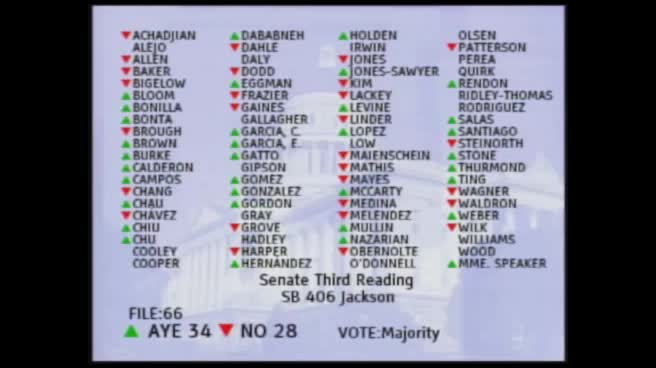 40MIN
Assembly Floor
 30MIN
Senate Floor
 2MIN
Assembly Floor
 1H
Assembly Standing Committee on Natural Resources
 1H
Assembly Standing Committee on Utilities and Commerce
 58MIN
Senate Floor
 44MIN
Senate Standing Committee on Environmental Quality
 59MIN
Senate Standing Committee on Energy, Utilities and Communications


Bill Co-Author(s):