SB 506: Economic development: military and aerospace.
- Session Year: 2015-2016
- House: Senate
- Latest Version Date: 2015-04-14
Existing law establishes the Governors Office of Business and Economic Development, which is administered by a director appointed by the Governor. The office serves the Governor as the lead entity for economic strategy and the marketing of California on issues relating to business development, private sector investment, and economic growth. Existing law, the Military Base Reuse Authority Act, authorizes the creation of a military base reuse authority to plan, finance, and manage the transition of a military base from military to civilian use, as specified.
This bill would establish the Military and Aerospace Program in the Governors Office of Business and Economic Development, and set forth the programs duties and authority with respect to state and local defense retention, conversion, and base reuse activities, including developing and recommending to the Governor and the Legislature a strategic plan for state and local defense retention and conversion efforts. The bill would authorize the office to establish a Military Advisory Council with a specified membership to provide input, information, technical advice, or other comments to the program on military related matters. This bill also would authorize the office to apply for grants and seek private funds for the operations of the office. The bill would establish the Military and Aerospace Account in the Special Deposit Fund in the State Treasury and require that any private funds the office accepts be deposited into that account. The bill would authorize the office to expend moneys in the account, upon appropriation by the Legislature, for specified purposes of the office.
The bill would require the Governors Office of Business and Economic Development to implement a space enterprise development program to foster activities that increase the competitiveness of space enterprise in California. The bill would authorize the director of the office to select a California nonprofit corporation to assist the office in its administration of space enterprise economic development activities, and would authorize the corporation to perform specified activities, including developing and implementing a state strategy for applying and commercializing technology to create jobs, respond to industry changes, and foster innovation and competitiveness in space enterprise. The bill would also establish the California Space Enterprise Competitive Grant Program within the office to provide funding, upon appropriation by the Legislature, for the development of space enterprise in California.
Existing law creates the Office of Planning and Research in the Governors office to provide the Governor and his or her cabinet with long-range, land use planning and research and to serve as the comprehensive state planning agency.
This bill would require a local retention authority to be recognized for each active military installation, as defined, in the state, and would require the office to maintain a list of retention authorities or their successors, including, but not limited to, separate airport or port authorities recognized as the local retention authority for military installations.
The California Global Warming Solutions Act of 2006 establishes the State Air Resources Board as the state agency responsible for monitoring and regulating sources emitting greenhouse gases. The act requires the state board to adopt a statewide greenhouse gas emissions limit, as defined, to be achieved by 2020, equivalent to the statewide greenhouse gas emissions levels in 1990. The act also requires the state board to prepare and approve a scoping plan for achieving the maximum technologically feasible and cost-effective reductions in greenhouse gas emissions. The act requires the state board, in developing the scoping plan, to take into account the relative contribution of each source or source category to statewide greenhouse gas emissions and the potential for adverse effects on small businesses.
This bill would additionally require the state board, in developing the scoping plan, to take into account the environmental benefits of renewable electrical generation facilities.
This chapter shall be known and may be cited as the Military and Aerospace Support Act.
13999.1.The Legislature finds and declares all of the following:
(a)There is potential for federal action to close or realign additional military installations nationwide through the base closure process, budget reductions, or internal United States Department of Defense reorganizations.
(b)There is synergy between the aerospace industry and Department of Defense activities in the state. Prior base closure rounds have resulted in significant downsizing and loss of jobs in the aerospace industry in California.
(c)There is potential growth in the aerospace industry, not only in national defense applications, but in commercial and private enterprises such as unmanned aerial vehicles, commercial space flight, and commercial space launch vehicles and services.
13999.2.(a)In an effort to be proactive in retaining and expanding these military facilities, the aerospace industry, and the jobs and intellectual capital associated with them, the Military and Aerospace Program is hereby created in the Governors Office of Business and Economic Development.
(b)The purpose of the program consists of both of the following:
(1)Providing a central clearinghouse for all defense retention, conversion, and base reuse activities in the state and interacting and communicating with military installations in the state.
(2)Retaining and encouraging growth in the aerospace and space flight industries through technical and regulatory advice, grants as provided in Section 13999.22, and other programs administered by the office or other state agencies.
(c)The office may organize and provide staffing for the program, as necessary, to perform the duties in this chapter, and may contract with other state or private agencies, nonprofit corporations, universities, firms, or individuals to fulfill any of its duties under this chapter.
(d)For purposes of this chapter, office means the Governors Office of Business and Economic Development.
13999.3.(a)The office may establish a Military Advisory Council to provide input, information, technical advice, or other comments to the program on military related matters, including, but not limited to, active Department of Defense installations in California and defense conversion issues. Participation by council members is voluntary and there is no reimbursement for per diem or expenses.
(b)The council may include, but is not limited to, representatives from any legislative office, state agency, local government, industry, and civic or research organizations that may have an interest in defense related activities.
13999.4.The program shall do all of the following:
(a)Develop and recommend to the Governor and the Legislature a strategic plan for state and local defense retention and conversion efforts. The plan shall address the states role in assisting communities with potential base closures and those impacted by previous closures. The office may coordinate with other state agencies, local groups, and interested organizations on this strategic plan to retain current Department of Defense installations, facilities, bases, and related civilian activities.
(b)Conduct outreach to entities and parties involved in defense retention and conversion across the state and provide a network to facilitate assistance and coordination for all defense retention and conversion activities within the state.
(c)Help develop and coordinate state retention advocacy efforts on the federal level.
(d)(1)Conduct an evaluation of existing state retention and conversion programs and provide the Legislature with recommendations on the continuation of existing programs, including, but not limited to, the possible elimination or alteration of those programs and provide recommendations to the Legislature on the necessity of new programs for defense retention and adequate funding levels. This evaluation and resulting recommendations shall be transmitted to each house of the Legislature in accordance with Section 9795. This requirement to submit an evaluation and recommendations is inoperative on January 1, 2020, pursuant to Section 10231.5.
(e)Update the plan prepared by the Defense Conversion Council as it existed on December 31, 1998, and any subsequent state agency reports, with the goal to minimize Californias loss of bases and jobs in future rounds of base closures. This plan shall include, but not be limited to, all of the following:
(1)Identify of major installations in California.
(2)Determine of how best to defend existing bases and base employment in this state.
(3)Coordinate of retention activities with communities that may face base closures.
(4)Develop of data and analyses on bases in this state.
(5)Coordinate with the state congressional delegation, the Legislature, and the Governor. With the consent of the appropriate authority, the office may temporarily borrow technical, policy, and administrative staff from other state agencies, including the Legislature.
(f)Serve as the primary state liaison with the Department of Defense and its installations in this state. In order to maximize the mission use of the installations, the program shall assist in resolving any disputes or issues between the Department of Defense and state entities.
(g)Review actions or programs by state agencies that may affect or impact Department of Defense installations or the states military base retention and reuse activities, and recommend to the Governor and the Legislature actions that may be taken to resolve or prevent similar problems in the future.
(h)If funds and resources are available, the office may undertake all of the following activities:
(1)Provide a central clearinghouse for all base retention or conversion assistance activities, including, but not limited to, employee training programs and regulation review and permit streamlining.
(2)Provide technical assistance to communities with potential or existing base closure activities.
(3)Provide a central clearinghouse for all defense retention and conversion funding, regulations, and application procedures for federal or state grants.
(4)Serve as a central clearinghouse for input and information, including needs, issues, and recommendations from businesses, industry representatives, labor, local government, and communities relative to retention and conversion efforts.
(5)Identify available state and federal resources to assist businesses, workers, communities, and educational institutions that may have a stake in retention and conversion activities.
(6)Provide one-stop coordination, maintain and disseminate information, standardize state endorsement procedures, and develop fast-track review procedures for proposals seeking state funds to match funding from federal defense conversion programs.
(7)Maintain and establish databases in fields such as defense-related companies, industry organization proposals for the state and federal defense industry, community assistance, training, and base retention, and provide electronic access to the databases.
13999.5.(a)The office may apply for grants and seek contributions from private industry to fund its operations.
(b)The office may actively solicit and accept funds from industry, foundations, or other sources to support its operations and responsibilities under this chapter.
(c)Any private funds the office accepts shall be deposited into the Military and Aerospace Account, which is hereby established in the Special Deposit Fund in the State Treasury. The office may expend moneys in the account, upon appropriation by the Legislature in the annual Budget Act, for the purposes of this chapter and for no other purpose. Records of funds received and expenditures made pursuant to this section shall be subject to public disclosure. A report describing the receipt and expenditure of these funds shall be submitted to the Department of Finance, the Assembly Committee on Budget, and the Senate Committee on Budget and Fiscal Review at least biennially.
13999.6.The office shall establish a military support grant program to grant funds to communities with Department of Defense installations to assist them in developing a retention strategy. The office may use grant criteria similar to those in any predecessor grant criteria established pursuant to former Section 13998.8 or existing defense conversion grant programs as a basis for developing the grant program. To discourage multiple grant applications for individual defense installations in a region, the criteria shall be drafted to encourage a single application for grant funds to develop, where appropriate, a single, regional defense retention strategy. The structure, requirements, administration, and funding procedures of the grant program shall be submitted to the Legislature for review at least 90 days prior to making the first grant disbursement. The office may make no grant award without the local community providing at least 50 percent or more in matching funds or in-kind services, with at least 50 percent of that match being in the form of funding.
13999.7.The office shall adopt necessary regulations to implement the programs authorized in this chapter. The office shall adopt these regulations as emergency regulations in accordance with Chapter 3.5 (commencing with Section 11340) of Part 1, and for purposes of that chapter, including Section 11349.6, the adoption of the regulations shall be considered by the Office of Administrative Law to be necessary for the immediate preservation of the public peace, health and safety, and general welfare. Notwithstanding subdivision (e) of Section 11346.1, the regulations shall be repealed within 180 days after their effective date, unless the office complies with Chapter 3.5 (commencing with Section 11340) of Part 1 as provided in subdivision (e) of Section 11346.1.
SEC. 2.Chapter 5 (commencing with Section 13999.20) is added to Part 4.7 of Division 3 of Title 2 of the Government Code, to read:5.Space Enterprise Development Act13999.20.This chapter shall be known and may be cited as the Space Enterprise Development Act.
13999.21.For purposes of this act, the following terms have the following meanings:
(a)Authority means the California Spaceport Authority.
(b)Date of designation means the date that the spaceport receives designation by the authority pursuant to Section 13999.23.
(c)Director means the Director of the Governors Office of Business and Economic Development.
(d)Governing body means the governing body of a city, county, city and county, special district, or joint powers authority.
(e)Launch means to place, or attempt to place, a launch vehicle into a ballistic, suborbital, or orbital trajectory, into Earth orbit in outer space, or otherwise into outer space, and also is a means of placing a commercial, civil, or military payload into Earth orbit or beyond, including all activities involved in the preparation of a launch vehicle for flight, including all processing, servicing, and support activities that take place at a launch site or at a California mission control support site for ocean launches. A launch begins with the arrival of the launch vehicle or payload at the launch site.
(f)Launch site means a location from which a space launch or operation directly associated with a space launch takes place, a location at which a launch vehicle or its payload, if any, is intended to land, or as defined in the Commercial Space Launch Act (51 U.S.C. Sec. 50901 et seq.). The site includes any right-of-way directly associated with the space launch or reentry operations and all facilities and support infrastructure related to launch, reentry, or payload processing.
(g)Launch vehicle means a vehicle specifically designed and built to operate in or place a payload in the upper atmosphere or outer space. Launch vehicles include, but are not limited to, expendable space launch vehicles and reusable launch vehicles.
(h)Office means the Governors Office of Business and Economic Development.
(i)Operation of a launch site means the conduct of approved safety operations at a launch site to support the launching of vehicles and payloads.
(j)Operation of a reentry site means the conduct of safety operations at a fixed site on Earth at which a reentry vehicle and its payload, if any, is intended to land.
(k)Payload means an object, including, but not limited to, a satellite that a licensed launch site undertakes to place into outer space by means of a launch vehicle, including components of the vehicle specifically designed or adopted to support that activity.
(l)Person means any individual and any corporation, partnership, joint venture, association, or other entity organized or existing under the laws of any state or nation.
(m)Reentry means the return of any launch vehicle that has been placed in a ballistic, suborbital, or orbital trajectory, and its payload, if any, to the Earth. Reentry includes all activities involved in the postflight ground operations. A reentry ends when a launch vehicle or payload, if any, has completed its descent to Earth and is retrieved.
(n)Reentry site means the location on Earth at which a reentry is intended to occur, as defined in a license issued or transferred by the United States Secretary of Transportation, and any necessary support infrastructure related to reentry or payload recovery.
(o)Reusable launch vehicle means a vehicle that is designed to launch into an orbital or suborbital trajectory, into Earth orbit in outer space, or otherwise into outer space, that returns to Earth and is reused for a subsequent future launch.
(p)Spaceport means an entity that has been designated pursuant to Section 13999.23.
13999.22.(a)Subject to the availability of funds appropriated for that purpose, the Governors Office of Business and Economic Development shall implement a space enterprise development program to foster activities that increase the competitiveness of space enterprise in California, including, but not limited to, the commercial use of space, space vehicle launches, space launch infrastructure, manufacturing, applied research, technology development, economic diversification, and business development.
(b)The office may contract with other state or private agencies, nonprofit corporations, universities, firms, or individuals for the performance of technical or specialized work, or for services related to space enterprise development programs authorized by this chapter.
(c)The director may select a California nonprofit corporation to assist the office in its administration of space enterprise economic development activities through programs, projects, grants, partnerships, networks, and collaboration. The corporation shall be selected through a solicitation process established by the office. The solicitation process shall include criteria for selection of the corporation, which shall include, but not be limited to, demonstrated experience in space enterprise and the ability to perform space enterprise development activities described in subdivision (d).
(d)The corporation may perform one or more of the following activities, as determined contractually between the office and the corporation:
(1)Serve as the California Spaceport Authority with responsibilities specified in Section 13999.23.
(2)Pursue grants from the federal government or from private businesses, foundations, or individuals, for California space enterprise activities, including, but not limited to, studies, services, infrastructure improvements and modernization, and defense transition programs, to the extent permitted by law.
(3)Identify science and technology trends that are significant to space enterprise and the state and act as a clearinghouse for space enterprise issues and information.
(4)Develop and implement a state strategy for applying and commercializing technology to create jobs, respond to industry changes, and foster innovation and competitiveness in space enterprise.
(5)Provide information to the director relevant to changes in federal, state, and local statutes and regulations that will enhance the development of space enterprise in California.
(6)Provide information to the office regarding the development of laws, regulations, decisions, or determinations affecting the economic and employment impacts of space enterprise in California.
(7)Provide recommendations to the director for appropriate state funding mechanisms and amounts to promote development of space enterprise in California, including education and workforce development.
(8)Provide recommendations to the director in the form of strategic planning documents.
(9)Review applications for, and promote, the California Space Enterprise Competitive Grant Program established by Section 13999.24.
(e)(1)The office and the corporation shall enter into an annual contract specifying the activities to be performed by the corporation.
(2)Pursuant to the contract, the corporation shall submit to the office quarterly reports of its activities and finances. The quarterly reports shall be of sufficient detail for the office to determine whether the corporation is in compliance with the annual contract between the office and the corporation.
(3)The annual contract shall include conflict of interest requirements developed by the office.
(4)Failure of the corporation to comply with the conditions in the annual contract, as evidenced in the quarterly reports and any supplemental monitoring of the corporation by the office, shall result in the cancellation of the annual contract and deselection of the corporation. Upon the deselection of the corporation, the office shall utilize the solicitation process set forth in subdivision (c) to select a replacement corporation.
13999.23.(a)The California Spaceport Authority shall designate spaceports for the operation of launch sites or reentry sites.
(b)Any city, county, city and county, special district, joint powers authority, or private entity, as appropriate, may apply to the authority for designation as a spaceport.
(c)(1)The application described in subdivision (b) shall require at least the following information to be submitted to the authority:
(A)A written notice of intent to apply for a federal launch site operators license from the United States Secretary of Transportation under the authority of the Commercial Space Launch Act (51 U.S.C. Sec. 50901 et seq.), to be received by the authority no later than 60 days prior to the submission of the application to the United States Secretary of Transportation.
(B)A copy of the perfected application submitted to the United States Secretary of Transportation for a federal launch site operators license.
(C)A written notice of acceptance or denial by the United States Secretary of Transportation for a federal launch site operators license. If acceptance is granted, a copy of the license shall be included in the written notice.
(2)This subdivision shall not apply to any launch site operator who is federally licensed on or before January 1, 2005.
(d)An entity located in California that has a federal launch site operators license from the United States Secretary of Transportation under the authority of the Commercial Space Launch Act (49 U.S.C. Sec. 7101 et seq.), shall receive a spaceport designation under this section as long as they maintain their federal designation and provide proof of their extension to the authority upon request.
(e)The authority shall withdraw spaceport designation upon receipt of notice from the Federal Aviation Administration that the launch site operator of the spaceport no longer meets safety requirements or that safety deficiencies in the spaceport have remained uncorrected for a reasonable period of time after being identified.
13999.24.(a)The California Space Enterprise Competitive Grant Program is hereby established within the Governors Office of Business and Economic Development to provide funding, upon appropriation by the Legislature, for the development of space enterprise in California. For purposes of this section, space enterprise activities include, but are not limited to, the commercial use of space, space vehicle launches, space launch infrastructure, manufacturing, applied research, technology development, economic diversification, and business development. Entities conducting activities in California intended to improve the competitiveness of space enterprise in California, including public, private, educational, commercial, nonprofit, or for-profit entities, may apply for grants.
(b)(1)If program funding is appropriated by the Legislature, the office, or the corporation selected pursuant to subdivision (c) of Section 13999.22, shall, at least annually, issue solicitations. A solicitation shall not be issued without the prior review and approval by the office. If the corporation has not issued a solicitation within 180 days of the appropriation of funds, the office shall issue the solicitation.
(2)Solicitations developed by the corporation shall include minimum eligibility and requirements. Additional requirements may be added to each years grant solicitation. The solicitation shall address at least all of the following:
(A)Jobs created and retained by the implementation of the project.
(B)Cost sharing by other project participants, which should include at least one of the following:
(i)A private sector company or companies.
(ii)One or more foundations, industry associations, or nonprofit cooperative associations, or any combination thereof.
(iii)In-kind support, which may include staff and facilities.
(iv)Federal or local government funding.
(C)A condition that grant funds will not be used to supplant other project funds.
(D)A demonstration that a majority of the project will be undertaken in California.
(E)An agreement among all project participants as to intellectual property rights relative to the project.
(F)The potential impact on the states economy.
(G)The cost-effectiveness of the project.
(H)The importance of state funding for the viability of the project.
(I)A demonstration of technical feasibility and an assessment of programmatic risk.
(c)In evaluating grant proposals, the corporation shall establish an impartial review panel composed of technical and scientific experts and government representatives to review grant applications. The panel shall be composed of members from throughout the state who are knowledgeable about activities related to space enterprise. No more than 30 percent of the panel members shall be government representatives, and all other members shall either be actively involved in, or be technical and scientific experts in activities related to, space enterprise. No more than 30 percent of the panel members shall be members of, or on the board of directors of, the corporation.
(d)(1)The review panel shall review all applications received by the deadline specified in the solicitation in order to determine the applications that are complete and that meet the criteria set forth in the solicitation. The review panel may rely on experts who are not part of the panel in order to determine compliance with one or more criteria.
(2)All applications meeting the criteria set forth in paragraph (1) shall be submitted to the office.
(3)The office may remove one or more applications from those submitted by the review panel upon a determination that the application did not meet the criteria set forth in paragraph (1). The office shall rank the grant applications received from the review panel, minus any applications removed by the office because of failure to meet the criteria. The ranking shall be based upon criteria stated in the solicitation. The ranking shall include recommendations as to the amount of state funding for each grant application.
(e)The director shall award program grants based upon the criteria stated in the solicitation.
(f)The funding determination shall be transmitted to the Governor and the chairpersons of the Senate and Assembly fiscal committees and shall be subject to the availability of funds appropriated for that purpose.
(g)The solicitation process set forth in this section shall not be subject to Chapter 3.5 (commencing with Section 11340) of Part 1.
(h)The Legislature hereby finds and declares that the granting of funds to private entities serves a public purpose by assisting an industry vital to the health and welfare of the State of California.
13999.25.The office shall adopt necessary regulations to implement the programs authorized in this chapter. The office shall adopt these regulations as emergency regulations in accordance with Chapter 3.5 (commencing with Section 11340) of Part 1, and for purposes of that chapter, including Section 11349.6, the adoption of the regulations shall be considered by the Office of Administrative Law to be necessary for the immediate preservation of the public peace, health and safety, and general welfare. Notwithstanding subdivision (e) of Section 11346.1, the regulations shall be repealed within 180 days after their effective date, unless the office complies with Chapter 3.5 (commencing with Section 11340) of Part 1 as provided in subdivision (e) of Section 11346.1.
SEC. 3.Article 6 (commencing with Section 65053.5) is added to Chapter 1.5 of Division 1 of Title 7 of the Government Code, to read:6.Single Local Retention Entities65053.5.(a)As used in this article, the following terms have the following meaning:
(1)Military installation means a base, camp, post, station, yard, center, homeport facility for any ship, or other facility under the jurisdiction of the United States Department of Defense, as defined in paragraph (1) of subsection (g) of Section 2687 of Title 10 of the United States Code.
(2)Affected local government means any county or city identified as located wholly or partly within the boundaries of a military installation or as having a sphere of influence over any portion of the installation with responsibility for local zoning and planning decisions.
(b)The Legislature hereby finds and declares all of the following:
(1)Because of the tremendous economic impact that military installations have on the state, it is in the best interest of the state to facilitate their retention.
(2)It is the intent of the Legislature to encourage cooperation among affected local governments in their efforts to retain military installations in this state by authorizing the creation of a joint powers authority pursuant to this section.
(3)The Legislature also encourages affected local governments to engage other community-based organizations in their retention activities.
(c)For the purposes of this article, a local retention authority shall be recognized for each active military installation in this state.
(d)A list of retention authorities or their successors, including, but not limited to, separate airport or port authorities recognized as the local retention authority for the military installations, shall be maintained by the Office of Planning and Research. If multiple affected local governments are identified for a military installation as described in paragraph (2) of subdivision (a), those affected counties and cities may, by resolution, designate an existing joint powers authority or establish a joint powers authority for the purposes of this article pursuant to Chapter 5 (commencing with Section 6500) of Division 7 of Title 1.
(e)(1)The state shall recognize a local retention authority for each active military installation if resolutions acknowledging the authority as the local retention authority are adopted by all boards of supervisors and city councils for counties and cities identified as affected local governments as described in paragraph (2) of subdivision (a) and are forwarded to the Office of Planning and Research on or before October 1, 2016.
(2)If prior to January 1, 2004, a local government was awarded grant moneys pursuant to any predecessor to former Section 13998.8 or former Section 65053.5 for a specific military installation and still qualifies as an affected local government as described in paragraph (2) of subdivision (a), the recipient local government shall be recognized by the state as the local retention authority unless resolutions acknowledging a different authority are adopted by all county boards of supervisors and city councils for counties and cities identified as affected local governments described in paragraph (2) of subdivision (a), and are forwarded to the Office of Planning and Research.
(f)If the necessary resolutions are not adopted and forwarded before October 1, 2016, the Office of Planning and Research, in consultation with Governors Office of Business and Economic Development, shall recognize a local retention authority for each military installation.
65053.6.The local retention authority shall be recognized by all state agencies as the local retention planning authority for the military installation. The state shall encourage the federal government and other local jurisdictions to recognize similarly the authorities designated pursuant to Section 65053.5 for the purposes of retention activities.
SECTION 1.Section 38561 of the Health and Safety Code is amended to read:38561.(a)(1)On or before January 1, 2009, the state board shall prepare and approve a scoping plan, as that term is understood by the state board, for achieving the maximum technologically feasible and cost-effective reductions in greenhouse gas emissions from sources or categories of sources of greenhouse gases by 2020 under this division.
(2)The state board shall consult with all state agencies with jurisdiction over sources of greenhouse gases, including the Public Utilities Commission and the State Energy Resources Conservation and Development Commission, on all elements of its plan that pertain to energy-related matters including, but not limited to, electrical generation, load based-standards or requirements, the provision of reliable and affordable electrical service, petroleum refining, and statewide fuel supplies to ensure the greenhouse gas emissions reduction activities to be adopted and implemented by the state board are complementary, nonduplicative, and can be implemented in an efficient and cost-effective manner.
(b)The plan shall identify and make recommendations on direct emissions reduction measures, alternative compliance mechanisms, market-based compliance mechanisms, and potential monetary and nonmonetary incentives for sources and categories of sources that the state board finds are necessary or desirable to facilitate the achievement of the maximum feasible and cost-effective reductions of greenhouse gas emissions by 2020.
(c)In making the determinations required by subdivision (b), the state board shall consider all relevant information pertaining to greenhouse gas emissions reduction programs in other states, localities, and nations, including the northeastern states of the United States, Canada, and the European Union.
(d)The state board shall evaluate the total potential costs and total potential economic and noneconomic benefits of the plan for reducing greenhouse gases to Californias economy, environment, and public health, using the best available economic models, emission estimation techniques, and other scientific methods.
(e)In developing its plan, the state board shall take into account the relative contribution of each source or source category to statewide greenhouse gas emissions, including the environmental benefits of renewable electrical generation facilities, and the potential for adverse effects on small businesses, and shall recommend a de minimis threshold of greenhouse gas emissions below which emissions reduction requirements will not apply.
(f)In developing its plan, the state board shall identify opportunities for emissions reduction measures from all verifiable and enforceable voluntary actions, including, but not limited to, carbon sequestration projects and best management practices.
(g)The state board shall conduct a series of public workshops to give interested parties an opportunity to comment on the plan. The state board shall conduct a portion of these workshops in regions of the state that have the most significant exposure to air pollutants, including, but not limited to, communities with minority populations, communities with low-income populations, or both.
(h)The state board shall update its plan for achieving the maximum technologically feasible and cost-effective reductions of greenhouse gas emissions at least once every five years.
TextPages 3, 8, 11, and 12.(a)(1)On or before January 1, 2009, the state board shall prepare and approve a scoping plan, as that term is understood by the state board, for achieving the maximum technologically feasible and cost-effective reductions in greenhouse gas emissions from sources or categories of sources of greenhouse gases by 2020 under this division. The
(2)The state board shall consult with all state agencies with jurisdiction over sources of greenhouse gases, including the Public Utilities Commission and the State Energy Resources Conservation and Development Commission, on all elements of its plan that pertain to energy related energy-related matters including, but not limited to, electrical generation, load based-standards or requirements, the provision of reliable and affordable electrical service, petroleum refining, and statewide fuel supplies to ensure the greenhouse gas emissions reduction activities to be adopted and implemented by the state board are complementary, nonduplicative, and can be implemented in an efficient and cost-effective manner.
(b)The plan shall identify and make recommendations on direct emission emissions reduction measures, alternative compliance mechanisms, market-based compliance mechanisms, and potential monetary and nonmonetary incentives for sources and categories of sources that the state board finds are necessary or desirable to facilitate the achievement of the maximum feasible and cost-effective reductions of greenhouse gas emissions by 2020.
(c)In making the determinations required by subdivision (b), the state board shall consider all relevant information pertaining to greenhouse gas emissions reduction programs in other states, localities, and nations, including the northeastern states of the United States, Canada, and the European Union.
(d)The state board shall evaluate the total potential costs and total potential economic and noneconomic benefits of the plan for reducing greenhouse gases to Californias economy, environment, and public health, using the best available economic models, emission estimation techniques, and other scientific methods.
(e)In developing its plan, the state board shall take into account the relative contribution of each source or source category to statewide greenhouse gas emissions, including the environmental benefits of renewable electrical generation facilities, and the potential for adverse effects on small businesses, and shall recommend a de minimis threshold of greenhouse gas emissions below which emission emissions reduction requirements will not apply.
(f)In developing its plan, the state board shall identify opportunities for emission reductions emissions reduction measures from all verifiable and enforceable voluntary actions, including, but not limited to, carbon sequestration projects and best management practices.
(g)The state board shall conduct a series of public workshops to give interested parties an opportunity to comment on the plan. The state board shall conduct a portion of these workshops in regions of the state that have the most significant exposure to air pollutants, including, but not limited to, communities with minority populations, communities with low-income populations, or both.
(h)The state board shall update its plan for achieving the maximum technologically feasible and cost-effective reductions of greenhouse gas emissions at least once every five years.
|
Date
|
Status
|
|---|---|
| Feb 1, 2016 | Returned to Secretary of Senate pursuant to Joint Rule 56. |
| May 28, 2015 | May 28 hearing: Held in committee and under submission. |
| May 23, 2015 | Set for hearing May 28. |
| May 11, 2015 | May 11 hearing: Placed on APPR. suspense file. |
| May 1, 2015 | Set for hearing May 11. |
| Apr 29, 2015 | From committee: Do pass and re-refer to Com. on APPR. (Ayes 5. Noes 0. Page 826.) (April 28). Re-referred to Com. on APPR. |
| Apr 29, 2015 | From committee: Do pass and re-refer to Com. on APPR. (Ayes 5. Noes 0.) (April 28). Re-referred to Com. on APPR. |
| Apr 28, 2015 | From committee: Do pass and re-refer to Com. on V.A. (Ayes 9. Noes 0. Page 794.) (April 27). Re-referred to Com. on V.A. |
| Apr 24, 2015 | Set for hearing April 28 in V.A. pending receipt. |
| Apr 21, 2015 | Set for hearing April 27. |
| Apr 16, 2015 | Re-referred to Coms. on B., P. & E.D. and V.A. |
| Apr 16, 2015 | Re-referred to Com. on RLS. |
| Apr 16, 2015 | Withdrawn from committee. |
| Apr 14, 2015 | (Corrected April 15). |
| Apr 14, 2015 | From committee with author's amendments. Read second time and amended. Re-referred to Com. on E.Q. |
| Mar 26, 2015 | April 15 set for first hearing canceled at the request of author. |
| Mar 17, 2015 | Set for hearing April 15. |
| Mar 12, 2015 | Referred to Com. on E.Q. |
| Feb 27, 2015 | From printer. May be acted upon on or after March 29. |
| Feb 26, 2015 | Introduced. Read first time. To Com. on RLS. for assignment. To print. |
|
Date
|
Description
|
Location
|
Votes
|
|
|---|---|---|---|---|
| May 11, 2015 | Placed on suspense file | Senate Standing Committee on Appropriations |
Passed |
|
| Apr 28, 2015 | Do pass, but first be re-referred to the Committee on [Appropriations] | Senate Standing Committee on Veterans Affairs |
Passed |
|
| Apr 27, 2015 | Do pass, but first be re-referred to the Committee on [Veterans Affairs] | Senate Standing Committee on Business, Professions and Economic Development |
Passed |
This list shows positions taken on this bill by organizations on the date displayed, which is linked to the original source.
Positions by individuals are not included.
SB 506 (Fuller) Page 7 of 7
SENATE COMMITTEE ON APPROPRIATIONS
Senator Ricardo Lara, Chair
2015 - 2016 Regular Session
SB 506 (Fuller) - Economic development: military and aerospace
|
|
Version: April 14, 2015 |
Policy Vote: B., P. & E.D. 9 - 0, V.A. 5 - 0 |
Urgency: No |
Mandate: No |
Hearing Date: May 11, 2015 |
Consultant: Robert Ingenito |
This bill meets the criteria for referral to the Suspense File.
Bill Summary:
SB 506 would (1) establish a process for the designation of a local retention authority to serve as the lead local government entity responsible for efforts to retain local military installations, (2) create the Military and Aerospace Program under the Governor’s Office of Business and Economic Development (GO-Biz) to address concerns relating to state and local defense retention, base conversion and base reuse activities, and (3) establish the Space Enterprise Development Program within GO-Biz to foster activities that increase the competitiveness of space enterprise in California, including the commercial use of space, space vehicle launches, space launch infrastructure, manufacturing, applied research, technology development, economic diversification, and business development.
Fiscal Impact:
GO-Biz indicates that it would incur annual General Fund costs of at about $2 million to implement the provisions of the bill.
The Governor’s Office of Planning and Research (OPR) would incur minor administrative costs.
Background:
The federal government conducted four rounds of Base Realignment and Closure (BRAC) closures late 1988 and 1993. Nationally, that process led to the closing of 350 large and small military bases and 55 major realignments. Reportedly, this saved federal taxpayers in excess of $16 billion through 2001 and six billion dollars more each subsequent year.
Prior to 1988, California had, by far, the largest military presence of any state, and was home 15 percent of the Department of Defense's (DoD’s) total 275,264 personnel and 18 percent of the major military bases around the country. Correspondingly, the base closures over those four rounds hit the State disproportionately hard.
Prior to the mid 1990's, California's response to BRAC was primarily focused on assisting local communities in the reuse of shuttered military bases. In 1994, then-Governor Wilson issued an Executive Order (W-87-94) which directed OPR to coordinate the state's effort to assist local communities in developing strategies to protect California bases from further closings, as a means of focusing on the importance military bases have on the state’s economy.
Subsequent legislation (AB 639, Alby, 1998 and SB 1099, Knight, 1999) codified an Office of Military Base Retention and Reuse (OMBRR), placing it within the Technology, Trade and Commerce Agency (TTCA) and outlining the responsibilities of the office, including the creation of a Defense Retention Grant Program. The grant program aided local communities in preparing for future BRAC rounds. SB 926 (Knight and Ashburn, 2004) then renamed OMBRR to the Office of Military and Aerospace Support (OMAS), signifying the close relationship between military and aerospace activities. OMAS exited through the 2005 BRAC round and subsequently sunsetted in January of 2007.
Unlike previous rounds, the fifth BRAC round (2005) focused more on realignment than closure. Along with saving money, a top priority was military force readiness, consolidating assets onto centralized installations from which they can be deployed rapidly and flexibly in support of an evolving global situation, and joint service missions. Implementation of the 2005 BRAC recommendations was completed in 2011.
Proposed Law:
This bill would, among other things, do the following:
The Military and Aerospace Support Act
Establish the Military and Aerospace Program (MA Program) in GO-Biz in an effort to be proactive in retaining and expanding military facilities, the aerospace industry, and the jobs and intellectual capital associated with them in the State.
State that the purpose of the MA Program is to provide a central clearinghouse for all defense retention, conversion, and base reuse activities in the State and interacting and communicating with military installations in the state and to retain and encourage growth in the aerospace and space flight industries through technical and regulatory advice, grants and other programs administered by GO-Biz or other state agencies.
Authorize GO-Biz to establish a Military Advisory Council (Council) to provide input, information, technical advice, or other comments to the Program on military related matters, as specified. Provide that participation by Council members is voluntary and there is no reimbursement for per diem or expenses. Provide that the Council may include, but is not limited to, representatives from any legislative office, state agency, local government, industry, and civic or research organizations that may have an interest in defense related activities.
Require the MA Program to do all of the following:
Develop and recommend to the Governor and the Legislature a strategic plan for state and local defense retention and conversion efforts. The plan shall address the State’s role in assisting communities with potential base closures and those impacted by previous closures. GO-Biz may coordinate with other state agencies, local groups, and interested organizations on this strategic plan to retain current DOD installations, facilities, bases, and related civilian activities.
Conduct outreach to entities and parties involved in defense retention and conversion across the state and provide a network to facilitate assistance and coordination for all defense retention and conversion activities within the State.
Help develop and coordinate state retention advocacy efforts on the federal level.
Conduct an evaluation of existing state retention and conversion programs, as specified, and provide the Legislature with recommendations on the continuation of existing programs.
Update the plan prepared by the Defense Conversion Council as it existed on December 31, 1998, and any subsequent state agency reports, with the goal to minimize California’s loss of bases and jobs in future rounds of base closures. State that the new plan shall include, but not be limited to, identifying major installations in California, determining how best to defend existing bases and base employment in this state, coordinating retention activities with communities that may face base closures, developing data and analyses on bases in this state and coordinating with the state congressional delegation, the Legislature, and the Governor.
Serve as the primary state liaison with DOD and its installations in this state and assist in resolving any disputes or issues between the DOD and state entities.
Review actions or programs by state agencies that may affect or impact DOD installations or the state’s military base retention and reuse activities, and recommend to the Governor and the Legislature actions that may be taken to resolve or prevent similar problems in the future.
Authorize the MA Program, providing that funds and resources are available, to also:
Provide a central clearinghouse for all base retention or conversion assistance activities, including, but not limited to, employee training programs and regulation review and permit streamlining.
Provide technical assistance to communities with potential or existing base closure activities.
Provide a central clearinghouse for all defense retention and conversion funding, regulations, and application procedures for federal or state grants.
Serve as a central clearinghouse for input and information, including needs, issues, and recommendations from businesses, industry representatives, labor, local government, and communities relative to retention and conversion efforts.
Identify available state and federal resources to assist businesses, workers, communities, and educational institutions that may have a stake in retention and conversion activities.
Provide one-stop coordination, maintain and disseminate information, standardize state endorsement procedures, and develop fast-track review procedures for proposals seeking state funds to match funding from federal defense conversion programs.
Maintain and establish databases in fields such as defense-related companies, industry organization proposals for the state and federal defense industry, community assistance, training, and base retention, and provide electronic access to the databases.
Authorize GO-Biz to apply for grants and seek contributions from private industry to fund MA Program operations. Provides that any private funds shall be deposited into the Military and Aerospace Account, which is established in the Special Deposit Fund in the State Treasury. Authorize GO-Biz to expend moneys in the account, upon appropriation by the Legislature in the annual Budget Act, only for the purposes outlined above related to the MA Program. Provides that records of funds received and expenditures made shall be subject to public disclosure and a report describing the receipt and expenditure of these funds shall be submitted to the Department of Finance, the Assembly Committee on Budget, and the Senate Committee on Budget and Fiscal Review at least biennially.
Require GO-Biz to establish a military support grant program (MS Grant Program) to grant funds to communities with DOD installations to assist them in developing a retention strategy. State that in order to discourage multiple grant applications for individual defense installations in a region, the criteria for grants shall be drafted to encourage a single application for grant funds to develop a single regional defense retention strategy. Require that the structure, requirements, administration, and funding procedures of the grant program be submitted to the Legislature for review at least 90 days prior to making the first grant disbursement. State that GO-Biz may only make a grant award if the local community provides at least 50 percent or more in matching funds or in-kind services, with at least 50 percent of that match being in the form of funding.
Require GO-Biz to adopt necessary regulations to implement the MA Program and MS Grant Program and shall adopt these regulations as emergency regulations.
Space Enterprise Development Act
Require GO-Biz to implement a space enterprise development program (Space Program) to foster activities that increase the competitiveness of space enterprise in California, as specified. Authorize GO-Biz to contract with other state or private agencies, nonprofit corporations, universities, firms, or individuals for the performance of technical or specialized work, or for services related to space enterprise development programs.
Authorize GO-Biz to select a California nonprofit corporation to assist in the administration of space enterprise economic development activities through programs, projects, grants, partnerships, networks, and collaboration. Require the nonprofit to be selected through a solicitation process that includes specified criteria. Establish requirements for a contract between GO-Biz and the nonprofit which include quarterly reports of the nonprofit’s activities and finances, conflict of interest provisions developed by GO-Biz and the ability for GO-Biz to cancel the contract if the nonprofit does not comply with requirements. Authorize the nonprofit to perform specified activities, as determined contractually between GO-Biz and the nonprofit.
Require the Authority to designate spaceports for the operation of launch sites or reentry sites and specifies that any city, county, city and county, special district, joint powers authority, or private entity, may apply to the Authority for designation as a spaceport. Set forth application requirements. Designate an entity that has a federal launch site operator's license from the United States Secretary of Transportation under the authority of the Commercial Space Launch Act (49 U.S.C. Sec. 7101 et seq.) as a spaceport as long as they maintain their federal designation and provide proof of their extension to the Authority upon request. Clarifies that these provisions do not apply to any launch site operator who is federally licensed on or before January 1, 2005.
Establish the California Space Enterprise Competitive Grant Program (Space Grant Program) within GO-Biz to provide funding, upon appropriation by the Legislature, for the development of space enterprise in California. Authorizes entities conducting activities intended to improve the competitiveness of space enterprise in California, including public, private, educational, commercial, nonprofit, or for-profit entities to apply for grants. Clarifies that space enterprise activities include, but are not limited to, the commercial use of space, space vehicle launches, space launch infrastructure, manufacturing, applied research, technology development, economic diversification, and business development.
Require GO-Biz or the nonprofit acting as the Authority to issue solicitations that include minimum eligibility and requirements for grants and that address jobs created and retained by the implementation of the project, cost sharing by other project participants, a condition that grant funds will not be used to supplant other project funds, a demonstration that a majority of the project will be undertaken in California, an agreement among all project participants as to intellectual property rights relative to the project, the potential impact on the state’s economy, the cost-effectiveness of the project, the importance of state funding for the viability of the project, a demonstration of technical feasibility and an assessment of programmatic risk. Requires an impartial review panel to evaluate grant proposals, comprised of technical and scientific experts and government representatives from throughout the state who are knowledgeable about activities related to space enterprise. Requires applications to be ranked and include recommendations as to the amount of state funding for each grant application. States that the granting of funds to private entities serves a public purpose by assisting an industry vital to the health and welfare of the State of California.
Require GO-Biz to adopt necessary regulations to implement the Space Program and Space Grant Program.
Provisions Related to Local Retention Entities
Require a local retention authority (RA) to be recognized for each active military installation in the State. Require a list of RAs or their successors, including, but not limited to, separate airport or port authorities recognized as the local retention authority for the military installations, to be maintained by the Office of Planning and Research (OPR). Authorize a joint powers authority to be designated or created if multiple affected local governments are identified as an affected local government.
Require the State to recognize an RA for each active military installation if resolutions acknowledging it as the RA are adopted by all Boards of Supervisors (BOSs) and City Councils (CCs) for counties and cities identified as affected local governments.
Provide that, if prior to January 1, 2004, a local government was awarded grant moneys pursuant to any predecessor agency for a specific military installation and still qualifies as an affected local government, the recipient local government shall be recognized by the state as the RA unless resolutions acknowledging a different RA are adopted by all County BOSs and CCs for counties and cities identified as affected local governments.
Require OPR, in consultation with GO-Biz, to recognize an RA for each military installation if the necessary resolutions are not adopted and forwarded before October 1, 2016 to OPR.
State that the RA shall be recognized by all state agencies as the local retention planning authority for the military installation and requires the state to encourage the federal government and other local jurisdictions to recognize these RAs.
Related Legislation:
SB 121 (Fuller) would require that school construction projects on military installations that are eligible for specified federal grants be given priority for funding under the State School Facility program. The bill is currently in the Senate Committee on Education.
Staff Comments:
GO-Biz’s annual General Fund budget is about $10 million. The estimated position and equipment costs to administer this bill would increase the size of the department by roughly 20 percent.
The 2005 Commission recommended that Congress authorize another BRAC round in 2015, and then every 8 years ongoing. In May 2012, the House Armed Services Committee rejected a proposal for a 2015 round of base closures. In March of 2015, an acting assistant Secretary of Defense testified before a House subcommittee, indicating that the Pentagon has begun the process of requesting a new round of base closures.
-- END --
SB 506 (Fuller) Page 15 of 15
SENATE COMMITTEE ON VETERANS AFFAIRS
Senator Jim Nielsen, Chair
2015 - 2016 Regular
Bill No: SB 506 Hearing Date: 4/28/15
Author: |
Fuller |
||
Version: |
4/14/15 |
||
Urgency: |
No |
Fiscal: |
Yes |
Consultant: |
Wade Teasdale |
||
Subject: Economic development: military and aerospace
DESCRIPTION
*This measure was scheduled to be heard on Monday, April 27, 2015 in the Committee on Business, Professions and Economic Development.
Summary:
Establishes a process for the designation of a local retention authority to serve as the lead local government entity responsible for efforts to retain local military installations.
Creates the Military and Aerospace (MA) Program under the Governor’s Office of Business and Economic Development (GO-Biz) to address concerns relating to state and local defense retention, base conversion and base reuse activities.
Establishes the Space Enterprise Development Program within GO-Biz to foster activities that increase the competitiveness of space enterprise in California, including the commercial use of space, space vehicle launches, space launch infrastructure, manufacturing, applied research, technology development, economic diversification, and business development.
Existing law:
Provisions Related to Military Base Retention, Conversion and Reuse
Establishes the Office of Planning and Research (OPR) in the Governor’s office and tasks OPR with the formulation, evaluation and updating of long-age goals and policies for land use, population growth and distribution.
Requires OPR to develop and adopt guidelines for the preparation and content of the mandatory elements required in city and county general plans that, among other requirements:
Contain advice including recommendations for best practices to allow for collaborative land use planning of adjacent civilian and military lands and facilities.
Encourage enhanced land use compatibility between civilian lands and any adjacent or nearby military facilities through the examination of potential impacts upon one another.
Contain advice for addressing the effects of civilian development on military readiness activities carried out on military installations, operating areas, training areas, training routes, airspace and other territory adjacent to those installations and areas.
Requires OPR to prepare and publish an advisory planning handbook for use by local officials, planners, and builders that explains how to reduce land use conflicts between the effects of civilian development and military readiness activities carried out on military installations, operating areas, training areas, training routes, and airspace, and other territory adjacent to those installations and areas.
Requires OPR to serve as the state’s liaison to the United States Department of Defense (DoD) in order to facilitate coordination on issues of mutual significant interest, particularly with regard to any proposed federal Base Realignment and Closure (BRAC) actions.
Provides that OPR shall:
Coordinate with DoD, other state agencies and departments, local governments, and other private and public entities to ensure the sustainability of defense activities within the state.
Develop legislation that supports the relationship between the state and DoD;
Work with federal defense agencies to address regulatory activities by state agencies that affect the sustainability of defense operations within the state and;
Develop any regional or statewide strategies necessary for the establishment and retention of the state’s military facilities and installations that are potentially impacted by any proposed federal BRAC actions.
Establishes the Military Base Reuse Authority Act to plan for, finance and manage the transition of military bases from military to civilian use.
Establishes GO-Biz within the Governor's Office and authorizes it to:
Serve as lead entity for economic strategy and the marketing of California on issues relating to business development, private sector investment and economic growth.
Coordinate development of policies and criteria to ensure that federal grants administered or directly expended by state government advance statewide economic goals and objectives.
Market the business and investment opportunities available in California by working in partnership with local, regional, federal, and other state public and private institutions to encourage business development and investment in the state.
Support small businesses by providing information about accessing capital, complying with regulations, and supporting state initiatives that support small business.
Requires GO-Biz to designate Innovation Hubs (iHubs) within the state to stimulate partnerships, economic development, and job creation by leveraging assets to provide an innovation platform for startup businesses, economic development organizations, business groups, and venture capitalists.
Requires an iHub to: (a) provide counseling and technical assistance in the areas of entrepreneurial business planning and management, financing, and marketing for small businesses; (b) provide expert advice to entrepreneurs on starting a business, including legal requirements for starting a business and access to financing opportunities; (c) conduct business workshops, seminars, and conferences with local partners; and (d) facilitate partnerships between innovative startup businesses, research institutions, and venture capitalists or financial institutions.
Creates the Innovation Accelerator Account within the California Economic Development Fund in the State Treasury and states that, subject to the approval of the Department of Finance, all moneys collected and received by GO-Biz for California Innovation Initiatives from gifts, bequests, or donations shall be deposited in the Innovation Accelerator Account and continuously appropriated to GO-Biz pursuant to requirements for a gift, bequest, or donation.
Specifies that GO-Biz is the primary state agency authorized to attract foreign investments, cooperate in international public infrastructure projects, and support California businesses in accessing markets, and requires the Director of GO-Biz to develop an international trade and investment program attracting employment-producing direct foreign investment to the state and provides support for California businesses in accessing international markets and increasing exports.
Authorizes GO-Biz to establish international trade and investment (ITI) offices outside of the U.S. according to certain requirements. Establishes processes and accountability measures for GO-Biz to accept private moneys to fund, establish and operate international trade offices.
Establishes the California Economic Development Fund in the State Treasury for the purpose of receiving federal, state, local, and private economic development funds, and receiving repayment of loans or grant proceeds and interest on those loans or grants. Provides that upon appropriation by the Legislature, moneys in the fund may be expended by GO-Biz to provide matching funds for loans or grants to public agencies, nonprofit organizations, and private entities, and for other economic development purposes, consistent with the purposes for which the moneys were received.
This bill:
Provisions relating to The Military and Aerospace Support Act
Enacts the Military and Aerospace Support Act.
Establishes the MA Program within GO-Biz to be proactive in retaining and expanding military facilities, the aerospace industry, and the jobs and intellectual capital associated with them in the state. States that the purpose of the MA Program is to provide a central clearinghouse for all defense retention, conversion, and base reuse activities in the state and interacting and communicating with military installations in the state and to retain and encourage growth in the aerospace and space flight industries through technical and regulatory advice, grants and other programs administered by GO-Biz or other state agencies.
Authorizes GO-Biz to establish a Military Advisory Council (Council) to provide input, information, technical advice, or other comments to the MA Program on military related matters, including, but not limited to, active DoD installations in California and defense conversion issues. Provides that participation by Council members is voluntary and there is no reimbursement for per diem or expenses. Provides that the Council may include, but is not limited to, representatives from any legislative office, state agency, local government, industry, and civic or research organizations that may have an interest in defense related activities.
Requires the MA Program to do all of the following:
Develop and recommend to the Governor and Legislature a strategic plan for state and local defense retention and conversion efforts. The plan shall address the state’s role in assisting communities with potential base closures and those impacted by previous closures. GO-Biz may coordinate with other state agencies, local groups, and interested organizations on this strategic plan to retain current DoD installations, facilities, bases, and related civilian activities.
Conduct outreach to entities and parties involved in defense retention and conversion across the state and provide a network to facilitate assistance and coordination for all defense retention and conversion activities within the state.
Help develop and coordinate state retention advocacy efforts on the federal level.
Until January 1, 2020, conduct an evaluation of existing state retention and conversion programs and provide the Legislature with recommendations on the continuation of existing programs, including, but not limited to, the possible elimination or alteration of those programs and provide recommendations to the Legislature on the necessity of new programs for defense retention and adequate funding levels.
Update the plan prepared by the Defense Conversion Council as it existed on December 31, 1998, and any subsequent state agency reports, with the goal to minimize California’s loss of bases and jobs in future rounds of base closures. States that the new plan shall include, but not be limited to, identifying major installations in California, determining how best to defend existing bases and base employment in this state, coordinating retention activities with communities that may face base closures, developing data and analyses on bases in this state and coordinating with the state congressional delegation, the Legislature, and the Governor. Authorizes GO-Biz to temporarily borrow technical, policy, and administrative staff from other state agencies, including the Legislature.
Serve as the primary state liaison with DoD and its installations in this state and assist in resolving any disputes or issues between the DoD and state entities.
Review actions or programs by state agencies that may affect or impact DoD installations or the state’s military base retention and reuse activities, and recommend to the Governor and the Legislature actions that may be taken to resolve or prevent similar problems in the future.
Authorizes the MA Program, providing that funds and resources are available, to also:
Provide a central clearinghouse for all base retention or conversion assistance activities, including, but not limited to, employee training programs and regulation review and permit streamlining.
Provide technical assistance to communities with potential or existing base closure activities.
Provide a central clearinghouse for all defense retention and conversion funding, regulations, and application procedures for federal or state grants.
Serve as a central clearinghouse for input and information, including needs, issues, and recommendations from businesses, industry representatives, labor, local government, and communities relative to retention and conversion efforts.
Identify available state and federal resources to assist businesses, workers, communities, and educational institutions that may have a stake in retention and conversion activities.
Provide one-stop coordination, maintain and disseminate information, standardize state endorsement procedures, and develop fast-track review procedures for proposals seeking state funds to match funding from federal defense conversion programs.
Maintain and establish databases in fields such as defense-related companies, industry organization proposals for the state and federal defense industry, community assistance, training, and base retention, and provide electronic access to the databases.
Authorizes GO-Biz to apply for grants and seek contributions from private industry to fund MA Program operations. Provides that any private funds shall be deposited into the Military and Aerospace Account. Authorizes GO-Biz to expend moneys in the account, upon appropriation by the Legislature in the annual Budget Act, only for the purposes outlined above related to the MA Program. Provides that records of funds received and expenditures made shall be subject to public disclosure and a report describing the receipt and expenditure of these funds shall be submitted to the Department of Finance, the Assembly Committee on Budget, and the Senate Committee on Budget and Fiscal Review at least biennially.
Requires GO-Biz to establish a Military Support Grant program (MS Grant Program) to grant funds to communities with DoD installations to assist them in developing a retention strategy. States that to discourage multiple grant applications for individual defense installations in a region, the criteria for grants shall be drafted to encourage a single application for grant funds to develop a single regional defense retention strategy. Requires that the structure, requirements, administration, and funding procedures of the grant program be submitted to the Legislature for review at least 90 days prior to making the first grant disbursement. States that GO-Biz may only make a grant award if the local community provides at least 50 percent or more in matching funds or in-kind services, with at least 50 percent of that match being in the form of funding.
Requires GO-Biz to adopt necessary regulations to implement the MA Program and MS Grant Program and shall adopt these regulations as emergency regulations.
Provisions Related to Local Military Retention Entities
Defines the following terms for provisions related to local retention entities:
“Military installation” means a base, camp, post, station, yard, center, homeport facility for any ship, or other facility under the jurisdiction of the DoD.
“Affected local government” means any county or city identified as located wholly or partly within the boundaries of a military installation or as having a sphere of influence over any portion of the installation with responsibility for local zoning and planning decisions.
Finds and declares the following:
Because of the tremendous economic impact that military installations have on the state, it is in the best interest of the state to facilitate their retention.
It is the intent of the Legislature to encourage cooperation among affected local governments in their efforts to retain military installations in this state by authorizing the creation of a joint powers authority.
The Legislature also encourages affected local governments to engage other community-based organizations in their retention activities.
Requires a local retention authority (RA) to be recognized for each active military installation in this state. Requires a list of RAs or their successors, including, but not limited to, separate airport or port authorities recognized as the local retention authority for the military installations, to be maintained by OPR. Authorizes a joint powers authority to be designated or created if multiple affected local governments are identified as an affected local government.
Requires the state to recognize an RA for each active military installation if resolutions acknowledging it as the RA are adopted by all Boards of Supervisors (BOSs) and City Councils (CCs) for counties and cities identified as affected local governments.
Provides that, if prior to January 1, 2004, a local government was awarded grant moneys pursuant to any predecessor agency for a specific military installation and still qualifies as an affected local government, the recipient local government shall be recognized by the state as the RA unless resolutions acknowledging a different RA are adopted by all County BOSs and CCs for counties and cities identified as affected local governments.
Requires OPR, in consultation with GO-Biz, to recognize an RA for each military installation if the necessary resolutions are not adopted and forwarded before October 1, 2016 to OPR.
States that the RA shall be recognized by all state agencies as the local retention planning authority for the military installation and requires the state to encourage the federal government and other local jurisdictions to recognize these RAs.
Provisions Related to the Space Enterprise Development Act
Enacts the Space Enterprise Development Act and defines the necessary terms:
Requires GO-Biz to implement a space enterprise development program (Space Program) to foster activities that increase the competitiveness of space enterprise in California, including, but not limited to, the commercial use of space, space vehicle launches, space launch infrastructure, manufacturing, applied research, technology development, economic diversification, and business development. Authorizes GO-Biz to contract with other state or private agencies, nonprofit corporations, universities, firms, or individuals for the performance of technical or specialized work, or for services related to space enterprise development programs.
Authorizes GO-Biz to select a California nonprofit corporation to assist in the administration of space enterprise economic development activities through programs, projects, grants, partnerships, networks, and collaboration. Requires the nonprofit to be selected through a solicitation process that includes criteria for selection of the corporation, which includes, but is not limited to, demonstrated experience in space enterprise and the ability to perform space enterprise development activities. Establishes requirements for a contract between GO-Biz and the nonprofit which include quarterly reports of the nonprofit’s activities and finances, conflict of interest provisions developed by GO-Biz and the ability for GO-Biz to cancel the contract if the nonprofit does not comply with requirements. Authorizes the nonprofit to perform one or more of the following activities, as determined contractually between GO-Biz and the nonprofit:
Serve as the Authority.
Pursue grants from the federal government or from private businesses, foundations, or individuals, for California space enterprise activities, including, but not limited to, studies, services, infrastructure improvements and modernization, and defense transition programs, to the extent permitted by law.
Identify science and technology trends that are significant to space enterprise and the state and act as a clearinghouse for space enterprise issues and information.
Develop and implement a state strategy for applying and commercializing technology to create jobs, respond to industry changes, and foster innovation and competitiveness in space enterprise.
Provide information to the Director relevant to changes in federal, state, and local statutes and regulations that will enhance the development of space enterprise in California.
Provide information to GO-Biz regarding the development of laws, regulations, decisions, or determinations affecting the economic and employment impacts of space enterprise in California.
Provide recommendations to the Director for appropriate state funding mechanisms and amounts to promote development of space enterprise in California, including education and workforce development.
Provide recommendations to the director in the form of strategic planning documents.
Review applications for, and promote, the California Space Enterprise Competitive Grant Program.
Requires the Authority to designate spaceports for the operation of launch sites or reentry sites and specifies that any city, county, city and county, special district, joint powers authority, or private entity, may apply to the Authority for designation as a spaceport. Sets forth application requirements. Designates an entity that has a federal launch site operator's license from the United States Secretary of Transportation under the authority of the Commercial Space Launch Act (49 U.S.C. Sec. 7101 et seq.) as a spaceport as long as they maintain their federal designation and provide proof of their extension to the Authority upon request. Clarifies that these provisions do not apply to any launch site operator who is federally licensed on or before January 1, 2005.
Establishes the California Space Enterprise Competitive Grant Program (Space Grant Program) within GO-Biz to provide funding, upon appropriation by the Legislature, for the development of space enterprise in California. Authorizes entities conducting activities intended to improve the competitiveness of space enterprise in California, including public, private, educational, commercial, nonprofit, or for-profit entities to apply for grants. Clarifies that space enterprise activities include, but are not limited to, the commercial use of space, space vehicle launches, space launch infrastructure, manufacturing, applied research, technology development, economic diversification, and business development.
Requires GO-Biz or the nonprofit acting as the Authority to issue solicitations that include minimum eligibility and requirements for grants and that address jobs created and retained by the implementation of the project, cost sharing by other project participants, a condition that grant funds will not be used to supplant other project funds, a demonstration that a majority of the project will be undertaken in California, an agreement among all project participants as to intellectual property rights relative to the project, the potential impact on the state’s economy, the cost-effectiveness of the project, the importance of state funding for the viability of the project, a demonstration of technical feasibility and an assessment of programmatic risk. Requires an impartial review panel to evaluate grant proposals, comprised of technical and scientific experts and government representatives from throughout the state who are knowledgeable about activities related to space enterprise. Requires applications to be ranked and include recommendations as to the amount of state funding for each grant application and. States that the granting of funds to private entities serves a public purpose by assisting an industry vital to the health and welfare of the State of California.
Requires GO-Biz to adopt necessary regulations to implement the Space Program and Space Grant Program.
BACKGROUND
Base Realignment and Closure
California has a strategic location, unique landscape and valuable resources that help further U.S. military readiness for actions around the globe. As a result, the DoD has made many economic and technological investments in the state, including large investments in land and military installations. The state’s unique resources and the military’s investments have fostered a strong partnership, and the ensuing collaboration is vital for economic, resource management, and military readiness reasons. State and local economies are influenced by the military’s presence. The burden of maintaining this partnership often falls on the shoulders of cities and counties. In addition to juggling the competing demands of expanding development, promoting economic development and upholding environmental quality standards, local governments must also consider the needs of local military installations in their land use planning. Traditionally, military installations were strategically located in underdeveloped areas so as to avoid land use conflicts. As the population of the state continues to grow and the land use needs of communities continue to expand outward, the need for stronger relationships and communication between local governments and the military developed. Without adequate communication and coordinated land use efforts, military missions, quality of life and public safety are increasingly jeopardized. Growth encroaching on a military installation so as to hinder its mission can contribute to the installation’s closure.
The federal government worked its way through four initial iterations of the BRAC process between late 1988 and 1993. Nationally, that process led to the closing of 350 large and small military bases and 55 major realignments. Reportedly, this saved federal taxpayers more than $16 billion through 2001 and six billion dollars more each subsequent year.
Prior to 1988, California had, by far, the largest military presence of any state, and was home to 335,979 (14.7%) of the Department of Defense's (DoD) total 2,275,264 personnel and 91 (18.3%) of the 495 major military bases then scattered around the nation. Not surprisingly, the BRAC cuts fell heavily on California.
Through the first four rounds (1988, 1991, 1993, 1995), the state suffered the loss of 93,546 uniformed and civilian DoD jobs, which represented 53.8% of the net cuts nationally. California lost nearly 28 percent of its military personnel, while the rest of the nation saw a reduction of just 3.6 percent.
In terms of major base closures, California lost 24 installations; Texas, seven; Pennsylvania, six; Illinois and New York, five each; and Florida, Indiana, Maryland and Virginia, four each.
Prior to the mid 1990's, California's response to BRAC was primarily focused on assisting local communities in the reuse of shuttered military bases. In 1994, then-Governor Wilson issued an Executive Order (W-87-94) which directed the Governor's Office of Planning and Research to coordinate the state's effort to assist local communities in developing strategies to protect California bases from further closings, as a means of focusing on the importance military bases have on the state’s economy.
Subsequent legislation (AB 639, Alby, 1998 and SB 1099, Knight, 1999) codified an Office of Military Base Retention and Reuse (OMBRR), placing it within the Technology, Trade and Commerce Agency (TTCA) and outlining the responsibilities of the office, including the creation of a Defense Retention Grant Program. The grant program aided local communities in preparing for future BRAC rounds. SB 926 (Knight and Ashburn, 2004) then renamed OMBRR to the Office of Military and Aerospace Support (OMAS), signifying the close relationship between military and aerospace activities. OMAS exited through the 2005 BRAC round and subsequently sunsetted in January of 2007.
Unlike previous rounds, the fifth BRAC round (2005) focused more on realignment than closure. Along with saving money, a top priority was military force readiness, consolidating assets onto centralized installations from which they can be deployed rapidly and flexibly in support of an evolving global situation, and joint service missions. Implementation of the 2005 BRAC recommendations was completed in 2011.
When a military installation is closed or its tenant units merely downsized, the communities in the area are adversely affected, particularly in the short-term. Military and civilian personnel face the loss or relocation of jobs. The uniformed personnel expect to be transferred regularly, but civilian workers on base usually are long-term local residents.
Local retailers who support the bases directly or indirectly suffer serious revenue decreases and may even be forced to close. Area governments lose revenues needed to maintain services and infrastructure. In addition, the negotiation and execution of land transfer, environmental cleanup, and redevelopment of the properties can be a challenging, alien process to communities.
The enabling BRAC statute typically provides a variety of mechanisms for disposing of property at closed or realigned military installations. In the past, some federal real property has been made available by public benefit conveyances for airport, education, and homeless assistance. Some have been converted to military reserve component bases. Others have been transferred to native American tribes. For some properties, economic development conveyances have been awarded to local redevelopment authorities. Some have been put up for public sale.
The 2005 BRAC Commission recommended that Congress authorize another BRAC round in 2015, and then every 8 years thereafter. In 2012 then-Defense Secretary Leon Panetta called for two BRAC rounds for 2013 and 2015, but Congress rejected Panetta’s requests and also declined to fund a Pentagon request in 2014 to fund another BRAC round.
Aerospace in California
According to a recent report by the Los Angeles Economic Development Corporation (LAEDC), the aerospace industry is comprised of companies that manufacture aircraft (civil and military), missiles, satellites and other space vehicles and the companies that manufacture and distribute parts and components. Buyers of these products include private industry, the military and government space administrations. The report notes that today, aerospace is a highly concentrated industry, dominated by a small number of large firms that are supported by a large number of smaller contractors. It is also characterized as a capital intensive and high-value added industry. Profitability depends a great deal on technical expertise, innovation and the ability to accurately price long-term contracts for programs that may take years to design, develop and build. According to the report, demand for aerospace products is driven by both civil and military requirements.
The California Spaceport Authority (Authority) to provide was originally created to recognize the support and unique services required for the development of commercial launch, manufacturing, and academic and research operations related to space flight. A nonprofit corporation was designated as the Authority with a mission of developing the commercial space industry in California and assisting with defense conversion efforts. AB 1475 (Bordonaro, Chapter 938, Statutes of 1997) then designated a new nonprofit corporation as the Authority and also created two grant programs to foster space flight-related infrastructure and associated activities –The Space Flight Competitive Grant Program and the Highway to Space Competitive Grant Program ultimately administered by two separate nonprofit entities, both responsible for the promotion of commercial space flight activities in the state. In 2003, all space flight related promotions and programs were consolidated under one entity and grant program with the passage of AB 1532 (Nakano, Chapter 627, Statutes of 2003) which tasked the Authority with responsibility for attraction and promotion of space flight industries in California and the administration of the space enterprise development program. Following the 2008 economic downturn, state and private funding for the Authority became limited or reallocated. In 2010, the nonprofit corporation selected to administer the space enterprise development program shuttered and no action was taken to select another nonprofit to administer the program. Language in the Government Code related to the Space Enterprise Development Program was repealed in 2014.
California’s robust aerospace industry suffered a significant downsizing and restructuring with the decline in military spending following the end of the Cold War and as a result of numerous BRAC rounds. In the early 1990s, there were efforts to retain many of California's aerospace companies and jobs through the development of commercial space activities on California's Central Coast at Vandenberg Air Force Base. These efforts generated legislation (AB 279, 1993) to designate California's first Spaceport Authority. This designation then allowed this Authority to lease federal property deemed “excess capacity” under the Federal Commercial Space Launch Act. The excess property was known as Space Launch Complex (SLC 6) [Formerly West Coast launch site for the Space Shuttle].
According to a brief prepared by the California Research Bureau, aerospace is one of the nation’s standout industries. Its workforce is highly skilled and well paid; its exports grow our economy; and it is a continuing source of innovation. Aerospace encompasses a diverse range of productive activities, including the manufacturing of both civilian and military aircraft, space vehicles, guided missiles and associated parts. In 2011, California’s aerospace industry produced over $31 billion worth of goods. Nationally, the aerospace industry produced more than $183 billion in goods in 2011. California represented 17 percent of this total. This was a slight increase over recent years. Overall, aerospace represented more than 72 percent of all transportation equipment manufacturing in California in 2011. Across all manufacturing sectors, aerospace contributed more than 6.3 percent of the $495 billion in manufactured goods produced in California in 2011. (Source: California Research Bureau, “CRB Briefly Stated: Aerospace Manufacturing in California’s Economy,” April 2012)
COMMENT
According to the Author (paraphrased):
Despite the tremendous economic impact and jobs associated with defense and aerospace in California, there is no statewide entity designated in law responsible for helping retain military installations and grow aerospace activities. This bill recognizes the unique synergy between DoD activities in the state and aerospace/space flight industries, by designating GO-Biz as the lead state entity for fostering these two economic activities.
Nothing in current law ensures there is a continuity of actions or focus from one administration to the next with respect to military installation issues and future base realignment and closures. While GO-Biz has the iHUB program with centers of innovation throughout the state that are typically focused on regional economic clusters (including the Innovation Hub for Defense, Energy and Aerospace (iDEA Hub)), this system does not provide for a statewide focus on military installations as well as aerospace and spaceflight activities. The iDEA Hub region encompasses California’s Kern, Ventura, Orange, Los Angeles, and San Diego counties but leaves out other significant aerospace/defense regions like the Central Coast and Silicon Valley.
This bill provides continuity on issues related to military installations by designating GO-Biz as the statewide lead on fostering the state’s military, aerospace and spaceflight sectors and provides flexibility for the administration to organize and operate programs by allowing GO-Biz to contract with other state or private agencies, nonprofit corporations, universities, firms, or individuals to fulfill any of its duties.
California has benefited significantly from the spending on the war on terror starting in the early 2000’s and that with a new round of base closures always on the horizon, California cannot wait to implement measures aimed at keeping military bases open and operational. Bigger and more immediate threats to military installations other than BRAC include federal budget reductions, non-BRAC force realignments and reductions in aircraft inventory. During past BRAC rounds, cities and counties within California were pitted against each other, fighting to keep their local base from closing and when a base was closed, there was confusion and debate over which local entity was responsible for the conversion and cleanup of the base. In some communities, multiple local jurisdictions claimed management and development rights to the closed base.
A process was established to end these disputes that involved bringing the communities together to select single local base reuse authority. The law was then expanded to select a single local retention authority responsible for fending off future BRAC rounds and to promote the retention of the selected military base. This law was in effect during the 2005 BRAC round, but was subsequently sunsetted in January 2007. This bill would reestablish a process for one local retention authority to be recognized for each military installation in the state.
Related Legislation
Current Year:
SB 121 (Fuller, 2015) requires that school construction projects on military installations that are eligible for specified federal grants are given priority for funding under the State School Facility program. (Pending Senate Committee on Education)
AB 442 (Irwin, 2015) codifies the Governor’s Military Council, under the direction of the California Military Department, and provides for appointment to the council by the Governor. (Pending Assembly Floor)
AB 1080 (Obernolte, 2015) authorizes the Department of Finance to find that an agreement between a former redevelopment agency and a joint powers authority that was created to exercise the powers provided by the Military Base Reuse Authority Act is an enforceable obligation. (Pending Assembly Committee on Local Government)
AJR 11 (Burke and Atkins, 2015) memorializes the President and the Congress of the United States to recognize the unique military value of California's defense installations and the disproportionate sacrifices California has endured in previous BRAC rounds. (Pending Senate Committee on Rules)
Prior Years:
AB 1997 (Gorell, 2013) provided that tax exemptions for persons engaged in aircraft manufacturing, for use primarily in manufacturing, processing, refining, fabricating, or recycling of property, or research and development also applies to local sales and use taxes and those specified state taxes with respect to qualified tangible personal property purchased by a qualified person that is engaged in aircraft manufacturing of unmanned aerial vehicles. (Referred to but not heard in Assembly Committee on Revenue and Taxation)
AB 250 (Holden, Chapter 530, Statutes of 2013) codified the iHub program at GO-Biz and expanded the program.
AB 737 (Fox, 2013) would have required GO-Biz to prepare and submit a proposal for an unmanned aircraft test site to the FAA on or before May 6, 2013. (Referred to but not heard in Senate Committee on Business, Professions and Economic Development)
SB 245 (Rubio, 2011) would have re-established the Office of Military Support within the Governor's Office of Planning and Research (OPR) for the purpose of serving as a clearinghouse for state activities related to the military, including base closures.( Died on Suspense, Assembly Committee on Appropriations)
AB 29 (John A. Pérez, Chapter 475, Statutes of 2011) established GO-Biz within the Governor's Office for the purpose of serving as the lead entity for economic strategy and marketing of California on issues relating to business development, private sector investment and economic growth.
AB 2287 (Bass, 2010) would have established the Office of Economic Development, which includes the California Business Investment Services Program, within the then-Governor's Economic Development Office. (Gut-and-amended into a different topic while in its initial Assembly policy committee)
AB 2734 (John A. Perez, 2010) created the Office of Economic Development which included the California Business Investment Services Program within the Governor's Office. Required the Office to serve the Governor as the lead entity for economic strategy and marketing of California and make recommendations to the Governor and Legislature regarding polices, programs, and actions to advance statewide economic goals. (Vetoed.)
SB 1259 (DeSaulnier, 2010) would have created the Economic Development and Job Creation Agency and require the new agency to perform duties relating to economic development and job creation. It requires the secretary to develop a reorganization plan and propose a structure for the agency. (Died on Suspense, Senate Committee on Appropriations)
AB 2711 (Portantino, 2008) Would have required the Secretary of Business, Transportation, and Housing Agency (BT & H) to develop a comprehensive state technology and innovation plan. Included a provision that extended the sunset date for the Office of Military and Aerospace Support (OMAS) from January 1, 2009 to January 1, 2012. (Died on Suspense, Assembly Committee on Appropriations)
SB 1698 (Ashburn, Chapter 681, Statutes of 2006) extended the authority for OMAS for two years, until January 1, 2009, and expanded the duties of the OMAS to include outreach to the aerospace industry for the purpose of fostering aerospace enterprises in California.
AB 2565 (Parra, Chapter 763, Statutes of 2004) requires that the strategic plan originally prepared by the California Defense Retention and Conversion Council as it existed in 1998 be updated.
AB 1202 (Laird, Chapter 330, Statues of 2005) replaced obsolete references to the Defense Conversion Council with OMAS and revised the definition of military bases, required the Director of OPR to select a mediator, in consultation with the federal Office of Economic Adjustment, to reach agreement among different jurisdictions on a local reuse entity in the event that the multiple local governments cannot agree on a single reuse entity for each base.
SB 926 (Knight and Ashburn, Chapter 907, Statutes of 2004) consolidated the defense retention and conversion efforts in the state. The bill changed the name of OMBRR to OMAS, transferred its functions to BTH, and set forth its duties and authority with respect to state and local defense retention and conversion, consolidating all such programs under a single office within state government. The bill also provided for the use of state Infrastructure and Economic Development Bank funds by local governments to develop projects on or near a military base that enhance the base's mission.
AB 1532 (Nakano, Chapter 627, Statutes of 2003) transferred the Technology Planning Program, California Space Enterprise Competitive Grant Program, and the Challenge Grant Program in the TTCA to the BTH and referred to these programs as the Space Enterprise Development Program.
SB 296 (Soto, 2001) would have enacted the Department of Defense Operational Effectiveness Preparedness Act to help prevent any further base closures in the state. (Referred but not heard in Senate Committee on Governmental Organization)
SB 1468 (Knight, Chapter 971, Statutes of 2002) required cities and counties to include military installations, aviation routes, airspace, and readiness activities in their state-mandated general plans, and requires OPR to provide guidance to local officials as part of its advisory General Plan Guidelines.
SB 1099 (Knight, Chapter 425, Statutes of 1999), the California Defense Retention and Conversion Act, reconstituted the defunct Defense Conversion Council as the California Defense and Retention and Conversion Council as well as required the establishment of a Defense Retention Grant Program.
AB 639 (Alby Chapter 952, Statutes of 1998) enacted the Defense Conversion, Reuse and Retention Omnibus Act which was designed to assist communities in both closure and retention efforts.
AB 1475 (Bordonaro, Chapter 938, Statutes of 1997) established the California Space and Technology Alliance as the primary California Space Authority to oversee the operations of the California Space Flight Competitive Grant Program and the Highway to Space Program.
SB 268 (Roberti, Chapter 441, Statutes of 1993) created the Defense Conversion Matching Grant Program, administered by the Office of Strategic Technology within the Trade and Commerce Agency, and overseen by the Defense Conversion Council. Also appropriated $5.5 million from the Petroleum Violation Escrow Account to fund defense conversion efforts.
SB 458 (Hart, Chapter 445, Statutes of 1993) enacted the California Defense Conversion Act of 1993 to enable the state to assume a leadership role in converting to a peacetime economy. Also created a 15-member Defense Conversion Council in the Trade and Commerce Agency with prescribed powers and duties, including the establishment of criteria for designation of regional technology alliances.
POSITIONS
Sponsor: Author
Support: None on file (4/24/2015)
Oppose: None on file (4/24/2015)
-- END --
SB 506 (Fuller) Page 19 of 19
SENATE COMMITTEE ON
BUSINESS, PROFESSIONS AND ECONOMIC DEVELOPMENT
Senator Jerry Hill, Chair
2015 - 2016 Regular
Bill No: SB 506 Hearing Date: April 27, 2015
Author: |
Fuller |
||
Version: |
April 14, 2015 |
||
Urgency: |
No |
Fiscal: |
Yes |
Consultant: |
Sarah Mason |
||
Subject: Economic development: military and aerospace.
SUMMARY: Establishes a military and aerospace program within the Governor’s Office of Business and Economic Development (GO-Biz), tasked with activities related to state and local defense retention, conversion and base reuse activities. Establishes a space enterprise development program within GO-Biz to foster activities that increase the competitiveness of space enterprise in California, including, the commercial use of space, space vehicle launches, space launch infrastructure, manufacturing, applied research, technology development, economic diversification, and business development. Authorizes both programs to create and oversee grant programs. Urges local governments impacted by military installations to cooperate in efforts to retain these installations and recognizes a local retention authority for each active military installation in the state.
Existing law:
Establishes GO-Biz within the Governor's Office for the purpose of serving as the lead state entity for economic strategy and marketing of California on issues relating to business development, private sector investment and economic growth. GO-Biz also serves as the administrative oversight for the California Business Investment Service and the Office of the Small Business Advocate. (Government Code (GC) §§ 12096 – 12098.5)
Authorizes GO-Biz as the lead entity for economic strategy and the marketing of California on issues relating to business development, private sector investment and economic growth. Authorizes GO-Biz, in this capacity, to coordinate the development of policies and criteria to ensure that federal grants administered or directly expended by state government advance statewide economic goals and objectives. Authorizes GO-Biz to market the business and investment opportunities available in California by working in partnership with local, regional, federal, and other state public and private institutions to encourage business development and investment in the state. Authorizes GO-Biz to support small businesses by providing information about accessing capital, complying with regulations, and supporting state initiatives that support small business. (GC § 12096.3)
Requires GO-Biz to designate Innovation Hubs (iHubs) within the state to stimulate partnerships, economic development, and job creation by leveraging assets to provide an innovation platform for startup businesses, economic development organizations, business groups, and venture capitalists. (GC § 12099.1)
Requires an iHub to: provide counseling and technical assistance in the areas of entrepreneurial business planning and management, financing, and marketing for small businesses; provide expert advice to entrepreneurs on starting a business, including legal requirements for starting a business and access to financing opportunities; conduct business workshops, seminars, and conferences with local partners; facilitate partnerships between innovative startup businesses, research institutions, and venture capitalists or financial institutions. (GC § 12099.6)
Creates the Innovation Accelerator Account within the California Economic Development Fund in the State Treasury and states that, subject to the approval of the Department of Finance, all moneys collected and received by GO-Biz for California Innovation Initiatives from gifts, bequests, or donations shall be deposited in the Innovation Accelerator Account and continuously appropriated to GO-Biz pursuant to requirements for a gift, bequest, or donation. (GC § 12099.7)
Specifies that GO-Biz is the primary state agency authorized to attract foreign investments, cooperate in international public infrastructure projects, and support California businesses in accessing markets. Requires the Director of GO-Biz to develop an international trade and investment program attracting employment-producing direct foreign investment to the state and provides support for California businesses in accessing international markets and increasing exports. Authorizes GO-Biz to establish international trade and investment (ITI) offices outside of the U.S. according to certain requirements. Establishes processes and accountability measures for GO-Biz to accept private monies to fund, establish and operate international trade offices. (GC §§ 13996.41, 13996.42, 13997)
Establishes the California Economic Development Fund in the State Treasury for the purpose of receiving federal, state, local, and private economic development funds, and receiving repayment of loans or grant proceeds and interest on those loans or grants. Provides that upon appropriation by the Legislature, moneys in the fund may be expended by GO-Biz to provide matching funds for loans or grants to public agencies, nonprofit organizations, and private entities, and for other economic development purposes, consistent with the purposes for which the moneys were received. (GC § 13997.6)
Establishes the Office of Planning and Research (OPR) in the Governor’s office tasked with engaging in the formulation, evaluation and updating of long-age goals and policies for land use, population growth and distribution (GC §§ 65037 and 65040)
Requires OPR to develop and adopt guidelines for the preparation of and the content of the mandatory elements required in city and county general plans that, among other requirements, contain advice including recommendations for best practices to allow for collaborative land use planning of adjacent civilian and military lands and facilities. States that the guidelines shall encourage enhanced land use compatibility between civilian lands and any adjacent or nearby military facilities through the examination of potential impacts upon one another. States that the guidelines shall contain advice for addressing the effects of civilian development on military readiness activities carried out on military installations, military operating areas, military training areas, military training routes, military airspace and other territory adjacent to those installations and areas.
On or before January 1, 2004, requires OPR to, if sufficient federal funds become available for this purpose, prepare and publish an advisory planning handbook for use by local officials, planners, and builders that explains how to reduce land use conflicts between the effects of civilian development and military readiness activities carried out on military installations, military operating areas, military training areas, military training routes, and military airspace, and other territory adjacent to those installations and areas. (GC § 65040.9)
Requires OPR to serve as the state’s liaison to the United States Department of Defense (DOD) in order to facilitate coordination regarding issues that are of significant interest to the state and the department, particularly with regard to any proposed federal Base Realignment and Closure actions. Provides that, in this role, OPR shall: coordinate with DOD and other state agencies, state departments, local governments, and other private and public entities to ensure the sustainability of defense activities within the state; develop legislation that supports the relationship between the state and DOD; work with federal defense agencies to address regulatory activities by state agencies that affect the sustainability of defense operations within the state; and develop any necessary regional or stateside strategies necessary for the establishment and retention of the state’s military facilities and installations that are potentially impacted by any proposed federal Base Realignment and Closure (BRAC) actions. (GC § 65040.14)
Establishes the Military Base Reuse Authority Act to plan for, finance and manage the transition of the military base from military to civilian use. (GC § 67800 et. seq)
This
bill:
Provisions Related to the Military and Aerospace Support Act
Enacts the Military and Aerospace Support Act and finds and declares the following:
There is potential for federal action to close or realign additional military installations nationwide through the base closure process, budget reductions, or internal DOD reorganizations.
There is synergy between the aerospace industry and DOD activities in the state. Prior base closure rounds have resulted in significant downsizing and loss of jobs in the aerospace industry in California.
There is potential growth in the aerospace industry, not only in national defense applications, but in commercial and private enterprises such as unmanned aerial vehicles, commercial space flight, and commercial space launch vehicles and services.
Establishes the Military and Aerospace Program (MA Program) in GO-Biz in an effort to be proactive in retaining and expanding military facilities, the aerospace industry, and the jobs and intellectual capital associated with them in the state.
States that the purpose of the MA Program is to provide a central clearinghouse for all defense retention, conversion, and base reuse activities in the state and interacting and communicating with military installations in the state and to retain and encourage growth in the aerospace and space flight industries through technical and regulatory advice, grants and other programs administered by GO-Biz or other state agencies.
Authorizes GO-Biz to establish a Military Advisory Council (Council) to provide input, information, technical advice, or other comments to the Program on military related matters, including, but not limited to, active DOD installations in California and defense conversion issues. Provides that participation by Council members is voluntary and there is no reimbursement for per diem or expenses. Provides that the Council may include, but is not limited to, representatives from any legislative office, state agency, local government, industry, and civic or research organizations that may have an interest in defense related activities.
Requires the MA Program to do all of the following:
Develop and recommend to the Governor and the Legislature a strategic plan for state and local defense retention and conversion efforts. The plan shall address the state’s role in assisting communities with potential base closures and those impacted by previous closures. GO-Biz may coordinate with other state agencies, local groups, and interested organizations on this strategic plan to retain current DOD installations, facilities, bases, and related civilian activities.
Conduct outreach to entities and parties involved in defense retention and conversion across the state and provide a network to facilitate assistance and coordination for all defense retention and conversion activities within the state.
Help develop and coordinate state retention advocacy efforts on the federal level.
Until January 1, 2020, conduct an evaluation of existing state retention and conversion programs and provide the Legislature with recommendations on the continuation of existing programs, including, but not limited to, the possible elimination or alteration of those programs and provide recommendations to the Legislature on the necessity of new programs for defense retention and adequate funding levels.
Update the plan prepared by the Defense Conversion Council as it existed on December 31, 1998, and any subsequent state agency reports, with the goal to minimize California’s loss of bases and jobs in future rounds of base closures. States that the new plan shall include, but not be limited to, identifying major installations in California, determining how best to defend existing bases and base employment in this state, coordinating retention activities with communities that may face base closures, developing data and analyses on bases in this state and coordinating with the state congressional delegation, the Legislature, and the Governor. Authorizes GO-Biz to temporarily borrow technical, policy, and administrative staff from other state agencies, including the Legislature.
Serve as the primary state liaison with DOD and its installations in this state and assist in resolving any disputes or issues between the DOD and state entities.
Review actions or programs by state agencies that may affect or impact DOD installations or the state’s military base retention and reuse activities, and recommend to the Governor and the Legislature actions that may be taken to resolve or prevent similar problems in the future.
Authorizes the MA Program, providing that funds and resources are available, to also:
Provide a central clearinghouse for all base retention or conversion assistance activities, including, but not limited to, employee training programs and regulation review and permit streamlining.
Provide technical assistance to communities with potential or existing base closure activities.
Provide a central clearinghouse for all defense retention and conversion funding, regulations, and application procedures for federal or state grants.
Serve as a central clearinghouse for input and information, including needs, issues, and recommendations from businesses, industry representatives, labor, local government, and communities relative to retention and conversion efforts.
Identify available state and federal resources to assist businesses, workers, communities, and educational institutions that may have a stake in retention and conversion activities.
Provide one-stop coordination, maintain and disseminate information, standardize state endorsement procedures, and develop fast-track review procedures for proposals seeking state funds to match funding from federal defense conversion programs.
Maintain and establish databases in fields such as defense-related companies, industry organization proposals for the state and federal defense industry, community assistance, training, and base retention, and provide electronic access to the databases.
Authorizes GO-Biz to apply for grants and seek contributions from private industry to fund MA Program operations. Provides that any private funds shall be deposited into the Military and Aerospace Account, which is established in the Special Deposit Fund in the State Treasury. Authorizes GO-Biz to expend moneys in the account, upon appropriation by the Legislature in the annual Budget Act, only for the purposes outlined above related to the MA Program. Provides that records of funds received and expenditures made shall be subject to public disclosure and a report describing the receipt and expenditure of these funds shall be submitted to the Department of Finance, the Assembly Committee on Budget, and the Senate Committee on Budget and Fiscal Review at least biennially.
Requires GO-Biz to establish a military support grant program (MS Grant Program) to grant funds to communities with DOD installations to assist them in developing a retention strategy. States that in order to discourage multiple grant applications for individual defense installations in a region, the criteria for grants shall be drafted to encourage a single application for grant funds to develop a single regional defense retention strategy. Requires that the structure, requirements, administration, and funding procedures of the grant program be submitted to the Legislature for review at least 90 days prior to making the first grant disbursement. States that GO-Biz may only make a grant award if the local community provides at least 50 percent or more in matching funds or in-kind services, with at least 50 percent of that match being in the form of funding.
Requires GO-Biz to adopt necessary regulations to implement the MA Program and MS Grant Program and shall adopt these regulations as emergency regulations.
Provisions Related to the Space Enterprise Development Act
Enacts the Space Enterprise Development Act and defines the following terms:
“Authority” means the California Spaceport Authority (Authority).
“Date of designation” means the date that the spaceport receives designation by the Authority.
“Director” means the Director of GO-Biz.
“Governing body” means the governing body of a city, county, city and county, special district, or joint powers authority.
“Launch” means to place, or attempt to place, a launch vehicle into a ballistic, suborbital, or orbital trajectory, into Earth orbit in outer space, or otherwise into outer space, and also is a means of placing a commercial, civil, or military payload into Earth orbit or beyond, including all activities involved in the preparation of a launch vehicle for flight, including all processing, servicing, and support activities that take place at a launch site or at a California mission control support site for ocean launches. A “launch” begins with the arrival of the launch vehicle or payload at the launch site.
“Launch site” means a location from which a space launch or operation directly associated with a space launch takes place, a location at which a launch vehicle or its payload, if any, is intended to land, or as defined in the Commercial Space Launch Act (51 U.S.C. Sec. 50901 et seq.). The site includes any right-of-way directly associated with the space launch or reentry operations and all facilities and support infrastructure related to launch, reentry, or payload processing.
“Launch vehicle” means a vehicle specifically designed and built to operate in or place a payload in the upper atmosphere or outer space. “Launch vehicles” include, but are not limited to, expendable space launch vehicles and reusable launch vehicles.
“Office” means GO-Biz.
“Operation of a launch site” means the conduct of approved safety operations at a launch site to support the launching of vehicles and payloads.
“Operation of a reentry site” means the conduct of safety operations at a fixed site on Earth at which a reentry vehicle and its payload, if any, is intended to land.
“Payload” means an object, including, but not limited to, a satellite that a licensed launch site undertakes to place into outer space by means of a launch vehicle, including components of the vehicle specifically designed or adopted to support that activity.
“Person” means any individual and any corporation, partnership, joint venture, association, or other entity organized or existing under the laws of any state or nation.
“Reentry” means the return of any launch vehicle that has been placed in a ballistic, suborbital, or orbital trajectory, and its payload, if any, to the Earth. “Reentry” includes all activities involved in the postflight ground operations.
A “reentry” ends when a launch vehicle or payload, if any, has completed its descent to Earth and is retrieved.
“Reentry site” means the location on Earth at which a reentry is intended to occur, as defined in a license issued or transferred by the United States Secretary of Transportation, and any necessary support infrastructure related to reentry or payload recovery.
“Reusable launch vehicle” means a vehicle that is designed to launch into an orbital or suborbital trajectory, into Earth orbit in outer space, or otherwise into outer space, that returns to Earth and is reused for a subsequent future launch.
“Spaceport” means an entity that has been designated by the Authority to operate launch or reentry sites.
Requires GO-Biz to implement a space enterprise development program (Space Program) to foster activities that increase the competitiveness of space enterprise in California, including, but not limited to, the commercial use of space, space vehicle launches, space launch infrastructure, manufacturing, applied research, technology development, economic diversification, and business development. Authorizes GO-Biz to contract with other state or private agencies, nonprofit corporations, universities, firms, or individuals for the performance of technical or specialized work, or for services related to space enterprise development programs.
Authorizes GO-Biz to select a California nonprofit corporation to assist in the administration of space enterprise economic development activities through programs, projects, grants, partnerships, networks, and collaboration. Requires the nonprofit to be selected through a solicitation process that includes criteria for selection of the corporation, which includes, but is not limited to, demonstrated experience in space enterprise and the ability to perform space enterprise development activities. Establishes requirements for a contract between GO-Biz and the nonprofit which include quarterly reports of the nonprofit’s activities and finances, conflict of interest provisions developed by GO-Biz and the ability for GO-Biz to cancel the contract if the nonprofit does not comply with requirements. Authorizes the nonprofit to perform one or more of the following activities, as determined contractually between GO-Biz and the nonprofit:
Serve as the Authority.
Pursue grants from the federal government or from private businesses, foundations, or individuals, for California space enterprise activities, including, but not limited to, studies, services, infrastructure improvements and modernization, and defense transition programs, to the extent permitted by law.
Identify science and technology trends that are significant to space enterprise and the state and act as a clearinghouse for space enterprise issues and information.
Develop and implement a state strategy for applying and commercializing technology to create jobs, respond to industry changes, and foster innovation and competitiveness in space enterprise.
Provide information to the Director relevant to changes in federal, state, and local statutes and regulations that will enhance the development of space enterprise in California.
Provide information to GO-Biz regarding the development of laws, regulations, decisions, or determinations affecting the economic and employment impacts of space enterprise in California.
Provide recommendations to the Director for appropriate state funding mechanisms and amounts to promote development of space enterprise in California, including education and workforce development.
Provide recommendations to the Director in the form of strategic planning documents.
Review applications for, and promote, the California Space Enterprise Competitive Grant Program.
Requires the Authority to designate spaceports for the operation of launch sites or reentry sites and specifies that any city, county, city and county, special district, joint powers authority, or private entity, may apply to the Authority for designation as a spaceport. Sets forth application requirements. Designates an entity that has a federal launch site operator's license from the United States Secretary of Transportation under the authority of the Commercial Space Launch Act (49 U.S.C. Sec. 7101 et seq.) as a spaceport as long as they maintain their federal designation and provide proof of their extension to the Authority upon request. Clarifies that these provisions do not apply to any launch site operator who is federally licensed on or before January 1, 2005.
Establishes the California Space Enterprise Competitive Grant Program (Space Grant Program) within GO-Biz to provide funding, upon appropriation by the Legislature, for the development of space enterprise in California. Authorizes entities conducting activities intended to improve the competitiveness of space enterprise in California, including public, private, educational, commercial, nonprofit, or for-profit entities to apply for grants. Clarifies that space enterprise activities include, but are not limited to, the commercial use of space, space vehicle launches, space launch infrastructure, manufacturing, applied research, technology development, economic diversification, and business development.
Requires GO-Biz or the nonprofit acting as the Authority to issue solicitations that include minimum eligibility and requirements for grants and that address jobs created and retained by the implementation of the project, cost sharing by other project participants, a condition that grant funds will not be used to supplant other project funds, a demonstration that a majority of the project will be undertaken in California, an agreement among all project participants as to intellectual property rights relative to the project, the potential impact on the state’s economy, the cost-effectiveness of the project, the importance of state funding for the viability of the project, a demonstration of technical feasibility and an assessment of programmatic risk. Requires an impartial review panel to evaluate grant proposals, comprised of technical and scientific experts and government representatives from throughout the state who are knowledgeable about activities related to space enterprise. Requires applications to be ranked and include recommendations as to the amount of state funding for each grant application. States that the granting of funds to private entities serves a public purpose by assisting an industry vital to the health and welfare of the State of California.
Requires GO-Biz to adopt necessary regulations to implement the Space Program and Space Grant Program.
Provisions Related to Local Retention Entities
Defines the following terms for provisions related to local retention entities:
“Military installation” means a base, camp, post, station, yard, center, homeport facility for any ship, or other facility under the jurisdiction of the DOD.
“Affected local government” means any county or city identified as located wholly or partly within the boundaries of a military installation or as having a sphere of influence over any portion of the installation with responsibility for local zoning and planning decisions.
Finds and declares the following:
Because of the tremendous economic impact that military installations have on the state, it is in the best interest of the state to facilitate their retention.
It is the intent of the Legislature to encourage cooperation among affected local governments in their efforts to retain military installations in this state by authorizing the creation of a joint powers authority.
The Legislature also encourages affected local governments to engage other community-based organizations in their retention activities.
Requires a local retention authority (RA) to be recognized for each active military installation in this state. Requires a list of RAs or their successors, including, but not limited to, separate airport or port authorities recognized as the local retention authority for the military installations, to be maintained by the Office of Planning and Research (OPR). Authorizes a joint powers authority to be designated or created if multiple affected local governments are identified as an affected local government.
Requires the state to recognize an RA for each active military installation if resolutions acknowledging it as the RA are adopted by all Boards of Supervisors (BOSs) and City Councils (CCs) for counties and cities identified as affected local governments.
Provides that, if prior to January 1, 2004, a local government was awarded grant moneys pursuant to any predecessor agency for a specific military installation and still qualifies as an affected local government, the recipient local government shall be recognized by the state as the RA unless resolutions acknowledging a different RA are adopted by all County BOSs and CCs for counties and cities identified as affected local governments.
Requires OPR, in consultation with GO-Biz, to recognize an RA for each military installation if the necessary resolutions are not adopted and forwarded before October 1, 2016 to OPR.
States that the RA shall be recognized by all state agencies as the local retention planning authority for the military installation and requires the state to encourage the federal government and other local jurisdictions to recognize these RAs.
FISCAL EFFECT: Unknown. This bill is keyed “fiscal” by Legislative Counsel.
COMMENTS:
Purpose. The Author is the Sponsor of this measure. According to the Author, despite the tremendous economic impact and jobs associated with defense and aerospace in California, there is no statewide entity designated in law responsible for helping retain military installations and grow aerospace activities. The Author states that this bill recognizes the unique synergy between DOD activities in the state and aerospace/space flight industries, by designating GO-Biz as the lead state entity for fostering these two economic activities.
The Author is concerned that there is nothing in current law that ensures there is a continuity of actions or focus from one administration to the next with respect to military installation issues and future base realignment and closures. The Author acknowledges that while GO-Biz has the iHUB program with centers of innovation throughout the state that are typically focused on regional economic clusters (including the Innovation Hub for Defense, Energy and Aerospace (iDEA Hub)), this system does not provide for a statewide focus on military installations as well as aerospace and spaceflight activities. The Author notes that the iDEA Hub region encompasses California’s Kern, Ventura, Orange, Los Angeles, and San Diego counties but leaves out other significant aerospace/defense regions like the Central Coast and Silicon Valley.
According to the Author, this bill provides continuity on issues related to military installations by designating GO-Biz as the statewide lead on fostering the state’s military, aerospace and spaceflight sectors and provides flexibility for the administration to organize and operate programs by allowing GO-Biz to contract with other state or private agencies, nonprofit corporations, universities, firms, or individuals to fulfill any of its duties.
The Author notes that California has benefited significantly from the spending on the war on terror starting in the early 2000’s and that with a new round of base closures always on the horizon, California cannot wait to implement measures aimed at keeping military bases open and operational. According to the Author, bigger and more immediate threats to military installations other than Base Realignment and Closure (BRAC) include federal budget reductions, non-BRAC force realignments and reductions in aircraft inventory. The Author notes that during past BRAC rounds, cities and counties within California were pitted against each other, fighting to keep their local base from closing and when a base was closed, there was confusion and debate over which local entity was responsible for the conversion and cleanup of the base. In some communities, multiple local jurisdictions claimed management and development rights to the closed base. According to the Author, a process was established to end these disputes that involved bringing the communities together to select single local base reuse authority. The law was then expanded to select a single local retention authority responsible for fending off future BRAC rounds and to promote the retention of the selected military base. The Author notes that this law was in effect during the 2005 BRAC round but was subsequently sunset in January 2007. This bill would reestablish a process for one local retention authority to be recognized for each military installation in the state.
Base Realignment and Closure. The Defense Base Realignment and Closure Act (BRAC) established a process for DOD to evaluate and then provide recommendations for the closure of military installations, necessary for reductions to overall DOD spending when the Cold War ended. The process requires that an assessment of those DOD recommendations be completed by an independent commission. Since the inception of the DOD's post-Cold War downsizing, the federal government has conducted five rounds of military base closures. In California, over 29 bases were closed or realigned, resulting in both the loss of military installations and associated jobs, as well as serious impacts to the robust aerospace industry in the state, particularly Southern California, stemming from defense spending cuts.
Prior to the mid 1990's, California's response to BRAC was primarily focused on assisting local communities in the reuse of shuttered military bases. In 1994, then-Governor Wilson issued an Executive Order (W-87-94) which directed the Governor's Office of Planning and Research to coordinate the state's effort to assist local communities in developing strategies to protect California bases from further closings, as a means of focusing on the importance military bases have on the state’s economy. Subsequent legislation (AB 639, Alby Chapter 952, Statutes of 1998 and SB 1099, Knight, Chapter 425, Statutes of 1999) codified an Office of Military Base Retention and Reuse (OMBRR), placing it within the Technology, Trade and Commerce Agency (TTCA) and outlining the responsibilities of the office, including the creation of a Defense Retention Grant Program. The grant program aided local communities in preparing for future BRAC rounds. SB 926 (Knight and Ashburn, Chapter 907, Statutes of 2004) then renamed OMBRR to the Office of Military and Aerospace Support (OMAS), signifying the close relationship between military and aerospace activities. OMAS exited through the 2005 BRAC round and subsequently sunsetted in January of 2007.
Aerospace in California. According to a recent report by the Los Angeles Economic Development Corporation (LAEDC), the aerospace industry is comprised of companies that manufacture aircraft (civil and military), missiles, satellites and other space vehicles and the companies that manufacture and distribute parts and components. Buyers of these products include private industry, the military and government space administrations. The report notes that today, aerospace is a highly concentrated industry, dominated by a small number of large firms that are supported by a large number of smaller contractors. It is also characterized as a capital intensive and high-value added industry. Profitability depends a great deal on technical expertise, innovation and the ability to accurately price long-term contracts for programs that may take years to design, develop and build. According to the report, demand for aerospace products is driven by both civil and military requirements.
The California Spaceport Authority (Authority) was originally created to recognize the support and unique services required for the development of commercial launch, manufacturing, and academic and research operations related to space flight. A nonprofit corporation was designated as the Authority with a mission of developing the commercial space industry in California and assisting with defense conversion efforts. AB 1475 (Bordonaro, Chapter 938, Statutes of 1997) then designated a new nonprofit corporation as the Authority and also created two grant programs to foster space flight-related infrastructure and associated activities –The Space Flight Competitive Grant Program and the Highway to Space Competitive Grant Program, ultimately administered by two separate nonprofit entities, both responsible for the promotion of commercial space flight activities in the state. In 2003, all space flight related promotions and programs were consolidated under one entity and grant program with the passage of AB 1532 (Nakano, Chapter 627, Statutes of 2003) which tasked the Authority with responsibility for attraction and promotion of space flight industries in California and the administration of the space enterprise development program. Following the 2008 economic downturn, state and private funding for the Authority became limited or reallocated. In 2010, the nonprofit corporation selected to administer the space enterprise development program shuttered and no action was taken to select another nonprofit to administer the program. Language in the Government Code related to the Space Enterprise Development Program was repealed in 2014.
California’s robust aerospace industry suffered a significant downsizing and restructuring with the decline in military spending following the end of the Cold War and as a result of numerous BRAC rounds. In the early 1990s, there were efforts to retain many of California's aerospace companies and jobs through the development of commercial space activities on California's Central Coast at Vandenberg Air Force Base. These efforts generated legislation (AB 279, 1993) to designate California's first Spaceport Authority. This designation then allowed this Authority to lease federal property deemed “excess capacity” under the Federal Commercial Space Launch Act. The excess property was known as Space Launch Complex (SLC 6) [Formerly West Coast launch site for the Space Shuttle].
According to a brief prepared by the California Research Bureau,
aerospace is one of the nation’s standout industries. Its
workforce is highly skilled and well paid; its exports grow our
economy; and it is a continuing source of innovation. Aerospace
encompasses a diverse range of productive activities, including the
manufacturing of both civilian and military aircraft, space vehicles,
guided missiles and associated parts. In 2011, California’s
aerospace industry produced over $31 billion worth of goods.
Nationally, the aerospace industry produced more than $183 billion in
goods in 2011. California represented 17 percent of this total.
This was a slight increase over recent years. Overall, aerospace
represented more than 72 percent of all transportation equipment
manufacturing in California in 2011. Across all manufacturing
sectors, aerospace contributed more than 6.3 percent of the
$495
billion in manufactured goods produced in California in 2011.
Aerospace is particularly attractive for economic development due to the various “spillover effects” the industry brings with it. This can represent the promotion of related industries through the supply chain, such as engine and engine parts, electrical components, hydraulics and fluid power subassemblies, intake and exhaust systems, even including seating and interior trim manufacturing. Other support services such as transportation and logistics support, managerial services, construction, and utilities also see an increase in demand due to California’s large aerospace industry.
The brief notes that new technological trends are diversifying aerospace beyond the military/defense and commercial air travel markets. The expansion of unmanned aerial vehicles (UAVs, or drones) from purely military to law enforcement and civilian uses is one such trend. The other is the growth of commercial spaceflight. The use of drones in the United States has been highly controversial, but the Federal Aviation Administration (FAA) has been moving forward with plans to integrate drones into the U.S. air traffic control system, and has recently announced the selection of six states as initial test site operators to begin studying issues related to the wider use of drones. This past decade has seen tremendous innovation in commercial spaceflight. The industry is being driven by three potential markets: payload delivery, terrestrial travel, and space tourism. Two big names in commercial space are SpaceX and Scaled Composites, both of which were founded in and are based in California, with manufacturing facilities located here. SpaceX was the first private entity to launch a liquid fueled rocket into orbit, the first to successfully attach a craft to the International Space Station (ISS) and is currently fulfilling a $1.6 billion contract to supply the ISS. The first facility in the country to be certified by the FAA as a spaceport is also in California, the Mojave Air & Space Port. This has been the test site for many competitors in the Ansari X Prize—a $10 million prize for the first nongovernmental organization to successfully launch and recover a reusable manned spacecraft twice within a twoweek period. The winner of the X Prize, Scaled Composites, is based in Mojave, and uses the spaceport as the initial test site for its projects. A spinoff called the Spaceship Company is currently under contract with Virgin Galactic to build the first private fleet of space vehicles for space tourism.
The aerospace industry has long been a leading catalyst for technological innovation in the nation, with Southern California’s aerospace firms taking the lead for much of the industry’s history and remains a vital sector for both the national and California economies. However, California has faced challenges in retaining even some California-based companies’ manufacturing, testing and launching activities. XCOR Aerospace, based in Mojave, moved its commercial space research and development center headquarters to Midland, Texas, and will be establishing an operational and manufacturing site at the Kennedy Space Center in Florida with the assistance of Space Florida. SpaceX, based in Hawthorne selected Brownsville, Texas for a new launch facility and currently launches its Falcon 9 rockets from Cape Canaveral in Florida, although it has also used Vandenberg Air Force Base in Lompoc, California. Since 2003, SpaceX has tested rockets at McGregor Air Force Base, near Waco, Texas. Virgin Galactic, which has facilities in Mojave and Los Angeles, has plans to launch from New Mexico’s Spaceport America, but did just open a new design and manufacturing facility for a small satellite launch vehicle (LauncherOne) at Long Beach Airport earlier this year.
Governor's Office of Business and Economic Development (GO-Biz). In February 2010, the Little Hoover Commission undertook a review of the state's economic and workforce development programs. In its final report, Making up for Lost Ground: Creating a Governor's Office of Economic Development, it analyzed the status and effectiveness of current programs since the 2003 demise of the Technology, Trade and Commerce Agency (TTCA) and recommended the creation of a new governmental entity to fill the void left by the dismantled agency.
The report called for a single entity that would promote greater economic development, foster job creation, serve as a policy advisor and deliver specific services (i.e., permitting, tax, regulatory, and other information) directly to the California business community. In April 2010, Governor Schwarzenegger issued Executive Order S-05-10 as a means to operationalize the report recommendations including the creation of the Governor's Office of Economic Development (GOED).
In October 2011, the Governor signed AB 29 (John A. Pérez, Chapter 475, Statutes of 2011), which effectively codified GOED and changed its name to GO-Biz, effective January 1, 2012. Since its inception, the office has served thousands of businesses, 95% of which are small. The most frequent types of assistance include help with permit streamlining, starting a business, relocation and expansion of businesses, and regulatory challenges.
In March 2012, Governor Brown initiated a reorganization process to realign the state's administrative structure. Key changes include dismantling of the Business, Transportation and Housing Agency (BTH) and the shifting of a number of key programs and services to GO-Biz including the Small Business Loan Guarantee Program, the California Travel and Tourism Commission, the California Film Commission, the Film California First Program and the Infrastructure and Economic Development Bank (I-Bank). GO-Biz also administers the “Made In California” program for the purpose of encouraging consumer product awareness and to foster the purchases of products manufactured in California. In addition, the Governor called for the placement of the California SBDC Program within GO-Biz. GO-Biz also now has authority for undertaking international trade and foreign investment activities, including establishing any international trade and investment office (AB 2012, Perez, Statutes of 2012). GO-Biz has partnered with the Bay Area Council to open a California-China Trade and Investment office in Shanghai's downtown Yangpu district and is authorized under current law to accept private monies to establish, fund and operate these offices.
A key initiative of GO-Biz is the "strike teams" which can be mobilized to help attract and/or retain specific businesses. Strike teams are especially well suited to engage with major employers and have been successfully activated to assist Bayer Healthcare, Jazz Semiconductor, and Baxter Pharmaceutical to locate and/or expand in California.
Among these other programs, GO-Biz also administers the Innovation Hub (iHub) program. According to GO-Biz, in the spring of 2010, the state launched its new, forward-thinking iHub program in an effort to harness and enhance California's Innovative spirit. The iHubs improve the state's national and global competitiveness by stimulating partnerships, economic development, and job creation around specific research clusters through state-designated iHubs. The iHubs leverage assets such as research parks, technology incubators, universities, and federal laboratories to provide an innovation platform for startup companies, economic development organizations, business groups, and venture capitalists. AB 250 (Holden, Chapter 530, Statutes of 2013) codified the iHub program at GO-Biz and expanded the program. There are currently 16 regional iHubs located throughout the state.
CalValley Tech iHub in the Central Valley
Cleantech Los Angeles iHub
Coachella Valley iHub
CNMI iHub in Torrance
East Bay Green Corridor iHub
iDEA iHub (referenced above) in Ridgecrest
i-GATE iHub in Livermore
iHub San Diego
iHub San Joaquin in San Joaquin County
Inland SoCal Link iHub in Riverside
Innovate North State iHub in Chico
North Bay iHub in Santa Rosa
OCTANe iHub in Orange County
Sacramento iHub in the Sacramento Region
San Jose/Silicon Valley iHub
SF iHub in San Francisco
While GO-Biz has undertaken administration for programs outlined above, the design of the office within the Office of the Governor was aimed at allowing it to operate at a higher level than other agencies within state government which are inherently organized to serve as umbrella organizations for multiple regulatory programs.
Related Legislation This Year. SB 121 (Fuller) requires that school construction projects on military installations that are eligible for specified federal grants be given priority for funding under the State School Facility program. (Status: The bill is pending in the Senate Committee on Education.)
AB 14 (Waldron) establishes the Unmanned Aircraft Systems (UAS) Task Force to develop a comprehensive policy for the use of UAS in California. (Status: The bill is currently pending in the Assembly Committee on Transportation.)
AB 442 (Irwin) codifies the Governor’s Military Council, under the direction of the California Military Department, and provides for appointment to the Council by the Governor. (Status: The bill is currently pending in the Assembly Committee on Appropriations.)
AB 1080 (Obernolte) authorizes the Department of Finance to determine that an agreement between a former redevelopment agency and a joint powers authority that was created to exercise the powers provided by the Military Base Reuse Authority Act is an enforceable obligation. (Status: The bill is currently pending in the Assembly.)
AJR 11 (Burke and Atkins) memorializes the President and the Congress of the United States to recognize the unique military value of California's defense installations and the disproportionate sacrifices California has endured in previous BRAC rounds. (Status: The bill is pending on the Assembly Floor.)
Prior Related Legislation. AB 1997 (Gorrell) of 2013 would have provided that tax exemptions for persons engaged in aircraft manufacturing, for use primarily in manufacturing, processing, refining, fabricating, or recycling of property, or research and development also applies to local sales and use taxes and those specified state taxes with respect to qualified tangible personal property purchased by a qualified person that is engaged in aircraft manufacturing of unmanned aerial vehicles. (Status: The bill was never heard in a policy committee of the Legislature.)
AB 250 (Holden, Chapter 530, Statutes of 2013) codified the iHub program at GO-Biz and expanded the program.
AB 737 (Fox) of 2013 would have required GO-Biz to prepare and
submit a proposal for an unmanned aircraft test site to the FAA on or
before May 6, 2013.
(Status: The bill was never
heard in a policy committee of the Senate in order to be considered
in the 2013-14 Session.)
SB 245 (Rubio) of 2011 would have re-established the Office of Military Support within the Governor's Office of Planning and Research (OPR) for the purpose of serving as a clearinghouse for state activities related to the military, including base closures.
AB 29 (John A. Pérez, Chapter 475, Statutes of 2011)
established GO-Biz within the Governor's Office for the purpose of
serving as the lead entity for economic strategy and marketing of
California on issues relating to business development, private sector
investment and economic growth.
AB 2287 (Bass) of 2010, would have established the Office of Economic Development, which includes the California Business Investment Services Program, within the then-Governor's Economic Development Office. (Status: This bill was held in the Assembly Committee on Jobs, Economic Development and the Economy.)
AB 2734 (John A. Perez) of 2010 created the Office of Economic Development which included the California Business Investment Services Program within the Governor's Office. Required the Office to serve the Governor as the lead entity for economic strategy and marketing of California and make recommendations to the Governor and Legislature regarding polices, programs, and actions to advance statewide economic goals. (Status: This measure was vetoed by the Governor in 2010. In his veto message, the Governor indicated that he was “disappointed at the insistence of the State Senate to make the director of this office subject to confirmation, which inappropriately infringes on the rights and powers of my office.”)
SB 1259 (DeSaulnier) of 2010 would have created the Economic Development and Job Creation Agency and require the new agency to perform duties relating to economic development and job creation. It requires the secretary to develop a reorganization plan and propose a structure for the agency. (Status: The measure was held in the Senate Committee on Appropriations.)
AB 2711 (Portantino) of 2008 would have required BTH to develop a comprehensive state technology and innovation plan. (Status: The measure was held in the Assembly Committee on Appropriations.)
SB 1698 (Ashburn, Chapter 681, Statutes of 2006) extended the authority for OMAS for two years, until January 1, 2009, and expanded the duties of the OMAS to include outreach to the aerospace industry for the purpose of fostering aerospace enterprises in California.
AB 2565 (Parra, Chapter 763, Statutes of 2004) requires that the strategic plan originally prepared by the California Defense Retention and Conversion Council as it existed in 1998 be updated.
AB 1202 (Laird, Chapter 330, Statues of 2005) replaced obsolete references to the Defense Conversion Council with OMAS and revised the definition of military bases, required the Director of OPR to select a mediator, in consultation with the federal Office of Economic Adjustment, to reach agreement among different jurisdictions on a local reuse entity in the event that the multiple local governments cannot agree on a single reuse entity for each base.
SB 926 (Knight and Ashburn, Chapter 907, Statutes of 2004) consolidated the defense retention and conversion efforts in the state. The bill changed the name of OMBRR to OMAS, transferred its functions to BTH, and set forth its duties and authority with respect to state and local defense retention and conversion, consolidating all such programs under a single office within state government. The bill also provided for the use of state Infrastructure and Economic Development Bank funds by local governments to develop projects on or near a military base that enhance the base's mission.
AB 1532 (Nakano, Chapter 627, Statutes of 2003) transferred the Technology Planning Program, California Space Enterprise Competitive Grant Program, and the Challenge Grant Program in the TTCA to the BTH and referred to these programs as the Space Enterprise Development Program.
SB 296 (Soto) of 2001 would have enacted the Department of Defense Operational Effectiveness Preparedness Act to help prevent any further base closures in the state. (Status: The bill was never heard in a policy committee of the Legislature.)
SB 1468 (Knight, Chapter 971, Statutes of 2002) required cities and counties to include military installations, aviation routes, airspace, and readiness activities in their state-mandated general plans, and requires OPR to provide guidance to local officials as part of its advisory General Plan Guidelines.
SB 1099 (Knight, Chapter 425, Statutes of 1999), the California Defense Retention and Conversion Act, reconstituted the defunct Defense Conversion Council as the California Defense and Retention and Conversion Council as well as required the establishment of a Defense Retention Grant Program.
AB 639 (Alby Chapter 952, Statutes of 1998) enacted the Defense Conversion, Reuse and Retention Omnibus Act which was designed to assist communities in both closure and retention efforts.
AB 1475 (Bordonaro, Chapter 938, Statutes of 1997) established the California Space and Technology Alliance as the primary California Space Authority to oversee the operations of the California Space Flight Competitive Grant Program and the Highway to Space Program.
SB 268 (Roberti, Chapter 441, Statutes of 1993) created the Defense Conversion Matching Grant Program, administered by the Office of Strategic Technology within the Trade and Commerce Agency, and overseen by the Defense Conversion Council. Also appropriated $5.5 million from the Petroleum Violation Escrow Account to fund defense conversion efforts.
SB 458 (Hart, Chapter 445, Statutes of 1993) enacted the California Defense Conversion Act of 1993 to enable the state to assume a leadership role in converting to a peacetime economy. Also created a 15-member Defense Conversion Council in the Trade and Commerce Agency with prescribed powers and duties, including the establishment of criteria for designation of regional technology alliances.
NOTE:
Double-referral to Senate Committee on Veterans Affairs.
SUPPORT AND OPPOSITION:
Support: None on file as of April 21, 2015.
Opposition: None on file as of April 21, 2015.
-- END --
Discussed in Hearing
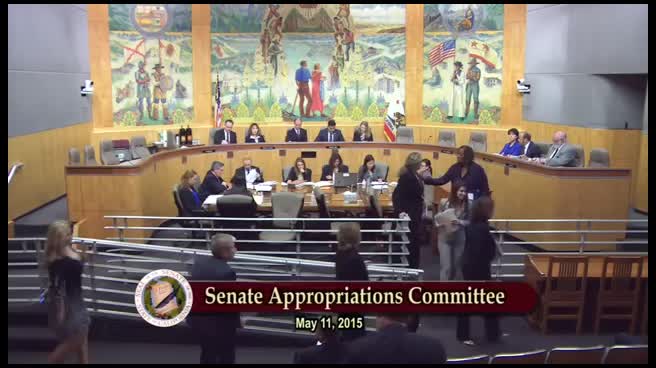 4MIN
Senate Standing Committee on Appropriations
Bill Author

Bill Co-Author(s):