SB 541: Public Utilities Commission: for-hire transportation carriers: enforcement.
- Session Year: 2015-2016
- House: Senate
- Latest Version Date: 2015-10-09
(1)The California Constitution establishes the Public Utilities Commission, with jurisdiction over the transportation of passengers and property by transportation companies, to the extent not preempted by federal law. The Household Goods Carriers Act and the Passenger Charter-party Carriers Act contain statements of the purposes of those acts and the use of the public highways pursuant to those acts.
This bill would specify activities to be undertaken by the commission to achieve these purposes. The bill would require the commission to hire an independent entity for not more than $250,000 to, in consultation with carrier trade associations for industries under the jurisdiction of the commission, assess the commissions capabilities to carry out the specified activities and to report to the Legislature no later than January 1, 2017, which report would be required to contain an analysis of current capabilities and deficiencies, and recommendations to overcome any deficiencies identified.
(2)A passenger stage corporation, as defined, which operates between fixed termini or over a regular route, is a common carrier subject to regulation by the commission pursuant to the Public Utilities Act. The Public Utilities Act, with certain exceptions, requires that a passenger stage corporation obtain a certificate of public convenience and necessity from the commission to operate on any public highway in the state and requires it to display an identifying symbol issued by the commission. The Public Utilities Act makes any public utility that violates the Public Utilities Act, or that fails to comply with any part of any order, decision, rule, direction, demand, or requirement of the commission guilty of a crime and makes it a misdemeanor for a person or corporation to hold out to the public that the person or corporation is in operation as a passenger stage corporation without having a valid certificate issued by the commission. The Public Utilities Act authorizes the commission to impose various fines and penalties for any violation of the act or an order, decision, rule, direction, demand, or requirement of the commission. The Public Utilities Act provides that the Department of the California Highway Patrol (CHP) has the primary responsibility for regulating the safety of operation of passenger stage corporations and requires the commission to cooperate with the CHP to ensure safe operation of these carriers.
A charter-party carrier of passengers, as defined, is subject to the jurisdiction and control of the commission under the Passenger Charter-party Carriers Act. The Passenger Charter-party Carriers Act requires a charter-party carrier of passengers to (A) obtain a certificate of public convenience and necessity or a permit issued by the commission, (B) operate within the state on a prearranged basis, as defined, (C) comply with specified vehicle identification requirements, and (D) comply with accident liability protection requirements. The Passenger Charter-party Carriers Act additionally prohibits a charter-party carrier of passengers from advertising its services, or in any manner representing its services, as being a taxicab or taxi service. The Passenger Charter-party Carriers Act makes violation of these requirements a crime. The Passenger Charter-party Carriers Act authorizes the commission to impose fines and penalties for violations of the act.
This bill would authorize peace officers, as defined, to enforce and assist in the enforcement of criminal violations of the Public Utilities Act, with respect to passenger stage corporations, and the Passenger Charter-party Carriers Act, with respect to charter-party carriers of passengers. The bill would require the commission to coordinate enforcement of those acts with peace officers through educational outreach and establishing lines of communication so that the commission is notified if an action is commenced so that the commission may take appropriate action to enforce the fine and penalty provisions of the acts. The bill would require the commission to ensure that the Passenger Charter-party Carriers Act is enforced and obeyed and that violations are promptly prosecuted and that penalty moneys due to the state are recovered and collected. The bill would authorize the Attorney General, a district attorney, or a city attorney to institute and prosecute actions or proceedings for the violation of the Passenger Charter-party Carriers Act.
(3)The Passenger Charter-party Carriers Act authorizes a CHP officer to impound a bus of a charter-party carrier of passengers for 30 days if the officer determines that (A) the driver was operating the bus when the carrier did not have a permit or certificate issued by the commission or the carriers permit or certificate was suspended, or (B) the driver was operating the bus without having a current and valid drivers license of the proper class, a passenger vehicle endorsement, or the required certificate. A provision of the Vehicle Code also authorizes a CHP officer to impound a bus of a charter-party carrier of passengers for 30 days if the officer makes any of the determinations described above.
This bill would authorize a peace officer, as defined, to impound a bus or limousine, as defined, of a charter-party carrier of passengers, except as specified, for 30 days in those circumstances. The bill would revise the Vehicle Code to authorize a peace officer, identically defined, to impound a bus or limousine of a charter-party carrier of passengers, except as specified, for 30 days in those circumstances and authorize a peace officer to impound a bus or limousine belonging to a passenger stage corporation for 30 days if the officer determines (A) the driver was operating the bus or limousine when the passenger stage corporation did not have a required certificate of public convenience and necessity issued by the commission, (B) the driver was operating the bus or limousine when the operating rights or certificate of public convenience and necessity of a passenger stage corporation was suspended, canceled, or revoked, or (C) the driver was operating the bus or limousine without having a current and valid drivers license of the proper class.
(4)A household goods carrier, as defined, which transports household goods and personal effects over any public highway in the state for compensation, is subject to regulation by the commission pursuant to the Household Goods Carriers Act. The Household Goods Carriers Act requires that a household goods carrier obtain a permit from the commission to transport household goods entirely within the state and obtain a valid operating authority issued by the Federal Motor Carrier Safety Administration to transport household goods and personal effects from this state to another or from another state to this state. The Household Goods Carriers Act additionally requires a household goods carrier to comply with specified vehicle identification requirements and comply with accident liability protection requirements. The Household Goods Carriers Act makes a violation of the requirements of the act a misdemeanor, authorizes the commission to impose fines and penalties for violations of the act, and requires the commission to ensure that the act is enforced and obeyed, that violations are promptly prosecuted and that penalty moneys due to the state are recovered and collected.
This bill would authorize peace officers, as defined, to enforce and assist in the enforcement of criminal violations of the Household Goods Carriers Act. The bill would require the commission to coordinate enforcement of the Household Goods Carriers Act with peace officers through educational outreach and establishing lines of communication so that peace officers can notify the commission if an action is commenced so that the commission may take appropriate action to enforce the fine and penalty provisions of the Household Goods Carriers Act.
(5)This bill would incorporate additional changes in Section 5387 of the Public Utilities Code proposed by SB 697 that would become operative only if SB 697 and this bill are both chaptered and become effective on or before January 1, 2016, and this bill is chaptered last.
(1)The California Constitution establishes the Public Utilities Commission, with jurisdiction over the transportation of passengers and property by transportation companies, to the extent not preempted by federal law. The Household Goods Carriers Act and the Passenger Charter-party Carriers Act contain statements of the purposes of those acts and the use of the public highways pursuant to those acts.
This bill would specify activities to be undertaken by the commission to achieve these purposes. The bill would require the commission to assess its capabilities hire an independent entity for not more than $250,000 to, in consultation with carrier trade associations for industries under the jurisdiction of the commission, assess the commissions capabilities to carry out the specified activities and to report to the Legislature no later than January 1, 2017, which report would be required to contain an analysis of current capabilities and deficiencies, and recommendations to overcome any deficiencies identified.
(2)A passenger stage corporation, as defined, which operates between fixed termini or over a regular route, is a common carrier subject to regulation by the commission pursuant to the Public Utilities Act. The Public Utilities Act, with certain exceptions, requires that a passenger stage corporation obtain a certificate of public convenience and necessity from the commission to operate on any public highway in the state and requires it to display an identifying symbol issued by the commission. The Public Utilities Act makes any public utility that violates the Public Utilities Act, or that fails to comply with any part of any order, decision, rule, direction, demand, or requirement of the commission guilty of a crime and makes it a misdemeanor for a person or corporation to hold out to the public that the person or corporation is in operation as a passenger stage corporation without having a valid certificate issued by the commission. The Public Utilities Act authorizes the commission to impose various fines and penalties for any violation of the act or an order, decision, rule, direction, demand, or requirement of the commission. The Public Utilities Act provides that the Department of the California Highway Patrol (CHP) has the primary responsibility for regulating the safety of operation of passenger stage corporations and requires the commission to cooperate with the CHP to ensure safe operation of these carriers.
A charter-party carrier of passengers, as defined, is subject to the jurisdiction and control of the commission under the Passenger Charter-party Carriers Act. The Passenger Charter-party Carriers Act requires a charter-party carrier of passengers to (A) obtain a certificate of public convenience and necessity or a permit issued by the commission, (B) operate within the state on a prearranged basis, as defined, (C) comply with specified vehicle identification requirements, and (D) comply with accident liability protection requirements. The Passenger Charter-party Carriers Act additionally prohibits a charter-party carrier of passengers from advertising its services, or in any manner representing its services, as being a taxicab or taxi service. The Passenger Charter-party Carriers Act makes violation of these requirements a crime. The Passenger Charter-party Carriers Act authorizes the commission to impose fines and penalties for violations of the act.
This bill would authorize peace officers, as defined, to enforce and assist in the enforcement of criminal violations of the Public Utilities Act, with respect to passenger stage corporations, and the Passenger Charter-party Carriers Act, with respect to charter-party carriers of passengers. The bill would require the commission to coordinate enforcement of those acts with peace officers through educational outreach and establishing lines of communication so that the commission is notified if an action is commenced so that the commission may take appropriate action to enforce the fine and penalty provisions of the acts. The bill would require the commission to ensure that the Passenger Charter-party Carriers Act is enforced and obeyed and that violations are promptly prosecuted and that penalty moneys due to the state are recovered and collected. The bill would authorize the Attorney General, a district attorney, or a city attorney to institute and prosecute actions or proceedings for the violation of the Passenger Charter-party Carriers Act.
(3)The Passenger Charter-party Carriers Act authorizes a CHP officer to impound a bus of a charter-party carrier of passengers for 30 days if the officer determines that (A) the driver was operating the bus when the carrier did not have a permit or certificate issued by the commission or the carriers permit or certificate was suspended, or (B) the driver was operating the bus without having a current and valid drivers license of the proper class, a passenger vehicle endorsement, or the required certificate. A provision of the Vehicle Code also authorizes a CHP officer to impound a bus of a charter-party carrier of passengers for 30 days if the officer makes any of the determinations described above.
This bill would authorize a peace officer, as defined, to impound a bus or limousine, as defined, of a charter-party carrier of passengers, except as specified, for 30 days in those circumstances. The bill would revise the Vehicle Code to authorize a peace officer, identically defined, to impound a bus or limousine of a charter-party carrier of passengers, except as specified, for 30 days in those circumstances and authorize a peace officer to impound a bus or limousine belonging to a passenger stage corporation for 30 days if the officer determines (A) the driver was operating the bus or limousine when the passenger stage corporation did not have a required certificate of public convenience and necessity issued by the commission, (B) the driver was operating the bus or limousine when the operating rights or certificate of public convenience and necessity of a passenger stage corporation was suspended, canceled, or revoked, or (C) the driver was operating the bus or limousine without having a current and valid drivers license of the proper class.
(4)A household goods carrier, as defined, which transports household goods and personal effects over any public highway in the state for compensation, is subject to regulation by the commission pursuant to the Household Goods Carriers Act. The Household Goods Carriers Act requires that a household goods carrier obtain a permit from the commission to transport household goods entirely within the state and obtain a valid operating authority issued by the Federal Motor Carrier Safety Administration to transport household goods and personal effects from this state to another or from another state to this state. The Household Goods Carriers Act additionally requires a household goods carrier to comply with specified vehicle identification requirements and comply with accident liability protection requirements. The Household Goods Carriers Act makes a violation of the requirements of the act a misdemeanor, authorizes the commission to impose fines and penalties for violations of the act, and requires the commission to ensure that the act is enforced and obeyed, that violations are promptly prosecuted and that penalty moneys due to the state are recovered and collected.
This bill would authorize peace officers, as defined, to enforce and assist in the enforcement of criminal violations of the Household Goods Carriers Act. The bill would require the commission to coordinate enforcement of the Household Goods Carriers Act with peace officers through educational outreach and establishing lines of communication so that peace officers can notify the commission if an action is commenced so that the commission may take appropriate action to enforce the fine and penalty provisions of the Household Goods Carriers Act.
(5)This bill would incorporate additional changes in Section 5387 of the Public Utilities Code proposed by SB 697 that would become operative only if SB 697 and this bill are both chaptered and become effective on or before January 1, 2016, and this bill is chaptered last.
(1)The California Constitution establishes the Public Utilities Commission, with jurisdiction over the transportation of passengers and property by transportation companies, to the extent not preempted by federal law. The Household Goods Carriers Act and the Passenger Charter-party Carriers Act contain statements of the purposes of those acts and the use of the public highways pursuant to those acts.
This bill would specify activities to be undertaken by the commission to achieve these purposes. The bill would require the commission to assess its capabilities to carry out the specified activities and to report to the Legislature no later than January 1, 2017, which report would be required to contain an analysis of current capabilities and deficiencies, and recommendations to overcome any deficiencies identified.
(2)A passenger stage corporation, as defined, which operates between fixed termini or over a regular route, is a common carrier subject to regulation by the commission pursuant to the Public Utilities Act. The Public Utilities Act, with certain exceptions, requires that a passenger stage corporation obtain a certificate of public convenience and necessity from the commission to operate on any public highway in the state and requires it to display an identifying symbol issued by the commission. The Public Utilities Act makes any public utility that violates the Public Utilities Act, or that fails to comply with any part of any order, decision, rule, direction, demand, or requirement of the commission guilty of a crime and makes it a misdemeanor for a person or corporation to hold out to the public that the person or corporation is in operation as a passenger stage corporation without having a valid certificate issued by the commission. The Public Utilities Act authorizes the commission to impose various fines and penalties for any violation of the act or an order, decision, rule, direction, demand, or requirement of the commission. The Public Utilities Act provides that the Department of the California Highway Patrol (CHP) has the primary responsibility for regulating the safety of operation of passenger stage corporations and requires the commission to cooperate with the CHP to ensure safe operation of these carriers.
A charter-party carrier of passengers, as defined, is subject to the jurisdiction and control of the commission under the Passenger Charter-party Carriers Act. The Passenger Charter-party Carriers Act requires a charter-party carrier of passengers to (A) obtain a certificate of public convenience and necessity or a permit issued by the commission, (B) operate within the state on a prearranged basis, as defined, (C) comply with specified vehicle identification requirements, and (D) comply with accident liability protection requirements. The Passenger Charter-party Carriers Act additionally prohibits a charter-party carrier of passengers from advertising its services, or in any manner representing its services, as being a taxicab or taxi service. The Passenger Charter-party Carriers Act makes violation of these requirements a crime. The Passenger Charter-party Carriers Act authorizes the commission to impose fines and penalties for violations of the act.
This bill would authorize peace officers, as defined, to enforce and assist in the enforcement of criminal violations of the Public Utilities Act, with respect to passenger stage corporations, and the Passenger Charter-party Carriers Act, with respect to charter-party carriers of passengers. The bill would require the commission to coordinate enforcement of those acts with peace officers through educational outreach and establishing lines of communication that ensure so that the commission is notified if an action is commenced so that the commission may take appropriate action to enforce the fine and penalty provisions of the acts. The bill would require the commission to ensure that the Passenger Charter-party Carriers Act is enforced and obeyed and that violations are promptly prosecuted and that penalty moneys due to the state are recovered and collected. The bill would authorize the Attorney General, a district attorney, or a city attorney to institute and prosecute actions or proceedings for the violation of the Passenger Charter-party Carriers Act.
(3)The Passenger Charter-party Carriers Act authorizes a CHP officer to impound a bus of a charter-party carrier of passengers for 30 days if the officer determines that (A) the driver was operating the bus when the carrier did not have a permit or certificate issued by the commission or the carriers permit or certificate was suspended, or (B) the driver was operating the bus without having a current and valid drivers license of the proper class, a passenger vehicle endorsement, or the required certificate. A provision of the Vehicle Code also authorizes a CHP officer to impound a bus of a charter-party carrier of passengers for 30 days if the officer makes any of the determinations described above.
This bill would authorize a peace officer, as defined, to impound a bus or limousine, as defined, of a charter-party carrier of passengers, except as specified, for 30 days in those circumstances. The bill would revise the Vehicle Code to authorize a peace officer, identically defined, to impound a bus or limousine of a charter-party carrier of passengers, except as specified, for 30 days in those circumstances and authorize a peace officer to impound a bus or limousine belonging to a passenger stage corporation for 30 days if the officer determines (A) the driver was operating the bus or limousine when the passenger stage corporation did not have a required certificate of public convenience and necessity issued by the commission, (B) the driver was operating the bus or limousine when the operating rights or certificate of public convenience and necessity of a passenger stage corporation was suspended, canceled, or revoked, or (C) the driver was operating the bus or limousine without having a current and valid drivers license of the proper class.
(4)A household goods carrier, as defined, which transports household goods and personal effects over any public highway in the state for compensation, is subject to regulation by the commission pursuant to the Household Goods Carriers Act. The Household Goods Carriers Act requires that a household goods carrier obtain a permit from the commission to transport household goods entirely within the state and obtain a valid operating authority issued by the Federal Motor Carrier Safety Administration to transport household goods and personal effects from this state to another or from another state to this state. The Household Goods Carriers Act additionally requires a household goods carrier to comply with specified vehicle identification requirements and comply with accident liability protection requirements. The Household Goods Carriers Act makes a violation of the requirements of the act a misdemeanor, authorizes the commission to impose fines and penalties for violations of the act, and requires the commission to ensure that the act is enforced and obeyed, that violations are promptly prosecuted and that penalty moneys due to the state are recovered and collected.
This bill would authorize peace officers, as defined, to enforce and assist in the enforcement of criminal violations of the Household Goods Carriers Act. The bill would require the commission to coordinate enforcement of the Household Goods Carriers Act with peace officers through educational outreach and establishing lines of communication that ensure that the commission is notified so that peace officers can notify the commission if an action is commenced so that the commission may take appropriate action to enforce the fine and penalty provisions of the Household Goods Carriers Act.
(1)The California Constitution establishes the Public Utilities Commission, with jurisdiction over the transportation of passengers and property by transportation companies, to the extent not preempted by federal law. The Household Goods Carriers Act and the Passenger Charter-party Carriers Act contain statements of the purposes of those acts and the use of the public highways pursuant to those acts.
This bill would specify activities to be undertaken by the commission to achieve these purposes. The bill would require the commission to assess its capabilities to carry out the specified activities and to report to the Legislature no later than January 1, 2017, which report would be required to contain an analysis of current capabilities and deficiencies, and recommendations to overcome any deficiencies identified.
(2)A passenger stage corporation, as defined, which operates between fixed termini or over a regular route, is a common carrier subject to regulation by the commission pursuant to the Public Utilities Act. The Public Utilities Act, with certain exceptions, requires that a passenger stage corporation obtain a certificate of public convenience and necessity from the commission to operate on any public highway in the state and requires it to display an identifying symbol issued by the commission. The Public Utilities Act makes any public utility that violates the Public Utilities Act, or that fails to comply with any part of any order, decision, rule, direction, demand, or requirement of the commission guilty of a crime and makes it a misdemeanor for a person or corporation to hold out to the public that the person or corporation is in operation as a passenger stage corporation without having a valid certificate issued by the commission. The Public Utilities Act authorizes the commission to impose various fines and penalties for any violation of the act or an order, decision, rule, direction, demand, or requirement of the commission. The Public Utilities Act provides that the Department of the California Highway Patrol (CHP) has the primary responsibility for regulating the safety of operation of passenger stage corporations and requires the commission to cooperate with the CHP to ensure safe operation of these carriers.
A charter-party carrier of passengers, as defined, is subject to the jurisdiction and control of the commission under the Passenger Charter-party Carriers Act. The Passenger Charter-party Carriers Act requires a charter-party carrier of passengers to (A) obtain a certificate of public convenience and necessity or a permit issued by the commission, (B) operate within the state on a prearranged basis, as defined, (C) comply with specified vehicle identification requirements, and (D) comply with accident liability protection requirements. The Passenger Charter-party Carriers Act additionally prohibits a charter-party carrier of passengers from advertising its services, or in any manner representing its services, as being a taxicab or taxi service. The Passenger Charter-party Carriers Act makes violation of these requirements a crime. The Passenger Charter-party Carriers Act authorizes the commission to impose fines and penalties for violations of the act.
This bill would authorize peace officers, as defined, to enforce and assist in the enforcement of criminal violations of the Public Utilities Act, with respect to passenger stage corporations, and the Passenger Charter-party Carriers Act, with respect to charter-party carriers of passengers. The bill would require the commission to coordinate enforcement of those acts with peace officers through educational outreach and establishing lines of communication that ensure that the commission is notified if an action is commenced so that the commission may take appropriate action to enforce the fine and penalty provisions of the acts. The bill would require the commission to ensure that the Passenger Charter-party Carriers Act is enforced and obeyed and that violations are promptly prosecuted and that penalty moneys due to the state are recovered and collected. The bill would authorize the Attorney General, a district attorney, or a city attorney to institute and prosecute actions or proceedings for the violation of the Passenger Charter-party Carriers Act.
(3)The Passenger Charter-party Carriers Act authorizes a CHP officer to impound a bus of a charter-party carrier of passengers for 30 days if the officer determines that (A) the driver was operating the bus when the carrier did not have a permit or certificate issued by the commission or the carriers permit or certificate was suspended, or (B) the driver was operating the bus without having a current and valid drivers license of the proper class, a passenger vehicle endorsement, or the required certificate. A provision of the Vehicle Code also authorizes a CHP officer to impound a bus of a charter-party carrier of passengers for 30 days if the officer makes any of the determinations described above.
This bill would authorize a peace officer, as defined, to impound a bus or limousine, as defined, of a charter-party carrier of passengers, except as specified, for 30 days in those circumstances. The bill would revise the Vehicle Code to authorize a peace officer, identically defined, to impound a bus or limousine of a charter-party carrier of passengers, except as specified, for 30 days in those circumstances and authorize a peace officer to impound a bus or limousine belonging to a passenger stage corporation for 30 days if the officer determines (A) the driver was operating the bus or limousine when the passenger stage corporation did not have a required certificate of public convenience and necessity issued by the commission, (B) the driver was operating the bus or limousine when the operating rights or certificate of public convenience and necessity of a passenger stage corporation was suspended, canceled, or revoked, or (C) the driver was operating the bus or limousine without having a current and valid drivers license of the proper class.
(4)A household goods carrier, as defined, which transports household goods and personal effects over any public highway in the state for compensation, is subject to regulation by the commission pursuant to the Household Goods Carriers Act. The Household Goods Carriers Act requires that a household goods carrier obtain a permit from the commission to transport household goods entirely within the state and obtain a valid operating authority issued by the Federal Motor Carrier Safety Administration to transport household goods and personal effects from this state to another or from another state to this state. The Household Goods Carriers Act additionally requires a household goods carrier to comply with specified vehicle identification requirements and comply with accident liability protection requirements. The Household Goods Carriers Act makes a violation of the requirements of the act a misdemeanor, authorizes the commission to impose fines and penalties for violations of the act, and requires the commission to ensure that the act is enforced and obeyed, that violations are promptly prosecuted and that penalty moneys due to the state are recovered and collected.
This bill would authorize peace officers, as defined, to enforce and assist in the enforcement of criminal violations of the Household Goods Carriers Act. The bill would require the commission to coordinate enforcement of the Household Goods Carriers Act with peace officers through educational outreach and establishing lines of communication that ensure that the commission is notified if an action is commenced so that the commission may take appropriate action to enforce the fine and penalty provisions of the Household Goods Carriers Act.
(1)The California Constitution establishes the Public Utilities Commission, with jurisdiction over the transportation of passengers and property by transportation companies, to the extent not preempted by federal law. The Household Goods Carriers Act and the Passenger Charter-party Carriers Act contain statements of the purposes of those acts and the use of the public highways pursuant to those acts.
This bill would specify activities to be undertaken by the commission to achieve these purposes. The bill would require the commission to assess its capabilities to carry out the specified activities and to report to the Legislature no later than January 1, 2017, which report would be required to contain an analysis of current capabilities and deficiencies, and recommendations to overcome any deficiencies identified.
(2)A passenger stage corporation, as defined, which operates between fixed termini or over a regular route, is a common carrier subject to regulation by the commission pursuant to the Public Utilities Act. The Public Utilities Act, with certain exceptions, requires that a passenger stage corporation obtain a certificate of public convenience and necessity from the commission to operate on any public highway in the state and requires it to display an identifying symbol issued by the commission. The Public Utilities Act makes any public utility that violates the Public Utilities Act, or that fails to comply with any part of any order, decision, rule, direction, demand, or requirement of the commission guilty of a crime and makes it a misdemeanor for a person or corporation to hold out to the public that the person or corporation is in operation as a passenger stage corporation without having a valid certificate issued by the commission. The Public Utilities Act authorizes the commission to impose various fines and penalties for any violation of the act or an order, decision, rule, direction, demand, or requirement of the commission. The Public Utilities Act provides that the Department of the California Highway Patrol (CHP) has the primary responsibility for regulating the safety of operation of passenger stage corporations and requires the commission to cooperate with the CHP to ensure safe operation of these carriers.
A charter-party carrier of passengers, as defined, is subject to the jurisdiction and control of the commission under the Passenger Charter-party Carriers Act. The Passenger Charter-party Carriers Act requires a charter-party carrier of passengers to (A) obtain a certificate of public convenience and necessity or a permit issued by the commission, (B) operate within the state on a prearranged basis, as defined, (C) comply with specified vehicle identification requirements, and (D) comply with accident liability protection requirements. The Passenger Charter-party Carriers Act additionally prohibits a charter-party carrier of passengers from advertising its services, or in any manner representing its services, as being a taxicab or taxi service. The Passenger Charter-party Carriers Act makes violation of these requirements a crime. The Passenger Charter-party Carriers Act authorizes the commission to impose fines and penalties for violations of the act.
This bill would authorize peace officers, defined to include sheriffs, police officers, CHP officers, and airport law enforcement officers, as defined, to enforce and assist in the enforcement of criminal violations of the Public Utilities Act, with respect to passenger stage corporations, and the Passenger Charter-party Carriers Act, with respect to charter-party carriers of passengers. The bill would require the commission to coordinate enforcement of those acts with those peace officers through educational outreach and establishing lines of communications communication that ensure that the commission is notified if an action is commenced so that the commission may take appropriate action to enforce the fine and penalty provisions of the acts. The bill would require the commission to ensure that the Passenger Charter-party Carriers Act is enforced and obeyed and that violations are promptly prosecuted and that penalty moneys due to the state are recovered and collected. The bill would authorize the Attorney General, a district attorney, or a city attorney to institute and prosecute actions or proceedings for the violation of the Passenger Charter-party Carriers Act.
(3)The Passenger Charter-party Carriers Act authorizes a CHP officer to impound a bus of a charter-party carrier of passengers for 30 days if the officer determines that (A) the driver was operating the bus when the carrier did not have a permit or certificate issued by the commission or the carriers permit or certificate was suspended, or (B) the driver was operating the bus without having a current and valid drivers license of the proper class, a passenger vehicle endorsement, or the required certificate. A provision of the Vehicle Code also authorizes a CHP officer to impound a bus of a charter-party carrier of passengers for 30 days if the officer makes any of the determinations described above.
This bill would authorize a peace officer, defined to include sheriffs, police officers, and airport law enforcement officers, in addition to CHP officers, as defined, to impound any vehicle a bus or limousine, as defined, of a charter-party carrier of passengers passengers, except as specified, for 30 days in those circumstances. The bill would revise the Vehicle Code to authorize a peace officer, identically defined, to impound any vehicle a bus or limousine of a charter-party carrier of passengers passengers, except as specified, for 30 days in those circumstances and authorize a peace officer to impound a vehicle bus or limousine belonging to a passenger stage corporation for 30 days if the officer determines (A) the driver was operating the vehicle bus or limousine when the passenger stage corporation did not have a required certificate of public convenience and necessity issued by the commission, (B) the driver was operating the vehicle bus or limousine when the operating rights or certificate of public convenience and necessity of a passenger stage corporation was suspended, canceled, or revoked, or (C) the driver was operating the vehicle bus or limousine without having a current and valid drivers license of the proper class.
The Passenger Charter-party Carriers Act additionally authorizes certain peace officers, when making an arrest for operating a charter-party carrier of passengers without a valid certificate or permit or when making an arrest for operating a charter-party carrier of passengers as a taxicab in violation of an ordinance or resolution of a city, county, or city and county, to impound and retain possession of the vehicle.
This bill would limit the authority to impound a vehicle pursuant to this provision to a sheriff, police officer, CHP officer, or airport law enforcement officer.
(4)A household goods carrier, as defined, which transports household goods and personal effects over any public highway in the state for compensation, is subject to regulation by the commission pursuant to the Household Goods Carriers Act. The Household Goods Carriers Act requires that a household goods carrier obtain a permit from the commission to transport household goods entirely within the state and obtain a valid operating authority issued by the Federal Motor Carrier Safety Administration to transport household goods and personal effects from this state to another or from another state to this state. The Household Goods Carriers Act additionally requires a household goods carrier to comply with specified vehicle identification requirements and comply with accident liability protection requirements. The Household Goods Carriers Act makes a violation of the requirements of the act a misdemeanor, authorizes the commission to impose fines and penalties for violations of the act, and requires the commission to ensure that the act is enforced and obeyed, that violations are promptly prosecuted and that penalty moneys due to the state are recovered and collected.
This bill would authorize peace officers, defined to include sheriffs, police officers, and CHP officers, as defined, to enforce and assist in the enforcement of criminal violations of the Household Goods Carriers Act. The bill would require the commission to coordinate enforcement of the Household Goods Carriers Act with those peace officers through educational outreach and establishing lines of communications communication that ensure that the commission is notified if an action is commenced so that the commission may take appropriate action to enforce the fine and penalty provisions of the Household Goods Carriers Act.
(1)The California Constitution establishes the Public Utilities Commission, with jurisdiction over the transportation of passengers and property by transportation companies, to the extent not preempted by federal law. The Household Goods Carriers Act and the Passenger Charter-party Carriers Act contain statements of the purposes of those acts and the use of the public highways pursuant to those acts.
This bill would require the commission, in consultation with the Department of Human Resources, to develop a comprehensive human resources plan for the Transportation Enforcement Branch of the Safety and Enforcement Division. The bill would require the commission to implement a program to monitor the performance of the Transportation Enforcement Branch and to develop a comprehensive strategy to detect, deter, and take enforcement actions against charter-party carriers of passengers, passenger stage corporations, and household goods carriers that are operating illegally. The bill would also require the commission to develop and implement a plan to improve technology capabilities to enhance customer service at the Transportation Enforcement Branch and develop a budget plan for the Transportation Enforcement Branch. The bill would require the commission to report to the Legislature by February 1, 2017, and by each February 1 thereafter on the commissions implementation of these requirements.
This bill would specify activities to be undertaken by the commission to achieve these purposes. The bill would require the commission to assess its capabilities to carry out the specified activities and to report to the Legislature no later than January 1, 2017, which report would be required to contain an analysis of current capabilities and deficiencies, and recommendations to overcome any deficiencies identified.
(2)A passenger stage corporation, as defined, which operates between fixed termini or over a regular route, is a common carrier subject to regulation by the commission pursuant to the Public Utilities Act. The Public Utilities Act, with certain exceptions, requires that a passenger stage corporation obtain a certificate of public convenience and necessity from the commission to operate on any public highway in the state and requires it to display an identifying symbol issued by the commission. The Public Utilities Act makes any public utility that violates the Public Utilities Act, or that fails to comply with any part of any order, decision, rule, direction, demand, or requirement of the commission guilty of a crime and makes it a misdemeanor for a person or corporation to hold out to the public that the person or corporation is in operation as a passenger stage corporation without having a valid certificate issued by the commission. The Public Utilities Act authorizes the commission to impose various fines and penalties for any violation of the act or an order, decision, rule, direction, demand, or requirement of the commission. The Public Utilities Act provides that the Department of the California Highway Patrol (CHP) has the primary responsibility for regulating the safety of operation of passenger stage corporations and requires the commission to cooperate with the CHP to ensure safe operation of these carriers.
A charter-party carrier of passengers, as defined, is subject to the jurisdiction and control of the commission under the Passenger Charter-party Carriers Act. The Passenger Charter-party Carriers Act requires a charter-party carrier of passengers to (A) obtain a certificate of public convenience and necessity or a permit issued by the commission, (B) operate within the state on a prearranged basis, as defined, (C) comply with specified vehicle identification requirements, and (D) comply with accident liability protection requirements. The Passenger Charter-party Carriers Act additionally prohibits a charter-party carrier of passengers from advertising its services, or in any manner representing its services, as being a taxicab or taxi service. The Passenger Charter-party Carriers Act makes violation of these requirements a crime. The Passenger Charter-party Carriers Act authorizes the commission to impose fines and penalties for violations of the act.
This bill would authorize peace officers, defined to include sheriffs, police officers, CHP officers, and airport law enforcement officers, to enforce and assist in the enforcement of criminal violations of the Public Utilities Act, with respect to passenger stage corporations, and the Passenger Charter-party Carriers Act, with respect to charter-party carriers of passengers. The bill would require the commission to coordinate enforcement of those acts with those peace officers through educational outreach and establishing lines of communications that ensure that the commission is notified if an action is commenced so that the commission may take appropriate action to enforce the fine and penalty provisions of the acts. The bill would require the commission to ensure that the Passenger Charter-party Carriers Act is enforced and obeyed and that violations are promptly prosecuted and that penalty moneys due to the state are recovered and collected. The bill would authorize the Attorney General, a district attorney, or a city attorney to institute and prosecute actions or proceedings for the violation of the Passenger Charter-party Carriers Act.
(3)The Passenger Charter-party Carriers Act authorizes a CHP officer to impound a bus of a charter-party carrier of passengers for 30 days if the officer determines that (A) the driver was operating the bus when the carrier did not have a permit or certificate issued by the commission or the carriers permit or certificate was suspended, or (B) the driver was operating the bus without having a current and valid drivers license of the proper class, a passenger vehicle endorsement, or the required certificate. A provision of the Vehicle Code also authorizes a CHP officer to impound a bus of a charter-party carrier of passengers for 30 days if the officer makes any of the determinations described above.
This bill would authorize a peace officer, defined to include sheriffs, police officers, and airport law enforcement officers, in addition to CHP officers, to impound any vehicle of a charter-party carrier of passengers for 30 days in those circumstances. The bill would revise the Vehicle Code to authorize a peace officer, identically defined, to impound any vehicle of a charter-party carrier of passengers for 30 days in those circumstances and authorize a peace officer to impound a vehicle belonging to a passenger stage corporation for 30 days if the officer determines (A) the driver was operating the vehicle when the passenger stage corporation did not have a required certificate of public convenience and necessity issued by the commission, (B) the driver was operating the vehicle when the operating rights or certificate of public convenience and necessity of a passenger stage corporation was suspended, canceled, or revoked, or (C) the driver was operating the vehicle without having a current and valid drivers license of the proper class.
The Passenger Charter-party Carriers Act additionally authorizes certain peace officers, when making an arrest for operating a charter-party carrier of passengers without a valid certificate or permit or when making an arrest for operating a charter-party carrier of passengers as a taxicab in violation of an ordinance or resolution of a city, county, or city and county, to impound and retain possession of the vehicle.
This bill would limit the authority to impound a vehicle pursuant to this provision to a sheriff, police officer, CHP officer, or airport law enforcement officer.
(4)A household goods carrier, as defined, which transports household goods and personal effects over any public highway in the state for compensation, is subject to regulation by the commission pursuant to the Household Goods Carriers Act. The Household Goods Carriers Act requires that a household goods carrier obtain a permit from the commission to transport household goods entirely within the state and obtain a valid operating authority issued by the Federal Motor Carrier Safety Administration to transport household goods and personal effects from this state to another or from another state to this state. The Household Goods Carriers Act additionally requires a household goods carrier to comply with specified vehicle identification requirements and comply with accident liability protection requirements. The Household Goods Carriers Act makes a violation of the requirements of the act a misdemeanor, authorizes the commission to impose fines and penalties for violations of the act, and requires the commission to ensure that the act is enforced and obeyed, that violations are promptly prosecuted and that penalty moneys due to the state are recovered and collected.
This bill would authorize peace officers, defined to include sheriffs, police officers, and CHP officers, to enforce and assist in the enforcement of criminal violations of the Household Goods Carriers Act. The bill would require the commission to coordinate enforcement of the Household Goods Carriers Act with those peace officers through educational outreach and establishing lines of communications that ensure that the commission is notified if an action is commenced so that the commission may take appropriate action to enforce the fine and penalty provisions of the Household Goods Carriers Act.
(1)The California Constitution establishes the Public Utilities Commission, with jurisdiction over the transportation of passengers and property by transportation companies, to the extent not preempted by federal law.
This bill would require the commission, in consultation with the Department of Human Resources, to develop a comprehensive human resources plan for the Transportation Enforcement Branch of the Safety and Enforcement Division. The bill would require the commission to implement a program to monitor the performance of the Transportation Enforcement Branch and to develop a comprehensive strategy to detect, deter, and take enforcement actions against charter-party carriers of passengers, passenger stage corporations, and household goods carriers that are operating illegally. The bill would also require the commission to develop and implement a plan to improve technology capabilities to enhance customer service at the Transportation Enforcement Branch and develop a budget plan for the Transportation Enforcement Branch. The bill would require the commission to report to the Legislature by January February 1, 2017, and by each January February 1 thereafter on the commissions implementation of these requirements.
(2)A passenger stage corporation, as defined, which operates between fixed termini or over a regular route, is a common carrier subject to regulation by the commission pursuant to the Public Utilities Act. The Public Utilities Act, with certain exceptions, requires that a passenger stage corporation obtain a certificate of public convenience and necessity from the commission to operate on any public highway in the state and requires it to display an identifying symbol issued by the commission. The Public Utilities Act makes any public utility that violates the Public Utilities Act, or that fails to comply with any part of any order, decision, rule, direction, demand, or requirement of the commission guilty of a crime and makes it a misdemeanor for a person or corporation to hold out to the public that the person or corporation is in operation as a passenger stage corporation without having a valid certificate issued by the commission. The Public Utilities Act authorizes the commission to impose various fines and penalties for any violation of the act or an order, decision, rule, direction, demand, or requirement of the commission. The Public Utilities Act provides that the Department of the California Highway Patrol (CHP) has the primary responsibility for regulating the safety of operation of passenger stage corporations and requires the commission to cooperate with the CHP to ensure safe operation of these carriers.
A charter-party carrier of passengers, as defined, is subject to the jurisdiction and control of the commission under the Passenger Charter-party Carriers Act. The Passenger Charter-party Carriers Act requires a charter-party carrier of passengers to (A) obtain a certificate of public convenience and necessity or a permit issued by the commission, (B) operate within the state on a prearranged basis, as defined, (C) comply with specified vehicle identification requirements, and (D) comply with accident liability protection requirements. The Passenger Charter-party Carriers Act additionally prohibits a charter-party carrier of passengers from advertising its services, or in any manner representing its services, as being a taxicab or taxi service. The Passenger Charter-party Carriers Act makes violation of these requirements a crime. The Passenger Charter-party Carriers Act authorizes the commission to impose fines and penalties for violations of the act.
This bill would authorize peace officers, defined to include sheriffs, police officers, CHP officers, and airport law enforcement officers, to enforce and assist in the enforcement of criminal violations of the Public Utilities Act, with respect to passenger stage corporations, and the Passenger Charter-party Carriers Act, with respect to charter-party carriers of passengers. The bill would require the commission to coordinate enforcement of those acts with those peace officers through educational outreach and establishing lines of communications that ensure that the commission is notified if an action is commenced so that the commission may take appropriate action to enforce the fine and penalty provisions of the acts. The bill would require the commission to ensure that the Passenger Charter-party Carriers Act is enforced and obeyed and that violations are promptly prosecuted and that penalty moneys due to the state are recovered and collected. The bill would authorize the Attorney General, a district attorney, or a city attorney to institute and prosecute actions or proceedings for the violation of the Passenger Charter-party Carriers Act.
(3)The Passenger Charter-party Carriers Act authorizes a CHP officer to impound a bus of a charter-party carrier of passengers for 30 days if the officer determines that (A) the driver was operating the bus when the carrier did not have a permit or certificate issued by the commission or the carriers permit or certificate was suspended, or (B) the driver was operating the bus without having a current and valid drivers license of the proper class, a passenger vehicle endorsement, or the required certificate. A provision of the Vehicle Code also authorizes a CHP officer to impound a bus of a charter-party carrier of passengers for 30 days if the officer makes any of the determinations described above.
This bill would authorize a peace officer, defined to include sheriffs, police officers, and airport law enforcement officers, in addition to CHP officers, to impound any vehicle of a charter-party carrier of passengers for 30 days in those circumstances. The bill would revise the Vehicle Code to authorize a peace officer, identically defined, to impound any vehicle of a charter-party carrier of passengers for 30 days in those circumstances and authorize a peace officer to impound a vehicle belonging to a passenger stage corporation for 30 days if the officer determines (A) the driver was operating the vehicle when the passenger stage corporation did not have a required certificate of public convenience and necessity issued by the commission, (B) the driver was operating the vehicle when the operating rights or certificate of public convenience and necessity of a passenger stage corporation was suspended, canceled, or revoked, or (C) the driver was operating the vehicle without having a current and valid drivers license of the proper class.
The Passenger Charter-party Carriers Act additionally authorizes certain peace officers, when making an arrest for operating a charter-party carrier of passengers without a valid certificate or permit or when making an arrest for operating a charter-party carrier of passengers as a taxicab in violation of an ordinance or resolution of a city, county, or city and county, to impound and retain possession of the vehicle.
This bill would limit the authority to impound a vehicle pursuant to this provision to a sheriff, police officer, CHP officer, or airport law enforcement officer.
(4)A household goods carrier, as defined, which transports household goods and personal effects over any public highway in the state for compensation, is subject to regulation by the commission pursuant to the Household Goods Carriers Act. The Household Goods Carriers Act requires that a household goods carrier obtain a permit from the commission to transport household goods entirely within the state and obtain a valid operating authority issued by the Federal Motor Carrier Safety Administration to transport household goods and personal effects from this state to another or from another state to this state. The Household Goods Carriers Act additionally requires a household goods carrier to comply with specified vehicle identification requirements and comply with accident liability protection requirements. The Household Goods Carriers Act makes a violation of the requirements of the act a misdemeanor, authorizes the commission to impose fines and penalties for violations of the act, and requires the commission to ensure that the act is enforced and obeyed, that violations are promptly prosecuted and that penalty moneys due to the state are recovered and collected.
This bill would authorize peace officers, defined to include sheriffs, police officers, and CHP officers, to enforce and assist in the enforcement of criminal violations of the Household Goods Carriers Act. The bill would require the commission to coordinate enforcement of the Household Goods Carriers Act with those peace officers through educational outreach and establishing lines of communications that ensure that the commission is notified if an action is commenced so that the commission may take appropriate action to enforce the fine and penalty provisions of the Household Goods Carriers Act.
(1)The California Constitution establishes the Public Utilities Commission, with jurisdiction over the transportation of passengers and property by transportation companies, to the extent not preempted by federal law.
This bill would require the commission, in consultation with the Department of Human Resources, to develop a comprehensive human resources plan for the Transportation Enforcement Branch of the Safety and Enforcement Division. The bill would require the commission to implement a program to monitor the performance of the Transportation Enforcement Branch and to develop a comprehensive strategy to detect, deter, and take enforcement actions against charter-party carriers of passengers, passenger stage corporations, and household goods carriers that are operating illegally. The bill would also require the commission to develop and implement a plan to improve technology capabilities to enhance customer service at the Transportation Enforcement Branch and develop a budget plan for the Transportation Enforcement Branch. The bill would require the commission to report to the Legislature by January 1, 2017, and by each January 1 thereafter on the commissions implementation of these requirements.
(2)A passenger stage corporation, as defined, which operates between fixed termini or over a regular route, is a common carrier subject to regulation by the commission pursuant to the Public Utilities Act. The Public Utilities Act, with certain exceptions, requires that a passenger stage corporation obtain a certificate of public convenience and necessity from the commission to operate on any public highway in the state and requires it to display an identifying symbol issued by the commission. The Public Utilities Act makes any public utility that violates the Public Utilities Act, or that fails to comply with any part of any order, decision, rule, direction, demand, or requirement of the commission guilty of a crime and makes it a misdemeanor for a person or corporation to hold out to the public that the person or corporation is in operation as a passenger stage corporation without having a valid certificate issued by the commission. The Public Utilities Act authorizes the commission to impose various fines and penalties for any violation of the act or an order, decision, rule, direction, demand, or requirement of the commission. The Public Utilities Act provides that the Department of the California Highway Patrol (CHP) has the primary responsibility for regulating the safety of operation of passenger stage corporations and requires the commission to cooperate with the CHP to ensure safe operation of these carriers.
A charter-party carrier of passengers, as defined, is subject to the jurisdiction and control of the commission under the Passenger Charter-party Carriers Act. The Passenger Charter-party Carriers Act requires a charter-party carrier of passengers to (A) obtain a certificate of public convenience and necessity or a permit issued by the commission, (B) operate within the state on a prearranged basis, as defined, (C) comply with specified vehicle identification requirements, and (D) comply with accident liability protection requirements. The Passenger Charter-party Carriers Act additionally prohibits a charter-party carrier of passengers from advertising its services, or in any manner representing its services, as being a taxicab or taxi service. The Passenger Charter-party Carriers Act makes violation of these requirements a crime. The Passenger Charter-party Carriers Act authorizes the commission to impose fines and penalties for violations of the act.
This bill would authorize peace officers, defined to include sheriffs, police officers, CHP officers, and airport law enforcement officers, to enforce and assist in the enforcement of criminal violations of the Public Utilities Act, with respect to passenger stage corporations, and the Passenger Charter-party Carriers Act, with respect to charter-party carriers of passengers. The bill would require the commission to coordinate enforcement of those acts with those peace officers through educational outreach and establishing lines of communications that ensure that the commission is notified if an action is commenced so that the commission may take appropriate action to enforce the fine and penalty provisions of the acts. The bill would require the commission to ensure that the Passenger Charter-party Carriers Act is enforced and obeyed and that violations are promptly prosecuted and that penalty moneys due to the state are recovered and collected. The bill would authorize the Attorney General, a district attorney, or a city attorney to institute and prosecute actions or proceedings for the violation of the Passenger Charter-party Carriers Act.
(3)The Passenger Charter-party Carriers Act authorizes a CHP officer to impound a bus of a charter-party carrier of passengers for 30 days if the officer determines that (A) the driver was operating the bus when the carrier did not have a permit or certificate issued by the commission or the carriers permit or certificate was suspended, or (B) the driver was operating the bus without having a current and valid drivers license of the proper class, a passenger vehicle endorsement, or the required certificate. A provision of the Vehicle Code also authorizes a CHP officer to impound a bus of a charter-party carrier of passengers for 30 days if the officer makes any of the determinations described above.
This bill would authorize a peace officer, defined to include sheriffs, police officers, and airport law enforcement officers, in addition to CHP officers, to impound any vehicle of a charter-party carrier of passengers for 30 days in those circumstances. The bill would revise the Vehicle Code to authorize a peace officer, identically defined, to impound any vehicle of a charter-party carrier of passengers for 30 days in those circumstances and authorize a peace officer to impound a vehicle belonging to a passenger stage corporation for 30 days if the officer determines (A) the driver was operating the vehicle when the passenger stage corporation did not have a required certificate of public convenience and necessity issued by the commission, (B) the driver was operating the vehicle when the operating rights or certificate of public convenience and necessity of a passenger stage corporation was suspended, canceled, or revoked, or (C) the driver was operating the vehicle without having a current and valid drivers license of the proper class.
The Passenger Charter-party Carriers Act additionally authorizes certain peace officers, when making an arrest for operating a charter-party carrier of passengers without a valid certificate or permit or when making an arrest for operating a charter-party carrier of passengers as a taxicab in violation of an ordinance or resolution of a city, county, or city and county, to impound and retain possession of the vehicle.
This bill would limit the authority to impound a vehicle pursuant to this provision to a sheriff, police officer, CHP officer, or airport law enforcement officer.
(4)A household goods carrier, as defined, which transports household goods and personal effects over any public highway in the state for compensation, is subject to regulation by the commission pursuant to the Household Goods Carriers Act. The Household Goods Carriers Act requires that a household goods carrier obtain a permit from the commission to transport household goods entirely within the state and obtain a valid operating authority issued by the Federal Motor Carrier Safety Administration to transport household goods and personal effects from this state to another or from another state to this state. The Household Goods Carriers Act additionally requires a household goods carrier to comply with specified vehicle identification requirements and comply with accident liability protection requirements. The Household Goods Carriers Act makes a violation of the requirements of the act a misdemeanor, authorizes the commission to impose fines and penalties for violations of the act, and requires the commission to ensure that the act is enforced and obeyed, that violations are promptly prosecuted and that penalty moneys due to the state are recovered and collected.
This bill would authorize peace officers, defined to include sheriffs, police officers, and CHP officers, to enforce and assist in the enforcement of criminal violations of the Household Goods Carriers Act. The bill would require the commission to coordinate enforcement of the Household Goods Carriers Act with those peace officers through educational outreach and establishing lines of communications that ensure that the commission is notified if an action is commenced so that the commission may take appropriate action to enforce the fine and penalty provisions of the Household Goods Carriers Act.
The California Constitution establishes the Public Utilities Commission, with jurisdiction over public utilities, and authorizes the commission to fix rates and establish rules for, among other things, the transportation of passengers and property by transportation companies.
This bill would express the intent of the Legislature to enact legislation to improve the regulation of transportation companies by the Public Utilities Commission.
(a)The Transportation Enforcement Branch of the Safety and Enforcement Division of the states Public Utilities Commission has regulatory oversight of various for-hire transportation carriers, including limousines, airport shuttles, charter buses, and moving companies. The Transportation Enforcement Branch administers licensing, enforces state law, and manages consumer complaints to ensure the reliable and safe transport of passengers and goods within the state.
(b)The California State Auditors Report 2013-130 concluded that the Transportation Enforcement Branch does not adequately ensure that passenger carriers operate safely. Among the numerous problems cited by the California State Auditor are that the branch does not have formal policies for dealing with complaints against carriers, it does not resolve complaints in a timely manner, it does not have adequate investigatory techniques, and it fails to properly account for fees paid by carriers. In addition, the California State Auditor concluded that without major improvements to its management processes, the branch has little ability to resolve its deficiencies.
(c)While the commission is undertaking an internal process to implement the California State Auditors recommendations, it is in the public interest for the Legislature to further ensure that the Transportation Enforcement Branch improves its performance to ensure passenger safety.
SEC. 2.Section 918.1 is added to the Public Utilities Code, to read:918.1.(a)The commission shall hire an independent entity for not more than two hundred fifty thousand dollars ($250,000) to, in consultation with carrier trade associations for industries under the jurisdiction of the commission, assess the commissions capabilities to carry out the activities specified in subdivision (b) of Section 5102 and shall report to the Legislature no later than January 1, 2017. The report shall contain an analysis of current capabilities and deficiencies, and recommendations to overcome any deficiencies identified.
(b)The report shall be submitted in compliance with Section 9795 of the Government Code.
(c)Pursuant to Section 10231.5 of the Government Code, this section shall remain in effect only until January 1, 2021, and as of that date is repealed, unless a later enacted statute, that is enacted before January 1, 2021, deletes or extends that date.
SEC. 3.Section 918.2 is added to the Public Utilities Code, to read:918.2.(a)The commission shall hire an independent entity for not more than two hundred fifty thousand dollars ($250,000) to, in consultation with carrier trade associations for industries under the jurisdiction of the commission, assess the commissions capabilities to carry out the activities specified in subdivision (b) of Section 5352 and shall report to the Legislature no later than January 1, 2017. The report shall contain an analysis of current capabilities and deficiencies, and recommendations to overcome any deficiencies identified.
(b)The report shall be submitted in compliance with Section 9795 of the Government Code.
(c)Pursuant to Section 10231.5 of the Government Code, this section shall remain in effect only until January 1, 2021, and as of that date is repealed, unless a later enacted statute, that is enacted before January 1, 2021, deletes or extends that date.
(d)The commission may combine the information required to be reported by this section with the report prepared pursuant to Section 918.1.
SEC. 4.Section 1046 is added to the Public Utilities Code, to read:1046.(a)For purposes of this section, the following terms have the following meanings:
(1)Bus means a vehicle designed, used, or maintained for carrying more than 10 persons, including the driver, which is used to transport persons for compensation or profit.
(2)Limousine means any sedan or sport utility vehicle, of either standard or extended length, with a seating capacity of not more than 10 passengers including the driver, used in the transportation of passengers for hire on a prearranged basis within this state, and includes a modified limousine as defined in Section 1042.1.
(3)Peace officer means a person who is designated as a peace officer pursuant to Chapter 4.5 (commencing with Section 830) of Title 3 of Part 2 of the Penal Code.
(b)A peace officer may, with respect to a passenger stage corporation, enforce and assist in the enforcement of Sections 2110 and 2112, resulting from a violation of Section 1031, 1041, or 1045, or more than one of those sections. A peace officer may additionally enforce and assist in the enforcement of Sections 1034.5 and 2119. In any case in which an arrest authorized by this subdivision is made for an offense declared to be a misdemeanor, and the person arrested does not demand to be taken before a magistrate, the arresting peace officer may, instead of taking such person before a magistrate, follow the procedure prescribed by Chapter 5C (commencing with Section 853.5) of Title 3 of Part 2 of the Penal Code. The provisions of that chapter shall thereafter apply with reference to any proceeding based upon the issuance of a citation pursuant to this authority.
(c)A peace officer may impound a bus or limousine operated by a passenger stage corporation pursuant to Section 14602.9 of the Vehicle Code if the peace officer determines that any of the following violations occurred while the driver was operating the vehicle:
(1)The driver was operating the bus or limousine when the passenger stage corporation did not have a certificate of public convenience and necessity issued by the commission as required pursuant to this article.
(2)The driver was operating the bus or limousine when the operating rights or certificate of public convenience and necessity of a passenger stage corporation was suspended, canceled, or revoked pursuant to Section 1033.5, 1033.7, or 1045.
(3)The driver was operating the bus or limousine without having a current and valid drivers license of the proper class.
(d)The commission shall coordinate enforcement of this section with those peace officers likely to be involved in enforcing this section, including undertaking both of the following:
(1)Educational outreach to promote awareness among those peace officers about the requirements of Sections 1031, 1034.5, 1041, 1045, 2110, 2112, and 2119.
(2)Establishing lines of communication so that the commission is notified if an action is commenced to enforce the requirements of those sections specified in subdivision (b), so that the commission may take appropriate action to enforce the fine and penalty provisions of Chapter 11 (commencing with Section 2100).
(e)The Legislature finds and declares that this section is intended to facilitate and enhance the commissions performance of its functions pursuant to Section 2101 and not diminish the commissions authority or responsibility pursuant to that section.
(f)This section does not authorize the impoundment of privately owned personal vehicles that are not common carriers nor the impoundment of vehicles used in transportation for compensation by charter-party carriers of passengers that are not required to carry individual permits.
SEC. 5.Section 5102 of the Public Utilities Code is amended to read:5102.(a)The use of the public highways for the transportation of used household goods and personal effects for compensation is a business affected with a public interest. It is the purpose of this chapter to preserve for the public the full benefit and use of public highways consistent with the needs of commerce without unnecessary congestion or wear and tear upon those highways; to secure to the people just, reasonable, and nondiscriminatory rates for transportation by carriers operating upon the highways; to secure full and unrestricted flow of traffic by motor carriers over the highways that will adequately meet reasonable public demands by providing for the regulation of rates of all carriers so that adequate and dependable service by all necessary carriers shall be maintained and the full use of the highways preserved to the public; and to promote fair dealing and ethical conduct in the rendition of services involving or incident to the transportation of household goods and personal effects.
(b)To achieve the purposes of subdivision (a) the commission shall do all of the following:
(1)Prioritize the timely processing of applications and hold application workshops for potential applicants around the state.
(2)Enable electronic filing of applications, reports, and fee payments.
(3)Dedicate staff to answering telephone calls, mailings, and electronic inquiries from carriers.
(4)Prioritize the timely processing of consumer complaints.
(5)Implement electronic case tracking of complaints and their disposition.
(6)Implement a process for appropriate and timely enforcement against illegally operating carriers, including by performing staff-driven investigations and performing enforcement through sting operations and other forms of presence in the field.
(7)Maintain relationships with, and implement outreach and education programs to, local law enforcement, district attorneys, and airports, and coordinate with law enforcement agencies pursuant to subdivision (d) of Section 1046, subdivision (d) of Section 5317.5, and subdivision (d) of Section 5417.5.
(8)Meet with carrier trade associations at least annually.
(9)Implement a consolidated case tracking system that integrates each of the transportation program core functions and data collection, administrative compliance details, complaints, and investigations.
SEC. 6.Section 5317.5 of the Public Utilities Code is amended to read:5317.5.(a)The commission shall ensure that this chapter is enforced and obeyed, and that violations thereof are promptly prosecuted and that penalty moneys due to the state are recovered and collected, and to this end it may sue in the name of the people of the State of California. Upon the request of the commission, the Attorney General or the district attorney of the proper county or city and county may aid in any investigation, hearing, or trial had under this chapter.
(b)For purposes of this section, peace officer means a person designated as a peace officer pursuant to Chapter 4.5 (commencing with Section 830) of Title 3 of Part 2 of the Penal Code.
(c)A peace officer may enforce and assist in the enforcement of Sections 5311 and 5312, resulting from a violation of Section 5132, 5133, 5140, or 5286, or more than one of those sections. A peace officer may additionally enforce and assist in the enforcement of Sections 5311.3 and 5314.5. In any case in which an arrest authorized by this subdivision is made for an offense declared to be a misdemeanor, and the person arrested does not demand to be taken before a magistrate, the arresting peace officer may, instead of taking such person before a magistrate, follow the procedure prescribed by Chapter 5C (commencing with Section 853.5) of Title 3 of Part 2 of the Penal Code. The provisions of that chapter shall thereafter apply with reference to any proceeding based upon the issuance of a citation pursuant to this authority.
(d)The commission shall coordinate enforcement of this section with those peace officers likely to be involved in enforcing this section, including undertaking both of the following:
(1)Educational outreach to promote awareness among those peace officers about the requirements of Sections 5132, 5133, 5140, 5286, 5311, 5311.3, 5312, and 5314.5.
(2)Establishing lines of communication so that the commission is notified if an action is commenced to enforce the requirements of those sections specified in subdivision (c), so that the commission may take appropriate action to enforce the fine and penalty provisions of this article.
(e)The Attorney General, a district attorney of the proper county or city and county, or a city attorney may institute and prosecute actions or proceedings for the violation of any law committed in connection with, or arising from, a transaction involving the transportation of household goods and personal effects.
SEC. 7.Section 5352 of the Public Utilities Code is amended to read:5352.(a)The use of the public highways for the transportation of passengers for compensation is a business affected with a public interest. It is the purpose of this chapter to preserve for the public full benefit and use of public highways consistent with the needs of commerce without unnecessary congestion or wear and tear upon the highways; to secure to the people adequate and dependable transportation by carriers operating upon the highways; to secure full and unrestricted flow of traffic by motor carriers over the highways which will adequately meet reasonable public demands by providing for the regulation of all transportation agencies with respect to accident indemnity so that adequate and dependable service by all necessary transportation agencies shall be maintained and the full use of the highways preserved to the public; and to promote carrier and public safety through its safety enforcement regulations.
(b)To achieve the purposes of subdivision (a) the commission shall do all of the following:
(1)Prioritize the timely processing of applications and hold application workshops for potential applicants around the state.
(2)Enable electronic filing of applications, reports, and fee payments.
(3)Dedicate staff to answering telephone calls, mailings, and electronic inquiries from carriers.
(4)Prioritize the timely processing of consumer complaints.
(5)Implement electronic case tracking of complaints and their disposition.
(6)Implement a process for appropriate and timely enforcement against illegally operating carriers, including by performing staff-driven investigations and performing enforcement through sting operations and other forms of presence in the field.
(7)Maintain relationships with, and implement outreach and education programs to, local law enforcement, district attorneys, and airports, and coordinate with law enforcement agencies pursuant to subdivision (d) of Section 1046, subdivision (d) of Section 5317.5, and subdivision (d) of Section 5417.5.
(8)Meet with carrier trade associations at least annually.
(9)Implement a consolidated case tracking system that integrates each of the transportation program core functions and data collection, administrative compliance details, complaints, and investigations.
SEC. 8.Section 5359 of the Public Utilities Code is amended to read:5359.(a)Motor vehicle means a vehicle which is self-propelled.
(b)Bus means a vehicle designed, used, or maintained for carrying more than 10 persons, including the driver, which is used to transport persons for compensation or profit.
(c)Limousine means any sedan or sport utility vehicle, of either standard or extended length, with a seating capacity of not more than 10 passengers including the driver, used in the transportation of passengers for hire on a prearranged basis within this state, and includes a modified limousine as defined in subdivision (d) of Section 1042.
SEC. 9.Section 5387 of the Public Utilities Code is amended to read:5387.(a)It is unlawful for the owner of a charter-party carrier of passengers to permit the operation of a vehicle upon a public highway for compensation without (1) having obtained from the commission a certificate or permit pursuant to this chapter, (2) having complied with the vehicle identification requirements of Section 5385 or 5385.5, and (3) having complied with the accident liability protection requirements of Section 5391.
(b)A person who drives a bus for a charter-party carrier without having a current and valid drivers license of the proper class, a passenger vehicle endorsement, or the required certificate shall be suspended from driving a bus of any kind, including, but not limited to, a bus, schoolbus, school pupil activity bus, or transit bus, with passengers for a period of five years pursuant to Section 13369 of the Vehicle Code.
(c)(1)A charter-party carrier shall have its authority to operate as a charter-party carrier permanently revoked by the commission or be permanently barred from receiving a permit or certificate from the commission if it commits any of the following acts:
(A)Operates a bus without having been issued a permit or certificate from the commission.
(B)Operates a bus with a permit that was suspended by the commission pursuant to Section 5378.5.
(C)Commits three or more liability insurance violations within a two-year period for which it has been cited.
(D)Operates a bus with a permit that was suspended by the commission during a period that the charter-party carriers liability insurance lapsed for which it has been cited.
(E)Knowingly employs a busdriver who does not have a current and valid drivers license of the proper class, a passenger vehicle endorsement, or the required certificate to drive a bus.
(F)Has one or more buses improperly registered with the Department of Motor Vehicles.
(2)The commission shall not issue a new permit or certificate to operate as a charter-party carrier if any officer, director, or owner of that charter-party carrier was an officer, director, or owner of a charter-party carrier that had its authority to operate as a charter-party carrier permanently revoked by the commission or that was permanently barred from receiving a permit or certificate from the commission pursuant to this subdivision.
(d)A peace officer, as designated pursuant to Chapter 4.5 (commencing with Section 830) of Title 3 of Part 2 of the Penal Code, may impound a bus or limousine of a charter-party carrier of passengers for 30 days pursuant to Section 14602.9 of the Vehicle Code if the peace officer determines that any of the following violations occurred while the driver was operating the bus or limousine of the charter-party carrier:
(1)The driver was operating the bus or limousine of a charter-party carrier of passengers when the charter-party carrier of passengers did not have a permit or certificate issued by the commission.
(2)The driver was operating the bus or limousine of a charter-party carrier of passengers when the charter-party carrier of passengers was operating with a suspended permit or certificate from the commission.
(3)The driver was operating the bus or limousine of a charter-party carrier of passengers without having a current and valid drivers license of the proper class, a passenger vehicle endorsement, or the required certificate.
(e)This section does not authorize the impoundment of privately owned personal vehicles that are not common carriers nor the impoundment of vehicles used in transportation for compensation by charter-party carriers of passengers that are not required to carry individual permits.
SEC. 9.5.Section 5387 of the Public Utilities Code is amended to read:5387.(a)It is unlawful for the owner of a charter-party carrier of passengers to permit the operation of a vehicle upon a public highway for compensation without (1) having obtained from the commission a certificate or permit pursuant to this chapter, (2) having complied with the vehicle identification requirements of Section 5385, and (3) having complied with the accident liability protection requirements of Section 5391.
(b)A person who drives a bus for a charter-party carrier without having a current and valid drivers license of the proper class, a passenger vehicle endorsement, or the required certificate shall be suspended from driving a bus of any kind, including, but not limited to, a bus, schoolbus, school pupil activity bus, or transit bus, with passengers for a period of five years pursuant to Section 13369 of the Vehicle Code.
(c)(1)A charter-party carrier shall have its authority to operate as a charter-party carrier permanently revoked by the commission or be permanently barred from receiving a permit or certificate from the commission if it commits any of the following acts:
(A)Operates a bus without having been issued a permit or certificate from the commission.
(B)Operates a bus with a permit that was suspended by the commission pursuant to Section 5378.5.
(C)Commits three or more liability insurance violations within a two-year period for which it has been cited.
(D)Operates a bus with a permit that was suspended by the commission during a period that the charter-party carriers liability insurance lapsed for which it has been cited.
(E)Knowingly employs a busdriver who does not have a current and valid drivers license of the proper class, a passenger vehicle endorsement, or the required certificate to drive a bus.
(F)Has one or more buses improperly registered with the Department of Motor Vehicles.
(2)The commission shall not issue a new permit or certificate to operate as a charter-party carrier if any officer, director, or owner of that charter-party carrier was an officer, director, or owner of a charter-party carrier that had its authority to operate as a charter-party carrier permanently revoked by the commission or that was permanently barred from receiving a permit or certificate from the commission pursuant to this subdivision.
(d)A peace officer, as designated pursuant to Chapter 4.5 (commencing with Section 830) of Title 3 of Part 2 of the Penal Code, may impound a bus or limousine of a charter-party carrier of passengers for 30 days pursuant to Section 14602.9 of the Vehicle Code if the peace officer determines that any of the following violations occurred while the driver was operating the bus or limousine of the charter-party carrier:
(1)The driver was operating the bus or limousine of a charter-party carrier of passengers when the charter-party carrier of passengers did not have a permit or certificate issued by the commission.
(2)The driver was operating the bus or limousine of a charter-party carrier of passengers when the charter-party carrier of passengers was operating with a suspended permit or certificate from the commission.
(3)The driver was operating the bus or limousine of a charter-party carrier of passengers without having a current and valid drivers license of the proper class, a passenger vehicle endorsement, or the required certificate.
(e)This section does not authorize the impoundment of privately owned personal vehicles that are not common carriers nor the impoundment of vehicles used in transportation for compensation by charter-party carriers of passengers that are not required to carry individual permits.
SEC. 10.Section 5417.5 is added to the Public Utilities Code, to read:5417.5.(a)The commission shall ensure that this chapter is enforced and obeyed, and that violations thereof are promptly prosecuted and that penalty moneys due to the state are recovered and collected, and to this end it may sue in the name of the people of the State of California. Upon the request of the commission, the Attorney General or the district attorney of the proper county or city and county may aid in any investigation, hearing, or trial under this chapter. The Attorney General, a district attorney of the proper county or city and county, or a city attorney may institute and prosecute actions or proceedings for the violation of any law committed in connection with, or arising from, a transaction involving a charter-party carrier of passengers.
(b)For purposes of this section, peace officer means a person designated as a peace officer pursuant to Chapter 4.5 (commencing with Section 830) of Title 3 of Part 2 of the Penal Code.
(c)A peace officer may enforce and assist in the enforcement of Sections 5411 and 5412 resulting from a violation of Section 5371, 5379, 5385, 5385.7, or 5387, or more than one of those sections. A peace officer may additionally enforce and assist in the enforcement of Sections 5411.3 and 5414.5. In any case in which an arrest authorized by this subdivision is made for an offense declared to be a misdemeanor, and the person arrested does not demand to be taken before a magistrate, the arresting peace officer may, instead of taking such person before a magistrate, follow the procedure prescribed by Chapter 5C (commencing with Section 853.5) of Title 3 of Part 2 of the Penal Code. The provisions of that chapter shall thereafter apply with reference to any proceeding based upon the issuance of a citation pursuant to this authority.
(d)The commission shall coordinate enforcement of this section with those peace officers likely to be involved in enforcing this section, including undertaking both of the following:
(1)Educational outreach to promote awareness among those peace officers about the requirements of Sections 5371, 5379, 5385, 5385.7, 5387, 5411, 5411.3, 5412, and 5414.5.
(2)Establishing lines of communication so that the commission is notified if an action is commenced to enforce the requirements of those sections specified in subdivision (c), so that the commission may take appropriate action to enforce the fine and penalty provisions of this article.
(e)The Attorney General, a district attorney of the proper county or city and county, or a city attorney may institute and prosecute actions or proceedings for the violation of any law committed in connection with, or arising from, a transaction involving the transportation of passengers by a charter-party carrier of passengers.
SEC. 11.Section 14602.9 of the Vehicle Code is amended to read:14602.9.(a)For purposes of this section, peace officer means a person designated as a peace officer pursuant to Chapter 4.5 (commencing with Section 830) of Title 3 of Part 2 of the Penal Code.
(b)A peace officer may impound a bus or limousine of a charter-party carrier for 30 days if the officer determines that any of the following violations occurred while the driver was operating the bus or limousine of the charter-party carrier:
(1)The driver was operating the bus or limousine of a charter-party carrier when the charter-party carrier did not have a permit or certificate issued by the Public Utilities Commission, pursuant to Section 5375 of the Public Utilities Code.
(2)The driver was operating the bus or limousine of a charter-party carrier when the charter-party carrier was operating with a suspended permit or certificate from the Public Utilities Commission.
(3)The driver was operating the bus or limousine of a charter-party carrier without having a current and valid drivers license of the proper class, a passenger vehicle endorsement, or the required certificate.
(c)A peace officer may impound a bus or limousine belonging to a passenger stage corporation for 30 days if the officer determines any of the following violations occurred while the driver was operating the bus or limousine:
(1)The driver was operating the bus or limousine when the passenger stage corporation did not have a certificate of public convenience and necessity issued by the Public Utilities Commission as required pursuant to Article 2 (commencing with Section 1031) of Chapter 5 of Part 1 of Division 1 of the Public Utilities Code.
(2)The driver was operating the bus or limousine when the operating rights or certificate of public convenience and necessity of a passenger stage corporation was suspended, canceled, or revoked pursuant to Section 1033.5, 1033.7, or 1045 of the Public Utilities Code.
(3)The driver was operating the bus or limousine without having a current and valid drivers license of the proper class.
(d)Within two working days after impoundment, the impounding agency shall send a notice by certified mail, return receipt requested, to the legal owner of the vehicle, at the address obtained from the department, informing the owner that the vehicle has been impounded. Failure to notify the legal owner within two working days shall prohibit the impounding agency from charging for more than 15 days impoundment when the legal owner redeems the impounded vehicle. The impounding agency shall maintain a published telephone number that provides information 24 hours a day regarding the impoundment of vehicles and the rights of a registered owner to request a hearing.
(e)The registered and legal owner of a vehicle that is removed and seized under subdivision (b) or (c) or his or her agent shall be provided the opportunity for a storage hearing to determine the validity of, or consider any mitigating circumstances attendant to, the storage, in accordance with Section 22852.
(f)(1)The impounding agency shall release the vehicle to the registered owner or his or her agent prior to the end of the impoundment period under any of the following circumstances:
(A)When the vehicle is a stolen vehicle.
(B)When the vehicle is subject to bailment and is driven by an unlicensed employee of a business establishment, including a parking service or repair garage.
(C)When, for a charter-party carrier of passengers, the driver of the vehicle is not the sole registered owner of the vehicle and the vehicle is being released to another registered owner of the vehicle who agrees not to allow the driver to use the vehicle until after the end of the impoundment period and the charter-party carrier has been issued a valid permit from the Public Utilities Commission, pursuant to Section 5375 of the Public Utilities Code.
(D)When, for a passenger stage corporation, the driver of the vehicle is not the sole registered owner of the vehicle and the vehicle is being released to another registered owner of the vehicle who agrees not to allow the driver to use the vehicle until after the end of the impoundment period and the passenger stage corporation has been issued a valid certificate of public convenience and necessity by the Public Utilities Commission, pursuant to Article 2 (commencing with Section 1031) of Chapter 5 of Part 1 of Division 1 of the Public Utilities Code.
(2)A vehicle shall not be released pursuant to this subdivision without presentation of the registered owners or agents currently valid drivers license to operate the vehicle and proof of current vehicle registration, or upon order of a court.
(g)The registered owner or his or her agent is responsible for all towing and storage charges related to the impoundment, and any administrative charges authorized under Section 22850.5.
(h)A vehicle removed and seized under subdivision (b) or (c) shall be released to the legal owner of the vehicle or the legal owners agent prior to the end of the impoundment period if all of the following conditions are met:
(1)The legal owner is a motor vehicle dealer, bank, credit union, acceptance corporation, or other licensed financial institution legally operating in this state, or is another person who is not the registered owner and holds a security interest in the vehicle.
(2)The legal owner or the legal owners agent pays all towing and storage fees related to the seizure of the vehicle. A lien sale processing fee shall not be charged to the legal owner who redeems the vehicle prior to the 10th day of impoundment. The impounding authority or any person having possession of the vehicle shall not collect from the legal owner of the type specified in paragraph (1), or the legal owners agent, any administrative charges imposed pursuant to Section 22850.5 unless the legal owner voluntarily requested a poststorage hearing.
(3)(A)The legal owner or the legal owners agent presents either lawful foreclosure documents or an affidavit of repossession for the vehicle, and a security agreement or title showing proof of legal ownership for the vehicle. All presented documents may be originals, photocopies, or facsimile copies, or may be transmitted electronically. The impounding agency shall not require a document to be notarized. The impounding agency may require the agent of the legal owner to produce a photocopy or facsimile copy of its repossession agency license or registration issued pursuant to Chapter 11 (commencing with Section 7500) of Division 3 of the Business and Professions Code, or to demonstrate, to the satisfaction of the impounding agency, that the agent is exempt from licensure pursuant to Section 7500.2 or 7500.3 of the Business and Professions Code.
(B)Administrative costs authorized under subdivision (a) of Section 22850.5 shall not be charged to the legal owner of the type specified in paragraph (1), who redeems the vehicle unless the legal owner voluntarily requests a poststorage hearing. A city, county, or state agency shall not require a legal owner or a legal owners agent to request a poststorage hearing as a requirement for release of the vehicle to the legal owner or the legal owners agent. The impounding agency shall not require any documents other than those specified in this paragraph. The impounding agency shall not require any documents to be notarized.
(C)As used in this paragraph, foreclosure documents means an assignment as that term is defined in subdivision (b) of Section 7500.1 of the Business and Professions Code.
(i)(1)A legal owner or the legal owners agent who obtains release of the vehicle pursuant to subdivision (h) may not release the vehicle to the registered owner of the vehicle or any agents of the registered owner, unless the registered owner is a rental car agency, until after the termination of the impoundment period.
(2)The legal owner or the legal owners agent shall not relinquish the vehicle to the registered owner until the registered owner or that owners agent presents his or her valid drivers license or valid temporary drivers license to the legal owner or the legal owners agent. The legal owner or the legal owners agent shall make every reasonable effort to ensure that the license presented is valid.
(3)Prior to relinquishing the vehicle, the legal owner may require the registered owner to pay all towing and storage charges related to the impoundment and any administrative charges authorized under Section 22850.5 that were incurred by the legal owner in connection with obtaining custody of the vehicle.
(j)(1)A vehicle removed and seized under subdivision (b) or (c) shall be released to a rental agency prior to the end of the impoundment period if the agency is either the legal owner or registered owner of the vehicle and the agency pays all towing and storage fees related to the seizure of the vehicle.
(2)The owner of a rental vehicle that was seized under this section may continue to rent the vehicle upon recovery of the vehicle. However, the rental agency shall not rent another vehicle to the driver of the vehicle that was seized until the impoundment period has expired.
(3)The rental agency may require the person to whom the vehicle was rented to pay all towing and storage charges related to the impoundment and any administrative charges authorized under Section 22850.5 that were incurred by the rental agency in connection with obtaining custody of the vehicle.
(k)Notwithstanding any other provision of this section, the registered owner, and not the legal owner, shall remain responsible for any towing and storage charges related to the impoundment, any administrative charges authorized under Section 22850.5, and any parking fines, penalties, and administrative fees incurred by the registered owner.
(l)The impounding agency is not liable to the registered owner for the improper release of the vehicle to the legal owner or the legal owners agent provided the release complies with this section.
(m)This section does not authorize the impoundment of privately owned personal vehicles that are not common carriers nor the impoundment of vehicles used in transportation for compensation by charter-party carriers that are not required to carry individual permits.
(n)For the purposes of this section, a charter-party carrier means a charter-party carrier of passengers as defined by Section 5360 of the Public Utilities Code.
(o)For purposes of this section, a passenger stage corporation means a passenger stage corporation as defined by Section 226 of the Public Utilities Code.
SEC. 12.Section 9.5 of this bill incorporates amendments to Section 5387 of the Public Utilities Code proposed by both this bill and Senate Bill 697. It shall only become operative if (1) both bills are enacted and become effective on or before January 1, 2016, (2) each bill amends Section 5387 of the Public Utilities Code, and (3) this bill is enacted after Senate Bill 697, in which case Section 9 of this bill shall not become operative.
(a)The Transportation Enforcement Branch of the Safety and Enforcement Division of the states Public Utilities Commission has regulatory oversight of various for-hire transportation carriers, including limousines, airport shuttles, charter buses, and moving companies. The Transportation Enforcement Branch administers licensing, enforces state law, and manages consumer complaints to ensure the reliable and safe transport of passengers and goods within the state.
(b)The California State Auditors Report 2013-130 concluded that the Transportation Enforcement Branch does not adequately ensure that passenger carriers operate safely. Among the numerous problems cited by the California State Auditor are that the branch does not have formal policies for dealing with complaints against carriers, it does not resolve complaints in a timely manner, it does not have adequate investigatory techniques, and it fails to properly account for fees paid by carriers. In addition, the California State Auditor concluded that without major improvements to its management processes, the branch has little ability to resolve its deficiencies.
(c)While the commission is undertaking an internal process to implement the California State Auditors recommendations, it is in the public interest for the Legislature to further ensure that the Transportation Enforcement Branch improves its performance to ensure passenger safety.
SEC. 2.Section 918.1 is added to the Public Utilities Code, to read:918.1.(a)The commission shall assess its capabilities hire an independent entity for not more than two hundred fifty thousand dollars ($250,000) to, in consultation with carrier trade associations for industries under the jurisdiction of the commission, assess the commissions capabilities to carry out the activities specified in subdivision (b) of Section 5102 and shall report to the Legislature no later than January 1, 2017. The report shall contain an analysis of current capabilities and deficiencies, and recommendations to overcome any deficiencies identified.
(b)The report shall be submitted in compliance with Section 9795 of the Government Code.
(c)Pursuant to Section 10231.5 of the Government Code, this section shall remain in effect only until January 1, 2021, and as of that date is repealed, unless a later enacted statute, that is enacted before January 1, 2021, deletes or extends that date.
SEC. 3.Section 918.2 is added to the Public Utilities Code, to read:918.2.(a)The commission shall assess its capabilities hire an independent entity for not more than two hundred fifty thousand dollars ($250,000) to, in consultation with carrier trade associations for industries under the jurisdiction of the commission, assess the commissions capabilities to carry out the activities specified in subdivision (b) of Section 5352 and shall report to the Legislature no later than January 1, 2017. The report shall contain an analysis of current capabilities and deficiencies, and recommendations to overcome any deficiencies identified.
(b)The report shall be submitted in compliance with Section 9795 of the Government Code.
(c)Pursuant to Section 10231.5 of the Government Code, this section shall remain in effect only until January 1, 2021, and as of that date is repealed, unless a later enacted statute, that is enacted before January 1, 2021, deletes or extends that date.
(d)The commission may combine the information required to be reported by this section with the report prepared pursuant to Section 918.1.
SEC. 4.Section 1046 is added to the Public Utilities Code, to read:1046.(a)For purposes of this section, the following terms have the following meanings:
(1)Bus means a vehicle designed, used, or maintained for carrying more than 10 persons, including the driver, which is used to transport persons for compensation or profit.
(2)Limousine means any sedan or sport utility vehicle, of either standard or extended length, with a seating capacity of not more than 10 passengers including the driver, used in the transportation of passengers for hire on a prearranged basis within this state, and includes a modified limousine as defined in Section 1042.1.
(3)Peace officer means a person who is designated as a peace officer pursuant to Chapter 4.5 (commencing with Section 830) of Title 3 of Part 2 of the Penal Code.
(b)A peace officer may, with respect to a passenger stage corporation, enforce and assist in the enforcement of Sections 2110 and 2112, resulting from a violation of Section 1031, 1041, or 1045, or more than one of those sections. A peace officer may additionally enforce and assist in the enforcement of Sections 1034.5 and 2119. In any case in which an arrest authorized by this subdivision is made for an offense declared to be a misdemeanor, and the person arrested does not demand to be taken before a magistrate, the arresting peace officer may, instead of taking such person before a magistrate, follow the procedure prescribed by Chapter 5C (commencing with Section 853.5) of Title 3 of Part 2 of the Penal Code. The provisions of that chapter shall thereafter apply with reference to any proceeding based upon the issuance of a citation pursuant to this authority.
(c)A peace officer may impound a bus or limousine operated by a passenger stage corporation pursuant to Section 14602.9 of the Vehicle Code if the peace officer determines that any of the following violations occurred while the driver was operating the vehicle:
(1)The driver was operating the bus or limousine when the passenger stage corporation did not have a certificate of public convenience and necessity issued by the commission as required pursuant to this article.
(2)The driver was operating the bus or limousine when the operating rights or certificate of public convenience and necessity of a passenger stage corporation was suspended, canceled, or revoked pursuant to Section 1033.5, 1033.7, or 1045.
(3)The driver was operating the bus or limousine without having a current and valid drivers license of the proper class.
(d)The commission shall coordinate enforcement of this section with those peace officers likely to be involved in enforcing this section, including undertaking both of the following:
(1)Educational outreach to promote awareness among those peace officers about the requirements of Sections 1031, 1034.5, 1041, 1045, 2110, 2112, and 2119.
(2)Establishing lines of communication so that the commission is notified if an action is commenced to enforce the requirements of those sections specified in subdivision (b), so that the commission may take appropriate action to enforce the fine and penalty provisions of Chapter 11 (commencing with Section 2100).
(e)The Legislature finds and declares that this section is intended to facilitate and enhance the commissions performance of its functions pursuant to Section 2101 and not diminish the commissions authority or responsibility pursuant to that section.
(f)This section does not authorize the impoundment of privately owned personal vehicles that are not common carriers nor the impoundment of vehicles used in transportation for compensation by charter-party carriers of passengers that are not required to carry individual permits.
SEC. 5.Section 5102 of the Public Utilities Code is amended to read:5102.(a)The use of the public highways for the transportation of used household goods and personal effects for compensation is a business affected with a public interest. It is the purpose of this chapter to preserve for the public the full benefit and use of public highways consistent with the needs of commerce without unnecessary congestion or wear and tear upon those highways; to secure to the people just, reasonable, and nondiscriminatory rates for transportation by carriers operating upon the highways; to secure full and unrestricted flow of traffic by motor carriers over the highways that will adequately meet reasonable public demands by providing for the regulation of rates of all carriers so that adequate and dependable service by all necessary carriers shall be maintained and the full use of the highways preserved to the public; and to promote fair dealing and ethical conduct in the rendition of services involving or incident to the transportation of household goods and personal effects.
(b)To achieve the purposes of subdivision (a) the commission shall do all of the following:
(1)Prioritize the timely processing of applications and hold application workshops for potential applicants around the state.
(2)Enable electronic filing of applications, reports, and fee payments.
(3)Dedicate staff to answering telephone calls, mailings, and electronic inquiries from carriers.
(4)Prioritize the timely processing of consumer complaints.
(5)Implement electronic case tracking of complaints and their disposition.
(6)Implement a process for appropriate and timely enforcement against illegally operating carriers, including by performing staff-driven investigations and performing enforcement through sting operations and other forms of presence in the field.
(7)Maintain relationships with, and implement outreach and education programs to, local law enforcement, district attorneys, and airports, and coordinate with law enforcement agencies pursuant to subdivision (d) of Section 1046, subdivision (d) of Section 5317.5, and subdivision (d) of Section 5417.5.
(8)Meet with carrier trade associations at least annually.
(9)Implement a consolidated case tracking system that integrates each of the transportation program core functions and data collection, administrative compliance details, complaints, and investigations.
SEC. 6.Section 5317.5 of the Public Utilities Code is amended to read:5317.5.(a)The commission shall ensure that this chapter is enforced and obeyed, and that violations thereof are promptly prosecuted and that penalty moneys due to the state are recovered and collected, and to this end it may sue in the name of the people of the State of California. Upon the request of the commission, the Attorney General or the district attorney of the proper county or city and county may aid in any investigation, hearing, or trial had under this chapter.
(b)For purposes of this section, peace officer means a person designated as a peace officer pursuant to Chapter 4.5 (commencing with Section 830) of Title 3 of Part 2 of the Penal Code.
(c)A peace officer may enforce and assist in the enforcement of Sections 5311 and 5312, resulting from a violation of Section 5132, 5133, 5140, or 5286, or more than one of those sections. A peace officer may additionally enforce and assist in the enforcement of Sections 5311.3 and 5314.5. In any case in which an arrest authorized by this subdivision is made for an offense declared to be a misdemeanor, and the person arrested does not demand to be taken before a magistrate, the arresting peace officer may, instead of taking such person before a magistrate, follow the procedure prescribed by Chapter 5C (commencing with Section 853.5) of Title 3 of Part 2 of the Penal Code. The provisions of that chapter shall thereafter apply with reference to any proceeding based upon the issuance of a citation pursuant to this authority.
(d)The commission shall coordinate enforcement of this section with those peace officers likely to be involved in enforcing this section, including undertaking both of the following:
(1)Educational outreach to promote awareness among those peace officers about the requirements of Sections 5132, 5133, 5140, 5286, 5311, 5311.3, 5312, and 5314.5.
(2)Establishing lines of communication so that the commission is notified if an action is commenced to enforce the requirements of those sections specified in subdivision (c), so that the commission may take appropriate action to enforce the fine and penalty provisions of this article.
(e)The Attorney General, a district attorney of the proper county or city and county, or a city attorney may institute and prosecute actions or proceedings for the violation of any law committed in connection with, or arising from, a transaction involving the transportation of household goods and personal effects.
SEC. 7.Section 5352 of the Public Utilities Code is amended to read:5352.(a)The use of the public highways for the transportation of passengers for compensation is a business affected with a public interest. It is the purpose of this chapter to preserve for the public full benefit and use of public highways consistent with the needs of commerce without unnecessary congestion or wear and tear upon the highways; to secure to the people adequate and dependable transportation by carriers operating upon the highways; to secure full and unrestricted flow of traffic by motor carriers over the highways which will adequately meet reasonable public demands by providing for the regulation of all transportation agencies with respect to accident indemnity so that adequate and dependable service by all necessary transportation agencies shall be maintained and the full use of the highways preserved to the public; and to promote carrier and public safety through its safety enforcement regulations.
(b)To achieve the purposes of subdivision (a) the commission shall do all of the following:
(1)Prioritize the timely processing of applications and hold application workshops for potential applicants around the state.
(2)Enable electronic filing of applications, reports, and fee payments.
(3)Dedicate staff to answering telephone calls, mailings, and electronic inquiries from carriers.
(4)Prioritize the timely processing of consumer complaints.
(5)Implement electronic case tracking of complaints and their disposition.
(6)Implement a process for appropriate and timely enforcement against illegally operating carriers, including by performing staff-driven investigations and performing enforcement through sting operations and other forms of presence in the field.
(7)Maintain relationships with, and implement outreach and education programs to, local law enforcement, district attorneys, and airports, and coordinate with law enforcement agencies pursuant to subdivision (d) of Section 1046, subdivision (d) of Section 5317.5, and subdivision (d) of Section 5417.5.
(8)Meet with carrier trade associations at least annually.
(9)Implement a consolidated case tracking system that integrates each of the transportation program core functions and data collection, administrative compliance details, complaints, and investigations.
SEC. 8.Section 5359 of the Public Utilities Code is amended to read:5359.(a)Motor vehicle means a vehicle which is self-propelled.
(b)Bus means a vehicle designed, used, or maintained for carrying more than 10 persons, including the driver, which is used to transport persons for compensation or profit.
(c)Limousine means any sedan or sport utility vehicle, of either standard or extended length, with a seating capacity of not more than 10 passengers including the driver, used in the transportation of passengers for hire on a prearranged basis within this state, and includes a modified limousine as defined in subdivision (d) of Section 1042.
SEC. 9.Section 5387 of the Public Utilities Code is amended to read:5387.(a)It is unlawful for the owner of a charter-party carrier of passengers to permit the operation of a vehicle upon a public highway for compensation without (1) having obtained from the commission a certificate or permit pursuant to this chapter, (2) having complied with the vehicle identification requirements of Section 5385 or 5385.5, and (3) having complied with the accident liability protection requirements of Section 5391.
(b)A person who drives a bus for a charter-party carrier without having a current and valid drivers license of the proper class, a passenger vehicle endorsement, or the required certificate shall be suspended from driving a bus of any kind, including, but not limited to, a bus, schoolbus, school pupil activity bus, or transit bus, with passengers for a period of five years pursuant to Section 13369 of the Vehicle Code.
(c)(1)A charter-party carrier shall have its authority to operate as a charter-party carrier permanently revoked by the commission or be permanently barred from receiving a permit or certificate from the commission if it commits any of the following acts:
(A)Operates a bus without having been issued a permit or certificate from the commission.
(B)Operates a bus with a permit that was suspended by the commission pursuant to Section 5378.5.
(C)Commits three or more liability insurance violations within a two-year period for which it has been cited.
(D)Operates a bus with a permit that was suspended by the commission during a period that the charter-party carriers liability insurance lapsed for which it has been cited.
(E)Knowingly employs a busdriver who does not have a current and valid drivers license of the proper class, a passenger vehicle endorsement, or the required certificate to drive a bus.
(F)Has one or more buses improperly registered with the Department of Motor Vehicles.
(2)The commission shall not issue a new permit or certificate to operate as a charter-party carrier if any officer, director, or owner of that charter-party carrier was an officer, director, or owner of a charter-party carrier that had its authority to operate as a charter-party carrier permanently revoked by the commission or that was permanently barred from receiving a permit or certificate from the commission pursuant to this subdivision.
(d)A peace officer, as designated pursuant to Chapter 4.5 (commencing with Section 830) of Title 3 of Part 2 of the Penal Code, may impound a bus or limousine of a charter-party carrier of passengers for 30 days pursuant to Section 14602.9 of the Vehicle Code if the peace officer determines that any of the following violations occurred while the driver was operating the bus or limousine of the charter-party carrier:
(1)The driver was operating the bus or limousine of a charter-party carrier of passengers when the charter-party carrier of passengers did not have a permit or certificate issued by the commission.
(2)The driver was operating the bus or limousine of a charter-party carrier of passengers when the charter-party carrier of passengers was operating with a suspended permit or certificate from the commission.
(3)The driver was operating the bus or limousine of a charter-party carrier of passengers without having a current and valid drivers license of the proper class, a passenger vehicle endorsement, or the required certificate.
(e)This section does not authorize the impoundment of privately owned personal vehicles that are not common carriers nor the impoundment of vehicles used in transportation for compensation by charter-party carriers of passengers that are not required to carry individual permits.
SEC. 9.5.Section 5387 of the Public Utilities Code is amended to read:5387.(a)It is unlawful for the owner of a charter-party carrier of passengers to permit the operation of a vehicle upon a public highway for compensation without (1) having obtained from the commission a certificate or permit pursuant to this chapter, (2) having complied with the vehicle identification requirements of Section 5385 or 5385.5, 5385, and (3) having complied with the accident liability protection requirements of Section 5391.
(b)A person who drives a bus for a charter-party carrier without having a current and valid drivers license of the proper class, a passenger vehicle endorsement, or the required certificate shall be suspended from driving a bus of any kind, including, but not limited to, a bus, schoolbus, school pupil activity bus, or transit bus, with passengers for a period of five years pursuant to Section 13369 of the Vehicle Code.
(c)(1)A charter-party carrier shall have its authority to operate as a charter-party carrier permanently revoked by the commission or be permanently barred from receiving a permit or certificate from the commission if it commits any of the following acts:
(A)Operates a bus without having been issued a permit or certificate from the commission.
(B)Operates a bus with a permit that was suspended by the commission pursuant to Section 5378.5.
(C)Commits three or more liability insurance violations within a two-year period for which it has been cited.
(D)Operates a bus with a permit that was suspended by the commission during a period that the charter-party carriers liability insurance lapsed for which it has been cited.
(E)Knowingly employs a busdriver who does not have a current and valid drivers license of the proper class, a passenger vehicle endorsement, or the required certificate to drive a bus.
(F)Has one or more buses improperly registered with the Department of Motor Vehicles.
(2)The commission shall not issue a new permit or certificate to operate as a charter-party carrier if any officer, director, or owner of that charter-party carrier was an officer, director, or owner of a charter-party carrier that had its authority to operate as a charter-party carrier permanently revoked by the commission or that was permanently barred from receiving a permit or certificate from the commission pursuant to this subdivision.
(d)An officer of the Department of the California Highway Patrol A peace officer, as designated pursuant to Chapter 4.5 (commencing with Section 830) of Title 3 of Part 2 of the Penal Code, may impound a bus or limousine of a charter-party carrier of passengers for 30 days pursuant to Section 14602.9 of the Vehicle Code if the peace officer determines that any of the following violations occurred while the busdriver driver was operating the bus or limousine of a the charter-party carrier:
(1)The driver was operating the bus or limousine of a charter-party carrier of passengers when the charter-party carrier of passengers did not have a permit or certificate issued by the commission.
(2)The driver was operating the bus or limousine of a charter-party carrier of passengers when the charter-party carrier of passengers was operating the bus with a suspended permit or certificate from the commission.
(3)The driver was operating the bus or limousine of a charter-party carrier of passengers without having a current and valid drivers license of the proper class, a passenger vehicle endorsement, or the required certificate.
(e)This section does not authorize the impoundment of privately owned personal vehicles that are not common carriers nor the impoundment of vehicles used in transportation for compensation by charter-party carriers of passengers that are not required to carry individual permits.
SEC. 10.Section 5417.5 is added to the Public Utilities Code, to read:5417.5.(a)The commission shall ensure that this chapter is enforced and obeyed, and that violations thereof are promptly prosecuted and that penalty moneys due to the state are recovered and collected, and to this end it may sue in the name of the people of the State of California. Upon the request of the commission, the Attorney General or the district attorney of the proper county or city and county may aid in any investigation, hearing, or trial under this chapter. The Attorney General, a district attorney of the proper county or city and county, or a city attorney may institute and prosecute actions or proceedings for the violation of any law committed in connection with, or arising from, a transaction involving a charter-party carrier of passengers.
(b)For purposes of this section, peace officer means a person designated as a peace officer pursuant to Chapter 4.5 (commencing with Section 830) of Title 3 of Part 2 of the Penal Code.
(c)A peace officer may enforce and assist in the enforcement of Sections 5411 and 5412 resulting from a violation of Section 5371, 5379, 5385, 5385.7, or 5387, or more than one of those sections. A peace officer may additionally enforce and assist in the enforcement of Sections 5411.3 and 5414.5. In any case in which an arrest authorized by this subdivision is made for an offense declared to be a misdemeanor, and the person arrested does not demand to be taken before a magistrate, the arresting peace officer may, instead of taking such person before a magistrate, follow the procedure prescribed by Chapter 5C (commencing with Section 853.5) of Title 3 of Part 2 of the Penal Code. The provisions of that chapter shall thereafter apply with reference to any proceeding based upon the issuance of a citation pursuant to this authority.
(d)The commission shall coordinate enforcement of this section with those peace officers likely to be involved in enforcing this section, including undertaking both of the following:
(1)Educational outreach to promote awareness among those peace officers about the requirements of Sections 5371, 5379, 5385, 5385.7, 5387, 5411, 5411.3, 5412, and 5414.5.
(2)Establishing lines of communication so that the commission is notified if an action is commenced to enforce the requirements of those sections specified in subdivision (c), so that the commission may take appropriate action to enforce the fine and penalty provisions of this article.
(e)The Attorney General, a district attorney of the proper county or city and county, or a city attorney may institute and prosecute actions or proceedings for the violation of any law committed in connection with, or arising from, a transaction involving the transportation of passengers by a charter-party carrier of passengers.
SEC. 11.Section 14602.9 of the Vehicle Code is amended to read:14602.9.(a)For purposes of this section, peace officer means a person designated as a peace officer pursuant to Chapter 4.5 (commencing with Section 830) of Title 3 of Part 2 of the Penal Code.
(b)A peace officer may impound a bus or limousine of a charter-party carrier for 30 days if the officer determines that any of the following violations occurred while the driver was operating the bus or limousine of the charter-party carrier:
(1)The driver was operating the bus or limousine of a charter-party carrier when the charter-party carrier did not have a permit or certificate issued by the Public Utilities Commission, pursuant to Section 5375 of the Public Utilities Code.
(2)The driver was operating the bus or limousine of a charter-party carrier when the charter-party carrier was operating with a suspended permit or certificate from the Public Utilities Commission.
(3)The driver was operating the bus or limousine of a charter-party carrier without having a current and valid drivers license of the proper class, a passenger vehicle endorsement, or the required certificate.
(c)A peace officer may impound a bus or limousine belonging to a passenger stage corporation for 30 days if the officer determines any of the following violations occurred while the driver was operating the bus or limousine:
(1)The driver was operating the bus or limousine when the passenger stage corporation did not have a certificate of public convenience and necessity issued by the Public Utilities Commission as required pursuant to Article 2 (commencing with Section 1031) of Chapter 5 of Part 1 of Division 1 of the Public Utilities Code.
(2)The driver was operating the bus or limousine when the operating rights or certificate of public convenience and necessity of a passenger stage corporation was suspended, canceled, or revoked pursuant to Section 1033.5, 1033.7, or 1045 of the Public Utilities Code.
(3)The driver was operating the bus or limousine without having a current and valid drivers license of the proper class.
(d)Within two working days after impoundment, the impounding agency shall send a notice by certified mail, return receipt requested, to the legal owner of the vehicle, at the address obtained from the department, informing the owner that the vehicle has been impounded. Failure to notify the legal owner within two working days shall prohibit the impounding agency from charging for more than 15 days impoundment when the legal owner redeems the impounded vehicle. The impounding agency shall maintain a published telephone number that provides information 24 hours a day regarding the impoundment of vehicles and the rights of a registered owner to request a hearing.
(e)The registered and legal owner of a vehicle that is removed and seized under subdivision (b) or (c) or his or her agent shall be provided the opportunity for a storage hearing to determine the validity of, or consider any mitigating circumstances attendant to, the storage, in accordance with Section 22852.
(f)(1)The impounding agency shall release the vehicle to the registered owner or his or her agent prior to the end of the impoundment period under any of the following circumstances:
(A)When the vehicle is a stolen vehicle.
(B)When the vehicle is subject to bailment and is driven by an unlicensed employee of a business establishment, including a parking service or repair garage.
(C)When, for a charter-party carrier of passengers, the driver of the vehicle is not the sole registered owner of the vehicle and the vehicle is being released to another registered owner of the vehicle who agrees not to allow the driver to use the vehicle until after the end of the impoundment period and the charter-party carrier has been issued a valid permit from the Public Utilities Commission, pursuant to Section 5375 of the Public Utilities Code.
(D)When, for a passenger stage corporation, the driver of the vehicle is not the sole registered owner of the vehicle and the vehicle is being released to another registered owner of the vehicle who agrees not to allow the driver to use the vehicle until after the end of the impoundment period and the passenger stage corporation has been issued a valid certificate of public convenience and necessity by the Public Utilities Commission, pursuant to Article 2 (commencing with Section 1031) of Chapter 5 of Part 1 of Division 1 of the Public Utilities Code.
(2)A vehicle shall not be released pursuant to this subdivision without presentation of the registered owners or agents currently valid drivers license to operate the vehicle and proof of current vehicle registration, or upon order of a court.
(g)The registered owner or his or her agent is responsible for all towing and storage charges related to the impoundment, and any administrative charges authorized under Section 22850.5.
(h)A vehicle removed and seized under subdivision (b) or (c) shall be released to the legal owner of the vehicle or the legal owners agent prior to the end of the impoundment period if all of the following conditions are met:
(1)The legal owner is a motor vehicle dealer, bank, credit union, acceptance corporation, or other licensed financial institution legally operating in this state, or is another person who is not the registered owner and holds a security interest in the vehicle.
(2)The legal owner or the legal owners agent pays all towing and storage fees related to the seizure of the vehicle. A lien sale processing fee shall not be charged to the legal owner who redeems the vehicle prior to the 10th day of impoundment. The impounding authority or any person having possession of the vehicle shall not collect from the legal owner of the type specified in paragraph (1), or the legal owners agent, any administrative charges imposed pursuant to Section 22850.5 unless the legal owner voluntarily requested a poststorage hearing.
(3)(A)The legal owner or the legal owners agent presents either lawful foreclosure documents or an affidavit of repossession for the vehicle, and a security agreement or title showing proof of legal ownership for the vehicle. All presented documents may be originals, photocopies, or facsimile copies, or may be transmitted electronically. The impounding agency shall not require a document to be notarized. The impounding agency may require the agent of the legal owner to produce a photocopy or facsimile copy of its repossession agency license or registration issued pursuant to Chapter 11 (commencing with Section 7500) of Division 3 of the Business and Professions Code, or to demonstrate, to the satisfaction of the impounding agency, that the agent is exempt from licensure pursuant to Section 7500.2 or 7500.3 of the Business and Professions Code.
(B)Administrative costs authorized under subdivision (a) of Section 22850.5 shall not be charged to the legal owner of the type specified in paragraph (1), who redeems the vehicle unless the legal owner voluntarily requests a poststorage hearing. A city, county, or state agency shall not require a legal owner or a legal owners agent to request a poststorage hearing as a requirement for release of the vehicle to the legal owner or the legal owners agent. The impounding agency shall not require any documents other than those specified in this paragraph. The impounding agency shall not require any documents to be notarized.
(C)As used in this paragraph, foreclosure documents means an assignment as that term is defined in subdivision (b) of Section 7500.1 of the Business and Professions Code.
(i)(1)A legal owner or the legal owners agent who obtains release of the vehicle pursuant to subdivision (h) may not release the vehicle to the registered owner of the vehicle or any agents of the registered owner, unless the registered owner is a rental car agency, until after the termination of the impoundment period.
(2)The legal owner or the legal owners agent shall not relinquish the vehicle to the registered owner until the registered owner or that owners agent presents his or her valid drivers license or valid temporary drivers license to the legal owner or the legal owners agent. The legal owner or the legal owners agent shall make every reasonable effort to ensure that the license presented is valid.
(3)Prior to relinquishing the vehicle, the legal owner may require the registered owner to pay all towing and storage charges related to the impoundment and any administrative charges authorized under Section 22850.5 that were incurred by the legal owner in connection with obtaining custody of the vehicle.
(j)(1)A vehicle removed and seized under subdivision (b) or (c) shall be released to a rental agency prior to the end of the impoundment period if the agency is either the legal owner or registered owner of the vehicle and the agency pays all towing and storage fees related to the seizure of the vehicle.
(2)The owner of a rental vehicle that was seized under this section may continue to rent the vehicle upon recovery of the vehicle. However, the rental agency shall not rent another vehicle to the driver of the vehicle that was seized until the impoundment period has expired.
(3)The rental agency may require the person to whom the vehicle was rented to pay all towing and storage charges related to the impoundment and any administrative charges authorized under Section 22850.5 that were incurred by the rental agency in connection with obtaining custody of the vehicle.
(k)Notwithstanding any other provision of this section, the registered owner, and not the legal owner, shall remain responsible for any towing and storage charges related to the impoundment, any administrative charges authorized under Section 22850.5, and any parking fines, penalties, and administrative fees incurred by the registered owner.
(l)The impounding agency is not liable to the registered owner for the improper release of the vehicle to the legal owner or the legal owners agent provided the release complies with this section.
(m)This section does not authorize the impoundment of privately owned personal vehicles that are not common carriers nor the impoundment of vehicles used in transportation for compensation by charter-party carriers that are not required to carry individual permits.
(n)For the purposes of this section, a charter-party carrier means a charter-party carrier of passengers as defined by Section 5360 of the Public Utilities Code.
(o)For purposes of this section, a passenger stage corporation means a passenger stage corporation as defined by Section 226 of the Public Utilities Code.
SEC. 12.Section 9.5 of this bill incorporates amendments to Section 5387 of the Public Utilities Code proposed by both this bill and Senate Bill 697. It shall only become operative if (1) both bills are enacted and become effective on or before January 1, 2016, (2) each bill amends Section 5387 of the Public Utilities Code, and (3) this bill is enacted after Senate Bill 697, in which case Section 9 of this bill shall not become operative.
(a)The Transportation Enforcement Branch of the Safety and Enforcement Division of the states Public Utilities Commission has regulatory oversight of various for-hire transportation carriers, including limousines, airport shuttles, charter buses, and moving companies. The Transportation Enforcement Branch administers licensing, enforces state law, and manages consumer complaints to ensure the reliable and safe transport of passengers and goods within the state.
(b)The California State Auditors Report 2013-130 concluded that the Transportation Enforcement Branch does not adequately ensure that passenger carriers operate safely. Among the numerous problems cited by the California State Auditor are that the branch does not have formal policies for dealing with complaints against carriers, it does not resolve complaints in a timely manner, it does not have adequate investigatory techniques, and it fails to properly account for fees paid by carriers. In addition, the California State Auditor concluded that without major improvements to its management processes, the branch has little ability to resolve its deficiencies.
(c)While the commission is undertaking an internal process to implement the California State Auditors recommendations, it is in the public interest for the Legislature to further ensure that the Transportation Enforcement Branch improves its performance to ensure passenger safety.
SEC. 2.Section 918.1 is added to the Public Utilities Code, to read:918.1.(a)The commission shall assess its capabilities to carry out the activities specified in subdivision (b) of Section 5102 and shall report to the Legislature no later than January 1, 2017. The report shall contain an analysis of current capabilities and deficiencies, and recommendations to overcome any deficiencies identified.
(b)The report shall be submitted in compliance with Section 9795 of the Government Code.
(c)Pursuant to Section 10231.5 of the Government Code, this section shall remain in effect only until January 1, 2021, and as of that date is repealed, unless a later enacted statute, that is enacted before January 1, 2021, deletes or extends that date.
SEC. 3.Section 918.2 is added to the Public Utilities Code, to read:918.2.(a)The commission shall assess its capabilities to carry out the activities specified in subdivision (b) of Section 5352 and shall report to the Legislature no later than January 1, 2017. The report shall contain an analysis of current capabilities and deficiencies, and recommendations to overcome any deficiencies identified.
(b)The report shall be submitted in compliance with Section 9795 of the Government Code.
(c)Pursuant to Section 10231.5 of the Government Code, this section shall remain in effect only until January 1, 2021, and as of that date is repealed, unless a later enacted statute, that is enacted before January 1, 2021, deletes or extends that date.
(d)The commission may combine the information required to be reported by this section with the report prepared pursuant to Section 918.1.
SEC. 4.Section 1046 is added to the Public Utilities Code, to read:1046.(a)For purposes of this section, the following terms have the following meanings:
(1)Bus means a vehicle designed, used, or maintained for carrying more than 10 persons, including the driver, which is used to transport persons for compensation or profit.
(2)Limousine means any sedan or sport utility vehicle, of either standard or extended length, with a seating capacity of not more than 10 passengers including the driver, used in the transportation of passengers for hire on a prearranged basis within this state, and includes a modified limousine as defined in Section 1042.1.
(3)Peace officer means a person who is designated as a peace officer pursuant to Chapter 4.5 (commencing with Section 830) of Title 3 of Part 2 of the Penal Code.
(b)A peace officer may, with respect to a passenger stage corporation, enforce and assist in the enforcement of Sections 2110 and 2112, resulting from a violation of Section 1031, 1041, or 1045, or more than one of those sections. A peace officer may additionally enforce and assist in the enforcement of Sections 1034.5 and 2119. In any case in which an arrest authorized by this subdivision is made for an offense declared to be a misdemeanor, and the person arrested does not demand to be taken before a magistrate, the arresting peace officer may, instead of taking such person before a magistrate, follow the procedure prescribed by Chapter 5C (commencing with Section 853.5) of Title 3 of Part 2 of the Penal Code. The provisions of that chapter shall thereafter apply with reference to any proceeding based upon the issuance of a citation pursuant to this authority.
(c)A peace officer may impound a bus or limousine operated by a passenger stage corporation pursuant to Section 14602.9 of the Vehicle Code if the peace officer determines that any of the following violations occurred while the driver was operating the vehicle:
(1)The driver was operating the bus or limousine when the passenger stage corporation did not have a certificate of public convenience and necessity issued by the commission as required pursuant to this article.
(2)The driver was operating the bus or limousine when the operating rights or certificate of public convenience and necessity of a passenger stage corporation was suspended, canceled, or revoked pursuant to Section 1033.5, 1033.7, or 1045.
(3)The driver was operating the bus or limousine without having a current and valid drivers license of the proper class.
(d)The commission shall coordinate enforcement of this section with those peace officers likely to be involved in enforcing this section, including undertaking both of the following:
(1)Educational outreach to ensure that those peace officers are aware of promote awareness among those peace officers about the requirements of Sections 1031, 1034.5, 1041, 1045, 2110, 2112, and 2119.
(2)Establishing lines of communication to ensure so that the commission is notified if an action is commenced to enforce the requirements of those sections specified in subdivision (b), so that the commission may take appropriate action to enforce the fine and penalty provisions of Chapter 11 (commencing with Section 2100).
(e)The Legislature finds and declares that this section is intended to facilitate and enhance the commissions performance of its functions pursuant to Section 2101 and not diminish the commissions authority or responsibility pursuant to that section.
(f)This section does not authorize the impoundment of privately owned personal vehicles that are not common carriers nor the impoundment of vehicles used in transportation for compensation by charter-party carriers of passengers that are not required to carry individual permits.
SEC. 5.Section 5102 of the Public Utilities Code is amended to read:5102.(a)The use of the public highways for the transportation of used household goods and personal effects for compensation is a business affected with a public interest. It is the purpose of this chapter to preserve for the public the full benefit and use of public highways consistent with the needs of commerce without unnecessary congestion or wear and tear upon those highways; to secure to the people just, reasonable, and nondiscriminatory rates for transportation by carriers operating upon the highways; to secure full and unrestricted flow of traffic by motor carriers over the highways that will adequately meet reasonable public demands by providing for the regulation of rates of all carriers so that adequate and dependable service by all necessary carriers shall be maintained and the full use of the highways preserved to the public; and to promote fair dealing and ethical conduct in the rendition of services involving or incident to the transportation of household goods and personal effects.
(b)To achieve the purposes of subdivision (a) the commission shall do all of the following:
(1)Prioritize the timely processing of applications and hold application workshops for potential applicants around the state.
(2)Enable electronic filing of applications, reports, and fee payments.
(3)Dedicate staff to answering telephone calls, mailings, and electronic inquiries from carriers.
(4)Prioritize the timely processing of consumer complaints.
(5)Implement electronic case tracking of complaints and their disposition.
(6)Implement a process for appropriate and timely enforcement against illegally operating carriers, including by performing staff-driven investigations and performing enforcement through sting operations and other forms of presence in the field.
(7)Maintain relationships with, and implement outreach and education programs to, local law enforcement, district attorneys, and airports. airports, and coordinate with law enforcement agencies pursuant to subdivision (d) of Section 1046, subdivision (d) of Section 5317.5, and subdivision (d) of Section 5417.5.
(8)Meet with carrier trade associations at least annually.
(9)Implement a consolidated case tracking system that integrates each of the transportation program core functions and data collection, administrative compliance details, complaints, and investigations.
SEC. 6.Section 5317.5 of the Public Utilities Code is amended to read:5317.5.(a)The commission shall ensure that this chapter is enforced and obeyed, and that violations thereof are promptly prosecuted and that penalty moneys due to the state are recovered and collected, and to this end it may sue in the name of the people of the State of California. Upon the request of the commission, the Attorney General or the district attorney of the proper county or city and county may aid in any investigation, hearing, or trial had under this chapter.
(b)For purposes of this section, peace officer means a person designated as a peace officer pursuant to Chapter 4.5 (commencing with Section 830) of Title 3 of Part 2 of the Penal Code.
(c)A peace officer may enforce and assist in the enforcement of Sections 5311 and 5312, resulting from a violation of Section 5132, 5133, 5140, or 5286, or more than one of those sections. A peace officer may additionally enforce and assist in the enforcement of Sections 5311.3 and 5314.5. In any case in which an arrest authorized by this subdivision is made for an offense declared to be a misdemeanor, and the person arrested does not demand to be taken before a magistrate, the arresting peace officer may, instead of taking such person before a magistrate, follow the procedure prescribed by Chapter 5C (commencing with Section 853.5) of Title 3 of Part 2 of the Penal Code. The provisions of that chapter shall thereafter apply with reference to any proceeding based upon the issuance of a citation pursuant to this authority.
(d)The commission shall coordinate enforcement of this section with those peace officers likely to be involved in enforcing this section, including undertaking both of the following:
(1)Educational outreach to ensure that those peace officers are aware of promote awareness among those peace officers about the requirements of Sections 5132, 5133, 5140, 5286, 5311, 5311.3, 5312, and 5314.5.
(2)Establishing lines of communication to ensure so that the commission is notified if an action is commenced to enforce the requirements of those sections specified in subdivision (c), so that the commission may take appropriate action to enforce the fine and penalty provisions of this article.
(e)The Attorney General, a district attorney of the proper county or city and county, or a city attorney may institute and prosecute actions or proceedings for the violation of any law committed in connection with, or arising from, a transaction involving the transportation of household goods and personal effects.
SEC. 7.Section 5352 of the Public Utilities Code is amended to read:5352.(a)The use of the public highways for the transportation of passengers for compensation is a business affected with a public interest. It is the purpose of this chapter to preserve for the public full benefit and use of public highways consistent with the needs of commerce without unnecessary congestion or wear and tear upon the highways; to secure to the people adequate and dependable transportation by carriers operating upon the highways; to secure full and unrestricted flow of traffic by motor carriers over the highways which will adequately meet reasonable public demands by providing for the regulation of all transportation agencies with respect to accident indemnity so that adequate and dependable service by all necessary transportation agencies shall be maintained and the full use of the highways preserved to the public; and to promote carrier and public safety through its safety enforcement regulations.
(b)To achieve the purposes of subdivision (a) the commission shall do all of the following:
(1)Prioritize the timely processing of applications and hold application workshops for potential applicants around the state.
(2)Enable electronic filing of applications, reports, and fee payments.
(3)Dedicate staff to answering telephone calls, mailings, and electronic inquiries from carriers.
(4)Prioritize the timely processing of consumer complaints.
(5)Implement electronic case tracking of complaints and their disposition.
(6)Implement a process for appropriate and timely enforcement against illegally operating carriers, including by performing staff-driven investigations and performing enforcement through sting operations and other forms of presence in the field.
(7)Maintain relationships with, and implement outreach and education programs to, local law enforcement, district attorneys, and airports. airports, and coordinate with law enforcement agencies pursuant to subdivision (d) of Section 1046, subdivision (d) of Section 5317.5, and subdivision (d) of Section 5417.5.
(8)Meet with carrier trade associations at least annually.
(9)Implement a consolidated case tracking system that integrates each of the transportation program core functions and data collection, administrative compliance details, complaints, and investigations.
SEC. 8.Section 5359 of the Public Utilities Code is amended to read:5359.(a)Motor vehicle means a vehicle which is self-propelled.
(b)Bus means a vehicle designed, used, or maintained for carrying more than 10 persons, including the driver, which is used to transport persons for compensation or profit.
(c)Limousine means any sedan or sport utility vehicle, of either standard or extended length, with a seating capacity of not more than 10 passengers including the driver, used in the transportation of passengers for hire on a prearranged basis within this state, and includes a modified limousine as defined in subdivision (d) of Section 1042.
SEC. 9.Section 5387 of the Public Utilities Code is amended to read:5387.(a)It is unlawful for the owner of a charter-party carrier of passengers to permit the operation of a vehicle upon a public highway for compensation without (1) having obtained from the commission a certificate or permit pursuant to this chapter, (2) having complied with the vehicle identification requirements of Section 5385 or 5385.5, and (3) having complied with the accident liability protection requirements of Section 5391.
(b)A person who drives a bus for a charter-party carrier without having a current and valid drivers license of the proper class, a passenger vehicle endorsement, or the required certificate shall be suspended from driving a bus of any kind, including, but not limited to, a bus, schoolbus, school pupil activity bus, or transit bus, with passengers for a period of five years pursuant to Section 13369 of the Vehicle Code.
(c)(1)A charter-party carrier shall have its authority to operate as a charter-party carrier permanently revoked by the commission or be permanently barred from receiving a permit or certificate from the commission if it commits any of the following acts:
(A)Operates a bus without having been issued a permit or certificate from the commission.
(B)Operates a bus with a permit that was suspended by the commission pursuant to Section 5378.5.
(C)Commits three or more liability insurance violations within a two-year period for which it has been cited.
(D)Operates a bus with a permit that was suspended by the commission during a period that the charter-party carriers liability insurance lapsed for which it has been cited.
(E)Knowingly employs a busdriver who does not have a current and valid drivers license of the proper class, a passenger vehicle endorsement, or the required certificate to drive a bus.
(F)Has one or more buses improperly registered with the Department of Motor Vehicles.
(2)The commission shall not issue a new permit or certificate to operate as a charter-party carrier if any officer, director, or owner of that charter-party carrier was an officer, director, or owner of a charter-party carrier that had its authority to operate as a charter-party carrier permanently revoked by the commission or that was permanently barred from receiving a permit or certificate from the commission pursuant to this subdivision.
(d)A peace officer, as designated pursuant to Chapter 4.5 (commencing with Section 830) of Title 3 of Part 2 of the Penal Code, may impound a bus or limousine of a charter-party carrier of passengers for 30 days pursuant to Section 14602.9 of the Vehicle Code if the peace officer determines that any of the following violations occurred while the driver was operating the bus or limousine of the charter-party carrier:
(1)The driver was operating the bus or limousine of a charter-party carrier of passengers when the charter-party carrier of passengers did not have a permit or certificate issued by the commission.
(2)The driver was operating the bus or limousine of a charter-party carrier of passengers when the charter-party carrier of passengers was operating with a suspended permit or certificate from the commission.
(3)The driver was operating the bus or limousine of a charter-party carrier of passengers without having a current and valid drivers license of the proper class, a passenger vehicle endorsement, or the required certificate.
(e)This section does not authorize the impoundment of privately owned personal vehicles that are not common carriers nor the impoundment of vehicles used in transportation for compensation by charter-party carriers of passengers that are not required to carry individual permits.
SEC. 10.Section 5417.5 is added to the Public Utilities Code, to read:5417.5.(a)The commission shall ensure that this chapter is enforced and obeyed, and that violations thereof are promptly prosecuted and that penalty moneys due to the state are recovered and collected, and to this end it may sue in the name of the people of the State of California. Upon the request of the commission, the Attorney General or the district attorney of the proper county or city and county may aid in any investigation, hearing, or trial under this chapter. The Attorney General, a district attorney of the proper county or city and county, or a city attorney may institute and prosecute actions or proceedings for the violation of any law committed in connection with, or arising from, a transaction involving a charter-party carrier of passengers.
(b)For purposes of this section, peace officer means a person designated as a peace officer pursuant to Chapter 4.5 (commencing with Section 830) of Title 3 of Part 2 of the Penal Code.
(c)A peace officer may enforce and assist in the enforcement of Sections 5411 and 5412 resulting from a violation of Section 5371, 5379, 5385, 5385.7, or 5387, or more than one of those sections. A peace officer may additionally enforce and assist in the enforcement of Sections 5411.3 and 5414.5. In any case in which an arrest authorized by this subdivision is made for an offense declared to be a misdemeanor, and the person arrested does not demand to be taken before a magistrate, the arresting peace officer may, instead of taking such person before a magistrate, follow the procedure prescribed by Chapter 5C (commencing with Section 853.5) of Title 3 of Part 2 of the Penal Code. The provisions of that chapter shall thereafter apply with reference to any proceeding based upon the issuance of a citation pursuant to this authority.
(d)The commission shall coordinate enforcement of this section with those peace officers likely to be involved in enforcing this section, including undertaking both of the following:
(1)Educational outreach to ensure that those peace officers are aware of promote awareness among those peace officers about the requirements of Sections 5371, 5379, 5385, 5385.7, 5387, 5411, 5411.3, 5412, and 5414.5.
(2)Establishing lines of communication to ensure so that the commission is notified if an action is commenced to enforce the requirements of those sections specified in subdivision (c), so that the commission may take appropriate action to enforce the fine and penalty provisions of this article.
(e)The Attorney General, a district attorney of the proper county or city and county, or a city attorney may institute and prosecute actions or proceedings for the violation of any law committed in connection with, or arising from, a transaction involving the transportation of passengers by a charter-party carrier of passengers.
SEC. 11.Section 14602.9 of the Vehicle Code is amended to read:14602.9.(a)For purposes of this section, peace officer means a person designated as a peace officer pursuant to Chapter 4.5 (commencing with Section 830) of Title 3 of Part 2 of the Penal Code.
(b)A peace officer may impound a bus or limousine of a charter-party carrier for 30 days if the officer determines that any of the following violations occurred while the driver was operating the bus or limousine of the charter-party carrier:
(1)The driver was operating the bus or limousine of a charter-party carrier when the charter-party carrier did not have a permit or certificate issued by the Public Utilities Commission, pursuant to Section 5375 of the Public Utilities Code.
(2)The driver was operating the bus or limousine of a charter-party carrier when the charter-party carrier was operating with a suspended permit or certificate from the Public Utilities Commission.
(3)The driver was operating the bus or limousine of a charter-party carrier without having a current and valid drivers license of the proper class, a passenger vehicle endorsement, or the required certificate.
(c)A peace officer may impound a bus or limousine belonging to a passenger stage corporation for 30 days if the officer determines any of the following violations occurred while the driver was operating the bus or limousine:
(1)The driver was operating the bus or limousine when the passenger stage corporation did not have a certificate of public convenience and necessity issued by the Public Utilities Commission as required pursuant to Article 2 (commencing with Section 1031) of Chapter 5 of Part 1 of Division 1 of the Public Utilities Code.
(2)The driver was operating the bus or limousine when the operating rights or certificate of public convenience and necessity of a passenger stage corporation was suspended, canceled, or revoked pursuant to Section 1033.5, 1033.7, or 1045 of the Public Utilities Code.
(3)The driver was operating the bus or limousine without having a current and valid drivers license of the proper class.
(d)Within two working days after impoundment, the impounding agency shall send a notice by certified mail, return receipt requested, to the legal owner of the vehicle, at the address obtained from the department, informing the owner that the vehicle has been impounded. Failure to notify the legal owner within two working days shall prohibit the impounding agency from charging for more than 15 days impoundment when the legal owner redeems the impounded vehicle. The impounding agency shall maintain a published telephone number that provides information 24 hours a day regarding the impoundment of vehicles and the rights of a registered owner to request a hearing.
(e)The registered and legal owner of a vehicle that is removed and seized under subdivision (b) or (c) or his or her agent shall be provided the opportunity for a storage hearing to determine the validity of, or consider any mitigating circumstances attendant to, the storage, in accordance with Section 22852.
(f)(1)The impounding agency shall release the vehicle to the registered owner or his or her agent prior to the end of the impoundment period under any of the following circumstances:
(A)When the vehicle is a stolen vehicle.
(B)When the vehicle is subject to bailment and is driven by an unlicensed employee of a business establishment, including a parking service or repair garage.
(C)When, for a charter-party carrier of passengers, the driver of the vehicle is not the sole registered owner of the vehicle and the vehicle is being released to another registered owner of the vehicle who agrees not to allow the driver to use the vehicle until after the end of the impoundment period and the charter-party carrier has been issued a valid permit from the Public Utilities Commission, pursuant to Section 5375 of the Public Utilities Code.
(D)When, for a passenger stage corporation, the driver of the vehicle is not the sole registered owner of the vehicle and the vehicle is being released to another registered owner of the vehicle who agrees not to allow the driver to use the vehicle until after the end of the impoundment period and the passenger stage corporation has been issued a valid certificate of public convenience and necessity by the Public Utilities Commission, pursuant to Article 2 (commencing with Section 1031) of Chapter 5 of Part 1 of Division 1 of the Public Utilities Code.
(2)A vehicle shall not be released pursuant to this subdivision without presentation of the registered owners or agents currently valid drivers license to operate the vehicle and proof of current vehicle registration, or upon order of a court.
(g)The registered owner or his or her agent is responsible for all towing and storage charges related to the impoundment, and any administrative charges authorized under Section 22850.5.
(h)A vehicle removed and seized under subdivision (b) or (c) shall be released to the legal owner of the vehicle or the legal owners agent prior to the end of the impoundment period if all of the following conditions are met:
(1)The legal owner is a motor vehicle dealer, bank, credit union, acceptance corporation, or other licensed financial institution legally operating in this state, or is another person who is not the registered owner and holds a security interest in the vehicle.
(2)The legal owner or the legal owners agent pays all towing and storage fees related to the seizure of the vehicle. A lien sale processing fee shall not be charged to the legal owner who redeems the vehicle prior to the 10th day of impoundment. The impounding authority or any person having possession of the vehicle shall not collect from the legal owner of the type specified in paragraph (1), or the legal owners agent, any administrative charges imposed pursuant to Section 22850.5 unless the legal owner voluntarily requested a poststorage hearing.
(3)(A)The legal owner or the legal owners agent presents either lawful foreclosure documents or an affidavit of repossession for the vehicle, and a security agreement or title showing proof of legal ownership for the vehicle. All presented documents may be originals, photocopies, or facsimile copies, or may be transmitted electronically. The impounding agency shall not require a document to be notarized. The impounding agency may require the agent of the legal owner to produce a photocopy or facsimile copy of its repossession agency license or registration issued pursuant to Chapter 11 (commencing with Section 7500) of Division 3 of the Business and Professions Code, or to demonstrate, to the satisfaction of the impounding agency, that the agent is exempt from licensure pursuant to Section 7500.2 or 7500.3 of the Business and Professions Code.
(B)Administrative costs authorized under subdivision (a) of Section 22850.5 shall not be charged to the legal owner of the type specified in paragraph (1), who redeems the vehicle unless the legal owner voluntarily requests a poststorage hearing. A city, county, or state agency shall not require a legal owner or a legal owners agent to request a poststorage hearing as a requirement for release of the vehicle to the legal owner or the legal owners agent. The impounding agency shall not require any documents other than those specified in this paragraph. The impounding agency shall not require any documents to be notarized.
(C)As used in this paragraph, foreclosure documents means an assignment as that term is defined in subdivision (b) of Section 7500.1 of the Business and Professions Code.
(i)(1)A legal owner or the legal owners agent who obtains release of the vehicle pursuant to subdivision (h) may not release the vehicle to the registered owner of the vehicle or any agents of the registered owner, unless the registered owner is a rental car agency, until after the termination of the impoundment period.
(2)The legal owner or the legal owners agent shall not relinquish the vehicle to the registered owner until the registered owner or that owners agent presents his or her valid drivers license or valid temporary drivers license to the legal owner or the legal owners agent. The legal owner or the legal owners agent shall make every reasonable effort to ensure that the license presented is valid.
(3)Prior to relinquishing the vehicle, the legal owner may require the registered owner to pay all towing and storage charges related to the impoundment and any administrative charges authorized under Section 22850.5 that were incurred by the legal owner in connection with obtaining custody of the vehicle.
(j)(1)A vehicle removed and seized under subdivision (b) or (c) shall be released to a rental agency prior to the end of the impoundment period if the agency is either the legal owner or registered owner of the vehicle and the agency pays all towing and storage fees related to the seizure of the vehicle.
(2)The owner of a rental vehicle that was seized under this section may continue to rent the vehicle upon recovery of the vehicle. However, the rental agency shall not rent another vehicle to the driver of the vehicle that was seized until the impoundment period has expired.
(3)The rental agency may require the person to whom the vehicle was rented to pay all towing and storage charges related to the impoundment and any administrative charges authorized under Section 22850.5 that were incurred by the rental agency in connection with obtaining custody of the vehicle.
(k)Notwithstanding any other provision of this section, the registered owner, and not the legal owner, shall remain responsible for any towing and storage charges related to the impoundment, any administrative charges authorized under Section 22850.5, and any parking fines, penalties, and administrative fees incurred by the registered owner.
(l)The impounding agency is not liable to the registered owner for the improper release of the vehicle to the legal owner or the legal owners agent provided the release complies with this section.
(m)This section does not authorize the impoundment of privately owned personal vehicles that are not common carriers nor the impoundment of vehicles used in transportation for compensation by charter-party carriers that are not required to carry individual permits.
(n)For the purposes of this section, a charter-party carrier means a charter-party carrier of passengers as defined by Section 5360 of the Public Utilities Code.
(o)For purposes of this section, a passenger stage corporation means a passenger stage corporation as defined by Section 226 of the Public Utilities Code.
(a)The Transportation Enforcement Branch of the Safety and Enforcement Division of the states Public Utilities Commission has regulatory oversight of various for-hire transportation carriers, including limousines, airport shuttles, charter buses, and moving companies. The Transportation Enforcement Branch administers licensing, enforces state law, and manages consumer complaints to ensure the reliable and safe transport of passengers and goods within the state.
(b)The California State Auditors Report 2013-130 concluded that the Transportation Enforcement Branch does not adequately ensure that passenger carriers operate safely. Among the numerous problems cited by the California State Auditor are that the branch does not have formal policies for dealing with complaints against carriers, it does not resolve complaints in a timely manner, it does not have adequate investigatory techniques, and it fails to properly account for fees paid by carriers. In addition, the California State Auditor concluded that without major improvements to its management processes, the branch has little ability to resolve its deficiencies.
(c)While the commission is undertaking an internal process to implement the California State Auditors recommendations, it is in the public interest for the Legislature to further ensure that the Transportation Enforcement Branch improves its performance to ensure passenger safety.
SEC. 2.Section 918.1 is added to the Public Utilities Code, to read:918.1.(a)The commission shall assess its capabilities to carry out the activities specified in subdivision (b) of Section 5102 and shall report to the Legislature no later than January 1, 2017. The report shall contain an analysis of current capabilities and deficiencies, and recommendations to overcome any deficiencies identified.
(b)The report shall be submitted in compliance with Section 9795 of the Government Code.
(c)Pursuant to Section 10231.5 of the Government Code, this section shall remain in effect only until January 1, 2021, and as of that date is repealed, unless a later enacted statute, that is enacted before January 1, 2021, deletes or extends that date.
SEC. 3.Section 918.2 is added to the Public Utilities Code, to read:918.2.(a)The commission shall assess its capabilities to carry out the activities specified in subdivision (b) of Section 5352 and shall report to the Legislature no later than January 1, 2017. The report shall contain an analysis of current capabilities and deficiencies, and recommendations to overcome any deficiencies identified.
(b)The report shall be submitted in compliance with Section 9795 of the Government Code.
(c)Pursuant to Section 10231.5 of the Government Code, this section shall remain in effect only until January 1, 2021, and as of that date is repealed, unless a later enacted statute, that is enacted before January 1, 2021, deletes or extends that date.
(d)The commission may combine the information required to be reported by this section with the report prepared pursuant to Section 918.1.
SEC. 2.SEC. 4.Section 1046 is added to the Public Utilities Code, to read:1046.(a)For purposes of this section, the following terms have the following meanings:
(1)Bus means a vehicle designed, used, or maintained for carrying more than 10 persons, including the driver, which is used to transport persons for compensation or profit.
(2)Limousine means any sedan or sport utility vehicle, of either standard or extended length, with a seating capacity of not more than 10 passengers including the driver, used in the transportation of passengers for hire on a prearranged basis within this state, and includes a modified limousine as defined in Section 1042.1.
(3)Peace officer means a person who is designated as a peace officer pursuant to Chapter 4.5 (commencing with Section 830) of Title 3 of Part 2 of the Penal Code.
(b)A peace officer may, with respect to a passenger stage corporation, enforce and assist in the enforcement of Sections 2110 and 2112, resulting from a violation of Section 1031, 1041, or 1045, or more than one of those sections. A peace officer may additionally enforce and assist in the enforcement of Sections 1034.5 and 2119. In any case in which an arrest authorized by this subdivision is made for an offense declared to be a misdemeanor, and the person arrested does not demand to be taken before a magistrate, the arresting peace officer may, instead of taking such person before a magistrate, follow the procedure prescribed by Chapter 5C (commencing with Section 853.5) of Title 3 of Part 2 of the Penal Code. The provisions of that chapter shall thereafter apply with reference to any proceeding based upon the issuance of a citation pursuant to this authority.
(c)A peace officer may impound a bus or limousine operated by a passenger stage corporation pursuant to Section 14602.9 of the Vehicle Code if the peace officer determines that any of the following violations occurred while the driver was operating the vehicle:
(1)The driver was operating the bus or limousine when the passenger stage corporation did not have a certificate of public convenience and necessity issued by the commission as required pursuant to this article.
(2)The driver was operating the bus or limousine when the operating rights or certificate of public convenience and necessity of a passenger stage corporation was suspended, canceled, or revoked pursuant to Section 1033.5, 1033.7, or 1045.
(3)The driver was operating the bus or limousine without having a current and valid drivers license of the proper class.
(d)The commission shall coordinate enforcement of this section with those peace officers likely to be involved in enforcing this section, including undertaking both of the following:
(1)Educational outreach to ensure that those peace officers are aware of the requirements of Sections 1031, 1034.5, 1041, 1045, 2110, 2112, and 2119.
(2)Establishing lines of communication to ensure that the commission is notified if an action is commenced to enforce the requirements of those sections specified in subdivision (b), so that the commission may take appropriate action to enforce the fine and penalty provisions of Chapter 11 (commencing with Section 2100).
(e)The Legislature finds and declares that this section is intended to facilitate and enhance the commissions performance of its functions pursuant to Section 2101 and not diminish the commissions authority or responsibility pursuant to that section.
(f)This section does not authorize the impoundment of privately owned personal vehicles that are not common carriers nor the impoundment of vehicles used in transportation for compensation by charter-party carriers of passengers that are not required to carry individual permits.
SEC. 3.SEC. 5.Section 5102 of the Public Utilities Code is amended to read:5102.(a)The use of the public highways for the transportation of used household goods and personal effects for compensation is a business affected with a public interest. It is the purpose of this chapter to preserve for the public the full benefit and use of public highways consistent with the needs of commerce without unnecessary congestion or wear and tear upon those highways; to secure to the people just, reasonable, and nondiscriminatory rates for transportation by carriers operating upon the highways; to secure full and unrestricted flow of traffic by motor carriers over the highways that will adequately meet reasonable public demands by providing for the regulation of rates of all carriers so that adequate and dependable service by all necessary carriers shall be maintained and the full use of the highways preserved to the public; and to promote fair dealing and ethical conduct in the rendition of services involving or incident to the transportation of household goods and personal effects.
(b)To achieve the purposes of subdivision (a) the commission shall do all of the following:
(1)Prioritize the timely processing of applications and hold application workshops for potential applicants around the state.
(2)Enable electronic filing of applications, reports, and fee payments.
(3)Dedicate staff to answering telephone calls, mailings, and electronic inquiries from carriers.
(4)Prioritize the timely processing of consumer complaints.
(5)Implement electronic case tracking of complaints and their disposition.
(6)Implement a process for appropriate and timely enforcement against illegally operating carriers, including by performing staff-driven investigations and performing enforcement through sting operations and other forms of presence in the field.
(7)Maintain relationships with, and implement outreach and education programs to, local law enforcement, district attorneys, and airports.
(8)Meet with carrier trade associations at least annually.
(9)Implement a consolidated case tracking system that integrates each of the transportation program core functions and data collection, administrative compliance details, complaints, and investigations.
(c)(1)The commission shall assess its capabilities to carry out the activities in subdivision (b) and report to the Legislature no later than January 1, 2017. The report shall contain an analysis of current capabilities and deficiencies, and recommendations to overcome any deficiencies identified.
(2)The report shall be submitted in compliance with Section 9795 of the Government Code.
(3)Pursuant to Section 10231.5 of the Government Code, this subdivision is inoperative on January 1, 2021.
SEC. 4.SEC. 6.Section 5317.5 of the Public Utilities Code is amended to read:5317.5.(a)The commission shall ensure that this chapter is enforced and obeyed, and that violations thereof are promptly prosecuted and that penalty moneys due to the state are recovered and collected, and to this end it may sue in the name of the people of the State of California. Upon the request of the commission, the Attorney General or the district attorney of the proper county or city and county may aid in any investigation, hearing, or trial had under this chapter.
(b)For purposes of this section, peace officer means a person designated as a peace officer pursuant to Chapter 4.5 (commencing with Section 830) of Title 3 of Part 2 of the Penal Code.
(c)A peace officer may enforce and assist in the enforcement of Sections 5311 and 5312, resulting from a violation of Section 5132, 5133, 5140, or 5286, or more than one of those sections. A peace officer may additionally enforce and assist in the enforcement of Sections 5311.3 and 5314.5. In any case in which an arrest authorized by this subdivision is made for an offense declared to be a misdemeanor, and the person arrested does not demand to be taken before a magistrate, the arresting peace officer may, instead of taking such person before a magistrate, follow the procedure prescribed by Chapter 5C (commencing with Section 853.5) of Title 3 of Part 2 of the Penal Code. The provisions of that chapter shall thereafter apply with reference to any proceeding based upon the issuance of a citation pursuant to this authority.
(d)The commission shall coordinate enforcement of this section with those peace officers likely to be involved in enforcing this section, including undertaking both of the following:
(1)Educational outreach to ensure that those peace officers are aware of the requirements of Sections 5132, 5133, 5140, 5286, 5311, 5311.3, 5312, and 5314.5.
(2)Establishing lines of communication to ensure that the commission is notified if an action is commenced to enforce the requirements of those sections specified in subdivision (c), so that the commission may take appropriate action to enforce the fine and penalty provisions of this article.
(e)The Attorney General, a district attorney of the proper county or city and county, or a city attorney may institute and prosecute actions or proceedings for the violation of any law committed in connection with, or arising from, a transaction involving the transportation of household goods and personal effects.
SEC. 5.SEC. 7.Section 5352 of the Public Utilities Code is amended to read:5352.(a)The use of the public highways for the transportation of passengers for compensation is a business affected with a public interest. It is the purpose of this chapter to preserve for the public full benefit and use of public highways consistent with the needs of commerce without unnecessary congestion or wear and tear upon the highways; to secure to the people adequate and dependable transportation by carriers operating upon the highways; to secure full and unrestricted flow of traffic by motor carriers over the highways which will adequately meet reasonable public demands by providing for the regulation of all transportation agencies with respect to accident indemnity so that adequate and dependable service by all necessary transportation agencies shall be maintained and the full use of the highways preserved to the public; and to promote carrier and public safety through its safety enforcement regulations.
(b)To achieve the purposes of subdivision (a) the commission shall do all of the following:
(1)Prioritize the timely processing of applications and hold application workshops for potential applicants around the state.
(2)Enable electronic filing of applications, reports, and fee payments.
(3)Dedicate staff to answering telephone calls, mailings, and electronic inquiries from carriers.
(4)Prioritize the timely processing of consumer complaints.
(5)Implement electronic case tracking of complaints and their disposition.
(6)Implement a process for appropriate and timely enforcement against illegally operating carriers, including by performing staff-driven investigations and performing enforcement through sting operations and other forms of presence in the field.
(7)Maintain relationships with, and implement outreach and education programs to, local law enforcement, district attorneys, and airports.
(8)Meet with carrier trade associations at least annually.
(9)Implement a consolidated case tracking system that integrates each of the transportation program core functions and data collection, administrative compliance details, complaints, and investigations.
(c)(1)The commission shall assess its capabilities to carry out the activities in subdivision (b) and report to the Legislature no later than January 1, 2017. The report shall contain an analysis of current capabilities and deficiencies, and recommendations to overcome any deficiencies identified.
(2)The report shall be submitted in compliance with Section 9795 of the Government Code.
(3)Pursuant to Section 10231.5 of the Government Code, this subdivision is inoperative on January 1, 2021.
SEC. 6.SEC. 8.Section 5359 of the Public Utilities Code is amended to read:5359.(a)Motor vehicle means a vehicle which is self-propelled.
(b)Bus means a vehicle designed, used, or maintained for carrying more than 10 persons, including the driver, which is used to transport persons for compensation or profit.
(c)Limousine means any sedan or sport utility vehicle, of either standard or extended length, with a seating capacity of not more than 10 passengers including the driver, used in the transportation of passengers for hire on a prearranged basis within this state, and includes a modified limousine as defined in subdivision (d) of Section 1042.1. 1042.
SEC. 7.SEC. 9.Section 5387 of the Public Utilities Code is amended to read:5387.(a)It is unlawful for the owner of a charter-party carrier of passengers to permit the operation of a vehicle upon a public highway for compensation without (1) having obtained from the commission a certificate or permit pursuant to this chapter, (2) having complied with the vehicle identification requirements of Section 5385 or 5385.5, and (3) having complied with the accident liability protection requirements of Section 5391.
(b)A person who drives a bus for a charter-party carrier without having a current and valid drivers license of the proper class, a passenger vehicle endorsement, or the required certificate shall be suspended from driving a bus of any kind, including, but not limited to, a bus, schoolbus, school pupil activity bus, or transit bus, with passengers for a period of five years pursuant to Section 13369 of the Vehicle Code.
(c)(1)A charter-party carrier shall have its authority to operate as a charter-party carrier permanently revoked by the commission or be permanently barred from receiving a permit or certificate from the commission if it commits any of the following acts:
(A)Operates a bus without having been issued a permit or certificate from the commission.
(B)Operates a bus with a permit that was suspended by the commission pursuant to Section 5378.5.
(C)Commits three or more liability insurance violations within a two-year period for which it has been cited.
(D)Operates a bus with a permit that was suspended by the commission during a period that the charter-party carriers liability insurance lapsed for which it has been cited.
(E)Knowingly employs a busdriver who does not have a current and valid drivers license of the proper class, a passenger vehicle endorsement, or the required certificate to drive a bus.
(F)Has one or more buses improperly registered with the Department of Motor Vehicles.
(2)The commission shall not issue a new permit or certificate to operate as a charter-party carrier if any officer, director, or owner of that charter-party carrier was an officer, director, or owner of a charter-party carrier that had its authority to operate as a charter-party carrier permanently revoked by the commission or that was permanently barred from receiving a permit or certificate from the commission pursuant to this subdivision.
(d)A peace officer, as designated pursuant to Chapter 4.5 (commencing with Section 830) of Title 3 of Part 2 of the Penal Code, may impound a bus or limousine of a charter-party carrier of passengers for 30 days pursuant to Section 14602.9 of the Vehicle Code if the peace officer determines that any of the following violations occurred while the driver was operating the bus or limousine of the charter-party carrier:
(1)The driver was operating the bus or limousine of a charter-party carrier of passengers when the charter-party carrier of passengers did not have a permit or certificate issued by the commission.
(2)The driver was operating the bus or limousine of a charter-party carrier of passengers when the charter-party carrier of passengers was operating with a suspended permit or certificate from the commission.
(3)The driver was operating the bus or limousine of a charter-party carrier of passengers without having a current and valid drivers license of the proper class, a passenger vehicle endorsement, or the required certificate.
(e)This section does not authorize the impoundment of privately owned personal vehicles that are not common carriers nor the impoundment of vehicles used in transportation for compensation by charter-party carriers of passengers that are not required to carry individual permits.
SEC. 8.SEC. 10.Section 5417.5 is added to the Public Utilities Code, to read:5417.5.(a)The commission shall ensure that this chapter is enforced and obeyed, and that violations thereof are promptly prosecuted and that penalty moneys due to the state are recovered and collected, and to this end it may sue in the name of the people of the State of California. Upon the request of the commission, the Attorney General or the district attorney of the proper county or city and county may aid in any investigation, hearing, or trial under this chapter. The Attorney General, a district attorney of the proper county or city and county, or a city attorney may institute and prosecute actions or proceedings for the violation of any law committed in connection with, or arising from, a transaction involving a charter-party carrier of passengers.
(b)For purposes of this section, peace officer means a person designated as a peace officer pursuant to Chapter 4.5 (commencing with Section 830) of Title 3 of Part 2 of the Penal Code.
(c)A peace officer may enforce and assist in the enforcement of Sections 5411 and 5412 resulting from a violation of Section 5371, 5379, 5385, 5385.7, or 5387, or more than one of those sections. A peace officer may additionally enforce and assist in the enforcement of Sections 5411.3 and 5414.5. In any case in which an arrest authorized by this subdivision is made for an offense declared to be a misdemeanor, and the person arrested does not demand to be taken before a magistrate, the arresting peace officer may, instead of taking such person before a magistrate, follow the procedure prescribed by Chapter 5C (commencing with Section 853.5) of Title 3 of Part 2 of the Penal Code. The provisions of that chapter shall thereafter apply with reference to any proceeding based upon the issuance of a citation pursuant to this authority.
(d)The commission shall coordinate enforcement of this section with those peace officers likely to be involved in enforcing this section, including undertaking both of the following:
(1)Educational outreach to ensure that those peace officers are aware of the requirements of Sections 5371, 5379, 5385, 5385.7, 5387, 5411, 5411.3, 5412, and 5414.5.
(2)Establishing lines of communication to ensure that the commission is notified if an action is commenced to enforce the requirements of those sections specified in subdivision (c), so that the commission may take appropriate action to enforce the fine and penalty provisions of this article.
(e)The Attorney General, a district attorney of the proper county or city and county, or a city attorney may institute and prosecute actions or proceedings for the violation of any law committed in connection with, or arising from, a transaction involving the transportation of passengers by a charter-party carrier of passengers.
SEC. 9.SEC. 11.Section 14602.9 of the Vehicle Code is amended to read:14602.9.(a)For purposes of this section, peace officer means a person designated as a peace officer pursuant to Chapter 4.5 (commencing with Section 830) of Title 3 of Part 2 of the Penal Code.
(b)A peace officer may impound a bus or limousine of a charter-party carrier for 30 days if the officer determines that any of the following violations occurred while the driver was operating the bus or limousine of the charter-party carrier:
(1)The driver was operating the bus or limousine of a charter-party carrier when the charter-party carrier did not have a permit or certificate issued by the Public Utilities Commission, pursuant to Section 5375 of the Public Utilities Code.
(2)The driver was operating the bus or limousine of a charter-party carrier when the charter-party carrier was operating with a suspended permit or certificate from the Public Utilities Commission.
(3)The driver was operating the bus or limousine of a charter-party carrier without having a current and valid drivers license of the proper class, a passenger vehicle endorsement, or the required certificate.
(c)A peace officer may impound a bus or limousine belonging to a passenger stage corporation for 30 days if the officer determines any of the following violations occurred while the driver was operating the bus or limousine limousine:
(1)The driver was operating the bus or limousine when the passenger stage corporation did not have a certificate of public convenience and necessity issued by the Public Utilities Commission as required pursuant to Article 2 (commencing with Section 1031) of Chapter 5 of Part 1 of Division 1 of the Public Utilities Code.
(2)The driver was operating the bus or limousine when the operating rights or certificate of public convenience and necessity of a passenger stage corporation was suspended, canceled, or revoked pursuant to Section 1033.5, 1033.7, or 1045 of the Public Utilities Code.
(3)The driver was operating the bus or limousine without having a current and valid drivers license of the proper class.
(d)Within two working days after impoundment, the impounding agency shall send a notice by certified mail, return receipt requested, to the legal owner of the vehicle, at the address obtained from the department, informing the owner that the vehicle has been impounded. Failure to notify the legal owner within two working days shall prohibit the impounding agency from charging for more than 15 days impoundment when the legal owner redeems the impounded vehicle. The impounding agency shall maintain a published telephone number that provides information 24 hours a day regarding the impoundment of vehicles and the rights of a registered owner to request a hearing.
(e)The registered and legal owner of a vehicle that is removed and seized under subdivision (b) or (c) or his or her agent shall be provided the opportunity for a storage hearing to determine the validity of, or consider any mitigating circumstances attendant to, the storage, in accordance with Section 22852.
(f)(1)The impounding agency shall release the vehicle to the registered owner or his or her agent prior to the end of the impoundment period under any of the following circumstances:
(A)When the vehicle is a stolen vehicle.
(B)When the vehicle is subject to bailment and is driven by an unlicensed employee of a business establishment, including a parking service or repair garage.
(C)When, for a charter-party carrier of passengers, the driver of the vehicle is not the sole registered owner of the vehicle and the vehicle is being released to another registered owner of the vehicle who agrees not to allow the driver to use the vehicle until after the end of the impoundment period and the charter-party carrier has been issued a valid permit from the Public Utilities Commission, pursuant to Section 5375 of the Public Utilities Code.
(D)When, for a passenger stage corporation, the driver of the vehicle is not the sole registered owner of the vehicle and the vehicle is being released to another registered owner of the vehicle who agrees not to allow the driver to use the vehicle until after the end of the impoundment period and the passenger stage corporation has been issued a valid certificate of public convenience and necessity by the Public Utilities Commission, pursuant to Article 2 (commencing with Section 1031) of Chapter 5 of Part 1 of Division 1 of the Public Utilities Code.
(2)A vehicle shall not be released pursuant to this subdivision without presentation of the registered owners or agents currently valid drivers license to operate the vehicle and proof of current vehicle registration, or upon order of a court.
(g)The registered owner or his or her agent is responsible for all towing and storage charges related to the impoundment, and any administrative charges authorized under Section 22850.5.
(h)A vehicle removed and seized under subdivision (b) or (c) shall be released to the legal owner of the vehicle or the legal owners agent prior to the end of the impoundment period if all of the following conditions are met:
(1)The legal owner is a motor vehicle dealer, bank, credit union, acceptance corporation, or other licensed financial institution legally operating in this state, or is another person who is not the registered owner and holds a security interest in the vehicle.
(2)The legal owner or the legal owners agent pays all towing and storage fees related to the seizure of the vehicle. A lien sale processing fee shall not be charged to the legal owner who redeems the vehicle prior to the 10th day of impoundment. The impounding authority or any person having possession of the vehicle shall not collect from the legal owner of the type specified in paragraph (1), or the legal owners agent, any administrative charges imposed pursuant to Section 22850.5 unless the legal owner voluntarily requested a poststorage hearing.
(3)(A)The legal owner or the legal owners agent presents either lawful foreclosure documents or an affidavit of repossession for the vehicle, and a security agreement or title showing proof of legal ownership for the vehicle. All presented documents may be originals, photocopies, or facsimile copies, or may be transmitted electronically. The impounding agency shall not require a document to be notarized. The impounding agency may require the agent of the legal owner to produce a photocopy or facsimile copy of its repossession agency license or registration issued pursuant to Chapter 11 (commencing with Section 7500) of Division 3 of the Business and Professions Code, or to demonstrate, to the satisfaction of the impounding agency, that the agent is exempt from licensure pursuant to Section 7500.2 or 7500.3 of the Business and Professions Code.
(B)Administrative costs authorized under subdivision (a) of Section 22850.5 shall not be charged to the legal owner of the type specified in paragraph (1), who redeems the vehicle unless the legal owner voluntarily requests a poststorage hearing. A city, county, or state agency shall not require a legal owner or a legal owners agent to request a poststorage hearing as a requirement for release of the vehicle to the legal owner or the legal owners agent. The impounding agency shall not require any documents other than those specified in this paragraph. The impounding agency shall not require any documents to be notarized.
(C)As used in this paragraph, foreclosure documents means an assignment as that term is defined in subdivision (o) (b) of Section 7500.1 of the Business and Professions Code.
(i)(1)A legal owner or the legal owners agent who obtains release of the vehicle pursuant to subdivision (h) may not release the vehicle to the registered owner of the vehicle or any agents of the registered owner, unless the registered owner is a rental car agency, until after the termination of the impoundment period.
(2)The legal owner or the legal owners agent shall not relinquish the vehicle to the registered owner until the registered owner or that owners agent presents his or her valid drivers license or valid temporary drivers license to the legal owner or the legal owners agent. The legal owner or the legal owners agent shall make every reasonable effort to ensure that the license presented is valid.
(3)Prior to relinquishing the vehicle, the legal owner may require the registered owner to pay all towing and storage charges related to the impoundment and any administrative charges authorized under Section 22850.5 that were incurred by the legal owner in connection with obtaining custody of the vehicle.
(j)(1)A vehicle removed and seized under subdivision (b) or (c) shall be released to a rental agency prior to the end of the impoundment period if the agency is either the legal owner or registered owner of the vehicle and the agency pays all towing and storage fees related to the seizure of the vehicle.
(2)The owner of a rental vehicle that was seized under this section may continue to rent the vehicle upon recovery of the vehicle. However, the rental agency shall not rent another vehicle to the driver of the vehicle that was seized until the impoundment period has expired.
(3)The rental agency may require the person to whom the vehicle was rented to pay all towing and storage charges related to the impoundment and any administrative charges authorized under Section 22850.5 that were incurred by the rental agency in connection with obtaining custody of the vehicle.
(k)Notwithstanding any other provision of this section, the registered owner, and not the legal owner, shall remain responsible for any towing and storage charges related to the impoundment, any administrative charges authorized under Section 22850.5, and any parking fines, penalties, and administrative fees incurred by the registered owner.
(l)The impounding agency is not liable to the registered owner for the improper release of the vehicle to the legal owner or the legal owners agent provided the release complies with this section.
(m)This section does not authorize the impoundment of privately owned personal vehicles that are not common carriers nor the impoundment of vehicles used in transportation for compensation by charter-party carriers that are not required to carry individual permits.
(n)For the purposes of this section, a charter-party carrier means a charter-party carrier of passengers as defined by Section 5360 of the Public Utilities Code.
(o)For purposes of this section, a passenger stage corporation means a passenger stage corporation as defined by Section 226 of the Public Utilities Code.
(a)The Transportation Enforcement Branch of the Safety and Enforcement Division of the states Public Utilities Commission has regulatory oversight of various for-hire transportation carriers, including limousines, airport shuttles, charter buses, and moving companies. The Transportation Enforcement Branch administers licensing, enforces state law, and manages consumer complaints to ensure the reliable and safe transport of passengers and goods within the state.
(b)The California State Auditors Report 2013-130 concluded that the Transportation Enforcement Branch does not adequately ensure that passenger carriers operate safely. Among the numerous problems cited by the California State Auditor are that the branch does not have formal policies for dealing with complaints against carriers, it does not resolve complaints in a timely manner, it does not have adequate investigatory techniques, and it fails to properly account for fees paid by carriers. In addition, the California State Auditor concluded that without major improvements to its management processes, the branch has little ability to resolve its deficiencies.
(c)While the commission is undertaking an internal process to implement the California State Auditors recommendations, it is in the public interest for the Legislature to further ensure that the Transportation Enforcement Branch improves its performance to ensure passenger safety.
SEC. 2.Section 1046 is added to the Public Utilities Code, to read:1046.(a)For purposes of this section, peace officer means all of the following: the following terms have the following meanings:
(1)Any sheriff, undersheriff, or deputy sheriff, employed in that capacity, of a county; any chief of police of a city or chief, director, or chief executive officer of a consolidated municipal public safety agency that performs police functions; and any police officer, employed in that capacity and appointed by the chief of police or chief, director, or chief executive of a public safety agency, of a city.
(2)An officer of the Department of the California Highway Patrol.
(3)Any person regularly employed as an airport law enforcement officer by a city, county, or district operating the airport or by a joint powers agency, created pursuant to Article 1 (commencing with Section 6500) of Chapter 5 of Division 7 of Title 1 of the Government Code, operating the airport, if the primary duty of the person is the enforcement of the law in or about properties owned, operated, and administered by the employing agency or when performing necessary duties with respect to patrons, employees, and properties of the employing agency, in or about the properties owned, operated, and administered by the employing agency.
(1)Bus means a vehicle designed, used, or maintained for carrying more than 10 persons, including the driver, which is used to transport persons for compensation or profit.
(2)Limousine means any sedan or sport utility vehicle, of either standard or extended length, with a seating capacity of not more than 10 passengers including the driver, used in the transportation of passengers for hire on a prearranged basis within this state, and includes a modified limousine as defined in Section 1042.1.
(3)Peace officer means a person who is designated as a peace officer pursuant to Chapter 4.5 (commencing with Section 830) of Title 3 of Part 2 of the Penal Code.
(b)A peace officer may, with respect to a passenger stage corporation, enforce and assist in the enforcement of Sections 2110 and 2112, resulting from a violation of Section 1031, 1041, or 1045, or more than one of those sections. A peace officer may additionally enforce and assist in the enforcement of Sections 1034.5 and 2119. In any case in which an arrest authorized by this subdivision is made for an offense declared to be a misdemeanor, and the person arrested does not demand to be taken before a magistrate, the arresting peace officer may, instead of taking such person before a magistrate, follow the procedure prescribed by Chapter 5C (commencing with Section 853.5) of Title 3 of Part 2 of the Penal Code. The provisions of that chapter shall thereafter apply with reference to any proceeding based upon the issuance of a citation pursuant to this authority.
(c)A peace officer may impound a vehicle bus or limousine operated by a passenger stage corporation pursuant to Section 14602.9 of the Vehicle Code if the peace officer determines that any of the following violations occurred while the driver was operating the vehicle:
(1)The driver was operating the vehicle bus or limousine when the passenger stage corporation did not have a certificate of public convenience and necessity issued by the commission as required pursuant to this article.
(2)The driver was operating the vehicle bus or limousine when the operating rights or certificate of public convenience and necessity of a passenger stage corporation was suspended, canceled, or revoked pursuant to Section 1033.5, 1033.7, or 1045.
(3)The driver was operating the vehicle bus or limousine without having a current and valid drivers license of the proper class.
(d)The commission shall coordinate enforcement of this section with those peace officers described in subdivision (a), likely to be involved in enforcing this section, including undertaking both of the following:
(1)Educational outreach to ensure that those peace officers are aware of the requirements of Sections 1031, 1034.5, 1041, 1045, 2110, 2112, and 2119.
(2)Establishing lines of communication to ensure that the commission is notified if an action is commenced to enforce the requirements of those sections specified in subdivision (b), so that the commission may take appropriate action to enforce the fine and penalty provisions of Chapter 11 (commencing with Section 2100).
(e)The Legislature finds and declares that this section is intended to facilitate and enhance the commissions performance of its functions pursuant to Section 2101 and not diminish the commissions authority or responsibility pursuant to that section.
(f)This section does not authorize the impoundment of privately owned personal vehicles nor the impoundment of vehicles used in transportation for compensation by charter-party carriers of passengers that are not required to carry individual permits.
SEC. 3.Section 5102 of the Public Utilities Code is amended to read:5102.(a)The use of the public highways for the transportation of used household goods and personal effects for compensation is a business affected with a public interest. It is the purpose of this chapter to preserve for the public the full benefit and use of public highways consistent with the needs of commerce without unnecessary congestion or wear and tear upon those highways; to secure to the people just, reasonable, and nondiscriminatory rates for transportation by carriers operating upon the highways; to secure full and unrestricted flow of traffic by motor carriers over the highways that will adequately meet reasonable public demands by providing for the regulation of rates of all carriers so that adequate and dependable service by all necessary carriers shall be maintained and the full use of the highways preserved to the public; and to promote fair dealing and ethical conduct in the rendition of services involving or incident to the transportation of household goods and personal effects.
(b)To achieve the purposes of subdivision (a) the commission shall do all of the following:
(1)Prioritize the timely processing of applications and hold application workshops for potential applicants around the state.
(2)Enable electronic filing of applications, reports, and fee payments.
(3)Dedicate staff to answering telephone calls, mailings, and electronic inquiries from carriers.
(4)Prioritize the timely processing of consumer complaints.
(5)Implement electronic case tracking of complaints and their disposition.
(6)Implement a process for appropriate and timely enforcement against illegally operating carriers, including by performing staff-driven investigations and performing enforcement through sting operations and other forms of presence in the field.
(7)Maintain relationships with, and implement outreach and education programs to, local law enforcement, district attorneys, and airports.
(8)Meet with carrier trade associations at least annually.
(9)Implement a consolidated case tracking system that integrates each of the transportation program core functions and data collection, administrative compliance details, complaints, and investigations.
(c)(1)The commission shall assess its capabilities to carry out the activities in subdivision (b) and report to the Legislature no later than January 1, 2017. The report shall contain an analysis of current capabilities and deficiencies, and recommendations to overcome any deficiencies identified.
(2)The report shall be submitted in compliance with Section 9795 of the Government Code.
(3)Pursuant to Section 10231.5 of the Government Code, this subdivision is inoperative on January 1, 2021.
SEC. 4.Section 5317.5 of the Public Utilities Code is amended to read:5317.5.(a)The commission shall ensure that this chapter is enforced and obeyed, and that violations thereof are promptly prosecuted and that penalty moneys due to the state are recovered and collected, and to this end it may sue in the name of the people of the State of California. Upon the request of the commission, the Attorney General or the district attorney of the proper county or city and county may aid in any investigation, hearing, or trial had under this chapter.
(b)For purposes of this section, peace officer means all of the following: a person designated as a peace officer pursuant to Chapter 4.5 (commencing with Section 830) of Title 3 of Part 2 of the Penal Code.
(1)Any sheriff, undersheriff, or deputy sheriff, employed in that capacity, of a county; any chief of police of a city or chief, director, or chief executive officer of a consolidated municipal public safety agency that performs police functions; and any police officer, employed in that capacity and appointed by the chief of police or chief, director, or chief executive of a public safety agency, of a city.
(2)An officer of the Department of the California Highway Patrol.
(c)A peace officer may enforce and assist in the enforcement of Sections 5311 and 5312, resulting from a violation of Section 5132, 5133, 5140, or 5286, or more than one of those sections. A peace officer may additionally enforce and assist in the enforcement of Sections 5311.3 and 5314.5. In any case in which an arrest authorized by this subdivision is made for an offense declared to be a misdemeanor, and the person arrested does not demand to be taken before a magistrate, the arresting peace officer may, instead of taking such person before a magistrate, follow the procedure prescribed by Chapter 5C (commencing with Section 853.5) of Title 3 of Part 2 of the Penal Code. The provisions of that chapter shall thereafter apply with reference to any proceeding based upon the issuance of a citation pursuant to this authority.
(d)The commission shall coordinate enforcement of this section with those peace officers described in subdivision (a), likely to be involved in enforcing this section, including undertaking both of the following:
(1)Educational outreach to ensure that those peace officers are aware of the requirements of Sections 5132, 5133, 5140, 5286, 5311, 5311.3, 5312, and 5314.5.
(2)Establishing lines of communication to ensure that the commission is notified if an action is commenced to enforce the requirements of those sections specified in subdivision (c), so that the commission may take appropriate action to enforce the fine and penalty provisions of this article.
(e)The Attorney General, a district attorney of the proper county or city and county, or a city attorney may institute and prosecute actions or proceedings for the violation of any law committed in connection with, or arising from, a transaction involving the transportation of household goods and personal effects.
SEC. 5.Section 5352 of the Public Utilities Code is amended to read:5352.(a)The use of the public highways for the transportation of passengers for compensation is a business affected with a public interest. It is the purpose of this chapter to preserve for the public full benefit and use of public highways consistent with the needs of commerce without unnecessary congestion or wear and tear upon the highways; to secure to the people adequate and dependable transportation by carriers operating upon the highways; to secure full and unrestricted flow of traffic by motor carriers over the highways which will adequately meet reasonable public demands by providing for the regulation of all transportation agencies with respect to accident indemnity so that adequate and dependable service by all necessary transportation agencies shall be maintained and the full use of the highways preserved to the public; and to promote carrier and public safety through its safety enforcement regulations.
(b)To achieve the purposes of subdivision (a) the commission shall do all of the following:
(1)Prioritize the timely processing of applications and hold application workshops for potential applicants around the state.
(2)Enable electronic filing of applications, reports, and fee payments.
(3)Dedicate staff to answering telephone calls, mailings, and electronic inquiries from carriers.
(4)Prioritize the timely processing of consumer complaints.
(5)Implement electronic case tracking of complaints and their disposition.
(6)Implement a process for appropriate and timely enforcement against illegally operating carriers, including by performing staff-driven investigations and performing enforcement through sting operations and other forms of presence in the field.
(7)Maintain relationships with, and implement outreach and education programs to, local law enforcement, district attorneys, and airports.
(8)Meet with carrier trade associations at least annually.
(9)Implement a consolidated case tracking system that integrates each of the transportation program core functions and data collection, administrative compliance details, complaints, and investigations.
(c)(1)The commission shall assess its capabilities to carry out the activities in subdivision (b) and report to the Legislature no later than January 1, 2017. The report shall contain an analysis of current capabilities and deficiencies, and recommendations to overcome any deficiencies identified.
(2)The report shall be submitted in compliance with Section 9795 of the Government Code.
(3)Pursuant to Section 10231.5 of the Government Code, this subdivision is inoperative on January 1, 2021.
SEC. 6.Section 5359 of the Public Utilities Code is amended to read:5359.(a)Motor vehicle means a vehicle which is self-propelled.
(b)Bus means a vehicle designed, used, or maintained for carrying more than 10 persons, including the driver, which is used to transport persons for compensation or profit.
(c)Limousine means any sedan or sport utility vehicle, of either standard or extended length, with a seating capacity of not more than 10 passengers including the driver, used in the transportation of passengers for hire on a prearranged basis within this state, and includes a modified limousine as defined in Section 1042.1.
SEC. 6.SEC. 7.Section 5387 of the Public Utilities Code is amended to read:5387.(a)It is unlawful for the owner of a charter-party carrier of passengers to permit the operation of a vehicle upon a public highway for compensation without (1) having obtained from the commission a certificate or permit pursuant to this chapter, (2) having complied with the vehicle identification requirements of Section 5385 or 5385.5, and (3) having complied with the accident liability protection requirements of Section 5391.
(b)A person who drives a bus for a charter-party carrier without having a current and valid drivers license of the proper class, a passenger vehicle endorsement, or the required certificate shall be suspended from driving a bus of any kind, including, but not limited to, a bus, schoolbus, school pupil activity bus, or transit bus, with passengers for a period of five years pursuant to Section 13369 of the Vehicle Code.
(c)(1)A charter-party carrier shall have its authority to operate as a charter-party carrier permanently revoked by the commission or be permanently barred from receiving a permit or certificate from the commission if it commits any of the following acts:
(A)Operates a bus without having been issued a permit or certificate from the commission.
(B)Operates a bus with a permit that was suspended by the commission pursuant to Section 5378.5.
(C)Commits three or more liability insurance violations within a two-year period for which it has been cited.
(D)Operates a bus with a permit that was suspended by the commission during a period that the charter-party carriers liability insurance lapsed for which it has been cited.
(E)Knowingly employs a busdriver who does not have a current and valid drivers license of the proper class, a passenger vehicle endorsement, or the required certificate to drive a bus.
(F)Has one or more buses improperly registered with the Department of Motor Vehicles.
(2)The commission shall not issue a new permit or certificate to operate as a charter-party carrier if any officer, director, or owner of that charter-party carrier was an officer, director, or owner of a charter-party carrier that had its authority to operate as a charter-party carrier permanently revoked by the commission or that was permanently barred from receiving a permit or certificate from the commission pursuant to this subdivision.
(d)A peace officer, as defined in Section 5417.5, designated pursuant to Chapter 4.5 (commencing with Section 830) of Title 3 of Part 2 of the Penal Code, may impound a vehicle bus or limousine of a charter-party carrier of passengers for 30 days pursuant to Section 14602.9 of the Vehicle Code if the peace officer determines that any of the following violations occurred while the driver was operating the vehicle bus or limousine of a the charter-party carrier:
(1)The driver was operating the vehicle bus or limousine of a charter-party carrier of passengers when the charter-party carrier of passengers did not have a permit or certificate issued by the commission.
(2)The driver was operating the vehicle bus or limousine of a charter-party carrier of passengers when the charter-party carrier of passengers was operating with a suspended permit or certificate from the commission.
(3)The driver was operating the vehicle bus or limousine of a charter-party carrier of passengers without having a current and valid drivers license of the proper class, a passenger vehicle endorsement, or the required certificate.
(e)This section does not authorize the impoundment of privately owned personal vehicles nor the impoundment of vehicles used in transportation for compensation by charter-party carriers of passengers that are not required to carry individual permits.
SEC. 7.Section 5411.5 of the Public Utilities Code is amended to read:5411.5.(a)Whenever a peace officer, as defined in Section 5417.5, arrests a person for operation of a vehicle of a charter-party carrier of passengers without a valid certificate or permit, the peace officer may impound and retain possession of the vehicle.
(b)Whenever a peace officer, as defined in Section 5417.5, arrests a person for operating a vehicle of a charter-party carrier of passengers as a taxicab in violation of an ordinance or resolution of a city, county, or city and county, the peace officer may impound and retain possession of the vehicle.
(c)If the vehicle is seized from a person who is not the owner of the vehicle, the impounding authority shall immediately give notice to the owner by first-class mail.
(d)The vehicle shall immediately be returned to the owner if the infraction or violation is not prosecuted or is dismissed, the owner is found not guilty of the offense, or it is determined that the vehicle was used in violation of Section 5411 without the knowledge and consent of the owner. The vehicle shall be returned to the owner upon payment of any fine ordered by the court. If the vehicle is seized due to a violation of a person other than the owner of the vehicle, the vehicle shall be returned to the owner after all impoundment fees are paid. After the expiration of six weeks from the final disposition of the criminal case, unless the owner is in the process of making payments to the court, the impounding authority may deal with the vehicle as lost or abandoned property under Section 1411 of the Penal Code.
(e)At any time, a person may make a motion in superior court for the immediate return of the vehicle on the ground that there was no probable cause to seize it or that there is some other good cause, as determined by the court, for the return of the vehicle. A proceeding under this section is a limited civil case.
(f)No peace officer, however, may impound any vehicle owned or operated by a nonprofit organization exempt from taxation pursuant to Section 501(c)(3) of the Internal Revenue Code which serves youth or senior citizens and provides transportation incidental to its programs or services or a rented motor vehicle that is being operated by a hired driver of a charter-party carrier of passengers that is providing hired driver service.
SEC. 8.Section 5417.5 is added to the Public Utilities Code, to read:5417.5.(a)The commission shall ensure that this chapter is enforced and obeyed, and that violations thereof are promptly prosecuted and that penalty moneys due to the state are recovered and collected, and to this end it may sue in the name of the people of the State of California. Upon the request of the commission, the Attorney General or the district attorney of the proper county or city and county may aid in any investigation, hearing, or trial under this chapter. The Attorney General, a district attorney of the proper county or city and county, or a city attorney may institute and prosecute actions or proceedings for the violation of any law committed in connection with, or arising from, a transaction involving a charter-party carrier of passengers.
(b)For purposes of this section, peace officer means all of the following: a person designated as a peace officer pursuant to Chapter 4.5 (commencing with Section 830) of Title 3 of Part 2 of the Penal Code.
(1)Any sheriff, undersheriff, or deputy sheriff, employed in that capacity, of a county; any chief of police of a city or chief, director, or chief executive officer of a consolidated municipal public safety agency that performs police functions; and any police officer, employed in that capacity and appointed by the chief of police or chief, director, or chief executive of a public safety agency, of a city.
(2)An officer of the Department of the California Highway Patrol.
(3)Any person regularly employed as an airport law enforcement officer by a city, county, or district operating the airport or by a joint powers agency, created pursuant to Article 1 (commencing with Section 6500) of Chapter 5 of Division 7 of Title 1 of the Government Code, operating the airport, if the primary duty of the person is the enforcement of the law in or about properties owned, operated, and administered by the employing agency or when performing necessary duties with respect to patrons, employees, and properties of the employing agency, in or about the properties owned, operated, and administered by the employing agency.
(c)A peace officer may enforce and assist in the enforcement of Sections 5411 and 5412 resulting from a violation of Section 5371, 5379, 5385, 5385.7, or 5387, or more than one of those sections. A peace officer may additionally enforce and assist in the enforcement of Sections 5411.3 and 5414.5. In any case in which an arrest authorized by this subdivision is made for an offense declared to be a misdemeanor, and the person arrested does not demand to be taken before a magistrate, the arresting peace officer may, instead of taking such person before a magistrate, follow the procedure prescribed by Chapter 5C (commencing with Section 853.5) of Title 3 of Part 2 of the Penal Code. The provisions of that chapter shall thereafter apply with reference to any proceeding based upon the issuance of a citation pursuant to this authority.
(d)The commission shall coordinate enforcement of this section with those peace officers described in subdivision (b), likely to be involved in enforcing this section, including undertaking both of the following:
(1)Educational outreach to ensure that those peace officers are aware of the requirements of Sections 5371, 5379, 5385, 5385.7, 5387, 5411, 5411.3, 5412, and 5414.5.
(2)Establishing lines of communication to ensure that the commission is notified if an action is commenced to enforce the requirements of those sections specified in subdivision (c), so that the commission may take appropriate action to enforce the fine and penalty provisions of this article.
(e)The Attorney General, a district attorney of the proper county or city and county, or a city attorney may institute and prosecute actions or proceedings for the violation of any law committed in connection with, or arising from, a transaction involving the transportation of passengers by a charter-party carrier of passengers.
SEC. 9.Section 14602.9 of the Vehicle Code is amended to read:14602.9.(a)For purposes of this section, peace officer means all of the following: a person designated as a peace officer pursuant to Chapter 4.5 (commencing with Section 830) of Title 3 of Part 2 of the Penal Code.
(1)An officer of the Department of the California Highway Patrol.
(2)Any sheriff, undersheriff, or deputy sheriff, employed in that capacity, of a county; any chief of police of a city or chief, director, or chief executive officer of a consolidated municipal public safety agency that performs police functions; and any police officer, employed in that capacity and appointed by the chief of police or chief, director, or chief executive of a public safety agency, of a city.
(3)Any person regularly employed as an airport law enforcement officer by a city, county, or district operating the airport or by a joint powers agency, created pursuant to Article 1 (commencing with Section 6500) of Chapter 5 of Division 7 of Title 1 of the Government Code, operating the airport, if the primary duty of the person is the enforcement of the law in or about properties owned, operated, and administered by the employing agency or when performing necessary duties with respect to patrons, employees, and properties of the employing agency, in or about the properties owned, operated, and administered by the employing agency.
(b)A peace officer may impound a vehicle bus or limousine of a charter-party carrier for 30 days if the officer determines that any of the following violations occurred while the driver was operating the vehicle bus or limousine of the charter-party carrier:
(1)The driver was operating the vehicle bus or limousine of a charter-party carrier when the charter-party carrier did not have a permit or certificate issued by the Public Utilities Commission, pursuant to Section 5375 of the Public Utilities Code.
(2)The driver was operating the vehicle bus or limousine of a charter-party carrier when the charter-party carrier was operating with a suspended permit or certificate from the Public Utilities Commission.
(3)The driver was operating the vehicle bus or limousine of a charter-party carrier without having a current and valid drivers license of the proper class, a passenger vehicle endorsement, or the required certificate.
(c)A peace officer may impound a vehicle bus or limousine belonging to a passenger stage corporation for 30 days if the officer determines any of the following violations occurred while the driver was operating the vehicle: bus or limousine
(1)The driver was operating the vehicle bus or limousine when the passenger stage corporation did not have a certificate of public convenience and necessity issued by the Public Utilities Commission as required pursuant to Article 2 (commencing with Section 1031) of Chapter 5 of Part 1 of Division 1 of the Public Utilities Code.
(2)The driver was operating the vehicle bus or limousine when the operating rights or certificate of public convenience and necessity of a passenger stage corporation was suspended, canceled, or revoked pursuant to Section 1033.5, 1033.7, or 1045 of the Public Utilities Code.
(3)The driver was operating the vehicle bus or limousine without having a current and valid drivers license of the proper class.
(d)Within two working days after impoundment, the impounding agency shall send a notice by certified mail, return receipt requested, to the legal owner of the vehicle, at the address obtained from the department, informing the owner that the vehicle has been impounded. Failure to notify the legal owner within two working days shall prohibit the impounding agency from charging for more than 15 days impoundment when the legal owner redeems the impounded vehicle. The impounding agency shall maintain a published telephone number that provides information 24 hours a day regarding the impoundment of vehicles and the rights of a registered owner to request a hearing.
(e)The registered and legal owner of a vehicle that is removed and seized under subdivision (b) or (c) or his or her agent shall be provided the opportunity for a storage hearing to determine the validity of, or consider any mitigating circumstances attendant to, the storage, in accordance with Section 22852.
(f)(1)The impounding agency shall release the vehicle to the registered owner or his or her agent prior to the end of the impoundment period under any of the following circumstances:
(A)When the vehicle is a stolen vehicle.
(B)When the vehicle is subject to bailment and is driven by an unlicensed employee of a business establishment, including a parking service or repair garage.
(C)When, for a charter-party carrier of passengers, the driver of the vehicle is not the sole registered owner of the vehicle and the vehicle is being released to another registered owner of the vehicle who agrees not to allow the driver to use the vehicle until after the end of the impoundment period and the charter-party carrier has been issued a valid permit from the Public Utilities Commission, pursuant to Section 5375 of the Public Utilities Code.
(D)When, for a passenger stage corporation, the driver of the vehicle is not the sole registered owner of the vehicle and the vehicle is being released to another registered owner of the vehicle who agrees not to allow the driver to use the vehicle until after the end of the impoundment period and the passenger stage corporation has been issued a valid certificate of public convenience and necessity by the Public Utilities Commission, pursuant to Article 2 (commencing with Section 1031) of Chapter 5 of Part 1 of Division 1 of the Public Utilities Code.
(2)A vehicle shall not be released pursuant to this subdivision without presentation of the registered owners or agents currently valid drivers license to operate the vehicle and proof of current vehicle registration, or upon order of a court.
(g)The registered owner or his or her agent is responsible for all towing and storage charges related to the impoundment, and any administrative charges authorized under Section 22850.5.
(h)A vehicle removed and seized under subdivision (b) or (c) shall be released to the legal owner of the vehicle or the legal owners agent prior to the end of the impoundment period if all of the following conditions are met:
(1)The legal owner is a motor vehicle dealer, bank, credit union, acceptance corporation, or other licensed financial institution legally operating in this state, or is another person who is not the registered owner and holds a security interest in the vehicle.
(2)The legal owner or the legal owners agent pays all towing and storage fees related to the seizure of the vehicle. A lien sale processing fee shall not be charged to the legal owner who redeems the vehicle prior to the 10th day of impoundment. The impounding authority or any person having possession of the vehicle shall not collect from the legal owner of the type specified in paragraph (1), or the legal owners agent, any administrative charges imposed pursuant to Section 22850.5 unless the legal owner voluntarily requested a poststorage hearing.
(3)(A)The legal owner or the legal owners agent presents either lawful foreclosure documents or an affidavit of repossession for the vehicle, and a security agreement or title showing proof of legal ownership for the vehicle. All presented documents may be originals, photocopies, or facsimile copies, or may be transmitted electronically. The impounding agency shall not require a document to be notarized. The impounding agency may require the agent of the legal owner to produce a photocopy or facsimile copy of its repossession agency license or registration issued pursuant to Chapter 11 (commencing with Section 7500) of Division 3 of the Business and Professions Code, or to demonstrate, to the satisfaction of the impounding agency, that the agent is exempt from licensure pursuant to Section 7500.2 or 7500.3 of the Business and Professions Code.
(B)Administrative costs authorized under subdivision (a) of Section 22850.5 shall not be charged to the legal owner of the type specified in paragraph (1), who redeems the vehicle unless the legal owner voluntarily requests a poststorage hearing. A city, county, or state agency shall not require a legal owner or a legal owners agent to request a poststorage hearing as a requirement for release of the vehicle to the legal owner or the legal owners agent. The impounding agency shall not require any documents other than those specified in this paragraph. The impounding agency shall not require any documents to be notarized.
(C)As used in this paragraph, foreclosure documents means an assignment as that term is defined in subdivision (o) of Section 7500.1 of the Business and Professions Code.
(i)(1)A legal owner or the legal owners agent who obtains release of the vehicle pursuant to subdivision (h) may not release the vehicle to the registered owner of the vehicle or any agents of the registered owner, unless the registered owner is a rental car agency, until after the termination of the impoundment period.
(2)The legal owner or the legal owners agent shall not relinquish the vehicle to the registered owner until the registered owner or that owners agent presents his or her valid drivers license or valid temporary drivers license to the legal owner or the legal owners agent. The legal owner or the legal owners agent shall make every reasonable effort to ensure that the license presented is valid.
(3)Prior to relinquishing the vehicle, the legal owner may require the registered owner to pay all towing and storage charges related to the impoundment and any administrative charges authorized under Section 22850.5 that were incurred by the legal owner in connection with obtaining custody of the vehicle.
(j)(1)A vehicle removed and seized under subdivision (b) or (c) shall be released to a rental agency prior to the end of the impoundment period if the agency is either the legal owner or registered owner of the vehicle and the agency pays all towing and storage fees related to the seizure of the vehicle.
(2)The owner of a rental vehicle that was seized under this section may continue to rent the vehicle upon recovery of the vehicle. However, the rental agency shall not rent another vehicle to the driver of the vehicle that was seized until the impoundment period has expired.
(3)The rental agency may require the person to whom the vehicle was rented to pay all towing and storage charges related to the impoundment and any administrative charges authorized under Section 22850.5 that were incurred by the rental agency in connection with obtaining custody of the vehicle.
(k)Notwithstanding any other provision of this section, the registered owner, and not the legal owner, shall remain responsible for any towing and storage charges related to the impoundment, any administrative charges authorized under Section 22850.5, and any parking fines, penalties, and administrative fees incurred by the registered owner.
(l)The impounding agency is not liable to the registered owner for the improper release of the vehicle to the legal owner or the legal owners agent provided the release complies with this section.
(m)This section does not authorize the impoundment of privately owned personal vehicles nor the impoundment of vehicles used in transportation for compensation by charter-party carriers that are not required to carry individual permits.
(m)
(n)For the purposes of this section, a charter-party carrier means a charter-party carrier of passengers as defined by Section 5360 of the Public Utilities Code.
(n)
(o)For purposes of this section, a passenger stage corporation means a passenger stage corporation as defined by Section 226 of the Public Utilities Code.
(a)The Transportation Enforcement Branch of the Safety and Enforcement Division of the states Public Utilities Commission has regulatory oversight of various for-hire transportation carriers, including limousines, airport shuttles, charter buses, and moving companies. The Transportation Enforcement Branch administers licensing, enforces state law, and manages consumer complaints to ensure the reliable and safe transport of passengers and goods within the state.
(b)The California State Auditors Report 2013-130 concluded that the Transportation Enforcement Branch does not adequately ensure that passenger carriers operate safely. Among the numerous problems cited by the California State Auditor are that the branch does not have formal policies for dealing with complaints against carriers, it does not resolve complaints in a timely manner, it does not have adequate investigatory techniques, and it fails to properly account for fees paid by carriers. In addition, the California State Auditor concluded that without major improvements to its management processes, the branch has little ability to resolve its deficiencies.
(c)While the commission is undertaking an internal process to implement the California State Auditors recommendations, it is in the public interest for the Legislature to further ensure that the Transportation Enforcement Branch improves its performance to ensure passenger safety.
SEC. 2.Section 309.8 is added to the Public Utilities Code, to read:309.8.(a)The commission, in consultation with the Department of Human Resources, shall develop a comprehensive human resources plan for the Transportation Enforcement Branch of the Safety and Enforcement Division, which focuses on staff development, management practices, and leadership. The plan shall include policies to properly and adequately train new employees, provide proper and adequate continuous training, and retain staff and reduce high rates of staff turnover.
(b)The commission shall implement a program to monitor the performance of the Transportation Enforcement Branch of the Safety and Enforcement Division to ensure that applications for permits and certificates are processed in a timely manner, ensure investigations are completed properly and in a timely manner, and ensure that the branch is taking appropriate enforcement actions. The program shall include, but shall not be limited to, the following performance measurements:
(1)The average length of time it takes to process an application for a permit or certificate.
(2)The number of complaints received and the average length of time it takes to resolve those complaints.
(3)The number of investigations, stings, and other operations undertaken to prohibit the illegal operation of charter-party carriers of passengers, passenger stage corporations, and household goods carriers.
(4)The average length of time it takes to complete an investigation and the disposition of the investigations completed.
(5)A method to annually analyze fees assessed on charter-party carriers of passengers, passenger stage corporations, and household goods carriers to determine if those fees are fair and commensurate with services rendered.
(c)(1)The commission shall develop a comprehensive strategy to detect, deter, and take enforcement actions against charter-party carriers of passengers, passenger stage corporations, and household goods carriers that are operating illegally. This strategy shall include steps to increase on-the-street enforcement of illegally operating charter-party carriers of passengers, passenger stage corporations, and household goods carriers and, to the extent possible, the commission shall coordinate with state and local law enforcement on enforcement activities.
(2)As part of the strategy, the commission shall include strike-force enforcement actions to be conducted at special events, including proms, awards, and sporting events, and a scheduled strategic, focused, enforcement timeline.
(3)As part of the strategy, the commission shall establish a formal method for acknowledging and investigating consumer complaints regarding charter-party carriers of passengers. Acknowledgment shall include written acknowledgment of receipt of a complaint.
(4)The strategy shall include steps to take enforcement actions against unpermitted, or illegally operating, charter-party carriers of passengers, passenger stage corporations, and household goods carriers that are advertising their services, either electronically or in print.
(5)The commission shall make best efforts to coordinate with associations representing industries regulated by the Transportation Enforcement Branch to coordinate enforcement of illegal operators.
(6)As part of the strategy, the commission shall detail how it will coordinate with the Board of Equalization to enforce the collection of penalty payments, the Department of Industrial Relations to enforce provisions related to workers compensation, and the Department of Motor Vehicles to enforce provisions related to vehicle insurance.
(d)(1)The commission shall develop and implement a plan to improve technology capabilities to enhance customer service at the Transportation Enforcement Branch that allow for complete online application and renewal, vehicle registration, vehicle insurance compliance, and consumer complaints.
(2)To the extent possible, the commission shall work to streamline the way charter-party carriers of passengers, passenger stage corporations, and household goods carriers submit information, reports, and applications. This shall include annual reports to the commission, quarterly revenue reports to the commission, and reports to the Department of the California Highway Patrol.
(3)The commission shall ensure that during all normal business hours, commission staff at the Transportation Enforcement Branch is available by phone so that regulated carriers and those applying for authority can easily contact a staff member to ask questions or obtain information.
(e)The commission shall, on an annual basis, meet with industry associations regulated by the Transportation Enforcement Branch, to ensure that there are coordinated efforts to improve customer service and enforcement to halt illegal operators.
(f)The commission shall develop a budget plan for the Transportation Enforcement Branch to ensure that revenues and expenditures are appropriately aligned. As part of the budget plan, the commission shall categorize revenues and expenditures by carrier type and shall also categorize which specific expenditures are for enforcement activities. The budget plan shall also include guidelines for maintaining a reasonable reserve for economic uncertainties.
(g)(1)The commission shall report to the Legislature on implementation of this section no later than February 1, 2017, and by each February 1, thereafter.
(2)A report to be submitted pursuant to this subdivision shall be submitted in compliance with Section 9795 of the Government Code.
SEC. 3.SEC. 2.Section 1046 is added to the Public Utilities Code, to read:1046.(a)For purposes of this section, peace officer means all of the following:
(1)Any sheriff, undersheriff, or deputy sheriff, employed in that capacity, of a county; any chief of police of a city or chief, director, or chief executive officer of a consolidated municipal public safety agency that performs police functions; and any police officer, employed in that capacity and appointed by the chief of police or chief, director, or chief executive of a public safety agency, of a city.
(2)An officer of the Department of the California Highway Patrol.
(3)Any person regularly employed as an airport law enforcement officer by a city, county, or district operating the airport or by a joint powers agency, created pursuant to Article 1 (commencing with Section 6500) of Chapter 5 of Division 7 of Title 1 of the Government Code, operating the airport, if the primary duty of the person is the enforcement of the law in or about properties owned, operated, and administered by the employing agency or when performing necessary duties with respect to patrons, employees, and properties of the employing agency, in or about the properties owned, operated, and administered by the employing agency.
(b)A peace officer may, with respect to a passenger stage corporation, enforce and assist in the enforcement of Sections 2110 and 2112, resulting from a violation of Section 1031, 1041, or 1045, or more than one of those sections. A peace officer may additionally enforce and assist in the enforcement of Sections 1034.5 and 2119. In any case in which an arrest authorized by this subdivision is made for an offense declared to be a misdemeanor, and the person arrested does not demand to be taken before a magistrate, the arresting peace officer may, instead of taking such person before a magistrate, follow the procedure prescribed by Chapter 5C (commencing with Section 853.5) of Title 3 of Part 2 of the Penal Code. The provisions of that chapter shall thereafter apply with reference to any proceeding based upon the issuance of a citation pursuant to this authority.
(c)A peace officer may impound a vehicle operated by a passenger stage corporation pursuant to Section 14602.9 of the Vehicle Code if the peace officer determines that any of the following violations occurred while the driver was operating the vehicle:
(1)The driver was operating the vehicle when the passenger stage corporation did not have a certificate of public convenience and necessity issued by the commission as required pursuant to this article.
(2)The driver was operating the vehicle when the operating rights or certificate of public convenience and necessity of a passenger stage corporation was suspended, canceled, or revoked pursuant to Section 1033.5, 1033.7, or 1045.
(3)The driver was operating the vehicle without having a current and valid drivers license of the proper class.
(d)The commission shall coordinate enforcement of this section with those peace officers described in subdivision (a), including undertaking both of the following:
(1)Educational outreach to ensure that those peace officers are aware of the requirements of Sections 1031, 1034.5, 1041, 1045, 2110, 2112, and 2119.
(2)Establishing lines of communication to ensure that the commission is notified if an action is commenced to enforce the requirements of those sections specified in subdivision (b), so that the commission may take appropriate action to enforce the fine and penalty provisions of Chapter 11 (commencing with Section 2100).
(e)The Legislature finds and declares that this section is intended to facilitate and enhance the commissions performance of its functions pursuant to Section 2101 and not diminish the commissions authority or responsibility pursuant to that section.
SEC. 3.Section 5102 of the Public Utilities Code is amended to read:5102.(a)The use of the public highways for the transportation of used household goods and personal effects for compensation is a business affected with a public interest. It is the purpose of this chapter to preserve for the public the full benefit and use of public highways consistent with the needs of commerce without unnecessary congestion or wear and tear upon those highways; to secure to the people just, reasonable, and nondiscriminatory rates for transportation by carriers operating upon the highways; to secure full and unrestricted flow of traffic by motor carriers over the highways that will adequately meet reasonable public demands by providing for the regulation of rates of all carriers so that adequate and dependable service by all necessary carriers shall be maintained and the full use of the highways preserved to the public; and to promote fair dealing and ethical conduct in the rendition of services involving or incident to the transportation of household goods and personal effects.
(b)To achieve the purposes of subdivision (a) the commission shall do all of the following:
(1)Prioritize the timely processing of applications and hold application workshops for potential applicants around the state.
(2)Enable electronic filing of applications, reports, and fee payments.
(3)Dedicate staff to answering telephone calls, mailings, and electronic inquiries from carriers.
(4)Prioritize the timely processing of consumer complaints.
(5)Implement electronic case tracking of complaints and their disposition.
(6)Implement a process for appropriate and timely enforcement against illegally operating carriers, including by performing staff-driven investigations and performing enforcement through sting operations and other forms of presence in the field.
(7)Maintain relationships with, and implement outreach and education programs to, local law enforcement, district attorneys, and airports.
(8)Meet with carrier trade associations at least annually.
(9)Implement a consolidated case tracking system that integrates each of the transportation program core functions and data collection, administrative compliance details, complaints, and investigations.
(c)(1)The commission shall assess its capabilities to carry out the activities in subdivision (b) and report to the Legislature no later than January 1, 2017. The report shall contain an analysis of current capabilities and deficiencies, and recommendations to overcome any deficiencies identified.
(2)The report shall be submitted in compliance with Section 9795 of the Government Code.
(3)Pursuant to Section 10231.5 of the Government Code, this subdivision is inoperative on January 1, 2021.
SEC. 4.Section 5317.5 of the Public Utilities Code is amended to read:5317.5.(a)The commission shall ensure that this chapter is enforced and obeyed, and that violations thereof are promptly prosecuted and that penalty moneys due to the state are recovered and collected, and to this end it may sue in the name of the people of the State of California. Upon the request of the commission, the Attorney General or the district attorney of the proper county or city and county may aid in any investigation, hearing, or trial had under this chapter.
(b)For purposes of this section, peace officer means all of the following:
(1)Any sheriff, undersheriff, or deputy sheriff, employed in that capacity, of a county; any chief of police of a city or chief, director, or chief executive officer of a consolidated municipal public safety agency that performs police functions; and any police officer, employed in that capacity and appointed by the chief of police or chief, director, or chief executive of a public safety agency, of a city.
(2)An officer of the Department of the California Highway Patrol.
(c)A peace officer may enforce and assist in the enforcement of Sections 5311 and 5312, resulting from a violation of Section 5132, 5133, 5140, or 5286, or more than one of those sections. A peace officer may additionally enforce and assist in the enforcement of Sections 5311.3 and 5314.5. In any case in which an arrest authorized by this subdivision is made for an offense declared to be a misdemeanor, and the person arrested does not demand to be taken before a magistrate, the arresting peace officer may, instead of taking such person before a magistrate, follow the procedure prescribed by Chapter 5C (commencing with Section 853.5) of Title 3 of Part 2 of the Penal Code. The provisions of that chapter shall thereafter apply with reference to any proceeding based upon the issuance of a citation pursuant to this authority.
(d)The commission shall coordinate enforcement of this section with those peace officers described in subdivision (a), including undertaking both of the following:
(1)Educational outreach to ensure that those peace officers are aware of the requirements of Sections 5132, 5133, 5140, 5286, 5311, 5311.3, 5312, and 5314.5.
(2)Establishing lines of communication to ensure that the commission is notified if an action is commenced to enforce the requirements of those sections specified in subdivision (c), so that the commission may take appropriate action to enforce the fine and penalty provisions of this article.
(e)The Attorney General, a district attorney of the proper county or city and county, or a city attorney may institute and prosecute actions or proceedings for the violation of any law committed in connection with, or arising from, a transaction involving the transportation of household goods and personal effects.
SEC. 5.Section 5352 of the Public Utilities Code is amended to read:5352.(a)The use of the public highways for the transportation of passengers for compensation is a business affected with a public interest. It is the purpose of this chapter to preserve for the public full benefit and use of public highways consistent with the needs of commerce without unnecessary congestion or wear and tear upon the highways; to secure to the people adequate and dependable transportation by carriers operating upon the highways; to secure full and unrestricted flow of traffic by motor carriers over the highways which will adequately meet reasonable public demands by providing for the regulation of all transportation agencies with respect to accident indemnity so that adequate and dependable service by all necessary transportation agencies shall be maintained and the full use of the highways preserved to the public; and to promote carrier and public safety through its safety enforcement regulations.
(b)To achieve the purposes of subdivision (a) the commission shall do all of the following:
(1)Prioritize the timely processing of applications and hold application workshops for potential applicants around the state.
(2)Enable electronic filing of applications, reports, and fee payments.
(3)Dedicate staff to answering telephone calls, mailings, and electronic inquiries from carriers.
(4)Prioritize the timely processing of consumer complaints.
(5)Implement electronic case tracking of complaints and their disposition.
(6)Implement a process for appropriate and timely enforcement against illegally operating carriers, including by performing staff-driven investigations and performing enforcement through sting operations and other forms of presence in the field.
(7)Maintain relationships with, and implement outreach and education programs to, local law enforcement, district attorneys, and airports.
(8)Meet with carrier trade associations at least annually.
(9)Implement a consolidated case tracking system that integrates each of the transportation program core functions and data collection, administrative compliance details, complaints, and investigations.
(c)(1)The commission shall assess its capabilities to carry out the activities in subdivision (b) and report to the Legislature no later than January 1, 2017. The report shall contain an analysis of current capabilities and deficiencies, and recommendations to overcome any deficiencies identified.
(2)The report shall be submitted in compliance with Section 9795 of the Government Code.
(3)Pursuant to Section 10231.5 of the Government Code, this subdivision is inoperative on January 1, 2021.
SEC. 5.SEC. 6.Section 5387 of the Public Utilities Code is amended to read:5387.(a)It is unlawful for the owner of a charter-party carrier of passengers to permit the operation of a vehicle upon a public highway for compensation without (1) having obtained from the commission a certificate or permit pursuant to this chapter, (2) having complied with the vehicle identification requirements of Section 5385 or 5385.5, and (3) having complied with the accident liability protection requirements of Section 5391.
(b)A person who drives a bus for a charter-party carrier without having a current and valid drivers license of the proper class, a passenger vehicle endorsement, or the required certificate shall be suspended from driving a bus of any kind, including, but not limited to, a bus, schoolbus, school pupil activity bus, or transit bus, with passengers for a period of five years pursuant to Section 13369 of the Vehicle Code.
(c)(1)A charter-party carrier shall have its authority to operate as a charter-party carrier permanently revoked by the commission or be permanently barred from receiving a permit or certificate from the commission if it commits any of the following acts:
(A)Operates a bus without having been issued a permit or certificate from the commission.
(B)Operates a bus with a permit that was suspended by the commission pursuant to Section 5378.5.
(C)Commits three or more liability insurance violations within a two-year period for which it has been cited.
(D)Operates a bus with a permit that was suspended by the commission during a period that the charter-party carriers liability insurance lapsed for which it has been cited.
(E)Knowingly employs a busdriver who does not have a current and valid drivers license of the proper class, a passenger vehicle endorsement, or the required certificate to drive a bus.
(F)Has one or more buses improperly registered with the Department of Motor Vehicles.
(2)The commission shall not issue a new permit or certificate to operate as a charter-party carrier if any officer, director, or owner of that charter-party carrier was an officer, director, or owner of a charter-party carrier that had its authority to operate as a charter-party carrier permanently revoked by the commission or that was permanently barred from receiving a permit or certificate from the commission pursuant to this subdivision.
(d)A peace officer, as defined in Section 5417.5, may impound a vehicle of a charter-party carrier of passengers for 30 days pursuant to Section 14602.9 of the Vehicle Code if the peace officer determines that any of the following violations occurred while the driver was operating the vehicle of a charter-party carrier:
(1)The driver was operating the vehicle of a charter-party carrier of passengers when the charter-party carrier of passengers did not have a permit or certificate issued by the commission.
(2)The driver was operating the vehicle of a charter-party carrier of passengers when the charter-party carrier of passengers was operating with a suspended permit or certificate from the commission.
(3)The driver was operating the vehicle of a charter-party carrier of passengers without having a current and valid drivers license of the proper class, a passenger vehicle endorsement, or the required certificate.
SEC. 6.SEC. 7.Section 5411.5 of the Public Utilities Code is amended to read:5411.5.(a)Whenever a peace officer, as defined in Section 5417.5, arrests a person for operation of a vehicle of a charter-party carrier of passengers without a valid certificate or permit, the peace officer may impound and retain possession of the vehicle.
(b)Whenever a peace officer, as defined in Section 5417.5, arrests a person for operating a vehicle of a charter-party carrier of passengers as a taxicab in violation of an ordinance or resolution of a city, county, or city and county, the peace officer may impound and retain possession of the vehicle.
(c)If the vehicle is seized from a person who is not the owner of the vehicle, the impounding authority shall immediately give notice to the owner by first-class mail.
(d)The vehicle shall immediately be returned to the owner if the infraction or violation is not prosecuted or is dismissed, the owner is found not guilty of the offense, or it is determined that the vehicle was used in violation of Section 5411 without the knowledge and consent of the owner. The vehicle shall be returned to the owner upon payment of any fine ordered by the court. If the vehicle is seized due to a violation of a person other than the owner of the vehicle, the vehicle shall be returned to the owner after all impoundment fees are paid. After the expiration of six weeks from the final disposition of the criminal case, unless the owner is in the process of making payments to the court, the impounding authority may deal with the vehicle as lost or abandoned property under Section 1411 of the Penal Code.
(e)At any time, a person may make a motion in superior court for the immediate return of the vehicle on the ground that there was no probable cause to seize it or that there is some other good cause, as determined by the court, for the return of the vehicle. A proceeding under this section is a limited civil case.
(f)No peace officer, however, may impound any vehicle owned or operated by a nonprofit organization exempt from taxation pursuant to Section 501(c)(3) of the Internal Revenue Code which serves youth or senior citizens and provides transportation incidental to its programs or services or a rented motor vehicle that is being operated by a hired driver of a charter-party carrier of passengers that is providing hired driver service.
SEC. 7.SEC. 8.Section 5417.5 is added to the Public Utilities Code, to read:5417.5.(a)The commission shall ensure that this chapter is enforced and obeyed, and that violations thereof are promptly prosecuted and that penalty moneys due to the state are recovered and collected, and to this end it may sue in the name of the people of the State of California. Upon the request of the commission, the Attorney General or the district attorney of the proper county or city and county may aid in any investigation, hearing, or trial under this chapter. The Attorney General, a district attorney of the proper county or city and county, or a city attorney may institute and prosecute actions or proceedings for the violation of any law committed in connection with, or arising from, a transaction involving a charter-party carrier of passengers.
(b)For purposes of this section, peace officer means all of the following:
(1)Any sheriff, undersheriff, or deputy sheriff, employed in that capacity, of a county; any chief of police of a city or chief, director, or chief executive officer of a consolidated municipal public safety agency that performs police functions; and any police officer, employed in that capacity and appointed by the chief of police or chief, director, or chief executive of a public safety agency, of a city.
(2)An officer of the Department of the California Highway Patrol.
(3)Any person regularly employed as an airport law enforcement officer by a city, county, or district operating the airport or by a joint powers agency, created pursuant to Article 1 (commencing with Section 6500) of Chapter 5 of Division 7 of Title 1 of the Government Code, operating the airport, if the primary duty of the person is the enforcement of the law in or about properties owned, operated, and administered by the employing agency or when performing necessary duties with respect to patrons, employees, and properties of the employing agency, in or about the properties owned, operated, and administered by the employing agency.
(c)A peace officer may enforce and assist in the enforcement of Sections 5411 and 5412 resulting from a violation of Section 5371, 5379, 5385, 5385.7, or 5387, or more than one of those sections. A peace officer may additionally enforce and assist in the enforcement of Sections 5411.3 and 5414.5. In any case in which an arrest authorized by this subdivision is made for an offense declared to be a misdemeanor, and the person arrested does not demand to be taken before a magistrate, the arresting peace officer may, instead of taking such person before a magistrate, follow the procedure prescribed by Chapter 5C (commencing with Section 853.5) of Title 3 of Part 2 of the Penal Code. The provisions of that chapter shall thereafter apply with reference to any proceeding based upon the issuance of a citation pursuant to this authority.
(d)The commission shall coordinate enforcement of this section with those peace officers described in subdivision (b), including undertaking both of the following:
(1)Educational outreach to ensure that those peace officers are aware of the requirements of Sections 5371, 5379, 5385, 5385.7, 5387, 5411, 5411.3, 5412, and 5414.5.
(2)Establishing lines of communication to ensure that the commission is notified if an action is commenced to enforce the requirements of those sections specified in subdivision (c), so that the commission may take appropriate action to enforce the fine and penalty provisions of this article.
(e)The Attorney General, a district attorney of the proper county or city and county, or a city attorney may institute and prosecute actions or proceedings for the violation of any law committed in connection with, or arising from, a transaction involving the transportation of passengers by a charter-party carrier of passengers.
SEC. 8.SEC. 9.Section 14602.9 of the Vehicle Code is amended to read:14602.9.(a)For purposes of this section, peace officer means all of the following:
(1)An officer of the Department of the California Highway Patrol.
(2)Any sheriff, undersheriff, or deputy sheriff, employed in that capacity, of a county; any chief of police of a city or chief, director, or chief executive officer of a consolidated municipal public safety agency that performs police functions; and any police officer, employed in that capacity and appointed by the chief of police or chief, director, or chief executive of a public safety agency, of a city.
(3)Any person regularly employed as an airport law enforcement officer by a city, county, or district operating the airport or by a joint powers agency, created pursuant to Article 1 (commencing with Section 6500) of Chapter 5 of Division 7 of Title 1 of the Government Code, operating the airport, if the primary duty of the person is the enforcement of the law in or about properties owned, operated, and administered by the employing agency or when performing necessary duties with respect to patrons, employees, and properties of the employing agency, in or about the properties owned, operated, and administered by the employing agency.
(b)A peace officer may impound a vehicle of a charter-party carrier for 30 days if the officer determines that any of the following violations occurred while the driver was operating the vehicle of the charter-party carrier:
(1)The driver was operating the vehicle of a charter-party carrier when the charter-party carrier did not have a permit or certificate issued by the Public Utilities Commission, pursuant to Section 5375 of the Public Utilities Code.
(2)The driver was operating the vehicle of a charter-party carrier when the charter-party carrier was operating with a suspended permit or certificate from the Public Utilities Commission.
(3)The driver was operating the vehicle of a charter-party carrier without having a current and valid drivers license of the proper class, a passenger vehicle endorsement, or the required certificate.
(c)A peace officer may impound a vehicle belonging to a passenger stage corporation for 30 days if the officer determines any of the following violations occurred while the driver was operating the vehicle:
(1)The driver was operating the vehicle when the passenger stage corporation did not have a certificate of public convenience and necessity issued by the Public Utilities Commission as required pursuant to Article 2 (commencing with Section 1031) of Chapter 5 of Part 1 of Division 1 of the Public Utilities Code.
(2)The driver was operating the vehicle when the operating rights or certificate of public convenience and necessity of a passenger stage corporation was suspended, canceled, or revoked pursuant to Section 1033.5, 1033.7, or 1045 of the Public Utilities Code.
(3)The driver was operating the vehicle without having a current and valid drivers license of the proper class.
(d)Within two working days after impoundment, the impounding agency shall send a notice by certified mail, return receipt requested, to the legal owner of the vehicle, at the address obtained from the department, informing the owner that the vehicle has been impounded. Failure to notify the legal owner within two working days shall prohibit the impounding agency from charging for more than 15 days impoundment when the legal owner redeems the impounded vehicle. The impounding agency shall maintain a published telephone number that provides information 24 hours a day regarding the impoundment of vehicles and the rights of a registered owner to request a hearing.
(e)The registered and legal owner of a vehicle that is removed and seized under subdivision (b) or (c) or his or her agent shall be provided the opportunity for a storage hearing to determine the validity of, or consider any mitigating circumstances attendant to, the storage, in accordance with Section 22852.
(f)(1)The impounding agency shall release the vehicle to the registered owner or his or her agent prior to the end of the impoundment period under any of the following circumstances:
(A)When the vehicle is a stolen vehicle.
(B)When the vehicle is subject to bailment and is driven by an unlicensed employee of a business establishment, including a parking service or repair garage.
(C)When, for a charter-party carrier of passengers, the driver of the vehicle is not the sole registered owner of the vehicle and the vehicle is being released to another registered owner of the vehicle who agrees not to allow the driver to use the vehicle until after the end of the impoundment period and the charter-party carrier has been issued a valid permit from the Public Utilities Commission, pursuant to Section 5375 of the Public Utilities Code.
(D)When, for a passenger stage corporation, the driver of the vehicle is not the sole registered owner of the vehicle and the vehicle is being released to another registered owner of the vehicle who agrees not to allow the driver to use the vehicle until after the end of the impoundment period and the passenger stage corporation has been issued a valid certificate of public convenience and necessity by the Public Utilities Commission, pursuant to Article 2 (commencing with Section 1031) of Chapter 5 of Part 1 of Division 1 of the Public Utilities Code.
(2)A vehicle shall not be released pursuant to this subdivision without presentation of the registered owners or agents currently valid drivers license to operate the vehicle and proof of current vehicle registration, or upon order of a court.
(g)The registered owner or his or her agent is responsible for all towing and storage charges related to the impoundment, and any administrative charges authorized under Section 22850.5.
(h)A vehicle removed and seized under subdivision (b) or (c) shall be released to the legal owner of the vehicle or the legal owners agent prior to the end of the impoundment period if all of the following conditions are met:
(1)The legal owner is a motor vehicle dealer, bank, credit union, acceptance corporation, or other licensed financial institution legally operating in this state, or is another person who is not the registered owner and holds a security interest in the vehicle.
(2)The legal owner or the legal owners agent pays all towing and storage fees related to the seizure of the vehicle. A lien sale processing fee shall not be charged to the legal owner who redeems the vehicle prior to the 10th day of impoundment. The impounding authority or any person having possession of the vehicle shall not collect from the legal owner of the type specified in paragraph (1), or the legal owners agent, any administrative charges imposed pursuant to Section 22850.5 unless the legal owner voluntarily requested a poststorage hearing.
(3)(A)The legal owner or the legal owners agent presents either lawful foreclosure documents or an affidavit of repossession for the vehicle, and a security agreement or title showing proof of legal ownership for the vehicle. All presented documents may be originals, photocopies, or facsimile copies, or may be transmitted electronically. The impounding agency shall not require a document to be notarized. The impounding agency may require the agent of the legal owner to produce a photocopy or facsimile copy of its repossession agency license or registration issued pursuant to Chapter 11 (commencing with Section 7500) of Division 3 of the Business and Professions Code, or to demonstrate, to the satisfaction of the impounding agency, that the agent is exempt from licensure pursuant to Section 7500.2 or 7500.3 of the Business and Professions Code.
(B)Administrative costs authorized under subdivision (a) of Section 22850.5 shall not be charged to the legal owner of the type specified in paragraph (1), who redeems the vehicle unless the legal owner voluntarily requests a poststorage hearing. A city, county, or state agency shall not require a legal owner or a legal owners agent to request a poststorage hearing as a requirement for release of the vehicle to the legal owner or the legal owners agent. The impounding agency shall not require any documents other than those specified in this paragraph. The impounding agency shall not require any documents to be notarized.
(C)As used in this paragraph, foreclosure documents means an assignment as that term is defined in subdivision (o) of Section 7500.1 of the Business and Professions Code.
(i)(1)A legal owner or the legal owners agent who obtains release of the vehicle pursuant to subdivision (h) may not release the vehicle to the registered owner of the vehicle or any agents of the registered owner, unless the registered owner is a rental car agency, until after the termination of the impoundment period.
(2)The legal owner or the legal owners agent shall not relinquish the vehicle to the registered owner until the registered owner or that owners agent presents his or her valid drivers license or valid temporary drivers license to the legal owner or the legal owners agent. The legal owner or the legal owners agent shall make every reasonable effort to ensure that the license presented is valid.
(3)Prior to relinquishing the vehicle, the legal owner may require the registered owner to pay all towing and storage charges related to the impoundment and any administrative charges authorized under Section 22850.5 that were incurred by the legal owner in connection with obtaining custody of the vehicle.
(j)(1)A vehicle removed and seized under subdivision (b) or (c) shall be released to a rental agency prior to the end of the impoundment period if the agency is either the legal owner or registered owner of the vehicle and the agency pays all towing and storage fees related to the seizure of the vehicle.
(2)The owner of a rental vehicle that was seized under this section may continue to rent the vehicle upon recovery of the vehicle. However, the rental agency shall not rent another vehicle to the driver of the vehicle that was seized until the impoundment period has expired.
(3)The rental agency may require the person to whom the vehicle was rented to pay all towing and storage charges related to the impoundment and any administrative charges authorized under Section 22850.5 that were incurred by the rental agency in connection with obtaining custody of the vehicle.
(k)Notwithstanding any other provision of this section, the registered owner, and not the legal owner, shall remain responsible for any towing and storage charges related to the impoundment, any administrative charges authorized under Section 22850.5, and any parking fines, penalties, and administrative fees incurred by the registered owner.
(l)The impounding agency is not liable to the registered owner for the improper release of the vehicle to the legal owner or the legal owners agent provided the release complies with this section.
(m)For the purposes of this section, a charter-party carrier means a charter-party carrier of passengers as defined by Section 5360 of the Public Utilities Code.
(n)For purposes of this section, a passenger stage corporation means a passenger stage corporation as defined by Section 226 of the Public Utilities Code.
(a)The Transportation Enforcement Branch of the Safety and Enforcement Division of the states Public Utilities Commission has regulatory oversight of various for-hire transportation carriers, including limousines, airport shuttles, charter buses, and moving companies. The Transportation Enforcement Branch administers licensing, enforces state law, and manages consumer complaints to ensure the reliable and safe transport of passengers and goods within the state.
(b)The California State Auditors Report 2013-130 concluded that the Transportation Enforcement Branch does not adequately ensure that passenger carriers operate safely. Among the numerous problems cited by the California State Auditor are that the branch does not have formal policies for dealing with complaints against carriers, it does not resolve complaints in a timely manner, it does not have adequate investigatory techniques, and it fails to properly account for fees paid by carriers. In addition, the California State Auditor concluded that without major improvements to its management processes, the branch has little ability to resolve its deficiencies.
(c)While the commission is undertaking an internal process to implement the California State Auditors recommendations, it is in the public interest for the Legislature to further ensure that the Transportation Enforcement Branch improves its performance to ensure passenger safety.
SEC. 2.Section 309.8 is added to the Public Utilities Code, to read:309.8.(a)The commission, in consultation with the Department of Human Resources, shall develop a comprehensive human resources plan for the Transportation Enforcement Branch of the Safety and Enforcement Division, which focuses on staff development, management practices, and leadership. The plan shall include policies to properly and adequately train new employees, provide proper and adequate continuous training, and retain staff and reduce high rates of staff turnover.
(b)The commission shall implement a program to monitor the performance of the Transportation Enforcement Branch of the Safety and Enforcement Division to ensure that applications for permits and certificates are processed in a timely manner, ensure investigations are completed properly and in a timely manner, and ensure that the branch is taking appropriate enforcement actions. The program shall include, but shall not be limited to, the following performance measurements:
(1)The average length of time it takes to process an application for a permit or certificate.
(2)The number of complaints received and the average length of time it takes to resolve those complaints.
(3)The number of investigations, stings, and other operations undertaken to prohibit the illegal operation of charter-party carriers of passengers, passenger stage corporations, and household goods carriers.
(4)The average length of time it takes to complete an investigation and the disposition of the investigations completed.
(5)A method to annually analyze fees assessed on charter-party carriers of passengers, passenger stage corporations, and household goods carriers to determine if those fees are fair and commensurate with services rendered.
(c)(1)The commission shall develop a comprehensive strategy to detect, deter, and take enforcement actions against charter-party carriers of passengers, passenger stage corporations, and household goods carriers that are operating illegally. This strategy shall include steps to increase on-the-street enforcement of illegally operating charter-party carriers of passengers, passenger stage corporations, and household goods carriers and, to the extent possible, the commission shall coordinate with state and local law enforcement on enforcement activities.
(2)As part of the strategy, the commission shall include strike-force enforcement actions to be conducted at special events, including proms, awards, and sporting events, and a scheduled strategic, focused, enforcement timeline.
(3)As part of the strategy, the commission shall establish a formal method for acknowledging and investigating consumer complaints regarding charter-party carriers of passengers. Acknowledgment shall include written acknowledgment of receipt of a complaint.
(4)The strategy shall include steps to take enforcement actions against unpermitted, or illegally operating, charter-party carriers of passengers, passenger stage corporations, and household goods carriers that are advertising their services, either electronically or in print.
(5)The commission shall make best efforts to coordinate with associations representing industries regulated by the Transportation Enforcement Branch to coordinate enforcement of illegal operators.
(6)As part of the strategy, the commission shall detail how it will coordinate with the Board of Equalization to enforce the collection of penalty payments, the Department of Industrial Relations to enforce provisions related to workers compensation, and the Department of Motor Vehicles to enforce provisions related to vehicle insurance.
(d)(1)The commission shall develop and implement a plan to improve technology capabilities to enhance customer service at the Transportation Enforcement Branch that allow for complete online application and renewal, vehicle registration, vehicle insurance compliance, and consumer complaints.
(2)To the extent possible, the commission shall work to streamline the way charter-party carriers of passengers, passenger stage corporations, and household goods carriers submit information, reports, and applications. This shall include annual reports to the commission, quarterly revenue reports to the commission, and reports to the Department of the California Highway Patrol.
(3)The commission shall ensure that during all normal business hours, commission staff at the Transportation Enforcement Branch is available by phone so that regulated carriers and those applying for authority can easily contact a staff member to ask questions or obtain information.
(e)The commission shall, on an annual basis, meet with industry associations regulated by the Transportation Enforcement Branch, to ensure that there are coordinated efforts to improve customer service and enforcement to halt illegal operators.
(f)The commission shall develop a budget plan for the Transportation Enforcement Branch to ensure that revenues and expenditures are appropriately aligned. As part of the budget plan, the commission shall categorize revenues and expenditures by carrier type and shall also categorize which specific expenditures are for enforcement activities. The budget plan shall also include guidelines for maintaining a reasonable reserve for economic uncertainties.
(g)(1)The commission shall report to the Legislature on implementation of this section no later than January February 1, 2017, and by each January February 1, thereafter.
(2)A report to be submitted pursuant to this subdivision shall be submitted in compliance with Section 9795 of the Government Code.
SEC. 3.Section 1046 is added to the Public Utilities Code, to read:1046.(a)For purposes of this section, peace officer means all of the following:
(1)Any sheriff, undersheriff, or deputy sheriff, employed in that capacity, of a county; any chief of police of a city or chief, director, or chief executive officer of a consolidated municipal public safety agency that performs police functions; and any police officer, employed in that capacity and appointed by the chief of police or chief, director, or chief executive of a public safety agency, of a city.
(2)An officer of the Department of the California Highway Patrol.
(3)Any person regularly employed as an airport law enforcement officer by a city, county, or district operating the airport or by a joint powers agency, created pursuant to Article 1 (commencing with Section 6500) of Chapter 5 of Division 7 of Title 1 of the Government Code, operating the airport, if the primary duty of the person is the enforcement of the law in or about properties owned, operated, and administered by the employing agency or when performing necessary duties with respect to patrons, employees, and properties of the employing agency, in or about the properties owned, operated, and administered by the employing agency.
(b)A peace officer may, with respect to a passenger stage corporation, enforce and assist in the enforcement of Sections 2110 and 2112, resulting from a violation of Section 1031, 1041, or 1045, or more than one of those sections. A peace officer may additionally enforce and assist in the enforcement of Sections 1034.5 and 2119. In any case in which an arrest authorized by this subdivision is made for an offense declared to be a misdemeanor, and the person arrested does not demand to be taken before a magistrate, the arresting peace officer may, instead of taking such person before a magistrate, follow the procedure prescribed by Chapter 5C (commencing with Section 853.5) of Title 3 of Part 2 of the Penal Code. The provisions of that chapter shall thereafter apply with reference to any proceeding based upon the issuance of a citation pursuant to this authority.
(c)A peace officer may impound a vehicle operated by a passenger stage corporation pursuant to Section 14602.9 of the Vehicle Code if the peace officer determines that any of the following violations occurred while the driver was operating the vehicle:
(1)The driver was operating the vehicle when the passenger stage corporation did not have a certificate of public convenience and necessity issued by the commission as required pursuant to this article.
(2)The driver was operating the vehicle when the operating rights or certificate of public convenience and necessity of a passenger stage corporation was suspended, canceled, or revoked pursuant to Section 1033.5, 1033.7, or 1045.
(3)The driver was operating the vehicle without having a current and valid drivers license of the proper class.
(d)The commission shall coordinate enforcement of this section with those peace officers described in subdivision (a), including undertaking both of the following:
(1)Educational outreach to ensure that those peace officers are aware of the requirements of Sections 1031, 1034.5, 1041, 1045, 2110, 2112, and 2119.
(2)Establishing lines of communication to ensure that the commission is notified if an action is commenced to enforce the requirements of those sections specified in subdivision (b), so that the commission may take appropriate action to enforce the fine and penalty provisions of Chapter 11 (commencing with Section 2100).
(e)The Legislature finds and declares that this section is intended to facilitate and enhance the commissions performance of its functions pursuant to Section 2101 and not diminish the commissions authority or responsibility pursuant to that section.
SEC. 4.Section 5317.5 of the Public Utilities Code is amended to read:5317.5.(a)The commission shall ensure that this chapter is enforced and obeyed, and that violations thereof are promptly prosecuted and that penalty moneys due to the state are recovered and collected, and to this end it may sue in the name of the people of the State of California. Upon the request of the commission, the Attorney General or the district attorney of the proper county or city and county may aid in any investigation, hearing, or trial had under this chapter.
(b)For purposes of this section, peace officer means all of the following:
(1)Any sheriff, undersheriff, or deputy sheriff, employed in that capacity, of a county; any chief of police of a city or chief, director, or chief executive officer of a consolidated municipal public safety agency that performs police functions; and any police officer, employed in that capacity and appointed by the chief of police or chief, director, or chief executive of a public safety agency, of a city.
(2)An officer of the Department of the California Highway Patrol.
(c)A peace officer may enforce and assist in the enforcement of Sections 5311 and 5312, resulting from a violation of Section 5132, 5133, 5140, or 5286, or more than one of those sections. A peace officer may additionally enforce and assist in the enforcement of Sections 5311.3 and 5314.5. In any case in which an arrest authorized by this subdivision is made for an offense declared to be a misdemeanor, and the person arrested does not demand to be taken before a magistrate, the arresting peace officer may, instead of taking such person before a magistrate, follow the procedure prescribed by Chapter 5C (commencing with Section 853.5) of Title 3 of Part 2 of the Penal Code. The provisions of that chapter shall thereafter apply with reference to any proceeding based upon the issuance of a citation pursuant to this authority.
(d)The commission shall coordinate enforcement of this section with those peace officers described in subdivision (a), including undertaking both of the following:
(1)Educational outreach to ensure that those peace officers are aware of the requirements of Sections 5132, 5133, 5140, 5286, 5311, 5311.3, 5312, and 5314.5.
(2)Establishing lines of communication to ensure that the commission is notified if an action is commenced to enforce the requirements of those sections specified in subdivision (c), so that the commission may take appropriate action to enforce the fine and penalty provisions of this article.
(e)The Attorney General, a district attorney of the proper county or city and county, or a city attorney may institute and prosecute actions or proceedings for the violation of any law committed in connection with, or arising from, a transaction involving the transportation of household goods and personal effects.
SEC. 5.Section 5387 of the Public Utilities Code is amended to read:5387.(a)It is unlawful for the owner of a charter-party carrier of passengers to permit the operation of a vehicle upon a public highway for compensation without (1) having obtained from the commission a certificate or permit pursuant to this chapter, (2) having complied with the vehicle identification requirements of Section 5385 or 5385.5, and (3) having complied with the accident liability protection requirements of Section 5391.
(b)A person who drives a bus for a charter-party carrier without having a current and valid drivers license of the proper class, a passenger vehicle endorsement, or the required certificate shall be suspended from driving a bus of any kind, including, but not limited to, a bus, schoolbus, school pupil activity bus, or transit bus, with passengers for a period of five years pursuant to Section 13369 of the Vehicle Code.
(c)(1)A charter-party carrier shall have its authority to operate as a charter-party carrier permanently revoked by the commission or be permanently barred from receiving a permit or certificate from the commission if it commits any of the following acts:
(A)Operates a bus without having been issued a permit or certificate from the commission.
(B)Operates a bus with a permit that was suspended by the commission pursuant to Section 5378.5.
(C)Commits three or more liability insurance violations within a two-year period for which it has been cited.
(D)Operates a bus with a permit that was suspended by the commission during a period that the charter-party carriers liability insurance lapsed for which it has been cited.
(E)Knowingly employs a busdriver who does not have a current and valid drivers license of the proper class, a passenger vehicle endorsement, or the required certificate to drive a bus.
(F)Has one or more buses improperly registered with the Department of Motor Vehicles.
(2)The commission shall not issue a new permit or certificate to operate as a charter-party carrier if any officer, director, or owner of that charter-party carrier was an officer, director, or owner of a charter-party carrier that had its authority to operate as a charter-party carrier permanently revoked by the commission or that was permanently barred from receiving a permit or certificate from the commission pursuant to this subdivision.
(d)A peace officer, as defined in Section 5417.5, may impound a vehicle of a charter-party carrier of passengers for 30 days pursuant to Section 14602.9 of the Vehicle Code if the peace officer determines that any of the following violations occurred while the driver was operating the vehicle of a charter-party carrier:
(1)The driver was operating the vehicle of a charter-party carrier of passengers when the charter-party carrier of passengers did not have a permit or certificate issued by the commission.
(2)The driver was operating the vehicle of a charter-party carrier of passengers when the charter-party carrier of passengers was operating with a suspended permit or certificate from the commission.
(3)The driver was operating the vehicle of a charter-party carrier of passengers without having a current and valid drivers license of the proper class, a passenger vehicle endorsement, or the required certificate.
SEC. 6.Section 5411.5 of the Public Utilities Code is amended to read:5411.5.(a)Whenever a peace officer, as defined in Section 5417.5, arrests a person for operation of a vehicle of a charter-party carrier of passengers without a valid certificate or permit, the peace officer may impound and retain possession of the vehicle.
(b)Whenever a peace officer, as defined in Section 5417.5, arrests a person for operating a vehicle of a charter-party carrier of passengers as a taxicab in violation of an ordinance or resolution of a city, county, or city and county, the peace officer may impound and retain possession of the vehicle.
(c)If the vehicle is seized from a person who is not the owner of the vehicle, the impounding authority shall immediately give notice to the owner by first-class mail.
(d)The vehicle shall immediately be returned to the owner if the infraction or violation is not prosecuted or is dismissed, the owner is found not guilty of the offense, or it is determined that the vehicle was used in violation of Section 5411 without the knowledge and consent of the owner. The vehicle shall be returned to the owner upon payment of any fine ordered by the court. If the vehicle is seized due to a violation of a person other than the owner of the vehicle, the vehicle shall be returned to the owner after all impoundment fees are paid. After the expiration of six weeks from the final disposition of the criminal case, unless the owner is in the process of making payments to the court, the impounding authority may deal with the vehicle as lost or abandoned property under Section 1411 of the Penal Code.
(e)At any time, a person may make a motion in superior court for the immediate return of the vehicle on the ground that there was no probable cause to seize it or that there is some other good cause, as determined by the court, for the return of the vehicle. A proceeding under this section is a limited civil case.
(f)No peace officer, however, may impound any vehicle owned or operated by a nonprofit organization exempt from taxation pursuant to Section 501(c)(3) of the Internal Revenue Code which serves youth or senior citizens and provides transportation incidental to its programs or services or a rented motor vehicle that is being operated by a hired driver of a charter-party carrier of passengers that is providing hired driver service.
SEC. 7.Section 5417.5 is added to the Public Utilities Code, to read:5417.5.(a)The commission shall ensure that this chapter is enforced and obeyed, and that violations thereof are promptly prosecuted and that penalty moneys due to the state are recovered and collected, and to this end it may sue in the name of the people of the State of California. Upon the request of the commission, the Attorney General or the district attorney of the proper county or city and county may aid in any investigation, hearing, or trial under this chapter. The Attorney General, a district attorney of the proper county or city and county, or a city attorney may institute and prosecute actions or proceedings for the violation of any law committed in connection with, or arising from, a transaction involving a charter-party carrier of passengers.
(b)For purposes of this section, peace officer means all of the following:
(1)Any sheriff, undersheriff, or deputy sheriff, employed in that capacity, of a county; any chief of police of a city or chief, director, or chief executive officer of a consolidated municipal public safety agency that performs police functions; and any police officer, employed in that capacity and appointed by the chief of police or chief, director, or chief executive of a public safety agency, of a city.
(2)An officer of the Department of the California Highway Patrol.
(3)Any person regularly employed as an airport law enforcement officer by a city, county, or district operating the airport or by a joint powers agency, created pursuant to Article 1 (commencing with Section 6500) of Chapter 5 of Division 7 of Title 1 of the Government Code, operating the airport, if the primary duty of the person is the enforcement of the law in or about properties owned, operated, and administered by the employing agency or when performing necessary duties with respect to patrons, employees, and properties of the employing agency, in or about the properties owned, operated, and administered by the employing agency.
(c)A peace officer may enforce and assist in the enforcement of Sections 5411 and 5412 resulting from a violation of Section 5371, 5379, 5385, 5385.7, or 5387, or more than one of those sections. A peace officer may additionally enforce and assist in the enforcement of Sections 5411.3 and 5414.5. In any case in which an arrest authorized by this subdivision is made for an offense declared to be a misdemeanor, and the person arrested does not demand to be taken before a magistrate, the arresting peace officer may, instead of taking such person before a magistrate, follow the procedure prescribed by Chapter 5C (commencing with Section 853.5) of Title 3 of Part 2 of the Penal Code. The provisions of that chapter shall thereafter apply with reference to any proceeding based upon the issuance of a citation pursuant to this authority.
(d)The commission shall coordinate enforcement of this section with those peace officers described in subdivision (b), including undertaking both of the following:
(1)Educational outreach to ensure that those peace officers are aware of the requirements of Sections 5371, 5379, 5385, 5385.7, 5387, 5411, 5411.3, 5412, and 5414.5.
(2)Establishing lines of communication to ensure that the commission is notified if an action is commenced to enforce the requirements of those sections specified in subdivision (c), so that the commission may take appropriate action to enforce the fine and penalty provisions of this article.
(e)The Attorney General, a district attorney of the proper county or city and county, or a city attorney may institute and prosecute actions or proceedings for the violation of any law committed in connection with, or arising from, a transaction involving the transportation of passengers by a charter-party carrier of passengers.
SEC. 8.Section 14602.9 of the Vehicle Code is amended to read:14602.9.(a)For purposes of this section, peace officer means all of the following:
(1)An officer of the Department of the California Highway Patrol.
(2)Any sheriff, undersheriff, or deputy sheriff, employed in that capacity, of a county; any chief of police of a city or chief, director, or chief executive officer of a consolidated municipal public safety agency that performs police functions; and any police officer, employed in that capacity and appointed by the chief of police or chief, director, or chief executive of a public safety agency, of a city.
(3)Any person regularly employed as an airport law enforcement officer by a city, county, or district operating the airport or by a joint powers agency, created pursuant to Article 1 (commencing with Section 6500) of Chapter 5 of Division 7 of Title 1 of the Government Code, operating the airport, if the primary duty of the person is the enforcement of the law in or about properties owned, operated, and administered by the employing agency or when performing necessary duties with respect to patrons, employees, and properties of the employing agency, in or about the properties owned, operated, and administered by the employing agency.
(b)A peace officer may impound a vehicle of a charter-party carrier for 30 days if the officer determines that any of the following violations occurred while the driver was operating the vehicle of the charter-party carrier:
(1)The driver was operating the vehicle of a charter-party carrier when the charter-party carrier did not have a permit or certificate issued by the Public Utilities Commission, pursuant to Section 5375 of the Public Utilities Code.
(2)The driver was operating the vehicle of a charter-party carrier when the charter-party carrier was operating with a suspended permit or certificate from the Public Utilities Commission.
(3)The driver was operating the vehicle of a charter-party carrier without having a current and valid drivers license of the proper class, a passenger vehicle endorsement, or the required certificate.
(c)A peace officer may impound a vehicle belonging to a passenger stage corporation for 30 days if the officer determines any of the following violations occurred while the driver was operating the vehicle:
(1)The driver was operating the vehicle when the passenger stage corporation did not have a certificate of public convenience and necessity issued by the Public Utilities Commission as required pursuant to Article 2 (commencing with Section 1031) of Chapter 5 of Part 1 of Division 1 of the Public Utilities Code.
(2)The driver was operating the vehicle when the operating rights or certificate of public convenience and necessity of a passenger stage corporation was suspended, canceled, or revoked pursuant to Section 1033.5, 1033.7, or 1045 of the Public Utilities Code.
(3)The driver was operating the vehicle without having a current and valid drivers license of the proper class.
(d)Within two working days after impoundment, the impounding agency shall send a notice by certified mail, return receipt requested, to the legal owner of the vehicle, at the address obtained from the department, informing the owner that the vehicle has been impounded. Failure to notify the legal owner within two working days shall prohibit the impounding agency from charging for more than 15 days impoundment when the legal owner redeems the impounded vehicle. The impounding agency shall maintain a published telephone number that provides information 24 hours a day regarding the impoundment of vehicles and the rights of a registered owner to request a hearing.
(e)The registered and legal owner of a vehicle that is removed and seized under subdivision (b) or (c) or his or her agent shall be provided the opportunity for a storage hearing to determine the validity of, or consider any mitigating circumstances attendant to, the storage, in accordance with Section 22852.
(f)(1)The impounding agency shall release the vehicle to the registered owner or his or her agent prior to the end of the impoundment period under any of the following circumstances:
(A)When the vehicle is a stolen vehicle.
(B)When the vehicle is subject to bailment and is driven by an unlicensed employee of a business establishment, including a parking service or repair garage.
(C)When, for a charter-party carrier of passengers, the driver of the vehicle is not the sole registered owner of the vehicle and the vehicle is being released to another registered owner of the vehicle who agrees not to allow the driver to use the vehicle until after the end of the impoundment period and the charter-party carrier has been issued a valid permit from the Public Utilities Commission, pursuant to Section 5375 of the Public Utilities Code.
(D)When, for a passenger stage corporation, the driver of the vehicle is not the sole registered owner of the vehicle and the vehicle is being released to another registered owner of the vehicle who agrees not to allow the driver to use the vehicle until after the end of the impoundment period and the passenger stage corporation has been issued a valid certificate of public convenience and necessity by the Public Utilities Commission, pursuant to Article 2 (commencing with Section 1031) of Chapter 5 of Part 1 of Division 1 of the Public Utilities Code.
(2)A vehicle shall not be released pursuant to this subdivision without presentation of the registered owners or agents currently valid drivers license to operate the vehicle and proof of current vehicle registration, or upon order of a court.
(g)The registered owner or his or her agent is responsible for all towing and storage charges related to the impoundment, and any administrative charges authorized under Section 22850.5.
(h)A vehicle removed and seized under subdivision (b) or (c) shall be released to the legal owner of the vehicle or the legal owners agent prior to the end of the impoundment period if all of the following conditions are met:
(1)The legal owner is a motor vehicle dealer, bank, credit union, acceptance corporation, or other licensed financial institution legally operating in this state, or is another person who is not the registered owner and holds a security interest in the vehicle.
(2)The legal owner or the legal owners agent pays all towing and storage fees related to the seizure of the vehicle. A lien sale processing fee shall not be charged to the legal owner who redeems the vehicle prior to the 10th day of impoundment. The impounding authority or any person having possession of the vehicle shall not collect from the legal owner of the type specified in paragraph (1), or the legal owners agent, any administrative charges imposed pursuant to Section 22850.5 unless the legal owner voluntarily requested a poststorage hearing.
(3)(A)The legal owner or the legal owners agent presents either lawful foreclosure documents or an affidavit of repossession for the vehicle, and a security agreement or title showing proof of legal ownership for the vehicle. All presented documents may be originals, photocopies, or facsimile copies, or may be transmitted electronically. The impounding agency shall not require a document to be notarized. The impounding agency may require the agent of the legal owner to produce a photocopy or facsimile copy of its repossession agency license or registration issued pursuant to Chapter 11 (commencing with Section 7500) of Division 3 of the Business and Professions Code, or to demonstrate, to the satisfaction of the impounding agency, that the agent is exempt from licensure pursuant to Section 7500.2 or 7500.3 of the Business and Professions Code.
(B)Administrative costs authorized under subdivision (a) of Section 22850.5 shall not be charged to the legal owner of the type specified in paragraph (1), who redeems the vehicle unless the legal owner voluntarily requests a poststorage hearing. A city, county, or state agency shall not require a legal owner or a legal owners agent to request a poststorage hearing as a requirement for release of the vehicle to the legal owner or the legal owners agent. The impounding agency shall not require any documents other than those specified in this paragraph. The impounding agency shall not require any documents to be notarized.
(C)As used in this paragraph, foreclosure documents means an assignment as that term is defined in subdivision (o) of Section 7500.1 of the Business and Professions Code.
(i)(1)A legal owner or the legal owners agent who obtains release of the vehicle pursuant to subdivision (h) may not release the vehicle to the registered owner of the vehicle or any agents of the registered owner, unless the registered owner is a rental car agency, until after the termination of the impoundment period.
(2)The legal owner or the legal owners agent shall not relinquish the vehicle to the registered owner until the registered owner or that owners agent presents his or her valid drivers license or valid temporary drivers license to the legal owner or the legal owners agent. The legal owner or the legal owners agent shall make every reasonable effort to ensure that the license presented is valid.
(3)Prior to relinquishing the vehicle, the legal owner may require the registered owner to pay all towing and storage charges related to the impoundment and any administrative charges authorized under Section 22850.5 that were incurred by the legal owner in connection with obtaining custody of the vehicle.
(j)(1)A vehicle removed and seized under subdivision (b) or (c) shall be released to a rental agency prior to the end of the impoundment period if the agency is either the legal owner or registered owner of the vehicle and the agency pays all towing and storage fees related to the seizure of the vehicle.
(2)The owner of a rental vehicle that was seized under this section may continue to rent the vehicle upon recovery of the vehicle. However, the rental agency shall not rent another vehicle to the driver of the vehicle that was seized until the impoundment period has expired.
(3)The rental agency may require the person to whom the vehicle was rented to pay all towing and storage charges related to the impoundment and any administrative charges authorized under Section 22850.5 that were incurred by the rental agency in connection with obtaining custody of the vehicle.
(k)Notwithstanding any other provision of this section, the registered owner, and not the legal owner, shall remain responsible for any towing and storage charges related to the impoundment, any administrative charges authorized under Section 22850.5, and any parking fines, penalties, and administrative fees incurred by the registered owner.
(l)The impounding agency is not liable to the registered owner for the improper release of the vehicle to the legal owner or the legal owners agent provided the release complies with this section.
(m)For the purposes of this section, a charter-party carrier means a charter-party carrier of passengers as defined by Section 5360 of the Public Utilities Code.
(n)For purposes of this section, a passenger stage corporation means a passenger stage corporation as defined by Section 226 of the Public Utilities Code.
(a)The Transportation Enforcement Branch of the Safety and Enforcement Division of the states Public Utilities Commission has regulatory oversight of various for-hire transportation carriers, including limousines, airport shuttles, charter buses, and moving companies. The Transportation Enforcement Branch administers licensing, enforces state law, and manages consumer complaints to ensure the reliable and safe transport of passengers and goods within the state.
(b)The California State Auditors Report 2013-130 concluded that the Transportation Enforcement Branch does not adequately ensure that passenger carriers operate safely. Among the numerous problems cited by the California State Auditor are that the branch does not have formal policies for dealing with complaints against carriers, it does not resolve complaints in a timely manner, it does not have adequate investigatory techniques, and it fails to properly account for fees paid by carriers. In addition, the California State Auditor concluded that without major improvements to its management processes, the branch has little ability to resolve its deficiencies.
(c)While the commission is undertaking an internal process to implement the California State Auditors recommendations, it is in the public interest for the Legislature to further ensure that the Transportation Enforcement Branch improves its performance to ensure passenger safety.
SEC. 2.Section 309.8 is added to the Public Utilities Code, to read:309.8.(a)The commission, in consultation with the Department of Human Resources, shall develop a comprehensive human resources plan for the Transportation Enforcement Branch of the Safety and Enforcement Division, which focuses on staff development, management practices, and leadership. The plan shall include policies to properly and adequately train new employees, provide proper and adequate continuous training, and retain staff and reduce high rates of staff turnover.
(b)The commission shall implement a program to monitor the performance of the Transportation Enforcement Branch of the Safety and Enforcement Division to ensure that applications for permits and certificates are processed in a timely manner, ensure investigations are completed properly and in a timely manner, and ensure that the branch is taking appropriate enforcement actions. The program shall include, but shall not be limited to, the following performance measurements:
(1)The average length of time it takes to process an application for a permit or certificate.
(2)The number of complaints received and the average length of time it takes to resolve those complaints.
(3)The number of investigations, stings, and other operations undertaken to prohibit the illegal operation of charter-party carriers of passengers, passenger stage corporations, and household goods carriers.
(4)The average length of time it takes to complete an investigation and the disposition of the investigations completed.
(5)A method to annually analyze fees assessed on charter-party carriers of passengers, passenger stage corporations, and household goods carriers to determine if those fees are fair and commensurate with services rendered.
(c)(1)The commission shall develop a comprehensive strategy to detect, deter, and take enforcement actions against charter-party carriers of passengers, passenger stage corporations, and household goods carriers that are operating illegally. This strategy shall include steps to increase on-the-street enforcement of illegally operating charter-party carriers of passengers, passenger stage corporations, and household goods carriers and, to the extent possible, the commission shall coordinate with state and local law enforcement on enforcement activities.
(2)As part of the strategy, the commission shall include strike-force enforcement actions to be conducted at special events, including proms, awards, and sporting events, and a scheduled strategic, focused, enforcement timeline.
(3)As part of the strategy, the commission shall establish a formal method for acknowledging and investigating consumer complaints regarding charter-party carriers of passengers. Acknowledgment shall include written acknowledgment of receipt of a complaint.
(4)The strategy shall include steps to take enforcement actions against unpermitted, or illegally operating, charter-party carriers of passengers, passenger stage corporations, and household goods carriers that are advertising their services, either electronically or in print.
(5)The commission shall make best efforts to coordinate with associations representing industries regulated by the Transportation Enforcement Branch to coordinate enforcement of illegal operators.
(6)As part of the strategy, the commission shall detail how it will coordinate with the Board of Equalization to enforce the collection of penalty payments, the Department of Industrial Relations to enforce provisions related to workers compensation, and the Department of Motor Vehicles to enforce provisions related to vehicle insurance.
(d)(1)The commission shall develop and implement a plan to improve technology capabilities to enhance customer service at the Transportation Enforcement Branch that allow for complete online application and renewal, vehicle registration, vehicle insurance compliance, and consumer complaints.
(2)To the extent possible, the commission shall work to streamline the way charter-party carriers of passengers, passenger stage corporations, and household goods carriers submit information, reports, and applications. This shall include annual reports to the commission, quarterly revenue reports to the commission, and reports to the Department of the California Highway Patrol.
(3)The commission shall ensure that during all normal business hours, commission staff at the Transportation Enforcement Branch is available by phone so that regulated carriers and those applying for authority can easily contact a staff member to ask questions or obtain information.
(e)The commission shall, on an annual basis, meet with industry associations regulated by the Transportation Enforcement Branch, to ensure that there are coordinated efforts to improve customer service and enforcement to halt illegal operators.
(f)The commission shall develop a budget plan for the Transportation Enforcement Branch to ensure that revenues and expenditures are appropriately aligned. As part of the budget plan, the commission shall categorize revenues and expenditures by carrier type and shall also categorize which specific expenditures are for enforcement activities. The budget plan shall also include guidelines for maintaining a reasonable reserve for economic uncertainties.
(g)(1)The commission shall report to the Legislature on implementation of this section no later than January 1, 2017, and by each January 1, thereafter.
(2)A report to be submitted pursuant to this subdivision shall be submitted in compliance with Section 9795 of the Government Code.
SEC. 3.Section 1046 is added to the Public Utilities Code, to read:1046.(a)For purposes of this section, peace officer means all of the following:
(1)Any sheriff, undersheriff, or deputy sheriff, employed in that capacity, of a county; any chief of police of a city or chief, director, or chief executive officer of a consolidated municipal public safety agency that performs police functions; and any police officer, employed in that capacity and appointed by the chief of police or chief, director, or chief executive of a public safety agency, of a city.
(2)An officer of the Department of the California Highway Patrol.
(3)Any person regularly employed as an airport law enforcement officer by a city, county, or district operating the airport or by a joint powers agency, created pursuant to Article 1 (commencing with Section 6500) of Chapter 5 of Division 7 of Title 1 of the Government Code, operating the airport, if the primary duty of the person is the enforcement of the law in or about properties owned, operated, and administered by the employing agency or when performing necessary duties with respect to patrons, employees, and properties of the employing agency, in or about the properties owned, operated, and administered by the employing agency.
(b)A peace officer may, with respect to a passenger stage corporation, enforce and assist in the enforcement of Sections 2110 and 2112, resulting from a violation of Section 1031, 1041, or 1045, or more than one of those sections. A peace officer may additionally enforce and assist in the enforcement of Sections 1034.5 and 2119. In any case in which an arrest authorized by this subdivision is made for an offense declared to be a misdemeanor, and the person arrested does not demand to be taken before a magistrate, the arresting peace officer may, instead of taking such person before a magistrate, follow the procedure prescribed by Chapter 5C (commencing with Section 853.5) of Title 3 of Part 2 of the Penal Code. The provisions of that chapter shall thereafter apply with reference to any proceeding based upon the issuance of a citation pursuant to this authority.
(c)A peace officer may impound a vehicle operated by a passenger stage corporation pursuant to Section 14602.9 of the Vehicle Code if the peace officer determines that any of the following violations occurred while the driver was operating the vehicle:
(1)The driver was operating the vehicle when the passenger stage corporation did not have a certificate of public convenience and necessity issued by the commission as required pursuant to this article.
(2)The driver was operating the vehicle when the operating rights or certificate of public convenience and necessity of a passenger stage corporation was suspended, canceled, or revoked pursuant to Section 1033.5, 1033.7, or 1045.
(3)The driver was operating the vehicle without having a current and valid drivers license of the proper class.
(d)The commission shall coordinate enforcement of this section with those peace officers described in subdivision (a), including undertaking both of the following:
(1)Educational outreach to ensure that those peace officers are aware of the requirements of Sections 1031, 1034.5, 1041, 1045, 2110, 2112, and 2119.
(2)Establishing lines of communication to ensure that the commission is notified if an action is commenced to enforce the requirements of those sections specified in subdivision (b), so that the commission may take appropriate action to enforce the fine and penalty provisions of Chapter 11 (commencing with Section 2100).
(e)The Legislature finds and declares that this section is intended to facilitate and enhance the commissions performance of its functions pursuant to Section 2101 and not diminish the commissions authority or responsibility pursuant to that section.
SEC. 4.Section 5317.5 of the Public Utilities Code is amended to read:5317.5.(a)The commission shall ensure that this chapter is enforced and obeyed, and that violations thereof are promptly prosecuted and penalties that penalty moneys due to the state therefor are recovered and collected, and to this end it may sue in the name of the people of the State of California. Upon the request of the commission, the Attorney General or the district attorney of the proper county or city and county may aid in any investigation, hearing, or trial had under this chapter. The
(b)For purposes of this section, peace officer means all of the following:
(1)Any sheriff, undersheriff, or deputy sheriff, employed in that capacity, of a county; any chief of police of a city or chief, director, or chief executive officer of a consolidated municipal public safety agency that performs police functions; and any police officer, employed in that capacity and appointed by the chief of police or chief, director, or chief executive of a public safety agency, of a city.
(2)An officer of the Department of the California Highway Patrol.
(c)A peace officer may enforce and assist in the enforcement of Sections 5311 and 5312, resulting from a violation of Section 5132, 5133, 5140, or 5286, or more than one of those sections. A peace officer may additionally enforce and assist in the enforcement of Sections 5311.3 and 5314.5. In any case in which an arrest authorized by this subdivision is made for an offense declared to be a misdemeanor, and the person arrested does not demand to be taken before a magistrate, the arresting peace officer may, instead of taking such person before a magistrate, follow the procedure prescribed by Chapter 5C (commencing with Section 853.5) of Title 3 of Part 2 of the Penal Code. The provisions of that chapter shall thereafter apply with reference to any proceeding based upon the issuance of a citation pursuant to this authority.
(d)The commission shall coordinate enforcement of this section with those peace officers described in subdivision (a), including undertaking both of the following:
(1)Educational outreach to ensure that those peace officers are aware of the requirements of Sections 5132, 5133, 5140, 5286, 5311, 5311.3, 5312, and 5314.5.
(2)Establishing lines of communication to ensure that the commission is notified if an action is commenced to enforce the requirements of those sections specified in subdivision (c), so that the commission may take appropriate action to enforce the fine and penalty provisions of this article.
(e)The Attorney General, a district attorney of the proper county or city and county, or a city attorney may institute and prosecute actions or proceedings for the violation of any law committed in connection with, or arising from, a transaction involving the transportation of household goods and personal effects.
SEC. 5.Section 5387 of the Public Utilities Code is amended to read:5387.(a)It is unlawful for the owner of a charter-party carrier of passengers to permit the operation of a vehicle upon a public highway for compensation without (1) having obtained from the commission a certificate or permit pursuant to this chapter, (2) having complied with the vehicle identification requirements of Section 5385 or 5385.5, and (3) having complied with the accident liability protection requirements of Section 5391.
(b)A person who drives a bus for a charter-party carrier without having a current and valid drivers license of the proper class, a passenger vehicle endorsement, or the required certificate shall be suspended from driving a bus of any kind, including, but not limited to, a bus, schoolbus, school pupil activity bus, or transit bus, with passengers for a period of five years pursuant to Section 13369 of the Vehicle Code.
(c)(1)A charter-party carrier shall have its authority to operate as a charter-party carrier permanently revoked by the commission or be permanently barred from receiving a permit or certificate from the commission if it commits any of the following acts:
(A)Operates a bus without having been issued a permit or certificate from the commission.
(B)Operates a bus with a permit that was suspended by the commission pursuant to Section 5378.5.
(C)Commits three or more liability insurance violations within a two-year period for which it has been cited.
(D)Operates a bus with a permit that was suspended by the commission during a period that the charter-party carriers liability insurance lapsed for which it has been cited.
(E)Knowingly employs a busdriver who does not have a current and valid drivers license of the proper class, a passenger vehicle endorsement, or the required certificate to drive a bus.
(F)Has one or more buses improperly registered with the Department of Motor Vehicles.
(2)The commission shall not issue a new permit or certificate to operate as a charter-party carrier if any officer, director, or owner of that charter-party carrier was an officer, director, or owner of a charter-party carrier that had its authority to operate as a charter-party carrier permanently revoked by the commission or that was permanently barred from receiving a permit or certificate from the commission pursuant to this subdivision.
(d)An officer of the Department of the California Highway Patrol A peace officer, as defined in Section 5417.5, may impound a bus vehicle of a charter-party carrier of passengers for 30 days pursuant to Section 14602.9 of the Vehicle Code if the peace officer determines that any of the following violations occurred while the busdriver driver was operating the bus vehicle of a charter-party carrier:
(1)The driver was operating the bus vehicle of a charter-party carrier of passengers when the charter-party carrier of passengers did not have a permit or certificate issued by the commission.
(2)The driver was operating the bus vehicle of a charter-party carrier of passengers when the charter-party carrier of passengers was operating the bus with a suspended permit or certificate from the commission.
(3)The driver was operating the bus vehicle of a charter-party carrier of passengers without having a current and valid drivers license of the proper class, a passenger vehicle endorsement, or the required certificate.
SEC. 6.Section 5411.5 of the Public Utilities Code is amended to read:5411.5.(a)Whenever a peace officer, as defined in Chapter 4.5 (commencing with Section 830) of Title 3 of Part 2 of the Penal Code, Section 5417.5, arrests a person for operation of a vehicle of a charter-party carrier of passengers without a valid certificate or permit, the peace officer may impound and retain possession of the vehicle.
(b)Whenever a peace officer, as defined in Chapter 4.5 (commencing with Section 830) of Title 3 of Part 2 of the Penal Code, Section 5417.5, arrests a person for operating a vehicle of a charter-party carrier of passengers as a taxicab in violation of an ordinance or resolution of a city, county, or city and county, the peace officer may impound and retain possession of the vehicle.
(c)If the vehicle is seized from a person who is not the owner of the vehicle, the impounding authority shall immediately give notice to the owner by first-class mail.
(d)The vehicle shall immediately be returned to the owner if the infraction or violation is not prosecuted or is dismissed, the owner is found not guilty of the offense, or it is determined that the vehicle was used in violation of Section 5411 without the knowledge and consent of the owner. The vehicle shall be returned to the owner upon payment of any fine ordered by the court. If the vehicle is seized due to a violation of a person other than the owner of the vehicle, the vehicle shall be returned to the owner after all impoundment fees are paid. After the expiration of six weeks from the final disposition of the criminal case, unless the owner is in the process of making payments to the court, the impounding authority may deal with the vehicle as lost or abandoned property under Section 1411 of the Penal Code.
(e)At any time, a person may make a motion in superior court for the immediate return of the vehicle on the ground that there was no probable cause to seize it or that there is some other good cause, as determined by the court, for the return of the vehicle. A proceeding under this section is a limited civil case.
(f)No peace officer, however, may impound any vehicle owned or operated by a nonprofit organization exempt from taxation pursuant to Section 501(c)(3) of the Internal Revenue Code which serves youth or senior citizens and provides transportation incidental to its programs or services or a rented motor vehicle that is being operated by a hired driver of a charter-party carrier of passengers that is providing hired driver service.
SEC. 7.Section 5417.5 is added to the Public Utilities Code, to read:5417.5.(a)The commission shall ensure that this chapter is enforced and obeyed, and that violations thereof are promptly prosecuted and that penalty moneys due to the state are recovered and collected, and to this end it may sue in the name of the people of the State of California. Upon the request of the commission, the Attorney General or the district attorney of the proper county or city and county may aid in any investigation, hearing, or trial under this chapter. The Attorney General, a district attorney of the proper county or city and county, or a city attorney may institute and prosecute actions or proceedings for the violation of any law committed in connection with, or arising from, a transaction involving a charter-party carrier of passengers.
(b)For purposes of this section, peace officer means all of the following:
(1)Any sheriff, undersheriff, or deputy sheriff, employed in that capacity, of a county; any chief of police of a city or chief, director, or chief executive officer of a consolidated municipal public safety agency that performs police functions; and any police officer, employed in that capacity and appointed by the chief of police or chief, director, or chief executive of a public safety agency, of a city.
(2)An officer of the Department of the California Highway Patrol.
(3)Any person regularly employed as an airport law enforcement officer by a city, county, or district operating the airport or by a joint powers agency, created pursuant to Article 1 (commencing with Section 6500) of Chapter 5 of Division 7 of Title 1 of the Government Code, operating the airport, if the primary duty of the person is the enforcement of the law in or about properties owned, operated, and administered by the employing agency or when performing necessary duties with respect to patrons, employees, and properties of the employing agency, in or about the properties owned, operated, and administered by the employing agency.
(c)A peace officer may enforce and assist in the enforcement of Sections 5411 and 5412 resulting from a violation of Section 5371, 5379, 5385, 5385.7, or 5387, or more than one of those sections. A peace officer may additionally enforce and assist in the enforcement of Sections 5411.3 and 5414.5. In any case in which an arrest authorized by this subdivision is made for an offense declared to be a misdemeanor, and the person arrested does not demand to be taken before a magistrate, the arresting peace officer may, instead of taking such person before a magistrate, follow the procedure prescribed by Chapter 5C (commencing with Section 853.5) of Title 3 of Part 2 of the Penal Code. The provisions of that chapter shall thereafter apply with reference to any proceeding based upon the issuance of a citation pursuant to this authority.
(d)The commission shall coordinate enforcement of this section with those peace officers described in subdivision (b), including undertaking both of the following:
(1)Educational outreach to ensure that those peace officers are aware of the requirements of Sections 5371, 5379, 5385, 5385.7, 5387, 5411, 5411.3, 5412, and 5414.5.
(2)Establishing lines of communication to ensure that the commission is notified if an action is commenced to enforce the requirements of those sections specified in subdivision (c), so that the commission may take appropriate action to enforce the fine and penalty provisions of this article.
(e)The Attorney General, a district attorney of the proper county or city and county, or a city attorney may institute and prosecute actions or proceedings for the violation of any law committed in connection with, or arising from, a transaction involving the transportation of passengers by a charter-party carrier of passengers.
SEC. 8.Section 14602.9 of the Vehicle Code is amended to read:14602.9.(a)An officer of the Department of the California Highway Patrol For purposes of this section, peace officer means all of the following:
(1)An officer of the Department of the California Highway Patrol.
(2)Any sheriff, undersheriff, or deputy sheriff, employed in that capacity, of a county; any chief of police of a city or chief, director, or chief executive officer of a consolidated municipal public safety agency that performs police functions; and any police officer, employed in that capacity and appointed by the chief of police or chief, director, or chief executive of a public safety agency, of a city.
(3)Any person regularly employed as an airport law enforcement officer by a city, county, or district operating the airport or by a joint powers agency, created pursuant to Article 1 (commencing with Section 6500) of Chapter 5 of Division 7 of Title 1 of the Government Code, operating the airport, if the primary duty of the person is the enforcement of the law in or about properties owned, operated, and administered by the employing agency or when performing necessary duties with respect to patrons, employees, and properties of the employing agency, in or about the properties owned, operated, and administered by the employing agency.
(b)A peace officer may impound a bus vehicle of a charter-party carrier for 30 days if the officer determines that any of the following violations occurred while the bus driver was operating the bus of a vehicle of the charter-party carrier:
(1)The driver was operating the bus vehicle of a charter-party carrier when the charter-party carrier did not have a permit or certificate issued by the Public Utilities Commission, pursuant to Section 5375 of the Public Utilities Code.
(2)The driver was operating the bus vehicle of a charter-party carrier when the charter-party carrier was operating the bus with a suspended permit or certificate from the Public Utilities Commission.
(3)The driver was operating the bus vehicle of a charter-party carrier without having a current and valid drivers license of the proper class, a passenger vehicle endorsement, or the required certificate.
(b)
(c)A peace officer may impound a vehicle belonging to a passenger stage corporation for 30 days if the officer determines any of the following violations occurred while the driver was operating the vehicle:
(1)The driver was operating the vehicle when the passenger stage corporation did not have a certificate of public convenience and necessity issued by the Public Utilities Commission as required pursuant to Article 2 (commencing with Section 1031) of Chapter 5 of Part 1 of Division 1 of the Public Utilities Code.
(2)The driver was operating the vehicle when the operating rights or certificate of public convenience and necessity of a passenger stage corporation was suspended, canceled, or revoked pursuant to Section 1033.5, 1033.7, or 1045 of the Public Utilities Code.
(3)The driver was operating the vehicle without having a current and valid drivers license of the proper class.
(d)Within two working days after impoundment, the impounding agency shall send a notice by certified mail, return receipt requested, to the legal owner of the vehicle, at the address obtained from the department, informing the owner that the vehicle has been impounded. Failure to notify the legal owner within two working days shall prohibit the impounding agency from charging for more than 15 days impoundment when the legal owner redeems the impounded vehicle. The impounding agency shall maintain a published telephone number that provides information 24 hours a day regarding the impoundment of vehicles and the rights of a registered owner to request a hearing.
(c)
(e)The registered and legal owner of a vehicle that is removed and seized under subdivision (a) (b) or (c) or his or her agent shall be provided the opportunity for a storage hearing to determine the validity of, or consider any mitigating circumstances attendant to, the storage, in accordance with Section 22852.
(d)
(f)(1)The impounding agency shall release the vehicle to the registered owner or his or her agent prior to the end of the impoundment period under any of the following circumstances:
(A)When the vehicle is a stolen vehicle.
(B)When the vehicle is subject to bailment and is driven by an unlicensed employee of a business establishment, including a parking service or repair garage.
(C)When, for a charter-party carrier of passengers, the driver of the vehicle is not the sole registered owner of the vehicle and the vehicle is being released to another registered owner of the vehicle who agrees not to allow the driver to use the vehicle until after the end of the impoundment period and the charter-party carrier has been issued a valid permit from the Public Utilities Commission, pursuant to Section 5375 of the Public Utilities Code.
(D)When, for a passenger stage corporation, the driver of the vehicle is not the sole registered owner of the vehicle and the vehicle is being released to another registered owner of the vehicle who agrees not to allow the driver to use the vehicle until after the end of the impoundment period and the passenger stage corporation has been issued a valid certificate of public convenience and necessity by the Public Utilities Commission, pursuant to Article 2 (commencing with Section 1031) of Chapter 5 of Part 1 of Division 1 of the Public Utilities Code.
(2)A vehicle shall not be released pursuant to this subdivision without presentation of the registered owners or agents currently valid drivers license to operate the vehicle and proof of current vehicle registration, or upon order of a court.
(e)
(g)The registered owner or his or her agent is responsible for all towing and storage charges related to the impoundment, and any administrative charges authorized under Section 22850.5.
(f)
(h)A vehicle removed and seized under subdivision (a) (b) or (c) shall be released to the legal owner of the vehicle or the legal owners agent prior to the end of the impoundment period if all of the following conditions are met:
(1)The legal owner is a motor vehicle dealer, bank, credit union, acceptance corporation, or other licensed financial institution legally operating in this state, or is another person who is not the registered owner and holds a security interest in the vehicle.
(2)The legal owner or the legal owners agent pays all towing and storage fees related to the seizure of the vehicle. A lien sale processing fee shall not be charged to the legal owner who redeems the vehicle prior to the 10th day of impoundment. The impounding authority or any person having possession of the vehicle shall not collect from the legal owner of the type specified in paragraph (1), or the legal owners agent, any administrative charges imposed pursuant to Section 22850.5 unless the legal owner voluntarily requested a poststorage hearing.
(3)(A)The legal owner or the legal owners agent presents either lawful foreclosure documents or an affidavit of repossession for the vehicle, and a security agreement or title showing proof of legal ownership for the vehicle. All presented documents may be originals, photocopies, or facsimile copies, or may be transmitted electronically. The impounding agency shall not require a document to be notarized. The impounding agency may require the agent of the legal owner to produce a photocopy or facsimile copy of its repossession agency license or registration issued pursuant to Chapter 11 (commencing with Section 7500) of Division 3 of the Business and Professions Code, or to demonstrate, to the satisfaction of the impounding agency, that the agent is exempt from licensure pursuant to Section 7500.2 or 7500.3 of the Business and Professions Code.
(B)Administrative costs authorized under subdivision (a) of Section 22850.5 shall not be charged to the legal owner of the type specified in paragraph (1), who redeems the vehicle unless the legal owner voluntarily requests a poststorage hearing. A city, county, or state agency shall not require a legal owner or a legal owners agent to request a poststorage hearing as a requirement for release of the vehicle to the legal owner or the legal owners agent. The impounding agency shall not require any documents other than those specified in this paragraph. The impounding agency shall not require any documents to be notarized.
(C)As used in this paragraph, foreclosure documents means an assignment as that term is defined in subdivision (o) of Section 7500.1 of the Business and Professions Code.
(g)
(i)(1)A legal owner or the legal owners agent who obtains release of the vehicle pursuant to subdivision (f) (h) may not release the vehicle to the registered owner of the vehicle or any agents of the registered owner, unless the registered owner is a rental car agency, until after the termination of the impoundment period.
(2)The legal owner or the legal owners agent shall not relinquish the vehicle to the registered owner until the registered owner or that owners agent presents his or her valid drivers license or valid temporary drivers license to the legal owner or the legal owners agent. The legal owner or the legal owners agent shall make every reasonable effort to ensure that the license presented is valid.
(3)Prior to relinquishing the vehicle, the legal owner may require the registered owner to pay all towing and storage charges related to the impoundment and any administrative charges authorized under Section 22850.5 that were incurred by the legal owner in connection with obtaining custody of the vehicle.
(h)
(j)(1)A vehicle removed and seized under subdivision (a) (b) or (c) shall be released to a rental agency prior to the end of the impoundment period if the agency is either the legal owner or registered owner of the vehicle and the agency pays all towing and storage fees related to the seizure of the vehicle.
(2)The owner of a rental vehicle that was seized under this section may continue to rent the vehicle upon recovery of the vehicle. However, the rental agency shall not rent another vehicle to the driver of the vehicle that was seized until the impoundment period has expired.
(3)The rental agency may require the person to whom the vehicle was rented to pay all towing and storage charges related to the impoundment and any administrative charges authorized under Section 22850.5 that were incurred by the rental agency in connection with obtaining custody of the vehicle.
(i)
(k)Notwithstanding any other provision of this section, the registered owner, and not the legal owner, shall remain responsible for any towing and storage charges related to the impoundment, any administrative charges authorized under Section 22850.5, and any parking fines, penalties, and administrative fees incurred by the registered owner.
(j)
(l)The impounding agency is not liable to the registered owner for the improper release of the vehicle to the legal owner or the legal owners agent provided the release complies with this section.
(k)For the purposes of this section, a bus means a bus as defined by Section 233 or a tour bus as defined by Section 612.
(l)
(m)For the purposes of this section, a charter-party carrier means a charter-party carrier of passengers as defined by Section 5360 of the Public Utilities Code.
(n)For purposes of this section, a passenger stage corporation means a passenger stage corporation as defined by Section 226 of the Public Utilities Code.
SECTION 1.It is the intent of the Legislature to enact legislation to improve the regulation of transportation companies by the Public Utilities Commission.
It is the intent of the Legislature to enact legislation to improve the regulation of transportation companies by the Public Utilities Commission.
|
Date
|
Status
|
|---|---|
| Oct 9, 2015 | Chaptered by Secretary of State. Chapter 718, Statutes of 2015. |
| Oct 9, 2015 | Approved by the Governor. |
| Sep 15, 2015 | Enrolled and presented to the Governor at 9:30 a.m. |
| Sep 10, 2015 | Assembly amendments concurred in. (Ayes 39. Noes 0. Page 2669.) Ordered to engrossing and enrolling. |
| Sep 10, 2015 | Assembly amendments concurred in. (Ayes 39. Noes 0.) Ordered to engrossing and enrolling. |
| Sep 8, 2015 | Read third time. Passed. (Ayes 79. Noes 0. Page 2963.) Ordered to the Senate. |
| Sep 8, 2015 | In Senate. Concurrence in Assembly amendments pending. |
| Sep 8, 2015 | Read third time. Passed. Ordered to the Senate. |
| Sep 3, 2015 | Ordered to third reading. |
| Sep 3, 2015 | Read third time and amended. |
| Sep 1, 2015 | Read second time. Ordered to third reading. |
| Aug 31, 2015 | Read second time and amended. Ordered to second reading. |
| Aug 31, 2015 | From committee: Do pass as amended. (Ayes 17. Noes 0.) (August 27). |
| Aug 19, 2015 | August 19 set for first hearing. Placed on APPR. suspense file. |
| Aug 17, 2015 | From committee with author's amendments. Read second time and amended. Re-referred to Com. on APPR. |
| Jul 16, 2015 | Read second time and amended. Re-referred to Com. on APPR. |
| Jul 15, 2015 | From committee: Do pass as amended and re-refer to Com. on APPR. with recommendation: To consent calendar. (Ayes 7. Noes 0.) (July 14). |
| Jun 30, 2015 | From committee: Do pass and re-refer to Com. on PUB. S. (Ayes 14. Noes 0.) (June 29). Re-referred to Com. on PUB. S. |
| Jun 18, 2015 | Referred to Coms. on U. & C. and PUB. S. |
| Jun 4, 2015 | In Assembly. Read first time. Held at Desk. |
| Jun 3, 2015 | Read third time. Passed. (Ayes 40. Noes 0. Page 1303.) Ordered to the Assembly. |
| Jun 3, 2015 | Read third time. Passed. (Ayes 40. Noes 0.) Ordered to the Assembly. |
| Jun 2, 2015 | Read second time and amended. Ordered to third reading. |
| Jun 1, 2015 | From committee: Do pass as amended. (Ayes 7. Noes 0. Page 1156.) (May 28). |
| Jun 1, 2015 | From committee: Do pass as amended. (Ayes 7. Noes 0.) (May 28). |
| May 27, 2015 | Set for hearing May 28. |
| May 26, 2015 | May 26 hearing: Placed on APPR. suspense file. |
| May 22, 2015 | Joint Rule 62(a) suspended. |
| May 19, 2015 | Set for hearing May 26. |
| May 18, 2015 | May 18 hearing postponed by committee. |
| May 8, 2015 | Set for hearing May 18. |
| May 5, 2015 | Read second time and amended. Re-referred to Com. on APPR. |
| May 4, 2015 | From committee: Do pass as amended and re-refer to Com. on APPR. (Ayes 10. Noes 0. Page 795.) (April 27). |
| May 4, 2015 | From committee: Do pass as amended and re-refer to Com. on APPR. (Ayes 10. Noes 0.) (April 27). |
| Apr 21, 2015 | Set for hearing April 27. |
| Apr 16, 2015 | Re-referred to Com. on E., U., & C. |
| Apr 6, 2015 | From committee with author's amendments. Read second time and amended. Re-referred to Com. on RLS. |
| Mar 12, 2015 | Referred to Com. on RLS. |
| Feb 27, 2015 | From printer. May be acted upon on or after March 29. |
| Feb 26, 2015 | Introduced. Read first time. To Com. on RLS. for assignment. To print. |
|
Date
|
Description
|
Location
|
Votes
|
|
|---|---|---|---|---|
| Sep 10, 2015 | Unfinished Business SB541 Hill Concurrence | Senate Floor |
Passed |
|
| Sep 8, 2015 | SB 541 Hill Senate Third Reading By RENDON | Assembly Floor |
Passed |
|
| Aug 27, 2015 | Do pass as amended. | Assembly Standing Committee on Appropriations |
Passed |
|
| Jul 14, 2015 | Do pass as amended, and be re-referred to the Committee on [Appropriations] with recommendation: To Consent Calendar | Assembly Standing Committee on Public Safety |
Passed |
|
| Jun 29, 2015 | Do pass and be re-referred to the Committee on [Public Safety] | Assembly Standing Committee on Utilities and Commerce |
Passed |
|
| Jun 3, 2015 | Senate 3rd Reading SB541 Hill | Senate Floor |
Passed |
|
| May 28, 2015 | Do pass as amended | Senate Standing Committee on Appropriations |
Passed |
|
| May 26, 2015 | Placed on suspense file | Senate Standing Committee on Appropriations |
Passed |
|
| Apr 27, 2015 | Do pass as amended, but first amend, and re-refer to the Committee on [Appropriations] | Senate Standing Committee on Energy, Utilities and Communications |
Passed |
This list shows positions taken on this bill by organizations on the date displayed, which is linked to the original source.
Positions by individuals are not included.
SB 541
Page 6
|
Office of Senate Floor Analyses (916) 651-1520 Fax: (916) 327-4478 |
UNFINISHED BUSINESS
Bill No: SB 541
Amended: 9/3/15
SENATE ENERGY, U. & C. COMMITTEE: 10-0, 4/27/15
AYES: Hueso, Fuller, Cannella, Hertzberg, Hill, Lara, Leyva, McGuire, Morrell, Wolk
NO VOTE RECORDED: Pavley
SENATE APPROPRIATIONS COMMITTEE: 7-0, 5/28/15
AYES: Lara, Bates, Beall, Hill, Leyva, Mendoza, Nielsen
SENATE FLOOR: 40-0, 6/3/15
AYES: Allen, Anderson, Bates, Beall, Berryhill, Block, Cannella, De León, Fuller, Gaines, Galgiani, Glazer, Hall, Hancock, Hernandez, Hertzberg, Hill, Hueso, Huff, Jackson, Lara, Leno, Leyva, Liu, McGuire, Mendoza, Mitchell, Monning, Moorlach, Morrell, Nguyen, Nielsen, Pan, Pavley, Roth, Runner, Stone, Vidak, Wieckowski, Wolk
ASSEMBLY FLOOR: 79-0, 9/8/15 - See last page for vote
SUBJECT: Public Utilities Commission: for-hire transportation carriers: enforcement
DIGEST: This bill codifies recommendations from the State Auditor’s report on strengthening the California Public Utilities Commission (CPUC)’s oversight of transportation-related activities of household good and charter-party carriers. This bill requires the CPUC to hire an independent entity to assess the agency’s capabilities, in consultation with carrier trade associations, related to specific goals and report its findings to the Legislature. This bill also expands enforcement authority to other peace officers beyond just the California Highway Patrol (CHP).
Assembly Amendments (1) require the CPUC to hire an independent entity to assess the capabilities of the agency to carry out the specified activities and report to the Legislature , (2) clarify the definition of peace officers referencing the existing Penal Code, (3) narrow the vehicles law enforcement can impound to buses and limousines of charter-party carriers and passenger stage corporations when they are operating without required permits or licensing, and (4) specify that the language in this bill related to impoundment does not authorize the impoundment of privately owned personal vehicles, or the impoundment of charter-party carriers that are not required to carry individual permits.
Existing law:
Establishes the CPUC with five members appointed by the Governor and confirmed by the Senate and empowers it to regulate privately owned public utilities and common carriers in California. Specifies that the Legislature may prescribe that additional classes of private corporations or other persons are public utilities. (Article XII of the California Constitution; Public Utilities Code §301 et seq.)
Establishes the CPUC’s authority to regulate, require license or permit to operate, require insurance and workers compensation, take appropriate enforcement action and other provisions related to passenger stage corporations (Public Utilities Code §1031 et seq.), and transportation charter-party carriers (Public Utilities Code §5351 et seq.).
Establishes the CPUC’s authority to regulate private carriers of passengers (Public Utilities Code §4001) and household goods carriers (Public Utilities Code §5101 et seq.) including requiring public liability and property insurance, cargo insurance, knowledge of rates, documentation, timely reporting of revenues and payment fees, and provides that the CPUC can take appropriate enforcement action, etc.
Provides the CHP with the ability to take enforcement action related to requirements of buses of charter-party carriers as required by the Public Utilities Code, including ensuring a proper and current license or permit from the CPUC. (Vehicle Code §14602.9)
This bill:
Requires the CPUC to hire an independent entity for not more than $250,000 to assess the agency’s capabilities to carry out the specific activities related to household goods carriers and to report to the Legislature no later than January 1, 2017.
Requires the CPUC to hire an independent entity for not more than $250,000 to assess the agency’s capabilities to carry out the specific activities related to transportation charter-party carriers and to report to the Legislature no later than January 1, 2017.
Requires the CPUC to prioritize the timely processing of applications of carriers, including enabling electronic filing and fee payments, dedicating staff to answering inquiries, implementing electronic case tracking of complaints and other requirements.
Authorizes a peace officer, as defined, to impound a bus or limousine when the passenger stage coach or charter-party carrier of passengers is not properly licensed or permitted.
Requires the CPUC to coordinate with peace officers likely to be involved in enforcement, including conducting educational outreach to promote awareness and establishing lines of communication to allow the CPUC to enforce the fine and penalty provisions.
Requires the CPUC to implement a process for appropriate and timely enforcement against illegally operating carriers, including performing staff-driven investigations and performing sting operations.
Provides that the Attorney General, a district attorney of the proper county or city and county, or a city attorney may institute and prosecute actions or proceedings for the violation of any law committed in connection with a transaction involving the transportation of household goods and personal effects or involving a charter-party carrier of passengers.
Exempts from the impoundment provisions of this bill privately owned personal vehicles and charter-party carriers that are not required to carry individual permits.
Background
Since its inception in 1911 (then as the Railroad Commission), the CPUC has regulated private companies and individuals that own, operate, control or manage transportation of people and property. Until 1995, with passage of federal trucking deregulation laws, the CPUC licensed and regulated many types of carriers transporting commodities over public highways within California. Currently, the CPUC’s remaining authority is limited to non-rail passenger carriers and household goods movers. Under state law, the CPUC is required to license carriers, and investigate and enforce safety and consumer protection laws for the following surface transportation carriers:
Passenger Stage Corporations – for-hire carriers transporting passengers over public highways on an individual-fare basis. Examples include: Greyhound bus service and airport shuttles.
Transportation Charter-Party Carriers – operate under the direction and control of their chartering party that arranges the transportation, on a prearranged basis. Examples include tour buses, limousines, and transportation network companies, including Uber, Lyft, and Sidecar.
Private Carriers of Passengers – includes not-for-hire motor carrier transporting passengers in buses (vehicles seating 10 or more) that are required to obtain a “CA number” from CHP.
Household Goods Carriers – includes for-hire moving companies.
The work to license, enforce and ensure safety of these carriers is done through the CPUC’s Transportation Enforcement Branch (TEB) within the Safety and Enforcement Division with approximately 45 authorized staff positions. The CPUC is responsible for issuing operating permits and certificates (operating authority) to qualified applicants for authority to operate as passenger stage corporations, charter-party carriers of passengers, and household goods carriers, and for denying, suspending and revoking operating authorities of such carriers that fail to meet statutory and regulatory requirements. The TEB’s efforts are funded through a fee assessed on various types of state-regulated vehicles, including passenger carriers. The CPUC collects these fees from operators and deposits them in the Transportation Reimbursement Account.
Type
of Carrier No. Permitted
Charter-party carriers of passengers 8,942
Private carrier of passengers 1,310
Household goods carriers 1,077
Passenger stage corporations 262
In response to a request by the Joint Legislative Budget Committee, the State Auditor developed and released a report in June 2014 concerning the CPUC’s TEB’s efforts to regulate passenger carriers, as well as its use of the fees it collects from these carriers. The report concluded that the “branch does not adequately ensure that passenger carriers comply with state law.” The Auditor’s report cited 17 areas within TEB’s efforts that are lacking and merit improvement, including lack of staff training, a lack of procedures for processing complaints, failure to complete investigations and issue citations in a timely manner, and many others. The Auditor’s report also provided a series of recommendations to address the many failures and shortcomings and to improve the TEB’s efforts to ensure carrier and public safety. This bill codifies many of the recommendations of the audit.
FISCAL EFFECT: Appropriation: No Fiscal Com.: Yes Local: No
According to the Assembly Appropriations Committee, this bill will have an increased one-time cost of approximately $250,000 for the CPUC to assess the transportation program and submit an evaluation report to the Legislature.
California Moving and Storage Association
Greater California Livery Association
None received
ARGUMENTS IN SUPPORT: The author states that the CPUC’s TEB requires further direction from the Legislature to improve its functions. SB 541 is a proposal to ensure the CPUC is focusing its efforts appropriately to ensure safety and improved customer service and enforcement of illegally operating limousines, buses, and moving companies.
AYES: Achadjian, Alejo, Travis Allen, Baker, Bigelow, Bloom, Bonilla, Bonta, Brough, Brown, Burke, Calderon, Campos, Chang, Chau, Chiu, Chu, Cooley, Cooper, Dababneh, Dahle, Daly, Dodd, Eggman, Frazier, Beth Gaines, Gallagher, Cristina Garcia, Eduardo Garcia, Gatto, Gipson, Gomez, Gonzalez, Gordon, Gray, Grove, Hadley, Harper, Roger Hernández, Holden, Irwin, Jones, Jones-Sawyer, Kim, Lackey, Levine, Linder, Lopez, Low, Maienschein, Mathis, Mayes, McCarty, Medina, Melendez, Mullin, Nazarian, Obernolte, O'Donnell, Olsen, Patterson, Perea, Quirk, Rendon, Ridley-Thomas, Rodriguez, Salas, Santiago, Steinorth, Mark Stone, Thurmond, Ting, Wagner, Waldron, Weber, Wilk, Williams, Wood, Atkins
NO VOTE RECORDED: Chávez
Prepared by: Nidia Bautista / E., U., & C. / (916) 651-4107
9/8/15 22:02:39
SB 541
Page 2
SENATE THIRD READING
SB 541
(Hill)
As Amended September 3, 2015
Majority vote
SENATE VOTE: 40-0
Committee |
Votes |
Ayes |
Noes |
Utilities |
14-0 |
Rendon, Patterson, Achadjian, Bonilla, Burke, Dahle, Eggman, Cristina Garcia, Hadley, Obernolte, Quirk, Santiago, Ting, Williams |
|
Public Safety |
7-0 |
Quirk, Melendez, Jones-Sawyer, Lackey, Lopez, Low, Santiago |
|
Appropriations |
17-0 |
Gomez, Bigelow, Bloom, Bonta, Calderon, Chang, Nazarian, Eggman, Gallagher, Eduardo Garcia, Holden, Jones, Quirk, Rendon, Wagner, Weber, Wood |
|
SUMMARY: This bill codifies the State Auditor report's recommendations on strengthening the California Public Utilities Commission's (CPUC) oversight of transportation-related activities of household goods carriers and charter party carriers (CPC). Specifically, this bill:
Directs the CPUC to coordinate enforcement with peace officers, as specified.
Authorizes the Attorney General, a district attorney, or a city attorney to prosecute actions or proceedings for the violation of any law committed in connection with a transaction involving the transportation of household goods and personal effects.
Requires the CPUC to establish specified goals related to its existing authority to provide oversight and regulation of transportation-related activities of household goods carriers and CPCs, and passenger stage corporations (PSC).
Requires the CPUC to hire an independent entity for no more than $250,000 to, in consultation with carrier trade associations, assess its capabilities to carry out the activities specified in the goals, and submit a report to the Legislature by January 1, 2017, with an analysis of current capabilities and deficiencies, and recommendations to overcome any deficiencies identified.
Allows peace officers to impound a bus or limousine of a CPC or PSC for 30 days if the officer determines that specified violations occurred while the driver was operating the vehicle of the charter party carrier:
Clarifies that impoundment provisions do not apply to privately-owned, personal vehicles, or to charter party carriers that are not required to carry individual permits.
FISCAL EFFECT: According to the Assembly Appropriations Committee, this bill would have an increased one-time cost of approximately $250,000 for the CPUC to assess the transportation program and submit an evaluation report to the Legislature.
COMMENTS:
Author’s Statement: "In a 2014 report, the California State Auditor concluded that the CPUC Transportation Enforcement Branch does not provide sufficient oversight of [CPCs] and [PSCs] to ensure consumer safety … SB 541 improves the functions of the Transportation Enforcement Branch at the CPUC to improve customer service and enforcement against illegally operating [CPCs], [PSCs], and moving companies."
Background: California law regulates different modes of passenger transportation for compensation, including taxi services, which are regulated by cities and/or counties, as well as CPCs and PSCs, which are regulated by the CPUC. The division within the CPUC responsible to ensure that services are delivered in a safe and reliable manner is the Safety and Enforcement Division. The Division is responsible for safety oversight in specific industries, including electric, natural gas, and telecommunications infrastructure; railroads, rail crossings, and light rail transit systems; passenger carriers and ferries; and household goods carriers.
The Division is funded through a fee assessed on various types of state-regulated vehicles, including passenger carriers. The CPUC collects these fees from operators and deposits them in the Transportation Reimbursement Account. The CPUC has set the fee for passenger carriers that seat no more than 15 persons at 1/3 of 1% of their annual gross revenue, plus a $10 quarterly fee or a $25 annual fee. The CPUC is allowed to maintain an appropriate reserve in the account based on past and projected operating experiences.
State Auditor Report: In June 2014, the California State Auditor released a report examining the efforts of the CPUC’s Transportation Enforcement Branch (within the Safety and Enforcement Division) to regulate passenger carriers and its use of fees collected from carriers. The report found that the branch did not provide sufficient oversight of CPCs and PSCs to ensure consumer safety, and made a number of recommendations to address the problems.
This bill codifies these recommendations by requiring the CPUC to establish specific goals and to assess, in consultation with carrier trade associations, its capabilities to achieve such goals, and report to the Legislature with an analysis of current capabilities and deficiencies, and recommendations to overcome any deficiencies identified by January 1, 2017.
To improve enforcement of the branch, the bill authorizes peace officers, as defined, to help in the enforcement of transportation-related services, as specified. The CPUC would coordinate efforts with peace officers through educational outreach and establishing lines of communication.
Analysis Prepared by: Edmond Cheung / U. & C. / (916) 319-2083 FN: 0002070
SB 541
Page 2
SENATE THIRD READING
SB 541
(Hill)
As Amended August 31, 2015
Majority vote
SENATE VOTE: 40-0
Committee |
Votes |
Ayes |
Noes |
Utilities |
14-0 |
Rendon, Patterson, Achadjian, Bonilla, Burke, Dahle, Eggman, Cristina Garcia, Hadley, Obernolte, Quirk, Santiago, Ting, Williams |
|
Public Safety |
7-0 |
Quirk, Melendez, Jones-Sawyer, Lackey, Lopez, Low, Santiago |
|
Appropriations |
17-0 |
Gomez, Bigelow, Bloom, Bonta, Calderon, Chang, Nazarian, Eggman, Gallagher, Eduardo Garcia, Holden, Jones, Quirk, Rendon, Wagner, Weber, Wood |
|
SUMMARY: Codifies the State Auditor report's recommendations on strengthening the California Public Utilities Commission's (CPUC) oversight of transportation-related activities of household goods carriers and charter party carriers (CPC). Specifically, this bill:
Directs the CPUC to coordinate enforcement with peace officers, as specified.
Authorizes the Attorney General, a district attorney, or a city attorney to prosecute actions or proceedings for the violation of any law committed in connection with a transaction involving the transportation of household goods and personal effects.
Requires the CPUC to establish specified goals related to its existing authority to provide oversight and regulation of transportation-related activities of household goods carriers and CPCs, and passenger stage corporations (PSC).
Requires the CPUC to assess its capabilities to carry out the activities specified in the goals, and submit a report to the Legislature by January 1, 2017, with an analysis of current capabilities and deficiencies, and recommendations to overcome any deficiencies identified.
Allows peace officers to impound a bus or limousine of a CPC or PSC for 30 days if the officer determines that specified violations occurred while the driver was operating the vehicle of the charter party carrier:
Clarifies that impoundment provisions do not apply to privately owned, personal vehicles, or to charter party carriers that are not required to carry individual permits.
FISCAL EFFECT: According to the Assembly Appropriations Committee, this bill would have an increased one-time cost of approximately $250,000 for the CPUC to assess the transportation program and submit an evaluation report to the Legislature.
COMMENTS:
Author’s Statement: "In a 2014 report, the California State Auditor concluded that the CPUC Transportation Enforcement Branch does not provide sufficient oversight of [CPCs] and [PSCs] to ensure consumer safety … SB 541 improves the functions of the Transportation Enforcement Branch at the CPUC to improve customer service and enforcement against illegally operating [CPCs], [PSCs], and moving companies."
Background: California law regulates different modes of passenger transportation for compensation, including taxi services, which are regulated by cities and/or counties, as well as CPCs and PSCs, which are regulated by the CPUC. The division within the CPUC responsible to ensure that services are delivered in a safe and reliable manner is the Safety and Enforcement Division. The division is responsible for safety oversight in specific industries, including electric, natural gas, and telecommunications infrastructure; railroads, rail crossings, and light rail transit systems; passenger carriers, ferries; and household goods carriers.
The division is funded through a fee assessed on various types of state-regulated vehicles, including passenger carriers. The CPUC collects these fees from operators and deposits them in the Transportation Reimbursement Account. The CPUC has set the fee for passenger carriers that seat no more than 15 persons at one-third of 1% of their annual gross revenue, plus a $10 quarterly fee or a $25 annual fee. The CPUC is allowed to maintain an appropriate reserve in the account based on past and projected operating experiences.
State Auditor Report: In June 2014, the California State Auditor released a report examining the CPUC’s Transportation Enforcement Branch, within the Safety and Enforcement Division, efforts to regulate passenger carriers, as well as its use of fees collected from carriers. The report found that the branch did not provide sufficient oversight of CPCs and PSCs to ensure consumer safety and made a number of recommendations to address the problems.
This bill codifies these recommendations by requiring the CPUC to establish specific goals, assess its capabilities to achieve such goals, and report to the Legislature with an analysis of current capabilities and deficiencies and recommendations to overcome any deficiencies identified by January 1, 2017.
To improve enforcement of the branch, this bill authorizes peace officers, as defined, to help in the enforcement of transportation-related services, as specified. The CPUC would coordinate efforts with peace officers through educational outreach and establishing lines of communication.
Analysis Prepared by: Edmond Cheung / U. & C. / (916) 319-2083 FN: 0001825
Date of Hearing: August 19, 2015
ASSEMBLY COMMITTEE ON APPROPRIATIONS
Jimmy Gomez, Chair
SB 541
(Hill) – As Amended August 17, 2015
Policy Committee: |
Utilities and Commerce |
Vote: |
14 - 0 |
|
Public Safety |
|
7 - 0 |
|
|
|
|
Urgency: No State Mandated Local Program: No Reimbursable: No
SUMMARY:
This bill codifies
the State Auditor recommendations to strengthen the Public Utilities
Commission’s (PUC) oversight of transportation-related activities.
This bill allows peace officers to impound buses and limousines of
specified companies that carry passengers when they lack the required
permits or licensing. Specifically, this bill:
Directs the PUC to coordinate enforcement with peace officers, as specified.
Authorizes the Attorney General, a district attorney, or a city attorney to prosecute actions or proceedings for the violation of any law committed in connection with a transaction involving the transportation of household goods and personal effects.
Requires the PUC to establish the specified goals related to its existing authority to provide oversight and regulation of transportation-related activities of household goods carriers and Charter Party Carriers (CPC), and Passenger Stage Corporations (PSC):
Requires the PUC to assess its capabilities to carry out the activities, specified in the goals, and submit a report to the Legislature by January 1, 2017, with an analysis of current capabilities and deficiencies, and recommendations to overcome any deficiencies identified.
Allows peace office to impound a bus or limousine of a CPC or PSC for 30 days if the officer determines that specified violations occurred while the driver was operating the vehicle of the charter-party carrier:
Clarifies that impoundment provisions do not apply to privately owned, personal vehicles, or to charter-party carriers that are not required to carry individual permits.
FISCAL EFFECT:
Increased one-time costs of approximately $250,000 for the PUC to assess the transportation program and submit an evaluation report to the Legislature.
COMMENTS:
Purpose. According to the author, this bill improves the functions of the Transportation Enforcement Branch (the Branch) at the Public Utilities Commission (PUC) to improve customer service and enforcement against illegally operating charter-party carriers, passenger stage corporations, and moving companies.
Background. In June 2014, the California State Auditor released a report examining the Branch within the Safety and Enforcement Division, efforts to regulate passenger carriers, as well as its use of fees collected from carriers. The report found that the Branch did not provide sufficient oversight of CPCs and PSCs to ensure consumer safety.
The report made a number of recommendations to address problems identified by the Auditor. This bill codifies these recommendations by requiring the PUC to establish specific goals and assess its capabilities to achieve such goals, and submit a report to the Legislature with an analysis of current capabilities and deficiencies, and recommendations to overcome any deficiencies identified.
To improve enforcement of the Branch, this bill authorizes peace officers to help in the enforcement of transportation-related services. The PUC would coordinate efforts with peace officers through educational outreach and establishing lines of communication.
Passenger Transportation. California law regulates different modes of passenger transportation for compensation, including taxi services, which are regulated by cities and/or counties, as well as CPCs and PSCs, which are regulated by the PUC. The division within the CPUC responsible to ensure that services are delivered in a safe and reliable manner is the Safety and Enforcement Division. The division is responsible for safety oversight in specific industries, including electric, natural gas, and telecommunications infrastructure; railroads, rail crossings, and light rail transit system; passenger carriers, ferries; and household goods carriers.
The Division is funded through a fee assessed on various types of
state-regulated vehicles, including passenger carriers. The PUC
collects these fees from operators and deposits them in the
Transportation Reimbursement Account. The PUC has set the fee for
passenger carriers that seat no more than 15 persons at 1/3 of 1
percent of their annual gross revenue, plus a $10 quarterly fee or a
$25 annual fee. The PUC is allowed to maintain an appropriate
reserve in the account based on past and projected operating
experiences.
Analysis Prepared by: Jennifer Galehouse / APPR. / (916) 319-2081
SB 541
Page 6
Date of Hearing: July 14, 2015
Counsel: David Billingsley
ASSEMBLY COMMITTEE ON PUBLIC SAFETY
Bill Quirk, Chair
SB 541
(Hill) – As Amended June 2, 2015
As Proposed to be Amended in Committee
SUMMARY:
Codifies the State Auditor report’s recommendations on
strengthening the California Public Utilities Commission’s (CPUC)
oversight of transportation-related activities. Allows peace officers
to impound buses and limousines of specified companies that carry
passengers when they lack the required permits or licensing.
Specifically, this bill:
Directs the CPUC to coordinate enforcement with peace officers, including:
Education outreach to ensure that those peace officers are aware of the transportation-related services, as specified, and
Establishing lines of communications to ensure that the CPUC is notified if an action is commenced so that CPUC can take appropriate action to enforce the fine and penalty provisions.
Authorizes the Attorney General, a district attorney, or a city attorney to prosecute actions or proceedings for the violation of any law committed in connection with a transaction involving the transportation of household goods and personal effects.
Requires the CPUC to establish the following goals related to its existing authority to provide oversight and regulation of transportation-related activities of household goods carriers and Charter Party Carriers (CPC) and Passenger Stage Corporations (PSC):
Prioritize the timely processing of applications and hold “application workshops” for potential applicants around the state;
Enable electronic filing of applications, reports, and fee payments;
Dedicate staff to answering telephone calls, mailings, and electronic inquiries from carriers;
Prioritize the timely processing of consumer complaints;
Implement electronic case tracking of complaints and their disposition;
Implement a process for appropriate and timely enforcement against illegally operating carriers, including by performing staff-driven investigations and performing enforcement through sting operations and other forms of presence in the field;
Maintain relationships with, and implement outreach and education programs to local law enforcement, district attorneys, and airports;
Meet with carrier trade associations at least annually; and,
Implement a consolidated case tracking system that integrates each of the transportation program core functions and data collection, administrative compliance details, complaints, and investigations.
Requires the CPUC to assess its capabilities to carry out the activities, specified in the goals, and report to the Legislature with an analysis of current capabilities and deficiencies, and recommendations to overcome any deficiencies identified by January 1, 2017.
Allows peace office to impound a bus or limousine of a CPC or PSC for 30 days if the officer determines that any of the following violations occurred while the driver was operating the vehicle of the charter-party carrier:
The driver was operating the bus or limousine of a CPC or PSC when the charter-party carrier did not have a permit or certificate issued by the CPUC;
The driver was operating the bus or limousine of a CPC when the CPC or PSC was operating with a suspended permit or certificate from the CPUC; or,
The driver was operating the bus or limousine of a CPC or PSC without having a current and valid driver’s license of the proper class.
Allows a peace officer to impound a bus or limousine of a CPC for 30 days if the officer determines that the driver was operating the bus or limousine without a passenger vehicle endorsement, or the required certificate.
Clarifies that impoundment provisions do not apply to privately owned, personal vehicles, or to charter-party carriers that are not required to carry individual permits.
EXISTING LAW:
Authorizes the CPUC to regulate PSCs, through the issuance of a certificate, require insurance and workers compensation, and take appropriate enforcement actions and other provisions, as specified. (Pub. Utilities Code, §§ 1031-1045.)
Specifies that "Passenger stage corporation" includes every corporation or person engaged as a common carrier, for compensation, between fixed termini (airport shuttles) or over a regular route (buses). (Pub. Utilities Code, § 226.)
Directs the CPUC to issue permits or certificates to CPCs, investigate complaints against carriers, cancel, revoke, or suspend permits and certificates for specific violations. (Public Utilities Code Section 5387.)
Defines “charter party carriers of passengers” as "every person engaged in the transportation of person by motor vehicle for compensation, whether in common or contract carriage, over any public highway in the state." (Pub. Utilities Code, § 5360.)
Authorizes the CPUC to regulate private carriers of passengers, including requiring public liability and property insurance, cargo insurance, knowledge of rates, documentation, timely reporting of revenues and payment fees, and take appropriate enforcement actions and other provisions, as specified. (Pub. Utilities Code, §§ 4000-4022.)
Defines “private carrier” as not-for-hire motor carriers that transports passengers and is required to obtain a carrier identification number, as specified. (Pub. Utilities Code, § 4001.)
Authorizes the CPUC to regulate household goods carriers, including requiring public liability and property insurance, cargo insurance, knowledge of rates, documentation, timely reporting of revenues and payment fees, and take appropriate enforcement actions and other provisions, as specified. (Pub. Utilities Code, §§ 5101-5335.)
Defines “household goods carrier” as "every corporation or person engaged in the transportation for compensation by means of a motor vehicle being used in the transportation of used household goods and personal effects over any public highway in the state." (Pub. Utilities Code, § 5109.)
States that if a peace officer arrests a person for operating a CPC without a valid permit or certificate, the officer may impound the vehicle. (Pub. Utilities Code, § 5411.5, subd. (a).)
States that if a peace officer arrests a person for operating a CPC of passengers as a taxicab in violation of an ordinance or resolution of a city, county, or city and county, the peace officer may impound the vehicle. (Pub. Utilities Code, § 5411.5, subd. (b).)
Specifies that the operation of a motor vehicle used in the business of transporting household goods and personal effects that does not possess a valid permit or operating authority may be removed from the highway by a peace officer. The peace officer may impound the vehicle for up to 72 hours at the request of the Public Utilities Commission, Attorney General, district attorney, or county counsel. (Pub. Utilities Code, § 5133, subd. (c).)
Allows an officer of the Department of the California Highway Patrol (CHP) to impound a bus of a charter-party carrier for 30 days if the officer determines that any of the following violations occurred while the bus driver was operating the bus of a charter-party carrier:
The driver was operating the bus of a charter-party carrier when the charter-party carrier did not have a permit or certificate issued by the Public Utilities Commission; (Veh. Code, § 14602.9, subd. (a)(1), (Pub. Utilities Code, § 5387, subd. (d).).)
The driver was operating the bus of a charter-party carrier when the charter-party carrier was operating the bus with a suspended permit or certificate from the Public Utilities Commission; or(Veh. Code, § 14602.9, subd. (a)(2), (Pub. Utilities Code, § 5387, subd. (d).).)
The driver was operating the bus of a charter-party carrier without having a current and valid driver's license of the proper class, a passenger vehicle endorsement, or the required certificate. (Veh. Code, § 14602.9, subd. (a)(3) (Pub. Utilities Code, § 5387, subd. (d).).)
FISCAL EFFECT: Unknown.
COMMENTS:
Author's Statement: According to the author, "SB 541 improves the functions of the Transportation Enforcement Branch (“the branch”) at the California Public Utilities Commission (CPUC) to improve customer service and enforcement against illegally operating charter-party carriers, passenger stage corporations, and moving companies.
“In a 2014 report, the California State Auditor concluded that the CPUC Transportation Enforcement Branch “does not provide sufficient oversight of charter-party carriers and passenger Stage Corporation (passenger carriers) to ensure consumer safety.” The Auditor found a multitude of problems including: the branch has not established written guidelines for processing consumer complaints, it takes the branch an average of 238 days to complete an investigation and the branch does not conduct proper investigations, the branch does not know if revenue is aligned with program activities, and the branch was not aware of the significant fund surplus it had accumulated, which at the time of the audit was over $9 million and has since grown to $14 million.
“In addition, many carriers experience long delays when they apply for carrier certificates and permits. Limousine operators report that the CPUC frequently loses their permit applications and no one answers the phone, nor responds promptly to inquiries. One carrier told our office, ‘we tried calling the PUC on several occasion and at various times throughout the working days in the months of June, July, and December 2014 and January 2015 but no one answered. So we emailed the licensing [division] but never got replies.’”
Background: California law regulates different modes of passenger transportation for compensation, including taxi services, which are regulated by cities and/or counties, as well as CPCs and PSCs, which are regulated by the CPUC. The division within the CPUC responsible to ensure that services are delivered in a safe and reliable manner is the Safety and Enforcement Division. The division is responsible for safety oversight in specific industries, including electric, natural gas, and telecommunications infrastructure; railroads, rail crossings, and light rail transit system; passenger carriers, ferries; and household goods carriers.
The Division is funded through a fee assessed on various types of
state-regulated vehicles, including passenger carriers. The CPUC
collects these fees from operators and deposits them in the
Transportation Reimbursement Account. The CPUC has set the fee for
passenger carriers that seat no more than 15 persons at 1/3 of 1
percent of their annual gross revenue, plus a $10 quarterly fee or a
$25 annual fee. The CPUC is allowed to maintain an appropriate
reserve in the account based on past and projected operating
experiences.
Charter-Party Carriers (CPC): CPCs are services that charter a vehicle, on a prearranged basis, for the exclusive use of an individual or group. Charges are based on the mileage or time of use, or a combination of both. The CPUC does not regulate the level of charges for CPCs. Types of CPCs include limos, tour buses, sightseeing services, and charter and party buses.
The CPUC requires CPCs to meet a number of requirements until an operating permit or certificate is issued. These requirements include providing sufficient proof of financial responsibility, maintain a preventative maintenance program for all vehicles, possessing a safety education and training program, and regularly checking the driving records of all persons operating vehicles used in transportation for compensation. Taxis are excluded from the definition of CPCs and are regulated by cities or counties.Passenger Stage Corporations (PSC): PSCs are services that provide transportation to the general public on an individual fare basis, such as scheduled bus operators, which are buses that operate on a fixed route and scheduled services, or airport shuttles, which operate on an on-call door-to-door share the ride service.
Private Carriers of Passengers and Household Good Carriers: Private carriers of passengers are not-for-hire motor carriers that do not receive any compensation for services and are required to obtain a carrier identification number. Examples of private carriers of passengers include vehicles used by employers to transport employees or vehicles used by an organization to transport members to and from a location.
Household good carriers are often referred to as moving companies which transports used household goods and personal effects for residential moves. They may also conduct office moves if granted a permit by the CPUC.
State Auditor Report: In June 2014, the California State Auditor released a report examining the CPUC’s Transportation Enforcement Branch, within the Safety and Enforcement Division, efforts to regulate passenger carriers, as well as its use of fees collected from carriers. The report found that the branch did not provide sufficient oversight of CPCs and PSCs to ensure consumer safety.
The report made a number of recommendations to address problems identified by the Auditor. This bill codifies these recommendations by requiring the CPUC to establish specific goals and assess its capabilities to achieve such goals, and report to the Legislature with an analysis of current capabilities and deficiencies, and recommendations to overcome any deficiencies identified by January 1, 2017.
To improve enforcement of the branch, this bill authorizes peace officers to help in the enforcement of transportation-related services. The CPUC would coordinate efforts with peace officers through educational outreach and establishing lines of communication.
Proposed Committee Amendments: The proposed amendments clarify that law enforcement can impound buses and limousines of CPC’s when they are operating without required permits. The proposed amendments also allow law enforcement to impound buses and limousines from PSC’s operating without required permits or licensing. The proposed amendments specify that the language in this bill related to impoundment does not authorize the impoundment of privately owned personal vehicles, or the impoundment of charter-party carriers that are not required to carry individual permits.
Argument in Support: According to the California Moving and Storage Association, “SB 541 improves the functions of the transportation Enforcement branch at the California Public Utilities Commission to improve customer service and enforcement against illegally operating moving companies, limousines and buses.
“In addition to regulating telecommunication companies and investor owned energy utility companies, the CPUC has also regulated various transportation services, including moving companies, limousines and buses since the 1960’s. The Transportation Enforcement Branch is under the CPUC’s Safety and Enforcement Division and oversees the regulation of transportation services with a staff of about 47.
“SB 41 helps implement audit recommendation and makes additional legislative changes to improve the functions of the CPUC Transportation Enforcement Branch.
“The CMSA feels very strongly that the most critical threat to California consumers who are moving is not coming from license, insured moving companies, but rather from a significant amount of unlicensed, unregulated, illegal companies that do not follow California law and jeopardize the protection of consumers. We urge the CPUC Transportation and Enforcement Branch to take appropriate action against unlawful companies in California.”
Related Legislation:
SB 697 (Hill), requires CPC vehicles to display a distinctive identifying symbol, showing their classification. SB 697 is pending hearing in the in Assembly Appropriations Committee.
Prior Legislation:
AB 636 (Jones), Chapter 248, Statutes of 2009, requires the CPUC to permanently revoke the authority of a charter-party carrier if the carrier knowingly employs a non-licensed or inappropriately licensed driver, and allows a CHP officer to impound the bus if driven by a non-licensed driver.
REGISTERED SUPPORT / OPPOSITION:
Support
California Moving
and Storage Association
Greater California Livery Association
Opposition
None
Analysis Prepared by: David Billingsley / PUB. S. / (916) 319-3744
SB 541
Page 7
Date of Hearing: June 29, 2015
ASSEMBLY COMMITTEE ON UTILITIES AND COMMERCE
Anthony Rendon, Chair
SB 541
(Hill) – As Amended June 2, 2015
SENATE VOTE: 40-0
SUBJECT: Public Utilities Commission: for-hire transportation carriers: enforcement.
SUMMARY: This bill codifies the State Auditor report’s recommendations on strengthening the California Public Utilities Commission’s (CPUC) oversight of transportation-related activities of household goods carriers and charter party carriers (CPC). Specifically, this bill:
Requires the CPUC to establish the following goals related to its existing authority to provide oversight and regulation of transportation-related activities of household goods carriers and CPCs:
Prioritize the timely processing of applications and hold “application workshops” for potential applicants around the state,
Enable electronic filing of applications, reports, and fee payments,
Dedicate staff to answering telephone calls, mailings, and electronic inquiries from carriers,
Prioritize the timely processing of consumer complaints,
Implement electronic case tracking of complaints and their disposition,
Implement a process for appropriate and timely enforcement against illegally operating carriers, including by performing staff-driven investigations and performing enforcement through sting operations and other forms of presence in the field,
Maintain relationships with, and implement outreach and education programs to local law enforcement, district attorneys, and airports,
Meet with carrier trade associations at least annually, and
Implement a consolidated case tracking system that integrates each of the transportation program core functions and data collection, administrative compliance details, complaints, and investigations.
Requires the CPUC to assess its capabilities to carry out the activities, specified in the goals, and report to the Legislature with an analysis of current capabilities and deficiencies, and recommendations to overcome any deficiencies identified by January 1, 2017.
Authorizes a peace officer, as defined, to enforce and assist in the enforcement of the transportation-related services, as specified, including to arrest violators and impound vehicles lacking proper certificates or permits.
Defines a “peace officer” to include local city or county police officers or sheriffs, California Highway Patrol (CHP) officers, or airport law enforcement officers.
Directs the CPUC to coordinate enforcement with peace officers, as defined, to including:
Education outreach to ensure that those peace officers are aware of the transportation-related services, as specified, and
Establishing lines of communications to ensure that the CPUC is notified if an action is commenced to enforce the requirements, as specified.
Authorizes the Attorney General, a district attorney, or a city attorney to prosecute actions or proceedings for the violation of any law committed in connection with a transaction involving the transportation of household goods and personal effects.
EXISTING LAW:
Authorizes the CPUC to regulate passenger stage corporations (PSC), through the issuance of a certificate, require insurance and workers compensation, and take appropriate enforcement actions and other provisions, as specified. (Public Utilities Code Sections 1031 to 1045)
Directs the CPUC to issue permits or certificates to CPCs, investigate complaints against carriers, cancel, revoke, or suspend permits and certificates for specific violations. (Public Utilities Code Section 5387)
Defines “charter party carriers of passengers” as every person engaged in the transportation of person by motor vehicle for compensation, whether in common or contract carriage, over any public highway in the state. (Public Utilities Code Section 5360)
Authorizes the CPUC to regulate private carriers of passengers, including requiring public liability and property insurance, cargo insurance, knowledge of rates, documentation, timely reporting of revenues and payment fees, and take appropriate enforcement actions and other provisions, as specified. (Public Utilities Code Sections 4000 to 4022)
Defines “private carrier” as not-for-hire motor carriers that transports passengers and is required to obtain a carrier identification number, as specified. (Public Utilities Code Section 4001)
Authorizes the CPUC to regulate household goods carriers, including requiring public liability and property insurance, cargo insurance, knowledge of rates, documentation, timely reporting of revenues and payment fees, and take appropriate enforcement actions and other provisions, as specified. (Public Utilities Code Sections 5101 to 5335)
Defines “household goods carrier” as every corporation or person engaged in the transportation for compensation by means of a motor vehicle being used in the transportation of used household goods and personal effects over any public highway in the state. (Public Utilities Code Section 5109)
Authorizes a CHP officer to impound a CPC for 30 days if the officer determines that a violation occurred while the bus driver was operating CPC, as specified. (Vehicle Code Section 14602.9)
FISCAL EFFECT: According to the Senate Appropriations Committee, this bill would have one-time contract costs in the mid-hundreds of thousands of dollars to develop an electronic permit program, a human resources plan, an enforcement strategy, and a monitoring protocol, as well as unknown ongoing cost pressures, likely in the millions of dollars, for a significant increase in positions for additional enforcement and permitting from the Public Utilities Transportation Reimbursement Account.
COMMENTS:
Author’s Statement: “In a 2014 report, the California State Auditor concluded that the CPUC Transportation Enforcement Branch does not provide sufficient oversight of [CPCs] and [PSCs] to ensure consumer safety … In addition, many carriers experience long delays when they apply for carrier certificates and permits … SB 541 improves the functions of the Transportation Enforcement Branch at the CPUC to improve customer service and enforcement against illegally operating [CPCs], [PSCs], and moving companies.”
Background: California law regulates different modes of passenger transportation for compensation, including taxi services, which are regulated by cities and/or counties, as well as CPCs and PSCs, which are regulated by the CPUC. The division within the CPUC responsible to ensure that services are delivered in a safe and reliable manner is the Safety and Enforcement Division. The division is responsible for safety oversight in specific industries, including electric, natural gas, and telecommunications infrastructure; railroads, rail crossings, and light rail transit system; passenger carriers, ferries; and household goods carriers.
The Division is funded through a fee assesssed on various types of state-regulated vehicles, including passenger carriers. The CPUC collects these fees from operators and deposits them in the Transportation Reimbursement Account. The CPUC has set the fee for passenger carriers that seat no more than 15 persons at 1/3 of 1 percent of their annual gross revenue, plus a $10 quarterly fee or a $25 annual fee. The CPUC is allowed to maintain an appropriate reserve in the account based on past and projected operating experiences.
What are Passenger Stage Corporations? PSCs are services that provide transportation to the general public on an individual fare basis, such as scheduled bus operators, which are buses that operate on a fixed route and scheduled services, or airport shuttles, which operate on an on-call door-to-door share the ride service.
What are Charter-Party Carriers? CPCs are services that charter a vehicle, on a prearranged basis, for the exclusive use of an individual or group. Charges are based on the mileage or time of use, or a combination of both. The CPUC does not regulate the level of charges for CPCs. Types of CPCs include limos, tour buses, sightseeing services, and charter and party buses.
The CPUC requires CPCs to meet a number of requirements until an operating permit or certificate is issued. These requirements include providing sufficient proof of financial responsibility, maintain a preventative maintenance program for all vehicles, possessing a safety education and training program, and regularly checking the driving records of all persons operating vehicles used in transportation for compensation. Taxis are excluded from the definition of CPCs and are regulated by cities or counties.
What are Private Carriers of Passengers and Household Good Carriers? Private carriers of passengers are not-for-hire motor carriers that do not receive any compensation for services and are required to obtain a carrier identification number. Examples of private carriers of passengers include vehicles used by employers to transport employees or vehicles used by an organization to transport members to and from a location.
Household good carriers are often referred to as moving companies which transports used household goods and personal effects for residential moves. They may also conduct office moves if granted a permit by the CPUC.
State Auditor Report: In June 2014, the California State Auditor released a report examining the CPUC’s Transportation Enforcement Branch, within the Safety and Enforcement Division, efforts to regulate passenger carriers, as well as its use of fees collected from carriers. The report found that the branch did not provide sufficient oversight of CPCs and PSCs to ensure consumer safety. Among the issues the Auditor’s report cited included:
The lack of procedures for processing complaints,
Failure to ensure that it completes investigations and issues corresponding citations in a timely manner,
Failure to conduct adequate investigations,
Imposing penalties for consistently lower amounts than state law allows,
Not consistently collecting money from passenger carriers related to citations,
Not effectively overseeing accounting related to the branch,
Not ensuring that passenger carrier fee payments are accurate,
Not aligning revenues and expenditures associated with passenger carriers as state law requires,
Incorrect funding of transportation enforcement positions due to the lack of managerial oversight,
Incorrectly funding and using positions authorized in the state budget for enforcement of passenger carriers at airports,
Not using the new positions for airport enforcement as the Legislature intended,
Limited efforts to implement an airport enforcement program at other major airports,
Inadequate enforcement across the state due to the lack of internal control and high turnover,
Lack of leadership within the branch,
High management turnover,
Failure to ensure adequate training for staff, and
The branch being unprepared to handle additional responsibilities.
The report provided a series of recommendations to address the issues, which include:
Developing policies and procedures for receiving complaints and investigating passenger carriers to ensure that all complaints are entered into the complaints database,
Establish a method for prioritizing complaints and implementing a policy specifying the maximum amount of time between the receipt of a complaint and the completion of the subsequent investigation,
Establishing standards specifying the type of evidence that it considers sufficient to determine whether a passenger carrier is operating illegally,
Implement a policy that directs investigators to obtain sufficient evidence to justify determinations, and to verify carrier claims that they are no longer operating or are not operating illegally,
Require investigators to review passenger carriers for compliance with each state law relating to passenger carrier requirements,
Implement a formal training program to ensure that all investigators have adequate knowledge and skills related to regulating passenger carriers,
Create a system to determine when a carrier merits a penalty, what the magnitude of the penalty should be, and ensure it is more consistent with what state law permits,
Require staff to examine and formally report on the feasibility of impounding the vehicles of passenger carriers that refuse to comply with orders or pay citation penalties, and the feasibility of making use of the Tax Board’s program to collect unpaid citation penalties,
Require its fiscal staff to implement a process to verify passenger carrier fee payments and associated revenues,
Implement a process to ensure that passenger carriers fee revenues more closely match related enforcement costs,
Require the branch to review annually all branch staff funding distributions and align them with recent time changes,
Use the five positions added for passenger carrier enforcement at airports as intended, and
Produce a strategic plan to include goals for the program and strategies to achieve those goals, including strategies for staff development and training, and performance measures to assess goal achievements.
This bill codifies these recommendations by requiring the CPUC to establish specific goals and assess its capabilities to achieve such goals, and report to the Legislature with an analysis of current capabilities and deficiencies, and recommendations to overcome any deficiencies identified by January 1, 2017.
To improve enforcement of the branch, the bill authorizes peace officers, as defined, to help in the enforcement of transportation-related services, including arresting violators and impounding vehicles that lack proper certificates or permits. The CPUC would coordinate efforts with peace officers through educational outreach and establishing lines of communication.
What about Transportation Network Companies? The CPUC defines Transportation Network Companies (TNC), such as Uber, Lyft, and Sidecar, as an “organization, including, but not limited to, a corporation, limited liability company, partnership, sole proprietor, or any entity, operating in California that provides prearranged transportation services for compensation using an online-enabled application or platform to connect passengers with drivers using a personal vehicle.” The CPUC believes that TNCS are currently providing passengers transportation for compensation, and reasonably concludes that TNCs are CPCs, therefore, falling under the CPUC’s existing jurisdiction over these services.
With the continued growth of TNCs, there have been a number of airports, including San Francisco International Airport, seeking to prohibit TNC drivers from picking up and dropping off passengers. This bill would authorize a peace officer, including airport law enforcement officers, to enforce CPUC regulations of transportation services, including services relating to TNCs. The CPUC requires a TNC to obtain an operating permit; however, there is no limit to the number of drivers a TNC can have under a permit. Individual TNC drivers do not have to obtain permits from the CPUC as long as they complete the TNCs process to be enrolled as a driver. Hence, airport law enforcement officers would only be enforcing CPUC regulations and impound vehicles if a driver was working for a TNC that did not have a valid permit, or the driver was operating a vehicle without a driver’s license, as specified. However, this does not preclude the airport law enforcement officer from operating under its normal capacity of enforcing airport policies concerning TNCs and how the officer determines when a TNC driver is officially on duty or off.
Arguments in Support: According to the Greater California Livery Association, “California’s charter-party carriers are assessed a fee based on their annual gross receipts to fund the Transportation Enforcement Branch responsibilities, those responsibilities have not been undertaken by the branch … Greater California Livery Association members are being assessed millions of dollars each year to fund an organization that does not do its job. Senate Bill 541 fixes that. The pending 2015-16 California general fund budget demonstrates a dramatic, if not obscene, reserve in the CPUC Public Utilities Transportation Reimbursement Account; these funds must be utilized now to correct the deficiencies noted in the auditor’s report and to truly enforce California’s public transportation safety laws.”
Double Referred: This bill is double referred to the Assembly Committee on Public Safety.
REGISTERED SUPPORT / OPPOSITION:
Support
Greater California Livery Association
Opposition
None on file.
Analysis Prepared by: Edmond Cheung / U. & C. / (916) 319-2083
SB 541
Page 7
|
Office of Senate Floor Analyses (916) 651-1520 Fax: (916) 327-4478 |
THIRD READING
Bill No: SB 541
Amended: 6/2/15
SENATE ENERGY, U. & C. COMMITTEE: 10-0, 4/27/15
AYES: Hueso, Fuller, Cannella, Hertzberg, Hill, Lara, Leyva, McGuire, Morrell, Wolk
NO VOTE RECORDED: Pavley
SENATE APPROPRIATIONS COMMITTEE: 7-0, 5/28/15
AYES: Lara, Bates, Beall, Hill, Leyva, Mendoza, Nielsen
SUBJECT: Public Utilities Commission: for-hire transportation carriers: enforcement
DIGEST: This bill proposes to strengthen the California Public Utilities Commission (CPUC)’s oversight of transportation-related activities by requiring the CPUC to assess its capabilities related to specific goals and report its findings to the Legislature. This bill also expands enforcement authority to other peace officers in addition to the California Highway Patrol (CHP).
Existing law:
Establishes the CPUC with five members appointed by the Governor and confirmed by the Senate and empowers it to regulate privately owned public utilities and common carriers in California. Specifies that the Legislature may prescribe that additional classes of private corporations or other persons are public utilities. (Article XII of the California Constitution; Public Utilities Code §301 et seq.)
Establishes the CPUC’s authority to regulate, require license or permit to operate, require insurance and workers compensation, take appropriate enforcement action and other provisions related to passenger stage corporations (Public Utilities Code §1031 et seq.), and transportation charter-party carriers (Public Utilities Code §5351 et seq.).
Establishes the CPUC’s authority to regulate private carriers of passengers (Public Utilities Code §4001) and household goods carriers (Public Utilities Code §5101 et seq.) including requiring public liability and property insurance, cargo insurance, knowledge of rates, documentation, timely reporting of revenues and payment fees, and provides that the CPUC can take appropriate enforcement action, etc.
Provides the CHP with the ability to take enforcement action related to requirements of buses of charter-party carriers as required by the Public Utilities Code, including ensuring a proper and current license or permit from the CPUC. (Vehicle Code §14602.9)
This bill:
Requires the CPUC to establish specific goals related its existing authority to provide oversight and regulation of transportation-related activities of household goods carriers and charter-party carriers. These goals include timely processing of applications, enabling electronic filing of applications, processing of customer complaints, timely enforcement of illegal operators, and others.
Requires the CPUC to assess it capabilities to carry out the activities enumerated in the specific goals and to report the Legislature by January 1, 2017, on its assessment.
Defines a peace officer to include local city or county police officer or sheriff, CHP officer, or airport law enforcement officer. Provides that peace officers, as defined, can enforce the Public Utilities Code related to carriers, including the ability to arrest violators and impound vehicles lacking proper certificates or permits.
Directs the CPUC to coordinate enforcement with those peace officers by providing educational outreach and establishing lines of communication to ensure the CPUC is notified if enforcement actions have commenced.
Provides that peace officers, as defined, can assist in enforcement cases related to provisions regarding carriers in the Public Utilities Code which are executed by the Attorney General, a district attorney, or city attorney.
Background
Since its inception in 1911 (then as the Railroad Commission), the CPUC has regulated private companies and individuals that own, operate, control or manage transportation of people and property. Until 1995, with passage of federal trucking deregulation laws, the CPUC licensed and regulated many types of carriers transporting commodities over public highways within California. Currently, the CPUC’s remaining authority is limited to non-rail passenger carriers and household goods movers. Under state law, the CPUC is required to license carriers, and investigate and enforce safety and consumer protection laws for the following surface transportation carriers:
Passenger Stage Corporations – for-hire carriers transporting passengers over public highways on an individual-fare basis. Examples include: Greyhound bus service and airport shuttles.
Transportation Charter-Party Carriers – operate under the direction and control of their chartering party that arranges the transportation, on a prearranged basis. Examples include tour buses, limousines, and transportation network companies, including Uber, Lyft, and Sidecar.
Private Carriers of Passengers – includes not-for-hire motor carrier transporting passengers in buses (vehicles seating 10 or more) that are required to obtain a “CA number” from CHP.
Household Goods Carriers – includes for-hire moving companies.
The work to license, enforce and ensure safety of these carriers is done through the CPUC’s Transportation Enforcement Branch (TEB) within the Safety and Enforcement Division with approximately 45 authorized staff positions. The CPUC is responsible for issuing operating permits and certificates (operating authority) to qualified applicants for authority to operate as passenger stage corporations, charter-party carriers of passengers, and household goods carriers, and for denying, suspending and revoking operating authorities of such carriers that fail to meet statutory and regulatory requirements. This work is performed by the Transportation License Section, the Transportation and Enforcement Section. The 45 authorized staff positions in TEB are spread evenly between licensing (14 staff), enforcement section-north (15 staff) and enforcement section-south (15 staff).
Type of Carrier No. Permitted
Charter-party carriers of passengers 8,942
Private carrier of passengers 1,310
Household goods carriers 1,077
Passenger stage corporations 262
In response to a request by the Joint Legislative Budget Committee, the State Auditor developed and released a report in June 2014 concerning the CPUC’s TEB’s efforts to regulate passenger carriers, as well as its use of fees it collects from these carriers. The report concluded that the “branch does not adequately ensure that passenger carriers comply with state law”. The Auditor’s report cited 17 areas within TEB’s efforts that are lacking and merit improvement, including:
A lack of procedures for processing complaints.
Failure to complete investigations and issue corresponding citations in a timely manner.
Failure to conduct adequate investigations.
Imposing penalties for lower amounts than state law allows.
Inconsistency regarding collecting money from passenger carriers for citations.
Not adequately overseeing accounting related to the branch.
Not ensuring that passenger carrier fee payments are adequate.
Not aligning revenues and expenditures associated with passenger carriers as state law requires.
Lack of managerial oversigh, which led to incorrect funding of transportation enforcement positions.
Incorrectly funded and used positions authorized in the state budget for enforcement of passenger carriers at airports.
Failure to use the new positions for airport enforcement as the legislature intended.
Limited efforts to implement an airport enforcement program at other major airports.
Lack of internal controls and high turnover have led to inadequate enforcement across the state.
Leadership within the branch has been lacking.
High management turnover for several years.
Failure to ensure staff receive adequate training.
Unprepared to handle additional responsibilities.
The Auditor’s report also provided a series of recommendations to address the many failures and shortcomings and to improve the TEB’s efforts to ensure carrier and public safety. The recommendations include:
Developing policies and procedures for receiving complaints and investigating passenger carriers, ensuring all complaints are entered into a database.
Establishing a method for prioritizing complaints and implementing a policy specifying the maximum amount of time between the receipt of a complaint and the completion of the subsequent investigation.
Requiring the TEB management to monitor and report regularly on its performance to the CPUC agency management and commissioners.
Establishing standards specifying the types of evidence that CPUC considers sufficient to determine whether a carrier is operating legally.
Implementing a policy that directs investigators to obtain sufficient evidence to justify determinations.
Requiring investigators to review passenger carriers for compliance with each state law relating to passenger carrier requirements.
Implementing a formal training program to ensure that all investigators have adequate knowledge and skills related to regulating passenger carriers.
Creating a system to determine when a carrier merits a penalty and the magnitude of the penalty and ensuring it is more consistent with what state law permits.
And several other recommendations.
Is the CPUC the appropriate agency to regulate transportation-related efforts? In consideration of the many challenges the agency is facing, the question must be raised as to whether the CPUC is the appropriate state agency to oversee transportation-related efforts. After federal deregulation of trucking, the CPUC’s corresponding staffing and resources, including its investigators, were largely eliminated. Today, the CPUC is struggling to keep up with existing demands, as well as new challenges that have emerged, such as addressing transportation network companies, such as Uber, Lyft and Sidecar. Moving the transportation-related efforts at the CPUC to another agency may be limited by constitutional requirements. However, the legislature may wish to more deeply explore the question with other relevant legislative committees and agencies.
Is a bill needed? The CPUC already has authority to institute the recommendations in the Auditor’s report and most of the proposals in this bill. In response to the Auditor’s report, the CPUC acknowledged its agreement with many of the findings and recommendations. The CPUC is taking action to respond to the recommendations, such as developing a strategic plan for the branch and others. However, the CPUC still has a long way to go. Therefore, additional direction from the Legislature is warranted, particularly related to reporting on its performance.
Do the agencies have the right tools? Expanding authority for enforcement to include local law enforcement authorities makes sense in theory. However, there are currently technological challenges to provide the CHP the ability to ensure the most current information regarding the status of CPUC permit or license. More work is needed, much of which is detailed in SB 541, to provide all the necessary agencies the appropriate tools to conduct effective enforcement.
FISCAL EFFECT: Appropriation: No Fiscal Com.: Yes Local: No
According to the Senate Appropriations Committee:
One-time contract costs in the mid-hundreds of thousands (special*) to develop an electronic permit program, a human resources plan, an enforcement strategy, and a monitoring protocol.
Unknown ongoing cost pressures, likely in the millions of dollars, (special*) for a significant increase in positions for additional enforcement and permitting.
* Public Utilities Transportation Reimbursement Account.
California Moving and Storage Association
Greater California Livery Association
None received
ARGUMENTS IN SUPPORT: The author states that the CPUC’s TEB requires further direction from the Legislature to improve its functions. SB 541 is a proposal to ensure the CPUC is focusing its efforts appropriately to ensure safety and improved customer service and enforcement of illegally operating limousines, buses, and moving companies.
Prepared by: Nidia Bautista / E., U., & C. / (916) 651-4107
6/2/15 22:18:42
**** END ****
SB 541 (Hill) Page 4 of 4
SENATE COMMITTEE ON APPROPRIATIONS
Senator Ricardo Lara, Chair
2015 - 2016 Regular Session
SB 541 (Hill) - Public Utilities Commission: for-hire transportation carriers: enforcement.
|
|
Version: May 5, 2015 |
Policy Vote: E., U., & C. 10 - 0 |
Urgency: No |
Mandate: No |
Hearing Date: May 28, 2015 |
Consultant: Marie Liu |
SUSPENSE FILE. AS AMENDED.
Bill Summary:
SB 541 would make a number of changes to the California Public Utilities (CPUC) oversight and enforcement of for-hire transportation carriers.
Fiscal Impact (as approved on May 28, 2015):
One-time contract costs in the mid-hundreds of thousands (special*) to develop an electronic permit program, a human resources plan, an enforcement strategy, and a monitoring protocol.
Unknown ongoing cost pressures, likely in the millions of dollars, (special*) for a significant increase in positions for additional enforcement and permitting.
* Public Utilities Transportation Reimbursement Account.
Background:
Existing law grants the CPUC the authority to regulate and license or permit passenger state corporations and transportation charter-party carriers. The commission is divided into several divisions, including the Safety and Enforcement Division which has the Transportation Enforcement Branch (TEB). The TEB has authority over non-rail passenger carriers and household goods movers (i.e. moving companies and vans). The term “passenger carriers” is encompassing of several types of carrier including passenger stage corporations, charter-party carriers, and vessel common carriers. A passenger stage corporation provides transportation services on a fixed route, scheduled service or an on-call, door-to-door shuttle-type services like airport shuttles. A transportation charter-party carrier operates under the direction and control of their chartering party and includes services such as tour buses and limousines. Charter-party carriers also include transportation network companies like Uber, Lyft, and Sidecar. And vessel common carriers include commute and tourist ferry service such as in the San Francisco Bay and service to Catalina Island. According to the CPUC’s January 2015 zero-based budget, there are nearly 12,000 carriers under the CPUC’s jurisdiction.
Carriers are required to pay a license fee to the CPUC, which are deposited into the Public Utilities Transportation Reimbursement Account, which funds CPUC’s related regulatory activities.
In June 2014, the California State Auditor released a report on the CPUC’s oversight of passenger carriers. Overall, the audit concluded that, “The Transportation Enforcement Branch (branch) of the California Public Utilities Commission (commission) does not provide sufficient oversight of charter-party carriers and passenger stage corporations (passenger carriers) to ensure customer safety…the branch does not adequately ensure that such passenger carriers comply with state law.” The auditor cited 17 areas within the TEB’s efforts that are lacking and merit improvement including:
A lack of procedures for processing complaints.
Failure to complete investigations and issue corresponding citations in a timely manner.
Failure to conduct adequate investigations.
Inconsistency regarding collecting money from passenger carriers for citations.
Not adequately overseeing accounting related to the branch.
Lack of managerial oversight, which led to incorrect funding of transportation enforcement positions.
Incorrectly funded and used positions authorized in the state budget for enforcement of passenger carriers at airports.
Limited efforts to implement an airport enforcement program at other major airports.
Failure to ensure staff receive adequate training.
Proposed Law:
This bill would make a number of changes to the CPUC’s oversight of transportation carriers. Specifically, this bill would:
Require the CPUC, in consultation with the Department of Human Resources, to develop a comprehensive human resources plan for the TEB of the CPUC’s Safety and Enforcement Division. The plan shall focus on staff development, management practices, and leadership, including policies to adequately train and retain employees.
Require the CPUC to implement a program to monitor the performance of the TEB, including tracking the timeliness in resolving applications for permits and certificates and ensuring appropriate enforcement actions.
Require the CPUC to develop a comprehensive strategy to detect, deter, and take enforcement actions against charter-party carriers of passengers, passenger stage corporations, and household goods carriers that are operating illegally. The strategy would be required to include strike-force enforcement actions, a formal process to respond to consumer complaints, and enforcement actions against illegally operating passenger carriers.
Require the CPUC to develop and implement a plan to improve technology capabilities to enhance customer service at the TEB that facilitate complete online application and renewal, vehicle registration, vehicle insurance compliance and consumer complaints. This bill would direct the CPUC to streamline the way carriers submit information, reports, and applications. The CPUC would be required to ensure that the staff of TEB are available by phone during normal business hours to respond to questions.
Require the CPUC to meet annually with the industry associations regulated by TEB to coordinate efforts to improve customer service and enforcement.
Require the CPUC to develop a budget plan for the TEB to ensure that revenues and expenditures are appropriately aligned, with detailed information regarding categorizing revenues and expenditures by carrier type and enforcement activities.
Require the CPUC to report to the Legislature on implementation by January 1, 2017, and by January 1, thereafter.
Allow a peace officer to enforce Public Utilities Code related to carriers, including the ability to arrest violators and impound vehicles lacking proper certificates or permits. “Peace officer” would be defined to include local city or county police officer or sheriff, California Highway Patrol officer, or airport law enforcement officer.
Direct the CPUC to coordinate enforcement with those peace officers by providing educational outreach and establishing lines of communication to ensure the CPUC is notified if enforcement actions have commenced.
Provide that peace officers, as defined, can assist in enforcement cases related to provisions regarding carriers in Public Utilities Code which are executed by the Attorney General, a district attorney, or city attorney.
Staff Comments:
Aside from the bill provisions that expand the persons who may enforce the Public Utilities Code, this bill is largely requiring the CPUC to undertake activities that are within its existing powers and authorities. However, as illustrated by the state auditor’s report, these existing powers and authorities are not being utilized effectively.
This year, the CPUC released a zero-based budget to the Legislature. In respect to the TEB, the CPUC found that the number of carriers overseen by the CPUC has increased by 224% since 2001 while they have had a 36% decrease in staffing. The average time to process license applications has increased and is currently three months from docketing to issue date with a large variance, partially due to the variable level of application completeness. As part of the formulation of the zero-based budget, the CPUC developed some performance measures and is able to generate simple reports on the number of open applications, license application process times, and other factors. The CPUC also now has the ability to extract performance metrics regarding enforcement as a result of actions taken for the zero-based budget. The CPUC notes that it is working with a 30 year-old information management system. While the zero-based budget indicated that there are more needs in licensing and enforcement in addition to the need for analysts in the TEB, the zero-based budget failed to identify the resources that the CPUC feels is necessary to properly accomplish its mission in this area.
This bill, by requiring specific actions of the CPUC, has brought forward budget needs that may be existing. However, as this bill is making certain actions mandatory, these costs, at least in part, are appropriately attributable to this bill, especially the planning and IT activities. Specifically, the CPUC believes it would need a one-time contract to develop the human resources plan, monitoring program, and enforcement strategy required under the bill plus one limited term position to oversee the contract for an annual cost of $107,000, likely for two years. Staff notes that normally such planning and strategy development should be within a department’s existing capabilities as it is core to management. However, the CPUC notes that the TEB currently only has one analyst position for the entire branch, severely limiting its planning capabilities. Therefore, the CPUC believes that contracting out this work with a limited-term staff overseeing the contract is the most efficient and effective way of developing the plans and strategies required by this bill.
To fulfill the bill’s requirement that the CPUC improve its technology capabilities in order to improve customer service and the permit application process, the CPUC anticipates needing a $500,000 information-technology contract that would be overseen by a systems analyst or by a maintenance contractor for an additional $100,000 in ongoing costs. The CPUC notes that it is in the preliminary stages of implementing such an IT upgrade, though no additional budget resources have been allocated for this purpose at this time. This bill would make those IT costs mandatory.
To implement the customer service and enforcement changes prompted by this bill to accomplish requirements including ensuring sufficient staff is available to answer phones during business hours, performing strike-force enforcement actions, and providing a written acknowledgement of all complaints, the CPUC anticipates needing 38 new positions at an annual cost of $3.0 million, divided between customer service (8), licensing (5), enforcement (20), and legal and supervisorial needs (5). While the CPUC did not provide specifics on the workload assumptions used to calculate these positions, staff believes it is reasonable to assume that at least some of these positions would be needed to reach the specific requirements of the bill. However, the vast majority of these positions are likely needed to achieve unspecified performance goals of the CPUC that would be prompted by this bill, but are not necessarily required. Therefore it is unclear how many of these positions are a result of the required activities of the bill versus how many positions are needed to make improvements identified by the zero-based budget and audit.
Staff notes that the Public Utilities Transportation Reimbursement Account currently has a reserve over $10 million. As such, should this bill be passed, an increase in fees to cover the additional costs imposed by this bill would not be needed for several years.
Author amendments (as adopted on May 28, 2015): Amend to delete the requirement for a human resources plan, a comprehensive strategy, and a specific IT plan and instead require the CPUC to have specific goals regarding customer service, application processing, enforcement, and interaction with regulated parties. Amendments would require the CPUC to assess its capabilities and make recommendations to overcome any staffing deficiencies to reach the required goals in a report to the Legislature due on January 1, 2017.
-- END --
SB 541 (Hill) Page 4 of 4
SENATE COMMITTEE ON APPROPRIATIONS
Senator Ricardo Lara, Chair
2015 - 2016 Regular Session
SB 541 (Hill) - Public Utilities Commission: for-hire transportation carriers: enforcement.
|
|
Version: May 5, 2015 |
Policy Vote: E., U., & C. 10 - 0 |
Urgency: No |
Mandate: No |
Hearing Date: May 26, 2015 |
Consultant: Marie Liu |
This bill meets the criteria for referral to the Suspense File.
Bill Summary:
SB 541 would make a number of changes to the California Public Utilities (CPUC) oversight and enforcement of for-hire transportation carriers.
Fiscal Impact:
One-time contract costs of $750,000 (special*) to develop an electronic permit program, a human resources plan, an enforcement strategy, and a monitoring protocol.
Annual costs of $207,000 (special*) to the CPUC for two years followed by $100,000 annually to manage the contract work and oversee the IT system.
Unknown ongoing costs, expected in the millions of dollars, (special*) for a significant increase in positions for additional enforcement and permitting.
* Public Utilities Transportation Reimbursement Account.
Background:
Existing law grants the CPUC the authority to regulate and license or permit passenger state corporations and transportation charter-party carriers. The commission is divided into several divisions, including the Safety and Enforcement Division which has the Transportation Enforcement Branch (TEB). The TEB has authority over non-rail passenger carriers and household goods movers (i.e. moving companies and vans). The term “passenger carriers” is encompassing of several types of carrier including passenger stage corporations, charter-party carriers, and vessel common carriers. A passenger stage corporation provides transportation services on a fixed route, scheduled service or an on-call, door-to-door shuttle-type services like airport shuttles. A transportation charter-party carrier operates under the direction and control of their chartering party and includes services such as tour buses and limousines. Charter-party carriers also include transportation network companies like Uber, Lyft, and Sidecar. And vessel common carriers include commute and tourist ferry service such as in the San Francisco Bay and service to Catalina Island. According to the CPUC’s January 2015 zero-based budget, there are nearly 12,000 carriers under the CPUC’s jurisdiction.
Carriers are required to pay a license fee to the CPUC, which are deposited into the Public Utilities Transportation Reimbursement Account, which funds CPUC’s related regulatory activities.
In June 2014, the California State Auditor released a report on the CPUC’s oversight of passenger carriers. Overall, the audit concluded that, “The Transportation Enforcement Branch (branch) of the California Public Utilities Commission (commission) does not provide sufficient oversight of charter-party carriers and passenger stage corporations (passenger carriers) to ensure customer safety…the branch does not adequately ensure that such passenger carriers comply with state law.” The auditor cited 17 areas within the TEB’s efforts that are lacking and merit improvement including:
A lack of procedures for processing complaints.
Failure to complete investigations and issue corresponding citations in a timely manner.
Failure to conduct adequate investigations.
Inconsistency regarding collecting money from passenger carriers for citations.
Not adequately overseeing accounting related to the branch.
Lack of managerial oversight, which led to incorrect funding of transportation enforcement positions.
Incorrectly funded and used positions authorized in the state budget for enforcement of passenger carriers at airports.
Limited efforts to implement an airport enforcement program at other major airports.
Failure to ensure staff receive adequate training.
Proposed Law:
This bill would make a number of changes to the CPUC’s oversight of transportation carriers. Specifically, this bill would:
Require the CPUC, in consultation with the Department of Human Resources, to develop a comprehensive human resources plan for the TEB of the CPUC’s Safety and Enforcement Division. The plan shall focus on staff development, management practices, and leadership, including policies to adequately train and retain employees.
Require the CPUC to implement a program to monitor the performance of the TEB, including tracking the timeliness in resolving applications for permits and certificates and ensuring appropriate enforcement actions.
Require the CPUC to develop a comprehensive strategy to detect, deter, and take enforcement actions against charter-party carriers of passengers, passenger stage corporations, and household goods carriers that are operating illegally. The strategy would be required to include strike-force enforcement actions, a formal process to respond to consumer complaints, and enforcement actions against illegally operating passenger carriers.
Require the CPUC to develop and implement a plan to improve technology capabilities to enhance customer service at the TEB that facilitate complete online application and renewal, vehicle registration, vehicle insurance compliance and consumer complaints. This bill would direct the CPUC to streamline the way carriers submit information, reports, and applications. The CPUC would be required to ensure that the staff of TEB are available by phone during normal business hours to respond to questions.
Require the CPUC to meet annually with the industry associations regulated by TEB to coordinate efforts to improve customer service and enforcement.
Require the CPUC to develop a budget plan for the TEB to ensure that revenues and expenditures are appropriately aligned, with detailed information regarding categorizing revenues and expenditures by carrier type and enforcement activities.
Require the CPUC to report to the Legislature on implementation by January 1, 2017, and by January 1, thereafter.
Allow a peace officer to enforce Public Utilities Code related to carriers, including the ability to arrest violators and impound vehicles lacking proper certificates or permits. “Peace officer” would be defined to include local city or county police officer or sheriff, California Highway Patrol officer, or airport law enforcement officer.
Direct the CPUC to coordinate enforcement with those peace officers by providing educational outreach and establishing lines of communication to ensure the CPUC is notified if enforcement actions have commenced.
Provide that peace officers, as defined, can assist in enforcement cases related to provisions regarding carriers in Public Utilities Code which are executed by the Attorney General, a district attorney, or city attorney.
Staff Comments:
Aside from the bill provisions that expand the persons who may enforce the Public Utilities Code, this bill is largely requiring the CPUC to undertake activities that are within its existing powers and authorities. However, as illustrated by the state auditor’s report, these existing powers and authorities are not being utilized effectively.
This year, the CPUC released a zero-based budget to the Legislature. In respect to the TEB, the CPUC found that the number of carriers overseen by the CPUC has increased by 224% since 2001 while they have had a 36% decrease in staffing. The average time to process license applications has increased and is currently three months from docketing to issue date with a large variance, partially due to the variable level of application completeness. As part of the formulation of the zero-based budget, the CPUC developed some performance measures and is able to generate simple reports on the number of open applications, license application process times, and other factors. The CPUC also now has the ability to extract performance metrics regarding enforcement as a result of actions taken for the zero-based budget. The CPUC notes that it is working with a 30 year-old information management system. While the zero-based budget indicated that there are more needs in licensing and enforcement in addition to the need for analysts in the TEB, the zero-based budget failed to identify the resources that the CPUC feels is necessary to properly accomplish its mission in this area.
This bill, by requiring specific actions of the CPUC, has brought forward budget needs that may be existing. However, as this bill is making certain actions mandatory, these costs, at least in part, are appropriately attributable to this bill, especially the planning and IT activities. Specifically, the CPUC believes it would need a one-time contract to develop the human resources plan, monitoring program, and enforcement strategy required under the bill plus one limited term position to oversee the contract for an annual cost of $107,000, likely for two years. Staff notes that normally such planning and strategy development should be within a department’s existing capabilities as it is core to management. However, the CPUC notes that the TEB currently only has one analyst position for the entire branch, severely limiting its planning capabilities. Therefore, the CPUC believes that contracting out this work with a limited-term staff overseeing the contract is the most efficient and effective way of developing the plans and strategies required by this bill.
To fulfill the bill’s requirement that the CPUC improve its technology capabilities in order to improve customer service and the permit application process, the CPUC anticipates needing a $500,000 information-technology contract that would be overseen by a systems analyst or by a maintenance contractor for an additional $100,000 in ongoing costs. The CPUC notes that it is in the preliminary stages of implementing such an IT upgrade, though no additional budget resources have been allocated for this purpose at this time. This bill would make those IT costs mandatory.
To implement the customer service and enforcement changes prompted by this bill to accomplish requirements including ensuring sufficient staff is available to answer phones during business hours, performing strike-force enforcement actions, and providing a written acknowledgement of all complaints, the CPUC anticipates needing 38 new positions at an annual cost of $3.0 million, divided between customer service (8), licensing (5), enforcement (20), and legal and supervisorial needs (5). While the CPUC did not provide specifics on the workload assumptions used to calculate these positions, staff believes it is reasonable to assume that at least some of these positions would be needed to reach the specific requirements of the bill. However, the vast majority of these positions are likely needed to achieve unspecified performance goals of the CPUC that would be prompted by this bill, but are not necessarily required. Therefore it is unclear how many of these positions are a result of the required activities of the bill versus how many positions are needed to make improvements identified by the zero-based budget and audit.
Staff notes that the Public Utilities Transportation Reimbursement Account currently has a reserve over $10 million. As such, should this bill be passed, an increase in fees to cover the additional costs imposed by this bill would not be needed for several years.
-- END --
SB 541 (Hill) Page 7 of 7
SENATE COMMITTEE ON ENERGY, UTILITIES AND COMMUNICATIONS
Senator Ben Hueso, Chair
2015 - 2016 Regular
Bill No: SB 541 Hearing Date: 4/27/2015
Author: |
Hill |
||
Version: |
4/6/2015 As Amended |
||
Urgency: |
No |
Fiscal: |
Yes |
Consultant: |
Nidia Bautista |
||
SUBJECT: Public Utilities Commission: for-hire transportation carriers: enforcement
DIGEST: This bill proposes a suite of requirements of the California Public Utilities Commission (CPUC) in an effort to strengthen the agency’s overall program and enforcement of for-hire transportation carriers. The bill also expands enforcement authority to other peace officers in addition to the California Highway Patrol.
ANALYSIS:
Existing law:
Establishes the CPUC with five members appointed by the governor and confirmed by the Senate and empowers it to regulate privately owned public utilities and common carriers in California. Specifies that the Legislature may prescribe that additional classes of private corporations or other persons are public utilities. (Article XII of the California Constitution; Public Utilities Code §301 et seq.)
Establishes the CPUC’s authority to regulate, require license or permit to operate, require insurance and workers compensation, take appropriate enforcement action and other provisions related to passenger stage corporations. (Public Utilities Code §1031 et seq) and transportation charter-party carriers (Public Utilities Code §5351).
Establishes the CPUC’s authority to regulate private carriers of passengers (Public Utilities Code §4001) and household goods carriers (Public Utilities Code §5101) including requiring public liability and property insurance, cargo insurance, knowledge of rates, documentation, timely reporting of revenues and payment fees, and provides that the CPUC can take appropriate enforcement action, etc.
Provides the California Highway Patrol (CHP) with the ability to take enforcement action related to requirements of buses of charter-party carriers as required by the Public Utilities Code, including ensuring a proper and current license or permit from the CPUC. (Vehicle Code §14602.9)
This bill:
Requires the CPUC, in consultation with the Department of Human Resources, to develop a comprehensive human resources plan for the TEB of the CPUC’s Safety and Enforcement Division. The plan shall focuses on staff development, management practices, and leadership, including policies to adequately train and retain employees.
Requires the CPUC to implement a program to monitor the performance of the TEB, including tracking the timeliness in resolving applications for permits and certificates and ensuring appropriate enforcement actions.
Requires the CPUC to develop a comprehensive strategy to detect, deter, and take enforcement actions against charter-party carriers of passengers, passenger stage corporations, and household goods carriers that are operating illegally. Directs the CPUC to coordinate these activities with state and local law enforcement, where possible. Details several strategies, including the use of strike-force enforcement at special events, a formal complaints process, enforcement actions for illegally operating carriers, coordination with relevant state agencies, and other strategies.
Requires the CPUC to develop and implement a plan to improve technology capabilities to enhance customer service at the TEB that facilitate complete online application and renewal, vehicle registration, vehicle insurance compliance and consumer complaints. Directs the CPUC to streamline the way carriers submit information, reports, and applications. Requires CPUC to ensure that staff of TEB are available by phone during normal business hours to respond to questions.
Requires the CPUC to meet annually with the industry associations regulated by TEB to coordinate efforts to improve customer service and enforcement.
Requires the CPUC to develop a budget plan for the TEB to ensure that revenues and expenditures are appropriately aligned, with detailed information regarding categorizing revenues and expenditures by carrier type and enforcement activities.
Requires the CPUC to report to the Legislature on implementation by January 1, 2017, and by January 1, thereafter.
Defines a peace officer to include local city or county police officer or sheriff, CHP officer, or airport law enforcement officer. Provides that peace officers, as defined, can enforce Public Utilities Code related to carriers, including the ability to arrest violators and impound vehicles lacking proper certificates or permits.
Directs the CPUC to coordinate enforcement with those peace officers by providing educational outreach and establishing lines of communication to ensure the CPUC is notified if enforcement actions have commenced.
Provides that peace officers, as defined, can assist in enforcement cases related to provisions regarding carriers in Public Utilities Code which are executed by the Attorney General, a district attorney, or city attorney.
Background
Since its inception in 1911 (then as the Railroad Commission), the CPUC has regulated private companies and individuals that own, operate, control or manage transportation of people and property. Until 1995, with passage of federal trucking deregulation laws, the CPUC licensed and regulated many types of carriers transporting commodities over public highways within California. Currently, the CPUC’s remaining authority is limited to non-rail passenger carriers and household goods movers. Under state law, the CPUC is required to license carriers, and investigate and enforce safety and consumer protection laws for the following surface transportation carriers:
Passenger Stage Corporations (PSCs) – for-hire carriers transporting passengers over public highways on an individual-fare basis. Examples include: Greyhound bus service and airport shuttles.
Transportation Charter-Party Carriers (TCPs) – operate under the direction and control of their chartering party that arranges the transportation, on a prearranged basis. Examples include tour buses, limousines, and transportation network companies, including Uber, Lyft, and Sidecar.
Private Carriers of Passengers (PCPs) – includes not-for-hire motor carrier transporting passengers in buses (vehicles seating 10 or more) that are required to obtain a “CA number” from CHP.
Household Goods Carriers – includes for-hire moving companies.
The work to license, enforce and ensure safety of these carriers is done through the CPUC’s TEB within the Safety and Enforcement Division with approximately 45 authorized staff positions. The CPUC is responsible for issuing operating permits and certificates (operating authority) to qualified applicants for authority to operate as passenger stage corporations, charter-party carriers of passengers, and household goods carriers, and for denying, suspending and revoking operating authorities of such carriers that fail to meet statutory and regulatory requirements. This work is performed by the Transportation License Section, the Transportation and Enforcement Section. The 45 authorized staff positions in TEB are spread evenly between licensing (14 staff), enforcement section-north (15 staff) and enforcement section-south (15 staff).
Type of Carrier No. Permitted
Charter-party carriers of passengers 8,942
Private carrier of passengers 1,310
Household goods carriers 1,077
Passenger stage corporations 262
In response to a request by the Joint Legislative Budget Committee, the State Auditor developed and released a report in June 2014 concerning the CPUC’s TEB’s efforts to regulate passenger carriers, as well as its use of fees it collects from these carriers. The report concluded that the “branch does not adequately ensure that passenger carriers comply with state law.” The Auditor’s report cited 17 areas within TEB’s efforts that are lacking and merit improvement, including:
A lack of procedures for processing complaints.
Failure to complete investigations and issue corresponding citations in a timely manner.
Failure to conduct adequate investigations.
Imposing penalties for lower amounts than state law allows.
Inconsistency regarding collecting money from passenger carriers for citations.
Not adequately overseeing accounting related to the branch.
Not ensuring that passenger carrier fee payments are adequate.
Not aligning revenues and expenditures associated with passenger carriers as state law requires.
Lack of managerial oversigh, which led to incorrect funding of transportation enforcement positions.
Incorrectly funded and used positions authorized in the state budget for enforcement of passenger carriers at airports.
Failure to use the new positions for airport enforcement as the legislature intended.
Limited efforts to implement an airport enforcement program at other major airports.
Lack of internal controls and high turnover have led to inadequate enforcement across the state.
Leadership within the branch has been lacking.
High management turnover for several years.
Failure to ensure staff receive adequate training.
Unprepared to handle additional responsibilities.
The Auditor’s report also provided a series of recommendations to address the many failures and shortcomings and to improve the TEB’s efforts to ensure carrier and public safety. The recommendations include:
Develop policies and procedures for receiving complaints and investigating passenger carriers, ensuring all complaints are entered into a database.
Establish a method for prioritizing complaints and implement a policy specifying the maximum amount of time between the receipt of a complaint and the completion of the subsequent investigation.
Require the TEB management to monitor and report regularly on its performance to the CPUC agency management and commissioners.
Establish standards specifying the types of evidence that CPUC considers sufficient to determine whether a carrier is operating legally.
Implement a policy that directs investigators to obtain sufficient evidence to justify determinations.
Require investigators to review passenger carriers for compliance with each state law relating to passenger carrier requirements.
Implement a formal training program to ensure that all investigators have adequate knowledge and skills related to regulating passenger carriers.
Create a system to determine when a carrier merits a penalty and the magnitude of the penalty and ensure it is more consistent with what state law permits.
And several other recommendations.
Is the CPUC the Right Agency to Regulate Transportation-Related Efforts? – In consideration of the many challenges the agency is facing, the question must be raised as to whether the CPUC is the right state agency to oversee transportation-related efforts. After federal deregulation of trucking, the CPUC’s corresponding staffing and resources, including investigators, were largely eliminated. Today, the CPUC is struggling to keep up with existing demands, as well as new challenges that have emerged, such as addressing transportation network companies, like Uber, Lyft and Sidecar. Moving the transportation-related efforts at the CPUC may be limited by constitutional requirements. However, the legislature may wish to more deeply explore the question with other relevant legislative committees and agencies.
Is a bill needed? – The CPUC already has authority to institute the recommendations in the Auditor’s report and most of the proposals in this bill. In response to the Auditor’s report, the CPUC acknowledged its agreement with many of the findings and recommendations. The agency is taking action to respond to the recommendations, such as developing a strategic plan for the branch and others. However, the agency still has a long way to go. Therefore, additional direction from the legislature is warranted, particularly related to reporting on its performance.
Do the agencies have the right tools? – Expanding authority for enforcement to include local law enforcement authorities makes a lot sense in theory. However, there are currently technological challenges to provide the CHP the ability to ensure the most current information regarding the status of CPUC permit or license. More work is needed, much of which is detailed in SB 541, to provide all the necessary agencies the appropriate tools to conduct appropriate enforcement.
Reporting to the Legislature – The CPUC is already required to provide an annual report to the Legislature by February 1st of each year. The author and committee may wish to amend the bill to align the reporting requirements with the annual report deadline, February 1st of each year.
FISCAL EFFECT: Appropriation: No Fiscal Com.: Yes Local: No
SUPPORT:
Greater California Livery Association
OPPOSITION:
None received
ARGUMENTS IN SUPPORT:
The author states that the CPUC’s Transportation Enforcement Branch requires further direction from the Legislature to improve its functions. SB 541 is a proposal to ensure the CPUC is focusing its efforts appropriately to ensure safety and improved customer service and enforcement of illegally operating limousines, buses, and moving companies.
-- END --
Discussed in Hearing
 56SEC
Senate Floor
 1MIN
Assembly Floor
 1MIN
Assembly Floor
 9MIN
Assembly Standing Committee on Utilities and Commerce
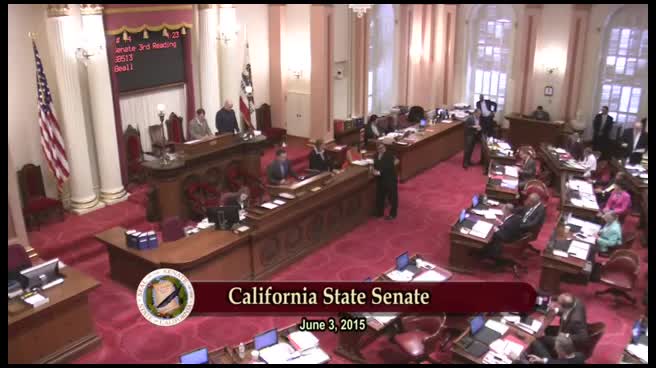 1MIN
Senate Floor
 5MIN
Senate Standing Committee on Energy, Utilities and Communications
Bill Author

Bill Co-Author(s):