SB 608: Homelessness.
- Session Year: 2015-2016
- House: Senate
- Latest Version Date: 2015-02-27
Existing law, the Unruh Civil Rights Act, provides that all persons within the state are free and equal, regardless of their sex, race, color, religion, ancestry, national origin, disability, medical condition, genetic information, marital status, or sexual orientation, and are entitled to the full and equal accommodations, advantages, facilities, privileges, or services in all business establishments of every kind whatsoever.
This bill would enact the Right to Rest Act, which would afford persons experiencing homelessness the right to use public space without discrimination based on their housing status. Because the bill would require local agencies to perform additional duties, it would impose a state-mandated local program. The bill would describe basic human and civil rights that may be exercised without being subject to criminal or civil sanctions or harassment, including the right to use and to move freely in public spaces, the right to rest in public spaces and to protect oneself from the elements, the right to eat in any public space in which having food is not prohibited, the right to perform religions observances in public spaces, and the right to occupy a motor vehicle or a recreational vehicle legally parked or parked with the permission of the property owner, as specified.
The bill would authorize a person whose rights have been violated pursuant to these provisions to enforce those rights in a civil action in which the court may award the prevailing party injunctive and declaratory relief, restitution, damages, statutory damages of $1,000 per violation, and fees and costs.
Existing law provides that any person who lodges in any building, structure, vehicle, or place without the permission of the owner or person entitled to the possession or in control of it, is guilty of disorderly conduct.
The bill would also exempt conduct that is protected by the bill from this definition of the crime of disorderly conduct.
The California Constitution requires the state to reimburse local agencies and school districts for certain costs mandated by the state. Statutory provisions establish procedures for making that reimbursement.
This bill would provide that, if the Commission on State Mandates determines that the bill contains costs mandated by the state, reimbursement for those costs shall be made pursuant to these statutory provisions.
This act shall be known and may be cited as The Right to Rest Act.
SEC. 2.The Legislature finds and declares all of the following:
(a)According to the Housing and Urban Developments report to Congress, 136,826 people were estimated to be homeless in California in 2013, a rate that is unprecedented following a deep and prolonged economic recession, a severe shortage of safe and affordable housing, a failed veteran and civilian mental health system, and a diminished social safety net.
(b)According to the United States Department of Education, 259,656 school children were known to have experienced homelessness in the 201213 school year.
(c)Homelessness is an independent risk factor for a number of illnesses, making people more susceptible to increased health problems due to high stress, sleep deprivation, unsanitary surroundings, lack of access to hygiene facilities, and a myriad of other situational stressors experienced by people without stable housing. Subsequently, people who are chronically homeless are more medically frail and three to four times more likely to die prematurely than their housed counterparts.
(d)Throughout California, local governments have enacted ordinances that make it illegal to rest or seek nourishment in public spaces.
(e)These local ordinances do not reduce the incidence of homelessness or crime. Instead, they result in increased incarceration rates and financial indebtedness of people who simply have no means of support and prolong homelessness by making it more difficult for people to secure housing, employment, and medical care.
(f)While these ordinances apply to all residents, they disproportionately impact people without homes, who have no private place to rest or seek nourishment, and are often selectively applied by law enforcement to people based upon their appearance or an assumption of homelessness.
(g)In practice, these ordinances deprive persons experiencing homelessness and those who may be perceived as homeless of a safe and legal place to rest and seek nourishment, which adversely impacts their health and well-being.
(h)Sleep deprivation impairs cognitive processes and puts one at risk for obesity, heart disease, heart attack, heart failure, irregular heartbeat, high blood pressure, stroke, diabetes, and depression. People who are homeless suffer from sleep deprivation and, absent a place to rest, they suffer it more frequently.
(i)Lacking the resources necessary to obtain adequate legal representation, homeless persons are often denied relief or damages through the courts.
(j)Both the federal government, through its Interagency Council on Homelessness, and the United Nations, have recognized that discrimination and criminalization violate a homeless persons human rights and have called upon state and local governments to cease enactment and enforcement of those laws.
(k)Homelessness and the increasing criminalization of homelessness and discrimination against those experiencing homelessness are widespread throughout California and are matters of statewide concern.
(l) Section 1 of Article I of the California Constitution provides that [a]ll people are by nature free and independent and have inalienable rights. Among these are enjoying and defending life and liberty, acquiring, possessing, and protecting property, and pursuing and obtaining safety, happiness, and privacy, without qualification as to whether or not a person is, or appears to be, homeless.
(m)Subdivision (a) of Section 7 of Article I of the California Constitution provides that [a] person may not be deprived of life, liberty, or property without due process of law or denied equal protection of the laws... .
(n) Concordant with this fundamental belief, a person should not be subject to discrimination based on his or her income, housing status, or ability or desire to appear housed. Therefore, it is the intent of the Legislature in enacting this legislation to protect the rights of all Californians, regardless of their housing status and ameliorate the adverse effects caused by the criminalization of homelessness on our communities and our citizens.
(o) Decriminalization of rest allows municipal governments to redirect resources from local enforcement activities to activities that address the root causes of homelessness and poverty.
SEC. 3.Part 2.2 (commencing with Section 53.8) is added to Division 1 of the Civil Code, to read:2.2.Homeless Persons53.8.For purposes of this part, the following definitions shall apply:
(a)BID means a business improvement district, as established pursuant to Chapter 2 (commencing with Section 36520) of Part 6 of Division 18 of, or Chapter 2 (commencing with Section 36620) of Part 7 of Division 18 of, the Streets and Highways Code, or any public-private partnership established under any municipal or county law authorized pursuant to Chapter 1 (commencing with Section 36500) of Part 6 of Division 18 of, or Chapter 2 (commencing with Section 36620) of Part 7 of Division 18 of, the Streets and Highways Code, whether or not the phrase business improvement district is part of the public-private partnerships name.
(b)BID agent means any person hired by a business improvement district.
(c)Discrimination based on housing status includes any distinction, exclusion, or restriction based on the status of having or not having a fixed or regular residence or that disproportionately impacts person of a particular housing status. Measures taken to ensure equal enjoyment or exercise of the human right to rest shall not be deemed discriminatory.
(d)Harassment means a knowing or willful course of conduct by law enforcement, public or private security personnel, or a BID agent directed at a specific person that a reasonable person would consider as seriously alarming, threatening, tormenting, or terrorizing.
(e)(1)Homeless persons, homeless people, or persons experiencing homelessness means those individuals or members of families who lack a fixed, regular, and adequate nighttime residence including all of the following:
(A)Individuals and members of families who are sharing the housing of other persons due to a loss of housing, economic hardship, or a similar reason; are living in motels, hotels, trailer parks, or camping grounds due to the lack of alternative adequate accommodations; are living in emergency or transitional shelters; are abandoned in a hospital; or are awaiting foster care placement.
(B)Individuals and members of families who have a primary nighttime residence that is a public or private place not designed for or ordinarily used as a regular sleeping accommodation for human beings, including a car, park, abandoned building, bus or train station, airport, or camping ground.
(C)Individuals and members of families who are living in cars, parks, public spaces, abandoned buildings, substandard housing, bus or train stations, or similar settings.
(D)Individuals and members of families who, in the preceding 36 months, have moved between jurisdictions in order to obtain temporary or seasonal employment in agriculture or fishing work, or have migrated 20 miles or more to a temporary residence to engage in a fishing activity.
(2)This definition includes unaccompanied youth and homeless families with children and youth who have experienced a long-term period without living independently in permanent housing, have experienced persistent instability as measured by frequent moves over that period, and can be expected to continue in that status for an extended period of time because of chronic disabilities, chronic physical health or mental health conditions, substance addiction, histories of domestic violence or childhood abuse, the presence of a child or youth with a disability, or multiple barriers to employment.
(f)Motor vehicle means a motor vehicle as defined in Section 415 of the Vehicle Code.
(g)Public space means any property that is owned, in whole or in part, by any state or local government entity or any property upon which there is an easement for public use and that is held open to the public, including, but not limited to, plazas, courtyards, parking lots, sidewalks, public transportation facilities and services, public buildings, shopping centers, and parks.
(h)Recreational vehicle means a recreational vehicle as defined in Section 18010 of the Health and Safety Code.
(i)Rest means the state of not moving, holding certain postures that include, but are not limited to, sitting, standing, leaning, kneeling, squatting, sleeping, or lying.
53.81.(a)Persons experiencing homelessness shall be permitted to use public space in the same manner as any other person, without discrimination based on their housing status. In addition, the existence of homelessness requires that civil and human rights that are amply protected in the home and in other private places be extended to the public areas in which homeless persons live to ensure the equal rights of all Californians, whether homeless or housed.
(b)Every person in the state shall have the following basic human and civil rights, that may be exercised without being subject to criminal or civil sanctions or harassment by law enforcement, public or private security personnel, or BID agents:
(1)The right to use and to move freely in public spaces, without discrimination and without time limitations that discriminate based upon housing status.
(2)The right to rest in public spaces and to protect oneself from the elements, in a nonobstructive manner.
(3)The right to eat, share, accept, or give food in any public space in which having food is not otherwise generally prohibited.
(4)The right to pray, meditate, worship, or practice religion in public spaces, without discrimination based upon housing status.
(5)The right to occupy a motor vehicle or a recreational vehicle, provided that the vehicle is legally parked on public property or parked on private property with permission of the property owner.
53.82.(a)Any person whose rights have been violated pursuant to this part may enforce those rights in a civil action.
(b)The court may award appropriate injunctive and declaratory relief, restitution for loss of property or personal effects and belongings, actual damages, compensatory damages, exemplary damages, statutory damages of one thousand dollars ($1,000) per violation, and reasonable attorneys fees and costs to a prevailing party.
SEC. 4.Section 647 of the Penal Code is amended to read:647.Except as provided in subdivision (l), every person who commits any of the following acts is guilty of disorderly conduct, a misdemeanor:
(a)Who solicits anyone to engage in or who engages in lewd or dissolute conduct in any public place or in any place open to the public or exposed to public view.
(b)Who solicits or who agrees to engage in or who engages in any act of prostitution. A person agrees to engage in an act of prostitution when, with specific intent to so engage, he or she manifests an acceptance of an offer or solicitation to so engage, regardless of whether the offer or solicitation was made by a person who also possessed the specific intent to engage in prostitution. No agreement to engage in an act of prostitution shall constitute a violation of this subdivision unless some act, in addition to the agreement, is done within this state in furtherance of the commission of an act of prostitution by the person agreeing to engage in that act. As used in this subdivision, prostitution includes any lewd act between persons for money or other consideration.
(c)Who accosts other persons in any public place or in any place open to the public for the purpose of begging or soliciting alms.
(d)Who loiters in or about any toilet open to the public for the purpose of engaging in or soliciting any lewd or lascivious or any unlawful act.
(e)Who lodges in any building, structure, vehicle, or place, whether public or private, without the permission of the owner or person entitled to the possession or in control of it. This subdivision does not apply to conduct that is protected pursuant to Section 53.81 of the Civil Code.
(f)Who is found in any public place under the influence of intoxicating liquor, any drug, controlled substance, toluene, or any combination of any intoxicating liquor, drug, controlled substance, or toluene, in a condition that he or she is unable to exercise care for his or her own safety or the safety of others, or by reason of his or her being under the influence of intoxicating liquor, any drug, controlled substance, toluene, or any combination of any intoxicating liquor, drug, or toluene, interferes with or obstructs or prevents the free use of any street, sidewalk, or other public way.
(g)When a person has violated subdivision (f), a peace officer, if he or she is reasonably able to do so, shall place the person, or cause him or her to be placed, in civil protective custody. The person shall be taken to a facility, designated pursuant to Section 5170 of the Welfare and Institutions Code, for the 72-hour treatment and evaluation of inebriates. A peace officer may place a person in civil protective custody with that kind and degree of force which would be lawful were he or she effecting an arrest for a misdemeanor without a warrant. A person who has been placed in civil protective custody shall not thereafter be subject to any criminal prosecution or juvenile court proceeding based on the facts giving rise to this placement. This subdivision shall not apply to the following persons:
(1)Any person who is under the influence of any drug, or under the combined influence of intoxicating liquor and any drug.
(2)Any person who a peace officer has probable cause to believe has committed any felony, or who has committed any misdemeanor in addition to subdivision (f).
(3)Any person who a peace officer in good faith believes will attempt escape or will be unreasonably difficult for medical personnel to control.
(h)Who loiters, prowls, or wanders upon the private property of another, at any time, without visible or lawful business with the owner or occupant. As used in this subdivision, loiter means to delay or linger without a lawful purpose for being on the property and for the purpose of committing a crime as opportunity may be discovered.
(i)Who, while loitering, prowling, or wandering upon the private property of another, at any time, peeks in the door or window of any inhabited building or structure, without visible or lawful business with the owner or occupant.
(j)(1)Any person who looks through a hole or opening, into, or otherwise views, by means of any instrumentality, including, but not limited to, a periscope, telescope, binoculars, camera, motion picture camera, camcorder, or mobile phone, the interior of a bedroom, bathroom, changing room, fitting room, dressing room, or tanning booth, or the interior of any other area in which the occupant has a reasonable expectation of privacy, with the intent to invade the privacy of a person or persons inside. This subdivision shall not apply to those areas of a private business used to count currency or other negotiable instruments.
(2)Any person who uses a concealed camcorder, motion picture camera, or photographic camera of any type, to secretly videotape, film, photograph, or record by electronic means, another, identifiable person under or through the clothing being worn by that other person, for the purpose of viewing the body of, or the undergarments worn by, that other person, without the consent or knowledge of that other person, with the intent to arouse, appeal to, or gratify the lust, passions, or sexual desires of that person and invade the privacy of that other person, under circumstances in which the other person has a reasonable expectation of privacy.
(3)(A)Any person who uses a concealed camcorder, motion picture camera, or photographic camera of any type, to secretly videotape, film, photograph, or record by electronic means, another, identifiable person who may be in a state of full or partial undress, for the purpose of viewing the body of, or the undergarments worn by, that other person, without the consent or knowledge of that other person, in the interior of a bedroom, bathroom, changing room, fitting room, dressing room, or tanning booth, or the interior of any other area in which that other person has a reasonable expectation of privacy, with the intent to invade the privacy of that other person.
(B)Neither of the following is a defense to the crime specified in this paragraph:
(i)The defendant was a cohabitant, landlord, tenant, cotenant, employer, employee, or business partner or associate of the victim, or an agent of any of these.
(ii)The victim was not in a state of full or partial undress.
(4)(A)Any person who intentionally distributes the image of the intimate body part or parts of another identifiable person, or an image of the person depicted engaged in an act of sexual intercourse, sodomy, oral copulation, sexual penetration, or an image of masturbation by the person depicted or in which the person depicted participates, under circumstances in which the persons agree or understand that the image shall remain private, the person distributing the image knows or should know that distribution of the image will cause serious emotional distress, and the person depicted suffers that distress.
(B)A person intentionally distributes an image described in subparagraph (A) when he or she personally distributes the image, or arranges, specifically requests, or intentionally causes another person to distribute that image.
(C)As used in this paragraph, intimate body part means any portion of the genitals, the anus and in the case of a female, also includes any portion of the breasts below the top of the areola, that is either uncovered or clearly visible through clothing.
(D)It shall not be a violation of this paragraph to distribute an image described in subparagraph (A) if any of the following applies:
(i)The distribution is made in the course of reporting an unlawful activity.
(ii)The distribution is made in compliance with a subpoena or other court order for use in a legal proceeding.
(iii)The distribution is made in the course of a lawful public proceeding.
(5)This subdivision shall not preclude punishment under any section of law providing for greater punishment.
(k)In any accusatory pleading charging a violation of subdivision (b), if the defendant has been once previously convicted of a violation of that subdivision, the previous conviction shall be charged in the accusatory pleading. If the previous conviction is found to be true by the jury, upon a jury trial, or by the court, upon a court trial, or is admitted by the defendant, the defendant shall be imprisoned in a county jail for a period of not less than 45 days and shall not be eligible for release upon completion of sentence, on probation, on parole, on work furlough or work release, or on any other basis until he or she has served a period of not less than 45 days in a county jail. In all cases in which probation is granted, the court shall require as a condition thereof that the person be confined in a county jail for at least 45 days. In no event does the court have the power to absolve a person who violates this subdivision from the obligation of spending at least 45 days in confinement in a county jail.
In any accusatory pleading charging a violation of subdivision (b), if the defendant has been previously convicted two or more times of a violation of that subdivision, each of these previous convictions shall be charged in the accusatory pleading. If two or more of these previous convictions are found to be true by the jury, upon a jury trial, or by the court, upon a court trial, or are admitted by the defendant, the defendant shall be imprisoned in a county jail for a period of not less than 90 days and shall not be eligible for release upon completion of sentence, on probation, on parole, on work furlough or work release, or on any other basis until he or she has served a period of not less than 90 days in a county jail. In all cases in which probation is granted, the court shall require as a condition thereof that the person be confined in a county jail for at least 90 days. In no event does the court have the power to absolve a person who violates this subdivision from the obligation of spending at least 90 days in confinement in a county jail.
In addition to any punishment prescribed by this section, a court may suspend, for not more than 30 days, the privilege of the person to operate a motor vehicle pursuant to Section 13201.5 of the Vehicle Code for any violation of subdivision (b) that was committed within 1,000 feet of a private residence and with the use of a vehicle. In lieu of the suspension, the court may order a persons privilege to operate a motor vehicle restricted, for not more than six months, to necessary travel to and from the persons place of employment or education. If driving a motor vehicle is necessary to perform the duties of the persons employment, the court may also allow the person to drive in that persons scope of employment.
(l)(1)A second or subsequent violation of subdivision (j) is punishable by imprisonment in a county jail not exceeding one year, or by a fine not exceeding two thousand dollars ($2,000), or by both that fine and imprisonment.
(2)If the victim of a violation of subdivision (j) was a minor at the time of the offense, the violation is punishable by imprisonment in a county jail not exceeding one year, or by a fine not exceeding two thousand dollars ($2,000), or by both that fine and imprisonment.
(m)(1)If a crime is committed in violation of subdivision (b) and the person who was solicited was a minor at the time of the offense, and if the defendant knew or should have known that the person who was solicited was a minor at the time of the offense, the violation is punishable by imprisonment in a county jail for not less than two days and not more than one year, or by a fine not exceeding ten thousand dollars ($10,000), or by both that fine and imprisonment.
(2)The court may, in unusual cases, when the interests of justice are best served, reduce or eliminate the mandatory two days of imprisonment in a county jail required by this subdivision. If the court reduces or eliminates the mandatory two days imprisonment, the court shall specify the reason on the record.
SEC. 5.If the Commission on State Mandates determines that this act contains costs mandated by the state, reimbursement to local agencies and school districts for those costs shall be made pursuant to Part 7 (commencing with Section 17500) of Division 4 of Title 2 of the Government Code.
|
Date
|
Status
|
|---|---|
| Feb 1, 2016 | Returned to Secretary of Senate pursuant to Joint Rule 56. |
| Dec 16, 2015 | January 5 set for second hearing canceled at the request of author. |
| Dec 10, 2015 | Set for hearing January 5. |
| Apr 8, 2015 | April 7 set for first hearing. Testimony taken. Further hearing to be set. |
| Mar 25, 2015 | Set for hearing April 7. |
| Mar 12, 2015 | Referred to Coms. on T. & H. and JUD. |
| Mar 2, 2015 | Read first time. |
| Mar 2, 2015 | From printer. May be acted upon on or after April 1. |
| Feb 27, 2015 | Introduced. To Com. on RLS. for assignment. To print. |
This list shows positions taken on this bill by organizations on the date displayed, which is linked to the original source.
Positions by individuals are not included.
SB 608 (Liu) Page 9 of 9
SENATE COMMITTEE ON TRANSPORTATION AND HOUSING
Senator Jim Beall, Chair
2015 - 2016 Regular
Bill No: SB 608 Hearing Date: 4/7/2015
Author: |
Liu |
||
Version: |
2/27/2015 |
||
Urgency: |
No |
Fiscal: |
Yes |
Consultant: |
Alison Dinmore |
||
SUBJECT: Right to Rest Act
DIGEST: This bill enacts the Right to Rest Act, which would afford persons experiencing homelessness the right to use public space without discrimination based on their housing status and a civil remedy if their rights pursuant to the Act are violated.
ANALYSIS:
Existing law:
Under the Unruh Civil Rights Act, provides that all persons are free and equal no matter what their sex, race, color, religion, ancestry, national origin, disability, medical condition, genetic information, marital status, or sexual orientation, and are entitled to full and equal accommodations, advantages, facilities, privileges, or services in all business establishments.
Under the California Penal Code, provides that any person who lodges in any building, structure, vehicle, or place without the permission of the owner or person entitled to the possession or control in it shall be guilty of disorderly conduct, a misdemeanor, punishable by imprisonment in the county jail not exceeding six months, or by a fine not exceeding $1,000, or both.
This bill enacts the Right to Rest Act, which provides that persons experiencing homelessness shall be permitted to use public space without discrimination based on their housing status. Additionally, civil and human rights afforded in the home and other private places shall be extended to public areas where homeless persons live.
More specifically, this bill provides that every person in the state shall have the following basic human and civil rights that may be exercised without being subject to criminal or civil sanctions or harassment by law enforcement, public or private security, or agents of a business improvement district (BID):
The right to use and move freely in public spaces without discrimination and without time limitations that discriminate based upon housing status.
The right to rest in public spaces and to protect oneself from the elements in a non-obstructive manner.
The right to eat, share, accept, or give food in any public space in which having food is not otherwise generally prohibited.
The right to pray, meditate, worship, or practice religion in public spaces without discrimination based upon housing status.
The right to occupy a motor vehicle or a recreational vehicle provided the vehicle is legally parked on public property or parked on private property with the permission of the property owner.
This bill provides that a person whose rights are violated pursuant to this Act may enforce those rights in a civil action and may be entitled to: injunctive and declaratory relief; restitution for loss of property or personal effects and belongings; actual damages; compensatory damages; exemplary damages; statutory damage of $1,000 per violation; and reasonable attorney’s fees and costs to a prevailing party.
Additionally, this bill exempts a person who lodges in any building, structure, vehicle, or place without the permission of the owner or person entitled to possession or control of it, from committing a misdemeanor if that conduct is protected under this Act.
COMMENTS:
Purpose of the bill. The author states that this bill seeks to end the criminalization of the non-criminal activities of life exercised by homeless people by protecting the freedom of movement, sitting, standing, lying, and sleeping, and clarifying that people shall have the right to share food and practice religion in public in California. With poverty and homelessness reaching record numbers in California, there has been a documented increase in laws that target people without homes and impact the poor. These anti-homeless laws — commonly referred to as “vagrancy,” “quality of life,” or “anti-nuisance” laws — deny people the right to exist in public. A survey of homeless people conducted by the Western Region Advocacy Project revealed that the majority of people without homes do not know of a safe place to sleep at night where they would not be arrested.
A report, published by the independent federal agency United States Interagency Council on Homelessness, called “Searching out Solutions: Constructive Alternatives to Criminalization” demonstrates that enforcement of laws against resting is ineffective; it does not increase business revenue or improve public perception of the problem of homelessness. These laws effectively make it harder for people to escape homelessness because the resulting warrants, fines, and criminal records make people ineligible for jobs and housing. This report was commended in a resolution by the U.S. Conference of Mayors. The U.S. Conference of Mayors also urged its members to review and adopt the recommendations in the report to meet the needs of the larger community as a whole while also enhancing progress on efforts to end homelessness.
Factors contributing to homelessness. Homelessness is the most severe face of poverty. According to the U.S. Department of Housing and Urban Development, California had 113,952 homeless people, or 20% of the nation’s overall homeless population, in January 2014. Of California’s total homeless population, 27% were chronically homeless, 20% were in households with at least one parent and one child, 10% were veterans, and 10% were victims of domestic violence. California also had the largest number of homeless families, unaccompanied homeless youth, and homeless veterans.
Contemporary homelessness began in the early 1980s due to shifts in economic and social policy at the federal level, such as dramatic cuts in affordable housing and other programs designed to serve low-income people. These economic and social policies continue to contribute to homelessness today. In addition, California’s homelessness rates are exacerbated by the state’s lack of affordable housing and decreased funding from the loss of redevelopment. Rents have risen to levels that make it difficult for low-wage workers to find affordable rental units. California has one of the nation’s highest rates of “poor renters,” or people that spend more than 50% of their income on rent. While most homeless people in the U.S. lived in emergency shelters or transitional housing in 2013, most homeless people in California were unsheltered. California’s high housing costs and shortage of shelters leave many homeless people with no choice but to rest and sleep in public.
Data indicates vagrancy laws punish status, not behavior. Researchers from the Policy Advocacy Clinic at the University of California at Berkeley Law School identified and analyzed more than 500 municipal laws that criminalize standing, sitting, resting, sleeping, and sharing of food in public places in its report “California’s New Vagrancy Laws: The Growing Enactment and Enforcement of Anti-Homeless Laws in the Golden State.” The report found that the number of ordinances targeting those behaviors rose with the increase in homelessness following the sharp decline of federal funding for affordable housing in the 1980s and again with the Great Recession in 2008. Researchers noticed a similar correlation between arrests and the economy; arrests rose during times of economic recessions and fell during rises in the economy. The report noted that these trends indicate that enforcement of vagrancy ordinances increases in response to deteriorating economic conditions and rising levels of homelessness.
Since 2011, despite decreases in unemployment and reduced impacts of the Great Recession, vagrancy arrests have continued to trend upwards. Additionally, researchers found that statewide arrests for these types of offenses rose by 77%, while arrests for drunkenness and disorderly conduct have decreased by 16% and 48% respectively. The report suggests that homeless people are being punished for their status, rather than their behavior.
Creating barriers to housing and other services. The Western Regional Advocacy Project led a survey effort documenting homeless people’s experiences with the criminal justice system for survival-related crimes. More than three quarters of survey respondents (78%) reported being harassed, cited, or arrested by police officers for sleeping outside. Seventy-five percent reported the same for sitting or lying down, and 76% for loitering or “hanging out.” Most of the relevant laws are infractions, which generally do not result in jail or prison time but do carry significant fines. Due to an inability to pay fines or make a court appearance, 57% reported bench warrants for their arrest.
Arrests and criminal records create a significant barrier to employment. For those who are working, an arrest or associated court appearances can cost them their jobs. Involvement with the criminal justice system often limits a person’s eligibility for public programs, cutting them off from the social safety net. The Western Regional Policy Project suggests that enforcement of these laws ultimately does not address the root causes of homelessness and could bar the homeless from accessing public assistance, qualifying for public housing, and finding and maintaining employment.
Local costs? Opponents argue that the enactment of this bill will lead to increased local costs and loss of revenues associated with maintenance and repair to public parks, public facilities, and open spaces, and would impact businesses. The researchers at Policy Advocacy Clinic at the UC Berkeley Law School argue, however, that it might be more costly to enforce these vagrancy laws. In addition to time police officers spend issuing citations, the justice system spends time and money processing them. In San Francisco alone, the Superior Court processing costs for anti-homeless citations was estimated at $4.10 per case in 2000, resulting in $77,900 in costs that year. The San Francisco District Attorney’s office then spent $317,086 processing infractions and misdemeanors that same year.
An analysis published by the United States Interagency Council on Homelessness analyzed cost studies of homeless interventions conducted between 2004 and 2009 in major U.S. cities, including Los Angeles and San Francisco, and found that U.S. jurisdictions spend an average of $87 per day to incarcerate an individual in a county jail, but only $28 per day to offer shelter. Further, programs that offer housing and supportive services, such as Project 50 in Los Angeles, realized a surplus after two years due to savings on incarceration and medical services. The researchers at the Policy Advocacy Clinic at the UC Berkeley Law School concludes that enforcement efforts may burden cities with significant financial costs.
Right for homeless people to use public space. In addition to protection from discrimination based on housing status, this bill would establish a right for the homeless to use public spaces in the same manner as any other person. This bill does not preclude a local jurisdiction from imposing time, place, or manner restrictions on use of public space, so long as those restrictions do not treat homeless and non-homeless persons differently. For example, a city may impose time restrictions on the use of a park, so long as the restriction is not intended to target the homeless or being enforced only against them. This bill also allows a person to sleep in their car on public property and on private property with the permission of the property owner, provided no other laws are being broken. For example, if a city limits parking to less than two hours or prohibits parking a recreational vehicle, these laws would still apply.
Further, this bill would extend civil and human rights to public places where homeless people live. A person whose rights have been violated may enforce those rights in a civil action and be entitled to appropriate relief and damages, including restitution and reasonable attorney’s fees.
Clarification of “public space.” The bill defines public space as property owned, in whole or in part, by a state or local government entity or any property upon which there is an easement for public use and that is held open to the public. Campgrounds owned by public entities and open for public use often require payment for use of camp sites and may fall under this definition of public space. Additionally, some state or local entities hold property open for public use at certain times but are closed at other times. The author does not intend for this bill to apply to public space that requires a fee or is closed to all persons. The author has agreed to accept amendments that would clarify that the Act shall not apply to a public space during a time when it is closed to all persons or when a fee is required for entry or use.
Opposition. Opponents argue that this bill is misguided and may incentivize homeless activity in cities, particularly among a subgroup of individuals who refuse assistance, rather than addressing the root causes of homelessness. This bill will establish a right to live on the streets, thus creating unsanitary conditions, impeding business, and creating intimidating and uncomfortable environments that will be undesirable for others to visit. Opponents state that this bill would usurp voter-approved ordinances that seek to balance the rights, health, and safety of all their residents by preventing camping, sleeping, and lying on the streets.
Opponents further argue that the bill creates confusion as to what activities are permitted, making enforcement of its provisions challenging to law enforcement, BID agents, and public and private security personnel. For example, the actions of those who seek to assist the homeless, under this bill, could be considered “harassment.” As indicated above, the bill may also result in additional costs and loss of revenues to local jurisdictions associated with maintenance and repair to public parks, public facilities, and open spaces.
Double-referral. The Senate Rules Committee has referred this bill to both this committee and the Judiciary Committee.
RELATED LEGISLATION:
AB 5 (Ammiano, 2014) — Would have created the Homeless Person’s Bill of Rights and Fairness Act, which: 1) prohibited the discrimination against the homeless by public entities; 2) provided that every person had the right to move freely, rest, eat, accept, or give food or water, and solicit donations in public spaces; and 3) established the right to lawful self-employment, confidentiality of specified records, and assistance of legal counsel. The bill also required the Department of Public Health to fund the provision of health and hygiene centers for use by homeless persons in designated areas. This bill was held on suspense in the Assembly Appropriations Committee.
FISCAL EFFECT: Appropriation: No Fiscal Com.: Yes Local: Yes
POSITIONS: (Communicated to the committee before noon on Wednesday,
April 1, 2015.)
SUPPORT:
East Bay Community Law Center (Co-sponsor)
JERICHO: A Voice for Justice (Co-sponsor)
Western Center on Law and Poverty (Co-sponsor)
Western Regional Advocacy Project (Co-sponsor)
American Civil Liberties Union of California (ACLU-CA)
Affordable Homeless Housing Alternatives (AHHA)
AWARE-LA
Berkeley Needle Exchange Emergency Distribution (Berkeley NEED)
Caduceus Justice
California Catholic Conference, Inc.
California Council of Churches IMPACT
California Partnership
Californians United for a Responsible Budget (CURB)
City Paws L.A.
Clarion Alley Mural Project (CAMP)
Coalition of California Welfare Rights Organizations, Inc.
Cooperation for Supportive Housing (CSH)
Drug Policy Alliance
Elica Health Centers
Esperanza Community Housing Corporation
Fair Chance Project
Food Not Bombs
Foothill House of Hospitality
General Assistance Advocacy Project (GAAP)
Girls Think Tank
Grey Panthers of San Francisco
Gubbio Project
Homeless Health Care Los Angeles
Homeless Lives Matter — Berkeley
Homeless Action Center
Housing California
HOUSING WORKS
Hunger Action Los Angeles (HALA)
Instituto de Educacion Popular del Sur de California (IDEPSCA)
Issues and Solutions
JWCH Institute, Inc.
L.A. for Choice
L.A. Human Right to Housing Collective
Labor Community Strategy Center
Lawyers’ Committee for Civil Rights of the San Francisco Bay Area
Larkin Street Youth Services
Lavender Youth Recreation and Information Center (LYRIC)
Legal Services for Prisoners with Children (LSPC)
Los Angeles Poverty Department (LAPD)
Los Angeles Catholic Worker
Los Angeles Community Action Network (LACAN)
Mutual Housing California
National Association for the Education of Homeless Children and Youth
(NAEHCY)
National Association of Social Workers, California (NASW-CA)
National Coalition for the Homeless (NCH)
National Law Center on Homelessness and Poverty
Occupy Orange County
Occupy Venice
Peace and Freedom Party of California
People Organized for Westside Renewal (POWER)
Prison Activist Resource Center (PARC)
Redwood Gospel Mission
Safe Ground Sacramento
Sacramento Food Not Bombs
Sacramento Homeless Organizing Committee (SHOC)
Sacramento Housing Alliance
Sacramento Loaves and Fishes
Sacramento Regional Coalition to End Homelessness (SRCEH)
San Francisco Coalition on Homelessness
San Francisco Living Wage Coalition
Southern California Association of Non-Profit Housing
Spirit of Venice
Strategic Actions for a Just Economy
St. Anthony Foundation
St. James Infirmary — San Francisco
St. Mary’s Center — Oakland
Suitcase Clinic
Tenemos que Reclamar y Unidos Salvar La Tierra (TRUST South LA)
United Coalition East Prevention Project (UCEPP)
Venice Community Housing
Venice Justice Committee
Women Organizing Resources, Knowledge, and Services (WORKS)
Wind Youth Services
6 Individuals
OPPOSITION:
California Chamber of Commerce
California Park and Recreation Society
California State Sheriffs’ Association
Central City Association of Los Angeles
Central City East Association
Hollywood Property Owners Alliance
Los Angeles Fashion District Business Improvement District
League of California Cities
Sacramento County District Attorney, Anne Marie Schubert
Small Business California
South Park Business Improvement District
Sunset and Vine Business Improvement District
Westchester Town Center
7 Individuals
-- END --
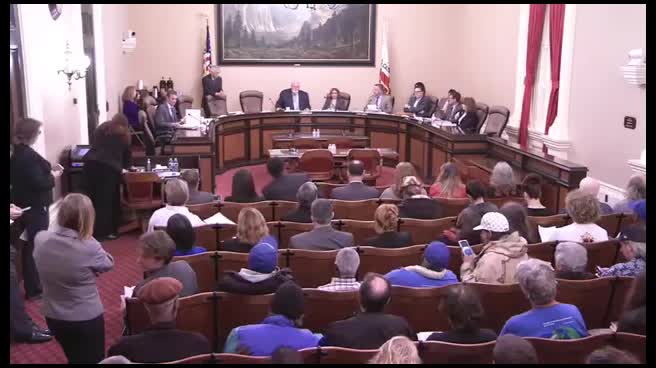
Discussed in Hearing
 1H
Senate Standing Committee on Transportation and Housing
Bill Author
Bill Co-Author(s):