SB 661: Protection of subsurface installations.
- Session Year: 2015-2016
- House: Senate
- Latest Version Date: 2016-09-29
Existing law requires every operator of a subsurface installation, except the Department of Transportation, to become a member of, participate in, and share in the costs of, a regional notification center. Existing law requires any person who plans to conduct any excavation to contact the appropriate regional notification center before commencing that excavation, as specified. Existing law defines a subsurface installation as any underground pipeline, conduit, duct, wire, or other structure. Existing law requires an operator of a subsurface installation, who receives notification of proposed excavation work, within 2 working days of that notification, excluding weekends and holidays, to mark the approximate location and number of subsurface installations that may be affected by the excavation or to advise that no subsurface installations operated by him or her would be affected. Existing law requires an operator of a subsurface installation that has failed to comply with these provisions to be liable to the excavator for damages, costs, and expenses.
This bill, the Dig Safe Act of 2016, would define terms for its purposes, including, among others, defining working day for purposes of determining excavation start date and time.
This bill would require an excavator planning to conduct an excavation to delineate the area to be excavated before notifying the appropriate regional notification center of the planned excavation, as provided. The bill would require an operator, before the legal start date and time of the excavation, to locate and field mark, within the area delineated for excavation, its subsurface installations. The bill would require an operator to maintain and preserve all plans and records for any subsurface installation owned by that operator as that information becomes known, as specified. The bill would, commencing November 1, 2017, establish a process for an excavator to request and obtain a continual excavation ticket for an area of continual excavation that is required to be valid for one year from the date of issuance and eligible for renewal.
This bill would amend the Natural Gas Pipeline Safety Act of 2011 to exclude from its provisions specific kinds of marking and locating of subsurface installations performed in compliance with this act.
This bill would prohibit an excavator that damages a subsurface installation due to an inaccurate field mark, as defined, by an operator from being liable for damages, replacement costs, or other expenses arising from damage to the subsurface installation, provided that the excavator complied with the provisions described above.
This bill would also require the Public Utilities Commission and the Office of the State Fire Marshal to enforce the requirement to locate and field mark subsurface installations and lines against operators of gas corporations, electrical corporations, water corporations, and operators of hazardous liquid pipeline facilities, as specified. The bill would also authorize a local governing board to enforce these provisions on local agencies under its jurisdiction.
This bill would create the California Underground Facilities Safe Excavation Board under, and assisted by the staff of, the Office of the State Fire Marshal. The bill would require the board to coordinate education and outreach activities, develop standards, and enforce, as specified, the provisions described above. The bill would also authorize the board to prescribe rules and regulations as may be necessary or proper to carry out the purposes of these provisions and to exercise the power and duties conferred upon it. The board would be composed of 9 members who would serve 4-year terms, and 2 nonvoting ex officio members who may be invited by the appointed members of the board. The bill, commencing July 1, 2018, would require the board to investigate possible violations of the provisions described above, and would authorize the board to transmit the investigation results and any recommended penalty to the state or local agency with jurisdiction over the activity or business undertaken in the commission of the violation, as specified. The bill would require the board to convene an annual meeting and, on or before February 1, 2018, and each year thereafter, to report to the Governor and the Legislature on its activities and any recommendations.
The bill would create the Safe Energy Infrastructure and Excavation Fund in the State Treasury and would provide that moneys deposited into the fund are to be used, upon appropriation by the Legislature, to cover the operational expenses of the board and for educational and outreach purposes, except as specified.
Existing law requires every operator of a subsurface installation, except the Department of Transportation, to become a member of, participate in, and share in the costs of, a regional notification center. Existing law requires any person who plans to conduct any excavation to contact the appropriate regional notification center before commencing that excavation, as specified. Existing law defines a subsurface installation as any underground pipeline, conduit, duct, wire, or other structure. Existing law requires an operator of a subsurface installation, who receives notification of proposed excavation work, within 2 working days of that notification, excluding weekends and holidays, to mark the approximate location and number of subsurface installations that may be affected by the excavation or to advise that no subsurface installations operated by him or her would be affected. Existing law requires an operator of a subsurface installation that has failed to comply with these provisions to be liable to the excavator for damages, costs, and expenses.
This bill, the Dig Safe Act of 2016, would define terms for its purposes, including, among others, defining working day for purposes of determining excavation start date and time in the context of these provisions. time.
The
This bill would require an excavator planning to conduct an excavation to delineate the area to be excavated before notifying the appropriate regional notification center of the planned excavation, as provided. The bill would require an operator, before the legal start date and time of the excavation, to locate and field mark, within the area delineated for excavation, its subsurface installations. The bill would require an operator to maintain and preserve all plans and records for any subsurface installation owned by that operator as that information becomes known, as specified. The bill would, commencing November 1, 2017, establish, starting on November 1, 2017, a process for a excavator to request and obtain a continual excavation ticket for an area of continual excavation that is required to be valid for one year from the date of issuance and eligible for renewal.
This bill would amend the Natural Gas Pipeline Safety Act of 2011 to exclude from its provisions specific kinds of marking and locating of subsurface installations performed in compliance with this act.
This bill would prohibit an excavator that damages a subsurface installation due to an inaccurate field mark, as defined, by an operator from being liable for damages, replacement costs, or other expenses arising from damage to the subsurface installation, provided that the excavator complied with the provisions described above.
The
This bill would also require the Public Utilities Commission and the Office of the State Fire Marshal to enforce the requirement to locate and field mark subsurface installations and lines against operators of gas corporations, electrical corporations, water corporations, and operators of hazardous liquid pipeline facilities, as specified. The bill would also authorize a local governing board to enforce these provisions on local agencies under its jurisdiction.
This bill would create the California Underground Facilities Safe Excavation Board under, and assisted by the staff of, the Office of the State Fire Marshal. The bill would require the board to coordinate education and outreach activities, develop standards, and enforce, as specified, the provisions described above. The bill would also authorize the board to prescribe rules and regulations as may be necessary or proper to carry out the purposes of these provisions and to exercise the power and duties conferred upon it.
The board would be composed of 9 members who would serve 4-year terms, and 2 nonvoting ex officio members who may be invited by the appointed members of the board. The bill, commencing January July 1, 2018, would require the board to investigate possible violations of the provisions described above, and would authorize the board to transmit the investigation results and any recommended penalty to the state or local agency with jurisdiction over the activity or business undertaken in the commission of the violation, as specified. The bill would require the board to convene an annual meeting and, on or before February 1, 2018, and each year thereafter, to report to the Governor and the Legislature on its activities and any recommendations.
The bill would create the Safe Energy Infrastructure and Excavation Fund in the State Treasury and would provide that moneys deposited into the fund are to be used, upon appropriation by the Legislature, to cover the operational expenses of the board and for educational and outreach purposes, except as specified.
Existing law requires every operator of a subsurface installation, except the Department of Transportation, to become a member of, participate in, and share in the costs of, a regional notification center. Existing law requires any person who plans to conduct any excavation to contact the appropriate regional notification center before commencing that excavation, as specified. Existing law defines a subsurface installation as any underground pipeline, conduit, duct, wire, or other structure. Existing law requires an operator of a subsurface installation, who receives notification of proposed excavation work, within 2 working days of that notification, excluding weekends and holidays, to mark the approximate location and number of subsurface installations that may be affected by the excavation or to advise that no subsurface installations operated by him or her would be affected. Existing law requires an operator of a subsurface installation that has failed to comply with these provisions to be liable to the excavator for damages, costs, and expenses.
This bill, the Dig Safe Act of 2016, would define working day for purposes of determining excavation start date and time in the context of these provisions.
The bill would require an excavator planning to conduct an excavation to delineate the area to be excavated before notifying the appropriate regional notification center of the planned excavation, as provided. The bill would require an operator, before the legal start date and time of the excavation, to locate and field mark, within the area delineated for excavation, its subsurface installations. The bill would require an operator to maintain and preserve all plans and records for any subsurface installation owned by that operator as that information becomes known, as specified.
This bill would prohibit an excavator that damages a subsurface installation due to an inaccurate field mark, as defined, by an operator from being liable for damages, replacement costs, or other expenses arising from damage to the subsurface installation, provided that the excavator complied with the provisions described above.
The bill would also require the Public Utilities Commission and the Office of the State Fire Marshal to enforce the requirement to locate and field mark subsurface installations and lines against operators of gas corporations, electrical corporations, water corporations, and operators of hazardous liquid pipeline facilities, as specified. The bill would also authorize a local governing board to enforce these provisions on local agencies under its jurisdiction.
This bill would create the California Underground Facilities Safe Excavation Board under, and assisted by the staff of, the Office of the State Fire Marshall. Marshal. The bill would require the board to coordinate education and outreach activities, develop standards, and investigate violations of, and enforce, as specified, the provisions described above. The bill would also authorize the board to prescribe rules and regulations as may be necessary or proper to carry out the purposes of these provisions and to exercise the power and duties conferred upon it.
The board would be composed of 9 members who would serve 4-year terms, and 2 nonvoting ex officio members who may be invited by the appointed members of the board. The bill would authorize the board, to the extent that resources allow, commencing on bill, commencing January 1, 2018, to use compliance audits in furthering the purposes of these provisions. would require the board to investigate possible violations of the provisions described above, and would authorize the board to transmit the investigation results and any recommended penalty to the state or local agency with jurisdiction over the activity or business undertaken in the commission of the violation, as specified. The bill would require the advisory committee board to conduct convene an annual meeting and, on or before February 1, 2018, and each year thereafter, to report to the Governor and the Legislature on its activities and any recommendations.
The bill would create the Safe Energy Infrastructure and Excavation Fund in the State Treasury and would provide that moneys deposited into the fund are to be used, upon appropriation by the Legislature, to cover the operational expenses of the board and for educational and outreach purposes, except as specified.
Existing law requires every operator of a subsurface installation, except the Department of Transportation, to become a member of, participate in, and share in the costs of, a regional notification center. Existing law requires any person who plans to conduct any excavation to contact the appropriate regional notification center before commencing that excavation, as specified. Existing law defines a subsurface installation as any underground pipeline, conduit, duct, wire, or other structure. Existing law requires an operator of a subsurface installation, who receives notification of proposed excavation work, within 2 working days of that notification, excluding weekends and holidays, to mark the approximate location and number of subsurface installations that may be affected by the excavation or to advise that no subsurface installations operated by him or her would be affected. Existing law requires an operator of a subsurface installation that has failed to comply with these provisions to be liable to the excavator for damages, costs, and expenses.
This bill, the Dig Safe Act of 2016, would declare the need to clarify and revise these provisions. The bill would define and redefine various terms relating to a regional notification center. The bill would expand the definition of a subsurface installation to include an underground structure or submerged duct, pipeline, or structure, except as specified. working day for purposes of determining excavation start date and time in the context of these provisions.
The bill would require an excavator planning to conduct an excavation to delineate the area to be excavated before notifying the appropriate regional notification center of the planned excavation, as provided. The bill would require an operator, before the legal start date and time of the excavation, to locate and field mark, within the area delineated for excavation, its subsurface installations. The bill would require an operator to maintain and preserve all plans and records for any subsurface installation owned by that operator as that information becomes known, as specified.
This bill would prohibit an excavator that damages a subsurface installation due to an inaccurate field mark, as defined, by an operator from being liable for damages, replacement costs, or other expenses arising from damage to the subsurface installation, provided that the excavator complied with the provisions described above.
The bill would delete the existing exemptions pertaining to an owner of real property and would instead exempt an owner of residential real property who, as part of improving his or her principal residence, is performing, or is having performed, an excavation using hand tools that does not require a permit, as specified.
The bill would also require the Public Utilities Commission and the Office of the State Fire Marshal to enforce the requirement to locate and field mark subsurface installations and lines against operators of natural gas and electric underground infrastructure and hazardous liquid pipelines, unless these operators are municipal utilities. gas corporations, electrical corporations, water corporations, and operators of hazardous liquid pipeline facilities, as specified. The bill would also authorize a local governing board to enforce these provisions on local agencies under its jurisdiction.
This bill, if specified funds are appropriated by the Legislature and authority to hire sufficient staff is granted to the Contractors State License Board, bill would create the California Underground Facilities Safe Excavation Advisory Committee Board under, and assisted by the staff of, the Contractors State License Board, in the Department of Consumer Affairs. Office of the State Fire Marshall. The bill would require the committee board to coordinate education and outreach activities, develop standards, and investigate violations of of, and enforce, as specified, the provisions described above, as specified. The bill would also require the advisory committee, by December 31, 2018, and in consultation with the Department of Food and Agriculture, to make recommendations, informed by a specified study, that addresses the long-term treatment of agricultural activities in relation to subsurface excavation, and whether those provisions are appropriate or could be modified in ways to promote participation in safe agricultural practices around high priority subsurface installations, as specified. above. The bill would also authorize the board to prescribe rules and regulations as may be necessary or proper to carry out the purposes of these provisions and to exercise the power and duties conferred upon it.
The advisory committee board would be composed of 9 members who would serve 2-year 4-year terms, and 2 nonvoting ex officio members who may be invited by the appointed members of the committee. board. The bill would authorize the advisory committee, board, to the extent that resources allow, commencing on January 1, 2018, to use compliance audits in furthering the purposes of these provisions. The bill would require the advisory committee to conduct an annual meeting and, on or before February 1, 2018, and each year thereafter, to report to the Governor and the Legislature on its activities and any recommendations.
The California Building Standards Law requires state agencies that adopt or propose adoption of any building standard to submit the building standard to the California Building Standards Commission for approval and adoption. Under existing law, if a state agency does not have authority to adopt building standards applicable to state buildings, the commission is required to adopt specific building standards, as prescribed. Existing law requires the commission to publish, or cause to be published, editions of the California Building Standards Code in its entirety once every 3 years. Existing law requires the Department of Housing and Community Development to propose the adoption, amendment, or repeal of building standards to the commission and to adopt, amend, and repeal other rules and regulations for the protection of the public health, safety, and general welfare of the occupants and the public involving buildings and building construction.
This bill would require the department and the commission to develop, and propose for adoption by the commission of, building standards requiring all new residential and nonresidential nonpressurized building sewers that connect from building structures to the public right-of-way or applicable utility easement to include the installation of tracer wire or tape, as specified. The bill would authorize the department and the commission to expend funds from the existing Building Standards Administration Special Revolving Fund for this purpose, upon appropriation.
The bill would create the Safe Energy Infrastructure and Excavation Fund in the State Treasury and would provide that moneys deposited into the fund are to be used used, upon appropriation by the Legislature, to cover the administrative expenses of the advisory committee, upon appropriation by the Legislature. The bill would authorize the Public Utilities Commission to use excess moneys in the fund for specified purposes relating to the safety of underground utilities, upon appropriation by the Legislature. operational expenses of the board and educational and outreach purposes, except as specified.
The Natural Gas Pipeline Safety Act of 2011, within the Public Utilities Act, designates the Public Utilities Commission as the state authority responsible for regulating and enforcing intrastate gas pipeline transportation and pipeline facilities pursuant to federal law, including the development, submission, and administration of a state pipeline safety program certification for natural gas. Existing federal law requires each operator of a buried gas pipeline to carry out a program to prevent damage to that pipeline from excavation activities, as specified.
The bill would require the Public Utilities Commission, no later than February 1, 2019, to report to the Legislature and to the California Underground Facilities Safe Excavation Advisory Committee an analysis of excavation damage to commission-regulated pipeline facilities. The bill would also require each gas corporation, as part of its damage prevention program, to collect certain information until January 1, 2020, to inform its outreach activities, and to report this information annually until January 1, 2020, to the Public Utilities Commission and the California Underground Facilities Safe Excavation Advisory Committee, as specified. The bill would also require each gas corporation to estimate Californians use of regional notification centers, as specified, and to provide this estimate to the commission and the advisory committee on or before July 1, 2017.
Under existing law, a violation of the Public Utilities Act or any order, decision, rule, direction, demand, or requirement of the commission is a crime.
Because the requirements described above are within the act, a violation of these requirements would impose a state-mandated local program by creating a new crime.
Existing law requires the Public Utilities Commission to develop and implement a safety enforcement program that is applicable to gas corporations and electrical corporations and that includes procedures for monitoring, data tracking and analysis, and investigations, as well as issuance of citations by commission staff, under the direction of the executive director of the commission, for correction and punishment of safety violations. That law requires the commission to develop and implement an appeals process to govern issuance and appeal of citations, or resolution of corrective action orders. That law requires the commission to implement the safety enforcement program for gas safety by July 1, 2014, and for electrical safety by January 1, 2015.
This bill would require that moneys collected as a result of the issuance of citations to gas corporations and electrical corporations pursuant to the above-described law be deposited in the Safe Energy Infrastructure and Excavation Fund.
The bill would make other conforming and clarifying changes.
The California Constitution requires the state to reimburse local agencies and school districts for certain costs mandated by the state. Statutory provisions establish procedures for making that reimbursement.
This bill would provide that no reimbursement is required by this act for a specified reason.
Existing law requires every operator of a subsurface installation, except the Department of Transportation, to become a member of, participate in, and share in the costs of, a regional notification center. Existing law requires any person who plans to conduct any excavation to contact the appropriate regional notification center before commencing that excavation, as specified. Existing law defines a subsurface installation as any underground pipeline, conduit, duct, wire, or other structure. Existing law requires an operator of a subsurface installation, who receives notification of proposed excavation work, within 2 working days of that notification, excluding weekends and holidays, to mark the approximate location and number of subsurface installations that may be affected by the excavation or to advise that no subsurface installations operated by him or her would be affected. Existing law requires an operator of a subsurface installation that has failed to comply with these provisions to be liable to the excavator for damages, costs, and expenses.
This bill, the Dig Safe Act of 2016, would declare the need to clarify and revise these provisions. The bill would define and redefine various terms relating to a regional notification center. The bill would expand the definition of a subsurface installation to include an underground structure or submerged duct, pipeline, or structure, except as specified.
The bill would require an excavator planning to conduct an excavation to delineate the area to be excavated before notifying the appropriate regional notification center of the planned excavation, as provided. The bill would require an operator, before the legal start date and time of the excavation, to locate and field mark, within the area delineated for excavation, its subsurface installations. The bill would require an operator to maintain and preserve all plans and records for any subsurface installation owned by that operator as that information becomes known, as specified.
This bill would prohibit an excavator that damages a subsurface installation due to an inaccurate field mark, as defined, by an operator from being liable for damages, replacement costs, or other expenses arising from damage to the subsurface installation, provided that the excavator complied with the provisions described above.
The bill would delete the existing exemptions pertaining to an owner of real property and would instead exempt an owner of residential real property who, as part of improving his or her principal residence, is performing, or is having performed, an excavation using hand tools that does not require a permit, as specified.
The bill would also require the Public Utilities Commission and the Office of the State Fire Marshal to enforce the requirement to locate and field mark subsurface installations and lines against operators of natural gas and electric underground infrastructure and hazardous liquid pipelines, unless these operators are municipal utilities.
This bill, if specified funds are appropriated by the Legislature and authority to hire sufficient staff is granted to the Contractors State License Board, would create the California Underground Facilities Safe Excavation Advisory Committee under, and assisted by the staff of, the Contractors State License Board, in the Department of Consumer Affairs. The bill would require the committee to coordinate education and outreach activities, develop standards, and investigate violations of the provisions described above, as specified. The bill would also require the advisory committee, by December 31, 2018, and in consultation with the Department of Food and Agriculture, to make recommendations, informed by a specified study, that addresses the long-term treatment of agricultural activities in relation to subsurface excavation, and whether those provisions are appropriate or could be modified in ways to promote participation in safe agricultural practices around high priority subsurface installations, as specified.
The advisory committee would be composed of 9 members who would serve 2-year terms, and 2 nonvoting ex officio members who may be invited by the appointed members of the committee. The bill would authorize the advisory committee, commencing on January 1, 2018, to use compliance audits in furthering the purposes of these provisions. The bill would require the advisory committee to conduct an annual meeting on or before February 1, 2018, and each year thereafter, to report to the Governor and the Legislature on its activities and any recommendations.
The California Building Standards Law requires state agencies that adopt or propose adoption of any building standard to submit the building standard to the California Building Standards Commission for approval and adoption. Under existing law, if a state agency does not have authority to adopt building standards applicable to state buildings, the commission is required to adopt specific building standards, as prescribed. Existing law requires the commission to publish, or cause to be published, editions of the California Building Standards Code in its entirety once every 3 years. Existing law requires the Department of Housing and Community Development to propose the adoption, amendment, or repeal of building standards to the commission and to adopt, amend, and repeal other rules and regulations for the protection of the public health, safety, and general welfare of the occupants and the public involving buildings and building construction.
This bill would require the department and the commission to develop, and propose for adoption by the commission of, building standards requiring all new residential and nonresidential nonpressurized building sewers that connect from building structures to the public right-of-way or applicable utility easement to include the installation of tracer wire or tape, as specified. The bill would authorize the department and the commission to expend funds from the existing Building Standards Administration Special Revolving Fund for this purpose, upon appropriation.
The bill would create the Safe Energy Infrastructure and Excavation Fund in the State Treasury and would provide that moneys deposited into the fund are to be used to cover the administrative expenses of the advisory committee, upon appropriation by the Legislature. The bill would authorize the Public Utilities Commission to use excess moneys in the fund for specified purposes relating to the safety of underground utilities, upon appropriation by the Legislature.
The Natural Gas Pipeline Safety Act of 2011, within the Public Utilities Act, designates the Public Utilities Commission as the state authority responsible for regulating and enforcing intrastate gas pipeline transportation and pipeline facilities pursuant to federal law, including the development, submission, and administration of a state pipeline safety program certification for natural gas. Existing federal law requires each operator of a buried gas pipeline to carry out a program to prevent damage to that pipeline from excavation activities, as specified.
The bill would require the Public Utilities Commission, no later than February 1, 2019, to report to the Legislature and to the California Underground Facilities Safe Excavation Advisory Committee an analysis of excavation damage to commission-regulated pipeline facilities. The bill would also require each gas corporation, as part of its damage prevention program, to collect certain information until January 1, 2020, to inform its outreach activities, and to report this information annually until January 1, 2020, to the Public Utilities Commission and the California Underground Facilities Safe Excavation Advisory Committee, as specified. The bill would also require each gas corporation to estimate Californians use of regional notification centers, as specified, and to provide this estimate to the commission and the advisory committee on or before July 1, 2017.
Under existing law, a violation of the Public Utilities Act or any order, decision, rule, direction, demand, or requirement of the commission is a crime.
Because the requirements described above are within the act, a violation of these requirements would impose a state-mandated local program by creating a new crime.
Existing law requires the Public Utilities Commission to develop and implement a safety enforcement program that is applicable to gas corporations and electrical corporations and that includes procedures for monitoring, data tracking and analysis, and investigations, as well as issuance of citations by commission staff, under the direction of the executive director of the commission, for correction and punishment of safety violations. That law requires the commission to develop and implement an appeals process to govern issuance and appeal of citations, or resolution of corrective action orders. That law requires the commission to implement the safety enforcement program for gas safety by July 1, 2014, and for electrical safety by January 1, 2015.
This bill would require that moneys collected as a result of the issuance of citations to gas corporations and electrical corporations pursuant to the above-described law be deposited in the Safe Energy Infrastructure and Excavation Fund.
The bill would make other conforming and clarifying changes.
The California Constitution requires the state to reimburse local agencies and school districts for certain costs mandated by the state. Statutory provisions establish procedures for making that reimbursement.
This bill would provide that no reimbursement is required by this act for a specified reason.
Existing property tax law requires the personal property of an air carrier to be taxed at its fair market value, and the California Constitution requires property subject to ad valorem property taxation to be assessed in the county in which it is situated. Existing law, through the 201516 fiscal year, specifies a formula to determine the fair market value of certificated aircraft of a commercial air carrier, and rebuttably presumes that the amount determined pursuant to this formula is the fair market value of the certificated aircraft.
The California Constitution requires the State Board of Equalization to assess specified properties owned by specified entities. Existing property tax law provides for the valuation of properties of a state assessee that owns property in more than one county. Existing law also provides, pursuant to specified formulas, for the application in each county of specified tax rates to the allocated assessed value of a state assessees property, and for the allocation among jurisdictions in that county of the resulting revenues.
This bill would, from the lien date for the 201718 fiscal year and each fiscal year thereafter, require the board to assess personal property that is owned by a commercial air carrier, as defined, in a manner consistent with currently specified procedures that determine the extent that the certificated aircraft is physically present in each county within the state. The bill would require the board to determine the fair market value of certificated aircraft according to the formula described above. This bill would require the board to notify county assessors, as specified, if a commercial air carriers taxable personal property includes fixtures that are to be locally assessed as real property. This bill would require that the revenues derived from the assessment of this property be allocated in the same percentage shares as revenues derived from locally assessed property among the jurisdictions in which the property is located. This bill would also make conforming changes to related provisions. The bill would also require the board to conduct an audit of a commercial air carrier every four years, as specified.
Existing property tax law requires the personal property of an air carrier to be taxed at its fair market value, and the California Constitution requires property subject to ad valorem property taxation to be assessed in the county in which it is situated. Existing law, through the 201516 fiscal year, specifies a formula to determine the fair market value of certificated aircraft of a commercial air carrier, and rebuttably presumes that the amount determined pursuant to this formula is the fair market value of the certificated aircraft.
The California Constitution requires the State Board of Equalization to assess specified properties owned by specified entities. Existing property tax law provides for the valuation of properties of a state assessee that owns property in more than one county. Existing law also provides, pursuant to specified formulas, for the application in each county of specified tax rates to the allocated assessed value of a state assessees property, and for the allocation among jurisdictions in that county of the resulting revenues.
This bill would, from the lien date for the 201617 201718 fiscal year and each fiscal year thereafter, require the board to assess personal property that is owned by a commercial air carrier, as defined, in a manner consistent with currently specified procedures that determine the extent that the certificated aircraft is physically present in each county within the state. The bill would require the board to determine the fair market value of certificated aircraft according to the formula described above. This bill would require the board to notify county assessors, as specified, if a commercial air carriers taxable personal property includes fixtures that are to be locally assessed as real property. This bill would require that the revenues derived from the assessment of this property be allocated in the same percentage shares as revenues derived from locally assessed property among the jurisdictions in which the property is located. This bill would also make conforming changes to related provisions. The bill would also require the board to conduct an audit of a commercial air carrier every four years, as specified.
Existing property tax law requires the personal property of an air carrier to be taxed at its fair market value, and the California Constitution requires property subject to ad valorem property taxation to be assessed in the county in which it is situated. Existing law, through the 201516 fiscal year, specifies a formula to determine the fair market value of certificated aircraft of a commercial air carrier, and rebuttably presumes that the amount determined pursuant to this formula is the fair market value of the certificated aircraft.
The California Constitution requires the State Board of Equalization to assess specified properties owned by specified entities. Existing property tax law provides for the valuation of properties of a state assessee that owns property in more than one county. Existing law also provides, pursuant to specified formulas, for the application in each county of specified tax rates to the allocated assessed value of a state assessees property, and for the allocation among jurisdictions in that county of the resulting revenues.
This bill would, from the lien date for the 201617 fiscal year and each fiscal year thereafter, require the board to assess personal property that is owned by a commercial air carrier, as defined, in a manner consistent with currently specified procedures that determine the extent that the certificated aircraft is physically present in each county within the state. This bill would require the board to notify county assessors, as specified, if a commercial air carriers taxable personal property includes fixtures that are to be locally assessed as real property. This bill would require that the revenues derived from the assessment of this property be allocated in the same percentage shares as revenues derived from locally assessed property among the jurisdictions in which the property is located. This bill would also make conforming changes to related provisions.
This act shall be known, and may be cited, as the Dig Safe Act of 2016.
SEC. 2.Section 4216 of the Government Code is amended to read:4216.As used in this article, the following definitions apply:
(a)Active subsurface installation means a subsurface installation currently in use or currently carrying service.
(b)Board means the California Underground Facilities Safe Excavation Board.
(c)Area of continual excavation means a location where excavation is part of the normal business activities of that location, including, but not limited to, agricultural operations and flood control facilities.
(d)Delineate means to mark in white the location or path of the proposed excavation using the guidelines in Appendix B of the Guidelines for Excavation Delineation published in the most recent version of the Best Practices guide of the Common Ground Alliance. If there is a conflict between the marking practices in those guidelines and other provisions of this article, this article shall control. Delineation also includes physical identification of the area to be excavated using pink marking, if an excavator makes a determination that standard delineation may be misleading to those persons using affected streets and highways, or be misinterpreted as a traffic or pedestrian control, and the excavator has contacted the regional notification center to advise the operators that the excavator will physically identify the area to be excavated using pink markings.
(e)Electronic positive response means an electronic response from an operator to the regional notification center providing the status of an operators statutorily required response to a ticket.
(f)(1) Emergency means a sudden, unexpected occurrence, involving a clear and imminent danger, demanding immediate action to prevent or mitigate loss of, or damage to, life, health, property, or essential public services.
(2)Unexpected occurrence includes, but is not limited to, a fire, flood, earthquake or other soil or geologic movement, riot, accident, damage to a subsurface installation requiring immediate repair, or sabotage.
(g)Excavation means any operation in which earth, rock, or other material in the ground is moved, removed, or otherwise displaced by means of tools, equipment, or explosives in any of the following ways: grading, trenching, digging, ditching, drilling, augering, tunneling, scraping, cable or pipe plowing and driving, or any other way.
(h)Except as provided in Section 4216.8, excavator means any person, firm, contractor or subcontractor, owner, operator, utility, association, corporation, partnership, business trust, public agency, or other entity that, with their, or his or her, own employees or equipment performs any excavation.
(i)Hand tool means a piece of equipment used for excavating that uses human power and is not powered by any motor, engine, hydraulic, or pneumatic device.
(j)High priority subsurface installation means high-pressure natural gas pipelines with normal operating pressures greater than 415kPA gauge (60psig), petroleum pipelines, pressurized sewage pipelines, high-voltage electric supply lines, conductors, or cables that have a potential to ground of greater than or equal to 60kv, or hazardous materials pipelines that are potentially hazardous to workers or the public if damaged.
(k)Inactive subsurface installation means either of the following:
(1)The portion of an underground subsurface installation that is not active but is still connected to the subsurface installation, or to any other subsurface installation, that is active or still carries service.
(2)A new underground subsurface installation that has not been connected to any portion of an existing subsurface installation.
(l)Legal excavation start date and time means two working days, not including the date of notification, unless the excavator specifies a later date and time, which shall not be more than 14 calendar days from the date of notification. For excavation in an area of continual excavation, legal excavation start date and time means two working days, not including the date of notification, unless the excavator specifies a later date and time, which shall not be more than six months from the date of notification.
(m)Local agency means a city, county, city and county, school district, or special district.
(n)(1)Locate and field mark means to indicate the existence of any owned or maintained subsurface installations by using the guidelines in Appendix B of the Guidelines for Operator Facility Field Delineation published in the most recent version of the Best Practices guide of the Common Ground Alliance and in conformance with the uniform color code of the American Public Works Association. If there is a conflict between the marking practices in the guidelines and this article, this article shall control.
(2)Locate and field mark does not require an indication of the depth.
(o)Operator means any person, corporation, partnership, business trust, public agency, or other entity that owns, operates, or maintains a subsurface installation. For purposes of Section 4216.1, an operator does not include an owner of real property where subsurface installations are exclusively located if they are used exclusively to furnish services on that property and the subsurface facilities are under the operation and control of that owner.
(p)Qualified person means a person who completes a training program in accordance with the requirements of Section 1509 of Title 8 of the California Code of Regulations Injury and Illness Prevention Program, that meets the minimum locators training guidelines and practices published in the most recent version of the Best Practices guide of the Common Ground Alliance.
(q)Regional notification center means a nonprofit association or other organization of operators of subsurface installations that provides advance warning of excavations or other work close to existing subsurface installations, for the purpose of protecting those installations from damage, removal, relocation, or repair.
(r)State agency means every state agency, department, division, bureau, board, or commission.
(s)Subsurface installation means any underground pipeline, conduit, duct, wire, or other structure, except nonpressurized sewerlines, nonpressurized storm drains, or other nonpressurized drain lines.
(t)Ticket means an excavation location request issued a number by the regional notification center.
(u)Tolerance zone means 24 inches on each side of the field marking placed by the operator in one of the following ways:
(1)Twenty-four inches from each side of a single marking, assumed to be the centerline of the subsurface installation.
(2)Twenty-four inches plus one-half the specified size on each side of a single marking with the size of installation specified.
(3)Twenty-four inches from each outside marking that graphically shows the width of the outside surface of the subsurface installation on a horizontal plane.
(v)Working day for the purposes of determining excavation start date and time means a weekday Monday through Friday, from 7:00 a.m. to 5:00 p.m., except for federal holidays and state holidays, as defined in Section 19853, or as otherwise posted on the Internet Web site of the regional notification center.
SEC. 3.Section 4216.1 of the Government Code is amended to read:4216.1.Every operator of a subsurface installation, except the Department of Transportation, shall become a member of, participate in, and share in the costs of, a regional notification center. Operators of subsurface installations who are members of, participate in, and share in, the costs of a regional notification center, including, but not limited to, the Underground Service AlertNorthern California or the Underground Service AlertSouthern California are in compliance with this section and Section 4216.9. A regional notification center shall not charge a fee to a person for notifying the regional notification center to obtain a ticket or to renew a ticket.
SEC. 4.Section 4216.2 of the Government Code is amended to read:4216.2.(a)Before notifying the appropriate regional notification center, an excavator planning to conduct an excavation shall delineate the area to be excavated. If the area is not delineated, an operator may, at the operators discretion, choose not to locate and field mark until the area to be excavated has been delineated.
(b)Except in an emergency, an excavator planning to conduct an excavation shall notify the appropriate regional notification center of the excavators intent to excavate at least two working days, and not more than 14 calendar days, before beginning that excavation. The date of the notification shall not count as part of the two-working-day notice. If an excavator gives less notice than the legal excavation start date and time and the excavation is not an emergency, the regional notification center will take the information and provide a ticket, but an operator has until the legal excavation start date and time to respond. However, an excavator and an operator may mutually agree to a different notice and start date. The contact information for operators notified shall be available to the excavator.
(c)When the excavation is proposed within 10 feet of a high priority subsurface installation, the operator of the high priority subsurface installation shall notify the excavator of the existence of the high priority subsurface installation to set up an onsite meeting prior to the legal excavation start date and time or at a mutually agreed upon time to determine actions or activities required to verify the location and prevent damage to the high priority subsurface installation. As part of the meeting, the excavator shall discuss with the operator the method and tools that will be used during the excavation and the information the operator will provide to assist in verifying the location of the subsurface installation. The excavator shall not begin excavating until after the completion of the onsite meeting.
(d)Except in an emergency, every excavator covered by Section 4216.8 planning to conduct an excavation on private property that does not require an excavation permit may contact the appropriate regional notification center if the private property is known, or reasonably should be known, to contain a subsurface installation other than the underground facility owned or operated by the excavator. Before notifying the appropriate regional notification center, an excavator shall delineate the area to be excavated. Any temporary marking placed at the planned excavation location shall be clearly seen, functional, and considerate to surface aesthetics and the local community. An excavator shall check if any local ordinances apply to the placement of temporary markings.
(e)The regional notification center shall provide a ticket to the person who contacts the center pursuant to this section and shall notify any member, if known, who has a subsurface installation in the area of the proposed excavation. A ticket shall be valid for 28 days from the date of issuance. If work continues beyond 28 days, the excavator shall renew the ticket either by accessing the centers Internet Web site or by calling 811 by the end of the 28th day.
(f)A record of all notifications by an excavator or operator to the regional notification center shall be maintained for a period of not less than three years. The record shall be available for inspection by the excavator and any member, or their representative, during normal working hours and according to guidelines for inspection as may be established by the regional notification centers.
(g)Unless an emergency exists, an excavator shall not begin excavation until the excavator receives a response from all known operators of subsurface installations within the delineated boundaries of the proposed area of excavation pursuant to subdivision (a) of Section 4216.3 and until the completion of any onsite meeting, if required by subdivision (c).
(h)If a site requires special access, an excavator shall request an operator to contact the excavator regarding that special access or give special instructions on the location request.
(i)If a ticket obtained by an excavator expires but work is ongoing, the excavator shall call into the regional notification center and get a new ticket and wait a minimum of two working days, not including the date of call in, before restarting excavation. All excavation shall cease during the waiting period.
SEC. 5.Section 4216.3 of the Government Code is amended to read:4216.3.(a)(1)(A)Unless the excavator and operator mutually agree to a later start date and time, or otherwise agree to the sequence and timeframe in which the operator will locate and field mark, an operator shall do one of the following before the legal excavation start date and time:
(i)Locate and field mark within the area delineated for excavation and, where multiple subsurface installations of the same type are known to exist together, mark the number of subsurface installations.
(ii)To the extent and degree of accuracy that the information is available, provide information to an excavator where the operators active or inactive subsurface installations are located.
(iii)Advise the excavator it operates no subsurface installations in the area delineated for excavation.
(B)An operator shall mark newly installed subsurface installations in areas with continuing excavation activity.
(C)An operator shall indicate with an A inside a circle the presence of any abandoned subsurface installations, if known, within the delineated area. The markings are to make an excavator aware that there are abandoned subsurface installations within that delineated work area.
(2)Only a qualified person shall perform subsurface installation locating activities.
(3)A qualified person performing subsurface installation locating activities on behalf of an operator shall use a minimum of a single-frequency utility locating device and shall have access to alternative sources for verification, if necessary.
(4)An operator shall amend, update, maintain, and preserve all plans and records for its subsurface installations as that information becomes known. If there is a change in ownership of a subsurface installation, the records shall be turned over to the new operator. Commencing January 1, 2017, records on abandoned subsurface installations, to the extent that those records exist, shall be retained.
(b)If the field marks are no longer reasonably visible, an excavator shall renotify the regional notification center with a request for remarks that can be for all or a portion of the excavation. Excavation shall cease in the area to be remarked. If the delineation markings are no longer reasonably visible, the excavator shall redelineate the area to be remarked. If remarks are requested, the operator shall have two working days, not including the date of request, to remark the subsurface installation. If the area to be remarked is not the full extent of the original excavation, the excavator shall delineate the portion to be remarked and provide a description of the area requested to be remarked on the ticket. The excavator shall provide a description for the area to be remarked that falls within the area of the original location request.
(c)Commencing January 1, 2018, every operator may supply an electronic positive response through the regional notification center before the legal excavation start date and time. The regional notification center shall make those responses available to the excavator.
(d)The excavator shall notify the appropriate regional notification center of the failure of an operator to identify subsurface installations pursuant to subparagraph (A) or (B) of paragraph (1) of subdivision (a), or subdivision (b). The notification shall include the ticket issued by the regional notification center. A record of all notifications received pursuant to this subdivision shall be maintained by the regional notification center for a period of not less than three years. The record shall be available for inspection pursuant to subdivision (f) of Section 4216.2.
(e)If an operator or local agency knows that it has a subsurface installation embedded or partially embedded in the pavement that is not visible from the surface, the operator or local agency shall contact the excavator before pavement removal to communicate and determine a plan of action to protect that subsurface installation and excavator.
SEC. 6.Section 4216.4 of the Government Code is amended to read:4216.4.(a)(1)Except as provided in paragraph (2), if an excavation is within the tolerance zone of a subsurface installation, the excavator shall determine the exact location of the subsurface installations in conflict with the excavation using hand tools before using any power-driven excavation or boring equipment within the tolerance zone of the subsurface installations. In all cases the excavator shall use reasonable care to prevent damaging subsurface installations.
(2)(A)An excavator may use a vacuum excavation device to expose subsurface installations within the tolerance zone if the operator has marked the subsurface installation, the excavator has contacted any operator whose subsurface installations may be in conflict with the excavation, and the operator has agreed to the use of a vacuum excavation device. An excavator shall inform the regional notification center of his or her intent to use a vacuum excavation device when obtaining a ticket.
(B)An excavator may use power-operated or boring equipment for the removal of any existing pavement only if there is no known subsurface installation contained in the pavement.
(3)An excavator shall presume all subsurface installations to be active, and shall use the same care around subsurface installations that may be inactive as the excavator would use around active subsurface installations.
(b)If the exact location of the subsurface installation cannot be determined by hand excavating in accordance with subdivision (a), the excavator shall request the operator to provide additional information to the excavator, to the extent that information is available to the operator, to enable the excavator to determine the exact location of the installation. If the excavator has questions about the markings that an operator has placed, the excavator may contact the notification center to send a request to have the operator contact the excavator directly. The regional notification center shall provide the excavator with the contact telephone number of the subsurface installation operator.
(c)(1)An excavator discovering or causing damage to a subsurface installation, including all breaks, leaks, nicks, dents, gouges, grooves, or other damage to subsurface installation lines, conduits, coatings, or cathodic protection, shall immediately notify the subsurface installation operator. The excavator may contact the regional notification center to obtain the contact information of the subsurface installation operator. If the operator is unknown and the damage or discovery of damage occurs outside the working hours of the regional notification center, the excavator may follow the instructions provided by the regional notification center through its Internet Web site or the telephone line recorded message.
(2)An excavator shall call 911 emergency services upon discovering or causing damage to either of the following:
(A)A natural gas or hazardous liquid pipeline subsurface installation in which the damage results in the escape of any flammable, toxic, or corrosive gas or liquid.
(B)A high priority subsurface installation of any kind.
(d)Each excavator, operator, or locator shall communicate with each other and respect the appropriate safety requirements and ongoing activities of the other parties, if known, at an excavation site.
SEC. 7.Section 4216.6 of the Government Code is amended to read:4216.6.(a)(1)Any operator or excavator who negligently violates this article is subject to a civil penalty in an amount not to exceed ten thousand dollars ($10,000).
(2)Any operator or excavator who knowingly and willfully violates any of the provisions of this article is subject to a civil penalty in an amount not to exceed fifty thousand dollars ($50,000).
(3)Except as otherwise specifically provided in this article, this section is not intended to affect any civil remedies otherwise provided by law for personal injury or for property damage, including any damage to subsurface installations, nor is this section intended to create any new civil remedies for those injuries or that damage.
(4)This article shall not be construed to limit any other provision of law granting governmental immunity to state or local agencies or to impose any liability or duty of care not otherwise imposed by law upon any state or local agency.
(b)An action may be brought by the Attorney General, the district attorney, or the local or state agency that issued the permit to excavate, for the enforcement of the civil penalty pursuant to this section in a civil action brought in the name of the people of the State of California. If penalties are collected as a result of a civil suit brought by a state or local agency for collection of those civil penalties, the penalties imposed shall be paid to the general fund of the agency. If more than one agency is involved in enforcement, the penalties imposed shall be apportioned among them by the court in a manner that will fairly offset the relative costs incurred by the state or local agencies, or both, in collecting these fees.
(c)The requirements of this article may also be enforced following a recommendation of the California Underground Facilities Safe Excavation Board by the following agencies, that shall act to accept, amend, or reject the recommendations of the board as follows:
(1)The Registrar of Contractors of the Contractors State License Board shall enforce the provisions of this article on contractors, as defined in Article 2 (commencing with Section 7025) of Chapter 9 of Division 3 of the Business and Professions Code, and telephone corporations, as defined in Section 234 of the Public Utilities Code, when acting as a contractor, as defined in Article 2 (commencing with Section 7025) of Chapter 9 of Division 3 of the Business and Professions Code. Nothing in this section affects the California Public Utilities Commissions existing authority over a public utility.
(2)The Public Utilities Commission shall enforce the provisions of this article on gas corporations, as defined in Section 222 of the Public Utilities Code, and electrical corporations, as defined in Section 218 of the Public Utilities Code, and water corporations, as defined in Section 241 of the Public Utilities Code.
(3)The Office of the State Fire Marshal shall enforce the provisions of this article on operators of hazardous liquid pipeline facilities, as defined in Section 60101 of Chapter 601 of Subtitle VIII of Title 49 of the United States Code.
(d)A local governing board may enforce the provisions of this article on local agencies under the governing boards jurisdiction.
(e)The California Underground Facilities Safe Excavation Board shall enforce the provisions of this article on persons other than those listed in subdivisions (c) and (d).
(f)Moneys collected as a result of penalties imposed pursuant to subdivisions (c) and (e) shall be deposited into the Safe Energy Infrastructure and Excavation Fund.
(g)Statewide information provided by operators and excavators regarding incident events shall be compiled and made available in an annual report by regional notification centers and posted on the Internet Web sites of the regional notification centers.
(h)For purposes of subdivision (g), the following terms have the following meanings:
(1)Incident event means the occurrence of excavator downtime, damages, near misses, and violations.
(2)Statewide information means information submitted by operators and excavators using the California Regional Common Ground Alliances Virtual Private Damage Information Reporting Tool. Supplied data shall comply with the Damage Information Reporting Tools minimum essential information as listed in the most recent version of the Best Practices guide of the Common Ground Alliance.
SEC. 8.Section 4216.7 of the Government Code is amended to read:4216.7.(a)If a subsurface installation is damaged by an excavator as a result of failing to comply with Section 4216.2 or 4216.4, or subdivision (b) of Section 4216.3, or as a result of failing to comply with the operators requests to protect the subsurface installation as specified by the operator before the start of excavation, the excavator shall be liable to the operator of the subsurface installation for resulting damages, costs, and expenses to the extent the damages, costs, and expenses were proximately caused by the excavators failure to comply.
(b)If an operator has failed to become a member of, participate in, or share in the costs of, a regional notification center, that operator shall forfeit his or her claim for damages to his or her subsurface installation arising from an excavation against an excavator who has complied with this article to the extent damages were proximately caused by the operators failure to comply with this article.
(c)If an operator of a subsurface installation without a reasonable basis, as determined by a court of competent jurisdiction, has failed to comply with the provisions of Section 4216.3, including, but not limited to, the requirement to field mark the appropriate location of subsurface installations within two working days of notification, as defined by subdivision (v) of Section 4216 and subdivision (b) of Section 4216.2, has failed to comply with subdivision (c) of Section 4216.2, or has failed to comply with subdivision (b) of Section 4216.4, the operator shall be liable for damages to the excavator who has complied with Section 4216.2, subdivisions (b) and (d) of Section 4216.3, and Section 4216.4, including liquidated damages, liability, losses, costs, and expenses, actually incurred by the excavator, resulting from the operators failure to comply with these specified requirements to the extent the damages, costs, and expenses were proximately caused by the operators failure to comply.
(d)An excavator who damages a subsurface installation due to an inaccurate field mark by an operator, or by a third party under contract to perform field marking for the operator, shall not be liable for damages, replacement costs, or other expenses arising from damages to the subsurface installation if the excavator complied with Sections 4216.2 and 4216.4.
This section is not intended to create any presumption or to affect the burden of proof in any action for personal injuries or property damage, other than damage to the subsurface installation, nor is this section intended to affect, create, or eliminate any remedy for personal injury or property damage, other than damage to the subsurface installation.
(e)For the purposes of this section, inaccurate field mark means a mark, or set of markings, made pursuant to Section 4216.3, that did not correctly indicate the approximate location of a subsurface installation affected by an excavation and includes the actual physical location of a subsurface installation affected by an excavation that should have been marked pursuant to Section 4216.3 but was not.
(f)Nothing in this section shall be construed to do any of the following:
(1)Affect claims including, but not limited to, third-party claims brought against the excavator or operator by other parties for damages arising from the excavation.
(2)Exempt the excavator or operator from his or her duty to mitigate any damages as required by common or other applicable law.
(3)Exempt the excavator or operator from liability to each other or third parties based on equitable indemnity or comparative or contributory negligence.
SEC. 9.Section 4216.9 of the Government Code is amended to read:4216.9.(a)A permit to excavate issued by any local agency, as defined in Section 4216, or any state agency, shall not be valid unless the applicant has been provided an initial ticket by a regional notification center pursuant to Section 4216.2. For purposes of this section, state agency means every state agency, department, division, bureau, board, or commission, including the Department of Transportation.
(b)This article does not exempt any person or corporation from Sections 7951, 7952, and 7953 of the Public Utilities Code.
SEC. 10.Section 4216.10 is added to the Government Code, to read:4216.10.(a)In lieu of the notification and locate and field mark requirements of Sections 4216.2 and 4216.3, an excavator may contact a regional notification center to request a continual excavation ticket for an area of continual excavation. The regional notification center shall provide a ticket to the person who contacts the center pursuant to this section and shall notify any member, if known, who has a subsurface installation in the area of continual excavation. The ticket provided to the excavator shall include the contact information for notified operators.
(b)An operator shall provide a response to the excavator pursuant to subdivision (a) of Section 4216.3.
(c)(1)When the area of continual excavation includes, or is within 10 feet of, a high priority subsurface installation, the operator of the high priority subsurface installation shall notify the excavator of the existence of the high priority subsurface installation to set up an onsite meeting prior to the legal excavation start date and time or at a mutually agreed upon time to determine actions or activities required to verify the location and to prevent damage to the high priority subsurface installation during the continual excavation time period. The onsite meeting shall be used to develop a mutually agreed upon plan for an area of continual excavation. Additional onsite meetings should also be held following unexpected occurrences or prior to excavation activities that may create conflicts with subsurface installations. As part of the meeting, the excavator shall discuss with the operator the method and tools that will be used during the excavation and the information the operator will provide to assist in verifying the location of the subsurface installation. The excavator shall not begin excavating until after the completion of the onsite meeting and information has been provided describing the activities that can be safely conducted to prevent damage to the high priority subsurface installation.
(2)When the area of continual excavation includes a subsurface installation but does not include, or is not within 10 feet of, a high priority subsurface installation, the excavator or the operator may request an onsite meeting at a mutually agreed upon time to determine actions or activities required to verify the location and to prevent damage to the subsurface installation during the continual excavation time period. The onsite meeting may be used to develop a plan for an area of continual excavation. The operator and excavator may mutually agree to conduct additional onsite meetings following unexpected occurrences or prior to excavation activities that may create conflicts with subsurface installations. As part of the meeting, the excavator may discuss with the operator the method and tools that will be used during the excavation and the information the operator will provide to assist in verifying the location of the subsurface installation. If an onsite meeting is requested prior to the legal excavation start date and time, the excavator shall not begin excavating until after the completion of the onsite meeting and information has been provided describing the activities that can be safely conducted to prevent damage to the subsurface installation.
(3)The excavator and operator shall maintain records regarding the plan of excavation, any locate and field mark and standby activities, and any other information deemed necessary by the excavator and operator. Excavation activities outside the scope of the plan shall be undertaken subsequent to notification pursuant to Section 4216.2.
(d)A ticket for an area of continual excavation shall be valid for one year from the date of issuance. The excavator may renew the ticket within two working days either by accessing the regional notification centers Internet Web site or by calling 811.
(e)The board shall, in consultation with the regional notification centers, develop through regulation a process by which the renewal requirement for a continual excavation ticket may be modified or eliminated for areas of continual excavation in which no subsurface installations are present.
(f)This section shall become operative on November 1, 2017.
SEC. 11.Section 4216.12 is added to the Government Code, to read:4216.12.(a)The California Underground Facilities Safe Excavation Board is hereby created under, and shall be assisted by the staff of, the Office of the State Fire Marshal.
(b)The board shall perform the following tasks:
(1)Coordinate education and outreach activities that encourage safe excavation practices, as described in Section 4216.17.
(2)Develop standards, as described in Section 4216.18.
(3)Investigate possible violations of this article, as described in Section 4216.19.
(4)Enforce this article to the extent authorized by subdivision (e) of Section 4216.6.
(c)Notwithstanding any other law, on and after January 1, 2019, the board shall be subject to review by the appropriate policy committees of the Legislature.
SEC. 12.Section 4216.13 is added to the Government Code, to read:4216.13.(a)The board shall be composed of nine members, of which seven shall be appointed by the Governor, one shall be appointed by the Speaker of the Assembly, and one shall be appointed by the Senate Committee on Rules.
(b)The seven members appointed by the Governor shall be appointed, as follows:
(1)Three members shall have knowledge and expertise in the operation of subsurface installations. Of those three members, one shall have knowledge and expertise in the operation of the subsurface installations of a municipal utility. At least one of the three members shall have knowledge and experience in the operation of high priority subsurface installations.
(2)Three members shall have knowledge and experience in contract excavation for employers who are not operators of subsurface installations. Of the three members, one member shall be a general engineering contractor, one member shall be a general building contractor, and one member shall be a specialty contractor. For the purposes of this section, the terms general engineering contractor, general building contractor, and specialty contractor shall have the meanings given in Article 4 (commencing with Section 7055) of Chapter 9 of Division 3 of the Business and Professions Code.
(3)One member shall have knowledge and expertise in performing or managing agricultural operations in the vicinity of subsurface installations.
(c)The member appointed by the Speaker of the Assembly shall have knowledge and expertise in representing in safety matters the workers employed by contract excavators.
(d)The member appointed by the Senate Committee on Rules shall have knowledge and expertise in subsurface installation location and marking and shall not be under the direct employment of an operator.
(e)The board may invite two directors of operations of regional notification centers to be nonvoting ex officio members of the board.
SEC. 13.Section 4216.14 is added to the Government Code, to read:4216.14.(a)The term of a member of the board is four years. Of the first members of the board, four members, determined by lot, shall serve for two years so that the terms of the members shall be staggered.
(b)A member shall not be appointed for more than two consecutive full terms.
(c)To the extent possible, the appointing power shall fill any vacancy in the membership of the board within 60 days after the vacancy occurs.
(d)Upon the recommendation of the board, the Governor may remove a member appointed by the Governor for incompetence or misconduct.
(e)The board shall select a chairperson from among its members at the first meeting of each calendar year or when a vacancy in the chair exists.
(f)Subject to subdivision (g), the manner in which the chairperson is selected and the chairpersons term of office shall be determined by the board.
(g)A member of the board shall not serve more than two consecutive years as the chairperson of the board.
SEC. 14.Section 4216.15 is added to the Government Code, to read:4216.15.The board shall meet at least once every three months. The board shall hold meetings in Sacramento and Los Angeles, and in other locations in the state it deems necessary.
SEC. 15.Section 4216.16 is added to the Government Code, to read:4216.16.The board may obtain funding for its operational expenses from:
(a)A federal grant.
(b)A fee charged to members of the regional notification centers not to exceed the reasonable regulatory cost incident to enforcement of this article. The board shall apportion the fee in a manner consistent with formulas used by the regional notification centers. Revenues derived from the imposition of this fee shall be deposited in the Safe Energy Infrastructure and Excavation Fund.
(c)Any other source.
(d)The board shall not charge a fee to a person for notifying the regional notification center to obtain a ticket or to renew a ticket.
SEC. 16.Section 4216.17 is added to the Government Code, to read:4216.17.(a)The board shall annually convene a meeting for the following purposes:
(1)To understand the existing needs for education and outreach, including to those groups with the highest awareness and education needs, including, but not limited to, homeowners.
(2)To facilitate discussion on how to coordinate existing education and outreach efforts with state and local government agencies, California operators, regional notification centers, and trade associations that fund outreach and education programs that encourage safe excavation practices.
(3)To determine the areas in which additional education and outreach efforts may be targeted through use, upon appropriation by the Legislature, of the moneys in the Safe Energy Infrastructure and Excavation Fund pursuant to subdivision (c).
(b)In addition to state and local government agencies, California operators, regional notification centers, and trade associations that fund outreach and education programs that encourage safe excavation practices, the meeting pursuant to subdivision (a) shall include representatives of groups that may be the target of those outreach and education efforts.
(c)Upon appropriation by the Legislature, the board shall grant the use of the moneys in the Safe Energy Infrastructure and Excavation Fund to fund public education and outreach programs designed to promote excavation safety around subsurface installations and targeted towards specific excavator groups, giving priority to those with the highest awareness and education needs, including, but not limited to, homeowners.
SEC. 17.Section 4216.18 is added to the Government Code, to read:4216.18.The board shall develop a standard or set of standards relevant to safety practices in excavating around subsurface installations and procedures and guidance in encouraging those practices. When possible, standards should be informed by publicly available data, including, but not limited to, that collected by state and federal agencies and by the regional notification centers pursuant to subdivision (g) of Section 4216.6, and the board should refrain from using data about facility events not provided either to a state or federal agency or as statewide information, as defined in paragraph (2) of subdivision (h) of Section 4216.6. The standard or set of standards are not intended to replace other relevant standards, including the Best Practices of the Common Ground Alliance, but are to inform areas currently without established standards. The standard or set of standards shall address all of the following:
(a)Evidence necessary for excavators and operators to demonstrate compliance with Sections 4216.2, 4216.3, and 4216.4.
(b)What constitutes reasonable care, as required by paragraph (1) of subdivision (a) of Section 4216.4, in using hand tools around subsurface installations within the tolerance zone, considering the need to balance worker safety in trenches with the protection of subsurface installations. As part of determining reasonable care, the board shall consider the appropriate additional excavating depth an excavator should make if either of the following occur:
(1)The subsurface installation is delineated within the tolerance zone but it is not in conflict with the excavation.
(2)The location of a subsurface installation is determined, but additional subsurface installations may exist immediately below the located subsurface installation.
(c)What constitutes reasonable care, as required by paragraph (1) of subdivision (a) of Section 4216.4, in grading activities on road shoulders and dirt roads which may include standards for potholing.
SEC. 18.Section 4216.19 is added to the Government Code, to read:4216.19.(a)The board shall investigate possible violations of this article.
(b)The board may investigate reports of incident events, as defined in paragraph (1) of subdivision (h) of Section 4216.6 and complaints from affected parties and members of the public.
(c)In determining whether to pursue an investigation, the board shall consider whether the parties have settled the matter and whether further enforcement is necessary as a deterrent to maintain the integrity of subsurface installations and to protect the safety of excavators and the public.
(d)If the board, upon the completion of an investigation, finds a probable violation of the article, the board shall transmit the investigation results and any recommended penalty to the state or local agency pursuant to subdivision (c) or (d) of Section 4216.6.
(e)Sanctions shall be graduated and may include notification and information letters, direction to attend relevant education, and financial penalties. When considering the issuance of citations and assessment of penalties, the board shall consider all of the following:
(1)The type of violation and its gravity.
(2)The degree of culpability.
(3)The operators or excavators history of violations.
(4)The operators or excavators history of work conducted without violations.
(5)The efforts taken by the violator to prevent violation and, once the violation occurred, the efforts taken to mitigate the safety consequences of the violation.
(f)This section shall become operative on July 1, 2018.
SEC. 19.Section 4216.21 is added to the Government Code, to read:4216.21.(a)For an investigation that the board undertakes as a result of a complaint of a violation of Section 4216.2, 4216.3, or 4216.4, the complainant shall not file an action in court for damages based on those violations until the investigation is complete, or for 6 months after the investigation begins, whichever comes first, during which time, applicable statutes of limitation shall be tolled.
(b)If a complainant files an action in court against a person for damages based upon violations of Section 4216.2, 4216.3, or 4216.4, after the completion of a board investigation in which the person was found not to have violated the article, the complainant shall also notify the board when the action is filed.
(c)This section only applies to a claim for damages to a subsurface installation.
SEC. 20.Section 4216.22 is added to the Government Code, to read:4216.22.Consistent with all laws of this state, the board may prescribe rules and regulations as may be necessary or proper to carry out the purposes and intent of this act and to exercise the powers and duties conferred upon it by this act.
SEC. 21.Section 4216.23 is added to the Government Code, to read:4216.23.(a)Notwithstanding Section 10231.5, the board shall report to the Governor and the Legislature on or before February 1, 2018, and each year thereafter, on the activities of the board and any recommendations of the board.
(b)A report to be submitted pursuant to subdivision (a) shall be submitted in compliance with Section 9795.
SEC. 22.Section 4216.24 is added to the Government Code, to read:4216.24.The Safe Energy Infrastructure and Excavation Fund is hereby established in the State Treasury. Moneys deposited into the fund shall be used, upon appropriation by the Legislature, to cover the operational expenses of the board and for the purposes specified in subdivision (b) of Section 4216.17, except that revenues derived from penalties imposed pursuant to Section 4216.6 shall not be used for operational expenses.
SEC. 23.Section 955.5 of the Public Utilities Code is amended to read:955.5.(a)For purposes of this section, the following terms have the following meanings:
(1)Gas pipeline means an intrastate distribution line as described in paragraph (1) of, or an intrastate transmission line as described in paragraph (2) of, Section 950.
(2)Hospital means a licensed general acute care hospital as defined in subdivision (a) of Section 1250 of the Health and Safety Code.
(3)School means a public or private preschool, elementary, or secondary school.
(b)A gas corporation shall provide not less than three working days notice to the administration of a school or hospital prior to undertaking nonemergency excavation or construction of a gas pipeline, excluding any work that only uses hand tools, pneumatic hand tools, or vacuum technology for the purpose of marking and locating a subsurface installation pursuant to Article 2 (commencing with Section 4216) of Chapter 3.1 of Division 5 of Title 1 of the Government Code, if the work is located within 500 feet of the school or hospital. The notification shall include all of the following:
(1)The name, address, telephone number, and emergency contact information for the gas corporation.
(2)The specific location of the gas pipeline where the excavation or construction will be performed.
(3)The date and time the excavation or construction is to be conducted and when the work is expected to be completed.
(4)An invitation and a telephone number to call for further information on what the school or hospital should do in the event of a leak.
(c)The gas corporation shall maintain a record of the date and time of any notification provided to the administration of a school or hospital prior to undertaking nonemergency excavation or construction of a gas pipeline and any subsequent contacts with the administration of a school or hospital relative to the excavation or construction and the actions taken, if any, in response to those subsequent contacts. The gas corporation shall maintain these records and make them available for inspection for no less than five years from the date of the notification.
This act shall be known, and may be cited, as the Dig Safe Act of 2016.
SEC. 2.Section 4216 of the Government Code is amended to read:4216.As used in this article article, the following definitions apply:
(a)Approximate location of subsurface installations means a strip of land not more than 24 inches on either side of the exterior surface of the subsurface installation. Approximate location does not mean depth.
(a)Active subsurface installation means a subsurface installation currently in use or currently carrying service.
(b)Board means the California Underground Facilities Safe Excavation Board.
(c)Area of continual excavation means a location where excavation is part of the normal business activities of that location, including, but not limited to, agricultural operations and flood control facilities.
(d)Delineate means to mark in white the location or path of the proposed excavation using the guidelines in Appendix B of the Guidelines for Excavation Delineation published in the most recent version of the Best Practices guide of the Common Ground Alliance. If there is a conflict between the marking practices in those guidelines and other provisions of this article, this article shall control. Delineation also includes physical identification of the area to be excavated using pink marking, if an excavator makes a determination that standard delineation may be misleading to those persons using affected streets and highways, or be misinterpreted as a traffic or pedestrian control, and the excavator has contacted the regional notification center to advise the operators that the excavator will physically identify the area to be excavated using pink markings.
(e)Electronic positive response means an electronic response from an operator to the regional notification center providing the status of an operators statutorily required response to a ticket.
(f)(1) Emergency means a sudden, unexpected occurrence, involving a clear and imminent danger, demanding immediate action to prevent or mitigate loss of, or damage to, life, health, property, or essential public services.
(2)Unexpected occurrence includes, but is not limited to, a fire, flood, earthquake or other soil or geologic movement, riot, accident, damage to a subsurface installation requiring immediate repair, or sabotage.
(b)
(g)Excavation means any operation in which earth, rock, or other material in the ground is moved, removed, or otherwise displaced by means of tools, equipment, or explosives in any of the following ways: grading, trenching, digging, ditching, drilling, augering, tunneling, scraping, cable or pipe plowing and driving, or any other way.
(c)
(h)Except as provided in Section 4216.8, excavator means any person, firm, contractor or subcontractor, owner, operator, utility, association, corporation, partnership, business trust, public agency, or other entity that, with their, or his or her, own employees or equipment performs any excavation.
(d)Emergency means a sudden, unexpected occurrence, involving a clear and imminent danger, demanding immediate action to prevent or mitigate loss of, or damage to, life, health, property, or essential public services. Unexpected occurrence includes, but is not limited to, fires, floods, earthquakes or other soil or geologic movements, riots, accidents, damage to a subsurface installation requiring immediate repair, or sabotage.
(i)Hand tool means a piece of equipment used for excavating that uses human power and is not powered by any motor, engine, hydraulic, or pneumatic device.
(e)
(j)High priority subsurface installation means high-pressure natural gas pipelines with normal operating pressures greater than 415kPA gauge (60psig), petroleum pipelines, pressurized sewage pipelines, high-voltage electric supply lines, conductors, or cables that have a potential to ground of greater than or equal to 60kv, or hazardous materials pipelines that are potentially hazardous to workers or the public if damaged.
(f)Inquiry identification number means the number that is provided by a regional notification center to every person who contacts the center pursuant to Section 4216.2. The inquiry identification number shall remain valid for not more than 28 calendar days from the date of issuance, and after that date shall require regional notification center revalidation.
(k)Inactive subsurface installation means either of the following:
(1)The portion of an underground subsurface installation that is not active but is still connected to the subsurface installation, or to any other subsurface installation, that is active or still carries service.
(2)A new underground subsurface installation that has not been connected to any portion of an existing subsurface installation.
(l)Legal excavation start date and time means two working days, not including the date of notification, unless the excavator specifies a later date and time, which shall not be more than 14 calendar days from the date of notification. For excavation in an area of continual excavation, legal excavation start date and time means two working days, not including the date of notification, unless the excavator specifies a later date and time, which shall not be more than six months from the date of notification.
(g)
(m)Local agency means a city, county, city and county, school district, or special district.
(n)(1)Locate and field mark means to indicate the existence of any owned or maintained subsurface installations by using the guidelines in Appendix B of the Guidelines for Operator Facility Field Delineation published in the most recent version of the Best Practices guide of the Common Ground Alliance and in conformance with the uniform color code of the American Public Works Association. If there is a conflict between the marking practices in the guidelines and this article, this article shall control.
(2)Locate and field mark does not require an indication of the depth.
(h)
(o)Operator means any person, corporation, partnership, business trust, public agency, or other entity that owns, operates, or maintains a subsurface installation. For purposes of Section 4216.1, an operator does not include an owner of real property where subsurface facilities installations are exclusively located if they are used exclusively to furnish services on that property and the subsurface facilities are under the operation and control of that owner.
(i)
(p)Qualified person means a person who completes a training program in accordance with the requirements of Title 8, Section 1509 of Title 8 of the California Code of Regulations, Section 1509, Regulations Injury and Illness Prevention Program, that meets the minimum locators training guidelines and practices of Common Ground Alliance current Best Practices. published in the most recent version of the Best Practices guide of the Common Ground Alliance.
(j)
(q)Regional notification center means a nonprofit association or other organization of operators of subsurface installations that provides advance warning of excavations or other work close to existing subsurface installations, for the purpose of protecting those installations from damage, removal, relocation, or repair.
(k)
(r)State agency means every state agency, department, division, bureau, board, or commission.
(l)
(s)Subsurface installation means any underground pipeline, conduit, duct, wire, or other structure, except nonpressurized sewerlines, nonpressurized storm drains, or other nonpressurized drain lines.
(t)Ticket means an excavation location request issued a number by the regional notification center.
(u)Tolerance zone means 24 inches on each side of the field marking placed by the operator in one of the following ways:
(1)Twenty-four inches from each side of a single marking, assumed to be the centerline of the subsurface installation.
(2)Twenty-four inches plus one-half the specified size on each side of a single marking with the size of installation specified.
(3)Twenty-four inches from each outside marking that graphically shows the width of the outside surface of the subsurface installation on a horizontal plane.
(m)
(v)Working day for the purposes of determining excavation start date and time means a weekday Monday through Friday, from 7:00 a.m. to 5:00 p.m., except for federal holidays and state holidays, as defined in Section 19853, or as otherwise posted on the Internet Web site of the regional notification center.
SEC. 3.Section 4216.1 of the Government Code is amended to read:4216.1.Every operator of a subsurface installation, except the Department of Transportation, shall become a member of, participate in, and share in the costs of, a regional notification center. Operators of subsurface installations who are members of, participate in, and share in, the costs of a regional notification center, including, but not limited to, the Underground Service AlertNorthern California or the Underground Service AlertSouthern California are in compliance with this section and Section 4216.9. A regional notification center shall not charge a fee to a person for notifying the regional notification center to obtain a ticket or to renew a ticket.
SEC. 4.Section 4216.2 of the Government Code is amended to read:4216.2.(a)Before notifying the appropriate regional notification center, an excavator planning to conduct an excavation shall delineate the area to be excavated. If the area is not delineated, an operator may, at the operators discretion, choose not to locate and field mark until the area to be excavated has been delineated.
(b)Except in an emergency, an excavator planning to conduct an excavation shall notify the appropriate regional notification center of the excavators intent to excavate at least two working days, and not more than 14 calendar days, before beginning that excavation. The date of the notification shall not count as part of the two-working-day notice. If an excavator gives less notice than the legal excavation start date and time and the excavation is not an emergency, the regional notification center will take the information and provide a ticket, but an operator has until the legal excavation start date and time to respond. However, an excavator and an operator may mutually agree to a different notice and start date. The contact information for operators notified shall be available to the excavator.
(c)When the excavation is proposed within 10 feet of a high priority subsurface installation, the operator of the high priority subsurface installation shall notify the excavator of the existence of the high priority subsurface installation prior to the legal excavation start date and time, and to set up an onsite meeting prior to the legal excavation start date and time or at a mutually agreed upon time to determine actions or activities required to verify the location and prevent damage to the high priority subsurface installation. As part of the meeting, the excavator shall discuss with the operator the method and tools that will be used during the excavation. excavation and the information the operator will provide to assist in verifying the location of the subsurface installation. The excavator shall not begin excavating until after the completion of the onsite meeting.
(d)Except in an emergency, every excavator covered by Section 4216.8 planning to conduct an excavation on private property that does not require an excavation permit may contact the appropriate regional notification center if the private property is known, or reasonably should be known, to contain a subsurface installation other than the underground facility owned or operated by the excavator. Before notifying the appropriate regional notification center, an excavator shall delineate the area to be excavated. Any temporary marking placed at the planned excavation location shall be clearly seen, functional, and considerate to surface aesthetics and the local community. An excavator shall check if any local ordinances apply to the placement of temporary markings.
(e)The regional notification center shall provide a ticket to the person who contacts the center pursuant to this section and shall notify any member, if known, who has a subsurface installation in the area of the proposed excavation. A ticket shall be valid for 28 days from the date of issuance. If work continues beyond 28 days, the excavator shall renew the ticket either by accessing the centers Internet Web site or by calling 811 by the end of the 28th day.
(f)A record of all notifications by an excavator or operator to the regional notification center shall be maintained for a period of not less than three years. The record shall be available for inspection by the excavator and any member, or their representative, during normal working hours and according to guidelines for inspection as may be established by the regional notification centers.
(g)Unless an emergency exists, an excavator shall not begin excavation until the excavator receives a positive response from all known operators of subsurface installations within the delineated boundaries of the proposed area of excavation. excavation pursuant to subdivision (a) of Section 4216.3 and until the completion of any onsite meeting, if required by subdivision (c).
(h)If a site requires special access, an excavator shall request an operator to contact the excavator regarding that special access or give special instructions on the location request.
(i)If a ticket obtained by an excavator expires but work is ongoing, the excavator shall call into the regional notification center and get a new ticket and wait a minimum of two working days, not including the date of call in, before restarting excavation. All excavation shall cease during the waiting period.
SEC. 5.Section 4216.3 of the Government Code is amended to read:4216.3.(a)(1)(A)Unless the excavator and operator mutually agree to a later start date and time, or otherwise agree to the sequence and timeframe in which the operator will locate and field mark, an operator shall do one of the following before the legal excavation start date and time:
(i)Locate and field mark within the area delineated for excavation and, where multiple subsurface installations of the same type are known to exist together, mark the number of subsurface installations.
(ii)To the extent and degree of accuracy that the information is available, provide information to an excavator where the operators active or inactive subsurface installations are located.
(iii)Advise the excavator it operates no subsurface installations in the area delineated for excavation.
(B)An operator shall mark newly installed subsurface installations in areas with continuing excavation activity.
(C)An operator shall indicate with an A inside a circle the presence of any abandoned subsurface installations, if known, within the delineated area. The markings are to make an excavator aware that there are abandoned subsurface installations within that delineated work area.
(2)Only a qualified person shall perform subsurface installation locating activities.
(3)A qualified person performing subsurface installation locating activities on behalf of an operator shall use a minimum of a single-frequency utility locating device and shall have access to alternative sources for verification, if necessary.
(4)An operator shall amend, update, maintain, and preserve all plans and records for its subsurface installations as that information becomes known. If there is a change in ownership of a subsurface installation, the records shall be turned over to the new operator. Commencing January 1, 2017, records on abandoned subsurface installations, to the extent that those records exist, shall be retained.
(b)If the field marks are no longer reasonably visible, an excavator shall renotify the regional notification center with a request for remarks that can be for all or a portion of the excavation. Excavation shall cease in the area to be remarked. If the delineation markings are no longer reasonably visible, the excavator shall redelineate the area to be remarked. If remarks are requested, the operator shall have two working days, not including the date of request, to remark the subsurface installation. If the area to be remarked is not the full extent of the original excavation, the excavator shall delineate the portion to be remarked and provide a description of the area requested to be remarked on the ticket. The excavator shall provide a description for the area to be remarked that falls within the area of the original location request.
(c)Commencing January 1, 2018, every operator may supply an electronic positive response through the regional notification center before the legal excavation start date and time. The regional notification center shall make those responses available to the excavator.
(d)The excavator shall notify the appropriate regional notification center of the failure of an operator to identify subsurface installations pursuant to subparagraph (A) or (B) of paragraph (1) of subdivision (a), or subdivision (b). The notification shall include the ticket issued by the regional notification center. A record of all notifications received pursuant to this subdivision shall be maintained by the regional notification center for a period of not less than three years. The record shall be available for inspection pursuant to subdivision (f) of Section 4216.2.
(e)If an operator or local agency knows that it has a subsurface installation embedded or partially embedded in the pavement that is not visible from the surface, the operator or local agency shall contact the excavator before pavement removal to communicate and determine a plan of action to protect that subsurface installation and excavator.
SEC. 6.Section 4216.4 of the Government Code is amended to read:4216.4.(a)(1)Except as provided in paragraph (2), if an excavation is within the tolerance zone of a subsurface installation, the excavator shall determine the exact location of the subsurface installations in conflict with the excavation using hand tools before using any power-driven excavation or boring equipment within the tolerance zone of the subsurface installations. In all cases the excavator shall use reasonable care to prevent damaging subsurface installations.
(2)(A)An excavator may use a vacuum excavation device to expose subsurface installations within the tolerance zone if the operator has marked the subsurface installation, the excavator has contacted any operator whose subsurface installations may be in conflict with the excavation, and the operator has agreed to the use of a vacuum excavation device. An excavator shall inform the regional notification center of his or her intent to use a vacuum excavation device when obtaining a ticket.
(B)An excavator may use power-operated or boring equipment for the removal of any existing pavement only if there is no known subsurface installation contained in the pavement.
(3)An excavator shall presume all subsurface installations to be active, and shall use the same care around subsurface installations that may be inactive as the excavator would use around active subsurface installations.
(b)If the exact location of the subsurface installation cannot be determined by hand excavating in accordance with subdivision (a), the excavator shall request the operator to provide additional information to the excavator, to the extent that information is available to the operator, to enable the excavator to determine the exact location of the installation. If the excavator has questions about the markings that an operator has placed, the excavator may contact the notification center to send a request to have the operator contact the excavator directly. The regional notification center shall provide the excavator with the contact telephone number of the subsurface installation operator.
(c)(1)An excavator discovering or causing damage to a subsurface installation, including all breaks, leaks, nicks, dents, gouges, grooves, or other damage to subsurface installation lines, conduits, coatings, or cathodic protection, shall immediately notify the subsurface installation operator. The excavator may contact the regional notification center to obtain the contact information of the subsurface installation operator. If the operator is unknown and the damage or discovery of damage occurs outside the working hours of the regional notification center, the excavator may follow the instructions provided by the regional notification center through its Internet web site or the telephone line recorded message.
(2)An excavator shall call 911 emergency services upon discovering or causing damage to either of the following:
(A)A natural gas or hazardous liquid pipeline subsurface installation in which the damage results in the escape of any flammable, toxic, or corrosive gas or liquid.
(B)A high priority subsurface installation of any kind.
(d)Each excavator, operator, or locator shall communicate with each other and respect the appropriate safety requirements and ongoing activities of the other parties, if known, at an excavation site.
SEC. 7.Section 4216.5 of the Government Code is amended to read:4216.5.The requirements of this article apply to state agencies and to local agencies that own or operate subsurface installations, except as otherwise provided in Section 4216.1. A local agency that is required to provide the services described in Section 4216.3 may charge a fee in an amount sufficient to cover the cost of providing that service.
SEC. 8.SEC. 7.Section 4216.6 of the Government Code is amended to read:4216.6.(a)(1)Any operator or excavator who negligently violates this article is subject to a civil penalty in an amount not to exceed ten thousand dollars ($10,000).
(2)Any operator or excavator who knowingly and willfully violates any of the provisions of this article is subject to a civil penalty in an amount not to exceed fifty thousand dollars ($50,000).
(3)Except as otherwise specifically provided in this article, this section is not intended to affect any civil remedies otherwise provided by law for personal injury or for property damage, including any damage to subsurface installations, nor is this section intended to create any new civil remedies for those injuries or that damage.
(4)This article shall not be construed to limit any other provision of law granting governmental immunity to state or local agencies or to impose any liability or duty of care not otherwise imposed by law upon any state or local agency.
(b)An action may be brought by the Attorney General, the district attorney, or the local or state agency that issued the permit to excavate, for the enforcement of the civil penalty pursuant to this section in a civil action brought in the name of the people of the State of California. If penalties are collected as a result of a civil suit brought by a state or local agency for collection of those civil penalties, the penalties imposed shall be paid to the general fund of the agency. If more than one agency is involved in enforcement, the penalties imposed shall be apportioned among them by the court in a manner that will fairly offset the relative costs incurred by the state or local agencies, or both, in collecting these fees.
(c)The requirements of this article may also be enforced following a recommendation of the California Underground Facilities Safe Excavation Board by the following agencies, that shall act to accept, amend, or reject the recommendations of the board as follows:
(1)The Registrar of Contractors of the Contractors State License Board shall enforce the provisions of this article on contractors, as defined in Article 2 (commencing with Section 7025) of Chapter 9 of Division 3 of the Business and Professions Code. Code, and telephone corporations, as defined in Section 234 of the Public Utilities Code, when acting as a contractor, as defined in Article 2 (commencing with Section 7025) of Chapter 9 of Division 3 of the Business and Professions Code. Nothing in this section affects the California Public Utilities Commissions existing authority over a public utility.
(2)The Public Utilities Commission shall enforce the provisions of this article on gas corporations, as defined in Section 222 of the Public Utilities Code, and electrical corporations, as defined in Section 218 of the Public Utilities Code, and water corporations, as defined in Section 241 of the Public Utilities Code.
(3)The Office of the State Fire Marshal shall enforce the provisions of this article on operators of hazardous liquid pipeline facilities, as defined in Section 60101 of Chapter 601 of Subtitle VIII of Title 49 of the United States Code.
(d)A local governing board may enforce the provisions of this article on local agencies under the governing boards jurisdiction.
(e)The California Underground Facilities Safe Excavation Board shall enforce the provisions of this article on persons other than those listed in subdivisions (c) and (d).
(f)Moneys collected as a result of penalties imposed pursuant to subdivisions (c) and (e) shall be deposited into the Safe Energy Infrastructure and Excavation Fund.
(g)Statewide information provided by operators and excavators regarding facility incident events shall be compiled and made available in an annual report by regional notification centers and posted on the Internet Web sites of the regional notification centers.
(h)For purposes of subdivision (g), the following terms have the following meanings:
(1)Incident event means the occurrence of excavator downtime, damages, near misses, and violations.
(2)Statewide information means information submitted by operators and excavators using the California Regional Common Ground Alliances Virtual Private Damage Information Reporting Tool. Supplied data shall comply with the Damage Information Reporting Tools minimum essential information as listed in the most recent version of the Best Practices guide of the Common Ground Alliance.
SEC. 9.SEC. 8.Section 4216.7 of the Government Code is amended to read:4216.7.(a)If a subsurface installation is damaged by an excavator as a result of failing to comply with Section 4216.2 or 4216.4, or subdivision (b) of Section 4216.3, or as a result of failing to comply with the operators requests to protect the subsurface installation as specified by the operator before the start of excavation, the excavator shall be liable to the operator of the subsurface installation for resulting damages, costs, and expenses to the extent the damages, costs, and expenses were proximately caused by the excavators failure to comply.
(b)If an operator has failed to become a member of, participate in, or share in the costs of, a regional notification center, that operator shall forfeit his or her claim for damages to his or her subsurface installation arising from an excavation against an excavator who has complied with this article to the extent damages were proximately caused by the operators failure to comply with this article.
(c)If an operator of a subsurface installation without a reasonable basis, as determined by a court of competent jurisdiction, has failed to comply with the provisions of Section 4216.3, including, but not limited to, the requirement to field mark the appropriate location of subsurface installations within two working days of notification, as defined by subdivision (m) (v) of Section 4216 and subdivision (b) of Section 4216.2, has failed to comply with subdivision (c) of Section 4216.2, or has failed to comply with subdivision (b) of Section 4216.4, the operator shall be liable for damages to the excavator who has complied with Section 4216.2, subdivisions (b) and (d) of Section 4216.3, and Section 4216.4, including liquidated damages, liability, losses, costs, and expenses, actually incurred by the excavator, resulting from the operators failure to comply with these specified requirements to the extent the damages, costs, and expenses were proximately caused by the operators failure to comply.
(d)An excavator who damages a subsurface installation due to an inaccurate field mark by an operator, or by a third party under contract to perform field marking for the operator, shall not be liable for damages, replacement costs, or other expenses arising from damages to the subsurface installation if the excavator complied with Sections 4216.2 and 4216.4.
This section is not intended to create any presumption or to affect the burden of proof in any action for personal injuries or property damage, other than damage to the subsurface installation, nor is this section intended to affect, create, or eliminate any remedy for personal injury or property damage, other than damage to the subsurface installation.
(e)For the purposes of this section, inaccurate field mark means a mark, or set of markings, made pursuant to Section 4216.3, that did not correctly indicate the approximate location of a subsurface installation affected by an excavation and includes the actual physical location of a subsurface installation affected by an excavation that should have been marked pursuant to Section 4216.3 but was not.
(f)Nothing in this section shall be construed to do any of the following:
(1)Affect claims including, but not limited to, third-party claims brought against the excavator or operator by other parties for damages arising from the excavation.
(2)Exempt the excavator or operator from his or her duty to mitigate any damages as required by common or other applicable law.
(3)Exempt the excavator or operator from liability to each other or third parties based on equitable indemnity or comparative or contributory negligence.
SEC. 10.SEC. 9.Section 4216.9 of the Government Code is amended to read:4216.9.(a)A permit to excavate issued by any local agency, as defined in Section 4216, or any state agency, shall not be valid unless the applicant has been provided an initial ticket by a regional notification center pursuant to Section 4216.2. For purposes of this section, state agency means every state agency, department, division, bureau, board, or commission, including the Department of Transportation.
(b)This article does not exempt any person or corporation from Sections 7951, 7952, and 7953 of the Public Utilities Code.
SEC. 10.Section 4216.10 is added to the Government Code, to read:4216.10.(a)In lieu of the notification and locate and field mark requirements of Sections 4216.2 and 4216.3, an excavator may contact a regional notification center to request a continual excavation ticket for an area of continual excavation. The regional notification center shall provide a ticket to the person who contacts the center pursuant to this section and shall notify any member, if known, who has a subsurface installation in the area of continual excavation. The ticket provided to the excavator shall include the contact information for notified operators.
(b)An operator shall provide a response to the excavator pursuant to subdivision (a) of Section 4216.3.
(c)(1)When the area of continual excavation includes, or is within 10 feet of, a high priority subsurface installation, the operator of the high priority subsurface installation shall notify the excavator of the existence of the high priority subsurface installation to set up an onsite meeting prior to the legal excavation start date and time or at a mutually agreed upon time to determine actions or activities required to verify the location and to prevent damage to the high priority subsurface installation during the continual excavation time period. The onsite meeting shall be used to develop a mutually agreed upon plan for an area of continual excavation. Additional onsite meetings should also be held following unexpected occurrences or prior to excavation activities that may create conflicts with subsurface installations. As part of the meeting, the excavator shall discuss with the operator the method and tools that will be used during the excavation and the information the operator will provide to assist in verifying the location of the subsurface installation. The excavator shall not begin excavating until after the completion of the onsite meeting and information has been provided describing the activities that can be safely conducted to prevent damage to the high priority subsurface installation.
(2)When the area of continual excavation includes a subsurface installation but does not include, or is not within 10 feet of, a high priority subsurface installation, the excavator or the operator may request an onsite meeting at a mutually agreed upon time to determine actions or activities required to verify the location and to prevent damage to the subsurface installation during the continual excavation time period. The onsite meeting may be used to develop a plan for an area of continual excavation. The operator and excavator may mutually agree to conduct additional onsite meetings following unexpected occurrences or prior to excavation activities that may create conflicts with subsurface installations. As part of the meeting, the excavator may discuss with the operator the method and tools that will be used during the excavation and the information the operator will provide to assist in verifying the location of the subsurface installation. If an onsite meeting is requested prior to the legal excavation start date and time, the excavator shall not begin excavating until after the completion of the onsite meeting and information has been provided describing the activities that can be safely conducted to prevent damage to the subsurface installation.
(3)The excavator and operator shall maintain records regarding the plan of excavation, any locate and field mark and standby activities, and any other information deemed necessary by the excavator and operator. Excavation activities outside the scope of the plan shall be undertaken subsequent to notification pursuant to Section 4216.2.
(d)A ticket for an area of continual excavation shall be valid for one year from the date of issuance. The excavator may renew the ticket within two working days either by accessing the regional notification centers Internet Web site or by calling 811.
(e)The board shall, in consultation with the regional notification centers, develop through regulation a process by which the renewal requirement for a continual excavation ticket may be modified or eliminated for areas of continual excavation in which no subsurface installations are present.
(f)This section shall become operative on November 1, 2017.
SEC. 11.Section 4216.12 is added to the Government Code, to read:4216.12.(a)The California Underground Facilities Safe Excavation Board is hereby created under, and shall be assisted by the staff of, the Office of the State Fire Marshal.
(b)The board shall perform the following tasks:
(1)Coordinate education and outreach activities that encourage safe excavation practices, as described in Section 4216.17.
(2)Develop standards, as described in Section 4216.18.
(3)Investigate possible violations of this article, as described in Section 4216.19.
(4)Enforce this article to the extent authorized by subdivision (e) of Section 4216.6.
(c)Notwithstanding any other law, on and after January 1, 2019, the board shall be subject to review by the appropriate policy committees of the Legislature.
SEC. 12.Section 4216.13 is added to the Government Code, to read:4216.13.(a)The board shall be composed of nine members, of which seven shall be appointed by the Governor, one shall be appointed by the Speaker of the Assembly, and one shall be appointed by the Senate Committee on Rules.
(b)The seven members appointed by the Governor shall be appointed, as follows:
(1)Three members shall have knowledge and expertise in the operation of subsurface installations. Of those three members, one shall have knowledge and expertise in the operation of the subsurface installations of a municipal utility. At least one of the three members shall have knowledge and experience in the operation of high priority subsurface installations.
(2)Three members shall have knowledge and experience in contract excavation for employers who are not operators of subsurface installations. Of the three members, one member shall be a general engineering contractor, one member shall be a general building contractor, and one member shall be a specialty contractor. For the purposes of this section, the terms general engineering contractor, general building contractor, and specialty contractor shall have the meanings given in Article 4 (commencing with Section 7055) of Chapter 9 of Division 3 of the Business and Professions Code.
(3)One member shall have knowledge and expertise in subsurface installation location and marking, and shall not be under the direct employment of an operator. performing or managing agricultural operations in the vicinity of subsurface installations.
(c)The member appointed by the Speaker of the Assembly shall have knowledge and expertise in representing in safety matters the workers employed by contract excavators.
(d)The member appointed by the Senate Committee on Rules shall have knowledge and expertise in managing the underground installations on ones own property, and may be drawn from agricultural, commercial, or residential, or other, property sectors. subsurface installation location and marking and shall not be under the direct employment of an operator.
(e)The board may invite two directors of operations of regional notification centers to be nonvoting ex officio members of the board.
SEC. 13.Section 4216.14 is added to the Government Code, to read:4216.14.(a)The term of a member of the board is four years. Of the first members of the board, four members, determined by lot, shall serve for two years so that the terms of the members shall be staggered.
(b)A member shall not be appointed for more than two consecutive full terms.
(c)To the extent possible, the appointing power shall fill any vacancy in the membership of the board within 60 days after the vacancy occurs.
(d)Upon the recommendation of the board, the Governor may remove a member appointed by the Governor for incompetence or misconduct.
(e)The board shall select a chairperson from among its members at the first meeting of each calendar year or when a vacancy in the chair exists.
(f)Subject to subdivision (g), the manner in which the chairperson is selected and the chairpersons term of office shall be determined by the board.
(g)A member of the board shall not serve more than two consecutive years as the chairperson of the board.
SEC. 14.Section 4216.15 is added to the Government Code, to read:4216.15.The board shall meet at least once every three months. The board shall hold meetings in Sacramento and Los Angeles, and in other locations in the state it deems necessary.
SEC. 15.Section 4216.16 is added to the Government Code, to read:4216.16.The board may obtain funding for its operational expenses from:
(a)A federal or state grant.
(b)A fee charged to members of the regional notification centers not to exceed the reasonable regulatory cost incident to enforcement of this article. The board shall apportion the fee in a manner consistent with formulas used by the regional notification centers. Revenues derived from the imposition of this fee shall be deposited in the Safe Energy Infrastructure and Excavation Fund.
(c)Any other source.
(d)The board shall not charge a fee to a person for notifying the regional notification center to obtain a ticket or to renew a ticket.
SEC. 16.Section 4216.17 is added to the Government Code, to read:4216.17.(a)The board shall annually convene a meeting for the following purposes:
(1)To understand the existing needs for education and outreach, including to those groups with the highest awareness and education needs, including, but not limited to, homeowners.
(2)To facilitate discussion on how to coordinate existing education and outreach efforts with state and local government agencies, California operators, regional notification centers, and trade associations that fund outreach and education programs that encourage safe excavation practices.
(3)To determine the areas in which additional education and outreach efforts may be targeted through use, upon appropriation by the Legislature, of the moneys in the Safe Energy Infrastructure and Excavation Fund pursuant to subdivision (c).
(b)In addition to state and local government agencies, California operators, regional notification centers, and trade associations that fund outreach and education programs that encourage safe excavation practices, the meeting pursuant to subdivision (a) shall include representatives of groups that may be the target of those outreach and education efforts.
(c)Upon appropriation by the Legislature, the board shall grant the use of the moneys in the Safe Energy Infrastructure and Excavation Fund to fund public education and outreach programs designed to promote excavation safety around subsurface installations and targeted towards specific excavator groups, giving priority to those with the highest awareness and education needs, including, but not limited to, homeowners.
SEC. 17.Section 4216.18 is added to the Government Code, to read:4216.18.The board shall develop a standard or set of standards relevant to safety practices in excavating around subsurface installations and procedures and guidance in encouraging those practices. When possible, standards should be informed by publicly available data, including, but not limited to, that collected by state and federal agencies and by the regional notification centers pursuant to subdivision (g) of Section 4216.6, and the board should refrain from using data about facility events not provided either to a state or federal agency or as statewide information, as defined in paragraph (2) of subdivision (h) of Section 4216.6. The standard or set of standards are not intended to replace other relevant standards, including the Best Practices of the Common Ground Alliance, but are to inform areas currently without established standards. The standard or set of standards shall address all of the following:
(a)Evidence necessary for excavators and operators to demonstrate compliance with Sections 4216.2, 4216.3, and 4216.4.
(b)What constitutes reasonable care, as required by paragraph (1) of subdivision (a) of Section 4216.4, in using hand tools around subsurface installations within the tolerance zone, considering the need to balance worker safety in trenches with the protection of subsurface installations. As part of determining reasonable care, the board shall consider the appropriate additional excavating depth an excavator should make if either of the following occur:
(1)The subsurface installation is delineated within the tolerance zone but it is not in conflict with the excavation.
(2)The location of a subsurface installation is determined, but additional subsurface installations may exist immediately below the located subsurface installation.
(c)What constitutes reasonable care, as required by paragraph (1) of subdivision (a) of Section 4216.4, in grading activities on road shoulders and dirt roads which may include standards for potholing.
SEC. 18.Section 4216.19 is added to the Government Code, to read:4216.19.(a)The board shall investigate possible violations of this article.
(b)The board may investigate reports of incident events, as defined in paragraph (1) of subdivision (h) of Section 4216.6 and complaints from affected parties and members of the public.
(c)In furthering the purposes of this article, to the extent that resources allow, the board may authorize staff allocated to it by the Office of the State Fire Marshal to use compliance audits, including field audits, and investigations of incidents.
(d)
(c)In determining whether to pursue an investigation, the board shall consider whether the parties have settled the matter and whether further enforcement is necessary as a deterrent to maintain the integrity of subsurface installations and to protect the safety of excavators and the public.
(e)
(d)If the board, upon the completion of an investigation, finds a probable violation of the article, the board may shall transmit the investigation results and any recommended penalty to the state or local agency with jurisdiction over the activity or business undertaken in commission of the violation, pursuant to subdivision (c) of Section 4216.6, and may take action pursuant to subdivision (e) of Section 4216.6. pursuant to subdivision (c) or (d) of Section 4216.6.
(f)
(e)Sanctions shall be graduated and may include notification and information letters, direction to attend relevant education, and financial penalties. When considering the issuance of citations and assessment of penalties, the board shall consider all of the following:
(1)The type of violation and its gravity.
(2)The degree of culpability.
(3)The operators or excavators history of violations.
(4)The operators or excavators history of work conducted without violations.
(5)The efforts taken by the violator to prevent violation and, once the violation occurred, the efforts taken to mitigate the safety consequences of the violation.
(g)
(f)This section shall become operative on January July 1, 2018.
SEC. 19.Section 4216.21 is added to the Government Code, to read:4216.21.(a)For an investigation that the board undertakes as a result of a complaint of a violation of Section 4216.2, 4216.3, or 4216.4, the complainant shall not file an action in court for damages based on those violations until the investigation is complete, or for 6 months after the investigation begins, whichever comes first, during which time, applicable statutes of limitation shall be tolled.
(b)If a complainant files an action in court against a person for damages based upon violations of Section 4216.2, 4216.3, or 4216.4, after the completion of a board investigation in which the person was found not to have violated the article, the complainant shall also notify the board when the action is filed.
(c)This section only applies to a claim for damages to a subsurface installation.
SEC. 20.Section 4216.22 is added to the Government Code, to read:4216.22.Consistent with all laws of this state, the board may prescribe rules and regulations as may be necessary or proper to carry out the purposes and intent of this act and to exercise the powers and duties conferred upon it by this act.
SEC. 21.Section 4216.23 is added to the Government Code, to read:4216.23.(a)Notwithstanding Section 10231.5, the board shall report to the Governor and the Legislature on or before February 1, 2018, and each year thereafter, on the activities of the board and any recommendations of the board.
(b)A report to be submitted pursuant to subdivision (a) shall be submitted in compliance with Section 9795.
SEC. 22.Section 4216.24 is added to the Government Code, to read:4216.24.The Safe Energy Infrastructure and Excavation Fund is hereby established in the State Treasury. Moneys deposited into the fund shall be used, upon appropriation by the Legislature, to cover the operational expenses of the board and for the purposes specified in subdivision (b) of Section 4216.17, except as follows:
(a)Revenues that revenues derived from penalties imposed pursuant to Section 4216.6 shall not be used for operational expenses.
(b)Revenues derived from the fee imposed pursuant to Section 4216.16 shall not be used for the purposes specified in subdivision (b) of Section 4216.17.
SEC. 23.Section 955.5 of the Public Utilities Code is amended to read:955.5.(a)For purposes of this section, the following terms have the following meanings:
(1)Gas pipeline means an intrastate distribution line as described in paragraph (1) of, or an intrastate transmission line as described in paragraph (2) of, Section 950.
(2)Hospital means a licensed general acute care hospital as defined in subdivision (a) of Section 1250 of the Health and Safety Code.
(3)School means a public or private preschool, elementary, or secondary school.
(b)A gas corporation shall provide not less than three working days notice to the administration of a school or hospital prior to undertaking nonemergency excavation or construction of a gas pipeline pipeline, excluding any work that only uses hand tools, pneumatic hand tools, or vacuum technology for the purpose of marking and locating a subsurface installation pursuant to Article 2 (commencing with Section 4216) of Chapter 3.1 of Division 5 of Title 1 of the Government Code, if the work is located within 500 feet of the school or hospital. The notification shall include all of the following:
(1)The name, address, telephone number, and emergency contact information for the gas corporation.
(2)The specific location of the gas pipeline where the excavation or construction will be performed.
(3)The date and time the excavation or construction is to be conducted and when the work is expected to be completed.
(4)An invitation and a telephone number to call for further information on what the school or hospital should do in the event of a leak.
(c)The gas corporation shall maintain a record of the date and time of any notification provided to the administration of a school or hospital prior to undertaking nonemergency excavation or construction of a gas pipeline and any subsequent contacts with the administration of a school or hospital relative to the excavation or construction and the actions taken, if any, in response to those subsequent contacts. The gas corporation shall maintain these records and make them available for inspection for no less than five years from the date of the notification.
This act shall be known, and may be cited, as the Dig Safe Act of 2016.
SEC. 2.Section 4216 of the Government Code is amended to read:4216.As used in this article the following definitions apply:
(a)Approximate location of subsurface installations means a strip of land not more than 24 inches on either side of the exterior surface of the subsurface installation. Approximate location does not mean depth.
(b)Excavation means any operation in which earth, rock, or other material in the ground is moved, removed, or otherwise displaced by means of tools, equipment, or explosives in any of the following ways: grading, trenching, digging, ditching, drilling, augering, tunneling, scraping, cable or pipe plowing and driving, or any other way.
(c)Except as provided in Section 4216.8, excavator means any person, firm, contractor or subcontractor, owner, operator, utility, association, corporation, partnership, business trust, public agency, or other entity that, with their, or his or her, own employees or equipment performs any excavation.
(d)Emergency means a sudden, unexpected occurrence, involving a clear and imminent danger, demanding immediate action to prevent or mitigate loss of, or damage to, life, health, property, or essential public services. Unexpected occurrence includes, but is not limited to, fires, floods, earthquakes or other soil or geologic movements, riots, accidents, damage to a subsurface installation requiring immediate repair, or sabotage.
(e)High priority subsurface installation means high-pressure natural gas pipelines with normal operating pressures greater than 415kPA gauge (60psig), petroleum pipelines, pressurized sewage pipelines, high-voltage electric supply lines, conductors, or cables that have a potential to ground of greater than or equal to 60kv, or hazardous materials pipelines that are potentially hazardous to workers or the public if damaged.
(f)Inquiry identification number means the number that is provided by a regional notification center to every person who contacts the center pursuant to Section 4216.2. The inquiry identification number shall remain valid for not more than 28 calendar days from the date of issuance, and after that date shall require regional notification center revalidation.
(g)Local agency means a city, county, city and county, school district, or special district.
(h)Operator means any person, corporation, partnership, business trust, public agency, or other entity that owns, operates, or maintains a subsurface installation. For purposes of Section 4216.1, an operator does not include an owner of real property where subsurface facilities are exclusively located if they are used exclusively to furnish services on that property and the subsurface facilities are under the operation and control of that owner.
(i)Qualified person means a person who completes a training program in accordance with the requirements of Title 8, California Code of Regulations, Section 1509, Injury Prevention Program, that meets the minimum training guidelines and practices of Common Ground Alliance current Best Practices.
(j)Regional notification center means a nonprofit association or other organization of operators of subsurface installations that provides advance warning of excavations or other work close to existing subsurface installations, for the purpose of protecting those installations from damage, removal, relocation, or repair.
(k)State agency means every state agency, department, division, bureau, board, or commission.
(l)Subsurface installation means any underground pipeline, conduit, duct, wire, or other structure, except nonpressurized sewerlines, nonpressurized storm drains, or other nonpressurized drain lines.
(m)Working day for the purposes of determining excavation start date and time means a weekday Monday through Friday, from 7:00 a.m. to 5:00 p.m., except for federal holidays and state holidays, as defined in Section 19853, or as otherwise posted on the Internet Web site of the regional notification center.
SEC. 3.Section 4216.1 of the Government Code is amended to read:4216.1.Every operator of a subsurface installation, except the Department of Transportation, shall become a member of, participate in, and share in the costs of, a regional notification center. Operators of subsurface installations who are members of, participate in, and share in, the costs of a regional notification center, including, but not limited to, the Underground Service AlertNorthern California or the Underground Service AlertSouthern California are in compliance with this section and Section 4216.9.
SEC. 4.Section 4216.2 of the Government Code is amended to read:4216.2.(a)Before notifying the appropriate regional notification center, an excavator planning to conduct an excavation shall delineate the area to be excavated. If the area is not delineated, an operator may, at the operators discretion, choose not to locate and field mark until the area to be excavated has been delineated.
(b)Except in an emergency, an excavator planning to conduct an excavation shall notify the appropriate regional notification center of the excavators intent to excavate at least two working days, and not more than 14 calendar days, before beginning that excavation. The date of the notification shall not count as part of the two-working-day notice. If an excavator gives less notice than the legal excavation start date and time and the excavation is not an emergency, the regional notification center will take the information and provide a ticket, but an operator has until the legal excavation start date and time to respond. However, an excavator and an operator may mutually agree to a different notice and start date. The contact information for operators notified shall be available to the excavator.
(c)When the excavation is proposed within 10 feet of a high priority subsurface installation, the operator of the high priority subsurface installation shall notify the excavator of the existence of the high priority subsurface installation prior to the legal excavation start date and time, and set up an onsite meeting at a mutually agreed upon time to determine actions or activities required to verify the location and prevent damage to the high priority subsurface installation. As part of the meeting, the excavator shall discuss with the operator the method and tools that will be used during the excavation. The excavator shall not begin excavating until after the completion of the onsite meeting.
(d)Except in an emergency, every excavator covered by Section 4216.8 planning to conduct an excavation on private property that does not require an excavation permit may contact the appropriate regional notification center if the private property is known, or reasonably should be known, to contain a subsurface installation other than the underground facility owned or operated by the excavator. Before notifying the appropriate regional notification center, an excavator shall delineate the area to be excavated. Any temporary marking placed at the planned excavation location shall be clearly seen, functional, and considerate to surface aesthetics and the local community. An excavator shall check if any local ordinances apply to the placement of temporary markings.
(e)If an excavator gives less than the legal excavation start date and time and it is not an emergency, the regional notification center shall take the information and provide a ticket but an operator shall have until the legal excavation start date and time to respond.
(f)
(e)The regional notification center shall provide a ticket to the person who contacts the center pursuant to this section and shall notify any member, if known, who has a subsurface installation in the area of the proposed excavation. A ticket shall be valid for 28 days from the date of issuance. If work continues beyond 28 days, the excavator shall renew the ticket either by accessing the centers Internet Web site or by calling 811 by the end of the 28th day.
(g)
(f)A record of all notifications by an excavator or operator to the regional notification center shall be maintained for a period of not less than three years. The record shall be available for inspection by the excavator and any member, or their representative, during normal working hours and according to guidelines for inspection as may be established by the regional notification centers.
(h)
(g)Unless an emergency exists, an excavator shall not begin excavation until the excavator receives a positive response from all known subsurface installations within the delineated boundaries of the proposed area of excavation.
(i)
(h)If a site requires special access, an excavator shall request an operator to contact the excavator regarding that special access or give special instructions on the location request.
(j)
(i)If a ticket obtained by an excavator expires but work is ongoing, the excavator shall call into the regional notification center and get a new ticket and wait a minimum of two working days, not including the date of call in, before restarting excavation. All excavation shall cease during the waiting period.
SEC. 5.Section 4216.3 of the Government Code is amended to read:4216.3.(a)(1)(A)Unless the excavator and operator mutually agree to a later start date and time, or otherwise agree to the sequence and timeframe in which the operator will locate and field mark, an operator shall do one of the following before the legal excavation start date and time:
(i)Locate and field mark within the area delineated for excavation and, where multiple subsurface installations of the same type are known to exist together, mark the number of subsurface installations.
(ii)To the extent and degree of accuracy that the information is available, provide information to an excavator where the operators active or inactive subsurface installations are located.
(iii)Advise the excavator it operates no subsurface installations in the area delineated for excavation.
(B)An operator shall mark newly installed subsurface installations in areas with continuing excavation activity.
(C)An operator shall indicate with an A inside a circle the presence of any abandoned subsurface installations, if known, within the delineated area. The markings are to make an excavator aware that there are abandoned subsurface installations within that delineated work area.
(2)Only a qualified person shall perform subsurface installation locating activities.
(3)A qualified person performing subsurface installation locating activities on behalf of an operator shall use a minimum of a single-frequency utility locating device and shall have access to alternative sources for verification, if necessary.
(4)An operator shall amend, update, maintain, and preserve all plans and records for its subsurface installations as that information becomes known. If there is a change in ownership of a subsurface installation, the records shall be turned over to the new operator. Commencing January 1, 2017, records on abandoned subsurface installations, to the extent that those records exist, shall be retained.
(b)If the field marks are no longer reasonably visible, an excavator shall renotify the regional notification center with a request for remarks that can be for all or a portion of the excavation. Excavation shall cease in the area to be remarked. If the delineation markings are no longer reasonably visible, the excavator shall redelineate the area to be remarked. If remarks are requested, the operator shall have two working days, not including the date of request, to remark the subsurface installation. If the area to be remarked is not the full extent of the original excavation, the excavator shall delineate the portion to be remarked and provide a description of the area requested to be remarked on the ticket. The excavator shall provide a description for the area to be remarked that falls within the area of the original location request.
(c)Every Commencing January 1, 2018, every operator may supply an electronic positive response through the regional notification center before the legal excavation start date and time. The regional notification center shall make those responses available. available to the excavator.
(d)The excavator shall notify the appropriate regional notification center of the failure of an operator to identify subsurface installations pursuant to subparagraph (A) or (B) of paragraph (1) of subdivision (a), or subdivision (b). The notification shall include the ticket issued by the regional notification center. A record of all notifications received pursuant to this subdivision shall be maintained by the regional notification center for a period of not less than three years. The record shall be available for inspection pursuant to subdivision (h) (f) of Section 4216.2.
(e)If an operator or local agency knows that it has a subsurface installation embedded or partially embedded in the pavement that is not visible from the surface, the operator or local agency shall contact the excavator before pavement removal to communicate and determine a plan of action to protect that subsurface installation and excavator.
SEC. 6.Section 4216.4 of the Government Code is amended to read:4216.4.(a)(1)Except as provided in paragraph (2), if an excavation is within the tolerance zone of a subsurface installation, the excavator shall determine the exact location of the subsurface installations in conflict with the excavation using hand tools before using any power-driven excavation or boring equipment within the tolerance zone of the subsurface installations. In all cases the excavator shall use reasonable care to prevent damaging subsurface installations.
(2)(A)An excavator may use a vacuum excavation device to expose subsurface installations within the tolerance zone if the operator has marked the subsurface installation, the excavator has contacted any operator whose subsurface installations may be in conflict with the excavation, and the operator has agreed to the use of a vacuum excavation device. An excavator shall inform the regional notification center of his or her intent to use a vacuum excavation device when obtaining a ticket.
(B)An excavator may use power-operated or boring equipment for the removal of any existing pavement only if there is no known subsurface installation contained in the pavement.
(3)An excavator shall presume all subsurface installations to be active, and shall use the same care around subsurface installations that may be inactive as the excavator would use around active subsurface installations.
(b)If the exact location of the subsurface installation cannot be determined by hand excavating in accordance with subdivision (a), the excavator shall request the operator to provide additional information to the excavator, to the extent that information is available to the operator, to enable the excavator to determine the exact location of the installation. If the excavator has questions about the markings that an operator has placed, the excavator may contact the notification center to send a request to have the operator contact the excavator directly. The regional notification center shall provide the excavator with the contact telephone number of the subsurface installation operator.
(c)(1)An excavator discovering or causing damage to a subsurface installation, including all breaks, leaks, nicks, dents, gouges, grooves, or other damage to subsurface installation lines, conduits, coatings, or cathodic protection, shall immediately notify the subsurface installation operator. The excavator may contact the regional notification center to obtain the contact information of the subsurface installation operator. If high priority subsurface installations are damaged and the operator cannot be contacted immediately, the excavator shall call 911 emergency services. If the operator is unknown and the damage or discovery of damage occurs outside the working hours of the regional notification center, the excavator may follow the instructions provided by the regional notification center through its Internet web site or the telephone line recorded message.
(2)An excavator shall call 911 emergency services upon discovering or causing damage to either of the following:
(A)A natural gas or hazardous liquid pipeline subsurface installation in which the damage results in the escape of any flammable, toxic, or corrosive gas or liquid.
(B)A high priority subsurface installation of any kind.
(d)Each excavator, operator, or locator shall communicate with each other and respect the appropriate safety requirements and ongoing activities of the other parties, if known, at an excavation site.
SEC. 7.Section 4216.5 of the Government Code is amended to read:4216.5.The requirements of this article apply to state agencies and to local agencies that own or operate subsurface installations, except as otherwise provided in Section 4216.1. A local agency that is required to provide the services described in Section 4216.3 may charge a fee in an amount sufficient to cover the cost of providing that service.
SEC. 8.Section 4216.6 of the Government Code is amended to read:4216.6.(a)(1)Any operator or excavator who negligently violates this article is subject to a civil penalty in an amount not to exceed ten thousand dollars ($10,000).
(2)Any operator or excavator who knowingly and willfully violates any of the provisions of this article is subject to a civil penalty in an amount not to exceed fifty thousand dollars ($50,000).
(3)Except as otherwise specifically provided in this article, this section is not intended to affect any civil remedies otherwise provided by law for personal injury or for property damage, including any damage to subsurface installations, nor is this section intended to create any new civil remedies for those injuries or that damage.
(4)This article shall not be construed to limit any other provision of law granting governmental immunity to state or local agencies or to impose any liability or duty of care not otherwise imposed by law upon any state or local agency.
(b)An action may be brought by the Attorney General, the district attorney, or the local or state agency that issued the permit to excavate, for the enforcement of the civil penalty pursuant to this section in a civil action brought in the name of the people of the State of California. If penalties are collected as a result of a civil suit brought by a state or local agency for collection of those civil penalties, the penalties imposed shall be paid to the general fund of the agency. If more than one agency is involved in enforcement, the penalties imposed shall be apportioned among them by the court in a manner that will fairly offset the relative costs incurred by the state or local agencies, or both, in collecting these fees.
(c)The requirements of this article may also be enforced following a recommendation of the California Underground Facilities Safe Excavation Board by the following agencies, that shall act to accept, amend, or reject the recommendations of the board as follows:
(1)The Registrar of Contractors of the Contractors State License Board shall enforce the provisions of this article on contractors, as defined in Article 2 (commencing with Section 7025) of Chapter 9 of Division 3 of the Business and Professions Code.
(2)The Public Utilities Commission shall enforce the provisions of this article on gas corporations, as defined in Section 222 of the Public Utilities Code, and electrical corporations, as defined in Section 218 of the Public Utilities Code, and water corporations, as defined in Section 241 of the Public Utilities Code.
(3)The Office of the State Fire Marshal shall enforce the provisions of this article on operators of hazardous liquid pipeline facilities, as defined in Section 60101 of Chapter 601 of Subtitle VIII of Title 49 of the United States Code.
(d)A local governing board may enforce the provisions of this article on local agencies under the governing boards jurisdiction.
(e)The California Underground Facilities Safe Excavation Board shall enforce the provisions of this article on persons other than those listed in subdivision subdivisions (c) and (d).
(f)Moneys collected as a result of penalties imposed pursuant to subdivisions (c) and (e) shall be deposited into the Safe Energy Infrastructure and Excavation Fund.
(g)Statewide information provided by operators and excavators regarding facility events shall be compiled and made available in an annual report by regional notification centers and posted on the Internet Web sites of the regional notification centers.
(h)For purposes of subdivision (g), the following terms have the following meanings:
(1)Incident event means the occurrence of excavator downtime, damages, near misses, and violations.
(2)Statewide information means information submitted by operators and excavators using the California Regional Common Ground Alliances Virtual Private Damage Information Reporting Tool. Supplied data shall comply with the Damage Information Reporting Tools minimum essential information as listed in the most recent version of the Best Practices guide of the Common Ground Alliance.
SEC. 9.Section 4216.7 of the Government Code is amended to read:4216.7.(a)If a subsurface installation is damaged by an excavator as a result of failing to comply with Section 4216.2 or 4216.4, or subdivision (b) of Section 4216.3, or as a result of failing to comply with the operators requests to protect the subsurface installation as specified by the operator before the start of excavation, the excavator shall be liable to the operator of the subsurface installation for resulting damages, costs, and expenses to the extent the damages, costs, and expenses were proximately caused by the excavators failure to comply.
(b)If an operator has failed to become a member of, participate in, or share in the costs of, a regional notification center, that operator shall forfeit his or her claim for damages to his or her subsurface installation arising from an excavation against an excavator who has complied with this article to the extent damages were proximately caused by the operators failure to comply with this article.
(c)If an operator of a subsurface installation without a reasonable basis, as determined by a court of competent jurisdiction, has failed to comply with the provisions of Section 4216.3, including, but not limited to, the requirement to field mark the appropriate location of subsurface installations within two working days of notification, as defined by subdivision (y) (m) of Section 4216 and subdivision (b) of Section 4216.2, has failed to comply with subdivision (c) of Section 4216.2, or has failed to comply with subdivision (b) of Section 4216.4, the operator shall be liable for damages to the excavator who has complied with Section 4216.2, subdivisions (b) and (d) of Section 4216.3, and Section 4216.4, including liquidated damages, liability, losses, costs, and expenses, actually incurred by the excavator, resulting from the operators failure to comply with these specified requirements to the extent the damages, costs, and expenses were proximately caused by the operators failure to comply.
(d)An excavator who damages a subsurface installation due to an inaccurate field mark by an operator, or by a third party under contract to perform field marking for the operator, shall not be liable for damages, replacement costs, or other expenses arising from damages to the subsurface installation if the excavator complied with Sections 4216.2 and 4216.4.
This section is not intended to create any presumption or to affect the burden of proof in any action for personal injuries or property damage, other than damage to the subsurface installation, nor is this section intended to affect, create, or eliminate any remedy for personal injury or property damage, other than damage to the subsurface installation.
(e)For the purposes of this section, inaccurate field mark means a mark, or set of markings, made pursuant to Section 4216.3, that did not correctly indicate the approximate location of a subsurface installation affected by an excavation and includes the actual physical location of a subsurface installation affected by an excavation that should have been marked pursuant to Section 4216.3 but was not.
(f)Nothing in this section shall be construed to do any of the following:
(1)Affect claims including, but not limited to, third-party claims brought against the excavator or operator by other parties for damages arising from the excavation.
(2)Exempt the excavator or operator from his or her duty to mitigate any damages as required by common or other applicable law.
(3)Exempt the excavator or operator from liability to each other or third parties based on equitable indemnity or comparative or contributory negligence.
SEC. 10.Section 4216.9 of the Government Code is amended to read:4216.9.(a)A permit to excavate issued by any local agency, as defined in Section 4216, or any state agency, shall not be valid unless the applicant has been provided an initial ticket by a regional notification center pursuant to Section 4216.2. For purposes of this section, state agency means every state agency, department, division, bureau, board, or commission, including the Department of Transportation.
(b)This article does not exempt any person or corporation from Sections 7951, 7952, and 7953 of the Public Utilities Code.
SEC. 11.Section 4216.12 is added to the Government Code, to read:4216.12.(a)The California Underground Facilities Safe Excavation Board is hereby created under, and shall be assisted by the staff of, the Office of the State Fire Marshall. Marshal.
(b)The board shall perform the following tasks:
(1)Coordinate education and outreach activities that encourage safe excavation practices, as described in Section 4216.17.
(2)Develop standards, as described in Section 4216.18.
(3)Investigate possible violations of this article, as described in Section 4216.19.
(4)Enforce this article to the extent authorized by subdivision (e) of Section 4216.6.
(c)Notwithstanding any other law, on and after January 1, 2019, the board shall be subject to review by the appropriate policy committees of the Legislature.
SEC. 12.Section 4216.13 is added to the Government Code, to read:4216.13.(a)The board shall be composed of nine members, of which seven shall be appointed by the Governor, one shall be appointed by the Speaker of the Assembly, and one shall be appointed by the Senate Committee on Rules.
(b)The seven members appointed by the Governor shall be appointed, as follows:
(1)Three members shall have knowledge and expertise in the operation of subsurface installations. Of those three members, one shall have knowledge and expertise in the operation of the subsurface installations of a municipal utility. At least one of the three members shall have knowledge and experience in the operation of high priority subsurface installations.
(2)Three members shall have knowledge and experience in contract excavation for employers who are not operators of subsurface installations. Of the three members, one member shall be a general engineering contractor, one member shall be a general building contractor, and one member shall be a specialty contractor. For the purposes of this section, the terms general engineering contractor, general building contractor, and specialty contractor shall have the meanings given in Article 4 (commencing with Section 7055) of Chapter 9 of Division 3 of the Business and Professions Code.
(3)One member shall have knowledge and expertise in subsurface installation location and marking, and shall not be under the direct employment of an operator.
(c)The member appointed by the Speaker of the Assembly shall have knowledge and expertise in representing in safety matters the workers employed by contract excavators.
(d)The member appointed by the Senate Committee on Rules shall have knowledge and expertise in managing the underground installations on ones own property, and may be drawn from agricultural, commercial, or residential, or other, property sectors.
(e)The board may invite two directors of operations of regional notification centers to be nonvoting ex officio members of the board.
SEC. 13.Section 4216.14 is added to the Government Code, to read:4216.14.(a)The term of a member of the board is four years. Of the first members of the board, four members, determined by lot, shall serve for two years so that the terms of the members shall be staggered.
(b)A member shall not be appointed for more than two consecutive full terms.
(c)To the extent possible, the appointing power shall fill any vacancy in the membership of the board within 60 days after the vacancy occurs.
(d)Upon the recommendation of the board, the Governor may remove a member appointed by the Governor for incompetence or misconduct.
(e)The board shall select a chairperson from among its members at the first meeting of each calendar year or when a vacancy in the chair exists.
(f)Subject to subdivision (g), the manner in which the chairperson is selected and the chairpersons term of office shall be determined by the board.
(g)A member of the board shall not serve more than two consecutive years as the chairperson of the board.
SEC. 14.Section 4216.15 is added to the Government Code, to read:4216.15.The board shall meet at least once every three months. The board shall hold meetings in Sacramento and Los Angeles, and in other locations in the state it deems necessary.
SEC. 15.Section 4216.16 is added to the Government Code, to read:4216.16.The board may obtain funding for its operational expenses from:
(a)A federal or state grant.
(b)A fee charged to members of the regional notification centers not to exceed the reasonable regulatory cost incident to enforcement of this article. Revenues derived from the imposition of this fee shall be deposited in the Safe Energy Infrastructure and Excavation Fund.
(c)Any other source.
SEC. 16.Section 4216.17 is added to the Government Code, to read:4216.17.(a)In order to understand the needs for education and outreach, including those groups with the highest awareness and education needs, such as homeowners, and to facilitate discussion on how to coordinate those efforts, the The board shall annually convene a meeting with state and local government agencies, California operators, regional notification centers, and trade associations that fund outreach and education programs that encourage safe excavation practices. for the following purposes:
(1)To understand the existing needs for education and outreach, including to those groups with the highest awareness and education needs, including, but not limited to, homeowners.
(2)To facilitate discussion on how to coordinate existing education and outreach efforts with state and local government agencies, California operators, regional notification centers, and trade associations that fund outreach and education programs that encourage safe excavation practices.
(3)To determine the areas in which additional education and outreach efforts may be targeted through use, upon appropriation by the Legislature, of the moneys in the Safe Energy Infrastructure and Excavation Fund pursuant to subdivision (c).
(b)In addition to state and local government agencies, California operators, regional notification centers, and trade associations that fund outreach and education programs that encourage safe excavation practices, the meeting pursuant to subdivision (a) shall include representatives of groups that may be the target of those outreach and education efforts.
(b)The board shall use the annual meeting described in subdivision (a) to determine the areas in which additional education and outreach efforts should be targeted. Upon appropriation
(c)Upon appropriation by the Legislature, the board shall grant the use of the moneys in the Safe Energy Infrastructure and Excavation Fund to fund public education and outreach programs designed to promote excavation safety around subsurface installations and targeted towards specific excavator groups, giving priority to those with the highest awareness and education needs, such as including, but not limited to, homeowners.
SEC. 17.Section 4216.18 is added to the Government Code, to read:4216.18.The board shall develop a standard or set of standards relevant to safety practices in excavating around subsurface installations and procedures and guidance in encouraging those practices. When possible, standards should be informed by publicly available data, such as including, but not limited to, that collected by state and federal agencies and by the regional notification centers pursuant to subdivision (g) of Section 4216.6, and the board should refrain from using data about facility events not provided either to a state or federal agency or as statewide information, as defined in paragraph (2) of subdivision (h) of Section 4216.6. The standard or set of standards are not intended to replace other relevant standards, including the best practices Best Practices of the Common Ground Alliance, but are to inform areas currently without established standards. The standard or set of standards shall address all of the following:
(a)Evidence necessary for excavators and operators to demonstrate compliance with Sections 4216.2, 4216.3, and 4216.4.
(b)Guidance for recommended sanctions against excavators and operators for violations of the article designed to improve safety. Sanctions may include notification and information letters, direction to attend relevant education, and financial penalties. The guidance shall state the circumstances under which the investigation and a recommendation for sanction shall be transmitted to a state or local agency, which may include the Attorney General or a district attorney, for enforcement pursuant to subdivision (b) of Section 4216.20 and may allow for a decision not to transmit if the investigation was initiated by a complaint, the parties have settled the matter, and the advisory committee has determined that further enforcement is not necessary as a deterrent to maintain the integrity of subsurface installations and to protect the safety of excavators and the public. Recommendations for sanctions shall be graduated and shall consider all of the following:
(1)The type of violation and its gravity.
(2)The degree of culpability.
(3)The operators or excavators history of violations.
(4)The operators or excavators history of work conducted without violations.
(5)The efforts taken by the violator to prevent violation, and, once the violation occurred, the efforts taken to mitigate the safety consequences of the violation.
(6)That homeowners have high awareness and education needs, and for this reason, financial penalties shall not be recommended except in cases in which a persons violations have been willful, repeated, and flagrant.
(c)
(b)What constitutes reasonable care, as required by paragraph (1) of subdivision (a) of Section 4216.4, in using hand tools around subsurface installations within the tolerance zone, considering the need to balance worker safety in trenches with the protection of subsurface installations. As part of determining reasonable care, the advisory committee board shall consider the appropriate additional excavating depth an excavator should make if either of the following occur:
(1)The subsurface installation is delineated within the tolerance zone but it is not in conflict with the excavation.
(2)The location of a subsurface installation is determined, but additional subsurface installations may exist immediately below the located subsurface installation.
(d)
(c)What constitutes reasonable care, as required by paragraph (1) of subdivision (a) of Section 4216.4, in grading activities on road shoulders and dirt roads which may include standards for potholing.
SEC. 18.Section 4216.19 is added to the Government Code, to read:4216.19.(a)The board shall investigate possible violations of this article.
(b)The board may investigate reports of incident events, as defined in paragraph (1) of subdivision (h) of Section 4216.6 and complaints from affected parties and members of the public.
(c)In furthering the purposes of this article, to the extent that resources allow, the board may authorize staff allocated to it by the Office of the State Fire Marshal to use compliance audits, including field audits, and investigations of incidents.
(c)
(d)In determining whether to pursue an investigation, the board shall consider whether the parties have settled the matter and whether further enforcement is necessary as a deterrent to maintain the integrity of subsurface installations and to protect the safety of excavators and the public.
(d)In furthering the purposes of this article, to the extent that resources allow, the board may authorize staff allocated to it by the Office of the State Fire Marshall to use compliance audits, including field audits, and investigations of incidents and near misses.
(e)If the board, upon the completion of an investigation, finds a probable violation of the article, the board may transmit the investigation results and any recommended penalty to the state or local agency with jurisdiction over the activity or business undertaken in commission of the violation, pursuant to subdivision (c) of Section 4216.6, and may take action pursuant to subdivision (e) of Section 4216.6.
(f)Sanctions shall be graduated and may include notification and information letters, direction to attend relevant education, and financial penalties. When considering the issuance of citations and assessment of penalties, the board shall consider all of the following:
(1)The type of violation and its gravity.
(2)The degree of culpability.
(3)The operators or excavators history of violations.
(4)The operators or excavators history of work conducted without violations.
(5)The efforts taken by the violator to prevent violation and, once the violation occurred, the efforts taken to mitigate the safety consequences of the violation.
(e)
(g)This section shall become operative on January 1, 2018.
SEC. 19.Section 4216.20 is added to the Government Code, to read:4216.20.(a)Upon the completion of an investigation of a possible violation of this article, the board shall inform the following parties of the result of the investigation, including any findings of probable violation:
(1)The party or parties whose activities were the subject of the investigation.
(2)The complainant, if the investigation was initiated because of a complaint.
(3)Any excavator or operator whose activities or subsurface installations were involved in the incident investigated.
(b)If the board, upon the completion of an investigation, finds a probable violation of the article, the board may transmit the investigation results and any recommended penalty to the state or local agency with jurisdiction over the activity or business undertaken in commission of the violation, pursuant to subdivision (c) of Section 4216.6, and may take action pursuant to subdivision (e) of Section 4216.6.
SEC. 20.SEC. 19.Section 4216.21 is added to the Government Code, to read:4216.21.(a)For an investigation that the board undertakes as a result of a complaint of a violation of Section 4216.2, 4216.3, or 4216.4, the complainant shall not file an action in court for damages based on those violations until the investigation is complete, or for 120 days 6 months after the investigation begins, whichever comes first, during which time, applicable statutes of limitation shall be tolled.
(b)If a complainant files an action in court against a person for damages based upon violations of Section 4216.2, 4216.3, or 4216.4, after the completion of a board investigation in which the person was found not to have violated the article, the complainant shall also notify the board when the action is filed.
(c)This section only applies to a claim for damages to a subsurface installation.
SEC. 21.SEC. 20.Section 4216.22 is added to the Government Code, to read:4216.22.Consistent with all laws of this state, the board may prescribe rules and regulations as may be necessary or proper to carry out the purposes and intent of this act and to exercise the powers and duties conferred upon it by this act.
SEC. 22.SEC. 21.Section 4216.23 is added to the Government Code, to read:4216.23.(a)Notwithstanding Section 10231.5, the board shall report to the Governor and the Legislature on or before February 1, 2018, and each year thereafter, on the activities of the board and any recommendations of the board.
(b)A report to be submitted pursuant to subdivision (a) shall be submitted in compliance with Section 9795.
SEC. 23.SEC. 22.Section 4216.24 is added to the Government Code, to read:4216.24.The Safe Energy Infrastructure and Excavation Fund is hereby established in the State Treasury. Moneys deposited into the fund shall be used, upon appropriation by the Legislature, to cover the operational expenses of the board and for the purposes specified in subdivision (b) of Section 4216.17, except as follows:
(a)Revenues derived from penalties imposed pursuant to Section 4216.6 shall not be used for operational expenses.
(b)Revenues derived from the fee imposed pursuant to Section 4216.16 shall not be used for the purposes specified in subdivision (b) of Section 4216.17.
This act shall be known, and may be cited, as the Dig Safe Act of 2016.
SEC. 2.The Legislature finds and declares all of the following:
(a)For the states one-call law to be effective, it needs greater clarity and effective enforcement, and it must foster communication between operators of subsurface installations and the various types of excavators in California.
(b)Regional notification centers, or one-call centers, have developed means of electronic communication that improve the efficiency of the one-call process, and statutory barriers to using new methods of notification should be eliminated.
(c)Electronic positive response is a means to communicate the status of responses to an excavators notice of excavation via the one-call center and provides the safety benefit that an excavator has an easy means to know whether or not all of the utilities within the excavation area have marked their subsurface installations.
(d)The delineation by an excavator of the area to be excavated in advance of the field location and marking by subsurface facility operators of their installations aids the excavator in understanding where subsurface installations were marked, and thus improves safety. This practice was recommended by the National Transportation Safety Board in its 1997 study Protecting Public Safety Through Excavation Damage Prevention and is a best practice of the Common Ground Alliance.
(e)Continuing an excavation after an excavation ticket has expired does not promote safety, and excavators should renew their ticket with the one-call center before expiration. Continuing excavation when markings are no longer visible does not promote safety, and excavators should stop work until the subsurface installations are remarked.
(f)Increased communication between subsurface installation operators and excavators before breaking ground has safety benefits.
(g)Construction sites often have many parties conducting different, ongoing work, and so the inherent safety risks associated with that work can be increased by a failure of these parties to effectively communicate. Excavators, operators of subsurface installations, and locators have a responsibility to communicate with other parties before entering these worksites, which may require advance schedule coordination, and also have a responsibility to observe the safety requirements set for those worksites.
(h)Abandoned subsurface installations can be mistaken for active subsurface installations that are marked, and thus present a safety risk to excavators and the public. Safety will be improved if subsurface facility operators identify these subsurface installations when their existence is known.
(i)The ability of an operator of subsurface installations to locate and mark affected installations can be seriously impaired by a lack of high-quality records of those installations, and thus operators should keep records of their facilities for as long as they are in the ground, whether or not they are in use.
(j)Failure by an operator of subsurface installations to mark the installations within the required two-working-day period is a serious breach of duty.
(k)While an operator has two working days after an excavators call to the one-call center to mark its subsurface installations, failure of that operator to do so does not relieve the excavator of the safety responsibility to wait until the operator has marked before commencing excavation.
(l)Mismarks by an operator place excavators and the public at great safety risk, and so operators who mismark their installations are entitled to no award for any damages to those installations.
(m)Installations that are embedded in pavement require more extensive communication among operators, locators, and excavators to prevent the installations from being damaged.
(n)Exemptions that allow a class of persons to excavate without calling 811 are to be permitted only if alternative procedures allow the excavation to take place without compromising safety.
(o)The Department of Transportation controls access to the state right-of-way by the traveling public, excavators, and contractors through the encroachment permit process authorized in Article 2 (commencing with Section 670) of Chapter 3 of Division 1 of the Streets and Highways Code. Recognizing that the public is not always aware where the state right-of-way exists, and that the Department of Transportation operates subsurface installations in the state right-of-way, the Department of Transportation shall facilitate clear communication channels with those working around the state right-of-way, with utility companies, and with the regional notification centers to promote safety and to prevent damage to subsurface installations.
(p)Insufficient information exists on how to best achieve safety when conducting agricultural activities around subsurface installations, and a study, informed by data collected about damages in agricultural areas is needed to determine effective and appropriate safety measures.
(q)Prevention of boring through sewer laterals with natural gas and other subsurface installation services may be achieved through reasonable care in the use of trenchless excavating technologies. Indication of the location of sewer laterals can aid in prevention of these cross-bores.
(r)The exemption that permits private property owners to dig on their property without calling a regional notification center to have the area marked for subsurface installations does not have a basis in safety.
(s)The exemption that permits homeowners to conduct excavation on their property with heavy machinery or when there is a utility easement on his or her property does not have a basis in safety.
(t)Behaviors that are suspected to be unsafe, but upon which there is not widespread agreement as to the level of risk and, therefore, are unregulated, must be monitored to better assess the risk.
(u)The Study on the Impact of Excavation Damage on Pipeline Safety, submitted by the United States Department of Transportation to Congress on October 9, 2014, reported that other states have found that exemption of landscape maintenance activities of less than 12 inches deep, when performed with hand tools, does not appear to have a significant impact on safety. The report cautions, however, that while those activity-based exemptions may be acceptable, they should be supported by sufficient data.
(v)Insufficient data exists on the safety risks of the installation of temporary real estate signposts; therefore, it is important that natural gas distribution companies collect information on whether damages are caused by these signposts.
(w)Gas corporations have ready access to information about damages that occur on their subsurface installations and should collect relevant data to inform future discussions regarding the risk of notification exemptions.
(x)Other states have experienced a dramatic improvement in safety after implementing centralized administrative oversight of one-call laws.
(y)California should have an advisory committee, composed of excavation stakeholders, subject to oversight by the Legislature and the Department of Finance, to perform three major tasks, which are to coordinate the diverse education and outreach efforts undertaken by state and local agencies, operators, and excavators throughout the state and issue grants for targeted efforts, to study excavation questions and develop standards that clarify best practices, and to investigate potential violations of the one-call law that inform both the standards it is to develop and potential enforcement actions. Due to the size of the state, and in order to reduce costs, the advisory committee should meet in northern and southern California.
(z)The advisory committee should not be funded through the General Fund, but should be funded through fines levied on gas and electric corporations for safety violations, instead of having those fines go to the General Fund.
SEC. 3.Section 4216 of the Government Code is amended to read:4216.As used in this article the following definitions apply:
(a)Abandoned subsurface installation means a subsurface installation that is no longer in service and is physically disconnected from any active or inactive subsurface installation.
(b)Active subsurface installation means a subsurface installation currently in use or currently carrying service.
(c)Advisory committee means the California Underground Facilities Safe Excavation Advisory Committee.
(d)Delineate means to mark in white the location or path of the proposed excavation using the guidelines in Appendix B of the Guidelines for Excavation Delineation published in the most recent version of the Best Practices guide of the Common Ground Alliance. If there is a conflict between the marking practices in those guidelines and other provisions of this article, this article shall control. Delineation also includes physical identification of the area to be excavated using pink marking, if an excavator makes a determination that standard delineation may be misleading to those persons using affected streets and highways, or be misinterpreted as a traffic or pedestrian control, and the excavator has contacted the regional notification center to advise the operators that the excavator will physically identify the area to be excavated using pink markings.
(e)Electronic positive response means an electronic response from an operator to the regional notification center providing the status of an operators statutorily required response to a ticket.
(f)(1)Emergency means a sudden, unexpected occurrence, involving a clear and imminent danger, demanding immediate action to prevent or mitigate loss of, or damage to, life, health, property, or essential public services.
(2)Unexpected occurrence includes, but is not limited to, a fire, flood, earthquake or other soil or geologic movement, riot, accident, damage to a subsurface installation requiring immediate repair, or sabotage.
(g)(1)Excavation means any operation in which earth, rock, pavement, or other material in the ground is moved, removed, or otherwise displaced by means of tools, equipment, or explosives in any of the following ways: grading, trenching, digging, ditching, drilling, augering, tunneling, scraping, cable or pipe plowing and driving, gouging, crushing, jack hammering, saw cutting, or any other way.
(2)For purposes of this article, excavation does not include any of the following:
(A)Landscape maintenance activity that is performed with hand tools at a depth of no more than 12 inches. Landscape maintenance activity includes all of the following:
(i)Aeration, dethatching, and cutting of vegetation, including lawn edging.
(ii)Installation or replacement of ground cover and plant life.
(iii)Minor fixes to existing drainage and sprinkler systems.
(B)Operator maintenance activities that are performed with hand tools around an operators facilities that traverse from above the ground to below ground in areas known, or reasonably believed, to contain only the operators facilities. Operator maintenance activities include all of the following:
(i)Clearing soil, debris, or vegetation from around or inside vaults, casings, and other in-ground structures that house an operators facilities.
(ii)Moving, removing, or displacing soil for the specific purpose of mitigating or preventing corrosion to pipeline facilities such as gas meters, risers, pipes, and valves located above ground or inside vaults, casings, and other in-ground structures.
(iii)Replacing or repairing an operators facilities located above ground or inside vaults, casings, and other in-ground structures.
(iv)Repairing or replacing vaults, casings, and other in-ground structures that house an operators facilities.
(C)Routine digging, grading, and scraping or similar operations in a flood control area known, or reasonably known, not to contain substructures, in connection with debris, vegetation, sediment, or mudflow removal for the purposes of flood control if the flood control facility is owned by a county, city, city and county, flood control district, or similar special district, and the activity is performed by or for the county, city, city and county, flood control district, or similar special district.
(D)This paragraph shall become inoperative on January 1, 2020.
(3)The exclusion of the activities in paragraph (2) from the definition of excavation shall not be used to discourage a person planning to perform those activities from voluntarily notifying a regional notification center pursuant to Section 4216.2, and does not relieve an operator of a subsurface installation from the obligation to locate and field mark pursuant to Section 4216.3 following the notification. The exclusion of activities in paragraph (2) does not relieve a person performing those activities from a duty of reasonable care to prevent damage to subsurface installations, and failure to exercise reasonable care may result in liability for damage to a subsurface installation that is proximately caused by those activities.
(h)Except as provided in Section 4216.8, excavator means any person, firm, contractor or subcontractor, owner, operator, utility, association, corporation, partnership, business trust, public agency, or other entity that, with his, her, or its own employees or equipment, performs any excavation.
(i)Hand tool means a piece of equipment used for excavating that uses human power and is not powered by any motor, engine, hydraulic, or pneumatic device.
(j)High priority subsurface installation means high-pressure natural gas pipelines with normal operating pressures greater than 415kPA gauge (60psig), petroleum pipelines, pressurized sewage pipelines, high-voltage electric supply lines, conductors, or cables that have a potential to ground of greater than or equal to 60kv, or hazardous materials pipelines that are potentially hazardous to workers or the public if damaged.
(k)Inactive subsurface installation means both of the following:
(1)The portion of an underground subsurface installation that is not in use but is still connected to the subsurface installation, or to any other subsurface installation, that is in use or still carries service.
(2)A new underground subsurface installation that has not been connected to any portion of an existing subsurface installation.
(l)Legal excavation start date and time means at least two working days, not including the date of notification, or up to 14 calendar days from the date of notification, if so specified by the excavator.
(m)Local agency means a city, county, city and county, school district, or special district.
(n)(1)Locate and field mark means to indicate the existence of any owned or maintained subsurface installations by using the guidelines in Appendix B of the Guidelines for Operator Facility Field Delineation published in the most recent version of the Best Practices guide of the Common Ground Alliance and in conformance with the uniform color code of the American Public Works Association. If there is a conflict between the marking practices in the guidelines and this article, this article shall control.
(2)Locate and field mark does not require an indication of the depth.
(o)Near miss means an event in which damage did not occur, but a clear potential for damage was identified.
(p)Operator means any person, corporation, partnership, business trust, public agency, or other entity that owns, operates, or maintains a subsurface installation. For purposes of Section 4216.1, an operator does not include an owner of real property where subsurface installations are exclusively located if they are used exclusively to furnish services on that property and the subsurface facilities are under the operation and control of that owner.
(q)Pavement means a manmade surface material that cannot be removed with a conventional hand tool.
(r)Positive response means the response from an operator directly to the excavator providing the status of an operators statutorily required response to a ticket.
(s)Qualified person means a person who completes a training program in accordance with the requirements of Section 1509 of Title 8 of the California Code of Regulations, Injury and Illness Prevention Program, that meets the minimum locators training guidelines and practices published in the most recent version of the Best Practices guide of the Common Ground Alliance.
(t)Regional notification center means a nonprofit association or other organization of operators of subsurface installations that provides advance warning of excavations or other work close to existing subsurface installations, for the purpose of protecting those installations from damage, removal, relocation, or repair.
(u)State agency means every state agency, department, division, bureau, board, or commission.
(v)Subsurface installation means any underground or submerged duct, pipeline, or structure, including, but not limited to, a conduit, duct, line, pipe, wire, or other structure, except nonpressurized sewerlines, nonpressurized storm drains, or other nonpressurized drain lines.
(w)Ticket means an excavation location request issued a number by the regional notification center.
(x)Tolerance zone means 24 inches on each side of the field marking placed by the operator in one of the following ways:
(1)Twenty-four inches from each side of a single marking, assumed to be the centerline of the subsurface installation.
(2)Twenty-four inches plus one-half the specified size on each side of a single marking with the size of installation specified.
(3)Twenty-four inches from each outside marking that graphically shows the width of the outside surface of the subsurface installation on a horizontal plane.
(y)Working day for the purposes of determining excavation start date and time means a weekday Monday through Friday, from 7:00 a.m. to 5:00 p.m., except for federal holidays and state holidays, as defined in Section 19853, or as otherwise posted on the Internet Web site of the regional notification center.
SEC. 2.Section 4216 of the Government Code is amended to read:4216.As used in this article the following definitions apply:
(a)Approximate location of subsurface installations means a strip of land not more than 24 inches on either side of the exterior surface of the subsurface installation. Approximate location does not mean depth.
(b)Excavation means any operation in which earth, rock, or other material in the ground is moved, removed, or otherwise displaced by means of tools, equipment, or explosives in any of the following ways: grading, trenching, digging, ditching, drilling, augering, tunneling, scraping, cable or pipe plowing and driving, or any other way.
(c)Except as provided in Section 4216.8, excavator means any person, firm, contractor or subcontractor, owner, operator, utility, association, corporation, partnership, business trust, public agency, or other entity that, with their, or his or her, own employees or equipment performs any excavation.
(d)Emergency means a sudden, unexpected occurrence, involving a clear and imminent danger, demanding immediate action to prevent or mitigate loss of, or damage to, life, health, property, or essential public services. Unexpected occurrence includes, but is not limited to, fires, floods, earthquakes or other soil or geologic movements, riots, accidents, damage to a subsurface installation requiring immediate repair, or sabotage.
(e)High priority subsurface installation means high-pressure natural gas pipelines with normal operating pressures greater than 415kPA gauge (60psig), petroleum pipelines, pressurized sewage pipelines, high-voltage electric supply lines, conductors, or cables that have a potential to ground of greater than or equal to 60kv, or hazardous materials pipelines that are potentially hazardous to workers or the public if damaged.
(f)Inquiry identification number means the number that is provided by a regional notification center to every person who contacts the center pursuant to Section 4216.2. The inquiry identification number shall remain valid for not more than 28 calendar days from the date of issuance, and after that date shall require regional notification center revalidation.
(g)Local agency means a city, county, city and county, school district, or special district.
(h)Operator means any person, corporation, partnership, business trust, public agency, or other entity that owns, operates, or maintains a subsurface installation. For purposes of Section 4216.1, an operator does not include an owner of real property where subsurface facilities are exclusively located if they are used exclusively to furnish services on that property and the subsurface facilities are under the operation and control of that owner.
(i)Qualified person means a person who completes a training program in accordance with the requirements of Title 8, California Code of Regulations, Section 1509, Injury Prevention Program, that meets the minimum training guidelines and practices of Common Ground Alliance current Best Practices.
(j)Regional notification center means a nonprofit association or other organization of operators of subsurface installations that provides advance warning of excavations or other work close to existing subsurface installations, for the purpose of protecting those installations from damage, removal, relocation, or repair.
(k)State agency means every state agency, department, division, bureau, board, or commission.
(l)Subsurface installation means any underground pipeline, conduit, duct, wire, or other structure, except nonpressurized sewerlines, nonpressurized storm drains, or other nonpressurized drain lines.
(m)Working day for the purposes of determining excavation start date and time means a weekday Monday through Friday, from 7:00 a.m. to 5:00 p.m., except for federal holidays and state holidays, as defined in Section 19853, or as otherwise posted on the Internet Web site of the regional notification center.
SEC. 4. SEC. 3.Section 4216.1 of the Government Code is amended to read:4216.1.Every operator of a subsurface installation, except the Department of Transportation, shall become a member of, participate in, and share in the costs of, a regional notification center. Operators of subsurface installations who are members of, participate in, and share in, the costs of a regional notification center, including, but not limited to, the Underground Service AlertNorthern California or the Underground Service AlertSouthern California are in compliance with this section and Section 4216.9.
SEC. 5. SEC. 4.Section 4216.2 of the Government Code is amended to read:4216.2.(a)Before notifying the appropriate regional notification center, an excavator planning to conduct an excavation shall delineate the area to be excavated. If the area is not delineated, an operator may, at the operators discretion, choose not to locate and field mark until the area to be excavated has been delineated.
(b)Except in an emergency, an excavator planning to conduct an excavation shall notify the appropriate regional notification center of the excavators intent to excavate at least two working days, and not more than 14 calendar days, before beginning that excavation. The date of the notification shall not count as part of the two-working-day notice. If an excavator gives less notice than the legal excavation start date and time and the excavation is not an emergency, the regional notification center will take the information and provide a ticket, but an operator has until the legal excavation start date and time to respond. However, an excavator and an operator may mutually agree to a different notice and start date.
(c)When the excavation is proposed within 10 feet of a high-priority high priority subsurface installation, the operator of the high-priority high priority subsurface installation shall notify the excavator of the existence of the high-priority high priority subsurface installation prior to the legal excavation start date and time, and set up an onsite meeting at a mutually agreed upon time to determine actions or activities required to verify the location and prevent damage to the high priority subsurface installation. The excavator shall not begin excavating until after the completion of the onsite meeting.
(d)Except in an emergency, every excavator covered by Section 4216.8 planning to conduct an excavation on private property that does not require an excavation permit may contact the appropriate regional notification center if the private property is known, or reasonably should be known, to contain a subsurface installation other than the underground facility owned or operated by the excavator. Before notifying the appropriate regional notification center, an excavator shall delineate the area to be excavated. Any temporary marking placed at the planned excavation location shall be clearly seen, functional, and considerate to surface aesthetics and the local community. An excavator shall check if any local ordinances apply to the placement of temporary markings.
(e)If an excavator gives less than the legal excavation start date and time and it is not an emergency, the regional notification center shall take the information and provide a ticket but an operator shall have until the legal excavation start date and time to respond.
(f)The regional notification center shall provide a ticket to the person who contacts the center pursuant to this section and shall notify any member, if known, who has a subsurface installation in the area of the proposed excavation. A ticket shall be valid for 28 days from the date of issuance. If work continues beyond 28 days, the excavator shall update renew the ticket either by accessing the centers Internet Web site or by calling 811 by the end of the 28th day.
(g)A record of all notifications by an excavator or operator to the regional notification center shall be maintained for a period of not less than three years. The record shall be available for inspection by the excavator and any member, or their representative, during normal working hours and according to guidelines for inspection as may be established by the regional notification centers.
(h)Unless an emergency exists, an excavator shall not begin excavation until the excavator receives a positive response from all known subsurface installations within the delineated boundaries of the proposed area of excavation.
(i)If a site requires special access, an excavator shall request an operator to contact the excavator regarding that special access or give special instructions on the location request.
(j)If a ticket obtained by an excavator expires but work is ongoing, the excavator shall call into the regional notification center and get a new ticket and wait a minimum of two working days, not including the date of call in, before restarting excavation. All excavation shall cease during the waiting period.
SEC. 6. SEC. 5.Section 4216.3 of the Government Code is amended to read:4216.3.(a)(1)(A)Unless the excavator and operator mutually agree to a later start date and time, or otherwise agree to the sequence and timeframe in which the operator will locate and field mark, an operator shall do one of the following before the legal excavation start date and time:
(i)Locate and field mark within the area delineated for excavation and, where multiple subsurface installations of the same type are known to exist together, mark the number of subsurface installations.
(ii)To the extent and degree of accuracy that the information is available, provide information to an excavator where the operators active or inactive subsurface installations are located.
(iii)Advise the excavator it operates no subsurface installations in the area delineated for excavation.
(B)An operator shall mark newly installed subsurface installations in areas with continuing excavation activity.
(C)An operator shall indicate with an A inside a circle the presence of any abandoned subsurface installations, if known, within the delineated area. The markings are to make an excavator aware that there are abandoned subsurface installations within that delineated work area.
(2)Only a qualified person shall perform subsurface installation locating activities.
(3)A qualified person performing subsurface installation locating activities on behalf of an operator shall use a minimum of a single-frequency utility locating device and shall have access to alternative sources for verification, if necessary.
(4)An operator shall amend, update, maintain, and preserve all plans and records for its subsurface installations as that information becomes known. If there is a change in ownership of a subsurface installation, the records shall be turned over to the new operator. Commencing January 1, 2017, records on abandoned subsurface installations, to the extent that those records exist, shall be retained.
(b)If the field marks are no longer reasonably visible, an excavator shall renotify the regional notification center with a request for remarks that can be for all or a portion of the excavation. Excavation shall cease in the area to be remarked. If the delineation markings are no longer reasonably visible, the excavator shall redelineate the area to be remarked. If remarks are requested, the operator shall have two working days, not including the date of request, to remark the subsurface installation. If the area to be remarked is not the full extent of the original excavation, the excavator shall delineate the portion to be remarked and provide a description of the area requested to be remarked on the ticket. The excavator shall provide a description for the area to be remarked that falls within the area of the original location request.
(c)Every operator may supply an electronic positive response through the regional notification center before the legal excavation start date and time. The regional notification center shall make those responses available.
(d)The excavator shall notify the appropriate regional notification center of the failure of an operator to identify subsurface installations pursuant to subparagraph (A) or (B) of paragraph (1) of subdivision (a), or subdivision (b). The notification shall include the ticket issued by the regional notification center. A record of all notifications received pursuant to this subdivision shall be maintained by the regional notification center for a period of not less than three years. The record shall be available for inspection pursuant to subdivision (h) of Section 4216.2.
(e)If an operator or local agency knows that it has a subsurface installation embedded or partially embedded in the pavement that is not visible from the surface, the operator or local agency shall contact the excavator before pavement removal to communicate and determine a plan of action to protect that subsurface installation and excavator.
SEC. 7. SEC. 6.Section 4216.4 of the Government Code is amended to read:4216.4.(a)(1)Except as provided in paragraph (2), if an excavation is within the tolerance zone of a subsurface installation, the excavator shall determine the exact location of the subsurface installations in conflict with the excavation using hand tools before using any power-driven excavation or boring equipment within the tolerance zone of the subsurface installations. In all cases the excavator shall use reasonable care to prevent damaging subsurface installations.
(2)(A)An excavator may use a vacuum excavation device to expose subsurface installations within the tolerance zone if the operator has marked the subsurface installation, the excavator has contacted any operator whose subsurface installations may be in conflict with the excavation, and the operator has agreed to the use of a vacuum excavation device. An excavator shall inform the regional notification center of his or her intent to use a vacuum excavation device when obtaining a ticket.
(B)An excavator may use power-operated or boring equipment for the removal of any existing pavement only if there is no known subsurface installation contained in the pavement.
(3)An excavator shall presume all subsurface installations to be active, and shall use the same care around subsurface installations that may be inactive as the excavator would use around active subsurface installations.
(b)If the exact location of the subsurface installation cannot be determined by hand excavating in accordance with subdivision (a), the excavator shall request the operator to provide additional information to the excavator, to the extent that information is available to the operator, to enable the excavator to determine the exact location of the installation. If the excavator has questions about the markings that an operator has placed, the excavator may contact the notification center to send a request to have the operator contact the excavator directly. The regional notification center shall provide the excavator with the contact telephone number of the subsurface installation operator.
(c)An excavator discovering or causing damage to a subsurface installation, including all breaks, leaks, nicks, dents, gouges, grooves, or other damage to subsurface installation lines, conduits, coatings, or cathodic protection, shall immediately notify the subsurface installation operator. The excavator may contact the regional notification center to obtain the contact information of the subsurface installation operator. If high priority subsurface installations are damaged and the operator cannot be contacted immediately, the excavator shall call 911 emergency services.
(d)Each excavator, operator, or locator shall communicate with each other and respect the appropriate safety requirements and ongoing activities of the other parties, if known, at an excavation site.
SEC. 8. SEC. 7.Section 4216.5 of the Government Code is amended to read:4216.5.The requirements of this article apply to state agencies and to local agencies that own or operate subsurface installations, except as otherwise provided in Section 4216.1. A local agency that is required to provide the services described in Section 4216.3 may charge a fee in an amount sufficient to cover the cost of providing that service.
SEC. 9. SEC. 8.Section 4216.6 of the Government Code is amended to read:4216.6.(a)(1)Any operator or excavator who negligently violates this article is subject to a civil penalty in an amount not to exceed ten thousand dollars ($10,000).
(2)Any operator or excavator who knowingly and willfully violates any of the provisions of this article is subject to a civil penalty in an amount not to exceed fifty thousand dollars ($50,000).
(3)Except as otherwise specifically provided in this article, this section is not intended to affect any civil remedies otherwise provided by law for personal injury or for property damage, including any damage to subsurface installations, nor is this section intended to create any new civil remedies for those injuries or that damage.
(4)This article shall not be construed to limit any other provision of law granting governmental immunity to state or local agencies or to impose any liability or duty of care not otherwise imposed by law upon any state or local agency.
(b)An action may be brought by the Attorney General, the district attorney, or the local or state agency that issued the permit to excavate, for the enforcement of the civil penalty pursuant to this section in a civil action brought in the name of the people of the State of California. If penalties are collected as a result of a civil suit brought by a state or local agency for collection of those civil penalties, the penalties imposed shall be paid to the general fund of the agency. If more than one agency is involved in enforcement, the penalties imposed shall be apportioned among them by the court in a manner that will fairly offset the relative costs incurred by the state or local agencies, or both, in collecting these fees.
(c)The requirements of this article may also be enforced following a recommendation of the California Underground Facilities Safe Excavation Advisory Committee by a state or local agency, which may include the Attorney General or a district attorney, with jurisdiction over the activity or business undertaken in commission of the violation. The following agencies Board by the following agencies, that shall act to accept, amend, or reject the recommendations of the advisory committee board as follows:
(1)The Registrar of Contractors of the Contractors State License Board shall enforce the provisions of this article on contractors, as defined in Article 2 (commencing with Section 7025) of Chapter 9 of Division 3 of the Business and Professions Code.
(2)The Public Utilities Commission shall enforce the provisions of this article on gas corporations, as defined in Section 222 of the Public Utilities Code, and electrical corporations, as defined in Section 218 of the Public Utilities Code. Code, and water corporations, as defined in Section 241 of the Public Utilities Code.
(3)The Office of the State Fire Marshal shall enforce the provisions of this article on operators of hazardous liquid pipeline facilities, as defined in Section 60101 of Chapter 601 of Subtitle VIII of Title 49 of the United States Code.
(d)A local governing board may enforce the provisions of this article on local agencies under the governing boards jurisdiction.
(e)The California Underground Facilities Safe Excavation Board shall enforce the provisions of this article on persons other than those listed in subdivision (c) and (d).
(f)Moneys collected as a result of penalties imposed pursuant to subdivisions (c) and (e) shall be deposited into the Safe Energy Infrastructure and Excavation Fund.
(d)
(g)Statewide information provided by operators and excavators regarding facility events shall be compiled and made available in an annual report by regional notification centers and posted on the Internet Web sites of the regional notification centers.
(e)
(h)For purposes of subdivision (d), (g), the following terms have the following meanings:
(1)Facility Incident event means the occurrence of excavator downtime, damages, near misses, and violations.
(2)Statewide information means information submitted by operators and excavators using the California Regional Common Ground Alliances Virtual Private Damage Information Reporting Tool. Supplied data shall comply with the Damage Information Reporting Tools minimum essential information as listed in the most recent version of the Best Practices guide of the Common Ground Alliance.
SEC. 10. SEC. 9.Section 4216.7 of the Government Code is amended to read:4216.7.(a)If a subsurface installation is damaged by an excavator as a result of failing to comply with Section 4216.2 or 4216.4, or subdivision (b) of Section 4216.3, or as a result of failing to comply with the operators requests to protect the subsurface installation as specified by the operator before the start of excavation, the excavator shall be liable to the operator of the subsurface installation for resulting damages, costs, and expenses to the extent the damages, costs, and expenses were proximately caused by the excavators failure to comply.
(b)If an operator has failed to become a member of, participate in, or share in the costs of, a regional notification center, that operator shall forfeit his or her claim for damages to his or her subsurface installation arising from an excavation against an excavator who has complied with this article to the extent damages were proximately caused by the operators failure to comply with this article.
(c)If an operator of a subsurface installation without a reasonable basis, as determined by a court of competent jurisdiction, has failed to comply with the provisions of Section 4216.3, including, but not limited to, the requirement to field mark the appropriate location of subsurface installations within two working days of notification, as defined by subdivision (y) of Section 4216 and subdivision (b) of Section 4216.2, has failed to comply with subdivision (c) of Section 4216.2, or has failed to comply with subdivision (b) of Section 4216.4, the operator shall be liable for damages to the excavator who has complied with Section 4216.2, subdivisions (b) and (d) of Section 4216.3, and Section 4216.4, including liquidated damages, liability, losses, costs, and expenses, actually incurred by the excavator, resulting from the operators failure to comply with these specified requirements to the extent the damages, costs, and expenses were proximately caused by the operators failure to comply.
(d)An excavator who damages a subsurface installation due to an inaccurate field mark by an operator, or by a third party under contract to perform field marking for the operator, shall not be liable for damages, replacement costs, or other expenses arising from damages to the subsurface installation if the excavator complied with Sections 4216.2 and 4216.4.
This section is not intended to create any presumption or to affect the burden of proof in any action for personal injuries or property damage, other than damage to the subsurface installation, nor is this section intended to affect, create, or eliminate any remedy for personal injury or property damage, other than damage to the subsurface installation.
(e)For the purposes of this section, inaccurate field mark means a mark, or set of markings, made pursuant to Section 4216.3, that did not correctly indicate the approximate location of a subsurface installation affected by an excavation and includes the actual physical location of a subsurface installation affected by an excavation that should have been marked pursuant to Section 4216.3 but was not.
(f)Nothing in this section shall be construed to do any of the following:
(1)Affect claims including, but not limited to, third-party claims brought against the excavator or operator by other parties for damages arising from the excavation.
(2)Exempt the excavator or operator from his or her duty to mitigate any damages as required by common or other applicable law.
(3)Exempt the excavator or operator from liability to each other or third parties based on equitable indemnity or comparative or contributory negligence.
SEC. 11.Section 4216.8 of the Government Code is amended to read:4216.8.This article does not apply to either of the following persons:
(a)An owner of residential real property, not engaged as a contractor or subcontractor licensed pursuant to Article 5 (commencing with Section 7065) of Chapter 9 of Division 3 of the Business and Professions Code, who, as part of improving his or her principal residence or an appurtenance thereto, is performing or is having an excavation performed using hand tools, including the installation of temporary real estate signposts, that does not require a permit issued by a state or local agency. A person described in this subdivision is not an excavator as defined in subdivision (h) of Section 4216, however this subdivision shall not discourage a person from voluntarily notifying a regional notification center pursuant to Section 4216.2, and does not relieve an operator of a subsurface facility from the obligation to locate and field mark pursuant to Section 4216.3 following the notification. Notwithstanding Section 4216.2, an owner of real residential property is not required to wait until 14 calendar days before the beginning of an excavation to notify the regional notification center, but rather may do so at any time at least two working days before beginning an excavation to learn the locations of subsurface installations on his or her property. This subdivision does not relieve a person performing excavation activities from a duty of reasonable care to prevent damage to subsurface installations, and failure to exercise reasonable care may result in liability for damage to a subsurface installation that is proximately caused by those activities.
(b)Any person or private entity that leases or rents power operated or power-driven excavating or boring equipment, regardless of whether an equipment operator is provided for that piece of equipment or not, to a contractor or subcontractor licensed pursuant to Article 5 (commencing with Section 7065) of Chapter 9 of Division 3 of the Business and Professions Code, if the signed rental agreement between the person or private entity and the contractor or subcontractor contains the following provision:
It is the sole responsibility of the lessee or renter to follow the requirements of the regional notification center law pursuant to Article 2 (commencing with Section 4216) of Chapter 3.1 of Division 5 of Title 1 of the Government Code. By signing this contract, the lessee or renter accepts all liabilities and responsibilities contained in the regional notification center law.
SEC. 12. SEC. 10.Section 4216.9 of the Government Code is amended to read:4216.9.
(a)A permit to excavate issued by any local agency, as defined in Section 4216, or any state agency, shall not be valid unless the applicant has been provided an initial ticket by a regional notification center pursuant to Section 4216.2. For purposes of this section, state agency means every state agency, department, division, bureau, board, or commission, including the Department of Transportation.
(b)This article does not exempt any person or corporation from Sections 7951, 7952, and 7953 of the Public Utilities Code.
SEC. 13. SEC. 11.Section 4216.12 is added to the Government Code, to read:4216.12.(a)The California Underground Facilities Safe Excavation Advisory Committee Board is hereby created under, and shall be assisted by the staff of, the Contractors State License Board in the Department of Consumer Affairs. Office of the State Fire Marshall.
(b)The advisory committee board shall perform the following tasks:
(1)Coordinate education and outreach activities that encourage safe excavation practices, as described in Section 4216.17.
(2)Develop standards, as described in Section 4216.18.
(3)Investigate possible violations of this article, as described in Section 4216.19.
(c)Notwithstanding any other law, the repeal of this section renders the advisory committee subject to review by the appropriate policy committees of the Legislature.
(d)This section shall remain in effect so long as, pursuant to subdivision (c) of Section 7000.5 of the Business and Professions Code, there is in the Department of Consumer Affairs a Contractors State License Board.
(e)This section shall become operative only if the Legislature appropriates moneys from the Safe Energy Infrastructure and Excavation Fund to the California Underground Facilities Safe Excavation Advisory Committee for the purposes of this section and grants authority to the Contractors State License Board to hire sufficient staff.
(4)Enforce this article to the extent authorized by subdivision (e) of Section 4216.6.
(c)Notwithstanding any other law, on and after January 1, 2019, the board shall be subject to review by the appropriate policy committees of the Legislature.
SEC. 14.SEC. 12.Section 4216.13 is added to the Government Code, to read:4216.13.(a)The advisory committee board shall be composed of nine members, of which four seven shall be appointed by the Governor, three shall be appointed by the Contractors State License Board, one shall be appointed by the Speaker of the Assembly, and one shall be appointed by the Senate Committee on Rules.
(b)The four seven members appointed by the Governor shall be appointed, as follows:
(1)Three members shall have knowledge and expertise in the operation of subsurface installations. Of those three members, one shall have knowledge and expertise in the operation of the subsurface installations of a municipal utility. At least one of the three members shall have knowledge and experience in the operation of high priority subsurface installations.
(2)One member shall have knowledge and expertise in subsurface installation location and marking and shall not be under the direct employment of an operator.
(c)The three members appointed by the Contractors State License Board
(2)Three members shall have knowledge and experience in contract excavation for employers who are not operators of subsurface installations. Of the three members, one member shall be a general engineering contractor, one member shall be a general building contractor, and one member shall be a specialty contractor. For the purposes of this section, the terms general engineering contractor, general building contractor, and specialty contractor shall have the meanings given in Article 4 (commencing with Section 7055) of Chapter 9 of Division 3 of the Business and Professions Code.
(3)One member shall have knowledge and expertise in subsurface installation location and marking, and shall not be under the direct employment of an operator.
(d)
(c)The member appointed by the Speaker of the Assembly shall have knowledge and expertise in representing in safety matters the workers employed by contract excavators.
(e)
(d)The member appointed by the Senate Committee on Rules shall have knowledge and expertise in managing the underground installations on ones own property, and may be drawn from agricultural, commercial, or residential, or other, property sectors.
(f)
(e)The advisory committee board may invite two directors of operations of regional notification centers to be nonvoting ex officio members of the advisory committee. board.
SEC. 15. SEC. 13.Section 4216.14 is added to the Government Code, to read:4216.14.(a)The term of a member of the advisory committee board is two four years. Of the first members of the advisory committee, board, four members, determined by lot, shall serve for one year two years so that the terms of the members shall be staggered.
(b)A member shall not be appointed for more than two consecutive full terms.
(c)To the extent possible, the appointing power shall fill any vacancy in the membership of the advisory committee board within 60 days after the vacancy occurs.
(d)Upon the recommendation of the advisory committee, board, the Governor may remove a member appointed by the Governor for incompetence or misconduct.
(e)The advisory committee board shall select a chairperson from among its members at the first meeting of each calendar year or when a vacancy in the chair exists.
(f)Subject to subdivision (g), the manner in which the chairperson is selected and the chairpersons term of office shall be determined by the advisory committee. board.
(g)A member of the advisory committee board shall not serve more than two consecutive years as the chairperson of the advisory committee. board.
SEC. 16. SEC. 14.Section 4216.15 is added to the Government Code, to read:4216.15.The advisory committee board shall meet at least once every three months. The advisory committee board shall hold meetings in Sacramento and Los Angeles, and in other locations in the state it deems necessary.
SEC. 17SEC. 15.Section 4216.16 is added to the Government Code, to read:4216.16.The advisory committee board may obtain funding for its operational expenses from:
(a)The Safe Energy Infrastructure and Excavation Fund, created in Section 320.5 of the Public Utilities Code.
(b)
(a)A federal or state grant.
(c)
(b)A fee charged to members of the regional notification centers not to exceed the reasonable regulatory cost incident to enforcement of this article. Revenues derived from the imposition of this fee shall be deposited in the Safe Energy Infrastructure and Excavation Fund.
(d)A filing or administrative fee to hear a complaint pursuant to Section 4216.20.
(e)
(c)Any other source.
SEC. 18. SEC. 16.Section 4216.17 is added to the Government Code, to read:4216.17.(a)In order to understand the needs for education and outreach, including of those groups with the highest awareness and education needs, such as homeowners, and to facilitate discussion on how to coordinate those efforts, the advisory committee board shall annually convene a meeting with state and local government agencies, California operators, regional notification centers, and trade associations that fund outreach and education programs that encourage safe excavation practices.
(b)The advisory committee board shall use the annual meeting described in subdivision (a) to determine the areas in which additional education and outreach efforts should be targeted. The advisory committee Upon appropriation by the Legislature, the board shall grant the use of the moneys that may be apportioned to it by the Public Utilities Commission pursuant to paragraph (1) of subdivision (b) of Section 320.5 of the Public Utilities Code in the Energy Infrastructure and Excavation Fund to fund public education and outreach programs designed to promote excavation safety around subsurface installations and target targeted towards specific excavator groups, giving priority to those with the highest awareness and education needs, such as homeowners.
SEC. 19. SEC. 17.Section 4216.18 is added to the Government Code, to read:4216.18.(a)The advisory committee board shall develop a standard or set of standards relevant to safety practices in excavating around subsurface installations and procedures and guidance in encouraging those practices. When possible, standards should be informed by public ly publicly available data, such as that collected by state and federal agencies and by the regional notification centers pursuant to subdivision (d) (g) of Section 4216.6, and the advisory committee board should refrain from using data about facility events not provided either to a state or federal agency or as statewide information, as defined in paragraph (2) of subdivision (e) (h) of Section 4216.6. The standard or set of standards are not intended to replace other relevant standards, including the best practices of the Common Ground Alliance, but are to inform areas currently without established standards. The standard or set of standards shall address all of the following:
(1)
(a)Evidence necessary for excavators and operators to demonstrate compliance with Sections 4216.2, 4216.3, and 4216.4.
(2)
(b)Guidance for recommended sanctions against excavators and operators for violations of the article designed to improve safety. Sanctions may include notification and information letters, direction to attend relevant education, and financial penalties. The guidance shall state the circumstances under which the investigation and a recommendation for sanction shall be transmitted to a state or local agency, which may include the Attorney General or a district attorney, for enforcement pursuant to subdivision (b) of Section 4216.20 and may allow for a decision not to transmit if the investigation was initiated by a complaint, the parties have settled the matter, and the advisory committee has determined that further enforcement is not necessary as a deterrent to maintain the integrity of subsurface installations and to protect the safety of excavators and the public. Recommendations for sanctions shall be graduated and shall consider all of the following:
(A)
(1)The type of violation and its gravity.
(B)
(2)The degree of culpability.
(C)
(3)The operators or excavators history of violations.
(D)
(4)The operators or excavators history of work conducted without violations.
(E)
(5)The efforts taken by the violator to prevent violation, and, once the violation occurred, the efforts taken to mitigate the safety consequences of the violation.
(F)
(6)That homeowners have high awareness and education needs, and for this reason, financial penalties shall not be recommended except in cases in which a persons violations have been willful, repeated, and flagrant.
(3)
(c)What constitutes reasonable care, as required by paragraph (1) of subdivision (a) of Section 4216.4, in using hand tools around subsurface installations within the tolerance zone, considering the need to balance worker safety in trenches with the protection of subsurface installations. As part of determining reasonable care, the advisory committee shall consider the appropriate additional excavating depth an excavator should make if either of the following occur:
(A)
(1)The subsurface installation is delineated within the tolerance zone but it is not in conflict with the excavation.
(B)
(2)The location of a subsurface installation is determined, but additional subsurface installations may exist immediately below the located subsurface installation.
(4)
(d)What constitutes reasonable care, as required by paragraph (1) of subdivision (a) of Section 4216.4, in grading activities on road shoulders and dirt roads which may include standards for potholing.
(b)On or before December 31, 2018, the advisory committee shall, in consultation with the Department of Food and Agriculture and after an agricultural stakeholder process, make recommendations for long-term treatment of agricultural activities that include determining whether the notification requirements of Section 4216.2, the locate and field mark requirements of Section 4216.3, and the excavation requirements of Section 4216.4 are appropriate for all types of agricultural activities, or whether they could be modified in ways to promote participation in safe agricultural practices around high priority subsurface installations.
(1)The recommendations shall be informed by a study that includes, but is not limited to, the following:
(A)A review of past damages attributable to agricultural activities, including information provided by gas corporations pursuant to subdivision (b) of Section 971 of the Public Utilities Code.
(B)Estimations of the use of regional notification centers by persons involved in agricultural activities provided by gas corporations, including the methodology used for the development of, the sources of error in, and confidence intervals for the estimations, pursuant to subdivision (c) of Section 971 of the Public Utilities Code.
(C)A review of the outreach and education practices of operators of high priority subsurface installations toward persons who undertake agricultural activities and measures of the successes of those practices, with an explanation of how the measure of success is defined.
(D)A review of existing standards for operator communication with excavators, such as Recommended Practice 1162 by the American Petroleum Institute.
(2)The recommendations shall address the following questions:
(A)Do agricultural activities differ from common types of excavation in ways that may affect the applicability of Sections 4216.2, 4216.3, and 4216.4 to agricultural activities?
(B)Should a person notify the regional notification center before undertaking agricultural activities that are not in the vicinity of subsurface installations? What is a sufficient means by which a person would know if there are subsurface installations in the vicinity?
(C)What is the benefit of the requirement in subdivision (c) of Section 4216.2 for an onsite meeting in advance of the performance of agricultural activities in the vicinity of high priority subsurface installations? Under what circumstances is an onsite meeting appropriate in advance of the performance of agricultural activities, and how far in advance of the performance of agricultural activities does the onsite meeting requirement retain its benefit? What is the most convenient and expedient means to initiate an onsite meeting in advance of the performance of agricultural activities?
(D)What outreach and education activities on the part of operators of high priority subsurface installations are important to promote safety in performing agricultural activities? What actions should the outreach and education activities induce in persons performing agricultural activities, and how can success be measured?
(E)How should the success of the advisory committees recommendations be measured?
SEC. 20. SEC. 18.Section 4216.19 is added to the Government Code, to read:4216.19.(a)The advisory committee board shall investigate possible violations of this article, including complaints from affected parties and members of the public. article.
(b)The board may investigate reports of incident events, as defined in paragraph (1) of subdivision (h) of Section 4216.6 and complaints from affected parties and members of the public.
(c)In determining whether to pursue an investigation, the board shall consider whether the parties have settled the matter and whether further enforcement is necessary as a deterrent to maintain the integrity of subsurface installations and to protect the safety of excavators and the public.
(b)
(d)In furthering the purposes of this article, the advisory committee to the extent that resources allow, the board may authorize staff allocated to it by the Contractors State License Board Office of the State Fire Marshall to use compliance audits, including field audits, and investigations of incidents and near misses.
(c)
(e)This section shall become operative on January 1, 2018.
SEC. 21. SEC. 19.Section 4216.20 is added to the Government Code, to read:4216.20.(a)Upon the completion of an investigation of a possible violation of this article, the advisory committee board shall inform the following parties of the result of the investigation, including any findings of probable violation:
(1)The party or parties whose activities were the subject of the investigation.
(2)The complainant, if the investigation was initiated because of a complaint.
(3)Any excavator or operator whose activities or subsurface installations were involved in the incident investigated.
(b)If the advisory committee, board, upon the completion of an investigation, finds a probable violation of the article, the advisory committee board may transmit the investigation results and any recommended penalty to the state or local agency with jurisdiction over the activity or business undertaken in commission of the violation. violation, pursuant to subdivision (c) of Section 4216.6, and may take action pursuant to subdivision (e) of Section 4216.6.
SEC. 22. SEC. 20.Section 4216.21 is added to the Government Code, to read:4216.21.(a)For an investigation that the advisory committee board undertakes as a result of a complaint of a violation of Section 4216.2, 4216.3, or 4216.4, the complainant shall not file an action in court for damages based on those violations until the investigation is complete, or for 120 days after the investigation begins, whichever comes first, during which time, applicable statutes of limitation shall be tolled.
(b)If a complainant files an action in court against a person for damages based upon violations of Section 4216.2, 4216.3, or 4216.4, after the completion of an advisory committee a board investigation in which the person was found not to have violated the article, the complainant shall also notify the advisory committee board when the action is filed.
(c)This section only applies to a claim for damages to a subsurface installation.
SEC. 21.Section 4216.22 is added to the Government Code, to read:4216.22.Consistent with all laws of this state, the board may prescribe rules and regulations as may be necessary or proper to carry out the purposes and intent of this act and to exercise the powers and duties conferred upon it by this act.
SEC. 23. SEC. 22.Section 4216.22 4216.23 is added to the Government Code, to read:4216.22. 4216.23.(a)Notwithstanding Section 10231.5, the advisory committee board shall report to the Governor and the Legislature on or before February 1, 2018, and each year thereafter, on the activities of the advisory committee board and any recommendations of the advisory committee. board.
(b)A report to be submitted pursuant to subdivision (a) shall be submitted in compliance with Section 9795.
SEC. 24.Section 17921.11 is added to the Health and Safety Code, to read:17921.11.(a)During the next regularly scheduled intervening code cycle that commences on or after January 1, 2017, or during a subsequent code adoption cycle, the department shall develop and propose for adoption by the California Building Standards Commission, pursuant to Chapter 4 (commencing with Section 18935) of Part 2.5, building standards requiring all new residential nonpressurized building sewers that connect from building structures to the public right-of-way or applicable utility easement to include the installation of tracer tape or wire to aid in detection and tracing of these nonpressurized building sewers.
(b)In researching, developing, and proposing building standards under this section, the Department of Housing and Community Development is authorized to expend funds from the Building Standards Administration Special Revolving Fund, upon appropriation pursuant to Section 18931.7.
SEC. 25.Section 18940.8 is added to the Health and Safety Code, to read:18940.8.(a)During the next regularly scheduled intervening code cycle that commences on or after January 1, 2017, or during a subsequent code adoption cycle, the commission shall develop and propose for adoption, pursuant to Chapter 4 (commencing with Section 18935) of Part 2.5, building standards requiring all new nonresidential nonpressurized building sewers that connect from building structures to the public right-of-way or applicable utility easement to include the installation of tracer tape or wire to aid in detection and tracing of these nonpressurized building sewers.
(b)In researching, developing, and proposing building standards under this section, the California Building Standards Commission is authorized to expend funds from the Building Standards Administration Special Revolving Fund, upon appropriation pursuant to Section 18931.7.
SEC. 26.Section 320.5 is added to the Public Utilities Code, to read:320.5.(a)The Safe Energy Infrastructure and Excavation Fund is hereby established in the State Treasury. Moneys deposited into the fund shall be used to cover the administrative expenses of the California Underground Facilities Safe Excavation Advisory Committee, upon appropriation by the Legislature. Additionally, the moneys may be used as described in subdivision (b).
(b)Up to five hundred thousand dollars ($500,000) of moneys in the fund that are in excess of the moneys necessary for the administrative expenses of the California Underground Facilities Safe Excavation Advisory Committee may, upon appropriation by the Legislature, be apportioned by the commission for the following purposes:
(1)The California Underground Facilities Safe Excavation Advisory Committee, to fund public education and outreach programs designed to promote excavation safety around subsurface installations and targeted toward specific excavator groups.
(2)The commission, to further a gas and electric safety and enforcement workforce development program consistent with its equal employment program. No moneys shall be used to fulfill existing state and federal training requirements or for ongoing operations, but moneys may be used for the purpose of education in emergent safety issues and in best practices pertaining to gas and electric utility inspections, audits, accident investigations, and data tracking and analysis. The commission may only apportion moneys for this purpose upon commission approval of a safety and enforcement workforce development program at a meeting of the commission. No more than one hundred fifty thousand dollars ($150,000) of the Safe Energy Infrastructure and Excavation Fund may be used for this purpose.
(c)Any moneys not allocated pursuant to subdivisions (a) and (b) shall be deposited into the General Fund.
SEC. 27.Section 911.2 is added to the Public Utilities Code, to read:911.2.No later than February 1, 2019, the commission shall report to the Legislature and to the California Underground Facilities Safe Excavation Advisory Committee an analysis of excavation damage to commission-regulated pipeline facilities. The report shall include analyses of the types of damage and other information described in Section 971.
SEC. 28.Section 955.5 of the Public Utilities Code is amended to read:955.5.(a)For purposes of this section, the following terms have the following meanings:
(1)Gas pipeline means an intrastate distribution line as described in paragraph (1) of, or an intrastate transmission line as described in paragraph (2) of, Section 950.
(2)Hospital means a licensed general acute care hospital as defined in subdivision (a) of Section 1250 of the Health and Safety Code.
(3)School means a public or private preschool, elementary, or secondary school.
(b)A gas corporation shall provide not less than three working days notice to the administration of a school or hospital prior to undertaking nonemergency excavation or construction of a gas pipeline, excluding any work that only uses hand tools, pneumatic hand tools, or vacuum technology for the purpose of marking and locating a subsurface installation pursuant to Article 2 (commencing with Section 4216) of Chapter 3.1 of Division 5 of Title 1 of the Government Code, if the work is located within 500 feet of the school or hospital. The notification shall include all of the following:
(1)The name, address, telephone number, and emergency contact information for the gas corporation.
(2)The specific location of the gas pipeline where the excavation or construction will be performed.
(3)The date and time the excavation or construction is to be conducted and when the work is expected to be completed.
(4)An invitation and a telephone number to call for further information on what the school or hospital should do in the event of a leak.
(c)The gas corporation shall maintain a record of the date and time of any notification provided to the administration of a school or hospital prior to undertaking nonemergency excavation or construction of a gas pipeline and any subsequent contacts with the administration of a school or hospital relative to the excavation or construction and the actions taken, if any, in response to those subsequent contacts. The gas corporation shall maintain these records and make them available for inspection for no less than five years from the date of the notification.
SEC. 29.Section 971 is added to the Public Utilities Code, to read:971.(a)As a part of its damage prevention program carried out pursuant to Section 192.614 of Part 192 of Title 49 of the Code of Federal Regulations, each gas corporation shall collect data to inform its outreach activities. Until January 1, 2020, the data shall include all of the following:
(1)Damage to underground commission-regulated pipeline facilities that occurred during the performance of landscaping activities. Each gas corporation shall note in its investigation of excavation damage incidents the approximate depth of the gas facility at the time of damage, the type of excavator involved, which may include homeowner, licensed contractor, or unlicensed contractor, and whether the excavator had called the regional notification center before performing the excavation.
(2)All claims filed by the gas corporation against an excavator for damage to commission-regulated pipeline facilities.
(3)Damages to underground commission-regulated pipeline facilities that occurred in the installation of temporary real estate signposts. Each gas corporation shall note in its investigation of excavation damage incidents the type of signpost installed and the method of installation, including the types of tools used.
(4)Damage to underground commission-regulated pipeline facilities that occurred during agricultural activities, including the type of activity performed and the type of tool involved in the damage.
(5)Any other information that the commission shall require.
(b)Until January 1, 2020, each gas corporation shall annually report to the commission and to the California Underground Facilities Safe Excavation Advisory Committee excavation damage data and analyses contained in subdivision (a) in a format of the commissions choosing.
(c)As a part of its damage prevention program carried out pursuant to Section 192.614 of Part 192 of Title 49 of the Code of Federal Regulations, each gas corporation shall estimate Californians use of regional notification centers, as defined in Section 4216 of the Government Code, before conducting agricultural activities. This estimation shall consider the use of regional notification centers before conducting agricultural activities that are both in the vicinity of its natural gas transmission pipelines and not in the vicinity of its natural gas transmission pipelines. Each gas corporation shall provide this estimate to the commission and to the California Underground Facilities Safe Excavation Advisory Committee on or before July 1, 2017. In performing this estimation, each gas corporation shall do all of the following:
(1)Estimate the amount and locations of agricultural activity being performed by using relevant publicly available information, such as maps prepared pursuant to the Farmland Mapping and Monitoring Program of the California Natural Resources Agency, information from the National Agricultural Statistics Service, and information available from assessor parcel numbers.
(2)Determine the number and locations of notifications to regional notification centers for excavation activities on agricultural land by using information from its own mark and locate activities and, to the extent the information is available, from the regional notification centers or other sources.
(3)For notifications in the vicinity of its natural gas transmission pipelines, determine the average number of notifications on agricultural land per transmission pipeline mile per year as well as a histogram to describe the number of transmission pipeline intervals Y, in units of the best available precision, on which X notifications occurred, where X increases from zero.
(4)Describe the methodology used for the development of any estimates and identify sources of error in the estimation and a confidence interval for the estimation.
SEC. 30.Section 1702.5 of the Public Utilities Code is amended to read:1702.5.(a)The commission shall, in an existing or new proceeding, develop and implement a safety enforcement program applicable to gas corporations and electrical corporations that includes procedures for monitoring, data tracking and analysis, and investigations, as well as issuance of citations by commission staff, under the direction of the executive director. The enforcement program shall be designed to improve gas and electrical system safety through the enforcement of applicable law, or order or rule of the commission related to safety using a variety of enforcement mechanisms, including the issuance of corrective actions, orders, and citations by designated commission staff, and recommendations for action made to the commission by designated commission staff.
(1)When considering the issuance of citations and assessment of penalties, the commission staff shall take into account voluntary reporting of potential violations, voluntary removal or resolution efforts undertaken, the prior history of violations, the gravity of the violation, and the degree of culpability.
(2)The procedures shall include, but are not limited to, providing notice of violation within a reasonable period of time after the discovery of the violation.
(3)The commission shall adopt an administrative limit on the amount of monetary penalty that may be set by commission staff.
(b)The commission shall develop and implement an appeals process to govern the issuance and appeal of citations or resolution of corrective action orders issued by the commission staff. The appeals process shall provide the respondent a reasonable period of time, upon receiving a citation, to file a notice of appeal, shall afford an opportunity for a hearing, and shall require the hearing officer to expeditiously provide a draft disposition.
(c)The commission shall, within a reasonable time set by the commission, conclude a safety enforcement action with a finding of violation, a corrective action order, a citation, a determination of no violation, approval of the corrective actions undertaken by the gas corporation or electrical corporation, or other action. The commission may institute a formal proceeding regarding the alleged violation, potentially resulting in additional enforcement action, regardless of any enforcement action taken at the commission staff level.
(d)The commission shall implement the safety enforcement program for gas safety by July 1, 2014, and implement the safety enforcement program for electrical safety no later than January 1, 2015.
(e)This section does not apply to an exempt wholesale generator, a qualifying small power producer, or qualifying cogenerator, as defined in Section 796 of Title 16 of the United States Code and the regulations enacted pursuant thereto. Nothing in this section affects the commissions authority pursuant to Section 761.3.
(f)Notwithstanding any other law, moneys collected as a result of the issuance of citations pursuant to this section shall be deposited in the Safe Energy Infrastructure and Excavation Fund.
SEC. 31.No reimbursement is required by this act pursuant to Section 6 of Article XIIIB of the California Constitution because the only costs that may be incurred by a local agency or school district will be incurred because this act creates a new crime or infraction, eliminates a crime or infraction, or changes the penalty for a crime or infraction, within the meaning of Section 17556 of the Government Code, or changes the definition of a crime within the meaning of Section 6 of Article XIIIB of the California Constitution.
SEC. 23.Section 4216.24 is added to the Government Code, to read:4216.24.The Safe Energy Infrastructure and Excavation Fund is hereby established in the State Treasury. Moneys deposited into the fund shall be used, upon appropriation by the Legislature, to cover the operational expenses of the board and for the purposes specified in subdivision (b) of Section 4216.17, except as follows:
(a)Revenues derived from penalties imposed pursuant to Section 4216.6 shall not be used for operational expenses.
(b)Revenues derived from the fee imposed pursuant to Section 4216.16 shall not be used for the purposes specified in subdivision (b) of Section 4216.17.
This act shall be known, and may be cited, as the Dig Safe Act of 2016.
SEC. 2.The Legislature finds and declares all of the following:
(a)For the states one-call law to be effective, it needs greater clarity and effective enforcement, and it must foster communication between operators of subsurface installations and the various types of excavators in California.
(b)Regional notification centers, or one-call centers, have developed means of electronic communication that improve the efficiency of the one-call process, and statutory barriers to using new methods of notification should be eliminated.
(c)Electronic positive response is a means to communicate the status of responses to an excavators notice of excavation via the one-call center and provides the safety benefit that an excavator has an easy means to know whether or not all of the utilities within the excavation area have marked their subsurface installations.
(d)The delineation by an excavator of the area to be excavated in advance of the field location and marking by subsurface facility operators of their installations aids the excavator in understanding where subsurface installations were marked, and thus improves safety. This practice was recommended by the National Transportation Safety Board in its 1997 study Protecting Public Safety through Excavation Damage Prevention and is a best practice of the Common Ground Alliance.
(e)Continuing an excavation after an excavation ticket has expired does not promote safety, and excavators should renew their ticket with the one-call center before expiration. Continuing excavation when markings are no longer visible does not promote safety, and excavators should stop work until the subsurface installations are remarked.
(f)Increased communication between subsurface installation operators and excavators before breaking ground has safety benefits.
(g)Construction sites often have many parties conducting different, ongoing work, and so the inherent safety risks associated with that work can be increased by a failure of these parties to effectively communicate. Excavators, operators of subsurface installations, and locators have a responsibility to communicate with other parties before entering these worksites, which may require advance schedule coordination, and also have a responsibility to observe the safety requirements set for those worksites.
(h)Abandoned subsurface installations can be mistaken for active subsurface installations that are marked, and thus present a safety risk to excavators and the public. Safety will be improved if subsurface facility operators identify these subsurface installations when their existence is known.
(i)The ability of an operator of subsurface installations to locate and mark affected installations can be seriously impaired by a lack of high-quality records of those installations, and thus operators should keep records of their facilities for as long as they are in the ground, whether or not they are in use.
(j)Failure by an operator of subsurface installations to mark the installations within the required two-working-day period is a serious breach of duty.
(k)While an operator has two working days after an excavators call to the one-call center to mark its subsurface installations, failure of that operator to do so does not relieve the excavator of the safety responsibility to wait until the operator has marked before commencing excavation.
(l)Mismarks by an operator place excavators and the public at great safety risk, and so operators who mismark their installations are entitled to no award for any damages to those installations.
(m)Installations that are embedded in pavement require more extensive communication among operators, locators, and excavators to prevent the installations from being damaged.
(n)Exemptions that allow a class of persons to excavate without calling 811 are to be permitted only if alternative procedures allow the excavation to take place without compromising safety.
(o)The Department of Transportation controls access to the state right-of-way by the traveling public, excavators, and contractors through the encroachment permit process authorized in Article 2 (commencing with Section 670) of Chapter 3 of Division 1 of the Streets and Highways Code. Recognizing that the public is not always aware where the state right-of-way exists, and that the Department of Transportation operates subsurface installations in the state right-of-way, the Department of Transportation shall facilitate clear communication channels with those working around the state right-of-way, with utility companies, and with the regional notification centers to promote safety and to prevent damage to subsurface installations.
(p)Insufficient information exists on how to best achieve safety when conducting agricultural activities around subsurface installations, and a study, informed by data collected about damages in agricultural areas is needed to determine effective and appropriate safety measures.
(q)Prevention of boring through sewer laterals with natural gas and other subsurface installation services may be achieved through reasonable care in the use of trenchless excavating technologies. Indication of the location of sewer laterals can aid in prevention of these cross-bores.
(r)The exemption that permits private property owners to dig on their property without calling a regional notification center to have the area marked for subsurface installations does not have a basis in safety.
(s)The exemption that permits homeowners to conduct excavation on their property with heavy machinery or when there is a utility easement on his or her property does not have a basis in safety.
(t)Behaviors that are suspected to be unsafe, but upon which there is not widespread agreement as to the level of risk and, therefore, are unregulated, must be monitored to better assess the risk.
(u)The Study on the Impact of Excavation Damage on Pipeline Safety, submitted by the United States Department of Transportation to Congress on October 9, 2014, reported that other states have found that exemption of landscape maintenance activities of less than 12 inches deep, when performed with hand tools, does not appear to have a significant impact on safety. The report cautions, however, that while those activity-based exemptions may be acceptable, they should be supported by sufficient data.
(v)Insufficient data exists on the safety risks of the installation of temporary real estate signposts; therefore, it is important that natural gas distribution companies collect information on whether damages are caused by these signposts.
(w)Gas corporations have ready access to information about damages that occur on their subsurface installations and should collect relevant data to inform future discussions regarding the risk of notification exemptions.
(x)Other states have experienced a dramatic improvement in safety after implementing centralized administrative oversight of one-call laws.
(y)California should have an advisory committee, composed of excavation stakeholders, subject to oversight by the Legislature and the Department of Finance, to perform three major tasks, which are to coordinate the diverse education and outreach efforts undertaken by state and local agencies, operators, and excavators throughout the state and issue grants for targeted efforts, to study excavation questions and develop standards that clarify best practices, and to investigate potential violations of the one-call law that inform both the standards it is to develop and potential enforcement actions. Due to the size of the state, and in order to reduce costs, the advisory committee should meet in northern and southern California.
(z)The advisory committee should not be funded through the General Fund, but should be funded through fines levied on gas and electric corporations for safety violations, instead of having those fines go to the General Fund.
SEC. 3.Section 4216 of the Government Code is amended to read:4216.As used in this article the following definitions apply:
(a)Approximate location of Abandoned subsurface installations installation means a strip of land not more than 24 inches on either side of the exterior surface of the subsurface installation that is no longer in service and is physically disconnected from any active or inactive subsurface installation. Approximate location does not mean depth.
(b)Active subsurface installation means a subsurface installation currently in use or currently carrying service.
(c)Advisory Committee means the California Underground Facilities Safe Excavation Advisory Committee.
(d)Delineate means to mark in white the location or path of the proposed excavation using the guidelines in Appendix B of the Guidelines for Excavation Delineation published in the most recent version of the Best Practices guide of the Common Ground Alliance. If there is a conflict between the marking practices in those guidelines and other provisions of this article, this article shall control. Delineation also includes physical identification of the area to be excavated using pink marking, if an excavator makes a determination that standard delineation may be misleading to those persons using affected streets and highways, or be misinterpreted as a traffic or pedestrian control, and the excavator has contacted the regional notification center to advise the operators that the excavator will physically identify the area to be excavated using pink markings.
(e)Electronic positive response means an electronic response from an operator to the regional notification center providing the status of an operators statutorily required response to a ticket.
(f)(1)Emergency means a sudden, unexpected occurrence, involving a clear and imminent danger, demanding immediate action to prevent or mitigate loss of, or damage to, life, health, property, or essential public services.
(2)Unexpected occurrence includes, but is not limited to, a fire, flood, earthquake or other soil or geologic movement, riot, accident, damage to a subsurface installation requiring immediate repair, or sabotage.
(b)
(g)(1)Excavation means any operation in which earth, rock, pavement, or other material in the ground is moved, removed, or otherwise displaced by means of tools, equipment, or explosives in any of the following ways: grading, trenching, digging, ditching, drilling, augering, tunneling, scraping, cable or pipe plowing and driving, gouging, crushing, jack hammering, saw cutting, or any other way.
(2)For purposes of this article, excavation does not include any of the following:
(A)Landscape maintenance activity that is performed with hand tools at a depth of no more than 12 inches. Landscape maintenance activity includes all of the following:
(i)Aeration, dethatching, and cutting of vegetation, including lawn edging.
(ii)Installation or replacement of ground cover and plant life.
(iii)Minor fixes to existing drainage and sprinkler systems.
(B)Operator maintenance activities that are performed with hand tools around an operators facilities that traverse from above the ground to below ground in areas known, or reasonably believed, to contain only the operators facilities. Operator maintenance activities include all of the following:
(i)Clearing soil, debris, or vegetation from around or inside vaults, casings, and other in-ground structures that house an operators facilities.
(ii)Moving, removing, or displacing soil for the specific purpose of mitigating or preventing corrosion to pipeline facilities such as gas meters, risers, pipes, and valves located above ground or inside vaults, casings, and other in-ground structures.
(iii)Replacing or repairing an operators facilities located above ground or inside vaults, casings, and other in-ground structures.
(iv)Repairing or replacing vaults, casings, and other in-ground structures that house an operators facilities.
(C)Routine digging, grading, and scraping or similar operations in a flood control area known, or reasonably known, not to contain substructures, in connection with debris, vegetation, sediment, or mudflow removal for the purposes of flood control if the flood control facility is owned by a county, city, city and county, flood control district, or similar special district, and the activity is performed by or for the county, city, city and county, flood control district, or similar special district.
(D)This paragraph shall become inoperative on January 1, 2020.
(3)The exclusion of the activities in paragraph (2) from the definition of excavation shall not be used to discourage a person planning to perform those activities from voluntarily notifying a regional notification center pursuant to Section 4216.2, and does not relieve an operator of a subsurface installation from the obligation to locate and field mark pursuant to Section 4216.3 following the notification. The exclusion of activities in paragraph (2) does not relieve a person performing those activities from a duty of reasonable care to prevent damage to subsurface installations, and failure to exercise reasonable care may result in liability for damage to a subsurface installation that is proximately caused by those activities.
(c)
(h)Except as provided in Section 4216.8, excavator means any person, firm, contractor or subcontractor, owner, operator, utility, association, corporation, partnership, business trust, public agency, or other entity that, with their, his, her, or his or her, its own employees or equipment equipment, performs any excavation.
(d)Emergency
(i)Hand tool means a sudden, unexpected occurrence, involving a clear and imminent danger, demanding immediate action to prevent or mitigate loss of, or damage to, life, health, property, or essential public services. Unexpected occurrence includes, but piece of equipment used for excavating that uses human power and is not limited to, fires, floods, earthquakes powered by any motor, engine, hydraulic, or other soil or geologic movements, riots, accidents, damage to a subsurface installation requiring immediate repair, or sabotage. pneumatic device.
(e)
(j)High priority subsurface installation means high-pressure natural gas pipelines with normal operating pressures greater than 415kPA gauge (60psig), petroleum pipelines, pressurized sewage pipelines, high-voltage electric supply lines, conductors, or cables that have a potential to ground of greater than or equal to 60kv, or hazardous materials pipelines that are potentially hazardous to workers or the public if damaged.
(k)Inactive subsurface installation means both of the following:
(1)The portion of an underground subsurface installation that is not in use but is still connected to the subsurface installation, or to any other subsurface installation, that is in use or still carries service.
(2)A new underground subsurface installation that has not been connected to any portion of an existing subsurface installation.
(f)Inquiry identification number
(l)Legal excavation start date and time means at least two working days, not including the number that is provided by a regional notification center date of notification, or up to every person who contacts the center pursuant to Section 4216.2. The inquiry identification number shall remain valid for not more than 28 14 calendar days from the date of issuance, and after that date shall require regional notification center revalidation. notification, if so specified by the excavator.
(g)
(m)Local agency means a city, county, city and county, school district, or special district.
(n)(1)Locate and field mark means to indicate the existence of any owned or maintained subsurface installations by using the guidelines in Appendix B of the Guidelines for Operator Facility Field Delineation published in the most recent version of the Best Practices guide of the Common Ground Alliance and in conformance with the uniform color code of the American Public Works Association. If there is a conflict between the marking practices in the guidelines and this article, this article shall control.
(2)Locate and field mark does not require an indication of the depth.
(o)Near miss means an event in which damage did not occur, but a clear potential for damage was identified.
(h)
(p)Operator means any person, corporation, partnership, business trust, public agency, or other entity that owns, operates, or maintains a subsurface installation. For purposes of Section 4216.1, an operator does not include an owner of real property where subsurface facilities installations are exclusively located if they are used exclusively to furnish services on that property and the subsurface facilities are under the operation and control of that owner.
(q)Pavement means a manmade surface material that cannot be removed with a conventional hand tool.
(r)Positive response means the response from an operator directly to the excavator providing the status of an operators statutorily required response to a ticket.
(i)
(s)Qualified person means a person who completes a training program in accordance with the requirements of Section 1509 of Title 8, 8 of the California Code of Regulations, Section 1509, Injury Injury and Illness Prevention Program, that meets the minimum locators training guidelines and practices published in the most recent version of the Best Practices guide of the Common Ground Alliance current Best Practices. Alliance.
(j)
(t)Regional notification center means a nonprofit association or other organization of operators of subsurface installations that provides advance warning of excavations or other work close to existing subsurface installations, for the purpose of protecting those installations from damage, removal, relocation, or repair.
(k)
(u)State agency means every state agency, department, division, bureau, board, or commission.
(l)
(v)Subsurface installation means any underground or submerged duct, pipeline, or structure, including, but not limited to, a conduit, duct, line, pipe, wire, or other structure, except nonpressurized sewerlines, nonpressurized storm drains, or other nonpressurized drain lines.
(w)Ticket means an excavation location request issued a number by the regional notification center.
(x)Tolerance zone means 24 inches on each side of the field marking placed by the operator in one of the following ways:
(1)Twenty-four inches from each side of a single marking, assumed to be the centerline of the subsurface installation.
(2)Twenty-four inches plus one-half the specified size on each side of a single marking with the size of installation specified.
(3)Twenty-four inches from each outside marking that graphically shows the width of the outside surface of the subsurface installation on a horizontal plane.
(y)Working day for the purposes of determining excavation start date and time means a weekday Monday through Friday, from 7:00 a.m. to 5:00 p.m., except for federal holidays and state holidays, as defined in Section 19853, or as otherwise posted on the Internet Web site of the regional notification center.
SEC. 4.Section 4216.1 of the Government Code is amended to read:4216.1.Every operator of a subsurface installation, except the Department of Transportation, shall become a member of, participate in, and share in the costs of, a regional notification center. Operators of subsurface installations who are members of, participate in, and share in, the costs of a regional notification center, including, but not limited to, the South Shore Utility Coordinating Council, the Underground Service AlertNorthern California or the Underground Service AlertSouthern California are in compliance with this section and Section 4216.9.
SEC. 5.Section 4216.2 of the Government Code is amended to read:4216.2.(a)Before notifying the appropriate regional notification center, an excavator planning to conduct an excavation shall delineate the area to be excavated. If the area is not delineated, an operator may, at the operators discretion, choose not to locate and field mark until the area to be excavated has been delineated.
(a)(1)
(b)Except in an emergency, any person an excavator planning to conduct any an excavation shall contact notify the appropriate regional notification center, center of the excavators intent to excavate at least two working days, but and not more than 14 calendar days, prior to commencing before beginning that excavation, if excavation. The date of the excavation will be conducted in an area that is known, or reasonably should be known, to contain subsurface installations other notification shall not count as part of the two-working-day notice. If an excavator gives less notice than the underground facilities owned or operated by legal excavation start date and time and the excavator and, if practical, excavation is not an emergency, the regional notification center will take the information and provide a ticket, but an operator has until the legal excavation start date and time to respond. However, an excavator shall delineate with white paint or other suitable markings the area to be excavated. and an operator may mutually agree to a different notice and start date.
(2)
(c)When the excavation is proposed within 10 feet of a high priority high-priority subsurface installation, the operator of the high priority high-priority subsurface installation shall notify the excavator of the existence of the high priority high-priority subsurface installation prior to the legal excavation start date and time, as such date and time are authorized pursuant to paragraph (1) of subdivision (a) of Section 4216.2. The excavator and operator or its representative shall conduct set up an onsite meeting at a mutually-agreed-on mutually agreed upon time to determine actions or activities required to verify the location of the high priority subsurface installations prior to start time. and prevent damage to the high-priority subsurface installation. The excavator shall not begin excavating until after the completion of the onsite meeting.
(b)
(d)Except in an emergency, every excavator covered by Section 4216.8 planning to conduct an excavation on private property that does not require an excavation permit may contact the appropriate regional notification center if the private property is known, or reasonably should be known, to contain a subsurface installation other than the underground facility owned or operated by the excavator and, if practical, excavator. Before notifying the excavator shall delineate with white paint or other suitable markings appropriate regional notification center, an excavator shall delineate the area to be excavated. Any temporary marking placed at the planned excavation location shall be clearly seen, functional, and considerate to surface aesthetics and the local community. An excavator shall check if any local ordinances apply to the placement of temporary markings.
(e)If an excavator gives less than the legal excavation start date and time and it is not an emergency, the regional notification center shall take the information and provide a ticket but an operator shall have until the legal excavation start date and time to respond.
(c)
(f)The regional notification center shall provide an inquiry identification number a ticket to the person who contacts the center pursuant to this section and shall notify any member, if known, who has a subsurface installation in the area of the proposed excavation. An inquiry identification number may A ticket shall be validated valid for more than 28 days when mutually agreed between from the excavator and any member operator so notified that has a subsurface installation in the area of date of issuance. If work continues beyond 28 days, the proposed excavation; and, it may be revalidated excavator shall update the ticket either by notification to accessing the regional notification center centers Internet Web site or by calling 811 by the excavator prior to end of the time of its expiration. 28th day.
(d)
(g)A record of all notifications by excavators and operators an excavator or operator to the regional notification center shall be maintained for a period of not less than three years. The record shall be available for inspection by the excavator and any member, or their representative, during normal working hours and according to guidelines for inspection as may be established by the regional notification centers.
(e)As used in this section,
(h)Unless an emergency exists, an excavator shall not begin excavation until the delineation is practical when any excavator receives a positive response from all known subsurface installations within the delineated boundaries of the following conditions exist: proposed area of excavation.
(1)When delineating a prospective excavation site with white paint could not be misleading to those persons using affected streets and highways.
(2)When the delineation could not be misinterpreted as a traffic or pedestrian control.
(3)Where
(i)If a site requires special access, an excavator can determine the exact location of shall request an excavation prior operator to contact the time an area has been field marked pursuant to Section 4216.3. excavator regarding that special access or give special instructions on the location request.
(4)Where delineation could not be construed as duplicative.
(f)Where
(j)If a ticket obtained by an excavator makes a determination that it expires but work is not practical to delineate ongoing, the area to be excavated, the excavator shall contact call into the regional notification center to advise the operators that the excavator shall identify the area to be excavated in another manner sufficient to enable the operator to determine the area and get a new ticket and wait a minimum of two working days, not including the date of the call in, before restarting excavation. All excavation to be field marked pursuant to Section 4216.3. shall cease during the waiting period.
SEC. 6.Section 4216.3 of the Government Code is amended to read:4216.3.(a)(1)Any operator of a subsurface installation who receives timely notification of any proposed excavation work in accordance with Section 4216.2 shall, within two working days of that notification, excluding weekends and holidays, or before (A)Unless the start of the excavation work, whichever is later, or at excavator and operator mutually agree to a later time mutually agreeable start date and time, or otherwise agree to the operator sequence and timeframe in which the excavator, operator will locate and field mark the approximate location and, if known, the number of subsurface installations that may be affected by the excavation to the extent and degree of accuracy that the information is available either in the records of the mark, an operator or as determined through the use shall do one of standard locating techniques other than excavating, otherwise advise the person who contacted following before the center of the location of the operators subsurface installations that may be affected by the excavation, or advise the person that the operator does not operate any subsurface installations that would be affected by the proposed excavation. legal excavation start date and time:
(i)Locate and field mark within the area delineated for excavation and, where multiple subsurface installations of the same type are known to exist together, mark the number of subsurface installations.
(ii)To the extent and degree of accuracy that the information is available, provide information to an excavator where the operators active or inactive subsurface installations are located.
(iii)Advise the excavator it operates no subsurface installations in the area delineated for excavation.
(B)An operator shall mark newly installed subsurface installations in areas with continuing excavation activity.
(C)An operator shall indicate with an A inside a circle the presence of any abandoned subsurface installations, if known, within the delineated area. The markings are to make an excavator aware that there are abandoned subsurface installations within that delineated work area.
(2)Only a qualified person shall perform subsurface installation locating activities.
(3)A qualified person performing subsurface installation locating activities on behalf of a subsurface installation an operator shall use a minimum of a single-frequency utility locating device and shall have access to alternative sources for verification, if necessary.
(4)Operators of high priority subsurface installations An operator shall maintain amend, update, maintain, and preserve all plans and records for its subsurface installations. installations as that information becomes known. If there is a change in ownership of a subsurface installation, the records shall be turned over to the new operator. Commencing January 1, 2017, records on abandoned subsurface installations, to the extent that those records exist, shall be retained.
(b)Every operator of a subsurface installation who field marks the location of a subsurface installation shall make a reasonable effort to make field markings in conformance with the uniform color code of the American Public Works Association.
(c)If, at any time during
(b)If the field marks are no longer reasonably visible, an excavation excavator shall renotify the regional notification center with a request for which there is remarks that can be for all or a valid inquiry identification number, an operators field portion of the excavation. Excavation shall cease in the area to be remarked. If the delineation markings are no longer reasonably visible, the excavator shall contact redelineate the appropriate regional notification center. The regional notification center shall contact any member, if known, who has a subsurface installation in the area of the excavation. Upon receiving timely notification or renotification pursuant to this subdivision, to be remarked. If remarks are requested, the operator shall re-locate and re-mark, within have two working days, those not including the date of request, to remark the subsurface installations that may installation. If the area to be affected by remarked is not the excavation full extent of the original excavation, the excavator shall delineate the portion to be remarked and provide a description of the extent necessary, in conformance with this section. area requested to be remarked on the ticket. The excavator shall provide a description for the area to be remarked that falls within the area of the original location request.
(c)Every operator may supply an electronic positive response through the regional notification center before the legal excavation start date and time. The regional notification center shall make those responses available.
(d)The excavator shall notify the appropriate regional notification center of the failure of an operator to comply with this section. identify subsurface installations pursuant to subparagraph (A) or (B) of paragraph (1) of subdivision (a), or subdivision (b). The notification shall include the inquiry identification number ticket issued by the regional notification center. A record of all notifications received pursuant to this subdivision shall be maintained by the regional notification center for a period of not less than three years. The record shall be available for inspection pursuant to subdivision (d) subdivision(h) of Section 4216.2.
(e)If an operator or local agency knows that it has a subsurface installation embedded or partially embedded in the pavement that is not visible from the surface, the operator or local agency shall contact the excavator before pavement removal to communicate and determine a plan of action to protect that subsurface installation and excavator.
SEC. 7.Section 4216.4 of the Government Code is amended to read:4216.4.(a)When the (1)Except as provided in paragraph (2), if an excavation is within the approximate location tolerance zone of a subsurface installation, the excavator shall determine the exact location of the subsurface installations in conflict with the excavation by excavating with using hand tools within the area of the approximate location of subsurface installations as provided by the operators in accordance with Section 4216.3 before using any power-operated or power-driven excavating excavation or boring equipment within the approximate location tolerance zone of the subsurface installation, except that power-operated or power-driven excavating or boring equipment may be used for installations. In all cases the removal of any existing pavement if there are no subsurface installations contained in the pavement. If documented notice of the intent to use vacuum excavation devices, or power-operated or power-driven excavating or boring equipment, has been provided to the subsurface installation operator or operators and it is mutually agreeable with the operator or operators and the excavator, the excavator may utilize vacuum excavation devices, or power-operated or power-driven excavating or boring equipment within the approximate location of a subsurface installation and shall use reasonable care to any depth. prevent damaging subsurface installations.
(2)(A)An excavator may use a vacuum excavation device to expose subsurface installations within the tolerance zone if the operator has marked the subsurface installation, the excavator has contacted any operator whose subsurface installations may be in conflict with the excavation, and the operator has agreed to the use of a vacuum excavation device. An excavator shall inform the regional notification center of his or her intent to use a vacuum excavation device when obtaining a ticket.
(B)An excavator may use power-operated or boring equipment for the removal of any existing pavement only if there is no known subsurface installation contained in the pavement.
(3)An excavator shall presume all subsurface installations to be active, and shall use the same care around subsurface installations that may be inactive as the excavator would use around active subsurface installations.
(b)If the exact location of the subsurface installation cannot be determined by hand excavating in accordance with subdivision (a), the excavator shall request the operator to provide additional information to the excavator, to the extent that information is available to the operator, to enable the excavator to determine the exact location of the installation. If the excavator has questions about the markings that an operator has placed, the excavator may contact the notification center to send a request to have the operator contact the excavator directly. The regional notification center shall provide the excavator with the contact phone telephone number of the subsurface installation operator.
(c)An excavator discovering or causing damage to a subsurface installation, including all breaks, leaks, nicks, dents, gouges, grooves, or other damage to subsurface installation lines, conduits, coatings, or cathodic protection, shall immediately notify the subsurface installation operator. The excavator may contact the regional notification center to obtain the contact information of the subsurface installation operator. If high priority subsurface installations are damaged and the operator cannot be contacted, contacted immediately, the excavator shall call 911 emergency services.
(d)Each excavator, operator, or locator shall communicate with each other and respect the appropriate safety requirements and ongoing activities of the other parties, if known, at an excavation site.
SEC. 8.Section 4216.5 of the Government Code is amended to read:4216.5.The requirements of this article apply to state agencies and to local agencies which that own or operate subsurface installations, except as otherwise provided in Section 4216.1. A local agency which that is required to provide the services described in Section 4216.3 may charge a fee in an amount sufficient to cover the cost of providing that service.
SEC. 9.Section 4216.6 of the Government Code is amended to read:4216.6.(a)(1)Any operator or excavator who negligently violates this article is subject to a civil penalty in an amount not to exceed ten thousand dollars ($10,000).
(2)Any operator or excavator who knowingly and willfully violates any of the provisions of this article is subject to a civil penalty in an amount not to exceed fifty thousand dollars ($50,000).
(3)Except as otherwise specifically provided in this article, this section is not intended to affect any civil remedies otherwise provided by law for personal injury or for property damage, including any damage to subsurface installations, nor is this section intended to create any new civil remedies for those injuries or that damage.
(4)This article shall not be construed to limit any other provision of law granting governmental immunity to state or local agencies or to impose any liability or duty of care not otherwise imposed by law upon any state or local agency.
(b)An action may be brought by the Attorney General, the district attorney, or the local or state agency which that issued the permit to excavate, for the enforcement of the civil penalty pursuant to this section. section in a civil action brought in the name of the people of the State of California. If penalties are collected as a result of a civil suit brought by a state or local agency for collection of those civil penalties, the penalties imposed shall be paid to the general fund of the agency. If more than one agency is involved in enforcement, the penalties imposed shall be apportioned among them by the court in a manner that will fairly offset the relative costs incurred by the state or local agencies, or both, in collecting these fees.
(c)The requirements of this article may also be enforced following a recommendation of the California Underground Facilities Safe Excavation Advisory Committee by a state or local agency, which may include the Attorney General or a district attorney, with jurisdiction over the activity or business undertaken in commission of the violation. The following agencies shall act to accept, amend, or reject the recommendations of the advisory committee as follows:
(1)The Registrar of Contractors of the Contractors State License Board shall enforce the provisions of this article on contractors, as defined in Article 2 of Chapter 9 of Division 3 of the Business and Professions Code.
(2)The Public Utilities Commission shall enforce the provisions of this article on gas corporations, as defined in Section 222 of the Public Utilities Code, and electrical corporations, as defined in Section 218 of the Public Utilities Code.
(3)The Office of the State Fire Marshal shall enforce the provisions of this article on operators of hazardous liquid pipeline facilities, as defined in Section 60101 of Chapter 601 of Subtitle VIII of Title 49 of the United States Code.
(c)
(d)Statewide information provided by operators and excavators regarding facility events shall be compiled and made available in an annual report by regional notification centers and posted on the Internet Web sites of the regional notification centers.
(d)
(e)For purposes of subdivision (c), (d), the following terms have the following meanings:
(1)Facility event means the occurrence of excavator downtime, damages, near misses, and violations.
(2)Statewide information means information submitted by operators and excavators using the California Regional Common Ground Alliances Virtual Private Damage Information Reporting Tool. Supplied data shall comply with the Damage Information Reporting Tools minimum essential information as listed in the Common Ground Alliances most recent most recent version of the Best Practices Handbook. guide of the Common Ground Alliance.
SEC. 10.Section 4216.7 of the Government Code is amended to read:4216.7.(a)If a subsurface installation is damaged by an excavator as a result of failing to comply with Section 4216.2 or 4216.4, or subdivision (b) of Section 4216.3, or as a result of failing to comply with the operators requests to protect the subsurface installation as specified by the operator prior to before the start of excavation, the excavator shall be liable to the operator of the subsurface installation for resulting damages, costs, and expenses to the extent the damages, costs, and expenses were proximately caused by the excavators failure to comply.
(b)If the an operator of a subsurface installation has failed to comply with become a member of, participate in, or share in the costs of, a regional notification center system requirements of Section 4216.1, center, that operator shall forfeit his or her claim for damages to his or her subsurface installation, installation arising from the excavation, an excavation against an excavator who has complied with the requirements of Section 4216.2 this article to the extent damages were proximately caused by the operators failure to comply. comply with this article.
(c)If an operator of a subsurface installation without a reasonable basis, as determined by a court of competent jurisdiction, has failed to comply with the provisions of Section 4216.3, including, but not limited to, the requirement to field mark the appropriate location of subsurface installations within two working days of notification, as defined by subdivision (y) of Section 4216 and subdivision (b) of Section 4216.2, has failed to comply with paragraph (2) of subdivision (a) (c) of Section 4216.2, or has failed to comply with subdivision (b) of Section 4216.4, the operator shall be liable for damages to the excavator who has complied with Sections 4216.2 Section 4216.2, subdivisions (b) and 4216.4 for (d) of Section 4216.3, and Section 4216.4, including liquidated damages, liability, losses, costs, and expenses expenses, actually incurred by the excavator, resulting from the operators failure to comply with these specified requirements to the extent the damages, costs, and expenses were proximately caused by the operators failure to comply.
(d)An excavator who damages a subsurface installation due to an inaccurate field mark by an operator, or by a third party under contract to perform field marking for the operator, shall not be liable for damages, replacement costs, or other expenses arising from damages to the subsurface installation if the excavator complied with Sections 4216.2 and 4216.4.
This section is not intended to create any presumption or to affect the burden of proof in any action for personal injuries or property damage, other than damage to the subsurface installation, nor is this section intended to affect, create, or eliminate any remedy for personal injury or property damage, other than damage to the subsurface installation.
(e)For the purposes of this section, inaccurate field mark means a mark, or set of markings, made pursuant to Section 4216.3, that did not correctly indicate the approximate location of a subsurface installation affected by an excavation and includes the actual physical location of a subsurface installation affected by an excavation that should have been marked pursuant to Section 4216.3 but was not.
(d)
(f)Nothing in this section shall be construed to do any of the following:
(1)Affect claims including, but not limited to, third-party claims brought against the excavator or operator by other parties for damages arising from the excavation.
(2)Exempt the excavator or operator from his or her duty to mitigate any damages as required by common or other applicable law.
(3)Exempt the excavator or operator from liability to each other or third parties based on equitable indemnity or comparative or contributory negligence.
SEC. 11.Section 4216.8 of the Government Code is amended to read:4216.8.This article does not apply to any either of the following persons:
(a)An owner of real property who contracts for an excavation project on the property, not requiring a permit issued by a state or local agency, with a contractor or subcontractor licensed pursuant to Article 5 (commencing with Section 7065) of Chapter 9 of Division 3 of the Business and Professions Code.
(b)
(a)An owner of residential real property, not engaged as a contractor or subcontractor licensed pursuant to Article 5 (commencing with Section 7065) of Chapter 9 of Division 3 of the Business and Professions Code, who who, as part of improving his or her principal residence or appurtenances thereto an appurtenance thereto, is performing or is having an excavation performed excavation work using hand tools, including the installation of temporary real estate signposts, that does not requiring require a permit issued by a state or local agency. A person described in this subdivision is not an excavator as defined in subdivision (h) of Section 4216, however this subdivision shall not discourage a person from voluntarily notifying a regional notification center pursuant to Section 4216.2, and does not relieve an operator of a subsurface facility from the obligation to locate and field mark pursuant to Section 4216.3 following the notification. Notwithstanding Section 4216.2, an owner of real residential property is not required to wait until 14 calendar days before the beginning of an excavation to notify the regional notification center, but rather may do so at any time at least two working days before beginning an excavation to learn the locations of subsurface installations on his or her property. This subdivision does not relieve a person performing excavation activities from a duty of reasonable care to prevent damage to subsurface installations, and failure to exercise reasonable care may result in liability for damage to a subsurface installation that is proximately caused by those activities.
(c)
(b)Any person or private entity that leases or rents power operated or power-driven excavating or boring equipment, regardless of whether an equipment operator is provided for that piece of equipment or not, to a contractor or subcontractor licensed pursuant to Article 5 (commencing with Section 7065) of Chapter 9 of Division 3 of the Business and Professions Code, if the signed rental agreement between the person or private entity and the contractor or subcontractor contains the following provision:
It is the sole responsibility of the lessee or renter to follow the requirements of the regional notification center law pursuant to Article 2 (commencing with Section 4216) of Chapter 3.1 of Division 5 of Title 1 of the Government Code. By signing this contract, the lessee or renter accepts all liabilities and responsibilities contained in the regional notification center law.
SEC. 12.Section 4216.9 of the Government Code is amended to read:4216.9.
(a)No A permit to excavate issued by any local agency, as defined in Section 4216, or any state agency, shall not be valid unless the applicant has been provided an initial inquiry identification number ticket by a regional notification center pursuant to Section 4216.2. For purposes of this section, state agency means every state agency, department, division, bureau, board, or commission, including the Department of Transportation.
(b)This article does not exempt any person or corporation from Sections 7951, 7952, and 7953 of the Public Utilities Code.
SEC. 13.Section 4216.12 is added to the Government Code, to read:4216.12.(a)The California Underground Facilities Safe Excavation Advisory Committee is hereby created under, and shall be assisted by the staff of, the Contractors State License Board in the Department of Consumer Affairs.
(b)The advisory committee shall perform the following tasks:
(1)Coordinate education and outreach activities that encourage safe excavation practices, as described in Section 4216.17.
(2)Develop standards, as described in Section 4216.18.
(3)Investigate possible violations of this article, as described in Section 4216.19.
(c)Notwithstanding any other law, the repeal of this section renders the advisory committee subject to review by the appropriate policy committees of the Legislature.
(d)This section shall remain in effect so long as, pursuant to subdivision (c) of Section 7000.5 of the Business and Professions Code, there is in the Department of Consumer Affairs a Contractors State License Board.
(e)This section shall become operative only if the Legislature appropriates moneys from the Safe Energy Infrastructure and Excavation Fund to the California Underground Facilities Safe Excavation Advisory Committee for the purposes of this section and grants authority to the Contractors State License Board to hire sufficient staff.
SEC. 14.Section 4216.13 is added to the Government Code, to read:4216.13.(a)The advisory committee shall be composed of nine members, of which four shall be appointed by the Governor, three shall be appointed by the Contractors State License Board, one shall be appointed by the Speaker of the Assembly, and one shall be appointed by the Senate Committee on Rules.
(b)The four members appointed by the Governor shall be appointed, as follows:
(1)Three members shall have knowledge and expertise in the operation of subsurface installations. Of those three members, one shall have knowledge and expertise in the operation of the subsurface installations of a municipal utility. At least one of the three members shall have knowledge and experience in the operation of high priority subsurface installations.
(2)One member shall have knowledge and expertise in subsurface installation location and marking and shall not be under the direct employment of an operator.
(c)The three members appointed by the Contractors State License Board shall have knowledge and experience in contract excavation for employers who are not operators of subsurface installations. Of the three members, one member shall be a general engineering contractor, one member shall be a general building contractor, and one member shall be a specialty contractor. For the purposes of this section, the terms general engineering contractor, general building contractor, and specialty contractor shall have the meanings given in Article 4 (commencing with Section 7055) of Chapter 9 of Division 3 of the Business and Professions Code.
(d)The member appointed by the Speaker of the Assembly shall have knowledge and expertise in representing in safety matters the workers employed by contract excavators.
(e)The member appointed by the Senate Committee on Rules shall have knowledge and expertise in managing the underground installations on ones own property, and may be drawn from agricultural, commercial, or residential, or other, property sectors.
(f)The advisory committee may invite two directors of operations of regional notification centers to be nonvoting ex officio members of the advisory committee.
SEC. 15.Section 4216.14 is added to the Government Code, to read:4216.14.(a)The term of a member of the advisory committee is two years. Of the first members of the advisory committee, four members, determined by lot, shall serve for one year so that the terms of the members shall be staggered.
(b)A member shall not be appointed for more than two consecutive full terms.
(c)To the extent possible, the appointing power shall fill any vacancy in the membership of the advisory committee within 60 days after the vacancy occurs.
(d)Upon the recommendation of the advisory committee, the Governor may remove a member appointed by the Governor for incompetence or misconduct.
(e)The advisory committee shall select a chairperson from among its members at the first meeting of each calendar year or when a vacancy in the chair exists.
(f)Subject to subdivision (g), the manner in which the chairperson is selected and the chairpersons term of office shall be determined by the advisory committee.
(g)A member of the advisory committee shall not serve more than two consecutive years as the chairperson of the advisory committee.
SEC. 16.Section 4216.15 is added to the Government Code, to read:4216.15.The advisory committee shall meet at least once every three months. The advisory committee shall hold meetings in Sacramento and Los Angeles, and in other locations in the state it deems necessary.
SEC. 17Section 4216.16 is added to the Government Code, to read:4216.16.The advisory committee may obtain funding for its operational expenses from:
(a)The Safe Energy Infrastructure and Excavation Fund, created in Section 320.5 of the Public Utilities Code.
(b)A federal or state grant.
(c)A fee charged to members of the regional notification centers not to exceed the reasonable regulatory cost incident to enforcement of this article.
(d)A filing or administrative fee to hear a complaint pursuant to Section 4216.20.
(e)Any other source.
SEC. 18.Section 4216.17 is added to the Government Code, to read:4216.17.(a)In order to understand the needs for education and outreach, including of those groups with the highest awareness and education needs, such as homeowners, and to facilitate discussion on how to coordinate those efforts, the advisory committee shall annually convene a meeting with state and local government agencies, California operators, regional notification centers, and trade associations that fund outreach and education programs that encourage safe excavation practices.
(b)The advisory committee shall use the annual meeting described in subdivision (a) to determine the areas in which additional education and outreach efforts should be targeted. The advisory committee shall grant the use of the moneys that may be apportioned to it by the Public Utilities Commission pursuant to paragraph (1) of subdivision (b) of Section 320.5 of the Public Utilities Code to fund public education and outreach programs designed to promote excavation safety around subsurface installations and target towards specific excavator groups, giving priority to those with the highest awareness and education needs, such as homeowners.
SEC. 19.Section 4216.18 is added to the Government Code, to read:4216.18.(a)The advisory committee shall develop a standard or set of standards relevant to safety practices in excavating around subsurface installations and procedures and guidance in encouraging those practices. When possible, standards should be informed by public ly available data, such as that collected by state and federal agencies and by the regional notification centers pursuant to subdivision (d) of Section 4216.6, and the advisory committee should refrain from using data about facility events not provided either to a state or federal agency or as statewide information, as defined in paragraph (2) of subdivision (e) of Section 4216.6. The standard or set of standards are not intended to replace other relevant standards, including the best practices of the Common Ground Alliance, but are to inform areas currently without established standards. The standard or set of standards shall address all of the following:
(1)Evidence necessary for excavators and operators to demonstrate compliance with Sections 4216.2, 4216.3, and 4216.4.
(2)Guidance for recommended sanctions against excavators and operators for violations of the article designed to improve safety. Sanctions may include notification and information letters, direction to attend relevant education, and financial penalties. The guidance shall state the circumstances under which the investigation and a recommendation for sanction shall be transmitted to a state or local agency, which may include the Attorney General or a district attorney, for enforcement pursuant to subdivision (b) of Section 4216.20 and may allow for a decision not to transmit if the investigation was initiated by a complaint, the parties have settled the matter, and the advisory committee has determined that further enforcement is not necessary as a deterrent to maintain the integrity of subsurface installations and to protect the safety of excavators and the public. Recommendations for sanctions shall be graduated and shall consider all of the following:
(A)The type of violation and its gravity.
(B)The degree of culpability.
(C)The operators or excavators history of violations.
(D)The operators or excavators history of work conducted without violations.
(E)The efforts taken by the violator to prevent violation, and, once the violation occurred, the efforts taken to mitigate the safety consequences of the violation.
(F)That homeowners have high awareness and education needs, and for this reason, financial penalties shall not be recommended except in cases in which a persons violations have been willful, repeated, and flagrant.
(3)What constitutes reasonable care, as required by paragraph (1) of subdivision (a) of Section 4216.4, in using hand tools around subsurface installations within the tolerance zone, considering the need to balance worker safety in trenches with the protection of subsurface installations. As part of determining reasonable care, the advisory committee shall consider the appropriate additional excavating depth an excavator should make if either of the following occur:
(A)The subsurface installation is delineated within the tolerance zone but it is not in conflict with the excavation.
(B)The location of a subsurface installation is determined, but additional subsurface installations may exist immediately below the located subsurface installation.
(4)What constitutes reasonable care, as required by paragraph (1) of subdivision (a) of Section 4216.4, in grading activities on road shoulders and dirt roads which may include standards for potholing.
(b)On or before December 31, 2018, the advisory committee shall, in consultation with the Department of Food and Agriculture and after an agricultural stakeholder process, make recommendations for long term treatment of agricultural activities that include determining whether the notification requirements of Section 4216.2, the locate and field mark requirements of Section 4216.3, and the excavation requirements of Section 4216.4 are appropriate for all types of agricultural activities, or whether they could be modified in ways to promote participation in safe agricultural practices around high priority subsurface installations.
(1)The recommendations shall be informed by a study that includes, but is not limited to, the following:
(A)A review of past damages attributable to agricultural activities, including information provided by gas corporations pursuant to subdivision (b) of Section 971 of the Public Utilities Code.
(B)Estimations of the use of regional notification centers by persons involved in agricultural activities provided by gas corporations, including the methodology used for the development of, the sources of error in, and confidence intervals for the estimations, pursuant to subdivision (c) of Section 971 of the Public Utilities Code.
(C)A review of the outreach and education practices of operators of high-priority subsurface installations toward persons who undertake agricultural activities and measures of the successes of those practices, with an explanation of how the measure of success is defined.
(D)A review of existing standards for operator communication with excavators, such as Recommended Practice 1162 by the American Petroleum Institute.
(2)The recommendations shall address the following questions:
(A)Do agricultural activities differ from common types of excavation in ways that may affect the applicability of Sections 4216.2, 4216.3, and 4216.4 to agricultural activities?
(B)Should a person notify the regional notification center before undertaking agricultural activities that are not in the vicinity of subsurface installations? What is a sufficient means by which a person would know if there are subsurface installations in the vicinity?
(C)What is the benefit of the requirement in subdivision (c) of Section 4216.2 for an onsite meeting in advance of the performance of agricultural activities in the vicinity of high-priority subsurface installations? Under what circumstances is an onsite meeting appropriate in advance of the performance of agricultural activities, and how far in advance of the performance of agricultural activities does the onsite meeting requirement retain its benefit? What is the most convenient and expedient means to initiate an onsite meeting in advance of the performance of agricultural activities?
(D)What outreach and education activities on the part of operators of high-priority subsurface installations are important to promote safety in performing agricultural activities? What actions should the outreach and education activities induce in persons performing agricultural activities, and how can success be measured?
(E)How should the success of the advisory committees recommendations be measured?
SEC. 20.Section 4216.19 is added to the Government Code, to read:4216.19.(a)The advisory committee shall investigate possible violations of this article, including complaints from affected parties and members of the public.
(b)In furthering the purposes of this article, the advisory committee may authorize staff allocated to it by the Contractors State License Board to use compliance audits, including field audits, and investigations of incidents and near-misses.
(c)This section shall become operative on January 1, 2018.
SEC. 21.Section 4216.20 is added to the Government Code, to read:4216.20.(a)Upon the completion of an investigation of a possible violation of this article, the advisory committee shall inform the following parties of the result of the investigation, including any findings of probable violation:
(1)The party or parties whose activities were the subject of the investigation.
(2)The complainant, if the investigation was initiated because of a complaint.
(3)Any excavator or operator whose activities or subsurface installations were involved in the incident investigated.
(b)If the advisory committee, upon the completion of an investigation, finds a probable violation of the article, the advisory committee may transmit the investigation results and any recommended penalty to the state or local agency with jurisdiction over the activity or business undertaken in commission of the violation.
SEC. 22.Section 4216.21 is added to the Government Code, to read:4216.21.(a)For an investigation that the advisory committee undertakes as a result of a complaint of a violation of Section 4216.2, 4216.3, or 4216.4, the complainant shall not file an action in court for damages based on those violations until the investigation is complete, or for 120 days after the investigation begins, whichever comes first, during which time, applicable statutes of limitation shall be tolled.
(b)If a complainant files an action in court against a person for damages based upon violations of Section 4216.2, 4216.3, or 4216.4, after the completion of an advisory committee investigation in which the person was found not to have violated the article, the complainant shall also notify the advisory committee when the action is filed.
(c)This section only applies to a claim for damages to a subsurface installation.
SEC. 23.Section 4216.22 is added to the Government Code, to read:4216.22.(a)Notwithstanding Section 10231.5, the advisory committee shall report to the Governor and the Legislature on or before February 1, 2018, and each year thereafter, on the activities of the advisory committee and any recommendations of the advisory committee.
(b)A report to be submitted pursuant to subdivision (a) shall be submitted in compliance with Section 9795.
SEC. 24.Section 17921.11 is added to the Health and Safety Code, to read:17921.11.(a)During the next regularly scheduled intervening code cycle that commences on or after January 1, 2017, or during a subsequent code adoption cycle, the department shall develop and propose for adoption by the California Building Standards Commission, pursuant to Chapter 4 (commencing with Section 18935) of Part 2.5, building standards requiring all new residential nonpressurized building sewers that connect from building structures to the public right-of-way or applicable utility easement to include the installation of tracer tape or wire to aid in detection and tracing of these nonpressurized building sewers.
(b)In researching, developing, and proposing building standards under this section, the Department of Housing and Community Development is authorized to expend funds from the Building Standards Administration Special Revolving Fund, upon appropriation pursuant to Section 18931.7.
SEC. 25.Section 18940.8 is added to the Health and Safety Code, to read:18940.8.(a)During the next regularly scheduled intervening code cycle that commences on or after January 1, 2017, or during a subsequent code adoption cycle, the commission shall develop and propose for adoption, pursuant to Chapter 4 (commencing with Section 18935) of Part 2.5, building standards requiring all new nonresidential nonpressurized building sewers that connect from building structures to the public right-of-way or applicable utility easement to include the installation of tracer tape or wire to aid in detection and tracing of these nonpressurized building sewers.
(b)In researching, developing, and proposing building standards under this section, the California Building Standard Commission is authorized to expend funds from the Building Standards Administration Special Revolving Fund, upon appropriation pursuant to Section 18931.7.
SEC. 26.Section 320.5 is added to the Public Utilities Code, to read:320.5.(a)The Safe Energy Infrastructure and Excavation Fund is hereby established in the State Treasury. Moneys deposited into the fund shall be used to cover the administrative expenses of the California Underground Facilities Safe Excavation Advisory Committee, upon appropriation by the Legislature. Additionally, the moneys may be used as described in subdivision (b).
(b)Up to five hundred thousand dollars ($500,000) of moneys in the fund that are in excess of the moneys necessary for the administrative expenses of the California Underground Facilities Safe Excavation Advisory Committee may, upon appropriation by the Legislature, be apportioned by the commission for the following purposes:
(1)The California Underground Facilities Safe Excavation Advisory Committee, to fund public education and outreach programs designed to promote excavation safety around subsurface installations and targeted toward specific excavator groups.
(2)The commission, to further a gas and electric safety and enforcement workforce development program consistent with its equal employment program. No moneys shall be used to fulfill existing state and federal training requirements or for ongoing operations, but moneys may be used for the purpose of education in emergent safety issues and in best practices pertaining to gas and electric utility inspections, audits, accident investigations, and data tracking and analysis. The commission may only apportion moneys for this purpose upon commission approval of a safety and enforcement workforce development program at a meeting of the commission. No more than one hundred fifty thousand dollars ($150,000) of the Safe Energy Infrastructure and Excavation Fund may be used for this purpose.
(c)Any moneys not allocated pursuant to subdivisions (a) and (b) shall be deposited into the General Fund.
SEC. 27.Section 911.2 is added to the Public Utilities Code, to read:911.2.No later than February 1, 2019, the commission shall report to the Legislature and to the California Underground Facilities Safe Excavation Advisory Committee an analysis of excavation damage to commission-regulated pipeline facilities. The report shall include analyses of the types of damage and other information described in Section 971.
SEC. 28.Section 955.5 of the Public Utilities Code is amended to read:955.5.(a)For purposes of this section, the following terms have the following meanings:
(1)Gas pipeline means an intrastate distribution line as described in paragraph (1) of, or an intrastate transmission line as described in paragraph (2) of, Section 950.
(2)Hospital means a licensed general acute care hospital as defined in subdivision (a) of Section 1250 of the Health and Safety Code.
(3)School means a public or private preschool, elementary, or secondary school.
(b)A gas corporation shall provide not less than three working days notice to the administration of a school or hospital prior to undertaking nonemergency excavation or construction of a gas pipeline pipeline, excluding any work that only uses hand tools, pneumatic hand tools, or vacuum technology for the purpose of marking and locating a subsurface installation pursuant to Article 2 (commencing with Section 4216) of Chapter 3.1 of Division 5 of Title 1 of the Government Code, if the work is located within 500 feet of the school or hospital. The notification shall include all of the following:
(1)The name, address, telephone number, and emergency contact information for the gas corporation.
(2)The specific location of the gas pipeline where the excavation or construction will be performed.
(3)The date and time the excavation or construction is to be conducted and when the work is expected to be completed.
(4)An invitation and a telephone number to call for further information on what the school or hospital should do in the event of a leak.
(c)The gas corporation shall maintain a record of the date and time of any notification provided to the administration of a school or hospital prior to undertaking nonemergency excavation or construction of a gas pipeline and any subsequent contacts with the administration of a school or hospital relative to the excavation or construction and the actions taken, if any, in response to those subsequent contacts. The gas corporation shall maintain these records and make them available for inspection for no less than five years from the date of the notification.
SEC. 29.Section 971 is added to the Public Utilities Code, to read:971.(a)As a part of its damage prevention program carried out pursuant to Section 192.614 of Part 192 of Title 49 of the Code of Federal Regulations, each gas corporation shall collect data to inform its outreach activities. Until January 1, 2020, the data shall include all of the following:
(1)Damage to underground commission-regulated pipeline facilities that occurred during the performance of landscaping activities. Each gas corporation shall note in its investigation of excavation damage incidents the approximate depth of the gas facility at the time of damage, the type of excavator involved, which may include homeowner, licensed contractor, or unlicensed contractor, and whether the excavator had called the regional notification center before performing the excavation.
(2)All claims filed by the gas corporation against an excavator for damage to commission-regulated pipeline facilities.
(3)Damages to underground commission-regulated pipeline facilities that occurred in the installation of temporary real estate signposts. Each gas corporation shall note in its investigation of excavation damage incidents the type of signpost installed and the method of installation, including the types of tools used.
(4)Damage to underground commission-regulated pipeline facilities that occurred during agricultural activities, including the type of activity performed and the type of tool involved in the damage.
(5)Any other information that the commission shall require.
(b)Until January 1, 2020, each gas corporation shall annually report to the commission and to the California Underground Facilities Safe Excavation Advisory Committee excavation damage data and analyses contained in subdivision (a) in a format of the commissions choosing.
(c)As a part of its damage prevention program carried out pursuant to Section 192.614 of Part 192 of Title 49 of the Code of Federal Regulations, each gas corporation shall estimate Californians use of regional notification centers, as defined in Section 4216 of the Government Code, before conducting agricultural activities. This estimation shall consider the use of regional notification centers before conducting agricultural activities that are both in the vicinity of its natural gas transmission pipelines and not in the vicinity of its natural gas transmission pipelines. Each gas corporation shall provide this estimate to the commission and to the California Underground Facilities Safe Excavation Advisory Committee on or before July 1, 2017. In performing this estimation, each gas corporation shall do all of the following:
(1)Estimate the amount and locations of agricultural activity being performed by using relevant publically available information, such as maps prepared pursuant to the Farmland Mapping and Monitoring Program of the California Natural Resources Agency, information from the National Agricultural Statistics Service, and information available from assessor parcel numbers.
(2)Determine the number and locations of notifications to regional notification centers for excavation activities on agricultural land by using information from its own mark and locate activities and, to the extent the information is available, from the regional notification centers or other sources.
(3)For notifications in the vicinity of its natural gas transmission pipelines, determine the average number of notifications on agricultural land per transmission pipeline mile per year as well as a histogram to describe the number of transmission pipeline intervals Y, in units of the best available precision, on which X notifications occurred, where X increases from zero.
(4)Describe the methodology used for the development of any estimates and identify sources of error in the estimation and a confidence interval for the estimation.
SEC. 30.Section 1702.5 of the Public Utilities Code is amended to read:1702.5.(a)The commission shall, in an existing or new proceeding, develop and implement a safety enforcement program applicable to gas corporations and electrical corporations which that includes procedures for monitoring, data tracking and analysis, and investigations, as well as issuance of citations by commission staff, under the direction of the executive director. The enforcement program shall be designed to improve gas and electrical system safety through the enforcement of applicable law, or order or rule of the commission related to safety using a variety of enforcement mechanisms, including the issuance of corrective actions, orders, and citations by designated commission staff, and recommendations for action made to the commission by designated commission staff.
(1)When considering the issuance of citations and assessment of penalties, the commission staff shall take into account voluntary reporting of potential violations, voluntary removal or resolution efforts undertaken, the prior history of violations, the gravity of the violation, and the degree of culpability.
(2)The procedures shall include, but are not limited to, providing notice of violation within a reasonable period of time after the discovery of the violation.
(3)The commission shall adopt an administrative limit on the amount of monetary penalty that may be set by commission staff.
(b)The commission shall develop and implement an appeals process to govern the issuance and appeal of citations or resolution of corrective action orders issued by the commission staff. The appeals process shall provide the respondent a reasonable period of time, upon receiving a citation, to file a notice of appeal, shall afford an opportunity for a hearing, and shall require the hearing officer to expeditiously provide a draft disposition.
(c)The commission shall, within a reasonable time set by the commission, conclude a safety enforcement action with a finding of violation, a corrective action order, a citation, a determination of no violation, approval of the corrective actions undertaken by the gas corporation or electrical corporation, or other action. The commission may institute a formal proceeding regarding the alleged violation, potentially resulting in additional enforcement action, regardless of any enforcement action taken at the commission staff level.
(d)The commission shall implement the safety enforcement program for gas safety by July 1, 2014, and implement the safety enforcement program for electrical safety no later than January 1, 2015.
(e)This section does not apply to an exempt wholesale generator, a qualifying small power producer, or qualifying cogenerator, as defined in Section 796 of Title 16 of the United States Code and the regulations enacted pursuant thereto. Nothing in this section affects the commissions authority pursuant to Section 761.3.
(f)Notwithstanding any other law, moneys collected as a result of the issuance of citations pursuant to this section shall be deposited in the Safe Energy Infrastructure and Excavation Fund.
SEC. 31.No reimbursement is required by this act pursuant to Section 6 of Article XIIIB of the California Constitution because the only costs that may be incurred by a local agency or school district will be incurred because this act creates a new crime or infraction, eliminates a crime or infraction, or changes the penalty for a crime or infraction, within the meaning of Section 17556 of the Government Code, or changes the definition of a crime within the meaning of Section 6 of Article XIIIB of the California Constitution.
All matter omitted in this version of the bill appears in the bill as amended in the Senate, April 13, 2015. (JR11)Notwithstanding any other law, for the 201617 201718 fiscal year and each fiscal year thereafter, all of the following apply:
(a)The property tax assessed value of taxable personal property that is owned by a commercial air carrier, as defined in Section 721.51, and that is assessed by the board, shall be allocated entirely to that tax rate area in the county in which the property is located.
(b)The tax rate applied to the assessed value allocated pursuant to subdivision (a) shall be the rate calculated pursuant to Section 93.
(c)The revenues derived from the application of the tax rate to the assessed value allocated to a tax rate area pursuant to subdivision (a) shall be allocated among the jurisdictions in that tax rate area, in those same percentage shares that property tax revenues derived from locally assessed property are allocated to those jurisdictions in that tax rate area, subject to any allocation and payment of funds as provided in subdivision (b) of Section 33670 of the Health and Safety Code, and subject to any modifications or adjustments made pursuant to Sections 99 and 99.2.
SEC. 2.Section 401.17 of the Revenue and Taxation Code is amended to read:401.17.(a)For the 200506 fiscal year to the 201516 201617 fiscal year, inclusive, it shall be rebuttably presumed that the preallocated fair market value of each make, model, and series of mainline jets, production freighters, and regional aircraft that has attained situs within this state is the lesser of the sum total of the amounts determined under paragraph (1) or the sum total of the amounts determined under paragraph (2). The value of an individual aircraft assessed to the original owner of that aircraft shall not exceed its original cost from the manufacturer. The preallocated fair market value of an aircraft may be rebutted by evidence including, but not limited to, appraisals, invoices, and expert testimony.
(1)(A)The original cost for the aircraft, which shall be determined as follows and adjusted, as applicable, under subparagraphs (B), (C), and (D):
(i)For owned and leased aircraft, the taxpayers or lessors acquisition cost for that individual aircraft reported in accordance with generally accepted accounting principles, and to the extent not included in the acquisition cost, transportation costs and capitalized interest and the cost of improvements made before a transaction described in clause (ii). If the original cost for leased aircraft cannot be determined from information reasonably available to the taxpayer, original cost may be determined by reference to the average new prices column of the Airliner Price Guide for that model, series, and year of manufacture of aircraft. If information is not available in the average new prices column for that model, series, and year, the original cost may be determined using the best indicator of original cost plus all conversion costs and improvement costs incurred for that aircraft.
(ii)For sale/leaseback or assignment of purchase rights transaction aircraft, the average of the taxpayers cost established pursuant to clause (i) and the cost established in a sale/leaseback or assignment of purchase rights transaction for individual aircraft that transfers the benefits and burdens of ownership to the lessor for United States federal income tax purposes. In no event shall the original cost for sale/leaseback aircraft be less than the taxpayers acquisition cost.
(iii)In the event of a merger, bankruptcy, or change in accounting methods by the reporting airline, there shall be a rebuttable presumption that the cost of the individual aircraft and the acquisition date reported by the acquired company, if available, or the cost reported prior to the change in accounting method, are the original cost and the applicable acquisition date.
(B)(i)For mainline jets and production freighters, the original cost described in subparagraph (A), plus the cost of any improvements not otherwise included in the original cost, shall be adjusted from the date of the acquisition of the aircraft to the lien date using the monthly United States Department of Labor Producer Price Index for aircraft and a 20-year straight-line percent-good table starting from the delivery date of the aircraft to the current owner or, in the case of a sale/leaseback or assignment of purchase rights transaction, as described in this section, the current operator with a minimum combined factor of 25 percent.
(ii)For regional aircraft, the original cost described in subparagraph (A), plus the cost of any improvements not otherwise included in the original cost, shall be adjusted from the date of the acquisition of the aircraft to the lien date using the monthly United States Department of Labor Producer Price Index for aircraft and a 16-year straight-line percent-good table starting from the delivery date of the aircraft to the current owner or, in the case of a sale/leaseback or assignment of purchase rights transaction, as described in this section, the current operator with a minimum combined factor of 25 percent.
(iii)If original cost is determined by reference to the Airliner Price Guide average new prices column, the adjustments required by this paragraph shall be made by setting the acquisition date of the aircraft to be the date of the aircrafts manufacture.
(C)(i)For mainline jets and regional aircraft, the assessor shall analyze the adjusted original cost derived pursuant to subparagraph (B), for application of an economic obsolescence allowance which shall be determined as follows:
(I)For the applicable year, the assessor shall calculate the average annual net revenue per available seat mile, the net load factor, and the yield utilizing the Airline Quarterly Financial Review published by the United States Department of Transportation, and referring to the section descriptive of the passenger airline industry, entitled System Operations, System Pax. Majors for the calendar year ending December 31 immediately preceding the applicable assessment date.
(II)For a 10-year benchmark, the assessor shall calculate as of December 31 for each of the 10 calendar years preceding the applicable year, the average annual net revenue per available seat mile, the net load factor, and the yield utilizing the Airline Quarterly Financial Review published by the United States Department of Transportation, and referring to the section descriptive of the passenger airline industry, entitled System Operations, System Pax. Majors for the calendar year ending December 31 immediately preceding the applicable assessment date.
(ii)(I)The assessor shall compare each factor calculated under subclause (I) of clause (i) with the corresponding factor calculated under subclause (II) of clause (i) to derive the percentage that each of the factors calculated under subclause (I) of clause (i) deviated from the 10-year benchmark calculated under subclause (II) of clause (i). The assessor shall then calculate a weighted average of the indicated percentage adjustments, weighted as follows:
(aa)Net revenue per available seat mile shall be weighted 35 percent.
(ab)Net load factor shall be weighted 35 percent.
(ac)Yield shall be weighted 30 percent.
(II)The assessor shall reduce the adjusted original costs derived under subparagraph (B) by the percentage adjustment calculated in subclause (I), but only if the final economic obsolescence determined under that subclause exceeds 10 percent, otherwise no economic obsolescence allowance shall be provided.
(D)(i)For production freighters, the assessor shall analyze the adjusted original cost derived under subparagraph (B), for application of an economic obsolescence allowance, as follows:
(I)For the applicable year, the assessor shall calculate the industry average of net revenue per available ton mile and the ton load factor based upon the Airline Quarterly Financial Review published by the United States Department of Transportation, and referring to the section descriptive of the cargo airline industry, entitled System Operations, System Cargo Majors for the calendar year ending December 31 preceding the relevant assessment date.
(II)For a 10-year benchmark, the assessor shall calculate as of December 31 for each of the 10 calendar years preceding the applicable year, the net revenue per available ton mile and the ton load factor utilizing the Airline Quarterly Financial Review published by the United States Department of Transportation and referring to the section descriptive of the cargo airline industry, entitled System Operations, System Cargo Majors as of December 31 for each of the 10 calendar years preceding the calendar year utilized for the subject year, for the calendar year ending December 31 immediately preceding the applicable assessment date.
(ii)(I)The assessor shall compare each factor calculated under subclause (I) of clause (i) with the corresponding factor calculated under subclause (II) of clause (i) to derive the percentage that each of the factors calculated under subclause (I) of clause (i) deviated from the 10-year benchmark calculated under subclause (II) of clause (i). The assessor shall then calculate a weighted average of the indicated percentage adjustments so that the net revenue per available ton mile is weighted 50 percent and the ton load factor is weighted 50 percent.
(II)The assessor shall reduce the adjusted original costs derived under subparagraph (B) by the percentage adjustment calculated in subclause (I), but only if the final economic obsolescence determined under that subclause exceeds 10 percent, otherwise no economic obsolescence allowance shall be provided.
(2)(A)Except as otherwise provided in subparagraph (B), for each individual mainline jet, production freighter, or regional aircraft, the assessor shall identify the value referenced in the Used Price of Avg. Acft. Wholesale column of the Winter edition of the Airliner Price Guide by make, model, series, and year of manufacture, and deduct 10 percent from that value for a fleet discount.
(B)For each individual mainline jet, production freighter, or regional aircraft that is less than two years old and for which the Airliner Price Guide does not list used wholesale values, the original cost determined under paragraph (1) of subparagraph (A) shall be decreased by the lesser of 5 percent or one-half of the percentage decrease between original cost and 90 percent of the value listed in the Used Price of Avg. Acft. Wholesale column of the Winter edition of the Airliner Price Guide for a two-year-old aircraft of that same make, model, and series.
(b)For the 200506 fiscal year to the 201516 201617 fiscal year, inclusive, it shall be rebuttably presumed that the preallocated fair market value for each make, model, and series of converted freighters that has attained situs within this state is the amount that is determined as follows:
(1)(A)The assessor shall begin his or her appraisal of a converted freighter as of the relevant lien date by identifying the aircrafts original cost as a passenger aircraft prior to conversion. The aircrafts original cost as a converted freighter shall be the lesser of:
(i)Its trended original cost as a passenger aircraft prior to conversion, less a downward adjustment of 10 percent to reflect tear-outs.
(ii)Its value described in the Winter edition of the Airliner Price Guide in the Used Price of Avg. Acft. Wholesale column in passenger configuration, less a downward adjustment of 10 percent to reflect tear-outs.
(B)The amount determined under subparagraph (A) shall be adjusted according to the following:
(i)If, on the relevant lien date, the frame of the aircraft is 15 years old or more, 50 percent of the cost to convert the aircraft to a freighter shall be added to the value determined under subparagraph (A).
(ii)If, on the relevant lien date, the frame of the aircraft is less than 15 years old, 75 percent of the cost to convert the aircraft to a freighter shall be added to the value determined under subparagraph (A).
(iii)In addition, all other improvements, including capitalized interest, to the aircraft that are not otherwise included in the aircrafts original and conversion costs shall be added at full value.
(2)The amount determined under paragraph (1) shall be adjusted from the date of the conversion of the aircraft to the lien date using the monthly United States Department of Labor Producer Price Index for aircraft and a 16-year straight-line percent-good table, however, the percent-good applied to the aircraft shall in no event be less than 15 percent.
(3)If the Airliner Price Guide Used Price of Avg. Acft. Wholesale is utilized under paragraph (1), only the improvements and adjusted conversion costs pertaining to the converted freighter shall be adjusted from the date of the conversion of the aircraft to the relevant lien date using the monthly United States Department of Labor Producer Price Index for aircraft and a 16-year straight-line percent-good table. In no event, however, shall the percent-good applied to the improvements and adjusted conversion costs be less than 15 percent.
(4)(A)Except as otherwise provided in subparagraph (B), the assessor shall reduce the adjusted original cost, plus improvements, and adjusted conversion costs, derived under paragraphs (1) to (3), inclusive, by the obsolescence percentage adjustment calculated for production freighters under subparagraph (D) of paragraph (1) of subdivision (a).
(B)If the Airliner Price Guide Used Price of Avg. Acft. Wholesale is utilized under paragraph (1), only the improvements and adjusted conversion costs pertaining to the converted freighter shall be reduced by the obsolescence percentage adjustment described in subparagraph (A).
(c)For purposes of this section, if the Airliner Price Guide ceases to be published or the format significantly changes, a guide or adjustment agreed to by commercial air carriers and the counties in which certificated aircraft have situs shall be substituted. If these parties do not agree on a guide or adjustment, the State Board of Equalization shall determine the guide or adjustment.
(d)The taxpayer shall, to the extent that information is reasonably available to the taxpayer, furnish the county assessor with an annual property statement that includes the aircraft original costs as defined in subparagraph (A) of paragraph (1) of subdivision (a). If an air carrier that has this information reasonably available to it fails to report original cost and improvements, as required by Sections 441 and 442, an assessor may in that case make an appropriate assessment pursuant to Section 501.
(e)For purposes of this section, all of the following apply:
(1)Converted freighter means a certificated aircraft, as defined in Section 1150, that, following its original manufacture, was used for passenger transportation, but was later converted to be used primarily for cargo transportation purposes.
(2)Mainline jet means a certificated aircraft, as defined in Section 1150, that is either of the following:
(A)Manufactured by Boeing, Airbus, or McDonnell Douglas.
(B)Capable of being configured with approximately 100 seats or more.
(3)Production Freighter means a certificated aircraft, as defined in Section 1150, that immediately following its manufacture is deployed primarily for cargo transportation purposes.
(4)Regional aircraft means a certificated aircraft, as defined in Section 1150, that is either of the following:
(A)Manufactured by ATR (Avions De Transport Regional), Beech, British Aerospace Jetstream, Canadair Regional Jet, Cessna, DeHaviland, Embraer, Fairchild, or Saab.
(B)Generally configured with fewer than 100 seats.
(5)Improvements means the cost of any modifications or capital additions that materially add to the value of or substantially prolong the useful life of the aircraft, or make it adaptable to a different use. Improvements include modification costs incurred during a heavy maintenance visit to the extent that they materially add to the value of or substantially prolong the useful life of the aircraft. Improvements do not include repair and maintenance costs incurred for the purpose of keeping the aircraft in an ordinarily efficient operating condition.
(6)Net revenue per available seat mile means operating revenue per available seat mile less cost per available seat mile as determined by the United States Department of Transportation.
(7)Net load factor means actual passenger load factor less break-even passenger load factor, as determined by the United States Department of Transportation.
(8)Net revenue per available ton mile means operating revenue per ton mile less cost per available ton mile as determined by the United States Department of Transportation.
(9)Yield means average revenue per revenue passenger mile as determined by the United States Department of Transportation.
(10)Ton Load Factor means that percentage of effective use of cargo capacity as determined by the United States Department of Transportation.
(f)The amendments made by the act adding this subdivision shall apply with respect to lien dates occurring on and after January 1, 2011.
(g)This section shall remain in effect only until July 1, 2017, and as of that date is repealed.
SEC. 3.Section 401.17 is added to the Revenue and Taxation Code, to read:401.17.(a)For the 201718 fiscal year and each fiscal year thereafter, it shall be rebuttably presumed that the preallocated fair market value of each make, model, and series of mainline jets, production freighters, and regional aircraft that has attained situs within this state is the lesser of the sum total of the amounts determined under paragraph (1) or the sum total of the amounts determined under paragraph (2). The value of an individual aircraft assessed to the original owner of that aircraft shall not exceed its original cost from the manufacturer. The preallocated fair market value of an aircraft may be rebutted by evidence including, but not limited to, appraisals, invoices, and expert testimony.
(1)(A) The original cost for the aircraft, which shall be determined as follows and adjusted, as applicable, under subparagraphs (B), (C), and (D):
(i)For owned and leased aircraft, the taxpayers or lessors acquisition cost for that individual aircraft reported in accordance with generally accepted accounting principles, and to the extent not included in the acquisition cost, transportation costs and capitalized interest and the cost of improvements made before a transaction described in clause (ii). If the original cost for leased aircraft cannot be determined from information reasonably available to the taxpayer, original cost may be determined by reference to the average new prices column of the Airliner Price Guide for that model, series, and year of manufacture of aircraft. If information is not available in the average new prices column for that model, series, and year, the original cost may be determined using the best indicator of original cost plus all conversion costs and improvement costs incurred for that aircraft.
(ii)For sale/leaseback or assignment of purchase rights transaction aircraft, the average of the taxpayers cost established pursuant to clause (i) and the cost established in a sale/leaseback or assignment of purchase rights transaction for individual aircraft that transfers the benefits and burdens of ownership to the lessor for United States federal income tax purposes. In no event shall the original cost for sale/leaseback aircraft be less than the taxpayers acquisition cost.
(iii)In the event of a merger, bankruptcy, or change in accounting methods by the reporting airline, there shall be a rebuttable presumption that the cost of the individual aircraft and the acquisition date reported by the acquired company, if available, or the cost reported prior to the change in accounting method, are the original cost and the applicable acquisition date.
(B)(i)For mainline jets and production freighters, the original cost described in subparagraph (A), plus the cost of any improvements not otherwise included in the original cost, shall be adjusted from the date of the acquisition of the aircraft to the lien date using the monthly United States Department of Labor Producer Price Index for aircraft and a 20-year straight-line percent-good table starting from the delivery date of the aircraft to the current owner or, in the case of a sale/leaseback or assignment of purchase rights transaction, as described in this section, the current operator with a minimum combined factor of 25 percent.
(ii)For regional aircraft, the original cost described in subparagraph (A), plus the cost of any improvements not otherwise included in the original cost, shall be adjusted from the date of the acquisition of the aircraft to the lien date using the monthly United States Department of Labor Producer Price Index for aircraft and a 16-year straight-line percent-good table starting from the delivery date of the aircraft to the current owner or, in the case of a sale/leaseback or assignment of purchase rights transaction, as described in this section, the current operator with a minimum combined factor of 25 percent.
(iii)If original cost is determined by reference to the Airliner Price Guide average new prices column, the adjustments required by this paragraph shall be made by setting the acquisition date of the aircraft to be the date of the aircrafts manufacture.
(C)(i) For mainline jets and regional aircraft, the board shall analyze the adjusted original cost derived pursuant to subparagraph (B), for application of an economic obsolescence allowance which shall be determined as follows:
(I)For the applicable year, the board shall calculate the average annual net revenue per available seat mile, the net load factor, and the yield utilizing the Airline Quarterly Financial Review published by the United States Department of Transportation, and referring to the section descriptive of the passenger airline industry, entitled System Operations, System Pax. Majors for the calendar year ending December 31 immediately preceding the applicable assessment date.
(II)For a 10-year benchmark, the board shall calculate as of December 31 for each of the 10 calendar years preceding the applicable year, the average annual net revenue per available seat mile, the net load factor, and the yield utilizing the Airline Quarterly Financial Review published by the United States Department of Transportation, and referring to the section descriptive of the passenger airline industry, entitled System Operations, System Pax. Majors for the calendar year ending December 31 immediately preceding the applicable assessment date.
(ii)(I) The board shall compare each factor calculated under subclause (I) of clause (i) with the corresponding factor calculated under subclause (II) of clause (i) to derive the percentage that each of the factors calculated under subclause (I) of clause (i) deviated from the 10-year benchmark calculated under subclause (II) of clause (i). The board shall then calculate a weighted average of the indicated percentage adjustments, weighted as follows:
(ia)Net revenue per available seat mile shall be weighted 35 percent.
(ib)Net load factor shall be weighted 35 percent.
(ic)Yield shall be weighted 30 percent.
(II)The board shall reduce the adjusted original costs derived under subparagraph (B) by the percentage adjustment calculated in subclause (I), but only if the final economic obsolescence determined under that subclause exceeds 10 percent, otherwise no economic obsolescence allowance shall be provided.
(D)(i) For production freighters, the board shall analyze the adjusted original cost derived under subparagraph (B), for application of an economic obsolescence allowance, as follows:
(I)For the applicable year, the board shall calculate the industry average of net revenue per available ton mile and the ton load factor based upon the Airline Quarterly Financial Review published by the United States Department of Transportation, and referring to the section descriptive of the cargo airline industry, entitled System Operations, System Cargo Majors for the calendar year ending December 31 preceding the relevant assessment date.
(II)For a 10-year benchmark, the board shall calculate as of December 31 for each of the 10 calendar years preceding the applicable year, the net revenue per available ton mile and the ton load factor utilizing the Airline Quarterly Financial Review published by the United States Department of Transportation and referring to the section descriptive of the cargo airline industry, entitled System Operations, System Cargo Majors as of December 31 for each of the 10 calendar years preceding the calendar year utilized for the subject year, for the calendar year ending December 31 immediately preceding the applicable assessment date.
(ii)(I) The board shall compare each factor calculated under subclause (I) of clause (i) with the corresponding factor calculated under subclause (II) of clause (i) to derive the percentage that each of the factors calculated under subclause (I) of clause (i) deviated from the 10-year benchmark calculated under subclause (II) of clause (i). The board shall then calculate a weighted average of the indicated percentage adjustments so that the net revenue per available ton mile is weighted 50 percent and the ton load factor is weighted 50 percent.
(II)The board shall reduce the adjusted original costs derived under subparagraph (B) by the percentage adjustment calculated in subclause (I), but only if the final economic obsolescence determined under that subclause exceeds 10 percent, otherwise no economic obsolescence allowance shall be provided.
(2)(A) Except as otherwise provided in subparagraph (B), for each individual mainline jet, production freighter, or regional aircraft, the board shall identify the value referenced in the Used Price of Avg. Acft. Wholesale column of the Winter edition of the Airliner Price Guide by make, model, series, and year of manufacture, and deduct 10 percent from that value for a fleet discount.
(B)For each individual mainline jet, production freighter, or regional aircraft that is less than two years old and for which the Airliner Price Guide does not list used wholesale values, the original cost determined under paragraph (1) of subparagraph (A) shall be decreased by the lesser of 5 percent or one-half of the percentage decrease between original cost and 90 percent of the value listed in the Used Price of Avg. Acft. Wholesale column of the Winter edition of the Airliner Price Guide for a two-year-old aircraft of that same make, model, and series.
(b)For the 201718 fiscal year and each fiscal year thereafter it shall be rebuttably presumed that the preallocated fair market value for each make, model, and series of converted freighters that has attained situs within this state is the amount that is determined as follows:
(1)(A)The board shall begin its appraisal of a converted freighter as of the relevant lien date by identifying the aircrafts original cost as a passenger aircraft prior to conversion. The aircrafts original cost as a converted freighter shall be the lesser of:
(i)Its trended original cost as a passenger aircraft prior to conversion, less a downward adjustment of 10 percent to reflect tear-outs.
(ii)Its value described in the Winter edition of the Airliner Price Guide in the Used Price of Avg. Acft. Wholesale column in passenger configuration, less a downward adjustment of 10 percent to reflect tear-outs.
(B)The amount determined under subparagraph (A) shall be adjusted according to the following:
(i)If, on the relevant lien date, the frame of the aircraft is 15 years old or more, 50 percent of the cost to convert the aircraft to a freighter shall be added to the value determined under subparagraph (A).
(ii)If, on the relevant lien date, the frame of the aircraft is less than 15 years old, 75 percent of the cost to convert the aircraft to a freighter shall be added to the value determined under subparagraph (A).
(iii)In addition, all other improvements, including capitalized interest, to the aircraft that are not otherwise included in the aircrafts original and conversion costs shall be added at full value.
(2)The amount determined under paragraph (1) shall be adjusted from the date of the conversion of the aircraft to the lien date using the monthly United States Department of Labor Producer Price Index for aircraft and a 16-year straight-line percent-good table, however, the percent-good applied to the aircraft shall in no event be less than 15 percent.
(3)If the Airliner Price Guide Used Price of Avg. Acft. Wholesale is utilized under paragraph (1), only the improvements and adjusted conversion costs pertaining to the converted freighter shall be adjusted from the date of the conversion of the aircraft to the relevant lien date using the monthly United States Department of Labor Producer Price Index for aircraft and a 16-year straight-line percent-good table. In no event, however, shall the percent-good applied to the improvements and adjusted conversion costs be less than 15 percent.
(4)(A) Except as otherwise provided in subparagraph (B), the board shall reduce the adjusted original cost, plus improvements, and adjusted conversion costs, derived under paragraphs (1) to (3), inclusive, by the obsolescence percentage adjustment calculated for production freighters under subparagraph (D) of paragraph (1) of subdivision (a).
(B)If the Airliner Price Guide Used Price of Avg. Acft. Wholesale is utilized under paragraph (1), only the improvements and adjusted conversion costs pertaining to the converted freighter shall be reduced by the obsolescence percentage adjustment described in subparagraph (A).
(c)For purposes of this section, if the Airliner Price Guide ceases to be published or the format significantly changes, a guide or adjustment agreed to by commercial air carriers and the counties in which certificated aircraft have situs shall be substituted. If these parties do not agree on a guide or adjustment, the State Board of Equalization shall determine the guide or adjustment.
(d)The taxpayer shall, to the extent that information is reasonably available to the taxpayer, furnish the board with an annual property statement that includes the aircraft original costs as defined in subparagraph (A) of paragraph (1) of subdivision (a). If an air carrier that has this information reasonably available to it fails to report original cost and improvements, as required by Sections 441 and 442, the board may in that case make an appropriate assessment pursuant to Section 501.
(e)For purposes of this section, all of the following apply:
(1)Converted freighter means a certificated aircraft, as defined in Section 1150, that, following its original manufacture, was used for passenger transportation, but was later converted to be used primarily for cargo transportation purposes.
(2)Mainline jet means a certificated aircraft, as defined in Section 1150, that is either of the following:
(A)Manufactured by Boeing, Airbus, or McDonnell Douglas.
(B)Capable of being configured with approximately 100 seats or more.
(3)Production Freighter means a certificated aircraft, as defined in Section 1150, that immediately following its manufacture is deployed primarily for cargo transportation purposes.
(4)Regional aircraft means a certificated aircraft, as defined in Section 1150, that is either of the following:
(A)Manufactured by ATR (Avions De Transport Regional), Beech, British Aerospace Jetstream, Canadair Regional Jet, Cessna, DeHaviland, Embraer, Fairchild, or Saab.
(B)Generally configured with fewer than 100 seats.
(5)Improvements means the cost of any modifications or capital additions that materially add to the value of or substantially prolong the useful life of the aircraft, or make it adaptable to a different use. Improvements include modification costs incurred during a heavy maintenance visit to the extent that they materially add to the value of or substantially prolong the useful life of the aircraft. Improvements do not include repair and maintenance costs incurred for the purpose of keeping the aircraft in an ordinarily efficient operating condition.
(6)Net revenue per available seat mile means operating revenue per available seat mile less cost per available seat mile as determined by the United States Department of Transportation.
(7)Net load factor means actual passenger load factor less break-even passenger load factor, as determined by the United States Department of Transportation.
(8)Net revenue per available ton mile means operating revenue per ton mile less cost per available ton mile as determined by the United States Department of Transportation.
(9)Yield means average revenue per revenue passenger mile as determined by the United States Department of Transportation.
(10)Ton Load Factor means that percentage of effective use of cargo capacity as determined by the United States Department of Transportation.
(f)This section shall become operative on July 1, 2017.
SEC. 2.SEC. 4.Section 721.51 is added to the Revenue and Taxation Code, to read:721.51.(a)Notwithstanding any other law, commencing with the lien date for the 201617 201718 fiscal year and for each fiscal year thereafter, the board shall annually assess all personal property that is owned, claimed, possessed, used, controlled, or managed by a commercial air carrier as defined in subdivision (b).
(b)(1)For purposes of this section, commercial air carrier means an air carrier or foreign air carrier engaged in air transportation as defined in Section 1150.
(2)Certificated aircraft owned or used by a commercial air carrier shall be assessed in a manner consistent with the procedures set forth in Article 6 (commencing with Section 1150) of Chapter 5 that determines the extent that the certificated aircraft is physically present in each county within this state.
(c)The board may audit a commercial air carrier as otherwise provided by law.
SEC. 3.SEC. 5.Section 755 of the Revenue and Taxation Code is amended to read:755.(a)On or before July 15, the board shall transmit to each county auditor an estimate of the total unitary value and operating nonunitary value of state-assessed property in the county and of nonunitary state-assessed property in each revenue district in the county. An estimate need not be made for a revenue district that did not levy a tax or assessment during the preceding year unless the board receives on or before January 1 preceding the fiscal year for which the levy is to be made a notice in writing of the proposed levy. The estimate shall be regarded as establishing the total assessed value of state-assessed property in the county and each revenue district in the county for the purpose of determining tax rates, subject only to those changes as may be transmitted on or prior to July 31. All information furnished pursuant to this section is at all times during office hours open to inspection by any interested person or entity.
(b)Notwithstanding subdivision (a), in making the estimate referred to in subdivision (a), the value of property described in paragraph (1) of subdivision (a) of Section 100.1 and the nonunitary value of the property of regulated railway companies, property subject to subdivisions (i), (j), (k), and (l) of Section 100, property subject to Section 100.9, and property subject to Section 100.51 shall be allocated by revenue district.
(c)The amendments made to this section by the act that added this subdivision apply for the 200708 fiscal year and for each fiscal year thereafter.
SEC. 4.SEC. 6.Section 756 of the Revenue and Taxation Code is amended to read:756.(a)On or before July 31, the board shall transmit to each county auditor a roll showing the unitary and operating nonunitary assessments made by the board in the county and the nonoperating nonunitary assessments made by the board in each city and revenue district in the county; provided, however, that the roll need not show the assessments made by the board in a revenue district which did not levy a tax or assessment during the preceding year. The roll is at all times, during office hours, open to the inspection of any person representing any taxing agency or revenue district, or any district described in Section 2131. If the roll does not show the assessments in a revenue district as herein provided and a notice of a proposed levy is furnished to the board in writing, on or before January 1 preceding the fiscal year for which the levy is to be made, the board shall furnish an estimate of the total assessed value of nonoperating nonunitary state-assessed property in the district and shall transmit thereafter to the county auditor a statement of roll change showing the nonoperating nonunitary assessments made by the board in the district.
(b)Notwithstanding subdivision (a), in making the roll referred to in subdivision (a), the value of property described in paragraph (1) of subdivision (a) of Section 100.11 and the nonunitary value of the property of regulated railway companies, property subject to subdivisions (i), (j), (k), and (l) of Section 100, property subject to Section 100.9, and property subject to Section 100.51 shall be enrolled by revenue district.
(c)The amendments made to this section by the act that added this subdivision apply for the 200708 fiscal year and for each fiscal year thereafter.
SEC. 5.SEC. 7.Section 828.1 is added to the Revenue and Taxation Code, to read:828.1.(a)All of the following apply to a property statement submitted by a commercial air carrier:
(1)Personal property located in this state, other than certificated aircraft, shall be reported by reference to the tax rate area in order to allocate assessed value by tax rate area as required by Section 100.51.
(2)Information related to certificated aircraft that normally make physical contact in counties shall be reported in the form prescribed by the board.
(b)If a commercial air carriers property statement includes fixtures that are to be locally assessed as fixtures, the board shall provide information regarding the fixtures to the county assessor for the county in which the fixtures are located.
SEC. 6.SEC. 8.Section 1152 of the Revenue and Taxation Code is amended to read:1152.The allocation formula to be used by each assessor is as follows:
(a)The time in state factor is the proportionate amount of time, both in the air and on the ground, that certificated aircraft have spent within the state during a representative period as compared to the total time in the representative period. For purposes of this subdivision, all time, both in the air and on the ground, that certificated aircraft have spent within the state prior to the aircrafts first entry into the revenue service of the air carrier in control of the aircraft on the current lien date shall be excluded from the time in state factor. This factor shall be multiplied by 75 percent.
(b)The arrivals and departures factor is the proportionate number of arrivals in and departures from airports within the state of certificated aircraft during a representative period as compared to the total number of arrivals in and departures from airports during the representative period. This factor shall be multiplied by 25 percent.
(c)For the 198384 fiscal year and fiscal years thereafter, in computing the time-in-state factor, on each occasion during the representative period that a certificated aircraft has spent 720 or more consecutive hours on the ground, all ground time in excess of 168 hours shall be excluded from the time in state attributable to that aircraft.
(d)The time-in-state factor shall be added to the arrivals and departures factor.
(e)The figure produced by application of subdivision (d) equals the allocation to be applied to full cash value to determine the value to which the assessment ratio shall be applied.
(f)This section shall remain in effect only until January 1, 2016, July 1, 2017, and as of that date is repealed.
SEC. 7.SEC. 9.Section 1152 is added to the Revenue and Taxation Code, to read:1152.The allocation formula to be used by the board is as follows:
(a)The time in state factor is the proportionate amount of time, both in the air and on the ground, that certificated aircraft have spent within the state during a representative period as compared to the total time in the representative period. For purposes of this subdivision, all time, both in the air and on the ground, that certificated aircraft have spent within the state prior to the aircrafts first entry into the revenue service of the air carrier in control of the aircraft on the current lien date shall be excluded from the time in state factor. This factor shall be multiplied by 75 percent.
(b)The arrivals and departures factor is the proportionate number of arrivals in and departures from airports within the state of certificated aircraft during a representative period as compared to the total number of arrivals in and departures from airports during the representative period. This factor shall be multiplied by 25 percent.
(c)For the 201617 201718 fiscal year and each fiscal year thereafter, in computing the time-in-state factor, on each occasion during the representative period that a certificated aircraft has spent 720 or more consecutive hours on the ground, all ground time in excess of 168 hours shall be excluded from the time in state attributable to that aircraft.
(d)The time-in-state factor shall be added to the arrivals and departures factor.
(e)The figure produced by application of subdivision (d) equals the allocation to be applied to full cash value to determine the value to which the assessment ratio shall be applied.
(f)This section shall become operative on January 1, 2016. July 1, 2017.
SEC. 8.SEC. 10.Section 1153 of the Revenue and Taxation Code is amended to read:1153.(a)After consulting with the assessors of the counties in which aircraft of an air carrier normally make physical contact, the board shall designate for each assessment year the representative period to be used by the assessors in assessing the aircraft of the carrier.
(b)This section shall remain in effect only until January 1, 2016, July 1, 2017, and as of that date is repealed.
SEC. 9.SEC. 11.Section 1153 is added to the Revenue and Taxation Code, to read:1153.(a)Notwithstanding any other law, for the 2016-17 201718 fiscal year and for each fiscal year thereafter, the representative period to be used by the board in assessing the certificated aircraft of a commercial air carrier shall be the second full week of January annually.
(b)This section shall become operative on January 1, 2016. July 1, 2017.
SEC. 12.Section 1153.5 of the Revenue and Taxation Code is amended to read:1153.5.(a)The Aircraft Advisory Subcommittee of the California Assessors Association shall, after soliciting input from commercial air carriers operating in the state, do both of the following:
(1)On or before March 1, 2006, and on or before each March 1 thereafter, designate a lead county assessors office for each commercial air carrier operating certificated aircraft in this state in that assessment year.
(2)Every third year thereafter, redesignate a lead county assessors office for each of these air carriers, unless an air carrier and its existing lead county assessors office concur to waive this redesignation.
(b)The lead county assessors office described in subdivision (a) shall do all of the following:
(1)Calculate, pursuant to Section 401.17, an unallocated value of the certificated aircraft of each commercial air carrier to which he or she is designated.
(2)Electronically transmit to the assessor of each county in which the property described in paragraph (1) has situs for the assessment year the values determined by the lead county assessors office under paragraph (1).
(3)Receive the property statement, as described in subdivision (l) of Section 441, of each commercial air carrier to which he or she is designated.
(4)Lead the audit team described in subdivision (d) when that team is conducting an audit of a commercial air carrier to which he or she is designated.
(5)Notify, in writing, each commercial air carrier for which he or she has been designated of this designation on or before the first March 15 that follows that designation.
(c)(1)Notwithstanding subdivision (b), the county assessor of each county in which the personal property of a commercial air carrier has situs for an assessment year is solely responsible for assessing that property, applying the allocation formula set forth in Section 1152, and enrolling the value of the property in that county, but, in determining the unallocated fleet value for each make, model, and series of certificated aircraft of a commercial air carrier, the assessor may consult with the lead county assessors office designated for that commercial air carrier.
(2)The lead county assessors office is subject to Section 322 of Title 18 of the California Code of Regulations and Sections 408, 451, and 1606 to the same extent as the assessor described in paragraph (1).
(d)Notwithstanding Section 469, an audit of a commercial air carrier shall be conducted once every four years on a centralized basis by an audit team of auditor-appraisers from at least one, but not more than three, counties, as determined by the Aircraft Advisory Subcommittee of the California Assessors Association. An audit, so conducted, shall encompass all of the California Personal Property and fixtures of the air carrier and is deemed to be made on behalf of each county for which an audit would otherwise be required under Section 469.
(e)This section shall remain in effect only until December 31, 2015, July 1, 2017, and as of that date is repealed.
SEC. 10.SEC. 13.Section 1155 of the Revenue and Taxation Code is amended to read:1155.For purposes of Section 404, certificated aircraft shall be deemed to be situated only in those taxing agencies in which the aircraft normally make physical contact with sufficient regularity to entitle such agencies to tax the aircraft under the laws and Constitution of the United States. Flight time within the state shall be allocated as follows:
(a)If the aircraft takes off in one taxing agency which is entitled to tax (within the meaning of the preceding sentence) and lands in another agency which is entitled to tax, the flight time between such taxing agencies shall be allocated one-half to each such agency.
(b)If the aircraft arrives from out of state or leaves the state, the flight time from or to the state boundary shall be allocated to the taxing agency entitled to tax in which the aircraft first lands or last takes off, as the case may be.
(c)This section shall remain in effect only until January 1, 2016, July 1, 2017, and as of that date is repealed.
SEC. 11.SEC. 14.Section 1155 is added to the Revenue and Taxation Code, to read:1155.(a)For purposes of Section 100.51, certificated aircraft shall be deemed to be situated only in those tax rate areas in which the aircraft normally make physical contact with sufficient regularity to entitle that tax rate area to the assessed value of the aircraft under the laws and Constitution of the United States. Flight time within the state shall be allocated as follows:
(1)If the aircraft takes off in one tax rate area that is entitled to the assessed value of the aircraft and lands in another tax rate area that is entitled to the assessed value of the aircraft, the flight time between the two tax rate areas shall be allocated one-half to each of the two tax rate areas.
(2)If the aircraft arrives from out of state or leaves the state, the flight time from or to the state boundary shall be allocated to the tax rate area entitled to the assessed value of the aircraft in which the aircraft first lands or last takes off, as the case may be.
(b)This section shall become operative on January 1, 2016. July 1, 2017.
SEC. 15.Section 1157 is added to the Revenue and Taxation Code, to read:1157.(a)Notwithstanding Section 469, the board shall conduct an audit of a commercial air carrier that has a full value of four hundred thousand dollars ($400,000) or more of assessable California personal property once every four years. An audit, so conducted, shall encompass all of the California personal property of the air carrier and is deemed to be made on behalf of each county for which an audit would otherwise be required under Section 469.
(b)This section shall become operative on July 1, 2017.
Notwithstanding any other law, for the 201617 fiscal year and each fiscal year thereafter, all of the following apply:
(a)The property tax assessed value of taxable personal property that is owned by a commercial air carrier, as defined in Section 721.51, and that is assessed by the board, shall be allocated entirely to that tax rate area in the county in which the property is located.
(b)The tax rate applied to the assessed value allocated pursuant to subdivision (a) shall be the rate calculated pursuant to Section 93.
(c)The revenues derived from the application of the tax rate to the assessed value allocated to a tax rate area pursuant to subdivision (a) shall be allocated among the jurisdictions in that tax rate area, in those same percentage shares that property tax revenues derived from locally assessed property are allocated to those jurisdictions in that tax rate area, subject to any allocation and payment of funds as provided in subdivision (b) of Section 33670 of the Health and Safety Code, and subject to any modifications or adjustments made pursuant to Sections 99 and 99.2.
SEC. 2.Section 721.51 is added to the Revenue and Taxation Code, to read:721.51.(a)Notwithstanding any other law, commencing with the lien date for the 201617 fiscal year and for each fiscal year thereafter, the board shall annually assess all personal property that is owned, claimed, possessed, used, controlled, or managed by a commercial air carrier as defined in subdivision (b).
(b)(1)For purposes of this section, commercial air carrier means an air carrier or foreign air carrier engaged in air transportation as defined in Section 1150.
(2)Certificated aircraft owned or used by a commercial air carrier shall be assessed in a manner consistent with the procedures set forth in Article 6 (commencing with Section 1150) of Chapter 5 that determines the extent that the certificated aircraft is physically present in each county within this state.
(c)The board may audit a commercial air carrier as otherwise provided by law.
SEC. 3.Section 755 of the Revenue and Taxation Code is amended to read:755.(a)On or before July 15, the board shall transmit to each county auditor an estimate of the total unitary value and operating nonunitary value of state-assessed property in the county and of nonunitary state-assessed property in each revenue district in the county. An estimate need not be made for a revenue district that did not levy a tax or assessment during the preceding year unless the board receives on or before January 1 preceding the fiscal year for which the levy is to be made a notice in writing of the proposed levy. The estimate shall be regarded as establishing the total assessed value of state-assessed property in the county and each revenue district in the county for the purpose of determining tax rates, subject only to those changes as may be transmitted on or prior to July 31. All information furnished pursuant to this section is at all times during office hours open to inspection by any interested person or entity.
(b)Notwithstanding subdivision (a), in making the estimate referred to in subdivision (a), the value of property described in paragraph (1) of subdivision (a) of Section 100.1 and the nonunitary value of the property of regulated railway companies, property subject to subdivisions (i), (j), (k), and (l) of Section 100, and property subject to Section 100.9, and property subject to Section 100.51 shall be allocated by revenue district.
(c)The amendments made to this section by the act that added this subdivision apply for the 200708 fiscal year and for each fiscal year thereafter.
SEC. 4.Section 756 of the Revenue and Taxation Code is amended to read:756.(a)On or before July 31, the board shall transmit to each county auditor a roll showing the unitary and operating nonunitary assessments made by the board in the county and the nonoperating nonunitary assessments made by the board in each city and revenue district in the county; provided, however, that the roll need not show the assessments made by the board in a revenue district which did not levy a tax or assessment during the preceding year. The roll is at all times, during office hours, open to the inspection of any person representing any taxing agency or revenue district, or any district described in Section 2131. If the roll does not show the assessments in a revenue district as herein provided and a notice of a proposed levy is furnished to the board in writing, on or before January 1 preceding the fiscal year for which the levy is to be made, the board shall furnish an estimate of the total assessed value of nonoperating nonunitary state-assessed property in the district and shall transmit thereafter to the county auditor a statement of roll change showing the nonoperating nonunitary assessments made by the board in the district.
(b)Notwithstanding subdivision (a), in making the roll referred to in subdivision (a), the value of property described in paragraph (1) of subdivision (a) of Section 100.1 100.11 and the nonunitary value of the property of regulated railway companies, property subject to subdivisions (i), (j), (k), and (l) of Section 100, and property subject to Section 100.9, and property subject to Section 100.51 shall be enrolled by revenue district.
(c)The amendments made to this section by the act that added this subdivision apply for the 200708 fiscal year and for each fiscal year thereafter.
SEC. 5.Section 828.1 is added to the Revenue and Taxation Code, to read:828.1.(a)All of the following apply to a property statement submitted by a commercial air carrier:
(1)Personal property located in this state, other than certificated aircraft, shall be reported by reference to the tax rate area in order to allocate assessed value by tax rate area as required by Section 100.51.
(2)Information related to certificated aircraft that normally make physical contact in counties shall be reported in the form prescribed by the board.
(b)If a commercial air carriers property statement includes fixtures that are to be locally assessed as fixtures, the board shall provide information regarding the fixtures to the county assessor for the county in which the fixtures are located.
SEC. 6.Section 1152 of the Revenue and Taxation Code is amended to read:1152.The allocation formula to be used by each assessor is as follows:
(a)The time in state factor is the proportionate amount of time, both in the air and on the ground, that certificated aircraft have spent within the state during a representative period as compared to the total time in the representative period. For purposes of this subdivision, all time, both in the air and on the ground, that certificated aircraft have spent within the state prior to the aircrafts first entry into the revenue service of the air carrier in control of the aircraft on the current lien date shall be excluded from the time in state factor. This factor shall be multiplied by 75 percent.
(b)The arrivals and departures factor is the proportionate number of arrivals in and departures from airports within the state of certificated aircraft during a representative period as compared to the total number of arrivals in and departures from airports during the representative period. This factor shall be multiplied by 25 percent.
(c)For the 198384 fiscal year and fiscal years thereafter, in computing the time-in-state factor, on each occasion during the representative period that a certificated aircraft has spent 720 or more consecutive hours on the ground, all ground time in excess of 168 hours shall be excluded from the time in state attributable to that aircraft.
(d)The time-in-state factor shall be added to the arrivals and departures factor.
(e)The figure produced by application of subdivision (d) equals the allocation to be applied to full cash value to determine the value to which the assessment ratio shall be applied.
(f)This section shall remain in effect only until January 1, 2016, and as of that date is repealed.
SEC. 7.Section 1152 is added to the Revenue and Taxation Code, to read:1152.The allocation formula to be used by the board is as follows:
(a)The time in state factor is the proportionate amount of time, both in the air and on the ground, that certificated aircraft have spent within the state during a representative period as compared to the total time in the representative period. For purposes of this subdivision, all time, both in the air and on the ground, that certificated aircraft have spent within the state prior to the aircrafts first entry into the revenue service of the air carrier in control of the aircraft on the current lien date shall be excluded from the time in state factor. This factor shall be multiplied by 75 percent.
(b)The arrivals and departures factor is the proportionate number of arrivals in and departures from airports within the state of certificated aircraft during a representative period as compared to the total number of arrivals in and departures from airports during the representative period. This factor shall be multiplied by 25 percent.
(c)For the 201617 fiscal year and each fiscal year thereafter, in computing the time-in-state factor, on each occasion during the representative period that a certificated aircraft has spent 720 or more consecutive hours on the ground, all ground time in excess of 168 hours shall be excluded from the time in state attributable to that aircraft.
(d)The time-in-state factor shall be added to the arrivals and departures factor.
(e)The figure produced by application of subdivision (d) equals the allocation to be applied to full cash value to determine the value to which the assessment ratio shall be applied.
(f)This section shall become operative on January 1, 2016.
SEC. 8.Section 1153 of the Revenue and Taxation Code is amended to read:1153.(a)After consulting with the assessors of the counties in which aircraft of an air carrier normally make physical contact, the board shall designate for each assessment year the representative period to be used by the assessors in assessing the aircraft of the carrier.
(b)This section shall remain in effect only until January 1, 2016, and as of that date is repealed.
SEC. 9.Section 1153 is added to the Revenue and Taxation Code, to read:1153.(a)Notwithstanding any other law, for the 2016-17 fiscal year and for each fiscal year thereafter, the representative period to be used by the board in assessing the certificated aircraft of a commercial air carrier shall be the second full week of January annually.
(b)This section shall become operative on January 1, 2016.
SEC. 10.Section 1155 of the Revenue and Taxation Code is amended to read:1155.For purposes of Section 404, certificated aircraft shall be deemed to be situated only in those taxing agencies in which the aircraft normally make physical contact with sufficient regularity to entitle such agencies to tax the aircraft under the laws and Constitution of the United States. Flight time within the state shall be allocated as follows:
(a)If the aircraft takes off in one taxing agency which is entitled to tax (within the meaning of the preceding sentence) and lands in another agency which is entitled to tax, the flight time between such taxing agencies shall be allocated one-half to each such agency.
(b)If the aircraft arrives from out of state or leaves the state, the flight time from or to the state boundary shall be allocated to the taxing agency entitled to tax in which the aircraft first lands or last takes off, as the case may be.
(c)This section shall remain in effect only until January 1, 2016, and as of that date is repealed.
SEC. 11.Section 1155 is added to the Revenue and Taxation Code, to read:1155.(a)For purposes of Section 100.51, certificated aircraft shall be deemed to be situated only in those tax rate areas in which the aircraft normally make physical contact with sufficient regularity to entitle that tax rate area to the assessed value of the aircraft under the laws and Constitution of the United States. Flight time within the state shall be allocated as follows:
(1)If the aircraft takes off in one tax rate area that is entitled to the assessed value of the aircraft and lands in another tax rate area that is entitled to the assessed value of the aircraft, the flight time between the two tax rate areas shall be allocated one-half to each of the two tax rate areas.
(2)If the aircraft arrives from out of state or leaves the state, the flight time from or to the state boundary shall be allocated to the tax rate area entitled to the assessed value of the aircraft in which the aircraft first lands or last takes off, as the case may be.
(b)This section shall become operative on January 1, 2016.
|
Date
|
Status
|
|---|---|
| Sep 9, 2016 | Enrolled and presented to the Governor at 3:30 p.m. |
| Aug 31, 2016 | Assembly amendments concurred in. (Ayes 35. Noes 3. Page 5594.) Ordered to engrossing and enrolling. |
| Aug 31, 2016 | Read third time. Passed. (Ayes 64. Noes 10. Page 6520.) Ordered to the Senate. |
| Aug 31, 2016 | Assembly amendments concurred in. (Ayes 35. Noes 3.) Ordered to engrossing and enrolling. |
| Aug 31, 2016 | In Senate. Concurrence in Assembly amendments pending. |
| Aug 31, 2016 | Read third time. Passed. Ordered to the Senate. |
| Aug 30, 2016 | Read second time. Ordered to third reading. |
| Aug 30, 2016 | From committee: Do pass. (Ayes 12. Noes 1.) (August 30). |
| Aug 24, 2016 | Re-referred to Com. on U. & C. pursuant to Assembly Rule 77.2. |
| Aug 19, 2016 | Read third time and amended. (Ayes 73. Noes 0. Page 5967.) |
| Aug 19, 2016 | Ordered to third reading. |
| Aug 19, 2016 | Read third time and amended. |
| Aug 16, 2016 | Read second time. Ordered to third reading. |
| Aug 15, 2016 | Read second time and amended. Ordered to second reading. |
| Aug 12, 2016 | From committee: Do pass as amended. (Ayes 12. Noes 1.) (August 11). |
| Aug 3, 2016 | August 3 set for first hearing. Placed on APPR. suspense file. |
| Jun 28, 2016 | Read second time and amended. Re-referred to Com. on APPR. |
| Jun 27, 2016 | From committee: Do pass as amended and re-refer to Com. on APPR. (Ayes 10. Noes 2.) (June 22). |
| May 31, 2016 | June 8 set for first hearing canceled at the request of author. |
| Apr 28, 2016 | Referred to Com. on U. & C. |
| Jan 26, 2016 | In Assembly. Read first time. Held at Desk. |
| Jan 26, 2016 | Read third time. Passed. (Ayes 35. Noes 3. Page 2954.) Ordered to the Assembly. |
| Jan 25, 2016 | Read second time. Ordered to third reading. |
| Jan 21, 2016 | From committee: Do pass. (Ayes 6. Noes 1. Page 2935.) (January 21). |
| Jan 20, 2016 | Set for hearing January 21. |
| Jan 19, 2016 | January 19 hearing: Placed on APPR. suspense file. |
| Jan 14, 2016 | Set for hearing January 19. |
| Jan 12, 2016 | From committee: Do pass and re-refer to Com. on APPR. (Ayes 5. Noes 1. Page 2886.) (January 12). Re-referred to Com. on APPR. |
| Jan 11, 2016 | From committee: Do pass and re-refer to Com. on JUD. (Ayes 8. Noes 0. Page 2879.) (January 11). Re-referred to Com. on JUD. |
| Jan 8, 2016 | Set for hearing January 12 in JUD. pending receipt. |
| Jan 7, 2016 | Set for hearing January 11. |
| Jan 6, 2016 | Re-referred to Coms. on B., P. & E.D. and JUD. |
| Jan 4, 2016 | Re-referred to Com. on RLS. |
| Jan 4, 2016 | Withdrawn from committee. |
| Jan 4, 2016 | From committee with author's amendments. Read second time and amended. Re-referred to Com. on APPR. |
| May 28, 2015 | May 28 hearing: Held in committee and under submission. |
| May 23, 2015 | Set for hearing May 28. |
| May 11, 2015 | May 11 hearing: Placed on APPR. suspense file. |
| May 1, 2015 | Set for hearing May 11. |
| Apr 29, 2015 | May 4 set for first hearing canceled at the request of author. |
| Apr 24, 2015 | Set for hearing May 4. |
| Apr 22, 2015 | From committee: Do pass and re-refer to Com. on APPR. (Ayes 7. Noes 0. Page 725.) (April 22). Re-referred to Com. on APPR. |
| Apr 13, 2015 | From committee with author's amendments. Read second time and amended. Re-referred to Com. on GOV. & F. |
| Apr 8, 2015 | Set for hearing April 22. |
| Mar 12, 2015 | Referred to Com. on GOV. & F. |
| Mar 2, 2015 | Read first time. |
| Mar 2, 2015 | From printer. May be acted upon on or after April 1. |
| Feb 27, 2015 | Introduced. To Com. on RLS. for assignment. To print. |
|
Date
|
Description
|
Location
|
Votes
|
|
|---|---|---|---|---|
| Aug 31, 2016 | W/O REF. TO FILE SB661 Hill | Senate Floor |
Passed |
|
| Aug 31, 2016 | SB 661 Hill Senate Third Reading By SALAS | Assembly Floor |
Passed |
|
| Aug 30, 2016 | Do pass. | Assembly Standing Committee on Utilities and Commerce |
Passed |
|
| Aug 19, 2016 | SB 661 Hill Senate Third Reading Amendment Set #1 | Assembly Floor |
Passed |
|
| Aug 11, 2016 | Do pass as amended. | Assembly Standing Committee on Appropriations |
Passed |
|
| Jun 22, 2016 | Do pass as amended and be re-referred to the Committee on [Appropriations] | Assembly Standing Committee on Utilities and Commerce |
Passed |
|
| Jan 26, 2016 | Senate 3rd Reading SB661 Hill | Senate Floor |
Passed |
|
| Jan 21, 2016 | Do pass | Senate Standing Committee on Appropriations |
Passed |
|
| Jan 19, 2016 | Placed on suspense file | Senate Standing Committee on Appropriations |
Passed |
|
| Jan 12, 2016 | Do pass, but first be re-referred to the Committee on [Appropriations] | Senate Standing Committee on Judiciary |
Passed |
|
| Jan 11, 2016 | Do pass, but first be re-referred to the Committee on [Judiciary] | Senate Standing Committee on Business, Professions and Economic Development |
Passed |
|
| May 11, 2015 | Placed on suspense file | Senate Standing Committee on Appropriations |
Passed |
|
| Apr 22, 2015 | Do pass, but first be re-referred to the Committee on [Appropriations] | Senate Standing Committee on Governance and Finance |
Passed |
This list shows positions taken on this bill by organizations on the date displayed, which is linked to the original source.
Positions by individuals are not included.
Date of Hearing: August 29, 2016
ASSEMBLY COMMITTEE ON UTILITIES AND COMMERCE
Mike Gatto, Chair
SBPCA Bill Id:SB 661
Author:(Hill) – As Amended Ver:August 19, 2016
SENATE VOTE: 35-3
SUBJECT: Protection of subsurface installations
SUMMARY: Enacts the Dig Safe Act of 2016 to modify laws governing excavations near subsurface installations. Among other things, this bill:
- Requires a person planning to conduct an excavation to contact the appropriate regional notification center prior to commencing the excavation regardless of whether it will be conducted in an area that is known, or reasonably should be known, to contain subsurface installations.
- Requires an excavator to delineate the area to be excavated before notifying the regional notification center. Specifies the amount of time required for notification prior to an excavation.
- Prohibits an excavator who damages a subsurface installation due to an inaccurate field mark by an operator from being liable for damages and other specified costs and expenses.
- Establishes the California Underground Facilities Safe Excavation Advisory Board (the Board), within the Office of the State Fire Marshall (OSFM), to investigate violations of the state’s excavation and subsurface installation laws, coordinate education and outreach, and develop standards. The Board may obtain funding for its operational expenses from:
- A federal or state grant.
- A fee charged to members of the regional notification centers.
- Any other source.
- Authorizes the Contractor's State Licensing Board (CSLB), the California Public Utilities Commission (CPUC), the OSFM, and local governments to accept, amend, or reject the recommendations of the Board to enforce specific provisions related to operators and excavators whose activities or business fall within the agency’s statutorily defined enforcement jurisdiction as follows:
- The Registrar of Contractors of the CSLB enforces violations by licensed contractors.
- The CPUC enforces violations by investor-owned electric and gas operators, and water corporations.
- OFSM enforces violations by operators of hazardous liquid pipeline facilities.
- Local governments may enforce against local agencies under their jurisdictions.
- Creates a Safe Energy Infrastructure and Excavation Fund and requires penalties to be deposited in the fund, for appropriation by the Legislature, for operational expenses and education and outreach, as specified.
- Defines terms used in the article in statute.
- Establishes an “area of continual excavation” ticket of one year in length for areas in which excavation is the business of the property, including agriculture and flood control facilities.
- Directs the Board to determine through regulation how to address “area of continual excavation” ticket renewal in areas in which no subsurface installations are present.
- Prohibits the regional notification centers from charging an excavator to provide a ticket.
- Provides that, during a meeting between an excavator and an operator before digging near a high priority subsurface installation, the information that the operator shall provide to the excavator to verify the installation’s location shall be discussed.
- States that the CPUC existing authority over a public utility is not affected.
- States the CSLB is the enforcement entity for a telephone corporation, when the telephone corporation is acting as contractor.
- Provides that one Governor appointee of the Board shall have an agricultural background, and that the locator position is a Senate appointee.
- Provides that excavation using pneumatic hand tools for the purpose of locating a gas facility does not require three day notification if in the vicinity of a school or hospital.
FISCAL EFFECT: According to the Assembly Appropriations Committee:
- Unknown diversion of penalty revenues, in the millions annually, from the General Fund (GF) to the Safe Energy Infrastructure and Excavation Fund, created by this bill.
- Increased first-year costs of $5.8 million (23 personnel year) and ongoing costs of $3.6 million for OSFM/California Department of Forestry and Fire Protection to support the Board with potential minor offsets from fee revenue generated from regional notification centers (GF/Special Fund).
- Increased CSLB first year costs of $190,000 and ongoing annual costs of $175,000 to process Advisory Committee recommendations for disciplinary actions. CSLB notes there will also be increased Attorney General (AG) costs to prosecute the most egregious actions. Using the current referral rate to the AG of 3% (approximately 150 cases) and $5,000 per case, estimated annual ongoing costs are $750,000.
- Minor, absorbable CPUC costs.
COMMENTS:
- Background: According to the author, roughly 7,000 of California's natural gas pipelines are hit every year, and it is estimated that roughly half of them occur because the excavator failed to use the free 8-1-1 service so that pipes can be located and marked before digging.
Both the National Transportation Safety Board and the federal pipeline safety regulator, Pipeline and Hazardous Materials Safety Administration (PHMSA), have identified call-before-you-dig laws as a means of improving excavation safety. PHMSA, in adopting regulations requiring distribution pipeline companies to develop comprehensive risk-based pipeline safety programs, explored best practices in excavation enforcement. In 2005, its working group found the states that have had the most success house enforcement in a centralized agency responsible for pipeline safety.
California relies on the AG and district attorneys to enforce the one-call law, though regulatory authorities such as the CPUC, OFSM, and CSLB have broad jurisdiction over gas pipeline and electric operators, hazardous liquid operators, and contractors, respectively, and thus have the ability to enforce safe operations on those entities within their jurisdictions.
However, according to the author, existing authorities have rarely been used, except for a recent CPUC investigation into Pacific, Gas and Electric Company's recordkeeping practices on its distribution system, which explores excavation issues.
- Prior Legislation: Last year, the Governor vetoed SB 119 (Hill) of 2015 that would have created the California Underground Facilities Safe Excavation Advisory Committee, within CSLB, to enforce existing and new provisions related to safe excavation. The Governor’s veto message included the following:
I understand that the telecommunications and cable companies have resisted providing explicit enforcement authority to the Public Utilities Commission over excavation safety. However, it is the Public Utilities Commission, and not the Contractors' State Licensing Board, that has the technical expertise and funds and should be given full authority to enforce and regulate excavation activities near subsurface installations.
This is a matter of public safety, and I look forward to working closely with the author to achieve our mutual goal.
- Continual Excavation: This bill includes a definition of "continual excavation" to mean a location where excavation is part of the normal business activities of that location, including, but not limited to, agricultural operations and flood control facilities. Agricultural groups expressed concern that the current language requiring an onsite meeting with the owners of subsurface installations is too broad and should be amended to limit the scope of the on-site meeting to excavation that is planned within 10 feet of a high priority subsurface installation and within five feet of a subsurface installation that is not a high priority.
According to agricultural groups, this bill, as written, would mandate procedures to be followed prior to commencing excavation regardless of whether it will be conducted in an area that is known, or reasonably should be known, to contain subsurface installations. They further state that "Since there are still open issues because we simply ran out of time in the negotiations with the Governor’s office and other stakeholders, we have been directed by our members to get on record our opposition unless the amendments that have been agreed to with the utilities can be adopted this year."
It is unclear if other stakeholders agree to the amendments proposed by the agricultural groups.
While the agricultural groups would prefer to have this particular language in the bill clarified, they have agreed to pursue this through the stakeholder group process rather than amending this bill at this time.
REGISTERED SUPPORT / OPPOSITION:
Support
Associated General Contractors of California
AT&T
California Labor Federation
California Legislative Conference of the Plumbing, Heating and Piping Industry
California State Council of Laborers
Construction Employers Association
National Electrical Contractors Association
Pacific, Gas and Electric Company
United Contractors
Western Line Constructors Chapter
Opposition
Agricultural Council of California (unless amended)
California Association of Winegrape Growers (unless amended)
California Citrus Mutual (unless amended)
California Fresh Fruit Association (unless amended)
California Fresh Fruit Association (unless amended)
Farm Bureau Federation (unless amended)
Western Agricultural Processers Association (unless amended)
Western Growers (unless amended)
Analysis Prepared by: Sue Kateley / U. & C. / (916) 319-2083
SENATE THIRD READING
STR Bill Id:SB 661
Author:(Hill)
As Amended Ver:August 19, 2016
Majority vote
SENATE VOTE: 35-3
Committee | Votes | Ayes | Noes |
Utilities | 10-2 | Gatto, Burke, Eggman, Cristina Garcia, Hadley, Roger Hernández, Quirk, Santiago, Ting, Williams | Patterson, Dahle |
Appropriations | 12-1 | Gonzalez, Bloom, Bonilla, Bonta, Chang, Eggman, Eduardo Garcia, Quirk, Santiago, Weber, Wood, McCarty | Obernolte |
Utilities | 12-1 | Gatto, Patterson, Burke, Chávez, Eggman, Cristina Garcia, Eduardo Garcia, Hadley, Holden, Quirk, Santiago, Ting | Obernolte |
SUMMARY: Enacts the Dig Safe Act of 2016 to modify laws governing excavations near subsurface installations. Among other things, this bill:
- Requires a person planning to conduct an excavation to contact the appropriate regional notification center prior to commencing the excavation regardless of whether it will be conducted in an area that is known, or reasonably should be known, to contain subsurface installations.
- Requires an excavator to delineate the area to be excavated before notifying the regional notification center. Specifies the amount of time required for notification prior to an excavation.
- Prohibits an excavator who damages a subsurface installation due to an inaccurate field mark by an operator from being liable for damages and other specified costs and expenses.
- Establishes the California Underground Facilities Safe Excavation Advisory Board (the Board), within the Office of the State Fire Marshall (OSFM), to investigate violations of the state's excavation and subsurface installation laws, coordinate education and outreach, and develop standards. The Board may obtain funding for its operational expenses from:
- A federal or state grant.
- A fee charged to members of the regional notification centers.
- Any other source.
- Authorizes the Contractor's State Licensing Board (CSLB), the California Public Utilities Commission (CPUC), the OSFM, and local governments to accept, amend, or reject the recommendations of the Board to enforce specific provisions related to operators and excavators whose activities or business fall within the agency's statutorily defined enforcement jurisdiction as follows:
- The Registrar of Contractors of the CSLB enforces violations by licensed contractors.
- The CPUC enforces violations by investor-owned electric and gas operators, and water corporations.
- OFSM enforces violations by operators of hazardous liquid pipeline facilities.
- Local governments may enforce against local agencies under their jurisdictions.
- Creates a Safe Energy Infrastructure and Excavation Fund and requires penalties to be deposited in the fund, for appropriation by the Legislature, for operational expenses and education and outreach, as specified.
- Defines terms used in the article in statute.
- Establishes an "area of continual excavation" ticket of one year in length for areas in which excavation is the business of the property, including agriculture and flood control facilities.
- Directs the Board to determine through regulation how to address "area of continual excavation" ticket renewal in areas in which no subsurface installations are present.
- Prohibits the regional notification centers from charging an excavator to provide a ticket.
- Provides that, during a meeting between an excavator and an operator before digging near a high priority subsurface installation, the information that the operator shall provide to the excavator to verify the installation's location shall be discussed.
- States that the CPUC existing authority over a public utility is not affected.
- States the CSLB is the enforcement entity for a telephone corporation, when the telephone corporation is acting as contractor.
- Provides that one Governor appointee of the Board shall have an agricultural background, and that the locator position is a Senate appointee.
- Provides that excavation using pneumatic hand tools for the purpose of locating a gas facility does not require three day notification if in the vicinity of a school or hospital.
FISCAL EFFECT: According to the Assembly Appropriations Committee:
- Unknown diversion of penalty revenues, in the millions annually, from the General Fund (GF) to the Safe Energy Infrastructure and Excavation Fund, created by this bill.
- Increased first-year costs of $5.8 million (23 personnel year) and ongoing costs of $3.6 million for OSFM/California Department of Forestry and Fire Protection to support the Board with potential minor offsets from fee revenue generated from regional notification centers (GF/Special Fund).
- Increased CSLB first year costs of $190,000 and ongoing annual costs of $175,000 to process Advisory Committee recommendations for disciplinary actions. CSLB notes there will also be increased Attorney General (AG) costs to prosecute the most egregious actions. Using the current referral rate to the AG of 3% (approximately 150 cases) and $5,000 per case, estimated annual ongoing costs are $750,000.
- Minor, absorbable CPUC costs.
COMMENTS:
- Background: According to the author, roughly 7,000 of California's natural gas pipelines are hit every year, and it is estimated that roughly half of them occur because the excavator failed to use the free 8-1-1 service so that pipes can be located and marked before digging.
Both the National Transportation Safety Board and the federal pipeline safety regulator, Pipeline and Hazardous Materials Safety Administration (PHMSA), have identified call-before-you-dig laws as a means of improving excavation safety. PHMSA, in adopting regulations requiring distribution pipeline companies to develop comprehensive risk-based pipeline safety programs, explored best practices in excavation enforcement. In 2005, its working group found the states that have had the most success house enforcement in a centralized agency responsible for pipeline safety.
California relies on the AG and district attorneys to enforce the one-call law, though regulatory authorities such as the CPUC, OFSM, and CSLB have broad jurisdiction over gas pipeline and electric operators, hazardous liquid operators, and contractors, respectively, and thus have the ability to enforce safe operations on those entities within their jurisdictions.
However, according to the author, existing authorities have rarely been used, except for a recent CPUC investigation into Pacific, Gas and Electric Company recordkeeping practices on its distribution system, which explores excavation issues.
- Prior Legislation: Last year, the Governor vetoed SB 119 (Hill) of 2015 that would have created the California Underground Facilities Safe Excavation Advisory Committee, within CSLB, to enforce existing and new provisions related to safe excavation. The Governor's veto message included the following:
I understand that the telecommunications and cable companies have resisted providing explicit enforcement authority to the Public Utilities Commission over excavation safety. However, it is the Public Utilities Commission, and not the Contractors' State Licensing Board, that has the technical expertise and funds and should be given full authority to enforce and regulate excavation activities near subsurface installations.
This is a matter of public safety, and I look forward to working closely with the author to achieve our mutual goal.
- Continual Excavation: This bill includes a definition of "continual excavation" to mean a location where excavation is part of the normal business activities of that location, including, but not limited to, agricultural operations and flood control facilities. Agricultural groups expressed concern that the current language requiring an onsite meeting with the owners of subsurface installations is too broad and should be amended to limit the scope of the on-site meeting to excavation that is planned within 10 feet of a high priority subsurface installation and within five feet of a subsurface installation that is not a high priority.
According to agricultural groups, this bill, as written, would mandate procedures to be followed prior to commencing excavation regardless of whether it will be conducted in an area that is known, or reasonably should be known, to contain subsurface installations.
While the agricultural groups would prefer to have this particular language in this bill clarified, they have agreed to pursue this through the stakeholder group process rather than amending this bill at this time.
Analysis Prepared by: Sue Kateley / U. & C. / (916) 319-2083 FN: 0005021
Office of Senate Floor Analyses (916) 651-1520 Fax: (916) 327-4478 | SB |
UNFINISHED BUSINESS
Bill No: SB 661
:
PRIOR VOTE NOT RELEVANT
SENATE BUS., PROF. & ECON. DEV. COMMITTEE: 8-0, 1/11/16
AYES: Hill, Bates, Berryhill, Block, Galgiani, Hernandez, Jackson, Wieckowski
NO VOTE RECORDED: Mendoza
SENATE JUDICIARY COMMITTEE: 5-1, 1/12/16
AYES: Jackson, Hertzberg, Leno, Monning, Wieckowski
NOES: Moorlach
NO VOTE RECORDED: Anderson
SENATE APPROPRIATIONS COMMITTEE: 6-1, 1/21/16
AYES: Lara, Bates, Beall, Hill, Leyva, Mendoza
NOES: Nielsen
SENATE FLOOR: 35-3, 1/26/16
AYES: Allen, Anderson, Beall, Berryhill, Block, Cannella, De León, Fuller, Gaines, Galgiani, Glazer, Hall, Hancock, Hernandez, Hertzberg, Hill, Hueso, Huff, Jackson, Lara, Leno, Leyva, Liu, McGuire, Mendoza, Mitchell, Monning, Nielsen, Pan, Pavley, Roth, Runner, Stone, Vidak, Wieckowski
NOES: Moorlach, Morrell, Nguyen
NO VOTE RECORDED: Bates, Wolk
ASSEMBLY FLOOR: Not available
DIGEST: This bill enacts the Dig Safe Act of 2016 to modify laws governing excavations near subsurface installations.
Assembly Amendments add the definition of “area of continual excavation”, return the definition of excavation to current law, create a California Underground Facilities Safe Excavation Advisory Board (Board) under the Office of the State Fire Marshall (OSFM), extend the term of the Board members from two to four years, sunset the Board until January 1, 2019, and make other technical and minor changes.
Existing law:
- Licenses and regulates more than 300,000 contractors under the Contractors State License Law (Contractors Law) by the Contractors State License Board (CSLB) within the Department of Consumer Affairs. The CSLB is under the direction of the registrar of contractors. (Business and Professions Code (BPC) § 7000 et seq.)
- Requires all owners of subsurface infrastructure, such as gas, oil, and water pipes, electrical and telecommunications conduits, etc., (except the Department of Transportation) to participate in and fund regional notification (“one-call”) centers. (Government Code (GC) § 4216.1)
- Exempts owners of non-pressurized sewer lines and storm drains from needing to become members of the one-call centers. (GC § 4216)
- Requires persons performing excavations to call one-call centers to have the locations of underground facilities marked before starting an excavation (GC § 4216.2), but exempts homeowners and other private property owners from this requirement for excavations on their own property. (GC § 4216.8)
- Requires owners of subsurface installations to mark their underground facilities within two working days of receiving a notification. (GC § 4216.3)
- Requires excavators to use hand tools within two feet on each side of a marked line indicating a subsurface facility to determine where that facility is before using any power excavating equipment. (GC § 4216.4)
- Provides that an excavator or operator who violates excavation requirements to be subject to the following:
- A civil penalty up to $10,000 for negligent violations.
- A civil penalty up to $50,000 for knowing and willful violations.
- Additional civil remedies provided for in law for personal injury and property damages.
- Any actions brought forth by the Attorney General (AG), district attorney, or local or state agency that issued the excavation permit, to enforce the civil penalties listed above. (GC § 4216.6)
- States that operators and excavators are liable for damages caused from violations of the one-call law, and that operators who fail to participate in the one-call centers cannot claim damages from an excavator who has complied with the law. (GC § 4216.7)
- Authorizes CSLB to issue a citation for a violation of Contractors Law in lieu of license denial, suspension, or revocation. (BPC § 7099, 16 CCR § 884)
- Requires CSLB to initiate a disciplinary action against a licensee within
30 days of receipt of a certified copy of the Labor Commissioner’s finding of a willful or deliberate violation of the Labor Code by a licensee. (BPC § 7110.5)
This bill:
- Requires a person planning to conduct an excavation to contact the appropriate regional notification center prior to commencing the excavation regardless of whether it will be conducted in an area that is known, or reasonably should be known, to contain subsurface installations.
- Requires an excavator to delineate the area to be excavated before notifying the regional notification center. Specifies the amount of time required for notification prior to an excavation.
- Prohibits an excavator who damages a subsurface installation due to an inaccurate field mark by an operator from being liable for damages and other specified costs and expenses.
- Establishes the Board within the OSFM, to investigate violations of the state's excavation and subsurface installation laws, coordinate education and outreach, and develop standards. The Board may obtain funding for its operational expenses from:
- A federal or state grant.
- A fee charged to members of the regional notification centers.
- Any other source.
- Authorizes the CSLB, the California Public Utilities Commission (CPUC), the OSFM, and local governments to accept, amend, or reject the recommendations of the Board to enforce specific provisions related to operators and excavators whose activities or business fall within the agency's statutorily defined enforcement jurisdiction as follows:
- The Registrar of Contractors of the CSLB enforces violations by licensed contractors.
- The CPUC enforces violations by investor-owned electric and gas operators, telecommunication companies, and water corporations.
- OSFM enforces violations by operators of hazardous liquid pipeline facilities.
- Local governments may enforce against local agencies under their jurisdictions.
- Creates a Safe Energy Infrastructure and Excavation Fund and requires penalties to be deposited in the fund, for appropriation by the Legislature, for operational expenses and education and outreach, as specified.
- Defines terms used in the article in statute.
- Establishes an "area of continual excavation" ticket of one year in length for areas in which excavation is the business of the property, including agriculture and flood control facilities.
- Directs the Board to determine through regulation how to address "area of continual excavation" ticket renewal in areas in which no subsurface installations are present.
- Prohibits the regional notification centers from charging an excavator to provide a ticket.
- Provides that, during a meeting between an excavator and an operator before digging near a high priority subsurface installation, the information that the operator shall provide to the excavator to verify the installation's location shall be discussed.
- States that the CPUC existing authority over a public utility is not affected.
- States the CSLB is the enforcement entity for a telephone corporation, when the telephone corporation is acting as contractor.
- Provides that one Governor appointee of the Board shall have an agricultural background, and that the locator position is a Senate appointee.
- Provides that excavation using pneumatic hand tools for the purpose of locating a gas facility does not require three day notification if in the vicinity of a school or hospital.
Background
According to the author, roughly 7,000 of California's natural gas pipelines are hit every year, and it is estimated that roughly half of them occur because the excavator failed to use the free 8-1-1 service so that pipes can be located and marked before digging.
Both the National Transportation Safety Board and the federal pipeline safety regulator, Pipeline and Hazardous Materials Safety Administration (PHMSA), have identified call-before-you-dig laws as a means of improving excavation safety. PHMSA, in adopting regulations requiring distribution pipeline companies to develop comprehensive risk-based pipeline safety programs, explored best practices in excavation enforcement. In 2005, its working group found the states that have had the most success house enforcement in a centralized agency responsible for pipeline safety.
California relies on the AG and district attorneys to enforce the one-call law, though regulatory authorities such as the CPUC, OSFM, and CSLB have broad jurisdiction over gas pipeline and electric operators, hazardous liquid operators, and contractors, respectively, and thus have the ability to enforce safe operations on those entities within their jurisdictions.
However, according to the author, existing authorities have rarely been used, except for a recent CPUC investigation into Pacific, Gas and Electric Company recordkeeping practices on its distribution system, which explores excavation issues.
Prior Legislation. Last year, the Governor vetoed SB 119 (Hill, 2015) that would have created the California Underground Facilities Safe Excavation Advisory Committee, within CSLB, to enforce existing and new provisions related to safe excavation. The Governor's veto message included the following:
“I understand that the telecommunications and cable companies have resisted providing explicit enforcement authority to the Public Utilities Commission over excavation safety. However, it is the Public Utilities Commission, and not the CSLB, that has the technical expertise and funds and should be given full authority to enforce and regulate excavation activities near subsurface installations.
This is a matter of public safety, and I look forward to working closely with the author to achieve our mutual goal.”
Continual Excavation. This bill includes a definition of "continual excavation" to mean a location where excavation is part of the normal business activities of that location, including, but not limited to, agricultural operations and flood control facilities. Agricultural groups expressed concern that the current language requiring an onsite meeting with the owners of subsurface installations is too broad and should be amended to limit the scope of the on-site meeting to excavation that is planned within 10 feet of a high priority subsurface installation and within five feet of a subsurface installation that is not a high priority.
According to the agricultural groups, this bill, as written, mandates procedures to be followed prior to commencing excavation regardless of whether it will be conducted in an area that is known, or reasonably should be known, to contain subsurface installations.
While the agricultural groups would prefer to have this particular language in this bill clarified, they have agreed to pursue this through the stakeholder group process rather than amending this bill at this time.
FISCAL EFFECT: Appropriation: Fiscal Com.: Local:
According to the Assembly Appropriations Committee analysis on August 3, 2016, this bill will create unknown diversion of penalty revenues, in the millions annually, from the General Fund to the Safe Energy Infrastructure and Excavation Fund, increased first year and ongoing costs to support the Board with potential minor offsets from fee revenue generated from regional notification centers, and increased costs to support first year and ongoing costs to process Advisory Committee recommendations for disciplinary actions.
American Subcontractors Association
Associated General Contractors of California
AT&T
California Labor Federation
California Legislative Conference of the Plumbing, Heating and Piping Industry
California State Council of Laborers
Construction Employers' Association
National Electrical Contractors Association
Pacific Gas and Electric Company
United Contractors
OPPOSITION: (Verified 8/31/16)
None received
ARGUMENTS IN SUPPORT: AT&T writes in support that “SB 661 is a compromise: Interested parties, including communications companies, contractors, labor, public and private facilities owners, and others, have worked together to create a system that will increase public safety, reduce instances of damage and increase collaboration between excavators and owners of underground facilities.”
8/31/16 22:02:18
**** END ****
SENATE THIRD READING
STR Bill Id:SB 661
Author:(Hill)
As Amended Ver:August 19, 2016
Majority vote
SENATE VOTE: 35-3
Committee | Votes | Ayes | Noes |
Utilities | 10-2 | Gatto, Burke, Eggman, Cristina Garcia, Hadley, Roger Hernández, Quirk, Santiago, Ting, Williams | Patterson, Dahle |
Appropriations | 12-1 | Gonzalez, Bloom, Bonilla, Bonta, Chang, Eggman, Eduardo Garcia, Quirk, Santiago, Weber, Wood, McCarty | Obernolte |
SUMMARY: Enacts the Dig Safe Act of 2016 to modify laws governing excavations near subsurface installations. Among other things, this bill:
- Requires a person planning to conduct an excavation to contact the appropriate regional notification center prior to commencing the excavation regardless of whether it will be conducted in an area that is known, or reasonably should be known, to contain subsurface installations.
- Requires an excavator to delineate the area to be excavated before notifying the regional notification center. Specifies the amount of time required for notification prior to an excavation.
- Prohibits an excavator who damages a subsurface installation due to an inaccurate field mark by an operator from being liable for damages and other specified costs and expenses.
- Establishes the California Underground Facilities Safe Excavation Advisory Board (the Board), within the Office of the State Fire Marshall (OSFM), to investigate violations of the state's excavation and subsurface installation laws, coordinate education and outreach, and develop standards. The board may obtain funding for its operational expenses from:
- A federal or state grant.
- A fee charged to members of the regional notification centers.
- Any other source.
- Authorizes the Contractor's State Licensing Board (CSLB), the California Public Utilities Commission (CPUC), the OSFM, and local governments to accept, amend, or reject the recommendations of the Board to enforce specific provisions related to operators and excavators whose activities or business fall within the agency's statutorily defined enforcement jurisdiction as follows:
- The Registrar of Contractors of the CSLB enforces violations by licensed contractors.
- The CPUC enforces violations by investor-owned electric and gas operators, telecommunication companies, and water corporations.
- OFSM enforces violations by operators of hazardous liquid pipeline facilities.
- Local governments may enforce against local agencies under their jurisdictions.
- Creates a Safe Energy Infrastructure and Excavation Fund and requires penalties to be deposited in the fund, for appropriation by the Legislature, for operational expenses and education and outreach, as specified.
- Defines terms used in the article in statute.
- Establish an "area of continual excavation" ticket of one year in length for areas in which excavation is the business of the property, including agriculture and flood control facilities.
- Direct the Board to determine through regulation how to address "area of continual excavation" ticket renewal in areas in which no subsurface installations are present.
- Prohibit the regional notification centers from charging an excavator to provide a ticket.
- Provide that, during a meeting between an excavator and an operator before digging near a high priority subsurface installation, the information that the operator shall provide to the excavator to verify the installation's location shall be discussed.
- State that the CPUC existing authority over a public utility is not affected.
- State the CSLB is the enforcement entity for a telephone corporation, when the telephone corporation is acting as contractor.
- Provide that one Governor appointee of the Board shall have an agricultural background, and that the locator position is a Senate appointee.
- Provide that excavation using pneumatic hand tools for the purpose of locating a gas facility does not require three day notification if in the vicinity of a school or hospital.
FISCAL EFFECT: According to the Assembly Appropriations Committee:
- Unknown diversion of penalty revenues, in the millions annually, from the General Fund (GF) to the Safe Energy Infrastructure and Excavation Fund, created by this bill.
- Increased first-year costs of $5.8 million (23 Personnel Year) and ongoing costs of $3.6 million for OSFM/California Department of Forestry and Fire Protection to support the Board with potential minor offsets from fee revenue generated from regional notification centers (GF/Special Fund).
- Increased CSLB first year costs of $190,000 and ongoing annual costs of $175,000 to process Advisory Committee recommendations for disciplinary actions. CLSB notes there will also be increased Attorney General (AG) costs to prosecute the most egregious actions. Using the current referral rate to the AG of 3% (approximately 150 cases) and $5,000 per case, estimated annual ongoing costs are $750,000.
- Minor, absorbable CPUC costs.
COMMENTS:
- Background: According to the author, roughly 7,000 of California's natural gas pipelines are hit every year, and it is estimated that roughly half of them occur because the excavator failed to use the free 8-1-1 service so that pipes can be located and marked before digging.
Both the National Transportation Safety Board and the federal pipeline safety regulator, Pipeline and Hazardous Materials Safety Administration (PHMSA), have identified call-before-you-dig laws as a means of improving excavation safety. PHMSA, in adopting regulations requiring distribution pipeline companies to develop comprehensive risk-based pipeline safety programs, explored best practices in excavation enforcement. In 2005, its working group found the states that have had the most success house enforcement in a centralized agency responsible for pipeline safety.
California relies on the AG and district attorneys to enforce the one-call law, though regulatory authorities such as the CPUC, OFSM, and CSLB have broad jurisdiction over gas pipeline and electric operators, hazardous liquid operators, and contractors, respectively, and thus have the ability to enforce safe operations on those entities within their jurisdictions.
However, according to the author, existing authorities have rarely been used, except for a recent CPUC investigation into PG&E recordkeeping practices on its distribution system, which explores excavation issues.
- Prior Legislation: Last year, the Governor vetoed SB 119 (Hill) of 2015 that would have created the California Underground Facilities Safe Excavation Advisory Committee, within CSLB, to enforce existing and new provisions related to safe excavation. The Governor's veto message included the following:
I understand that the telecommunications and cable companies have resisted providing explicit enforcement authority to the Public Utilities Commission over excavation safety. However, it is the Public Utilities Commission, and not the Contractors' State Licensing Board, that has the technical expertise and funds and should be given full authority to enforce and regulate excavation activities near subsurface installations.
This is a matter of public safety, and I look forward to working closely with the author to achieve our mutual goal.
Analysis Prepared by: Sue Kateley / U. & C. / (916) 319-2083 FN: 0004719
SENATE THIRD READING
STR Bill Id:
Author:(Hill)
As Amended Ver:August 15, 2016
Majority vote
SENATE VOTE: 35-3
Committee | Votes | Ayes | Noes |
Utilities | 10-2 | Gatto, Burke, Eggman, Cristina Garcia, Hadley, Roger Hernández, Quirk, Santiago, Ting, Williams | Patterson, Dahle |
Appropriations | 12-1 | Gonzalez, Bloom, Bonilla, Bonta, Chang, Eggman, Eduardo Garcia, Quirk, Santiago, Weber, Wood, McCarty | Obernolte |
SUMMARY: Enacts the Dig Safe Act of 2016 to modify laws governing excavations near subsurface installations. Among other things, this bill:
- Requires a person planning to conduct an excavation to contact the appropriate regional notification center prior to commencing the excavation regardless of whether it will be conducted in an area that is known, or reasonably should be known, to contain subsurface installations.
- Requires an excavator to delineate the area to be excavated before notifying the regional notification center. Specifies the amount of time required for notification prior to an excavation.
- Prohibits an excavator who damages a subsurface installation due to an inaccurate field mark by an operator from being liable for damages and other specified costs and expenses.
- Establishes the California Underground Facilities Safe Excavation Advisory Board (the Board), within the Office of the State Fire Marshall (OSFM), to investigate violations of the state's excavation and subsurface installation laws, coordinate education and outreach, and develop standards. The board may obtain funding for its operational expenses from:
- A federal or state grant.
- A fee charged to members of the regional notification centers.
- Any other source.
- Authorizes the Contractor's State Licensing Board (CSLB), the California Public Utilities Commission (CPUC), the OSFM, and local governments to accept, amend, or reject the recommendations of the Board to enforce specific provisions related to operators and excavators whose activities or business fall within the agency's statutorily defined enforcement jurisdiction as follows:
- The Registrar of Contractors of the CSLB enforces violations by licensed contractors.
- The CPUC enforces violations by investor-owned electric and gas operators, telecommunication companies, and water corporations.
- OSFM enforces violations by operators of hazardous liquid pipeline facilities.
- Local governments may enforce against local agencies under their jurisdictions.
- Creates a Safe Energy Infrastructure and Excavation Fund and requires penalties to be deposited in the fund, for appropriation by the Legislature, for operational expenses and education and outreach, as specified.
FISCAL EFFECT: According to the Assembly Appropriations Committee:
- Unknown diversion of penalty revenues, in the millions annually, from the General Fund (GF) to the Safe Energy Infrastructure and Excavation Fund, created by this bill.
- Increased first-year costs of $5.8 million (23 Personnel Year (PY)) and ongoing costs of $3.6 million for OSFM/California Department of Forestry and Fire Protection to support the Board with potential minor offsets from fee revenue generated from regional notification centers (GF/Special Fund).
- Increased CSLB first year costs of $190,000 and ongoing annual costs of $175,000 to process Advisory Committee recommendations for disciplinary actions. CSLB notes there will also be increased Attorney General (AG) costs to prosecute the most egregious actions. Using the current referral rate to the AG of 3% (approximately 150 cases) and $5,000 per case, estimated annual ongoing costs are $750,000.
- Minor, absorbable CPUC costs.
COMMENTS:
- Background: According to the author, roughly 7,000 of California's natural gas pipelines are hit every year, and it is estimated that roughly half of them occur because the excavator failed to use the free 8-1-1 service so that pipes can be located and marked before digging.
Both the National Transportation Safety Board and the federal pipeline safety regulator, Pipeline and Hazardous Materials Safety Administration (PHMSA), have identified call-before-you-dig laws as a means of improving excavation safety. PHMSA, in adopting regulations requiring distribution pipeline companies to develop comprehensive risk-based pipeline safety programs, explored best practices in excavation enforcement. In 2005, its working group found the states that have had the most success house enforcement in a centralized agency responsible for pipeline safety.
California relies on the AG and district attorneys to enforce the one-call law, though regulatory authorities such as the CPUC, OSFM, and CSLB have broad jurisdiction over gas pipeline and electric operators, hazardous liquid operators, and contractors, respectively, and thus have the ability to enforce safe operations on those entities within their jurisdictions.
However, according to the author, existing authorities have rarely been used, except for a recent CPUC investigation into PG&E recordkeeping practices on its distribution system, which explores excavation issues.
- Prior Legislation: Last year, the Governor vetoed SB 119 (Hill) of 2015 that would have created the California Underground Facilities Safe Excavation Advisory Committee, within CSLB, to enforce existing and new provisions related to safe excavation. The Governor's veto message included the following:
I understand that the telecommunications and cable companies have resisted providing explicit enforcement authority to the Public Utilities Commission over excavation safety. However, it is the Public Utilities Commission, and not the Contractors' State Licensing Board, that has the technical expertise and funds and should be given full authority to enforce and regulate excavation activities near subsurface installations.
This is a matter of public safety, and I look forward to working closely with the author to achieve our mutual goal.
Analysis Prepared by: Sue Kateley / U. & C. / (916) 319-2083 FN: 0004219
Date of Hearing: August 3, 2016
ASSEMBLY COMMITTEE ON APPROPRIATIONS
Lorena Gonzalez, Chair
SBPCA Bill Id:SB 661
Author:(Hill) – As Amended Ver:June 28, 2016
Policy Committee: | Utilities and Commerce | Vote: | 10 - 2 |
Urgency: No State Mandated Local Program: No Reimbursable: No
SUMMARY:
This bill enacts the Dig Safe Act of 2016 to modify laws governing excavations near subsurface installations. Among other things, this bill:
- Requires a person planning to conduct an excavation to contact the appropriate regional notification center prior to commencing the excavation regardless of whether it will be conducted in an area that is known, or reasonably should be known, to contain subsurface installations.
- Requires an excavator to delineate the area to be excavated before notifying the regional notification center. Specifies the amount of time required for notification prior to an excavation.
- Prohibits an excavator who damages a subsurface installation due to an inaccurate field mark by an operator from being liable for damages and other specified costs and expenses.
- Establishes the California Underground Facilities Safe Excavation Advisory Board (the Board), within the Office of the State Fire Marshall (OSFM), to investigate violations of the state’s excavation and subsurface installation laws, coordinate education and outreach, and develop standards. The board may obtain funding for its operational expenses from:
- A federal or state grant.
- A fee charged to members of the regional notification centers.
- Any other source.
- Authorizes the Contractor's State Licensing Board (CSLB), the Public Utilities Commission (PUC), the OSFM, and local governments to accept, amend, or reject the recommendations of the Board to enforce specific provisions related to operators and excavators whose activities or business fall within the agency’s statutorily defined enforcement jurisdiction as follows:
- The Registrar of Contractors of the CSLB enforces violations by licensed contractors.
- The PUC enforces violations by investor-owned electric and gas operators, telecommunication companies, and water corporations.
- OFSM enforces violations by operators of hazardous liquid pipeline facilities.
- Local governments may enforce against local agencies under their jurisdictions.
- Creates a Safe Energy Infrastructure and Excavation Fund and requires penalties to be deposited in the fund, for appropriation by the Legislature, for operational expenses and education and outreach, as specified.
FISCAL EFFECT:
- Unknown diversion of penalty revenues, in the millions annually, from the GF to the Safe Energy Infrastructure and Excavation Fund, created by this bill.
- Increased first-year costs of $5.8 million (23 PY) and ongoing costs of $3.6 million for OSFM/CalFire to support the Board with potential minor offsets from fee revenue generated from regional notification centers (GF/Special Fund).
- Increased CSLB first year costs of $190,000 and ongoing annual costs of $175,000 to process Advisory Committee recommendations for disciplinary actions. CLSB notes there will also be increased Attorney General (AG) costs to prosecute the most egregious actions. Using the current referral rate to the AG of 3% (approximately 150 cases) and $5,000 per case, estimated annual ongoing costs are $750,000.
- Minor, absorbable PUC costs.
COMMENTS:
- Purpose. According to the author, roughly 7,000 of California's natural gas pipelines are hit every year, and it is estimated that roughly half of them occur because the excavator failed to use the free 8-1-1 service so that pipes can be located and marked before digging.
The author contends the safety hazard associated with digging into natural gas pipelines has hung over the Legislature for a long time—at least since 2004, when five laborers were killed in Walnut Creek when a petroleum pipeline exploded after it was struck with a backhoe.
This bill seeks to improve enforcement, clarify the law, and develop strategies for improving excavation safety.
- Background. Both the National Transportation Safety Board and the federal pipeline safety regulator, Pipeline and Hazardous Materials Safety Administration (PHMSA), have identified call-before-you-dig laws as a means of improving excavation safety. PHMSA, in adopting regulations requiring distribution pipeline companies to develop comprehensive risk-based pipeline safety programs, explored best practices in excavation enforcement. In 2005, its working group found the states that have had the most success house enforcement in a centralized agency responsible for pipeline safety.
California relies on the Attorney General and district attorneys to enforce the one-call law, though regulatory authorities such as the PUC, OFSM, and CSLB have broad jurisdiction over gas pipeline and electric operators, hazardous liquid operators, and contractors, respectively, and thus have the ability to enforce safe operations on those entities within their jurisdictions.
However, according to the author, existing authorities have rarely been used, except for a recent PUC investigation into PG&E recordkeeping practices on its distribution system, which explores excavation issues.
- Prior Legislation. Last year, the Governor vetoed SB 119 (Hill) that would have created the California Underground Facilities Safe Excavation Advisory Committee, within CSLB, to enforce existing and new provisions related to safe excavation. The Governor’s veto message included the following:
"I understand that the telecommunications and cable companies have resisted providing explicit enforcement authority to the Public Utilities Commission over excavation safety. However, it is the Public Utilities Commission, and not the Contractors' State Licensing Board, that has the technical expertise and funds and should be given full authority to enforce and regulate excavation activities near subsurface installations.
This is a matter of public safety, and I look forward to working closely with the author to achieve our mutual goal."
Analysis Prepared by: Jennifer Galehouse / APPR. / (916) 319-2081
Date of Hearing: June 22, 2016
ASSEMBLY COMMITTEE ON UTILITIES AND COMMERCE
Mike Gatto, Chair
SBPCA Bill Id:SB 661
Author:(Hill) – As Amended Ver:January 4, 2016
SENATE VOTE: 35-3
SUBJECT: Protection of subsurface installations
SUMMARY: Establishes the "Dig Safe Act of 2016" and makes several changes to existing laws governing subsurface excavations, including prohibiting an excavator that damages a subsurface installation due to an inaccurate field mark by an operator from being liable for damages, replacement costs, or other expenses arising from damage to the subsurface installation, provided the excavator complied with all pre-excavation notification requirements and procedures. Directs, among other things, specified state agencies to enforce violations of the bill's provisions related to excavation, and creates the California Underground Facilities Safe Excavation Advisory Committee to investigate alleged violations of specified laws relating to the protection of underground infrastructure and develop standards relevant to safety practices in excavating around subsurface installations. Specifically, this bill:
- Establishes the "Dig Safe Act of 2016" and, except as specified, requires a person planning to conduct an excavation to contact the appropriate regional notification center prior to commencing that excavation regardless of whether the excavation will be conducted in an area that is known, or reasonably should be known, to contain subsurface installations.
- Creates the California Underground Facilities Safe Excavation Advisory Committee, to be assisted by the staff of the Contractors' State License Board (CSLB) in the Department of Consumer Affairs, subject to appropriation of funds.
- Directs the California Underground Facilities Safe Excavation Advisory Committee to:
- Coordinate education and outreach activities that encourage safe excavation practices;
- Develop standards relevant to safety practices in excavating around subsurface installations; and
- Investigate possible violations of specified laws relating to the protection of underground infrastructure.
- Authorizes the California Underground Facilities Safe Excavation Advisory Committee to issue non-binding recommendations to other state or local agencies pertaining to the enforcement of laws relating to the protection of underground infrastructure, including recommended sanctions against excavators and operators who violate these laws.
- Exempts, until January 1, 2020, exempt excavations performed as a landscape or operator maintenance activity, as specified, or routine operations, as specified, in a flood control area.
- Provides that before notifying the appropriate regional notification center, an excavator planning to conduct an excavation shall delineate the area to be excavated. If the area is not delineated, an operator may, at the operator's discretion, choose not to locate and field mark until the area to be excavated has been delineated.
- Specifies that, except in an emergency, an excavator shall not begin excavation until the excavator receives a response from all operators of known subsurface installations within the delineated boundaries of the proposed area of excavation.
- Requires an operator to indicate with an "A" inside a circle the presence of any abandoned subsurface installations within the delineated area. States that there shall be no liability associated with marking abandoned subsurface installations.
- Requires operators of subsurface installations to retain records on abandoned subsurface installations, as specified.
- States that if an operator or local agency knows that it has a subsurface installation embedded or partially embedded in the pavement that is not visible from the surface, the operator or local agency shall contact the excavator before pavement removal to communicate and determine a plan of action to protect both the subsurface installation and the excavator.
- Provides that if an operator has failed to become a member of, participate in, or share in the costs of, a regional notification center, that operator shall forfeit his or her claim for damages to his or her subsurface installation arising from an excavation against an excavator who has complied with the requirements of this bill to the extent the damages were proximately caused by the operator's failure to be a member of, participate in, or share in the costs of, a regional notification center.
- Provides that if an operator of a subsurface installation has failed to comply with the requirements of this bill without a reasonable basis, as determined by a court of competent jurisdiction, including, but not limited to, the requirement to field mark the appropriate location of subsurface installations within two working days of notification, the operator shall be liable to the excavator who has complied with the above provisions for damages, including liquidated damages, liability, losses, costs, and expenses actually incurred by the excavator resulting from the operator's failure to comply with these specified requirements to the extent the damages, costs, and expenses were proximately caused by the operator's failure to comply.
- Provides that an excavator who damages a subsurface installation due to an inaccurate field mark by an operator, or by a third party under contract to perform field marking for the operator, shall not be liable for damages, replacement costs, or other expenses arising from damages to the subsurface installation if the excavator complied with the requirements of this bill.
- Specifies that the above provision is not intended to create any presumption or to affect the burden of proof in any action for personal injuries or property damage, other than damage to the subsurface installation, nor is it intended to affect, create, or eliminate any remedy for personal injury or property damage, other than damage to the subsurface installation.
- Strikes an existing exemption for an owner of real property who contracts for an excavation project on the property with a licensed contractor or subcontractor, and limit the existing exemption for an owner of residential real property, not engaged as a licensed contractor or subcontractor, who as part of improving his or her principal residence or appurtenances thereto is performing or having performed excavation work using hand tools only.
- Authorizes the Registrar of Contractors of the Contractors' State License Board, the California Public Utilities Commission (CPUC), and the Office of the State Fire Marshal (OSFM) to enforce certain provisions of the laws pertaining to subsurface infrastructure.
- Makes other conforming and clarifying changes.
- Makes various legislative findings and declarations related to excavation and subsurface installations.
EXISTING LAW:
- Vests the CSLB with all functions and duties relating to the administration of the Contractors State License Law. (Business and Professions Code Section 7000 et seq.)
- Establishes the "Call Before You Dig" law and requires every operator of a subsurface installation, except the Department of Transportation, to become a member of, participate in, and share in the costs of, a regional notification center. (Government Code Section 4216.1)
- States that except in an emergency, any person planning to conduct any excavation shall contact the appropriate regional notification center at least two working days, but not more than 14 calendar days, prior to commencing that excavation, if the excavation will be conducted in an area that is known, or reasonably should be known, to contain subsurface installations other than the underground facilities owned or operated by the excavator. (Government Code Section 4216.2(a))
- Provides that where an excavation is proposed within 10 feet of a high priority subsurface installation, the operator of the high priority subsurface installation shall notify the excavator of the existence of the high priority subsurface installation prior to the excavation start date and time, and the excavator and operator or its representative shall conduct an onsite meeting at a mutually-agreed-on time to determine actions or activities required to verify the location of the high priority subsurface installation prior to start time. (Government Code Section 4216.2(a))
- Provides that any operator of a subsurface installation who receives timely notification of any proposed excavation work shall, within two working days of that notification, excluding weekends and holidays, or before the start of the excavation work, or at a later time mutually agreeable to the operator and the excavator, locate and field mark the approximate location and, if known, the number of subsurface installations that may be affected by the excavation. (Government Code Section 4216.3(a))
- States that if a subsurface installation is damaged by an excavator as a result of failing to comply with the above requirements, or as a result of failing to comply with the operator's requests to protect the subsurface installation as specified by the operator prior to the start of excavation, the excavator shall be liable to the operator of the subsurface installation for resulting damages, costs, and expenses to the extent the damages, costs, and expenses were proximately caused by the excavator's failure to comply. (Government Code Section 4216.7(a))
- States that if the operator of a subsurface installation has failed to comply with the regional notification center system requirements, that operator shall forfeit his or her claim for damages to the subsurface installation arising from the excavation against an excavator who has complied with the above requirements to the extent damages were proximately caused by the operator's failure to comply. (Government Code Section 4216.7(b))
- States that if an operator of a subsurface installation fails to comply with the above provisions, the operator shall be liable to the excavator who has complied with these provisions for damages, costs, and expenses resulting from the operator's failure to comply to the extent the damages, costs, and expenses were proximately caused by the operator's failure to comply. (Government Code Section 4216.7(c))
- Exempts a project on the property with a licensed contractor or subcontractor, or an owner of residential real property, not engaged as a licensed contractor or subcontractor, who as part of improving his or her principal residence or appurtenances thereto is performing or having performed excavation work, from the "Call Before You Dig" law if the excavation work does not require a permit from a state or local agency. (Government Code Section 4216.8)
FISCAL EFFECT: Unknown
COMMENTS:
- Author's Statement: "California has the ignominy of having the country's two most recent pipeline fatalities. On Friday April 17, a front loader in Fresno came into contact with a 12-inch high pressure natural gas transmission pipe, causing an explosion that injured fourteen people. One person died as a result, and the operator of the front loader was hospitalized for 53 days. On November 13, the operator of a bulldozer preparing a field for orchard planting south of Bakersfield struck one of [Pacific Gas and Electric Company's] backbone transmission natural gas pipelines, killing himself and seriously burning two people nearby. Accidents such as this are the result of unsafe practices that people undertake all the time. Roughly 7,000 of California's natural gas pipelines are hit every year, and it is estimated that roughly half of them occur because the excavator failed to use the free 8-1-1 service so that pipes can be located and marked before digging. The safety hazard associated with digging into natural gas pipelines has hung over the Legislature for a long time—at least since 2004, when five laborers were killed in Walnut Creek when a petroleum pipeline exploded after it was struck with a backhoe."
- Background: Following the attention to gas safety in the wake of the natural gas pipeline explosion in San Bruno (which was not caused by excavation), the CPUC, Pacific Gas and Electric Company (PG&E), and others attempted to reboot reform efforts to improve excavation safety. In 2005 a construction crew digging a trench to install a new water pipeline for the East Bay Municipal Utility District (EBMUD) in Walnut Creek struck a high-pressure petroleum pipeline operated by Kinder Morgan, killing five workers. A backhoe struck the pipe, releasing gasoline that was ignited by nearby welders. The petroleum line had been installed along the street but had been bent to avoid a tree that had since been removed. Kinder Morgan had not identified the bend, leading the contractor to believe that the pipe was not in the path of the backhoe.
In response, the Legislature required additional communication and operator qualification standards without addressing the other means of improving excavation safety that had been identified by the National Transportation Safety Board (NTSB) and the federal pipeline safety regulator (Pipeline and Hazardous Materials Safety Administration – PHMSA) particularly enforcement of the one-call law. In its 1997 Safety Study on excavation damage, NTSB found that administratively enforcing a state's one-call law was more effective than relying on an Attorney General or district attorney to do so, and that small penalties were effective enforcement, if for no other reason that large, punitive penalties were rarely levied.
Fatal accidents have occurred even after all this attention, drawing no response from the Legislature. On October 2, 2009, two workers working inside a water pipe during a municipal water project drowned when a nearby backhoe operator struck an 8-inch water pipe, flooding the trench they had been working in. The intersection where the strike occurred was deemed too busy to mark the lines.
More recently, on April 17, 2015, a 12-inch high-pressure natural gas pipeline exploded in Fresno, injuring 14 people. The accident remains under investigation, but a county worker was operating a front-end loader within several feet of the pipeline at the time of the explosion. According to the author, the contractor responsible for the excavating job had called 8-1-1 to obtain a ticket and the ticket had expired on November 5th.
California still relies on the Attorney General and district attorneys to enforce the one-call law, though regulatory authorities such as the CPUC, OSFM, and CSLB have broad jurisdiction over gas pipeline and electric operators, hazardous liquid operators, and contractors, respectively, and thus have the ability to enforce safe operations on those entities within their jurisdictions.
- Suggested Amendments: This bill is identical to SB 119 (Hill) of 2015, which was heard and approved in this committee on July 3, 2015. Governor Brown vetoed SB 119 on October 10, 2015 stating, among other things, that he looked forward to working closely with the author. Following the veto of SB 119 in 2015, the author worked with the administration and reached an understanding on technical amendments to establish a program that will improve safety around subsurface excavations. The amendments reflect negotiations between the administration and the author. Specifically:
- Deletes findings and declarations.
- Reverts the definitions to current law and only adds the definition for working day.
- "Advisory committee" under CSLB becomes a "board" under the OSFM , but generally performs the same roles, including accident investigation, standard setting, and coordination of education and outreach.
- Enforcement retains some characteristics of SB 119, but expands enforcement in some areas.
- As in SB 119, violations by certain parties found by the board through investigation will be referred to other agencies for enforcement:
- CSLB enforces violations of licensed contractors.
- OSFM enforces violations of petroleum pipeline operators.
- CPUC enforces violations of IOU gas and electric operators.
- Added are:
- CPUC enforces violations of gas, electric, and water corporations.
- Local governments may enforce against local agencies under their jurisdiction for violations of this law.
- The board enforces violations by all others.
- As in SB 119, violations by certain parties found by the board through investigation will be referred to other agencies for enforcement:
The author may wish to consider technical amendments to make the language consistent with the provisions negotiated with the administration. The proposed amendments are:
SECTION 1. This act shall be known, and may be cited, as the Dig Safe Act of 2016.
SEC. 2. The Legislature finds and declares all of the following:
(a) For the state’s “one-call” law to be effective, it needs greater clarity and effective enforcement, and it must foster communication between operators of subsurface installations and the various types of excavators in California.
(b) Regional notification centers, or “one-call” centers, have developed means of electronic communication that improve the efficiency of the “one-call” process, and statutory barriers to using new methods of notification should be eliminated.
(c) Electronic positive response is a means to communicate the status of responses to an excavator’s notice of excavation via the one-call center and provides the safety benefit that an excavator has an easy means to know whether or not all of the utilities within the excavation area have marked their subsurface installations.
(d) The delineation by an excavator of the area to be excavated in advance of the field location and marking by subsurface facility operators of their installations aids the excavator in understanding where subsurface installations were marked, and thus improves safety. This practice was recommended by the National Transportation Safety Board in its 1997 study “Protecting Public Safety through Excavation Damage Prevention” and is a best practice of the Common Ground Alliance.
(e) Continuing an excavation after an excavation “ticket” has expired does not promote safety, and excavators should renew their ticket with the one-call center before expiration. Continuing excavation when markings are no longer visible does not promote safety, and excavators should stop work until the subsurface installations are remarked.
(f) Increased communication between subsurface installation operators and excavators before breaking ground has safety benefits.
(g) Construction sites often have many parties conducting different, ongoing work, and so the inherent safety risks associated with that work can be increased by a failure of these parties to effectively communicate. Excavators, operators of subsurface installations, and locators have a responsibility to communicate with other parties before entering these worksites, which may require advance schedule coordination, and also have a responsibility to observe the safety requirements set for those worksites.
(h) Abandoned subsurface installations can be mistaken for active subsurface installations that are marked, and thus present a safety risk to excavators and the public. Safety will be improved if subsurface facility operators identify these subsurface installations when their existence is known.
(i) The ability of an operator of subsurface installations to locate and mark affected installations can be seriously impaired by a lack of high-quality records of those installations, and thus operators should keep records of their facilities for as long as they are in the ground, whether or not they are in use.
(j) Failure by an operator of subsurface installations to mark the installations within the required two-working-day period is a serious breach of duty.
(k) While an operator has two working days after an excavator’s call to the one-call center to mark its subsurface installations, failure of that operator to do so does not relieve the excavator of the safety responsibility to wait until the operator has marked before commencing excavation.
(l) Mismarks by an operator place excavators and the public at great safety risk, and so operators who mismark their installations are entitled to no award for any damages to those installations.
(m) Installations that are embedded in pavement require more extensive communication among operators, locators, and excavators to prevent the installations from being damaged.
(n) Exemptions that allow a class of persons to excavate without calling 811 are to be permitted only if alternative procedures allow the excavation to take place without compromising safety.
(o) More communication is needed between the Department of Transportation and the regional notification centers, including the sharing of subsurface installation location information, so that excavators may be alerted of possible Department of Transportation subsurface installations in the area of planned excavation and, if the excavation is to take place in a Department of Transportation right-of-way, the need to seek a Department of Transportation encroachment permit. The Department of Transportation controls access to the state right-of-way by the traveling public, excavators, and contractors through the encroachment permit process authorized in Article 2 (commencing with Section 670) of Chapter 3 of Division 1 of the Streets and Highway Code. Recognizing that the public is not always aware where the state right-of-way exists, and that the Department of Transportation operates subsurface installations in the state right-of-way, the Department of Transportation shall facilitate clear communication channels with those working around the state right of way, with utility companies, and with the regional notification centers to promote safety and to prevent damage to subsurface installations.
(p) Insufficient information exists on how to best achieve safety when conducting agricultural activities around subsurface installations, and a study informed by data collected about damages in agricultural areas is needed to determine effective and appropriate safety measures.
(q) Prevention of boring through sewer laterals with natural gas and other subsurface installation services may be achieved through reasonable care in the use of trenchless excavating technologies. Indication of the location of sewer laterals can aid in prevention of these cross-bores.
(r) The exemption that permits private property owners to dig on their property without calling a regional notification center to have the area marked for subsurface installations does not have a basis in safety.
(s) The exemption that permits homeowners to conduct excavation on their property with heavy machinery or when there is a utility easement on his or her property does not have a basis in safety.
(t) Behaviors that are suspected to be unsafe, but upon which there is not widespread agreement as to the level of risk and, therefore, are unregulated, must be monitored to better assess the risk.
(u) The Study on the Impact of Excavation Damage on Pipeline Safety, submitted by the United States Department of Transportation to Congress on October 9, 2014, reported that other states have found that exemption of landscape maintenance activities of less than 12 inches deep, when performed with hand tools, does not appear to have a significant impact on safety. The report cautions, however, that while those activity-based exemptions may be acceptable, they should be supported by sufficient data.
(v) Insufficient data exists on the safety risks of the installation of temporary real estate signposts; therefore, it is important that natural gas distribution companies collect information on whether damages are caused by these signposts.
(w) Gas corporations have ready access to information about damages that occur on their subsurface installations and should collect relevant data to inform future discussions regarding the risk of notification exemptions.
(x) Other states have experienced a dramatic improvement in safety after implementing centralized administrative oversight of one-call laws.
(y) California should have an advisory committee, composed of excavation stakeholders, subject to oversight by the Legislature and the Department of Finance, to perform three major tasks, which are to coordinate the diverse education and outreach efforts undertaken by state and local agencies, operators, and excavators throughout the state and issue grants for targeted efforts, to study excavation questions and develop standards that clarify best practices, and to investigate potential violations of the one-call law that inform both the standards it is to develop and potential enforcement actions. Due to the size of the state, and in order to reduce costs, the advisory committee should meet in northern and southern California.
(z) The advisory committee should not be funded through the General Fund, but should be funded through fines levied on gas and electric corporations for safety violations, instead of having those fines go to the General Fund.
SEC. 3. Section 4216 of the Government Code is amended to read:
4216. As used in this article the following definitions apply:
(a) “Abandoned subsurface installation” means a subsurface installation that is no longer in service and is physically disconnected from any active or inactive subsurface installation.
(b) “Active subsurface installation” means a subsurface installation currently in use or currently carrying service.
(c) “Advisory Committee” means the California Underground Facilities Safe Excavation Advisory Committee.
(d) “Delineate” means to mark in white the location or path of the proposed excavation using the guidelines in Appendix B of the “Guidelines for Excavation Delineation” published in the most recent version of the Best Practices guide of the Common Ground Alliance. If there is a conflict between the marking practices in those guidelines and other provisions of this article, this article shall control. “Delineation” also includes physical identification of the area to be excavated using pink marking, if an excavator makes a determination that standard delineation may be misleading to those persons using affected streets and highways, or be misinterpreted as a traffic or pedestrian control, and the excavator has contacted the regional notification center to advise the operators that the excavator will physically identify the area to be excavated using pink markings.
(e) “Electronic positive response” means an electronic response from an operator to the regional notification center providing the status of an operator’s statutorily required response to a ticket.
(f) (1) “Emergency” means a sudden, unexpected occurrence, involving a clear and imminent danger, demanding immediate action to prevent or mitigate loss of, or damage to, life, health, property, or essential public services.
(2) “Unexpected occurrence” includes, but is not limited to, a fire, flood, earthquake or other soil or geologic movement, riot, accident, damage to a subsurface installation requiring immediate repair, or sabotage.
(g) (1) “Excavation” means any operation in which earth, rock, pavement, or other material in the ground is moved, removed, or otherwise displaced by means of tools, equipment, or explosives in any of the following ways: grading, trenching, digging, ditching, drilling, augering, tunneling, scraping, cable or pipe plowing and driving, gouging, crushing, jack hammering, saw cutting, or any other way.
(2) For purposes of this article, “excavation” does not include any of the following:
(A) Landscape maintenance activity that is performed with hand tools at a depth of no more than 12 inches. Landscape maintenance activity includes all of the following:
(i) Aeration, dethatching, and cutting of vegetation, including lawn edging.
(ii) Installation or replacement of ground cover and plant life.
(iii) Minor fixes to existing drainage and sprinkler systems.
(B) Operator maintenance activities that are performed with hand tools around an operator’s facilities that traverse from above the ground to below ground in areas known, or reasonably believed, to contain only the operator’s facilities. Operator maintenance activities include all of the following:
(i) Clearing soil, debris, or vegetation from around or inside vaults, casings, and other in-ground structures that house an operator’s facilities.
(ii) Moving, removing, or displacing soil for the specific purpose of mitigating or preventing corrosion to pipeline facilities such as gas meters, risers, pipes, and valves located above ground or inside vaults, casings, and other in-ground structures.
(iii) Replacing or repairing an operator’s facilities located above ground or inside vaults, casings, and other in-ground structures.
(iv) Repairing or replacing vaults, casings, and other in-ground structures that house an operator’s facilities.
(C) Routine digging, grading, and scraping or similar operations in a flood control area known, or reasonably known, not to contain substructures, in connection with debris, vegetation, sediment, or mudflow removal for the purposes of flood control where the flood control facility is owned by a county, city, city and county, flood control district, or similar special district, and the activity is performed by or for the county, city, city and county, flood control district, or similar special district.
(D) This paragraph shall become inoperative on January 1, 2020.
(3) The exclusion of the activities in paragraph (2) from the definition of “excavation” shall not be used to discourage a person planning to perform those activities from voluntarily notifying a regional notification center pursuant to Section 4216.2, and does not relieve an operator of a subsurface installation from the obligation to locate and field mark pursuant to Section 4216.3 following the notification. The exclusion of activities in paragraph (2) does not relieve a person performing those activities from a duty of reasonable care to prevent damage to subsurface installations, and failure to exercise reasonable care may result in liability for damage to a subsurface installation that is proximately caused by those activities.
(h) Except as provided in Section 4216.8, “excavator” means any person, firm, contractor or subcontractor, owner, operator, utility, association, corporation, partnership, business trust, public agency, or other entity that, with his, her, or its own employees or equipment, performs any excavation.
(i) “Hand tool” means a piece of equipment used for excavating that uses human power and is not powered by any motor, engine, hydraulic, or pneumatic device.
(j) “High priority subsurface installation” means high-pressure natural gas pipelines with normal operating pressures greater than 415kPA gauge (60psig), petroleum pipelines, pressurized sewage pipelines, high-voltage electric supply lines, conductors, or cables that have a potential to ground of greater than or equal to 60kv, or hazardous materials pipelines that are potentially hazardous to workers or the public if damaged.
(k) “Inactive subsurface installation” means both of the following:
(1) The portion of an underground subsurface installation that is not in use but is still connected to the subsurface installation, or to any other subsurface installation, that is in use or still carries service.
(2) A new underground subsurface installation that has not been connected to any portion of an existing subsurface installation.
(l) “Legal excavation start date and time” means at least two working days, not including the date of notification, or up to 14 calendar days from the date of notification, if so specified by the excavator.
(m) “Local agency” means a city, county, city and county, school district, or special district.
(n) (1) “Locate and field mark” means to indicate the existence of any owned or maintained subsurface installations by using the guidelines in Appendix B of the “Guidelines for Operator Facility Field Delineation” published in the most recent version of the Best Practices guide of the Common Ground Alliance and in conformance with the uniform color code of the American Public Works Association. If there is a conflict between the marking practices in the guidelines and this article, this article shall control.
(2) “Locate and field mark” does not require an indication of the depth.
(o) “Near miss” means an event in which damage did not occur, but a clear potential for damage was identified.
(p) “Operator” means any person, corporation, partnership, business trust, public agency, or other entity that owns, operates, or maintains a subsurface installation. For purposes of Section 4216.1, an “operator” does not include an owner of real property where subsurface installations are exclusively located if they are used exclusively to furnish services on that property and the subsurface facilities are under the operation and control of that owner.
(q) “Pavement” means a manmade surface material that cannot be removed with a conventional hand tool.
(r) “Positive response” means the response from an operator directly to the excavator providing the status of an operator’s statutorily required response to a ticket.
(s) “Qualified person” means a person who completes a training program in accordance with the requirements of Section 1509 of Title 8 of the California Code of Regulations, Injury and Illness Prevention Program, that meets the minimum locators training guidelines and practices published in the most recent version of the Best Practices guide of the Common Ground Alliance.
(t) “Regional notification center” means a nonprofit association or other organization of operators of subsurface installations that provides advance warning of excavations or other work close to existing subsurface installations, for the purpose of protecting those installations from damage, removal, relocation, or repair.
(u) “State agency” means every state agency, department, division, bureau, board, or commission.
(v) “Subsurface installation” means any underground or submerged duct, pipeline, or structure, including, but not limited to, a conduit, duct, line, pipe, wire, or other structure, except nonpressurized sewerlines, nonpressurized storm drains, or other nonpressurized drain lines.
(w) “Ticket” means an excavation location request issued a number by the regional notification center.
(x) “Tolerance zone” means 24 inches on each side of the field marking placed by the operator in one of the following ways:
(1) Twenty-four inches from each side of a single marking, assumed to be the centerline of the subsurface installation.
(2) Twenty-four inches plus one-half the specified size on each side of a single marking with the size of installation specified.
(3) Twenty-four inches from each outside marking that graphically shows the width of the outside surface of the subsurface installation on a horizontal plane.
(y) “Working day” for the purposes of determining excavation start date and time means a weekday Monday through Friday, from 7:00 a.m. to 5:00 p.m., except for federal holidays and state holidays, as defined in Section 19853, or as otherwise posted on the Internet Web site of the regional notification center.
SEC. 2. Section 4216 of the Government Code is amended to read:
4216. As used in this article the following definitions apply:
(a) “Approximate location of subsurface installations” means a strip of land not more than 24 inches on either side of the exterior surface of the subsurface installation. “Approximate location” does not mean depth.
(b) “Excavation” means any operation in which earth, rock, or other material in the ground is moved, removed, or otherwise displaced by means of tools, equipment, or explosives in any of the following ways: grading, trenching, digging, ditching, drilling, augering, tunneling, scraping, cable or pipe plowing and driving, or any other way.
(c) Except as provided in Section 4216.8, “excavator” means any person, firm, contractor or subcontractor, owner, operator, utility, association, corporation, partnership, business trust, public agency, or other entity that, with their, or his or her, own employees or equipment performs any excavation.
(d) “Emergency” means a sudden, unexpected occurrence, involving a clear and imminent danger, demanding immediate action to prevent or mitigate loss of, or damage to, life, health, property, or essential public services. “Unexpected occurrence” includes, but is not limited to, fires, floods, earthquakes or other soil or geologic movements, riots, accidents, damage to a subsurface installation requiring immediate repair, or sabotage.
(e) “High priority subsurface installation” means high-pressure natural gas pipelines with normal operating pressures greater than 415kPA gauge (60psig), petroleum pipelines, pressurized sewage pipelines, high-voltage electric supply lines, conductors, or cables that have a potential to ground of greater than or equal to 60kv, or hazardous materials pipelines that are potentially hazardous to workers or the public if damaged.
(f) “Inquiry identification number” means the number that is provided by a regional notification center to every person who contacts the center pursuant to Section 4216.2. The inquiry identification number shall remain valid for not more than 28 calendar days from the date of issuance, and after that date shall require regional notification center revalidation.
(g) “Local agency” means a city, county, city and county, school district, or special district.
(h) “Operator” means any person, corporation, partnership, business trust, public agency, or other entity that owns, operates, or maintains a subsurface installation. For purposes of Section 4216.1, an “operator” does not include an owner of real property where subsurface facilities are exclusively located if they are used exclusively to furnish services on that property and the subsurface facilities are under the operation and control of that owner.
(i) “Qualified person” means a person who completes a training program in accordance with the requirements of Title 8, California Code of Regulations, Section 1509, Injury Prevention Program, that meets the minimum training guidelines and practices of Common Ground Alliance current Best Practices.
(j) “Regional notification center” means a nonprofit association or other organization of operators of subsurface installations that provides advance warning of excavations or other work close to existing subsurface installations, for the purpose of protecting those installations from damage, removal, relocation, or repair.
(k) “State agency” means every state agency, department, division, bureau, board, or commission.
(l) “Subsurface installation” means any underground pipeline, conduit, duct, wire, or other structure, except nonpressurized sewerlines, nonpressurized storm drains, or other nonpressurized drain lines.
(m) “Working day” for the purposes of determining excavation start date and time means a weekday Monday through Friday, from 7:00 a.m. to 5:00 p.m., except for federal holidays and state holidays, as defined in Section 19853, or as otherwise posted on the Internet Web site of the regional notification center.
SEC. 4.SEC. 3.
Section 4216.1 of the Government Code is amended to read:
4216.1. Every operator of a subsurface installation, except the Department of Transportation, shall become a member of, participate in, and share in the costs of, a regional notification center. Operators of subsurface installations who are members of, participate in, and share in, the costs of a regional notification center, including, but not limited to, the Underground Service Alert—Northern California or the Underground Service Alert—Southern California are in compliance with this section and Section 4216.9.
SEC. 5.SEC. 4. Section 4216.2 of the Government Code is amended to read:
4216.2. (a) Before notifying the appropriate regional notification center, an excavator planning to conduct an excavation shall delineate the area to be excavated. If the area is not delineated, an operator may, at the operator’s discretion, choose not to locate and field mark until the area to be excavated has been delineated.
(b) Except in an emergency, an excavator planning to conduct an excavation shall notify the appropriate regional notification center of the excavator’s intent to excavate at least two working days, and not more than 14 calendar days, before beginning that excavation. The date of the notification shall not count as part of the two-working-day notice. If an excavator gives less notice than the legal excavation start date and time and the excavation is not an emergency, the regional notification center will take the information and provide a ticket, but an operator has until the legal excavation start date and time to respond. However, an excavator and an operator may mutually agree to a different notice and start date.
(c) When the excavation is proposed within 10 feet of a high priority subsurface installation, the operator of the high priority subsurface installation shall notify the excavator of the existence of the high priority subsurface installation prior to the legal excavation start date and time, and set up an onsite meeting at a mutually agreed upon time to determine actions or activities required to verify the location and prevent damage to the high priority subsurface installation. The excavator shall not begin excavating until after the completion of the onsite meeting.
(d) Except in an emergency, every excavator covered by Section 4216.8 planning to conduct an excavation on private property that does not require an excavation permit may contact the appropriate regional notification center if the private property is known, or reasonably should be known, to contain a subsurface installation other than the underground facility owned or operated by the excavator. Before notifying the appropriate regional notification center, an excavator shall delineate the area to be excavated. Any temporary marking placed at the planned excavation location shall be clearly seen, functional, and considerate to surface aesthetics and the local community. An excavator shall check if any local ordinances apply to the placement of temporary markings.
(e) If an excavator gives less than the legal excavation start date and time and it is not an emergency, the regional notification center shall take the information and provide a ticket but an operator shall have until the legal excavation start date and time to respond.
(f) The regional notification center shall provide a ticket to the person who contacts the center pursuant to this section and shall notify any member, if known, who has a subsurface installation in the area of the proposed excavation. A ticket shall be valid for 28 days from the date of issuance. If work continues beyond 28 days, the excavator shall update renew the ticket either by accessing the center’s Internet Web site or by calling “811” by the end of the 28th day.
(g) A record of all notifications by an excavator or operator to the regional notification center shall be maintained for a period of not less than three years. The record shall be available for inspection by the excavator and any member, or their representative, during normal working hours and according to guidelines for inspection as may be established by the regional notification centers.
(h) Unless an emergency exists, an excavator shall not begin excavation until the excavator receives a positive response from all known subsurface installations within the delineated boundaries of the proposed area of excavation.
(i) If a site requires special access, an excavator shall request an operator to contact the excavator regarding that special access or give special instructions on the location request.
(j) If a ticket obtained by an excavator expires but work is ongoing, the excavator shall call into the regional notification center and get a new ticket and wait a minimum of two working days, not including the date of call in, before restarting excavation. All excavation shall cease during the waiting period.
SEC. 6. SEC. 5. Section 4216.3 of the Government Code is amended to read:
4216.3. (a) (1) (A) Unless the excavator and operator mutually agree to a later start date and time, or otherwise agree to the sequence and timeframe in which the operator will locate and field mark, an operator shall do one of the following before the legal excavation start date and time:
(i) Locate and field mark within the area delineated for excavation and, where multiple subsurface installations of the same type are known to exist together, mark the number of subsurface installations.
(ii) To the extent and degree of accuracy that the information is available, provide information to an excavator where the operator’s active or inactive subsurface installations are located.
(iii) Advise the excavator it operates no subsurface installations in the area delineated for excavation.
(B) An operator shall mark newly installed subsurface installations in areas with continuing excavation activity.
(C) An operator shall indicate with an “A” inside a circle the presence of any abandoned subsurface installations, if known, within the delineated area. The markings are to make an excavator aware that there are abandoned subsurface installations within that delineated work area.
(2) Only a qualified person shall perform subsurface installation locating activities.
(3) A qualified person performing subsurface installation locating activities on behalf of an operator shall use a minimum of a single-frequency utility locating device and shall have access to alternative sources for verification, if necessary.
(4) An operator shall amend, update, maintain, and preserve all plans and records for its subsurface installations as that information becomes known. If there is a change in ownership of a subsurface installation, the records shall be turned over to the new operator. Commencing January 1, 2017, records on abandoned subsurface installations, to the extent that those records exist, shall be retained.
(b) If the field marks are no longer reasonably visible, an excavator shall renotify the regional notification center with a request for remarks that can be for all or a portion of the excavation. Excavation shall cease in the area to be remarked. If the delineation markings are no longer reasonably visible, the excavator shall redelineate the area to be remarked. If remarks are requested, the operator shall have two working days, not including the date of request, to remark the subsurface installation. If the area to be remarked is not the full extent of the original excavation, the excavator shall delineate the portion to be remarked and provide a description of the area requested to be remarked on the ticket. The excavator shall provide a description for the area to be remarked that falls within the area of the original location request.
(c) Every operator may supply an electronic positive response through the regional notification center before the legal excavation start date and time. The regional notification center shall make those responses available.
(d) The excavator shall notify the appropriate regional notification center of the failure of an operator to identify subsurface installations pursuant to subparagraph (A) or (B) of paragraph (1) of subdivision (a), or subdivision (b). The notification shall include the ticket issued by the regional notification center. A record of all notifications received pursuant to this subdivision shall be maintained by the regional notification center for a period of not less than three years. The record shall be available for inspection pursuant to subdivision (h) of Section 4216.2.
(e) If an operator or local agency knows that it has a subsurface installation embedded or partially embedded in the pavement that is not visible from the surface, the operator or local agency shall contact the excavator before pavement removal to communicate and determine a plan of action to protect that subsurface installation and excavator.
SEC. 7. SEC. 6. Section 4216.4 of the Government Code is amended to read:
4216.4. (a) (1) Except as provided in paragraph (2), if an excavation is within the tolerance zone of a subsurface installation, the excavator shall determine the exact location of the subsurface installations in conflict with the excavation using hand tools before using any power-driven excavation or boring equipment within the tolerance zone of the subsurface installations. In all cases the excavator shall use reasonable care to prevent damaging subsurface installations.
(2) (A) An excavator may use a vacuum excavation device to expose subsurface installations within the tolerance zone if the operator has marked the subsurface installation, the excavator has contacted any operator whose subsurface installations may be in conflict with the excavation, and the operator has agreed to the use of a vacuum excavation device. An excavator shall inform the regional notification center of his or her intent to use a vacuum excavation device when obtaining a ticket.
(B) An excavator may use power-operated or boring equipment for the removal of any existing pavement only if there is no known subsurface installation contained in the pavement.
(3) An excavator shall presume all subsurface installations to be active, and shall use the same care around subsurface installations that may be inactive as the excavator would use around active subsurface installations.
(b) If the exact location of the subsurface installation cannot be determined by hand excavating in accordance with subdivision (a), the excavator shall request the operator to provide additional information to the excavator, to the extent that information is available to the operator, to enable the excavator to determine the exact location of the installation. If the excavator has questions about the markings that an operator has placed, the excavator may contact the notification center to send a request to have the operator contact the excavator directly. The regional notification center shall provide the excavator with the contact telephone number of the subsurface installation operator.
(c) An excavator discovering or causing damage to a subsurface installation, including all breaks, leaks, nicks, dents, gouges, grooves, or other damage to subsurface installation lines, conduits, coatings, or cathodic protection, shall immediately notify the subsurface installation operator. The excavator may contact the regional notification center to obtain the contact information of the subsurface installation operator. If high priority subsurface installations are damaged and the operator cannot be contacted immediately, the excavator shall call 911 emergency services.
(d) Each excavator, operator, or locator shall communicate with each other and respect the appropriate safety requirements and ongoing activities of the other parties, if known, at an excavation site.
SEC. 8. SEC. 7. Section 4216.5 of the Government Code is amended to read:
4216.5. The requirements of this article apply to state agencies and to local agencies that own or operate subsurface installations, except as otherwise provided in Section 4216.1. A local agency that is required to provide the services described in Section 4216.3 may charge a fee in an amount sufficient to cover the cost of providing that service.
SEC. 9.SEC. 8. Section 4216.6 of the Government Code is amended to read:
4216.6. (a) (1) Any operator or excavator who negligently violates this article is subject to a civil penalty in an amount not to exceed ten thousand dollars ($10,000).
(2) Any operator or excavator who knowingly and willfully violates any of the provisions of this article is subject to a civil penalty in an amount not to exceed fifty thousand dollars ($50,000).
(3) Except as otherwise specifically provided in this article, this section is not intended to affect any civil remedies otherwise provided by law for personal injury or for property damage, including any damage to subsurface installations, nor is this section intended to create any new civil remedies for those injuries or that damage.
(4) This article shall not be construed to limit any other provision of law granting governmental immunity to state or local agencies or to impose any liability or duty of care not otherwise imposed by law upon any state or local agency.
(b) An action may be brought by the Attorney General, the district attorney, or the local or state agency that issued the permit to excavate, for the enforcement of the civil penalty pursuant to this section in a civil action brought in the name of the people of the State of California. If penalties are collected as a result of a civil suit brought by a state or local agency for collection of those civil penalties, the penalties imposed shall be paid to the general fund of the agency. If more than one agency is involved in enforcement, the penalties imposed shall be apportioned among them by the court in a manner that will fairly offset the relative costs incurred by the state or local agencies, or both, in collecting these fees.
(c) The requirements of this article may also be enforced following a recommendation of the California Underground Facilities Safe Excavation Advisory Committee by a state or local agency, which may include the Attorney General or a district attorney, with jurisdiction over the activity or business undertaken in commission of the violation. The following agencies Board by the following agencies, who shall act to accept, amend, or reject the recommendations of the advisory committee as follows: board:
(1) The Registrar of Contractors of the Contractors’ State License Board shall enforce the provisions of this article on contractors, as defined in Article 2 (commencing with Section 7025) of Chapter 9 of Division 3 of the Business and Professions Code.
(2) The Public Utilities Commission shall enforce the provisions of this article on gas corporations, as defined in Section 222 of the Public Utilities Code, and electrical corporations, as defined in Section 218 of the Public Utilities Code, and water corporations, as defined in Section 241 of the Public Utilities Code.
(3) The Office of the State Fire Marshal shall enforce the provisions of this article on operators of hazardous liquid pipeline facilities, as defined in Section 60101 of Chapter 601 of Subtitle VIII of Title 49 of the United States Code.
(d) The local governing board may enforce the provisions of this article on local agencies under the governing board’s jurisdiction.
(e) California Underground Facilities Safe Excavation Board shall enforce the provisions of this article on persons other than those listed in subdivision (c) and (d).
(f) Moneys collected as a result of penalties imposed pursuant to subdivisions (c) and (e) shall be deposited in the Safe Energy Infrastructure and Excavation Fund.
(d)(g) Statewide information provided by operators and excavators regarding facility incident events shall be compiled and made available in an annual report by regional notification centers and posted on the Internet Web sites of the regional notification centers.
(e) (h) For purposes of subdivision (d), (g), the following terms have the following meanings:
(1) “Facility Incident event” means the occurrence of excavator downtime, damages, near misses, and violations.
(2) “Statewide information” means information submitted by operators and excavators using the California Regional Common Ground Alliance’s Virtual Private Damage Information Reporting Tool. Supplied data shall comply with the Damage Information Reporting Tool’s minimum essential information as listed in the most recent version of the Best Practices guide of the Common Ground Alliance.
SEC. 10.SEC. 9. Section 4216.7 of the Government Code is amended to read:
4216.7. (a) If a subsurface installation is damaged by an excavator as a result of failing to comply with Section 4216.2 or 4216.4, or subdivision (b) of Section 4216.3, or as a result of failing to comply with the operator’s requests to protect the subsurface installation as specified by the operator before the start of excavation, the excavator shall be liable to the operator of the subsurface installation for resulting damages, costs, and expenses to the extent the damages, costs, and expenses were proximately caused by the excavator’s failure to comply.
(b) If an operator has failed to become a member of, participate in, or share in the costs of, a regional notification center, that operator shall forfeit his or her claim for damages to his or her subsurface installation arising from an excavation against an excavator who has complied with this article to the extent damages were proximately caused by the operator’s failure to comply with this article.
(c) If an operator of a subsurface installation without a reasonable basis, as determined by a court of competent jurisdiction, has failed to comply with the provisions of Section 4216.3, including, but not limited to, the requirement to field mark the appropriate location of subsurface installations within two working days of notification, as defined by subdivision (y)(m) of Section 4216 and subdivision (b) of Section 4216.2, has failed to comply with subdivision (c) of Section 4216.2, or has failed to comply with subdivision (b) of Section 4216.4, the operator shall be liable for damages to the excavator who has complied with Section 4216.2, subdivisions (b) and (d) of Section 4216.3, and Section 4216.4, including liquidated damages, liability, losses, costs, and expenses, actually incurred by the excavator, resulting from the operator’s failure to comply with these specified requirements to the extent the damages, costs, and expenses were proximately caused by the operator’s failure to comply.
(d) An excavator who damages a subsurface installation due to an inaccurate field mark by an operator, or by a third party under contract to perform field marking for the operator, shall not be liable for damages, replacement costs, or other expenses arising from damages to the subsurface installation if the excavator complied with Sections 4216.2 and 4216.4.
This section is not intended to create any presumption or to affect the burden of proof in any action for personal injuries or property damage, other than damage to the subsurface installation, nor is this section intended to affect, create, or eliminate any remedy for personal injury or property damage, other than damage to the subsurface installation.
(e) For the purposes of this section, “inaccurate field mark” means a mark, or set of markings, made pursuant to Section 4216.3, that did not correctly indicate the approximate location of a subsurface installation affected by an excavation and includes the actual physical location of a subsurface installation affected by an excavation that should have been marked pursuant to Section 4216.3 but was not.
(f) Nothing in this section shall be construed to do any of the following:
(1) Affect claims including, but not limited to, third-party claims brought against the excavator or operator by other parties for damages arising from the excavation.
(2) Exempt the excavator or operator from his or her duty to mitigate any damages as required by common or other applicable law.
(3) Exempt the excavator or operator from liability to each other or third parties based on equitable indemnity or comparative or contributory negligence.
SEC. 11. Section 4216.8 of the Government Code is amended to read:
4216.8. This article does not apply to either of the following persons:
(a) An owner of residential real property, not engaged as a contractor or subcontractor licensed pursuant to Article 5 (commencing with Section 7065) of Chapter 9 of Division 3 of the Business and Professions Code, who, as part of improving his or her principal residence or an appurtenance thereto, is performing or is having an excavation performed using hand tools, including the installations of temporary real estate signposts, that does not require a permit issued by a state or local agency. A person described in this subdivision is not an “excavator” as defined in subdivision (h) of Section 4216, however this subdivision shall not discourage a person from voluntarily notifying a regional notification center pursuant to Section 4216.2, and does not relieve an operator of a subsurface facility from the obligation to locate and field mark pursuant to Section 4216.3 following the notification. Notwithstanding Section 4216.2, an owner of real residential property is not required to wait until 14 calendar days before the beginning of an excavation to notify the regional notification center, but rather may do so at any time at least two working days before beginning an excavation to learn the locations of subsurface installations on his or her property. This subdivision does not relieve a person performing excavation activities from a duty of reasonable care to prevent damage to subsurface installations, and failure to exercise reasonable care may result in liability for damage to a subsurface installation that is proximately caused by those activities.
(b) Any person or private entity that leases or rents power operated or power-driven excavating or boring equipment, regardless of whether an equipment operator is provided for that piece of equipment or not, to a contractor or subcontractor licensed pursuant to Article 5 (commencing with Section 7065) of Chapter 9 of Division 3 of the Business and Professions Code, if the signed rental agreement between the person or private entity and the contractor or subcontractor contains the following provision:
“It is the sole responsibility of the lessee or renter to follow the requirements of the regional notification center law pursuant to Article 2 (commencing with Section 4216) of Chapter 3.1 of Division 5 of Title 1 of the Government Code. By signing this contract, the lessee or renter accepts all liabilities and responsibilities contained in the regional notification center law.”
SEC. 12.SEC. 10.
Section 4216.9 of the Government Code is amended to read:
4216.9. (a) A permit to excavate issued by any local agency, as defined in Section 4216, or any state agency, shall not be valid unless the applicant has been provided an initial ticket by a regional notification center pursuant to Section 4216.2. For purposes of this section, “state agency” means every state agency, department, division, bureau, board, or commission, including the Department of Transportation.
(b) This article does not exempt any person or corporation from Sections 7951, 7952, and 7953 of the Public Utilities Code.
SEC. 13.SEC. 11.
Section 4216.12 is added to the Government Code, to read:
4216.12. (a) The California Underground Facilities Safe Excavation Advisory Committee Board is hereby created under, and shall be assisted by the staff of, the Contractors’ State License Board in the Department of Consumer Affairs.Office of the State Fire Marshall.
(b) The advisory committee board shall perform the following tasks:
(1) Coordinate education and outreach activities that encourage safe excavation practices, as described in Section 4216.17.
(2) Develop standards, as described in Section 4216.18.
(3) Investigate possible violations of this article, as described in Section 4216.19.
(c) Notwithstanding any other law, the repeal of this section renders the advisory committee subject to review by the appropriate policy committees of the Legislature.
(d) This section shall remain in effect so long as, pursuant to subdivision (c) of Section 7000.5 of the Business and Professions Code, there is in the Department of Consumer Affairs a Contractors’ State License Board.
(e) This section shall become operative only if the Legislature appropriates moneys from the Safe Energy Infrastructure and Excavation Fund to the California Underground Facilities Safe Excavation Advisory Committee for the purposes of this section and grants authority to the Contractors’ State License Board to hire sufficient staff.
(4) Enforce the article, to the extent authorized by subdivision (e) of Section 4216.6.
(c) Notwithstanding any other law, on and after January 1, 2019, the board shall be subject to review by the appropriate policy committees of the Legislature.
SEC. 14.SEC. 12.
Section 4216.13 is added to the Government Code, to read:
4216.13. (a) The advisory committee board shall be composed of nine members, of which fours even shall be appointed by the Governor, three shall be appointed by the Contractors’ State License Board, one shall be appointed by the Speaker of the Assembly, and one shall be appointed by the Senate Committee on Rules.
(b) The fourSeven members appointed by the Governor shall be appointed, as follows:
(1) Three members shall have knowledge and expertise in the operation of subsurface installations. Of those three members, one shall have knowledge and expertise in the operation of the subsurface installations of a municipal utility. At least one of the three members shall have knowledge and experience in the operation of high priority subsurface installations.
(2) One member shall have knowledge and expertise in subsurface installation location and marking and shall not be under the direct employment of an operator.
(c) The three (2) Three members appointed by the Contractors’ State License Board shall have knowledge and experience in contract excavation for employers who are not operators of subsurface installations. Of the three members, one member shall be a general engineering contractor, one member shall be a general building contractor, and one member shall be a specialty contractor. For the purposes of this section, the terms “general engineering contractor,” “general building contractor,” and “specialty contractor” shall have the meanings given in Article 4 (commencing with Section 7055) of Chapter 9 of Division 3 of the Business and Professions Code.
(3) One member shall have knowledge and expertise in subsurface installation location and marking and shall not be under the direct employment of an operator.
(d) The member appointed by the Speaker of the Assembly shall have knowledge and expertise in representing in safety matters the workers employed by contract excavators.
(e) The member appointed by the Senate Committee on Rules shall have knowledge and expertise in managing the underground installations on one’s own property, and may be drawn from agricultural, commercial, or residential, or other, property sectors.
(f) The advisory committee board may invite two directors of operations of regional notification centers to be nonvoting ex officio members of the advisory committee. board.
SEC. 15.SEC. 13. Section 4216.14 is added to the Government Code, to read:
4216.14. (a) The term of a member of the advisory committeeboard is twofour years. Of the first members of the advisory committee,board, four members, determined by lot, shall serve for one year two years so that the terms of the members shall be staggered.
(b) A member shall not be appointed for more than two consecutive full terms.
(c) To the extent possible, the appointing power shall fill any vacancy in the membership of the advisory committeeboard within 60 days after the vacancy occurs.
(d) Upon the recommendation of the advisory committee,board, the Governor may remove a member appointed by the Governor for incompetence or misconduct.
(e) The advisory committeeboard shall select a chairperson from among its members at the first meeting of each calendar year or when a vacancy in the chair exists.
(f) Subject to subdivision (g), the manner in which the chairperson is selected and the chairperson’s term of office shall be determined by the advisory committee.board.
(g) A member of the advisory committeeboard shall not serve more than two consecutive years as the chairperson of the advisory committee.board.
SEC. 16.SEC. 14. Section 4216.15 is added to the Government Code, to read:
4216.15. The advisory committeeboard shall meet at least once every three months. The advisory committeeboard shall hold meetings in Sacramento and Los Angeles, and in other locations in the state it deems necessary.
SEC. 17.SEC. 15. Section 4216.16 is added to the Government Code, to read:
4216.16. The advisory committeeboard may obtain funding for its operational expenses from:
(a) The Safe Energy Infrastructure and Excavation Fund, created in Section 320.5 of the Public Utilities Code.
(b)(a) A federal or state grant.
(c)(b) A fee charged to members of the regional notification centers not to exceed the reasonable regulatory cost incident to enforcement of this article. Revenues derived from the imposition of this fee shall be deposited in the Safe Energy Infrastructure and Excavation Fund.
(d) A filing or administrative fee to hear a complaint pursuant to Section 4216.20.
(e)(c) Any other source.
SEC. 18.SEC. 16. Section 4216.17 is added to the Government Code, to read:
4216.17. (a) In order to understand the needs for education and outreach, including of those groups with the highest awareness and education needs, such as homeowners, and to facilitate discussion on how to coordinate those efforts, the advisory committeeboard shall annually convene a meeting with state and local government agencies, California operators, regional notification centers, and trade associations that fund outreach and education programs that encourage safe excavation practices.
(b) The advisory committeeboard shall use the annual meeting described in subdivision (a) to determine the areas in which additional education and outreach efforts should be targeted. The advisory committeeboard shall grant the use of the moneys that may be apportioned to it by the Public Utilities Commission pursuant to paragraph (1) of subdivision (b) of Section 320.5 of the Public Utilities Codein the Safe Energy Infrastructure and Excavation Fund to fund public education and outreach programs designed to promote excavation safety around subsurface installations and targettargeted towards specific excavator groups, giving priority to those with the highest awareness and education needs, such as homeowners.
SEC. 19.SEC. 17. Section 4216.18 is added to the Government Code, to read:
4216.18. (a) The advisory committeeboard shall develop a standard or set of standards relevant to safety practices in excavating around subsurface installations and procedures and guidance in encouraging those practices. When possible, standards should be informed by public lypublicly available data, such as that collected by state and federal agencies and by the regional notification centers pursuant to subdivision (d)(g) of Section 4216.6, and the advisory committeeboard should refrain from using data about facility events not provided either to a state or federal agency or as statewide information, as defined in paragraph (2) of subdivision (e)(h)of Section 4216.6. The standard or set of standards are not intended to replace other relevant standards, including the best practices of the Common Ground Alliance, but are to inform areas currently without established standards. The standard or set of standards shall address all of the following:
(1)(a) Evidence necessary for excavators and operators to demonstrate compliance with Sections 4216.2, 4216.3, and 4216.4.
(2)(b) Guidance for recommended sanctions against excavators and operators for violations of the article designed to improve safety. Sanctions may include notification and information letters, direction to attend relevant education, and financial penalties. The guidance shall state the circumstances under which the investigation and a recommendation for sanction shall be transmitted to a state or local agency, which may include the Attorney General or a district attorney, for enforcement pursuant to subdivision (b) of Section 4216.20 and may allow for a decision not to transmit if the investigation was initiated by a complaint, the parties have settled the matter, and the advisory committee has determined that further enforcement is not necessary as a deterrent to maintain the integrity of subsurface installations and to protect the safety of excavators and the public. Recommendations for sanctions shall be graduated and shall consider all of the following:
(A)(1) The type of violation and its gravity.
(B)(2) The degree of culpability.
(C)(3) The operator’s or excavator’s history of violations.
(D)(4) The operator’s or excavator’s history of work conducted without violations.
(E)(5) The efforts taken by the violator to prevent violation, and, once the violation occurred, the efforts taken to mitigate the safety consequences of the violation.
(F)(6) That homeowners have high awareness and education needs, and for this reason, financial penalties shall not be recommended except in cases in which a person’s violations have been willful, repeated, and flagrant.
(3)(c) What constitutes reasonable care, as required by paragraph (1) of subdivision (a) of Section 4216.4, in using hand tools around subsurface installations within the tolerance zone, considering the need to balance worker safety in trenches with the protection of subsurface installations. As part of determining reasonable care, the advisory committee shall consider the appropriate additional excavating depth an excavator should make if either of the following occur:
(A)(1) The subsurface installation is delineated within the tolerance zone but it is not in conflict with the excavation.
(B)(2) The location of a subsurface installation is determined, but additional subsurface installations may exist immediately below the located subsurface installation.
(4)(d) What constitutes reasonable care, as required by paragraph (1) of subdivision (a) of Section 4216.4, in grading activities on road shoulders and dirt roads which may include standards for potholing.
(b) On or before December 31, 2018, the advisory committee shall, in consultation with the Department of Food and Agriculture and after an agricultural stakeholder process, make recommendations for long-term treatment of agricultural activities that include determining whether the notification requirements of Section 4216.2, the locate and field mark requirements of Section 4216.3, and the excavation requirements of Section 4216.4 are appropriate for all types of agricultural activities, or whether they could be modified in ways to promote participation in safe agricultural practices around high priority subsurface installations.
(1) The recommendations shall be informed by a study that includes, but is not limited to, the following:
(A) A review of past damages attributable to agricultural activities, including information provided by gas corporations pursuant to subdivision (b) of Section 971 of the Public Utilities Code.
(B) Estimations of the use of regional notification centers by persons involved in agricultural activities provided by gas corporations, including the methodology used for the development of, the sources of error in, and confidence intervals for the estimations, pursuant to subdivision (c) of Section 971 of the Public Utilities Code.
(C) A review of the outreach and education practices of operators of high priority subsurface installations toward persons who undertake agricultural activities and measures of the successes of those practices, with an explanation of how the measure of success is defined.
(D) A review of existing standards for operator communication with excavators, such as Recommended Practice 1162 by the American Petroleum Institute.
(2) The recommendations shall address the following questions:
(A) Do agricultural activities differ from common types of excavation in ways that may affect the applicability of Sections 4216.2, 4216.3, and 4216.4 to agricultural activities?
(B) Should a person notify the regional notification center before undertaking agricultural activities that are not in the vicinity of subsurface installations? What is a sufficient means by which a person would know if there are subsurface installations in the vicinity?
(C) What is the benefit of the requirement in subdivision (c) of Section 4216.2 for an onsite meeting in advance of the performance of agricultural activities in the vicinity of high priority subsurface installations? Under what circumstances is an onsite meeting appropriate in advance of the performance of agricultural activities, and how far in advance of the performance of agricultural activities does the onsite meeting requirement retain its benefit? What is the most convenient and expedient means to initiate an onsite meeting in advance of the performance of agricultural activities?
(D) What outreach and education activities on the part of operators of high priority subsurface installations are important to promote safety in performing agricultural activities? What actions should the outreach and education activities induce in persons performing agricultural activities, and how can success be measured?
(E) How should the success of the advisory committee’s recommendations be measured?
SEC. 20.SEC. 18. Section 4216.19 is added to the Government Code, to read:
4216.19. (a) The advisory committee board shall investigate possible violations of this article, including complaints from affected parties and members of the public. article.
(b) The board may investigate reports of incident events, as defined by paragraph (1) of subdivision (h) of Section 4216.6 and complaints from affected parties and members of the public.
(c) In determining whether to pursue an investigation, the board shall consider whether the parties have settled the matter and whether further enforcement is necessary as a deterrent to maintain the integrity of subsurface installations and to protect the safety of excavators and the public.
(b)(d) In furthering the purposes of this article, the advisory committee to the extent resources allow, the board may authorize staff allocated to it by the Contractors’ State License Board Office of the State Fire Marshall to use compliance audits, including field audits, and investigations of incidents and near-misses.
(c)(e) This section shall become operative on January 1, 2018.
SEC. 21.SEC. 19. Section 4216.20 is added to the Government Code, to read:
4216.20. (a) Upon the completion of an investigation of a possible violation of this article, the advisory committee board shall inform the following parties of the result of the investigation, including any findings of probable violation:
(1) The party or parties whose activities were the subject of the investigation.
(2) The complainant, if the investigation was initiated because of a complaint.
(3) Any excavator or operator whose activities or subsurface installations were involved in the incident investigated.
(b) If the advisory committee, board, upon the completion of an investigation, finds a probable violation of the article, the advisory committee board may transmit the investigation results and any recommended penalty to the state or local agency with jurisdiction over the activity or business undertaken in commission of the violation. violation, pursuant to subdivision (c) of Section 4216.6, and may take action pursuant to subdivision (e) of Section 4216.6.
SEC. 22.SEC. 20. Section 4216.21 is added to the Government Code, to read:
4216.21. (a) For an investigation that the advisory committee board undertakes as a result of a complaint of a violation of Sections 4216.2, 4216.3, or 4216.4, the complainant shall not file an action in court for damages based on those violations until the investigation is complete, or for 120 days after the investigation begins, whichever comes first, during which time, applicable statutes of limitation shall be tolled.
(b) If a complainant files an action in court against a person for damages based upon violations of Sections 4216.2, 4216.3, or 4216.4, after the completion of an advisory committee board investigation in which the person was found not to have violated the article, the complainant shall also notify the advisory committee board when the action is filed.
(c) This section only applies to a claim for damages to a subsurface installation.
SEC. 21. Section 4216.22 is added to the Government Code, to read:
4216.22. The board may prescribe rules and regulations as may be necessary or proper to carry out the purposes and intent of this act and to exercise the powers and duties conferred upon it by this act, not inconsistent with any statute of this state.
SEC. 23.SEC. 22.Section 4216.224216.23 is added to the Government Code, to read:
4216.22.4216.23. (a) Notwithstanding Section 10231.5, the advisory committee board shall report to the Governor and the Legislature on or before February 1, 2018, and each year thereafter, on the activities of the advisory committee board and any recommendations of the advisory committee. board.
(b) A report to be submitted pursuant to subdivision (a) shall be submitted in compliance with Section 9795.
SEC. 24. Section 17921.11 is added to the Health and Safety Code, to read:
17921.11. (a) During the next regularly scheduled intervening code cycle that commences on or after January 1, 2016, or during a subsequent code adoption cycle, the department shall develop and propose for adoption by the California Building Standards Commission, pursuant to Chapter 4 (commencing with Section 18935) of Part 2.5, building standards requiring all new residential nonpressurized building sewers that connect from building structures to the public right-of-way or applicable utility easement to include the installation of tracer tape or wire to aid in detection and tracing of these nonpressurized building sewers.
(b) In researching, developing, and proposing building standards under this section, the Department of Housing and Community Development is authorized to expend funds from the Building Standards Administration Special Revolving Fund, upon appropriation pursuant to Section 18931.7.
SEC. 25. Section 18940.8 is added to the Health and Safety Code, to read:
18940.8.(a) During the next regularly scheduled intervening code cycle that commences on or after January 1, 2016, or during a subsequent code adoption cycle, the commission shall develop and propose for adoption, pursuant to Chapter 4 (commencing with Section 18935) of Part 2.5, building standards requiring all new nonresidential nonpressurized building sewers that connect from building structures to the public right-of-way or applicable utility easement to include the installation of tracer tape or wire to aid in detection and tracing of these nonpressurized building sewers.
(b) In researching, developing, and proposing building standards under this section, the California Building Standard Commission is authorized to expend funds from the Building Standards Administration Special Revolving Fund, upon appropriation pursuant to Section 18931.7.
SEC. 26. Section 320.5 is added to the Public Utilities Code, to read:
320.5. (a) The Safe Energy Infrastructure and Excavation Fund is hereby established in the State Treasury. Moneys deposited into the fund shall be used to cover the administrative expenses of the California Underground Facilities Safe Excavation Advisory Committee, upon appropriation by the Legislature. Additionally, the moneys may be used as described in subdivision (b).
(b) Up to five hundred thousand dollars ($500,000) of moneys in the fund that are in excess of the moneys necessary for the administrative expenses of the California Underground Facilities Safe Excavation Advisory Committee may, upon appropriation by the Legislature, be apportioned by the commission for the following purposes:
(1) The California Underground Facilities Safe Excavation Advisory Committee, to fund public education and outreach programs designed to promote excavation safety around subsurface installations and targeted toward specific excavator groups.
(2) The commission, to further a gas and electric safety and enforcement workforce development program consistent with its equal employment opportunity program. No moneys shall be used to fulfill existing state and federal training requirements or for ongoing operations, but moneys may be used for the purpose of education in emergent safety issues and in best practices pertaining to gas and electric utility inspections, audits, accident investigations, and data tracking and analysis. The commission may only apportion moneys for this purpose upon commission approval of a safety and enforcement workforce development program at a meeting of the commission. No more than one hundred fifty thousand dollars ($150,000) of the Safe Energy Infrastructure and Excavation Fund may be used for this purpose.
(c) Any moneys not allocated pursuant to subdivisions (a) and (b) shall be deposited into the General Fund.
SEC. 27. Section 911.2 is added to the Public Utilities Code, to read:
911.2. No later than February 1, 2019, the commission shall report to the Legislature and to the California Underground Facilities Safe Excavation Advisory Committee an analysis of excavation damage to commission-regulated pipeline facilities. The report shall include analyses of the types of damages and other information described in Section 971.
SEC. 28. Section 955.5 of the Public Utilities Code is amended to read:
955.5. (a) For purposes of this section, the following terms have the following meanings:
(1) “Gas pipeline” means an intrastate distribution line as described in paragraph (1) of, or an intrastate transmission line as described in paragraph (2) of, Section 950.
(2) “Hospital” means a licensed general acute care hospital as defined in subdivision (a) of Section 1250 of the Health and Safety Code.
(3) “School” means a public or private preschool, elementary, or secondary school.
(b) A gas corporation shall provide not less than three working days’ notice to the administration of a school or hospital prior to undertaking nonemergency excavation or construction of a gas pipeline, excluding any work which only uses hand tools, pneumatic hand tools, or vacuum technology for the purpose of marking and locating a subsurface installation pursuant to Article 2 (commencing with Section 4216) of Chapter 3.1 of Division 5 of Title 1 of the Government Code, if the work is located within 500 feet of the school or hospital. The notification shall include all of the following:
(1) The name, address, telephone number, and emergency contact information for the gas corporation.
(2) The specific location of the gas pipeline where the excavation or construction will be performed.
(3) The date and time the excavation or construction is to be conducted and when the work is expected to be completed.
(4) An invitation and a telephone number to call for further information on what the school or hospital should do in the event of a leak.
(c) The gas corporation shall maintain a record of the date and time of any notification provided to the administration of a school or hospital prior to undertaking nonemergency excavation or construction of a gas pipeline and any subsequent contacts with the administration of a school or hospital relative to the excavation or construction and the actions taken, if any, in response to those subsequent contacts. The gas corporation shall maintain these records and make them available for inspection for no less than five years from the date of the notification.
SEC. 29. Section 971 is added to the Public Utilities Code, to read:
971. (a) As a part of its damage prevention program carried out pursuant to Section 192.614 of Part 192 of Title 49 of the Code of Federal Regulations, each gas corporation shall collect data to inform its outreach activities. Until January 1, 2020, the data shall include all of the following:
(1) Damages to underground commission-related pipeline facilities that occurred during the performance of landscaping activities. Each gas corporation shall note in its investigation of excavation damage incidents the approximate depth of the gas facility at the time of damage, the type of excavator involved, which may include “homeowner,” “licensed contractor,” or “unlicensed contractor,” and whether the excavator had called the regional notification center before performing the excavation.
(2) All claims filed by the gas corporation against an excavator for damage to commission-regulated pipeline facilities.
(3) Damages to underground commission-related pipeline facilities that occurred in the installation of temporary real estate signposts. Each gas corporation shall note in its investigation of excavation damage incidents the type of signpost installed and the method of installation, including the types of tools used.
(4) Damages to underground commission-regulated pipeline facilities that occurred during agricultural activities, including the type of activity performed and the type of tool involved in the damage.
(5) Any other information that the commission shall require.
(b) Until January 1, 2020, each gas corporation shall annually report to the commission and to the California Underground Facilities Safe Excavation Advisory Committee excavation damage data and analyses contained in subdivision (a) in a format of the commission’s choosing.
(c) As a part of its damage prevention program carried out pursuant to Section 192.614 of Part 192 of Title 49 of the Code of Federal Regulations, each gas corporation shall estimate Californians’ use of regional notification centers, as defined in Section 4216 of the Government Code, before conducting agricultural activities. This estimation shall consider the use of regional notification centers before conducting agricultural activities that are both in the vicinity of its natural gas transmission pipelines and not in the vicinity of its natural gas transmission pipelines. Each gas corporation shall provide this estimate to the commission and to the California Underground Facilities Safe Excavation Advisory Committee on or before July 1, 2016. In performing this estimation, each gas corporation shall do all of the following:
(1) Estimate the amount and locations of agricultural activity being performed by using relevant publically available information, such as maps prepared pursuant to the Farmland Mapping and Monitoring Program of the California Natural Resources Agency, information from the National Agricultural Statistics Service, and information available from assessor parcel numbers.
(2) Determine the number and locations of notifications to regional notification centers for excavation activities on agricultural land by using information from its own mark and locate activities and, to the extent the information is available, from the regional notification centers or other sources.
(3) For notifications in the vicinity of its natural gas transmission pipelines, determine the average number of notifications on agricultural land per transmission pipeline mile per year as well as a histogram to describe the number of transmission pipeline intervals Y, in units of the best available precision, on which X notifications occurred, where X increases from zero.
(4) Describe the methodology used for the development of any estimates and identify sources of error in the estimation and a confidence interval for the estimation.
SEC. 30. Section 1702.5 of the Public Utilities Code is amended to read:
1702.5. (a) The commission shall, in an existing or new proceeding, develop and implement a safety enforcement program applicable to gas corporations and electrical corporations that includes procedures for monitoring, data tracking and analysis, and investigations, as well as issuance of citations by commission staff, under the direction of the executive director. The enforcement program shall be designed to improve gas and electrical system safety through the enforcement of applicable law, or order or rule of the commission related to safety using a variety of enforcement mechanisms, including the issuance of corrective actions, orders, and citations by designated commission staff, and recommendations for action made to the commission by designated commission staff.
(1) When considering the issuance of citations and assessment of penalties, the commission staff shall take into account voluntary reporting of potential violations, voluntary removal or resolution efforts undertaken, the prior history of violations, the gravity of the violation, and the degree of culpability.
(2) The procedures shall include, but are not limited to, providing notice of violation within a reasonable period of time after the discovery of the violation.
(3) The commission shall adopt an administrative limit on the amount of monetary penalty that may be set by commission staff.
(b) The commission shall develop and implement an appeals process to govern the issuance and appeal of citations or resolution of corrective action orders issued by the commission staff. The appeals process shall provide the respondent a reasonable period of time, upon receiving a citation, to file a notice of appeal, shall afford an opportunity for a hearing, and shall require the hearing officer to expeditiously provide a draft disposition.
(c) The commission shall, within a reasonable time set by the commission, conclude a safety enforcement action with a finding of violation, a corrective action order, a citation, a determination of no violation, approval of the corrective actions undertaken by the gas corporation or electrical corporation, or other action. The commission may institute a formal proceeding regarding the alleged violation, potentially resulting in additional enforcement action, regardless of any enforcement action taken at the commission staff level.
(d) The commission shall implement the safety enforcement program for gas safety by July 1, 2014, and implement the safety enforcement program for electrical safety no later than January 1, 2015.
(e) This section does not apply to an exempt wholesale generator, a qualifying small power producer, or qualifying cogenerator, as defined in Section 796 of Title 16 of the United States Code and the regulations enacted pursuant thereto. Nothing in this section affects the commission’s authority pursuant to Section 761.3.
(f) Notwithstanding any other law, moneys collected as a result of the issuance of citations pursuant to this section shall be deposited in the Safe Energy Infrastructure and Excavation Fund.
SEC. 23. Section 4216.24 is added to the Government Code, to read:
4216.24. The Safe Energy Infrastructure and Excavation Fund is hereby established in the State Treasury. Moneys deposited in the fund shall be used, upon appropriation by the Legislature, for both of the following purposes:
(a) To cover the operational expenses of the board. Any revenues derived from penalties imposed pursuant to Section 4216.6 shall not be used for operational expenses.
(b) For the purposes specified in subdivision (b) of Section 4216.17. Any revenues derived from the fee imposed pursuant to Section 4216.16 shall not be used for this purpose.
- Prior Legislation:
AB 73 (Elder), Chapter 928, Statutes of 1989: Created California's one-call law, requiring facility owners to participate in the one-call notification centers, mandatory calling before excavation, use safe excavation practices, and penalties for noncompliance.
SB 1359 (Torlakson), Chapter 651, Statutes of 2006: Required onsite meetings between excavators and operators when an excavation was to take place near the most dangerous lines, such as high-pressure gas and petroleum lines and high-voltage electric lines. The bill also required the notification to an operator in the case of a damage or the discovery of a prior damage, specified the qualifications for locating underground infrastructure, and added liability provisions.
AB 1514 (Lowenthal) of 2012: Increased the maximum fine for a violation of the “one-call” law from $10,000 to $100,000 and would have placed the CPUC in charge of investigating excavation damages and referring the investigations to the Attorney General or a district attorney for action. Died in the Assembly Appropriations Committee.
AB 811 (Lowenthal), Chapter 250, Statutes of 2013: Required the regional notification centers (or "one-call" centers) to annually report on subsurface facility damages voluntarily reported to those centers from excavators and utilities. An earlier version would have set education requirements as a condition of obtaining a license from CSLB, but that requirement was stripped from the bill in the Assembly.
SB 119 (Hill) of 2015: Modified laws governing excavations near subsurface installations. Vetoed by Governor.
REGISTERED SUPPORT / OPPOSITION:
Support
Associated General Contractors of California
AT&T
California Labor Federation
California State Council of Laborers
Construction Employers Association
National Electrical Contractors Association
California Legislative Conference of the Plumbing, Heating and Piping Industry
United Contractors
Western Line Constructors Chapter
Opposition
None on file.
Analysis Prepared by: Sue Kateley / U. & C. / (916) 319-2083
Office of Senate Floor Analyses (916) 651-1520 Fax: (916) 327-4478 | SB |
THIRD READING
Bill No: SB 661
:
PRIOR VOTE NOT RELEVANT
SENATE BUS, PROF. & ECON. DEV. COMMITTEE: 8-0, 1/11/16
AYES: Hill, Bates, Berryhill, Block, Galgiani, Hernandez, Jackson, Wieckowski
NO VOTE RECORDED: Mendoza
SENATE JUDICIARY COMMITTEE: 5-1, 1/12/16
AYES: Jackson, Hertzberg, Leno, Monning, Wieckowski
NOES: Moorlach
NO VOTE RECORDED: Anderson
SENATE APPROPRIATIONS COMMITTEE: 6-1, 1/21/16
AYES: Lara, Bates, Beall, Hill, Leyva, Mendoza
NOES: Nielsen
DIGEST: This bill modifies “call before you dig” laws governing excavations near subsurface installations. Among other things, this bill enhances the existing enforcement powers of specified state entities, revises liability provisions that apply to the pre-excavation notification and subsurface installation marking requirements for operators and excavators, and establishes the California Underground Facilities Safe Excavation Advisory Committee to enforce laws relating to the protection of underground infrastructure, as specified.
Existing law:
- Licenses and regulates more than 300,000 contractors under the Contractors State License Law (Contractors Law) by the Contractors State License Board (CSLB) within the Department of Consumer Affairs. The CSLB is under the direction of the registrar of contractors. (Business and Professions Code (BPC) § 7000 et seq.)
- Requires all owners of subsurface infrastructure, such as gas, oil, and water pipes, electrical and telecommunications conduits, etc., (except the Department of Transportation) to participate in and fund regional notification (“one-call”) centers. (Government Code (GC) § 4216.1)
- Exempts owners of non-pressurized sewer lines and storm drains from needing to become members of the one-call centers. (GC § 4216)
- Requires persons performing excavations to call one-call centers to have the locations of underground facilities marked before starting an excavation (GC § 4216.2), but exempts homeowners and other private property owners from this requirement for excavations on their own property. (GC § 4216.8)
- Requires owners of subsurface installations to mark their underground facilities within two working days of receiving a notification. (GC § 4216.3)
- Requires excavators to use hand tools within two feet on each side of a marked line indicating a subsurface facility to determine where that facility is before using any power excavating equipment. (GC § 4216.4)
- Provides that an excavator or operator who violates excavation requirements to be subject to the following:
- A civil penalty up to $10,000 for negligent violations.
- A civil penalty up to $50,000 for knowing and willful violations.
- Additional civil remedies provided for in law for personal injury and property damages.
- Any actions brought forth by the Attorney General, district attorney, or local or state agency that issued the excavation permit, to enforce the civil penalties listed above. (GC § 4216.6)
- States that operators and excavators are liable for damages caused from violations of the one-call law, and that operators who fail to participate in the one-call centers cannot claim damages from an excavator who has complied with the law. (GC § 4216.7)
- Authorizes CSLB to issue a citation for a violation of Contractors Law in lieu of license denial, suspension, or revocation. (BPC § 7099, 16 CCR § 884)
- Requires CSLB to initiate a disciplinary action against a licensee within 30 days of receipt of a certified copy of the Labor Commissioner’s finding of a willful or deliberate violation of the Labor Code by a licensee. (BPC § 7110.5)
This bill:
- Establishes the California Underground Facilities Safe Excavation Advisory Committee (the Advisory Committee), within the CSLB, to investigate violations of the state's excavation and subsurface installation laws, to coordinate education and outreach, and develop standards.
- Creates a Safe Energy Infrastructure and Excavation Fund to cover administrative costs of the Advisory Committee, an education program, and a workforce training program. The administrative costs and programs will be funded by fines levied on gas and electric companies for safety violations, grants, fees charged to regional notification center members, filing fees from complaint hearings, and any other source.
- Authorizes the CSLB, the Public Utilities Commission (PUC), and the Office of the State Fire Marshal to accept, amend, or reject the recommendations of the Advisory Committee to enforce specific provisions related to operators and excavators whose activities or business falls within the agency's statutorily defined enforcement jurisdiction.
- Requires an excavator to delineate the area to be excavated before notifying the regional notification center, as specified.
- Provides that in an action for reimbursement or indemnification for a claim arising from damage to a subsurface installation in which a court finds that the excavator complied with the requirements of the law, the excavator may be awarded reasonable attorney’s fees and expenses.
- Requires, if the operator of a high-priority subsurface installation finds that the depth of the subsurface installation subject to agricultural activities is insufficient to safely perform those activities, the operator must send notification of the potential hazard to the landowner by registered mail. Within specified days of that notification, the operator must go to the site at a time mutually agreed upon by both parties, and identify the location and depth of the high-priority subsurface installation with permanent markers.
- Requires each gas company to collect data to inform its outreach activities, including:
- Damages to underground PUC-regulated pipeline facilities that occur during the performance of landscaping activities from the day of enactment of this bill until January 1, 2020,
- All claims filed by a gas company against an excavator for damage to a PUC-regulated pipeline facility,
- Any other information that the PUC may require.
- Requires real property owners, as specified, to call a regional call center when excavating on their property and using any tools other than hand tools, regardless of whether the work being performed requires a permit. Provides that a person complying with the notification provisions is not relieved of his or her duty to perform any excavation with reasonable care to prevent damage to subsurface installations.
- Makes numerous findings and declarations regarding the efficiency of regional notification centers, including among others, more effective methods of coordination and communication to increase safety, timely responses to request for field markings, and better coordination with the Department of Transportation (Caltrans).
- Revises definitions of terms used regarding excavation and subsurface installation.
- Titles this bill the "Dig Safe Act of 2016."
- Adds an exemption to the definition of excavation for removal of sediment in a flood control facility operated by a city, county, or flood control district.
- Sunsets all exemptions to the definition of excavation on January 1, 2020.
- Clarifies that an excavator and operator may mutually agree to a different notice and start date for an excavation.
- Provides that liquidated damages, liability, losses, costs, and expenses may be awarded to an excavator for an operator's non-compliance only if the operator did not have a reasonable basis for the non-compliance.
- Clarifies that a homeowner, when using the 8-1-1 service, may use the 8-1-1 service at any time in advance of an excavation, but should do so at least two working days before beginning the excavation.
- Clarifies that the PUC may not use training funds to fulfill existing requirements or fund ongoing operations.
- Adds sewer lateral language for residential and non-residential buildings into the Health and Safety Code that requires indication of the location of the sewers.
- Rewrites Caltrans-related findings and declarations and states that Caltrans actively communicate with excavators where infrastructure is located.
- Strikes redundant sentences regarding remarking and redelineation.
- States that hand tools need to be used around facilities in conflict with the excavation within the tolerance zone (similar to current law), and requires the Advisory Committee to clarify best practices for extra hand digging beyond the depth of excavation and beyond the identification of the facility, as specified.
- States that, in developing standards for using tracer wire in sewer laterals and other drain lines, a lateral is something that flows either into the public right-of-way or into a utility easement.
- Includes the two one-call centers – one from the north and one from the south – instead of just one as nonvoting ex officio members of the Advisory Committee.
- Exempts gas utility notification of schools and hospitals three days before excavation when that excavation is being performed to locate and mark a line within two working days.
Background
Excavation Safety: A Reoccurring Issue. It is difficult to determine the scope of the problem from a collection of tragic anecdotes, but California has recently had a number of near-miss incidents, the following of which are a sampling that have attracted media attention:
- On November 6, 2011, PG&E was conducting a water pressure test on the gas pipeline that had exploded a year earlier, south of the San Bruno explosion site in nearby Woodside. The pipe ruptured, causing a mudslide that shut down I-280 for four hours. A dent was found at the point of rupture, caused by an unknown, unreported excavation accident.
- On June 28, 2012, power pole work in San Joaquin County caused the severing of an underground fiber optic cable, resulting in a 911 outage as well as internet, land line, and cellular service disruption in Amador County. Full system function wasn’t restored for more than 24 hours.
- On August 2, 2012, an excavator clipped a gas line with a backhoe at the same intersection which had erupted in the September 2010 explosion in San Bruno, prompting evacuations. The contractor had failed to use proper excavation techniques.
- On March 12, 2013, a Berkeley homeowner hired a day laborer to do sewer work, who hit the gas line with a pick, igniting the gas and burning the front of a home and a van parked outside. No call was made to have gas lines marked.
- On March 15, 2013, a subcontractor punctured a steel pipe in Fresno, causing the evacuation of over 300 homes and businesses. Excavation was faulty for numerous reasons.
- On April 24, 2013, a pavement recycling vehicle hit a 3-inch natural gas line in Bakersfield, causing an explosion that engulfed the vehicle in flames. No one was injured. The excavator appeared to follow applicable laws and protocols, but the gas line was much closer to the road surface than expected. The pipeline operator maintains that hand-digging was required to locate the pipe depth.
- On October 24, 2014, a farmer who was ripping a field southwest of Bakersfield struck one of PG&E’s backbone transmission lines causing the fire department to create an eight-square-mile “exclusion zone” that temporarily closed schools and required sheltering-in-place.
- On November 13, 2015, an agricultural contractor hit one of PG&E’s two main transmission lines that run from the Arizona border into its Bakersfield service territory. The operator of the heavy machinery was killed, and two people nearby suffered serious burns.
PG&E has also reported that its underground facilities were struck 1,878 times in 2014, or just over five per day.
Between 2011 and 2013, CSLB received 13 complaints from operators. However, in 2014, they received 100 complaints.
Regional Notification Centers. Current law requires an individual or entity wishing to perform an excavation and dig, drill, or bore below the ground to inform the regional notification center of a planned excavation to ensure that owners of underground facilities in the area can mark their facilities and prevent excavators from damaging their property. Regional notification centers in California include the Underground Service Alert – Northern California, and the Underground Service Alert – Southern California.
CSLB describes a regional notification center as “an association of owners and operators of subsurface installations (water, gas, electric, telephone, sewer, oil lines, etc.). Damage to underground structures may result in the disruption of essential services and pose a threat to workers, the public and environmental safety. The purpose of the center is to provide a single telephone number that excavators can use to give the center's members advance notification of their intent to excavate. The operators of the underground installations are then responsible for providing information about the locations of the facility, or marking or staking the approximate location of their facility, or advising the excavator of clearance. The operators are only responsible for any facility they own.”
FISCAL EFFECT: Appropriation: Fiscal Com.: Local:
According to the Senate Appropriations Committee, this bill will result in: 1) unknown penalty revenues, in the millions annually, from the General Fund to the Safe Energy Infrastructure and Excavation Fund, 2) initial costs of approximately $2.4 million, with ongoing costs of approximately $2.1 million to fund the Advisory Committee, 3) costs of approximately $190,000 initially, and $175,000 annually ongoing for CSLB staff time to administer disciplinary actions of the Advisory Committee, and 4) one-time costs in the range of $110,000 to $190,000 for the Building Standards Commission staff to develop and adopt non-residential building standards for the installation of tracer wire or tape for nonpressurized sewers. Also, the Senate Appropriations Committee mentions minor and absorbable costs for the Fire Marshal and PUC.
Associated General Contractors
AT&T
California Council of Laborers
California Labor Federation
California Landscape Contractors Association
California Legislative Conference on the Plumbing, Heating, and Piping Industry
National Electrical Contractors Association
Southern California Contractors Association
Underground Service Alert of Southern California
United Contractors
Western Line Constructors Chapter, Inc.
OPPOSITION: (Verified 1/22/16)
None received
ARGUMENTS IN SUPPORT: Proponents of this bill underscore that “in order for an excavation safety program to work properly, contractors and facility owners must be active participants and equally accountable for safe excavation practices around underground facilities. Contractors must notify the One Call Centers of their intent to excavate, when required, and the facility operators must mark their facilities correctly and in a timely manner. Therefore, we feel that the following provisions, taken together and not separately, are vital to promoting safe excavation in California.”
1/25/16 16:16:49
SENATE COMMITTEE ON APPROPRIATIONS
Senator Ricardo Lara, Chair
2015 - 2016 Regular Session
SB 661 (Hill) - Protection of subsurface installations
Version: January 4, 2016 | Policy Vote: B., P. & E.D. 8 - 0, JUD. 5 - 1 |
Urgency: No | Mandate: Yes |
Hearing Date: January 19, 2016 | Consultant: Mark McKenzie |
This bill meets the criteria for referral to the Suspense File.
Bill Summary:
SB 661 would modify “call before you dig” laws governing excavations near subsurface installations. Among other things, this bill would enhance the existing enforcement powers of specified state entities, revise liability provisions that apply to the pre-excavation notification and subsurface installation marking requirements for operators and excavators, and establish the California Underground Facilities Safe Excavation Advisory Committee to enforce laws relating to the protection of underground infrastructure, as specified.
Fiscal Impact:
- Penalty revenue diversion: Unknown diversion of penalty revenues, in the millions annually, from the General Fund to the Safe Energy Infrastructure and Excavation Fund (Safe Fund), created by this bill. In recent years, the California Public Utilities Commission (CPUC) reports it has imposed penalties related to its enforcement programs of $16.8 million in 2011-12, $8.4 million in 2013-14, and $11.9 million to date in 2014-15, which are currently deposited into the General Fund. This bill would instead require penalty revenues to be deposited into the Safe Fund for specified activities, and any amounts not utilized for purposes of the activities required by the bill would then be deposited into the General Fund.
- Underground Facilities Safe Excavation Advisory Committee (Advisory Committee): Estimated initial costs of approximately $2.4 million, with ongoing costs of approximately $2.1 million for the following activities: make necessary IT upgrades, establish and staff the activities of the Advisory Committee, hold 5-6 board and stakeholder meetings annually, establish standards and conduct enforcement activities, conduct audits and investigations of incidents and near misses, provide for administrative adjudication hearings, and conduct public education and outreach activities. The Advisory Committee would be established within the Contractor’s State Licensing Board (CSLB), but the costs for staff and activities would be funded through the Safe Fund, established by this bill.
- CSLB: Estimated costs of approximately $190,000 initially, and $175,000 annually ongoing for staff time to administer disciplinary actions of the Advisory Committee. Additional enforcement costs, estimated at $750,000 annually in reimbursements, for cases referred to the Attorney General for discipline. (Contractor’s License Fund)
- Fire Marshal: Minor and absorbable costs for enforcement related to hazardous liquid pipeline operators’ locating and marking facilities. (General Fund)
- California Public Utilities Commission (CPUC): Minor costs for enforcement related to natural gas and underground electric infrastructure operators’ locating and marking facilities, and to provide a one-time report to the Legislature related to excavation damage to CPUC-regulated pipelines. (Public Utilities Reimbursement Account)
- Building Standards Commission (BSC): One-time costs in the range of $110,000 to $190,000 for BSC staff to develop and adopt non-residential building standards for the installation of tracer wire or tape for nonpressurized sewers that connect a structure to the public right-of-way. The Department of Housing and Community Development (HCD) indicates costs to develop the residential building standards would be minor. (Building Standards Administration Special Revolving Fund)
Background:
Existing law requires every person or entity that owns, operates, or maintains a subsurface installation (an operator), except Caltrans, to join and share in the costs of a non-profit regional notification center (one-call center). Except in an emergency, anyone planning to dig in an area with underground installations (an excavator) must notify a one-call center at least two days, but not more than 14 days, prior to digging, and the excavator must mark the area to be excavated with white paint, as specified. The one-call center then notifies all members who have subsurface installations in the area of the proposed excavation. Existing law requires an operator of subsurface installations to locate and field mark the approximate location and number of underground facilities that may be affected by the excavation within two days of receiving a notification from a one-call center. Excavators are required to use hand tools within two feet of either side of an operator’s marked line indicating the location of a subsurface installation to determine the exact location of that facility before using any power-operated or power-driven excavating or boring equipment. Excavators are required to notify the one-call center if any operators fail to comply with these requirements.
Existing law subjects any operator or excavator who negligently violates these provisions to a civil penalty of up to $10,000, while an owner or excavator who willfully violates these laws is subject to a civil penalty of up to $50,000. The Attorney General, a district attorney, or a state or local agency who issues an excavation permit may bring an action before the courts for violations. If a subsurface installation is damaged by an excavator as a result of failing to comply with responsibilities under the one-call laws, the excavator is liable to the operator for resulting damages, costs, and expenses. If the operator of a subsurface installation failed to comply with the one-call center requirements, the operator forfeits any claim for damages to underground facilities arising from the excavation. If an operator has failed to comply with his or her responsibilities under the one-call laws, the operator is liable to the excavator who complied with the laws for damages, costs, and expenses resulting from the operator’s failure to comply.
Proposed Law:
SB 661 would establish the “Safe Dig Act of 2016” and make numerous changes to laws related to safe excavating practices near underground facilities, including the following:
- Require an excavator to delineate the area of excavation prior to notifying a one-call center, and authorize an operator to withhold locating and marking subsurface facilities until the digging area has been delineated by an excavator.
- Add to, and clarify statutory definitions pertaining to the one-call laws.
- Prohibit an excavator from digging until receiving a positive response from all operators of known subsurface installations within the delineated boundaries of a proposed area of excavation, except in an emergency situation.
- Require an operator to provide information on the location of active and inactive subsurface installations, mark abandoned facilities with an “A” inside a circle, and advise the excavator if it operates no subsurface installations in the area.
- Require an operator or local agency that has subsurface installations embedded in pavement to contact the excavator before excavation to plan for protection of those installations.
- Require an operator to amend, update, maintain and preserve all plans and records of its subsurface installations, and to keep records of abandoned facilities beginning on January 1, 2017.
- Authorize the Registrar of Contractors of the CSLB, the CPUC, and the Office of the State Fire Marshal to conduct enforcement of facilities that fall under their specified jurisdictions, and require these entities to act to accept, amend, or reject recommendations of the Advisory Committee regarding enforcement.
- Specify an operator that has failed to become a member of, participate in, or share in the costs of, a regional notification center forfeits a claim for damages to subsurface installation arising from an excavation caused by an excavator who has complied with the bill’s requirements, as specified.
- Provide that an operator who has failed to comply with the requirements of this bill without a reasonable basis, as determined by the courts, including requirements to field mark facility locations, shall be liable to the excavator who has complied with the above provisions for damages, as specified.
- Specify that an excavator in compliance with one-call laws that damages underground facilities due to an inaccurate field mark by an operator is not liable for damages, costs, or expenses arising from damage cause to a subsurface installation.
- Require a residential property owner doing work on his or her property to comply with the one-call laws, unless there is no easement or right-of-way for subsurface installations and the owner only uses hand tools for excavation.
- Create the California Underground Facilities Safe Excavation Advisory Committee, with specified membership, within the CSLB, subject to the Legislature appropriating funds from the Safe Fund for purposes of the bill and providing authority for
CSLB to hire sufficient staff. - Require the Advisory Committee to coordinate education and outreach activities that encourage safe excavation practices, develop specified standards, and investigate possible violations of the state’s excavation and subsurface installation laws.
- Authorize the Advisory Committee to receive funding from the Safe Fund, federal or state grants, fees charged to members of one-call centers, fines and penalties assessed in enforcement actions, or any other source.
- Require the Advisory Committee submit an annual report to the Legislature and Governor on its activities and any recommendations, beginning February 1, 2018.
- Require the Advisory Committee, by December 31, 2018, to consult with the Department of Food and Agriculture, convene a stakeholder process, and make recommendations for long term treatment of agricultural activities, relative to the requirements for locating and field marking subsurface installations when excavating.
- Require the Building Standards Commission and HCD to develop and adopt building standards requiring all new residential and nonresidential nonpressurized building sewers that connect a structure to the public right-of-way or applicable utility easement to include the installation of tracer tape or wire, as specified. HCD and BSC would be authorized to use funds from the Building Standards Administration Special Revolving Fund for these purposes, upon appropriation by the Legislature.
- Establish the Safe Energy Infrastructure and Excavation Fund (Safe Fund) in the State Treasury. Revenues in the Safe Fund would be available, upon appropriation by the Legislature, for administrative expenses of the Advisory Committee, with up to $500,000 set aside for public education and outreach programs, and up to $150,000 set aside for the CPUC to further a specified workforce development program.
- Require gas corporations to collect data on damage to underground commission-regulated pipeline facilities that occurred in specified circumstances, and any other information the CPUC requires, and to annually report excavation damage data and analyses to the CPUC until January 1, 2020.
- Require the CPUC to report an analysis of excavation damages to CPUC-regulated pipeline facilities to the Legislature by February 1, 2019.
- Require any moneys collected by the CPUC as a result of citations issued in relation to safety enforcement programs applicable to gas and electrical corporations be deposited into the Safe Fund.
Related Legislation:
AB 811 (Lowenthal), Chap 250/2013, requires regional notification centers to annually report on subsurface installation damages that are voluntarily reported by excavators and operators.
SB 119 (Hill), which was vetoed last year, is substantively identical to this bill. The Governor’s veto message included the following:
I understand that the telecommunications and cable companies have resisted providing explicit enforcement authority to the Public Utilities Commission over excavation safety. However, it is the Public Utilities Commission, and not the Contractors' State Licensing Board, that has the technical expertise and funds and should be given full authority to enforce and regulate excavation activities near subsurface installations.
This is a matter of public safety, and I look forward to working closely with the author to achieve our mutual goal.
Staff Comments:
SB 661 requires all fines and penalties from specified CPUC enforcement actions be deposited into the Safe Fund for specified purposes of the Advisory Committee. Under current law, those revenues are deposited into the General Fund. Staff notes that the amounts of these fines and penalties are likely to substantially exceed the needs of the Advisory Committee for its administrative costs, enforcement actions, and education and outreach programs. The bill does specify that any funds that exceed the amount necessary to fund the specified activities in the bill would be deposited into the General Fund.
Bill history: Staff notes that SB 661 was recently amended to remove the contents of the bill that was held on this Committee’s Suspense File last May, and instead insert provisions that were previously in SB 119, which was vetoed by the Governor last year. The previous version of SB 661 would have transferred the assessment of airline personal property from local assessors to the Board of Equalization.
-- END --
Senator Hannah-Beth Jackson, Chair
2015-2016 Regular Session
Bill No: SB 661 (Author:Hill)
Version: January 4, 2016
Hearing Date: January 12, 2016
Fiscal: Yes
Urgency: No
Consultant: TH
SUBJECT
Protection of Subsurface Installations
DESCRIPTION
This bill would establish the “Dig Safe Act of 2016” and make several changes to existing laws governing subsurface excavations, including prohibiting an excavator that damages a subsurface installation due to an inaccurate field mark by an operator from being liable for damages, replacement costs, or other expenses arising from damage to the subsurface installation, provided the excavator complied with all pre-excavation notification requirements and procedures. This bill would also, among other things, direct specified state agencies to enforce violations of the bill’s provisions related to excavation, and would create the California Underground Facilities Safe Excavation Advisory Committee, which would investigate alleged violations of specified laws relating to the protection of underground infrastructure and develop standards relevant to safety practices in excavating around subsurface installations.
BACKGROUND
In 1986, a Southern California excavating crew assumed that no subsurface infrastructure existed at their construction site. They were wrong, and during excavation, a gas main was struck and exploded, killing a 23-year old crewmember. That incident, and several others like it across the country, were the impetus for California’s 1989 “Call Before You Dig” law (Gov. Code Sec. 4216 et seq.), which requires most individuals to contact a Regional Notification Center prior to commencing planned excavations, and requires any utility or other operator with subsurface installations in the vicinity of a planned excavation to go to the site and clearly identify and mark all underground infrastructure. Despite being a part of California law for almost 30 years, excavators and operators of subsurface installations regularly damage these installations, either by failing to follow the required notification procedures or by failing to adequately mark underground infrastructure prior to excavation. The Pacific Gas and Electric Company (“PG&E”), an operator of subsurface installations throughout central and northern California, reports that in 2014 it experienced 1,910 third-party “dig-in” incidents resulting in an estimated $8 million in damage. Sempra Utilities, another operator of subsurface installations, reports that it had 3,173 dig-in incidents in 2013, and that roughly 50 percent of the incidents could be attributed to excavators that failed to follow California’s required excavation notification laws.
During a dig-in incident this past April in Fresno, an excavator punctured a 10-inch natural gas pipeline while operating heavy equipment at a road construction site, killing one person, injuring 12 others, and temporarily closing down Highway 99. (See King, Baker, Williams, PG&E Gas Pipeline Explodes Near Fresno; At Least 11 Hurt
San Francisco Chronicle (Apr. 18, 2015) <http://www.sfgate.com/news/article/PG-E-gas-pipeline-explodes-near-Fresno-at-least-6207633.php> [as of Jan. 5, 2016]; Exponent Failure Analysis Assoc., PG&E Line 118B Fresno In-Service Rupture Analysis (July 2015) <http://www.cpuc.ca.gov/NR/rdonlyres/A5C3630F-83A3-4326-A35C-2FAF4E0E8C90/0/1502991FresnoRuptureReport.pdf> [as of Jan. 5, 2016].) More recently, in Bakersfield during November of last year, one person died and three others were injured when an individual thought to be a farmer struck a natural gas transmission line with a piece of heavy equipment. It is unclear at this point whether the parties involved had complied with California’s “Call Before You Dig” Law prior to the incident. (Mayer, Burch, Burger, Cox, One Dead and Three Injured in PG&E Natural Gas Line Explosion Southwest of Bakersfield, Bakersfield Californian (Nov. 13, 2015) <http://www.bakersfield.com/news/2015/ 11/13/pg-e-natural-gas-line-explodes-in-flames-near-bakersfield.html> [as of Jan. 5, 2016].)
This bill is substantially similar to SB 119 (Hill, 2015), which passed out of this Committee on a vote of 5-1. After the bill passed out of this Committee, SB 119 was amended to redirect certain enforcement and oversight functions to specified state agencies and the California Underground Facilities Safe Excavation Advisory Committee, limited certain exceptions pertaining to excavations undertaken by owners of residential real property, and made other technical changes. SB 119 was subsequently vetoed by Governor Brown because he believed the Public Utilities Commission should be the enforcing and regulating entity responsible for excavation activities near subsurface installations.
This bill would modify California’s existing subsurface excavation laws by clarifying the actions both excavators and operators must perform before an excavation is begun. Among other things, the bill would clarify circumstances in which excavators must call a Regional Notification Center before undertaking routine excavations, such as those normally performed during agricultural operations, and would modify liability and immunity provisions that apply to operators and excavators who follow the mandated pre-excavation notification and marking requirements. This bill would also enhance the enforcement powers of certain state agencies to bring proceedings against operators and excavators who fail to follow subsurface excavation laws, and would create the California Underground Facilities Safe Excavation Advisory Committee.
This bill was approved by the Senate Business, Professions, and Economic Development Committee on January 11, 2016.
CHANGES TO EXISTING LAW
- Existing law vests the Contractors’ State License Board with all functions and duties relating to the administration of the Contractors’ State License Law. (Bus. & Prof. Code Sec. 7000 et seq.)
This bill would create the California Underground Facilities Safe Excavation Advisory Committee, to be assisted by the staff of the Contractors’ State License Board in the Department of Consumer Affairs, subject to appropriation of funds.
This bill would direct the California Underground Facilities Safe Excavation Advisory Committee to:
- coordinate education and outreach activities that encourage safe excavation practices;
- develop standards relevant to safety practices in excavating around subsurface installations; and
- investigate possible violations of specified laws relating to the protection of underground infrastructure.
This bill would, in addition to other enforcement measures, authorize the California Underground Facilities Safe Excavation Advisory Committee to issue non-binding recommendations to other state or local agencies pertaining to the enforcement of laws relating to the protection of underground infrastructure, including recommended sanctions against excavators and operators who violate these laws.
- Existing law, the “Call Before You Dig” law, requires every operator of a subsurface installation, except the Department of Transportation, to become a member of, participate in, and share in the costs of, a regional notification center. (Gov. Code Sec. 4216.1.)
Existing law states that except in an emergency, any person planning to conduct any excavation shall contact the appropriate regional notification center at least two working days, but not more than 14 calendar days, prior to commencing that excavation, if the excavation will be conducted in an area that is known, or reasonably should be known, to contain subsurface installations other than the underground facilities owned or operated by the excavator. (Gov. Code Sec. 4216.2(a).)
Existing law provides that where an excavation is proposed within 10 feet of a high priority subsurface installation, the operator of the high priority subsurface installation shall notify the excavator of the existence of the high priority subsurface installation prior to the excavation start date and time, and the excavator and operator or its representative shall conduct an onsite meeting at a mutually-agreed-on time to determine actions or activities required to verify the location of the high priority subsurface installation prior to start time. (Gov. Code Sec. 4216.2(a).)
Existing law provides that any operator of a subsurface installation who receives timely notification of any proposed excavation work shall, within two working days of that notification, excluding weekends and holidays, or before the start of the excavation work, or at a later time mutually agreeable to the operator and the excavator, locate and field mark the approximate location and, if known, the number of subsurface installations that may be affected by the excavation. (Gov. Code Sec. 4216.3(a).)
Existing law states that if a subsurface installation is damaged by an excavator as a result of failing to comply with the above requirements, or as a result of failing to comply with the operator’s requests to protect the subsurface installation as specified by the operator prior to the start of excavation, the excavator shall be liable to the operator of the subsurface installation for resulting damages, costs, and expenses to the extent the damages, costs, and expenses were proximately caused by the excavator’s failure to comply. (Gov. Code Sec. 4216.7(a).)
Existing law states that if the operator of a subsurface installation has failed to comply with the regional notification center system requirements, that operator shall forfeit his or her claim for damages to the subsurface installation arising from the excavation against an excavator who has complied with the above requirements to the extent damages were proximately caused by the operator’s failure to comply. (Gov. Code Sec. 4216.7(b).)
Existing law states that if an operator of a subsurface installation fails to comply with the above provisions, the operator shall be liable to the excavator who has complied with these provisions for damages, costs, and expenses resulting from the operator’s failure to comply to the extent the damages, costs, and expenses were proximately caused by the operator’s failure to comply. (Gov. Code Sec. 4216.7(c).)
Existing law exempts an owner of real property who contracts for an excavation project on the property with a licensed contractor or subcontractor, or an owner of residential real property, not engaged as a licensed contractor or subcontractor, who as part of improving his or her principal residence or appurtenances thereto is performing or having performed excavation work, from the “Call Before You Dig” law if the excavation work does not require a permit from a state or local agency. (Gov. Code Sec. 4216.8.)
This bill would establish the “Dig Safe Act of 2016” and, except as specified, require a person planning to conduct an excavation to contact the appropriate regional notification center prior to commencing that excavation regardless of whether the excavation will be conducted in an area that is known, or reasonably should be known, to contain subsurface installations.
This bill, until January 1, 2020, would exempt excavations performed as a landscape or operator maintenance activity, as specified, or routine operations, as specified, in a flood control area.
This bill would provide that before notifying the appropriate regional notification center, an excavator planning to conduct an excavation shall delineate the area to be excavated. If the area is not delineated, an operator may, at the operator’s discretion, choose not to locate and field mark until the area to be excavated has been delineated.
This bill would specify that, except in an emergency, an excavator shall not begin excavation until the excavator receives a response from all operators of known subsurface installations within the delineated boundaries of the proposed area of excavation.
This bill would require an operator to indicate with an “A” inside a circle the presence of any abandoned subsurface installations within the delineated area. This bill would state that there shall be no liability associated with marking abandoned subsurface installations.
This bill would require operators of subsurface installations to retain records on abandoned subsurface installations, as specified.
This bill would state that if an operator or local agency knows that it has a subsurface installation embedded or partially embedded in the pavement that is not visible from the surface, the operator or local agency shall contact the excavator before pavement removal to communicate and determine a plan of action to protect both the subsurface installation and the excavator.
This bill would provide that if an operator has failed to become a member of, participate in, or share in the costs of, a regional notification center, that operator shall forfeit his or her claim for damages to his or her subsurface installation arising from an excavation against an excavator who has complied with the requirements of this bill to the extent the damages were proximately caused by the operator’s failure to be a member of, participate in, or share in the costs of, a regional notification center.
This bill would provide that if an operator of a subsurface installation has failed to comply with the requirements of this bill without a reasonable basis, as determined by a court of competent jurisdiction, including, but not limited to, the requirement to field mark the appropriate location of subsurface installations within two working days of notification, the operator shall be liable to the excavator who has complied with the above provisions for damages, including liquidated damages, liability, losses, costs, and expenses actually incurred by the excavator resulting from the operator’s failure to comply with these specified requirements to the extent the damages, costs, and expenses were proximately caused by the operator’s failure to comply.
This bill would provide that an excavator who damages a subsurface installation due to an inaccurate field mark by an operator, or by a third party under contract to perform field marking for the operator, shall not be liable for damages, replacement costs, or other expenses arising from damages to the subsurface installation if the excavator complied with the requirements of this bill.
This bill would specify that the above provision is not intended to create any presumption or to affect the burden of proof in any action for personal injuries or property damage, other than damage to the subsurface installation, nor is it intended to affect, create, or eliminate any remedy for personal injury or property damage, other than damage to the subsurface installation.
This bill would strike the existing exemption for an owner of real property who contracts for an excavation project on the property with a licensed contractor or subcontractor, and limit the existing exemption for an owner of residential real property, not engaged as a licensed contractor or subcontractor, who as part of improving his or her principal residence or appurtenances thereto is performing or having performed excavation work using hand tools only.
This bill would authorize the Registrar of Contractors of the Contractors’ State License Board, the Public Utilities Commission, and the Office of the State Fire Marshal to enforce certain provisions of the laws pertaining to subsurface infrastructure.
This bill would make other conforming and clarifying changes.
This bill would make various legislative findings and declarations related to excavation and subsurface installations.
COMMENT
- Stated need for the bill
The author writes:
California has the ignominy of having the country’s two most recent pipeline fatalities. On April 17, 2015, a front loader in Fresno came into contact with a 12-inch high pressure natural gas transmission pipe, causing an explosion that injured fourteen people. One person died as a result, and the operator of the front loader was hospitalized for 53 days. On November 13, the operator of a bulldozer preparing a field for orchard planting south of Bakersfield struck one of Pacific Gas and Electric’s backbone transmission natural gas pipelines, killing himself and seriously burning two people nearby. Accidents such as these are the result of unsafe practices that people undertake all the time. Roughly 7,000 of California’s natural gas pipelines are hit every year, and it is estimated that roughly half of them occur because the excavator failed to use the free 8-1-1 service so that pipes can be located and marked before digging. The safety hazard associated with digging into natural gas pipelines has hung over the Legislature for a long time—at least since 2004, when five laborers were killed in Walnut Creek when a petroleum pipeline exploded after it was struck with a backhoe.
The strategy that SB 661 takes to finally tackle this problem is to:
- Improve enforcement;
- Clarify the law; and
- Develop a venue for discussions to improve excavation safety.
SB 661 proposes to emulate other states’ successes in reducing excavation damage by creating a central enforcement board, composed of excavation stakeholders, to enforce California’s one-call laws.
- Changes to Existing Liabilities and Immunities
Existing law, California’s “Call Before You Dig” law, renders excavators and operators of subsurface installations liable for damages proximately caused by a failure to comply with the law’s provisions, such as failing to contact a regional notification center or failing to properly identify and mark subsurface installations prior to the commencement of certain excavation activities. This bill would modify that liability structure by clarifying the liability for, or immunity from, damages resulting from non-compliance.
Immunities from liability are generally disfavored as a matter of public policy. By their nature, they prevent an injured party from seeking recovery for damages caused by the wrongful acts of another. They also dis-incentivize careful behavior by parties who, because of their immunity, cannot be held liable for their wrongful acts. California law, to the contrary, has generally provided recourse for those injured by the acts of another. Civil Code Section 3281, for example, provides that “every person who suffers detriment from the unlawful act or omission of another, may recover from the person in fault a compensation therefor in money, which is called damages.” This and other sections that provide recourse and compensation for wrongful injuries help to ensure that all people adhere to a certain standard of care in their conduct.
However, in limited situations, the Legislature has approved measured immunity from liability to promote other policy goals beneficial to the public. These limited immunities often incentivize actors to behave according to a set standard in order to obtain its benefits. Existing law pertaining to excavation near subsurface infrastructure contains such immunities. The law provides that if an operator of a subsurface installation fails to comply with such things as pre-excavation marking requirements, that operator forfeits his or her claim for damages to the subsurface installation arising from the excavation, provided the excavator both complied with the law’s requirements and the damages were caused by the operator’s failure to comply. (See Gov. Code Sec. 4216.7(b).)
The Legislature also uses exposure to civil liability – the inverse of immunity – as a mechanism for promoting public policy goals. The subsurface excavation law contains provisions of this type as well. One such provision renders an operator liable in certain circumstances to an excavator for damages, costs, and expenses resulting from the operator’s failure to comply with the law to the extent the damages, costs, and expenses were proximately caused by the operator’s failure to comply. (See Gov. Code Sec. 4216.7(c).) Another provides that if a subsurface installation is damaged by an excavator as a result of failing to comply with the law’s requirements, such as notifying a regional notification center before excavating, the excavator is liable to the operator for resulting damages, costs, and expenses to the extent those damages, costs, and expenses were caused by the excavator’s failure to comply with the law. (See Gov. Code Sec. 4216.7(a).) This set of liability and limited immunity provisions incentivize excavators and operators of subsurface infrastructure to comply with the subsurface excavation law’s pre-excavation notification and marking requirements.
This bill would modify the existing liability structure of the subsurface excavation law in several ways. First, it would require an operator to become a member of, participate in, or share in the costs of, a regional notification center, in order to avoid forfeiting damage claims against excavators who comply with the law. This bill would also create a new immunity for excavators who damage subsurface installations due to an inaccurate field mark by an operator, and would specifically authorize excavators to receive damages including liquidated damages, liability, and losses when operators fail to comply with the law’s pre-excavation marking requirements. These changes, while expanding certain liabilities, do not fundamentally alter the subsurface excavation law’s existing liability structure.
- Impact to Third Parties
The “Call Before You Dig” law limits the scope of its immunity and liability provisions by imposing certain equitable constraints on those provisions and by explicitly requiring parties to mitigate their damages. Specifically, existing law provides that these liability and immunity provisions do not:
- affect claims including, but not limited to, third-party claims brought against the excavator or operator by other parties for damages arising from the excavation;
- exempt the excavator or operator from his or her duty to mitigate any damages as required by common or other applicable law; or
- exempt the excavator or operator from liability to each other or third parties based on equitable indemnity or comparative or contributory negligence. (Gov. Code Sec. 4216.7(d).)
To ensure that the proposed changes to the immunity provisions of the subsurface excavation law related to liability for improperly marked underground infrastructure do not unintentionally impact the rights of third parties injured as a result of noncompliance with the law, this bill explicitly states that it “[does not] create any presumption or . . . affect the burden of proof in any action for personal injuries or property damage, other than damage to the subsurface installation, [or] affect, create, or eliminate any remedy for personal injury or property damage, other than damage to the subsurface installation.” By so doing, this bill ensures that third parties injured by the negligent acts of an operator or excavator remain free to pursue recourse for their injuries.
- Governor Brown’s Veto of SB 119
This bill is substantially similar to the enrolled version of SB 119 (Hill, 2015). In vetoing SB 119, Governor Brown stated:
This bill would create the California Underground Facilities Safe Excavation Advisory Committee, within the Contractors’ State Licensing Board, in order to enforce existing and new provisions related to safe excavation.
I understand that the telecommunications and cable companies have resisted providing explicit enforcement authority to the Public Utilities Commission over excavation safety. However, it is the Public Utilities Commission, and not the Contractors’ State Licensing Board, that has the technical expertise and funds and should be given full authority to enforce and regulate excavation activities near subsurface installations.
The author states that the Governor’s veto of SB 119 was not based upon a rejection of the bill’s underlying policy of fostering safer excavations near underground infrastructure, and that he is working with the Governor’s office to determine which state agencies should enforce California’s “Call Before You Dig” law.
Support: Associated General Contractors of California; California Legislative Conference of the Plumbing, Heating and Piping Industry; California Landscape Contractors Association; California State Council of Laborers; National Electric Contractors Association; Southern California Contractors Association; Underground Service Alert of Southern California; United Contractors; Western Line Constructors Chapter, Inc.
Opposition: None Known
HISTORY
Source: Author
Related Pending Legislation: None Known
Prior Legislation:
SB 119 (Hill, 2015) See Background, Comment 4.
AB 811 (Lowenthal, Ch. 250, Stats. 2013) required regional notification centers to post on their Internet Web sites information provided by operators and excavators relating to violations of specified state laws governing subsurface excavations.
AB 1514 (Lowenthal, 2012) would have increased civil penalties for violations of excavations laws and authorized the Public Utilities Commission to provide a copy of an investigation report to prosecutors following an excavation-related violation. AB 1514 died in the Assembly Appropriations Committee.
SB 1359 (Torlakson, Ch. 651, Stats. 2006) requires an onsite meeting to determine the location of high priority subsurface installations prior to the start of an excavation, specifies who can determine the location of a high priority subsurface installation, and assigns liability for damages resulting from an excavator’s and operator’s failure to comply with its legal obligations.
AB 1264 (Benoit, Ch. 77, Stats. 2004) exempted providers of leased or rented excavation equipment and their employees from specified state laws governing subsurface excavations if the equipment is rented to a licensed contractor and the rental agreement includes a provision stating that the contractor who receives the equipment accepts certain liabilities. AB 1264 also extended the validity of an inquiry identification number from 14 days to 28 days, affording contractors more time to complete excavations and reducing the number of calls to the regional notification centers.
AB 73 (Elder, Ch. 928, Stats. 1989), among other things, clarified requirements in state law governing subsurface excavations regarding identifying an area to be excavated. AB 73 specified that excavators are liable for any damages resulting from their failure to comply with notification requirements, and precluded, to a specified extent, damage claims by those owners or operators who themselves fail to comply with notification requirements. AB 73 also provided that an operator or excavator who negligently violates the subsurface excavation law would be subject to civil penalties not to exceed $10,000, and that an operator or excavator who knowingly and willfully violates the provisions would be subject to civil penalties not to exceed $50,000, as specified. AB 73 required that if more than one agency is involved in enforcement, the penalties and fines collected shall be apportioned between them by the court in a manner that will fairly offset the relative costs or losses incurred by the public agencies.
Prior Vote: Senate Business, Professions, and Economic Development Committee (Ayes 8, Noes 0)
**************
SENATE COMMITTEE ON
BUSINESS, PROFESSIONS AND ECONOMIC DEVELOPMENT
Senator Jerry Hill, Chair
2015 - 2016 Regular
Bill No: Hearing Date: January 11, 2016
Author: | |||
Version: | January 4, 2016 | ||
Urgency: | No | Fiscal: | Yes |
Consultant: | Mark Mendoza | ||
Subject: Protection of subsurface installations.
SUMMARY:
Establishes the California Underground Facilities Safe Excavation Advisory Committee within the Contractor's State Licensing Board; modifies existing exemptions to participate in one-call centers; adds liability provisions for excavators and utility operators; updates technical requirements of the “call before you dig” process; creates the Safe Energy Infrastructure and Excavation Fund (Fund); develops a funding mechanism for the Fund.
Existing law:
- Licenses and regulates more than 300,000 contractors under the Contractors State License Law (Contractors Law) by the Contractors State License Board (CSLB) within the Department of Consumer Affairs. The CSLB is under the direction of the registrar of contractors. (Business and Professions Code (BPC) § 7000 et seq.)
- Requires all owners of subsurface infrastructure, such as gas, oil, and water pipes, electrical and telecommunications conduits, etc., (except the Department of Transportation) to participate in and fund regional notification (“one-call”) centers. (Government Code (GC) § 4216.1)
- Exempts owners of non-pressurized sewer lines and storm drains from needing to become members of the one-call centers. (GC § 4216)
- Requires persons performing excavations to call one-call centers to have the locations of underground facilities marked before starting an excavation (GC § 4216.2), but exempts homeowners and other private property owners from this requirement for excavations on their own property. (GC § 4216.8)
- Requires owners of subsurface installations to mark their underground facilities within two working days of receiving a notification. (GC § 4216.3)
- Requires excavators to use hand tools within two feet on each side of a marked line indicating a subsurface facility to determine where that facility is before using any power excavating equipment. (GC § 4216.4)
- Provides that an excavator or operator who violates excavation requirements to be subject to the following:
- A civil penalty up to $10,000 for negligent violations.
- A civil penalty up to $50,000 for knowing and willful violations.
- Additional civil remedies provided for in law for personal injury and property damages.
- Any actions brought forth by the Attorney General (AG), district attorney, or local or state agency that issued the excavation permit, to enforce the civil penalties listed above. (GC § 4216.6)
- States that operators and excavators are liable for damages caused from violations of the one-call law, and that operators who fail to participate in the one-call centers cannot claim damages from an excavator who has complied with the law.
(GC § 4216.7) - Authorizes CSLB to issue a citation for a violation of Contractors Law in lieu of license denial, suspension, or revocation. (BPC § 7099, 16 CCR § 884)
- Requires CSLB to initiate a disciplinary action against a licensee within 30 days of receipt of a certified copy of the Labor Commissioner’s finding of a willful or deliberate violation of the Labor Code by a licensee. (BPC § 7110.5)
This bill:
- Establishes the California Underground Facilities Safe Excavation Advisory Committee (the Advisory Committee), within the Contractor's State Licensing Board (CSLB), to investigate violations of the state's excavation and subsurface installation laws, to coordinate education and outreach, and develop standards.
- Creates a Safe Energy Infrastructure and Excavation Fund to cover administrative costs of the Advisory Committee, an education program, and a workforce training program. The administrative costs and programs will be funded by fines levied on gas and electric companies for safety violations, grants, fees charged to regional notification center members, filing fees from complaint hearings, and any other source.
- Authorizes the CSLB, the Public Utilities Commission (PUC), and the Office of the State Fire Marshal to accept, amend, or reject the recommendations of the Advisory Committee to enforce specific provisions related to operators and excavators whose activities or business falls within the agency's statutorily defined enforcement jurisdiction.
- Requires an excavator to delineate the area to be excavated before notifying the regional notification center, as specified.
- Provides that in an action for reimbursement or indemnification for a claim arising from damage to a subsurface installation in which a court finds that the excavator complied with the requirements of the law, the excavator may be awarded reasonable attorney’s fees and expenses.
- Requires, if the operator of a high-priority subsurface installation finds that the depth of the subsurface installation subject to agricultural activities is insufficient to safely perform those activities, the operator must send notification of the potential hazard to the landowner by registered mail. Within specified days of that notification, the operator must go to the site at a time mutually agreed upon by both parties, and identify the location and depth of the high-priority subsurface installation with permanent markers.
- Requires each gas company to collect data to inform its outreach activities, including:
- Damages to underground PUC-regulated pipeline facilities that occur during the performance of landscaping activities from the day of enactment of this bill until January 1, 2020,
- All claims filed by a gas company against an excavator for damage to a PUC-regulated pipeline facility,
- Any other information that the PUC may require.
- Requires real property owners, as specified, to call a regional call center when excavating on their property and using any tools other than hand tools, regardless of whether the work being performed requires a permit. Provides that a person complying with the notification provisions is not relieved of his or her duty to perform any excavation with reasonable care to prevent damage to subsurface installations.
- Makes numerous findings and declarations regarding the efficiency of regional notification centers, including among others, more effective methods of coordination and communication to increase safety, timely responses to request for field markings, and better coordination with the Department of Transportation (CalTrans).
- Revises definitions of terms used regarding excavation and subsurface installation.
- Titles the measure the "Dig Safe Act of 2016."
- Adds an exemption to the definition of excavation for removal of sediment in a flood control facility operated by a city, county, or flood control district.
- Sunsets all exemptions to the definition of excavation on January 1, 2020.
- Clarifies that an excavator and operator may mutually agree to a different notice and start date for an excavation.
- Provides that liquidated damages, liability, losses, costs, and expenses may be awarded to an excavator for an operator's non-compliance only if the operator did not have a reasonable basis for the non-compliance.
- Clarifies that a homeowner, when using the 8-1-1 service, may use the 8-1-1 service at any time in advance of an excavation, but should do so at least two working days before beginning the excavation.
- Clarifies that the PUC may not use training funds to fulfill existing requirements or fund ongoing operations.
- Adds sewer lateral language for residential and non-residential buildings into the Health and Safety Code that requires indication of the location of the sewers.
- Rewrites CalTrans-related findings and declarations and states that CalTrans actively communicate with excavators where infrastructure is located.
- Strikes redundant sentences regarding remarking and redelineation.
- States that hand tools need to be used around facilities in conflict with the excavation within the tolerance zone (similar to current law), and require the Advisory Committee to clarify best practices for extra hand digging beyond the depth of excavation and beyond the identification of the facility, as specified.
- States that, in developing standards for using tracer wire in sewer laterals and other drain lines, a lateral is something that flows either into the public right-of-way or into a utility easement.
- Includes the two one-call centers – one from the north and one from the south – instead of just one as nonvoting ex officio members of the Advisory Committee.
- Exempts gas utility notification of schools and hospitals three days before excavation when that excavation is being performed to locate and mark a line within two working days.
FISCAL EFFECT:
Unknown. This bill is keyed fiscal by Legislative Counsel.
COMMENTS:
- Purpose. The Author is the Sponsor of this bill. According to the Author, nationwide data suggests that excavation in California is more dangerous than in other states, largely due to a failure by some excavations and owners of underground facilities to follow the state’s excavation safety laws. Excavation activities accounted for more than 25 percent of pipeline-related fatalities in the U.S. between 2002 and 2011. This bill would update California’s excavation safety laws and would create a centralized authority to enforce them.
- Background. Following the attention to gas safety in the wake of the natural gas pipeline explosion in San Bruno (which was not caused by excavation), the Public Utilities Commission (PUC), Pacific Gas and Electric Co (PG&E), and others attempted to reboot reform efforts to improve excavation safety. In 2005, a construction crew digging a trench to install a new water pipeline for East Bay Municipal Utility District (EBMUD) in Walnut Creek struck a high-pressure petroleum pipeline operated by Kinder Morgan, killing 5 workers. A backhoe struck the pipe, releasing gasoline that was ignited by nearby welders. The petroleum line had been installed along the street but had been bent to avoid a tree that had since been removed. Kinder Morgan had not identified the bend, leading the contractor to believe that the pipe was not in the path of the backhoe.
In response to this incident, the Legislature required additional communication and operator qualification standards. SB 1359 (Torlakson, Chapter 651, Statutes of 2006) required onsite meetings between excavators and operators when an excavation was to take place near the most dangerous lines, such as high-pressure gas and petroleum lines and high-voltage electric lines. The bill also required the notification to an operator in the case of damage or the discovery of a prior damage, specified the qualifications for locating underground infrastructure, and added liability provisions. However, the legislation did not address other means of improving excavation safety that had been previously identified by the National Transportation Safety Board (NTSB) and the federal pipeline safety regulator (Pipeline and Hazardous Materials Safety Administration – PHMSA) - particularly enforcement of the one-call law.
In its 1997 Safety Study on excavation damage, NTSB found that administratively enforcing a state’s one-call law was more effective than relying on an Attorney General or district attorney to do so, and that small penalties were effective enforcement, if for no other reason that large, punitive penalties were rarely levied.
In 2005, PHMSA, in adopting regulations requiring distribution pipeline companies to develop comprehensive risk-based pipeline safety programs, explored best practices in excavation enforcement. PHMSA’s report, Integrity Management for Gas Distribution Pipelines, found that the states that have had the most success in preventing damage to underground infrastructure have a strong, centralized enforcement agency.
California still relies on the Attorney General and district attorneys to enforce the one-call law, though regulatory authorities such as the PUC, the Office of the State Fire Marshall and CSLB have broad jurisdiction over gas pipeline and electric operators, hazardous liquid operators, and contractors, respectively, and thus have the ability to enforce safe operations on those entities within their jurisdictions.
As required by the federal Pipeline Inspection, Protection, Enforcement, and Safety Act of 2006 (PIPES Act), PHMSA has opened a rulemaking (PHMSA-2009-0192) to determine criteria by which it is to evaluate state enforcement of damage prevention laws. On July 25, 2015, PHMSA finalized the pipeline safety regulations and established review criteria for State excavation damage prevention law enforcement programs as a prerequisite for PHMSA to conduct an enforcement proceeding against an excavator in the absence of an adequate enforcement program in the State where a pipeline damage prevention violation occurs. This final rule amends the pipeline safety regulations to establish the following: (1) criteria and procedures for determining the adequacy of State pipeline excavation damage prevention law enforcement programs; (2) an administrative process for making State adequacy determinations; (3) the Federal requirements PHMSA will enforce in States with inadequate excavation damage prevention law enforcement programs; and (4) the adjudication process for administrative enforcement proceedings against excavators where Federal authority is exercised. The development of the review criteria and the subsequent determination of the adequacy of State excavation damage prevention law enforcement programs are intended to encourage States to develop effective excavation damage prevention law enforcement programs to protect the public from the risk of pipeline ruptures caused by excavation damage and allow for Federal administrative enforcement action in States with inadequate enforcement programs.
- Excavation Safety: A Reccurring Issue. It is difficult to determine the scope of the problem from a collection of tragic anecdotes, but California has recently had a number of near-miss incidents, the following of which are a sampling that have attracted media attention:
- On November 6, 2011, PG&E was conducting a water pressure test on the gas pipeline that had exploded a year earlier, south of the San Bruno explosion site in nearby Woodside. The pipe ruptured, causing a mudslide that shut down I-280 for four hours. A dent was found at the point of rupture, caused by an unknown, unreported excavation accident.
- On June 28, 2012, power pole work in San Joaquin County caused the severing of an underground fiber optic cable, resulting in a 911 outage as well as internet, land line, and cellular service disruption in Amador County. Full system function wasn’t restored for more than 24 hours.
- On August 2, 2012, an excavator clipped a gas line with a backhoe at the same intersection which had erupted in the September 2010 explosion in San Bruno, prompting evacuations. The contractor had failed to use proper excavation techniques.
- On March 12, 2013, a Berkeley homeowner hired a day laborer to do sewer work, who hit the gas line with a pick, igniting the gas and burning the front of a home and a van parked outside. No call was made to have gas lines marked.
- On March 15, 2013, a subcontractor punctured a steel pipe in Fresno, causing the evacuation of over 300 homes and businesses. Excavation was faulty for numerous reasons.
- On April 24, 2013, a pavement recycling vehicle hit a 3-inch natural gas line in Bakersfield, causing an explosion that engulfed the vehicle in flames. No one was injured. The excavator appeared to follow applicable laws and protocols, but the gas line was much closer to the road surface than expected. The pipeline operator maintains that hand-digging was required to locate the pipe depth.
- On October 24, 2014, a farmer who was ripping a field southwest of Bakersfield struck one of PG&E’s backbone transmission lines causing the fire department to create an eight-square-mile “exclusion zone” that temporarily closed schools and required sheltering-in-place.
- On November 13, 2015, an agricultural contractor hit one of PG&E’s two main transmission lines that run from the Arizona border into its Bakersfield service territory. The operator of the heavy machinery was killed, and two people nearby suffered serious burns.
PG&E has also reported that its underground facilities were struck 1,878 times in 2014, or just over 5 per day.
Between 2011 and 2013, CSLB received 13 complaints from operators. However, in 2014, they received 100 complaints.
- Regional Notification Centers. Current law requires an individual or entity wishing to perform an excavation and dig, drill, or bore below the ground to inform the regional notification center of a planned excavation to ensure that owners of underground facilities in the area can mark their facilities and prevent excavators from damaging their property. Regional notification centers in California include the Underground Service Alert – Northern California, and the Underground Service Alert – Southern California.
CSLB describes a regional notification center as “an association of owners and operators of subsurface installations (water, gas, electric, telephone, sewer, oil lines, etc.). Damage to underground structures may result in the disruption of essential services and pose a threat to workers, the public and environmental safety. The purpose of the center is to provide a single telephone number that excavators can use to give the center's members advance notification of their intent to excavate. The operators of the underground installations are then responsible for providing information about the locations of the facility, or marking or staking the approximate location of their facility, or advising the excavator of clearance. The operators are only responsible for any facility they own.”
- Penalties for Notification Violations. Excavators and operators who negligently or willfully violate notification and marking procedures may be fined or subject to additional civil damages. Existing law limits penalties for negligent excavation to no more than $10,000, and violations that are knowing and willful to no more than $50,000. This measure does not make changes to these amounts.
- Prior Related Legislation. SB 119 (Hill) of 2015 was an identical bill to the current version of this bill. (Status: This bill was vetoed by Governor Brown).
AB 811 (Lowenthal, Chapter 250, Statutes of 2013) required the regional notification centers (or “one-call” centers) to annually report on subsurface facility damages that are voluntarily reported to those centers from excavators and utilities. An earlier version would have set education requirements as a condition of obtaining a license from CSLB, but that requirement was stripped from the bill in the Assembly.
AB 1514 (Lowenthal, 2012) would have increased the maximum fine for a violation of the “one-call” law from $10,000 to $100,000 and would have placed the CPUC in charge of investigating excavation damages and referring the investigations to the Attorney General or a district attorney for action. (Status: This bill was held under submission in the Assembly Committee on Appropriations).
SB 1359 (Torlakson, Chapter 651, Statutes of 2006) required onsite meetings between excavators and operators when an excavation was to take place near the most dangerous lines, such as high-pressure gas and petroleum lines and high-voltage electric lines. The bill also required the notification to an operator in the case of damage or the discovery of a prior damage, specified the qualifications for locating underground infrastructure, and added liability provisions.
AB 73 (Elder, Chapter 928, Statutes of 1989) created California’s one-call law – requiring facility owners to participate in the one-call notification centers, mandatory calling before excavation, safe excavation practices, and penalties for noncompliance.
NOTE:
Double-referral to Senate Committee on Judiciary.
SUPPORT AND OPPOSITION:
Support: None on file as of January 6, 2016.
Opposition: None on file as of January 6, 2016.
-- END --
SB 661 (Hill) Page 4 of 4
SENATE COMMITTEE ON APPROPRIATIONS
Senator Ricardo Lara, Chair
2015 - 2016 Regular Session
SB 661 (Hill) - Property taxation: state assessment: commercial air carrier personal property
|
|
Version: April 13, 2015 |
Policy Vote: GOV. & F. 7 - 0 |
Urgency: No |
Mandate: No |
Hearing Date: May 11, 2015 |
Consultant: Robert Ingenito |
This bill meets the criteria for referral to the Suspense File.
Bill Summary:
SB 661 would transfer assessment of airline personal property from local assessors to the Board of Equalization (BOE).
Fiscal Impact:
BOE would incur substantial costs to implement the provisions of the bill. Preliminary figures are still pending, but will likely be in the low millions of dollars annually (See Staff Comments).
Conceptually, this bill should be revenue neutral. However, if BOE’s assessment was lower than the aggregated amount that would have been calculated at the local level, General Fund spending would increase pursuant to Proposition 98. Conversely, if BOE’s assessment was higher than what would have been calculated at the local level, General Fund spending would decrease. (See Staff Comments).
Background:
Current law provides that all property is taxable unless explicitly exempted either by the Constitution or federal law. The Constitution limits the maximum amount of any ad valorem tax on real property at 1 percent of full cash value, and precludes reassessment unless the property is newly constructed or changes ownership; in contrast, assessors value personal property each year.
In 1850, the Legislature first directed county assessors to tax property; however, assessors in different counties often applied different tax rates and methods of assessment; the inconsistencies were especially acute between counties dominated by mining and agriculture. In 1879, BOE was created to equalize rates and assessment practices among counties. In 1910, voters amended the Constitution to direct BOE to value property that crossed county lines, such as that owned by railways, companies selling gas and electricity, or telephone companies.
Generally, assessors value business personal property, such as aircraft, by multiplying the taxpayer’s cost of acquiring it by an inflation adjustment to estimate the cost to replace the property at current market prices. This “reproduction cost new” is then multiplied by a “percent good factor” (a depreciation factor) to provide an estimate of the depreciated reproduction cost of the property, which becomes the taxable value of the property for the fiscal year.
Assessors may only value certificated aircraft with “situs” in California on a fleet basis. For example, assessors must value an airlines’ entire A380 fleet if only one enters the state, but doesn’t include any of its 747’s if none of them do, regardless of the total number or value of A380s or 747s an airline owns. Once assessors calculate value, they must apportion it among counties based on a weighted average of (1) the fleet’s ground and flight time (75 percent) and (2) arrivals and departures (25 percent) measured only during the “representative period,” currently designated by BOE as the second full in week in January. This apportioned fleet value is then multiplied by the appropriate rate for the tax rate area in that county.
Until 1998, state law did not prescribe a specific method for assessors to determine the value of aircraft, resulting in years of disagreements and litigation between assessors and airlines. In 1998, the Legislature detailed a valuation methodology for certificated aircraft which was presumed to equal the fair market value of the aircraft for those years, enacting three bills to codify a settlement agreement between several counties and airline industry representatives. In 2003, the agreement expired, and assessors again locally valued aircraft without specific guidance from the Revenue and Taxation Code.
In 2006, assessors and the airlines again agreed on a new valuation methodology (AB 964, Horton), and directed a “lead assessor” to value each airline’s fleet; this new methodology has a sunset in 2010-11. Instead of filing property statements with each county, airlines file a single consolidated statement with a single assessor designated by the Aircraft Advisory Subcommittee of the California Assessors’ Association. The measure established categories for various types of aircraft, and set forth a valuation methodology for each. The bill also directed the lead assessor to audit the airline every four years. The new methodology provided that the aircraft value was the lesser of:
A historical cost basis, including transportation and improvement costs, as well as capitalized interest, with specific provisions for leased aircraft, aircraft in a sale/leaseback or assignment of purchase rights, or aircraft acquired in bankruptcy, with specified adjustments, or
10 per cent off (for a fleet adjustment) on the wholesale prices listed in the “Airliner Pricing Guide,” If the APG ceases to exist, the Board of Equalization (BOE) shall determine the guide or adjustment.
AB 964 also directed assessors to analyze the cost to determine whether an economic obsolescence allowance should apply. To determine economic obsolescence for mainline jets and regional aircraft, the assessor calculates three factors for both the previous calendar year and the past ten years: average net revenue per seat mile, net load factor, and yield. The assessor then compares each factor’s previous calendar year value with its value for the past ten years to determine the amount of difference. The assessor then applies a weighted average of the indicated percentage adjustments: net revenue per available seat mile (35 percent), net load (35 percent), and yield (30 percent). The assessor must reduce the original cost by the percentage, but only if the final economic obsolescence exceeds 10 percent.
The methodology set forth in AB 964 was extended until 2015-16 (AB 384, Ma) after AB 311 was vetoed by Governor Schwarzenegger the previous year. AB 384 but differed from AB 311 by:
Replacing language specifying value with a rebuttable presumption.
Allowing the taxpayer to rebut the presumption with appraisals, invoices, and expert testimony, and
Capping an aircraft’s value at its original cost.
With AB 384’s sunset approaching, certificated aircraft will revert to local assessment without a lead assessor on January 1, 2016, requiring each assessor where a plane lands to independently value aircraft. Instead of extending the lead assessor model, the commercial airline industry wants BOE to assess its personal property instead, including certificated aircraft, due to the burden of complying with the lead assessor model, and disagreements with assessors over the application of the economic obsolescence factor.
Proposed Law:
This bill would (1) extend the current lead assessor model one year to 2016-17, and (2) transfer assessment of personal property owned by commercial air carriers to BOE beginning in 2017-18. BOE must use the same methodology to establish value currently used by assessors. BOE would allocate revenue from assessing this property by situs. BOE must audit commercial air liners that have assessable personal property with a value of four hundred thousand dollars or more.
The bill would codify the representative period as the second full week in January, which was previously designated by BOE in consultation with assessors.
Staff Comments:
This bill would result in substantial new workload for BOE, and would result in significant annual new costs to assess commercial air carrier personal property, hear appeals, and defend itself in litigation related to potential air carrier assessment.
Certificated aircraft assessed valuation attributed to California each year totals approximately $7.9 billion. At the one percent basic tax rate, this equates to $79 million in property tax revenue. In theory, the fair market value of personal property assessed by the BOE would be the same as that determined by local county assessors, since both agencies are subject to the same laws and would use the same codified methodology. However, property appraisal involves a certain degree of subjectivity. Consequently, is it improbable that BOE-values would be the same as local county assessor values, especially in the early years when BOE would be developing staff expertise that it currently lacks with respect to aircraft valuation. Given the linkage between local property taxes and General Fund Proposition 98 spending, any departure between BOE and county assessors would impact state spending.
-- END --
SB 661 (Hill) 4/13/15 Page 6 of 6
SENATE COMMITTEE ON GOVERNANCE AND FINANCE
Senator Robert M. Hertzberg, Chair
2015 - 2016 Regular
Bill No: |
SB 661 |
Hearing Date: |
4/22/15 |
Author: |
Hill |
Tax Levy: |
No |
Version: |
4/13/15 |
Fiscal: |
Yes |
Consultant: |
Grinnell |
||
PROPERTY TAXATION: STATE ASSESSMENT: COMERCIAL AIR CARRIER PERSONAL PROPERTY
Transfers assessment of airline personal property from local assessors to BOE.
Background and Existing Law
Section 1 of Article XIII of the California Constitution provides that all property is taxable unless explicitly exempted by the Constitution or federal law. While the Constitution limits the maximum amount of any ad valorem tax on real property at 1% of full cash value, and precludes reassessment unless the property is newly constructed or changes ownership, assessors value personal property each year.
I. Assessors and BOE. In 1850, the Legislature first directed county assessors to tax property; however, assessors in different counties often applied different tax rates and methods of assessment. The California Constitution of 1879 created BOE to equalize rates and assessment practices among counties. In 1910, voters amended the Constitution to direct BOE to value property owned by railways, companies selling gas and electricity, or telephone companies. The Constitution additionally allows the Legislature to authorize BOE assessment of property owned or used as “public utilities”.
II. Valuing certificated aircraft. Generally, assessors value business personal property, such as aircraft, by multiplying the taxpayer’s cost of acquiring it by a price index that measures inflation to estimate its “reproduction cost new,” an approximation of the cost to replace the property at current market prices. This “reproduction cost new” is then multiplied by a “percent good factor” (a depreciation factor) to provide an estimate of the depreciated reproduction cost of the property, which becomes the taxable value of the property for the fiscal year.
Assessors may only value certificated aircraft with “situs” in California on a fleet basis, which is all aircraft owned by the taxpayer by make and model. Assessors must value an airlines’ entire A380 fleet if only one enters the state, but doesn’t include any of its 747’s if none of them do, regardless of the total number or value of A380s or 747s an airline owns. Once assessors calculate value, they must apportion it among counties based on a weighted average of the fleet’s ground and flight time (75%) and arrivals and departures (25%) measured only during the “representative period,” currently designated by BOE as the second full in week in January. This apportioned fleet value is then multiplied by the appropriate rate for the tax rate area in that county.
Until 1998, state law did not prescribe a specific method for assessors to determine the value of aircraft, resulting in years of disagreements and litigation between assessors and airlines. In 1998, the Legislature detailed a valuation methodology for certificated aircraft which was presumed to equal the fair market value of the aircraft for those years, enacting three bills to codify a settlement agreement between several counties and airline industry representatives (AB 1807, Takasugi; AB 2318, Knox; and SB 30, Kopp). In 2003, the agreement expired, and assessors again locally valued aircraft without specific guidance from the Revenue and Taxation Code.
In 2006, assessors and the airlines again agreed on a new valuation methodology, and directed a “lead assessor” to value each airline’s fleet that sunset after the 2010-11 fiscal year (AB 964, Horton). Instead of filing property statements with each county, airlines file a single consolidated statement with a single assessor designated by the Aircraft Advisory Subcommittee of the California Assessors’ Association. The measure established categories for mainline jets, regional aircraft, production freighters, and converted freighters, and set forth a valuation methodology for each. The bill also directed the lead assessor to audit the airline every four years. The new methodology provided that the aircraft value was the lesser of:
A historical cost basis, including transportation and improvement costs, as well as capitalized interest, with specific provisions for leased aircraft, aircraft in a sale/leaseback or assignment of purchase rights, or aircraft acquired in bankruptcy, with specified adjustments, or
10 per cent off (for a fleet adjustment) on the wholesale prices listed in the “Airliner Pricing Guide,” If the APG ceases to exist, the Board of Equalization (BOE) shall determine the guide or adjustment.
AB 964 also directed assessors to analyze the cost to see if an economic obsolescence allowance should apply. To determine economic obsolescence for mainline jets and regional aircraft, the assessor calculates three factors for both the previous calendar year and the past ten years: average net revenue per seat mile, net load factor, and yield. The assessor then compares each factor’s previous calendar year value with its value for the past ten years to determine the amount of difference. The assessor then applies a weighted average of the indicated percentage adjustments: net revenue per available seat mile (35%), net load (35%), and yield (30%). The assessor must reduce the original cost by the percentage, but only if the final economic obsolescence exceeds 10%. AB 964 applied a different economic obsolescence formula similar to the above for freighters, except it uses net revenue per available ton mile (50%) and ton load (50%) factors instead.
After Governor Schwarzenegger vetoed the first bill that extended the sunset (AB 311, Ma, 2009), he signed a similar bill the next year (AB 384, Ma, 2010). AB 384 extended the lead assessor model and the valuation methodology until the 2015-16 fiscal year, but differed from AB 311 by:
Replacing language specifying value with a rebuttable presumption,
Allowing the taxpayer to rebut the presumption with appraisals, invoices, and expert testimony, and
Capping an aircraft’s value at its original cost.
With AB 384’s sunset approaching, certificated aircraft will revert to local assessment without a lead assessor on January 1, 2016, requiring each assessor where a plane lands to independently value aircraft. Instead of extending the lead assessor model, the commercial airline industry wants BOE to assess its personal property instead, including certificated aircraft, due to the burden of complying with the lead assessor model, and disagreements with assessors over the application of the economic obsolescence factor.
Proposed Law
Senate Bill 661 transfers assessment of personal property owned by commercial air carriers to BOE, including certificated aircraft, commencing in 2017-18 fiscal year. The bill extends the current lead assessor model one year to 2016-17. BOE must use the same methodology to establish value currently used by assessors. BOE allocates revenue from assessing this property by situs. BOE must audit commercial air liners that have assessable personal property with a value of four hundred thousand dollars or more.
The measure codifies the representative period as the second full week in January, which was previously designated by BOE in consultation with assessors. The bill also makes conforming changes striking out sections necessary to change from the lead assessor model to BOE assessment.
State Revenue Impact
According to BOE, SB 661’s revenue effect is unknown.
Comments
1. Purpose of the bill. According to the author, “SB 661 creates a centralized process that will bring efficiencies and uniformity compared to the current decentralized county assessment process. The goal of SB 661 is to be revenue neutral to counties from a tax assessment perspective, since the Board of Equalization will use the same airline taxation formula in current law that is utilized by county assessors. Article XIII, Section 19 of the California Constitution requires the BOE to assess property owned or used by regulated railroad companies. It also requires the BOE to assess the property owned by certain public utilities. These properties are commonly referred to as “state assessed” properties because the BOE, rather than the local county assessor, is responsible for determining the value of the property for property tax purposes. However, counties are responsible for billing, collecting, and apportioning the resulting taxes. These functions are the responsibility of the county auditor and the county tax collector. A state assesses property holdings are valued as a single unit and the total value is subsequently allocated among the counties. Generally, state assessed properties operate as an integrated unit and often cross county boundaries. Property owned or used by a state assesse that is used in the company’s primary operations as part of the company’s integrated system is assessed as “unitary property” and the company is valued as a single unit under the principal of unit valuation. A “unit valuation” of a public utility company or a railroad company captures the value of the company’s property as a system of interrelated assets, rather than a valuation of individual components of land, buildings, and other assets. For these companies, value depends on the interrelation and operation of the entire public utility or entire railroad. For example, there would be little worth to one section of railroad track or one section of an electrical transmission line; rather their value depends on being a part of an integrated system. There are currently 450 state assesses and over the last three years about 35-40 appeals have been filed with the BOE. Only two of these appeals have gone before the board over the last three years and in both cases the BOE ruled against the taxpayer.”
2. Who assesses? SB 661 asks legislators to decide whether locally-elected county assessors or the State Board of Equalization is better suited to establishing the correct value, especially because the bill maintains the same assessment methodology that’s been in place since 2006. Placing the duty with either assessors or BOE will have tradeoffs, as each will have distinct advantages over the other. Assessors argue that they are better suited to value aircraft because they’re professional property appraisers who aren’t subject to political influence, have experience to establish correct values based on their long experience doing so BOE lacks, and are subject to rigorous BOE oversight. It’s also easier for assessors to be physically present at airports within their counties to track takeoffs and landings. BOE argues that it has extensive experience valuing utility properties, and as a result, only rarely must consider appeals over values with taxpayers it currently assesses. BOE additionally notes that SB 661 would result in less litigation, conform to other states’ practices, achieve efficiencies, and increase uniformity.
3. Burden. The burden on the taxpayers to comply with the current lead assessor model, not to mention local assessment, would be reduced significantly under SB 661, as taxpayers would only have to supply BOE with information they currently send to the assessor in each county in which they do business. Additionally, taxpayers would only have to appeal to BOE if they disagreed with its appraisers’ value, as opposed to county assessment appeals boards, whose decisions aren’t binding on other counties. Taxpayers would only be subject to BOE audits, as opposed to a mandatory audit from a lead county every four years as required by current law, as well as more limited audits from other counties. However, the measure would create a significant precedent because BOE would solely assess airline personal property, while assessors would value airline real property, creating a unique treatment which could invite other proposals to shift responsibility for assessment from the local level to BOE. Another potential concern for SB 661 is that the same body that administers the tax would also consider appeals; when the Legislature first imposed the personal income tax, it also created the Franchise Tax Board to administer the tax, but assigned appeals to BOE due to this concern.
4. How to assess? Assessment of personal property, especially certificated aircraft, is inherently difficult. Not only are planes valuable, which leads to a larger range of disagreement, but the economic condition of the airline industry can change rapidly due to terrorist attacks, economic recessions, and mergers, all of which have occurred in recent years. The Legislature initially codified an assessment methodology after years of litigation resulted in settlement agreements. AB 964’s methods of assessment were supposed to establish a very detailed methodology based on either an easily knowable cost basis or a well-known price index. However, that bill also created a kind of safety valve that would reduce values due to obsolescence whenever a weighted average of three metrics fell 10% below its average for the past ten years. Some airlines appealed assessors’ valuations over different issues, including arguing that assessors erred by using an incorrect period to calculate the ten year average, incorrect comparison information, and applied the incorrect base year. Assessors disagreed, and assessment appeals boards subsequently upheld the assessor’s valuations. However, airlines subsequently filed suit in several counties challenging that determination, and to preserve legal standing.
5. One of a kind. BOE is the nation’s only elected tax appeals board. As such, it has been criticized for its tax appeal decisions being politicized and favorable to affluent taxpayers. BOE allows taxpayers and their representatives to directly lobby its members, which is generally barred in judicial or quasi-judicial settings, creating the impression that effective lobbying and political strategy is more influential than applying the facts to the law in tax cases, and creating an administrative record that could help guide taxpayers and tax enforcement agencies. In a recent case, the Second District Court of Appeals faulted BOE "for rendering a decision without due regard for the statutory and constitutional laws that govern its decision-making" City of Palmdale v. State Board of Equalization, Case B232833. The Court held that, "To vacate the judgment and reinstate [BOE's] decision would not only imply the agency acted properly, it would also undermine the effectiveness of the judgment in exposing [BOE's] deficiencies in handling the administrative appeal." Due to a reduction in the number of published decisions, the Legislature recently required publication of BOE decisions in significant cases (AB 2323, Perea, 2012). However, AB 2323 doesn’t seem to have resulted in further clarity. A December, 2014, BNA Bloomberg news article that concluded the bill “had been a disappointment to some practitioners and tax professionals hungry for more insight into why the board makes the decisions it does.” SB 661 proponents counter that local assessment appeals boards can be biased towards counties that rely on property tax revenues from assessing aircraft, and point to the lack of current disputes between BOE and taxpayers it currently assesses.
6. Appeals. Either BOE or local assessment will each have strengths and weakness, however, one important issue to consider is standing for appeals. Under current law, taxpayers can only appeal local assessment appeals board decisions to superior court if they believe assessment are illegal; issues of pure valuation must be resolved administratively. Additionally, even if taxpayers win art one county assessment appeals board, its decisions aren’t binding on other counties. On the other hand, under SB 661, taxpayers could challenge BOE valuations in Superior Court, and name counties as defendants. Local agencies would lack standing to challenge BOE aircraft assessments.
7. Constitutional? Assessors argue that the Legislature can’t assign the duty to assess commercial airline personal property because they aren’t “public utilities.” The author counters with a Legislative Counsel opinion that disagrees, relying mostly on Independent Energy Producers Association, Inc. v. Board of Equalization (2004) 125 Cal.App.4th 425. In that case, the Court ruled against energy generators who argued that the Legislature’s enactment of AB 81 (Migden) which was preceded by BOE Rule 905, unconstitutionally required BOE to assess electricity generation, as they weren’t “public utilities.” Assessors had valued these power plants after investor-owned utilities had sold them as a result of California’s attempt to deregulate them (AB 1890, Brulte, 1996.)
8. Embedded. In addition to BOE assessment, another point of contention between assessors and airlines is whether to value embedded software. Assessors may value storage media and basic operational programs, defined as those fundamental and necessary to a computer functioning; however, “computer programs” are expressly exempt (the statute, crafted in 1972, refers to punched cards, tapes, discs, or drums). In 1996, BOE implemented Property Tax Rule 152, which interprets statute to include only the ROM-based kernel software contained in a computer, and allowed operating system software to be exempt from the property tax. However, the grand bargains represented in AB 964 and AB 384 was to maintain local assessment of certificated aircraft, but not to include embedded software in valuation. SB 611 transfers assessment to BOE, while remaining silent on embedded software.
9. Another way? The Constitution does allow the Legislature to authorize counties to create multi-county assessment appeals boards. The Legislature could elect to do so to find a middle ground between this bill and AB 1157 (Nazarian), which extends the current lead assessor method. That measure is currently in the Assembly Revenue and Taxation Committee.
Support and Opposition
4/17/15
Support: Alaska Airlines, American Airlines, California Chamber of Commerce, California Taxpayers Association, Delta Airlines, State Board of Equalization, Southwest Airlines, United Airlines.
Opposition: California State Association of Counties, California Tax Reform Association, County of Santa Clara, Santa Clara County Assessor Larry Stone, California Assessor’s Association
-- END --
Discussed in Hearing
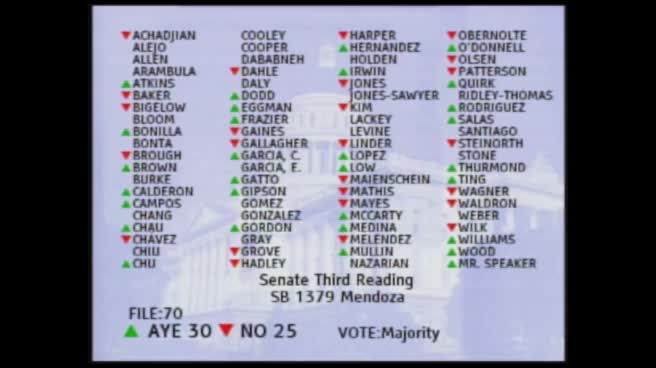 1MIN
Assembly Floor
 2MIN
Senate Floor
 5MIN
Assembly Standing Committee on Utilities and Commerce
 19MIN
Assembly Standing Committee on Utilities and Commerce
 2MIN
Senate Floor
 26SEC
Senate Standing Committee on Appropriations
 11SEC
Senate Standing Committee on Appropriations
 7MIN
Senate Standing Committee on Business, Professions and Economic Development
Bill Author

Bill Co-Author(s):