AB 1397: Community colleges: California Community Colleges Fair Accreditation Act of 2015.
- Session Year: 2015-2016
- House: Assembly
- Latest Version Date: 2015-09-04
Existing law establishes the California Community Colleges, under the administration of the Board of Governors of the California Community Colleges, as one of the segments of public postsecondary education in this state. Existing law specifies the duties of the board of governors, including, among other duties, establishing minimum standards for the formation of community colleges and districts. Under existing regulatory authority, the board of governors requires each community college to be accredited. Existing law requires the accrediting agency for the community colleges to report to the appropriate policy and budget subcommittees of the Legislature upon the issuance of a decision that affects the accreditation status of a community college and to report, on a biannual basis, any accreditation policy changes that affect the accreditation process or status for a community college.
This bill would enact the California Community Colleges Fair Accreditation Act of 2015. The act would require that an appropriate percentage of each visiting accreditation team from the accrediting agency for the California Community Colleges be composed of academics, as defined. The bill would prohibit persons with conflicts of interest, as defined, from serving on a visiting accreditation team.
The bill would require the accrediting agency to conduct the meetings of its decisionmaking body to ensure the ability of members of the public to attend those meetings. The bill would require the accrediting agency to post the agenda of the meetings of its decisionmaking body on its Internet Web site, and to mail that agenda to specified officers of affected institutions, no less than 30 days before a public meeting of that body. The bill would require the accrediting agency to preserve all documents generated during an accreditation-related review, as specified. The bill would require the agencys accreditation-related decisions to be based on written, published standards in accordance with state and federal statutes and regulations, as specified.
The bill would authorize the shortening of the time periods required by the bill with respect to certain actions of the agency only pursuant to a written declaration made, under penalty of perjury, by the chief executive officer of the agency, as specified.
The bill would authorize an institution to submit an appeal of a decision by the accrediting agency to subject that institution to a sanction of probation or a more serious sanction. The bill would require a member of a panel that would hear one of these appeals to file a specified disclosure form under penalty of perjury. By expanding the scope of the crime of perjury, this bill would impose a state-mandated local program.
The California Constitution requires the state to reimburse local agencies and school districts for certain costs mandated by the state. Statutory provisions establish procedures for making that reimbursement.
This bill would provide that no reimbursement is required by this act for a specified reason.
Existing law establishes the California Community Colleges, under the administration of the Board of Governors of the California Community Colleges, as one of the segments of public postsecondary education in this state. Existing law specifies the duties of the board of governors, including, among other duties, establishing minimum standards for the formation of community colleges and districts. Under existing regulatory authority, the board of governors requires each community college to be accredited. Existing law requires the accrediting agency for the community colleges to report to the appropriate policy and budget subcommittees of the Legislature upon the issuance of a decision that affects the accreditation status of a community college and to report, on a biannual basis, any accreditation policy changes that affect the accreditation process or status for a community college.
This bill would enact the California Community Colleges Fair Accreditation Act of 2015. The act would require that an appropriate percentage of each visiting accreditation team from the accrediting agency for the California Community Colleges be composed of academics, as defined. The bill would prohibit persons with conflicts of interest, as defined, from serving on a visiting accreditation team.
The bill would require the accrediting agency to conduct the meetings of its decisionmaking body to ensure the ability of members of the public to attend those meetings. The bill would require the accrediting agency to preserve all documents generated during an accreditation-related review, as specified. The bill would require the agencys accreditation-related decisions to be based on written, published standards in accordance with state and federal statutes and regulations, as specified.
The bill would authorize an institution to submit an appeal of a decision by the accrediting agency to subject that institution to a sanction of probation or a more serious sanction.
Existing law establishes the California Community Colleges, under the administration of the Board of Governors of the California Community Colleges, as one of the segments of public postsecondary education in this state. Existing law specifies the duties of the board of governors, including, among other duties, establishing minimum standards for the formation of community colleges and districts. Under existing regulatory authority, the board of governors requires each community college to be accredited. Existing law requires the accrediting agency for the community colleges to report to the appropriate policy and budget subcommittees of the Legislature upon the issuance of a decision that affects the accreditation status of a community college and to report, on a biannual basis, any accreditation policy changes that affect the accreditation process or status for a community college.
This bill would enact the California Community Colleges Fair Accreditation Act of 2015. The act would require that at least 50% an appropriate percentage of each visiting accreditation team from the accrediting agency for the California Community Colleges be composed of academics, as defined. The bill would prohibit persons with a conflict conflicts of interest, as defined, from serving on a visiting accreditation team.
The bill would require the accrediting agency to conduct the meetings of its decisionmaking body to ensure the ability of members of the public to attend those meetings. The bill would require the accrediting agency to preserve all documents generated during an accreditation-related review, as specified. The bill would require the agencys accreditation-related decisions to be based on written, published standards in accordance with state and federal statutes and regulations, as specified.
The bill would authorize an institution to file submit an appeal of a decision by the accrediting agency. The bill would provide that the appeal would be heard by a panel appointed by the Chancellor of the California Community Colleges. agency to subject that institution to a sanction of probation or a more serious sanction.
Existing law establishes the California Community Colleges, under the administration of the Board of Governors of the California Community Colleges, as one of the segments of public postsecondary education in this state. Existing law specifies the duties of the board of governors, including, among other duties, establishing minimum standards for the formation of community colleges and districts. Under existing regulatory authority, the board of governors requires each community college to be accredited. Existing law requires the accrediting agency for the community colleges to report to the appropriate policy and budget subcommittees of the Legislature upon the issuance of a decision that affects the accreditation status of a community college and to report, on a biannual basis, any accreditation policy changes that affect the accreditation process or status for a community college.
This bill would require the accrediting agency for the community colleges to provide an opportunity for public comment before taking any action related to the accreditation status of a community college. enact the California Community Colleges Fair Accreditation Act of 2015. The act would require that at least 50% of each visiting accreditation team from the accrediting agency for the California Community Colleges be composed of academics, as defined. The bill would prohibit persons with a conflict of interest, as defined, from serving on a visiting accreditation team.
The bill would require the accrediting agency to conduct the meetings of its decisionmaking body to ensure the ability of members of the public to attend those meetings. The bill would require the accrediting agency to preserve all documents generated during an accreditation-related review, as specified. The bill would require the agencys accreditation-related decisions to be based on written, published standards in accordance with state and federal statutes and regulations, as specified.
The bill would authorize an institution to file an appeal of a decision by the accrediting agency. The bill would provide that the appeal would be heard by a panel appointed by the Chancellor of the California Community Colleges.
Existing law establishes the California Community Colleges, under the administration of the Board of Governors of the California Community Colleges, as one of the segments of public postsecondary education in this state. Existing law specifies the duties of the board of governors, including, among other duties, establishing minimum standards for the formation of community colleges and districts. Under existing regulatory authority, the board of governors requires each community college to be accredited.
This bill would require the accrediting agency for the community colleges to provide an opportunity for public comment before taking any action related to the accreditation status of a community college.
(a)This article shall be known, and may be cited, as the California Community Colleges Fair Accreditation Act of 2015.
(b)The Legislature finds and declares all of the following:
(1)The goal of accreditation is to promote and ensure higher education quality through peer evaluation and review.
(2)The community college accrediting agency should be a nonprofit, private educational association of regional scope, responsible for developing evaluation criteria, conducting peer evaluations, assessing whether criteria are met, and supporting institutional development and improvement.
(3)The community college accrediting agency should have a comprehensive and nondiscriminatory accreditation process that is in compliance with the requirements of applicable federal and state laws and regulations.
(c)This article shall apply only to accrediting procedures regarding institutions located in California.
72801.(a)As used in this article:
(1)Academic means a person who is currently, or has recently, directly engaged in a significant manner in postsecondary teaching or research.
(2)Agency means the accrediting agency for the California Community Colleges.
(3)Near relative means a spouse, including a registered domestic partner, child, parent, sibling, person in an in-law relationship, or a step relative in one of the relationships referenced in this subparagraph.
(b)The agency shall operate only by policies that are in compliance with the federal criteria for recognition of an accrediting agency pursuant to Subpart 2 (commencing with Section 496) of Part H of Title IV of the federal Higher Education Act of 1965, as amended.
(b)It is the intent of the Legislature that the provisions of this article shall be implemented in a manner that complies with pertinent federal statutes and regulations.
(c)(1)Each visiting accreditation team sent out by the agency shall be composed of an appropriate percentage of academics.
(2)The agency shall establish and enforce procedures to ensure that persons serving on visiting accreditation teams do not have conflicts of interest. No person may serve on a visiting accreditation team who has a conflict of interest. For the purposes of this paragraph, a conflict of interest is determined by any circumstance in which an individuals capacity to make an impartial or unbiased accreditation recommendation may be affected, including, but not necessarily limited to, any of the following:
(A)Paid service in any capacity to the institution under review.
(B)Serving as, or having a near relative serving as, a current member, staff member, or consultant of the agencys decisionmaking body.
(C)Serving as, or having a near relative serving as, a current member, staff member, or consultant of the institutions governing body.
(D)Candidacy for employment at the institution being evaluated.
(E)A written agreement with an institution that may create a conflict of interest or appearance of a conflict of interest with the institution being evaluated.
(F)Having a personal or financial interest in the ownership or operation of the institution being evaluated.
(G)Receipt of honoraria, honors, or awards from the institution being evaluated.
(H)Other personal or professional connections that would create a conflict of interest or the appearance of a conflict of interest.
(3)A prospective member of a visiting accreditation team shall submit an appropriate disclosure form to the agency, declaring that he or she does not violate the visiting team conflict-of-interest criteria in paragraph (2). Copies of these forms shall be provided to the institution under review.
(d)(1)The agency shall conduct its meetings the meetings of its decisionmaking body so as to ensure that those members of the public who desire to appear at open sessions of agency those meetings have an opportunity to attend those portions of the meetings. No less than 30 days before each meeting of the decisionmaking body of the agency, the agency shall make an agenda for that meeting available to the public by posting the agenda on its Internet Web site and by other appropriate means. This agenda shall include the street address of the meeting site. The agenda shall be mailed, no less than 30 days before each meeting, to the chief executive officer and the accreditation liaison officer of any applicant, candidate, or accredited institution that is listed on the agenda in connection with any matter to be considered at the meeting.
(2)A sufficient length of time shall be allowed for public comment at agency meetings, meetings of the agencys decisionmaking body, and no agency action related to an institutions accreditation shall be made prior to the decisionmaking bodys taking of public comment.
(3)The agency shall make an accreditation decision by a vote of its decisionmaking body. The outcome of the vote shall be recorded and posted to the agencys Internet Web site. Minutes from all open session portions of the meetings of the decisionmaking body of the agency shall be recorded and posted to the agencys Internet Web site.
(4)Any officer, employee, representative, or consultant of the agency with an actual or appearance of a conflict of interest shall be disqualified from participating in discussion and voting. voting by the agencys decisionmaking body. For purposes of this clause, a conflict of interest is defined as any circumstance in which an individuals capacity to make an impartial or unbiased recommendation or decision may be affected, including by any of the following:
(A)Paid service in any capacity to the institution under review.
(B)Serving as, or having a near relative serving as, a current member, staff member, or consultant of the institutions governing body.
(C)Having served on the most recent evaluation team of an institution being considered.
(D)Candidacy for employment at the institution being evaluated.
(E)A written agreement with an institution that may create a conflict of interest or appearance of a conflict of interest with the institution being evaluated.
(F)Having a personal or financial interest in the ownership or operation of the institution being evaluated.
(G)Receipt of honoraria, honors, or awards from the institution being evaluated.
(H)Other personal or professional connections that would create a conflict of interest or the appearance of a conflict of interest.
(I)Any other relationship that would impede an individuals objectivity.
(e)The agency shall preserve all documents generated during an accreditation-related review, including, but not necessarily limited to, email correspondence, for no less than 36 months after the completion of an accreditation-related review. All reports, evaluations, recommendations, and decision documents generated during an accreditation-related review shall be retained indefinitely. for two full accreditation cycles, for 14 years, or for the retention period required for that document by the federal government, whichever period is longest.
(f)The agencys accreditation-related decisions shall be based on written, published standards, and shall be in accordance with, and not be inconsistent with, state and federal statutes and regulations.
(g)
(f)No revision shall be made by the agency to a proposed visiting accreditation team report unless the revision is shared with the members of the visiting accreditation team and with the institution under review, and each is afforded an opportunity to comment on the revision.
(h)
(g)(1)A community college or a community college district shall be given advance notice of proposed visiting accreditation team reports, so that the college or district may respond to correct factual errors or dissent from conclusions. The institution under review shall be afforded adequate time to review the reports before a meeting of the agencys decisionmaking body at which a decision relating to the institutions accreditation is to be made, which shall be no less than six weeks before the meeting. The institution under review may respond to these reports in writing, orally at the meeting, or in both of those ways.
(2)Any visiting accrediting team recommendation for action shall be shared with the institution under review at least six weeks before a meeting of the agencys decisionmaking body, so that the institution may decide whether and how to respond to the recommendation. Any recommendation for action made to the agencys decisionmaking body by a person employed by or representing the agency, including its staff, agents, and employees, shall be shared with the institution subject to the recommendation at least six weeks before a meeting of the agencys decisionmaking body relating to the recommendation.
(3)The time periods for advance notice established pursuant to paragraph (1) and for the review period established pursuant to paragraph (2) may be shortened only pursuant to a declaration made by the chief executive officer of the agency. This declaration shall include, but not be limited to, a statement that exigent circumstances exist and the time periods established by law impair the agencys ability to act swiftly in taking action for the preservation of the public good. This declaration shall be in writing, signed under penalty of perjury, and shall specify the exigent circumstances necessitating expedited action by the agency. The declaration shall be posted on the agencys Internet Web site, and, as soon as is practicable, a copy of the declaration shall be delivered to the affected institution.
(i)(1)The agency shall have a written policy, consistent with federal law, that does both of the following:
(A)Identifies a period for an institution to correct any deficiencies that have prevented the institution from receiving full accreditation.
(B)Provides criteria for altering that period.
(2)The policy adopted under paragraph (1) shall be published, and shall provide a process through which an institution may submit applications for an extension, even if a decision has expressly denied such an extension. An application for an extension, and the decision of the agency as to the application, shall be made publicly available.
(j)(1)Whenever the agencys decisionmaking body issues a sanction of probation or a more serious sanction, the institution subject to the sanction shall be given written notice of the alleged sanctionable offenses or deficiencies. The institution shall be afforded an opportunity to submit an appeal of the decision to issue the sanction.
(2)A member of an appeal panel with an actual conflict of interest, or the appearance of a conflict of interest, shall be disqualified from participating in an appeal submitted pursuant to paragraph (1). For purposes of this paragraph, a conflict of interest shall be defined as any circumstance in which an individuals capacity to make an impartial or unbiased recommendation or decision may be affected, including by any of the following:
(A)Paid service in any capacity to the institution under review.
(B)Serving as, or having a near relative serving as, a current member, staff member, or consultant of the institutions governing body.
(C)Having voted or had the opportunity to vote, as a member of the agencys decisionmaking body, on the sanction being appealed.
(D)Having served on any team, review committee, or body on behalf of the commission that was involved with the action of the commission being appealed.
(E)Current service on the commission.
(3)A prospective member of an appeal panel shall submit an appropriate disclosure form, signed under penalty of perjury, to the agency, declaring that he or she does not violate the conflict-of-interest criteria listed in subparagraphs (A) to (D), inclusive, of paragraph (2). Copies of these forms shall be provided to the institution that is making the appeal.
(k)The provisions of this section are severable. If any provision of this section or its application is held invalid, that invalidity shall not affect other provisions or applications that can be given effect without the invalid provision or application.
SEC. 2.No reimbursement is required by this act pursuant to Section 6 of Article XIIIB of the California Constitution because the only costs that may be incurred by a local agency or school district will be incurred because this act creates a new crime or infraction, eliminates a crime or infraction, or changes the penalty for a crime or infraction, within the meaning of Section 17556 of the Government Code, or changes the definition of a crime within the meaning of Section 6 of Article XIIIB of the California Constitution.
(a)This article shall be known, and may be cited, as the California Community Colleges Fair Accreditation Act of 2015.
(b)The Legislature finds and declares all of the following:
(1)The goal of accreditation is to promote and ensure higher education quality through peer evaluation and review.
(2)The community college accrediting agency should be a nonprofit, private educational association of regional scope, responsible for developing evaluation criteria, conducting peer evaluations, assessing whether criteria are met, and supporting institutional development and improvement.
(3)The community college accrediting agency should have a comprehensive and nondiscriminatory accreditation process that is in compliance with the requirements of applicable federal and state laws and regulations.
(c)This article shall apply only to accrediting procedures regarding institutions located in California.
72801.(a)As used in this article:
(1)Academic means a person who is currently, or has recently, directly engaged in a significant manner in postsecondary teaching or research.
(2)Agency means the accrediting agency for the California Community Colleges.
(3)Near relative means a spouse, including a registered domestic partner, child, parent, sibling, person in an in-law relationship, or a step relative in one of the relationships referenced in this subparagraph.
(b)The agency shall operate only by policies that are in compliance with the federal criteria for recognition of an accrediting agency pursuant to Subpart 2 (commencing with Section 496) of Part H of Title IV of the federal Higher Education Act of 1965, as amended.
(c)(1)Each visiting accreditation team sent out by the agency shall be composed of an appropriate percentage of academics.
(2)The agency shall establish and enforce procedures to ensure that persons serving on visiting accreditation teams do not have conflicts of interest. No person may serve on a visiting accreditation team who has a conflict of interest. For the purposes of this paragraph, a conflict of interest is determined by any circumstance in which an individuals capacity to make an impartial or unbiased accreditation recommendation may be affected, including, but not necessarily limited to, any of the following:
(A)Paid service in any capacity to the institution under review.
(B)Serving as, or having a near relative serving as, a current member, staff member, or consultant of the agencys decisionmaking body.
(C)Serving as, or having a near relative serving as, a current member, staff member, or consultant of the institutions governing body.
(D)Candidacy for employment at the institution being evaluated.
(E)A written agreement with an institution that may create a conflict of interest or appearance of a conflict of interest with the institution being evaluated.
(F)Having a personal or financial interest in the ownership or operation of the institution being evaluated.
(G)Receipt of honoraria, honors, or awards from the institution being evaluated.
(H)Other personal or professional connections that would create a conflict of interest or the appearance of a conflict of interest.
(3)A prospective member of a visiting accreditation team shall submit an appropriate disclosure form to the agency, declaring that he or she does not violate the visiting team conflict-of-interest criteria in paragraph (2). Copies of these forms shall be provided to the institution under review.
(d)(1)The agency shall conduct its meetings so as to ensure that those members of the public who desire to appear at open sessions of agency meetings have an opportunity to attend those portions of the meetings.
(2)A sufficient length of time shall be allowed for public comment at agency meetings, and no agency action related to an institutions accreditation shall be made prior to the decisionmaking bodys taking of public comment.
(3)The agency shall make an accreditation decision by a vote of its decisionmaking body. The outcome of the vote shall be recorded and posted to the agencys Internet Web site. Minutes from all open session portions of the meetings of the decisionmaking body of the agency shall be recorded and posted to the agencys Internet Web site.
(4)Any officer or employee officer, employee, representative, or consultant of the agency with an actual or appearance of a conflict of interest shall be disqualified from participating in discussion and voting. For purposes of this clause, a conflict of interest is defined as any circumstance in which an individuals capacity to make an impartial or unbiased recommendation or decision may be affected, including by either any of the following:
(A)Paid service in any capacity to the institution under review.
(B)Serving as, or having a near relative serving as, a current member, staff member, or consultant of the institutions governing body.
(C)Having served on the most recent evaluation team of an institution being considered.
(D)Candidacy for employment at the institution being evaluated.
(E)A written agreement with an institution that may create a conflict of interest or appearance of a conflict of interest with the institution being evaluated.
(F)Having a personal or financial interest in the ownership or operation of the institution being evaluated.
(G)Receipt of honoraria, honors, or awards from the institution being evaluated.
(H)Other personal or professional connections that would create a conflict of interest or the appearance of a conflict of interest.
(I)Any other relationship that would impede an individuals objectivity.
(e)The agency shall preserve all documents generated during an accreditation-related review, including, but not necessarily limited to, email correspondence, for no less than 36 months after the completion of an accreditation-related review. All reports, evaluations, recommendations, and decision documents generated during an accreditation-related review shall be retained indefinitely.
(f)The agencys accreditation-related decisions shall be based on written, published standards, and shall be in accordance with, and not be inconsistent with, state and federal statutes and regulations.
(g)No revision shall be made by the agency to a proposed visiting accreditation team report unless the revision is shared with the members of the visiting accreditation team and with the institution under review, and each is afforded an opportunity to comment on the revision.
(h)(1)A community college or a community college district shall be given advance notice of proposed visiting accreditation team reports, so that the college or district may respond to correct factual errors or dissent from conclusions. The institution under review shall be afforded adequate time to review the reports before a meeting of the agencys decisionmaking body at which a decision relating to the institutions accreditation is to be made, which shall be no less than six weeks before the meeting. The institution under review may respond to these reports in writing, orally at the meeting, or in both of those ways.
(2)Any visiting accrediting team recommendation for action shall be shared with the institution under review at least six weeks before a meeting of the agencys decisionmaking body, so that the institution may decide whether and how to respond to the recommendation. Any recommendation for action made to the agencys decisionmaking body by a person employed by or representing the agency, including its staff, agents, and employees, shall be shared with the institution subject to the recommendation at least six weeks before a meeting of the agencys decisionmaking body relating to the recommendation.
(i)(1)The agency shall have a written policy, consistent with federal law, that does both of the following:
(A)Identifies a period for an institution to correct any deficiencies that have prevented the institution from receiving full accreditation.
(B)Provides criteria for altering that period.
(2)The policy adopted under paragraph (1) shall be published, and shall provide a process through which an institution may submit applications for an extension, even if a decision has expressly denied such an extension. An application for an extension, and the decision of the agency as to the application, shall be made publicly available.
(j)(1)Whenever the agencys decisionmaking body issues a sanction of probation or a more serious sanction, the institution subject to the sanction shall be given written notice of the alleged sanctionable offenses or deficiencies. The institution shall be afforded an opportunity to submit an appeal of the decision to issue the sanction.
(2)A member of an appeal panel with an actual conflict of interest, or the appearance of a conflict of interest, shall be disqualified from participating in an appeal submitted pursuant to paragraph (1). For purposes of this paragraph, a conflict of interest shall be defined as any circumstance in which an individuals capacity to make an impartial or unbiased recommendation or decision may be affected, including by any of the following:
(A)Paid service in any capacity to the institution under review.
(B)Serving as, or having a near relative serving as, a current member, staff member, or consultant of the institutions governing body.
(C)Having voted or had the opportunity to vote, as a member of the agencys decisionmaking body, on the sanction being appealed.
(D)Having served as a member of the visiting accreditation team which submitted the recommendation for the sanction on any team, review committee, or body on behalf of the commission that was involved with the action of the commission being appealed.
(E)Current service on the commission.
(3)A prospective member of an appeal panel shall submit an appropriate disclosure form form, signed under penalty of perjury, to the agency, declaring that he or she does not violate the conflict-of-interest criteria listed in subparagraphs (A) to (D), inclusive, of paragraph (2). Copies of these forms shall be provided to the institution that is making the appeal.
SEC. 2.No reimbursement is required by this act pursuant to Section 6 of Article XIIIB of the California Constitution because the only costs that may be incurred by a local agency or school district will be incurred because this act creates a new crime or infraction, eliminates a crime or infraction, or changes the penalty for a crime or infraction, within the meaning of Section 17556 of the Government Code, or changes the definition of a crime within the meaning of Section 6 of Article XIIIB of the California Constitution.
(a)This article shall be known, and may be cited, as the California Community Colleges Fair Accreditation Act of 2015.
(b)The Legislature finds and declares all of the following:
(1)The goal of accreditation is to promote and ensure higher education quality through peer evaluation and review.
(2)The community college accrediting agency should be a nonprofit, private educational association of regional scope, responsible for developing evaluation criteria, conducting peer evaluations, assessing whether criteria are met, and supporting institutional development and improvement.
(3)The community college accrediting agency should have a comprehensive and nondiscriminatory accreditation process that is in compliance with the requirements of applicable federal and state laws and regulations.
(c)This article shall apply only to accrediting procedures regarding institutions located in California.
72801.(a)As used in this article:
(1)Academic means a person who is currently, or has recently, directly engaged in a significant manner in postsecondary teaching or research.
(2)Agency means the accrediting agency for the California Community Colleges.
(3)Near relative means a spouse, including a registered domestic partner, child, parent, sibling, person in an in-law relationship, or a step relative in one of the relationships referenced in this subparagraph.
(b)The agency shall operate only by policies that are in compliance with the federal criteria for recognition of an accrediting agency pursuant to Subpart 2 (commencing with Section 496) of Part H of Title IV of the federal Higher Education Act of 1965, as amended.
(c)(1)Each visiting accreditation team sent out by the agency shall be composed of an appropriate percentage of academics.
(2)The agency shall establish and enforce procedures to ensure that persons serving on visiting accreditation teams do not have conflicts of interest. No person may serve on a visiting accreditation team who has a conflict of interest. For the purposes of this paragraph, a conflict of interest is determined by any circumstance in which an individuals capacity to make an impartial or unbiased accreditation recommendation may be affected, including, but not necessarily limited to, any of the following:
(A)Paid service in any capacity to the institution under review.
(B)Serving as, or having a near relative serving as, a current member, staff member member, or consultant of the agencys decisionmaking body.
(C)Serving as, or having a near relative serving as, a current member, staff member member, or consultant of the institutions governing body.
(3)A prospective member of a visiting accreditation team shall submit an appropriate disclosure form to the agency, declaring that he or she does not violate the visiting team conflict-of-interest criteria in paragraph (2). Copies of these forms shall be provided to the institution under review.
(d)(1)The agency shall conduct its meetings so as to ensure that those members of the public who desire to appear at open sessions of agency meetings have an opportunity to attend those portions of the meetings.
(2)A sufficient length of time shall be allowed for public comment at agency meetings, and no agency action related to an institutions accreditation shall be made prior to the decisionmaking bodys taking of public comment.
(3)The agency shall make an accreditation decision by a vote of its decisionmaking body. The outcome of the vote shall be recorded and posted to the agencys Internet Web site. Minutes from all open session portions of the meetings of the decisionmaking body of the agency shall be recorded and posted to the agencys Internet Web site.
(4)Any officer or employee of the agency with an actual or appearance of a conflict of interest shall be disqualified from participating in discussion and voting. For purposes of this clause, a conflict of interest is defined as any circumstance in which an individuals capacity to make an impartial or unbiased recommendation or decision may be affected, including by either of the following:
(A)Paid service in any capacity to the institution under review.
(B)Serving as, or having a near relative serving as, a current member, staff member, or consultant of the institutions governing body.
(e)The agency shall preserve all documents generated during an accreditation-related review, including, but not necessarily limited to, email correspondence, for no less than 36 months after the completion of an accreditation-related review. All reports, evaluations, recommendations, and decision documents generated during an accreditation-related review shall be retained indefinitely.
(f)The agencys accreditation-related decisions shall be based on written, published standards, and shall be in accordance with, and not be inconsistent with, state and federal statutes and regulations.
(g)No revision shall be made by the agency to a proposed visiting accreditation team report unless the revision is shared with the members of the visiting accreditation team and with the institution under review, and each is afforded an opportunity to comment on the revision.
(h)(1)A community college or a community college district shall be given advance notice of proposed visiting accreditation team reports, so that the college or district may respond to correct factual errors or dissent from conclusions. The institution under review shall be afforded adequate time to review the reports before a meeting of the agencys decisionmaking body at which a decision relating to the institutions accreditation is to be made, which shall be no less than six weeks before the meeting. The institution under review may respond to these reports in writing, orally at the meeting, or in both of those ways.
(2)Any visiting accrediting team recommendation for action shall be shared with the institution under review at least six weeks before a meeting of the agencys decisionmaking body, so that the institution may decide whether and how to respond to the recommendation. Any recommendation for action made to the agencys decisionmaking body by a person employed by or representing the agency, including its staff, agents, and employees, shall be shared with the institution subject to the recommendation at least six weeks before a meeting of the agencys decisionmaking body relating to the recommendation.
(i)(1)The agency shall have a written policy, consistent with federal law, that does both of the following:
(A)Identifies a period for an institution to correct any deficiencies that have prevented the institution from receiving full accreditation.
(B)Provides criteria for altering that period.
(2)The policy adopted under paragraph (1) shall be published, and shall provide a process through which an institution may submit applications for an extension, even if a decision has expressly denied such an extension. An application for an extension, and the decision of the agency as to the application, shall be made publicly available.
(j)(1)Whenever the agencys decisionmaking body issues a sanction of probation or a more serious sanction, the institution subject to the sanction shall be given written notice of the alleged sanctionable offenses or deficiencies. The institution shall be afforded an opportunity to submit an appeal of the decision to issue the sanction.
(2)A member of an appeal panel with an actual conflict of interest, or the appearance of a conflict of interest, shall be disqualified from participating in an appeal submitted pursuant to paragraph (1). For purposes of this paragraph, a conflict of interest shall be defined as any circumstance in which an individuals capacity to make an impartial or unbiased recommendation or decision may be affected, including by either any of the following:
(A)Paid service in any capacity to the institution under review.
(B)Serving as, or having a near relative serving as, a current member, staff member, or consultant of the institutions governing body.
(C)Having voted or had the opportunity to vote, as a member of the agencys decisionmaking body, on the sanction being appealed.
(D)Having served as a member of the visiting accreditation team which submitted the recommendation for the sanction being appealed.
(3)A prospective member of an appeal panel shall submit an appropriate disclosure form to the agency, declaring that he or she does not violate the conflict-of-interest criteria listed in subparagraphs (A) and (B) to (D), inclusive, of paragraph (2). Copies of these forms shall be provided to the institution that is making the appeal.
(2)
72801.(a)As used in this article:
(A)
(1)Academic means a person who is currently, or has recently, directly engaged in a significant manner in postsecondary teaching or research.
(B)
(2)Agency means the accrediting agency for the California Community Colleges.
(C)
(3)Near relative means a spouse, including a registered domestic partner, child, parent, sibling, person in an in-law relationship, or a step relative in one of the relationships referenced in this subparagraph.
(b)The agency shall operate only by policies that are in compliance with the federal criteria for recognition of an accrediting agency pursuant to Subpart 2 (commencing with Section 496) of Part H of Title IV of the federal Higher Education Act of 1965, as amended.
(b)
(c)(1)No less than 50 percent of each Each visiting accreditation team sent out by the agency shall be composed of an appropriate percentage of academics.
(2)The agency shall establish and enforce procedures to ensure that persons serving on visiting accreditation teams do not have conflicts of interest. No person may serve on a visiting accreditation team who has a conflict of interest. For the purposes of this paragraph, a conflict of interest is determined by any circumstance in which an individuals capacity to make an impartial or unbiased accreditation recommendation may be affected by affected, including, but not necessarily limited to, any of the following:
(A)Prior, current, or anticipated affiliation with the institution under review.
(B)
(A)Paid service in any capacity to the institution under review.
(C)
(B)Serving as, or having a near relative serving as, a current member, staff member or consultant of the agencys decisionmaking body.
(D)
(C)Serving as, or having a near relative serving as, a current member, staff member or consultant of the institutions governing body.
(3)A prospective member of a visiting accreditation team shall submit an appropriate disclosure form to the agency, declaring under penalty of perjury that he or she does not violate the visiting team conflict-of-interest criteria in paragraph (2). Copies of these forms shall be provided to the institution under review.
(4)Every member of the agencys decisionmaking body and staff shall annually file a form that identifies all sources of earnings that derive from the field of education, or from entities that perform services for any community college located in California, or from organizations that engage in any lobbying or representational activities for California community colleges.
(c)
(d)(1)The agency shall conduct its meetings so as to ensure that those members of the public who desire to appear at open sessions of agency meetings have an opportunity to attend those portions of the meetings.
(2)A sufficient length of time shall be allowed for public comment at agency meetings, and no agency action related to an institutions accreditation shall be made prior to the decisionmaking bodys taking of public comment.
(3)The agency shall make an accreditation decision by a vote of its decisionmaking body in a public meeting. The vote of each member of the decisionmaking body body. The outcome of the vote shall be recorded and posted to the agencys Internet Web site. Minutes from all open session portions of the meetings of the decisionmaking body of the agency shall be recorded and posted to the agencys Internet Web site.
(4)Any officer or employee of the agency with an actual or appearance of a conflict of interest shall be disqualified from participating in discussion and voting. For the purposes of this clause, a conflict of interest shall be defined as any is defined as any circumstance in which an individuals capacity to make an impartial or unbiased recommendation or decision may be affected, including by either of the following:
(A)Prior, current, or anticipated affiliation with the institution under review.
(B)
(A)Paid service in any capacity to the institution under review.
(C)
(B)Serving as, or having a near relative serving as, a current member, staff member, or consultant of the institutions governing body.
(d)
(e)The agency shall preserve all documents generated during an accreditation-related review, including, but not necessarily limited to, email correspondence, for no less than 36 months after the completion of an accreditation-related review. All reports, evaluations, recommendations, and decision documents generated during an accreditation-related review shall be retained indefinitely.
(e)(1)
(f)The agencys accreditation-related decisions shall be based on written, published standards, and shall be in accordance with, and not be inconsistent with, state and federal statutes and regulations.
(2)The agency shall afford appropriate deference to the activities or operations of the institution under review that are consistent with the requirements of the state law.
(f)
(g)No revision shall be made by the agency to a proposed visiting accreditation team report unless the revision is shared with the members of the visiting accreditation team and with the institution under review, and each is afforded an opportunity to comment on the revision.
(g)
(h)(1)A community college or a community college district shall be given advance notice of proposed visiting accreditation team reports, so that the college or district may respond to correct factual errors or dissent from conclusions. The institution under review shall be afforded adequate time to review the reports before a meeting of the agencys decisionmaking body at which a decision relating to the institutions accreditation is to be made, which shall be no less than six weeks before the meeting. The institution under review may respond to these reports in writing, orally at the meeting, or in both of those ways.
(2)Any visiting accrediting team recommendation for action shall be shared with the institution under review at least six weeks before a meeting of the agencys decisionmaking body, so that the institution may decide whether and how to respond to the recommendation. Any recommendation for action made to the agencys decisionmaking body by a person employed by or representing the agency, including its staff, agents, and employees, shall be shared with the institution subject to the recommendation at least six weeks before a meeting of the agencys decisionmaking body relating to the recommendation.
(h)
(i)(1)The agency shall have a written policy, consistent with federal law, that does both of the following:
(A)Identifies a period for an institution to correct any deficiencies that have prevented the institution from receiving full accreditation.
(B)Provides criteria for altering that period.
(2)The policy adopted under paragraph (1) shall be published, and shall provide a process through which an institution may submit applications for an extension, even if a decision has expressly denied such an extension. An application for an extension, and the decision of the agency as to the application, shall be made publicly available.
(i)
(j)(1)Whenever the agencys decisionmaking body issues a sanction of probation or a more serious sanction, the institution subject to the sanction shall be given written notice of the alleged sanctionable offenses or deficiencies. The institution shall be afforded an opportunity to submit an appeal of the decision to issue the sanction. The burden of proof for the agency to issue the sanction shall rest with the agency.
(j)An appeal pursuant to subdivision (i) shall be heard by a panel appointed by the chancellor. An institution filing an appeal has the right to file an application to present new or additional evidence to the panel. The panel shall, in its discretion, determine whether to accept the new or additional evidence.
(2)A member of an appeal panel with an actual conflict of interest, or the appearance of a conflict of interest, shall be disqualified from participating in an appeal submitted pursuant to paragraph (1). For purposes of this paragraph, a conflict of interest shall be defined as any circumstance in which an individuals capacity to make an impartial or unbiased recommendation or decision may be affected, including by either of the following:
(A)Paid service in any capacity to the institution under review.
(B)Serving as, or having a near relative serving as, a current member, staff member, or consultant of the institutions governing body.
(3)A prospective member of an appeal panel shall submit an appropriate disclosure form to the agency, declaring that he or she does not violate the conflict-of-interest criteria listed in subparagraphs (A) and (B) of paragraph (2). Copies of these forms shall be provided to the institution that is making the appeal.
(a)(1)This section shall be known, and may be cited, as the California Community Colleges Fair Accreditation Act of 2015.
(2)As used in this article:
(A)Academic means a person who is currently, or has recently, directly engaged in a significant manner in postsecondary teaching or research.
(B)Agency means the accrediting agency for the California Community Colleges.
(C)Near relative means a spouse, including a registered domestic partner, child, parent, sibling, person in an in-law relationship, or a step relative in one of the relationships referenced in this subparagraph.
(b)(1)No less than 50 percent of each visiting accreditation team sent out by the agency shall be composed of academics.
(2)No person may serve on a visiting accreditation team who has a conflict of interest. For the purposes of this paragraph, a conflict of interest is determined by any circumstance in which an individuals capacity to make an impartial or unbiased accreditation recommendation may be affected by any of the following:
(A)Prior, current, or anticipated affiliation with the institution under review.
(B)Paid service in any capacity to the institution under review.
(C)Serving as, or having a near relative serving as, a current member, staff member or consultant of the agencys decisionmaking body.
(D)Serving as, or having a near relative serving as, a current member, staff member or consultant of the institutions governing body.
(3)A prospective member of a visiting accreditation team shall submit an appropriate disclosure form to the agency, declaring under penalty of perjury that he or she does not violate the visiting team conflict-of-interest criteria in paragraph (2). Copies of these forms shall be provided to the institution under review.
(4)Every member of the agencys decisionmaking body and staff shall annually file a form that identifies all sources of earnings that derive from the field of education, or from entities that perform services for any community college located in California, or from organizations that engage in any lobbying or representational activities for California community colleges.
(c)(1)The agency shall conduct its meetings so as to ensure that those members of the public who desire to appear at agency meetings have an opportunity to attend those meetings.
(2)A sufficient length of time shall be allowed for public comment at agency meetings, and no agency action related to an institutions accreditation shall be made prior to the decisionmaking bodys taking of public comment.
(3)The agency shall make an accreditation decision by a vote of its decisionmaking body in a public meeting. The vote of each member of the decisionmaking body shall be recorded and posted to the agencys Internet Web site. Minutes from the meetings of the decisionmaking body of the agency shall be recorded and posted to the agencys Internet Web site.
(4)Any officer or employee of the agency with an actual or appearance of a conflict of interest shall be disqualified from participating in discussion and voting. For the purposes of this clause, a conflict of interest shall be defined as any of the following:
(A)Prior, current, or anticipated affiliation with the institution under review.
(B)Paid service in any capacity to the institution under review.
(C)Serving as, or having a near relative serving as, a current member, staff member, or consultant of the institutions governing body.
(d)The agency shall preserve all documents generated during an accreditation-related review, including, but not necessarily limited to, email correspondence, for no less than 36 months after the completion of an accreditation-related review. All reports, evaluations, recommendations, and decision documents generated during an accreditation-related review shall be retained indefinitely.
(e)(1)The agencys accreditation-related decisions shall be based on written, published standards, and shall be in accordance with, and not be inconsistent with, state and federal statutes and regulations.
(2)The agency shall afford appropriate deference to the activities or operations of the institution under review that are consistent with the requirements of the state law.
(f)No revision shall be made by the agency to a proposed visiting accreditation team report unless the revision is shared with the members of the visiting accreditation team and with the institution under review, and each is afforded an opportunity to comment on the revision.
(g)(1)A community college or a community college district shall be given advance notice of proposed visiting accreditation team reports, so that the college or district may respond to correct factual errors or dissent from conclusions. The institution under review shall be afforded adequate time to review the reports before a meeting of the agencys decisionmaking body at which a decision relating to the institutions accreditation is to be made, which shall be no less than six weeks before the meeting. The institution under review may respond to these reports in writing, orally at the meeting, or in both of those ways.
(2)Any visiting accrediting team recommendation for action shall be shared with the institution under review at least six weeks before a meeting of the agencys decisionmaking body, so that the institution may decide whether and how to respond to the recommendation. Any recommendation for action made to the agencys decisionmaking body by a person employed by or representing the agency, including its staff, agents, and employees, shall be shared with the institution subject to the recommendation at least six weeks before a meeting of the agencys decisionmaking body relating to the recommendation.
(h)(1)The agency shall have a written policy, consistent with federal law, that does both of the following:
(A)Identifies a period for an institution to correct any deficiencies that have prevented the institution from receiving full accreditation.
(B)Provides criteria for altering that period.
(2)The policy adopted under paragraph (1) shall be published, and shall provide a process through which an institution may submit applications for an extension, even if a decision has expressly denied such an extension. An application for an extension, and the decision of the agency as to the application, shall be made publicly available.
(i)Whenever the agencys decisionmaking body issues a sanction of probation or a more serious sanction, the institution subject to the sanction shall be given written notice of the alleged sanctionable offenses or deficiencies. The institution shall be afforded an opportunity to submit an appeal of the decision to issue the sanction. The burden of proof for the agency to issue the sanction shall rest with the agency.
(j)An appeal pursuant to subdivision (i) shall be heard by a panel appointed by the chancellor. An institution filing an appeal has the right to file an application to present new or additional evidence to the panel. The panel shall, in its discretion, determine whether to accept the new or additional evidence.
SECTION 1.Section 72216 is added to the Education Code, to read:72216.(a)The accrediting agency for the California Community Colleges shall provide an opportunity for public comment before taking any action related to the accreditation status of a community college.
(b)This section does not affect the accreditation status of a community college on January 1, 2016.
(c)This section does not apply to the accrediting agencys activities that are related to private educational institutions in the state or educational institutions outside of the state.
(d)This section does not affect the authority of the United States Department of Education regarding educational institutions.
(e)The provisions of this section are severable. If any provision of this section or its application is held invalid, that invalidity shall not affect other provisions or applications that can be given effect without the invalid provision or application.
(a)The accrediting agency for the California Community Colleges shall provide an opportunity for public comment before taking any action related to the accreditation status of a community college.
(b)This section does not affect the accreditation status of a community college on January 1, 2016.
(c)This section does not apply to the accrediting agencys activities that are related to private educational institutions in the state or educational institutions outside of the state.
(d)This section does not affect the authority of the United States Department of Education regarding educational institutions.
(e)The provisions of this section are severable. If any provision of this section or its application is held invalid, that invalidity shall not affect other provisions or applications that can be given effect without the invalid provision or application.
|
Date
|
Status
|
|---|---|
| Sep 11, 2015 | Ordered to inactive file at the request of Senator Beall. |
| Sep 8, 2015 | Read second time. Ordered to third reading. |
| Sep 4, 2015 | Read third time and amended. Ordered to second reading. |
| Aug 19, 2015 | Read second time. Ordered to third reading. |
| Aug 18, 2015 | From committee: Do pass. (Ayes 6. Noes 0.) (August 17). |
| Jul 15, 2015 | From committee: Do pass and re-refer to Com. on APPR. (Ayes 6. Noes 3.) (July 15). Re-referred to Com. on APPR. |
| Jul 8, 2015 | From committee chair, with author's amendments: Amend, and re-refer to committee. Read second time, amended, and re-referred to Com. on ED. |
| Jun 18, 2015 | Referred to Com. on ED. |
| Jun 4, 2015 | Read third time. Passed. Ordered to the Senate. (Ayes 61. Noes 18. Page 1908.) |
| Jun 4, 2015 | In Senate. Read first time. To Com. on RLS. for assignment. |
| May 28, 2015 | Read third time and amended. Ordered to third reading. (Page 1630.) |
| May 28, 2015 | Read third time and amended. Ordered to third reading. |
| May 21, 2015 | Read second time. Ordered to third reading. |
| May 20, 2015 | From committee: Do pass. (Ayes 12. Noes 0.) (May 20). |
| May 6, 2015 | Re-referred to Com. on APPR. |
| May 5, 2015 | Read second time and amended. |
| May 4, 2015 | From committee: Amend, and do pass as amended and re-refer to Com. on APPR. (Ayes 10. Noes 3.) (April 28). |
| Apr 15, 2015 | Re-referred to Com. on HIGHER ED. |
| Apr 14, 2015 | From committee chair, with author's amendments: Amend, and re-refer to Com. on HIGHER ED. Read second time and amended. |
| Mar 23, 2015 | Referred to Com. on HIGHER ED. |
| Mar 2, 2015 | Read first time. |
| Mar 1, 2015 | From printer. May be heard in committee March 31. |
| Feb 27, 2015 | Introduced. To print. |
|
Date
|
Description
|
Location
|
Votes
|
|
|---|---|---|---|---|
| Aug 17, 2015 | Do pass | Senate Standing Committee on Appropriations |
Passed |
|
| Jul 15, 2015 | Do pass, but first be re-referred to the Committee on [Appropriations] | Senate Standing Committee on Education |
Passed |
|
| Jun 4, 2015 | AB 1397 TING Assembly Third Reading | Assembly Floor |
Passed |
|
| May 20, 2015 | Do pass. | Assembly Standing Committee on Appropriations |
Passed |
|
| Apr 28, 2015 | Do pass as amended and be re-referred to the Committee on [Appropriations] | Assembly Standing Committee on Higher Education |
Passed |
This list shows positions taken on this bill by organizations on the date displayed, which is linked to the original source.
Positions by individuals are not included.
AB 1397
Page 10
|
Office of Senate Floor Analyses (916) 651-1520 Fax: (916) 327-4478 |
THIRD READING
Bill No: AB 1397
Author: Ting (D) and Bonta (D), et al.
Amended: 9/4/15 in Senate
SENATE EDUCATION COMMITTEE: 6-3, 7/15/15
AYES: Runner, Block, Leyva, Mendoza, Pan, Vidak
NOES: Liu, Hancock, Monning
SENATE APPROPRIATIONS COMMITTEE: 6-0, 8/17/15
AYES: Lara, Beall, Hill, Leyva, Mendoza, Nielsen
NO VOTE RECORDED: Bates
ASSEMBLY FLOOR: 61-18, 6/4/15 - See last page for vote
SUBJECT: Community colleges: California Community Colleges Fair Accreditation Act of 2015
DIGEST: This bill establishes the California Community Colleges (CCC) Fair Accreditation Act of 2015 and requires the accrediting agency for CCCs to meet specified operational standards.
Senate Floor Amendments of 9/4/15 1) include a severability clause; 2) modify the period of time required for preserving documents; 3) add an exception to providing a community college advance notice and review period for exigent circumstances; 4) include a time frame for making the agenda available to the public; and 5) state legislative intent that the provisions of this bill be implemented in manner that comply with federal law.
ANALYSIS: Existing law confers upon the CCC Board of Governor’s (BOG) the ability to prescribe minimum standards for the formation and operation of community colleges and exercise general supervision over the community colleges. (Education Code § 66700 and § 70901)
As such, regulations (Title 5 California Code of Regulations § 51016) have been adopted to require each community college within a district to be an accredited institution with the Accrediting Commission for Community and Junior Colleges (ACCJC) determining accreditation.
This bill establishes the CCC Fair Accreditation Act of 2015 and requires the accrediting agency for CCCs to meet specified operational standards. Specifically, this bill:
Establishes the following requirements for the accrediting agency’s decision making body and visiting teams:
Requires each visiting accreditation team to have an appropriate share of academics and defines academics to mean a person who is currently, or has recently directly engaged in a significant manner in postsecondary teaching or research.
Requires the agency to establish and enforce procedures for the purpose of ensuring that accreditation team members do not have conflicts of interest and prohibits any person from serving on a visiting team who has a conflict of interest defined as any circumstance in which an individuals’ capacity to make an impartial or unbiased recommendation may be affected by:
Paid service in any capacity to the institution under review.
Servings as, or having a near relative serving as, a current member, staff member, or consultant of the agency’s decision-making body or the institution’s governing body.
Candidacy for employment at the institution being evaluated.
A written agreement with an institution that may create a conflict of interest or appearance of a conflict of interest with the institution being evaluated.
Having a personal or financial interest in the ownership or operation of the institution being evaluated.
Receipt of honoraria, honors, or awards from the institution being evaluated.
Other personal or professional connections that would create a conflict of interest or the appearance of a conflict of interest.
Requires a prospective member of a visiting team to submit an appropriate disclosure form to the agency declaring that he/she does not violate the conflict of interest criteria. Requires copies of these forms to be provided to the institution under review.
Prohibits revisions from being made by the agency to a proposed visiting accreditation team report unless the revision is share with members of the visiting accreditation team and with the institution under review, and each is afforded an opportunity to comment on the revision.
Requires accrediting agency’s decision-making body to adhere to the following meeting procedures:
Members of the public must have an opportunity to attend open session portions of the meeting.
Agendas shall be made available to the public no less than 30 days before each meeting, as specified and posted to agency’s Internet Web site.
A sufficient length of time must be allowed for public comment, and public comment must be allowed prior to action related to an institution’s accreditation.
Accreditation decisions must be made by a vote of the accrediting agency’s decision-making body in a public meeting. The outcome of the vote and minutes from the meeting must be recorded and posted to the agency’s Internet Web site.
Prohibits any officer, employee, representative, or consultant of the agency with an actual or appearance of a conflict of interest, as specified, from participating in discussion and voting.
Requires the agency to preserve all documents generated during an accreditation-related review, including but not limited to, email correspondence, for no less than three years after the completion of an accreditation review. Requires all reports, evaluations, recommendations, and decision documents generated during an accreditation related review to be retained for a specified period of time.
Requires the agency’s accreditation-related decision to be based on written, published standards in accordance with state and federal statutes and regulations.
Establishes the following due process requirements:
A community college or a community college district must be given advance notice of proposed visiting accreditation team reports so that the college or district may respond to correct factual errors or dissent from conclusions.
The institution under review must be afforded adequate time to review the reports at least six weeks prior to a meeting of the agency’s decision-making body at which a decision relating to the institution’s accreditation is to be made.
The accrediting agency’s chief executive officer may declare a shorten time period for giving advance notice and review period to an institution under review, as specified, if exigent circumstances exist.
Any visiting accrediting team recommendation for action must be shared with the institutions under review at least six weeks prior to a meeting of the agency’s decision-making body.
Any recommendation for action by a person employed or representing the agency, as specified, must be shared with the institution at least six weeks before a meeting relating to the recommendation takes place, as specified.
Requires the agency to have a written policy, consistent with federal law, that does all of the following:
Identifies a period for an institution to correct any deficiencies that have prevented the institution from receiving full accreditation.
Provides criteria for altering that period.
The policy must be published, and must provide a process through which an institution may submit applications for an extension, even if a decision has expressly denied such an extension. The application for an extension and the decision related to the extension shall be made publically available.
Requires all of the following in regards to the agency’s appeals process:
Provides that when a sanction of probation or a more serious sanction is issued by the agency’s decision making body an institution shall be given written notice of the alleged offenses or deficiencies.
Provides that the institution must be afforded an opportunity to submit an appeal of the decision to issue the sanction.
Prohibits a member of an appeal panel with actual conflict of interest, or the appearance of a conflict of interest, as specified, from participating in an appeal that a member of an appeal submitted per the process described above.
Requires a prospective member of an appeal panel to submit an appropriate disclosure form, signed under penalty of perjury, to the agency declaring that he/she does not violate the conflict of interest criteria. Requires copies of these forms to be provided to the institution making the appeal.
Expands the scope of the crime of perjury thereby imposing a state-mandated local program and specifies, that no reimbursement is required by this act pursuant the California Constitution because the only costs that may be incurred by a local agency or school district will be incurred because this act creates a new crime or infraction, eliminates a crime or infraction, or changes the penalty for a crime or infraction, or changes the definition of a crime or infraction, as specified.
Specifies that the article is only applicable to accrediting procedures regarding institutions located in California.
States legislative intent that the provisions of this bill be implemented in manner that comply with federal law.
Includes a severability clause.
Defines various terms for the purpose of this bill.
Makes a variety of legislative findings and declarations regarding the scope and responsibility of the community college accrediting agency.
Comments
Need for the bill. According to the author, California has a flawed community college accreditation process and given the significant role an accreditor has in the success of California’s community colleges it is incumbent upon the state to ensure that the accreditation process is fair, objective, and transparent. The author further notes that the United States Department of Education (USDE), the California State Auditor and a California Superior Court have cited a number of deficiencies in the processes and determinations of the ACCJC. This bill seeks to establish processes under which the community college accreditation agency should operate.
Accreditation. Accreditation is a voluntary, non-governmental peer review process used to determine academic quality. Accrediting agencies are private organizations that establish operating standards for educational or professional institutions and programs, determine the extent to which the standards are met, and publicly announce their findings.
Under federal law, the USDE establishes the general standards for accreditation agencies and is required to publish a list of recognized accrediting agencies that are deemed reliable authorities on the quality of education provided by their accredited institutions. The National Advisory Committee on Institutional Quality and Integrity advises the USDE on whether accrediting entities’ standards are sufficiently rigorous and effective in their application to ensure quality of the education. To meet that standard, accrediting entities must demonstrate compliance with all the criteria for recognition.
The ACCJC is the regional accrediting agency for community colleges in the western region (California, Hawaii, and U.S. territories). Commission membership consists of the institutions ACCJC has accredited; the 19 commissioners are elected by a vote of the presidents of the member-colleges and serve up to two three-year terms.
The ACCJC bylaws govern, among other areas, commission meetings, responsibilities of commissioners, and the appeal process for institutions appealing a denial or termination of accreditation. The ACCJC bylaws may be amended by a majority vote of the Commissioners. Under ACCJC bylaws, the President (Chief Executive Officer) is appointed, and may be removed, by the Commissioners. The President is responsible for general supervision, direction, and control of ACCJC operations.
Accreditation of California community colleges. After an initial accreditation, colleges must have their accreditation reaffirmed every six years. This process includes a self-study, a site visit by a team of peers, a recommendation by the visiting team and an action by the ACCJC. In addition to these core components, colleges must submit a midterm report every three years and annual progress reports. The college/district may also have to submit follow-up reports and host visits as required by the Commission. There are three levels of sanction prior to termination of accreditation: Warning, Probation, and Show Cause. Follow-up reports and accreditation visits are required to retain full accreditation.
Many California community colleges have faced various levels of accreditation sanctions. Most recently, the sanctions imposed on City College of San Francisco have drawn attention to ACCJC and its accreditation process. The heightened attention lead to an audit by the California State Auditor, who on June 26, 2014, issued a report on CCC Accreditation. This audit report provided both a review of the ACCJC and the accreditation process in general, as well as a more in-depth examination of recent events related to City College of San Francisco. The report raised some concerns of the ACCJC and the accreditation process and made a series of recommendations to address the identified concerns.
After the release of the State Auditor’s report, the Chancellor’s Office reconvened its Accreditation Task Force consisting of community college stakeholders. The Accreditation Task Force is charged with providing input through a report to the Chancellor’s Office regarding the accreditation process, including addressing the State Auditor’s recommendations. The Accreditation Task Force held its final meeting at the end of May and recently finalized its final report. The recommendations from the taskforce may help shed light on issues and present potential recommendations for future legislative review and action.
Unintended consequences? This bill proposes a number of statutory requirements on the make-up of accreditation visiting teams, public meeting procedures, maintenance of accreditation review documents, due process and appeals, policies and procedures. As previously indicated, accrediting agencies are private membership-based non-profit organizations recognized by the USDE. While these agencies provide accreditation of public institutions, they are not themselves public entities. The ability of the state to enforce statutorily imposed requirements is limited as accrediting agencies could simply choose not to provide accreditation of community colleges.
This bill makes its provisions applicable only to accrediting procedures for institutions located in California. Federal regulations (34 CFR Section 602.18) require accreditors to be consistent in applying standards to all of its member institutions and to make decisions regarding accreditation on the basis of the agency’s published standards. Arguably, the provisions in this bill could be perceived as giving CCC greater influence over accreditation decisions than other colleges in the accreditor’s membership.
Federal regulations (34 CFR Section 602.14) also require accrediting agencies to be separate and independent of other organizations, including groups within its membership. The provisions in this bill may raise concerns regarding the ability of the accrediting commission to independently and effectively conduct its work.
As noted in a recent letter to ACCJC, the USDE expresses “serious concerns” regarding the ability of an accrediting agency to enforce its standards effectively, as required by the USDE’s recognition criteria. It indicates that the timeline established in this bill prior to making a decision appears to interfere with an accrediting agency’s ability to act swiftly in taking enforcement action. Federal regulations require that if the accrediting agency’s review of an institution is not in compliance their standards, the agency must immediately initiate adverse action against the institution or program. This bill requires that the accrediting agency operate by policies that are consistent with the federal criteria for recognition of an accrediting agency. The USDE indicates that only it can interpret and apply its recognition criteria.
NOTE: See Senate Education Committee analysis for full discussion.
FISCAL EFFECT: Appropriation: No Fiscal Com.: Yes Local: Yes
According to the Senate Appropriations Committee, there is no direct and certain cost to the state:
Potential costs to the extent fees are increased by the ACCJC to modify systems to conform to this bill. Though community colleges pay these fees, they are not reimbursable pursuant to state mandate law. Instead, increases in fees could put pressure on colleges’ budgets which are largely funded by Proposition 98 General Fund.
CCC student eligibility for state and federal financial aid could potentially be compromised to the extent the USDE does not recognize the ACCJC due to this bill’s provisions that may conflict with federal accrediting agency recognition requirements. This could create a significant General Fund cost pressure to backfill any loss in funding.
Bay Area Council
California Community College Independents
California Federation of Teachers
California Labor Federation
California School Employees Association
California Teachers Association
Faculty Association of California Community Colleges
Golden Gate Restaurant Association
State Building and Construction Trades Council of California
State Center Federation of Teachers
Accrediting Commission for Community and Junior Colleges
Association of California Community College Administrators
Community College League of California
MTI College
North Orange County Community College District
ASSEMBLY FLOOR: 61-18, 6/4/15
AYES: Achadjian, Alejo, Bloom, Bonilla, Bonta, Brown, Burke, Calderon, Campos, Chang, Chau, Chiu, Chu, Cooley, Cooper, Dababneh, Daly, Dodd, Eggman, Frazier, Beth Gaines, Cristina Garcia, Eduardo Garcia, Gatto, Gipson, Gomez, Gonzalez, Gordon, Gray, Roger Hernández, Holden, Irwin, Jones, Jones-Sawyer, Levine, Linder, Lopez, Low, Maienschein, Mayes, McCarty, Medina, Mullin, Nazarian, O'Donnell, Patterson, Perea, Quirk, Rendon, Ridley-Thomas, Rodriguez, Salas, Santiago, Mark Stone, Thurmond, Ting, Wagner, Weber, Williams, Wood, Atkins
NOES: Travis Allen, Baker, Bigelow, Brough, Chávez, Dahle, Gallagher, Grove, Hadley, Harper, Lackey, Mathis, Melendez, Obernolte, Olsen, Steinorth, Waldron, Wilk
NO VOTE RECORDED: Kim
Prepared by: Olgalilia Ramirez / ED. / (916) 651-4105
9/9/15 13:06:34
**** END ****
AB 1397
Page 10
|
Office of Senate Floor Analyses (916) 651-1520 Fax: (916) 327-4478 |
THIRD READING
Bill No: AB 1397
Author: Ting (D) and Bonta (D), et al.
Amended: 9/4/15 in Senate
SENATE EDUCATION COMMITTEE: 6-3, 7/15/15
AYES: Runner, Block, Leyva, Mendoza, Pan, Vidak
NOES: Liu, Hancock, Monning
SENATE APPROPRIATIONS COMMITTEE: 6-0, 8/17/15
AYES: Lara, Beall, Hill, Leyva, Mendoza, Nielsen
NO VOTE RECORDED: Bates
ASSEMBLY FLOOR: 61-18, 6/4/15 - See last page for vote
SUBJECT: Community colleges: California Community Colleges Fair Accreditation Act of 2015
DIGEST: This bill establishes the California Community Colleges (CCC) Fair Accreditation Act of 2015 and requires the accrediting agency for CCCs to meet specified operational standards.
Senate Floor Amendments of 9/4/15 1) include a severability clause; 2) modify the period of time required for preserving documents; 3) add an exception to providing a community college advance notice and review period for exigent circumstances; 4) include a time frame for making the agenda available to the public; and 5) state legislative intent that the provisions of this bill be implemented in manner that comply with federal law.
ANALYSIS: Existing law confers upon the CCC Board of Governor’s (BOG) the ability to prescribe minimum standards for the formation and operation of community colleges and exercise general supervision over the community colleges. (Education Code § 66700 and § 70901)
As such, regulations (Title 5 California Code of Regulations § 51016) have been adopted to require each community college within a district to be an accredited institution with the Accrediting Commission for Community and Junior Colleges (ACCJC) determining accreditation.
This bill establishes the CCC Fair Accreditation Act of 2015 and requires the accrediting agency for CCCs to meet specified operational standards. Specifically, this bill:
Establishes the following requirements for the accrediting agency’s decision making body and visiting teams:
Requires each visiting accreditation team to have an appropriate share of academics and defines academics to mean a person who is currently, or has recently directly engaged in a significant manner in postsecondary teaching or research.
Requires the agency to establish and enforce procedures for the purpose of ensuring that accreditation team members do not have conflicts of interest and prohibits any person from serving on a visiting team who has a conflict of interest defined as any circumstance in which an individuals’ capacity to make an impartial or unbiased recommendation may be affected by:
Paid service in any capacity to the institution under review.
Servings as, or having a near relative serving as, a current member, staff member, or consultant of the agency’s decision-making body or the institution’s governing body.
Candidacy for employment at the institution being evaluated.
A written agreement with an institution that may create a conflict of interest or appearance of a conflict of interest with the institution being evaluated.
Having a personal or financial interest in the ownership or operation of the institution being evaluated.
Receipt of honoraria, honors, or awards from the institution being evaluated.
Other personal or professional connections that would create a conflict of interest or the appearance of a conflict of interest.
Requires a prospective member of a visiting team to submit an appropriate disclosure form to the agency declaring that he/she does not violate the conflict of interest criteria. Requires copies of these forms to be provided to the institution under review.
Prohibits revisions from being made by the agency to a proposed visiting accreditation team report unless the revision is share with members of the visiting accreditation team and with the institution under review, and each is afforded an opportunity to comment on the revision.
Requires accrediting agency’s decision-making body to adhere to the following meeting procedures:
Members of the public must have an opportunity to attend open session portions of the meeting.
Agendas shall be made available to the public no less than 30 days before each meeting, as specified and posted to agency’s Internet Web site.
A sufficient length of time must be allowed for public comment, and public comment must be allowed prior to action related to an institution’s accreditation.
Accreditation decisions must be made by a vote of the accrediting agency’s decision-making body in a public meeting. The outcome of the vote and minutes from the meeting must be recorded and posted to the agency’s Internet Web site.
Prohibits any officer, employee, representative, or consultant of the agency with an actual or appearance of a conflict of interest, as specified, from participating in discussion and voting.
Requires the agency to preserve all documents generated during an accreditation-related review, including but not limited to, email correspondence, for no less than three years after the completion of an accreditation review. Requires all reports, evaluations, recommendations, and decision documents generated during an accreditation related review to be retained for a specified period of time.
Requires the agency’s accreditation-related decision to be based on written, published standards in accordance with state and federal statutes and regulations.
Establishes the following due process requirements:
A community college or a community college district must be given advance notice of proposed visiting accreditation team reports so that the college or district may respond to correct factual errors or dissent from conclusions.
The institution under review must be afforded adequate time to review the reports at least six weeks prior to a meeting of the agency’s decision-making body at which a decision relating to the institution’s accreditation is to be made.
The accrediting agency’s chief executive officer may declare a shorten time period for giving advance notice and review period to an institution under review, as specified, if exigent circumstances exist.
Any visiting accrediting team recommendation for action must be shared with the institutions under review at least six weeks prior to a meeting of the agency’s decision-making body.
Any recommendation for action by a person employed or representing the agency, as specified, must be shared with the institution at least six weeks before a meeting relating to the recommendation takes place, as specified.
Requires the agency to have a written policy, consistent with federal law, that does all of the following:
Identifies a period for an institution to correct any deficiencies that have prevented the institution from receiving full accreditation.
Provides criteria for altering that period.
The policy must be published, and must provide a process through which an institution may submit applications for an extension, even if a decision has expressly denied such an extension. The application for an extension and the decision related to the extension shall be made publically available.
Requires all of the following in regards to the agency’s appeals process:
Provides that when a sanction of probation or a more serious sanction is issued by the agency’s decision making body an institution shall be given written notice of the alleged offenses or deficiencies.
Provides that the institution must be afforded an opportunity to submit an appeal of the decision to issue the sanction.
Prohibits a member of an appeal panel with actual conflict of interest, or the appearance of a conflict of interest, as specified, from participating in an appeal that a member of an appeal submitted per the process described above.
Requires a prospective member of an appeal panel to submit an appropriate disclosure form, signed under penalty of perjury, to the agency declaring that he/she does not violate the conflict of interest criteria. Requires copies of these forms to be provided to the institution making the appeal.
Expands the scope of the crime of perjury thereby imposing a state-mandated local program and specifies, that no reimbursement is required by this act pursuant the California Constitution because the only costs that may be incurred by a local agency or school district will be incurred because this act creates a new crime or infraction, eliminates a crime or infraction, or changes the penalty for a crime or infraction, or changes the definition of a crime or infraction, as specified.
Specifies that the article is only applicable to accrediting procedures regarding institutions located in California.
Specifies that an agency shall only operate by policies that comply with the federal criteria for recognition of an accrediting agency pursuant to the federal Higher Education Act of 1965 relating to accrediting agency recognition, as specified.
Includes a severability clause.
Defines various terms for the purpose of this bill.
Makes a variety of legislative findings and declarations regarding the scope and responsibility of the community college accrediting agency.
Comments
Need for the bill. According to the author, California has a flawed community college accreditation process and given the significant role an accreditor has in the success of California’s community colleges it is incumbent upon the state to ensure that the accreditation process is fair, objective, and transparent. The author further notes that the United States Department of Education (USDE), the California State Auditor and a California Superior Court have cited a number of deficiencies in the processes and determinations of the ACCJC. This bill seeks to establish processes under which the community college accreditation agency should operate.
Accreditation. Accreditation is a voluntary, non-governmental peer review process used to determine academic quality. Accrediting agencies are private organizations that establish operating standards for educational or professional institutions and programs, determine the extent to which the standards are met, and publicly announce their findings.
Under federal law, the USDE establishes the general standards for accreditation agencies and is required to publish a list of recognized accrediting agencies that are deemed reliable authorities on the quality of education provided by their accredited institutions. The National Advisory Committee on Institutional Quality and Integrity advises the USDE on whether accrediting entities’ standards are sufficiently rigorous and effective in their application to ensure quality of the education. To meet that standard, accrediting entities must demonstrate compliance with all the criteria for recognition.
The ACCJC is the regional accrediting agency for community colleges in the western region (California, Hawaii, and U.S. territories). Commission membership consists of the institutions ACCJC has accredited; the 19 commissioners are elected by a vote of the presidents of the member-colleges and serve up to two three-year terms.
The ACCJC bylaws govern, among other areas, commission meetings, responsibilities of commissioners, and the appeal process for institutions appealing a denial or termination of accreditation. The ACCJC bylaws may be amended by a majority vote of the Commissioners. Under ACCJC bylaws, the President (Chief Executive Officer) is appointed, and may be removed, by the Commissioners. The President is responsible for general supervision, direction, and control of ACCJC operations.
Accreditation of California community colleges. After an initial accreditation, colleges must have their accreditation reaffirmed every six years. This process includes a self-study, a site visit by a team of peers, a recommendation by the visiting team and an action by the ACCJC. In addition to these core components, colleges must submit a midterm report every three years and annual progress reports. The college/district may also have to submit follow-up reports and host visits as required by the Commission. There are three levels of sanction prior to termination of accreditation: Warning, Probation, and Show Cause. Follow-up reports and accreditation visits are required to retain full accreditation.
Many California community colleges have faced various levels of accreditation sanctions. Most recently, the sanctions imposed on City College of San Francisco have drawn attention to ACCJC and its accreditation process. The heightened attention lead to an audit by the California State Auditor, who on June 26, 2014, issued a report on CCC Accreditation. This audit report provided both a review of the ACCJC and the accreditation process in general, as well as a more in-depth examination of recent events related to City College of San Francisco. The report raised some concerns of the ACCJC and the accreditation process and made a series of recommendations to address the identified concerns.
After the release of the State Auditor’s report, the Chancellor’s Office reconvened its Accreditation Task Force consisting of community college stakeholders. The Accreditation Task Force is charged with providing input through a report to the Chancellor’s Office regarding the accreditation process, including addressing the State Auditor’s recommendations. The Accreditation Task Force held its final meeting at the end of May and recently finalized its final report. The recommendations from the taskforce may help shed light on issues and present potential recommendations for future legislative review and action.
Unintended consequences? This bill proposes a number of statutory requirements on the make-up of accreditation visiting teams, public meeting procedures, maintenance of accreditation review documents, due process and appeals, policies and procedures. As previously indicated, accrediting agencies are private membership-based non-profit organizations recognized by the USDE. While these agencies provide accreditation of public institutions, they are not themselves public entities. The ability of the state to enforce statutorily imposed requirements is limited as accrediting agencies could simply choose not to provide accreditation of community colleges.
This bill makes its provisions applicable only to accrediting procedures for institutions located in California. Federal regulations (34 CFR Section 602.18) require accreditors to be consistent in applying standards to all of its member institutions and to make decisions regarding accreditation on the basis of the agency’s published standards. Arguably, the provisions in this bill could be perceived as giving CCC greater influence over accreditation decisions than other colleges in the accreditor’s membership.
Federal regulations (34 CFR Section 602.14) also require accrediting agencies to be separate and independent of other organizations, including groups within its membership. The provisions in this bill may raise concerns regarding the ability of the accrediting commission to independently and effectively conduct its work.
As noted in a recent letter to ACCJC, the USDE expresses “serious concerns” regarding the ability of an accrediting agency to enforce its standards effectively, as required by the USDE’s recognition criteria. It indicates that the timeline established in this bill prior to making a decision appears to interfere with an accrediting agency’s ability to act swiftly in taking enforcement action. Federal regulations require that if the accrediting agency’s review of an institution is not in compliance their standards, the agency must immediately initiate adverse action against the institution or program. This bill requires that the accrediting agency operate only by policies that comply with the federal criteria for recognition of an accrediting agency. The USDE indicates that only it can interpret and apply its recognition criteria.
NOTE: See Senate Education Committee analysis for full discussion.
FISCAL EFFECT: Appropriation: No Fiscal Com.: Yes Local: Yes
According to the Senate Appropriations Committee, there is no direct and certain cost to the state:
Potential costs to the extent fees are increased by the ACCJC to modify systems to conform to this bill. Though community colleges pay these fees, they are not reimbursable pursuant to state mandate law. Instead, increases in fees could put pressure on colleges’ budgets which are largely funded by Proposition 98 General Fund.
CCC student eligibility for state and federal financial aid could potentially be compromised to the extent the USDE does not recognize the ACCJC due to this bill’s provisions that may conflict with federal accrediting agency recognition requirements. This could create a significant General Fund cost pressure to backfill any loss in funding.
Bay Area Council
California Community College Independents
California Federation of Teachers
California Labor Federation
California School Employees Association
California Teachers Association
Faculty Association of California Community Colleges
Golden Gate Restaurant Association
State Building and Construction Trades Council of California
State Center Federation of Teachers
Accrediting Commission for Community and Junior Colleges
Association of California Community College Administrators
Community College League of California
MTI College
North Orange County Community College District
ASSEMBLY FLOOR: 61-18, 6/4/15
AYES: Achadjian, Alejo, Bloom, Bonilla, Bonta, Brown, Burke, Calderon, Campos, Chang, Chau, Chiu, Chu, Cooley, Cooper, Dababneh, Daly, Dodd, Eggman, Frazier, Beth Gaines, Cristina Garcia, Eduardo Garcia, Gatto, Gipson, Gomez, Gonzalez, Gordon, Gray, Roger Hernández, Holden, Irwin, Jones, Jones-Sawyer, Levine, Linder, Lopez, Low, Maienschein, Mayes, McCarty, Medina, Mullin, Nazarian, O'Donnell, Patterson, Perea, Quirk, Rendon, Ridley-Thomas, Rodriguez, Salas, Santiago, Mark Stone, Thurmond, Ting, Wagner, Weber, Williams, Wood, Atkins
NOES: Travis Allen, Baker, Bigelow, Brough, Chávez, Dahle, Gallagher, Grove, Hadley, Harper, Lackey, Mathis, Melendez, Obernolte, Olsen, Steinorth, Waldron, Wilk
NO VOTE RECORDED: Kim
Prepared by: Olgalilia Ramirez / ED. / (916) 651-4105
9/8/15 21:01:50
**** END ****
AB 1397
Page 9
|
Office of Senate Floor Analyses (916) 651-1520 Fax: (916) 327-4478 |
THIRD READING
Bill No: AB 1397
Author: Ting (D) and Bonta (D), et al.
Amended: 7/8/15 in Senate
SENATE EDUCATION COMMITTEE: 6-3, 7/15/15
AYES: Runner, Block, Leyva, Mendoza, Pan, Vidak
NOES: Liu, Hancock, Monning
SENATE APPROPRIATIONS COMMITTEE: 6-0, 8/17/15
AYES: Lara, Beall, Hill, Leyva, Mendoza, Nielsen
NO VOTE RECORDED: Bates
ASSEMBLY FLOOR: 61-18, 6/4/15 - See last page for vote
SUBJECT: Community colleges: California Community Colleges Fair Accreditation Act of 2015
DIGEST: This bill establishes the California Community Colleges (CCC) Fair Accreditation Act of 2015 and requires the accrediting agency for CCCs to meet specified operational standards.
ANALYSIS: Existing law confers upon the CCC Board of Governor’s (BOG) the ability to prescribe minimum standards for the formation and operation of community colleges and exercise general supervision over the community colleges. (Education Code § 66700 and § 70901)
As such, regulations (Title 5 California Code of Regulations § 51016) have been adopted to require each community college within a district to be an accredited institution with the Accrediting Commission for Community and Junior Colleges (ACCJC) determining accreditation.
This bill establishes the CCC Fair Accreditation Act of 2015 and requires the accrediting agency for CCCs to meet specified operational standards. Specifically, this bill:
Establishes the following requirements for the accrediting agency’s decision making body and visiting teams:
Requires each visiting accreditation team to have an appropriate share of academics and defines academics to mean a person who is currently, or has recently directly engaged in a significant manner in postsecondary teaching or research.
Requires the agency to establish and enforce procedures for the purpose of ensuring that accreditation team members do not have conflicts of interest and prohibits any person from serving on a visiting team who has a conflict of interest defined as any circumstance in which an individuals’ capacity to make an impartial or unbiased recommendation may be affected by:
Paid service in any capacity to the institution under review.
Servings as, or having a near relative serving as, a current member, staff member, or consultant of the agency’s decision-making body or the institution’s governing body.
Candidacy for employment at the institution being evaluated.
A written agreement with an institution that may create a conflict of interest or appearance of a conflict of interest with the institution being evaluated.
Having a personal or financial interest in the ownership or operation of the institution being evaluated.
Receipt of honoraria, honors, or awards from the institution being evaluated.
Other personal or professional connections that would create a conflict of interest or the appearance of a conflict of interest.
Requires a prospective member of a visiting team to submit an appropriate disclosure form to the agency declaring that he/she does not violate the conflict of interest criteria. Requires copies of these forms to be provided to the institution under review.
Prohibits revisions from being made by the agency to a proposed visiting accreditation team report unless the revision is share with members of the visiting accreditation team and with the institution under review, and each is afforded an opportunity to comment on the revision.
Requires all of the following for meetings of the accrediting agency for CCCs:
Members of the public who desire to appear at open sessions agency meetings must have an opportunity to attend those portions of the meetings.
A sufficient length of time must be allowed for public comment, and public comment must be allowed prior to action related to an institution’s accreditation.
Accreditation decisions must be made by a vote of the accrediting agency’s decision-making body in a public meeting. The outcome of the vote and minutes from the meeting must be recorded and posted to the agency’s Internet Web site.
Prohibits any officer, employee, representative, or consultant of the agency with an actual or appearance of a conflict of interest, as specified, from participating in discussion and voting.
Requires the agency to preserve all documents generated during an accreditation-related review, including but not limited to, email correspondence, for no less than three years after the completion of an accreditation review. Requires all reports, evaluations, recommendations, and decisions documents generated during an accreditation related review to be related indefinitely.
Requires the agency’s accreditation-related decision to be based on written, published standards in accordance with state and federal statutes and regulations.
Establishes the following due process requirements:
A community college or a community college district must be given advance notice of proposed visiting accreditation team reports so that the college or district may respond to correct factual errors or dissent from conclusions.
The institution under review must be afforded adequate time to review the reports at least six weeks prior to a meeting of the agency’s decision-making body at which a decision relating to the institution’s accreditation is to be made.
Any visiting accrediting team recommendation for action must be shared with the institutions under review at least six weeks prior to a meeting of the agency’s decision-making body.
Any recommendation for action by a person employed or representing the agency, as specified, must be shared with the institution at least six weeks before a meeting relating to the recommendation takes place, as specified.
Requires the agency to have a written policy, consistent with federal law, that does all of the following:
Identifies a period for an institution to correct any deficiencies that have prevented the institution from receiving full accreditation.
Provides criteria for altering that period.
The policy must be published, and must provide a process through which an institution may submit applications for an extension, even if a decision has expressly denied such an extension. The application for an extension and the decision related to the extension shall be made publically available.
Requires all of the following in regards to the agency’s appeals process:
Provides that when a sanction of probation or a more serious sanction is issued by the agency’s decision making body an institution shall be given written notice of the alleged offenses or deficiencies.
Provides that the institution must be afforded an opportunity to submit an appeal of the decision to issue the sanction.
Prohibits a member of an appeal panel with actual conflict of interest, or the appearance of a conflict of interest, as specified, from participating in an appeal that a member of an appeal submitted per the process described above.
Requires a prospective member of an appeal panel to submit an appropriate disclosure form, signed under penalty of perjury, to the agency declaring that he/she does not violate the conflict of interest criteria. Requires copies of these forms to be provided to the institution making the appeal.
Expands the scope of the crime of perjury thereby imposing a state-mandated local program and specifies, that no reimbursement is required by this act pursuant the California Constitution because the only costs that may be incurred by a local agency or school district will be incurred because this act creates a new crime or infraction, eliminates a crime or infraction, or changes the penalty for a crime or infraction, or changes the definition of a crime or infraction, as specified.
Specifies that the article is only applicable to accrediting procedures regarding institutions located in California.
Specifies that an agency shall only operate by policies that comply with the federal criteria for recognition of an accrediting agency pursuant to the federal Higher Education Act of 1965 relating to accrediting agency recognition, as specified.
Defines various terms for the purpose of this bill.
Makes a variety of legislative findings and declarations regarding the scope and responsibility of the community college accrediting agency.
Comments
Need for the bill. According to the author, California has a flawed community college accreditation process and given the significant role an accreditor has in the success of California’s community colleges it is incumbent upon the state to ensure that the accreditation process is fair, objective, and transparent. The author further notes that the United States Department of Education (USDE), the California State Auditor and a California Superior Court have cited a number of deficiencies in the processes and determinations of the ACCJC. This bill seeks to establish processes under which the community college accreditation agency should operate.
Accreditation. Accreditation is a voluntary, non-governmental peer review process used to determine academic quality. Accrediting agencies are private organizations that establish operating standards for educational or professional institutions and programs, determine the extent to which the standards are met, and publicly announce their findings.
Under federal law, the USDE establishes the general standards for accreditation agencies and is required to publish a list of recognized accrediting agencies that are deemed reliable authorities on the quality of education provided by their accredited institutions. The National Advisory Committee on Institutional Quality and Integrity advises the USDE on whether accrediting entities’ standards are sufficiently rigorous and effective in their application to ensure quality of the education. To meet that standard, accrediting entities must demonstrate compliance with all the criteria for recognition.
The ACCJC is the regional accrediting agency for community colleges in the western region (California, Hawaii, and U.S. territories). Commission membership consists of the institutions ACCJC has accredited; the 19 commissioners are elected by a vote of the presidents of the member-colleges and serve up to two three-year terms.
The ACCJC bylaws govern, among other areas, commission meetings, responsibilities of commissioners, and the appeal process for institutions appealing a denial or termination of accreditation. The ACCJC bylaws may be amended by a majority vote of the Commissioners. Under ACCJC bylaws, the President (Chief Executive Officer) is appointed, and may be removed, by the Commissioners. The President is responsible for general supervision, direction, and control of ACCJC operations.
Accreditation of California community colleges. After an initial accreditation, colleges must have their accreditation reaffirmed every six years. This process includes a self-study, a site visit by a team of peers, a recommendation by the visiting team and an action by the ACCJC. In addition to these core components, colleges must submit a midterm report every three years and annual progress reports. The college/district may also have to submit follow-up reports and host visits as required by the Commission. There are three levels of sanction prior to termination of accreditation: Warning, Probation, and Show Cause. Follow-up reports and accreditation visits are required to retain full accreditation.
Many California community colleges have faced various levels of accreditation sanctions. Most recently, the sanctions imposed on City College of San Francisco have drawn attention to ACCJC and its accreditation process. The heightened attention lead to an audit by the California State Auditor, who on June 26, 2014, issued a report on CCC Accreditation. This audit report provided both a review of the ACCJC and the accreditation process in general, as well as a more in-depth examination of recent events related to City College of San Francisco. The report raised some concerns of the ACCJC and the accreditation process and made a series of recommendations to address the identified concerns.
After the release of the State Auditor’s report, the Chancellor’s Office reconvened its Accreditation Task Force consisting of community college stakeholders. The Accreditation Task Force is charged with providing input through a report to the Chancellor’s Office regarding the accreditation process, including addressing the State Auditor’s recommendations. The Accreditation Task Force held its final meeting at the end of May and is in the process of finalizing and submitting its final report later this year. The recommendations from the taskforce may help shed light on issues and present potential recommendations for future legislative review and action.
Unintended consequences? This bill proposes a number of statutory requirements on the make-up of accreditation visiting teams, public meeting procedures, maintenance of accreditation review documents, due process and appeals, policies and procedures. As previously indicated, accrediting agencies are private membership-based non-profit organizations recognized by the USDE. While these agencies provide accreditation of public institutions, they are not themselves public entities. The ability of the state to enforce statutorily imposed requirements is limited as accrediting agencies could simply choose not to provide accreditation of community colleges.
This bill makes its provisions applicable only to accrediting procedures for institutions located in California. Federal regulations (34 CFR Section 602.18) require accreditors to be consistent in applying standards to all of its member institutions and to make decisions regarding accreditation on the basis of the agency’s published standards. Arguably, the provisions in this bill could be perceived as giving CCC greater influence over accreditation decisions than other colleges in the accreditor’s membership.
Federal regulations (34 CFR Section 602.14) also require accrediting agencies to be separate and independent of other organizations, including groups within its membership. The provisions in this bill may raise concerns regarding the ability of the accrediting commission to independently and effectively conduct its work.
As noted in a recent letter to ACCJC, the USDE expresses “serious concerns” regarding the ability of an accrediting agency to enforce its standards effectively, as required by the USDE’s recognition criteria. It indicates that the timeline established in this bill prior to making a decision appears to interfere with an accrediting agency’s ability to act swiftly in taking enforcement action. Federal regulations require that if the accrediting agency’s review of an institution is not in compliance their standards, the agency must immediately initiate adverse action against the institution or program. This bill requires that the accrediting agency operate only by policies that comply with the federal criteria for recognition of an accrediting agency. The USDE indicates that only it can interpret and apply its recognition criteria.
NOTE: See Senate Education Committee analysis for full discussion.
FISCAL EFFECT: Appropriation: No Fiscal Com.: Yes Local: Yes
According the Senate Appropriations Committee there is no direct and certain cost to the state:
Potential costs to the extent fees are increased by the ACCJC to modify systems to conform to this bill. Though community colleges pay these fees, they are not reimbursable pursuant to state mandate law. Instead, increases in fees could put pressure on colleges’ budgets which are largely funded by Proposition 98 General Fund.
CCC student eligibility for state and federal financial aid could potentially be compromised to the extent the USDE does not recognize the ACCJC due to this bill’s provisions that may conflict with federal accrediting agency recognition requirements. This could create a significant General Fund cost pressure to backfill any loss in funding.
Bay Area Council
California Community College Independents
California Federation of Teachers
California Labor Federation
California School Employees Association
California Teachers Association
Faculty Association of California Community Colleges
Golden Gate Restaurant Association
State Building and Construction Trades Council of California
State Center Federation of Teachers
OPPOSITION: (Verified 8/19/15)
Accrediting Commission for Community and Junior Colleges
Association of California Community College Administrators
Community College League of California
MTI College
North Orange County Community College District
ASSEMBLY FLOOR: 61-18, 6/4/15
AYES: Achadjian, Alejo, Bloom, Bonilla, Bonta, Brown, Burke, Calderon, Campos, Chang, Chau, Chiu, Chu, Cooley, Cooper, Dababneh, Daly, Dodd, Eggman, Frazier, Beth Gaines, Cristina Garcia, Eduardo Garcia, Gatto, Gipson, Gomez, Gonzalez, Gordon, Gray, Roger Hernández, Holden, Irwin, Jones, Jones-Sawyer, Levine, Linder, Lopez, Low, Maienschein, Mayes, McCarty, Medina, Mullin, Nazarian, O'Donnell, Patterson, Perea, Quirk, Rendon, Ridley-Thomas, Rodriguez, Salas, Santiago, Mark Stone, Thurmond, Ting, Wagner, Weber, Williams, Wood, Atkins
NOES: Travis Allen, Baker, Bigelow, Brough, Chávez, Dahle, Gallagher, Grove, Hadley, Harper, Lackey, Mathis, Melendez, Obernolte, Olsen, Steinorth, Waldron, Wilk
NO VOTE RECORDED: Kim
Prepared by: Olgalilia Ramirez / ED. / (916) 651-4105
8/19/15 20:39:15
**** END ****
AB 1397 (Ting) Page 3 of 3
SENATE COMMITTEE ON APPROPRIATIONS
Senator Ricardo Lara, Chair
2015 - 2016 Regular Session
AB 1397 (Ting) - Community colleges: California Community Colleges Fair Accreditation Act of 2015.
|
|
Version: July 8, 2015 |
Policy Vote: ED. 6 - 3 |
Urgency: No |
Mandate: Yes |
Hearing Date: August 17, 2015 |
Consultant: Jillian Kissee |
This bill may meet the criteria for referral to the Suspense File.
Bill Summary:
This bill establishes the California Community Colleges (CCC) Fair Accreditation Act of 2015 and requires the accrediting agency for CCCs to meet various specified operational standards.
Fiscal Impact:
No direct and certain cost to the state.
Potential costs to the extent fees are increased by the Accrediting Commission for Community and Junior Colleges (ACCJC) to modify systems to conform to this bill. Though community colleges pay these fees, they are not reimbursable pursuant to state mandate law. Instead, increases in fees could put pressure on colleges’ budgets which are largely funded by Proposition 98 General Fund.
CCC student eligibility for state and federal financial aid could potentially be compromised to the extent the United States Department of Education (USDE) does not recognize the ACCJC due to the bill’s provisions that may conflict with federal accrediting agency recognition requirements. This could create a significant General Fund cost pressure to backfill any loss in funding. See staff comments.
Background:
State regulations require each community college within a district to be an accredited institution. Accreditation is a voluntary, non-governmental peer review process used to determine academic quality. Accrediting agencies are private organizations that establish operating standards for educational or professional institutions and programs. They determine the extent to which the standards are met and publicly announce their findings. Federal law requires institutions to be accredited in order to participate in federal programs that provide financial assistance to students.
The National Advisory Committee on Institutional Quality and Integrity advises the USDE on matters related to postsecondary accreditation and the eligibility and certification process for higher education institutions to participate in federal student aid programs. It assesses whether accrediting agencies’ standards are sufficiently rigorous to ensure the entity is a reliable authority regarding the quality of the education provided by the institutions or programs it accredits. Accrediting entities must meet all the criteria for recognition.
The ACCJC is the regional accrediting agency for community colleges in the western region. Its 19 commissioners, one of which is a representative of the CCC Chancellor’s Office, are elected by a vote of the presidents of the member colleges, which have been accredited by the ACCJC.
After an initial accreditation, colleges must have their accreditation reaffirmed every six years. Generally, this involves a self-study, a site visit by a team of peers, a recommendation by the visiting team, an action by the accrediting agency, and follow-up progress reports.
Institutions pay annual membership dues and fees to the accrediting agency to support expenses resulting from comprehensive evaluation visits and any special and follow-up visits. The accrediting agency charges fees for a variety of other services such as those related to eligibility review, candidacy, and initial accreditation.
The CCC Chancellor’s Office has an Accreditation Task Force to advise and provide recommendations regarding the accreditation process. These recommendations are expected to be available later this year.
Proposed Law:
This bill establishes the CCC Fair Accreditation Act of 2015 and requires ACCJC to meet specified operational standards. This bill makes its provisions applicable only to accrediting procedures for institutions in California.
This bill further prescribes the accreditation process by requiring:
The establishment and enforcement of procedures to ensure no conflicts of interest, as specified, exist with individuals serving on visiting accreditation teams.
The agency to conduct meetings to ensure the public has an opportunity to attend open sessions; there is sufficient time for public comment; and that no action of the agency related to an institution’s accreditation is to be taken prior to hearing public comment.
Accreditation-related decisions to be based on published standards, consistent with state and federal law.
That no revision is to be made by the agency to a report from a visiting accreditation team report unless it is shared with the team and with the institution under review and is afforded an opportunity to comment on the revision.
An institution under review six weeks to review visiting accreditation team reports and recommendation for action before a decision relating to the institution’s accreditation is to be made.
Time for an institution to correct any deficiencies that have prevented the institution from receiving full accreditation and the ability to apply for an extension.
An appeals process for certain sanctions issued by the agency.
Related Legislation:
AB 1385 (Ting, 2015) requires notification to the CCC Board of Governors before an accrediting agency increases membership fees, special assessments, or other payments charged to a community college.
AB 404 (Chiu, 2015) requires, among other things, the ACCJC to report to the CCC Board of Governors the date by which the agency’s application for continued recognition is due. AB 404 is pending in this Committee.
Staff Comments:
As noted above, this bill does not result in direct costs to the state at this time. However, potential costs to the state could arise depending on the implications of a recent letter issued to the ACCJC from the USDE expressing “serious concerns” regarding the ability of an accrediting agency to enforce its standards effectively, as required by the USDE’s recognition criteria. It indicates that the timeline established in the bill prior to a decision is able to be made would appear to interfere with an accrediting agency’s ability to act swiftly in taking enforcement action. Federal regulations require that if the accrediting agency’s review of an institution is not in compliance their standards, the agency must immediately initiate adverse action against the institution or program. This bill requires that the accrediting agency operate only by policies that are in compliance with the federal criteria for recognition of an accrediting agency. The USDE indicates that only it can interpret and apply its recognition criteria.
The implication of USDE’s concerns is unknown at this time. Conflict with USDE’s recognition criteria could put recognition of the ACCJC as an accrediting agency in jeopardy. This would have serious implications as it could potentially compromise CCC student eligibility for state and federal financial aid. Other possible implications could be costs attributed to disputes or litigation to determine the ability of the state to enforce statutorily-imposed requirements since accrediting agencies are private membership-based, non-profit organizations recognized by the USDE.
-- END --
AB 1397 (Ting) Page 8 of 8
SENATE COMMITTEE ON EDUCATION
Senator Carol Liu, Chair
2015 - 2016 Regular
Bill No: AB 1397
Author: |
Ting |
||
Version: |
July 8, 2015 Hearing Date: July 15, 2015 |
||
Urgency: |
No |
Fiscal: |
Yes |
Consultant: |
Olgalilia Ramirez |
||
Subject: Community colleges: California Community Colleges Fair Accreditation Act of 2015
SUMMARY
This bill establishes the California Community Colleges (CCC) Fair Accreditation Act of 2015 and requires the accrediting agency for CCCs to meet specified operational standards.
BACKGROUND
Existing law confers upon the CCC Board of Governor’s (BOG) the ability to prescribe minimum standards for the formation and operation of community colleges and exercise general supervision over the community colleges.
(Education Code § 66700 and § 70901)
As such, regulations (Title 5 California Code of Regulations (CCR) § 51016) have been adopted to require each community college within a district to be an accredited institution – with the Accrediting Commission for Community and Junior Colleges (ACCJC) determining accreditation.
ANALYSIS
This bill establishes the CCC Fair Accreditation Act of 2015 and requires the accrediting agency for CCCs to meet specified operational standards. Specifically it:
Establishes the following requirements for the accrediting agency’s decision making body and visiting teams:
Requires each visiting accreditation team to have an appropriate share of academics and defines academics to mean a person who is currently, or has recently directly engaged in a significant manner in postsecondary teaching or research.
Requires the agency to establish and enforce procedures for the purpose of ensuring that accreditation team members do not have conflicts of interest and prohibits any person from serving on a visiting team who has a conflict of interest defined as any circumstance in which an individuals’ capacity to make an impartial or unbiased recommendation may be affected by:
Paid service in any capacity to the institution under review.
Servings as, or having a near relative serving as, a current member, staff member, or consultant of the agency’s decision-making body or the institution’s governing body.
Candidacy for employment at the institution being evaluated.
A written agreement with an institution that may create a conflict of interest or appearance of a conflict of interest with the institution being evaluated.
Having a personal or financial interest in the ownership or operation of the institution being evaluated.
Receipt of honoraria, honors, or awards from the institution being evaluated.
Other personal or professional connections that would create a conflict of interest or the appearance of a conflict of interest.
Requires a prospective member of a visiting team to submit an appropriate disclosure form to the agency declaring that he/she does not violate the conflict of interest criteria. Requires copies of these forms to be provided to the institution under review.
Prohibits revisions from being made by the agency to a proposed visiting accreditation team report unless the revision is share with members of the visiting accreditation team and with the institution under review, and each is afforded an opportunity to comment on the revision.
Requires all of the following for meetings of the accrediting agency for CCCs:
Members of the public who desire to appear at open sessions agency meetings must have an opportunity to attend those portions of the meetings.
A sufficient length of time must be allowed for public comment, and public comment must be allowed prior to action related to an institution’s accreditation.
Accreditation decisions must be made by a vote of the accrediting agency’s decision-making body in a public meeting. The outcome of the vote and minutes from the meeting must be recorded and posted to the agency’s Internet Web site.
Prohibits any officer, employee, representative, or consultant of the agency with an actual or appearance of a conflict of interest, as specified, from participating in discussion and voting.
Requires the agency to preserve all documents generated during an accreditation-related review, including but not limited to, email correspondence, for no less than 3 years after the completion of an accreditation review. Requires all reports, evaluations, recommendations, and decisions documents generated during an accreditation related review to be related indefinitely.
Requires the agency’s accreditation-related decision to be based on written, published standards in accordance with state and federal statutes and regulations.
Establishes the following due process requirements:
A community college or a community college district must be given advance notice of proposed visiting accreditation team reports so that the college or district may respond to correct factual errors or dissent from conclusions.
The institution under review must be afforded adequate time to review the reports at least six weeks prior to a meeting of the agency’s decision-making body at which a decision relating to the institution’s accreditation is to be made.
Any visiting accrediting team recommendation for action must be shared with the institutions under review at least six weeks prior to a meeting of the agency’s decision-making body.
Any recommendation for action by a person employed or representing the agency, as specified, must be shared with the institution at least six weeks before a meeting relating to the recommendation takes place, as specified.
Requires the agency to have a written policy, consistent with federal law, that does all of the following:
Identifies a period for an institution to correct any deficiencies that have prevented the institution from receiving full accreditation.
Provides criteria for altering that period.
The policy must be published, and must provide a process through which an institution may submit applications for an extension, even if a decision has expressly denied such an extension. The application for an extension and the decision related to the extension shall be made publically available.
Requires all of the following in regards to the agency’s appeals process:
Provides that when a sanction of probation or a more serious sanction is issued by the agency’s decision making body an institution shall be given written notice of the alleged offenses or deficiencies.
Provides that the institution must be afforded an opportunity to submit an appeal of the decision to issue the sanction.
Prohibits a member of an appeal panel with actual conflict of interest, or the appearance of a conflict of interest, as specified, from participating in an appeal that a member of an appeal submitted per the process described above.
Requires a prospective member of an appeal panel to submit an appropriate disclosure form, signed under penalty of perjury, to the agency declaring that he/she does not violate the conflict of interest criteria. Requires copies of these forms to be provided to the institution making the appeal.
Expands the scope of the crime of perjury thereby imposing a state-mandated local program and specifies, that no reimbursement is required by this act pursuant the California Constitution because the only costs that may be incurred by a local agency or school district will be incurred because this act creates a new crime or infraction, eliminates a crime or infraction, or changes the penalty for a crime or infraction, or changes the definition of a crime or infraction, as specified.
Specifies that the article is only applicable to accrediting procedures regarding institutions located in California.
Specifies that an agency shall only operate by policies that comply with the federal criteria for recognition of an accrediting agency pursuant to the federal Higher Education Act of 1965 relating to accrediting agency recognition, as specified.
Defines various terms for the purpose of this bill.
Makes a variety of legislative findings and declarations regarding the scope and responsibility of the community college accrediting agency.
STAFF COMMENTS
Need for the bill. According to the author, California has a flawed community college accreditation process and given the significant role an accreditor has in the success of California’s community colleges it is incumbent upon the state to ensure that the accreditation process is fair, objective, and transparent. The author further notes that the United States Department, the California State Auditor and a California Superior Court have cited a number of deficiencies in the processes and determinations of the Accrediting Commission for Community and Junior Colleges (ACCJC). This bill seeks to establish processes under which the community college accreditation agency should operate.
Accreditation. Accreditation is a voluntary, non-governmental peer review process used to determine academic quality. Accrediting agencies are private organizations that establish operating standards for educational or professional institutions and programs, determine the extent to which the standards are met, and publicly announce their findings.
Under federal law, the United States Department of Education (USDE) establishes the general standards for accreditation agencies and is required to publish a list of recognized accrediting agencies that are deemed reliable authorities on the quality of education provided by their accredited institutions. There are three basic types of accreditation:
Regional Accreditation. There are six USDE-recognized regional accrediting agencies. Each regional accreditor encompasses public, the vast majority of non-profit private (independent), and some for-profit postsecondary educational institutions in the region it serves. California's regional accrediting agency is separated into two commissions: the Accrediting Commission for Community and Junior Colleges (ACCJC) and the Senior College and University Commission (WASC-Sr.).
National Accreditation. National accreditation is not based on geography, but more focused to evaluate specific types of schools and programs. National accreditation is designed to allow nontraditional colleges (trade schools, religious schools, certain online schools) to be compared against similarly designed institutions. Different standards and categories are measured, depending on the type of institution.
Specialized/Programmatic Accreditation. Offered by accrediting agencies that represent specific fields of study, these agencies do not accredit entire colleges but instead accredit the programs within colleges that prepare students for the specific field or industry. In most cases, specialized accreditation alone does not enable participation in state and federal financial aid programs.
Accrediting Commission for Community and Junior Colleges (ACCJC). The ACCJC is the regional accrediting agency for community colleges in the western region (California, Hawaii, and U.S. territories). Commission membership consists of the institutions ACCJC has accredited; the 19 commissioners are elected by a vote of the presidents of the member-colleges and serve up to two three-year terms. Commissioners must fall within the following categories:
One representative of the CCC Chancellor's Office;
One representative from the Hawaii community colleges system office;
At least five academic faculty;
At least three public members;
At least three community college administrators;
At least one independent institutional representative;
At least one representative of WASC Sr. accredited institutions;
At least one representative of the institutions in the American Affiliated Pacific Islands.
The ACCJC bylaws govern, among other areas, commission meetings, responsibilities of commissioners, and the appeal process for institutions appealing a denial or termination of accreditation. The ACCJC bylaws may be amended by a majority vote of the Commissioners. Under ACCJC bylaws, the President (Chief Executive Officer) is appointed, and may be removed, by the Commissioners. The President is responsible for general supervision, direction, and control of ACCJC operations.
Who reviews the accrediting agencies? The National Advisory Committee on Institutional Quality and Integrity (NACIQI) advises the United State Department of Education on matters related to postsecondary accreditation and the eligibility and certification process for higher education institutions to participate in Federal student aid programs. Its primary function is to provide recommendations to the U.S. Secretary of Education concerning whether accrediting entities’ standards are sufficiently rigorous and effective in their application to ensure the entity is a reliable authority regarding the quality of the education provided by the institutions or programs it accredits. To meet that standard, accrediting entities must demonstrate compliance with all the criteria for recognition. Once a recommendation is made, this process allows for public comment.
Accreditation of California community colleges. After an initial accreditation, colleges must have their accreditation reaffirmed every six years. This process includes a self-study, a site visit by a team of peers, a recommendation by the visiting team and an action by the Accrediting Commission for Community and Junior Colleges (ACCJC). In addition to these core components, colleges must submit a midterm report every three years and annual progress reports. The college/district may also have to submit follow-up reports and host visits as required by the Commission. There are three levels of sanction prior to termination of accreditation: Warning, Probation, and Show Cause. Follow up reports and accreditation visits are required to retain full accreditation.
Many California community colleges have faced various levels of accreditation sanctions. Most recently the sanctions imposed on City College of San Francisco have drawn attention to ACCJC and its accreditation process. The heightened attention lead to an audit by the California State Auditor, who on June 26, 2014, issued a report on California Community Colleges Accreditation. This audit report provided both a review of the ACCJC and the accreditation process in general, as well as a more in-depth examination of recent events related to City College of San Francisco. The report raised some concerns of the ACCJC and the accreditation process and made a series of recommendations to address the identified concerns.
After the release of the State Auditor’s report, the Chancellor’s Office reconvened its Accreditation Task Force consisting of community college stakeholders. The Accreditation Task Force is charged with providing input through a report to the Chancellor’s Office regarding the accreditation process, including addressing the State Auditor’s recommendations. The Accreditation Task Force held its final meeting at the end of May and is in the process of finalizing and submitting its final report later this year. The recommendations from the taskforce may help shed light on issues and present potential recommendations for future legislative review and action.
Should any statutory changes affecting an accrediting agency be imposed prior to the receipt of the report and recommendations of the Chancellor’s Office Accreditation Task Force?
Unintended consequences? This bill proposes a number of statutory requirements on the make-up of accreditation visiting teams, public meeting procedures, maintenance of accreditation review documents, due process and appeals, policies and procedures. Arguably, because of the role accrediting agencies play in oversight of public institutions, there should be additional transparency in the accreditation process. But does this bill strike the appropriate balance between transparency, independence, and objectivity?
Additionally, as previously indicated, accrediting agencies are private membership-based non-profit organizations recognized by the USDE. While these agencies provide accreditation of public institutions, they are not themselves public entities. The ability of the state to enforce statutorily imposed requirements is limited as accrediting agencies could simply choose not to provide accreditation of community colleges.
This bill makes its provisions applicable only to accrediting procedures for institutions located in California. Federal regulations (34 CFR Section 602.18) require accreditors to be consistent in applying standards to all of its member institutions and to make decisions regarding accreditation on the basis of the agency’s published standards. Would this bill’s provisions be perceived as giving California community colleges greater influence over accreditation decisions than other colleges in the accreditor’s membership?
Federal regulations (34 CFR Section 602.14) also require accrediting agencies to be separate and independent of other organizations, including groups within its membership. Would these provisions be interpreted to compromise the accreditor’s independence? Would they undermine the ability of the accrediting commission to independently and effectively conduct its work?
The committee may also wish to consider:
How do these provisions align with current federal regulations governing accreditation agencies?
How frequently do federal regulations change? Are these statutory provisions flexible enough to be reconciled with changing federal regulations?
Should this committee endorse a bill that could potentially compromise CCC student eligibility for state and federal financial aid or the transferability of student credits to other accredited institutions?
Task Force recommendations are expected in the fall. Shouldn’t any statutory changes await the more thorough review and recommendations of the Task Force?
Prior and related legislation.
AB 1385 (Ting, 2015) requires notification to the California Community College (CCC) Board of Governors (BOG) before an accrediting agency increases membership fees, special assessments, or other payments charged to a community college. AB 1385 is pending in this Committee
AB 404 (Chiu, 2015) requires the regional accrediting agency for the California Community Colleges (CCC) to report to the CCC Board of Governors (BOG) the date by which the agency’s application for continued recognition is due and requires the California Community Colleges (CCC) Board of Governors (BOG) to conduct a survey of community colleges, as specified, to develop a report, transmitted to specified entities, that reflects a systemwide evaluation of the regional accrediting agency. Passed out of this committee and is pending in the Senate Appropriations Committee.
SB 1068 (Beall, 2014) would have required the BOG CCC, by January 1, 2016, to report on the feasibility of creating an independent accrediting agency to accredit the California Community Colleges (CCC) and other 2-year private postsecondary educational institutions, and to make recommendations relative to CCC accreditation. SB 1068 was held on the Senate Appropriations suspense file.
SUPPORT
Bay Area Council
California Federation of Teachers
California Labor Federation
California Teachers Association
Faculty Association of California Community Colleges
State Building and Construction Trades Council of California
OPPOSITION
Accrediting Commission for Community and Junior Colleges (ACCJC)
Community College League of California
-- END --
AB 1397
Page 3
ASSEMBLY THIRD READING
AB 1397
(Ting)
As Amended May 28, 2015
Majority vote
Committee |
Votes |
Ayes |
Noes |
Higher Education |
10-3 |
Medina, Bloom, Irwin, Jones-Sawyer, Levine, Linder, Low, Santiago, Weber, Williams |
Baker, Chávez, Harper |
Appropriations |
12-0 |
Gomez, Bloom, Bonta, Calderon, Eggman, Eduardo Garcia, Holden, Quirk, Rendon, Wagner, Weber, Wood |
|
SUMMARY: Establishes the California Community Colleges (CCCs) Fair Accreditation Act of 2015 (Act) and requires the accrediting agency for CCCs to meet specified operational standards. Specifically, this bill requires:
Each visiting accreditation team to have an appropriate share of academics.
Establishing and enforcing procedures so that accreditation team members do not have conflicts of interest, as specified.
Ensuring that those wanting to appear at open meeting sessions of the agency have an opportunity to attend, and allowing sufficient time for public comment.
Making minutes of open portions of meetings and accreditation votes available on the agency's Web site.
Preserving all documents generated during an accreditation-related review for at least 36 months.
Providing a community college district with advance notice of an accreditation decision and an opportunity to respond.
Sharing any accreditation team's recommendation for action with the district at least six weeks prior to the agency making a decision on that recommendation.
Having a written policy identifying a period for an institution to correct any deficiencies and criteria for altering that period.
Providing an institution subject to sanction an opportunity to appeal the decision and prohibiting appeal panel members from having a conflict of interest.
EXISTING LAW:
Establishes the CCC Board of Governors (BOG) to provide general supervision over the CCC and requires the BOG to prescribe minimum standards for CCC formation and operation (Education Code (EDC) Section 66700).
Requires the BOG to develop minimum standards governing academic standards, employment policies and shared governance; evaluate CCC fiscal and educational effectiveness and provide assistance when districts encounter management difficulties; administer state funding and establish minimum conditions entitling CCC districts to receive state funds; requires the CCC BOG, in determining if a CCC district satisfies the minimum conditions for receipt of apportionment funding, to review the accreditation status of the CCCs within that district review and approve educational programs (EDC Section 70901).
Requires the accrediting agency for CCCs to report to the appropriate policy and budget subcommittees of the Legislature upon the issuance of a decision that affects the accreditation status of a community college and, on a biannual basis, any accreditation policy changes that affect the accreditation process or status for a CCC; and, requires the CCC Chancellor's Office to ensure that the appropriate policy and budget subcommittees are provided the aforementioned required information (EDC Sections 72208).
BOG regulations (5 California Code of Regulations (CCR) Section 51016) require CCCs to be accredited by the Accrediting Commission for Community and Junior Colleges (ACCJC). However, BOG recently approved regulatory changes to remove the explicit requirement of accreditation by the ACCJC. The regulatory change would provide that accreditation shall be determined only by an accrediting agency approved recommended by the CCC Chancellor and approved by the BOG. The Board is authorized to approve only an accreditor recognized and approved by the United States Secretary of Education (USDE) under the Higher Education Act of 1965 acting within the agency’s scope of recognition by the Secretary.
FISCAL EFFECT: According to the Assembly Appropriations Committee, to the extent compliance with the above increases the accrediting agency's operating costs, the accreditation fees charged by the agency to community colleges may increase. The additional costs to districts would not be state reimbursable.
COMMENTS: Purpose of this bill. According to the author, this bill establishes reasonable parameters under which any accreditation agency should operate in the course of overseeing California’s community and junior colleges. The author believes this legislation creates strong conflict of interest policies, provides due process to our education institutions and stakeholders, requires open decision-making, and creates a meaningful appeals process.
Accreditation. Accreditation is a voluntary, non-governmental peer review process used to determine academic quality. Accrediting agencies are private organizations that establish operating standards for educational or professional institutions and programs, determine the extent to which the standards are met, and publicly announce their findings. Accrediting agency membership consists of the accredited institutions and organizational activities are funded through fees/dues required of accredited institutions. Under federal law, the USDE establishes "criteria for recognition" of an accrediting agency and publishes a list of "recognized" agencies. Institutions must be recognized in order to participate in federal financial aid programs. Under California law, institutions must be accredited in order to participate in the Cal Grant Program. Accreditation, and most commonly regional accreditation, is established by California's public and independent universities as a requirement for transfer of educational credits earned by a student at another institution.
Accrediting Commission for Community and Junior Colleges (ACCJC). ACCJC is the regional accrediting agency for community colleges in the western region (California, Hawaii, and United States territories). Commission membership consists of the institutions ACCJC has accredited. The 19 ACCJC commissioners are elected by a vote of the presidents of the member-colleges and serve up to two three-year terms.
ACCJC bylaws govern, among other areas, commission meetings, responsibilities of commissioners, and the appeal process for institutions appealing a denial or termination of accreditation. ACCJC bylaws may be amended by a majority vote of the Commissioners. Under ACCJC bylaws, the President (Chief Executive Officer) is appointed, and may be removed, by the Commissioners. The President is responsible for general supervision, direction, and control of ACCJC operations.
Between 2003 and 2008, ACCJC had placed 37% of CCCs on "sanction" (at risk of losing accreditation). A study of other regional accreditors showed that during this same time, the percentage of community colleges being sanctioned ranged from 0% to 6%. The large number of penalties for community colleges under ACCJCs jurisdiction led community college leaders, faculty, and staff to, through the CCC Chancellor's Office (CCCCO) Consultation Council, review and make recommendations regarding ACCJC's actions.
In June of 2014, the Bureau of State Audits (BSA) released an audit of ACCJC's application of the accreditation process. The audit was conducted at the request of the Joint Legislative Audit Committee (JLAC) following concerns among several legislators over the ACCJC decision to terminate accreditation for City College of San Francisco (CCSF). The BSA audit includes a series of recommendations to improve CCC accreditation; among the recommendations supported by CCCCO, BSA recommended the CCCCO facilitate improved communication between CCCs and ACCJC. BSA also recommended allowing CCCs flexibility to choose an accrediting agency; the CCCCO responded that this recommendation should not be pursued as it could lead to reduced transparency, reduced employee mobility within CCCs, and added challenges in overseeing colleges effectively. The CCC Board of Governors (BOG) took action to remove ACCJC from the regulatory requirement for CCC accreditation, but will still require a single accreditor for all colleges.
This bill sets a precedent that the state has a role in the peer-review and oversight provided by an accrediting agency. Proponents argue that accrediting agencies play an important role in oversight of institutions receiving public funding, and that the public has an interest in fairness in accreditation. Conversely, the Community College League of California argues that accreditation is meant to be a peer-review process, governed by a national standard. The League argues this bill would make it very difficult for the agency to comply with federal requirements and attract qualified staff, visiting team members, or commissioners.
Analysis Prepared by: Laura Metune / HIGHER ED. / (916) 319-3960 FN: 0000543
AB 1397
Page 3
ASSEMBLY THIRD READING
AB 1397
(Ting)
As Amended May 5, 2015
Majority vote
Committee |
Votes |
Ayes |
Noes |
Higher Education |
10-3 |
Medina, Bloom, Irwin, Jones-Sawyer, Levine, Linder, Low, Santiago, Weber, Williams |
Baker, Chávez, Harper |
Appropriations |
12-0 |
Gomez, Bloom, Bonta, Calderon, Eggman, Eduardo Garcia, Holden, Quirk, Rendon, Wagner, Weber, Wood |
|
SUMMARY: Establishes the California Community Colleges (CCCs) Fair Accreditation Act of 2015 (Act) and requires the accrediting agency for CCCs to meet specified operational standards. Specifically, this bill requires:
Each visiting accreditation team to have an appropriate share of academics.
Establishing and enforcing procedures so that accreditation team members do not have conflicts of interest, as specified.
Ensuring that those wanting to appear at open meeting sessions of the agency have an opportunity to attend, and allowing sufficient time for public comment.
Making minutes of open portions of meetings and accreditation votes available on the agency's Web site.
Preserving all documents generated during an accreditation-related review for at least 36 months.
Providing a community college district with advance notice of an accreditation decision and an opportunity to respond.
Sharing any accreditation team's recommendation for action with the district at least six weeks prior to the agency making a decision on that recommendation.
Having a written policy identifying a period for an institution to correct any deficiencies and criteria for altering that period.
Providing an institution subject to sanction an opportunity to appeal the decision.
EXISTING LAW:
Establishes the CCC Board of Governors (BOG) to provide general supervision over the CCC and requires the BOG to prescribe minimum standards for CCC formation and operation (Education Code (EDC) Section 66700).
Requires the BOG to develop minimum standards governing academic standards, employment policies and shared governance; evaluate CCC fiscal and educational effectiveness and provide assistance when districts encounter management difficulties; administer state funding and establish minimum conditions entitling CCC districts to receive state funds; requires the CCC BOG, in determining if a CCC district satisfies the minimum conditions for receipt of apportionment funding, to review the accreditation status of the CCCs within that district review and approve educational programs (EDC Section 70901).
Requires the accrediting agency for CCCs to report to the appropriate policy and budget subcommittees of the Legislature upon the issuance of a decision that affects the accreditation status of a community college and, on a biannual basis, any accreditation policy changes that affect the accreditation process or status for a CCC; and, requires the CCC Chancellor's Office to ensure that the appropriate policy and budget subcommittees are provided the aforementioned required information (EDC Sections 72208).
BOG regulations (5 California Code of Regulations (CCR) Section 51016) require CCCs to be accredited by the Accrediting Commission for Community and Junior Colleges (ACCJC). However, BOG recently approved regulatory changes to remove the explicit requirement of accreditation by the ACCJC. The regulatory change would provide that accreditation shall be determined only by an accrediting agency approved recommended by the CCC Chancellor and approved by the BOG. The Board is authorized to approve only an accreditor recognized and approved by the United States Secretary of Education (USDE) under the Higher Education Act of 1965 acting within the agency’s scope of recognition by the Secretary.
FISCAL EFFECT: According to the Assembly Appropriations Committee, to the extent compliance with the above increases the accrediting agency's operating costs, the accreditation fees charged by the agency to community colleges may increase. The additional costs to districts would not be state reimbursable.
COMMENTS: Purpose of this bill. According to the author, this bill establishes reasonable parameters under which any accreditation agency should operate in the course of overseeing California’s community and junior colleges. The author believes this legislation creates strong conflict of interest policies, provides due process to our education institutions and stakeholders, requires open decision-making, and creates a meaningful appeals process.
Accreditation. Accreditation is a voluntary, non-governmental peer review process used to determine academic quality. Accrediting agencies are private organizations that establish operating standards for educational or professional institutions and programs, determine the extent to which the standards are met, and publicly announce their findings. Accrediting agency membership consists of the accredited institutions and organizational activities are funded through fees/dues required of accredited institutions. Under federal law, the USDE establishes "criteria for recognition" of an accrediting agency and publishes a list of "recognized" agencies. Institutions must be recognized in order to participate in federal financial aid programs. Under California law, institutions must be accredited in order to participate in the Cal Grant Program. Accreditation, and most commonly regional accreditation, is established by California's public and independent universities as a requirement for transfer of educational credits earned by a student at another institution.
Accrediting Commission for Community and Junior Colleges (ACCJC). ACCJC is the regional accrediting agency for community colleges in the western region (California, Hawaii, and United States territories). Commission membership consists of the institutions ACCJC has accredited. The 19 ACCJC commissioners are elected by a vote of the presidents of the member-colleges and serve up to two three-year terms.
ACCJC bylaws govern, among other areas, commission meetings, responsibilities of commissioners, and the appeal process for institutions appealing a denial or termination of accreditation. ACCJC bylaws may be amended by a majority vote of the Commissioners. Under ACCJC bylaws, the President (Chief Executive Officer) is appointed, and may be removed, by the Commissioners. The President is responsible for general supervision, direction, and control of ACCJC operations.
Between 2003 and 2008, ACCJC had placed 37% of CCCs on "sanction" (at risk of losing accreditation). A study of other regional accreditors showed that during this same time, the percentage of community colleges being sanctioned ranged from 0% to 6%. The large number of penalties for community colleges under ACCJCs jurisdiction led community college leaders, faculty, and staff to, through the CCC Chancellor's Office (CCCCO) Consultation Council, review and make recommendations regarding ACCJC's actions.
In June of 2014, the Bureau of State Audits (BSA) released an audit of ACCJC's application of the accreditation process. The audit was conducted at the request of the Joint Legislative Audit Committee (JLAC) following concerns among several legislators over the ACCJC decision to terminate accreditation for City College of San Francisco (CCSF). The BSA audit includes a series of recommendations to improve CCC accreditation; among the recommendations supported by CCCCO, BSA recommended the CCCCO facilitate improved communication between CCCs and ACCJC. BSA also recommended allowing CCCs flexibility to choose an accrediting agency; the CCCCO responded that this recommendation should not be pursued as it could lead to reduced transparency, reduced employee mobility within CCCs, and added challenges in overseeing colleges effectively. The CCC Board of Governors (BOG) took action to remove ACCJC from the regulatory requirement for CCC accreditation, but will still require a single accreditor for all colleges.
This bill sets a precedent that the state has a role in the peer-review and oversight provided by an accrediting agency. Proponents argue that accrediting agencies play an important role in oversight of institutions receiving public funding, and that the public has an interest in fairness in accreditation. Conversely, the Community College League of California argues that accreditation is meant to be a peer-review process, governed by a national standard. The League argues this bill would make it very difficult for the agency to comply with federal requirements and attract qualified staff, visiting team members, or commissioners.
Analysis Prepared by: Laura Metune / HIGHER ED. / (916) 319-3960 FN: 0000500
AB 1397
Page 3
Date of Hearing: May 20, 2015
ASSEMBLY COMMITTEE ON APPROPRIATIONS
Jimmy Gomez, Chair
AB 1397
(Ting) – As Amended May 5, 2015
Policy Committee: |
Higher Education |
Vote: |
10 - 3 |
|
|
|
|
|
|
|
|
Urgency: No State Mandated Local Program: No Reimbursable: No
SUMMARY:
This bill requires the accrediting agency for the California Community Colleges (CCC) to meet specified operational standards, including:
Requiring each visiting accreditation team to have an appropriate share of academics.
Establishing and enforcing procedures so that accreditation team members do not have conflicts of interest, as specified.
Ensuring that those wanting to appear at open meeting sessions of the agency have an opportunity to attend, and allowing sufficient time for public comment.
Making minutes of open portions of meetings and accreditation votes available on the agency's website.
Preserving all documents generated during a accreditation-related review for at least 36 months.
Providing a community college district with advance notice of an accreditation decision and an opportunity to respond.
Sharing any accreditation team's recommendation for action with the district at least six weeks prior to the agency making a decision on that recommendation.
Having a written policy identifying a period for an institution to correct any deficiencies and criteria for altering that period.
Providing an institution subject to sanction an opportunity to appeal the decision.
FISCAL EFFECT:
To the extent compliance with the above increases the accrediting agency's operating costs, the accreditation fees charged by the agency to community colleges may increase. The additional costs to districts would not be state reimbursable.
COMMENTS:
Purpose. According to the author, AB 1397 establishes reasonable parameters under which any accreditation agency should operate in the course of overseeing California’s community and junior colleges. The author believes this legislation creates strong conflict of interest policies, provides due process to our education institutions and stakeholders, requires open decision-making, and creates a meaningful appeals process.
Background. Accreditation is a voluntary, non-governmental peer review process used to determine academic quality. Accrediting agencies are private organizations that establish operating standards for educational or professional institutions and programs, determine the extent to which the standards are met, and publicly announce their findings. Under federal law, the USDE establishes the general standards for accreditation agencies and is required to publish a list of recognized accrediting agencies that are deemed reliable authorities on the quality of education provided by their accredited institutions. Institutional accreditation is a requirement for participation in federal financial aid programs. Under federal regulations, accrediting agencies are required to meet general outlined standards, but specific processes and quality standards are left to each accrediting agency to determine.
There are six USDE-recognized regional accrediting agencies. Each regional accreditor encompasses public, the vast majority of non-profit private (independent), and some for-profit postsecondary educational institutions in the region it serves. California's regional accrediting agency is separated into two commissions; The Accrediting Commission for Community and Junior Colleges (ACCJC) is the regional accrediting agency for community colleges in the western region (California, Hawaii, and U.S. territories).
Between 2003 and 2008, ACCJC had placed 37% of CCCs on "sanction" (at risk of losing accreditation). A study of other regional accreditors showed that during this same time, the percentage of community colleges being sanctioned ranged from 0 to 6%. The large number of penalties for community colleges under ACCJCs jurisdiction led community college leaders, faculty, and staff to, through the CCC Chancellor's Office (CCCCO) Consultation Council, review and make recommendations regarding ACCJC's actions.
In June of 2014, the BSA released an audit of ACCJC's application of the accreditation process. The audit was conducted at the request of the Joint Legislative Audit Committee (JLAC) following concerns among several legislators over the ACCJC decision to terminate accreditation for City College of San Francisco (CCSF). The BSA audit includes a series of recommendations to improve CCC accreditation; among the recommendations supported by CCCCO, BSA recommended the CCCCO facilitate improved communication between CCCs and ACCJC. BSA also recommended allowing CCCs flexibility to choose an accrediting agency; the CCCCO responded that this recommendation should not be pursued as it could lead to reduced transparency, reduced employee mobility within CCCs, and added challenges in overseeing colleges effectively. The CCC Board of Governors (BOG) took action to remove ACCJC from the regulatory requirement for CCC accreditation, but will still require a single accreditor for all colleges.
This bill sets a precedent that the state has a role in the peer-review and oversight provided by an accrediting agency. Proponents argue that accrediting agencies play an important role in oversight of institutions receiving public funding, and that the public has an interest in fairness in accreditation. Conversely, the Community College League of California argues that accreditation is meant to be a peer-review process, governed by a national standard. The League argues this bill would make it very difficult for the agency to comply with federal requirements and attract qualified staff, visiting team members, or commissioners.
Related Legislation. AB 404 (Chiu), awaiting referral in the Senate, requires the CCC BOG to conduct a survey of the CCC, including faculty and classified personnel, to develop a report to be transmitted to the USDE that reflects a systemwide evaluation of the agency based on criteria used to determine an accreditor's status.
AB 1385 (Ting), pending in the Assembly, prohibits the accrediting agency for the CCCs from imposing a special assessment on CCCs for legal fees for any lawsuit, unless there has been an affirmative vote of the majority of the chief executive officers, or their designees, of all of the CCCs.
Analysis Prepared by: Chuck Nicol / APPR. / (916) 319-2081
AB 1397
Page 10
Date of Hearing: April 28, 2015
ASSEMBLY COMMITTEE ON HIGHER EDUCATION
Jose Medina, Chair
AB 1397
(Ting) – As Amended April 14, 2015
SUBJECT: Community colleges: California Community Colleges Fair Accreditation Act of 2015
SUMMARY: Establishes the California Community Colleges (CCCs) Fair Accreditation Act of 2015 (Act) and requires the accrediting agency for CCCs to meet specified operational standards. Specifically, this bill:
Establishes the following requirements for the accrediting agency's decision making body and visiting teams:
Requires that no less than 50% of visiting teams be composed of academics and defines "academics" as someone who is currently, or has recently, directly engaged in a significant manner in postsecondary teaching or research.
Prohibits any person from serving on a visiting team who has a conflict of interest, defined as any circumstance in which an individuals' capacity to make an impartial or unbiased recommendation may be affected by:
Prior, current, or anticipated affiliation with the institution under review.
Paid service in any capacity to the institution under review.
Serving as, or having a near relative serving as, a current member, staff member or consultant of the agency’s decision making body.
Serving as, or having a near relative serving as, a current member, staff member or consultant of the institution’s governing body.
Requires a prospective member of a visiting team to submit an appropriate disclosure form to the agency, under penalty of perjury, that he/she does not violate the conflict of interest criteria. Requires copies of these forms to be provided to the institution under review.
Requires every member of the agency's decision making body and staff to annually file a form that identifies all sources of earnings that derive from the field of education, or from entities that perform services for any CCC located in California, or from organizations that engage in lobbying or representational activities for CCC.
Requires all of the following for meetings of the accrediting agency for CCCs:
Members of the public who desire to appear at agency meetings must have an opportunity to attend those meetings.
A sufficient length of time must be allowed for public comment, and public comment must be allowed prior to action related to an institution’s accreditation.
Accreditation decisions must be made by a vote of the accrediting agency's decision-making body in a public meeting. The vote of each member and the minutes from the meeting must be recorded and posted to the agency’s Internet Web site.
Prohibits any officer or employee of the agency with an actual or appearance of a conflict of interest to be disqualified from participating in discussion and voting and defines conflict of interest to mean:
Prior, current, or anticipated affiliation with the institution under review.
Paid service in any capacity to the institution under review.
Serving as, or having a near relative serving as, a current member, staff member, or consultant of the institution’s governing body.
Requires the agency to preserve all documents generated during an accreditation-related review, including, but not necessarily limited to, email correspondence, for no less than 36 months after the completion of an accreditation-related review. All reports, evaluations, recommendations, and decision documents generated during an accreditation-related review shall be retained indefinitely.
Requires the agency’s accreditation-related decisions to be based on written, published standards, and shall be in accordance with, and not be inconsistent with, state and federal statutes and regulations.
Requires the agency to afford appropriate deference to the activities or operations of the institution under review that are consistent with the requirements of the state law.
Prohibits revisions from being made by the agency to a proposed visiting accreditation team report unless the revision is shared with the members of the visiting accreditation team and with the institution under review, and each is afforded an opportunity to comment on the revision.
Establishes the following due process requirements:
A Community College District (CCD) must be given advance notice of proposed visiting accreditation team reports, so that the college or district may respond to correct factual errors or dissent from conclusions. The institution under review must be afforded adequate time to review the reports before a meeting of the agency’s decision-making body at which a decision relating to the institution’s accreditation is to be made, which must be no less than six weeks before the meeting. Provides the institution under review may respond to these reports in writing, orally at the meeting, or in both of those ways.
Any visiting accrediting team recommendation for action must be shared with the institution under review at least six weeks before a meeting of the agency’s decision-making body, so that the institution may decide whether and how to respond to the recommendation. Any recommendation for action made to the agency’s decision-making body by a person employed by or representing the agency, including its staff, agents, and employees, must be shared with the institution subject to the recommendation at least six weeks before a meeting of the agency’s decision-making body relating to the recommendation.
Requires the agency to have a written policy, consistent with federal law, that does both of the following:
Identifies a period for an institution to correct any deficiencies that have prevented the institution from receiving full accreditation; and,
Provides criteria for altering that period.
Requires the aforementioned policy to be published, and to provide a process through which an institution may submit applications for an extension, even if a decision has expressly denied such an extension. An application for an extension, and the decision of the agency as to the application, shall be made publicly available.
Requires all of the following in regards to the agency's appeals process:
Provides that whenever the agency’s decision-making body issues a sanction of probation or a more serious sanction, the institution subject to the sanction shall be given written notice of the alleged sanctionable offenses or deficiencies.
Provides that the institution must be afforded an opportunity to submit an appeal of the decision to issue the sanction.
Establishes that the burden of proof for the agency to issue the sanction shall rest with the agency.
Provides that an appeal shall be heard by a panel appointed by the chancellor.
Provides that an institution filing an appeal has the right to file an application to present new or additional evidence to the panel.
Provides that the appeal panel shall, in its discretion, determine whether to accept the new or additional evidence.
EXISTING LAW:
Establishes the CCC Board of Governors (BOG) to provide general supervision over the CCC and requires the BOG to prescribe minimum standards for CCC formation and operation (Education Code Section 66700).
Requires the BOG to develop minimum standards governing academic standards, employment policies and shared governance; evaluate CCC fiscal and educational effectiveness and provide assistance when districts encounter management difficulties; administer state funding and establish minimum conditions entitling CCC districts to receive state funds; requires the CCC BOG, in determining if a CCC district satisfies the minimum conditions for receipt of apportionment funding, to review the accreditation status of the CCCs within that district review and approve educational programs (EDC Section 70901).
Requires the accrediting agency for CCCs to report to the appropriate policy and budget subcommittees of the Legislature upon the issuance of a decision that affects the accreditation status of a community college and, on a biannual basis, any accreditation policy changes that affect the accreditation process or status for a CCC; and, requires the CCC Chancellor's Office to ensure that the appropriate policy and budget subcommittees are provided the aforementioned required information (EDC Sections 72208).
BOG regulations (5 CCR Section 51016) require CCCs to be accredited by the Accrediting Commission for Community and Junior Colleges (ACCJC). However, BOG recently approved regulatory changes to remove the explicit requirement of accreditation by the ACCJC. The regulatory change would provide that accreditation shall be determined only by an accrediting agency approved recommended by the CCC Chancellor and approved by the BOG. The Board is authorized to approve only an accreditor recognized and approved by the U.S. Secretary of Education (USDE) under the Higher Education Act of 1965 acting within the agency’s scope of recognition by the Secretary.
FISCAL EFFECT: Unknown
COMMENTS: Purpose of this bill. According to the author, AB 1397 establishes reasonable parameters under which any accreditation agency should operate in the course of overseeing California’s community and junior colleges. The author believes this legislation creates strong conflict of interest policies, provides due process to our education institutions and stakeholders, requires open decision-making, and creates a meaningful appeals process.
Accreditation. Accreditation is a voluntary, non-governmental peer review process used to determine academic quality. Accrediting agencies are private organizations that establish operating standards for educational or professional institutions and programs, determine the extent to which the standards are met, and publicly announce their findings. Accrediting agency membership consists of the accredited institutions and organizational activities are funded through fees/dues required of accredited institutions. Under federal law, the USDE establishes "criteria for recognition" of an accrediting agency and publishes a list of "recognized" agencies. Institutions must be recognized in order to participate in federal financial aid programs. Under California law, institutions must be accredited in order to participate in the Cal Grant Program. Accreditation, and most commonly regional accreditation, is established by California's public and independent universities as a requirement for transfer of educational credits earned by a student at another institution.
ACCJC. ACCJC is the regional accrediting agency for community colleges in the western region (California, Hawaii, and U.S. territories). Commission membership consists of the institutions ACCJC has accredited. The 19 ACCJC commissioners are elected by a vote of the presidents of the member-colleges and serve up to two three-year terms. Commissioners must fall within the following categories:
One representative of the CCC Chancellor's Office;
One representative from the Hawaii community colleges system office;
At least five academic faculty;
At least three public members;
At least three community college administrators;
At least one independent institutional representative;
At least one representative of WASC Sr. accredited institutions;
At least one representative of the institutions in the American Affiliated Pacific Islands.
ACCJC bylaws govern, among other areas, commission meetings, responsibilities of commissioners, and the appeal process for institutions appealing a denial or termination of accreditation. ACCJC bylaws may be amended by a majority vote of the Commissioners. Under ACCJC bylaws, the President (Chief Executive Officer) is appointed, and may be removed, by the Commissioners. The President is responsible for general supervision, direction, and control of ACCJC operations.
ACCJC controversy. Between 2003 and 2008, ACCJC had placed 37% of CCCs on "sanction" (at risk of losing accreditation). A study of other regional accreditors showed that during this same time, the percentage of community colleges being sanctioned ranged from 0 to 6%. The large number of penalties for community colleges under ACCJCs jurisdiction led community college leaders, faculty, and staff to, through the CCC Chancellor's Office (CCCCO) Consultation Council, review and make recommendations regarding ACCJC's actions. Under the leadership of then-Chancellor Jack Scott, the group made a series of recommendations largely designed to focus ACCJC on institutional improvement rather than compliance. In a written response to Chancellor Scott's recommendations, ACCJC defended current practices and made suggestions of how the CCCCO could assist colleges in meeting requirements.
The author also points to the following as evidence of deficiencies at ACCJC:
USDE. In two letters from the USDE to ACCJC (dated August 13, 2013 and January 28, 2014), the USDE found the agency to be out of compliance with several standards set by the Secretary of Education’s Criteria for Recognition, including:
The ability to demonstrate that the agency’s policies and decisions to grant or deny accreditation are widely accepted or supported by educators, educational institutions, licensing bodies, practitioners and employers in the professional and vocational fields.
Having effective mechanisms for evaluating an institution’s compliance with the agency’s standards before reaching a decision to accredit colleges.
Providing due process to institutions, including giving the institution written specification of its requirements in making accreditation decisions and giving the institution a reasonable amount of time to respond.
Bureau of State Audits (BSA). In June of 2014, the BSA released an audit of ACCJC's application of the accreditation process. The audit was conducted at the request of the Joint Legislative Audit Committee (JLAC) following concerns among several legislators over the ACCJC decision to terminate accreditation for City College of San Francisco (CCSF). The audit listed a number of concerns with the existing accreditation process and decision-making, including:
Inconsistency in the application of the accreditation process and decisions, including granting different colleges different amounts of time to resolve sanctions and comply with accreditation standards.
Serious deficiencies in its appeals process, including the lack of a definitive right for colleges to introduce new evidence when appealing a decision.
A lack of transparency in deliberations regarding an institution's accreditation status; 38% of college executives surveyed felt that the decision-making process was not appropriately transparent.
California Superior Court. In August 2013, San Francisco City Attorney Dennis Herrera filed a case against ACCJC; People ex. rel. Herrera v. ACCJC, Case No CGC-13-533693. Superior Court Judge Curtis E.A. Karnow found that ACCJC violated state and federal laws and regulations. In February 2015, Judge Karnow ordered ACCJC to allow CCSF to respond to the 2013 basis for termination, and then to take action, consistent with law, to rescind or reaffirm the 2013 termination. The Judge also noted that "under federal law it is ACCJC, and not this court, which exercises its discretion with respect to accreditation decisions."
Should the state regulate accrediting agencies? To date, the California statute has not directly intervened in the authority of an accrediting agency or the accreditation process. This bill sets a precedence that the state has a role in the peer-review and oversight provided by an accrediting agency. A primary question for the Committee to consider is the appropriateness of state-level regulation of accrediting agencies. As previously outlined, this bill establishes numerous requirements on the CCC accrediting agency. Proponents argue that accrediting agencies play an important role in oversight of institutions receiving public funding, and that the public has an interest in fairness in accreditation. However, the Community College League of California (League) argues that accreditation is meant to be a peer-review process, governed by a national standard. The League argues this bill would make it very difficult for the agency to comply with federal requirements and attract qualified staff, visiting team members, or commissioners.
Can the state regulate accrediting agencies? The state has the authority to regulate an accrediting agency similar to regulation of any private business. As with private business, an accrediting agency could choose not to provide accreditation of colleges in California. If CCCs were unable to identify an accrediting agency willing to meet the state's requirement, effectively, CCC students would lose eligibility for state and federal financial aid, and the ability of CCC students to transfer educational credits to other higher education institutions could be at risk.
Alternative approach. In response to BSA recommendations, the CCCCO began gathering input from a broad range of CCC stakeholders. Accreditation discussions are occurring through the CCC Consultation Council as well as through a Task Force on Accreditation established by CCC Chancellor Harris. According to the CCCCO, once the Task Force has completed its work and sufficient information gathering has been accomplished, the CCCCO will move forward on recommendations to improve CCC accreditation. As an alternative to direct regulation of accrediting agencies, as proposed in this bill, the Committee could require the CCC Chancellor to report to the Legislature regarding the Task Force on Accreditation recommendations for improving the CCC accreditation process.
There are six USDE-recognized regional accrediting agencies. California's regional accrediting agency is, unlike the others, separated into two commissions for postsecondary education: ACCJC and the Senior College and University Commission (WASC-Sr.). California's public four-year institutions are accredited by WASC-Sr. With California's focus on student transfer from CCC to four-year institutions, and the recent creation of a CCC baccalaureate pilot program, it may be appropriate to examine whether California would benefit from a single regional accreditor. If the Committee chooses the aforementioned recommendation, the Committee may also wish to direct the Task Force to look specifically at potential benefits of establishing a single accreditor systemwide, including the potential of WASC Sr. assuming accreditation responsibilities for CCCs.
Issues to consider. If the Committee determines that the state should regulate accrediting agencies, the Committee may wish evaluate how the requirements of this bill align to the federal criteria for recognition and (a non-exhaustive review of) the practices of accrediting agencies across the country. As previously noted, an accrediting agency could choose not to operate in California in order to avoid these requirements. Further, an accrediting agency determined by USDE as noncompliant with criteria for recognition could lose recognition. In both cases, the ability of an institution to be accredited by a recognized accrediting agency – and receive federal financial aid funds, and ensure student transferability – could be threatened.
Composition of evaluation teams. This bill requires at least 50% of visiting teams be composed of academics. Federal criteria for recognition specify that evaluation and decision making bodies of accrediting agencies must have academic personnel and educators and practitioners, however an exact percentage is not required. A non-exhaustive search has not identified any accrediting agency that specifies an exact percentage of academics. In People ex. rel. Herrera v. ACCJC the People's expert witness described the proper number of academics on a visiting team as highly variable; the Judge ultimately determined that one academic was too few, but three out of sixteen was not proven as too few. The Judge also noted that outstanding administrative issues at a campus may alter the appropriate balance.
Conflict of Interest Policy. This bill prohibits visiting team members, officers, and employees from having actual or an appearance of a conflict of interest. A conflict of interest may include prior or current affiliation with the institution under review, paid service to the institution under review, or having a near relative serving in a capacity for the college or for the ACCJC. The federal criteria for recognition also prohibit conflicts of interest and require agencies to have "clear and effective controls against" actual or the appearance of conflicts of interest. ACCJC's current policy regarding conflicts of interest appears to comply with the definition contained in this bill.
This bill requires agency decision-makers and staff to annually file a form identifying all sources of earnings derived from the field of education, from entities that perform services for any CCC, or from lobbying regarding any CCC. It is not clear where this form is intended to be filed or who will be reviewing the form.
Additionally, as currently drafted, it is unclear if this would prohibit the CCCCO from maintaining a Commission seat on the ACCJC, as the CCCCO often provides services, support, and lobbying on behalf of CCCs.
Public meetings and voting. This bill requires public access to, and public comment at, agency meetings. According to ACCJCs letter of opposition to this bill, these requirements "would lengthen and make a public spectacle of the meetings" as well as "interject public opinion into the decisions." ACCJC is concerned that such requirements would place the commission in violation of USDE requirements. However, federal criteria for recognition specifically require an agency to "provide an opportunity for third-party comment concerning the institution's or program's qualifications for accreditation or pre-accreditation. At the agency's discretion, third-party comment may be received either in writing or at a public hearing, or both."
This bill requires agency decision-making to occur in public, and be recorded in meeting minutes and posted on the agency's website. It is unclear if this provision is intended to require public deliberations or only public voting. Committee staff was unable to find another accrediting agency that requires either public deliberations or public voting regarding accreditation decisions. Public deliberations and voting requirements may have consequences for the peer-review and improvement nature of the accreditation process.
Accordance with state/federal standards. This bill requires an agency to establish standards in accordance with state and federal laws, and to "afford appropriate deference to" institutional activities that are "consistent with the requirements of state law." It is unclear what this provision is intended to accomplish and whether compliance with this provision could violate federal requirements. Federal "criteria for recognition" require that agencies develop and base decisions on accreditation standards that cover an array of student success and institutional administrative and fiscal stability criteria.
Due Process. This bill contains a variety of requirements surrounding due process and the ability of an institution under review to receive and comment/correct visiting committee reports prior to agency action. Federal criteria for recognition, and ACCJCs policies, also establish an array of due process requirements. Several of the requirements of this bill are consistent with federal requirements and (recently revised) ACCJC policies. This bill, however, also requires visiting team recommendations to be shared with the institution under review. Committee staff was unable to identify another accrediting agency that currently requires the visiting team recommendation to be provided to the institution. For example, WASC-Sr. policies specifically provide that the team recommendation is confidential to the Commission prior to decision-making.
Appeals Process. The appeals process outlined in this bill is inconsistent and potentially conflicts with two provisions of federal criteria for recognition. This bill contains a requirement that the appeals panel reviewing agency decisions be appointed by the CCC Chancellor. This requirement appears in direct conflict to federal criteria that expressly prohibit outside organizations from playing a role in making or ratifying accreditation decisions. This bill authorizes the appeal panel to consider new or additional evidence. This requirement is inconsistent with the criteria for recognition that establish a very narrow requirement for new evidence related only to institutional financial stability.
Related legislation.
AB 404 (Chiu) was approved by this committee on April 7, 2015, and requires the CCC BOG to conduct a survey of the CCC, including faculty and classified personnel, to develop a report to be transmitted to the USDE that reflects a systemwide evaluation of the agency based on criteria used to determine an accreditor's status.
AB 1385 (Ting) is pending in the Assembly Higher Education Committee. This bill prohibits the accrediting agency for CCCs from imposing a special assessment on CCCs for legal fees for any lawsuit, unless there has been an affirmative vote of the majority of the chief executive officers, or their designees, of all of the CCCs.
Prior legislation.
AB 1942 (Bonta), Chapter 382, Statutes of 2014, required the CCC BOG, in determining if a CCC district satisfies the minimum conditions for receipt of apportionment funding, to review the accreditation status of the CCCs within that district; required the accrediting agency for CCCs to report to the appropriate policy and budget subcommittees of the Legislature upon the issuance of a decision that affects the accreditation status of a CCC and, on a biannual basis, any accreditation policy changes that affect the accreditation process or status for a CCC; and, required the CCCCO to ensure that the appropriate policy and budget subcommittees are provided the aforementioned required information.
AB 2247 (Williams), Chapter 388, Statutes of 2014, required all campuses serving California students of public and private postsecondary educational institutions that receive state or federal financial aid funding to post institutional accreditation documents on the institution's website.
SB 1068 (Beall) of 2014, which was held in the Senate Appropriations Committee, would have required CCC BOG, by January 1, 2016, to report on the feasibility of creating an independent accrediting agency to accredit the CCCs and other 2-year private postsecondary educational institutions, and to make recommendations relative to CCC accreditation.
REGISTERED SUPPORT / OPPOSITION:
Support
California Federation of Teachers (Sponsor)
California Labor Federation
California Teachers Association
Opposition
Accrediting Commission for Community and Junior Colleges
Community College League of California
Analysis Prepared by: Laura Metune / HIGHER ED. / (916) 319-3960
Discussed in Hearing
 6MIN
Senate Standing Committee on Appropriations
 59MIN
Senate Standing Committee on Education
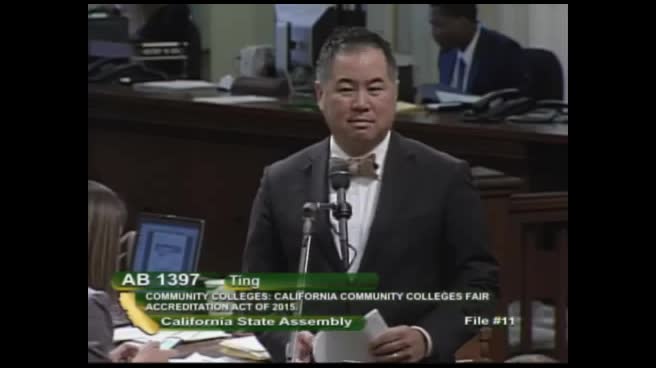 6MIN
Assembly Floor
 43SEC
Assembly Floor
 4MIN
Assembly Standing Committee on Appropriations
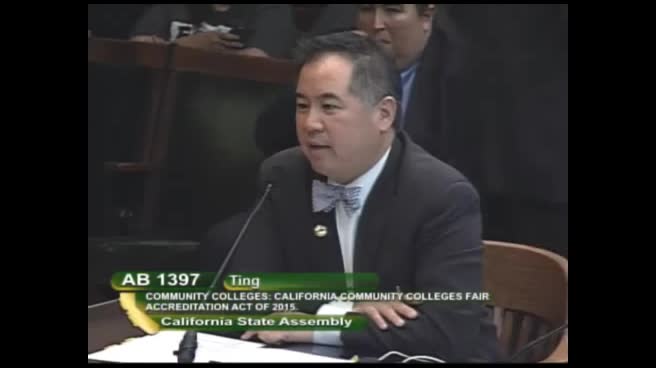 14MIN
Assembly Standing Committee on Higher Education


Bill Co-Author(s):