SB 742: Solid waste: diversion.
- Session Year: 2015-2016
- House: Senate
- Latest Version Date: 2015-04-06
The California Integrated Waste Management Act of 1989, administered by the Department of Resources Recycling and Recovery, generally regulates the disposal, management, and recycling of solid waste. The act requires each state agency to develop and adopt, in consultation with the department, an integrated waste management plan. Existing law requires each state agency and each large state facility, on and after January 1, 2004, to divert at least 50% of all solid waste from landfill disposal or transformation facilities through source reduction, recycling, and composting activities.
This bill would require each state agency and each large state facility, on and after January 1, 2018, to divert at least 60% of all solid waste from landfill disposal or transformation facilities through source reduction, recycling, and composting activities. The bill would also delete an obsolete provision.
This bill would make nonsubstantive changes to some of its provisions.
The California Integrated Waste Management Act of 1989, administered by the Department of Resources Recycling and Recovery, generally regulates the disposal, management, and recycling of solid waste.
This bill would make nonsubstantive changes to some of its provisions.
(a)Each state agency and each large state facility shall divert at least 25 percent of all solid waste generated by the state agency by January 1, 2002, through source reduction, recycling, and composting activities.
42921.(b)(a)On and after January 1, 2004, each state agency and each large state facility shall divert at least 50 percent of all solid waste through source reduction, recycling, and composting activities.
(b)On and after January 1, 2018, each state agency and each large state facility shall divert at least 60 percent of all solid waste through source reduction, recycling, and composting activities.
SECTION 1.Section 42240 of the Public Resources Code is amended to read:42240.The Department of General Services and the Department of Resources Recycling and Recovery, in consultation with other affected state agencies, shall maintain specifications for the purchase of compost by the State of California. The specifications shall designate the state minimum operating standards and product quality standards. The specifications shall be designed to maximize the use of compost without jeopardizing the safety and health of the citizens of the state or the environment.
SEC. 2.Section 42241 of the Public Resources Code is amended to read:42241.The Department of Transportation shall use compost in place of, or to supplement, petroleum-based commercial fertilizers in the states highway landscape maintenance program.
SEC. 3.Section 42243 of the Public Resources Code is amended to read:42243.The Department of Forestry and Fire Protection, the Department of Parks and Recreation, and the Department of General Services shall initiate programs to restore public lands that use compost, cocompost, rice straw, and chemically fixed sewage sludge and shall use those products or materials wherever possible.
SEC. 4.Section 42244 of the Public Resources Code is amended to read:42244.The department shall evaluate compost, cocompost, and chemically fixed sewage sludge for use as solid waste landfill cover materials or for use as extenders for currently used cover material. Compost, cocompost, and chemically fixed sewage sludge products, when used as a substitute for or mixed with currently approved cover material, shall possess all the physical characteristics required in the definition of a cover material.
SEC. 5.Section 42244.5 of the Public Resources Code is repealed.SEC. 6.Section 42245 of the Public Resources Code is amended to read:42245.Based on the results of the evaluation conducted in accordance with Section 42244, the department may, on a case-by-case basis, approve the use of compost, cocompost, and chemically fixed sewage sludge, that meet the performance standards for cover material, for up to 25 percent of landfill cover materials or landfill cover extenders.
The Department of General Services and the board Department of Resources Recycling and Recovery, in consultation with other affected state agencies, shall maintain specifications for the purchase of compost by the State of California. The specifications shall designate the state minimum operating standards and product quality standards. The specifications shall be designed to maximize the use of compost without jeopardizing the safety and health of the citizens of the state or the environment.
SEC. 2.Section 42241 of the Public Resources Code is amended to read:42241.On or after January 1, 1991, the The Department of Transportation shall use compost in place of, or to supplement, petroleum-based commercial fertilizers in the states highway landscape maintenance program.
SEC. 3.Section 42243 of the Public Resources Code is amended to read:42243.On or after January 1, 1993, the The Department of Forestry and Fire Protection, the Department of Parks and Recreation, and the Department of General Services shall initiate programs to restore public lands that use compost, co-compost, cocompost, rice straw, and chemically fixed sewage sludge and shall use those products or materials wherever possible.
SEC. 4.Section 42244 of the Public Resources Code is amended to read:42244.The board department shall evaluate compost, cocompost, and chemically fixed sewage sludge for use as solid waste landfill cover materials or for use as extenders for currently used cover material. Compost, cocompost, and chemically fixed sewage sludge products, when used as a substitute for or mixed with currently approved cover material, shall possess all the physical characteristics required in the definition of a cover material.
SEC. 5.Section 42244.5 of the Public Resources Code is repealed.42244.5.On or before January 1, 1994, the board shall evaluate rice straw for use as a solid waste landfill cover material or for use as an extender for currently used cover material. Rice straw or rice straw materials, when used as a substitute for or mixed with currently approved cover material, shall possess all the physical characteristics required in the definition of a cover material. The results of the evaluation shall be included in the report required pursuant to Section 40507.
SEC. 6.Section 42245 of the Public Resources Code is amended to read:42245.On or after January 1, 1992, based Based on the results of the evaluation conducted in accordance with Section 42244, the board department may, on a case-by-case basis, approve the use of compost, co-compost, cocompost, and chemically fixed sewage sludge, that meet the performance standards for cover material, for up to 25 percent of landfill cover materials or landfill cover extenders.
|
Date
|
Status
|
|---|---|
| Feb 1, 2016 | Returned to Secretary of Senate pursuant to Joint Rule 56. |
| May 28, 2015 | May 28 hearing: Held in committee and under submission. |
| May 23, 2015 | Set for hearing May 28. |
| May 18, 2015 | May 18 hearing: Placed on APPR. suspense file. |
| May 8, 2015 | Set for hearing May 18. |
| Apr 30, 2015 | From committee: Do pass and re-refer to Com. on APPR. (Ayes 7. Noes 0. Page 859.) (April 29). Re-referred to Com. on APPR. |
| Apr 30, 2015 | From committee: Do pass and re-refer to Com. on APPR. (Ayes 7. Noes 0.) (April 29). Re-referred to Com. on APPR. |
| Apr 17, 2015 | Set for hearing April 29. |
| Apr 16, 2015 | Re-referred to Com. on E.Q. |
| Apr 6, 2015 | From committee with author's amendments. Read second time and amended. Re-referred to Com. on RLS. |
| Mar 19, 2015 | Referred to Com. on RLS. |
| Mar 2, 2015 | Read first time. |
| Mar 2, 2015 | From printer. May be acted upon on or after April 1. |
| Feb 27, 2015 | Introduced. To Com. on RLS. for assignment. To print. |
|
Date
|
Description
|
Location
|
Votes
|
|
|---|---|---|---|---|
| May 18, 2015 | Placed on suspense file | Senate Standing Committee on Appropriations |
Passed |
|
| Apr 29, 2015 | Do pass, but first be re-referred to the Committee on [Appropriations] | Senate Standing Committee on Environmental Quality |
Passed |
This list shows positions taken on this bill by organizations on the date displayed, which is linked to the original source.
Positions by individuals are not included.
SB 742 (Hertzberg) Page 2 of 2
SENATE COMMITTEE ON APPROPRIATIONS
Senator Ricardo Lara, Chair
2015 - 2016 Regular Session
SB 742 (Hertzberg) - Solid waste: diversion.
|
|
Version: April 6, 2015 |
Policy Vote: E.Q. 7 - 0 |
Urgency: No |
Mandate: No |
Hearing Date: May 18, 2015 |
Consultant: Marie Liu |
This bill meets the criteria for referral to the Suspense File.
Bill Summary:
SB 742 would raise the requirement for each state agency and large facility to diver 50% of its solid waste from landfills to 60% by January 1, 2018.
Fiscal Impact:
Unknown costs and cost pressures, potentially in the millions of dollars, from the General Fund and various special funds, to a limited number of state agencies and facilities to increase their waste diversion rates.
Background:
Existing law requires that each agency and each large state facility to divert at least 50% of all solid waste through source reduction, recycling, and composting. These requirements are the state government’s complement to the California Integrated Waste Management Act that establishes a state policy goal that 75% of solid waste generated be diverted from landfill disposal by 2020.
Each state agency is required to annually report to CalRecycle a summary of their progress in implementing solid waste diversion programs. CalRecycle is allowed to consider an agency’s or facility’s per capital disposal rate and growth rate to determine compliance (PRC §42921.5).
Proposed Law:
This bill would raise the waste diversion requirement for the state from 50% to 60%
Staff Comments:
Based on the reports submitted to CalRecycle, of the 282 reportable state agencies and large state facilities, only 27 facilities are have diversion rates of less than 60% already. And of these 27, 13 have diversion rates exceeding 55% and therefore may only need relatively minor measures to reach the new limit set by this goal. The remaining 14 facilities, however, would require more significant investment to comply with this bill’s requirement as many of these 14 have diversion rates in the 30 and 40 percent range.
As allowed by statute, CalRecycle determines compliance based on disposal amounts per employee (referred to as the diversion rate equivalent). However, this per employee can be somewhat awkward for agencies that may handle solid waste from other people other than employees, such as visitors in state parks and inmates in prisons as this can significantly skew the estimated diversion rates. In recognition of this skewing and in recognition that some facilities have unique waste diversion challenges (i.e. state hospitals that generate significant amount of bio-hazardous and non-recyclable waste), CalRecycle does not solely rely on the diversion rate equivalent rates for these agencies to determine compliance.
Considering how CalRecycle determines compliance with the state diversion rate requirements and given the existing diversion rates of state agencies and facilities, the costs to implement this bill may be relatively controlled. The costs would vary significantly between state agencies but given the number of agencies and facilities affected, statewide total costs could be at least in the hundreds of thousands of dollars.
However, staff notes that the leniency that CalRecycle grants state agencies in determining compliance, while reasonable, is not explicitly allowed in the statute. Thus agencies and facilities with low diversion rates because of special circumstances would be under pressure to continue to raise its diversion rate equivalent rates to 60% regardless of whether CalRecycle considers them compliant or not. Because of their special circumstances, the cost pressures to achieve 60% are likely at least in the millions of dollars.
-- END --
SB 742 (Hertzberg) Page 3 of 3
SENATE COMMITTEE ON ENVIRONMENTAL QUALITY
Senator Wieckowski, Chair
2015 - 2016 Regular
Bill No: SB 742
Author: |
Hertzberg |
||
Version: |
4/6/2015 |
Hearing Date: |
4/29/2015 |
Urgency: |
No |
Fiscal: |
Yes |
Consultant: |
Joanne Roy |
||
SUBJECT: Solid waste: diversion
ANALYSIS:
Existing
law:
Pursuant to the California Integrated Waste Management Act of 1989, establishes a state policy goal that 75% of solid waste generated be diverted from landfill disposal by 2020. (Public Resources Code (PRC) §40000 et seq.).
Establishes the State Agency Integrated Waste Management Act (PRC §42920 et seq.), which does the following:
Requires that state agencies develop and implement an integrated waste management plan. (PRC §42920)
Requires each state agency and large state facility to divert at least 50% of all solid waste from landfill disposal or transformation facilities through source reduction, recycling and composting activities by 2004. (PRC §42921)
This
bill requires each state agency and each large state facility to
divert at least 60% of solid waste from landfills through source
reduction, recycling, and composting activities on and after January
1, 2018.
Background
Statewide Waste Diversion Goals.
The Department of Resources, Recycling and Recovery (CalRecycle) is tasked with diverting at least 75% of solid waste in the state by 2020. Currently, organic materials, including green waste make up one-third of the waste stream (approximately 11 million tons) and food waste continues to be the highest single category of disposal at over 15%. Green materials, such as lumber, cardboard, and leaves and grass comprise over 20%.
State Agencies and Large State Facilities.
The State Agency Integrated Waste Management Act (AB 75 (Strom-Martin), Chapter 764, Statutes of 1999) requires that state agencies develop and implement an integrated waste management plan. State agencies and large state facilities are required to divert at least 50% of their solid waste from disposal facilities by January 1, 2004. Also, each state agency and large facility must submit an annual report to CalRecycle summarizing progress in implementing solid waste diversion programs. Of the 282 reportable state agencies and large state facilities, 247 are currently achieving at least 50% diversion.
Comments
Purpose of Bill.
According to the author, “The State must, by example, contribute to achieving its own policy goal. Their participation will have important practical and symbolic effects, and will encourage local governments and businesses to do more.”
Related/Prior Legislation
AB
1826 (Chesbro), Chapter 727, Statutes of 2014, phases in requirements
for a business that generates a specified amount of organic waste per
week to arrange recycling services for that material beginning
January 1, 2016, through January 1, 2019.
AB 341
(Chesbro), Chapter 476, Statutes of 2011, requires business and
multifamily residential dwellings of five or more units that generate
more than four cubic yards of solid waste per week to separate
recyclable materials from solid waste and subscribe to basic level of
recycling service that includes collection, self-hauling, or other
arrangements for the pickup of the recyclable materials or subscribe
to a recycling service that may include mixed waste processing that
yields diversion results comparable to source separation.
AB
75 (Strom-Martin), Chapter 764, Statutes of 1999, established the
State Agency Integrated Waste Management Act, which requires state
agencies to develop and implement an integrated waste management
plan.
SOURCE:
California Recycling Refuse Council
SUPPORT:
Advance Disposal Support
Californians Against Waste
CR&R Waste Services
Desert Valley Disposal Inc.
Inland Empire Disposal Association
Los Angeles County Waste Management Association
Metropolitan Recycling, LLC
Mid Valley Disposal
Palm Springs Disposal Services
Solid Waste Association of Orange County
Varners Bros Inc.
OPPOSITION:
None on file
-- END --
Discussed in Hearing
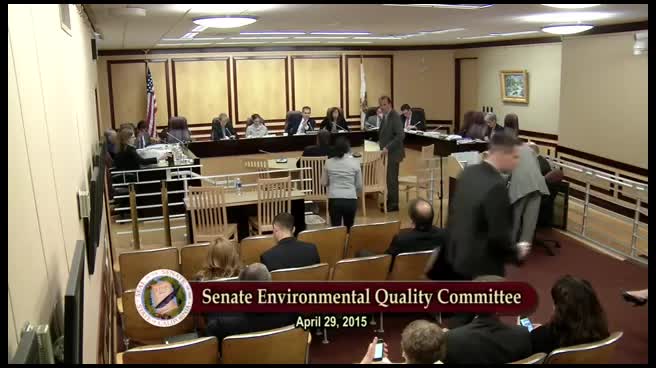 6MIN
Senate Standing Committee on Environmental Quality
Bill Author

Bill Co-Author(s):