SB 812: Modified limousines and tour buses: standards and inspection.
- Session Year: 2015-2016
- House: Senate
- Latest Version Date: 2016-09-27
(1)Existing law, on and after January 1, 2017, requires any person operating a modified limousine that is modified prior to July 1, 2015, to ensure that the vehicle is equipped with one or 2 rear windows that the rear seat passengers or all passengers of the vehicle may open from the inside of the vehicle in case of any fire or other emergency.
This bill would extend the operative date of this requirement to January 1, 2018.
(2)Existing law defines a tour bus to include any bus operated by or for a charter-party carrier of passengers or a passenger stage corporation, with a bus in this respect defined to mean any vehicle designed, used, or maintained for carrying more than 10 persons, including the driver. Existing law provides for the Department of the California Highway Patrol to regulate the safe operation of various classes of vehicles, including tour buses. A violation of various statutes and regulations governing tour buses and operators of tour buses is a crime.
Existing law also requires the department, at least once every 13 months, to inspect every maintenance facility or terminal of any person who at any time operates any bus. Existing law requires that if the bus operation includes more than 100 buses, the inspection shall be without prior notice.
This bill would require the department, if a tour bus has received an unsatisfactory compliance rating, to conduct a followup inspection between 30 and 90 days after the initial inspection during which the unsatisfactory rating was received. The bill would require the department to order a tour bus out of service upon determining during a terminal inspection or at any other time that the condition of a tour bus is such that it has multiple safety violations of a nature that operation of the tour bus could constitute an imminent danger to public safety. The bill would prohibit the tour bus from being operated with passengers until all of the safety violations have been corrected and the department has verified the correction of the safety violations upon a subsequent inspection by the department of the tour bus, which shall occur within five business days of the submission of a reinspection request from the tour bus carrier. By creating a new crime, the bill would impose a state-mandated local program.
(3)The California Constitution requires the state to reimburse local agencies and school districts for certain costs mandated by the state. Statutory provisions establish procedures for making that reimbursement.
This bill would provide that no reimbursement is required by this act for a specified reason.
(1)Existing law, on and after January 1, 2017, requires any person operating a modified limousine that is modified prior to July 1, 2015, to ensure that the vehicle is equipped with one or 2 rear windows that the rear seat passengers or all passengers of the vehicle may open from the inside of the vehicle in case of any fire or other emergency.
This bill would extend the operative date of this requirement to January 1, 2018.
Existing
(2)Existing law defines a tour bus to include any bus operated by or for a charter-party carrier of passengers or a passenger stage corporation, with a bus in this respect defined to mean any vehicle designed, used, or maintained for carrying more than 10 persons, including the driver. Existing law provides for the Department of the California Highway Patrol to regulate the safe operation of various classes of vehicles, including tour buses. A violation of various statutes and regulations governing tour buses and operators of tour buses is a crime.
Existing law also requires the department, at least once every 13 months, to inspect every maintenance facility or terminal of any person who at any time operates any bus. Existing law requires that if the bus operation includes more than 100 buses, the inspection shall be without prior notice.
This bill would require the department, if a tour bus has received an unsatisfactory compliance rating, to conduct a follow up followup inspection between 30 and 90 days after the initial inspection during which the unsatisfactory rating was received. The bill would require the department to order a tour bus out of service upon determining during a terminal inspection or at any other time that the condition of a tour bus is such that it has multiple safety violations of a nature that operation of the tour bus could constitute an imminent danger to public safety. The bill would prohibit the tour bus from being operated with passengers until all of the safety violations have been corrected and the department has verified the correction of the safety violations upon a subsequent inspection by the department of the tour bus, which shall occur within five business days of the submission of a reinspection request from the tour bus carrier. By creating a new crime, the bill would impose a state-mandated local program.
The
(3)The California Constitution requires the state to reimburse local agencies and school districts for certain costs mandated by the state. Statutory provisions establish procedures for making that reimbursement.
This bill would provide that no reimbursement is required by this act for a specified reason.
(1)Existing
Existing law defines a tour bus to include any bus operated by or for a charter-party carrier of passengers or a passenger stage corporation, with a bus in this respect defined to mean any vehicle designed, used, or maintained for carrying more than 10 persons, including the driver. Existing law provides for the Department of the California Highway Patrol to regulate the safe operation of various classes of vehicles, including tour buses. Existing law requires charter-party carriers of passengers, upon initial application and annually thereafter, to pay tour bus terminal inspection fees to offset the costs of inspections of the department. A violation of various statutes and regulations governing tour buses and operators of tour buses is a crime.
Existing law also requires the department, at least once every 13 months, to inspect every maintenance facility or terminal of any person who at any time operates any bus. Existing law requires that if the bus operation includes more than 100 buses, the inspection shall be without prior notice. Existing law requires the Public Utilities Commission, pending a hearing in the matter, to suspend the operating certificate of a charter-party carrier of passengers or a passenger stage corporation upon receipt of a written recommendation from the department for, among other things, failure to maintain any vehicle used in transportation for compensation in a safe operating condition. Existing law also requires, among other things, upon a determination by the department that a tour bus or modified limousine carrier has failed to maintain any vehicle used in transportation for compensation in a safe operating condition such that the failure presents an imminent danger to public safety, that the department shall recommend to the commission that the carriers operating authority be suspended, denied, or revoked, or to the United States Department of Transportation that appropriate administrative action be taken against the carriers interstate operating authority, whichever is appropriate.
This bill would require the department, if a tour bus or modified limousine carrier has received an unsatisfactory compliance rating for 3 consecutive terminal inspections, as specified, to recommend to the commission that the carriers operating authority be suspended, denied, or revoked, or to the United States Department of Transportation that appropriate administrative action be taken against the carriers interstate operating authority, whichever is appropriate. The bill would also require the commission to suspend an operating certificate of a charter-party carrier of passengers or a passenger stage corporation in those circumstances. The bill would additionally require the department to inspect a maintenance facility or terminal of a tour bus operator that receives 2 or more successive satisfactory ratings at least once every 26 months instead of at least once every 13 months. The bill would also require the department to inspect a maintenance facility or terminal of a tour bus operator that receives an unsatisfactory rating every 6 months until the operator achieves a satisfactory rating during a regular terminal inspection. If the satisfactory rating is the result of a reinspection, the bill would require the next regular terminal inspection to be conducted within 6 months. The bill would require the department, if, subsequent to an inspection of a maintenance facility or terminal of a tour bus operator, a tour bus is issued an out-of-service order in the field, to conduct an inspection of that maintenance facility or terminal within 90 days of the issuance of the order. rating, to conduct a follow up inspection between 30 and 90 days after the initial inspection during which the unsatisfactory rating was received. The bill would require the department to order a tour bus out of service upon determining during a terminal inspection or at any other time that the condition of a tour bus is such that it has multiple safety violations of a nature that operation of the tour bus could constitute an imminent danger to public safety. The bill would prohibit the tour bus from being operated with passengers until all of the safety violations have been corrected and the department has verified the correction of the safety violations upon a subsequent inspection by the department of the tour bus, which shall occur within five business days of the submission of a reinspection request from the tour bus carrier. By creating a new crime, the bill would impose a state-mandated local program.
This bill would require that the fees collected to offset the costs of inspections not be used to supplement other sources of funding or support for any other inspection program conducted by the department and would require the department to modify, by regulation, its existing tour bus terminal inspection program, beginning no later than January 1, 2018, to ensure that the performance-based program targets companies that are noncompliant, have a history of noncompliance with safety laws or regulations, or have received unsatisfactory ratings and to prioritize those companies for unannounced surprise inspections. The bill would also require no fewer than 10% of the total number of tour bus carrier inspections conducted by the department to be unannounced surprise inspections. The bill would require the department to conduct a followup inspection 30 days after an operator receives an unsatisfactory rating.
This bill would require a charter-party carrier of passengers or a passenger stage corporation that has received an unsatisfactory rating and is currently being inspected every 6 months, prior to operating a newly acquired tour bus that is more than 2 years old, to first schedule an inspection of the tour bus with, and obtain a satisfactory rating for the tour bus from, the department. The bill would also require the Department of the California Highway Patrol, upon determining that the condition of a tour bus is such that it has multiple safety violations of a nature that operation of the tour bus could constitute an imminent danger to public safety, to immediately order the tour bus out of service, and would prohibit operation of the tour bus until all of the safety violations have been corrected and the department has verified the correction of the safety violations upon a subsequent inspection of the tour bus. By changing the definition of existing crimes and creating new crimes, the bill would impose a state-mandated local program.
(2)The The California Constitution requires the state to reimburse local agencies and school districts for certain costs mandated by the state. Statutory provisions establish procedures for making that reimbursement.
This bill would provide that no reimbursement is required by this act for a specified reason.
(1)Existing law defines a tour bus to include any bus operated by or for a charter-party carrier of passengers or a passenger stage corporation, with a bus in this respect defined to mean any vehicle designed, used, or maintained for carrying more than 10 persons, including the driver. Existing law provides for the Department of the California Highway Patrol to regulate the safe operation of various classes of vehicles, including tour buses. Existing law requires charter-party carriers of passengers, upon initial application and annually thereafter, to pay tour bus terminal inspection fees to offset the costs of inspections of the Department of the California Highway Patrol. department. A violation of various statutes and regulations governing tour buses and operators of tour buses is a crime.
Existing law also requires the Department of the California Highway Patrol, department, at least once every 13 months, to inspect every maintenance facility or terminal of any person who at any time operates any bus. Existing law requires that if the bus operation includes more than 100 buses, the inspection shall be without prior notice. Existing law requires the Public Utilities Commission, pending a hearing in the matter, to suspend the operating certificate of a charter-party carrier of passengers or a passenger stage corporation upon receipt of a written recommendation from the department for, among other things, failure to maintain any vehicle used in transportation for compensation in a safe operating condition. Existing law also requires, among other things, upon a determination by the department that a tour bus or modified limousine carrier has failed to maintain any vehicle used in transportation for compensation in a safe operating condition such that the failure presents an imminent danger to public safety, that the department shall recommend to the commission that the carriers operating authority be suspended, denied, or revoked, or to the United States Department of Transportation that appropriate administrative action be taken against the carriers interstate operating authority, whichever is appropriate.
This bill would require the department, if a tour bus or modified limousine carrier has received an unsatisfactory compliance rating for 3 consecutive terminal inspections, as specified, to recommend to the commission that the carriers operating authority be suspended, denied, or revoked, or to the United States Department of Transportation that appropriate administrative action be taken against the carriers interstate operating authority, whichever is appropriate. The bill would also require the commission to suspend an operating certificate of a charter-party carrier of passengers or a passenger stage corporation in those circumstances. The bill would additionally require the department to inspect a maintenance facility or terminal of a tour bus operator that receives 2 or more successive satisfactory ratings at least once every 26 months instead of at least once every 13 months. The bill would also require the department to inspect a maintenance facility or terminal of a tour bus operator that receives an unsatisfactory rating every 6 months until the operator achieves a satisfactory rating during a regular terminal inspection. If the satisfactory rating is the result of a reinspection, the bill would require the next regular terminal inspection to be conducted within 6 months. The bill would require the department, if, subsequent to an inspection of a maintenance facility or terminal of a tour bus operator, a tour bus is issued an out-of-service order in the field, to conduct an inspection of that maintenance facility or terminal within 90 days of the issuance of the order.
This bill would require that the fees collected to offset the costs of inspections not be used to supplement other sources of funding or support for any other inspection program conducted by the Department of the California Highway Patrol department and would require the department to modify, by regulation, its existing tour bus terminal inspection program, beginning no later than January 1, 2018, to ensure that the performance-based program targets companies that are noncompliant, have a history of noncompliance with safety laws or regulations, or have received unsatisfactory ratings and to prioritize those companies for unannounced surprise inspections. The bill would also require no fewer than 10% of the total number of tour bus carrier inspections conducted by the department to be unannounced surprise inspections. The bill would require the department to conduct a followup inspection 30 days after an operator receives an unsatisfactory rating.
This bill would require a charter-party carrier of passengers or a passenger stage corporation that has received an unsatisfactory rating and is currently being inspected every 6 months, prior to operating a newly acquired tour bus that is more than 2 years old, to first schedule an inspection of the tour bus with, and obtain a satisfactory rating for the tour bus from, the department. The bill would also require the Department of the California Highway Patrol, upon determining that the condition of a tour bus is such that it has multiple safety violations of a nature that operation of the tour bus could constitute an imminent danger to public safety, to immediately order the tour bus out of service, and would prohibit operation of the tour bus until all of the safety violations have been corrected and the department has verified the correction of the safety violations upon a subsequent inspection of the tour bus. By changing the definition of existing crimes and creating new crimes, the bill would impose a state-mandated local program.
(2)The California Constitution requires the state to reimburse local agencies and school districts for certain costs mandated by the state. Statutory provisions establish procedures for making that reimbursement.
This bill would provide that no reimbursement is required by this act for a specified reason.
(1)Existing law defines a tour bus to include any bus operated by or for a charter-party carrier of passengers or a passenger stage corporation, with a bus in this respect defined to mean any vehicle designed, used, or maintained for carrying more than 10 persons, including the driver. Existing law provides for the Department of the California Highway Patrol to regulate the safe operation of various classes of vehicles, including tour buses. Existing law requires charter-party carriers of passengers, upon initial application and annually thereafter, to pay tour bus terminal inspection fees to offset the costs of inspections of the Department of the California Highway Patrol. A violation of various statutes and regulations governing tour buses and operators of tour buses is a crime.
Existing law also requires the Department of the California Highway Patrol, at least once every 13 months, to inspect every maintenance facility or terminal of any person who at any time operates any bus. Existing law requires that if the bus operation includes more than 100 buses, the inspection shall be without prior notice. Existing law requires the Public Utilities Commission, pending a hearing in the matter, to suspend the operating certificate of a charter-party carrier of passengers or a passenger stage corporation upon receipt of a written recommendation from the department for, among other things, failure to maintain any vehicle used in transportation for compensation in a safe operating condition. Existing law also requires, among other things, upon a determination by the department that a tour bus or modified limousine carrier has failed to maintain any vehicle used in transportation for compensation in a safe operating condition such that the failure presents an imminent danger to public safety, that the department shall recommend to the commission that the carriers operating authority be suspended, denied, or revoked, or to the United States Department of Transportation that appropriate administrative action be taken against the carriers interstate operating authority, whichever is appropriate.
This bill would require the department, if a tour bus or modified limousine carrier has received an unsatisfactory compliance rating for 3 consecutive terminal inspections, as specified, to recommend to the commission that the carriers operating authority be suspended, denied, or revoked, or to the United States Department of Transportation that appropriate administrative action be taken against the carriers interstate operating authority, whichever is appropriate. The bill would also require the commission to suspend an operating certificate of a charter-party carrier of passengers or a passenger stage corporation in those circumstances. The bill would additionally require the department to inspect a maintenance facility or terminal of a tour bus operator that receives 2 or more successive satisfactory ratings at least once every 26 months instead of at least once every 13 months. The bill would also require the department to inspect a maintenance facility or terminal of a tour bus operator that receives an unsatisfactory rating every 6 months until the operator achieves a satisfactory rating during a regular terminal inspection. If the satisfactory rating is the result of a reinspection, the bill would require the next regular terminal inspection to be conducted within 6 months.
This bill would require that the fees collected to affect offset the costs of inspections not be used to supplement other sources of funding or support for any other inspection program conducted by the Department of the California Highway Patrol and would require the department to modify, by regulation, its existing tour bus terminal inspection program, beginning no later than January 1, 2018, to ensure that the performance-based program targets companies that are noncompliant, have a history of noncompliance with safety laws or regulations, or have received unsatisfactory ratings and to prioritize those companies for unannounced surprise inspections. The bill would also require no fewer than 10% of the total number of tour bus carrier inspections conducted by the department to be unannounced surprise inspections. The bill would require the department to conduct a followup inspection 30 days after an operator receives an unsatisfactory rating.
This bill would require a charter-party carrier of passengers or a passenger stage corporation that has received an unsatisfactory rating and is currently being inspected every 6 months, prior to operating a newly acquired tour bus that is more than 2 years old, to first schedule an inspection of the tour bus with, and obtain a satisfactory rating for the tour bus from, the department. The bill would also require the Department of the California Highway Patrol, upon determining that the condition of a tour bus is such that it has multiple safety violations of a nature that operation of the tour bus could constitute an imminent danger to public safety, to immediately order the tour bus out of service, and would prohibit operation of the tour bus until all of the safety violations have been corrected and the department has verified the correction of the safety violations upon a subsequent inspection of the tour bus. By changing the definition of existing crimes and creating new crimes, the bill would impose a state-mandated local program.
(2)The California Constitution requires the state to reimburse local agencies and school districts for certain costs mandated by the state. Statutory provisions establish procedures for making that reimbursement.
This bill would provide that no reimbursement is required by this act for a specified reason.
(1)Existing law defines a tour bus to include any bus operated by or for a charter-party carrier of passengers or a passenger stage corporation, with a bus in this respect defined to mean any vehicle designed, used, or maintained for carrying more than 10 persons, including the driver. Existing law provides for the Department of the California Highway Patrol to regulate the safe operation of various classes of vehicles, including tour buses. Existing law requires charter-party carriers of passengers, upon initial application and annually thereafter, to pay tour bus terminal inspection fees of $15 per tour bus, up to a maximum of $6,500, fees to offset the costs of inspections of the Department of the California Highway Patrol, and requires the Public Utilities Commission to collect these fees and to deposit fee revenues in the Motor Vehicle Account. Existing law does not impose similar fees on passenger stage corporations. Patrol. A violation of various statutes and regulations governing tour buses and operators of tour buses is a crime.
Existing law also requires the Department of the California Highway Patrol, at least once every 13 months, to inspect every maintenance facility or terminal of any person who at any time operates any bus. Existing law requires that if the bus operation includes more than 100 buses, the inspection shall be without prior notice. Existing law requires the Public Utilities Commission, pending a hearing in the matter, to suspend the operating certificate of a charter-party carrier of passengers or a passenger stage corporation upon receipt of a written recommendation from the department for, among other things, failure to maintain any vehicle used in transportation for compensation in a safe operating condition. Existing law also requires, among other things, upon a determination by the department that a tour bus or modified limousine carrier has failed to maintain any vehicle used in transportation for compensation in a safe operating condition such that the failure presents an imminent danger to public safety, that the department shall recommend to the commission that the carriers operating authority be suspended, denied, or revoked, or to the United States Department of Transportation that appropriate administrative action be taken against the carriers interstate operating authority, whichever is appropriate.
This bill would require the department, if a tour bus or modified limousine carrier has received an unsatisfactory compliance rating for 3 consecutive terminal inspections, as specified, to recommend to the commission that the carriers operating authority be suspended, denied, or revoked, or to the United States Department of Transportation that appropriate administrative action be taken against the carriers interstate operating authority, whichever is appropriate. The bill would also require the commission to suspend an operating certificate of a charter-party carrier of passengers or a passenger stage corporation in those circumstances. The bill would additionally require the department to inspect a maintenance facility or terminal that receives 2 or more successive satisfactory ratings at least once every 26 months instead of at least once every 13 months. The bill would also require the department to inspect a maintenance facility or terminal that receives an unsatisfactory rating every 6 months until the operator achieves a satisfactory rating, unless the satisfactory rating is the result of a reinspection, as specified. rating during a regular terminal inspection. If the satisfactory rating is the result of a reinspection, the bill would require the next regular terminal inspection to be conducted within 6 months.
This bill would require the Department of the California Highway Patrol, by regulation, to develop and adopt bus terminal inspection fees that are scaled and applicable to charter-party carriers of passengers and passenger stage corporations that operate one or more tour buses, to replace existing fees, in an amount sufficient to offset the costs to administer the inspection program for these companies, as specified. The bill would require the fees to be collected by the Public Utilities Commission in the case of charter-party carriers of passengers or as otherwise required by the regulations. The bill would provide that an operating carrier may not be charged more than $6,500 in fees. The bill would make other conforming changes.
This bill would require the Department of the California Highway Patrol, by regulation, to modify that the fees collected to affect the costs of inspections not be used to supplement other sources of funding or support for any other inspection program conducted by the Department of the California Highway Patrol and would require the department to modify, by regulation, its existing tour bus terminal inspection program, beginning no later than January 1, 2018, to ensure that the performance-based program targets companies that are noncompliant, have a history of noncompliance with safety laws or regulations, or have received unsatisfactory ratings and to prioritize those companies for unannounced surprise inspections. The bill would also require no fewer than 10% of the total number of tour bus carrier inspections conducted by the department to be unannounced surprise inspections. The bill would require the department to conduct a followup inspection 30 days after an operator receives an unsatisfactory rating.
This bill would require a charter-party carrier of passengers or a passenger stage corporation that has received an unsatisfactory rating and is currently being inspected every 6 months, prior to operating a newly acquired tour bus that is more than 2 years old, to first schedule an inspection of the tour bus with, and obtain a satisfactory rating for the tour bus from, the department. The bill would also require the Department of the California Highway Patrol, upon determining that the condition of a tour bus is such that it has multiple safety violations of a nature that operation of the tour bus could constitute an imminent danger to public safety, to immediately order the tour bus out of service, and would prohibit operation of the tour bus until all of the safety violations have been corrected and the department has verified the correction of the safety violations upon a subsequent inspection of the tour bus. By changing the definition of existing crimes and creating new crimes, the bill would impose a state-mandated local program.
(2)The California Constitution requires the state to reimburse local agencies and school districts for certain costs mandated by the state. Statutory provisions establish procedures for making that reimbursement.
This bill would provide that no reimbursement is required by this act for a specified reason.
(1)Existing law defines a tour bus to include any bus operated by or for a charter-party carrier of passengers or a passenger stage corporation, with a bus in this respect defined to mean any vehicle designed, used, or maintained for carrying more than 10 persons, including the driver. Existing law provides for the Department of the California Highway Patrol to regulate the safe operation of various classes of vehicles, including tour buses. Existing law requires charter-party carriers of passengers, upon initial application and annually thereafter, to pay tour bus terminal inspection fees of $15 per tour bus, up to a maximum of $6,500, to offset the costs of inspections of the Department of the California Highway Patrol, and requires the Public Utilities Commission to collect these fees and to deposit fee revenues in the Motor Vehicle Account. Existing law does not impose similar fees on passenger stage corporations. A violation of various statutes and regulations governing tour buses and operators of tour buses is a crime.
Existing law also requires the Department of the California Highway Patrol, at least once every 13 months, to inspect every maintenance facility or terminal of any person who at any time operates any bus. Existing law requires that if the bus operation includes more than 100 buses, the inspection shall be without prior notice. Existing law requires the Public Utilities Commission, pending a hearing in the matter, to suspend the operating certificate of a charter-party carrier of passengers or a passenger stage corporation upon receipt of a written recommendation from the department for, among other things, failure to maintain any vehicle used in transportation for compensation in a safe operating condition. Existing law also requires, among other things, upon a determination by the department that a tour bus or modified limousine carrier has failed to maintain any vehicle used in transportation for compensation in a safe operating condition such that the failure presents an imminent danger to public safety, that the department shall recommend to the commission that the carriers operating authority be suspended, denied, or revoked, or to the United States Department of Transportation that appropriate administrative action be taken against the carriers interstate operating authority, whichever is appropriate.
This bill would require the department, if a tour bus or modified limousine carrier has received an unsatisfactory compliance rating for a 3 consecutive terminal inspections, as specified, to recommend to the commission that the carriers operating authority be suspended, denied, or revoked, or to the United States Department of Transportation that appropriate administrative action be taken against the carriers interstate operating authority, whichever is appropriate. The bill would also require the commission to suspend an operating certificate of a charter-party carrier of passengers or a passenger stage corporation in those circumstances. The bill would additionally authorize require the department to inspect a maintenance facility or terminal that receives 2 or more successive satisfactory ratings at least once every 26 months. months instead of at least once every 13 months. The bill would also require the department to inspect a maintenance facility or terminal that receives an unsatisfactory rating every 6 months until the operator achieves a satisfactory rating, unless the satisfactory rating is the result of a reinspection, as specified.
This bill would require the Department of the California Highway Patrol, by regulation, to develop and adopt bus terminal inspection fees that are scaled and applicable to charter-party carriers of passengers and passenger stage corporations that operate one or more tour buses, to replace existing fees, in an amount sufficient to offset the costs to administer the inspection program for these companies, as specified. The bill would require the fees to be collected by the Public Utilities Commission in the case of charter-party carriers of passengers or as otherwise required by the regulations. The bill would provide that an operating carrier may not be charged more than $6,500 in fees. The bill would make other conforming changes.
This bill would require the Department of the California Highway Patrol, by regulation, to modify its existing tour bus terminal inspection program, beginning no later than January 1, 2018, to ensure that the performance-based program targets companies that are noncompliant, have a history of noncompliance with safety laws or regulations, or have received unsatisfactory ratings and to prioritize those companies for unannounced surprise inspections. The bill would also require no fewer than 10% of the total number of tour bus carrier inspections conducted by the department to be unannounced surprise inspections. The bill would require the department to conduct a followup inspection 30 days after an operator receives an unsatisfactory rating.
This bill would require a charter-party carrier of passengers or a passenger stage corporation that has received an unsatisfactory rating and is currently being inspected every 6 months, prior to operating a newly acquired tour bus that is more than 2 years old, to first schedule an inspection of the tour bus with, and obtain a satisfactory rating for the tour bus from, the department. The bill would also require the Department of the California Highway Patrol, upon determining that the condition of a tour bus is such that it has multiple safety violations of a nature that operation of the tour bus could constitute an imminent danger to public safety, to immediately order the tour bus out of service, and would prohibit operation of the tour bus until all of the safety violations have been corrected and the department has verified the correction of the safety violations upon a subsequent inspection of the tour bus. By changing the definition of existing crimes and creating new crimes, the bill would impose a state-mandated local program.
(2)Existing law provides for the regulation of private carriers of passengers, passenger stage corporations, and charter-party carriers of passengers by the Public Utilities Commission.
This bill would require the commission to monitor the recall notifications of the National Highway Traffic Safety Administration (NHTSA) relative to buses operated by private carriers of passengers and buses, limousines, and modified limousines operated by passenger stage corporations and charter-party carriers of passengers. The bill would require the commission, upon determining that a bus, limousine, or modified limousine is the subject of a safety recall by NHTSA that involves parts or accessories necessary for the safe operation of the vehicle, as defined, to contact any private carrier of passengers, passenger stage corporation, or charter-party carrier of passengers affected by the recall to ensure that the registrant, certificate holder, or permittee is aware of it and has a plan in place to correct the defect. The bill would authorize the commission to issue an out-of-service order for any vehicle affected by the recall until the recall repair is completed. Because a violation of provisions governing private carriers of passengers, passenger stage corporations, and charter-party carriers of passengers is a crime, this bill would impose a state-mandated local program by creating new crimes.
(3)
(2)The California Constitution requires the state to reimburse local agencies and school districts for certain costs mandated by the state. Statutory provisions establish procedures for making that reimbursement.
This bill would provide that no reimbursement is required by this act for a specified reason.
(1)Existing law defines a tour bus to include any bus operated by or for a charter-party carrier of passengers or a passenger stage corporation, with a bus in this respect defined to mean any vehicle designed, used, or maintained for carrying more than 10 persons, including the driver. Existing law provides for the Department of the California Highway Patrol to regulate the safe operation of various classes of vehicles, including tour buses. Existing law requires charter-party carriers of passengers, upon initial application and annually thereafter, to pay tour bus terminal inspection fees of $15 per tour bus, up to a maximum of $6,500, to offset the costs of inspections of the Department of the California Highway Patrol, and requires the Public Utilities Commission to collect these fees and to deposit fee revenues in the Motor Vehicle Account. Existing law does not impose similar fees on passenger stage corporations. A violation of various statutes and regulations governing tour buses and operators of tour buses is a crime.
Existing law also requires the Department of the California Highway Patrol, at least once every 13 months, to inspect every maintenance facility or terminal of any person who at any time operates any bus. Existing law requires that if the bus operation includes more than 100 buses, the inspection shall be without prior notice. Existing law requires the Public Utilities Commission, pending a hearing in the matter, to suspend the operating certificate of a charter-party carrier of passengers or a passenger stage corporation upon receipt of a written recommendation from the department for, among other things, failure to maintain any vehicle used in transportation for compensation in a safe operating condition. Existing law also requires, among other things, upon a determination by the department that a tour bus or modified limousine carrier has failed to maintain any vehicle used in transportation for compensation in a safe operating condition such that the failure presents an imminent danger to public safety, that the department shall recommend to the commission that the carriers operating authority be suspended, denied, or revoked, or to the United States Department of Transportation that appropriate administrative action be taken against the carriers interstate operating authority, whichever is appropriate.
This bill would require the department, if a tour bus or modified limousine carrier has received an unsatisfactory compliance rating for a 3 consecutive terminal inspections, as specified, to recommend to the commission that the carriers operating authority be suspended, denied, or revoked, or to the United States Department of Transportation that appropriate administrative action be taken against the carriers interstate operating authority, whichever is appropriate. The bill would also require the commission to suspend an operating certificate of a charter-party carrier of passengers or a passenger stage corporation in those circumstances. The bill would additionally authorize the department to inspect a maintenance facility or terminal that receives 2 or more successive satisfactory ratings once every 26 months. The bill would also require the department to inspect a maintenance facility or terminal that receives an unsatisfactory rating every 6 months until the operator achieves a satisfactory rating, unless the satisfactory rating is the result of a reinspection, as specified.
This bill would require the Department of the California Highway Patrol, by regulation, to develop and adopt bus terminal inspection fees that are scaled and applicable to charter-party carriers of passengers and passenger stage corporations that operate one or more tour buses, to replace existing fees, in an amount sufficient to offset the costs to administer the inspection program for these companies, as specified. The bill would require the fees to be collected by the Public Utilities Commission in the case of charter-party carriers of passengers or as otherwise required by the regulations. The bill would provide that an operating carrier may not be charged more than $6,500 in fees. The bill would make other conforming changes.
This bill would require the Department of the California Highway Patrol, by regulation, to modify its existing tour bus terminal inspection program, beginning no later than January 1, 2018, to ensure that the performance-based program targets companies that are noncompliant, have a history of noncompliance with safety laws or regulations, or have received unsatisfactory ratings and to prioritize those companies for unannounced surprise inspections. The bill would also require no fewer than 10% of the total number of tour bus carrier inspections conducted by the department to be unannounced surprise inspections. The bill would require the department to conduct a followup inspection 30 days after an operator receives an unsatisfactory rating.
This bill would require a charter-party carrier of passengers or a passenger stage corporation that has received an unsatisfactory rating and is currently being inspected every 6 months, prior to operating a newly acquired tour bus that is more than 2 years old, to first schedule an inspection of the tour bus with, and obtain a satisfactory rating for the tour bus from, the department. The bill would also require the Department of the California Highway Patrol, upon determining that the condition of a tour bus is such that it has multiple safety violations of a nature that operation of the tour bus could constitute an imminent danger to public safety, to immediately order the tour bus out of service, and would prohibit operation of the tour bus until all of the safety violations have been corrected and the department has verified the correction of the safety violations upon a subsequent inspection of the tour bus. By changing the definition of existing crimes and creating new crimes, the bill would impose a state-mandated local program.
This bill would also require the Department of the California Highway Patrol to conduct a comprehensive review of the statutes and regulations governing tour buses, as well as buses generally, with the objective of identifying opportunities for simplification, consolidation, avoidance of duplication, and consistent use of terminology, as specified. The bill would require a report containing the departments recommendations for proposed statutory changes to be submitted to the policy committees of both houses of the Legislature with responsibility for transportation matters by January 1, 2018.
(2)Existing law provides for the regulation of private carriers of passengers, passenger stage corporations corporations, and charter-party carriers of passengers by the Public Utilities Commission.
This bill would require the commission to monitor the recall notifications of the National Highway Traffic Safety Administration (NHTSA) relative to buses operated by private carriers of passengers and buses, limousines, and modified limousines operated by passenger stage corporations and charter-party carriers of passengers. The bill would require the commission, upon determining that a bus, limousine, or modified limousine is the subject of a safety recall by NHTSA that involves parts or accessories necessary for the safe operation of the vehicle, as defined, to contact any private carrier of passengers, passenger stage corporation corporation, or charter-party carrier of passengers affected by the recall to ensure that the registrant, certificate holder holder, or permittee is aware of it and has a plan in place to correct the defect. The bill would authorize the commission to issue an out-of-service order for any vehicle affected by the recall until the recall repair is completed. Because a violation of provisions governing private carriers of passengers, passenger stage corporations corporations, and charter-party carriers of passengers is a crime, this bill would impose a state-mandated local program by creating new crimes.
(3)The California Constitution requires the state to reimburse local agencies and school districts for certain costs mandated by the state. Statutory provisions establish procedures for making that reimbursement.
This bill would provide that no reimbursement is required by this act for a specified reason.
(1)Existing law defines a tour bus to include any bus operated by or for a charter-party carrier of passengers or a passenger stage corporation, with a bus in this respect defined to mean any vehicle designed, used, or maintained for carrying more than 10 persons, including the driver. Existing law provides for the Department of the California Highway Patrol to regulate the safe operation of various classes of vehicles, including tour buses. Existing law requires charter-party carriers of passengers, upon initial application and annually thereafter, to pay tour bus terminal inspection fees of $15 per tour bus, up to a maximum of $6,500, to offset the costs of inspections of the Department of the California Highway Patrol, and requires the Public Utilities Commission to collect these fees and to deposit fee revenues in the Motor Vehicle Account. Existing law does not impose similar fees on passenger stage corporations. A violation of various statutes and regulations governing tour buses and operators of tour buses is a crime.
Existing law also requires the Department of the California Highway Patrol, at least once every 13 months, to inspect every maintenance facility or terminal of any person who at any time operates any bus. Existing law requires that if the bus operation includes more than 100 buses, the inspection shall be without prior notice. Existing law requires the Public Utilities Commission, pending a hearing in the matter, to suspend the operating certificate of a charter-party carrier of passengers or a passenger stage corporation upon receipt of a written recommendation from the department for, among other things, failure to maintain any vehicle used in transportation for compensation in a safe operating condition. Existing law also requires, among other things, upon a determination by the department that a tour bus or modified limousine carrier has failed to maintain any vehicle used in transportation for compensation in a safe operating condition such that the failure presents an imminent danger to public safety, that the department shall recommend to the commission that the carriers operating authority be suspended, denied, or revoked, or to the United States Department of Transportation that appropriate administrative action be taken against the carriers interstate operating authority, whichever is appropriate.
This bill would require the department, if a tour bus or modified limousine carrier has received an unsatisfactory compliance rating for a 3 consecutive terminal inspections, as specified, to recommend to the commission that the carriers operating authority be suspended, denied, or revoked, or to the United States Department of Transportation that appropriate administrative action be taken against the carriers interstate operating authority, whichever is appropriate. The bill would also require the commission to suspend an operating certificate of a charter-party carrier of passengers or a passenger stage corporation in those circumstances. The bill would additionally authorize the department to inspect a maintenance facility or terminal that receives 2 or more successive satisfactory ratings once every 26 months. The bill would also require the department to inspect a maintenance facility or terminal that receives an unsatisfactory rating every 6 months until the operator achieves a satisfactory rating, unless the satisfactory rating is the result of a reinspection, as specified.
This bill would require the Department of the California Highway Patrol, by regulation, to develop and adopt bus terminal inspection fees that are scaled and applicable to charter-party carriers of passengers and passenger stage corporations that operate one or more tour buses, to replace existing fees, in an amount sufficient to offset the costs to administer the inspection program for these companies, as specified. The bill would require the fees to be collected by the Public Utilities Commission in the case of charter-party carriers of passengers or as otherwise required by the regulations. The bill would provide that an operating carrier may not be charged more than $6,500 in fees. The bill would make other conforming changes.
This bill would require the Department of the California Highway Patrol, by regulation, to modify its existing tour bus terminal inspection program, beginning no later than January 1, 2018, to ensure that the performance-based program targets companies that are noncompliant, have a history of noncompliance with safety laws or regulations, or have received unsatisfactory ratings and to prioritize those companies for unannounced surprise inspections. The bill would also require no fewer than 10% of the total number of tour bus carrier inspections conducted by the department to be unannounced surprise inspections. The bill would require the department to conduct a followup inspection 30 days after an operator receives an unsatisfactory rating.
This bill would require a charter-party carrier of passengers or a passenger stage corporation, corporation that has received an unsatisfactory rating and is currently being inspected every 6 months, prior to operating a newly acquired tour bus that is more than 2 years old, to first schedule an inspection of the tour bus with, and obtain a satisfactory rating for the tour bus from, the department. The bill would also require the Department of the California Highway Patrol, upon determining that the condition of a tour bus is such that it has multiple safety violations of a nature that operation of the tour bus could constitute an imminent danger to public safety, to immediately order the tour bus out of service, and would prohibit operation of the tour bus until all of the safety violations have been corrected and the department has verified the correction of the safety violations upon a subsequent inspection of the tour bus. By changing the definition of existing crimes and creating new crimes, the bill would impose a state-mandated local program.
This bill would require, beginning January 1, 2018, a charter-party carrier of passengers or a passenger stage corporation operating tour buses that applies for renewal of the registration of its vehicles to provide proof of its most recent bus terminal inspection with a satisfactory rating by the department.
This bill would also require the Department of the California Highway Patrol to conduct a comprehensive review of the statutes and regulations governing tour buses, as well as buses generally, with the objective of identifying opportunities for simplification, consolidation, avoidance of duplication, and consistent use of terminology, as specified. The bill would require a report containing the departments recommendations for proposed statutory changes to be submitted to the policy committees of both houses of the Legislature with responsibility for transportation matters by January 1, 2018.
(2)Existing law provides for the regulation of passenger stage corporations and charter-party carriers of passengers by the Public Utilities Commission.
This bill would require the commission to monitor the recall notifications of the National Highway Traffic Safety Administration (NHTSA) relative to buses, limousines, and modified limousines operated by passenger stage corporations and charter-party carriers of passengers. The bill would require the commission, upon determining that a bus, limousine, or modified limousine is the subject of a safety recall by NHTSA that involves parts or accessories necessary for the safe operation of the vehicle, as defined, to contact any passenger stage corporation or charter-party carrier of passengers affected by the recall to ensure that the certificate holder or permittee is aware of it and has a plan in place to correct the defect. The bill would authorize the commission to issue an out-of-service order for any vehicle affected by the recall until the recall repair is completed. Because a violation of provisions governing passenger stage corporations and charter-party carriers of passengers is a crime, this bill would impose a state-mandated local program by creating new crimes.
(3)The California Constitution requires the state to reimburse local agencies and school districts for certain costs mandated by the state. Statutory provisions establish procedures for making that reimbursement.
This bill would provide that no reimbursement is required by this act for a specified reason.
(1)Existing law defines a tour bus to include any bus operated by or for a charter-party carrier of passengers or a passenger stage corporation, with a bus in this respect defined to mean any vehicle designed, used, or maintained for carrying more than 10 persons, including the driver. Existing law provides for the Department of the California Highway Patrol to regulate the safe operation of various classes of vehicles, including tour buses. Existing law requires charter-party carriers of passengers, upon initial application and annually thereafter, to pay tour bus terminal inspection fees of $15 per tour bus, up to a maximum of $6,500, to offset the costs of inspections of the Department of the California Highway Patrol, and requires the Public Utilities Commission to collect these fees and to deposit fee revenues in the Motor Vehicle Account. Existing law does not impose similar fees on passenger stage corporations. A violation of various statutes and regulations governing tour buses and operators of tour buses is a crime.
Existing law also requires the Department of the California Highway Patrol, at least once every 13 months, to inspect every maintenance facility or terminal of any person who at any time operates any bus. Existing law requires that if the bus operation includes more than 100 buses, the inspection shall be without prior notice.
This bill would additionally authorize the department to inspect a maintenance facility or terminal that receives 2 or more successive satisfactory ratings once every 26 months. The bill would also require the department to inspect a maintenance facility or terminal that receives an unsatisfactory rating every 6 months until the operator achieves a satisfactory rating, unless the satisfactory rating is the result of a reinspection, as specified.
This bill would require the Department of the California Highway Patrol, by regulation, to develop and adopt bus terminal inspection fees that are scaled and applicable to charter-party carriers of passengers and passenger stage corporations that operate one or more tour buses, to replace existing fees, in an amount sufficient to offset the costs to administer the inspection program for these companies, as specified. The bill would require the fees to be collected by the Public Utilities Commission in the case of charter-party carriers of passengers or as otherwise required by the regulations. The bill would provide that an operating carrier may not be charged more than $6,500 in fees. The bill would make other conforming changes.
This bill would require the Department of the California Highway Patrol, by regulation, to modify its existing tour bus terminal inspection program program, beginning no later than January 1, 2018, to ensure that the performance-based program is performance-based, with parameters to evaluate and target on-site inspections of tour buses operated by or for charter-party carriers of passengers and passenger stage corporations. The bill would require the tour bus terminal inspection program to prioritize newly acquired tour buses operated by charter-party carriers of passengers and passenger stage corporations, as well as affected targets companies that are noncompliant or noncompliant, have a history of noncompliance with safety laws or regulations. regulations, or have received unsatisfactory ratings and to prioritize those companies for unannounced surprise inspections. The bill would also require no fewer than 25% 10% of the total number of tour bus carrier inspections conducted by the department to be unannounced surprise inspections. The bill would require the department to conduct a followup inspection 30 days after an operator receives an unsatisfactory rating.
This bill would require a charter-party carrier of passengers or a passenger stage corporation, prior to operating a newly acquired tour bus, bus that is more than 2 years old, to first schedule an inspection of the tour bus with, and obtain a satisfactory rating for the tour bus from, the department. The bill would also require the Department of the California Highway Patrol, upon determining that the condition of a tour bus is such that it has multiple safety violations of a nature that operation of the tour bus could constitute an imminent danger to public safety, to immediately order the tour bus out of service, and would prohibit operation of the tour bus until all of the safety violations have been corrected and the department has verified the correction of the safety violations upon a subsequent inspection of the tour bus. By changing the definition of existing crimes and creating new crimes, the bill would impose a state-mandated local program.
This bill would require, beginning January 1, 2018, a charter-party carrier of passengers or a passenger stage corporation operating tour buses that applies for renewal of the registration of its vehicles to provide proof of its most recent bus terminal inspection with a satisfactory rating by the department.
This bill would also require the Department of the California Highway Patrol to conduct a comprehensive review of the statutes and regulations governing tour buses, as well as buses generally, with the objective of identifying opportunities for simplification, consolidation, avoidance of duplication, and consistent use of terminology, as specified. The bill would require a report containing the departments recommendations for proposed statutory changes to be submitted to the policy committees of both houses of the Legislature with responsibility for transportation matters by January 1, 2018.
(2)Existing law provides for the regulation of passenger stage corporations and charter-party carriers of passengers by the Public Utilities Commission.
This bill would require the commission to monitor the recall notifications of the National Highway Traffic Safety Administration (NHTSA) relative to buses and limousines buses, limousines, and modified limousines operated by passenger stage corporations and charter-party carriers of passengers. The bill would require the commission, upon determining that a limousine or bus bus, limousine, or modified limousine is the subject of a safety recall, to notify the carrier and order affected vehicles out of service. The bill would prohibit a carrier from operating a limousine or bus that is the subject of a safety recall after being notified by the commission or otherwise becoming aware of the recall. The bill would require carriers to fix the safety defects of an affected vehicle before returning it to service and to submit written documentation to the commission in that regard. The bill would require the commission, upon determining that the safety defects have been fixed, to rescind its out-of-service order and notify the carrier that the vehicle may again be operated. recall by NHTSA that involves parts or accessories necessary for the safe operation of the vehicle, as defined, to contact any passenger stage corporation or charter-party carrier of passengers affected by the recall to ensure that the certificate holder or permittee is aware of it and has a plan in place to correct the defect. The bill would authorize the commission to issue an out-of-service order for any vehicle affected by the recall until the recall repair is completed. Because a violation of provisions governing passenger stage corporations and charter-party carriers of passengers is a crime, this bill would impose a state-mandated local program by creating new crimes.
(3)The California Constitution requires the state to reimburse local agencies and school districts for certain costs mandated by the state. Statutory provisions establish procedures for making that reimbursement.
This bill would provide that no reimbursement is required by this act for a specified reason.
(1)Existing law defines a tour bus to include any bus operated by or for a charter-party carrier of passengers or a passenger stage corporation, with a bus in this respect defined to mean any vehicle designed, used, or maintained for carrying more than 10 persons, including the driver. Existing law provides for the Department of the California Highway Patrol to regulate the safe operation of various classes of vehicles, including tour buses. Existing law requires charter-party carriers of passengers, upon initial application and annually thereafter, to pay tour bus terminal inspection fees of $15 per tour bus, up to a maximum of $6,500, to offset the costs of inspections of the Department of the California Highway Patrol, and requires the Public Utilities Commission to collect these fees and to deposit fee revenues in the Motor Vehicle Account. Existing law does not impose similar fees on passenger stage corporations. A violation of various statutes and regulations governing tour buses and operators of tour buses is a crime.
This bill would require the Department of the California Highway Patrol, by regulation, to develop and adopt bus terminal inspection fees applicable to charter-party carriers of passengers and passenger stage corporations that operate one or more tour buses, to replace existing fees, in an amount sufficient to offset the costs to administer the inspection program for these companies, as specified. The bill would require the fees to be collected by the Public Utilities Commission in the case of charter-party carriers of passengers or as otherwise required by the regulations. The bill would make other conforming changes.
This bill would require the Department of the California Highway Patrol, by regulation, to modify its existing tour bus terminal inspection program to ensure that the program is performance-based, with parameters to evaluate and target on-site inspections of tour of buses operated by or for charter-party carriers of passengers and passenger stage corporations. The bill would require the tour bus terminal inspection program to prioritize newly acquired tour buses operated by charter-party carriers of passengers and passenger stage corporations, as well as affected companies that are noncompliant or have a history of noncompliance with safety laws or regulations. The bill would also require no fewer than 25% of the total number of tour bus carrier inspections conducted by the department to be unannounced surprise inspections.
This bill would require a charter-party carrier of passengers or a passenger stage corporation, prior to operating a newly acquired tour bus, to first schedule an inspection of the tour bus with, and obtain a satisfactory rating for the tour bus from, the department. The bill would also require the Department of the California Highway Patrol, upon determining that the condition of a tour bus is such that it has multiple safety violations of a nature that operation of the tour bus could constitute an imminent danger to public safety, to immediately order the tour bus out of service, and would prohibit operation of the tour bus until all of the safety violations have been corrected and the department has verified the correction of the safety violations upon a subsequent inspection of the tour bus. By changing the definition of existing crimes and creating new crimes, the bill would impose a state-mandated local program.
This bill would also require the Department of the California Highway Patrol to conduct a comprehensive review of the statutes and regulations governing tour buses, as well as buses generally, with the objective of identifying opportunities for simplification, consolidation, avoidance of duplication, and consistent use of terminology, as specified. The bill would require a report containing the departments recommendations for proposed statutory changes to be submitted to the policy committees of both houses of the Legislature with responsibility for transportation matters by January 1, 2018.
(2)Existing law provides for the regulation of passenger stage corporations and charter-party carriers of passengers by the Public Utilities Commission.
This bill would require the commission to monitor the recall notifications of the National Highway Traffic Safety Administration (NHTSA) relative to buses and limousines operated by passenger stage corporations and charter-party carriers of passengers. The bill would require the commission, upon determining that a limousine or bus is the subject of a safety recall, to notify the carrier and order affected vehicles out of service. The bill would prohibit a carrier from operating a limousine or bus that is the subject of a safety recall after being notified by the commission or otherwise becoming aware of the recall. The bill would require carriers to fix the safety defects of an affected vehicle before returning it to service and to submit written documentation to the commission in that regard. The bill would require the commission, upon determining that the safety defects have been fixed, to rescind its out-of-service order and notify the carrier that the vehicle may again be operated. Because a violation of provisions governing passenger stage corporations and charter-party carriers of passengers is a crime, this bill would impose a state-mandated local program by creating new crimes.
(2)
(3)The California Constitution requires the state to reimburse local agencies and school districts for certain costs mandated by the state. Statutory provisions establish procedures for making that reimbursement.
This bill would provide that no reimbursement is required by this act for a specified reason.
(1)Existing law defines a tour bus to include any bus operated by or for a charter-party carrier of passengers or a passenger stage corporation, with a bus in this respect defined to mean any vehicle designed, used, or maintained for carrying more than 10 persons, including the driver. Existing law provides for the Department of the California Highway Patrol to regulate the safe operation of various classes of vehicles, including tour buses. Existing law requires charter-party carriers of passengers, upon initial application and annually thereafter, to pay tour bus terminal inspection fees of $15 per tour bus, up to a maximum of $6,500, to offset the costs of inspections of the Department of the California Highway Patrol, and requires the Public Utilities Commission to collect these fees and to deposit fee revenues in the Motor Vehicle Account. Existing law does not impose similar fees on passenger stage corporations. A violation of various statutes and regulations governing tour buses and operators of tour buses is a crime.
This bill would require the Department of the California Highway Patrol, by regulation, to develop and adopt bus terminal inspection fees applicable to charter-party carriers of passengers and passenger stage corporations that operate one or more tour buses, to replace existing fees, in an amount sufficient to offset the costs to administer the inspection program for these companies, as specified. The bill would require the fees to be collected by the Public Utilities Commission in the case of charter-party carriers of passengers or as otherwise required by the regulations. The bill would make other conforming changes.
This bill would require the Department of the California Highway Patrol, by regulation, to modify its existing tour bus terminal inspection program to ensure that the program is performance-based, with parameters to evaluate and target on-site inspections tour of buses operated by or for charter-party carriers of passengers and passenger stage corporations. The bill would require the tour bus terminal inspection program to prioritize newly acquired tour buses operated by charter-party carriers of passengers and passenger stage corporations, as well as affected companies that are noncompliant or have a history of noncompliance with safety laws or regulations. The bill would also require no fewer than 25% of the total number of tour bus carrier inspections conducted by the department to be unannounced surprise inspections.
This bill would require a charter-party carrier of passengers or a passenger stage corporation, prior to operating a newly acquired tour bus, to first schedule an inspection of the tour bus with, and obtain a satisfactory rating for the tour bus from, the department. The bill would also require the Department of the California Highway Patrol, upon determining that the condition of a tour bus is such that it has multiple safety violations of a nature that operation of the tour bus could constitute an imminent danger to public safety, to immediately order the tour bus out of service, and would prohibit operation of the tour bus until all of the safety violations have been corrected and the department has verified the correction of the safety violations upon a subsequent inspection of the tour bus. By changing the definition of existing crimes and creating new crimes, the bill would impose a state-mandated local program.
This bill would also require the Department of the California Highway Patrol to conduct a comprehensive review of the statutes and regulations governing tour buses, as well as buses generally, with the objective of identifying opportunities for simplification, consolidation, avoidance of duplication, and consistent use of terminology, as specified. The bill would require a report containing the departments recommendations for proposed statutory changes to be submitted to the policy committees of both houses of the Legislature with responsibility for transportation matters by January 1, 2018.
(2)The California Constitution requires the state to reimburse local agencies and school districts for certain costs mandated by the state. Statutory provisions establish procedures for making that reimbursement.
This bill would provide that no reimbursement is required by this act for a specified reason.
(a)Any person who operates a modified limousine shall ensure that the vehicle has at least two rear side doors, as specified in paragraph (2), and one or two rear windows, as specified in paragraph (1), that the rear seat passengers or all passengers of the vehicle may open from the inside of the vehicle in case of any fire or other emergency that may require the immediate exit of the passengers of the vehicle. A limousine subject to this subdivision shall be equipped with both of the following:
(1)(A)Except as provided in subparagraph (B), at least two rear push-out windows that are accessible to all passengers. At least one push-out window shall be located on each side of the vehicle, unless the design of the limousine precludes the installation of a push-out window on one side of the vehicle, in which case the second push-out window shall instead be located in the roof of the vehicle.
(B)If the design of the limousine precludes the installation of even one push-out window on a side of the vehicle, one push-out window shall instead be located in the roof of the vehicle.
(C)The Department of the California Highway Patrol shall establish, by regulation, standards to ensure that window exits are operable and sufficient in emergency situations for limousine passengers. The department shall ensure that these regulations comply with any applicable federal motor vehicle safety standards.
(D)For modified limousines modified prior to July 1, 2015, the requirements of this paragraph shall apply on and after January 1, 2018.
(2)(A)At least two rear side doors that are accessible to all passengers and that may be opened manually by any passenger. At least one rear side door shall be located on each side of the vehicle.
(B)For modified limousines modified on or after July 1, 2015, at least one of these side doors shall be located near the drivers compartment and another near the back of the vehicle.
(C)The rear side doors shall comply with any applicable federal motor vehicle safety standards as deemed necessary by the Department of the California Highway Patrol.
(b)In the case of a fire or other emergency that requires the immediate exit of the passengers from the limousine, the driver of the limousine shall unlock the doors so that the rear side doors can be opened by the passengers from the inside of the vehicle.
(c)An owner or operator of a limousine shall do all of the following:
(1)Instruct all passengers on the safety features of the vehicle prior to the beginning of any trip, including, but not limited to, instructions for lowering the partition between the driver and passenger compartments and for communicating with the driver by the use of an intercom or other onboard or wireless device.
(2)Disclose to the contracting party and the passengers whether the limousine meets the safety requirements described in this section.
(3)If paragraph (1) of subdivision (d) applies, the owner or operator of a limousine shall further disclose to the contracting party and the passengers that the limousine does not meet the safety requirements required in subdivision (a) regarding vehicle escape options because of its exempt status, and therefore may pose a greater risk to passengers should emergency escape be necessary.
(d)(1)Except as provided in paragraph (2), subdivision (a) shall not apply to any limousine manufactured before 1970 that has an active transportation charter-party carrier (TCP) number that was issued by the commission as of August 15, 2013.
(2)Subdivision (a) shall apply to any limousine manufactured before 1970 if it was modified after August 15, 2013.
SEC. 2.Section 34501 of the Vehicle Code is amended to read:34501.(a)(1)The department shall adopt reasonable rules and regulations that, in the judgment of the department, are designed to promote the safe operation of vehicles described in Section 34500, regarding, but not limited to, controlled substances and alcohol testing of drivers by motor carriers, hours of service of drivers, equipment, fuel containers, fueling operations, inspection, maintenance, recordkeeping, accident reports, and drawbridges. The rules and regulations shall not, however, be applicable to schoolbuses, which shall be subject to rules and regulations adopted pursuant to Section 34501.5.
The rules and regulations shall exempt local law enforcement agencies, within a single county, engaged in the transportation of inmates or prisoners when those agencies maintain other motor vehicle operations records which furnish hours of service information on drivers which are in substantial compliance with the rules and regulations. This exemption does not apply to any local law enforcement agency engaged in the transportation of inmates or prisoners outside the county in which the agency is located, if that agency would otherwise be required, by existing law, to maintain driving logs.
(2)The department may adopt rules and regulations relating to commercial vehicle safety inspection and out-of-service criteria. In adopting the rules and regulations, the commissioner may consider the commercial vehicle safety inspection and out-of-service criteria adopted by organizations such as the Commercial Vehicle Safety Alliance, other intergovernmental safety group, or the United States Department of Transportation. The commissioner may provide departmental representatives to that alliance or other organization for the purpose of promoting the continued improvement and refinement of compatible nationwide commercial vehicle safety inspection and out-of-service criteria.
(3)The commissioner shall appoint a committee of 15 members, consisting of representatives of industry subject to the regulations to be adopted pursuant to this section, to act in an advisory capacity to the department, and the department shall cooperate and confer with the advisory committee so appointed. The commissioner shall appoint a separate committee to advise the department on rules and regulations concerning wheelchair lifts for installation and use on buses, consisting of persons who use the wheelchair lifts, representatives of transit districts, representatives of designers or manufacturers of wheelchairs and wheelchair lifts, and representatives of the Department of Transportation.
(4)The department may inspect any vehicles in maintenance facilities or terminals, as well as any records relating to the dispatch of vehicles or drivers, and the pay of drivers, to ensure compliance with this code and regulations adopted pursuant to this section.
(b)The department, using the definitions adopted pursuant to Section 2402.7, shall adopt regulations for the transportation of hazardous materials in this state, except the transportation of materials which are subject to other provisions of this code, that the department determines are reasonably necessary to ensure the safety of persons and property using the highways. The regulations may include provisions governing the filling, marking, packing, labeling, and assembly of, and containers that may be used for, hazardous materials shipments, and the manner by which the shipper attests that the shipments are correctly identified and in proper condition for transport.
(c)(1)At least once every 13 months, the department shall inspect every maintenance facility or terminal of any person who at any time operates any bus. If the bus operation includes more than 100 buses, the inspection shall be without prior notice.
(2)This subdivision does not preclude the department from conducting inspections of tour bus operations with fewer than 100 buses without prior notice. To the extent possible, the department shall conduct inspections without prior notice of any tour bus operation, including tour bus operations that have a history of noncompliance with safety laws or regulations, that have received unsatisfactory ratings, or that have had buses ordered out of service for safety violations.
(3)If a tour bus operator receives an unsatisfactory rating, the department shall conduct a followup inspection between 30 and 90 days after the initial inspection during which the unsatisfactory rating was received.
(d)The commissioner shall adopt and enforce regulations which will make the public or private users of any bus aware of the operators last safety rating.
(e)It is unlawful and constitutes a misdemeanor for any person to operate any bus without the inspections specified in subdivision (c) having been conducted.
(f)The department may adopt regulations restricting or prohibiting the movement of any vehicle from a maintenance facility or terminal if the vehicle is found in violation of this code or regulations adopted pursuant to this section.
SEC. 3.Section 34505.1 of the Vehicle Code is amended to read:34505.1.(a)Upon determining that a tour bus carrier or modified limousine carrier has either (1) failed to maintain any vehicle used in transportation for compensation in a safe operating condition or to comply with the Vehicle Code or with regulations contained in Title 13 of the California Code of Regulations relative to motor carrier safety, and, in the departments opinion, that failure presents an imminent danger to public safety or constitutes such a consistent failure as to justify a recommendation to the Public Utilities Commission or the United States Department of Transportation or (2) failed to enroll all drivers in the pull notice system as required by Section 1808.1, the department shall recommend to the Public Utilities Commission that the carriers operating authority be suspended, denied, or revoked, or to the United States Department of Transportation that appropriate administrative action be taken against the carriers interstate operating authority, whichever is appropriate. For purposes of this subdivision, two consecutive unsatisfactory compliance ratings for an inspected terminal assigned because the tour bus carrier or modified limousine carrier failed to comply with the periodic report requirements of Section 1808.1 or the cancellation of the carriers enrollment by the Department of Motor Vehicles for nonpayment of required fees may be determined by the department to be a consistent failure. However, when recommending denial of an application for new or renewal authority, the department need not conclude that the carriers failure presents an imminent danger to public safety or that it constitutes a consistent failure. The department need only conclude that the carriers compliance with the safety-related matters described in paragraph (1) of subdivision (a) is sufficiently unsatisfactory to justify a recommendation for denial. The department shall retain a record, by carrier, of every recommendation made pursuant to this section.
(b)Before transmitting a recommendation pursuant to subdivision (a), the department shall notify the carrier in writing of all of the following:
(1)That the department has determined that the carriers safety record is unsatisfactory, furnishing a copy of any documentation or summary of any other evidence supporting the determination.
(2)That the determination may result in a suspension, revocation, or denial of the carriers operating authority by the Public Utilities Commission or the United States Department of Transportation, as appropriate.
(3)That the carrier may request a review of the determination by the department within five days of its receipt of the notice required under this subdivision. If a review is requested by the carrier, the department shall conduct and evaluate that review prior to transmitting any notification pursuant to subdivision (a).
(c)Notwithstanding subdivision (a) or (b), upon determining during a terminal inspection or at any other time that the condition of a tour bus is such that it has multiple safety violations of a nature that operation of the tour bus could constitute an imminent danger to public safety, the department shall immediately order the tour bus out of service. The tour bus shall not be subsequently operated with passengers until all of the safety violations have been corrected and the department has verified the correction of the safety violations upon a subsequent inspection by the department of the tour bus, which shall occur within five business days of the submission of a reinspection request from the tour bus carrier to the department.
SEC. 4.No reimbursement is required by this act pursuant to Section 6 of Article XIIIB of the California Constitution because the only costs that may be incurred by a local agency or school district will be incurred because this act creates a new crime or infraction, eliminates a crime or infraction, or changes the penalty for a crime or infraction, within the meaning of Section 17556 of the Government Code, or changes the definition of a crime within the meaning of Section 6 of Article XIIIB of the California Constitution.
(a)Any person who operates a modified limousine shall ensure that the vehicle has at least two rear side doors, as specified in paragraph (2), and one or two rear windows, as specified in paragraph (1), that the rear seat passengers or all passengers of the vehicle may open from the inside of the vehicle in case of any fire or other emergency that may require the immediate exit of the passengers of the vehicle. A limousine subject to this subdivision shall be equipped with both of the following:
(1)(A)Except as provided in subparagraph (B), at least two rear push-out windows that are accessible to all passengers. At least one push-out window shall be located on each side of the vehicle, unless the design of the limousine precludes the installation of a push-out window on one side of the vehicle, in which case the second push-out window shall instead be located in the roof of the vehicle.
(B)If the design of the limousine precludes the installation of even one push-out window on a side of the vehicle, one push-out window shall instead be located in the roof of the vehicle.
(C)The Department of the California Highway Patrol shall establish, by regulation, standards to ensure that window exits are operable and sufficient in emergency situations for limousine passengers. The department shall ensure that these regulations comply with any applicable federal motor vehicle safety standards.
(D)For modified limousines modified prior to July 1, 2015, the requirements of this paragraph shall apply on and after January 1, 2017. 2018.
(2)(A)At least two rear side doors that are accessible to all passengers and that may be opened manually by any passenger. At least one rear side door shall be located on each side of the vehicle.
(B)For modified limousines modified on or after July 1, 2015, at least one of these side doors shall be located near the drivers compartment and another near the back of the vehicle.
(C)The rear side doors shall comply with any applicable federal motor vehicle safety standards as deemed necessary by the Department of the California Highway Patrol.
(b)In the case of a fire or other emergency that requires the immediate exit of the passengers from the limousine, the driver of the limousine shall unlock the doors so that the rear side doors can be opened by the passengers from the inside of the vehicle.
(c)An owner or operator of a limousine shall do all of the following:
(1)Instruct all passengers on the safety features of the vehicle prior to the beginning of any trip, including, but not limited to, instructions for lowering the partition between the driver and passenger compartments and for communicating with the driver by the use of an intercom or other onboard or wireless device.
(2)Disclose to the contracting party and the passengers whether the limousine meets the safety requirements described in this section.
(3)If paragraph (1) of subdivision (d) applies, the owner or operator of a limousine shall further disclose to the contracting party and the passengers that the limousine does not meet the safety requirements required in subdivision (a) regarding vehicle escape options because of its exempt status, and therefore may pose a greater risk to passengers should emergency escape be necessary.
(d)(1)Except as provided in paragraph (2), subdivision (a) shall not apply to any limousine manufactured before 1970 that has an active transportation charter-party carrier (TCP) number that was issued by the commission as of August 15, 2013.
(2)Subdivision (a) shall apply to any limousine manufactured before 1970 if it was modified after August 15, 2013.
SECTION 1.SEC. 2.Section 34501 of the Vehicle Code is amended to read:34501.(a)(1)The department shall adopt reasonable rules and regulations that, in the judgment of the department, are designed to promote the safe operation of vehicles described in Section 34500, regarding, but not limited to, controlled substances and alcohol testing of drivers by motor carriers, hours of service of drivers, equipment, fuel containers, fueling operations, inspection, maintenance, recordkeeping, accident reports, and drawbridges. The rules and regulations shall not, however, be applicable to schoolbuses, which shall be subject to rules and regulations adopted pursuant to Section 34501.5.
The rules and regulations shall exempt local law enforcement agencies, within a single county, engaged in the transportation of inmates or prisoners when those agencies maintain other motor vehicle operations records which furnish hours of service information on drivers which are in substantial compliance with the rules and regulations. This exemption does not apply to any local law enforcement agency engaged in the transportation of inmates or prisoners outside the county in which the agency is located, if that agency would otherwise be required, by existing law, to maintain driving logs.
(2)The department may adopt rules and regulations relating to commercial vehicle safety inspection and out-of-service criteria. In adopting the rules and regulations, the commissioner may consider the commercial vehicle safety inspection and out-of-service criteria adopted by organizations such as the Commercial Vehicle Safety Alliance, other intergovernmental safety group, or the United States Department of Transportation. The commissioner may provide departmental representatives to that alliance or other organization for the purpose of promoting the continued improvement and refinement of compatible nationwide commercial vehicle safety inspection and out-of-service criteria.
(3)The commissioner shall appoint a committee of 15 members, consisting of representatives of industry subject to the regulations to be adopted pursuant to this section, to act in an advisory capacity to the department, and the department shall cooperate and confer with the advisory committee so appointed. The commissioner shall appoint a separate committee to advise the department on rules and regulations concerning wheelchair lifts for installation and use on buses, consisting of persons who use the wheelchair lifts, representatives of transit districts, representatives of designers or manufacturers of wheelchairs and wheelchair lifts, and representatives of the Department of Transportation.
(4)The department may inspect any vehicles in maintenance facilities or terminals, as well as any records relating to the dispatch of vehicles or drivers, and the pay of drivers, to ensure compliance with this code and regulations adopted pursuant to this section.
(b)The department, using the definitions adopted pursuant to Section 2402.7, shall adopt regulations for the transportation of hazardous materials in this state, except the transportation of materials which are subject to other provisions of this code, that the department determines are reasonably necessary to ensure the safety of persons and property using the highways. The regulations may include provisions governing the filling, marking, packing, labeling, and assembly of, and containers that may be used for, hazardous materials shipments, and the manner by which the shipper attests that the shipments are correctly identified and in proper condition for transport.
(c)(1)At least once every 13 months, the department shall inspect every maintenance facility or terminal of any person who at any time operates any bus. If the bus operation includes more than 100 buses, the inspection shall be without prior notice.
(2)This subdivision does not preclude the department from conducting inspections of tour bus operations with fewer than 100 buses without prior notice. To the extent possible, the department shall conduct inspections without prior notice of any tour bus operation, including tour bus operations that have a history of noncompliance with safety laws or regulations, that have received unsatisfactory ratings, or that have had buses ordered out of service for safety violations.
(3)If a tour bus operator receives an unsatisfactory rating, the department shall conduct a follow up followup inspection between 30 and 90 days after the initial inspection during which the unsatisfactory rating was received.
(d)The commissioner shall adopt and enforce regulations which will make the public or private users of any bus aware of the operators last safety rating.
(e)It is unlawful and constitutes a misdemeanor for any person to operate any bus without the inspections specified in subdivision (c) having been conducted.
(f)The department may adopt regulations restricting or prohibiting the movement of any vehicle from a maintenance facility or terminal if the vehicle is found in violation of this code or regulations adopted pursuant to this section.
SEC. 2.SEC. 3.Section 34505.1 of the Vehicle Code is amended to read:34505.1.(a)Upon determining that a tour bus carrier or modified limousine carrier has either (1) failed to maintain any vehicle used in transportation for compensation in a safe operating condition or to comply with the Vehicle Code or with regulations contained in Title 13 of the California Code of Regulations relative to motor carrier safety, and, in the departments opinion, that failure presents an imminent danger to public safety or constitutes such a consistent failure as to justify a recommendation to the Public Utilities Commission or the United States Department of Transportation or (2) failed to enroll all drivers in the pull notice system as required by Section 1808.1, the department shall recommend to the Public Utilities Commission that the carriers operating authority be suspended, denied, or revoked, or to the United States Department of Transportation that appropriate administrative action be taken against the carriers interstate operating authority, whichever is appropriate. For purposes of this subdivision, two consecutive unsatisfactory compliance ratings for an inspected terminal assigned because the tour bus carrier or modified limousine carrier failed to comply with the periodic report requirements of Section 1808.1 or the cancellation of the carriers enrollment by the Department of Motor Vehicles for nonpayment of required fees may be determined by the department to be a consistent failure. However, when recommending denial of an application for new or renewal authority, the department need not conclude that the carriers failure presents an imminent danger to public safety or that it constitutes a consistent failure. The department need only conclude that the carriers compliance with the safety-related matters described in paragraph (1) of subdivision (a) is sufficiently unsatisfactory to justify a recommendation for denial. The department shall retain a record, by carrier, of every recommendation made pursuant to this section.
(b)Before transmitting a recommendation pursuant to subdivision (a), the department shall notify the carrier in writing of all of the following:
(1)That the department has determined that the carriers safety record is unsatisfactory, furnishing a copy of any documentation or summary of any other evidence supporting the determination.
(2)That the determination may result in a suspension, revocation, or denial of the carriers operating authority by the Public Utilities Commission or the United States Department of Transportation, as appropriate.
(3)That the carrier may request a review of the determination by the department within five days of its receipt of the notice required under this subdivision. If a review is requested by the carrier, the department shall conduct and evaluate that review prior to transmitting any notification pursuant to subdivision (a).
(c)Notwithstanding subdivision (a) or (b), upon determining during a terminal inspection or at any other time that the condition of a tour bus is such that it has multiple safety violations of a nature that operation of the tour bus could constitute an imminent danger to public safety, the department shall immediately order the tour bus out of service. The tour bus shall not be subsequently operated with passengers until all of the safety violations have been corrected and the department has verified the correction of the safety violations upon a subsequent inspection by the department of the tour bus, which shall occur within five business days of the submission of a reinspection request from the tour bus carrier to the department.
SEC. 3.SEC. 4.No reimbursement is required by this act pursuant to Section 6 of Article XIIIB of the California Constitution because the only costs that may be incurred by a local agency or school district will be incurred because this act creates a new crime or infraction, eliminates a crime or infraction, or changes the penalty for a crime or infraction, within the meaning of Section 17556 of the Government Code, or changes the definition of a crime within the meaning of Section 6 of Article XIIIB of the California Constitution.
(a)Upon receipt of a written recommendation from the Department of the California Highway Patrol that the certificate of a passenger stage corporation be suspended (1) for failure to maintain any vehicle used in transportation for compensation in a safe operating condition or to comply with the Vehicle Code or with regulations contained in Title 13 of the California Code of Regulations relative to motor carrier safety, if that failure is either a consistent failure or presents an imminent danger to public safety, (2) for failure to enroll all drivers in the pull notice system as required by Section 1808.1 of the Vehicle Code, or (3) for receiving an unsatisfactory compliance rating in three consecutive terminal inspections as specified in subdivision (c) of Section 34505.1 of the Vehicle Code, the commission shall, pending a hearing in the matter pursuant to subdivision (d), suspend the corporations certificate. The departments written recommendation shall specifically indicate compliance with subdivision (c).
(b)A corporation whose certificate is suspended pursuant to subdivision (a) may obtain a reinspection of its terminal and vehicles by the department, by submitting a written request for reinstatement to the commission and paying a reinstatement fee of one hundred twenty-five dollars ($125). The commission shall deposit all reinstatement fees collected pursuant to this subdivision in the Public Utilities Commission Transportation Reimbursement Account. The commission shall forward a request for reinspection to the department which shall perform a reinspection within a reasonable time. The commission shall reinstate a corporations certificate suspended under subdivision (a) promptly upon receipt of a written recommendation from the department that the corporations safety compliance has improved to the satisfaction of the department, unless the certificate is suspended for another reason or has been revoked.
(c)Before transmitting a recommendation pursuant to subdivision (a) to the commission, the Department of the California Highway Patrol shall notify the passenger stage corporation in writing of all of the following:
(1)That the department has determined that the corporations safety record is unsatisfactory, furnishing a copy of any documentation or summary of any other evidence supporting the determination.
(2)That the determination may result in a suspension or revocation of the corporations certificate by the commission.
(3)That the corporation may request a review of the determination by the department within five days of its receipt of the notice required under this subdivision. If a review pursuant to this paragraph is requested by the corporation, the department shall conduct and evaluate that review prior to transmitting any notification to the commission pursuant to subdivision (a).
(d)Whenever the commission suspends the certificate of any passenger stage corporation pursuant to subdivision (a), the commission shall furnish the corporation written notice of the suspension and shall hold a hearing within a reasonable time, not to exceed 21 days, after a written request therefor is filed with the commission, with a copy thereof furnished to the Department of the California Highway Patrol. At the hearing, the corporation shall show cause why the suspension should not be continued. At the conclusion of the hearing, the commission may, in addition to any other applicable penalty provided in this part, terminate the suspension, continue the suspension in effect, or revoke the certificate. The commission may revoke the certificate of any passenger stage corporation suspended pursuant to subdivision (a) at any time 90 days or more after its suspension if the commission has not received a written recommendation for reinstatement from the department and the corporation has not filed a written request for a hearing with the commission.
(e)If the commission, after a hearing, finds that a passenger stage corporation has continued to operate as such after its certificate has been suspended pursuant to subdivision (a), the commission shall do one of the following:
(1)Revoke the certificate of the corporation.
(2)Impose upon the holder of the certificate a civil penalty of not less than one thousand dollars ($1,000) nor more than five thousand dollars ($5,000) for each day of unlawful operations.
SEC. 2.Section 5373.1 of the Public Utilities Code is amended to read:5373.1.(a)Each application for a charter-party carrier of passengers certificate or permit shall be accompanied by a filing fee as follows:
(1)Class A certificates (new): one thousand five hundred dollars ($1,500).
(2)Class A certificates (renewal): one hundred dollars ($100).
(3)Class B certificates (new): one thousand dollars ($1,000).
(4)Class B certificates (renewal): one hundred dollars ($100).
(5)Class C certificates (new): one thousand dollars ($1,000).
(6)Class C certificates (renewal): one hundred dollars ($100).
(7)Permits (new): one thousand dollars ($1,000).
(8)Permits (renewal): one hundred dollars ($100).
(b)The commission shall also require each application to be accompanied by a fee to offset the cost of the charter-party carrier bus terminal inspections conducted by the Department of the California Highway Patrol. The fee shall be fifteen dollars ($15) per tour bus, as defined in Section 612 of the Vehicle Code, or a maximum of six thousand five hundred dollars ($6,500) for each operating carrier.
(c)The commission shall require each charter-party carrier that operates tour buses, as defined in Section 612 of the Vehicle Code, to undergo an annual bus terminal inspection conducted by the Department of the California Highway Patrol and to pay an annual fee of fifteen dollars ($15) per tour bus, or a maximum of six thousand five hundred dollars ($6,500), to offset the cost of the inspections.
(d)The commission shall deposit the fees collected pursuant to subdivisions (b) and (c) in the Motor Vehicle Account in the State Transportation Fund to cover the costs of the inspections conducted by the department as specified in subdivisions (b) and (c). The revenues from the fees shall not be used to supplant other sources of funding for, or otherwise support, any other inspection program conducted by the department.
SEC. 3.Section 5378.5 of the Public Utilities Code is amended to read:5378.5.(a)Upon receipt of a written recommendation from the Department of the California Highway Patrol that the certificate or permit of a charter-party carrier be suspended (1) for failure to maintain any vehicle used in transportation for compensation in a safe operating condition or to comply with the Vehicle Code or with regulations contained in Title 13 of the California Code of Regulations relative to motor carrier safety if that failure is either a consistent failure or presents an imminent danger to public safety, (2) for failure to enroll all drivers in the pull notice system as required by Section 1808.1 of the Vehicle Code, or (3) for receiving an unsatisfactory compliance rating in three consecutive terminal inspections as specified in subdivision (c) of Section 34505.1 of the Vehicle Code, the commission shall, pending a hearing in the matter pursuant to subdivision (d), suspend the carriers certificate or permit. The written recommendation shall specifically indicate compliance with subdivision (c).
(b)A carrier whose certificate or permit is suspended pursuant to subdivision (a) may obtain a reinspection of its terminal and vehicles by the department, by submitting a written request for reinstatement to the commission and paying a reinstatement fee of one thousand dollars ($1,000). The commission shall deposit all reinstatement fees collected pursuant to this subdivision in the Public Utilities Commission Transportation Reimbursement Account. The commission shall then forward a request for reinspection to the department which shall then perform a reinspection within a reasonable time. The commission shall reinstate a carriers certificate or permit suspended under subdivision (a) promptly upon receipt of a written recommendation from the department that the carriers safety compliance has improved to the satisfaction of the department, unless the certificate or permit is suspended for another reason, or has been revoked.
(c)Before transmitting a recommendation pursuant to subdivision (a) to the commission, the Department of the California Highway Patrol shall notify the charter-party carrier in writing of all of the following:
(1)That the department has determined that the carriers safety record is unsatisfactory, furnishing a copy of any documentation or summary of any other evidence supporting the determination.
(2)That the determination may result in suspension or revocation of the carriers certificate or permit by the commission.
(3)That the carrier may request a review of the determination by the department within five days of its receipt of the notice required under this subdivision. If a review pursuant to this paragraph is requested by the carrier, the department shall conduct and evaluate that review prior to transmitting any notification to the commission pursuant to subdivision (a).
(d)Whenever the commission suspends the certificate or permit of any charter-party carrier pursuant to subdivision (a), the commission shall furnish the carrier written notice of the suspension and shall hold a hearing within a reasonable time, not to exceed 21 days, after a written request therefor is filed with the commission, with a copy thereof furnished to the Department of the California Highway Patrol. At the hearing, the carrier shall show cause why the suspension should not be continued. At the conclusion of the hearing, the commission may, in addition to any other penalty provided in this chapter, terminate the suspension, continue the suspension in effect, or revoke the certificate or permit. The commission may revoke the certificate or permit of any carrier suspended pursuant to subdivision (a) at any time 90 days or more after its suspension if the commission has not received a written recommendation for reinstatement from the department and the carrier has not filed a written request for a hearing with the commission.
(e)If the commission, after a hearing, finds that a charter-party carrier has continued to operate as such a carrier after its certificate or permit has been suspended pursuant to subdivision (a), the commission shall do one of the following:
(1)Revoke the operating certificate or permit of the carrier.
(2)Impose upon the holder of the certificate or permit a civil penalty of not less than one thousand five hundred dollars ($1,500) nor more than seven thousand five hundred dollars ($7,500) for each day of unlawful operations.
SEC. 4.Section 612 of the Vehicle Code is amended to read:612.Tour bus means a vehicle designed, used, or maintained for carrying more than 10 persons, including the driver, which is operated by or for a charter-party carrier of passengers, as defined in Section 5360 of the Public Utilities Code, or a passenger stage corporation, as defined in Section 226 of the Public Utilities Code.
SEC. 5.SECTION 1.Section 34501 of the Vehicle Code is amended to read:34501.(a)(1)The department shall adopt reasonable rules and regulations that, in the judgment of the department, are designed to promote the safe operation of vehicles described in Section 34500, regarding, but not limited to, controlled substances and alcohol testing of drivers by motor carriers, hours of service of drivers, equipment, fuel containers, fueling operations, inspection, maintenance, recordkeeping, accident reports, and drawbridges. The rules and regulations shall not, however, be applicable to schoolbuses, which shall be subject to rules and regulations adopted pursuant to Section 34501.5.
The rules and regulations shall exempt local law enforcement agencies, within a single county, engaged in the transportation of inmates or prisoners when those agencies maintain other motor vehicle operations records which furnish hours of service information on drivers which are in substantial compliance with the rules and regulations. This exemption does not apply to any local law enforcement agency engaged in the transportation of inmates or prisoners outside the county in which the agency is located, if that agency would otherwise be required, by existing law, to maintain driving logs.
(2)The department may adopt rules and regulations relating to commercial vehicle safety inspection and out-of-service criteria. In adopting the rules and regulations, the commissioner may consider the commercial vehicle safety inspection and out-of-service criteria adopted by organizations such as the Commercial Vehicle Safety Alliance, other intergovernmental safety group, or the United States Department of Transportation. The commissioner may provide departmental representatives to that alliance or other organization for the purpose of promoting the continued improvement and refinement of compatible nationwide commercial vehicle safety inspection and out-of-service criteria.
(3)The commissioner shall appoint a committee of 15 members, consisting of representatives of industry subject to the regulations to be adopted pursuant to this section, to act in an advisory capacity to the department, and the department shall cooperate and confer with the advisory committee so appointed. The commissioner shall appoint a separate committee to advise the department on rules and regulations concerning wheelchair lifts for installation and use on buses, consisting of persons who use the wheelchair lifts, representatives of transit districts, representatives of designers or manufacturers of wheelchairs and wheelchair lifts, and representatives of the Department of Transportation.
(4)The department may inspect any vehicles in maintenance facilities or terminals, as well as any records relating to the dispatch of vehicles or drivers, and the pay of drivers, to ensure compliance with this code and regulations adopted pursuant to this section.
(b)The department, using the definitions adopted pursuant to Section 2402.7, shall adopt regulations for the transportation of hazardous materials in this state, except the transportation of materials which are subject to other provisions of this code, that the department determines are reasonably necessary to ensure the safety of persons and property using the highways. The regulations may include provisions governing the filling, marking, packing, labeling, and assembly of, and containers that may be used for, hazardous materials shipments, and the manner by which the shipper attests that the shipments are correctly identified and in proper condition for transport.
(c)(1)Except as provided in paragraphs (2), (3), and (4), at At least once every 13 months, the department shall inspect every maintenance facility or terminal of any person who at any time operates any bus. If the bus operation includes more than 100 buses, the inspection shall be without prior notice.
(2)A maintenance facility or terminal of a tour bus operator that receives two or more consecutive satisfactory ratings shall be inspected at least once every 26 months unless the first satisfactory rating is the result of a reinspection required pursuant to paragraph (2) of subdivision (b) of Section 34513.
(3)A maintenance facility or terminal of a tour bus operator that receives an unsatisfactory rating shall be inspected every six months until the operator achieves a satisfactory rating during a regular terminal inspection. Following the assignment of a satisfactory rating as the result of a reinspection pursuant to paragraph (2) of subdivision (b) of Section 34513, the next regular terminal inspection shall be conducted within six months.
(4)If, subsequent to the inspection of a maintenance facility or terminal of a tour bus operator pursuant to this subdivision, a tour bus is issued an out-of-service order in the field as described in subdivision (d) of Section 2800 or under criteria adopted pursuant to paragraph (2) of subdivision (a), the department shall conduct an inspection of that maintenance facility or terminal within 90 days after issuance of the order.
(2)This subdivision does not preclude the department from conducting inspections of tour bus operations with fewer than 100 buses without prior notice. To the extent possible, the department shall conduct inspections without prior notice of any tour bus operation, including tour bus operations that have a history of noncompliance with safety laws or regulations, that have received unsatisfactory ratings, or that have had buses ordered out of service for safety violations.
(3)If a tour bus operator receives an unsatisfactory rating, the department shall conduct a follow up inspection between 30 and 90 days after the initial inspection during which the unsatisfactory rating was received.
(d)The commissioner shall adopt and enforce regulations which will make the public or private users of any bus aware of the operators last safety rating.
(e)It is unlawful and constitutes a misdemeanor for any person to operate any bus without the inspections specified in subdivision (c) having been conducted.
(f)The department may adopt regulations restricting or prohibiting the movement of any vehicle from a maintenance facility or terminal if the vehicle is found in violation of this code or regulations adopted pursuant to this section.
SEC. 6.Section 34505 of the Vehicle Code is amended to read:34505.(a)Tour bus operators shall, in addition to the systematic inspection, maintenance, and lubrication services required of all motor carriers, require each tour bus to be inspected at least every 45 days, or more often if necessary to ensure safe operation. This inspection shall include, but not be limited to, all of the following:
(1)Brake adjustment.
(2)Brake system components and leaks.
(3)Steering and suspension systems.
(4)Tires and wheels.
(b)A tour bus shall not be used to transport passengers until all defects listed during the inspection conducted pursuant to subdivision (a) have been corrected and attested to by the signature of the operators authorized representative.
(c)Records of inspections conducted pursuant to subdivision (a) shall be kept at the operators maintenance facility or terminal where the tour bus is regularly garaged. The records shall be retained by the operator for one year, and shall be made available for inspection upon request by any authorized employee of the department. Each record shall include, but not be limited to, all of the following:
(1)Identification of the vehicle, including make, model, license number, or other means of positive identification.
(2)Date and nature of each inspection and any repair performed.
(3)Signature of operators authorized representative attesting to the inspection and to the completion of all required repairs.
(4)Company vehicle number.
(d)Prior to operating a newly acquired tour bus that is more than two years old, a charter-party carrier of passengers or a passenger stage corporation that has received an unsatisfactory rating and is being inspected every six months pursuant to paragraph (3) of subdivision (c) of Section 34501, shall first schedule an inspection of the tour bus with, and obtain a satisfactory rating for the tour bus from, the department. This requirement shall not apply to a charter-party carrier of passengers or a passenger stage corporation that has received two or more consecutive satisfactory ratings and is being inspected pursuant to the inspection schedule authorized under paragraph (2) of subdivision (c) of Section 34501.
SEC. 7.Section 34505.1 of the Vehicle Code is amended to read:34505.1.(a)Upon determining that a tour bus carrier or modified limousine carrier has either (1) failed to maintain any vehicle used in transportation for compensation in a safe operating condition or to comply with the Vehicle Code or with regulations contained in Title 13 of the California Code of Regulations relative to motor carrier safety, and, in the departments opinion, that failure presents an imminent danger to public safety or constitutes such a consistent failure as to justify a recommendation to the Public Utilities Commission or the United States Department of Transportation or (2) failed to enroll all drivers in the pull notice system as required by Section 1808.1, the department shall recommend to the Public Utilities Commission that the carriers operating authority be suspended, denied, or revoked, or to the United States Department of Transportation that appropriate administrative action be taken against the carriers interstate operating authority, whichever is appropriate.
(b)For purposes of this section, two consecutive unsatisfactory compliance ratings for an inspected terminal assigned because the tour bus carrier or modified limousine carrier failed to comply with the periodic report requirements of Section 1808.1 or the cancellation of the carriers enrollment by the Department of Motor Vehicles for nonpayment of required fees may be determined by the department to be a consistent failure. However, when recommending denial of an application for new or renewal authority, the department need not conclude that the carriers failure presents an imminent danger to public safety or that it constitutes a consistent failure. The department need only conclude that the carriers compliance with the safety-related matters described in paragraph (1) of subdivision (a) is sufficiently unsatisfactory to justify a recommendation for denial.
(c)If a tour bus or modified limousine carrier has either (1) received an unsatisfactory compliance rating for a regular terminal inspection and the next two consecutive follow-up terminal inspections or (2) received an unsatisfactory compliance rating for three consecutive regular terminal inspections irrespective of receiving satisfactory ratings on the follow-up inspections associated with the first two terminal inspections, the department shall recommend to the Public Utilities Commission that the carriers operating authority be suspended, denied, or revoked, or to the United States Department of Transportation that appropriate administrative action be taken against the carriers interstate operating authority, whichever is appropriate.
(d)Before transmitting a recommendation pursuant to this section, the department shall notify the carrier in writing of all of the following:
(1)That the department has determined that the carriers safety record is unsatisfactory, furnishing a copy of any documentation or summary of any other evidence supporting the determination.
(2)That the determination may result in a suspension, revocation, or denial of the carriers operating authority by the Public Utilities Commission or the United States Department of Transportation, as appropriate.
(3)That the carrier may request a review of the determination by the department within five days of its receipt of the notice required under this subdivision. If a review is requested by the carrier, the department shall conduct and evaluate that review prior to transmitting any notification pursuant to this section.
(e)Notwithstanding anything to the contrary in subdivision (a), (b), or (c), upon determining during a terminal inspection or at any other time that the condition of a tour bus is such that it has multiple safety violations of a nature that operation of the tour bus could constitute an imminent danger to public safety, the department shall immediately order the tour bus out of service. The tour bus shall not be subsequently operated with passengers until all of the safety violations have been corrected and the department has verified the correction of the safety violations upon a subsequent inspection by the department of the tour bus, which shall occur within five business days of the submission of a reinspection request from the tour bus carrier to the department.
(f)The department shall retain a record, by carrier, of every recommendation made pursuant to this section.
SEC. 8.Section 34505.3 is added to the Vehicle Code, to read:34505.3.(a)(1)The department shall conduct unannounced surprise inspections of charter-party carriers of passengers and passenger stage corporations operating one or more tour buses in addition to regularly scheduled inspections.
(2)The department shall prioritize unannounced surprise inspections of companies that are noncompliant, have a history of noncompliance with safety laws or regulations, or that have received unsatisfactory ratings.
(b)Each fiscal year, no fewer than 10 percent of the total number of tour bus carrier inspections conducted by the department shall be unannounced surprise inspections.
SEC. 9.Section 34513 of the Vehicle Code is amended to read:34513.(a)The department shall adopt rules and regulations relating to the equipment, maintenance, and operation of tour buses.
(b)(1)No later than January 1, 2018, the department shall, by regulation, modify its existing tour bus terminal inspection program to ensure that the performance-based program targets companies that are noncompliant, have a history of noncompliance with safety laws or regulations, or that have received unsatisfactory ratings.
(2)If a carrier receives an unsatisfactory rating, the department shall conduct a followup inspection between 30 to 90 days after the initial inspection during which an unsatisfactory rating was deemed appropriate.
(3)It is the intent of the Legislature that, to the greatest extent possible, the bus inspection program shall strive to inspect as many tour buses operated by or for charter-party carriers of passengers and passenger stage corporations as possible.
SEC. 2.Section 34505.1 of the Vehicle Code is amended to read:34505.1.(a)Upon determining that a tour bus carrier or modified limousine carrier has either (1) failed to maintain any vehicle used in transportation for compensation in a safe operating condition or to comply with the Vehicle Code or with regulations contained in Title 13 of the California Code of Regulations relative to motor carrier safety, and, in the departments opinion, that failure presents an imminent danger to public safety or constitutes such a consistent failure as to justify a recommendation to the Public Utilities Commission or the United States Department of Transportation or (2) failed to enroll all drivers in the pull notice system as required by Section 1808.1, the department shall recommend to the Public Utilities Commission that the carriers operating authority be suspended, denied, or revoked, or to the United States Department of Transportation that appropriate administrative action be taken against the carriers interstate operating authority, whichever is appropriate. For purposes of this subdivision, two consecutive unsatisfactory compliance ratings for an inspected terminal assigned because the tour bus carrier or modified limousine carrier failed to comply with the periodic report requirements of Section 1808.1 or the cancellation of the carriers enrollment by the Department of Motor Vehicles for nonpayment of required fees may be determined by the department to be a consistent failure. However, when recommending denial of an application for new or renewal authority, the department need not conclude that the carriers failure presents an imminent danger to public safety or that it constitutes a consistent failure. The department need only conclude that the carriers compliance with the safety-related matters described in paragraph (1) of subdivision (a) is sufficiently unsatisfactory to justify a recommendation for denial. The department shall retain a record, by carrier, of every recommendation made pursuant to this section.
(b)Before transmitting a recommendation pursuant to subdivision (a), the department shall notify the carrier in writing of all of the following:
(1)That the department has determined that the carriers safety record is unsatisfactory, furnishing a copy of any documentation or summary of any other evidence supporting the determination.
(2)That the determination may result in a suspension, revocation, or denial of the carriers operating authority by the Public Utilities Commission or the United States Department of Transportation, as appropriate.
(3)That the carrier may request a review of the determination by the department within five days of its receipt of the notice required under this subdivision. If a review is requested by the carrier, the department shall conduct and evaluate that review prior to transmitting any notification pursuant to subdivision (a).
(c)Notwithstanding subdivision (a) or (b), upon determining during a terminal inspection or at any other time that the condition of a tour bus is such that it has multiple safety violations of a nature that operation of the tour bus could constitute an imminent danger to public safety, the department shall immediately order the tour bus out of service. The tour bus shall not be subsequently operated with passengers until all of the safety violations have been corrected and the department has verified the correction of the safety violations upon a subsequent inspection by the department of the tour bus, which shall occur within five business days of the submission of a reinspection request from the tour bus carrier to the department.
SEC. 10.SEC. 3.No reimbursement is required by this act pursuant to Section 6 of Article XIIIB of the California Constitution because the only costs that may be incurred by a local agency or school district will be incurred because this act creates a new crime or infraction, eliminates a crime or infraction, or changes the penalty for a crime or infraction, within the meaning of Section 17556 of the Government Code, or changes the definition of a crime within the meaning of Section 6 of Article XIIIB of the California Constitution.
(a)Upon receipt of a written recommendation from the Department of the California Highway Patrol that the certificate of a passenger stage corporation be suspended (1) for failure to maintain any vehicle used in transportation for compensation in a safe operating condition or to comply with the Vehicle Code or with regulations contained in Title 13 of the California Code of Regulations relative to motor carrier safety, if that failure is either a consistent failure or presents an imminent danger to public safety, (2) for failure to enroll all drivers in the pull notice system as required by Section 1808.1 of the Vehicle Code, or (3) for receiving an unsatisfactory compliance rating in three consecutive terminal inspections as specified in subdivision (c) of Section 34505.1 of the Vehicle Code, the commission shall, pending a hearing in the matter pursuant to subdivision (d), suspend the corporations certificate. The departments written recommendation shall specifically indicate compliance with subdivision (c).
(b)A corporation whose certificate is suspended pursuant to subdivision (a) may obtain a reinspection of its terminal and vehicles by the department, by submitting a written request for reinstatement to the commission and paying a reinstatement fee of one hundred twenty-five dollars ($125). The commission shall deposit all reinstatement fees collected pursuant to this subdivision in the Public Utilities Commission Transportation Reimbursement Account. The commission shall forward a request for reinspection to the department which shall perform a reinspection within a reasonable time. The commission shall reinstate a corporations certificate suspended under subdivision (a) promptly upon receipt of a written recommendation from the department that the corporations safety compliance has improved to the satisfaction of the department, unless the certificate is suspended for another reason or has been revoked.
(c)Before transmitting a recommendation pursuant to subdivision (a) to the commission, the Department of the California Highway Patrol shall notify the passenger stage corporation in writing of all of the following:
(1)That the department has determined that the corporations safety record is unsatisfactory, furnishing a copy of any documentation or summary of any other evidence supporting the determination.
(2)That the determination may result in a suspension or revocation of the corporations certificate by the commission.
(3)That the corporation may request a review of the determination by the department within five days of its receipt of the notice required under this subdivision. If a review pursuant to this paragraph is requested by the corporation, the department shall conduct and evaluate that review prior to transmitting any notification to the commission pursuant to subdivision (a).
(d)Whenever the commission suspends the certificate of any passenger stage corporation pursuant to subdivision (a), the commission shall furnish the corporation written notice of the suspension and shall hold a hearing within a reasonable time, not to exceed 21 days, after a written request therefor is filed with the commission, with a copy thereof furnished to the Department of the California Highway Patrol. At the hearing, the corporation shall show cause why the suspension should not be continued. At the conclusion of the hearing, the commission may, in addition to any other applicable penalty provided in this part, terminate the suspension, continue the suspension in effect, or revoke the certificate. The commission may revoke the certificate of any passenger stage corporation suspended pursuant to subdivision (a) at any time 90 days or more after its suspension if the commission has not received a written recommendation for reinstatement from the department and the corporation has not filed a written request for a hearing with the commission.
(e)If the commission, after a hearing, finds that a passenger stage corporation has continued to operate as such after its certificate has been suspended pursuant to subdivision (a), the commission shall do one of the following:
(1)Revoke the certificate of the corporation.
(2)Impose upon the holder of the certificate a civil penalty of not less than one thousand dollars ($1,000) nor more than five thousand dollars ($5,000) for each day of unlawful operations.
SEC. 2.Section 5373.1 of the Public Utilities Code is amended to read:5373.1.(a)Each application for a charter-party carrier of passengers certificate or permit shall be accompanied by a filing fee as follows:
(1)Class A certificates (new): one thousand five hundred dollars ($1,500).
(2)Class A certificates (renewal): one hundred dollars ($100).
(3)Class B certificates (new): one thousand dollars ($1,000).
(4)Class B certificates (renewal): one hundred dollars ($100).
(5)Class C certificates (new): one thousand dollars ($1,000).
(6)Class C certificates (renewal): one hundred dollars ($100).
(7)Permits (new): one thousand dollars ($1,000).
(8)Permits (renewal): one hundred dollars ($100).
(b)The commission shall also require each application to be accompanied by a fee to offset the cost of the charter-party carrier bus terminal inspections conducted by the Department of the California Highway Patrol. The fee shall be fifteen dollars ($15) per tour bus, as defined in Section 612 of the Vehicle Code, or a maximum of six thousand five hundred dollars ($6,500) for each operating carrier.
(c)The commission shall require each charter-party carrier that operates tour buses, as defined in Section 612 of the Vehicle Code, to undergo an annual bus terminal inspection conducted by the Department of the California Highway Patrol and to pay an annual fee of fifteen dollars ($15) per tour bus, or a maximum of six thousand five hundred dollars ($6,500), to offset the cost of the inspections.
(d)The commission shall deposit the fees collected pursuant to subdivisions (b) and (c) in the Motor Vehicle Account in the State Transportation Fund to cover the costs of the inspections conducted by the department as specified in subdivisions (b) and (c). The revenues from the fees shall not be used to supplant other sources of funding for, or otherwise support, any other inspection program conducted by the department.
SEC. 3.Section 5378.5 of the Public Utilities Code is amended to read:5378.5.(a)Upon receipt of a written recommendation from the Department of the California Highway Patrol that the certificate or permit of a charter-party carrier be suspended (1) for failure to maintain any vehicle used in transportation for compensation in a safe operating condition or to comply with the Vehicle Code or with regulations contained in Title 13 of the California Code of Regulations relative to motor carrier safety if that failure is either a consistent failure or presents an imminent danger to public safety, (2) for failure to enroll all drivers in the pull notice system as required by Section 1808.1 of the Vehicle Code, or (3) for receiving an unsatisfactory compliance rating in three consecutive terminal inspections as specified in subdivision (c) of Section 34505.1 of the Vehicle Code, the commission shall, pending a hearing in the matter pursuant to subdivision (d), suspend the carriers certificate or permit. The written recommendation shall specifically indicate compliance with subdivision (c).
(b)A carrier whose certificate or permit is suspended pursuant to subdivision (a) may obtain a reinspection of its terminal and vehicles by the department, by submitting a written request for reinstatement to the commission and paying a reinstatement fee of one thousand dollars ($1,000). The commission shall deposit all reinstatement fees collected pursuant to this subdivision in the Public Utilities Commission Transportation Reimbursement Account. The commission shall then forward a request for reinspection to the department which shall then perform a reinspection within a reasonable time. The commission shall reinstate a carriers certificate or permit suspended under subdivision (a) promptly upon receipt of a written recommendation from the department that the carriers safety compliance has improved to the satisfaction of the department, unless the certificate or permit is suspended for another reason, or has been revoked.
(c)Before transmitting a recommendation pursuant to subdivision (a) to the commission, the Department of the California Highway Patrol shall notify the charter-party carrier in writing of all of the following:
(1)That the department has determined that the carriers safety record is unsatisfactory, furnishing a copy of any documentation or summary of any other evidence supporting the determination.
(2)That the determination may result in suspension or revocation of the carriers certificate or permit by the commission.
(3)That the carrier may request a review of the determination by the department within five days of its receipt of the notice required under this subdivision. If a review pursuant to this paragraph is requested by the carrier, the department shall conduct and evaluate that review prior to transmitting any notification to the commission pursuant to subdivision (a).
(d)Whenever the commission suspends the certificate or permit of any charter-party carrier pursuant to subdivision (a), the commission shall furnish the carrier written notice of the suspension and shall hold a hearing within a reasonable time, not to exceed 21 days, after a written request therefor is filed with the commission, with a copy thereof furnished to the Department of the California Highway Patrol. At the hearing, the carrier shall show cause why the suspension should not be continued. At the conclusion of the hearing, the commission may, in addition to any other penalty provided in this chapter, terminate the suspension, continue the suspension in effect, or revoke the certificate or permit. The commission may revoke the certificate or permit of any carrier suspended pursuant to subdivision (a) at any time 90 days or more after its suspension if the commission has not received a written recommendation for reinstatement from the department and the carrier has not filed a written request for a hearing with the commission.
(e)If the commission, after a hearing, finds that a charter-party carrier has continued to operate as such a carrier after its certificate or permit has been suspended pursuant to subdivision (a), the commission shall do one of the following:
(1)Revoke the operating certificate or permit of the carrier.
(2)Impose upon the holder of the certificate or permit a civil penalty of not less than one thousand five hundred dollars ($1,500) nor more than seven thousand five hundred dollars ($7,500) for each day of unlawful operations.
SEC. 4.Section 612 of the Vehicle Code is amended to read:612.Tour bus means a vehicle designed, used, or maintained for carrying more than 10 persons, including the driver, which is operated by or for a charter-party carrier of passengers, as defined in Section 5360 of the Public Utilities Code, or a passenger stage corporation, as defined in Section 226 of the Public Utilities Code.
SEC. 5.Section 34501 of the Vehicle Code is amended to read:34501.(a)(1)The department shall adopt reasonable rules and regulations that, in the judgment of the department, are designed to promote the safe operation of vehicles described in Section 34500, regarding, but not limited to, controlled substances and alcohol testing of drivers by motor carriers, hours of service of drivers, equipment, fuel containers, fueling operations, inspection, maintenance, recordkeeping, accident reports, and drawbridges. The rules and regulations shall not, however, be applicable to schoolbuses, which shall be subject to rules and regulations adopted pursuant to Section 34501.5.
The rules and regulations shall exempt local law enforcement agencies, within a single county, engaged in the transportation of inmates or prisoners when those agencies maintain other motor vehicle operations records which furnish hours of service information on drivers which are in substantial compliance with the rules and regulations. This exemption does not apply to any local law enforcement agency engaged in the transportation of inmates or prisoners outside the county in which the agency is located, if that agency would otherwise be required, by existing law, to maintain driving logs.
(2)The department may adopt rules and regulations relating to commercial vehicle safety inspection and out-of-service criteria. In adopting the rules and regulations, the commissioner may consider the commercial vehicle safety inspection and out-of-service criteria adopted by organizations such as the Commercial Vehicle Safety Alliance, other intergovernmental safety group, or the United States Department of Transportation. The commissioner may provide departmental representatives to that alliance or other organization for the purpose of promoting the continued improvement and refinement of compatible nationwide commercial vehicle safety inspection and out-of-service criteria.
(3)The commissioner shall appoint a committee of 15 members, consisting of representatives of industry subject to the regulations to be adopted pursuant to this section, to act in an advisory capacity to the department, and the department shall cooperate and confer with the advisory committee so appointed. The commissioner shall appoint a separate committee to advise the department on rules and regulations concerning wheelchair lifts for installation and use on buses, consisting of persons who use the wheelchair lifts, representatives of transit districts, representatives of designers or manufacturers of wheelchairs and wheelchair lifts, and representatives of the Department of Transportation.
(4)The department may inspect any vehicles in maintenance facilities or terminals, as well as any records relating to the dispatch of vehicles or drivers, and the pay of drivers, to ensure compliance with this code and regulations adopted pursuant to this section.
(b)The department, using the definitions adopted pursuant to Section 2402.7, shall adopt regulations for the transportation of hazardous materials in this state, except the transportation of materials which are subject to other provisions of this code, that the department determines are reasonably necessary to ensure the safety of persons and property using the highways. The regulations may include provisions governing the filling, marking, packing, labeling, and assembly of, and containers that may be used for, hazardous materials shipments, and the manner by which the shipper attests that the shipments are correctly identified and in proper condition for transport.
(c)(1)Except as provided in paragraphs (2) and (3), (2), (3), and (4), at least once every 13 months, the department shall inspect every maintenance facility or terminal of any person who at any time operates any bus. If the bus operation includes more than 100 buses, the inspection shall be without prior notice.
(2)A maintenance facility or terminal of a tour bus operator that receives two or more consecutive satisfactory ratings shall be inspected at least once every 26 months unless the first satisfactory rating is the result of a reinspection required pursuant to paragraph (2) of subdivision (b) of Section 34513.
(3)A maintenance facility or terminal of a tour bus operator that receives an unsatisfactory rating shall be inspected every six months until the operator achieves a satisfactory rating during a regular terminal inspection. Following the assignment of a satisfactory rating as the result of a reinspection pursuant to paragraph (2) of subdivision (b) of Section 34513, the next regular terminal inspection shall be conducted within six months.
(4)If, subsequent to the inspection of a maintenance facility or terminal of a tour bus operator pursuant to this subdivision, a tour bus is issued an out-of-service order in the field as described in subdivision (d) of Section 2800 or under criteria adopted pursuant to paragraph (2) of subdivision (a), the department shall conduct an inspection of that maintenance facility or terminal within 90 days after issuance of the order.
(d)The commissioner shall adopt and enforce regulations which will make the public or private users of any bus aware of the operators last safety rating.
(e)It is unlawful and constitutes a misdemeanor for any person to operate any bus without the inspections specified in subdivision (c) having been conducted.
(f)The department may adopt regulations restricting or prohibiting the movement of any vehicle from a maintenance facility or terminal if the vehicle is found in violation of this code or regulations adopted pursuant to this section.
SEC. 6.Section 34505 of the Vehicle Code is amended to read:34505.(a)Tour bus operators shall, in addition to the systematic inspection, maintenance, and lubrication services required of all motor carriers, require each tour bus to be inspected at least every 45 days, or more often if necessary to ensure safe operation. This inspection shall include, but not be limited to, all of the following:
(1)Brake adjustment.
(2)Brake system components and leaks.
(3)Steering and suspension systems.
(4)Tires and wheels.
(b)A tour bus shall not be used to transport passengers until all defects listed during the inspection conducted pursuant to subdivision (a) have been corrected and attested to by the signature of the operators authorized representative.
(c)Records of inspections conducted pursuant to subdivision (a) shall be kept at the operators maintenance facility or terminal where the tour bus is regularly garaged. The records shall be retained by the operator for one year, and shall be made available for inspection upon request by any authorized employee of the department. Each record shall include, but not be limited to, all of the following:
(1)Identification of the vehicle, including make, model, license number, or other means of positive identification.
(2)Date and nature of each inspection and any repair performed.
(3)Signature of operators authorized representative attesting to the inspection and to the completion of all required repairs.
(4)Company vehicle number.
(d)Prior to operating a newly acquired tour bus that is more than two years old, a charter-party carrier of passengers or a passenger stage corporation that has received an unsatisfactory rating and is being inspected every six months pursuant to paragraph (3) of subdivision (c) of Section 34501, shall first schedule an inspection of the tour bus with, and obtain a satisfactory rating for the tour bus from, the department. This requirement shall not apply to a charter-party carrier of passengers or a passenger stage corporation that has received two or more consecutive satisfactory ratings and is being inspected pursuant to the inspection schedule authorized under paragraph (2) of subdivision (c) of Section 34501.
SEC. 7.Section 34505.1 of the Vehicle Code is amended to read:34505.1.(a)Upon determining that a tour bus carrier or modified limousine carrier has either (1) failed to maintain any vehicle used in transportation for compensation in a safe operating condition or to comply with the Vehicle Code or with regulations contained in Title 13 of the California Code of Regulations relative to motor carrier safety, and, in the departments opinion, that failure presents an imminent danger to public safety or constitutes such a consistent failure as to justify a recommendation to the Public Utilities Commission or the United States Department of Transportation or (2) failed to enroll all drivers in the pull notice system as required by Section 1808.1, the department shall recommend to the Public Utilities Commission that the carriers operating authority be suspended, denied, or revoked, or to the United States Department of Transportation that appropriate administrative action be taken against the carriers interstate operating authority, whichever is appropriate.
(b)For purposes of this section, two consecutive unsatisfactory compliance ratings for an inspected terminal assigned because the tour bus carrier or modified limousine carrier failed to comply with the periodic report requirements of Section 1808.1 or the cancellation of the carriers enrollment by the Department of Motor Vehicles for nonpayment of required fees may be determined by the department to be a consistent failure. However, when recommending denial of an application for new or renewal authority, the department need not conclude that the carriers failure presents an imminent danger to public safety or that it constitutes a consistent failure. The department need only conclude that the carriers compliance with the safety-related matters described in paragraph (1) of subdivision (a) is sufficiently unsatisfactory to justify a recommendation for denial.
(c)If a tour bus or modified limousine carrier has either (1) received an unsatisfactory compliance rating for a regular terminal inspection and the next two consecutive follow-up terminal inspections or (2) received an unsatisfactory compliance rating for three consecutive regular terminal inspections irrespective of receiving satisfactory ratings on the follow-up inspections associated with the first two terminal inspections, the department shall recommend to the Public Utilities Commission that the carriers operating authority be suspended, denied, or revoked, or to the United States Department of Transportation that appropriate administrative action be taken against the carriers interstate operating authority, whichever is appropriate.
(d)Before transmitting a recommendation pursuant to this section, the department shall notify the carrier in writing of all of the following:
(1)That the department has determined that the carriers safety record is unsatisfactory, furnishing a copy of any documentation or summary of any other evidence supporting the determination.
(2)That the determination may result in a suspension, revocation, or denial of the carriers operating authority by the Public Utilities Commission or the United States Department of Transportation, as appropriate.
(3)That the carrier may request a review of the determination by the department within five days of its receipt of the notice required under this subdivision. If a review is requested by the carrier, the department shall conduct and evaluate that review prior to transmitting any notification pursuant to this section.
(e)Notwithstanding anything to the contrary in subdivision (a), (b), or (c), upon determining during a terminal inspection or at any other time that the condition of a tour bus is such that it has multiple safety violations of a nature that operation of the tour bus could constitute an imminent danger to public safety, the department shall immediately order the tour bus out of service. The tour bus shall not be subsequently operated with passengers until all of the safety violations have been corrected and the department has verified the correction of the safety violations upon a subsequent inspection by the department of the tour bus, which shall occur within five business days of the submission of a reinspection request from the tour bus carrier to the department.
(f)The department shall retain a record, by carrier, of every recommendation made pursuant to this section.
SEC. 8.Section 34505.3 is added to the Vehicle Code, to read:34505.3.(a)(1)The department shall conduct unannounced surprise inspections of charter-party carriers of passengers and passenger stage corporations operating one or more tour buses in addition to regularly scheduled inspections.
(2)The department shall prioritize unannounced surprise inspections of companies that are noncompliant, have a history of noncompliance with safety laws or regulations, or that have received unsatisfactory ratings.
(b)Each fiscal year, no fewer than 10 percent of the total number of tour bus carrier inspections conducted by the department shall be unannounced surprise inspections.
SEC. 9.Section 34513 of the Vehicle Code is amended to read:34513.(a)The department shall adopt rules and regulations relating to the equipment, maintenance, and operation of tour buses.
(b)(1)No later than January 1, 2018, the department shall, by regulation, modify its existing tour bus terminal inspection program to ensure that the performance-based program targets companies that are noncompliant, have a history of noncompliance with safety laws or regulations, or that have received unsatisfactory ratings.
(2)If a carrier receives an unsatisfactory rating, the department shall conduct a followup inspection between 30 to 90 days after the initial inspection during which an unsatisfactory rating was deemed appropriate.
(3)It is the intent of the Legislature that, to the greatest extent possible, the bus inspection program shall strive to inspect as many tour buses operated by or for charter-party carriers of passengers and passenger stage corporations as possible.
SEC. 10.No reimbursement is required by this act pursuant to Section 6 of Article XIIIB of the California Constitution because the only costs that may be incurred by a local agency or school district will be incurred because this act creates a new crime or infraction, eliminates a crime or infraction, or changes the penalty for a crime or infraction, within the meaning of Section 17556 of the Government Code, or changes the definition of a crime within the meaning of Section 6 of Article XIIIB of the California Constitution.
(a)Upon receipt of a written recommendation from the Department of the California Highway Patrol that the certificate of a passenger stage corporation be suspended (1) for failure to maintain any vehicle used in transportation for compensation in a safe operating condition or to comply with the Vehicle Code or with regulations contained in Title 13 of the California Code of Regulations relative to motor carrier safety, if that failure is either a consistent failure or presents an imminent danger to public safety, (2) for failure to enroll all drivers in the pull notice system as required by Section 1808.1 of the Vehicle Code, or (3) for receiving an unsatisfactory compliance rating in three consecutive terminal inspections as specified in subdivision (c) of Section 34505.1 of the Vehicle Code, the commission shall, pending a hearing in the matter pursuant to subdivision (d), suspend the corporations certificate. The departments written recommendation shall specifically indicate compliance with subdivision (c).
(b)A corporation whose certificate is suspended pursuant to subdivision (a) may obtain a reinspection of its terminal and vehicles by the department, by submitting a written request for reinstatement to the commission and paying a reinstatement fee of one hundred twenty-five dollars ($125). The commission shall deposit all reinstatement fees collected pursuant to this subdivision in the Public Utilities Commission Transportation Reimbursement Account. The commission shall forward a request for reinspection to the department which shall perform a reinspection within a reasonable time. The commission shall reinstate a corporations certificate suspended under subdivision (a) promptly upon receipt of a written recommendation from the department that the corporations safety compliance has improved to the satisfaction of the department, unless the certificate is suspended for another reason or has been revoked.
(c)Before transmitting a recommendation pursuant to subdivision (a) to the commission, the Department of the California Highway Patrol shall notify the passenger stage corporation in writing of all of the following:
(1)That the department has determined that the corporations safety record is unsatisfactory, furnishing a copy of any documentation or summary of any other evidence supporting the determination.
(2)That the determination may result in a suspension or revocation of the corporations certificate by the commission.
(3)That the corporation may request a review of the determination by the department within five days of its receipt of the notice required under this subdivision. If a review pursuant to this paragraph is requested by the corporation, the department shall conduct and evaluate that review prior to transmitting any notification to the commission pursuant to subdivision (a).
(d)Whenever the commission suspends the certificate of any passenger stage corporation pursuant to subdivision (a), the commission shall furnish the corporation written notice of the suspension and shall hold a hearing within a reasonable time, not to exceed 21 days, after a written request therefor is filed with the commission, with a copy thereof furnished to the Department of the California Highway Patrol. At the hearing, the corporation shall show cause why the suspension should not be continued. At the conclusion of the hearing, the commission may, in addition to any other applicable penalty provided in this part, terminate the suspension, continue the suspension in effect, or revoke the certificate. The commission may revoke the certificate of any passenger stage corporation suspended pursuant to subdivision (a) at any time 90 days or more after its suspension if the commission has not received a written recommendation for reinstatement from the department and the corporation has not filed a written request for a hearing with the commission.
(e)If the commission, after a hearing, finds that a passenger stage corporation has continued to operate as such after its certificate has been suspended pursuant to subdivision (a), the commission shall do one of the following:
(1)Revoke the certificate of the corporation.
(2)Impose upon the holder of the certificate a civil penalty of not less than one thousand dollars ($1,000) nor more than five thousand dollars ($5,000) for each day of unlawful operations.
SEC. 2.Section 5373.1 of the Public Utilities Code is amended to read:5373.1.(a)Each application for a charter-party carrier of passengers certificate or permit shall be accompanied by a filing fee as follows:
(1)Class A certificates (new): one thousand five hundred dollars ($1,500).
(2)Class A certificates (renewal): one hundred dollars ($100).
(3)Class B certificates (new): one thousand dollars ($1,000).
(4)Class B certificates (renewal): one hundred dollars ($100).
(5)Class C certificates (new): one thousand dollars ($1,000).
(6)Class C certificates (renewal): one hundred dollars ($100).
(7)Permits (new): one thousand dollars ($1,000).
(8)Permits (renewal): one hundred dollars ($100).
(b)The commission shall also require each application to be accompanied by a fee to offset the cost of the charter-party carrier bus terminal inspections conducted by the Department of the California Highway Patrol. The fee shall be fifteen dollars ($15) per tour bus, as defined in Section 612 of the Vehicle Code, or a maximum of six thousand five hundred dollars ($6,500) for each operating carrier.
(c)The commission shall require each charter-party carrier that operates tour buses, as defined in Section 612 of the Vehicle Code, to undergo an annual bus terminal inspection conducted by the Department of the California Highway Patrol and to pay an annual fee of fifteen dollars ($15) per tour bus, or a maximum of six thousand five hundred dollars ($6,500), to offset the cost of the inspections.
(d)The commission shall deposit the fees collected pursuant to subdivisions (b) and (c) in the Motor Vehicle Account in the State Transportation Fund to cover the costs of the inspections conducted by the department as specified in subdivisions (b) and (c). The revenues from the fees shall not be used to supplant other sources of funding for, or otherwise support, any other inspection program conducted by the department.
SEC. 3.Section 5378.5 of the Public Utilities Code is amended to read:5378.5.(a)Upon receipt of a written recommendation from the Department of the California Highway Patrol that the certificate or permit of a charter-party carrier be suspended (1) for failure to maintain any vehicle used in transportation for compensation in a safe operating condition or to comply with the Vehicle Code or with regulations contained in Title 13 of the California Code of Regulations relative to motor carrier safety if that failure is either a consistent failure or presents an imminent danger to public safety, (2) for failure to enroll all drivers in the pull notice system as required by Section 1808.1 of the Vehicle Code, or (3) for receiving an unsatisfactory compliance rating in three consecutive terminal inspections as specified in subdivision (c) of Section 34505.1 of the Vehicle Code, the commission shall, pending a hearing in the matter pursuant to subdivision (d), suspend the carriers certificate or permit. The written recommendation shall specifically indicate compliance with subdivision (c).
(b)A carrier whose certificate or permit is suspended pursuant to subdivision (a) may obtain a reinspection of its terminal and vehicles by the department, by submitting a written request for reinstatement to the commission and paying a reinstatement fee of one thousand dollars ($1,000). The commission shall deposit all reinstatement fees collected pursuant to this subdivision in the Public Utilities Commission Transportation Reimbursement Account. The commission shall then forward a request for reinspection to the department which shall then perform a reinspection within a reasonable time. The commission shall reinstate a carriers certificate or permit suspended under subdivision (a) promptly upon receipt of a written recommendation from the department that the carriers safety compliance has improved to the satisfaction of the department, unless the certificate or permit is suspended for another reason, or has been revoked.
(c)Before transmitting a recommendation pursuant to subdivision (a) to the commission, the Department of the California Highway Patrol shall notify the charter-party carrier in writing of all of the following:
(1)That the department has determined that the carriers safety record is unsatisfactory, furnishing a copy of any documentation or summary of any other evidence supporting the determination.
(2)That the determination may result in suspension or revocation of the carriers certificate or permit by the commission.
(3)That the carrier may request a review of the determination by the department within five days of its receipt of the notice required under this subdivision. If a review pursuant to this paragraph is requested by the carrier, the department shall conduct and evaluate that review prior to transmitting any notification to the commission pursuant to subdivision (a).
(d)Whenever the commission suspends the certificate or permit of any charter-party carrier pursuant to subdivision (a), the commission shall furnish the carrier written notice of the suspension and shall hold a hearing within a reasonable time, not to exceed 21 days, after a written request therefor is filed with the commission, with a copy thereof furnished to the Department of the California Highway Patrol. At the hearing, the carrier shall show cause why the suspension should not be continued. At the conclusion of the hearing, the commission may, in addition to any other penalty provided in this chapter, terminate the suspension, continue the suspension in effect, or revoke the certificate or permit. The commission may revoke the certificate or permit of any carrier suspended pursuant to subdivision (a) at any time 90 days or more after its suspension if the commission has not received a written recommendation for reinstatement from the department and the carrier has not filed a written request for a hearing with the commission.
(e)If the commission, after a hearing, finds that a charter-party carrier has continued to operate as such a carrier after its certificate or permit has been suspended pursuant to subdivision (a), the commission shall do one of the following:
(1)Revoke the operating certificate or permit of the carrier.
(2)Impose upon the holder of the certificate or permit a civil penalty of not less than one thousand five hundred dollars ($1,500) nor more than seven thousand five hundred dollars ($7,500) for each day of unlawful operations.
SEC. 4.Section 612 of the Vehicle Code is amended to read:612.Tour bus means a vehicle designed, used, or maintained for carrying more than 10 persons, including the driver, which is operated by or for a charter-party carrier of passengers, as defined in Section 5360 of the Public Utilities Code, or a passenger stage corporation, as defined in Section 226 of the Public Utilities Code.
SEC. 5.Section 34501 of the Vehicle Code is amended to read:34501.(a)(1)The department shall adopt reasonable rules and regulations that, in the judgment of the department, are designed to promote the safe operation of vehicles described in Section 34500, regarding, but not limited to, controlled substances and alcohol testing of drivers by motor carriers, hours of service of drivers, equipment, fuel containers, fueling operations, inspection, maintenance, recordkeeping, accident reports, and drawbridges. The rules and regulations shall not, however, be applicable to schoolbuses, which shall be subject to rules and regulations adopted pursuant to Section 34501.5.
The rules and regulations shall exempt local law enforcement agencies, within a single county, engaged in the transportation of inmates or prisoners when those agencies maintain other motor vehicle operations records which furnish hours of service information on drivers which are in substantial compliance with the rules and regulations. This exemption does not apply to any local law enforcement agency engaged in the transportation of inmates or prisoners outside the county in which the agency is located, if that agency would otherwise be required, by existing law, to maintain driving logs.
(2)The department may adopt rules and regulations relating to commercial vehicle safety inspection and out-of-service criteria. In adopting the rules and regulations, the commissioner may consider the commercial vehicle safety inspection and out-of-service criteria adopted by organizations such as the Commercial Vehicle Safety Alliance, other intergovernmental safety group, or the United States Department of Transportation. The commissioner may provide departmental representatives to that alliance or other organization for the purpose of promoting the continued improvement and refinement of compatible nationwide commercial vehicle safety inspection and out-of-service criteria.
(3)The commissioner shall appoint a committee of 15 members, consisting of representatives of industry subject to the regulations to be adopted pursuant to this section, to act in an advisory capacity to the department, and the department shall cooperate and confer with the advisory committee so appointed. The commissioner shall appoint a separate committee to advise the department on rules and regulations concerning wheelchair lifts for installation and use on buses, consisting of persons who use the wheelchair lifts, representatives of transit districts, representatives of designers or manufacturers of wheelchairs and wheelchair lifts, and representatives of the Department of Transportation.
(4)The department may inspect any vehicles in maintenance facilities or terminals, as well as any records relating to the dispatch of vehicles or drivers, and the pay of drivers, to ensure compliance with this code and regulations adopted pursuant to this section.
(b)The department, using the definitions adopted pursuant to Section 2402.7, shall adopt regulations for the transportation of hazardous materials in this state, except the transportation of materials which are subject to other provisions of this code, that the department determines are reasonably necessary to ensure the safety of persons and property using the highways. The regulations may include provisions governing the filling, marking, packing, labeling, and assembly of, and containers that may be used for, hazardous materials shipments, and the manner by which the shipper attests that the shipments are correctly identified and in proper condition for transport.
(c)(1)Except as provided in paragraphs (2) and (3), at least once every 13 months, the department shall inspect every maintenance facility or terminal of any person who at any time operates any bus. If the bus operation includes more than 100 buses, the inspection shall be without prior notice.
(2)A maintenance facility or terminal of a tour bus operator that receives two or more consecutive satisfactory ratings shall be inspected at least once every 26 months unless the satisfactory rating is the result of a reinspection required pursuant to paragraph (2) of subdivision (c) (b) of Section 34513.
(3)A maintenance facility or terminal of a tour bus operator that receives an unsatisfactory rating shall be inspected every six months until the operator achieves a satisfactory rating during a regular terminal inspection. Following the assignment of a satisfactory rating as the result of a reinspection pursuant to paragraph (2) of subdivision (c) (b) of Section 34513, the next regular terminal inspection shall be conducted within six months.
(d)The commissioner shall adopt and enforce regulations which will make the public or private users of any bus aware of the operators last safety rating.
(e)It is unlawful and constitutes a misdemeanor for any person to operate any bus without the inspections specified in subdivision (c) having been conducted.
(f)The department may adopt regulations restricting or prohibiting the movement of any vehicle from a maintenance facility or terminal if the vehicle is found in violation of this code or regulations adopted pursuant to this section.
SEC. 6.Section 34505 of the Vehicle Code is amended to read:34505.(a)Tour bus operators shall, in addition to the systematic inspection, maintenance, and lubrication services required of all motor carriers, require each tour bus to be inspected at least every 45 days, or more often if necessary to ensure safe operation. This inspection shall include, but not be limited to, all of the following:
(1)Brake adjustment.
(2)Brake system components and leaks.
(3)Steering and suspension systems.
(4)Tires and wheels.
(b)A tour bus shall not be used to transport passengers until all defects listed during the inspection conducted pursuant to subdivision (a) have been corrected and attested to by the signature of the operators authorized representative.
(c)Records of inspections conducted pursuant to subdivision (a) shall be kept at the operators maintenance facility or terminal where the tour bus is regularly garaged. The records shall be retained by the operator for one year, and shall be made available for inspection upon request by any authorized employee of the department. Each record shall include, but not be limited to, all of the following:
(1)Identification of the vehicle, including make, model, license number, or other means of positive identification.
(2)Date and nature of each inspection and any repair performed.
(3)Signature of operators authorized representative attesting to the inspection and to the completion of all required repairs.
(4)Company vehicle number.
(d)Prior to operating a newly acquired tour bus that is more than two years old, a charter-party carrier of passengers or a passenger stage corporation that has received an unsatisfactory rating and is being inspected every six months pursuant to paragraph (3) of subdivision (c) of Section 34501, shall first schedule an inspection of the tour bus with, and obtain a satisfactory rating for the tour bus from, the department. This requirement shall not apply to a charter-party carrier of passengers or a passenger stage corporation that has received two or more consecutive satisfactory ratings and is being inspected pursuant to the inspection schedule authorized under paragraph (2) of subdivision (c) of Section 34501.
SEC. 7.Section 34505.1 of the Vehicle Code is amended to read:34505.1.(a)Upon determining that a tour bus carrier or modified limousine carrier has either (1) failed to maintain any vehicle used in transportation for compensation in a safe operating condition or to comply with the Vehicle Code or with regulations contained in Title 13 of the California Code of Regulations relative to motor carrier safety, and, in the departments opinion, that failure presents an imminent danger to public safety or constitutes such a consistent failure as to justify a recommendation to the Public Utilities Commission or the United States Department of Transportation or (2) failed to enroll all drivers in the pull notice system as required by Section 1808.1, the department shall recommend to the Public Utilities Commission that the carriers operating authority be suspended, denied, or revoked, or to the United States Department of Transportation that appropriate administrative action be taken against the carriers interstate operating authority, whichever is appropriate.
(b)For purposes of this section, two consecutive unsatisfactory compliance ratings for an inspected terminal assigned because the tour bus carrier or modified limousine carrier failed to comply with the periodic report requirements of Section 1808.1 or the cancellation of the carriers enrollment by the Department of Motor Vehicles for nonpayment of required fees may be determined by the department to be a consistent failure. However, when recommending denial of an application for new or renewal authority, the department need not conclude that the carriers failure presents an imminent danger to public safety or that it constitutes a consistent failure. The department need only conclude that the carriers compliance with the safety-related matters described in paragraph (1) of subdivision (a) is sufficiently unsatisfactory to justify a recommendation for denial.
(c)If a tour bus or modified limousine carrier has either (1) received an unsatisfactory compliance rating for a regular terminal inspection and the next two consecutive follow-up terminal inspections or (2) received an unsatisfactory compliance rating for three consecutive regular terminal inspections irrespective of receiving satisfactory ratings on the follow-up inspections associated with the first two terminal inspections, the department shall recommend to the Public Utilities Commission that the carriers operating authority be suspended, denied, or revoked, or to the United States Department of Transportation that appropriate administrative action be taken against the carriers interstate operating authority, whichever is appropriate.
(d)Before transmitting a recommendation pursuant to this section, the department shall notify the carrier in writing of all of the following:
(1)That the department has determined that the carriers safety record is unsatisfactory, furnishing a copy of any documentation or summary of any other evidence supporting the determination.
(2)That the determination may result in a suspension, revocation, or denial of the carriers operating authority by the Public Utilities Commission or the United States Department of Transportation, as appropriate.
(3)That the carrier may request a review of the determination by the department within five days of its receipt of the notice required under this subdivision. If a review is requested by the carrier, the department shall conduct and evaluate that review prior to transmitting any notification pursuant to this section.
(e)Notwithstanding anything to the contrary in subdivision (a), (b), or (c), upon determining during a terminal inspection or at any other time that the condition of a tour bus is such that it has multiple safety violations of a nature that operation of the tour bus could constitute an imminent danger to public safety, the department shall immediately order the tour bus out of service. The tour bus shall not be subsequently operated with passengers until all of the safety violations have been corrected and the department has verified the correction of the safety violations upon a subsequent inspection by the department of the tour bus, which shall occur within five business days of the submission of a reinspection request from the tour bus carrier to the department.
(f)The department shall retain a record, by carrier, of every recommendation made pursuant to this section.
SEC. 8.Section 34505.2 34505.3 is added to the Vehicle Code, to read:34505.2.34505.3.(a)(1)The department shall conduct unannounced surprise inspections of charter-party carriers of passengers and passenger stage corporations operating one or more tour buses in addition to regularly scheduled inspections.
(2)The department shall prioritize unannounced surprise inspections of companies that are noncompliant, have a history of noncompliance with safety laws or regulations, or that have received unsatisfactory ratings.
(b)Each fiscal year, no fewer than 10 percent of the total number of tour bus carrier inspections conducted by the department shall be unannounced surprise inspections.
SEC. 9.Section 34513 of the Vehicle Code is amended to read:34513.(a)The department shall adopt rules and regulations relating to the equipment, maintenance, and operation of tour buses.
(b)(1)No later than January 1, 2018, the department shall, by regulation, modify its existing tour bus terminal inspection program to ensure that the performance-based program targets companies that are noncompliant, have a history of noncompliance with safety laws or regulations, or that have received unsatisfactory ratings.
(2)If a carrier receives an unsatisfactory rating, the department shall conduct a followup inspection no later than 30 between 30 to 90 days after the initial inspection during which an unsatisfactory rating was deemed appropriate.
(3)It is the intent of the Legislature that, to the greatest extent possible, the bus inspection program shall strive to inspect as many tour buses operated by or for charter-party carriers of passengers and passenger stage corporations as possible.
SEC. 10.No reimbursement is required by this act pursuant to Section 6 of Article XIIIB of the California Constitution because the only costs that may be incurred by a local agency or school district will be incurred because this act creates a new crime or infraction, eliminates a crime or infraction, or changes the penalty for a crime or infraction, within the meaning of Section 17556 of the Government Code, or changes the definition of a crime within the meaning of Section 6 of Article XIIIB of the California Constitution.
(a)Upon receipt of a written recommendation from the Department of the California Highway Patrol that the certificate of a passenger stage corporation be suspended (1) for failure to maintain any vehicle used in transportation for compensation in a safe operating condition or to comply with the Vehicle Code or with regulations contained in Title 13 of the California Code of Regulations relative to motor carrier safety, if that failure is either a consistent failure or presents an imminent danger to public safety, (2) for failure to enroll all drivers in the pull notice system as required by Section 1808.1 of the Vehicle Code, or (3) for receiving an unsatisfactory compliance rating in three consecutive terminal inspections as specified in subdivision (c) of Section 34505.1 of the Vehicle Code, the commission shall, pending a hearing in the matter pursuant to subdivision (d), suspend the corporations certificate. The departments written recommendation shall specifically indicate compliance with subdivision (c).
(b)A corporation whose certificate is suspended pursuant to subdivision (a) may obtain a reinspection of its terminal and vehicles by the department, by submitting a written request for reinstatement to the commission and paying a reinstatement fee of one hundred twenty-five dollars ($125). The commission shall deposit all reinstatement fees collected pursuant to this subdivision in the Public Utilities Commission Transportation Reimbursement Account. The commission shall forward a request for reinspection to the department which shall perform a reinspection within a reasonable time. The commission shall reinstate a corporations certificate suspended under subdivision (a) promptly upon receipt of a written recommendation from the department that the corporations safety compliance has improved to the satisfaction of the department, unless the certificate is suspended for another reason or has been revoked.
(c)Before transmitting a recommendation pursuant to subdivision (a) to the commission, the Department of the California Highway Patrol shall notify the passenger stage corporation in writing of all of the following:
(1)That the department has determined that the corporations safety record is unsatisfactory, furnishing a copy of any documentation or summary of any other evidence supporting the determination.
(2)That the determination may result in a suspension or revocation of the corporations certificate by the commission.
(3)That the corporation may request a review of the determination by the department within five days of its receipt of the notice required under this subdivision. If a review pursuant to this paragraph is requested by the corporation, the department shall conduct and evaluate that review prior to transmitting any notification to the commission pursuant to subdivision (a).
(d)Whenever the commission suspends the certificate of any passenger stage corporation pursuant to subdivision (a), the commission shall furnish the corporation written notice of the suspension and shall hold a hearing within a reasonable time, not to exceed 21 days, after a written request therefor is filed with the commission, with a copy thereof furnished to the Department of the California Highway Patrol. At the hearing, the corporation shall show cause why the suspension should not be continued. At the conclusion of the hearing, the commission may, in addition to any other applicable penalty provided in this part, terminate the suspension, continue the suspension in effect, or revoke the certificate. The commission may revoke the certificate of any passenger stage corporation suspended pursuant to subdivision (a) at any time 90 days or more after its suspension if the commission has not received a written recommendation for reinstatement from the department and the corporation has not filed a written request for a hearing with the commission.
(e)If the commission, after a hearing, finds that a passenger stage corporation has continued to operate as such after its certificate has been suspended pursuant to subdivision (a), the commission shall do one of the following:
(1)Revoke the certificate of the corporation.
(2)Impose upon the holder of the certificate a civil penalty of not less than one thousand dollars ($1,000) nor more than five thousand dollars ($5,000) for each day of unlawful operations.
SEC. 2.Section 5373.1 of the Public Utilities Code is amended to read:5373.1.(a)Each application for a charter-party carrier of passengers certificate or permit shall be accompanied by a filing fee as follows:
(1)Class A certificates (new): one thousand five hundred dollars ($1,500).
(2)Class A certificates (renewal): one hundred dollars ($100).
(3)Class B certificates (new): one thousand dollars ($1,000).
(4)Class B certificates (renewal): one hundred dollars ($100).
(5)Class C certificates (new): one thousand dollars ($1,000).
(6)Class C certificates (renewal): one hundred dollars ($100).
(7)Permits (new): one thousand dollars ($1,000).
(8)Permits (renewal): one hundred dollars ($100).
(b)The commission shall also require each application to be accompanied by a fee to offset the cost of the charter-party carrier bus terminal inspections conducted by the Department of the California Highway Patrol. The fee shall be fifteen dollars ($15) per tour bus, as defined in Section 612 of the Vehicle Code, or a maximum of six thousand five hundred dollars ($6,500) for each operating carrier, until the effective date of the new fee structure established by the Department of the California Highway Patrol pursuant to subdivision (b) of Section 34513 of the Vehicle Code. carrier.
(c)The commission shall require each charter-party carrier that operates tour buses, as defined in Section 612 of the Vehicle Code, to undergo an annual bus terminal inspection conducted by the Department of the California Highway Patrol and to pay an annual fee of fifteen dollars ($15) per tour bus, or a maximum of six thousand five hundred dollars ($6,500), to offset the cost of the inspections, until the effective date of the new fee structure established by the Department of the California Highway Patrol pursuant to subdivision (b) of Section 34513 of the Vehicle Code. inspections.
(d)The commission shall deposit the fees collected pursuant to subdivisions (b) and (c) in the Motor Vehicle Account in the State Transportation Fund to cover the costs of the inspections conducted by the department as specified in subdivisions (b) and (c). The revenues from the fees shall not be used to supplant other sources of funding for, or otherwise support, any other inspection program conducted by the department.
SEC. 3.Section 5378.5 of the Public Utilities Code is amended to read:5378.5.(a)Upon receipt of a written recommendation from the Department of the California Highway Patrol that the certificate or permit of a charter-party carrier be suspended (1) for failure to maintain any vehicle used in transportation for compensation in a safe operating condition or to comply with the Vehicle Code or with regulations contained in Title 13 of the California Code of Regulations relative to motor carrier safety if that failure is either a consistent failure or presents an imminent danger to public safety, (2) for failure to enroll all drivers in the pull notice system as required by Section 1808.1 of the Vehicle Code, or (3) for receiving an unsatisfactory compliance rating in three consecutive terminal inspections as specified in subdivision (c) of Section 34505.1 of the Vehicle Code, the commission shall, pending a hearing in the matter pursuant to subdivision (d), suspend the carriers certificate or permit. The written recommendation shall specifically indicate compliance with subdivision (c).
(b)A carrier whose certificate or permit is suspended pursuant to subdivision (a) may obtain a reinspection of its terminal and vehicles by the department, by submitting a written request for reinstatement to the commission and paying a reinstatement fee of one thousand dollars ($1,000). The commission shall deposit all reinstatement fees collected pursuant to this subdivision in the Public Utilities Commission Transportation Reimbursement Account. The commission shall then forward a request for reinspection to the department which shall then perform a reinspection within a reasonable time. The commission shall reinstate a carriers certificate or permit suspended under subdivision (a) promptly upon receipt of a written recommendation from the department that the carriers safety compliance has improved to the satisfaction of the department, unless the certificate or permit is suspended for another reason, or has been revoked.
(c)Before transmitting a recommendation pursuant to subdivision (a) to the commission, the Department of the California Highway Patrol shall notify the charter-party carrier in writing of all of the following:
(1)That the department has determined that the carriers safety record is unsatisfactory, furnishing a copy of any documentation or summary of any other evidence supporting the determination.
(2)That the determination may result in suspension or revocation of the carriers certificate or permit by the commission.
(3)That the carrier may request a review of the determination by the department within five days of its receipt of the notice required under this subdivision. If a review pursuant to this paragraph is requested by the carrier, the department shall conduct and evaluate that review prior to transmitting any notification to the commission pursuant to subdivision (a).
(d)Whenever the commission suspends the certificate or permit of any charter-party carrier pursuant to subdivision (a), the commission shall furnish the carrier written notice of the suspension and shall hold a hearing within a reasonable time, not to exceed 21 days, after a written request therefor is filed with the commission, with a copy thereof furnished to the Department of the California Highway Patrol. At the hearing, the carrier shall show cause why the suspension should not be continued. At the conclusion of the hearing, the commission may, in addition to any other penalty provided in this chapter, terminate the suspension, continue the suspension in effect, or revoke the certificate or permit. The commission may revoke the certificate or permit of any carrier suspended pursuant to subdivision (a) at any time 90 days or more after its suspension if the commission has not received a written recommendation for reinstatement from the department and the carrier has not filed a written request for a hearing with the commission.
(e)If the commission, after a hearing, finds that a charter-party carrier has continued to operate as such a carrier after its certificate or permit has been suspended pursuant to subdivision (a), the commission shall do one of the following:
(1)Revoke the operating certificate or permit of the carrier.
(2)Impose upon the holder of the certificate or permit a civil penalty of not less than one thousand five hundred dollars ($1,500) nor more than seven thousand five hundred dollars ($7,500) for each day of unlawful operations.
SEC. 4.Section 612 of the Vehicle Code is amended to read:612.Tour bus means a vehicle designed, used, or maintained for carrying more than 10 persons, including the driver, which is operated by or for a charter-party carrier of passengers, as defined in Section 5360 of the Public Utilities Code, or a passenger stage corporation, as defined in Section 226 of the Public Utilities Code.
SEC. 5.Section 34501 of the Vehicle Code is amended to read:34501.(a)(1)The department shall adopt reasonable rules and regulations that, in the judgment of the department, are designed to promote the safe operation of vehicles described in Section 34500, regarding, but not limited to, controlled substances and alcohol testing of drivers by motor carriers, hours of service of drivers, equipment, fuel containers, fueling operations, inspection, maintenance, recordkeeping, accident reports, and drawbridges. The rules and regulations shall not, however, be applicable to schoolbuses, which shall be subject to rules and regulations adopted pursuant to Section 34501.5.
The rules and regulations shall exempt local law enforcement agencies, within a single county, engaged in the transportation of inmates or prisoners when those agencies maintain other motor vehicle operations records which furnish hours of service information on drivers which are in substantial compliance with the rules and regulations. This exemption does not apply to any local law enforcement agency engaged in the transportation of inmates or prisoners outside the county in which the agency is located, if that agency would otherwise be required, by existing law, to maintain driving logs.
(2)The department may adopt rules and regulations relating to commercial vehicle safety inspection and out-of-service criteria. In adopting the rules and regulations, the commissioner may consider the commercial vehicle safety inspection and out-of-service criteria adopted by organizations such as the Commercial Vehicle Safety Alliance, other intergovernmental safety group, or the United States Department of Transportation. The commissioner may provide departmental representatives to that alliance or other organization for the purpose of promoting the continued improvement and refinement of compatible nationwide commercial vehicle safety inspection and out-of-service criteria.
(3)The commissioner shall appoint a committee of 15 members, consisting of representatives of industry subject to the regulations to be adopted pursuant to this section, to act in an advisory capacity to the department, and the department shall cooperate and confer with the advisory committee so appointed. The commissioner shall appoint a separate committee to advise the department on rules and regulations concerning wheelchair lifts for installation and use on buses, consisting of persons who use the wheelchair lifts, representatives of transit districts, representatives of designers or manufacturers of wheelchairs and wheelchair lifts, and representatives of the Department of Transportation.
(4)The department may inspect any vehicles in maintenance facilities or terminals, as well as any records relating to the dispatch of vehicles or drivers, and the pay of drivers, to ensure compliance with this code and regulations adopted pursuant to this section.
(b)The department, using the definitions adopted pursuant to Section 2402.7, shall adopt regulations for the transportation of hazardous materials in this state, except the transportation of materials which are subject to other provisions of this code, that the department determines are reasonably necessary to ensure the safety of persons and property using the highways. The regulations may include provisions governing the filling, marking, packing, labeling, and assembly of, and containers that may be used for, hazardous materials shipments, and the manner by which the shipper attests that the shipments are correctly identified and in proper condition for transport.
(c)(1)Except as provided in paragraphs (2) and (3), at least once every 13 months, the department shall inspect every maintenance facility or terminal of any person who at any time operates any bus. If the bus operation includes more than 100 buses, the inspection shall be without prior notice.
(2)A maintenance facility or terminal that receives two or more successive consecutive satisfactory ratings shall be inspected at least once every 26 months unless the satisfactory rating is the result of a reinspection required pursuant to paragraph (2) of subdivision (c) of Section 34513.
(3)A maintenance facility or terminal that receives an unsatisfactory rating shall be inspected every six months until the operator achieves a satisfactory rating. rating during a regular terminal inspection. Following the assignment of a satisfactory rating as the result of a reinspection pursuant to paragraph (2) of subdivision (c) of Section 34513, the next regular terminal inspection shall be conducted within six months.
(d)The commissioner shall adopt and enforce regulations which will make the public or private users of any bus aware of the operators last safety rating.
(e)It is unlawful and constitutes a misdemeanor for any person to operate any bus without the inspection inspections specified in subdivision (c) having been conducted.
(f)The department may adopt regulations restricting or prohibiting the movement of any vehicle from a maintenance facility or terminal if the vehicle is found in violation of this code or regulations adopted pursuant to this section.
SEC. 6.Section 34505 of the Vehicle Code is amended to read:34505.(a)Tour bus operators shall, in addition to the systematic inspection, maintenance, and lubrication services required of all motor carriers, require each tour bus to be inspected at least every 45 days, or more often if necessary to ensure safe operation. This inspection shall include, but not be limited to, all of the following:
(1)Brake adjustment.
(2)Brake system components and leaks.
(3)Steering and suspension systems.
(4)Tires and wheels.
(b)A tour bus shall not be used to transport passengers until all defects listed during the inspection conducted pursuant to subdivision (a) have been corrected and attested to by the signature of the operators authorized representative.
(c)Records of inspections conducted pursuant to subdivision (a) shall be kept at the operators maintenance facility or terminal where the tour bus is regularly garaged. The records shall be retained by the operator for one year, and shall be made available for inspection upon request by any authorized employee of the department. Each record shall include, but not be limited to, all of the following:
(1)Identification of the vehicle, including make, model, license number, or other means of positive identification.
(2)Date and nature of each inspection and any repair performed.
(3)Signature of operators authorized representative attesting to the inspection and to the completion of all required repairs.
(4)Company vehicle number.
(d)Prior to operating a newly acquired tour bus that is more than two years old, a charter-party carrier of passengers or a passenger stage corporation that has received an unsatisfactory rating and is being inspected every six months pursuant to paragraph (3) of subdivision (c) of Section 34501, shall first schedule an inspection of the tour bus with, and obtain a satisfactory rating for the tour bus from, the department. This requirement shall not apply to a charter-party carrier of passengers or a passenger stage corporation that has received two or more successive consecutive satisfactory ratings and is being inspected pursuant to the inspection schedule authorized under paragraph (2) of subdivision (c) of Section 34501.
SEC. 7.Section 34505.1 of the Vehicle Code is amended to read:34505.1.(a)Upon determining that a tour bus carrier or modified limousine carrier has either (1) failed to maintain any vehicle used in transportation for compensation in a safe operating condition or to comply with the Vehicle Code or with regulations contained in Title 13 of the California Code of Regulations relative to motor carrier safety, and, in the departments opinion, that failure presents an imminent danger to public safety or constitutes such a consistent failure as to justify a recommendation to the Public Utilities Commission or the United States Department of Transportation or (2) failed to enroll all drivers in the pull notice system as required by Section 1808.1, the department shall recommend to the Public Utilities Commission that the carriers operating authority be suspended, denied, or revoked, or to the United States Department of Transportation that appropriate administrative action be taken against the carriers interstate operating authority, whichever is appropriate.
(b)For purposes of this section, two consecutive unsatisfactory compliance ratings for an inspected terminal assigned because the tour bus carrier or modified limousine carrier failed to comply with the periodic report requirements of Section 1808.1 or the cancellation of the carriers enrollment by the Department of Motor Vehicles for nonpayment of required fees may be determined by the department to be a consistent failure. However, when recommending denial of an application for new or renewal authority, the department need not conclude that the carriers failure presents an imminent danger to public safety or that it constitutes a consistent failure. The department need only conclude that the carriers compliance with the safety-related matters described in paragraph (1) of subdivision (a) is sufficiently unsatisfactory to justify a recommendation for denial.
(c)If a tour bus or modified limousine carrier has either (1) received an unsatisfactory compliance rating for a regular terminal inspection and the next two consecutive follow-up terminal inspections or (2) received an unsatisfactory compliance rating for three consecutive regular terminal inspections irrespective of receiving satisfactory ratings on the follow-up inspections associated with the first two terminal inspections, the department shall recommend to the Public Utilities Commission that the carriers operating authority be suspended, denied, or revoked, or to the United States Department of Transportation that appropriate administrative action be taken against the carriers interstate operating authority, whichever is appropriate.
(d)Before transmitting a recommendation pursuant to this section, the department shall notify the carrier in writing of all of the following:
(1)That the department has determined that the carriers safety record is unsatisfactory, furnishing a copy of any documentation or summary of any other evidence supporting the determination.
(2)That the determination may result in a suspension, revocation, or denial of the carriers operating authority by the Public Utilities Commission or the United States Department of Transportation, as appropriate.
(3)That the carrier may request a review of the determination by the department within five days of its receipt of the notice required under this subdivision. If a review is requested by the carrier, the department shall conduct and evaluate that review prior to transmitting any notification pursuant to this section.
(e)Notwithstanding anything to the contrary in subdivision (a), (b), or (c), upon determining during a terminal inspection or at any other time that the condition of a tour bus is such that it has multiple safety violations of a nature that operation of the tour bus could constitute an imminent danger to public safety, the department shall immediately order the tour bus out of service. The tour bus shall not be subsequently operated with passengers until all of the safety violations have been corrected and the department has verified the correction of the safety violations upon a subsequent inspection by the department of the tour bus, which shall occur within five business days of the submission of a reinspection request from the tour bus carrier to the department.
(f)The department shall retain a record, by carrier, of every recommendation made pursuant to this section.
SEC. 8.Section 34505.2 is added to the Vehicle Code, to read:34505.2.(a)(1)The department shall conduct unannounced surprise inspections of charter-party carriers of passengers and passenger stage corporations operating one or more tour buses in addition to regularly scheduled inspections.
(2)The department shall prioritize unannounced surprise inspections of companies that are noncompliant, have a history of noncompliance with safety laws or regulations, or that have received unsatisfactory ratings.
(b)Each fiscal year, no fewer than 10 percent of the total number of tour bus carrier inspections conducted by the department shall be unannounced surprise inspections.
SEC. 9.Section 34513 of the Vehicle Code is amended to read:34513.(a)The department shall adopt rules and regulations relating to the equipment, maintenance, and operation of tour buses.
(b)(1)The department shall, by regulation, develop and adopt a fee structure for bus terminal inspections of charter-party carriers of passengers and passenger stage corporations, to be paid by charter-party carriers of passengers and passenger stage corporations that operate one or more tour buses. The fees shall be scaled and based upon the number of buses operated by or for a company and shall be collected upon initial application and annually thereafter by the Public Utilities Commission pursuant to Section 5373.1 for carriers subject to that section, or as otherwise provided in regulations. The fees shall be in an amount sufficient to offset the costs to administer the inspection program as it pertains to charter-party carriers of passengers and passenger stage corporations, and revenues from the fees shall be deposited in the Motor Vehicle Account in the State Transportation Fund.
(2)The revenues from the fees shall not be used to supplant other sources of funding for, or otherwise support, any other inspection program conducted by the department.
(3)When developing the regulations, the department shall consider measures that increase efficiencies to limit the financial impact to charter-party carriers of passengers and passenger stage corporations subject to the fees.
(4)The department shall adopt the regulations in consultation with appropriate interested parties.
(5)In no instance shall an operating carrier be charged more than six thousand five hundred dollars ($6,500).
(c)
(b)(1)No later than January 1, 2018, the department shall, by regulation, modify its existing tour bus terminal inspection program to ensure that the performance-based program targets companies that are noncompliant, have a history of noncompliance with safety laws or regulations, or that have received unsatisfactory ratings.
(2)If a carrier receives an unsatisfactory rating, the department shall conduct a followup inspection no later than 30 days after the initial inspection during which an unsatisfactory rating was deemed appropriate.
(3)It is the intent of the Legislature that, to the greatest extent possible, the bus inspection program shall strive to inspect as many tour buses operated by or for charter-party carriers of passengers and passenger stage corporations as possible.
SEC. 10.No reimbursement is required by this act pursuant to Section 6 of Article XIIIB of the California Constitution because the only costs that may be incurred by a local agency or school district will be incurred because this act creates a new crime or infraction, eliminates a crime or infraction, or changes the penalty for a crime or infraction, within the meaning of Section 17556 of the Government Code, or changes the definition of a crime within the meaning of Section 6 of Article XIIIB of the California Constitution.
(a)The commission shall monitor the recall notifications of the National Highway Traffic Safety Administration (NHTSA) relative to buses, limousines, and modified limousines operated by passenger stage corporations in this state and shall subscribe to NHTSAs electronic mail notification system.
(b)(1)Upon determining that a bus, limousine, or modified limousine of a passenger stage corporation is the subject of a safety recall by NHTSA that involves parts or accessories necessary for the safe operation of the vehicle, the commission shall immediately contact any passenger stage corporation affected by the recall to ensure that the certificate holder or permittee is aware of the recall and has a plan in place to correct the defect.
(2)As used in this section, parts or accessories necessary for the safe operation of the vehicle has the same meaning as described in Part 393 of Title 49 of the Code of Federal Regulations.
(c)The commission may issue an out-of-service order for any vehicle affected by the recall if the recall involves parts or accessories necessary for the safe operation of the vehicle, which order shall remain in effect until the recall repair of the vehicle is completed.
SEC. 2.SECTION 1.Section 1033.7 of the Public Utilities Code is amended to read:1033.7.(a)Upon receipt of a written recommendation from the Department of the California Highway Patrol that the certificate of a passenger stage corporation be suspended (1) for failure to maintain any vehicle used in transportation for compensation in a safe operating condition or to comply with the Vehicle Code or with regulations contained in Title 13 of the California Code of Regulations relative to motor carrier safety, if that failure is either a consistent failure or presents an imminent danger to public safety, (2) for failure to enroll all drivers in the pull notice system as required by Section 1808.1 of the Vehicle Code, or (3) for receiving an unsatisfactory compliance rating in three consecutive terminal inspections as specified in subdivision (c) of Section 34505.1 of the Vehicle Code, the commission shall, pending a hearing in the matter pursuant to subdivision (d), suspend the corporations certificate. The departments written recommendation shall specifically indicate compliance with subdivision (c).
(b)A corporation whose certificate is suspended pursuant to subdivision (a) may obtain a reinspection of its terminal and vehicles by the department, by submitting a written request for reinstatement to the commission and paying a reinstatement fee of one hundred twenty-five dollars ($125). The commission shall deposit all reinstatement fees collected pursuant to this subdivision in the Public Utilities Commission Transportation Reimbursement Account. The commission shall forward a request for reinspection to the department which shall perform a reinspection within a reasonable time. The commission shall reinstate a corporations certificate suspended under subdivision (a) promptly upon receipt of a written recommendation from the department that the corporations safety compliance has improved to the satisfaction of the department, unless the certificate is suspended for another reason or has been revoked.
(c)Before transmitting a recommendation pursuant to subdivision (a) to the commission, the Department of the California Highway Patrol shall notify the passenger stage corporation in writing of all of the following:
(1)That the department has determined that the corporations safety record is unsatisfactory, furnishing a copy of any documentation or summary of any other evidence supporting the determination.
(2)That the determination may result in a suspension or revocation of the corporations certificate by the commission.
(3)That the corporation may request a review of the determination by the department within five days of its receipt of the notice required under this subdivision. If a review pursuant to this paragraph is requested by the corporation, the department shall conduct and evaluate that review prior to transmitting any notification to the commission pursuant to subdivision (a).
(d)Whenever the commission suspends the certificate of any passenger stage corporation pursuant to subdivision (a), the commission shall furnish the corporation written notice of the suspension and shall hold a hearing within a reasonable time, not to exceed 21 days, after a written request therefor is filed with the commission, with a copy thereof furnished to the Department of the California Highway Patrol. At the hearing, the corporation shall show cause why the suspension should not be continued. At the conclusion of the hearing, the commission may, in addition to any other applicable penalty provided in this part, terminate the suspension, continue the suspension in effect, or revoke the certificate. The commission may revoke the certificate of any passenger stage corporation suspended pursuant to subdivision (a) at any time 90 days or more after its suspension if the commission has not received a written recommendation for reinstatement from the department and the corporation has not filed a written request for a hearing with the commission.
(e)If the commission, after a hearing, finds that a passenger stage corporation has continued to operate as such after its certificate has been suspended pursuant to subdivision (a), the commission shall do one of the following:
(1)Revoke the certificate of the corporation.
(2)Impose upon the holder of the certificate a civil penalty of not less than one thousand dollars ($1,000) nor more than five thousand dollars ($5,000) for each day of unlawful operations.
SEC. 3.Section 4003 is added to the Public Utilities Code, to read:4003.(a)The commission shall monitor the recall notifications of the National Highway Traffic Safety Administration (NHTSA) relative to buses operated by private carriers of passengers in this state and shall subscribe to NHTSAs electronic mail notification system.
(b)(1)Upon determining that a bus of a private carrier of passengers is the subject of a safety recall by NHTSA that involves parts or accessories necessary for the safe operation of the vehicle, the commission shall immediately contact any private carrier of passengers affected by the recall to ensure that the registrant is aware of the recall and has a plan in place to correct the defect.
(2)As used in this section, parts or accessories necessary for the safe operation of the vehicle has the same meaning as described in Part 393 of Title 49 of the Code of Federal Regulations.
(c)The commission may issue an out-of-service order for any vehicle affected by the recall if the recall involves parts or accessories necessary for the safe operation of the vehicle, which order shall remain in effect until the recall repair of the vehicle is completed.
SEC. 4.SEC. 2.Section 5373.1 of the Public Utilities Code is amended to read:5373.1.(a)Each application for a charter-party carrier of passengers certificate or permit shall be accompanied by a filing fee as follows:
(1)Class A certificates (new): one thousand five hundred dollars ($1,500).
(2)Class A certificates (renewal): one hundred dollars ($100).
(3)Class B certificates (new): one thousand dollars ($1,000).
(4)Class B certificates (renewal): one hundred dollars ($100).
(5)Class C certificates (new): one thousand dollars ($1,000).
(6)Class C certificates (renewal): one hundred dollars ($100).
(7)Permits (new): one thousand dollars ($1,000).
(8)Permits (renewal): one hundred dollars ($100).
(b)The commission shall also require each application to be accompanied by a fee to offset the cost of the charter-party carrier bus terminal inspections conducted by the Department of the California Highway Patrol. The fee shall be fifteen dollars ($15) per tour bus, as defined in Section 612 of the Vehicle Code, or a maximum of six thousand five hundred dollars ($6,500) for each operating carrier, until the effective date of the new fee structure established by the Department of the California Highway Patrol pursuant to subdivision (b) of Section 34513 of the Vehicle Code.
(c)The commission shall require each charter-party carrier that operates tour buses, as defined in Section 612 of the Vehicle Code, to undergo an annual bus terminal inspection conducted by the Department of the California Highway Patrol and to pay an annual fee of fifteen dollars ($15) per tour bus, or a maximum of six thousand five hundred dollars ($6,500), to offset the cost of the inspections, until the effective date of the new fee structure established by the Department of the California Highway Patrol pursuant to subdivision (b) of Section 34513 of the Vehicle Code.
(d)The commission shall deposit the fees collected pursuant to subdivisions (b) and (c) in the Motor Vehicle Account in the State Transportation Fund to cover the costs of the inspections conducted by the department as specified in subdivisions (b) and (c). The revenues from the fees shall not be used to supplant other sources of funding for, or otherwise support, any other inspection program conducted by the department.
SEC. 5.Section 5374.4 is added to the Public Utilities Code, to read:5374.4.(a)The commission shall monitor the recall notifications of the National Highway Traffic Safety Administration (NHTSA) relative to buses, limousines, and modified limousines operated by charter-party carriers of passengers in this state and shall subscribe to NHTSAs electronic mail notification system.
(b)(1)Upon determining that a bus, limousine, or modified limousine of a charter-party carrier of passengers is the subject of a safety recall by NHTSA that involves parts or accessories necessary for the safe operation of the vehicle, the commission shall immediately contact any charter-party carrier of passengers affected by the recall to ensure that the certificate holder or permittee is aware of the recall and has a plan in place to correct the defect.
(2)As used in this section, parts or accessories necessary for the safe operation of the vehicle has the same meaning as described in Part 393 of Title 49 of the Code of Federal Regulations.
(c)The commission may issue an out-of-service order for any vehicle affected by the recall if the recall, involves parts or accessories necessary for the safe operation of the vehicle, which order shall remain in effect until the recall repair of the vehicle is completed.
SEC. 6.SEC. 3.Section 5378.5 of the Public Utilities Code is amended to read:5378.5.(a)Upon receipt of a written recommendation from the Department of the California Highway Patrol that the certificate or permit of a charter-party carrier be suspended (1) for failure to maintain any vehicle used in transportation for compensation in a safe operating condition or to comply with the Vehicle Code or with regulations contained in Title 13 of the California Code of Regulations relative to motor carrier safety if that failure is either a consistent failure or presents an imminent danger to public safety, (2) for failure to enroll all drivers in the pull notice system as required by Section 1808.1 of the Vehicle Code, or (3) for receiving an unsatisfactory compliance rating in three consecutive terminal inspections as specified in subdivision (c) of Section 34505.1 of the Vehicle Code, the commission shall, pending a hearing in the matter pursuant to subdivision (d), suspend the carriers certificate or permit. The written recommendation shall specifically indicate compliance with subdivision (c).
(b)A carrier whose certificate or permit is suspended pursuant to subdivision (a) may obtain a reinspection of its terminal and vehicles by the department, by submitting a written request for reinstatement to the commission and paying a reinstatement fee of one thousand dollars ($1,000). The commission shall deposit all reinstatement fees collected pursuant to this subdivision in the Public Utilities Commission Transportation Reimbursement Account. The commission shall then forward a request for reinspection to the department which shall then perform a reinspection within a reasonable time. The commission shall reinstate a carriers certificate or permit suspended under subdivision (a) promptly upon receipt of a written recommendation from the department that the carriers safety compliance has improved to the satisfaction of the department, unless the certificate or permit is suspended for another reason, or has been revoked.
(c)Before transmitting a recommendation pursuant to subdivision (a) to the commission, the Department of the California Highway Patrol shall notify the charter-party carrier in writing of all of the following:
(1)That the department has determined that the carriers safety record is unsatisfactory, furnishing a copy of any documentation or summary of any other evidence supporting the determination.
(2)That the determination may result in suspension or revocation of the carriers certificate or permit by the commission.
(3)That the carrier may request a review of the determination by the department within five days of its receipt of the notice required under this subdivision. If a review pursuant to this paragraph is requested by the carrier, the department shall conduct and evaluate that review prior to transmitting any notification to the commission pursuant to subdivision (a).
(d)Whenever the commission suspends the certificate or permit of any charter-party carrier pursuant to subdivision (a), the commission shall furnish the carrier written notice of the suspension and shall hold a hearing within a reasonable time, not to exceed 21 days, after a written request therefor is filed with the commission, with a copy thereof furnished to the Department of the California Highway Patrol. At the hearing, the carrier shall show cause why the suspension should not be continued. At the conclusion of the hearing, the commission may, in addition to any other penalty provided in this chapter, terminate the suspension, continue the suspension in effect, or revoke the certificate or permit. The commission may revoke the certificate or permit of any carrier suspended pursuant to subdivision (a) at any time 90 days or more after its suspension if the commission has not received a written recommendation for reinstatement from the department and the carrier has not filed a written request for a hearing with the commission.
(e)If the commission, after a hearing, finds that a charter-party carrier has continued to operate as such a carrier after its certificate or permit has been suspended pursuant to subdivision (a), the commission shall do one of the following:
(1)Revoke the operating certificate or permit of the carrier.
(2)Impose upon the holder of the certificate or permit a civil penalty of not less than one thousand five hundred dollars ($1,500) nor more than seven thousand five hundred dollars ($7,500) for each day of unlawful operations.
SEC. 7.SEC. 4.Section 612 of the Vehicle Code is amended to read:612.Tour bus means a vehicle designed, used, or maintained for carrying more than 10 persons, including the driver, which is operated by or for a charter-party carrier of passengers, as defined in Section 5360 of the Public Utilities Code, or a passenger stage corporation, as defined in Section 226 of the Public Utilities Code.
SEC. 8.SEC. 5.Section 34501 of the Vehicle Code is amended to read:34501.(a)(1)The department shall adopt reasonable rules and regulations that, in the judgment of the department, are designed to promote the safe operation of vehicles described in Section 34500, regarding, but not limited to, controlled substances and alcohol testing of drivers by motor carriers, hours of service of drivers, equipment, fuel containers, fueling operations, inspection, maintenance, recordkeeping, accident reports, and drawbridges. The rules and regulations shall not, however, be applicable to schoolbuses, which shall be subject to rules and regulations adopted pursuant to Section 34501.5.
The rules and regulations shall exempt local law enforcement agencies, within a single county, engaged in the transportation of inmates or prisoners when those agencies maintain other motor vehicle operations records which furnish hours of service information on drivers which are in substantial compliance with the rules and regulations. This exemption does not apply to any local law enforcement agency engaged in the transportation of inmates or prisoners outside the county in which the agency is located, if that agency would otherwise be required, by existing law, to maintain driving logs.
(2)The department may adopt rules and regulations relating to commercial vehicle safety inspection and out-of-service criteria. In adopting the rules and regulations, the commissioner may consider the commercial vehicle safety inspection and out-of-service criteria adopted by organizations such as the Commercial Vehicle Safety Alliance, other intergovernmental safety group, or the United States Department of Transportation. The commissioner may provide departmental representatives to that alliance or other organization for the purpose of promoting the continued improvement and refinement of compatible nationwide commercial vehicle safety inspection and out-of-service criteria.
(3)The commissioner shall appoint a committee of 15 members, consisting of representatives of industry subject to the regulations to be adopted pursuant to this section, to act in an advisory capacity to the department, and the department shall cooperate and confer with the advisory committee so appointed. The commissioner shall appoint a separate committee to advise the department on rules and regulations concerning wheelchair lifts for installation and use on buses, consisting of persons who use the wheelchair lifts, representatives of transit districts, representatives of designers or manufacturers of wheelchairs and wheelchair lifts, and representatives of the Department of Transportation.
(4)The department may inspect any vehicles in maintenance facilities or terminals, as well as any records relating to the dispatch of vehicles or drivers, and the pay of drivers, to ensure compliance with this code and regulations adopted pursuant to this section.
(b)The department, using the definitions adopted pursuant to Section 2402.7, shall adopt regulations for the transportation of hazardous materials in this state, except the transportation of materials which are subject to other provisions of this code, that the department determines are reasonably necessary to ensure the safety of persons and property using the highways. The regulations may include provisions governing the filling, marking, packing, labeling, and assembly of, and containers that may be used for, hazardous materials shipments, and the manner by which the shipper attests that the shipments are correctly identified and in proper condition for transport.
(c)(1)Except as provided in paragraphs (2) and (3), at least once every 13 months, the department shall inspect every maintenance facility or terminal of any person who at any time operates any bus. If the bus operation includes more than 100 buses, the inspection shall be without prior notice.
(2)A maintenance facility or terminal that receives two or more successive satisfactory ratings may shall be inspected at least once every 26 months unless the satisfactory rating is the result of a reinspection required pursuant to paragraph (2) of subdivision (c) of Section 34513.
(3)A maintenance facility or terminal that receives an unsatisfactory rating shall be inspected every six months until the operator achieves a satisfactory rating.
(d)The commissioner shall adopt and enforce regulations which will make the public or private users of any bus aware of the operators last safety rating.
(e)It is unlawful and constitutes a misdemeanor for any person to operate any bus without the inspection specified in subdivision (c) having been conducted.
(f)The department may adopt regulations restricting or prohibiting the movement of any vehicle from a maintenance facility or terminal if the vehicle is found in violation of this code or regulations adopted pursuant to this section.
SEC. 9.SEC. 6.Section 34505 of the Vehicle Code is amended to read:34505.(a)Tour bus operators shall, in addition to the systematic inspection, maintenance, and lubrication services required of all motor carriers, require each tour bus to be inspected at least every 45 days, or more often if necessary to ensure safe operation. This inspection shall include, but not be limited to, all of the following:
(1)Brake adjustment.
(2)Brake system components and leaks.
(3)Steering and suspension systems.
(4)Tires and wheels.
(b)A tour bus shall not be used to transport passengers until all defects listed during the inspection conducted pursuant to subdivision (a) have been corrected and attested to by the signature of the operators authorized representative.
(c)Records of inspections conducted pursuant to subdivision (a) shall be kept at the operators maintenance facility or terminal where the tour bus is regularly garaged. The records shall be retained by the operator for one year, and shall be made available for inspection upon request by any authorized employee of the department. Each record shall include, but not be limited to, all of the following:
(1)Identification of the vehicle, including make, model, license number, or other means of positive identification.
(2)Date and nature of each inspection and any repair performed.
(3)Signature of operators authorized representative attesting to the inspection and to the completion of all required repairs.
(4)Company vehicle number.
(d)Prior to operating a newly acquired tour bus that is more than two years old, a charter-party carrier of passengers or a passenger stage corporation that has received an unsatisfactory rating and is being inspected every six months pursuant to paragraph (3) of subdivision (c) of Section 34501, shall first schedule an inspection of the tour bus with, and obtain a satisfactory rating for the tour bus from, the department. This requirement shall not apply to a charter-party carrier of passengers or a passenger stage corporation that has received two or more successive satisfactory ratings and is being inspected pursuant to the inspection schedule authorized under paragraph (2) of subdivision (c) of Section 34501.
SEC. 10.SEC. 7.Section 34505.1 of the Vehicle Code is amended to read:34505.1.(a)Upon determining that a tour bus carrier or modified limousine carrier has either (1) failed to maintain any vehicle used in transportation for compensation in a safe operating condition or to comply with the Vehicle Code or with regulations contained in Title 13 of the California Code of Regulations relative to motor carrier safety, and, in the departments opinion, that failure presents an imminent danger to public safety or constitutes such a consistent failure as to justify a recommendation to the Public Utilities Commission or the United States Department of Transportation or (2) failed to enroll all drivers in the pull notice system as required by Section 1808.1, the department shall recommend to the Public Utilities Commission that the carriers operating authority be suspended, denied, or revoked, or to the United States Department of Transportation that appropriate administrative action be taken against the carriers interstate operating authority, whichever is appropriate.
(b)For purposes of this section, two consecutive unsatisfactory compliance ratings for an inspected terminal assigned because the tour bus carrier or modified limousine carrier failed to comply with the periodic report requirements of Section 1808.1 or the cancellation of the carriers enrollment by the Department of Motor Vehicles for nonpayment of required fees may be determined by the department to be a consistent failure. However, when recommending denial of an application for new or renewal authority, the department need not conclude that the carriers failure presents an imminent danger to public safety or that it constitutes a consistent failure. The department need only conclude that the carriers compliance with the safety-related matters described in paragraph (1) of subdivision (a) is sufficiently unsatisfactory to justify a recommendation for denial.
(c)If a tour bus or modified limousine carrier has either (1) received an unsatisfactory compliance rating for a regular terminal inspection and the next two consecutive follow-up terminal inspections or (2) received an unsatisfactory compliance rating for three consecutive regular terminal inspections irrespective of receiving satisfactory ratings on the follow-up inspections associated with the first two terminal inspections, the department shall recommend to the Public Utilities Commission that the carriers operating authority be suspended, denied, or revoked, or to the United States Department of Transportation that appropriate administrative action be taken against the carriers interstate operating authority, whichever is appropriate.
(d)Before transmitting a recommendation pursuant to this section, the department shall notify the carrier in writing of all of the following:
(1)That the department has determined that the carriers safety record is unsatisfactory, furnishing a copy of any documentation or summary of any other evidence supporting the determination.
(2)That the determination may result in a suspension, revocation, or denial of the carriers operating authority by the Public Utilities Commission or the United States Department of Transportation, as appropriate.
(3)That the carrier may request a review of the determination by the department within five days of its receipt of the notice required under this subdivision. If a review is requested by the carrier, the department shall conduct and evaluate that review prior to transmitting any notification pursuant to this section.
(e)Notwithstanding anything to the contrary in subdivision (a), (b), or (c), upon determining during a terminal inspection or at any other time that the condition of a tour bus is such that it has multiple safety violations of a nature that operation of the tour bus could constitute an imminent danger to public safety, the department shall immediately order the tour bus out of service. The tour bus shall not be subsequently operated with passengers until all of the safety violations have been corrected and the department has verified the correction of the safety violations upon a subsequent inspection by the department of the tour bus, which shall occur within five business days of the submission of a reinspection request from the tour bus carrier to the department.
(f)The department shall retain a record, by carrier, of every recommendation made pursuant to this section.
SEC. 11.SEC. 8.Section 34505.2 is added to the Vehicle Code, to read:34505.2.(a)(1)The department shall conduct unannounced surprise inspections of charter-party carriers of passengers and passenger stage corporations operating one or more tour buses in addition to regularly scheduled inspections.
(2)The department shall prioritize unannounced surprise inspections of companies that are noncompliant, have a history of noncompliance with safety laws or regulations, or that have received unsatisfactory ratings.
(b)Each fiscal year, no fewer than 10 percent of the total number of tour bus carrier inspections conducted by the department shall be unannounced surprise inspections.
SEC. 12.SEC. 9.Section 34513 of the Vehicle Code is amended to read:34513.(a)The department shall adopt rules and regulations relating to the equipment, maintenance, and operation of tour buses.
(b)(1)The department shall, by regulation, develop and adopt a fee structure for bus terminal inspections of charter-party carriers of passengers and passenger stage corporations, to be paid by charter-party carriers of passengers and passenger stage corporations that operate one or more tour buses. The fees shall be scaled and based upon the number of buses operated by or for a company and shall be collected upon initial application and annually thereafter by the Public Utilities Commission pursuant to Section 5373.1 for carriers subject to that section, or as otherwise provided in regulations. The fees shall be in an amount sufficient to offset the costs to administer the inspection program as it pertains to charter-party carriers of passengers and passenger stage corporations, and revenues from the fees shall be deposited in the Motor Vehicle Account in the State Transportation Fund.
(2)The revenues from the fees shall not be used to supplant other sources of funding for, or otherwise support, any other inspection program conducted by the department.
(3)When developing the regulations, the department shall consider measures that increase efficiencies to limit the financial impact to charter-party carriers of passengers and passenger stage corporations subject to the fees.
(4)The department shall adopt the regulations in consultation with appropriate interested parties.
(5)In no instance shall an operating carrier be charged more than six thousand five hundred dollars ($6,500).
(c)(1)No later than January 1, 2018, the department shall, by regulation, modify its existing tour bus terminal inspection program to ensure that the performance-based program targets companies that are noncompliant, have a history of noncompliance with safety laws or regulations, or that have received unsatisfactory ratings.
(2)If a carrier receives an unsatisfactory rating, the department shall conduct a followup inspection no later than 30 days after the initial inspection during which an unsatisfactory rating was deemed appropriate.
(3)It is the intent of the Legislature that, to the greatest extent possible, the bus inspection program shall strive to inspect as many tour buses operated by or for charter-party carriers of passengers and passenger stage corporations as possible.
SEC. 13.SEC. 10.No reimbursement is required by this act pursuant to Section 6 of Article XIIIB of the California Constitution because the only costs that may be incurred by a local agency or school district will be incurred because this act creates a new crime or infraction, eliminates a crime or infraction, or changes the penalty for a crime or infraction, within the meaning of Section 17556 of the Government Code, or changes the definition of a crime within the meaning of Section 6 of Article XIIIB of the California Constitution.
(a)The commission shall monitor the recall notifications of the National Highway Traffic Safety Administration (NHTSA) relative to buses, limousines, and modified limousines operated by passenger stage corporations in this state and shall subscribe to NHTSAs electronic mail notification system.
(b)(1)Upon determining that a bus, limousine, or modified limousine of a passenger stage corporation is the subject of a safety recall by NHTSA that involves parts or accessories necessary for the safe operation of the vehicle, the commission shall immediately contact any passenger stage corporation affected by the recall to ensure that the certificate holder or permittee is aware of the recall and has a plan in place to correct the defect.
(2)As used in this section, parts or accessories necessary for the safe operation of the vehicle has the same meaning as described in Part 393 of Title 49 of the Code of Federal Regulations.
(c)The commission may issue an out-of-service order for any vehicle affected by the recall if the recall involves parts or accessories necessary for the safe operation of the vehicle, which order shall remain in effect until the recall repair of the vehicle is completed.
SEC. 2.Section 1033.7 of the Public Utilities Code is amended to read:1033.7.(a)Upon receipt of a written recommendation from the Department of the California Highway Patrol that the certificate of a passenger stage corporation be suspended (1) for failure to maintain any vehicle used in transportation for compensation in a safe operating condition or to comply with the Vehicle Code or with regulations contained in Title 13 of the California Code of Regulations relative to motor carrier safety, if that failure is either a consistent failure or presents an imminent danger to public safety, (2) for failure to enroll all drivers in the pull notice system as required by Section 1808.1 of the Vehicle Code, or (3) for receiving an unsatisfactory compliance rating in three consecutive terminal inspections as specified in subdivision (c) of Section 34505.1 of the Vehicle Code, the commission shall, pending a hearing in the matter pursuant to subdivision (d), suspend the corporations certificate. The departments written recommendation shall specifically indicate compliance with subdivision (c).
(b)A corporation whose certificate is suspended pursuant to subdivision (a) may obtain a reinspection of its terminal and vehicles by the department, by submitting a written request for reinstatement to the commission and paying a reinstatement fee of one hundred twenty-five dollars ($125). The commission shall deposit all reinstatement fees collected pursuant to this subdivision in the Public Utilities Commission Transportation Reimbursement Account. The commission shall forward a request for reinspection to the department which shall perform a reinspection within a reasonable time. The commission shall reinstate a corporations certificate suspended under subdivision (a) promptly upon receipt of a written recommendation from the department that the corporations safety compliance has improved to the satisfaction of the department, unless the certificate is suspended for another reason or has been revoked.
(c)Before transmitting a recommendation pursuant to subdivision (a) to the commission, the Department of the California Highway Patrol shall notify the passenger stage corporation in writing of all of the following:
(1)That the department has determined that the corporations safety record is unsatisfactory, furnishing a copy of any documentation or summary of any other evidence supporting the determination.
(2)That the determination may result in a suspension or revocation of the corporations certificate by the commission.
(3)That the corporation may request a review of the determination by the department within five days of its receipt of the notice required under this subdivision. If a review pursuant to this paragraph is requested by the corporation, the department shall conduct and evaluate that review prior to transmitting any notification to the commission pursuant to subdivision (a).
(d)Whenever the commission suspends the certificate of any passenger stage corporation pursuant to subdivision (a), the commission shall furnish the corporation written notice of the suspension and shall hold a hearing within a reasonable time, not to exceed 21 days, after a written request therefor is filed with the commission, with a copy thereof furnished to the Department of the California Highway Patrol. At the hearing, the corporation shall show cause why the suspension should not be continued. At the conclusion of the hearing, the commission may, in addition to any other applicable penalty provided in this part, terminate the suspension, continue the suspension in effect, or revoke the certificate. The commission may revoke the certificate of any passenger stage corporation suspended pursuant to subdivision (a) at any time 90 days or more after its suspension if the commission has not received a written recommendation for reinstatement from the department and the corporation has not filed a written request for a hearing with the commission.
(e)If the commission, after a hearing, finds that a passenger stage corporation has continued to operate as such after its certificate has been suspended pursuant to subdivision (a), the commission shall do one of the following:
(1)Revoke the certificate of the corporation.
(2)Impose upon the holder of the certificate a civil penalty of not less than one thousand dollars ($1,000) nor more than five thousand dollars ($5,000) for each day of unlawful operations.
SEC. 3.Section 4003 is added to the Public Utilities Code, to read:4003.(a)The commission shall monitor the recall notifications of the National Highway Traffic Safety Administration (NHTSA) relative to buses operated by private carriers of passengers in this state and shall subscribe to NHTSAs electronic mail notification system.
(b)(1)Upon determining that a bus of a private carrier of passengers is the subject of a safety recall by NHTSA that involves parts or accessories necessary for the safe operation of the vehicle, the commission shall immediately contact any private carrier of passengers affected by the recall to ensure that the registrant is aware of the recall and has a plan in place to correct the defect.
(2)As used in this section, parts or accessories necessary for the safe operation of the vehicle has the same meaning as described in Part 393 of Title 49 of the Code of Federal Regulations.
(c)The commission may issue an out-of-service order for any vehicle affected by the recall if the recall involves parts or accessories necessary for the safe operation of the vehicle, which order shall remain in effect until the recall repair of the vehicle is completed.
SEC. 3.SEC. 4.Section 5373.1 of the Public Utilities Code is amended to read:5373.1.(a)Each application for a charter-party carrier of passengers certificate or permit shall be accompanied by a filing fee as follows:
(1)Class A certificates (new): one thousand five hundred dollars ($1,500).
(2)Class A certificates (renewal): one hundred dollars ($100).
(3)Class B certificates (new): one thousand dollars ($1,000).
(4)Class B certificates (renewal): one hundred dollars ($100).
(5)Class C certificates (new): one thousand dollars ($1,000).
(6)Class C certificates (renewal): one hundred dollars ($100).
(7)Permits (new): one thousand dollars ($1,000).
(8)Permits (renewal): one hundred dollars ($100).
(b)The commission shall also require each application to be accompanied by a fee to offset the cost of the charter-party carrier bus terminal inspections conducted by the Department of the California Highway Patrol. The fee shall be fifteen dollars ($15) per tour bus, as defined in Section 612 of the Vehicle Code, or a maximum of six thousand five hundred dollars ($6,500) for each operating carrier, until the effective date of the new fee structure established by the Department of the California Highway Patrol pursuant to subdivision (b) of Section 34513 of the Vehicle Code.
(c)The commission shall require each charter-party carrier that operates tour buses, as defined in Section 612 of the Vehicle Code, to undergo an annual bus terminal inspection conducted by the Department of the California Highway Patrol and to pay an annual fee of fifteen dollars ($15) per tour bus, or a maximum of six thousand five hundred dollars ($6,500), to offset the cost of the inspections, until the effective date of the new fee structure established by the Department of the California Highway Patrol pursuant to subdivision (b) of Section 34513 of the Vehicle Code.
(d)The commission shall deposit the fees collected pursuant to subdivisions (b) and (c) in the Motor Vehicle Account in the State Transportation Fund to cover the costs of the inspections conducted by the department as specified in subdivisions (b) and (c). The revenues from the fees shall not be used to supplant other sources of funding for, or otherwise support, any other inspection program conducted by the department.
SEC. 4.SEC. 5.Section 5374.4 is added to the Public Utilities Code, to read:5374.4.(a)The commission shall monitor the recall notifications of the National Highway Traffic Safety Administration (NHTSA) relative to buses, limousines, and modified limousines operated by charter-party carriers of passengers in this state and shall subscribe to NHTSAs electronic mail notification system.
(b)(1)Upon determining that a bus, limousine, or modified limousine of a charter-party carrier of passengers is the subject of a safety recall by NHTSA that involves parts or accessories necessary for the safe operation of the vehicle, the commission shall immediately contact any charter-party carrier of passengers affected by the recall to ensure that the certificate holder or permittee is aware of the recall and has a plan in place to correct the defect.
(2)As used in this section, parts or accessories necessary for the safe operation of the vehicle has the same meaning as described in Part 393 of Title 49 of the Code of Federal Regulations.
(c)The commission may issue an out-of-service order for any vehicle affected by the recall if the recall, involves parts or accessories necessary for the safe operation of the vehicle, which order shall remain in effect until the recall repair of the vehicle is completed.
SEC. 5.SEC. 6.Section 5378.5 of the Public Utilities Code is amended to read:5378.5.(a)Upon receipt of a written recommendation from the Department of the California Highway Patrol that the certificate or permit of a charter-party carrier be suspended (1) for failure to maintain any vehicle used in transportation for compensation in a safe operating condition or to comply with the Vehicle Code or with regulations contained in Title 13 of the California Code of Regulations relative to motor carrier safety if that failure is either a consistent failure or presents an imminent danger to public safety, (2) for failure to enroll all drivers in the pull notice system as required by Section 1808.1 of the Vehicle Code, or (3) for receiving an unsatisfactory compliance rating in three consecutive terminal inspections as specified in subdivision (c) of Section 34505.1 of the Vehicle Code, the commission shall, pending a hearing in the matter pursuant to subdivision (d), suspend the carriers certificate or permit. The written recommendation shall specifically indicate compliance with subdivision (c).
(b)A carrier whose certificate or permit is suspended pursuant to subdivision (a) may obtain a reinspection of its terminal and vehicles by the department, by submitting a written request for reinstatement to the commission and paying a reinstatement fee of one thousand dollars ($1,000). The commission shall deposit all reinstatement fees collected pursuant to this subdivision in the Public Utilities Commission Transportation Reimbursement Account. The commission shall then forward a request for reinspection to the department which shall then perform a reinspection within a reasonable time. The commission shall reinstate a carriers certificate or permit suspended under subdivision (a) promptly upon receipt of a written recommendation from the department that the carriers safety compliance has improved to the satisfaction of the department, unless the certificate or permit is suspended for another reason, or has been revoked.
(c)Before transmitting a recommendation pursuant to subdivision (a) to the commission, the Department of the California Highway Patrol shall notify the charter-party carrier in writing of all of the following:
(1)That the department has determined that the carriers safety record is unsatisfactory, furnishing a copy of any documentation or summary of any other evidence supporting the determination.
(2)That the determination may result in suspension or revocation of the carriers certificate or permit by the commission.
(3)That the carrier may request a review of the determination by the department within five days of its receipt of the notice required under this subdivision. If a review pursuant to this paragraph is requested by the carrier, the department shall conduct and evaluate that review prior to transmitting any notification to the commission pursuant to subdivision (a).
(d)Whenever the commission suspends the certificate or permit of any charter-party carrier pursuant to subdivision (a), the commission shall furnish the carrier written notice of the suspension and shall hold a hearing within a reasonable time, not to exceed 21 days, after a written request therefor is filed with the commission, with a copy thereof furnished to the Department of the California Highway Patrol. At the hearing, the carrier shall show cause why the suspension should not be continued. At the conclusion of the hearing, the commission may, in addition to any other penalty provided in this chapter, terminate the suspension, continue the suspension in effect, or revoke the certificate or permit. The commission may revoke the certificate or permit of any carrier suspended pursuant to subdivision (a) at any time 90 days or more after its suspension if the commission has not received a written recommendation for reinstatement from the department and the carrier has not filed a written request for a hearing with the commission.
(e)If the commission, after a hearing, finds that a charter-party carrier has continued to operate as such a carrier after its certificate or permit has been suspended pursuant to subdivision (a), the commission shall do one of the following:
(1)Revoke the operating certificate or permit of the carrier.
(2)Impose upon the holder of the certificate or permit a civil penalty of not less than one thousand five hundred dollars ($1,500) nor more than seven thousand five hundred dollars ($7,500) for each day of unlawful operations.
SEC. 6.SEC. 7.Section 612 of the Vehicle Code is amended to read:612.Tour bus means a vehicle designed, used, or maintained for carrying more than 10 persons, including the driver, which is operated by or for a charter-party carrier of passengers, as defined in Section 5360 of the Public Utilities Code, or a passenger stage corporation, as defined in Section 226 of the Public Utilities Code.
SEC. 7.SEC. 8.Section 34501 of the Vehicle Code is amended to read:34501.(a)(1)The department shall adopt reasonable rules and regulations that, in the judgment of the department, are designed to promote the safe operation of vehicles described in Section 34500, regarding, but not limited to, controlled substances and alcohol testing of drivers by motor carriers, hours of service of drivers, equipment, fuel containers, fueling operations, inspection, maintenance, recordkeeping, accident reports, and drawbridges. The rules and regulations shall not, however, be applicable to schoolbuses, which shall be subject to rules and regulations adopted pursuant to Section 34501.5.
The rules and regulations shall exempt local law enforcement agencies, within a single county, engaged in the transportation of inmates or prisoners when those agencies maintain other motor vehicle operations records which furnish hours of service information on drivers which are in substantial compliance with the rules and regulations. This exemption does not apply to any local law enforcement agency engaged in the transportation of inmates or prisoners outside the county in which the agency is located, if that agency would otherwise be required, by existing law, to maintain driving logs.
(2)The department may adopt rules and regulations relating to commercial vehicle safety inspection and out-of-service criteria. In adopting the rules and regulations, the commissioner may consider the commercial vehicle safety inspection and out-of-service criteria adopted by organizations such as the Commercial Vehicle Safety Alliance, other intergovernmental safety group, or the United States Department of Transportation. The commissioner may provide departmental representatives to that alliance or other organization for the purpose of promoting the continued improvement and refinement of compatible nationwide commercial vehicle safety inspection and out-of-service criteria.
(3)The commissioner shall appoint a committee of 15 members, consisting of representatives of industry subject to the regulations to be adopted pursuant to this section, to act in an advisory capacity to the department, and the department shall cooperate and confer with the advisory committee so appointed. The commissioner shall appoint a separate committee to advise the department on rules and regulations concerning wheelchair lifts for installation and use on buses, consisting of persons who use the wheelchair lifts, representatives of transit districts, representatives of designers or manufacturers of wheelchairs and wheelchair lifts, and representatives of the Department of Transportation.
(4)The department may inspect any vehicles in maintenance facilities or terminals, as well as any records relating to the dispatch of vehicles or drivers, and the pay of drivers, to ensure compliance with this code and regulations adopted pursuant to this section.
(b)The department, using the definitions adopted pursuant to Section 2402.7, shall adopt regulations for the transportation of hazardous materials in this state, except the transportation of materials which are subject to other provisions of this code, that the department determines are reasonably necessary to ensure the safety of persons and property using the highways. The regulations may include provisions governing the filling, marking, packing, labeling, and assembly of, and containers that may be used for, hazardous materials shipments, and the manner by which the shipper attests that the shipments are correctly identified and in proper condition for transport.
(c)(1)Except as provided in paragraphs (2) and (3), at least once every 13 months, the department shall inspect every maintenance facility or terminal of any person who at any time operates any bus. If the bus operation includes more than 100 buses, the inspection shall be without prior notice.
(2)A maintenance facility or terminal that receives two or more successive satisfactory ratings may be inspected once every 26 months unless the satisfactory rating is the result of a reinspection required pursuant to paragraph (2) of subdivision (c) of Section 34513.
(3)A maintenance facility or terminal that receives an unsatisfactory rating shall be inspected every six months until the operator achieves a satisfactory rating.
(d)The commissioner shall adopt and enforce regulations which will make the public or private users of any bus aware of the operators last safety rating.
(e)It is unlawful and constitutes a misdemeanor for any person to operate any bus without the inspection specified in subdivision (c) having been conducted.
(f)The department may adopt regulations restricting or prohibiting the movement of any vehicle from a maintenance facility or terminal if the vehicle is found in violation of this code or regulations adopted pursuant to this section.
SEC. 8.SEC. 9.Section 34505 of the Vehicle Code is amended to read:34505.(a)Tour bus operators shall, in addition to the systematic inspection, maintenance, and lubrication services required of all motor carriers, require each tour bus to be inspected at least every 45 days, or more often if necessary to ensure safe operation. This inspection shall include, but not be limited to, all of the following:
(1)Brake adjustment.
(2)Brake system components and leaks.
(3)Steering and suspension systems.
(4)Tires and wheels.
(b)A tour bus shall not be used to transport passengers until all defects listed during the inspection conducted pursuant to subdivision (a) have been corrected and attested to by the signature of the operators authorized representative.
(c)Records of inspections conducted pursuant to subdivision (a) shall be kept at the operators maintenance facility or terminal where the tour bus is regularly garaged. The records shall be retained by the operator for one year, and shall be made available for inspection upon request by any authorized employee of the department. Each record shall include, but not be limited to, all of the following:
(1)Identification of the vehicle, including make, model, license number, or other means of positive identification.
(2)Date and nature of each inspection and any repair performed.
(3)Signature of operators authorized representative attesting to the inspection and to the completion of all required repairs.
(4)Company vehicle number.
(d)Prior to operating a newly acquired tour bus that is more than two years old, a charter-party carrier of passengers or a passenger stage corporation that has received an unsatisfactory rating and is being inspected every six months pursuant to paragraph (3) of subdivision (c) of Section 34501, shall first schedule an inspection of the tour bus with, and obtain a satisfactory rating for the tour bus from, the department. This requirement shall not apply to a charter-party carrier of passengers or a passenger stage corporation that has received two or more successive satisfactory ratings and is being inspected pursuant to the inspection schedule authorized under paragraph (2) of subdivision (c) of Section 34501.
SEC. 9.SEC. 10.Section 34505.1 of the Vehicle Code is amended to read:34505.1.(a)Upon determining that a tour bus carrier or modified limousine carrier has either (1) failed to maintain any vehicle used in transportation for compensation in a safe operating condition or to comply with the Vehicle Code or with regulations contained in Title 13 of the California Code of Regulations relative to motor carrier safety, and, in the departments opinion, that failure presents an imminent danger to public safety or constitutes such a consistent failure as to justify a recommendation to the Public Utilities Commission or the United States Department of Transportation or (2) failed to enroll all drivers in the pull notice system as required by Section 1808.1, the department shall recommend to the Public Utilities Commission that the carriers operating authority be suspended, denied, or revoked, or to the United States Department of Transportation that appropriate administrative action be taken against the carriers interstate operating authority, whichever is appropriate.
(b)For purposes of this section, two consecutive unsatisfactory compliance ratings for an inspected terminal assigned because the tour bus carrier or modified limousine carrier failed to comply with the periodic report requirements of Section 1808.1 or the cancellation of the carriers enrollment by the Department of Motor Vehicles for nonpayment of required fees may be determined by the department to be a consistent failure. However, when recommending denial of an application for new or renewal authority, the department need not conclude that the carriers failure presents an imminent danger to public safety or that it constitutes a consistent failure. The department need only conclude that the carriers compliance with the safety-related matters described in paragraph (1) of subdivision (a) is sufficiently unsatisfactory to justify a recommendation for denial.
(c)If a tour bus or modified limousine carrier has either (1) received an unsatisfactory compliance rating for a regular terminal inspection and the next two consecutive follow-up terminal inspections or (2) received an unsatisfactory compliance rating for three consecutive regular terminal inspections irrespective of receiving satisfactory ratings on the follow-up inspections associated with the first two terminal inspections, the department shall recommend to the Public Utilities Commission that the carriers operating authority be suspended, denied, or revoked, or to the United States Department of Transportation that appropriate administrative action be taken against the carriers interstate operating authority, whichever is appropriate.
(d)Before transmitting a recommendation pursuant to this section, the department shall notify the carrier in writing of all of the following:
(1)That the department has determined that the carriers safety record is unsatisfactory, furnishing a copy of any documentation or summary of any other evidence supporting the determination.
(2)That the determination may result in a suspension, revocation, or denial of the carriers operating authority by the Public Utilities Commission or the United States Department of Transportation, as appropriate.
(3)That the carrier may request a review of the determination by the department within five days of its receipt of the notice required under this subdivision. If a review is requested by the carrier, the department shall conduct and evaluate that review prior to transmitting any notification pursuant to this section.
(e)Notwithstanding anything to the contrary in subdivision (a), (b), or (c), upon determining during a terminal inspection or at any other time that the condition of a tour bus is such that it has multiple safety violations of a nature that operation of the tour bus could constitute an imminent danger to public safety, the department shall immediately order the tour bus out of service. The tour bus shall not be subsequently operated with passengers until all of the safety violations have been corrected and the department has verified the correction of the safety violations upon a subsequent inspection by the department of the tour bus, which shall occur within five business days of the submission of a reinspection request from the tour bus carrier to the department.
(f)The department shall retain a record, by carrier, of every recommendation made pursuant to this section.
SEC. 10.SEC. 11.Section 34505.2 is added to the Vehicle Code, to read:34505.2.(a)(1)The department shall conduct unannounced surprise inspections of charter-party carriers of passengers and passenger stage corporations operating one or more tour buses in addition to regularly scheduled inspections.
(2)The department shall prioritize unannounced surprise inspections of companies that are noncompliant, have a history of noncompliance with safety laws or regulations, or that have received unsatisfactory ratings.
(b)Each fiscal year, no fewer than 10 percent of the total number of tour bus carrier inspections conducted by the department shall be unannounced surprise inspections.
SEC. 11.SEC. 12.Section 34513 of the Vehicle Code is amended to read:34513.(a)The department shall adopt rules and regulations relating to the equipment, maintenance, and operation of tour buses.
(b)(1)The department shall, by regulation, develop and adopt a fee structure for bus terminal inspections of charter-party carriers of passengers and passenger stage corporations, to be paid by charter-party carriers of passengers and passenger stage corporations that operate one or more tour buses. The fees shall be scaled and based upon the number of buses operated by or for a company and shall be collected upon initial application and annually thereafter by the Public Utilities Commission pursuant to Section 5373.1 for carriers subject to that section, or as otherwise provided in regulations. The fees shall be in an amount sufficient to offset the costs to administer the inspection program as it pertains to charter-party carriers of passengers and passenger stage corporations, and revenues from the fees shall be deposited in the Motor Vehicle Account in the State Transportation Fund.
(2)The revenues from the fees shall not be used to supplant other sources of funding for, or otherwise support, any other inspection program conducted by the department.
(3)When developing the regulations, the department shall consider measures that increase efficiencies to limit the financial impact to charter-party carriers of passengers and passenger stage corporations subject to the fees.
(4)The department shall adopt the regulations in consultation with appropriate interested parties.
(5)In no instance shall an operating carrier be charged more than six thousand five hundred dollars ($6,500).
(c)(1)No later than January 1, 2018, the department shall, by regulation, modify its existing tour bus terminal inspection program to ensure that the performance-based program targets companies that are noncompliant, have a history of noncompliance with safety laws or regulations, or that have received unsatisfactory ratings.
(2)If a carrier receives an unsatisfactory rating, the department shall conduct a followup inspection no later than 30 days after the initial inspection during which an unsatisfactory rating was deemed appropriate.
(3)It is the intent of the Legislature that, to the greatest extent possible, the bus inspection program shall strive to inspect as many tour buses operated by or for charter-party carriers of passengers and passenger stage corporations as possible.
SEC. 12.The Department of the California Highway Patrol shall conduct a comprehensive review of the statutes and regulations governing tour buses, as well as buses generally, with the objective of identifying opportunities for simplification, consolidation, avoidance of duplication, and consistent use of terminology. The review shall be conducted in consultation with the Public Utilities Commission, the Office of Legislative Counsel, and interested parties. On or before January 1, 2018, the department shall submit a report containing its recommendations for proposed statutory changes to the policy committees of both houses of the Legislature with responsibility for transportation matters, for potential inclusion, if appropriate in whole or in part, in a future omnibus transportation bill. The report shall be submitted pursuant to Section 9795 of the Government Code.
SEC. 13.No reimbursement is required by this act pursuant to Section 6 of Article XIIIB of the California Constitution because the only costs that may be incurred by a local agency or school district will be incurred because this act creates a new crime or infraction, eliminates a crime or infraction, or changes the penalty for a crime or infraction, within the meaning of Section 17556 of the Government Code, or changes the definition of a crime within the meaning of Section 6 of Article XIIIB of the California Constitution.
(a)The commission shall monitor the recall notifications of the National Highway Traffic Safety Administration (NHTSA) relative to buses, limousines, and modified limousines operated by passenger stage corporations in this state and shall subscribe to NHTSAs electronic mail notification system.
(b)(1)Upon determining that a bus, limousine, or modified limousine of a passenger stage corporation is the subject of a safety recall by NHTSA that involves parts or accessories necessary for the safe operation of the vehicle, the commission shall immediately contact any passenger stage corporation affected by the recall to ensure that the certificate holder or permittee is aware of the recall and has a plan in place to correct the defect.
(2)As used in this section, parts or accessories necessary for the safe operation of the vehicle has the same meaning as described in Part 393 of Title 49 of the Code of Federal Regulations.
(c)The commission may issue an out-of-service order for any vehicle affected by the recall if the recall involves parts or accessories necessary for the safe operation of the vehicle, which order shall remain in effect until the recall repair of the vehicle is completed.
SEC. 2.Section 1033.7 of the Public Utilities Code is amended to read:1033.7.(a)Upon receipt of a written recommendation from the Department of the California Highway Patrol that the certificate of a passenger stage corporation be suspended either (1) for failure to maintain any vehicle used in transportation for compensation in a safe operating condition or to comply with the Vehicle Code or with regulations contained in Title 13 of the California Code of Regulations relative to motor carrier safety, if that failure is either a consistent failure or presents an imminent danger to public safety, or (2) for failure to enroll all drivers in the pull notice system as required by Section 1808.1 of the Vehicle Code, or (3) for receiving an unsatisfactory compliance rating in three consecutive terminal inspections as specified in subdivision (c) of Section 34505.1 of the Vehicle Code, the commission shall, pending a hearing in the matter pursuant to subdivision (d), suspend the corporations certificate. The departments written recommendation shall specifically indicate compliance with subdivision (c).
(b)A corporation whose certificate is suspended pursuant to subdivision (a) may obtain a reinspection of its terminal and vehicles by the department, by submitting a written request for reinstatement to the commission and paying a reinstatement fee of one hundred twenty-five dollars ($125). The commission shall deposit all reinstatement fees collected pursuant to this subdivision in the Public Utilities Commission Transportation Reimbursement Account. The commission shall forward a request for reinspection to the department which shall perform a reinspection within a reasonable time. The commission shall reinstate a corporations certificate suspended under subdivision (a) promptly upon receipt of a written recommendation from the department that the corporations safety compliance has improved to the satisfaction of the department, unless the certificate is suspended for another reason or has been revoked.
(c)Before transmitting a recommendation pursuant to subdivision (a) to the commission, the Department of the California Highway Patrol shall notify the passenger stage corporation in writing of all of the following:
(1)That the department has determined that the corporations safety record is unsatisfactory, furnishing a copy of any documentation or summary of any other evidence supporting the determination.
(2)That the determination may result in a suspension or revocation of the corporations certificate by the commission.
(3)That the corporation may request a review of the determination by the department within five days of its receipt of the notice required under this subdivision. If a review pursuant to this paragraph is requested by the corporation, the department shall conduct and evaluate that review prior to transmitting any notification to the commission pursuant to subdivision (a).
(d)Whenever the commission suspends the certificate of any passenger stage corporation pursuant to subdivision (a), the commission shall furnish the corporation written notice of the suspension and shall hold a hearing within a reasonable time, not to exceed 21 days, after a written request therefor is filed with the commission, with a copy thereof furnished to the Department of the California Highway Patrol. At the hearing, the corporation shall show cause why the suspension should not be continued. At the conclusion of the hearing, the commission may, in addition to any other applicable penalty provided in this part, terminate the suspension, continue the suspension in effect, or revoke the certificate. The commission may revoke the certificate of any passenger stage corporation suspended pursuant to subdivision (a) at any time 90 days or more after its suspension if the commission has not received a written recommendation for reinstatement from the department and the corporation has not filed a written request for a hearing with the commission.
(e)If the commission, after a hearing, finds that a passenger stage corporation has continued to operate as such after its certificate has been suspended pursuant to subdivision (a), the commission shall do one of the following:
(1)Revoke the certificate of the corporation.
(2)Impose upon the holder of the certificate a civil penalty of not less than one thousand dollars ($1,000) nor more than five thousand dollars ($5,000) for each day of unlawful operations.
SEC. 2.SEC. 3.Section 5373.1 of the Public Utilities Code is amended to read:5373.1.(a)Each application for a charter-party carrier of passengers certificate or permit shall be accompanied by a filing fee as follows:
(1)Class A certificates (new): one thousand five hundred dollars ($1,500).
(2)Class A certificates (renewal): one hundred dollars ($100).
(3)Class B certificates (new): one thousand dollars ($1,000).
(4)Class B certificates (renewal): one hundred dollars ($100).
(5)Class C certificates (new): one thousand dollars ($1,000).
(6)Class C certificates (renewal): one hundred dollars ($100).
(7)Permits (new): one thousand dollars ($1,000).
(8)Permits (renewal): one hundred dollars ($100).
(b)The commission shall also require each application to be accompanied by a fee to offset the cost of the charter-party carrier bus terminal inspections conducted by the Department of the California Highway Patrol. The fee shall be fifteen dollars ($15) per tour bus, as defined in Section 612 of the Vehicle Code, or a maximum of six thousand five hundred dollars ($6,500) for each operating carrier, until the effective date of the new fee structure established by the Department of the California Highway Patrol pursuant to subdivision (b) of Section 34513 of the Vehicle Code.
(c)The commission shall require each charter-party carrier that operates tour buses, as defined in Section 612 of the Vehicle Code, to undergo an annual bus terminal inspection conducted by the Department of the California Highway Patrol and to pay an annual fee of fifteen dollars ($15) per tour bus, or a maximum of six thousand five hundred dollars ($6,500), to offset the cost of the inspections, until the effective date of the new fee structure established by the Department of the California Highway Patrol pursuant to subdivision (b) of Section 34513 of the Vehicle Code.
(d)The commission shall deposit the fees collected pursuant to subdivisions (b) and (c) in the Motor Vehicle Account in the State Transportation Fund to cover the costs of the inspections conducted by the department as specified in subdivisions (b) and (c). The revenues from the fees shall not be used to supplant other sources of funding for, or otherwise support, any other inspection program conducted by the department.
SEC. 3.SEC. 4.Section 5374.4 is added to the Public Utilities Code, to read:5374.4.(a)The commission shall monitor the recall notifications of the National Highway Traffic Safety Administration (NHTSA) relative to buses, limousines, and modified limousines operated by charter-party carriers of passengers in this state and shall subscribe to NHTSAs electronic mail notification system.
(b)(1)Upon determining that a bus, limousine, or modified limousine of a charter-party carrier of passengers is the subject of a safety recall by NHTSA that involves parts or accessories necessary for the safe operation of the vehicle, the commission shall immediately contact any charter-party carrier of passengers affected by the recall to ensure that the certificate holder or permittee is aware of the recall and has a plan in place to correct the defect.
(2)As used in this section, parts or accessories necessary for the safe operation of the vehicle has the same meaning as described in Part 393 of Title 49 of the Code of Federal Regulations.
(c)The commission may issue an out-of-service order for any vehicle affected by the recall if the recall, involves parts or accessories necessary for the safe operation of the vehicle, which order shall remain in effect until the recall repair of the vehicle is completed.
SEC. 5.Section 5378.5 of the Public Utilities Code is amended to read:5378.5.(a)Upon receipt of a written recommendation from the Department of the California Highway Patrol that the certificate or permit of a charter-party carrier be suspended either (1) for failure to maintain any vehicle used in transportation for compensation in a safe operating condition or to comply with the Vehicle Code or with regulations contained in Title 13 of the California Code of Regulations relative to motor carrier safety if that failure is either a consistent failure or presents an imminent danger to public safety, or (2) for failure to enroll all drivers in the pull notice system as required by Section 1808.1 of the Vehicle Code, or (3) for receiving an unsatisfactory compliance rating in three consecutive terminal inspections as specified in subdivision (c) of Section 34505.1 of the Vehicle Code, the commission shall, pending a hearing in the matter pursuant to subdivision (d), suspend the carriers certificate or permit. The written recommendation shall specifically indicate compliance with subdivision (c).
(b)A carrier whose certificate or permit is suspended pursuant to subdivision (a) may obtain a reinspection of its terminal and vehicles by the department, by submitting a written request for reinstatement to the commission and paying a reinstatement fee of one thousand dollars ($1,000). The commission shall deposit all reinstatement fees collected pursuant to this subdivision in the Public Utilities Commission Transportation Reimbursement Account. The commission shall then forward a request for reinspection to the department which shall then perform a reinspection within a reasonable time. The commission shall reinstate a carriers certificate or permit suspended under subdivision (a) promptly upon receipt of a written recommendation from the department that the carriers safety compliance has improved to the satisfaction of the department, unless the certificate or permit is suspended for another reason, or has been revoked.
(c)Before transmitting a recommendation pursuant to subdivision (a) to the commission, the Department of the California Highway Patrol shall notify the charter-party carrier in writing of all of the following:
(1)That the department has determined that the carriers safety record is unsatisfactory, furnishing a copy of any documentation or summary of any other evidence supporting the determination.
(2)That the determination may result in suspension or revocation of the carriers certificate or permit by the commission.
(3)That the carrier may request a review of the determination by the department within five days of its receipt of the notice required under this subdivision. If a review pursuant to this paragraph is requested by the carrier, the department shall conduct and evaluate that review prior to transmitting any notification to the commission pursuant to subdivision (a).
(d)Whenever the commission suspends the certificate or permit of any charter-party carrier pursuant to subdivision (a), the commission shall furnish the carrier written notice of the suspension and shall hold a hearing within a reasonable time, not to exceed 21 days, after a written request therefor is filed with the commission, with a copy thereof furnished to the Department of the California Highway Patrol. At the hearing, the carrier shall show cause why the suspension should not be continued. At the conclusion of the hearing, the commission may, in addition to any other penalty provided in this chapter, terminate the suspension, continue the suspension in effect, or revoke the certificate or permit. The commission may revoke the certificate or permit of any carrier suspended pursuant to subdivision (a) at any time 90 days or more after its suspension if the commission has not received a written recommendation for reinstatement from the department and the carrier has not filed a written request for a hearing with the commission.
(e)If the commission, after a hearing, finds that a charter-party carrier has continued to operate as such a carrier after its certificate or permit has been suspended pursuant to subdivision (a), the commission shall do one of the following:
(1)Revoke the operating certificate or permit of the carrier.
(2)Impose upon the holder of the certificate or permit a civil penalty of not less than one thousand five hundred dollars ($1,500) nor more than seven thousand five hundred dollars ($7,500) for each day of unlawful operations.
SEC. 4.SEC. 6.Section 612 of the Vehicle Code is amended to read:612.Tour bus means a vehicle designed, used, or maintained for carrying more than 10 persons, including the driver, which is operated by or for a charter-party carrier of passengers, as defined in Section 5360 of the Public Utilities Code, or a passenger stage corporation, as defined in Section 226 of the Public Utilities Code.
SEC. 5.SEC. 7.Section 34501 of the Vehicle Code is amended to read:34501.(a)(1)The department shall adopt reasonable rules and regulations that, in the judgment of the department, are designed to promote the safe operation of vehicles described in Section 34500, regarding, but not limited to, controlled substances and alcohol testing of drivers by motor carriers, hours of service of drivers, equipment, fuel containers, fueling operations, inspection, maintenance, recordkeeping, accident reports, and drawbridges. The rules and regulations shall not, however, be applicable to schoolbuses, which shall be subject to rules and regulations adopted pursuant to Section 34501.5.
The rules and regulations shall exempt local law enforcement agencies, within a single county, engaged in the transportation of inmates or prisoners when those agencies maintain other motor vehicle operations records which furnish hours of service information on drivers which are in substantial compliance with the rules and regulations. This exemption does not apply to any local law enforcement agency engaged in the transportation of inmates or prisoners outside the county in which the agency is located, if that agency would otherwise be required, by existing law, to maintain driving logs.
(2)The department may adopt rules and regulations relating to commercial vehicle safety inspection and out-of-service criteria. In adopting the rules and regulations, the commissioner may consider the commercial vehicle safety inspection and out-of-service criteria adopted by organizations such as the Commercial Vehicle Safety Alliance, other intergovernmental safety group, or the United States Department of Transportation. The commissioner may provide departmental representatives to that alliance or other organization for the purpose of promoting the continued improvement and refinement of compatible nationwide commercial vehicle safety inspection and out-of-service criteria.
(3)The commissioner shall appoint a committee of 15 members, consisting of representatives of industry subject to the regulations to be adopted pursuant to this section, to act in an advisory capacity to the department, and the department shall cooperate and confer with the advisory committee so appointed. The commissioner shall appoint a separate committee to advise the department on rules and regulations concerning wheelchair lifts for installation and use on buses, consisting of persons who use the wheelchair lifts, representatives of transit districts, representatives of designers or manufacturers of wheelchairs and wheelchair lifts, and representatives of the Department of Transportation.
(4)The department may inspect any vehicles in maintenance facilities or terminals, as well as any records relating to the dispatch of vehicles or drivers, and the pay of drivers, to assure ensure compliance with this code and regulations adopted pursuant to this section.
(b)The department, using the definitions adopted pursuant to Section 2402.7, shall adopt regulations for the transportation of hazardous materials in this state, except the transportation of materials which are subject to other provisions of this code, that the department determines are reasonably necessary to ensure the safety of persons and property using the highways. The regulations may include provisions governing the filling, marking, packing, labeling, and assembly of, and containers that may be used for, hazardous materials shipments, and the manner by which the shipper attests that the shipments are correctly identified and in proper condition for transport.
(c)(1)Except as provided in paragraphs (2) and (3), at least once every 13 months, the department shall inspect every maintenance facility or terminal of any person who at any time operates any bus. If the bus operation includes more than 100 buses, the inspection shall be without prior notice.
(2)A maintenance facility or terminal that receives two or more successive satisfactory ratings may be inspected once every 26 months unless the satisfactory rating is the result of a reinspection required pursuant to paragraph (2) of subdivision (c) of Section 34513.
(3)A maintenance facility or terminal that receives an unsatisfactory rating shall be inspected every six months until the operator achieves a satisfactory rating.
(d)The commissioner shall adopt and enforce regulations which will make the public or private users of any bus aware of the operators last safety rating.
(e)It is unlawful and constitutes a misdemeanor for any person to operate any bus without the inspection specified in subdivision (c) having been conducted.
(f)The department may adopt regulations restricting or prohibiting the movement of any vehicle from a maintenance facility or terminal if the vehicle is found in violation of this code or regulations adopted pursuant to this section.
SEC. 6.SEC. 8.Section 34505 of the Vehicle Code is amended to read:34505.(a)Tour bus operators shall, in addition to the systematic inspection, maintenance, and lubrication services required of all motor carriers, require each tour bus to be inspected at least every 45 days, or more often if necessary to ensure safe operation. This inspection shall include, but not be limited to, all of the following:
(1)Brake adjustment.
(2)Brake system components and leaks.
(3)Steering and suspension systems.
(4)Tires and wheels.
(b)A tour bus shall not be used to transport passengers until all defects listed during the inspection conducted pursuant to subdivision (a) have been corrected and attested to by the signature of the operators authorized representative.
(c)Records of inspections conducted pursuant to subdivision (a) shall be kept at the operators maintenance facility or terminal where the tour bus is regularly garaged. The records shall be retained by the operator for one year, and shall be made available for inspection upon request by any authorized employee of the department. Each record shall include, but not be limited to, all of the following:
(1)Identification of the vehicle, including make, model, license number, or other means of positive identification.
(2)Date and nature of each inspection and any repair performed.
(3)Signature of operators authorized representative attesting to the inspection and to the completion of all required repairs.
(4)Company vehicle number.
(d)Prior to operating a newly acquired tour bus that is more than two years old, a charter-party carrier of passengers or a passenger stage corporation that has received an unsatisfactory rating and is being inspected every six months pursuant to paragraph (3) of subdivision (c) of Section 34501, shall first schedule an inspection of the tour bus with, and obtain a satisfactory rating for the tour bus from, the department. This requirement shall not apply to a charter-party carrier of passengers or a passenger stage corporation that has received two or more successive satisfactory ratings and is being inspected pursuant to the inspection schedule authorized under paragraph (2) of subdivision (c) of Section 34501.
SEC. 7.SEC. 9.Section 34505.1 of the Vehicle Code is amended to read:34505.1.(a)Upon determining that a tour bus carrier or modified limousine carrier has either (1) failed to maintain any vehicle used in transportation for compensation in a safe operating condition or to comply with the Vehicle Code or with regulations contained in Title 13 of the California Code of Regulations relative to motor carrier safety, and, in the departments opinion, that failure presents an imminent danger to public safety or constitutes such a consistent failure as to justify a recommendation to the Public Utilities Commission or the United States Department of Transportation or (2) failed to enroll all drivers in the pull notice system as required by Section 1808.1, the department shall recommend to the Public Utilities Commission that the carriers operating authority be suspended, denied, or revoked, or to the United States Department of Transportation that appropriate administrative action be taken against the carriers interstate operating authority, whichever is appropriate. For
(b)For purposes of this subdivision, section, two consecutive unsatisfactory compliance ratings for an inspected terminal assigned because the tour bus carrier or modified limousine carrier failed to comply with the periodic report requirements of Section 1808.1 or the cancellation of the carriers enrollment by the Department of Motor Vehicles for nonpayment of required fees may be determined by the department to be a consistent failure. However, when recommending denial of an application for new or renewal authority, the department need not conclude that the carriers failure presents an imminent danger to public safety or that it constitutes a consistent failure. The department need only conclude that the carriers compliance with the safety-related matters described in paragraph (1) of subdivision (a) is sufficiently unsatisfactory to justify a recommendation for denial. The department shall retain a record, by carrier, of every recommendation made pursuant to this section.
(c)If a tour bus or modified limousine carrier has either (1) received an unsatisfactory compliance rating for a regular terminal inspection and the next two consecutive follow-up terminal inspections or (2) received an unsatisfactory compliance rating for three consecutive regular terminal inspections irrespective of receiving satisfactory ratings on the follow-up inspections associated with the first two terminal inspections, the department shall recommend to the Public Utilities Commission that the carriers operating authority be suspended, denied, or revoked, or to the United States Department of Transportation that appropriate administrative action be taken against the carriers interstate operating authority, whichever is appropriate.
(b)
(d)Before transmitting a recommendation pursuant to subdivision (a), this section, the department shall notify the carrier in writing of all of the following:
(1)That the department has determined that the carriers safety record is unsatisfactory, furnishing a copy of any documentation or summary of any other evidence supporting the determination.
(2)That the determination may result in a suspension, revocation, or denial of the carriers operating authority by the Public Utilities Commission or the United States Department of Transportation, as appropriate.
(3)That the carrier may request a review of the determination by the department within five days of its receipt of the notice required under this subdivision. If a review is requested by the carrier, the department shall conduct and evaluate that review prior to transmitting any notification pursuant to subdivision (a). this section.
(c)
(e)Notwithstanding anything to the contrary in subdivision (a) (a), (b), or (b), (c), upon determining during a terminal inspection or at any other time that the condition of a tour bus is such that it has multiple safety violations of a nature that operation of the tour bus could constitute an imminent danger to public safety, the department shall immediately order the tour bus out of service. The tour bus shall not be subsequently operated with passengers until all of the safety violations have been corrected and the department has verified the correction of the safety violations upon a subsequent inspection by the department of the tour bus, which shall occur within five business days of the submission of a reinspection request from the tour bus carrier to the department.
(f)The department shall retain a record, by carrier, of every recommendation made pursuant to this section.
SEC. 8.SEC. 10.Section 34505.2 is added to the Vehicle Code, to read:34505.2.(a)(1)The department shall conduct unannounced surprise inspections of charter-party carriers of passengers and passenger stage corporations operating one or more tour buses in addition to regularly scheduled inspections.
(2)The department shall prioritize unannounced surprise inspections of companies that are noncompliant, have a history of noncompliance with safety laws or regulations, or that have received unsatisfactory ratings.
(b)Each fiscal year, no fewer than 10 percent of the total number of tour bus carrier inspections conducted by the department shall be unannounced surprise inspections.
SEC. 9.Section 34505.3 is added to the Vehicle Code, to read:34505.3.(a)Beginning January 1, 2018, a charter-party carrier of passengers or a passenger stage corporation operating tour buses that applies for renewal of the registration of its vehicles shall provide proof of its most recent bus terminal inspection with a satisfactory rating by the department.
(b)The Department of Motor Vehicles shall not approve a registration renewal under subdivision (a) if proof of inspection with a satisfactory rating is not provided by the charter-party carrier of passengers or the passenger stage corporation.
SEC. 10.SEC. 11.Section 34513 of the Vehicle Code is amended to read:34513.(a)The department shall adopt rules and regulations relating to the equipment, maintenance, and operation of tour buses.
(b)(1)The department shall, by regulation, develop and adopt a fee structure for bus terminal inspections of charter-party carriers of passengers and passenger stage corporations, to be paid by charter-party carriers of passengers and passenger stage corporations that operate one or more tour buses. The fees shall be scaled and based upon the number of buses operated by or for a company and shall be collected upon initial application and annually thereafter by the Public Utilities Commission pursuant to Section 5373.1 for carriers subject to that section, or as otherwise provided in regulations. The fees shall be in an amount sufficient to offset the costs to administer the inspection program as it pertains to charter-party carriers of passengers and passenger stage corporations, and revenues from the fees shall be deposited in the Motor Vehicle Account in the State Transportation Fund.
(2)The revenues from the fees shall not be used to supplant other sources of funding for, or otherwise support, any other inspection program conducted by the department.
(3)When developing the regulations, the department shall consider measures that increase efficiencies to limit the financial impact to charter-party carriers of passengers and passenger stage corporations subject to the fees.
(4)The department shall adopt the regulations in consultation with appropriate interested parties.
(5)In no instance shall an operating carrier be charged more than $6,500. six thousand five hundred dollars ($6,500).
(c)(1)No later than January 1, 2018, the department shall, by regulation, modify its existing tour bus terminal inspection program to ensure that the performance-based program targets companies that are noncompliant, have a history of noncompliance with safety laws or regulations, or that have received unsatisfactory ratings.
(2)If a carrier receives an unsatisfactory rating, the department shall conduct a followup inspection no later than 30 days after the initial inspection during which an unsatisfactory rating was deemed appropriate.
(3)It is the intent of the Legislature that, to the greatest extent possible, the bus inspection program shall strive to inspect as many tour buses operated by or for charter-party carriers of passengers and passenger stage corporations as possible.
SEC. 11.SEC. 12.The Department of the California Highway Patrol shall conduct a comprehensive review of the statutes and regulations governing tour buses, as well as buses generally, with the objective of identifying opportunities for simplification, consolidation, avoidance of duplication, and consistent use of terminology. The review shall be conducted in consultation with the Public Utilities Commission, the Office of Legislative Counsel, and interested parties. On or before January 1, 2018, the department shall submit a report containing its recommendations for proposed statutory changes to the policy committees of both houses of the Legislature with responsibility for transportation matters, for potential inclusion, if appropriate in whole or in part, in a future omnibus transportation bill. The report shall be submitted pursuant to Section 9795 of the Government Code.
SEC. 12.SEC. 13.No reimbursement is required by this act pursuant to Section 6 of Article XIIIB of the California Constitution because the only costs that may be incurred by a local agency or school district will be incurred because this act creates a new crime or infraction, eliminates a crime or infraction, or changes the penalty for a crime or infraction, within the meaning of Section 17556 of the Government Code, or changes the definition of a crime within the meaning of Section 6 of Article XIIIB of the California Constitution.
(a)The commission shall monitor the recall notifications of the National Highway Traffic Safety Administration (NHTSA) relative to buses and limousines buses, limousines, and modified limousines operated by passenger stage corporations in this state and shall subscribe to NHTSAs electronic mail notification system.
(b)(1)Upon determining that a limousine or bus bus, limousine, or modified limousine of a passenger stage corporation is the subject of a safety recall by NHTSA, NHTSA that involves parts or accessories necessary for the safe operation of the vehicle, the commission shall immediately notify the affected passenger stage corporation and shall order affected vehicles to be placed out of service. contact any passenger stage corporation affected by the recall to ensure that the certificate holder or permittee is aware of the recall and has a plan in place to correct the defect.
(c)A passenger stage corporation shall not operate a limousine or bus that is the subject of a safety recall by NHTSA after being notified by the commission pursuant to subdivision (b), or otherwise becoming aware of the recall, and shall fix the safety defects of an affected vehicle before returning it to service.
(d)Upon completing necessary repairs to an affected vehicle, the passenger stage corporation shall submit written documentation to the commission. The commission, upon determining that the safety defects have been fixed, shall rescind its out of service order and notify the passenger stage corporation that the vehicle may again be operated.
(2)As used in this section, parts or accessories necessary for the safe operation of the vehicle has the same meaning as described in Part 393 of Title 49 of the Code of Federal Regulations.
(c)The commission may issue an out-of-service order for any vehicle affected by the recall if the recall involves parts or accessories necessary for the safe operation of the vehicle, which order shall remain in effect until the recall repair of the vehicle is completed.
SEC. 2.Section 5373.1 of the Public Utilities Code is amended to read:5373.1.(a)Each application for a charter-party carrier of passengers certificate or permit shall be accompanied by a filing fee as follows:
(1)Class A certificates (new): one thousand five hundred dollars ($1,500).
(2)Class A certificates (renewal): one hundred dollars ($100).
(3)Class B certificates (new): one thousand dollars ($1,000).
(4)Class B certificates (renewal): one hundred dollars ($100).
(5)Class C certificates (new): one thousand dollars ($1,000).
(6)Class C certificates (renewal): one hundred dollars ($100).
(7)Permits (new): one thousand dollars ($1,000).
(8)Permits (renewal): one hundred dollars ($100).
(b)The commission shall also require each application to be accompanied by a fee to offset the cost of the charter-party carrier bus terminal inspections conducted by the Department of the California Highway Patrol. The fee shall be fifteen dollars ($15) per tour bus, as defined in Section 612 of the Vehicle Code, or a maximum of six thousand five hundred dollars ($6,500) for each operating carrier, until the effective date of the new fee structure established by the Department of the California Highway Patrol pursuant to subdivision (b) of Section 34513 of the Vehicle Code.
(c)The commission shall require each charter-party carrier that operates tour buses, as defined in Section 612 of the Vehicle Code, to undergo an annual bus terminal inspection conducted by the Department of the California Highway Patrol and to pay an annual fee of fifteen dollars ($15) per tour bus, or a maximum of six thousand five hundred dollars ($6,500), to offset the cost of the inspections, until the effective date of the new fee structure established by the Department of the California Highway Patrol pursuant to subdivision (b) of Section 34513 of the Vehicle Code.
(d)The commission shall deposit the fees collected pursuant to subdivisions (b) and (c) in the Motor Vehicle Account in the State Transportation Fund to cover the costs of the inspections conducted by the department as specified in subdivisions (b) and (c). The revenues from the fees shall not be used to supplant other sources of funding for, or otherwise support, any other inspection program conducted by the department.
SEC. 3.Section 5374.4 is added to the Public Utilities Code, to read:5374.4.(a)The commission shall monitor the recall notifications of the National Highway Traffic Safety Administration (NHTSA) relative to buses and limousines buses, limousines, and modified limousines operated by charter-party carriers of passengers in this state and shall subscribe to NHTSAs electronic mail notification system.
(b)(1)Upon determining that a limousine or bus bus, limousine, or modified limousine of a charter-party carrier of passengers is the subject of a safety recall by NHTSA, NHTSA that involves parts or accessories necessary for the safe operation of the vehicle, the commission shall immediately notify the affected charter-party carrier of passengers and shall order affected vehicles to be placed out of service. contact any charter-party carrier of passengers affected by the recall to ensure that the certificate holder or permittee is aware of the recall and has a plan in place to correct the defect.
(c)A charter-party carrier of passengers shall not operate a limousine or bus that is the subject of a safety recall by NHTSA after being notified by the commission pursuant to subdivision (b), or otherwise becoming aware of the recall, and shall fix the safety defects of an affected vehicle before returning it to service.
(d)Upon completing necessary repairs to an affected vehicle, the charter-party carrier of passengers shall submit written documentation to the commission. The commission, upon determining that the safety defects have been fixed, shall rescind its out-of-service order and notify the charter-party carrier of passengers that the vehicle may again be operated.
(2)As used in this section, parts or accessories necessary for the safe operation of the vehicle has the same meaning as described in Part 393 of Title 49 of the Code of Federal Regulations.
(c)The commission may issue an out-of-service order for any vehicle affected by the recall if the recall, involves parts or accessories necessary for the safe operation of the vehicle, which order shall remain in effect until the recall repair of the vehicle is completed.
SEC. 4.Section 612 of the Vehicle Code is amended to read:612.Tour bus means a vehicle designed, used, or maintained for carrying more than 10 persons, including the driver, which is operated by or for a charter-party carrier of passengers, as defined in Section 5360 of the Public Utilities Code, or a passenger stage corporation, as defined in Section 226 of the Public Utilities Code.
SEC. 5.Section 34501 of the Vehicle Code is amended to read:34501.(a)(1)The department shall adopt reasonable rules and regulations that, in the judgment of the department, are designed to promote the safe operation of vehicles described in Section 34500, regarding, but not limited to, controlled substances and alcohol testing of drivers by motor carriers, hours of service of drivers, equipment, fuel containers, fueling operations, inspection, maintenance, recordkeeping, accident reports, and drawbridges. The rules and regulations shall not, however, be applicable to schoolbuses, which shall be subject to rules and regulations adopted pursuant to Section 34501.5.
The rules and regulations shall exempt local law enforcement agencies, within a single county, engaged in the transportation of inmates or prisoners when those agencies maintain other motor vehicle operations records which furnish hours of service information on drivers which are in substantial compliance with the rules and regulations. This exemption does not apply to any local law enforcement agency engaged in the transportation of inmates or prisoners outside the county in which the agency is located, if that agency would otherwise be required, by existing law, to maintain driving logs.
(2)The department may adopt rules and regulations relating to commercial vehicle safety inspection and out-of-service criteria. In adopting the rules and regulations, the commissioner may consider the commercial vehicle safety inspection and out-of-service criteria adopted by organizations such as the Commercial Vehicle Safety Alliance , other intergovernmental safety group, or the United States Department of Transportation. The commissioner may provide departmental representatives to that alliance or other organization for the purpose of promoting the continued improvement and refinement of compatible nationwide commercial vehicle safety inspection and out-of-service criteria.
(3)The commissioner shall appoint a committee of 15 members, consisting of representatives of industry subject to the regulations to be adopted pursuant to this section, to act in an advisory capacity to the department, and the department shall cooperate and confer with the advisory committee so appointed. The commissioner shall appoint a separate committee to advise the department on rules and regulations concerning wheelchair lifts for installation and use on buses, consisting of persons who use the wheelchair lifts, representatives of transit districts, representatives of designers or manufacturers of wheelchairs and wheelchair lifts, and representatives of the Department of Transportation.
(4)The department may inspect any vehicles in maintenance facilities or terminals, as well as any records relating to the dispatch of vehicles or drivers, and the pay of drivers, to assure compliance with this code and regulations adopted pursuant to this section.
(b)The department, using the definitions adopted pursuant to Section 2402.7, shall adopt regulations for the transportation of hazardous materials in this state, except the transportation of materials which are subject to other provisions of this code, that the department determines are reasonably necessary to ensure the safety of persons and property using the highways. The regulations may include provisions governing the filling, marking, packing, labeling, and assembly of, and containers that may be used for, hazardous materials shipments, and the manner by which the shipper attests that the shipments are correctly identified and in proper condition for transport.
(c)At (1)Except as provided in paragraphs (2) and (3), at least once every 13 months, the department shall inspect every maintenance facility or terminal of any person who at any time operates any bus. If the bus operation includes more than 100 buses, the inspection shall be without prior notice.
(2)A maintenance facility or terminal that receives two or more successive satisfactory ratings may be inspected once every 26 months unless the satisfactory rating is the result of a reinspection required pursuant to paragraph (2) of subdivision (c) of Section 34513.
(3)A maintenance facility or terminal that receives an unsatisfactory rating shall be inspected every six months until the operator achieves a satisfactory rating.
(d)The commissioner shall adopt and enforce regulations which will make the public or private users of any bus aware of the operators last safety rating.
(e)It is unlawful and constitutes a misdemeanor for any person to operate any bus without the inspection specified in subdivision (c) having been conducted.
(f)The department may adopt regulations restricting or prohibiting the movement of any vehicle from a maintenance facility or terminal if the vehicle is found in violation of this code or regulations adopted pursuant to this section.
SEC. 5.SEC. 6.Section 34505 of the Vehicle Code is amended to read:34505.(a)Tour bus operators shall, in addition to the systematic inspection, maintenance, and lubrication services required of all motor carriers, require each tour bus to be inspected at least every 45 days, or more often if necessary to ensure safe operation. This inspection shall include, but not be limited to, all of the following:
(1)Brake adjustment.
(2)Brake system components and leaks.
(3)Steering and suspension systems.
(4)Tires and wheels.
(b)A tour bus shall not be used to transport passengers until all defects listed during the inspection conducted pursuant to subdivision (a) have been corrected and attested to by the signature of the operators authorized representative.
(c)Records of inspections conducted pursuant to subdivision (a) shall be kept at the operators maintenance facility or terminal where the tour bus is regularly garaged. The records shall be retained by the operator for one year, and shall be made available for inspection upon request by any authorized employee of the department. Each record shall include, but not be limited to, all of the following:
(1)Identification of the vehicle, including make, model, license number, or other means of positive identification.
(2)Date and nature of each inspection and any repair performed.
(3)Signature of operators authorized representative attesting to the inspection and to the completion of all required repairs.
(4)Company vehicle number.
(d)Prior to operating a newly acquired tour bus, bus that is more than two years old, a charter-party carrier of passengers or a passenger stage corporation shall first schedule an inspection of the tour bus with, and obtain a satisfactory rating for the tour bus from, the department.
SEC. 6.SEC. 7.Section 34505.1 of the Vehicle Code is amended to read:34505.1.(a)Upon determining that a tour bus carrier or modified limousine carrier has either (1) failed to maintain any vehicle used in transportation for compensation in a safe operating condition or to comply with the Vehicle Code or with regulations contained in Title 13 of the California Code of Regulations relative to motor carrier safety, and, in the departments opinion, that failure presents an imminent danger to public safety or constitutes such a consistent failure as to justify a recommendation to the Public Utilities Commission or the United States Department of Transportation or (2) failed to enroll all drivers in the pull notice system as required by Section 1808.1, the department shall recommend to the Public Utilities Commission that the carriers operating authority be suspended, denied, or revoked, or to the United States Department of Transportation that appropriate administrative action be taken against the carriers interstate operating authority, whichever is appropriate. For purposes of this subdivision, two consecutive unsatisfactory compliance ratings for an inspected terminal assigned because the tour bus carrier or modified limousine carrier failed to comply with the periodic report requirements of Section 1808.1 or the cancellation of the carriers enrollment by the Department of Motor Vehicles for nonpayment of required fees may be determined by the department to be a consistent failure. However, when recommending denial of an application for new or renewal authority, the department need not conclude that the carriers failure presents an imminent danger to public safety or that it constitutes a consistent failure. The department need only conclude that the carriers compliance with the safety-related matters described in paragraph (1) of subdivision (a) is sufficiently unsatisfactory to justify a recommendation for denial. The department shall retain a record, by carrier, of every recommendation made pursuant to this section.
(b)Before transmitting a recommendation pursuant to subdivision (a), the department shall notify the carrier in writing of all of the following:
(1)That the department has determined that the carriers safety record is unsatisfactory, furnishing a copy of any documentation or summary of any other evidence supporting the determination.
(2)That the determination may result in a suspension, revocation, or denial of the carriers operating authority by the Public Utilities Commission or the United States Department of Transportation, as appropriate.
(3)That the carrier may request a review of the determination by the department within five days of its receipt of the notice required under this subdivision. If a review is requested by the carrier, the department shall conduct and evaluate that review prior to transmitting any notification pursuant to subdivision (a).
(c)Notwithstanding anything to the contrary in subdivision (a) or (b), upon determining during a terminal inspection or at any other time that the condition of a tour bus is such that it has multiple safety violations of a nature that operation of the tour bus could constitute an imminent danger to public safety, the department shall immediately order the tour bus out of service. The tour bus shall not be subsequently operated with passengers until all of the safety violations have been corrected and the department has verified the correction of the safety violations upon a subsequent inspection by the department of the tour bus, which shall occur within five business days of the submission of a reinspection request from the tour bus carrier to the department.
SEC. 7.SEC. 8.Section 34505.2 is added to the Vehicle Code, to read:34505.2.(a)(1)The department shall conduct unannounced surprise inspections of charter-party carriers of passengers and passenger stage corporations operating one or more tour buses in addition to regular regularly scheduled inspections. In each
(2)The department shall prioritize unannounced surprise inspections of companies that are noncompliant, have a history of noncompliance with safety laws or regulations, or that have received unsatisfactory ratings.
(b)Each fiscal year, no fewer than 25 10 percent of the total number of tour bus carrier inspections conducted by the department shall be unannounced surprise inspections.
SEC. 9.Section 34505.3 is added to the Vehicle Code, to read:34505.3.(a)Beginning January 1, 2018, a charter-party carrier of passengers or a passenger stage corporation operating tour buses that applies for renewal of the registration of its vehicles shall provide proof of its most recent bus terminal inspection with a satisfactory rating by the department.
(b)The Department of Motor Vehicles shall not approve a registration renewal under subdivision (a) if proof of inspection with a satisfactory rating is not provided by the charter-party carrier of passengers or the passenger stage corporation.
SEC. 8.SEC. 10.Section 34513 of the Vehicle Code is amended to read:34513.(a)The department shall adopt rules and regulations relating to the equipment, maintenance, and operation of tour buses.
(b)(1)The department shall, by regulation, develop and adopt a fee structure for bus terminal inspections of charter-party carriers of passengers and passenger stage corporations, to be paid by charter-party carriers of passengers and passenger stage corporations that operate one or more tour buses. The fees shall be scaled and based upon the number of buses operated by or for a company and shall be collected upon initial application and annually thereafter by the Public Utilities Commission pursuant to Section 5373.1 for carriers subject to that section, or as otherwise provided in regulations. The fees shall be in an amount sufficient to offset the costs to administer the inspection program as it pertains to charter-party carriers of passengers and passenger stage corporations, and revenues from the fees shall be deposited in the Motor Vehicle Account in the State Transportation Fund. The
(2)The revenues from the fees shall not be used to supplant other sources of funding for, or otherwise support, any other inspection program conducted by the department. When
(3)When developing the regulations, the department shall consider measures that increase efficiencies to limit the financial impact to charter-party carriers of passengers and passenger stage corporations subject to the fees. The
(4)The department shall adopt the regulations in consultation with appropriate interested parties.
(5)In no instance shall an operating carrier be charged more than $6,500.
(c)The (1)No later than January 1, 2018, the department shall, by regulation, modify its existing tour bus terminal inspection program to ensure that the performance-based program is performance-based, with parameters to evaluate and target on-site inspections of buses operated by or for charter-party carriers of passengers and passenger stage corporations. The bus terminal inspection program shall prioritize newly acquired tour buses operated by charter-party carriers of passengers and passenger stage corporations, as well as affected targets companies that are noncompliant or noncompliant, have a history of noncompliance with safety laws or regulations. It regulations, or that have received unsatisfactory ratings.
(2)If a carrier receives an unsatisfactory rating, the department shall conduct a followup inspection no later than 30 days after the initial inspection during which an unsatisfactory rating was deemed appropriate.
(3)It is the intent of the Legislature that, to the greatest extent possible, the bus inspection program shall strive to inspect as many tour buses operated by or for charter-party carriers of passengers and passenger stage corporations as possible.
SEC. 9.SEC. 11.The Department of the California Highway Patrol shall conduct a comprehensive review of the statutes and regulations governing tour buses, as well as buses generally, with the objective of identifying opportunities for simplification, consolidation, avoidance of duplication, and consistent use of terminology. The review shall be conducted in consultation with the Public Utilities Commission, the Office of Legislative Counsel, and interested parties. On or before January 1, 2018, the department shall submit a report containing its recommendations for proposed statutory changes to the policy committees of both houses of the Legislature with responsibility for transportation matters, for potential inclusion, if appropriate in whole or in part, in a future omnibus transportation bill. The report shall be submitted pursuant to Section 9795 of the Government Code.
SEC. 10.SEC. 12.No reimbursement is required by this act pursuant to Section 6 of Article XIIIB of the California Constitution because the only costs that may be incurred by a local agency or school district will be incurred because this act creates a new crime or infraction, eliminates a crime or infraction, or changes the penalty for a crime or infraction, within the meaning of Section 17556 of the Government Code, or changes the definition of a crime within the meaning of Section 6 of Article XIIIB of the California Constitution.
(a)The commission shall monitor the recall notifications of the National Highway Traffic Safety Administration (NHTSA) relative to buses and limousines operated by passenger stage corporations in this state and shall subscribe to NHTSAs electronic mail notification system.
(b)Upon determining that a limousine or bus of a passenger stage corporation is the subject of a safety recall by NHTSA, the commission shall immediately notify the affected passenger stage corporation and shall order affected vehicles to be placed out of service.
(c)A passenger stage corporation shall not operate a limousine or bus that is the subject of a safety recall by NHTSA after being notified by the commission pursuant to subdivision (b), or otherwise becoming aware of the recall, and shall fix the safety defects of an affected vehicle before returning it to service.
(d)Upon completing necessary repairs to an affected vehicle, the passenger stage corporation shall submit written documentation to the commission. The commission, upon determining that the safety defects have been fixed, shall rescind its out of service order and notify the passenger stage corporation that the vehicle may again be operated.
SECTION 1.SEC. 2.Section 5373.1 of the Public Utilities Code is amended to read:5373.1.(a)Each application for a charter-party carrier of passengers certificate or permit shall be accompanied by a filing fee as follows:
(1)Class A certificates (new): one thousand five hundred dollars ($1,500).
(2)Class A certificates (renewal): one hundred dollars ($100).
(3)Class B certificates (new): one thousand dollars ($1,000).
(4)Class B certificates (renewal): one hundred dollars ($100).
(5)Class C certificates (new): one thousand dollars ($1,000).
(6)Class C certificates (renewal): one hundred dollars ($100).
(7)Permits (new): one thousand dollars ($1,000).
(8)Permits (renewal): one hundred dollars ($100).
(b)The commission shall also require each application to be accompanied by a fee to offset the cost of the charter-party carrier bus terminal inspections conducted by the Department of the California Highway Patrol. The fee shall be fifteen dollars ($15) per tour bus, as defined in Section 612 of the Vehicle Code, or a maximum of six thousand five hundred dollars ($6,500) for each operating carrier, until the effective date of the new fee structure established by the Department of the California Highway Patrol pursuant to subdivision (b) of Section 34513 of the Vehicle Code.
(c)The commission shall require each charter-party carrier that operates tour buses, as defined in Section 612 of the Vehicle Code, to undergo an annual bus terminal inspection conducted by the Department of the California Highway Patrol and to pay an annual fee of fifteen dollars ($15) per tour bus, or a maximum of six thousand five hundred dollars ($6,500), to offset the cost of the inspections, until the effective date of the new fee structure established by the Department of the California Highway Patrol pursuant to subdivision (b) of Section 34513 of the Vehicle Code.
(d)The commission shall deposit the fees collected pursuant to subdivisions (b) and (c) in the Motor Vehicle Account in the State Transportation Fund to cover the costs of the inspections conducted by the department as specified in subdivisions (b) and (c). The revenues from the fees shall not be used to supplant other sources of funding for, or otherwise support, any other inspection program conducted by the department.
SEC. 3.Section 5374.4 is added to the Public Utilities Code, to read:5374.4.(a)The commission shall monitor the recall notifications of the National Highway Traffic Safety Administration (NHTSA) relative to buses and limousines operated by charter-party carriers of passengers in this state and shall subscribe to NHTSAs electronic mail notification system.
(b)Upon determining that a limousine or bus of a charter-party carrier of passengers is the subject of a safety recall by NHTSA, the commission shall immediately notify the affected charter-party carrier of passengers and shall order affected vehicles to be placed out of service.
(c)A charter-party carrier of passengers shall not operate a limousine or bus that is the subject of a safety recall by NHTSA after being notified by the commission pursuant to subdivision (b), or otherwise becoming aware of the recall, and shall fix the safety defects of an affected vehicle before returning it to service.
(d)Upon completing necessary repairs to an affected vehicle, the charter-party carrier of passengers shall submit written documentation to the commission. The commission, upon determining that the safety defects have been fixed, shall rescind its out-of-service order and notify the charter-party carrier of passengers that the vehicle may again be operated.
SEC. 2.SEC. 4.Section 612 of the Vehicle Code is amended to read:612.Tour bus means a vehicle designed, used, or maintained for carrying more than 10 persons, including the driver, which is operated by or for a charter-party carrier of passengers, as defined in Section 5360 of the Public Utilities Code, or a passenger stage corporation, as defined in Section 226 of the Public Utilities Code.
SEC. 3.SEC. 5.Section 34505 of the Vehicle Code is amended to read:34505.(a)Tour bus operators shall, in addition to the systematic inspection, maintenance, and lubrication services required of all motor carriers, require each tour bus to be inspected at least every 45 days, or more often if necessary to ensure safe operation. This inspection shall include, but not be limited to, all of the following:
(1)Brake adjustment.
(2)Brake system components and leaks.
(3)Steering and suspension systems.
(4)Tires and wheels.
(b)A tour bus shall not be used to transport passengers until all defects listed during the inspection conducted pursuant to subdivision (a) have been corrected and attested to by the signature of the operators authorized representative.
(c)Records of inspections conducted pursuant to subdivision (a) shall be kept at the operators maintenance facility or terminal where the tour bus is regularly garaged. The records shall be retained by the operator for one year, and shall be made available for inspection upon request by any authorized employee of the department. Each record shall include, but not be limited to, all of the following:
(1)Identification of the vehicle, including make, model, license number, or other means of positive identification.
(2)Date and nature of each inspection and any repair performed.
(3)Signature of operators authorized representative attesting to the inspection and to the completion of all required repairs.
(4)Company vehicle number.
(d)Prior to operating a newly acquired tour bus, a charter-party carrier of passengers or a passenger stage corporation shall first schedule an inspection of the tour bus with, and obtain a satisfactory rating for the tour bus from, the department.
SEC. 4.SEC. 6.Section 34505.1 of the Vehicle Code is amended to read:34505.1.(a)Upon determining that a tour bus carrier or modified limousine carrier has either (1) failed to maintain any vehicle used in transportation for compensation in a safe operating condition or to comply with the Vehicle Code or with regulations contained in Title 13 of the California Code of Regulations relative to motor carrier safety, and, in the departments opinion, that failure presents an imminent danger to public safety or constitutes such a consistent failure as to justify a recommendation to the Public Utilities Commission or the United States Department of Transportation or (2) failed to enroll all drivers in the pull notice system as required by Section 1808.1, the department shall recommend to the Public Utilities Commission that the carriers operating authority be suspended, denied, or revoked, or to the United States Department of Transportation that appropriate administrative action be taken against the carriers interstate operating authority, whichever is appropriate. For purposes of this subdivision, two consecutive unsatisfactory compliance ratings for an inspected terminal assigned because the tour bus carrier or modified limousine carrier failed to comply with the periodic report requirements of Section 1808.1 or the cancellation of the carriers enrollment by the Department of Motor Vehicles for nonpayment of required fees may be determined by the department to be a consistent failure. However, when recommending denial of an application for new or renewal authority, the department need not conclude that the carriers failure presents an imminent danger to public safety or that it constitutes a consistent failure. The department need only conclude that the carriers compliance with the safety-related matters described in paragraph (1) of subdivision (a) is sufficiently unsatisfactory to justify a recommendation for denial. The department shall retain a record, by carrier, of every recommendation made pursuant to this section.
(b)Before transmitting a recommendation pursuant to subdivision (a), the department shall notify the carrier in writing of all of the following:
(1)That the department has determined that the carriers safety record is unsatisfactory, furnishing a copy of any documentation or summary of any other evidence supporting the determination.
(2)That the determination may result in a suspension, revocation, or denial of the carriers operating authority by the Public Utilities Commission or the United States Department of Transportation, as appropriate.
(3)That the carrier may request a review of the determination by the department within five days of its receipt of the notice required under this subdivision. If a review is requested by the carrier, the department shall conduct and evaluate that review prior to transmitting any notification pursuant to subdivision (a).
(c)Notwithstanding anything to the contrary in subdivision (a) or (b), upon determining during a terminal inspection or at any other time that the condition of a tour bus is such that it has multiple safety violations of a nature that operation of the tour bus could constitute an imminent danger to public safety, the department shall immediately order the tour bus out of service. The tour bus shall not be subsequently operated with passengers until all of the safety violations have been corrected and the department has verified the correction of the safety violations upon a subsequent inspection by the department of the tour bus, which shall occur within five business days of the submission of a reinspection request from the tour bus carrier to the department.
SEC. 5.SEC. 7.Section 34505.2 is added to the Vehicle Code, to read:34505.2.The department shall conduct unannounced surprise inspections of charter-party carriers of passengers and passenger stage corporations operating one or more tour buses in addition to regular scheduled inspections. In each fiscal year, no fewer than 25 percent of the total number of tour bus carrier inspections conducted by the department shall be unannounced surprise inspections.
SEC. 6.SEC. 8.Section 34513 of the Vehicle Code is amended to read:34513.(a)The department shall adopt rules and regulations relating to the equipment, maintenance, and operation of tour buses.
(b)The department shall, by regulation, develop and adopt a fee structure for bus terminal inspections of charter-party carriers of passengers and passenger stage corporation, corporations, to be paid by charter-party carriers of passengers and passenger stage corporations that operate one or more tour buses. The fees shall be based upon the number of buses operated by or for a company and shall be collected upon initial application and annually thereafter by the Public Utilities Commission pursuant to Section 5373.1 for carriers subject to that section, or as otherwise provided in regulations. The fees shall be in an amount sufficient to offset the costs to administer the inspection program as it pertains to charter-party carriers of passengers and passenger stage corporations, and revenues from the fees shall be deposited in the Motor Vehicle Account in the State Transportation Fund. The revenues from the fees shall not be used to supplant other sources of funding for, or otherwise support, any other inspection program conducted by the department. When developing the regulations, the department shall consider measures that increase efficiencies to limit the financial impact to charter-party carriers of passengers and passenger stage corporations subject to the fees. The department shall adopt the regulations in consultation with appropriate interested parties.
(c)The department shall, by regulation, modify its existing tour bus terminal inspection program to ensure that the program is performance-based, with parameters to evaluate and target on-site inspections of buses operated by or for charter-party carriers of passengers and passenger stage corporations. The bus terminal inspection program shall prioritize newly acquired tour buses operated by charter-party carriers of passengers and passenger stage corporations, as well as affected companies that are noncompliant or have a history of noncompliance with safety laws or regulations. It is the intent of the Legislature that, to the greatest extent possible, the bus inspection program shall strive to inspect as many tour buses operated by or for charter-party carriers of passengers and passenger stage corporations as possible.
SEC. 7.SEC. 9.The Department of the California Highway Patrol shall conduct a comprehensive review of the statutes and regulations governing tour buses, as well as buses generally, with the objective of identifying opportunities for simplification, consolidation, avoidance of duplication, and consistent use of terminology. The review shall be conducted in consultation with the Public Utilities Commission, the Office of Legislative Counsel, and interested parties. On or before January 1, 2018, the department shall submit a report containing its recommendations for proposed statutory changes to the policy committees of both houses of the Legislature with responsibility for transportation matters, for potential inclusion, if appropriate in whole or in part, in a future omnibus transportation bill. The report shall be submitted pursuant to Section 9795 of the Government Code.
SEC. 8.SEC. 10.No reimbursement is required by this act pursuant to Section 6 of Article XIIIB of the California Constitution because the only costs that may be incurred by a local agency or school district will be incurred because this act creates a new crime or infraction, eliminates a crime or infraction, or changes the penalty for a crime or infraction, within the meaning of Section 17556 of the Government Code, or changes the definition of a crime within the meaning of Section 6 of Article XIIIB of the California Constitution.
(a)Each application for a charter-party carrier of passengers certificate or permit shall be accompanied by a filing fee as follows:
(1)Class A certificates (new): one thousand five hundred dollars ($1,500).
(2)Class A certificates (renewal): one hundred dollars ($100).
(3)Class B certificates (new): one thousand dollars ($1,000).
(4)Class B certificates (renewal): one hundred dollars ($100).
(5)Class C certificates (new): one thousand dollars ($1,000).
(6)Class C certificates (renewal): one hundred dollars ($100).
(7)Permits (new): one thousand dollars ($1,000).
(8)Permits (renewal): one hundred dollars ($100).
(b)The commission shall also require each application to be accompanied by a fee to offset the cost of the charter-party carrier bus terminal inspections conducted by the Department of the California Highway Patrol. The fee shall be fifteen dollars ($15) per tour bus, as defined in Section 612 of the Vehicle Code, or a maximum of six thousand five hundred dollars ($6,500) for each operating carrier. carrier, until the effective date of the new fee structure established by the Department of the California Highway Patrol pursuant to subdivision (b) of Section 34513 of the Vehicle Code.
(c)The commission shall require each charter-party carrier that operates tour buses, as defined in Section 612 of the Vehicle Code, to undergo an annual bus terminal inspection conducted by the Department of the California Highway Patrol and to pay an annual fee of fifteen dollars ($15) per tour bus, or a maximum of six thousand five hundred dollars ($6,500), to offset the cost of the inspections. inspections, until the effective date of the new fee structure established by the Department of the California Highway Patrol pursuant to subdivision (b) of Section 34513 of the Vehicle Code.
(d)The commission shall deposit the fees collected pursuant to subdivisions (b) and (c) in the Motor Vehicle Account in the State Transportation Fund to cover the costs of the inspections conducted by the department as specified in subdivisions (b) and (c). The revenues from the fees shall not be used to supplant other sources of funding for, or otherwise support, any other inspection program conducted by the department.
SEC. 2.Section 612 of the Vehicle Code is amended to read:612.Tour bus means a bus vehicle designed, used, or maintained for carrying more than 10 persons, including the driver, which is operated by or for a charter-party carrier of passengers, as defined in Section 5360 of the Public Utilities Code, or a passenger stage corporation, as defined in Section 226 of the Public Utilities Code.
SEC. 3.Section 34505 of the Vehicle Code is amended to read:34505.(a)Tour bus operators shall, in addition to the systematic inspection, maintenance, and lubrication services required of all motor carriers, require each tour bus to be inspected at least every 45 days, or more often if necessary to ensure safe operation. This inspection shall include, but not be limited to, all of the following:
(1)Brake adjustment.
(2)Brake system components and leaks.
(3)Steering and suspension systems.
(4)Tires and wheels.
(b)A tour bus shall not be used to transport passengers until all defects listed during the inspection conducted pursuant to subdivision (a) have been corrected and attested to by the signature of the operators authorized representative.
(c)Records of inspections conducted pursuant to subdivision (a) shall be kept at the operators maintenance facility or terminal where the tour bus is regularly garaged. The records shall be retained by the operator for one year, and shall be made available for inspection upon request by any authorized employee of the department. Each record shall include, but not be limited to, all of the following:
(1)Identification of the vehicle, including make, model, license number, or other means of positive identification.
(2)Date and nature of each inspection and any repair performed.
(3)Signature of operators authorized representative attesting to the inspection and to the completion of all required repairs.
(4)Company vehicle number.
(d)Prior to operating a newly acquired tour bus, a charter-party carrier of passengers or a passenger stage corporation shall first schedule an inspection of the tour bus with, and obtain a satisfactory rating for the tour bus from, the department.
SEC. 4.Section 34505.1 of the Vehicle Code is amended to read:34505.1.(a)Upon determining that a tour bus carrier or modified limousine carrier has either (1) failed to maintain any vehicle used in transportation for compensation in a safe operating condition or to comply with the Vehicle Code or with regulations contained in Title 13 of the California Code of Regulations relative to motor carrier safety, and, in the departments opinion, that failure presents an imminent danger to public safety or constitutes such a consistent failure as to justify a recommendation to the Public Utilities Commission or the United States Department of Transportation or (2) failed to enroll all drivers in the pull notice system as required by Section 1808.1, the department shall recommend to the Public Utilities Commission that the carriers operating authority be suspended, denied, or revoked, or to the United States Department of Transportation that appropriate administrative action be taken against the carriers interstate operating authority, whichever is appropriate. For purposes of this subdivision, two consecutive unsatisfactory compliance ratings for an inspected terminal assigned because the tour bus carrier or modified limousine carrier failed to comply with the periodic report requirements of Section 1808.1 or the cancellation of the carriers enrollment by the Department of Motor Vehicles for nonpayment of required fees may be determined by the department to be a consistent failure. However, when recommending denial of an application for new or renewal authority, the department need not conclude that the carriers failure presents an imminent danger to public safety or that it constitutes a consistent failure. The department need only conclude that the carriers compliance with the safety-related matters described in paragraph (1) of subdivision (a) is sufficiently unsatisfactory to justify a recommendation for denial. The department shall retain a record, by carrier, of every recommendation made pursuant to this section.
(b)Before transmitting a recommendation pursuant to subdivision (a), the department shall notify the carrier in writing of all of the following:
(1)That the department has determined that the carriers safety record is unsatisfactory, furnishing a copy of any documentation or summary of any other evidence supporting the determination.
(2)That the determination may result in a suspension, revocation, or denial of the carriers operating authority by the Public Utilities Commission or the United States Department of Transportation, as appropriate.
(3)That the carrier may request a review of the determination by the department within five days of its receipt of the notice required under this subdivision. If a review is requested by the carrier, the department shall conduct and evaluate that review prior to transmitting any notification pursuant to subdivision (a).
(c)Notwithstanding anything to the contrary in subdivision (a) or (b), upon determining during a terminal inspection or at any other time that the condition of a tour bus is such that it has multiple safety violations of a nature that operation of the tour bus could constitute an imminent danger to public safety, the department shall immediately order the tour bus out of service. The tour bus shall not be subsequently operated with passengers until all of the safety violations have been corrected and the department has verified the correction of the safety violations upon a subsequent inspection by the department of the tour bus, which shall occur within five business days of the submission of a reinspection request from the tour bus carrier to the department.
SEC. 5.Section 34505.2 is added to the Vehicle Code, to read:34505.2.The department shall conduct unannounced surprise inspections of charter-party carriers of passengers and passenger stage corporations operating one or more tour buses in addition to regular scheduled inspections. In each fiscal year, no fewer than 25 percent of the total number of tour bus carrier inspections conducted by the department shall be unannounced surprise inspections.
SEC. 6.Section 34513 of the Vehicle Code is amended to read:34513.(a)The department shall adopt rules and regulations relating to the equipment and maintenance equipment, maintenance, and operation of tour buses.
(b)The department shall, by regulation, develop and adopt a fee structure for bus terminal inspections of charter-party carriers of passengers and passenger stage corporation, to be paid by charter-party carriers of passengers and passenger stage corporations that operate one or more tour buses. The fees shall be based upon the number of buses operated by or for a company and shall be collected upon initial application and annually thereafter by the Public Utilities Commission pursuant to Section 5373.1 for carriers subject to that section, or as otherwise provided in regulations. The fees shall be in an amount sufficient to offset the costs to administer the inspection program as it pertains to charter-party carriers of passengers and passenger stage corporations, and revenues from the fees shall be deposited in the Motor Vehicle Account in the State Transportation Fund. The revenues from the fees shall not be used to supplant other sources of funding for, or otherwise support, any other inspection program conducted by the department. When developing the regulations, the department shall consider measures that increase efficiencies to limit the financial impact to charter-party carriers of passengers and passenger stage corporations subject to the fees. The department shall adopt the regulations in consultation with appropriate interested parties.
(c)The department shall, by regulation, modify its existing tour bus terminal inspection program to ensure that the program is performance-based, with parameters to evaluate and target on-site inspections of buses operated by or for charter-party carriers of passengers and passenger stage corporations. The bus terminal inspection program shall prioritize newly-acquired tour buses operated by charter-party carriers of passengers and passenger stage corporations, as well as affected companies that are noncompliant or have a history of noncompliance with safety laws or regulations. It is the intent of the Legislature that, to the greatest extent possible, the bus inspection program shall strive to inspect as many tour buses operated by or for charter-party carriers of passengers and passenger stage corporations as possible.
SEC. 7.The Department of the California Highway Patrol shall conduct a comprehensive review of the statutes and regulations governing tour buses, as well as buses generally, with the objective of identifying opportunities for simplification, consolidation, avoidance of duplication, and consistent use of terminology. The review shall be conducted in consultation with the Public Utilities Commission, the Office of Legislative Counsel, and interested parties. On or before January 1, 2018, the department shall submit a report containing its recommendations for proposed statutory changes to the policy committees of both houses of the Legislature with responsibility for transportation matters, for potential inclusion, if appropriate in whole or in part, in a future omnibus transportation bill. The report shall be submitted pursuant to Section 9795 of the Government Code.
SEC. 8.No reimbursement is required by this act pursuant to Section 6 of Article XIIIB of the California Constitution because the only costs that may be incurred by a local agency or school district will be incurred because this act creates a new crime or infraction, eliminates a crime or infraction, or changes the penalty for a crime or infraction, within the meaning of Section 17556 of the Government Code, or changes the definition of a crime within the meaning of Section 6 of Article XIIIB of the California Constitution.
|
Date
|
Status
|
|---|---|
| Sep 9, 2016 | Enrolled and presented to the Governor at 3:30 p.m. |
| Aug 31, 2016 | Assembly amendments concurred in. (Ayes 38. Noes 0. Page 5557.) Ordered to engrossing and enrolling. |
| Aug 31, 2016 | Assembly amendments concurred in. (Ayes 38. Noes 0.) Ordered to engrossing and enrolling. |
| Aug 30, 2016 | Read third time. Passed. (Ayes 80. Noes 0. Page 6478.) Ordered to the Senate. |
| Aug 30, 2016 | In Senate. Concurrence in Assembly amendments pending. |
| Aug 30, 2016 | Read third time. Passed. Ordered to the Senate. |
| Aug 29, 2016 | From committee: Do pass. (Ayes 15. Noes 0.) (August 29). |
| Aug 29, 2016 | Read second time. Ordered to third reading. |
| Aug 18, 2016 | Re-referred to Com. on TRANS. pursuant to Assembly Rule 77.2. |
| Aug 18, 2016 | Ordered to third reading. |
| Aug 18, 2016 | Read third time and amended. |
| Aug 16, 2016 | Read second time. Ordered to third reading. |
| Aug 15, 2016 | Read second time and amended. Ordered to second reading. |
| Aug 12, 2016 | From committee: Do pass as amended. (Ayes 14. Noes 0.) (August 11). |
| Aug 3, 2016 | August 3 set for first hearing. Placed on APPR. suspense file. |
| Jun 29, 2016 | Read second time and amended. Re-referred to Com. on APPR. |
| Jun 28, 2016 | From committee: Do pass as amended and re-refer to Com. on APPR. (Ayes 15. Noes 0.) (June 27). |
| Jun 21, 2016 | From committee with author's amendments. Read second time and amended. Re-referred to Com. on TRANS. |
| Jun 16, 2016 | From committee with author's amendments. Read second time and amended. Re-referred to Com. on TRANS. |
| Jun 9, 2016 | Referred to Com. on TRANS. |
| Jun 2, 2016 | In Assembly. Read first time. Held at Desk. |
| Jun 1, 2016 | Read third time. Passed. (Ayes 39. Noes 0. Page 4089.) Ordered to the Assembly. |
| Jun 1, 2016 | Read third time. Passed. (Ayes 39. Noes 0.) Ordered to the Assembly. |
| May 31, 2016 | Read second time and amended. Ordered to third reading. |
| May 27, 2016 | From committee: Do pass as amended. (Ayes 7. Noes 0. Page 3997.) (May 27). |
| May 27, 2016 | From committee: Do pass as amended. (Ayes 7. Noes 0.) (May 27). |
| May 20, 2016 | Set for hearing May 27. |
| May 16, 2016 | May 16 hearing: Placed on APPR. suspense file. (Ayes 7. Noes 0.) |
| May 6, 2016 | Set for hearing May 16. |
| Apr 27, 2016 | Read second time and amended. Re-referred to Com. on APPR. |
| Apr 26, 2016 | From committee: Do pass as amended and re-refer to Com. on APPR. (Ayes 11. Noes 0. Page 3593.) (April 19). |
| Apr 26, 2016 | From committee: Do pass as amended and re-refer to Com. on APPR. (Ayes 11. Noes 0.) (April 19). |
| Apr 14, 2016 | Set for hearing April 19. |
| Apr 12, 2016 | Read second time and amended. Re-referred to Com. on E., U., & C. |
| Apr 11, 2016 | From committee: Do pass as amended and re-refer to Com. on E., U., & C. (Ayes 10. Noes 0. Page 3396.) (April 5). |
| Mar 17, 2016 | From committee with author's amendments. Read second time and amended. Re-referred to Com. on T. & H. |
| Mar 16, 2016 | Set for hearing April 5. |
| Feb 12, 2016 | From committee with author's amendments. Read second time and amended. Re-referred to Com. on T. & H. |
| Jan 28, 2016 | Referred to Coms. on T. & H. and E., U., & C. |
| Jan 5, 2016 | From printer. May be acted upon on or after February 4. |
| Jan 4, 2016 | Introduced. Read first time. To Com. on RLS. for assignment. To print. |
|
Date
|
Description
|
Location
|
Votes
|
|
|---|---|---|---|---|
| Aug 31, 2016 | Unfinished Business SB812 Hill Concurrence | Senate Floor |
Passed |
|
| Aug 30, 2016 | SB 812 Hill Senate Third Reading By CHIU | Assembly Floor |
Passed |
|
| Aug 29, 2016 | Do pass. | Assembly Standing Committee on Transportation |
Passed |
|
| Aug 11, 2016 | Do pass as amended. | Assembly Standing Committee on Appropriations |
Passed |
|
| Jun 27, 2016 | Do pass as amended and be re-referred to the Committee on [Appropriations] | Assembly Standing Committee on Transportation |
Passed |
|
| Jun 1, 2016 | Senate 3rd Reading SB812 Hill | Senate Floor |
Passed |
|
| May 27, 2016 | Do pass as amended | Senate Standing Committee on Appropriations |
Passed |
|
| May 16, 2016 | Placed on suspense file | Senate Standing Committee on Appropriations |
Passed |
|
| Apr 19, 2016 | Do pass as amended, but first amend, and re-refer to the Committee on [Appropriations] | Senate Standing Committee on Energy, Utilities and Communications |
Passed |
|
| Apr 5, 2016 | Do pass as amended, but first amend, and re-refer to the Committee on [Energy, Utilities and Communications] | Senate Standing Committee on Transportation and Housing |
Passed |
This list shows positions taken on this bill by organizations on the date displayed, which is linked to the original source.
Positions by individuals are not included.
Office of Senate Floor Analyses (916) 651-1520 Fax: (916) 327-4478 | SB |
UNFINISHED BUSINESS
Bill No: SB 812
: 8/18/16
SENATE TRANS. & HOUSING COMMITTEE: 10-0, 4/5/16
AYES: Beall, Cannella, Allen, Bates, Galgiani, Leyva, McGuire, Mendoza, Roth, Wieckowski
NO VOTE RECORDED: Gaines
SENATE ENERGY, U. & C. COMMITTEE: 11-0, 4/19/16
AYES: Hueso, Morrell, Cannella, Gaines, Hertzberg, Hill, Lara, Leyva, McGuire, Pavley, Wolk
SENATE APPROPRIATIONS COMMITTEE: 7-0, 5/27/16
AYES: Lara, Bates, Beall, Hill, McGuire, Mendoza, Nielsen
SENATE FLOOR: 39-0, 6/1/16
AYES: Allen, Anderson, Bates, Beall, Berryhill, Block, Cannella, De León, Fuller, Gaines, Galgiani, Glazer, Hall, Hancock, Hernandez, Hertzberg, Hill, Hueso, Huff, Jackson, Lara, Leno, Leyva, Liu, McGuire, Mendoza, Mitchell, Monning, Moorlach, Morrell, Nguyen, Nielsen, Pan, Pavley, Roth, Stone, Vidak, Wieckowski, Wolk
NO VOTE RECORDED: Runner
ASSEMBLY FLOOR: 80-0, 8/30/16 - See last page for vote
SUBJECT: Modified limousines and tour buses: standards and inspections
DIGEST: This bill makes changes to the California Highway Patrol’s (CHP) authority to inspect charter-bus terminals and order vehicles out of service, with the goal of increasing regulatory scrutiny of operators with poor safety records.
Assembly Amendments remove most of the provisions in the bill as passed out of the Senate, including language changing the frequency of inspection for operators based on their past performance record; language requiring the development, by regulation, of a new inspection fee structure and a performance-based inspection program; language requiring that 10% of terminal inspections be unscheduled; and language establishing that two consecutive unsatisfactory ratings on terminal inspections trigger the loss of an operator’s license. Additionally, the amendments extend the compliance deadline for prior legislation related to modified limousine safety by one year.
Existing law:
- Requires that charter-party carriers of passengers and passenger stage corporations:
- Obtain a permit from the California Public Utilities Commission (CPUC).
- Register all individual buses with the CPUC.
- Conduct safety inspections on each of their buses at least every 45 days.
- Correct any defects that are found during an inspection before transporting passengers.
- Keep detailed records of inspections and repairs performed.
- Requires the CHP to:
- Conduct annual terminal inspections on a representative subset of each carrier’s buses and records to verify that buses are being maintained in accordance with the law. For carriers with more than 100 buses, inspections are not scheduled in advance.
- Collect a fee of $15 per bus (not to exceed $6,500 total) to offset the cost of terminal inspections of charter-party carriers. These fees are deposited in the state Motor Vehicle Account.
- Reinspect, within 120 days, any terminal that receives an “unsatisfactory” rating in an inspection.
- Authorizes the CHP to recommend that the CPUC suspend a carrier’s operating authority when the CHP finds violations at a terminal that constitute an imminent threat to public safety or a consistent failure to comply with regulations.
- Requires the CPUC to follow the CHP’s recommendation, pending a hearing.
- Requires operators of modified limousines to ensure that sufficient door and window exits, as specified, are installed on certain vehicles by January 1, 2017.
- Requires the CHP to establish standards for operability of window exits on modified limousines by January 1, 2017.
This bill:
- Encourages the CHP to conduct surprise inspections of tour bus operations to the extent that it is possible to do so.
- Clarifies that the CHP is not prohibited from conducting surprise inspections of tour bus operations with fewer than 100 buses.
- Requires the CHP to conduct a follow-up inspection 30 to 90 days after a terminal receives an unsatisfactory rating in a regular inspection.
- Requires the CHP to order a bus out of service if it finds, either during a terminal inspection or at some other time, multiple safety violations that could constitute an imminent danger to public safety.
- Forbids the operator of a bus that has been ordered out of service from transporting passengers until the CHP has verified that the safety violations have been corrected.
- Extends the deadline for operators to comply with modified limousine emergency exit requirements, and for CHP to develop standards for window exits, to January 1, 2018.
Comments
- Purpose. According to the author, SB 812 puts forward common sense policies to improve the safety of tour buses driven in California. Since 1986, the CHP has had a program in place to inspect the safety of tour buses in the state. Since the inception of the program, the CHP has inspected thousands of buses and caught many mechanical problems. However, the author states that there are components of the inspection program that need to be updated and strengthened, and the purpose of SB 812 is to do that. The bill encourages the CHP to conduct surprise, unannounced tour bus inspections and requires the CHP to order a bus out of service if it finds safety violations that endanger the public. It also shortens the amount of time a bus operator has to fix safety problems.
- What’s covered? This bill deals with bus transportation by charter-party carriers and passenger stage corporations. It does not affect school buses or public transit buses. A bus is defined as a vehicle designed to carry more than 10 people, including the driver. Charter-party carriers transport passengers traveling under a single contract for a fixed fee. Passenger stage corporations transport passengers over a fixed route between regular termini.
- San Francisco tour bus accident. On November 13, 2015, 19 people were injured when a City Sightseeing bus crashed into construction scaffolding in San Francisco’s Union Square. The bus was originally a transit vehicle and had been retrofitted as a double-decker open-air tour bus before it was sold to City Sightseeing. Despite early speculation that the vehicle’s brakes may have failed, on March 23, 2016, the CHP announced that the cause of the crash was driver error. Post-crash investigations revealed that City Sightseeing had not notified the CPUC when it added the bus to its fleet, as required by law, and the CHP identified other safety violations at the company in a December 2015 terminal inspection.
- Related legislation: AB 1574 (Chiu, 2016). The San Francisco bus crash has drawn attention to the problem of unregistered “ghost buses” and to the possibility of improving the CHP’s bus inspection program. The former issue is the target of AB 1574, a companion bill which compels the CPUC and the DMV to ensure that the former has a record of all commercial buses registered with the latter. AB 1574 imposes additional triggers for bus inspections and broadens the authority of the CHP and the CPUC to impound vehicles.
- Terminal inspections: What they do and what they don’t do. Buses must undergo frequent maintenance, which is why existing law requires operators to perform their own safety checks and routine repairs on every vehicle at least once every 45 days — far more often than regulators could be called in for inspections. There are also tradeoffs between the number of buses that are checked in an inspection and the amount of notice given to operators, on the one hand, and the impact to an operator’s service on the other. While the ideal inspection program might involve surprise terminal visits in which all buses are physically examined, this approach would severely compromise an operator’s ability to deliver reliable service to paying customers. The current terminal inspection program balances these tradeoffs by checking a subset of vehicles and examining terminal records to determine whether operators have established systems that ensure that all of their vehicles are safely maintained.
- Tour bus safety: What’s right and what’s wrong. Tour buses are quite safe relative to other forms of ground transportation. In the year 2013, for example, only 43 of 32,719 U.S. traffic fatalities (0.13%) occurred in accidents involving a tour bus. In California, only 6.5% of traffic fatalities and serious injuries occur in accidents involving commercial vehicles — a category that includes trucks as well as several different types of buses. It is also worth noting that the CHP’s terminal inspection program is more comprehensive than its counterparts in other states.
However, some of the bus companies that have been involved in recent accidents in California have been found to be out of compliance with state safety regulations. In some cases, violations were not detected prior to the accident; in other cases, they appear not to have been adequately addressed after detection. For example, City Sightseeing had a record of satisfactory ratings on terminal inspections prior to the November 2015 accident, but in a surprise inspection following the crash, the CHP found multiple serious violations in the terminal. A 2013 bus crash near Pala, California, involved a company that had received multiple “unsatisfactory” ratings in terminal inspections in the three years leading up to the crash.
- Fixes: Surprise inspections, inspection follow-up, and out-of-service orders. The above examples suggest that public safety may be improved by the changes to the existing tour bus terminal inspection proposed in this bill. Clarifying the CHP’s authority to conduct surprise inspections of smaller operators may increase the likelihood that safety violations will be detected before accidents occur. For terminals that receive an unsatisfactory rating in an annual inspection, this bill shortens the follow-up inspection window from 120 days to 30-90 days. The bill also requires the CHP to order individual buses out of service when serious violations that threaten public safety are found, and forbids operators from transporting passengers in vehicles that have been ordered out of service until the CHP certifies that the violations have been corrected.
- More time for the limousine industry. On May 4, 2013, a limousine fire on the San Mateo-Hayward bridge killed five passengers who were unable to get out of the vehicle. Several other occupants escaped by climbing through the partition window separating the passengers from the driver. Approximately one month later, on June 9, 2013, nine passengers successfully exited a limousine in Walnut Creek prior to the vehicle catching fire while idling. In response to these incidents, several bills were introduced to provide additional safeguards to the limousine industry, including a terminal inspection program (SB 611, Hill, Chapter 860, Statutes of 2014) and requirements relating to emergency exits in modified (also known as “stretch”) vehicles (SB 109, Corbett, Chapter 752, Statutes of 2013).
In the interest of efficiency, the CHP attempted to adopt the new regulations required by these bills in a single rule package, but the complexity of the inspection component (which has been subject to subsequent, clarifying legislation) has delayed the implementation of other limousine safety measures. Under existing law, operators must install pop-out emergency windows on certain vehicles by January 1, 2017, but the CHP has yet to issue standards for window exits. In order to give operators more time to comply with the pending rules, this bill was amended in the Assembly to extend the compliance deadline by one year.
FISCAL EFFECT: Appropriation: Fiscal Com.: Local:
According to the Assembly Appropriations Committee, any costs to CHP should be minor and absorbable.
California Association of Highway Patrolmen
California Bus Association
OPPOSITION: (Verified 8/30/16)
None received
ASSEMBLY FLOOR: 80-0, 8/30/16
AYES: Achadjian, Alejo, Travis Allen, Arambula, Atkins, Baker, Bigelow, Bloom, Bonilla, Bonta, Brough, Brown, Burke, Calderon, Campos, Chang, Chau, Chávez, Chiu, Chu, Cooley, Cooper, Dababneh, Dahle, Daly, Dodd, Eggman, Frazier, Beth Gaines, Gallagher, Cristina Garcia, Eduardo Garcia, Gatto, Gipson, Gomez, Gonzalez, Gordon, Gray, Grove, Hadley, Harper, Roger Hernández, Holden, Irwin, Jones, Jones-Sawyer, Kim, Lackey, Levine, Linder, Lopez, Low, Maienschein, Mathis, Mayes, McCarty, Medina, Melendez, Mullin, Nazarian, Obernolte, O'Donnell, Olsen, Patterson, Quirk, Ridley-Thomas, Rodriguez, Salas, Santiago, Steinorth, Mark Stone, Thurmond, Ting, Wagner, Waldron, Weber, Wilk, Williams, Wood, Rendon
**** END ****
SENATE THIRD READING
STR Bill Id:SB 812
Author:(Hill)
As Amended Ver:August 18, 2016
Majority vote
SENATE VOTE: 39-0
Committee | Votes | Ayes | Noes |
Transportation | 15-0 | Frazier, Linder, Baker, Bloom, Brown, Chu, Daly, Dodd, Gomez, Kim, Mathis, Medina, Melendez, Nazarian, O'Donnell |
SUMMARY: Imposes additional requirements on the inspection of tour buses. Specifically, this bill:
- Requires the Department of the California Highway Patrol (CHP), to the extent possible, to conduct inspections of tour bus operations without prior notice, including tour bus operations that have a history of non-compliance with safety laws or regulations, that have received unsatisfactory inspection ratings, or that have had buses ordered out of service for safety violations.
- Requires CHP to immediately order out of service any tour bus that is determined to have multiple safety violations during a terminal inspection or at any other time, and prohibits the tour bus from being operated with passengers until all safety violations have been corrected and the tour bus is re-inspected by CHP.
- Extends the deadline by which every modified limousine that has been modified prior to July 1, 2015, must comply with the requirement to be equipped with two rear push-out windows from January 1, 2017, to January 1, 2018.
EXISTING LAW:
- Defines a "bus" as a vehicle designed, used, or maintained for carrying more than 10 persons, including the driver, which is used to transport persons for compensation or profit, or is used by any non-profit organization or group, and defines a "tour bus" as a bus operated by or for a charter-party carrier of passengers (CPC) or a passenger stage corporation (PSC).
- Requires CHP to regulate the equipment, maintenance, and safe operation of tour buses.
- Requires CHP to inspect every maintenance facility or terminal of any person who operates any bus, including any vehicle in that terminal, at least once every 13 months, with inspections of terminals housing more than 100 buses occurring without prior notice, and prohibits a person from operating a bus without this inspection having been conducted.
- Requires the California Public Utilities Commission (CPUC), upon the recommendation of CHP, to suspend the permit or certificate of a PSC or CPC for failure to maintain any vehicle used in transportation for compensation in a safe operating condition if that failure is either a consistent failure or presents an imminent danger to public safety.
- Defines "modified limousine," as specified, and requires every modified limousine that has been modified prior to July 1, 2015, to be equipped with two rear push out windows, as specified, by January 1, 2017.
- Requires CHP to establish, by regulation, standards to ensure that window exits are operable and sufficient in emergency situations for limousine passengers, as specified.
FISCAL EFFECT: According to the Assembly Appropriations Committee, any costs to CHP should be minor and absorbable.
COMMENTS: Tour buses operated by CPCs and PSCs are required to be inspected every 13 months by CHP and additionally every 45 days by the tour bus operator. The findings of the inspections carried out by CHP are reported to CPUC, and tour buses may not legally operate unless the bus operator's terminal and maintenance facilities have been inspected. Terminal inspections typically include inspections of a vehicle's registration, the driver's licensure, and the condition of the vehicle itself. As not every vehicle is inspected in a terminal inspection, and an inspection can still result in a satisfactory rating even if some vehicles exhibit minor violations, recent events suggest current inspections may not subject carriers to sufficient scrutiny.
The author cites a 2015 tour bus crash in San Francisco as the impetus for this bill. While the crash was found to be the result of driver error, according to the author, the vehicle had never been inspected by CHP and was not properly registered with CPUC. A subsequent surprise inspection of the carrier's fleet resulted in the discovery of numerous safety violations that had not been discovered in previous, scheduled inspections.
This bill would require additional inspections of tour bus operations to occur without prior notice, and would require CHP to immediately order out of service any non-compliant tour bus, until the bus's safety violations are corrected and verified in a subsequent CHP inspection. The author believes that restructuring CHP's terminal inspection program will improve the safety and oversight of tour buses operating in California.
Additionally, this bill extends the deadline by which modified limousines must comply with the requirement to be equipped with two rear push-out windows until January 1, 2018, as the standards pertaining to those windows have not yet been established by CHP regulation.
Please see the policy committee analysis for full discussion of this bill.
Analysis Prepared by: Justin Behrens / TRANS. / (916) 319-2093 FN: 0004954
SENATE THIRD READING
STR Bill Id:SB 812
Author:(Hill)
As Amended Ver:August 15, 2015
Majority vote
SENATE VOTE: 39-0
Committee | Votes | Ayes | Noes |
Transportation | 15-0 | Frazier, Linder, Baker, Bloom, Brown, Chu, Daly, Dodd, Eduardo Garcia, Gomez, Kim, Mathis, Melendez, Nazarian, O'Donnell | |
Appropriations | 14-0 | Gonzalez, Bloom, Bonilla, Bonta, Calderon, Daly, Eggman, Eduardo Garcia, Holden, Quirk, Santiago, Weber, Wood, McCarty |
|
SUMMARY: Imposes additional requirements on the inspection of tour buses. Specifically, this bill:
- Requires the Department of the California Highway Patrol (CHP), to the extent possible, to conduct inspections of tour bus operations without prior notice, including tour bus operations that have a history of non-compliance with safety laws or regulations, that have received unsatisfactory inspection ratings, or that have had buses ordered out of service for safety violations.
- Requires CHP to immediately order out of service any tour bus that is determined to have multiple safety violations during a terminal inspection or at any other time, and prohibits the tour bus from being operated with passengers until all safety violations have been corrected and the tour bus is re-inspected by CHP.
EXISTING LAW:
- Defines a "bus" as a vehicle designed, used, or maintained for carrying more than 10 persons, including the driver, which is used to transport persons for compensation or profit, or is used by any non-profit organization or group.
- Defines a "tour bus" as a bus operated by or for a charter-party carrier of passengers (CPC) or a passenger stage corporation (PSC).
- Requires CHP to regulate the equipment, maintenance, and safe operation of tour buses.
- Requires CHP to inspect every maintenance facility or terminal of any person who operates any bus, including any vehicle in that terminal, at least once every 13 months, with inspections of terminals housing more than 100 buses occurring without prior notice, and prohibits a person from operating a bus without this inspection having been conducted.
- Additionally requires all tour buses to be inspected every 45 days by the tour bus operator, or more often if necessary to ensure safe operation.
- Requires the California Public Utilities Commission (CPUC), upon the recommendation of CHP and pending an administrative hearing, to suspend the permit or certificate of a PSC or CPC for failure to maintain any vehicle used in transportation for compensation in a safe operating condition if that failure is either a consistent failure or presents an imminent danger to public safety.
FISCAL EFFECT: According to the Assembly Appropriations Committee, any costs to CHP should be minor and absorbable.
COMMENTS: Existing law generally vests CPUC with the responsibility to regulate CPCs and PSCs. Tour buses operated by CPCs and PSCs are required to be inspected every 13 months by CHP and additionally every 45 days by the tour bus operator. The findings of the inspections carried out by CHP are reported to CPUC, and tour buses may not legally operate unless the bus operator's terminal and maintenance facilities have been inspected. Terminal inspections typically include inspections of a vehicle's registration, the driver's licensure, and the condition of the vehicle itself. As not every vehicle is inspected in a terminal inspection, and an inspection can still result in a satisfactory rating even if some vehicles present exhibit minor safety violations, recent events suggest the current inspection program may not subject certain carriers to sufficient scrutiny.
The author cites a tour bus crash in downtown San Francisco in November 2015, as the impetus for this bill. While the crash was found to be the result of driver error, according to the author, the vehicle had never been inspected by CHP and was not properly registered with CPUC. A subsequent surprise inspection of the carrier's fleet resulted in the discovery of numerous safety violations that had not been discovered in previous, scheduled inspections.
This bill would require additional inspections of tour bus operations to occur without prior notice, and would require CHP to immediately order out of service any non-compliant tour bus, until the bus's safety violations are corrected and verified in a subsequent CHP inspection.
The author believes that restructuring CHP's terminal inspection program will improve the safety and oversight of tour buses operating in California.
Please see the policy committee analysis for full discussion of this bill.
Analysis Prepared by: Justin Behrens / TRANS. / (916) 319-2093 FN: 0004056
Date of Hearing: August 3, 2016
ASSEMBLY COMMITTEE ON APPROPRIATIONS
Lorena Gonzalez, Chair
SBPCA Bill Id:SB 812
Author:(Hill) – As Amended Ver:June 29, 2016
Policy Committee: | Transportation | Vote: | 15 - 0 |
Urgency: No State Mandated Local Program: Yes Reimbursable: No
SUMMARY:
This bill imposes additional, performance-based inspection requirements on tour buses operated by passenger stage corporations (PSCs) and charter party carriers (CPCs). Specifically, this bill:
- Requires the Public Utilities Commission (PUC), upon the recommendation of the CHP and pending an administrative hearing, to suspend the permit or certificate of a PSC or CPC for receiving an unsatisfactory compliance rating in three consecutive CHP terminal inspections.
- Provides that a maintenance facility or terminal of a tour bus operator receiving two or more consecutive satisfactory CHP inspection ratings shall be inspected at least once every 26 months, instead of at least once every 13 months.
- Provides that a maintenance facility or terminal of a tour bus operator that received an unsatisfactory CHP inspection rating shall be inspected every six months until the operator achieves a satisfactory rating during a regular terminal inspection.
- Requires a tour bus older than two years and newly acquired by a CPC or PSC, which has received an unsatisfactory rating and is being inspected every six months, to be inspected by CHP prior to being operated.
- Requires the CHP, when a tour bus is issued an out-of-service order pursuant to a field inspection, to inspect the operator's terminal or maintenance facility within 90 days.
- Requires CHP to recommend to the PUC or the U.S. Department of Transportation, as appropriate, that a tour bus or modified limousine carrier’s operating authority be suspended, denied, or revoked upon three consecutive unsatisfactory inspection ratings.
- Requires CHP to order a tour bus out of service upon a determination that the tour bus has multiple safety violations that could constitute an imminent danger to public safety, and prohibits the tour bus from being operated until corrections to the violations are verified by a subsequent CHP inspection within five business days.
- Requires at least 10% of the inspections CHP conducts each year to be unannounced surprise inspections, prioritized toward companies that are non-compliant, have a history of non-compliance with safety laws or regulations, or have received unsatisfactory ratings.
- Requires CHP, by January 1, 2018, to adopt regulations modifying its existing tour bus terminal inspection program per the above, and requires the CHP to conduct a follow-up inspection to an unsatisfactory rating between 30 to 90 days after the initial inspection.
FISCAL EFFECT:
- CHP. The CHP will incur significant unknown costs for additional annual surprise bus inspections, inspection of additional buses when initially put in service, inspection of buses before returning to service after failing inspection, and more frequent re-inspection of terminals that receive unsatisfactory ratings. These additional costs will be somewhat offset by reduced inspections of carriers receiving satisfactory ratings. Based on current annual inspection costs of $1.3 million for about 5,200 tour bus inspections, assuming a 30% to 50% increase in inspections, costs would increase by $400,000 to $600,000 annually. These costs should decline over time assuming more operators receive satisfactory ratings and would thus be subject to less frequent inspections. There will be additional one-time costs of several hundred thousand dollars to train and equip new inspectors. [Motor Vehicle Account]
It should be noted that current annual inspection fee revenues are only about $200,000, far less than the current inspection costs, even absent the additional costs stemming from this bill. It is unclear why this regulatory activity should be so highly subsidized rather than be self-supporting. It is staff's understanding that the author is working to resolve this issue.
- PUC. Ongoing special fund costs of approximately $330,000 for an administrative law judge and an attorney for conducting additional formal hearings in carrier permit revocation cases, and for associated litigation. [Transportation Reimbursement Account]
COMMENTS:
- Background. PSCs provide transportation to the general public on an individual fare basis, such as scheduled bus operators, which are buses that operate on a fixed route and scheduled services, or airport shuttles, which operate on an on-call door-to-door share the ride service.
CPC is a charter vehicle, on a pre-arranged basis, for the exclusive use of an individual or group. Charges are based on the mileage or time of use, or a combination of both. The PUC does not regulate the fees charged by CPCs. Types of CPCs include limousines, tour buses, sightseeing services, and charter and party buses.
Current law generally vests the PUC with the responsibility to regulate CPCs and PSCs. Tour buses operated by CPCs and PSCs are required to be inspected every 13 months by the CHP and every 45 days by the tour bus operator. The findings of the inspections carried out by the CHP are reported to the PUC, and tour buses may not legally operate unless the bus operator’s terminal and maintenance facilities have been inspected. Terminal inspections typically include inspections of a vehicle’s registration, the driver’s licensure, and the condition of the vehicles. Due to the size of tour bus fleets, the CHP only inspects a representative sample of each carrier’s fleet in the annual inspection. According to some estimates, the CHP inspects less than 1/3 of all buses, leaving some buses uninspected.
- Purpose. The author introduced this bill in response to a tour bus crash in San Francisco in November 2015 that injured 20 people. While the crash was found to be the result of driver error, according to the author, the vehicle had never been inspected by CHP and was not properly registered with CPUC. A subsequent surprise inspection of the carrier’s fleet resulted in the discovery of numerous safety violations that had not been discovered in previous scheduled inspections. This bill restructures CHP’s tour bus inspection program as a performance-based program, with additional inspections targeting carriers with repeated violations and less frequent inspections for carriers who consistently demonstrate compliance.
- Related Legislation. AB 1574 (Chiu), pending in Senate Appropriatons, requires the PUC to verify with the DMV that the buses, limousines, and modified limousines used by a PSC or CPC have been reported and met safety requirements.
AB 1677 (Ting), also pending in Senate Appropriations, requires the CHP to develop protocols for additional inspection of tour buses by the CHP when requested and reimbursed by local governments.
Analysis Prepared by: Chuck Nicol / APPR. / (916) 319-2081
Date of Hearing: June 27, 2016
ASSEMBLY COMMITTEE ON TRANSPORTATION
Jim Frazier, Chair
SBPCA Bill Id:SB 812
Author:(Hill) – As Amended Ver:June 21, 2016
SENATE VOTE: 39-0
SUBJECT: Charter-party carriers of passengers: passenger stage corporations: private carriers of passengers
SUMMARY: Imposes additional, performance-based requirements on the inspection of tour buses. Specifically, this bill:
- Requires the California Public Utilities Commission (CPUC), upon the recommendation of the Department of the California Highway Patrol (CHP) and pending an administrative hearing, to suspend the permit or certificate of a passenger state corporation (PSC) or charter party carrier (CPC) for receiving an unsatisfactory compliance rating in three consecutive CHP terminal inspections, as specified.
- Prohibits the fees collected by CHP to offset the costs of inspections from being used to supplement other sources of funding or to support any other inspection program conducted by CHP.
- Provides that a maintenance facility or terminal of a tour bus operator that receives two or more consecutive satisfactory CHP inspection ratings shall be inspected at least once every 26 months instead of at least once every 13 months.
- Provides that a maintenance facility or terminal of a tour bus operator that receives an unsatisfactory CHP inspection rating shall be inspected every 6 months until the operator achieves a satisfactory rating during a regular terminal inspection.
- Requires a tour bus that is older than two years that is newly acquired by a CPC or PSC that has received an unsatisfactory rating and is being inspected every 6 months to be inspected by CHP prior to being operated.
- Requires CHP to recommend to CPUC or the United States Department of Transportation that a tour bus or modified limousine carrier’s operating authority be suspended, denied, or revoked upon three consecutive unsatisfactory inspection ratings, and requires CHP to retain records of each recommendation by carrier.
- Requires CHP to order a tour bus out of service upon the determination that the tour bus has multiple safety violations that could constitute an imminent danger to public safety and prohibits the tour bus from being operated until corrections to the violations are verified by a subsequent CHP inspection within 5 business days.
- Requires CHP to conduct unannounced surprise inspections, prioritizing companies that are non-compliant, have a history of non-compliance with safety laws or regulations, or have received unsatisfactory ratings, and requires that at least 10% of the inspections it conducts each year be surprise inspections.
- Requires CHP, by January 1, 2018, to adopt regulations modifying its existing tour bus terminal inspection program to ensure that the performance-based program targets companies that are non-compliant, have a history of non-compliance with safety laws or regulations, or that have received unsatisfactory ratings, and requires CHP to conduct a follow-up inspection to an unsatisfactory rating between 30 to 90 days after the initial inspection.
EXISTING LAW:
- Defines “charter-party carrier of passengers” as a person engaged in the transportation of persons by motor vehicle for compensation over any public highway.
- Defines “passenger stage corporation” as a corporation or person engaged as a common carrier, for compensation, in the ownership, control, operation, or management of any passenger stage over any public highway in the state between a fixed termini or over a regular route, as specified.
- Establishes the “Passenger Charter-Party Carriers Act,” which directs the CPUC to issue permits or certificates to charter-party carriers, investigate complaints against carriers, and cancel, revoke, or suspend permits and certificates for specific violations.
- Requires the CPUC, upon the recommendation of CHP and pending an administrative hearing, to suspend the permit or certificate of a PSC or CPC for failure to maintain any vehicle used in transportation for compensation in a safe operating condition if that failure is either a consistent failure or presents an imminent danger to public safety.
- Defines a “bus” as a vehicle designed, used, or maintained for carrying more than 10 persons, including the driver, which is used to transport persons for compensation or profit, or is used by any non-profit organization or group.
- Defines a “tour bus” as a bus operated by or for a CPC or PSC.
- Requires CHP to regulate the equipment, maintenance, and safe operation of tour buses.
- Requires CHP to inspect every maintenance facility or terminal of any person who operates any bus, including any vehicle in that terminal, at least once every 13 months, with inspections of terminals housing more than 100 buses occurring without prior notice, and prohibits a person from operating a bus without this inspection having been conducted.
- Requires each CPC operating tour buses in California to pay an annual fee of $15 per tour bus, or a maximum of $6,500, to offset the cost of the CHP inspections.
- Additionally requires all tour buses to be inspected every 45 days by the tour bus operator, or more often if necessary to ensure safe operation.
FISCAL EFFECT: Unknown
COMMENTS: Existing law generally vests CPUC with the responsibility to regulate CPCs and PSCs. Tour buses operated by CPCs and PSCs are required to be inspected every 13 months by CHP and additionally every 45 days by the tour bus operator. The findings of the inspections carried out by CHP are reported to CPUC, and tour buses may not legally operate unless the bus operator’s terminal and maintenance facilities have been inspected. Terminal inspections typically include inspections of a vehicle’s registration, the driver’s licensure, and the condition of the vehicle itself. As not every vehicle is inspected in a terminal inspection, and an inspection can still result in a satisfactory rating even if some vehicles present exhibit minor safety violations, recent events suggest the current inspection program may not subject certain carriers to sufficient scrutiny.
The author cites a tour bus crash in downtown San Francisco in November 2015, as the impetus for this bill. While the crash was found to be the result of driver error, according to the author, the vehicle had never been inspected by CHP and was not properly registered with CPUC. A subsequent surprise inspection of the carrier’s fleet resulted in the discovery of numerous safety violations that had not been discovered in previous, scheduled inspections.
This bill would restructure CHP’s tour bus inspection program as a performance-based program, with additional inspections targeting carriers with repeated violations and less frequent inspections for carriers who consistently demonstrate compliance. Carriers with multiple unsatisfactory inspection results for their tour buses or modified limousines would be subject to enhanced sanctions, including revocation of the carrier’s operating authority. CHP would be required to conduct additional surprise inspections in order to better determine if carriers are complying with all applicable requirements.
The author believes that restructuring CHP’s terminal inspection program will improve the safety and oversight of tour buses and modified limousines operating in California.
Precedent for a shift to a performance-based inspection system exists in the form of the Basic Inspection of Terminals (BIT) program, in which motor carriers of property are inspected based upon their safety record, with non-compliant carriers facing greater scrutiny and more frequent inspections and compliant carriers enjoying longer periods of time between inspections.
Proposed author’s amendment: While the BIT program is bolstered through more frequent inputs of data from the carriers in the form of roadside inspection facilities (scales) in addition to terminal inspections, tour buses are often only regularly inspected in their respective terminal inspection. A motor carrier who enjoys longer periods between terminal inspections due to multiple satisfactory ratings is still subject to regular verification of compliance with safety standards when they drive through roadside scales, while tour buses have no equivalent system for regular verification. Currently CHP conducts ‘destination inspections’ where tour buses are inspected at one terminus of their route, but the department cannot inspect those vehicles mid-trip and these inspections have no real regularity. However, a citing officer in a destination inspection or in any other kind of roadside inspection may order a tour bus out of service if found to be non-compliant.
In order to ensure that a tour bus’s continued safety performance is reasonably linked to the amount of time between terminal inspections, the author intends to amend this bill to require CHP to additionally inspect a carrier’s terminal within 90 days if a tour bus belonging to that terminal is ordered out of service in a roadside or destination inspection due to safety violations. This amendment further links the performance of an operator in the field to the scrutiny it receives under the terminal inspection program.
Related legislation: AB 1574 (Chiu) would require CPUC to verify with the Department of Motor Vehicles (DMV) that the buses, limousines, and modified limousines used by a PSC or CPC have been reported and met safety requirements. AB 1574 is scheduled to be heard by the Senate Transportation & Housing Committee on June 28, 2016.
AB 1677 (Ting) requires the CHP to develop protocols for the inspection of tour buses by local agencies. AB 1677 is scheduled to be heard by the Senate Transportation & Housing Committee on June 28, 2016.
Previous legislation: SB 611 (Hill), Chapter 860, Statutes of 2014, required all modified limousines, as defined, to be equipped with two fire extinguishers and required CHP to develop and implement an inspection program for modified limousines, as specified.
AB 529 (Lowenthal), Chapter 500, Statutes of 2013, revised the BIT program to include additional vehicles and establish a performance-based model for inspections.
SB 338 (Hill) of 2013, would have required all limousines, as defined, to be equipped with two fire extinguishers and would have required CHP to administer an inspection program for certain limousines, as specified. SB 338 was vetoed by the Governor. In his veto message, the Governor stated that the fee authorized by SB 338 was not sufficient to cover CHP’s costs of conducting the inspections, and requested the Legislature to pass a bill with the same provisions except authorizing the CHP to charge a fee for the actual cost to perform the inspections.
REGISTERED SUPPORT / OPPOSITION:
Support
California Association of Highway Patrolmen
City and County of San Francisco
Opposition
None on file
Analysis Prepared by: Justin Behrens / TRANS. / (916) 319-2093
Office of Senate Floor Analyses (916) 651-1520 Fax: (916) 327-4478 | SB |
THIRD READING
Bill No: SB 812
:
SENATE TRANS. & HOUSING COMMITTEE: 10-0, 4/5/16
AYES: Beall, Cannella, Allen, Bates, Galgiani, Leyva, McGuire, Mendoza, Roth, Wieckowski
NO VOTE RECORDED: Gaines
SENATE ENERGY, U. & C. COMMITTEE: 11-0, 4/19/16
AYES: Hueso, Morrell, Cannella, Gaines, Hertzberg, Hill, Lara, Leyva, McGuire, Pavley, Wolk
SENATE APPROPRIATIONS COMMITTEE: 7-0, 5/27/16
AYES: Lara, Bates, Beall, Hill, McGuire, Mendoza, Nielsen
DIGEST: This bill makes multiple changes to the California Highway Patrol’s (CHP) authority to inspect tour buses, with the goal of increasing regulatory scrutiny of operators with poor safety records. This bill also increases state oversight of recalled limousines and buses.
Existing law:
- Requires that charter-party carriers of passengers and passenger stage corporations:
- Obtain a permit from the California Public Utilities Commission (CPUC);
- Register all individual buses with the CPUC;
- Conduct safety inspections on each of their buses at least every 45 days;
- Correct any defects that are found during an inspection before transporting passengers; and
- Keep detailed records of inspections and repairs performed.
- Requires the CHP to:
- Conduct annual terminal inspections on a representative subset of each carrier’s buses and records to verify that buses are being maintained in accordance with the law. For carriers with fewer than 100 buses, inspections are scheduled. For carriers with more than 100 buses, inspections are not scheduled in advance.
- Collect a fee of $15 per bus (not to exceed $6,500 total) to offset the cost of terminal inspections of charter party carriers. These fees are deposited in the state Motor Vehicle Account.
- Reinspect, within 120 days, any terminal that receives an “unsatisfactory” rating in an inspection.
- Authorizes the CHP to recommend that the CPUC suspend a carrier’s operating authority when the CHP finds violations at a terminal that constitute an imminent threat to public safety or a consistent failure to comply with regulations.
- Requires the CPUC to follow the CHP’s recommendation, pending a hearing.
This bill:
- Modifies the CHP’s existing terminal inspection program so that terminals with a history of unsatisfactory ratings are inspected more frequently than terminals with a record of satisfactory performance. Specifically, this bill:
- Allows the CHP to inspect terminals with two or more consecutive satisfactory ratings every 26 months as opposed to every 13 months;
- Requires the CHP to inspect terminals that receive an unsatisfactory rating every six months until the operator achieves a satisfactory rating;
- When a terminal receives an unsatisfactory rating in a regular inspection, requires the CHP to conduct a follow-up inspection within 30 days; and
- Requires any operator that is being inspected every six months and acquires a bus that is more than two years old to have the vehicle inspected by the CHP before it is used to transport passengers.
- Requires the CPUC to suspend the operating license of a passenger stage corporation or charter party carrier of passengers that receives an unsatisfactory rating in three consecutive terminal inspections, pending a hearing.
- Augments the existing terminal inspection program by requiring the CHP to conduct additional surprise inspections. The CHP is directed to prioritize companies that have a history of noncompliance for these inspections, and to ensure that at least 10% of the inspections it conducts each year are surprise inspections.
- Requires the CHP to order a bus out of service if it finds, either during a terminal inspection or at some other time, multiple safety violations that could constitute an imminent threat to the public.
- Requires the CHP to establish by January 1, 2018, a new scaled fee structure for terminal inspections that retains the current maximum per-operator inspection fee.
- Requires the CHP, in consultation with the CPUC and the Office of the Legislative Counsel, to conduct a study of existing statutes and regulations governing tour buses with the goal of identifying opportunities to avoid duplication and use terminology consistently. The CHP would be required to report to the Legislature on its findings on or before January 1, 2018.
Comments
- Purpose. According to the author, “SB 812 puts forward common sense policies to improve the safety of tour buses driven in California. Since 1986, the CHP has had a program in place to inspect the safety of tour buses in the state. Since the inception of the program the CHP has inspected thousands of buses and caught many mechanical problems. There are components of the inspection program, however, that need to be updated and strengthened, which SB 812 seeks to do. The bill will increase the number of surprise, un-announced tour bus inspections, will shorten the amount of time a bus operator has to fix safety problems, and will implement a risk-based inspection methodology so tour bus operators with a history of unsatisfactory ratings will be inspected more often, meaning the CHP will focus more of their efforts and limited resources on problematic and unsafe bus operators. Lastly, SB 812 increases state oversight of recalled limousines and buses.”
- What’s covered? This bill deals with bus transportation by charter party carriers and passenger stage corporations. It does not affect school buses or public transit buses. A bus is defined as a vehicle designed to carry more than 10 people, including the driver. Charter party carriers transport passengers traveling under a single contract for a fixed fee. Passenger stage corporations transport passengers over a fixed route between regular termini.
- Background: San Francisco tour bus accident. On November 13, 2015, 19 people were injured when a City Sightseeing bus crashed into construction scaffolding in San Francisco’s Union Square. The bus was originally a transit vehicle and had been retrofitted as a double-decker open-air tour bus before it was sold to City Sightseeing. Despite early speculation that the vehicle’s brakes may have failed, on March 23, 2016, the CHP announced that the cause of the crash was driver error. Post-crash investigations revealed that City Sightseeing had not notified the CPUC when it added the bus to its fleet, as required by law, and the CHP identified other safety violations at the company in a December 2015 terminal inspection.
- Related legislation: AB 1574. The San Francisco bus crash has drawn attention to the problem of unregistered “ghost buses” and to the possibility of improving the CHP’s bus inspection program. The former issue is the target of AB 1574 (Chiu, 2016), a companion bill which compels the CPUC and the DMV to ensure that the former has a record of all commercial buses registered with the latter. AB 1574 imposes additional triggers for bus inspections and broadens the authority of the CHP and the CPUC to impound vehicles.
- Terminal inspections: What they do and what they don’t do. Buses must undergo frequent maintenance, which is why existing law requires operators to perform their own safety checks and routine repairs on every vehicle at least once every 45 days — far more often than regulators could be called in for inspections. There are also tradeoffs between the number of buses that are checked in an inspection and the amount of notice given to operators, on the one hand, and the impact to an operator’s service on the other. While the ideal inspection program might involve surprise terminal visits in which all buses are physically examined, this approach would severely compromise an operator’s ability to deliver reliable service to paying customers. The current terminal inspection program balances these tradeoffs by checking a subset of vehicles and examining terminal records to determine whether operators have established systems that ensure that all of their vehicles are safely maintained.
- New fee structure. The existing terminal inspection fee of $15/bus does not begin to cover the cost of inspections. Depending on their operating authority, some bus companies may not pay inspection fees at all. While matching fees to the true cost of inspections could have a significant impact on operators, raising the fees somewhat would at least relieve the impact on the Motor Vehicle Account. This bill requires the CHP to develop a new fee structure by regulation, taking into account the costs to the state to operate the program and preserving the $6,500 per-terminal cap in existing law.
- The case for a performance-based system. This bill aims to change the terminal inspection program so that it prioritizes for inspection operators with a record of safety-related violations. Some of the bus companies that have been involved in accidents in California were out of compliance with state safety regulations, and these violations were either not detected prior to the accident or were not corrected after detection. For example, City Sightseeing had a record of satisfactory ratings on terminal inspections prior to the November 2015 accident, but in a surprise inspection following the crash, the CHP found multiple serious violations in the terminal. A 2013 bus crash near Pala, California, involved a company that had received multiple “unsatisfactory” ratings in terminal inspections in the three years leading up to the crash. These examples suggest that more frequent checks of poorly performing operators would increase the safety of bus travel.
- Does the magnitude of the changes match the magnitude of the problem? It is important to bear in mind, however, that bus crashes are actually quite rare. In the year 2013, for example, only 43 of 32,719 U.S. traffic fatalities (0.13%) occurred in accidents involving a tour bus. In California, only 6.5% of traffic fatalities and serious injuries occur in accidents involving commercial vehicles — a category that includes trucks as well as several different types of buses. When bus accidents do occur, mechanical failures or defects are usually not the cause. It is also worth noting that the CHP’s terminal inspection program is more comprehensive than its counterparts in other states, and the existing program includes performance-based elements. Specifically, if a terminal inspection results in an unsatisfactory rating, the CHP returns to that terminal within four months (120 days) for a follow-up inspection. Inspections continue on this four-month interval until the operator receives a satisfactory rating. With respect to terminals that receive an unsatisfactory rating in an annual inspection, this bill effectively replaces inspections every four months until compliance is achieved with inspections every one month until compliance is achieved, followed by inspections every six months.
- Alternative to inspection: loss of operating authority. One of the primary ways this bill aims to make bus travel safer is by requiring the CHP to conduct more vehicle and terminal inspections than are required under existing law. Revoking operating authority from chronically noncompliant carriers is another way to protect public safety that can also act as a cap on the number of additional inspections the state must undertake. This bill therefore also requires the CHP to recommend suspending an operator’s license after it receives three consecutive unsatisfactory ratings on terminal inspections. An operator is considered to have received three consecutive unsatisfactory ratings if it obtained (a) an unsatisfactory compliance rating in a regular terminal inspection and the next two consecutive follow-up terminal inspections, or (b) an unsatisfactory compliance rating for three consecutive regular terminal inspections, irrespective of receiving satisfactory ratings on the follow-up inspections associated with the first two terminal inspections.
- Two years between inspections for good performers? This bill attempts to offset the expansion of inspections for poor performers by providing relief from annual inspections to good performers. Instead, terminal inspections would be required once every 26 months for operators who receive two consecutive satisfactory ratings on terminal inspections. This provision is not without precedent: Until recently, the CHP permitted property carriers with strong compliance records to bypass some annual inspections by certifying their continued compliance with state safety requirements. However, this relaxed inspection option was not extended to carriers of hazardous materials, suggesting that the state found it important to maintain annual inspections for higher risk cargo. Loosening the annual inspection requirement for carriers who are responsible for the safety of human passengers may be out of step with this practice.
- Two kinds of bus operators, two sets of rules. Currently, the statutory requirements facing charter party carriers and passenger stage corporations are enumerated in different sections of the Public Utilities Code. In many cases they are similar or even identical, but sometimes they are markedly different. A good example is the fee for terminal inspections, which is fixed in statute for charter party carriers but not for passenger stage corporations. Terminology related to vehicles (e.g., buses, tour buses) also varies among code sections and codes. The study of statutes and regulations required by this bill would evaluate whether the complexity of state policy in this area has resulted in uneven public safety requirements or arbitrary distribution of costs among operator types.
FISCAL EFFECT: Appropriation: Fiscal Com.: Local:
According to the Senate Appropriations Committee:
- Estimated CHP costs of up to $75,000 to develop and adopt regulations to modify the tour bus inspection program and the fee schedule. (Motor Vehicle Account)
- Estimated CHP staff costs off approximately $1 million to $1.4 million in the first year and $500,000 to $700,000 annually ongoing for 6-8 PY of new inspection staff. First year costs include initial training and equipment costs for new staff. (Motor Vehicle Account)
- Unknown, significant revenue gains as a result of the requirement that CHP adopt a fee schedule that covers its costs to administer the inspection program. Increased fee revenues would fully offset the increased staffing costs noted above, and correct structural deficits in the current program. (Motor Vehicle Account)
- One-time CPUC costs of approximately $100,000 to make necessary automation upgrades. (Transportation Reimbursement Account)
- Ongoing CPUC staff costs of approximately $330,000 for PY (Administrative Law Judge and Legal Counsel) for a proceeding, conducting additional formal hearings in carrier permit revocation cases, and associated formal litigation. (Transportation Reimbursement Account)
California Association of Highway Patrolmen
California Bus Association
City and County of San Francisco
OPPOSITION: (Verified 5/27/16)
None received
5/31/16 21:58:39
**** END ****
SENATE COMMITTEE ON APPROPRIATIONS
Senator Ricardo Lara, Chair
2015 - 2016 Regular Session
SB 812 (Hill) - Charter-party carriers of passengers: passenger stage corporations: private carriers of passengers
Version: April 27, 2016 | Policy Vote: T. & H. 10 - 0, E., U., & C. 11 - 0 |
Urgency: No | Mandate: Yes |
Hearing Date: May 27, 2016 | Consultant: Mark McKenzie |
Bill Summary:
SB 812 would make changes to the bus terminal inspection program and require the California Highway Patrol (CHP) to perform additional unannounced inspections and follow up inspections, as specified. The bill would also require the California Public Utilities Commission (CPUC) to monitor recall notifications relative to buses and limousines, notify operators of recalls, and issue out-of-service orders for vehicles requiring certain recall repairs.
*********** ANALYSIS ADDENDUM – SUSPENSE FILE ***********
The following information is revised to reflect amendments
adopted by the committee on May 27, 2016
Fiscal Impact:
CHP costs:
- Estimated CHP costs of up to $75,000 to develop and adopt regulations to modify the tour bus inspection program and the fee schedule. (Motor Vehicle Account)
- Estimated CHP staff costs off approximately $1 million to $1.4 million in the first year, and $500,000 to $700,000 annually ongoing for 6-8 PY of new inspection staff. First year costs include initial training and equipment costs for new staff. (Motor Vehicle Account)
- Unknown, significant revenue gains as a result of the requirement that CHP adopt a fee schedule that covers its costs to administer the inspection program. Increased fee revenues would fully offset the increased staffing costs noted above, and correct structural deficits in the current program. (Motor Vehicle Account)
CPUC costs: - One-time CPUC costs of approximately $100,000 to make necessary automation upgrades. (Transportation Reimbursement Account)
- Ongoing CPUC staff costs of approximately $330,000 for PY (Administrative Law Judge, and Legal Counsel) for a proceeding, conducting additional formal hearings in carrier permit revocation cases, and associated formal litigation. (Transportation Reimbursement Account)
Author Amendments:
- Delete provisions that require CPUC to monitor recall notifications relative to buses and limousines and notify operators of recalls, and authorize CPUC to issue out-of-service orders for vehicles requiring certain recall repairs.
- Require, rather an authorize, that a maintenance facility or terminal that receives two or more successive satisfactory ratings be inspected at least once every 26 months, rather than every 13 months, as specified.
-- END --
SENATE COMMITTEE ON APPROPRIATIONS
Senator Ricardo Lara, Chair
2015 - 2016 Regular Session
SB 812 (Hill) - Charter-party carriers of passengers: passenger stage corporations: private carriers of passengers
Version: April 27, 2016 | Policy Vote: T&H 10 - 0; E,U,& C 11 - 0 |
Urgency: No | Mandate: Yes |
Hearing Date: May 16, 2016 | Consultant: Mark McKenzie |
This bill meets the criteria for referral to the Suspense File.
Bill Summary:
SB 812 would make changes to the bus terminal inspection program and require the California Highway Patrol (CHP) to perform additional unannounced inspections and follow up inspections, as specified. The bill would also require the California Public Utilities Commission (CPUC) to monitor recall notifications relative to buses and limousines, notify operators of recalls, and issue out-of-service orders for vehicles requiring certain recall repairs.
Fiscal Impact:
CHP costs:
- Estimated CHP costs of up to $75,000 to develop and adopt regulations to modify the tour bus inspection program and the fee schedule. (Motor Vehicle Account)
- Estimated CHP staff costs off approximately $1 million to $1.4 million in the first year, and $500,000 to $700,000 annually ongoing for 6-8 PY of new inspection staff. First year costs include initial training and equipment costs for new staff. (Motor Vehicle Account)
- Unknown, significant revenue gains as a result of the requirement that CHP adopt a fee schedule that covers its costs to administer the inspection program. Increased fee revenues would fully offset the increased staffing costs noted above, and correct structural deficits in the current program. (Motor Vehicle Account)
CPUC costs: - One-time CPUC costs of approximately $100,000 to make necessary automation upgrades. (Transportation Reimbursement Account)
- Ongoing CPUC staff costs of approximately $471,000 for 3 PY (Administrative Law Judge, Analyst, and Legal Counsel) for a proceeding, conducting additional formal hearings in carrier permit revocation cases, and associated formal litigation, as well as staff time associated with the administration of safety recall provisions. (Transportation Reimbursement Account)
Background:
Existing law provides for the regulation of private carriers of passengers, passenger stage corporations, and charter-party carriers by the CPUC. Private carriers of passengers are not-for-hire motor carriers that transport passengers, such as those used by churches and nonprofit entities. Passenger stage corporations provide transportation to the general public on an individual fare basis, such as scheduled bus operators with buses that operate on a fixed route and scheduled services, or airport shuttles that operate on an on-call door-to-door share the ride service. Charter party carriers provide transportation services to individuals or groups for compensation on a pre-arranged basis, and may provide limousine, tour bus, charter bus, party bus, or sightseeing services. Existing law defines a tour bus as a vehicle designed, used, or maintained to carry more than 10 persons, including the driver, and operated by a passenger stage corporation or a charter party carrier.
Existing law requires passenger stage corporations and charter-party carriers obtain a permit and register all individual buses with the CPUC. These entities must also conduct safety inspections on each of their buses at least every 45 days, correct any defects that are found during an inspection before transporting passengers, and maintain detailed records of inspections and repairs.
Existing law requires CHP to inspect the maintenance facilities or terminals of tour bus operators at least once every 13 months; inspections of operators with 100 or fewer buses are scheduled in advance, but inspections for those with over 100 buses are unannounced. CHP inspects a representative subset of each carrier’s buses and records to verify that buses are being maintained in accordance with the law. Charter party carriers are charged a fee of $15 per bus (not to exceed $6,500 total per carrier) to offset the cost of inspection. These fees are deposited in the state Motor Vehicle Account. Passenger stage corporations are not required to pay a per-bus fee for terminal inspections.
Existing law also provides that if a terminal receives an “unsatisfactory” rating in an inspection, it must be inspected again within 120 days. When the CHP finds violations at a terminal of either a charter-party carrier or a passenger stage corporation that constitute either an imminent threat to public safety or evidence of consistent failure to comply with relevant regulations, it is authorized to make a recommendation that the CPUC suspend the carrier’s operating authority. The CPUC is required to follow the CHP’s recommendation, but must first hold a hearing on the matter.
Proposed Law:
SB 812 would make changes to CHP’s bus terminal inspection program. Specifically, this bill would:
- Require CHP to adopt regulations by January 1, 2018 to modify its tour bus inspection program to ensure that the performance-based program targets companies that are noncompliant, have a history of noncompliance with safety laws or regulations, or that have received unsatisfactory ratings.
- Require a maintenance facility or terminal that receives an unsatisfactory rating to be inspected every six months until the operator receives a satisfactory rating.
- Require CHP to conduct a follow-up inspection within 30 days after an initial inspection of a carrier that received an unsatisfactory rating, rather than 120 days.
- Require tour bus operators that are subject to bi-annual inspections to obtain a satisfactory inspection rating for any newly acquired bus that is more than two years old prior to operation of that bus.
- Require the CPUC to suspend a passenger stage corporation’s or charter party carrier’s certificate or permit to operate, pending a hearing on the matter, for receiving unsatisfactory ratings in three consecutive terminal inspections.
- Authorize a maintenance facility or terminal that receives two or more successive satisfactory ratings to be inspected every 26 months, rather than every 13 months, unless the satisfactory rating is the result of a reinspection.
- Require CHP to recommend to the CPUC that a tour bus or modified limousine carrier’s operating authority be suspended, denied or revoked if that carrier has either received an unsatisfactory compliance rating for a regular terminal inspection and two consecutive follow-up inspections, or received that rating for three consecutive inspections.
- Require CHP to immediately order a tour bus out of service if it determines that the bus has multiple safety violations that make operation an imminent danger to public safety. The bus may not be operated until all violations have been corrected and verified by CHP in a subsequent inspection, which shall occur within five days of a reinspection request.
- Require CHP to conduct unannounced surprise inspections of tour bus operators in addition to regularly scheduled inspections.
- Require CHP to prioritize surprise inspections of companies that are noncompliant, have a history of noncompliance with safety laws or regulations, or that have received unsatisfactory ratings.
- Require at least 10 percent of tour bus carrier inspections in a given fiscal year to be surprise inspections.
- Require CHP, by regulation, to develop and adopt a fee structure for bus terminal inspections, with fees that are scaled and based upon the number of buses a company operates, and charged in an amount to offset costs to administer the inspection program, as specified.
- Specify that the fees would be charged to both passenger stage corporations and charter party carriers, and retains the $6,500 cap for each tour bus operator.
- Specify that the current fee structure for charter party carriers will remain in place until CHP adopts the new fee structure.
The bill would also require the CPUC to monitor National Highway Traffic Safety Administration’s (NHTSA’s) recall notifications relative to buses, limousines, and modified limousines operated by passenger stage corporations, charter party carriers, and private carriers of passengers. The CPUC must immediately contact the operator affected by a recall that involves parts or accessories necessary for safe operation to ensure that the entity is aware of the recall and has a plan in place to correct the defect. The bill authorizes the CPUC to issue an out-of-service order for any vehicle affected by such a recall.
Related Legislation:
AB 1574 (Chiu), pending on the Assembly Appropriations Committee’s Suspense File, requires the CPUC to verify with the Department of Motor Vehicles that the buses, limousines, and modified limousines used by a passenger stage corporation or a charter party carrier have been reported to the CPUC and meet safety requirements.
AB 1677 (Ting), pending on the Assembly Appropriations Committee’s Suspense File, requires CHP to develop protocols for entering into agreements with local governments to increase the number of tour buses inspected by CHP.
Staff Comments:
CHP indicates that it currently inspects nearly 2,500 tour bus terminals and nearly 5,200 individual buses annually that are subject to the requirements of SB 812. Approximately 93 percent of terminals receive a satisfactory rating, and the number of individual buses that are taken out of service as a result of safety violations is currently unknown, but could represent more than 10 percent of those inspected. The current inspection fees of $15 per bus, with a maximum charge of $6,500 per operator, which is only charged to charter party carriers, is not sufficient to offset the costs to administer the program.
SB 812 would make significant revisions to the inspection program, and impose new requirements on CHP, such as additional annual surprise inspections, more frequent reinspections of terminals that receive unsatisfactory ratings, additional inspections of buses when they are initially put into service by specified operators, and additional inspections of buses before returning to service after failing safety inspections. The net overall impact over time is difficult to predict, but the bill will require CHP to conduct significantly more inspections each year over the first several years of the modified program.
Staff estimates that the bill would conceivably result in hundreds of additional annual bus inspections as well as hundreds of additional terminal inspections, which could require an additional 6 to 8 PY of inspection staff at a cost of approximately $500,000 to $700,000 annually. Initial training and equipment costs for inspection personnel would add an almost equivalent amount to the first year staff costs. The number of inspections will decrease over time as carriers that consistently receive satisfactory ratings would only be subject to inspection every 26 months, rather than every 13 months, and the program focuses inspection efforts on habitually non-compliant carriers and unsafe vehicles. Staff notes that these factors would partially mitigate new costs for additional personnel, and the bill also requires CHP to adopt a revised fee schedule that would fully offset the costs to administer the program.
-- END --
SENATE COMMITTEE ON ENERGY, UTILITIES AND COMMUNICATIONS
Senator Ben Hueso, Chair
2015 - 2016 Regular
Bill No: Hearing Date: 4/19/2016
Author: | |||
Version: | As Amended | ||
Urgency: | Fiscal: | ||
Consultant: | |||
SUBJECT:
DIGEST: This bill makes multiple changes to the California Highway Patrol’s (CHP) authority to inspect tour buses, with the goal of increasing regulatory scrutiny of operators with poor safety records. This bill also requires the California Public Utilities Commission (CPUC) to monitor recalls of limousines and buses, notify operators of the recalls that affect the safety of the vehicle and suspend a license to operate if a recall has not been addressed by the operator.
ANALYSIS:
Existing law:
- Establishes the CPUC and empowers it to regulate privately owned public utilities and common carriers in California. (Article XII of the California Constitution; Public Utilities Code §301 et seq.)
- Defines passenger stage corporation as every corporation or person engaged as a common carrier, for compensation, in the ownership, control, operation, or management of any passenger stage over any public highway in the state between fixed termini or over a regular route, not including those exclusively operating within a local jurisdiction or school buses. Establishes the CPUC’s authority to regulate, require license or permit to operate, require vehicles used are in safe operating condition, require insurance and workers compensation, take appropriate enforcement action and other provisions related to passenger stage corporations. (Public Utilities Code §§226 and 1031 et seq.)
- Defines "charter-party carrier of passengers" as every person engaged in the transportation of persons by motor vehicle for compensation, whether in common or contract carriage, over any public highway in the state and includes any person, corporation, or other entity engaged in the provision of a hired driver service when a rented motor vehicle is being operated by a hired driver. Establishes the CPUC’s authority to regulate, require license or permit to operate, require insurance and workers compensation, require vehicles are in safe operating condition, take appropriate enforcement action and other provisions related to charter-party carrier of passengers. (Public Utilities Code §5351)
- Establishes the CPUC’s authority to regulate private carriers of passengers including requiring public liability and property insurance, cargo insurance, knowledge of rates, documentation, timely reporting of revenues and payment fees, and provides that the CPUC can take appropriate enforcement action, etc. (Public Utilities Code §4001)
- Provides the CHP with the ability to take enforcement action related to requirements of buses of charter-party carriers as required by the Public Utilities Code, including ensuring a proper and current license or permit from the CPUC. (Vehicle Code §14602.9)
- Provides that the Department of Motor Vehicles (DMV) shall regulate the safe operation of buses, including tour buses, and establish regulations regarding equipment and operations. (Vehicle Code §34500 et seq.)
This bill:
- Requires the CPUC to monitor the recall notifications of the National Highway Traffic Safety Administration (NHTSA) related to buses, limousines, and modified limousines operated by passenger stage corporations and charter-party carriers in the state.
- Requires the CPUC to notify operators with affected vehicles.
- Prohibits operators from transporting passengers in vehicles subject to certain safety recalls until the defect that prompted the recall has been corrected; and
- Gives the CPUC the authority to order out of service any vehicle operated by a passenger stage corporation or a charter-party carrier that is subject to certain safety recalls.
- Requires the CPUC to suspend a certificate to operate for a charter-party carrier or passenger stage corporation, pending a CHP recommendation and a hearing in the matter, that receives three consecutive unsatisfactory compliance ratings for terminal inspections conducted by the CHP.
- Authorizes the CHP to establish a new fee structure to offset the cost of bus terminal inspections for charter party carriers and passenger stage corporations, while maintaining the existing statutory cap of $6,500 for each operating carrier. Prohibits the revenues from the fees from being used to supplant other sources of funding for any other inspection program conducted by the CHP.
- Modifies the CHP’s existing terminal inspection program so that terminals with a history of unsatisfactory ratings are inspected more frequently than terminals with a record of satisfactory performance.
- Provides the CHP can inspect terminals with two or more consecutive satisfactory ratings every 26 months as oppose to every 13 months;
- Requires the CHP to inspect terminals that receive an unsatisfactory rating every six months until the operator achieves a satisfactory rating; and
- When a terminal receives an unsatisfactory rating in a regular inspection, requires the CHP to conduct a follow-up inspection within 30 days.
- Augments the existing terminal inspection program by requiring the CHP to conduct additional surprise inspections. The CHP is directed to prioritize companies that have a history of noncompliance for these inspections, and to ensure that at least 10 percent of the inspections it conducts each year are surprise inspections.
- Requires the CHP to conduct a comprehensive review, in consultation with the Office of Legislative Counsel and the CPUC, of the statutes and regulations governing tour buses, and buses generally, in order to identify opportunities to simplify and consolidate where appropriate. Requires the CHP to provide a report for proposed changes to the policy committees with responsibility for transportation matters before January 2, 2018.
- Modifies the CHP’s existing terminal inspection program so that terminals with a history of unsatisfactory ratings are inspected more frequently than terminals with a record of satisfactory performance. Specifically, this bill:
- Allows the CHP to inspect terminals with two or more consecutive satisfactory ratings every 26 months as opposed to every 13 months;
- Requires the CHP to inspect terminals that receive an unsatisfactory rating every six months until the operator achieves a satisfactory rating; and
- When a terminal receives an unsatisfactory rating in a regular inspection, requires the CHP to conduct a follow-up inspection within 30 days.
- Augments the existing terminal inspection program by requiring the CHP to conduct additional surprise inspections. The CHP is directed to prioritize companies that have a history of noncompliance for these inspections, and to ensure that at least 10 percent of the inspections it conducts each year are surprise inspections.
- Requires any operator that acquires a bus to have the vehicle inspected by the CHP before it is used to transport passengers, unless the bus is less than two years old.
- Requires the CHP to order a bus out of service if it finds, either during a terminal inspection or at some other time, multiple safety violations that could constitute an imminent threat to the public.
- Effective January 1, 2018, requires passenger stage corporations and charter party carriers to show proof of their most recent bus terminal inspection to the DMV when renewing the registration of any individual bus, and prohibits the DMV from registering a bus if the operator has not attained a satisfactory rating.
- Requires the CHP to establish by January 1, 2018, a new scaled fee structure for terminal inspections that retains the current maximum per-operator inspection fee.
- Requires the CHP, in consultation with the CPUC and the Office of the Legislative Counsel, to conduct a study of existing statutes and regulations governing tour buses with the goal of identifying opportunities to avoid duplication and use terminology consistently. The CHP would be required to report to the Legislature on its findings on or before January 1, 2018.
Background
On November 13, 2015, a City Sightseeing bus crashed into construction scaffolding in San Francisco’s Union Square resulting in 19 people injured. The bus was originally used as a transit vehicle and had been retrofitted as a double-decker open-air tour bus before it was sold to City Sightseeing. The CHP’s investigation found the cause of the crash was driver error, specifically driving at an unsafe speed. Post-crash investigations revealed that City Sightseeing had not notified the CPUC when it added the bus to its fleet, as required by law, and the CHP identified other safety violations at the company in a December 2015 terminal inspection. The CHP investigation also noted that there was a recall notice issued in December 2010 that was applicable to the bus, although it did not contribute to the accident. Specifically, the recall notice is related to a fitting connected to the hydraulic pump in the engine compartment.
As set forth in the Senate Transportation and Housing Committee who heard this bill on April 5th:
Terminal inspections: What they do and what they don’t do. Buses must undergo frequent maintenance, which is why existing law requires operators to perform their own safety checks and routine repairs on every vehicle at least once every 45 days – far more often than regulators could be called in for inspections. There are also tradeoffs between the number of buses that are checked in an inspection and the amount of notice given to operators, on the one hand, and the impact to an operator’s service on the other. While the ideal inspection program might involve surprise terminal visits in which all buses are physically examined, this approach would severely compromise an operator’s ability to deliver reliable service to paying customers. The current terminal inspection program balances these tradeoffs by checking a subset of vehicles and examining terminal records to determine whether operators have established systems that ensure that all of their vehicles are safely maintained. One assumption underlying this approach is that it would be extraordinarily difficult for operators to persuasively “fake” correspondence between maintenance records and actual under-the-hood conditions.
New fee structure. The existing terminal inspection fee of $15/bus does not begin to cover the cost of inspections. Depending on their operating authority, some bus companies may not pay inspection fees at all. While matching fees to the true cost of inspections could have a significant impact on operators, raising the fees somewhat would at least relieve the impact on the Motor Vehicle Account. This bill requires the CHP to develop a new fee structure by regulation, taking into account the costs to the state to operate the program and preserving the $6,500 per terminal cap in existing law.
The case for a performance-based system. This bill aims to change the terminal inspection program so that it prioritizes for inspection operators with a record of safety-related violations. Some of the bus companies that have been involved in accidents in California were out of compliance with state safety regulations, and these violations were either not detected prior to the accident or were not corrected after detection. For example, City Sightseeing had a record of satisfactory ratings on terminal inspections prior to the November 2015 accident, but in a surprise inspection following the crash, the CHP found multiple serious violations in the terminal. A 2013 bus crash near Pala, California, involved a company that had received multiple “unsatisfactory” ratings in terminal inspections in the three years leading up to the crash. These examples suggest that some of the measures in this bill, such as more frequent checks of poorly performing operators, would increase the safety of bus travel.
Does the magnitude of the changes match the magnitude of the problem? It is important to bear in mind, however, that bus crashes are actually quite rare. In the year 2013, for example, only 43 of 32,719 U.S. traffic fatalities (0.13 percent) occurred in accidents involving a tour bus. In California, only 6.5 percent of traffic fatalities and serious injuries occur in accidents involving commercial vehicles – a category that includes trucks as well as several different types of buses. When bus accidents do occur, mechanical failures or defects are usually not the cause. It is also worth noting that the CHP’s terminal inspection program is more comprehensive than its counterparts in other states, and the existing program includes performance-based elements. Specifically, if a terminal inspection results in an unsatisfactory rating, the CHP returns to that terminal within four months (120 days) for a follow-up inspection. Inspections continue on this four-month interval until the operator receives a satisfactory rating. With respect to terminals that receive an unsatisfactory rating in an annual inspection, this bill effectively replaces inspections every four months until compliance is achieved with inspections every one month until compliance is achieved, followed by inspections every six months.
Alternative to inspection: loss of operating authority. One of the primary ways this bill aims to make bus travel safer is by requiring the CHP to conduct more vehicle and terminal inspections than are required under existing law. Several provisions of this bill either increase the number of inspections that would be conducted under the CHP’s existing authority or require inspections to be conducted in circumstances that do not trigger an inspection under current law. These added inspections increase the cost of the inspection program to the state. Revoking operating authority from chronically noncompliant carriers is another way to protect public safety that does not necessitate imposing additional inspections. Amendments taken in Senate Transportation require the CHP to recommend suspending an operator’s license after it receives three consecutive unsatisfactory ratings on terminal inspections.
Showing proof of successful terminal inspection to renew DMV registration. The provisions in this bill requiring operators to show proof of a recent terminal inspection to the DMV in order to renew the registration of their buses would not prevent an operator from renewing the registration of an individual bus that has not been properly registered with the CPUC. This requirement only provides an additional incentive to operators to obtain a satisfactory rating on their terminal inspections. An operator will only be subject to this incentive in cases where the registration renewal deadline for one of its vehicles coincides with the interval between a failed terminal inspection and a successful follow-up inspection. Both this bill and existing law provide several more direct and consistent penalties for operators who cannot obtain a satisfactory rating on a terminal inspection.
Two years between inspections for good performers? This bill attempts to offset the expansion of inspections for poor performers by providing relief from annual inspections to good performers. Instead, terminal inspections would be required once every 26 months for operators who receive two consecutive satisfactory ratings on terminal inspections. This provision is not without precedent: Until recently, the CHP permitted property carriers with strong compliance records to bypass some annual inspections by certifying their continued compliance with state safety requirements. However, this relaxed inspection option was not extended to carriers of hazardous materials, suggesting that the state found it important to maintain annual inspections for higher-risk cargo. Loosening the annual inspection requirement for carriers who are responsible for the safety of human passengers may be out of step with this practice.
SEUC Comments:
A third kind of bus operator – the private carrier of passengers. While this bill addresses recalls for buses and limousines operating as charter-party carriers and passenger stage corporations, there are other buses who register with the CPUC as private carriers of passengers who could also benefit from the notifications. These vehicles are registered to carry passengers for purposes such as nonprofits, churches and others. To the extent feasible the CPUC should also notify those vehicles of any safety recall notices. The author and committee may wish to amend this bill to require the CPUC to notify private carriers of passengers of NHTSA vehicle safety recalls.
Decoding the code. Section 12 of this bill which requires the CHP to work with the CPUC and Legislative Counsel to recommend changes to simplify the statutes related to tour buses is a worthy effort. However, the direction is better suited as intent language. The author and committee may wish to amend this bill to move Section 12 to intent language and include language that provides the recommendations to both the policy committees in each house related to transportation, including the utilities committees overseeing the work of the CPUC.
Prior/Related Legislation
AB 1574 (Chiu) requires CPUC to verify with the DMV that the buses, limousines, and modified limousines used by a passenger stage corporations or charter-party carriers have been reported and meet safety requirements. AB 1574 passed out of the Assembly Committee on Utilities and Commerce on March 30, 2016, and is scheduled to be heard by the Assembly Committee on Transportation Committee on April 18, 2016.
AB 1677 (Ting) requires the CHP to develop protocols for the inspection of tour buses by local agencies.
SB 247 (Lara) requires charter buses to have specified emergency equipment by July 1, 2017, including a secondary exit door, burn resistant materials, event data recorder, and others. The bill also requires charter bus drivers to instruct passengers of locations and operations of emergency exits and the use of seat belts prior to the beginning of a trip and provide these instructions in writing.
FISCAL EFFECT: Appropriation: Fiscal Com.: Local:
SUPPORT:
California Bus Association, if amended
City and County of San Francisco
OPPOSITION:
None received
ARGUMENTS IN SUPPORT: The author states: “SB 812 puts forward common sense policies to improve the safety of tour buses driven in California. Since 1986, the CHP has had a program in place to inspect the safety of tour buses in the state. Since the inception of the program the CHP has inspected thousands of buses and caught many mechanical problems. There are components of the inspection program, however, that need to be updated and strengthened, which SB 812 seeks to do. This bill will increase the number of surprise, un-announced tour bus inspections, will shorten the amount of time a bus operator has to fix safety problems, and will implement a risk-based inspection methodology so tour bus operators with a history of unsatisfactory ratings will be inspected more often, meaning the CHP will focus more of their efforts and limited resources on problematic and unsafe bus operators. Lastly, SB 812 increases state oversight of recalled limousines and buses.”
-- END --
SENATE COMMITTEE ON TRANSPORTATION AND HOUSING
Senator Jim Beall, Chair
2015 - 2016 Regular
Bill No: SB 812 Hearing Date: 4/5/2016
Author: | Hill | ||
Version: | 3/17/2016 | ||
Urgency: | No | Fiscal: | Yes |
Consultant: | Randy Chinn, Sarah Carvill | ||
SUBJECT: Charter-party carriers of passengers and passenger stage corporations
DIGEST: This bill makes multiple changes to the California Highway Patrol’s (CHP) authority to inspect tour buses, with the goal of increasing regulatory scrutiny of operators with poor safety records. The bill also increases state oversight of recalled limousines and buses.
ANALYSIS:
Existing law requires that charter-party carriers of passengers obtain a permit from the California Public Utilities Commission (CPUC) and register all individual buses with the CPUC. Charter party carriers are also required to conduct safety inspections on each of their buses at least every 45 days, to correct any defects that are found during an inspection before transporting passengers, and to keep detailed records of inspections and repairs performed.
The CHP is required to conduct annual but unscheduled terminal inspections on a representative subset of each carrier’s buses and records to verify that buses are being maintained in accordance with the law, and to collect a fee of $15 per bus (not to exceed $6,500 total) to offset the cost of inspection. These fees are deposited in the state Motor Vehicle Account. For companies with fewer than 100 buses, inspections are scheduled.
Passenger stage corporations are subject to the same requirements as charter-party carriers with respect to reporting their individual vehicles to the CPUC, inspecting their own buses, correcting defects, and maintaining records of maintenance and inspection. They are not required to pay a per-bus fee for terminal inspections.
Existing law also provides that if a terminal receives an “unsatisfactory” rating in an inspection, it must be inspected again within 120 days. When the CHP finds violations at a terminal of either a charter-party carrier or a passenger stage corporation that constitute either an imminent threat to public safety or evidence of consistent failure to comply with relevant regulations, it is authorized to make a recommendation that the CPUC suspend the carrier’s operating authority. The CPUC is required to follow the CHP’s recommendation, but must first hold a hearing on the matter.
This bill:
- Imposes new requirements on the CPUC, passenger stage corporations, and charter-party carriers with respect to National Highway Traffic Safety Administration (NHTSA) recalls in cases where the defect that prompted the recall threatens the safe operation of a bus, limousine, or modified limousine. Specifically, the bill:
- Requires the CPUC to monitor NHTSA recalls and notify operators with affected vehicles of certain safety recalls;
- Forbids operators from transporting passengers in vehicles subject to certain safety recalls until the defect that prompted the recall has been corrected; and
- Gives the CPUC the authority to order out of service any vehicle operated by a passenger stage corporation or a charter-party carrier that is subject to certain safety recalls.
- Modifies the CHP’s existing terminal inspection program so that terminals with a history of unsatisfactory ratings are inspected more frequently than terminals with a record of satisfactory performance. Specifically, the bill:
- Allows the CHP to inspect terminals with two or more consecutive satisfactory ratings every 26 months as opposed to every 13 months;
- Requires the CHP to inspect terminals that receive an unsatisfactory rating every six months until the operator achieves a satisfactory rating; and
- When a terminal receives an unsatisfactory rating in a regular inspection, requires the CHP to conduct a follow-up inspection within 30 days.
- Augments the existing terminal inspection program by requiring the CHP to conduct additional surprise inspections. The CHP is directed to prioritize companies that have a history of noncompliance for these inspections, and to ensure that at least 10% of the inspections it conducts each year are surprise inspections.
- Requires any operator that acquires a bus to have the vehicle inspected by the CHP before it is used to transport passengers, unless the bus is less than two years old.
- Requires the CHP to order a bus out of service if it finds, either during a terminal inspection or at some other time, multiple safety violations that could constitute an imminent threat to the public.
- Effective January 1, 2018, requires passenger stage corporations and charter party carriers to show proof of their most recent bus terminal inspection to the Department of Motor Vehicles (DMV) when renewing the registration of any individual bus, and prohibits the DMV from registering a bus if the operator has not attained a satisfactory rating.
- Requires the CHP to establish by January 1, 2018, a new scaled fee structure for terminal inspections that retains the current maximum per-operator inspection fee.
- Requires the CHP, in consultation with the CPUC and the Office of the Legislative Counsel, to conduct a study of existing statutes and regulations governing tour buses with the goal of identifying opportunities to avoid duplication and use terminology consistently. The CHP would be required to report to the Legislature on its findings on or before January 1, 2018.
COMMENTS:
- Purpose. According to the author, “SB 812 puts forward common sense policies to improve the safety of tour buses driven in California. Since 1986, the CHP has had a program in place to inspect the safety of tour buses in the state. Since the inception of the program the CHP has inspected thousands of buses and caught many mechanical problems. There are components of the inspection program, however, that need to be updated and strengthened, which SB 812 seeks to do. The bill will increase the number of surprise, un-announced tour bus inspections, will shorten the amount of time a bus operator has to fix safety problems, and will implement a risk-based inspection methodology so tour bus operators with a history of unsatisfactory ratings will be inspected more often, meaning the CHP will focus more of their efforts and limited resources on problematic and unsafe bus operators. Lastly, SB 812 increases state oversight of recalled limousines and buses.”
- What’s covered. This bill deals with bus transportation by charter-party carriers and passenger stage corporations. It does not affect school buses or public transit buses. A bus is defined as a vehicle designed to carry more than 10 people, including the driver. Charter party carriers transport passengers traveling under a single contract for a fixed fee, while passenger stage corporations transport passengers over a fixed route between regular termini.
- Background: San Francisco tour bus accident. On November 13, 2015, 19 people were injured when a City Sightseeing bus crashed into construction scaffolding in San Francisco’s Union Square. The bus was originally a transit vehicle and had been retrofitted as a double-decker open-air tour bus before it was sold to City Sightseeing. Despite early speculation that the vehicle’s brakes may have failed, on March 23, 2016, the CHP announced that the cause of the crash was driver error. Post-crash investigations revealed that City Sightseeing had not notified the CPUC when it added the bus to its fleet, as required by law, and the CHP identified other safety violations at the company in a December 2015 terminal inspection.
- Related legislation: AB 1574. The San Francisco bus crash has drawn attention to the problem of unregistered “ghost buses” and to the possibility of improving the CHP’s bus inspection program. The former issue is the target of AB 1574 (Chiu), a companion bill which compels the CPUC and the DMV to ensure that the former has a record of all commercial buses registered with the latter. AB 1574 imposes additional triggers for bus inspections and broadens the authority of the CHP and the CPUC to impound vehicles.
- NHTSA recalls. The provisions of this bill concerning recalls were included in response to a fire in a modified limousine that killed five passengers on the San Mateo Bridge in 2013. The maker of that vehicle later recalled nearly 1,000 limousines for the defect implicated in the fire, but the recall went unnoticed by state regulators until a California newspaper discovered it. The author of this bill is concerned that buses and limousines under safety recalls may continue to be used to transport passengers even if the defects that prompted the recall have not been fixed. Representatives of the bus industry point out that many “safety” recalls arise from defects that do not present an imminent threat to the operation of the vehicle, so the bill provides the CPUC with discretion to determine whether or not a particular recall warrants an out of service order.
- Terminal inspections: What they do and what they don’t do. Buses must undergo frequent maintenance, which is why existing law requires operators to perform their own safety checks and routine repairs on every vehicle at least once every 45 days — far more often than regulators could be called in for inspections. There are also tradeoffs between the number of buses that are checked in an inspection and the amount of notice given to operators, on the one hand, and the impact to an operator’s service on the other. While the ideal inspection program might involve surprise terminal visits in which all buses are physically examined, this approach would severely compromise an operator’s ability to deliver reliable service to paying customers. The current terminal inspection program balances these tradeoffs by checking a subset of vehicles and examining terminal records to determine whether operators have established systems that ensure that all of their vehicles are safely maintained. One assumption underlying this approach is that it would be extraordinarily difficult for operators to persuasively “fake” correspondence between maintenance records and actual under-the-hood conditions.
- New fee structure. The existing terminal inspection fee of $15/bus does not begin to cover the cost of inspections. Depending on their operating authority, some bus companies may not pay inspection fees at all. While matching fees to the true cost of inspections could have a significant impact on operators, raising the fees somewhat would at least relieve the impact on the Motor Vehicle Account. This bill requires the CHP to develop a new fee structure by regulation, taking into account the costs to the state to operate the program and preserving the $6,500 per terminal cap in existing law.
- The case for a performance-based system. This bill aims to change the terminal inspection program so that it prioritizes for inspection operators with a record of safety-related violations. Some of the bus companies that have been involved in accidents in California were out of compliance with state safety regulations, and these violations were either not detected prior to the accident or were not corrected after detection. For example, City Sightseeing had a record of satisfactory ratings on terminal inspections prior to the November 2015 accident, but in a surprise inspection following the crash, the CHP found multiple serious violations in the terminal. A 2013 bus crash near Pala, California, involved a company that had received multiple “unsatisfactory” ratings in terminal inspections in the three years leading up to the crash. These examples suggest that some of the measures in this bill, such as more frequent checks of poorly performing operators, would increase the safety of bus travel.
- Does the magnitude of the changes match the magnitude of the problem? It is important to bear in mind, however, that bus crashes are actually quite rare. In the year 2013, for example, only 43 of 32,719 U.S. traffic fatalities (0.13%) occurred in accidents involving a tour bus. In California, only 6.5% of traffic fatalities and serious injuries occur in accidents involving commercial vehicles — a category that includes trucks as well as several different types of buses. When bus accidents do occur, mechanical failures or defects are usually not the cause. It is also worth noting that the CHP’s terminal inspection program is more comprehensive than its counterparts in other states, and the existing program includes performance-based elements. Specifically, if a terminal inspection results in an unsatisfactory rating, the CHP returns to that terminal within four months (120 days) for a follow-up inspection. Inspections continue on this four-month interval until the operator receives a satisfactory rating. With respect to terminals that receive an unsatisfactory rating in an annual inspection, this bill effectively replaces inspections every four months until compliance is achieved with inspections every one month until compliance is achieved, followed by inspections every six months.
- Alternative to inspection: loss of operating authority. One of the primary ways this bill aims to make bus travel safer is by requiring the CHP to conduct more vehicle and terminal inspections than are required under existing law. Several provisions of the bill either increase the number of inspections that would be conducted under the CHP’s existing authority or require inspections to be conducted in circumstances that do not trigger an inspection under current law. These added inspections increase the cost of the inspection program to the state. Revoking operating authority from chronically noncompliant carriers is another way to protect public safety that does not necessitate imposing additional inspections. The author and committee may wish to consider amendments that require the CHP to recommend suspending an operator’s license after it receives three consecutive unsatisfactory ratings on terminal inspections. These amendments would specify that an operator would be considered to have received three consecutive unsatisfactory ratings if it received (1) an unsatisfactory compliance rating in a regular terminal inspection and the next two consecutive follow-up terminal inspections, or (2) an unsatisfactory compliance rating for three consecutive regular terminal inspections, irrespective of receiving satisfactory ratings on the follow-up inspections associated with the first two terminal inspections.
- Inspections of newly acquired buses. Among the many provisions in this bill relating to inspections, the requirement that the CHP inspect all newly acquired buses that are more than two years old is notable in that it applies to all operators, not just those with a record of poor performance. It is therefore less consistent with the author’s goal of instituting a more performance-based inspection program than many of the bill’s other requirements. This provision is also unique in that it would require the CHP to send inspectors to terminals for the purpose of examining a single vehicle — a less efficient use of state resources than terminal inspections in which multiple vehicles are inspected. The author and committee may wish to consider amending the bill to limit this provision to operators who have received an unsatisfactory rating in their most recent terminal inspection.
- Showing proof of successful terminal inspection to renew DMV registration. The provisions in this bill requiring operators to show proof of a recent terminal inspection to the DMV in order to renew the registration of their buses would not prevent an operator from renewing the registration of an individual bus that has not been properly registered with the CPUC. This requirement only provides an additional incentive to operators to obtain a satisfactory rating on their terminal inspections. An operator will only be subject to this incentive in cases where the registration renewal deadline for one of its vehicles coincides with the interval between a failed terminal inspection and a successful follow-up inspection. Both this bill and existing law provide several more direct and consistent penalties for operators who cannot obtain a satisfactory rating on a terminal inspection. The author and committee may wish to consider amending the bill to remove this provision by striking Section 9 (page 12, lines 20-29).
- Two years between inspections for good performers? This bill attempts to offset the expansion of inspections for poor performers by providing relief from annual inspections to good performers. Instead, terminal inspections would be required once every 26 months for operators who receive two consecutive satisfactory ratings on terminal inspections. This provision is not without precedent: Until recently, the CHP permitted property carriers with strong compliance records to bypass some annual inspections by certifying their continued compliance with state safety requirements. However, this relaxed inspection option was not extended to carriers of hazardous materials, suggesting that the state found it important to maintain annual inspections for higher-risk cargo. Loosening the annual inspection requirement for carriers who are responsible for the safety of human passengers may be out of step with this practice.
- Two kinds of bus operators, two sets of rules. Currently, the statutory requirements facing charter-party carriers and passenger stage corporations are enumerated in different sections of the Public Utilities Code. In many cases they are similar or even identical, but sometimes they are markedly different. A good example is the fee for terminal inspections, which is fixed in statute for charter-party carriers but not for passenger stage corporations. Terminology related to vehicles (e.g., buses, tour buses) also varies among code sections and codes. The study of statutes and regulations required by this bill would evaluate whether the complexity of state policy in this area has resulted in uneven public safety requirements or arbitrary distribution of costs among operator types.
Related Legislation:
AB 1574 (Chiu) — imposes new requirements on the CPUC and the DMV with the goal of ensuring that all commercial buses, limousines, and modified limousines are registered with the CPUC and broadens the authority of the CHP and the CPUC in cases where such vehicles are not properly registered. This bill is pending in the Assembly Utilities and Commerce Committee.
FISCAL EFFECT: Appropriation: Fiscal Com.: Local:
POSITIONS: (Communicated to the committee before noon on Wednesday,
March 30, 2016.)
SUPPORT:
California Bus Association
OPPOSITION:
None received
-- END --
Discussed in Hearing
 2MIN
Senate Floor
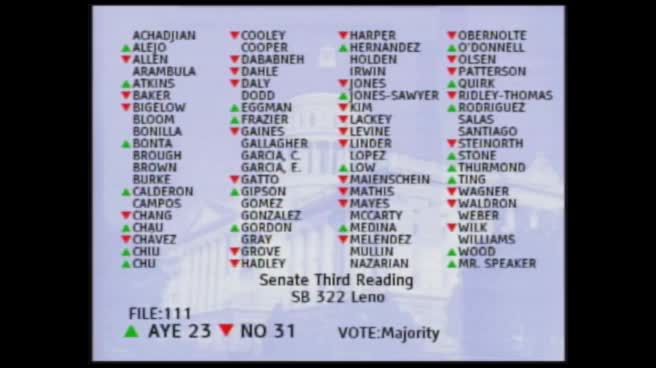 1MIN
Assembly Floor
 41SEC
Assembly Floor
 4MIN
Assembly Standing Committee on Transportation
 4MIN
Senate Floor
 3MIN
Senate Standing Committee on Energy, Utilities and Communications
 11MIN
Senate Standing Committee on Transportation and Housing
Bill Author


