SB 822: Agricultural pest control: citrus disease prevention: monthly assessment.
- Session Year: 2015-2016
- House: Senate
- Latest Version Date: 2016-09-09
Existing law creates the California Citrus Pest and Disease Prevention Committee in the Department of Food and Agriculture to, among other things, develop a statewide citrus specific pest and disease work plan.
Existing law requires producers in the citrus fruit industry to pay a monthly assessment not exceeding $0.09 per carton of citrus fruit, to be used for citrus disease management and pest control activities, which are deposited in the Citrus Disease Management Account in the Department of Food and Agriculture Fund, except as specified.
This bill would increase the maximum amount of the monthly assessment to $0.12 per carton of citrus fruit.
Existing law creates the California Citrus Pest and Disease Prevention Committee in the Department of Food and Agriculture to, among other things, develop a statewide citrus specific pest and disease work plan. Existing law provides for a monthly assessment to be paid by producers, as defined, which are deposited in the Citrus Disease Management Account in the Department of Food and Agriculture Fund. Moneys in the Citrus Disease Management Account is available upon appropriation by the Legislature for specified activities relating to citrus disease prevention.
This bill would appropriate $5,000,000 from the General Fund to the Citrus Disease Management Account in the Department of Food and Agriculture Fund, and would make those funds available for expenditure by the department, without regard to fiscal year, for the purpose of combating citrus disease or its vectors.
Existing law requires producers in the citrus fruit industry to pay a monthly assessment not exceeding $0.09 per carton of citrus fruit, to be used for citrus disease management and pest control activities, which are deposited in the Citrus Disease Management Account, except as specified.
This bill would increase the maximum amount of the monthly assessment to $0.12 per carton of citrus fruit.
(a)During the first marketing season, beginning February 1, 2010, and ending September 30, 2010, the monthly assessment to be paid by producers shall be one cent ($0.01) per carton. Thereafter, in addition to any other assessments, fees, or charges that may be required pursuant to this code, producers shall pay a monthly assessment established by the committee that shall not exceed twelve cents ($0.12) per carton. The assessment shall be:
(1)Based on the number of 40-pound carton equivalents produced.
(2)Collected from the producer by the first handler. If a producer prepares the citrus fruit for market, the producer shall be deemed the handler.
(3)Remitted to the department by the first handler, along with an assessment report, at the end of each month during the marketing season.
(4)Deposited in the Citrus Disease Management Account in the Department of Food and Agriculture Fund or, upon the recommendation of the committee, deposited in accordance with Section 227 or Article 2.5 (commencing with Section 230) of Chapter 2 of Part 1 of Division 1. The use of the funds deposited in the Citrus Disease Management Account shall be limited to the activities authorized by this article.
(b)A producer producing less than 750 40-pound carton equivalents shall not be required to remit the assessment provided in subdivision (a).
(c)The committee may recommend to the secretary an assessment less than the amount specified in subdivision (a) or no assessment if no disease prevention program is necessary or if there is sufficient reserve to operate the program, except as provided in Section 5930.
(a)There is hereby created the Citrus Disease Management Account in the Department of Food and Agriculture Fund.
(b)The Citrus Disease Management Account shall consist of money from federal, industry, and other non-General Fund sources. Money from federal, industry, and other non-General Fund sources shall be available upon appropriation by the Legislature for the sole purpose of combating citrus specific pests, diseases, and their vectors.
(c)Notwithstanding subdivision (b), the sum of five million dollars ($5,000,000) is hereby appropriated from the General Fund to the Citrus Disease Management Account in the Department of Food and Agriculture Fund, and shall be made available for expenditure by the department, without regard to fiscal year, for the purpose of combating citrus disease or its vectors.
SEC. 2.SECTION 1.Section 5919 of the Food and Agricultural Code is amended to read:5919.(a)During the first marketing season, beginning February 1, 2010, and ending September 30, 2010, the monthly assessment to be paid by producers shall be one cent ($0.01) per carton. Thereafter, in addition to any other assessments, fees, or charges that may be required pursuant to this code, producers shall pay a monthly assessment established by the committee that shall not exceed twelve cents ($0.12) per carton. The assessment shall be:
(1)Based on the number of 40-pound carton equivalents produced.
(2)Collected from the producer by the first handler. If a producer prepares the citrus fruit for market, the producer shall be deemed the handler.
(3)Remitted to the department by the first handler, along with an assessment report, at the end of each month during the marketing season.
(4)Deposited in the Citrus Disease Management Account in the Department of Food and Agriculture Fund or, upon the recommendation of the committee, deposited in accordance with Section 227 or Article 2.5 (commencing with Section 230) of Chapter 2 of Part 1 of Division 1. The use of the funds deposited in the Citrus Disease Management Account shall be limited to the activities authorized by this article.
(b)A producer producing less than 750 40-pound carton equivalents shall not be required to remit the assessment provided in subdivision (a).
(c)The committee may recommend to the secretary an assessment less than the amount specified in subdivision (a) or no assessment if no disease prevention program is necessary or if there is sufficient reserve to operate the program, except as provided in Section 5930.
(a)There is hereby created the Citrus Disease Management Account in the Department of Food and Agriculture Fund.
(b)The Citrus Disease Management Account shall consist of money from federal, industry, and other non-General Fund sources. Money from federal, industry, and other non-General Fund sources shall be available upon appropriation by the Legislature for the sole purpose of combating citrus specific pests, diseases, and their vectors.
(c)Notwithstanding subdivision (b), the sum of five million dollars ($5,000,000) is hereby appropriated from the General Fund to the Citrus Disease Management Account in the Department of Food and Agriculture Fund, and shall be made available for expenditure by the department, without regard to fiscal year, for the purpose of combating citrus disease or its vectors.
SEC. 2.Section 5919 of the Food and Agricultural Code is amended to read:5919.(a)During the first marketing season, beginning February 1, 2010, and ending September 30, 2010, the monthly assessment to be paid by producers shall be one cent ($0.01) per carton. Thereafter, in addition to any other assessments, fees, or charges that may be required pursuant to this code, producers shall pay a monthly assessment established by the committee that shall not exceed nine twelve cents ($0.09) ($0.12) per carton. The assessment shall be:
(1)Based on the number of 40-pound carton equivalents produced.
(2)Collected from the producer by the first handler. If a producer prepares the citrus fruit for market, the producer shall be deemed the handler.
(3)Remitted to the department by the first handler, along with an assessment report, at the end of each month during the marketing season.
(4)Deposited in the Citrus Disease Management Account in the Department of Food and Agriculture Fund or, upon the recommendation of the committee, deposited in accordance with Section 227 or Article 2.5 (commencing with Section 230) of Chapter 2 of Part 1 of Division 1. The use of the funds deposited in the Citrus Disease Management Account shall be limited to the activities authorized by this article.
(b)A producer producing less than 750 40-pound carton equivalents shall not be required to remit the assessment provided in subdivision (a).
(c)The committee may recommend to the secretary an assessment less than the amount specified in subdivision (a) or no assessment if no disease prevention program is necessary or if there is sufficient reserve to operate the program, except as provided in Section 5930.
|
Date
|
Status
|
|---|---|
| Sep 9, 2016 | Chaptered by Secretary of State. Chapter 279, Statutes of 2016. |
| Sep 9, 2016 | Approved by the Governor. |
| Aug 24, 2016 | Enrolled and presented to the Governor at 5 p.m. |
| Aug 19, 2016 | In Senate. Ordered to engrossing and enrolling. |
| Aug 18, 2016 | Read third time. Passed. (Ayes 77. Noes 0. Page 5903.) Ordered to the Senate. |
| Aug 18, 2016 | Read third time. Passed. Ordered to the Senate. |
| Aug 11, 2016 | From consent calendar on motion of Assembly Member Waldron. |
| Aug 11, 2016 | Ordered to third reading. |
| Aug 11, 2016 | From consent calendar on motion of Assembly Member Cooper. |
| Aug 4, 2016 | Read second time. Ordered to consent calendar. |
| Aug 3, 2016 | From committee: Do pass. Ordered to consent calendar. (Ayes 20. Noes 0.) (August 3). |
| Jun 29, 2016 | From committee: Do pass and re-refer to Com. on APPR. (Ayes 9. Noes 0.) (June 29). Re-referred to Com. on APPR. |
| Jun 29, 2016 | From committee: Do pass and re-refer to Com. on APPR. with recommendation: To consent calendar. (Ayes 9. Noes 0.) (June 29). Re-referred to Com. on APPR. |
| Jun 9, 2016 | Referred to Com. on AGRI. |
| Jun 2, 2016 | In Assembly. Read first time. Held at Desk. |
| Jun 1, 2016 | Read third time. Passed. (Ayes 38. Noes 1. Page 4089.) Ordered to the Assembly. |
| Jun 1, 2016 | Read third time. Passed. (Ayes 38. Noes 1.) Ordered to the Assembly. |
| May 31, 2016 | Read second time and amended. Ordered to third reading. |
| May 27, 2016 | From committee: Do pass as amended. (Ayes 7. Noes 0. Page 3998.) (May 27). |
| May 27, 2016 | From committee: Do pass as amended. (Ayes 7. Noes 0.) (May 27). |
| May 20, 2016 | Set for hearing May 27. |
| Apr 11, 2016 | April 11 hearing: Placed on APPR. suspense file. |
| Apr 1, 2016 | Set for hearing April 11. |
| Mar 29, 2016 | From committee: Do pass and re-refer to Com. on APPR. (Ayes 4. Noes 0. Page 3310.) (March 29). Re-referred to Com. on APPR. |
| Mar 29, 2016 | From committee: Do pass and re-refer to Com. on APPR. (Ayes 4. Noes 0.) (March 29). Re-referred to Com. on APPR. |
| Mar 15, 2016 | Set for hearing March 29. |
| Jan 28, 2016 | Referred to Com. on AGRI. |
| Jan 6, 2016 | From printer. May be acted upon on or after February 5. |
| Jan 5, 2016 | Introduced. Read first time. To Com. on RLS. for assignment. To print. |
|
Date
|
Description
|
Location
|
Votes
|
|
|---|---|---|---|---|
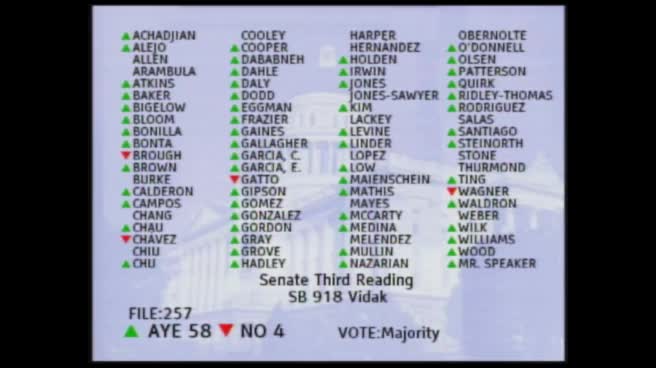
| Aug 18, 2016 | SB 822 Roth Senate Third Reading By MATHIS | Assembly Floor |
Passed |
|
| Aug 3, 2016 | Do pass. To Consent Calendar. | Assembly Standing Committee on Appropriations |
Passed |
|
| Jun 29, 2016 | Do pass and be re-referred to the Committee on [Appropriations] | Assembly Standing Committee on Agriculture |
Passed |
|
| Jun 1, 2016 | Senate 3rd Reading SB822 Roth | Senate Floor |
Passed |
|
| May 27, 2016 | Do pass as amended | Senate Standing Committee on Appropriations |
Passed |
|
| Apr 11, 2016 | Placed on suspense file | Senate Standing Committee on Appropriations |
Passed |
|
| Mar 29, 2016 | Do pass, but first be re-referred to the Committee on [Appropriations] | Senate Standing Committee on Agriculture |
Passed |
This list shows positions taken on this bill by organizations on the date displayed, which is linked to the original source.
Positions by individuals are not included.
SENATE THIRD READING
STR Bill Id:SB 822
Author:(Roth)
As Amended Ver:May 31, 2016
Majority vote
SENATE VOTE: 38-1
Committee | Votes | Ayes | Noes |
Agriculture | 9-0 | Dodd, Mathis, Eggman, Gray, Grove, Irwin, Jones-Sawyer, Quirk, Salas | |
Appropriations | 20-0 | Gonzalez, Bigelow, Bloom, Bonilla, Bonta, Calderon, Chang, Daly, Eggman, Gallagher, Eduardo Garcia, Holden, Jones, Obernolte, Quirk, Santiago, Wagner, Weber, Wood, Chau |
|
SUMMARY: Increases the maximum monthly citrus assessment fee from $0.09 to $0.12 cents per 40 pound carton.
EXISTING LAW: Establishes the California Citrus Pest and Disease Prevention Committee (CCPDPC) within the California Department of Food and Agriculture (CDFA) to advise the Secretary of CDFA on efforts to prevent and manage citrus pests and diseases. An assessment is levied on citrus producers and deposited into the Citrus Disease Management Account (Account) for the sole purpose of combating citrus-specific pests and diseases. The Account may also contain funds from federal and other non-General Fund (GF) sources. The current assessment rate is $0.09 per 40 pound carton, which amounts to $15 million annually and represents more than half of the total budget for this program.
FISCAL EFFECT: According to the Assembly Appropriations Committee, this bill has an estimated revenue increase of up to approximately $5 million annually from increased assessments fees (Special Fund).
COMMENTS: Citrus is a $2 billion industry in the State of California. California produces 82% of the United States' fresh citrus and directly employs more than 14,000 people. It contributes an additional $1.2 billion in economic value to the state and supports another 10,000 jobs.
In March of 2012, Huanglongbing (HLB) was found in a Los Angeles-area backyard. HLB is a bacterial plant disease that destroys the production, appearance and value of citrus trees, ruining the citrus. HLB is spread mainly by the Asian Citrus Psyllid (ACP). To date there is no known controls for HLB other than removing and destroying infected groves. After a 2005 discovery in Florida, it took only two years for HLB to transmit to all 32 Florida citrus-producing counties and infect over half of the citrus trees in that state.
The CCPDPC is funded by the California citrus industry and federal grants. Of the $25 million annual budget, roughly $15 million is funded through the $0.09 per carton assessment fee and $10 million through USDA. However, this year, the federal government approved an additional $2 million in funding that will be used to increase psyllid detection and trapping in the San Joaquin Valley. The CCPDPC received a one-time $1 million appropriation from the General Fund (GF) in Fiscal Year 2013-14; however, no other monies from California's GF have been appropriated.
Over half of all citrus trees in California are located in residential backyards. Currently, $12 million of the industry-assessed fees are being used to detect and trap ACP and remove HLB-infected citrus trees in the Los Angeles Basin, the area of greatest infestation. None of the assessment fees are currently being used to treat commercial citrus groves.
According to the author, this bill will provide much needed funding to continue to combat the spread and devastating effects of HLB on California's citrus industry.
RELATED LEGISLATION
AB 862 (Agriculture), Chapter 374, Statutes of 2015, specified that all expenditures incurred by CDFA be reimbursed by the Citrus Disease Management Account.
SB 1018 (De León), Chapter 924, Statutes of 2014, required the Secretary of CDFA to notify the CCPDPC for any changes to program activities or increases in expenditures, and specified that only reasonable, rather than all, expenditures incurred by CDFA be reimbursed by the program's funding account.
AB 571 (Gatto) of 2013, would have appropriated $5 million from the GF to the Citrus Disease Management Account within the CDFA Fund for the purposes of combating citrus disease or its vectors. This bill was vetoed by the Governor.
AB 604 (De León), Chapter 17, Statutes of 2010, authorized CDFA to spend any monies it had collected in the Citrus Disease Management Account on citrus specific pest and disease programs through June 30, 2010.
AB 281 (De León), Chapter 426, Statutes of 2009, established CCPDPC and the Citrus Disease Management Account within CDFA to prevent and manage citrus pests and diseases. The Account shall consist of money from industry assessment fees but may also include federal and other non-GF sources.
Analysis Prepared by: Victor Francovich / AGRI. / (916) 319-2084 FN: 0003976
Date of Hearing: August 3, 2016
ASSEMBLY COMMITTEE ON APPROPRIATIONS
Lorena Gonzalez, Chair
SBPCA Bill Id:SB 822
Author:(Roth) – As Amended Ver:May 31, 2016
Policy Committee: | Agriculture | Vote: | 9 - 0 |
Urgency: No State Mandated Local Program: No Reimbursable: No
SUMMARY:
This bill increases the maximum monthly citrus assessment fee to be deposited into the Citrus Disease Management Account from $0.09 to $0.12 cents per 40 pound carton of citrus fruit
FISCAL EFFECT:
Estimated revenue increase of up to approximately $5 million annually from increased assessments fees (Special Fund).
COMMENTS:
- Purpose. According to the author, SB 822 will provide necessary funding to continue to combat the spread of a harmful disease and help protect California’s citrus industry.
- HLB and ACP. Huanglongbing, also known as citrus greening disease, is a bacterial plant disease that, while not harmful to humans or animals, is fatal for citrus trees. The disease destroys citrus trees’ production, appearance and economic value. Diseased trees produce hard, bitter, misshapen fruit, and the trees typically die within 3-5 years of being infected. HLB is considered to be one of the most serious plant diseases in the world and currently there is no cure. Infected plants must be removed and destroyed in order to prevent further spread of HLB.
HLB is spread by the Asian citrus psyllid, a tiny, invasive insect that feeds on the leaves and stems of citrus trees and causes shoot deformation and plant stunting. When an ACP feeds on an HLB-infected tree, it can pick up the bacteria that cause the disease. Once infected, ACP carries the disease-causing bacteria for life and can transfer the disease when feeding on other citrus trees.
In 2008, ACP was first identified in Southern California and has since spread rapidly such that quarantine boundaries now comprise one-third of the State. In March 2012, HLB was detected in a multi-grafted citrus tree in a residential portion of Los Angeles County. The tree was destroyed; however, the disease was detected again in 2015 in 22 trees located in the surrounding areas. The new finds and the rapid migration of the disease-carrying insect have increased CDFA’s surveillance, trapping, and analytical workloads.
- Current industry assessments. An assessment is levied on citrus producers and deposited into the Citrus Disease Management Account for the sole purpose of combating citrus-specific pests and diseases. This account may also contain funds from federal and other non-General Fund (GF) sources. The current assessment rate is $0.09 per 40 pound carton, which amounts to $15 million annually and represents more than half of the total budget for this program.
Analysis Prepared by: Luke Reidenbach / APPR. / (916) 319-2081
Date of Hearing: June 29, 2016
ASSEMBLY COMMITTEE ON AGRICULTURE
Bill Dodd, Chair
SBPCA Bill Id:SB 822
Author:(Roth) – As Amended Ver:May 31, 2016
SENATE VOTE: 38-1
SUBJECT: Agricultural pest control: citrus disease prevention: monthly assessment.
SUMMARY: This bill increases the maximum monthly citrus assessment fee from $0.09 to $0.12 cents per 40 pound carton.
EXISTING LAW: Establishes the California Citrus Pest and Disease Prevention Committee (CCPDPC) within the California Department of Food and Agriculture (CDFA) to advise the Secretary of CDFA on efforts to prevent and manage citrus pests and diseases. An assessment is levied on citrus producers and deposited into the Citrus Disease Management Account for the sole purpose of combating citrus-specific pests and diseases. This account may also contain funds from federal and other non-General Fund (GF) sources. The current assessment rate is $0.09 per 40 pound carton, which amounts to $15 million annually and represents more than half of the total budget for this program.
FISCAL EFFECT: According to the Senate Committee on Appropriations, this bill would increase the citrus industry assessed fee authority by $0.03 per carton, from $0.09 to $0.12. If the fee were raised to the maximum level, revenues would annually increase by roughly $5 million in special funds.
COMMENTS: Citrus is a $2 billion industry in the state of California. California produces 82% of the United States' fresh citrus and directly employs more than 14,000 people. It contributes an additional $1.2 billion in economic value to the state and supports another 10,000 jobs.
In March of 2012, Huanglongbing (HLB) was found in a Los Angeles-area backyard. HLB is a bacterial plant disease that destroys the production, appearance and value of citrus trees, ruining the citrus. HLB is spread mainly by the Asian citrus psyllid (ACP). To date there is no known controls for HLB other than removing and destroying infected groves. After a 2005 discovery in
Florida, it took only two years for HLB to transmit to all 32 Florida citrus producing counties
and infect over half of the citrus trees in that state.
The CCPDPC is funded by the California citrus industry and federal grants. Of the $25 million annual budget, roughly $15 million is funded through the $0.09 per carton assessment fee and $10 million through USDA. However, this year, the federal government approved an additional $2 million in funding that will be used to increase psyllid detection and trapping in the San Joaquin Valley. The CCPDPC received a one-time $1 million appropriation from the GF in FY 2013-14; however, no other monies from California’s GF have been appropriated.
Over half of all citrus trees in California are located in residential backyards. Currently, $12 million of the industry-assessed fees are being used to detect and trap ACP and remove HLB-infected citrus trees in the Los Angeles Basin, the area of greatest infestation. None of the assessment fees are currently being used to treat commercial citrus groves.
According to the author, this bill will provide much needed funding to continue to combat the spread and devastating effects of HLB on California’s citrus industry.
RELATED LEGISLATION
:
AB 862 (Agriculture), Chapter 374, Statutes of 2015, specified that all expenditures incurred by CDFA be reimbursed by the Citrus Disease Management Account.
SB 1018 (De León), Chapter 924, Statutes of 2014, required the Secretary of CDFA to notify the CCPDPC for any changes to program activities or increases in expenditures, and specified that only reasonable, rather than all, expenditures incurred by CDFA be reimbursed by the program’s funding account.
AB 571 (Gatto) of 2013, would have appropriated $5 million from the GF to the Citrus Disease Management Account within the CDFA Fund for the purposes of combating citrus disease or its vectors. This bill was vetoed by the Governor.
AB 604 (De León and Fuller), Chapter 17, Statutes of 2010, authorized CDFA to spend any monies it had collected in the Citrus Disease Management Account on citrus specific pest and disease programs through June 30, 2010.
AB 281 (De León), Chapter 426, Statutes of 2009, established CCPDPC and the Citrus Disease Management Account within CDFA to prevent and manage citrus pests and diseases. The Account shall consist of money from industry assessment fees but may also include federal and other non-GF sources.
REGISTERED SUPPORT / OPPOSITION:
Support
California Citrus Mutual (Sponsor)
Southwest California Legislative Council
Western Growers Association
Opposition
None on file.
Analysis Prepared by: Victor Francovich / AGRI. / (916) 319-2084
Office of Senate Floor Analyses (916) 651-1520 Fax: (916) 327-4478 | SB 822 |
THIRD READING
Bill No: SB 822
Amended: 5/31/16
SENATE AGRICULTURE COMMITTEE: 4-0, 3/29/16
AYES: Galgiani, Cannella, Pan, Wolk
NO VOTE RECORDED: Berryhill
SENATE APPROPRIATIONS COMMITTEE: 7-0, 5/27/16
AYES: Lara, Bates, Beall, Hill, McGuire, Mendoza, Nielsen
SUBJECT: Agricultural pest control: citrus disease prevention: monthly assessment
SOURCE: California Citrus Mutual
DIGEST: This bill increases the maximum monthly citrus assessment fee from $0.09 to $0.12 cents per 40 pound carton.
ANALYSIS: Existing law requires producers in the citrus fruit industry to pay a monthly assessment not exceeding $0.09 per carton of citrus fruit, to be used for citrus disease management and pest control activities, which are deposited in the Citrus Disease Management Account, except as specified.
This bill increases the monthly citrus assessment fee from $0.09 to $0.12 per 40 pound carton.
Background
California is the top-producing agricultural state in the nation with $54 billion in agricultural commodity value in 2014. California is also a top producer of citrus fruits and is ranked second only to Florida in citrus production but first in citrus product sold fresh to market. According to the most recent census, in 2012, the $2.1 billion California citrus industry grew nearly 4 million tons of citrus on 270,000 acres and provided more than 14,000 jobs.
Existing law establishes the California Citrus Pest and Disease Prevention Committee (CCPDPC) within the California Department of Food and Agriculture (CDFA) to advise the secretary of CDFA on efforts to prevent and manage citrus pests and diseases. An assessment is levied on citrus producers and deposited into the Citrus Disease Management Account for the sole purpose of combating citrus-specific pests and diseases. This account may also contain funds from federal and other non-General Fund sources. The current assessment rate is $0.09 per 40 pound carton, which amounts to $15 million annually and represents more than half of the total budget for this program (AB 281, De León, Chapter 426, Statutes of 2009; Food and Agricultural Code §5911 et seq.).
Asian citrus psyllid (ACP) is an invasive pest that feeds on citrus plants’ leaves and stems and causes shoot deformation and plant stunting. More importantly, ACP may transmit Huanglongbing (HLB), a bacterial plant disease that causes the plant to produce unpalatable/inedible fruit before ultimately killing the tree. According to CDFA, HLB is the most devastating disease of citrus in the world. There is no cure and infected plants must be destroyed.
The first discovery of ACP and HLB in the United States was in Florida in 1998 and early September 2005, respectively. Within 2 years, the disease HLB spread to all citrus-producing counties and infected over half of all citrus trees in the state. Studies have shown that the economic damage due to HLB in Florida alone has resulted in a loss of $7.8 billion and 7,513 jobs since 2007, reducing the industry to nearly a quarter of the size it once was. The disease HLB has also been detected in Georgia, Louisiana, South Carolina, Texas, and most recently, California.
In 2008, the pest ACP was first identified in Southern California. In in the last two years, ACP has rapidly spread north into commercial citrus groves and residential trees, and quarantine boundaries have expanded to encompass one-third of the state. Meanwhile, in March 2012, HLB was detected in a residential, multi-grafted citrus tree in Los Angeles County. The tree was destroyed, however the disease was detected again in 2015 in 17 trees located in the surrounding areas. The new finds and the rapid northern migration is a cause of great concern, raising CDFA’s surveillance, trapping, and analytical workloads.
According to the University of California, Agriculture and Natural Resources (UCANR), the citrus industry, the University of California, and both the state and federal governments are working to eliminate and prevent the establishment of ACP and HLB in California. Much of the research is conducted with funding from the citrus industry through the Citrus Research Board, UCANR, CDFA Specialty Crops Block Grants, and the United States Department of Agriculture - National Institute of Food and Agriculture (USDA-NIFA).
The Agricultural Act of 2014 (H.R. 2642) was signed into law on February 7, 2014, and directs $125 million of the USDA Specialty Crop Research Initiative funding toward citrus disease research over the next 5 years. In FY 2015, the federal government awarded $20 million in grants nationwide to university researchers and extension projects to aid in the fight against HLB.
Comments
Funding sources. The CCPDPC is funded by the California citrus industry and federal grants. Of the $25 million annual budget, roughly $15 million is funded through the $0.09 per carton assessment fee and $10 million through the United States Department of Agriculture. However, this year, the federal government approved an additional $2 million in funding that will be used to increase psyllid detection and trapping in the San Joaquin Valley. The CCPDPC received a one-time $1 million appropriation from the General Fund in FY 2013-14 (AB 110, Statutes of 2013), however no other monies from California’s General Fund have been appropriated.
Budget request. The Senate Budget Subcommittee No. 2 approved a General Fund allocation of $5 million to CDFA for Asian citrus psyllid control, where $4.25 million is dedicated for residential application and $750,000 for an interagency agreement with the Department of Pesticide Regulation to provide a consumer product database for a residential level study of the impacts of neonicotinoid-treated seed and plants sold at the retail level.
Residential citrus. Over half of all citrus trees in California are located in residential backyards. Currently, $12 million of the industry-assessed fees are being used to detect and trap ACP and remove HLB-infected citrus trees in the Los Angeles Basin, the area of greatest infestation. None of the assessment fees are currently being used to treat commercial citrus groves.
FISCAL EFFECT: Appropriation: No Fiscal Com.: Yes Local: No
According to the Senate Appropriations Committee:
The bill would increase citrus industry assessed fee authority by $0.03 per carton, from $0.09 to $0.12. If the fee were raised to the maximum level, revenues would increase by roughly $5 million annually (special fund).
California Citrus Mutual (source)
Southwest California Legislative Council
Western Growers Association
OPPOSITION: (Verified 5/31/16)
None received
ARGUMENTS IN SUPPORT: According to the author, “SB 822 will provide much needed funding to continue to combat the spread and devastating effects of Huanglongbing (HLB) on California’s citrus industry. Florida has already lost approximately $7.8 billion in revenue, 162,000 citrus acres, and 7,513 jobs to HLB and similar impacts are being seen in Texas. While California’s citrus industry has slowed the spread of the disease by raising $15 million per year for trapping and treatments, it is not enough. SB 822 seeks to increase the assessment on citrus growers to raise up to an additional $5 million […] to help protect California’s $3 billion citrus industry, 22,000 jobs and countless residential citrus trees so important to California’s rich history.”
Prepared by: Anne Megaro / AGRI. / (916) 651-1508
5/31/16 20:45:33
**** END ****
SENATE COMMITTEE ON APPROPRIATIONS
Senator Ricardo Lara, Chair
2015 - 2016 Regular Session
SB 822 (Roth) - Agricultural pest control: citrus disease prevention
Version: January 5, 2016 | Policy Vote: AGRI. 4 - 0 |
Urgency: No | Mandate: No |
Hearing Date: May 27, 2016 | Consultant: Robert Ingenito |
Bill Summary: SB 822 would (1) appropriate $5 million from the General Fund to the Citrus Disease Management Account within the California Department of Food and Agriculture (CDFA) to combat citrus disease or its vectors, and (2) increase the maximum citrus industry assessment fee from $0.09 to $0.12 per 40-pound carton.
*********** ANALYSIS ADDENDUM – SUSPENSE FILE ***********
The following information is revised to reflect amendments
adopted by the committee on May 27, 2016
Fiscal Impact:
The bill would increase citrus industry assessed fee authority by $0.03 per carton, from $0.09 to $0.12. If the fee were raised to the maximum level, revenues would increase by roughly $5 million annually (special fund).
Author Amendments:
Delete the $5 million appropriation.
-- END --
SENATE COMMITTEE ON
Senator Ricardo Lara, Chair
2015 - 2016 Regular Session
SB 822 (Roth) - Agricultural pest control: citrus disease prevention
Version: | Policy Vote: |
Urgency: | Mandate: |
Hearing Date: | Consultant: |
This bill meets the criteria for referral to the Suspense File.
Bill Summary: SB 822 would (1) appropriate $5 million from the General Fund to the Citrus Disease Management Account within the California Department of Food and Agriculture (CDFA) to combat citrus disease or its vectors, and (2) increase the maximum citrus industry assessment fee from $0.09 to $0.12 per 40-pound carton (carton).
Fiscal Impact:
- The bill would make a $5 million General Fund appropriation on a one-time basis, which would be available over multiple fiscal years.
- The bill would increase citrus industry assessed fee authority by $0.03 per carton, from $0.09 to $0.12. If the fee were raised to the maximum level, revenues would increase by roughly $5 million annually.
Background: Citrus is a $2 billion industry in California. The State produces roughly one-third of the nation’s fresh citrus on roughly 270,000 acres, and directly employs in excess of than 14,000 people.
Huanglongbing (HLB), also known as citrus greening disease, is a bacterial plant disease that, while not harmful to humans or animals, is fatal for citrus trees. The disease destroys citrus trees’ production, appearance and economic value. Diseased trees produce hard, bitter, misshapen fruit, and the trees typically die within 3-5 years of being infected. HLB is considered to be one of the most serious plant diseases in the world and currently there is no cure. According to CDFA, HLB is the most devastating disease of citrus in the world, affecting citrus in Asia, Africa, Brazil, Central America, as well as the United States. Infected plants must be removed and destroyed in order to prevent further spread of HLB.
HLB is spread by the Asian citrus psyllid (ACP), a tiny, invasive insect that feeds on the leaves and stems of citrus trees and causes shoot deformation and plant stunting. When an ACP feeds on an HLB-infected tree, it can pick up the bacteria that causes the disease. Once infected, ACP carries the disease-causing bacteria for life and can transfer the disease when feeding on other citrus trees.
After a 2005 discovery in Florida, it took only two years for HLB to transmit to all 32 Florida citrus-producing counties and infect over half of the citrus tree in that state. Studies conclude that HLB-related economic damage in Florida has resulted in a loss of roughly $8 billion and 8,000 jobs over the last five years. Additionally, HLB has since been detected in Georgia, Louisiana, South Carolina, and Texas.
In 2008, ACP was first identified in Southern California and has since spread rapidly such that quarantine boundaries now comprise one-third of the State. In March 2012, HLB was detected in a multi-grafted citrus tree in a residential portion of Los Angeles County. The tree was destroyed; however, the disease was detected again in 2015 in 17 trees located in the surrounding areas. The new finds and the rapid migration of the disease-carrying insect have increased CDFA’s surveillance, trapping, and analytical workloads.
Proposed Law: This bill would (1) appropriate $5 million from the General Fund to the Citrus Disease Management Account within the California Department of Food and Agriculture (CDFA) to combat citrus disease or its vectors, and (2) increase the maximum citrus assessment fee from $0.09 to $0.12 per carton.
Related Legislation:
- AB 571 (Gatto, 2013) This bill would have appropriated $5 million from the General Fund to the Citrus Disease Management Account within the California Department of Food and Agriculture Fund for the purposes of combating citrus disease or its vectors. The bill was vetoed by the Governor.
- AB 604 (De León and Fuller) Chapter 17, Statutes of 2010. Authorizes CDFA to spend any monies it had collected in the Citrus Disease Management Account on citrus specific pest and disease programs through June 30, 2010.
- AB 281 (De León) Chapter 426, Statutes of 2009. Establishes the California Citrus Pest and Disease Prevention Committee and the Citrus Disease Management Account within CDFA to prevent and manage citrus pests and diseases. The Account shall consist of money from industry assessment fees but may also include federal and other non-General Fund sources.
Staff Comments: Current law establishes the California Citrus Pest and Disease Prevention Committee (CCPDPC) within CDFA to advise on efforts to prevent and manage citrus pests and diseases. CCPDPC is generally funded by (1) the California citrus industry, and (2) federal grants. An assessment is levied on citrus producers and deposited into the Citrus Disease Management Account for the sole purpose of combating citrus-specific pests and diseases. The current assessment rate is the statutory maximum of $0.09 per carton. Assessment revenues have averaged $15 million over the last five years, and represent more than half of the total budget for program.
Additionally, $10 million dollars has been provided annually in recent years through a grant from the United States Department of Agriculture. However, this year, the federal government approved an additional $2 million in funding that will be used to increase ACP detection and trapping in the San Joaquin Valley.
CCPDPC received a one-time $1 million General Fund appropriation in 2013-14. This bill would increase funding by an additional $5 million (General Fund). Additionally, if the industry assessment were raised to $0.12 cents per carton, fee revenues would increase by roughly $5 million annually, based on 2014-15 production levels.
Currently, $12 million of the industry-assessed fees are being used to detect and trap ACP and remove HLB-infected citrus trees in the Los Angeles Basin, the area of greatest infestation. None of the assessment fees are currently being used to treat commercial citrus groves.
-- END --
SENATE COMMITTEE ON AGRICULTURE
Senator Cathleen Galgiani, Chair
2015 - 2016 Regular
Bill No: SB 822 Hearing Date: 3/29/16
Author: | Roth | ||
Version: | 1/5/16 Introduced | ||
Urgency: | No | Fiscal: | Yes |
Consultant: | Anne Megaro | ||
Subject: Agricultural pest control: citrus disease prevention
SUMMARY
:
This bill would appropriate $5 million from the General Fund to the Citrus Disease Management Account within the California Department of Food and Agriculture Fund for the purpose of combating citrus disease or its vectors. This bill would also increase the monthly citrus assessment fee from $0.09 to $0.12 per 40 pound carton.
BACKGROUND AND EXISTING LAW
:
California is the top-producing agricultural state in the nation with $54 billion in agricultural commodity value in 2014. California is also a top producer of citrus fruits and is ranked second only to Florida in citrus production but first in citrus product sold fresh to market. According to the most recent census, in 2012, the $2.1 billion California citrus industry grew nearly 4 million tons of citrus on 270,000 acres and provided more than 14,000 jobs.
Existing law establishes the California Citrus Pest and Disease Prevention Committee (CCPDPC) within the California Department of Food and Agriculture (CDFA) to advise the secretary of CDFA on efforts to prevent and manage citrus pests and diseases. An assessment is levied on citrus producers and deposited into the Citrus Disease Management Account for the sole purpose of combating citrus-specific pests and diseases. This account may also contain funds from federal and other non-General Fund sources. The current assessment rate is $0.09 per 40 pound carton, which amounts to $15 million annually and represents more than half of the total budget for this program (AB 281, Statutes of 2009; Food and Agricultural Code §5911 et seq.).
Asian citrus psyllid (ACP) is an invasive pest that feeds on citrus plants’ leaves and stems and causes shoot deformation and plant stunting. More importantly, ACP may transmit Huanglongbing (HLB), a bacterial plant disease that causes the plant to produce unpalatable/inedible fruit before ultimately killing the tree. According to CDFA, HLB is the most devastating disease of citrus in the world. There is no cure and infected plants must be destroyed.
The first discovery of ACP and HLB in the United States was in Florida in 1998 and early September 2005, respectively. Within 2 years, the disease HLB spread to all citrus-producing counties and infected over half of all citrus trees in the state. Studies have shown that the economic damage due to HLB in Florida alone has resulted in a loss of $7.8 billion and 7,513 jobs since 2007, reducing the industry to nearly a quarter of the size it once was. The disease HLB has also been detected in Georgia, Louisiana, South Carolina, Texas, and most recently, California.
In 2008, the pest ACP was first identified in Southern California. In in the last two years, ACP has rapidly spread north into commercial citrus groves and residential trees, and quarantine boundaries have expanded to encompass one-third of the state. Meanwhile, in March 2012, HLB was detected in a residential, multi-grafted citrus tree in Los Angeles County. The tree was destroyed, however the disease was detected again in 2015 in 17 trees located in the surrounding areas. The new finds and the rapid northern migration is a cause of great concern, raising CDFA’s surveillance, trapping, and analytical workloads.
According to the University of California, Agriculture and Natural Resources (UCANR), the citrus industry, the University of California, and both the state and federal governments are working to eliminate and prevent the establishment of ACP and HLB in California. Much of the research is conducted with funding from the citrus industry through the Citrus Research Board, UCANR, CDFA Specialty Crops Block Grants, and the United States Department of Agriculture - National Institute of Food and Agriculture (USDA-NIFA).
The Agricultural Act of 2014 (H.R. 2642) was signed into law on February 7, 2014, and directs $125 million of the USDA Specialty Crop Research Initiative funding toward citrus disease research over the next 5 years. In FY 2015, the federal government awarded $20 million in grants nationwide to university researchers and extension projects to aid in the fight against HLB.
PROPOSED LAW
:
This bill:
- Appropriates $5 million from the General Fund to the Citrus Disease Management Account within the Department of Food and Agriculture Fund for the purpose of combating citrus disease or its vectors.
- Increases the monthly citrus assessment fee from $0.09 to $0.12 per 40 pound carton.
ARGUMENTS IN SUPPORT:
According to the author, “SB 822 will provide much needed funding to continue to combat the spread and devastating effects of Huanglongbing (HLB) on California’s citrus industry. Florida has already lost approximately $7.8 billion in revenue, 162,000 citrus acres, and 7,513 jobs to HLB and similar impacts are being seen in Texas. While California’s citrus industry has slowed the spread of the disease by raising $15 million per year for trapping and treatments, it is not enough. SB 822 seeks to increase the assessment on citrus growers to raise up to an additional $5 million and provide an appropriation from the General Fund to help protect California’s $3 billion citrus industry, 22,000 jobs and countless residential citrus trees so important to California’s rich history.”
COMMENTS
:
Vetoed: Governor Brown vetoed a similar bill in 2013, AB 571 (Gatto), stating “While I am acutely aware of the devastating effects of the Asian citrus psyllid and its vector Huanglongbing, this program has mostly been funded by the citrus industry and the federal government. If the current support is inadequate, let's review our options during the budget process.”
Funding sources: The CCPDPC is funded by the California citrus industry and federal grants. Of the $25 million annual budget, roughly $15 million is funded through the $0.09 per carton assessment fee and $10 million through the United States Department of Agriculture. However, this year, the federal government approved an additional $2 million in funding that will be used to increase psyllid detection and trapping in the San Joaquin Valley. The CCPDPC received a one-time $1 million appropriation from the General Fund in FY 2013-14 (AB 110, Statutes of 2013), however no other monies from California’s General Fund have been appropriated.
Residential citrus: Over half of all citrus trees in California are located in residential backyards. Currently, $12 million of the industry-assessed fees are being used to detect and trap ACP and remove HLB-infected citrus trees in the Los Angeles Basin, the area of greatest infestation. None of the assessment fees are currently being used to treat commercial citrus groves.
RELATED LEGISLATION
:
AB 862 (Agriculture) Chapter 374, Statutes of 2015. Among other provisions, specifies that all expenditures incurred by CDFA be reimbursed by the Citrus Disease Management Account.
SB 1018 (De León) Chapter 924, Statutes of 2014. Requires the Secretary of CDFA to notify the CCPDPC for any changes to program activities or increases in expenditures, and specifies that only reasonable, rather than all, expenditures incurred by CDFA be reimbursed by the program’s funding account.
AB 571 (Gatto). Vetoed, 2013. This bill would have appropriated $5 million from the General Fund to the Citrus Disease Management Account within the California Department of Food and Agriculture Fund for the purposes of combating citrus disease or its vectors.
AB 604 (De León and Fuller) Chapter 17, Statutes of 2010. Authorizes CDFA to spend any monies it had collected in the Citrus Disease Management Account on citrus specific pest and disease programs through June 30, 2010.
AB 281 (De León) Chapter 426, Statutes of 2009. Establishes the California Citrus Pest and Disease Prevention Committee and the Citrus Disease Management Account within CDFA to prevent and manage citrus pests and diseases. The Account shall consist of money from industry assessment fees but may also include federal and other non-General Fund sources.
SUPPORT
:
California Citrus Mutual (Sponsor)
Southwest California Legislative Council
Western Growers Association
OPPOSITION
:
None received
-- END --
Discussed in Hearing
 1H
Assembly Standing Committee on Privacy and Consumer Protection
 1H
Assembly Standing Committee on Communications and Conveyance
 46SEC
Assembly Floor
 3MIN
Senate Floor
Bill Author

Bill Co-Author(s):