SB 868: State Remote Piloted Aircraft Act.
- Session Year: 2015-2016
- House: Senate
- Latest Version Date: 2016-05-31
Existing federal law, the FAA Modernization and Reform Act of 2012, provides for the integration of civil unmanned aircraft systems, commonly known as drones, into the National Airspace System. Existing federal law generally requires an aircraft to be registered with the Federal Aviation Administration (FAA), prohibits a person from operating a United States registered aircraft unless that aircraft displays specified nationality and registration marks, and, unless authorized by the FAA, prohibits a person from placing on any aircraft a design, mark, or symbol that modifies or confuses those nationality and registration marks.
The State Aeronautics Act governs various matters relative to aviation in the state, including, among other things, fostering and promoting safety in aeronautics and establishing only those regulations that are essential and clearly within the scope of the authority granted to the Department of Transportation by the Legislature, in order that persons may engage in every phase of aeronautics with the least possible restriction consistent with the safety and the rights of others. A violation of the act is a crime punishable by a fine of not more than $1,000 or by imprisonment of not more than 6 months, or both.
Existing law establishes the Office of Emergency Services in the office of the Governor and makes the Office of Emergency Services responsible for the states emergency and disaster response services for natural, technological, or manmade disasters and emergencies.
This bill would enact the State Remote Piloted Aircraft Act. The bill would establish conditions for operating remote piloted aircraft, including the procurement of maintaining liability insurance or proof of financial responsibility. The bill would authorize the department to adopt rules and regulations governing the conditions under which remote piloted aircraft may be operated for the purpose of protecting and ensuring the general public interest and safety and the safety of persons operating remote piloted aircraft. The bill would authorize the Office of Emergency Services to adopt rules and regulations and to make and amend general or special rules, orders, and procedures with respect to operating a remote piloted aircraft in certain circumstances, including operating a remote piloted aircraft within 500 feet of critical infrastructure. The bill would prohibit the operation of remote piloted aircraft within 500 feet of critical infrastructure and in other specified areas, subject to exceptions, and would prohibit certain ways of operating remote piloted aircraft.
The bill would authorize the department to make and amend general or special rules, orders, and procedures, and establish minimum standards consistent with the act as it deems necessary, to assist political subdivisions and their law enforcement agencies, and to enter into any contracts necessary to the execution of its powers pursuant to the act, as specified. The bill would provide that an officer or employee designated by the Director of Transportation to exercise certain powers of arrest, as specified, and any state or peace officer charged with the enforcement of state and local laws or ordinances, ordinances may enforce and assist in the enforcement of the act, any rules or orders issued under the act, and all other state laws applicable to remote piloted aircraft or unmanned aircraft systems. The bill would provide that remedies provided by the act are cumulative with any other remedies available under law. The bill would provide that the provisions of the act are severable. The bill would make a violation of any provision of the act or any rule or order issued pursuant to the act punishable as an infraction with a fine not exceeding $250, or as a misdemeanor punishable by imprisonment in a county jail not exceeding 6 months, or by a fine not exceeding $1,000, or by both that fine and imprisonment.
Because the bill would create new crimes, the bill would impose a state-mandated local program.
The California Constitution requires the state to reimburse local agencies and school districts for certain costs mandated by the state. Statutory provisions establish procedures for making that reimbursement.
This bill would provide that no reimbursement is required by this act for a specified reason.
Existing federal law, the FAA Modernization and Reform Act of 2012, provides for the integration of civil unmanned aircraft systems, commonly known as drones, into the National Airspace System. Existing federal law generally requires an aircraft to be registered with the Federal Aviation Administration (FAA), prohibits a person from operating a United States registered aircraft unless that aircraft displays specified nationality and registration marks, and, unless authorized by the FAA, prohibits a person from placing on any aircraft a design, mark, or symbol that modifies or confuses those nationality and registration marks.
The State Aeronautics Act governs various matters relative to aviation in the state, including, among other things, fostering and promoting safety in aeronautics and establishing only those regulations that are essential and clearly within the scope of the authority granted to the Department of Transportation by the Legislature, in order that persons may engage in every phase of aeronautics with the least possible restriction consistent with the safety and the rights of others. A violation of the act is a crime punishable by a fine of not more than $1,000 or by imprisonment of not more than 6 months, or both.
Existing law establishes the Office of Emergency Services in the office of the Governor and makes the office Office of Emergency Services responsible for the states emergency and disaster response services for natural, technological, or manmade disasters and emergencies.
This bill would enact the State Remote Piloted Aircraft Act. The bill would establish conditions for operating remote piloted aircraft, including the procurement of liability insurance. insurance or proof of financial responsibility. The bill would authorize the department to adopt rules and regulations governing the conditions under which remote piloted aircraft may be operated for the purpose of protecting and ensuring the general public interest and safety and the safety of persons operating remote piloted aircraft. The bill would authorize the Office of Emergency Services to adopt rules and regulations and to make and amend general or special rules, orders, and procedures with respect to operating a remote piloted aircraft in certain circumstances, including operating a remote piloted aircraft within 500 feet of critical infrastructure.
The bill would authorize the department to make and amend general or special rules, orders, and procedures, and establish minimum standards consistent with the act as it deems necessary, to assist political subdivisions and their law enforcement agencies, and to enter into any contracts necessary to the execution of its powers pursuant to the act, as specified. The bill would authorize provide that an officer or employee designated by the Director of Transportation and the departments officers and employees, Transportation to exercise certain powers of arrest, as specified, and any state or peace officer charged with the enforcement of state and local laws or ordinances, to may enforce and assist in the enforcement of the act, any rules or orders issued under the act, and all other state laws applicable to remote piloted aircraft or unmanned aircraft systems. The bill would also authorize the director to designate any officer or employee of the department to exercise the powers of arrest, as specified. The bill would provide that remedies provided by the act are cumulative with any other remedies available under law. The bill would provide that the provisions of the act are severable. The bill would make a violation of the act or any rule or order issued pursuant to the act punishable in the same manner as a violation of the State Aeronautics Act, except as provided, which would make violations subject to criminal penalties. The bill would make a violation of any provision of the act or any rule or order issued pursuant to the act punishable as an infraction with a fine not exceeding $250, or as a misdemeanor punishable by imprisonment in a county jail not exceeding 6 months, or by a fine not exceeding $1,000, or by both that fine and imprisonment.
Because the bill would create new crimes, the bill would impose a state-mandated local program.
The California Constitution requires the state to reimburse local agencies and school districts for certain costs mandated by the state. Statutory provisions establish procedures for making that reimbursement.
This bill would provide that no reimbursement is required by this act for a specified reason.
Existing federal law, the FAA Modernization and Reform Act of 2012, provides for the integration of civil unmanned aircraft systems, commonly known as drones, into the National Airspace System. Existing federal law generally requires an aircraft to be registered with the Federal Aviation Administration (FAA), prohibits a person from operating a United States registered aircraft unless that aircraft displays specified nationality and registration marks, and, unless authorized by the FAA, prohibits a person from placing on any aircraft a design, mark, or symbol that modifies or confuses those nationality and registration marks.
The State Aeronautics Act governs various matters relative to aviation in the state, including, among other things, fostering and promoting safety in aeronautics and establishing only those regulations that are essential and clearly within the scope of the authority granted to the Department of Transportation by the Legislature, in order that persons may engage in every phase of aeronautics with the least possible restriction consistent with the safety and the rights of others. A violation of the act is a crime punishable by a fine of not more than $1,000 or by imprisonment of not more than 6 months, or both.
Existing law establishes the Office of Emergency Services in the office of the Governor and makes the office responsible for the states emergency and disaster response services for natural, technological, or manmade disasters and emergencies.
This bill would enact the State Remote Piloted Aircraft Act. The bill would establish conditions for operating remote piloted aircraft, including the procurement of liability insurance. The bill would authorize the department to adopt rules and regulations governing the conditions under which remote piloted aircraft may be operated for the purpose of protecting and ensuring the general public interest and safety and the safety of persons operating remote piloted aircraft. The bill would authorize the Office of Emergency Services to adopt rules and regulations and to make and amend general or special rules, orders, and procedures with respect to operating a remote piloted aircraft in certain circumstances, including operating a remote piloted aircraft within 500 feet of critical infrastructure.
The bill would authorize the department to make and amend general or special rules, orders, and procedures, and establish minimum standards consistent with the act as it deems necessary, to assist political subdivisions and their law enforcement agencies, and to enter into any contracts necessary to the execution of its powers pursuant to the act, as specified. The bill would provide that a person or entity injured or aggrieved by any procedure or action of the department with respect to remote piloted aeronautics may appeal to the California Transportation Commission for relief, as specified. The bill would authorize the Director of Transportation and the departments officers and employees, and any state or peace officer charged with the enforcement of state and local laws or ordinances, to enforce and assist in the enforcement of the act, any rules or orders issued under the act, and all other state laws applicable to remote piloted aircraft or unmanned aircraft systems. The bill would also authorize the director to designate any officer or employee of the department to exercise the powers of arrest, as specified. The bill would provide that remedies provided by the act are cumulative with any other remedies available under law. The bill would provide that the provisions of the act are severable. The bill would make a violation of the act or any rule or order issued pursuant to the act punishable in the same manner as a violation of the State Aeronautics Act, except as provided, which would make violations subject to criminal penalties.
Because the bill would create new crimes, the bill would impose a state-mandated local program.
The California Constitution requires the state to reimburse local agencies and school districts for certain costs mandated by the state. Statutory provisions establish procedures for making that reimbursement.
This bill would provide that no reimbursement is required by this act for a specified reason.
Existing federal law, the Federal Aviation Administration FAA Modernization and Reform Act of 2012, provides for the integration of civil unmanned aircraft systems, commonly known as drones, into the National Airspace System. Existing federal law generally requires an aircraft to be registered with the Federal Aviation Administration (FAA), prohibits a person from operating a United States registered aircraft unless that aircraft displays specified nationality and registration marks, and, unless authorized by the FAA, prohibits a person from placing on any aircraft a design, mark, or symbol that modifies or confuses those nationality and registration marks.
The State Aeronautics Act governs various matters relative to aviation in the state, including, among other things, fostering and promoting safety in aeronautics and establishing only those regulations that are essential and clearly within the scope of the authority granted to the Department of Transportation by the Legislature, in order that persons may engage in every phase of aeronautics with the least possible restriction consistent with the safety and the rights of others. A violation of the act is a crime punishable by a fine of not more than $1,000 or by imprisonment of not more than 6 months, or both.
Existing law establishes the Office of Emergency Services in the office of the Governor and makes the office responsible for the states emergency and disaster response services for natural, technological, or manmade disasters and emergencies.
This bill would enact the State Remote Piloted Aircraft Act. The bill would establish conditions for operating remote piloted aircraft, including the procurement of liability insurance. The bill would authorize the department to adopt reasonable rules and regulations governing the conditions under which remote piloted aircraft may be operated for the purpose of protecting and ensuring the general public interest and safety and the safety of persons operating remote piloted aircraft. The bill would authorize the Office of Emergency Services to adopt reasonable rules and regulations and to make and amend general or special rules, orders, and procedures with respect to operating a remote piloted aircraft in certain circumstances, including operating a remote piloted aircraft within 500 feet of critical infrastructure.
The bill would authorize the department to make and amend general or special rules, orders, and procedures, and establish minimum standards consistent with the act as it deems necessary, to assist political subdivisions and their law enforcement agencies, and to enter into any contracts necessary to the execution of its powers pursuant to the act, as specified. The bill would provide that a person or entity injured or aggrieved by any procedure or action of the department with respect to remote piloted aeronautics may appeal to the California Transportation Commission for relief, as specified. The bill would provide that remedies provided by the act are cumulative with any other remedies available under law. The bill would provide that the provisions of the act are severable. The bill would make a violation of the act or any rule or order issued pursuant to the act punishable in the same manner as a violation of the State Aeronautics Act, except as provided, which would make violations subject to criminal penalties.
Because the bill would create new crimes, the bill would impose a state-mandated local program.
The California Constitution requires the state to reimburse local agencies and school districts for certain costs mandated by the state. Statutory provisions establish procedures for making that reimbursement.
This bill would provide that no reimbursement is required by this act for a specified reason.
Existing federal law, the Federal Aviation Administration Modernization and Reform Act of 2012, provides for the integration of civil unmanned aircraft systems, commonly known as drones, into the National Airspace System. Existing federal law generally requires an aircraft to be registered with the Federal Aviation Administration (FAA), prohibits a person from operating a United States registered aircraft unless that aircraft displays specified nationality and registration marks, and, unless authorized by the FAA, prohibits a person from placing on any aircraft a design, mark, or symbol that modifies or confuses those nationality and registration marks.
The State Aeronautics Act governs various matters relative to aviation in the state, including, among other things, fostering and promoting safety in aeronautics and establishing only those regulations that are essential and clearly within the scope of the authority granted to the Department of Transportation by the Legislature, in order that persons may engage in every phase of aeronautics with the least possible restriction consistent with the safety and the rights of others. A violation of the act is a crime punishable by a fine of not more than $1,000 or by imprisonment of not more than 6 months, or both.
This bill would enact the State Remote Piloted Aircraft Act. The bill would establish conditions for operating remote piloted aircraft, including the procurement of liability insurance. The bill would authorize the department to adopt reasonable rules and regulations governing the conditions under which remote piloted aircraft may be operated for the purpose of protecting and ensuring the general public interest and safety and the safety of persons operating remote piloted aircraft.
The bill would authorize the department to make and amend general or special rules, orders, and procedures, and establish minimum standards consistent with the act as it deems necessary, to assist political subdivisions and their law enforcement agencies, and to enter into any contracts necessary to the execution of its powers pursuant to the act, as specified. The bill would provide that a person or entity injured or aggrieved by any procedure or action of the department with respect to remote piloted aeronautics may appeal to the California Transportation Commission for relief, as specified. The bill would provide that the provisions of the act are severable. The bill would make a violation of the act or any rule or order issued pursuant to the act punishable in the same manner as a violation of the State Aeronautics Act, which would make violations subject to criminal penalties.
Because the bill would create new crimes, the bill would impose a state-mandated local program.
The California Constitution requires the state to reimburse local agencies and school districts for certain costs mandated by the state. Statutory provisions establish procedures for making that reimbursement.
This bill would provide that no reimbursement is required by this act for a specified reason.
The following persons are not peace officers but may exercise the powers of arrest of a peace officer as specified in Section 836 during the course and within the scope of their employment, if they successfully complete a course in the exercise of those powers pursuant to Section 832:
(a)Persons designated by a cemetery authority pursuant to Section 8325 of the Health and Safety Code.
(b)Persons regularly employed as security officers for independent institutions of higher education, recognized under subdivision (b) of Section 66010 of the Education Code, if the institution has concluded a memorandum of understanding, permitting the exercise of that authority, with the sheriff or the chief of police within whose jurisdiction the institution lies.
(c)Persons regularly employed as security officers for health facilities, as defined in Section 1250 of the Health and Safety Code, that are owned and operated by cities, counties, and cities and counties, if the facility has concluded a memorandum of understanding, permitting the exercise of that authority, with the sheriff or the chief of police within whose jurisdiction the facility lies.
(d)Employees or classes of employees of the California Department of Forestry and Fire Protection designated by the Director of Forestry and Fire Protection, provided that the primary duty of the employee shall be the enforcement of the law as that duty is set forth in Section 4156 of the Public Resources Code.
(e)Persons regularly employed as inspectors, supervisors, or security officers for transit districts, as defined in Section 99213 of the Public Utilities Code, if the district has concluded a memorandum of understanding permitting the exercise of that authority, with, as applicable, the sheriff, the chief of police, or the Department of the California Highway Patrol within whose jurisdiction the district lies. For the purposes of this subdivision, the exercise of peace officer authority may include the authority to remove a vehicle from a railroad right-of-way as set forth in Section 22656 of the Vehicle Code.
(f)Officers and employees of the Department of Transportation who are designated by the Director of Transportation to enforce the provisions of the State Remote Piloted Aircraft Act (Part 1.5 (commencing with Section 21750) of Division 9 of the Public Utilities Code), any rule or order issued under that part, or any other law applicable to remote piloted aircraft or unmanned aircraft systems.
(g)Nonpeace officers regularly employed as county parole officers pursuant to Section 3089.
(h)Persons appointed by the Executive Director of the California Science Center pursuant to Section 4108 of the Food and Agricultural Code.
(i)Persons regularly employed as investigators by the Department of Transportation for the City of Los Angeles and designated by local ordinance as public officers, to the extent necessary to enforce laws related to public transportation, and authorized by a memorandum of understanding with the chief of police, permitting the exercise of that authority. For the purposes of this subdivision, investigator means an employee defined in Section 53075.61 of the Government Code authorized by local ordinance to enforce laws related to public transportation. Transportation investigators authorized by this section shall not be deemed peace officers for purposes of Sections 241 and 243.
(j)Persons regularly employed by any department of the City of Los Angeles who are designated as security officers and authorized by local ordinance to enforce laws related to the preservation of peace in or about the properties owned, controlled, operated, or administered by any department of the City of Los Angeles and authorized by a memorandum of understanding with the Chief of Police of the City of Los Angeles permitting the exercise of that authority. Security officers authorized pursuant to this subdivision shall not be deemed peace officers for purposes of Sections 241 and 243.
(k)Illegal dumping enforcement officers or code enforcement officers, to the extent necessary to enforce laws related to illegal waste dumping or littering, and authorized by a memorandum of understanding with, as applicable, the sheriff or chief of police within whose jurisdiction the person is employed, permitting the exercise of that authority. An illegal dumping enforcement officer or code enforcement officer is defined, for purposes of this section, as a person employed full time, part time, or as a volunteer after completing training prescribed by law, by a city, county, or city and county, whose duties include illegal dumping enforcement and who is designated by local ordinance as a public officer. An illegal dumping enforcement officer or code enforcement officer may also be a person who is not regularly employed by a city, county, or city and county, but who has met all training requirements and is directly supervised by a regularly employed illegal dumping enforcement officer or code enforcement officer conducting illegal dumping enforcement. This person shall not have the power of arrest or access to summary criminal history information pursuant to this section. No person may be appointed as an illegal dumping enforcement officer or code enforcement officer if that person is disqualified pursuant to the criteria set forth in Section 1029 of the Government Code. Persons regularly employed by a city, county, or city and county designated pursuant to this subdivision may be furnished state summary criminal history information upon a showing of compelling need pursuant to subdivision (c) of Section 11105.
SEC. 2.Section 21012 of the Public Utilities Code is amended to read:21012.Aircraft means any manned contrivance used or designed for navigation of, or flight in, the air requiring certification and registration as prescribed by federal statute or regulation. Notwithstanding the foregoing provisions of this section, manned lighter-than-air balloons and ultralight vehicles as defined in the regulations of the Federal Aviation Administration (14 C.F.R. Part 103), whether or not certificated by the Federal Aviation Administration, shall not be considered to be aircraft for purposes of this part. Aircraft does not include remote piloted aircraft, as defined in Section 21753.
SEC. 3.Part 1.5 (commencing with Section 21750) is added to Division 9 of the Public Utilities Code, to read:1.5.State Remote Piloted Aircraft Act21750.This part may be cited as the State Remote Piloted Aircraft Act.
21751.The purpose of this part is to further and protect the public interest in remote piloted aircraft by all of the following means:
(a)Encouraging the development and general use of remote piloted aircraft.
(b)Fostering and promoting safety in remote piloted aeronautics.
(c)Preserving the fundamental right to privacy.
(d)Protecting the security of critical infrastructure.
(e)Protecting Californias natural resources.
(f)Encouraging the use of remote piloted aircraft for newsgathering in a manner consistent with the fundamental right to privacy.
(g)Granting to a state agency powers, and imposing upon it duties, so that the state may properly perform its functions relative to remote piloted aeronautics and effectively exercise its jurisdiction over persons and property.
(h)Effecting, where feasible and consistent with the policies of this state, uniformity with federal aeronautics laws and regulations.
(i)Establishing only those regulations that are essential and clearly within the scope of the authority granted by the Legislature, in order that persons may engage in every phase of remote piloted aeronautics with the least possible restriction consistent with the safety and the rights of others.
21752.(a)Unless the context otherwise requires, the definitions and general provisions set forth in this part govern the construction of this part.
(b)This part shall not be construed to do either of the following:
(1)Limit any power of the state or a political subdivision to regulate the operation of remote piloted aircraft if the regulations do not conflict with the provisions of this part.
(2)Preempt any local ordinance that regulates remotely piloted aircraft or unmanned aircraft systems if the ordinance is consistent with this part.
(c)Except as specified, this part shall not be construed as prohibiting, restricting, or permitting the prohibition of the take-off, takeoff, operation, or landing of remote piloted aircraft.
21753.(a)Aircraft means any contrivance used or designed for navigation of, or flight in, the air.
(b)Airport means any area of land or water that is used, or intended for use, for the landing and take-off takeoff of aircraft, and any appurtenant areas that are used, or intended for use, for airport buildings or other airport facilities or rights-of-way, and all airport buildings and facilities located thereon.
(c)Critical infrastructure means systems and assets so vital to the state that the incapacity or destruction of those systems or assets would have a debilitating impact on security, economic security, public health and safety, or any combination of those matters.
(d)Department means the Department of Transportation.
(e)Heliport means any area of land, water, or structure used, or intended for use, for the landing and take-off takeoff of helicopters, and any appurtenant areas that are used, or intended for use, for heliport buildings or other heliport facilities or rights-of-way, and all heliport buildings and facilities located thereon.
(f)Operation of remote piloted aircraft or operate remote piloted aircraft means the use, navigation, or piloting of remote piloted aircraft in the airspace over the land or waters of this state.
(g)Person means any individual, firm, partnership, corporation, limited liability company, company, association, joint stock association, or body politic; and includes any trustee, receiver, assignee, or other similar representative.
(h)Pilot means the person in command of a remote piloted aircraft while underway.
(i)Political subdivision means any county, city, whether general law or chartered, city and county, public corporation, district, or other political entity or public corporation of this state.
(j)Remote piloted aircraft means an aircraft that is operated without the possibility of direct human intervention from within or on the aircraft.
(k)Remote piloted aircraft system means a remote piloted aircraft and its associated elements, including communication links, that are required for the pilot to control the remote piloted aircraft.
21754.A person shall not operate a remote piloted aircraft in any of the following circumstances:
(a)(1)Within 500 feet of critical infrastructure designated by rule or regulation by the department, in consultation with the Office of Emergency Services Services, without first obtaining the consent of the owner or operator of the critical infrastructure.
(2)This subdivision shall not apply to the operation of a remote piloted aircraft by any person that the Federal Aviation Administration Administration, whether by permit, license, or rule, authorizes to operate a remote piloted aircraft for a commercial purpose who operates the remote aircraft in a manner that complies with the authorization or by any person described in Section 1070 of the Evidence Code if both of the following conditions are met:
(A)The operation of the remote piloted aircraft does not unreasonably interfere with the operation of the critical infrastructure.
(B)The operation of the remote piloted aircraft does not pose an imminent and credible threat to the safety or security of the critical infrastructure.
(b)Within 1,000 feet of a heliport without first obtaining the consent of the owner or operator of the heliport, or without first obtaining a waiver, exemption, or other authorization authorization, whether by permit, license, or rule, for its operation from the Federal Aviation Administration.
(c)Within five miles of an airport without first obtaining the consent of the owner or operator of the airport, or without first obtaining a waiver, exemption, or other authorization authorization, whether by permit, license, or rule, for its operation from the Federal Aviation Administration.
(d)Within any other area where the department or department, in consultation with the Office of Emergency Services, through rule or regulation, determines that unrestricted use of remote piloted aircraft presents an imminent danger to public health and safety.
21755.A person shall not operate a remote piloted aircraft in any of the following circumstances:
(a)Within the airspace overlaying units of the state park system, unless the operator of the remote piloted aircraft has obtained a permit authorizing the use of that aircraft in that airspace or the unit of the state park system over which the remote piloted aircraft is used has, by rule or regulation, authorized the launching, landing, or operation of remote piloted aircraft.
(b)Within the airspace overlaying lands or waters managed by the Department of Fish and Wildlife, unless the operator of the remote piloted aircraft has obtained a permit authorizing the use of that aircraft in that airspace or the Department of Fish and Wildlife has, by rule or regulation, authorized the launching, landing, or operation of remote piloted aircraft over those lands or waters.
(c)(1)Within 500 feet of the State Capitol or other building housing the state legislative offices and chambers, situated in the area bounded by 10th, L, 15th, and N Streets in the City of Sacramento, unless the operator of the remote piloted aircraft has obtained a permit authorizing the use of that aircraft within 500 feet of the building or the Department of the California Highway Patrol has, by rule or regulation, authorized the launching, landing, or operation of remote piloted aircraft within 500 feet of the building.
(2)This subdivision shall not apply to the operation of a remote piloted aircraft by any person that the Federal Aviation Administration Administration, whether by permit, license, or rule, authorizes to operate a remote piloted aircraft for a commercial purpose who operates the remote piloted aircraft in a manner that complies with the authorization or by any person described in Section 1070 of the Evidence Code if both of the following conditions are met:
(A)The operation of the remote piloted aircraft does not unreasonably interfere with the operation of the State Capitol.
(B)The operation of the remote piloted aircraft does not pose an imminent and credible threat to the safety or security of the State Capitol.
21756.Notwithstanding Sections 21754 and 21755, a person may operate a remote piloted aircraft in any of the following circumstances:
(a)In any airspace designated for the taking off or landing of aircraft at an airport or heliport when the operator of the remote piloted aircraft is both authorized to and engaged in taking off from or landing at that airport or heliport.
(b)Upon or above any property to which the operator of the remote piloted aircraft has a right of entry.
(c)Upon or above any property for which the operation of a remote piloted aircraft has been permitted by the California Film Commission pursuant to the Motion Picture, Television, and Commercial Industries Act of 1984 (Chapter 1 (commencing with Section 14998) of Part 5.7 of Division 3 of Title 2 of the Government Code), provided the operator of the remote piloted aircraft operates the aircraft pursuant to the permit and adheres to all terms and conditions specified in the permit.
(d)In any location or airspace deemed necessary by the operator of the remote piloted aircraft to avoid imminent danger to the life and safety of another person or to the public at large.
21757.A person shall not weaponize a remote piloted aircraft or operate a weaponized remote piloted aircraft.
21758.(a)A person shall not operate a remote piloted aircraft in any of the following manners:
(1)In a manner that interferes with manned aircraft.
(2)In a manner that is prohibited by any federal statute or regulation governing aeronautics.
(3)In a careless or reckless manner so as to endanger the life or property of another.
(4)In a manner that constitutes a nuisance under Section 3479 of the Civil Code.
(5)In a manner that violates an individuals right to privacy under Section 1 of Article I of the California Constitution.
(6)In a manner that constitutes trespass under California law.
(b)A remotely piloted aircraft shall always give way to manned aircraft.
21759.(a)A person shall not knowingly and intentionally operate a remote piloted aircraft, without authorization, in a manner that interferes with the safe operation of amusement parks or ski resorts in the state.
(b)As used in this section, amusement park means any permanent facility or park providing amusement rides for use by the public, and amusement ride means a mechanical device that carries or conveys passengers along, around, or over a fixed or restricted route or course for the purpose of giving passengers amusement, pleasure, thrills, or excitement.
(c)As used in this section, ski resort means any permanent facility or park providing recreational conveyances, such as aerial tramways, aerial lifts, surface lifts, tows, conveyors, or other devices or equipment, used primarily for participating in or observing mountain sports activities.
21759.21760.A person shall not operate a remote piloted aircraft in this state without first complying with all licensing, registration, and marking requirements required by the Federal Aviation Administration.
21760.21761.(a)Every commercial operator of a remote piloted aircraft shall procure, and continue in effect maintain, so long as the commercial operator continues to offer services for compensation, adequate protection against liability imposed by law upon operators of remote piloted aircraft.
(b)Any person using, operating, or renting a remote piloted aircraft with the permission, expressed or implied, of a commercial operator shall also procure maintain adequate protection against liability imposed by law for the payment of damages for personal bodily injuries, including death resulting therefrom, and property damage as a result of an accident involving the remote piloted aircraft.
(c)The department shall, after a public hearing, establish the amount of liability insurance or proof of financial responsibility, required by this section, that is reasonably necessary to provide adequate compensation for damages incurred through an accident involving a commercial operator of a remote piloted aircraft.
21761.21762.(a)Consistent with the provisions of this part, the department may adopt rules and regulations governing the conditions under which remote piloted aircraft may be operated for the purpose of protecting and ensuring the general public interest and safety and the safety of persons operating remote piloted aircraft.
(b)The department may make and amend general or special rules, orders, and procedures, and establish minimum standards consistent with this part as it deems necessary to administer this part.
(c)In exercising authority under this part, the department shall cooperate with and assist the federal government, political subdivisions of this state, and others in the development of remote piloted aeronautics, and shall seek to coordinate activities whenever feasible.
(d)The department shall keep on file with the Secretary of State, and at its principal office, a copy of all its rules and regulations, adopted pursuant to this part, for public inspection.
(e)The department shall provide for the publication and general distribution of all its orders, rules, regulations, and procedures having general effect that are applicable to remote piloted aircraft.
21762.(a)The Office of Emergency Services may adopt rules and regulations, and may make and amend general or special rules, orders, and procedures, as it deems necessary to administer subdivisions (a) and (d) of Section 21754.
(b)In exercising authority under this part, the Office of Emergency Services shall coordinate activities with the federal government and political subdivisions of this state whenever feasible.
(c)The Office of Emergency Services shall keep on file with the Secretary of State, and at its principal office, a copy of all its rules and regulations, adopted pursuant to this part, for public inspection, and shall provide for the publication and general distribution of all its orders, rules, regulations, and procedures having general effect that are applicable to remote piloted aircraft.
21763.The department may do all of the following:
(a)Represent the state in remote piloted aeronautical matters before federal and other agencies.
(b)Participate as plaintiff or defendant or as intervenor on behalf of the state or any political subdivision or citizen in any controversy that involves the interest of the state in remote piloted aeronautics.
(c)Assist political subdivisions and their law enforcement agencies in becoming acquainted with and enforcing regulations promulgated under this part.
(d)Enter into any contracts necessary to the execution of its powers under this part. All contracts made by the department, either as the agent of the state or as the agent of any political subdivision, shall be made pursuant to the laws of the state governing the making of like contracts.
(e)Exercise any of its powers under this part in cooperation with any political subdivision, state agency, other states or their political subdivisions, or the United States.
(f)Enforce this part and rules and orders issued under this part in the name of the state by injunction or other legal process in the federal, state, and local courts of this state or pursuant to any federal, state, or local administrative hearing.
21764.A violation of any provision of this part or any rule or order issued pursuant to this part shall be punishable as an infraction with a fine not to exceed two hundred fifty dollars ($250), or as a misdemeanor punishable by imprisonment in a county jail not exceeding six months, or by a fine not exceeding one thousand dollars ($1,000), or by both that fine and imprisonment.
21765.(a)An officer or employee designated by the director pursuant to subdivision (b) and any state or peace officer charged with the enforcement of state and local laws or ordinances may enforce and assist in the enforcement of this part, any rule or order issued under this part, and all other laws of the state applicable to remote piloted aircraft or unmanned aircraft systems.
(b)In the enforcement of this part, any rule or order issued under this part, or other law applicable to remote piloted aircraft or unmanned aircraft systems, the director may designate any officer or employee of the department to exercise the powers of arrest pursuant to Section 830.7 of the Penal Code.
21766.Nothing in this part shall be construed to impair or impede any other rights, causes of action, claims, or defenses available under other laws. The remedies provided in this part are cumulative with any other remedies available under other laws.
21767.The provisions of this part are severable. If any provision of this part or its application is held to be invalid, that invalidity shall not affect other provisions or applications that can be given effect without the invalid provision or application.
SEC. 4.No reimbursement is required by this act pursuant to Section 6 of Article XIIIB of the California Constitution because the only costs that may be incurred by a local agency or school district will be incurred because this act creates a new crime or infraction, eliminates a crime or infraction, or changes the penalty for a crime or infraction, within the meaning of Section 17556 of the Government Code, or changes the definition of a crime within the meaning of Section 6 of Article XIIIB of the California Constitution.
The following persons are not peace officers but may exercise the powers of arrest of a peace officer as specified in Section 836 during the course and within the scope of their employment, if they successfully complete a course in the exercise of those powers pursuant to Section 832:
(a)Persons designated by a cemetery authority pursuant to Section 8325 of the Health and Safety Code.
(b)Persons regularly employed as security officers for independent institutions of higher education, recognized under subdivision (b) of Section 66010 of the Education Code, if the institution has concluded a memorandum of understanding, permitting the exercise of that authority, with the sheriff or the chief of police within whose jurisdiction the institution lies.
(c)Persons regularly employed as security officers for health facilities, as defined in Section 1250 of the Health and Safety Code, that are owned and operated by cities, counties, and cities and counties, if the facility has concluded a memorandum of understanding, permitting the exercise of that authority, with the sheriff or the chief of police within whose jurisdiction the facility lies.
(d)Employees or classes of employees of the California Department of Forestry and Fire Protection designated by the Director of Forestry and Fire Protection, provided that the primary duty of the employee shall be the enforcement of the law as that duty is set forth in Section 4156 of the Public Resources Code.
(e)Persons regularly employed as inspectors, supervisors, or security officers for transit districts, as defined in Section 99213 of the Public Utilities Code, if the district has concluded a memorandum of understanding permitting the exercise of that authority, with, as applicable, the sheriff, the chief of police, or the Department of the California Highway Patrol within whose jurisdiction the district lies. For the purposes of this subdivision, the exercise of peace officer authority may include the authority to remove a vehicle from a railroad right-of-way as set forth in Section 22656 of the Vehicle Code.
(f)Officers and employees of the Department of Transportation who are designated by the Director of Transportation to enforce the provisions of the State Remote Piloted Aircraft Act (Part 1.5 (commencing with Section 21750) of Division 9 of the Public Utilities Code), any rule or order issued under that part, or any other law applicable to remote piloted aircraft or unmanned aircraft systems.
(g)Nonpeace officers regularly employed as county parole officers pursuant to Section 3089.
(h)Persons appointed by the Executive Director of the California Science Center pursuant to Section 4108 of the Food and Agricultural Code.
(i)Persons regularly employed as investigators by the Department of Transportation for the City of Los Angeles and designated by local ordinance as public officers, to the extent necessary to enforce laws related to public transportation, and authorized by a memorandum of understanding with the chief of police, permitting the exercise of that authority. For the purposes of this subdivision, investigator means an employee defined in Section 53075.61 of the Government Code authorized by local ordinance to enforce laws related to public transportation. Transportation investigators authorized by this section shall not be deemed peace officers for purposes of Sections 241 and 243.
(j)Persons regularly employed by any department of the City of Los Angeles who are designated as security officers and authorized by local ordinance to enforce laws related to the preservation of peace in or about the properties owned, controlled, operated, or administered by any department of the City of Los Angeles and authorized by a memorandum of understanding with the Chief of Police of the City of Los Angeles permitting the exercise of that authority. Security officers authorized pursuant to this subdivision shall not be deemed peace officers for purposes of Sections 241 and 243.
(k)Illegal dumping enforcement officers or code enforcement officers, to the extent necessary to enforce laws related to illegal waste dumping or littering, and authorized by a memorandum of understanding with, as applicable, the sheriff or chief of police within whose jurisdiction the person is employed, permitting the exercise of that authority. An illegal dumping enforcement officer or code enforcement officer is defined, for purposes of this section, as a person employed full time, part time, or as a volunteer after completing training prescribed by law, by a city, county, or city and county, whose duties include illegal dumping enforcement and who is designated by local ordinance as a public officer. An illegal dumping enforcement officer or code enforcement officer may also be a person who is not regularly employed by a city, county, or city and county, but who has met all training requirements and is directly supervised by a regularly employed illegal dumping enforcement officer or code enforcement officer conducting illegal dumping enforcement. This person shall not have the power of arrest or access to summary criminal history information pursuant to this section. No person may be appointed as an illegal dumping enforcement officer or code enforcement officer if that person is disqualified pursuant to the criteria set forth in Section 1029 of the Government Code. Persons regularly employed by a city, county, or city and county designated pursuant to this subdivision may be furnished state summary criminal history information upon a showing of compelling need pursuant to subdivision (c) of Section 11105.
SEC. 2.Section 21012 of the Public Utilities Code is amended to read:21012.Aircraft means any manned contrivance used or designed for navigation of, or flight in, the air requiring certification and registration as prescribed by federal statute or regulation. Notwithstanding the foregoing provisions of this section, manned lighter-than-air balloons and ultralight vehicles as defined in the regulations of the Federal Aviation Administration (14 C.F.R. Part 103), whether or not certificated by the Federal Aviation Administration, shall not be considered to be aircraft for purposes of this part. Aircraft does not include remote piloted aircraft, as defined in Section 21753.
SEC. 3.Part 1.5 (commencing with Section 21750) is added to Division 9 of the Public Utilities Code, to read:1.5.State Remote Piloted Aircraft Act21750.This part may be cited as the State Remote Piloted Aircraft Act.
21751.The purpose of this part is to further and protect the public interest in remote piloted aircraft by all of the following means:
(a)Encouraging the development and general use of remote piloted aircraft.
(b)Fostering and promoting safety in remote piloted aeronautics.
(c)Preserving the fundamental right to privacy.
(d)Protecting the security of critical infrastructure.
(e)Protecting Californias natural resources.
(f)Encouraging the use of remote piloted aircraft for newsgathering in a manner consistent with the fundamental right to privacy.
(g)Granting to a state agency powers, and imposing upon it duties, so that the state may properly perform its functions relative to remote piloted aeronautics and effectively exercise its jurisdiction over persons and property.
(h)Effecting, where feasible and consistent with the policies of this state, uniformity with federal aeronautics laws and regulations.
(i)Establishing only those regulations that are essential and clearly within the scope of the authority granted by the Legislature, in order that persons may engage in every phase of remote piloted aeronautics with the least possible restriction consistent with the safety and the rights of others.
21752.(a)Unless the context otherwise requires, the definitions and general provisions set forth in this part govern the construction of this part.
(b)This part shall not be construed to do either of the following:
(1)Limit any power of the state or a political subdivision to regulate the operation of remote piloted aircraft if the regulations do not conflict with the provisions of this part.
(2)Preempt any local ordinance that regulates remotely piloted aircraft or unmanned aircraft systems if the ordinance is consistent with this part.
(c)Except as specified, this part shall not be construed as prohibiting, restricting, or permitting the prohibition of the take-off, operation, or landing of remote piloted aircraft.
21753.(a)Aircraft means any contrivance used or designed for navigation of, or flight in, the air.
(b)Airport means any area of land or water that is used, or intended for use, for the landing and take-off of aircraft, and any appurtenant areas that are used, or intended for use, for airport buildings or other airport facilities or rights-of-way, and all airport buildings and facilities located thereon.
(c)Critical infrastructure means systems and assets so vital to the state that the incapacity or destruction of those systems or assets would have a debilitating impact on security, economic security, public health and safety, or any combination of those matters.
(d)Department means the Department of Transportation.
(e)Heliport means any area of land, water, or structure used, or intended for use, for the landing and take-off of helicopters, and any appurtenant areas that are used, or intended for use, for heliport buildings or other heliport facilities or rights-of-way, and all heliport buildings and facilities located thereon.
(f)Operation of remote piloted aircraft or operate remote piloted aircraft means the use, navigation, or piloting of remote piloted aircraft in the airspace over the land or waters of this state.
(g)Person means any individual, firm, partnership, corporation, limited liability company, company, association, joint stock association, or body politic; and includes any trustee, receiver, assignee, or other similar representative.
(h)Pilot means the person in command of a remote piloted aircraft while underway.
(i)Political subdivision means any county, city, city and county, public corporation, district, or other political entity or public corporation of this state.
(j)Remote piloted aircraft means an aircraft that is operated without the possibility of direct human intervention from within or on the aircraft.
(k)Remote piloted aircraft system means a remote piloted aircraft and its associated elements, including communication links, that are required for the pilot to control the remote piloted aircraft.
21754.A person shall not operate a remote piloted aircraft in any of the following circumstances:
(a)(1)Within 500 feet of critical infrastructure designated by rule or regulation by the Office of Emergency Services without first obtaining the consent of the owner or operator of the critical infrastructure.
(2)This subdivision shall not apply to the operation of a remote piloted aircraft by any person that the Federal Aviation Administration authorizes to operate a remote piloted aircraft for a commercial purpose who operates the remote aircraft in a manner that complies with the authorization or by any person described in Section 1070 of the Evidence Code if both of the following conditions are met:
(A)The operation of the remote piloted aircraft does not unreasonably interfere with the operation of the critical infrastructure.
(B)The operation of the remote piloted aircraft does not pose an imminent and credible threat to the safety or security of the critical infrastructure.
(b)Within 1,000 feet of a heliport without first obtaining the consent of the owner or operator of the heliport, or without first obtaining a waiver, exemption, or other authorization for its operation from the Federal Aviation Administration.
(c)Within five miles of an airport without first obtaining the consent of the owner or operator of the airport, or without first obtaining a waiver, exemption, or other authorization for its operation from the Federal Aviation Administration.
(d)Within any other area where the department or the Office of Emergency Services, through rule or regulation, determines that unrestricted use of remote piloted aircraft presents an imminent danger to public health and safety.
21755.A person shall not operate a remote piloted aircraft in any of the following circumstances:
(a)Within the airspace overlaying units of the state park system, unless the operator of the remote piloted aircraft has obtained a permit authorizing the use of that aircraft in that airspace or the unit of the state park system over which the remote piloted aircraft is used has, by rule or regulation, authorized the launching, landing, or operation of remote piloted aircraft.
(b)Within the airspace overlaying lands or waters managed by the Department of Fish and Wildlife, unless the operator of the remote piloted aircraft has obtained a permit authorizing the use of that aircraft in that airspace or the Department of Fish and Wildlife has, by rule or regulation, authorized the launching, landing, or operation of remote piloted aircraft over those lands or waters.
(c)(1)Within 500 feet of the State Capitol or other building housing the state legislative offices and chambers, situated in the area bounded by 10th, L, 15th, and N Streets in the City of Sacramento, unless the operator of the remote piloted aircraft has obtained a permit authorizing the use of that aircraft within 500 feet of the building or the Department of the California Highway Patrol has, by rule or regulation, authorized the launching, landing, or operation of remote piloted aircraft within 500 feet of the building.
(2)This subdivision shall not apply to the operation of a remote piloted aircraft by any person that the Federal Aviation Administration authorizes to operate a remote piloted aircraft for a commercial purpose who operates the remote piloted aircraft in a manner that complies with the authorization or by any person described in Section 1070 of the Evidence Code if both of the following conditions are met:
(A)The operation of the remote piloted aircraft does not unreasonably interfere with the operation of the State Capitol.
(B)The operation of the remote piloted aircraft does not pose an imminent and credible threat to the safety or security of the State Capitol.
21756.Notwithstanding Sections 21754 and 21755, a person may operate a remote piloted aircraft in any of the following circumstances:
(a)In any airspace designated for the taking off or landing of aircraft at an airport or heliport when the operator of the remote piloted aircraft is both authorized to and engaged in taking off from or landing at that airport or heliport.
(b)Upon or above any property to which the operator of the remote piloted aircraft has a right of entry.
(c)Upon or above any property for which the operation of a remote piloted aircraft has been permitted by the California Film Commission pursuant to the Motion Picture, Television, and Commercial Industries Act of 1984 (Chapter 1 (commencing with Section 14998) of Part 5.7 of Division 3 of Title 2 of the Government Code), provided the operator of the remote piloted aircraft operates the aircraft pursuant to the permit and adheres to all terms and conditions specified in the permit.
(d)In any location or airspace deemed necessary by the operator of the remote piloted aircraft to avoid imminent danger to the life and safety of another person or to the public at large.
21757.A person shall not weaponize a remote piloted aircraft or operate a weaponized remote piloted aircraft.
21758.(a)A person shall not operate a remote piloted aircraft in any of the following manners:
(1)In a manner that interferes with manned aircraft.
(2)In a manner that is prohibited by any federal statute or regulation governing aeronautics.
(3)In a careless or reckless manner so as to endanger the life or property of another.
(4)In a manner that constitutes a nuisance under Section 3479 of the Civil Code.
(5)In a manner that violates an individuals right to privacy under Section 1 of Article I of the California Constitution.
(6)In a manner that constitutes trespass under California law.
(b)A remotely piloted aircraft shall always give way to manned aircraft.
21759.A person shall not operate a remote piloted aircraft in this state without first complying with all licensing, registration, and marking requirements required by the Federal Aviation Administration.
21760.(a)Every commercial operator of a remote piloted aircraft shall procure, and continue in effect so long as the commercial operator continues to offer services for compensation, adequate protection against liability imposed by law upon operators of remote piloted aircraft.
(b)Any person using, operating, or renting a remote piloted aircraft with the permission, expressed or implied, of a commercial operator shall also procure adequate protection against liability imposed by law for the payment of damages for personal bodily injuries, including death resulting therefrom, and property damage as a result of an accident involving the remote piloted aircraft.
(c)The department shall, after a public hearing, establish the amount of liability insurance, insurance or proof of financial responsibility, required by this section, that is reasonably necessary to provide adequate compensation for damages incurred through an accident involving a commercial operator of a remote piloted aircraft.
21761.(a)Consistent with the provisions of this part, the department may adopt rules and regulations governing the conditions under which remote piloted aircraft may be operated for the purpose of protecting and ensuring the general public interest and safety and the safety of persons operating remote piloted aircraft.
(b)The department may make and amend general or special rules, orders, and procedures, and establish minimum standards consistent with this part as it deems necessary to administer this part.
(c)In exercising authority under this part, the department shall cooperate with and assist the federal government, political subdivisions of this state, and others in the development of remote piloted aeronautics, and shall seek to coordinate activities whenever feasible.
(d)The department shall keep on file with the Secretary of State, and at its principal office, a copy of all its rules and regulations, adopted pursuant to this part, for public inspection.
(e)The department shall provide for the publication and general distribution of all its orders, rules, regulations, and procedures having general effect that are applicable to remote piloted aircraft.
21762.(a)The Office of Emergency Services may adopt rules and regulations, and may make and amend general or special rules, orders, and procedures, as it deems necessary to administer subdivisions (a) and (d) of Section 21754.
(b)In exercising authority under this part, the Office of Emergency Services shall coordinate activities with the federal government and political subdivisions of this state whenever feasible.
(c)The Office of Emergency Services shall keep on file with the Secretary of State, and at its principal office, a copy of all its rules and regulations, adopted pursuant to this part, for public inspection, and shall provide for the publication and general distribution of all its orders, rules, regulations, and procedures having general effect that are applicable to remote piloted aircraft.
21763.The department may do all of the following:
(a)Represent the state in remote piloted aeronautical matters before federal and other agencies.
(b)Participate as plaintiff or defendant or as intervenor on behalf of the state or any political subdivision or citizen in any controversy that involves the interest of the state in remote piloted aeronautics.
(c)Assist political subdivisions and their law enforcement agencies in becoming acquainted with and enforcing regulations promulgated under this part.
(d)Enter into any contracts necessary to the execution of its powers under this part. All contracts made by the department, either as the agent of the state or as the agent of any political subdivision, shall be made pursuant to the laws of the state governing the making of like contracts.
(e)Exercise any of its powers under this part in cooperation with any political subdivision, state agency, other states or their political subdivisions, or the United States.
(f)Enforce this part and rules and orders issued under this part in the name of the state by injunction or other legal process in the federal, state, and local courts of this state or pursuant to any federal, state, or local administrative hearing.
21764.(a)Except as provided in this section, a violation of any provision of this part or any rule or order issued pursuant to this part shall be punishable in the same manner as provided in the State Aeronautics Act (Part 1 (commencing with Section 21001)).
(b)A violation of subdivision (a) of Section 21755 shall be punishable in the same manner as provided in Section 5008 of the Public Resources Code.
(c)A violation of subdivision (b) of Section 21755 shall be punishable in the same manner as provided in Section 12000 of the Fish and Game Code.
(d)A violation of subdivision (c) of Section 21755 shall be punishable in the same manner as provided in Section 14685 of the Government Code.
21764.A violation of any provision of this part or any rule or order issued pursuant to this part shall be punishable as an infraction with a fine not to exceed two hundred fifty dollars ($250), or as a misdemeanor punishable by imprisonment in a county jail not exceeding six months, or by a fine not exceeding one thousand dollars ($1,000), or by both that fine and imprisonment.
21765.(a)The Director of Transportation and the departments officers and employees, An officer or employee designated by the director pursuant to subdivision (b) and any state or peace officer charged with the enforcement of state and local laws or ordinances, ordinances may enforce and assist in the enforcement of this part, any rule or order issued under this part, and all other laws of the state applicable to remote piloted aircraft or unmanned aircraft systems.
(b)In the enforcement of this part, any rule or order issued under this part, or other law applicable to remote piloted aircraft or unmanned aircraft systems, the director may designate any officer or employee of the department to exercise the powers of arrest pursuant to Section 830.7 of the Penal Code.
21766.Nothing in this part shall be construed to impair or impede any other rights, causes of action, claims, or defenses available under other laws. The remedies provided in this part are cumulative with any other remedies available under other laws.
21767.The provisions of this part are severable. If any provision of this part or its application is held to be invalid, that invalidity shall not affect other provisions or applications that can be given effect without the invalid provision or application.
SEC. 4.No reimbursement is required by this act pursuant to Section 6 of Article XIIIB of the California Constitution because the only costs that may be incurred by a local agency or school district will be incurred because this act creates a new crime or infraction, eliminates a crime or infraction, or changes the penalty for a crime or infraction, within the meaning of Section 17556 of the Government Code, or changes the definition of a crime within the meaning of Section 6 of Article XIIIB of the California Constitution.
The following persons are not peace officers but may exercise the powers of arrest of a peace officer as specified in Section 836 during the course and within the scope of their employment, if they successfully complete a course in the exercise of those powers pursuant to Section 832:
(a)Persons designated by a cemetery authority pursuant to Section 8325 of the Health and Safety Code.
(b)Persons regularly employed as security officers for independent institutions of higher education, recognized under subdivision (b) of Section 66010 of the Education Code, if the institution has concluded a memorandum of understanding, permitting the exercise of that authority, with the sheriff or the chief of police within whose jurisdiction the institution lies.
(c)Persons regularly employed as security officers for health facilities, as defined in Section 1250 of the Health and Safety Code, that are owned and operated by cities, counties, and cities and counties, if the facility has concluded a memorandum of understanding, permitting the exercise of that authority, with the sheriff or the chief of police within whose jurisdiction the facility lies.
(d)Employees or classes of employees of the California Department of Forestry and Fire Protection designated by the Director of Forestry and Fire Protection, provided that the primary duty of the employee shall be the enforcement of the law as that duty is set forth in Section 4156 of the Public Resources Code.
(e)Persons regularly employed as inspectors, supervisors, or security officers for transit districts, as defined in Section 99213 of the Public Utilities Code, if the district has concluded a memorandum of understanding permitting the exercise of that authority, with, as applicable, the sheriff, the chief of police, or the Department of the California Highway Patrol within whose jurisdiction the district lies. For the purposes of this subdivision, the exercise of peace officer authority may include the authority to remove a vehicle from a railroad right-of-way as set forth in Section 22656 of the Vehicle Code.
(f)Officers and employees of the Department of Transportation who are designated by the Director of Transportation to enforce the provisions of the State Remote Piloted Aircraft Act (Part 1.5 (commencing with Section 21750) of Division 9 of the Public Utilities Code), any rule or order issued under that part, or any other law applicable to remote piloted aircraft or unmanned aircraft systems.
(f)
(g)Nonpeace officers regularly employed as county parole officers pursuant to Section 3089.
(g)
(h)Persons appointed by the Executive Director of the California Science Center pursuant to Section 4108 of the Food and Agricultural Code.
(h)
(i)Persons regularly employed as investigators by the Department of Transportation for the City of Los Angeles and designated by local ordinance as public officers, to the extent necessary to enforce laws related to public transportation, and authorized by a memorandum of understanding with the chief of police, permitting the exercise of that authority. For the purposes of this subdivision, investigator means an employee defined in Section 53075.61 of the Government Code authorized by local ordinance to enforce laws related to public transportation. Transportation investigators authorized by this section shall not be deemed peace officers for purposes of Sections 241 and 243.
(i)
(j)Persons regularly employed by any department of the City of Los Angeles who are designated as security officers and authorized by local ordinance to enforce laws related to the preservation of peace in or about the properties owned, controlled, operated, or administered by any department of the City of Los Angeles and authorized by a memorandum of understanding with the Chief of Police of the City of Los Angeles permitting the exercise of that authority. Security officers authorized pursuant to this subdivision shall not be deemed peace officers for purposes of Sections 241 and 243.
(j)
(k)Illegal dumping enforcement officers or code enforcement officers, to the extent necessary to enforce laws related to illegal waste dumping or littering, and authorized by a memorandum of understanding with, as applicable, the sheriff or chief of police within whose jurisdiction the person is employed, permitting the exercise of that authority. An illegal dumping enforcement officer or code enforcement officer is defined, for purposes of this section, as a person employed full time, part time, or as a volunteer after completing training prescribed by law, by a city, county, or city and county, whose duties include illegal dumping enforcement and who is designated by local ordinance as a public officer. An illegal dumping enforcement officer or code enforcement officer may also be a person who is not regularly employed by a city, county, or city and county, but who has met all training requirements and is directly supervised by a regularly employed illegal dumping enforcement officer or code enforcement officer conducting illegal dumping enforcement. This person shall not have the power of arrest or access to summary criminal history information pursuant to this section. No person may be appointed as an illegal dumping enforcement officer or code enforcement officer if that person is disqualified pursuant to the criteria set forth in Section 1029 of the Government Code. Persons regularly employed by a city, county, or city and county designated pursuant to this subdivision may be furnished state summary criminal history information upon a showing of compelling need pursuant to subdivision (c) of Section 11105.
SECTION 1.SEC. 2.Section 21012 of the Public Utilities Code is amended to read:21012.Aircraft means any manned contrivance used or designed for navigation of, or flight in, the air requiring certification and registration as prescribed by federal statute or regulation. Notwithstanding the foregoing provisions of this section, manned lighter-than-air balloons and ultralight vehicles as defined in the regulations of the Federal Aviation Administration (14 C.F.R. Part 103), whether or not certificated by the Federal Aviation Administration, shall not be considered to be aircraft for purposes of this part. Aircraft does not include remote piloted aircraft, as defined in Section 21753.
SEC. 2.SEC. 3.Part 1.5 (commencing with Section 21750) is added to Division 9 of the Public Utilities Code, to read:1.5.State Remote Piloted Aircraft Act21750.This part may be cited as the State Remote Piloted Aircraft Act.
21751.The purpose of this part is to further and protect the public interest in remote piloted aircraft by all of the following means:
(a)Encouraging the development and general use of remote piloted aircraft.
(b)Fostering and promoting safety in remote piloted aeronautics.
(c)Preserving the fundamental right to privacy.
(d)Protecting the security of critical infrastructure.
(e)Protecting Californias natural resources.
(f)Encouraging the use of remote piloted aircraft for newsgathering in a manner consistent with the fundamental right to privacy.
(g)Granting to a state agency powers, and imposing upon it duties, so that the state may properly perform its functions relative to remote piloted aeronautics and effectively exercise its jurisdiction over persons and property.
(h)Effecting, where feasible and consistent with the policies of this state, uniformity with federal aeronautics laws and regulations.
(i)Establishing only those regulations that are essential and clearly within the scope of the authority granted by the Legislature, in order that persons may engage in every phase of remote piloted aeronautics with the least possible restriction consistent with the safety and the rights of others.
21752.(a)Unless the context otherwise requires, the definitions and general provisions set forth in this part govern the construction of this part.
(b)This part shall not be construed as limiting to do either of the following:
(1)Limit any power of the state or a political subdivision to regulate the operation of remote piloted aircraft if the regulations do not conflict with the provisions of this part.
(2)Preempt any local ordinance that regulates remotely piloted aircraft or unmanned aircraft systems if the ordinance is consistent with this part.
(c)Except as specified, this part shall not be construed as prohibiting, restricting, or permitting the prohibition of the take-off, operation, or landing of remote piloted aircraft.
21753.(a)Aircraft means any contrivance used or designed for navigation of, or flight in, the air.
(b)Airport means any area of land or water that is used, or intended for use, for the landing and take-off of aircraft, and any appurtenant areas that are used, or intended for use, for airport buildings or other airport facilities or rights-of-way, and all airport buildings and facilities located thereon.
(c)Critical infrastructure means systems and assets so vital to the state that the incapacity or destruction of those systems or assets would have a debilitating impact on security, economic security, public health and safety, or any combination of those matters.
(d)Department means the Department of Transportation.
(e)Heliport means any area of land, water, or structure used, or intended for use, for the landing and take-off of helicopters, and any appurtenant areas that are used, or intended for use, for heliport buildings or other heliport facilities or rights-of-way, and all heliport buildings and facilities located thereon.
(f)Operation of remote piloted aircraft or operate remote piloted aircraft means the use, navigation, or piloting of remote piloted aircraft in the airspace over the land or waters of this state.
(g)Person means any individual, firm, partnership, corporation, limited liability company, company, association, joint stock association, or body politic; and includes any trustee, receiver, assignee, or other similar representative.
(h)Pilot means the person in command of a remote piloted aircraft while underway.
(i)Political subdivision means any county, city, city and county, public corporation, district, or other political entity or public corporation of this state.
(j)Remote piloted aircraft means an aircraft that is operated without the possibility of direct human intervention from within or on the aircraft.
(k)Remote piloted aircraft system means a remote piloted aircraft and its associated elements, including communication links, that are required for the pilot to control the remote piloted aircraft.
21754.A person shall not operate a remote piloted aircraft in any of the following circumstances:
(a)(1)Within 500 feet of critical infrastructure designated by rule or regulation by the Office of Emergency Services without first obtaining the consent of the owner or operator of the critical infrastructure.
(2)This subdivision shall not apply to the operation of a remote piloted aircraft by any person that the Federal Aviation Administration authorizes to operate a remote piloted aircraft for a commercial purpose who operates the remote aircraft in a manner that complies with the authorization or by any person described in Section 1070 of the Evidence Code engaged in gathering, receiving, or processing information for communication to the public if all both of the following conditions that are applicable are met:
(A)If the person is authorized by the Federal Aviation Administration to operate a remote piloted aircraft for a commercial purpose, the person operates the remote piloted aircraft in a manner that complies with the authorization.
(B)
(A)The operation of the remote piloted aircraft does not unreasonably interfere with the operation of the critical infrastructure.
(C)
(B)The operation of the remote piloted aircraft does not pose a an imminent and credible threat to the safety or security of the critical infrastructure.
(b)Within 1,000 feet of a heliport without first obtaining the consent of the owner or operator of the heliport, or without first obtaining a waiver, exemption, or other authorization for its operation from the Federal Aviation Administration.
(c)Within five miles of an airport without first obtaining the consent of the owner or operator of the airport, or without first obtaining a waiver, exemption, or other authorization for its operation from the Federal Aviation Administration.
(d)Within any other area where the department or the Office of Emergency Services, through rule or regulation, determines that unrestricted use of remote piloted aircraft presents an imminent danger to public health and safety.
21755.A person shall not operate a remote piloted aircraft in any of the following circumstances:
(a)Within the airspace overlaying units of the state park system, unless the operator of the remote piloted aircraft has obtained a permit authorizing the use of that aircraft in that airspace or the unit of the state park system over which the remote piloted aircraft is used has, by rule or regulation, authorized the launching, landing, or operation of remote piloted aircraft.
(b)Within the airspace overlaying lands or waters managed by the Department of Fish and Wildlife, unless the operator of the remote piloted aircraft has obtained a permit authorizing the use of that aircraft in that airspace or the Department of Fish and Wildlife has, by rule or regulation, authorized the launching, landing, or operation of remote piloted aircraft over those lands or waters.
(c)(1)Within 500 feet of the State Capitol or other building housing the state legislative offices and chambers, situated in the area bounded by 10th, L, 15th, and N Streets in the City of Sacramento, unless the operator of the remote piloted aircraft has obtained a permit authorizing the use of that aircraft within 500 feet of the building or the Department of the California Highway Patrol has, by rule or regulation, authorized the launching, landing, or operation of remote piloted aircraft within 500 feet of the building.
(2)This subdivision shall not apply to the operation of a remote piloted aircraft by any person that the Federal Aviation Administration authorizes to operate a remote piloted aircraft for a commercial purpose who operates the remote piloted aircraft in a manner that complies with the authorization or by any person described in Section 1070 of the Evidence Code engaged in gathering, receiving, or processing information for communication to the public if all both of the following conditions that are applicable are met:
(A)If the person is authorized by the Federal Aviation Administration to operate a remote piloted aircraft for a commercial purpose, the person operates the remote piloted aircraft in a manner that complies with the authorization.
(B)
(A)The operation of the remote piloted aircraft does not unreasonably interfere with the operation of the State Capitol.
(C)
(B)The operation of the remote piloted aircraft does not pose a an imminent and credible threat to the safety or security of the State Capitol.
21756.Notwithstanding Sections 21754 and 21755, a person may operate a remote piloted aircraft in any of the following circumstances:
(a)In any airspace designated for the taking off or landing of aircraft at an airport or heliport when the operator of the remote piloted aircraft is both authorized to and engaged in taking off from or landing at that airport or heliport.
(b)Upon or above any property to which the operator of the remote piloted aircraft has a right of entry.
(c)Upon or above any property for which the operation of a remote piloted aircraft has been permitted by the California Film Commission pursuant to the Motion Picture, Television, and Commercial Industries Act of 1984 (Chapter 1 (commencing with Section 14998) of Part 5.7 of Division 3 of Title 2 of the Government Code), provided the operator of the remote piloted aircraft operates the aircraft pursuant to the permit and adheres to all terms and conditions specified in the permit.
(d)In any location or airspace deemed necessary by the operator of the remote piloted aircraft to avoid imminent danger to the life and safety of another person or to the public at large.
21757.A person shall not weaponize a remote piloted aircraft or operate a weaponized remote piloted aircraft.
21758.(a)A person shall not operate a remote piloted aircraft in any of the following manners:
(1)In a manner that interferes with manned aircraft.
(2)In a manner that is prohibited by any federal statute or regulation governing aeronautics.
(3)In a careless or reckless manner so as to endanger the life or property of another.
(4)In a manner that constitutes a nuisance under Section 3479 of the Civil Code.
(5)In a manner that violates an individuals right to privacy under Section 1 of Article I of the California Constitution.
(6)In a manner that constitutes trespass under California law.
(b)A remotely piloted aircraft shall always give way to manned aircraft.
21759.A person shall not operate a remote piloted aircraft in this state without first complying with all licensing, registration, and marking requirements required by the Federal Aviation Administration.
21760.(a)Every commercial operator of a remote piloted aircraft shall procure, and continue in effect so long as the commercial operator continues to offer services for compensation, adequate protection against liability imposed by law upon operators of remote piloted aircraft.
(b)Any person using, operating, or renting a remote piloted aircraft with the permission, expressed or implied, of a commercial operator shall also procure adequate protection against liability imposed by law for the payment of damages for personal bodily injuries, including death resulting therefrom, and property damage as a result of an accident involving the remote piloted aircraft.
(c)The department shall, after a public hearing, establish the amount of liability insurance, required by this section, that is reasonably necessary to provide adequate compensation for damages incurred through an accident involving a commercial operator of a remote piloted aircraft.
21761.(a)Consistent with the provisions of this part, the department may adopt rules and regulations governing the conditions under which remote piloted aircraft may be operated for the purpose of protecting and ensuring the general public interest and safety and the safety of persons operating remote piloted aircraft.
(b)The department may make and amend general or special rules, orders, and procedures, and establish minimum standards consistent with this part as it deems necessary to administer this part.
(c)In exercising authority under this part, the department shall cooperate with and assist the federal government, political subdivisions of this state, and others in the development of remote piloted aeronautics, and shall seek to coordinate activities whenever feasible.
(d)The department shall keep on file with the Secretary of State, and at its principal office, a copy of all its rules and regulations, adopted pursuant to this part, for public inspection.
(e)The department shall provide for the publication and general distribution of all its orders, rules, regulations, and procedures having general effect that are applicable to remote piloted aircraft.
21762.(a)The Office of Emergency Services may adopt rules and regulations, and may make and amend general or special rules, orders, and procedures, as it deems necessary to administer subdivisions (a) and (d) of Section 21754.
(b)In exercising authority under this part, the Office of Emergency Services shall coordinate activities with the federal government and political subdivisions of this state whenever feasible.
(c)The Office of Emergency Services shall keep on file with the Secretary of State, and at its principal office, a copy of all its rules and regulations, adopted pursuant to this part, for public inspection, and shall provide for the publication and general distribution of all its orders, rules, regulations, and procedures having general effect that are applicable to remote piloted aircraft.
21763.The department may do all of the following:
(a)Represent the state in remote piloted aeronautical matters before federal and other agencies.
(b)Participate as plaintiff or defendant or as intervenor on behalf of the state or any political subdivision or citizen in any controversy that involves the interest of the state in remote piloted aeronautics.
(c)Assist political subdivisions and their law enforcement agencies in becoming acquainted with and enforcing regulations promulgated under this part.
(d)Enter into any contracts necessary to the execution of its powers under this part. All contracts made by the department, either as the agent of the state or as the agent of any political subdivision, shall be made pursuant to the laws of the state governing the making of like contracts.
(e)Exercise any of its powers under this part in cooperation with any political subdivision, state agency, other states or their political subdivisions, or the United States.
(f)Enforce this part and rules and orders issued under this part in the name of the state by injunction or other legal process in the federal, state, and local courts of this state or pursuant to any federal, state, or local administrative hearing.
21764.(a)Except as provided in this section, a violation of any provision of this part or any rule or order issued pursuant to this part shall be punishable in the same manner as provided for in the State Aeronautics Act (Part 1 (commencing with Section 21001)).
(b)A violation of subdivision (a) of Section 21755 shall be punishable in the same manner as provided for in Section 5008 of the Public Resources Code, and the Department of Parks and Recreation shall have exclusive jurisdiction to enforce this provision. Code.
(c)A violation of subdivision (b) of Section 21755 shall be punishable in the same manner as provided for in Section 12000 of the Fish and Game Code, and the Department of Fish and Wildlife shall have exclusive jurisdiction to enforce this provision. Code.
(d)A violation of subdivision (c) of Section 21755 shall be punishable in the same manner as provided for in Section 14685 of the Government Code, and the Department of the California Highway Patrol shall have exclusive jurisdiction to enforce this provision. Code.
21765.A person or entity injured or aggrieved by any procedure or action of the department with respect to remote piloted aeronautics may appeal to the California Transportation Commission for relief, and the decision of the commission as to that matter shall, after an evidentiary hearing, be conclusive, and subject to review pursuant to Chapter 4.5 (commencing with Section 11400) of Part 1 of Division 3 of Title 2 of the Government Code. (a)The Director of Transportation and the departments officers and employees, and any state or peace officer charged with the enforcement of state and local laws or ordinances, may enforce and assist in the enforcement of this part, any rule or order issued under this part, and all other laws of the state applicable to remote piloted aircraft or unmanned aircraft systems.
(b)In the enforcement of this part, any rule or order issued under this part, or other law applicable to remote piloted aircraft or unmanned aircraft systems, the director may designate any officer or employee of the department to exercise the powers of arrest pursuant to Section 830.7 of the Penal Code.
21766.Nothing in this part shall be construed to impair or impede any other rights, causes of action, claims, or defenses available under other laws. The remedies provided in this part are cumulative with any other remedies available under other laws.
21767.The provisions of this part are severable. If any provision of this part or its application is held to be invalid, that invalidity shall not affect other provisions or applications that can be given effect without the invalid provision or application.
SEC. 3.SEC. 4.No reimbursement is required by this act pursuant to Section 6 of Article XIIIB of the California Constitution because the only costs that may be incurred by a local agency or school district will be incurred because this act creates a new crime or infraction, eliminates a crime or infraction, or changes the penalty for a crime or infraction, within the meaning of Section 17556 of the Government Code, or changes the definition of a crime within the meaning of Section 6 of Article XIIIB of the California Constitution.
Aircraft means any manned contrivance used or designed for navigation of, or flight in, the air requiring certification and registration as prescribed by federal statute or regulation. Notwithstanding the foregoing provisions of this section, manned lighter-than-air balloons and ultralight vehicles as defined in the regulations of the Federal Aviation Administration (14 C.F.R. Part 103), whether or not certificated by the Federal Aviation Administration, shall not be considered to be aircraft for purposes of this part. Aircraft does not include remote piloted aircraft, as defined in Section 21753.
SEC. 2.Part 1.5 (commencing with Section 21750) is added to Division 9 of the Public Utilities Code, to read:1.5.State Remote Piloted Aircraft Act21750.This part may be cited as the State Remote Piloted Aircraft Act.
21751.The purpose of this part is to further and protect the public interest in remote piloted aircraft by all of the following means:
(a)Encouraging the development and general use of remote piloted aircraft.
(b)Fostering and promoting safety in remote piloted aeronautics.
(c)Preserving the fundamental right to privacy.
(d)Protecting the security of critical infrastructure.
(e)Protecting Californias natural resources.
(f)Encouraging the use of remote piloted aircraft for newsgathering in a manner consistent with the fundamental right to privacy.
(g)Granting to a state agency powers, and imposing upon it duties, so that the state may properly perform its functions relative to remote piloted aeronautics and effectively exercise its jurisdiction over persons and property.
(h)Effecting, where feasible and consistent with the policies of this state, uniformity with federal aeronautics laws and regulations.
(i)Establishing only those regulations that are essential and clearly within the scope of the authority granted by the Legislature, in order that persons may engage in every phase of remote piloted aeronautics with the least possible restriction consistent with the safety and the rights of others.
21752.(a)Unless the context otherwise requires, the definitions and general provisions set forth in this part govern the construction of this part.
(b)This part shall not be construed as limiting any power of the state or a political subdivision to regulate the operation of remote piloted aircraft if the regulations do not conflict with the provisions of this part.
(c)Except as specified, this part shall not be construed as prohibiting, restricting, or permitting the prohibition of the take-off, operation, or landing of remote piloted aircraft.
21753.(a)Aircraft means any contrivance used or designed for navigation of, or flight in, the air.
(b)Airport means any area of land or water that is used, or intended for use, for the landing and take-off of aircraft, and any appurtenant areas that are used, or intended for use, for airport buildings or other airport facilities or rights-of-way, and all airport buildings and facilities located thereon.
(c)Critical infrastructure means systems and assets so vital to the state that the incapacity or destruction of those systems or assets would have a debilitating impact on security, economic security, public health and safety, or any combination of those matters.
(d)Department means the Department of Transportation.
(e)Heliport means any area of land, water, or structure used, or intended for use, for the landing and take-off of helicopters, and any appurtenant areas that are used, or intended for use, for heliport buildings or other heliport facilities or rights-of-way, and all heliport buildings and facilities located thereon.
(f)Operation of remote piloted aircraft or operate remote piloted aircraft means the use, navigation, or piloting of remote piloted aircraft in the airspace over the land or waters of this state.
(g)Person means any individual, firm, partnership, corporation, limited liability company, company, association, joint stock association, or body politic; and includes any trustee, receiver, assignee, or other similar representative.
(h)Pilot means the person in command of a remote piloted aircraft while underway.
(i)Political subdivision means any county, city, city and county, public corporation, district, or other political entity or public corporation of this state.
(j)Remote piloted aircraft means an aircraft that is operated without the possibility of direct human intervention from within or on the aircraft.
(k)Remote piloted aircraft system means a remote piloted aircraft and its associated elements, including communication links, that are required for the pilot to control the remote piloted aircraft.
21754.A person shall not operate a remote piloted aircraft in any of the following circumstances:
(a)(1)Within 500 feet of critical infrastructure designated by rule or regulation by the Office of Emergency Services without first obtaining the consent of the owner or operator of the critical infrastructure.
(2)This subdivision shall not apply to the operation of a remote piloted aircraft by any person that the Federal Aviation Administration authorizes to operate a remote piloted aircraft for a commercial purpose or by any person described in Section 1070 of the Evidence Code engaged in gathering, receiving, or processing information for communication to the public if all of the following conditions that are applicable are met:
(A)If the person is authorized by the Federal Aviation Administration to operate a remote piloted aircraft for a commercial purpose, the person operates the remote piloted aircraft in a manner that complies with the authorization.
(B)The operation of the remote piloted aircraft does not interfere with the operation of the critical infrastructure.
(C)The operation of the remote piloted aircraft does not pose a threat to the safety or security of the critical infrastructure.
(b)Within 1,000 feet of a heliport without first obtaining the consent of the owner or operator of the heliport, or without first obtaining a waiver, exemption, or other authorization for its operation from the Federal Aviation Administration.
(c)Within five miles of an airport without first obtaining the consent of the owner or operator of the airport, or without first obtaining a waiver, exemption, or other authorization for its operation from the Federal Aviation Administration.
(d)Within any other area where the department or the Office of Emergency Services, through reasonable rule or regulation, determines that unrestricted use of remote piloted aircraft presents an imminent danger to public health and safety.
21755.A person shall not operate a remote piloted aircraft in any of the following circumstances:
(a)Within the airspace overlaying units of the state park system, unless the operator of the remote piloted aircraft has obtained a permit authorizing the use of that aircraft in that airspace or the unit of the state park system over which the remote piloted aircraft is used has, by rule or regulation, authorized the launching, landing, or operation of remote piloted aircraft.
(b)Within the airspace overlaying lands or waters managed by the Department of Fish and Wildlife, unless the operator of the remote piloted aircraft has obtained a permit authorizing the use of that aircraft in that airspace or the Department of Fish and Wildlife has, by rule or regulation, authorized the launching, landing, or operation of remote piloted aircraft over those lands or waters.
(c)(1)Within 500 feet of the State Capitol or other building housing the state legislative offices and chambers, situated in the area bounded by 10th, L, 15th, and N Streets in the City of Sacramento, unless the operator of the remote piloted aircraft has obtained a permit authorizing the use of that aircraft within 500 feet of the building or the Department of the California Highway Patrol has, by rule or regulation, authorized the launching, landing, or operation of remote piloted aircraft within 500 feet of the building.
(2)This subdivision shall not apply to the operation of a remote piloted aircraft by any person that the Federal Aviation Administration authorizes to operate a remote piloted aircraft for a commercial purpose or by any person described in Section 1070 of the Evidence Code engaged in gathering, receiving, or processing information for communication to the public if all of the following conditions that are applicable are met:
(A)If the person is authorized by the Federal Aviation Administration to operate a remote piloted aircraft for a commercial purpose, the person operates the remote piloted aircraft in a manner that complies with the authorization.
(B)The operation of the remote piloted aircraft does not interfere with the operation of the State Capitol.
(C)The operation of the remote piloted aircraft does not pose a threat to the safety or security of the State Capitol.
21756.Notwithstanding Sections 21754 and 21755, a person may operate a remote piloted aircraft in any of the following circumstances:
(a)In any airspace designated for the taking off or landing of aircraft at an airport or heliport when the operator of the remote piloted aircraft is both authorized to and engaged in taking off from or landing at that airport or heliport.
(b)Upon or above any property to which the operator of the remote piloted aircraft has a right of entry, including a remote piloted aircraft operated under the direction of a duly authorized representative of a news service, newspaper, or radio or television station or network in a closed area pursuant to subdivision (d) of Section 409.5 of the Penal Code. entry.
(c)Upon or above any property for which the operator of the the operation of a remote piloted aircraft has received a permit from been permitted by the California Film Commission pursuant to the Motion Picture, Television, and Commercial Industries Act of 1984 (Chapter 1 (commencing with Section 14998) of Part 5.7 of Division 3 of Title 2 of the Government Code), provided the operator of the remote piloted aircraft operates the aircraft pursuant to the permit and adheres to all terms and conditions specified in the permit.
(d)In any location or airspace deemed necessary by the operator of the remote piloted aircraft to avoid imminent danger to the life and safety of another person or to the public at large.
21757.A person shall not weaponize a remote piloted aircraft or operate a weaponized remote piloted aircraft.
21758.(a)A person shall not operate a remote piloted aircraft in any of the following manners:
(1)In a manner that interferes with manned aircraft.
(2)In a manner that is prohibited by any federal statute or regulation governing aeronautics.
(3)In a careless or reckless manner so as to endanger the life or property of another.
(4)In a manner that substantially and unreasonably interferes with the comfortable enjoyment of private property. constitutes a nuisance under Section 3479 of the Civil Code.
(5)In a manner that violates an individuals fundamental right to privacy. privacy under Section 1 of Article I of the California Constitution.
(6)Within the immediate reaches of the enveloping atmosphere of private property without first obtaining the consent of the owner or lawful occupant of the property.
(6)In a manner that constitutes trespass under California law.
(b)A remotely piloted aircraft shall always give way to manned aircraft.
21759.A person shall not operate a remote piloted aircraft in this state without first complying with all licensing, registration, and marking requirements required by the Federal Aviation Administration.
21760.(a)Every commercial operator of a remote piloted aircraft shall procure, and continue in effect so long as the commercial operator continues to offer services for compensation, adequate protection against liability imposed by law upon operators of remote piloted aircraft.
(b)Any person using, operating, or renting a remote piloted aircraft with the permission, expressed or implied, of a commercial operator shall also procure adequate protection against liability imposed by law for the payment of damages for personal bodily injuries, including death resulting therefrom, and property damage as a result of an accident involving the remote piloted aircraft.
(c)The department shall, after a public hearing, establish the amount of liability insurance, required by this section, that is reasonably necessary to provide adequate compensation for damages incurred through an accident involving a commercial operator of a remote piloted aircraft.
21761.(a)Consistent with the provisions of this part, the department may adopt reasonable rules and regulations governing the conditions under which remote piloted aircraft may be operated for the purpose of protecting and ensuring the general public interest and safety and the safety of persons operating remote piloted aircraft.
(b)The department may make and amend general or special rules, orders, and procedures, and establish minimum standards consistent with this part as it deems necessary to administer this part.
(c)In exercising authority under this part, the department shall cooperate with and assist the federal government, political subdivisions of this state, and others in the development of remote piloted aeronautics, and shall seek to coordinate activities whenever feasible.
(d)The department shall keep on file with the Secretary of State, and at its principal office, a copy of all its rules and regulations, adopted pursuant to this part, for public inspection.
(e)The department shall provide for the publication and general distribution of all its orders, rules, regulations, and procedures having general effect that are applicable to remote piloted aircraft.
21762.(a)The Office of Emergency Services may adopt reasonable rules and regulations, and may make and amend general or special rules, orders, and procedures, as it deems necessary to administer subdivisions (a) and (d) of Section 21754.
(b)In exercising authority under this part, the Office of Emergency Services shall coordinate activities with the federal government and political subdivisions of this state whenever feasible.
(c)The Office of Emergency Services shall keep on file with the Secretary of State, and at its principal office, a copy of all its rules and regulations, adopted pursuant to this part, for public inspection, and shall provide for the publication and general distribution of all its orders, rules, regulations, and procedures having general effect that are applicable to remote piloted aircraft.
21763.The department may do all of the following:
(a)Represent the state in remote piloted aeronautical matters before federal and other agencies.
(b)Participate as plaintiff or defendant or as intervenor on behalf of the state or any political subdivision or citizen in any controversy that involves the interest of the state in remote piloted aeronautics.
(c)Assist political subdivisions and their law enforcement agencies in becoming acquainted with and enforcing regulations promulgated under this part.
(d)Enter into any contracts necessary to the execution of its powers under this part. All contracts made by the department, either as the agent of the state or as the agent of any political subdivision, shall be made pursuant to the laws of the state governing the making of like contracts.
(e)Exercise any of its powers under this part in cooperation with any political subdivision, state agency, other states or their political subdivisions, or the United States.
(f)Enforce this part and rules and orders issued under this part in the name of the state by injunction or other legal process in the federal, state, and local courts of this state or pursuant to any federal, state, or local administrative hearing.
21764.(a)Except as provided in this section, a violation of any provision of this part or any rule or order issued pursuant to this part shall be punishable in the same manner provided for in the State Aeronautics Act (Part 1 (commencing with Section 21001)).
(b)A violation of subdivision (a) of Section 21755 shall be punishable in the same manner provided for in Section 5008 of the Public Resources Code, and the Department of Parks and Recreation shall have exclusive jurisdiction to enforce this provision.
(c)A violation of subdivision (b) of Section 21755 shall be punishable in the same manner provided for in Section 12000 of the Fish and Game Code, and the Department of Fish and Wildlife shall have exclusive jurisdiction to enforce this provision.
(d)A violation of subdivision (c) of Section 21755 shall be punishable in the same manner provided for in Section 14685 of the Government Code, and the Department of the California Highway Patrol shall have exclusive jurisdiction to enforce this provision.
21765.A person or entity injured or aggrieved by any procedure or action of the department with respect to remote piloted aeronautics may appeal to the California Transportation Commission for relief, and the decision of the commission as to that matter shall, after an evidentiary hearing, be conclusive, and subject to review pursuant to Chapter 4.5 (commencing with Section 11400) of Part 1 of Division 3 of Title 2 of the Government Code.
21766.Nothing in this part shall be construed to impair or impede any other rights, causes of action, claims, or defenses available under other laws. The remedies provided in this part are cumulative with any other remedies available under other laws.
21767.The provisions of this part are severable. If any provision of this part or its application is held to be invalid, that invalidity shall not affect other provisions or applications that can be given effect without the invalid provision or application.
SEC. 3.No reimbursement is required by this act pursuant to Section 6 of Article XIIIB of the California Constitution because the only costs that may be incurred by a local agency or school district will be incurred because this act creates a new crime or infraction, eliminates a crime or infraction, or changes the penalty for a crime or infraction, within the meaning of Section 17556 of the Government Code, or changes the definition of a crime within the meaning of Section 6 of Article XIIIB of the California Constitution.
Aircraft means any manned contrivance used or designed for navigation of, or flight in, the air requiring certification and registration as prescribed by federal statute or regulation. Notwithstanding the foregoing provisions of this section, manned lighter-than-air balloons and ultralight vehicles as defined in the regulations of the Federal Aviation Administration (14 C.F.R. Part 103), whether or not certificated by the Federal Aviation Administration, shall not be considered to be aircraft for purposes of this part. Aircraft does not include remote piloted aircraft, as defined in Section 21753.
SEC. 2.Part 1.5 (commencing with Section 21750) is added to Division 9 of the Public Utilities Code, to read:1.5.State Remote Piloted Aircraft Act21750.This part may be cited as the State Remote Piloted Aircraft Act.
21751.The purpose of this part is to further and protect the public interest in remote piloted aircraft by all of the following means:
(a)Encouraging the development and general use of remote piloted aircraft.
(b)Fostering and promoting safety in remote piloted aeronautics.
(c)Preserving the fundamental right to privacy.
(d)Protecting the security of critical infrastructure.
(e)Protecting Californias natural resources.
(f)Encouraging the use of remote piloted aircraft for newsgathering in a manner consistent with the fundamental right to privacy.
(e)
(g)Granting to a state agency powers, and imposing upon it duties, so that the state may properly perform its functions relative to remote piloted aeronautics and effectively exercise its jurisdiction over persons and property.
(f)
(h)Effecting, where feasible and consistent with the policies of this state, uniformity with federal aeronautics laws and regulations.
(g)
(i)Establishing only those regulations that are essential and clearly within the scope of the authority granted by the Legislature, in order that persons may engage in every phase of remote piloted aeronautics with the least possible restriction consistent with the safety and the rights of others.
21752.(a)Unless the context otherwise requires, the definitions and general provisions set forth in this part govern the construction of this part.
(b)This part shall not be construed as limiting any power of the state or a political subdivision to regulate the operation of remote piloted aircraft if the regulations do not conflict with the provisions of this part.
(c)Except as specified, this part shall not be construed as prohibiting, restricting, or permitting the prohibition of the take-off, operation, or landing of remote piloted aircraft.
21753.(a)Aircraft means any contrivance used or designed for navigation of, or flight in, the air.
(b)Airport means any area of land or water that is used, or intended for use, for the landing and take-off of aircraft, and any appurtenant areas that are used, or intended for use, for airport buildings or other airport facilities or rights-of-way, and all airport buildings and facilities located thereon.
(c)Critical infrastructure means systems and assets so vital to the state that the incapacity or destruction of those systems or assets would have a debilitating impact on security, economic security, public health and safety, or any combination of those matters.
(d)Department means the Department of Transportation.
(e)Heliport means any area of land, water, or structure used, or intended for use, for the landing and take-off of helicopters, and any appurtenant areas that are used, or intended for use, for heliport buildings or other heliport facilities or rights-of-way, and all heliport buildings and facilities located thereon.
(f)Operation of remote piloted aircraft or operate remote piloted aircraft means the use, navigation, or piloting of remote piloted aircraft in the airspace over the land or waters of this state.
(g)Person means any individual, firm, partnership, corporation, limited liability company, company, association, joint stock association, or body politic; and includes any trustee, receiver, assignee, or other similar representative.
(h)Pilot means the person in command of a remote piloted aircraft while underway.
(i)Political subdivision means any county, city, city and county, public corporation, district, or other political entity or public corporation of this state.
(j)Remote piloted aircraft means an aircraft that is operated without the possibility of direct human intervention from within or on the aircraft.
(k)Remote piloted aircraft system means a remote piloted aircraft and its associated elements, including communication links, that are required for the pilot to control the remote piloted aircraft.
21754.A person shall not operate a remote piloted aircraft in any of the following circumstances:
(a)Within 500 feet of critical infrastructure designated by the department Office of Emergency Services without first obtaining the consent of the owner or operator of the critical infrastructure.
(b)Within 1,000 feet of a heliport without first obtaining the consent of the owner or operator of the heliport, or without first obtaining a waiver, exemption, or other authorization for its operation from the Federal Aviation Administration.
(c)Within five miles of an airport without first obtaining the consent of the owner or operator of the airport, or without first obtaining a waiver, exemption, or other authorization for its operation from the Federal Aviation Administration.
(d)Within the immediate reaches of the enveloping atmosphere of private property without first obtaining the consent of the owner or lawful occupant of the property.
(d)Within any other area where the department or the Office of Emergency Services, through reasonable rule or regulation, determines that unrestricted use of remote piloted aircraft presents an imminent danger to public health and safety.
21755.A person shall not operate a remote piloted aircraft in any of the following circumstances:
(a)Within the airspace overlaying units of the state park system, unless the operator of the remote piloted aircraft has obtained a permit authorizing the use of that aircraft in that airspace or the unit of the state park system over which the remote piloted aircraft is used has, by rule or regulation, authorized the launching, landing, or operation of remote piloted aircraft.
(b)Within the airspace overlaying lands or waters managed by the Department of Fish and Wildlife, unless the operator of the remote piloted aircraft has obtained a permit authorizing the use of that aircraft in that airspace or the Department of Fish and Wildlife has, by rule or regulation, authorized the launching, landing, or operation of remote piloted aircraft over those lands or waters.
(c)Within 500 feet of the State Capitol or other building housing the state legislative offices and chambers, situated in the area bounded by 10th, L, 15th, and N Streets in the City of Sacramento, unless the operator of the remote piloted aircraft has obtained a permit authorizing the use of that aircraft within 500 feet of the building or the Department of the California Highway Patrol has, by rule or regulation, authorized the launching, landing, or operation of remote piloted aircraft within 500 feet of the building.
(d)Within any other area that the department, through reasonable regulation, determines that unrestricted use of remote piloted aircraft presents an imminent danger to public health and safety.
21756.Notwithstanding Sections 21754 and 21755, a person may operate a remote piloted aircraft in any of the following circumstances:
(a)In any airspace designated for the taking off or landing of aircraft at an airport or heliport when the operator of the remote piloted aircraft is both authorized to and engaged in taking off from or landing at that airport or heliport.
(b)Upon or above any property for to which the operator of the remote piloted aircraft has a right to enter. of entry, including a remote piloted aircraft operated under the direction of a duly authorized representative of a news service, newspaper, or radio or television station or network in a closed area pursuant to subdivision (d) of Section 409.5 of the Penal Code.
(c)Upon or above any property for which the operator of the remote piloted aircraft has received a permit from the California Film Commission pursuant to the Motion Picture, Television, and Commercial Industries Act of 1984 (Chapter 1 (commencing with Section 14998) of Part 5.7 of Division 3 of Title 2 of the Government Code), provided the operator adheres to all terms and conditions specified in the permit.
(c)
(d)In any location or airspace deemed necessary by the operator of the remote piloted aircraft to avoid imminent danger to the life and safety of another person or to the public at large.
21757.A person shall not weaponize a remote piloted aircraft or operate a weaponized remote piloted aircraft.
21758.(a)A person shall not operate a remote piloted aircraft in any of the following manners:
(1)In a manner that interferes with manned aircraft.
(2)In a manner that is prohibited by any federal statute or regulation governing aeronautics.
(3)In a careless or reckless manner so as to endanger the life or property of another.
(4)In a manner that substantially and unreasonably interferes with the comfortable enjoyment of private property.
(5)In a manner that violates an individuals fundamental right to privacy.
(6)Within the immediate reaches of the enveloping atmosphere of private property without first obtaining the consent of the owner or lawful occupant of the property.
(b)A remotely piloted aircraft shall always give way to manned aircraft.
21759.A person shall not operate a remote piloted aircraft in this state without first complying with all licensing, registration, and marking requirements required by the Federal Aviation Administration.
21760.(a)Every commercial operator of a remote piloted aircraft shall procure, and continue in effect so long as the commercial operator continues to offer services for compensation, adequate protection against liability imposed by law upon operators of remote piloted aircraft.
(b)Any person using, operating, or renting a remote piloted aircraft with the permission, expressed or implied, of a commercial operator shall also procure adequate protection against liability imposed by law for the payment of damages for personal bodily injuries, including death resulting therefrom, and property damage as a result of an accident involving the remote piloted aircraft.
(c)The department shall, after a public hearing, establish the amount of liability insurance, required by this section, that is reasonably necessary to provide adequate compensation for damages incurred through an accident involving a commercial operator of a remote piloted aircraft.
21761.(a)Consistent with the provisions of this part, the department may adopt reasonable rules and regulations governing the conditions under which remote piloted aircraft may be operated for the purpose of protecting and ensuring the general public interest and safety and the safety of persons operating remote piloted aircraft.
(b)The department may make and amend general or special rules, orders, and procedures, and establish minimum standards consistent with this part as it deems necessary to administer this part.
(c)In exercising authority under this part, the department shall cooperate with and assist the federal government, political subdivisions of this state, and others in the development of remote piloted aeronautics, and shall seek to coordinate activities whenever feasible.
(d)The department shall keep on file with the Secretary of State, and at its principal office, a copy of all its rules and regulations, adopted pursuant to this part, for public inspection.
(e)The department shall provide for the publication and general distribution of all its orders, rules, regulations, and procedures having general effect that are applicable to remote piloted aircraft.
21762.(a)The Office of Emergency Services may adopt reasonable rules and regulations, and may make and amend general or special rules, orders, and procedures, as it deems necessary to administer subdivisions (a) and (d) of Section 21754.
(b)In exercising authority under this part, the Office of Emergency Services shall coordinate activities with the federal government and political subdivisions of this state whenever feasible.
(c)The Office of Emergency Services shall keep on file with the Secretary of State, and at its principal office, a copy of all its rules and regulations, adopted pursuant to this part, for public inspection, and shall provide for the publication and general distribution of all its orders, rules, regulations, and procedures having general effect that are applicable to remote piloted aircraft.
21762.21763.The department may do all of the following:
(a)Represent the state in remote piloted aeronautical matters before federal and other agencies.
(b)Participate as plaintiff or defendant or as intervenor on behalf of the state or any political subdivision or citizen in any controversy that involves the interest of the state in remote piloted aeronautics.
(c)Assist political subdivisions and their law enforcement agencies in becoming acquainted with and enforcing regulations promulgated under this part.
(d)Enter into any contracts necessary to the execution of its powers under this part. All contracts made by the department, either as the agent of the state or as the agent of any political subdivision, shall be made pursuant to the laws of the state governing the making of like contracts.
(e)Exercise any of its powers under this part in cooperation with any political subdivision, state agency, other states or their political subdivisions, or the United States.
(f)Enforce this part and rules and orders issued under this part in the name of the state by injunction or other legal process in the federal, state, and local courts of this state or pursuant to any federal, state, or local administrative hearing.
21763.A
21764.(a)Except as provided in this section, a violation of any provision of this part or any rule or order issued pursuant to this part shall be punishable in the same manner provided for in the State Aeronautics Act (Part 1 (commencing with Section 21001)).
(b)A violation of subdivision (a) of Section 21755 shall be punishable in the same manner provided for in Section 5008 of the Public Resources Code, and the Department of Parks and Recreation shall have exclusive jurisdiction to enforce this provision.
(c)A violation of subdivision (b) of Section 21755 shall be punishable in the same manner provided for in Section 12000 of the Fish and Game Code, and the Department of Fish and Wildlife shall have exclusive jurisdiction to enforce this provision.
(d)A violation of subdivision (c) of Section 21755 shall be punishable in the same manner provided for in Section 14685 of the Government Code, and the Department of the California Highway Patrol shall have exclusive jurisdiction to enforce this provision.
21764.21765.A person or entity injured or aggrieved by any procedure or action of the department with respect to remote piloted aeronautics may appeal to the California Transportation Commission for relief, and the decision of the commission as to that matter shall, after an evidentiary hearing, be conclusive, and subject to review pursuant to Chapter 4.5 (commencing with Section 11400) of Part 1 of Division 3 of Title 2 of the Government Code.
21766.Nothing in this part shall be construed to impair or impede any other rights, causes of action, claims, or defenses available under other laws. The remedies provided in this part are cumulative with any other remedies available under other laws.
21765.21767.The provisions of this part are severable. If any provision of this part or its application is held to be invalid, that invalidity shall not affect other provisions or applications that can be given effect without the invalid provision or application.
SEC. 3.No reimbursement is required by this act pursuant to Section 6 of Article XIIIB of the California Constitution because the only costs that may be incurred by a local agency or school district will be incurred because this act creates a new crime or infraction, eliminates a crime or infraction, or changes the penalty for a crime or infraction, within the meaning of Section 17556 of the Government Code, or changes the definition of a crime within the meaning of Section 6 of Article XIIIB of the California Constitution.
Aircraft means any manned contrivance used or designed for navigation of, or flight in, the air requiring certification and registration as prescribed by federal statute or regulation. Notwithstanding the foregoing provisions of this section, manned lighter-than-air balloons and ultralight vehicles as defined in the regulations of the Federal Aviation Administration (14 C.F.R. Part 103), whether or not certificated by the Federal Aviation Administration, shall not be considered to be aircraft for purposes of this part. Aircraft does not include remote piloted aircraft, as defined in Section 21753.
SEC. 2.Part 1.5 (commencing with Section 21750) is added to Division 9 of the Public Utilities Code, to read:1.5.State Remote Piloted Aircraft Act21750.This part may be cited as the State Remote Piloted Aircraft Act.
21751.The purpose of this part is to further and protect the public interest in remote piloted aircraft by all of the following means:
(a)Encouraging the development and general use of remote piloted aircraft.
(b)Fostering and promoting safety in remote piloted aeronautics.
(c)Preserving the fundamental right to privacy.
(d)Protecting the security of critical infrastructure.
(e)Granting to a state agency powers, and imposing upon it duties, so that the state may properly perform its functions relative to remote piloted aeronautics and effectively exercise its jurisdiction over persons and property.
(f)Effecting, where feasible and consistent with the policies of this state, uniformity with federal aeronautics laws and regulations.
(g)Establishing only those regulations that are essential and clearly within the scope of the authority granted by the Legislature, in order that persons may engage in every phase of remote piloted aeronautics with the least possible restriction consistent with the safety and the rights of others.
21752.(a)Unless the context otherwise requires, the definitions and general provisions set forth in this part govern the construction of this part.
(b)This part shall not be construed as limiting any power of the state or a political subdivision to regulate the operation of remote piloted aircraft if the regulations do not conflict with the provisions of this part.
(c)Except as specified, this part shall not be construed as prohibiting, restricting, or permitting the prohibition of the take-off, operation, or landing of remote piloted aircraft.
21753.(a)Aircraft means any contrivance used or designed for navigation of, or flight in, the air.
(b)Airport means any area of land or water that is used, or intended for use, for the landing and take-off of aircraft, and any appurtenant areas that are used, or intended for use, for airport buildings or other airport facilities or rights-of-way, and all airport buildings and facilities located thereon.
(c)Critical infrastructure means systems and assets so vital to the state that the incapacity or destruction of those systems or assets would have a debilitating impact on security, economic security, public health and safety, or any combination of those matters.
(d)Department means the Department of Transportation.
(e)Heliport means any area of land, water, or structure used, or intended for use, for the landing and take-off of helicopters, and any appurtenant areas that are used, or intended for use, for heliport buildings or other heliport facilities or rights-of-way, and all heliport buildings and facilities located thereon.
(f)Operation of remote piloted aircraft or operate remote piloted aircraft means the use, navigation, or piloting of remote piloted aircraft in the airspace over the land or waters of this state.
(g)Person means any individual, firm, partnership, corporation, limited liability company, company, association, joint stock association, or body politic; and includes any trustee, receiver, assignee, or other similar representative.
(h)Pilot means the person in command of a remote piloted aircraft while underway.
(i)Political subdivision means any county, city, city and county, public corporation, district, or other political entity or public corporation of this state.
(j)Remote piloted aircraft means an aircraft that is operated without the possibility of direct human intervention from within or on the aircraft.
(k)Remote piloted aircraft system means a remote piloted aircraft and its associated elements, including communication links, that are required for the pilot to control the remote piloted aircraft.
21754.A person shall not operate a remote piloted aircraft in any of the following circumstances:
(a)Within 500 feet of critical infrastructure designated by the department without first obtaining the consent of the owner or operator of the critical infrastructure.
(b)Within 1,000 feet of a heliport without first obtaining the consent of the owner or operator of the heliport, or without first obtaining a waiver, exemption, or other authorization for its operation from the Federal Aviation Administration.
(c)Within five miles of an airport without first obtaining the consent of the owner or operator of the airport, or without first obtaining a waiver, exemption, or other authorization for its operation from the Federal Aviation Administration.
(d)Within the immediate reaches of the enveloping atmosphere of private property without first obtaining the consent of the owner or lawful occupant of the property.
21755.A person shall not operate a remote piloted aircraft in any of the following circumstances:
(a)Within the airspace overlaying units of the state park system, unless the operator of the remote piloted aircraft has obtained a permit authorizing the use of that aircraft or the unit of the state park system over which the remote piloted aircraft is used has, by rule or regulation, authorized the launching, landing, or operation of remote piloted aircraft.
(b)Within the airspace overlaying lands or waters managed by the Department of Fish and Wildlife, unless the operator of the remote piloted aircraft has obtained a permit authorizing the use of that aircraft or the Department of Fish and Wildlife has, by rule or regulation, authorized the launching, landing, or operation of remote piloted aircraft over those lands or waters.
(c)Within 500 feet of the State Capitol or other building housing the state legislative offices and chambers, situated in the area bounded by 10th, L, 15th, and N Streets in the City of Sacramento, unless the operator of the remote piloted aircraft has obtained a permit authorizing the use of that aircraft within 500 feet of the building or the Department of the California Highway Patrol has, by rule or regulation, authorized the launching, landing, or operation of remote piloted aircraft within 500 feet of the building.
(d)Within any other area that the department, through reasonable regulation, determines that unrestricted use of remote piloted aircraft presents an imminent danger to public health and safety.
21756.Notwithstanding Sections 21754 and 21755, a person may operate a remote piloted aircraft in any of the following circumstances:
(a)In any airspace designated for the taking off or landing of aircraft at an airport or heliport when the operator of the remote piloted aircraft is both authorized to and engaged in taking off from or landing at that airport or heliport.
(b)Upon or above any property for which the operator of the remote piloted aircraft has a right to enter.
(c)In any location or airspace deemed necessary by the operator of the remote piloted aircraft to avoid imminent danger to the life and safety of another person or to the public at large.
21757.A person shall not weaponize a remote piloted aircraft or operate a weaponized remote piloted aircraft.
21758.(a)A person shall not operate a remote piloted aircraft in any of the following manners:
(1)In a manner that interferes with manned aircraft.
(2)In a manner that is prohibited by any federal statute or regulation governing aeronautics.
(3)In a careless or reckless manner so as to endanger the life or property of another.
(b)A remotely piloted aircraft shall always give way to manned aircraft.
21759.A person shall not operate a remote piloted aircraft in this state without first complying with all licensing, registration, and marking requirements required by the Federal Aviation Administration.
21760.(a)Every commercial operator of a remote piloted aircraft shall procure, and continue in effect so long as the commercial operator continues to offer services for compensation, adequate protection against liability imposed by law upon operators of remote piloted aircraft.
(b)Any person using, operating, or renting a remote piloted aircraft with the permission, expressed or implied, of a commercial operator shall also procure adequate protection against liability imposed by law for the payment of damages for personal bodily injuries, including death resulting therefrom, and property damage as a result of an accident involving the remote piloted aircraft.
(c)The department shall, after a public hearing, establish the amount of liability insurance, required by this section, that is reasonably necessary to provide adequate compensation for damages incurred through an accident involving a commercial operator of a remote piloted aircraft.
21761.(a)Consistent with the provisions of this part, the department may adopt reasonable rules and regulations governing the conditions under which remote piloted aircraft may be operated for the purpose of protecting and ensuring the general public interest and safety and the safety of persons operating remote piloted aircraft.
(b)The department may make and amend general or special rules, orders, and procedures, and establish minimum standards consistent with this part as it deems necessary to administer this part.
(c)In exercising authority under this part, the department shall cooperate with and assist the federal government, political subdivisions of this state, and others in the development of remote piloted aeronautics, and shall seek to coordinate activities whenever feasible.
(d)The department shall keep on file with the Secretary of State, and at its principal office, a copy of all its rules and regulations, adopted pursuant to this part, for public inspection.
(e)The department shall provide for the publication and general distribution of all its orders, rules, regulations, and procedures having general effect that are applicable to remote piloted aircraft.
21762.The department may do all of the following:
(a)Represent the state in remote piloted aeronautical matters before federal and other agencies.
(b)Participate as plaintiff or defendant or as intervenor on behalf of the state or any political subdivision or citizen in any controversy that involves the interest of the state in remote piloted aeronautics.
(c)Assist political subdivisions and their law enforcement agencies in becoming acquainted with and enforcing regulations promulgated under this part.
(d)Enter into any contracts necessary to the execution of its powers under this part. All contracts made by the department, either as the agent of the state or as the agent of any political subdivision, shall be made pursuant to the laws of the state governing the making of like contracts.
(e)Exercise any of its powers under this part in cooperation with any political subdivision, state agency, other states or their political subdivisions, or the United States.
(f)Enforce this part and rules and orders issued under this part in the name of the state by injunction or other legal process in the federal, state, and local courts of this state or pursuant to any federal, state, or local administrative hearing.
21763.A violation of any provision of this part or any rule or order issued pursuant to this part shall be punishable in the same manner provided for in the State Aeronautics Act (Part 1 (commencing with Section 21001)).
21764.A person or entity injured or aggrieved by any procedure or action of the department with respect to remote piloted aeronautics may appeal to the California Transportation Commission for relief, and the decision of the commission as to that matter shall, after an evidentiary hearing, be conclusive, and subject to review pursuant to Chapter 4.5 (commencing with Section 11400) of Part 1 of Division 3 of Title 2 of the Government Code.
21765.The provisions of this part are severable. If any provision of this part or its application is held to be invalid, that invalidity shall not affect other provisions or applications that can be given effect without the invalid provision or application.
SEC. 3.No reimbursement is required by this act pursuant to Section 6 of Article XIIIB of the California Constitution because the only costs that may be incurred by a local agency or school district will be incurred because this act creates a new crime or infraction, eliminates a crime or infraction, or changes the penalty for a crime or infraction, within the meaning of Section 17556 of the Government Code, or changes the definition of a crime within the meaning of Section 6 of Article XIIIB of the California Constitution.
|
Date
|
Status
|
|---|---|
| Jun 21, 2016 | June 21 set for first hearing. Failed passage in committee. (Ayes 3. Noes 4.) Reconsideration granted. |
| Jun 9, 2016 | Referred to Coms. on P. & C.P. and TRANS. |
| Jun 2, 2016 | In Assembly. Read first time. Held at Desk. |
| Jun 1, 2016 | Read third time. Passed. (Ayes 25. Noes 12. Page 4084.) Ordered to the Assembly. |
| Jun 1, 2016 | Read third time. Passed. (Ayes 25. Noes 12.) Ordered to the Assembly. |
| May 31, 2016 | Read second time and amended. Ordered to third reading. |
| May 27, 2016 | From committee: Do pass as amended. (Ayes 5. Noes 2. Page 3998.) (May 27). |
| May 27, 2016 | From committee: Do pass as amended. (Ayes 5. Noes 2.) (May 27). |
| May 20, 2016 | Set for hearing May 27. |
| May 16, 2016 | May 16 hearing: Placed on APPR. suspense file. (Ayes 7. Noes 0.) |
| May 6, 2016 | Set for hearing May 16. |
| Apr 26, 2016 | Read second time and amended. Re-referred to Com. on APPR. |
| Apr 25, 2016 | From committee: Do pass as amended and re-refer to Com. on APPR. (Ayes 5. Noes 2. Page 3612.) (April 19). |
| Apr 25, 2016 | From committee: Do pass as amended and re-refer to Com. on APPR. (Ayes 5. Noes 2.) (April 19). |
| Apr 7, 2016 | From committee with author's amendments. Read second time and amended. Re-referred to Com. on PUB. S. |
| Apr 7, 2016 | Set for hearing April 19. |
| Apr 5, 2016 | From committee: Do pass and re-refer to Com. on PUB. S. (Ayes 7. Noes 2. Page 3396.) (April 5). Re-referred to Com. on PUB. S. |
| Apr 5, 2016 | From committee: Do pass and re-refer to Com. on PUB. S. (Ayes 7. Noes 2.) (April 5). Re-referred to Com. on PUB. S. |
| Mar 28, 2016 | From committee with author's amendments. Read second time and amended. Re-referred to Com. on T. & H. |
| Mar 16, 2016 | Set for hearing April 5. |
| Mar 1, 2016 | From committee with author's amendments. Read second time and amended. Re-referred to Com. on T. & H. |
| Jan 28, 2016 | Referred to Coms. on T. & H. and PUB. S. |
| Jan 13, 2016 | From printer. May be acted upon on or after February 12. |
| Jan 12, 2016 | Introduced. Read first time. To Com. on RLS. for assignment. To print. |
|
Date
|
Description
|
Location
|
Votes
|
|
|---|---|---|---|---|
| Jun 21, 2016 | Do pass and be re-referred to the Committee on [Transportation] | Assembly Standing Committee on Privacy and Consumer Protection |
Failed |
|
| Jun 1, 2016 | Senate 3rd Reading SB868 Jackson | Senate Floor |
Passed |
|
| May 27, 2016 | Do pass as amended | Senate Standing Committee on Appropriations |
Passed |
|
| May 16, 2016 | Placed on suspense file | Senate Standing Committee on Appropriations |
Passed |
|
| Apr 19, 2016 | Do pass as amended, but first amend, and re-refer to the Committee on [Appropriations] | Senate Standing Committee on Public Safety |
Passed |
|
| Apr 5, 2016 | Do pass, but first be re-referred to the Committee on [Public Safety] | Senate Standing Committee on Transportation and Housing |
Passed |
This list shows positions taken on this bill by organizations on the date displayed, which is linked to the original source.
Positions by individuals are not included.
Date of Hearing: June 21, 2016
ASSEMBLY COMMITTEE ON PRIVACY AND CONSUMER PROTECTION
Ed Chau, Chair
SBPCA Bill Id:SB 868
Author:(Jackson) – As Amended Ver:May 31, 2016
SENATE VOTE: 25-12
SUBJECT: State Remote Piloted Aircraft Act
SUMMARY: Establishes the State Remote Piloted Aircraft Act, which governs where and how unmanned aircraft systems (UAS) may operate, and establishes state-level regulatory and enforcement authority over UAS for the California Department of Transportation (Caltrans), the California Office of Emergency Services (OES), the California Department of Fish and Wildlife, the California Department of Parks and Recreation, and the California Highway Patrol (CHP). Specifically, this bill:
- Prohibits the operation of a UAS in the following circumstances, as specified:
- Within 500 feet of critical infrastructure, as designated by Caltrans in consultation with OES, without first obtaining the consent of the owner or operator of the critical infrastructure, unless:
- the Federal Aviation Administration (FAA) has authorized by permit, license, or rule the UAS operator for a commercial purpose and the UAS operator complies with the authorization; or
- the UAS operator is a journalist acting under the California Shield Law, which provides protections to journalists seeking to maintain the confidentiality of an unnamed source, and the operator does not unreasonably interfere with or pose an imminent and credible threat to the safety or security of the critical infrastructure;
- Within 1,000 feet of a heliport, without first obtaining consent of the owner or operator of the heliport, or without first obtaining a waiver, exemption, or other authorization, whether by permit, license or rule, for its operation from the FAA;
- Within five miles of an airport, without first obtaining consent of the owner or operator of the airport, or without first obtaining a waiver, exemption, or other authorization, whether by permit, license or rule, for its operation from the FAA;
- Within any other area where Caltrans, in consultation with OES, determines that unrestricted use of UAS presents an imminent danger to public health and safety;
- Within the airspace of the state park system, without first obtaining a permit authorizing UAS use, or the unit of the state park system being overflown has, by rule or regulation, authorized the launching, landing, or operation of UAS;
- Within the airspace of lands or waters managed by the Department of Fish and Wildlife, without first obtaining a permit authorizing UAS use or the Department has, by rule or regulation, authorized the launching, landing, or operation of UAS over those lands or waters; and
- Within 500 feet of the State Capitol or other building housing state legislative offices and chambers, unless the operator has obtained a permit or the CHP has, by rule or regulation, authorized the launching, landing, or operation of UAS within 500 feet of the building, unless:
- the Federal Aviation Administration (FAA) has authorized by permit, license, or rule the UAS operator for a commercial purpose and the UAS operator complies with the authorization; or
- the UAS operator is a journalist acting under the California Shield Law, which provides protections to journalists seeking to maintain the confidentiality of an unnamed source, and the operator does not unreasonably interfere with or pose an imminent and credible threat to the safety or security of the State Capitol.
- Notwithstanding the above provisions, this bill authorizes UAS operation:
- In any airspace designated for the taking off or landing of aircraft at an airport or heliport when the UAS operator is both authorized to and engaged in taking off from or landing at that airport or heliport;
- Upon or above any property to which the UAS operator has a right of entry;
- Above property for which the UAS operator has received a permit from the California Film Commission provided that the UAS operator adheres to all terms and conditions specified in the permit; and
- In any airspace deemed necessary by the operator to avoid imminent danger to the life and safety of another person or the public.
- Prohibits the weaponization of UAS and the operation of a weaponized UAS.
- Prohibits the operation of a UAS in a manner that:
- Interferes with manned aircraft;
- Is prohibited by federal statute or regulation;
- Is careless or reckless that endangers life or property;
- Constitutes a nuisance, as specified;
- Violates an individual’s right to privacy under the California Constitution; and
- Constitutes trespass under California law.
- Requires that UAS must always give way to manned aircraft.
- Prohibits the knowing and intentional operation of a UAS, without authorization, in a manner that interferes with the safe operation of amusement parks or ski resorts, as defined.
- Requires UAS operators to first comply with all licensing, registration and marking requirements required by the FAA.
- Requires every commercial UAS operator and any person using a UAS with permission from a commercial UAS operator to maintain adequate protection against liability for payment of damages for personal bodily injury, including death, and property damage as a result of a UAS accident.
- Requires Caltrans to establish, after a public hearing, the amount of liability insurance reasonably necessary to adequately compensate for damages incurred through a commercial UAS accident.
- Authorizes Caltrans to develop and publicly disclose rules and regulations to govern the conditions under which UAS may be operated for the purpose of protecting the public interest and safety and the safety of UAS operators, and authorizes Caltrans to make and amend general or special rules, orders, and procedures and to establish minimum standards consistent with this bill as needed.
- Requires Caltrans to cooperate with and assist the federal government, political subdivisions of the state, and others in the development of UAS aeronautics in developing rules and regulations.
- Authorizes Caltrans to:
- Represent the state in UAS matters before federal and other agencies;
- Participate as plaintiff, defendant or intervenor on behalf of the state or any political subdivision or citizen in any controversy that involves the state’s interest in UAS aeronautics;
- Assist political subdivisions and their law enforcement agencies in learning and enforcing the Caltrans regulations to be developed under this bill;
- Enter into any contracts necessary to the execution of Caltrans’s powers under this bill; and
- Exercise any of its powers under this bill in cooperation with any political subdivision, state agency, other states or their political subdivisions, or the United States; and
- Enforce the provisions of this bill and the rules and orders Caltrans issues under this bill by injunction or other legal process in federal, state, and local courts or using the federal, state or local administrative hearing process.
- Makes a violation of this bill or Caltrans’ rules and regulations subject to an infraction with a fine of $250 or subject to a misdemeanor with a fine of not more than $1,000, and imprisonment of up to six months, or both.
- Authorizes an officer of Caltrans and any peace officer to enforce and assist in the enforcement of this bill, and authorizes Caltrans to designate officers or employees to exercise the powers of arrest to enforce this bill.
- Provides that the provisions of this bill may not be construed to impair or impede any other rights, causes of action, claims, or defenses available under other laws and that the remedies in the bill are cumulative with any other remedies available at law.
- Provides that the provisions of this bill are severable, and that if any part of this bill is found to be invalid, the remaining parts of the bill are unaffected.
- Provides that this bill may not be construed to limit any power of the state or a political subdivision to regulate the operation of UAS if the regulations do not conflict with the bill, including any local ordinance that regulates UAS if consistent with these provisions, nor may these provisions be construed as prohibiting, restricting, or permitting the prohibition of the takeoff, operation or landing of UAS, except as specified.
- Makes statements of legislative intent regarding the need to further and protect the public interest in remote piloted aircraft.
EXISTING LAW:
- Vests, pursuant to federal law, the FAA with the authority to regulate airspace use, management and efficiency, air traffic control, safety, navigational facilities, and aircraft noise. (49 U.S.C. Section 40103, 44502, and 44701-44735)
- Requires, under the FAA Modernization and Reform Act of 2012, the FAA to safely integrate UAS operation into the national airspace system by September 30, 2015, and to develop and implement certification requirements for the operation of UAS in the national airspace system. (Public Law Number 112-095)
- Requires, under FAA rules, as of February 19, 2016, federal registration of a UAS before first flight outdoors for any UAS weighing more than 0.55 pounds (250 grams) and less than 55 pounds (approximately 25 kilos), including payloads such as on-board cameras, and requires UAS owners to be at least 13 years old to register and to provide name, home address, and email address. Upon registration, UAS owners receive a Certificate of Aircraft Registration/Proof of Ownership along with a unique identification number, which must be marked or affixed to the UAS. (14 CFR Parts 1, 45, 47, 48, 91, and 375)
- Authorizes certain persons who are not peace officers to exercise the powers of arrest under certain circumstances, if they have completed a specific training course prescribed by the Commission on Peace Officer Standards and Training. (Penal Code Section 830.7)
- Establishes a Division of Aeronautics within Caltrans. (Public Utilities Code (PU) Section 21001 et seq.)
- Makes a violation of the State Aeronautics Act a misdemeanor with a penalty of up to six months in jail and/or a fine of not more than $1,000 plus penalty assessments. (PU 24400)
FISCAL EFFECT: According to the Senate Appropriations Committee:
- Estimated Caltrans costs in the range of $150,000 to $200,000 to develop and adopt rules and regulations governing the operation of drones in California, should the department exercise this authority. (State Highway Account)
- Estimated ongoing costs, potentially in the range of $300,000 to $500,000, for additional staff to administer and oversee state functions related to drone operations, including coordination with state, federal, local, and private entities, conducting training activities, and updating rules and regulations as necessary. These costs could be higher to the extent Caltrans exercises its authority to act as an enforcement entity (including additional costs for personnel to undergo specified peace officer training), or to participate in specified legal actions that involve state interests related to unmanned aircraft systems. (State Highway Account)
- Minor costs for OES staff to coordinate with Caltrans in developing rules and regulations regarding drone operations near critical infrastructure. (General Fund)
- Minor and absorbable costs to the Department of Parks and Recreation (DPR) and the Department of Fish and Wildlife (DFW) to manage enforcement and permitting issues regarding the operation of drones within airspace over the state parks system or the lands and waters managed by DFW, respectively. (Special funds)
COMMENTS:
- Purpose of the bill. This bill seeks to comprehensively regulate UAS use in California by establishing numerous prohibitions, restrictions, and penalties on the use of UAS (also known as drones) in ways that would invade privacy, endanger personal safety, interfere with critical infrastructure or harm nature. The bill tasks several state agencies with enforcement of these responsibilities and also requires commercial UAS operators to obtain liability insurance in order to mitigate potential harm to people, property, and nature. This bill is author-sponsored.
- Author’s statement. According to the author: “The development of small unmanned aircraft systems – known as “unmanned aerial vehicles,” “remote piloted aircraft,” or simply “drones” – promises to revolutionize the way Californians interact with each other and their environment. Drone technology may transform the way California’s farmers and ranchers manage livestock and agricultural resources. Drone technology could also fundamentally alter the way goods move across the state and greatly improve the capacity of emergency personnel to respond to disasters.
“However, the lack of clear rules governing the use of this emerging technology threatens to harm California’s natural resources and undermine public safety. To date, the lack of regulation has led to disputes between neighbors concerned about invasions of their privacy, impacts to wildlife, near-collisions with airplanes and helicopters, interference with firefighting efforts, and accidents injuring innocent bystanders. Some individuals are reportedly modifying drones to carry weapons, and, in at least one instance, a drone was used to land radioactive material on the roof of a government building.
“Commonsense rules are needed to ensure that drones are used in a safe and responsible manner, consistent with the values of the people of the State of California. This bill creates a comprehensive set of sensible and intelligent drone regulations that strike an appropriate balance between protecting public safety and privacy, and encouraging innovation and technology.
“SB 868 continues to allow local governments to regulate drone use in their communities, and provides certain exceptions for operators who have received authorization from the Federal Aviation Administration to fly in otherwise restricted areas. SB 868 avoids the threat of frivolous litigation by vesting primary enforcement authority with the Division of Aeronautics within the Department of Transportation. The bill also directs the Division of Aeronautics to work cooperatively with local governments, state agencies, and the federal government to enforce this regulatory framework.”
- Growth in commercial and recreational uses of UAS. UAS are widely available to the public for recreational use. Retail UAS devices outfitted with cameras now range in price from roughly $300 to $1,500. The Consumer Electronics Association estimates that hobbyists in the United States bought 700,000 drones in 2015.
At the same time, a wide variety of commercial applications for UAS are being rapidly developed and tested. UAS can give the news media economical and environmentally-friendly access to aerial views of traffic, storms, and other events when compared to the current use of helicopters and other manned aircraft. UAS can also be used in the agricultural industry to observe and measure crops while conserving resources and avoiding the use of heavy equipment. And UAS may be a future delivery system for mail-order and Internet companies as well. - The growing number of UAS incidents causing injury and damage. While California has had no fatal drone accident to date, less serious accidents are on the rise. For example, in October 2015, 647 residents in West Hollywood went without power after a hobbyist UAS flew into a power line. In September 2015, a falling UAS in Pasadena cut and bruised the head of an 11-month old baby in a stroller during an outdoor movie screening. Also in 2015, during the North Fire in San Bernardino County, five separate UAS prevented firefighters from dispatching helicopters with water buckets for twenty minutes over a wildfire that leapt onto a Los Angeles-area freeway. Other incidents include drones falling into the stands at the 2015 U.S. Open, crashing into a moving car in Canada, and hitting a toddler in the UK that left the youth blind in one eye.
Between December 2013 and September 12, 2015, the Center for the Study of the Drone at Bard College collected records of 921 incidents involving drones and manned aircrafts in the national airspace. 158 incidents were classified as instances in which a drone came within 200 feet or less of an airplane, 28 of which required a pilot to maneuver the aircraft to avoid a collision with a drone. (“Drone Sightings and Close Encounters: An Analysis,” Center for the Study of the Drone at Bard College, December 2015)
Under federal law, operators are prohibited from flying above 400 feet or within five miles of an airport. More recently, on April 18, 2016, a drone collided with a British Airways plane as it was coming in for landing at London's Heathrow Airport - Europe's busiest air terminal.
The FAA's Aerospace Forecast report projects that the number of UAS in the U.S. will increase from 2.5 million in 2016 to 7 million in 2020 (4.3 million hobbyist and 2.7 million commercial).
- Current regulation of UAS. Under current federal law, the FAA has broad authority to regulate the national airspace. State and local jurisdictions may seek a Temporary Flight Restriction from the FAA to protect public safety for certain events, such as the Superbowl.
In 2012, Congress passed the FAA Modernization and Reform Act of 2012 (Act). The Act required the FAA to establish a framework for safely integrating UAS into the national airspace, and authorized the FAA to establish interim requirements for the commercial operation of UAS. While the FAA is not expected to finish its final rulemaking for another year or two, the FAA’s interim rules require entities that wish to conduct commercial, governmental, research or educational UAS operations to meet certain standards and apply for a Certificate of Authorization from the FAA in order to operate.
In February 2015, the FAA proposed regulations on commercial drone users. Among the proposals was a 55-pound weight limitation, a line-of-sight operation requirement, maximum airspeed of 100 mph, a ban on operation over any people, a maximum operating altitude of 500 feet, and training and licensing for the operator. The FAA has said it will release the final version of those regulations in Spring 2016, so industry experts expect the FAA to publish its new regulations soon.
However, in December 2015, the FAA issued rules requiring any UAS weighing between half a pound and 55 pounds to be registered with the FAA by February 19, 2016. The new FAA registration rules apply only to “model aircraft,” i.e., recreational UAS. Upon registration, the FAA issues a unique identifier, which must be affixed to the UAS in a “readily accessible and visible manner.” The unique identifier can then be used to look up the UAS owner in the event of a problem or accident. Recent reports indicate that 460,000 drone users have registered with the FAA, with many users likely to have more than one drone. This number already exceeds the total number of registered airplanes and helicopters in the United States. (Baltimore Sun, “Small Drones in Maryland, Nation, Outnumber Other Kinds of Aircraft,” May 31, 2016.)
The Legislature considered 11 UAS bills in 2015, five of which reached Governor Brown’s desk. Only one bill was signed into law: AB 856 (Calderon), which expanded the scope of physical invasion of privacy claims to include using a UAS to enter the airspace over private property for the purpose of taking photos or other recordings. Governor Brown vetoed several other UAS bills on the grounds that, “Each of these bills creates a new crime - usually by finding a novel way to characterize and criminalize conduct that is already proscribed. This multiplication and particularization of criminal behavior creates increasing complexity without commensurate benefit.”
In the meantime, several California cities and special districts have enacted their own ordinances restricting UAS use. In October 2015, the City of Los Angeles enacted UAS restrictions similar to the FAA’s proposed regulations. In December 2015, the city filed the first criminal charges under the ordinance, citing two UAS operators for interfering with a Los Angeles Police Department helicopter, causing it to change its landing path. In Northern California, the Golden Gate Bridge Highway and Transportation District banned UAS near the Golden Gate Bridge after a drone crashed on the roadway. Other California jurisdictions that have enacted local UAS ordinances include the City of West Hollywood, the East Bay Regional Parks District and the City of Rancho Mirage. Others, including the City of Encinitas, are considering adopting UAS ordinances.
- The federal preemption issue. Once the FAA has finished promulgating regulations governing the commercial use of UAS, a future court may find that those regulations preempt certain state laws – such as the provisions of this bill, if passed – but much remains uncertain.
In Montalvo v. Spirit Airlines, the Ninth Circuit held in 2007 that federal law preempts state law aviation safety standards in areas in which the FAA has issued “pervasive regulations.” In discussing the Montalvo case, the Ninth Circuit found that the specific FAA regulations relevant in the case were “pervasive” in that they were “specific,” detail[ed],” “complete,” “thorough” and “comprehensive” and that this pervasiveness evidenced Congressional intent to broadly preempt state law. The Montalvo court held that “federal law occupies the entire field of aviation safety. Congress’ intent to displace state law is implicit in the pervasiveness of the federal regulations, the dominance of the federal interest in this area, and the legislative goal of establishing a single, uniform system of control over air safety.” Montalvo v. Spirit Airlines, 508 F.3d 464, 473 (9th Cir. 2007) But two years later, in Martin ex rel. Heckman v. Midwest Express Holdings, Inc., the Ninth Circuit limited the scope of FAA preemption and held that state law was only preempted if the specific area covered by the plaintiff’s tort claim was the subject of pervasive federal regulations. (555 F.3d 806, 811 (9th Cir. 2009))
The FAA itself recently took a more concrete position on the issue of preemption of state and local UAS regulation. According to a December 17, 2015, FAA white paper entitled, “State and Local Regulation of Unmanned Aircraft Systems (UAS),” the FAA stated that “[l]aws traditionally related to state and local police power – including land use, zoning, privacy, trespass, and law enforcement operations – generally are not subject to federal regulation.” The FAA cited the following as examples:
- Requiring police to obtain a warrant before using UAS for surveillance;
- Specifying that UAS may not be used for voyeurism;
- Prohibiting the use of UAS to hunt or fish or interfere with someone hunting or fishing; and
- Banning the weaponization of UAS.
However, the FAA fact sheet identifies other areas for which it recommends consultation with the FAA, such as “operational UAS restrictions on flight altitude, flight paths; operational bans; any regulation of navigable airspace. For example – a city ordinance banning anyone from operating UAS within city limits, within the airspace of the city or within certain distances of landmarks.”
The FAA fact sheet states further that “federal courts strictly scrutinize state and local regulation of overflight” and that “[s]tate and local restrictions affecting UAS operations should be consistent with the extensive federal statutory and regulatory framework pertaining to control of the airspace, flight management and efficiency, air traffic control, aviation safety, navigational facilities, and the regulation of aircraft noise at its source.”
Many of the provisions of this bill would create no-fly zones, place restrictions on overflight, and impose other operational restrictions, which appear to fall into the above category, which requires consistency with the FAA’s extensive federal regulatory framework pertaining to control of airspace and flight management in order to avoid preemption.
Because the FAA regulations have not yet been finalized, it would be difficult – even for the FAA – to determine whether and in what ways the provisions of this bill conflict with the FAA regulatory framework. A coalition of technology companies and industry associations oppose this bill as premature and likely to be preempted by the FAA’s broad authority to regulate navigable airspace. Industry experts, such as the Association for Unmanned Vehicle Systems International (AUVSI), contend that while state and local governments may have authority to regulate in the area of takeoff and landing of UAS in instances involving public safety and local police power under the Tenth Amendment of the U.S. Constitution, UAS flight path and overflight of both manned and unmanned aircraft are squarely within the FAA’s jurisdiction.
- Requiring Caltrans, OES, CHP, and the Departments of Fish and Wildlife and Parks and Recreation to regulate UAS. This bill requires the development of implementing regulations by Caltrans and involves several other departments in the oversight of UAS operation in California. Caltrans currently has a Division of Aeronautics, a 25-person unit, which deals with siting, planning, and inspection issues at public-use airports. These are airports open to the general public, such as Sacramento Executive Airport, and do not include the large commercial airports, such as Sacramento International Airport. Caltrans is the only state agency with any dealings or familiarity with the FAA, and the author contends Caltrans is therefore the best location to place the broad, new UAS regulatory duties created by this bill.
SB 868 provides that, along with peace officers, the Director of Caltrans and the department's officers and employees, as designated by Caltrans, may enforce this bill and any rule or order issued under this bill, provided the officer has received the specified POST training.
- Requiring commercial UAS operators to carry liability insurance. This bill requires every commercial UAS operator, and any person using, operating, or renting a UAS with the permission of a commercial operator, to maintain liability insurance. Caltrans is tasked with holding a public hearing on the issue and ultimately determining the amount of insurance necessary to provide adequate compensation for liability or damages incurred involving operation of a UAS. Recreational and other non-commercial drone operators are not required to obtain insurance under this bill, although many may have coverage through existing homeowners’ insurance policies. AB 2724 (Gatto), which this Committee heard and approved earlier this year, requires hobbyist UAS operators to carry adequate liability insurance.
- Arguments in support. The California State Association of Counties, states in support of this bill, that “the increased use of unmanned aircraft technology in recent years offers a variation of benefits, but also presents a series of challenges for state and local government regulatory authorities. The lack of clear regulations with this technology has led to multiple problems with the interference with first responders, firefighting efforts, near collisions with aircrafts, and invasion of privacy. SB 868 takes a critical step in addressing these issues.”
The League of California Cities (LCC) states in support, that "this measure is a reasonable effort to establish comprehensive state regulation of [UAS]. It thoughtfully makes use of existing enforcement resources by identifying state entities with current law enforcement responsibilities and tasking them with roles in the regulatory process." LCC states further, that “there is clearly a need for regulations in light of the vacuum represented by weak FAA requirements with respect to recreational [UAS]. The FAA itself has identified a definite role for local ordinances within the regulatory framework on [UAS] in its December 2015 Fact Sheet released by the Office of its General Counsel.”
The California League of Conservation Voters states in support that “The bill limits the use of drones over state parks and wildlife refuges while empowering land managers to allow drone use inappropriate circumstances, like conducting wildlife surveys or monitoring the health of particular species. California needs to act swiftly to protect our natural resources, and SB 868 provides a framework to ensure that these resources are preserved for future generations.”
The California Police Chiefs Association states in support that, “[UAS] technology is evolving rapidly and it is important that our laws be updated to protect our citizens’ privacy and ensure public safety. SB 868 provides for both by establishing clear state guidelines for [UAS] operations, while empowering law enforcement and state agencies to enforce these rules.”
The City of West Hollywood, states in support that this bill “will complement the City of West Hollywood’s recently adopted local ordinance...regulating [UAS]. The new ordinance imposes strict limits on flying [UAS] and specifically prohibits [UAS] from taking photos, video or audio recordings of people where they have a reasonable expectation of privacy, such as their homes or hotel rooms.”
- Arguments in opposition. A coalition of UAS manufacturers and industry organizations led by the California Chamber of Commerce and the Consumer Technology Association contend that the bill needlessly addresses already prohibited conduct (e.g., eavesdroppers and Peeping Toms), creates a new insurance requirement without justification, and is preempted by federal law. The coalition states that “to the extent legislation is adopted, it should clarify the scope of existing law and its application to UAS. State statutes that conflict with federal law, redundantly address already-forbidden conduct, or attach burdensome regulation to UAS operations would undermine innovation and provide a strong disincentive to the UAS industry regarding future developmental and educational activities in California.”
The Electronic Frontier Foundation (EFF) opposes this bill and expresses concerns about how this bill would affect the growing UAS hobbyist community. EFF contends that this bill makes an artificial distinction between non-commercial and commercial UAS uses, and in doing so “makes operations by non-commercial operators illegal when the very same operations would be legal if they were commercial in nature.” EFF notes that while the bill contains numerous exceptions for commercial operations authorized by the FAA, not every operation authorized by the FAA is commercial. EFF writes, “The FAA distinguishes between hobby/recreational and non-hobby/non-recreational use, not between commercial and non-commercial. As such, many non-commercial yet FAA-sanctioned operations will be illegal under S.B. 868—including operations by non-profits, which the FAA has explicitly said fall under its authority.”
- Related legislation. AB 56 (Quirk) bans the weaponization of drones and regulates the use of UAS by public agencies, including law enforcement. AB 56 is pending on the Senate Floor.
AB 1662 (Chau) protects people from hit-and-run UAS accidents by requiring UAS operators to remain at the scene of an accident and provide their name and address along with valid identification to the victim and the police. AB 1662 is pending in the Senate Public Safety Committee.
AB 2320 (Calderon/Low) clarifies that using a UAS to enter the airspace within which a person is prohibited from entering under a given protective order is a violation of the protective order, permits a judge to prohibit a registered sex offender from operating a UAS, prohibits operating a UAS in a way that interferes with emergency response in an emergency, prohibits using a UAS to stalk another person, and prohibits using a UAS to deliver contraband into a prison. AB 2320 is pending in the Senate Public Safety Committee.
AB 2724 (Gatto) requires UAS makers to include with the UAS a copy of FAA safety regulations, and if the UAS is required to be registered with the FAA, a notice of the registration requirement. The bill also requires UAS with GPS technology to be outfitted with a geo-fencing feature and requires UAS owners to have adequate liability insurance. AB 2724 is pending in the Senate Transportation & Housing Committee.
- Prior legislation. AB 856 (Calderon), Chapter 521, Statutes of 2015, expanded the scope of the cause of action in existing law for physical invasion of privacy by making a person liable for physical invasion of privacy when the person knowingly enters “into the airspace” above the land of another person without permission.
SB 142 (Jackson) of 2015 would have extended liability for wrongful occupation of real property and damages to a person who without permission operates a UAS below the navigable airspace overlaying the real property. SB 142 was vetoed by Governor Brown.
SB 168 (Gaines) of 2015 would have increased fines for UAS interference with firefighting activities and granted civil immunity to public entities, public employees, and unpaid volunteers, and private entities acting within the scope of delegated authority, that damage a UAS in the course of providing a variety of emergency services. SB 168 was vetoed by Governor Brown.
SB 170 (Gaines) of 2015 would have made it a felony to use UAS to deliver contraband into a prison or county jail and creates a misdemeanor crime for the use of UAS over a prison or capture images of a prison. SB 170 was vetoed by Governor Brown.
SB 262 (Galgiani) of 2015 would have authorized a law enforcement agency to use a UAS if it complied with the U.S. and California Constitution, federal and state law, and provided the local governing board approved the use. SB 262 was held in the Senate Judiciary Committee.
SB 263 (Gaines) of 2015 would have clarified that using a UAS to enter the airspace within which a person is prohibited from entering under a given protective order is a violation of the protective order. SB 263 was held in the Senate Public Safety Committee.
SB 271 (Gaines) of 2015 would have prohibited the use of UAS at or less than 350 feet above a public school campus or to use a UAS to capture images of school campus during school hours without the written permission of the school principal. SB 271 was vetoed by Governor Brown.
AB 1256 (Author:Bloom), Chapter 852, Statutes of 2014, created a cause of action for the capture of a visual image or sound recording of another person with the use of an enhanced visual or audio device liable for "constructive" invasion of privacy, and made it illegal, and subject to civil liability, to attempt to obstruct, intimidate, or otherwise interfere with a person who is attempting to enter or exit a school, medical facility, or lodging, as defined.
AB 2306 (Chau), Chapter 858, Statutes of 2014, expanded a person’s potential liability for constructive invasion of privacy, by removing the limitation that the person use a visual or auditory enhancing device, and instead made the person liable when using any device to engage in the specified unlawful activity.
SB 15 (Padilla) of 2013 would have imposed a search warrant requirement on law enforcement agency use of a UAS in certain circumstances, would have applied existing civil and criminal law to prohibited activities with devices or instrumentalities affixed to, or contained within a UAS, and would have prohibited equipping a UAS with a weapon, and would have prohibited using a UAS to invade a person's privacy. SB 15 failed passage in the Assembly Public Safety Committee.
- Double-referral. This bill is double-referred to the Assembly Transportation Committee, where it will be heard if passed by this Committee.
REGISTERED SUPPORT / OPPOSITION:
Support
Association of California Water Agencies
California League of Conservation Voters
California Police Chiefs Association
California Ski Industry Association
California State Association of Counties
City of Beverly Hills
City of Camarillo
City of Palos Verdes Estates
City of Redding
City of Santa Maria
City of Sunnyvale
City of Thousand Oaks
City of Torrance
City of West Hollywood
League of California Cities
San Diego County Regional Airport Authority
Ventura Council of Governments
One individual
Opposition
3D Robotics
Academy of Model Aeronautics
Airware
American Insurance Association
Association for Unmanned Vehicle Systems International
California Chamber of Commerce
California Manufacturers & Technology Association
CompTIA
Consumer Technology Association
CTIA — The Wireless Association
DJI
Electronic Frontier Foundation
GoPro, Inc.
Personal Insurance Federation of California
Small UAV Coalition
State Farm Mutual Automobile Insurance Company
TechNet
Yuneec USA Inc.
Analysis Prepared by: Jennie Bretschneider / P. & C.P. / (916) 319-2200
Office of Senate Floor Analyses (916) 651-1520 Fax: (916) 327-4478 | SB |
THIRD READING
Bill No: SB 868
:
SENATE TRANS. & HOUSING COMMITTEE: 7-2, 4/5/16
AYES: Beall, Allen, Leyva, McGuire, Mendoza, Roth, Wieckowski
NOES: Cannella, Bates
NO VOTE RECORDED: Gaines, Galgiani
SENATE PUBLIC SAFETY COMMITTEE: 5-2, 4/19/16
AYES: Hancock, Glazer, Leno, Liu, Monning
NOES: Anderson, Stone
SENATE APPROPRIATIONS COMMITTEE: 5-2, 5/27/16
AYES: Lara, Beall, Hill, McGuire, Mendoza
NOES: Bates, Nielsen
DIGEST: This bill establishes rules on where and how remote piloted aircraft (i.e., drones) may operate.
Existing federal regulations require all drone owners to register their drones with the Federal Aviation Administration (FAA). Commercial drone operators, but not recreational drone operators, must also obtain FAA authorization, which is granted on a case-by-case basis.
Existing state law establishes a Division of Aeronautics within the California Department of Transportation (Caltrans).
This bill:
- Prohibits the operation of a drone in the following circumstances without consent of the property owner or manager or Office of Emergency Services (OES), as specified:
- Within 500 feet of critical infrastructure designated by the OES, unless the operator is an FAA authorized commercial operator who does not interfere with the operation of the critical infrastructure
- Within 1,000 feet of a heliport
- Within five miles of an airport
- Within any other area where Caltrans or OES determines that drone usage creates an imminent danger to public health and safety
- Within the airspace of the state park system
- Within the airspace of lands or waters managed by the Department of Fish and Wildlife
- Within 500 feet of the State Capitol or other building housing state legislative offices and chambers, unless the operator is an FAA-authorized commercial operator who does not interfere with the operation of the critical infrastructure
- Prohibits the operation of a drone in a manner that:
- Interferes with manned aircraft
- Is prohibited by federal statute or regulation
- Is careless or reckless and endangers life or property
- Constitutes a nuisance under section 3479 of the civil code
- Violates an individual’s right to privacy under the California Constitution
- Constitutes trespass under California law
- Prohibits the knowing and intentional operation of a drone, without authorization, in a manner that interferes with the safe operation of amusement parks or ski resorts.
- Prohibits weaponization of drones.
- Authorizes operating a drone:
- Above any property to which the drone operator has a right of entry
- Above state property if the operator has received a permit from the California Film Commission
- In any airspace deemed necessary by the operator to avoid imminent danger to the life and safety of another person or the public
- Requires:
- Every commercial operator of a drone to maintain adequate protection against liability
- Every drone to give way to manned aircraft
- Every drone operator to comply with all licensing, registration, and marking requirements of the FAA
- Provides Caltrans:
- Shall develop rules and regulations to enforce these provisions and shall cooperate with the federal government and other political subdivisions in California
- May represent the state in drone matters before federal and other agencies.
- May participate as plaintiff or defendant or intervenor on behalf of the state
- May assist political subdivisions and their law enforcement agencies with the regulations
- May enforce these rules and regulations by injunction or other legal process in federal, state, and local courts
- Provides violations of Caltrans’ rules and regulations are subject to a fine of not more than $1,000 or imprisonment by not more than six months, or both. Appeals of these violations shall be made to the California Transportation Commission. OES is authorized to adopt regulations regarding the prohibition against operating drones within 500 feet of critical infrastructure or in any other area where unrestricted drone operation presents an imminent danger to public health and safety.
- Provides operation of a drone in violation of the prohibition against operation in the state park system shall be enforced exclusively by the Department of Parks and Recreation. Violations are either misdemeanors, punishable by up to 90 days in jail, or a fine of up to $1,000, or both; or infractions punishable by a fine of up to $1,000.
- Provides operation of a drone in violation of the prohibition against operation above lands or waters managed by the Department of Fish and Wildlife shall be enforced exclusively by that department. Violations are misdemeanors.
- Provides operation of a drone in violation of the prohibition against operation above the State Capitol and related buildings shall be enforced exclusively by the California Highway Patrol (CHP). Violations are misdemeanors.
- Provides the provisions of this bill are severable. If any part of this bill is found to be invalid, the remaining parts of the bill are unaffected.
Background
Moving beyond hobbyists and the military, drones are increasingly a part of commercial and recreational activities. In fields as diverse as agriculture, filmmaking, electric utility service, and public safety, drones can monitor, track, and provide surveillance in many useful and previously undoable ways. Amazon and Google are experimenting with using drones to speed package delivery. Drones have become easier to use and have become less costly. This, combined with improved cameras and sensors, has caused drone sales to take off, so to speak. The FAA estimated that 1 million drones would be sold during the 2015 Christmas season. Compared to 2014, the Consumer Electronics Association estimated that drone sales would increase by 63% in 2015.
Drones will play an increasingly visible role in our future. They will be used by many businesses and government entities to do their jobs better and more efficiently, and they’ll be used by our friends and neighbors for recreation. They will also be over our heads, whether in the park, at the mall, or in our backyards.
The remarkable growth in drone usage creates issues. Foremost is public safety, as drones can imperil aircraft, as recent incidents with commercial aviation and forest fire-fighting aircraft demonstrate. The FAA has noted that, “Incidents involving unauthorized and unsafe use of small, remote-controlled aircraft have risen dramatically. Pilot reports of interactions with suspected unmanned aircraft have increased from 238 sightings in all of 2014 to 780 through August of this year (2015).” ( FAA Office of the Chief Counsel; “State and Local Regulation of Unmanned Aircraft systems (UAS) Fact Sheet”; December 17, 2015.) The safety of the public on the ground is also potentially at risk, as drones can crash, be mispiloted, or simply malfunction. Drones can also be used for harmful purposes, as in the case of transporting contraband into prisons or as a means for conveying explosives or other dangerous materials. And there are the more conventional concerns about privacy and nuisance behavior.
Comments
- Current drone regulation. The FAA does not permit commercial drone operation except on a case-by-case basis. However, in February 2015, the FAA proposed regulations on commercial drone users. Among the proposals was a 55-pound weight limitation, line-of-sight operation, maximum airspeed of 100 mph, a ban on operation over any people, a maximum operating altitude of 500 feet, and training and licensing for the operator. Those rules have not been finalized but are expected by mid-year.
In December 2015, the FAA required commercial and recreational drone users to register their drones. Recent reports indicate that 460,000 drone users have registered, with many users likely to have more than one drone, exceeding the number of registered airplanes and helicopters. (Baltimore Sun, “Small Drones in Maryland, Nation, Outnumber Other Kinds of Aircraft”, May 31, 2016.)
- Jurisdiction. The dividing line between state and federal jurisdiction of drones is fuzzy. The most recent and directly relevant guidance is perhaps the December 17, 2015 fact sheet issued by the FAA’s Office of the Chief Counsel, cited above. It notes that “a navigable airspace free from inconsistent state and local restrictions is essential to the maintenance of a safe and sound air transportation system.” Quoting the fact sheet, “Laws traditionally related to state and local police power — including land use, zoning, privacy, trespass, and law enforcement operations — generally are not subject to federal regulation.” Cited examples include prohibiting drones from being used for voyeurism, prohibitions on using drones for hunting or fishing, and prohibitions on attaching weapons to drones.
The fact sheet notes that mandating equipment or training for drones related to aviation safety would likely be preempted by federal law. State drone registration requirements are barred.
Other areas are less clear. Operational restrictions on drones, including altitude and flight paths, operational bans, and any regulations of navigable airspace are areas where consultation with the FAA is recommended by the Fact Sheet. Many of the provisions of this bill create no-fly zones and impose operational restrictions, which fall into this jurisdictionally unclear area, neither clearly authorized nor clearly preempted.
This fuzzy jurisdiction has not prevented the creation of rules in some local California jurisdictions. In October 2015, the City of Los Angeles enacted drone regulations similar to the FAA proposal. In December, the city filed the first criminal charges under the ordinance, citing two individuals for operating a drone which interfered with a Los Angeles Police Department air unit, causing it to change its landing path. In northern California, the Golden Gate Bridge, Highway and Transportation District banned drones near the Golden Gate Bridge after a drone crashed on the roadway. Other California jurisdictions, including the East Bay Regional Parks District and the City of Rancho Mirage, have enacted their own rules.
- Caltrans. This bill requires the development of implementing regulations by Caltrans. While this may seem an odd assignment, within Caltrans resides the Division of Aeronautics, a 25-person unit which deals with siting, planning, and inspection issues at public-use airports. These are airports open to the general public, such as Sacramento Executive Airport, and do not include the large commercial airports, such as Sacramento International Airport. Caltrans is the only state agency with any dealings or familiarity with the FAA and is therefore the best, though imperfect, fit for these regulatory duties.
- Insurance requirement. This bill requires every commercial drone operator, and any person using, operating, or renting a drone with the permission of a commercial operator, to maintain liability insurance. The amount of insurance shall be determined by Caltrans, after a public hearing, at a level necessary to provide adequate compensation for liability or damages incurred involving operation of a drone. Recreational and other non-commercial drone operators are not required to obtain insurance by this legislation, although many may have coverage through existing homeowners’ insurance policies. Commercial liability insurance is generally broadly encompassing, and large commercial businesses carry such coverage or have deep enough pockets to cover most liability or damages. Self-insurance is permitted. More risky are small or new businesses which may not carry adequate insurance for the potential risks they pose to the public.
- Enforcement. The most difficult issue in the bill is enforcement. Policing no-fly zones or tracking down nuisance or dangerous drones is exceedingly difficult, given their mobility and small size. Moreover, despite the federal requirement, many, if not most, drones do not have individual identifying markings. Locating the operator of an anonymous captured drone would be very challenging, given that the operator may be hundreds of yards away in any direction.
This bill provides enforcement authority to Caltrans, the Department of Parks and Recreation, the Department of Fish and Wildlife, and the CHP, depending on the location of the violation. Violations are misdemeanors which could involve jail time, fines, or both.
FISCAL EFFECT: Appropriation: Fiscal Com.: Local:
According to the Senate Appropriations Committee:
- Estimated Caltrans costs in the range of $150,000 to $200,000 to develop and adopt rules and regulations governing the operation of drones in California, should the department exercise this authority. (State Highway Account)
- Estimated ongoing costs, potentially in the range of $300,000 to $500,000, for additional staff to administer and oversee state functions related to drone operations, including coordination with state, federal, local, and private entities, conducting training activities, and updating rules and regulations as necessary. These costs could be higher to the extent Caltrans exercises its authority to act as an enforcement entity (including additional costs for personnel to undergo specified peace officer training), or to participate in specified legal actions that involve state interests related to unmanned aircraft systems. (State Highway Account)
- Minor costs for OES staff to coordinate with Caltrans in developing rules and regulations regarding drone operations near critical infrastructure. (General Fund)
- Minor and absorbable costs to the Department of Parks and Recreation (DPR) and the Department of Fish and Wildlife (DFW) to manage enforcement and permitting issues regarding the operation of drones within airspace over the state parks system or the lands and waters managed by DFW, respectively. (Special funds)
California League of Conservation Voters
California Police Chiefs Association
California State Association of Counties
City of Camarillo
City of Redding
City of Sunnyvale
City of Thousand Oaks
City of Torrance
City of West Hollywood
League of California Cities
San Diego International Airport
Ventura Council of Governments
One Individual
OPPOSITION: (Verified 5/31/16)
Academy of Model Aeronautics
Association for Unmanned Vehicle Systems International
California Chamber of Commerce
Consumer Technology Association
CTIA — The Wireless Association
Small UAV Coalition
3D Robotics
DJI
GoPro, Inc.
Yuneec USA Inc.
State Farm Mutual Automobile Insurance Company
ARGUMENTS IN SUPPORT: According to the author, the development of small unmanned aircraft systems (i.e., drones) promises to revolutionize the way Californians interact with each other and their environment. However, the lack of clear rules governing the use of this emerging technology threatens to harm California’s natural resources and undermine public safety. To date, the lack of regulation has led to disputes between neighbors concerned about invasions of their privacy, impacts to wildlife, near collisions with airplanes and helicopters, interference with firefighting efforts, and accidents injuring innocent bystanders. Some individuals are reportedly modifying drones to carry weapons, and, in at least one instance, a drone was used to land radioactive material on the roof of a government building.
Commonsense rules are needed to ensure that drones are used in a safe and responsible manner, consistent with the values of the people of the state of California.
ARGUMENTS IN OPPOSITION: A coalition of drone manufacturers and drone users opposes this bill. They contend that the bill needlessly addresses already prohibited conduct (e.g., eavesdropping and Peeping Tom), creates a new insurance requirement without justification, and is preempted by federal law. The coalition is concerned that this bill will deter future innovation and investment in California in the drone industry.
5/31/16 20:45:28
**** END ****
SENATE COMMITTEE ON APPROPRIATIONS
Senator Ricardo Lara, Chair
2015 - 2016 Regular Session
SB 868 (Jackson) - State Remote Piloted Aircraft Act
Version: April 26, 2016 | Policy Vote: T. & H. 7 - 2, PUB. S. 5 - 2 |
Urgency: No | Mandate: Yes |
Hearing Date: May 27, 2016 | Consultant: Mark McKenzie |
Bill Summary:
SB 868 would enact the State Remote Piloted Aircraft Act to establish a regulatory framework for the operation of unmanned aircraft in this state, and authorize the Department of Transportation (Caltrans) to adopt rules and regulations governing the conditions under which remote piloted aircraft (drones) may operate.
*********** ANALYSIS ADDENDUM – SUSPENSE FILE ***********
The following information is revised to reflect amendments
adopted by the committee on May 27, 2016
Fiscal Impact:
- Estimated Caltrans costs in the range of $150,000 to $200,000 to develop and adopt rules and regulations governing the operation of drones in California, should the department exercise this authority. (State Highway Account)
- Estimated ongoing costs, potentially in the range of $300,000 to $500,000, for additional staff to administer and oversee state functions related to drone operations, including coordination with state, federal, local, and private entities, conducting training activities, and updating rules and regulations as necessary. These costs could be higher to the extent Caltrans exercises its authority to act as an enforcement entity (including additional costs for personnel to undergo specified peace officer training), or to participate in specified legal actions that involve state interests related to unmanned aircraft systems. (State Highway Account)
- Minor costs for Office of Emergency Services (OES) staff to coordinate with Caltrans in developing rules and regulations regarding drone operations near critical infrastructure. (General Fund)
- Minor and absorbable costs to the Department of Parks and Recreation (DPR) and the Department of Fish and Wildlife (DFW) to manage enforcement and permitting issues regarding the operation of drones within airspace over the state parks system or the lands and waters managed by DFW, respectively. (Special funds)
Author Amendments:
- Clarify that the bill applies to both general law and charter cities.
- Specify that exceptions related to Federal Aviation Authority (FAA) authorized drone operations are by FAA permit, license, or rule.
- Specify that prohibited operations near critical infrastructure would be designated by Caltrans rules or regulations adopted in consultation with OES, rather than through direct OES rules or regulations.
- Prohibit the operation of a drone, without authorization, in a manner that interferes with the safe operation of amusement parks or ski resorts, as specified.
- Delete provisions that authorize OES to adopt, amend or make rules and regulations to administer drone operations around critical infrastructure.
- Delete the requirement for OES to coordinate activities with other public entities and to keep a copy of all rules and regulations on file with the Secretary of State, and to provide for the publication and general distribution of those items.
-- END --
SENATE COMMITTEE ON APPROPRIATIONS
Senator Ricardo Lara, Chair
2015 - 2016 Regular Session
SB 868 (Jackson) - State Remote Piloted Aircraft Act
Version: April 26, 2016 | Policy Vote: T. & H. 7 - 2, PUB. S. 5 - 2 |
Urgency: No | Mandate: Yes |
Hearing Date: May 16, 2016 | Consultant: Mark McKenzie |
This bill meets the criteria for referral to the Suspense File.
Bill Summary:
SB 868 would enact the State Remote Piloted Aircraft Act to establish a regulatory framework for the operation of unmanned aircraft in this state, and authorize the Department of Transportation (Caltrans) to adopt rules and regulations governing the conditions under which remote piloted aircraft (drones) may operate.
Fiscal Impact:
- Estimated Caltrans costs in the range of $150,000 to $200,000 to develop and adopt rules and regulations governing the operation of drones in California, should the department exercise this authority. (State Highway Account)
- Estimated ongoing costs, potentially in the range of $300,000 to $500,000, for additional staff to administer and oversee state functions related to drone operations, including coordination with state, federal, local, and private entities, conducting training activities, and updating rules and regulations as necessary. These costs could be higher to the extent Caltrans exercises its authority to act as an enforcement entity (including additional costs for personnel to undergo specified peace officer training), or to participate in specified legal actions that involve state interests related to unmanned aircraft systems. (State Highway Account)
- Estimated costs of up to $150,000 annually for additional staff time at the Office of Emergency Services (OES) to develop and adopt any necessary rules and regulations, coordinate with federal and local agencies, and maintain a dedicated web page and public communications capabilities. (General Fund)
- Minor and absorbable costs to the Department of Parks and Recreation (DPR) and the Department of Fish and Wildlife (DFW) to manage enforcement and permitting issues regarding the operation of drones within airspace over the state parks system or the lands and waters managed by DFW, respectively. (Special funds)
Background:
Existing federal regulations require all commercial and recreational drone owners to register unmanned piloted aircraft with the Federal Aviation Administration (FAA). In 2012, Congress passed the FAA Modernization and Reform Act of 2012 (Act). The Act required the FAA to establish a framework for safely integrating unmanned aircraft systems into the national airspace no later than September 30, 2015, and authorized the FAA to establish interim requirements for the commercial operation of drones. Under the interim rules, drone operators must meet certain standards and apply for a commercial use exemption and an FAA Certificate of Authorization (COA) in order to operate in in “navigable airspace,” which is generally above 500 feet. In addition, the Act also provides that certain small drones (model, hobby, or recreational use aircraft) that are operated away from airports and air traffic and near the ground level are exempt from federal regulation, if they are flown for exclusively recreational, non-commercial purposes. The FAA has proposed a framework of regulations for the operation of small unmanned aircraft systems for non-recreational purposes. The proposed commercial regulations include a 55-pound weight limitation, line-of-sight operation, a maximum airspeed of 100 mph, a ban on operation over any people, a maximum operating altitude of 500 feet, and training and licensing for the operator. Final rules are expected to be adopted later this year.
Several local agencies, such as the City of Los Angeles and the Golden Gate Bridge, Highway, and Transportation District, have also established drone regulations within their jurisdictions.
Existing state law establishes a Division of Aeronautics within Caltrans to foster and promote safety in aeronautics and establish only those regulations that are necessary so that persons may engage in aeronautics with the least possible restriction consistent with the safety and rights of others. The Division of Aeronautics is primarily involved in the siting, planning, and inspection of public-use airports in the state.
Proposed Law:
SB 868 would establish a regulatory framework for the operation of unmanned aircraft systems within the state that would further and protect the public interest in remote piloted aircraft, as specified. Specifically, this bill would:
- Specify that the State Remote Piloted Aircraft Act should not be construed to limit any power of the state or political subdivision, or preempt local ordinances to regulate drone operations if the regulations or ordinances are consistent with and not in conflict with the bill.
- Prohibit a person from operating a drone in any of the following circumstances:
- Within 500 feet of critical infrastructure designated by OES regulations, without first obtaining permission from the owner of that infrastructure.
- Within 1000 feet of a heliport without consent from the heliport owner, or without obtaining an FAA waiver, exemption, or other authorization.
- Within 5 miles of an airport without consent from the airport owner, or without obtaining an FAA waiver, exemption, or other authorization.
- Within any other area that OES regulations determine that unrestricted drone use presents an imminent danger to public health and safety.
- Within airspace overlaying the state parks system without first obtaining a permit, as specified.
- Within the airspace overlaying lands or waters managed by DFW without first obtaining a permit, as specified.
- Within 500 feet of the State Capitol or other building housing state legislative offices and chambers without obtaining a permit from the California Highway Patrol, or FAA authorization, as specified.
- Authorize a person to operate a drone in any of the following circumstances:
- In any airspace designated for taking off or landing at an airport or heliport when the operator is authorized and engaged in those activities.
- Upon or above any property to which the operator has a right of entry.
- Upon or above any property for which drone operation has been permitted by the California Film Commission, as specified.
- In any location or airspace deemed necessary by the operator to avoid imminent danger to the life and safety of a person or the general public.
- Prohibit a person from weaponizing a drone or operating a weaponized drone.
- Prohibit a person from operating a drone in any a manner that interferes with manned aircraft, is prohibited by federal statutes or regulations, carelessly or recklessly endangers life or property, constitutes a nuisance, violates privacy rights, or constitutes trespass under state law.
- Prohibit a person from operating a drone without complying with all FAA licensing, registration, and marking requirements.
- Require Caltrans to establish the amount of liability insurance or proof of financial responsibility necessary to provide adequate compensation for damages incurred through a commercial drone accident.
- Require every commercial drone operator, and persons using a drone with a commercial operator’s permission, to procure adequate protection against liability, as specified.
- Authorize Caltrans to adopt rules and regulations governing the conditions under which drones may be operated in the state for the purpose of protecting and ensuring general public interest and safety and the safety of drone operators.
- Authorize Caltrans to make and amend any general or special rules, orders, and procedures, and establish minimum standards as deemed necessary.
- Require Caltrans to cooperate and assist the federal government, political subdivisions of the state, and others in the development of drone aeronautics.
- Require Caltrans to keep a copy of all rules and regulations on file with the Secretary of State, and to provide for the publication and general distribution of those items.
- Authorize OES to adopt rules and regulations, and make or amend any general or special rules, orders, and procedures it deems necessary to administer drone operations around critical infrastructure.
- Require OES to coordinate activities with other public entities and to keep a copy of all rules and regulations on file with the Secretary of State, and to provide for the publication and general distribution of those items.
- Authorize Caltrans to do any of the following:
- Represent the state in drone matters before federal and other agencies.
- Participate in specified legal proceedings on behalf of the state or any political subdivision or citizen that involves state interests in drone aeronautics.
- Assist political subdivisions and their law enforcement agencies in becoming acquainted with and enforcing Caltrans’ regulations on drone operations.
- Enter into any contracts necessary for execution of its relevant powers.
- Exercise any powers relative to these provisions in cooperation with any political subdivision, state agency, other states, or the federal government.
- Enforce provisions of the bill and any relevant rules and orders, as specified.
- Specify that a violation of the bill’s provisions is an infraction punishable with a fine of up to $250, or a misdemeanor punishable by imprisonment up to six months in a county jail, or a fine of up to $1,000, or both.
- Authorize the Director of Caltrans to designate any officer or employee of the department to exercise the powers of arrest to enforce the bill’s provisions. Any persons designated by the Director to enforce these provisions must successfully complete a specified course in the exercise of powers of arrest.
Related Legislation:
SB 142 (Jackson), which was vetoed by the Governor last year, would have designated the operation of a drone below the navigable airspace overlying the property of another without permission as trespassing. The veto message states the following:
This bill would enact trespass liability for anyone flying a drone less than 350 feet above real property without the express permission of the property owner, whether or not anyone's privacy was violated by the flight. Drone technology certainly raises novel issues that merit careful examination. This bill, however, while well-intentioned, could expose the occasional hobbyist and the FAA-approved commercial user alike to burdensome litigation and new causes of action.
SB 170 (Gaines), which was vetoed by the Governor last year, would have prohibited the operation of a drone over a state prison or jail. The veto message expressed a general objection to the creation of new crimes.
SB 271 (Gaines), which was vetoed by the Governor in 2015, would have prohibited the operation of a drone over a K-12 school campus or the taking of pictures by a drone of a K-12 campus without permission. The veto message expressed a general objection to the creation of new crimes.
AB 14 (Waldron), which failed passage in the Assembly Transportation Committee in 2015, would have established a drone task force to recommend policies regarding drone use.
Staff Comments:
This bill authorizes, but does not require Caltrans to adopt regulations and perform other regulatory and enforcement functions related to the operations of drones in California. It is unclear whether Caltrans will act to adopt relevant regulations or exercise any of the other general powers of authority specified in the bill. It seems likely that Caltrans would at least wait until the FAA completes its current rulemaking regarding commercial drone operations before taking any action to adopt its own rules and regulations, if it deems such action necessary.
-- END --
SENATE COMMITTEE ON PUBLIC SAFETY
Senator Loni Hancock, Chair
2015 - 2016 Regular
Bill No: SB 868 Hearing Date: April 19, 2016
Author: | Jackson | ||
Version: | April 7, 2016 | ||
Urgency: | No | Fiscal: | Yes |
Consultant: | MK | ||
Subject: State Remote Piloted Aircraft Act
HISTORY
Source: Author
Prior Legislation: SB 167 (Gaines) not heard 2015
SB 170 (Gaines) Vetoed 2015
SB 262 (Galgiani) Failed Senate Judiciary 2015
SB 263 (Gaines) not heard 2015
SB 271 (Gaines) Vetoed 2015
AB 56 (Quirk) inactive Senate Floor
SB 15 (Padilla) failed Assembly Public Safety 2014
AB 1327 (Gorell) Vetoed 2014
Support: California League of Conservation Voters; City of West Hollywood; League of California Cities; a number of individuals
Opposition: Academy of Model Aeronautics; Association for Unmanned Vehicle Systems International; California Chamber of Commerce; California Manufacturers and Technology Association; Consumer Technology Association; CTIO Wireless Association; DJI; GoPro, Inc.; Small UAV Coalition; State Farm Mutual Automobile Insurance Company (unless amended); TechNet; 3D Robotics; Yuneec USA Inc.
PURPOSE
The purpose of this bill is to regulate the use of unmanned aircraft and to provide penalties for the violation of those prohibitions.
Existing law authorizes certain persons who are not peace officers to exercise the powers of arrest under certain circumstances, if they have completed a specific training course prescribed by the Commission on Peace Officer Standards and Training. (Penal Code § 830.7).
This bill gives officers and employees of the Department of Transportation who are designated by the Director of Transportation the right to exercise the powers of arrest to enforce the provisions of the State Remote Piloted Aircraft Act, any rule or order issued under that part or any other law applicable to remote piloted aircraft or unmanned aircraft systems.
Existing federal regulations require all drone owners to register their drones with the Federal Aviation Administration (FAA). Commercial drone operators, but not recreational drone operators, must also obtain FAA authorization, which is granted on a case-by-case basis.
Existing law establishes a Division of Aeronautics within the California Department of Transportation (Caltrans). (Public Utilities Code §§ 21001 et seq)
This bill creates the “State Remote Piloted Aircraft Act.”
This bill provides that it shall not be construed to either of the following:
- Limit any power of the state or a political subdivision to regulate the operation of remote piloted aircraft if the regulations do not conflict with the provision of this part.
- Preempt any local ordinance that regulates remotely piloted aircraft or unmanned aircraft systems if the ordinance is consistent with this part.
This bill prohibits the operation of a drone in the following circumstances without consent of the property owner or manager or Office of Emergency Services (OES), as specified:
- Within 500 feet of critical infrastructure designated by the OES, unless the operator is an FAA authorized commercial operator who does not interfere with the operation of the critical infrastructure;
- Within 1,000 feet of a heliport;
- Within five miles of an airport;
- Within any other area where Caltrans or OES determines that drone usage creates an imminent danger to public health and safety;
- Within the airspace of the state park system;
- Within the airspace of lands or waters managed by the Department of Fish and Wildlife; and
- Within 500 feet of the State Capitol or other building housing state legislative offices and chambers, unless the operator is an FAA-authorized commercial operator who does not interfere with the operation of the critical infrastructure.
This bill prohibits the operation of a drone in a manner that:
- Interferes with manned aircraft;
- Is prohibited by federal statute or regulation;
- Is careless or reckless and endangers life or property;
- Constitutes a nuisance under section 3479 of the Civil Code;
- Violates an individual’s right to privacy under the California constitution; and
- Constitutes trespass under California law.
This bill prohibits the weaponization of drones.
This bill authorizes operating a drone:
- Above any property to which the drone operator has a right of entry.
- Above state property if the operator has received a permit from the California Film Commission.
- In any airspace deemed necessary by the operator to avoid imminent danger to the life and safety of another person or the public.
This bill requires:
- Every commercial operator of a drone to procure adequate protection against liability.
- Every drone to give way to manned aircraft.
- Every drone operator to comply with all licensing, registration, and marking requirements of the FAA.
This bill provides that Caltrans and OES may adopt rules and regulations relating to the provisions in this bill.
Existing law provides that a violation of the State Aeronautics Act is punishable as a misdemeanor with a penalty of up to six months in jail and/or a fine of not more than $1,000 (plus penalty assessments).
This bill provides that a violation of any provision, except as otherwise specified, shall be punishable in the same manner as provided in the State Aeronautics Act.
This bill provides that operating an unmanned aircraft within the airspace overlaying units of the state park system without a permit or other authorizations is a wobblet with a misdemeanor penalty of imprisonment in the county jail not exceeding 90 days and/or a fine not exceeding $1,000 (plus penalty assessments) or an infraction punishable by a fine of not more than $1,000 (plus penalty assessments).
This bill provides that operating an unmanned aircraft with in airspace overlaying lands or waters managed by the Department of Fish and Wildlife without a permit or other authorization is a wobblet with a misdemeanor penalty of up to six months in jail and/or a fine of $1,000 (plus penalty assessments) or an infraction with a fine of $100 to $1,000 (plus penalty assessments).
This bill provides that operating an unmanned aircraft within 500 feet of the State Capitol or other building housing the state legislative offices and chambers without a permit or other authorizations is a misdemeanor punishable by up to six months in jail and/or a fine of $1,000 plus penalty assessments.
This bill provides that the provisions of this bill are severable. If any part of this bill is found to be invalid, the remaining parts of the bill are unaffected.
RECEIVERSHIP/OVERCROWDING CRISIS AGGRAVATION
For the past several years this Committee has scrutinized legislation referred to its jurisdiction for any potential impact on prison overcrowding. Mindful of the United States Supreme Court ruling and federal court orders relating to the state’s ability to provide a constitutional level of health care to its inmate population and the related issue of prison overcrowding, this Committee has applied its “ROCA” policy as a content-neutral, provisional measure necessary to ensure that the Legislature does not erode progress in reducing prison overcrowding.
On February 10, 2014, the federal court ordered California to reduce its in-state adult institution population to 137.5% of design capacity by February 28, 2016, as follows:
- 143% of design bed capacity by June 30, 2014;
- 141.5% of design bed capacity by February 28, 2015; and,
- 137.5% of design bed capacity by February 28, 2016.
In December of 2015 the administration reported that as “of December 9, 2015, 112,510 inmates were housed in the State’s 34 adult institutions, which amounts to 136.0% of design bed capacity, and 5,264 inmates were housed in out-of-state facilities. The current population is 1,212 inmates below the final court-ordered population benchmark of 137.5% of design bed capacity, and has been under that benchmark since February 2015.” (Defendants’ December 2015 Status Report in Response to February 10, 2014 Order, 2:90-cv-00520 KJM DAD PC, 3-Judge Court, Coleman v. Brown, Plata v. Brown (fn. omitted).) One year ago, 115,826 inmates were housed in the State’s 34 adult institutions, which amounted to 140.0% of design bed capacity, and 8,864 inmates were housed in out-of-state facilities. (Defendants’ December 2014 Status Report in Response to February 10, 2014 Order, 2:90-cv-00520 KJM DAD PC, 3-Judge Court, Coleman v. Brown, Plata v. Brown (fn. omitted).)
While significant gains have been made in reducing the prison population, the state must stabilize these advances and demonstrate to the federal court that California has in place the “durable solution” to prison overcrowding “consistently demanded” by the court. (Opinion Re: Order Granting in Part and Denying in Part Defendants’ Request For Extension of December 31, 2013 Deadline, NO. 2:90-cv-0520 LKK DAD (PC), 3-Judge Court, Coleman v. Brown, Plata v. Brown (2-10-14). The Committee’s consideration of bills that may impact the prison population therefore will be informed by the following questions:
- Whether a proposal erodes a measure which has contributed to reducing the prison population;
- Whether a proposal addresses a major area of public safety or criminal activity for which there is no other reasonable, appropriate remedy;
- Whether a proposal addresses a crime which is directly dangerous to the physical safety of others for which there is no other reasonably appropriate sanction;
- Whether a proposal corrects a constitutional problem or legislative drafting error; and
- Whether a proposal proposes penalties which are proportionate, and cannot be achieved through any other reasonably appropriate remedy.
COMMENTS
1. Need for The Bill
According to the author:
The development of small unmanned aircraft systems – known as “unmanned aerial vehicles,” “remote piloted aircraft,” or simply “drones” – promises to revolutionize the way Californians interact with each other and their environment. Drone technology may transform the way California’s farmers and ranchers manage livestock and agricultural resources. Drone technology could also fundamentally alter the way goods move across the state and greatly improve the capacity of emergency personnel to respond to disasters.
However, the lack of clear rules governing the use of this emerging technology threatens to harm California’s natural resources and undermine public safety. To date, the lack of regulation has led to disputes between neighbors concerned about invasions of their privacy, impacts to wildlife, near-collisions with airplanes and helicopters, interference with firefighting efforts, and accidents injuring innocent bystanders. Some individuals are reportedly modifying drones to carry weapons, and, in at least one instance, a drone was used to land radioactive material on the roof of a government building.
Commonsense rules are needed to ensure that drones are used in a safe and responsible manner, consistent with the values of the people of the State of California.
This bill creates a comprehensive set of sensible and intelligent drone regulations that strike an appropriate balance between protecting public safety and privacy, and encouraging innovation and technology.
SB 868 avoids the threat of frivolous litigation by vesting primary enforcement authority with the Division of Aeronautics within the Department of Transportation. The bill also directs the Division of Aeronautics to work cooperatively with local governments, state agencies, and the federal government to enforce this regulatory framework.
2. Current Drone Regulation
The FAA does not permit commercial drone operation except on a case-by-case basis. However, in February 2015, the FAA proposed regulations on commercial drone users. Among the proposals was a 55-pound weight limitation, line-of-sight operation, maximum airspeed of 100 mph, a ban on operation over any people, a maximum operating altitude of 500 feet, and training and licensing for the operator. Those rules have not been finalized but are expected by mid-year.
In December 2015, the FAA required commercial and recreational drone users to register their drones. Nearly 300,000 drone users registered within the first 30 days, according to the FAA. This is modest success given the more than 1 million drones in use.
Several California local governments have enacted their own drone regulations. In October 2015, the City of Los Angeles enacted drone regulations similar to the FAA proposal. In December, the city filed the first criminal charges under the ordinance, citing two individuals for operating a drone which interfered with a Los Angeles Police Department air unit, causing it to change its landing path. In northern California, the Golden Gate Bridge, Highway and Transportation District banned drones near the Golden Gate Bridge after a drone crashed on the roadway.
3. Regulation of Drones
This bill sets up a regulation of remote piloted aircraft prohibiting their use in specified public locations without authorization. Specifically it:
- Limits drone use within 500 feet of critical infrastructure, within 1,000 feet of a heliport, or within 5 miles of an airport, without permission;
- Limits disruptive drone use within the immediate airspace of private property without permission;
- Limits drone use over state parks, wildlife refuges, the State Capitol, or other designated safety areas, without a permit or permission;
- Prohibits the weaponization of drones;
- Prohibits the reckless operation of drones and drone interference with manned aircraft;
- Requires commercial drone operators to obtain liability insurance; and
- Continues to allow local governments to regulate drone use in their communities.
4. Criminal Penalties
- Penalties by reference
This bill creates criminal penalties by cross-referencing other code sections. Because when imposing criminal penalties it is important to be clear what they are and because the cross-referenced sections could change or be deleted, it would be more appropriate for the penalties to appear in the actual act this bill creates.
- General penalty
Unless otherwise provided, the penalty for a violation of this section is a misdemeanor with a penalty of up to 6 months in jail and/ or a fine up to $1,000. Because there are approximately 310% in penalty assessments added to criminal fines, the actual fine will be closer to $4,100. Is this an appropriate penalty?
- Penalty for unmanned aircraft over land or state parks
This bill provides that it is a wobblet for a person to operate an unmanned aircraft within airspace over the state park system unless the person has a permit or it is authorized by rule or regulation. The misdemeanor penalty is imprisonment in the county jail not exceeding 90 days and/or a fine not exceeding $1,000 ($4,100 with penalty assessments) and the infraction penalty is a fine of not more than $1,000 ( $4,100 with penalty assessments).
The standard fine for an infraction is not more than $250 ($1025 with penalty assessments). A person charged with an infraction has not right to a jury trial or representation. Is a fine that will be $4,100 with penalty assessments appropriate for an infraction in this case?
The bill creates an exception the prohibition against using an unmanned aircraft over state parks if there are rules or regulations authorizing the operation of the unmanned aircraft. Will these rules and regulations be easily accessible for the general public so as not to create confusion or to make the crime void for vagueness?
- Penalty for unmanned aircraft over Fish and Wildlife lands and waters
This bill provides that it is a wobblet for a person to operate an unmanned aircraft with in airspace overlaying lands or waters managed by the Department of Fish and Wildlife unless the person has a permit or it is authorized by a rule or regulation. The misdemeanor penalty is up to six months in jail and/or a fine of $1,000 ($4,100 with penalty assessments) or an infraction with a fine of $100 to $1,000 ($410-$4,100).
The standard fine for an infraction is not more than $250 ($1025 with penalty assessments). A person charged with an infraction has not right to a jury trial or representation. Is a fine that will be $4,100 with penalty assessments appropriate for an infraction in this case?
The bill creates and exception the prohibition against using an unmanned aircraft over lands and waters managed by the Department of Fish and Wildlife if there are rules or regulations authorizing the operation of the unmanned aircraft. Will these rules and regulations be easily accessible for the general public so as not to create confusion or to make the crime void for vagueness?
- Penalty for operating an unmanned aircraft near the State Capitol
This bill makes it a misdemeanor to operate an unmanned aircraft within 500 feet of the State Capitol or other building housing the state legislative offices and chambers situated in the area bounded by 10th, L, 15th and N Streets without a permit or authorization by rule or regulation. The misdemeanor penalty is up to six months in jail and/or a fine of $1,000 ($4,100 with penalty assessments)
The bill creates and exception the prohibition against using an unmanned within 500 feet of the State Capitol if there are rules or regulations authorizing the operation of the unmanned aircraft. Will these rules and regulations be easily accessible for the general public so as not to create confusion or to make the crime void for vagueness?
It is not clear if the bill intends to cover the LOB, it states “other building housing legislative offices and chambers” but puts the boundary at N street which would not seem to cover LOB which extends beyond N street.
Will it be clear to the general public that flying an unmanned aircraft is inappropriate in Capitol Park? Under this Legislation an unmanned aircraft could be flown in front of the Library and Courts building but not across 10th Street in Capitol Park. Since the limitation is within 500 feet of the building, it appears a person could fly an unmanned aircraft near the rose garden on 15th Street but would be in violation at some point as the unmanned aircraft neared the Capitol building. The penalty for a violation is a misdemeanor so should some notice be required?
5. Enforcement
This bill provides that along with peace officers the Director of the Department of Transportation and its officers and employees may enforce and assist in the enforcement of this bill and any rule or order issued under this bill.
Under this bill, the Director of the Department of Transportation may designate any officer or employee of the department to exercise the powers of arrest pursuant to Penal Code Section 830.7. Penal Code Section 830.7 authorizes certain people to exercise the power to arrest provided they have received the specified POST training.
Instead of giving general power to enforce these laws to anyone in the Department of Transportation, should that power be limited to those who have received the Penal Code 830.7 designation?
6. Transportation Committee Amendment
The author will take an amendment in this Committee that she agreed to in the Committee on Transportation and Housing to address the opposition by State Farm regarding financial responsibility.
7. Support
The League of California Cities supports this bill stating:
The rapid development and increased use of drone technology in recent years offers a variety of benefits, but also presents a series of challenges for state and local government regulatory authority. Unregulated drone activity has led to a variety of issues, including interference with first responders, firefighting efforts, near-collisions with first responder as well as commercial aircraft and invasions of privacy.
The California League of Conservation Voters supports this bill stating:
Drone Technology promises to transform many aspects of California’s economy, and could greatly decrease environmental costs associated with farming and moving goods across our state. However, the lack of clear rules governing the use of this emerging technology threatens to harm California’s natural resources and undermine public safety. Recent news articles have described how wildlife are impacted by unregulated drone use, and research from wildlife biologists has shown that drones can cause stress to animals like black bears and raptors even when operated some distance from an animal. Both Department of Fish and Wildlife and the California state Parks are beginning to experience similar issues with drones impacting wildlife in our parks and refuges.
Commonsense rules are needed to ensure that drones are used in a safe and responsible manner. This bill creates a comprehensive set of sensible and intelligent drone regulations that strike an appropriate balance between protecting natural resources and encouraging innovation and technology….
8. Opposition
A coalition[1] of companies opposes this bill stating:
The undersigned organizations and companies (hereinafter the “Coalition”), each of which has a significant presence in California, are writing today in strong opposition to enactment of Senate Bill No. 868 (“SB 868”), the “State Remote Piloted Aircraft Act.” Contrary to the legislation’s stated purpose of “[e]ncouraging the development and general use of remote piloted aircraft,” the Bill, if enacted, would deter future innovation and investment in California by the unmanned aircraft systems (“UAS”) industry. See SB 868, § 21751(i). SB 868 should be rejected because (1) various provisions needlessly address conduct already prohibited in California, (2) it creates a new insurance requirement devoid of empirical support for the burdens imposed, and (3) various provisions are preempted by federal law. If the legislation is not rejected, it should be modified to eliminate the problems identified above. Such action would be consistent with the legislature’s goal to establish “only those regulations that are essential” and to place “the least possible restriction” on UAS usage.
***
For the above reasons, the Coalition opposes enactment of SB 868. To the extent legislation is adopted, it should clarify the scope of existing law and its application to UAS. State statues that conflict with federal law, redundantly address already-forbidden conduct, or attach burdensome regulation to UAS operations would undermine innovation and provide a strong disincentive to the UAS industry regarding future developmental and educational activities in California. The Coalition stands ready to work with California regarding potential steps that can be taken to address UAS concerns without adopting legislation that is unnecessary or preempted.
-- END –
The coalition is: Academy of Model Aeronautics; Association for Unmanned Vehicle Systems International; California Chamber of Commerce; CMTA; Consumer Technology Association; CTIA-the Wireless Association; Small UAV Coalition; TechNet; 3D Robotics; DJI; GoPro, Inc.; Yuneec USA Inc. ↑
SENATE COMMITTEE ON TRANSPORTATION AND HOUSING
Senator Jim Beall, Chair
2015 - 2016 Regular
Bill No: Hearing Date: 4/5/2016
Author: | Jackson | ||
Version: | 3/28/2016 Amended | ||
Urgency: | No | Fiscal: | Yes |
Consultant: | Randy Chinn | ||
SUBJECT:
DIGEST: This bill establishes rules on where and how remote piloted aircraft (i.e., drones) may operate.
ANALYSIS:
Existing federal regulations require all drone owners to register their drones with the Federal Aviation Administration (FAA). Commercial drone operators, but not recreational drone operators, must also obtain FAA authorization, which is granted on a case-by-case basis.
Existing law establishes a Division of Aeronautics within the California Department of Transportation (Caltrans).
This bill:
- Prohibits the operation of a drone in the following circumstances without consent of the property owner or manager or Office of Emergency Services (OES), as specified:
- Within 500 feet of critical infrastructure designated by the OES, unless the operator is an FAA authorized commercial operator who does not interfere with the operation of the critical infrastructure;
- Within 1,000 feet of a heliport;
- Within five miles of an airport;
- Within any other area where Caltrans or OES determines that drone usage creates an imminent danger to public health and safety;
- Within the airspace of the state park system;
- Within the airspace of lands or waters managed by the Department of Fish and Wildlife; and
- Within 500 feet of the State Capitol or other building housing state legislative offices and chambers, unless the operator is an FAA-authorized commercial operator who does not interfere with the operation of the critical infrastructure.
- Prohibits the operation of a drone in a manner that:
- Interferes with manned aircraft;
- Is prohibited by federal statute or regulation;
- Is careless or reckless and endangers life or property;
- Constitutes a nuisance under section 3479 of the civil code;
- Violates an individual’s right to privacy under the California constitution; and
- Constitutes trespass under California law.
- Prohibits the weaponization of drones.
- Authorizes operating a drone:
- Above any property to which the drone operator has a right of entry.
- Above state property if the operator has received a permit from the California Film Commission.
- In any airspace deemed necessary by the operator to avoid imminent danger to the life and safety of another person or the public.
- Requires:
- Every commercial operator of a drone to procure adequate protection against liability.
- Every drone to give way to manned aircraft.
- Every drone operator to comply with all licensing, registration, and marking requirements of the FAA.
- Caltrans:
- Shall develop rules and regulations to enforce these provisions and shall cooperate with the federal government and other political subdivisions in California.
- May represent the state in drone matters before federal and other agencies.
- May participate as plaintiff or defendant or intervenor on behalf of the state.
- May assist political subdivisions and their law enforcement agencies with the regulations.
- May enforce these rules and regulations by injunction or other legal process in federal, state, and local courts.
Violations of Caltrans’ rules and regulations are subject to a fine of not more than $1,000 or imprisonment by not more than six months, or both. Appeals of these violations shall be made to the California Transportation Commission.
OES is authorized to adopt regulations regarding the prohibition against operating drones within 500 feet of critical infrastructure or in any other area where unrestricted drone operation presents an imminent danger to public health and safety.
Operation of a drone in violation of the prohibition against operation in the state park system shall be enforced exclusively by the Department of Parks and Recreation. Violations are either misdemeanors, punishable by up to 90 days in jail, or a fine of up to $1,000, or both; or infractions punishable by a fine of up to $1,000.
Operation of a drone in violation of the prohibition against operation above lands or waters managed by the Department of Fish and Wildlife shall be enforced exclusively by that department. Violations are misdemeanors.
Operation of a drone in violation of the prohibition against operation above the State Capitol and related buildings shall be enforced exclusively by the California Highway Patrol (CHP). Violations are misdemeanors.
The provisions of this bill are severable. If any part of this bill is found to be invalid, the remaining parts of the bill are unaffected.
COMMENTS:
Author’s statement. According to the author, the development of small unmanned aircraft systems (i.e., drones) promises to revolutionize the way Californians interact with each other and their environment. However, the lack of clear rules governing the use of this emerging technology threatens to harm California’s natural resources and undermine public safety. To date, the lack of regulation has led to disputes between neighbors concerned about invasions of their privacy, impacts to wildlife, near collisions with airplanes and helicopters, interference with firefighting efforts, and accidents injuring innocent bystanders. Some individuals are reportedly modifying drones to carry weapons, and, in at least one instance, a drone was used to land radioactive material on the roof of a government building.
Commonsense rules are needed to ensure that drones are used in a safe and responsible manner, consistent with the values of the people of the state of California.
Background. Moving beyond hobbyists and the military, drones are increasingly a part of commercial and recreational activities. In fields as diverse as agriculture, filmmaking, electric utility service, and public safety, drones can monitor, track, and provide surveillance in many useful and previously undoable ways. Amazon and Google are experimenting with using drones to speed package delivery. Drones have become easier to use and have become less costly. This, combined with improved cameras and sensors, has caused drone sales to take off, so to speak. The FAA estimated that 1 million drones would be sold during the 2015 Christmas season. Compared to 2014, the Consumer Electronics Association estimated that drone sales would increase by 63% in 2015.
Drones will play an increasingly visible role in our future. They will be used by many businesses and government entities to do their jobs better and more efficiently, and they’ll be used by our friends and neighbors for recreation. They will also be over our heads, whether in the park, at the mall, or in our backyards.
The remarkable growth in drone usage creates issues. Foremost is public safety, as drones can imperil aircraft, as recent incidents with commercial aviation and forest fire-fighting aircraft demonstrate. The FAA has noted that, “Incidents involving unauthorized and unsafe use of small, remote-controlled aircraft have risen dramatically. Pilot reports of interactions with suspected unmanned aircraft have increased from 238 sightings in all of 2014 to 780 through August of this year (2015).”[1] The safety of the public on the ground is also potentially at risk, as drones can crash, be mispiloted, or simply malfunction. Drones can also be used for harmful purposes, as in the case of transporting contraband into prisons or as a means for conveying explosives or other dangerous materials. And there are the more conventional concerns about privacy and nuisance behavior.
Current drone regulation. The FAA does not permit commercial drone operation except on a case-by-case basis. However, in February 2015, the FAA proposed regulations on commercial drone users. Among the proposals was a 55-pound weight limitation, line-of-sight operation, maximum airspeed of 100 mph, a ban on operation over any people, a maximum operating altitude of 500 feet, and training and licensing for the operator. Those rules have not been finalized but are expected by mid-year.
In December 2015, the FAA required commercial and recreational drone users to register their drones. Nearly 300,000 drone users registered within the first 30 days, according to the FAA. This is modest success given the more than 1 million drones in use.
Several California local governments have enacted their own drone regulations. In October 2015, the City of Los Angeles enacted drone regulations similar to the FAA proposal. In December, the city filed the first criminal charges under the ordinance, citing two individuals for operating a drone which interfered with a Los Angeles Police Department air unit, causing it to change its landing path. In northern California, the Golden Gate Bridge, Highway and Transportation District banned drones near the Golden Gate Bridge after a drone crashed on the roadway.
Jurisdiction. The dividing line between state and federal jurisdiction of drones is fuzzy. The most recent and directly relevant guidance is perhaps the December 17, 2015, fact sheet issued by the FAA’s Office of the Chief Counsel, cited above. It notes that “a navigable airspace free from inconsistent state and local restrictions is essential to the maintenance of a safe and sound air transportation system.” Quoting the fact sheet, “Laws traditionally related to state and local police power — including land use, zoning, privacy, trespass, and law enforcement operations — generally are not subject to federal regulation.” Cited examples include prohibiting drones from being used for voyeurism, prohibitions on using drones for hunting or fishing, and prohibitions on attaching weapons to drones.
The fact sheet notes that mandating equipment or training for drones related to aviation safety would likely be preempted by federal law. State drone registration requirements are barred.
Other areas are less clear. Operational restrictions on drones, including altitude and flight paths, operational bans, and any regulations of navigable airspace are areas where consultation with the FAA is recommended by the Fact Sheet. Many of the provisions of this bill create no-fly zones and impose operational restrictions, which fall into this jurisdictionally unclear area, neither clearly authorized nor clearly preempted.
As noted above, the fuzzy jurisdictional lines have not prevented the City of Los Angeles and the Golden Gate Bridge, Highway and Transportation District from imposing their own rules.
Caltrans. This bill requires the development of implementing regulations by Caltrans. While this may seem an odd assignment, within Caltrans resides the Division of Aeronautics, a 25-person unit which deals with siting, planning, and inspection issues at public-use airports. These are airports open to the general public, such as Sacramento Executive Airport, and do not include the large commercial airports, such as Sacramento International Airport. Caltrans is the only state agency with any dealings or familiarity with the FAA and is therefore the best, though imperfect, fit for these regulatory duties.
Insurance requirement. This bill requires every commercial drone operator, and any person using, operating, or renting a drone with the permission of a commercial operator, to procure liability insurance. The amount of insurance shall be determined by Caltrans, after a public hearing, at a level necessary to provide adequate compensation for liability or damages incurred involving operation of a drone. Recreational and other non-commercial drone operators are not required to obtain insurance by this legislation, although many may have coverage through existing homeowners’ insurance policies. Commercial liability insurance is generally broadly encompassing, and large commercial businesses carry such coverage or have deep enough pockets to cover most liability or damages. More risky are small or new businesses which may not carry adequate insurance for the potential risks they pose to the public.
Enforcement. The most difficult issue in the bill is enforcement. Policing no-fly zones or tracking down nuisance or dangerous drones is exceedingly difficult, given their mobility and small size. Moreover, despite the federal requirement, many, if not most, drones do not have individual identifying markings. Locating the operator of an anonymous captured drone would be very challenging, given that the operator may be hundreds of yards away in any direction.
This bill provides enforcement authority to Caltrans, the Department of Parks and Recreation, the Department of Fish and Wildlife, and the CHP, depending on the location of the violation. Violations are misdemeanors which could involve jail time, fines, or both.
Opposition. A coalition of drone manufacturers and drone users opposes this bill. They contend that the bill needlessly addresses already prohibited conduct (e.g., eavesdropping and Peeping Tom), creates a new insurance requirement without justification, and is preempted by federal law. The coalition is concerned that this bill will deter future innovation and investment in California in the drone industry.
Double-referral. This bill has also been referred to the Senate Public Safety Committee.
Related Legislation:
SB 142 (Jackson, 2015) — operation of a drone below the navigable airspace overlying the property of another without permission is trespassing. This bill was vetoed by the Governor.
SB 170 (Gaines, 2015) — prohibits operation of a drone over a jail. This bill was vetoed by the Governor.
SB 271 (Gaines, 2015) — prohibits operation of a drone over a K-12 school campus or the taking of pictures by a drone of a K-12 campus without permission. This bill was vetoed by the Governor.
AB 14 (Waldron, 2015) — established a drone task force to recommend policies regarding drone use. This bill failed passage in the Assembly Transportation Committee.
FISCAL EFFECT: Appropriation: No Fiscal Com.: Yes Local: Yes
POSITIONS: (Communicated to the committee before noon on Wednesday,
March 30, 2016.)
SUPPORT:
City of West Hollywood
OPPOSITION:
Academy of Model Aeronautics
Association for Unmanned Vehicle Systems International
California Chamber of Commerce
Consumer Technology Association
CTIA — The Wireless Association
Small UAV Coalition
3D Robotics
DJI
GoPro, Inc.
Yuneec USA Inc.
-- END --
FAA Office of the Chief Counsel; “State and Local Regulation of Unmanned Aircraft systems (UAS) Fact Sheet”; December 17, 2015. ↑
Discussed in Hearing
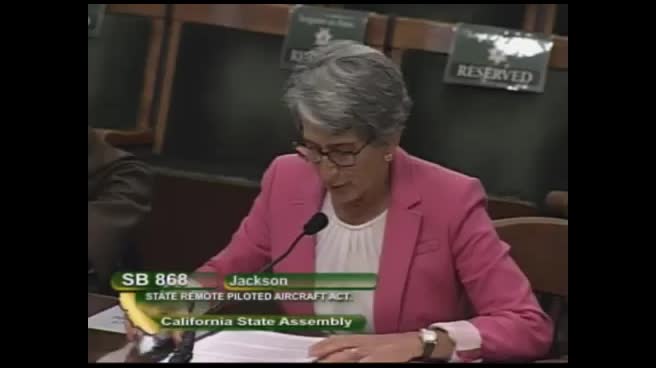 42MIN
Assembly Standing Committee on Privacy and Consumer Protection
 6MIN
Senate Floor
 8MIN
Senate Standing Committee on Appropriations
 23MIN
Senate Standing Committee on Public Safety
 50MIN
Senate Standing Committee on Transportation and Housing
Bill Author

Bill Co-Author(s):