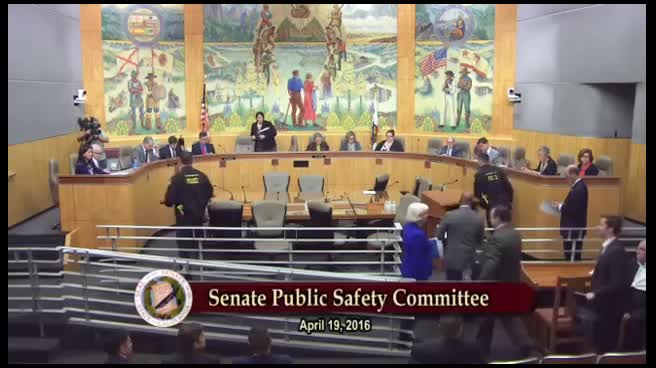
SB 880: Firearms: assault weapons.
- Session Year: 2015-2016
- House: Senate
- Latest Version Date: 2016-07-01
(1)Existing law generally prohibits the possession or transfer of assault weapons, except for the sale, purchase, importation, or possession of assault weapons by specified individuals, including law enforcement officers. Under existing law, assault weapon means, among other things, a semiautomatic centerfire rifle or a semiautomatic pistol that has the capacity to accept a detachable magazine and has any one of specified attributes, including, for rifles, a thumbhole stock, and for pistols, a second handgrip.
This bill would revise this definition of assault weapon to mean a semiautomatic centerfire rifle, or a semiautomatic pistol that does not have a fixed magazine but has any one of those specified attributes. The bill would also define fixed magazine to mean an ammunition feeding device contained in, or permanently attached to, a firearm in such a manner that the device cannot be removed without disassembly of the firearm action.
By expanding the definition of an existing crime, the bill would impose a state-mandated local program.
(2)Existing law requires that any person who, within this state, possesses an assault weapon, except as otherwise provided, be punished as a felony or for a period not to exceed one year in a county jail.
This bill would exempt from punishment under that provision a person who possessed an assault weapon prior to January 1, 2017, if specified requirements are met.
(3)Existing law requires that, with specified exceptions, any person who, prior to January 1, 2001, lawfully possessed an assault weapon prior to the date it was defined as an assault weapon, and which was not specified as an assault weapon at the time of lawful possession, register the firearm with the Department of Justice. Existing law permits the Department of Justice to charge a fee for registration of up to $20 per person but not to exceed the actual processing costs of the department. Existing law, after the department establishes fees sufficient to reimburse the department for processing costs, requires fees charged to increase at a rate not to exceed the legislatively approved annual cost-of-living adjustment for the departments budget or as otherwise increased through the Budget Act. Existing law requires those fees to be deposited into the Dealers Record of Sale Special Account. Existing law, the Administrative Procedure Act, establishes the requirements for the adoption, publication, review, and implementation of regulations by state agencies.
This bill would require that any person who, from January 1, 2001, to December 31, 2016, inclusive, lawfully possessed an assault weapon that does not have a fixed magazine, as defined, and including those weapons with an ammunition feeding device that can be removed readily from the firearm with the use of a tool, register the firearm with the Department of Justice before January 1, 2018, but not before the effective date of specified regulations. The bill would permit the department to increase the $20 registration fee as long as it does not exceed the reasonable processing costs of the department. The bill would also require registrations to be submitted electronically via the Internet utilizing a public-facing application made available by the department. The bill would require the registration to contain specified information, including, but not limited to, a description of the firearm that identifies it uniquely and specified information about the registrant. The bill would permit the department to charge a fee of up to $15 per person for registration through the Internet, not to exceed the reasonable processing costs of the department to be paid and deposited, as specified, for purposes of the registration program. The bill would require the department to adopt regulations for the purpose of implementing those provisions and would exempt those regulations from the Administrative Procedure Act. The bill would also make technical and conforming changes.
(4)The California Constitution requires the state to reimburse local agencies and school districts for certain costs mandated by the state. Statutory provisions establish procedures for making that reimbursement.
This bill would provide that no reimbursement is required by this act for a specified reason.
(1)Existing law generally prohibits the possession or transfer of assault weapons, except for the sale, purchase, importation, or possession of assault weapons by specified individuals, including law enforcement officers. Under existing law, assault weapon means, among other things, a semiautomatic centerfire rifle or a semiautomatic pistol that has the capacity to accept a detachable magazine and has any one of specified attributes, including, for rifles, a thumbhole stock, and for pistols, a second handgrip.
This bill would revise this definition of assault weapon to mean a semiautomatic centerfire rifle, or a semiautomatic pistol that does not have a fixed magazine but has any one of those specified attributes. The bill would also define fixed magazine to mean an ammunition feeding device contained in, or permanently attached to, a firearm in such a manner that the device cannot be removed without disassembly of the firearm action.
By expanding the definition of an existing crime, the bill would impose a state-mandated local program.
(2)Existing law requires that any person who, within this state, possesses an assault weapon, except as otherwise provided, be punished as a felony or for a period not to exceed one year in a county jail.
This bill would exempt from punishment under that provision a person who possessed an assault weapon since prior to January 1, 2017, if specified requirements are met.
(3)Existing law requires that, with specified exceptions, any person who, prior to January 1, 2001, lawfully possessed an assault weapon prior to the date it was defined as an assault weapon, and which was not specified as an assault weapon at the time of lawful possession, register the firearm with the Department of Justice. Existing law permits the Department of Justice to charge a fee for registration of up to $20 per person but not to exceed the actual processing costs of the department. Existing law, after the department establishes fees sufficient to reimburse the department for processing costs, requires fees charged to increase at a rate not to exceed the legislatively approved annual cost-of-living adjustment for the departments budget or as otherwise increased through the Budget Act. Existing law requires those fees to be deposited into the Dealers Record of Sale Special Account. Existing law, the Administrative Procedure Act, establishes the requirements for the adoption, publication, review, and implementation of regulations by state agencies.
This bill would require that any person who, from January 1, 2001, to December 31, 2016, inclusive, lawfully possessed an assault weapon that does not have a fixed magazine, as defined, and including those weapons with an ammunition feeding device that can be removed readily from the firearm with the use of a tool, register the firearm with the Department of Justice before July 1, 2017, January 1, 2018, but not before the effective date of specified regulations. The bill would permit the department to increase the $20 registration fee as long as it does not exceed the reasonable processing costs of the department. The bill would also require registrations to be submitted electronically via the Internet utilizing a public-facing application made available by the department. The bill would require the registration to contain specified information, including, but not limited to, a description of the firearm that identifies it uniquely and specified information about the registrant. The bill would permit the department to charge a fee of up to $15 per person for registration through the Internet, not to exceed the reasonable processing costs of the department to be paid and deposited, as specified, for purposes of the registration program. The bill would require the department to adopt regulations for the purpose of implementing those provisions and would exempt those regulations from the Administrative Procedure Act. The bill would also make technical and conforming changes.
(4)The California Constitution requires the state to reimburse local agencies and school districts for certain costs mandated by the state. Statutory provisions establish procedures for making that reimbursement.
This bill would provide that no reimbursement is required by this act for a specified reason.
(1)Existing law generally prohibits the possession or transfer of assault weapons, except for the sale, purchase, importation, or possession of assault weapons by specified individuals, including law enforcement officers. Under existing law, assault weapon means, among other things, a semiautomatic centerfire rifle or a semiautomatic pistol that has the capacity to accept a detachable magazine and has any one of specified attributes, including, for rifles, a thumbhole stock, and for pistols, a second handgrip.
This bill would revise this definition of assault weapon to mean a semiautomatic centerfire rifle, or a semiautomatic pistol that does not have a fixed magazine but has any one of those specified attributes. The bill would also define fixed magazine to mean an ammunition feeding device contained in, or permanently attached to, a firearm in such a manner that the device cannot be removed without disassembly of the firearm action.
By expanding the definition of an existing crime, the bill would impose a state-mandated local program.
(2)Existing law requires that any person who, within this state, possesses an assault weapon, except as otherwise provided, be punished as a felony or for a period not to exceed one year in a county jail.
This bill would exempt from punishment under that provision a person who possessed an assault weapon since prior to January 1, 2017, if specified requirements are met.
(3)Existing law requires that, with specified exceptions, any person who, prior to January 1, 2001, lawfully possessed an assault weapon prior to the date it was defined as an assault weapon, and which was not specified as an assault weapon at the time of lawful possession, register the firearm with the Department of Justice. Existing law permits the Department of Justice to charge a fee for registration of up to $20 per person but not to exceed the actual processing costs of the department. Existing law, after the department establishes fees sufficient to reimburse the department for processing costs, requires fees charged to increase at a rate not to exceed the legislatively approved annual cost-of-living adjustment for the departments budget or as otherwise increased through the Budget Act. Existing law requires those fees to be deposited into the Dealers Record of Sale Special Account. Existing law, the Administrative Procedure Act, establishes the requirements for the adoption, publication, review, and implementation of regulations by state agencies.
This bill would require that any person who, from January 1, 2001, to December 31, 2016, inclusive, lawfully possessed an assault weapon that does not have a fixed magazine, as defined, and including those weapons with an ammunition feeding device that can be removed readily from the firearm with the use of a tool, register the firearm with the Department of Justice before July 1, 2017, but not before the effective date of specified regulations. The bill would permit the department to increase the $20 registration fee as long as it does not exceed the reasonable processing costs of the department. The bill would also require registrations to be submitted electronically via the Internet utilizing a public-facing application made available by the department. The bill would require the registration to contain specified information, including, but not limited to, a description of the firearm that identifies it uniquely and specified information about the registrant. The bill would permit the department to charge a fee of up to $15 per person for registration through the Internet, not to exceed the reasonable processing costs of the department to be paid and deposited, as specified, for purposes of the registration program. The bill would require the department to adopt regulations for the purpose of implementing those provisions and would exempt those regulations from the Administrative Procedure Act. The bill would also make technical and conforming changes.
(4)The California Constitution requires the state to reimburse local agencies and school districts for certain costs mandated by the state. Statutory provisions establish procedures for making that reimbursement.
This bill would provide that no reimbursement is required by this act for a specified reason.
(a)Notwithstanding Section 30510, assault weapon also means any of the following:
(1)A semiautomatic, centerfire rifle that does not have a fixed magazine but has any one of the following:
(A)A pistol grip that protrudes conspicuously beneath the action of the weapon.
(B)A thumbhole stock.
(C)A folding or telescoping stock.
(D)A grenade launcher or flare launcher.
(E)A flash suppressor.
(F)A forward pistol grip.
(2)A semiautomatic, centerfire rifle that has a fixed magazine with the capacity to accept more than 10 rounds.
(3)A semiautomatic, centerfire rifle that has an overall length of less than 30 inches.
(4)A semiautomatic pistol that does not have a fixed magazine but has any one of the following:
(A)A threaded barrel, capable of accepting a flash suppressor, forward handgrip, or silencer.
(B)A second handgrip.
(C)A shroud that is attached to, or partially or completely encircles, the barrel that allows the bearer to fire the weapon without burning the bearers hand, except a slide that encloses the barrel.
(D)The capacity to accept a detachable magazine at some location outside of the pistol grip.
(5)A semiautomatic pistol with a fixed magazine that has the capacity to accept more than 10 rounds.
(6)A semiautomatic shotgun that has both of the following:
(A)A folding or telescoping stock.
(B)A pistol grip that protrudes conspicuously beneath the action of the weapon, thumbhole stock, or vertical handgrip.
(7)A semiautomatic shotgun that has the ability to accept a detachable magazine.
(8)Any shotgun with a revolving cylinder.
(b)For purposes of this section, fixed magazine means an ammunition feeding device contained in, or permanently attached to, a firearm in such a manner that the device cannot be removed without disassembly of the firearm action.
(c)The Legislature finds a significant public purpose in exempting from the definition of assault weapon pistols that are designed expressly for use in Olympic target shooting events. Therefore, those pistols that are sanctioned by the International Olympic Committee and by USA Shooting, the national governing body for international shooting competition in the United States, and that were used for Olympic target shooting purposes as of January 1, 2001, and that would otherwise fall within the definition of assault weapon pursuant to this section are exempt, as provided in subdivision (d).
(d)Assault weapon does not include either of the following:
(1)Any antique firearm.
(2)Any of the following pistols, because they are consistent with the significant public purpose expressed in subdivision (c):
| MANUFACTURER | MODEL | CALIBER |
| BENELLI | MP90 | .22LR |
| BENELLI | MP90 | .32 S&W LONG |
| BENELLI | MP95 | .22LR |
| BENELLI | MP95 | .32 S&W LONG |
| HAMMERLI | 280 | .22LR |
| HAMMERLI | 280 | .32 S&W LONG |
| HAMMERLI | SP20 | .22LR |
| HAMMERLI | SP20 | .32 S&W LONG |
| PARDINI | GPO | .22 SHORT |
| PARDINI | GP-SCHUMANN | .22 SHORT |
| PARDINI | HP | .32 S&W LONG |
| PARDINI | MP | .32 S&W LONG |
| PARDINI | SP | .22LR |
| PARDINI | SPE | .22LR |
| WALTHER | GSP | .22LR |
| WALTHER | GSP | .32 S&W LONG |
| WALTHER | OSP | .22 SHORT |
| WALTHER | OSP-2000 | .22 SHORT |
(3)The Department of Justice shall create a program that is consistent with the purposes stated in subdivision (c) to exempt new models of competitive pistols that would otherwise fall within the definition of assault weapon pursuant to this section from being classified as an assault weapon. The exempt competitive pistols may be based on recommendations by USA Shooting consistent with the regulations contained in the USA Shooting Official Rules or may be based on the recommendation or rules of any other organization that the department deems relevant.
SEC. 2.Section 30680 is added to the Penal Code, to read:30680.Section 30605 does not apply to the possession of an assault weapon by a person who has possessed the assault weapon prior to January 1, 2017, if all of the following are applicable:
(a)Prior to January 1, 2017, the person was eligible to register that assault weapon pursuant to subdivision (b) of Section 30900.
(b)The person lawfully possessed that assault weapon prior to January 1, 2017.
(c)The person registers the assault weapon by January 1, 2018, in accordance with subdivision (b) of Section 30900.
SEC. 3.Section 30900 of the Penal Code is amended to read:30900.(a)(1)Any person who, prior to June 1, 1989, lawfully possessed an assault weapon, as defined in former Section 12276, as added by Section 3 of Chapter 19 of the Statutes of 1989, shall register the firearm by January 1, 1991, and any person who lawfully possessed an assault weapon prior to the date it was specified as an assault weapon pursuant to former Section 12276.5, as added by Section 3 of Chapter 19 of the Statutes of 1989 or as amended by Section 1 of Chapter 874 of the Statutes of 1990 or Section 3 of Chapter 954 of the Statutes of 1991, shall register the firearm within 90 days with the Department of Justice pursuant to those procedures that the department may establish.
(2)Except as provided in Section 30600, any person who lawfully possessed an assault weapon prior to the date it was defined as an assault weapon pursuant to former Section 12276.1, as it read in Section 7 of Chapter 129 of the Statutes of 1999, and which was not specified as an assault weapon under former Section 12276, as added by Section 3 of Chapter 19 of the Statutes of 1989 or as amended at any time before January 1, 2001, or former Section 12276.5, as added by Section 3 of Chapter 19 of the Statutes of 1989 or as amended at any time before January 1, 2001, shall register the firearm by January 1, 2001, with the department pursuant to those procedures that the department may establish.
(3)The registration shall contain a description of the firearm that identifies it uniquely, including all identification marks, the full name, address, date of birth, and thumbprint of the owner, and any other information that the department may deem appropriate.
(4)The department may charge a fee for registration of up to twenty dollars ($20) per person but not to exceed the reasonable processing costs of the department. After the department establishes fees sufficient to reimburse the department for processing costs, fees charged shall increase at a rate not to exceed the legislatively approved annual cost-of-living adjustment for the departments budget or as otherwise increased through the Budget Act but not to exceed the reasonable costs of the department. The fees shall be deposited into the Dealers Record of Sale Special Account.
(b)(1)Any person who, from January 1, 2001, to December 31, 2016, inclusive, lawfully possessed an assault weapon that does not have a fixed magazine, as defined in Section 30515, including those weapons with an ammunition feeding device that can be readily removed from the firearm with the use of a tool, shall register the firearm before January 1, 2018, but not before the effective date of the regulations adopted pursuant to paragraph (5), with the department pursuant to those procedures that the department may establish by regulation pursuant to paragraph (5).
(2)Registrations shall be submitted electronically via the Internet utilizing a public-facing application made available by the department.
(3)The registration shall contain a description of the firearm that identifies it uniquely, including all identification marks, the date the firearm was acquired, the name and address of the individual from whom, or business from which, the firearm was acquired, as well as the registrants full name, address, telephone number, date of birth, sex, height, weight, eye color, hair color, and California drivers license number or California identification card number.
(4)The department may charge a fee in an amount of up to fifteen dollars ($15) per person but not to exceed the reasonable processing costs of the department. The fee shall be paid by debit or credit card at the time that the electronic registration is submitted to the department. The fee shall be deposited in the Dealers Record of Sale Special Account to be used for purposes of this section.
(5)The department shall adopt regulations for the purpose of implementing this subdivision. These regulations are exempt from the Administrative Procedure Act (Chapter 3.5 (commencing with Section 11340) of Part 1 of Division 3 of Title 2 of the Government Code).
SEC. 4.No reimbursement is required by this act pursuant to Section 6 of Article XIIIB of the California Constitution because the only costs that may be incurred by a local agency or school district will be incurred because this act creates a new crime or infraction, eliminates a crime or infraction, or changes the penalty for a crime or infraction, within the meaning of Section 17556 of the Government Code, or changes the definition of a crime within the meaning of Section 6 of Article XIIIB of the California Constitution.
(a)Notwithstanding Section 30510, assault weapon also means any of the following:
(1)A semiautomatic, centerfire rifle that does not have a fixed magazine but has any one of the following:
(A)A pistol grip that protrudes conspicuously beneath the action of the weapon.
(B)A thumbhole stock.
(C)A folding or telescoping stock.
(D)A grenade launcher or flare launcher.
(E)A flash suppressor.
(F)A forward pistol grip.
(2)A semiautomatic, centerfire rifle that has a fixed magazine with the capacity to accept more than 10 rounds.
(3)A semiautomatic, centerfire rifle that has an overall length of less than 30 inches.
(4)A semiautomatic pistol that does not have a fixed magazine but has any one of the following:
(A)A threaded barrel, capable of accepting a flash suppressor, forward handgrip, or silencer.
(B)A second handgrip.
(C)A shroud that is attached to, or partially or completely encircles, the barrel that allows the bearer to fire the weapon without burning the bearers hand, except a slide that encloses the barrel.
(D)The capacity to accept a detachable magazine at some location outside of the pistol grip.
(5)A semiautomatic pistol with a fixed magazine that has the capacity to accept more than 10 rounds.
(6)A semiautomatic shotgun that has both of the following:
(A)A folding or telescoping stock.
(B)A pistol grip that protrudes conspicuously beneath the action of the weapon, thumbhole stock, or vertical handgrip.
(7)A semiautomatic shotgun that has the ability to accept a detachable magazine.
(8)Any shotgun with a revolving cylinder.
(b)For purposes of this section, fixed magazine means an ammunition feeding device contained in, or permanently attached to, a firearm in such a manner that the device cannot be removed without disassembly of the firearm action.
(c)The Legislature finds a significant public purpose in exempting from the definition of assault weapon pistols that are designed expressly for use in Olympic target shooting events. Therefore, those pistols that are sanctioned by the International Olympic Committee and by USA Shooting, the national governing body for international shooting competition in the United States, and that were used for Olympic target shooting purposes as of January 1, 2001, and that would otherwise fall within the definition of assault weapon pursuant to this section are exempt, as provided in subdivision (d).
(d)Assault weapon does not include either of the following:
(1)Any antique firearm.
(2)Any of the following pistols, because they are consistent with the significant public purpose expressed in subdivision (c):
| MANUFACTURER | MODEL | CALIBER |
| BENELLI | MP90 | .22LR |
| BENELLI | MP90 | .32 S&W LONG |
| BENELLI | MP95 | .22LR |
| BENELLI | MP95 | .32 S&W LONG |
| HAMMERLI | 280 | .22LR |
| HAMMERLI | 280 | .32 S&W LONG |
| HAMMERLI | SP20 | .22LR |
| HAMMERLI | SP20 | .32 S&W LONG |
| PARDINI | GPO | .22 SHORT |
| PARDINI | GP-SCHUMANN | .22 SHORT |
| PARDINI | HP | .32 S&W LONG |
| PARDINI | MP | .32 S&W LONG |
| PARDINI | SP | .22LR |
| PARDINI | SPE | .22LR |
| WALTHER | GSP | .22LR |
| WALTHER | GSP | .32 S&W LONG |
| WALTHER | OSP | .22 SHORT |
| WALTHER | OSP-2000 | .22 SHORT |
(3)The Department of Justice shall create a program that is consistent with the purposes stated in subdivision (c) to exempt new models of competitive pistols that would otherwise fall within the definition of assault weapon pursuant to this section from being classified as an assault weapon. The exempt competitive pistols may be based on recommendations by USA Shooting consistent with the regulations contained in the USA Shooting Official Rules or may be based on the recommendation or rules of any other organization that the department deems relevant.
SEC. 2.Section 30680 is added to the Penal Code, to read:30680.Notwithstanding the meaning of assault weapon under Section 30515, as amended by the act that added this section, Section 30605 does not apply to the possession of an assault weapon by a person who has possessed the assault weapon prior to January 1, 2017, if all of the following are applicable:
(a)Prior to January 1, 2017, the person was eligible to register that assault weapon pursuant to subdivision (c) (b) of Section 30900.
(b)The person lawfully possessed that assault weapon prior to January 1, 2017.
(c)The person registers the assault weapon by January 1, 2018, in accordance with subdivision (c) (b) of Section 30900.
SEC. 3.Section 30900 of the Penal Code is amended to read:30900.(a)(1)Any person who, prior to June 1, 1989, lawfully possessed an assault weapon, as defined in former Section 12276, as added by Section 3 of Chapter 19 of the Statutes of 1989, shall register the firearm by January 1, 1991, and any person who lawfully possessed an assault weapon prior to the date it was specified as an assault weapon pursuant to former Section 12276.5, as added by Section 3 of Chapter 19 of the Statutes of 1989 or as amended by Section 1 of Chapter 874 of the Statutes of 1990 or Section 3 of Chapter 954 of the Statutes of 1991, shall register the firearm within 90 days with the Department of Justice pursuant to those procedures that the department may establish.
(2)Except as provided in Section 30600, any person who lawfully possessed an assault weapon prior to the date it was defined as an assault weapon pursuant to former Section 12276.1, as it read in Section 7 of Chapter 129 of the Statutes of 1999, and which was not specified as an assault weapon under former Section 12276, as added by Section 3 of Chapter 19 of the Statutes of 1989 or as amended at any time before January 1, 2001, or former Section 12276.5, as added by Section 3 of Chapter 19 of the Statutes of 1989 or as amended at any time before January 1, 2001, shall register the firearm by January 1, 2001, with the department pursuant to those procedures that the department may establish.
(3)The registration shall contain a description of the firearm that identifies it uniquely, including all identification marks, the full name, address, date of birth, and thumbprint of the owner, and any other information that the department may deem appropriate.
(4)The department may charge a fee for registration of up to twenty dollars ($20) per person but not to exceed the reasonable processing costs of the department. After the department establishes fees sufficient to reimburse the department for processing costs, fees charged shall increase at a rate not to exceed the legislatively approved annual cost-of-living adjustment for the departments budget or as otherwise increased through the Budget Act but not to exceed the reasonable costs of the department. The fees shall be deposited into the Dealers Record of Sale Special Account.
(b)(1)Any person who, from January 1, 2001, to December 31, 2016, inclusive, lawfully possessed an assault weapon that does not have a fixed magazine, as defined in Section 30515, including those weapons with an ammunition feeding device that can be readily removed from the firearm with the use of a tool, shall register the firearm before January 1, 2018, but not before the effective date of the regulations adopted pursuant to paragraph (5), with the department pursuant to those procedures that the department may establish by regulation pursuant to paragraph (5).
(2)Registrations shall be submitted electronically via the Internet utilizing a public-facing application made available by the department.
(3)The registration shall contain a description of the firearm that identifies it uniquely, including all identification marks, the date the firearm was acquired, the name and address of the individual from whom, or business from which, the firearm was acquired, as well as the registrants full name, address, telephone number, date of birth, sex, height, weight, eye color, hair color, and California drivers license number or California identification card number.
(4)The department may charge a fee in an amount of up to fifteen dollars ($15) per person but not to exceed the reasonable processing costs of the department. The fee shall be paid by debit or credit card at the time that the electronic registration is submitted to the department. The fee shall be deposited in the Dealers Record of Sale Special Account to be used for purposes of this section.
(5)The department shall adopt regulations for the purpose of implementing this subdivision. These regulations are exempt from the Administrative Procedure Act (Chapter 3.5 (commencing with Section 11340) of Part 1 of Division 3 of Title 2 of the Government Code).
SEC. 4.No reimbursement is required by this act pursuant to Section 6 of Article XIIIB of the California Constitution because the only costs that may be incurred by a local agency or school district will be incurred because this act creates a new crime or infraction, eliminates a crime or infraction, or changes the penalty for a crime or infraction, within the meaning of Section 17556 of the Government Code, or changes the definition of a crime within the meaning of Section 6 of Article XIIIB of the California Constitution.
(a)Notwithstanding Section 30510, assault weapon also means any of the following:
(1)A semiautomatic, centerfire rifle that does not have a fixed magazine but has any one of the following:
(A)A pistol grip that protrudes conspicuously beneath the action of the weapon.
(B)A thumbhole stock.
(C)A folding or telescoping stock.
(D)A grenade launcher or flare launcher.
(E)A flash suppressor.
(F)A forward pistol grip.
(2)A semiautomatic, centerfire rifle that has a fixed magazine with the capacity to accept more than 10 rounds.
(3)A semiautomatic, centerfire rifle that has an overall length of less than 30 inches.
(4)A semiautomatic pistol that does not have a fixed magazine but has any one of the following:
(A)A threaded barrel, capable of accepting a flash suppressor, forward handgrip, or silencer.
(B)A second handgrip.
(C)A shroud that is attached to, or partially or completely encircles, the barrel that allows the bearer to fire the weapon without burning the bearers hand, except a slide that encloses the barrel.
(D)The capacity to accept a detachable magazine at some location outside of the pistol grip.
(5)A semiautomatic pistol with a fixed magazine that has the capacity to accept more than 10 rounds.
(6)A semiautomatic shotgun that has both of the following:
(A)A folding or telescoping stock.
(B)A pistol grip that protrudes conspicuously beneath the action of the weapon, thumbhole stock, or vertical handgrip.
(7)A semiautomatic shotgun that has the ability to accept a detachable magazine.
(8)Any shotgun with a revolving cylinder.
(b)For purposes of this section, fixed magazine means an ammunition feeding device contained in, or permanently attached to, a firearm in such a manner that the device cannot be removed without disassembly of the firearm action.
(c)The Legislature finds a significant public purpose in exempting from the definition of assault weapon pistols that are designed expressly for use in Olympic target shooting events. Therefore, those pistols that are sanctioned by the International Olympic Committee and by USA Shooting, the national governing body for international shooting competition in the United States, and that were used for Olympic target shooting purposes as of January 1, 2001, and that would otherwise fall within the definition of assault weapon pursuant to this section are exempt, as provided in subdivision (d).
(d)Assault weapon does not include either of the following:
(1)Any antique firearm.
(2)Any of the following pistols, because they are consistent with the significant public purpose expressed in subdivision (c):
| MANUFACTURER | MODEL | CALIBER |
| BENELLI | MP90 | .22LR |
| BENELLI | MP90 | .32 S&W LONG |
| BENELLI | MP95 | .22LR |
| BENELLI | MP95 | .32 S&W LONG |
| HAMMERLI | 280 | .22LR |
| HAMMERLI | 280 | .32 S&W LONG |
| HAMMERLI | SP20 | .22LR |
| HAMMERLI | SP20 | .32 S&W LONG |
| PARDINI | GPO | .22 SHORT |
| PARDINI | GP-SCHUMANN | .22 SHORT |
| PARDINI | HP | .32 S&W LONG |
| PARDINI | MP | .32 S&W LONG |
| PARDINI | SP | .22LR |
| PARDINI | SPE | .22LR |
| WALTHER | GSP | .22LR |
| WALTHER | GSP | .32 S&W LONG |
| WALTHER | OSP | .22 SHORT |
| WALTHER | OSP-2000 | .22 SHORT |
(3)The Department of Justice shall create a program that is consistent with the purposes stated in subdivision (c) to exempt new models of competitive pistols that would otherwise fall within the definition of assault weapon pursuant to this section from being classified as an assault weapon. The exempt competitive pistols may be based on recommendations by USA Shooting consistent with the regulations contained in the USA Shooting Official Rules or may be based on the recommendation or rules of any other organization that the department deems relevant.
SEC. 2.Section 30680 is added to the Penal Code, to read:30680.Notwithstanding the meaning of assault weapon under Section 30515, as amended by the act that added this section, Section 30605 does not apply to the possession of an assault weapon by a person who has possessed the assault weapon prior to January 1, 2017, if all of the following are applicable:
(a)Prior to January 1, 2017, the person was eligible to register that assault weapon pursuant to subdivision (c) of Section 30900.
(b)The person lawfully possessed that assault weapon prior to January 1, 2017.
(c)The person registers the assault weapon by July 1, 2017, January 1, 2018, in accordance with subdivision (c) of Section 30900.
SEC. 3.Section 30900 of the Penal Code is amended to read:30900.(a)(1)Any person who, prior to June 1, 1989, lawfully possessed an assault weapon, as defined in former Section 12276, as added by Section 3 of Chapter 19 of the Statutes of 1989, shall register the firearm by January 1, 1991, and any person who lawfully possessed an assault weapon prior to the date it was specified as an assault weapon pursuant to former Section 12276.5, as added by Section 3 of Chapter 19 of the Statutes of 1989 or as amended by Section 1 of Chapter 874 of the Statutes of 1990 or Section 3 of Chapter 954 of the Statutes of 1991, shall register the firearm within 90 days with the Department of Justice pursuant to those procedures that the department may establish.
(2)Except as provided in Section 30600, any person who lawfully possessed an assault weapon prior to the date it was defined as an assault weapon pursuant to former Section 12276.1, as it read in Section 7 of Chapter 129 of the Statutes of 1999, and which was not specified as an assault weapon under former Section 12276, as added by Section 3 of Chapter 19 of the Statutes of 1989 or as amended at any time before January 1, 2001, or former Section 12276.5, as added by Section 3 of Chapter 19 of the Statutes of 1989 or as amended at any time before January 1, 2001, shall register the firearm by January 1, 2001, with the department pursuant to those procedures that the department may establish.
(3)The registration shall contain a description of the firearm that identifies it uniquely, including all identification marks, the full name, address, date of birth, and thumbprint of the owner, and any other information that the department may deem appropriate.
(4)The department may charge a fee for registration of up to twenty dollars ($20) per person but not to exceed the reasonable processing costs of the department. After the department establishes fees sufficient to reimburse the department for processing costs, fees charged shall increase at a rate not to exceed the legislatively approved annual cost-of-living adjustment for the departments budget or as otherwise increased through the Budget Act but not to exceed the reasonable costs of the department. The fees shall be deposited into the Dealers Record of Sale Special Account.
(b)(1)Any person who, from January 1, 2001, to December 31, 2016, inclusive, lawfully possessed an assault weapon that does not have a fixed magazine, as defined in Section 30515, including those weapons with an ammunition feeding device that can be readily removed from the firearm with the use of a tool, shall register the firearm before July 1, 2017, January 1, 2018, but not before the effective date of the regulations adopted pursuant to paragraph (5), with the department pursuant to those procedures that the department may establish by regulation pursuant to paragraph (5).
(2)Registrations shall be submitted electronically via the Internet utilizing a public-facing application made available by the department.
(3)The registration shall contain a description of the firearm that identifies it uniquely, including all identification marks, the date the firearm was acquired, the name and address of the individual from whom, or business from which, the firearm was acquired, as well as the registrants full name, address, telephone number, date of birth, sex, height, weight, eye color, hair color, and California drivers license number or California identification card number.
(4)The department may charge a fee in an amount of up to fifteen dollars ($15) per person but not to exceed the reasonable processing costs of the department. The fee shall be paid by debit or credit card at the time that the electronic registration is submitted to the department. The fee shall be deposited in the Dealers Record of Sale Special Account to be used for purposes of this section.
(5)The department shall adopt regulations for the purpose of implementing this subdivision. These regulations are exempt from the Administrative Procedure Act (Chapter 3.5 (commencing with Section 11340) of Part 1 of Division 3 of Title 2 of the Government Code).
SEC. 4.No reimbursement is required by this act pursuant to Section 6 of Article XIIIB of the California Constitution because the only costs that may be incurred by a local agency or school district will be incurred because this act creates a new crime or infraction, eliminates a crime or infraction, or changes the penalty for a crime or infraction, within the meaning of Section 17556 of the Government Code, or changes the definition of a crime within the meaning of Section 6 of Article XIIIB of the California Constitution.
(a)Notwithstanding Section 30510, assault weapon also means any of the following:
(1)A semiautomatic, centerfire rifle that has the capacity to accept a detachable magazine and does not have a fixed magazine but has any one of the following:
(A)A pistol grip that protrudes conspicuously beneath the action of the weapon.
(B)A thumbhole stock.
(C)A folding or telescoping stock.
(D)A grenade launcher or flare launcher.
(E)A flash suppressor.
(F)A forward pistol grip.
(2)A semiautomatic, centerfire rifle that has a fixed magazine with the capacity to accept more than 10 rounds.
(3)A semiautomatic, centerfire rifle that has an overall length of less than 30 inches.
(4)A semiautomatic pistol that has the capacity to accept a detachable magazine and does not have a fixed magazine but has any one of the following:
(A)A threaded barrel, capable of accepting a flash suppressor, forward handgrip, or silencer.
(B)A second handgrip.
(C)A shroud that is attached to, or partially or completely encircles, the barrel that allows the bearer to fire the weapon without burning the bearers hand, except a slide that encloses the barrel.
(D)The capacity to accept a detachable magazine at some location outside of the pistol grip.
(5)A semiautomatic pistol with a fixed magazine that has the capacity to accept more than 10 rounds.
(6)A semiautomatic shotgun that has both of the following:
(A)A folding or telescoping stock.
(B)A pistol grip that protrudes conspicuously beneath the action of the weapon, thumbhole stock, or vertical handgrip.
(7)A semiautomatic shotgun that has the ability to accept a detachable magazine.
(8)Any shotgun with a revolving cylinder.
(b)For purposes of this section, fixed magazine means an ammunition feeding device contained in, or permanently attached to, a firearm in such a manner that the device cannot be removed without disassembly of the firearm action.
(b)
(c)The Legislature finds a significant public purpose in exempting from the definition of assault weapon pistols that are designed expressly for use in Olympic target shooting events. Therefore, those pistols that are sanctioned by the International Olympic Committee and by USA Shooting, the national governing body for international shooting competition in the United States, and that were used for Olympic target shooting purposes as of January 1, 2001, and that would otherwise fall within the definition of assault weapon pursuant to this section are exempt, as provided in subdivision (c). (d).
(c)
(d)Assault weapon does not include either of the following:
(1)Any antique firearm.
(2)Any of the following pistols, because they are consistent with the significant public purpose expressed in subdivision (b): (c):
| MANUFACTURER | MODEL | CALIBER |
| BENELLI | MP90 | .22LR |
| BENELLI | MP90 | .32 S&W LONG |
| BENELLI | MP95 | .22LR |
| BENELLI | MP95 | .32 S&W LONG |
| HAMMERLI | 280 | .22LR |
| HAMMERLI | 280 | .32 S&W LONG |
| HAMMERLI | SP20 | .22LR |
| HAMMERLI | SP20 | .32 S&W LONG |
| PARDINI | GPO | .22 SHORT |
| PARDINI | GP-SCHUMANN | .22 SHORT |
| PARDINI | HP | .32 S&W LONG |
| PARDINI | MP | .32 S&W LONG |
| PARDINI | SP | .22LR |
| PARDINI | SPE | .22LR |
| WALTHER | GSP | .22LR |
| WALTHER | GSP | .32 S&W LONG |
| WALTHER | OSP | .22 SHORT |
| WALTHER | OSP-2000 | .22 SHORT |
(3)The Department of Justice shall create a program that is consistent with the purposes stated in subdivision (b) (c) to exempt new models of competitive pistols that would otherwise fall within the definition of assault weapon pursuant to this section from being classified as an assault weapon. The exempt competitive pistols may be based on recommendations by USA Shooting consistent with the regulations contained in the USA Shooting Official Rules or may be based on the recommendation or rules of any other organization that the department deems relevant.
SEC. 2.Section 30680 is added to the Penal Code, to read:30680.Notwithstanding the meaning of assault weapon under Section 30515, as amended by the act that added this section, Section 30605 does not apply to the possession of an assault weapon by a person who has possessed the assault weapon prior to January 1, 2017, if all of the following are applicable:
(a)Prior to January 1, 2017, the person was eligible to register that assault weapon pursuant to subdivision (c) of Section 30900.
(b)The person lawfully possessed that assault weapon prior to January 1, 2017.
(c)The person registers the assault weapon by July 1, 2017, in accordance with subdivision (c) of Section 30900.
SEC. 3.Section 30900 of the Penal Code is amended to read:30900.(a)(1)Any person who, prior to June 1, 1989, lawfully possessed an assault weapon, as defined in former Section 12276, as added by Section 3 of Chapter 19 of the Statutes of 1989, shall register the firearm by January 1, 1991, and any person who lawfully possessed an assault weapon prior to the date it was specified as an assault weapon pursuant to former Section 12276.5, as added by Section 3 of Chapter 19 of the Statutes of 1989 or as amended by Section 1 of Chapter 874 of the Statutes of 1990 or Section 3 of Chapter 954 of the Statutes of 1991, shall register the firearm within 90 days with the Department of Justice pursuant to those procedures that the department may establish.
(b)
(2)Except as provided in Section 30600, any person who lawfully possessed an assault weapon prior to the date it was defined as an assault weapon pursuant to former Section 12276.1, as it read in Section 7 of Chapter 129 of the Statutes of 1999, and which was not specified as an assault weapon under former Section 12276, as added by Section 3 of Chapter 19 of the Statutes of 1989 or as amended at any time before January 1, 2001, or former Section 12276.5, as added by Section 3 of Chapter 19 of the Statutes of 1989 or as amended at any time before January 1, 2001, shall register the firearm by January 1, 2001, with the department pursuant to those procedures that the department may establish.
(c)
(3)The registration shall contain a description of the firearm that identifies it uniquely, including all identification marks, the full name, address, date of birth, and thumbprint of the owner, and any other information that the department may deem appropriate.
(d)
(4)The department may charge a fee for registration of up to twenty dollars ($20) per person but not to exceed the actual reasonable processing costs of the department. After the department establishes fees sufficient to reimburse the department for processing costs, fees charged shall increase at a rate not to exceed the legislatively approved annual cost-of-living adjustment for the departments budget or as otherwise increased through the Budget Act. Act but not to exceed the reasonable costs of the department. The fees shall be deposited into the Dealers Record of Sale Special Account.
(b)(1)Any person who, from January 1, 2001, to December 31, 2016, inclusive, lawfully possessed an assault weapon that does not have a fixed magazine, as defined in Section 30515, including those weapons with an ammunition feeding device that can be readily removed from the firearm with the use of a tool, shall register the firearm before July 1, 2017, but not before the effective date of the regulations adopted pursuant to paragraph (5), with the department pursuant to those procedures that the department may establish by regulation pursuant to paragraph (5).
(2)Registrations shall be submitted electronically via the Internet utilizing a public-facing application made available by the department.
(3)The registration shall contain a description of the firearm that identifies it uniquely, including all identification marks, the date the firearm was acquired, the name and address of the individual from whom, or business from which, the firearm was acquired, as well as the registrants full name, address, telephone number, date of birth, sex, height, weight, eye color, hair color, and California drivers license number or California identification card number.
(4)The department may charge a fee in an amount of up to fifteen dollars ($15) per person but not to exceed the reasonable processing costs of the department. The fee shall be paid by debit or credit card at the time that the electronic registration is submitted to the department. The fee shall be deposited in the Dealers Record of Sale Special Account to be used for purposes of this section.
(5)The department shall adopt regulations for the purpose of implementing this subdivision. These regulations are exempt from the Administrative Procedure Act (Chapter 3.5 (commencing with Section 11340) of Part 1 of Division 3 of Title 2 of the Government Code).
SEC. 4.No reimbursement is required by this act pursuant to Section 6 of Article XIIIB of the California Constitution because the only costs that may be incurred by a local agency or school district will be incurred because this act creates a new crime or infraction, eliminates a crime or infraction, or changes the penalty for a crime or infraction, within the meaning of Section 17556 of the Government Code, or changes the definition of a crime within the meaning of Section 6 of Article XIIIB of the California Constitution.
|
Date
|
Status
|
|---|---|
| Jul 1, 2016 | Chaptered by Secretary of State. Chapter 48, Statutes of 2016. |
| Jul 1, 2016 | Approved by the Governor. |
| Jun 30, 2016 | Read third time. Passed. (Ayes 44. Noes 30. Page 5573.) Ordered to the Senate. |
| Jun 30, 2016 | Enrolled and presented to the Governor at 1:30 p.m. |
| Jun 30, 2016 | In Senate. Ordered to engrossing and enrolling. |
| Jun 30, 2016 | Read third time. Passed. Ordered to the Senate. |
| Jun 23, 2016 | Assembly Rule 96 suspended. (Ayes 50. Noes 27. Page 5473.) |
| Jun 23, 2016 | Ordered to third reading. |
| Jun 23, 2016 | Withdrawn from committee. |
| Jun 23, 2016 | Assembly Rule 96 suspended. (Ayes 43. Noes 24.) |
| Jun 15, 2016 | From committee: Do pass and re-refer to Com. on APPR. (Ayes 5. Noes 1.) (June 14). Re-referred to Com. on APPR. |
| Jun 1, 2016 | Referred to Com. on PUB. S. |
| May 19, 2016 | Read third time. Passed. (Ayes 24. Noes 14. Page 3900.) Ordered to the Assembly. |
| May 19, 2016 | In Assembly. Read first time. Held at Desk. |
| May 19, 2016 | Read third time. Passed. (Ayes 24. Noes 14.) Ordered to the Assembly. |
| May 17, 2016 | Read second time and amended. Ordered to third reading. |
| May 16, 2016 | From committee: Do pass as amended. (Ayes 5. Noes 2. Page 3888.) (May 16). |
| May 16, 2016 | (Ayes 2. Noes 4. Page 3887.) (May 16) |
| May 16, 2016 | From committee: Do pass as amended. (Ayes 5. Noes 2.) (May 16). |
| May 16, 2016 | (Ayes 2. Noes 4.) (May 16) |
| May 16, 2016 | Motion to place on APPR. suspense file failed. |
| May 11, 2016 | Set for hearing May 16. |
| Apr 28, 2016 | May 2 hearing postponed by committee. |
| Apr 22, 2016 | Set for hearing May 2. |
| Apr 20, 2016 | From committee: Do pass and re-refer to Com. on APPR. (Ayes 5. Noes 2. Page 3612.) (April 19). Re-referred to Com. on APPR. |
| Apr 20, 2016 | From committee: Do pass and re-refer to Com. on APPR. (Ayes 5. Noes 2.) (April 19). Re-referred to Com. on APPR. |
| Apr 1, 2016 | Set for hearing April 19. |
| Mar 30, 2016 | April 5 hearing postponed by committee. |
| Mar 28, 2016 | From committee with author's amendments. Read second time and amended. Re-referred to Com. on PUB. S. |
| Mar 15, 2016 | Set for hearing April 5. |
| Jan 28, 2016 | Referred to Com. on PUB. S. |
| Jan 19, 2016 | From printer. May be acted upon on or after February 18. |
| Jan 15, 2016 | Introduced. Read first time. To Com. on RLS. for assignment. To print. |
|
Date
|
Description
|
Location
|
Votes
|
|
|---|---|---|---|---|
| Jun 30, 2016 | SB 880 Hall Senate Third Reading By JONES-SAWYER | Assembly Floor |
Passed |
|
| Jun 14, 2016 | Do pass and be re-referred to the Committee on [Appropriations] | Assembly Standing Committee on Public Safety |
Passed |
|
| May 19, 2016 | Senate 3rd Reading SB880 Hall | Senate Floor |
Passed |
|
| May 16, 2016 | Do pass as amended | Senate Standing Committee on Appropriations |
Passed |
|
| May 16, 2016 | Placed on suspense file | Senate Standing Committee on Appropriations |
Failed |
|
| Apr 19, 2016 | Do pass, but first be re-referred to the Committee on [Appropriations] | Senate Standing Committee on Public Safety |
Passed |
This list shows positions taken on this bill by organizations on the date displayed, which is linked to the original source.
Positions by individuals are not included.
SENATE THIRD READING
STR Bill Id:SB 880
Author:(Hall and Glazer)
As Amended Ver:May 17, 2016
Majority vote
SENATE VOTE: 24-14
Committee | Votes | Ayes | Noes |
Public Safety | 5-1 | Jones-Sawyer, Lopez, Low, Quirk, Santiago | Lackey |
SUMMARY: Redefines what constitutes an assault weapon in order to close the bullet button loophole. Also requires registration of weapons previously not prohibited, under the new definition. Specifically, this bill:
- Revises the definition of "assault weapon" to mean "a semiautomatic centerfire rifle, or a semiautomatic pistol that does not have a fixed magazine but has any one of those specified attributes."
- Defines "fixed magazine" to mean "an ammunition feeding device contained in, or permanently attached to, a firearm in such a manner that the device cannot be removed without disassembly of the firearm action."
- Exempts a person who possessed an assault weapon prior to January 1, 2017, if specified requirements are met.
- Requires that any person who, from January 1, 2001, to December 31, 2016, lawfully possessed an assault weapon that does not have a fixed magazine, as defined, register the firearm with the Department of Justice (DOJ) before January 1, 2018.
- Permits the DOJ to increase the $20 registration fee as long as it does not exceed the reasonable processing costs of the department.
- Requires registrations to be submitted electronically via the Internet utilizing a public-facing application made available by the DOJ.
- Requires the registration to contain specified information, including, but not limited to, a description of the firearm that identifies it uniquely and specified information about the registrant.
- Permits the DOJ to charge a fee of up to $15 per person for registration through the internet, not to exceed the reasonable processing costs of the department to be paid and deposited, as specified, for purposes of the registration program.
- Requires the DOJ to adopt regulations for the purpose of implementing those provisions and would exempt those regulations from the Administrative Procedure Act.
EXISTING LAW:
- Contains legislative findings and declarations that the proliferation and use of assault and .50 BMG rifles poses a threat to the health, safety, and security of all citizens of California.
- States legislative intent to place restrictions on the use of assault weapons and .50 BMG rifles and to establish a registration and permit procedure for their lawful sale and possession.
- Prohibits several categories of assault weapons:
- Specified firearms listed by name and others listed by series;
- Semiautomatic centerfire rifles or semiautomatic pistols having the capacity to accept a detachable magazine and also having one of several specified characteristics;
- Semiautomatic centerfire rifles or semiautomatic pistols with a fixed magazine having the capacity to hold more than 10 rounds;
- Semiautomatic centerfire rifles with an overall length of less than 30 inches;
- Semiautomatic shotguns having two specified characteristics;
- Semiautomatic shotguns having the capacity to accept a detachable magazine; and,
- Any shotgun with a revolving cylinder.
- Defines a "detachable magazine" as any ammunition feeding device that can be removed readily from the firearm with neither disassembly of the firearm action nor use of a tool being required. A bullet or ammunition cartridge is considered a tool. Ammunition feeding device includes any belted or linked ammunition, but does not include clips, en bloc clips, or stripper clips that load cartridges into the magazine.
- Bans the manufacture, distribution, transportation, importation, sale, gift or loan of an assault weapon.
- Makes the possession of an assault weapon a criminal offense, subject to certain exceptions.
- Defines a ".50 BMG rifle" as "a center fire rifle that can fire a .50 BMG cartridge and is not already an assault weapon or a machinegun."
- Bans the manufacture, distribution, transportation, importation, sale, gift, loan, or possession of .50 BMG rifles.
- Exempts the DOJ, law enforcement agencies, military forces, and other specified agencies from the prohibition against sales to, purchase by, importation of, or possession of assault weapons or .50 BMG rifles.
- Requires that any person who lawfully possesses an assault weapon prior to the date it was specified as an assault weapon to register the firearm with DOJ, as specified.
FISCAL EFFECT: Unknown. This bill is keyed non-fiscal by the Legislative Counsel.
COMMENTS: According to the author, "bullet button-equipped semi-automatic weapons have no legitimate use for sport hunters or competitive shooters. They are designed only to facilitate the maximum destruction of human life. Such weapons have been used in a number of recent gun attacks including the recent terrorist attack in San Bernardino that left 14 Californians dead and 21 injured. Too many Californians have died at the hands of these dangerous weapons.
"SB 880 will make our communities safer and upholds our commitment to reduce gun violence in California by closing the bullet button loophole in California's Assault Weapons Ban. This bill clarifies the definition of assault weapons and provides the DOJ the authority to bring existing regulations into conformity with the original intent of California's Assault Weapon Ban. Absent this bill, the assault weapon ban is severely weakened, and these types of military-style firearms will continue to proliferate on our streets and in our neighborhoods."
Analysis Prepared by: Gabriel Caswell / PUB. S. / (916) 319-3744 FN: 0003528
Date of Hearing: June 14, 2016
Counsel: Gabriel Caswell
ASSEMBLY COMMITTEE ON PUBLIC SAFETY
Reginald Byron Jones-Sawyer, Sr., Chair
SBPCA Bill Id:SB 880
Author:(Hall) – As Amended Ver:May 17, 2016
SUMMARY: Redefines what constitutes an assault weapon in order to close the bullet button loophole. Also requires registration of weapons previously not prohibited, under the new definition. Specifically, this bill:
- Revises the definition of “assault weapon” to mean "a semiautomatic centerfire rifle, or a semiautomatic pistol that does not have a fixed magazine but has any one of those specified attributes."
- Defines “fixed magazine” to mean "an ammunition feeding device contained in, or permanently attached to, a firearm in such a manner that the device cannot be removed without disassembly of the firearm action."
- Exempts a person who possessed an assault weapon prior to January 1, 2017, if specified requirements are met.
- Requires that any person who, from January 1, 2001, to December 31, 2016, lawfully possessed an assault weapon that does not have a fixed magazine, as defined, register the firearm with the Department of Justice (DOJ) before January 1, 2018.
- Permits the DOJ to increase the $20 registration fee as long as it does not exceed the reasonable processing costs of the department.
- Requires registrations to be submitted electronically via the Internet utilizing a public-facing application made available by the DOJ.
- Requires the registration to contain specified information, including, but not limited to, a description of the firearm that identifies it uniquely and specified information about the registrant.
- Permits the DOJ to charge a fee of up to $15 per person for registration through the internet, not to exceed the reasonable processing costs of the department to be paid and deposited, as specified, for purposes of the registration program.
- Requires the DOJ to adopt regulations for the purpose of implementing those provisions and would exempt those regulations from the Administrative Procedure Act.
EXISTING LAW:
- Contains legislative findings and declarations that the proliferation and use of assault and .50 BMG rifles poses a threat to the health, safety, and security of all citizens of California. (Pen. Code, § 30505.)
- States legislative intent to place restrictions on the use of assault weapons and .50 BMG rifles and to establish a registration and permit procedure for their lawful sale and possession. (Pen. Code, § 30505.)
- Prohibits several categories of assault weapons:
- Specified firearms listed by name and others listed by series (Pen. Code, § 30510);
- Semiautomatic centerfire rifles or semiautomatic pistols having the capacity to accept a detachable magazine and also having one of several specified characteristics;
- Semiautomatic centerfire rifles or semiautomatic pistols with a fixed magazine having the capacity to hold more than 10 rounds;
- Semiautomatic centerfire rifles with an overall length of less than 30 inches;
- Semiautomatic shotguns having two specified characteristics;
- Semiautomatic shotguns having the capacity to accept a detachable magazine; and,
- Any shotgun with a revolving cylinder. (Pen. Code, § 30515.)
- Specified firearms listed by name and others listed by series (Pen. Code, § 30510);
- Defines a "detachable magazine" as any ammunition feeding device that can be removed readily from the firearm with neither disassembly of the firearm action nor use of a tool being required. A bullet or ammunition cartridge is considered a tool. Ammunition feeding device includes any belted or linked ammunition, but does not include clips, en bloc clips, or stripper clips that load cartridges into the magazine. (11 Cal. Code Regs. Section 5469.)
- Bans the manufacture, distribution, transportation, importation, sale, gift or loan of an assault weapon. (Pen. Code, § 30600, subd. (a).)
- Makes the possession of an assault weapon a criminal offense, subject to certain exceptions. (Pen. Code, § 30605.)
- Defines a ".50 BMG rifle" as "a center fire rifle that can fire a .50 BMG cartridge and is not already an assault weapon or a machinegun." (Pen. Code, § 30530.)
- Bans the manufacture, distribution, transportation, importation, sale, gift, loan, or possession of .50 BMG rifles. (Pen. Code §§ 30600 & 30610.)
- Exempts the DOJ, law enforcement agencies, military forces, and other specified agencies from the prohibition against sales to, purchase by, importation of, or possession of assault weapons or .50 BMG rifles. (Pen. Code, § 30625.)
- Requires that any person who lawfully possesses an assault weapon prior to the date it was specified as an assault weapon to register the firearm with DOJ, as specified. (Pen. Code, § 30900 et. seq.)
FISCAL EFFECT: Unknown
COMMENTS:
- Author's Statement: According to the author, "bullet button-equipped semi-automatic weapons have no legitimate use for sport hunters or competitive shooters. They are designed only to facilitate the maximum destruction of human life. Such weapons have been used in a number of recent gun attacks including the recent terrorist attack in San Bernardino that left 14 Californians dead and 21 injured. Too many Californians have died at the hands of these dangerous weapons.
"SB 880 will make our communities safer and upholds our commitment to reduce gun violence in California by closing the bullet button loophole in California’s Assault Weapons Ban. This bill clarifies the definition of assault weapons and provides the DOJ the authority to bring existing regulations into conformity with the original intent of California’s Assault Weapon Ban. Absent this bill, the assault weapon ban is severely weakened, and these types of military-style firearms will continue to proliferate on our streets and in our neighborhoods."
- California's Assault Weapons Ban: The origin of and subsequent modifications to the assault weapons ban in California are described by the federal Court of Appeal in the following extended excerpt from Silveira v. Lockyer, 312 F.3d 1052 (9th Cir. 2002) (as amend. Jan. 27, 2003).
In response to a proliferation of shootings involving semi-automatic weapons, the California Legislature passed the Roberti-Roos Assault Weapons Control Act (AWCA) in 1989. The immediate cause of the AWCA's enactment was a random shooting earlier that year at the Cleveland Elementary School in Stockton, California. An individual armed with an AK-47 semi-automatic weapon opened fire on the schoolyard, where 300 pupils were enjoying their morning recess. Five children ages six to nine were killed, and one teacher and 29 children were wounded.
The California Assembly met soon thereafter in an extraordinary session called for the purpose of enacting a response to the Stockton shooting. The legislation that followed, the AWCA, was the first legislative restriction on assault weapons in the nation, and was the model for a similar federal statute enacted in 1994. The AWCA renders it a felony offense to manufacture in California any of the semi-automatic weapons specified in the statute, or to possess, sell, transfer, or import into the state such weapons without a permit. The statute contains a grandfather clause that permits the ownership of assault weapons by individuals who lawfully purchased them before the statute's enactment, so long as the owners register the weapons with DOJ. The grandfather clause, however, imposes significant restrictions on the use of weapons that are registered pursuant to its provisions. Approximately 40 models of firearms are listed in the statute as subject to its restrictions. The specified weapons include “civilian” models of military weapons that feature slightly less firepower than the military-issue versions, such as the Uzi, an Israeli-made military rifle; the AR-15, a semi-automatic version of the United States military's standard-issue machine gun, the M-16; and the AK-47, a Russian-designed and Chinese-produced military rifle. The AWCA also includes a mechanism for the Attorney General to seek a judicial declaration in certain California superior courts that weapons identical to the listed firearms are also subject to the statutory restrictions.
The AWCA includes a provision that codifies the legislative findings and expresses the legislature's reasons for passing the law: "The Legislature hereby finds and declares that the proliferation and use of assault weapons poses a threat to the health, safety, and security of all citizens of this state. The Legislature has restricted the assault weapons specified in [the statute] based upon finding that each firearm has such a high rate of fire and capacity for firepower that its function as a legitimate sports or recreational firearm is substantially outweighed by the danger that it can be used to kill and injure human beings. It is the intent of the Legislature in enacting this chapter to place restrictions on the use of assault weapons and to establish a registration and permit procedure for their lawful sale and possession. It is not, however, the intent of the Legislature by this chapter to place restrictions on the use of those weapons which are primarily designed and intended for hunting, target practice, or other legitimate sports or recreational activities."
In 1999, the Legislature amended the AWCA in order to broaden its coverage and to render it more flexible in response to technological developments in the manufacture of semiautomatic weapons. The amended AWCA retains both the original list of models of restricted weapons, and the judicial declaration procedure by which models may be added to the list. The 1999 amendments to the AWCA statute add a third method of defining the class of restricted weapons: the amendments provide that a weapon constitutes a restricted assault weapon if it possesses certain generic characteristics listed in the statute. Examples of the types of weapons restricted by the revised AWCA include a “semiautomatic, center-fire rifle that has a fixed magazine with the capacity to accept more than 10 rounds,” and a semiautomatic, centerfire rifle that has the capacity to accept a detachable magazine and also features a flash suppressor, a grenade launcher, or a flare launcher. The amended AWCA also restricts assault weapons equipped with “barrel shrouds,” which protect the user's hands from the intense heat created by the rapid firing of the weapon, as well as semiautomatic weapons equipped with silencers.
- Changes This Bill Makes to the AWCA: As the Court explained, in 1999 the assault weapons ban was amended to expand the definition of an assault weapon to include a definition by the generic characteristics, specifically, to include a “semiautomatic, centerfire rifle that has the capacity to accept a detachable magazine” in addition to one of several specified characteristics, such as a grenade launcher or flash suppressor. [SB 23 (Perata) Statutes of 1999, Chapter 129, Section 7 et seq.] SB 23 was enacted in response to the marketing of so-called “copycat” weapons - firearms that were substantially similar to weapons on the prohibited list but differed in some insignificant way, perhaps only the name of the weapon, thereby defeating the intent of the ban.
SB 23’s generic definition of an assault weapon was intended to close the loophole in the law created by its definition of assault weapons as only those specified by make and model. Regulations promulgated after the enactment of SB 23 define a detachable magazine as any ammunition feeding device that can be removed readily from the firearm with neither disassembly of the firearm action nor use of a tool being required. A bullet or ammunition cartridge is considered a tool. In response to this definition, a new feature has been developed by firearms manufacturers to make military-style, high-powered, semi-automatic rifles “California compliant,” the bullet button.
In 2012, researchers at the nonprofit Violence Policy Center in Washington, D.C. released a paper describing the phenomenon of the bullet button and its effect on California’s assault weapons ban:
The “Bullet Button”–Assault Weapon Manufacturers’ Gateway to the California Market
Catalogs and websites from America’s leading assault rifle manufacturers are full of newly designed “California compliant” assault weapons. Number one and two assault weapon manufacturers Bushmaster and DPMS, joined by ArmaLite, Colt, Sig Sauer, Smith & Wesson, and others are all introducing new rifles designed to circumvent California’s assault weapons ban and are actively targeting the state in an effort to lift now-sagging sales of this class of weapon. They are accomplishing this with the addition of a minor design change to their military-style weapons made possible by a definitional loophole: the “bullet button.” [Please see the Appendix beginning on page six for 2012 catalog copy featuring “California compliant” assault rifles utilizing a “bullet button” from leading assault weapon manufacturers.]
California law bans semiautomatic rifles with the capacity to accept a detachable ammunition magazine and any one of six enumerated additional assault weapon characteristics (e.g., folding stock, flash suppressor, pistol grip, or other military-style features).
High-capacity detachable ammunition magazines allow shooters to expel large amounts of ammunition quickly and have no sporting purpose. However, in California an ammunition magazine is not viewed as detachable if a “tool” is required to remove it from the weapon. The “bullet button” is a release button for the ammunition magazine that can be activated with the tip of a bullet. With the tip of the bullet replacing the use of a finger in activating the release, the button can be pushed and the detachable ammunition magazine removed and replaced in seconds. Compared to the release process for a standard detachable ammunition magazine it is a distinction without a difference. (Bullet Buttons, The Gun Industry’s Attack on California’s Assault Weapons Ban, Violence Policy Center, Washington D.C., May 2012. )
One approach to this issue, taken by SB 249 (Yee) in 2012 and SB 47 (Yee) of 2014, as well as AB 1664 (Levine) of this session, and this bill, amends the statute to replace the language regarding detachable magazines This approach also defines a "detachable magazine" as "an ammunition feeding device that can be removed readily from the firearm without disassembly of the firearm action, including an ammunition feeding device that can be removed readily from the firearm with the use of a tool." In other words, a semiautomatic rifle could have a detachable magazine, as long as that rifle did not also have any of the six prohibited features or that rifle could have the prohibited features as long as it had a fixed magazine.
Proponents argue the feature that makes one semi-automatic rifle capable of killing or wounding more people in a shorter amount of time than another is the capacity to rapidly reload large amounts of ammunition. For example, proponents note that, in 2011, a man opened fire on teenagers at a summer youth camp in Norway, killing 69 and wounding another 110, using a high-powered, semi-automatic rifle, the .223 caliber Ruger Mini-14. That rifle had none of the features listed in California’s definition of an assault weapon and it is a perfectly legal weapon in California; supporters of this bill submit that what made that weapon such an effective tool of mass murder is the fact that the killer was able to rapidly reload one magazine after another of ammunition.
- Constitutionality: The Constitutionality of California’s assault weapons ban has been upheld by both the California Supreme Court [Kasler v. Lockyer, 23 Cal. 4th 472 (2000)] and the federal Court of Appeal. [Silveira v. Lockyer, 312 F.3d 1052 (9th Cir. 2002) (as amend. Jan. 27, 2003).] While the California Supreme Court rejected allegations that the law violated equal protection guarantees, the separation of powers, and failed to provide adequate notice of what was prohibited under the law, the Ninth Circuit Court of Appeal decision in Silveira was based largely on its interpretation of the Second Amendment right to keep and bear arms. The Second Amendment of the Constitution states, “A well regulated Militia, being necessary to the security of a free State, the right of the people to keep and bear Arms, shall not be infringed.” (United States Const. Amend. 2.) The Silveira Court based its ruling on the widely held interpretation of the Second Amendment known as the “collective rights” view, that the right secured by the Second Amendment relates to firearm ownership only in the context of a “well regulated militia.” [Silveira v. Lockyer, 312 F.3d 1052, 1086 (9th Cir. Cal. 2002).]
The Silveira Court’s interpretation of the meaning of the Second Amendment has since been squarely rejected by the U.S. Supreme Court in District of Columbia v. Heller, 554 U.S. 570 (2008) and McDonald v. City of Chicago, 130 S. Ct. 3020 (2010). Whether the Heller and McDonald cases mean that California’s assault weapons ban violates the Second Amendment and is, therefore, unconstitutional is a different matter.
In Heller, the Supreme Court rejected the “collective rights” view of the Second Amendment and, instead, endorsed the “individual rights” interpretation, that the Second Amendment protects the right of each citizen to firearm ownership. After adopting this reading of the Second Amendment, the Supreme Court held that federal law may not prevent citizens from owning a handgun in their home. (District of Columbia v. Heller, 554 U.S. 570, 683-684.) In the McDonald case, the Supreme Court extended this ruling to apply to laws passed by the 50 states. (McDonald v. City of Chicago, 130 S. Ct. 3020, 3050.)
In deciding that the Second Amendment guaranteed the right to own a handgun in the home for self-defense, the Supreme Court stated that this ruling has its limitations:
"Like most rights, the right secured by the Second Amendment is not unlimited. From Blackstone through the 19th-century cases, commentators and courts routinely explained that the right was not a right to keep and carry any weapon whatsoever in any manner whatsoever and for whatever purpose. For example, the majority of the 19th-century courts to consider the question held that prohibitions on carrying concealed weapons were lawful under the Second Amendment or state analogues. Although we do not undertake an exhaustive historical analysis today of the full scope of the Second Amendment, nothing in our opinion should be taken to cast doubt on longstanding prohibitions on the possession of firearms by felons and the mentally ill, or laws forbidding the carrying of firearms in sensitive places such as schools and government buildings, or laws imposing conditions and qualifications on the commercial sale of arms."
- Governor's Veto Message of 2013's SB 374 (Steinberg): Governor Brown vetoed somewhat similar legislation (requiring a fixed magazine) in 2013 with the following veto message:
"I am returning Senate Bill 374 without my signature.
"The State of California already has some of the strictest gun laws in the country, including bans on military-style assault rifles and high-capacity ammunition magazines.
"While the author's intent is to strengthen these restrictions, this bill goes much farther by banning any semi-automatic rifle with a detachable magazine. This ban covers low-capacity rifles that are commonly used for hunting, firearms training, and marksmanship practice, as well as some historical and collectible firearms. Moreover, hundreds of thousands of current gun owners would have to register their rifles as assault weapons and would be banned from selling or transferring them in the future.
"Today I signed a number of bills that strengthen California's gun laws, including AB 48, which closes a loophole in the existing ban on dangerous high-capacity magazines. I also signed AB 1131 and SB 127, which restrict the ability of mentally unstable people to purchase or possess guns.
"I don't believe that this bill's blanket ban on semi-automatic rifles would reduce criminal activity or enhance public safety enough to warrant this infringement on gun owners' rights."
- Argument in Support: According to the Law Center to Prevent Gun Violence, "The California Legislature recognized long ago—after a gunman with an assault weapon shot 34 children at Cleveland Elementary School in Stockton, California—that these military-grade weapons of war have no place in our communities. Since 1989, California has led the nation in enacting common sense gun safety laws to keep assault weapons off our streets. However, the gun industry has repeatedly skirted the limits of this law and exploited its loopholes in order to continue selling military-style weaponry within the state.
"Existing California law defines prohibited assault weapons to include firearms that have both the capacity to accept a detachable magazine and specified military-style features. The ability to accept a detachable magazine allows a shooter to quickly reload an assault weapon to continue firing and killing without interruption.
"California’s assault weapons ban does not define the term 'detachable magazine,' however. Perplexingly, current DOJ regulations define 'detachable magazine' in a manner that runs counter to both the spirit and the letter of the state’s assault weapons ban. Under these regulations’ definition, a weapon is not considered to have a detachable magazine, and is therefore not a prohibited assault weapon, if a 'tool' is used to release the firearm’s magazine instead of the shooter’s finger alone. The regulations specifically state that “a bullet or an ammunition feeding device is considered a tool.[1]
"The gun industry has exploited this dangerous loophole in recent years by marketing 'California compliant' assault weapons that are equipped with a 'bullet button.' These weapons are the functional equivalents of illegal assault weapons in every respect, except that the shooter uses a bullet, magnet, or other instrument, instead of his or her finger, to depress the button that releases the weapon’s magazine. These weapons may be reloaded as quickly and efficiently as prohibited assault weapons, but they have been permitted to flood into this state at an alarming rate, threatening Californians’ safety.
"SB 880 would further the letter and spirit of California’s assault weapons law by adding a statutory definition of 'fixed magazine' to clarify that bullet button weapons are illegal assault weapons. This definition would establish that firearms like bullet button weapons, whose magazines may be removed and reloaded without disassembling the firearm action, do not have 'fixed magazines.' Individuals who lawfully obtained these weapons prior to January 1, 2017, would be required to register their weapons with DOJ.
"A December 2015 mass shooting tragedy illustrates the compelling need for this legislation. On that day, two radicalized assailants used bullet button weapons to shoot 36 people in a San Bernardino community building in the span of less than four minutes. The 'California compliant' bullet button weapons they used were designed to inflict maximal carnage on military battlefields and were nearly indistinguishable from illegal assault weapons. Any legitimate function these weapons might serve in sport or recreation is substantially outweighed by the danger that they may be used to—and in fact have been used to—quickly and efficiently take large numbers of human lives. By prohibiting all future manufacturing, possession, and sale of these weapons, SB 880 would help protect the public and law enforcement from battlefield weaponry that has no place in our civilian communities.
"This legislation is substantively similar to AB 1664 (Levine), which recently passed with strong support in this Committee and on the Assembly floor."
- Argument in Opposition: According to the Firearms Policy Coalition, "On behalf of the members and supporters of Firearms Policy Coalition, I respectfully submit our opposition to Senate Bill 880 (Hall and Glazer) and respectfully request your 'NO' vote.
"SB 880 seeks to expand the ban on so-called 'assault weapon' through vague language, by re-defining the term 'detachable magazine' to mean 'an ammunition feeding device that can be removed readily from the firearm without disassembly of the firearm action, including an ammunition feeding device that can be removed readily from the firearm with the use of a tool.'
"SB 880 would ban millions of semi-automatic rifles protected by the Second Amendment to the United States Constitution and violate the civil rights of every law-abiding person in (and visitor to) California, moving the goal posts yet again for the millions of law abiding residents and visitors who have [quite reasonably, given the volume] struggled for years to keep up with the frenetic pace of California’s ever-increasing and expensive firearm regulations.
"The California Department of Justice (DOJ) will have to start from scratch to create new regulations, new forms, new databases and new online interfaces. Even with modest compliance by the public, the already struggling DOJ will have to hire or re-purpose dozens of staff in order to process millions of firearms lawfully owned by hundreds of thousands of California residents.
"Law enforcement will find cause to arrest thousands of residents and visitors annually as SB 880 wraps in tens of millions of firearms owned by millions of Californians and visitors. This will burden the courts and the correctional system—with people who are otherwise law-abiding.
"To summarize;
- "SB 880’s uninformed new definitions put millions of law–abiding residents and visitors in to our jails and prisons and therefore probation and parole.
- "SB 880 contains no provision for outreach to the millions of Californians who have lawfully acquired firearms that would be subject to SB 880’s reach.
- "SB 880 contains no provision for educating law enforcement officers or prosecutors—the very people who will have to interpret and enforce it—which will lead to false arrests and ruined lives.
"SB 880 creates overnight felons for mere possession, transfer, transport or inheritance of common, constitutionally protected items, creating a crisis for residents and visitors who have been law abiding all their lives and could lose all they have worked for –by simply exercising a fundamental right."
- Related Legislation:
- AB 1663 (Chiu) takes a different approach to closing the bullet button loophole. AB 1663 was held in Assembly Appropriations Committee.
- AB 1664 (Levine) is substantially similar to this legislation. AB 1664 is currently awaiting a hearing in Senate Public Safety.
- Prior Legislation:
- SB 47 (Yee), of the 2013-2014 Legislative Session, would have closed the bullet button loophole by redefining an assault weapon in statute as 'a semiautomatic, centerfire rifle that does not have a fixed magazine' and has any one of several specified features. SB 47 was held on the Assembly Appropriations Committee suspense file.
- SB 374 (Steinberg), of the 2013-2014 Legislative Session, would have closed the bullet button loophole by redefining an assault weapon as it pertains to rifles and defines "detachable magazines" and "fixed magazines." Specifies that rifles which are not assault weapons have fixed magazines. SB 347 was vetoed by the Governor.
- SB 249 (Yee), of the 2011-12 Legislative Session, would have prohibited any person from importing, making, selling, loaning, transferring or possessing any conversion kit designed to convert certain firearms with a fixed magazine into firearms with a detachable magazine. SB 249 was held on the Assembly Appropriations Committee suspense file.
- SB 47 (Yee), of the 2013-2014 Legislative Session, would have closed the bullet button loophole by redefining an assault weapon in statute as 'a semiautomatic, centerfire rifle that does not have a fixed magazine' and has any one of several specified features. SB 47 was held on the Assembly Appropriations Committee suspense file.
REGISTERED SUPPORT / OPPOSITION:
Support
American Academy of Pediatrics
American College of Emergency Physicians, California Chapter
Bend the Arc
Brady Campaign to Prevent Gun Violence, Orange County
Brotherhood Crusade
California Attorney General
California Academy of Family Physicians
California Catholic Conference
California Chapters of the Brady Campaign
California Communities United Institute
California State PTA
Charles R. Drew University of Medicine and Science
City of Berkeley
City of Long Beach
City of Los Angeles
City of Oakland
Coalition Against Gun Violence
Community Clinic Association
Courage Campaign
International Health and Epidermiology Research Center
Law Center to Prevent Gun Violence
Laguna Woods Democratic Club
Nevada County Democrats
Peace Over Violence
Physicians for Social Responsibility, Sacramento
Physicians for Social Responsibility, San Francisco Bay
Rainbow Services
Santa Clara County Board of Supervisors
Violence Prevention Coalition
Youth Alive
31 private individual
Opposition
California Rifle and Pistol Association
California Sportsman's Lobby
California State Sheriffs' Association
California Waterfowl Association
Crossroads of the West
Gun Owners of California
Firearms Policy Coalition
National Rifle Association
National Shooting Sports Foundation
Outdoor Sportsmen's Coalition of California
Rick Farinelli, District 3 Supervisor, Madera County
Safari Club International
San Bernardino Sheriff's Office
Analysis Prepared by: Gabriel Caswell / PUB. S. / (916) 319-3744
11 CCR 5469. ↑
Office of Senate Floor Analyses (916) 651-1520 Fax: (916) 327-4478 | SB |
THIRD READING
Bill No: SB 880
: 5/17/16
SENATE PUBLIC SAFETY COMMITTEE: 5-2, 4/19/16
AYES: Hancock, Glazer, Leno, Liu, Monning
NOES: Anderson, Stone
SENATE APPROPRIATIONS COMMITTEE: 5-2, 5/16/16
AYES: Lara, Beall, Hill, McGuire, Mendoza
NOES: Bates, Nielsen
DIGEST: This bill: (1) amends the definition of assault weapon to refer to a firearm that has one of several specified military-style features and does not have a “fixed magazine” rather than a firearm that has one of those features and “has the capacity to accept a detachable magazine;” (2) defines “fixed magazine” as “an ammunition feeding device contained in, or permanently attached to, a firearm in such a manner that the device cannot be removed without disassembly of the firearm action”; (3) provides that any person who was eligible to register an assault weapon and lawfully possessed such a weapon prior to January 1, 2017, would be exempt from penalties, if the person registers the weapon by January 1, 2018; (4) requires that any person who from January 1, 2001, to December 31, 2016, lawfully possessed an assault weapon that does not have a fixed magazine, as defined, register the firearm before January 1, 2018, with the Department of Justice (DOJ), as specified; (5) provides that this registration be submitted online, as specified; (6) authorizes DOJ to charge a fee of up to $15 per person but not to exceed the reasonable processing costs of the DOJ for this registration; and (7) requires DOJ to establish procedures for the purpose of carrying out this registration requirement and specifies that these procedures shall be exempt from the Administrative Procedure Act.
Existing law:
- Contains legislative findings and declarations that the proliferation and use of assault and .50 BMG rifles poses a threat to the health, safety, and security of all citizens of California. (Penal Code § 30505.)
- States legislative intent to place restrictions on the use of assault weapons and .50 BMG rifles and to establish a registration and permit procedure for their lawful sale and possession. (Penal Code § 30505.)
- Defines “assault weapon” as one of certain specified rifles and pistols (Penal Code § 30510) or as:
- A semiautomatic, centerfire rifle that has the capacity to accept a detachable magazine and has at least one of the following: a pistol grip that protrudes conspicuously beneath the action of the weapon; a thumbhole stock; a vertical handgrip; a folding or telescoping stock; a grenade launcher or flare launcher; a flash suppressor; or, a forward handgrip;
- A semiautomatic, centerfire rifle that has a fixed magazine with the capacity to accept more than 10 rounds;
- A semiautomatic, centerfire rifle that has an overall length of less than 30 inches;
- A semiautomatic pistol that has the capacity to accept a detachable magazine and has at least one of the following: a threaded barrel, capable of accepting a flash suppressor, forward handgrip, or silencer; a second handgrip; a shroud that is attached to, or partially or completely encircles, the barrel that allows the bearer to fire the weapon without burning his or her hand, excepting a slide that encloses the barrel; or, the capacity to accept a detachable magazine at some location outside of the pistol grip;
- A semiautomatic pistol with a fixed magazine that has the capacity to accept more than 10 rounds;
- A semiautomatic shotgun that has both of the following: a folding or telescoping stock; and a pistol grip that protrudes conspicuously beneath the action of the weapon, thumbhole stock, or vertical handgrip;
- A semiautomatic shotgun that has the ability to accept a detachable magazine; and
- Any shotgun that has a revolving cylinder. (Penal Code § 30515.)
- Defines a “detachable magazine” as any ammunition feeding device that can be removed readily from the firearm with neither disassembly of the firearm action nor use of a tool being required. A bullet or ammunition cartridge is considered a tool. Ammunition feeding device includes any belted or linked ammunition, but does not include clips, en bloc clips, or stripper clips that load cartridges into the magazine. (11 Cal. Code of Regs. § 5469.)
- Provides that unlawful possession of an assault weapon is an alternate felony-misdemeanor and shall be punished by imprisonment in a county jail for a period not exceeding one year, or by imprisonment pursuant to subdivision (h) of Section 1170 (16 months, two or three years). Notwithstanding the above, a first violation of these provisions is punishable by a fine not exceeding $500 if the person was found in possession of no more than two firearms and certain specified conditions are met. (Penal Code § 30605.)
- Provides that any person who within California manufactures, imports into California, offers for sale, or who gives or lends any assault weapon with specified exceptions is guilty of a felony punishable by imprisonment in state prison for four, six, or eight years. (Penal Code § 30600.)
- Defines a “.50 BMG rifle and cartridge,” as specified. (Penal Code §§ 30525, 30530.)
- Exempts the DOJ, law enforcement agencies, military forces, and other specified agencies from the prohibition against sales to, purchase by, importation of, or possession of assault weapons or .50 BMG rifles. (Penal Code § 30625.)
- Requires that any person who lawfully possesses an assault weapon, as specified, must register the firearm with DOJ, as specified. (Penal Code § 30900 et. seq.)
This bill:
- Amends the definition of assault weapon to refer to a firearm that has one of several specified features and does not have a “fixed magazine” rather than a firearm with one of those features and the “capacity to accept a detachable magazine.”
- Defines “fixed magazine” as “an ammunition feeding device contained in, or permanently attached to, a firearm in such a manner that the device cannot be removed without disassembly of the firearm action.”
- Provides that, notwithstanding the new definition of assault weapon contained in this bill, any person who possessed an assault weapon prior to January 1, 2017, is exempt from punishment pursuant to Section 30605, if all of the following are applicable:
- Prior to January 1, 2017, the person was eligible to register that assault weapon pursuant to subdivision (c) of Section 30900;
- The person lawfully possessed that assault weapon on January 1, 2017; and
- The person registers the assault weapon by January 1, 2018, a specified.
- Provides that any person who, from January 1, 2001, to December 31, 2016, inclusive, lawfully possessed an assault weapon that does not have a fixed magazine, as defined in Section 30515, including those weapons with an ammunition feeding device that can be removed readily from the firearm with the use of a tool, shall register the firearm before January 1, 2018, with the DOJ pursuant to those procedures that the DOJ may establish.
- Registrations shall be submitted electronically via the Internet utilizing a public-facing application made available by the DOJ.
- The registration shall contain a description of the firearm that identifies it uniquely, including all identification marks, the date the firearm was acquired, the name and address of the individual from whom, or business from which, the firearm was acquired, as well as the registrant’s full name, address, telephone number, date of birth, sex, height, weight, eye color, hair color, and California driver’s license number or California identification card number.
- The DOJ may charge a fee of up to fifteen dollars ($15) per person but not to exceed the reasonable processing costs of the department. The fee shall be paid by debit or credit card at the time that the electronic registration is submitted to the DOJ. The fee shall be deposited in the Dealers’ Record of Sale Special Account.
- The DOJ shall establish procedures for the purpose of carrying out this subdivision. These procedures shall be exempt from the Administrative Procedure Act.
Background
As the Court of Appeal explained, in 1999, the Assault Weapons ban was amended to expand the definition of an assault weapon to include a definition by the generic characteristics, specifically, to include a “semiautomatic, centerfire rifle that has the capacity to accept a detachable magazine” in addition to one of several specified characteristics, such as a grenade launcher or flash suppressor. SB 23 (Perata, Chapter 129, Statutes of 1999, § 7 et seq) was enacted in response to the marketing of so-called “copycat” weapons, firearms that were substantially similar to weapons on the prohibited list but differed in some insignificant way, perhaps only the name of the weapon, thereby defeating the intent of the ban. “SB 23 takes weapons that are made, then modified, named and re-named off the market. It fixes the loophole in current law that bans guns by name, not by capability, by providing a generic definition of the weapons.” (Committee analysis of SB 23 (Perata), Assembly Public Safety Committee.)
SB 23’s generic definition of an assault weapon was intended to close the loophole in the law created by its definition of assault weapons as only those specified by make and model. Regulations promulgated after the enactment of SB 23 define a detachable magazine as “any ammunition feeding device that can be removed readily from the firearm with neither disassembly of the firearm action nor use of a tool being required. A bullet or ammunition cartridge is considered a tool.” (11 CFR § 5469(a).) In response to this definition, a new feature has been developed by firearms manufacturers to make semi-automatic rifles “California compliant,” the bullet button.
In 2012, researchers at the nonprofit Violence Policy Center in Washington, D.C. released a paper describing the phenomenon of the bullet button and its effect on California’s assault weapons ban:
The “Bullet Button”–Assault Weapon Manufacturers’ Gateway to the California Market
Catalogs and websites from America’s leading assault rifle manufacturers are full of newly designed “California compliant” assault weapons. Number one and two assault weapon manufacturers Bushmaster and DPMS, joined by ArmaLite, Colt, Sig Sauer, Smith & Wesson, and others are all introducing new rifles designed to circumvent California’s assault weapons ban and are actively targeting the state in an effort to lift now-sagging sales of this class of weapon. They are accomplishing this with the addition of a minor design change to their military-style weapons made possible by a definitional loophole: the “bullet button.” [Please see the Appendix beginning on page six for 2012 catalog copy featuring “California compliant” assault rifles utilizing a “bullet button” from leading assault weapon manufacturers.]
California law bans semiautomatic rifles with the capacity to accept a detachable ammunition magazine and any one of six enumerated additional assault weapon characteristics (e.g., folding stock, flash suppressor, pistol grip, or other military-style features).
High-capacity detachable ammunition magazines allow shooters to expel large amounts of ammunition quickly and have no sporting purpose.1 However, in California an ammunition magazine is not viewed as detachable if a “tool” is required to remove it from the weapon. The “bullet button” is a release button for the ammunition magazine that can be activated with the tip of a bullet. With the tip of the bullet replacing the use of a finger in activating the release, the button can be pushed and the detachable ammunition magazine removed and replaced in seconds. Compared to the release process for a standard detachable ammunition magazine it is a distinction without a difference. 1 Department of the Treasury Study on the Sporting Suitability of Modified Semiautomatic Assault Rifles, April 1998. (Bullet Buttons, The Gun Industry’s Attack on California’s Assault Weapons Ban, Violence Policy Center, Washington D.C., May 2012. )
This bill amends the definition of assault weapon to a firearm that has one of several specified features and does not have a “fixed magazine,” rather than a firearm that has one of those features and “has the capacity to accept a detachable magazine.” It also defines, “fixed magazine” as “an ammunition feeding device contained in, or permanently attached to, a firearm in such a manner that the device cannot be removed without disassembly of the firearm action.” So, a semiautomatic rifle could have a detachable magazine, as long as it does not also have any features or it could have the features as long as it had a fixed magazine. The purpose of this change is to clarify that equipping a weapon with a “bullet button” magazine release does not take that weapon outside the definition of an assault weapon.
This bill also requires any person who, from January 1, 2001, to December 31, 2016, lawfully possessed an assault weapon that does not have a fixed magazine, as defined, including those weapons with an ammunition feeding device that can be removed readily from the firearm with the use of a tool, in other words, those weapons with a “bullet button” magazine release, to register the firearm before January 1, 2018, with the DOJ pursuant to those procedures that the DOJ may establish.
FISCAL EFFECT: Appropriation: Fiscal Com.: Local:
According to the Senate Appropriations Committee, the fiscal impact includes:
- Registration process: Estimated costs of $1.7 million in FY 2016-17, $1.5 million in FY 2017-18, and $37,000 (DROS Fund*/General Fund) annually thereafter, to be fully offset by fees collected from registrants once fully implemented. Staff notes the DROS Fund is structurally imbalanced, and current revenues are insufficient to cover the costs of this bill. As a result, a General Fund appropriation may be required to enable completion of the activities within the timelines prescribed.
- State prisons: Potentially significant increase in annual state incarceration costs (General Fund) to the extent the narrower definition of “assault weapon” results in additional firearms violations. For every 10 new commitments to state prison (five each for manufacturing and possession), additional annual costs of $290,000, compounding to $1.2 million for overlapping sentences assuming the middle term of the triads for violations of both manufacturing and possession.
- Local agencies: Potential future increase in local enforcement and incarceration costs for unlawful possession or sale/manufacture of assault weapons.
- Firearms sales: Potential near-term loss of sales tax revenue of $1.6 million (General Fund) per 10 percent of annual rifle sales in California. Future year impact could be somewhat mitigated to the extent consumers shift to purchases of alternative firearms.
- APPS enforcement: Unknown, potential increase in DOJ enforcement costs (Special Fund*) to the extent additional persons are placed on the armed prohibited persons list resulting from the provisions of this measure.
*Dealers’ Record of Sale (DROS) Special Account – Appropriations staff notes that the DROS Account is structurally imbalanced, with an estimated reserve balance of less than $1 million by year-end FY 2016-17. As a result, an appropriation from another fund source, potentially the General Fund, may be required to support the activities required by this bill.
Kamala Harris, California Attorney General
American Academy of Pediatrics
Bend the Arc
Brotherhood Crusade
California Academy of Family Physicians
California Chapter of the American College of Emergency Physicians
California Chapters of the Brady Campaign to Prevent Gun Violence
California Communities United Institute
Charles R. Drew University of Medicine and Science
City of Oakland
City of Long Beach
Coalition Against Gun Violence, a Santa Barbara Coalition
County of Santa Clara Board of Supervisors
Community Clinic Association
Courage Campaign
Eric Garcetti, Mayor of the City of Los Angeles
Law Center to Prevent Gun Violence
Nevada County Democrats
Orange County Chapter, Brady Campaign to Prevent Gun Violence
Peace Over Violence
Physicians for Social Responsibility, San Francisco Bay Area Chapter
Rainbow Services
Violence Prevention Coalition of Greater Los Angeles
Youth Alive!
Several Individuals
OPPOSITION: (Verified 05/17/16)
California State Sheriffs’ Association
California Sportsman’s Lobby, Inc.
Crossroads of the West
Firearms Policy Coalition
Gun Owners of California
National Rifle Association
National Shooting Sports Foundation, Inc.
Outdoor Sportsmen’s Coalition of California
Safari Club International
One Individual
ARGUMENTS IN SUPPORT: The California Chapters of the Brady Campaign to Prevent Gun Violence:
California’s existing assault weapons statute prohibits semi-automatic centerfire rifles or semiautomatic pistols that have the capacity to accept a detachable magazine and are equipped with any of the following features: a pistol grip, a thumbhole stock, a folding or telescoping stock, a grenade or flare launcher, a flash suppressor, or a forward pistol grip. These features are not found on sporting guns and were designed specifically to facilitate the killing of human beings in battle.
The California Brady Campaign Chapters support prohibiting military-style semi-automatic assault weapons. The rapid and controlled spray of bullets associated with assault weapons is a threat to police officers, families, and communities. As was shown by the tragedy at Sandy Hook School and more recently in San Bernardino, an assault weapon escalates the lethality and number of victims in a mass shooting incident.
Unfortunately, firearm manufactures have found ways to enable the dangerous quick reloading that the California’s assault weapons law sought to ban. For example, the “bullet button” is a feature that enables the firearm owner to use a bullet or other pointed object to quickly detach and replace the weapon’s ammunition magazine. Because the use of a bullet or other “tool” is required to remove the magazine, the sale of bullet button-equipped guns has been allowed, even though the California assault weapons law prohibits weapons that have “the capacity to accept a detachable magazine.” In fact, in the first eleven months after the retention of records for long guns became operational (January 1, 2014 to December 2, 2014), there were 50,574 sales or transfers of military-style weapons with a bullet-button or other similar feature that allows for the rapid exchange of the magazine.
The California Brady Campaign Chapters support clarifying and strengthening California’s assault weapons law as proposed by SB 880. The bill recasts existing law by listing as assault weapons those firearms with military-style features that do not have a fixed magazine. A fixed magazine is defined as an ammunition feeding device contained in, or permanently attached to, a firearm in such a manner that the device cannot be removed without disassembly of the firearm action. A weapon that does not have a fixed magazine, as defined, and has any one of the military-style features would be unlawful.
SB 880 would require any person who lawfully possessed from January 1, 2001 to December 31, 2016 an assault weapon that does not have a fixed magazine as defined in the bill to register the weapon before July 1, 2017 with the California Department of Justice. This record would enable law enforcement to disarm the person through the Armed Prohibited Persons System program if the person were to become prohibited from possessing firearms and assist law enforcement in the tracing of crime guns.
The gun industry has taken advantage of an imprecise definition to evade the intent of the law. This loophole must be closed and accordingly, the California Brady Campaign Chapters are in strong support of SB 880.
ARGUMENTS IN OPPOSITION: According to the Firearms Policy Coalition:
SB 880 attempts to subvert long-standing law regarding the definition of “detachable magazine” and “fixed magazine”. It relies on unclear, undefined language such as “without disassembly of the action” or “does not have a fixed magazine” and seeks to prohibit the purchase, inheritance, sale, transfer, transport, importation and manufacture of the most common and popular protected weapons of the modern era.
SB 880 is the largest gun-ban in California history
SB 880 would immediately ban and force the registration of millions of semi-automatic rifles in common use and protected under the Second Amendment to the United States Constitution. With guns sales and the shooting sports hitting new heights, SB 880 will result in potentially millions of firearms being taken off the shelves for sale, out of estates for bequests and ban the lawful transfer of collections and firearms.
By moving the goal posts on millions of its own residents, California would create new criminal liability for hundreds of thousands of Californians and California visitors -- including shooting sports competitors -- without so much as a simple outreach program, public service announcement, or mandate that DOJ update the years-outdated (and, in some cases, grossly misleading) information it promulgates in its publications and on its website but refuses to correct in spite of the real consequences to law-abiding people.
SB 880 creates overnight felons for mere possession, transfer, transport or inheritance of common, protected items, creating a crisis for residents and visitors who have been law abiding all their lives and could lose all they have worked for–by simply exercising a fundamental right.
SB 880 may actually create a stock of millions of new “Assault Weapons” that will remain for generations
Counter-intuitively, while some people may get caught as overnight felons, there are others who will be engaged and will take advantage of the opportunity to register hundreds of thousands or even millions of firearms- thereby having state sanction to have whatever magazine style or politically incorrect cosmetic features they like. Despite the ban, these will remain in the civilian inventory for many decades- all with the proper documentation and blessing of the Attorney General.
Prepared by: Jessica Devencenzi / PUB. S. /
5/18/16 16:27:48
**** END ****
SENATE COMMITTEE ON APPROPRIATIONS
Senator Ricardo Lara, Chair
2015 - 2016 Regular Session
SB 880 (Hall) - Firearms: assault weapons
Version: March 28, 2016 | Policy Vote: PUB. S. 5 - 2 |
Urgency: No | Mandate: Yes |
Hearing Date: May 16, 2016 | Consultant: Jolie Onodera |
This bill meets the criteria for referral to the Suspense File.
Bill Summary:
SB 880 would update California’s regulation of “assault weapons,” as follows:
- Amends the definition of assault weapon to refer to a firearm that has one of several specified military-style features and does not have a “fixed magazine” rather than a firearm that has one of those features and “has the capacity to accept a detachable magazine”.
- Defines “fixed magazine” as “an ammunition feeding device contained in, or permanently attached to, a firearm in such a manner that the device cannot be removed without disassembly of the firearm action.
- Requires that any person who from January 1, 2001, to December 31, 2016, lawfully possessed an assault weapon that does not have a fixed magazine, as defined, register the firearm via online submission before January 1, 2018, with the Department of Justice (DOJ), as specified.
- Authorizes DOJ to charge a fee of up to $15 per person not to exceed the reasonable processing costs for this registration.
Fiscal Impact:
- Registration process: Estimated costs of $1.7 million in FY 2016-17, $1.5 million in FY 2017-18, and $37,000 (DROS Fund*/General Fund) annually thereafter, to be fully offset by fees collected from registrants once fully implemented. Staff notes the DROS Fund is structurally imbalanced, and current revenues are insufficient to cover the costs of this bill. As a result, a General Fund appropriation may be required to enable completion of the activities within the timelines prescribed.
- State prisons: Potentially significant increase in annual state incarceration costs (General Fund) to the extent the narrower definition of “assault weapon” results in additional firearms violations. For every 10 new commitments to state prison (five each for manufacturing and possession), additional annual costs of $290,000, compounding to $1.2 million for overlapping sentences assuming the middle term of the triads for violations of both manufacturing and possession.
- Local agencies: Potential future increase in local enforcement and incarceration costs for unlawful possession or sale/manufacture of assault weapons.
- Firearms sales: Potential near-term loss of sales tax revenue of $1.6 million (General Fund) per 10 percent of annual rifle sales in California. Future year impact could be somewhat mitigated to the extent consumers shift to purchases of alternative firearms.
- APPS enforcement: Unknown, potential increase in DOJ enforcement costs (Special Fund*) to the extent additional persons are placed on the armed prohibited persons list resulting from the provisions of this measure.
*Dealers’ Record of Sale (DROS) Special Account – Staff notes the DROS Account is structurally imbalanced, with an estimated reserve balance of less than $1 million by year-end FY 2016-17. As a result, an appropriation from another fund source, potentially the General Fund, may be required to support the activities required by this bill.
Background:
The enactment of the assault weapons ban in California is described by the federal Court of Appeal from Silveira v. Lockyer, 312 F.3d 1052 (9th Cir. 2002), in part, as follows: In response to a proliferation of shootings involving semi-automatic weapons, the California Legislature passed the Roberti-Roos Assault Weapons Control Act (“the AWCA”) in 1989. The immediate cause of the AWCA’s enactment was a random shooting earlier that year at the Cleveland Elementary School in Stockton, California. An individual armed with an AK-47 semi-automatic weapon opened fire on the schoolyard, where three hundred pupils were enjoying their morning recess. Five children aged 6 to 9 were killed, and one teacher and 29 children were wounded.
The codified legislative findings and declarations of the AWCA state, in part, “that the proliferation and use of assault weapons poses a threat to the health, safety, and security of all citizens of this state. The Legislature has restricted the assault weapons specified in Section 30510 based upon finding that each firearm has such a high rate of fire and capacity for firepower that its function as a legitimate sports or recreational firearm is substantially outweighed by the danger that it can be used to kill and injure human beings. It is the intent of the Legislature in enacting this chapter to place restrictions on the use of assault weapons and to establish a registration and permit procedure for their lawful sale and possession.”
The AWCA was amended by SB 23 (Perata) Chapter 129/1999 to expand the definition of an assault weapon to include a definition based on its generic characteristics in addition to one of several specified features. SB 23 was enacted in response to the marketing of so-called “copycat” weapons – firearms that were substantially similar to weapons on the prohibited list but slightly different, perhaps only by the name of the weapon, thereby circumventing the ban. The more general definition of an assault weapon enacted under SB 23 was intended to remove the allowance of such copycat weapons that the law previously authorized by its definition of an assault weapon as only those listed by specified make and model.
This bill seeks to address the issue regarding the definition of an assault weapon as it pertains to what constitutes a “detachable magazine.” Regulations promulgated after the enactment of SB 23 define a detachable magazine as, “any ammunition feeding device that can be removed readily from the firearm with neither disassembly of the firearm action nor use of a tool being required. A bullet or ammunition cartridge is considered a tool.” (11 CFR § 5469(a)) In response to this definition, features such as the “bullet button” have been developed by firearms manufacturers that enable easy detachment of a magazine with the use of a “tool” and are thus not classified as a “detachable magazine.” As a result, firearms with features such as the “bullet button” do not fall within the current definition of an assault weapon.
Proposed Law:
This bill would redefine “assault weapon” to refer to a firearm that has one of several specified military-style features and does not have a “fixed magazine,” rather than a firearm that has one of those features and “has the capacity to accept a “detachable magazine.” This bill:
- Defines “fixed magazine” as “an ammunition feeding device contained in, or permanently attached to, a firearm in such a manner that the device cannot be removed without disassembly of the firearm action.
- Requires that any person who from January 1, 2001, to December 31, 2016, lawfully possessed an assault weapon that does not have a fixed magazine, as defined, register the firearm via online submission utilizing a public-facing application before January 1, 2018, with the DOJ.
- Provides that notwithstanding the new definition of “assault weapon,” any person who possessed an assault weapon prior to January 1, 2017, is exempt from punishment pursuant to PC 30605, if all of the following are applicable:
- Prior to January 1, 2017, the person was eligible to register that assault weapon pursuant to PC 30900(c).
- The person lawfully possessed that assault weapon on January 1, 2017.
- The person registers the assault weapon by January 1, 2018, as specified above.
- Authorizes DOJ to charge a fee of up to $15 per person not to exceed the reasonable processing costs of the DOJ. Fees are to be deposited in the DROS Account. Requires the fee to be paid by debit or credit card at the time the electronic registration is submitted to the DOJ.
- Requires the DOJ to adopt regulations to implement the registration requirements.
Related Legislation: AB 1135 (Levine) 2016 is nearly identical to this measure. AB 1135 is scheduled to be heard today by this Committee.
Prior Legislation:
SB 47 (Yee) 2013 was substantially similar to this measure. SB 47 was held on the Suspense File of the Assembly Appropriations Committee.
SB 249 (Yee) 2012 was substantially similar to this measure. SB 249 was held on the Suspense File of the Assembly Appropriations Committee.
Staff Comments:
The DOJ has indicated costs of $1.7 million in FY 2016-17, $1.5 million in FY 2017-18, and $37,000 (DROS Fund) annually thereafter to redesign the existing Assault Weapon Registration (AWR) system with a new web user interface to enable online registration of the specified firearms, to be fully offset by fees. The existing AWR application is over 15 years old, and due to its inflexibility and lack of technical support, DOJ has indicated it cannot be modified for the new business requirements. The new application would be public facing for applicants to complete the personal and firearm information along with the required fee payable upon registration. The software development project is estimated to take 12 months to complete. The additional workload to process registrations after the initial group of registrants is completed is estimated to be minor.
Staff notes the DROS Account is structurally imbalanced, with a projected reserve balance of less than $1 million at year end FY 2016-17. In order for the DOJ to fully fund the associated costs of the mandates of this bill, an appropriation of funds, potentially from the General Fund, would be required, as the estimated costs cannot be absorbed in FY 2016-17. With either the aforementioned appropriation or delayed implementation to January 1, 2018, the DOJ would have time to submit a Budget Change Proposal to request additional resources via the FY 2017-18 budget process. Finally, a new revenue source would need to be identified, as current revenues in the DROS Account are insufficient to cover the increased costs.
Under existing law, unlawful possession of an assault weapon is an alternate felony-misdemeanor punishable as a felony by imprisonment in a county jail for 16 months, two or three years (or in state prison with a current or prior serious or violent felony), or as a misdemeanor by imprisonment in a county jail for up to one year. Under specified circumstances, a first violation for unlawful possession of an assault weapon could result in a fine. Current law also provides that any person who within the state imports, manufactures, offers for sale, or who gives or lends any assault weapon, is guilty of a felony punishable by imprisonment in state prison or county jail for four, six, or eight years. By narrowing the scope of firearms that are legal in the state, this bill expands the scope of the aforementioned crimes.
Arrest information from the DOJ indicates an increasing number of violations of possession of an assault weapon since 2010, with 825 arrests in 2012. Arrest data for felony violations for the import, sale, manufacture, or loan of an assault weapon reflect a decreasing trend, with 124 arrests in 2012. According to the CDCR, 58 individuals in 2011 and 22 individuals in 2012 were committed to state prison specific to these crimes.
It is unknown how many persons will be convicted under the expanded scope of these crimes, though it is assumed the convictions could likely be highest in the near-term. For every 10 individuals (assuming convictions for both manufacturing/sale and possession), increased state incarceration costs are estimated at $290,000 (General Fund) per year, compounding to $1.2 million due to overlapping sentences (assuming the middle terms of the 4, 6, 8 year triad for manufacturing and 16 month, 2, 3 year triad for possession with a prior), based on the range of potential costs to accommodate extended state prison sentences. To the extent the number of individuals impacted is greater/less or the average sentence imposed is longer/shorter than estimated, annual costs would be impacted accordingly.
To the extent the provisions of this bill have the effect of reducing the number of semi-automatic rifles currently sold, there would be an impact to both local and state sales tax revenues. It is estimated that Californians spend over $400 million annually on rifle purchases and over 300,000 rifles are sold each year. For every 10 percent reduction in annual sales, state sales tax revenues are estimated to drop by approximately $1.6 million (General Fund). It is estimated that the impact is likely in the near term, with the impact in future years projected to be somewhat mitigated to the extent consumers shift to purchases of alternative and/or newly developed firearms.
To the extent the provisions of this bill serve to reduce the incidence of firearms-related injuries and death, potential future cost savings could be substantial. A study by the non-profit Pacific Institute for Research and Evaluation (PIRE) reported over 105,000 incidences of firearm injury and death in 2010 nationally, with an estimated societal cost of over $174 billion in work lost, medical care, insurance, criminal justice expenses, and pain and suffering. At a unit level, the study reported a governmental cost of $187,000 to $582,000 per firearm fatality in medical and mental health care, emergency services, and administrative and criminal justice costs. The estimated societal cost per firearm injury or fatality, including lost work productivity and quality of life was reported at nearly $430,000 to $5 million, respectively.
Amendments to be taken in Committee: The author has agreed to take the following technical amendments to Section 2 of the bill to update incorrect cross-references:
Section 30680 is added to the Penal Code, to read:
30680. Notwithstanding the meaning of “assault weapon” under Section 30515, as amended by the act that added this section, Section 30605 does not apply to the possession of an assault weapon by a person who has possessed the assault weapon prior to January 1, 2017, if all of the following are applicable:
(a) Prior to January 1, 2017, the person was eligible to register that assault weapon pursuant to subdivision (c) (b) of Section 30900.
(b) The person lawfully possessed that assault weapon prior to January 1, 2017.
(c) The person registers the assault weapon by January 1, 2018, in accordance with subdivision (c)(b) of Section 30900.
Additionally, an amendment will be taken to add Senator Hancock as a coauthor.
-- END --
SENATE COMMITTEE ON PUBLIC SAFETY
Senator Loni Hancock, Chair
2015 - 2016 Regular
Bill No: SB 880 Hearing Date: April 19, 2016
Author: | Hall | ||
Version: | March 28, 2016 | ||
Urgency: | No | Fiscal: | Yes |
Consultant: | JRD | ||
Subject: Firearms: Assault Weapons
HISTORY
Source: Author
Prior Legislation: SB 47 (Yee) – died in Assembly Appropriations, 2013
SB 249 (Yee) – died in Assembly Appropriations, 2012
AB 2728 (Klehs) – Ch. 793, Statutes of 2006
SB 238 (Perata) – Ch. 499, Statutes of 2003
SB 626 (Perata) – Ch. 937, Statutes of 2001
SB 23 (Perata) – Ch. 129, Statutes of 1999
Roberti-Roos Assault Weapons Control Act – Ch. 19, § 3, Stats. 1989
Support: American Academy of Pediatrics; Bend the Arc; Brady Campaign to Prevent Gun Violence, Brotherhood Crusade; California Academy of Family Physicians; California Chapters; California Chapter of the American College of Emergency Physicians; California Communities United Institute; Charles R. Drew University of Medicine and Science; City of Oakland; City of Long Beach; Coalition Against Gun Violence, a Santa Barbara Coalition; County of Santa Clara Board of Supervisors; Community Clinic Association; Courage Campaign; Eric Garcetti, Law Center to Prevent Gun Violence; Mayor of the City of Los Angeles; Kamala Harris, California Attorney General; Nevada County Democrats; Orange County Chapter, Brady Campaign to Prevent Gun Violence; Peace Over Violence; Physicians for Social Responsibility, San Francisco Bay Area Chapter; Rainbow Services; Violence Prevention Coalition of Greater Los Angeles; Youth Alive!; several individuals
Opposition: California State Sheriffs’ Association; California Sportsman’s Lobby, Inc.; Crossroads of the West; Firearms Policy Coalition; Gun Owners of California; National Rifle Association; National Shooting Sports Foundation, Inc.; Outdoor Sportsmen’s Coalition of California; Safari Club International
PURPOSE
The purpose of this bill is to (1) amend the definition of assault weapon to refer to a firearm that has one of several specified military-style features and does not have a “fixed magazine” rather than a firearm that has one of those features and “has the capacity to accept a detachable magazine;” (2) define “fixed magazine” as “an ammunition feeding device contained in, or permanently attached to, a firearm in such a manner that the device cannot be removed without disassembly of the firearm action”; (3) provide that any person who was eligible to register an assault weapon and lawfully possessed such a weapon prior to January 1, 2017, would be exempt from penalties, if the person registers the weapon by January 1, 2018; (4) require that any person who from January 1, 2001, to December 31, 2016, lawfully possessed an assault weapon that does not have a fixed magazine, as defined, register the firearm before January 1, 2018, with the Department of Justice (DOJ), as specified; (5) provide that this registration be submitted online, as specified; (6) authorize DOJ to charge a fee of up to $15 per person but not to exceed the reasonable processing costs of the department for this registration; and (7) require DOJ to establish procedures for the purpose of carrying out this registration requirement and to specify that these procedures shall be exempt from the Administrative Procedure Act.
Current law contains legislative findings and declarations that the proliferation and use of assault and .50 BMG rifles poses a threat to the health, safety, and security of all citizens of California. (Penal Code § 30505.)
Current law states legislative intent to place restrictions on the use of assault weapons and .50 BMG rifles and to establish a registration and permit procedure for their lawful sale and possession. (Penal Code § 30505.)
Current law defines “assault weapon” as one of certain specified rifles and pistols (Penal Code § 30510) or as:
- A semiautomatic, centerfire rifle that has the capacity to accept a detachable magazine and has at least one of the following:
- A pistol grip that protrudes conspicuously beneath the action of the weapon;
- A thumbhole stock;
- A vertical handgrip;
- A folding or telescoping stock;
- A grenade launcher or flare launcher;
- A flash suppressor; or,
- A forward handgrip.
- A semiautomatic, centerfire rifle that has a fixed magazine with the capacity to accept more than 10 rounds;
- A semiautomatic, centerfire rifle that has an overall length of less than 30 inches;
- A semiautomatic pistol that has the capacity to accept a detachable magazine and has at least one of the following:
- A threaded barrel, capable of accepting a flash suppressor, forward handgrip, or silencer;
- A second handgrip;
- A shroud that is attached to, or partially or completely encircles, the barrel that allows the bearer to fire the weapon without burning his or her hand, excepting a slide that encloses the barrel; or
- The capacity to accept a detachable magazine at some location outside of the pistol grip.
- A semiautomatic pistol with a fixed magazine that has the capacity to accept more than 10 rounds;
- A semiautomatic shotgun that has both of the following:
- A folding or telescoping stock; and
- A pistol grip that protrudes conspicuously beneath the action of the weapon, thumbhole stock, or vertical handgrip.
- A semiautomatic shotgun that has the ability to accept a detachable magazine; and
- Any shotgun that has a revolving cylinder. (Penal Code § 30515.)
- A semiautomatic, centerfire rifle that has the capacity to accept a detachable magazine and has at least one of the following:
Current law defines a “detachable magazine” as any ammunition feeding device that can be removed readily from the firearm with neither disassembly of the firearm action nor use of a tool being required. A bullet or ammunition cartridge is considered a tool. Ammunition feeding device includes any belted or linked ammunition, but does not include clips, en bloc clips, or stripper clips that load cartridges into the magazine. (11 Cal. Code of Regs. § 5469.)
Current law provides that unlawful possession of an assault weapon is an alternate felony-misdemeanor and shall be punished by imprisonment in a county jail for a period not exceeding one year, or by imprisonment pursuant to subdivision (h) of Section 1170 (16 months, two or three years). Notwithstanding the above, a first violation of these provisions is punishable by a fine not exceeding $500 if the person was found in possession of no more than two firearms and certain specified conditions are met. (Penal Code § 30605.)
Current law provides that any person who within California manufactures, imports into California, offers for sale, or who gives or lends any assault weapon with specified exceptions is guilty of a felony punishable by imprisonment in state prison for four, six, or eight years. (Penal Code § 30600.)
Current law defines a “.50 BMG rifle and cartridge,” as specified. (Penal Code §§ 30525, 30530.)
Current law exempts the DOJ, law enforcement agencies, military forces, and other specified agencies from the prohibition against sales to, purchase by, importation of, or possession of assault weapons or .50 BMG rifles. (Penal Code § 30625.)
Current law requires that any person who lawfully possesses an assault weapon, as specified, must register the firearm with DOJ, as specified. (Penal Code § 30900 et. seq.)
This bill would amend the definition of assault weapon to refer to a firearm that has one of several specified features and does not have a “fixed magazine” rather than a firearm with one of those features and the “capacity to accept a detachable magazine.”
This bill would define “fixed magazine” as “an ammunition feeding device contained in, or permanently attached to, a firearm in such a manner that the device cannot be removed without disassembly of the firearm action.”
This bill would provide that, notwithstanding the new definition of assault weapon contained in this bill, any person who possessed an assault weapon prior to January 1, 2017, is exempt from punishment pursuant to Section 30605, if all of the following are applicable:
- Prior to January 1, 2017, the person was eligible to register that assault weapon pursuant to subdivision (c) of Section 30900;
- The person lawfully possessed that assault weapon on January 1, 2017; and
- The person registers the assault weapon by January 1, 2018, a specified.
This bill would provide that any person who, from January 1, 2001, to December 31, 2016, inclusive, lawfully possessed an assault weapon that does not have a fixed magazine, as defined in Section 30515, including those weapons with an ammunition feeding device that can be removed readily from the firearm with the use of a tool, shall register the firearm before January 1, 2018, with the department pursuant to those procedures that the department may establish.
- Registrations shall be submitted electronically via the Internet utilizing a public-facing application made available by the department.
- The registration shall contain a description of the firearm that identifies it uniquely, including all identification marks, the date the firearm was acquired, the name and address of the individual from whom, or business from which, the firearm was acquired, as well as the registrant’s full name, address, telephone number, date of birth, sex, height, weight, eye color, hair color, and California driver’s license number or California identification card number.
- The department may charge a fee of up to fifteen dollars ($15) per person but not to exceed the reasonable processing costs of the department. The fee shall be paid by debit or credit card at the time that the electronic registration is submitted to the department. The fee shall be deposited in the Dealers’ Record of Sale Special Account.
- The department shall establish procedures for the purpose of carrying out this subdivision. These procedures shall be exempt from the Administrative Procedure Act.
RECEIVERSHIP/OVERCROWDING CRISIS AGGRAVATION
For the past several years this Committee has scrutinized legislation referred to its jurisdiction for any potential impact on prison overcrowding. Mindful of the United States Supreme Court ruling and federal court orders relating to the state’s ability to provide a constitutional level of health care to its inmate population and the related issue of prison overcrowding, this Committee has applied its “ROCA” policy as a content-neutral, provisional measure necessary to ensure that the Legislature does not erode progress in reducing prison overcrowding.
On February 10, 2014, the federal court ordered California to reduce its in-state adult institution population to 137.5% of design capacity by February 28, 2016, as follows:
- 143% of design bed capacity by June 30, 2014;
- 141.5% of design bed capacity by February 28, 2015; and,
- 137.5% of design bed capacity by February 28, 2016.
In December of 2015 the administration reported that as “of December 9, 2015, 112,510 inmates were housed in the State’s 34 adult institutions, which amounts to 136.0% of design bed capacity, and 5,264 inmates were housed in out-of-state facilities. The current population is 1,212 inmates below the final court-ordered population benchmark of 137.5% of design bed capacity, and has been under that benchmark since February 2015.” (Defendants’ December 2015 Status Report in Response to February 10, 2014 Order, 2:90-cv-00520 KJM DAD PC, 3-Judge Court, Coleman v. Brown, Plata v. Brown (fn. omitted).) One year ago, 115,826 inmates were housed in the State’s 34 adult institutions, which amounted to 140.0% of design bed capacity, and 8,864 inmates were housed in out-of-state facilities. (Defendants’ December 2014 Status Report in Response to February 10, 2014 Order, 2:90-cv-00520 KJM DAD PC, 3-Judge Court, Coleman v. Brown, Plata v. Brown (fn. omitted).)
While significant gains have been made in reducing the prison population, the state must stabilize these advances and demonstrate to the federal court that California has in place the “durable solution” to prison overcrowding “consistently demanded” by the court. (Opinion Re: Order Granting in Part and Denying in Part Defendants’ Request For Extension of December 31, 2013 Deadline, NO. 2:90-cv-0520 LKK DAD (PC), 3-Judge Court, Coleman v. Brown, Plata v. Brown (2-10-14). The Committee’s consideration of bills that may impact the prison population therefore will be informed by the following questions:
- Whether a proposal erodes a measure which has contributed to reducing the prison population;
- Whether a proposal addresses a major area of public safety or criminal activity for which there is no other reasonable, appropriate remedy;
- Whether a proposal addresses a crime which is directly dangerous to the physical safety of others for which there is no other reasonably appropriate sanction;
- Whether a proposal corrects a constitutional problem or legislative drafting error; and
- Whether a proposal proposes penalties which are proportionate, and cannot be achieved through any other reasonably appropriate remedy.
COMMENTS
1. Need for This Bill
According to the author:
Studies show that states with the toughest gun laws have the lowest rates of gun-related deaths. While California has led the nation in prohibiting the ownership of military-style assault weapons with detachable ammunition magazines, gun manufacturers are exploiting the “bullet button loophole” to create “California compliant” assault weapons.
For years, gun owners have been able to circumvent California’s assault weapon laws by using a small tool to quickly eject and reload ammunition magazines. Bullet button-equipped weapons are functionally the same as illegal assault weapons, but are not included in the prohibition because a tool is required to release the ammunition magazine, and it cannot technically be released by hand.
These types of modifications have no legitimate use for sport hunters or competitive shooters. Bullet button-equipped weapons are designed only to facilitate the maximum destruction of human life. Such weapons have been used in a number of recent gun attacks including the recent terrorist attack in San Bernardino that left 14 Californians dead and 21 injured.
This bill clarifies the definition of assault weapons and provides the Department of Justice the authority to bring existing regulations into conformity with the original intent of California’s Assault Weapon Ban. Absent this bill, the assault weapon ban is severely weakened, and these types of military-style firearms will continue to proliferate on our streets and in our neighborhoods.
2. Bullet Button: San Bernardino Shooting
On December 2, 2015, 14 people were killed and 21 were seriously injured in a mass shooting at the Inland Regional Center in San Bernardino, California. The perpetrators of this mass shooting used firearms that were legally purchased in California,
A carveout in a California gun law reportedly allowed for the legal purchase of two assault-style rifles that were used in the San Bernardino shooting Wednesday, which killed 14 people and injured 21 others, though the weapons were later altered illegally.
Many guns in the style of the two AR-15 semiautomatic rifles, a .223-caliber DPMS Model A15 and a Smith & Wesson M&P15, are banned under a 1989 California gun law targeting assault weapons. The law specifically targets assault rifles with magazines that are detachable by hand, in order to prevent users from reloading quickly and inflicting mass damage.
But if the guns are equipped with a “bullet button,” as the Wall Street Journal reports the San Bernardino shooters’ were, they’re perfectly legal to sell. Instead of removing a magazine by hand, the shooter must press a recessed button that is only accessible using the tip of a bullet or another small tool. Technically, this does not classify as a “detachable magazine,” so the guns are allowed. In practice, the method still allows users to swap out magazines within seconds. Gunmakers began making bullet buttons after California passed its harsher gun laws, according to the Associated Press.
But in this case, the weapons were additionally altered in a way that violated the California law, the Journal reports, allowing one to use higher-capacity magazines than permitted.
The two gunmen fired 65 to 75 rounds during the attack and then another 76 rounds in a later shootout with police, according to officials. They had more than 1,400 more assault rifle rounds on their bodies and in their vehicle.
(This Gun Law May Have Let the San Bernardino Attackers Shoot Faster, Victor Luckerson, Time Magazine, December 4, 2015, http://time.com/4136757/san-bernardino-shooting-gun-law-bullet-button/.)
3. Background – The Genesis and Evolution of the Assault Weapons Ban in California
The origin of and subsequent modifications to the assault weapons ban in California are described by the federal Court of Appeal in the following extended excerpt from Silveira v. Lockyer, 312 F.3d 1052 (9th Cir. 2002) (as amend. Jan. 27, 2003).
In response to a proliferation of shootings involving semi-automatic weapons, the California Legislature passed the Roberti-Roos Assault Weapons Control Act (“the AWCA”) in 1989. The immediate cause of the AWCA’s enactment was a random shooting earlier that year at the Cleveland Elementary School in Stockton, California. An individual armed with an AK-47 semi-automatic weapon opened fire on the schoolyard, where three hundred pupils were enjoying their morning recess. Five children aged 6 to 9 were killed, and one teacher and 29 children were wounded.
The California Assembly met soon thereafter in an extraordinary session called for the purpose of enacting a response to the Stockton shooting. The legislation that followed, the AWCA, was the first legislative restriction on assault weapons in the nation, and was the model for a similar federal statute enacted in 1994. The AWCA renders it a felony offense to manufacture in California any of the semi-automatic weapons specified in the statute, or to possess, sell, transfer, or import into the state such weapons without a permit. The statute contains a grandfather clause that permits the ownership of assault weapons by individuals who lawfully purchased them before the statute’s enactment, so long as the owners register the weapons with the state Department of Justice. The grandfather clause, however, imposes significant restrictions on the use of weapons that are registered pursuant to its provisions. Approximately forty models of firearms are listed in the statute as subject to its restrictions. The specified weapons include “civilian” models of military weapons that feature slightly less firepower than the military-issue versions, such as the Uzi, an Israeli-made military rifle; the AR-15, a semi-automatic version of the United States military’s standard-issue machine gun, the M-16; and the AK-47, a Russian-designed and Chinese-produced military rifle. The AWCA also includes a mechanism for the Attorney General to seek a judicial declaration in certain California Superior Courts that weapons identical to the listed firearms are also subject to the statutory restrictions.
The AWCA includes a provision that codifies the legislative findings and expresses the legislature’s reasons for passing the law:
The Legislature hereby finds and declares that the proliferation and use of assault weapons poses a threat to the health, safety, and security of all citizens of this state. The Legislature has restricted the assault weapons specified in [the statute] based upon finding that each firearm has such a high rate of fire and capacity for firepower that its function as a legitimate sports or recreational firearm is substantially outweighed by the danger that it can be used to kill and injure human beings. It is the intent of the Legislature in enacting this chapter to place restrictions on the use of assault weapons and to establish a registration and permit procedure for their lawful sale and possession. It is not, however, the intent of the Legislature by this chapter to place restrictions on the use of those weapons which are primarily designed and intended for hunting, target practice, or other legitimate sports or recreational activities.
In 1999, the legislature amended the AWCA in order to broaden its coverage and to render it more flexible in response to technological developments in the manufacture of semiautomatic weapons. The amended AWCA retains both the original list of models of restricted weapons, and the judicial declaration procedure by which models may be added to the list. The 1999 amendments to the AWCA statute add a third method of defining the class of restricted weapons: The amendments provide that a weapon constitutes a restricted assault weapon if it possesses certain generic characteristics listed in the statute. Examples of the types of weapons restricted by the revised AWCA include a “semiautomatic, center-fire rifle that has a fixed magazine with the capacity to accept more than 10 rounds,” and a semiautomatic, centerfire rifle that has the capacity to accept a detachable magazine and also features a flash suppressor, a grenade launcher, or a flare launcher. The amended AWCA also restricts assault weapons equipped with “barrel shrouds,” which protect the user’s hands from the intense heat created by the rapid firing of the weapon, as well as semiautomatic weapons equipped with silencers. (Silveira v. Lockyer, 312 F.3d 1052, 1057-1059 (9th Cir. Cal. 2002) (footnotes omitted; citations omitted).)
4. Constitutional Questions
The constitutionality of California’s assault weapons ban has been upheld by both the California Supreme Court (Kasler v. Lockyer, 23 Cal. 4th 472 (2000)), and the federal Court of Appeal. (Silveira v. Lockyer, 312 F.3d 1052 (9th Cir. 2002) (as amend. Jan. 27, 2003).) While the California Supreme Court rejected allegations that the law violated equal protection guarantees, the separation of powers, and failed to provide adequate notice of what was prohibited under the law, the Ninth Circuit Court of Appeal decision in Silveira was based largely on its interpretation of the Second Amendment right to keep and bear arms. The Second Amendment to the Constitution states, “A well regulated Militia, being necessary to the security of a free State, the right of the people to keep and bear Arms, shall not be infringed.” (United States Const. Amend. 2.) The Silveira Court based its ruling on the widely-held interpretation of the Second Amendment known as the “collective rights” view, that the right secured by the Second Amendment relates to firearm ownership only in the context of a “well regulated militia.” (Silveira v. Lockyer, 312 F.3d 1052, 1086 (9th Cir. Cal. 2002).)
The Silveira Court’s interpretation of the meaning of the Second Amendment has since been squarely rejected by the U.S. Supreme Court in District of Columbia v. Heller, 554 U.S. 570 (2008) and McDonald v. City of Chicago, 130 S. Ct. 3020 (2010). Whether the Heller and McDonald cases mean that California’s assault weapons ban violates the Second Amendment, and is therefore unconstitutional, is a different matter.
In Heller, the Supreme Court rejected the “collective rights” view of the Second Amendment, and, instead endorsed the “individual rights” interpretation, that the Second Amendment protects the right of each citizen to firearm ownership. After adopting this reading of the Second Amendment, the Supreme Court held that federal law may not prevent citizens from owning a handgun in their home. (District of Columbia v. Heller, 554 U.S. 570, 683-684.) In the McDonald case, the Supreme Court extended this ruling to apply to laws passed by the 50 states. (McDonald v. City of Chicago, 130 S. Ct. 3020, 3050.)
While the Supreme Court has held it is unconstitutional to prohibit citizens from owning a handgun in the home for self-defense, it has also stated that the right secured by the Second Amendment does not prohibited laws banning certain types of weapons for civilian use, specifically, “M-16 rifles and the like.” Whether the specific prohibitions contained in California’s existing assault weapons ban, or those proposed in this bill, are consistent with the right guaranteed under the Second Amendment was not specifically resolved by the decisions in Heller and McDonald.
5. How This Bill Would Change the Existing Assault Weapons Ban
As the Court of Appeal explained, in 1999, the Assault Weapons ban was amended to expand the definition of an assault weapon to include a definition by the generic characteristics, specifically, to include a “semiautomatic, centerfire rifle that has the capacity to accept a detachable magazine” in addition to one of several specified characteristics, such as a grenade launcher or flash suppressor. (SB 23 (Perata) Stats. 1999, Ch. 129, § 7 et seq.) SB 23 was enacted in response to the marketing of so-called “copycat” weapons, firearms that were substantially similar to weapons on the prohibited list but differed in some insignificant way, perhaps only the name of the weapon, thereby defeating the intent of the ban. “SB 23 takes weapons that are made, then modified, named and re-named off the market. It fixes the loophole in current law that bans guns by name, not by capability, by providing a generic definition of the weapons.” (Committee analysis of SB 23 (Perata), Assembly Public Safety Committee.)
SB 23’s generic definition of an assault weapon was intended to close the loophole in the law created by its definition of assault weapons as only those specified by make and model. Regulations promulgated after the enactment of SB 23 define a detachable magazine as “any ammunition feeding device that can be removed readily from the firearm with neither disassembly of the firearm action nor use of a tool being required. A bullet or ammunition cartridge is considered a tool.” (11 CFR § 5469(a).) In response to this definition, a new feature has been developed by firearms manufacturers to make semi-automatic rifles “California compliant,” the bullet button.
In 2012, researchers at the nonprofit Violence Policy Center in Washington, D.C. released a paper describing the phenomenon of the bullet button and its effect on California’s assault weapons ban:
The “Bullet Button”–Assault Weapon Manufacturers’ Gateway to the California Market
Catalogs and websites from America’s leading assault rifle manufacturers are full of newly designed “California compliant” assault weapons. Number one and two assault weapon manufacturers Bushmaster and DPMS, joined by ArmaLite, Colt, Sig Sauer, Smith & Wesson, and others are all introducing new rifles designed to circumvent California’s assault weapons ban and are actively targeting the state in an effort to lift now-sagging sales of this class of weapon. They are accomplishing this with the addition of a minor design change to their military-style weapons made possible by a definitional loophole: the “bullet button.” [Please see the Appendix beginning on page six for 2012 catalog copy featuring “California compliant” assault rifles utilizing a “bullet button” from leading assault weapon manufacturers.]
California law bans semiautomatic rifles with the capacity to accept a detachable ammunition magazine and any one of six enumerated additional assault weapon characteristics (e.g., folding stock, flash suppressor, pistol grip, or other military-style features).
High-capacity detachable ammunition magazines allow shooters to expel large amounts of ammunition quickly and have no sporting purpose.1 However, in California an ammunition magazine is not viewed as detachable if a “tool” is required to remove it from the weapon. The “bullet button” is a release button for the ammunition magazine that can be activated with the tip of a bullet. With the tip of the bullet replacing the use of a finger in activating the release, the button can be pushed and the detachable ammunition magazine removed and replaced in seconds. Compared to the release process for a standard detachable ammunition magazine it is a distinction without a difference.
1 Department of the Treasury Study on the Sporting Suitability of Modified Semiautomatic Assault Rifles, April 1998. (Bullet Buttons, The Gun Industry’s Attack on California’s Assault Weapons Ban, Violence Policy Center, Washington D.C., May 2012. )
This bill would amend the definition of assault weapon to a firearm that has one of several specified features and does not have a “fixed magazine,” rather than a firearm that has one of those features and “has the capacity to accept a detachable magazine.” It would also define, “fixed magazine” as “an ammunition feeding device contained in, or permanently attached to, a firearm in such a manner that the device cannot be removed without disassembly of the firearm action.” So, a semiautomatic rifle could have a detachable magazine, as long as it does not also have any features or it could have the features as long as it had a fixed magazine. The purpose of this change is to clarify that equipping a weapon with a “bullet button” magazine release does not take that weapon outside the definition of an assault weapon.
This bill would also require any person who, from January 1, 2001, to December 31, 2016, lawfully possessed an assault weapon that does not have a fixed magazine, as defined, including those weapons with an ammunition feeding device that can be removed readily from the firearm with the use of a tool, in other words, those weapons with a “bullet button” magazine release, to register the firearm before January 1, 2018, with the department pursuant to those procedures that the department may establish. Because the bill would clarify that these are assault weapons, this provision is consistent with the existing law that requires assault weapons, lawfully possessed, to be registered with DOJ.
6. Argument in Support
According to the California Chapters of the Brady Campaign to Prevent Gun Violence:
California’s existing assault weapons statute prohibits semi-automatic centerfire rifles or semiautomatic pistols that have the capacity to accept a detachable magazine and are equipped with any of the following features: a pistol grip, a thumbhole stock, a folding or telescoping stock, a grenade or flare launcher, a flash suppressor, or a forward pistol grip. These features are not found on sporting guns and were designed specifically to facilitate the killing of human beings in battle.
The California Brady Campaign Chapters support prohibiting military-style semi-automatic assault weapons. The rapid and controlled spray of bullets associated with assault weapons is a threat to police officers, families, and communities. As was shown by the tragedy at Sandy Hook School and more recently in San Bernardino, an assault weapon escalates the lethality and number of victims in a mass shooting incident.
Unfortunately, firearm manufactures have found ways to enable the dangerous quick reloading that the California’s assault weapons law sought to ban. For example, the “bullet button” is a feature that enables the firearm owner to use a bullet or other pointed object to quickly detach and replace the weapon’s ammunition magazine. Because the use of a bullet or other “tool” is required to remove the magazine, the sale of bullet button-equipped guns has been allowed, even though the California assault weapons law prohibits weapons that have “the capacity to accept a detachable magazine.” In fact, in the first eleven months after the retention of records for long guns became operational (January 1, 2014 to December 2, 2014), there were 50,574 sales or transfers of military-style weapons with a bullet-button or other similar feature that allows for the rapid exchange of the magazine.[1]
The California Brady Campaign Chapters support clarifying and strengthening California’s assault weapons law as proposed by SB 880. The bill recasts existing law by listing as assault weapons those firearms with military-style features that do not have a fixed magazine. A fixed magazine is defined as an ammunition feeding device contained in, or permanently attached to, a firearm in such a manner that the device cannot be removed without disassembly of the firearm action. A weapon that does not have a fixed magazine, as defined, and has any one of the military-style features would be unlawful.
SB 880 would require any person who lawfully possessed from January 1, 2001 to December 31, 2016 an assault weapon that does not have a fixed magazine as defined in the bill to register the weapon before July 1, 2017 with the California Department of Justice. This record would enable law enforcement to disarm the person through the Armed Prohibited Persons System program if the person were to become prohibited from possessing firearms and assist law enforcement in the tracing of crime guns.
The gun industry has taken advantage of an imprecise definition to evade the intent of the law. This loophole must be closed and accordingly, the California Brady Campaign Chapters are in strong support of SB 880.
7. Argument in Opposition
According to the Firearms Policy Coalition:
SB 880 attempts to subvert long-standing law regarding the definition of “detachable magazine” and “fixed magazine”. It relies on unclear, undefined language such as “without disassembly of the action” or “does not have a fixed magazine” and seeks to prohibit the purchase, inheritance, sale, transfer, transport, importation and manufacture of the most common and popular protected weapons of the modern era.
SB 880 is the largest gun-ban in California history
SB 880 would immediately ban and force the registration of millions of semi-automatic rifles in common use and protected under the Second Amendment to the United States Constitution. With guns sales and the shooting sports hitting new heights, SB 880 will result in potentially millions of firearms being taken off the shelves for sale, out of estates for bequests and ban the lawful transfer of collections and firearms.
By moving the goal posts on millions of its own residents, California would create new criminal liability for hundreds of thousands of Californians and California visitors -- including shooting sports competitors -- without so much as a simple outreach program, public service announcement, or mandate that DOJ update the years-outdated (and, in some cases, grossly misleading) information it promulgates in its publications and on its website but refuses to correct in spite of the real consequences to law-abiding people.
SB 880 creates overnight felons for mere possession, transfer, transport or inheritance of common, protected items, creating a crisis for residents and visitors who have been law abiding all their lives and could lose all they have worked for–by simply exercising a fundamental right.
SB 880 may actually create a stock of millions of new “Assault Weapons” that will remain for generations
Counter-intuitively, while some people may get caught as overnight felons, there are others who will be engaged and will take advantage of the opportunity to register hundreds of thousands or even millions of firearms- thereby having state sanction to have whatever magazine style or politically incorrect cosmetic features they like. Despite the ban, these will remain in the civilian inventory for many decades- all with the proper documentation and blessing of the Attorney General.
– END –
Data provided by the California Department of Justice, December 8, 2014. ↑