SB 893: Postsecondary education: tuition and fees.
- Session Year: 2015-2016
- House: Senate
- Latest Version Date: 2016-04-19
Existing law requires the Regents of the University of California, the Board of Directors of the Hastings College of the Law, the Trustees of the California State University, and the governing board of each community college district to collect fees from students attending those postsecondary education institutions. This provision is applicable to the Regents of the University of California only if the regents, by resolution, make it applicable.
This bill would prohibit the regents, the trustees, and the governing board of each community college district from collecting any fees or tuition of any kind from a student in an undergraduate program who is the surviving dependent, as defined, of any individual killed in the terrorist attack in San Bernardino on December 2, 2015, if the dependent meets the financial need requirements of the Cal Grant A Program and either the dependent was a resident of California on December 2, 2015, or if the individual killed in the attack was a resident of California on that date. The bill would require the governing board of each community college district to waive fee requirements for any student in an undergraduate program who is a surviving dependent. The bill would require the California Victim Compensation and Government Claims Board to identify all persons who are eligible for tuition and fee waivers pursuant to the bill, to notify these persons or their parents or guardians of that eligibility, and, if requested by the public segments of postsecondary education in the state, on a case-by-case basis, to confirm the eligibility of persons requesting the waiver of tuition and fees. This prohibition The bill would apply to the University of California only if the regents, by resolution, make it applicable. To the extent that the bill would impose new duties on community college districts, it would constitute a state-mandated local program.
The California Constitution requires the state to reimburse local agencies and school districts for certain costs mandated by the state. Statutory provisions establish procedures for making that reimbursement.
This bill would provide that, if the Commission on State Mandates determines that the bill contains costs mandated by the state, reimbursement for those costs shall be made pursuant to these statutory provisions.
This bill would declare that it is to take effect immediately as an urgency statute.
Existing law requires the Regents of the University of California, the Board of Directors of the Hastings College of the Law, the Trustees of the California State University, and the governing board of each community college district to collect fees from students attending those postsecondary education institutions. This provision is applicable to the Regents of the University of California only if the regents, by resolution, make it applicable.
This bill would prohibit the regents, the trustees, and the governing board of each community college district from collecting any fees or tuition of any kind from a student in an undergraduate program who is the surviving dependent, as defined, of any individual killed in the terrorist attack in San Bernardino on December 2, 2015, if the dependent meets the financial need requirements of the Cal Grant A Program and the dependent was a resident of California on December 2, 2015, or if the individual killed in the attack was a resident of California on that date. The bill would require the governing board of each community college district to waive fee requirements for any student in an undergraduate program who is a surviving dependent. The bill would require the California Victim Compensation and Government Claims Board to identify all persons who are eligible for tuition and fee waivers pursuant to the bill, to notify these persons or their parents or guardians of that eligibility, and, if requested by the public segments of postsecondary education in the state, on a case-by-case basis, to confirm the eligibility of persons requesting the waiver of tuition and fees. This prohibition would apply to the University of California only if the regents, by resolution, make it applicable. To the extent that the bill would impose new duties on community college districts, it would constitute a state-mandated local program.
The California Constitution requires the state to reimburse local agencies and school districts for certain costs mandated by the state. Statutory provisions establish procedures for making that reimbursement.
This bill would provide that, if the Commission on State Mandates determines that the bill contains costs mandated by the state, reimbursement for those costs shall be made pursuant to these statutory provisions.
This bill would declare that it is to take effect immediately as an urgency statute.
The Legislature finds and declares all of the following:
(a)On December 2, 2015, a terrorist attack occurred at the Inland Regional Center in San Bernardino County in which 14 people were killed and 21 22 people were injured.
(b)President Obamas speech from the oval office stated that the San Bernardino attack was an act of terrorism designed to kill innocent people.
(c)Governor Brown proclaimed a state of emergency to assist San Bernardino County and waived fees for copies of certificates of death records by any person who suffered a loss of a family member due to that terrorist attack.
(d)The Legislature established a precedent for providing financial assistance for dependents of victims of the September 11, 2001, terror attacks when it passed Assembly Bill 1746 (Chapter 450 of the Statutes of 2002).
(e)Existing law requires the University of California, the Hastings College of the Law, and the California State University to waive systemwide fees and tuition fees for any surviving spouse or surviving child, natural or adopted, of peace officers killed in the performance of active law enforcement.
SEC. 2.Section 68121.5 is added to the Education Code, to read:68121.5.(a)Notwithstanding any other law, no mandatory systemwide fees or tuition of any kind shall be required or collected by the Regents of the University of California or the Trustees of the California State University from a student who is in an undergraduate program and who is the surviving dependent of any individual killed in the terrorist attack in San Bernardino on December 2, 2015, if he or she meets the financial need requirements set forth in Section 69432.7 for the Cal Grant A Program and either of the following apply:
(1)The surviving dependent was a resident of California on December 2, 2015.
(2)The individual killed in the attack was a resident of California on December 2, 2015.
(b)(1)The California Victim Compensation and Government Claims Board shall identify all persons who are eligible for tuition and fee waivers pursuant to this section or subdivision (k) of Section 76300. That board shall notify these persons or, in the case of minors, the parents or guardians of these persons, of their eligibility for tuition and fee waivers under these provisions. This notification shall be in writing, and shall be received by all of the appropriate persons no later than July 1, 2016. 2017.
(2)The Trustees of the California State University, the Regents of the University of California, and the governing board of each community college district in the state shall waive tuition and fees, as specified in this section and in subdivision (k) of Section 76300, for any person who can demonstrate eligibility. If requested by the California State University, the University of California, the Hastings College of the Law, or a California Community College, the California Victim Compensation and Government Claims Board, on a case-by-case basis, shall confirm the eligibility of persons requesting the waiver of tuition and fees, as provided for in this section.
(c)A determination of whether a person was a resident of California on December 2, 2015, shall be based on the criteria set forth in this chapter for determining nonresident and resident tuition.
(d)(1) Dependent, for purposes of this section, means the surviving spouse or a surviving child, natural or adopted, of an individual killed as a result of injuries sustained during the terrorist attack in San Bernardino on December 2, 2015.
(2)A dependent who is the surviving spouse of an individual killed in the terrorist attack in San Bernardino on December 2, 2015, is entitled to the waivers provided in this section until ____. January 1, 2027.
(3)A dependent who is the surviving child, natural or adopted, of an individual killed in the terrorist attack in San Bernardino on December 2, 2015, is entitled to the waivers under this section until that person attains 30 years of age.
(4)A dependent of an individual killed in the terrorist attack in San Bernardino on December 2, 2015, who is determined to be eligible by the California Victim Compensation and Government Claims Board, is entitled to the waivers provided in this section until ____.
SEC. 3.Section 76300 of the Education Code is amended to read:76300.(a)The governing board of each community college district shall charge each student a fee pursuant to this section.
(b)(1)The fee prescribed by this section shall be forty-six dollars ($46) per unit per semester, effective with the summer term of the 2012 calendar year.
(2)The board of governors shall proportionately adjust the amount of the fee for term lengths based upon a quarter system, and also shall proportionately adjust the amount of the fee for summer sessions, intersessions, and other short-term courses. In making these adjustments, the board of governors may round the per unit fee and the per term or per session fee to the nearest dollar.
(c)For the purposes of computing apportionments to community college districts pursuant to Section 84750.5, the board of governors shall subtract, from the total revenue owed to each district, 98 percent of the revenues received by districts from charging a fee pursuant to this section.
(d)The board of governors shall reduce apportionments by up to 10 percent to any district that does not collect the fees prescribed by this section.
(e)The fee requirement does not apply to any of the following:
(1)Students enrolled in the noncredit courses designated by Section 84757.
(2)California State University or University of California students enrolled in remedial classes provided by a community college district on a campus of the University of California or a campus of the California State University, for whom the district claims an attendance apportionment pursuant to an agreement between the district and the California State University or the University of California.
(3)Students enrolled in credit contract education courses pursuant to Section 78021, if the entire cost of the course, including administrative costs, is paid by the public or private agency, corporation, or association with which the district is contracting and if these students are not included in the calculation of the full-time equivalent students (FTES) of that district.
(f)The governing board of a community college district may exempt special part-time students admitted pursuant to Section 76001 from the fee requirement.
(g)(1)The fee requirements of this section shall be waived for any student who meets all of the following requirements:
(A)Meets minimum academic and progress standards adopted by the board of governors, which fulfill the requirements outlined in this paragraph and paragraphs (2) to (5), inclusive. Any minimum academic and progress standards adopted pursuant to this section shall be uniform across all community college districts and campuses. These standards shall not include a maximum unit cap, and community college districts and colleges shall not impose requirements for fee waiver eligibility other than the minimum academic and progress standards adopted by the board of governors and the requirements of subparagraph (B).
(B)Meets one of the following criteria:
(i)At the time of enrollment, is a recipient of benefits under the Temporary Assistance for Needy Families program, the Supplemental Security Income/State Supplementary Payment Program, or a general assistance program.
(ii)Demonstrates eligibility according to income standards established by regulations of the board of governors.
(iii)Demonstrates financial need in accordance with the methodology set forth in federal law or regulation for determining the expected family contribution of students seeking financial aid.
(2)(A)The board of governors, in consultation with students, faculty, and other key stakeholders, shall consider all of the following in the development and adoption of minimum academic and progress standards pursuant to subparagraph (A) of paragraph (1):
(i)Minimum uniform academic and progress standards that do not unfairly disadvantage financially needy students in pursuing their education.
(ii)Criteria for reviewing extenuating circumstances and granting appeals that, at a minimum, take into account and do not penalize a student for circumstances outside his or her control, such as reductions in student support services or changes to the economic situation of the student.
(iii)A process for reestablishing fee waiver eligibility that provides a student with a reasonable opportunity to continue or resume his or her enrollment at a community college.
(B)To ensure that students are not unfairly impacted by the requirements of subparagraph (A) of paragraph (1), the board of governors shall establish a reasonable implementation period that commences no sooner than one year from adoption of the minimum academic and progress standards, or any subsequent changes to these standards, pursuant to subparagraph (A) of paragraph (1) and that is phased in to provide students adequate notification of this requirement and information about available support resources.
(3)It is the intent of the Legislature that minimum academic and progress standards adopted pursuant to subparagraph (A) of paragraph (1) be implemented only as campuses develop and implement the student support services and interventions necessary to ensure no disproportionate impact to students based on ethnicity, gender, disability, or socioeconomic status. The board of governors shall consider the ability of community college districts to meet the requirements of this paragraph before adopting minimum academic and progress standards, or any subsequent changes to these standards, pursuant to subparagraph (A) of paragraph (1).
(4)It is the intent of the Legislature to ensure that a student shall not lose fee waiver eligibility without a community college campus first demonstrating a reasonable effort to provide a student with adequate notification and assistance in maintaining his or her fee waiver eligibility. The board of governors shall adopt regulations to implement this paragraph that ensure all of the following:
(A)Students are provided information about the available student support services to assist them in maintaining fee waiver eligibility.
(B)Community college district policies and course catalogs reflect the minimum academic and progress standards adopted pursuant to subparagraph (A) of paragraph (1) and that appropriate notice is provided to students before the policies are put into effect.
(C)A student does not lose fee waiver eligibility unless he or she has not met minimum academic and progress standards adopted pursuant to subparagraph (A) of paragraph (1) for a period of no less than two consecutive academic terms.
(5)The board of governors shall provide notification of a proposed action to adopt regulations pursuant to this subdivision to the appropriate policy and fiscal committees of the Legislature in accordance with the requirements of paragraph (1) of subdivision (a) of Section 70901.5. This notification shall include, but not be limited to, all of the following:
(A)The proposed minimum academic and progress standards and information detailing how the requirements of paragraphs (1) to (4), inclusive, have been or will be satisfied.
(B)How many students may lose fee waiver eligibility by ethnicity, gender, disability, and, to the extent relevant data is available, by socioeconomic status.
(C)The criteria for reviewing extenuating circumstances, granting appeals, and reestablishing fee waiver eligibility pursuant to paragraph (2).
(h)The fee requirements of this section shall be waived for any student who, at the time of enrollment, is a dependent or surviving spouse who has not remarried, of any member of the California National Guard who, in the line of duty and while in the active service of the state, was killed, died of a disability resulting from an event that occurred while in the active service of the state, or is permanently disabled as a result of an event that occurred while in the active service of the state. Active service of the state, for the purposes of this subdivision, refers to a member of the California National Guard activated pursuant to Section 146 of the Military and Veterans Code.
(i)The fee requirements of this section shall be waived for any student who is the surviving spouse or the child, natural or adopted, of a deceased person who met all of the requirements of Section 68120.
(j)The fee requirements of this section shall be waived for any student in an undergraduate program, including a student who has previously graduated from another undergraduate or graduate program, who is the dependent of any individual killed in the September 11, 2001, terrorist attacks on the World Trade Center and the Pentagon or the crash of United Airlines Flight 93 in southwestern Pennsylvania, if that dependent meets the financial need requirements set forth in Section 69432.7 for the Cal Grant A Program and either of the following applies:
(1)The dependent was a resident of California on September 11, 2001.
(2)The individual killed in the attacks was a resident of California on September 11, 2001.
(k)The fee requirements of this section shall be waived for any student in an undergraduate program, including a student who has previously graduated from another undergraduate or graduate program, who is the dependent of any individual killed in the terrorist attack in San Bernardino on December 2, 2015, if that dependent meets the financial need requirements set forth in Section 69432.7 for the Cal Grant A Program and either of the following applies:
(1)The dependent was a resident of California on December 2, 2015.
(2)The individual killed in the attack was a resident of California on December 2, 2015.
(l)A determination of whether a person is a resident of California on September 11, 2001, for purposes of subdivision (j) shall be based on the criteria set forth in Chapter 1 (commencing with Section 68000) of Part 41 of Division 5 for determining nonresident and resident tuition.
(m)A determination of whether a person was a resident of California on December 2, 2015, for purposes of subdivision (k) shall be based on the criteria set forth in Chapter 1 (commencing with Section 68000) of Part 41 of Division 5 for determining nonresident and resident tuition.
(n)(1)Dependent, for purposes of subdivision (j), is a person who, because of his or her relationship to an individual killed as a result of injuries sustained during the terrorist attacks of September 11, 2001, qualifies for compensation under the federal September 11th Victim Compensation Fund of 2001 (Title IV (commencing with Section 401) of Public Law 107-42).
(2)A dependent who is the surviving spouse of an individual killed in the terrorist attacks of September 11, 2001, is entitled to the waivers provided in this section until January 1, 2013.
(3)A dependent who is the surviving child, natural or adopted, of an individual killed in the terrorist attacks of September 11, 2001, is entitled to the waivers under subdivision (j) until that person attains 30 years of age.
(4)A dependent of an individual killed in the terrorist attacks of September 11, 2001, who is determined to be eligible by the California Victim Compensation and Government Claims Board, is also entitled to the waivers provided in this section until January 1, 2013.
(o)(1)Dependent, for purposes of subdivision (k), means the surviving spouse or a surviving child, natural or adopted, of an individual killed as a result of injuries sustained during the terrorist attack in San Bernardino on December 2, 2015.
(2)A dependent who is the surviving spouse of an individual killed in the terrorist attack in San Bernardino on December 2, 2015, is entitled to the waivers provided in this section until ____. January 1, 2027.
(3)A dependent who is the surviving child, natural or adopted, of an individual killed in the terrorist attack in San Bernardino on December 2, 2015, is entitled to the waivers under this section until that person attains 30 years of age.
(4)A dependent of an individual killed in the terrorist attack in San Bernardino on December 2, 2015, who is determined to be eligible by the California Victim Compensation and Government Claims Board, is entitled to the waivers provided in this section until ____.
(p)(1)It is the intent of the Legislature that sufficient funds be provided to support the provision of a fee waiver for every student who demonstrates eligibility pursuant to subdivisions (g) to (k), inclusive.
(2)From funds provided in the annual Budget Act, the board of governors shall allocate to community college districts, pursuant to this subdivision, an amount equal to 2 percent of the fees waived pursuant to subdivisions (g) to (k), inclusive. From funds provided in the annual Budget Act, the board of governors shall allocate to community college districts, pursuant to this subdivision, an amount equal to ninety-one cents ($0.91) per credit unit waived pursuant to subdivisions (g) to (k), inclusive. It is the intent of the Legislature that funds provided pursuant to this subdivision be used to support the determination of financial need and delivery of student financial aid services, on the basis of the number of students for whom fees are waived. It also is the intent of the Legislature that the funds provided pursuant to this subdivision directly offset mandated costs claimed by community college districts pursuant to Commission on State Mandates consolidated Test Claims 99-TC-13 (Enrollment Fee Collection) and 00-TC-15 (Enrollment Fee Waivers). Funds allocated to a community college district for determination of financial need and delivery of student financial aid services shall supplement, and shall not supplant, the level of funds allocated for the administration of student financial aid programs during the 199293 fiscal year.
(q)The board of governors shall adopt regulations implementing this section.
SEC. 4.If the Commission on State Mandates determines that this act contains costs mandated by the state, reimbursement to local agencies and school districts for those costs shall be made pursuant to Part 7 (commencing with Section 17500) of Division 4 of Title 2 of the Government Code.
SEC. 5.This act is an urgency statute necessary for the immediate preservation of the public peace, health, or safety within the meaning of Article IV of the Constitution and shall go into immediate effect. The facts constituting the necessity are:
In order to provide immediate educational and economic relief to the surviving dependents of any individual killed in the terrorist attack in San Bernardino on December 2, 2015, it is necessary for this act to take effect immediately.
The Legislature finds and declares all of the following:
(a)On December 2, 2015, a terrorist attack occurred at the Inland Regional Center in San Bernardino County in which 14 people were killed and 21 people were injured.
(b)President Obamas speech from the oval office stated that the San Bernardino attack was an act of terrorism designed to kill innocent people.
(c)Governor Brown proclaimed a state of emergency to assist San Bernardino County and waived fees for copies of certificates of death records by any person who suffered a loss of a family member due to that terrorist attack.
(d)The Legislature established a precedent for providing financial assistance for dependents of victims of the September 11, 2001, terror attacks when it passed Assembly Bill 1746 (Chapter 450 of the Statutes of 2002).
(e)Existing law requires the University of California, the Hastings College of the Law, and the California State University to waive systemwide fees and tuition fees for any surviving spouse or surviving child, natural or adopted, of peace officers killed in the performance of active law enforcement.
SEC. 2.Section 68121.5 is added to the Education Code, to read:68121.5.(a)Notwithstanding any other law, no mandatory systemwide fees or tuition of any kind shall be required or collected by the Regents of the University of California or the Trustees of the California State University from a student who is in an undergraduate program and who is the surviving dependent of any individual killed in the terrorist attack in San Bernardino on December 2, 2015, if he or she meets the financial need requirements set forth in Section 69432.7 for the Cal Grant A Program and either of the following apply:
(1)The surviving dependent was a resident of California on December 2, 2015.
(2)The individual killed in the attack was a resident of California on December 2, 2015.
(b)(1)The California Victim Compensation and Government Claims Board shall identify all persons who are eligible for tuition and fee waivers pursuant to this section or subdivision (k) of Section 76300. That board shall notify these persons or, in the case of minors, the parents or guardians of these persons, of their eligibility for tuition and fee waivers under these provisions. This notification shall be in writing, and shall be received by all of the appropriate persons no later than July 1, 2016.
(2)The Trustees of the California State University, the Regents of the University of California, and the governing board of each community college district in the state shall waive tuition and fees, as specified in this section and in subdivision (k) of Section 76300, for any person who can demonstrate eligibility. If requested by the California State University, the University of California, the Hastings College of the Law, or a California Community College, the California Victim Compensation and Government Claims Board, on a case-by-case basis, shall confirm the eligibility of persons requesting the waiver of tuition and fees, as provided for in this section.
(c)A determination of whether a person was a resident of California on December 2, 2015, shall be based on the criteria set forth in this chapter for determining nonresident and resident tuition.
(d)(1) Dependent, for purposes of this section, means the surviving spouse or a surviving child, natural or adopted, of an individual killed as a result of injuries sustained during the terrorist attack in San Bernardino on December 2, 2015.
(2)A dependent who is the surviving spouse of an individual killed in the terrorist attack in San Bernardino on December 2, 2015, is entitled to the waivers provided in this section until ____.
(3)A dependent who is the surviving child, natural or adopted, of an individual killed in the terrorist attack in San Bernardino on December 2, 2015, is entitled to the waivers under this section until that person attains 30 years of age.
(4)A dependent of an individual killed in the terrorist attack in San Bernardino on December 2, 2015, who is determined to be eligible by the California Victim Compensation and Government Claims Board, is entitled to the waivers provided in this section until ____.
SEC. 3.Section 76300 of the Education Code is amended to read:76300.(a)The governing board of each community college district shall charge each student a fee pursuant to this section.
(b)(1)The fee prescribed by this section shall be forty-six dollars ($46) per unit per semester, effective with the summer term of the 2012 calendar year.
(2)The board of governors shall proportionately adjust the amount of the fee for term lengths based upon a quarter system, and also shall proportionately adjust the amount of the fee for summer sessions, intersessions, and other short-term courses. In making these adjustments, the board of governors may round the per unit fee and the per term or per session fee to the nearest dollar.
(c)For the purposes of computing apportionments to community college districts pursuant to Section 84750.5, the board of governors shall subtract, from the total revenue owed to each district, 98 percent of the revenues received by districts from charging a fee pursuant to this section.
(d)The board of governors shall reduce apportionments by up to 10 percent to any district that does not collect the fees prescribed by this section.
(e)The fee requirement does not apply to any of the following:
(1)Students enrolled in the noncredit courses designated by Section 84757.
(2)California State University or University of California students enrolled in remedial classes provided by a community college district on a campus of the University of California or a campus of the California State University, for whom the district claims an attendance apportionment pursuant to an agreement between the district and the California State University or the University of California.
(3)Students enrolled in credit contract education courses pursuant to Section 78021, if the entire cost of the course, including administrative costs, is paid by the public or private agency, corporation, or association with which the district is contracting and if these students are not included in the calculation of the full-time equivalent students (FTES) of that district.
(f)The governing board of a community college district may exempt special part-time students admitted pursuant to Section 76001 from the fee requirement.
(g)(1)The fee requirements of this section shall be waived for any student who meets all of the following requirements:
(A)Meets minimum academic and progress standards adopted by the board of governors, which fulfill the requirements outlined in this paragraph and paragraphs (2) to (5), inclusive. Any minimum academic and progress standards adopted pursuant to this section shall be uniform across all community college districts and campuses. These standards shall not include a maximum unit cap, and community college districts and colleges shall not impose requirements for fee waiver eligibility other than the minimum academic and progress standards adopted by the board of governors and the requirements of subparagraph (B).
(B)Meets one of the following criteria:
(i)At the time of enrollment, is a recipient of benefits under the Temporary Assistance for Needy Families program, the Supplemental Security Income/State Supplementary Payment Program, or a general assistance program.
(ii)Demonstrates eligibility according to income standards established by regulations of the board of governors.
(iii)Demonstrates financial need in accordance with the methodology set forth in federal law or regulation for determining the expected family contribution of students seeking financial aid.
(2)(A)The board of governors, in consultation with students, faculty, and other key stakeholders, shall consider all of the following in the development and adoption of minimum academic and progress standards pursuant to subparagraph (A) of paragraph (1):
(i)Minimum uniform academic and progress standards that do not unfairly disadvantage financially needy students in pursuing their education.
(ii)Criteria for reviewing extenuating circumstances and granting appeals that, at a minimum, take into account and do not penalize a student for circumstances outside his or her control, such as reductions in student support services or changes to the economic situation of the student.
(iii)A process for reestablishing fee waiver eligibility that provides a student with a reasonable opportunity to continue or resume his or her enrollment at a community college.
(B)To ensure that students are not unfairly impacted by the requirements of subparagraph (A) of paragraph (1), the board of governors shall establish a reasonable implementation period that commences no sooner than one year from adoption of the minimum academic and progress standards, or any subsequent changes to these standards, pursuant to subparagraph (A) of paragraph (1) and that is phased in to provide students adequate notification of this requirement and information about available support resources.
(3)It is the intent of the Legislature that minimum academic and progress standards adopted pursuant to subparagraph (A) of paragraph (1) be implemented only as campuses develop and implement the student support services and interventions necessary to ensure no disproportionate impact to students based on ethnicity, gender, disability, or socioeconomic status. The board of governors shall consider the ability of community college districts to meet the requirements of this paragraph before adopting minimum academic and progress standards, or any subsequent changes to these standards, pursuant to subparagraph (A) of paragraph (1).
(4)It is the intent of the Legislature to ensure that a student shall not lose fee waiver eligibility without a community college campus first demonstrating a reasonable effort to provide a student with adequate notification and assistance in maintaining his or her fee waiver eligibility. The board of governors shall adopt regulations to implement this paragraph that ensure all of the following:
(A)Students are provided information about the available student support services to assist them in maintaining fee waiver eligibility.
(B)Community college district policies and course catalogs reflect the minimum academic and progress standards adopted pursuant to subparagraph (A) of paragraph (1) and that appropriate notice is provided to students before the policies are put into effect.
(C)A student does not lose fee waiver eligibility unless he or she has not met minimum academic and progress standards adopted pursuant to subparagraph (A) of paragraph (1) for a period of no less than two consecutive academic terms.
(5)The board of governors shall provide notification of a proposed action to adopt regulations pursuant to this subdivision to the appropriate policy and fiscal committees of the Legislature in accordance with the requirements of paragraph (1) of subdivision (a) of Section 70901.5. This notification shall include, but not be limited to, all of the following:
(A)The proposed minimum academic and progress standards and information detailing how the requirements of paragraphs (1) to (4), inclusive, have been or will be satisfied.
(B)How many students may lose fee waiver eligibility by ethnicity, gender, disability, and, to the extent relevant data is available, by socioeconomic status.
(C)The criteria for reviewing extenuating circumstances, granting appeals, and reestablishing fee waiver eligibility pursuant to paragraph (2).
(h)The fee requirements of this section shall be waived for any student who, at the time of enrollment, is a dependent or surviving spouse who has not remarried, of any member of the California National Guard who, in the line of duty and while in the active service of the state, was killed, died of a disability resulting from an event that occurred while in the active service of the state, or is permanently disabled as a result of an event that occurred while in the active service of the state. Active service of the state, for the purposes of this subdivision, refers to a member of the California National Guard activated pursuant to Section 146 of the Military and Veterans Code.
(i)The fee requirements of this section shall be waived for any student who is the surviving spouse or the child, natural or adopted, of a deceased person who met all of the requirements of Section 68120.
(j)The fee requirements of this section shall be waived for any student in an undergraduate program, including a student who has previously graduated from another undergraduate or graduate program, who is the dependent of any individual killed in the September 11, 2001, terrorist attacks on the World Trade Center and the Pentagon or the crash of United Airlines Flight 93 in southwestern Pennsylvania, if that dependent meets the financial need requirements set forth in Section 69432.7 for the Cal Grant A Program and either of the following applies:
(1)The dependent was a resident of California on September 11, 2001.
(2)The individual killed in the attacks was a resident of California on September 11, 2001.
(k)The fee requirements of this section shall be waived for any student in an undergraduate program, including a student who has previously graduated from another undergraduate or graduate program, who is the dependent of any individual killed in the terrorist attack in San Bernardino on December 2, 2015, if that dependent meets the financial need requirements set forth in Section 69432.7 for the Cal Grant A Program and either of the following applies:
(1)The dependent was a resident of California on December 2, 2015.
(2)The individual killed in the attack was a resident of California on December 2, 2015.
(k)
(l)A determination of whether a person is a resident of California on September 11, 2001, for purposes of subdivision (j) shall be based on the criteria set forth in Chapter 1 (commencing with Section 68000) of Part 41 of Division 5 for determining nonresident and resident tuition.
(m)A determination of whether a person was a resident of California on December 2, 2015, for purposes of subdivision (k) shall be based on the criteria set forth in Chapter 1 (commencing with Section 68000) of Part 41 of Division 5 for determining nonresident and resident tuition.
(l)
(n)(1)Dependent, for purposes of subdivision (j), is a person who, because of his or her relationship to an individual killed as a result of injuries sustained during the terrorist attacks of September 11, 2001, qualifies for compensation under the federal September 11th Victim Compensation Fund of 2001 (Title IV (commencing with Section 401) of Public Law 107-42).
(2)A dependent who is the surviving spouse of an individual killed in the terrorist attacks of September 11, 2001, is entitled to the waivers provided in this section until January 1, 2013.
(3)A dependent who is the surviving child, natural or adopted, of an individual killed in the terrorist attacks of September 11, 2001, is entitled to the waivers under subdivision (j) until that person attains 30 years of age.
(4)A dependent of an individual killed in the terrorist attacks of September 11, 2001, who is determined to be eligible by the California Victim Compensation and Government Claims Board, is also entitled to the waivers provided in this section until January 1, 2013.
(o)(1)Dependent, for purposes of subdivision (k), means the surviving spouse or a surviving child, natural or adopted, of an individual killed as a result of injuries sustained during the terrorist attack in San Bernardino on December 2, 2015.
(2)A dependent who is the surviving spouse of an individual killed in the terrorist attack in San Bernardino on December 2, 2015, is entitled to the waivers provided in this section until ____.
(3)A dependent who is the surviving child, natural or adopted, of an individual killed in the terrorist attack in San Bernardino on December 2, 2015, is entitled to the waivers under this section until that person attains 30 years of age.
(4)A dependent of an individual killed in the terrorist attack in San Bernardino on December 2, 2015, who is determined to be eligible by the California Victim Compensation and Government Claims Board, is entitled to the waivers provided in this section until ____.
(m)
(p)(1)It is the intent of the Legislature that sufficient funds be provided to support the provision of a fee waiver for every student who demonstrates eligibility pursuant to subdivisions (g) to (j), (k), inclusive.
(2)From funds provided in the annual Budget Act, the board of governors shall allocate to community college districts, pursuant to this subdivision, an amount equal to 2 percent of the fees waived pursuant to subdivisions (g) to (j), (k), inclusive. From funds provided in the annual Budget Act, the board of governors shall allocate to community college districts, pursuant to this subdivision, an amount equal to ninety-one cents ($0.91) per credit unit waived pursuant to subdivisions (g) to (j), (k), inclusive. It is the intent of the Legislature that funds provided pursuant to this subdivision be used to support the determination of financial need and delivery of student financial aid services, on the basis of the number of students for whom fees are waived. It also is the intent of the Legislature that the funds provided pursuant to this subdivision directly offset mandated costs claimed by community college districts pursuant to Commission on State Mandates consolidated Test Claims 99-TC-13 (Enrollment Fee Collection) and 00-TC-15 (Enrollment Fee Waivers). Funds allocated to a community college district for determination of financial need and delivery of student financial aid services shall supplement, and shall not supplant, the level of funds allocated for the administration of student financial aid programs during the 199293 fiscal year.
(n)
(q)The board of governors shall adopt regulations implementing this section.
(o)This section shall become operative on May 1, 2012, only if subdivision (b) of Section 3.94 of the Budget Act of 2011 is operative.
SEC. 4.If the Commission on State Mandates determines that this act contains costs mandated by the state, reimbursement to local agencies and school districts for those costs shall be made pursuant to Part 7 (commencing with Section 17500) of Division 4 of Title 2 of the Government Code.
SEC. 5.This act is an urgency statute necessary for the immediate preservation of the public peace, health, or safety within the meaning of Article IV of the Constitution and shall go into immediate effect. The facts constituting the necessity are:
In order to provide immediate educational and economic relief to the surviving dependents of any individual killed in the terrorist attack in San Bernardino on December 2, 2015, it is necessary for this act to take effect immediately.
|
Date
|
Status
|
|---|---|
| May 27, 2016 | May 27 hearing: Held in committee and under submission. |
| May 20, 2016 | Set for hearing May 27. |
| May 2, 2016 | May 2 hearing: Placed on APPR. suspense file. |
| Apr 22, 2016 | Set for hearing May 2. |
| Apr 19, 2016 | Read second time and amended. Re-referred to Com. on APPR. |
| Apr 18, 2016 | From committee: Do pass as amended and re-refer to Com. on APPR. with recommendation: To consent calendar. (Ayes 9. Noes 0. Page 3417.) (April 6). |
| Apr 18, 2016 | From committee: Do pass as amended and re-refer to Com. on APPR. with recommendation: To consent calendar. (Ayes 9. Noes 0.) (April 6). |
| Mar 18, 2016 | Set for hearing April 6. |
| Mar 9, 2016 | March 16 set for second hearing canceled at the request of author. |
| Mar 3, 2016 | Set for hearing March 16. |
| Mar 2, 2016 | March 9 set for first hearing canceled at the request of author. |
| Feb 25, 2016 | Set for hearing March 9. |
| Jan 28, 2016 | Referred to Com. on ED. |
| Jan 21, 2016 | From printer. May be acted upon on or after February 20. |
| Jan 20, 2016 | Introduced. Read first time. To Com. on RLS. for assignment. To print. |
|
Date
|
Description
|
Location
|
Votes
|
|
|---|---|---|---|---|
| May 2, 2016 | Placed on suspense file | Senate Standing Committee on Appropriations |
Passed |
|
| Apr 6, 2016 | Do pass as amended, but first amend, and re-refer to the Committee on [Appropriations] with the recommendation: To Consent Calendar | Senate Standing Committee on Education |
Passed |
This list shows positions taken on this bill by organizations on the date displayed, which is linked to the original source.
Positions by individuals are not included.
SENATE COMMITTEE ON APPROPRIATIONS
Senator Ricardo Lara, Chair
2015 - 2016 Regular Session
SB 893 (Nguyen) - Postsecondary education: tuition and fees
Version: April 19, 2016 | Policy Vote: ED. 9 - 0 |
Urgency: Yes | Mandate: Yes |
Hearing Date: May 2, 2016 | Consultant: Jillian Kissee |
This bill meets the criteria for referral to the Suspense File.
Bill Summary:
This bill, an urgency measure, prohibits the Regents of University of California (UC), the board of Directors of the Hastings College of the Law, the Trustees of the California State University (CSU), and the governing board of each community college district from collecting systemwide tuition or fees from an undergraduate student who is the surviving dependent of any individual killed in the San Bernardino terrorist attack on December 2, 2015, as specified.
Fiscal Impact:
- Unknown revenue loss to segments to waive fees for qualified students. However, assuming a range of seven (half of the victims having qualified dependents) to 28 (two qualified dependents per victim) beneficiaries who are California residents, costs would likely range from in the tens of thousands to mid hundreds of thousands annually. Costs would vary depending upon the number of qualified dependents that use the benefit provided in this bill and the segment they attend. The revenue loss would result in a cost pressure to the state to backfill the waived tuition and fees.
Assuming Cal Grant awards would not be paid out to the student since the student would not be assessed fees, this bill could result in unknown savings to the Cal Grant program. Net increased cost pressure to the state would be the difference between the Cal Grant that would have been awarded to the student and the systemwide tuition and fees waived. See staff comments. (General Fund or Proposition 98) - Additional unknown cost pressures to waive fees for students affected by other future tragedies.
- The Victim Compensation and Government Claims Board and the California Student Aid Commission indicate that costs to implement this bill are absorbable. (Restitution Fund and General Fund)
Background:
Existing law prohibits the UC, CSU and the California Community Colleges (CCC) from charging tuition or fees to the surviving spouse or child of a deceased law enforcement or fire suppression personnel, as specified. Current law also prohibits those institutions from charging mandatory systemwide tuition or fees to the surviving dependent of any California resident killed in the September 11, 2001 attack, as specified. The fee waivers are limited to undergraduate students who meet the specified financial need requirements. (Education Code § 68123 and EC § 76300)
Existing law also exempts certain CCC students from the fee requirement, including students who meet specified income thresholds and students who are the dependent or surviving spouse of a California National Guard member killed or disabled as a result of their service, as specified. (EC § 76300)
Existing law provides that statutes related to the UC (and most other aspects of the governance and operation of the UC) are applicable only to the extent that the Regents of UC make such provisions applicable. (EC § 67400 and 68134)
Proposed Law:
This bill, an urgency measure:
- Prohibits any mandatory fees or tuition of any kind to be required or collected by the UC Regents or the CSU Trustees from a student who is an undergraduate program and who is the surviving dependent of any individual killed in the terrorist attack in San Bernardino on December 2, 2015, if he or she meets the financial need requirements of the Cal Grant A program and the surviving dependent, or the individual killed in the attack, was a resident of California on this date.
- Requires the California Victim Compensation and Government Claims Board to identify all persons who are eligible for tuition and fee waivers pursuant to this bill and notify them, in writing, of their eligibility by July 1, 2017.
- Requires the CSU, UC, and the governing board of each community college district in the state to waive tuition and fees pursuant to this bill, for any person who can demonstrate eligibility. If requested by the CSU, UC, the Hastings College of the Law, or a CCC, the California Victim Compensation and Government Claims Board is required to confirm the eligibility of persons requesting the waiver of tuition and fees on a case-by-case basis.
- Requires CCC fees to be waived for any student in an undergraduate program, including a student who has previously graduated from another undergraduate or graduate program, who is the dependent of any individual killed in the terrorist attack, as specified.
- Requires fees to be waived for dependents who are the surviving spouse of an individual killed in the terrorist attack until January 1, 2027 and for dependents who are the surviving child of an individual killed until that person attains 30 years of age.
- Provides that these provisions are applicable to the UC only if the Board of Regents by resolution, make them applicable.
Staff Comments:
According to the author’s office, this bill ensures that surviving dependents and spouses of the 14 victims of the December 2, 2015 terror attack have the financial opportunity to obtain an undergraduate education. The actual costs related to this bill are unknown because it is unknown how many dependents of the victims exist, how many will seek education at the state’s public postsecondary institutions, how many will attend at each segment, and how many will qualify for waived fees pursuant to this bill based on their income level.
Assuming a range of scenarios, a possible number of qualified dependents could be between seven and 28. If they all went to the UC at rate of $12,240 for residents, forgone revenue to the University would range between $86,000 and $343,000 for one year (up to $1.4 million for four years). If they all went to CSU at a rate of $5,472 for residents, forgone revenue would range between $38,000 and $153,000 (up to $918,000 over six years).
If the qualified students attend the CCC, there may be a possibility that the Board of Governors (BOG) fee waiver would cover the cost of student fees if the student met the income eligibility. However, according to the CCC, the maximum income criteria to be eligible for a Cal Grant A award is higher than for the BOG fee waiver. Therefore, some students may be eligible for their fees to be waived under this bill but could also not qualify to receive a BOG fee waiver. If 10 students fell into this category, costs would be about $14,000 per year (or $28,000 for two years).
Staff notes that this bill allows for a surviving dependent to qualify for tuition and fees to be waived if he or she is a resident of California or if the individual killed in the attack was a resident of California on the date of the attack. This allows for the possibility that the surviving dependent is not a resident of California. In this case, forgone revenue would be larger than stated above since the fees waived would be at the nonresident rate. For UC this would be just under $39,000 and for CSU around $17,000. The CCC has an average systemwide nonresident tuition fee of $200.
As noted above, waiving student tuition and fee revenue at the state’s postsecondary institutions would result in a cost pressure to backfill the lost revenue. Assuming Cal Grant awards would not be paid to qualified students whose tuition and fees are waived, this bill could also result in savings to the Cal Grant program. The net cost pressure to the state would be the difference between the Cal Grant award that would have been awarded to the student without this bill, and the systemwide tuition and fees waived pursuant to this bill.
Though this bill specifies that tuition and fees waivers be applied to undergraduate programs, it also references the Hastings College of the Law, which has student fees that are significantly higher than undergraduate systemwide tuition and fees mentioned above. According to the author’s office, it is not the intent of this bill to waive fees of students attending the law school.
Recommended Amendments:
Delete references to the Hastings College of the Law to conform to the intent of the author.
-- END --
SENATE COMMITTEE ON EDUCATION
Senator Carol Liu, Chair
2015 - 2016 Regular
Bill No: SB 893
Author: | Nguyen | ||
Version: | January 20, 2016 Hearing Date: April 6, 2016 | ||
Urgency: | Yes | Fiscal: | Yes |
Consultant: | Olgalilia Ramirez | ||
Subject: Postsecondary education: tuition and fees
SUMMARY
This bill, an urgency measure, prohibits the Regents of University of California (UC), the board of Directors of the Hastings College of the Law, the Trustees of the California State University (CSU) and governing board of each community college district from collecting systemwide fees or tuition from an undergraduate student who is the surviving dependent of any individual killed in the San Bernardino terrorist attack on December 2, 2015, as specified.
BACKGROUND
Existing law authorizes the UC, CSU and requires the California Community Colleges (CCC) to collect fees from students attending those postsecondary education institutions. (EC § 89700)
Existing law prohibits UC, CSU and CCC from charging tuition or fees to the surviving spouse or child of a deceased law enforcement or fire suppression personnel, as specified. Current law also prohibits those institutions from charging mandatory systemwide tuition or fees to the surviving dependent of any California resident killed in the September 11, 2001 attack, as specified. The fee waivers are limited to undergraduate students who meet the specified financial need requirements.
(EC § 68123 and EC § 76300)
Existing law also exempts certain CCC students from the fee requirement, including students who meet specified income thresholds and students who are the dependent or surviving spouse of a California National Guard member killed or disabled as a result of their service, as specified. (EC § 76300)
Existing law provides that statutes related to UC (and most other aspects of the governance and operation of UC) are applicable only to the extent that the Regents of UC make such provisions applicable. (EC § 67400 and 68134)
ANALYSIS
This bill:
- Prohibits the Regents of University of California, the board of Directors of the Hastings College of the Law, the Trustees of the California State University and
governing board of each community college district from collecting systemwide fees or tuition from an undergraduate student who is the surviving dependent of any individual killed in the San Bernardino terrorist attack on December 2, 2015, as specified. Specifically it,
- Requires, in order to be eligible, that a student:
- Meet the financial need requirements of the Cal Grant A program.
- Be enrolled in an undergraduate program.
- Be a California resident or a dependent of California resident killed on the date of the attack.
- Requires the Victims Compensation and Government Claims Board to:
- Notify beneficiaries in writing about this fee waiver by July 1, 2016.
- Confirm an individual’s eligibility if so requested by University of California (UC), California State University (CSU), California Community College (CCC), or Hastings College of Law
- Defines, for purpose of this bill, “dependent,” to mean the surviving spouse or a surviving child, natural or adopted, of an individual killed during the attack, as specified.
- Provides that a surviving child be entitled to a waiver until age 30 and specifies that a surviving spouse and dependent deemed eligible by the Victim Compensation Government Claims Board be entitled to a waiver for an unspecified length of time.
- Provides that these provisions are applicable to UC only if the Board of Regents, by resolution, make it applicable.
- Establishes, if the Commission on State Mandates determines that this act contains costs mandated by the state, the state will reimburse applicable entities.
- Makes the bill an urgency measure in order to provide immediate educational and economic relief to the specified surviving dependent.
- Makes various technical and clarifying changes.
STAFF COMMENTS
- Need for the bill. On December 2, 2015, 14 people were killed and 22 people injured at the Inland Regional Center in San Bernardino County. President Obama recognized the attack as an act of terrorism and Governor Brown issued
a State of Emergency to assist San Bernardino County with state resources. According to the author, historically the surviving dependents of victims of the September 11th terror attacks received tuition fee waivers and currently there is no such benefit for family members of those killed in the San Bernardino attack. This bill provides financial assistance to the surviving dependents of the San Bernardino terrorist attack by waiving undergraduate tuition fees at public postsecondary institutions.
- Who is eligible? This bill outlines various eligibility criteria for the fee waiver including a financial need determination based upon Cal Grant A. Cal Grant A is also the basis for determining eligibility for the September 11th tuition fee waiver. The 2016-17 income ceiling for the Cal Grant A is $90,500 for a family of four. The fee waiver proposed by this bill would offer financial assistance to students with low to moderate incomes. Of those eligible, it’s unclear how many would use the San Bernardino waiver. Arguably, the number could be relatively low given that some dependents would naturally qualify for other student aid programs (i.e. Board of Governors waiver or Cal Grant).
This bill limits the length of eligibility for a surviving child but is silent with regard to the length of eligibility for a surviving spouse. Consistent with the author’s request, staff recommends the bill be amended to set January 1, 2027 as the eligibility cutoff date for a surviving spouse. This date mirrors the length of time (10 years) given to those eligible for the September 11th fee waiver program.
This bill specifies that a dependent, who is identified by the Victim Compensation and Government Claims Board, be entitled to a waiver until an unspecified length. There are no other dependents, beyond a child or spouse, who would qualify for a fee waiver under this bill’s provisions. As such, it is redundant to grant or determine a length of eligibility for this group (dependents identified by the Victim Compensation and Government Claims Board). For this reason staff recommends the bill be amended to strike provisions on page 4, lines 19-23 and on page 9, lines 36-40.
- Other technical amendments. Consistent with the author’s request, staff recommends technical amendments as follows:
- Under findings and declarations, clarify the number of people injured in the attack from 21 to 22.
- Modify the date by which the Victim Compensation and Government Claims Board identifies all persons eligible for the waiver from July 1, 2016 to July 1, 2017.
- Other fee waiver programs. As noted in the background of this analysis, current law prohibits public postsecondary institutions from applying certain fees to various groups impacted by other tragic events. The fee waiver program outlined
in this bill only applies to those impacted by the San Bernardino attack and not to victims of other tragedies that occur in the state or even on college campuses.
SUPPORT
California Teamsters Public Affairs Council
County of San Bernardino
OPPOSITION
None received.
-- END --
Discussed in Hearing
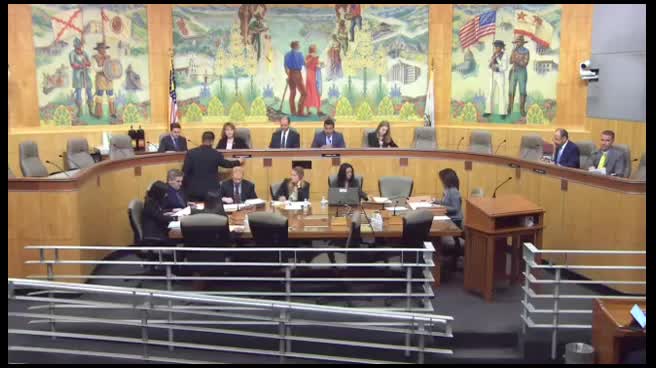 2MIN
Senate Standing Committee on Appropriations
Bill Author