SCA 1: University of California: terms of regents.
- Session Year: 2015-2016
- House: Senate
- Latest Version Date: 2016-05-19
Existing provisions of the California Constitution provide that the University of California constitutes a public trust, and require the university to be administered by the Regents of the University of California, a corporation in the form of a board, with full powers of organization and government, subject to legislative control only for specified purposes.
Existing provisions of the California Constitution provide that the regents consist of 7 ex officio members, and 18 members appointed by the Governor and approved by the Senate, a majority of the membership concurring, for 12-year terms. The California Constitution authorizes the board of regents to appoint a student or faculty member of the university, or both, to the board, as specified.
This measure would prohibit reduce the terms of regents appointed by the Governor for terms commencing on or after the effective date of the measure to 10 years, and would prohibit these regents from serving more than one term 2 terms on the board board, as specified. The measure would provide that regents serving on the board on the effective date of the measure who had served more than one term, as specified, could continue to serve until the expiration of their terms and, if they had served less than 12 years on the board as of that date, would make these members terms, but would not be eligible for reappointment to the board. The measure would also provide that regents serving in their first terms on the board on the effective date of the measure, as specified, would be eligible for reappointment to the board for no more than one additional term. The
Notwithstanding the provisions of the measure described above, the measure would also make a member appointed to fill a vacancy on the board on or after the effective date of the measure eligible for reappointment only if the balance of the term for which he or she has been appointed to fill the vacancy is less than 6 years. to the board for no more than one term.
Existing provisions of the California Constitution provide that the University of California constitutes a public trust, and require the university to be administered by the Regents of the University of California, a corporation in the form of a board, with full powers of organization and government, subject to legislative control only for specified purposes.
Existing provisions of the California Constitution provide that the regents consist of 7 ex officio members, and 18 members appointed by the Governor and approved by the Senate, a majority of the membership concurring, for 12-year terms. The California Constitution authorizes the board of regents to appoint a student or faculty member of the university, or both, to the board, as specified.
This measure would, for would prohibit regents appointed by the Governor for terms commencing on or after March 1, 2017, make the duration of a term 4 years. The measure also would, commencing November 9, 2016, prohibit a person from being appointed for a term that would result in that person serving a total of more than 16 years as a regent, exclusive of service as a student or faculty regent. The measure would specify limits on the periods of service of appointive regents whose service on the board began before November 9, 2016, and who, as of January 1, 2017, have served as regents for more than 4 years. the effective date of the measure from serving more than one term on the board. The measure would provide that regents serving on the board on the effective date of the measure could continue to serve until the expiration of their terms and, if they had served less than 12 years on the board as of that date, would make these members eligible for reappointment to the board for no more than one additional term. The measure would also make a member appointed to fill a vacancy on the board on or after the effective date of the measure eligible for reappointment only if the balance of the term for which he or she has been appointed to fill the vacancy is less than 6 years.
Existing provisions of the California Constitution provide that the University of California constitutes a public trust, and require the university to be administered by the Regents of the University of California, a corporation in the form of a board, with full powers of organization and government, subject to legislative control only for specified purposes. These provisions require that corporation to have all powers necessary or convenient for the effective administration of its trust.
This measure would repeal on January 1, 2017, the constitutional provisions relating to the university and the regents, and would require the university and the regents to be continued in existence subject to legislative control as may be provided by statute. The measure would require the Legislature to enact legislation to implement these provisions, but would prohibit the Legislature from enacting any law that restrains academic freedom, as defined, or imposes educational or curricular requirements on students enrolled at the University of California. The measure would also require the University of California to focus its recruitment efforts on the enrollment of California residents as students of the university.
Existing provisions of the California Constitution provide that the regents consist of 7 ex officio members, and 18 members appointed by the Governor and approved by the Senate, a majority of the membership concurring, for 12-year terms. The California Constitution authorizes the board of regents to appoint a student or faculty member of the university, or both, to the board, as specified.
This measure would, for regents appointed by the Governor for terms commencing on or after March 1, 2017, make the duration of a term 4 years. The measure also would, commencing November 9, 2016, prohibit a person from being appointed for a term that would result in that person serving a total of more than 16 years as a regent, exclusive of service as a student or faculty regent. The measure would specify limits on the periods of service of appointive regents whose service on the board began before November 9, 2016, and who, as of January 1, 2017, have served as regents for more than 4 years.
Existing provisions of the California Constitution provide that the University of California constitutes a public trust, and require the university to be administered by the Regents of the University of California, a corporation in the form of a board, with full powers of organization and government, subject to legislative control only for specified purposes. These provisions require that corporation to have all powers necessary or convenient for the effective administration of its trust.
This measure would repeal on January 1, 2017, the constitutional provisions relating to the university and the regents, and would require the university and the regents to be continued in existence subject to legislative control as may be provided by statute. The measure would require the Legislature to enact legislation to implement these provisions, but would prohibit the Legislature from enacting any law that restrains academic freedom, as defined, or imposes educational or curricular requirements on students enrolled at the University of California. The measure would also require the University of California to focus its recruitment efforts on the enrollment of California residents as students of the university.
Resolved by the Senate, the Assembly concurring, That the Legislature of the State of California at its 201516 Regular Session commencing on the first day of December 2014, two-thirds of the membership of each house concurring, hereby proposes to the people of the State of California, that the Constitution of the State be amended as follows:
(a)The University of California shall constitute a public trust, to be administered by the existing corporation known as The Regents of the University of California, with full powers of organization and government, subject only to that legislative control as may be necessary to ensure the security of its funds and compliance with the terms of the endowments of the university and competitive bidding procedures as may be made applicable to the university by statute for the letting of construction contracts, sales of real property, and purchasing of materials, goods, and services. The corporation shall be in form a board composed of seven ex officio members, which shall be: the Governor, the Lieutenant Governor, the Speaker of the Assembly, the Superintendent of Public Instruction, the president and the vice president of the alumni association of the university, and the acting president of the university, and 18 appointive members appointed by the Governor and approved by the Senate, a majority of the membership concurring.
(b)(1)The terms of the members appointed prior to November 5, 1974, shall be 16 years; the terms of two appointive members to expire as heretofore on March 1 of every even-numbered calendar year, and two members shall be appointed for terms commencing on March 1, 1976, and on March 1 of each year thereafter; provided that no such appointments shall be made for terms to commence on March 1, 1979, or on March 1 of each fourth year thereafter, to the end that no appointment to the regents for a newly commencing term shall be made during the first year of any gubernatorial term of office. The Except as set forth in paragraphs (2) and (3), the terms of the members appointed for terms commencing on and after March 1, 1976, shall be 12 years.
(2)(A)Except as set forth in paragraph (3), no The terms of members appointed for terms commencing on or after the effective date of the measure that adds this paragraph shall be 10 years. No member appointed on or after the effective date of the measure that adds this paragraph shall serve more than one term two terms on the board.
(B)A member appointed before the effective date of the measure that adds this paragraph who, as of that date, has served as a regent for 12 or more years, more than one term, may continue to serve until the expiration of his or her term, but shall not be eligible for reappointment to the board.
(C)A member appointed before the effective date of the measure that adds this paragraph, paragraph who, as of on that date, has served as a regent for less than 12 years, is serving in his or her first term as a regent, may continue to serve until the expiration of his or her term, and shall be eligible for reappointment to the board for no more than one additional term.
(3)In Notwithstanding paragraph (2), in case of any vacancy, the term of office of the appointee to fill that vacancy, who shall be appointed by the Governor and approved by the Senate, a majority of the membership concurring, shall be for the balance of the term for which that vacancy exists. A member who has been appointed pursuant to this paragraph on or after the effective date of the measure that adds paragraph (2) shall be eligible for reappointment to the board, board for no more than one term, only if the balance of the term for which he or she has been appointed to fill the vacancy is less than six years. term.
(c)The members of the board may, in their discretion, following procedures established by them and after consultation with representatives of faculty and students of the university, including appropriate officers of the academic senate and student governments, appoint to the board either or both of the following persons as members with all rights of participation: a member of the faculty at a campus of the university or of another institution of higher education; a person enrolled as a student at a campus of the university for each regular academic term during his or her service as a member of the board. Any person so appointed shall serve for not less than one year commencing on July 1.
(d)Regents shall be able persons broadly reflective of the economic, cultural, and social diversity of the State, including ethnic minorities and women. However, it is not intended that formulas or specific ratios be applied in the selection of regents.
(e)In the selection of the regents, the Governor shall consult an advisory committee composed as follows: The the Speaker of the Assembly and two public members appointed by the Speaker, the President pro Tempore of the Senate and two public members appointed by the Senate Committee on Rules, two public members appointed by the Governor, the chairperson of the regents of the university, an alumnus of the university chosen by the alumni association of the university, a student of the university chosen by the Council of Student Body Presidents, and a member of the faculty of the university chosen by the academic senate of the university. Public members shall serve for four years, except that one each of the initially appointed members selected by the Speaker of the Assembly, the President pro Tempore of the Senate, and the Governor shall be appointed to serve for two years; student, alumni, and faculty members shall serve for one year and may not be regents of the university at the time of their service on the advisory committee.
(f)The Regents of the University of California shall be vested with the legal title and the management and disposition of the property of the university and of property held for its benefit, and shall have the power to take and hold, either by purchase or by donation, or gift, testamentary or otherwise, or in any other manner, without restriction, all real and personal property for the benefit of the university or incidentally to its conduct. However, sales of university real property shall be subject to competitive bidding procedures that may be provided by statute. The corporation shall also have all the powers necessary or convenient for the effective administration of its trust, including the power to sue and to be sued, to use a seal, and to delegate to its committees or to the faculty of the university, or to others, the authority or functions as it may deem wise. The regents shall receive all funds derived from the sale of lands pursuant to the act of Congress of July 2, 1862, and any subsequent acts amendatory thereof. The university shall be entirely independent of all political or sectarian influence and kept free therefrom in the appointment of its regents and in the administration of its affairs, and no person shall be debarred admission to any department of the university on account of race, religion, ethnic heritage, or sex.
(g)Meetings of the Regents of the University of California shall be public, with exceptions and notice requirements as may be provided by statute.
Resolved by the Senate, the Assembly concurring, That the Legislature of the State of California at its 201516 Regular Session commencing on the first day of December 2014, two-thirds of the membership of each house concurring, hereby proposes to the people of the State of California, that the Constitution of the State be amended as follows:
(a)The University of California shall constitute a public trust, to be administered by the existing corporation known as The Regents of the University of California, with full powers of organization and government, subject only to that legislative control as may be necessary to ensure the security of its funds and compliance with the terms of the endowments of the university and competitive bidding procedures as may be made applicable to the university by statute for the letting of construction contracts, sales of real property, and purchasing of materials, goods, and services. The corporation shall be in form a board composed of seven ex officio members, which shall be: the Governor, the Lieutenant Governor, the Speaker of the Assembly, the Superintendent of Public Instruction, the president and the vice president of the alumni association of the university, and the acting president of the university, and 18 appointive members appointed by the Governor and approved by the Senate, a majority of the membership concurring.
(b)(1)The terms of the members appointed prior to November 5, 1974, shall be 16 years; the terms of two appointive members to expire as heretofore on March 1 of every even-numbered calendar year, and two members shall be appointed for terms commencing on March 1, 1976, and on March 1 of each year thereafter; provided that no such appointments shall be made for terms to commence on March 1, 1979, or on March 1 of each fourth year thereafter, to the end that no appointment to the regents for a newly commencing term shall be made during the first year of any gubernatorial term of office. Except as set forth in paragraph (2), the The terms of the members appointed for terms commencing on and after March 1, 1976, shall be 12 years.
(2)(A)Except as set forth in subparagraph (B) or (C): paragraph (3), no member appointed on or after the effective date of the measure that adds this paragraph shall serve more than one term on the board.
(i)The terms of the members appointed for terms commencing on or after March 1, 2017, shall be four years.
(ii)Commencing November 9, 2016, a person shall not be appointed for a term set forth in this paragraph, or set forth in paragraph (1) or (3), if the appointment would result in that person serving a total of more than 16 years as a regent, exclusive of any time served pursuant to subdivision (c).
(B)A member appointed before November 9, 2016, the effective date of the measure that adds this paragraph who, as of January 1, 2017, that date, has served as a regent for 15 12 or more years years, may continue to serve until the expiration of his or her term or until January 1, 2018, whichever is earlier, at which time the person shall cease to be a regent and the Governor may appoint a new member pursuant to subparagraph (A). term, but shall not be eligible for reappointment to the board.
(C)A member appointed before November 9, 2016, the effective date of the measure that adds this paragraph, who, as of January 1, 2017, that date, has served as a regent for more than four years, but less than 15 12 years, may continue to serve until the expiration of his or her term or until his or her service totals 16 years, whichever is earlier, at which time the person shall cease to be a regent and the Governor may appoint a member pursuant to subparagraph (A). term, and shall be eligible for reappointment to the board for no more than one additional term.
(3)In case of any vacancy, the term of office of the appointee to fill that vacancy, who shall be appointed by the Governor and approved by the Senate, a majority of the membership concurring, shall be for the balance of the term for which that vacancy exists. A member who has been appointed pursuant to this paragraph on or after the effective date of the measure that adds paragraph (2) shall be eligible for reappointment to the board, for no more than one term, only if the balance of the term for which he or she has been appointed to fill the vacancy is less than six years.
(c)The members of the board may, in their discretion, following procedures established by them and after consultation with representatives of faculty and students of the university, including appropriate officers of the academic senate and student governments, appoint to the board either or both of the following persons as members with all rights of participation: a member of the faculty at a campus of the university or of another institution of higher education; a person enrolled as a student at a campus of the university for each regular academic term during his or her service as a member of the board. Any person so appointed shall serve for not less than one year commencing on July 1.
(d)Regents shall be able persons broadly reflective of the economic, cultural, and social diversity of the State, including ethnic minorities and women. However, it is not intended that formulas or specific ratios be applied in the selection of regents.
(e)In the selection of the regents, the Governor shall consult an advisory committee composed as follows: The Speaker of the Assembly and two public members appointed by the Speaker, the President pro Tempore of the Senate and two public members appointed by the Senate Committee on Rules, two public members appointed by the Governor, the chairperson of the regents of the university, an alumnus of the university chosen by the alumni association of the university, a student of the university chosen by the Council of Student Body Presidents, and a member of the faculty of the university chosen by the academic senate of the university. Public members shall serve for four years, except that one each of the initially appointed members selected by the Speaker of the Assembly, the President pro Tempore of the Senate, and the Governor shall be appointed to serve for two years; student, alumni, and faculty members shall serve for one year and may not be regents of the university at the time of their service on the advisory committee.
(f)The Regents of the University of California shall be vested with the legal title and the management and disposition of the property of the university and of property held for its benefit, and shall have the power to take and hold, either by purchase or by donation, or gift, testamentary or otherwise, or in any other manner, without restriction, all real and personal property for the benefit of the university or incidentally to its conduct. However, sales of university real property shall be subject to competitive bidding procedures that may be provided by statute. The corporation shall also have all the powers necessary or convenient for the effective administration of its trust, including the power to sue and to be sued, to use a seal, and to delegate to its committees or to the faculty of the university, or to others, the authority or functions as it may deem wise. The regents shall receive all funds derived from the sale of lands pursuant to the act of Congress of July 2, 1862, and any subsequent acts amendatory thereof. The university shall be entirely independent of all political or sectarian influence and kept free therefrom in the appointment of its regents and in the administration of its affairs, and no person shall be debarred admission to any department of the university on account of race, religion, ethnic heritage, or sex.
(g)Meetings of the Regents of the University of California shall be public, with exceptions and notice requirements as may be provided by statute.
Resolved by the Senate, the Assembly concurring, That the Legislature of the State of California at its 201516 Regular Session commencing on the first day of December 2014, two-thirds of the membership of each house concurring, hereby proposes to the people of the State of California, that the Constitution of the State be amended as follows:
(a)The University of California shall constitute a public trust, to be administered by the existing corporation known as The Regents of the University of California, with full powers of organization and government, subject only to that legislative control as may be necessary to ensure the security of its funds and compliance with the terms of the endowments of the university and competitive bidding procedures as may be made applicable to the university by statute for the letting of construction contracts, sales of real property, and purchasing of materials, goods, and services. The corporation shall be in form a board composed of seven ex officio members, which shall be: the Governor, the Lieutenant Governor, the Speaker of the Assembly, the Superintendent of Public Instruction, the president and the vice president of the alumni association of the university, and the acting president of the university, and 18 appointive members appointed by the Governor and approved by the Senate, a majority of the membership concurring.
(b)(1)The terms of the members appointed prior to November 5, 1974, shall be 16 years; the terms of two appointive members to expire as heretofore on March 1 of every even-numbered calendar year, and two members shall be appointed for terms commencing on March 1, 1976, and on March 1 of each year thereafter; provided that no such appointments shall be made for terms to commence on March 1, 1979, or on March 1 of each fourth year thereafter, to the end that no appointment to the regents for a newly commencing term shall be made during the first year of any gubernatorial term of office. The Except as set forth in paragraph (2), the terms of the members appointed for terms commencing on and after March 1, 1976, shall be 12 years.
(2)(A)Except as set forth in subparagraph (B) or (C):
(i)The terms of the members appointed for terms commencing on or after March 1, 2017, shall be four years.
(ii)Commencing November 9, 2016, a person shall not be appointed for a term set forth in this paragraph, or set forth in paragraph (1) or (3), if the appointment would result in that person serving a total of more than 16 years as a regent, exclusive of any time served pursuant to subdivision (c).
(B)A member appointed before November 9, 2016, who, as of January 1, 2017, has served as a regent for 15 or more years may continue to serve until the expiration of his or her term or until January 1, 2018, whichever is earlier, at which time the person shall cease to be a regent and the Governor may appoint a new member pursuant to subparagraph (A).
(C)A member appointed before November 9, 2016, who, as of January 1, 2017, has served as a regent for more than four years, but less than 15 years, may continue to serve until the expiration of his or her term or until his or her service totals 16 years, whichever is earlier, at which time the person shall cease to be a regent and the Governor may appoint a member pursuant to subparagraph (A).
In
(3)In case of any vacancy, the term of office of the appointee to fill such that vacancy, who shall be appointed by the Governor and approved by the Senate, a majority of the membership concurring, shall be for the balance of the term for which that vacancy exists.
(c)The members of the board may, in their discretion, following procedures established by them and after consultation with representatives of faculty and students of the university, including appropriate officers of the academic senate and student governments, appoint to the board either or both of the following persons as members with all rights of participation: a member of the faculty at a campus of the university or of another institution of higher education; a person enrolled as a student at a campus of the university for each regular academic term during his or her service as a member of the board. Any person so appointed shall serve for not less than one year commencing on July 1.
(d)Regents shall be able persons broadly reflective of the economic, cultural, and social diversity of the State, including ethnic minorities and women. However, it is not intended that formulas or specific ratios be applied in the selection of regents.
(e)In the selection of the regents, the Governor shall consult an advisory committee composed as follows: The Speaker of the Assembly and two public members appointed by the Speaker, the President pro Tempore of the Senate and two public members appointed by the Senate Committee on Rules, two public members appointed by the Governor, the chairperson of the regents of the university, an alumnus of the university chosen by the alumni association of the university, a student of the university chosen by the Council of Student Body Presidents, and a member of the faculty of the university chosen by the academic senate of the university. Public members shall serve for four years, except that one each of the initially appointed members selected by the Speaker of the Assembly, the President pro Tempore of the Senate, and the Governor shall be appointed to serve for two years; student, alumni, and faculty members shall serve for one year and may not be regents of the university at the time of their service on the advisory committee.
(f)The Regents of the University of California shall be vested with the legal title and the management and disposition of the property of the university and of property held for its benefit, and shall have the power to take and hold, either by purchase or by donation, or gift, testamentary or otherwise, or in any other manner, without restriction, all real and personal property for the benefit of the university or incidentally to its conduct. However, sales of university real property shall be subject to competitive bidding procedures that may be provided by statute. The corporation shall also have all the powers necessary or convenient for the effective administration of its trust, including the power to sue and to be sued, to use a seal, and to delegate to its committees or to the faculty of the university, or to others, the authority or functions as it may deem wise. The regents shall receive all funds derived from the sale of lands pursuant to the act of Congress of July 2, 1862, and any subsequent acts amendatory thereof. The university shall be entirely independent of all political or sectarian influence and kept free therefrom in the appointment of its regents and in the administration of its affairs, and no person shall be debarred admission to any department of the university on account of race, religion, ethnic heritage, or sex.
(g)Meetings of the Regents of the University of California shall be public, with exceptions and notice requirements as may be provided by statute.
(h)This section shall become inoperative on January 1, 2017, and as of that date is repealed.
Resolved by the Senate, the Assembly concurring, That the Legislature of the State of California at its 201516 Regular Session commencing on the first day of December 2014, two-thirds of the membership of each house concurring, hereby proposes to the people of the State of California, that the Constitution of the State be amended as follows:
(a)The University of California shall constitute a public trust, to be administered by the existing corporation known as The Regents of the University of California, with full powers of organization and government, subject only to such that legislative control as may be necessary to insure ensure the security of its funds and compliance with the terms of the endowments of the university and such competitive bidding procedures as may be made applicable to the university by statute for the letting of construction contracts, sales of real property, and purchasing of materials, goods, and services. Said The corporation shall be in form a board composed of seven ex officio members, which shall be: the Governor, the Lieutenant Governor, the Speaker of the Assembly, the Superintendent of Public Instruction, the president and the vice president of the alumni association of the university, and the acting president of the university, and 18 appointive members appointed by the Governor and approved by the Senate, a majority of the membership concurring; provided, however that the present appointive members shall hold office until the expiration of their present terms.
(b)The terms of the members appointed prior to November 5, 1974, shall be 16 years; the terms of two appointive members to expire as heretofore on March 1st 1 of every even-numbered calendar year, and two members shall be appointed for terms commencing on March 1, 1976, and on March 1 of each year thereafter; provided that no such appointments shall be made for terms to commence on March 1, 1979, or on March 1 of each fourth year thereafter, to the end that no appointment to the regents for a newly commencing term shall be made during the first year of any gubernatorial term of office. The terms of the members appointed for terms commencing on and after March 1, 1976, shall be 12 years. During the period of transition until the time when the appointive membership is comprised exclusively of persons serving for terms of 12 years, the total number of appointive members may exceed the numbers specified in the preceeding paragraph.
In case of any vacancy, the term of office of the appointee to fill such vacancy, who shall be appointed by the Governor and approved by the Senate, a majority of the membership concurring, shall be for the balance of the term for which such that vacancy exists.
(c)The members of the board may, in their discretion, following procedures established by them and after consultation with representatives of faculty and students of the university, including appropriate officers of the academic senate and student governments, appoint to the board either or both of the following persons as members with all rights of participation: a member of the faculty at a campus of the university or of another institution of higher education; a person enrolled as a student at a campus of the university for each regular academic term during his or her service as a member of the board. Any person so appointed shall serve for not less than one year commencing on July 1.
(d)Regents shall be able persons broadly reflective of the economic, cultural, and social diversity of the State, including ethnic minorities and women. However, it is not intended that formulas or specific ratios be applied in the selection of regents.
(e)In the selection of the Regents regents, the Governor shall consult an advisory committee composed as follows: The Speaker of the Assembly and two public members appointed by the Speaker, the President Pro pro Tempore of the Senate and two public members appointed by the Rules Committee of the Senate Committee on Rules, two public members appointed by the Governor, the chairman chairperson of the regents of the university, an alumnus of the university chosen by the alumni association of the university, a student of the university chosen by the Council of Student Body Presidents, and a member of the faculty of the university chosen by the academic senate of the university. Public members shall serve for four years, except that one each of the initially appointed members selected by the Speaker of the Assembly, the President Pro pro Tempore of the Senate, and the Governor shall be appointed to serve for two years; student, alumni, and faculty members shall serve for one year and may not be regents of the university at the time of their service on the advisory committee.
(f)The Regents of the University of California shall be vested with the legal title and the management and disposition of the property of the university and of property held for its benefit, and shall have the power to take and hold, either by purchase or by donation, or gift, testamentary or otherwise, or in any other manner, without restriction, all real and personal property for the benefit of the university or incidentally to its conduct; provided, however, that. However, sales of university real property shall be subject to such competitive bidding procedures as that may be provided by statute. Said The corporation shall also have all the powers necessary or convenient for the effective administration of its trust, including the power to sue and to be sued, to use a seal, and to delegate to its committees or to the faculty of the university, or to others, such the authority or functions as it may deem wise. The Regents regents shall receive all funds derived from the sale of lands pursuant to the act of Congress of July 2, 1862, and any subsequent acts amendatory thereof. The university shall be entirely independent of all political or sectarian influence and kept free therefrom in the appointment of its regents and in the administration of its affairs, and no person shall be debarred admission to any department of the university on account of race, religion, ethnic heritage, or sex.
(g)Meetings of the Regents of the University of California shall be public, with exceptions and notice requirements as may be provided by statute.
(h)This section shall become inoperative on January 1, 2017, and as of that date is repealed.
(a)The University of California is hereby continued in existence in the state government, and is subject to legislative control as may be provided by statute.
(b)The University of California shall be administered by the existing corporation known as The Regents of the University of California, which is hereby continued in existence in the state government, and is subject to legislative control as may be provided by statute.
(c) (1)The Legislature shall enact legislation to implement this section.
(2)Notwithstanding subdivisions (a) and (b), or any other provision of this Constitution, the Legislature shall not enact any law that restrains academic freedom within the University of California or imposes educational or curricular requirements on students enrolled at the University of California.
(3)As used in this subdivision, academic freedom means the freedom to discuss all relevant matters in the classroom, to explore all avenues of scholarship, research, and creative expression, and to speak or write without institutional discipline or restraint on matters of public concern as well as matters related to professional duties of faculty and staff and the functioning of the university.
(d)The University of California shall focus its recruitment efforts on the enrollment of California residents as students of the university.
(e)This section shall become operative on January 1, 2017.
|
Date
|
Status
|
|---|---|
| Aug 31, 2016 | Ordered to inactive file on request of Senator Lara. |
| May 31, 2016 | Read second time. Ordered to third reading. |
| May 27, 2016 | From committee: Be adopted. (Ayes 5. Noes 1. Page 4012.) (May 27). |
| May 27, 2016 | From committee: Be adopted. (Ayes 5. Noes 1.) (May 27). |
| May 27, 2016 | May 27 set for first hearing. Held in committee. Reconsideration of favorable vote granted. |
| May 24, 2016 | Set for hearing May 27. |
| May 23, 2016 | May 23 hearing: Placed on APPR. suspense file. (Ayes 7. Noes 0.) |
| May 19, 2016 | Set for hearing May 23 in APPR. pending receipt. |
| May 19, 2016 | Read second time and amended. Re-referred to Com. on APPR. |
| May 18, 2016 | From committee: Be adopted as amended and re-refer to Com. on APPR. (Ayes 5. Noes 0. Page 3823.) (May 10). |
| May 18, 2016 | From committee: Be adopted as amended and re-refer to Com. on APPR. (Ayes 5. Noes 0.) (May 10). |
| May 6, 2016 | Set for hearing May 10. |
| May 5, 2016 | From committee with author's amendments. Read second time and amended. Re-referred to Com. on E. & C.A. |
| Apr 20, 2016 | From committee: Be adopted and re-refer to Com. on E. & C.A. (Ayes 6. Noes 0. Page 3608.) (April 20). Re-referred to Com. on E. & C.A. |
| Apr 20, 2016 | From committee: Be adopted and re-refer to Com. on E. & C.A. (Ayes 6. Noes 0.) (April 20). Re-referred to Com. on E. & C.A. |
| Apr 8, 2016 | Set for hearing April 20. |
| Mar 10, 2016 | From committee with author's amendments. Read second time and amended. Re-referred to Com. on ED. |
| Jan 15, 2015 | Referred to Coms. on ED. and E. & C.A. |
| Jan 5, 2015 | Read first time. |
| Dec 5, 2014 | From printer. May be acted upon on or after January 4. |
| Dec 4, 2014 | Introduced. To Com. on RLS. for assignment. To print. |
|
Date
|
Description
|
Location
|
Votes
|
|
|---|---|---|---|---|
| May 27, 2016 | Be adopted | Senate Standing Committee on Appropriations |
Passed |
|
| May 27, 2016 | [05-27-2016] set for [First] hearing: Reconsideration of favorable vote granted | Senate Standing Committee on Appropriations |
Passed |
|
| May 27, 2016 | Be adopted | Senate Standing Committee on Appropriations |
Passed |
|
| May 23, 2016 | Placed on suspense file | Senate Standing Committee on Appropriations |
Passed |
|
| May 10, 2016 | Be adopted as amended, but first amend, and re-refer to the Committee on [Appropriations] | Senate Standing Committee on Elections and Constitutional Amendments |
Passed |
|
| Apr 20, 2016 | Be adopted, but first be re-referred to the Committee on [Elections and Constitutional Amendments] | Senate Standing Committee on Education |
Passed |
This list shows positions taken on this bill by organizations on the date displayed, which is linked to the original source.
Positions by individuals are not included.
Office of Senate Floor Analyses (916) 651-1520 Fax: (916) 327-4478 | SCA |
THIRD READING
Bill No: SCA 1
:
SENATE EDUCATION COMMITTEE: 6-0, 4/20/16
AYES: Hancock, Huff, Leyva, Mendoza, Monning, Vidak
NO VOTE RECORDED: Liu, Block, Pan
SENATE ELECTIONS & C.A. COMMITTEE: 5-0, 5/10/16
AYES: Allen, Anderson, Hancock, Hertzberg, Liu
SENATE APPROPRIATIONS COMMITTEE: 5-1, 5/27/16
AYES: Lara, Beall, Hill, McGuire, Mendoza
NOES: Nielsen
NO VOTE RECORDED: Bates
DIGEST: This constitutional amendment proposes to modify Article IX of the State Constitution to reduce the term of an appointment as a Regent of the University of California from 12 years to 10 years for terms commencing on or after the effective date of this measure and prohibits these members from serving more than two terms.
Existing law, under the California Constitution:
- Establishes the University of California (UC), a public trust to be administered by the Regents of the UC and grants the Regents full powers of organization and government, subject only to such legislative control as may be necessary to insure security of its funds, compliance with the terms of its endowments, statutory requirements around competitive bidding and contracts, sales of property and the purchase of materials, goods and services. (Article IX, Section (9)(a) of the California Constitution)
- Establishes the requirements for appointment and terms to be served by a member of the Regents of the UC. The Constitution specifically requires that members appointed prior to November 5, 1974, serve a 16-year term and that members appointed on and after March 1, 1976, be appointed for a term of 12 years. The Constitution also provides that the Senate, a majority of the membership concurring, approve any Regent appointee made by the Governor. (Article IX, Section (9)(b) of the California Constitution)
This constitutional amendment proposes to place before the voters a change to the California Constitution to modify the terms of an appointment as UC Regent. It:
- Establishes new restrictions on the terms to be served by an appointed member of the Regents. It:
- Requires that the terms of a Regent appointed for terms commencing on or after the effective date of the measure be 10 years.
- Prohibits any member appointed on or after the effective date of the measure from serving more than two terms on the board.
- Provides that a member appointed in order to fill a vacancy shall be eligible for reappointment to the board for no more than one term.
- Makes the following provision for Regents appointed prior to the measure’s enactment:
- Provides that a Regent appointed prior to the measure’s effective date who has served more than one term:
- Is authorized to serve until the expiration of their term.
- Is ineligible for reappointment to the board.
- Provides that a Regent appointed prior to the measure’s effective date who is serving his/her first term:
- May continue to serve until the expiration of his/her term.
- Is eligible for reappointment to the board for no more than one additional term.
- Provides that a Regent appointed prior to the measure’s effective date who has served more than one term:
- Makes a number of technical changes and corrections.
Comments
- Need for the bill. According to the author, the Senate’s confirmation process of the UC Regents is one of the few oversight mechanisms the public and the Legislature have to hold the UC accountable. Because the Regent’s terms are so long, the author opines that the public, students, and legislators are unable to hold them accountable to the commitments and promises they make during their confirmation hearings. The author is concerned that in the last decade the UC has increased its out of state and international students, while ignoring the diverse pool of potential applicants in its own backyard, and proposed tuition increases despite opposition from the public, students, and elected officials. According to the author, shorter terms and term limits will provide the Legislature and the public greater oversight of the UC’s powerful and autonomous body and ensure accountability to the public. This measure will allow voters to decide whether to shorten the terms and establish term limits for the Regents.
- Clarifications. Currently, UC Regents are appointed by the Governor, and confirmed by the Senate, for a 12-year term. Appointments for less than 12 years can be made in order to fill a vacancy in which case the appointee serves for the remainder of the term. This measure reduces the term of an appointment as a Regent to 10 years and caps the allowable service as a Regent at two terms. Current regents would be allowed to continue their existing appointment until the expiration of their terms, but eligibility for reappointment would depend upon the number of terms already served. Similarly, appointments to fill a vacancy would be eligible for only one additional term.
The California Constitution provides for 18 Regents to be appointed by the Governor, and approved by the Senate, via majority vote, as well as a student member. In addition, the Constitution provides for seven ex officio members to include the Governor, Lieutenant Governor, Assembly Speaker, Superintendent of Public Instruction, the President and Vice-president of the University’s alumni association, and the acting President of the University.
No cap on the total terms of service as a Regent currently exists.
- Other University Board terms? According to information provided by the UC, several other Universities have governing board terms that range from six to eight years. These include the University of Texas, University of New Mexico, University of Washington, University of Georgia, University of Wisconsin, and the University of Michigan. The University of Virginia and the University of Florida set 4- and 5-year terms for board members, respectively.
The California State University (CSU) Board of Trustees members are appointed for 8-year terms. However, CSU Trustee terms are established via statute. It is unclear whether the board terms of other national universities are constitutionally prescribed, although, according to the UC, Michigan, Georgia, New Mexico, and Florida are constitutionally autonomous. It is also unclear whether there are caps on the number of years that may be served as a board member.
- Constitutional amendment requirements. As a proposed Constitutional amendment, this measure does not go into effect unless approved by the majority of voters at a statewide election. This proposal requires a 2/3 vote of each house in order to be submitted to the voters. It does not require approval by the Governor.
FISCAL EFFECT: Appropriation: Fiscal Com.: Local:
According to the Senate Appropriations Committee, this measure results in costs of up to $552,000 general fund for additional pages to be printed in the voter information guide for a statewide election. The UC cites no significant costs resulting from the passage of this measure.
None received
OPPOSITION: (Verified 5/27/16)
None received
5/28/16 16:46:16
**** END ****
SENATE COMMITTEE ON APPROPRIATIONS
Senator Ricardo Lara, Chair
2015 - 2016 Regular Session
SCA 1 (Lara) - University of California: terms of regents
Version: May 19, 2016 | Policy Vote: ED. 6 - 0, E. & C.A. 5 - 0 |
Urgency: No | Mandate: No |
Hearing Date: May 23, 2016 | Consultant: Jillian Kissee |
This bill meets the criteria for referral to the Suspense File.
Bill Summary:
This bill sets forth a constitutional amendment before the voters to reduce the terms of members appointed to the University of California (UC) Board of Regents (Board) from 12 years to 10 years for terms commencing on or after the effective date of this measure. This measure also prohibits members from serving more than two terms.
Fiscal Impact:
Costs of up to $552,000 for additional pages to be printed in the voter information guide for a statewide election. The pages would include the language of this measure, the Legislative Analyst’s Office analysis, and arguments in support and opposition. (General Fund)
The UC cites no significant costs resulting from the passage of this measure.
Background:
The California Constitution requires that Board members appointed on and after March 1, 1976 be appointed for a term of 12 years and does not prohibit a regent of the UC from being appointed to serve more than one term. The Constitution provides that the Senate, with a majority of the membership concurring, approve any Regent appointee made by the Governor. (Article IX, Section (9)(b) of the California Constitution)
Proposed Law:
For terms commencing on or after the effective date of this measure, this measure reduces the terms of members appointed to the Board from 12 years to 10 years and prohibits members from serving more than two terms.
In addition, it provides that a member appointed before the effective date of this measure that has served as a regent for more than one term, may continue to serve until the expiration of his or her term, but is ineligible for reappointment to the Board. For a member who is serving in his or her first term as of the effective date of this measure, he or she may continue to serve until the term’s expiration, and is eligible for reappointment for one more additional term. Finally, the measure provides that a member who has been appointed to fill a vacancy is eligible for reappointment to the Board for no more than one term.
Related Legislation:
SCA 12 (Runner), pending in the Senate Judiciary Committee, requires the UC Regents to ensure that priority in admissions is given to applicants who are California residents.
-- END --
SENATE COMMITTEE ON
ELECTIONS AND CONSTITUTIONAL AMENDMENTS
Senator Ben Allen, Chair
2015 - 2016 Regular
Bill No: SCA Hearing Date: 5/10/16
Author: | |||
Version: | 5/5/16 | ||
Urgency: | No | Fiscal: | Yes |
Consultant: | Darren Chesin | ||
Subject: University of California: terms of regents
DIGEST
This measure prohibits Regents of the University of California from serving more than one 12-year term on the board for terms commencing on or after the effective date of this measure.
ANALYSIS
Existing law:
- Establishes, pursuant to the California Constitution, the University of California (UC), as a public trust to be administered by the Regents of the UC and grants the Regents full powers of organization and government, subject only to such legislative control as may be necessary to insure security of its funds, compliance with the terms of its endowments, statutory requirements around competitive bidding and contracts, sales of property and the purchase of materials, goods and services.
- Provides that the Senate, a majority of the membership concurring, approve any Regent appointee made by the Governor.
- Establishes the requirements for appointment and terms to be served by a member of the Regents of the UC. The Constitution specifically requires that members appointed on and after March 1, 1976 be appointed for a term of 12 years.
- Does not prohibit a Regent of the UC from being appointed to serve more than one term.
This bill:
- Prohibits Regents appointed by the Governor for terms commencing on or after the effective date of this measure from serving more than one 12-year term on the board.
- Provides that a Regent appointed before the effective date of this measure who has served for 12 or more years may continue to serve until the expiration of his or her term, but shall not be eligible for reappointment to the board.
- Provides that a Regent appointed before the effective date of this measure who has served as a Regent for less than 12 years, may continue to serve until the expiration of his or her term, and shall be eligible for reappointment to the board for no more than one additional term.
- Provides that a Regent appointed to fill a vacancy on the board on or after the effective date of this measure is eligible for reappointment only if the balance of the term for which he or she has been appointed to fill the vacancy is less than 6 years.
- Makes various technical changes and corrections.
BACKGROUND
UC Regents. Currently, UC Regents are appointed by the Governor, and confirmed by the Senate, for a 12 year term. Appointments for less than 12 years can be made in order to fill a vacancy in which case the appointee serves for the remainder of the term. Current law does not prohibit a UC Regent from being appointed to serve more than one term.
The California Constitution provides for 18 Regents to be appointed by the Governor, and approved by the Senate, via majority vote, as well as a student member. In addition, the Constitution provides for seven ex officio members to include the Governor, Lieutenant Governor, Assembly Speaker, Superintendent of Public Instruction, the President and Vice-president of the University’s alumni association, and the acting President of the University.
Other university board terms. The California State University (CSU) Board of Trustees members are appointed for 8 year terms. However, CSU Trustee terms are established via statue. It is unclear whether the board terms of other national universities are constitutionally prescribed, although, according to the UC, Michigan, Georgia, New Mexico, and Florida are constitutionally autonomous. It is also unclear whether there are caps on the number of years that may be served as a board member.
COMMENTS
- According to the author: The Senate’s confirmation process is one of the few oversight mechanisms that we all agree fosters communication between the Legislature, the public, and the UC Board of Regents. Currently, some Regents have served for over 20 years and their service should be commended, however, their lengthy term disincentives a dialogue with the public and the Legislature.
SCA 1 will give voters the opportunity to increase oversight at the University of California (UC) by providing that Regents serve single 12-year terms, and allowing current Regents to serve no more than one additional 12-year term, unless they have already served 12 or more years on the board, at which point they may continue to serve until the expiration of their term.
These terms will enable us to engage more often and work together towards our common goals. If the UC is going to retain its reputation and continue to lead globally, we need to work collaboratively with the UC to better serve its students, professors, and employees.
SCA 1 will allow voters to establish appropriate term limits for the UC Board of Regents 2016 and give the Legislature and the public the opportunity to be more involved in the functions of the university. UC will still maintain the same academic independence it has enjoyed since its inception.
RELATED/PRIOR LEGISLATION
SCA 12 (Runner), which is pending in the Senate Judiciary Committee, proposes to modify the State Constitution to require the UC Regents to ensure that priority in admissions is given to applicants who are California residents.
POSITIONS
Sponsor: Author
Support: None received
Oppose: University of California
UCLA Undergraduate Students Association
Three individuals including two former UC Regents
(It should be noted that all of the aforementioned letters of opposition relate to the prior version of this measure which would have reduced the length of the Regents’ terms from 12 to 4 years and limited the total number of possible years served to 16. The Committee is unaware if these organizations and individuals continue to oppose the current version of this measure.)
-- END --
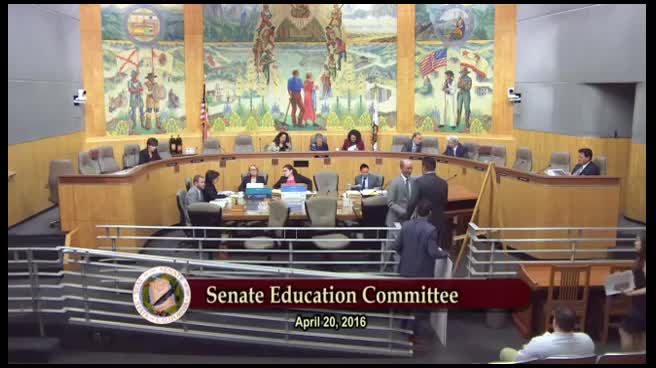
SENATE COMMITTEE ON EDUCATION
Senator Carol Liu, Chair
2015 - 2016 Regular
Bill No: SCA 1
Author: | and Cannella | ||
Version: | March 10, 2016 Hearing Date: April 20, 2016 | ||
Urgency: | No | Fiscal: | Yes |
Consultant: | Kathleen Chavira | ||
Subject: University of California: terms of regents
NOTE: This measure has been referred to the Committees on Education and Elections and Constitutional Amendments. A "do pass" motion should include referral to the Elections and Constitutional Amendments Committee.
SUMMARY
This measure proposes to modify Article IX of the State Constitution to reduce the term of an appointment as a Regent of the University of California from 12 years to four years and to cap the term of such an appointment at 16 years beginning March 1, 2017, as specified.
BACKGROUND
The California Constitution establishes the University of California (UC), a public trust to be administered by the Regents of the UC and grants the Regents full powers of organization and government, subject only to such legislative control as may be necessary to insure security of its funds, compliance with the terms of its endowments, statutory requirements around competitive bidding and contracts, sales of property and the purchase of materials, goods and services.
(Article IX, Section (9)(a) of the California Constitution)
The California Constitution establishes the requirements for appointment and terms to be served by a member of the Regents of the UC. The Constitution specifically requires that members appointed prior to November 5, 1974 serve a 16 year term and that members appointed on and after March 1, 1976 be appointed for a term of 12 years. The Constitution also provides that the Senate, a majority of the membership concurring, approve any Regent appointee made by the Governor.
(Article IX, Section (9)(b) of the California Constitution)
ANALYSIS
This constitutional amendment proposes to place before the voters a change to the California Constitution to modify the terms of an appointment as Regent of the University of California. It:
- Establishes new restrictions on the terms to be served by an appointed member of the Regents. It:
- Requires that the terms of a Regent appointed for terms commencing on or after March 1, 2017 be four years.
- Beginning November 9, 2016, prohibits appointment of a person as a Regent if the appointment would result in the individual serving a total of more than 16 years as a Regent (except for the appointment of a faculty member or a student Regent).
- Makes the following exceptions to the new restrictions for existing Regents appointed prior to November 9, 2016:
- Authorizes a Regent who has served for 15 years or more to serve until the expiration of their term or until January 1, 2018, whichever is sooner.
- Authorizes a Regent who, as of January 1, 2017, has served for more than four years but less than 15 years to serve until the expiration of their term or until the total term of service is 16 years, whichever is sooner.
- Makes a number of technical changes and corrections.
STAFF COMMENTS
- Need for the bill. According to the author, the Senate’s confirmation process of the UC Regents is one of the few oversight mechanisms the public and the Legislature have to hold the UC accountable. Because the Regent’s terms are so long, the author opines that the public, students, and legislators are unable to hold them accountable to the commitments and promises they make during their confirmation hearings. The author is concerned that in the last decade the UC has increased its out of state and international students, while ignoring the diverse pool of potential applicants in its own backyard, and proposed tuition increases despite opposition from the public, students, and elected officials. According to the author, shorter terms and term limits will provide the Legislature and the public greater oversight of the UC’s powerful and autonomous body and ensure accountability to the public. This measure will allow voters to decide whether to shorten the terms and establish term limits for the Regents.
- Clarifications. Currently, UC Regents are appointed by the Governor, and confirmed by the Senate, for a 12 year term. Appointments for less than 12 years can be made in order to fill a vacancy in which case the appointee serves for the remainder of the term. This bill reduces the term of an appointment as a Regent to 4 years. It also caps the total years of allowable service as a Regent at 16 years, and makes provision for the transition to these new requirements for existing Regents. No cap on the total terms of service as a Regent currently exists.
The California Constitution provides for 18 Regents to be appointed by the Governor, and approved by the Senate, via majority vote, as well as a student member. In addition, the Constitution provides for seven ex officio members to include the Governor, Lieutenant Governor, Assembly Speaker, Superintendent of Public Instruction, the President and Vice-president of the University’s alumni association, and the acting President of the University.
- Effect on existing Regents. This bill establishes 4 year terms and overall term limits of 16 years for Regents appointed on or after March 1, 2017. In addition, it makes provision for the “phasing out” of existing Regents based upon the amount of time which has already been served as a Regent.
If the bill’s provisions were enacted, the existing Regents would be affected as follows:
- Four of the current Regents were newly appointed less than four years ago by Governor Brown. These Regents would serve the remainder of their terms and all could be reappointed for an additional four year term without exceeding 16 years of service as a Regent. In addition, two of the Regents had terms that expired in March 2016 and the subsequent appointees to these positions would be subject to the 4-year and 16-year terms of the bill.
- Four of the current Regents, (three of which were re-appointed by Governor Brown in 2014) were initially appointed prior to November 2016 and have served for 15 or more years. Regents Pattiz, Lozano, Lansing and Blum would be compelled to step down on January 1, 2018, prior to the expiration of their terms. Regents Pattiz and Blum are serving terms currently set to expire in 2026, and the terms of Regents Lozano and Lansing are set to expire in 2022. If allowed to serve their full terms, these individuals will have served as Regents for 21-25 years.
- Eight of the current Regents will have served more than four years but less than 15 years as of January 2107. These Regents would serve until the expiration of their term or until total service equals 16 years, whichever is sooner. All would have served a total of 12 years by the expiration of their terms and could be reappointed for an additional four year term without exceeding 16 years of service as a Regent.
- Other University Board terms? According to information provided by the University of California (UC), several other Universities have governing board terms that range from 6-8 years. These include the University of Texas, University of New Mexico, University of Washington, University of Georgia, University of Wisconsin, and the University of Michigan. The University of Virginia and the University of Florida set 4 and 5 year terms for board members, respectively.
The California State University (CSU) Board of Trustees members are appointed for 8 year terms. However, CSU Trustee terms are established via statue. It is unclear whether the board terms of other national universities are constitutionally prescribed, although, according to the UC, Michigan, Georgia, New Mexico, and Florida are constitutionally autonomous. It is also unclear whether there are caps on the number of years that may be served as a board member.
- Balancing autonomy and accountability? This bill reduces the terms of the Regents from 12 years to four years. Serving the full 16 years would require “re-confirmation” every four years. Arguably, the autonomy established in the constitution was intended to limit legislative efforts to regulate issues related to teaching, learning and scholarship and to limit governmental interference in institutional operations.
The Committee may wish to consider:
- Would the potential to be denied “reappointment” every four years compromise the ability of a Regent to administer the University of California independent of state political influence?
- Is a 12 year term necessary to ensure such independence?
- Constitutional amendment requirements. As a proposed Constitutional
amendment this measure would not go into effect unless approved by the majority of voters at a statewide election. This proposal requires a 2/3 vote of each house in order to be submitted to the voters. It does not require approval by the Governor.
- Conflicting Legislation? Legislative counsel has noted a potential conflict between this bill, and SCA 12 (Runner), also on the Committee’s agenda today, as both propose changes to Section 9, Article IX of the California Constitution. While the provisions of each proposed constitutional amendment do not appear to be in conflict, this bill has been referred to the Senate Committee on Elections and Constitutional Amendments which has jurisdiction over bills to amend the constitution and can appropriately determine any necessary amendments to address a conflict.
SUPPORT
None received on this version.
OPPOSITION
None received.
-- END --


Bill Co-Author(s):
