SJR 13: Voting: apportionment.
- Session Year: 2015-2016
- House: Senate
- Latest Version Date: 2015-09-04
This measure would urge the Supreme Court of the United States to uphold the federal constitutional principle of one person, one vote and not deny Californias children and immigrants equal protection under the law.
This measure would urge the Supreme Court of the United States to uphold the federal constitutional principle of one person, one vote and not deny Californias children and immigrants equal protection under the law.
This measure would urge the Supreme Court of the United States to uphold the federal constitutional principle of one person, one vote and not deny Californias children and immigrants equal protection under the law.
WHEREAS, One person, one vote has been an enshrined principle of the United States Constitution since it was articulated by Chief Justice of the United States Earl Warren in Reynolds v. Sims (1964) 377 U.S. 533, which was decided at the height of the Civil Rights movement; and
WHEREAS, The Supreme Court of the United States, in Reynolds v. Sims, held that seats in both houses of a bicameral legislature must be apportioned equally on a population basis under the equal protection clause of the 14th Amendment to the United States Constitution; and
WHEREAS, Federal courts have consistently endorsed the use of total population, including those ineligible to vote, to determine equal apportionment since Reynolds v. Sims; and
WHEREAS, Political districts across the nation were arbitrarily drawn and severely imbalanced before the Supreme Court of the United States affirmed the principle of one person, one vote in Reynolds v. Sims; and
WHEREAS, Texas plaintiffs, led by Sue Evenwel, Titus County GOP Chairwoman, are attempting to disenfranchise Californias immigrants and children by challenging the longstanding democratic principle of one person, one vote through their litigation in Evenwel v. Abbott; and
WHEREAS, The legal theory proffered by the plaintiffs, that legislative districts must be drawn in a way that excludes children and noncitizens and instead be drawn based on the population of eligible voters, has never been endorsed by the Supreme Court of the United States; and
WHEREAS, Sixty-three percent of Californias population consists of citizens of voting age; and
WHEREAS, California is deeply concerned with the recent decision of the Supreme Court of the United States to hear arguments in Evenwel v. Abbott and potentially disenfranchise 37 percent of our states population; and
WHEREAS, Not counting immigrants, whether with legal status or undocumented, as full persons for purposes of apportionment is reminiscent of the United States Constitutions infamous three-fifths clause that did not view enslaved Black people the same as White people for purposes of apportionment; and
WHEREAS, Overturning the long held precedent of one person, one vote would be tantamount to enshrining discrimination and prejudice in the law; and
WHEREAS, These plaintiffs seek to use the Supreme Court of the United States to turn back the clock on a half century of legal precedent and return to an unjust, unequal system of drawing legislative districts that would deprive immigrants and children of representation; now, therefore, be it
Resolved by the Senate and the Assembly of the State of California, jointly, That the Legislature urges the Supreme Court of the United States to uphold the United States Constitutions principle of one person, one vote and not deny Californias children and immigrants equal protection under the law; and be it further
Resolved, That the Secretary of the Senate transmit copies of this resolution to the members of the Supreme Court of the United States, to the President and Vice President of the United States, to the Speaker of the House of Representatives, to the Majority Leader of the Senate, and to each Senator and Representative from California in the Congress of the United States.
|
Date
|
Status
|
|---|---|
| Sep 4, 2015 | Chaptered by Secretary of State. Res. Chapter 160, Statutes of 2015. |
| Sep 4, 2015 | Enrolled and filed with the Secretary of State at 9:15 a.m. |
| Aug 31, 2015 | Read. Adopted. (Ayes 57. Noes 11. Page 2697.) Ordered to the Senate. |
| Aug 31, 2015 | In Senate. Ordered to engrossing and enrolling. |
| Aug 31, 2015 | Read. Adopted. Ordered to the Senate. |
| Jul 15, 2015 | From committee: Be adopted. Ordered to third reading. (Ayes 5. Noes 1.) (July 15). |
| Jun 29, 2015 | Referred to Com. on E. & R. |
| Jun 23, 2015 | In Assembly. Held at Desk. |
| Jun 22, 2015 | Read. Adopted. (Ayes 36. Noes 0. Page 1548.) Ordered to the Assembly. |
| Jun 18, 2015 | From committee: Be adopted. Ordered to third reading. (Ayes 7. Noes 0. Page 1475.) (June 16). |
| Jun 12, 2015 | Set for hearing June 16. |
| Jun 11, 2015 | Re-referred to Com. on JUD. |
| Jun 8, 2015 | Introduced. Referred to Com. on RLS. |
|
Date
|
Description
|
Location
|
Votes
|
|
|---|---|---|---|---|
| Aug 31, 2015 | SJR 13 De León Senate Third Reading By GOMEZ | Assembly Floor |
Passed |
|
| Jul 15, 2015 | Be adopted. To third reading. | Assembly Standing Committee on Elections and Redistricting |
Passed |
|
| Jun 22, 2015 | Senate 3rd Reading SJR13 De León | Senate Floor |
Passed |
|
| Jun 16, 2015 | Be adopted. Ordered to third reading | Senate Standing Committee on Judiciary |
Passed |
This list shows positions taken on this bill by organizations on the date displayed, which is linked to the original source.
Positions by individuals are not included.
SJR 13
Page 2
SENATE THIRD READING
SJR 13
(De León)
As Introduced June 8, 2015
Majority vote
SENATE VOTE: 36-0
Committee |
Votes |
Ayes |
Noes |
Elections |
5-1 |
Ridley-Thomas, Gatto, Low, Mullin, Perea |
Grove |
SUMMARY: Urges the United States (U.S.) Supreme Court to uphold the U.S. Constitution's principle of "one person, one vote" in the case of Evenwel v. Abbott. Specifically, this resolution:
Contains the following findings and declarations:
"One person, one vote" has been an enshrined principle of the U.S. Constitution since it was articulated by Chief Justice of the U.S. Earl Warren in Reynolds v. Sims (1964) 377 U.S. 533, which was decided at the height of the Civil Rights movement;
The U.S. Supreme Court, in Reynolds v. Sims, held that seats in both houses of a bicameral legislature must be apportioned equally on a population basis under the equal protection clause of the Fourteenth Amendment to the U.S. Constitution;
Federal courts have consistently endorsed the use of total population, including those ineligible to vote, to determine equal apportionment since Reynolds v. Sims;
Political districts across the nation were arbitrarily drawn and severely imbalanced before the Supreme Court of the U.S. affirmed the principle of "one person, one vote" in Reynolds v. Sims;
Texas plaintiffs, led by Sue Evenwel, Titus County GOP Chairwoman, are attempting to disenfranchise California's immigrants and children by challenging the longstanding democratic principle of "one person, one vote" through their litigation in Evenwel v. Abbott;
The legal theory proffered by the plaintiffs, that legislative districts must be drawn in a way that excludes children and noncitizens and instead be drawn based on the population of eligible voters, has never been endorsed by the U.S. Supreme Court;
Sixty-three percent of California's population consists of citizens of voting age;
California is deeply concerned with the recent decision of the U.S. Supreme Court to hear arguments in Evenwel v. Abbott and potentially disenfranchise 37% of the state's population;
Not counting immigrants, whether with legal status or undocumented, as full persons for purposes of apportionment is reminiscent of the U.S. Constitution's infamous three-fifths clause that did not view enslaved black people the same as white people for purposes of apportionment;
Overturning the long held precedent of "one person, one vote" would be tantamount to enshrining discrimination and prejudice in the law; and,
These plaintiffs seek to use the U.S. Supreme Court to turn back the clock on a half century of legal precedent and return to an unjust, unequal system of drawing legislative districts that would deprive immigrants and children of representation.
Urges the U.S. Supreme Court to uphold the U.S. Constitution's principle of "one person, one vote" and not deny California's children and immigrants equal protection under the law.
FISCAL EFFECT: None. This resolution is keyed non-fiscal by the Legislative Counsel.
COMMENTS: According to the author, "I am deeply concerned with the U.S. Supreme Court's recent decision to revisit a long-standing principle of our constitution – 'one person, one vote' –in the Evenwel v. Abbott case. This is a shocking development with dire implications for the political rights of millions of American residents.
"In California, overturning 'one person, one vote' could lead to a system of political segregation that only counts three-fifths of our population and essentially ignores the rest. Californians believe that all people – not just adult registered voters – deserve equal protection under our laws and fundamental political representation."
In April 2014, two individuals in Texas filed a lawsuit in the U.S. District Court for the Western District of Texas challenging the state's senatorial districts that were adopted by the Legislature and the Governor. In that case, Evenwel v. Perry (2014), case number A-14-CA-335-LY-CH-MHS, the plaintiffs alleged that the state's senatorial districts violated the "one person, one vote" principal of the Equal Protection Clause. Although the plaintiffs acknowledged that the Senate districts were designed to have relatively equal populations, they argued that the failure to establish districts that equalized both total population and voter population was impermissible under the one person, one vote principle. Last November, the District Court dismissed the case, finding that the plaintiffs "failed to plead facts that state an Equal Protection Clause violation under the recognized means for showing unconstitutionality under that clause" and that the "Plaintiffs' proposed theory for providing an Equal Protection Clause violation... has never gained acceptance in the law." In May of this year, the U.S. Supreme Court agreed to hear the appeal in Evenwel. (The case is now titled Evenwel v. Abbott, to reflect the fact that Greg Abbott became the Governor of Texas after the District Court issued its decision.) The U.S. Supreme Court will hear oral arguments in the case at its next term, which begins in the fall.
Please see the policy committee analysis for a full discussion of this resolution.
Analysis Prepared by: Ethan Jones / E. & R. / (916) 319-2094 FN: 0001247
SJR 13
Page 5
Date of Hearing: July 15, 2015
ASSEMBLY COMMITTEE ON ELECTIONS AND REDISTRICTING
Sebastian Ridley-Thomas, Chair
SJR 13
(De León) – As Introduced June 8, 2015
SENATE VOTE: 36-0
SUBJECT: Voting: apportionment.
SUMMARY: Urges the United States (U.S.) Supreme Court to uphold the U.S. Constitution's principle of "one person, one vote" in the case of Evenwel v. Abbott. Specifically, this resolution:
Contains the following findings and declarations:
"One person, one vote" has been an enshrined principle of the U.S. Constitution since it was articulated by Chief Justice of the U.S. Earl Warren in Reynolds v. Sims (1964) 377 U.S. 533, which was decided at the height of the Civil Rights movement;
The U.S. Supreme Court, in Reynolds v. Sims, held that seats in both houses of a bicameral legislature must be apportioned equally on a population basis under the equal protection clause of the Fourteenth Amendment to the U.S. Constitution;
Federal courts have consistently endorsed the use of total population, including those ineligible to vote, to determine equal apportionment since Reynolds v. Sims;
Political districts across the nation were arbitrarily drawn and severely imbalanced before the Supreme Court of the U.S. affirmed the principle of "one person, one vote" in Reynolds v. Sims;
Texas plaintiffs, led by Sue Evenwel, Titus County GOP Chairwoman, are attempting to disenfranchise California's immigrants and children by challenging the longstanding democratic principle of "one person, one vote" through their litigation in Evenwel v. Abbott;
The legal theory proffered by the plaintiffs, that legislative districts must be drawn in a way that excludes children and noncitizens and instead be drawn based on the population of eligible voters, has never been endorsed by the U.S. Supreme Court;
Sixty-three percent of California's population consists of citizens of voting age;
California is deeply concerned with the recent decision of the U.S. Supreme Court to hear arguments in Evenwel v. Abbott and potentially disenfranchise 37 percent of the state's population;
Not counting immigrants, whether with legal status or undocumented, as full persons for purposes of apportionment is reminiscent of the U.S. Constitution's infamous three-fifths clause that did not view enslaved Black people the same as White people for purposes of apportionment;
Overturning the long held precedent of "one person, one vote" would be tantamount to enshrining discrimination and prejudice in the law; and,
These plaintiffs seek to use the U.S. Supreme Court to turn back the clock on a half century of legal precedent and return to an unjust, unequal system of drawing legislative districts that would deprive immigrants and children of representation.
Urges the U.S. Supreme Court to uphold the U.S. Constitution's principle of "one person, one vote" and not deny California's children and immigrants equal protection under the law.
EXISTING LAW:
Requires seats in the U.S. House of Representatives to be apportioned among the states according to their respective numbers, counting the whole number of persons in each state, excluding Indians not taxed. (U.S. Constitution, Fourteenth Amendment, Section 2.)
Prohibits a state from making or enforcing any law which abridges the privileges or immunities of citizens of the U.S.; from depriving any person of life, liberty, or property, without due process of law; or from denying to any person within its jurisdiction the equal protection of the laws. (U.S. Constitution, Fourteenth Amendment, Section 1.)
FISCAL EFFECT: None. This resolution is keyed non-fiscal by the Legislative Counsel.
COMMENTS:
Purpose of the Resolution: According to the author:
I am deeply concerned with the U.S. Supreme Court's recent decision
to revisit a long-standing principle of our constitution – "one
person, one vote" – in the Evenwel v. Abbott case. This
is a shocking development with dire implications for the political
rights of millions of American residents.
Since it was
first affirmed 51 years ago by Chief Justice Earl Warren's Supreme
Court, "one person, one vote" has been a widely articulated
and consistently upheld tenet of our nation's Constitution. Before
that time, political districts across the nation were arbitrarily
drawn and severely imbalanced – leaving millions underrepresented.
Los Angeles County and its 6 million people, for example, had the
equivalent voting power in our State Senate of a rural district with
barely 14,000 people.
This challenge now is nothing more
than a cynical and transparent effort to turn back the clock on
decades of legal precedent and return an unjust, unequal system of
redistricting that could greatly disadvantage diverse and urban
communities and deprive millions of American residents, many of whom
are either Latino or Asian, of political representation. Moreover, as
noted in the U.S. District Court ruling in question (Evenwel v.
Perry), the plaintiffs rely primarily on a legal "theory
never before accepted by the Supreme Court or any circuit court."
In
California, overturning "one person, one vote" could lead
to a system of political segregation that only counts three-fifths of
our population and essentially ignores the rest. Californians
believe that all people – not just adult registered voters –
deserve equal protection under our laws and fundamental political
representation.
Therefore, this measure is necessary to
urge the Supreme Court of the United States to uphold the federal
constitutional principle of "one person, one vote" and not
deny California's children and immigrants equal protection under the
law.
"One Person, One Vote" and Reynolds v. Sims: As noted above, the Fourteenth Amendment to the U.S. Constitution prohibits a state from denying to any person within its jurisdiction the equal protection of the laws, among other provisions. This provision is commonly referred to as the Equal Protection Clause.
Prior to the 1960s, in many states, the seats in at least one of the houses of the state Legislature were established and based at least partially on geography, rather than strictly on a population basis. For example, although the districts in both houses of California's Legislature originally were based on population, in 1926, California voters adopted Proposition 28, which proposed a so-called "federal plan" of representation. Under that plan, the seats in the state Senate were apportioned largely based on geography, rather than by population. Proposition 28 provided that no county or city and county could contain more than one senatorial district, and no senatorial district could include more than three counties of small population. Assembly districts under Proposition 28 continued to be established based largely on population.
In 1962, the U.S. Supreme Court considered Baker v. Carr (1962) 369 U.S. 186, a case in which Tennessee voters alleged that the state's apportioning of seats in the General Assembly among the state's counties, and a failure to reapportion them subsequently notwithstanding substantial growth and redistribution of the state's population, resulted in a "debasement of their votes," and those voters were thereby denied the equal protection of the laws guaranteed them by the Fourteenth Amendment. In that case, the Court held for the first time that such allegations of a denial of equal protection presented a justiciable constitutional cause of action. Prior to Baker, courts generally had held that such controversies over the apportionment of state legislative seats presented a "political question" over which the courts did not have jurisdiction.
The following year, the U.S. Supreme Court first coined the phrase "one person, one vote" in the case of Gray v. Sanders (1963) 372 U.S. 368. That case concerned a Georgia law under which the winners of primary elections for statewide offices were determined based on a county unit system, where the candidate who received the most votes in each county received two votes for each representative to which the county was entitled in the lower House of Georgia's General Assembly. Because seats in the lower House were not apportioned based entirely on population, this system had the effect of giving voters in less-populated counties greater influence in primary elections than voters in more populous counties. In its ruling in Gray, the U.S. Supreme Court found that the Equal Protection Clause requires that all voters who participate in an election have an equal vote in that election. In its decision, the court wrote:
How then can one person be given twice or ten times the voting power of another person in a state-wide election merely because he lives in a rural area or because he lives in the smallest rural county? Once the geographical unit for which a representative is to be chosen is designated, all who participate in the election are to have an equal vote—whatever their race, whatever their sex, whatever their occupation, whatever their income, and wherever their home may be in that geographical unit. This is required by the Equal Protection Clause of the Fourteenth Amendment. The concept of "we the people" under the Constitution visualizes no preferred class of voters but equality among those who meet the basic qualifications. The idea that every voter is equal to every other voter in his State, when he casts his ballot in favor of one of several competing candidates, underlies many of our decisions….
The conception of political equality from the Declaration of Independence, to Lincoln's Gettysburg Address, to the Fifteenth, Seventeenth, and Nineteenth Amendments can mean only one thing—one person, one vote.
Following Gray, in 1964, the U.S. Supreme Court squarely
addressed the question of whether the Equal Protection Clause
requires apportionment of state legislative seats to be based on
population in Reynolds v. Sims (1964) 377 U.S. 533. In
Reynolds, the Court held the apportionment of Alabama's
legislature unconstitutional and ordered reapportionment consistent
with the one person, one vote principle. As articulated in Reynolds,
the only permissible basis for drawing districts under the Equal
Protection Clause—for both houses of a bicameral state
legislature—is population, not geographical area. Chief Justice
Warren's majority opinion noted that, "Legislators represent
people, not trees or acres. Legislators are elected by voters, not
farms or cities or economic interests. As long as ours is a
representative form of government, and our legislatures are those
instruments of government elected directly by and directly
representative of the people, the right to elect legislators in a
free and unimpaired fashion is a bedrock of our political system."
Consistent with the Reynolds Court's holding that both houses of a state legislature must be apportioned by population, the Court has applied and upheld the one person, one vote principle on numerous occasions and extended it to all forms of local governments.
Evenwel v. Abbott: In April 2014, two individuals in Texas filed a lawsuit in the U.S. District Court for the Western District of Texas challenging the state's senatorial districts that were adopted by the Legislature and the Governor. In that case, Evenwel v. Perry (2014), case number A-14-CA-335-LY-CH-MHS, the plaintiffs, Sue Evenwel and Edward Pfenniger, alleged that the state's senatorial districts violated the one person, one vote principal of the Equal Protection Clause. Although the plaintiffs acknowledged that the Senate districts were designed to have a relatively equal number of persons based on total population, they argued that the failure to establish districts that equalized both total population and voter population was impermissible under the one person, one vote principle.
Notwithstanding the U.S. Supreme Court's determination in Reynolds that the Fourteenth Amendment requires that apportionment of districts be based upon population, the Court has never held which population, if any, is required to be used as the basis for apportionment. Instead, the U.S. Supreme Court explained in Burns v. Richardson (1966) 384 U.S. 73, "the decision to include or exclude any such group" in the population that is used as the basis for apportionment "involves choices about the nature of representation with which we have been shown no constitutionally founded reason to interfere." The Court found that "[u]nless a choice is one the Constitution forbids, the resulting apportionment base offends no constitutional bar, and compliance with the rule established in Reynolds v. Sims is to be measured thereby." (Internal citations omitted.)
In November 2014, the U.S. District Court for the Western District of Texas dismissed the Evenwel case, finding that the plaintiffs "failed to plead facts that state an Equal Protection Clause violation under the recognized means for showing unconstitutionality under that clause" and that the "Plaintiffs' proposed theory for providing an Equal Protection Clause violation . . . has never gained acceptance in the law." In May of this year, the U.S. Supreme Court agreed to hear the appeal in Evenwel. (The case is now titled Evenwel v. Abbott, to reflect the fact that Greg Abbott became the Governor of Texas between the time that the District Court issued its decision and the time that the U.S. Supreme Court agreed to hear the appeal of the case.) The U.S. Supreme Court will hear oral arguments in the case at its next term, which begins in the fall.
REGISTERED SUPPORT / OPPOSITION:
Support
American Civil Liberties Union of California
Asian Americans Advancing Justice – Sacramento
California Asian Pacific Islander Budget Partnership
California Immigrant Policy Center
California State Conference of the National Association for the Advancement of Colored People
California State Council of Service Employees International Union
Coalition for Humane Immigrant Rights of Los Angeles
Latino Coalition for a Healthy California
Los Angeles Center for Law and Justice
Mexican American Legal Defense and Educational Fund
United Farm Workers
Opposition
None on file.
Analysis Prepared by: Ethan Jones / E. & R. / (916) 319-2094
SJR 13
Page 9
|
Office of Senate Floor Analyses (916) 651-1520 Fax: (916) 327-4478 |
THIRD READING
Bill No: SJR 13
Introduced: 6/8/15
SENATE JUDICIARY COMMITTEE: 7-0, 6/16/15
AYES: Jackson, Moorlach, Anderson, Hertzberg, Leno, Monning, Wieckowski
SUBJECT: Voting: apportionment
DIGEST: This resolution urges the United States Supreme Court to uphold the federal constitutional principle of “one person, one vote” and to not deny California’s children and immigrants equal protection under the law.
Existing law:
Provides, under the Fourteenth Amendment to the U.S. Constitution, that no state shall make or enforce any law which shall abridge the privileges or immunities of citizens of the United States; nor shall any state deprive any person of life, liberty, or property, without due process of law; nor deny to any person within its jurisdiction the equal protection of the laws.
Holds that the equal protection clause requires that every voter is equal to every other voter in the state when he casts his ballot in a statewide election. (Gray v. Sanders (1963) 372 U.S. 368, 379-380, 381.)
Holds that the constitution requires that as nearly as practicable one man’s vote in a congressional election must be worth as much as another’s and further provides that “while it may not be possible to draw congressional districts with mathematical precision, that is no excuse for ignoring our Constitution’s plain objective of making equal representation for equal numbers of people the fundamental goal for the House of Representatives.” (Wesberry v. Sanders (1964) 377 U.S. 1, 7-8, 18.)
Provides that “the fundamental principle of representative government is one of equal representation for equal numbers of people, without regard to race, sex, economic status, or place of residence within a state” and holds that the Equal Protection Clause requires that the seats in both houses of a bicameral state legislature be apportioned “on a population basis.” (Reynolds v. Sims (1964) 377 U.S. 533, 560, 568.)
Upholds apportionment on the basis of registered voters in one specific instance. Specifically, the Supreme Court held Hawaii’s then-present apportionment based upon distribution of the voting population in constructing electoral districts “only because on this record it was found to have produced a distribution of legislators not substantially different from that which would have resulted from the use of a permissible population basis.” (Burns v. Richardson (1966) 384 U.S. 73, 93 (emphasis added).) Further provides that this holding is “not to be understood as deciding that the validity of the registered voters basis as a measure has been established for all time or circumstances . . . .” (Id. at 96.)
Provides that “the Equal Protection Clause does not require the States to use total population figures derived from the federal census as the standard by which this substantial population equivalency is to be measured. . . . Neither in Reynolds v. Sims nor in any other decision has this Court suggested that the States are required to include aliens, transients, short-term or temporary residents, or persons denied the vote for conviction of crime, in the apportionment base by which their legislators are distributed and against which compliance with the Equal Protection Clause is to be measured. The decision to include or exclude any such group involves choices about the nature of representation with which we have been shown no constitutionally founded reason to interfere. Unless a choice is one the Constitution forbids [citation omitted], the resulting apportionment base offends no constitutional bar, and compliance with the rule established in Reynolds v. Sims is to be measured thereby.” (Id. at 91-92.)
Holds that basing districts on voting population rather than total population would disproportionately affect the constitutionally protected right to equal representation for people living in the Hispanic district challenged in that case, rejecting the argument that rejecting statistics based upon total population, rather than voting population, for redistricting is erroneous as a matter of law. (Garza v. County of Los Angeles (9th Cir. 1990) 918 F.2d 763, 773-74.)
Holds, in a California Supreme Court decision, that the federal Constitution requires apportionment by total population, not by voting population, and that “[a]dherence to a population standard, rather than one based on registered voters, is more likely to guarantee that those who cannot or do not cast a ballot may still have some voice in government.” (Calderon v. City of Los Angeles (1971) 4 Cal.3d 251, 258-259.) Also provides that this holding is not to be understood to condemn a voter-based apportionment “in all circumstances and for all time,” but that the plan would need to show it fairly reflects population distribution to withstand constitutional attack. (Id. at 264.)
Requires districting in California to be accomplished on the basis of total population. (Elec. Code Sec. 21500.)
This resolution:
States:
“One person, one vote” has been an enshrined principle of the U.S. Constitution since it was articulated by Chief Justice Earl Warren in Reynolds v. Sims (1964) 377 U.S. 533, which was decided at the height of the Civil Rights movement;
The U.S. Supreme Court, in Reynolds v. Sims, held that seats in both houses of a bicameral legislature must be apportioned equally on a population basis under the Fourteenth Amendment’s equal protection clause;
Federal courts have consistently endorsed the use of total population including those ineligible to vote, to determine equal apportionment since Reynolds v. Sims;
Political districts across the nation were arbitrarily drawn and severely imbalanced before the U.S. Supreme Court affirmed the principle of “one person, one vote” in Reynolds v. Sims;
Texas plaintiffs, led by Sue Evenwel, Titus County GOP chairwoman, are attempting to disenfranchise California’s immigrants and children by challenging the longstanding democratic principle of “one person, one vote” through their litigation in Evenwel v. Abbott;
The legal theory proffered by the plaintiffs, that legislative districts must be drawn in a way that excludes children and noncitizens and instead be drawn based on the population of eligible voters, has not been endorsed by the U.S. Supreme Court;
63% of California’s population consists of voting age citizens;
California is deeply concerned with the recent decision of the U.S. Supreme Court to hear arguments in Evenwel v. Abbot and potentially disenfranchise 37% of our state’s population;
Not counting immigrants, whether with legal status or undocumented, as full persons for purposes of apportionment is reminiscent of the U.S. Constitution’s infamous three-fifths clause that did not view enslaved black people the same as white people for purposes of apportionment;
Overturning the long held precedent of “one person, one vote” would be tantamount to enshrining discrimination and prejudice in the law; and
These plaintiffs seek to use the U.S. Supreme Court to turn back the clock on a half century of legal precedent and return to an unjust, unequal system of drawing legislative districts that would deprive immigrants and children of representation.
Urges the U.S. Supreme Court to uphold the Constitution’s principle of “one person, one vote” and not deny California’s children and immigrants equal protection under the law.
Background
While fundamental to a republic, the U.S. Constitution does not affirmatively declare a right to vote. Indeed, the right was initially left to the states, which typically limited the franchise to white male property owners. From laws expressly limiting the franchise to white male property owners to the imposition of poll taxes to literacy tests and grandfather clauses, numerous methods have historically been used to deny various categories of individuals, such as African-Americans, women, and other minorities from having or exercising the right to vote.
Since the end of the Civil War, however, the right has come to be addressed under a series of amendments to the Constitution: the Fifteenth Amendment (adopted in 1870 to prohibit states from denying the right to vote on account of “race, color, or previous condition of servitude”); the Seventeenth Amendment (adopted in 1913 to permit the direct election of U.S. senators); the Nineteenth Amendment (adopted in 1920 to enfranchise women); the Twenty-Fourth Amendment (adopted in 1964 to ban poll taxes); and the Twenty-Sixth Amendment (adopted in 1971 to protect the right of citizens, age 18 or older, to vote). In addition to those textual provisions, beginning in the 1960s, the U.S. Supreme Court affirmatively recognized that the right to vote is a fundamental right guaranteed and protected under the Equal Protection and Due Process clauses of the Fourteenth Amendment, which have been read to prevent states from enacting suffrage laws that conflict with fundamental principles of fairness, liberty, and self-government.
While most traditional limits on voting rights such as race, sex, education, and wealth have gradually been removed and significant progress has been made to remove “first generation barriers” to ballot access since the enactment of the Voting Rights Act of 1965, “second generation barriers” that are constructed to keep minority voters from fully participating in the electoral process have continued in their place. These second-generation barriers involve various vote dilution devices such as racial gerrymandering to redraw legislative districts to segregate the races for purposes of voting or the use of at-large (as opposed to district-by-district) elections to eliminate the potency of the otherwise sizable minority’s votes, that, when adopted with a discriminatory purpose, “cuts down the right to vote as certainly as denial of access to the ballot.” Another method of achieving vote dilution, which is of particular relevance to this resolution, has been by way of malapportionment.
“Apportionment,” refers to the distribution of legislative seats among districts or allocation of the political power of a set of constituent voters among their representatives in a governing body. Specifically, it describes the determination, upon each decennial census, of the number of representatives in Congress which each state shall elect, the calculation being based upon population. It also describes the determination of the number of state or local representatives any single electoral district shall elect, based upon population. “Reapportionment” (or, “redistricting”) is the realignment of those legislative district boundaries to reflect changes in population. “Malapportionment,” thereby, refers to the improper or unconstitutional apportionment (or reapportionment) of a district – i.e. the creation of electoral districts with unequal ratios of voters to representatives. In other words, it constitutes vote dilution because the voters in the more populous district have proportionately less influence in the political process than those in small districts. For example, if a single-member district has 10,000 voters and another has 100,000 voters, the smaller district’s voters have ten times the influence as the larger district’s, per person, over the governing body.
Until the seminal 1962 case of Baker v. Carr however, the U.S. Supreme Court had declined to review constitutional challenges to apportionment under the theory that such claims constitute nonjusticiable political questions, which are more appropriately resolved in the political process. In Baker, the Court held that an Equal Protection claim challenging a state’s apportionment of legislative seats, on the ground that certain citizens’ right to vote was effectively impaired by virtue of vote debasement (or dilution), presents a justiciable controversy subject to adjudication by federal court. The following year, in Gray v.Sanders, the Court first coined the phrase “one person, one vote,” the principle that the Equal Protection Clause requires voting districts to have about the same population; anything else would impermissibly dilute the voting power of those in the more populous districts. As reasoned by the Court:
How then can one person be given twice or ten times the voting power of another person in a statewide election merely because he lives in a rural area or because he lives in the smallest rural county? Once the geographical unit for which a representative is to be chosen is designated, all who participate in the election are to have an equal vote -- whatever their race, whatever their sex, whatever their occupation, whatever their income, and wherever their home may be in that geographical unit. This is required by the Equal Protection Clause of the Fourteenth Amendment. The concept of “we the people” under the Constitution visualizes no preferred class of voters but equality among those who meet the basic qualifications. The idea that every voter is equal to every other voter in his State, when he casts his ballot in favor of one of several competing candidates, underlies many of our decisions. [ . . . ]
The conception of political equality from the Declaration of Independence, to Lincoln’s Gettysburg Address, to the Fifteenth, Seventeenth, and Nineteenth Amendments can mean only one thing -- one person, one vote.”
Following Gray, in 1964, the Supreme Court decided six cases known as the “Reapportionment Cases,” chief among them being the landmark case of Reynolds v. Sims (1964) 377 U.S. 533. In Reynolds, the Court held the apportionment of Alabama’s Legislature unconstitutional and ordered reapportionment consistent with the one person, one vote principle. As articulated in Reynolds, the only permissible basis for drawing districts under the Equal Protection Clause—for both houses of a bicameral state legislature—is population, not geographical area. The Court regarded the dilution or debasement of a citizen’s fundamental right to vote as much a suffrage issue as prohibiting the free exercise of franchise and reasoned that any substantial disparity in the population of legislative districts has the same effect as allotting a different number of votes to different individuals. As Chief Justice Warren’s majority opinion famously described: “Legislators represent people; not trees or acres. Legislators are elected by voters, not farms or cities or economic interests. As long as ours is a representative form of government, and our legislatures are those instruments of government elected directly by and directly representative of the people, the right to elect representatives in a free and unimpaired fashion is a bedrock of our political system.” (Id. at 562.) Consistent with Reynolds’ holding that both houses of a state legislature must be apportioned by population, the Court has applied and upheld the one-person, one-vote principle on numerous occasions and extended it to all forms of local governments.
SJR 13 urges the U.S. Supreme Court to uphold “one person, one vote” principle and not deny California’s children and immigrants equal protection under the law.
Comments
As stated by the author:
Since it was first affirmed 51 years ago by Chief Justice Earl Warren’s Supreme Court, “one person, one vote” has been a widely articulated and consistently upheld tenet of our nation’s Constitution. Before that time, political districts across the nation were arbitrarily drawn and severely imbalanced – leaving millions underrepresented. Los Angeles County and its 6 million people, for example, had the equivalent voting power in our State Senate of a rural district with barely 14,000 people.
This challenge now is nothing more than a cynical and transparent effort to turn back the clock on decades of legal precedent and return an unjust, unequal system of redistricting that could greatly disadvantage diverse and urban communities and deprive millions of American residents, many of whom are either Latino or Asian, of political representation. Moreover, as noted in the U.S. District Court ruling in question (Evenwel v. Perry), the plaintiffs rely primarily on a legal “theory never before accepted by the Supreme Court or any circuit court.”
In California, overturning “one person, one vote” could lead to a system of political segregation that only counts three-fifths of our population and essentially ignores the rest. Californians believe that all people – not just adult registered voters – deserve equal protection under our laws and fundamental political representation.
Therefore, this measure is necessary to urge the Supreme Court of the United States to uphold the federal constitutional principle of “one person, one vote” and not deny California’s children and immigrants equal protection under the law.
FISCAL EFFECT: Appropriation: No Fiscal Com.: No Local: No
American Civil Liberties Union
Asian Americans Advancing Justice—Sacramento
California Asian Pacific Islander Budget Partnership
California Immigrant Policy Center
California State Conference of the National Association for the Advancement of Colored People
California State Council of Service Employees International Union
Coalition for Humane Immigrant Rights of Los Angeles
Latino Coalition for a Healthy California
Los Angeles Center for Law and Justice
Mexican American Legal Defense and Educational Fund
United Farm Workers
OPPOSITION: (Verified 6/18/15)
None received
ARGUMENTS IN SUPPORT: The Latino Coalition for a Healthy California writes, “Overturning ‘one person, one vote’ would not only turn back the clock on half a century of legal precedent but would allow for the inequities that would deprive immigrants and children of representation. It would also send a harmful message to our society that not all human beings are people. Creating a segregated political system that does not account for the true composition of the population is damaging to our democratic system, economy, and social well-being.”
Also in support, the Asian Americans Advancing Justice—Sacramento writes that “[s]ixty – three percent of California’s population consists of citizens of voting age. A negative decision in Evenwel v. Abbot could significantly deprive Asian Americans, Pacific Islanders, Latinos, and other immigrant communities of political representation. Moreover, because California has a relatively large number of immigrants who are not yet citizens compared to other states in the United States, California will likely lose representation in the U.S. House of Representatives should the U.S. Supreme Court overturn our traditional notions of one person, one vote. Such a decision would disenfranchise, not just immigrants and children, but all Californians. Our nation must not create a system of political segregation where immigrants and children are told they do not count. Election officials must represent the interest of all residents of a community. Creating a structure that ignores the needs of some, is anathema to democracy and will weaken our society.”
Prepared by: Ronak Daylami / JUD. / (916) 651-4113
6/18/15 17:38:09
SJR 13 (De León)
Page 14 of 14
Senator Hannah-Beth Jackson, Chair
2015-2016 Regular Session
SJR 13 (De León)
Version: June 8, 2015
Hearing Date: June 16, 2015
Fiscal: No
Urgency: No
RD
SUBJECT
Voting: apportionment
DESCRIPTION
This measure would urge the United States Supreme Court to uphold the federal constitutional principle of “one person, one vote” and to not deny California’s children and immigrants equal protection under the law.
BACKGROUND
While fundamental to a republic, the U.S. Constitution does not affirmatively declare a right to vote. Indeed, the right was initially left to the states, which typically limited the franchise to white male property owners. From laws expressly limiting the franchise to white male property owners to the imposition of poll taxes to literacy tests and grandfather clauses, numerous methods have historically been used to deny various categories of individuals, such as African-Americans, women, and other minorities from having or exercising the right to vote.
Since the end of the Civil War, however, the right has come to be addressed under a series of amendments to the federal Constitution: the Fifteenth Amendment (adopted in 1870 to prohibit states from denying the right to vote on account of “race, color, or previous condition of servitude”); the Seventeenth Amendment (adopted in 1913 to permit the direct election of U.S. senators); the Nineteenth Amendment (adopted in 1920 to enfranchise women); the Twenty-Fourth Amendment (adopted in 1964 to ban poll taxes from being used to deny or abridge the right of citizens to vote); and the Twenty-Sixth Amendment (adopted in 1971 to prohibit the right of citizens, age 18 or older, to vote from being denied or abridged on account of age). In addition to those textual provisions, beginning in the 1960s during the Civil Rights movement, the United States Supreme affirmatively recognized that the right to vote is a fundamental right guaranteed and protected under the Equal Protection and Due Process clauses of the Fourteenth Amendment, which have been read to prevent states from enacting suffrage laws that conflict with fundamental principles of fairness, liberty, and self-government. (See The Oxford Companion to the Supreme Court of the United States, Vote, Right to (2005) 2nd Ed. pp. 1052-1053; see also Chemerinsky, Constitutional Law Principles and Policies (2011) 4th Edition, p. 893 (hereinafter “Chemerinksy”).)
While most traditional limits on voting rights such as race, sex, education, and wealth have gradually been removed and significant progress has been made to remove “first generation barriers” to ballot access since the enactment of the Voting Rights Act of 1965, “second generation barriers” that are constructed to keep minority voters from fully participating in the electoral process have continued in their place. (See Fannie Lou Hamer, Rosa Parks, and Coretta Scott King Voting Rights Act Reauthorization and Amendments Act of 2006, Congressional Purpose and Findings, P.L. 109-246, Sec. 2(b)(1), (2) (Jul. 27, 2006) 120 Stat. 577, see also 52 USC Sec. 10301.) These second-generation barriers involve various vote dilution devices such as racial gerrymandering to redraw legislative districts to segregate the races for purposes of voting or the use of at-large (as opposed to district-by-district) elections to eliminate the potency of the otherwise sizable minority’s votes, that, when adopted with a discriminatory purpose, “cuts down the right to vote as certainly as denial of access to the ballot.” (See Shelby v. Holder (2013) 133 U.S. 2612, 2635-2356 (J. Ginsburg dissenting) (internal citations omitted).) Another method of achieving vote dilution, which is of particular relevance to this resolution, has been by way of malapportionment.
“Apportionment,” refers to the distribution of legislative seats among districts or allocation of the political power of a set of constituent voters among their representatives in a governing body. Specifically, it describes the determination, upon each decennial census, of the number of representatives in Congress which each state shall elect, the calculation being based upon population. (See U.S. Const. art. I, Sec. 2.) It also describes the determination of the number of state or local representatives any single electoral district shall elect, based upon population. “Reapportionment” (or, “redistricting”) is the realignment of those legislative district boundaries to reflect changes in population. “Malapportionment,” thereby, refers to the improper or unconstitutional apportionment (or reapportionment) of a district – i.e. the creation of electoral districts with unequal ratios of voters to representatives. In other words, it constitutes vote dilution as the voters in the more populous district have proportionately less influence in the political process than those in small districts. For example, if a single-member district has 10,000 voters and another has 100,000 voters, the smaller district’s voters have ten times the influence as the larger district’s, per person, over the governing body.
Until the seminal 1962 case of Baker v. Carr (1962) 369 U.S. 186, however, the United States Supreme Court had declined to review constitutional challenges to apportionment under the theory that such claims constitute nonjusticiable political questions, which, pursuant to that doctrine, are deemed to be more appropriately resolved in the political process. In Baker, the Court held that an Equal Protection claim challenging the constitutionality of a State’s apportionment of seats in its legislature, on the ground that certain citizens’ right to vote was effectively impaired by virtue of vote debasement (or dilution), presents a justiciable controversy subject to adjudication by federal court. The following year, the Supreme Court first coined the phrase “one person, one vote” in the case of Gray v. Sanders (1963) 372 U.S. 368, 379-380, 381, the principle that the Equal Protection Clause requires legislative voting districts to have about the same population; anything else would impermissibly dilute the voting power of those in the more populous districts. As reasoned by the Court:
How then can one person be given twice or ten times the voting power of another person in a statewide election merely because he lives in a rural area or because he lives in the smallest rural county? Once the geographical unit for which a representative is to be chosen is designated, all who participate in the election are to have an equal vote -- whatever their race, whatever their sex, whatever their occupation, whatever their income, and wherever their home may be in that geographical unit. This is required by the Equal Protection Clause of the Fourteenth Amendment. The concept of “we the people” under the Constitution visualizes no preferred class of voters but equality among those who meet the basic qualifications. The idea that every voter is equal to every other voter in his State, when he casts his ballot in favor of one of several competing candidates, underlies many of our decisions. [ . . . ]
The conception of political equality from the Declaration of Independence, to Lincoln’s Gettysburg Address, to the Fifteenth, Seventeenth, and Nineteenth Amendments can mean only one thing -- one person, one vote.”
Following Gray, in 1964, the Supreme Court decided six cases known as the “Reapportionment Cases,” chief among them being the landmark case of Reynolds v. Sims (1964) 377 U.S. 533. In Reynolds, the Court held the apportionment of Alabama’s legislature unconstitutional and ordered reapportionment consistent with the one person, one vote principle. As articulated in Reynolds, the only permissible basis for drawing districts under the Equal Protection Clause—for both houses of a bicameral state legislature—is population, not geographical area. (Id. at 568.) The Court regarded the dilution or debasement of a citizen’s fundamental right to vote as much a suffrage issue as prohibiting the free exercise of franchise and reasoned that any substantial disparity in the population of legislative districts has the same effect as allotting a different number of votes to different individuals. (See id. at 555.) As Chief Justice Warren’s majority opinion famously described: “Legislators represent people; not trees or acres. Legislators are elected by voters, not farms or cities or economic interests. As long as ours is a representative form of government, and our legislatures are those instruments of government elected directly by and directly representative of the people, the right to elect representatives in a free and unimpaired fashion is a bedrock of our political system.” (Id. at 562.)
Consistent with the Reynolds Court’s holding that both houses of a state legislature must be apportioned by population, the Court has applied and upheld the one-person, one-vote principle on numerous occasions and extended it to all forms of local governments.
SJR 13 would urge the Supreme Court of the United States to uphold the United States Constitution’s principle of “one person, one vote” and not deny California’s children and immigrants equal protection under the law.
CHANGES TO EXISTING LAW
Existing federal law, the U.S. Constitution, provides that “the House of Representatives shall be composed of Members chosen [ . . . ] by the People of the several States [ . . . ].” Existing federal law provides that “Representatives [ . . . ] shall be apportioned among the several States which may be included within this Union, according to their respective Numbers, which shall be determined by adding to the whole Number of free Persons, including those bound to Service for a Term of Years, and excluding Indians not taxed, three fifths of all other Persons. The actual Enumeration shall be made [ . . . ] within every subsequent Term of ten Years, in such Manner as they shall by Law direct.” (U.S. Const., art. I, Sec. 2, clauses 1, 3.)
Existing federal law, the U.S. Constitution, provides that no state shall make or enforce any law which shall abridge the privileges or immunities of citizens of the United States; nor shall any State deprive any person of life, liberty, or property, without due process of law; nor deny to any person within its jurisdiction the equal protection of the laws. (U.S. Const., 14th Amend., Sec. 1.)
Existing case law holds that the equal protection clause requires that every voter is equal to every other voter in the state when he casts his ballot in a statewide election. (Gray v. Sanders (1963) 372 U.S. 368, 379-380, 381.)
Existing case law holds that challenges to the constitutionality of congressional districting plans enacted by state legislatures do not present nonjusticiable questions and should not be dismissed generally for “want of equity.” (Wesberry v. Sanders (1964) 377 U.S. 1, 7.) Existing case law holds that the constitution requires that as nearly as practicable one man’s vote in a congressional election must be worth as much as another’s. (Id. at 7-8.) Existing case law provides that “while it may not be possible to draw congressional districts with mathematical precision, that is no excuse for ignoring our Constitution’s plain objective of making equal representation for equal numbers of people the fundamental goal for the House of Representatives.” (Id. at 18.)
Existing case law provides that “the fundamental principle of representative government is one of equal representation for equal numbers of people, without regard to race, sex, economic status, or place of residence within a state” and holds that the Equal Protection Clause requires that the seats in both houses of a bicameral state legislature be apportioned “on a population basis.” (Reynolds v. Sims (1964) 377 U.S. 533, 560, 568.)
Existing case law upholds apportionment on the basis of registered voters in one specific instance. Specifically, the Supreme Court held Hawaii’s then-present apportionment based upon distribution of the voting population in constructing electoral districts “only because on this record it was found to have produced a distribution of legislators not substantially different from that which would have resulted from the use of a permissible population basis.” (Burns v. Richardson (1966) 384 U.S. 73, 93 (emphasis added).) Existing case law provides that this holding is “not to be understood as deciding that the validity of the registered voters basis as a measure has been established for all time or circumstances, in Hawaii or elsewhere.” (Id. at 96.)
Existing case law provides that “the Equal Protection Clause does not require the States to use total population figures derived from the federal census as the standard by which this substantial population equivalency is to be measured. . . . Neither in Reynolds v. Sims nor in any other decision has this Court suggested that the States are required to include aliens, transients, short-term or temporary residents, or persons denied the vote for conviction of crime, in the apportionment base by which their legislators are distributed and against which compliance with the Equal Protection Clause is to be measured. The decision to include or exclude any such group involves choices about the nature of representation with which we have been shown no constitutionally founded reason to interfere. Unless a choice is one the Constitution forbids [citation omitted], the resulting apportionment base offends no constitutional bar, and compliance with the rule established in Reynolds v. Sims is to be measured thereby.” (Id. at 91-92.)
Existing case law holds that basing districts on voting population rather than total population would disproportionately affect the constitutionally protected right to equal representation for people living in the Hispanic district challenged in that case, rejecting the argument that rejecting statistics based upon total population, rather than voting population, for redistricting is erroneous as a matter of law. (Garza v. County of Los Angeles (9th Cir. 1990) 918 F.2d 763, 773-74.)
Existing case law holds, in a California Supreme Court decision, that the United States Constitution requires apportionment by total population, not by voting population, and that “[a]dherence to a population standard, rather than one based on registered voters, is more likely to guarantee that those who cannot or do not cast a ballot may still have some voice in government.” (Calderon v. City of Los Angeles (1971) 4 Cal.3d 251, 258-259.) Existing case law provides that this holding is not to be understood to condemn a voter-based apportionment “in all circumstances and for all time,” but that in accordance with Burns, above, the plan would need to show it fairly reflects population distribution to withstand constitutional attack. (Id. at 264.) To this end, the court also articulated guidelines for the future if voter-based apportionment would be used. (Id. at 265.)
Existing law requires districting in California to be accomplished on the basis of total population. Specifically, existing law requires redistricting following each decennial federal census, and using that census as a basis, to adjust the boundaries of any or all of the supervisorial districts of the county so that the districts shall be as nearly equal in population as may be and shall comply with the applicable provisions of federal law, as amended, and permits consideration to be given to: (a) topography, (b) geography, (c) cohesiveness, contiguity, integrity, and compactness of territory, and (d) community of interests of the districts. (Elec. Code Sec. 21500.)
This measure would state:
“one person, one vote” has been an enshrined principle of the United States Constitution since it was articulated by Chief Justice of the United States Earl Warren in Reynolds v. Sims (1964) 377 U.S. 533, which was decided at the height of the Civil Rights movement;
the Supreme Court of the United States, in Reynolds v. Sims, held that seats in both houses of a bicameral legislature must be apportioned equally on a population basis under the equal protection clause of the 14th Amendment to the United States Constitution;
federal courts have consistently endorsed the use of total population including those ineligible to vote, to determine equal apportionment since Reynolds v. Sims;
political districts across the nation were arbitrarily drawn and severely imbalanced before the Supreme Court of the United States affirmed the principle of “one person, one vote” in Reynolds v. Sims;
Texas plaintiffs, led by Sue Evenwel, Titus County GOP chairwoman, are attempting to disenfranchise California’s immigrants and children by challenging the longstanding democratic principle of “one person, one vote” through their litigation in Evenwel v. Abbott;
the legal theory proffered by the plaintiffs, that legislative districts must be drawn in a way that excludes children and noncitizens and instead be drawn based on the population of eligible voters, has not been endorsed by the Supreme Court of the United States;
sixty three percent of California’s population consists of citizens of voting age;
California is deeply concerned with the recent decision of the Supreme Court of the United States to hear arguments in Evenwel v. Abbot and potentially disenfranchise 37 percent of our state’s population;
not counting immigrants, whether with legal status or undocumented, as full persons for purposes of apportionment is reminiscent of the United States Constitution’s infamous three-fifths clause that did not view enslaved black people the same as white people for purposes of apportionment;
overturning the long held precedent of “one person, one vote” would be tantamount to enshrining discrimination and prejudice in the law; and
these plaintiffs seek to use the Supreme Court of the United States to turn back the clock on a half century of legal precedent and return to an unjust, unequal system of drawing legislative districts that would deprive immigrants and children of representation.
This measure would urge the Supreme Court of the United States to uphold the United States Constitution’s principle of “one person, one vote” and not deny California’s children and immigrants equal protection under the law.
COMMENT
1. Stated need for the bill
According to the author:
Since it was first affirmed 51 years ago by Chief Justice Earl Warren’s Supreme Court, “one person, one vote” has been a widely articulated and consistently upheld tenet of our nation’s Constitution. Before that time, political districts across the nation were arbitrarily drawn and severely imbalanced – leaving millions underrepresented. Los Angeles County and its 6 million people, for example, had the equivalent voting power in our State Senate of a rural district with barely 14,000 people.
This challenge now is nothing more than a cynical and transparent effort to turn back the clock on decades of legal precedent and return an unjust, unequal system of redistricting that could greatly disadvantage diverse and urban communities and deprive millions of American residents, many of whom are either Latino or Asian, of political representation. Moreover, as noted in the U.S. District Court ruling in question (Evenwel v. Perry), the plaintiffs rely primarily on a legal “theory never before accepted by the Supreme Court or any circuit court.”
In California, overturning “one person, one vote” could lead to a system of political segregation that only counts three-fifths of our population and essentially ignores the rest. Californians believe that all people – not just adult registered voters – deserve equal protection under our laws and fundamental political representation.
Therefore, this measure is necessary to urge the Supreme Court of the United States to uphold the federal constitutional principle of “one person, one vote” and not deny California’s children and immigrants equal protection under the law.”
The Latino Coalition for a Healthy California writes in support that “[o]verturning ‘one person, one vote’ would not only turn back the clock on half a century of legal precedent but would allow for the inequities that would deprive immigrants and children of representation. It would also send a harmful message to our society that not all human beings are people. Creating a segregated political system that does not account for the true composition of the population is damaging to our democratic system, economy, and social well-being.”
In support of the bill, the Asian Americans Advancing Justice—Sacramento writes that “[s]ixty – three percent of California’s population consists of citizens of voting age. A negative decision in Evenwel v. Abbot could significantly deprive Asian Americans, Pacific Islanders, Latinos, and other immigrant communities of political representation. Moreover, because California has a relatively large number of immigrants who are not yet citizens compared to other states in the United States, California will likely lose representation in the U.S. House of Representatives should the U.S. Supreme Court overturn our traditional notions of one person, one vote. Such a decision would disenfranchise, not just immigrants and children, but all Californians. Our nation must not create a system of political segregation where immigrants and children are told they do not count. Election officials must represent the interest of all residents of a community. Creating a structure that ignores the needs of some, is anathema to democracy and will weaken our society.”
2. “One person – one vote” and the Texas challenge that is the impetus of this resolution
As noted in the Background, the United States Supreme Court has consistently applied and upheld the “one person, one vote” principle in evaluating constitutional challenges to various apportionment schemes and has only in “limited and unique circumstances [ . . . ] ever permitted deviation” from that principle. (See Chemerinksy at 908.) For example, in a case involving a water storage district, the Court permitted “one-acre, one-vote,” instead, because of the limited governing authority of the water district and how its decisions uniquely effected landowners. “But in almost all other instances, the court has said that one-person, one-vote must be met.” (Id. at 909.)
While in the landmark case of Reynolds v. Sims (1964) 377 U.S. 533, the Court made clear that the Fourteenth Amendment requires that apportionment of districts be based upon population, the Court has never actually stated which population, if any, is mandated to be used as the basis of apportionment. Inevitably, the question arises as to who counts for these purposes. “Is it all persons legally within the area, or all citizens in the area, or all potential voters in the area, or all registered voters, or all who voted in the last election? The choice can make an enormous difference as to whether the particular districting is constitutional or a violation of equal protection.” (Id. at 909-910.) While the Court has not ruled that a single one of these approaches must be used, in most cases, including Reynolds, it has upheld apportionment where it has been based upon total population and resulted in substantially equal population (with only minor deviations of 10 percent, and sometimes less, being allowed). In one case, Burns v. Richardson (1966) 384, U.S. 73, the Court upheld Hawaii’s apportionment on the basis of registered-voter data, as opposed to total population, but did so, “only because on this record it was found to have produced a distribution of legislators not substantially different from that which would have resulted from the use of a permissible population basis.” (Burns at 93 (emphasis added).)
Recently, and of particular importance to this resolution, in November 2014, a United States District Court in Texas was asked to consider a challenge to the Texas Legislature’s redistricting plan, “PLANS 172” that was based on population (as opposed to citizen voting age population). In that case, Evenwel v. Perry (2014, W.D. Tex.) U.S. Dist. Lexis 156192, 3, the plaintiffs, Sue Evenwel and Edward Pfenniger (hereinafter, “plaintiffs”) filed suit alleging that they are registered voters who actively vote in Texas Senate elections and challenging the fact that, in enacting PLANS 172, the Texas legislature apportioned senatorial districts to achieve a relatively equal number of individuals based on total population alone. As stated by the district court, “[t]he crux of the dispute is Plaintiffs’ allegation that the districts vary widely in population when measured using various voter-population metrics. They further allege that it is possible to create districts that contain both relatively equal numbers of voter population and relatively equal numbers of total population. They argue that PLANS 172 violates the one-person, one-vote principle of the Equal Protection Clause by not appropriating districts to equalize both total population and voter population.” (U.S. Dist. Lexis 156192, 4 (emphasis in original).) Stated another way, relying on the Burns case, the plaintiffs essentially were making the argument that an apportionment scheme base only on population (which has on numerous occasions been upheld by the Supreme Court), violates Equal Protection unless the districts are also equal in voter population as well.
Notably, the plaintiffs neither alleged that PLANS 172 failed to achieve substantial population equality (to the contrary they admitted facts showing the total deviation from ideal was under 10 percent), nor did they allege that the apportionment base employed by Texas involves a choice the Constitution forbids. (Id. at 6.)
Ultimately, the Texas District Court granted the defendants’ Federal Rule 12(b)(6) motion to dismiss for failure to state a claim, holding that the plaintiff’s failed to plead facts that state an Equal Protection Clause violation under the Supreme Court-recognized means for showing unconstitutionality under that clause, and that their proposed theory has never gained acceptance under the law. (Id. at 14.) Nonetheless, the plaintiffs have challenged the decision and the Supreme Court has agreed to hear the matter, noting “probable jurisdiction.” (Evanwel v. Perry (2015) 2015 U.S. LEXIS 3416.)
This measure urges the Supreme Court to uphold “one person, one vote” as understood under Reynolds and its progeny, as opposed to the suggested re-interpretation of that principle by the Evenwel plaintiffs. In doing so, the resolution reflects both the history of voting rights cases since Reynolds, as well as the litigation arising in Texas, by noting, for example, that:
federal courts have consistently endorsed the use of total population including those ineligible to vote, to determine equal apportionment since Reynolds v. Sims;
Texas plaintiffs, led by Sue Evenwel, Titus County GOP chairwoman, are attempting to disenfranchise California’s immigrants and children by challenging the longstanding democratic principle of “one person, one vote” through their litigation in Evenwel v. Abbott;
the legal theory proffered by the plaintiffs, that legislative districts must be drawn in a way that excludes children and noncitizens and instead be drawn based on the population of eligible voters, has not been endorsed by the Supreme Court;
California is deeply concerned with the recent decision of the Supreme Court to hear arguments in Evenwel v. Abbot and potentially disenfranchise 37 percent of our state’s population;
not counting immigrants, whether with legal status or undocumented, as full persons for purposes of apportionment is reminiscent of the U.S. Constitution’s infamous three-fifths clause that did not view enslaved black people the same as white people for purposes of apportionment;
overturning the long held precedent of “one person, one vote” would be tantamount to enshrining discrimination and prejudice in the law; and
these plaintiffs seek to use the Supreme Court to turn back the clock on a half century of legal precedent and return to an unjust, unequal system of drawing legislative districts that would deprive immigrants and children of representation.
3. Total population as basis of apportionment has frequently been used in applying the one person, one vote principle
While the Court has upheld total population as the basis for achieving substantial population equality in apportionment, it has not gone as far as affirmatively requiring that it be used. That being said, as noted by the Texas district court, above, courts have repeatedly rejected Equal Protection challenges to the use of total population for apportionment purposes. (See Chen v. City of Houston (5th Cir. 2000) 206 F.3d 502, 522, cert. denied 532 U.S. 1046 (2001) (rejecting argument that City of Houston violated Equal Protection Clause by “improperly craft[ing] its districts to equalize total population rather than citizen voting age population (CVAP)”); see also Daly v. Hunt (4th Cir. 1996) 93 F.3d 1212, 1222 (rejecting argument that “voting-age population is the more appropriate apportionment base because it provides a better indication of actual voting strength than does total population”).)
Of particular relevance for this state, the Ninth Circuit in Garza v. County of Los Angeles (9th Cir. 1990) 918 F.2d 763, 773-74 has previously rejected the argument that the decision to “employ[ ] statistics based upon total population, rather than voting population, for redistricting is erroneous as a matter of law.” Indeed, as noted in the Garza case, the Supreme Court, in Gaffney v. Cummings (1973) 412 U.S. 735, 747 “approved a redistricting based on total population, but with some deviations based upon consideration of political factors. In approving that plan, the Court expressly noted that districting based upon total population would lead to some disparities in the size of the eligible voting population among districts. These differences arise from the number of people ineligible to vote because of age, alienage, or non-residence, and because many people choose not to register or vote. [Gaffney, at 746-47.] The Court made no intimation that such disparities would render those apportionment schemes constitutionally infirm.” (Garza, at 774.)
As a matter of public policy, it is arguably concerning not to “count” individuals simply due to their age or immigration status. This is particularly the case in a state as diverse and young as California. Even the Burns Court, which held that it was permissible for the government to use the number of registered voters as its basis for drawing districts in one particular instance, recognized that use of a registered voter or actual voter basis presents a problem as:
[such a basis] depends not only upon criteria such as govern state citizenship, but also upon the extent of political activity of those eligible to register and vote. Each is thus susceptible to improper influences by which those in political power might be able to perpetuate underrepresentation of groups constitutionally entitled to participate in the electoral process, or perpetuate a ‘ghost of prior malapportionment.’ Moreover, ‘fluctuations in the number of registered voters in a given election may be sudden and substantial, caused by such fortuitous factors as a peculiarly controversial election issue, a particularly popular candidate, or even weather conditions.’ [Citation omitted.] Such effects must be particularly a matter of concern where, as in the case of Hawaii apportionment, registration figures derived from a single election are made controlling for as long as 10 years. (Burns v. Richardson (1966) 384 U.S. 73, 93.)
Moreover, even discounting constitutional implications of such a voter-only based apportionment scheme, the necessary and undesirable policy implication of such an apportionment scheme would be to send the message that non-voters do not matter for purposes of representation. (Discussed further in Comment 4, below.)
4. Apportionment based on eligible, registered, or likely voters could effectively disenfranchise millions of Californians in violation of the Constitution
As noted above, today, the claim that a state is denying the right of representation to its citizens through improper apportionment presents a justiciable issue and the courts have consistently applied the one-person, one-vote rule in those cases. (Reynolds v. Sims (1964) 377 U.S. 533.)
As recognized by the Supreme Court as early as 1886 in dicta, voting is a “fundamental political right” because it is “preservative of all rights.” (Chemerinksy at 894, citing Yick Wo. v. Hopkins (1886) 118 U.S. 356, 370.) As expressed in a reapportionment case of Wesberry v. Sanders (1964) 376 U.S. 1, 17: “No right is more precious in a free country than that of having a voice in the election of those who make laws under which, as good citizens, we must live. Other rights, even the most basic, are illusory if the right to vote is undermined.” The Wesberry Court relied in part on the words of the framers, including one of the more active members of the Convention and an Associate Justice of the Court, James Wilson: “All elections ought to be equal. Elections are equal, when a given number of citizens, in one part of the state, choose as many representatives, as are chosen by the same number of citizens, in any other part of the state. In this manner, the proportion of the representatives and of the constituents will remain invariably the same.” (Id.) In the words of James Madison in Federalist No. 57: “Who are to be the electors of the Federal Representatives? Not the rich more than the poor; not the learned more than the ignorant; not the haughty heirs of distinguished names, more than the humble sons of obscure and unpropitious fortune. The electors are to be the great body of the people of the United States. . . .” (Id. at 18.) “Readers,” the Wesberry Court said, citing the phrase first coined the prior year in Gray v. Sanders (1963) 372 U.S. 368, 381, “surely could have fairly taken this to mean, ‘one person, one vote.’” (Id.)
As described in the Background, the right to vote has developed over the years as a product of post-Civil War constitutional amendments and case law interpreting the right to vote to be a fundamental interest protected under the Equal Protection and Due Process Clauses of the Fourteenth Amendment. Overall, by the mid-1970s, virtually any citizen over the age of 18 had the right to vote in elections. That being said, “even though most legal barriers have fallen, barely half the electorate votes in presidential elections, with considerably smaller percentages turning out in state or local races. Among those generally not voting are the young, those with lesser education, the poor, and people of color. In effect the real electorate today looks much like those who were legally permitted to vote in 1787.” (The Oxford Companion to the Supreme Court of the United States, Voting Rights of Other Individuals (2005, 2nd Ed.). p. 1054.)
Thus, if the Court were to hold that “one person, one vote” requires reapportionment based upon something other than the general population, such as the population of registered voters or the plaintiff’s preferred method of citizens of voting age population, it is arguably easy to envision that many people would be denied their right to equal protection and equal representation. In a republic form of government, elected officials represent not just their electors, but all constituents in their districts. Thus, the drawing of electoral districts matters not only determined which voters in a particular area are able to vote for candidates seeking to represent that district, but also determines the individuals who the elected official will ultimately represent. As stated by the Ninth Circuit in Garza, relying on extensive Supreme Court precedent:
The purpose of redistricting is not only to protect the voting power of citizens; a coequal goal is to ensure “equal representation for equal numbers of people.” Kirkpatrick [v. Priesler] 394 U.S. [526] at 531, [ . . . ]. Interference with individuals’ free access to elected representatives impermissibly burdens their right to petition the government. Eastern Railroad Presidents Conference v. Noerr Motor Freight, Inc., [(1961)] 365 U.S. 127, 137 [ . . . ]. Since “the whole concept of representation depends upon the ability of the people to make their wishes known to their representatives”, this right to petition is an important corollary to the right to be represented. Id. Non-citizens are entitled to various federal and local benefits, such as emergency medical care and pregnancy-related care provided by Los Angeles County. [Citations omitted.] As such, they have a right to petition their government for services and to influence how their tax dollars are spent. [ . . . ]
[Basing districts on voting population rather than total population] would dilute the access of voting age citizens in that district to their representative, and would similarly abridge the right of aliens and minors to petition that representative. For over a century, the Supreme Court has recognized that aliens are “persons” within the meaning of the fourteenth amendment to the Constitution, entitled to equal protection. See Yick Wo v. Hopkins [(1886)] 118 U.S. 356 [ . . . ]. This equal protection right serves to allow political participation short of voting or holding a sensitive public office. [Citations omitted.] Minors, too, have the right to political expression. Tinker v. Des Moines Community School Dist. [(1969)] 393 U.S. 503, 511-13 [ . . . ]. To refuse to count people in constructing a districting plan ignores these rights in addition to burdening the political rights of voting age citizens in affected districts.
In a later Supreme Court case, Kirkpatrick v. Preisler (1969) 394 U.S. 526, 531, the Supreme Court commented that “[e]qual representation for equal numbers of people is a principle designed to prevent debasement of voting power and diminution of access to elected representatives.” As recognized by the California Supreme Court in Calderon v. Los Angeles, “[c]rucial though voting is as a method of participation in representative government [citing various Supreme Court precedent including Reynolds], access to elected officials is also an important means of democratic expression -- and one that is not limited to those who cast ballots.” (4 Cal.3d 251, 259, noting also that “one form of such access is embodied in the First Amendment's guarantee of ‘the right of the people peaceably to assemble, and to petition the Government for a redress of grievances.’ There is nothing in that amendment to limit its protection to registered voters.” See id., fn. 8.)
Support: American Civil Liberties Union; Asian Americans Advancing Justice—Sacramento; California Asian Pacific Islander (API) Budget Partnership; California Immigrant Policy Center; Coalition for Humane Immigrant Rights of Los Angeles; Latino Coalition for a Healthy California; Mexican American Legal Defense and Educational Fund; United Farm Workers
Opposition: None Known
HISTORY
Source: Author
Related Pending Legislation: None Known
Prior Legislation: None Known
**************
Discussed in Hearing
 26MIN
Assembly Floor
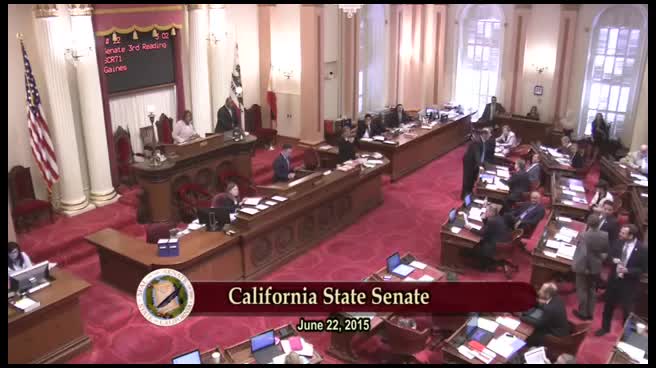 17MIN
Senate Floor
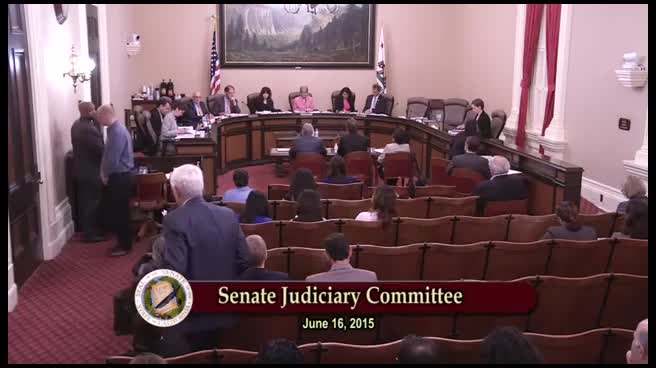 13MIN
Senate Standing Committee on Judiciary
Bill Author
Bill Co-Author(s):