SBX1 13: Office of the Transportation Inspector General.
- Session Year: 2015-2016
- House: Senate
- Latest Version Date: 2015-09-03
Existing law creates various state transportation agencies, including the Department of Transportation and the High-Speed Rail Authority, with specified powers and duties. Existing law provides for the allocation of state transportation funds to various transportation purposes.
This bill would create the Office of the Transportation Inspector General in state government government, as an independent office that would not be a subdivision of any other government entity, to build capacity for self-correction into the government itself and to ensure that all state agencies expending state transportation funds are operating efficiently, effectively, and in compliance with federal and state laws. The bill would provide for the Governor to appoint the Transportation Inspector General for a 6-year term, subject to confirmation by the Senate, and would provide that the Transportation Inspector General may not be removed from office during the term except for good cause. The bill would specify the duties and responsibilities of the Transportation Inspector General, would require an annual report to the Legislature and Governor, and would provide that funding for the office shall, to the extent possible, be from federal transportation funds, with other necessary funding to be made available from the State Highway Account and an account from which high-speed rail activities may be funded.
Existing law creates various state transportation agencies, including the Department of Transportation and the High-Speed Rail Authority, with specified powers and duties. Existing law provides for the allocation of state transportation funds to various transportation purposes.
This bill would create the Office of the Transportation Inspector General in state government as an independent office that would not be a subdivision of any other government entity, to ensure that all state agencies expending state transportation funds are operating efficiently, effectively, and in compliance with federal and state laws. The bill would provide for the Governor to appoint the Transportation Inspector General for a 6-year term, subject to confirmation by the Senate, and would provide that the Transportation Inspector General may not be removed from office during the term except for good cause. The bill would specify the duties and responsibilities of the Transportation Inspector General, would require an annual report to the Legislature and Governor, and would provide that funding for the office shall, to the extent possible, be from federal transportation funds, with other necessary funding to be made available from the State Highway Account and an account from which high-speed rail activities may be funded.
The Legislature finds and declares all of the following:
(a)Over the next 10 years, the state faces a $59 billion shortfall to adequately maintain the state highway system in a basic state of good repair.
(b)There is within the Department of Transportation (Caltrans) a culture of waste and fraud, as exemplified by exposure of the deficiencies in the construction of the replacement span of the San Francisco-Oakland Bay Bridge and the efforts to internally conceal those deficiencies, falsified data in the testing of bridge safety, and Caltrans employees consuming alcohol while on the job, misusing state assets, and moonlighting on state time.
(b)Numerous audits and reports over the past three years have highlighted inefficiencies and instances of waste within Californias transportation agencies.
(c)The 21st Annual Highway Report by the Reason Foundation, published in September 2014, found the following:
(1)California has 50,462 lane miles of highways under the administration of Caltrans. the Department of Transportation (Caltrans).
(2)Overall, California spent $501,136 per state mile of highway, more than three times the national average, yet Californias state highway system ranks 45th in overall performance and cost effectiveness.
(3)California spent $102,889 per state mile of highway specifically on maintenance, nearly four times the national average.
(4)California spent $48,754 per state mile of highway specifically on administration, more than four times the national average.
(d)The Legislative Analysts Office included the following concerns and recommendations related to Caltrans accountability and efficiency in the Capital Outlay Support Program Review report issued in May 2014:
(1)Data used to request budgetary resources for the program is largely unreliable due to a lack of internal control, lack of data collection, and an incentive to report inaccurate data.
(2)Steps should be taken to improve data quality for the program.
(e)A Transportation Inspector General should be established to independently investigate Caltrans, identify waste and inefficiencies, and report and make recommendations to the Legislature. Legislature, and build capacity for self-correction into the government itself.
SEC. 2.Part 5.1 (commencing with Section 14460) is added to Division 3 of Title 2 of the Government Code, to read:5.1.OFFICE OF THE TRANSPORTATION INSPECTOR GENERAL14460.(a)There is hereby created in state government the independent Office of the Transportation Inspector General, which shall not be a subdivision of any other governmental entity, to build capacity for self-correction into the government itself and to ensure that the Department of Transportation, the High-Speed Rail Authority, and all other state agencies expending state transportation funds are operating efficiently, effectively, and in compliance with applicable federal and state laws.
(b)The Governor shall appoint, subject to confirmation by the Senate, the Transportation Inspector General to a six-year term. The Transportation Inspector General may not be removed from office during that term, except for good cause.
14461.The Transportation Inspector General shall review policies, practices, and procedures, and conduct audits and investigations of activities involving state transportation funds in consultation with all affected state agencies. Specifically, the Transportation Inspector Generals duties and responsibilities shall include, but not be limited to, all of the following:
(a)To examine the operating practices of the Department of Transportation, the High-Speed Rail Authority, and all other state agencies expending state transportation funds to identify fraud and waste, opportunities for efficiencies, and opportunities to improve the data used to determine appropriate project resource allocations.
(b)To identify best practices in the delivery of transportation projects and develop policies or recommend proposed legislation enabling state agencies to adopt these practices when practicable.
(c)To provide objective analysis of, and when possible, offer solutions to, concerns raised by the public or generated within agencies involving the states transportation infrastructure and project delivery methods.
(d)To conduct, supervise, and coordinate audits and investigations relating to the programs and operations of all state transportation agencies with state-funded transportation projects.
(e)To recommend policies promoting economy and efficiency in the administration of programs and operations of all state agencies with state-funded transportation projects.
14462.The Transportation Inspector Generals office shall not conduct any an audit or investigation that would be redundant to or concurrent with any an audit or investigation of the same matter being conducted contemporaneously by another state entity, or planned to be initiated pursuant to state or federal law or adopted agency board policy, within 18 months of the notification of the intent to undertake the audit or investigation by the Transportation Inspector General. The state entity shall provide the Transportation Inspector General with a summary of the results of the audit or investigation upon its completion, if requested.
14463.(a)The Transportation Inspector General shall report annually to the Governor and Legislature with a summary of his or her findings, investigations, and audits. The summary shall be posted on the Transportation Inspector Generals Internet Web site and shall otherwise be made available to the public upon its release to the Governor and
Legislature. and Legislature. The summary shall include, but need not be limited to, significant problems discovered by the Transportation Inspector General and whether recommendations of the Transportation Inspector General relative to investigations and audits have been implemented by the affected agencies. The report shall be submitted to the Legislature pursuant to in compliance with Section 9795.
(b)The Transportation Inspector General shall, in consultation with the Department of Finance, develop a methodology for producing a workload budget to be used for annually adjusting the budget of the Office of the Transportation Inspector General, beginning with the budget for the 201617 fiscal year. To the extent possible, the office shall be funded with federal transportation funds. Should federal funding not be available to fully fund the office, funding shall be made available, in proportion to the activities of the office, from the State Highway Account and an account from which high-speed rail activities may be funded.
The Legislature finds and declares all of the following:
(a)Over the next 10 years, the state faces a $59 billion shortfall to adequately maintain the state highway system in a basic state of good repair.
(b)There is within the Department of Transportation (Caltrans) a culture of waste and fraud, as exemplified by exposure of the deficiencies in the construction of the replacement span of the San Francisco-Oakland Bay Bridge and the efforts to internally conceal those deficiencies, falsified data in the testing of bridge safety, and Caltrans employees consuming alcohol while on the job, misusing state assets, and moonlighting on state time.
(c)The 21st Annual Highway Report by the Reason Foundation, published in September 2014, found the following:
(1)California has 50,462 lane miles of highways under the administration of Caltrans.
(2)Overall, California spent $501,136 per state mile of highway, more than three times the national average, yet Californias state highway system ranks 45th in overall performance and cost effectiveness.
(3)California spent $102,889 per state mile of highway specifically on maintenance, nearly four times the national average.
(4)California spent $48,754 per state mile of highway specifically on administration, more than four times the national average.
(d)The Legislative Analysts Office included the following concerns and recommendations related to Caltrans accountability and efficiency in the Capital Outlay Support Program Review report issued in May 2014:
(1)Data used to request budgetary resources for the program is largely unreliable due to a lack of internal control, lack of data collection, and an incentive to report inaccurate data.
(2)Steps should be taken to improve data quality for the program.
(e)A Transportation Inspector General should be established to independently investigate Caltrans, identify waste and inefficiencies, and report and make recommendations to the Legislature.
SEC. 2.Part 5.1 (commencing with Section 14460) is added to Division 3 of Title 2 of the Government Code, to read:5.1.OFFICE OF THE TRANSPORTATION INSPECTOR GENERAL14460.(a)There is hereby created in state government the independent Office of the Transportation Inspector General, which shall not be a subdivision of any other governmental entity, to ensure that the Department of Transportation, the High-Speed Rail Authority, and all other state agencies expending state transportation funds are operating efficiently, effectively, and in compliance with applicable federal and state laws.
(b)The Governor shall appoint, subject to confirmation by the Senate, the Transportation Inspector General to a six-year term. The Transportation Inspector General may not be removed from office during that term, except for good cause.
14461.The Transportation Inspector General shall review policies, practices, and procedures, and conduct audits and investigations of activities involving state transportation funds in consultation with all affected state agencies. Specifically, the Transportation Inspector Generals duties and responsibilities shall include, but not be limited to, all of the following:
(a)To examine the operating practices of the Department of Transportation, the High-Speed Rail Authority, and all other state agencies expending state transportation funds to identify fraud and waste, opportunities for efficiencies, and opportunities to improve the data used to determine appropriate project resource allocations.
(b)To identify best practices in the delivery of transportation projects and develop policies or recommend proposed legislation enabling state agencies to adopt these practices when practicable.
(c)To provide objective analysis of, and when possible, offer solutions to, concerns raised by the public or generated within agencies involving the states transportation infrastructure and project delivery methods.
(d)To conduct, supervise, and coordinate audits and investigations relating to the programs and operations of all state transportation agencies with state-funded transportation projects.
(e)To recommend policies promoting economy and efficiency in the administration of programs and operations of all state agencies with state-funded transportation projects.
14462.The Transportation Inspector Generals office shall not conduct any audit or investigation that would be redundant to or concurrent with any audit or investigation of the same matter being conducted contemporaneously by another state entity, or planned to be initiated pursuant to state or federal law or adopted agency board policy, within 18 months of the notification of the intent to undertake the audit or investigation by the Transportation Inspector General. The state entity shall provide the Transportation Inspector General with a summary of the results of the audit or investigation upon its completion, if requested.
14463.(a)The Transportation Inspector General shall report annually to the Governor and Legislature with a summary of his or her findings, investigations, and audits. The summary shall be posted on the Transportation Inspector Generals Internet Web site and shall otherwise be made available to the public upon its release to the Governor and
Legislature. The summary shall include, but need not be limited to, significant problems discovered by the Transportation Inspector General and whether recommendations of the Transportation Inspector General relative to investigations and audits have been implemented by the affected agencies. The report shall be submitted to the Legislature pursuant to Section 9795.
(b)The Transportation Inspector General shall, in consultation with the Department of Finance, develop a methodology for producing a workload budget to be used for annually adjusting the budget of the Office of the Transportation Inspector General, beginning with the budget for the 201617 fiscal year. To the extent possible, the office shall be funded with federal transportation funds. Should federal funding not be available to fully fund the office, funding shall be made available, in proportion to the activities of the office, from the State Highway Account and an account from which high-speed rail activities may be funded.
|
Date
|
Status
|
|---|---|
| Sep 3, 2015 | From committee with author's amendments. Read second time and amended. Re-referred to Com. on APPR. |
| Aug 19, 2015 | From committee: Do pass and re-refer to Com. on APPR. (Ayes 12. Noes 0. Page 37.) (August 19). Re-referred to Com. on APPR. |
| Aug 19, 2015 | From committee: Do pass and re-refer to Com. on APPR. (Ayes 12. Noes 0.) (August 19). Re-referred to Com. on APPR. |
| Aug 6, 2015 | Set for hearing August 19. |
| Jul 17, 2015 | From printer. |
| Jul 16, 2015 | Introduced. Read first time. Referred to Com. on T. & I.D. |
| Jul 16, 2015 | To print. |
|
Date
|
Description
|
Location
|
Votes
|
|
|---|---|---|---|---|
| Aug 19, 2015 | Do pass, but first be re-referred to the Committee on [Appropriations] | Senate 1st Extraordinary Session on Transportation and Infrastructure Development |
Passed |
This list shows positions taken on this bill by organizations on the date displayed, which is linked to the original source.
Positions by individuals are not included.
SBX1 13 (Vidak) Page 5 of 5
SENATE COMMITTEE ON TRANSPORTATION AND INFRASTRUCTURE DEVELOPMENT
Senator Jim Beall, Chair
2015 - 2016 First Extraordinary
Bill No: SBX1 13 Hearing Date: 08/19/2015
Author: |
Vidak |
||
Version: |
7/16/2015 |
||
Urgency: |
No |
Fiscal: |
Yes |
Consultant: |
Christine Hochmuth |
||
SUBJECT: Office of the Transportation Inspector General
DIGEST: This bill creates the Office of the Transportation Inspector General (OTIG) in state government as an independent office, to ensure that all state agencies expending state transportation funds are operating efficiently, effectively, and in compliance with federal and state laws.
ANALYSIS:
Existing law:
Creates, under the Federal Inspector General Act of 1978, independent and objective units which conduct and supervise audits and investigations relating to the programs and operations of various federal departments, agencies, boards, and commissions, including the Department of Transportation.
Establishes, under the Federal Inspector General Reform Act of 2008, the Council of the Inspectors General on Integrity and Efficiency (CIGIE), an independent entity within the executive branch designed to address integrity, economy, and effectiveness issues that transcend individual Government agencies and increase the professionalism and effectiveness of personnel by developing policies, standards, and approaches to aid in the establishment of a well-trained and highly skilled workforce in the offices of the inspectors general.
Requires the Los Angeles County Metropolitan Transportation Authority (LACMTA) to appoint an inspector general to report quarterly on the expenditures which are specified by the authority.
This bill:
Creates the independent OTIG which is responsible for ensuring that the Department of Transportation (Caltrans), the High-Speed Rail Authority (HSRA), and all other state agencies expending state transportation funds are operating efficiently, effectively, and in compliance with applicable federal and state laws.
Requires the Governor to appoint the Transportation Inspector General (TIG) to a six-year term, subject to Senate confirmation; prohibits the removal of the TIG during that term except for good cause.
Requires the TIG to review policies, practices, and procedures, and conduct audits and investigations of activities involving state transportation funds in consultation with all affected state agencies.
Provides that the TIG’s duties and responsibilities shall include, at a minimum, all of the following:
To examine the operating practices of Caltrans, HSRA, and all other state agencies expending state transportation funds to identify fraud and waste, opportunities for efficiencies, and opportunities to improve the data used to determine appropriate project resource allocations.
To identify best practices in the delivery of transportation projects and develop policies or recommend proposed legislation enabling state agencies to adopt these practices when practicable.
To provide objective analysis of, and when possible, offer solutions to, concerns raised by the public or generated within agencies involving the state’s transportation infrastructure and project delivery methods.
To conduct, supervise, and coordinate audits and investigations relating to the programs and operations of all state transportation agencies with state-funded transportation projects.
To recommend policies promoting economy and efficiency in the administration of programs and operations of all state agencies with state-funded transportation projects.
Prohibits the TIG’s office from conducting any audits or investigations that are redundant to or concurrent with those being conducted contemporaneously by another state entity, or planned to be initiated pursuant to state or federal law or adopted agency board policy, within 18 months of the notification of the intent to undertake the audit or investigation by the TIG.
Requires the TIG to report annually to the Governor and Legislature with a summary of their findings, investigations, and audits, including significant problems discovered by the TIG and whether recommendations of the TIG have been implemented. The summary must be posted on the TIG’s web site and must otherwise be made available to the public.
Requires the TIG, in consultation with the Department of Finance, to develop a methodology for producing a workload budget to be used for annually adjusting the budget of the OTIG, beginning with the budget for the 2016-17 FY. The office must be funded with federal transportation funds to the extent possible. If federal funding is unavailable, funding must be made available, in proportion to the activities of the office, from the State Highway Account and an account from which HSR activities may be funded.
COMMENTS:
Purpose. According to the author, “Over the past few years there have been constant examples within Caltrans of waste, fraud, inefficiencies, as exemplified by exposure of the deficiencies in the construction of the replacement span of the San Francisco-Oakland Bay Bridge and the efforts to internally conceal those deficiencies. Additionally, there have been reports of falsified data in the testing of bridge safety, Caltrans employees consuming alcohol while on the job, misusing state assets, and moonlighting on state time.”
The author contends that OTIG will root out waste, improve opportunities for efficiency, highlight best practices, and find opportunities to improve project resource allocations. Caltrans, HSRA, and other transportation state agencies are tasked with spending billions of dollars every year ($11.4 billion according to the Governor’s Budget of 2015-16), and the author states that it is important to ensure that these resources are being used efficiently.
California Bureau of State Audits (BSA). In April of 2011, the California State Auditor presented an audit report concerning the performance, management, efficiency, and budget of Caltrans’s Capital Outlay Support program. The report concluded that, despite a stated goal to reduce overruns in its support project budgets, Caltrans had performed little analysis to determine the frequency or magnitude of support cost budget overruns. Their review of projects that completed construction in fiscal years (FY) 2007-08 through 2009-10 indicated that 62% of the projects had support costs that exceeded their respective budgets. These overruns totaled more than $305 million of the $1.4 billion in total support cost expenditures.
Are current accountability measures enough? SB 878 (DeSaulnier, 2011) would have established an independent OTIG to oversee Caltrans, HSRA, and all other state, regional, and local agencies expending state transportation funds. Governor Brown vetoed SB 878, stating that Caltrans and local transportation agencies are already subject to performance reviews and fiscal audits by state and federal auditors, the Legislative Analyst’s Office, the Department of Finance, and the Transportation Committees of the Legislature. Further, he questioned the action of creating a new, costly state office, instead requesting that the Legislature use the resources they already have.
While similar, there are distinct differences between the existing oversight options and the proposed OTIG. OTIG will do investigations and audits of the state’s transportation-related activities, and it will be self-directed, not requiring statutory or legislative direction. This may give OTIG the ability to investigate and recommend solutions to problems of which the Legislature may not be aware or which may be sensitive or controversial. Further, being focused solely on expenditures of state transportation resources, OTIG should be able to delve deeper into problems and propose more comprehensive solutions involving the complicated transportation project delivery paradigm.
This bill does not preclude partnering with or utilizing academic and/or other institutions that may be especially qualified to assist OTIG with investigations. This bill calls upon OTIG to conduct, supervise, and coordinate audits and investigations, and there may be many ways to accomplish these goals.
Federal Inspectors General can be a sound investment. Based on federal semi-annual reports, OTIG has reported a significant return on investment based on completed work over the last five years. Per year, on average OTIG issued 73 audit reports with a total of 228 recommendations, including financial recommendations totaling almost $359 million. Additionally, their investigative work during the same time period resulted, on average, in 45 indictments, 37 convictions and a total of almost $173 million per year in fines, restitutions, and recoveries. (For reference, the 2016 FY budget request for OTIG is $87.472 million in support of 410 base-level full-time equivalents.)
More authority for the OTIG? The federal OTIG has the authority to require by subpoena the production of all information, documents, reports, answers, records, accounts, papers, and other data in any medium (including electronically stored information, as well as any tangible thing) and documentary evidence necessary in the performance of their duties. Likewise, the OIG for the California Department of Corrections and Rehabilitation may administer oaths, certify to all official acts, and issue subpoenas. The committee may wish to discuss the merits of providing similar authority to the proposed OTIG.
Related Legislation:
SB 878 (DeSaulnier, 2011) — would have established the independent Office of Transportation Inspector General to ensure that state and local agencies expend state transportation funds efficiently, effectively, and in compliance with applicable federal and state laws. SB 878 was vetoed by Governor Brown.
AB 471 (Lowenthal, 2009) — would have created an independent Inspector General to oversee the High-Speed Rail Authority. AB 471 was held in the Assembly Appropriations committee.
FISCAL EFFECT: Appropriation: No Fiscal Com.: Yes Local: No
POSITIONS: (Communicated to the committee before noon on Thursday,
August 13, 2015.)
SUPPORT:
Transportation California
OPPOSITION:
Sierra Club California
-- END --
Discussed in Hearing
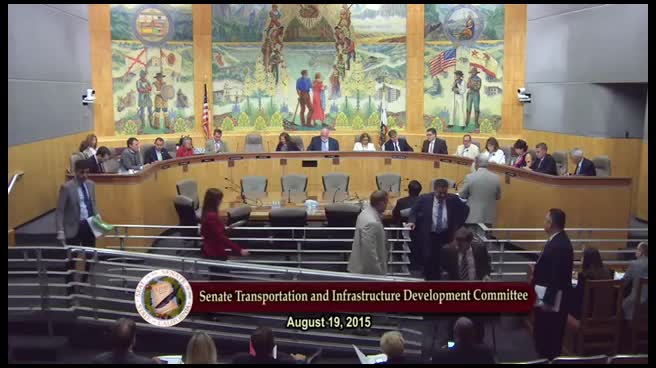 14MIN
Transportation and Infrastructure Development
Bill Author