SBX1 6: Greenhouse Gas Reduction Fund: transportation expenditures.
- Session Year: 2015-2016
- House: Senate
- Latest Version Date: 2015-07-13
Existing law requires all moneys, except for fines and penalties, collected by the State Air Resources Board from the auction or sale of allowances as part of a market-based compliance mechanism relative to reduction of greenhouse gas emissions to be deposited in the Greenhouse Gas Reduction Fund.
Existing law continuously appropriates 25% of the annual proceeds of the fund to the high-speed rail project, and also continuously appropriates to that project $400,000,000 of the amount loaned from the fund to the General Fund by the Budget Act of 2013, upon repayment of the loan by the General Fund. Existing law further appropriates 35% of the annual proceeds of the fund to transit and intercity rail capital, low-carbon transit operations, and affordable housing and sustainable communities.
This bill would delete the continuous appropriations from the fund for the high-speed rail project, and would prohibit any of the proceeds from the fund from being used for that project. The bill would continuously appropriate the remaining 65% of annual proceeds of the fund to the California Transportation Commission for allocation to high-priority transportation projects, as determined by the commission, with 40% of those moneys to be allocated to state highway projects, 40% to local street and road projects divided equally between cities and counties, and 20% to public transit projects.
This bill would require $400,000,000 of the amount loaned from the fund to the General Fund by the Budget Act of 2013 to be immediately repaid to the fund, thereby making an appropriation.
(a)The Legislature shall appropriate the annual proceeds of the fund shall be expended for the purpose of reducing greenhouse gas emissions in this state in accordance with the requirements of Section 39712.
(b)To carry out a portion of the requirements of subdivision (a), annual proceeds are continuously appropriated for the following:
(1)Beginning in the 201516 fiscal year, and notwithstanding Section 13340 of the Government Code, 35 percent of annual proceeds are continuously appropriated, without regard to fiscal years, for transit, affordable housing, and sustainable communities programs as following:
(A)Ten percent of the annual proceeds of the fund is hereby continuously appropriated to the Transportation Agency for the Transit and Intercity Rail Capital Program created by Part 2 (commencing with Section 75220) of Division 44 of the Public Resources Code.
(B)Five percent of the annual proceeds of the fund is hereby continuously appropriated to the Low Carbon Transit Operations Program created by Part 3 (commencing with Section 75230) of Division 44 of the Public Resources Code. Funds shall be allocated by the Controller, according to requirements of the program, and pursuant to the distribution formula in subdivision (b) or (c) of Section 99312 of, and Sections 99313 and 99314 of, the Public Utilities Code.
(C)Twenty percent of the annual proceeds of the fund is hereby continuously appropriated to the Strategic Growth Council for the Affordable Housing and Sustainable Communities Program created by Part 1 (commencing with Section 75200) of Division 44 of the Public Resources Code. Of the amount appropriated in this subparagraph, no less than 10 percent of the annual proceeds, shall be expended for affordable housing, consistent with the provisions of that program.
(2)Beginning in the 201516 fiscal year, and notwithstanding Section 13340 of the Government Code, 25 percent of the annual proceeds of the fund is hereby continuously appropriated to the High-Speed Rail Authority for the following components of the initial operating segment and Phase I Blended System as described in the 2012 business plan adopted pursuant to Section 185033 of the Public Utilities Code: the remaining annual proceeds of the fund are continuously appropriated, without regard to fiscal years, to the California Transportation Commission for allocation to high-priority transportation projects, as determined by the commission. The commission shall allocate available moneys as follows: 40 percent to state highway projects, 40 percent to local street and road projects, divided equally between cities and counties, and 20 percent to public transit projects.
(A)Acquisition and construction costs of the project.
(B)Environmental review and design costs of the project.
(C)Other capital costs of the project.
(D)Repayment of any loans made to the authority to fund the project.
(c)In determining the amount of annual proceeds of the fund for purposes of the calculation in subdivision (b), the funds subject to Section 39719.1 shall not be included.
(c)None of the proceeds of the fund may be used for the high-speed rail project.
SEC. 2.Section 39719.1 of the Health and Safety Code is amended to read:39719.1.(a)Of the amount loaned from the fund to the General Fund pursuant to Item 3900-011-3228 of Section 2.00 of the Budget Act of 2013, four hundred million dollars ($400,000,000) shall be repaid immediately to the fund and shall thereupon be available to the High-Speed Rail Authority pursuant to subdivision (b). for expenditure pursuant to Section 39719.
(b)The portion of the loan from the fund to the General Fund described in subdivision (a) shall be repaid to the fund as necessary based on the financial needs of the high-speed rail project. Beginning in the 201516 fiscal year, and in order to carry out the goals of the fund in accordance with the requirements of Section 39712, the amounts of all the loan repayments, notwithstanding Section 13340 of the Government Code, are continuously appropriated from the fund to the High-Speed Rail Authority for the following components of the initial operating segment and Phase I Blended System as described in the 2012 business plan adopted pursuant to Section 185033 of the Public Utilities Code:
(1)Acquisition and construction costs of the project.
(2)Environmental review and design costs of the project.
(3)Other capital costs of the project.
(4)Repayment of any loans made to the authority to fund the project.
|
Date
|
Status
|
|---|---|
| Sep 14, 2015 | Returned to Secretary of Senate pursuant to Joint Rule 62(a). |
| Sep 2, 2015 | September 1 set for first hearing. Failed passage in committee. |
| Sep 1, 2015 | September 1 set for first hearing. Failed passage in committee. (Ayes 2. Noes 9. Page 56.) |
| Aug 28, 2015 | Set for hearing September 1. |
| Jul 14, 2015 | From printer. |
| Jul 13, 2015 | To print. |
| Jul 13, 2015 | Introduced. Read first time. Referred to Com. on T. & I.D. |
|
Date
|
Description
|
Location
|
Votes
|
|
|---|---|---|---|---|
| Sep 1, 2015 | Do pass, but first be re-referred to the Committee on [Appropriations] | Senate 1st Extraordinary Session on Transportation and Infrastructure Development |
Failed |
This list shows positions taken on this bill by organizations on the date displayed, which is linked to the original source.
Positions by individuals are not included.
SBX1 6 (Runner) Page 4 of 4
SENATE COMMITTEE ON TRANSPORTATION AND INFRASTRUCTURE DEVELOPMENT
Senator Jim Beall, Chair
2015 - 2016 First Extraordinary
Bill No: SBX1 6 Hearing Date: 9/1/2015
Author: |
Runner |
||
Version: |
7/13/2015 |
||
Urgency: |
No |
Fiscal: |
Yes |
Consultant: |
Erin Riches |
||
SUBJECT: Greenhouse Gas Reduction Fund: transportation expenditures
DIGEST: This bill prohibits expenditure of Greenhouse Gas Reduction Fund (GGRF) monies on the high-speed rail project and appropriates the majority of GGRF monies to the California Transportation Commission (CTC) for allocation to high-priority transportation projects, as specified.
ANALYSIS:
Existing law:
AB 32, Núñez, Chapter 488, Statutes of 2006 requires the state Air Resources Board (ARB) to develop a plan to reduce emissions to 1990 levels by 2020. It also requires ARB to ensure that programs to reduce greenhouse gas (GHG) emissions are targeted, to the extent feasible, to the most disadvantaged communities in the state. AB 32 authorizes ARB to deposit any fees paid by GHG emission sources into the GGRF.
AB 1532, Pérez, Chapter 807, Statutes of 2012 specifies that GGRF revenues must be used to facilitate the achievement of GHG emissions reductions.
The 2014-15 budget agreement allocated $832 million in GGRF revenues to a variety of GHG emission reduction programs. Beginning in 2015-16, the budget agreement appropriates 25% of GGRF revenues to the state’s high-speed rail project, 20% to affordable housing and sustainable communities grants, 10% to intercity capital rail projects, and 5% to low-carbon transit projects. The remaining 40% of GGRF revenues are available for annual appropriation by the Legislature.
The 2013-14 budget agreement provided for a loan of GGRF monies to the General Fund. The 2014-15 budget agreement provided that $400 million in GGRF loan repayments shall be directed to the high-speed rail project beginning in 2015-16. To date, no appropriations have been made to repay the loan.
This bill:
Deletes the continuous appropriation of 25% of GGRF monies to high-speed rail.
Continuously appropriates 65% of GGRF monies to the CTC for allocation to “high-priority transportation projects,” as determined by the CTC.
Requires the CTC to allocate 40% of these monies to state highway projects; 40% to local street and road projects, divided equally between cities and counties; and 20% to public transit projects.
Prohibits any GGRF monies from being used for the high-speed rail project.
Deletes the requirement for the $400 million GGRF loan repayment to be directed to high-speed rail.
COMMENTS:
Purpose. The author asserts that the state’s continuous appropriation of GGRF monies to high-speed rail will not accomplish AB 32’s goals; on the contrary, the most optimistic estimate of when the first phase of the high-speed rail project may be operational is 2022, two years after the AB 32 target date. The author also states that according to the Legislative Analyst’s Office report, The 2012-13 Budget: Funding Requests for High-Speed Rail, this project would initially increase GHG emissions for numerous years. This bill seeks to redirect GGRF revenues to projects that will actually reduce GHG emissions and help enable the state to meet its AB 32 emission reduction target by 2020.
A bullet in the bullet train budget. In 2008, California voters approved Proposition 1A, the Safe, Reliable High-Speed Passenger Train Bond Act for the 21st Century (Prop. 1A), which authorized $9 billion in general obligation bonds for the high-speed rail project. In 2009, the federal government augmented the Prop. 1A bond funding with roughly $3.3 billion in funding from the American Recovery and Reinvestment Act and other federal funding programs. The High-Speed Rail Authority (HSRA) committed to match these federal funds with approximately $2.3 billion in state funding. Of the $8.8 billion appropriated thus far for high-speed rail, HSRA spent $950 million through 2013-14 and an estimated $917 million in 2014-15. For 2015-16, HSRA plans to spend $3.0 billion: $1.4 billion in Prop. 1A bond funds, $1.2 billion in federal funds, and $500 million in GGRF revenues. By removing GGRF monies from the mix, this bill creates a large hole in high-speed rail funding; it is unclear what other funds could fill that hole.
Piece by piece. GGRF investments must facilitate the achievement of GHG emissions reductions. However, after that requirement is fulfilled, there are a number of other policy goals that should be considered, including benefits to environmental quality, resource protection, public health, and the economy, as well as benefits to disadvantaged communities. And although the GGRF is growing, it is still a limited source of revenue. In order to create an optimized strategy from GGRF monies, proposals should not be considered in isolation, but be assessed in aggregate to determine what suite of measures best meets the requirements of the GGRF, uses resources most efficiently, and maximizes policy objectives. As budget discussions on a cap-and-trade investment strategy have been pushed later and later this session, an opportunity exists to have a comprehensive discussion on the universe of GGRF proposals currently in the Legislature. The committee may wish to consider whether the subject of this bill is more appropriate to the budget discussion than the transportation special session.
Related Legislation:
SBX1 2 (Huff) — would require GGRF monies generated from transportation fuels to be spent on transportation infrastructure, excluding high-speed rail. SBX1 1 is also being heard by this committee today.
SBX1 3 (Vidak) — would have redirected Prop. 1A bond proceeds to state highways and freeways, and local streets and roads, upon voter approval. SBX1 3 failed passage in this committee on August 19, 2015.
SBX1 8 (Hill) — would increase the percentage of GGRF funds from 10% to 20% for the Transit and Intercity Rail Capital Program and from 5% to 10% for the Low Carbon Transit Operations Program. SBX1 8 is also being heard by this committee today.
ABX1 7 (Nazarian) — is identical to SBX1 8 (Hill). ABX1 7 is pending committee assignment in the Assembly.
FISCAL EFFECT: Appropriation: Yes Fiscal Com.: Yes Local: No
POSITIONS: (Communicated to the committee before noon on Thursday, August 27, 2015.)
SUPPORT:
None received
OPPOSITION:
None received
-- END --
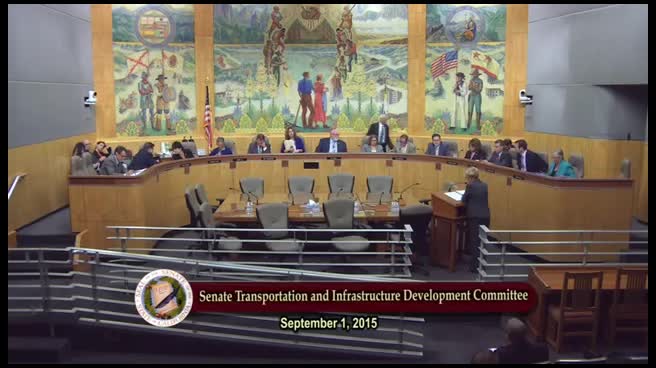
Discussed in Hearing
 30MIN
Transportation and Infrastructure Development
Bill Author

Bill Co-Author(s):