SBX1 9: Department of Transportation.
- Session Year: 2015-2016
- House: Senate
- Latest Version Date: 2015-07-16
(1)Existing law creates the Department of Transportation with various powers and duties relative to the state highway system and other transportation programs.
This bill would prohibit the department from using any nonrecurring funds, including, but not limited to, loan repayments, bond funds, or grant funds, to pay the salaries or benefits of any permanent civil service position within the department.
(2)Article XXII of the California Constitution grants to the State of California and all other governmental entities the choice and authority to contract with qualified private entities for architectural and engineering services for all public works of improvement.
This bill would require the Department of Transportation to contract with qualified private entities for architectural and engineering services with respect to public works of improvement undertaken by the department, with a minimum of 15% of the total annual value of these services to be contracted to qualified private entities beginning on July 1, 2016, and increasing each year to a minimum of 50% by July 1, 2023.
The Legislature finds and declares all of the following:
(a)Over the next 10 years, the state faces a $59 billion shortfall to adequately maintain the state highway system in a basic state of good repair.
(b)The 21st Annual Highway Report by the Reason Foundation, published in September 2014, found the following:
(1)California has 50,462 lane miles of highways under the administration of the Department of Transportation (Caltrans).
(2)Overall, California spent $501,136 per state mile of highway, more than three times the national average, yet Californias state highway system ranks 45th in overall performance and cost effectiveness.
(3)California spent $102,889 per state mile of highway specifically on maintenance, nearly four times the national average.
(4)California spent $48,754 per state mile of highway specifically on administration, more than four times the national average.
(c)Proposition 35, approved by voters in 2000, allows Caltrans, without limitation, to contract for architectural and engineering work. Currently, Caltrans only contracts for 10 percent of this work, while 90 percent is completed by permanent state staff, resulting in an inability to adjust staffing levels as workload fluctuates.
(d)Hiring permanent state staff with limited-term or one-time funding is fiscally imprudent and leads to structural funding deficiencies.
(e)According to the Legislative Analysts Office, in the Capital Outlay Support Program Review report issued in May 2014, the Capital Outlay Support Program is overstaffed by approximately 3,500 full-time equivalent positions, at a cost of more than $500 million annually.
SEC. 2.Section 14009 is added to the Government Code, to read:14009.The department may not use any nonrecurring funds, including, but not limited to, loan repayments, bond funds, or grant funds, to pay the salaries or benefits of any permanent civil service position within the department.
SEC. 3.Article 2.6 (commencing with Section 14140) is added to Chapter 2 of Part 5 of Division 3 of Title 2 of the Government Code, to read:2.6.Architectural and Engineering Services14140.The department shall implement Article XXII of the California Constitution by contracting with qualified private entities for architectural and engineering services, as defined in Section 4529.10, with respect to public works of improvement undertaken by the department, as follows:
(a)A minimum of 15 percent of the total annual value of architectural and engineering services required by the department shall be contracted to qualified private entities for the fiscal year beginning on July 1, 2016.
(b)A minimum of 20 percent of the total annual value of architectural and engineering services required by the department shall be contracted to qualified private entities for the fiscal year beginning on July 1, 2017.
(c)A minimum of 25 percent of the total annual value of architectural and engineering services required by the department shall be contracted to qualified private entities for the fiscal year beginning on July 1, 2018.
(d)A minimum of 30 percent of the total annual value of architectural and engineering services required by the department shall be contracted to qualified private entities for the fiscal year beginning on July 1, 2019.
(e)A minimum of 35 percent of the total annual value of architectural and engineering services required by the department shall be contracted to qualified private entities for the fiscal year beginning on July 1, 2020.
(f)A minimum of 40 percent of the total annual value of architectural and engineering services required by the department shall be contracted to qualified private entities for the fiscal year beginning on July 1, 2021.
(g)A minimum of 45 percent of the total annual value of architectural and engineering services required by the department shall be contracted to qualified private entities for the fiscal year beginning on July 1, 2022.
(h)A minimum of 50 percent of the total annual value of architectural and engineering services required by the department shall be contracted to qualified private entities for the fiscal year beginning on July 1, 2023, and in subsequent fiscal years.
|
Date
|
Status
|
|---|---|
| Sep 14, 2015 | Returned to Secretary of Senate pursuant to Joint Rule 62(a). |
| Aug 19, 2015 | August 19 set for first hearing. Failed passage in committee. (Ayes 3. Noes 9. Page 36.) |
| Aug 19, 2015 | August 19 set for first hearing. Failed passage in committee. |
| Aug 6, 2015 | Set for hearing August 19. |
| Jul 17, 2015 | From printer. |
| Jul 16, 2015 | To print. |
| Jul 16, 2015 | Introduced. Read first time. Referred to Com. on T. & I.D. |
|
Date
|
Description
|
Location
|
Votes
|
|
|---|---|---|---|---|
| Aug 19, 2015 | Do pass, but first be re-referred to the Committee on [Appropriations] | Senate 1st Extraordinary Session on Transportation and Infrastructure Development |
Failed |
This list shows positions taken on this bill by organizations on the date displayed, which is linked to the original source.
Positions by individuals are not included.
SBX1 9 (Moorlach) Page 4 of 4
SENATE COMMITTEE ON TRANSPORTATION AND INFRASTRUCTURE DEVELOPMENT
Senator Jim Beall, Chair
2015 - 2016 First Extraordinary
Bill No: SBX1 9 Hearing Date: 8/19/2015
Author: |
Moorlach |
||
Version: |
7/16/2015 |
||
Urgency: |
No |
Fiscal: |
Yes |
Consultant: |
Randy Chinn |
||
SUBJECT: Department of Transportation
DIGEST: This bill requires the Department of Transportation (Caltrans) to contract with private entities for architectural and engineering services, for a minimum of 15% of the total annual value of these services by July 1, 2016, and increasing each year to a minimum of 50% by July 1, 2023.
ANALYSIS:
Existing practice, as expressed in the state budget, requires Caltrans to contract out 10% of its Capital Outlay Support (COS) staffing, which is roughly equivalent to architectural and engineering services, while 90% is performed by Caltrans staff. This practice goes back to the 1980s.
This bill:
Requires Caltrans to contract out to private entities a minimum of 15% of the total annual value of architectural and engineering services for the 2016-17 fiscal year and to increase that amount by five percentage points annually until a minimum level of 50% is reached for the 2023-24 fiscal year and beyond.
Prohibits Caltrans from using any nonrecurring funds to pay for permanent civil service positions.
COMMENTS:
Purpose. The author notes that funding for large projects is highly variable. When workload rises, additional permanent state employees are hired in accordance with a 90/10 ratio of permanent state employees/contract employees, an arbitrary ratio established through budget action for many years. This makes it difficult to reduce engineering and support staff when workload and funding taper off. If a greater portion of the work were performed by private contractors, staffing could be more easily adjusted to fit workload needs. Without the ability to adjust the number of staff, the COS program will continue to be overstaffed, consuming funding that could otherwise go to build additional projects. This bill will gradually increase the percentage of contracted-out work from 10% to 50%, providing Caltrans with the flexibility to adjust staffing and freeing up funds to build projects. The author believes this can be done through attrition and without layoffs.
Surplus staff? Last year the Legislative Analyst’s Office (LAO) determined1 that the COS program was overstaffed by 3,500 people, resulting in $500 million in unnecessary annual costs which could otherwise be spent on transportation projects. That assessment was necessarily made based on a high-level review of Caltrans’ operations because certain project-specific data was either unreliable or not collected. The LAO concluded that because funding for new construction projects had declined substantially, a corresponding reduction to COS staffing was warranted.
Caltrans disagrees. In a July 20 letter to the committee, Caltrans observes that its COS staffing is at an 18-year low, and that it has reduced 3,422 full-time equivalent positions in their COS program, or 26%, since 2007-08. They argue that staffing levels should be based on a project-specific analysis of workload, not on funding levels.
One of the LAO’s recommendations is that Caltrans improve its project-specific data quality, and that is apparently occurring. The COS program has also been subject to zero-based budgeting for several years. Taken together, along with continuing oversight through the annual budget process, the Legislature will be better positioned to ensure appropriate COS staffing. The trend of decreased staffing may be reversed if substantial new funding becomes available for bridge and highway repair and maintenance.
Contracting out. For many years, the Legislature has split the COS program work, with 10% of the staffing going to private contractors and 90% going to Caltrans. This has been a policy of the state that has been carried out in the budget process, apparently with little discussion or debate over the past several years, that reflects a balance of the interests of the public sector unions and the private engineering firms.
The principle behind this bill is that contracted workers are more easily let go, allowing for staffing levels to better match the workload when that workload declines. But Caltrans has been reducing its staff almost every year for the past 10, according to the LAO report, so the 90/10 ratio does not seem to have limited Caltrans’ ability to reduce its size. Neither has Caltrans expressed concerns that the 10% contracting-out ratio has impaired its ability to properly size its workforce. This may be because Caltrans has several mechanisms to size its workforce: normal workforce attrition, which Caltrans estimates at about 5% annually; the use of limited-term state employees; and the use of overtime. Those mechanisms, combined with the 10% contract workforce, may provide Caltrans with the flexibility to size its workforce to fit its needs.
Increased contracting out may be justified based on cost savings, but the cost of contracted-out employees appears higher than the cost of state employees. In 2011, the Senate Budget Committee estimated that state COS staff cost $158,000 per year while contract staff cost $243,000, though this extra cost may be offset by increased productivity and flexibility.
Caltrans’ hiring practices. The Senate Transportation and Infrastructure Development Committee has not yet been able to determine whether or under what conditions Caltrans currently hires permanent staff with non-recurrent revenue.
Staffing levels are a budget issue. The LAO report raises important questions about the necessary level of COS staffing. Every dollar saved in reduced COS expenses can be spent on necessary road maintenance and repair. But determining the appropriate level of staffing in an organization as large and complex as Caltrans is an intensive, data-driven exercise that depends very much on the specific work being done. The budget process seems to be the most appropriate way to do this, and as well to consider the appropriate level of contracted-out services. It may well be appropriate to increase the level of contracted-out work, but that should be based on an analysis of the specific work requirements, costs, and benefits. Moreover, SB X1 1 (Beall) deals with the staffing levels directly by requiring Caltrans to provide the California Transportation Commission with a plan to increase its efficiency by up to 30% over the next three years.
Related Legislation:
SB X1 1 (Beall) — establishes a program to raise permanent funding for transportation maintenance and repair, and requires Caltrans to provide the California Transportation Commission with a plan to increase its efficiency by up to 30% over the next three years. This bill is being heard in the Senate Transportation and Infrastructure Development Committee today.
FISCAL EFFECT: Appropriation: No Fiscal Com.: Yes Local: No
POSITIONS: (Communicated to the committee before noon on Thursday,
August 13, 2015.)
SUPPORT:
California Construction and Industrial Materials Association
California Taxpayers Association
OPPOSITION:
Professional Engineers in California Government
Sierra Club of California
-- END --
1 “The 2014-15 Budget: Capital Outlay Support Program Review”. LAO, May 14, 2014.
Discussed in Hearing
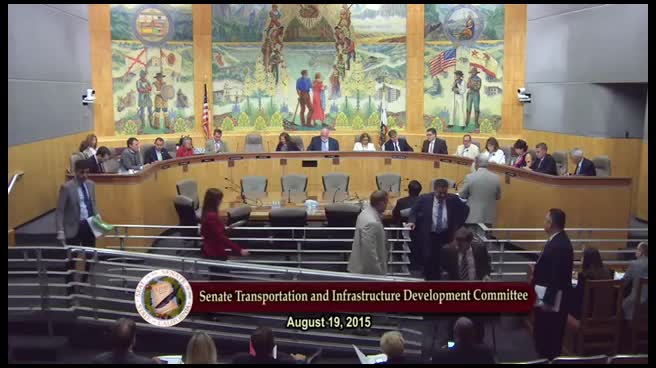 57MIN
Transportation and Infrastructure Development
Bill Author

Bill Co-Author(s):