AB 10: Feminine hygiene products: public school restrooms.
- Session Year: 2017-2018
- House: Assembly
- Latest Version Date: 2017-10-12
Existing law, with certain exceptions, requires every public and private school, as provided, to have restroom facilities that are open as prescribed during school hours, and at all times to keep every restroom maintained and cleaned regularly, fully operational, and stocked with soap and paper supplies.
This bill would require a public school maintaining any combination of classes from grade 6 to grade 12, inclusive, that meets a 40% pupil poverty threshold specified in federal law to stock 50% of the schools restrooms with feminine hygiene products, as defined. The bill would prohibit a public school from charging for any menstrual products, including feminine hygiene products, provided to pupils. By imposing additional duties on public schools, the bill would impose a state-mandated local program.
The California Constitution requires the state to reimburse local agencies and school districts for certain costs mandated by the state. Statutory provisions establish procedures for making that reimbursement.
This bill would provide that, if the Commission on State Mandates determines that the bill contains costs mandated by the state, reimbursement for those costs shall be made pursuant to the statutory provisions noted above.
Existing law, with certain exceptions, requires every public and private school, as provided, to have restroom facilities that are open as prescribed during school hours, and at all times to keep every restroom maintained and cleaned regularly, fully operational, and stocked with soap and paper supplies.
This bill would require a public school maintaining any combination of classes from grade 6 to grade 12, inclusive, that meets a 40% pupil poverty threshold specified in federal law to stock 50% of the schools restrooms with feminine hygiene products, as defined, and to provide the feminine hygiene products at no charge. defined. The bill would prohibit a public school from charging for any menstrual products, including feminine hygiene products, provided to pupils. By imposing additional duties on public schools, the bill would impose a state-mandated local program.
The California Constitution requires the state to reimburse local agencies and school districts for certain costs mandated by the state. Statutory provisions establish procedures for making that reimbursement.
This bill would provide that, if the Commission on State Mandates determines that the bill contains costs mandated by the state, reimbursement for those costs shall be made pursuant to the statutory provisions noted above.
Existing law, with certain exceptions, requires every public and private school, as provided, to have restroom facilities that are open as prescribed during school hours, and at all times to keep every restroom maintained and cleaned regularly, fully operational, and stocked with soap and paper supplies.
This bill would additionally require public and private schools to keep every restroom stocked with feminine hygiene products. require a public school maintaining any combination of classes from grade 6 to grade 12, inclusive, that meets a 40% pupil poverty threshold specified in federal law to stock 50% of the schools restrooms with feminine hygiene products, as defined, and to provide the feminine hygiene products at no charge. By imposing additional duties on public schools, the bill would impose a state-mandated local program.
Existing law, the Donahoe Higher Education Act, sets forth, among other things, the missions and functions of Californias public and independent segments of higher education. Provisions of the act apply to the University of California only to the extent that the Regents of the University of California, by resolution, act to make them applicable. This bill would require public and private institutions of higher education, including the California State University, each community college district, and the governing board of each independent institution of higher education, and would encourage the Regents of the University of California, to provide an adequate supply of feminine hygiene products sufficient to meet the needs of female students at each campus in their respective jurisdictions and to ensure that female students have direct access to feminine hygiene products in college bathrooms. By imposing additional duties on community college districts, the bill would impose a state-mandated local program.Existing law requires the Department of Housing and Community Development to administer the Emergency Housing and Assistance Program. Under that program, existing law prohibits an individual or household from being denied emergency shelter because of an inability to pay. For these purposes, existing law defines emergency shelter as housing with minimal supportive services for homeless persons that is limited to occupancy of 6 months or less by a homeless person.Under existing law known as the Domestic Violence Shelter-Based Programs Act, domestic violence shelter-based programs are required to provide specified basic services to victims of domestic violence and their children. Existing law defines a domestic violence shelter for these purposes.This bill, except as specified, would require an eligible organization providing emergency shelter and a domestic violence shelter to ensure adequate and timely access to free menstrual products, as defined, to all menstruating persons who receive services from the organization or shelter. The bill would require a city, county, or city and county to adopt an ordinance establishing enforcement mechanisms for an organization or shelter to comply with these requirements. The bill would also require a city, county, or city and county to compile and submit a report documenting compliance with these requirements to specified legislative committees by a certain date. By imposing new duties on a city, county, or city and county, the bill would create a state-mandated local program.The California Constitution requires the state to reimburse local agencies and school districts for certain costs mandated by the state. Statutory provisions establish procedures for making that reimbursement.This bill would provide that, if the Commission on State Mandates determines that the bill contains costs mandated by the state, reimbursement for those costs shall be made pursuant to the statutory provisions noted above.Existing law, with certain exceptions, requires every public and private school, as provided, to have restroom facilities that are open as prescribed during school hours, and at all times to keep every restroom maintained and cleaned regularly, fully operational, and stocked with soap and paper supplies.
This bill would additionally require public and private schools to keep every restroom stocked with feminine hygiene products.
Existing law, the Donahoe Higher Education Act, sets forth, among other things, the missions and functions of Californias public and independent segments of higher education. Provisions of the act apply to the University of California only to the extent that the Regents of the University of California, by resolution, act to make them applicable.
This bill would require public and private institutions of higher education, including the California State University, each community college district, and the governing board of each independent institution of higher education, and would encourage the Regents of the University of California, to provide an adequate supply of feminine hygiene products sufficient to meet the needs of female students at each campus in their respective jurisdictions and to ensure that female students have direct access to feminine hygiene products in college bathrooms. By imposing additional duties on community college districts, the bill would impose a state-mandated local program.
Existing law establishes the Department of Housing and Community Development in the Business, Consumer Services, and Housing Agency. The department is responsible for administering various housing and home loan programs throughout the state. This bill would require the department to ensure that each female occupant of specified emergency housing shelters and domestic violence shelters is provided with an adequate supply of feminine hygiene products.Existing law requires the Department of Housing and Community Development to administer the Emergency Housing and Assistance Program. Under that program, existing law prohibits an individual or household from being denied emergency shelter because of an inability to pay. For these purposes, existing law defines emergency shelter as housing with minimal supportive services for homeless persons that is limited to occupancy of 6 months or less by a homeless person.
Under existing law known as the Domestic Violence Shelter-Based Programs Act, domestic violence shelter-based programs are required to provide specified basic services to victims of domestic violence and their children. Existing law defines a domestic violence shelter for these purposes.
This bill, except as specified, would require an eligible organization providing emergency shelter and a domestic violence shelter to ensure adequate and timely access to free menstrual products, as defined, to all menstruating persons who receive services from the organization or shelter. The bill would require a city, county, or city and county to adopt an ordinance establishing enforcement mechanisms for an organization or shelter to comply with these requirements. The bill would also require a city, county, or city and county to compile and submit a report documenting compliance with these requirements to specified legislative committees by a certain date. By imposing new duties on a city, county, or city and county, the bill would create a state-mandated local program.
The California Constitution requires the state to reimburse local agencies and school districts for certain costs mandated by the state. Statutory provisions establish procedures for making that reimbursement.
This bill would provide that, if the Commission on State Mandates determines that the bill contains costs mandated by the state, reimbursement for those costs shall be made pursuant to the statutory provisions noted above.
Existing law, with certain exceptions, requires every public and private school, as provided, to have restroom facilities that are open as prescribed during school hours, and at all times to keep every restroom maintained and cleaned regularly, fully operational, and stocked with soap and paper supplies.
This bill would additionally require public and private schools to keep every restroom stocked with feminine hygiene products.
Existing law, the Donahoe Higher Education Act, sets forth, among other things, the missions and functions of Californias public and independent segments of higher education. Provisions of the act apply to the University of California only to the extent that the Regents of the University of California, by resolution, act to make them applicable.
This bill would require public and private institutions of higher education, including the California State University, each community college district, and the governing board of each independent institution of higher education, and would encourage the Regents of the University of California, to provide an adequate supply of feminine hygiene products sufficient to meet the needs of female students at each campus in their respective jurisdictions and to ensure that female students have direct access to feminine hygiene products in college bathrooms. By imposing additional duties on community college districts, the bill would impose a state-mandated local program.
Existing law establishes the Department of Housing and Community Development in the Business, Consumer Services, and Housing Agency. The department is responsible for administering various housing and home loan programs throughout the state.
This bill would require the department to ensure that each female occupant of specified emergency housing shelters and domestic violence shelters is provided with an adequate supply of feminine hygiene products.
The California Constitution requires the state to reimburse local agencies and school districts for certain costs mandated by the state. Statutory provisions establish procedures for making that reimbursement.
This bill would provide that, if the Commission on State Mandates determines that the bill contains costs mandated by the state, reimbursement for those costs shall be made pursuant to the statutory provisions noted above.
Existing law establishes the State Department of Education in state government, and vests the department with specified powers and duties relating to the states public school system, including encouraging and assisting school districts to improve and monitor the health of their pupils.
This bill would require the department to provide public and private schools, including charter schools, with an adequate supply of feminine hygiene products sufficient to meet the needs of all female pupils and to ensure that female pupils have direct access to feminine hygiene products in school bathrooms.
Existing law, the Donahoe Higher Education Act, sets forth, among other things, the missions and functions of Californias public and independent segments of higher education. Provisions of the act apply to the University of California only to the extent that the Regents of the University of California, by resolution, act to make them applicable.
This bill would require public and private institutions of higher education, including the California State University, each community college district, and the governing board of each independent institution of higher education, and would encourage the Regents of the University of California, to provide an adequate supply of feminine hygiene products sufficient to meet the needs of female students at each campus in their respective jurisdictions and to ensure that female students have direct access to feminine hygiene products in college bathrooms. By imposing additional duties on community college districts, the bill would impose a state-mandated local program.
Existing law establishes the Department of Housing and Community Development in the Business, Consumer Services, and Housing Agency. The department is responsible for administering various housing and home loan programs throughout the state.
This bill would require the department to ensure that each female occupant of specified emergency housing shelters and domestic violence shelters is provided with an adequate supply of feminine hygiene products.
The California Constitution requires the state to reimburse local agencies and school districts for certain costs mandated by the state. Statutory provisions establish procedures for making that reimbursement.
This bill would provide that, if the Commission on State Mandates determines that the bill contains costs mandated by the state, reimbursement for those costs shall be made pursuant to the statutory provisions noted above.
(a)A public school maintaining any combination of classes from grade 6 to grade 12, inclusive, that meets the 40-percent pupil poverty threshold required to operate a schoolwide program pursuant to Section 6314(a)(1)(A) of Title 20 of the United States Code shall stock at least 50 percent of the schools restrooms with feminine hygiene products at all times.
(b)A public school described in subdivision (a) shall not charge for any menstrual products provided to pupils, including, but not limited to, feminine hygiene products.
(c)For purposes of this section, feminine hygiene products means tampons and sanitary napkins for use in connection with the menstrual cycle.
SEC. 2.If the Commission on State Mandates determines that this act contains costs mandated by the state, reimbursement to local agencies and school districts for those costs shall be made pursuant to Part 7 (commencing with Section 17500) of Division 4 of Title 2 of the Government Code.
(a)A public school maintaining any combination of classes from grade 6 to grade 12, inclusive, that meets the 40-percent pupil poverty threshold required to operate a schoolwide program pursuant to Section 6314(a)(1)(A) of Title 20 of the United States Code shall stock at least 50 percent of the schools restrooms with feminine hygiene products at all times.
(b)A school shall provide feminine hygiene products pursuant to subdivision (a) at no charge.(b)A public school described in subdivision (a) shall not charge for any menstrual products provided to pupils, including, but not limited to, feminine hygiene products.
(c)For purposes of this section, feminine hygiene products means tampons and sanitary napkins for use in connection with the menstrual cycle.
SEC. 2.If the Commission on State Mandates determines that this act contains costs mandated by the state, reimbursement to local agencies and school districts for those costs shall be made pursuant to Part 7 (commencing with Section 17500) of Division 4 of Title 2 of the Government Code.
(a)A public school maintaining any combination of classes from grade 6 to grade 12, inclusive, that meets the 40-percent pupil poverty threshold required to operate a schoolwide program pursuant to Section 6314(a)(1)(A) of Title 20 of the United States Code shall stock at least 50 percent of the schools restrooms with feminine hygiene products at all times.
(b)A school shall provide feminine hygiene products pursuant to subdivision (a) at no charge.
(c)For purposes of this section, feminine hygiene products means tampons and sanitary napkins for use in connection with the menstrual cycle.
SEC. 2.If the Commission on State Mandates determines that this act contains costs mandated by the state, reimbursement to local agencies and school districts for those costs shall be made pursuant to Part 7 (commencing with Section 17500) of Division 4 of Title 2 of the Government Code.
SECTION 1.Section 35292.5 of the Education Code is amended to read:35292.5.(a)Every public and private school maintaining any combination of classes from kindergarten to grade 12, inclusive, shall comply with all of the following:(1)Every restroom shall at all times be maintained and cleaned regularly, fully operational and stocked at all times with toilet paper, feminine hygiene products, soap, and paper towels or functional hand dryers.(2)The school shall keep all restrooms open during school hours when pupils are not in classes, and shall keep a sufficient number of restrooms open during school hours when pupils are in classes.(b)Notwithstanding subdivision (a), a school may temporarily close a restroom as necessary for pupil safety or as necessary to repair the facility.(c)For purposes of this section, feminine hygiene products means tampons and sanitary napkins for use in connection with the menstrual cycle.SEC. 2.Section 66026.5 is added to the Education Code, to read:66026.5.(a)Public and private institutions of higher education, including the California State University, each community college district, and the governing board of each independent institution of higher education, as defined in subdivision (b) of Section 66010, are required, and the Regents of the University of California are encouraged, to provide an adequate supply of feminine hygiene products sufficient to meet the needs of female students at each campus in their respective jurisdictions and to ensure that female students have direct access to feminine hygiene products in college bathrooms.(b)For purposes of this section, feminine hygiene products means tampons and sanitary napkins for use in connection with the menstrual cycle.SEC. 3.Division 30 (commencing with Section 46090) is added to the Health and Safety Code, to read:30.Shelter Services46090.(a)To prevent unnecessary medical emergencies among homeless Californians, an eligible organization providing emergency shelter as defined in Section 50801 of the Health and Safety Code and a domestic violence shelter as defined in subdivision (c) of Section 18291 of the Welfare and Institutions Code shall ensure adequate and timely access to free menstrual products to all menstruating persons who receive services from the organization or shelter.(b)If an organization or shelter already has an established standard of care or is in compliance with a city, county, or city and county ordinance requiring access to free menstrual products, and the standard of care or ordinance is consistent with and not in conflict with this division, the organization or shelter shall be exempt from the requirements of this division. If any funding were to be made available to an organization or shelter to carry out the requirements of this division, nothing in this division shall be construed to prohibit an exempt organization or shelter from seeking that funding and being reimbursed for costs associated with providing free menstrual products to persons served by the organization or shelter.(c)A city, county, or city and county with at least one organization or shelter within its jurisdiction which is subject to the requirements of this division and not exempt pursuant to subdivision (b) shall adopt an ordinance establishing enforcement mechanisms for an organization or shelter to comply with the requirements of this division.(d)(1)A city, county, or city and county subject to this division shall compile and submit a report documenting compliance with this division to the Assembly Committee on Housing and Community Development and the Senate Committee on Transportation and Housing Committee no later than January 1, 2020.(2)This subdivision shall become inoperative on January 1, 2022, pursuant to Section 10231.5 of the Government Code.(e)For the purposes of this division, menstrual products means tampons and sanitary napkins for use in connection with the menstrual cycle.(f)Nothing in this division shall be construed to prohibit a city, county, or city and county from enacting or enforcing an ordinance consistent with and not in conflict with this division.(g)Nothing in this division shall be construed to prohibit a city, county, or city and county to, by ordinance, require other entities not subject to this division from providing menstrual products to the people they serve.SEC. 4.If the Commission on State Mandates determines that this act contains costs mandated by the state, reimbursement to local agencies and school districts for those costs shall be made pursuant to Part 7 (commencing with Section 17500) of Division 4 of Title 2 of the Government Code.(a)Every public and private school maintaining any combination of classes from kindergarten to grade 12, inclusive, shall comply with all of the following:
(1)Every restroom shall at all times be maintained and cleaned regularly, fully operational and stocked at all times with toilet paper, feminine hygiene products, soap, and paper towels or functional hand dryers.
(2)The school shall keep all restrooms open during school hours when pupils are not in classes, and shall keep a sufficient number of restrooms open during school hours when pupils are in classes.
(b)Notwithstanding subdivision (a), a school may temporarily close a restroom as necessary for pupil safety or as necessary to repair the facility.
(c)For purposes of this section, feminine hygiene products means tampons and sanitary napkins for use in connection with the menstrual cycle.
SEC. 2.Section 66026.5 is added to the Education Code, to read:66026.5.(a)Public and private institutions of higher education, including the California State University, each community college district, and the governing board of each independent institution of higher education, as defined in subdivision (b) of Section 66010, are required, and the Regents of the University of California are encouraged, to provide an adequate supply of feminine hygiene products sufficient to meet the needs of female students at each campus in their respective jurisdictions and to ensure that female students have direct access to feminine hygiene products in college bathrooms.
(b)For purposes of this section, feminine hygiene products means tampons and sanitary napkins for use in connection with the menstrual cycle.
SEC. 3.Section 50410 is added to the Health and Safety Code, to read:50410.(a)The department shall ensure that each female occupant of a shelter described in Chapter 5 (commencing with Section 18290) of Part 6 of Division 9 of the Welfare and Institutions Code or Chapter 11.5 (commencing with Section 50800) is provided with an adequate supply of feminine hygiene products.(b)For purposes of this section, feminine hygiene products means tampons and sanitary napkins for use in connection with the menstrual cycle.SEC. 3.Division 30 (commencing with Section 46090) is added to the Health and Safety Code, to read:30.Shelter Services46090.(a)To prevent unnecessary medical emergencies among homeless Californians, an eligible organization providing emergency shelter as defined in Section 50801 of the Health and Safety Code and a domestic violence shelter as defined in subdivision (c) of Section 18291 of the Welfare and Institutions Code shall ensure adequate and timely access to free menstrual products to all menstruating persons who receive services from the organization or shelter.
(b)If an organization or shelter already has an established standard of care or is in compliance with a city, county, or city and county ordinance requiring access to free menstrual products, and the standard of care or ordinance is consistent with and not in conflict with this division, the organization or shelter shall be exempt from the requirements of this division. If any funding were to be made available to an organization or shelter to carry out the requirements of this division, nothing in this division shall be construed to prohibit an exempt organization or shelter from seeking that funding and being reimbursed for costs associated with providing free menstrual products to persons served by the organization or shelter.
(c)A city, county, or city and county with at least one organization or shelter within its jurisdiction which is subject to the requirements of this division and not exempt pursuant to subdivision (b) shall adopt an ordinance establishing enforcement mechanisms for an organization or shelter to comply with the requirements of this division.
(d)(1)A city, county, or city and county subject to this division shall compile and submit a report documenting compliance with this division to the Assembly Committee on Housing and Community Development and the Senate Committee on Transportation and Housing Committee no later than January 1, 2020.
(2)This subdivision shall become inoperative on January 1, 2022, pursuant to Section 10231.5 of the Government Code.
(e)For the purposes of this division, menstrual products means tampons and sanitary napkins for use in connection with the menstrual cycle.
(f)Nothing in this division shall be construed to prohibit a city, county, or city and county from enacting or enforcing an ordinance consistent with and not in conflict with this division.
(g)Nothing in this division shall be construed to prohibit a city, county, or city and county to, by ordinance, require other entities not subject to this division from providing menstrual products to the people they serve.
SEC. 4.If the Commission on State Mandates determines that this act contains costs mandated by the state, reimbursement to local agencies and school districts for those costs shall be made pursuant to Part 7 (commencing with Section 17500) of Division 4 of Title 2 of the Government Code.
(a)Every public and private school maintaining any combination of classes from kindergarten to grade 12, inclusive, shall comply with all of the following:
(1)Every restroom shall at all times be maintained and cleaned regularly, fully operational and stocked at all times with toilet paper, feminine hygiene products, soap, and paper towels or functional hand dryers.
(2)The school shall keep all restrooms open during school hours when pupils are not in classes, and shall keep a sufficient number of restrooms open during school hours when pupils are in classes.
(b)Notwithstanding subdivision (a), a school may temporarily close a restroom as necessary for pupil safety or as necessary to repair the facility.
(c)For purposes of this section, feminine hygiene products means tampons and sanitary napkins for use in connection with the menstrual cycle.
SEC. 2.Section 66026.5 is added to the Education Code, to read:66026.5.(a)Public and private institutions of higher education, including the California State University, each community college district, and the governing board of each independent institution of higher education, as defined in subdivision (b) of Section 66010, are required, and the Regents of the University of California are encouraged, to provide an adequate supply of feminine hygiene products sufficient to meet the needs of female students at each campus in their respective jurisdictions and to ensure that female students have direct access to feminine hygiene products in college bathrooms.
(b)For purposes of this section, feminine hygiene products means tampons and sanitary napkins for use in connection with the menstrual cycle.
SEC. 3.Section 50410 is added to the Health and Safety Code, to read:50410.(a)The department shall ensure that each female occupant of a shelter described in Chapter 5 (commencing with Section 18290) of Part 6 of Division 9 of the Welfare and Institutions Code or Chapter 11.5 (commencing with Section 50800) is provided with an adequate supply of feminine hygiene products.
(b)For purposes of this section, feminine hygiene products means tampons and sanitary napkins for use in connection with the menstrual cycle.
SEC. 4.If the Commission on State Mandates determines that this act contains costs mandated by the state, reimbursement to local agencies and school districts for those costs shall be made pursuant to Part 7 (commencing with Section 17500) of Division 4 of Title 2 of the Government Code.
REVISIONS: HeadingLine 2.(a)The department shall provide public and private schools, including charter schools, with an adequate supply of feminine hygiene products sufficient to meet the needs of all female pupils and shall ensure that female pupils have direct access to feminine hygiene products in school bathrooms.
(b)For purposes of this section, feminine hygiene products means tampons and sanitary napkins for use in connection with the menstrual cycle.
SEC. 2.Section 66026.5 is added to the Education Code, to read:66026.5.(a)Public and private institutions of higher education, including the California State University, each community college district, and the governing board of each independent institution of higher education, as defined in subdivision (b) of Section 66010, are required, and the Regents of the University of California are encouraged, to provide an adequate supply of feminine hygiene products sufficient to meet the needs of female students at each campus in their respective jurisdictions and to ensure that female students have direct access to feminine hygiene products in college bathrooms.
(b)For purposes of this section, feminine hygiene products means tampons and sanitary napkins for use in connection with the menstrual cycle.
SEC. 3.Section 50410 is added to the Health and Safety Code, to read:50410.(a)The department shall ensure that each female occupant of a shelter described in Chapter 5 (commencing with Section 18290) of Part 6 of Division 9 of the Welfare and Institutions Code or Chapter 11.5 (commencing with Section 50800) is provided with an adequate supply of feminine hygiene products.
(b)For purposes of this section, feminine hygiene products means tampons and sanitary napkins for use in connection with the menstrual cycle.
SEC. 4.If the Commission on State Mandates determines that this act contains costs mandated by the state, reimbursement to local agencies and school districts for those costs shall be made pursuant to Part 7 (commencing with Section 17500) of Division 4 of Title 2 of the Government Code.
|
Date
|
Status
|
|---|---|
| Oct 12, 2017 | Chaptered by Secretary of State - Chapter 687, Statutes of 2017. |
| Oct 12, 2017 | Approved by the Governor. |
| Sep 18, 2017 | Enrolled and presented to the Governor at 4 p.m. |
| Sep 11, 2017 | Senate amendments concurred in. To Engrossing and Enrolling. |
| Sep 6, 2017 | In Assembly. Concurrence in Senate amendments pending. May be considered on or after September 8 pursuant to Assembly Rule 77. |
| Sep 6, 2017 | Read third time. Passed. Ordered to the Assembly. |
| Sep 5, 2017 | Read second time. Ordered to third reading. |
| Sep 1, 2017 | From committee: Amend, and do pass as amended. (Ayes 7. Noes 0.) (September 1). |
| Jul 10, 2017 | In committee: Referred to APPR. suspense file. |
| Jun 28, 2017 | From committee: Do pass and re-refer to Com. on APPR. (Ayes 7. Noes 0.) (June 28). Re-referred to Com. on APPR. |
| Jun 14, 2017 | Referred to Com. on ED. |
| Jun 1, 2017 | In Senate. Read first time. To Com. on RLS. for assignment. |
| May 31, 2017 | Read third time. Passed. Ordered to the Senate. (Ayes 68. Noes 6. Page 1947.) |
| May 30, 2017 | Read second time and amended. Ordered returned to second reading. |
| May 26, 2017 | From committee: Amend, and do pass as amended. (Ayes 13. Noes 4.) (May 26). |
| May 10, 2017 | In committee: Set, first hearing. Referred to APPR. suspense file. |
| Apr 17, 2017 | Re-referred to Com. on APPR. |
| Apr 6, 2017 | Read second time and amended. |
| Apr 5, 2017 | From committee: Amend, and do pass as amended and re-refer to Com. on APPR. (Ayes 7. Noes 0.) (April 5). |
| Mar 16, 2017 | Coauthors revised. |
| Mar 8, 2017 | Re-referred to Com. on ED. |
| Mar 7, 2017 | From committee chair, with author's amendments: Amend, and re-refer to Com. on ED. Read second time and amended. |
| Jan 19, 2017 | Referred to Coms. on ED. and H. & C.D. |
| Dec 6, 2016 | From printer. May be heard in committee January 5. |
| Dec 5, 2016 | Read first time. To print. |
|
Date
|
Description
|
Location
|
Votes
|
|
|---|---|---|---|---|
| Sep 11, 2017 | AB 10 GARCIA, C. Concurrence in Senate Amendments | Assembly Floor |
Passed |
|
| Sep 6, 2017 | Assembly 3rd Reading AB10 Cristina Garcia By Mitchell | Senate Floor |
Passed |
|
| Sep 1, 2017 | Do pass as amended | Senate Standing Committee on Appropriations |
Passed |
|
| Jul 10, 2017 | Placed on suspense file | Senate Standing Committee on Appropriations |
Passed |
|
| Jun 28, 2017 | Do pass, but first be re-referred to the Committee on [Appropriations] | Senate Standing Committee on Education |
Passed |
|
| May 31, 2017 | AB 10 GARCIA, C. Assembly Third Reading | Assembly Floor |
Passed |
|
| May 26, 2017 | Do pass as amended. | Assembly Standing Committee on Appropriations |
Passed |
|
| Apr 5, 2017 | Do pass as amended and be re-referred to the Committee on [Appropriations] | Assembly Standing Committee on Housing and Community Development |
Passed |
|
| Mar 15, 2017 | Do pass and be re-referred to the Committee on [Housing and Community Development] | Assembly Standing Committee on Education |
Passed |
This list shows positions taken on this bill by organizations on the date displayed, which is linked to the original source.
Positions by individuals are not included.
CONCURRENCE IN SENATE AMENDMENTS
CSA1 Bill Id:AB 10
Author:(Cristina Garcia)
As Amended Ver:September 1, 2017
Majority vote
ASSEMBLY: | 68-6 | (May 31, 2017) | SENATE: | 39-0 | (September 6, 2017) |
Original Committee Reference: ED.
SUMMARY: Requires a public school serving students in any of grades 6 to 12, that meets the 40% pupil poverty threshold required to operate a federal Title I schoolwide program, to stock at least 50% of the school's restrooms with feminine hygiene products at all times and to provide those products at no charge.
The Senate amendments specify that schools may not charge students for menstrual products and add co-authors.
FISCAL EFFECT: According to the Senate Appropriations Committee:
- One-time state reimbursable mandated costs, ranging from the millions to tens of millions of dollars in Proposition 98 General Fund, for the bill's requirement for Title I schools serving grades 6 to 12 to stock at least 50% of their restrooms with feminine hygiene products. The precise cost will depend on the actual number of bathrooms that will require dispensers to be installed as well as the installation cost for each dispenser, which can vary from anywhere as low as several hundred dollars to as high as two to three thousand dollars.
- Ongoing state reimbursable mandated costs, likely in the hundreds of thousands of dollars in Proposition 98 General Fund, to stock the dispensers at no charge.
COMMENTS: According to the author, "Feminine hygiene products are a necessity for the health, well-being, and full participation for those who menstruate. No person who menstruates should ever need to worry about access to tampons or sanitary pads. These products are medical necessities for half of our population and as a state California should not wait to lead the country to increase access to these products."
Analysis Prepared by: Debbie Look / ED. / (916) 319-2087 FN: 0001774
Office of Senate Floor Analyses (916) 651-1520 Fax: (916) 327-4478 | AB |
THIRD READING
Bill No: AB 10
:
SENATE EDUCATION COMMITTEE: 7-0, 6/28/17
AYES: Allen, Wilk, Galgiani, Leyva, Mendoza, Pan, Vidak
SENATE APPROPRIATIONS COMMITTEE: 7-0, 9/1/17
AYES: Lara, Bates, Beall, Bradford, Hill, Nielsen, Wiener
ASSEMBLY FLOOR: 68-6, 5/31/17 - See last page for vote
DIGEST:
This bill requires a public school maintaining any combination of grades 6 to grade 12, inclusive, that meets the 40-percent pupil poverty threshold required to operate a federal Title I schoolwide program, to stock at least 50 percent of the school’s restrooms with feminine hygiene products (FHPs) at all times and prohibits those schools from charging for any menstrual products provided to pupils, including FHPs.
Existing law:
- Requires public and private schools enrolling students from Kindergarten through 12th grade to ensure that every restroom is maintained and cleaned regularly, fully operational and stocked at all times with toilet paper, soap and paper towels or functional hand dryers. (EC § 35292.5)
- Requires school districts, as a condition of participation in the school facilities program, to establish a facilities inspection system to ensure that each of its schools is maintained in good repair, as defined, through the use of the Facility Inspection Tool created by the Office of Public School Construction or a local evaluation instrument that meets the same criteria. (EC § 17002)
- Defines “Good Repair” for school facilities to mean that, among other items, restrooms and restroom fixtures are functional and appear to be maintained and stocked with supplies regularly. (EC § 17002)
- Requires that the safety, cleanliness, and adequacy of school facilities, including any needed maintenance to ensure good repair, be reported on the School Accountability Report Card. (EC § 33126)
5) Requires that a pupil be permitted to participate in sex-segregated school programs and activities, including athletic teams and competitions, and use facilities consistent with his or her gender identity, irrespective of the gender listed on the pupil’s records. (EC § 221.5)
This bill requires a public school maintaining any combination of grades 6 to grade 12, inclusive, that meets the 40-percent pupil poverty threshold required to operate a federal Title I schoolwide program, to stock at least 50 percent of the school’s restrooms with FHPs at all times and prohibits those schools from charging for any menstrual products provided to pupils, including FHPs. The bill defines FHP to mean tampons and sanitary napkins for use in connection with the menstrual cycle.
Comments
1) Need for the bill. According to the author, “Menstrual products, tampons and pads, are a medical necessity for all people that menstruate. There is no other set of products that one gender has no choice, but to use once a month for forty years of their life. Menstrual products are legally recognized in a court case in Illinois in 1989. In recognition of their necessity, the state of California provides menstrual products for free in correctional facilities. As a state we need to do more. Not having access to these vital medical necessities creates an additional barrier to a young girl’s education. Young girls sometimes miss school because of a lack of access to these products. A pilot project to provide menstrual products for free in New York City was done last year in 25 middle schools and high schools and the schools saw a 2.4% increase in attendance. Providing tampons and pads is about equity and social justice. We provide toilet paper in the bathrooms of schools and tampons should be no different. This bill seeks to increase access to menstrual products to girls and young women who need it most by providing them for free in public schools grade 6 to grade 12 that receive Title 1 funding.”
2) Access to female hygiene products for vulnerable populations. According to a June 20, 2016 committee report by Committee on Women’s Issues for the Council of the City of New York, “Globally, approximately 52% of the female population (26% of the total population) is of reproductive age. Most of these women and girls will menstruate each month for between two and seven days. Menstruation is a natural part of the reproductive cycle, in which blood is lost through the vagina. However, in most parts of the world, it remains taboo and is rarely addressed. As a result of the stigmas associated with menstruation, the practical challenges of menstrual hygiene are made even more difficult by various socio-cultural factors. To manage menstruation hygienically, it is essential that women and girls have access to feminine hygiene products. Feminine hygiene products are vital for the health, well-being and full participation of women and girls. Inadequate menstrual hygiene management is associated with both health and psycho-social issues, particularly among low-income women. It has been reported that a lack of access to feminine hygiene products can cause emotional duress, physical infection and disease, and can lead to cervical cancer. Access to feminine hygiene products has proven to be limited for vulnerable populations. Currently the cost of feminine hygiene products (FHP) are not included in health insurance or flexible spending accounts, nor in public benefits programs such as the Supplemental Nutrition Assistance Program (SNAP) or Women, Infants, and Children (WIC) benefits.”
3) Dangers of toxic shock syndrome. While some pupils who menstruate may choose to reduce the cost of FHPs by reducing the time between changing the product, this choice can have deathly health consequences caused by Toxic Shock Syndrome. In 1980 the Center for Disease Control established a close association between incidents of Toxic Shock Syndrome (TSS) and tampon use. The potentially fatal disease causes fever, shock, low blood pressure, skin rashes and liver and kidney abnormalities. In 1982 the Federal Drug Administration (FDA) required that menstrual tampon packages contain a brief statement alerting consumers to the dangers of TSS, including the risk to all women using tampons during their menstrual period, especially the reported higher risks to women under 30 years of age and teenage girls. The package warnings were also to include information on the incidence of TSS of 6 to 17 per 100,000 menstruating women and girls per year and the risk of death from contracting TSS.
4) Other jurisdictions. New York City adopted legislation in July 2016 requiring the Department of Education to make free feminine hygiene products (FHPS) available to students in the bathrooms of school buildings, in which there are female students in grades 6 to 12. The intent of the legislation was to ensure that students have the support they need to focus on learning and feel comfortable in the classroom. Supporters also pointed out that increasing access to basic FHPs demonstrates a commitment to advancing gender equity. This legislation followed a successful pilot program during the 2015-16 school year, in which the City placed 380 dispensers in 25 middle and high schools. The City reported a 2.4 percent increase in school attendance during the pilot program year.
Other jurisdictions have proposed legislation to provide free menstrual hygiene products in public buildings and/or schools, including New York State in 2015 and Wisconsin in 2015. Neither of these bills was successful. Five states currently have similar measures pending before their legislative bodies, including Illinois, Maryland, Connecticut, Tennessee, and South Carolina.
Related/Prior Legislation
AB 9 (C. Garcia, 2017) would have exempted the sale of tampons, sanitary napkins, menstrual sponges, and menstrual cups from sales taxes. AB 9 was held in the Assembly Appropriations Committee.
AB 1561 (C. Garcia, 2015-2016 Regular Session) would have exempted the sale of tampons, sanitary napkins, menstrual sponges, and menstrual cups from sales taxes during the period from 2017 through 2022, but was vetoed by the Governor.
SB 971 (Huff, Chapter 923, Statutes of 2004) eliminated the requirement, established by SB 892 in 2003, for schools to submit reports to the Office of Public School Construction on the responses to restroom maintenance complaint forms.
SB 550 (Vasconcellos, Chapter 900, Statutes of 2004) authorized school districts to use the uniform complaint process to help identify and resolve any deficiencies related to instructional materials, the condition of a facility that is not maintained in a clean or safe manner or in good repair, and teacher vacancy or misassignment.
SB 892 (Murray, Chapter 909, Statutes of 2003) established the requirement that every public and private school have restroom facilities that are open as prescribed during school hours, and at all times to keep every restroom maintained and cleaned regularly, fully operational, and stocked with soap and paper supplies.
FISCAL EFFECT: Appropriation: Fiscal Com.: Local:
According to the Senate Appropriations Committee, one-time state reimbursable mandated costs, ranging from the millions to the tens of millions of dollars in Proposition 98 General Fund, for the bill’s requirement for Title I schools serving grades 6 to 12, to stock at least 50 percent of their restrooms with feminine hygiene products. The precise cost will depend on the actual number of bathrooms that will require dispensers to be installed as well as the installation cost for each dispenser, which can vary from anywhere as lost as several hundred dollars to as high as two to three thousand dollars. Ongoing state reimbursable mandated costs, likely in the hundreds of thousands of dollars in Proposition 98 General Fund, to stock the dispensers at no charge.
9 to 5 California
ACT for Women and Girls
Alliance of Californians for Community Empowerment
All Rise Alameda
American Academy of Pediatrics
American Association of University Women
American Civil Liberties Union of California
American Congress of Obstetricians and Gynecologists
American Federation of State, County and Municipal Employees
A Stronger California: Securing Economic Opportunity for all Women
California Asset Building Coalition
California Child Care Resource and Referral Network
California Domestic Workers Coalition
California Employment Lawyers Association
California Health+ Advocates
California Immigrant Policy Center
California Latinas for Reproductive Justice
California League of United Latin American Citizens
California Partnership
California School Nurses Organization
California State PTA
California Teachers Association
California Women’s Law Center
California Women’s List at UC Davis
California Work and Family Coalition
Center for Popular Democracy
Child Care Law Center
Children’s Defense Fund – California
City and County of San Francisco, Department on the Status of Women
Common Sense Kids Action
Conscious Period
Courage Campaign
Downtown Women’s Action Coalition
Equal Rights Advocates
Latino Coalition for Healthy California
Legal Aid Society Employment Law Center
Mujeres Unidas y Activas
NARAL Pro-Choice California
National Association of Social Workers, California Chapter
National Council of Jewish Women, Los Angeles
Opportunity Institute
Parent Revolution
Parent Voices
Planned Parenthood Affiliates of California
Raising California Together
San Francisco Living Wage Coalition
Tradeswomen, Inc.
Voices of Progress
Western Center on Law & Poverty
Women’s Foundation of California
Several individuals
OPPOSITION: (Verified 8/31/17)
California Right to Life Committee, Inc.
ASSEMBLY FLOOR: 68-6, 5/31/17
AYES: Acosta, Aguiar-Curry, Arambula, Baker, Berman, Bloom, Bocanegra, Bonta, Burke, Caballero, Calderon, Cervantes, Chau, Chávez, Chiu, Chu, Cooley, Cooper, Cunningham, Dababneh, Dahle, Daly, Flora, Fong, Frazier, Friedman, Cristina Garcia, Eduardo Garcia, Gipson, Gloria, Gomez, Gonzalez Fletcher, Gray, Grayson, Holden, Irwin, Jones-Sawyer, Kalra, Kiley, Lackey, Levine, Limón, Low, Maienschein, Mathis, McCarty, Medina, Mullin, Muratsuchi, Nazarian, O'Donnell, Quirk, Quirk-Silva, Reyes, Ridley-Thomas, Rodriguez, Rubio, Salas, Santiago, Steinorth, Mark Stone, Thurmond, Ting, Voepel, Waldron, Weber, Wood, Rendon
NOES: Bigelow, Brough, Gallagher, Harper, Mayes, Obernolte
NO VOTE RECORDED: Travis Allen, Chen, Choi, Eggman, Melendez, Patterson
9/4/17 12:33:26
SENATE COMMITTEE ON APPROPRIATIONS
Senator Ricardo Lara, Chair
2017 - 2018 Regular Session
AB 10 (Cristina Garcia) - Feminine hygiene products: public school restrooms
Version: May 30, 2017 | Policy Vote: ED. 7 - 0 |
Urgency: No | Mandate: Yes |
Hearing Date: September 1, 2017 | Consultant: Lenin Del Castillo |
Bill Summary:
This bill requires a public school maintaining any combination of grades 6 to grade 12, inclusive, that meets the 40-percent pupil poverty threshold required to operate a federal Title I schoolwide program, to stock at least 50 percent of the school’s restrooms with feminine hygiene products at all times and to provide those products at no charge.
*********** ANALYSIS ADDENDUM – SUSPENSE FILE ***********
The following information is revised to reflect amendments
adopted by the committee on September 1, 2017
Fiscal Impact:
- One-time state reimbursable mandated costs, ranging from the millions to tens of millions of dollars in Proposition 98 General Fund, for the bill’s requirement for Title I schools serving grades 6 to 12 to stock at least 50 percent of their restrooms with feminine hygiene products. The precise cost will depend on the actual number of bathrooms that will require dispensers to be installed as well as the installation cost for each dispenser, which can vary from anywhere as low as several hundred dollars to as high as two to three thousand dollars.
- Ongoing state reimbursable mandated costs, likely in the hundreds of thousands of dollars in Proposition 98 General Fund, to stock the dispensers at no charge.
Author Amendments:
Make clarifying changes and add coauthors.
-- END --
SENATE COMMITTEE ON
Senator Ricardo Lara, Chair
2017 - 2018 Regular Session
AB 10 (Cristina Garcia) - Feminine hygiene products: public school restrooms
Version: | Policy Vote: |
Urgency: | Mandate: |
Hearing Date: | Consultant: |
This bill meets the criteria for referral to the Suspense File.
Bill Summary:
This bill requires a public school maintaining any combination of grades 6 to grade 12, inclusive, that meets the 40-percent pupil poverty threshold required to operate a federal Title I schoolwide program, to stock at least 50 percent of the school’s restrooms with feminine hygiene products at all times and to provide those products at no charge.
Fiscal Impact:
- One-time state reimbursable mandated costs, ranging from the millions to tens of millions of dollars in Proposition 98 General Fund, for the bill’s requirement for Title I schools serving grades 6 to 12 to stock at least 50 percent of their restrooms with feminine hygiene products. The precise cost will depend on the actual number of bathrooms that will require dispensers to be installed as well as the installation cost for each dispenser, which can vary from anywhere as low as several hundred dollars to as high as two to three thousand dollars.
- Ongoing state reimbursable mandated costs, likely in the hundreds of thousands of dollars in Proposition 98 General Fund, to stock the dispensers at no charge.
Background:
Existing law requires public and private schools enrolling students from Kindergarten through 12th grade to ensure that every restroom is maintained and cleaned regularly, fully operational and stocked at all times with toilet paper, soap and paper towels or functional hand dryers. It also requires school districts, as a condition of participation in the School Facilities Program, to establish a facilities inspection system to ensure that each of its schools is maintained in good repair, as defined, through the use of the Facility Inspection Tool created by the Office of Public School Construction or a local evaluation instrument that meets the same criteria.
Existing law defines “good repair” for school facilities to mean that, among other items, restrooms and restroom fixtures are functional and appear to be maintained and stocked with supplies regularly. Further, the law requires that the safety, cleanliness, and adequacy of school facilities, including any needed maintenance to ensure good repair, be reported on the School Accountability Report Card.
Proposed Law:
This bill requires a public school maintaining any combination of grades 6 to grade 12, inclusive, that meets the 40-percent pupil poverty threshold required to operate a federal Title I schoolwide program, to stock at least 50 percent of the school’s restrooms with feminine hygiene products (FHPs) at all times and to provide those products at no charge. The bill defines FHP to mean tampons and sanitary napkins for use in connection with the menstrual cycle.
Related Legislation:
AB 9 (C. Garcia) exempts the sale of tampons, sanitary napkins, menstrual sponges, and menstrual cups from sales taxes. AB 9 was held on the suspense file in the Assembly Appropriations Committee.
AB 1561 (C. Garcia, 2016) would have exempted the sale of tampons, sanitary napkins, menstrual sponges, and menstrual cups from sales taxes during the period from 2017 through 2022. This bill was vetoed by the Governor with the following message:
I am returning the following seven bills without my signature:
Assembly Bill 717
Assembly Bill 724
Assembly Bill 1561
Assembly Bill 2127
Assembly Bill 2728
Senate Bill 898
Senate Bill 907
Each of these bills creates a new tax break or expands an existing tax break. In total, these bills would reduce revenues by about $300 million through 2017-18.
As I said last year, tax breaks are the same as new spending -- they both cost the General Fund money. As such, they must be considered during budget deliberations so that all spending proposals are weighed against each other at the same time. This is even more important when the state's budget remains precariously balanced.
Therefore, I cannot sign these measures.
-- END --
SENATE COMMITTEE ON EDUCATION
Senator Benjamin Allen, Chair
2017 - 2018 Regular
Bill No: Hearing Date: June 28, 2017
Author: | Cristina Garcia | ||
Version: |
| ||
Urgency: | Fiscal: | ||
Consultant: | |||
Subject:
SUMMARY
This bill requires a public school maintaining any combination of grades 6 to grade 12, inclusive, that meets the 40-percent pupil poverty threshold required to operate a federal Title I schoolwide program, to stock at least 50 percent of the school’s restrooms with feminine hygiene products at all times and to provide those products at no charge.
BACKGROUND
Existing law:
- Requires public and private schools enrolling students from Kindergarten through 12th grade to ensure that every restroom is maintained and cleaned regularly, fully operational and stocked at all times with toilet paper, soap and paper towels or functional hand dryers. (EC § 35292.5)
- Requires school districts, as a condition of participation in the school facilities program, to establish a facilities inspection system to ensure that each of its schools is maintained in good repair, as defined, through the use of the Facility Inspection Tool created by the Office of Public School Construction or a local evaluation instrument that meets the same criteria. (EC § 17002)
- Defines “Good Repair” for school facilities to mean that, among other items, restrooms and restroom fixtures are functional and appear to be maintained and stocked with supplies regularly. (EC § 17002)
- Requires that the safety, cleanliness, and adequacy of school facilities, including any needed maintenance to ensure good repair, be reported on the School Accountability Report Card. (EC § 33126)
5) Requires that a pupil be permitted to participate in sex-segregated school programs and activities, including athletic teams and competitions, and use facilities consistent with his or her gender identity, irrespective of the gender listed on the pupil’s records. (EC § 221.5)
ANALYSIS
This bill requires a public school maintaining any combination of grades 6 to grade 12, inclusive, that meets the 40-percent pupil poverty threshold required to operate a federal Title I schoolwide program, to stock at least 50 percent of the school’s restrooms with feminine hygiene products (FHPs) at all times and to provide those products at no charge. The bill defines FHP to mean tampons and sanitary napkins for use in connection with the menstrual cycle.
STAFF COMMENTS
1) Need for the bill. According to the author, “Menstrual products, tampons and pads, are a medical necessity for all people that menstruate. There is no other set of products that one gender has no choice, but to use once a month for forty years of their life. Menstrual products are legally recognized in a court case in Illinois in 1989. In recognition of their necessity, the state of California provides menstrual products for free in correctional facilities. As a state we need to do more. Not having access to these vital medical necessities creates an additional barrier to a young girl’s education. Young girls sometimes miss school because of a lack of access to these products. A pilot project to provide menstrual products for free in New York City was done last year in 25 middle schools and high schools and the schools saw a 2.4% increase in attendance. Providing tampons and pads is about equity and social justice. We provide toilet paper in the bathrooms of schools and tampons should be no different. This bill seeks to increase access to menstrual products to girls and young women who need it most by providing them for free in public schools grade 6 to grade 12 that receive Title 1 funding.”
2) Access to female hygiene products for vulnerable populations. According to a June 20, 2016 committee report by Committee on Women’s Issues for the Council of the City of New York, “Globally, approximately 52% of the female population (26% of the total population) is of reproductive age. Most of these women and girls will menstruate each month for between two and seven days. Menstruation is a natural part of the reproductive cycle, in which blood is lost through the vagina. However, in most parts of the world, it remains taboo and is rarely addressed. As a result of the stigmas associated with menstruation, the practical challenges of menstrual hygiene are made even more difficult by various socio-cultural factors. To manage menstruation hygienically, it is essential that women and girls have access to feminine hygiene products. Feminine hygiene products are vital for the health, well-being and full participation of women and girls. Inadequate menstrual hygiene management is associated with both health and psycho-social issues, particularly among low-income women. It has been reported that a lack of access to feminine hygiene products can cause emotional duress, physical infection and disease, and can lead to cervical cancer. Access to feminine hygiene products has proven to be limited for vulnerable populations. Currently the cost of feminine hygiene products (FHP) are not included in health insurance or flexible spending accounts, nor in public benefits programs such as the Supplemental Nutrition Assistance Program (SNAP) or Women, Infants, and Children (WIC) benefits.”
3) Dangers of toxic shock syndrome. While some pupils who menstruate may choose to reduce the cost of FHPs by reducing the time between changing the product, this choice can have deathly health consequences caused by Toxic Shock Syndrome. In 1980 the Center for Disease Control established a close association between incidents of Toxic Shock Syndrome (TSS) and tampon use. The potentially fatal disease causes fever, shock, low blood pressure, skin rashes and liver and kidney abnormalities. In 1982 the Federal Drug Administration (FDA) required that menstrual tampon packages contain a brief statement alerting consumers to the dangers of TSS, including the risk to all women using tampons during their menstrual period, especially the reported higher risks to women under 30 years of age and teenage girls. The package warnings were also to include information on the incidence of TSS of 6 to 17 per 100,000 menstruating women and girls per year and the risk of death from contracting TSS.
4) Other jurisdictions. New York City adopted legislation in July 2016 requiring the Department of Education (CDE) to make free feminine hygiene products (FHPS) available to students in the bathrooms of school buildings, in which there are female students in grades 6 to 12. The intent of the legislation was to ensure that students have the support they need to focus on learning and feel comfortable in the classroom. Supporters also pointed out that increasing access to basic FHPs demonstrates a commitment to advancing gender equity. This legislation followed a successful pilot program during the 2015-16 school year, in which the City placed 380 dispensers in 25 middle and high schools. The City reported a 2.4 percent increase in school attendance during the pilot program year.
Other jurisdictions have proposed legislation to provide free menstrual hygiene products in public buildings and/or schools, including New York State in 2015 and Wisconsin in 2015. Neither of these bills was successful. Five states currently have similar measures pending before their legislative bodies, including Illinois, Maryland, Connecticut, Tennessee, and South Carolina.
5) Fiscal impact. According to the Assembly Appropriations Committee, there would be “minor and absorbable costs to the CDE to update the Office of Public School Construction Facility Inspection Tool” and “cost pressures in the hundreds of millions annually, due to reimbursable mandate costs to schools,” as “there are approximately 3,093 schools that will need to stock at least 50 percent of restrooms with free feminine hygiene products.”
6) Related and previous legislation. AB 9 (C. Garcia, 2017), would exempt the sale of tampons, sanitary napkins, menstrual sponges, and menstrual cups from sales taxes.
AB 1561 (C. Garcia) of the 2015-2016 Session, which was vetoed by the Governor, would have exempted the sale of tampons, sanitary napkins, menstrual sponges, and menstrual cups from sales taxes during the period from 2017 through 2022.
SB 971 (Huff, Chapter 923, Statutes of 2004) eliminated the requirement, established by SB 892 in 2003, for schools to submit reports to the Office of Public School Construction on the responses to restroom maintenance complaint forms.
SB 550 (Vasconcellos, Chapter 900, Statutes of 2004) authorized school districts to use the uniform complaint process to help identify and resolve any deficiencies related to instructional materials, the condition of a facility that is not maintained in a clean or safe manner or in good repair, and teacher vacancy or misassignment.
SB 892 (Murray, Chapter 909, Statutes of 2003) established the requirement that every public and private school have restroom facilities that are open as prescribed during school hours, and at all times to keep every restroom maintained and cleaned regularly, fully operational, and stocked with soap and paper supplies.
SUPPORT
9 to 5 California
Alliance of Californians for Community Empowerment
American Association of University Women
American Federation of State, County and Municipal Employees
American Civil Liberties Union of California
American Congress of Obstetricians and Gynecologists
A Stronger California: Securing Economic Opportunity for all Women
California Asset Building Coalition
California Child Care Resource and Referral Network
California Domestic Workers Coalition
California Employment Lawyers Association
California Health+ Advocates
California Immigrant Policy Center
California Latinas for Reproductive Justice
California Partnership
California School Nurses Organization
California State PTA
California Teachers Association
California Women’s Law Center
California Work and Family Coalition
Center for Popular Democracy
Child Care Law Center
Children’s Defense Fund – California
City and County of San Francisco, Department on the Status of Women
Common Sense Kids Action
Courage Campaign
Downtown Women’s Action Coalition
Equal Rights Advocates
Legal Aid Society Employment Law Center
Mujeres Unidas y Activas
National Association of Social Workers, California Chapter
National Council of Jewish Women, Los Angeles
Opportunity Institute
Parent Voices
Planned Parenthood
Raising California Together
San Francisco Living Wage Coalition
Tradeswomen, Inc.
Voices of Progress
Western Center on Law & Poverty
Women’s Foundation of California
OPPOSITION
California Right to Life Committee, Inc.
-- END --
ASSEMBLY THIRD READING
ATR Bill Id:AB 10
Author:(Cristina Garcia)
As Amended Ver:May 30, 2017
Majority vote
Committee | Votes | Ayes | Noes |
Education | 6-1 | O'Donnell, Chávez, Gloria, McCarty, Thurmond, Weber | Kiley |
Housing | 7-0 | Chiu, Steinorth, Bocanegra, Chau, Choi, Kalra, Limón | |
Appropriations | 13-4 | Gonzalez Fletcher, Bloom, Bocanegra, Bonta, Calderon, McCarty, Quirk, Fong, Friedman, Eduardo Garcia, Gray, Muratsuchi, Reyes | Bigelow, Brough, Gallagher, Obernolte |
SUMMARY: Requires public schools serving pupils in grades six through twelve which enroll at least 40% of pupils from low income families to stock restrooms with feminine hygiene products. Specifically, this bill:
- Requires public schools enrolling pupils in grades six through twelve, inclusive, that qualify to operate a schoolwide Title I program based upon a 40% pupil poverty threshold, to stock at least 50% of the school’s restrooms with feminine hygiene products at all times.
- Specifies that the feminine hygiene products must be provided at no charge.
- Defines feminine hygiene products for purposes of this section as tampons and sanitary napkins for use in connection with the menstrual cycle.
FISCAL EFFECT: According to the Assembly Appropriations Committee:
- Minor and absorbable costs to California Department of Education to update the Office of Public School Construction Facility Inspection Tool.
- Cost pressures in the hundreds of millions annually, due to reimbursable mandate costs to schools. There are approximately 3,093 schools that will need to stock at least 50 percent of restrooms with free feminine hygiene products.
EXISTING LAW:
- Requires that public and private schools enrolling students from Kindergarten through 12th grade ensure that every restroom is maintained and cleaned regularly, fully operational and stocked at all times with toilet paper, soap and paper towels or functional hand dryers
COMMENTS:
Arguments in support. According to the author, "Feminine hygiene products are a necessity for the health, well-being, and full participation for those who menstruate. No person who menstruates should ever need to worry about access to tampons or sanitary pads. These products are medical necessities for half of our population and as a state California should not wait to lead the country to increase access to these products."
Supporters note that the provision of feminine hygiene products in schools would support all pupils who menstruate in reaching their full potential, irrespective of their socio-economic status. Lack of access to these products can keep pupils from attending school, distract them from their studies or keep them from participating in sports activities.
Arguments in opposition. One organization notes that feminine hygiene products should be the responsibility of the individual to provide, rather than the taxpayers.
Analysis Prepared by: Debbie Look / ED. / (916) 319-2087 FN: 0000702
Date of Hearing: May 10, 2017
ASSEMBLY COMMITTEE ON APPROPRIATIONS
Lorena Gonzalez Fletcher, Chair
ABPCA Bill Id:AB 10
Author:(Cristina Garcia) – As Amended Ver:April 6, 2017
Policy Committee: | Education | Vote: | 6 - 1 |
Housing and Community Development | 7 - 0 | ||
|
|
Urgency: No State Mandated Local Program: Yes Reimbursable: Yes
SUMMARY:
This bill requires access to free menstrual products at emergency and domestic violence shelters and organizations; and for public and private schools serving kindergarten through grade 12, and public and private institutions of higher education to ensure that restrooms are stocked at all times with feminine hygiene products, as defined. Specifically, this bill:
- Adds feminine hygiene products to the list of supplies required to be stocked in public and private school restrooms, for those schools enrolling students in any of kindergarten through 12th grade, at all times.
- Requires feminine hygiene product availability at public and private postsecondary institutions; and encourages the UC to provide an adequate supply of feminine hygiene products sufficient to meet the needs of female students.
- Requires a city, county, or city and county with at least one organization or shelter within its jurisdiction, which is subject to the requirements of this division and not exempt pursuant to 1), above, to adopt an ordinance establishing enforcement mechanisms for an organization or shelter to comply with the requirements of this division.
- Provides that, if funding were to be made available to an organization or shelter to carry out the requirements of this division, nothing in this division may be construed to prohibit an exempt organization or shelter from seeking that funding and being reimbursed for costs associated with providing free menstrual products to persons served by the organization or shelter.
- Requires each city, county, or city and county, subject to this division to compile and submit a report documenting compliance with this bill to the Assembly Housing and Community Development Committee and the Senate Transportation and Housing Committee by January 1, 2020.
- Provides that nothing in this bill may be construed to prohibit a city, county, or city and county from enacting or enforcing an ordinance consistent with and not in conflict with this bill.
FISCAL EFFECT:
- Minor and absorbed cost to California Department of Education (CDE) to update the Office of Public School Construction Facility Inspection Tool (FIT).
- Potential general fund cost pressures in the hundreds of millions should the Commission on State Mandates find this to be a reimbursable workload. As an example, the Los Angeles Unified School District has 896 K-12 schools sites and 11,731 restrooms. LAUSD estimates $38 million in installation costs and additional on-going annual costs of $508,000 assuming a 30% usage of all dispensers. These costs could qualify as reimbursable state costs.
- $36 million in one-time cost and $1.8 million in on-going costs to California’s Community Colleges. The California Community College Chancellor’s Office (CCCCO) estimates approximately $320,000 general fund for the initial set up per college with an average of 50 restrooms per campus and $16,000 on-going in refill cost per campus. The CCCCO also notes that Community College Campuses are public spaces and it will be difficult to regulate feminine hygiene products are only used by female students. These costs could qualify as reimbursable state costs.
- $2.2 million one-time cost and $4.2 million ongoing for all California State Universities. The California State University (CSU) Chancellor’s Office has over 475,000 students and 1,462 buildings with an average of 3 restrooms per building. One-time cost includes the installation of new vending machines and monthly cost of $350,000. The CSU Chancellor’s Office notes that CSU’s are public spaces and it will be difficult to regulate feminine hygiene products are only used by female students.
- Unknown cost to UC campuses.
- Unknown cost to emergency and domestic violence shelters. The California Partnership to End Domestic Violence identifies 128 domestic violence shelters statewide. Their 2014-2015 Impact report finds that 5,784 Californian’s receive services from domestic violence shelters every day.
COMMENTS:
- Purpose. According to the author, “Feminine hygiene products are a necessity for the health, well-being, and full participation for those who menstruate. No person who menstruates should ever need to worry about access to tampons or sanitary pads. These products are medical necessities for half of our population and as a state California should not wait to lead the country to increase access to these products.”
- Background: Public and Private K-12 Schools. SB 892 (Murray) of 2003, Chapter 909, Statutes of 2003 established the “Clean Restroom Act” established the requirement that every public and private school enrolling students from kindergarten through grade 12, ensure that restrooms be kept open during school hours, maintained and cleaned regularly, be fully operational and stocked at all times with toilet paper, soap, and paper towels or functional hand dryers. Schools participating in the school facilities program are required to have annual facility inspections and report the results on their School Accountability Report Card. The Office of Public School Construction Facility Inspection Tool (FIT) or a comparable locally developed tool may be used during these inspections to determine if a school facility is in “good repair”. The FIT includes the evaluation of the degree to which restrooms are maintained and cleaned regularly; are fully operational; are stocked with toilet paper, soap, and paper towels; and are open during school hours. As the use of the FIT is only required for those schools participating in the school facility program, the oversight of this updated requirement to stock feminine hygiene products would be limited to those schools. Adding feminine hygiene products to the list of supplies required to be stocked in school restrooms would require an update to the FIT produced by the Office of Public School Construction.
- Postsecondary Education Institutions. Existing state law does not regulate facilities or restrooms in student housing at public and private institutions of higher education. Statutes related to UC (and most other aspects of the governance and operation of UC) are applicable only to the extent that the UC Regents make such provisions applicable. Similarly, the powers, duties, and functions with respect to the management, administration, and control of the CSU system are conferred to the CSU Trustees.
- Shelters and Organizations. An “eligible organization” is an agency of local government or a nonprofit corporation that provides, or contracts with community organizations to provide, emergency shelter or transitional housing, or both. Existing law defines "emergency shelter" as housing with minimal supportive services for homeless persons that is limited to occupancy of six months or less by a homeless person. A domestic violence shelter must meet all of the following requirements: (a) Provides shelter in an undisclosed and secured location, (b) Provides staff that meet specified training requirements, and (c) Provides basic services to victims of domestic violence and their children that include, shelter on a 24 hours a day, seven days a week basis; temporary housing and food facilities; psychological support and peer counseling; referrals to existing services in the community; a drop-in center; arrangements for school age children to continue their education during their stay at the domestic violence shelter-based program; and emergency transportation as feasible.
Analysis Prepared by: Daisy Gonzales / APPR. / (916) 319-2081
Date of Hearing: April 5, 2017
ASSEMBLY COMMITTEE ON HOUSING AND COMMUNITY DEVELOPMENT
David Chiu, Chair
ABPCA Bill Id:AB 10 (
Author:Cristina Garcia) – As Amended Ver:March 7, 2017
[Note: This bill is doubled referred to the Assembly Committee on Education and was heard by that Committee on March 15, 2017 as it relates to issues under its jurisdiction.]
AS PROPOSED TO BE AMENDED
SUBJECT: Feminine hygiene products: school and college bathrooms and shelters
SUMMARY: Requires emergency shelters and domestic violence shelters to ensure adequate and timely access to free menstrual products to all menstruating persons who receive services from the shelter. Specifically, this bill:
- Requires all domestic violence shelters and eligible organizations that provide emergency shelters to ensure adequate and timely access to free menstrual products to all menstruating persons who receive services from the organization or shelter.
- Provides that, if an organization or shelter already has an established standard of care or is in compliance with a local ordinance requiring access to free menstrual products, and the standard of care or ordinance is consistent with and not in conflict with this division, the organization or shelter shall be exempt from the requirements of this division.
- Requires a city, county, or city and county with at least one organization or shelter within its jurisdiction which is subject to the requirements of this division and not exempt pursuant to 2), above, to adopt an ordinance establishing enforcement mechanisms for an organization or shelter to comply with the requirements of this division.
- Provides that, if funding were to be made available to an organization or shelter to carry out the requirements of this division, nothing in this division shall be construed to prohibit an exempt organization or shelter from seeking that funding and being reimbursed for costs associated with providing free menstrual products to persons served by the organization or shelter.
- Requires each city, county, or city and county, subject to this division to compile and submit a report documenting compliance with this division to the Assembly Housing and Community Development Committee and the Senate Transportation and Housing Committee no later than January 1, 2020.
- Defines “menstrual products” as tampons and sanitary napkins for use in connection with the menstrual cycle.
- Provides that nothing in this division shall be construed to prohibit a city, county, or city and county from enacting or enforcing an ordinance consistent with and not in conflict with this division.
- Provides that nothing in this division shall be construed to prohibit a city, county, or city and county to adopt an ordinance requiring other entities not subject to this division from providing menstrual products to the people they serve.
- Makes other requirements regarding menstrual product availability in public and private school restrooms, as well as postsecondary institutions.
- Provides that if the Commission on State Mandates determines that this act contains costs mandated by the state, reimbursement to local agencies and school districts for those costs shall be made pursuant to state law.
EXISTING LAW:
- Defines "emergency shelter" as housing with minimal supportive services for homeless persons that is limited to occupancy of six months or less by a homeless person. No individual or household may be denied emergency shelter because of an inability to pay (Health & Safety Code Section 50801).
- Defines “eligible organization” as an agency of local government or a nonprofit corporation that provides, or contracts with community organizations to provide, emergency shelter or transitional housing, or both (Health & Safety Code Section 50801).
- Requires cities and counties to accommodate their need for emergency shelters on sites where the use is allowed without a conditional use permit (Govt. Code Section 65583).
- Provides that shelters may only be subject to those development and management standards that apply to residential or commercial development within the same zone except that a local government may apply written, objective standards that include all of the following:
- The maximum number of beds or persons permitted to be served nightly by the facility;
- Off-street parking based upon demonstrated need, provided that the standards do not require more parking for emergency shelters than for other residential or commercial uses within the same zone;
- The size and location of exterior and interior onsite waiting and client intake areas;
- The provision of onsite management;
- The proximity to other emergency shelters, provided that emergency shelters are not required to be more than 300 feet apart;
- The length of stay;
- Lighting; and
- Security during hours that the emergency shelter is in operation.
(Govt. Code Section 65583).
- Defines "domestic violence shelter" as a shelter for domestic violence victims that meets all of the following requirements:
- Provides shelter in an undisclosed and secured location; and
- Provides staff that meet specified training requirements.
- Provides the following basic services to victims of domestic violence and their children:
- Shelter on a 24 hours a day, seven days a week basis;
- A 24 hours a day, seven days a week telephone hotline for crisis calls;
- Temporary housing and food facilities;
- Psychological support and peer counseling;
- Referrals to existing services in the community;
- A drop-in center that operates during normal business hours to assist victims of domestic violence who have a need for support services;
- Arrangements for school age children to continue their education during their stay at the domestic violence shelter-based program; and
- Emergency transportation as feasible.
(Welfare & Institutions Code Sections 18291 & 18294)
FISCAL EFFECT: Unknown
COMMENTS:
Need for this bill: According to the author,
"Menstrual products, tampons and pads, are a medical necessity for all people that menstruate. There is no other set of products that one gender has no choice but to use once a month for forty years of their life. Menstrual products were legally recognized as a necessity in a court case in Illinois in 1989. In recognition of their necessity, the state of California provides menstrual products for free in correctional facilities. As a state we need to do more. Food banks and shelters report chronic shortages of tampons and pads. Homeless women struggle to access these products and must often resort to improvising using newspaper or other materials. Similarly, young women sometimes miss school because of a lack of access to these products. A pilot project in New York City to provide menstrual products for free in 25 middle schools and high schools saw a 2.4% increase in attendance. Providing tampons and pads is about equity and social justice. We provide toilet paper in the bathrooms in schools and shelters—tampons and pads should be no different. This bill seeks to increase access to menstrual products to the girls and women who need it most by providing them for free in schools, colleges and shelters." Staff comment: The author points out that the average woman has 456 periods over her lifetime and a single box of tampons costs $7 at common retailers. Women who are low-income or homeless often have difficulty accessing menstrual products, as the cost of these products is not insignificant. As a result, they may struggle to pay for basic necessities like a box of tampons or pads each month for the majority of their adult life. For homeless women accessing tampons and pads can be especially difficult. Social workers report that these products usually top the list of needed items at shelters because people do not think to donate them. Tampons and pads are regulated by the Food and Drug Administration (FDA). The classification of tampons as medical devices came soon after the realization that toxic shock syndrome was linked to their use and underscores that these products are necessary health products for women’s health. Toxic shock syndrome presents as a high fever, accompanied by low blood pressure, malaise and confusion, which can rapidly progress to stupor, coma, and multiple organ failure. Extending the time tampons are used to save money or the use of high-absorbency tampons increase the likelihood of toxic shock syndrome. While the state does not currently require shelters to provide menstrual products, local governments may enact these types of requirements. For instance, San Francisco enacted legislation establishing standards of care for its shelters, and these standards require shelters to provide free menstrual products. The City's Shelter Monitoring Committee is charged with documenting the conditions of shelters and resource centers, and investigating client complaints. This bill would require domestic violence shelters and organizations that provide emergency shelters to provide free menstrual products to all menstruating persons receiving care from the organization or shelter, and requires local governments to monitor compliance by adopting enforcement mechanisms. Organizations or shelters that already have an established standard of care, or are in compliance with a local government's existing standard of care requiring access to free menstrual products, are exempt to the extent that the standard of care or ordinance is consistent with and not in conflict with this bill. Shelters obtain hygiene supplies through a variety of different public and private funding sources or donations. This bill does not allocate funds to shelters to provide menstrual products. Other jurisdictions: In June 2016, in a 49-0 vote, the New York City Council approved a measure that would make New York City the first in the United States to give all women in public schools, prisons, and homeless shelters access to menstrual products free of charge. Supporters contended that increasing access to basic menstrual products demonstrates a commitment to advancing gender equity. This legislation followed a successful pilot program during the 2015-16 school year, in which the City placed 380 menstrual product dispensers in 25 middle and high schools. The City reported a 2.4% increase in school attendance during the pilot program year. In Ohio, as part of an initiative launched in early 2017 by the Columbus City Council and the Recreation and Parks Department, community recreation centers and homeless shelters across Columbus will be stocked with menstrual products. The initiative in Columbus homeless shelters marks the first effort in Ohio towards providing free and accessible menstrual products for women in shelters. Other jurisdictions have proposed legislation to provide free menstrual products in public buildings and/or schools, including New York State in 2015 and Wisconsin in 2015. Neither of these bills was successful. Five states currently have similar measures pending before their legislative bodies, including Illinois, Maryland, Connecticut, Tennessee, and South Carolina. Committee Amendments: |
This bill is analyzed as proposed to be amended. The Committee amendments provide that local governments, rather than the Department of Housing and Community Development, shall enforce the requirements of the bill. They also make technical, clarifying changes.
1. In the title, in line 2, strike out "Section 50410" and insert:
Division 30 (commencing with Section 46090)
2. On page 4, strike out lines 4-14, inclusive, and insert:
SEC. 3: Division 30 (commencing with section 46090) is added to the Health & Safety Code, to read:
- To prevent unnecessary medical emergencies among homeless Californians, an eligible organization providing emergency shelter as defined in Section 50801 of the Health and Safety Code and a domestic violence shelter as defined in subdivision (c) of Section 18291 of the Welfare and Institutions Code shall ensure adequate and timely access to free menstrual products to all menstruating persons who receive services from the organization or shelter.
- If an organization or shelter already has an established standard of care or is in compliance with a city, county, or city and county ordinance requiring access to free menstrual products, and the standard of care or ordinance is consistent with and not in conflict with this section, the organization or shelter shall be exempt from the requirements of this section. If any funding were to be made available to an organization or shelter to carry out the requirements of this section, nothing in this section shall be construed to prohibit an exempt organization or shelter from seeking that funding and being reimbursed for costs associated with providing free menstrual products to persons served by the organization or shelter.
- A city, county, or city and county with at least one organization or shelter within its jurisdiction which is subject to the requirements of this section and not exempt pursuant to subdivision (b) shall adopt an ordinance establishing enforcement mechanisms for an organization or shelter to comply with the requirements of this section.
- (1) Each city or county, or city and county, subject to this section shall compile and submit a report documenting compliance with this section to the Assembly Housing and Community Development Committee and the Senate Transportation and Housing Committee no later than January 1, 2020.
(2) This subdivision shall become inoperative on January 1, 2022, pursuant to Section 10231.5 of the Government Code.
- For purposes of this division, “menstrual products” means tampons and sanitary napkins for use in connection with the menstrual cycle.
- Nothing in this division shall be construed to prohibit a city, county, or city and county from enacting or enforcing an ordinance consistent with and not in conflict with this division.
- Nothing in this division shall be construed to prohibit a city, county, or city and county to, by ordinance, require other entities not subject to this division from providing menstrual products to the people they serve.
Related legislation:
AB 9 (Garcia, 2016): Would establish a sales and use tax exemption for tampons, sanitary napkins, menstrual sponges, and menstrual cups. This bill is pending in the Assembly Committee on Revenue and Taxation.
AB 1561 (Garcia, 2016): Would have established a sales and use tax exemption for tampons, sanitary napkins, menstrual sponges, and menstrual cups. This bill was vetoed by the Governor.
Double referred: This bill is double referred. It was heard in the Assembly Committee on Education and passed out on a vote of 6-1 on March 15, 2017.
REGISTERED SUPPORT / OPPOSITION:
Support
ACLU of California
ACT for Women and Girls
Alliance of Californians for Community Empowerment
American Academy of Pediatrics, California
American Association of University Women
American Congress of Obstetricians and Gynecologists, District IX
American Federation of State, County and Municipal Employees, AFL-CIO
Associated Students Inc. at Sacramento State
California Asset Building Coalition
California Child Care Resource & Referral Network
California Domestic Workers Coalition
California Employment Lawyers Association
California Faculty Association
California Hunger Action Coalition
California Latinas for Reproductive Justice
California Partnership
California School Nurses Organization
California State PTA
California Women's Law Center
California Work and Family Coalition
Career Ladders Project
Center for Popular Democracy
Child Care Law Center
Children's Defense Fund - California
Courage Campaign
Equal Rights Advocates
9 to 5
Faculty Association of California Community Colleges
Ladders Project
Latino Coalition for a Healthy California
Legal Aid at Work
Mujeres Unidas y Activas
NARAL Pro-Choice California
National Council of Jewish Women, Los Angeles
Parent Voices CA
Raising California Together
St. Anthony's Foundation
Stronger California Advocates Network
Student Senate for California Community Colleges
The Opportunity Institute
Tradeswomen, Inc.
UFCW Western States Council
Voices for Progress
Western Center on Law and Poverty
Women's Foundation of California
YWCA San Francisco & Marin
Opposition
California Right to Life Committee
Analysis Prepared by: Rebecca Rabovsky / H. & C.D. / 916-319-2085
Date of Hearing: March 15, 2017
ASSEMBLY COMMITTEE ON EDUCATION
Patrick O'Donnell, Chair
ABPCA Bill Id:AB 10 (
Author:Cristina Garcia) – As Amended Ver:March 7, 2017
[Note: This bill is doubled referred to the Assembly Housing and Community Development Committee and will be heard by that Committee as it relates to issues under its jurisdiction.]
SUBJECT: Feminine hygiene products: adequate supply: school and college bathrooms and shelters
SUMMARY: Requires every public and private school serving kindergarten through grade 12 to ensure that restrooms are stocked at all times with feminine hygiene products. Specifically, this bill:
- Adds feminine hygiene products to the list of supplies required to be stocked in public and private school restrooms, for those schools enrolling students in any of kindergarten through 12th grade, at all times.
- Makes other requirements regarding feminine hygiene product availability at postsecondary institutions as well as specified emergency housing shelters and domestic violence shelters.
EXISTING LAW:
- Requires that public and private schools enrolling students from Kindergarten through 12th grade ensure that every restroom is maintained and cleaned regularly, fully operational and stocked at all times with toilet paper, soap and paper towels or functional hand dryers (ECS 35292.5).
- Requires that, as a condition of participation in the school facilities program, school districts establish a facilities inspection system to ensure that each of its schools is maintained in good repair (ECS 17070.75(f)) through the use of the Facility Inspection Tool created by the Office of Public School Construction, or a local evaluation instrument that meets the same criteria (ECS 17002).
- Defines “Good Repair” for school facilities to mean that, among other items, restrooms and restroom fixtures are functional and appear to be maintained and stocked with supplies regularly (ECS 17002).
- Requires that the safety, cleanliness and adequacy of school facilities, including any needed maintenance to ensure good repair, be reported on the School Accountability Report Card (ECS 33126).
FISCAL EFFECT: The Office of Legislative Counsel has keyed this bill as a state-mandated local program.
COMMENTS:
Need for the bill. According to the author, “Feminine hygiene products are a necessity for the health, well-being, and full participation for those who menstruate. No person who menstruates should ever need to worry about access to tampons or sanitary pads. These products are medical necessities for half of our population and as a state California should not wait to lead the country to increase access to these products.”
Supporters note that the provision of feminine hygiene products in schools would support all pupils who menstruate in reaching their full potential, irrespective of their socio-economic status. Alternatively, lack of access to these products can keep pupils from attending school, distract them from their studies or keep them from participating in sports activities.
Applicable to all schools. Supporters note that, as some pupils begin menstruating as early as 4th or 5th grade, the need for feminine hygiene products would apply to elementary schools as well as middle and high schools.
Dangers of toxic shock syndrome. While some pupils who menstruate may choose to reduce the cost of feminine hygiene products by reducing the time between changing the product, this choice can have a deathly health consequences caused by Toxic Shock Syndrome (TSS). In 1980 the Center for Disease Control (CDC) established a close association between incidents of TSS and tampon use. The potentially fatal disease causes fever, shock, low blood pressure, skin rashes and liver and kidney abnormalities. In 1982 the Federal Drug Administration (FDA) required that menstrual tampon packages contain a brief statement alerting consumers to the dangers of TSS, including the risk to all women using tampons during their menstrual period, especially the reported higher risks to women under 30 years of age and teenage girls. The package warnings were also to include information on the incidence of TSS of 6 to 17 per 100,000 menstruating women and girls per year and the risk of death from contracting TSS.
Restroom maintenance in California schools. SB 892 of 2003, the “Clean Restroom Act” established the requirement that every public and private school enrolling students from kindergarten through grade 12, ensure that restrooms be kept open during school hours, maintained and cleaned regularly, be fully operational and stocked at all times with toilet paper, soap, and paper towels or functional hand dryers.
Schools participating in the school facilities program are required to have annual facility inspections and report the results on their School Accountability Report Card. The Office of Public School Construction Facility Inspection Tool (FIT) or a comparable locally developed tool may be used during these inspections to determine if a school facility is in “good repair”. The FIT includes the evaluation of the degree to which restrooms are maintained and cleaned regularly; are fully operational; are stocked with toilet paper, soap, and paper towels; and are open during school hours. As the use of the FIT is only required for those schools participating in the school facility program, the oversight of this updated requirement to stock feminine hygiene products would be limited to those schools.
Adding feminine hygiene products to the list of supplies required to be stocked in school restrooms would require an update to the FIT produced by the Office of Public School Construction. This could be accomplished administratively, subject to the approval of the State Allocation Board.
Another possible form of oversight for this new requirement could be through the Uniform Complaint Process (UCP). All school districts are required to have a UCP in place to allow individuals to file complaints, including those related to the school’s responsibility to ensure that facilities are clean, safe, and maintained in good repair.
Other jurisdictions. New York City adopted legislation in July 2016 requiring the Department of Education to make free feminine hygiene products available to students in the bathrooms of school buildings, in which there are female students in grades 6 to 12. The intent of the legislation was to ensure that students have the support they need to focus on learning and feel comfortable in the classroom. Supporters also pointed out that increasing access to basic feminine hygiene products demonstrates a commitment to advancing gender equity. This legislation followed a successful pilot program during the 2015-16 school year, in which the City placed 380 dispensers in 25 middle and high schools. The City reported a 2.4% increase in school attendance during the pilot program year.
Other jurisdictions have proposed legislation to provide free menstrual hygiene products in public buildings and/or schools, including New York State in 2015 and Wisconsin in 2015. Neither of these bills was successful. Five states currently have similar measures pending before their legislative bodies, including Illinois, Maryland, Connecticut, Tennessee, and South Carolina.
Prior and similar legislation. AB 9 (C. Garcia) of this Session, would exempt the sale of tampons, sanitary napkins, menstrual sponges, and menstrual cups from sales taxes.
AB 1561 (C. Garcia) of the 2015-2016 Session, which was vetoed by the Governor, would have exempted the sale of tampons, sanitary napkins, menstrual sponges, and menstrual cups from sales taxes during the period from 2017 through 2022.
Chapter 923, statutes of 2004 (SB 971, Huff) eliminated the requirement, established by SB 892 in 2003, for schools to submit reports to the Office of Public School Construction on the responses to restroom maintenance complaint forms.
Chapter 900, statutes of 2004 (SB 550, Vasconcellos) authorized school districts to use the uniform complaint process to help identify and resolve any deficiencies related to instructional materials, the condition of a facility that is not maintained in a clean or safe manner or in good repair, and teacher vacancy or misassignment.
Chapter 909, statutes of 2003 (SB 892, Murray) established the requirement that every public and private school have restroom facilities that are open as prescribed during school hours, and at all times to keep every restroom maintained and cleaned regularly, fully operational, and stocked with soap and paper supplies.
REGISTERED SUPPORT / OPPOSITION:
Support
American Federation of State, County and Municipal Employees (AFSCME)
American Civil Liberties Union of California
American Congress of Obstetricians and Gynecologists
A Stronger California: Securing Economic Opportunity for all Women
California Latinas for Reproductive Justice
California School Nurses Organization
Courage Campaign
Downtown Women’s Action Coalition
Equal Rights Advocates
National Council of Jewish Women, Los Angeles
San Francisco Living Wage Coalition
Western Center on Law & Poverty
Opposition
California Right to Life Committee
Analysis Prepared by: Debbie Look / ED. / (916) 319-2087
Discussed in Hearing
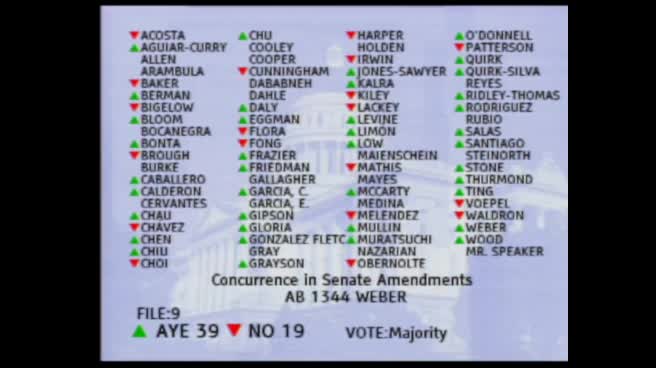 1MIN
Assembly Floor
 3MIN
Senate Floor
 1H
Senate Standing Committee on Appropriations
 11MIN
Senate Standing Committee on Education
 1MIN
Assembly Floor
 1H
Assembly Standing Committee on Appropriations
 12MIN
Assembly Standing Committee on Housing and Community Development
 18MIN
Assembly Standing Committee on Education
Bill Author







