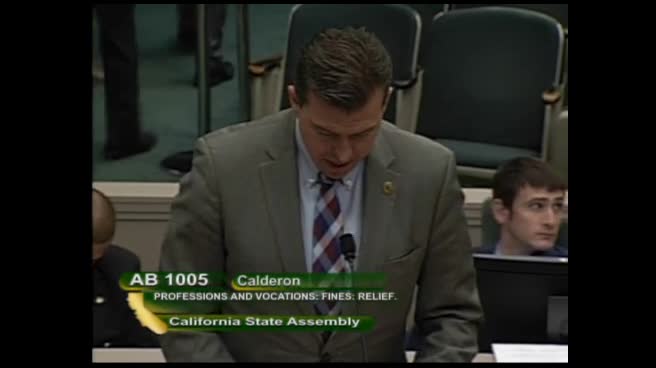
AB 1005: Professions and vocations: fines: relief.
- Session Year: 2017-2018
- House: Assembly
- Latest Version Date: 2017-05-02
Under existing law, the Department of Consumer Affairs is under the control of the Director of Consumer Affairs and is comprised of various boards, bureaus, commissions, committees, and similarly constituted agencies boards that license and regulate the practice of various professions and vocations. A violation of a regulatory act by a licensee can subject a licensee to discipline, including administrative penalties or citations, suspension, or revocation of the license. Existing law specifies that whenever any provision of law governing businesses and professions grants authority to issue a citation for a violation of a code provision, that authority also includes the authority to issue a citation for the violation of any regulation adopted pursuant to code.
This bill would authorize boards, bureaus, commissions, committees, and similarly constituted agencies that license and regulate professions and vocations, when granted the authority to issue a citation, to instead issue a fix-it ticket in lieu of a fine. The bill would specify that any person who is issued a fix-it ticket in lieu of a citation would have 30 days in which to correct the violation before being issued the fine.Under existing law, any board within the Department of Consumer Affairs, the board created by the Chiropractic Initiative Act, and the Osteopathic Medical Board of California, is authorized to establish, by regulation, a system for the issuance to a licensee of a citation which may contain an order of abatement or an order to pay an administrative fine assessed by the board where the licensee is in violation of the applicable law. Existing law requires the system, whenever appropriate, to include a provision requiring the citation to contain an order of abatement fixing a reasonable time for abatement of the violation.
This bill, except with regard to healing arts licensees, would instead require a citation containing an order to pay an administrative fine to contain an order of abatement fixing a period of no less than 30 days for abatement of the violation before the administrative fine becomes effective, as provided.
Under existing law, the Department of Consumer Affairs is under the control of the Director of Consumer Affairs and is comprised of various boards, bureaus, commissions, committees, and similarly constituted agencies that license and regulate the practice of various professions and vocations. A violation of a regulatory act by a licensee can subject a licensee to discipline, including administrative penalties or citations, suspension, or revocation of the license. Existing law specifies that whenever any provision of law governing businesses and professions grants authority to issue a citation for a violation of a code provision, that authority also includes the authority to issue a citation for the violation of any regulation adopted pursuant to code.
This bill would authorize boards, bureaus, commissions, committees, and similarly constituted agencies that license and regulate professions and vocations, when granted the authority to issue a citation, to instead issue a fix-it ticket in lieu of a fine. The bill would specify that any person who is issued a fix-it ticket in lieu of a citation would have 30 days in which to correct the violation before being issued the fine.
Under existing law, there is the Office of Professional Examination Services within the Department of Consumer Affairs. Existing law provides for the licensure and regulation of various professions and vocations by boards within the Department of Consumer Affairs.This bill would require the office to conduct an occupational analysis of every professions and vocations license subject to examination in this state to determine the licenses with a need for the examination to be offered in languages other than English. The bill would also require the office to report this analysis with recommendations to the Legislature by January 1, 2019.Under existing law, there is the Office of Professional Examination Services within the Department of Consumer Affairs. Existing law provides for the licensure and regulation of various professions and vocations by boards within the Department of Consumer Affairs.
This bill would require the office to conduct an occupational analysis of every professions and vocations license subject to examination in this state to determine the licenses with a need for the examination to be offered in languages other than English. The bill would also require the office to report this analysis with recommendations to the Legislature by January 1, 2019.
(a)Except with respect to persons regulated under Chapter 11 (commencing with Section 7500), any board, bureau, or commission within the department, the board created by the Chiropractic Initiative Act, and the Osteopathic Medical Board of California, may establish, by regulation, a system for the issuance to a licensee of a citation which may contain an order of abatement or an order to pay an administrative fine assessed by the board, bureau, or commission where the licensee is in violation of the applicable licensing act or any regulation adopted pursuant thereto.
(b)The system shall contain the following provisions:
(1)Citations shall be in writing and shall describe with particularity the nature of the violation, including specific reference to the provision of law determined to have been violated.
(2)Whenever Except as provided in paragraph (3), whenever appropriate, the citation shall contain an order of abatement fixing a reasonable time for abatement of the violation.
(3)Notwithstanding paragraph (2), except with respect to healing arts licensees licensed pursuant to Division 2 (commencing with Section 500, the board created by the Chiropractic Initiative Act, and the Osteopathic Medical Board of California, a citation containing an order to pay an administrative fine shall contain the following:
(A)An order of abatement fixing a period of no less than 30 days for abatement of the violation before the administrative fine becomes effective.
(B)If the licensee successfully abates the violation within the 30-day period, the licensee shall not be responsible for payment of the administrative fine.
(C)If the licensee fails to abate the violation within the 30-day period, the licensee shall pay the administrative fine.
(3)(4)In no event shall the administrative fine assessed by the board, bureau, or commission exceed five thousand dollars ($5,000) for each inspection or each investigation made with respect to the violation, or five thousand dollars ($5,000) for each violation or count if the violation involves fraudulent billing submitted to an insurance company, the Medi-Cal program, or Medicare. In assessing a fine, the board, bureau, or commission shall give due consideration to the appropriateness of the amount of the fine with respect to factors such as the gravity of the violation, the good faith of the licensee, and the history of previous violations.
(4)(5)A citation or fine assessment issued pursuant to a citation shall inform the licensee that if he or she desires a hearing to contest the finding of a violation, that hearing shall be requested by written notice to the board, bureau, or commission within 30 days of the date of issuance of the citation or assessment. assessment or the date the administrative fine becomes effective pursuant to paragraph (3). If a hearing is not requested pursuant to this section, payment of any fine shall not constitute an admission of the violation charged. Hearings shall be held pursuant to Chapter 5 (commencing with Section 11500) of Part 1 of Division 3 of Title 2 of the Government Code.
(5)(6)Failure of a licensee to pay a fine within 30 days of the date of assessment, assessment or the date the administrative fine becomes effective pursuant to paragraph (3) unless the citation is being appealed, may result in disciplinary action being taken by the board, bureau, or commission. Where a citation is not contested and a fine is not paid, the full amount of the assessed fine shall be added to the fee for renewal of the license. A license shall not be renewed without payment of the renewal fee and fine.
(c)The system may contain the following provisions:
(1)A citation may be issued without the assessment of an administrative fine.
(2)Assessment of administrative fines may be limited to only particular violations of the applicable licensing act.
(d)Notwithstanding any other provision of law, if a fine is paid to satisfy an assessment based on the finding of a violation, payment of the fine shall be represented as satisfactory resolution of the matter for purposes of public disclosure.
(e)Administrative fines collected pursuant to this section shall be deposited in the special fund of the particular board, bureau, or commission.
SECTION 1.Section 12.5 of the Business and Professions Code is amended to read:12.5.(a)Whenever any provision of this code grants authority to issue a citation for a violation of any provision of this code, that authority also includes the authority to issue a citation for the violation of any regulation adopted pursuant to any provision of this code.(b)The authority to issue a citation for a violation of any provision of this code also includes the authority to issue a fix-it ticket, in lieu of a fine. Any person who is issued a fix-it ticket in lieu of a citation and fine shall have 30 days in which to correct the violation before being issued the fine.(a)Whenever in any provision of this code authority is granted grants authority to issue a citation for a violation of any provision of this code, that authority also includes the authority to issue a citation for the violation of any regulation adopted pursuant to any provision of this code.
(b)The authority to issue a citation for a violation of any provision of this code also includes the authority to issue a fix-it ticket, in lieu of a fine. Any person who is issued a fix-it ticket in lieu of a citation and fine shall have 30 days in which to correct the violation before being issued the fine.
SECTION 1.Section 139.2 is added to the Business and Professions Code, to read:139.2.(a)The Office of Professional Examination Services shall conduct an occupational analysis of every license subject to examination in this state to determine the licenses with a need for the examination to be offered in languages other than English.(b)(1)Pursuant to Section 9795 of the Government Code, the office shall report this analysis with recommendations to the Legislature by January 1, 2019.(2)This subdivision shall become inoperative on January 1, 2022, pursuant to Section 10231.5 of the Government Code.(a)The Office of Professional Examination Services shall conduct an occupational analysis of every license subject to examination in this state to determine the licenses with a need for the examination to be offered in languages other than English.
(b)(1)Pursuant to Section 9795 of the Government Code, the office shall report this analysis with recommendations to the Legislature by January 1, 2019.
(2)This subdivision shall become inoperative on January 1, 2022, pursuant to Section 10231.5 of the Government Code.
|
Date
|
Status
|
|---|---|
| Feb 1, 2018 | From committee: Filed with the Chief Clerk pursuant to Joint Rule 56. |
| Jan 31, 2018 | Died pursuant to Art. IV, Sec. 10(c) of the Constitution. |
| May 26, 2017 | In committee: Held under submission. |
| May 17, 2017 | In committee: Set, first hearing. Referred to APPR. suspense file. |
| May 3, 2017 | Re-referred to Com. on APPR. |
| May 2, 2017 | Read second time and amended. |
| May 1, 2017 | From committee: Amend, and do pass as amended and re-refer to Com. on APPR. (Ayes 16. Noes 0.) (April 25). |
| Apr 18, 2017 | Re-referred to Com. on B. & P. |
| Apr 17, 2017 | From committee chair, with author's amendments: Amend, and re-refer to Com. on B. & P. Read second time and amended. |
| Mar 6, 2017 | Referred to Com. on B. & P. |
| Feb 17, 2017 | From printer. May be heard in committee March 19. |
| Feb 16, 2017 | Read first time. To print. |
|
Date
|
Description
|
Location
|
Votes
|
|
|---|---|---|---|---|
| Apr 25, 2017 | Do pass as amended and be re-referred to the Committee on [Appropriations] | Assembly Standing Committee on Business and Professions |
Passed |
This list shows positions taken on this bill by organizations on the date displayed, which is linked to the original source.
Positions by individuals are not included.
Date of Hearing: May 17, 2017
ASSEMBLY COMMITTEE ON APPROPRIATIONS
Lorena Gonzalez Fletcher, Chair
ABPCA Bill Id:AB 1005
Author:(Calderon) – As Amended Ver:May 2, 2017
Policy Committee: | Business and Professions | Vote: | 16 - 0 |
Urgency: No State Mandated Local Program: No Reimbursable: No
SUMMARY:
This bill requires non-healing arts entities within the Department of Consumer Affairs (DCA) to issue a fix-it ticket, with a 30-day cure period, before an administrative fine becomes effective for a Business and Professions Code violation.
It also specifies if the licensee successfully abates the violation within the 30-day period, the licensee is not responsible for payment of the administrative fine.
FISCAL EFFECT:
- Significant penalty revenue loss. DCA has identified at least $4.2 million in projected revenue losses (various special funds). Because citations are used to help pay the cost of enforcement programs, in order to compensate for revenue losses, DCA entities may have to raise fees or curtail enforcement as a result of revenue loss.
- Increased enforcement costs for various entities under DCA, in the range of hundreds of thousands of dollars at a minimum, across the department (various special funds).
COMMENTS:
- Purpose. The author cites challenges small businesses face when meeting the multitude of state regulations. According to the author, the intent of this bill is to give business owners, especially small businesses, a chance to correct their non-serious violations before being fined excessive amounts that can impact business operations
- Background. The DCA's general provisions authorize most DCA entities to establish a citation program for violations of the laws and regulations within each entity's jurisdiction. In addition, each DCA entity's practice Act usually contains specific citation authority. DCA entities typically use citations for minor violations that do not warrant formal discipline, such as failure to notify of a change of address, failure to renew a license in time, or other procedural violations.
A citation is a written document issued to a licensee who is found to be in violation of an applicable licensing law. A citation must describe the nature of a violation and cite the violated provision of law or regulation. The citation may include an order of abatement (order for corrective action), an order to pay an administrative fine, neither, or both. Existing law requires that all citations include, if appropriate, an order of abatement fixing a reasonable amount of time to correct the violation.
A licensee has 30 days to contest a citation or a fine by requesting a hearing. If the licensee does not request a hearing, the licensee must correct the violation within the time noted in any included order of abatement, and pay any assessed fines, within 30 days. Usually the minimum fine is $50 and the maximum is $5,000 (typically reserved for egregious, intentional, or repeated violations). The ranges are often specified in each entity's practice Act, and some practice Acts establish specific amounts for particular violations.
This bill applies to twenty non-healing arts entities within DCA, including the new Bureau of Medical Cannabis Regulation, the Board of Barbering and Cosmetology, the Court Reporters Board, the Bureau of Automotive Repair, and the Contractors State License Board, the Bureau of Real Estate, and the Bureau for Private Postsecondary Education, among others.
- Staff Comments. This bill may alleviate the financial pressure fines place on businesses, but may have some unintended consequences. Numerous concerns raised in the Business and Professions committee analysis remain unaddressed. These concerns included the following:
- Fine assessments may lose their deterrent effect and lead to bad behavior. Enforcement entities may have incentive to pursue more aggressive discipline.
- The removal of discretion to determine a reasonable period for correction undermines the entities' authority; 30 days may be inappropriate for some violations.
- Existing law already authorizes licensees to appeal a citation they believe may be unfair or improperly issued. Due process concerns, as well as enforcement actions that are perceived as overly harsh or punitive, are carefully considered during the sunset review process every four years.
- Healing arts licensees are excluded from this bill; it is unclear that one group merits the categorical application of this policy over the other.
- This bill requires a citation that contains a fine assessment also include an abatement period, even if there is nothing to correct (such as a late submittal of a renewal application).
- This bill may conflict with existing citation authorities under the general provisions or within the specific practice Acts of each entity.
- This bill may require certain entities to send additional investigators in cases where a fine is assessed, in order to determine timely compliance with the abatement order.
Analysis Prepared by: Lisa Murawski / APPR. / (916) 319-2081
Date of Hearing:
ASSEMBLY COMMITTEE ON BUSINESS AND PROFESSIONS
Evan Low, Chair
ABPCA Bill Id:AB 1005
Author:(Calderon) – As Amended Ver:April 17, 2017
SUBJECT: Professions and vocations: fines: relief.
SUMMARY: Authorizes agencies that enforce provisions of the Business and Professions Code (BPC) to issue a fix-it ticket, in lieu of a fine, for violations of the BPC.
EXISTING LAW:
- Establishes licensing and regulatory programs for professions, vocations, and business, including attorneys under the State Bar, clinical laboratories under the Department of Public health, alcohol under the Department of Alcoholic Beverage Control, and business licensing and regulation under cities, counties, and the Office of the Attorney General. (BPC §§ 1-26211)
- Specifies that, whenever a provision of the BPC authorizes an entity to issue a citation for a violation of the code, the authority also includes the authority to issue a citation for the violation of any regulation adopted pursuant to the code. (BPC § 12.5)
- Provides for the licensure and regulation of various professions and vocations by boards, bureaus, and other entities within the Department of Consumer Affairs (DCA). (BPC §§ 22, 100-144.5)
- Specifies that each of the entities comprising the department exists as a separate unit, and has the functions of setting standards, holding meetings, and setting dates thereof, preparing and conducting examinations, passing upon applicants, conducting investigations of violations of laws under its jurisdiction, issuing citations and holding hearings for the revocation of licenses, and the imposing of penalties following those hearings, insofar as these powers are given by statute to each respective entity. (BPC § 108)
- Authorizes, except for the Bureau of Security and Investigative Services with respect to repossession agencies, any entity within the DCA, including those established by initiative acts, to establish, by regulation, a system for the issuance to a licensee of a citation which may contain an order of abatement or an order to pay an administrative fine assessed by the entity where the licensee or unlicensed individual is in violation of the applicable licensing act or any regulation adopted pursuant the act. (BPC §§ 125.9(a), 148)
- Requires a citation system adopted under the authority to meet the following: (BPC § 125.9(b))
- Citations must be in writing and describe with particularity the nature of the violation, including specific reference to the provision of law determined to have been violated.
- Whenever appropriate, the citation must contain an order of abatement fixing a reasonable time for abatement of the violation.
- The administrative fine assessed by the entity may not exceed $5,000 for each inspection or each investigation made with respect to the violation, or $5,000 for each violation or count if the violation involves fraudulent billing submitted to an insurance company, the Medi-Cal program, or Medicare.
- In assessing a fine, the entity must give due consideration to the appropriateness of the amount of the fine with respect to factors that include the gravity of the violation, the good faith of the licensee, and the history of previous violations.
- The citation or fine assessment issued pursuant to a citation must inform the licensee that if the licensee desires a hearing to contest the finding of a violation, the licensee must request the hearing in writing to the issuing entity within 30 days of the date the citation or assessment was issued, as specified.
- Failure of a licensee to pay a fine within 30 days of the date of assessment, unless the citation is being appealed, may result in disciplinary action being taken by the board, bureau, or commission. Where a citation is not contested and a fine is not paid, the full amount of the assessed fine shall be added to the fee for renewal of the license. A license shall not be renewed without payment of the renewal fee and fine.
- The system may contain the following provisions: (BPC § 125.9(c))
- A citation may be issued without the assessment of an administrative fine.
- Assessment of administrative fines may be limited to only particular violations of the applicable licensing act.
- Notwithstanding any other provision of law, if a fine is paid to satisfy an assessment based on the finding of a violation, payment of the fine shall be represented as satisfactory resolution of the matter for purposes of public disclosure. (BPC § 125.9(d))
THIS BILL:
- Specifies that the authority to issue a citation for a violation of any provision of the BPC also includes the authority to issue a fix-it ticket, in lieu of a fine.
- Provides a person who is issued a fix-it ticket in lieu of a fine 30 days in which to correct the violation before being issued a fine.
FISCAL EFFECT: Unknown. This bill is keyed fiscal by the Legislative Counsel.
COMMENTS:
Purpose. This bill is sponsored by the author. According to the author, "According to the U.S. Small Business Administration report, California has over 3.7 million small businesses, which is 1.3 million more than any other state, and also employs half of the state’s private workforce. While small businesses often function as an economic engine for the state’s economy, small businesses suffer as they are often unable to meet the multitude of regulations while running the daily operation of their business.
In order to ease the burden of excessive fines on businesses whose goal is to achieve a regulatory safe environment, [this bill] seeks to have investigative agencies offer a correctable citation should a business be found with a non-serious violations before being fined. This solution is a way California can move in the right direction to spur economic growth and create jobs."
Background. The BPC contains the California laws pertaining to the regulation of businesses and licensed professions. The BPC is generally divided up by topic, including professional licensing and consumer affairs under the DCA and the State Bar, standards for weighing and measuring, business contracts and rights, consumer rights and remedies, antitrust, advertising, arts and entertainment, online privacy, standards for gas stations, tobacco licensing and regulation, alcohol licensing and regulation, and cannabis licensing and regulation. The BPC also contains provisions implementing several initiative acts, including the Chiropractic Initiative Act, the Osteopathic Initiative Act, and the Adult Use of Marijuana Act.
Various governmental entities are authorized to administer and enforce the provisions, including the Department of Justice, the Department of General Services, the Department of Alcoholic Beverage Control, the Board of Equalization, the DCA, the licensing entities under the DCA, the California Horse Racing Board, cities, and localities, among others. This bill extends any authority to issue a citation for a violation of the provisions of the BPC to also include the authority to issue a "fix-it ticket," under which the person who is issued the citation has thirty days to correct before the issuing authority may issue a fine.
DCA Licensing Entities. In California, many professions require a license to legally practice. Many of the licensing programs are administered by licensing boards, bureaus, and other entities within the DCA. A large number of the entities authorized to issue citations under the BPC are the DCA licensing entities.
The DCA licensing entities are established to protect the people of California through adequate regulation of businesses and professions that engage in activities that risk harm to the health, safety, and welfare of the public (BPC § 101.6). Each profession and entity generally has a "practice act," or a chapter within a practice act, which serves as the entity's enacting statute and establishes the requirements and authorities specific to the profession covered by the practice act.
The professions and entities under the DCA are divided into "healing arts" and "professions and vocations generally" (non-healing arts). The healing arts entities are as follows:
- Acupuncture Board
- Board of Behavioral Sciences
- Board of Chiropractic Examiners
- Dental Board of California
- Dental Hygiene Committee of California
- Medical Board of California
- Naturopathic Medicine Committee
- California Board of Occupational Therapy
- Board of Optometry
- Osteopathic Medical Board of California
- Board of Pharmacy
- Physical Therapy Board of California
- Physician Assistant Board
- Board of Podiatric Medicine
- Board of Psychology
- Board of Registered Nursing
- Respiratory Care Board
- Speech-Language Pathology and Audiology and Hearing Aid Dispensers Board
- Veterinary Medical Board
- Board of Vocational Nursing and Psychiatric Technicians
The non-healing arts entities are as follows:
- Board of Accountancy
- Arbitration Certification Program
- California Architects Board
- Athletic Commission of California
- Bureau of Automotive Repair
- Board of Barbering and Cosmetology
- Cemetery and Funeral Bureau
- Contractors State License Board
- Court Reporters Board
- Bureau of Electronic and Appliance Repair, Home Furnishings and Thermal Insulation
- Board for Professional Engineers, Land Surveyors, and Geologists
- Board of Guide Dogs for the Blind
- Landscape Architects Technical Committee
- Bureau of Medical Cannabis Regulation
- Bureau for Private Postsecondary Education
- Professional Fiduciaries Bureau
- Bureau of Real Estate
- Bureau of Real Estate Appraisers
- Bureau of Security and Investigative Services
- Structural Pest Control Board
The DCA supports these entities by providing centralized administrative, investigative, and technological support services. Further, the DCA itself is technically a licensing entity as the bureaus are under the direct control and supervision of the director. The DCA also houses the Consumer Information Center and Complaint Resolution Program, which mediates consumer complaints involving industries regulated by the following programs:
- Bureau of Security and Investigative Services
- Bureau of Electronic and Appliance Repair and Home Furnishings and Thermal Insulation
- Bureau of Automotive Repair
- Cemetery and Funeral Bureau
DCA Licensing Enforcement. Existing law authorizes the licensing entities to enforce the practice requirements to ensure licensees provide safe and effective services to the public and prevent unlicensed practice. Some of the authorities are located under the BPC's general provisions while others are specific to an entity and located in the entity's practice act.
In general, the enforcement authority includes administrative actions that are tied to a license, such as the ability to issue a citation, assess a fine, place a license on probationary status (including suspension), and ultimately license revocation. For unlicensed practice and criminal violations rising above administrative action, the licensing entities may seek an injunction or other equitable remedies in a court of law (BPC § 125.5) or refer the case for criminal prosecution (BPC § 160). Most licensing violations are misdemeanors.
Like other state enforcement agencies, DCA entities are authorized to determine the appropriate penalty based on the nature of the violation, including the relation to a licensee's practice, the level of consumer harm, number of offenses, remedial steps taken, and other relevant factors. To that end, DCA entities are authorized to investigate potential violations to confirm whether a violation has occurred and determine the nature of the violation.
As state agencies, all DCA entities are subject to the Administrative Procedure Act (APA) (Government Code (GOV) §§ 11340-11500), which establishes rulemaking procedures and standards, fosters public participation, and ensures agencies comply with state law. The APA's administrative adjudication provisions ensure licensee due process rights, including notice, an opportunity for fair hearing, administrative review (agency appeal), and judicial review (court appeal) (GOV §§ 11400-11475.70).
Cite and Fine. With regard to DCA entities, this bill clarifies that the entities that are authorized to issue citations may also issue a "fix-it ticket." The DCA's general provisions authorize DCA entities (except for the BSIS with regard to repossession agencies) to establish a citation program for violations of the laws and regulations within each entity's jurisdiction. In addition, each DCA entity's practice act usually contains specific citation authority. DCA entities typically use citations for minor violations that do not warrant formal discipline, such as failure to notify of a change of address, failure to renew a license in time, or other procedural violations.
A citation is a written document issued to a licensee who is found to be in violation of an applicable licensing law. A citation must describe the nature of a violation and cite to the violated provision of law or regulation. The citation may include an order of abatement (order for corrective action), an order to pay an administrative fine, neither, or both. Existing law requires that all citations include, if appropriate, an order of abatement fixing a reasonable amount of time to correct the violation.
A licensee has 30 days to contest a citation or a fine by requesting a hearing. If the licensee does not request a hearing, the licensee must correct the violation within the time noted in any included order of abatement and pay any assessed fines within 30 days. Usually the minimum fine is $50 and the maximum is $5,000 (typically reserved for egregious, intentional, or repeated violations). The ranges are often specified in each entity's practice act, and some practice acts establish specific amounts for particular violations.
AMENDMENTS:
According to the author:
California’s business climate is crucial to the state’s international trade and is an important factor for dispersing the positive economic impacts of trade within the state’s economy. It is common to hear the challenges small businesses face when meeting the multitude of state regulations, as noted in a study by the National Federation of Independent Business (NFIB).
Often time, business owners are unaware of the multitude of regulations they must follow and it is not uncommon to have owners act as their own compliance officer. Despite businesses being not nearly as knowledgeable on every hundreds of regulations in statute, the state does bear some responsibility in educating and assisting businesses to comply.
NFIB stated in their study that regulations are a problem for businesses and their members have voiced concerns that regulations are costly, confusing, and makes it difficult for them to operate their business.
The intent of [this bill] is to give business owners, especially small businesses, a chance to correct their non-serious violations before being fined excessive amounts that can impact the business ability to grow, hire new employees, or potentially force their business into closure.
To that end, the bill should be amended to do the following:
1) Narrow the applicable entities to non-healing arts entities under the DCA.
2) Require all citations with a fine assessment to also contain an abatement period in which the licensee has the opportunity to correct the violation before being required to pay a fine.
3) Require the abatement period to be at least 30 days instead of a “reasonable period.”
The amendment is as follows:
Strike the current language of the bill and insert:
SECTION 1. Section 125.9 of the Business and Professions Code is amended to read:
125.9. (a) Except with respect to persons regulated under Chapter 11 (commencing with Section 7500), any board, bureau, or commission within the department, the board created by the Chiropractic Initiative Act, and the Osteopathic Medical Board of California, may establish, by regulation, a system for the issuance to a licensee of a citation which may contain an order of abatement or an order to pay an administrative fine assessed by the board, bureau, or commission where the licensee is in violation of the applicable licensing act or any regulation adopted pursuant thereto.
(b) The system shall contain the following provisions:
(1) Citations shall be in writing and shall describe with particularity the nature of the violation, including specific reference to the provision of law determined to have been violated.
(2) Whenever Except as provided in paragraph (3), whenever appropriate, the citation shall contain an order of abatement fixing a reasonable time for abatement of the violation.
(3) Notwithstanding paragraph (2), except with respect to persons and facilities regulated under Division 2 (commencing with Section 500) relating to healing arts and clinical laboratories, the board created by the Chiropractic Initiative Act, and the Osteopathic Medical Board of California, a citation containing an order to pay an administrative fine shall contain the following:
(A) An order of abatement fixing a period of no less than 30 days for abatement of the violation before the fine assessment becomes effective.
(B) If the licensee successfully abates the violation within the 30-day period, the licensee shall not be responsible for payment of the assessment.
(C) If the licensee fails to abate the violation within the 30-day period, the licensee shall pay the assessed fine.
(3) In no event shall the administrative fine assessed by the board, bureau, or commission exceed five thousand dollars ($5,000) for each inspection or each investigation made with respect to the violation, or five thousand dollars ($5,000) for each violation or count if the violation involves fraudulent billing submitted to an insurance company, the Medi-Cal program, or Medicare. In assessing a fine, the board, bureau, or commission shall give due consideration to the appropriateness of the amount of the fine with respect to factors such as the gravity of the violation, the good faith of the licensee, and the history of previous violations.
(4) A citation or fine assessment issued pursuant to a citation shall inform the licensee that if he or she desires a hearing to contest the finding of a violation, that hearing shall be requested by written notice to the board, bureau, or commission within 30 days of the date of issuance of the citation or assessment. assessment or the date an assessment becomes effective pursuant to paragraph (3). If a hearing is not requested pursuant to this section, payment of any fine shall not constitute an admission of the violation charged. Hearings shall be held pursuant to Chapter 5 (commencing with Section 11500) of Part 1 of Division 3 of Title 2 of the Government Code.
(5) Failure of a licensee to pay a fine within 30 days of the date of assessment, or the date the assessment becomes effective pursuant to paragraph (3), unless the citation is being appealed, may result in disciplinary action being taken by the board, bureau, or commission. Where a citation is not contested and a fine is not paid, the full amount of the assessed fine shall be added to the fee for renewal of the license. A license shall not be renewed without payment of the renewal fee and fine.
(c) The system may contain the following provisions:
(1) A citation may be issued without the assessment of an administrative fine.
(2) Assessment of administrative fines may be limited to only particular violations of the applicable licensing act.
(d) Notwithstanding any other provision of law, if a fine is paid to satisfy an assessment based on the finding of a violation, payment of the fine shall be represented as satisfactory resolution of the matter for purposes of public disclosure.
(e) Administrative fines collected pursuant to this section shall be deposited in the special fund of the particular board, bureau, or commission.
IMPLEMENTATION ISSUES:
There are concerns raised with this amendment, including:
- The amendment requires non-healing arts entities to include an order for abatement in all citations with a fine assessment instead of “whenever appropriate” as specified under BPC § 125.9(b)(2). However, some citable violations are not correctable or can be corrected before the entity finds out about it. In one common example, if a licensee is late in submitting a renewal, the licensing entity may not find out until it has received the delinquent renewal.
Even after the renewal is processed and the licensee is in good standing, there may have been a period of time where the licensee practiced on the expired license. Therefore, the entity may investigate to determine whether the licensee should be penalized, considering factors such as consumer harm, good faith, or prior violations. Procedural violations like this do not normally rise to the level of formal discipline and typically result in a warning or small fine for a first offense, with increasing fine assessments for aggravating factors.
As amended, this bill requires a citation that contains a fine assessment to also include an abatement period, even if there is nothing to correct. If this bill passes this Committee, the author may wish to remedy this issue.
- The amendment may conflict with existing citation authorities under the general provisions or within the specific practice acts of each entity. For instance, BPC § 136 requires a licensee to notify the issuing entity of mailing address changes within 30 days of the change, unless the entity has specified by regulations a shorter time period. It also specifies that the failure to comply with the requirement is grounds for the issuance of a citation and administrative fine if the entity is authorized to issue a citation or fine.
As amended, this bill requires that a non-healing arts entity choosing to issue a citation that contains a fine assessment pursuant to that authority also include a 30-day abatement period. This may create a loophole in the 30-day notice requirement. If an entity discovers that a licensee has not submitted an address change, the amendment may allow the licensee to avoid a fine by submitting the notice within 30 days of the citation instead of when the address change occurred. If this bill passes this Committee, the author may wish to harmonize the language with conflicting provisions in the BPC.
- As amended, this bill may require certain entities to send additional investigators in cases where a fine is assessed in order to determine timely compliance with the abatement order (for instance where a real estate licensee has posted a sign without the proper license number). This could potentially increase enforcement costs and impact enforcement caseloads.
POLICY CONCERNS:
- If all fine assessments allow licensees to correct the violation, the fine assessments may lose their deterrent effect. As amended, this bill allows any assessed fine to be corrected, even fines assessed at the statutory maximum of $5,000. This may incentivize boards to skip the fine and instead impose formal discipline or criminal prosecution (which can still include a fine).
- As amended, this bill removes the entities' discretion to determine a reasonable period for correction. Due to the wide range of violations and variation in ways a violation may occur, the DCA entities are authorized to investigate cases and make determinations on a case-by-case basis. For example, some violations may require immediate correction, such as in cases of accidental misrepresentation of a title or scope of practice. Under the amended language, the licensee could in theory continue to misrepresent the ability to practice for 29 more days. This period could be extended further by requesting an appeal on the 29th day.
This could create different issues for different entities. If a non-specialty contractor submits a bid for a roof repair requiring a specialty license, the Contractors State License Board could issue a citation ordering the contractor to withdraw the bid and assess a fine for unlicensed practice. Under the amended language, the contractor would have 30 days to withdraw the bid. If the bid was for a sub-contract as part of a larger renovation and the bid was accepted within the 30 day window, the harm to the consumer and other contractors has already occurred. However, the Board would be prevented from fining or disciplining the licensee for this behavior because the licensee was in compliance with the 30-day requirement. This may again incentivize boards to skip citations altogether in situations where formal discipline or criminal prosecution may not initially be warranted. - As amended, this bill gives all non-healing arts licensees a 30-day window to correct a violation resulting in a fine. Existing law already authorizes licensees to appeal a citation they believe may be unfair or improperly issued (which would halt enforcement of the citation). If the licensee wins on appeal, the fine does not need to be paid. If the licensee loses the administrative appeal, the licensee may appeal to a court of law.
In addition, if DCA licensing entities are being overly harsh or punitive to licensees, this is often revealed during the Joint Sunset Review process held by this Committee in partnership with the Senate Committee on Business, Professions, and Economic Development. The Committees thoroughly review enforcement data, solicit input from stakeholders, make extensive recommendations, and author "sunset bills." Due process issues like the one raised under this bill are often addressed as a part of that process. - Applying this to non-healing arts licensees while excluding healing arts licensees raises both fairness and constitutional concerns (equal protection — treating two similarly situated classes differently). Even as amended, this bill covers a large number and wide variation of license types within both classes of licensees. It is not currently clear that healing arts licensees as a whole are so different from non-healing arts licensees, in practice and in potential consumer harms, that one group merits the categorical application of this policy over the other.
REGISTERED SUPPORT:
None on file.
REGISTERED OPPOSITION:
None on file.
Analysis Prepared by: Vincent Chee / B. & P. / 916-319-3301
Discussed in Hearing
 1H
Assembly Standing Committee on Appropriations
 4MIN
Assembly Standing Committee on Business and Professions
Bill Author

Bill Co-Author(s):