AB 1500: State highways: relinquishment: Route 75.
- Session Year: 2015-2016
- House: Assembly
- Latest Version Date: 2016-09-21
Existing law gives the Department of Transportation full possession and control of all state highways. Existing law describes the authorized routes in the state highway system and establishes a process for adoption of a highway on an authorized route by the California Transportation Commission. Existing law authorizes the commission to relinquish to local agencies state highway segments that have been deleted from the state highway system by legislative enactment or have been superseded by relocation, and in certain other cases.
This bill would authorize the commission to relinquish to the Cities of Imperial Beach and San Diego specified portions of Route 75, under certain conditions.
The Planning and Zoning Law requires a city or county to adopt a general plan for land use development that includes, among other things, a housing element. That law requires the housing element to include an assessment of housing needs and an inventory of resources and constraints relevant to the meeting of these needs. That law requires this assessment and inventory to include the identification of a zone or zones where emergency shelters are allowed as a permitted use without a conditional use or other discretionary permit, as provided.
This bill would authorize a city or county to additionally include in its assessment and inventory the identification of supportive housing and transitional housing, as those terms are defined in specified statutes. If a local government elects to include this identification in its assessment and inventory, the bill would impose certain requirements, including that the identified zone or zones include sufficient capacity to accommodate the need for supportive housing or transitional housing, that the local government demonstrate that existing or proposed permit processing, development, and management standards are objective and encourage and facilitate the development of supportive housing or transitional housing, and that supportive housing or transitional housing generally be subject only to the development and management standards that apply to residential or commercial development within the same zone. The bill would also provide that the permit processing, development, and management standards applied under these provisions would not be discretionary acts within the meaning of the California Environmental Quality Act.
The California Environmental Quality Act (CEQA) requires a lead agency, as defined, to prepare, or cause to be prepared, and certify the completion of an environmental impact report on a project that it proposes to carry out or approve that may have a significant effect on the environment or to adopt a negative declaration if it finds that the project will not have that effect. CEQA also requires a lead agency to prepare a mitigated negative declaration for a project that may have a significant effect on the environment if revisions in the project would avoid or mitigate that effect and there is no substantial evidence that the project, as revised, would have a significant effect on the environment. CEQA exempts specified projects from its requirements.
This bill would exempt from the requirements of CEQA priority housing projects, as defined, if specified conditions are met. Because a lead agency would be required to determine the applicability of this exemption, this bill would impose a state-mandated local program.
The California Constitution requires the state to reimburse local agencies and school districts for certain costs mandated by the state. Statutory provisions establish procedures for making that reimbursement.
This bill would provide that no reimbursement is required by this act for a specified reason.
The California Environmental Quality Act (CEQA) requires a lead agency, as defined, to prepare, or cause to be prepared, and certify the completion of, of an environmental impact report (EIR) on a project that it proposes to carry out or approve that may have a significant effect on the environment or to adopt a negative declaration if it finds that the project will not have that effect. CEQA also requires a lead agency to prepare a mitigated negative declaration for a project that may have a significant effect on the environment if revisions in the project would avoid or mitigate that effect and there is no substantial evidence that the project, as revised, would have a significant effect on the environment. CEQA exempts specified projects from its requirements.
This bill would exempt from the requirements of CEQA homeless complex priority housing projects, as defined. defined, if specified conditions are met. Because a lead agency would be required to determine the applicability of this exemption, this bill would impose a state-mandated local program.
The California Constitution requires the state to reimburse local agencies and school districts for certain costs mandated by the state. Statutory provisions establish procedures for making that reimbursement.
This bill would provide that no reimbursement is required by this act for a specified reason.
The California Environmental Quality Act (CEQA) requires a lead agency, as defined, to prepare, or cause to be prepared, and certify the completion of, an environmental impact report (EIR) on a project that it proposes to carry out or approve that may have a significant effect on the environment or to adopt a negative declaration if it finds that the project will not have that effect. CEQA also requires a lead agency to prepare a mitigated negative declaration for a project that may have a significant effect on the environment if revisions in the project would avoid or mitigate that effect and there is no substantial evidence that the project, as revised, would have a significant effect on the environment. CEQA exempts specified projects from its requirements.
This bill would exempt from the requirements of CEQA homeless complex projects, as defined. Because a lead agency would be required to determine the applicability of this exemption, this bill would impose a state-mandated local program.
The California Constitution requires the state to reimburse local agencies and school districts for certain costs mandated by the state. Statutory provisions establish procedures for making that reimbursement.
This bill would provide that no reimbursement is required by this act for a specified reason.
(a)Route 75 is from Route 5 to Route 5 via the Silver Strand and the San Diego-Coronado Toll Bridge.
(b)Upon a determination by the commission that it is in the best interests of the state to do so, the commission may, upon terms and conditions approved by it, relinquish portions of Route 75, if the department and the applicable local agency enter into an agreement providing for that relinquishment, as follows:
(1)To the City of Imperial Beach, the portions of Route 75 within its city limits.
(2)To the City of San Diego, the portions of Route 75 within its city limits.
(c)The following conditions apply upon relinquishment:
(1)The relinquishment shall become effective on the date following the county recorders recordation of the relinquishment resolution containing the commissions approval of the terms and conditions of the relinquishment.
(2)On and after the effective date of the relinquishment, the relinquished portions of Route 75 shall cease to be a state highway.
(3)The portions of Route 75 relinquished under subdivision (b) and this subdivision shall be ineligible for future adoption under Section 81.
(4)The Cities of Imperial Beach and San Diego shall ensure the continuity of traffic flow on the relinquished portions of Route 75, including any traffic signal progression.
(5)For the portions of Route 75 relinquished under subdivision (b) and this subdivision, the Cities of Imperial Beach and San Diego shall install and maintain, within their respective jurisdictions, signs directing motorists to the continuation of Route 75, to the extent deemed necessary by the department.
(a)Route 75 is from Route 5 to Route 5 via the Silver Strand and the San Diego-Coronado Toll Bridge.
(b)Upon a determination by the commission that it is in the best interests of the state to do so, the commission may, upon terms and conditions approved by it, relinquish portions of Route 75, if the department and the applicable local agency enter into an agreement providing for that relinquishment, as follows:
(1)To the City of Imperial Beach, the portions of Route 75 within its city limits.
(2)To the City of San Diego, the portions of Route 75 within its city limits.
(c)The following conditions apply upon relinquishment:
(1)The relinquishment shall become effective on the date following the county recorders recordation of the relinquishment resolution containing the commissions approval of the terms and conditions of the relinquishment.
(2)On and after the effective date of the relinquishment, the relinquished portions of Route 75 shall cease to be a state highway.
(3)The portions of Route 75 relinquished under subdivision (b) and this subdivision shall be ineligible for future adoption under Section 81.
(4)The Cities of Imperial Beach and San Diego shall ensure the continuity of traffic flow on the relinquished portions of Route 75, including any traffic signal progression.
(5)For the portions of Route 75 relinquished under subdivision (b) and this subdivision, the Cities of Imperial Beach and San Diego shall install and maintain, within their respective jurisdictions, signs directing motorists to the continuation of Route 75 75, to the extent deemed necessary by the department.
(a)Route 75 is from Route 5 to Route 5 via the Silver Strand and the San Diego-Coronado Toll Bridge.
(b)Upon a determination by the commission that it is in the best interests of the state to do so, the commission may, upon terms and conditions approved by it, relinquish portions of Route 75, if the department and the applicable local agency enter into an agreement providing for that relinquishment, as follows:
(1)To the City of Imperial Beach, the portions of Route 75 within its city limits.
(2)To the City of San Diego, the portions of Route 75 within its city limits.
(c)The following conditions apply upon relinquishment:
(1)The relinquishment shall become effective on the date following the county recorders recordation of the relinquishment resolution containing the commissions approval of the terms and conditions of the relinquishment.
(2)On and after the effective date of the relinquishment, the relinquished portions of Route 75 shall cease to be a state highway.
(3)The portions of Route 75 relinquished under subdivision (b) and this subdivision shall be ineligible for future adoption under Section 81.
(4)The Cities of Imperial Beach and San Diego shall ensure the continuity of traffic flow on the relinquished portions of Route 75, including any traffic signal progression.
(5)For the portions of Route 75 relinquished under subdivision (b) and this subdivision, the Cities of Imperial Beach and San Diego shall install and maintain, within their respective jurisdictions, signs directing motorists to the continuation of Route 75 to the extent deemed necessary by the department.
SECTION 1.Section 65583.5 is added to the Government Code, to read:65583.5.The assessment and inventory adopted pursuant to subdivision (a) of Section 65583 may include the identification of a zone or zones where supportive housing, as defined in paragraph (2) of subdivision (b) of Section 50675.14 of the Health and Safety Code, or transitional housing, as defined in Section 50801 of the Health and Safety Code, is allowed as a permitted use without a conditional use or other discretionary permit. If the local government elects to identify a zone or zones pursuant to this section, all of the following shall apply:
(a)The identified zone or zones shall include sufficient capacity to accommodate the need for supportive housing or transitional housing. If the local government cannot identify a zone or zones with sufficient capacity, the local government shall include a program to amend its zoning ordinance to meet the requirements of this section within one year of the adoption of the housing element. The local government may identify additional zones where supportive housing or transitional housing is permitted with a conditional use permit.
(b)The local government shall also demonstrate that existing or proposed permit processing, development, and management standards are objective and encourage and facilitate the development of, or conversion to, supportive housing or transitional housing. Supportive housing or transitional housing may only be subject to those development and management standards that apply to residential or commercial development within the same zone except that a local government may apply written, objective standards.
(c)The permit processing, development, and management standards applied under this section shall not be deemed to be discretionary acts within the meaning of the California Environmental Quality Act (Division 13 (commencing with Section 21000) of the Public Resources Code).
The assessment and inventory adopted pursuant to subdivision (a) of Section 65583 may include the identification of a zone or zones where supportive housing, as defined in paragraph (2) of subdivision (b) of Section 50675.14 of the Health and Safety Code, or transitional housing, as defined in Section 50801 of the Health and Safety Code, is allowed as a permitted use without a conditional use or other discretionary permit. If the local government elects to identify a zone or zones pursuant to this section, all of the following shall apply:
(a)The identified zone or zones shall include sufficient capacity to accommodate the need for supportive housing or transitional housing. If the local government cannot identify a zone or zones with sufficient capacity, the local government shall include a program to amend its zoning ordinance to meet the requirements of this section within one year of the adoption of the housing element. The local government may identify additional zones where supportive housing or transitional housing is permitted with a conditional use permit.
(b)The local government shall also demonstrate that existing or proposed permit processing, development, and management standards are objective and encourage and facilitate the development of, or conversion to, supportive housing or transitional housing. Supportive housing or transitional housing may only be subject to those development and management standards that apply to residential or commercial development within the same zone except that a local government may apply written, objective standards.
(c)The permit processing, development, and management standards applied under this section shall not be deemed to be discretionary acts within the meaning of the California Environmental Quality Act (Division 13 (commencing with Section 21000) of the Public Resources Code).
SECTION 1.Section 21080.40 is added to the Public Resources Code, to read:21080.40.(a)For purposes of this section, the following terms mean the following:
(1)Emergency shelter has the same meaning as set forth in Section 50801 of the Health and Safety Code.
(2) Priority housing project means an activity or approval necessary for, or incidental to, the development, planning, design, site acquisition, subdivision, financing, leasing, construction, operation, or maintenance of an emergency shelter, transitional housing, or supportive housing.
(3)Supportive housing has the same meaning as set forth in paragraph (2) of subdivision (b) of Section 50675.14 of the Health and Safety Code.
(4)Transitional housing has the same meaning as set forth in Section 50801 of the Health and Safety Code.
(b)This division does not apply to a priority housing project if all of the following conditions are met:
(1)The lead agency has filed a notice of determination with the Office of Planning and Research consistent with Section 21152.1.
(2)The city or county in which the project is located has adopted a housing element that the Department of Housing and Community Development has determined to be in compliance with applicable statutes and regulations at the time the lead agency files the notice of determination with the Office of Planning and Research.
(3)The city or county in which the project is located is compliant with the housing element portion of its annual report, required pursuant to Section 65400 of the Government Code, at the time the local agency files the notice of determination with the Office of Planning and Research.
(c)This section does not alter, affect, expand, or diminish a public agencys obligation to comply with statutory or regulatory requirements imposed pursuant to other laws.
SEC. 2.No reimbursement is required by this act pursuant to Section 6 of Article XIIIB of the California Constitution because a local agency or school district has the authority to levy service charges, fees, or assessments sufficient to pay for the program or level of service mandated by this act, within the meaning of Section 17556 of the Government Code.
(a)For purposes of this section, the following terms mean the following:
(1)Affordable housing cost has the same meaning as set forth in Section 50052.5 of the Health and Safety Code.
(2)Affordable rent has the same meaning as set forth in Section 50053 of the Health and Safety Code.
(3)
(1)Emergency shelter has the same meaning as set forth in Section 50801 of the Health and Safety Code.
(4)Low-income housing means housing with at least 20 percent of the units affordable to lower income households subject to all of the following:
(A)The project developer shall provide sufficient legal commitments to the appropriate local agency to ensure the continued availability and use of the housing units for extremely low income households, very low income households, or lower income households at monthly housing costs with an affordable housing cost or affordable rent for the period required by the applicable financing method.
(B)Rental units shall be affordable for at least 55 years.
(C)Ownership units shall be subject to resale restrictions or equity sharing requirements for at least 30 years.
(5)Lower income household has the same meaning as set forth in Section 50079.5 of the Health and Safety Code.
(6)
(2) Priority housing project means an activity or approval necessary for, or incidental to, the development, planning, design design, site acquisition, subdivision, financing, leasing, construction, operation, or maintenance of an emergency shelter, transitional housing, supportive housing, low-income housing, or associated development, including any accessory roadway, utility, or other improvement to that shelter, housing, or associated development. or supportive housing.
(7)
(3)Supportive housing has the same meaning as set forth in paragraph (2) of subdivision (b) of Section 50675.14 of the Health and Safety Code.
(8)
(4)Transitional housing has the same meaning as set forth in Section 50801 of the Health and Safety Code.
(b)This division does not apply to a priority housing project if all of the following conditions are met:
(1)The project does not result in a net loss in the number of housing units with an affordable housing cost or affordable rent to lower income households within the project area.
(2)
(1)The lead agency has filed a notice of determination with the Office of Planning and Research consistent with Section 21152.1.
(3)
(2)The city or county in which the project is located has adopted a housing element that the Department of Housing and Community Development has determined to be in compliance with applicable statutes and regulations at the time the lead agency files the notice of determination with the Office of Planning and Research.
(4)
(3)The city or county in which the project is located is compliant with the housing element portion of its annual report, required pursuant to Section 65400 of the Government Code, at the time the local agency files the notice of determination with the Office of Planning and Research.
(c)This section does not alter, affect, expand, or diminish a public agencys obligation to comply with statutory or regulatory requirements imposed pursuant to other laws.
SEC. 2.No reimbursement is required by this act pursuant to Section 6 of Article XIIIB of the California Constitution because a local agency or school district has the authority to levy service charges, fees, or assessments sufficient to pay for the program or level of service mandated by this act, within the meaning of Section 17556 of the Government Code.
(a)For purposes of this section, the following terms mean the following:
(1)Affordable housing cost has the same meaning as set forth in Section 50052.5 of the Health and Safety Code.
(2)Affordable rent has the same meaning as set forth in Section 50053 of the Health and Safety Code.
(1)
(3)Emergency shelter has the same meaning as set forth in Section 50801 of the Health and Safety Code.
(2)Homeless complex project means an activity or approval necessary for, or incidental to, the development, planning, design site acquisition, subdivision, financing, leasing, construction, operation, or maintenance of an emergency shelter, temporary or transitional housing, supportive housing, low-income housing, or building that provides services for the homeless, and associated development, including any accessory roadway, utility, or other improvement to that shelter, housing, building, or associated development.
(3)
(4)Low-income housing means housing with affordable housing cost to extremely low households, very low income households, or lower income households, as those terms are defined in Section 50052.5 of the Health and Safety Code. at least 20 percent of the units affordable to lower income households subject to all of the following:
(A)The project developer shall provide sufficient legal commitments to the appropriate local agency to ensure the continued availability and use of the housing units for extremely low income households, very low income households, or lower income households at monthly housing costs with an affordable housing cost or affordable rent for the period required by the applicable financing method.
(B)Rental units shall be affordable for at least 55 years.
(C)Ownership units shall be subject to resale restrictions or equity sharing requirements for at least 30 years.
(5)Lower income household has the same meaning as set forth in Section 50079.5 of the Health and Safety Code.
(6) Priority housing project means an activity or approval necessary for, or incidental to, the development, planning, design site acquisition, subdivision, financing, leasing, construction, operation, or maintenance of an emergency shelter, transitional housing, supportive housing, low-income housing, or associated development, including any accessory roadway, utility, or other improvement to that shelter, housing, or associated development.
(4)
(7)Supportive housing has the same meaning as set forth in paragraph (2) of subdivision (b) of Section 50675.14 of the Health and Safety Code.
(5)
(8)Transitional housing has the same meaning as set forth in Section 50801 of the Health and Safety Code.
(b)This division does not apply to a homeless complex project. priority housing project if all of the following conditions are met:
(1)The project does not result in a net loss in the number of housing units with an affordable housing cost or affordable rent to lower income households within the project area.
(2)The lead agency has filed a notice of determination with the Office of Planning and Research consistent with Section 21152.1.
(3)The city or county in which the project is located has adopted a housing element that the Department of Housing and Community Development has determined to be in compliance with applicable statutes and regulations at the time the lead agency files the notice of determination with the Office of Planning and Research.
(4)The city or county in which the project is located is compliant with the housing element portion of its annual report, required pursuant to Section 65400 of the Government Code, at the time the local agency files the notice of determination with the Office of Planning and Research.
(c)This section does not alter, affect, expand, or diminish a public agencys obligation to comply with statutory or regulatory requirements imposed pursuant to other laws.
SEC. 2.No reimbursement is required by this act pursuant to Section 6 of Article XIIIB of the California Constitution because a local agency or school district has the authority to levy service charges, fees, or assessments sufficient to pay for the program or level of service mandated by this act, within the meaning of Section 17556 of the Government Code.
(a)For purposes of this section, the following terms mean the following:
(1)Emergency shelter has the same meaning as set forth in Section 50801 of the Health and Safety Code.
(2)Homeless complex project means an activity or approval necessary for, or incidental to, the development, planning, design site acquisition, subdivision, financing, leasing, construction, operation, or maintenance of an emergency shelter, temporary or transitional housing, supportive housing, low-income housing, or building that provides services for the homeless, and associated development, including any accessory roadway, utility, or other improvement to that shelter, housing, building, or associated development.
(3)Low-income housing means housing with affordable housing cost to extremely low households, very low income households, or lower income households, as those terms are defined in Section 50052.5 of the Health and Safety Code.
(4)Supportive housing has the same meaning as set forth in paragraph (2) of subdivision (b) of Section 50675.14 of the Health and Safety Code.
(5)Transitional housing has the same meaning as set forth in Section 50801 of the Health and Safety Code.
(b)This division does not apply to a homeless complex project.
SEC. 2.No reimbursement is required by this act pursuant to Section 6 of Article XIIIB of the California Constitution because a local agency or school district has the authority to levy service charges, fees, or assessments sufficient to pay for the program or level of service mandated by this act, within the meaning of Section 17556 of the Government Code.
|
Date
|
Status
|
|---|---|
| Aug 26, 2016 | Enrolled and presented to the Governor at 4:30 p.m. |
| Aug 22, 2016 | Senate amendments concurred in. To Engrossing and Enrolling. (Ayes 78. Noes 0. Page 6052.). |
| Aug 22, 2016 | Senate amendments concurred in. To Engrossing and Enrolling. |
| Aug 16, 2016 | Read third time. Passed. Ordered to the Assembly. (Ayes 38. Noes 0. Page 5023.). |
| Aug 16, 2016 | Read third time. Passed. Ordered to the Assembly. (Ayes 38. Noes 0.). |
| Aug 16, 2016 | In Assembly. Concurrence in Senate amendments pending. May be considered on or after August 18 pursuant to Assembly Rule 77. |
| Aug 16, 2016 | Read third time. Passed. Ordered to the Assembly. |
| Aug 15, 2016 | Read second time. Ordered to third reading. |
| Aug 11, 2016 | From committee: Do pass. (Ayes 7. Noes 0.) (August 11). |
| Aug 1, 2016 | In committee: Referred to APPR. suspense file. |
| Aug 1, 2016 | From committee chair, with author's amendments: Amend, and re-refer to committee. Read second time, amended, and re-referred to Com. on APPR. |
| Jun 29, 2016 | From committee: Do pass and re-refer to Com. on APPR. with recommendation: To Consent Calendar. (Ayes 10. Noes 0.) (June 28). Re-referred to Com. on APPR. |
| Jun 21, 2016 | From committee chair, with author's amendments: Amend, and re-refer to committee. Read second time, amended, and re-referred to Com. on T. & H. |
| Jun 9, 2016 | In committee: Hearing postponed by committee. |
| Feb 4, 2016 | Referred to Com. on T. & H. |
| Jan 27, 2016 | In Senate. Read first time. To Com. on RLS. for assignment. |
| Jan 27, 2016 | Read third time. Passed. Ordered to the Senate. (Ayes 77. Noes 1. Page 3498.) |
| Jan 19, 2016 | Read second time. Ordered to third reading. |
| Jan 15, 2016 | (Page 3426.) |
| Jan 15, 2016 | Ordered to second reading. |
| Jan 15, 2016 | Withdrawn from committee. |
| Jan 14, 2016 | Re-referred to Com. on APPR. |
| Jan 13, 2016 | Read second time and amended. |
| Jan 12, 2016 | From committee: Amend, and do pass as amended and re-refer to Com. on APPR. (Ayes 9. Noes 0.) (January 11). |
| Jan 4, 2016 | Re-referred to Com. on NAT. RES. |
| Jan 4, 2016 | From committee chair, with author's amendments: Amend, and re-refer to Com. on NAT. RES. Read second time and amended. |
| Apr 28, 2015 | In committee: Set, first hearing. Further hearing to be set. |
| Apr 20, 2015 | Re-referred to Com. on NAT. RES. |
| Apr 16, 2015 | Read second time and amended. |
| Apr 15, 2015 | From committee: Amend, and do pass as amended and re-refer to Com. on NAT. RES. (Ayes 7. Noes 0.) (April 15). |
| Mar 26, 2015 | Referred to Coms. on H. & C.D. and NAT. RES. |
| Mar 2, 2015 | Read first time. |
| Mar 1, 2015 | From printer. May be heard in committee March 31. |
| Feb 27, 2015 | Introduced. To print. |
|
Date
|
Description
|
Location
|
Votes
|
|
|---|---|---|---|---|
| Aug 22, 2016 | AB 1500 ATKINS Concurrence in Senate Amendments | Assembly Floor |
Passed |
|
| Aug 16, 2016 | Assembly 3rd Reading AB1500 Atkins By Hueso | Senate Floor |
Passed |
|
| Aug 11, 2016 | Do pass | Senate Standing Committee on Appropriations |
Passed |
|
| Aug 1, 2016 | Placed on suspense file | Senate Standing Committee on Appropriations |
Passed |
|
| Jun 28, 2016 | Do pass, but first be re-referred to the Committee on [Appropriations] with the recommendation: To Consent Calendar | Senate Standing Committee on Transportation and Housing |
Passed |
|
| Jan 27, 2016 | AB 1500 MAIENSCHEIN Assembly Third Reading | Assembly Floor |
Passed |
|
| Jan 11, 2016 | Do pass as amended and be re-referred to the Committee on [Appropriations] | Assembly Standing Committee on Natural Resources |
Passed |
|
| Apr 15, 2015 | Do pass as amended and be re-referred to the Committee on [Natural Resources] | Assembly Standing Committee on Housing and Community Development |
Passed |
This list shows positions taken on this bill by organizations on the date displayed, which is linked to the original source.
Positions by individuals are not included.
CONCURRENCE IN SENATE AMENDMENTS
CSA1 Bill Id:AB 1500
Author:(Atkins)
As Amended Ver:August 1, 2016
Majority vote
ASSEMBLY: |
| (January 27, 2016) | SENATE: | 38-0 | (August 16, 2016) |
(vote not relevant)
Original Committee Reference: HOUSING
SUMMARY: Authorizes portions of State Route (SR) 75 to be relinquished in San Diego County, under certain terms and conditions.
The Senate amendments replace the entire contents of the bill and replace them with provisions that facilitate the relinquishment of portions of SR 75. Specifically, the amendments:
- Authorize the California Transportation Commission (CTC), upon a determination that it is the best interest of the state to do so and upon an agreement between the California Department of Transportation (Caltrans) and the City of Imperial Beach and between Caltrans and the City of San Diego, to relinquish that portion of SR 75 that lies within the applicable city limits.
- Provide that the relinquishments will become effective on the date following the county recordation of the relinquishment resolutions containing CTC's approval of the specified terms and conditions.
- Specify that, following the effective date of relinquishment, the relinquished segments will no longer be state highways and may not be considered for future adoption as state highways.
- Require the cities that adopt a segment of SR 75 to ensure continuity of traffic flow, including traffic signal progression, on the relinquished segment. Also requires these cities to install and maintain signs directing motorists to the continuation of SR 75 to the extent that Caltrans determines such signage is necessary.
FISCAL EFFECT: This bill is nearly identical to AB 2075 (Atkins) of the current legislative session, which was previously held in the Assembly Appropriations Committee. (AB 2075 included the City of Coronado to which portions of SR 75 could be relinquished and this bill does not include it.)
The Appropriations Committee's analysis of AB 2075, which is still relevant, stated:
- Potentially significant one-time costs depending on the outcome of negotiations between Caltrans and the cities, and a determination by Caltrans that the relinquishment is in the best interest of the state.
- Moderate long-term maintenance and repair savings to Caltrans, if the CTC exercises its authority to relinquish the highway segments.
COMMENTS: Each session, numerous bills authorizing CTC to relinquish segments of the state highway to local jurisdictions are passed by the Legislature and signed by the Governor. Relinquishment transactions are generally preceded by a negotiation of terms and conditions between the local jurisdiction and Caltrans. Once an agreement has been established, the Legislature authorizes CTC to relinquish the segment and CTC then approves the relinquishment and verifies its approval via resolution. The final step is for the Legislature to delete these segments from current law.
This bill is consistent with Caltrans' policies that encourage the relinquishment of state highways that do not serve regional or statewide transportation needs. Recipient agencies often seek relinquishment of state highways so that they can have greater control over the facility, which often serves as a local street.
According to the author, the United States Navy started a series of improvements on its property located along SR 75 in the area between the City of Imperial Beach and the City of Coronado. The improvements are expected to generate a significant amount of traffic when fully constructed and occupied. The Imperial Beach City Council would like to have more direct control over SR 75 within its boundaries so that it can work with the Navy in managing traffic.
SR 75 does not function as an inter-regional transportation facility and relinquishment to the cities is appropriate if agreeable terms can be negotiated.
Analysis Prepared by: Janet Dawson / TRANS. / (916) 319-2093 FN: 0004161
Office of Senate Floor Analyses (916) 651-1520 Fax: (916) 327-4478 | AB |
THIRD READING
Bill No: AB 1500
:
SENATE TRANS. & HOUSING COMMITTEE: 10-0, 6/28/16
AYES: Beall, Cannella, Allen, Bates, Gaines, Leyva, McGuire, Mendoza, Roth, Wieckowski
NO VOTE RECORDED: Galgiani
SENATE APPROPRIATIONS COMMITTEE: 7-0, 8/11/16
AYES: Lara, Bates, Beall, Hill, McGuire, Mendoza, Nielsen
ASSEMBLY FLOOR: 77-1, 1/27/16 - See last page for vote
DIGEST: This bill allows the California Transportation Commission (CTC) to relinquish segments of State Route (SR) 75 in San Diego County.
Existing law:
- Identifies the California state highway system through a description of segments of the state’s regional and interregional roads that are owned and operated by the Department of Transportation (Caltrans).
- Defines a “state highway” as any roadway that is acquired, laid out, constructed, improved, or maintained as a state highway according to legislative authorization.
- Specifies that it is the intent of the Legislature for the routes of the state highway system to connect the communities and regions of the state and that they serve the state’s economy by connecting centers of commerce, industry, agriculture, mineral wealth, and recreation.
- Provides that any expansion or deletion of the state highway system occurs through a statutory process requiring the CTC to make findings that it is in the best interest of the state to include or delete a specified portion of roadway from the system.
This bill:
- Authorizes CTC, upon a determination that it is the best interest of the state to do so and upon an agreement between Caltrans and the cities of Imperial Beach and San Diego, to relinquish that portion of SR 75 that lies within the applicable city limits.
- Provides that the relinquishments will become effective on the date following the county recordation of the relinquishment resolutions containing CTC’s approval of the specified terms and conditions.
- Specifies that, following the effective date of relinquishment, the relinquished segments will no longer be state highways and may not be considered for future adoption as state highways.
- Requires cities that adopt a segment of SR 75 to ensure continuity of traffic flow, including traffic signal progression, on the relinquished segment. Also requires these cities to install and maintain signs directing motorists to the continuation of SR 75 to the extent that Caltrans determines such signage is necessary.
Comments
- Purpose. The author introduced this bill in response to the U.S. Navy starting a series of improvements on its property located along SR 75 in the area between the City of Imperial Beach and the City of Coronado. The improvements are expected to generate a significant amount of traffic when fully constructed and occupied. The Imperial Beach City Council would like to have more direct control over SR 75 within its boundaries so that it can work with the Navy in managing traffic.
- Relinquishments. Each session, the Legislature passes and the Governor signs numerous bills authorizing CTC to relinquish segments of the state highway system to local jurisdictions. Relinquishment transactions are generally preceded by a negotiation of terms and conditions between the local jurisdiction and Caltrans. Once an agreement has been established, CTC typically approves the relinquishment and verifies its approval via a resolution.
- Caltrans study. In July 2014, Caltrans released an analysis titled “Transportation System Analyses and Evaluation for State Route 75 for Segment Within the City of Imperial Beach.” The analysis indicated that the portion of SR 75 being evaluated for relinquishment operated like a city street rather than a state highway, with on-street parking, numerous driveways, and access points generating significant side friction. The Caltrans analysis identified that this portion of SR 75 does not function as an interregional transportation facility. Furthermore, SR 75 parallels the Interstate 5 freeway, which carries most of the interregional commercial and passenger vehicular traffic. This bill authorizes CTC to move forward with the recommendations identified in this Caltrans analysis of SR 75.
FISCAL EFFECT: Appropriation: Fiscal Com.: Local:
According to the Senate Appropriations Committee, unknown one-time costs ranging from minor up to several million to Caltrans prior to the relinquishment of the designated segments of SR 75 to the cities of San Diego and Imperial Beach (State Highway Account). These costs would be offset in future years due to avoided maintenance costs on the relinquished segments.
David Alvarez, Councilmember, City of San Diego
OPPOSITION: (Verified 8/11/16)
None received
ASSEMBLY FLOOR: 77-1, 1/27/16
AYES: Achadjian, Alejo, Travis Allen, Baker, Bigelow, Bloom, Bonilla, Bonta, Brough, Brown, Burke, Calderon, Campos, Chang, Chau, Chávez, Chiu, Chu, Cooley, Cooper, Dababneh, Dahle, Daly, Dodd, Eggman, Frazier, Beth Gaines, Gallagher, Cristina Garcia, Eduardo Garcia, Gipson, Gomez, Gonzalez, Gordon, Gray, Grove, Hadley, Harper, Roger Hernández, Holden, Irwin, Jones, Jones-Sawyer, Kim, Lackey, Levine, Linder, Lopez, Low, Maienschein, Mathis, Mayes, McCarty, Medina, Melendez, Mullin, Nazarian, Obernolte, O'Donnell, Olsen, Patterson, Quirk, Rendon, Rodriguez, Salas, Santiago, Steinorth, Mark Stone, Thurmond, Ting, Wagner, Waldron, Weber, Wilk, Williams, Wood, Atkins
NOES: Gatto
NO VOTE RECORDED: Ridley-Thomas
8/15/16 20:10:04
**** END ****
SENATE COMMITTEE ON
Senator Ricardo Lara, Chair
2015 - 2016 Regular Session
AB 1500 (Atkins) - State highways: relinquishment: Route 75
Version: August 1, 2016 | Policy Vote: |
Urgency: | Mandate: |
Hearing Date: | Consultant: |
This bill meets the criteria for referral to the Suspense File.
Bill Summary:
AB 1500 would authorize the California Transportation Commission (CTC) to relinquish specified portions of State Highway Route (SR) 75 to the Cities of Imperial Beach and San Diego.
Fiscal Impact:
- Unknown one-time costs ranging from minor up to several million to the Department of Transportation (Caltrans) prior to the relinquishment of the designated segments of SR 75 to the Cities of San Diego and Imperial Beach (State Highway Account). These costs would be offset in future years due to avoided maintenance costs on the relinquished segments.
Background:
Existing law identifies the California state highway system (SHS) through a description of segments of the state’s regional and interregional roads that are owned and operated by Caltrans. Existing law requires the CTC to relinquish to cities and counties segments of state highways that have been deleted from the SHS by legislative enactment. The CTC is prohibited from relinquishing a segment of state highway to a city or county that has been superseded by relocation until Caltrans has placed the highway into a “state of good repair,” which includes litter removal, weed control, and tree and shrub trimming, but does not obligate Caltrans for widening, new construction, or major reconstruction, unless directed by the CTC.
The Legislature has provided statutory authorization to CTC to relinquish a number of state highway segments to local jurisdictions under specified conditions. Relinquishment provides the recipient agency with greater control over local transportation projects and relieves Caltrans of any further responsibility to improve, maintain, or repair infrastructure related to the relinquished segment of state highway. Generally, relinquishments are subject to negotiated agreements between Caltrans and a local jurisdiction seeking control of a local highway segment. CTC must determine that the agreement for relinquishment, which has typically involved a one-time payment of State Highway Account funds to the local entity, is in the best interests of the state.
Historically, Caltrans has annually set aside $12 million of State Highway Operations and Protection Plan (SHOPP) funding for rehabilitation necessary for highway relinquishments. In recent years, however, Caltrans has not set aside funding to rehabilitate relinquished highways.
Proposed Law:
AB 1500 would authorize CTC to relinquish the portions of SR 75 located in the Cities of Imperial Beach and San Diego within their respective city limits, upon a determination that the relinquishment is in the state’s best interest. The relinquished segments would cease to be a part of the state highway system, and would be ineligible for future adoption as a state highway. The bill would require the Cities of Imperial Beach and San Diego to ensure the continuity of traffic flow along the relinquished portions and maintain signs directing motorists to the continuation of SR 75, to the extent deemed necessary by Caltrans.
Related Legislation:
SB 254 (Allen), as heard by this Committee in 2015, would have established procedures for the administrative relinquishment of state highway segments that do not serve an interregional purpose. That bill was amended in the Assembly to address an unrelated subject.
Staff Comments:
Existing law describes SR 75 as a highway from Route 5 to Route 5 via the Silver Strand and upon the San Diego-Coronado Toll Bridge. Going from north to south, SR 75 crosses the bridge and passes through the Cities of Coronado and Imperial Beach before re-entering San Diego city limits and connecting to Route 5. The U.S. Navy has initiated a series of improvements on its property at the Naval Amphibious Base located along the Silver Strand Boulevard section of SR 75, just north of Imperial Beach. The improvements are expected to generate a significant amount of traffic when fully constructed and occupied. The Imperial Beach City Council would like to have more direct control over SR 75 within its boundaries (approximately 1.2 miles of roadway locally identified as Palm Avenue) so that it can work with the Navy in managing traffic. According to a recent Caltrans analysis, this segment of SR 75 functions as a city street rather than a state highway or interregional route, with on-street parking, numerous driveways, and other access points.
Caltrans may provide State Highway Account funding to a local entity that is assuming control over state highway segments in order to bring the roadway up to a “state of good repair,” although there is no statutory obligation to do so. The actual amounts vary for each relinquished highway segment and are determined by a negotiation of terms and conditions between Caltrans and the local jurisdiction, but those costs are based upon a cost-benefit analysis covering a ten-year period, which is included in a Project Scope Summary Report prepared for legislative relinquishments.
Caltrans has not identified a specific cost estimate for the relinquishment of this highway segment, but based on other relinquishments, one-time costs may range from minimal up to $1 million per centerline mile of roadway depending on numerous factors such as roadway condition, projected maintenance costs, and any planned capital projects. The combined segments of SR 75 within the Cities of San Diego and Imperial Beach are approximately 2.2 miles long, so initial costs could be minimal but may be as high as $2 million. The relinquishment of these segments would relieve Caltrans of any future maintenance and repair costs, resulting in unknown long-term annual savings.
Actual costs and savings would be more certain if legislation to authorize relinquishment followed, rather than preceded, the completion of the cost-benefit analysis and an agreement between Caltrans and the specified cities. However, Caltrans does not typically conduct the analysis and enter into negotiations until legislative authority for relinquishment has been provided.
Staff notes that Caltrans District 11 staff is currently working on a Transportation Concept Report for SR 75, which is scheduled for completion in late 2016. This planning document will identify existing and future route conditions as well as any future needs for the highway, and it may be useful to inform relinquishment negotiations. Caltrans is also in the process of completing a Relinquishment Assessment Report for the portions of SR 75 within the City of Coronado.
-- END --
SENATE COMMITTEE ON TRANSPORTATION AND HOUSING
Senator Jim Beall, Chair
2015 - 2016 Regular
Bill No: AB 1500 Hearing Date: 6/28/2016
Author: | Atkins | ||
Version: | 6/21/2016 | ||
Urgency: | No | Fiscal: | Yes |
Consultant: | Manny Leon | ||
SUBJECT: State highways: relinquishment: Route 75
DIGEST: This bill allows the California Transportation Commission (CTC) to relinquish segments of State Route (SR) 75 in San Diego County.
ANALYSIS:
Existing law:
- Identifies the California state highway system through a description of segments of the state’s regional and interregional roads that are owned and operated by the Department of Transportation (Caltrans).
- Defines a “state highway” as any roadway that is acquired, laid out, constructed, improved, or maintained as a state highway according to legislative authorization.
- Specifies that it is the intent of the Legislature for the routes of the state highway system to connect the communities and regions of the state and that they serve the state’s economy by connecting centers of commerce, industry, agriculture, mineral wealth, and recreation.
- Provides that any expansion or deletion of the state highway system occurs through a statutory process requiring the CTC to make findings that it is in the best interest of the state to include or delete a specified portion of roadway from the system.
This bill:
- Authorizes CTC, upon a determination that it is the best interest of the state to do so and upon an agreement between Caltrans and the cities of Imperial Beach and San Diego, to relinquish that portion of SR 75 that lies within the applicable city limits.
2) Provides that the relinquishments will become effective on the date following the county recordation of the relinquishment resolutions containing CTC’s approval of the specified terms and conditions.
3) Specifies that, following the effective date of relinquishment, the relinquished segments will no longer be state highways and may not be considered for future adoption as state highways.
- Requires cities that adopt a segment of SR 75 to ensure continuity of traffic flow, including traffic signal progression, on the relinquished segment. Also requires these cities to install and maintain signs directing motorists to the continuation of SR 75 to the extent that Caltrans determines such signage is necessary.
COMMENTS:
1) Purpose. The author introduced this bill in response to the U.S. Navy starting a series of improvements on its property located along SR 75 in the area between the City of Imperial Beach and the City of Coronado. The improvements are expected to generate a significant amount of traffic when fully constructed and occupied. The Imperial Beach City Council would like to have more direct control over SR 75 within its boundaries so that it can work with the Navy in managing traffic.
- Relinquishments. Each session, the Legislature passes and the governor signs numerous bills authorizing CTC to relinquish segments of the state highway system to local jurisdictions. Relinquishment transactions are generally preceded by a negotiation of terms and conditions between the local jurisdiction and Caltrans. Once an agreement has been established, CTC typically approves the relinquishment and verifies its approval via a resolution.
- Caltrans study. In July 2014, Caltrans released an analysis titled “Transportation System Analyses and Evaluation for State Route 75 for Segment Within the City of Imperial Beach.” The analysis indicated that the portion of SR 75 being evaluated for relinquishment operated like a city street rather than a state highway, with on-street parking, numerous driveways, and access points generated significant side friction. The Caltrans analysis identified that this portion of the SR 75 does not function as an interregional transportation facility. Furthermore, SR 75 parallels the Interstate 5 (I-5) freeway, which carries most of the interregional commercial and passenger vehicular traffic. This bill authorizes CTC to move forward with the recommendations identified in this Caltrans analysis of SR 75.
FISCAL EFFECT: Appropriation: Fiscal Com.: Local:
Assembly Votes:
Prior votes not relevant
POSITIONS: (Communicated to the committee before noon on Wednesday,
June 22, 2016.)
SUPPORT:
The Honorable David Alvarez, Councilmember, City of San Diego
OPPOSITION:
None received
-- END --
ASSEMBLY THIRD READING
ATR Bill Id:AB 1500
Author:(Maienschein)
As Amended Ver:January 13, 2016
Majority vote
Committee | Votes | Ayes | Noes |
Housing | 7-0 | Chau, Steinorth, Burke, Chiu, Beth Gaines, Lopez, Mullin | |
Natural Resources | 9-0 | Williams, Dahle, Bonta, Cristina Garcia, Hadley, Harper, McCarty, Mark Stone, Wood |
SUMMARY: Provides that if a local government elects to identify supportive or transitional housing developments in their housing element the development is allowed as a permitted use without a conditional use or other discretionary permit. Specifically, this bill:
- Provides that if a local government elects to identify supportive or transitional housing developments in their housing element the development is allowed as a permitted use without a conditional use or other discretionary permit.
- Requires if a local government elects to participate, zone or zones in the housing element must be sufficient to accommodate the need for supportive or transitional housing.
- Provides that if a local government cannot identify a zone or zones with sufficient capacity to accommodate supportive or transitional housing than the local government must include a program to rezone adequate sites within one year.
- Allows a local government to identify additional zones where a supportive housing or transitional housing is permitted with a conditional use permit.
- Requires a local government to demonstrate that existing or proposed permit processing, development, and management standards are objective and encourage and facilitate the development of or conversion to supportive housing or transitional housing.
- Provides that supportive or transitional housing may only be subject to those development and management standards that apply to residential or commercial development with in the same zone except that a local government may apply written, objective standards.
FISCAL EFFECT: None
COMMENTS: Every local government is required to prepare a housing element as part of its general plan. The housing element process starts when Department of Housing and Community Development (HCD) determines the number of new housing units a region is projected to need at all income levels (very low-, low-, moderate-, and above moderate-income) over the course of the next housing element planning period to accommodate population growth and overcome existing deficiencies in the housing supply. This number is known as the regional housing needs assessment (RHNA). The Council of Governments (COG) for the region, or HCD for areas with no COG, then assigns a share of the RHNA number to every city and county in the region based on a variety of factors.
In preparing its housing element, a city or county must show how it plans to accommodate its share of the RHNA. The housing element must include an inventory of sites already zoned for housing.
As part of the housing element, local governments must identify sites for emergency shelters. Among other things, the housing element must identify zones where emergency shelters are allowed as a permitted use without a conditional use permit or other discretionary permit, meaning they are not subject to California Environmental Quality Act (CEQA) review. In addition, any residential project is exempt from CEQA review if it is consistent with an adopted specific plan for which an environmental impact report has been prepared.
Housing element law requires local governments to treat transitional and supportive housing projects as a residential use of property and prohibits restrictions that are not applicable to other residential dwellings of the same type. The intent of the law is that local governments treat supportive housing and transitional housing as they would any other multifamily dwelling and not consider who will live in the development when approving a project. Local governments are not required to have separate zones for supportive or transitional housing because the intent is to treat those uses as all other uses. It appears that the intent of this bill is to assist in the development of supportive and transitional housing by applying the CEQA exemption that applies in current law to emergency shelters to supportive and transitional housing. This bill allows a local government to apply additional written, objective standards to a supportive housing development which could inadvertently undermine the current prohibition on treating supportive housing and transitional housing differently than other residential uses.
Analysis Prepared by: Lisa Engel / H. & C.D. / (916) 319-2085 FN: 0002564
Date of Hearing: January 11, 2015
ASSEMBLY COMMITTEE ON NATURAL RESOURCES
Das Williams, Chair
ABPCA Bill Id:AB 1500 (
Author:Maienschein) – As Amended Ver:January 4, 2016
SUBJECT: California Environmental Quality Act: priority housing projects: exemption
SUMMARY: Exempts from CEQA a "priority housing project," which includes an emergency shelter, transitional housing, or supportive housing project.
EXISTING LAW:
- CEQA requires lead agencies with the principal responsibility for carrying out or approving a proposed project to prepare a negative declaration, mitigated negative declaration, or environmental impact report (EIR) for this action, unless the project is exempt from CEQA. (CEQA includes various statutory exemptions, as well as categorical exemptions in the CEQA guidelines.)
- Exempts from CEQA any residential development project, including any subdivision, or any zoning change that is undertaken to implement and is consistent with a specific plan for which an EIR has been certified after January 1, 1980, unless substantial changes or new information require the preparation of a supplemental EIR for the specific plan, in which case the exemption applies once the supplemental EIR is certified.
- Requires cities and counties to accommodate their need for emergency shelters on sites where the use is allowed without a conditional use permit (i.e., approval is non-discretionary, and therefore not subject to CEQA) and requires cities and counties to treat transitional and supportive housing projects as a residential use of property. [SB 2 (Cedillo), Chapter 633, Statutes of 2007]
- Exempts from CEQA specified residential housing projects which meet detailed criteria established to ensure the project does not have a significant effect on the environment. [SB 1925 (Sher), Chapter 1039, Statutes of 2002] The SB 1925 exemptions are available to:
- affordable agricultural housing projects not more than 45 units within a city, or 20 units within an agricultural zone, on a site not more than five acres in size;
- urban affordable housing projects not more than 100 units on a site not more than five acres in size; and,
- urban infill housing projects not more than 100 units on a site not more than four acres in size which is within one-half mile of a major transit stop.
- affordable agricultural housing projects not more than 45 units within a city, or 20 units within an agricultural zone, on a site not more than five acres in size;
- Requires metropolitan planning organizations (MPOs) to include a sustainable communities strategy (SCS), as defined, in their regional transportation plans, or an alternative planning strategy (APS), for the purpose of reducing greenhouse gas (GHG) emissions, aligns planning for transportation and housing, and creates specified incentives for the implementation of the strategies, including CEQA exemption or abbreviated review for residential or mixed-use residential "transit priority projects" if the project is consistent with the use designation, density, building intensity, and applicable policies specified for the project area in either an approved SCS or APS. [SB 375 (Steinberg), Chapter 728, Statutes of 2008]
- Establishes abbreviated CEQA review procedures for specified infill projects, where only specific or more significant effects on the environment which were not addressed in a prior planning-level EIR need be addressed. An EIR for such a project need not consider alternative locations, densities, and building intensities or growth-inducing impacts. Infill projects may include residential, retail, commercial, transit station, school, or public office building projects located within an urban area. [SB 226 (Simitian), Chapter 469, Statutes of 2011] SB 226 requires the Office of Planning and Research (OPR) to develop CEQA guidelines to implement its infill provisions, including statewide standards to promote smart growth, reduction of GHG emissions, reduction in water use, energy efficiency improvements, and protection of public health.
- Exempts from CEQA residential, mixed-use, and "employment center" projects, as defined, located within "transit priority areas," as defined, if the project is consistent with an adopted specific plan and specified elements of a SCS or APS adopted pursuant to SB 375. [SB 743 (Steinberg), Chapter 386, Statutes of 2013]
THIS BILL:
- Exempts from CEQA a "priority housing project" if all the following conditions are met:
- The lead agency has filed a notice of determination with OPR.
- The city or county has adopted a housing element approved by the Department of Housing and Community Development and is in compliance with the housing element portion of its annual general plan report.
- Defines "priority housing project" as any activity or approval necessary for, or incidental to, the development, planning, design, site acquisition, subdivision, financing, leasing, construction, operation, or maintenance of an emergency shelter, transitional housing, or supportive housing.
- Incorporates the following definitions by reference:
- “Emergency shelter” means housing with minimal supportive services for homeless persons that is limited to occupancy of six months or less by a homeless person. No individual or household may be denied emergency shelter because of an inability to pay.
- “Transitional housing” means housing with supportive services for up to 24 months that is exclusively designated and targeted for recently homeless persons. Transitional housing includes self-sufficiency development services, with the ultimate goal of moving recently homeless persons to permanent housing as quickly as possible, and limits rents and service fees to an ability-to-pay formula reasonably consistent with the United States Department of Housing and Urban Development’s requirements for subsidized housing for low-income persons. Rents and service fees paid for transitional housing may be reserved, in whole or in part, to assist residents in moving to permanent housing.
- “Supportive housing” means housing with no limit on length of stay, that is occupied by the target population, and that is linked to onsite or offsite services that assist the supportive housing resident in retaining the housing, improving his or her health status, and maximizing his or her ability to live and, when possible, work in the community.
FISCAL EFFECT: Unknown
COMMENTS:
- Background. CEQA provides a process for evaluating the environmental effects of applicable projects undertaken or approved by public agencies. If a project is not exempt from CEQA, an initial study is prepared to determine whether the project may have a significant effect on the environment. If the initial study shows that the project would not have a significant effect on the environment, the lead agency must prepare a negative declaration. If the initial study shows that the project may have a significant effect, the lead agency must prepare an EIR.
Generally, an EIR must accurately describe the proposed project, identify and analyze each significant environmental impact expected to result from the proposed project, identify mitigation measures to reduce those impacts to the extent feasible, and evaluate a range of reasonable alternatives to the proposed project. Prior to approving any project that has received environmental review, an agency must make certain findings. If mitigation measures are required or incorporated into a project, the agency must adopt a reporting or monitoring program to ensure compliance with those measures.
CEQA includes various statutory exemptions, as well as categorical exemptions in the CEQA Guidelines. SB 1925 (2002) established CEQA exemptions for certain residential projects providing affordable urban or agricultural housing, or located on an infill site within an urbanized area, and meeting specified unit and acreage criteria. The stated intent of the Legislature in enacting those provisions included “creating a streamlined procedure for agricultural employee housing, affordable housing, and urban infill housing projects that do not have an adverse effect on the environment.” For purposes of qualifying for the CEQA exemption for affordable housing, among other criteria, projects must be located within an urbanized area, not more than five acres in area and fewer than 100 units.
Since then, additional legislation has provided CEQA exemptions and streamlining for residential (not specific to, but including, affordable housing) and certain other projects in infill areas. SB 375 (2008) provided a CEQA exemption for a narrow set of eligible residential projects in infill areas adjacent to transit. SB 226 (2011) provided abbreviated CEQA review procedures for a broader set of urban infill projects, including retail, commercial, and public buildings. SB 743 (2013) established a new exemption for residential, mixed-use and "employment center" projects located within one-half mile of a major transit stop, if the project is consistent with an adopted specific plan and specified elements of a SB 375 strategy. SB 743 also required OPR to propose revisions to the CEQA Guidelines for transportation impacts to better support infill development.
This bill provides a complete exemption for emergency shelters, transitional housing, and supportive housing projects, regardless of location or size.
- Author's statement:
California has the largest population of persons experiencing homelessness of any state in the country. The Department of Housing and Urban Development (HUD) reported that on a single night in 2008, California communities counting people living on the streets or in shelters reported a total of 157,277 homeless persons. Over 380,000 people are homeless for some period of time during the course of each year in California. The state has one of the highest rates of homelessness, with one in every 230 residents homeless at any point in time, and one in every 95 residents homeless at some point during the course of a year. In the rest of the country, most homeless people are sheltered, temporarily living in shelters or in transitional housing. In California, 70 percent of homeless people live unsheltered, the largest percentage in the nation.
A Legislative Analyst’s Office report entitled “California’s High Housing Costs: Causes and Consequences” was published on March 17, 2015, and identified CEQA as a major contributor to the state’s high cost of housing. Unlike other major development projects, homeless complex projects do not have a high potential for profits upon completion and are less worth the costs incurred with CEQA challenges.
According to the San Jose Mercury News, when the city shut down the notorious homeless encampment known as “The Jungle,” they discovered that many of its inhabitants were actually receiving housing subsidies but were unable to find housing to use the subsidies for. The severe shortage of affordable housing and shelters has resulted in many homeless people across the state who are not being helped even though they are eligible and receiving benefits designed to get them off the streets and into stable housing.
- LAO housing report. The LAO report cited by the author includes the following statements in a section entitled "Why Do Coastal Areas Not Build Enough Housing?":
(CEQA) requires local governments to conduct a detailed review of the potential environmental effects of new housing construction (and most other types of development) prior to approving it. The information in these reports sometimes results in the city or county denying proposals to develop housing or approving fewer housing units than the developer proposed. In addition, CEQA’s complicated procedural requirements give development opponents significant opportunities to continue challenging housing projects after local governments have approved them.
Our review of CEQA documents submitted to the state by California’s ten largest cites between 2004-2013 indicates that local agencies took, on average, around two and a half years to approve housing projects that required an EIR. The CEQA process also, in some cases, results in developers reducing the size and scope of a project in response to concerns discovered during the review process.
The LAO report did not include any specific examples or data. It also makes no reference to the vast majority of housing projects that do not require an EIR, because they are exempt from CEQA or approved via a negative declaration.
- OPR survey indicates CEQA is not a significant barrier to infill projects. OPR's "2012 Annual Planning Survey Results" asked city and county planners to explain the primary barriers their jurisdictions have experienced to implementing infill projects. Based on 238 responses, 25% of jurisdictions reported that infrastructure constraints were a primary barrier to implementing infill projects. Just under 25% reported that they had problems with assembling parcels of the right size and configuration for infill development. Only 4% of respondents identified CEQA as a barrier.
- Emergency shelters, transitional housing, and supportive housing projects can be approved without CEQA review under current law. The Planning and Zoning Law requires cities and counties, through the adoption of General Plan housing elements, to identify housing needs and sites, including emergency shelters. Among other things, the housing element must identify zones where emergency shelters are allowed as a permitted use without a conditional use permit or other discretionary permit, meaning they are not subject to CEQA review. In addition, any residential project is exempt from CEQA review if it is consistent with an adopted specific plan for which an EIR has been prepared. Housing element law requires cities and counties to treat transitional and supportive housing projects as a residential use of property and prohibits restrictions that are not applicable to other residential dwellings of the same type.
REGISTERED SUPPORT / OPPOSITION:
Support
California Association of Realtors
California Building Industry Association (prior version)
California Chamber of Commerce (prior version)
California Housing Consortium (prior version)
Opposition
California League of Conservation Voters
Sierra Club California
State Building and Construction Trades Council of California
Brandt-Hawley Law Group (prior version)
California Labor Federation (prior version)
California State Pipe Trades Council (prior version)
Center for Biological Diversity (prior version)
Environmental Defense Center (prior version)
Natural Resources Defense Council (prior version)
Planning and Conservation League (prior version)
Shute, Mihaly and Weinberger (prior version)
Analysis Prepared by: Lawrence Lingbloom / NAT. RES. / (916) 319-2092
AB 1500
Page 5
Date of Hearing: April 27, 2015
ASSEMBLY COMMITTEE ON NATURAL RESOURCES
Das Williams, Chair
AB 1500
(Maienschein) – As Amended April 16, 2015
SUBJECT: California Environmental Quality Act: priority housing projects: exemption
SUMMARY: Exempts from CEQA any "priority housing project," as defined, regardless of the size or location of the project.
EXISTING LAW:
CEQA requires lead agencies with the principal responsibility for carrying out or approving a proposed project to prepare a negative declaration, mitigated negative declaration, or environmental impact report (EIR) for this action, unless the project is exempt from CEQA (CEQA includes various statutory exemptions, as well as categorical exemptions in the CEQA guidelines).
Exempts from CEQA any residential development project, including any subdivision, or any zoning change that is undertaken to implement and is consistent with a specific plan for which an EIR has been certified after January 1, 1980, unless substantial changes or new information require the preparation of a supplemental EIR for the specific plan, in which case the exemption applies once the supplemental EIR is certified.
Requires cities and counties to accommodate their need for emergency shelters on sites where the use is allowed without a conditional use permit (i.e., approval is non-discretionary, and therefore not subject to CEQA) and requires cities and counties to treat transitional and supportive housing projects as a residential use of property. [SB 2 (Cedillo), Chapter 633, Statutes of 2007]
Exempts from CEQA specified residential housing projects which meet detailed criteria established to ensure the project does not have a significant effect on the environment. [SB 1925 (Sher), Chapter 1039, Statutes of 2002] The SB 1925 exemptions are available to:
affordable agricultural housing projects not more than 45 units within a city, or 20 units within an agricultural zone, on a site not more than five acres in size;
urban affordable housing projects not more than 100 units on a site not more than five acres in size; and,
urban infill housing projects not more than 100 units on a site not more than four acres in size which is within one-half mile of a major transit stop.
Requires metropolitan planning organizations (MPOs) to include a sustainable communities strategy (SCS), as defined, in their regional transportation plans, or an alternative planning strategy (APS), for the purpose of reducing GHG emissions, aligns planning for transportation and housing, and creates specified incentives for the implementation of the strategies, including CEQA exemption or abbreviated review for residential or mixed-use residential "transit priority projects" if the project is consistent with the use designation, density, building intensity, and applicable policies specified for the project area in either an approved SCS or APS. [SB 375 (Steinberg), Chapter 728, Statutes of 2008]
Establishes abbreviated CEQA review procedures for specified infill projects, where only specific or more significant effects on the environment which were not addressed in a prior planning-level EIR need be addressed. An EIR for such a project need not consider alternative locations, densities, and building intensities or growth-inducing impacts. Infill projects may include residential, retail, commercial, transit station, school, or public office building projects located within an urban area. [SB 226 (Simitian), Chapter 469, Statutes of 2011] SB 226 requires OPR to develop CEQA guidelines to implement its infill provisions, including statewide standards to promote smart growth, reduction of greenhouse gas (GHG) emissions, reduction in water use, energy efficiency improvements and protection of public health.
Exempts from CEQA residential, mixed-use, and "employment center" projects, as defined, located within "transit priority areas," as defined, if the project is consistent with an adopted specific plan and specified elements of a SCS or APS adopted pursuant to SB 375. [SB 743 (Steinberg), Chapter 386, Statutes of 2013]
THIS BILL:
Exempts from CEQA a "priority housing project" if all the following conditions are met:
The project does not result in a net loss in the number of affordable housing units in the project area.
The lead agency has filed a notice of determination with OPR.
The city or county has adopted a housing element approved by the Department of Housing and Community Development and is in compliance with the housing element portion of its annual general plan report.
Defines "priority housing project" as any activity or approval necessary for, or incidental to, the development, planning, design, site acquisition, subdivision, financing, leasing, construction, operation, or maintenance of an emergency shelter, transitional housing, supportive housing, low-income housing, or associated development, including any accessory roadway, utility, or other improvement to that shelter, housing, or associated development.
Defines "low-income housing" as housing with at least 20% of the units affordable to low, very low, or extremely low income households.
FISCAL EFFECT: Unknown
COMMENTS:
Background. CEQA provides a process for evaluating the environmental effects of applicable projects undertaken or approved by public agencies. If a project is not exempt from CEQA, an initial study is prepared to determine whether the project may have a significant effect on the environment. If the initial study shows that the project would not have a significant effect on the environment, the lead agency must prepare a negative declaration. If the initial study shows that the project may have a significant effect, the lead agency must prepare an EIR.
Generally, an EIR must accurately describe the proposed project, identify and analyze each significant environmental impact expected to result from the proposed project, identify mitigation measures to reduce those impacts to the extent feasible, and evaluate a range of reasonable alternatives to the proposed project. Prior to approving any project that has received environmental review, an agency must make certain findings. If mitigation measures are required or incorporated into a project, the agency must adopt a reporting or monitoring program to ensure compliance with those measures.
CEQA includes various statutory exemptions, as well as categorical exemptions in the CEQA Guidelines. SB 1925 (2002) established CEQA exemptions for certain residential projects providing affordable urban or agricultural housing, or located on an infill site within an urbanized area, and meeting specified unit and acreage criteria. The stated intent of the Legislature in enacting those provisions included “creating a streamlined procedure for agricultural employee housing, affordable housing, and urban infill housing projects that do not have an adverse effect on the environment.” For purposes of qualifying for the CEQA exemption for affordable housing, among other criteria projects must be located within an urbanized area, not more than five acres in area, and fewer than 100 units.
Since then, additional legislation has provided CEQA exemptions and streamlining for residential (not specific to, but including, affordable housing) and certain other projects in infill areas. SB 375 (2008) provided a CEQA exemption for a narrow set of eligible residential projects in infill areas adjacent to transit. SB 226 (2011) provided abbreviated CEQA review procedures for a broader set of urban infill projects, including retail, commercial, and public buildings. SB 743 (2013) established a new exemption for residential, mixed-use and "employment center" projects located within one-half mile of a major transit stop, if the project is consistent with an adopted specific plan and specified elements of a SB 375 strategy. SB 743 also required OPR to propose revisions to the CEQA Guidelines for transportation impacts to better support infill development.
This bill provides a complete exemption for priority housing projects, regardless of location or size. Priority housing includes emergency shelters, transitional housing, supportive housing, low-income housing, and associated development. A housing project consisting of at least 20% low-income housing is eligible, though the entire project, including as much as 80% non-affordable housing, would be exempt. The bill is unclear regarding what "associated development" might include and whether mixed-use or other projects that include housing and non-housing development would be covered by the exemption.
Author's statement:
California has the largest population of persons experiencing homelessness of any state in the country. The Department of Housing and Urban Development (HUD) reported that on a single night in 2008, California communities counting people living on the streets or in shelters reported a total of 157,277 homeless persons. Over 380,000 people are homeless for some period of time during the course of each year in California. The state has one of the highest rates of homelessness, with one in every 230 residents homeless at any point in time, and one in every 95 residents homeless at some point during the course of a year. In the rest of the country, most homeless people are sheltered, temporarily living in shelters or in transitional housing. In California, 70 percent of homeless people live unsheltered, the largest percentage in the nation.
An LAO report entitled “California’s High Housing Costs: Causes and Consequences” was published on March 17th, 2015 and identified CEQA as a major contributor to the state’s high cost of housing. Unlike other major development projects, homeless complex projects do not have a high potential for profits upon completion and are less worth the costs incurred with CEQA challenges.
According to the San Jose Mercury news, when the city shutdown the notorious homeless encampment known as “The Jungle,” they discovered that many of its inhabitants were actually receiving housing subsidies but were unable to find housing to use the subsidies for. The severe shortage of affordable housing and shelters has resulted in many homeless people across the state who are not being helped even though they are eligible and receiving benefits designed to get them off the streets and into stable housing.
LAO housing report. The LAO report cited by the author includes the following statements in a section entitled "Why Do Coastal Areas Not Build Enough Housing?":
(CEQA) requires local governments to conduct a detailed review of the potential environmental effects of new housing construction (and most other types of development) prior to approving it. The information in these reports sometimes results in the city or county denying proposals to develop housing or approving fewer housing units than the developer proposed. In addition, CEQA’s complicated procedural requirements give development opponents significant opportunities to continue challenging housing projects after local governments have approved them.
Our review of CEQA documents submitted to the state by California’s ten largest cites between 2004-2013 indicates that local agencies took, on average, around two and a half years to approve housing projects that required an EIR. The CEQA process also, in some cases, results in developers reducing the size and scope of a project in response to concerns discovered during the review process.
The LAO report did not include any specific examples or data. It also makes no reference to the vast majority of housing projects that do not require an EIR, because they are exempt from CEQA or approved via a negative declaration.
OPR survey indicates CEQA is not a significant barrier to infill projects. OPR's "2012 Annual Planning Survey Results" asked city and county planners to explain the primary barriers their jurisdiction has experienced to implementing infill projects. Based on 238 responses, 25% of jurisdictions reported that infrastructure constraints were a primary barrier to implementing infill projects. Just under 25% reported that they had problems with assembling parcels of the right size and configuration for infill development. Only 4% of respondents identified CEQA as a barrier.
REGISTERED SUPPORT / OPPOSITION:
Support
California Housing Consortium
Opposition
Brandt-Hawley Law Group
California Labor Federation
California State Pipe Trades Council
Center for Biological Diversity
Environmental Defense Center
Natural Resources Defense Council
Planning and Conservation League
Shute, Mihaly and Weinberger LLP
Sierra Club California
State Building and Construction Trades Council of California
Analysis Prepared by: Lawrence Lingbloom / NAT. RES. / (916) 319-2092
AB 1500
Page 7
Date of Hearing: April 15, 2015
ASSEMBLY COMMITTEE ON HOUSING AND COMMUNITY DEVELOPMENT
Ed Chau, Chair
AB 1500
(Maienschein) – As Introduced February 27, 2015
SUBJECT: California Environmental Quality Act: homeless complex projects: exemption
SUMMARY: Exempts from the requirements of California Environmental Quality Act (CEQA) homeless complex projects, as defined. Specifically, this bill:
Exempts "homeless complex projects" from the requirements of CEQA.
Defines "homeless complex projects" as an activity or approval necessary for, or incidental to, the development, planning, design site acquisition, subdivision, financing, leasing, construction, operation, or maintenance of:
An emergency shelter;
Temporary or transitional housing;
Supportive housing;
Low-income housing;
Building that provides services for homeless persons; and
Associated development, including any accessory roadway, utility, or other improvement to that shelter, housing, building, or associated development.
EXISTING LAW:
Under CEQA requires lead agencies with the principal responsibility for carrying out or approving a proposed project to prepare a negative declaration, mitigated declaration, or environmental impact report (EIR) for this action, unless the project is exempt from CEQA. CEQA includes various statutory exemptions, as well as categorical exemptions in the CEQA Guidelines (Public Resources Code Section 21000, et seq.).
Requires the Office of Planning and Research (OPR) and the Natural Resources Agency to prepare, adopt, and periodically update CEQA guidelines, including identifying classes of projects determined to have no significant effect on the environment and therefore eligible for a categorical exemption, as well as guidelines for the mitigation of greenhouse gas emissions (Public Resources Code Section 21083).
Exempts from CEQA specified residential housing projects that meet criteria established to ensure the project does not have a significant effect on the environment, including:
Affordable agricultural housing projects of not more than 45 units within a city, or 20 units within an agricultural zone, on a site not more than five acres in size;
Affordable urban housing projects of not more than 100 units on a site not more than five acres in size; and
Urban infill housing projects of not more than 100 units on a site not more than four acres in size that is within one-half mile of a major transit stop.
(Public Resources Code Sections 21159.20-21159.28)
With respect to the CEQA exemption for affordable housing projects, authorizes an exemption to any development project that consists of the construction, conversion, or use of residential housing consisting of not more than 100 units that is affordable to low-income households if:
The developer of the development project provides sufficient legal commitments to the appropriate local agency to ensure the continued availability and use of the housing units for lower income households for a period of at least 30 years, at affordable monthly housing costs;
The development project site is, among other things, not more than five acres in area, and is located within an urbanized area; and
The development project meets the criteria listed in Public Resources Code Section 21159.21, including consistency with any applicable general plan, specific plan, and local coastal program, is not located within the boundaries of a state conservancy, and does not have a significant effect on historical resources.
(Public Resources Code Section 21159.23)
Requires local agencies to file notice of specified CEQA housing exemptions with OPR however, failure to file this notice does not affect the validity of the project (Public Resources Code Section 21152.1).
FISCAL EFFECT: Unknown.
COMMENTS:
Background:
CEQA provides a process for evaluating the environmental effects of applicable projects undertaken or approved by public agencies. If a project is not exempt from CEQA, an initial study is prepared to determine whether the project may have a significant effect on the environment. If the initial study shows that the project would not have a significant effect on the environment, the lead agency must prepare a negative declaration. If the initial study shows that the project may have a significant effect, the lead agency must prepare an EIR.
Generally, an EIR must accurately describe the proposed project, identify and analyze each significant environmental impact expected to result from the proposed project, identify mitigation measures to reduce those impacts to the extent feasible, and evaluate a range of reasonable alternatives to the proposed project. Prior to approving any project that has received environmental review, an agency must make certain findings. If mitigation measures are required or incorporated into a project, the agency must adopt a reporting or monitoring program to ensure compliance with those measures.
CEQA includes various statutory exemptions, as well as categorical exemptions in the CEQA Guidelines. SB 1925 (Sher), Chapter 1039, Statutes of 2002, exempted from CEQA certain residential projects providing affordable urban or agricultural housing, or located on an infill site within an urbanized area, and meeting specified unit and acreage criteria. The stated intent of the Legislature in enacting those provisions included “creating a streamlined procedure for agricultural employee housing, affordable housing, and urban infill housing projects that do not have an adverse effect on the environment.” For purposes of qualifying for the CEQA exemption for affordable housing, among other criteria projects must not be located within an urbanized area, not more than five acres in area, and fewer than 100 units.
Since then, additional legislation has provided CEQA exemptions and streamlining for residential and certain other projects in infill areas. SB 375 (Steinberg), Chapter 728, Statutes of 2008, provided a CEQA exemption for a narrow set of eligible residential projects in infill areas adjacent to transit. SB 226 (Simitian), Chapter 469, Statutes of 2011, provided abbreviated CEQA review procedures for a broader set of urban infill projects, including retail, commercial, and public buildings. SB 743 (Steinberg), Chapter 386, Statutes of 2013, established a new exemption for residential, mixed-use and "employment center" projects located within one-half mile of a major transit stop, if the project is consistent with an adopted specific plan and specified elements of a SB 375 strategy. It also required OPR to propose revisions to the CEQA Guidelines for transportation impacts to better support infill development.
Affordable housing in California:
There is no question that California is facing an affordable housing crisis, and the state has long been associated with high housing costs. The Public Policy Institute of California has identified that more than 36% of mortgaged homeowners and 47% of all renters are spending more than 35% of their household incomes on housing. There is a decrease in the number of homeowners and an increase in the number of renters. At the same time vacancy rates are low and rents are increasing.
According to the U.S. Department of Housing and Urban Development, California has six of the most expensive rental markets in the country. Nationwide, rents in 2014 grew the fastest in the San Jose and San Francisco metropolitan areas, increasing by 14.4 percent and 13.5 percent, respectively. Between 2006 and 2011, rents increased throughout the state by an average of ten percent. Lower-income households represent a majority of renter households. Out of 5.1 million renters in California, 60% are in lower-income households, while one in four renter households are in the extremely low-income. One in two renters in California pay in excess of 30% of their income towards housing and one in four renters pay half of their income towards housing.
In March of 2015, the LAO published a report entitled “California’s High Housing Costs: Causes and Consequences." Among other things, the report noted that "California’s home prices and rents have risen because housing developers in California’s coastal areas have not responded to economic signals to increase the supply of housing and build housing at higher densities." The report went on to specify that CEQA is one of the most significant factors hindering development, as it can be used to stop or limit housing development in coastal areas, thus reducing supply and driving up prices statewide. Between 2004- 2013, the LAO found that local agencies in the state's ten largest cities took on average about two and a half years to approve housing projects that required an EIR.
There is an often divisive balancing act between avoiding unnecessary significant environmental impacts and unduly hindering development. CEQA exemptions and streamlining attempt to strike a balance between these two concerns.
Purpose of this bill:
According to the author, "CEQA has contributed to increased housing costs and has been a barrier to affordable housing in California." AB 1500 "would cut costs for the construction and maintenance of emergency shelters, temporary or transitional housing, supportive housing or low-income housing resulting in an increase in housing opportunities for the homeless or soon to be homeless." In the author's view, CEQA has an especially pronounced effect on affordable housing because "[u]nlike other major development projects, homeless complex projects do not have a high potential for profits upon completion and are less worth the costs incurred with CEQA challenges."
The author also points out that "California has the largest population of persons experiencing homelessness of any state in the country… The state has one of the highest rates of homelessness, with one in every 230 residents homeless at any point in time, and one in every 95 residents homeless at some point during the course of a year. In the rest of the country, most homeless people are sheltered, temporarily living in shelters or in transitional housing. In California, 70% of homeless people live unsheltered, the largest percentage in the nation."
Arguments in Support:
The California Building Industry Association and the California Chamber of Commerce contend that "[a]lthough CEQA is an important and well-intended environmental law, the unfortunate reality is that CEQA is being misused by interest groups for reasons completely unrelated to the environment, thus keeping many of California's most impoverished residents from a safe and adequate place to call home."
The American Planning Association, California Chapter, supports AB 1500 if amended. Their suggestions are focused on the emergency shelter exemption, and would limit the other types of exempted projects in the bill to those that are tied to an emergency shelter. Additionally, they specify that "without a definition of 'associated development' the bill appears to provide the exemption to additional, unnamed projects, including a large project even if the homeless emergency shelter or any facilities specifically tied to that shelter are only one small piece of the development." Other suggestions include ensuring that facilities remain in service for a reasonable period of time, and that local agencies should be allowed to limit the size of the complex depending on its location and surrounding uses.
Arguments in Opposition:
In opposing AB 1500, Sierra Club California believes the bill goes too far, as it exempts the construction of many types of housing. In opponents' view, "[m]any local governments need to provide more low-income housing, but a CEQA exemption for the homeless is not a proper way to help provide this housing."
Staff Comments:
The Committee may wish to accept the amendments below, which, among other things, ensure that exempted low income housing projects contain a specified percentage of low income units. The amendments make the following substantive changes:
Changes the term “homeless complex project” to “priority housing project.”
Removes “building that provides services for the homeless” from the exemption.
Narrows the definition of “low income housing” to mean housing with at least 20% affordable units, as defined, and with long-term deed restrictions for those units.
Provides that the exemption only applies if these requirements are met:
The project would not result in a net loss of existing affordable units in the project area.
The city or county where the project is located has a compliant Housing Element, and is in compliance with the Housing Element Annual Reporting Requirements, at the time the notice of determination of exemption is filed with OPR.
Clarifies that the exemption does not alter, affect, expand, or diminish a public agency’s obligation to comply with regulatory requirements imposed pursuant to other laws.
Committee Amendments:
On page 2, between lines 4 and 5, insert:
(1) "Affordable housing cost" has the same meaning as set forth in Section 50052.5 of the Health and Safety Code.
(2) "Affordable rent" has the same meaning as set forth in Section 50053 of the Health and Safety Code.
On page 2, in line 5, strike out "(1)" and insert:
(3)
On page 2, strike out lines 7 to 15, inclusive, in line 16, strike out "(3)" and insert:
(4)
On page 2, in line 16, strike out "affordable" , strike out lines 17 to 19, inclusive, and insert:
At least 20 percent of the units affordable to lower income households subject to all of the following:
(A) The project developer shall provide sufficient legal commitments to the appropriate local agency to ensure the continued availability and use of the housing units for extremely low income households, very low income households, or lower income households at monthly housing costs with an affordable housing cost or affordable rent for the period required by the applicable financing method.
(B) Rental units shall be affordable for at least 55 years.
(C) Ownership units shall be subject to resale restrictions or equity sharing requirements for at least 30 years.
(5) "Lower income household" has the same meaning as set forth in Section 50079.5 of the Health and Safety Code.
(6) "Priority housing project" means an activity or approval necessary for, or incidental to, the development, planning, design site acquisition, subdivision, financing, leasing, construction, operation, or maintenance of an emergency shelter, transitional housing, supportive housing, low-income housing, or associated development, including any accessory roadway, utility, or other improvement to that shelter, housing, building, or associated development.
On page 2, in line 20, strike out"(4)" and insert:
(7)
On page 2, in line 23, strike out "(5)" and insert:
(8)
On page 2, in line 25, strike out "homeless complex project." and insert:
priority housing project if all the following conditions are met:
(1) the project does not result in a net loss in the number of housing units with an affordable housing cost or affordable rent to lower income households within the project area.
(2) The lead agency has filed a notice of determination with the Office of Planning and Research consistent with Section 21152.1.
(3) The city or county in which the project is located has adopted a housing element that the Department of Housing and Community Development has determined to be in compliance with applicable statutes and regulations at the time the lead agency files the notice of determination with the Office of Planning and Research.
(4) The city or county in which the project is located is compliant with the housing element portion of its annual report, required pursuant to Section 65400 of the Government Code, at the time the local agency files the notice of determination with the Office of Planning and Research.
(c) This section does not alter, affect, expand, or diminish a public agency's obligation to comply with statutory or regulatory requirements imposed pursuant to other laws.
Double referred: If AB 1500 passes this committee, the bill will be referred to the Committee on Natural Resources.
REGISTERED SUPPORT / OPPOSITION:
Support
American Planning Association, California Chapter (Support if Amended)
California Building Industry Association
California Chamber of Commerce
Opposition
Sierra Club California
Analysis Prepared by: Rebecca Rabovsky / H. & C.D. / (916) 319-2085
Discussed in Hearing
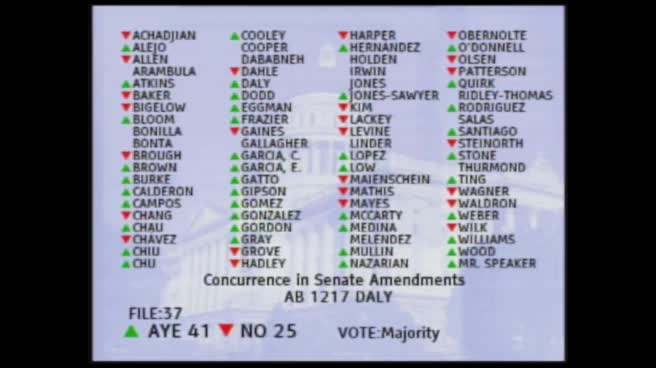 1MIN
Assembly Floor
 2MIN
Senate Floor
 1MIN
Assembly Floor
 13MIN



