AB 1064: California State University: student discretionary expenses survey.
- Session Year: 2017-2018
- House: Assembly
- Latest Version Date: 2017-09-13
Existing law establishes the California State University, under the administration of the Board of Trustees of the California State University, as one of the 3 segments of public postsecondary education in California.
This bill would, on or before January 1, 2021, and on or before each January 1 every 3 years thereafter, require the California State University to conduct a survey of a representative sample of the student population at each campus to determine the average students annual discretionary expenses, which shall not include tuition and fees, to attend the campus, including the average annual cost for each category of discretionary expense and average annual total cost of attendance. The bill would require each campus to post its category averages and its average annual total cost of attendance on its Internet Web site within the 6 months immediately following completion of each campuswide survey.
Existing law establishes the California State University, under the administration of the Board of Trustees of the California State University, as one of the 3 segments of public postsecondary education in California.
This bill would, on or before January 1, 2021, and on or before each January 1 every 3 years thereafter, require the California State University to conduct a survey of a representative sample of the student population at each campus to determine the average students annual discretionary expenses, which shall not include tuition and fees, to attend the campus. campus, including the average annual cost for each category of discretionary expense and average annual total cost of attendance. The bill would require the each campus to post its average category averages and its average annual total cost of attendance on its Internet Web site within the 6 months immediately following completion of each campuswide survey.
Existing law establishes the California State University, under the administration of the Board of Trustees of the California State University, as one of the 3 segments of public postsecondary education in California.
This bill would, on or before January 1, 2021, and on or before each January 1 every 3 years thereafter, require the California State University to conduct a survey of a representative sample of the student population at each campus to determine the average students annual discretionary expenses, which shall not include tuition and fees, to attend the campus. The bill would require the campus to post its average on its Internet Web site within the 6 months immediately following completion of each campuswide survey.
Existing law, the Donahoe Higher Education Act, sets forth the missions and functions of the 4 segments comprising the states postsecondary education system. These segments are the University of California, administered by the Regents of the University of California, the California State University, administered by the Trustees of the California State University, the California Community Colleges, administered by the Board of Governors of the California Community Colleges, and independent institutions of higher education. Provisions of the act apply to the University of California only to the extent that the regents act, by resolution, to make the provisions applicable.This bill would make nonsubstantive changes to the provision naming the act.Existing law, the Donahoe Higher Education Act, sets forth the missions and functions of the 4 segments comprising the states postsecondary education system. These segments are the University of California, administered by the Regents of the University of California, the California State University, administered by the Trustees of the California State University, the California Community Colleges, administered by the Board of Governors of the California Community Colleges, and independent institutions of higher education. Provisions of the act apply to the University of California only to the extent that the regents act, by resolution, to make the provisions applicable.
This bill would make nonsubstantive changes to the provision naming the act.
(a)(1)On or before January 1, 2021, and on or before each January 1 every three years thereafter, the California State University shall conduct a survey of a representative sample of the student population at each campus to determine the average students annual discretionary expenses, which shall not include tuition and fees, to attend the campus. Discretionary expenses include, but are not necessarily limited to, all of the following:
(A)Housing.
(B)Food.
(C)Textbooks.
(D)Supplies.
(E)Course materials.
(F)Educationally related technology.
(G)Transportation expenses, including, but not limited to, travel expenses while at school and to and from a students permanent address.
(H)Medical expenses.
(I)Child care expenses.
(J)Recreational expenses.
(2)The California State University shall determine the average annual cost for each category of discretionary expense.
(b)The California State University shall exclude from the category averages determined pursuant to subdivision (a) lack of, or a reduction in, expenses that would skew the average for at least both of the following scenarios:
(1)Support or aid provided by close family or friends, including, but not limited to, free housing.
(2)Poverty or hardship, including, but not limited to, homelessness.
(c)Each campus shall use its category averages, determined pursuant to subdivisions (a) and (b), to determine the average annual total cost of attendance.
(d)Each campus shall post its updated category averages determined pursuant to subdivisions (a) and (b) and its updated average annual total cost of attendance determined pursuant to subdivision (c) on its Internet Web site within the six months immediately following completion of each campuswide survey pursuant to subdivision (a).
(a)(1)On or before January 1, 2021, and on or before each January 1 every three years thereafter, the California State University shall conduct a survey of a representative sample of the student population at each campus to determine the average students annual discretionary expenses, which shall not include tuition and fees, to attend the campus. Discretionary expenses include, but are not necessarily limited to, all of the following:
(1)(A)Housing.
(2)(B)Food.
(3)(C)Textbooks.
(4)(D)Supplies.
(5)(E)Course materials.
(6)(F)Educationally related technology.
(7)(G)Transportation expenses, including, but not limited to, travel expenses while at school and to and from a students permanent address.
(8)(H)Medical expenses.
(9)(I)Child care expenses.
(10)(J)Recreational expenses.
(2)The California State University shall determine the average annual cost for each category of discretionary expense.
(b)The California State University shall exclude from the average category averages determined pursuant to subdivision (a) lack of, or a reduction in, expenses that would skew the average for at least both of the following scenarios:
(1)Support or aid provided by close family or friends, including, but not limited to, free housing.
(2)Poverty or hardship, including, but not limited to, homelessness.
(c)Each campus shall use its average, category averages, determined pursuant to subdivisions (a) and (b), to determine the average annual total cost of attendance.
(d)Each campus shall post its updated average category averages determined pursuant to subdivisions (a) and (b) and its updated average annual total cost of attendance determined pursuant to subdivision (c) on its Internet Web site within the six months immediately following completion of each campuswide survey pursuant to subdivision (a).
(a)On or before January 1, 2021, and on or before each January 1 every three years thereafter, the California State University shall conduct a survey of a representative sample of the student population at each campus to determine the average students annual discretionary expenses, which shall not include tuition and fees, to attend the campus. Discretionary expenses include, but are not necessarily limited to, all of the following:
(1)Housing.
(2)Food.
(3)Textbooks.
(4)Supplies.
(5)Course materials.
(6)Educationally related technology.
(7)Transportation expenses, including, but not limited to, travel expenses while at school and to and from a students permanent address.
(8)Medical expenses.
(9)Child care expenses.
(10)Recreational expenses.
(b)The California State University shall exclude from the average determined pursuant to subdivision (a) lack of, or a reduction in, expenses that would skew the average for at least both of the following scenarios:
(1)Support or aid provided by close family or friends, including, but not limited to, free housing.
(2)Poverty or hardship, including, but not limited to, homelessness.
(c)Each campus shall use its average, determined pursuant to subdivisions (a) and (b), to determine the average annual total cost of attendance.
(d)Each campus shall post its updated average determined pursuant to subdivisions (a) and (b) on its Internet Web site within the six months immediately following completion of each campuswide survey pursuant to subdivision (a).
SECTION 1.Section 66000 of the Education Code is amended to read:66000.This part shall be known, and may be cited, as the Donahoe Higher Education Act.This part shall be known known, and may be cited cited, as the Donahoe Higher Education Act.
|
Date
|
Status
|
|---|---|
| Jan 12, 2018 | Stricken from file. |
| Jan 3, 2018 | Consideration of Governor's veto pending. |
| Oct 12, 2017 | Vetoed by Governor. |
| Sep 19, 2017 | Enrolled and presented to the Governor at 3 p.m. |
| Sep 11, 2017 | Senate amendments concurred in. To Engrossing and Enrolling. |
| Sep 6, 2017 | In Assembly. Concurrence in Senate amendments pending. May be considered on or after September 8 pursuant to Assembly Rule 77. |
| Sep 6, 2017 | Read third time. Passed. Ordered to the Assembly. |
| Sep 5, 2017 | Read second time. Ordered to third reading. |
| Sep 1, 2017 | From committee: Do pass. (Ayes 7. Noes 0.) (September 1). |
| Aug 21, 2017 | In committee: Referred to APPR. suspense file. |
| Jul 12, 2017 | Read second time and amended. Re-referred to Com. on APPR. |
| Jul 11, 2017 | From committee: Amend, and do pass as amended and re-refer to Com. on APPR. (Ayes 6. Noes 0.) (July 5). |
| Jun 14, 2017 | Referred to Com. on ED. |
| Jun 1, 2017 | In Senate. Read first time. To Com. on RLS. for assignment. |
| May 31, 2017 | Read third time. Passed. Ordered to the Senate. (Ayes 73. Noes 1. Page 1915.) |
| May 30, 2017 | Read second time. Ordered to third reading. |
| May 26, 2017 | From committee: Do pass. (Ayes 12. Noes 0.) (May 26). |
| May 3, 2017 | In committee: Set, first hearing. Referred to APPR. suspense file. |
| Apr 26, 2017 | From committee: Do pass and re-refer to Com. on APPR. (Ayes 11. Noes 1.) (April 25). Re-referred to Com. on APPR. |
| Mar 22, 2017 | Re-referred to Com. on HIGHER ED. |
| Mar 21, 2017 | From committee chair, with author's amendments: Amend, and re-refer to Com. on HIGHER ED. Read second time and amended. |
| Mar 20, 2017 | Referred to Com. on HIGHER ED. |
| Feb 17, 2017 | From printer. May be heard in committee March 19. |
| Feb 16, 2017 | Read first time. To print. |
|
Date
|
Description
|
Location
|
Votes
|
|
|---|---|---|---|---|
| Sep 11, 2017 | AB 1064 CALDERON Concurrence in Senate Amendments | Assembly Floor |
Passed |
|
| Sep 6, 2017 | Assembly 3rd Reading AB1064 Calderon By Wiener | Senate Floor |
Passed |
|
| Sep 1, 2017 | Do pass | Senate Standing Committee on Appropriations |
Passed |
|
| Aug 21, 2017 | Placed on suspense file | Senate Standing Committee on Appropriations |
Passed |
|
| Jul 5, 2017 | Do pass as amended, but first amend, and re-refer to the Committee on [Appropriations] | Senate Standing Committee on Education |
Passed |
|
| May 31, 2017 | AB 1064 CALDERON Assembly Third Reading | Assembly Floor |
Passed |
|
| May 26, 2017 | Do pass. | Assembly Standing Committee on Appropriations |
Passed |
|
| Apr 25, 2017 | Do pass and be re-referred to the Committee on [Appropriations] | Assembly Standing Committee on Higher Education |
Passed |
This list shows positions taken on this bill by organizations on the date displayed, which is linked to the original source.
Positions by individuals are not included.
GOVERNOR'S VETO
GV Bill Id:AB 1064
Author:(Calderon)
As Enrolled Ver:September 13, 2017
2/3 vote
ASSEMBLY: | 73-1 | (May 31, 2017) | SENATE: | 40-0 | (September 6, 2017) |
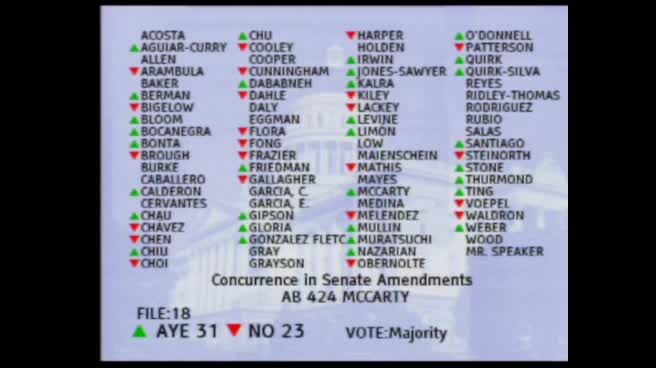
ASSEMBLY: | 79-0 | (September 11, 2017) |
Original Committee Reference: HIGHER ED.
SUMMARY: Requires the California State University (CSU) to conduct a survey every three years at each campus to determine the average student's annual discretionary expenses, excluding tuition and fees, to attend the campus.
The Senate amendments requires CSU determine the average annual cost for each category of discretionary expense outlined in the legislation, and makes technical and clarifying amendments pursuant to that reporting modification.
FISCAL EFFECT: According to the Senate Appropriations Committee, the CSU estimates a range of $300,000 to $500,000 General Fund every third year for all campuses to complete the student expense surveys.
COMMENTS: Purpose. According to the author, the "…cost of attendance (COA) is not [accurately reported] at CSU campuses. In California, until 2007, the California Student Aid Commission (CSAC) conducted a comprehensive survey and subsequent report on student discretionary spending at California public and private postsecondary institutions. This was used as a measure to assess COA at public institutions in California. In 2007, the study was eliminated when CSAC's budget was decreased by 40%. Currently, the University of California conducts a comprehensive system-wide survey every three years to establish COA at each campus [- the most recent survey was released in February, and is based on responses from over 14,000 students]. The CSU uses the data from the 2007 SEARS study, conducted over ten years ago, and factors a Cost of Living Adjustment (COLA) to establish COA at the [its] 23 campuses."
Student Expenses and Resources Survey (SEARS). SEARS was a triennial survey conducted by CSAC to assess the financial circumstances, attendance costs, and expenses of California's college students. This survey was carried out in cooperation with the California Community Colleges, the University of California (UC), the CSU, the Association of Independent California Colleges and Universities, and the California Association of Private Postsecondary Schools. CSAC administered this survey to students attending postsecondary educational institutions across the state. The survey contained questions that are considered "core" subjects, such as dependency status, expenses, resources, and housing arrangements. Due to budget constraints, the SEARS survey has not been conducted since 2006-07.
The author argues that COAs created using decade-old data and a COLA are not accurate. The author cites that, San Francisco State University and CSU, Bakersfield's have similar costs in their COA for food and housing. However, in 2015, the median monthly housing costs for renters in San Francisco was $1558 compared to $983 in Bakersfield. This same pattern of similar cost for food and housing being rendered for campuses with different housing costs is also found when comparing CSU Fresno with CSU Long Beach and CSU Chico with CSU Northridge.
Arguments in support. The organization uAspire, a non-profit dedicated to removing financial barriers to postsecondary education, writes, "…the actual cost of attending college in California – parallel to the cost of living – varies tremendously by campus. Students and families need an accurate understanding of housing, food, transportation, and other costs specific to their campus to make the right financial choices for their situation. We encourage the use of a student-survey, alongside other factors, to provide a more transparent picture of the cost of attending CSUs."
No opposition on file.
Related legislation. AB 990 (Rodriguez), Chapter 170, Statutes of 2017, requires CSU campuses, and requests UC campuses, to annually post on their respective Web sites the cost of a one-bedroom apartment in the area surrounding the campus.
While I understand the desire to provide students and families with detailed and accurate cost information on all aspects of college attendance, the bill requires too many data points to be collected, analyzed and reported by each campus at not trivial expense.
If the Board of Trustees is dissatisfied with the way cost estimates are currently reported to the U.S. [United States] Department of Education's College Navigator, then the Board should decide what information is most valuable and how much funding should be allocated to its collection and dissemination.
Analysis Prepared by: Kevin Powers / HIGHER ED. / (916) 319-3960 FN: 0002470
CONCURRENCE IN SENATE AMENDMENTS
CSA1 Bill Id:AB 1064
Author:(Calderon)
As Amended Ver:July 12, 2017
Majority vote
ASSEMBLY: | 73-1 | (May 31, 2017) | SENATE: | 40-0 | (September 6, 2017) |
Original Committee Reference: HIGHER ED.
SUMMARY: Requires the California State University (CSU) to conduct a survey every three years at each campus to determine the average student's annual discretionary expenses, excluding tuition and fees, to attend the campus.
The Senate amendments requires CSU determine the average annual cost for each category of discretionary expense outlined in the legislation, and makes technical and clarifying amendments pursuant to that reporting modification.
FISCAL EFFECT: According to the Senate Appropriations Committee, the CSU estimates a range of $300,000 to $500,000 General Fund every third year for all campuses to complete the student expense surveys.
COMMENTS: Purpose. According to the author, the "…cost of attendance (COA) is not [accurately reported] at CSU campuses. In California, until 2007, the California Student Aid Commission (CSAC) conducted a comprehensive survey and subsequent report on student discretionary spending at California public and private postsecondary institutions. This was used as a measure to assess COA at public institutions in California. In 2007, the study was eliminated when CSAC's budget was decreased by 40%. Currently, the University of California conducts a comprehensive system-wide survey every three years to establish COA at each campus [- the most recent survey was released in February, and is based on responses from over 14,000 students]. The CSU uses the data from the 2007 SEARS study, conducted over ten years ago, and factors a Cost of Living Adjustment (COLA) to establish COA at the [its] 23 campuses."
Student Expenses and Resources Survey (SEARS). SEARS was a triennial survey conducted by CSAC to assess the financial circumstances, attendance costs, and expenses of California's college students. This survey was carried out in cooperation with the California Community Colleges, the UC, the CSU, the Association of Independent California Colleges and Universities, and the California Association of Private Postsecondary Schools. CSAC administered this survey to students attending postsecondary educational institutions across the state. The survey contained questions that are considered "core" subjects, such as dependency status, expenses, resources, and housing arrangements. Due to budget constraints, the SEARS survey has not been conducted since 2006-07.
The author argues that COAs created using decade-old data and a COLA are not accurate. The author cites that, San Francisco State University and CSU, Bakersfield's have similar costs in their COA for food and housing. However, in 2015, the median monthly housing costs for renters in San Francisco was $1558 compared to $983 in Bakersfield. This same pattern of similar cost for food and housing being rendered for campuses with different housing costs is also found when comparing CSU Fresno with CSU Long Beach and CSU Chico with CSU Northridge.
Arguments in support. The organization uAspire, a non-profit dedicated to removing financial barriers to postsecondary education, writes, "…the actual cost of attending college in California – parallel to the cost of living – varies tremendously by campus. Students and families need an accurate understanding of housing, food, transportation, and other costs specific to their campus to make the right financial choices for their situation. We encourage the use of a student-survey, alongside other factors, to provide a more transparent picture of the cost of attending CSUs."
No opposition on file.
Related legislation. AB 990 (Rodriguez) of the current legislative session, pending on the Assembly Floor, requires CSU campuses, and requests UC campuses, to annually post on their respective Web sites the cost of a one-bedroom apartment in the area surrounding the campus.
Analysis Prepared by: Kevin J. Powers / HIGHER ED. / (916) 319-3960 FN: 0001927
Office of Senate Floor Analyses (916) 651-1520 Fax: (916) 327-4478 | AB |
THIRD READING
Bill No: AB 1064
:
SENATE EDUCATION COMMITTEE: 6-0, 7/5/17
AYES: Allen, Wilk, Galgiani, Leyva, Pan, Vidak
NO VOTE RECORDED: Mendoza
SENATE APPROPRIATIONS COMMITTEE: 7-0, 9/1/17
AYES: Lara, Bates, Beall, Bradford, Hill, Nielsen, Wiener
ASSEMBLY FLOOR: 73-1, 5/31/17 - See last page for vote
DIGEST:
This bill requires the California State University (CSU) to conduct a survey every three years at each campus to determine the average student’s annual discretionary expenses, excluding tuition and fees, to attend the campus.
Existing law:
- Requires, pursuant to federal law, the United States Secretary of Education to make publicly available on the College Navigator Web site specified information about each institution of higher education that participates in federal financial aid programs, among many other things, the cost of attendance for first-time, full-time undergraduate students who live on campus and for those who live off-campus. Existing regulations also require, for public institutions of higher education, information on those costs for residents and non-residents. (United States Code, Title 20, § 1015a)
- Defines, pursuant to federal law, “cost of attendance” as:
- Tuition and fees normally assessed, including costs for required equipment, materials or supplies.
- An allowance for books, supplies, transportation, and miscellaneous personal expenses including a computer.
- An allowance, as determined by the institution, for room and board costs, as specified.
- For students enrolled less than half-time, tuition and fees and an allowance for specified costs.
- Allowances for students who are engaged in work study, are incarcerated, have dependents or are disabled. (20 USC § 1087ll)
- Tuition and fees normally assessed, including costs for required equipment, materials or supplies.
- Requires, pursuant to state law, the University of California (UC) to report biennially to the Legislature and the Department of Finance, by October 1 of each even-numbered year, on the total costs of education at the UC. (Education Code § 92670)
- Requires the report to identify the costs of undergraduate education, graduate academic education, graduate professional education, and research activities. Existing law requires all four of these categories to be reported in total and disaggregated separately by specified disciplines. (EC § 92670)
- Requires the costs to be reported on both a systemwide and campus-by-campus basis for any report submitted after January 1, 2017. Existing law requires a report prepared after January 1, 2017, to include information on costs, disaggregated by campus, based on the methodology developed by the National Association of College and University Business Officers in its February 2002 report, and other methodologies determined by the UC. (EC § 92670)
- Requires the Regents of the UC and the Trustees of the CSU to annually provide the Legislature, by February 1 of each year, with detailed information regarding expenditures of revenues derived from student fees and uses of institutional financial aid, and provide information regarding the systemwide average total cost of attendance per student. (EC § 66028.6)
- Defines “cost of attendance” as the mandatory systemwide fees, books and supplies, room and board, transportation, and miscellaneous personal expenses for an undergraduate California resident student, as used in determining financial aid eligibility. (EC § 66028.1)
This bill:
- Requires, by January 1, 2021, and by January 1 every three years thereafter, the CSU to conduct a survey of a representative sample of the student population at each campus to determine the average student’s annual discretionary expenses, which shall not include tuition and fees, to attend the campus.
- Requires discretionary expenses include, but are not limited to, all of the following:
- Housing.
- Food.
- Textbooks.
- Supplies.
- Course materials.
- Educationally related technology.
- Transportation expenses, including but not limited to, travel expenses while at school and to and from a student’s permanent address.
- Medical expenses.
- Child care expenses.
- Recreational expenses.
- Requires the CSU to determine the average annual cost for each category of discretionary expenses listed in 2) above.
- Requires the CSU to exclude from the category averages determined pursuant to 1) & 2) above a lack of, or a reduction in, expenses that would skew the average for at least both of the following scenarios:
- Support or aid provided by close family or friends, including but not limited to, free housing.
- Poverty or hardship, including, but not limited to, homelessness.
- Support or aid provided by close family or friends, including but not limited to, free housing.
- Requires each campus to use its average determined pursuant to 1) - 3) above, to determine the average annual total cost of attendance.
- Requires each campus to post its updated category averages and its updated average annual total cost of attendance on its Web site within the six months immediately following completion of each campus-wide survey.
Comments
- Student Expenses and Resources Survey (SEARS). SEARS was a triennial survey conducted by the California Student Aid Commission (CSAC) to assess the financial circumstances, attendance costs, and expenses of California’s college students. This survey was carried out in cooperation with the California Community Colleges, the UC, the CSU, the Association of Independent California Colleges and Universities, and the California Association of Private Postsecondary Schools. CSAC administered this survey to students attending postsecondary educational institutions across the state. The survey contained questions that are considered “core” subjects, such as dependency status, expenses, resources, and housing arrangements. Due to budget constraints, the SEARS survey has not been conducted since 2006-07. The data currently available is based on the 2006-07 survey and is adjusted for inflation. [http://www.csac.ca.gov/pubs/forms/grnt_frm/studentexpensebudget.pdf]
SEARS yielded data that accounted for costs and expenses across all systems of postsecondary education in California but was not system- or campus-specific and therefore did not account for regional differences in costs. - College Navigator. Existing federal law requires the United States Secretary of Education to make publicly available on the College Navigator Web site specified information about each institution of higher education that participates in federal financial aid programs, among many other things, the cost of attendance for first-time, full-time undergraduate students who live on campus and for those who live off-campus. The College Navigator provides campus-specific data, and federal law defines “cost of attendance” to include allowances for housing. However, the author notes that federal statutes do not state how the cost of attendance is to be established. [https://nces.ed.gov/collegenavigator/]
- Current Practices. CSU determines student expenses using data from the 2006-07 SEARS report and adjusts for inflation. The CSU publishes a summary of standard student expense budget, the annual Campus Cost of Attendance. While this data is provided by campus, it is based on data that does not take regional costs into consideration. [http://www.calstate.edu/SAS/ costofattendance/documents/17-18COA.pdf]
The UC distributes a Cost of Attendance Survey every three years to a random sample of UC students to ask about their actual indirect costs. Those survey responses are used to inform campus-specific student budgets. The total cost of attendance, or student expense budget, includes tuition and fees, room and board, books and supplies, transportation, health care, and personal expenses. The most recent survey was released in February 2017, and is based on responses from over 14,000 students. According to the UC, moving forward, this survey will be administered biennially rather than triennially. [http://regents.universityofcalifornia.edu/regmeet/mar17/a1attach.pdf]
This bill essentially requires the CSU to administer a survey to students that mirrors UC’s triennial survey of students’ costs, rather than relying on the SEARS survey results from 2006-07, adjusted for inflation.
FISCAL EFFECT: Appropriation: Fiscal Com.: Local:
According to the Senate Appropriations Committee, the CSU estimates a range of $300,000 to $500,000 General Fund every third year for all campuses to complete the student expense surveys.
uAspire
OPPOSITION: (Verified 8/31/17)
None received
ASSEMBLY FLOOR: 73-1, 5/31/17
AYES: Acosta, Aguiar-Curry, Travis Allen, Arambula, Baker, Berman, Bloom, Bocanegra, Bonta, Brough, Burke, Caballero, Calderon, Cervantes, Chau, Chávez, Chen, Chiu, Chu, Cooley, Cooper, Cunningham, Dababneh, Dahle, Daly, Flora, Frazier, Friedman, Gallagher, Cristina Garcia, Eduardo Garcia, Gipson, Gloria, Gomez, Gonzalez Fletcher, Gray, Grayson, Holden, Irwin, Jones-Sawyer, Kalra, Kiley, Lackey, Levine, Limón, Low, Maienschein, Mathis, Mayes, McCarty, Medina, Mullin, Muratsuchi, Nazarian, Obernolte, O'Donnell, Quirk, Quirk-Silva, Reyes, Ridley-Thomas, Rodriguez, Rubio, Salas, Santiago, Steinorth, Mark Stone, Thurmond, Ting, Voepel, Waldron, Weber, Wood, Rendon
NOES: Harper
NO VOTE RECORDED: Bigelow, Choi, Eggman, Fong, Melendez, Patterson
9/4/17 12:19:22
**** END ****
SENATE COMMITTEE ON APPROPRIATIONS
Senator Ricardo Lara, Chair
2017 - 2018 Regular Session
AB 1064 (Calderon) - California State University: student discretionary expenses survey
Version: July 12, 2017 | Policy Vote: ED. 6 - 0 |
Urgency: No | Mandate: No |
Hearing Date: August 21, 2017 | Consultant: Lenin Del Castillo |
This bill meets the criteria for referral to the Suspense File.
Bill Summary:
This bill requires the California State University (CSU) to conduct a survey every three years at each campus to determine the average student’s annual discretionary expenses, excluding tuition and fees, to attend the campus.
Fiscal Impact:
The CSU estimates a range of $300,000 to $500,000 General Fund every third year for all campuses to complete the student expense surveys.
Background:
Existing law requires the University of California (UC) to report biennially to the Legislature and the Department of Finance, by October 1 of each even-numbered year, on the total costs of education at the UC. The report is required to identify the costs of undergraduate education, graduate academic education, graduate professional education, and research activities. It also requires all four of these categories to be reported in total and disaggregated separately by specified disciplines.
Further, the costs are to be reported on both a systemwide and campus-by-campus basis for any report submitted after January 1, 2017. Existing law requires a report prepared after January 1, 2017, to include information on costs, disaggregated by campus, based on the methodology developed by the National Association of College and University Business Officers in its February 2002 report, and other methodologies determined by the University of California.
Existing law requires the Regents of the UC and the Trustees of the CSU to annually provide the Legislature, by February 1 of each year, with detailed information regarding expenditures of revenues derived from student fees and uses of institutional financial aid, and provide information regarding the systemwide average total cost of attendance per student. The “cost of attendance” is defined as the mandatory systemwide fees, books and supplies, room and board, transportation, and miscellaneous personal expenses for an undergraduate California resident student, as used in determining financial aid eligibility.
Proposed Law:
This bill requires the CSU to conduct a survey every three years at each campus to determine the average student’s annual discretionary expenses, excluding tuition and fees. Specifically, this bill:
This bill requires, by January 1, 2021, and by January 1 every three years thereafter, the CSU to conduct a survey of a representative sample of the student population at each campus to determine the average student’s annual discretionary expenses, which shall not include tuition and fees, to attend the campus.
This bill provides that the discretionary expenses include, but are not limited to, all of the following: housing, food, textbooks, supplies, course materials, educationally related technology, transportation expenses, including but not limited to, travel expenses while at school and to and from a student’s permanent address, medical expenses, child care expenses, and recreational expenses.
The CSU shall determine the average annual cost for each category of discretionary expense. Further, this bill requires the CSU to exclude from the category averages, a lack of or a reduction in, expenses that would skew the average for at least both of the following scenarios: support or aid provided by close family or friends, including but not limited to, free housing; and poverty or hardship, including but not limited to, homelessness.
This bill requires each campus to use its category averages to determine the average annual total cost of attendance and post its updated average on its website within the six months immediately following completion of each campus-wide survey.
Related Legislation:
AB 990 (Rodriguez) requires each campus of the CSU, and requests each campus of UC, to annually post on its website information about the market cost of a one-bedroom apartment in the areas surrounding the campus. AB 990 has been enrolled and sent to the Governor.
-- END --
SENATE COMMITTEE ON EDUCATION
Senator Benjamin Allen, Chair
2017 - 2018 Regular
Bill No: AB 1064 Hearing Date: July 5, 2017
Author: | |||
Version: | March 21, 2017 | ||
Urgency: | No | Fiscal: | Yes |
Consultant: | Lynn Lorber | ||
Subject: California State University: student discretionary expenses survey
SUMMARY
This bill requires the California State University (CSU) to conduct a survey every three years at each campus to determine the average student’s annual discretionary expenses, excluding tuition and fees, to attend the campus.
BACKGROUND
Existing law:
- Requires, pursuant to federal law, the United States Secretary of Education to make publicly available on the College Navigator website specified information about each institution of higher education that participates in federal financial aid programs, among many other things, the cost of attendance for first-time, full-time undergraduate students who live on campus and for those who live off-campus. Existing regulations also require, for public institutions of higher education, information on those costs for residents and non-residents. (United States Code, Title 20, § 1015a)
- Defines, pursuant to federal law, “cost of attendance” as:
- Tuition and fees normally assessed, including costs for required equipment, materials or supplies.
- An allowance for books, supplies, transportation, and miscellaneous personal expenses including a computer.
- An allowance, as determined by the institution, for room and board costs, as specified.
- For students enrolled less than half-time, tuition and fees and an allowance for specified costs.
- Allowances for students who are engaged in work study, are incarcerated, have dependents or are disabled. (20 USC § 1087ll)
- Tuition and fees normally assessed, including costs for required equipment, materials or supplies.
- Requires, pursuant to state law, the University of California (UC) to report biennially to the Legislature and the Department of Finance, by October 1 of each even-numbered year, on the total costs of education at the UC. (Education Code § 92670)
- Requires the report to identify the costs of undergraduate education, graduate academic education, graduate professional education, and research activities. Existing law requires all four of these categories to be reported in total and disaggregated separately by specified disciplines. (EC § 92670)
- Requires the costs to be reported on both a systemwide and campus-by-campus basis for any report submitted after January 1, 2017. Existing law requires a report prepared after January 1, 2017, to include information on costs, disaggregated by campus, based on the methodology developed by the National Association of College and University Business Officers in its February 2002 report, and other methodologies determined by the University of California. (EC § 92670)
- Requires the Regents of the UC and the Trustees of the California State University (CSU) to annually provide the Legislature, by February 1 of each year, with detailed information regarding expenditures of revenues derived from student fees and uses of institutional financial aid, and provide information regarding the systemwide average total cost of attendance per student. (EC § 66028.6)
- Defines “cost of attendance” as the mandatory systemwide fees, books and supplies, room and board, transportation, and miscellaneous personal expenses for an undergraduate California resident student, as used in determining financial aid eligibility. (EC § 66028.1)
ANALYSIS
This bill requires the CSU to conduct a survey every three years at each campus to determine the average student’s annual discretionary expenses, excluding tuition and fees. Specifically, this bill:
- Requires, by January 1, 2021, and by January 1 every three years thereafter, the CSU to conduct a survey of a representative sample of the student population at each campus to determine the average student’s annual discretionary expenses, which shall not include tuition and fees, to attend the campus.
- Requires discretionary expenses include, but are not limited to, all of the following:
- Housing.
- Food.
- Textbooks.
- Supplies.
- Course materials.
- Educationally related technology.
- Transportation expenses, including but not limited to, travel expenses while at school and to and from a student’s permanent address.
- Medical expenses.
- Child care expenses.
- Recreational expenses.
- Housing.
- Requires the California State University (CSU) to exclude from the average determined pursuant to #1-2 a lack of, or a reduction in, expenses that would skew the average for at least both of the following scenarios:
- Support or aid provided by close family or friends, including but not limited to, free housing.
- Poverty or hardship, including but not limited to, homelessness.
- Support or aid provided by close family or friends, including but not limited to, free housing.
- Requires each campus to use its average determined pursuant to #1-3, to determine the average annual total cost of attendance.
- Requires each campus to post its updated average on its website within the six months immediately following completion of each campus-wide survey.
STAFF COMMENTS
- Need for the bill. According to the author, “Cost of attendance (COA) is not accurate at CSU campuses. In California, until 2007, the California Student Aid Commission (CSAC) conducted a comprehensive survey and subsequent report on student discretionary spending at California public and private postsecondary institutions. This was used as a measure to assess COA at public institutions in California. In 2007, the survey was eliminated when CSAC’s budget was decreased. Any difference in COA from the cost of living where students are living during the school year is detrimental to students. For our most needy students, with no outside support, the adoption of an inaccurate COA causes a student to be ill-prepared to finance their living while attending a university, at no fault to students. Additionally, families budgeting may face sticker shock when they are faced with bills higher than initially estimated from their campus. Contrastingly, if a COA is too high a student may over-borrow leading to unnecessary loan payment at the fruition of education.”
- Student Expenses and Resources Survey (SEARS). SEARS was a triennial survey conducted by the CSAC to assess the financial circumstances, attendance costs, and expenses of California’s college students. This survey was carried out in cooperation with the California Community Colleges, the University of California, the CSU, the Association of Independent California Colleges and Universities, and the California Association of Private Postsecondary Schools. The California Student Aid Commission (CSAC) administered this survey to students attending postsecondary educational institutions across the state. The survey contained questions that are considered “core” subjects, such as dependency status, expenses, resources, and housing arrangements. Due to budget constraints, the Student Expenses and Resources Survey (SEARS) survey has not been conducted since 2006-07. The data currently available is based on the 2006-07 survey and is adjusted for inflation. http://www.csac.ca.gov/pubs/forms/grnt_frm/studentexpensebudget.pdf
SEARS yielded data that accounted for costs and expenses across all systems of postsecondary education in California but was not system- or campus-specific and therefore did not account for regional differences in costs. According to CSAC’s 2017-18 Student Budget Expense Budgets, the cost of off-campus housing per month is $1,030. - College Navigator. Existing federal law requires the United States Secretary of Education to make publicly available on the College Navigator website specified information about each institution of higher education that participates in federal financial aid programs, among many other things, the cost of attendance for first-time, full-time undergraduate students who live on campus and for those who live off-campus. The College Navigator provides campus-specific data, and federal law defines “cost of attendance” to include allowances for housing. However, the author notes that federal statutes do not state how the cost of attendance is to be established. https://nces.ed.gov/collegenavigator/
- Current Practices. CSU determines student expenses using data from the 2006-07 SEARS report and adjusts for inflation. The CSU publishes a summary of standard student expense budget, the annual Campus Cost of Attendance. http://www.calstate.edu/SAS/costofattendance/documents/17-18COA.pdf While this data is provided by campus, it is based on data that does not take regional costs into consideration and therefore results in data showing the cost of food and housing while living off campus, for example, as follows:
- $14,502 at Channel Islands, Fullerton, Los Angeles, Northridge, San Francisco, San Jose and Sonoma.
- $13,923 at East Bay.
- $13,770 at San Bernardino.
- $13,500 at Dominguez Hills.
- $13,486 at Long Beach.
- $13,294 at Fresno and Sacramento.
- $13,293 at San Marcos.
- $13,292 at Monterey Bay.
- $13,134 at San Luis Obispo.
- $13,061 at Bakersfield.
- $13,016 at Humboldt.
- $12,761 at San Diego.
- $12,588 at Pomona.
- $11,900 at Stanislaus.
- $11,862 at Chico.
- $14,502 at Channel Islands, Fullerton, Los Angeles, Northridge, San Francisco, San Jose and Sonoma.
The University of California (UC) distributes a Cost of Attendance Survey every three years to a random sample of UC students to ask about their actual indirect costs. Those survey responses are used to inform campus-specific student budgets. The total cost of attendance, or student expense budget, includes tuition and fees, room and board, books and supplies, transportation, health care, and personal expenses. The most recent survey was released in February 2017, and is based on responses from over 14,000 students. According to the UC, moving forward, this survey will be administered biennially rather than triennially. http://regents.universityofcalifornia.edu/regmeet/mar17/a1attach.pdf
This bill essentially requires the California State University (CSU) to administer a survey to students that mirrors UC’s triennial survey of students’ costs, rather than relying on the Student Expenses and Resources Survey (SEARS) survey results from 2006-07, adjusted for inflation.
- Average annual expenses. This bill requires CSU to determine and report the average student’s annual discretionary expenses and the average annual total cost of attendance. Staff recommends an amendment to clarify that the average annual discretionary expenses are to be determined and reported by expense (housing, food, textbooks, etc), in addition to the average annual total cost of attendance.
- Related legislation. AB 990 (Rodriguez) requires each campus of the CSU, and requests each campus of UC, to annually post on its website information about the market cost of a one-bedroom apartment in the areas surrounding the campus. AB 990 is scheduled to be heard by this Committee on July 5.
SB 307 (Nguyen) requests the UC to convene a task force, consisting of three representatives from the UC, CSU and California Community Colleges (CCC), selected by the governing boards of each segment for the purpose of conducting a study to determine the extent, causes, and effects of housing insecurity and homelessness of current and future students. SB 307 is scheduled to be heard by the Assembly Higher Education Committee on July 11.
SUPPORT
UAspire
OPPOSITION
None received
-- END --
ASSEMBLY THIRD READING
ATR Bill Id:AB 1064
Author:(Calderon)
As Amended Ver:March 21, 2017
Majority vote
Committee | Votes | Ayes | Noes |
Higher Education | 11-1 | Medina, Baker, Arambula, Bloom, Irwin, Kiley, Levine, Low, Quirk-Silva, Santiago, Weber | Choi |
Appropriations | 12-0 | Gonzalez Fletcher, Bloom, Bocanegra, Bonta, Calderon, McCarty, Quirk, Friedman, Eduardo Garcia, Gray, Muratsuchi, Reyes |
|
SUMMARY: Requires the California State University (CSU), on or before January 1, 2021, and on or before each January 1 every three years thereafter, to conduct a survey of a representative sample of the student population at each CSU campus to determine the average student's annual discretionary expenses to attend the campus. The bill would require the campus to post its average on its Internet Web site within the six months immediately following completion of each campuswide survey.
EXISTING LAW: Existing law establishes the CSU, under the administration of the Board of Trustees of the CSU, as one of the three segments of public postsecondary education in California. (Education Code Section 66010 et seq.)
FISCAL EFFECT: Approximately $250,000 General Fund to conduct the CSU survey at 23 campuses. These costs would be incurred by CSU every three years as required by this bill.
COMMENTS: Purpose. According to the author, the "…cost of attendance (COA) is not [accurately reported] at CSU campuses. In California, until 2007, the California Student Aid Commission (CSAC) conducted a comprehensive survey and subsequent report on student discretionary spending at California public and private postsecondary institutions. This was used as a measure to assess COA at public institutions in California. In 2007, the study was eliminated when CSAC's budget was decreased by 40%. Currently, the University of California conducts a comprehensive system-wide survey every three years to establish COA at each campus [- the most recent survey was released in February, and is based on responses from over 14,000 students]. The CSU uses the data from the 2007 SEARS study, conducted over ten years ago, and factors a Cost of Living Adjustment (COLA) to establish COA at the [its] 23 campuses."
The author argues that COAs created using decade-old data and a COLA are not accurate. The author cites that, San Francisco State University and CSU, Bakersfield's have similar costs in their COA for food and housing. However, in 2015, the median monthly housing costs for renters in San Francisco was $1558 compared to $983 in Bakersfield. This same pattern of similar cost for food and housing being rendered for campuses with different housing costs is also found when comparing CSU Fresno with CSU Long Beach and CSU Chico with CSU Northridge.
Arguments in support. The organization uAspire, a non-profit dedicated to removing financial barriers to postsecondary education, writes, "…the actual cost of attending college in California – parallel to the cost of living – varies tremendously by campus. Students and families need an accurate understanding of housing, food, transportation, and other costs specific to their campus to make the right financial choices for their situation. We encourage the use of a student-survey, alongside other factors, to provide a more transparent picture of the cost of attending CSUs."
Related legislation. AB 990 (Rodriguez) of the current legislative session, pending on the Assembly Floor, requires CSU campuses, and requests UC campuses, to annually post on their respective Web sites the cost of a one-bedroom apartment in the area surrounding the campus.
Analysis Prepared by: Kevin J. Powers / HIGHER ED. / (916) 319-3960 FN: 0000646
Date of Hearing: May 3, 2017
ASSEMBLY COMMITTEE ON APPROPRIATIONS
Lorena Gonzalez Fletcher, Chair
ABPCA Bill Id:AB 1064
Author:(Calderon) – As Amended Ver:March 21, 2017
Policy Committee: | Higher Education | Vote: | 11 - 1 |
|
| ||
|
|
Urgency: No State Mandated Local Program: No Reimbursable: No
SUMMARY:
This bill requires the California State University (CSU) to conduct a survey of a representative sample of the student population at each CSU campus to determine the average student’s annual discretionary expenses to attend the campus, every three years and post its average on its website. Specifically, this bill:
- Requires the CSU, on or before January 1, 2021, and on or before each January 1 every three years thereafter, to conduct a survey of a representative sample of the student population at each CSU campus to determine the average student’s annual discretionary expenses, which must not include tuition and fees, to attend the CSU campus.
- Stipulates that discretionary expenses include, but are not limited to: housing, food, textbooks, supplies, course materials, educationally related technology, transportation expenses – including (but not limited to) travel expenses while at school and to and from a student’s permanent address, medical expenses, child care expenses, and recreational expenses.
- Requires CSU to exclude from the average determined pursuant to the survey a lack of, or a reduction in, expenses that would skew the average for at least both of the following scenarios:
- Support or aid provided by close family or friends, including, but not limited to, free housing.
- Poverty or hardship, including, but not limited to, homelessness.
- Requires the results of this survey to be posted by each campus on their internet website within the six months immediately following completion of each campuswide survey.
FISCAL EFFECT:
Approximately $250,000 General Fund to conduct the CSU survey at 23 campuses. These costs would be incurred by CSU every three years as required by this bill.
COMMENTS:
- Background and Purpose. Existing law establishes the CSU, under the administration of the Board of Trustees of the CSU, as one of the three segments of public postsecondary education in California. According to the author, the “…cost of attendance (COA) is not [accurately reported] at CSU campuses. In California, until 2007, the California Student Aid Commission (CSAC) conducted a comprehensive survey and subsequent report on student discretionary spending at California public and private postsecondary institutions. This was used as a measure to assess COA at public institutions in California. In 2007, the study was eliminated when CSAC’s budget was decreased by 40%...The CSU uses the data from the 2007 Student Expenses And Resources Survey (SEARS) study, conducted over ten years ago, and factors a Cost of Living Adjustment (COLA) to establish COA at the [its] 23 campuses.” The author argues that COAs are created using decade-old data and the COLA are not accurate. The author cites that, San Francisco State University and CSU, Bakersfield’s have similar costs in their COA for food and housing.
- Related Legislation. AB 990 (Rodriguez) requires CSU campuses, and requests UC campuses, to annually post on their respective websites the cost of a one-bedroom apartment in the area surrounding the campus. The bill will be heard in this Committee today.
Analysis Prepared by: Daisy Gonzales / APPR. / (916) 319-2081
Date of Hearing: April 25, 2017
ASSEMBLY COMMITTEE ON HIGHER EDUCATION
Jose Medina, Chair
ABPCA Bill Id:AB 1064 (
Author:Calderon) – As Amended Ver:March 21, 2017
SUBJECT: California State University: student discretionary expenses survey
SUMMARY: Requires the California State University (CSU), on or before January 1, 2021, and on or before each January 1 every three years thereafter, to conduct a survey of a representative sample of the student population at each CSU campus to determine the average student’s annual discretionary expenses to attend the campus. The bill would require the campus to post its average on its Internet Web site within the six months immediately following completion of each campuswide survey. Specifically, this bill:
- Requires the CSU, on or before January 1, 2021, and on or before each January 1 every three years thereafter, to conduct a survey of a representative sample of the student population at each CSU campus to determine the average student’s annual discretionary expenses, which shall not include tuition and fees, to attend the CSU campus.
- Stipulates that discretionary expenses include, but are not limited to: housing, food, textbooks, supplies, course materials, educationally related technology, transportation expenses – including (but not limited to) travel expenses while at school and to and from a student’s permanent address, medical expenses, child care expenses, and recreational expenses.
- Requires CSU to exclude from the average determined pursuant to the survey a lack of, or a reduction in, expenses that would skew the average for at least both of the following scenarios:
- Support or aid provided by close family or friends, including, but not limited to, free housing.
- Poverty or hardship, including, but not limited to, homelessness.
- Determines that the average annual total cost of attendance for each campus shall be determined pursuant to the above requirements.
- Requires the results of this survey to be posted by each campus on their internet web site within the six months immediately following completion of each campuswide survey.
EXISTING LAW: Existing law establishes the CSU, under the administration of the Board of Trustees of the CSU, as one of the three segments of public postsecondary education in California. (Education Code Section 66010 et seq.)
FISCAL EFFECT: Unknown.
COMMENTS: Purpose. According to the author, the “…cost of attendance (COA) is not [accurately reported] at CSU campuses. In California, until 2007, the California Student Aid Commission (CSAC) conducted a comprehensive survey and subsequent report on student discretionary spending at California public and private postsecondary institutions. This was used as a measure to assess COA at public institutions in California. In 2007, the study was eliminated when CSAC’s budget was decreased by 40%. Currently, the University of California conducts a comprehensive system-wide survey every three years to establish COA at each campus [- the most recent survey was released in February, and is based on responses from over 14,000 students]. The CSU uses the data from the 2007 SEARS study, conducted over ten years ago, and factors a Cost of Living Adjustment (COLA) to establish COA at the [its] 23 campuses.”
The author argues that COAs created using decade-old data and a COLA are not accurate. The author cites that, San Francisco State University and CSU, Bakersfield’s have similar costs in their COA for food and housing. However, in 2015, the median monthly housing costs for renters in San Francisco was $1558 compared to $983 in Bakersfield. This same pattern of similar cost for food and housing being rendered for campuses with different housing costs is also found when comparing CSU Fresno with CSU Long Beach and CSU Chico with CSU Northridge.
Arguments in support. The organization uAspire, a non-profit dedicated to removing financial barriers to postsecondary education, writes, “…the actual cost of attending college in California – parallel to the cost of living – varies tremendously by campus. Students and families need an accurate understanding of housing, food, transportation, and other costs specific to their campus to make the right financial choices for their situation. We encourage the use of a student-survey, alongside other factors, to provide a more transparent picture of the cost of attending CSUs.”
Related legislation. AB 990 (Rodriguez), pending in Assembly Appropriations Committee, requires CSU campuses, and requests UC campuses, to annually post on their respective websites the cost of a one-bedroom apartment in the area surrounding the campus.
REGISTERED SUPPORT / OPPOSITION:
Support
uAspire
Opposition
None on file.
Analysis Prepared by: Kevin J. Powers / HIGHER ED. / (916) 319-3960
Discussed in Hearing
 50SEC
Assembly Floor
 2MIN
Senate Floor
 1H
Senate Standing Committee on Appropriations
 1MIN
Assembly Floor
 1H
Assembly Standing Committee on Appropriations
 19MIN
Assembly Standing Committee on Higher Education
 2MIN
Assembly Standing Committee on Higher Education
Bill Author

Bill Co-Author(s):