AB 1151: Vaquita-friendly fish and fish products.
- Session Year: 2017-2018
- House: Assembly
- Latest Version Date: 2017-05-30
Existing law establishes the Department of Fish and Wildlife and generally requires the Fish and Game Code to be administered and enforced through regulations adopted by the department. Existing law makes it unlawful for any person to possess, sell, offer for sale, trade, or distribute a shark fin, as defined. Existing law generally makes violations of provisions relating to fish and wildlife a crime.
This bill would would, commencing January 1, 2019, make it unlawful to sell, offer for sale, trade, or distribute vaquita-harmful fish and fish products, products that are not vaquita-friendly, as defined. The bill would require the department to adopt regulations on or before January 1, 2019, to enforce this prohibition and would prohibit the department from enforcing the prohibition until July 1, 2019. By creating a new crime, this bill would impose a state-mandated local program.
The California Constitution requires the state to reimburse local agencies and school districts for certain costs mandated by the state. Statutory provisions establish procedures for making that reimbursement.
This bill would provide that no reimbursement is required by this act for a specified reason.
Existing law makes it unlawful for any person to possess, sell, offer for sale, trade, or distribute a shark fin, as defined. Existing law generally makes violations of provisions relating to fish and wildlife a crime.
This bill would make it unlawful to possess, sell, offer for sale, trade, or distribute vaquita-harmful fish and fish products, as defined. By creating a new crime, this bill would impose a state-mandated local program.
The California Constitution requires the state to reimburse local agencies and school districts for certain costs mandated by the state. Statutory provisions establish procedures for making that reimbursement.
This bill would provide that no reimbursement is required by this act for a specified reason.
The Legislature finds and declares all of the following:
(a)There is worldwide concern regarding the plight of the vaquita, the worlds smallest and most endangered cetacean, found only in the northern Gulf of California, Mexico.
(b)As of November 2016, there were only approximately 30 vaquitas remaining, reflecting a population decline of 90 percent between 2011 and 2016.
(c)Mortality in gill nets of various mesh size caused the vaquitas decline and remains the predominant and immediate threat to the vaquitas survival.
(d)The international community has been working to reverse the decline of the vaquita, urging the exclusion of gill nets in vaquita habitat and the transition to alternative, vaquita-friendly fishing gear.
(e)For decades, fish and fish products caught with gill nets in vaquita habitat have been sold and consumed in California, incidentally contributing to the vaquitas decline.
(f)Since 2010, illegal gill net fishing for the endangered totoaba fish, the swim bladder of which is smuggled to Asia where it is coveted as a soup ingredient, has been hastening the vaquitas decline.
(f)(g)California has an interest in the vaquita not going extinct and not suffering after getting caught in gill nets.
(g)(h)California can support encourage efforts to save the vaquita from extinction by enacting strong prohibitions on supporting commerce in fish and fish products caught with gill nets in the vaquita range. from the vaquitas range that do not harm vaquita.
(i)Foundations and the federal government have been helping Mexican fisheries operating in the vaquitas range to develop certification and labeling efforts to signify vaquita-safe fish and fish products.
(h)(j)California wants to contribute to vaquita conservation, recovery, and welfare.
SEC. 2.Section 2023 is added to the Fish and Game Code, to read:2023.(a)For purposes of this section, the following terms have the following meanings:
(1)Fish has the same meaning as defined in Section 45.
(2)Northern Gulf of California means that area of the Gulf of California, Mexico, north of 30 N.(3)Vaquita-harmful(2)Vaquita-friendly fish and fish products means any fish or fish product that are not caught with any kind of gill net in the vaquita range.
(4)(3)Vaquita range means anywhere vaquita are found to reside in the wild, including that area of the Gulf of California, Mexico, north of 30 N.
(b)Except as otherwise provided in subdivision (c), it Commencing January 1, 2019, it shall be unlawful for any person to sell, offer for sale, trade, or distribute vaquita-harmful fish and fish products. products that are not vaquita-friendly. On or before January 1, 2019, the department shall adopt regulations to enforce this section. The department shall not enforce this section until July 1, 2019.
(c)Before January 1, 2019, any restaurant may sell, offer for sale, trade, or distribute vaquita-harmful fish and fish products possessed by that restaurant, as of January 1, 2018, that is prepared for consumption.SEC. 3.No reimbursement is required by this act pursuant to Section 6 of Article XIIIB of the California Constitution because the only costs that may be incurred by a local agency or school district will be incurred because this act creates a new crime or infraction, eliminates a crime or infraction, or changes the penalty for a crime or infraction, within the meaning of Section 17556 of the Government Code, or changes the definition of a crime within the meaning of Section 6 of Article XIIIB of the California Constitution.
The Legislature finds and declares all of the following:
(a)There is worldwide concern regarding the plight of the vaquita, the worlds smallest and most endangered cetacean, found only in the northern Gulf of California, Mexico.
(b)As of November 2016, there were only approximately 30 vaquitas remaining, reflecting a population decline of 90 percent between 2011 and 2016.
(c)Mortality in gill nets of various mesh size caused the vaquitas decline and remains the predominant and immediate threat to the vaquitas survival.
(d)The international community has been working to reverse the decline of the vaquita, urging the exclusion of gill nets in vaquita habitat and the transition to alternative, vaquita-friendly fishing gear.
(e)For decades, fish and fish products caught with gill nets in vaquita habitat have been sold and consumed in California, incidentally contributing to the vaquitas decline.
(f)California has an interest in the vaquita not going extinct and not suffering after getting caught in gill nets.
(f)(g)California can support efforts to save the vaquita from extinction by enacting strong prohibitions on commerce in fish and fish products caught with gill nets in the northern Gulf of California. vaquita range.
(h)California wants to contribute to vaquita conservation, recovery, and welfare.
SEC. 2.Section 2023 is added to the Fish and Game Code, to read:2023.(a)For purposes of this section, the following terms have the following meanings:
(1)Fish has the same meaning as defined in Section 45.
(1)(2)Northern Gulf of California means that area of the Gulf of California, Mexico, north of 30N. 30 N.
(2)(3)Vaquita-harmful fish and fish products means raw, dried, or otherwise processed fish or fish products from the northern Gulf of California any fish or fish product caught with any kind of gill net. net in the vaquita range.
(4)Vaquita range means anywhere vaquita are found to reside in the wild, including that area of the Gulf of California, Mexico, north of 30 N.
(b)Except as otherwise provided in subdivision (c), it shall be unlawful for any person to possess, sell, offer for sale, trade, or distribute vaquita-harmful fish and fish products.
(c)Before January 1, 2018, 2019, any restaurant may possess, sell, offer for sale, trade, or distribute vaquita-harmful fish and fish products possessed by that restaurant, as of January 1, 2017, 2018, that is prepared for consumption.
SEC. 3.No reimbursement is required by this act pursuant to Section 6 of Article XIIIB of the California Constitution because the only costs that may be incurred by a local agency or school district will be incurred because this act creates a new crime or infraction, eliminates a crime or infraction, or changes the penalty for a crime or infraction, within the meaning of Section 17556 of the Government Code, or changes the definition of a crime within the meaning of Section 6 of Article XIIIB of the California Constitution.
REVISIONS: HeadingLine 2.The Legislature finds and declares all of the following:
(a)There is worldwide concern regarding the plight of the vaquita, the worlds smallest and most endangered cetacean, found only in the northern Gulf of California, Mexico.
(b)As of November 2016, there were only approximately 30 vaquitas remaining, reflecting a population decline of 90 percent between 2011 and 2016.
(c)Mortality in gill nets of various mesh size caused the vaquitas decline and remains the predominant and immediate threat to the vaquitas survival.
(d)The international community has been working to reverse the decline of the vaquita, urging the exclusion of gill nets in vaquita habitat and the transition to alternative, vaquita-friendly fishing gear.
(e)For decades, fish and fish products caught with gill nets in vaquita habitat have been sold and consumed in California, incidentally contributing to the vaquitas decline.
(f)California can support efforts to save the vaquita from extinction by enacting strong prohibitions on commerce in fish and fish products caught with gill nets in the northern Gulf of California.
SEC. 2.Section 2023 is added to the Fish and Game Code, to read:2023.(a)For purposes of this section, the following terms have the following meanings:
(1)Northern Gulf of California means that area of the Gulf of California, Mexico, north of 30N.
(2)Vaquita-harmful fish and fish products means raw, dried, or otherwise processed fish or fish products from the northern Gulf of California caught with any kind of gill net.
(b)Except as otherwise provided in subdivision (c), it shall be unlawful for any person to possess, sell, offer for sale, trade, or distribute vaquita-harmful fish and fish products.
(c)Before January 1, 2018, any restaurant may possess, sell, offer for sale, trade, or distribute vaquita-harmful fish and fish products possessed by that restaurant, as of January 1, 2017, that is prepared for consumption.
SEC. 3.No reimbursement is required by this act pursuant to Section 6 of Article XIIIB of the California Constitution because the only costs that may be incurred by a local agency or school district will be incurred because this act creates a new crime or infraction, eliminates a crime or infraction, or changes the penalty for a crime or infraction, within the meaning of Section 17556 of the Government Code, or changes the definition of a crime within the meaning of Section 6 of Article XIIIB of the California Constitution.
|
Date
|
Status
|
|---|---|
| Sep 12, 2017 | Ordered to inactive file at the request of Senator Allen. |
| Sep 5, 2017 | Read second time. Ordered to third reading. |
| Sep 1, 2017 | From committee: Do pass. (Ayes 5. Noes 2.) (September 1). |
| Jul 10, 2017 | In committee: Referred to APPR. suspense file. |
| Jun 27, 2017 | From committee: Do pass and re-refer to Com. on APPR. (Ayes 6. Noes 2.) (June 27). Re-referred to Com. on APPR. |
| Jun 14, 2017 | Referred to Com. on N.R. & W. |
| Jun 1, 2017 | In Senate. Read first time. To Com. on RLS. for assignment. |
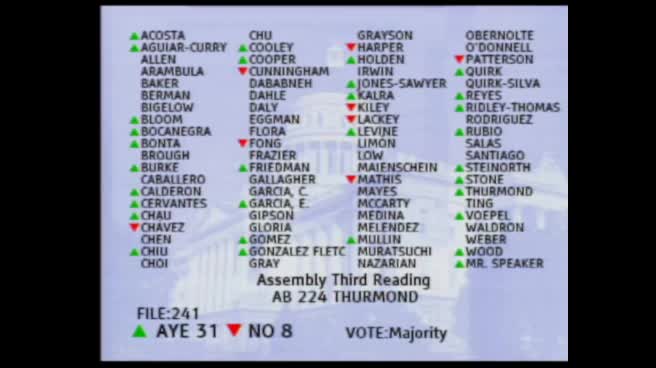
| May 31, 2017 | Read third time. Passed. Ordered to the Senate. (Ayes 56. Noes 18. Page 1966.) |
| May 30, 2017 | Read second time and amended. Ordered returned to second reading. |
| May 26, 2017 | From committee: Amend, and do pass as amended. (Ayes 12. Noes 5.) (May 26). |
| Apr 26, 2017 | In committee: Set, first hearing. Referred to APPR. suspense file. |
| Apr 4, 2017 | Coauthors revised. |
| Mar 29, 2017 | Re-referred to Com. on W.,P., & W. |
| Mar 28, 2017 | From committee chair, with author's amendments: Amend, and re-refer to Com. on W.,P., & W. Read second time and amended. |
| Mar 6, 2017 | Referred to Com. on W.,P., & W. |
| Feb 19, 2017 | From printer. May be heard in committee March 21. |
| Feb 17, 2017 | Read first time. To print. |
|
Date
|
Description
|
Location
|
Votes
|
|
|---|---|---|---|---|
| Sep 1, 2017 | Do pass | Senate Standing Committee on Appropriations |
Passed |
|
| Jul 10, 2017 | Placed on suspense file | Senate Standing Committee on Appropriations |
Passed |
|
| Jun 27, 2017 | Do pass, but first be re-referred to the Committee on [Appropriations] | Senate Standing Committee on Natural Resources and Water |
Passed |
|
| May 31, 2017 | AB 1151 GLORIA Assembly Third Reading | Assembly Floor |
Passed |
|
| May 26, 2017 | Do pass as amended. | Assembly Standing Committee on Appropriations |
Passed |
|
| Apr 4, 2017 | Do pass and be re-referred to the Committee on [Appropriations] | Assembly Standing Committee on Water, Parks, and Wildlife |
Passed |
This list shows positions taken on this bill by organizations on the date displayed, which is linked to the original source.
Positions by individuals are not included.
Office of Senate Floor Analyses (916) 651-1520 Fax: (916) 327-4478 | AB |
THIRD READING
Bill No: AB 1151
:
SENATE NATURAL RES. & WATER COMMITTEE: 6-2, 6/27/17
AYES: Hertzberg, Allen, Atkins, Hueso, Jackson, Stern
NOES: Stone, Vidak
NO VOTE RECORDED: Monning
SENATE APPROPRIATIONS COMMITTEE: 5-2, 9/1/17
AYES: Lara, Beall, Bradford, Hill, Wiener
NOES: Bates, Nielsen
ASSEMBLY FLOOR: 56-18, 5/31/17 - See last page for vote
Natural Resources Defense Council
DIGEST:
This bill makes it unlawful, beginning on January 1, 2019, for any person to sell, offer to sell, trade, or distribute fish and fish products that are not vaquita-friendly.
Existing law:
- Makes it unlawful to take any marine mammal, as defined, except as provided under certain federal laws (see, for example, Fish and Game Code §4500, and the federal Marine Mammal Protection Act and Endangered Species Act).
- Requires fisheries to reduce incidental mortality and serious injury to marine mammals, as specified.
- Makes it unlawful for any person to possess, sell, offer for sale, trade, or distribute shark fin. (see Fish and Game Code §2021).
This bill:
- Requires the Department of Fish and Wildlife (CDFW) to adopt regulations on or before January 1, 2019 to enforce the sale of vaquita-friendly fish and fish products. However, the Department would not be required to enforce the ban until July 1, 2019.
- Makes relevant legislative findings regarding the plight of the vaquita in the northern Gulf of California, Mexico. California’s interest in the vaquita not going extinct is declared.
- Defines “vaquita-friendly” as any fish or fish product that are not caught with any form of gill net in the vaquita range.
- Defines “vaquita range” as anywhere vaquita are found to reside in the wild, including that area of the Gulf of California, Mexico, north of 30° N.
Background
- The vaquita is a rare species of porpoise endemic to the northern Gulf of California, Mexico. The vaquita are critically threatened and are widely considered to be the most endangered marine mammal in the world. In 1996, the International Union for Conservation of Nature (IUCN) listed the vaquita as critically endangered.
- Vaquitas are not fished for but are caught and killed in gillnet fishing gear. The decline of the vaquita is attributable to incidental entanglement and drowning in gillnets.
- Gillnets are a common fishing method where fish typically become held in mesh netting by having the net slip over their head and catching behind their gills. They are so effective that their use is closely regulated in many fisheries. To save the vaquita, scientists agree that the only solution is to totally eliminate fishing with gillnets within vaquita habitat.
- Totoabas are endemic to the Gulf of California and, like the vaquita, are critically threatened and have been internationally listed as endangered since 1996 by the IUCN. Today, the totoaba are illegally fished solely for their swim bladder. The totoaba swim bladder is the reason why both the totoaba and vaquita are critically endangered. Fish swim bladders are valued in Asia, where they are known as “maw”, to make soup that is believed by some people to boost fertility, circulation, skin vitality, and longevity. There are reports of a single maw selling for $50,000 or more. Typical consumer prices in Hong Kong vary from about $2,600 for a quarter-pound dry bladder to $25,000 for a 1 pound dry bladder.
- The Mexican ban on gillnets excluded one fishery, the curvina fishery, from February-April, because of its size and the method of use of gillnet it was believed that the fishery would not represent any threat to vaquitas. In November 2016, the IUCN body responsible for listing the vaquitas as endangered made the recommendation that this exemption be removed. Specifically it stated that the curvina fishery is being used to disguise illegal totoaba fishing.
- In recent years, Mexico has responded to the declining population of vaquita by taking actions to reduce the number of gillnets in the northern Gulf of California. In March of 2015, President Pena Nieto announced a two-year emergency gillnet ban throughout vaquita habitat. Associated with the ban are land, sea, and air enforcement actions. On land, six drug sniffing dogs have been retrained to recognize the totoaba swim bladder, and now sit at three checkpoints leading out of the protected area. In the sea, the Mexican navy has six boats and a larger vessel patrolling the protected area both day and night. In the air, the navy has one airplane and one helicopter patrolling twice a day. In addition to the enforcement actions, the Mexican government is also offering $2,000-3,000 dollars per month to fishers as compensation for their losses resulting from the ban.
Related/Prior Legislation
AB 376 (Fong, Chapter 524, Statutes of 2011) made it unlawful for any person to possess, sell or trade a shark fin.
FISCAL EFFECT: Appropriation: Fiscal Com.: Local:
According to the Senate Appropriations Committee, unknown, potentially significant, cost to the CDFW (Fish and Game Preservation Fund) to enforce the ban.
Approximately $30,000 to develop regulations.
Between $300 and $150,000 per incident.
Defenders of Wildlife (co-source)
Natural Resources Defense Council (co-source)
Audubon California
Animal Welfare Institute
Asian Pacific Environmental Network
AZUL
California Coastal Commission
California Coastal Protection Network
California League of Conservation Voters
Center for Biological Diversity
Clean Water Action
Environment California
Heal the Bay
Humane Society of the United States
San Diego Human Society
San Diego Zoo Global
Seventh Generation Advisors
Sierra Club California
The Nature Conservancy
Trust for Public Land
Turtle Island Restoration Network
UPSTREAM Policy Institute
Voices for Progress Education Fund
Whale and Dolphin Conservation, North America
California Fisheries and Seafood Institute
Pacific Seafood Group
Pelagic Data Systems, Inc.
ARGUMENTS IN SUPPORT: According to the author, this bill “takes steps to protect the rare vaquita porpoise from extinction. Today, there are less than 30 vaquita left, with a population that has declined by 95% since 1990, when there were more than 700.”
According to the sponsors of the bill, the programs to help save the vaquita proposed by the Mexican government have been poorly enforced but “there is still time to save the vaquita and this bill is an important part of the larger effort that are trying to give the species the best chance of survival.”
Many of these identical points are made a broad group of environmental organizations, conservancy groups and animal protection groups.
The author notes that by making it unlawful to sell or trade fish and fish products from vaquita habitat caught with any kind of gillnet that Californians can “ensure that they are not contributing to the vaquita’s extinction and send a message of market realignment and solidarity with Mexican efforts to permanently remove gillnets from vaquita habitat, giving the remaining 30 vaquita a fighting chance.”
ARGUMENTS IN OPPOSITION: According to the Pacific Seafood Group, banning curvina is not an effective method for protecting the endangered vaquita porpoise. Doing so unfairly targets the curvina fishing industry, which they do not believe is part of the international trade that threatens vaquita. Opponents argue that the vaquita are threatened by the totoaba fish that is illegally fished for its bladder.
ASSEMBLY FLOOR: 56-18, 5/31/17
AYES: Aguiar-Curry, Arambula, Baker, Berman, Bloom, Bocanegra, Bonta, Burke, Caballero, Calderon, Cervantes, Chau, Chiu, Chu, Cooley, Cooper, Dababneh, Daly, Frazier, Friedman, Cristina Garcia, Eduardo Garcia, Gipson, Gloria, Gomez, Gonzalez Fletcher, Gray, Grayson, Holden, Irwin, Jones-Sawyer, Kalra, Levine, Limón, Low, Maienschein, McCarty, Medina, Mullin, Muratsuchi, Nazarian, O'Donnell, Quirk, Quirk-Silva, Reyes, Ridley-Thomas, Rodriguez, Rubio, Salas, Santiago, Mark Stone, Thurmond, Ting, Waldron, Wood, Rendon
NOES: Acosta, Travis Allen, Bigelow, Brough, Chávez, Cunningham, Dahle, Flora, Fong, Gallagher, Harper, Kiley, Lackey, Mathis, Mayes, Obernolte, Patterson, Voepel
NO VOTE RECORDED: Chen, Choi, Eggman, Melendez, Steinorth, Weber
9/5/17 10:11:10
**** END ****
SENATE COMMITTEE ON APPROPRIATIONS
Senator Ricardo Lara, Chair
2017 - 2018 Regular Session
AB 1151 (Gloria) - Vaquita-friendly fish and fish products
Version: May 30, 2017 | Policy Vote: N.R. & W. 6 - 2 |
Urgency: No | Mandate: Yes |
Hearing Date: July 10, 2017 | Consultant: Narisha Bonakdar |
This bill meets the criteria for referral to the Suspense File.
Bill Summary:
- AB 1151, beginning on January 1, 2019, prohibits the sale, offer to sale, trade, or distribution of fish and fish products that are not Vaquita-friendly, and requires the Department of Fish and Wildlife (CDFW) to develop implementing regulations.
Fiscal Impact:
Unknown, potentially significant, cost to the CDFW (Fish and Game Preservation Fund) to enforce the ban. (See staff comments)
Approximately $30,000 to develop regulations.
Between $300 and $150,000 per incident.
Background:
Existing law. Existing law prohibits the take of any marine mammal, as defined, except as provided under certain federal laws (see, for example, Fish and Game Code §4500, and the federal Marine Mammal Protection Act and Endangered Species Act). Further, existing law requires fisheries to reduce incidental mortality and serious injury to marine mammals, as specified.
Vaquita on the (drift gillnet) line. The Vaquita is a rare species of porpoise endemic to the northern Gulf of California, Mexico. The Vaquita are critically threatened and are widely considered to be the most endangered marine mammal in the world. The Vaquita has been internationally listed as endangered since 1996 by the International Union for Conservation of Nature (UIC). The decline of the Vaquita is attributable to incidental entanglement and drowning in gillnets (a common fishing method using mesh netting to catch fish behind their gills) attempting to catch blue shrimp. The continued threat to Vaquita existence is also driven by an illegal fishery for the totoaba.
Totoabas. Totoabas are endemic to the Gulf of California and, like the Vaquita, are critically threatened and have been internationally listed as endangered since 1996 by the UIC. The totoaba were commercially fished from the 1920’s until 1975 when the fishery was Mexican regulation closed the fishery due to over-fishing. Today, totobas are illegally fished for their swim bladder, which some believe boost fertility, circulation, skin vitality, and longevity.
Curvina. The Mexican ban on gillnets excluded one fishery, the curvina fishery, from February-April, because of its size and the method of use of gillnet it was believed that the fishery would not represent any threat to vaquitas. In November 2016, the UIC body responsible for listing the vaquitas as endangered, made the recommendation that this exemption be removed is being used to disguise illegal totoaba fishing.
The Mexican ban on gillnets excluded one fishery, the curvina fishery, from February-April, because of its size and the method of use of gillnet it was believed that the fishery would not represent any threat to vaquitas. In November 2016, the UIC body responsible for listing the vaquitas as endangered, made the recommendation that this exemption be removed. Specifically it stated that the curvina fishery is being used to disguise illegal totoaba fishing.
In March of 2015, President Pena Nieto announced a two-year emergency gillnet ban throughout Vaquita habitat, as well as land, sea, and air enforcement actions. These efforts include drug sniffing dogs trained to recognize the totoaba swim bladder stationed at three checkpoints leading out of the protected area, and air and sea patrol.
In addition to the enforcement actions, the Mexican government is also offering $2,000-3,000 dollars per month to compensate fishers for losses resulting from the ban.
On April 3, the Mexican government also announced that it would give $3 million to the VaquitaCPR (conservation, protection and recovery) plan to save the species. The Association of Zoos and Aquariums in Silver Spring, Maryland donated and additional $1 million. The project will use specially-trained dolphins to corral as many vaquitas as possible place them in protective pens in hopes that they will breed.
Proposed Law:
- This bill:
- Prohibits the sale, offer to sale, trade, or distribution of fish and fish products that are not Vaquita-friendly, beginning on January 1, 2019.
- Makes relevant legislative findings regarding the plight of the Vaquita in the northern Gulf of California, Mexico. Also, declare California’s interest in the Vaquita not going extinct.
- Defines “Vaquita-friendly” as any fish or fish product that is not caught with any form of gill net in the Vaquita range. Define “Vaquita range” as anywhere Vaquita are found to reside in the wild, including that area of the Gulf of California, Mexico, north of 30° N.
- Requires the CDFW to adopt regulations on or before January 1, 2019 to enforce the sale of Vaquita-friendly fish and fish products.
- Specifies that the CDFW does not have to enforce the ban until July 1, 2019.
Related Legislation:
AB 376 (Fong, Chapter 524, Statutes. 2011) made it unlawful for any person to possess, sell or trade a shark fin.
Staff Comments:
Reason for the bill. According to the author, this bill “takes steps to protect the rare Vaquita porpoise from extinction. Today, there are less than 30 Vaquita left, with a population that has declined by 95% since 1990, when there were more than 700.”
According to the sponsors of the bill, the programs to help save the Vaquita proposed by the Mexican government have been poorly enforced but “there is still time to save the Vaquita and this bill is an important part of the larger effort that are trying to give the species the best chance of survival.”
Many of these identical points are made a broad group of environmental organizations, conservancy groups and animal protection groups.
The author notes that by making it unlawful to sell or trade fish and fish products from Vaquita habitat caught with any kind of gillnet that Californians can “ensure that they are not contributing to the vaquita’s extinction and send a message of market realignment and solidarity with Mexican efforts to permanently remove gillnets from Vaquita habitat, giving the remaining 30 Vaquita a fighting chance.”
According to the CDFW.
“The Department estimates the costs of developing a regulation and estimates the rulemaking costs at $30,016.
Further, the Department cannot estimate the number of law enforcement incidents that may be generated by the enactment of this bill. However, costs that may be incurred during the course of a typical enforcement incident could range from $300 to $150,000 per incident. These include investigating a local market selling illegal fish imported from Mexico and investigation tips that a group is selling totoaba and creating an illegal black market.
Inspections and illegal import/export investigations take more time to substantiate the legitimacy of the import. The new law would create a need for an inspection program at borders, airports, and marine ports of entry to inspect commercial fish shipments to ensure compliance before these fish enter California markets. Additionally, the Department would see an increase in the need to inspect and educate businesses and the commercial fishing industry who are currently involved in the trade and bring them into compliance. It could also create situations where people involved in this trade would then be in violation of the law requiring enforcement action to be taken upon them.
Examples of costs for the example investigations are described below.
Scenario #1: The Law Enforcement Division receives information that a local market is selling fish products imported from Mexico.
- Warden is dispatched to investigate.
- A simple investigation may take one to two hours to sort through documents and fish products.
- A more intensive investigation may take eight to 40 hours or more to complete and may require the warden to complete further inspections of wholesale markets and processors. Paperwork and accounting documents are required to be kept as fish are landed and sold throughout the wholesale business eventually to the ultimate consumer. This investigation may involve wardens from around the state or in other states since the product was imported into California. Finally, time is required to write investigative reports and submit the reports to the District Attorney if a violation is found. If the case goes to trial, more warden time would be required to testify in court proceedings.
- A simple investigation might average $150.00 to $300.00 and a more complex investigation might average $2.000.00 or more.
Scenario #2: The Law Enforcement Division receives information that a recreational fishing group is selling totoaba creating an illegal black market.
- Special Operations Unit is dispatched to conduct surveillance in a covert capacity. This might require six to eight covert wardens making observations as part of an undercover investigation to support a commercialization of fish case. The case might include undercover buys or sells to the group, covert surveillance, and support by uniformed wardens to assist as needed.
- Case development usually averages from two to four weeks.
- Arresting a suspect once evidence has been collected requires additional uniformed wardens; usually 15 to 50 officers.
- Evidence logging, case reports and filing the case with the court, along with additional hours to participate in court proceedings may be required.
- Costs could range from $30,000.00 to $150,000.00 per each commercialization case.”
-- END --
SENATE COMMITTEE ON NATURAL RESOURCES AND WATER
Senator Robert Hertzberg, Chair
2017 - 2018 Regular
Bill No: AB 1151 Hearing Date: June 27, 2017
Author: | |||
Version: |
| ||
Urgency: | Fiscal: | ||
Consultant: | |||
Subject: Vaquita-friendly fish and fish products
BACKGROUND AND EXISTING LAW
- Existing law makes it unlawful to take any marine mammal, as defined, except as provided under certain federal laws (see, for example, Fish and Game Code §4500, and the federal Marine Mammal Protection Act and Endangered Species Act). Further, existing law requires fisheries to reduce incidental mortality and serious injury to marine mammals, as specified.
- Makes it unlawful for any person to possess, sell, offer for sale, trade, or distribute shark fin. (see Fish and Game Code §2021)
- The vaquita is a rare species of porpoise endemic to the northern Gulf of California, Mexico. The vaquita are critically threatened and are widely considered to be the most endangered marine mammal in the world. In 1996, the International Union for Conservation of Nature (IUCN) listed the vaquita as critically endangered.
- Vaquitas are not fished for but are caught and killed in gillnet fishing gear. The decline of the vaquita is attributable to incidental entanglement and drowning in gillnets.
- Gillnets are a common fishing method where fish typically become held in mesh netting by having the net slip over their head and catching behind their gills. They are so effective that their use is closely regulated in many fisheries. To save the vaquita, scientists agree that the only solution is to totally eliminate fishing with gillnets within vaquita habitat.
- Totoabas are endemic to the Gulf of California and, like the vaquita, are critically threatened and have been internationally listed as endangered since 1996 by the IUCN. Today, the totoaba are illegally fished solely for their swim bladder. The totoaba swim bladder is the reason why both the totoaba and vaquita are critically endangered. Fish swim bladder are valued in Asia, where they are known as “maw”, to make soup that is believed by some people to boost fertility, circulation, skin vitality, and longevity. There are reports of a single maw selling for $50,000 or more. Typical consumer prices in Hong Kong vary from about $2,600 for a quarter pound dry bladder to $25,000 for a 1 pound dry bladder.
- The Mexican ban on gillnets excluded one fishery, the curvina fishery, from February-April, because of its size and the method of use of gillnet it was believed that the fishery would not represent any threat to vaquitas. In November 2016, the IUCN body responsible for listing the vaquitas as endangered, made the recommendation that this exemption be removed. Specifically it stated that the curvina fishery is being used to disguise illegal totoaba fishing.
- In recent years, Mexico has responded to the declining population of vaquita by taking actions to reduce the number of gillnets in the northern Gulf of California. In March of 2015, President Pena Nieto announced a two-year emergency gillnet ban throughout vaquita habitat. Associated with the ban are land, sea, and air enforcement actions. On land, six drug sniffing dogs have been retrained to recognize the totoaba swim bladder, and now sit at three checkpoints leading out of the protected area. In the sea, the Mexican navy has six boats and a larger vessel patrolling the protected area both day and night. In the air, the navy has one airplane and one helicopter patrolling twice a day.
In addition to the enforcement actions, the Mexican government is also offering $2,000-3,000 dollars a month to fishers as compensation for their losses resulting from the ban.
PROPOSED LAW
This bill would, beginning on January 1, 2019, make it unlawful for any person to sell, offer to sell, trade, or distribute fish and fish products that are not vaquita-friendly. Specifically, this bill would:
- Make relevant legislative findings regarding the plight of the vaquita in the northern Gulf of California, Mexico. Also, declare California’s interest in the vaquita not going extinct.
- Define “vaquita-friendly” as any fish or fish product that are not caught with any form of gill net in the vaquita range.
- Define “vaquita range” as anywhere vaquita are found to reside in the wild, including that area of the Gulf of California, Mexico, north of 30° N.
- Require the Department of Fish and Wildlife to adopt regulations on or before January 1, 2019 to enforce the sale of vaquita-friendly fish and fish products. However, the Department would not be required to enforce the ban until July 1, 2019.
ARGUMENTS IN SUPPORT
According to the author, this bill “takes steps to protect the rare vaquita porpoise from extinction. Today, there are less than 30 vaquita left, with a population that has declined by 95% since 1990, when there were more than 700.”
According to the sponsors of the bill, the programs to help save the vaquita proposed by the Mexican government have been poorly enforced but “there is still time to save the vaquita and this bill is an important part of the larger effort that are trying to give the species the best chance of survival.”
Many of these identical points are made a broad group of environmental organizations, conservancy groups and animal protection groups.
The author notes that by making it unlawful to sell or trade fish and fish products from vaquita habitat caught with any kind of gillnet that Californians can “ensure that they are not contributing to the vaquita’s extinction and send a message of market realignment and solidarity with Mexican efforts to permanently remove gillnets from vaquita habitat, giving the remaining 30 vaquita a fighting chance.”
ARGUMENTS IN OPPOSITION
According to the Pacific Seafood Group, banning curvina is not an effective method for protecting the endangered vaquita porpoise. Doing so unfairly targets the curvina fishing industry, which they do not believe is part of the international trade that threatens vaquita. Opponents argue that the vaquita are threatened by the totoaba fish that is illegally fished for its bladder.
COMMENTS
- Recent related legislation
AB 376 (Fong, c. 524, Stats. 2011), made it unlawful for any person to possess, sell or trade a shark fin.
SUPPORT
Defenders of Wildlife (co-sponsor)
Natural Resources Defense Council (co-sponsor)
Audubon California
Animal Welfare Institute
Asian Pacific Environmental Network
AZUL
California Coastal Protection Network
California League of Conservation Voters
Center for Biological Diversity
Clean Water Action
Environment California
Heal the Bay
The Humane Society of the United States
The Nature Conservancy
San Diego Human Society
San Diego Zoo Global
Seventh Generation Advisors
Sierra Club California
Trust for Public Land
Turtle Island Restoration Network
UPSTREAM Policy Institute
Voices for Progress Education Fund
Whale and Dolphin Conservation, North America
OPPOSITION
Pacific Seafood Group
ASSEMBLY THIRD READING
ATR Bill Id:AB 1151
Author:(Gloria)
As Amended Ver:
Majority vote
Committee | Votes | Ayes | Noes |
Water | 8-4 | Eduardo Garcia, Chu, Friedman, Gloria, Levine, Rubio, Thurmond, Wood | Gallagher, Bigelow, Choi, Harper |
Appropriations | 12-5 | Gonzalez Fletcher, Bloom, Bocanegra, Bonta, Calderon, McCarty, Quirk, Friedman, Eduardo Garcia, Gray, Muratsuchi, Reyes | Bigelow, Brough, Fong, Gallagher, Obernolte |
SUMMARY: On or before January 1, 2019, makes it unlawful for any person to sell, offer for sale, trade, or distribute fish and fish products that are not vaquita-friendly, as defined. Specifically, this bill:
- Requires the Department of Fish and Wildlife (DFW) to adopt regulations to enforce the sale of vaquita-friendly fish and fish products. Prohibits the DFW from enforcing the vaquita-friendly requirements until July 1, 2019.
- Defines vaquita-friendly fish and fish products to mean any fish or fish product that are not caught with any kind of gill net in the vaquita range.
- Makes findings and declarations regarding the plight of the vaquita in the northern Gulf of California, Mexico. States that California has an interest in the vaquita not going extinct and can encourage efforts to save the vaquita by supporting commerce in fish and fish products that do not harm vaquita.
EXISTING LAW:
- The Marine Mammal Protection Act (MMPA) prohibits the "take" of marine mammals in U.S. waters and by U.S. citizens on the high seas, and the importation of marine mammals and marine mammal products into the U.S.
- Implements the Convention on International Trade in Endangered Species of Wild Fauna and Flora (CITES) treaty to ensure that international trade in plants and animals does not threaten their survival through the U.S. Endangered Species Act (ESA).
- Allows for the International Union for Conservation of Nature (IUCN) to list species for protection.
- Generally makes violations of provisions relating to fish and wildlife a crime.
- Makes it unlawful for any person to possess, sell, offer for sale, trade, or distribute shark fin.
FISCAL EFFECT: According to the Assembly Appropriations Committee:
- Unknown DFW one-time costs, likely less than $500,000, to develop enforcement regulations.
- Increased DFW costs in the $100,000 to $200,000 range for public education and outreach regarding ban and impact of the delayed implementation on restaurants currently in possession of vaquita-harmful fish.
- Potential costs associated with legal challenges based on enforcement of the ban as interfering with international commerce.
COMMENTS: The vaquita is a charismatic and rare species of porpoise endemic to the northern Gulf of California, Mexico. The vaquita are critically threatened and are widely considered to be the most endangered marine mammal in the world. The vaquita has the smallest geographical range of any marine mammal. Nearly the entire population lives within an area less than one quarter the size of metropolitan Los Angeles. It is also the smallest being about five feet long and 100 pounds with distinctive black lips and black rimmed eyes. The vaquita have been internationally listed as endangered since 1996 by the IUCN. The vaquita have experienced a precipitous decline in population having had an estimated decline of 95% from 1997-2016. Presently, there is believed to be only 30 vaquita in existence.
Vaquitas are not specifically fished for, but are caught and killed in gillnet fishing gear as by-catch. Gillnets are a common fishing method where fish typically become held in mesh netting by having the net slip over their head and catching behind their gills. Gillnets are typically set out as panels of netting in the water. They are so effective that their use is closely regulated in many fisheries. To save the vaquita, scientists agree that the only solution is to totally eliminate fishing with gillnets within vaquita habitat.
The continued threat to vaquita existence is driven by an illegal fishery for the totoaba. Blue shrimp is the only legal commercial fishery that has been in existence in vaquita habitat in recent years.
Totoabas are endemic to the Gulf of California and, like the vaquita, are critically threatened and have been internationally listed as endangered since 1996 by the IUCN. The totoaba occurred in such great abundance in the early part of the 20th century that they have been credited with bringing about some of the first permanent settlements along the northern Gulf of California coastline, including the towns of San Felipe, Golfo de Santa Clara, and Pureto Peñasco. The totoaba were commercially fished from the 1920's, the fishery peaking in 1943, and was closed by Mexican regulation due to over-fishing in 1975.
The totoaba were fished not just for their meat but for their swim bladder, and today are illegally fished solely for their swim bladder. The totoaba swim bladder is the reason why both the totoaba and vaquita are critically endangered. Fish swim bladder are valued in Asia, where they are known as "maw", to make soup that is believed by some people to boost fertility, circulation, skin vitality, and longevity. The totoaba maw is known in Asia as "money maw", and is a commodity that has been stockpiled with the more valuable bladders used as a form of speculative investment and as currency. There are reports of a single maw selling for $50,000 or more. Typical consumer prices in Hong Kong vary from about $2,600 for a quarter pound dry bladder to $25,000 for a 1 pound dry bladder.
Mexican fishers may receive over $4,000 per pound of fresh bladder, a significant sum as compared to the average income in the region. As a result of these high prices, it is believed that drug cartels are involved in the totoaba bladder market and, despite the fact that totoaba fishing is illegal, it has been occurring at a high rate. At this high rate it is believed that vaquita will go extinct by 2020, and the totoaba will follow into extinction not long after.
In recent years, Mexico has responded by taking a number of actions from 1995-2015, to reduce the number of gillnets in the northern Gulf of California. In March of 2015, President Pena Nieto took those actions significantly further in announcing a two-year emergency gillnet ban throughout vaquita habitat. Associated with the ban are land, sea, and air enforcement actions.
The Mexican ban on gillnets excluded one fishery, the curvina fishery, from February-April. Because of the curvina's size and the method of use of gillnet, it was believed that the fishery would not represent any threat to vaquitas. In November 2016, the IUCN body responsible for listing the vaquitas as endangered, made the recommendation that this exemption be removed. Specifically, it stated that the curvina fishery is being used to disguise illegal totoaba fishing.
On April 3, 2017, the Mexican government announced that it would give $3 million to the VaquitaCPR (conservation, protection and recovery) plan to save them. A further $1 million was donated on the same day by the Association of Zoos and Aquariums in Silver Spring, Maryland.
The project will use dolphins specially trained by the US Navy to corral as many vaquitas as possible, so they can be put into protective pens in their natural habitat. Scientists hope that the vaquitas will adjust to captivity and breed in the pens.
Analysis Prepared by: Ryan Ojakian / W., P., & W. / (916) 319-2096 FN: 0000825
Date of Hearing: April 4, 2017
ASSEMBLY COMMITTEE ON WATER, PARKS, AND WILDLIFE
Eduardo Garcia, Chair
ABPCA Bill Id:AB 1151 (
Author:Gloria) – As Amended Ver:March 28, 2017
SUBJECT: Vaquita-harmful fish and fish products
SUMMARY: With specified exemptions, makes it unlawful for any person to sell, offer for sale, trade, or distribute vaquita-harmful fish and fish products, as defined. Specifically, this bill:
- Makes findings and declarations regarding the plight of the vaquita in the northern Gulf of California, Mexico. States that California has an interest in the vaquita not going extinct and can support efforts to save the vaquita by enacting strong prohibitions on commerce in fish and fish products caught with gillnets in the northern Gulf of California.
- Defines the northern Gulf of California to be the Gulf of California, Mexico north of 30°N.
- Defines vaquita-harmful fish and fish products to be any fish or fish product caught with any kind of gillnet in the vaquita range.
- Prior to January 1, 2019, permits any restaurant to sell, offer for sale, trade, or distribute vaquita-harmful fish and fish products.
EXISTING LAW:
- The Marine Mammal Protection Act (MMPA) prohibits the "take" of marine mammals in U.S. waters and by U.S. citizens on the high seas, and the importation of marine mammals and marine mammal products into the U.S.
- Implements the Convention on International Trade in Endangered Species of Wild Fauna and Flora (CITES) treaty to ensure that international trade in plants and animals does not threaten their survival through the U.S. Endangered Species Act (ESA).
- Allows for the International Union for Conservation of Nature (IUCN) to list species for protection.
- Generally makes violations of provisions relating to fish and wildlife a crime.
- Makes it unlawful for any person to possess, sell, offer for sale, trade, or distribute shark fin.
FISCAL EFFECT: Unknown.
COMMENTS: With specified exemptions, makes it unlawful for any person to possess, sell, offer for sale, trade, or distribute vaquita-harmful fish and fish products, as defined.
Author’s Statement: This bill takes steps to protect the rare vaquita porpoise from extinction. Today, there are only about 30 vaquita left, with a population that has declined by 95 percent since 1990, when there were more than 700. This bill will eliminate a market for vaquita-harmful fish, allowing California to be part of a solution and work with Mexico to save the vaquita.
Background: Vaquita Are Endangered Marine Mammal. The vaquita is a charismatic and rare species of porpoise endemic to the northern Gulf of California, Mexico. The vaquita are critically threatened and are widely considered to be the most endangered marine mammal in the world. The vaquita has the smallest geographical range of any marine mammal. Nearly the entire population lives within an area less than one quarter the size of metropolitan Los Angeles. It is also the smallest being about five feet long and 100 pounds with distinctive black lips and black rimmed eyes. The vaquita have been internationally listed as endangered since 1996 by the IUCN. The vaquita have experienced a precipitous decline in population having had an estimated decline of 95 percent from 1997-2016. Presently, there is believed to be only 30 vaquita in existence.
Vaquitas are not specifically fished for, but are caught and killed in gillnet fishing gear as by-catch. Gillnets are a common fishing method where fish typically become held in mesh netting by having the net slip over their head and catching behind their gills. Gillnets are typically set out as panels of netting in the water. They are so effective that their use is closely regulated in many fisheries. To save the vaquita, scientists agree that the only solution is to totally eliminate fishing with gillnets within vaquita habitat.
Blue shrimp is the only legal commercial fishery that has been in existence in vaquita habitat in recent years. The continued threat to vaquita existence is driven by an illegal fishery for the totoaba.
Totoaba “Aquatic Cocaine”. Totoabas are endemic to the Gulf of California, migrating in a specific “clockwise” pattern throughout the Gulf, and spawning in the late spring in the Colorado River delta. The totoaba, like the vaquita, are critically threatened and have been internationally listed as endangered since 1996 by the IUCN. The totoaba occurred in such great abundance in the early part of the 20th century that they have been credited with bringing about some of the first permanent settlements along the northern Gulf of California coastline, including the towns of San Felipe, Golfo de Santa Clara, and Pureto Penasco. The totoaba were commercially fished from the 1920’s, the fishery peaking in 1943, and was closed by Mexican regulation due to over-fishing in 1975.
The totoaba is the largest of the Sciaenidae, a family that includes fish commonly known as drums, croakers, corvinas, and sea bass. The totoaba can grow to be 6.5 feet long, weigh nearly 300 lbs, and live up to 30 years. They have an internal organ known as a swim bladder, which biologically is used for buoyance regulation and sound creation important for communication and location purposes.
The totoaba were fished not just for their meat but for their swim bladder, and today are illegally fished solely for their swim bladder. The totoaba swim bladder is the reason why both the totoaba and vaquita are critically endangered. Fish swim bladder are valued in Asia, where they are known as “maw”, to make soup that is believed by some people to boost fertility, circulation, skin vitality, and longevity. The tototaba maw is highly valued for its size and collagen content. The totoaba maw is known in Asia as “money maw”, and is a commodity that has been stockpiled with the more valuable bladders used as a form of speculative investment and as currency. The totoaba swim bladder has been described as “aquatic cocaine” with the bladder costing more per pound than the cost of cocaine. There are reports of a single maw selling for $50,000 or more. Typical consumer prices in Hong Kong vary from about $2,600 for a quarter pound dry bladder to $25,000 for a 1 pound dry bladder.
Mexican fishers may receive over $4,000 per pound of fresh bladder, a significant sum as compared to the average income in the region. As a result of these high prices, it is believed that drug cartels are involved in the totoaba bladder market and, despite the fact that totoaba fishing is illegal, it has been occurring at a high rate. At this high rate it is believed that vaquita will go extinct by 2020, and the totoaba will follow into extinction not long after.
Vaquita Protections. This situation has not gone unnoticed by the Mexican government. In recent years, Mexico has responded by taking a number of actions from 1995-2015, to reduce the number of gillnets in the northern Gulf of California. In March of 2015, President Pena Nieto took those actions significantly further in announcing a two-year emergency gillnet ban throughout vaquita habitat. Associated with the ban are land, sea, and air enforcement actions. On land, six drug sniffing dogs have been retrained to recognize the totoaba swim bladder, and now sit at three checkpoints leading out of the protected area. In the sea, the Mexican navy has six boats and a larger vessel patrolling the protected area both day and night. In the air, the navy has one airplane and one helicopter patrolling twice a day.
In addition to the enforcement actions, the Mexican government is also offering $2,000-3,000 dollars a month to fishers as compensation for their losses resulting from the ban. There is also work being done to develop alternative fishing methods that do not harm the vaquita, that could potentially allow for sustainable fishing in the region, and implementation of a permanent gillnet ban.
Also associated with the gillnet ban was increased efforts to survey the vaquita population. While it is possible that the more extensive survey is simply providing a more complete picture, it does not initially appear that the ban is doing enough for the vaquita. It is believed that the vaquita population is still falling at a rate of 50 percent annually with the population being estimated at 60 in 2015 prior to the ban, and falling to 30 at last count in 2016.
At this time it is not known how long the gillnet ban will remain in place.
Curvian Fishery. The ban on gillnets excluded one fishery, the curvina fishery, from February-April, because of its size and the method of use of gillnet it was believed that the fishery would not represent any threat to vaquitas. In November 2016, the IUCN body responsible for listing the vaquitas as endangered, made the recommendation that this exemption be removed. Specifically it stated “the curvina fishery is being used to disguise illegal totoaba fishing. The indirect effects of the curvina fishery, namely providing cover for illegal totoaba fishing, are not being controlled. We reiterate our recommendation that the gillnet ban include the nets used in the curvina fishery. The existence of this fishery as an exception to the gillnet ban reduces the efficiency of enforcement and facilitates the illegal fishery for totoaba during the curvina season.”
Totoaba Aquaculture. In 1994, a totoaba breeding and aquaculture program was created by the Mexican government to support restocking of the totoaba for recovery of wild stocks. Because the totoaba are a large fast growing fish and the swim bladders command such a high price, there is great interest from entrepreneurs in developing a commercial totoaba aquaculture market. The totoaba are remarkably well suited for aquaculture. Totoaba growth is among the fastest reported for any farmed marine fish, and they are of high food quality. The fact that they are a listed endangered species poses potential challenges for commercial aquaculture production. Despite those challenges, several companies have been partnering with Mexico to develop a market.
Because totoaba maw are an investment and used as currency normal supply and demand would dictate that as the totoaba population decreases the investment will increase in value. This creates pressure that may only be offset by creating more supply if both the totoaba and vaquita are to survive.
However, it would be challenging at best and impossible at worst, to manipulate the maw market for the good of wild totoaba. We have seen legal markets for products from endangered species server to hide and protect illegal markets. If a totoaba market could be created to avoid that pitfall is not known.
Prior and Related Legislation: AB 376 (Fong), Chapter 524, Statues of 2011, made it unlawful for any person to possess, sell or trade a shark fin.
Supporting Arguments: There are only about 30 vaquita remaining in a population that has declined by 95percent since 1990. The vaquita’s steep decline is solely attributable to fishermen’s use of gillnets in vaquita habitat. Over the last two decades, the Mexican government has announced several programs to help save the vaquita. Unfortunately, these programs have been poorly enforced and between 2015 and 2016 the vaquita’s rate of decline increased to nearly 50 percent, despite a nearly complete ban on the use of gillnets in vaquita waters. There is still time to save the vaquita and this bill is an important part of the larger effort that are trying to give the species the best chance of survival.
REGISTERED SUPPORT / OPPOSITION:
Support
Defenders of Wildlife
Natural Resources Defense Council
Opposition
None on file.
Analysis Prepared by: Ryan Ojakian / W., P., & W. /
Date of Hearing: April 26, 2017
ASSEMBLY COMMITTEE ON APPROPRIATIONS
Lorena Gonzalez Fletcher, Chair
ABPCA Bill Id:AB 1151
Author:(Gloria) – As Amended Ver:March 28, 2017
Policy Committee: | Water, Parks and Wildlife | Vote: | 8 - 4 |
|
| ||
|
|
Urgency: No State Mandated Local Program: Yes Reimbursable: No
SUMMARY:
This bill makes it unlawful for any person to sell, offer for sale, trade, or distribute vaquita-harmful fish and fish products, as defined. However, prior to January 1, 2019, this bill permits any restaurant to sell, offer for sale, trade, or distribute vaquita-harmful fish and fish products in their possession as of January 1, 2018. Additionally, this bill:
- Makes findings and declarations regarding the plight of the vaquita in the northern Gulf of California, Mexico. States that California has an interest in the vaquita not going extinct and can support efforts to save the vaquita by enacting strong prohibitions on commerce in fish and fish products caught with gillnets in the northern Gulf of California.
- Defines the Northern Gulf of California to be the Gulf of California, Mexico north of 30°N.
FISCAL EFFECT:
- Unknown, potentially significant increased Department of Fish and Wildlife (DFW) enforcement costs. DFW's Law Enforcement Division anticipates considerable difficulty in proving the legitimacy of fish products from the area of the Gulf of California impacted by this bill.
- Increased DFW costs in the $100,000 to $200,000 range for public education and outreach regarding ban and impact of the delayed implementation on restaurants currently in possession of vaquita-harmful fish.
- Potential costs associated with legal challenges based on enforcement of the ban as interfering with international commerce.
COMMENTS:
- Purpose. According to the author, today, there are only about 30 vaquita left, with a population that has declined by 95% since 1990, when there were more than 700. This bill will eliminate a market for vaquita-harmful fish, allowing California to be part of a solution and work with Mexico to save the vaquita.
- Vaquitas. The vaquita is a rare species of porpoise endemic to the northern Gulf of California, Mexico. The vaquita are critically threatened and are widely considered to be the most endangered marine mammal in the world. Nearly the entire population lives within an area less than one quarter the size of metropolitan Los Angeles. The vaquita has been internationally listed as endangered since 1996 by the International Union for Conservation of Nature (IUCN).
Vaquitas are caught and killed in gillnet fishing gear as by-catch. Gillnets are a common fishing method where fish typically become held in mesh netting by having the net slip over their head and catching behind their gills. Gillnets are typically set out as panels of netting in the water. They are so effective that their use is closely regulated in many fisheries. To save the vaquita, scientists agree that the only solution is to totally eliminate fishing with gillnets within the vaquita habitat.
Blue shrimp is the only legal commercial fishery that has been in existence in vaquita habitat in recent years. The continued threat to vaquita existence is driven by an illegal fishery for the totoaba.
- Totoabas. Totoabas are endemic to the Gulf of California and, like the vaquita, are critically threatened and have been internationally listed as endangered since 1996 by the IUCN. The totoaba occurred in such great abundance in the early part of the 20th century that they have been credited with bringing about some of the first permanent settlements along the norther Gulf of California coastline, including the towns of San Felipe, Golfo de Santa Clara, and Pureto Peñasco. The totoaba were commercially fished from the 1920’s, the fishery peaking in 1943, and was closed by Mexican regulation due to over-fishing in 1975.
The totoaba were fished not just for their meat but for their swim bladder, and today are illegally fished solely for their swim bladder. The totoaba swim bladder is the reason why both the totoaba and vaquita are critically endangered. Fish swim bladder are valued in Asia, where they are known as “maw”, to make soup that is believed by some people to boost fertility, circulation, skin vitality, and longevity. The totoaba maw is known in Asia as “money maw”, and is a commodity that has been stockpiled with the more valuable bladders used as a form of speculative investment and as currency. There are reports of a single maw selling for $50,000 or more. Typical consumer prices in Hong Kong vary from about $2,600 for a quarter pound dry bladder to $25,000 for a 1 pound dry bladder.
Mexican fishers may receive over $4,000 per pound of fresh bladder, a significant sum as compared to the average income in the region. As a result of these high prices, it is believed that drug cartels are involved in the totoaba bladder market and, despite the fact that totoaba fishing is illegal, it has been occurring at a high rate. At this high rate it is believed that vaquita will go extinct by 2020, and the totoaba will follow into extinction not long after.
- Curvina . The Mexican ban on gillnets excluded one fishery, the curvina fishery, from February-April, because of its size and the method of use of gillnet it was believed that the fishery would not represent any threat to vaquitas. In November 2016, the IUCN body responsible for listing the vaquitas as endangered, made the recommendation that this exemption be removed. Specifically it stated that the curvina fishery is being used to disguise illegal totoaba fishing.
- Recent Events. On 3 April, the Mexican government announced that it would give $3 million to the VaquitaCPR (conservation, protection and recovery) plan to save them. A further $1 million was donated on the same day by the Association of Zoos and Aquariums in Silver Spring, Maryland.
The project will use dolphins specially trained by the US Navy to corral as many vaquitas as possible, so they can be put into protective pens in their natural habitat. Scientists hope that the vaquitas will adjust to captivity and breed in the pens.
- Arguments in Support. According to supporters including the NRDC, the vaquita’s steep decline is solely attributable to fishermen’s use of gillnets in vaquita habitat. Over the last two decades, the Mexican government has announced several programs to help save the vaquita. Unfortunately, these programs have been poorly enforced and between 2015 and 2016 the vaquita’s rate of decline increased to nearly 50 percent, despite a nearly complete ban on the use of gillnets in vaquita waters. There is still time to save the vaquita and this bill is an important part of the larger effort that are trying to give the species the best chance of survival.
- Arguments in Opposition. According to opponents, including Pacific Seafood, the Curvina fishing industry uses different sized gillnets than those used for totoaba poaching and the gillnets are never left unsupervised or overnight. This bill unfairly targets the curvina fishing industry, which is one of the most highly regulated fisheries in Mexico.
Analysis Prepared by: Jennifer Galehouse / APPR. / (916) 319-2081
Discussed in Hearing
 1H
Senate Standing Committee on Appropriations
 25MIN
Senate Standing Committee on Natural Resources and Water
 1MIN
Assembly Floor
 1H
Assembly Standing Committee on Appropriations
 34MIN
Assembly Standing Committee on Water, Parks, and Wildlife
 34MIN
Assembly Standing Committee on Water, Parks, and Wildlife
Bill Author


