AB 1168: Gambling: local moratorium.
- Session Year: 2017-2018
- House: Assembly
- Latest Version Date: 2018-09-26
Existing law, the Gambling Control Act, provides for the licensure and regulation of various legalized gambling activities and establishments by the California Gambling Control Commission and the investigation and enforcement of those activities and establishments by the Department of Justice.
Under the existing Gambling Control Act, a city, county, or city and county may authorize controlled gambling consistent with state law. Existing law prohibits, until January 1, 2020, the governing body and the electors of a city, county, or city and county that has not authorized legal gaming within its boundaries prior to January 1, 1996, from authorizing legal gaming. Existing law also prohibits, until January 1, 2020, an ordinance in effect on January 1, 1996, that authorizes legal gaming within a city, county, or city and county from being amended to expand gaming in that jurisdiction beyond that permitted on that effective date.
This bill would instead make those prohibitions applicable until January 1, 2023.
Existing law also prohibits, until January 1, 2020, the commission from issuing a gambling license for a gambling establishment that was not licensed to operate on December 31, 1999, except as specified.
This bill would instead make that prohibition applicable until January 1, 2023.
Existing law, the Gambling Control Act, provides for the licensure and regulation of various legalized gambling activities and establishments by the California Gambling Control Commission and the investigation and enforcement of those activities and establishments by the Department of Justice.
Under the existing Gambling Control Act, a city, county, or city and county may authorize controlled gambling consistent with state law. Existing law prohibits, until January 1, 2020, the governing body and the electors of a city, county, or city and county that has not authorized legal gaming within its boundaries prior to January 1, 1996, from authorizing legal gaming. Existing law also prohibits, until January 1, 2020, an ordinance in effect on January 1, 1996, that authorizes legal gaming within a city, county, or city and county from being amended to expand gaming in that jurisdiction beyond that permitted on that effective date.
This bill would instead make those prohibitions applicable until January 1, 2024. 2023.
Existing law also prohibits, until January 1, 2020, the commission from issuing a gambling license for a gambling establishment that was not licensed to operate on December 31, 1999, except as specified.
This bill would instead make that prohibition applicable until January 1, 2024. 2023.
Existing law, the Gambling Control Act, provides for the licensure and regulation of various legalized gambling activities and establishments by the California Gambling Control Commission and the investigation and enforcement of those activities and establishments by the Department of Justice.
Under the existing Gambling Control Act, a city, county, or city and county may authorize controlled gambling consistent with state law. Existing law prohibits, until January 1, 2020, the governing body and the electors of a city, county, or city and county that has not authorized legal gaming within its boundaries prior to January 1, 1996, from authorizing legal gaming. Existing law also prohibits, until January 1, 2020, an ordinance in effect on January 1, 1996, that authorizes legal gaming within a city, county, or city and county from being amended to expand gaming in that jurisdiction beyond that permitted on that effective date.
This bill would instead make those prohibitions applicable until January 1, 2030. 2024.
Existing law also prohibits, until January 1, 2020, the commission from issuing a gambling license for a gambling establishment that was not licensed to operate on December 31, 1999, except as specified.
This bill would instead make that prohibition applicable until January 1, 2030. 2024.
Existing law, the Gambling Control Act, provides for the licensure and regulation of various legalized gambling activities and establishments by the California Gambling Control Commission and the investigation and enforcement of those activities and establishments by the Department of Justice.
Under the existing Gambling Control Act, a city, county, or city and county may authorize controlled gambling consistent with state law. Existing law prohibits, until January 1, 2020, the governing body and the electors of a city, county, or city and county that has not authorized legal gaming within its boundaries prior to January 1, 1996, from authorizing legal gaming. Existing law also prohibits, until January 1, 2020, an ordinance in effect on January 1, 1996, that authorizes legal gaming within a city, county, or city and county from being amended to expand gaming in that jurisdiction beyond that permitted on that effective date.
This bill would instead make those prohibitions applicable until January 1, 2030.
Existing law also prohibits, until January 1, 2020, the commission from issuing a gambling license for a gambling establishment that was not licensed to operate on December 31, 1999, except as specified.
This bill would instead make that prohibition applicable until January 1, 2030.
Existing law, the Gambling Control Act, provides for the licensure and regulation of various legalized gambling activities and establishments by the California Gambling Control Commission and the investigation and enforcement of those activities and establishments by the Department of Justice. Existing law requires a corporation to comply with specified requirements in order to obtain a gambling license, including a requirement that the corporation supply supplemental information to the department, including the amount of remuneration to persons other than directors and officers in excess of $100,000 per annum and a copy of its annual federal income tax return within 30 calendar days after that return is filed with the Internal Revenue Service. A willful violation of the Gambling Control Act is punishable as a misdemeanor.This bill would change the supplemental information required to be reported to include the amount of remuneration to persons other than directors and officers in excess of $95,000 per annum and to include a copy of the corporations annual federal income tax return within 30 business days after that return is filed with the Internal Revenue Service. Because a willful violation of these reporting requirements is punishable as a misdemeanor, the bill would impose a state-mandated local program.The California Constitution requires the state to reimburse local agencies and school districts for certain costs mandated by the state. Statutory provisions establish procedures for making that reimbursement.This bill would provide that no reimbursement is required by this act for a specified reason.Existing law, the Gambling Control Act, provides for the licensure and regulation of various legalized gambling activities and establishments by the California Gambling Control Commission and the investigation and enforcement of those activities and establishments by the Department of Justice. Existing law requires a corporation to comply with specified requirements in order to obtain a gambling license, including a requirement that the corporation supply supplemental information to the department, including the amount of remuneration to persons other than directors and officers in excess of $100,000 per annum and a copy of its annual federal income tax return within 30 calendar days after that return is filed with the Internal Revenue Service. A willful violation of the Gambling Control Act is punishable as a misdemeanor.
This bill would change the supplemental information required to be reported to include the amount of remuneration to persons other than directors and officers in excess of $95,000 per annum and to include a copy of the corporations annual federal income tax return within 30 business days after that return is filed with the Internal Revenue Service. Because a willful violation of these reporting requirements is punishable as a misdemeanor, the bill would impose a state-mandated local program.
The California Constitution requires the state to reimburse local agencies and school districts for certain costs mandated by the state. Statutory provisions establish procedures for making that reimbursement.
This bill would provide that no reimbursement is required by this act for a specified reason.
(a)Neither the governing body nor the electors of a county, city, or city and county that has not authorized legal gaming within its boundaries prior to January 1, 1996, shall authorize legal gaming.
(b)An ordinance in effect on January 1, 1996, that authorizes legal gaming within a city, county, or city and county may not be amended to expand gaming in that jurisdiction beyond that permitted on January 1, 1996.
(c)This section shall remain in effect only until January 1, 2023, and as of that date is repealed, unless a later enacted statute that is enacted before January 1, 2023, deletes or extends that date.
SEC. 2.Section 19963 of the Business and Professions Code is amended to read:19963.(a)In addition to any other limitations on the expansion of gambling imposed by Section 19962 or any provision of this chapter, the commission may not issue a gambling license for a gambling establishment that was not licensed to operate on December 31, 1999, unless an application to operate that establishment was on file with the department prior to September 1, 2000.
(b)This section shall remain in effect only until January 1, 2023, and as of that date is repealed, unless a later enacted statute that is enacted before January 1, 2023, deletes or extends that date.
(a)Neither the governing body nor the electors of a county, city, or city and county that has not authorized legal gaming within its boundaries prior to January 1, 1996, shall authorize legal gaming.
(b)An ordinance in effect on January 1, 1996, that authorizes legal gaming within a city, county, or city and county may not be amended to expand gaming in that jurisdiction beyond that permitted on January 1, 1996.
(c)This section shall remain in effect only until January 1, 2024, 2023, and as of that date is repealed, unless a later enacted statute that is enacted before January 1, 2024, 2023, deletes or extends that date.
SEC. 2.Section 19963 of the Business and Professions Code is amended to read:19963.(a)In addition to any other limitations on the expansion of gambling imposed by Section 19962 or any provision of this chapter, the commission may not issue a gambling license for a gambling establishment that was not licensed to operate on December 31, 1999, unless an application to operate that establishment was on file with the department prior to September 1, 2000.
(b)This section shall remain in effect only until January 1, 2024, 2023, and as of that date is repealed, unless a later enacted statute that is enacted before January 1, 2024, 2023, deletes or extends that date.
(a)Neither the governing body nor the electors of a county, city, or city and county that has not authorized legal gaming within its boundaries prior to January 1, 1996, shall authorize legal gaming.
(b)An ordinance in effect on January 1, 1996, that authorizes legal gaming within a city, county, or city and county may not be amended to expand gaming in that jurisdiction beyond that permitted on January 1, 1996.
(c)This section shall remain in effect only until January 1, 2030, 2024, and as of that date is repealed, unless a later enacted statute that is enacted before January 1, 2030, 2024, deletes or extends that date.
SEC. 2.Section 19963 of the Business and Professions Code is amended to read:19963.(a)In addition to any other limitations on the expansion of gambling imposed by Section 19962 or any provision of this chapter, the commission may not issue a gambling license for a gambling establishment that was not licensed to operate on December 31, 1999, unless an application to operate that establishment was on file with the department prior to September 1, 2000.
(b)This section shall remain in effect only until January 1, 2030, 2024, and as of that date is repealed, unless a later enacted statute that is enacted before January 1, 2030, 2024, deletes or extends that date.
(a)On and after the effective date of this chapter, neither Neither the governing body nor the electors of a county, city, or city and county that has not authorized legal gaming within its boundaries prior to January 1, 1996, shall authorize legal gaming.
(b)An ordinance in effect on January 1, 1996, that authorizes legal gaming within a city, county, or city and county may not be amended to expand gaming in that jurisdiction beyond that permitted on January 1, 1996.
(c)This section shall become operative on January 1, 2010.(d)(c)This section shall remain in effect only until January 1, 2020, 2030, and as of that date is repealed, unless a later enacted statute, statute that is enacted before January 1, 2020, 2030, deletes or extends that date.
SEC. 2.Section 19963 of the Business and Professions Code is amended to read:19963.(a)In addition to any other limitations on the expansion of gambling imposed by Section 19962 or any provision of this chapter, the commission may not issue a gambling license for a gambling establishment that was not licensed to operate on December 31, 1999, unless an application to operate that establishment was on file with the department prior to September 1, 2000.
(b)This section shall remain in effect only until January 1, 2020, 2030, and as of that date is repealed, unless a later enacted statute, statute that is enacted before January 1, 2020, 2030, deletes or extends that date.
SECTION 1.Section 19880 of the Business and Professions Code is amended to read:19880.In addition to the requirements of Section 19852, in order to be eligible to receive a gambling license as the owner of a gambling enterprise, a corporation shall comply with all of the following requirements:(a)Maintain an office of the corporation in the gambling establishment.(b)Comply with all of the requirements of the laws of this state pertaining to corporations.(c)Maintain, in the corporations principal office in California or in the gambling establishment, a ledger that meets both of the following conditions:(1)At all times reflects the ownership of record of every class of security issued by the corporation.(2)Is available for inspection by the department at all reasonable times without notice.(d)Supply supplemental forms and information, in accordance with Section 19865, with the initial license application, and thereafter only on request, to the department, which shall include, but not be limited to, all of the following:(1)The organization, financial structure, and nature of the business to be operated, including the names, personal and criminal history, and fingerprints of all officers and directors, and the names, addresses, and number of shares held by all stockholders of record.(2)The rights and privileges acquired by the holders of different classes of authorized securities, including debentures.(3)The terms and conditions on which securities are to be offered.(4)The terms and conditions on all outstanding loans, mortgages, trust deeds, pledges, or any other indebtedness or security interest.(5)The extent of the equity security holdings in the corporation of all officers, directors, and underwriters, and their remuneration as compensation for services, in the form of salary, wages, fees, bonuses, or otherwise.(6)The amount of remuneration to persons other than directors and officers in excess of ninety-five thousand dollars ($95,000) per annum.(7)Bonus and profit-sharing arrangements.(8)Management, consultant, and service contracts related to the operation of controlled gaming.(9)Options existing, or to be created, in respect of their securities or other interests.(10)Financial statements for at least three fiscal years preceding the year of registration, or, if the corporation has not been in existence for a period of three years, financial statements from the date of its formation. All financial statements shall be prepared in accordance with generally accepted accounting principles and audited by a licensee of the California Board of Accountancy.(11)Any further financial data that the department, with the approval of the commission, may deem necessary or appropriate for the protection of the state.(12)An annual profit-and-loss statement and an annual balance sheet, and a copy of its annual federal income tax return, within 30 business days after that return is filed with the Internal Revenue Service.SEC. 2.No reimbursement is required by this act pursuant to Section 6 of Article XIIIB of the California Constitution because the only costs that may be incurred by a local agency or school district will be incurred because this act creates a new crime or infraction, eliminates a crime or infraction, or changes the penalty for a crime or infraction, within the meaning of Section 17556 of the Government Code, or changes the definition of a crime within the meaning of Section 6 of Article XIIIB of the California Constitution.In addition to the requirements of Section 19852, in order to be eligible to receive a gambling license as the owner of a gambling enterprise, a corporation shall comply with all of the following requirements:
(a)Maintain an office of the corporation in the gambling establishment.
(b)Comply with all of the requirements of the laws of this state pertaining to corporations.
(c)Maintain, in the corporations principal office in California or in the gambling establishment, a ledger that meets both of the following conditions:
(1)At all times reflects the ownership of record of every class of security issued by the corporation.
(2)Is available for inspection by the department at all reasonable times without notice.
(d)Supply supplemental forms and information, in accordance with Section 19865, with the initial license application, and thereafter only on request, to the department, which shall include, but not be limited to, all of the following:
(1)The organization, financial structure, and nature of the business to be operated, including the names, personal and criminal history, and fingerprints of all officers and directors, and the names, addresses, and number of shares held by all stockholders of record.
(2)The rights and privileges acquired by the holders of different classes of authorized securities, including debentures.
(3)The terms and conditions on which securities are to be offered.
(4)The terms and conditions on all outstanding loans, mortgages, trust deeds, pledges, or any other indebtedness or security interest.
(5)The extent of the equity security holdings in the corporation of all officers, directors, and underwriters, and their remuneration as compensation for services, in the form of salary, wages, fees, bonuses, or otherwise.
(6)The amount of remuneration to persons other than directors and officers in excess of one hundred thousand dollars ($100,000) ninety-five thousand dollars ($95,000) per annum.
(7)Bonus and profit-sharing arrangements.
(8)Management, consultant, and service contracts related to the operation of controlled gaming.
(9)Options existing, or to be created, in respect of their securities or other interests.
(10)Financial statements for at least three fiscal years preceding the year of registration, or, if the corporation has not been in existence for a period of three years, financial statements from the date of its formation. All financial statements shall be prepared in accordance with generally accepted accounting principles and audited by a licensee of the California Board of Accountancy.
(11)Any further financial data that the department, with the approval of the commission, may deem necessary or appropriate for the protection of the state.
(12)An annual profit-and-loss statement and an annual balance sheet, and a copy of its annual federal income tax return, within 30 calendar business days after that return is filed with the Internal Revenue Service.
SEC. 2.No reimbursement is required by this act pursuant to Section 6 of Article XIIIB of the California Constitution because the only costs that may be incurred by a local agency or school district will be incurred because this act creates a new crime or infraction, eliminates a crime or infraction, or changes the penalty for a crime or infraction, within the meaning of Section 17556 of the Government Code, or changes the definition of a crime within the meaning of Section 6 of Article XIIIB of the California Constitution.
|
Date
|
Status
|
|---|---|
| Sep 26, 2018 | Chaptered by Secretary of State - Chapter 744, Statutes of 2018. |
| Sep 26, 2018 | Approved by the Governor. |
| Sep 6, 2018 | Enrolled and presented to the Governor at 3 p.m. |
| Aug 27, 2018 | In Assembly. Ordered to Engrossing and Enrolling. |
| Aug 27, 2018 | Read third time. Passed. Ordered to the Assembly. |
| Aug 22, 2018 | Read second time. Ordered to third reading. |
| Aug 21, 2018 | From inactive file. |
| Sep 13, 2017 | Ordered to inactive file at the request of Senator Lara. |
| Jul 12, 2017 | Read second time. Ordered to third reading. |
| Jul 11, 2017 | From committee: Do pass. (Ayes 8. Noes 1.) (July 11). |
| Jun 8, 2017 | Referred to Com. on G.O. |
| May 26, 2017 | In Senate. Read first time. To Com. on RLS. for assignment. |
| May 26, 2017 | Read third time. Passed. Ordered to the Senate. (Ayes 58. Noes 2. Page 1710.) |
| May 22, 2017 | Read third time and amended. Ordered to third reading. (Page 1644.) |
| May 9, 2017 | Read second time. Ordered to third reading. |
| May 8, 2017 | Read second time and amended. Ordered returned to second reading. |
| May 4, 2017 | From committee: Amend, and do pass as amended. (Ayes 16. Noes 0.) (May 3). |
| Mar 27, 2017 | Re-referred to Com. on G.O. |
| Mar 23, 2017 | Referred to Com. on G.O. |
| Feb 19, 2017 | From printer. May be heard in committee March 21. |
| Feb 17, 2017 | Read first time. To print. |
|
Date
|
Description
|
Location
|
Votes
|
|
|---|---|---|---|---|
| Aug 27, 2018 | Assembly 3rd Reading AB1168 Gipson By Lara | Senate Floor |
Passed |
|
| Jul 11, 2017 | Do pass | Senate Standing Committee on Governmental Organization |
Passed |
|
| May 26, 2017 | AB 1168 GIPSON Assembly Third Reading | Assembly Floor |
Passed |
|
| May 3, 2017 | Do pass as amended. | Assembly Standing Committee on Governmental Organization |
Passed |
This list shows positions taken on this bill by organizations on the date displayed, which is linked to the original source.
Positions by individuals are not included.
Office of Senate Floor Analyses (916) 651-1520 Fax: (916) 327-4478 | AB |
THIRD READING
Bill No: AB 1168
:
SENATE GOVERNMENTAL ORG. COMMITTEE: 8-1, 7/11/17
AYES: Dodd, Berryhill, Bradford, Gaines, Galgiani, Lara, Mendoza, Portantino
NOES: Hill
NO VOTE RECORDED: Cannella, Glazer, Hueso, Vidak
ASSEMBLY FLOOR: 58-2, 5/26/17 - See last page for vote
SOURCE: Artichoke Joe’s Casino
Bicycle Hotel & Casino
California Grand Casino
Commerce Casino
Hawaiian Gardens Casino
Hollywood Park Casino
Larry Flynt’s Hustler Casino
Larry Flynt’s Lucky Lady Casino
M8trix Casino
Oaks Card Club
DIGEST: This bill extends the gambling moratorium related to the expansion of gaming and the issuance of new gambling licenses from January 1, 2020, to January 1, 2023.
ANALYSIS:
Existing law:
- Provides, under the Gambling Control Act (Act), for the licensure and regulation of various legalized gambling activities and gambling establishments by the California Gambling Control Commission (CGCC) and the investigation and enforcement of those activities and establishments by the Department of Justice (DOJ).
- Prohibits the CGCC, until January 1, 2020, from issuing a gambling license for a gambling establishment that was not licensed to operate on December 31, 1999, unless an application to operate that establishment was on file with DOJ prior to September 1, 2000.
- Prohibits, until January 1, 2020, an ordinance in effect on January 1, 1996, that authorizes legal gaming within a city, county, or city and county from being amended to expand gaming in that jurisdiction beyond that permitted on January 1, 1996, with minor exceptions.
- Requires any amendment to any ordinance that would result in an expansion of gambling, as defined, in the city, county, or city and county, to be approved by the voters in that jurisdiction, unless that amendment results in an increase of less than 25% with respect to specified matters, including the number of gambling tables or the hours of operation of a gambling establishment in the city, county, or city and county.
This bill extends the gambling moratorium related to the expansion of gaming and the issuance of new gambling licenses from January 1, 2020, to January 1, 2023.
Background
Purpose of the bill. According to the author’s office, “California has had a longstanding policy against the expansion of gambling establishments in the state. Since 1995, state law has discouraged cities and counties from expanding gambling, particularly in urban and suburban communities. AB 1168 is a ‘clean’ moratorium extension, meaning there is no extra tables or expansion given to any cardroom.”
Gambling regulation/enforcement in California. The Act created a comprehensive scheme for statewide regulation of legal gambling under a bifurcated system of administration involving the Bureau of Gambling Control (Bureau) within DOJ and the five-member CGCC by the Governor. The CGCC is authorized to establish minimum regulatory standards for the gambling industry and to ensure that the state gambling licenses are not issued to, or held by, unsuitable or unqualified individuals.
The Bureau monitors the conduct of gaming operations to ensure compliance with state gambling laws and conducts extensive background investigations of applicants seeking a state gambling license. The Bureau also conducts background checks for all key employees and state gambling licensees and vendor applications.
The Bureau inspects premises where gambling is conducted, examines gambling equipment, audits papers, books, and records of the gambling establishment, investigates suspected violations of gambling laws, and is ultimately responsible for enforcing compliance with all state laws pertaining to gambling.
Moratorium. Though the gaming moratorium is often discussed as a single entity, there are actually two statutory moratoriums that restrict the growth of gambling establishments in California. One moratorium prohibits the state from issuing licenses for new gaming establishments. The other limits gambling establishments from expanding gaming at their establishments, including additional tables. Both of these moratoriums are set to expire on January 1, 2020. This bill extends both of these moratoriums to January 1, 2023.
The moratorium restricting the expansion of existing gambling establishments and licensing of new establishments began in 1995. A five‐year moratorium was put in place by the enactment of SB 100 (Maddy, Chapter 387, Statutes of 1995). Since this initial moratorium, legislation continuing both moratoriums has been continually enacted. Most recently, AB 241 (Hall, Chapter 316, Statutes of 2011), extended the moratorium from January 1, 2015, to January 1, 2020.
Since the enactment of the moratorium in 1995, the Legislature has also passed several laws allowing gaming establishment to expand the number of tables in a licensed establishment. Most local jurisdictions have modified their local ordinances to realize the maximum amount of growth authorized by law.
Related/Prior Legislation
SB 654 (Dodd, 2017) authorizes a city, county, or city and county to amend its local ordinance to increase the operation of hours of a gambling establishment to up to 24 hours a day, seven days a week. (Pending in Assembly Appropriations Committee)
AB 779 (Burke, 2017) modifies the definition of a “gambling enterprise employee” to no longer include an employee whose duties do not involve gaming activities, including, but not limited to, a cocktail server, bartender, janitorial worker, or other person engaged exclusively in preparing or serving food or beverages. (Pending in Senate Appropriations Committee)
AB 1039 (Hall, Chapter 745, Statutes of 2013) allowed a city, county, or city and county to amend its local ordinance in order to increase by two the number of tables above the number of tables authorized by local ordinance that was currently in effect on January 1, 2013.
AB 241 (Hall, Chapter 316, Statutes of 2011) extended the gambling moratorium related to the expansion of card rooms and the issuance of new card room licenses from January 1, 2015, to January 1, 2020.
AB 441 (Hall, Chapter 530, Statutes of 2010) allowed a city, county, or city and county to amend its local ordinance in order to increase by two the number of tables above the number of tables authorized by local ordinance that was currently in effect by January 1, 2010.
AB 2193 (Hall, 2010) would have extended the gambling moratorium related to the expansion of cardrooms and the issuance of new cardroom licenses from January 1, 2015, to January 1, 2020. (Vetoed by Governor Schwarzenegger)
AB 163 (Mendoza, Chapter 647, Statutes of 2008) authorized a city or county, without voter approval, to amend an ordinance to increase the number of gambling tables that may be operated in a gambling establishment by three tables if the ordinance in effect on July 1, 2007, provided for five to eight tables, and by four tables if the ordinance in effect on July 1, 2007, provided for nine to 12 tables.
SB 730 (Florez, Chapter 438, Statutes of 2007) authorized CGCC, among other things, to issue licenses for a two-year period and required CGCC to establish a portable key employee license program.
AB 1973 (Bermudez, Chapter 854, Statutes of 2006) extended, among other things, the moratorium on the expansion of gambling from January 1, 2010, to January 1, 2015.
SB 1198 (Florez, Chapter 181, Statutes of 2006) deleted "wagering limits" from the list of items that are considered expansion of gambling pursuant to the moratorium on the expansion of existing gaming in a locality.
AB 635 (Bermudez, Chapter 694, Statutes of 2005) permitted local governments to revise their ordinances limiting the number of tables in card rooms by 24.99 percent or two tables, whichever is greater, as compared with the level or number operated or authorized on January 1, 1996, without voter approval.
AB 864 (Firebaugh, Chapter 872, Statutes of 2004) permitted cities and counties to adopt ordinances permitting the expansion of gambling that result in less than a 25 percent increase, without voter approval.
SB 814 (Vincent, Chapter 799, Statutes of 2003) authorized CGCC to renew gambling licenses for a period of up to two years and specified that for any license issued for more than one year the licensee shall continue to pay the annual gambling license fee. The bill also extended the moratorium on the expansion of gambling from January 1, 2007, to January 1, 2010.
SB 100 (Maddy, Chapter 387, Statutes of 1995) established the original moratorium on card room expansion, prohibiting the creation of new card rooms until January 1, 1999.
FISCAL EFFECT: Appropriation: Fiscal Com.: Local:
Artichoke Joe’s Casino (co-source)
Bicycle Hotel & Casino (co-source)
California Grand Casino (co-source)
Commerce Casino (co-source)
Hawaiian Gardens Casino (co-source)
Hollywood Park Casino (co-source)
Larry Flynt’s Hustler Casino (co-source)
Larry Flynt’s Lucky Lady Casino (co-source)
M8trix Casino (co-source)
Oaks Card Club (co-source)
California Coalition Against Gambling Expansion
City of Compton
Crystal Casino
Ocean’s Eleven Casino
OPPOSITION: (Verified 7/11/17)
Bay 101
League of California Cities
ARGUMENTS IN SUPPORT: According to the sponsors of the bill, “California has historically resisted increasing the number of gambling establishments in the state. Since 1995, state law has discouraged cities and counties from expanding gambling, particularly in urban and suburban communities. Extending the current prohibition will not impact existing gambling facilities in California. Rather, this measure will provide needed financial stability to local governments that rely upon revenue from licensed gambling, and it will continue the state’s commitment to limit the number of gambling facilities operated in the state.”
Supporters also argue that, “currently, the 80 existing card clubs provide revenues that pay for important programs and services, including public safety, parks, water delivery systems, and transportation. Many cities have millions of dollars in long-term bonds and debt service that is financed in large part by club revenues. If the licensing moratorium were to expire, it would be quickly followed by expanded gambling activities in adjacent areas and undermine the finances of all these cities, negatively impacting fiscal health across the state.”
ARGUMENTS IN OPPOSITION: According to the League of California Cities, “this measure represents an incursion against local land use authority and police power that does not appear to be justified. We are aware of no compelling reason why the current moratorium on local expansion of legal gaming operations, which under current law is due to expire on January 1, 2020, should be extended. Revenue from these operations could bring material benefit to the host communities, but will never be realized should this measure advance.”
Bay 101 argues that, “the rigid nature of the moratorium stifles innovation and competition. By extending inflexible regulation for three more years, AB 1168 would kill the ability of Bay 101 to add jobs. It will also decrease revenues to the cities in which card clubs operate in the State. We have the desire to grow our revenues and employment. AB 1168 however, precludes this possibility and, as a consequence frustrates our ability to compete and grow.”
ASSEMBLY FLOOR: 58-2, 5/26/17
AYES: Acosta, Aguiar-Curry, Travis Allen, Arambula, Baker, Bigelow, Bloom, Bocanegra, Bonta, Brough, Burke, Caballero, Calderon, Cervantes, Chávez, Chen, Chiu, Cooley, Cooper, Dababneh, Dahle, Daly, Flora, Fong, Frazier, Friedman, Gallagher, Cristina Garcia, Eduardo Garcia, Gipson, Gloria, Gomez, Gonzalez Fletcher, Gray, Irwin, Jones-Sawyer, Kiley, Lackey, Levine, Limón, Maienschein, Mayes, McCarty, Mullin, Muratsuchi, Nazarian, O'Donnell, Patterson, Quirk, Reyes, Santiago, Mark Stone, Thurmond, Ting, Voepel, Weber, Wood, Rendon
NOES: Ridley-Thomas, Salas
NO VOTE RECORDED: Berman, Chau, Choi, Chu, Cunningham, Eggman, Grayson, Harper, Holden, Kalra, Low, Mathis, Medina, Melendez, Obernolte, Quirk-Silva, Rodriguez, Rubio, Steinorth, Waldron
7/12/17 8:47:37
**** END ****
SENATE COMMITTEE ON GOVERNMENTAL ORGANIZATION
Senator Bill Dodd
Chair
2017 - 2018 Regular
Bill No: AB Hearing Date: 7/11/2017
Author: | Gipson | ||
Version: | Amended | ||
Urgency: | Fiscal: | ||
Consultant: | |||
SUBJECT:
DIGEST: This bill extends the gambling moratorium related to the expansion of gaming and the issuance of new gambling licenses from January 1, 2020 to January 1, 2023.
ANALYSIS:
Existing law:
- Provides, under the Gambling Control Act (Act), for the licensure and regulation of various legalized gambling activities and gambling establishments by the California Gambling Control Commission (CGCC) and the investigation and enforcement of those activities and establishments by the Department of Justice (DOJ).
- Prohibits the CGCC, until January 1, 2020, from issuing a gambling license for a gambling establishment that was not licensed to operate on December 31, 1999, unless an application to operate that establishment was on file with DOJ prior to September 1, 2000.
- Prohibits, until January 1, 2020, an ordinance in effect on January 1, 1996, that authorizes legal gaming within a city, county, or city and county from being amended to expand gaming in that jurisdiction beyond that permitted on January 1, 1996, with minor exceptions.
- Requires any amendment to any ordinance that would result in an expansion of gambling, as defined, in the city, county, or city and county, to be approved by the voters in that jurisdiction, unless that amendment results in an increase of less than 25% with respect to specified matters, including the number of gambling tables or the hours of operation of a gambling establishment in the city, county, or city and county.
This bill extends the gambling moratorium related to the expansion of gaming and the issuance of new gambling licenses from January 1, 2020 to January 1, 2023.
Background
Purpose of the bill. According to the author’s office, “California has had a longstanding policy against the expansion of gambling establishments in the state. Since 1995, state law has discouraged cities and counties from expanding gambling, particularly in urban and suburban communities. AB 1168 is a ‘clean’ moratorium extension, meaning there is no extra tables or expansion given to any cardroom.”
Gambling regulation/enforcement in California. The Act created a comprehensive scheme for statewide regulation of legal gambling under a bifurcated system of administration involving the Bureau of Gambling Control (Bureau) within DOJ and the five-member CGCC by the Governor. The CGCC is authorized to establish minimum regulatory standards for the gambling industry and to ensure that the state gambling licenses are not issued to, or held by, unsuitable or unqualified individuals.
The Bureau monitors the conduct of gaming operations to ensure compliance with state gambling laws and conducts extensive background investigations of applicants seeking a state gambling license. The Bureau also conducts background checks for all key employees and state gambling licensees and vendor applications.
The Bureau inspects premises where gambling is conducted, examines gambling equipment, audits papers, books, and records of the gambling establishment, investigates suspected violations of gambling laws, and is ultimately responsible for enforcing compliance with all state laws pertaining to gambling.
Moratorium. Though the gaming moratorium is often discussed as a single entity, there are actually two statutory moratoriums that restrict the growth of gambling establishments in California. One moratorium prohibits the state from issuing licenses for new gaming establishments. The other limits gambling establishments from expanding gaming at their establishments, including additional tables. Both of these moratoriums are set to expire on January 1, 2020. This bill would extend both of these moratoriums to January 1, 2023.
The moratorium restricting the expansion of existing gambling establishments and licensing of new establishments began in 1995. A five‐year moratorium was put in place by the enactment of SB 100 (Maddy, Chapter 387, Statutes of 1995). Since this initial moratorium, legislation continuing both moratoriums has been continually enacted. Most recently, AB 241 (Hall, Chapter 316, Statutes of 2011), extended the moratorium from January 1, 2015, to January 1, 2020.
Since the enactment of the moratorium in 1995, the Legislature has also passed several laws allowing gaming establishment to expand the number of tables in a licensed establishment. Most local jurisdictions have modified their local ordinances to realize the maximum amount of growth authorized by law.
Prior/Related Legislation
SB 654 (Dodd, 2017) authorizes a city, county, or city and county to amend its local ordinance to increase the operation of hours of a gambling establishment to up to 24 hours a day, seven days a week. (Pending in Assembly Appropriations Committee)
AB 779 (Burke, 2017) modifies the definition of a “gambling enterprise employee” to no longer include an employee whose duties do not involve gaming activities, including, but not limited to, a cocktail server, bartender, janitorial worker, or other person engaged exclusively in preparing or serving food or beverages. (Pending in Senate Governmental Organization Committee)
AB 1039 (Hall, Chapter 745, Statutes of 2013) allowed a city, county, or city and county to amend its local ordinance in order to increase by two the number of tables above the number of tables authorized by local ordinance that was currently in effect on January 1, 2013.
AB 241 (Hall, Chapter 316, Statutes of 2011) extended the gambling moratorium related to the expansion of card rooms and the issuance of new card room licenses from January 1, 2015, to January 1, 2020.
AB 441 (Hall, Chapter 530, Statutes of 2010) allowed a city, county, or city and county to amend its local ordinance in order to increase by two the number of tables above the number of tables authorized by local ordinance that was currently in effect by January 1, 2010.
AB 2193 (Hall, 2010) would have extended the gambling moratorium related to the expansion of cardrooms and the issuance of new cardroom licenses from January 1, 2015, to January 1, 2020. (Vetoed by Governor Schwarzenegger)
AB 163 (Mendoza, Chapter 647, Statutes of 2008) authorized a city or county, without voter approval, to amend an ordinance to increase the number of gambling tables that may be operated in a gambling establishment by three tables if the ordinance in effect on July 1, 2007, provided for five to eight tables, and by four tables if the ordinance in effect on July 1, 2007, provided for nine to 12 tables.
SB 730 (Florez, Chapter 438, Statutes of 2007) among other things, authorized CGCC to issue licenses for a two-year period and required CGCC to establish a portable key employee license program.
AB 1973 (Bermudez, Chapter 854, Statutes of 2006) among other things, extended the moratorium on the expansion of gambling from January 1, 2010, to January 1, 2015.
SB 1198 (Florez, Chapter 181, Statutes of 2006) deleted "wagering limits" from the list of items that are considered expansion of gambling pursuant to the moratorium on the expansion of existing gaming in a locality.
AB 635 (Bermudez, Chapter 694, Statutes of 2005) permitted local governments to revise their ordinances limiting the number of tables in card rooms by 24.99 percent or two tables, whichever is greater, as compared with the level or number operated or authorized on January 1, 1996, without voter approval.
AB 864 (Firebaugh, Chapter 872, Statutes of 2004) permitted cities and counties to adopt ordinances permitting the expansion of gambling that result in less than a 25 percent increase, without voter approval.
SB 814 (Vincent, Chapter 799, Statutes of 2003) authorized CGCC to renew gambling licenses for a period of up to two years and specified that for any license issued for more than one year the licensee shall continue to pay the annual gambling license fee. The bill also extended the moratorium on the expansion of gambling from January 1, 2007, to January 1, 2010.
SB 100 (Maddy, Chapter 387, Statutes of 1995) established the original moratorium on card room expansion, prohibiting the creation of new card rooms until January 1, 1999.
FISCAL EFFECT: Appropriation: No Fiscal Com.: No Local: No
SUPPORT:
Artichoke Joe’s Casino (Co-source)
Bicycle Hotel & Casino (Co-source)
California Grand Casino (Co-source)
Commerce Casino (Co-source)
Hawaiian Gardens Casino (Co-source)
Hollywood Park Casino (Co-source)
Larry Flynt’s Hustler Casino (Co-source)
Larry Flynt’s Lucky Lady Casino (Co-source)
M8trix Casino (Co-source)
Oaks Card Club (Co-source)
California Coalition Against Gambling Expansion
City of Compton
Crystal Casino
Ocean’s Eleven Casino
OPPOSITION:
Bay 101
League of California Cities
ARGUMENTS IN SUPPORT: According to the sponsors of the bill, “California has historically resisted increasing the number of gambling establishments in the state. Since 1995, state law has discouraged cities and counties from expanding gambling, particularly in urban and suburban communities. Extending the current prohibition will not impact existing gambling facilities in California. Rather, this measure will provide needed financial stability to local governments that rely upon revenue from licensed gambling, and it will continue the state’s commitment to limit the number of gambling facilities operated in the state.”
Supporters also argue that, “currently, the 80 existing card clubs provide revenues that pay for important programs and services, including public safety, parks, water delivery systems, and transportation. Many cities have millions of dollars in long-term bonds and debt service that is financed in large part by club revenues. If the licensing moratorium were to expire, it would be quickly followed by expanded gambling activities in adjacent areas and undermine the finances of all these cities, negatively impacting fiscal health across the state.”
ARGUMENTS IN OPPOSITION: According to the League of California Cities, “this measure represents an incursion against local land use authority and police power that does not appear to be justified. We are aware of no compelling reason why the current moratorium on local expansion of legal gaming operations, which under current law is due to expire on January 1, 2020, should be extended. Revenue from these operations could bring material benefit to the host communities, but will never be realized should this measure advance.”
Bay 101 argues that, “the rigid nature of the moratorium stifles innovation and competition. By extending inflexible regulation for three more years, AB 1168 would kill the ability of Bay 101 to add jobs. It will also decrease revenues to the cities in which card clubs operate in the State. We have the desire to grow our revenues and employment. AB 1168 however, precludes this possibility and, as a consequence frustrates our ability to compete and grow.”
Date of Hearing: May 3, 2017
ASSEMBLY COMMITTEE ON GOVERNMENTAL ORGANIZATION
Adam Gray, Chair
ABPCA Bill Id:AB 1168 (
Author:Gipson) – As Amended Ver:March 23, 2017
SUBJECT: Gambling: local moratorium
SUMMARY: Extends the gambling moratorium related to the expansion of cardrooms and the issuance of new cardroom licenses from January 1, 2020 to January 1, 2030.
EXISTING LAW:
1) The Gambling Control Act (Act), generally regulates the licensing and operation of gambling establishments. The Act is administered by the California Gambling Control Commission (CGCC) and is enforced by the Bureau of Gambling Control (Bureau), within the Department of Justice (DOJ)
2) Expresses the intent of the Legislature that nothing in the Act shall be construed to preclude any city, county, or city and county from prohibiting any gambling activity, from imposing more stringent local controls or conditions upon gambling than are imposed by the Act or by CGCC.
3) Existing law, Article 13 (commencing with Section 19960 of the Business and Professions Code), addresses the authority of local governments to approve the existence and expansion of gambling establishments. That article prohibits a local jurisdiction from issuing a gambling license with respect to any gambling establishment unless a specified measure was adopted by the voters of that jurisdiction, or the gambling establishment is located in a jurisdiction that, prior to January 1, 1984, expressly authorized the operation of one or more cardrooms. In addition, Sections 19961 and 19962 limit the authority of a local jurisdiction to expand gambling, including the authority to increase the number of tables that a gambling establishment may operate.
4) Imposes a moratorium on the authority of a local jurisdiction to amend its gambling ordinance to provide for an expansion of gambling. This moratorium remains in effect until January 1, 2020.
5) Defines an "expansion of gambling," in part, as a change that results in an increase of 25% or more in the number of tables a gambling establishment may operate based on the number of tables authorized on January 1, 1996.
6) Prohibits CGCC, until January 1, 2020, from issuing a gambling license for a gambling establishment that was not licensed to operate on December 31, 1999, unless an application to operate that establishment was on file with DOJ prior to September 1, 2000.
FISCAL EFFECT: Keyed non-fiscal by Legislative Counsel
COMMENTS:
Purpose of the bill: According to the author, “California has had a longstanding policy against expansion of gambling establishments in the state. Since 1995, state law has discouraged cities and counties from expanding gambling, particularly in urban and suburban communities. AB 1168 is a “clean” moratorium extension, meaning there are no extra tables or expansions given to any cardroom. Other bills in this legislative session (SB 654, Dodd) deal with extra tables, extended hours and other requests by the cardroom community. This bill explicitly deals with the moratorium extension.”
Proponents of AB 1168 have stated the need for the bill is to provide financial stability to local governments that rely upon revenue from licensed gambling, and it will continue the state’s commitment to limit the number of gambling facilities operated in the state. Card clubs in their cities provide revenues that pay for important programs and services, including public safety, parks, water delivery systems, transportation, and the like. Supporters claim that, if the licensing moratorium were to expire, it would be quickly followed by expanded gaming activities in adjacent areas and would negatively impact the fiscal health of many communities and many others across the state.
Background: Prior to 1998, California's gambling industry was essentially unregulated. In 1984, the Legislature enacted the "Gaming Registration Act," which required the Attorney General's office to provide uniform, minimum regulation of California card rooms. However, the scope of the Attorney General's authority was extremely limited and funding was inadequate. Recognizing the need for broader oversight of California's gambling industry, the Legislature enacted the "Gambling Control Act” in 1997.
The Act provides CGCC with jurisdiction over the operation of gambling establishments in California. The Act requires every owner, lessee, or employee of a gambling establishment to obtain and maintain a valid state gambling license and assigns CGCC the responsibility of assuring that gambling licenses are not issued to, or held by, unqualified or disqualified persons, or by persons whose operations are conducted in a manner that is harmful to the public health, safety, or welfare. The Act directs CGCC to issue licenses only to those persons of good character, honesty and integrity, whose prior activities, criminal record, if any; reputation, habits and associations do not pose a threat to the public interest of this state. The Bureau conducts background and field investigations and enforces the provisions of the Act in this regard.
Moratorium: There are currently two statutory moratoriums that restrict the growth of card clubs in California. One moratorium prohibits the state from issuing licenses for new gambling establishments. The other limits licensed gaming establishments from expanding the number of tables and hours they operate. Most local jurisdictions have modified their gambling ordinances to realize the maximum amount of growth authorized by law. Both of these moratoriums are set expire on January 1, 2020.
The moratorium restricting the expansion of existing card clubs or licensing of new ones began in 1995. A five‐year moratorium was put in place by the enactment of SB 100 (Maddy), Chapter 387, Statutes of 1995. SB 8 (Lockyer) 1997, enacted the Gambling Control Act and continued the moratorium on authorization of new or expansion of gambling establishments by two years,
from January 1, 1999, until January 1, 2001. Legislation continuing the moratorium has been
continually enacted and most recently, AB 241 (Hall), Chapter 316, Statutes of 2011, extended
the card club gambling moratorium from January 1, 2015 to January 1, 2020.
It is important to note, since the enactment of the moratorium in 1995, the Legislature has passed several laws allowing cardrooms to expand the number of tables in a licensed establishment. See Prior/Related Legislation for full list of moratorium and expansion bills.
Support: A coalition of cardrooms writes in support: “On behalf of Hawaiian Gardens Casino, Commerce Casino, California Grand Casino, Artichoke Joe’s Casino, Hollywood Park Casino, Oaks Card Club, M8trix Casino, Larry Flynt’s Hustler Casino and Larry Flynt’s Lucky Lady Casino, we write as sponsors in support of AB 1168 (Gipson) that continues the existing moratorium on card club expansion to the year 2030, keeping in line with longstanding state policy of continually reexamining the number of card clubs and tables in California.
Extending the current prohibition will not impact existing gambling facilities in California. Rather, this measure will provide needed financial stability to local governments that rely upon revenue from licensed gambling, and it will continue the state's commitment to limit the number of gambling facilities operated in the state.
In the past, the moratorium has been continued in 5‐year increments, but given the long and
successful history of the moratorium statute extensions, a 10‐year extension is eminently
reasonable. And as previously mentioned, selective exemptions that allow reasonable targeted expansions as the legislature deems appropriate have worked before and will work again. For all of these reasons, our nine card clubs are pleased to be sponsors and strongly support
AB 1168.”
Opposition: The League of California Cities writes in opposition: “This measure represents an incursion against local land use authority and police power that does not appear to be justified. We are aware of no compelling reason why the current moratorium on local expansion of legal gaming operations, which under current law is due to expire on January 1, 2020, should be extended. Revenue from these operations could bring material benefit to the host communities, but will never be realized should this measure advance.
This measure threatens real fiscal harm to cities that are host to card rooms and other legal gaming operations, by denying local governments control over them for another decade.
For these reasons, the League of California Cities strongly opposes this legislation as yet another attack on local revenue streams.”
Bay 101 Casino writes in opposition: “The rigid nature of the moratorium stifles innovation and competition. By extending the inflexible regulation for 10 more years, AB 1168 would kill the ability of Bay 101 to add jobs. It will also decrease the revenues to the cities in which card clubs operate in the State. We have a desire to grow our revenues and employment. AB 1168, however, precludes this possibility and, as a consequence, frustrates our ability to compete and grow.”
Author’s Amendments: The author will offer the following amendment in committee. The amendment will decrease the extension of the existing moratorium from 10 to 3 years.
Prior/Related legislation: SB 654 (Dodd) of the 2017-2018 Legislative Session. Allows a city, county, or city and county to amend its ordinance to increase the operating hours of a gambling establishment to up to 24 hours a day, 7 days a week. (Pending in Senate Appropriations)
AB 1039 (Hall), Chapter 745, Statutes of 2013. Allowed a city, county, or city and county to amend its local ordinance to increase the number of tables by two, above the number of tables authorized by local ordinance in effect on January 1, 2013.
AB 241 (Hall), Chapter 316, Statutes of 2011. Extended the gambling moratorium related to the expansion of cardrooms and the issuance of new cardroom licenses from January 1, 2015 to January 1, 2020.
AB 2193 (Hall) of the 2009-2010 Legislative Session. Would have extended the gambling moratorium related to the expansion of cardrooms and the issuance of new cardroom licenses from January 1, 2015 to January 1, 2020. (Vetoed by Governor)
SB 213 (Florez) of the 2009-2010 Legislative Session. Among other things, would have extended the moratorium on the issuance of new gambling establishments from January 1, 2015 to January 1, 2020. (Vetoed by Governor)
AB 441 (Hall), Chapter 530, Statutes of 2010. Modified provisions of the Act as it relates to the limit on increases in the number of gambling tables that a local jurisdiction may authorize without voter approval.
AB 293 (Mendoza) Chapter 233, Statutes of 2009. Made numerous changes to the Gambling Control Act, including replacing references to "gambling establishments" with "gambling enterprises" in specific sections of the Act.
AB 163 (Mendoza) Chapter 647, Statutes of 2008. Authorized a city or county, without voter approval, to amend an ordinance to increase the number of gambling tables that may be operated in a gambling establishment by 3 tables if the ordinance in effect on July 1, 2007, provided for 5 to 8 tables, and by 4 tables if the ordinance in effect on July 1, 2007, provided for 9 to 12 tables.
SB 730 (Florez) Chapter 438, Statutes of 2007. Among other things, authorized CGCC to issue licenses for a two-year period and required CGCC to establish a portable key employee license program.
AB 1973 (Bermudez) Chapter 854, Statutes of 2006. Among other things, extended the moratorium on the expansion of gambling from January 1, 2010, to January 1, 2015.
SB 1198 (Florez) Chapter 181, Statutes of 2006. Deleted "wagering limits" from the list of items that are considered expansion of gambling pursuant to the moratorium on the expansion of existing gaming in a locality.
AB 635 (Bermudez) Chapter 694, Statutes of 2005. Permitted local governments to revise their ordinances limiting the number of tables in card rooms by 24.99 percent or two tables, whichever is greater, as compared with the level or number operated or authorized on January 1, 1996, without voter approval.
AB 864 (Firebaugh) Chapter 872, Statutes of 2004. Permitted cities and counties to adopt ordinances permitting the expansion of gambling that result in less than a 25 percent increase, without voter approval.
SB 814 (Vincent) Chapter 799, Statutes of 2003. Authorized CGCC to renew gambling licenses for a period of up to 2 years. Specified that for any license issued for more than one year the licensee shall continue to pay the annual gambling license fee. Also, extended the moratorium on the expansion of gambling from January 1, 2007 to January 1, 2010.
SB 8 (Lockyer), Chapter 867, Statutes of 1997. Repealed the Gaming Regulation Act, and instead enacted the Gambling Control Act, which provided for DOJ to investigate and enforce controlled gambling in the state. It also establishes CGCC to regulate gambling in this state to issue, suspend, or revoke gambling licenses and extended the moratorium to January 1, 2001.
SB 100 (Maddy) Chapter 387, Statutes of 1995. Established the original moratorium on card room expansion, prohibiting the creation of new card rooms until January 1, 1999.
REGISTERED SUPPORT / OPPOSITION:
Support
Artichoke Joe’s Casino
California Grand Casino
Commerce Casino
Hawaiian Gardens Casino
Hollywood Park Casino
Larry Flynt’s Hustler Casino
Larry Flynt’s Lucky Lady Casino
M8trix Casino
Oaks Card Club
Opposition
Bay 101 Casino
League of California Cities
Analysis Prepared by: Kenton Stanhope / G.O. / (916) 319-2531
ASSEMBLY THIRD READING
ATR Bill Id:AB 1168
Author:(Gipson)
As Amended Ver:May 22, 2017
Majority vote
Committee | Votes | Ayes | Noes |
Governmental Organization | 16-0 | Gray, Bigelow, Acosta, Aguiar-Curry, Bocanegra, Bonta, Brough, Cooley, Cooper, Daly, Gallagher, Gipson, Gloria, Jones-Sawyer, Kiley, Levine |
SUMMARY: Extends the gambling moratorium related to the expansion of cardrooms and the issuance of new cardroom licenses from January 1, 2020, to January 1, 2023.
EXISTING LAW:
- The Gambling Control Act (Act), generally regulates the licensing and operation of gambling establishments. The Act is administered by the California Gambling Control Commission (CGCC) and is enforced by the Bureau of Gambling Control (Bureau), within the Department of Justice (DOJ)
- Expresses the intent of the Legislature that nothing in the Act shall be construed to preclude any city, county, or city and county from prohibiting any gambling activity, from imposing more stringent local controls or conditions upon gambling than are imposed by the Act or by CGCC.
- Existing law, Article 13 (commencing with Business and Professions Code Section 19960), addresses the authority of local governments to approve the existence and expansion of gambling establishments. That article prohibits a local jurisdiction from issuing a gambling license with respect to any gambling establishment unless a specified measure was adopted by the voters of that jurisdiction, or the gambling establishment is located in a jurisdiction that, prior to January 1, 1984, expressly authorized the operation of one or more cardrooms. In addition, Sections 19961 and 19962 limit the authority of a local jurisdiction to expand gambling, including the authority to increase the number of tables that a gambling establishment may operate.
- Imposes a moratorium on the authority of a local jurisdiction to amend its gambling ordinance to provide for an expansion of gambling. This moratorium remains in effect until January 1, 2020.
- Defines an "expansion of gambling," in part, as a change that results in an increase of 25% or more in the number of tables a gambling establishment may operate based on the number of tables authorized on January 1, 1996.
- Prohibits CGCC, until January 1, 2020, from issuing a gambling license for a gambling establishment that was not licensed to operate on December 31, 1999, unless an application to operate that establishment was on file with DOJ prior to September 1, 2000.
FISCAL EFFECT: This bill is keyed non-fiscal by the Legislative Counsel
COMMENTS:
Purpose of the bill: According to the author, "California has had a longstanding policy against expansion of gambling establishments in the state. Since 1995, state law has discouraged cities and counties from expanding gambling, particularly in urban and suburban communities. AB 1168 is a 'clean' moratorium extension, meaning there are no extra tables or expansions given to any cardroom. Other bills in this legislative session (SB 654, (Dodd)) deal with extra tables, extended hours and other requests by the cardroom community. This bill explicitly deals with the moratorium extension."
Proponents of his bill have stated the need for the bill is to provide financial stability to local governments that rely upon revenue from licensed gambling, and it will continue the state's commitment to limit the number of gambling facilities operated in the state. Card clubs in their cities provide revenues that pay for important programs and services, including public safety, parks, water delivery systems, transportation, and the like. Supporters claim that, if the licensing moratorium were to expire, it would be quickly followed by expanded gaming activities in adjacent areas and would negatively impact the fiscal health of many communities and many others across the state.
Background: Prior to 1998, California's gambling industry was essentially unregulated. In 1984, the Legislature enacted the "Gaming Registration Act," which required the Attorney General's office to provide uniform, minimum regulation of California card rooms. However, the scope of the Attorney General's authority was extremely limited and funding was inadequate. Recognizing the need for broader oversight of California's gambling industry, the Legislature enacted the "Gambling Control Act" in 1997.
The Act provides CGCC with jurisdiction over the operation of gambling establishments in California. The Act requires every owner, lessee, or employee of a gambling establishment to obtain and maintain a valid state gambling license and assigns CGCC the responsibility of assuring that gambling licenses are not issued to, or held by, unqualified or disqualified persons, or by persons whose operations are conducted in a manner that is harmful to the public health, safety, or welfare. The Act directs CGCC to issue licenses only to those persons of good character, honesty and integrity, whose prior activities, criminal record, if any; reputation, habits and associations do not pose a threat to the public interest of this state. The Bureau conducts background and field investigations and enforces the provisions of the Act in this regard.
Moratorium: There are currently two statutory moratoriums that restrict the growth of card clubs in California. One moratorium prohibits the state from issuing licenses for new gambling establishments. The other limits licensed gaming establishments from expanding the number of tables and hours they operate. Most local jurisdictions have modified their gambling ordinances to realize the maximum amount of growth authorized by law. Both of these moratoriums are set expire on January 1, 2020.
The moratorium restricting the expansion of existing card clubs or licensing of new ones began in 1995. A five‐year moratorium was put in place by the enactment of SB 100 (Maddy), Chapter 387, Statutes of 1995. SB 8 (Lockyer), Chapter 867, Statutes of 1997, enacted the Gambling Control Act and continued the moratorium on authorization of new or expansion of gambling establishments by two years, from January 1, 1999, until January 1, 2001. Legislation continuing the moratorium has been continually enacted and most recently, AB 241 (Hall), Chapter 316, Statutes of 2011, extended the card club gambling moratorium from January 1, 2015 to January 1, 2020.
It is important to note, since the enactment of the moratorium in 1995, the Legislature has passed several laws allowing cardrooms to expand the number of tables in a licensed establishment. See Prior/Related Legislation for full list of moratorium and expansion bills.
Support: A coalition of cardrooms writes in support: "On behalf of Hawaiian Gardens Casino, Commerce Casino, California Grand Casino, Artichoke Joe's Casino, Hollywood Park Casino, Oaks Card Club, M8trix Casino, Larry Flynt's Hustler Casino and Larry Flynt's Lucky Lady Casino, we write as sponsors in support of AB 1168 (Gipson) that continues the existing moratorium on card club expansion to the year 2030, keeping in line with longstanding state policy of continually reexamining the number of card clubs and tables in California.
"Extending the current prohibition will not impact existing gambling facilities in California. Rather, this measure will provide needed financial stability to local governments that rely upon revenue from licensed gambling, and it will continue the state's commitment to limit the number of gambling facilities operated in the state.
"In the past, the moratorium has been continued in 5‐year increments, but given the long and successful history of the moratorium statute extensions, a 10‐year extension is eminently reasonable. And as previously mentioned, selective exemptions that allow reasonable targeted expansions as the legislature deems appropriate have worked before and will work again. For all of these reasons, our nine card clubs are pleased to be sponsors and strongly support
AB 1168."
Opposition: The League of California Cities writes in opposition: "This measure represents an incursion against local land use authority and police power that does not appear to be justified. We are aware of no compelling reason why the current moratorium on local expansion of legal gaming operations, which under current law is due to expire on January 1, 2020, should be extended. Revenue from these operations could bring material benefit to the host communities, but will never be realized should this measure advance.
"This measure threatens real fiscal harm to cities that are host to card rooms and other legal gaming operations, by denying local governments control over them for another decade.
"For these reasons, the League of California Cities strongly opposes this legislation as yet another attack on local revenue streams."
Bay 101 Casino writes in opposition: "The rigid nature of the moratorium stifles innovation and competition. By extending the inflexible regulation for 10 more years, AB 1168 would kill the ability of Bay 101 to add jobs. It will also decrease the revenues to the cities in which card clubs operate in the State. We have a desire to grow our revenues and employment. AB 1168, however, precludes this possibility and, as a consequence, frustrates our ability to compete and grow."
Prior/Related legislation: SB 654 (Dodd) of the current legislative session. Allows a city, county, or city and county to amend its ordinance to increase the operating hours of a gambling establishment to up to 24 hours a day, seven days a week. (Pending in Senate Appropriations)
AB 1039 (Hall), Chapter 745, Statutes of 2013. Allowed a city, county, or city and county to amend its local ordinance to increase the number of tables by two, above the number of tables authorized by local ordinance in effect on January 1, 2013.
AB 241 (Hall), Chapter 316, Statutes of 2011. Extended the gambling moratorium related to the expansion of cardrooms and the issuance of new cardroom licenses from January 1, 2015, to January 1, 2020.
AB 2193 (Hall) of 2010. Would have extended the gambling moratorium related to the expansion of cardrooms and the issuance of new cardroom licenses from January 1, 2015, to January 1, 2020. (Vetoed by Governor)
SB 213 (Florez) of the 2009. Among other things, would have extended the moratorium on the issuance of new gambling establishments from January 1, 2015 to January 1, 2020. (Vetoed by Governor)
AB 441 (Hall), Chapter 530, Statutes of 2010. Modified provisions of the Act as it relates to the limit on increases in the number of gambling tables that a local jurisdiction may authorize without voter approval.
AB 293 (Mendoza), Chapter 233, Statutes of 2009. Made numerous changes to the Gambling Control Act, including replacing references to "gambling establishments" with "gambling enterprises" in specific sections of the Act.
AB 163 (Mendoza), Chapter 647, Statutes of 2008. Authorized a city or county, without voter approval, to amend an ordinance to increase the number of gambling tables that may be operated in a gambling establishment by three tables if the ordinance in effect on July 1, 2007, provided for five to eight tables, and by four tables if the ordinance in effect on July 1, 2007, provided for nine to 12 tables.
SB 730 (Florez), Chapter 438, Statutes of 2007. Among other things, authorized CGCC to issue licenses for a two-year period and required CGCC to establish a portable key employee license program.
AB 1973 (Bermudez), Chapter 854, Statutes of 2006. Among other things, extended the moratorium on the expansion of gambling from January 1, 2010, to January 1, 2015.
SB 1198 (Florez), Chapter 181, Statutes of 2006. Deleted "wagering limits" from the list of items that are considered expansion of gambling pursuant to the moratorium on the expansion of existing gaming in a locality.
AB 635 (Bermudez), Chapter 694, Statutes of 2005. Permitted local governments to revise their ordinances limiting the number of tables in card rooms by 24.99% or two tables, whichever is greater, as compared with the level or number operated or authorized on January 1, 1996, without voter approval.
AB 864 (Firebaugh), Chapter 872, Statutes of 2004. Permitted cities and counties to adopt ordinances permitting the expansion of gambling that result in less than a 25% increase, without voter approval.
SB 814 (Vincent), Chapter 799, Statutes of 2003. Authorized CGCC to renew gambling licenses for a period of up to two years. Specified that for any license issued for more than one year the licensee shall continue to pay the annual gambling license fee. Also, extended the moratorium on the expansion of gambling from January 1, 2007 to January 1, 2010.
SB 8 (Lockyer), Chapter 867, Statutes of 1997. Repealed the Gaming Regulation Act, and instead enacted the Gambling Control Act, which provided for DOJ to investigate and enforce controlled gambling in the state. It also establishes CGCC to regulate gambling in this state to issue, suspend, or revoke gambling licenses and extended the moratorium to January 1, 2001.
SB 100 (Maddy) Chapter 387, Statutes of 1995. Established the original moratorium on card room expansion, prohibiting the creation of new card rooms until January 1, 1999.
Analysis Prepared by: Kenton Stanhope / G.O. / (916) 319-2531 FN: 0000471
ASSEMBLY THIRD READING
ATR Bill Id:AB 1168
Author:(Gipson)
As Amended Ver:
Majority vote
Committee | Votes | Ayes | Noes |
Governmental Organization | 16-0 | Gray, Bigelow, Acosta, Aguiar-Curry, Bocanegra, Bonta, Brough, Cooley, Cooper, Daly, Gallagher, Gipson, Gloria, Jones-Sawyer, Kiley, Levine |
SUMMARY: Extends the gambling moratorium related to the expansion of cardrooms and the issuance of new cardroom licenses from January 1, 2020 to January 1, 2024.
EXISTING LAW:
- The Gambling Control Act (Act), generally regulates the licensing and operation of gambling establishments. The Act is administered by the California Gambling Control Commission (CGCC) and is enforced by the Bureau of Gambling Control (Bureau), within the Department of Justice (DOJ)
- Expresses the intent of the Legislature that nothing in the Act shall be construed to preclude any city, county, or city and county from prohibiting any gambling activity, from imposing more stringent local controls or conditions upon gambling than are imposed by the Act or by CGCC.
- Existing law, Article 13 (commencing with Business and Professions Code Section 19960), addresses the authority of local governments to approve the existence and expansion of gambling establishments. That article prohibits a local jurisdiction from issuing a gambling license with respect to any gambling establishment unless a specified measure was adopted by the voters of that jurisdiction, or the gambling establishment is located in a jurisdiction that, prior to January 1, 1984, expressly authorized the operation of one or more cardrooms. In addition, Business and Professions Code Sections 19961 and 19962 limit the authority of a local jurisdiction to expand gambling, including the authority to increase the number of tables that a gambling establishment may operate.
- Imposes a moratorium on the authority of a local jurisdiction to amend its gambling ordinance to provide for an expansion of gambling. This moratorium remains in effect until January 1, 2020.
- Defines an "expansion of gambling," in part, as a change that results in an increase of 25% or more in the number of tables a gambling establishment may operate based on the number of tables authorized on January 1, 1996.
- Prohibits CGCC, until January 1, 2020, from issuing a gambling license for a gambling establishment that was not licensed to operate on December 31, 1999, unless an application to operate that establishment was on file with DOJ prior to September 1, 2000.
FISCAL EFFECT: This bill is keyed non-fiscal by the Legislative Counsel.
COMMENTS:
Purpose of the bill: According to the author, "California has had a longstanding policy against expansion of gambling establishments in the state. Since 1995, state law has discouraged cities and counties from expanding gambling, particularly in urban and suburban communities. AB 1168 is a 'clean' moratorium extension, meaning there are no extra tables or expansions given to any cardroom. Other bills in this legislative session (SB 654 (Dodd)) deal with extra tables, extended hours and other requests by the cardroom community. This bill explicitly deals with the moratorium extension."
Proponents of this bill have stated the need for the bill is to provide financial stability to local governments that rely upon revenue from licensed gambling, and it will continue the state's commitment to limit the number of gambling facilities operated in the state. Card clubs in their cities provide revenues that pay for important programs and services, including public safety, parks, water delivery systems, transportation, and the like. Supporters claim that, if the licensing moratorium were to expire, it would be quickly followed by expanded gaming activities in adjacent areas and would negatively impact the fiscal health of many communities and many others across the state.
Background: Prior to 1998, California's gambling industry was essentially unregulated. In 1984, the Legislature enacted the "Gaming Registration Act," which required the Attorney General's office to provide uniform, minimum regulation of California card rooms. However, the scope of the Attorney General's authority was extremely limited and funding was inadequate. Recognizing the need for broader oversight of California's gambling industry, the Legislature enacted the "Gambling Control Act" in 1997.
The Act provides CGCC with jurisdiction over the operation of gambling establishments in California. The Act requires every owner, lessee, or employee of a gambling establishment to obtain and maintain a valid state gambling license and assigns CGCC the responsibility of assuring that gambling licenses are not issued to, or held by, unqualified or disqualified persons, or by persons whose operations are conducted in a manner that is harmful to the public health, safety, or welfare. The Act directs CGCC to issue licenses only to those persons of good character, honesty and integrity, whose prior activities, criminal record, if any; reputation, habits and associations do not pose a threat to the public interest of this state. The Bureau conducts background and field investigations and enforces the provisions of the Act in this regard.
Moratorium: There are currently two statutory moratoriums that restrict the growth of card clubs in California. One moratorium prohibits the state from issuing licenses for new gambling establishments. The other limits licensed gaming establishments from expanding the number of tables and hours they operate. Most local jurisdictions have modified their gambling ordinances to realize the maximum amount of growth authorized by law. Both of these moratoriums are set expire on January 1, 2020.
The moratorium restricting the expansion of existing card clubs or licensing of new ones began in 1995. A five‐year moratorium was put in place by the enactment of SB 100 (Maddy), Chapter 387, Statutes of 1995. SB 8 (Lockyer), Chapter 867, Statutes of 1997, enacted the Gambling Control Act and continued the moratorium on authorization of new or expansion of gambling establishments by two years, from January 1, 1999, until January 1, 2001. Legislation continuing the moratorium has been continually enacted and most recently, AB 241 (Hall), Chapter 316, Statutes of 2011, extended the card club gambling moratorium from January 1, 2015 to January 1, 2020.
It is important to note, since the enactment of the moratorium in 1995, the Legislature has passed several laws allowing cardrooms to expand the number of tables in a licensed establishment. See Prior/Related Legislation for full list of moratorium and expansion bills.
Support: A coalition of cardrooms writes in support: "On behalf of Hawaiian Gardens Casino, Commerce Casino, California Grand Casino, Artichoke Joe's Casino, Hollywood Park Casino, Oaks Card Club, M8trix Casino, Larry Flynt's Hustler Casino and Larry Flynt's Lucky Lady Casino, we write as sponsors in support of AB 1168 (Gipson) that continues the existing moratorium on card club expansion to the year 2030, keeping in line with longstanding state policy of continually reexamining the number of card clubs and tables in California.
"Extending the current prohibition will not impact existing gambling facilities in California. Rather, this measure will provide needed financial stability to local governments that rely upon revenue from licensed gambling, and it will continue the state's commitment to limit the number of gambling facilities operated in the state.
"In the past, the moratorium has been continued in 5‐year increments, but given the long and successful history of the moratorium statute extensions, a 10‐year extension is eminently reasonable. And as previously mentioned, selective exemptions that allow reasonable targeted expansions as the legislature deems appropriate have worked before and will work again. For all of these reasons, our nine card clubs are pleased to be sponsors and strongly support AB 1168."
Opposition: The League of California Cities writes in opposition: "This measure represents an incursion against local land use authority and police power that does not appear to be justified. We are aware of no compelling reason why the current moratorium on local expansion of legal gaming operations, which under current law is due to expire on January 1, 2020, should be extended. Revenue from these operations could bring material benefit to the host communities, but will never be realized should this measure advance.
"This measure threatens real fiscal harm to cities that are host to card rooms and other legal gaming operations, by denying local governments control over them for another decade.
"For these reasons, the League of California Cities strongly opposes this legislation as yet another attack on local revenue streams."
Bay 101 Casino writes in opposition: "The rigid nature of the moratorium stifles innovation and competition. By extending the inflexible regulation for 10 more years, AB 1168 would kill the ability of Bay 101 to add jobs. It will also decrease the revenues to the cities in which card clubs operate in the State. We have a desire to grow our revenues and employment. AB 1168, however, precludes this possibility and, as a consequence, frustrates our ability to compete and grow."
Prior/Related legislation: SB 654 (Dodd) of the current legislative session. Allows a city, county, or city and county to amend its ordinance to increase the operating hours of a gambling establishment to up to 24 hours a day, seven days a week. (Pending in Senate Appropriations)
AB 1039 (Hall), Chapter 745, Statutes of 2013. Allowed a city, county, or city and county to amend its local ordinance to increase the number of tables by two, above the number of tables authorized by local ordinance in effect on January 1, 2013.
AB 241 (Hall), Chapter 316, Statutes of 2011. Extended the gambling moratorium related to the expansion of cardrooms and the issuance of new cardroom licenses from January 1, 2015 to January 1, 2020.
AB 2193 (Hall) of the 2009-2010 Legislative Session. Would have extended the gambling moratorium related to the expansion of cardrooms and the issuance of new cardroom licenses from January 1, 2015 to January 1, 2020. (Vetoed by Governor)
SB 213 (Florez) of the 2009-2010 Legislative Session. Among other things, would have extended the moratorium on the issuance of new gambling establishments from January 1, 2015 to January 1, 2020. (Vetoed by Governor)
AB 441 (Hall), Chapter 530, Statutes of 2010. Modified provisions of the Act as it relates to the limit on increases in the number of gambling tables that a local jurisdiction may authorize without voter approval.
AB 293 (Mendoza), Chapter 233, Statutes of 2009. Made numerous changes to the Gambling Control Act, including replacing references to "gambling establishments" with "gambling enterprises" in specific sections of the Act.
AB 163 (Mendoza), Chapter 647, Statutes of 2008. Authorized a city or county, without voter approval, to amend an ordinance to increase the number of gambling tables that may be operated in a gambling establishment by three tables if the ordinance in effect on July 1, 2007, provided for five to eight tables, and by four tables if the ordinance in effect on July 1, 2007, provided for 9 to 12 tables.
SB 730 (Florez), Chapter 438, Statutes of 2007. Among other things, authorized CGCC to issue licenses for a two-year period and required CGCC to establish a portable key employee license program.
AB 1973 (Bermudez), Chapter 854, Statutes of 2006. Among other things, extended the moratorium on the expansion of gambling from January 1, 2010, to January 1, 2015.
SB 1198 (Florez), Chapter 181, Statutes of 2006. Deleted "wagering limits" from the list of items that are considered expansion of gambling pursuant to the moratorium on the expansion of existing gaming in a locality.
AB 635 (Bermudez), Chapter 694, Statutes of 2005. Permitted local governments to revise their ordinances limiting the number of tables in card rooms by 24.99% or two tables, whichever is greater, as compared with the level or number operated or authorized on January 1, 1996, without voter approval.
AB 864 (Firebaugh), Chapter 872, Statutes of 2004. Permitted cities and counties to adopt ordinances permitting the expansion of gambling that result in less than a 25% increase, without voter approval.
SB 814 (Vincent) Chapter 799, Statutes of 2003. Authorized CGCC to renew gambling licenses for a period of up to two years. Specified that for any license issued for more than one year the licensee shall continue to pay the annual gambling license fee. Also, extended the moratorium on the expansion of gambling from January 1, 2007 to January 1, 2010.
SB 8 (Lockyer), Chapter 867, Statutes of 1997. Repealed the Gaming Regulation Act, and instead enacted the Gambling Control Act, which provided for DOJ to investigate and enforce controlled gambling in the state. It also establishes CGCC to regulate gambling in this state to issue, suspend, or revoke gambling licenses and extended the moratorium to January 1, 2001.
SB 100 (Maddy), Chapter 387, Statutes of 1995. Established the original moratorium on card room expansion, prohibiting the creation of new card rooms until January 1, 1999.
Analysis Prepared by: Kenton Stanhope / G.O. / (916) 319-2531 FN: 0000296
Date of Hearing: May 3, 2017
ASSEMBLY COMMITTEE ON GOVERNMENTAL ORGANIZATION
Adam Gray, Chair
ABPCA Bill Id:AB 1168 (
Author:Gipson) – As Amended Ver:March 23, 2017
SUBJECT: Gambling: local moratorium
SUMMARY: Extends the gambling moratorium related to the expansion of cardrooms and the issuance of new cardroom licenses from January 1, 2020 to January 1, 2030.
EXISTING LAW:
1) The Gambling Control Act (Act), generally regulates the licensing and operation of gambling establishments. The Act is administered by the California Gambling Control Commission (CGCC) and is enforced by the Bureau of Gambling Control (Bureau), within the Department of Justice (DOJ)
2) Expresses the intent of the Legislature that nothing in the Act shall be construed to preclude any city, county, or city and county from prohibiting any gambling activity, from imposing more stringent local controls or conditions upon gambling than are imposed by the Act or by CGCC.
3) Existing law, Article 13 (commencing with Section 19960 of the Business and Professions Code), addresses the authority of local governments to approve the existence and expansion of gambling establishments. That article prohibits a local jurisdiction from issuing a gambling license with respect to any gambling establishment unless a specified measure was adopted by the voters of that jurisdiction, or the gambling establishment is located in a jurisdiction that, prior to January 1, 1984, expressly authorized the operation of one or more cardrooms. In addition, Sections 19961 and 19962 limit the authority of a local jurisdiction to expand gambling, including the authority to increase the number of tables that a gambling establishment may operate.
4) Imposes a moratorium on the authority of a local jurisdiction to amend its gambling ordinance to provide for an expansion of gambling. This moratorium remains in effect until January 1, 2020.
5) Defines an "expansion of gambling," in part, as a change that results in an increase of 25% or more in the number of tables a gambling establishment may operate based on the number of tables authorized on January 1, 1996.
6) Prohibits CGCC, until January 1, 2020, from issuing a gambling license for a gambling establishment that was not licensed to operate on December 31, 1999, unless an application to operate that establishment was on file with DOJ prior to September 1, 2000.
FISCAL EFFECT: Keyed non-fiscal by Legislative Counsel
COMMENTS:
Purpose of the bill: According to the author, “California has had a longstanding policy against expansion of gambling establishments in the state. Since 1995, state law has discouraged cities and counties from expanding gambling, particularly in urban and suburban communities. AB 1168 is a “clean” moratorium extension, meaning there are no extra tables or expansions given to any cardroom. Other bills in this legislative session (SB 654, Dodd) deal with extra tables, extended hours and other requests by the cardroom community. This bill explicitly deals with the moratorium extension.”
Proponents of AB 1168 have stated the need for the bill is to provide financial stability to local governments that rely upon revenue from licensed gambling, and it will continue the state’s commitment to limit the number of gambling facilities operated in the state. Card clubs in their cities provide revenues that pay for important programs and services, including public safety, parks, water delivery systems, transportation, and the like. Supporters claim that, if the licensing moratorium were to expire, it would be quickly followed by expanded gaming activities in adjacent areas and would negatively impact the fiscal health of many communities and many others across the state.
Background: Prior to 1998, California's gambling industry was essentially unregulated. In 1984, the Legislature enacted the "Gaming Registration Act," which required the Attorney General's office to provide uniform, minimum regulation of California card rooms. However, the scope of the Attorney General's authority was extremely limited and funding was inadequate. Recognizing the need for broader oversight of California's gambling industry, the Legislature enacted the "Gambling Control Act” in 1997.
The Act provides CGCC with jurisdiction over the operation of gambling establishments in California. The Act requires every owner, lessee, or employee of a gambling establishment to obtain and maintain a valid state gambling license and assigns CGCC the responsibility of assuring that gambling licenses are not issued to, or held by, unqualified or disqualified persons, or by persons whose operations are conducted in a manner that is harmful to the public health, safety, or welfare. The Act directs CGCC to issue licenses only to those persons of good character, honesty and integrity, whose prior activities, criminal record, if any; reputation, habits and associations do not pose a threat to the public interest of this state. The Bureau conducts background and field investigations and enforces the provisions of the Act in this regard.
Moratorium: There are currently two statutory moratoriums that restrict the growth of card clubs in California. One moratorium prohibits the state from issuing licenses for new gambling establishments. The other limits licensed gaming establishments from expanding the number of tables and hours they operate. Most local jurisdictions have modified their gambling ordinances to realize the maximum amount of growth authorized by law. Both of these moratoriums are set expire on January 1, 2020.
The moratorium restricting the expansion of existing card clubs or licensing of new ones began in 1995. A five‐year moratorium was put in place by the enactment of SB 100 (Maddy), Chapter 387, Statutes of 1995. SB 8 (Lockyer) 1997, enacted the Gambling Control Act and continued the moratorium on authorization of new or expansion of gambling establishments by two years,
from January 1, 1999, until January 1, 2001. Legislation continuing the moratorium has been
continually enacted and most recently, AB 241 (Hall), Chapter 316, Statutes of 2011, extended
the card club gambling moratorium from January 1, 2015 to January 1, 2020.
It is important to note, since the enactment of the moratorium in 1995, the Legislature has passed several laws allowing cardrooms to expand the number of tables in a licensed establishment. See Prior/Related Legislation for full list of moratorium and expansion bills.
Support: A coalition of cardrooms writes in support: “On behalf of Hawaiian Gardens Casino, Commerce Casino, California Grand Casino, Artichoke Joe’s Casino, Hollywood Park Casino, Oaks Card Club, M8trix Casino, Larry Flynt’s Hustler Casino and Larry Flynt’s Lucky Lady Casino, we write as sponsors in support of AB 1168 (Gipson) that continues the existing moratorium on card club expansion to the year 2030, keeping in line with longstanding state policy of continually reexamining the number of card clubs and tables in California.
Extending the current prohibition will not impact existing gambling facilities in California. Rather, this measure will provide needed financial stability to local governments that rely upon revenue from licensed gambling, and it will continue the state's commitment to limit the number of gambling facilities operated in the state.
In the past, the moratorium has been continued in 5‐year increments, but given the long and
successful history of the moratorium statute extensions, a 10‐year extension is eminently
reasonable. And as previously mentioned, selective exemptions that allow reasonable targeted expansions as the legislature deems appropriate have worked before and will work again. For all of these reasons, our nine card clubs are pleased to be sponsors and strongly support
AB 1168.”
Opposition: The League of California Cities writes in opposition: “This measure represents an incursion against local land use authority and police power that does not appear to be justified. We are aware of no compelling reason why the current moratorium on local expansion of legal gaming operations, which under current law is due to expire on January 1, 2020, should be extended. Revenue from these operations could bring material benefit to the host communities, but will never be realized should this measure advance.
This measure threatens real fiscal harm to cities that are host to card rooms and other legal gaming operations, by denying local governments control over them for another decade.
For these reasons, the League of California Cities strongly opposes this legislation as yet another attack on local revenue streams.”
Bay 101 Casino writes in opposition: “The rigid nature of the moratorium stifles innovation and competition. By extending the inflexible regulation for 10 more years, AB 1168 would kill the ability of Bay 101 to add jobs. It will also decrease the revenues to the cities in which card clubs operate in the State. We have a desire to grow our revenues and employment. AB 1168, however, precludes this possibility and, as a consequence, frustrates our ability to compete and grow.”
Author’s Amendments: The author will offer the following amendment in committee. The amendment will decrease the extension of the existing moratorium from 10 to 3 years.
Prior/Related legislation: SB 654 (Dodd) of the 2017-2018 Legislative Session. Allows a city, county, or city and county to amend its ordinance to increase the operating hours of a gambling establishment to up to 24 hours a day, 7 days a week. (Pending in Senate Appropriations)
AB 1039 (Hall), Chapter 745, Statutes of 2013. Allowed a city, county, or city and county to amend its local ordinance to increase the number of tables by two, above the number of tables authorized by local ordinance in effect on January 1, 2013.
AB 241 (Hall), Chapter 316, Statutes of 2011. Extended the gambling moratorium related to the expansion of cardrooms and the issuance of new cardroom licenses from January 1, 2015 to January 1, 2020.
AB 2193 (Hall) of the 2009-2010 Legislative Session. Would have extended the gambling moratorium related to the expansion of cardrooms and the issuance of new cardroom licenses from January 1, 2015 to January 1, 2020. (Vetoed by Governor)
SB 213 (Florez) of the 2009-2010 Legislative Session. Among other things, would have extended the moratorium on the issuance of new gambling establishments from January 1, 2015 to January 1, 2020. (Vetoed by Governor)
AB 441 (Hall), Chapter 530, Statutes of 2010. Modified provisions of the Act as it relates to the limit on increases in the number of gambling tables that a local jurisdiction may authorize without voter approval.
AB 293 (Mendoza) Chapter 233, Statutes of 2009. Made numerous changes to the Gambling Control Act, including replacing references to "gambling establishments" with "gambling enterprises" in specific sections of the Act.
AB 163 (Mendoza) Chapter 647, Statutes of 2008. Authorized a city or county, without voter approval, to amend an ordinance to increase the number of gambling tables that may be operated in a gambling establishment by 3 tables if the ordinance in effect on July 1, 2007, provided for 5 to 8 tables, and by 4 tables if the ordinance in effect on July 1, 2007, provided for 9 to 12 tables.
SB 730 (Florez) Chapter 438, Statutes of 2007. Among other things, authorized CGCC to issue licenses for a two-year period and required CGCC to establish a portable key employee license program.
AB 1973 (Bermudez) Chapter 854, Statutes of 2006. Among other things, extended the moratorium on the expansion of gambling from January 1, 2010, to January 1, 2015.
SB 1198 (Florez) Chapter 181, Statutes of 2006. Deleted "wagering limits" from the list of items that are considered expansion of gambling pursuant to the moratorium on the expansion of existing gaming in a locality.
AB 635 (Bermudez) Chapter 694, Statutes of 2005. Permitted local governments to revise their ordinances limiting the number of tables in card rooms by 24.99 percent or two tables, whichever is greater, as compared with the level or number operated or authorized on January 1, 1996, without voter approval.
AB 864 (Firebaugh) Chapter 872, Statutes of 2004. Permitted cities and counties to adopt ordinances permitting the expansion of gambling that result in less than a 25 percent increase, without voter approval.
SB 814 (Vincent) Chapter 799, Statutes of 2003. Authorized CGCC to renew gambling licenses for a period of up to 2 years. Specified that for any license issued for more than one year the licensee shall continue to pay the annual gambling license fee. Also, extended the moratorium on the expansion of gambling from January 1, 2007 to January 1, 2010.
SB 8 (Lockyer), Chapter 867, Statutes of 1997. Repealed the Gaming Regulation Act, and instead enacted the Gambling Control Act, which provided for DOJ to investigate and enforce controlled gambling in the state. It also establishes CGCC to regulate gambling in this state to issue, suspend, or revoke gambling licenses and extended the moratorium to January 1, 2001.
SB 100 (Maddy) Chapter 387, Statutes of 1995. Established the original moratorium on card room expansion, prohibiting the creation of new card rooms until January 1, 1999.
REGISTERED SUPPORT / OPPOSITION:
Support
Artichoke Joe’s Casino
California Grand Casino
Commerce Casino
Hawaiian Gardens Casino
Hollywood Park Casino
Larry Flynt’s Hustler Casino
Larry Flynt’s Lucky Lady Casino
Oaks Card Club M8trix Casino
Opposition
Bay 101 Casino
League of California Cities
Analysis Prepared by: Kenton Stanhope / G.O. / (916) 319-2531
Discussed in Hearing
 2MIN
Senate Floor
 45MIN
Senate Standing Committee on Governmental Organization
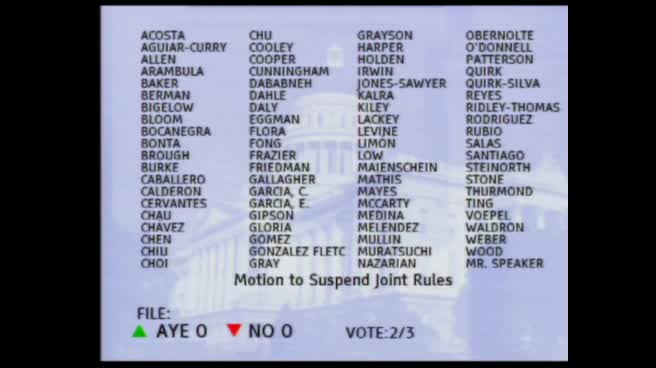 2MIN
Assembly Floor
 55SEC
Assembly Floor
Bill Author

Bill Co-Author(s):