AB 1193: Property tax: welfare exemption: low-income housing.
- Session Year: 2017-2018
- House: Assembly
- Latest Version Date: 2017-10-13
Existing property tax law, in accordance with the California Constitution, provides for a welfare exemption for property that meets certain requirements, including that it is used exclusively for religious, hospital, scientific, or charitable purposes and is owned and operated by certain nonprofit entities. Under existing property tax law, property that meets these requirements that is used exclusively for rental housing and related facilities is entitled to a partial exemption, equal to that percentage of the value of the property that is equal to the percentage that the number of units serving lower income households represents of the total number of residential units, in any year that any of certain criteria apply, including that the owner is eligible for and receives low-income housing tax credits pursuant to specified provisions of the Internal Revenue Code.
This bill, in the case of an owner of property that is eligible for the above-described federal low-income housing tax credit, would provide that a unit would continue to be treated as occupied by a lower income household if the occupants were lower income households on the lien date in the fiscal year in which occupancy of the unit commenced and the unit continues to be rent restricted, notwithstanding an increase in the income of the occupants of the unit to 140% of area median income, but that the unit would cease to be treated as a lower income unit if the income of the occupants of the unit increases above 140% of area median income. The bill would provide that its provisions would be operative only from the 201819 fiscal year through the 202728 fiscal year.
This bill would require a claim for the welfare exemption on qualified property to be accompanied by an affidavit containing specified information regarding the units occupied by lower income households for which the exemption is claimed and would provide that affidavit is not subject to public disclosure. By imposing new duties upon county tax officials, this bill would impose a state-mandated local program.
Existing constitutional provisions require that a statute that limits the right of access to the meetings of public bodies or the writings of public officials and agencies be adopted with findings demonstrating the interest protected by the limitation and the need for protecting that interest.
This bill would make legislative findings to that effect.
The California Constitution requires local agencies, for the purpose of ensuring public access to the meetings of public bodies and the writings of public officials and agencies, to comply with a statutory enactment that amends or enacts laws relating to public records or open meetings and contains findings demonstrating that the enactment furthers the constitutional requirements relating to this purpose.
This bill would make legislative findings to that effect.
The California Constitution requires the state to reimburse local agencies and school districts for certain costs mandated by the state. Statutory provisions establish procedures for making that reimbursement.
This bill would provide that with regard to certain mandates no reimbursement is required by this act for a specified reason.
With regard to any other mandates, this bill would provide that, if the Commission on State Mandates determines that the bill contains costs so mandated by the state, reimbursement for those costs shall be made pursuant to the statutory provisions noted above.
Existing law requires the state to reimburse local agencies annually for certain property tax revenues lost as a result of any exemption or classification of property for purposes of ad valorem property taxation.
This bill would provide that, notwithstanding those provisions, no appropriation is made and the state shall not reimburse local agencies for property tax revenues lost by them pursuant to the bill.
This bill would take effect immediately as a tax levy.
Existing property tax law, in accordance with the California Constitution, provides for a welfare exemption for property that meets certain requirements, including that it is used exclusively for religious, hospital, scientific, or charitable purposes and is owned and operated by certain nonprofit entities. Under existing property tax law, property that meets these requirements that is used exclusively for rental housing and related facilities is entitled to a partial exemption, equal to that percentage of the value of the property that is equal to the percentage that the number of units serving lower income households represents of the total number of residential units, in any year that any of certain criteria apply, including that the owner is eligible for and receives low-income housing tax credits pursuant to specified provisions of the Internal Revenue Code.
This bill, in the case of an owner of property that is eligible for the above-described federal low-income housing tax credit, would provide that a unit would continue to be treated as occupied by a lower income household if the occupants were lower income households on the lien date in the fiscal year in which use occupancy of the unit commenced and the unit continues to be rent restricted, notwithstanding an increase in the income of the occupants of the unit to 140% of area median income, but that the unit would cease to be treated as a lower income unit if the income of the occupants of the unit increases above 140% of area median income. The bill would provide that its provisions would be operative only from the 201819 fiscal year through the 202728 fiscal year.
This bill would require a claim for the welfare exemption on qualified property to be accompanied by an affidavit containing specified information regarding the units occupied by lower income households for which the exemption is claimed and would provide that affidavit is not subject to public disclosure. By imposing new duties upon county tax officials, this bill would impose a state-mandated local program.
Existing constitutional provisions require that a statute that limits the right of access to the meetings of public bodies or the writings of public officials and agencies be adopted with findings demonstrating the interest protected by the limitation and the need for protecting that interest.
This bill would make legislative findings to that effect.
The California Constitution requires local agencies, for the purpose of ensuring public access to the meetings of public bodies and the writings of public officials and agencies, to comply with a statutory enactment that amends or enacts laws relating to public records or open meetings and contains findings demonstrating that the enactment furthers the constitutional requirements relating to this purpose.
This bill would make legislative findings to that effect.
The California Constitution requires the state to reimburse local agencies and school districts for certain costs mandated by the state. Statutory provisions establish procedures for making that reimbursement.
This bill would provide that with regard to certain mandates no reimbursement is required by this act for a specified reason.
With regard to any other mandates, this bill would provide that, if the Commission on State Mandates determines that the bill contains costs so mandated by the state, reimbursement for those costs shall be made pursuant to the statutory provisions noted above.
Existing law requires the state to reimburse local agencies annually for certain property tax revenues lost as a result of any exemption or classification of property for purposes of ad valorem property taxation.
This bill would provide that, notwithstanding those provisions, no appropriation is made and the state shall not reimburse local agencies for property tax revenues lost by them pursuant to the bill.
This bill would take effect immediately as a tax levy.
Existing property tax law, in accordance with the California Constitution, provides for a welfare exemption for property that meets certain requirements, including that it is used exclusively for religious, hospital, scientific, or charitable purposes and is owned and operated by certain nonprofit entities. Under existing property tax law, property that meets these requirements that is used exclusively for rental housing and related facilities is entitled to a partial exemption, equal to that percentage of the value of the property that is equal to the percentage that the number of units serving lower income households represents of the total number of residential units, in any year that any of certain criteria apply, including that the owner is eligible for and receives low-income housing tax credits pursuant to specified provisions of the Internal Revenue Code.
This bill, in the case of an owner of property that is eligible for the above-described federal low-income housing tax credit, would provide that a unit would continue to be treated as occupied by a lower income household if the income of the occupants initially met the income limitation were lower income households on the lien date in the fiscal year in which use of the unit commenced and the unit continues to be rent restricted, notwithstanding an increase in the income of the occupants of a low-income unit above the applicable income limitation applicable under federal law, of the unit to 140% of area median income, but that the unit would cease to be treated as a low-income lower income unit if the income of the occupants of the unit increases above 140% of the income limitation, consistent with the federal low-income housing tax credit. area median income. The bill would provide that its provisions would be operative only from the 201819 fiscal year through the 202728 fiscal year.
This bill would require a claim for the welfare exemption on qualified property to be accompanied by an affidavit containing specified information regarding the units occupied by lower income households for which the exemption is claimed and would provide that affidavit is not subject to public disclosure. By imposing new duties upon county tax officials, this bill would impose a state-mandated local program.
Existing constitutional provisions require that a statute that limits the right of access to the meetings of public bodies or the writings of public officials and agencies be adopted with findings demonstrating the interest protected by the limitation and the need for protecting that interest.
This bill would make legislative findings to that effect.
The California Constitution requires local agencies, for the purpose of ensuring public access to the meetings of public bodies and the writings of public officials and agencies, to comply with a statutory enactment that amends or enacts laws relating to public records or open meetings and contains findings demonstrating that the enactment furthers the constitutional requirements relating to this purpose.
This bill would make legislative findings to that effect.
The California Constitution requires the state to reimburse local agencies and school districts for certain costs mandated by the state. Statutory provisions establish procedures for making that reimbursement.
This bill would provide that with regard to certain mandates no reimbursement is required by this act for a specified reason.
With regard to any other mandates, this bill would provide that, if the Commission on State Mandates determines that the bill contains costs so mandated by the state, reimbursement for those costs shall be made pursuant to the statutory provisions noted above.
Existing law requires the state to reimburse local agencies annually for certain property tax revenues lost as a result of any exemption or classification of property for purposes of ad valorem property taxation.
This bill would provide that, notwithstanding those provisions, no appropriation is made and the state shall not reimburse local agencies for property tax revenues lost by them pursuant to the bill.
This bill would take effect immediately as a tax levy.
Existing property tax law, in accordance with the California Constitution, provides for a welfare exemption for property that meets certain requirements, including that it is used exclusively for religious, hospital, scientific, or charitable purposes and is owned and operated by certain nonprofit entities. Under existing property tax law, property that meets these requirements that is used exclusively for rental housing and related facilities is entitled to a partial exemption, equal to that percentage of the value of the property that is equal to the percentage that the number of units serving lower income households represents of the total number of residential units, in any year that any of certain criteria apply, including that the owner is eligible for and receives low-income housing tax credits pursuant to specified provisions of the Internal Revenue Code.
This bill, for the 201819 fiscal year to the 202728 fiscal year, would describe certain provisions of the Internal Revenue Code related to the determination of eligibility for a low-income housing tax credit under the Internal Revenue Code that also apply for the purposes of the welfare exemption. The bill would provide its provisions would only be operative in a fiscal year in which any budget measure specifically appropriates moneys for the purpose of implementing its provisions. in the case of an owner of property that is eligible for the above-described federal low-income housing tax credit, would provide that a unit would continue to be treated as occupied by a lower income household if the income of the occupants initially met the income limitation and the unit continues to be rent restricted, notwithstanding an increase in the income of the occupants of a low-income unit above the applicable income limitation applicable under federal law, but that the unit would cease to be treated as a low-income unit if the income of the occupants of the unit increases above 140% of the income limitation, consistent with the federal low-income housing tax credit. The bill would provide that its provisions would be operative only from the 201819 fiscal year through the 202728 fiscal year.
Existing law requires the state to reimburse local agencies annually for certain property tax revenues lost as a result of any exemption or classification of property for purposes of ad valorem property taxation.
This bill would provide that, notwithstanding those provisions, no appropriation is made and the state shall not reimburse local agencies for property tax revenues lost by them pursuant to the bill.
This bill would take effect immediately as a tax levy.
Existing property tax law, in accordance with the California Constitution, provides for a welfare exemption for property that meets certain requirements, including that it is used exclusively for religious, hospital, scientific, or charitable purposes and is owned and operated by certain nonprofit entities. Under existing property tax law, property that meets these requirements that is used exclusively for rental housing and related facilities is entitled to a partial exemption, equal to that percentage of the value of the property that is equal to the percentage that the number of units serving lower income households represents of the total number of residential units, in any year that any of certain criteria apply, including that the owner is eligible for and receives low-income housing tax credits pursuant to specified provisions of the Internal Revenue Code.
This bill would specify bill, for the 201819 fiscal year to the 202728 fiscal year, would describe certain provisions of the Internal Revenue Code related to the determination of eligibility for a low-income housing tax credit under the Internal Revenue Code that also apply for the purposes of the welfare exemption. The bill would provide its provisions would only be operative in a fiscal year in which any budget measure specifically appropriates moneys for the purpose of implementing its provisions.
Existing property tax law, in accordance with the California Constitution, provides for a welfare exemption for property that meets certain requirements, including that it is used exclusively for religious, hospital, scientific, or charitable purposes and is owned and operated by certain nonprofit entities. Under existing property tax law, property that meets these requirements that is used exclusively for rental housing and related facilities is entitled to a partial exemption, equal to that percentage of the value of the property that is equal to the percentage that the number of units serving lower income households represents of the total number of residential units, in any year that any of certain criteria apply, including that the owner is eligible for and receives low-income housing tax credits pursuant to specified provisions of the Internal Revenue Code.
This bill would specify describe certain provisions of the Internal Revenue Code related to the determination of eligibility for a low-income housing tax credit under the Internal Revenue Code that also apply for the purposes of the welfare exemption.
(a)Property used exclusively for religious, hospital, scientific, or charitable purposes owned and operated by community chests, funds, foundations, limited liability companies, or corporations organized and operated for religious, hospital, scientific, or charitable purposes is exempt from taxation, including ad valorem taxes to pay the interest and redemption charges on any indebtedness approved by the voters prior to July 1, 1978, or any bonded indebtedness for the acquisition or improvement of real property approved on or after July 1, 1978, by two-thirds of the votes cast by the voters voting on the proposition, if:
(1)The owner is not organized or operated for profit. However, in the case of hospitals, the organization shall not be deemed to be organized or operated for profit if, during the immediately preceding fiscal year, operating revenues, exclusive of gifts, endowments, and grants-in-aid, did not exceed operating expenses by an amount equivalent to 10 percent of those operating expenses. As used herein, operating expenses include depreciation based on cost of replacement and amortization of, and interest on, indebtedness.
(2)No part of the net earnings of the owner inures to the benefit of any private shareholder or individual.
(3)The property is used for the actual operation of the exempt activity, and does not exceed an amount of property reasonably necessary to the accomplishment of the exempt purpose.
(A)For the purposes of determining whether the property is used for the actual operation of the exempt activity, consideration shall not be given to use of the property for either or both of the following described activities if that use is occasional:
(i)The owner conducts fundraising activities on the property and the proceeds derived from those activities are not unrelated business taxable income, as defined in Section 512 of the Internal Revenue Code, of the owner and are used to further the exempt activity of the owner.
(ii)The owner permits any other organization that meets all of the requirements of this subdivision, other than ownership of the property, to conduct fundraising activities on the property and the proceeds derived from those activities are not unrelated business taxable income, as defined in Section 512 of the Internal Revenue Code, of the organization, are not subject to the tax on unrelated business taxable income that is imposed by Section 511 of the Internal Revenue Code, and are used to further the exempt activity of the organization.
(B)For purposes of subparagraph (A):
(i)Occasional use means use of the property on an irregular or intermittent basis by the qualifying owner or any other qualifying organization described in clause (ii) of subparagraph (A) that is incidental to the primary activities of the owner or the other organization.
(ii)Fundraising activities means both activities involving the direct solicitation of money or other property and the anticipated exchange of goods or services for money between the soliciting organization and the organization or person solicited.
(C)Subparagraph (A) shall have no application in determining whether paragraph (3) has been satisfied unless the owner of the property and any other organization using the property as provided in subparagraph (A) have filed with the assessor a valid organizational clearance certificate issued pursuant to Section 254.6.
(D)For the purposes of determining whether the property is used for the actual operation of the exempt activity, consideration shall not be given to the use of the property for meetings conducted by any other organization if the meetings are incidental to the other organizations primary activities, are not fundraising meetings or activities as defined in subparagraph (B), are held no more than once per week, and the other organization and its use of the property meet all other requirements of paragraphs (1) to (5), inclusive, of this subdivision. The owner or the other organization also shall file with the assessor a copy of a valid, unrevoked letter or ruling from the Internal Revenue Service or the Franchise Tax Board stating that the other organization, or the national organization of which it is a local chapter or affiliate, qualifies as an exempt organization under Section 501(c)(3) or 501(c)(4) of the Internal Revenue Code or Section 23701d, 23701f, or 23701w.
(E)Nothing in subparagraph (A), (B), (C), or (D) shall be construed to either enlarge or restrict the exemption provided for in subdivision (b) of Section 4 and Section 5 of Article XIII of the California Constitution and this section.
(4)The property is not used or operated by the owner or by any other person so as to benefit any officer, trustee, director, shareholder, member, employee, contributor, or bondholder of the owner or operator, or any other person, through the distribution of profits, payment of excessive charges or compensations, or the more advantageous pursuit of their business or profession.
(5)The property is not used by the owner or members thereof for fraternal or lodge purposes, or for social club purposes except where that use is clearly incidental to a primary religious, hospital, scientific, or charitable purpose.
(6)The property is irrevocably dedicated to religious, charitable, scientific, or hospital purposes and upon the liquidation, dissolution, or abandonment of the owner will not inure to the benefit of any private person except a fund, foundation, or corporation organized and operated for religious, hospital, scientific, or charitable purposes.
(7)The property, if used exclusively for scientific purposes, is used by a foundation or institution that, in addition to complying with the foregoing requirements for the exemption of charitable organizations in general, has been chartered by the Congress of the United States (except that this requirement shall not apply when the scientific purposes are medical research), and whose objects are the encouragement or conduct of scientific investigation, research, and discovery for the benefit of the community at large.
The exemption provided for herein shall be known as the welfare exemption. This exemption shall be in addition to any other exemption now provided by law, and the existence of the exemption provision in paragraph (2) of subdivision (a) of Section 202 shall not preclude the exemption under this section for museum or library property. Except as provided in subdivision (e), this section shall not be construed to enlarge the college exemption.
(b)Property used exclusively for school purposes of less than collegiate grade and owned and operated by religious, hospital, or charitable funds, foundations, limited liability companies, or corporations, which property and funds, foundations, limited liability companies, or corporations meet all of the requirements of subdivision (a), shall be deemed to be within the exemption provided for in subdivision (b) of Section 4 and Section 5 of Article XIII of the California Constitution and this section.
(c)Property used exclusively for nursery school purposes and owned and operated by religious, hospital, or charitable funds, foundations, limited liability companies, or corporations, which property and funds, foundations, limited liability companies, or corporations meet all the requirements of subdivision (a), shall be deemed to be within the exemption provided for in subdivision (b) of Section 4 and Section 5 of Article XIII of the California Constitution and this section.
(d)Property used exclusively for a noncommercial educational FM broadcast station or an educational television station, and owned and operated by religious, hospital, scientific, or charitable funds, foundations, limited liability companies, or corporations meeting all of the requirements of subdivision (a), shall be deemed to be within the exemption provided for in subdivision (b) of Section 4 and Section 5 of Article XIII of the California Constitution and this section.
(e)Property used exclusively for religious, charitable, scientific, or hospital purposes and owned and operated by religious, hospital, scientific, or charitable funds, foundations, limited liability companies, or corporations or educational institutions of collegiate grade, as defined in Section 203, which property and funds, foundations, limited liability companies, corporations, or educational institutions meet all of the requirements of subdivision (a), shall be deemed to be within the exemption provided for in subdivision (b) of Section 4 and Section 5 of Article XIII of the California Constitution and this section. As to educational institutions of collegiate grade, as defined in Section 203, the requirements of paragraph (6) of subdivision (a) shall be deemed to be met if both of the following are met:
(1)The property of the educational institution is irrevocably dedicated in its articles of incorporation to charitable and educational purposes, to religious and educational purposes, or to educational purposes.
(2)The articles of incorporation of the educational institution provide for distribution of its property upon its liquidation, dissolution, or abandonment to a fund, foundation, or corporation organized and operated for religious, hospital, scientific, charitable, or educational purposes meeting the requirements for exemption provided by Section 203 or this section.
(f)Property used exclusively for housing and related facilities for elderly or handicapped families and financed by, including, but not limited to, the federal government pursuant to Section 202 of Public Law 86-372 (12 U.S.C. Sec. 1701q), as amended, Section 231 of Public Law 73-479 (12 U.S.C. Sec. 1715v), Section 236 of Public Law 90-448 (12 U.S.C. Sec. 1715z), or Section 811 of Public Law 101-625 (42 U.S.C. Sec. 8013), and owned and operated by religious, hospital, scientific, or charitable funds, foundations, limited liability companies, or corporations meeting all of the requirements of this section shall be deemed to be within the exemption provided for in subdivision (b) of Section 4 and Section 5 of Article XIII of the California Constitution and this section.
The amendment of this paragraph made by Chapter 1102 of the Statutes of 1984 does not constitute a change in, but is declaratory of, existing law. However, no refund of property taxes shall be required as a result of this amendment for any fiscal year prior to the fiscal year in which the amendment takes effect.
Property used exclusively for housing and related facilities for elderly or handicapped families at which supplemental care or services designed to meet the special needs of elderly or handicapped residents are not provided, or that is not financed by the federal government pursuant to Section 202 of Public Law 86-372 (12 U.S.C. Sec. 1701q), as amended, Section 231 of Public Law 73-479 (12 U.S.C. Sec. 1715v), Section 236 of Public Law 90-448 (12 U.S.C. Sec. 1715z), or Section 811 of Public Law 101-625 (42 U.S.C. Sec. 8013), shall not be entitled to exemption pursuant to this subdivision unless the property is used for housing and related facilities for low- and moderate-income elderly or handicapped families. Property that would otherwise be exempt pursuant to this subdivision, except that it includes some housing and related facilities for other than low- or moderate-income elderly or handicapped families, shall be entitled to a partial exemption. The partial exemption shall be equal to that percentage of the value of the property that is equal to the percentage that the number of low- and moderate-income elderly and handicapped families represents of the total number of families occupying the property.
As used in this subdivision, low and moderate income has the same meaning as the term persons and families of low or moderate income as defined by Section 50093 of the Health and Safety Code.
(g)(1)Property used exclusively for rental housing and related facilities and owned and operated by religious, hospital, scientific, or charitable funds, foundations, limited liability companies, or corporations, including limited partnerships in which the managing general partner is an eligible nonprofit corporation or eligible limited liability company, meeting all of the requirements of this section, or by veterans organizations, as described in Section 215.1, meeting all the requirements of paragraphs (1) to (7), inclusive, of subdivision (a), shall be deemed to be within the exemption provided for in subdivision (b) of Section 4 and Section 5 of Article XIII of the California Constitution and this section and shall be entitled to a partial exemption equal to that percentage of the value of the property that is equal to the percentage that the number of units serving lower income households represents of the total number of residential units in any year in which any of the following criteria applies:
(A)The acquisition, rehabilitation, development, or operation of the property, or any combination of these factors, is financed with tax-exempt mortgage revenue bonds or general obligation bonds, or is financed by local, state, or federal loans or grants and the rents of the occupants who are lower income households do not exceed those prescribed by deed restrictions or regulatory agreements pursuant to the terms of the financing or financial assistance.
(B)The owner of the property is eligible for and receives low-income housing tax credits pursuant to Section 42 of the Internal Revenue Code of 1986, as added by Public Law 99-514.
(C)In the case of a claim, other than a claim with respect to property owned by a limited partnership in which the managing general partner is an eligible nonprofit corporation, that is filed for the 200001 fiscal year or any fiscal year thereafter, 90 percent or more of the occupants of the property are lower income households whose rent does not exceed the rent prescribed by Section 50053 of the Health and Safety Code. The total exemption amount allowed under this subdivision to a taxpayer, with respect to a single property or multiple properties for any fiscal year on the sole basis of the application of this subparagraph, may not exceed ten million dollars ($10,000,000) in assessed value.
(D)(i)The property was previously purchased and owned by the Department of Transportation pursuant to a consent decree requiring housing mitigation measures relating to the construction of a freeway and is now solely owned by an organization that qualifies as an exempt organization under Section 501(c)(3) of the Internal Revenue Code.
(ii)This subparagraph shall not apply to property owned by a limited partnership in which the managing partner is an eligible nonprofit corporation.
(2)In order to be eligible for the exemption provided by this subdivision, the owner of the property shall do both of the following:
(A)(i)For any claim filed for the 200001 fiscal year or any fiscal year thereafter, certify and ensure, subject to the limitation in clause (ii), that there is an enforceable and verifiable agreement with a public agency, a recorded deed restriction, or other legal document that restricts the projects usage and that provides that the units designated for use by lower income households are continuously available to or occupied by lower income households, subject to the exception in clause (iii), at rents that do not exceed those prescribed by Section 50053 of the Health and Safety Code, or, to the extent that the terms of federal, state, or local financing or financial assistance conflicts with Section 50053, rents that do not exceed those prescribed by the terms of the financing or financial assistance.
(ii)In the case of a limited partnership in which the managing general partner is an eligible nonprofit corporation, the restriction and provision specified in clause (i) shall be contained in an enforceable and verifiable agreement with a public agency, or in a recorded deed restriction to which the limited partnership certifies.
(iii)(I)In the case of an owner of property that is eligible for and receives a low-income housing tax credit pursuant to Section 42 of the Internal Revenue Code, relating to low-income housing credit, a unit shall continue to be treated as occupied by a lower income household if the occupants were lower income households on the lien date in the fiscal year in which their occupancy of the unit commenced and the unit continues to be rent restricted, notwithstanding an increase in the income of the occupants of the unit to 140 percent of area median income, adjusted for family size. However, the unit shall cease to be treated as a lower income unit if the income of the occupants of the unit increases above 140 percent of area median income, adjusted for family size.
(II)This clause shall only be operative from the 201819 fiscal year through the 202728 fiscal year.
(B)Certify that the funds that would have been necessary to pay property taxes are used to maintain the affordability of, or reduce rents otherwise necessary for, the units occupied by lower income households.
(3)As used in this subdivision:
(A)Lower income households has the same meaning as the term lower income households as defined by Section 50079.5 of the Health and Safety Code.
(B)Related facilities means any managers units and any and all common area spaces that are included within the physical boundaries of the rental housing development, including, but not limited to, common area space, walkways, balconies, patios, clubhouse space, meeting rooms, laundry facilities, and parking areas, except any portions of the overall development that are nonexempt commercial space.
(C)(i)Units serving lower income households shall mean units that are occupied by lower income households at an affordable rent, as defined in Section 50053 of the Health and Safety Code or, to the extent that the terms of federal, state, or local financing or financial assistance conflicts with Section 50053, rents that do not exceed those prescribed by the terms of the financing or financial assistance. Units reserved for lower income households at an affordable rent that are temporarily vacant due to tenant turnover or repairs shall be counted as occupied.
(ii)(I)Units serving lower income households shall also mean units specified in clause (iii) of subparagraph (A) of paragraph (2).
(II)This clause shall only be operative from the 201819 fiscal year through the 202728 fiscal year.
(h)Property used exclusively for an emergency or temporary shelter and related facilities for homeless persons and families and owned and operated by religious, hospital, scientific, or charitable funds, foundations, limited liability companies, or corporations meeting all of the requirements of this section shall be deemed to be within the exemption provided for in subdivision (b) of Section 4 and Section 5 of Article XIII of the California Constitution and this section. Property that otherwise would be exempt pursuant to this subdivision, except that it includes housing and related facilities for other than an emergency or temporary shelter, shall be entitled to a partial exemption.
As used in this subdivision, emergency or temporary shelter means a facility that would be eligible for funding pursuant to Chapter 11 (commencing with Section 50800) of Part 2 of Division 31 of the Health and Safety Code.
(i)Property used exclusively for housing and related facilities for employees of religious, charitable, scientific, or hospital organizations that meet all the requirements of subdivision (a) and owned and operated by funds, foundations, limited liability companies, or corporations that meet all the requirements of subdivision (a) shall be deemed to be within the exemption provided for in subdivision (b) of Section 4 and Section 5 of Article XIII of the California Constitution and this section to the extent the residential use of the property is institutionally necessary for the operation of the organization.
(j)For purposes of this section, charitable purposes include educational purposes. For purposes of this subdivision, educational purposes means those educational purposes and activities for the benefit of the community as a whole or an unascertainable and indefinite portion thereof, and do not include those educational purposes and activities that are primarily for the benefit of an organizations shareholders. Educational activities include the study of relevant information, the dissemination of that information to interested members of the general public, and the participation of interested members of the general public.
(k)In the case of property used exclusively for the exempt purposes specified in this section, owned and operated by limited liability companies that are organized and operated for those purposes, the State Board of Equalization shall adopt regulations to specify the ownership, organizational, and operational requirements for those companies to qualify for the exemption provided by this section.
(l)The amendments made by Chapter 354 of the Statutes of 2004 shall apply with respect to lien dates occurring on and after January 1, 2005.
(m)The amendments made by the act adding this subdivision shall apply with respect to lien dates occurring on and after January 1, 2017.
SEC. 2.Section 259.15 is added to the Revenue and Taxation Code, to read:259.15.(a)For the 201819 fiscal year to the 202728 fiscal year, the claim for welfare exemption on a property that is eligible for and has received low-income housing tax credits pursuant to Section 42 of the Internal Revenue Code, relating to low-income housing credit, including Section 42(g)(2)(D) of the Internal Revenue Code, relating to treatment of units occupied by individuals whose incomes rise above limit, in addition to giving any other information as prescribed by the board, when claiming an exemption for units pursuant to clause (iii) of subparagraph (A) of paragraph (2) of subdivision (g) of Section 214 shall be accompanied by an affidavit that provides the following:
(1)A list of all units, for which exemption is claimed, in which the unit will continue to be treated as a low-income unit if the occupant initially met the income limitation and the unit continues to be rent restricted.
(2)All of the following nonpersonally identifiable information about the occupants of the units listed pursuant to paragraph (1):
(A)The unit name or number.
(B)The actual household income of the occupant.
(C)The maximum rent that may be charged to the occupant.
(D)The actual rent charged to the occupant.
(b)The affidavit required to accompany the claim for welfare exemption pursuant to subdivision (a) shall be confidential and shall not be subject to public disclosure.
SEC. 3.The Legislature finds and declares that Section 2 of this act, which adds Section 259.15 to the Revenue and Taxation Code, imposes a limitation on the publics right of access to the meetings of public bodies or the writings of public officials and agencies within the meaning of Section 3 of Article I of the California Constitution. Pursuant to that constitutional provision, the Legislature makes the following findings to demonstrate the interest protected by this limitation and the need for protecting that interest:
In order to protect the privacy of an individuals personal and financial information contained in an affidavit accompanying a claim for welfare exemption, as required by this act, it is in the states interest to limit public access to information.
SEC. 4.The Legislature finds and declares that Section 2 of this act, which adds Section 259.15 to the Revenue and Taxation Code, furthers, within the meaning of paragraph (7) of subdivision (b) of Section 3 of Article I of the California Constitution, the purposes of that constitutional section as it relates to the right of public access to the meetings of local public bodies or the writings of local public officials and local agencies. Pursuant to paragraph (7) of subdivision (b) of Section 3 of Article I of the California Constitution, the Legislature makes the following findings:
The protection of sensitive personal and personal financial information contained in an affidavit accompanying a claim for welfare exemption, as required by this act, is consistent with and furthers proper access to documents and information in the possession of local government agencies.
SEC. 5.No reimbursement is required by this act pursuant to Section 6 of Article XIII B of the California Constitution for certain costs that may be incurred by a local agency or school district because, in that regard, the only costs that may be incurred by a local agency or school district under this act would result from a legislative mandate that is within the scope of paragraph (7) of subdivision (b) of Section 3 of Article I of the California Constitution.
However, if the Commission on State Mandates determines that this act contains other costs mandated by the state, reimbursement to local agencies and school districts for those costs shall be made pursuant to Part 7 (commencing with Section 17500) of Division 4 of Title 2 of the Government Code.
SEC. 6.Notwithstanding Section 2229 of the Revenue and Taxation Code, no appropriation is made by this act and the state shall not reimburse any local agency for any property tax revenues lost by it pursuant to this act.
SEC. 7.This act provides for a tax levy within the meaning of Article IV of the California Constitution and shall go into immediate effect.
(a)Property used exclusively for religious, hospital, scientific, or charitable purposes owned and operated by community chests, funds, foundations, limited liability companies, or corporations organized and operated for religious, hospital, scientific, or charitable purposes is exempt from taxation, including ad valorem taxes to pay the interest and redemption charges on any indebtedness approved by the voters prior to July 1, 1978, or any bonded indebtedness for the acquisition or improvement of real property approved on or after July 1, 1978, by two-thirds of the votes cast by the voters voting on the proposition, if:
(1)The owner is not organized or operated for profit. However, in the case of hospitals, the organization shall not be deemed to be organized or operated for profit if, during the immediately preceding fiscal year, operating revenues, exclusive of gifts, endowments, and grants-in-aid, did not exceed operating expenses by an amount equivalent to 10 percent of those operating expenses. As used herein, operating expenses include depreciation based on cost of replacement and amortization of, and interest on, indebtedness.
(2)No part of the net earnings of the owner inures to the benefit of any private shareholder or individual.
(3)The property is used for the actual operation of the exempt activity, and does not exceed an amount of property reasonably necessary to the accomplishment of the exempt purpose.
(A)For the purposes of determining whether the property is used for the actual operation of the exempt activity, consideration shall not be given to use of the property for either or both of the following described activities if that use is occasional:
(i)The owner conducts fundraising activities on the property and the proceeds derived from those activities are not unrelated business taxable income, as defined in Section 512 of the Internal Revenue Code, of the owner and are used to further the exempt activity of the owner.
(ii)The owner permits any other organization that meets all of the requirements of this subdivision, other than ownership of the property, to conduct fundraising activities on the property and the proceeds derived from those activities are not unrelated business taxable income, as defined in Section 512 of the Internal Revenue Code, of the organization, are not subject to the tax on unrelated business taxable income that is imposed by Section 511 of the Internal Revenue Code, and are used to further the exempt activity of the organization.
(B)For purposes of subparagraph (A):
(i)Occasional use means use of the property on an irregular or intermittent basis by the qualifying owner or any other qualifying organization described in clause (ii) of subparagraph (A) that is incidental to the primary activities of the owner or the other organization.
(ii)Fundraising activities means both activities involving the direct solicitation of money or other property and the anticipated exchange of goods or services for money between the soliciting organization and the organization or person solicited.
(C)Subparagraph (A) shall have no application in determining whether paragraph (3) has been satisfied unless the owner of the property and any other organization using the property as provided in subparagraph (A) have filed with the assessor a valid organizational clearance certificate issued pursuant to Section 254.6.
(D)For the purposes of determining whether the property is used for the actual operation of the exempt activity, consideration shall not be given to the use of the property for meetings conducted by any other organization if the meetings are incidental to the other organizations primary activities, are not fundraising meetings or activities as defined in subparagraph (B), are held no more than once per week, and the other organization and its use of the property meet all other requirements of paragraphs (1) to (5), inclusive, of this subdivision. The owner or the other organization also shall file with the assessor a copy of a valid, unrevoked letter or ruling from the Internal Revenue Service or the Franchise Tax Board stating that the other organization, or the national organization of which it is a local chapter or affiliate, qualifies as an exempt organization under Section 501(c)(3) or 501(c)(4) of the Internal Revenue Code or Section 23701d, 23701f, or 23701w.
(E)Nothing in subparagraph (A), (B), (C), or (D) shall be construed to either enlarge or restrict the exemption provided for in subdivision (b) of Section 4 and Section 5 of Article XIII of the California Constitution and this section.
(4)The property is not used or operated by the owner or by any other person so as to benefit any officer, trustee, director, shareholder, member, employee, contributor, or bondholder of the owner or operator, or any other person, through the distribution of profits, payment of excessive charges or compensations, or the more advantageous pursuit of their business or profession.
(5)The property is not used by the owner or members thereof for fraternal or lodge purposes, or for social club purposes except where that use is clearly incidental to a primary religious, hospital, scientific, or charitable purpose.
(6)The property is irrevocably dedicated to religious, charitable, scientific, or hospital purposes and upon the liquidation, dissolution, or abandonment of the owner will not inure to the benefit of any private person except a fund, foundation, or corporation organized and operated for religious, hospital, scientific, or charitable purposes.
(7)The property, if used exclusively for scientific purposes, is used by a foundation or institution that, in addition to complying with the foregoing requirements for the exemption of charitable organizations in general, has been chartered by the Congress of the United States (except that this requirement shall not apply when the scientific purposes are medical research), and whose objects are the encouragement or conduct of scientific investigation, research, and discovery for the benefit of the community at large.
The exemption provided for herein shall be known as the welfare exemption. This exemption shall be in addition to any other exemption now provided by law, and the existence of the exemption provision in paragraph (2) of subdivision (a) of Section 202 shall not preclude the exemption under this section for museum or library property. Except as provided in subdivision (e), this section shall not be construed to enlarge the college exemption.
(b)Property used exclusively for school purposes of less than collegiate grade and owned and operated by religious, hospital, or charitable funds, foundations, limited liability companies, or corporations, which property and funds, foundations, limited liability companies, or corporations meet all of the requirements of subdivision (a), shall be deemed to be within the exemption provided for in subdivision (b) of Section 4 and Section 5 of Article XIII of the California Constitution and this section.
(c)Property used exclusively for nursery school purposes and owned and operated by religious, hospital, or charitable funds, foundations, limited liability companies, or corporations, which property and funds, foundations, limited liability companies, or corporations meet all the requirements of subdivision (a), shall be deemed to be within the exemption provided for in subdivision (b) of Section 4 and Section 5 of Article XIII of the California Constitution and this section.
(d)Property used exclusively for a noncommercial educational FM broadcast station or an educational television station, and owned and operated by religious, hospital, scientific, or charitable funds, foundations, limited liability companies, or corporations meeting all of the requirements of subdivision (a), shall be deemed to be within the exemption provided for in subdivision (b) of Section 4 and Section 5 of Article XIII of the California Constitution and this section.
(e)Property used exclusively for religious, charitable, scientific, or hospital purposes and owned and operated by religious, hospital, scientific, or charitable funds, foundations, limited liability companies, or corporations or educational institutions of collegiate grade, as defined in Section 203, which property and funds, foundations, limited liability companies, corporations, or educational institutions meet all of the requirements of subdivision (a), shall be deemed to be within the exemption provided for in subdivision (b) of Section 4 and Section 5 of Article XIII of the California Constitution and this section. As to educational institutions of collegiate grade, as defined in Section 203, the requirements of paragraph (6) of subdivision (a) shall be deemed to be met if both of the following are met:
(1)The property of the educational institution is irrevocably dedicated in its articles of incorporation to charitable and educational purposes, to religious and educational purposes, or to educational purposes.
(2)The articles of incorporation of the educational institution provide for distribution of its property upon its liquidation, dissolution, or abandonment to a fund, foundation, or corporation organized and operated for religious, hospital, scientific, charitable, or educational purposes meeting the requirements for exemption provided by Section 203 or this section.
(f)Property used exclusively for housing and related facilities for elderly or handicapped families and financed by, including, but not limited to, the federal government pursuant to Section 202 of Public Law 86-372 (12 U.S.C. Sec. 1701q), as amended, Section 231 of Public Law 73-479 (12 U.S.C. Sec. 1715v), Section 236 of Public Law 90-448 (12 U.S.C. Sec. 1715z), or Section 811 of Public Law 101-625 (42 U.S.C. Sec. 8013), and owned and operated by religious, hospital, scientific, or charitable funds, foundations, limited liability companies, or corporations meeting all of the requirements of this section shall be deemed to be within the exemption provided for in subdivision (b) of Section 4 and Section 5 of Article XIII of the California Constitution and this section.
The amendment of this paragraph made by Chapter 1102 of the Statutes of 1984 does not constitute a change in, but is declaratory of, existing law. However, no refund of property taxes shall be required as a result of this amendment for any fiscal year prior to the fiscal year in which the amendment takes effect.
Property used exclusively for housing and related facilities for elderly or handicapped families at which supplemental care or services designed to meet the special needs of elderly or handicapped residents are not provided, or that is not financed by the federal government pursuant to Section 202 of Public Law 86-372 (12 U.S.C. Sec. 1701q), as amended, Section 231 of Public Law 73-479 (12 U.S.C. Sec. 1715v), Section 236 of Public Law 90-448 (12 U.S.C. Sec. 1715z), or Section 811 of Public Law 101-625 (42 U.S.C. Sec. 8013), shall not be entitled to exemption pursuant to this subdivision unless the property is used for housing and related facilities for low- and moderate-income elderly or handicapped families. Property that would otherwise be exempt pursuant to this subdivision, except that it includes some housing and related facilities for other than low- or moderate-income elderly or handicapped families, shall be entitled to a partial exemption. The partial exemption shall be equal to that percentage of the value of the property that is equal to the percentage that the number of low- and moderate-income elderly and handicapped families represents of the total number of families occupying the property.
As used in this subdivision, low and moderate income has the same meaning as the term persons and families of low or moderate income as defined by Section 50093 of the Health and Safety Code.
(g)(1)Property used exclusively for rental housing and related facilities and owned and operated by religious, hospital, scientific, or charitable funds, foundations, limited liability companies, or corporations, including limited partnerships in which the managing general partner is an eligible nonprofit corporation or eligible limited liability company, meeting all of the requirements of this section, or by veterans organizations, as described in Section 215.1, meeting all the requirements of paragraphs (1) to (7), inclusive, of subdivision (a), shall be deemed to be within the exemption provided for in subdivision (b) of Section 4 and Section 5 of Article XIII of the California Constitution and this section and shall be entitled to a partial exemption equal to that percentage of the value of the property that is equal to the percentage that the number of units serving lower income households represents of the total number of residential units in any year in which any of the following criteria applies:
(A)The acquisition, rehabilitation, development, or operation of the property, or any combination of these factors, is financed with tax-exempt mortgage revenue bonds or general obligation bonds, or is financed by local, state, or federal loans or grants and the rents of the occupants who are lower income households do not exceed those prescribed by deed restrictions or regulatory agreements pursuant to the terms of the financing or financial assistance.
(B)The owner of the property is eligible for and receives low-income housing tax credits pursuant to Section 42 of the Internal Revenue Code of 1986, as added by Public Law 99-514.
(C)In the case of a claim, other than a claim with respect to property owned by a limited partnership in which the managing general partner is an eligible nonprofit corporation, that is filed for the 200001 fiscal year or any fiscal year thereafter, 90 percent or more of the occupants of the property are lower income households whose rent does not exceed the rent prescribed by Section 50053 of the Health and Safety Code. The total exemption amount allowed under this subdivision to a taxpayer, with respect to a single property or multiple properties for any fiscal year on the sole basis of the application of this subparagraph, may not exceed ten million dollars ($10,000,000) in assessed value.
(D)(i)The property was previously purchased and owned by the Department of Transportation pursuant to a consent decree requiring housing mitigation measures relating to the construction of a freeway and is now solely owned by an organization that qualifies as an exempt organization under Section 501(c)(3) of the Internal Revenue Code.
(ii)This subparagraph shall not apply to property owned by a limited partnership in which the managing partner is an eligible nonprofit corporation.
(2)In order to be eligible for the exemption provided by this subdivision, the owner of the property shall do both of the following:
(A)(i)For any claim filed for the 200001 fiscal year or any fiscal year thereafter, certify and ensure, subject to the limitation in clause (ii), that there is an enforceable and verifiable agreement with a public agency, a recorded deed restriction, or other legal document that restricts the projects usage and that provides that the units designated for use by lower income households are continuously available to or occupied by lower income households, subject to the exception in clause (iii), at rents that do not exceed those prescribed by Section 50053 of the Health and Safety Code, or, to the extent that the terms of federal, state, or local financing or financial assistance conflicts with Section 50053, rents that do not exceed those prescribed by the terms of the financing or financial assistance.
(ii)In the case of a limited partnership in which the managing general partner is an eligible nonprofit corporation, the restriction and provision specified in clause (i) shall be contained in an enforceable and verifiable agreement with a public agency, or in a recorded deed restriction to which the limited partnership certifies.
(iii)(I)In the case of an owner of property that is eligible for and receives a low-income housing tax credit pursuant to Section 42 of the Internal Revenue Code, relating to low-income housing credit, a unit shall continue to be treated as occupied by a lower income household if the occupants were lower income households on the lien date in the fiscal year in which use of their occupancy of the unit commenced and the unit continues to be rent restricted, notwithstanding an increase in the income of the occupants of the unit to 140 percent of area median income, adjusted for family size. However, the unit shall cease to be treated as a lower income unit if the income of the occupants of the unit increases above 140 percent of area median income, adjusted for family size.
(II)This clause shall only be operative from the 201819 fiscal year through the 202728 fiscal year.
(B)Certify that the funds that would have been necessary to pay property taxes are used to maintain the affordability of, or reduce rents otherwise necessary for, the units occupied by lower income households.
(3)As used in this subdivision:
(A)Lower income households has the same meaning as the term lower income households as defined by Section 50079.5 of the Health and Safety Code.
(B)Related facilities means any managers units and any and all common area spaces that are included within the physical boundaries of the rental housing development, including, but not limited to, common area space, walkways, balconies, patios, clubhouse space, meeting rooms, laundry facilities, and parking areas, except any portions of the overall development that are nonexempt commercial space.
(C)(i)Units serving lower income households shall mean units that are occupied by lower income households at an affordable rent, as defined in Section 50053 of the Health and Safety Code or, to the extent that the terms of federal, state, or local financing or financial assistance conflicts with Section 50053, rents that do not exceed those prescribed by the terms of the financing or financial assistance. Units reserved for lower income households at an affordable rent that are temporarily vacant due to tenant turnover or repairs shall be counted as occupied.
(ii)(I)Units serving lower income households shall also mean units specified in clause (iii) of subparagraph (A) of paragraph (2).
(II)This clause shall only be operative from the 201819 fiscal year through the 202728 fiscal year.
(h)Property used exclusively for an emergency or temporary shelter and related facilities for homeless persons and families and owned and operated by religious, hospital, scientific, or charitable funds, foundations, limited liability companies, or corporations meeting all of the requirements of this section shall be deemed to be within the exemption provided for in subdivision (b) of Section 4 and Section 5 of Article XIII of the California Constitution and this section. Property that otherwise would be exempt pursuant to this subdivision, except that it includes housing and related facilities for other than an emergency or temporary shelter, shall be entitled to a partial exemption.
As used in this subdivision, emergency or temporary shelter means a facility that would be eligible for funding pursuant to Chapter 11 (commencing with Section 50800) of Part 2 of Division 31 of the Health and Safety Code.
(i)Property used exclusively for housing and related facilities for employees of religious, charitable, scientific, or hospital organizations that meet all the requirements of subdivision (a) and owned and operated by funds, foundations, limited liability companies, or corporations that meet all the requirements of subdivision (a) shall be deemed to be within the exemption provided for in subdivision (b) of Section 4 and Section 5 of Article XIII of the California Constitution and this section to the extent the residential use of the property is institutionally necessary for the operation of the organization.
(j)For purposes of this section, charitable purposes include educational purposes. For purposes of this subdivision, educational purposes means those educational purposes and activities for the benefit of the community as a whole or an unascertainable and indefinite portion thereof, and do not include those educational purposes and activities that are primarily for the benefit of an organizations shareholders. Educational activities include the study of relevant information, the dissemination of that information to interested members of the general public, and the participation of interested members of the general public.
(k)In the case of property used exclusively for the exempt purposes specified in this section, owned and operated by limited liability companies that are organized and operated for those purposes, the State Board of Equalization shall adopt regulations to specify the ownership, organizational, and operational requirements for those companies to qualify for the exemption provided by this section.
(l)The amendments made by Chapter 354 of the Statutes of 2004 shall apply with respect to lien dates occurring on and after January 1, 2005.
(m)The amendments made by the act adding this subdivision shall apply with respect to lien dates occurring on and after January 1, 2017.
SEC. 2.Section 259.15 is added to the Revenue and Taxation Code, to read:259.15.(a)For the 201819 fiscal year to the 202728 fiscal year, the claim for welfare exemption on a property that is eligible for and has received low-income housing tax credits pursuant to Section 42 of the Internal Revenue Code, relating to low-income housing credit, including Section 42(g)(2)(D) of the Internal Revenue Code, relating to treatment of units occupied by individuals whose incomes rise above limit, in addition to giving any other information as prescribed by the board, when claiming an exemption for units pursuant to clause (iii) of subparagraph (A) of paragraph (2) of subdivision (g) of Section 214 shall be accompanied by an affidavit that provides the following:
(1)A list of all units, for which exemption is claimed, in which the unit will continue to be treated as a low-income unit if the occupant initially met the income limitation and the unit continues to be rent restricted.
(2)All of the following nonpersonally identifiable information about the occupants of the units listed pursuant to paragraph (1):
(A)The unit name or number.
(B)The actual household income of the occupant.
(C)The maximum rent that may be charged to the occupant.
(D)The actual rent charged to the occupant.
(b)The affidavit required to accompany the claim for welfare exemption pursuant to subdivision (a) shall be confidential and shall not be subject to public disclosure.
SEC. 3.The Legislature finds and declares that Section 2 of this act, which adds Section 259.15 to the Revenue and Taxation Code, imposes a limitation on the publics right of access to the meetings of public bodies or the writings of public officials and agencies within the meaning of Section 3 of Article I of the California Constitution. Pursuant to that constitutional provision, the Legislature makes the following findings to demonstrate the interest protected by this limitation and the need for protecting that interest:
In order to protect the privacy of an individuals personal and financial information contained in an affidavit accompanying a claim for welfare exemption, as required by this act, it is in the states interest to limit public access to information.
SEC. 4.The Legislature finds and declares that Section 2 of this act, which adds Section 259.15 to the Revenue and Taxation Code, furthers, within the meaning of paragraph (7) of subdivision (b) of Section 3 of Article I of the California Constitution, the purposes of that constitutional section as it relates to the right of public access to the meetings of local public bodies or the writings of local public officials and local agencies. Pursuant to paragraph (7) of subdivision (b) of Section 3 of Article I of the California Constitution, the Legislature makes the following findings:
The protection of sensitive personal and personal financial information contained in an affidavit accompanying a claim for welfare exemption, as required by this act, is consistent with and furthers proper access to documents and information in the possession of local government agencies.
SEC. 5.No reimbursement is required by this act pursuant to Section 6 of Article XIII B of the California Constitution for certain costs that may be incurred by a local agency or school district because, in that regard, the only costs that may be incurred by a local agency or school district under this act would result from a legislative mandate that is within the scope of paragraph (7) of subdivision (b) of Section 3 of Article I of the California Constitution.
However, if the Commission on State Mandates determines that this act contains other costs mandated by the state, reimbursement to local agencies and school districts for those costs shall be made pursuant to Part 7 (commencing with Section 17500) of Division 4 of Title 2 of the Government Code.
SEC. 6.Notwithstanding Section 2229 of the Revenue and Taxation Code, no appropriation is made by this act and the state shall not reimburse any local agency for any property tax revenues lost by it pursuant to this act.
SEC. 7.This act provides for a tax levy within the meaning of Article IV of the California Constitution and shall go into immediate effect.
(a)Property used exclusively for religious, hospital, scientific, or charitable purposes owned and operated by community chests, funds, foundations, limited liability companies, or corporations organized and operated for religious, hospital, scientific, or charitable purposes is exempt from taxation, including ad valorem taxes to pay the interest and redemption charges on any indebtedness approved by the voters prior to July 1, 1978, or any bonded indebtedness for the acquisition or improvement of real property approved on or after July 1, 1978, by two-thirds of the votes cast by the voters voting on the proposition, if:
(1)The owner is not organized or operated for profit. However, in the case of hospitals, the organization shall not be deemed to be organized or operated for profit if, during the immediately preceding fiscal year, operating revenues, exclusive of gifts, endowments endowments, and grants-in-aid, did not exceed operating expenses by an amount equivalent to 10 percent of those operating expenses. As used herein, operating expenses include depreciation based on cost of replacement and amortization of, and interest on, indebtedness.
(2)No part of the net earnings of the owner inures to the benefit of any private shareholder or individual.
(3)The property is used for the actual operation of the exempt activity, and does not exceed an amount of property reasonably necessary to the accomplishment of the exempt purpose.
(A)For the purposes of determining whether the property is used for the actual operation of the exempt activity, consideration shall not be given to use of the property for either or both of the following described activities if that use is occasional:
(i)The owner conducts fundraising activities on the property and the proceeds derived from those activities are not unrelated business taxable income, as defined in Section 512 of the Internal Revenue Code, of the owner and are used to further the exempt activity of the owner.
(ii)The owner permits any other organization that meets all of the requirements of this subdivision, other than ownership of the property, to conduct fundraising activities on the property and the proceeds derived from those activities are not unrelated business taxable income, as defined in Section 512 of the Internal Revenue Code, of the organization, are not subject to the tax on unrelated business taxable income that is imposed by Section 511 of the Internal Revenue Code, and are used to further the exempt activity of the organization.
(B)For purposes of subparagraph (A):
(i)Occasional use means use of the property on an irregular or intermittent basis by the qualifying owner or any other qualifying organization described in clause (ii) of subparagraph (A) that is incidental to the primary activities of the owner or the other organization.
(ii)Fundraising activities means both activities involving the direct solicitation of money or other property and the anticipated exchange of goods or services for money between the soliciting organization and the organization or person solicited.
(C)Subparagraph (A) shall have no application in determining whether paragraph (3) has been satisfied unless the owner of the property and any other organization using the property as provided in subparagraph (A) have filed with the assessor a valid organizational clearance certificate issued pursuant to Section 254.6.
(D)For the purposes of determining whether the property is used for the actual operation of the exempt activity, consideration shall not be given to the use of the property for meetings conducted by any other organization if the meetings are incidental to the other organizations primary activities, are not fundraising meetings or activities as defined in subparagraph (B), are held no more than once per week, and the other organization and its use of the property meet all other requirements of paragraphs (1) to (5), inclusive, of this subdivision. The owner or the other organization also shall file with the assessor a copy of a valid, unrevoked letter or ruling from the Internal Revenue Service or the Franchise Tax Board stating that the other organization, or the national organization of which it is a local chapter or affiliate, qualifies as an exempt organization under Section 501(c)(3) or 501(c)(4) of the Internal Revenue Code or Section 23701d, 23701f, or 23701w.
(E)Nothing in subparagraph (A), (B), (C), or (D) shall be construed to either enlarge or restrict the exemption provided for in subdivision (b) of Section 4 and Section 5 of Article XIII of the California Constitution and this section.
(4)The property is not used or operated by the owner or by any other person so as to benefit any officer, trustee, director, shareholder, member, employee, contributor, or bondholder of the owner or operator, or any other person, through the distribution of profits, payment of excessive charges or compensations, or the more advantageous pursuit of their business or profession.
(5)The property is not used by the owner or members thereof for fraternal or lodge purposes, or for social club purposes except where that use is clearly incidental to a primary religious, hospital, scientific, or charitable purpose.
(6)The property is irrevocably dedicated to religious, charitable, scientific, or hospital purposes and upon the liquidation, dissolution, or abandonment of the owner will not inure to the benefit of any private person except a fund, foundation, or corporation organized and operated for religious, hospital, scientific, or charitable purposes.
(7)The property, if used exclusively for scientific purposes, is used by a foundation or institution that, in addition to complying with the foregoing requirements for the exemption of charitable organizations in general, has been chartered by the Congress of the United States (except that this requirement shall not apply when the scientific purposes are medical research), and whose objects are the encouragement or conduct of scientific investigation, research, and discovery for the benefit of the community at large.
The exemption provided for herein shall be known as the welfare exemption. This exemption shall be in addition to any other exemption now provided by law, and the existence of the exemption provision in paragraph (2) of subdivision (a) of Section 202 shall not preclude the exemption under this section for museum or library property. Except as provided in subdivision (e), this section shall not be construed to enlarge the college exemption.
(b)Property used exclusively for school purposes of less than collegiate grade and owned and operated by religious, hospital, or charitable funds, foundations, limited liability companies, or corporations, which property and funds, foundations, limited liability companies, or corporations meet all of the requirements of subdivision (a), shall be deemed to be within the exemption provided for in subdivision (b) of Section 4 and Section 5 of Article XIII of the California Constitution and this section.
(c)Property used exclusively for nursery school purposes and owned and operated by religious, hospital, or charitable funds, foundations, limited liability companies, or corporations, which property and funds, foundations, limited liability companies, or corporations meet all the requirements of subdivision (a), shall be deemed to be within the exemption provided for in subdivision (b) of Section 4 and Section 5 of Article XIII of the California Constitution and this section.
(d)Property used exclusively for a noncommercial educational FM broadcast station or an educational television station, and owned and operated by religious, hospital, scientific, or charitable funds, foundations, limited liability companies, or corporations meeting all of the requirements of subdivision (a), shall be deemed to be within the exemption provided for in subdivision (b) of Section 4 and Section 5 of Article XIII of the California Constitution and this section.
(e)Property used exclusively for religious, charitable, scientific, or hospital purposes and owned and operated by religious, hospital, scientific, or charitable funds, foundations, limited liability companies, or corporations or educational institutions of collegiate grade, as defined in Section 203, which property and funds, foundations, limited liability companies, corporations, or educational institutions meet all of the requirements of subdivision (a), shall be deemed to be within the exemption provided for in subdivision (b) of Section 4 and Section 5 of Article XIII of the California Constitution and this section. As to educational institutions of collegiate grade, as defined in Section 203, the requirements of paragraph (6) of subdivision (a) shall be deemed to be met if both of the following are met:
(1)The property of the educational institution is irrevocably dedicated in its articles of incorporation to charitable and educational purposes, to religious and educational purposes, or to educational purposes.
(2)The articles of incorporation of the educational institution provide for distribution of its property upon its liquidation, dissolution, or abandonment to a fund, foundation, or corporation organized and operated for religious, hospital, scientific, charitable, or educational purposes meeting the requirements for exemption provided by Section 203 or this section.
(f)Property used exclusively for housing and related facilities for elderly or handicapped families and financed by, including, but not limited to, the federal government pursuant to Section 202 of Public Law 86-372 (12 U.S.C. Sec. 1701q), as amended, Section 231 of Public Law 73-479 (12 U.S.C. Sec. 1715v), Section 236 of Public Law 90-448 (12 U.S.C. Sec. 1715z), or Section 811 of Public Law 101-625 (42 U.S.C. Sec. 8013), and owned and operated by religious, hospital, scientific, or charitable funds, foundations, limited liability companies, or corporations meeting all of the requirements of this section shall be deemed to be within the exemption provided for in subdivision (b) of Section 4 and Section 5 of Article XIII of the California Constitution and this section.
The amendment of this paragraph made by Chapter 1102 of the Statutes of 1984 does not constitute a change in, but is declaratory of, existing law. However, no refund of property taxes shall be required as a result of this amendment for any fiscal year prior to the fiscal year in which the amendment takes effect.
Property used exclusively for housing and related facilities for elderly or handicapped families at which supplemental care or services designed to meet the special needs of elderly or handicapped residents are not provided, or that is not financed by the federal government pursuant to Section 202 of Public Law 86-372 (12 U.S.C. Sec. 1701q), as amended, Section 231 of Public Law 73-479 (12 U.S.C. Sec. 1715v), Section 236 of Public Law 90-448 (12 U.S.C. Sec. 1715z), or Section 811 of Public Law 101-625 (42 U.S.C. Sec. 8013), shall not be entitled to exemption pursuant to this subdivision unless the property is used for housing and related facilities for low- and moderate-income elderly or handicapped families. Property that would otherwise be exempt pursuant to this subdivision, except that it includes some housing and related facilities for other than low- or moderate-income elderly or handicapped families, shall be entitled to a partial exemption. The partial exemption shall be equal to that percentage of the value of the property that is equal to the percentage that the number of low- and moderate-income elderly and handicapped families represents of the total number of families occupying the property.
As used in this subdivision, low and moderate income has the same meaning as the term persons and families of low or moderate income as defined by Section 50093 of the Health and Safety Code.
(g)(1)Property used exclusively for rental housing and related facilities and owned and operated by religious, hospital, scientific, or charitable funds, foundations, limited liability companies, or corporations, including limited partnerships in which the managing general partner is an eligible nonprofit corporation or eligible limited liability company, meeting all of the requirements of this section, or by veterans organizations, as described in Section 215.1, meeting all the requirements of paragraphs (1) to (7), inclusive, of subdivision (a), shall be deemed to be within the exemption provided for in subdivision (b) of Section 4 and Section 5 of Article XIII of the California Constitution and this section and shall be entitled to a partial exemption equal to that percentage of the value of the property that is equal to the percentage that the number of units serving lower income households represents of the total number of residential units in any year in which any of the following criteria applies:
(A)The acquisition, rehabilitation, development, or operation of the property, or any combination of these factors, is financed with tax-exempt mortgage revenue bonds or general obligation bonds, or is financed by local, state, or federal loans or grants and the rents of the occupants who are lower income households do not exceed those prescribed by deed restrictions or regulatory agreements pursuant to the terms of the financing or financial assistance.
(B)The owner of the property is eligible for and receives low-income housing tax credits pursuant to Section 42 of the Internal Revenue Code of 1986, as added by Public Law 99-514.
(C)In the case of a claim, other than a claim with respect to property owned by a limited partnership in which the managing general partner is an eligible nonprofit corporation, that is filed for the 200001 fiscal year or any fiscal year thereafter, 90 percent or more of the occupants of the property are lower income households whose rent does not exceed the rent prescribed by Section 50053 of the Health and Safety Code. The total exemption amount allowed under this subdivision to a taxpayer, with respect to a single property or multiple properties for any fiscal year on the sole basis of the application of this subparagraph, may not exceed ten million dollars ($10,000,000) in assessed value.
(D)(i)The property was previously purchased and owned by the Department of Transportation pursuant to a consent decree requiring housing mitigation measures relating to the construction of a freeway and is now solely owned by an organization that qualifies as an exempt organization under Section 501(c)(3) of the Internal Revenue Code.
(ii)This subparagraph shall not apply to property owned by a limited partnership in which the managing partner is an eligible nonprofit corporation.
(2)In order to be eligible for the exemption provided by this subdivision, the owner of the property shall do both of the following:
(A)(i)For any claim filed for the 200001 fiscal year or any fiscal year thereafter, certify and ensure, subject to the limitation in clause (ii), that there is an enforceable and verifiable agreement with a public agency, a recorded deed restriction, or other legal document that restricts the projects usage and that provides that the units designated for use by lower income households are continuously available to or occupied by lower income households households, subject to the exception in clause (iii), at rents that do not exceed those prescribed by Section 50053 of the Health and Safety Code, or, to the extent that the terms of federal, state, or local financing or financial assistance conflicts with Section 50053, rents that do not exceed those prescribed by the terms of the financing or financial assistance.
(ii)In the case of a limited partnership in which the managing general partner is an eligible nonprofit corporation, the restriction and provision specified in clause (i) shall be contained in an enforceable and verifiable agreement with a public agency, or in a recorded deed restriction to which the limited partnership certifies.
(iii)(I)In the case of an owner of property that is eligible for and receives a low-income housing tax credit pursuant to Section 42 of the Internal Revenue Code, relating to low-income housing credit, a unit shall continue to be treated as occupied by a lower income household if the occupants were lower income households on the lien date in the fiscal year in which use of the unit commenced and the unit continues to be rent restricted, notwithstanding an increase in the income of the occupants of the unit to 140 percent of area median income, adjusted for family size. However, the unit shall cease to be treated as a lower income unit if the income of the occupants of the unit increases above 140 percent of area median income, adjusted for family size.
(II)This clause shall only be operative from the 201819 fiscal year through the 202728 fiscal year.
(B)Certify that the funds that would have been necessary to pay property taxes are used to maintain the affordability of, or reduce rents otherwise necessary for, the units occupied by lower income households.
(3)As used in this subdivision:
(A)Lower income households has the same meaning as the term lower income households as defined by Section 50079.5 of the Health and Safety Code.
(B)Related facilities means any managers units and any and all common area spaces that are included within the physical boundaries of the rental housing development, including, but not limited to, common area space, walkways, balconies, patios, clubhouse space, meeting rooms, laundry facilities, and parking areas, except any portions of the overall development that are nonexempt commercial space.
(C)(i)Units serving lower income households shall mean units that are occupied by lower income households at an affordable rent, as defined in Section 50053 of the Health and Safety Code or, to the extent that the terms of federal, state, or local financing or financial assistance conflicts with Section 50053, rents that do not exceed those prescribed by the terms of the financing or financial assistance. Units reserved for lower income households at an affordable rent that are temporarily vacant due to tenant turnover or repairs shall be counted as occupied.
(ii)(I)Units serving lower income households shall also mean units specified in clause (iii) of subparagraph (A) of paragraph (2).
(II)This clause shall only be operative from the 201819 fiscal year through the 202728 fiscal year.
(h)Property used exclusively for an emergency or temporary shelter and related facilities for homeless persons and families and owned and operated by religious, hospital, scientific, or charitable funds, foundations, limited liability companies, or corporations meeting all of the requirements of this section shall be deemed to be within the exemption provided for in subdivision (b) of Section 4 and Section 5 of Article XIII of the California Constitution and this section. Property that otherwise would be exempt pursuant to this subdivision, except that it includes housing and related facilities for other than an emergency or temporary shelter, shall be entitled to a partial exemption.
As used in this subdivision, emergency or temporary shelter means a facility that would be eligible for funding pursuant to Chapter 11 (commencing with Section 50800) of Part 2 of Division 31 of the Health and Safety Code.
(i)Property used exclusively for housing and related facilities for employees of religious, charitable, scientific, or hospital organizations that meet all the requirements of subdivision (a) and owned and operated by funds, foundations, limited liability companies, or corporations that meet all the requirements of subdivision (a) shall be deemed to be within the exemption provided for in subdivision (b) of Section 4 and Section 5 of Article XIII of the California Constitution and this section to the extent the residential use of the property is institutionally necessary for the operation of the organization.
(j)For purposes of this section, charitable purposes include educational purposes. For purposes of this subdivision, educational purposes means those educational purposes and activities for the benefit of the community as a whole or an unascertainable and indefinite portion thereof, and do not include those educational purposes and activities that are primarily for the benefit of an organizations shareholders. Educational activities include the study of relevant information, the dissemination of that information to interested members of the general public, and the participation of interested members of the general public.
(k)In the case of property used exclusively for the exempt purposes specified in this section, owned and operated by limited liability companies that are organized and operated for those purposes, the State Board of Equalization shall adopt regulations to specify the ownership, organizational, and operational requirements for those companies to qualify for the exemption provided by this section.
(l)The amendments made by Chapter 354 of the Statutes of 2004 shall apply with respect to lien dates occurring on and after January 1, 2005.
(m)The amendments made by the act adding this subdivision shall apply with respect to lien dates occurring on and after January 1, 2017.
SEC. 2.Section 259.15 is added to the Revenue and Taxation Code, to read:259.15.(a)For the 201819 fiscal year to the 202728 fiscal year, the claim for welfare exemption on a property that is eligible for and has received low-income housing tax credits pursuant to Section 42 of the Internal Revenue Code, relating to low-income housing credit, including Section 42(g)(2)(D) of the Internal Revenue Code, relating to treatment of units occupied by individuals whose incomes rise above limit, in addition to giving any other information as prescribed by the board, when claiming an exemption for units pursuant to clause (iii) of subparagraph (A) of paragraph (2) of subdivision (g) of Section 214 shall be accompanied by an affidavit that provides the following:
(1)A list of all units, for which exemption is claimed, in which the unit will continue to be treated as a low-income unit if the occupant initially met the income limitation and the unit continues to be rent restricted.
(2)All of the following nonpersonally identifiable information about the occupants of the units listed pursuant to paragraph (1):
(A)The unit name or number.
(B)The actual household income of the occupant.
(C)The maximum rent that may be charged to the occupant.
(D)The actual rent charged to the occupant.
(b)The affidavit required to accompany the claim for welfare exemption pursuant to subdivision (a) shall be confidential and shall not be subject to public disclosure.
SEC. 3.The Legislature finds and declares that Section 2 of this act, which adds Section 259.15 to the Revenue and Taxation Code, imposes a limitation on the publics right of access to the meetings of public bodies or the writings of public officials and agencies within the meaning of Section 3 of Article I of the California Constitution. Pursuant to that constitutional provision, the Legislature makes the following findings to demonstrate the interest protected by this limitation and the need for protecting that interest:
In order to protect the privacy of an individuals personal and financial information contained in an affidavit accompanying a claim for welfare exemption, as required by this act, it is in the states interest to limit public access to information.
SEC. 4.The Legislature finds and declares that Section 2 of this act, which adds Section 259.15 to the Revenue and Taxation Code, furthers, within the meaning of paragraph (7) of subdivision (b) of Section 3 of Article I of the California Constitution, the purposes of that constitutional section as it relates to the right of public access to the meetings of local public bodies or the writings of local public officials and local agencies. Pursuant to paragraph (7) of subdivision (b) of Section 3 of Article I of the California Constitution, the Legislature makes the following findings:
The protection of sensitive personal and personal financial information contained in an affidavit accompanying a claim for welfare exemption, as required by this act, is consistent with and furthers proper access to documents and information in the possession of local government agencies.
SEC. 5.No reimbursement is required by this act pursuant to Section 6 of Article XIII B of the California Constitution for certain costs that may be incurred by a local agency or school district because, in that regard, the only costs that may be incurred by a local agency or school district under this act would result from a legislative mandate that is within the scope of paragraph (7) of subdivision (b) of Section 3 of Article I of the California Constitution.
However, if the Commission on State Mandates determines that this act contains other costs mandated by the state, reimbursement to local agencies and school districts for those costs shall be made pursuant to Part 7 (commencing with Section 17500) of Division 4 of Title 2 of the Government Code.
SEC. 6.Notwithstanding Section 2229 of the Revenue and Taxation Code, no appropriation is made by this act and the state shall not reimburse any local agency for any property tax revenues lost by it pursuant to this act.
SEC. 7.This act provides for a tax levy within the meaning of Article IV of the California Constitution and shall go into immediate effect.
All matter omitted in this version of the bill appears in the bill as amended in the Senate, June 28, 2017. (JR11)(a)Property used exclusively for religious, hospital, scientific, or charitable purposes owned and operated by community chests, funds, foundations, limited liability companies, or corporations organized and operated for religious, hospital, scientific, or charitable purposes is exempt from taxation, including ad valorem taxes to pay the interest and redemption charges on any indebtedness approved by the voters prior to July 1, 1978, or any bonded indebtedness for the acquisition or improvement of real property approved on or after July 1, 1978, by two-thirds of the votes cast by the voters voting on the proposition, if:
(1)The owner is not organized or operated for profit. However, in the case of hospitals, the organization shall not be deemed to be organized or operated for profit if, during the immediately preceding fiscal year, operating revenues, exclusive of gifts, endowments endowments, and grants-in-aid, did not exceed operating expenses by an amount equivalent to 10 percent of those operating expenses. As used herein, operating expenses include depreciation based on cost of replacement and amortization of, and interest on, indebtedness.
(2)No part of the net earnings of the owner inures to the benefit of any private shareholder or individual.
(3)The property is used for the actual operation of the exempt activity, and does not exceed an amount of property reasonably necessary to the accomplishment of the exempt purpose.
(A)For the purposes of determining whether the property is used for the actual operation of the exempt activity, consideration shall not be given to use of the property for either or both of the following described activities if that use is occasional:
(i)The owner conducts fundraising activities on the property and the proceeds derived from those activities are not unrelated business taxable income, as defined in Section 512 of the Internal Revenue Code, of the owner and are used to further the exempt activity of the owner.
(ii)The owner permits any other organization that meets all of the requirements of this subdivision, other than ownership of the property, to conduct fundraising activities on the property and the proceeds derived from those activities are not unrelated business taxable income, as defined in Section 512 of the Internal Revenue Code, of the organization, are not subject to the tax on unrelated business taxable income that is imposed by Section 511 of the Internal Revenue Code, and are used to further the exempt activity of the organization.
(B)For purposes of subparagraph (A):
(i)Occasional use means use of the property on an irregular or intermittent basis by the qualifying owner or any other qualifying organization described in clause (ii) of subparagraph (A) that is incidental to the primary activities of the owner or the other organization.
(ii)Fundraising activities means both activities involving the direct solicitation of money or other property and the anticipated exchange of goods or services for money between the soliciting organization and the organization or person solicited.
(C)Subparagraph (A) shall have no application in determining whether paragraph (3) has been satisfied unless the owner of the property and any other organization using the property as provided in subparagraph (A) have filed with the assessor a valid organizational clearance certificate issued pursuant to Section 254.6.
(D)For the purposes of determining whether the property is used for the actual operation of the exempt activity, consideration shall not be given to the use of the property for meetings conducted by any other organization if the meetings are incidental to the other organizations primary activities, are not fundraising meetings or activities as defined in subparagraph (B), are held no more than once per week, and the other organization and its use of the property meet all other requirements of paragraphs (1) to (5), inclusive, of this subdivision. The owner or the other organization also shall file with the assessor a copy of a valid, unrevoked letter or ruling from the Internal Revenue Service or the Franchise Tax Board stating that the other organization, or the national organization of which it is a local chapter or affiliate, qualifies as an exempt organization under Section 501(c)(3) or 501(c)(4) of the Internal Revenue Code or Section 23701d, 23701f, or 23701w.
(E)Nothing in subparagraph (A), (B), (C), or (D) shall be construed to either enlarge or restrict the exemption provided for in subdivision (b) of Section 4 and Section 5 of Article XIII of the California Constitution and this section.
(4)The property is not used or operated by the owner or by any other person so as to benefit any officer, trustee, director, shareholder, member, employee, contributor, or bondholder of the owner or operator, or any other person, through the distribution of profits, payment of excessive charges or compensations, or the more advantageous pursuit of their business or profession.
(5)The property is not used by the owner or members thereof for fraternal or lodge purposes, or for social club purposes except where that use is clearly incidental to a primary religious, hospital, scientific, or charitable purpose.
(6)The property is irrevocably dedicated to religious, charitable, scientific, or hospital purposes and upon the liquidation, dissolution, or abandonment of the owner will not inure to the benefit of any private person except a fund, foundation, or corporation organized and operated for religious, hospital, scientific, or charitable purposes.
(7)The property, if used exclusively for scientific purposes, is used by a foundation or institution that, in addition to complying with the foregoing requirements for the exemption of charitable organizations in general, has been chartered by the Congress of the United States (except that this requirement shall not apply when the scientific purposes are medical research), and whose objects are the encouragement or conduct of scientific investigation, research, and discovery for the benefit of the community at large.
The exemption provided for herein shall be known as the welfare exemption. This exemption shall be in addition to any other exemption now provided by law, and the existence of the exemption provision in paragraph (2) of subdivision (a) of Section 202 shall not preclude the exemption under this section for museum or library property. Except as provided in subdivision (e), this section shall not be construed to enlarge the college exemption.
(b)Property used exclusively for school purposes of less than collegiate grade and owned and operated by religious, hospital, or charitable funds, foundations, limited liability companies, or corporations, which property and funds, foundations, limited liability companies, or corporations meet all of the requirements of subdivision (a), shall be deemed to be within the exemption provided for in subdivision (b) of Section 4 and Section 5 of Article XIII of the California Constitution and this section.
(c)Property used exclusively for nursery school purposes and owned and operated by religious, hospital, or charitable funds, foundations, limited liability companies, or corporations, which property and funds, foundations, limited liability companies, or corporations meet all the requirements of subdivision (a), shall be deemed to be within the exemption provided for in subdivision (b) of Section 4 and Section 5 of Article XIII of the California Constitution and this section.
(d)Property used exclusively for a noncommercial educational FM broadcast station or an educational television station, and owned and operated by religious, hospital, scientific, or charitable funds, foundations, limited liability companies, or corporations meeting all of the requirements of subdivision (a), shall be deemed to be within the exemption provided for in subdivision (b) of Section 4 and Section 5 of Article XIII of the California Constitution and this section.
(e)Property used exclusively for religious, charitable, scientific, or hospital purposes and owned and operated by religious, hospital, scientific, or charitable funds, foundations, limited liability companies, or corporations or educational institutions of collegiate grade, as defined in Section 203, which property and funds, foundations, limited liability companies, corporations, or educational institutions meet all of the requirements of subdivision (a), shall be deemed to be within the exemption provided for in subdivision (b) of Section 4 and Section 5 of Article XIII of the California Constitution and this section. As to educational institutions of collegiate grade, as defined in Section 203, the requirements of paragraph (6) of subdivision (a) shall be deemed to be met if both of the following are met:
(1)The property of the educational institution is irrevocably dedicated in its articles of incorporation to charitable and educational purposes, to religious and educational purposes, or to educational purposes.
(2)The articles of incorporation of the educational institution provide for distribution of its property upon its liquidation, dissolution, or abandonment to a fund, foundation, or corporation organized and operated for religious, hospital, scientific, charitable, or educational purposes meeting the requirements for exemption provided by Section 203 or this section.
(f)Property used exclusively for housing and related facilities for elderly or handicapped families and financed by, including, but not limited to, the federal government pursuant to Section 202 of Public Law 86-372 (12 U.S.C. Sec. 1701q), as amended, Section 231 of Public Law 73-479 (12 U.S.C. Sec. 1715v), Section 236 of Public Law 90-448 (12 U.S.C. Sec. 1715z), or Section 811 of Public Law 101-625 (42 U.S.C. Sec. 8013), and owned and operated by religious, hospital, scientific, or charitable funds, foundations, limited liability companies, or corporations meeting all of the requirements of this section shall be deemed to be within the exemption provided for in subdivision (b) of Section 4 and Section 5 of Article XIII of the California Constitution and this section.
The amendment of this paragraph made by Chapter 1102 of the Statutes of 1984 does not constitute a change in, but is declaratory of, existing law. However, no refund of property taxes shall be required as a result of this amendment for any fiscal year prior to the fiscal year in which the amendment takes effect.
Property used exclusively for housing and related facilities for elderly or handicapped families at which supplemental care or services designed to meet the special needs of elderly or handicapped residents are not provided, or that is not financed by the federal government pursuant to Section 202 of Public Law 86-372 (12 U.S.C. Sec. 1701q), as amended, Section 231 of Public Law 73-479 (12 U.S.C. Sec. 1715v), Section 236 of Public Law 90-448 (12 U.S.C. Sec. 1715z), or Section 811 of Public Law 101-625 (42 U.S.C. Sec. 8013), shall not be entitled to exemption pursuant to this subdivision unless the property is used for housing and related facilities for low- and moderate-income elderly or handicapped families. Property that would otherwise be exempt pursuant to this subdivision, except that it includes some housing and related facilities for other than low- or moderate-income elderly or handicapped families, shall be entitled to a partial exemption. The partial exemption shall be equal to that percentage of the value of the property that is equal to the percentage that the number of low- and moderate-income elderly and handicapped families represents of the total number of families occupying the property.
As used in this subdivision, low and moderate income has the same meaning as the term persons and families of low or moderate income as defined by Section 50093 of the Health and Safety Code.
(g)(1)Property used exclusively for rental housing and related facilities and owned and operated by religious, hospital, scientific, or charitable funds, foundations, limited liability companies, or corporations, including limited partnerships in which the managing general partner is an eligible nonprofit corporation or eligible limited liability company, meeting all of the requirements of this section, or by veterans organizations, as described in Section 215.1, meeting all the requirements of paragraphs (1) to (7), inclusive, of subdivision (a), shall be deemed to be within the exemption provided for in subdivision (b) of Section 4 and Section 5 of Article XIII of the California Constitution and this section and shall be entitled to a partial exemption equal to that percentage of the value of the property that is equal to the percentage that the number of units serving lower income households represents of the total number of residential units in any year in which any of the following criteria applies:
(A)The acquisition, rehabilitation, development, or operation of the property, or any combination of these factors, is financed with tax-exempt mortgage revenue bonds or general obligation bonds, or is financed by local, state, or federal loans or grants and the rents of the occupants who are lower income households do not exceed those prescribed by deed restrictions or regulatory agreements pursuant to the terms of the financing or financial assistance.
(B)(i)Except as provided in clause (ii), the The owner of the property is eligible for and receives low-income housing tax credits pursuant to Section 42 of the Internal Revenue Code of 1986, as added by Public Law 99-514.
(ii)For the 201819 fiscal year to the 202728 fiscal year, the owner of the property is eligible for and receives low-income housing tax credits pursuant to Section 42 of the Internal Revenue Code of 1986, as added by Public Law 99-514, including Section 42(g)(2)(D) of the Internal Revenue Code, which provides that, notwithstanding an increase in the income of the occupants of a low-income unit above the income limitation applicable under Section 42(g)(1) of the Internal Revenue Code, the unit will continue to be treated as a low-income unit if the income of the occupants initially met the income limitation and the unit continues to be rent restricted; but that if the income of the occupants of the unit increases above 140 percent of the income limitation the unit will cease to be treated as a low-income unit if any available or subsequently available residential rental unit in the building of a size comparable to, or smaller than, the unit is occupied by a new resident whose income exceeds the income limitation. (iii)This clause shall be operative, and clause (i) shall not be operative, for any fiscal year in which any budget measure specifically appropriates moneys for the purpose of implementing this clause, subclause (II) of clause (i) of subparagraph (A) of paragraph (2), and clause (ii) of subparagraph (C) of paragraph (3) in that fiscal year.(C)In the case of a claim, other than a claim with respect to property owned by a limited partnership in which the managing general partner is an eligible nonprofit corporation, that is filed for the 200001 fiscal year or any fiscal year thereafter, 90 percent or more of the occupants of the property are lower income households whose rent does not exceed the rent prescribed by Section 50053 of the Health and Safety Code. The total exemption amount allowed under this subdivision to a taxpayer, with respect to a single property or multiple properties for any fiscal year on the sole basis of the application of this subparagraph, may not exceed ten million dollars ($10,000,000) in assessed value.
(D)(i)The property was previously purchased and owned by the Department of Transportation pursuant to a consent decree requiring housing mitigation measures relating to the construction of a freeway and is now solely owned by an organization that qualifies as an exempt organization under Section 501(c)(3) of the Internal Revenue Code.
(ii)This subparagraph shall not apply to property owned by a limited partnership in which the managing partner is an eligible nonprofit corporation.
(2)In order to be eligible for the exemption provided by this subdivision, the owner of the property shall do both of the following:
(A)(i)(I)Except as otherwise provided in subclause (II), for For any claim filed for the 200001 fiscal year or any fiscal year thereafter, certify and ensure, subject to the limitation in clause (ii), that there is an enforceable and verifiable agreement with a public agency, a recorded deed restriction, or other legal document that restricts the projects usage and that provides that the units designated for use by lower income households are continuously available to or occupied by lower income households households, subject to the exception in clause (iii), at rents that do not exceed those prescribed by Section 50053 of the Health and Safety Code, or, to the extent that the terms of federal, state, or local financing or financial assistance conflicts with Section 50053, rents that do not exceed those prescribed by the terms of the financing or financial assistance.
(II)(ia)For the 201819 fiscal year to the 202728 fiscal year, certify and ensure, subject to the limitation in clause (ii), that there is an enforceable and verifiable agreement with a public agency, a recorded deed restriction, or other legal document that restricts the projects usage and that provides that the units designated for use by lower income households are continuously available to or occupied by lower income households at rents that do not exceed those prescribed by Section 50053 of the Health and Safety Code, or, to the extent that the terms of federal, state, or local financing or financial assistance conflicts with Section 50053 of the Health and Safety Code, including, but not limited to, Section 42(g)(2)(D) of the Internal Revenue Code, rents that do not exceed those prescribed by the terms of the financing or financial assistance, including, but not limited to, the income limits imposed by Section 42(g)(2)(D) of the Internal Revenue Code. (ib)This subclause shall be operative, and subclause (I) shall not be operative, for any fiscal year in which any budget measure specifically appropriates moneys for the purpose of implementing this subclause, clause (ii) of subparagraph (B) of paragraph (1), and clause (ii) of subparagraph (C) of paragraph (3) in that fiscal year.(ii)In the case of a limited partnership in which the managing general partner is an eligible nonprofit corporation, the restriction and provision specified in clause (i) shall be contained in an enforceable and verifiable agreement with a public agency, or in a recorded deed restriction to which the limited partnership certifies.
(iii)(I)In the case of an owner of property that is eligible for and receives a low-income housing tax credit pursuant to Section 42 of the Internal Revenue Code of 1986, as added by Public Law 99-514, a unit shall continue to be treated as occupied by a lower income household if the income of the occupants initially met the income limitation and the unit continues to be rent restricted, notwithstanding an increase in the income of the occupants of a low-income unit above the income limitation applicable under Section 42(g)(1) of the Internal Revenue Code. However, the unit shall cease to be treated as a low-income unit if the income of the occupants of the unit increases above 140 percent of the income limitation, consistent with Section 42(g)(2)(D) of the Internal Revenue Code.
(II)This clause shall only be operative from the 201819 fiscal year through the 202728 fiscal year.
(B)Certify that the funds that would have been necessary to pay property taxes are used to maintain the affordability of, or reduce rents otherwise necessary for, the units occupied by lower income households.
(3)As used in this subdivision:
(A)Lower income households has the same meaning as the term lower income households as defined by Section 50079.5 of the Health and Safety Code.
(B)Related facilities means any managers units and any and all common area spaces that are included within the physical boundaries of the rental housing development, including, but not limited to, common area space, walkways, balconies, patios, clubhouse space, meeting rooms, laundry facilities, and parking areas, except any portions of the overall development that are nonexempt commercial space.
(C)Units serving lower income households shall mean the following:(i)Except as otherwise provided in clause (ii), unitsthat(C)(i)Units serving lower income households shall mean units that are occupied by lower income households at an affordable rent, as defined in Section 50053 of the Health and Safety Code or, to the extent that the terms of federal, state, or local financing or financial assistance conflicts with Section 50053, rents that do not exceed those prescribed by the terms of the financing or financial assistance. Units reserved for lower income households at an affordable rent that are temporarily vacant due to tenant turnover or repairs shall be counted as occupied.
(ii)(I)For the 201819 fiscal year to the 202728 fiscal year, units that are occupied by lower income households at an affordable rent, as defined in Section 50053 of the Health and Safety Code or, to the extent that the terms of federal, state, or local financing or financial assistance conflicts with Section 50053 of the Health and Safety Code, including, but not limited to, Section 42(g)(2)(D) of the Internal Revenue Code, rents that do not exceed those prescribed by the terms of the financing or financial assistance. Units reserved for lower income households at an affordable rent that are temporarily vacant due to tenant turnover or repairs shall be counted as occupied. (II)This clause shall be operative, and clause (i) shall not be operative, for any fiscal year in which any budget measure specifically appropriates moneys for the purpose of implementing this clause, clause (ii) of subparagraph (B) of paragraph (1), and subclause (II) of clause (i) of subparagraph (A) of paragraph (2) in that fiscal year.(ii)(I)Units occupied by households as specified in clause (iii) of subparagraph (A) of paragraph (2) at an affordable rent shall be deemed to be occupied by lower income households.
(II)This clause shall only be operative from the 201819 fiscal year through the 202728 fiscal year.
(h)Property used exclusively for an emergency or temporary shelter and related facilities for homeless persons and families and owned and operated by religious, hospital, scientific, or charitable funds, foundations, limited liability companies, or corporations meeting all of the requirements of this section shall be deemed to be within the exemption provided for in subdivision (b) of Section 4 and Section 5 of Article XIII of the California Constitution and this section. Property that otherwise would be exempt pursuant to this subdivision, except that it includes housing and related facilities for other than an emergency or temporary shelter, shall be entitled to a partial exemption.
As used in this subdivision, emergency or temporary shelter means a facility that would be eligible for funding pursuant to Chapter 11 (commencing with Section 50800) of Part 2 of Division 31 of the Health and Safety Code.
(i)Property used exclusively for housing and related facilities for employees of religious, charitable, scientific, or hospital organizations that meet all the requirements of subdivision (a) and owned and operated by funds, foundations, limited liability companies, or corporations that meet all the requirements of subdivision (a) shall be deemed to be within the exemption provided for in subdivision (b) of Section 4 and Section 5 of Article XIII of the California Constitution and this section to the extent the residential use of the property is institutionally necessary for the operation of the organization.
(j)For purposes of this section, charitable purposes include educational purposes. For purposes of this subdivision, educational purposes means those educational purposes and activities for the benefit of the community as a whole or an unascertainable and indefinite portion thereof, and do not include those educational purposes and activities that are primarily for the benefit of an organizations shareholders. Educational activities include the study of relevant information, the dissemination of that information to interested members of the general public, and the participation of interested members of the general public.
(k)In the case of property used exclusively for the exempt purposes specified in this section, owned and operated by limited liability companies that are organized and operated for those purposes, the State Board of Equalization shall adopt regulations to specify the ownership, organizational, and operational requirements for those companies to qualify for the exemption provided by this section.
(l)The amendments made by Chapter 354 of the Statutes of 2004 shall apply with respect to lien dates occurring on and after January 1, 2005.
(m)The amendments made by the act adding this subdivision shall apply with respect to lien dates occurring on and after January 1, 2017.
SEC. 2.Notwithstanding Section 2229 of the Revenue and Taxation Code, no appropriation is made by this act and the state shall not reimburse any local agency for any property tax revenues lost by it pursuant to this act.
SEC. 3.This act provides for a tax levy within the meaning of Article IV of the California Constitution and shall go into immediate effect.
(a)Property used exclusively for religious, hospital, scientific, or charitable purposes owned and operated by community chests, funds, foundations, limited liability companies, or corporations organized and operated for religious, hospital, scientific, or charitable purposes is exempt from taxation, including ad valorem taxes to pay the interest and redemption charges on any indebtedness approved by the voters prior to July 1, 1978, or any bonded indebtedness for the acquisition or improvement of real property approved on or after July 1, 1978, by two-thirds of the votes cast by the voters voting on the proposition, if:
(1)The owner is not organized or operated for profit. However, in the case of hospitals, the organization shall not be deemed to be organized or operated for profit if, during the immediately preceding fiscal year, operating revenues, exclusive of gifts, endowments and grants-in-aid, did not exceed operating expenses by an amount equivalent to 10 percent of those operating expenses. As used herein, operating expenses include depreciation based on cost of replacement and amortization of, and interest on, indebtedness.
(2)No part of the net earnings of the owner inures to the benefit of any private shareholder or individual.
(3)The property is used for the actual operation of the exempt activity, and does not exceed an amount of property reasonably necessary to the accomplishment of the exempt purpose.
(A)For the purposes of determining whether the property is used for the actual operation of the exempt activity, consideration shall not be given to use of the property for either or both of the following described activities if that use is occasional:
(i)The owner conducts fundraising activities on the property and the proceeds derived from those activities are not unrelated business taxable income, as defined in Section 512 of the Internal Revenue Code, of the owner and are used to further the exempt activity of the owner.
(ii)The owner permits any other organization that meets all of the requirements of this subdivision, other than ownership of the property, to conduct fundraising activities on the property and the proceeds derived from those activities are not unrelated business taxable income, as defined in Section 512 of the Internal Revenue Code, of the organization, are not subject to the tax on unrelated business taxable income that is imposed by Section 511 of the Internal Revenue Code, and are used to further the exempt activity of the organization.
(B)For purposes of subparagraph (A):
(i)Occasional use means use of the property on an irregular or intermittent basis by the qualifying owner or any other qualifying organization described in clause (ii) of subparagraph (A) that is incidental to the primary activities of the owner or the other organization.
(ii)Fundraising activities means both activities involving the direct solicitation of money or other property and the anticipated exchange of goods or services for money between the soliciting organization and the organization or person solicited.
(C)Subparagraph (A) shall have no application in determining whether paragraph (3) has been satisfied unless the owner of the property and any other organization using the property as provided in subparagraph (A) have filed with the assessor a valid organizational clearance certificate issued pursuant to Section 254.6.
(D)For the purposes of determining whether the property is used for the actual operation of the exempt activity, consideration shall not be given to the use of the property for meetings conducted by any other organization if the meetings are incidental to the other organizations primary activities, are not fundraising meetings or activities as defined in subparagraph (B), are held no more than once per week, and the other organization and its use of the property meet all other requirements of paragraphs (1) to (5), inclusive, of this subdivision. The owner or the other organization also shall file with the assessor a copy of a valid, unrevoked letter or ruling from the Internal Revenue Service or the Franchise Tax Board stating that the other organization, or the national organization of which it is a local chapter or affiliate, qualifies as an exempt organization under Section 501(c)(3) or 501(c)(4) of the Internal Revenue Code or Section 23701d, 23701f, or 23701w.
(E)Nothing in subparagraph (A), (B), (C), or (D) shall be construed to either enlarge or restrict the exemption provided for in subdivision (b) of Section 4 and Section 5 of Article XIII of the California Constitution and this section.
(4)The property is not used or operated by the owner or by any other person so as to benefit any officer, trustee, director, shareholder, member, employee, contributor, or bondholder of the owner or operator, or any other person, through the distribution of profits, payment of excessive charges or compensations, or the more advantageous pursuit of their business or profession.
(5)The property is not used by the owner or members thereof for fraternal or lodge purposes, or for social club purposes except where that use is clearly incidental to a primary religious, hospital, scientific, or charitable purpose.
(6)The property is irrevocably dedicated to religious, charitable, scientific, or hospital purposes and upon the liquidation, dissolution, or abandonment of the owner will not inure to the benefit of any private person except a fund, foundation, or corporation organized and operated for religious, hospital, scientific, or charitable purposes.
(7)The property, if used exclusively for scientific purposes, is used by a foundation or institution that, in addition to complying with the foregoing requirements for the exemption of charitable organizations in general, has been chartered by the Congress of the United States (except that this requirement shall not apply when the scientific purposes are medical research), and whose objects are the encouragement or conduct of scientific investigation, research, and discovery for the benefit of the community at large.
The exemption provided for herein shall be known as the welfare exemption. This exemption shall be in addition to any other exemption now provided by law, and the existence of the exemption provision in paragraph (2) of subdivision (a) of Section 202 shall not preclude the exemption under this section for museum or library property. Except as provided in subdivision (e), this section shall not be construed to enlarge the college exemption.
(b)Property used exclusively for school purposes of less than collegiate grade and owned and operated by religious, hospital, or charitable funds, foundations, limited liability companies, or corporations, which property and funds, foundations, limited liability companies, or corporations meet all of the requirements of subdivision (a), shall be deemed to be within the exemption provided for in subdivision (b) of Section 4 and Section 5 of Article XIII of the California Constitution and this section.
(c)Property used exclusively for nursery school purposes and owned and operated by religious, hospital, or charitable funds, foundations, limited liability companies, or corporations, which property and funds, foundations, limited liability companies, or corporations meet all the requirements of subdivision (a), shall be deemed to be within the exemption provided for in subdivision (b) of Section 4 and Section 5 of Article XIII of the California Constitution and this section.
(d)Property used exclusively for a noncommercial educational FM broadcast station or an educational television station, and owned and operated by religious, hospital, scientific, or charitable funds, foundations, limited liability companies, or corporations meeting all of the requirements of subdivision (a), shall be deemed to be within the exemption provided for in subdivision (b) of Section 4 and Section 5 of Article XIII of the California Constitution and this section.
(e)Property used exclusively for religious, charitable, scientific, or hospital purposes and owned and operated by religious, hospital, scientific, or charitable funds, foundations, limited liability companies, or corporations or educational institutions of collegiate grade, as defined in Section 203, which property and funds, foundations, limited liability companies, corporations, or educational institutions meet all of the requirements of subdivision (a), shall be deemed to be within the exemption provided for in subdivision (b) of Section 4 and Section 5 of Article XIII of the California Constitution and this section. As to educational institutions of collegiate grade, as defined in Section 203, the requirements of paragraph (6) of subdivision (a) shall be deemed to be met if both of the following are met:
(1)The property of the educational institution is irrevocably dedicated in its articles of incorporation to charitable and educational purposes, to religious and educational purposes, or to educational purposes.
(2)The articles of incorporation of the educational institution provide for distribution of its property upon its liquidation, dissolution, or abandonment to a fund, foundation, or corporation organized and operated for religious, hospital, scientific, charitable, or educational purposes meeting the requirements for exemption provided by Section 203 or this section.
(f)Property used exclusively for housing and related facilities for elderly or handicapped families and financed by, including, but not limited to, the federal government pursuant to Section 202 of Public Law 86-372 (12 U.S.C. Sec. 1701q), as amended, Section 231 of Public Law 73-479 (12 U.S.C. Sec. 1715v), Section 236 of Public Law 90-448 (12 U.S.C. Sec. 1715z), or Section 811 of Public Law 101-625 (42 U.S.C. Sec. 8013), and owned and operated by religious, hospital, scientific, or charitable funds, foundations, limited liability companies, or corporations meeting all of the requirements of this section shall be deemed to be within the exemption provided for in subdivision (b) of Section 4 and Section 5 of Article XIII of the California Constitution and this section.
The amendment of this paragraph made by Chapter 1102 of the Statutes of 1984 does not constitute a change in, but is declaratory of, existing law. However, no refund of property taxes shall be required as a result of this amendment for any fiscal year prior to the fiscal year in which the amendment takes effect.
Property used exclusively for housing and related facilities for elderly or handicapped families at which supplemental care or services designed to meet the special needs of elderly or handicapped residents are not provided, or that is not financed by the federal government pursuant to Section 202 of Public Law 86-372 (12 U.S.C. Sec. 1701q), as amended, Section 231 of Public Law 73-479 (12 U.S.C. Sec. 1715v), Section 236 of Public Law 90-448 (12 U.S.C. Sec. 1715z), or Section 811 of Public Law 101-625 (42 U.S.C. Sec. 8013), shall not be entitled to exemption pursuant to this subdivision unless the property is used for housing and related facilities for low- and moderate-income elderly or handicapped families. Property that would otherwise be exempt pursuant to this subdivision, except that it includes some housing and related facilities for other than low- or moderate-income elderly or handicapped families, shall be entitled to a partial exemption. The partial exemption shall be equal to that percentage of the value of the property that is equal to the percentage that the number of low- and moderate-income elderly and handicapped families represents of the total number of families occupying the property.
As used in this subdivision, low and moderate income has the same meaning as the term persons and families of low or moderate income as defined by Section 50093 of the Health and Safety Code.
(g)(1)Property used exclusively for rental housing and related facilities and owned and operated by religious, hospital, scientific, or charitable funds, foundations, limited liability companies, or corporations, including limited partnerships in which the managing general partner is an eligible nonprofit corporation or eligible limited liability company, meeting all of the requirements of this section, or by veterans organizations, as described in Section 215.1, meeting all the requirements of paragraphs (1) to (7), inclusive, of subdivision (a), shall be deemed to be within the exemption provided for in subdivision (b) of Section 4 and Section 5 of Article XIII of the California Constitution and this section and shall be entitled to a partial exemption equal to that percentage of the value of the property that is equal to the percentage that the number of units serving lower income households represents of the total number of residential units in any year in which any of the following criteria applies:
(A)The acquisition, rehabilitation, development, or operation of the property, or any combination of these factors, is financed with tax-exempt mortgage revenue bonds or general obligation bonds, or is financed by local, state, or federal loans or grants and the rents of the occupants who are lower income households do not exceed those prescribed by deed restrictions or regulatory agreements pursuant to the terms of the financing or financial assistance.
(B)The (i)Except as provided in clause (ii), the owner of the property is eligible for and receives low-income housing tax credits pursuant to Section 42 of the Internal Revenue Code of 1986, as added by Public Law 99-514, including Section 42(g)(2)(D) of the Internal Revenue Code, which provides that, notwithstanding an increase in the income of the occupants of a low-income unit above the income limitation applicable under Section 42(g)(1) of the Internal Revenue Code, the unit will continue to be treated as a low-income unit if the income of the occupants initially met the income limitation and the unit continues to be rent restricted; but that if the income of the occupants of the unit increases above 140 percent of the income limitation the unit will cease to be treated as a low-income unit if any available or subsequently available residential rental unit in the building of a size comparable to, or smaller than, the unit is occupied by a new resident whose income exceeds the income limitation. 99-514.(ii)For the 201819 fiscal year to the 202728 fiscal year, the owner of the property is eligible for and receives low-income housing tax credits pursuant to Section 42 of the Internal Revenue Code of 1986, as added by Public Law 99-514, including Section 42(g)(2)(D) of the Internal Revenue Code, which provides that, notwithstanding an increase in the income of the occupants of a low-income unit above the income limitation applicable under Section 42(g)(1) of the Internal Revenue Code, the unit will continue to be treated as a low-income unit if the income of the occupants initially met the income limitation and the unit continues to be rent restricted; but that if the income of the occupants of the unit increases above 140 percent of the income limitation the unit will cease to be treated as a low-income unit if any available or subsequently available residential rental unit in the building of a size comparable to, or smaller than, the unit is occupied by a new resident whose income exceeds the income limitation.
(iii)This clause shall be operative, and clause (i) shall not be operative, for any fiscal year in which any budget measure specifically appropriates moneys for the purpose of implementing this clause, subclause (II) of clause (i) of subparagraph (A) of paragraph (2), and clause (ii) of subparagraph (C) of paragraph (3) in that fiscal year.
(C)In the case of a claim, other than a claim with respect to property owned by a limited partnership in which the managing general partner is an eligible nonprofit corporation, that is filed for the 200001 fiscal year or any fiscal year thereafter, 90 percent or more of the occupants of the property are lower income households whose rent does not exceed the rent prescribed by Section 50053 of the Health and Safety Code. The total exemption amount allowed under this subdivision to a taxpayer, with respect to a single property or multiple properties for any fiscal year on the sole basis of the application of this subparagraph, may not exceed ten million dollars ($10,000,000) in assessed value.
(D)(i)The property was previously purchased and owned by the Department of Transportation pursuant to a consent decree requiring housing mitigation measures relating to the construction of a freeway and is now solely owned by an organization that qualifies as an exempt organization under Section 501(c)(3) of the Internal Revenue Code.
(ii)This subparagraph shall not apply to property owned by a limited partnership in which the managing partner is an eligible nonprofit corporation.
(2)In order to be eligible for the exemption provided by this subdivision, the owner of the property shall do both of the following:
(A)(i)For (I)Except as otherwise provided in subclause (II), for any claim filed for the 200001 fiscal year or any fiscal year thereafter, certify and ensure, subject to the limitation in clause (ii), that there is an enforceable and verifiable agreement with a public agency, a recorded deed restriction, or other legal document that restricts the projects usage and that provides that the units designated for use by lower income households are continuously available to or occupied by lower income households at rents that do not exceed those prescribed by Section 50053 of the Health and Safety Code, or, to the extent that the terms of federal, state, or local financing or financial assistance conflicts with Section 50053, including, but not limited to, Section 42(g)(2)(D) of the Internal Revenue Code, rents that do not exceed those prescribed by the terms of the financing or financial assistance, including, but not limited to, the income limits imposed by Section 42(g)(2)(D) of the Internal Revenue Code. assistance.(II)(ia)For the 201819 fiscal year to the 202728 fiscal year, certify and ensure, subject to the limitation in clause (ii), that there is an enforceable and verifiable agreement with a public agency, a recorded deed restriction, or other legal document that restricts the projects usage and that provides that the units designated for use by lower income households are continuously available to or occupied by lower income households at rents that do not exceed those prescribed by Section 50053 of the Health and Safety Code, or, to the extent that the terms of federal, state, or local financing or financial assistance conflicts with Section 50053 of the Health and Safety Code, including, but not limited to, Section 42(g)(2)(D) of the Internal Revenue Code, rents that do not exceed those prescribed by the terms of the financing or financial assistance, including, but not limited to, the income limits imposed by Section 42(g)(2)(D) of the Internal Revenue Code.
(ib)This subclause shall be operative, and subclause (I) shall not be operative, for any fiscal year in which any budget measure specifically appropriates moneys for the purpose of implementing this subclause, clause (ii) of subparagraph (B) of paragraph (1), and clause (ii) of subparagraph (C) of paragraph (3) in that fiscal year.
(ii)In the case of a limited partnership in which the managing general partner is an eligible nonprofit corporation, the restriction and provision specified in clause (i) shall be contained in an enforceable and verifiable agreement with a public agency, or in a recorded deed restriction to which the limited partnership certifies.
(B)Certify that the funds that would have been necessary to pay property taxes are used to maintain the affordability of, or reduce rents otherwise necessary for, the units occupied by lower income households.
(3)As used in this subdivision:
(A)Lower income households has the same meaning as the term lower income households as defined by Section 50079.5 of the Health and Safety Code.
(B)Related facilities means any managers units and any and all common area spaces that are included within the physical boundaries of the rental housing development, including, but not limited to, common area space, walkways, balconies, patios, clubhouse space, meeting rooms, laundry facilities, and parking areas, except any portions of the overall development that are nonexempt commercial space.
(C)Units serving lower income households shall mean units the following:(i)Except as otherwise provided in clause (ii), units
that are occupied by lower income households at an affordable rent, as defined in Section 50053 of the Health and Safety Code or, to the extent that the terms of federal, state, or local financing or financial assistance conflicts with Section 50053,including, but not limited to, Section 42(g)(2)(D) of the Internal Revenue Code, 50053, rents that do not exceed those prescribed by the terms of the financing or financial assistance. Units reserved for lower income households at an affordable rent that are temporarily vacant due to tenant turnover or repairs shall be counted as occupied.
(ii)(I)For the 201819 fiscal year to the 202728 fiscal year, units that are occupied by lower income households at an affordable rent, as defined in Section 50053 of the Health and Safety Code or, to the extent that the terms of federal, state, or local financing or financial assistance conflicts with Section 50053 of the Health and Safety Code, including, but not limited to, Section 42(g)(2)(D) of the Internal Revenue Code, rents that do not exceed those prescribed by the terms of the financing or financial assistance. Units reserved for lower income households at an affordable rent that are temporarily vacant due to tenant turnover or repairs shall be counted as occupied.
(II)This clause shall be operative, and clause (i) shall not be operative, for any fiscal year in which any budget measure specifically appropriates moneys for the purpose of implementing this clause, clause (ii) of subparagraph (B) of paragraph (1), and subclause (II) of clause (i) of subparagraph (A) of paragraph (2) in that fiscal year.
(h)Property used exclusively for an emergency or temporary shelter and related facilities for homeless persons and families and owned and operated by religious, hospital, scientific, or charitable funds, foundations, limited liability companies, or corporations meeting all of the requirements of this section shall be deemed to be within the exemption provided for in subdivision (b) of Section 4 and Section 5 of Article XIII of the California Constitution and this section. Property that otherwise would be exempt pursuant to this subdivision, except that it includes housing and related facilities for other than an emergency or temporary shelter, shall be entitled to a partial exemption.
As used in this subdivision, emergency or temporary shelter means a facility that would be eligible for funding pursuant to Chapter 11 (commencing with Section 50800) of Part 2 of Division 31 of the Health and Safety Code.
(i)Property used exclusively for housing and related facilities for employees of religious, charitable, scientific, or hospital organizations that meet all the requirements of subdivision (a) and owned and operated by funds, foundations, limited liability companies, or corporations that meet all the requirements of subdivision (a) shall be deemed to be within the exemption provided for in subdivision (b) of Section 4 and Section 5 of Article XIII of the California Constitution and this section to the extent the residential use of the property is institutionally necessary for the operation of the organization.
(j)For purposes of this section, charitable purposes include educational purposes. For purposes of this subdivision, educational purposes means those educational purposes and activities for the benefit of the community as a whole or an unascertainable and indefinite portion thereof, and do not include those educational purposes and activities that are primarily for the benefit of an organizations shareholders. Educational activities include the study of relevant information, the dissemination of that information to interested members of the general public, and the participation of interested members of the general public.
(k)In the case of property used exclusively for the exempt purposes specified in this section, owned and operated by limited liability companies that are organized and operated for those purposes, the State Board of Equalization shall adopt regulations to specify the ownership, organizational, and operational requirements for those companies to qualify for the exemption provided by this section.
(l)The amendments made by Chapter 354 of the Statutes of 2004 shall apply with respect to lien dates occurring on and after January 1, 2005.
(m)The amendments made by the act adding this subdivision shall apply with respect to lien dates occurring on and after January 1, 2017.
(a)Property used exclusively for religious, hospital, scientific, or charitable purposes owned and operated by community chests, funds, foundations, limited liability companies, or corporations organized and operated for religious, hospital, scientific, or charitable purposes is exempt from taxation, including ad valorem taxes to pay the interest and redemption charges on any indebtedness approved by the voters prior to July 1, 1978, or any bonded indebtedness for the acquisition or improvement of real property approved on or after July 1, 1978, by two-thirds of the votes cast by the voters voting on the proposition, if:
(1)The owner is not organized or operated for profit. However, in the case of hospitals, the organization shall not be deemed to be organized or operated for profit if, during the immediately preceding fiscal year, operating revenues, exclusive of gifts, endowments and grants-in-aid, did not exceed operating expenses by an amount equivalent to 10 percent of those operating expenses. As used herein, operating expenses include depreciation based on cost of replacement and amortization of, and interest on, indebtedness.
(2)No part of the net earnings of the owner inures to the benefit of any private shareholder or individual.
(3)The property is used for the actual operation of the exempt activity, and does not exceed an amount of property reasonably necessary to the accomplishment of the exempt purpose.
(A)For the purposes of determining whether the property is used for the actual operation of the exempt activity, consideration shall not be given to use of the property for either or both of the following described activities if that use is occasional:
(i)The owner conducts fundraising activities on the property and the proceeds derived from those activities are not unrelated business taxable income, as defined in Section 512 of the Internal Revenue Code, of the owner and are used to further the exempt activity of the owner.
(ii)The owner permits any other organization that meets all of the requirements of this subdivision, other than ownership of the property, to conduct fundraising activities on the property and the proceeds derived from those activities are not unrelated business taxable income, as defined in Section 512 of the Internal Revenue Code, of the organization, are not subject to the tax on unrelated business taxable income that is imposed by Section 511 of the Internal Revenue Code, and are used to further the exempt activity of the organization.
(B)For purposes of subparagraph (A):
(i)Occasional use means use of the property on an irregular or intermittent basis by the qualifying owner or any other qualifying organization described in clause (ii) of subparagraph (A) that is incidental to the primary activities of the owner or the other organization.
(ii)Fundraising activities means both activities involving the direct solicitation of money or other property and the anticipated exchange of goods or services for money between the soliciting organization and the organization or person solicited.
(C)Subparagraph (A) shall have no application in determining whether paragraph (3) has been satisfied unless the owner of the property and any other organization using the property as provided in subparagraph (A) have filed with the assessor a valid organizational clearance certificate issued pursuant to Section 254.6.
(D)For the purposes of determining whether the property is used for the actual operation of the exempt activity, consideration shall not be given to the use of the property for meetings conducted by any other organization if the meetings are incidental to the other organizations primary activities, are not fundraising meetings or activities as defined in subparagraph (B), are held no more than once per week, and the other organization and its use of the property meet all other requirements of paragraphs (1) to (5), inclusive, of this subdivision. The owner or the other organization also shall file with the assessor a copy of a valid, unrevoked letter or ruling from the Internal Revenue Service or the Franchise Tax Board stating that the other organization, or the national organization of which it is a local chapter or affiliate, qualifies as an exempt organization under Section 501(c)(3) or 501(c)(4) of the Internal Revenue Code or Section 23701d, 23701f, or 23701w.
(E)Nothing in subparagraph (A), (B), (C), or (D) shall be construed to either enlarge or restrict the exemption provided for in subdivision (b) of Section 4 and Section 5 of Article XIII of the California Constitution and this section.
(4)The property is not used or operated by the owner or by any other person so as to benefit any officer, trustee, director, shareholder, member, employee, contributor, or bondholder of the owner or operator, or any other person, through the distribution of profits, payment of excessive charges or compensations, or the more advantageous pursuit of their business or profession.
(5)The property is not used by the owner or members thereof for fraternal or lodge purposes, or for social club purposes except where that use is clearly incidental to a primary religious, hospital, scientific, or charitable purpose.
(6)The property is irrevocably dedicated to religious, charitable, scientific, or hospital purposes and upon the liquidation, dissolution, or abandonment of the owner will not inure to the benefit of any private person except a fund, foundation, or corporation organized and operated for religious, hospital, scientific, or charitable purposes.
(7)The property, if used exclusively for scientific purposes, is used by a foundation or institution that, in addition to complying with the foregoing requirements for the exemption of charitable organizations in general, has been chartered by the Congress of the United States (except that this requirement shall not apply when the scientific purposes are medical research), and whose objects are the encouragement or conduct of scientific investigation, research, and discovery for the benefit of the community at large.
The exemption provided for herein shall be known as the welfare exemption. This exemption shall be in addition to any other exemption now provided by law, and the existence of the exemption provision in paragraph (2) of subdivision (a) of Section 202 shall not preclude the exemption under this section for museum or library property. Except as provided in subdivision (e), this section shall not be construed to enlarge the college exemption.
(b)Property used exclusively for school purposes of less than collegiate grade and owned and operated by religious, hospital, or charitable funds, foundations, limited liability companies, or corporations, which property and funds, foundations, limited liability companies, or corporations meet all of the requirements of subdivision (a), shall be deemed to be within the exemption provided for in subdivision (b) of Section 4 and Section 5 of Article XIII of the California Constitution and this section.
(c)Property used exclusively for nursery school purposes and owned and operated by religious, hospital, or charitable funds, foundations, limited liability companies, or corporations, which property and funds, foundations, limited liability companies, or corporations meet all the requirements of subdivision (a), shall be deemed to be within the exemption provided for in subdivision (b) of Section 4 and Section 5 of Article XIII of the California Constitution and this section.
(d)Property used exclusively for a noncommercial educational FM broadcast station or an educational television station, and owned and operated by religious, hospital, scientific, or charitable funds, foundations, limited liability companies, or corporations meeting all of the requirements of subdivision (a), shall be deemed to be within the exemption provided for in subdivision (b) of Section 4 and Section 5 of Article XIII of the California Constitution and this section.
(e)Property used exclusively for religious, charitable, scientific, or hospital purposes and owned and operated by religious, hospital, scientific, or charitable funds, foundations, limited liability companies, or corporations or educational institutions of collegiate grade, as defined in Section 203, which property and funds, foundations, limited liability companies, corporations, or educational institutions meet all of the requirements of subdivision (a), shall be deemed to be within the exemption provided for in subdivision (b) of Section 4 and Section 5 of Article XIII of the California Constitution and this section. As to educational institutions of collegiate grade, as defined in Section 203, the requirements of paragraph (6) of subdivision (a) shall be deemed to be met if both of the following are met:
(1)The property of the educational institution is irrevocably dedicated in its articles of incorporation to charitable and educational purposes, to religious and educational purposes, or to educational purposes.
(2)The articles of incorporation of the educational institution provide for distribution of its property upon its liquidation, dissolution, or abandonment to a fund, foundation, or corporation organized and operated for religious, hospital, scientific, charitable, or educational purposes meeting the requirements for exemption provided by Section 203 or this section.
(f)Property used exclusively for housing and related facilities for elderly or handicapped families and financed by, including, but not limited to, the federal government pursuant to Section 202 of Public Law 86-372 (12 U.S.C. Sec. 1701q), as amended, Section 231 of Public Law 73-479 (12 U.S.C. Sec. 1715v), Section 236 of Public Law 90-448 (12 U.S.C. Sec. 1715z), or Section 811 of Public Law 101-625 (42 U.S.C. Sec. 8013), and owned and operated by religious, hospital, scientific, or charitable funds, foundations, limited liability companies, or corporations meeting all of the requirements of this section shall be deemed to be within the exemption provided for in subdivision (b) of Section 4 and Section 5 of Article XIII of the California Constitution and this section.
The amendment of this paragraph made by Chapter 1102 of the Statutes of 1984 does not constitute a change in, but is declaratory of, existing law. However, no refund of property taxes shall be required as a result of this amendment for any fiscal year prior to the fiscal year in which the amendment takes effect.
Property used exclusively for housing and related facilities for elderly or handicapped families at which supplemental care or services designed to meet the special needs of elderly or handicapped residents are not provided, or that is not financed by the federal government pursuant to Section 202 of Public Law 86-372 (12 U.S.C. Sec. 1701q), as amended, Section 231 of Public Law 73-479 (12 U.S.C. Sec. 1715v), Section 236 of Public Law 90-448 (12 U.S.C. Sec. 1715z), or Section 811 of Public Law 101-625 (42 U.S.C. Sec. 8013), shall not be entitled to exemption pursuant to this subdivision unless the property is used for housing and related facilities for low- and moderate-income elderly or handicapped families. Property that would otherwise be exempt pursuant to this subdivision, except that it includes some housing and related facilities for other than low- or moderate-income elderly or handicapped families, shall be entitled to a partial exemption. The partial exemption shall be equal to that percentage of the value of the property that is equal to the percentage that the number of low- and moderate-income elderly and handicapped families represents of the total number of families occupying the property.
As used in this subdivision, low and moderate income has the same meaning as the term persons and families of low or moderate income as defined by Section 50093 of the Health and Safety Code.
(g)(1)Property used exclusively for rental housing and related facilities and owned and operated by religious, hospital, scientific, or charitable funds, foundations, limited liability companies, or corporations, including limited partnerships in which the managing general partner is an eligible nonprofit corporation or eligible limited liability company, meeting all of the requirements of this section, or by veterans organizations, as described in Section 215.1, meeting all the requirements of paragraphs (1) to (7), inclusive, of subdivision (a), shall be deemed to be within the exemption provided for in subdivision (b) of Section 4 and Section 5 of Article XIII of the California Constitution and this section and shall be entitled to a partial exemption equal to that percentage of the value of the property that is equal to the percentage that the number of units serving lower income households represents of the total number of residential units in any year in which any of the following criteria applies:
(A)The acquisition, rehabilitation, development, or operation of the property, or any combination of these factors, is financed with tax-exempt mortgage revenue bonds or general obligation bonds, or is financed by local, state, or federal loans or grants and the rents of the occupants who are lower income households do not exceed those prescribed by deed restrictions or regulatory agreements pursuant to the terms of the financing or financial assistance.
(B)The owner of the property is eligible for and receives low-income housing tax credits pursuant to Section 42 of the Internal Revenue Code of 1986, as added by Public Law 99-514. 99-514, including Section 42(g)(2)(D) of the Internal Revenue Code, which provides that, notwithstanding an increase in the income of the occupants of a low-income unit above the income limitation applicable under Section 42(g)(1) of the Internal Revenue Code, the unit will continue to be treated as a low-income unit if the income of the occupants initially met the income limitation and the unit continues to be rent restricted; but that if the income of the occupants of the unit increases above 140 percent of the income limitation the unit will cease to be treated as a low-income unit if any available or subsequently available residential rental unit in the building of a size comparable to, or smaller than, the unit is occupied by a new resident whose income exceeds the income limitation.
(C)In the case of a claim, other than a claim with respect to property owned by a limited partnership in which the managing general partner is an eligible nonprofit corporation, that is filed for the 200001 fiscal year or any fiscal year thereafter, 90 percent or more of the occupants of the property are lower income households whose rent does not exceed the rent prescribed by Section 50053 of the Health and Safety Code. The total exemption amount allowed under this subdivision to a taxpayer, with respect to a single property or multiple properties for any fiscal year on the sole basis of the application of this subparagraph, may not exceed ten million dollars ($10,000,000) in assessed value.
(D)(i)The property was previously purchased and owned by the Department of Transportation pursuant to a consent decree requiring housing mitigation measures relating to the construction of a freeway and is now solely owned by an organization that qualifies as an exempt organization under Section 501(c)(3) of the Internal Revenue Code.
(ii)This subparagraph shall not apply to property owned by a limited partnership in which the managing partner is an eligible nonprofit corporation.
(2)In order to be eligible for the exemption provided by this subdivision, the owner of the property shall do both of the following:
(A)(i)For any claim filed for the 200001 fiscal year or any fiscal year thereafter, certify and ensure, subject to the limitation in clause (ii), that there is an enforceable and verifiable agreement with a public agency, a recorded deed restriction, or other legal document that restricts the projects usage and that provides that the units designated for use by lower income households are continuously available to or occupied by lower income households at rents that do not exceed those prescribed by Section 50053 of the Health and Safety Code, or, to the extent that the terms of federal, state, or local financing or financial assistance conflicts with Section 50053, including, but not limited to, Section 42(g)(2)(D) of the Internal Revenue Code, rents that do not exceed those prescribed by the terms of the financing or financial assistance. assistance, including, but not limited to, the income limits imposed by Section 42(g)(2)(D) of the Internal Revenue Code.
(ii)In the case of a limited partnership in which the managing general partner is an eligible nonprofit corporation, the restriction and provision specified in clause (i) shall be contained in an enforceable and verifiable agreement with a public agency, or in a recorded deed restriction to which the limited partnership certifies.
(B)Certify that the funds that would have been necessary to pay property taxes are used to maintain the affordability of, or reduce rents otherwise necessary for, the units occupied by lower income households.
(3)As used in this subdivision:
(A)Lower income households has the same meaning as the term lower income households as defined by Section 50079.5 of the Health and Safety Code.
(B)Related facilities means any managers units and any and all common area spaces that are included within the physical boundaries of the rental housing development, including, but not limited to, common area space, walkways, balconies, patios, clubhouse space, meeting rooms, laundry facilities, and parking areas, except any portions of the overall development that are nonexempt commercial space.
(C)Units serving lower income households shall mean units that are occupied by lower income households at an affordable rent, as defined in Section 50053 of the Health and Safety Code or, to the extent that the terms of federal, state, or local financing or financial assistance conflicts with Section 50053,including, but not limited to, Section 42(g)(2)(D) of the Internal Revenue Code, rents that do not exceed those prescribed by the terms of the financing or financial assistance. Units reserved for lower income households at an affordable rent that are temporarily vacant due to tenant turnover or repairs shall be counted as occupied.
(h)Property used exclusively for an emergency or temporary shelter and related facilities for homeless persons and families and owned and operated by religious, hospital, scientific, or charitable funds, foundations, limited liability companies, or corporations meeting all of the requirements of this section shall be deemed to be within the exemption provided for in subdivision (b) of Section 4 and Section 5 of Article XIII of the California Constitution and this section. Property that otherwise would be exempt pursuant to this subdivision, except that it includes housing and related facilities for other than an emergency or temporary shelter, shall be entitled to a partial exemption.
As used in this subdivision, emergency or temporary shelter means a facility that would be eligible for funding pursuant to Chapter 11 (commencing with Section 50800) of Part 2 of Division 31 of the Health and Safety Code.
(i)Property used exclusively for housing and related facilities for employees of religious, charitable, scientific, or hospital organizations that meet all the requirements of subdivision (a) and owned and operated by funds, foundations, limited liability companies, or corporations that meet all the requirements of subdivision (a) shall be deemed to be within the exemption provided for in subdivision (b) of Section 4 and Section 5 of Article XIII of the California Constitution and this section to the extent the residential use of the property is institutionally necessary for the operation of the organization.
(j)For purposes of this section, charitable purposes include educational purposes. For purposes of this subdivision, educational purposes means those educational purposes and activities for the benefit of the community as a whole or an unascertainable and indefinite portion thereof, and do not include those educational purposes and activities that are primarily for the benefit of an organizations shareholders. Educational activities include the study of relevant information, the dissemination of that information to interested members of the general public, and the participation of interested members of the general public.
(k)In the case of property used exclusively for the exempt purposes specified in this section, owned and operated by limited liability companies that are organized and operated for those purposes, the State Board of Equalization shall adopt regulations to specify the ownership, organizational, and operational requirements for those companies to qualify for the exemption provided by this section.
(l)The amendments made by Chapter 354 of the Statutes of 2004 shall apply with respect to lien dates occurring on and after January 1, 2005.
(m)The amendments made by the act adding this subdivision shall apply with respect to lien dates occurring on and after January 1, 2017.
|
Date
|
Status
|
|---|---|
| Oct 13, 2017 | Chaptered by Secretary of State - Chapter 756, Statutes of 2017. |
| Oct 13, 2017 | Approved by the Governor. |
| Sep 25, 2017 | Enrolled and presented to the Governor at 12 p.m. |
| Sep 14, 2017 | Senate amendments concurred in. To Engrossing and Enrolling. |
| Sep 14, 2017 | Senate amendments concurred in. To Engrossing and Enrolling. (Ayes 77. Noes 0. Page 3379.). |
| Sep 13, 2017 | Assembly Rule 77(a) suspended. |
| Sep 13, 2017 | In Assembly. Concurrence in Senate amendments pending. May be considered on or after September 15 pursuant to Assembly Rule 77. |
| Sep 12, 2017 | Read third time. Passed. Ordered to the Assembly. |
| Sep 12, 2017 | Ordered to special consent calendar. |
| Sep 5, 2017 | Read second time. Ordered to third reading. |
| Sep 1, 2017 | From committee: Amend, and do pass as amended. (Ayes 7. Noes 0.) (September 1). |
| Aug 21, 2017 | In committee: Referred to APPR. suspense file. |
| Jul 19, 2017 | Read second time and amended. Re-referred to Com. on APPR. |
| Jul 18, 2017 | From committee: Amend, and do pass as amended and re-refer to Com. on APPR. (Ayes 7. Noes 0.) (July 12). |
| Jul 3, 2017 | In committee: Set, first hearing. Hearing canceled at the request of author. |
| Jun 28, 2017 | From committee chair, with author's amendments: Amend, and re-refer to committee. Read second time, amended, and re-referred to Com. on GOV. & F. |
| Jun 8, 2017 | Referred to Com. on GOV. & F. |
| May 26, 2017 | In Senate. Read first time. To Com. on RLS. for assignment. |
| May 26, 2017 | Read third time. Passed. Ordered to the Senate. (Ayes 75. Noes 0. Page 1712.) |
| May 17, 2017 | Read second time. Ordered to third reading. |
| May 16, 2017 | Read second time and amended. Ordered returned to second reading. |
| May 15, 2017 | From committee: Amend, and do pass as amended. (Ayes 6. Noes 0.) (May 8). |
| Apr 3, 2017 | In committee: Set, first hearing. Hearing canceled at the request of author. |
| Mar 9, 2017 | Referred to Com. on REV. & TAX. |
| Feb 19, 2017 | From printer. May be heard in committee March 21. |
| Feb 17, 2017 | Read first time. To print. |
|
Date
|
Description
|
Location
|
Votes
|
|
|---|---|---|---|---|
| Sep 14, 2017 | AB 1193 GLORIA Concurrence in Senate Amendments | Assembly Floor |
Passed |
|
| Sep 12, 2017 | Assembly 3rd Reading AB1193 Gloria By Jackson | Senate Floor |
Passed |
|
| Sep 1, 2017 | Do pass as amended | Senate Standing Committee on Appropriations |
Passed |
|
| Aug 21, 2017 | Placed on suspense file | Senate Standing Committee on Appropriations |
Passed |
|
| Jul 12, 2017 | Do pass as amended, but first amend, and re-refer to the Committee on [Appropriations] | Senate Standing Committee on Governance and Finance |
Passed |
|
| May 26, 2017 | AB 1193 GLORIA Assembly Third Reading | Assembly Floor |
Passed |
|
| May 8, 2017 | Do pass as amended. | Assembly Standing Committee on Revenue and Taxation |
Passed |
This list shows positions taken on this bill by organizations on the date displayed, which is linked to the original source.
Positions by individuals are not included.
CONCURRENCE IN SENATE AMENDMENTS
CSA1 Bill Id:AB 1193
Author:(Gloria)
As Amended Ver:September 1, 2017
Majority vote. Tax-levy.
ASSEMBLY: | 75-0 | (May 26, 2017) | SENATE: | 40-0 | (September 12, 2017) |
Original Committee Reference: REV. & TAX.
SUMMARY: Provides that, in the case of a property eligible for and receiving a low-income housing tax credit (LIHTC), a unit shall continue to be treated as occupied by a lower income household if the occupants were lower income households on the lien date in the fiscal year (FY) in which their occupancy commenced and the unit continues to be rent restricted, notwithstanding an increase in the income of the occupants to 140% of area median income (AMI), adjusted for family size.
The Senate amendments:
- Clarify that, in the case of a property eligible for and receiving a LIHTC, a unit shall continue to be treated as occupied by a lower income household if the occupants were lower income households on the lien date in the FY in which their occupancy commenced and the unit continues to be rent restricted, notwithstanding an increase in the income of the occupants to 140% of AMI, adjusted for family size.
- Clarify that any such unit shall cease to be treated as a lower income unit if the income of the occupants of the unit increases above 140% of AMI, adjusted for family size.
- Delete the provisions making the property tax relief contingent upon budgetary action appropriating moneys for implementation.
- Make technical changes to Revenue and Taxation Code (R&TC) Section 214.
- Add R&TC Section 259.15 to provide that:
- For the 2018-19 FY to the 2027-28 FY, specified welfare exemption claims must be accompanied by an affidavit that provides the following:
- A list of all units, for which exemption is claimed, in which the unit will continue to be treated as a low-income unit if the occupant initially met the income limitation and the unit continues to be rent restricted; and,
- All of the following nonpersonally identifiable information about the occupants of the units listed above:
- The unit name or number;
- The actual household income of the occupant;
- The maximum rent that may be charged to the occupant; and,
- The actual rent charged to the occupant.
- Any such affidavit shall be confidential and shall not be subject to public disclosure.
- For the 2018-19 FY to the 2027-28 FY, specified welfare exemption claims must be accompanied by an affidavit that provides the following:
- Add legislative findings that, in order to protect the privacy of an individual's personal and financial information contained in an affidavit accompanying a claim for welfare exemption, as required by this bill, it is in the state's interest to limit public access to information.
- Provide that, for specified reasons, no reimbursement is required by this bill pursuant to the California Constitution Section 6 of Article XIII B for certain costs that may be incurred by a local agency or school district. However, if the Commission on State Mandates determines that this bill contains other costs mandated by the state, reimbursement for those costs shall be made, as specified.
- Provide that, notwithstanding R&TC Section 2229, the state shall not reimburse any local agency for any property tax revenues lost under this bill.
- Provide that this bill shall go into immediate effect as a tax levy.
EXISTING LAW:
- Authorizes the Legislature to exempt from taxation property used exclusively for religious, hospital, or charitable purposes, as specified. The Legislature has implemented this "welfare exemption" in R&TC Section 214.
- Exempts low-income housing developments operated by non-profit organizations, as specified.
- Provides that qualifying rental housing properties are entitled to a partial exemption, equal to that percentage of the property's value that is equal to the percentage that the number of units serving "lower income households" represents of the total number of residential units. The exemption applies in any year in which any of certain criteria apply, including that the owner is eligible for and receives LIHTCs under Internal Revenue Code (IRC) Section 42.
- Defines "lower income households" by reference to Health and Safety Code (H&SC) Section 50079.5. H&SC Section 50079.5, in turn, defines the term as persons and families whose income does not exceed the qualifying limits for lower income families as established and amended from time to time under Section 8 of the United States Housing Act of 1937. In the event the federal standards are discontinued, the Department of Housing and Community Development must, by regulation, establish income limits for lower income households for all geographic areas of the state at 80% of AMI, adjusted for family size and revised annually.
AS PASSED BY THE ASSEMBLY, this bill:
- Included, within the statutory provisions governing the welfare exemption for low-income housing developments, a reference to the federal LIHTC provisions in IRC Section 42(g)(2)(D). IRC Section 42(g)(2)(D), in turn, provides that, notwithstanding an increase in the income of occupants of a low-income unit above the applicable income limitation, the unit will continue to be treated as a low-income unit if the income of the occupants initially met the income limitation and the unit continues to be rent restricted.
- Provided, in intended conformity with IRC Section 42(g)(2)(D)(ii), that if the income of the occupants of the unit increases above 140% of the income limitation, the unit will cease to be treated as a low-income unit if any available or subsequently available residential rental unit in the building of a size comparable to, or smaller than, the unit is occupied by a new resident whose income exceeds the income limitation.
- Made the above provisions generally applicable for the 2018-19 FY through the 2027-28 FY. However, the provisions would only be operative in a FY in which any budget measure specifically appropriates moneys for the purposes of implementation.
- Made other conforming changes.
FISCAL EFFECT: According to the Senate Appropriations Committee, the Board of Equalization (BOE) indicates that, due to data limitations, the revenue impact of this bill is indeterminable. Specifically, this bill would result in a loss of property tax revenue; the magnitude of the loss would be driven by: 1) the number of additional units that would qualify for the welfare exemption, and 2) the assessed value of each of those additional units. Reductions in local property tax revenues, in turn, increase General Fund Proposition 98 spending by up to roughly 50% (the exact amount depends on the specific amount of the annual Proposition 98 guarantee, which in turn depends upon a variety of economic, demographic and budgetary factors). The BOE would incur minor and absorbable administration costs.
COMMENTS:
1) The author has provided the following statement in support of this bill:
AB 1193 ensures that affordable housing properties have a consistent level of property tax, allowing them to plan for future maintenance, capital repairs, and loan requirements. Currently, when an affordable housing property houses tenants who earn less than 80% of the average median income (AMI) of a county, it receives an exemption from property tax for those units. This allows it to invest those funds in the property.
According to federal law, an individual who enters an affordable unit while earning 60% or less of AMI cannot be asked to leave until he or she earns 140% AMI. This creates a hard situation for the property owner because a tenant can earn between 80% and 140% AMI, and while the owner loses the property tax exemption, he or she cannot ask the tenant to leave or raise rent. AB 1193 remedies this by raising the property tax exemption for affordable properties to match the federal requirement of 140% AMI — thereby protecting residents and ensuring that owners maintain the exemption to invest in the maintenance of properties.
- Revenue and Taxation Committee Comments:
- The welfare exemption for low-income housing developments: California Constitution, Article XIII, Section 4(b) authorizes the Legislature to exempt from taxation property used exclusively for religious, hospital, or charitable purposes, as specified. The Legislature has implemented this "welfare exemption" in R&TC Section 214.
AB 2144 (Filante), Chapter 1469, Statutes of 1987, amended R&TC Section 214 specifically to exempt low-income housing developments operated by non-profit organizations. As noted in the Senate Revenue and Taxation Committee analysis, AB 2144's proponents argued that the property tax funds then being paid "could better be used in furtherance of the goals of providing low income housing."
Generally, to qualify for the welfare exemption, the law requires that the rental housing be financed with specified tax-exempt bonds, government loans, or grants, or that the property's owner receives a LIHTC under IRC Section 42.
The welfare exemption extends to "units serving lower income households". To qualify, the BOE notes that a unit must be occupied by a lower income household (i.e., one with a maximum income of 80% AMI).
- Eligibility under the LIHTC: Under the IRC, a low-income unit will continue to be treated as a low-income unit if the occupant's income initially met the income limitation and the unit continues to be rent-restricted.
- What is the problem? California property tax law has no equivalent provision deeming a unit as low income when the occupant's household income exceeds the property tax-related income limit of 80% of AMI after move-in.
- How does this bill address the problem? This bill is designed to allow the owners of low-income rental housing properties receiving the federal LIHTC to continue to claim the welfare exemption on units occupied by individuals whose income increases after move-in to a level above the property tax related limit, provided the unit remains rent-restricted.
Analysis Prepared by: M. David Ruff / REV. & TAX. / (916) 319-2098 FN: 0001942
Office of Senate Floor Analyses (916) 651-1520 Fax: (916) 327-4478 | AB |
THIRD READING
Bill No: AB 1193
Amended: 9/1/17 in Senate
SENATE GOVERNANCE & FIN. COMMITTEE: 7-0, 7/12/17
AYES: McGuire, Nguyen, Beall, Hernandez, Hertzberg, Lara, Moorlach
SENATE APPROPRIATIONS COMMITTEE: 7-0, 9/1/17
AYES: Lara, Bates, Beall, Bradford, Hill, Nielsen, Wiener
ASSEMBLY FLOOR: 75-0, 5/26/17 - See last page for vote
SOURCE: California Council for Affordable Housing
DIGEST:
This bill expands eligibility of the welfare exemption from property tax for property owners of units occupied by individuals who meet income limits when they begin occupying a unit, but whose income subsequently increases.
Existing law:
- Provides that all property is taxable unless explicitly exempted by the Constitution or federal law, but also allows the Legislature to exempt property used for charitable purposes owned by nonprofit entities organized and operated for charitable purposes, such as universities, hospitals, and libraries (California Constitution, Article XIII).
- Allows owners of rental housing to claim the exemption, when:
- It is financed with tax-exempt mortgage revenue bonds; general obligation bonds; federal, state, or local grants; or federal low-income housing tax credits (LIHTCs) finance the housing, with specified exemptions,
- The property is enforceably restricted for low-income housing for persons, relying on the definition for "lower income households" in the Health and Safety Code, which links to qualifying limits for lower income families under Section 8 of the United States Housing Act of 1937. In the event the federal standards are discontinued, the Department of Housing and Community Development must establish income limits by regulation for lower income households for all geographic areas of the state at 80% of area median income (AMI), adjusted for family size and revised annually,
- Rents do not exceed those prescribed in deed restrictions, and
- The property owner certifies that funds that would have been used to pay property taxes are used to maintain the affordability of the units or reduce rents.
- Requires property owners to annually file a claim with the assessor to receive the exemption, stating the number of units serving low-income households, including vacant units, and a list of qualified households. To qualify, the property owner must obtain a signed statement from each household certifying that the family household income did not exceed the income limits for that year.
- Allows taxpayers who provide project capital to low-income rental housing projects to claim LIHTCs against the Personal Income Tax, Corporation Tax, and Gross Premiums Tax. Federal law, which the state conforms to, sets the states that a rental housing project is eligible for LIHTCs when:
- A project qualifies if 20% or more of the residential units in the project are both rent-restricted and occupied by individuals whose income is 50% or less of area median gross income, or
- 40% or more of the residential units in such project are both rent-restricted and occupied by individuals whose income is 60% or less of area median gross income.
- Considers, under the LIHTC law, a residential unit rent-restricted if the unit’s rent does not exceed 30% of the occupant’s income under the limitations above, as defined.
- Allows, under LIHTC law, a low-income unit to continue to be treated as a low-income unit, and therefore qualify investors for the credit, if the occupant's income initially met the income limitation and the unit continues to be rent-restricted. LIHTC law further provides that if an occupant's income exceeds 140% of federal law’s income limitations, then the next available unit of a comparable or smaller size must be rented to a low-income tenant. If not, the unit occupied by the household over the 140% threshold ceases to be treated as a low-income unit for purposes of determining whether the project complies with LIHTC law.
This bill:
- States that for purposes of the welfare exemption from property tax for rental housing, only for which the property owner is eligible for and has received LIHTCs, that a unit shall continue to be treated as occupied by a lower income household, which can then continue to qualify the owner for the exemption, if:
- The occupants were lower income households on the lien date in the fiscal year in which their occupancy of the unit commenced, and
- The unit continues to be rent restricted, notwithstanding an increase in the income of the occupants of the unit to 140 percent of area median income, adjusted for family size.
- Ceases the unit’s qualification as a lower income unit, which can then result in the unit no longer making the owner eligible for the exemption, if the income of the occupants of the unit increases above 140 percent of area median income, adjusted for family size.
- Applies from the 2018–19 fiscal year through the 2027–28 fiscal year.
- Requires property owners claiming an exemption under the bill to accompany the exemption claim with a confidential affidavit containing:
- A list of all units for which the exemption is claimed, that will continue to be treated as low-income units under the bill,
- Specified non-personally identifiable information, including unit name or number, actual household income of the unit’s occupants, maximum rent for the unit, and actual rent charged.
- Makes a conforming change.
- Makes specified legislative findings regarding the necessity for the affidavit to be confidential and unavailable for public review.
- Provides that no reimbursement for mandated costs is necessary for specified purposes.
FISCAL EFFECT: Appropriation: Fiscal Com.: Local:
According to the Senate Appropriations Committee, the Board of Equalization (BOE) indicates that, due to data limitations, the revenue impact of this bill is indeterminable. Specifically, the bill will result in a loss or property tax revenue; the magnitude of the loss would be driven by (1) the number of additional units that would qualify for the welfare exemption, and (2) the assessed value of each of those additional units. Reductions in local property tax revenues, in turn, increase General Fund Proposition 98 spending by up to roughly 50 percent (the exact amount depends on the specific amount of the annual Proposition 98 guarantee, which in turns depends upon a variety of economic, demographic and budgetary factors). BOE would incur minor and absorbable administration costs.
California Council for Affordable Housing (source)
State Controller Betty Yee
Association of Regional Center Agencies
BRIDGE Housing
California Housing Consortium
EAH Housing
Jamboree
LeadingAge California
Non-Profit Housing Association of Northern California
Related California
Resources for Community Development
San Diego Housing Federation
None received
ARGUMENTS IN SUPPORT: According to the author, “AB 1193 ensures that affordable housing properties have a consistent level of property tax, allowing them to plan for future maintenance, capital repairs, and loan requirements. Currently, when an affordable housing property houses tenants who earn less than 80% of the average median income (AMI) of a county, it receives an exemption from property tax for those units. This allows it to invest those funds in the property. According to federal law, an individual who enters an affordable unit while earning 60% or less of AMI cannot be asked to leave until he or she earns 140% AMI. This creates a hard situation for the property owner because a tenant can earn between 80% and 140% AMI, and while the owner loses the property tax exemption, he or she cannot ask the tenant to leave or raise rent. AB 1193 remedies this by raising the property tax exemption for affordable properties to match the federal requirement of 140% AMI- thereby protecting residents and ensuring that owners maintain the exemption to invest in the maintenance of properties.”
ASSEMBLY FLOOR: 75-0, 5/26/17
AYES: Acosta, Aguiar-Curry, Travis Allen, Arambula, Baker, Berman, Bigelow, Bloom, Bocanegra, Bonta, Brough, Burke, Caballero, Calderon, Cervantes, Chávez, Chen, Chiu, Choi, Chu, Cooley, Cooper, Cunningham, Dababneh, Dahle, Daly, Flora, Fong, Frazier, Friedman, Gallagher, Cristina Garcia, Eduardo Garcia, Gipson, Gloria, Gomez, Gonzalez Fletcher, Gray, Grayson, Holden, Irwin, Jones-Sawyer, Kalra, Kiley, Lackey, Levine, Limón, Low, Maienschein, Mathis, Mayes, McCarty, Medina, Melendez, Mullin, Muratsuchi, Nazarian, Obernolte, O'Donnell, Patterson, Quirk, Quirk-Silva, Reyes, Ridley-Thomas, Rodriguez, Rubio, Salas, Santiago, Mark Stone, Thurmond, Ting, Voepel, Weber, Wood, Rendon
NO VOTE RECORDED: Chau, Eggman, Harper, Steinorth, Waldron
9/4/17 12:40:47
**** END ****
SENATE COMMITTEE ON
Senator Ricardo Lara, Chair
2017 - 2018 Regular Session
AB 1193 (Gloria) - Property tax: welfare exemption: low-income housing
Version: | Policy Vote: |
Urgency: | Mandate: |
Hearing Date: | Consultant: |
*********** ANALYSIS ADDENDUM – SUSPENSE FILE ***********
The following information is revised to reflect amendments
adopted by the committee on September 1, 2017
Bill Summary:
AB 1193 would extend the low-income housing property tax exemption to a rent-restricted unit occupied by an over-income tenant, as defined, who was income-qualified at first occupancy.
Fiscal Impact:
The Board of Equalization (BOE) indicates that, due to data limitations, the revenue impact of this bill is indeterminable. Specifically, the bill would result in a loss or property tax revenue; the magnitude of the loss would be driven by (1) the number of additional units that would qualify for the welfare exemption, and (2) the assessed value of each of those additional units. Reductions in local property tax revenues, in turn, increase General Fund Proposition 98 spending by up to roughly 50 percent (the exact amount depends on the specific amount of the annual Proposition 98 guarantee, which in turns depends upon a variety of economic, demographic and budgetary factors). BOE would incur minor and absorbable administration costs.
Author Amendments:
Make clarifying changes.
-- END --
SENATE COMMITTEE ON APPROPRIATIONS
Senator Ricardo Lara, Chair
2017 - 2018 Regular Session
AB 1193 (Gloria) - Property tax: welfare exemption: low-income housing
Version: July 19, 2017 | Policy Vote: GOV. & F. 7 - 0 |
Urgency: No | Mandate: Yes |
Hearing Date: August 21, 2017 | Consultant: Robert Ingenito |
This bill meets the criteria for referral to the Suspense File.
Bill Summary:
AB 1193 would extend the low-income housing property tax exemption to a rent-restricted unit occupied by an over-income tenant, as defined, who was income-qualified at first occupancy.
Fiscal Impact:
The Board of Equalization (BOE) indicates that, due to data limitations, the revenue impact of this bill is indeterminable. Specifically, the bill would result in a loss or property tax revenue; the magnitude of the loss would be driven by (1) the number of additional units that would qualify for the welfare exemption, and (2) the assessed value of each of those additional units. Reductions in local property tax revenues, in turn, increase General Fund Proposition 98 spending by up to roughly 50 percent (the exact amount depends on the specific amount of the annual Proposition 98 guarantee, which in turns depends upon a variety of economic, demographic and budgetary factors). BOE would incur minor and absorbable administration costs.
Background:
Under the California Constitution, all property is taxable unless explicitly exempted by either itself or federal law. The Constitution (1) limits the maximum amount of any ad valorem tax on real property at one percent of full cash value, plus any locally-authorized bonded indebtedness, and (2) provides that assessors can only reappraise property whenever it is purchased, newly constructed, or when ownership changes (Proposition 13, 1978). Proposition 13 also limits on the inflationary growth of real property value to two percent per year.
The California Constitution allows the Legislature to exempt property used for charitable purposes owned by nonprofit entities organized and operated for charitable purposes, such as universities, hospitals, and libraries; this exemption is commonly known as the “welfare exemption.” The Legislative Analyst’s Office indicates that local agencies statewide forego $3 billion annually in revenues from welfare exempt properties.
The welfare exemption includes property used exclusively for rental housing, if (1) it is financed with tax-exempt mortgage revenue bonds, general obligation bonds, federal, state, or local grants, or if federal low-income housing tax credits (LIHTCs) finance the housing, (2) the property is enforceably restricted for low-income housing for persons, and rents do not exceed those prescribed in deed restrictions, and (3) the property owner certifies that funds that would have been used to pay property taxes are used to maintain the affordability of the units or reduce rents.
A welfare exemption for rental housing can be partial, or equal to that percentage of the property's value that is equal to the percentage of units serving lower income households. To qualify, the property owner must obtain a signed statement from each household certifying that the family household income did not exceed the income limits for that year.
Property tax law defines lower income households by cross-reference to the Health and Safety Code. This law generally provides that lower income households are those households with incomes at 80 percent of the Area Median Income (AMI) adjusted for family size and geographic areas of the State. The law requires the Department of Housing and Community Development (HCD) to annually publish these income limits based on federal Housing and Urban Development (HUD) data.
Current state law allows taxpayers who provide project capital to low-income rental housing projects to claim LIHTCs against the Personal Income Tax, Corporation Tax, and Gross Premiums Tax. Taxpayers claim LIHTCs approximately equal to a specified percentage of the project’s basis over four years, and start claiming the credit in the taxable year in which the project is placed in service. State LIHTCs are calculated in partial conformity with federal LIHTCs, although the credit rates and durations differ. The California Tax Credit Allocation Committee allocates state and federal LIHTCs.
Federal law, to which the state conforms, sets the requirements determining whether a rental housing project is eligible for LIHTCs. A project qualifies if 20 perent or more of the residential units in the project are both rent-restricted and occupied by individuals whose income is 50 percent or less of area median gross income, or 40 percent or more of the residential units in such project are both rent-restricted and occupied by individuals whose income is 60 percent or less of area median gross income. A residential unit is considered rent-restricted if the unit’s rent does not exceed 30 percent of the occupant’s income, as defined.
Federal law states a low-income unit will continue to be treated as such, and therefore qualify investors for the credit, if the occupant's income initially met the income limitation and the unit continues to be rent-restricted. Federal law further provides that if an occupant's income exceeds 140 percent of federal law’s income limitations, then the next available unit of a comparable or smaller size must be rented to a low-income tenant. If not, the unit occupied by the household over the 140 percent threshold ceases to be treated as a low-income unit.
Proposed Law:
This bill would, among other things, do the following:
- Increase the “lower income household” income limit from 80 percent to 140 percent of AMI, adjusted for family size, in limited instances. Specifically, this bill allows owners of low-income rental housing properties receiving federal low-income housing tax credits to continue to claim the property tax exemption on units occupied by tenants whose household income increases after move-in to a level above the property tax related income limit of 80 percent of AMI up to the federal law related limit of 140 percent of AMI provided the units remain rent-restricted. No property tax exemption is available if the income of the occupants of the unit increases above 140 percent of AMI, adjusted for family size.
- Provide that if the unit remains rent restricted, “units serving lower income households” includes units occupied by tenants who were lower income households when they first moved into the unit, but whose income has subsequently increased, as specified.
- Require the rental housing owners to provide additional information with their annual welfare exemption claim for rent-restricted units occupied by overincome tenants. The owner must annually provide a list of those units and non-personally identifiable information about the occupants of those units which includes: (1) the actual household income of the occupant, (2) the maximum rent that may be charged to the occupant, and (3) the actual rent charged to the occupant. This bill would require the assessor to keep this additional information confidential to protect the privacy of the occupant's personal and financial information.
Staff Comments:
The bill’s revenue impact depends on (1) how many additional units would qualify for the welfare exemption, and (2) the assessed value of each of those units. As noted above, at the basic one percent rate, each $100,000 in exempted assessed valuation results in a revenue loss of $1,000. Reductions in local property tax revenues, in turn, increase General Fund Proposition 98 spending by up to roughly 50 percent (the exact amount depends on the specific amount of the annual Proposition 98 guarantee, which in turns depends upon a variety of economic, demographic and budgetary factors). However, the assessed value of any unit is variable; consequently, it depends on the facts of each property on a case-by-case basis. The BOE does not have data on assessed value of welfare exempt properties at the unit level, and thus cannot develop a reliable estimate of the revenue loss resulting from the bill.
CTCAC has developed a map displaying the location of all existing multifamily housing projects developed using LIHTC in California with detailed information about each project. CTCAC data indicates there are about 284,000 LIHTC units in the State. Based on reported tenant income data collected by CTCAC, BOE assumes that five percent of these units are occupied by overincome tenants. Under this scenario, up to 14,200 units would additionally qualify for the welfare exemption.
This bill would likely complicate administration of the welfare exemption. Verifying income information could present a challenge to assessors, as they do not currently receive such information at the unit level for purposes of the welfare exemption. Consequently, they would need to know which units would exceed the higher income limitations under the bill’s provisions, and track the eligibility by date for each specific unit and each specific tenant over multiple years. Failure to do so could lead to their granting an exemption that could not be verified definitively.
-- END --
SENATE COMMITTEE ON GOVERNANCE AND FINANCE
Senator Mike McGuire, Chair
2017 - 2018 Regular
Bill No: | AB 1193 | Hearing Date: | 7/12/17 |
Author: | Gloria | Tax Levy: | No |
Version: | 6/28/17 | Fiscal: | Yes |
Consultant: | Grinnell | ||
Property tax: welfare exemption: low-income housing
Expands eligibility of the welfare exemption from property tax for units occupied by individuals who meet current income limits, but whose income subsequently increases.
Background
Welfare Exemption. The California Constitution provides that all property is taxable unless explicitly exempted by the Constitution or federal law, but also allows the Legislature to exempt property used for charitable purposes owned by nonprofit entities organized and operated for charitable purposes, such as universities, hospitals, and libraries. The Legislature enacted this exemption, commonly known as the “welfare exemption.” The welfare exemption has a similar policy genesis as corporate tax exemptions for charitable groups: revenues paid in tax to the government divert needed resources away from the organization’s good works. According to the Legislative Analyst’s Office, local agencies statewide forego $3 billion annually in revenues from welfare exempt properties.
The welfare exemption includes property used exclusively for rental housing, if:
- It is financed with tax-exempt mortgage revenue bonds; general obligation bonds; federal, state, or local grants; or federal low-income housing tax credits (LIHTCs) finance the housing,
- The property is enforceably restricted for low-income housing for persons, and rents do not exceed those prescribed in deed restrictions, and
- The property owner certifies that funds that would have been used to pay property taxes are used to maintain the affordability of the units or reduce rents (AB 2144, Filante, 1987).
A welfare exemption from property tax for rental housing can be partial, or equal to that percentage of the property's value that is equal to the percentage of units serving lower income households. Property owners must annually file a claim with the assessor to receive the exemption, stating the number of units serving low-income households, including vacant units, and a list of qualified households. To qualify, the property owner must obtain a signed statement from each household certifying that the family household income did not exceed the income limits for that year.
The welfare exemption relies on the definition for "lower income households" in the Health and Safety Code, which links to qualifying limits for lower income families under Section 8 of the United States Housing Act of 1937. In the event the federal standards are discontinued, the Department of Housing and Community Development must establish income limits by regulation for lower income households for all geographic areas of the state at 80% of area median income (AMI), adjusted for family size and revised annually.
Low-income housing tax credits. Current state law allows taxpayers who provide project capital to low-income rental housing projects to claim LIHTCs against the Personal Income Tax, Corporation Tax, and Gross Premiums Tax. Taxpayers claim LIHTCs approximately equal to a specified percentage of the project’s basis over four years, and start claiming the credit in the taxable year in which the project is placed in service. State LIHTCs are calculated in partial conformity with federal LIHTCs, although the credit rates and durations differ. The California Tax Credit Allocation Committee (CTCAC), comprised of the State Treasurer, the State Controller, the Director of Finance, and three non-voting members, allocates state and federal LIHTCs.
Federal law, which the state conforms to, sets the requirements determining whether a rental housing project is eligible for LIHTCs. A project qualifies if 20% or more of the residential units in the project are both rent-restricted and occupied by individuals whose income is 50% or less of area median gross income, or 40% or more of the residential units in such project are both rent-restricted and occupied by individuals whose income is 60% or less of area median gross income. A residential unit is considered rent-restricted if the unit’s rent does not exceed 30% of the occupant’s income, as defined.
Federal law states a low-income unit will continue to be treated as a low-income unit, and therefore qualify investors for the credit, if the occupant's income initially met the income limitation and the unit continues to be rent-restricted. Federal law further provides that if an occupant's income exceeds 140% of federal law’s income limitations, then the next available unit of a comparable or smaller size must be rented to a low-income tenant. If not, the unit occupied by the household over the 140% threshold ceases to be treated as a low-income unit.
Seeking to ensure that the welfare exemption remains intact when occupants’ income grows, affordable housing developers want to allow the welfare exemption from property tax to continue to apply when an occupant’s income increases.
Proposed Law
Assembly Bill 1193 provides that for property owners who are eligible for and receive LIHTCs, the welfare exemption from property tax continues to apply to a unit if the income of the occupants initially met the income limitation and the unit continues to be rent restricted; however, the exemption ceases to apply if the income of the occupants of the unit increases above 140% of the income limitation, consistent with federal law. The bill also makes conforming changes.
The measure takes effect in the 2018-19 fiscal year, and lasts until the 2027-28 fiscal year.
State Revenue Impact
The Board of Equalization (BOE) states the revenue effect of AB 1193 is indeterminable.
Comments
1. Purpose of the bill. According to the author, “AB 1193 ensures that affordable housing properties have a consistent level of property tax, allowing them to plan for future maintenance, capital repairs, and loan requirements. Currently, when an affordable housing property houses tenants who earn less than 80% of the average median income (AMI) of a county, it receives an exemption from property tax for those units. This allows it to invest those funds in the property. According to federal law, an individual who enters an affordable unit while earning 60% or less of AMI cannot be asked to leave until he or she earns 140% AMI. This creates a hard situation for the property owner because a tenant can earn between 80% and 140% AMI, and while the owner loses the property tax exemption, he or she cannot ask the tenant to leave or raise rent. AB 1193 remedies this by raising the property tax exemption for affordable properties to match the federal requirement of 140% AMI- thereby protecting residents and ensuring that owners maintain the exemption to invest in the maintenance of properties.”
2. Administration. Assessors are concerned that AB 1193 complicates administration of the welfare exemption. Assessors argue that verifying income information poses a significant administrative challenge because they do not currently receive income information at the unit level for purposes of the welfare exemption. As a result, they would need to know which units will exceed the income limitations as revised by the bill, and track the eligibility by date for each specific unit and each specific tenant over multiple years. If not, assessors argue that they will be put in the untenable situation of granting an exemption that could not be verified definitively. In SB 998 (Hill, 2016), the Legislature increased the amount of the welfare exemption from property tax for non-publicly financed affordable housing, but added reporting requirements to ensure that assessors receive information sufficient to ensure the property qualifies for the exemption. The Committee may wish to consider whether assessors have sufficient information to administer AB 1193.
3. Crossing the streams. AB 1193 amends state law’s welfare exemption from property tax, which is enforced by locally-elected assessors, but applies only to property owners using LIHTCs subject to requirements in federal law, and monitored by CTCAC and the Internal Revenue Service. The measure links income limitations in federal law used to determine whether a project qualifies for LIHTCs into the welfare exemption, which determines eligibility for the exemption differently, specifically that the occupants of the unit’s income must be less than 80% of the areawide median, by reference to the Health and Safety Code, among other restrictions. To simplify administration, Committee staff recommends that the measure be amended to delete references to federal law, and instead provide that the welfare exemption continues to apply to a unit in which the occupant initially qualifies for the exemption, but whose income subsequently increases to above a specified percent of the areawide median, and make conforming changes.
Assembly Actions
Assembly Revenue and Taxation Committee: 6-0
Assembly Floor: 75-0
Support and Opposition
(7/7/17)
Support: Association of Regional Center Agencies, BRIDGE Housing, California Council for Affordable Housing , California Housing Consortium, EAH Housing, Jamboree, Non-Profit Housing Association of Northern California, Related California, Resources for Community Development.
Opposition: Unknown.
-- END --
ASSEMBLY THIRD READING
ATR Bill Id:AB 1193
Author:(Gloria)
As Amended Ver:May 16, 2017
Majority vote
Committee | Votes | Ayes | Noes |
Revenue & Taxation | 6-0 | Ridley-Thomas, Brough, Travis Allen, Chen, Dababneh, Quirk |
SUMMARY: Specifies certain provisions of the Internal Revenue Code (IRC) related to the determination of eligibility for a low-income housing tax credit (LIHTC) that shall also apply for purposes of the state's property tax welfare exemption. Specifically, this bill:
- Includes, within the statutory provisions governing the welfare exemption for low-income housing developments, a reference to the federal LIHTC provisions in IRC Section 42(g)(2)(D). IRC Section 42(g)(2)(D), in turn, provides that, notwithstanding an increase in the income of occupants of a low-income unit above the applicable income limitation, the unit will continue to be treated as a low-income unit if the income of the occupants initially met the income limitation and the unit continues to be rent restricted.
- Provides, in intended conformity with IRC Section 42(g)(2)(D)(ii), that if the income of the occupants of the unit increases above 140% of the income limitation, the unit will cease to be treated as a low-income unit if any available or subsequently available residential rental unit in the building of a size comparable to, or smaller than, the unit is occupied by a new resident whose income exceeds the income limitation.
- Makes the above provisions generally applicable for the 2018-19 fiscal year (FY) through the 2027-28 FY. However, the provisions shall only be operative in a FY in which any budget measure specifically appropriates moneys for the purposes of implementation.
- Makes other conforming changes.
EXISTING LAW:
- Authorizes the Legislature to exempt from taxation property used exclusively for religious, hospital, or charitable purposes, as specified. The Legislature has implemented this "welfare exemption" in Revenue and Taxation Code (R&TC) Section 214.
- Exempts low-income housing developments operated by non-profit organizations, as specified.
- Provides that qualifying rental housing properties are entitled to a partial exemption, equal to that percentage of the property's value that is equal to the percentage that the number of units serving "lower income households" represents of the total number of residential units. The exemption applies in any year in which any of certain criteria apply, including that the owner is eligible for and receives LIHTCs under IRC Section 42.
- Defines "lower income households" by reference to Health and Safety Code (H&SC) Section 50079.5. H&SC Section 50079.5, in turn, defines the term as persons and families whose income does not exceed the qualifying limits for lower income families as established and amended from time to time under Section 8 of the United States Housing Act of 1937. In the event the federal standards are discontinued, the Department of Housing and Community Development must, by regulation, establish income limits for lower income households for all geographic areas of the state at 80% of area median income (AMI), adjusted for family size and revised annually.
FISCAL EFFECT: Unknown. This bill is keyed non-fiscal by the Legislative Counsel.
COMMENTS:
1) The author has provided the following statement in support of this bill:
AB 1193 ensures that affordable housing properties have a consistent level of property tax, allowing them to plan for future maintenance, capital repairs, and loan requirements. Currently, when an affordable housing property houses tenants who earn less than 80% of the average median income (AMI) of a county, it receives an exemption from property tax for those units. This allows it to invest those funds in the property.
According to federal law, an individual who enters an affordable unit while earning 60% or less of AMI cannot be asked to leave until he or she earns 140% AMI. This creates a hard situation for the property owner because a tenant can earn between 80% and 140% AMI, and while the owner loses the property tax exemption, he or she cannot ask the tenant to leave or raise rent. AB 1193 remedies this by raising the property tax exemption for affordable properties to match the federal requirement of 140% AMI — thereby protecting residents and ensuring that owners maintain the exemption to invest in the maintenance of properties.
- Revenue and Taxation Committee Comments:
- The welfare exemption for low-income housing developments: California Constitution, Article XIII, Section 4(b) authorizes the Legislature to exempt from taxation property used exclusively for religious, hospital, or charitable purposes, as specified. The Legislature has implemented this "welfare exemption" in R&TC Section 214.
AB 2144 (Filante), Chapter 1469, Statutes of 1987, amended R&TC Section 214 specifically to exempt low-income housing developments operated by non-profit organizations. As noted in the Senate Revenue and Taxation Committee analysis, AB 2144's proponents argued that the property tax funds then being paid "could better be used in furtherance of the goals of providing low income housing."
Generally, to qualify for the welfare exemption, the law requires that the rental housing be financed with specified tax-exempt bonds, government loans, or grants, or that the property's owner receives a LIHTC under IRC Section 42.
The welfare exemption extends to "units serving lower income households". To qualify, the BOE notes that a unit must be occupied by a lower income household (i.e., one with a maximum income of 80% AMI).
- The benefits of the welfare exemption: This bill is supported by the California Council for Affordable Housing (CCAH), a statewide organization that includes developers, lenders, equity investors, management companies, and other entities working to expand affordable housing options. CCAH notes that the welfare exemption lowers the cost of owning and operating affordable housing developments. Moreover, CCAH argues that, without such an exemption, lenders would not include the savings provided by the exemption into their underwriting, making affordable housing projects next to impossible to finance.
- Eligibility under the LIHTC: Under the IRC, a low-income unit will continue to be treated as a low-income unit if the occupant's income initially met the income limitation and the unit continues to be rent-restricted. Federal law further provides that if an occupant's income exceeds 140% of federal law income limitations, then the next available unit of a comparable or smaller size must be rented to a low-income tenant. If not, the unit occupied by the household over the 140% threshold ceases to be treated as a low-income unit.
- What is the problem? California property tax law has no equivalent provision deeming a unit as low-income when the occupant's household income exceeds the property tax-related income limit of 80% of AMI after move-in.
- How does this bill address the problem? This bill is designed to allow the owners of low-income rental housing properties receiving the federal LIHTC to continue to claim the welfare exemption on units occupied by individuals whose income increases after move-in to a level above the property tax related limit, provided the unit remains rent-restricted.
Analysis Prepared by: M. David Ruff / REV. & TAX. / (916) 319-2098 FN: 0000444
Date of Hearing: May 8, 2017
ASSEMBLY COMMITTEE ON REVENUE AND TAXATION
Sebastian Ridley-Thomas, Chair
ABPCA Bill Id:AB 1193 (
Author:Gloria) – As Introduced Ver:February 17, 2017
Majority vote.
SUBJECT: Property tax: welfare exemption: low-income housing
SUMMARY: Specifies certain provisions of the Internal Revenue Code (IRC) related to the determination of eligibility for a low-income housing tax credit (LIHTC) that shall also apply for purposes of the state's property tax welfare exemption. Specifically, this bill:
- Includes, within the statutory provisions governing the welfare exemption for low-income housing developments, a reference to the federal LIHTC provisions in IRC Section 42(g)(2)(D). IRC Section 42(g)(2)(D), in turn, provides that, notwithstanding an increase in the income of occupants of a low-income unit above the applicable income limitation, the unit will continue to be treated as a low-income unit if the income of the occupants initially met the income limitation and the unit continues to be rent restricted.
- Provides, in intended conformity with IRC Section 42(g)(2)(D)(ii), that if the income of the occupants of the unit increases above 140% of the income limitation, the unit will cease to be treated as a low-income unit if any available or subsequently available residential rental unit in the building of a size comparable to, or smaller than, the unit is occupied by a new resident whose income exceeds the income limitation.
- Makes other conforming changes.
EXISTING LAW:
- Authorizes the Legislature to exempt from taxation property used exclusively for religious, hospital, or charitable purposes, as specified. (California Constitution Article XIII, Section 4(b).) The Legislature has implemented this "welfare exemption" in Revenue and Taxation Code (R&TC) Section 214.
- Exempts low-income housing developments operated by non-profit organizations, as specified. (R&TC Section 214(g).)
- Provides that qualifying rental housing properties are entitled to a partial exemption, equal to that percentage of the property's value that is equal to the percentage that the number of units serving "lower income households" represents of the total number of residential units. The exemption applies in any year in which any of certain criteria apply, including that the owner is eligible for and receives LIHTCs under IRC Section 42.
- Defines "lower income households" by reference to Health and Safety Code (H&SC) Section 50079.5. H&SC Section 50079.5, in turn, defines the term as persons and families whose income does not exceed the qualifying limits for lower income families as established and amended from time to time under Section 8 of the United States Housing Act of 1937. In the event the federal standards are discontinued, the Department of Housing and Community Development must, by regulation, establish income limits for lower income households for all geographic areas of the state at 80% of area median income (AMI), adjusted for family size and revised annually.
FISCAL EFFECT: Unknown. The State Board of Equalization (BOE) does note that the bill could exempt up to 14,200 units of unknown assessed value per unit.
COMMENTS:
1) The author has provided the following statement in support of this bill:
AB 1193 ensures that affordable housing properties have a consistent level of property tax, allowing them to plan for future maintenance, capital repairs, and loan requirements. Currently, when an affordable housing property houses tenants who earn less than 80% of the average median income (AMI) of a county, it receives an exemption from property tax for those units. This allows it to invest those funds in the property.
According to federal law, an individual who enters an affordable unit while earning 60% or less of AMI cannot be asked to leave until he or she earns 140% AMI. This creates a hard situation for the property owner because a tenant can earn between 80% and 140% AMI, and while the owner loses the property tax exemption, he or she cannot ask the tenant to leave or raise rent. AB 1193 remedies this by raising the property tax exemption for affordable properties to match the federal requirement of 140% AMI- thereby protecting residents and ensuring that owners maintain the exemption to invest in the maintenance of properties.
- This bill is supported by the California Council for Affordable Housing (CCAH), which notes:
Currently, the welfare exemption is applied to units occupied by households at or below 80% of the applicable county Area Median Income (AMI). However, for any year in which an originally-qualified household's income exceeds 80% AMI, the exemption no longer applies to such unit. This poses a significant hardship to owners, as rents are still restricted, but property taxes increase. The fix proposed under AB 1193 will allow property owners to keep claiming the exemption as long as the unit continues to be rent restricted and in compliance with regulatory agreements.
3) The BOE notes the following in its staff analysis of this bill:
- The effect of this bill: "This bill extends the welfare exemption to units occupied by households with incomes over 80% of AMI in properties owned by a person eligible for and receiving low-income housing tax credits pursuant to Section 42 of the Internal Revenue Code if, generally, the occupants initially met the income limitation and the unit continues to be rent restricted."
- Property tax hardship: "Proponents state that deed or regulatory restrictions generally prohibit the owner of these properties from evicting tenants for being over-income or increasing the over-income tenant's rent. The resulting property tax ‘savings’ become a loss on these units and present a financial hardship to the property owners, since rents remain restricted, but property taxes increase."
- The amendments are confusing: "The inserted references to IRC Section 42(g)(2)(D) are located in sentences that discuss rent limits, not occupant income limits. BOE staff is working with the author to address this. A direct statement about which units can be counted as exemption-eligible when calculating the percentage of qualified units to total units would be helpful in the practical administration of this law change."
- Does this bill exempt a unit occupied by a household with an income above 140% of AMI? "Under federal law a unit continues to be treated as a low-income unit so long as the occupants initially met the income threshold requirement and the unit remains rent restricted. Revocation of the ‘low-income unit’ designation appears predicated on the next available unit in the property being rented to a non-income qualified person. If all units that turn over are rented to income-qualified persons, such as in a 100% affordable housing project, then does the unit occupied by a household with income above 140% of AMI remain property tax exempt? Existing law establishes a clear bright-line test at 80% of AMI. Does this bill intend to establish a 140% of AMI bright-line in the case of tax credit-related properties?"
- Other low-income housing property owners: "Will non-LIHTC rental housing property owners similarly situated seek the exemption extension to units occupied by over-income tenants? For instance, properties financed with tax-exempt bonds and government financing may seek similar changes."
- The effect of this bill: "This bill extends the welfare exemption to units occupied by households with incomes over 80% of AMI in properties owned by a person eligible for and receiving low-income housing tax credits pursuant to Section 42 of the Internal Revenue Code if, generally, the occupants initially met the income limitation and the unit continues to be rent restricted."
- Committee Staff Comments:
- The welfare exemption for low-income housing developments: Article XIII, Section 4(b) of the California Constitution authorizes the Legislature to exempt from taxation property used exclusively for religious, hospital, or charitable purposes, as specified. The Legislature has implemented this "welfare exemption" in R&TC Section 214.
AB 2144 (Filante), of the 1987-88 Regular Session, amended R&TC Section 214 specifically to exempt low-income housing developments operated by non-profit organizations. As noted in the Senate Revenue and Taxation Committee analysis, AB 2144's proponents argued that the property tax funds then being paid "could better be used in furtherance of the goals of providing low income housing."
Generally, to qualify for the welfare exemption, the law requires that the rental housing be financed with specified tax-exempt bonds, government loans, or grants, or that the property's owner receives a LIHTC under IRC Section 42.
The welfare exemption extends to "units serving lower income households". To qualify, the BOE notes that a unit must be occupied by a lower income household (i.e., one with a maximum income of 80% AMI).
- The benefits of the welfare exemption: This bill is supported by CCAH, a statewide organization that includes developers, lenders, equity investors, management companies, and other entities working to expand affordable housing options. CCAH notes that the welfare exemption lowers the cost of owning and operating affordable housing developments. Moreover, CCAH argues that, without such an exemption, lenders would not include the savings provided by the exemption into their underwriting, making affordable housing projects next to impossible to finance.
- Eligibility under the LIHTC: Under the IRC, a low-income unit will continue to be treated as a low-income unit if the occupant's income initially met the income limitation and the unit continues to be rent-restricted. Federal law further provides that if an occupant's income exceeds 140% of federal law income limitations, then the next available unit of a comparable or smaller size must be rented to a low-income tenant. If not, the unit occupied by the household over the 140% threshold ceases to be treated as a low-income unit.
- What is the problem? California property tax law has no equivalent provision deeming a unit as low-income when the occupant's household income exceeds the property tax-related income limit of 80% of AMI after move-in.
- How does this bill address the problem? This bill is designed to allow the owners of low-income rental housing properties receiving the federal LIHTC to continue to claim the welfare exemption on units occupied by individuals whose income increases after move-in to a level above the property tax related limit, provided the unit remains rent-restricted.
- The benefits of the welfare exemption: This bill is supported by CCAH, a statewide organization that includes developers, lenders, equity investors, management companies, and other entities working to expand affordable housing options. CCAH notes that the welfare exemption lowers the cost of owning and operating affordable housing developments. Moreover, CCAH argues that, without such an exemption, lenders would not include the savings provided by the exemption into their underwriting, making affordable housing projects next to impossible to finance.
REGISTERED SUPPORT / OPPOSITION:
Support
Association of Regional Center Agencies
California Council for Affordable Housing
California Housing Consortium
Jamboree Housing Corporation
Non-Profit Housing Association of Northern California
Related California
Opposition
None on file
Analysis Prepared by: M. David Ruff / REV. & TAX. / (916) 319-2098
Discussed in Hearing
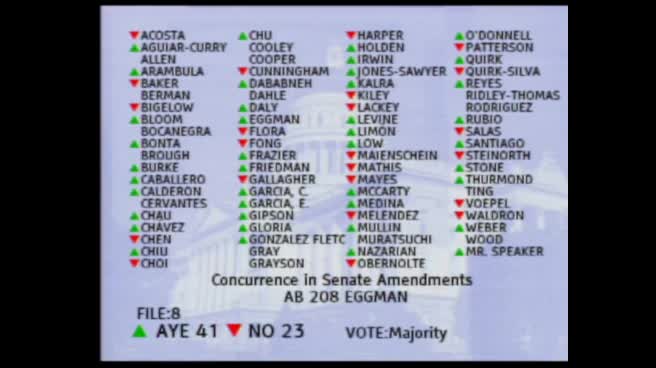 1MIN
Assembly Floor
 1MIN
Senate Floor
 1H
Senate Standing Committee on Appropriations
 3MIN
Senate Standing Committee on Governance and Finance
 2MIN
Assembly Floor
 22MIN
Assembly Standing Committee on Revenue and Taxation
Bill Author

Bill Co-Author(s):