AB 1206: Vehicles: impoundment: pilot program.
- Session Year: 2017-2018
- House: Assembly
- Latest Version Date: 2017-10-06
Existing law authorizes a city or county to adopt an ordinance declaring a motor vehicle to be a public nuisance subject to seizure and an impoundment of up to 30 days if the vehicle is used in the commission or attempted commission of the crimes of pimping, pandering, and soliciting, or agreeing to engage in, or engaging in, any act of prostitution, or illegal dumping of commercial quantities of waste matter upon a public or private highway or road, and the owner or operator of the vehicle had a prior conviction for the same offense within the past 3 years.
This bill would authorize the Cities of Los Angeles, Oakland, and Sacramento to conduct a 24-month pilot program in which law enforcement officers may remove a vehicle used in the commission, or attempted commission, of pimping, pandering, or solicitation of prostitution. The bill would require each of these cities, if they elect to implement the pilot program, to take specified actions, including, among others, offering a diversion program to prostitutes cited or arrested in the course of the pilot program. The bill would require any ordinance adopted by each of these cities to include specified procedural guidelines for the removal and retrieval of vehicles. The bill would require each of these cities, within 6 months of the completion of the pilot program, to issue a report, as specified. The bill would repeal these provisions on January 1, 2022.
Existing law authorizes a city or county to adopt an ordinance declaring a motor vehicle to be a public nuisance subject to seizure and an impoundment of up to 30 days if the vehicle is used in the commission or attempted commission of the crimes of pimping, pandering, and soliciting, or agreeing to engage in, or engaging in, any act of prostitution, or illegal dumping of commercial quantities of waste matter upon a public or private highway or road, and the owner or operator of the vehicle had a prior conviction for the same offense within the past 3 years.
This bill would authorize the Cities of Los Angeles and Oakland Angeles, Oakland, and Sacramento to conduct a 24-month pilot program in which law enforcement officers may remove a vehicle used in the commission, or attempted commission, of pimping, pandering, or solicitation of prostitution. The bill would require each of these cities, if they elect to implement the pilot program, to take specified actions, including, among others, offering a diversion program to prostitutes cited or arrested in the course of the pilot program. The bill would require any ordinance adopted by each of these cities to include specified procedural guidelines for the removal and retrieval of vehicles. The bill would require each of these cities, within 6 months of the completion of the pilot program, to issue a report, as specified. The bill would repeal these provisions on January 1, 2022.
Existing law authorizes a city or county to adopt an ordinance declaring a motor vehicle to be a public nuisance subject to seizure and an impoundment of up to 30 days if the vehicle is used in the commission or attempted commission of the crimes of pimping, pandering, and soliciting, or agreeing to engage in, or engaging in, any act of prostitution, or illegal dumping of commercial quantities of waste matter upon a public or private highway or road, and the owner or operator of the vehicle had a prior conviction for the same offense within the past 3 years.
This bill would authorize the City Cities of Los Angeles and Oakland to conduct a 24-month pilot program in which law enforcement officers may impound remove a vehicle used in the commission, or attempted commission, of pimping, pandering, or solicitation of prostitution. The bill would require the city, if it elects each of these cities, if they elect to implement the pilot program, to take specified actions, including, among others, offering a diversion program to prostitutes cited or arrested in the course of the pilot program. The bill would require any ordinance adopted by the City of Los Angeles pursuant to the bill each of these cities to include specified procedural guidelines for the impoundment removal and release retrieval of vehicles. The bill would require the city, each of these cities, within 6 months of the completion of the pilot program program, to issue a report, as specified. The bill would repeal these provisions on January 1, 2022.
Existing law authorizes a city or county to adopt an ordinance declaring a motor vehicle to be a public nuisance subject to seizure and an impoundment of up to 30 days if the vehicle is used in the commission or attempted commission of the crimes of pimping, pandering, and soliciting, or agreeing to engage in, or engaging in, any act of prostitution, or illegal dumping of commercial quantities of waste matter upon a public or private highway or road, and the owner or operator of the vehicle had a prior conviction for the same offense within the past 3 years.
This bill would authorize the City of Los Angeles to conduct a 24-month pilot program in which law enforcement officers may impound a vehicle used in the commission, or attempted commission, of pimping, pandering, or solicitation of prostitution. The bill would require the city, if it elects to implement the pilot program, to take specified actions, including, among others, offering a diversion program to prostitutes cited or arrested in the course of the pilot program. The bill would require any ordinance adopted by the City of Los Angeles pursuant to the bill to include specified procedural guidelines for the impoundment and release of vehicles. The bill would require the city, within 6 months of the completion of the pilot program to issue a report, as specified. The bill would repeal these provisions on January 1, 2022.
Existing law authorizes a city or county to adopt an ordinance declaring a motor vehicle to be a public nuisance subject to seizure and an impoundment of up to 30 days if the vehicle is used in the commission or attempted commission of the crimes of pimping, pandering, and soliciting, or agreeing to engage in, or engaging in, any act of prostitution, or illegal dumping of commercial quantities of waste matter upon a public or private highway or road, and the owner or operator of the vehicle had a prior conviction for the same offense within the past 3 years.
This bill would delete the requirement that the ordinance could have authorize the seizure and impoundment of a vehicle if the owner or operator of the vehicle had a prior conviction for the same offense within the past 3 years. authorize the City of Los Angeles to conduct a 24-month pilot program in which law enforcement officers may impound a vehicle used in the commission, or attempted commission, of pimping, pandering, or solicitation of prostitution. The bill would require the city, if it elects to implement the pilot program, to take specified actions, including, among others, offering a diversion program to prostitutes cited or arrested in the course of the pilot program. The bill would require the city, within 6 months of the completion of the pilot program to issue a report, as specified. The bill would repeal these provisions on January 1, 2022.
Existing law authorizes a city or county to adopt an ordinance declaring a motor vehicle to be a public nuisance subject to seizure and an impoundment of up to 30 days if the vehicle is used in the commission or attempted commission of the crimes of pimping, pandering, and soliciting, or agreeing to engage in, or engaging in, any act of prostitution, or illegal dumping of commercial quantities of waste matter upon a public or private highway or road, and the owner or operator of the vehicle had a prior conviction for the same offense within the past 3 years.
This bill would delete the requirement that the ordinance could have authorize the seizure and impoundment of a vehicle if the owner or operator of the vehicle had a prior conviction for the same offense within the past 3 years.
(a)Notwithstanding any other law, the Cities of Los Angeles, Oakland, and Sacramento may each adopt an ordinance to conduct a 24-month pilot program in which law enforcement officers of the city may, pursuant to a valid arrest, remove a vehicle used in the commission, or attempted commission, of pimping in violation of Section 266h of the Penal Code, pandering in violation of Section 266i of the Penal Code, or solicitation of prostitution in violation of paragraph (2) or (3) of subdivision (b) of Section 647 of the Penal Code.
(b)If either city elects to implement the pilot program described in subdivision (a), it shall do all of the following:
(1)Offer a diversion program to prostitutes cited or arrested in the course of the pilot program.
(2)Authorize the removal of a vehicle only if the individual committing, or attempting to commit, a crime described in subdivision (a) is the sole registered owner of the vehicle. If that individual is not the sole registered owner, the other registered owner or owners of the vehicle shall be provided an opportunity to take possession of the vehicle.
(3)Reimburse an individual for the costs associated with towing and impounding the vehicle if he or she is not found guilty of the crime for which the vehicle was impounded or if the charge of committing, or attempting to commit, the crime for which the vehicle was impounded was dismissed.
(c)(1)Within six months of the completion of the pilot program described in subdivision (a), each of the participating cities shall issue a report that describes, at a minimum, all of the following:
(A)The number of individuals cited, and the number of individuals arrested, during the pilot program for the commission, or attempted commission, of a crime described in subdivision (a).
(B)The number of vehicles towed during the pilot program because they were used in the commission, or attempted commission, of a crime described in subdivision (a).
(C)The number of minor victims of a crime described in subdivision (a) that law enforcement encountered during the course of the pilot program.
(D)Whether the implementation of the pilot program impacted the number of citations or arrests for commission, or attempted commission, of a crime described in subdivision (a).
(2)(A)The report described in paragraph (1) shall be submitted to the Legislature, including the Chairs of the Senate and Assembly Committees on Public Safety, the Senate President pro Tempore, and the Speaker of the Assembly, and to the Governor and Attorney General.
(B)A report to be submitted pursuant to subparagraph (A) shall be submitted in compliance with Section 9795 of the Government Code.
(d)An ordinance adopted pursuant to this section shall contain, but not be limited to, the following provisions:
(1)At the time of arrest, the person shall be notified that his or her vehicle will be towed and given information on how the vehicle may be retrieved.
(2)The registered owner or his or her agent may retrieve the vehicle at any time.
(3)The registered owner or his or her agent is responsible for all towing and storage fees related to the seizure of a vehicle pursuant to this section.
(4)If a vehicle is not claimed by the registered owner within 30 days and the legal owner is a motor vehicle dealer, bank, credit union, acceptance corporation, or other licensed financial institution legally operating in this state, or is another person who is not the registered owner but holds a security interest in the vehicle, the legal owner shall be given notice that the car has been seized and shall be given an opportunity to retrieve the vehicle. The vehicle shall be released to the legal owner upon payment of all towing and storage fees due.
(e)This section shall not be construed to limit the authority of any peace officer to impound a vehicle pursuant to any applicable provision of this code.
(f)This section shall remain in effect only until January 1, 2022, and as of that date is repealed.
(a)Notwithstanding any other law, the Cities of Los Angeles and Oakland Angeles, Oakland, and Sacramento may each adopt an ordinance to conduct a 24-month pilot program in which law enforcement officers of the city may, pursuant to a valid arrest, remove a vehicle used in the commission, or attempted commission, of pimping in violation of Section 266h of the Penal Code, pandering in violation of Section 266i of the Penal Code, or solicitation of prostitution in violation of paragraph (2) or (3) of subdivision (b) of Section 647 of the Penal Code.
(b)If either city elects to implement the pilot program described in subdivision (a), it shall do all of the following:
(1)Offer a diversion program to prostitutes cited or arrested in the course of the pilot program.
(2)Authorize the removal of a vehicle only if the individual committing, or attempting to commit, a crime described in subdivision (a) is the sole registered owner of the vehicle. If that individual is not the sole registered owner, the other registered owner or owners of the vehicle shall be provided an opportunity to take possession of the vehicle.
(3)Reimburse an individual for the costs associated with towing and impounding the vehicle if he or she is not found guilty of the crime for which the vehicle was impounded or if the charge of committing, or attempting to commit, the crime for which the vehicle was impounded was dismissed.
(c)(1)Within six months of the completion of the pilot program described in subdivision (a), each of the participating cities shall issue a report that describes, at a minimum, all of the following:
(A)The number of individuals cited, and the number of individuals arrested, during the pilot program for the commission, or attempted commission, of a crime described in subdivision (a).
(B)The number of vehicles towed during the pilot program because they were used in the commission, or attempted commission, of a crime described in subdivision (a).
(C)The number of minor victims of a crime described in subdivision (a) that law enforcement encountered during the course of the pilot program.
(D)Whether the implementation of the pilot program impacted the number of citations or arrests for commission, or attempted commission, of a crime described in subdivision (a).
(2)(A)The report described in paragraph (1) shall be submitted to the Legislature, including the Chairs of the Senate and Assembly Committees on Public Safety, the Senate President pro Tempore, and the Speaker of the Assembly, and to the Governor and Attorney General.
(B)A report to be submitted pursuant to subparagraph (A) shall be submitted in compliance with Section 9795 of the Government Code.
(d)An ordinance adopted pursuant to this section shall contain, but not be limited to, the following provisions:
(1)At the time of arrest, the person shall be notified that his or her vehicle will be towed and given information on how the vehicle may be retrieved.
(2)The registered owner or his or her agent may retrieve the vehicle at any time.
(3)The registered owner or his or her agent is responsible for all towing and storage fees related to the seizure of a vehicle pursuant to this section.
(4)If a vehicle is not claimed by the registered owner within 30 days and the legal owner is a motor vehicle dealer, bank, credit union, acceptance corporation, or other licensed financial institution legally operating in this state, or is another person who is not the registered owner but holds a security interest in the vehicle, the legal owner shall be given notice that the car has been seized and shall be given an opportunity to retrieve the vehicle. The vehicle shall be released to the legal owner upon payment of all towing and storage fees due.
(e)This section shall not be construed to limit the authority of any peace officer to impound a vehicle pursuant to any applicable provision of this code.
(f)This section shall remain in effect only until January 1, 2022, and as of that date is repealed.
(a)Notwithstanding any other law, the City of Los Angeles Cities of Los Angeles and Oakland may each adopt an ordinance to conduct a 24-month pilot program in which law enforcement officers of the city may, pursuant to a valid arrest, impound for up to 30 days, remove a vehicle used in the commission, or attempted commission, of pimping in violation of Section 266h of the Penal Code, pandering in violation of Section 266i of the Penal Code, or solicitation of prostitution in violation of paragraph (2) or (3) of subdivision (b) of Section 647 of the Penal Code.
(b)If the City of Los Angeles either city elects to implement the pilot program described in subdivision (a), it shall do all of the following:
(1)Offer a diversion program to prostitutes cited or arrested in the course of the pilot program.
(2)Authorize the impoundment removal of a vehicle only if the individual committing, or attempting to commit, a crime described in subdivision (a) is the sole registered owner of the vehicle. If that individual is not the sole registered owner, the other registered owner or owners of the vehicle shall be provided an opportunity to take possession of the vehicle.
(3)Reimburse an individual for the costs associated with towing and impounding the vehicle if he or she is not found guilty of the crime for which the vehicle was impounded or if the charge of committing, or attempting to commit, the crime for which the vehicle was impounded was dismissed.
(c)(1)Within six months of the completion of the pilot program described in subdivision (a), the City of Los Angeles each of the participating cities shall issue a report that describes, at a minimum, all of the following:
(A)The number of individuals cited, and the number of individuals arrested, during the pilot program for the commission, or attempted commission, of a crime described in subdivision (a).
(B)The number of vehicles impounded towed during the pilot program because they were used in the commission, or attempted commission, of a crime described in subdivision (a).
(C)The number of minor victims of a crime described in subdivision (a) that law enforcement encountered during the course of the pilot program.
(D)Whether the implementation of the pilot program impacted the number of citations or arrests for commission, or attempted commission, of a crime described in subdivision (a).
(2)(A)The report described in paragraph (1) shall be submitted to the Legislature, including the Chairs of the Senate and Assembly Committees on Public Safety, the Senate President pro Tempore, and the Speaker of the Assembly, and to the Governor and Attorney General.
(B)A report to be submitted pursuant to subparagraph (A) shall be submitted in compliance with Section 9795 of the Government Code.
(d)An ordinance adopted pursuant to this section shall contain, but not be limited to, the following provisions:
(1)Within two working days after impoundment, the impounding agency shall send a notice by certified mail, return receipt requested, to all legal and registered owners of the vehicle, at the addresses obtained from the department, informing them that the vehicle has been impounded. The notice shall also include notice of the opportunity for a poststorage hearing to determine the validity of the storage or to determine mitigating circumstances establishing that the vehicle should be released. The impounding agency shall be prohibited from charging for more than five days storage if it fails to notify the owners within two working days after the impoundment when an owner redeems the impounded vehicle. The impounding agency shall maintain a published telephone number that provides information 24 hours a day regarding the impoundment of vehicles and the rights of a legal owner and a registered owner to request a hearing. The notice shall include all of the following information:(A)The name, address, and telephone number of the agency providing the notice.(B)The location of the place of storage and description of the vehicle, that shall include, if available, the model or make, the manufacturer, the license plate number, and the mileage.(C)The authority and purpose for the removal of the vehicle.(D)A statement that, in order to receive a poststorage hearing, the owners, or their agents, shall request the hearing in person, writing, or by telephone within 10 days of the date appearing on the notice.(2)The poststorage hearing shall be conducted within 48 hours of the request, excluding weekends and holidays. The public agency may authorize one of its own officers or employees to conduct the hearing if that hearing officer is not the same person who directed the seizure of the vehicle.(3)Failure of the legal and the registered owners, or their agents, to request or to attend a scheduled hearing shall satisfy the poststorage hearing requirement.(4)The agency employing the person who directed the storage shall be responsible for the costs incurred for towing and storage if it is determined in the poststorage hearing that reasonable grounds for the storage are not established.(5)Any period during which a vehicle is subjected to storage under an ordinance adopted pursuant to this section shall be included as part of the period of impoundment.(6)The impounding agency shall release the vehicle to the registered owner or his or her agent prior to the end of the impoundment period under any of the following circumstances:(A)The driver of the impounded vehicle was arrested without probable cause.(B)The vehicle is a stolen vehicle.(C)The vehicle is subject to bailment and was driven by an unlicensed employee of a business establishment, including a parking service or repair garage.(D)The driver of the vehicle is not the sole registered owner of the vehicle and the vehicle is being released to another registered owner of the vehicle who agrees not to allow the driver to use the vehicle until after the end of the impoundment period.(E)The registered owner of the vehicle was neither the driver nor a passenger of the vehicle at the time of the alleged violation, or was unaware that the driver was using the vehicle to engage in activities subject to Section 266h or 266i of, or solicitation of prostitution in violation of paragraph (2) or (3) of subdivision (b) of Section 647 of, the Penal Code.(F)A spouse, registered domestic partner, or other affected third party objects to the impoundment of the vehicle on the grounds that it would create a hardship if the subject vehicle is the sole vehicle in a household. The hearing officer shall release the vehicle where the hardship to a spouse, registered domestic partner, or other affected third party created by the impoundment of the subject vehicle, or the length of the impoundment, outweighs the seriousness and the severity of the act in which the vehicle was used.(7)Notwithstanding any provision of law, if a motor vehicle is released prior to the conclusion of the impoundment period because the driver was arrested without probable cause, neither the arrested person nor the registered owner of the motor vehicle shall be responsible for the towing and storage charges.(8)Except as provided in paragraph (7), the registered owner or his or her agent shall be responsible for all towing and storage charges related to the impoundment.(9)A vehicle removed and seized under an ordinance adopted pursuant to this section may be released to the legal owner of the vehicle or the legal owners agent prior to the end of the impoundment period if both of the following conditions are met:(A)The legal owner is a motor vehicle dealer, bank, credit union, acceptance corporation, or other licensed financial institution legally operating in this state, or is another person who is not the registered owner and holds a security interest in the vehicle.(B)The legal owner or the legal owners agent pays all towing and storage fees related to the seizure and impoundment of the vehicle.(10)(A)A lien sale processing fee shall not be charged to the legal owner who redeems the vehicle prior to the 15th day of the impoundment period. Neither the impounding authority nor any person having possession of the vehicle shall collect from the legal owner as described in subparagraph (A) of paragraph (9), or the legal owners agent, any administrative charges imposed pursuant to Section 22850.5, unless the legal owner voluntarily requested a poststorage hearing.(B)A person operating or in charge of a storage facility where vehicles are stored pursuant to this section shall accept a valid bank credit card, debit card, or cash for payment of towing, storage, and related fees by a legal or registered owner or the owners agent claiming the vehicle. A credit card or debit card shall be in the name of the person presenting the card. As used in this subparagraph, credit card is as defined in subdivision (a) of Section 1747.02 of the Civil Code and does not include a credit card issued by a retail seller, and debit card is as defined in Section 1748.30 of the Civil Code.(C)A person operating or in charge of a storage facility described in subparagraph (B) who violates subparagraph (B) shall be civilly liable to the owner of the vehicle or the person who tendered the fees for four times the amount of the towing, storage, and related fees, not to exceed five hundred dollars ($500).(D)A person operating or in charge of the storage facility described in subparagraph (B) shall have sufficient funds on the premises of the primary storage facility during normal business hours to accommodate, and make change for, a reasonable monetary transaction.(E)Credit charges for towing and storage services shall comply with Section 1748.1 of the Civil Code. Law enforcement agencies may include the costs of providing for payment by credit when making agreements with towing companies on rates.(F)A failure by a storage facility to comply with any applicable conditions set forth in this subdivision shall not affect the right of the legal owner or the legal owners agent to retrieve the vehicle if all conditions required of the legal owner or legal owners agent under this subdivision are satisfied.(11)(A)The legal owner or the legal owners agent shall present to the law enforcement agency, impounding agency, person in possession of the vehicle, or any person acting on behalf of those agencies, a copy of the assignment, as defined in subdivision (b) of Section 7500.1 of the Business and Professions Code, a release from the one responsible governmental agency, only if required by the agency, a government-issued photographic identification card, and any one of the following as determined by the legal owner or the legal owners agent: a certificate of repossession for the vehicle, a security agreement for the vehicle, or a certificate of title, whether paperless or electronic, showing proof of legal ownership for the vehicle. Any documents presented may be originals, photocopies, or facsimile copies, or may be transmitted electronically. The law enforcement agency, impounding agency, or other governmental agency, or any person acting on behalf of those agencies, shall not require any documents to be notarized. The law enforcement agency, impounding agency, or any person acting on behalf of those agencies may require the agent of the legal owner to produce a photocopy or facsimile copy of its repossession agency license or registration issued pursuant to Chapter 11 (commencing with Section 7500) of Division 3 of the Business and Professions Code, or to demonstrate, to the satisfaction of the law enforcement agency, impounding agency, or any person acting on behalf of those agencies that the agent is exempt from licensure pursuant to Section 7500.2 or 7500.3 of the Business and Professions Code.(B)Administrative costs authorized under subdivision (a) of Section 22850.5 shall not be charged to the legal owner of the type specified in subparagraph (A) of paragraph (9) who redeems the vehicle unless the legal owner voluntarily requests a poststorage hearing. A city, county, city and county, or state agency shall not require a legal owner or a legal owners agent to request a poststorage hearing as a requirement for release of the vehicle to the legal owner or the legal owners agent. The law enforcement agency, impounding agency, or other governmental agency, or any person acting on behalf of those agencies, shall not require any documents other than those specified in this paragraph. The legal owner or the legal owners agent shall be given a copy of any documents he or she is required to sign, except for a vehicle evidentiary hold log book. The law enforcement agency, impounding agency, or any person acting on behalf of those agencies, or any person in possession of the vehicle, may photocopy and retain the copies of any documents presented by the legal owner or legal owners agent. The legal owner shall indemnify and hold harmless a storage facility from any claims arising out of the release of the vehicle to the legal owner or the legal owners agent and from any damage to the vehicle after its release, including the reasonable costs associated with defending any such claims.(12)A legal owner, who meets the requirements for release of a vehicle pursuant to paragraph (9), or the legal owners agent, shall not be required to request a poststorage hearing as a requirement for release of the vehicle to the legal owner or the legal owners agent.(13)(A)A legal owner, who meets the requirements for release of a vehicle pursuant to paragraph (9), or the legal owners agent, shall not release the vehicle to the registered owner of the vehicle or an agent of the registered owner, unless the registered owner is a rental car agency, until after the termination of the impoundment period.(B)Prior to relinquishing the vehicle, the legal owner may require the registered owner to pay all towing and storage charges related to the seizure and impoundment.(14)(A)A vehicle removed and seized pursuant to an ordinance adopted pursuant to this section shall be released to a rental car agency prior to the end of the impoundment period if the agency is either the legal owner or registered owner of the vehicle and the agency pays all towing and storage fees related to the seizure and impoundment of the vehicle.(B)The owner of a rental vehicle that was seized under an ordinance adopted pursuant to this section may continue to rent the vehicle upon recovery of the vehicle. However, the rental car agency shall not rent another vehicle to the driver of the vehicle that was seized until the impoundment period has expired.(C)The rental car agency may require the person to whom the vehicle was rented to pay all towing and storage charges related to the seizure and impoundment.(1)At the time of arrest, the person shall be notified that his or her vehicle will be towed and given information on how the vehicle may be retrieved.
(2)The registered owner or his or her agent may retrieve the vehicle at any time.
(3)The registered owner or his or her agent is responsible for all towing and storage fees related to the seizure of a vehicle pursuant to this section.
(4)If a vehicle is not claimed by the registered owner within 30 days and the legal owner is a motor vehicle dealer, bank, credit union, acceptance corporation, or other licensed financial institution legally operating in this state, or is another person who is not the registered owner but holds a security interest in the vehicle, the legal owner shall be given notice that the car has been seized and shall be given an opportunity to retrieve the vehicle. The vehicle shall be released to the legal owner upon payment of all towing and storage fees due.
(e)This section shall not be construed to limit the authority of any peace officer to impound a vehicle pursuant to any applicable provision of this code.
(e)(f)This section shall remain in effect only until January 1, 2022, and as of that date is repealed.
(a)Notwithstanding any other law, the City of Los Angeles may adopt an ordinance to conduct a 24-month pilot program in which law enforcement officers of the city may may, pursuant to a valid arrest, impound for up to 30 days, a vehicle used in the commission, or attempted commission, of pimping in violation of Section 266h of the Penal Code, pandering in violation of Section 266i of the Penal Code, or solicitation of prostitution in violation of paragraph (2) or (3) of subdivision (b) of Section 647 of the Penal Code.
(b)If the City of Los Angeles elects to implement the pilot program described in subdivision (a), it shall do all of the following:
(1)Offer a diversion program to prostitutes cited or arrested in the course of the pilot program.
(2)Authorize the impoundment of a vehicle only if the individual committing, or attempting to commit, a crime described in subdivision (a) is the sole registered owner of the vehicle. If that individual is not the sole registered owner, the other registered owner or owners of the vehicle shall be provided an opportunity to take possession of the vehicle.
(3)Reimburse an individual for the costs associated with towing and impounding the vehicle if he or she is not found guilty of the crime for which the vehicle was impounded or if the charge of committing, or attempting to commit, the crime for which the vehicle was impounded was dismissed.
(c)(1)Within six months of the completion of the pilot program described in subdivision (a), the City of Los Angeles shall issue a report the that describes, at a minimum, all of the following:
(A)The number of individuals cited, and the number of individuals arrested, during the pilot program for the commission, or attempted commission, of a crime described in subdivision (a).
(B)The number of vehicles impounded during the pilot program because they were used in the commission, or attempted commission, of a crime described in subdivision (a).
(C)The number of minor victims of a crime described in subdivision (a) that law enforcement encountered during the course of the pilot program.
(D)Whether the implementation of the pilot program impacted the number of citations or arrests for commission, or attempted commission, of a crime described in subdivision (a).
(2)(A)The report described in paragraph (1) shall be submitted to the Legislature, including the Chairs of the Senate and Assembly Committees on Public Safety, the Senate Pro Tem, President pro Tempore, and the Speaker of the Assembly, and to the Governor and Attorney General.
(B)A report to be submitted pursuant to subparagraph (A) shall be submitted in compliance with Section 9795 of the Government Code.
(d)An ordinance adopted pursuant to this section shall contain, but not be limited to, the following provisions:
(1)Within two working days after impoundment, the impounding agency shall send a notice by certified mail, return receipt requested, to all legal and registered owners of the vehicle, at the addresses obtained from the department, informing them that the vehicle has been impounded. The notice shall also include notice of the opportunity for a poststorage hearing to determine the validity of the storage or to determine mitigating circumstances establishing that the vehicle should be released. The impounding agency shall be prohibited from charging for more than five days storage if it fails to notify the owners within two working days after the impoundment when an owner redeems the impounded vehicle. The impounding agency shall maintain a published telephone number that provides information 24 hours a day regarding the impoundment of vehicles and the rights of a legal owner and a registered owner to request a hearing. The notice shall include all of the following information:
(A)The name, address, and telephone number of the agency providing the notice.
(B)The location of the place of storage and description of the vehicle, that shall include, if available, the model or make, the manufacturer, the license plate number, and the mileage.
(C)The authority and purpose for the removal of the vehicle.
(D)A statement that, in order to receive a poststorage hearing, the owners, or their agents, shall request the hearing in person, writing, or by telephone within 10 days of the date appearing on the notice.
(2)The poststorage hearing shall be conducted within 48 hours of the request, excluding weekends and holidays. The public agency may authorize one of its own officers or employees to conduct the hearing if that hearing officer is not the same person who directed the seizure of the vehicle.
(3)Failure of the legal and the registered owners, or their agents, to request or to attend a scheduled hearing shall satisfy the poststorage hearing requirement.
(4)The agency employing the person who directed the storage shall be responsible for the costs incurred for towing and storage if it is determined in the poststorage hearing that reasonable grounds for the storage are not established.
(5)Any period during which a vehicle is subjected to storage under an ordinance adopted pursuant to this section shall be included as part of the period of impoundment.
(6)The impounding agency shall release the vehicle to the registered owner or his or her agent prior to the end of the impoundment period under any of the following circumstances:
(A)The driver of the impounded vehicle was arrested without probable cause.
(B)The vehicle is a stolen vehicle.
(C)The vehicle is subject to bailment and was driven by an unlicensed employee of a business establishment, including a parking service or repair garage.
(D)The driver of the vehicle is not the sole registered owner of the vehicle and the vehicle is being released to another registered owner of the vehicle who agrees not to allow the driver to use the vehicle until after the end of the impoundment period.
(E)The registered owner of the vehicle was neither the driver nor a passenger of the vehicle at the time of the alleged violation, or was unaware that the driver was using the vehicle to engage in activities subject to Section 266h or 266i of, or solicitation of prostitution in violation of paragraph (2) or (3) of subdivision (b) of Section 647 of, the Penal Code.
(F)A spouse, registered domestic partner, or other affected third party objects to the impoundment of the vehicle on the grounds that it would create a hardship if the subject vehicle is the sole vehicle in a household. The hearing officer shall release the vehicle where the hardship to a spouse, registered domestic partner, or other affected third party created by the impoundment of the subject vehicle, or the length of the impoundment, outweighs the seriousness and the severity of the act in which the vehicle was used.
(7)Notwithstanding any provision of law, if a motor vehicle is released prior to the conclusion of the impoundment period because the driver was arrested without probable cause, neither the arrested person nor the registered owner of the motor vehicle shall be responsible for the towing and storage charges.
(8)Except as provided in paragraph (7), the registered owner or his or her agent shall be responsible for all towing and storage charges related to the impoundment.
(9)A vehicle removed and seized under an ordinance adopted pursuant to this section may be released to the legal owner of the vehicle or the legal owners agent prior to the end of the impoundment period if both of the following conditions are met:
(A)The legal owner is a motor vehicle dealer, bank, credit union, acceptance corporation, or other licensed financial institution legally operating in this state, or is another person who is not the registered owner and holds a security interest in the vehicle.
(B)The legal owner or the legal owners agent pays all towing and storage fees related to the seizure and impoundment of the vehicle.
(10)(A)A lien sale processing fee shall not be charged to the legal owner who redeems the vehicle prior to the 15th day of the impoundment period. Neither the impounding authority nor any person having possession of the vehicle shall collect from the legal owner as described in subparagraph (A) of paragraph (9), or the legal owners agent, any administrative charges imposed pursuant to Section 22850.5, unless the legal owner voluntarily requested a poststorage hearing.
(B)A person operating or in charge of a storage facility where vehicles are stored pursuant to this section shall accept a valid bank credit card, debit card, or cash for payment of towing, storage, and related fees by a legal or registered owner or the owners agent claiming the vehicle. A credit card or debit card shall be in the name of the person presenting the card. As used in this subparagraph, credit card is as defined in subdivision (a) of Section 1747.02 of the Civil Code and does not include a credit card issued by a retail seller, and debit card is as defined in Section 1748.30 of the Civil Code.
(C)A person operating or in charge of a storage facility described in subparagraph (B) who violates subparagraph (B) shall be civilly liable to the owner of the vehicle or the person who tendered the fees for four times the amount of the towing, storage, and related fees, not to exceed five hundred dollars ($500).
(D)A person operating or in charge of the storage facility described in subparagraph (B) shall have sufficient funds on the premises of the primary storage facility during normal business hours to accommodate, and make change for, a reasonable monetary transaction.
(E)Credit charges for towing and storage services shall comply with Section 1748.1 of the Civil Code. Law enforcement agencies may include the costs of providing for payment by credit when making agreements with towing companies on rates.
(F)A failure by a storage facility to comply with any applicable conditions set forth in this subdivision shall not affect the right of the legal owner or the legal owners agent to retrieve the vehicle if all conditions required of the legal owner or legal owners agent under this subdivision are satisfied.
(11)(A)The legal owner or the legal owners agent shall present to the law enforcement agency, impounding agency, person in possession of the vehicle, or any person acting on behalf of those agencies, a copy of the assignment, as defined in subdivision (b) of Section 7500.1 of the Business and Professions Code, a release from the one responsible governmental agency, only if required by the agency, a government-issued photographic identification card, and any one of the following as determined by the legal owner or the legal owners agent: a certificate of repossession for the vehicle, a security agreement for the vehicle, or a certificate of title, whether paperless or electronic, showing proof of legal ownership for the vehicle. Any documents presented may be originals, photocopies, or facsimile copies, or may be transmitted electronically. The law enforcement agency, impounding agency, or other governmental agency, or any person acting on behalf of those agencies, shall not require any documents to be notarized. The law enforcement agency, impounding agency, or any person acting on behalf of those agencies may require the agent of the legal owner to produce a photocopy or facsimile copy of its repossession agency license or registration issued pursuant to Chapter 11 (commencing with Section 7500) of Division 3 of the Business and Professions Code, or to demonstrate, to the satisfaction of the law enforcement agency, impounding agency, or any person acting on behalf of those agencies that the agent is exempt from licensure pursuant to Section 7500.2 or 7500.3 of the Business and Professions Code.
(B)Administrative costs authorized under subdivision (a) of Section 22850.5 shall not be charged to the legal owner of the type specified in subparagraph (A) of paragraph (9) who redeems the vehicle unless the legal owner voluntarily requests a poststorage hearing. A city, county, city and county, or state agency shall not require a legal owner or a legal owners agent to request a poststorage hearing as a requirement for release of the vehicle to the legal owner or the legal owners agent. The law enforcement agency, impounding agency, or other governmental agency, or any person acting on behalf of those agencies, shall not require any documents other than those specified in this paragraph. The legal owner or the legal owners agent shall be given a copy of any documents he or she is required to sign, except for a vehicle evidentiary hold log book. The law enforcement agency, impounding agency, or any person acting on behalf of those agencies, or any person in possession of the vehicle, may photocopy and retain the copies of any documents presented by the legal owner or legal owners agent. The legal owner shall indemnify and hold harmless a storage facility from any claims arising out of the release of the vehicle to the legal owner or the legal owners agent and from any damage to the vehicle after its release, including the reasonable costs associated with defending any such claims.
(12)A legal owner, who meets the requirements for release of a vehicle pursuant to paragraph (9), or the legal owners agent, shall not be required to request a poststorage hearing as a requirement for release of the vehicle to the legal owner or the legal owners agent.
(13)(A)A legal owner, who meets the requirements for release of a vehicle pursuant to paragraph (9), or the legal owners agent, shall not release the vehicle to the registered owner of the vehicle or an agent of the registered owner, unless the registered owner is a rental car agency, until after the termination of the impoundment period.
(B)Prior to relinquishing the vehicle, the legal owner may require the registered owner to pay all towing and storage charges related to the seizure and impoundment.
(14)(A)A vehicle removed and seized pursuant to an ordinance adopted pursuant to this section shall be released to a rental car agency prior to the end of the impoundment period if the agency is either the legal owner or registered owner of the vehicle and the agency pays all towing and storage fees related to the seizure and impoundment of the vehicle.
(B)The owner of a rental vehicle that was seized under an ordinance adopted pursuant to this section may continue to rent the vehicle upon recovery of the vehicle. However, the rental car agency shall not rent another vehicle to the driver of the vehicle that was seized until the impoundment period has expired.
(C)The rental car agency may require the person to whom the vehicle was rented to pay all towing and storage charges related to the seizure and impoundment.
(d)(e)This section shall remain in effect only until January 1, 2022, and as of that date is repealed.
(a)Notwithstanding any other law, the City of Los Angeles may adopt an ordinance to conduct a 24-month pilot program in which law enforcement officers of the city may impound a vehicle used in the commission, or attempted commission, of pimping in violation of Section 266h of the Penal Code, pandering in violation of Section 266i of the Penal Code, or solicitation of prostitution in violation of paragraph (2) or (3) of subdivision (b) of Section 647 of the Penal Code.
(b)If the City of Los Angeles elects to implement the pilot program described in subdivision (a), it shall do all of the following:
(1)Offer a diversion program to prostitutes cited or arrested in the course of the pilot program.
(2)Authorize the impoundment of a vehicle only if the individual committing, or attempting to commit, a crime described in subdivision (a) is the sole owner of the vehicle. If that individual is not the sole owner, the other owner or owners of the vehicle shall be provided an opportunity to take possession of the vehicle.
(3)Reimburse an individual for the costs associated with towing and impounding the vehicle if he or she is not found guilty of the crime for which the vehicle was impounded or if the charge of committing, or attempting to commit, the crime for which the vehicle was impounded was dismissed.
(c)(1)Within six months of the completion of the pilot program described in subdivision (a), the City of Los Angeles shall issue a report the describes, at a minimum, all of the following:
(A)The number of individuals cited, and the number of individuals arrested, during the pilot program for the commission, or attempted commission, of a crime described in subdivision (a).
(B)The number of vehicles impounded during the pilot program because they were used in the commission, or attempted commission, of a crime described in subdivision (a).
(C)The number of minor victims of a crime described in subdivision (a) that law enforcement encountered during the course of the pilot program.
(D)Whether the implementation of the pilot program impacted the number of citations or arrests for commission, or attempted commission, of a crime described in subdivision (a).
(2)(A)The report described in paragraph (1) shall be submitted to the Legislature, including the Chairs of the Senate and Assembly Committees on Public Safety, the Senate Pro Tem, and the Speaker of the Assembly, and to the Governor and Attorney General.
(B)A report to be submitted pursuant to subparagraph (A) shall be submitted in compliance with Section 9795 of the Government Code.
(d)This section shall remain in effect only until January 1, 2022, and as of that date is repealed.
SECTION 1.Section 22659.5 of the Vehicle Code is amended to read:22659.5.Notwithstanding any other provision of law, a city or a county may adopt an ordinance declaring a motor vehicle to be a public nuisance subject to seizure and an impoundment period of up to 30 days when the motor vehicle is used in the commission or attempted commission of an act that violates Section 266h or 266i of, subdivision (h) of Section 374.3 of, or subdivision (b) of Section 647 of, the Penal Code. An ordinance adopted pursuant to this section may incorporate any combination or all of these offenses. The vehicle may only be impounded pursuant to a valid arrest of the driver for a violation of one of these provisions. An ordinance adopted pursuant to this section shall, at a minimum, contain all of the following provisions:(a)Within two working days after impoundment, the impounding agency shall send a notice by certified mail, return receipt requested, to the legal owner of the vehicle, at the address obtained from the department, informing the owner that the vehicle has been impounded. The notice shall also include notice of the opportunity for a poststorage hearing to determine the validity of the storage or to determine mitigating circumstances establishing that the vehicle should be released. The impounding agency shall be prohibited from charging for more than five days storage if it fails to notify the legal owner within two working days after the impoundment when the legal owner redeems the impounded vehicle. The impounding agency shall maintain a published telephone number that provides information 24 hours a day regarding the impoundment of vehicles and the rights of a legal owner and a registered owner to request a hearing. The notice shall include all of the following information:(1)The name, address, and telephone number of the agency providing the notice.(2)The location of the place of storage and description of the vehicle, that shall include, if available, the model or make, the manufacturer, the license plate number, and the mileage.(3)The authority and purpose for the removal of the vehicle.(4)A statement that, in order to receive a poststorage hearing, the owners, or their agents, shall request the hearing in person, writing, or by telephone within 10 days of the date appearing on the notice.(b)The poststorage hearing shall be conducted within 48 hours of the request, excluding weekends and holidays. The public agency may authorize one of its own officers or employees to conduct the hearing if that hearing officer is not the same person who directed the seizure of the vehicle.(c)Failure of the legal and the registered owners, or their agents, to request or to attend a scheduled hearing shall satisfy the poststorage hearing requirement.(d)The agency employing the person who directed the storage shall be responsible for the costs incurred for towing and storage if it is determined in the poststorage hearing that reasonable grounds for the storage are not established.(e)Any period during which a vehicle is subjected to storage under an ordinance adopted pursuant to this section shall be included as part of the period of impoundment.(f)The impounding agency shall release the vehicle to the registered owner or his or her agent prior to the end of the impoundment period under any of the following circumstances:(1)The driver of the impounded vehicle was arrested without probable cause.(2)The vehicle is a stolen vehicle.(3)The vehicle is subject to bailment and was driven by an unlicensed employee of a business establishment, including a parking service or repair garage.(4)The driver of the vehicle is not the sole registered owner of the vehicle and the vehicle is being released to another registered owner of the vehicle who agrees not to allow the driver to use the vehicle until after the end of the impoundment period.(5)The registered owner of the vehicle was neither the driver nor a passenger of the vehicle at the time of the alleged violation, or was unaware that the driver was using the vehicle to engage in activities subject to Section 266h or 266i of, or subdivision (b) of Section 647 of, the Penal Code.(6)A spouse, registered domestic partner, or other affected third party objects to the impoundment of the vehicle on the grounds that it would create a hardship if the subject vehicle is the sole vehicle in a household. The hearing officer shall release the vehicle where the hardship to a spouse, registered domestic partner, or other affected third party created by the impoundment of the subject vehicle, or the length of the impoundment, outweigh the seriousness and the severity of the act in which the vehicle was used.(g)Notwithstanding any provision of law, if a motor vehicle is released prior to the conclusion of the impoundment period because the driver was arrested without probable cause, neither the arrested person nor the registered owner of the motor vehicle shall be responsible for the towing and storage charges.(h)Except as provided in subdivision (g), the registered owner or his or her agent shall be responsible for all towing and storage charges related to the impoundment.(i)A vehicle removed and seized under an ordinance adopted pursuant to this section shall be released to the legal owner of the vehicle or the legal owners agent prior to the end of the impoundment period if both of the following conditions are met:(1)The legal owner is a motor vehicle dealer, bank, credit union, acceptance corporation, or other licensed financial institution legally operating in this state, or is another person who is not the registered owner and holds a security interest in the vehicle.(2)The legal owner or the legal owners agent pays all towing and storage fees related to the seizure and impoundment of the vehicle.(j)(1)No lien sale processing fees shall be charged to the legal owner who redeems the vehicle prior to the 15th day of the impoundment period. Neither the impounding authority nor any person having possession of the vehicle shall collect from the legal owner as described in paragraph (1) of subdivision (i), or the legal owners agent, any administrative charges imposed pursuant to Section 22850.5, unless the legal owner voluntarily requested a poststorage hearing.(2)A person operating or in charge of a storage facility where vehicles are stored pursuant to this section shall accept a valid bank credit card or cash for payment of towing, storage, and related fees by a legal or registered owner or the owners agent claiming the vehicle. A credit card or debit card shall be in the name of the person presenting the card. For purposes of this section, credit card is as defined in subdivision (a) of Section 1747.02 of the Civil Code. Credit card does not include a credit card issued by a retail seller.(3)A person operating or in charge of a storage facility described in paragraph (2) who violates paragraph (2) shall be civilly liable to the owner of the vehicle or the person who tendered the fees for four times the amount of the towing, storage, and related fees not to exceed five hundred dollars ($500).(4)A person operating or in charge of the storage facility described in paragraph (2) shall have sufficient funds on the premises of the primary storage facility during normal business hours to accommodate, and make change for, a reasonable monetary transaction.(5)Credit charges for towing and storage services shall comply with Section 1748.1 of the Civil Code. Law enforcement agencies may include the costs of providing for payment by credit when making agreements with towing companies on rates.(6)A failure by a storage facility to comply with any applicable conditions set forth in this subdivision shall not affect the right of the legal owner or the legal owners agent to retrieve the vehicle if all conditions required of the legal owner or legal owners agent under this subdivision are satisfied.(k)(1)The legal owner or the legal owners agent shall present to the law enforcement agency, impounding agency, person in possession of the vehicle, or any person acting on behalf of those agencies, a copy of the assignment, as defined in subdivision (b) of Section 7500.1 of the Business and Professions Code, a release from the one responsible governmental agency, only if required by the agency, a government-issued photographic identification card, and any one of the following as determined by the legal owner or the legal owners agent: a certificate of repossession for the vehicle, a security agreement for the vehicle, or title, whether or not paperless or electronic, showing proof of legal ownership for the vehicle. Any documents presented may be originals, photocopies, or facsimile copies, or may be transmitted electronically. The law enforcement agency, impounding agency, or other governmental agency, or any person acting on behalf of those agencies, shall not require any documents to be notarized. The law enforcement agency, impounding agency, or any person acting on behalf of those agencies may require the agent of the legal owner to produce a photocopy or facsimile copy of its repossession agency license or registration issued pursuant to Chapter 11 (commencing with Section 7500) of Division 3 of the Business and Professions Code, or to demonstrate, to the satisfaction of the law enforcement agency, impounding agency, or any person acting on behalf of those agencies that the agent is exempt from licensure pursuant to Section 7500.2 or 7500.3 of the Business and Professions Code.(2)Administrative costs authorized under subdivision (a) of Section 22850.5 shall not be charged to the legal owner of the type specified in paragraph (1) of subdivision (i) who redeems the vehicle unless the legal owner voluntarily requests a poststorage hearing. A city, county, city and county, or state agency shall not require a legal owner or a legal owners agent to request a poststorage hearing as a requirement for release of the vehicle to the legal owner or the legal owners agent. The law enforcement agency, impounding agency, or other governmental agency, or any person acting on behalf of those agencies, shall not require any documents other than those specified in this paragraph. The legal owner or the legal owners agent shall be given a copy of any documents he or she is required to sign, except for a vehicle evidentiary hold log book. The law enforcement agency, impounding agency, or any person acting on behalf of those agencies, or any person in possession of the vehicle, may photocopy and retain the copies of any documents presented by the legal owner or legal owners agent. The legal owner shall indemnify and hold harmless a storage facility from any claims arising out of the release of the vehicle to the legal owner or the legal owners agent and from any damage to the vehicle after its release, including the reasonable costs associated with defending any such claims.(l)A legal owner, who meets the requirements for release of a vehicle pursuant to subdivision (i), or the legal owners agent, shall not be required to request a poststorage hearing as a requirement for release of the vehicle to the legal owner or the legal owners agent.(m)(1)A legal owner, who meets the requirements for release of a vehicle pursuant to subdivision (i), or the legal owners agent, shall not release the vehicle to the registered owner of the vehicle or an agent of the registered owner, unless the registered owner is a rental car agency, until after the termination of the impoundment period.(2)Prior to relinquishing the vehicle, the legal owner may require the registered owner to pay all towing and storage charges related to the seizure and impoundment.(n)(1)A vehicle removed and seized pursuant to an ordinance adopted pursuant to this section shall be released to a rental car agency prior to the end of the impoundment period if the agency is either the legal owner or registered owner of the vehicle and the agency pays all towing and storage fees related to the seizure and impoundment of the vehicle.(2)The owner of a rental vehicle that was seized under an ordinance adopted pursuant to this section may continue to rent the vehicle upon recovery of the vehicle. However, the rental car agency shall not rent another vehicle to the driver of the vehicle that was seized until the impoundment period has expired.(3)The rental car agency may require the person to whom the vehicle was rented to pay all towing and storage charges related to the seizure and impoundment.Notwithstanding any other provision of law, a city or a county may adopt an ordinance declaring a motor vehicle to be a public nuisance subject to seizure and an impoundment period of up to 30 days when the motor vehicle is used in the commission or attempted commission of an act that violates Section 266h or 266i of, subdivision (h) of Section 374.3 of, or subdivision (b) of Section 647 of, the Penal Code, if the owner or operator of the vehicle has had a prior conviction for the same offense within the past three years. Code. An ordinance adopted pursuant to this section may incorporate any combination or all of these offenses. The vehicle may only be impounded pursuant to a valid arrest of the driver for a violation of one of these provisions. An ordinance adopted pursuant to this section shall, at a minimum, contain all of the following provisions:
(a)Within two working days after impoundment, the impounding agency shall send a notice by certified mail, return receipt requested, to the legal owner of the vehicle, at the address obtained from the department, informing the owner that the vehicle has been impounded. The notice shall also include notice of the opportunity for a poststorage hearing to determine the validity of the storage or to determine mitigating circumstances establishing that the vehicle should be released. The impounding agency shall be prohibited from charging for more than five days storage if it fails to notify the legal owner within two working days after the impoundment when the legal owner redeems the impounded vehicle. The impounding agency shall maintain a published telephone number that provides information 24 hours a day regarding the impoundment of vehicles and the rights of a legal owner and a registered owner to request a hearing. The notice shall include all of the following information:
(1)The name, address, and telephone number of the agency providing the notice.
(2)The location of the place of storage and description of the vehicle, that shall include, if available, the model or make, the manufacturer, the license plate number, and the mileage.
(3)The authority and purpose for the removal of the vehicle.
(4)A statement that, in order to receive a poststorage hearing, the owners, or their agents, shall request the hearing in person, writing, or by telephone within 10 days of the date appearing on the notice.
(b)The poststorage hearing shall be conducted within 48 hours of the request, excluding weekends and holidays. The public agency may authorize one of its own officers or employees to conduct the hearing if that hearing officer is not the same person who directed the seizure of the vehicle.
(c)Failure of the legal and the registered owners, or their agents, to request or to attend a scheduled hearing shall satisfy the poststorage hearing requirement.
(d)The agency employing the person who directed the storage shall be responsible for the costs incurred for towing and storage if it is determined in the poststorage hearing that reasonable grounds for the storage are not established.
(e)Any period during which a vehicle is subjected to storage under an ordinance adopted pursuant to this section shall be included as part of the period of impoundment.
(f)The impounding agency shall release the vehicle to the registered owner or his or her agent prior to the end of the impoundment period under any of the following circumstances:
(1)The driver of the impounded vehicle was arrested without probable cause.
(2)The vehicle is a stolen vehicle.
(3)The vehicle is subject to bailment and was driven by an unlicensed employee of a business establishment, including a parking service or repair garage.
(4)The driver of the vehicle is not the sole registered owner of the vehicle and the vehicle is being released to another registered owner of the vehicle who agrees not to allow the driver to use the vehicle until after the end of the impoundment period.
(5)The registered owner of the vehicle was neither the driver nor a passenger of the vehicle at the time of the alleged violation, or was unaware that the driver was using the vehicle to engage in activities subject to Section 266h or 266i of, or subdivision (b) of Section 647 of, the Penal Code.
(6)A spouse, registered domestic partner, or other affected third party objects to the impoundment of the vehicle on the grounds that it would create a hardship if the subject vehicle is the sole vehicle in a household. The hearing officer shall release the vehicle where the hardship to a spouse, registered domestic partner, or other affected third party created by the impoundment of the subject vehicle, or the length of the impoundment, outweigh the seriousness and the severity of the act in which the vehicle was used.
(g)Notwithstanding any provision of law, if a motor vehicle is released prior to the conclusion of the impoundment period because the driver was arrested without probable cause, neither the arrested person nor the registered owner of the motor vehicle shall be responsible for the towing and storage charges.
(h)Except as provided in subdivision (g), the registered owner or his or her agent shall be responsible for all towing and storage charges related to the impoundment.
(i)A vehicle removed and seized under an ordinance adopted pursuant to this section shall be released to the legal owner of the vehicle or the legal owners agent prior to the end of the impoundment period if both of the following conditions are met:
(1)The legal owner is a motor vehicle dealer, bank, credit union, acceptance corporation, or other licensed financial institution legally operating in this state, or is another person who is not the registered owner and holds a security interest in the vehicle.
(2)The legal owner or the legal owners agent pays all towing and storage fees related to the seizure and impoundment of the vehicle.
(j)(1)No lien sale processing fees shall be charged to the legal owner who redeems the vehicle prior to the 15th day of the impoundment period. Neither the impounding authority nor any person having possession of the vehicle shall collect from the legal owner as described in paragraph (1) of subdivision (i), or the legal owners agent, any administrative charges imposed pursuant to Section 22850.5, unless the legal owner voluntarily requested a poststorage hearing.
(2)A person operating or in charge of a storage facility where vehicles are stored pursuant to this section shall accept a valid bank credit card or cash for payment of towing, storage, and related fees by a legal or registered owner or the owners agent claiming the vehicle. A credit card or debit card shall be in the name of the person presenting the card. For purposes of this section, credit card is as defined in subdivision (a) of Section 1747.02 of the Civil Code. Credit card does not include a credit card issued by a retail seller.
(3)A person operating or in charge of a storage facility described in paragraph (2) who violates paragraph (2) shall be civilly liable to the owner of the vehicle or the person who tendered the fees for four times the amount of the towing, storage, and related fees not to exceed five hundred dollars ($500).
(4)A person operating or in charge of the storage facility described in paragraph (2) shall have sufficient funds on the premises of the primary storage facility during normal business hours to accommodate, and make change for, a reasonable monetary transaction.
(5)Credit charges for towing and storage services shall comply with Section 1748.1 of the Civil Code. Law enforcement agencies may include the costs of providing for payment by credit when making agreements with towing companies on rates.
(6)A failure by a storage facility to comply with any applicable conditions set forth in this subdivision shall not affect the right of the legal owner or the legal owners agent to retrieve the vehicle if all conditions required of the legal owner or legal owners agent under this subdivision are satisfied.
(k)(1)The legal owner or the legal owners agent shall present to the law enforcement agency, impounding agency, person in possession of the vehicle, or any person acting on behalf of those agencies, a copy of the assignment, as defined in subdivision (b) of Section 7500.1 of the Business and Professions Code, a release from the one responsible governmental agency, only if required by the agency, a government-issued photographic identification card, and any one of the following as determined by the legal owner or the legal owners agent: a certificate of repossession for the vehicle, a security agreement for the vehicle, or title, whether or not paperless or electronic, showing proof of legal ownership for the vehicle. Any documents presented may be originals, photocopies, or facsimile copies, or may be transmitted electronically. The law enforcement agency, impounding agency, or other governmental agency, or any person acting on behalf of those agencies, shall not require any documents to be notarized. The law enforcement agency, impounding agency, or any person acting on behalf of those agencies may require the agent of the legal owner to produce a photocopy or facsimile copy of its repossession agency license or registration issued pursuant to Chapter 11 (commencing with Section 7500) of Division 3 of the Business and Professions Code, or to demonstrate, to the satisfaction of the law enforcement agency, impounding agency, or any person acting on behalf of those agencies that the agent is exempt from licensure pursuant to Section 7500.2 or 7500.3 of the Business and Professions Code.
(2)Administrative costs authorized under subdivision (a) of Section 22850.5 shall not be charged to the legal owner of the type specified in paragraph (1) of subdivision (i) who redeems the vehicle unless the legal owner voluntarily requests a poststorage hearing. A city, county, city and county, or state agency shall not require a legal owner or a legal owners agent to request a poststorage hearing as a requirement for release of the vehicle to the legal owner or the legal owners agent. The law enforcement agency, impounding agency, or other governmental agency, or any person acting on behalf of those agencies, shall not require any documents other than those specified in this paragraph. The legal owner or the legal owners agent shall be given a copy of any documents he or she is required to sign, except for a vehicle evidentiary hold log book. The law enforcement agency, impounding agency, or any person acting on behalf of those agencies, or any person in possession of the vehicle, may photocopy and retain the copies of any documents presented by the legal owner or legal owners agent. The legal owner shall indemnify and hold harmless a storage facility from any claims arising out of the release of the vehicle to the legal owner or the legal owners agent and from any damage to the vehicle after its release, including the reasonable costs associated with defending any such claims.
(l)A legal owner, who meets the requirements for release of a vehicle pursuant to subdivision (i), or the legal owners agent, shall not be required to request a poststorage hearing as a requirement for release of the vehicle to the legal owner or the legal owners agent.
(m)(1)A legal owner, who meets the requirements for release of a vehicle pursuant to subdivision (i), or the legal owners agent, shall not release the vehicle to the registered owner of the vehicle or an agent of the registered owner, unless the registered owner is a rental car agency, until after the termination of the impoundment period.
(2)Prior to relinquishing the vehicle, the legal owner may require the registered owner to pay all towing and storage charges related to the seizure and impoundment.
(n)(1)A vehicle removed and seized pursuant to an ordinance adopted pursuant to this section shall be released to a rental car agency prior to the end of the impoundment period if the agency is either the legal owner or registered owner of the vehicle and the agency pays all towing and storage fees related to the seizure and impoundment of the vehicle.
(2)The owner of a rental vehicle that was seized under an ordinance adopted pursuant to this section may continue to rent the vehicle upon recovery of the vehicle. However, the rental car agency shall not rent another vehicle to the driver of the vehicle that was seized until the impoundment period has expired.
(3)The rental car agency may require the person to whom the vehicle was rented to pay all towing and storage charges related to the seizure and impoundment.
|
Date
|
Status
|
|---|---|
| Oct 6, 2017 | Chaptered by Secretary of State - Chapter 531, Statutes of 2017. |
| Oct 6, 2017 | Approved by the Governor. |
| Sep 19, 2017 | Enrolled and presented to the Governor at 3 p.m. |
| Sep 11, 2017 | Senate amendments concurred in. To Engrossing and Enrolling. |
| Sep 5, 2017 | In Assembly. Concurrence in Senate amendments pending. May be considered on or after September 7 pursuant to Assembly Rule 77. |
| Sep 5, 2017 | Read third time. Passed. Ordered to the Assembly. |
| Aug 30, 2017 | Read second time. Ordered to third reading. |
| Aug 29, 2017 | Read third time and amended. Ordered to second reading. |
| Jul 13, 2017 | Read second time. Ordered to third reading. |
| Jul 12, 2017 | From committee: Do pass. (Ayes 6. Noes 1.) (July 11). |
| Jun 28, 2017 | From committee chair, with author's amendments: Amend, and re-refer to committee. Read second time, amended, and re-referred to Com. on PUB. S. |
| Jun 21, 2017 | In committee: Hearing postponed by committee. |
| Jun 13, 2017 | In committee: Set, first hearing. Hearing canceled at the request of author. |
| May 18, 2017 | Referred to Com. on PUB. S. |
| May 4, 2017 | In Senate. Read first time. To Com. on RLS. for assignment. |
| May 4, 2017 | Read third time. Passed. Ordered to the Senate. (Ayes 69. Noes 1. Page 1381.) |
| May 1, 2017 | Read second time. Ordered to third reading. |
| Apr 27, 2017 | Read second time and amended. Ordered returned to second reading. |
| Apr 26, 2017 | From committee: Amend, and do pass as amended. (Ayes 6. Noes 1.) (April 25). |
| Apr 20, 2017 | Re-referred to Com. on PUB. S. |
| Apr 19, 2017 | From committee chair, with author's amendments: Amend, and re-refer to Com. on PUB. S. Read second time and amended. |
| Apr 4, 2017 | In committee: Set, first hearing. Hearing canceled at the request of author. |
| Mar 9, 2017 | Referred to Com. on PUB. S. |
| Feb 19, 2017 | From printer. May be heard in committee March 21. |
| Feb 17, 2017 | Read first time. To print. |
|
Date
|
Description
|
Location
|
Votes
|
|
|---|---|---|---|---|
| Sep 11, 2017 | AB 1206 BOCANEGRA Concurrence in Senate Amendments | Assembly Floor |
Passed |
|
| Sep 5, 2017 | Assembly 3rd Reading AB1206 Bocanegra By Pan | Senate Floor |
Passed |
|
| Jul 11, 2017 | Do pass | Senate Standing Committee on Public Safety |
Passed |
|
| May 4, 2017 | AB 1206 BOCANEGRA Assembly Third Reading | Assembly Floor |
Passed |
|
| Apr 25, 2017 | Do pass as amended. | Assembly Standing Committee on Public Safety |
Passed |
This list shows positions taken on this bill by organizations on the date displayed, which is linked to the original source.
Positions by individuals are not included.
CONCURRENCE IN SENATE AMENDMENTS
CSA1 Bill Id:AB 1206
Author:(Bocanegra)
As Amended Ver:August 29, 2017
Majority vote
ASSEMBLY: | 69-1 | (May 4, 2017) | SENATE: | 37-1 | (September 5, 2017) |
Original Committee Reference: PUB. S.
SUMMARY: Authorizes a two-year pilot program in the Cities of Los Angeles, Oakland, and Sacramento to permit law enforcement officers to tow vehicles used in the commission, or attempted commission of specified offenses related to prostitution.
The Senate amendments:
- Add the Cities of Oakland and Sacramento to the pilot program.
- Delete language allowing impoundment for up to 30 days of vehicles used in the commission, or attempted commission of specified offenses related to prostitution.
- Allow removal (towing) of vehicles used in the commission, or attempted commission of specified offenses related to prostitution.
- Require that at the time of the arrest, that the person be notified that his or her vehicle will be towed and given information on how the vehicle may be retrieved.
- Allow the registered owner or his or her agent to retrieve the vehicle at any time.
- Specify that the registered owner or his or her agent is responsible for all towing and storage fees related to the seizure of a vehicle pursuant to this section.
- Provide that if a vehicle is not claimed by the registered owner within 30 days and the legal owner is a motor vehicle dealer, bank, credit union, acceptance corporation, or other licensed financial institution legally operating in this state, or is another person who is not the registered owner but holds a security interest in the vehicle, the legal owner shall be given notice that the car has been seized and shall be given an opportunity to retrieve the vehicle. The vehicle shall be released to the legal owner upon payment of all towing and storage fees due.
EXISTING LAW:
- Permits local jurisdictions to adopt local ordinances permitting impoundment of vehicles for violations of prostitution, pimping, and pandering offenses in the same manner with the same procedural protections as provided in this bill.
- States notwithstanding any other provision of law and except as provided in this provision, a motor vehicle is subject to forfeiture as a nuisance if it is driven on a California highway by a driver with a suspended or revoked license, or by an unlicensed driver, who is a registered owner of the vehicle at the time of impoundment and has a previous misdemeanor conviction for driving on a suspended or revoked license.
- Prohibits a peace officer from impounding a vehicle, as specified, if the license of the driver expired within the preceding 30 days and the driver would otherwise have been properly licensed.
AS PASSED BY THE ASSEMBLY, this bill:
- Authorized the City of Los Angeles to conduct a 24-month pilot program in which law enforcement officers may impound a vehicle, upon first-time arrest if it is used in the commission, or attempted commission, of pimping, pandering, or solicitation of prostitution.
- The bill would require the city, if it elects to implement the pilot program, to take specified actions, including, among others, offering a diversion program to prostitutes cited or arrested in the course of the pilot program.
- Authorized impoundment only if the arrestee is the sole owner of the vehicle.
- The bill would require the city, within six months of the completion of the pilot program to issue a report, as specified. The bill would repeal these provisions on January 1, 2022. The report shall include the following:
- The number of individuals cited, and the number of individuals arrested, during the pilot program for the commission, or attempted commission, of a crime;
- The number of vehicles impounded during the pilot program because they were used in the commission, or attempted commission, of a crime;
- The number of minor victims of a crime that law enforcement encountered during the course of the pilot program; and
- Whether the implementation of the pilot program impacted the number of citations or arrests for commission, or attempted commission, of a crime.
- Provided the same procedural safeguards in existing law for cars impounded for prostitution related offenses.
FISCAL EFFECT: Unknown. This bill is keyed non-fiscal by the Legislative Counsel.
COMMENTS: According to the author, "Human trafficking is the act of controlling a person through force, fraud, or coercion, for labor or services. It is a crime perpetrated against men, women, and children of every nationality and socioeconomic status. Human trafficking is the world’s second most profitable criminal enterprise, and it is estimated to be a low-risk, high-profit $32 billion per-year global industry.
"More specifically, sex trafficking is the act of forcing, coercing, or transporting a person for the purpose of a commercial sex act. These crimes are most often committed against women and children, usually occurring in residential brothels, brothels disguised as massage parlors, strip clubs, in vehicles, and on the streets.
"Over the last 10 years, domestic gangs have started to play a bigger role in the sex trafficking industry, evolving from trafficking guns and drugs to trafficking human beings. Law enforcement agencies have noticed an uptick in domestic street gangs setting up commercial sex rings that reach across traditional gang rivalries. These profit-driven criminal enterprises will continue to engage in human trafficking as long as the rewards are high and the risks remain low.
"Throughout the state, local governments and law enforcement agencies have created task forces to combat the epidemics in their communities, such as the Los Angeles Police Department's (LAPD) 'Valley Bureau Human Trafficking Task Force.' In 2016, LAPD's task force made more than 500 arrests, issued more than 3,000 citations and rescued at least 10 human trafficking victims, eight of whom were minors. One of the most popular venues for prostitution and sex trafficking is the motor vehicle, which serves as not only a venue for service, but also a venue for transportation of individuals against their will. The task force regularly receives complaints citing motor vehicles parking in residential driveways while services are rendered. Residents also find used condoms, wrappers, needles and syringes on peoples, driveways, sidewalks and streets of family neighborhoods.
"Motor vehicles play a key role in the act of committing sex crimes, as they are often the location where these sensitive crimes are committed or perpetuated. Furthermore, vehicles also serve as a venue to commit additional crimes against sex trafficking victims, such as assault. Law enforcement agencies have seen many instances in which 'johns' physically assault prostitutes, leaving them with broken bones, stab wounds and black eyes."
Analysis Prepared by: David Billingsley / PUB. S. / (916) 319-3744 FN: 0001562
Office of Senate Floor Analyses (916) 651-1520 Fax: (916) 327-4478 | AB |
THIRD READING
Bill No: AB 1206
:
SENATE PUBLIC SAFETY COMMITTEE: 6-1, 7/11/17
AYES: Skinner, Bradford, Jackson, Mitchell, Stone, Wiener
NOES: Anderson
ASSEMBLY FLOOR: 69-1, 5/4/17 - See last page for vote
DIGEST:
This bill authorizes a two-year pilot program in the Cities of Los Angeles, Oakland, and Sacramento to permit law enforcement officers to remove the vehicles of people arrested for first-time prostitution related offenses.
Senate Floor Amendments of 8/29/17 add Sacramento to the cities which may have a pilot project.
Existing law:
- Provides that any person who maintains or commits any public nuisance for which the punishment is not otherwise prescribed, or who willfully omits performing any legal duty relating to the removal of a public nuisance, is guilty of a misdemeanor punishable by up to six months in the county jail and/or a fine up to $1,000. (Penal Code § 372.)
- Authorizes a local county, city or city and county to adopt a five-year pilot program for declaring a motor vehicle used in prostitution and related offenses to be a nuisance. (Vehicle Code § 22659.5.) An ordinance adopted pursuant to Vehicle Code Section 22659.5 shall have the following features:
- Where the defendant is arrested and taken into custody, the arresting officer may remove the vehicle from a public highway or public land. The owner may retrieve the vehicle through proof of registration and payment of applicable fees and costs. (Vehicle Code §§ 22651 and 22850 et seq.)
- The nuisance provisions apply only if the defendant was convicted of a specified offense, or a lesser included offense as part of a plea bargain.
- The defendant can be ordered not to use the vehicle again for purposes of committing prostitution or a related offense. Violation of such an order may result in impoundment of the vehicle for up to 48 hours.
- Provides that any person who maintains or commits any public nuisance for which the punishment is not otherwise prescribed or who willfully omits performing any legal duty relating to the removal of a public nuisance is guilty of a misdemeanor punishable by up to six months in the county jail and/or a fine up to $1,000. (Penal Code § 372)
- Prohibits any person from dumping or causing to be dumped any waste matter, including rocks or dirt, in or upon any public or private highway or road, without the consent of the owner, or in or upon any public park or other public property, without the consent of the state or local agency having jurisdiction over the highway, road, or property. The penalty is an infraction with a penalty of $250-$1,000 plus penalty assessments for a first offense. (Penal Code § 374.3.)
- Provides that dumping commercial quantities of waste in violation of Penal Code Section 374.3 is a misdemeanor, punishable by imprisonment in the county jail for up to six months and a mandatory fine of between $1,000 and $3,000 for a first conviction, between $3,000 and $6,000 for a second conviction, and between $6,000 and $10,000 for a third or subsequent conviction. (Penal Code § 374.3(h).)
- Defines commercial quantities of waste as either waste generated in the course of a business or trade, or an amount equal to one cubic yard. (Penal Code § 374.3 (h).)
- Authorizes the impoundment and, in specific instances, civil forfeiture of a motor vehicle when the registered owner has multiple convictions for misdemeanor illegal dumping of waste matter. (Vehicle Code § 23112.7.)
- States notwithstanding any other provision of law and except as provided in this provision, a motor vehicle is subject to forfeiture as a nuisance if it is driven on a California highway by a driver with a suspended or revoked license, or by an unlicensed driver, who is a registered owner of the vehicle at the time of impoundment and has a previous misdemeanor conviction for driving on a suspended or revoked license. (Vehicle Code § 14607.6 (a).) 3)
- Provides that a peace officer may exercise discretion in a situation where the driver without a valid license is an employee driving a vehicle registered to the employer in the course of employment. A peace officer may also exercise discretion in a situation where the driver without a valid license is the employee of a bona fide business establishment or is a person otherwise controlled by such an establishment and it reasonably appears that an owner of the vehicle, or an agent of the owner, relinquished possession of the vehicle to the business establishment solely for servicing or parking of the vehicle or other reasonably similar situations, and where the vehicle was not to be driven except as directly necessary to accomplish that business purpose. In this event, if the vehicle can be returned to or be retrieved by the business establishment or registered owner, the peace officer may release and not impound the vehicle. (Vehicle Code § 14607.6 (c)(3).)
- Provides a registered or legal owner of record at the time of impoundment may request a hearing to determine the validity of the impoundment, as specified. (Vehicle Code § 14607.6 (c)(4).)
- States if the driver of a vehicle impounded, as specified, was not a registered owner of the vehicle at the time of impoundment, or if the driver of the vehicle was a registered owner of the vehicle at the time of impoundment but the driver does not have a previous conviction for driving on a suspended or revoked license, the vehicle shall be released pursuant to the Vehicle Code and is not subject to forfeiture. (Vehicle Code § 14607.6 (c)(5).)
This bill:
- Authorizes the Cities of Los Angeles, Oakland and Sacramento to conduct a 24-month pilot program in which law enforcement officers may remove a vehicle if it is used in the commission, or attempted commission, of pimping, pandering, or solicitation of prostitution.
- Requires the city, if it elects to implement the pilot program, to take specified actions, including, among others, offering a diversion program to prostitutes cited or arrested in the course of the pilot program.
- Authorizes removal only if the arrestee is the sole owner of the vehicle.
- Requires the city, within six months of the completion of the pilot program to issue a report, as specified. This bill repeals these provisions on January 1, 2022. The report shall include the following:
- The number of individuals cited, and the number of individuals arrested, during the pilot program for the commission, or attempted commission, of a crime;
- The number of vehicles impounded during the pilot program because they were used in the commission, or attempted commission, of a crime;
- The number of minor victims of a crime that law enforcement encountered during the course of the pilot program; and
- Whether the implementation of the pilot program impacted the number of citations or arrests for commission, or attempted commission, of a crime.
- Provides that an ordinance adopted pursuant to this section shall contain but not be limited to, the following provisions:
- At the time of arrest, the person shall be notified that his or her vehicle will be towed and given information on how the vehicle may be retrieved.
- The registered owner or his or her agent may retrieve the vehicle at any time.
- The registered owner or his or her agent is responsible for all towing and storage fees related to the seizure of a vehicle pursuant to this section.
- If a vehicle is not claimed by the registered owner within 30 days the legal owner is a motor vehicle dealer, bank, credit union, acceptance corporation, or other licensed financial institution legally operating in this state, or is another person who is not the registered owner but holds a security interest in the vehicle, the legal owner shall be given notice that the car has been seized and shall be given an opportunity to retrieve the vehicle. The vehicle shall be released to the legal owner upon payment of all towing and storage fees due.
- Provides that it shall not be construed to limit the authority of any peace officer to impound a vehicle pursuant to any applicable provision of this code.
FISCAL EFFECT: Appropriation: Fiscal Com.: Local:
Abolitionist Mom
AnnieCannons
California Police Chiefs Association
California State Sheriffs’ Association
City of Los Angeles
City of Oakland
Councilwoman Nury Martinez, City of Los Angeles
Journey Out
Los Angeles County District Attorney’s Office
Love From Margo Foundation
Saving Innocence
The Freedom Story
Volkswagen of Oakland
OPPOSITION: (Verified 8/29/17)
American Civil Liberties Union
California Attorneys for Criminal Justice
California Public Defenders Association
ASSEMBLY FLOOR: 69-1, 5/4/17
AYES: Acosta, Aguiar-Curry, Arambula, Baker, Berman, Bloom, Bocanegra, Bonta, Brough, Burke, Caballero, Calderon, Cervantes, Chau, Chávez, Chen, Chiu, Choi, Chu, Cooley, Cooper, Cunningham, Dababneh, Dahle, Daly, Eggman, Flora, Fong, Gallagher, Eduardo Garcia, Gipson, Gloria, Gomez, Gray, Grayson, Harper, Holden, Irwin, Jones-Sawyer, Kalra, Lackey, Levine, Limón, Low, Maienschein, Mathis, Mayes, McCarty, Medina, Melendez, Mullin, Muratsuchi, Nazarian, Obernolte, O'Donnell, Quirk-Silva, Reyes, Rodriguez, Rubio, Salas, Santiago, Steinorth, Mark Stone, Thurmond, Ting, Voepel, Waldron, Wood, Rendon
NOES: Quirk
NO VOTE RECORDED: Travis Allen, Bigelow, Frazier, Friedman, Cristina Garcia, Gonzalez Fletcher, Kiley, Patterson, Ridley-Thomas, Weber
Prepared by: Mary Kennedy / PUB. S. /
8/30/17 13:46:25
**** END ****
Office of Senate Floor Analyses (916) 651-1520 Fax: (916) 327-4478 | AB |
THIRD READING
Bill No: AB 1206
:
SENATE PUBLIC SAFETY COMMITTEE: 6-1, 7/11/17
AYES: Skinner, Bradford, Jackson, Mitchell, Stone, Wiener
NOES: Anderson
ASSEMBLY FLOOR: 69-1, 5/4/17 - See last page for vote
DIGEST:
This bill authorizes a two-year pilot program in the Cities of Los Angeles and Oakland to permit law enforcement officers to remove the vehicles of people arrested for first-time prostitution related offenses.
Existing law:
- Provides that any person who maintains or commits any public nuisance for which the punishment is not otherwise prescribed, or who willfully omits performing any legal duty relating to the removal of a public nuisance, is guilty of a misdemeanor punishable by up to six months in the county jail and/or a fine up to $1,000. (Penal Code § 372.)
- Authorizes a local county, city or city and county to adopt a five-year pilot program for declaring a motor vehicle used in prostitution and related offenses to be a nuisance. (Vehicle Code § 22659.5.) An ordinance adopted pursuant to Vehicle Code Section 22659.5 shall have the following features:
- Where the defendant is arrested and taken into custody, the arresting officer may remove the vehicle from a public highway or public land. The owner may retrieve the vehicle through proof of registration and payment of applicable fees and costs. (Vehicle Code §§ 22651 and 22850 et seq.)
- The nuisance provisions apply only if the defendant was convicted of a specified offense, or a lesser included offense as part of a plea bargain.
- The defendant can be ordered not to use the vehicle again for purposes of committing prostitution or a related offense. Violation of such an order may result in impoundment of the vehicle for up to 48 hours.
- Provides that any person who maintains or commits any public nuisance for which the punishment is not otherwise prescribed or who willfully omits performing any legal duty relating to the removal of a public nuisance is guilty of a misdemeanor punishable by up to six months in the county jail and/or a fine up to $1,000. (Penal Code § 372)
- Prohibits any person from dumping or causing to be dumped any waste matter, including rocks or dirt, in or upon any public or private highway or road, without the consent of the owner, or in or upon any public park or other public property, without the consent of the state or local agency having jurisdiction over the highway, road, or property. The penalty is an infraction with a penalty of $250-$1,000 plus penalty assessments for a first offense. (Penal Code § 374.3.)
- Provides that dumping commercial quantities of waste in violation of Penal Code Section 374.3 is a misdemeanor, punishable by imprisonment in the county jail for up to six months and a mandatory fine of between $1,000 and $3,000 for a first conviction, between $3,000 and $6,000 for a second conviction, and between $6,000 and $10,000 for a third or subsequent conviction. (Penal Code § 374.3(h).)
- Defines commercial quantities of waste as either waste generated in the course of a business or trade, or an amount equal to one cubic yard. (Penal Code § 374.3 (h).)
- Authorizes the impoundment and, in specific instances, civil forfeiture of a motor vehicle when the registered owner has multiple convictions for misdemeanor illegal dumping of waste matter. (Vehicle Code § 23112.7.)
- States notwithstanding any other provision of law and except as provided in this provision, a motor vehicle is subject to forfeiture as a nuisance if it is driven on a California highway by a driver with a suspended or revoked license, or by an unlicensed driver, who is a registered owner of the vehicle at the time of impoundment and has a previous misdemeanor conviction for driving on a suspended or revoked license. (Vehicle Code § 14607.6 (a).) 3)
- Provides that a peace officer may exercise discretion in a situation where the driver without a valid license is an employee driving a vehicle registered to the employer in the course of employment. A peace officer may also exercise discretion in a situation where the driver without a valid license is the employee of a bona fide business establishment or is a person otherwise controlled by such an establishment and it reasonably appears that an owner of the vehicle, or an agent of the owner, relinquished possession of the vehicle to the business establishment solely for servicing or parking of the vehicle or other reasonably similar situations, and where the vehicle was not to be driven except as directly necessary to accomplish that business purpose. In this event, if the vehicle can be returned to or be retrieved by the business establishment or registered owner, the peace officer may release and not impound the vehicle. (Vehicle Code § 14607.6 (c)(3).)
- Provides a registered or legal owner of record at the time of impoundment may request a hearing to determine the validity of the impoundment, as specified. (Vehicle Code § 14607.6 (c)(4).)
- States if the driver of a vehicle impounded, as specified, was not a registered owner of the vehicle at the time of impoundment, or if the driver of the vehicle was a registered owner of the vehicle at the time of impoundment but the driver does not have a previous conviction for driving on a suspended or revoked license, the vehicle shall be released pursuant to the Vehicle Code and is not subject to forfeiture. (Vehicle Code § 14607.6 (c)(5).)
This bill:
- Authorizes the Cities of Los Angeles and Oakland to conduct a 24-month pilot program in which law enforcement officers may remove a vehicle if it is used in the commission, or attempted commission, of pimping, pandering, or solicitation of prostitution.
- Requires the city, if it elects to implement the pilot program, to take specified actions, including, among others, offering a diversion program to prostitutes cited or arrested in the course of the pilot program.
- Authorizes removal only if the arrestee is the sole owner of the vehicle.
- Requires the city, within six months of the completion of the pilot program to issue a report, as specified. This bill repeals these provisions on January 1, 2022. The report shall include the following:
- The number of individuals cited, and the number of individuals arrested, during the pilot program for the commission, or attempted commission, of a crime;
- The number of vehicles impounded during the pilot program because they were used in the commission, or attempted commission, of a crime;
- The number of minor victims of a crime that law enforcement encountered during the course of the pilot program; and
- Whether the implementation of the pilot program impacted the number of citations or arrests for commission, or attempted commission, of a crime.
- Provides that an ordinance adopted pursuant to this section shall contain but not be limited to, the following provisions:
- At the time of arrest, the person shall be notified that his or her vehicle will be towed and given information on how the vehicle may be retrieved.
- The registered owner or his or her agent may retrieve the vehicle at any time.
- The registered owner or his or her agent is responsible for all towing and storage fees related to the seizure of a vehicle pursuant to this section.
- If a vehicle is not claimed by the registered owner within 30 days the legal owner is a motor vehicle dealer, bank, credit union, acceptance corporation, or other licensed financial institution legally operating in this state, or is another person who is not the registered owner but holds a security interest in the vehicle, the legal owner shall be given notice that the car has been seized and shall be given an opportunity to retrieve the vehicle. The vehicle shall be released to the legal owner upon payment of all towing and storage fees due.
- Provides that it shall not be construed to limit the authority of any peace officer to impound a vehicle pursuant to any applicable provision of this code.
FISCAL EFFECT: Appropriation: Fiscal Com.: Local:
Abolitionist Mom
AnnieCannons
California Police Chiefs Association
California State Sheriffs’ Association
City of Los Angeles
City of Oakland
Councilwoman Nury Martinez, City of Los Angeles
Journey Out
Los Angeles County District Attorney’s Office
Love From Margo Foundation
Saving Innocence
The Freedom Story
Volkswagen of Oakland
OPPOSITION: (Verified 7/14/17)
American Civil Liberties Union
California Attorneys for Criminal Justice
California Public Defenders Association
ASSEMBLY FLOOR: 69-1, 5/4/17
AYES: Acosta, Aguiar-Curry, Arambula, Baker, Berman, Bloom, Bocanegra, Bonta, Brough, Burke, Caballero, Calderon, Cervantes, Chau, Chávez, Chen, Chiu, Choi, Chu, Cooley, Cooper, Cunningham, Dababneh, Dahle, Daly, Eggman, Flora, Fong, Gallagher, Eduardo Garcia, Gipson, Gloria, Gomez, Gray, Grayson, Harper, Holden, Irwin, Jones-Sawyer, Kalra, Lackey, Levine, Limón, Low, Maienschein, Mathis, Mayes, McCarty, Medina, Melendez, Mullin, Muratsuchi, Nazarian, Obernolte, O'Donnell, Quirk-Silva, Reyes, Rodriguez, Rubio, Salas, Santiago, Steinorth, Mark Stone, Thurmond, Ting, Voepel, Waldron, Wood, Rendon
NOES: Quirk
NO VOTE RECORDED: Travis Allen, Bigelow, Frazier, Friedman, Cristina Garcia, Gonzalez Fletcher, Kiley, Patterson, Ridley-Thomas, Weber
Prepared by: Mary Kennedy / PUB. S. /
7/14/17 13:48:42
**** END ****
SENATE COMMITTEE ON PUBLIC SAFETY
Senator Nancy Skinner, Chair
2017 - 2018 Regular
Bill No: AB 1206 Hearing Date: July 11, 2017
Author: | Bocanegra | ||
Version: | June 28, 2017 | ||
Urgency: | No | Fiscal: | No |
Consultant: | MK | ||
Subject: Vehicles: Impoundment: Pilot Program
HISTORY
Source: Author
Prior Legislation: AB 2147 (Eggman) Vetoed 2016
AB 2877 (Chavez) Failed Assembly Public Safety 2015
AB 14 (Fuentes) Chapter 210, Stats. 2009
AB 1751 (Fuentes) – 2008, Vetoed
AB 1724 (Jones) – 2008, Vetoed
AB 1332 (Gotch) Chapter 485, Stats. 1993
Support: Abolitionist Mom; AnnieCannons; California Police Chiefs Association; California State Sheriffs’ Association; City of Los Angeles; City of Los Angeles Councilwoman Nury Martinez; City of Oakland; Journey Out; Los Angeles County District Attorney’s Office; Love From Margo Foundation; Saving Innocence; The Freedom Story; Volkswagen of Oakland
Opposition: American Civil Liberties Union; California Attorneys for Criminal Justice; California Public Defenders Association
Assembly Floor Vote: 69 - 1
PURPOSE
The purpose of this bill is to authorize a two-year pilot program in the cities of Los Angeles and Oakland to permit law enforcement officers to remove the vehicles of people arrested for first time prostitution related offenses.
Existing law provides that any person who maintains or commits any public nuisance for which the punishment is not otherwise prescribed, or who willfully omits performing any legal duty relating to the removal of a public nuisance, is guilty of a misdemeanor punishable by up to 6 months in the county jail and/or a fine up to $1000. (Penal Code § 372.)
Existing law authorizes a local county, city or city and county to adopt a five-year pilot program for declaring a motor vehicle used in prostitution and related offenses to be a nuisance. (Vehicle Code § 22659.5.) An ordinance adopted pursuant to Vehicle Code Section 22659.5 shall have the following features:
- Where the defendant is arrested and taken into custody, the arresting officer may remove the vehicle from a public highway or public land. The owner may retrieve the vehicle through proof of registration and payment of applicable fees and costs. (Vehicle Code §§ 22651 and 22850 et seq.)
- The nuisance provisions apply only if the defendant was convicted of a specified offense, or a lesser included offense as part of a plea bargain.
- The defendant can be ordered not to use the vehicle again for purposes of committing prostitution or a related offense. Violation of such an order may result in impoundment of the vehicle for up to 48 hours.
Existing law provides that any person who maintains or commits any public nuisance for which the punishment is not otherwise prescribed or who willfully omits performing any legal duty relating to the removal of a public nuisance is guilty of a misdemeanor punishable by up to six months in the county jail and/or a fine up to $1000. (Penal Code § 372)
Existing law prohibits any person from dumping or causing to be dumped any waste matter, including rocks or dirt, in or upon any public or private highway or road, without the consent of the owner, or in or upon any public park or other public property, without the consent of the state or local agency having jurisdiction over the highway, road, or property. The penalty is an infraction with a penalty of $250-$1000 plus penalty assessments for a first offense. (Penal Code § 374.3.)
Existing law provides that dumping commercial quantities of waste in violation of Penal Code Section 374.3 is a misdemeanor, punishable by imprisonment in the county jail for up to six months and a mandatory fine of between $1000 and $3000 for a first conviction, between $3000 and $6000 for a second conviction, and between $6000 and $10,000 for a third or subsequent conviction. (Penal Code § 374.3(h).)
Existing law defines commercial quantities of waste as either waste generated in the course of a business or trade, or an amount equal to one cubic yard. (Penal Code § 374.3 (h).)
Existing law authorizes the impoundment and, in specific instances, civil forfeiture of a motor vehicle when the registered owner has multiple convictions for misdemeanor illegal dumping of waste matter. (Vehicle Code § 23112.7.)
Existing law states notwithstanding any other provision of law and except as provided in this provision, a motor vehicle is subject to forfeiture as a nuisance if it is driven on a California highway by a driver with a suspended or revoked license, or by an unlicensed driver, who is a registered owner of the vehicle at the time of impoundment and has a previous misdemeanor conviction for driving on a suspended or revoked license. (Vehicle Code § 14607.6 (a).) 3)
Existing law provides that a peace officer may exercise discretion in a situation where the driver without a valid license is an employee driving a vehicle registered to the employer in the course of employment. A peace officer may also exercise discretion in a situation where the driver without a valid license is the employee of a bona fide business establishment or is a person otherwise controlled by such an establishment and it reasonably appears that an owner of the vehicle, or an agent of the owner, relinquished possession of the vehicle to the business establishment solely for servicing or parking of the vehicle or other reasonably similar situations, and where the vehicle was not to be driven except as directly necessary to accomplish that business purpose. In this event, if the vehicle can be returned to or be retrieved by the business establishment or registered owner, the peace officer may release and not impound the vehicle. (Vehicle Code § 14607.6 (c)(3).)
Existing law provides a registered or legal owner of record at the time of impoundment may request a hearing to determine the validity of the impoundment, as specified. (Vehicle Code § 14607.6 (c)(4).)
Existing law states if the driver of a vehicle impounded, as specified, was not a registered owner of the vehicle at the time of impoundment, or if the driver of the vehicle was a registered owner of the vehicle at the time of impoundment but the driver does not have a previous conviction for driving on a suspended or revoked license, the vehicle shall be released pursuant to the Vehicle Code and is not subject to forfeiture. (Vehicle Code § 14607.6 (c)(5).)
This bill authorizes the cities of Los Angeles and Oakland to conduct a 24-month pilot program in which law enforcement officers may remove a vehicle if it is used in the commission, or attempted commission, of pimping, pandering, or solicitation of prostitution.
The bill requires the city, if it elects to implement the pilot program, to take specified actions, including, among others, offering a diversion program to prostitutes cited or arrested in the course of the pilot program.
This bill authorizes removal only if the arrestee is the sole owner of the vehicle.
This bill requires the city, within six months of the completion of the pilot program to issue a report, as specified. The bill would repeal these provisions on January 1, 2022. The report shall include the following:
- The number of individuals cited, and the number of individuals arrested, during the pilot program for the commission, or attempted commission, of a crime;
- The number of vehicles impounded during the pilot program because they were used in the commission, or attempted commission, of a crime;
- The number of minor victims of a crime that law enforcement encountered during the course of the pilot program; and
- Whether the implementation of the pilot program impacted the number of citations or arrests for commission, or attempted commission, of a crime.
This bill provides that an ordinance adopted pursuant to this section shall contain but not be limited to, the following provisions:
- At the time of arrest, the person shall be notified that his or her vehicle will be towed and given information on how the vehicle may be retrieved.
- The registered owner or his or her agent may retrieve the vehicle at any time.
- The registered owner or his or her agent is responsible for all towing and storage fees related to the seizure of a vehicle pursuant to this section.
- If a vehicle is not claimed by the registered owner within 30 days the legal owner is a motor vehicle dealer, bank, credit union, acceptance corporation, or other licensed financial institution legally operating in this state, or is another person who is not the registered owner but holds a security interest in the vehicle, the legal owner shall be given notice that the car has been seized and shall be given an opportunity to retrieve the vehicle. The vehicle shall be released to the legal owner upon payment of all towing and storage fees due.
This bill provides that it shall not be construed to limit the authority of any peace officer to impound a vehicle pursuant to any applicable provision of this code.
COMMENTS
1. Need for This Bill
According to the author:
Under existing law, a city or county may pass an ordinance to tow a vehicle that is used in the commission or attempted commission of the crimes of pimping, pandering, and soliciting, or agreeing to engage in, or engaging in any act of prostitution, only if the individual in question has a prior conviction within the last three years for one of the aforementioned crimes. Unfortunately, the requirement that an individual have a conviction within the last three years should a local government want to tow a vehicle is extremely problematic and counter-productive for jurisdictions trying to tackle human/sex trafficking in an expedited manner. Not only are vehicles left on the side of the road, in private driveways, in front of homes, in neighborhoods, and in alley ways for extended periods of time, but they’re readily available for other individuals involved in sex trafficking rings to pick up and resume trafficking at a moment’s notice.
Furthermore often vehicles are used to transport victims of human/sex trafficking making the vehicle a part of the crime. There are also other criminal acts that take place in vehicles, such as Johns physically assaulting the victims using various weapons. The Los Angeles Police Human Trafficking Task Force Operations- Valley Bureau made over 3,000 traffic citations in regards to commission or attempted commission of the crimes of pimping, pandering, and soliciting, or agreeing to engage in, or engaging in any act of prostitution in 2016, however only impounded 63 vehicles, leaving key evidence behind for perpetrators to reclaim after being detained.
2. O’Connell v. City of Stockton
In O'Connell v. City of Stockton (2007) 41 Cal.4th 1061 the California Supreme Court overturned a Stockton ordinance allowing forfeiture to the city of any vehicle used to solicit prostitution or to obtain or attempt to obtain controlled substances. The court held that the ordinance was preempted by state law. As to the Stockton drug forfeiture provisions, the court ruled that the comprehensive nature of the Uniform Controlled Substances Act, which includes vehicle forfeiture (Health & Safety. Code § 11469 et seq.), manifest the Legislature's intent to preclude local regulation. Further, the Stockton ordinance conflicted with state law because it provided for penalties in excess of those prescribed by the Legislature. As to the prostitution related forfeiture provisions, the court held that the Vehicle Code preempted local ordinances. Vehicle Code Section 21 expressly states that "no local authority shall enact or enforce any ordinance on the matters covered by [the Vehicle Code] unless expressly authorized therein." Vehicle Code Section 22659.5, subdivision (a), sets out the limits and requirements for local ordinances declaring vehicles used in the solicitation of prostitution to be nuisances. Such ordinances can only be enacted as five-year pilot programs. Allowed ordinances can include provisions ordering the defendant not to use the vehicle again and allowing forcible removal of the vehicles. "Section 22659.5 contains no language, however, that would allow a local entity such as the City [of Stockton] here to seize and forfeit a vehicle that, through its use in soliciting prostitution, has created a public nuisance." (O'Connell v. City of Stockton, supra, 41 Cal.4th 1061, 1074.)
3. Brewster v Beck
The 9th Circuit released an opinion on June 21, 2017 in the Case of Brewster v. Beck.
The court held that the 30-day impoundment of a vehicle constitutes a “seizure” requiring compliance with the Fourth Amendment.
Lamya Brewster loaned her vehicle to a driver with a suspended license. Los Angeles Police Department (LAPD) officers stopped the driver, discovered the suspension, and impounded the vehicle, relying on Veh. Code §14602.6(a)(1), which authorizes impounding a vehicle when the driver has a suspended license. Vehicles seized under this section must generally be held in impound for 30 days. Three days later, Brewster appeared at a hearing before the LAPD with proof that she was the registered owner of the vehicle and her valid California driver’s license. Brewster offered to pay all towing and storage fees that had accrued, but the LAPD refused to release the vehicle before the 30-day holding period had lapsed.
Brewster filed suit under 42 U.S.C. §1983, arguing the 30-day impound was a warrantless seizure that violated the Fourth Amendment. The district court granted the city’s motion to dismiss, finding the 30-day impound was a valid administrative penalty.
The court of appeals reversed, holding that the 30-day impound of Brewster’s vehicle was a seizure that required compliance with the Fourth Amendment. That the seizure of the vehicle was lawful at the outset was not determinative. A seizure is justified under the Fourth Amendment only to the extent that the government’s justification holds force. Thereafter, the government must cease the seizure or secure a new justification. Here, although the initial seizure had a legitimate public safety purpose, that justification vanished when Brewster showed up with proof of ownership and a valid driver’s license. Because the city failed to provide any justification for the continued retention of her car, the district court erred in granting its motion to dismiss. (Brewster v. Beck D.C. No. 5:14-cv-02257-JGB-SP; Summary of the case from The Recorder June 21, 2017 http://www.therecorder.com/id=1202790834632/Brewster-v-Beck?slreturn=20170528190128)
4. Current Procedures with Local Approval
Existing law authorizes local jurisdictions to adopt ordinances declaring vehicles used in the commission of prostitution to be impounded as a public nuisance. Vehicle Code Section 22659.5
was enacted in 1993 and allowed a local government to impound a vehicle after a conviction for prostitution, as specified, for up to 48 hours. AB 1332 (Gotch), Chapter 485, Statutes of 1993, declared legislative intent as follows:
The Legislature hereby finds and declares that under the Red Light Abatement Law every building or place used for, among other unlawful purposes, prostitution is a nuisance which shall be enjoined, abated, and prevented, and for which damages may be recovered. It is recognized that in many instances vehicles are used in the commission of acts of prostitution and that if these vehicles were subject to the same procedures currently applicable to buildings and places, the commission of prostitution in vehicles would be vastly curtailed. The Legislature, therefore, intends to enact a five-year pilot program in order to ascertain whether declaring motor vehicles a public nuisance when used in the commission of acts of prostitution would have a substantial effect upon the reduction of prostitution in neighborhoods, thereby serving the local business owners and citizens of our urban communities.
In 2009, the pilot program was extended to be a statewide program which permitted the same provisions and procedures in this bill to be adopted by local ordinance through passage of AB 14 (Fuentes), Chapter 210, Statutes of 2009.
4. Pilot Would Allow Impound Upon a First Arrest
This bill would allow the cities of Los Angeles and Oakland to adopt an ordinance to create a pilot project that would provide for the removal of a vehicle used in the commission or attempted commission of pimping, pandering or soliciting. The owner of the vehicle can retrieve the vehicle upon payment of any towing and storage charges. If the car is not picked up in 30 days and there is a legal owner, the legal owner shall be notified and the legal owner can retrieve the car.
5. Support
The California Police Chiefs Association supports this bill stating:
Under existing law, a city or county may pass an ordinance to tow a vehicle that is used in the commission or attempted commission of the crimes of pimping, pandering, and soliciting, or agreeing to engage in, or engaging in any act of prostitution, only if the individual in question has a prior conviction within the last three years for one of the aforementioned crimes. Unfortunately, the requirement that an individual have a conviction within the last three years should a local government want to tow a vehicle is extremely problematic and counter-productive for jurisdictions trying to tackle human/sex trafficking in an expedited manner. Not only are vehicles left on the side of the road, in private driveways, in front of homes, in neighborhoods, and in alley ways for extended periods of time, but they are readily available for other individuals involved in sex trafficking rings to pick up and resume trafficking at a moment’s notice.
6. Opposition
The California Attorneys for Criminal Justice opposes this bill stating:
As amended this measure authorizes the City of Los Angeles and Oakland to adopt a pilot program that would allow a police officer to tow the vehicle of anyone arrested for specified offenses including the solicitation of prostitution. There have been many legislative efforts in recent years to expand the authority of to tow and impound or remove vehicles. Notwithstanding these bill proposals, the 9th Circuit Court of Appeals has articulated a fundamental constitutional principle when it comes to vehicle impoundments or removals occurring upon arrest. According to the 9th Circuit, they are per se unconstitutional.
In Miranda v. City of Cornelius (2005) 429 F.3d 858, the court concluded that law enforcement is precluded by the 4th Amendment.
The impoundment of an automobile is a seizure within the meaning of the Fourth Amendment....A seizure conducted without a warrant is per se unreasonable under the Fourth Amendment. (Miranda v. City of Cornelius, (2005) 429 F.3d 858).
The Miranda court further explained that there is little justification for impounding vehicles at the time of arrest. The court went on to specifically state that neither the adoption of a local ordinance or a state legislation could overcome the constitutional protection afforded by the 4th Amendment.
We begin with the premise…that the decision to impound pursuant to of itself, determine the reasonableness of the seizure under the Fourth Amendment, as applied to the states by the Fourteenth Amendment. The question in this Court upon review of a state-approved search or seizure is not whether the search (or seizure) was authorized by state law. The question is rather whether the search was reasonable under the Fourth Amendment.” Miranda v. City of Cornelius, (2005) 429 F.3d 858, 866; citing Sibron v. New York , (1968) 392 U.S. 40, 61.
In essence, the Miranda court requires an exception to the Fourth Amendment prohibition against unreasonable searches and seizures. Unfortunately, AB 1206 does not incorporate any of the recognized exceptions. Therefore, any towing that occurs pursuant to this bill would be in violation of constitutional protections.
-- END –
SENATE COMMITTEE ON PUBLIC SAFETY
Senator Nancy Skinner, Chair
2017 - 2018 Regular
Bill No: AB 1206 Hearing Date: June 13, 2017
Author: | Bocanegra | ||
Version: | April 27, 2017 | ||
Urgency: | No | Fiscal: | No |
Consultant: | MK | ||
Subject: Vehicles: Impoundment: Pilot Program
HISTORY
Source: Author
Prior Legislation: AB 2147 (Eggman) Vetoed 2016
AB 2877 (Chavez) Failed Assembly Public Safety 2015
AB 14 (Fuentes) Chapter 210, Stats. 2009
AB 1751 (Fuentes) – 2008, Vetoed
AB 1724 (Jones) – 2008, Vetoed
AB 1332 (Gotch) Chapter 485, Stats. 1993
Support: California Police Chiefs Association; California State Sheriffs’ Association; City of Los Angeles; City of Los Angeles Councilwoman Nury Martinez; City of Oakland; Journey Out; Saving Innocence
Opposition: American Civil Liberties Union; California Attorneys for Criminal Justice; California Public Defenders Association
Assembly Floor Vote: 69 - 1
PURPOSE
The purpose of this bill is to authorize a two-year pilot program in the City of Los Angeles to permit law enforcement officers to impound the vehicles, up to 30 days, of people arrested for first time prostitution related offenses.
Existing law provides that any person who maintains or commits any public nuisance for which the punishment is not otherwise prescribed, or who willfully omits performing any legal duty relating to the removal of a public nuisance, is guilty of a misdemeanor punishable by up to 6 months in the county jail and/or a fine up to $1000. (Penal Code § 372.)
Existing law authorizes a local county, city or city and county to adopt a five-year pilot program for declaring a motor vehicle used in prostitution and related offenses to be a nuisance. (Vehicle Code § 22659.5.) An ordinance adopted pursuant to Vehicle Code Section 22659.5 shall have the following features:
- Where the defendant is arrested and taken into custody, the arresting officer may remove the vehicle from a public highway or public land. The owner may retrieve the vehicle through proof of registration and payment of applicable fees and costs. (Vehicle Code §§ 22651 and 22850 et seq.)
- The nuisance provisions apply only if the defendant was convicted of a specified offense, or a lesser included offense as part of a plea bargain.
- The defendant can be ordered not to use the vehicle again for purposes of committing prostitution or a related offense. Violation of such an order may result in impoundment of the vehicle for up to 48 hours.
Existing law provides that any person who maintains or commits any public nuisance for which the punishment is not otherwise prescribed or who willfully omits performing any legal duty relating to the removal of a public nuisance is guilty of a misdemeanor punishable by up to six months in the county jail and/or a fine up to $1000. (Penal Code § 372)
Existing law prohibits any person from dumping or causing to be dumped any waste matter, including rocks or dirt, in or upon any public or private highway or road, without the consent of the owner, or in or upon any public park or other public property, without the consent of the state or local agency having jurisdiction over the highway, road, or property. The penalty is an infraction with a penalty of $250-$1000 plus penalty assessments for a first offense. (Penal Code § 374.3.)
Existing law provides that dumping commercial quantities of waste in violation of Penal Code Section 374.3 is a misdemeanor, punishable by imprisonment in the county jail for up to six months and a mandatory fine of between $1000 and $3000 for a first conviction, between $3000 and $6000 for a second conviction, and between $6000 and $10,000 for a third or subsequent conviction. (Penal Code § 374.3(h).)
Existing law defines commercial quantities of waste as either waste generated in the course of a business or trade, or an amount equal to one cubic yard. (Penal Code § 374.3 (h).)
Existing law authorizes the impoundment and, in specific instances, civil forfeiture of a motor vehicle when the registered owner has multiple convictions for misdemeanor illegal dumping of waste matter. (Vehicle Code § 23112.7.)
Existing law states notwithstanding any other provision of law and except as provided in this provision, a motor vehicle is subject to forfeiture as a nuisance if it is driven on a California highway by a driver with a suspended or revoked license, or by an unlicensed driver, who is a registered owner of the vehicle at the time of impoundment and has a previous misdemeanor conviction for driving on a suspended or revoked license. (Vehicle Code § 14607.6 (a).) 3)
Existing law provides that a peace officer may exercise discretion in a situation where the driver without a valid license is an employee driving a vehicle registered to the employer in the course of employment. A peace officer may also exercise discretion in a situation where the driver without a valid license is the employee of a bona fide business establishment or is a person otherwise controlled by such an establishment and it reasonably appears that an owner of the vehicle, or an agent of the owner, relinquished possession of the vehicle to the business establishment solely for servicing or parking of the vehicle or other reasonably similar situations, and where the vehicle was not to be driven except as directly necessary to accomplish that business purpose. In this event, if the vehicle can be returned to or be retrieved by the business establishment or registered owner, the peace officer may release and not impound the vehicle. (Vehicle Code § 14607.6 (c)(3).)
Existing law provides a registered or legal owner of record at the time of impoundment may request a hearing to determine the validity of the impoundment, as specified. (Vehicle Code § 14607.6 (c)(4).)
Existing law states if the driver of a vehicle impounded, as specified, was not a registered owner of the vehicle at the time of impoundment, or if the driver of the vehicle was a registered owner of the vehicle at the time of impoundment but the driver does not have a previous conviction for driving on a suspended or revoked license, the vehicle shall be released pursuant to the Vehicle Code and is not subject to forfeiture. (Vehicle Code § 14607.6 (c)(5).)
This bill authorizes the City of Los Angeles to conduct a 24-month pilot program in which law enforcement officers may impound a vehicle, upon first-time arrest if it is used in the commission, or attempted commission, of pimping, pandering, or solicitation of prostitution.
The bill requires the city, if it elects to implement the pilot program, to take specified actions, including, among others, offering a diversion program to prostitutes cited or arrested in the course of the pilot program.
This bill authorizes impoundment only if the arrestee is the sole owner of the vehicle.
This bill requires the city, within six months of the completion of the pilot program to issue a report, as specified. The bill would repeal these provisions on January 1, 2022. The report shall include the following:
- The number of individuals cited, and the number of individuals arrested, during the pilot program for the commission, or attempted commission, of a crime;
- The number of vehicles impounded during the pilot program because they were used in the commission, or attempted commission, of a crime;
- The number of minor victims of a crime that law enforcement encountered during the course of the pilot program; and
- Whether the implementation of the pilot program impacted the number of citations or arrests for commission, or attempted commission, of a crime.
This bill provides the same procedural safeguards in existing law for cars impounded for prostitution related offenses.
COMMENTS
1. Need for This Bill
According to the author:
Under existing law, a city or county may pass an ordinance to tow a vehicle that is used in the commission or attempted commission of the crimes of pimping, pandering, and soliciting, or agreeing to engage in, or engaging in any act of prostitution, only if the individual in question has a prior conviction within the last three years for one of the aforementioned crimes. Unfortunately, the requirement that an individual have a conviction within the last three years should a local government want to tow a vehicle is extremely problematic and counter-productive for jurisdictions trying to tackle human/sex trafficking in an expedited manner. Not only are vehicles left on the side of the road, in private driveways, in front of homes, in neighborhoods, and in alley ways for extended periods of time, but they’re readily available for other individuals involved in sex trafficking rings to pick up and resume trafficking at a moment’s notice.
Furthermore often vehicles are used to transport victims of human/sex trafficking making the vehicle a part of the crime. There are also other criminal acts that take place in vehicles, such as Johns physically assaulting the victims using various weapons. The Los Angeles Police Human Trafficking Task Force Operations- Valley Bureau made over 3,000 traffic citations in regards to commission or attempted commission of the crimes of pimping, pandering, and soliciting, or agreeing to engage in, or engaging in any act of prostitution in 2016, however only impounded 63 vehicles, leaving key evidence behind for perpetrators to reclaim after being detained.
2. O’Connell v. City of Stockton
In O'Connell v. City of Stockton (2007) 41 Cal.4th 1061 the California Supreme Court overturned a Stockton ordinance allowing forfeiture to the city of any vehicle used to solicit prostitution or to obtain or attempt to obtain controlled substances. The court held that the ordinance was preempted by state law. As to the Stockton drug forfeiture provisions, the court ruled that the comprehensive nature of the Uniform Controlled Substances Act, which includes vehicle forfeiture (Health & Safety. Code § 11469 et seq.), manifest the Legislature's intent to preclude local regulation. Further, the Stockton ordinance conflicted with state law because it provided for penalties in excess of those prescribed by the Legislature. As to the prostitution related forfeiture provisions, the court held that the Vehicle Code preempted local ordinances. Vehicle Code Section 21 expressly states that "no local authority shall enact or enforce any ordinance on the matters covered by [the Vehicle Code] unless expressly authorized therein." Vehicle Code Section 22659.5, subdivision (a), sets out the limits and requirements for local ordinances declaring vehicles used in the solicitation of prostitution to be nuisances. Such ordinances can only be enacted as five-year pilot programs. Allowed ordinances can include provisions ordering the defendant not to use the vehicle again and allowing forcible removal of the vehicles. "Section 22659.5 contains no language, however, that would allow a local entity such as the City [of Stockton] here to seize and forfeit a vehicle that, through its use in soliciting prostitution, has created a public nuisance." (O'Connell v. City of Stockton, supra, 41 Cal.4th 1061, 1074.)
3. Current Procedures with Local Approval
Existing law authorizes local jurisdictions to adopt ordinances declaring vehicles used in the commission of prostitution to be impounded as a public nuisance. Vehicle Code Section 22659.5 was enacted in 1993 and allowed a local government to impound a vehicle after a conviction for prostitution, as specified, for up to 48 hours. AB 1332 (Gotch), Chapter 485, Statutes of 1993, declared legislative intent as follows:
The Legislature hereby finds and declares that under the Red Light Abatement Law every building or place used for, among other unlawful purposes, prostitution is a nuisance which shall be enjoined, abated, and prevented, and for which damages may be recovered. It is recognized that in many instances vehicles are used in the commission of acts of prostitution and that if these vehicles were subject to the same procedures currently applicable to buildings and places, the commission of prostitution in vehicles would be vastly curtailed. The Legislature, therefore, intends to enact a five-year pilot program in order to ascertain whether declaring motor vehicles a public nuisance when used in the commission of acts of prostitution would have a substantial effect upon the reduction of prostitution in neighborhoods, thereby serving the local business owners and citizens of our urban communities.
In 2009, the pilot program was extended to be a statewide program which permitted the same provisions and procedures in this bill to be adopted by local ordinance through passage of AB 14 (Fuentes), Chapter 210, Statutes of 2009.
4. Pilot Would Allow Impound Upon a First Arrest
AB 14 (Fuentes), Chapter 210, Statutes of 2009 specified that impoundment may occur upon the arrest of an offender when there is a prior related conviction. The reason for the inclusion of the prior conviction is that the statute authorizes a 30-day impoundment upon the arrest of an alleged offender. The interested parties negotiated this provision because an arrest is not proof of wrongdoing. In fact, the alleged offender is innocent until proven guilty. However, the interested parties felt that persons arrested for prostitution or dumping related offenses when the alleged offender had a prior conviction of the same offense made a much stronger case that they were in fact a nuisance engaged in prostitution or dumping offenses.
This bill would eliminate the prior conviction requirement for the impoundment of a vehicle upon an arrest for a specified prostitution or illegal dumping arrest in the pilot program Los Angeles would be authorized to create. First, this elimination does not meet the specifications that the person is engaged in the alleged offense repeatedly, and thus a public nuisance. Second, the impoundment of the alleged offender's vehicle is based solely on the arrest of the officer and not the conviction of the offender in a court of law. The impoundment of the vehicle upon the arrest without a prior could result in a person engaging in lawful activity and falsely arrested. The sufferance of an impound, and the alleged offender not being adjudicated guilty or not guilty would still suffer the 30-day impoundment running. The inclusion of the prior offense makes it far more likely that the alleged offender is actually engaged in illegal activity giving rise to the impoundment.
5. Argument in Support
The City of Los Angeles supports this bill stating:
The Los Angeles Police Department has a specific Human Trafficking Unit to focus on reducing human trafficking and sex trafficking in the region. We know that the motor vehicles play a key role in the act of committing sex crimes, as they are often the location where these crimes are committed or perpetuated. Vehicles also serve as a venue to commit additional rimes against sex trafficking victims.
Current law authorizes local governments to pass ordinances to tow vehicles that are used in commission or attempted commission of crimes related to prostitution only if the individual in question has a prior conviction within the last three years for one of the aforementioned crimes.
AB 1206 removes the tree-year conviction requirement and authorizes the City of Los Angeles to conduct a two year pilot project to allow law enforcement officers to impound , for 30 days, the vehicles of people arrested for the first time prostitution-related offenses. Upon conclusion of the pilot program, this bill would require a report on the findings of the program.
6. Argument in Opposition
The ACLU opposes this bill stating:
Under current law, a person’s car can be impounded following an arrest for certain prostitution-related offenses or illegal dumping offenses, if the car is alleged to have been used in the commission or attempted commission of the crime for which the person was arrested, and, more importantly, if the person has been convicted of the same offense within the three preceding years.
The existing statute already raises constitutional concerns, as it permits a city or county to deprive a person of his or her property based only on an arrest and without an opportunity for the person to be heard prior to the initial deprivation. A mere arrest is not proof that a person has actually committed a crime or that a person’s vehicle is a nuisance. Any undertaking by the government to take a person’s property in this context should, with few exceptions, be preceded by the ability of the owner of the property to be heard prior to the actual taking, and should likewise be preceded by a conviction.
The existing statute partially addresses the above concerns by adding a requirement that before a person’s car can be impounded, the person must, within the immediately preceding three years, have been convicted of the same crime for which he or she is currently being arrested. Even this requirement of a prior conviction does not cure all of the concerns, as a prior conviction does not prove that a person is guilty of the currently charged crime. Without the requirement of a prior conviction, however, the situation is far worse, allowing impoundment of person’s vehicle when that person has never been convicted of the crime upon which the impoundment is predicated.
Because of the harm to the due process rights of vehicle owners that would be caused under the proposed pilot program, we must oppose AB 1206.
-- END –
ASSEMBLY THIRD READING
ATR Bill Id:AB 1206
Author:(Bocanegra)
As Amended Ver:
Majority vote
Committee | Votes | Ayes | Noes |
Public Safety | 6-1 | Jones-Sawyer, Lackey, Flora, Gonzalez Fletcher, Rubio, Santiago | Quirk |
SUMMARY: Authorizes a two-year pilot program in the City of Los Angeles to permit law enforcement officers to impound the vehicles, up to 30 days, of people arrested for first time prostitution related offenses. Specifically, this bill:
- Authorizes the City of Los Angeles to conduct a 24-month pilot program in which law enforcement officers may impound a vehicle, upon first-time arrest if it is used in the commission, or attempted commission, of pimping, pandering, or solicitation of prostitution.
- The bill would require the city, if it elects to implement the pilot program, to take specified actions, including, among others, offering a diversion program to prostitutes cited or arrested in the course of the pilot program.
- Authorizes impoundment only if the arrestee is the sole owner of the vehicle.
- The bill would require the city, within six months of the completion of the pilot program to issue a report, as specified. The bill would repeal these provisions on January 1, 2022. The report shall include the following:
- The number of individuals cited, and the number of individuals arrested, during the pilot program for the commission, or attempted commission, of a crime;
- The number of vehicles impounded during the pilot program because they were used in the commission, or attempted commission, of a crime;
- The number of minor victims of a crime that law enforcement encountered during the course of the pilot program; and
- Whether the implementation of the pilot program impacted the number of citations or arrests for commission, or attempted commission, of a crime.
- Provides the same procedural safeguards in existing law for cars impounded for prostitution related offenses.
EXISTING LAW:
- Permits local jurisdictions to adopt local ordinances permitting impoundment of vehicles for violations of prostitution, pimping, and pandering offenses in the same manner with the same procedural protections as provided in this bill.
- States notwithstanding any other provision of law and except as provided in this provision, a motor vehicle is subject to forfeiture as a nuisance if it is driven on a California highway by a driver with a suspended or revoked license, or by an unlicensed driver, who is a registered owner of the vehicle at the time of impoundment and has a previous misdemeanor conviction for driving on a suspended or revoked license.
- Prohibits a peace officer from impounding a vehicle, as specified, if the license of the driver expired within the preceding 30 days and the driver would otherwise have been properly licensed.
FISCAL EFFECT: Unknown. This bill is keyed non-fiscal by the Legislative Counsel.
COMMENTS: According to the author, "Human trafficking is the act of controlling a person through force, fraud, or coercion, for labor or services. It is a crime perpetrated against men, women, and children of every nationality and socioeconomic status. Human trafficking is the world’s second most profitable criminal enterprise, and it is estimated to be a low-risk, high-profit $32 billion per-year global industry.
"More specifically, sex trafficking is the act of forcing, coercing, or transporting a person for the purpose of a commercial sex act. These crimes are most often committed against women and children, usually occurring in residential brothels, brothels disguised as massage parlors, strip clubs, in vehicles, and on the streets.
"Over the last 10 years, domestic gangs have started to play a bigger role in the sex trafficking industry, evolving from trafficking guns and drugs to trafficking human beings. Law enforcement agencies have noticed an uptick in domestic street gangs setting up commercial sex rings that reach across traditional gang rivalries. These profit-driven criminal enterprises will continue to engage in human trafficking as long as the rewards are high and the risks remain low.
"Throughout the state, local governments and law enforcement agencies have created task forces to combat the epidemics in their communities, such as the Los Angeles Police Department's (LAPD) 'Valley Bureau Human Trafficking Task Force.' In 2016, LAPD's task force made more than 500 arrests, issued more than 3,000 citations and rescued at least 10 human trafficking victims, eight of whom were minors. One of the most popular venues for prostitution and sex trafficking is the motor vehicle, which serves as not only a venue for service, but also a venue for transportation of individuals against their will. The task force regularly receives complaints citing motor vehicles parking in residential driveways while services are rendered. Residents also find used condoms, wrappers, needles and syringes on peoples, driveways, sidewalks and streets of family neighborhoods.
"Motor vehicles play a key role in the act of committing sex crimes, as they are often the location where these sensitive crimes are committed or perpetuated. Furthermore, vehicles also serve as a venue to commit additional crimes against sex trafficking victims, such as assault. Law enforcement agencies have seen many instances in which 'johns' physically assault prostitutes, leaving them with broken bones, stab wounds and black eyes."
Analysis Prepared by: Gabriel Caswell / PUB. S. / (916) 319-3744 FN: 0000185
Date of Hearing:
Counsel: Gabriel Caswell
ASSEMBLY COMMITTEE ON PUBLIC SAFETY
Reginald Byron Jones-Sawyer, Sr., Chair
ABPCA Bill Id:AB 1206
Author:(Bocanegra) – As Amended Ver:
As Proposed to be Amended in Committee
SUMMARY: Authorizes a 2-year pilot program in the City of Los Angeles to permit law enforcement officers to impound the vehicles, up to 30 days, of people arrested for first time prostitution related offenses. Specifically, this bill:
- Authorizes the City of Los Angeles to conduct a 24-month pilot program in which law enforcement officers may impound a vehicle, upon first-time arrest if it is used in the commission, or attempted commission, of pimping, pandering, or solicitation of prostitution.
- The bill would require the city, if it elects to implement the pilot program, to take specified actions, including, among others, offering a diversion program to prostitutes cited or arrested in the course of the pilot program.
- Authorizes impoundment only if the arrestee is the sole owner of the vehicle.
- The bill would require the city, within six months of the completion of the pilot program to issue a report, as specified. The bill would repeal these provisions on January 1, 2022. The report shall include the following:
- The number of individuals cited, and the number of individuals arrested, during the pilot program for the commission, or attempted commission, of a crime;
- The number of vehicles impounded during the pilot program because they were used in the commission, or attempted commission, of a crime;
- The number of minor victims of a crime that law enforcement encountered during the course of the pilot program; and
- Whether the implementation of the pilot program impacted the number of citations or arrests for commission, or attempted commission, of a crime.
- Provides the same procedural safeguards in existing law for cars impounded for prostitution related offenses.
EXISTING LAW:
- Permits local jurisdictions to adopt local ordinances permitting impoundment of vehicles for violations of prostitution, pimping, and pandering offenses in the same manner with the same procedural protections as provided in this bill. (Veh. Code § 22659.5.)
- States notwithstanding any other provision of law and except as provided in this provision, a motor vehicle is subject to forfeiture as a nuisance if it is driven on a California highway by a driver with a suspended or revoked license, or by an unlicensed driver, who is a registered owner of the vehicle at the time of impoundment and has a previous misdemeanor conviction for driving on a suspended or revoked license. (Veh. Code § 14607.6, subd. (a).)
- Prohibits a peace officer from impounding a vehicle, as specified, if the license of the driver expired within the preceding 30 days and the driver would otherwise have been properly licensed. (Veh. Code § 14607.6, subd. (c)(2).)
- Provides that a peace officer may exercise discretion in a situation where the driver without a valid license is an employee driving a vehicle registered to the employer in the course of employment. A peace officer may also exercise discretion in a situation where the driver without a valid license is the employee of a bona fide business establishment or is a person otherwise controlled by such an establishment and it reasonably appears that an owner of the vehicle, or an agent of the owner, relinquished possession of the vehicle to the business establishment solely for servicing or parking of the vehicle or other reasonably similar situations, and where the vehicle was not to be driven except as directly necessary to accomplish that business purpose. In this event, if the vehicle can be returned to or be retrieved by the business establishment or registered owner, the peace officer may release and not impound the vehicle. (Veh. Code § 14607.6, subd. (c)(3).)
- Provides a registered or legal owner of record at the time of impoundment may request a hearing to determine the validity of the impoundment, as specified. (Veh. Code § 14607.6, subd. (c)(4).)
- States if the driver of a vehicle impounded, as specified, was not a registered owner of the vehicle at the time of impoundment, or if the driver of the vehicle was a registered owner of the vehicle at the time of impoundment but the driver does not have a previous conviction for driving on a suspended or revoked license, the vehicle shall be released pursuant to the Vehicle Code and is not subject to forfeiture. (Veh. Code § 14607.6, subd. (c)(5).)
FISCAL EFFECT:
Unknown
COMMENTS:
- Author's Statement: According to the author, "Human trafficking is the act of controlling a person through force, fraud, or coercion, for labor or services. It is a crime perpetrated against men, women, and children of every nationality and socioeconomic status. Human trafficking is the world’s second most profitable criminal enterprise, and it is estimated to be a low-risk, high-profit $32 billion per-year global industry.
"More specifically, sex trafficking is the act of forcing, coercing, or transporting a person for the purpose of a commercial sex act. These crimes are most often committed against women and children, usually occurring in residential brothels, brothels disguised as massage parlors, strip clubs, in vehicles, and on the streets.
"Over the last ten years, domestic gangs have started to play a bigger role in the sex trafficking industry, evolving from trafficking guns and drugs to trafficking human beings. Law enforcement agencies have noticed an uptick in domestic street gangs setting up commercial sex rings that reach across traditional gang rivalries. These profit-driven criminal enterprises will continue to engage in human trafficking as long as the rewards are high and the risks remain low.
"Throughout the state, local governments and law enforcement agencies have created task forces to combat the epidemics in their communities, such as the Los Angeles Police Department’s (LAPD) ‘Valley Bureau Human Trafficking Task Force.’ In 2016, LAPD’s task force made more than 500 arrests, issued more than 3,000 citations and rescued at least 10 human trafficking victims, eight of whom were minors. One of the most popular venues for prostitution and sex trafficking is the motor vehicle, which serves as not only a venue for service, but also a venue for transportation of individuals against their will. The task force regularly receives complaints citing motor vehicles parking in residential driveways while services are rendered. Residents also find used condoms, wrappers, needles and syringes on peoples, driveways, sidewalks and streets of family neighborhoods.
"Motor vehicles play a key role in the act of committing sex crimes, as they are often the location where these sensitive crimes are committed or perpetuated. Furthermore, vehicles also serve as a venue to commit additional crimes against sex trafficking victims, such as assault. Law enforcement agencies have seen many instances in which 'johns' physically assault prostitutes, leaving them with broken bones, stab wounds and black eyes."
- Vehicle Code Section 22659.5 Currently Authorizes the Similar Procedures with Local Approval, when the Offender has a Prior Offense: Existing law authorizes local jurisdictions to adopt ordinances declaring vehicles used in the commission of prostitution to be impounded as a public nuisance. Vehicle Code Section 22659.5 was enacted in 1993 and allowed a local government to impound a vehicle after a conviction for prostitution, as specified, for up to 48 hours. AB 1332 (Gotch), Chapter 485, Statutes of 1993, declared legislative intent as follows:
"The Legislature hereby finds and declares that under the Red Light Abatement Law every building or place used for, among other unlawful purposes, prostitution is a nuisance which shall be enjoined, abated, and prevented, and for which damages may be recovered. It is recognized that in many instances vehicles are used in the commission of acts of prostitution and that if these vehicles were subject to the same procedures currently applicable to buildings and places, the commission of prostitution in vehicles would be vastly curtailed. The Legislature, therefore, intends to enact a five-year pilot program in order to ascertain whether declaring motor vehicles a public nuisance when used in the commission of acts of prostitution would have a substantial effect upon the reduction of prostitution in neighborhoods, thereby serving the local business owners and citizens of our urban communities."
In 2009, the pilot program was extended to be a statewide program which permitted the same provisions and procedures in this bill to be adopted by local ordinance through passage of AB 14 (Fuentes), Chapter 210, Statutes of 2009.
- Reason for Inclusion of Prior Offenses: The underlying legislation, as passed by AB 14 (Fuentes), Chapter 210, Statutes of 2009 specified that impoundment may occur upon the arrest of an offender when there is a prior related conviction. The reason for the inclusion of the prior conviction is that the statute authorizes a 30-day impoundment upon the arrest of an alleged offender. The interested parties negotiated this provision because an arrest is not proof of wrongdoing. In fact, the alleged offender is innocent until proven guilty. However, the interested parties felt that persons arrested for prostitution or dumping related offenses when the alleged offender had a prior conviction of the same offense made a much stronger case that they were in fact a nuisance engaged in prostitution or dumping offenses.
This bill would eliminate the prior conviction requirement for the impoundment of a vehicle upon an arrest for a specified prostitution or illegal dumping arrest. First, this elimination does not meet the specifications that the person is engaged in the alleged offense repeatedly, and thus a public nuisance. Second, the impoundment of the alleged offender's vehicle is based solely on the arrest of the officer and not the conviction of the offender in a court of law. The impoundment of the vehicle upon the arrest without a prior could result in a person engaging in lawful activity and falsely arrested. The sufferance of an impound, and the alleged offender not being adjudicated guilty or not guilty would still suffer the 30-day impoundment running. The inclusion of the prior offense makes it far more likely that the alleged offender is actually engaged in illegal activity giving rise to the impoundment.
- O'Connell vs. City of Stockton: In July of 2007, the California Supreme Court ruled that Vehicle Code Section 22659.5 pre-empted local ordinances on the subject of vehicle impoundment and forfeiture for specified crimes. (O'Connell vs. City of Stockton (2007) 41 Cal.4th 1061, 1068.) The Stockton ordinance at issue, the "Seizure and Forfeiture of Nuisance Vehicles", authorized impoundment and/or forfeiture "of any vehicle used to solicit an act of prostitution, or to acquire or attempt to acquire any controlled substance if found by a preponderance of evidence." (O'Connell at 1069.) Local ordinances that "duplicate, contradict or enter into an area totally occupied" by general state law are unconstitutional and preempted by the general state law. (Sherwin Williams Co. vs. City of Los Angeles (1993) 4 Cal.4th 893, 897.)
First, the Court found the Uniform Controlled Substances Act (UCSA) impliedly occupied the entire field of drug sentencing and penalties including forfeiture of a vehicle. The UCSA requires forfeiture of a vehicle only upon proof beyond a reasonable doubt of the vehicle's use to facilitate certain serious drug crimes. (Health and Saf. Code § 11469; O'Connell at 1081.) Second, the Court held that Vehicle Code Section 22659.5(a) expressly pre-empted the provision related to vehicle forfeiture for solicitation. As noted above, the Vehicle Code provision does not authorize forfeiture and only allows for impoundment after conviction for a period of 48 hours. (Veh. Code § 22659.5, subd. (b).) Moreover, Vehicle Code Section 21 prohibits local governments from enacting ordinances on matters included by the Vehicle Code unless otherwise specified. Hence, because state law occupies the entire field of drug sentencing and penalties and specified Vehicle Code sections expressly speak to the issue of vehicle impoundment for prostitution, conflicting local ordinances are pre-empted and unconstitutional. (Calif. Const., Article XI, § 7.)
The California Supreme Court asked the parties involved in this case to brief issues regarding federal and state constitutional guarantees of substantive and procedural due process for pre-conviction impoundment and forfeiture. Ultimately, however, because the Court ruled the Stockton ordinance was pre-empted by state law, the Court did not resolve the issues of due process. (O'Connell at 1068, fn. 1.) It is important to note the issue of due process still remains and may be litigated in the future. - Argument in Support: According to the California State Sheriffs' Association, "one of the most popular venues for prostitution and sex trafficking is the motor vehicle, which serves as not only a venue for service, but also a venue for transportation of individuals against their will. Prostitution-related activities cause decay and blight in neighborhoods. Giving law enforcement the authority to impound a motor vehicle if it is used in the commission or attempted commission of pimping, pandering, or solicitation of prostitution will curb criminal conduct and lead to safer neighborhoods."
- Argument in Opposition: According to the American Civil Liberties Union, "We believe this bill raises due process concerns and we strongly caution against removing the prior conviction requirement from the existing statute.
"Under current law, a person’s car can be impounded following an arrest for certain prostitution-related offenses or illegal dumping offenses, if the car is alleged to have been used in the commission or attempted commission of the crime for which the person was arrested, and, more importantly, if the person has been convicted of the same offense within the three preceding years.
"The existing statute already raises constitutional concerns, as it permits a city or county to deprive a person of his or her property based only on an arrest and without an opportunity for the person to be heard prior to the initial deprivation. A mere arrest is not proof that a person has actually committed a crime or that a person’s vehicle is a nuisance, and any undertaking by the government to take a person’s property in this context should, with few exceptions, be preceded by the ability of the owner of the property to be heard prior to the actual taking, and should likewise be preceded by a conviction.
"The existing statute partially addresses the above concerns by adding a requirement that before a person’s car can be impounded, the person must, within the immediately preceding three years, have been convicted of the same crime for which he or she is currently being arrested. Even this requirement of a prior conviction does not cure all of the concerns, as a prior conviction does not prove that a person is guilty of the currently charged crime. Without the requirement of a prior conviction, however, the situation is far worse, allowing impoundment of person’s vehicle when that person has never been convicted of the crime upon which the impoundment is predicated.
"Although AB 1206 is intended to target those who engage in human trafficking, it would also allow for law enforcement to impound the vehicles of the victims of human trafficking. AB 1206 permits impoundment following an arrest for the crime of prostitution, in addition to the crimes of soliciting prostitution or pandering. Depriving a victim of human trafficking, or any person engaged in prostitution for that matter, of his or her vehicle could have profound negative consequences, particularly if such a person is trying to get away from an abuser. Getting rid of the prior conviction requirement would only make impoundment easier and could result in a person with no conviction history losing access to his or her only means of transportation. This might not only prevent the person from leaving an abuser, but could also prevent the person from taking his or her children to school or doctors’ appointments, attending classes or treatment, or going to a lawful place of employment.
"In the face of these concerns, getting rid of the requirement of a prior conviction, will only create new problems without a commensurate benefit."
- Prior Legislation:
- AB 2147 (Eggman), of the 2015-2016 Legislative Session, would have specified that vehicle impoundment programs which are related to solicitation of prostitution offenses, currently authorized under existing state law, do not need to be authorized by a local ordinance. AB 2147 was vetoed by the governor.
- AB 2811 (Chavez), of the 2015-2016 Legislative Session, would have removed the prior conviction requirement for the impoundment of a vehicle upon an arrest for a prostitution related arrest if the police officer has probable cause to believe that the victim is a minor or a victim of human trafficking as specified. AB 2811 failed passage in this committee.
- AB 14 (Fuentes), Chapter 210, Statutes of 2009, authorized cities or counties to adopt local ordinances declaring a motor vehicle to be a public nuisance subject to impoundment for not more than 30 days upon a valid arrest of a person who uses the vehicle in the commission or attempted commission of specified prostitution crimes or illegal commercial dumping and has one prior conviction for either of those crimes.
- AB 1724 (Jones), of the 2007-2008 Legislative Session, would have authorized a city, county, or a city and county to adopt an ordinance declaring, under specified conditions, a motor vehicle used in the commission or the attempted commission of an act that constitute the illegal dumping of commercial quantities of waste matter upon a public or private highway or road a public nuisance subject to seizure and 30-day impoundment. AB 1724 was vetoed.
- AB 1145 (Huff), of the 2007-08 Legislative Session, would have authorized vehicle seizure and forfeiture when the owner of the vehicle uses it in connection with the commission of a crime of vandalism, as specified. AB 1145 failed passage in this Committee.
- AB 2147 (Eggman), of the 2015-2016 Legislative Session, would have specified that vehicle impoundment programs which are related to solicitation of prostitution offenses, currently authorized under existing state law, do not need to be authorized by a local ordinance. AB 2147 was vetoed by the governor.
REGISTERED SUPPORT / OPPOSITION:
Support
California State Sheriffs' Association
Los Angeles City Councilwoman Nury Martinez
Opposition
American Civil Liberties Union
California Attorneys for Criminal Justice
California Public Defenders Association
Analysis Prepared by:
Gabriel Caswell / PUB. S. /
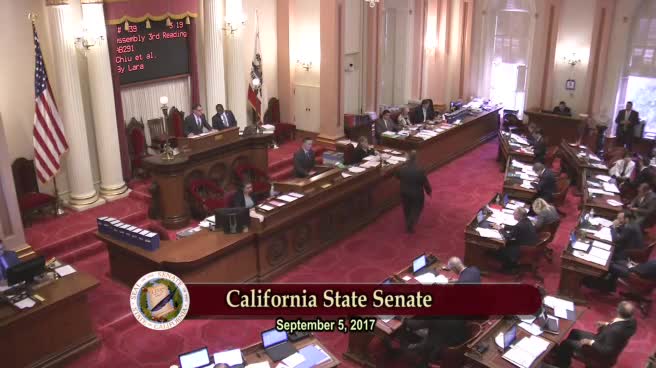
Bill Author

Bill Co-Author(s):