AB 1248: Pupils: wearing of traditional tribal regalia or recognized objects of religious or cultural significance as an adornment at school graduation ceremonies.
- Session Year: 2017-2018
- House: Assembly
- Latest Version Date: 2018-09-27
Existing law authorizes the governing board of any school district to adopt or rescind a reasonable dress code policy that requires pupils to wear a schoolwide uniform or prohibits pupils from wearing gang-related apparel. Existing law authorizes these actions if the governing board of the school district approves a plan, which may be initiated by an individual schools principal, staff, or parents, and determines that the policy is necessary for the health and safety of the school environment. Existing law also authorizes individual schools to include the reasonable dress code policy as part of their school safety plans. Existing law prohibits a dress code policy adopted pursuant to this provision from precluding pupils who participate in a nationally recognized youth organization from wearing organization uniforms on days that the organization has a scheduled meeting.
This bill would provide that a pupil may wear traditional tribal regalia or recognized objects of religious or cultural significance as an adornment, as defined, at school graduation ceremonies. The bill would also declare that nothing in its provisions shall be construed to limit a local educational agencys discretion and authority to prohibit an item that is likely to cause a substantial disruption of, or material interference with, the ceremony.
Existing law authorizes the governing board of any school district to adopt or rescind a reasonable dress code policy that requires pupils to wear a schoolwide uniform or prohibits pupils from wearing gang-related apparel. Existing law authorizes these actions if the governing board of the school district approves a plan, which may be initiated by an individual schools principal, staff, or parents, and determines that the policy is necessary for the health and safety of the school environment. Existing law also authorizes individual schools to include the reasonable dress code policy as part of their school safety plans. Existing law prohibits a dress code policy adopted pursuant to this provision from precluding pupils who participate in a nationally recognized youth organization from wearing organization uniforms on days that the organization has a scheduled meeting.
This bill would declare that, notwithstanding any other law, provide that a pupil has the right to wear religious, ceremonial, or cultural adornments, as defined, may wear traditional tribal regalia or recognized objects of religious or cultural significance as an adornment, as defined, at school graduation ceremonies. The bill would also declare that nothing in its provisions shall be construed to limit a local educational agencys discretion and authority to prohibit an item that is likely to cause a substantial disruption of, or material interference with, the ceremony or to expand or diminish any pupil rights established under specified provisions related to school dress codes and pupil freedom of speech. ceremony.
Existing law authorizes the governing board of any school district to adopt or rescind a reasonable dress code policy that requires pupils to wear a schoolwide uniform or prohibits pupils from wearing gang-related apparel. Existing law authorizes these actions if the governing board of the school district approves a plan, which may be initiated by an individual schools principal, staff, or parents, and determines that the policy is necessary for the health and safety of the school environment. Existing law also authorizes individual schools to include the reasonable dress code policy as part of their school safety plans. Existing law prohibits a dress code policy adopted pursuant to this provision from precluding pupils who participate in a nationally recognized youth organization from wearing organization uniforms on days that the organization has a scheduled meeting.
This bill would declare that, notwithstanding any other law, a pupil has the right to wear religious, ceremonial, or cultural adornments, as defined, at school graduation ceremonies. The bill would also declare that nothing in its provisions shall be construed to limit a local educational agencys authority to prohibit an item that is likely to cause a substantial disruption of, or interference with, the ceremony or to expand or diminish any pupil rights established under specified provisions related to school dress codes and pupil freedom of speech.
Existing law requires the governing body of a public agency, as defined, within 70 days after the commencement of its existence, to file with the Secretary of State a statement containing specified information about the public entity and its governing board and officers.This bill would require that the filing of the statement occur within 60 days after commencement of the existence of the public agency. The bill would make other nonsubstantive changes to these provisions.Existing law requires the governing body of a public agency, as defined, within 70 days after the commencement of its existence, to file with the Secretary of State a statement containing specified information about the public entity and its governing board and officers.
This bill would require that the filing of the statement occur within 60 days after commencement of the existence of the public agency. The bill would make other nonsubstantive changes to these provisions.
(a)A pupil may wear traditional tribal regalia or recognized objects of religious or cultural significance as an adornment at school graduation ceremonies. Nothing in this section shall be construed to limit a local educational agencys discretion and authority to prohibit an item that is likely to cause a substantial disruption of, or material interference with, the ceremony.
(b)For purposes of this section, the following terms have the following meanings:
(1)Adornment means something attached to, or worn with, but not replacing, the cap and gown customarily worn at school graduation ceremonies.
(2)Cultural means recognized practices and traditions of a certain group of people.
(3)Local educational agency means a school district, county office of education, or charter school.
(a)Notwithstanding any other law, a pupil has the right to wear religious, ceremonial, or cultural adornments A pupil may wear traditional tribal regalia or recognized objects of religious or cultural significance as an adornment at school graduation ceremonies. Nothing in this section shall be construed to limit a local educational agencys discretion and authority to prohibit an item that is likely to cause a substantial disruption of, or material interference with, the ceremony or to expand or diminish any pupil rights established under Section 35183 or 48950. ceremony.
(b)For purposes of this section, the following terms have the following meanings:
(1)Adornment means something attached to, or worn with, but not replacing, the cap and gown customarily worn at school graduation ceremonies.
(2)Cultural means relating to the habits, practices, beliefs, recognized practices and traditions of a certain group of people.
(3)Local educational agency means a school district, county office of education, or charter school.
(a)Notwithstanding any other law, a pupil has the right to wear religious, ceremonial, or cultural adornments at school graduation ceremonies. Nothing in this section shall be construed to limit a local educational agencys authority to prohibit an item that is likely to cause a substantial disruption of, or interference with, the ceremony or to expand or diminish any pupil rights established under Section 35183 or 48950.
(b)For purposes of this section, the following terms have the following meanings:
(1)Adornment means something attached to, or worn with, but not replacing, the cap and gown customarily worn at school graduation ceremonies.
(2)Cultural means relating to the habits, practices, beliefs, and traditions of a certain group of people.
(3)Local educational agency means a school district, county office of education, or charter school.
SECTION 1.Section 53051 of the Government Code is amended to read:53051.(a)Within sixty (60) days after the date of commencement of its legal existence, the governing body of a public agency shall file with the Secretary of State on a form prescribed by the Secretary of State and also with the county clerk of each county in which the public agency maintains an office, a statement of the following facts:1.The full, legal name of the public agency.2.The official mailing address of the governing body of the public agency.3.The name and residence or business address of each member of the governing body of the public agency.4.The name, title, and residence or business address of the chairperson, president, or other presiding officer, and clerk or secretary of the governing body of the public agency.(b)Within 10 days after any change in the facts required to be stated pursuant to subdivision (a), an amended statement containing the information required by subdivision (a) shall be filed with the Secretary of State. The information submitted to the Secretary of State shall be on a form prescribed by the Secretary of State.(c)It shall be the duty of the Secretary of State and of the county clerk of each county to establish and maintain an indexed Roster of Public Agencies, to be so designated, that shall contain all information filed as required in subdivisions (a) and (b), which roster is hereby declared to be a public record.(a)Within seventy (70) sixty (60) days after the date of commencement of its legal existence, the governing body of each a public agency shall file with the Secretary of State on a form prescribed by the Secretary of State and also with the county clerk of each county in which the public agency maintains an office, a statement of the following facts:
1.The full, legal name of the public agency.
2.The official mailing address of the governing body of the public agency.
3.The name and residence or business address of each member of the governing body of the public agency.
4.The name, title, and residence or business address of the chairman, chairperson, president, or other presiding officer, and clerk or secretary of the governing body of such the public agency.
(b)Within 10 days after any change in the facts required to be stated pursuant to subdivision (a), an amended statement containing the information required by subdivision (a) shall be filed as provided therein. filed with the Secretary of State. The information submitted to the Secretary of State shall be on a form prescribed by the Secretary of State.
(c)It shall be the duty of the Secretary of State and of the county clerk of each county to establish and maintain an indexed Roster of Public Agencies, to be so designated, which that shall contain all information filed as required in subdivisions (a) and (b), which roster is hereby declared to be a public record.
|
Date
|
Status
|
|---|---|
| Sep 27, 2018 | Chaptered by Secretary of State - Chapter 804, Statutes of 2018. |
| Sep 27, 2018 | Approved by the Governor. |
| Sep 10, 2018 | Enrolled and presented to the Governor at 3:30 p.m. |
| Aug 30, 2018 | Senate amendments concurred in. To Engrossing and Enrolling. |
| Aug 29, 2018 | In Assembly. Concurrence in Senate amendments pending. |
| Aug 29, 2018 | Read third time. Passed. Ordered to the Assembly. |
| Aug 27, 2018 | Read second time. Ordered to third reading. |
| Aug 24, 2018 | Read third time and amended. Ordered to second reading. |
| Aug 9, 2018 | Ordered to third reading. |
| Aug 1, 2018 | Ordered to special consent calendar. |
| Jun 14, 2018 | Read second time. Ordered to third reading. |
| Jun 13, 2018 | From committee: Do pass. (Ayes 7. Noes 0.) (June 12). |
| May 9, 2018 | From committee: Do pass and re-refer to Com. on JUD. (Ayes 5. Noes 0.) (May 9). Re-referred to Com. on JUD. |
| Feb 14, 2018 | Referred to Coms. on ED. and JUD. |
| Jan 22, 2018 | In Senate. Read first time. To Com. on RLS. for assignment. |
| Jan 22, 2018 | Read third time. Passed. Ordered to the Senate. |
| Jan 18, 2018 | Read second time. Ordered to third reading. |
| Jan 17, 2018 | From committee: Do pass. (Ayes 10. Noes 0.) (January 17). |
| Jan 10, 2018 | From committee: Do pass and re-refer to Com. on JUD. (Ayes 6. Noes 0.) (January 10). Re-referred to Com. on JUD. |
| Jan 8, 2018 | Assembly Rule 56 suspended. |
| Jan 4, 2018 | From committee: Be re-referred to Coms. on ED. and JUD. (Ayes 9. Noes 0.) (January 4). Re-referred to Com. on ED. |
| Jan 3, 2018 | From committee chair, with author's amendments: Amend, and re-refer to Com. on L. GOV. Read second time and amended. |
| Mar 13, 2017 | Referred to Coms. on L. GOV. and P. & C.P. |
| Feb 19, 2017 | From printer. May be heard in committee March 21. |
| Feb 17, 2017 | Read first time. To print. |
|
Date
|
Description
|
Location
|
Votes
|
|
|---|---|---|---|---|
| Aug 30, 2018 | AB 1248 GLORIA Concurrence in Senate Amendments | Assembly Floor |
Passed |
|
| Aug 29, 2018 | Assembly 3rd Reading AB1248 Gloria By Wilk | Senate Floor |
Passed |
|
| Jun 12, 2018 | Do pass | Senate Standing Committee on Judiciary |
Passed |
|
| May 9, 2018 | Do pass, but first be re-referred to the Committee on [Judiciary] | Senate Standing Committee on Education |
Passed |
|
| Jan 22, 2018 | AB 1248 GLORIA Assembly Third Reading | Assembly Floor |
Passed |
|
| Jan 17, 2018 | Do pass. | Assembly Standing Committee on Judiciary |
Passed |
|
| Jan 10, 2018 | Do pass and be re-referred to the Committee on [Judiciary] | Assembly Standing Committee on Education |
Passed |
|
| Jan 4, 2018 | Favorable With Amendment(s) (Post-Secondary Education Subcommittee) | Assembly Standing Committee on Rules |
Passed |
This list shows positions taken on this bill by organizations on the date displayed, which is linked to the original source.
Positions by individuals are not included.
CONCURRENCE IN SENATE AMENDMENTS
CSA1 Bill Id:AB 1248
Author:(Gloria)
As Amended Ver:August 24, 2018
Majority vote
ASSEMBLY: | 69-1 | (January 17, 2018) | SENATE: | 39-0 | (August 29, 2018) |
Original Committee Reference: ED.
SUMMARY: Authorizes a student to wear tribal regalia or recognized objects of religious or cultural significance as an adornment at school graduation ceremonies.
The Senate amendments:
- Clarify that a student's rights to wear adornments at school graduation ceremony are limited to traditional tribal regalia or recognized objects of religious or cultural significance.
- Clarify the definition of cultural as "recognized practices and traditions of a certain group of people."
- Clarify the bill's prohibition against its provisions from being construed as to limit a local educational agency's discretion and authority to prohibit an item that is likely to cause substantial disruption of, or a material interference with, the ceremony
- Delete language relating to expanding or diminishing any pupil rights relative to dress code or free speech provisions.
EXISTING LAW:
- Authorizes the governing board of school districts to adopt a reasonable dress code policy that requires pupils to wear a schoolwide uniform or prohibits pupils from wearing "gang-related apparel" if the governing board of the school district approves a plan that may be initiated by an individual school's principal, staff, and parents, and it determines that the policy is necessary for the health and safety of the school environment.
- Specifies that a pupil has the right to wear a dress uniform, issued by a branch of the United States Armed Forces, during his or her high school graduation ceremony if he or she has met the graduation requirements and is an active member of the United States Armed Forces.
- Prohibits a school from making or enforcing a rule subjecting a high school pupil to disciplinary sanctions solely on the basis of conduct that is speech or other communication that, when engaged in outside of the campus, is protected by the First Amendment to the United States Constitution or California Constitution Article I, Section 2.
FISCAL EFFECT: None. This bill is keyed non-fiscal by the Legislative Counsel
COMMENTS: According to the author:
Under existing law, the California Education Code enables school districts to develop and enforce reasonable dress code policies. At their discretion, school districts have routinely adopted 'no adornment' policies designed to maintain traditional decorum at commencement ceremonies. However, several incidents involving Native American students attempting to wear eagle feathers at graduation reveal that 'no adornment' policies preclude students from recognizing their cultural traditions while celebrating their academic achievements." The author cites several examples in support, including eight Native American students at Lemoore High School in 2014 who were initially prohibited from wearing eagle feathers only to be allowed to do so several hours before the ceremony after parents and students organized a petition and a 2016 incident at Cosumnes Oaks High School in Elk Grove in which an African American student was warned against wearing a Kente cloth, a fabric worn during important occasions in African culture, and was escorted out of the graduation before officially receiving his diploma. In the author's view, "these cases illustrate how students have been unjustly prevented from recognizing their cultural traditions while celebrating a personal milestone.
Significance of eagle feathers and high school graduation. American Indian and Alaska Native high school students from across the country are given eagle feathers to be worn at graduation ceremonies as a form of practice and expression of spiritual and religious beliefs. The feathers are also given for the students' leadership and academic achievement, as a sign of maturity, to signify the achievement of this important educational journey, to honor the graduate and his or her family, community, and tribal nation. American Indian and Alaska Native high school students seek to express and practice their religious and spiritual beliefs and celebrate their personal academic achievement, leadership, and transition into adulthood by wearing an eagle feather at their graduation ceremony. Moreover, according to many Native religious and spiritual traditions, eagle feathers are given only in times of great honor and often to mark significant personal achievement, and for many Native students, receiving an eagle feather in recognition of high school graduation is as significant as earning the diploma.
Governor's Veto Message: This bill is similar to last year's AB 233 (Gloria), which was vetoed by the Governor. The Governor's veto message reads as follows:
This bill provides that a student has the right to wear specific adornments at school graduation ceremonies. Students in California have a well-established right to express their views through symbolic acts under the state Education Code and the Free Speech Clause of the First Amendment. See Tinker v. Des Moines Independent Community School Dist. (1969) 393 U.S. 503, 506. Under these precedents, student expression is clearly protected.
To the extent that there is a dispute about what a student can wear at school graduation ceremonies, I believe those closest to the problem – principals and democratically elected school boards – are in the best position to make wise judgments.
Existing constitutional case law already permits schools to limit student speech that is likely to create a substantial disruption, and case law since Tinker is generally deferential to the school's determination; that same case law also already gives a student a right to challenge the school's determination if the disruption is not substantial enough to justify repression of student speech. This bill, if enacted, would not change that. However, this bill might clarify school responsibilities. That is, it might help school officials avoid lawsuits by causing them to think twice about prohibiting reasonable adornments unless they have a reason to believe, based on some evidence or past experience, that allowing those adornments will cause disruption.
Analysis Prepared by: Debbie Look / ED. / (916) 319-2087 FN: 0005099
Office of Senate Floor Analyses (916) 651-1520 Fax: (916) 327-4478 | AB |
THIRD READING
Bill No: AB 1248
: Senate
SENATE EDUCATION COMMITTEE: 5-0, 5/9/18
AYES: Allen, Wilk, Galgiani, Pan, Vidak
NO VOTE RECORDED: Leyva
SENATE JUDICIARY COMMITTEE: 7-0, 6/12/18
AYES: Jackson, Moorlach, Anderson, Hertzberg, Monning, Stern, Wieckowski
ASSEMBLY FLOOR: 69-1, 1/22/18 - See last page for vote
SUBJECT: Pupils: wearing of traditional tribal regalia or recognized objects of religious or cultural significance as an adornment at school graduation ceremonies
DIGEST:
This bill authorizes a student to wear tribal regalia or recognized objects of religious or cultural significance as an adornment at school graduation ceremonies.
Senate Floor Amendments of 8/24/18 authorize a student to wear tribal regalia or recognized objects of religious or cultural significance as an adornment at school graduation ceremonies, and clarify the bill’s prohibition against its provisions from being construed as to limit a local educational agency’s discretion and authority to prohibit an item that is likely to cause substantial disruption of, or a material interference with, the ceremony. The amendments also revise the definition of “cultural” for purposes of the bill to mean “recognized practices and traditions of a certain group of people.”
Existing law:
- Authorizes the governing board of school districts to adopt a reasonable dress code policy that requires pupils to wear a schoolwide uniform or prohibits pupils from wearing “gang-related apparel” if the governing board of the school district approves a plan that may be initiated by an individual school’s principal, staff, and parents, and it determines that the policy is necessary for the health and safety of the school environment. (Education Code § 35183)
- Authorizes individual schools to include a reasonable dress code as part of its school safety plan. (EC § 35183)
- Specifies that a pupil has the right to wear a dress uniform, issued by a branch of the United States Armed Forces, during his or her high school graduation ceremony if he or she has met the graduation requirements and is an active member of the United States Armed Forces. (EC § 35183.3)
- Prohibits a school district, charter school, or private secondary school from making or enforcing a rule subjecting a high school pupil to disciplinary sanctions solely on the basis of conduct that is speech or other communication that, when engaged in outside of the campus, is protected by the First Amendment to the United States Constitution or Section 2 of Article I of the California Constitution. (EC § 48950)
This bill authorizes a student to wear tribal regalia or recognized objects of religious or cultural significance as an adornment at school graduation ceremonies. Specifically, this bill:
- Prohibits its provisions from being construed to limit a local educational agency’s discretion and authority to prohibit an item that is likely to cause a substantial disruption of, or material interference with, the ceremony.
- Defines, for purposes of the bill:
- “Adornment” as “something attached to, or worn with, but not replacing, the cap and gown customarily worn at school graduation ceremonies.”
- “Cultural” as “recognized practices and traditions of a certain group of people.”
- “Local educational agency” as a school district, county office of education, or charter school.
Comments
1) Need for the bill. According to the author, “Under existing law, the California Education Code enables school districts to develop and enforce reasonable dress code policies. At their discretion, school districts have routinely adopted ‘no adornment’ policies designed to maintain traditional decorum at commencement ceremonies. However, several incidents involving Native American students attempting to wear eagle feathers at graduation reveal that ‘no adornment’ policies preclude students from recognizing their cultural traditions while celebrating their academic achievements.” The author cites several examples in support, including eight Native American students at Lemoore High School in 2014 who were initially prohibited from wearing eagle feathers only to be allowed to do so several hours before the ceremony after parents and students organized a petition and a 2016 incident at Cosumnes Oaks High School in Elk Grove in which an African American student was warned against wearing a Kente cloth, a fabric worn during important occasions in African culture, and was escorted out of the graduation before officially receiving his diploma. In the author’s view, “these cases illustrate how students have been unjustly prevented from recognizing their cultural traditions while celebrating a personal milestone.”
2) Significance of eagle feathers and high school graduation. According to a 2015 National Congress of American Indians resolution, American Indian and Alaska Native high school students from across the country are given eagle feathers to be worn at graduation ceremonies as a form of practice and expression of spiritual and religious beliefs. The feathers are also given for the students’ leadership and academic achievement, as a sign of maturity, to signify the achievement of this important educational journey, to honor the graduate and his or her family, community, and tribal nation. American Indian and Alaska Native high school students seek to express and practice their religious and spiritual beliefs and celebrate their personal academic achievement, leadership, and transition into adulthood by wearing an eagle feather at their graduation ceremony. Moreover, according to many Native religious and spiritual traditions, eagle feathers are given only in times of great honor and often to mark significant personal achievement, and for many Native students, receiving an eagle feather in recognition of high school graduation is as significant as earning the diploma. Accordingly, the National Congress of American Indians resolution supports “the right of American Indian and Alaska Native high school students to practice and express their traditional religious and spiritual beliefs and honor their academic and other achievements by wearing an eagle feather at their commencement ceremonies” and urges “all schools to respect traditional tribal religious and spiritual beliefs by allowing Native students to wear an eagle feather at graduation.”
3) Overzealous enforcement? There is no question that school districts are empowered to enforce reasonable dress codes. This bill is a response to arguably unnecessary strict enforcement of graduation ceremony dress codes. For example, in May 2015, Christian Titman, a Native American high school senior at Clovis High School, asked the school in April of 2015 if he could wear a single sacred eagle feather, about three to four inches in length, during his graduation ceremony. The school denied his request. With the help of California Indian Legal Services, the Native American Rights Fund, and the American Civil Liberties Union, Titman sought a temporary restraining order from the local superior court; however, Titman and the school reached an agreement before the judge issued the order. Additionally, many African American students wish to wear a Kente cloth, a colorful fabric sash, attached to or draped across their traditional high school graduation gowns. The kente cloth originated among the West African nations that were the primary source of persons who were forcefully carried from Africa to the New World in slave ships. As such, this cloth is an important cultural symbol for many African American students. In May of 2016, Nyree Holmes, a senior at Cosumnes Oaks High School in Elk Grove refused to remove a kente cloth from his graduation robe. Officers escorted Mr. Holmes from the arena before the conclusion of the graduation ceremony. A spokesperson for Elk Grove Unified School District conceded that the incident was mishandled by the school and that the incident would likely cause the school to revise its policy, which it subsequently did, and it allows students to wear items of cultural importance, subject to review and approval of their principal. The district also changed its procedures for how it would handle situations like this in the future, making explicit that this type of violation does not call for intervention by school resource officers.
It does not appear that these examples of religiously or culturally important items significantly disrupt graduation ceremonies. It is also apparent that high school graduation is one of the seminal moments of a young person’s life. Preventing students from participating in such a momentous event because of something they choose to wear as part of their graduation attire should be reserved for instances that are truly disruptive to the ceremony as a whole, which is a celebratory event, not an academic undertaking in of itself. It seems prudent in these circumstances to err on the side of participation and trust that the vast majority of graduates who want to add an important adornment to their graduation attire will do so sincerely.
4) Senate Judiciary Committee. This bill was also referred to the Senate Judiciary Committee, which made the following conclusions regarding the constitutional considerations this bill implicates:
Applicable Doctrine: Hazelwood or Tinker?
“…More fundamentally, however, whether Hazelwood [484 U.S. 260] or Tinker [393 U.S. 503] applies to an individual student’s choice of how to adorn their caps and gowns at graduation does not govern the Legislature’s decision about this bill. If Tinker applies, then schools must allow students to wear adornments at graduation (unless they cause a material disruption) whether this bill passes or not. If Hazelwood applies, then schools have discretion within the bounds of the constitution to restrict adornments, but nothing stops the Legislature from constraining that discretion.”
Governor’s Veto of Previous Identical Bill May Have Rested on Mistaken Impression
“Proponents of AB 233 had argued that the bill was needed because schools were regularly violating the Tinker standard by refusing to allow students to wear cap and gown adornments at graduation, even when those adornments did not substantially and materially disrupt the ceremony. Governor Brown’s invocation of the Tinker case in his veto strongly suggests he believes that the Tinker standard appropriately and adequately protects California students’ right to free expression. Governor Brown also expressed confidence that local school boards are in the best position to make wise judgments about what adornments should be allowed at graduation. The CSBA’s [California School Boards Association] opposition may indicate that the Governor’s confidence was misplaced. It appears that, in fact, local school boards have a very different conception of the limits on their authority to restrict student expression than the Governor’s veto presumed.”
Establishment Clause Issues
“CSBA’s opposition appears to assert that, at least as to religious adornments, school officials must not allow students to wear them at high school graduation ceremonies, because to do so would violate the constitutional prohibition on the establishment of religion. […] [H]owever, the CSBA’s underlying assumption about the representative nature of individual student’s cap and gown adornments may conflate two distinct things. The case law does support the idea that student expression can reasonably be perceived as representing the school when the student is selected by the school to speak to the whole audience during the graduation program. It is not clear, however, that this rule extends as far as what any one individual student decides to wear as an adornment to their cap and gown. […] CSBA’s constitutional argument emphasizes the Establishment Clause while giving short shrift to the countervailing weight of the Free Exercise Clause. […] [A]n effort to prevent individual students from wearing a crucifix, a hijab, a yarmulke, or an eagle feather during a graduation ceremony runs afoul of those students’ right to express their religious beliefs where that expression cannot reasonably be viewed as representing the school.”
What Type of Free Expression Forum is a High School Graduation?
“…Critically, however, even if students would gain broad latitude to express themselves through adornments attached to their caps and gowns, schools would still be able to prohibit adornments when they have reason to believe the message communicated by the adornment will cause a substantial disruption. Content restrictions of this kind are constitutionally acceptable because ‘the basis for the content discrimination consists entirely of the very reason the entire class of speech at issue is proscribable.’ (R.A.V., supra, 505 U.S. 377, 388.) In other words, adornments that will cause a material interference with the ceremony can be prohibited because the reason for prohibiting them is the material interference, not the content or viewpoint of the message.
“As CSBA points out, this still leaves local school authorities with the problem of determining when any individual adornment might cause a substantial disruption or interference at the graduation ceremony. However, this bill would reinforce what is arguably the correct constitutional approach anyway: that in making these decisions, schools must focus carefully on the question of whether any individual adornment would genuinely interfere with the graduation ceremony, rather than reacting to the content of the adornment or resorting to blanket rules that unnecessarily stifle individual student expression.”
State Constitution may Provide Additional Protection to Student Expression
“Committee staff is unaware of any cases that directly apply the California Constitution to student expression in the context of graduation ceremonies. As general matter, however, the California Constitution is, if anything, more protective of free speech rights than its federal counterpart. (See Griset v. Fair Political Practices Commission (1994) 8 Cal.4th 851, 866, fn. 5.) Presumably, the California Constitution would weigh even more heavily on the side of student liberty than the U.S. Constitution. It is quite possible therefore, that even if the federal constitution does not prevent school authorities from banning religious, cultural, and ceremonial adornments in graduation ceremonies, the California Constitution does.”
Related/Prior Legislation
AB 233 (Gloria, 2017) was similar to this bill and was vetoed by the Governor, who stated:
This bill provides that a student has the right to wear specific adornments at school graduation ceremonies.
Students in California have a well-established right to express their views through symbolic acts under the state Education Code and the Free Speech Clause of the First Amendment. See Tinker v. Des Moines Independent Community School Dist. (1969) 393 U.S. 503, 506. Under these precedents, student expression is clearly protected.
To the extent that there is a dispute about what a student can wear at school graduation ceremonies, I believe those closest to the problem -- principals and democratically elected school boards -- are in the best position to make wise judgments.
AB 2051 (Nakanishi and Cogdill, 2004) would have specified that a governing board of a school district that adopts a standard dress appearance policy include within the policy certain provisions, including that a parent or guardian may choose to exempt their son or daughter from the standard dress appearance policy. AB 2051 failed passage in the Assembly Education Committee.
FISCAL EFFECT: Appropriation: Fiscal Com.: Local:
Alameda County Office of Education
American Civil Liberties Union of California
Barona Band of Mission Indians
Cahuilla Band of Indians
California Indian Culture and Sovereignty Center at CSU San Marcos
California Nations Indian Gaming Association
California Teachers Association
California Tribal Business Alliance
Federated Indians of Graton Rancheria
Habematolel Pomo of Upper Lake
Inaja Cosmit Band of Mission Indians
Jamul Indian Village of California
National Association of Social Workers – California Chapter
Resources for Indian Student Education, Inc.
Rincon Band of Luiseño Indians
San Manuel Band of Mission Indians
Santa Ynez Band of Chumash Indians
Sycuan Band of the Kumeyaay Nation
Tejon Indian Tribe
Tribal Alliance of Sovereign Indian Nations
United Auburn Indian Community of the Auburn Rancheria
Viejas Band of the Kumeyaay Indians
Wilton Rancheria
Yocha Dehe Wintun Nation
OPPOSITION: (Verified 8/24/18)
California School Boards Association
ASSEMBLY FLOOR: 69-1, 1/22/18
AYES: Acosta, Aguiar-Curry, Arambula, Baker, Berman, Bloom, Bonta, Brough, Burke, Caballero, Calderon, Carrillo, Chau, Chávez, Chen, Chiu, Chu, Cooley, Cooper, Cunningham, Dahle, Daly, Eggman, Flora, Fong, Frazier, Friedman, Gallagher, Cristina Garcia, Eduardo Garcia, Gipson, Gloria, Gonzalez Fletcher, Gray, Holden, Irwin, Jones-Sawyer, Kalra, Kiley, Lackey, Levine, Limón, Low, Maienschein, Mathis, Mayes, McCarty, Medina, Melendez, Muratsuchi, Nazarian, O'Donnell, Patterson, Quirk, Quirk-Silva, Reyes, Rodriguez, Rubio, Salas, Santiago, Steinorth, Mark Stone, Thurmond, Ting, Voepel, Waldron, Weber, Wood, Rendon
NOES: Harper
NO VOTE RECORDED: Travis Allen, Bigelow, Cervantes, Choi, Grayson, Mullin, Obernolte
8/27/18 19:30:25
Office of Senate Floor Analyses (916) 651-1520 Fax: (916) 327-4478 | AB |
THIRD READING
Bill No: AB 1248
:
SENATE EDUCATION COMMITTEE: 5-0, 5/9/18
AYES: Allen, Wilk, Galgiani, Pan, Vidak
NO VOTE RECORDED: Leyva
SENATE JUDICIARY COMMITTEE: 7-0, 6/12/18
AYES: Jackson, Moorlach, Anderson, Hertzberg, Monning, Stern, Wieckowski
ASSEMBLY FLOOR: 69-1, 1/22/18 - See last page for vote
DIGEST:
This bill specifies that a pupil has the right to wear religious, ceremonial, or cultural adornments at school graduation ceremonies.
Existing law:
- Authorizes the governing board of school districts to adopt a reasonable dress code policy that requires pupils to wear a schoolwide uniform or prohibits pupils from wearing “gang-related apparel” if the governing board of the school district approves a plan that may be initiated by an individual school’s principal, staff, and parents, and it determines that the policy is necessary for the health and safety of the school environment. (Education Code § 35183)
- Authorizes individual schools to include a reasonable dress code as part of its school safety plan. (EC § 35183)
- Specifies that a pupil has the right to wear a dress uniform, issued by a branch of the United States Armed Forces, during his or her high school graduation ceremony if he or she has met the graduation requirements and is an active member of the United States Armed Forces. (EC § 35183.3)
- Prohibits a school district, charter school, or private secondary school from making or enforcing a rule subjecting a high school pupil to disciplinary sanctions solely on the basis of conduct that is speech or other communication that, when engaged in outside of the campus, is protected by the First Amendment to the United States Constitution or Section 2 of Article I of the California Constitution. (EC § 48950)
This bill specifies that a pupil has the right to wear religious, ceremonial, or cultural adornments at school graduation ceremonies. Specifically, this bill:
- Specifies, notwithstanding any other law, that a pupil has the right to wear religious, ceremonial, or cultural adornments at school graduation ceremonies.
- Prohibits its provisions from being construed to limit a local educational agency’s authority to prohibit an item that is likely to cause a substantial disruption of, or interference with, the ceremony or to expand or diminish certain pupil rights relating to dress codes and freedom of speech.
- Defines, for purposes of the bill:
- “Adornment” as “something attached to, or worn with, but not replacing, the cap and gown customarily worn at school graduation ceremonies.”
- “Cultural” as “relating to the habits, practices, beliefs, and traditions of a certain group of people.”
- “Local educational agency” as a school district, county office of education, or charter school.
Comments
1) Need for the bill. According to the author, “Under existing law, the California Education Code enables school districts to develop and enforce reasonable dress code policies. At their discretion, school districts have routinely adopted ‘no adornment’ policies designed to maintain traditional decorum at commencement ceremonies. However, several incidents involving Native American students attempting to wear eagle feathers at graduation reveal that ‘no adornment’ policies preclude students from recognizing their cultural traditions while celebrating their academic achievements.” The author cites several examples in support, including eight Native American students at Lemoore High School in 2014 who were initially prohibited from wearing eagle feathers only to be allowed to do so several hours before the ceremony after parents and students organized a petition and a 2016 incident at Cosumnes Oaks High School in Elk Grove in which an African American student was warned against wearing a Kente cloth, a fabric worn during important occasions in African culture, and was escorted out of the graduation before officially receiving his diploma. In the author’s view, “these cases illustrate how students have been unjustly prevented from recognizing their cultural traditions while celebrating a personal milestone.”
2) Significance of eagle feathers and high school graduation. According to a 2015 National Congress of American Indians resolution, American Indian and Alaska Native high school students from across the country are given eagle feathers to be worn at graduation ceremonies as a form of practice and expression of spiritual and religious beliefs. The feathers are also given for the students’ leadership and academic achievement, as a sign of maturity, to signify the achievement of this important educational journey, to honor the graduate and his or her family, community, and tribal nation. American Indian and Alaska Native high school students seek to express and practice their religious and spiritual beliefs and celebrate their personal academic achievement, leadership, and transition into adulthood by wearing an eagle feather at their graduation ceremony. Moreover, according to many Native religious and spiritual traditions, eagle feathers are given only in times of great honor and often to mark significant personal achievement, and for many Native students, receiving an eagle feather in recognition of high school graduation is as significant as earning the diploma. Accordingly, the National Congress of American Indians resolution supports “the right of American Indian and Alaska Native high school students to practice and express their traditional religious and spiritual beliefs and honor their academic and other achievements by wearing an eagle feather at their commencement ceremonies” and urges “all schools to respect traditional tribal religious and spiritual beliefs by allowing Native students to wear an eagle feather at graduation.”
3) Overzealous enforcement? There is no question that school districts are empowered to enforce reasonable dress codes. This bill is a response to arguably unnecessary strict enforcement of graduation ceremony dress codes. For example, in May 2015, Christian Titman, a Native American high school senior at Clovis High School, asked the school in April of 2015 if he could wear a single sacred eagle feather, about three to four inches in length, during his graduation ceremony. The school denied his request. With the help of California Indian Legal Services, the Native American Rights Fund, and the American Civil Liberties Union, Titman sought a temporary restraining order from the local superior court; however, Titman and the school reached an agreement before the judge issued the order. Additionally, many African American students wish to wear a Kente cloth, a colorful fabric sash, attached to or draped across their traditional high school graduation gowns. The kente cloth originated among the West African nations that were the primary source of persons who were forcefully carried from Africa to the New World in slave ships. As such, this cloth is an important cultural symbol for many African American students. In May of 2016, Nyree Holmes, a senior at Cosumnes Oaks High School in Elk Grove refused to remove a kente cloth from his graduation robe. Officers escorted Mr. Holmes from the arena before the conclusion of the graduation ceremony. A spokesperson for Elk Grove Unified School District conceded that the incident was mishandled by the school and that the incident would likely cause the school to revise its policy, which it subsequently did, and it allows students to wear items of cultural importance, subject to review and approval of their principal. The district also changed its procedures for how it would handle situations like this in the future, making explicit that this type of violation does not call for intervention by school resource officers.
It does not appear that these examples of religiously or culturally important items significantly disrupt graduation ceremonies. It is also apparent that high school graduation is one of the seminal moments of a young person’s life. Preventing students from participating in such a momentous event because of something they choose to wear as part of their graduation attire should be reserved for instances that are truly disruptive to the ceremony as a whole, which is a celebratory event, not an academic undertaking in of itself. It seems prudent in these circumstances to err on the side of participation and trust that the vast majority of graduates who want to add an important adornment to their graduation attire will do so sincerely.
4) Senate Judiciary Committee. This bill was also referred to the Senate Judiciary Committee, which made the following conclusions regarding the constitutional considerations this bill implicates:
Applicable Doctrine: Hazelwood or Tinker?
“…More fundamentally, however, whether Hazelwood [484 U.S. 260] or Tinker [393 U.S. 503] applies to an individual student’s choice of how to adorn their caps and gowns at graduation does not govern the Legislature’s decision about this bill. If Tinker applies, then schools must allow students to wear adornments at graduation (unless they cause a material disruption) whether this bill passes or not. If Hazelwood applies, then schools have discretion within the bounds of the constitution to restrict adornments, but nothing stops the Legislature from constraining that discretion.”
Governor’s Veto of Previous Identical Bill may Have Rested on Mistaken Impression
“Proponents of AB 233 had argued that the bill was needed because schools were regularly violating the Tinker standard by refusing to allow students to wear cap and gown adornments at graduation, even when those adornments did not substantially and materially disrupt the ceremony. Governor Brown’s invocation of the Tinker case in his veto strongly suggests he believes that the Tinker standard appropriately and adequately protects California students’ right to free expression. Governor Brown also expressed confidence that local school boards are in the best position to make wise judgments about what adornments should be allowed at graduation. The CSBA’s [California School Boards Association] opposition may indicate that the Governor’s confidence was misplaced. It appears that, in fact, local school boards have a very different conception of the limits on their authority to restrict student expression than the Governor’s veto presumed.”
Establishment Clause Issues
“CSBA’s opposition appears to assert that, at least as to religious adornments, school officials must not allow students to wear them at high school graduation ceremonies, because to do so would violate the constitutional prohibition on the establishment of religion. […] [H]owever, the CSBA’s underlying assumption about the representative nature of individual student’s cap and gown adornments may conflate two distinct things. The case law does support the idea that student expression can reasonably be perceived as representing the school when the student is selected by the school to speak to the whole audience during the graduation program. It is not clear, however, that this rule extends as far as what any one individual student decides to wear as an adornment to their cap and gown. […] CSBA’s constitutional argument emphasizes the Establishment Clause while giving short shrift to the countervailing weight of the Free Exercise Clause. […] [A]n effort to prevent individual students from wearing a crucifix, a hijab, a yarmulke, or an eagle feather during a graduation ceremony runs afoul of those students’ right to express their religious beliefs where that expression cannot reasonably be viewed as representing the school.”
What Type of Free Expression Forum is a High School Graduation?
“…Critically, however, even if students would gain broad latitude to express themselves through adornments attached to their caps and gowns, schools would still be able to prohibit adornments when they have reason to believe the message communicated by the adornment will cause a substantial disruption. Content restrictions of this kind are constitutionally acceptable because ‘the basis for the content discrimination consists entirely of the very reason the entire class of speech at issue is proscribable.’ (R.A.V., supra, 505 U.S. 377, 388.) In other words, adornments that will cause a material interference with the ceremony can be prohibited because the reason for prohibiting them is the material interference, not the content or viewpoint of the message.
“As CSBA points out, this still leaves local school authorities with the problem of determining when any individual adornment might cause a substantial disruption or interference at the graduation ceremony. However, this bill would reinforce what is arguably the correct constitutional approach anyway: that in making these decisions, schools must focus carefully on the question of whether any individual adornment would genuinely interfere with the graduation ceremony, rather than reacting to the content of the adornment or resorting to blanket rules that unnecessarily stifle individual student expression.”
State Constitution may Provide Additional Protection to Student Expression
“Committee staff is unaware of any cases that directly apply the California Constitution to student expression in the context of graduation ceremonies. As general matter, however, the California Constitution is, if anything, more protective of free speech rights than its federal counterpart. (See Griset v. Fair Political Practices Commission (1994) 8 Cal.4th 851, 866, fn. 5.) Presumably, the California Constitution would weigh even more heavily on the side of student liberty than the U.S. Constitution. It is quite possible therefore, that even if the federal constitution does not prevent school authorities from banning religious, cultural, and ceremonial adornments in graduation ceremonies, the California Constitution does.”
Related/Prior Legislation
AB 233 (Gloria, 2017) was identical to this bill and was vetoed by the Governor, who stated:
This bill provides that a student has the right to wear specific adornments at school graduation ceremonies.
Students in California have a well-established right to express their views through symbolic acts under the state Education Code and the Free Speech Clause of the First Amendment. See Tinker v. Des Moines Independent Community School Dist. (1969) 393 U.S. 503, 506. Under these precedents, student expression is clearly protected.
To the extent that there is a dispute about what a student can wear at school graduation ceremonies, I believe those closest to the problem -- principals and democratically elected school boards -- are in the best position to make wise judgments.
AB 2051 (Nakanishi and Cogdill, 2004) would have specified that a governing board of a school district that adopts a standard dress appearance policy include within the policy certain provisions, including that a parent or guardian may choose to exempt their son or daughter from the standard dress appearance policy. AB 2051 failed passage in the Assembly Education Committee.
FISCAL EFFECT: Appropriation: Fiscal Com.: Local:
Alameda County Office of Education
American Civil Liberties Union of California
Barona Band of Mission Indians
Cahuilla Band of Indians
California Indian Culture and Sovereignty Center at CSU San Marcos
California Nations Indian Gaming Association
California Teachers Association
California Tribal Business Alliance
Federated Indians of Graton Rancheria
Habematolel Pomo of Upper Lake
Inaja Cosmit Band of Mission Indians
Jamul Indian Village of California
National Association of Social Workers – California Chapter
Resources for Indian Student Education, Inc.
Rincon Band of Luiseño Indians
San Manuel Band of Mission Indians
Santa Ynez Band of Chumash Indians
Sycuan Band of the Kumeyaay Nation
Tejon Indian Tribe
Tribal Alliance of Sovereign Indian Nations
United Auburn Indian Community of the Auburn Rancheria
Viejas Band of the Kumeyaay Indians
Wilton Rancheria
Yocha Dehe Wintun Nation
OPPOSITION: (Verified 6/13/18)
California School Boards Association
ASSEMBLY FLOOR: 69-1, 1/22/18
AYES: Acosta, Aguiar-Curry, Arambula, Baker, Berman, Bloom, Bonta, Brough, Burke, Caballero, Calderon, Carrillo, Chau, Chávez, Chen, Chiu, Chu, Cooley, Cooper, Cunningham, Dahle, Daly, Eggman, Flora, Fong, Frazier, Friedman, Gallagher, Cristina Garcia, Eduardo Garcia, Gipson, Gloria, Gonzalez Fletcher, Gray, Holden, Irwin, Jones-Sawyer, Kalra, Kiley, Lackey, Levine, Limón, Low, Maienschein, Mathis, Mayes, McCarty, Medina, Melendez, Muratsuchi, Nazarian, O'Donnell, Patterson, Quirk, Quirk-Silva, Reyes, Rodriguez, Rubio, Salas, Santiago, Steinorth, Mark Stone, Thurmond, Ting, Voepel, Waldron, Weber, Wood, Rendon
NOES: Harper
NO VOTE RECORDED: Travis Allen, Bigelow, Cervantes, Choi, Grayson, Mullin, Obernolte
8/21/18 14:47:52
Senator Hannah-Beth Jackson, Chair
2017-2018 Regular Session
Bill No: AB 1248 (Author:Gloria)
Version: January 3, 2018
Hearing Date: June 12, 2018
Fiscal: No
Urgency: No
Consultant: TSG
SUBJECT
Pupils: right to wear religious, ceremonial, or cultural adornments at school graduation ceremonies
DESCRIPTION
This bill would codify the right of California public high school students to accessorize their cap and gown with religious, ceremonial, or cultural adornments, such as eagle feathers or kente cloth, at graduation ceremonies, provided that such adornments do not cause substantial disruption or otherwise interfere with the ceremony.
BACKGROUND
School graduation ceremonies are moments of pomp and circumstance. With their students and faculty on display before the parents and the community, school administrators feel pressure to ensure that the occasion goes off in a smooth, uniform, and orderly fashion. From the students’ perspective, the graduation ceremony represents an opportunity to bask in their achievement publicly. For many students, it is also a moment to show gratitude to, and solidarity with, the community, ancestry, faith, and traditions that have nurtured them along their journey. Students frequently express these sentiments by wearing some form of accessory or adornment to their caps and gowns. Occasionally, this has resulted in a clash between students and school administrators.
Under well-established constitutional precedent, students have a right to express themselves in the classroom, but only up to a point. School administrators have the authority to impose some limits on what students wear, but only when those adornments substantially disrupt the educational mission. It is somewhat less clear whether this same rule applies to what students can wear at a graduation ceremony, where the program, at least, could conceivably be construed as a representation of the school’s views, rather than those of individual students. (See Comment 4, below, for a detailed discussion.)
In recent years, the scope of a school’s authority to regulate student attire in the context of graduation ceremonies has been put to the test. A number of California school administrators have refused to allow students to wear certain cultural or religious adornments during graduation ceremonies. (See Comment 3, below, for examples of incidents illustrating the issue.) Several of these incidents involved schools prohibiting Native American students from displaying eagle feathers as part of their graduation attire. The eagle feather is an especially significant emblem in many native cultures. Among other things, it symbolizes honesty, truth, majesty, strength, perspective, and connection to the Creator. While some students have sued in defense of their right to wear such adornments, any decision generally comes after the graduation ceremony takes place and the damage has already been done.
This bill attempts to head off the majority of these disputes by codifying that students have the right to wear religious, ceremonial, or cultural adornments as accessories to their caps and gowns during school graduation ceremonies. That right would be circumscribed, however, by a school’s ongoing authority to prohibit any item that is likely to cause a substantial disruption or otherwise interfere with the ceremony.
This bill passed out of the Senate Committee on Education by a 5 to 0 vote.
CHANGES TO EXISTING LAW
Existing law holds that a school cannot infringe upon student expression unless it would “materially and substantially interfere with the requirements of appropriate discipline in the operation of the school.” (Tinker v Des Moines Ind. Community School District (1969) 393 U.S. 503.)
Existing law authorizes the governing board of any school district to adopt or rescind a reasonable dress code policy that requires pupils to wear a schoolwide uniform or prohibits pupils from wearing gang-related apparel, if the board approves the policy in a specified manner and determines that the policy is necessary for the health and safety of the school environment. A policy adopted pursuant to this provision shall not prohibit a student from wearing the uniform of a nationally recognized youth organization on days that the organization has scheduled a meeting. In addition, a reasonable dress code policy adopted pursuant to this provision is not a violation of Education Code Section 48950, described below. (Ed. Code Sec. 35183.)
Existing law prohibits, subject to certain exceptions, a school district operating one or more high schools, a charter school, or a private secondary school, from making or enforcing a rule subjecting a high school student to disciplinary sanctions solely on the basis of conduct that is speech or other communication that, when engaged in outside of the campus, is protected from governmental restriction by the First Amendment to the United States Constitution or Section 2 of Article I of the California Constitution. (Ed. Code Sec. 48950.)
Existing law provides, notwithstanding any other law, that a student shall have the right to wear a dress uniform issued to the student by a branch of the United States Armed Forces at the student’s high school graduation ceremony, so long as the student is otherwise eligible to participate and completed basic training for, and is an active member of, a branch of the United States military. (Ed. Code Sec. 35183.3.)
This bill would specify that, notwithstanding any other law, a pupil has the right to wear religious, ceremonial, or cultural adornments at school graduation ceremonies.
This bill would restrict its provisions from being construed to limit a school district’s authority to prohibit an item that is likely to cause a substantial disruption of, or interference with, the ceremony or to expand or diminish certain pupil rights relating to dress codes and freedom of speech.
This bill would define “adornment”, for purposes of the bill, as “something attached to, or worn with, but not replacing, the cap and gown customarily worn at school graduation ceremonies.”
This bill would define “cultural,” for purposes of this bill as “relating to the habits, practices, beliefs, and traditions of a certain group of people.”
COMMENT
1. Stated need for the bill
According to the author:
AB 1248 enhances the diversity of California’s schools by protecting a student’s right to wear cultural adornments at graduation ceremonies.
Under existing law, the California Education Code enables school districts to adopt policies which prevent students from wearing cultural adornments at graduation ceremonies. These policies preclude students from recognizing the cultures, communities, and families integral to their academic success. AB 1248 rectifies this problem by ensuring that a student’s right to celebrate their cultural background is protected.
California has long been a bellwether for inclusivity and social justice. By protecting a pupil’s right to wear cultural adornments at commencement, AB 1248 enhances the diversity of California’s public institutions.
In support, Resources for Indian Student Education, Inc., writes:
High school graduation is an accomplishment that is revered by entire Tribal communities. We are proud of our graduates, and our communities celebrate achievements in a social way. Native/American Indian graduates are proud of their heritage, culture and traditions as much as they are of their academic success.
Feathers, robes (blankets), a traditional sash, beaded adornments and basket hats are examples of cultural, religious and traditional regalia that instill pride and respect in our Native American youth. To incorporate one of these historical items on a mortar board cap and/or graduation gown recognizes the role Native American heritage held in achieving graduation—which will endure beyond the milestone ceremony itself.
In further support, the California Indian Culture and Sovereignty Center writes:
Native American students’ ability to exhibit their cultural, religious, and traditional regalia at their high school graduation honors not only the student but also their family and Native American heritage. […] When a young tribal member or any Native American achieves their high school goal, our entire tribal community shares in the celebration and stands proudly with our young graduate.
It is unfortunate that this type of legislation is needed but we have seen first-hand the devastation the denial of American Indian culture can have on our students and their families.
2. Concerns expressed about the bill
In opposition to the bill, the California School Boards Association writes:
[AB 1248] effectively eliminates the ability of locally-elected governing boards to establish a cohesive graduation dress code. AB 1248 would… require [Local Education Agencies] LEAs to approve virtually any adornment a student wishes to wear… […]
The only clearly, legally defensible position for an LEA would be to approve all requests from students. This is because the bill uses the poorly-defined terms “ceremonial” and “cultural” adornments, which would put LEAs in the position of making a subjective decision regarding the content of student speech. Except in the case of speech posing a threat to public safety, school districts and county offices of education – like other public agencies – are able to regulate the “time, place, or manner” of speech, but not the content.
For example, a student wishing to wear a graduation stole bearing the Confederate flag could challenge a school district’s decision to prevent him/her from celebrating Southern heritage if the district allows other students to wear stoles unrelated to school-issued honors. (Internal citations omitted.)
3. Examples of the problem this bill purports to address
The author points to the following incidents as evidence of the need for this bill:
In 2014, district administrators at Lemoore High School in Lemoore, CA prevented eight Native American seniors from wearing eagle feathers at their commencement ceremony. This inspired parents and students to petition school administrators to grant an exception to the district’s no-adornment policy. Hours before the ceremony, the administration relented, allowing graduates to wear eagle feathers.
In 2015, a member of the Pit River Tribe was told by school authorities that he would be unable to wear an eagle feather given to him by his father to wear at graduation. The Clovis Unified School District cited its dress code to justify their prohibition of this adornment. The student subsequently sought a temporary restraining order that would bar Clovis Unified’s dress code from being enforced at graduation. Before the judge ruled, the district relented and allowed the student to wear his eagle feather at the ceremony.
In 2016, at Consumnes Oaks High School in Elk Grove, an African American student wore a Kente cloth, a fabric worn during important occasions in African culture, at his graduation. He said that he wanted to feel closer to his ancestors. As a result, the student was escorted off the graduation stage by police officers before he received his diploma. This student’s decision to wear a cultural adornment unjustly precluded him from celebrating his academic accomplishment.
4. Constitutional considerations
This bill raises interesting constitutional questions regarding the limits on the authority of school officials to censor student expression.
- Applicable doctrine: Hazelwood or Tinker?
The constitutional issue behind this bill pits the free expression rights of students against the asserted authority of school authorities to control the image presented by the school during a graduation ceremony.
U.S. Supreme Court doctrine on student expression may be categorized into three primary threads. Individual student expression in classrooms and around campus is governed by Tinker v. Des Moines Independent Community School District (1969) 393 U.S. 503. The Tinker standard states that individual student expression is constitutionally protected unless it materially and substantially interferes with the requirements of appropriate discipline in the operation of the school.
Student expression that bears the imprimatur of the school in some way, such as the content of a student newspaper, is governed by Hazelwood School District v. Kuhlmeier (1988) 484 U.S. 260. The Hazelwood standard permits schools to exercise editorial control over the style and content of student speech in school-sponsored expressive activities, so long as the school’s actions are reasonably related to legitimate pedagogical concerns.
Finally, individual student expression that is lewd or encourages illicit drug use is controlled by the Bethel School District v. Fraser (1986) 478 U.S. 675 line of cases. Under the Fraser standard, student speech can be censored or punished, even if does not materially or substantially interrupt the educational process.
AB 233 (Gloria, 2017) was identical to this bill. In analyzing AB 233 last year, Committee staff assumed the applicability of the Tinker standard to an individual student’s decision about what adornments to wear at a graduation ceremony. The Governor’s veto message for AB 233 also appears to have relied on the assumption that California schools agree with, and abide by, the applicability of the Tinker standard to adornments on caps and gowns at high school graduation ceremonies. (See Comment 5, below, for further discussion of this point.)
In its opposition to this year’s AB 1248, however, the California School Boards Association (CSBA) points to a different cluster of cases in which courts have upheld schools’ ability to limit student expression at graduation ceremonies. All of those cases (with one exception to be addressed momentarily) justify censorship of the students on the ground that, because they were selected to speak in the commencement program, the students’ statements could reasonably have been viewed as representing the school itself. In other words, student speeches at graduation ceremonies bear the imprimatur of the school. Thus, although its letter does not explicitly say so, the essence of CSBA’s argument seems to be that Hazelwood, not Tinker, is the applicable standard for all aspects of a high school graduation, down to the adornments on individual student’s caps and gowns.
There may be reasons to distinguish between what takes place on the graduation stage, and what the individual graduates are wearing, however. In Cole v. Oroville Union High School (2000) 228 F.3d 1092, the Ninth Circuit concluded that a valedictory speech bears the imprint of the school district, and, on that basis, upheld the constitutionality of the school official’s review and censorship of such an address. In reaching that conclusion, the Ninth Circuit relied on a number of factors, including the fact that “only selected students are allowed to speak,” that the principal has “final authority to approve the content of student speeches,” and that “the speech presumably is broadcast to the audience over a school microphone or public address system.” (Id. at 1103.) Each of these factors suggest that the court was focused on student expression that is part and parcel of the graduation ceremony program – what happens on stage or in front of the audience – rather than on individual student expression within the broader context of high school graduation. The latter, arguably, cannot reasonably be perceived as representative of the school and therefore falls within the sort of student expression that the Tinker standard protects constitutionally.
CSBA cites only one case in which the activity in question was not a student graduation speech. In Dreaming Bear v. Fleming (D.S.D. 2010) 714 F.Supp.2d 972, a Native American student sued his high school for forcing him to wear a cap and gown over the ceremonial Lakota robes he wished to wear instead. The federal district court hearing the matter upheld the high school’s decision and dismissed the case, reasoning that, at least at the moment of crossing the stage, the student could be seen as representing the school. Therefore, the court concluded, Hazelwood, not Tinker, was the applicable standard.
There are a number of reasons why the Dreaming Bear decision may not support the CSBA’s conclusion that Hazelwood applies to cap and gown adornments in California high school graduations, however. First, a federal district court decision from outside the Ninth Circuit is not binding authority within California. Second, while Dreaming Bear can be read as ruling that caps and gowns bear the imprimatur of the school, it does not necessarily follow that individualized adornments – the subject of this bill – should be viewed in the same light. Third, the Dreaming Bear court limited its ruling to the moment that the student crossed the stage to receive his diploma. In doing so, it implied that apart from that instant within the broader ceremony, the school did not have constitutional authority over even the student’s choice not to wear a cap and gown. Finally, it can be argued that the Dreaming Bear court simply got it wrong, that Tinker was the appropriate governing standard for the situation, and that the constitution does protect an individual student’s right to wear culturally and religiously significant ceremonial robes in lieu of a cap and gown during a graduation ceremony, so long as they do not cause a substantial disruption.
More fundamentally, however, whether Hazelwood or Tinker applies to an individual student’s choice of how to adorn their caps and gowns at graduation does not govern the Legislature’s decision about this bill. If Tinker applies, then schools must allow students to wear adornments at graduation (unless they cause a material disruption) whether this bill passes or not. If Hazelwood applies, then schools have discretion within the bounds of the constitution to restrict adornments, but nothing stops the Legislature from constraining that discretion.
- Establishment Clause issues
The discussion does not end there, however, because CSBA’s opposition to the bill goes further than just arguing that the Hazelwood standard applies. CSBA’s opposition appears to assert that, at least as to religious adornments, school officials must not allow students to wear them at high school graduation ceremonies, because to do so would violate the constitutional prohibition on the establishment of religion.
Like the argument that the Hazelwood line of cases applies to what students wear to graduation, the assertion that allowing religious adornments on caps and gowns at graduation violates the Establishment Clause begins from the proposition that student expression within the confines of a graduation ceremony may reasonably be perceived as representing the viewpoint of the school. Accordingly, if a student wears an adornment saying “Jesus Saves,” to graduation, people could see that as the school not just allowing, but actually endorsing that religious message. Since the public schools, like the government more generally, are constitutionally forbidden from promoting any particular religious belief, if a student wearing a religious cap and gown adornment could reasonably be viewed as an attempt by the school to establish any particular religious belief, then the school not only can restrict such religious adornments; constitutionally, it must.
As previously discussed, however, the CSBA’s underlying assumption about the representative nature of individual student’s cap and gown adornments may conflate two distinct things. The case law does support the idea that student expression can reasonably be perceived as representing the school when the student is selected by the school to speak to the whole audience during the graduation program. It is not clear, however, that this rule extends as far as what any one individual student decides to wear as an adornment to their cap and gown. It is harder to imagine that anyone would perceive one student’s adornment saying “Jesus Saves” as representing the entire school, especially if other students are wearing adornments with other cultural, religious, or ceremonial messages.
Moreover, CSBA’s constitutional argument emphasizes the Establishment Clause while giving short shrift to the countervailing weight of the Free Exercise Clause. Under the First Amendment to the U.S. Constitution, government is not only supposed to refrain from establishing any one religion, it is also not supposed to interfere with an individual’s free exercise of their religion. Thus, while the CSBA is correct in saying that Ninth Circuit doctrine suggests that school authorities cannot permit student speakers to utilize a public high school graduation ceremony for the purposes of proselytizing, (Cole v. Oroville Union High School (2000) 228 F.3d 1092), it may also be the case that an effort to prevent individual students from wearing a crucifix, a hijab, a yarmulke, or an eagle feather during a graduation ceremony runs afoul of those students’ right to express their religious beliefs where that expression cannot reasonably be viewed as representing the school.
Finally, the CSBA’s position regarding establishment of religion is further complicated by the fact that caps and gowns themselves appear to originate from religious tradition. An in-depth study of how caps and gowns came to be such an integral part of American graduation ceremonies is beyond the scope of this analysis. However, a brief review of publicly available sources reveals a general consensus that the cap and gown tradition is religious in origin: medieval European, Christian scholars were required by church leaders to wear caps and gowns to distinguish them from laypeople.
Arguably, therefore, if the CSBA is correct in its assertion that permitting religious adornments at high school graduations violates the Establishment Clause, then public schools regularly and systematically violate that constitutional edict by requiring students to dress in caps and gowns at graduation. Indeed, it could be argued that the only thing that truly separates caps and gowns from eagle feathers in this context is that the schools have so thoroughly and successfully “established” the religious tradition of caps and gowns that they have come to be viewed as part and parcel of the ceremony.
- What type of free expression forum is a high school graduation?
Finally, the CSBA’s opposition letter makes an argument about the impact that this bill would have on what type of forum a high school graduation would be considered for purposes of constitutional free expression analysis.
According to U.S. Supreme Court precedent, there are three types of “forums” under government control, and the constitutional rules about what kind of expression the government can regulate are different for each. In a traditional public forum, like public streets, sidewalks, and parks, the government may only impose time, place, and manner restrictions on speech, and only so long as the restrictions are narrowly tailored to serve a clear government interest, are content and viewpoint neutral, and provide for an ample alternative means of expression. (Perry Education Association v. Perry Local Educators’ Association (1983) 460 U.S. 37, 44.)
Designated public forums are “public property which the state has voluntarily opened for its use by the public as place for expressive activity.” (Id. at 45.) The government is not constitutionally required to maintain the open character of these limited public forums, but once it does, any restrictions it imposes on speech therein must meet the same standard as in a traditional public forum. (Ibid.)
Non-public, or “closed” forums are government properties that are “not by tradition or designation a forum for public communication.” (Id. at 46.) In such places, the government can place restrictions on speech so long as they are reasonable and viewpoint neutral. (Ibid.)
CSBA asserts that public high school graduations are closed forums, but that enactment of AB 1248 would have the effect of converting them into public forums. This may once again conflate the entire graduation ceremony with the quite narrow subject of this bill: adornments on caps and gowns. Allowing students to express themselves on an individual basis through an accessory to their attire does not necessarily imply that the school loses all control over the content of what takes place at the graduation ceremony as a whole.
As to cap and gown adornments alone, however, CSBA may be correct that the bill would result in a more open forum for speech, not because of the bill itself, but by operation of First Amendment doctrine. If schools must allow students to wear cap and gown adornments with ceremonial, religious, and cultural meanings, then schools may not be able to limit adornments to just those categories. Government restrictions on speech must be content and viewpoint neutral, even within categories of speech that enjoy more limited First Amendment protection, such as student speech. (R.A.V. v. St. Paul (1992) 505 U.S. 377, 383-384). Thus, once a school permits an adornment saying “Jesus Saves,” for instance, it must also permit adornments saying “Save the Whales,” so as not to discriminate based on the content of the message. Similarly, once the school allows “Vote Newsom” adornments, it must also allow adornments that say “Vote Cox,” so as to avoid viewpoint discrimination.
Critically, however, even if students would gain broad latitude to express themselves through adornments attached to their caps and gowns, schools would still be able to prohibit adornments when they have reason to believe the message communicated by the adornment will cause a substantial disruption. Content restrictions of this kind are constitutionally acceptable because “the basis for the content discrimination consists entirely of the very reason the entire class of speech at issue is proscribable.” (R.A.V., supra, 505 U.S. 377, 388.) In other words, adornments that will cause a material interference with the ceremony can be prohibited because the reason for prohibiting them is the material interference, not the content or viewpoint of the message.
As CSBA points out, this still leaves local school authorities with the problem of determining when any individual adornment might cause a substantial disruption or interference at the graduation ceremony. However, this bill would reinforce what is arguably the correct constitutional approach anyway: that in making these decisions, schools must focus carefully on the question of whether any individual adornment would genuinely interfere with the graduation ceremony, rather than reacting to the content of the adornment or resorting to blanket rules that unnecessarily stifle individual student expression.
- State Constitution may provide additional protection to student expression
Committee staff is unaware of any cases that directly apply the California Constitution to student expression in the context of graduation ceremonies. As general matter, however, the California Constitution is, if anything, more protective of free speech rights than its federal counterpart. (See Griset v. Fair Political Practices Commission (1994) 8 Cal.4th 851, 866, fn. 5.) Presumably, the California Constitution would weigh even more heavily on the side of student liberty than the U.S. Constitution. It is quite possible therefore, that even if the federal constitution does not prevent school authorities from banning religious, cultural, and ceremonial adornments in graduation ceremonies, the California Constitution does.
5. Opposition assertions undercut basis for Governor’s veto of prior identical bill
This bill is identical to the final version of AB 233 (Gloria, 2017), which was vetoed by Governor Brown. AB 233 passed this Committee 7-0 and was subsequently amended to clarify that its provisions applied to all school districts, county offices of education, and charter schools. AB 233 cleared the Senate Floor unanimously and received only one “no” vote on the Assembly floor. In his veto message, Governor Brown stated:
This bill provides that a student has the right to wear specific adornments at school graduation ceremonies.
Students in California have a well-established right to express their views through symbolic acts under the state Education Code and the Free Speech Clause of the First Amendment. See Tinker v. Des Moines Independent Community School Dist. (1969) 393 U.S. 503, 506. Under these precedents, student expression is clearly protected.
To the extent that there is a dispute about what a student can wear at school graduation ceremonies, I believe those closest to the problem -- principals and democratically elected school boards -- are in the best position to make wise judgments.”
Proponents of AB 233 had argued that the bill was needed because schools were regularly violating the Tinker standard by refusing to allow students to wear cap and gown adornments at graduation, even when those adornments did not substantially and materially disrupt the ceremony. Governor Brown’s invocation of the Tinker case in his veto strongly suggests he believes that the Tinker standard appropriately and adequately protects California students’ right to free expression. Governor Brown also expressed confidence that local school boards are in the best position to make wise judgments about what adornments should be allowed at graduation. The CSBA’s opposition may indicate that the Governor’s confidence was misplaced. It appears that, in fact, local school boards have a very different conception of the limits on their authority to restrict student expression than the Governor’s veto presumed.
6. A wider problem?
Cap and gown adornments may be just the tip of the iceberg. On June 2, 2018, Petaluma High School valedictorian Lulabel Seitz was midway through her commencement address to her classmates and community when she deviated moderately from the transcript she had previously run by school officials for approval. She intended to discuss, in general terms, what she believes was a mishandling of sexual misconduct allegations on campus. School officials cut off her microphone. Though some in the audience chanted “let her speak!” Seitz was not permitted to continue.
In defending the school’s action, Assistant Superintendent of Student Services Dave Rose reportedly made reference to the U.S. Supreme Court’s Hazelwood decision. [1] (Hazelwood School District v. Kuhlmeier (1988) 484 U.S. 260.)
For the reasons discussed in Comment 4, above, the Hazelwood line of cases do support the idea that school can exercise some editorial control over student speeches that are part of the commencement program without infringing on students’ constitutional rights. That control is not without limits however: “[E]ducators do not offend the First Amendment by exercising editorial control over the style and content of student speech in school-sponsored expressive activities so long as their actions are reasonably related to legitimate pedagogical concerns.” (Hazelwood, supra, 484 U.S. 260 at 271. Emphasis added.)
Much as this bill would do in the context of graduation cap and gown adornments, there may be a need for the Legislature to ensure school officials do not overstep their limited constitutional authority to control student expression that the Hazelwood doctrines allows. The Constitution appears to protect the kind of statement that Lulabel Seitz wanted to make, but even if it does not, the Legislature can.
Support: American Civil Liberties Union; Barona Band of Mission Indians; Cahuilla Band of Indians; California Indian Culture and Sovereignty Center at CSU San Marcos; California Nations Indian Gaming Association; California Teachers Association; California Tribal Business Alliance; Federated Indians of Graton Rancheria; Inaja Cosmit Band of Mission Indians; Jamul Indian Village of California; Habematolel Pomo of Upper Lake; National Association of Social Workers – California Chapter; Resources for Indian Student Education, Inc.; Rincon Band of Luiseño Indians; San Manuel Band of Mission Indians; Santa Ynez Band of Chumash Indians; Sycuan Band of the Kumeyaay Nation; Tejon Indian Tribe; Tribal Alliance of Sovereign Indian Nations; United Auburn Indian Community of the Auburn Rancheria; Viejas Band of the Kumeyaay Indians; Wilton Rancheria; Yocha Dehe Wintun Nation
Opposition: California School Boards Association
HISTORY
Source: Author
Related Pending Legislation: None known
Prior Legislation:
AB 233 (Gloria, 2017) was identical to this bill. Governor Brown vetoed AB 233.
AB 1463 (Smyth, Chapter 296, Statutes of 2009) granted high school students the right to wear the dress uniform of a branch of the United States military during a high school graduation ceremony as long as the student completes basic training and is an active member in that branch of the military.
AB 2051 (Nakanishi and Cogdill, 2004) would have required school district dress codes to include one of the following provisions: a parent or guardian may choose to exempt their son or daughter from the standard dress appearance policy; or, if a school principal demonstrates that the exemption of a pupil from the standard dress appearance policy would result in safety concerns for pupils and staff at the school, the only way a parent or guardian may exempt their pupil from the standard dress appearance policy is by demonstrating an objection based on a religious or philosophical tenet. This bill failed passage before the Assembly Committee on Education.
Prior Vote:
Senate Education Committee (Ayes 5, Noes 0)
Assembly Floor (Ayes 69, Noes 1)
Assembly Judiciary Committee (Ayes 10, Noes 0)
Assembly Education Committee (Ayes 6, Noes 0)
Assembly Rules Committee (Ayes 9, Noes 0)
**************
Beausang, Petaluma High School Valedictorian ‘Appalled’ After Mic Cut Off During Her Graduation Speech (June 6, 2018) The Press Democrat <http://www.pressdemocrat.com/news/8396987-181/petaluma-high-school-valedictorian-appalled?gallery=8389262> (as of June 10, 2018). ↑
SENATE COMMITTEE ON EDUCATION
Senator Benjamin Allen, Chair
2017 - 2018 Regular
Bill No: 1248 Hearing Date: May 9, 2018
Author: | Gloria | ||
Version: | January 3, 2018 | ||
Urgency: | Fiscal: | ||
Consultant: | |||
Subject: .
NOTE: This bill has been referred to the Committees on Education and Judiciary. A "do pass" motion should include referral to the Committee on Judiciary.
SUMMARY
This bill specifies that a pupil has the right to wear religious, ceremonial, or cultural adornments at school graduation ceremonies.
BACKGROUND
Existing law:
1) Authorizes the governing board of school districts to adopt a reasonable dress code policy that requires pupils to wear a schoolwide uniform or prohibits pupils from wearing “gang-related apparel” if the governing board of the school district approves a plan that may be initiated by an individual school’s principal, staff, and parents, and it determines that the policy is necessary for the health and safety of the school environment. (Education Code § 35183)
2) Authorizes individual schools to include a reasonable dress code as part of its school safety plan. (EC § 35183)
3) Specifies that a pupil has the right to wear a dress uniform, issued by a branch of the United States Armed Forces, during his or her high school graduation ceremony if he or she has met the graduation requirements and is an active member of the United States Armed Forces. (EC § 35183.3)
4) Prohibits a school district, charter school, or private secondary school from making or enforcing a rule subjecting a high school pupil to disciplinary sanctions solely on the basis of conduct that is speech or other communication that, when engaged in outside of the campus, is protected by the First Amendment to the United States Constitution or Section 2 of Article I of the California Constitution. (EC § 48950)
ANALYSIS
This bill specifies that a pupil has the right to wear religious, ceremonial, or cultural adornments at school graduation ceremonies. Specifically, this bill:
1) Specifies, notwithstanding any other law, that a pupil has the right to wear religious, ceremonial, or cultural adornments at school graduation ceremonies.
2) Prohibits its provisions from being construed to limit a local educational agency’s authority to prohibit an item that is likely to cause a substantial disruption of, or interference with, the ceremony or to expand or diminish certain pupil rights relating to dress codes and freedom of speech.
3) For purposes of the bill, defines:
a) “Adornment” as “something attached to, or worn with, but not replacing, the cap and gown customarily worn at school graduation ceremonies.”
b) “Cultural” as “relating to the habits, practices, beliefs, and traditions of a certain group of people.”
c) “Local educational agency” as a school district, county office of education, or charter school.
STAFF COMMENTS
- Need for the bill. According to the author, “Under existing law, the California Education Code enables school districts to develop and enforce reasonable dress code policies. At their discretion, school districts have routinely adopted “no adornment” policies designed to maintain traditional decorum at commencement ceremonies. However, several incidents involving Native American students attempting to wear eagle feathers at graduation reveal that “no adornment” policies preclude students from recognizing their cultural traditions while celebrating their academic achievements.” The author cites several examples in support, including eight Native American students at Lemoore High School in 2014 who were initially prohibited from wearing eagle feathers only to be allowed to do so several hours before the ceremony after parents and students organized a petition and a 2016 incident at Cosumnes Oaks High School in Elk Grove in which an African American student was warned against wearing a Kente cloth, a fabric worn during important occasions in African culture, and was escorted out of the graduation before officially receiving his diploma. In the author’s view, “these cases illustrate how students have been unjustly prevented from recognizing their cultural traditions while celebrating a personal milestone.”
- Significance of Eagle feathers and high school graduation. According to a 2015 National Congress of American Indians resolution, American Indian and Alaska Native high school students from across the country are given eagle feathers to be worn at graduation ceremonies as a form of practice and expression of spiritual and religious beliefs. The feathers are also given for the students’ leadership and academic achievement, as a sign of maturity, to signify the achievement of this important educational journey, to honor the graduate and his or her family, community, and tribal nation. American Indian and Alaska Native high school students seek to express and practice their religious and spiritual beliefs and celebrate their personal academic achievement, leadership, and transition into adulthood by wearing an eagle feather at their graduation ceremony. Moreover, according to many Native religious and spiritual traditions, eagle feathers are given only in times of great honor and often to mark significant personal achievement, and for many Native students, receiving an eagle feather in recognition of high school graduation is as significant as earning the diploma. Accordingly, the National Congress of American Indians resolution supports “the right of American Indian and Alaska Native high school students to practice and express their traditional religious and spiritual beliefs and honor their academic and other achievements by wearing an eagle feather at their commencement ceremonies” and urges “all schools to respect traditional tribal religious and spiritual beliefs by allowing Native students to wear an eagle feather at graduation.”
- Overzealous enforcement? There is no question that school districts are empowered to enforce reasonable dress codes. However, as outlined in the Assembly Judiciary Committee’s analysis, a school cannot infringe upon student expression unless it would “materially and substantially interfere with the requirements of appropriate discipline in the operation of the school.” This bill is a response to arguably unnecessary strict enforcement of graduation ceremony dress codes. For example, in May 2015, Christian Titman, a Native American high school senior at Clovis High School, asked the school in April of 2015 if he could wear a single sacred eagle feather, about three to four inches in length, during his graduation ceremony. The school denied his request. With the help of California Indian Legal Services, the Native American Rights Fund, and the American Civil Liberties Union, Titman sought a temporary restraining order from the local superior court; however, Titman and the school reached an agreement before the judge issued the order. Additionally, many African American students wish to wear a Kente cloth, a colorful fabric sash, attached to or draped across their traditional high school graduation gowns. The kente cloth originated among the West African nations that were the primary source of persons who were forcefully carried from Africa to the New World in slave ships. As such, this cloth is an important cultural symbol for many African American students. In May of 2016, Nyree Holmes, a senior at Cosumnes Oaks High School in Elk Grove, California, refused to remove a kente cloth from his graduation robe. Officers escorted Mr. Holmes from the arena before the conclusion of the graduation ceremony. A spokesperson for Elk Grove Unified School District conceded that the incident was mishandled by the school and that the incident would likely cause the school to revise its policy, which it subsequently did, and it allows students to wear items of cultural importance, subject to review and approval of their principal. The district also changed its procedures for how it would handle situations like this in the future, making explicit that this type of violation does not call for intervention by school resource officers.
It is unclear to staff how these examples of religiously or culturally important items significantly disrupt graduation ceremonies. Moreover, many high school graduates are adults at the time of graduation, and hopefully most graduates will soon be attending college, an environment that generally lacks strict dress codes. It is also apparent that high school graduation is one of the seminal moments of a young person’s life. Preventing students from participating in such a momentous event because of something they choose to wear as part of their graduation attire should be reserved for instances that are truly disruptive to the ceremony as a whole, which is a celebratory event, not an academic undertaking itself. It seems prudent in these circumstances to err on the side of participation and trust that the vast majority of graduates who want to add an important adornment to their graduation attire will do so sincerely.
4) Identical bill vetoed. This bill is identical to the final version of AB 233 (Gloria, 2017), which was vetoed by Governor Brown. AB 233 passed this committee 7-0 and was subsequently amended to clarify that its provisions applied to all school districts, county offices of education, and charter schools. AB 233 passed the Senate unanimously and received only 1 “no” vote on the Assembly floor. Governor Brown, in his veto message, stated:
“This bill provides that a student has the right to wear specific adornments at school graduation ceremonies.
Students in California have a well-established right to express their views through symbolic acts under the state Education Code and the Free Speech Clause of the First Amendment. See Tinker v. Des Moines Independent Community School Dist. (1969) 393 U.S. 503, 506. Under these precedents, student expression is clearly protected.
To the extent that there is a dispute about what a student can wear at school graduation ceremonies, I believe those closest to the problem -- principals and democratically elected school boards -- are in the best position to make wise judgments.”
As noted above, this bill is identical the vetoed version of AB 233. Given the Governor’s veto message leaves little room for a different approach, as it appears to be a fundamental disagreement with the bill’s intent, the committee may wish to consider whether it wishes to approve an identical second attempt at the same issue that does not address any of the Governor’s stated concerns.
5) Arguments in opposition. The California School Boards Association (CSBA) opposes this bill. CSBA’s concerns include concerns over religious viewpoint discrimination, vague terminology, and disruption of graduation ceremony. Specifically, CSBA claims that the bill “effectively opens the graduation ceremony from a ‘closed’ or ‘limited’ open forum, to a wide ‘open’ forum. Administrators would need to make quick decisions on what additions to the cap and gown constitute a threat of ‘substantial disruption’ religious endorsement, or viewpoint discrimination. Such ‘split second’ decisions before the graduation processional themselves could prove quite disruptive and subject school districts to litigation.” For example, CSBA asks: “How is the administrator presiding over the ceremony going to distinguish between students wearing leis, orany other cultural flower arrangement, for protected heritage or inappropriate celebratory purposes? Would the cultural category include adornments not tied to ethnicity, for example, referencing the confederate flag?”
The Assembly Judiciary Committee’s analysis concluded that
“…both proponents and opponents may overstate the likely impact of this bill. Existing constitutional case law already permits schools to limit student speech that is likely to create a substantial disruption, and case law since Tinker is generally deferential to the school's determination; that same case law also already gives a student a right to challenge the school's determination if the disruption is not substantial enough to justify repression of student speech. This bill, if enacted, would not change that. However, as the proponents reasonably argue, this bill might clarify school responsibilities.”
This bill has been double-referred to the Senate Committees on Education and Judiciary. The Senate Judiciary Committee will conduct its own analysis regarding these constitutional concerns, but it should be noted that the Senate Judiciary Committee approved AB 233 (Gloria, 2017) 7-0.
- Other previous legislation. AB 2051 (Nakanishi and Cogdill, 2004) specified that a governing board of a school district that adopts a standard dress appearance policy include within the policy one of the following provisions: a parent or guardian may choose to exempt their son or daughter from the standard dress appearance policy; or if a school principal demonstrates that the exemption of a pupil from the standard dress appearance policy would result in safety concerns for pupils and staff at the school, the only way a parent or guardian may exempt their pupil from the standard dress appearance policy is by demonstrating an objection based on a religious or philosophical tenet. AB 2051 failed passage in Assembly Education.
SUPPORT
American Civil Liberties Union
Barona Band of Mission Indians
Cahuilla Band of Indians
California Indian Culture and Sovereignty Center at CSU San Marcos
California Nations Indian Gaming Association
California Teachers Association
California Tribal Business Alliance
Federated Indians of Graton Rancheria
Inaja Cosmit Band of Mission Indians
Jamul Indian Village of California
Habematolel Pomo of Upper Lake
National Association of Social Workers – California Chapter
Resources for Indian Student Education, Inc.
Rincon Band of Luiseño Indians
San Manuel Band of Mission Indians
Santa Ynez Band of Chumash Indians
Sycuan Band of the Kumeyaay Nation
Tejon Indian Tribe
Tribal Alliance of Sovereign Indian Nations
United Auburn Indian Community of the Auburn Rancheria
Viejas Band of the Kumeyaay Indians
Wilton Rancheria
Yocha Dehe Wintun Nation
OPPOSITION
California School Boards Association
-- END --
ASSEMBLY THIRD READING
ATR Bill Id:AB 1248
Author:(Gloria)
As Amended Ver:January 3, 2018
Majority vote
Committee | Votes | Ayes | Noes |
Education | 6-0 | O'Donnell, Chávez, Kalra, Kiley, Jones-Sawyer, Weber | |
Judiciary | 10-0 | Mark Stone, Cunningham, Chau, Chiu, Cristina Garcia, Holden, Kalra, Kiley, Maienschein, Reyes |
SUMMARY: Specifies that students have the right to wear religious, ceremonial, or cultural adornments at school graduation ceremonies. Specifically, this bill:
- States that a student shall have the right to wear religious, ceremonial, or cultural adornments at school graduation ceremonies.
- Clarifies that nothing in this section limits a local education's authority to prohibit an item that is likely to cause a substantial disruption of, or interference with, the graduation ceremony.
- Specifies that nothing in the act expands or diminishes student rights under current law regarding dress code policies or freedom of speech provisions.
- Defines "adornment" as something attached to, or worn with, but not replacing, the cap and gown worn at school graduation ceremonies.
- Defines "cultural" as the habits, practices, beliefs, and traditions of a certain group of people.
- Defines "local education agency" as a school district, county office of education or charter school.
FISCAL EFFECT: None. This bill has been keyed as non-fiscal by the Legislative Counsel.
COMMENTS:
Need for the bill. According to the author, "under existing law, the California Education Code enables school districts to develop and enforce reasonable dress code policies. At their discretion, school districts have routinely adopted "no adornment" policies designed to maintain traditional decorum at commencement ceremonies. However, several incidents involving Native American students attempting to wear eagle feathers at graduation reveal that "no adornment" policies preclude students from recognizing cultural traditions while celebrating their academic achievement. AB 1248 would protect a pupil’s right to recognize their cultural heritage at graduation ceremonies."
Schools, Student Dress Codes, and the First Amendment. Existing state law expressly gives local school districts the authority to establish a "reasonable" dress code. However, it is not without limits. Most notably, this authority cannot diminish rights afforded by the First Amendment or the parallel liberty of speech provision in the California Constitution.
Tinker v. Des Moines and its progeny. In the leading case of Tinker v. Des Moines School District, the United States (U.S.) Supreme Court considered a local policy that prohibited students from wearing arm bands only after school officials became aware of a plan by some students to wear black arm bands to express their opposition to the war in Vietnam. A district court upheld the right of the school to impose the ban and suspend students in order to prevent any disturbance to school discipline. However, the U.S. Supreme Court rejected this argument. While the Court recognized that students do not shed their rights at the schoolhouse gate, it also recognized that schools require a certain amount of discipline so as not to disrupt the operation and educational mission of the school. In Tinker, the court set a fairly high bar for limiting student expression: a school cannot infringe upon student expression unless it would "materially and substantially interfere with the requirements of appropriate discipline in the operation of the school."
Arguments in support. Supporters, including representatives of numerous tribal organizations, note that wearing an eagle feather, traditional sash, beading adornment or other cultural, religious and traditional regalia on a graduation cap and gown instills pride and respect in Native American youth and recognizes the role their Native American heritage played in achieving high school graduation.
Arguments in opposition. In vetoing last year's AB 233 (Gloria) which contained substantially similar language, the Governor noted that principals and school boards were in the best position to make judgments on what a student can wear at school graduation ceremonies. The California School Boards Association notes that, although they support the ability of students to wear religious or tribal cultural adornments with their regalia, they oppose this bill as they believe it would eliminate the ability of locally-elected boards to establish a cohesive graduation dress code that maintains the focus of the graduation ceremony on the academic and co-curricular achievements it is intended to recognize.
Analysis Prepared by: Debbie Look / ED. / (916) 319-2087 FN: 0002527
Date of Hearing: January 17, 2018
ASSEMBLY COMMITTEE ON JUDICIARY
Mark Stone, Chair
ABPCA Bill Id:AB 1248
Author:(Gloria) – As Amended Ver:January 3, 2018
SUBJECT: Pupils: right to wear religious, ceremonial, or cultural adornments at school graduation ceremonies
KEY ISSUE: should state law specify that students have the right to wear religious, ceremonial, or cultural adornments at a high school graduation, so long as doing so does NOT create a substantial disruption of the ceremony?
SYNOPSIS
This bill is a response to reports that local public school officials have sometimes refused to allow Native American students to wear eagle feathers or other cultural symbols attached to the graduation cap or gown. There is also at least one report of an African American student having been escorted from a graduation ceremony for wearing a West African kente cloth after he had been informed that this would violate school policy. This bill would ensure that students have the right to wear reasonable religious, ceremonial, or cultural adornments at a high school graduation ceremony, unless doing so would substantially disrupt the ceremony. Consequently, the bill raises the important question of how best to balance a student's unquestioned First Amendment right of freedom of expression against a school's ability to maintain a certain level of order and decorum by establishing reasonable dress codes. While the U.S. Supreme Court recognizes that students do not shed their First Amendment rights "at the schoolhouse gate," they have nonetheless conceded that schools have some authority to restrict forms of expression, but only if they threaten to "materially and substantially interfere with the requirements of appropriate discipline in the operation of the school.” Mindful of this constitutional balance, this bill would appropriately allow a school to prohibit the wearing of an adornment if it is "likely to cause a substantial disruption of, or interference with, the graduation ceremony." The bill also specifies that nothing in this bill is intended to expand or diminish student rights related to the dress codes that regulate student dress during the regular school day. The bill is supported by the ACLU and several Native California tribes and bands. It is opposed by the California School Boards Association, which contends that the bill would undermine the discretion of local school boards and that critical terms used in the bill are poorly defined. AB 233, a nearly identical bill by the same author, passed out of this Committee last year on a vote of 11-0. The final version of AB 233 passed off the Senate and Assembly Floors by 40-0 and 73-1 votes, respectively. Despite this strong legislative support, the Governor vetoed AB 233, contending that existing case law already establishes an appropriate balancing test and appropriately leaves it to elected school boards to determine whether a particular form of expression would create substantial disruption.
SUMMARY: Recognizes a student's right to wear religious, ceremonial, or cultural adornments at a high school graduation ceremony, subject to certain limitations. Specifically, this bill:
- Provides, notwithstanding any other law, that a student has the right to wear religious, ceremonial, or cultural adornments at school graduation ceremonies.
- Notwithstanding 1) above, a school district has the authority to prohibit an item that is likely to cause a substantial disruption of, or interference with, the graduation ceremony. Nothing in this bill shall expand or diminish any student rights, as specified.
- Defines the following terms for purposes of this bill:
- "Cultural" means relating to the habits, practices, beliefs, and traditions of a certain people.
- "Adornment" means something attached to, or worn with, but not replacing, the cap and gown customarily worn at school graduation ceremonies.
EXISTING LAW:
- Holds that a school cannot infringe upon student expression unless it would “materially and substantially interfere with the requirements of appropriate discipline in the operation of the school.” (Tinker v Des Moines Ind. Community School District (1969) 393 U.S. 503.)
- Authorizes the governing board of any school district to adopt or rescind a reasonable dress code policy that requires pupils to wear a schoolwide uniform or prohibits pupils from wearing gang-related apparel, if the board approves the policy in a specified manner and determines that the policy is necessary for the health and safety of the school environment. Specifies that a policy adopted pursuant to this provision shall not prohibit a student from wearing the uniform of a nationally recognized youth organization on days that the organization has scheduled a meeting. Specifies that a reasonable dress code policy adopted pursuant to this provision is not a violation of Education Code Section 48950, described below. (Education Code Section 35183.)
- Prohibits, subject to certain exceptions, a school district operating one or more high schools, a charter school, or a private secondary school, from making or enforcing a rule subjecting a high school student to disciplinary sanctions solely on the basis of conduct that is speech or other communication that, when engaged in outside of the campus, is protected from governmental restriction by the First Amendment to the United States Constitution or Section 2 of Article I of the California Constitution. (Education Code Section 48950.)
- Provides, notwithstanding any other law, that a student shall have the right to wear a dress uniform issued to the student by a branch of the United States Armed Forces at the student's high school graduation ceremony, so long as the student is otherwise eligible to participate and completed basic training for, and is an active member of, a branch of the United States military. (Education Code Section 35183.3.)
FISCAL EFFECT: As currently in print this bill is keyed non-fiscal.
COMMENTS: This bill would specify that students in public schools have the right to wear religious, ceremonial, and cultural adornments during a high school graduation ceremony. According to California Indian Legal Services (CILS), every year when the high school graduation season nears, it is contacted by Native American students and their families who report that their local school is denying the student the right to wear an eagle feather on the graduation cap or a beaded adornment or tribal sash across the gown. (See e.g. http://www.calindian.org/donatefeather.) Many Native American students, in California and throughout the country, seek to recognize both their academic achievement and their cultural heritage by wearing eagle feathers attached to their graduation caps or gowns. This desire sometimes clashes, however, with school board policies that impose a general ban on students attaching any kind of adornments on their caps and gowns. From the school district's point of view, a ban on adornments not only ensures uniformity, but it appropriately places the focus of the ceremony on the academic nature of the achievement. However, for many Native Americans, the academic achievement cannot be separated from their cultural heritage and the support that the student received from the Native American community in attaining this academic achievement. As CILS notes, "given the low graduation rates of Native American students compared to the rest of the population, such an accomplishment is truly a cause of celebration." (Jed Parr and Laura Svoboda, "California Indian Legal Services," News From Native California 2016.)
In some cases, Native American students and their parents have compromised with school districts to allow a student to wear Native American adornments, notwithstanding the non-adornment policy, as was the case at Lemoore High School in June, 2014. (Fresno Bee, June 5, 2014.) In a 2015 case, parents of Native American students successfully resolved a conflict with Bishop Union High School by allowing students to adorn their caps with traditional beading and eagle feathers. (CILS Newsletter, May 2015.) However, not all efforts at compromise have been successful. For example, in May, 2015, Christian Titman, a Native American high school senior at Clovis High School, asked the school in April of 2015 if he could wear a single sacred eagle feather, about three to four inches in length, during his graduation ceremony. His request was denied. With the help of CILS, the Native American Rights Fund, and the ACLU, Titman sought a temporary restraining order from the local superior court; however, Titman and the school reached an agreement before the judge issued the order. (See "Student wins fight over wearing sacred eagle feather at graduation," Los Angeles Times, June 3, 2015.) As noted below, the California School Boards Association (CSBA) opposes this bill because it believes that the focus of the graduation ceremony should be on the academic achievement. However, Titman's case nicely illustrates that for many Native Americans the cultural and religious symbol cannot be easily separated from the academic achievement. As Titman told the Los Angeles Times, his father gave him the feather because the feather is often given to mark an important transition in one's life. (Ibid.)
While the desire of Native American students to wear eagle feathers prompted this bill, the issue is not limited to Native American students. For example, many African American students wish to wear a kente cloth, a colorful fabric sash that can be attached to or draped across the traditional high school graduation gown. The kente cloth originated among the West African nations that were the primary source of persons forcefully carried from Africa to the New World in slave ships. As such, they are an important cultural symbol for many African American students. In May of 2016, Nyree Holmes, a senior at Cosumnes Oaks High School in Elk Grove, California, refused to remove a kente cloth from his graduation robe. Holmes was escorted off the stage at Sleep Train Arena by uniformed security officers. A spokesperson for Elk Grove Unified School District conceded that the incident was mishandled by the school and that the incident would likely cause the school to revise its policy. According to the author, this bill will help prevent the incident that took place at Sleep Train Arena, or the lawsuit filed against Clovis High School, by making it clear that students have a right to wear ceremonial, religious, and cultural adornments unless those adornments are likely to cause substantial disruption of the ceremony.
The approach in this bill is fully consistent with case law balancing a student's unquestioned right of freedom of expression and the school's equally unquestioned discretion to impose reasonable limits on those rights in order to prevent the disruption of important school functions. Specifically, the bill does this by recognizing a student's right to wear ceremonial, religious, or cultural adornments unless the school determines that the adornment is likely to cause "substantial disruption" of the ceremony. As detailed below, the "substantial disruption" language comes from well-established case law applying the First Amendment in the high school context. In addition, this bill is consistent with past exceptions created by the Legislature. For example, AB 1463 (Chapter 296, Statutes of 2009) granted high school students the right to wear the dress uniform of a branch of the United States military during a high school graduation ceremony, so long as the student had completed basic training and was an active member in that branch of the military. Although opponents of this bill, as discussed below, argue that it is essential for all students to wear uniform caps and gowns in order to focus on the personal and collective academic achievement, the Legislature has obviously made exceptions. Indeed, AB 1463 allowed students to dispense with the cap and gown entirely in favor of a military uniform; this bill would only allow the student to adorn the cap and gown, not replace it, with symbols that express the student's religious or cultural heritage.
Schools, Student Dress Codes, and the First Amendment: This bill raises important questions about the relative balance between a school's discretion to place limits on student dress and conduct versus a student's unquestioned First Amendment right of free expression. Existing state law expressly gives local school districts the authority to establish a "reasonable" dress code. (Education Code Section 35183.) At the most restrictive end of the spectrum, these dress codes may require wearing a prescribed school uniform; less restrictively, a dress code may impose limits on what students may choose to wear. These restrictions may apply to anything from the length of shorts or skirts to a prohibition on wearing "gang-related" colors or symbols. However, while the Education Code expressly grants school districts this authority, it is not without limits. Most notably, this authority cannot diminish rights afforded by the First Amendment or the parallel liberty of speech provision in the California Constitution (Article I, Section 2). While this bill does not affect the student dress codes that regulate dress during the regular school day, it nonetheless recognizes the same need to balance the respective rights and responsibilities of students and schools.
Tinker v. Des Moines and its progeny: In the leading case of Tinker v. Des Moines School District, the U.S. Supreme Court considered a local policy that prohibited students from wearing arm bands only after school officials became aware of a plan by some students to wear black arm bands to express their opposition to the war in Vietnam. Any student wearing an arm band would be asked to remove it, and any student who refused to do so would be suspended and would only be allowed to return if they removed the arm band. A district court upheld the right of the school to impose the ban and suspend students in order to prevent any disturbance to school discipline. However, the U.S. Supreme Court rejected this argument. Justice Fortas famously declared that students do not "shed their constitutional rights to freedom of speech or expression as the schoolhouse gate." The Court conceded that schools could impose certain limits – including those relating to "the lengths of skirts or the type of clothing" – if necessary to maintain appropriate discipline. In other words, while the Court recognized that students do not shed their rights at the schoolhouse gate, it also recognized that schools require a certain amount of discipline so as not to disrupt the operation and educational mission of the school. In Tinker, the court set a fairly high bar for limiting student expression: a school cannot infringe upon student expression unless it would "materially and substantially interfere with the requirements of appropriate discipline in the operation of the school." (Tinker v. Des Moines Ind. Community School District (1969) 393 U.S. 503, quoting Burnside v. Byars (1966) 363 F.3d 744, 749.)
According to Professor Erwin Chemerinsky, in the cases since Tinker, the courts have been more deferential to school officials, but the basic holding of Tinker remains intact – student expression cannot be limited unless it constitutes a substantial disruption to appropriate discipline and the operation of the school. (Chemerinsky, Constitutional Law: Principles and Policies, p. 1152.) For example, in Bethel School District v. Eraser, the U.S. Supreme Court upheld the punishment of a student who gave a speech to a school assembly that was laced with sexual references (as punishment he was not allowed to speak at his high school graduation). The Court concluded that "it was perfectly appropriate for the school to . . . make the point to the pupils that vulgar speech is wholly inconsistent with the 'fundamental value' of public school education." (Bethel School District v. Eraser (1986) 478 U.S. 675, 683-686.) In Hazelwood v. Kuhlmeier, the Court upheld a high school principal's decision to prohibit the publication of a story in a student newspaper about the experience of three students' experiences with pregnancy. Even though the article did not use the names of the three students, the principal feared that other facts in the article might allow the students to be identified. Justice White showed that the Court both relied upon, but also limited Tinker¸ by writing in his majority opinion that while students "do not shed their constitutional rights at the schoolhouse gate," the First Amendment rights of students in public schools "are not automatically co-extensive with the rights of adults in other settings." (Hazelwood School District v. Kuhlmeier (1988) 484 U.S. 260, 266-271; see also Chemerinsky, pp. 1151-1154.) In short, while the recent cases have not dispensed with Tinker's requirement for a "material and substantial disruption," in specific cases the courts have shown more deference to the school's determination of what is likely to constitute a "material and substantial disruption."
Opposition concerns may be overstated. The CSBA opposes this bill, in part, because it believes the key terms – such as "cultural adornment" – are "poorly defined" and would put school districts "in the position of making a subjective decision regarding the content of student speech." [Emphasis in original.] For example, the CSBA claims that, under this bill, a school would be forced to permit a student from the Southern part of the United States to wear a Confederate flag on the cap or gown if the student claimed that the flag represented his or her "Southern culture" or "Southern heritage." However, this seems unlikely, especially in light of the more recent case law, noted above, that is more deferential to school districts when it comes to determining what constitutes an appropriate level of discipline and order, and what is likely to cause a "substantial disruption." If a school believed it "likely" that a Confederate flag would disrupt the ceremony – a reasonable assumption given recent controversies over the Confederate flag as a symbol of racism and slavery and the violence in Charlottesville – then, arguably, that school could constitutionally prohibit a student from wearing a Confederate flag. It is true that a school could not restrict the wearing of a Confederate flag while permitting the wearing of an eagle feather or a kente cloth solely because the school found the flag more politically objectionable. However, a school district could prohibit the flag if it reasonably believed, based perhaps on past experience, that the flag was "likely" to cause "substantial disruption." The same school district, with complete consistency, could permit the eagle feather or kente cloth if there was no evidence to suggest that the feather or cloth was "likely" to cause disruption. While heated debates over the Confederate flag have been quite intense in recent years, as evidenced by bills and resolutions before this Committee in recent years, there is no such evidence that a student wearing eagle feathers or a kente cloth has ever created a disruption. In fact, it appears that disruptions have occurred only when school administrators tried to stop a student from wearing an adornment, as in the Elk Grove incident. That disruption was created by the school's action, not because anyone at the graduation ceremony found the kente cloth offensive or distracting to the ceremony.
Governor's Veto Message: As noted, this bill is virtually identical to last year's AB 233, which passed out of this Committee but was vetoed by the Governor. The Governor's veto message reads as follows:
This bill provides that a student has the right to wear specific adornments at school graduation ceremonies.
Students in California have a well-established right to express their views through symbolic acts under the state Education Code and the Free Speech Clause of the First Amendment. See Tinker v. Des Moines Independent Community School Dist. (1969) 393 U.S. 503, 506. Under these precedents, student expression is clearly protected.
To the extent that there is a dispute about what a student can wear at school graduation ceremonies, I believe those closest to the problem – principals and democratically elected school boards – are in the best position to make wise judgments.
In short, the Governor's position is that existing First Amendment case law already establishes the parameters of student expression within schools. As discussed above, that case law generally recognizes that students retain their free speech rights while in school, but that school officials have the discretion to limit those rights if the speech would substantially disrupt the mission and operation of the school. Existing case law does not specify the exact parameters of that right; rather, it leaves it to the local school officials to determine whether the speech would constitute a substantial enough disruption. Notably, existing case law also permits a student to challenge that local decision if the student feels the restriction went too far. In short, the Governor's veto was not so much based on opposition to the bill's intent or the sensible way that it strikes a balance between student rights and school responsibilities; rather, the veto apparently reflected the view that the bill is unnecessary.
In conclusion, both proponents and opponents may overstate the likely impact of this bill. Existing constitutional case law already permits schools to limit student speech that is likely to create a substantial disruption, and case law since Tinker is generally deferential to the school's determination; that same case law also already gives a student a right to challenge the school's determination if the disruption is not substantial enough to justify repression of student speech. This bill, if enacted, would not change that. However, as the proponents reasonably argue, this bill might clarify school responsibilities. That is, it might help school officials avoid lawsuits by causing them to think twice about prohibiting reasonable adornments unless they have a reason to believe, based on some evidence or past experience, that allowing those adornments will cause disruption. In short, while the CSBA believes that this could lead to more litigation, the proponents argue that the bill could actually reduce litigation by clarifying the school's responsibility to respect student expression unless there is a compelling reason not to.
Arguments in Support: According to the Santa Ynez Band of Chumash Indians, "Native American students' ability to show their cultural, religious, and traditional regalia at their high school graduate not only honors the students' but also their families' Native American heritage. . . When a young tribal member . . . achieves high school graduation, the entire tribal community celebrates and stands proudly with the young graduate. Wearing an eagle feather, traditional sash or beading adornment . . . not only instills pride and respect in the Native American youth but it also recognizes the role Native American heritage played in the achievement of graduation." Several other bands, tribes, and sovereign nations of Native Californians support this bill for substantially the same reasons.
The ACLU supports this bill because it will "clarify the rights of pupils to wear religious, ceremonial, or cultural adornments at school graduation ceremonies." Despite recognized student rights of free expression, the ACLU notes that "unfortunately, some districts have not always been clear on their obligations, leading to litigation that should be unnecessary. For example, the ACLU was forced to file a lawsuit, along other Native American advocates, to vindicate the rights of Christian Titman when Clovis High School refused to allow him to wear an eagle feather at his graduation in 2015." This bill, the ACLU believes, will provide "helpful clarity in the Education Code, which should help reduce the need for unnecessary litigation."
Arguments in Opposition: The CBSA writes that while it "supports the ability of students to wear religious or tribal cultural adornments with their regalia," it believes that AB 1248 "would have a much broader impact" because of broad terminology in the bill would prevent schools from establishing "any limits on what students wear during graduation ceremonies." The CSBA claims that this bill will put schools "in the position of making a subjective decision regarding the content of student speech." For example, the CSBA claims that under this bill a school board would not be able to prohibit a student from wearing a Confederate flag if the student claimed that it represented the student's Southern heritage. In addition, the CSBA claims that graduation ceremonies are supposed to "mark the culmination of academic programs, and it is appropriate for [school boards] to determine whether they want to keep the focus on academic and co-curricular honors and achievements." Finally, the CSBA contends, consistent with the Governor's veto message, that local school officials "are in the best position to determine the appropriate dress code for graduation ceremonies."
REGISTERED SUPPORT / OPPOSITION:
Support
ACLU
American Indian Studies Department, CSU San Marcos
Barona Band of Mission Indians
Cahuilla Band of Indians
California Indian Cultural and Sovereignty Center, CSU San Marcos
Federal Indians of the Graton Rancheria
Inaja Cosmit Band of Mission Indians
Jamul Indian Village
National Association of Social Workers, California Chapter
Resources for Indian Student Education, Inc. (RISE)
Santa Ynez Band of Chumash Indians
Sycuan Band of the Kumeyaay Nation
Tejon Indian Tribe
Viejas Band of Kumeyaay Indians
Opposition
California School Boards Association
Analysis Prepared by: Thomas Clark / JUD. / (916) 319-2334
Date of Hearing: January 10, 2018
ASSEMBLY COMMITTEE ON EDUCATION
Patrick O'Donnell, Chair
ABPCA Bill Id:AB 1248 (
Author:Gloria) – As Amended Ver:January 3, 2018
[Note: This bill is doubled referred to the Assembly Judiciary Committee and will be heard by that Committee as it relates to issues under its jurisdiction.]
SUBJECT: Pupils: right to wear religious, ceremonial, or cultural adornments at school graduation ceremonies
SUMMARY: Specifies that students have the right to wear religious, ceremonial, or cultural adornments at school graduation ceremonies. Specifically, this bill:
- States that a student shall have the right to wear religious, ceremonial, or cultural adornments at school graduation ceremonies.
- Clarifies that nothing in this section limits a local education’s authority to prohibit an item that is likely to cause a substantial disruption of, or interference with, the graduation ceremony.
- Specifies that nothing in the act expands or diminishes student rights under current law regarding dress code policies or freedom of speech provisions.
- Defines “adornment” as something attached to, or worn with, but not replacing, the cap and gown worn at school graduation ceremonies.
- Defines “cultural” as the habits, practices, beliefs, and traditions of a certain group of people.
- Defines “local education agency” as a school district, county office of education or charter school.
EXISTING LAW:
- Authorizes the governing board of school districts to adopt a reasonable dress code policy that requires pupils to wear a schoolwide uniform or prohibits pupils from wearing “gang-related apparel” if deemed necessary for the health and safety of the school environment (EC 35183).
- Specifies that a pupil has the right to wear a dress uniform, issued by a branch of the United States Armed Forces, during his or her high school graduation ceremony, if he or she has met the graduation requirements, and is an active member of the United States Armed Forces (EC 35183.3).
- Prohibits a school district, charter school, or private secondary school from making or enforcing a rule subjecting a high school pupil to disciplinary sanctions solely on the basis of conduct that is speech or other communication that, when engaged in outside of the campus, is protected by the First Amendment to the United States Constitution or Section 2 of Article I of the California Constitution (EC 48950).
FISCAL EFFECT: This bill has been keyed as non-fiscal by the Office of Legislative Counsel.
COMMENTS:
Need for the bill. According to the author, “under existing law, the California Education Code enables school districts to develop and enforce reasonable dress code policies. At their discretion, school districts have routinely adopted “no adornment” policies designed to maintain traditional decorum at commencement ceremonies. However, several incidents involving Native American students attempting to wear eagle feathers at graduation reveal that “no adornment” policies preclude students from recognizing cultural traditions while celebrating their academic achievement. AB 1248 would protect a pupil’s right to recognize their cultural heritage at graduation ceremonies.”
National action on this issue. In 2015, the National Congress of American Indians adopted a resolution in support of allowing Native students to wear eagle feathers at high school graduation ceremonies. Native American students are given eagle feathers to be worn at graduation ceremonies for the students’ leadership and academic achievement; as a sign of maturity; to signify the achievement of this important educational journey; to honor the graduate and his or her family, community and tribal nation.
Significance of high school graduation. The National Congress of American Indians contends that graduation from high school is an especially significant occasion for Native students, considering that the American Indian and Alaska Native high school graduation rate is 67 percent, the lowest of any racial or ethnic demographic in the U.S.
For the 2015/16 school year, the cohort graduation rate among American Indian or Alaska Native students in California was 74% versus the statewide graduation rate of 83.8% for all students.
Students have been prohibited from exhibiting cultural adornments. According to California Indian Legal Services (CLIS), “every year, school authorities deny Indian students from wearing traditional and cultural regalia during their graduation ceremonies in violation of their right to freedom of expression. CILS has successfully intervened in many of these cases as advocates for students, often resulting in the school’s retraction of its denial. Unfortunately not every Native American student can seek legal assistance. Those unrepresented youth encountered hostile results when school officials forcibly removed eagle feathers from their graduation cap at the moment the student received their diploma.”
A Native American student sued the Clovis Unified School District in 2015 as the district refused to let him wear an eagle feather to his high school graduation. The student wanted to mark his achievement and honor his heritage by wearing the eagle feather, an item that his tribe considered sacred and symbolic of a significant accomplishment. Eventually, the student reached agreement with the district and was permitted to wear the eagle feather to his graduation ceremony.
This issue is not limited to Native American students. For example, many African American students wish to wear a kente cloth, a colorful fabric sash, attached to or draped across their traditional high school graduation gowns. The kente cloth originated among the West African nations that were the primary source of persons who were forcefully carried from Africa to the New World in slave ships.
Student dress as expression of views or beliefs. Courts have recognized that students clothing choices can communicate political or social stances as well as religious beliefs and that these actions may be protected under the First Amendment. Many school districts have implemented dress codes and/or school uniforms as a means of increasing discipline and schools safety. Federal judges in several states have upheld school uniform policies which have been challenged by students and parents.
Arguments in support. Supporters, including representatives of numerous tribal organizations, note that wearing an eagle feather, traditional sash, beading adornment or other cultural, religious and traditional regalia on a graduation cap and gown instills pride and respect in Native American youth and recognizes the role their Native American heritage played in achieving high school graduation. Denying a Native American student the right to display his or her traditional, cultural, or religious regalia prevents the student from showing who they are and where they come from. High school graduation is an accomplishment that is revered by entire tribal communities. Family members, tribal community members, and tribal leaders take great pride in their students’ accomplishments by honoring them with an eagle feather, traditional sash, or hand beading of their cap and gown.
Arguments in opposition. In vetoing last year’s AB 233 (Gloria) which contained substantially similar language, the Governor noted that principals and school boards were in the best position to make judgements on what a student can wear at school graduation ceremonies. The California School Boards Association (CSBA) notes that, although they support the ability of students to wear religious or tribal cultural adornments with their regalia, they oppose AB 1248 as they believe it would eliminate the ability of locally-elected boards to establish a cohesive graduation dress code that maintains the focus of the graduation ceremony on the academic and co-curricular achievements it is intended to recognize. CSBA notes that California’s diverse student body includes a wide range of backgrounds and requiring all of these to be recognized at academic graduation ceremonies would detract from the achievements that are the very purpose of these ceremonies.
Prior legislation. AB 233 (Gloria) of this session contained substantially similar language to this bill and was vetoed by the Governor. The Governor’s veto message included the following:
“Students in California have a well-established right to express their views through symbolic acts under the state Education Code and the Free Speech Clause of the First Amendment. See Tinker v. Des Moines Independent Community School Dist. (1969) 393 U.S. 503, 506. Under these precedents, student expression is clearly protected.
To the extent that there is a dispute about what a student can wear at school graduation ceremonies, I believe those closest to the problem -- principals and democratically elected school boards -- are in the best position to make wise judgments.”
AB 2051 (Nakanishi and Cogdill) of 2004 specified that a governing board of a school district that adopts a standard dress appearance policy include within the policy one of the following provisions: a parent or guardian may choose to exempt their son or daughter from the standard dress appearance policy; or if a school principal demonstrates that the exemption of a pupil from the standard dress appearance policy would result in safety concerns for pupils and staff at the school, the only way a parent or guardian may exempt their pupil from the standard dress appearance policy is by demonstrating an objection based on a religious or philosophical tenet. This bill failed passage in Assembly Education.
REGISTERED SUPPORT / OPPOSITION:
Support
American Civil Liberties Union of California
Federated Indians of Grafton Rancheria
Inaja Cosmit Band of Mission Indians
Jamul Indian Village of California
National Association of Social Workers – California Chapter
Resources for Indian Student Education Inc.
Santa Ynez Band of Chumash Indians
Sycuan Band of the Kumeyaay Nation
Tejon Indian Tribe
Viejas Band of Kumeyaay Indians
Opposition
California School Boards Association
Analysis Prepared by: Debbie Look / ED. / (916) 319-2087
Discussed in Hearing
 55SEC
Assembly Floor
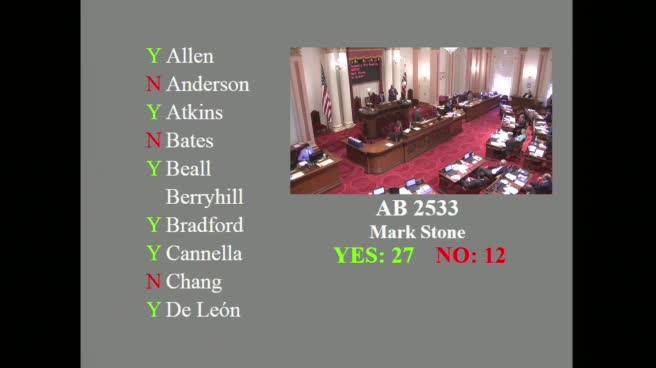 2MIN
Senate Floor
 7MIN
Senate Standing Committee on Judiciary
 2MIN
Senate Standing Committee on Education
 6MIN
Assembly Floor
 7MIN
Assembly Standing Committee on Judiciary
 7MIN
Assembly Standing Committee on Education
Bill Author

Bill Co-Author(s):