AB 1279: Valley fever.
- Session Year: 2017-2018
- House: Assembly
- Latest Version Date: 2017-09-15
Existing law requires the State Department of Public Health to establish a list of reportable communicable and noncommunicable diseases and conditions and specify the timeliness requirements related to the reporting of each disease and condition. Existing law also supports research into the development of a vaccine to protect against valley fever (coccidioidomycosis).
This bill would require the department to develop outreach programs to educate the public about valley fever.
(1)Existing law requires the State Department of Public Health to establish a list of reportable communicable and noncommunicable diseases and conditions and specify the timeliness requirements related to the reporting of each disease and condition. Existing law also supports research into the development of a vaccine to protect against valley fever (coccidioidomycosis).
This bill would require the department to post a summary of confirmed cases of valley fever on its Internet Web site, as specified, and to implement an enhanced monitoring system that tracks cases of valley fever in the state. The bill would require the department to establish a workgroup that includes health officers from the 5 counties with the highest incidences of valley fever and, in consultation with that workgroup, to develop outreach programs to educate the public about valley fever.
By requiring select counties to participate in a workgroup, this bill would impose a state-mandated local program.(2)The California Constitution requires the state to reimburse local agencies and school districts for certain costs mandated by the state. Statutory provisions establish procedures for making that reimbursement.This bill would provide that, if the Commission on State Mandates determines that the bill contains costs mandated by the state, reimbursement for those costs shall be made pursuant to the statutory provisions noted above.(1)Existing law requires the State Department of Public Health to establish a list of reportable communicable and noncommunicable diseases and conditions and specify the timeliness requirements related to the reporting of each disease and condition. Existing law also supports research into the development of a vaccine to protect against valley fever (coccidioidomycosis).
This bill would require each county to ascertain and report the existence of every confirmed case of valley fever to the department in a timely manner.TheThis bill would require the department to post a summary of confirmed cases of valley fever on its Internet Web site, as specified, and to implement an enhanced monitoring system that tracks cases of valley fever in the state. The bill would require the department to establish a workgroup that includes health officers from the 5 counties with the highest incidences of valley fever and to implement an enhanced monitoring system that tracks cases of valley fever in the state, and and, in consultation with that workgroup, to develop an annual outreach program programs to educate the public about valley fever. The bill would require the department to post confirmed cases of valley fever on its Internet Web site.
By requiring counties to perform a new duty to collect and report information, and requiring select counties to participate in a workgroup, this bill would impose a state-mandated local program.
(2)The California Constitution requires the state to reimburse local agencies and school districts for certain costs mandated by the state. Statutory provisions establish procedures for making that reimbursement.
This bill would provide that, if the Commission on State Mandates determines that the bill contains costs mandated by the state, reimbursement for those costs shall be made pursuant to the statutory provisions noted above.
(1)Existing law requires the State Department of Public Health to establish a list of reportable communicable and noncommunicable diseases and conditions and specify the timeliness requirements related to the reporting of each disease and condition. Existing law also supports research into the development of a vaccine to protect against valley fever (coccidioidomycosis).
This bill would require each county to ascertain and report the existence of every confirmed case of valley fever to the department in a timely manner. By requiring the county to perform a new duty to collect and report information, this bill would impose a state-mandated local program.
The bill would require the department to establish a workgroup that includes health officers from the 5 counties with the highest incidence incidences of valley fever and to implement an enhanced monitoring system that tracks cases of valley fever in the state. state, and to develop an annual outreach program to educate the public about valley fever. The bill would require the department to post confirmed cases of valley fever on its Internet Web site. The bill would require the department to conduct an annual outreach program to educate the public about valley fever. The bill would appropriate $2,000,000 from the General Fund to the department to fund research equipment, enhanced monitoring, and public outreach related to valley fever.
By requiring counties to perform a new duty to collect and report information, and requiring select counties to participate in a workgroup, this bill would impose a state-mandated local program.
(2)The California Constitution requires the state to reimburse local agencies and school districts for certain costs mandated by the state. Statutory provisions establish procedures for making that reimbursement.
This bill would provide that, if the Commission on State Mandates determines that the bill contains costs mandated by the state, reimbursement for those costs shall be made pursuant to the statutory provisions noted above.
(1)Existing law requires the State Department of Public Health to establish a list of reportable communicable and noncommunicable diseases and conditions and specify the timeliness requirements related to the reporting of each disease and condition. Existing law also supports research into the development of a vaccine to protect against valley fever (coccidioidomycosis).
This bill would require each county to ascertain and report the existence of every case of valley fever to the department in a timely manner. By requiring the county to perform a new duty to collect and report information, this bill would impose a state-mandated local program.
The bill would require the department to establish a workgroup that includes health officers from the 5 counties with the highest incidence of valley fever and to implement an enhanced monitoring system that tracks cases of valley fever in the state. The bill would require the department to post both suspected and confirmed cases of valley fever on its Internet Web site. The bill would require the department to conduct an annual outreach program to educate the public about valley fever. The bill would appropriate $2,000,000 from the General Fund to the department to fund research equipment, enhanced monitoring, and public outreach related to valley fever.
(2)The California Constitution requires the state to reimburse local agencies and school districts for certain costs mandated by the state. Statutory provisions establish procedures for making that reimbursement.
This bill would provide that, if the Commission on State Mandates determines that the bill contains costs mandated by the state, reimbursement for those costs shall be made pursuant to the statutory provisions noted above.
(1)Existing law requires the State Department of Public Health to establish a list of reportable communicable and noncommunicable diseases and conditions and specify the timeliness requirements related to the reporting of each disease and condition. Existing law also supports research into the development of a vaccine to protect against valley fever (coccidioidomycosis).
This bill would require each county to ascertain and report the existence of every case of valley fever to the department in a timely manner. By requiring the county to perform a new duty to collect and report information, this bill would impose a state-mandated local program. The bill would also require the department to publicly announce within a county whenever the number of reported cases of valley fever is equal to or greater than 5% of the countys population in a manner that is reasonably likely to inform a majority of the residents of the county. The
The bill would require the department to establish an enhanced monitoring system that tracks cases of valley fever in the state. The bill would require the department to post both suspected and confirmed cases of valley fever on its Internet Web site. The bill would require the department to conduct an annual outreach program to educate the public about valley fever. The bill would appropriate $2,000,000 from the General Fund to the department to fund research and equipment equipment, enhanced monitoring, and public outreach related to address valley fever.
(2)The California Constitution requires the state to reimburse local agencies and school districts for certain costs mandated by the state. Statutory provisions establish procedures for making that reimbursement.
This bill would provide that, if the Commission on State Mandates determines that the bill contains costs mandated by the state, reimbursement for those costs shall be made pursuant to the statutory provisions noted above.
(1)Existing law requires the State Department of Public Health to establish a list of reportable communicable and noncommunicable diseases and conditions and specify the timeliness requirements related to the reporting of each disease and condition. Existing law also supports research into the development of a vaccine to protect against valley fever (coccidioidomycosis).
This bill would require each county to ascertain and report the existence of every case of valley fever to the department in a timely manner. By requiring the county to perform a new duty to collect and report information, this bill would impose a state-mandated local program. The bill would also require the department to publicly announce within a county whenever the number of reported cases of valley fever is equal to or greater than 5% of the countys population in a manner that is reasonably likely to inform a majority of the residents of the county. The bill would appropriate $2,000,000 from the General Fund to the department to fund research and equipment to address valley fever.
(2)The California Constitution requires the state to reimburse local agencies and school districts for certain costs mandated by the state. Statutory provisions establish procedures for making that reimbursement.
This bill would provide that, if the Commission on State Mandates determines that the bill contains costs mandated by the state, reimbursement for those costs shall be made pursuant to the statutory provisions noted above.
The State Department of Public Health shall develop and implement public outreach programs to educate the public about coccidioidomycosis, commonly referred to as valley fever.
The department shall post a summary of all confirmed cases of valley fever reported pursuant to department regulations on its Internet Web site, in a manner that protects the confidentiality of individuals in those cases. State Department of Public Health shall develop and implement public outreach programs to educate the public about coccidioidomycosis, commonly referred to as valley fever.
26167.The department shall do all of the following:(a)Establish an enhanced monitoring system to track confirmed cases of valley fever throughout the state.(b)Establish a workgroup that shall include health officers from the five counties with the highest incidences of valley fever, as determined by the department, to improve timely and accurate monitoring.(c)Develop, in consultation with the workgroup established pursuant to subdivision (b), public outreach programs to educate the public about valley fever.26169.For purposes of this chapter, the following definitions shall apply:(a)Department means the State Department of Public Health.(b)Valley fever means coccidioidomycosis.SEC. 2.If the Commission on State Mandates determines that this act contains costs mandated by the state, reimbursement to local agencies and school districts for those costs shall be made pursuant to Part 7 (commencing with Section 17500) of Division 4 of Title 2 of the Government Code.The department shall post a summary of all confirmed cases of valley fever reported pursuant to department regulations on its Internet Web site. site, in a manner that protects the confidentiality of individuals in those cases.
26167.(a)The department shall establish do all of the following:
(a)Establish an enhanced monitoring system to track confirmed cases of valley fever throughout the state.
(b)In order to improve timely and accurate monitoring for valley fever, the department shall establish Establish a workgroup that shall include health officers from the five counties with the highest incidences of valley fever, as determined by the department. department, to improve timely and accurate monitoring.
(c)Develop, in consultation with the workgroup established pursuant to subdivision (b), public outreach programs to educate the public about valley fever.
26168.The workgroup described in subdivision (b) of Section 26167 shall develop an annual public outreach program to educate the public about valley fever.26169.For purposes of this chapter, the following definitions shall apply:
(a)Department means the State Department of Public Health.
(b)Valley fever means coccidioidomycosis.
SEC. 2.If the Commission on State Mandates determines that this act contains costs mandated by the state, reimbursement to local agencies and school districts for those costs shall be made pursuant to Part 7 (commencing with Section 17500) of Division 4 of Title 2 of the Government Code.
(a)Each county shall ascertain and report the existence of every confirmed case of valley fever to the department in a timely manner.
(b)The department shall post all confirmed cases of valley fever on its Internet Web site.
26167.(a)The department shall establish an enhanced monitoring system to track confirmed cases of valley fever throughout the state.
(b)In order to improve timely and accurate monitoring for valley fever, the department shall establish a workgroup that shall include health officers from the five counties with the highest incidence incidences of valley fever, as determined by the department.
26168.The department workgroup described in subdivision (b) of Section 26167 shall conduct develop an annual public outreach program to educate the public about valley fever.
26169.For purposes of this chapter, the following definitions shall apply:
(a)Department means the State Department of Public Health.
(b)Valley fever means coccidioidomycosis.
SEC. 2.If the Commission on State Mandates determines that this act contains costs mandated by the state, reimbursement to local agencies and school districts for those costs shall be made pursuant to Part 7 (commencing with Section 17500) of Division 4 of Title 2 of the Government Code.
SEC. 3.The sum of two million dollars ($2,000,000) is hereby appropriated from the General Fund to the State Department of Public Health for the purpose of funding research equipment, enhanced monitoring, and public outreach related to valley fever, also known as coccidioidomycosis.(a)Each county shall ascertain and report the existence of every case of valley fever, including both suspected and confirmed cases, fever to the department in a timely manner. This section shall not be deemed to require the disclosure of personal medical information.
(b)The department shall post all cases of valley fever, including both suspected and confirmed cases, fever on its Internet Web site.
26167.(a)The department shall establish an enhanced monitoring system to track cases of valley fever throughout the state.
(b)In order to improve timely and accurate monitoring for valley fever, the department shall establish a workgroup that shall include health officers from the five counties with the highest incidence of valley fever, as determined by the department.
26168.The department shall conduct an annual public outreach program to educate the public about valley fever.
26169.For purposes of this chapter, the following definitions shall apply:
(a)Department means the State Department of Public Health.
(b)Valley fever means coccidioidomycosis.
SEC. 2.If the Commission on State Mandates determines that this act contains costs mandated by the state, reimbursement to local agencies and school districts for those costs shall be made pursuant to Part 7 (commencing with Section 17500) of Division 4 of Title 2 of the Government Code.
SEC. 3.The sum of two million dollars ($2,000,000) is hereby appropriated from the General Fund to the State Department of Public Health for the purpose of funding research equipment, enhanced monitoring, and public outreach related to valley fever, also known as coccidioidomycosis.
(a)Each county shall ascertain and report the existence of every case of valley fever fever, including both suspected and confirmed cases, to the department in a timely manner. This section shall not be deemed to require the disclosure of personal medical information.
(b)The department shall post all cases of valley fever, including both suspected and confirmed cases, on its Internet Web site.
26167.The department shall publicly announce within a county whenever the number of reported cases of valley fever is equal to or greater than 5 percent of the countys population. The department shall make the announcement in a manner that is reasonably likely to inform a majority of the residents of the county. establish an enhanced monitoring system to track cases of valley fever throughout the state.
26168.The department shall conduct an annual public outreach program to educate the public about valley fever.
26169.For purposes of this chapter, the following definitions shall apply:
(a)Department means the State Department of Public Health.
(b)Valley fever means coccidioidomycosis.
SEC. 2.If the Commission on State Mandates determines that this act contains costs mandated by the state, reimbursement to local agencies and school districts for those costs shall be made pursuant to Part 7 (commencing with Section 17500) of Division 4 of Title 2 of the Government Code.
SEC. 3.The sum of two million dollars ($2,000,000) is hereby appropriated from the General Fund to the State Department of Public Health for the purpose of funding research and equipment equipment, enhanced monitoring, and public outreach related to address valley fever, also known as coccidioidomycosis.
Each county shall ascertain and report the existence of every case of valley fever to the department in a timely manner. This section shall not be deemed to require the disclosure of personal medical information.
26167.The department shall publicly announce within a county whenever the number of reported cases of valley fever is equal to or greater than 5 percent of the countys population. The department shall make the announcement in a manner that is reasonably likely to inform a majority of the residents of the county.
26169.For purposes of this chapter, the following definitions shall apply:
(a)Department means the State Department of Public Health.
(b)Valley fever means coccidioidomycosis.
SEC. 2.If the Commission on State Mandates determines that this act contains costs mandated by the state, reimbursement to local agencies and school districts for those costs shall be made pursuant to Part 7 (commencing with Section 17500) of Division 4 of Title 2 of the Government Code.
SEC. 3.The sum of two million dollars ($2,000,000) is hereby appropriated from the General Fund to the State Department of Public Health for the purpose of funding research and equipment to address valley fever, also known as coccidioidomycosis.
|
Date
|
Status
|
|---|---|
| Jan 12, 2018 | Stricken from file. |
| Jan 3, 2018 | Consideration of Governor's veto pending. |
| Oct 3, 2017 | Vetoed by Governor. |
| Sep 21, 2017 | Enrolled and presented to the Governor at 3:30 p.m. |
| Sep 13, 2017 | Assembly Rule 77(a) suspended. |
| Sep 12, 2017 | In Assembly. Concurrence in Senate amendments pending. May be considered on or after September 14 pursuant to Assembly Rule 77. |
| Sep 11, 2017 | Read third time. Passed. Ordered to the Assembly. |
| Sep 5, 2017 | Read second time. Ordered to third reading. |
| Sep 1, 2017 | From committee: Amend, and do pass as amended. (Ayes 7. Noes 0.) (September 1). |
| Aug 21, 2017 | In committee: Referred to APPR. suspense file. |
| Jul 11, 2017 | Read second time and amended. Re-referred to Com. on APPR. |
| Jul 10, 2017 | From committee: Amend, and do pass as amended and re-refer to Com. on APPR. (Ayes 9. Noes 0.) (July 5). |
| Jun 14, 2017 | Referred to Com. on HEALTH. |
| Jun 1, 2017 | In Senate. Read first time. To Com. on RLS. for assignment. |
| May 31, 2017 | Read third time. Passed. Ordered to the Senate. (Ayes 76. Noes 0. Page 1970.) |
| May 30, 2017 | Read second time and amended. Ordered returned to second reading. |
| May 26, 2017 | From committee: Amend, and do pass as amended. (Ayes 13. Noes 0.) (May 26). |
| May 10, 2017 | In committee: Set, first hearing. Referred to APPR. suspense file. |
| Apr 26, 2017 | Re-referred to Com. on APPR. |
| Apr 25, 2017 | Read second time and amended. |
| Apr 24, 2017 | From committee: Amend, and do pass as amended and re-refer to Com. on APPR. (Ayes 14. Noes 0.) (April 18). |
| Apr 17, 2017 | Re-referred to Com. on HEALTH. |
| Apr 6, 2017 | From committee chair, with author's amendments: Amend, and re-refer to Com. on HEALTH. Read second time and amended. |
| Mar 13, 2017 | Referred to Com. on HEALTH. |
| Feb 19, 2017 | From printer. May be heard in committee March 21. |
| Feb 17, 2017 | Read first time. To print. |
|
Date
|
Description
|
Location
|
Votes
|
|
|---|---|---|---|---|
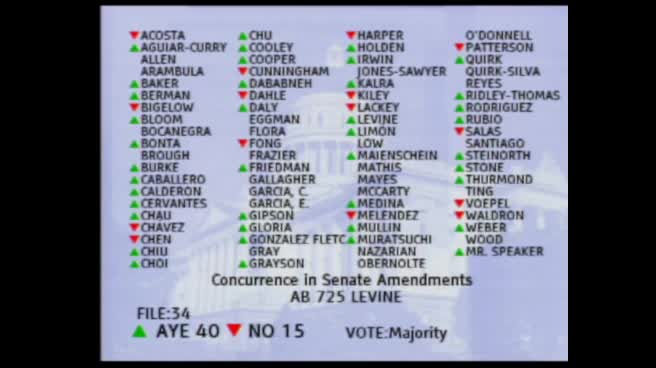
| Sep 13, 2017 | AB 1279 SALAS Concurrence in Senate Amendments | Assembly Floor |
Passed |
|
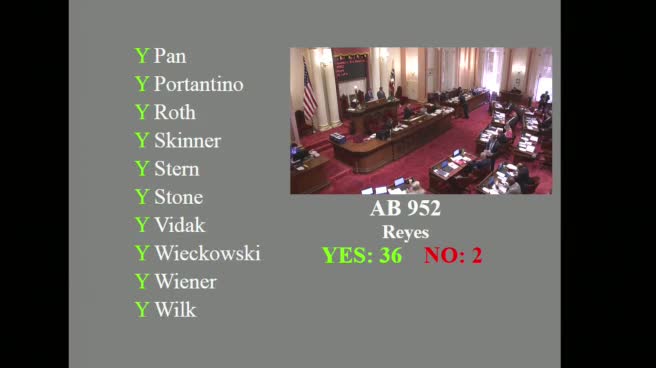
| Sep 11, 2017 | Assembly 3rd Reading AB1279 Salas et al. By Fuller | Senate Floor |
Passed |
|
| Sep 1, 2017 | Do pass as amended | Senate Standing Committee on Appropriations |
Passed |
|
| Aug 21, 2017 | Placed on suspense file | Senate Standing Committee on Appropriations |
Passed |
|
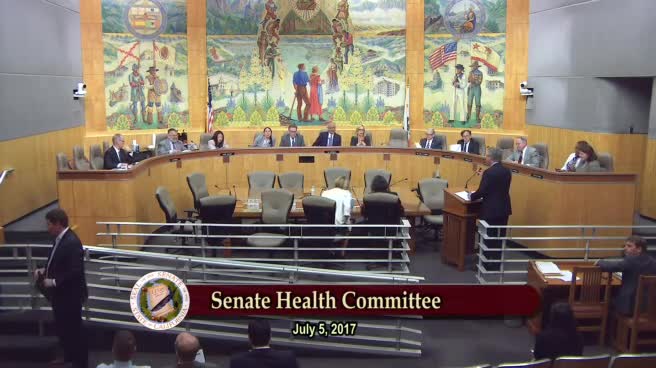
| Jul 5, 2017 | Do pass as amended, but first amend, and re-refer to the Committee on [Appropriations] | Senate Standing Committee on Health |
Passed |
|
| May 31, 2017 | AB 1279 SALAS Assembly Third Reading | Assembly Floor |
Passed |
|
| May 26, 2017 | Do pass as amended. | Assembly Standing Committee on Appropriations |
Passed |
|
| Apr 18, 2017 | Do pass as amended and be re-referred to the Committee on [Appropriations] | Assembly Standing Committee on Health |
Passed |
This list shows positions taken on this bill by organizations on the date displayed, which is linked to the original source.
Positions by individuals are not included.
GOVERNOR'S VETO
GV Bill Id:AB 1279
Author:(Salas)
As Enrolled Ver:September 15, 2017
2/3 vote
ASSEMBLY: | 76-0 | (May 31, 2017) | SENATE: | 40-0 | (September 11, 2017) |
ASSEMBLY: | 77-0 | (September 13, 2017) |
Original Committee Reference: HEALTH
SUMMARY: Requires the Department of Public Health (DPH) to develop and implement public outreach programs to educate the public about coccidioidomycosis, commonly referred to as valley fever.
The Senate amendments delete the Assembly version of this bill, and instead require DPH to develop and implement public outreach programs to educate the public about coccidioidomycosis, commonly referred to as valley fever.
AS PASSED BY THE ASSEMBLY this bill required each county to report all cases of valley fever to the DPH and required DPH to establish a workgroup to improve timely and accurate monitoring for valley fever.
FISCAL EFFECT: According to the Senate Appropriations Committee, ongoing costs of about $580,000 per year for DPH to contract for public outreach activities and investigations of valley fever outbreaks (General Fund).
COMMENTS: Valley fever is primarily a disease of the lung, caused by a fungus, which lives in the soil and is endemic to parts of the southwestern U.S. and elsewhere in the Western Hemisphere. Agricultural communities with open fields, such as Kern County, are especially vulnerable to valley fever outbreaks. About 60% of persons who inhale the spores do not get sick at all and are unaware they are infected. For others, symptoms are similar to a cold or flu. Of those patients seeking medical care, the most common symptoms are fatigue, cough, chest pain, fever, rash, headache, and joint aches. More extreme cases include pneumonia-like symptoms. According to the Centers for Disease Control and Prevention, 11,072 cases of valley fever were reported in the U.S. in 2015. Of these, 3,053 were in California. According to DPH, valley fever contributes to an average of 78 deaths per year in California. DPH has a Web page dedicated to valley fever. It includes links to brochures and fact sheets (in English, Spanish, and Tagalog), occupational health posters, resources on work-related illness, information for health professionals (including a recent update on valley fever in the Medical Board of California's 2017 newsletter), and data and statistics, including annual reported cases by county and epidemiological summaries.
This bill requires the Department of Public Health to develop outreach programs to educate the public about Valley Fever.
The department already provides fact sheets, brochures, posters and other educational materials to raise awareness of this disease. Expanding this program would necessitate additional resources which should be considered along with other funding requests as part of the budget process.
Analysis Prepared by: John Gilman / HEALTH / (916) 319-2097 FN: 0002429
CONCURRENCE IN SENATE AMENDMENTS
CSA1 Bill Id:AB 1279
Author:(Salas)
As Amended Ver:September 1, 2017
Majority vote
ASSEMBLY: | 76-0 | (May 31, 2017) | SENATE: | 40-0 | (September 11, 2017) |
Original Committee Reference: HEALTH
SUMMARY: Requires the Department of Public Health (DPH) to develop and implement public outreach programs to educate the public about coccidioidomycosis, commonly referred to as valley fever.
The Senate amendments delete the Assembly version of this bill, and instead require DPH to develop and implement public outreach programs to educate the public about coccidioidomycosis, commonly referred to as valley fever.
AS PASSED BY THE ASSEMBLY this bill required each county to report all cases of valley fever to the DPH and required DPH to establish a workgroup to improve timely and accurate monitoring for valley fever.
FISCAL EFFECT: According to the Senate Appropriations Committee, ongoing costs of about $580,000 per year for DPH to contract for public outreach activities and investigations of valley fever outbreaks (General Fund).
COMMENTS: Valley fever (also known as coccidioidomycosis) is primarily a disease of the lung, caused by a fungus, which lives in the soil and is endemic to parts of the southwestern U.S. and elsewhere in the Western Hemisphere. Agricultural communities with open fields, such as Kern County, are especially vulnerable to valley fever outbreaks. About 60% of persons who inhale the spores do not get sick at all and are unaware they are infected. For others, symptoms are similar to a cold or flu. Of those patients seeking medical care, the most common symptoms are fatigue, cough, chest pain, fever, rash, headache, and joint aches. More extreme cases include pneumonia-like symptoms. According to the Centers for Disease Control and Prevention (CDC), 11,072 cases of valley fever were reported in the U.S. in 2015. Of these, 3,053 were in California, 7,662 in Arizona, and 397 in the rest of the country. According to DPH, valley fever contributes to an average of 78 deaths per year in California.
DPH has a Web page dedicated to valley fever. It includes links to brochures and fact sheets (in English, Spanish, and Tagalog), occupational health posters, resources on work-related illness, information for health professionals (including a recent update on valley fever in the Medical Board of California's 2017 newsletter), and data and statistics, including annual reported cases by county and epidemiological summaries.
Analysis Prepared by: John Gilman / HEALTH / (916) 319-2097 FN: 0001852
Office of Senate Floor Analyses (916) 651-1520 Fax: (916) 327-4478 | AB 1279 |
THIRD READING
Bill No: AB 1279
Amended: 9/1/17 in Senate
SENATE HEALTH COMMITTEE: 9-0, 7/5/17
AYES: Hernandez, Nguyen, Atkins, Leyva, Mitchell, Monning, Newman, Nielsen, Roth
SENATE APPROPRIATIONS COMMITTEE: 7-0, 9/1/17
AYES: Lara, Bates, Beall, Bradford, Hill, Nielsen, Wiener
ASSEMBLY FLOOR: 76-0, 5/31/17 - See last page for vote
DIGEST:
- This bill requires the Department of Public Health (DPH) to develop and implement public outreach programs to educate the public about coccidioidomycosis, commonly referred to as valley fever.
Existing law:
- Requires DPH to establish a list of reportable communicable and non-communicable diseases and conditions and specify the timeliness requirements related to the reporting of each disease and condition.
- Requires, through regulation, every health care provider, knowing of or in attendance on a case or suspected case of any of diseases or conditions as specified, to report to the local health officer for the jurisdiction where the patient resides. Permits any individual having knowledge of a person who is suspected to be suffering from one of the diseases or conditions listed make such a report to the local health officer for the jurisdiction where the patient resides when there is no health care provider in attendance. Defines "health care provider" as a physician and surgeon, a veterinarian, a podiatrist, a nurse practitioner, a physician assistant, a registered nurse, a nurse midwife, a school nurse, an infection control practitioner, a medical examiner, a coroner, or a dentist.
- Requires, through regulation, an administrator of each health facility, clinic, or other setting where more than one health care provider may know of a case, a suspected case or an outbreak of disease within the facility to establish and be responsible for administrative procedures to assure that reports are made to the local officer.
- Requires, through regulation, local health officers to report cases of identified diseases to DPH.
- Requires funds appropriated to DPH for the purpose of valley fever vaccine research to be used to continue and expand the current research effort being conducted by the Valley Fever Vaccine Project.
This bill requires DPH to develop and implement public outreach programs to educate the public about valley fever.
Background
According to the Centers for Disease Control and Prevention (CDC), valley fever is caused by Coccidioides, a fungus that lives in soil in the southwestern United States and parts of Mexico, Central America, and South America. Inhaling the airborne fungal spores can cause infection, but is not spread from person to person. Most people who are exposed to the fungus do not get sick, but some people develop flu-like symptoms that may last for weeks to months. In a very small proportion of people who get valley fever, the infection can spread from the lungs to the rest of the body and cause more severe conditions, such as meningitis or even death.
Incidence. According to the CDC, between 1998 and 2015 the number of reported valley fever cases peaked in 2011 (at 22,641). In 2015, there were 11,072 reported cases. The reasons for the changes in the number of reported cases are not entirely known, but could be due to changes in the number of susceptible people exposed to the fungus because of travel or relocation to endemic areas; environmental factors such as temperature and rainfall, which can affect the growth of the fungus and how much of it is circulating; and the way cases are being detected and reported. It is believed that many cases likely go undiagnosed. Some researchers estimate that each year the fungus infects more than 150,000 people, many of whom are sick without knowing the cause or have cases so mild they are not detected. While anyone in an endemic area is at risk, those working in occupations involving dirt and dust exposure may be at increased risk of infection. Several groups of people are at higher risk for developing the severe forms of valley fever, including African Americans, Asians, women in their third trimester of pregnancy, and people with weak immune systems, including those with an organ transplant or who have HIV/AIDS. In California, highly endemic counties (more than 20 cases per 100,000 population per year), are Kern, Kings, Fresno, Merced, Madera, Tulare, and San Luis Obispo.
Comments
Author’s statement. According to the author, DPH recently announced that the number of Valley Fever cases in California for 2016 increased to more than 5,300 claiming many lives in counties across the state. In 2015, the total number of Valley Fever infections only reached 3,000. Early detection and treatment of Valley Fever infections can help save lives.
Related/Prior Legislation
SB 115 (Fuller, 2015) would have appropriated $1 million from the General Fund to DPH for purposes of valley fever vaccine research. SB 1044 (Fuller, 2014), AB 1955 (Ashburn, 2002), SB 1027 (Ashburn, 2003) and SB 492 (Ashburn, 2005) were substantially similar to SB 115. SB 1044 was referred to Banking and Finance but never acted upon. AB 1955, SB 1027 and SB 492 were held on the Assembly Appropriations Committee suspense file.
FISCAL EFFECT: Appropriation: No Fiscal Com.: Yes Local: No
According to the Senate Appropriations Committee, ongoing costs of about $580,000 per year for DPH to contract for public outreach activities and investigations of Valley Fever outbreaks (General Fund).
American Lung Association
Arvin Chamber of Commerce
California Faculty Association
City of Lemoore
Greater Lamont Chamber of Commerce
Kern County Board of Supervisors
Valley Fever Survivor
OPPOSITION: (Verified 8/31/17)
Department of Finance
Department of Public Health
ASSEMBLY FLOOR: 76-0, 5/31/17
AYES: Acosta, Aguiar-Curry, Travis Allen, Arambula, Baker, Berman, Bigelow, Bloom, Bocanegra, Bonta, Brough, Burke, Caballero, Calderon, Cervantes, Chau, Chávez, Chiu, Chu, Cooley, Cooper, Cunningham, Dababneh, Dahle, Daly, Flora, Fong, Frazier, Friedman, Gallagher, Cristina Garcia, Eduardo Garcia, Gipson, Gloria, Gomez, Gonzalez Fletcher, Gray, Grayson, Harper, Holden, Irwin, Jones-Sawyer, Kalra, Kiley, Lackey, Levine, Limón, Low, Maienschein, Mathis, Mayes, McCarty, Medina, Mullin, Muratsuchi, Nazarian, Obernolte, O'Donnell, Patterson, Quirk, Quirk-Silva, Reyes, Ridley-Thomas, Rodriguez, Rubio, Salas, Santiago, Steinorth, Mark Stone, Thurmond, Ting, Voepel, Waldron, Weber, Wood, Rendon
NO VOTE RECORDED: Chen, Choi, Eggman, Melendez
Prepared by: Melanie Moreno / HEALTH / (916) 651-4111
9/4/17 12:53:39
**** END ****
SENATE COMMITTEE ON
Senator Ricardo Lara, Chair
2017 - 2018 Regular Session
AB 1279 (Salas) - Valley fever
Version: | Policy Vote: |
Urgency: | Mandate: |
Hearing Date: | Consultant: |
Bill Summary:
AB 1279 would require the Department of Public Health to implement an enhanced monitoring system for tracking cases of Valley Fever and to develop a public outreach campaign.
*********** ANALYSIS ADDENDUM – SUSPENSE FILE ***********
The following information is revised to reflect amendments
adopted by the committee on September 1, 2017
Fiscal Impact:
- Ongoing costs of about $580,000 per year for the Department of Public Health to contract for public outreach activities and investigations of Valley Fever outbreaks (General Fund).
Author Amendments:
Limit the bill to only require the Department of Public Health to implement public outreach programs regarding Valley Fever.
-- END --
SENATE COMMITTEE ON
Senator Ricardo Lara, Chair
2017 - 2018 Regular Session
AB 1279 (Salas) - Valley fever
Version: | Policy Vote: |
Urgency: | Mandate: |
Hearing Date: | Consultant: |
This bill meets the criteria for referral to the Suspense File.
Bill Summary:
AB 1279 would require the Department of Public Health to implement an enhanced monitoring system for tracking cases of Valley Fever and to develop a public outreach campaign.
Fiscal Impact:
- Ongoing costs of about $800,000 per year for the Department of Public Health to perform data analysis and monitoring of Valley Fever cases reported by local health departments, to work with local health districts to improve consistency in reporting cases, and to develop a public outreach program (General Fund).
- Ongoing costs of about $580,000 per year for the Department of Public Health to contract for public outreach activities and investigations of Valley Fever outbreaks (General Fund).
- Ongoing costs of about $600,000 per year for the Department of Public Health to provide local assistance funding to local health departments to improve their monitoring and reporting of Valley Fever cases (General Fund).
Background:
Valley Fever is an infection that is caused when a person inhales certain fungal spores. In California, Valley Fever is most common in central valley counties. While most individuals who are exposed to the fungal spores that cause Valley Fever experience no symptoms or mild symptoms, in some cases serious medical complications occur.
Under current law, the Department of Public Health is required to conduct disease surveillance and prevention activities for over 80 communicable diseases, including Valley Fever. Currently, testing laboratories are required to report individual cases of Valley Fever to the Department. The Department investigates outbreaks of Valley Fever and works with local health departments when outbreaks occur.
Proposed Law:
AB 1279 would require the Department of Public Health to implement an enhanced monitoring system for tracking cases of Valley Fever and to develop a public outreach campaign.
Specific provisions of the bill would:
- Require the Department to post a summary of all confirmed cases of Valley Fever on its website, in a manner that protects patient confidentiality;
- Require the Department to establish an enhanced monitoring system to track confirmed cases of Valley Fever;
- Establish a workgroup, with local health officers from the five most impacted counties, to improve monitoring and reporting;
- Require the Department to establish public outreach programs.
Related Legislation:
SB 115 (Fuller, 2015) would have appropriated $1 million from the General Fund for Valley Fever vaccine research. That bill was held on the Assembly Appropriations Committee’s Suspense File.
Staff Comments:
Under current law, the Department of Public Health already tracks confirmed cases of Valley Fever in the state and publishes an annual summary of cases, broken down by county, age group, and ethnicity. In 2016 there were over 5,000 cases reported to the Department.
The Department notes that there are inherent difficulties in creating an accurate record of all cases of Valley Fever in a timely manner. For example, many people who contract Valley Fever experience mild flu-like symptoms that do not result in their seeking medical care or for which testing for Valley Fever is not ordered by their health care provider. It is also important to note that local health districts currently follow direction from the Centers for Disease Control and Prevention in reporting cases of Valley Fever to the Department.
It is not clear what the benefit to the public would be to post information on all confirmed cases of Valley Fever on the Department’s website.
The Department also publishes information for the public and health care professionals, in English and Spanish, about Valley Fever and actions that members of the public can take to reduce their risk of contracting Valley Fever.
-- END --
SENATE COMMITTEE ON HEALTH
Senator Ed Hernandez, O.D., Chair
BILL NO: AB 1279
AUTHOR: | Salas | ||
VERSION: | May 30, 2017 | ||
HEARING DATE: | July 5, 2017 | ||
CONSULTANT: | Melanie Moreno | ||
SUBJECT: Valley fever
SUMMARY:
- Requires counties to ascertain and report the existence of every confirmed case of valley fever to the Department of Public Health (DPH) in a timely manner and for DPH to post those cases on its Internet Web site. Requires DPH to establish an enhanced monitoring system to track confirmed cases of valley fever throughout the state. Requires DPH to establish a workgroup that includes health officers from the five counties with the highest incidences of valley fever, as determined by DPH.
Existing law:
- Requires DPH to establish a list of reportable communicable and non-communicable diseases and conditions and specify the timeliness requirements related to the reporting of each disease and condition.
- Requires, through regulation, every health care provider, knowing of or in attendance on a case or suspected case of any of diseases or conditions as specified, to report to the local health officer for the jurisdiction where the patient resides. Permits any individual having knowledge of a person who is suspected to be suffering from one of the diseases or conditions listed make such a report to the local health officer for the jurisdiction where the patient resides when there is no health care provider in attendance. Defines "health care provider" as a physician and surgeon, a veterinarian, a podiatrist, a nurse practitioner, a physician assistant, a registered nurse, a nurse midwife, a school nurse, an infection control practitioner, a medical examiner, a coroner, or a dentist.
- Requires, through regulation, an administrator of each health facility, clinic, or other setting where more than one health care provider may know of a case, a suspected case or an outbreak of disease within the facility to establish and be responsible for administrative procedures to assure that reports are made to the local officer.
- Requires, through regulation, local health officers to report cases of identified diseases to DPH.
- Requires funds appropriated to DPH for the purpose of valley fever vaccine research to be used to continue and expand the current research effort being conducted by the Valley Fever Vaccine Project.
This bill:
- Requires counties to ascertain and report the existence of every confirmed case of valley fever to DPH in a timely manner.
- Requires DPH to post all confirmed cases of valley fever on its Internet Web site and to establish an enhanced monitoring system to track confirmed cases of valley fever throughout the state.
- Requires DPH, in order to improve timely and accurate monitoring for valley fever, to establish a workgroup that includes health officers from the five counties with the highest incidences of valley fever, as determined by DPH.
- Requires the workgroup to develop an annual public outreach program to educate the public about valley fever.
FISCAL EFFECT:
According to the Assembly Appropriations Committee:
- Minor costs to DPH to implement a workgroup.
- Unknown, significant cost pressure to fund outreach activities recommended by the workgroup. Costs would depend on the strategies pursued.
- Unknown, potentially state-reimbursable costs, likely in the hundreds of thousands, to support local assistance to support valley fever disease monitoring. Building surveillance capacity takes human and technological infrastructure that will result in ongoing costs to maintain.
PRIOR VOTES:
Assembly Floor: | 76 - 0 |
Assembly Appropriations Committee: | 13 - 0 |
Assembly Health Committee: | 14 - 0 |
COMMENTS:
- Author’s statement. According to the author, DPH recently announced that the number of Valley Fever cases in California for 2016 increased to more than 5,300 claiming many lives in counties across the state. In 2015, the total number of Valley Fever infections only reached 3,000. Early detection and treatment of Valley Fever infections can help save lives. AB 1279 establishes a workgroup made up of local health officers from the 5 most affected counties in the state to explore ways to streamline the reporting of Valley Fever infections. The bill also requires DPH to conduct annual outreach to bring awareness to California families living in areas affect by Valley Fever so that infections can be detected and treated early.
- Background. According to the Centers for Disease Control and Prevention (CDC), valley fever is caused by Coccidioides, a fungus that lives in soil in the southwestern United States and parts of Mexico, Central America, and South America. Inhaling the airborne fungal spores can cause infection, but is not spread from person to person. Most people who are exposed to the fungus do not get sick, but some people develop flu-like symptoms that may last for weeks to months. In a very small proportion of people who get valley fever, the infection can spread from the lungs to the rest of the body and cause more severe conditions, such as meningitis or even death.
- Endemic areas. The CDC map below shows the approximate areas (called “endemic areas”) where Coccidioides is known to live or is suspected to live in the U.S. and Mexico. Much of what is known about where the fungus lives in the southwestern U.S. is based on studies performed in the late 1940s and early 1950s. The map also shows the locations of several outbreaks and locations of Valley Fever cases acquired outside of the areas identified by skin testing. Coccidioides might also live in similar areas with hot, dry climates that are not shaded on the map.

- Incidence. According to the CDC, between 1998 and 2015 the number of reported valley fever cases peaked in 2011 (at 22,641). In 2015, there were 11,072 reported cases. The reasons for the changes in the number of reported cases are not entirely known, but could be due to changes in the number of susceptible people exposed to the fungus because of travel or relocation to endemic areas; environmental factors such as temperature and rainfall, which can affect the growth of the fungus and how much of it is circulating; and the way cases are being detected and reported. It is believed that many cases likely go undiagnosed. Some researchers estimate that each year the fungus infects more than 150,000 people, many of whom are sick without knowing the cause or have cases so mild they are not detected. While anyone in an endemic area is at risk, those working in occupations involving dirt and dust exposure may be at increased risk of infection. Several groups of people are at higher risk for developing the severe forms of valley fever, including African Americans, Asians, women in their third trimester of pregnancy, and people with weak immune systems, including those with an organ transplant or who have HIV/AIDS. In California, highly endemic counties (more than 20 cases per 100,000 population per year), are Kern, Kings, Fresno, Merced, Madera, Tulare, and San Luis Obispo.
- Vaccine. Valley fever research has been going on since the 1930s and 40s, with not much progress towards a vaccine. According to a report published in October 2012 by the Reporting On Health collaborative (an initiative of The California Endowment Health Journalism Fellowships at the University of Southern California’s Annenberg School for Communication and Journalism), when a valley fever vaccine was evaluated in the late 1970s and early 1980s, and proved to be effective in mice and monkeys, hundreds of people signed up for the human clinical (Phase III) trials. However, patients complained of very sore arms and swelling at the injection site even at low doses. The shot was so painful people dropped out of the trial, and ultimately the vaccine did not show conclusive protection. In 1997, a Bakersfield-based committee worked with California State University, Bakersfield to select five U.S. scientists to develop a new vaccine with funding from the California HealthCare Foundation (CHCF) and the State of California. The project was launched with a $1.5 million grant from CHCF, $700,000 in state general funds, and a contribution of more than $100,000 from rotary clubs. With further contributions over the next decade from CHCF, the federal government, the state, the county of Kern and nonprofit groups, total funding reached about $16 million. However, funding dried up and the research stalled. DPH reports that it last received funding for valley fever in 2009-10 when $1 million in state funding was appropriated for valley fever vaccine development. Most of that funding was provided to an academic advisory group to coordinate vaccine research grants because DPH lacks technical expertise and capacity to monitor valley fever vaccine development projects. That funding was exhausted in 2010 and DPH is no longer involved in any research for a valley fever vaccine.
- Existing reporting mechanisms. The CDPH’s Division of Communicable Disease Control (DCDC) identifies, prevents and controls infectious diseases that pose a threat to public health, including emerging and re-emerging infectious diseases, vaccine-preventable agents, bacterial toxins, bioterrorism, and pandemics. DCDC works with local health officers to identify and monitor reported cases of over 70 reportable diseases, [including coccidioidomycosis, (valley fever)]. These reportable diseases and conditions are mandated by state statute and regulation to be reported by healthcare providers and laboratories to local health officers. Local health officers are required to report this information to CDPH. For most counties, local health department staff enter case information into CalREDIE, the statewide electronic disease reporting system. Basic patient identifying information is required for each case of Valley Fever; a longer Coccidioidomycosis Case Report Form with more information requested is available but is voluntary and not required.
- Prior legislation. SB 115 would have appropriated $1 million from the General Fund to DPH for purposes of valley fever vaccine research. SB 1044 (Fuller of 2014), AB 1955 (Ashburn of 2002), SB 1027 (Ashburn of 2003) and SB 492 (Ashburn of 2005) were substantially similar to SB 115. SB 1044 was referred to Banking and Finance but never acted upon. AB 1955, SB 1027 and SB 492 were held on the Assembly Appropriations Committee suspense file.
- Support. The Kern County Board of Supervisors states that there are approximately 500 cases of valley fever and five deaths in a typical year, with those numbers increasing during an “epidemic” year to 1,500 cases and 12 deaths. Valley Fever Survivors, in support, states that this bill invests in necessary research and helps health officers better understand the epidemic.
- Policy comment. Given the robust public health reporting system for communicable and non-communicable diseases that exists currently, it is unclear what real effect the reporting requirements under this bill will have.
- Amendments. The Committee suggest that the following amendments be adopted in order to address the policy comment in 9) above and technical assistance provided by DPH, on page 2, beginning on line 6:
- 26165. (a)
Each county shall ascertain and report the existence of every confirmed case of valley fever to the department in a timely manner.
- 26165. (a)
(b) The department shall post a summary of all confirmed cases of valley fever reported pursuant to 120130 on its Internet Web site in a manner that protects the confidentiality of individuals with valley fever.
26167.(a) The department shall:
(1) establish an enhanced monitoring system to track confirmed cases of valley fever throughout the state.
(b) (2) In order to improve timely and accurate monitoring for valley fever, the department shall establish a workgroup that shall include health officers from the five counties with the highest incidences of valley fever, as determined by the department, to improve timely and accurate monitoring.
(3) develop, in consultation with the workgroup described in subsection (2), public outreach program to educate the public about valley fever.
26168. The workgroup described in subdivision (b) of Section 26167 shall develop an annual public outreach program to educate the public about valley fever.
26169. For purposes of this chapter, the following definitions shall apply:
(a) “Department” means the State Department of Public Health.
(b) “Valley fever” means coccidioidomycosis.
SUPPORT AND OPPOSITION:
Support: City of Lemoore
Greater Lamont Chamber of Commerce
Kern County Board of Supervisors
Valley Fever Survivor
Oppose: None received
-- END --
ASSEMBLY THIRD READING
ATR Bill Id:AB 1279
Author:(Salas)
As Amended Ver:May 30, 2017
Majority vote
Committee | Votes | Ayes | Noes |
Health | 14-0 | Wood, Maienschein, Bonta, Burke, Gallagher, Limón, McCarty, Nazarian, Patterson, Quirk-Silva, Rodriguez, Santiago, Thurmond, Waldron | |
Appropriations | 13-0 | Gonzalez Fletcher, Bloom, Bocanegra, Bonta, Calderon, McCarty, Quirk, Fong, Friedman, Eduardo Garcia, Gray, Muratsuchi, Reyes |
|
SUMMARY: Requires each county to report all cases of valley fever to the Department of Public Health (DPH) and requires DPH to establish a workgroup to improve timely and accurate monitoring for valley fever. Specifically, this bill:
- Requires each county to ascertain and report the existence of every confirmed case of valley fever to DPH in a timely manner.
- Requires DPH to do all of the following:
- Post all confirmed cases of valley fever on its Internet Website;
- Establish an enhanced monitoring system to track confirmed cases of valley fever throughout the state; and,
- Establish a workgroup that includes health officers from the five counties with the highest incidences of valley fever.
FISCAL EFFECT: According to the Assembly Appropriations Committee:
- Minor costs to DPH to implement a workgroup.
- Unknown, significant cost pressure to fund outreach activities recommended by the workgroup. Costs would depend on the strategies pursued.
- Unknown, potentially state-reimbursable costs, likely in the hundreds of thousands, to support local assistance to support valley fever disease monitoring. Building surveillance capacity takes human and technological infrastructure that will result in ongoing costs to maintain.
COMMENTS: Valley fever has been reported from almost every county in California with 75% of cases found in people who live in the Central Valley, yet California does not currently have an official statewide database to track the rate of valley fever infections and is not currently funding any research programs. According to the U.S. Centers for Disease Control and Prevention (CDC), between 1999 and 2011, the rate of valley fever infections in California rose more than 600%, from 939 to 5,697 reported cases. Nationally, CDC has never reported more than 23,000 cases despite estimates that the disease infects more than 150,000 people across the southwestern U.S., according to the Center for Health Journalism at the University of Southern California. The inability to streamline reporting of infections makes it difficult to target resources.
Valley fever (also known as coccidioidomycosis) is primarily a disease of the lung, caused by a fungus, which lives in the soil and is endemic to parts of the southwestern U.S. and elsewhere in the Western Hemisphere. Agricultural communities with open fields, such as Kern County, are especially vulnerable to valley fever outbreaks. About 60% of persons who inhale the spores do not get sick at all and are unaware they are infected. For others, symptoms are similar to a cold or flu. Of those patients seeking medical care, the most common symptoms are fatigue, cough, chest pain, fever, rash, headache, and joint aches. More extreme cases include pneumonia-like symptoms. According to the CDC, 11,072 cases of valley fever were reported in the U.S. in 2015. Of these, 3,053 were in California, 7,662 in Arizona, and 397 in the rest of the country. According to DPH, valley fever contributes to an average of 78 deaths per year in California.
DPH has a web page dedicated to valley fever. It includes links to brochures and fact sheets (in English, Spanish, and Tagalog), occupational health posters, resources on work-related illness, information for health professionals (including a recent update on valley fever in the Medical Board of California's 2017 newsletter), and data and statistics, including annual reported cases by county and epidemiological summaries. In response to questions from the author's office regarding the reporting of suspected cases of valley fever, DPH notes that it can be difficult to determine whether valley fever cases represent recent infections or infections acquired in the past. Many cases initially reported as suspects are eventually not confirmed. Since symptoms of valley fever are non-specific and resemble other infections, such as influenza, some doctors may find it difficult to diagnose valley fever and laboratory testing is usually required. However, some laboratory tests cannot distinguish between a new diagnosis and exposure to valley fever fungus in the past. DPH reports that it last received funding for valley fever in 2009-10 when $1 million in state funding was appropriated for valley fever vaccine development. Most of that funding was provided to an academic advisory group to coordinate vaccine research grants because DPH lacks technical expertise and capacity to monitor valley fever vaccine development projects. That funding was exhausted in 2010 and DPH is no longer involved in any research for a valley fever vaccine.
Analysis Prepared by: John Gilman / HEALTH / (916) 319-2097 FN: 0000824
Date of Hearing: May 10, 2017
ASSEMBLY COMMITTEE ON APPROPRIATIONS
Lorena Gonzalez Fletcher, Chair
ABPCA Bill Id:AB 1279
Author:(Salas) – As Amended Ver:April 25, 2017
Policy Committee: | Health | Vote: | 14 - 0 |
|
|
Urgency: No State Mandated Local Program: Yes Reimbursable: No
SUMMARY:
This bill requires each county to report all cases of valley fever to the California Department of Public Health (CDPH) and requires CDPH to establish an enhanced monitoring system for, and a public education program about, valley fever.
It also appropriates $2 million from the General Fund (GF) to CDPH for the purpose of funding research equipment, enhanced monitoring, and public outreach related to valley fever.
FISCAL EFFECT:
$2 million to CDPH for calendar year 2018, budgeted approximately as follows:
- $650,000 for state research scientists and a health education consultant to implement surveillance and an educational outreach program.
- $600,000 to support local assistance to support local disease monitoring.
- $650,000 for public education and outreach.
- $100,000 in costs for travel, printing, and laboratory purchases.
The state will also incur cost pressure on an ongoing basis to maintain enhanced surveillance and, to a lesser extent, the outreach campaign. Building surveillance capacity takes human and technological infrastructure that does not make sense to do on a one-time basis.
COMMENTS:
- Purpose. This bill intends to enhance the state's ability to track and respond to valley fever, a disease that has been becoming more common in California. According to the author, valley fever has been reported from almost every county in California, with 75% of cases found in the Central Valley, yet California does not currently have an official statewide database to track the rate of valley fever infections and is not currently funding any outreach programs.
- Background. Valley fever (also known as coccidioidomycosis) is primarily a disease of the lung, caused by a fungus, which lives in the soil and is endemic to parts of the southwestern U.S. and elsewhere in the Western Hemisphere. The tiny seeds, or spores, are inhaled into the lungs when wind disturbs soil and swirls dust into the air. Many people who breathe in the spores do not report symptoms, and symptoms of valley fever are non-specific and resemble other infections, such as influenza. Some doctors may find it difficult to diagnose valley fever and laboratory testing is usually required. However, according to the U.S. Centers for Disease Control and Prevention (CDC), between 1999 and 2011, the rate of valley fever infections in California rose more than 600%, from 939 to 5,697 reported cases. Many healthy people recover from the disease without incident, but according to CDPH, valley fever contributes to an average of 78 deaths per year in California.
- Prior Legislation.
- SB 115 (Fuller), of the 2015-16 Legislative Session, would have appropriated $1 million from the GF for valley fever vaccine research. SB 115 was held on this Committee's suspense file.
- SB 1044 (Fuller), of the 2013-2014 Legislative Session, a similar bill to SB 115, was referred to the Senate Budget and Fiscal Review Committee and was not acted upon.
Analysis Prepared by: Lisa Murawski / APPR. / (916) 319-2081
Date of Hearing:
ASSEMBLY COMMITTEE ON
, Chair
ABPCA Bill Id:
Author:Salas – As Amended Ver:
SUBJECT:
SUMMARY: Requires each county to report all cases of valley fever to the Department of Public Health (DPH) and requires DPH to establish an enhanced monitoring system for, and a public education program about, valley fever. Specifically, this bill:
- Requires each county to ascertain and report the existence of every suspected and confirmed case of valley fever to DPH in a timely manner. States that this bill shall not be deemed to require the disclosure of personal medical information.
- Requires DPH to do all of the following:
- Post all suspected and confirmed cases of valley fever on its Internet Website;
- Establish an enhanced monitoring system to track cases of valley fever throughout the state; and,
- Conduct an annual public outreach program to educate the public about valley fever.
- Appropriates $2 million from the General Fund (GF) to DPH for the purpose of funding research equipment, enhanced monitoring, and public outreach related to valley fever.
EXISTING LAW:
- Requires DPH to establish a list of reportable communicable and noncommunicable diseases and conditions and specify the timeliness requirements related to the reporting of each disease and condition.
- Requires funds appropriated to DPH be used for the purpose of valley fever vaccine research be used to support the Valley Fever Vaccine Project (VFVP).
FISCAL EFFECT: This bill has not yet been analyzed by a fiscal committee.
COMMENTS:
- PURPOSE OF THIS BILL. Valley fever has been reported from almost every county in California with 75% of cases found in people who live in the Central Valley, yet California does not currently have an official statewide database to track the rate of valley fever infections and is not currently funding any research programs. According to the U.S. Centers for Disease Control and Prevention (CDC), between 1999 and 2011, the rate of valley fever infections in California rose more than 600%, from 939 to 5,697 reported cases. Nationally, CDC has never reported more than 23,000 cases despite estimates that the disease infects more than 150,000 people across the southwestern U.S., according to the Center for Health Journalism (CHJ) at the University of Southern California. The inability to streamline reporting of infections makes it difficult to target resources. This bill allocates $2 million for valley fever research and will streamline and enhance reporting of valley fever infections.
- BACKGROUND. Valley fever (also known as coccidioidomycosis) is primarily a disease of the lung, caused by a fungus, which lives in the soil and is endemic to parts of the southwestern U.S. and elsewhere in the Western Hemisphere. The tiny seeds, or spores, are inhaled into the lungs when wind disturbs soil and swirls dust into the air. It is not contagious person to person. Agricultural communities with open fields, such as Kern County, are especially vulnerable to valley fever outbreaks. About 60% of persons who inhale the spores do not get sick at all and are unaware they are infected. For others, symptoms are similar to a cold or flu. Of those patients seeking medical care, the most common symptoms are fatigue, cough, chest pain, fever, rash, headache, and joint aches. More extreme cases include pneumonia-like symptoms. According to the CDC, 11,072 cases of valley fever were reported in the U.S. in 2015. Of these, 3,053 were in California, 7,662 in Arizona, and 397 in the rest of the country. According to DPH, valley fever contributes to an average of 78 deaths per year in California.
The usual course of disease in otherwise healthy people is complete recovery within six months. In most cases, the body's immune response is effective and no specific course of treatment is necessary. Approximately 5% to 10% of people who get valley fever will develop serious or long-term problems in their lungs. In an even smaller percent of people (about 1%), the infection spreads from the lungs to other parts of the body, such as the central nervous system (brain and spinal cord), skin, or bones and joints. Meningitis is the most serious and lethal complication of disseminated disease and approximately one-half to one percent of persons with valley fever in its disseminated form die from meningitis.
Anyone who lives in or travels to the southwestern United States or parts of Mexico or Central or South America can get valley fever. It is most common in adults aged 60 and older. According to the CDC, certain groups of people may be at higher risk for developing the severe forms of valley fever, including: those with weakened immune systems; pregnant women; people with diabetes; African Americans; and, Filipinos.
- VFVP. Begun in 1997, VFVP was a public-private cooperative venture involving DPH, California State University (CSU) Bakersfield, the California Health Care Foundation, Kern County, and the Rotary Club. In 1998, five researchers doing the most promising valley fever vaccine research agreed to participate in VFVP. By 2001, the project had identified a number of promising antigens from which a vaccine might be developed. However, as reported by CHJ in a series of articles in 2012, the search for a vaccine failed to progress because of inadequate funding and a lack of pharmaceutical industry interest. From its initial formation until 2010, VFVP had raised $16 million, including $9.7 million from the GF.
- DPH Activities. DPH has a web page dedicated to valley fever. It includes links to brochures and fact sheets (in English, Spanish, and Tagalog), occupational health posters, resources on work-related illness, information for health professionals (including a recent update on valley fever in the Medical Board of California’s 2017 newsletter), and data and statistics, including annual reported cases by county and epidemiological summaries. In response to questions from the author’s office regarding the reporting of suspected cases of valley fever, DPH notes that it can be difficult to determine whether valley fever cases represent recent infections or infections acquired in the past. Many cases initially reported as suspects are eventually not confirmed. Since symptoms of valley fever are non-specific and resemble other infections, such as influenza, some doctors may find it difficult to diagnose valley fever and laboratory testing is usually required. However, some laboratory tests cannot distinguish between a new diagnosis and exposure to valley fever fungus in the past. DPH reports that it last received funding for valley fever in 2009-10 when $1 million in state funding was appropriated for valley fever vaccine development. Most of that funding was provided to an academic advisory group to coordinate vaccine research grants because DPH lacks technical expertise and capacity to monitor valley fever vaccine development projects. That funding was exhausted in 2010 and DPH is no longer involved in any research for a valley fever vaccine.
- Other Recent Activities Related to Valley Fever.
i) Duke University School of Medicine. In 2015, Duke was awarded a $5 million
contract from the National Institutes of Health (NIH) to support clinical trials on the use of the anti-fungal drug fluconazale as treatment for valley fever pneumonia. In 2016, the NIH study began recruiting more than 1,000 patients in California and Arizona to see if early treatment with the drug will block the fungus from causing disseminated disease. Duke is working with doctors at Kern Medical Center in Bakersfield, and the external advisory panel for the study includes researchers from the University of California (UC) and the University of Arizona.
ii) University of Arizona Valley Fever Center for Excellence (VFCE). VFCE wa
established in 1996, where researchers currently are working on a valley fever vaccine for humans as well as pets, in addition to improving rapid detection and treatment of the disease.
iii) Infectious Diseases Society of America (IDSA). In 2016, IDSA published an
updated “Clinical Practice Guideline for the Treatment of Coccidioidomycosis” geared toward primary care physicians.
iv) Seventh International Coccidioidomycosis Symposium. This three and a half day
symposium, to be held in August 2017 at Stanford University, includes numerous workshops and sessions, with such topics as soil isolation, diagnosis, epidemiology, case management, and occupational health. Over 50 faculty are expected, including some from DPH, UC, CDC, NIH, and VFCE.
3) SUPPORT. The Kern County Board of Supervisors supports this bill because of the toll
valley fever takes on the county. According to Kern County, there are approximately 500 cases of valley fever and five deaths in a typical year, with those numbers increasing during an “epidemic” year to 1,500 cases and 12 deaths. Valley Fever Survivors, in support, states that this will invests in necessary research and helps health officers better understand the epidemic.
4) PREVIOUS LEGISLATION.
a) SB 115 (Fuller) of 2015 would have appropriated $1 million from the GF for valley
fever vaccine research. SB 115 was held on the Assembly Appropriations Committee suspense file. SB 1044 (Fuller) of 2014, a similar bill to SB 115, was referred to the Senate Budget and Fiscal Review Committee and was not acted upon.
b) AB 1205 (Ashburn), Chapter 751, Statutes of 2001, appropriates $500,000 to DPH
for continuation of the VFVP.
5) COMMENT. Currently, it appears that DPH is monitoring valley fever and reporting
annually on the number of confirmed cases by county. Because valley fever can mimic other more common diseases, such as influenza, it would be difficult and of dubious value to attempt to include “suspected” cases. The Committee may wish to consider whether this bill should be limited to funding public outreach programs that are in addition to current activities in which DPH is engaged.
REGISTERED SUPPORT / OPPOSITION:
Support
Kern County Board of Supervisors
Valley Fever Survivors
Opposition
None on file.
Analysis Prepared by:
Discussed in Hearing
 48SEC
Assembly Floor
 4MIN
Senate Floor
 1H
Senate Standing Committee on Appropriations
 6MIN
Senate Standing Committee on Health
 1MIN
Assembly Floor
 1H
Assembly Standing Committee on Appropriations
 11MIN
Assembly Standing Committee on Health
Bill Author



