AB 1537: Small Business Financial Assistance Act of 2013: reports.
- Session Year: 2015-2016
- House: Assembly
- Latest Version Date: 2015-08-12
The Small Business Financial Assistance Act of 2013 authorizes the formation of small business financial development corporations to grant loans from, or guarantee loans made by a financial institution or financial company, as defined, against, moneys awarded to the corporation from the California Small Business Expansion Fund, a continuously appropriated fund, for the purpose of stimulating small business development, as specified. Existing law charges the program manager, as defined, with the administration of these provisions. Existing law requires each corporation to provide to the program manager, in a format prescribed by the program manager, specified data and reports, including, but not limited to, a summary of all outstanding loans, bonds, and other credit enhancements to which a corporate guarantee is attached, as specified.
This bill would additionally require each corporation to provide to the program manager a list by city and county of the number and dollar value of all credit enhancements and debt instruments the corporation entered into during the report year and that are outstanding at the close of the fiscal year.
Existing law requires the program manager, no later than January 1 of each year, to prepare and submit to the Governor and the Legislature a report for the preceding fiscal year ending June 30 containing the financial product activity of each corporation. Existing law requires the report to include, among other things, direct loans, guarantees, and other financial products awarded and outstanding balances.
This bill would additionally require the report to include a geographic distribution by city and county of the direct loans, guarantees, and other financial products awarded and outstanding at the close of the fiscal year.
By expanding the requirements of the report, this bill would increase the costs associated with the report, thereby making an appropriation.
Each corporation shall provide to the program manager, in a format prescribed by him or her, the following data and reports:
(a)A summary of all outstanding loans, bonds, and other credit enhancements to which a corporation guarantee, as authorized by this chapter, is attached, on a schedule determined by the program manager.
(b)A summary of all outstanding direct loans and other debt instruments made by a corporation, as authorized by this chapter, on a schedule determined by the program manager.
(c)A summary of all outstanding other financial project obligations made by a corporation, as authorized by this chapter, on a schedule determined by the program manager.
(d)Statement of economic interests from each designated person pursuant to Section 87302.
(e)No later than July 31 of each fiscal year, commencing January 1, 2014, each of the following documents:
(1)A copy of the corporation board approved budget for the current fiscal year.
(2)Projected fiscal year summary of authorized program activities including direct loans, loan guarantees, bond guarantees, and other financial product activity supported by the expansion fund.
(3)A copy of the written plan of operation or strategic plan for the current fiscal year as approved by the corporations board of directors.
(4)A copy of the current and valid articles of incorporation and bylaws of the corporation with noted amendments from the prior fiscal year.
(f)No later than October 31 of each year commencing January 1, 2014, a copy of the corporations prior fiscal year audit, auditor findings, if any, and finding responses.
(g)A list by city and county of the number and dollar value of all credit enhancements and debt instruments the corporation entered into, pursuant to this chapter, during the report year, and that are outstanding at the close of the fiscal year.
(h)Any other statistical and other data, reports, or other information required by the directives and requirements or the program manager.
SEC. 2.Section 63089.98 of the Government Code is amended to read:63089.98.(a)Annually, not later than January 1 of each year commencing January 1, 2014, and notwithstanding Section 10231.5, the program manager shall prepare and submit to the Governor and the Legislature, pursuant to Section 9795, a report for the preceding fiscal year ending June 30, containing the expansion fund and trust fund financial product activity of each corporation, including all of the following:
(1)Direct loans, guarantees, and other financial products awarded and outstanding balances.
(2)Default and loss statistics.
(3)Employment data.
(4)Ethnicity and gender data of participating contractors and other entities, and experience of surety insurer participants in the bond guarantee program.
(5)Geographic distribution by city and county of the direct loans, guarantees, and other financial products awarded and outstanding at the close of the fiscal year.
(6)Significant events.
(b)The program manager shall post the report on the banks Internet Web site.
Each corporation shall provide to the program manager, in a format prescribed by him or her, the following data and reports:
(a)A summary of all outstanding loans, bonds, and other credit enhancements to which a corporation guarantee, as authorized by this chapter, is attached, on a schedule determined by the program manager.
(b)A summary of all outstanding direct loans and other debt instruments made by a corporation, as authorized by this chapter, on a schedule determined by the program manager.
(c)A summary of all outstanding other financial project obligations made by a corporation, as authorized by this chapter, on a schedule determined by the program manager.
(d)Statement of economic interests from each designated person pursuant to Section 87302.
(e)No later than July 31 of each fiscal year, commencing January 1, 2014, each of the following documents:
(1)A copy of the corporation board approved budget for the current fiscal year.
(2)Projected fiscal year summary of authorized program activities including direct loans, loan guarantees, bond guarantees, and other financial product activity supported by the expansion fund.
(3)A copy of the written plan of operation or strategic plan for the current fiscal year as approved by the corporations board of directors.
(4)A copy of the current and valid articles of incorporation and bylaws of the corporation with noted amendments from the prior fiscal year.
(f)No later than October 31 of each year commencing January 1, 2014, a copy of the corporations prior fiscal year audit, auditor findings, if any, and finding responses.
(g)A list by city and county of the number and dollar value of all credit enhancements and debt instruments the corporation entered into into, pursuant to this chapter, during the report year, and that are outstanding at the close of the fiscal year.
(h)Any other statistical and other data, reports, or other information required by the directives and requirements or the program manager.
SEC. 2.Section 63089.98 of the Government Code is amended to read:63089.98.(a)Annually, not later than January 1 of each year commencing January 1, 2014, and notwithstanding Section 10231.5, the program manager shall prepare and submit to the Governor and the Legislature, pursuant to Section 9795, a report for the preceding fiscal year ending June 30, containing the expansion fund and trust fund financial product activity of each corporation, including all of the following:
(1)Direct loans, guarantees, and other financial products awarded and outstanding balances.
(2)Default and loss statistics.
(3)Employment data.
(4)Ethnicity and gender data of participating contractors and other entities, and experience of surety insurer participants in the bond guarantee program.
(5)Geographic distribution by city and county of the direct loans, guarantees, and other financial products awarded and outstanding at the close of the fiscal year.
(6)Significant events.
(b)The program manager shall post the report on the banks Internet Web site.
Each corporation shall provide to the program manager, in a format prescribed by him or her, the following data and reports:
(a)A summary of all outstanding loans, bonds, and other credit enhancements to which a corporation guarantee, as authorized by this chapter, is attached, on a schedule determined by the program manager.
(b)A summary of all outstanding direct loans and other debt instruments made by a corporation, as authorized by this chapter, on a schedule determined by the program manager.
(c)A summary of all outstanding other financial project obligations made by a corporation, as authorized by this chapter, on a schedule determined by the program manager.
(d)Statement of economic interests from each designated person pursuant to Section 87302.
(e)No later than July 31 of each fiscal year, commencing January 1, 2014, each of the following documents:
(1)A copy of the corporation board approved budget for the current fiscal year.
(2)Projected fiscal year summary of authorized program activities including direct loans, loan guarantees, bond guarantees, and other financial product activity supported by the expansion fund.
(3)A copy of the written plan of operation or strategic plan for the current fiscal year as approved by the corporations board of directors.
(4)A copy of the current and valid articles of incorporation and bylaws of the corporation with noted amendments from the prior fiscal year.
(f)No later than October 31 of each year commencing January 1, 2014, a copy of the corporations prior fiscal year audit, auditor findings, if any, and finding responses.
(g)A list by city and county of the number and dollar value of all credit enhancements and debt instruments the corporation entered into during the report year, and that are outstanding at the close of the fiscal year.
(g)
(h)Any other statistical and other data, reports, or other information required by the directives and requirements or the program manager.
SEC. 2.Section 63089.98 of the Government Code is amended to read:63089.98.(a)Annually, not later than January 1 of each year commencing January 1, 2014, and notwithstanding Section 10231.5, the program manager shall prepare and submit to the Governor and the Legislature, pursuant to Section 9795, a report for the preceding fiscal year ending June 30, containing the expansion fund and trust fund financial product activity of each corporation, including all of the following:
(1)Direct loans, guarantees, and other financial products awarded and outstanding balances.
(2)Default and loss statistics.
(3)Employment data.
(4)Ethnicity and gender data of participating contractors and other entities, and experience of surety insurer participants in the bond guarantee program.
(5)Geographic distribution by city and county of the direct loans, guarantees, and other financial products awarded and outstanding at the close of the fiscal year.
(5)
(6)Significant events.
(b)The program manager shall post the report on the banks Internet Web site.
|
Date
|
Status
|
|---|---|
| Aug 12, 2015 | Chaptered by Secretary of State - Chapter 191, Statutes of 2015. |
| Aug 12, 2015 | Approved by the Governor. |
| Aug 3, 2015 | Enrolled and presented to the Governor at 3 p.m. |
| Jul 16, 2015 | Senate amendments concurred in. To Engrossing and Enrolling. (Ayes 79. Noes 0. Page 2409.). |
| Jul 16, 2015 | Senate amendments concurred in. To Engrossing and Enrolling. |
| Jul 9, 2015 | In Assembly. Concurrence in Senate amendments pending. May be considered on or after July 11 pursuant to Assembly Rule 77. |
| Jul 9, 2015 | Read third time. Passed. Ordered to the Assembly. (Ayes 39. Noes 0. Page 1880.). |
| Jul 9, 2015 | Read third time. Passed. Ordered to the Assembly. |
| Jul 7, 2015 | Read second time. Ordered to Consent Calendar. |
| Jul 6, 2015 | From committee: Be placed on second reading file pursuant to Senate Rule 28.8 and ordered to consent calendar. |
| Jun 25, 2015 | From committee chair, with author's amendments: Amend, and re-refer to committee. Read second time, amended, and re-referred to Com. on APPR. |
| Jun 24, 2015 | In committee: Set, first hearing. Hearing canceled at the request of author. |
| Jun 15, 2015 | From committee: Do pass and re-refer to Com. on APPR. with recommendation: To Consent Calendar. (Ayes 9. Noes 0.) (June 15). Re-referred to Com. on APPR. |
| May 28, 2015 | Referred to Com. on B., P. & E.D. |
| May 18, 2015 | Read third time. Passed. Ordered to the Senate. (Ayes 77. Noes 0. Page 1488.) |
| May 18, 2015 | In Senate. Read first time. To Com. on RLS. for assignment. |
| May 14, 2015 | Read second time. Ordered to third reading. |
| May 13, 2015 | From committee: Do pass. (Ayes 17. Noes 0.) (May 13). |
| Apr 30, 2015 | From committee: Do pass and re-refer to Com. on APPR. with recommendation: To Consent Calendar. (Ayes 8. Noes 0.) (April 29). Re-referred to Com. on APPR. |
| Apr 20, 2015 | Referred to Com. on J., E.D., & E. |
| Mar 26, 2015 | From printer. May be heard in committee April 25. |
| Mar 25, 2015 | Read first time. To print. |
|
Date
|
Description
|
Location
|
Votes
|
|
|---|---|---|---|---|
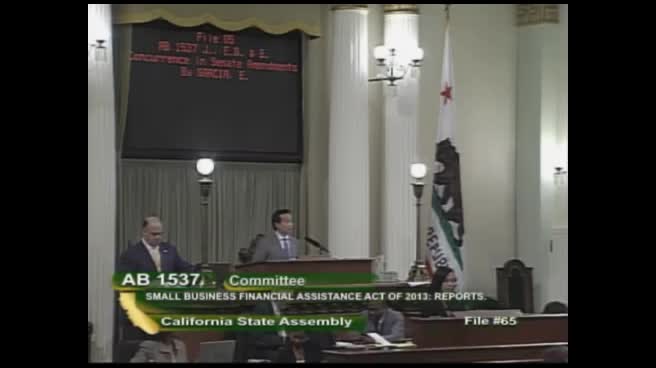
| Jul 16, 2015 | AB 1537 J., E.D. & E. Concurrence in Senate Amendments By GARCIA, E. | Assembly Floor |
Passed |
|
| Jul 9, 2015 | Consent Calendar 2nd AB1537 Committee on Jobs, Economic Development, and the Economy | Senate Floor |
Passed |
|
| Jun 15, 2015 | Do pass, but first be re-referred to the Committee on [Appropriations] with the recommendation: To Consent Calendar | Senate Standing Committee on Business, Professions and Economic Development |
Passed |
|
| May 18, 2015 | AB 1537 J., E.D. & E. Assembly Third Reading By GARCIA, E. | Assembly Floor |
Passed |
|
| May 13, 2015 | Do pass. | Assembly Standing Committee on Appropriations |
Passed |
|
| Apr 29, 2015 | Do pass and be re-referred to the Committee on [Appropriations] with recommendation: To Consent Calendar | Assembly Standing Committee on Jobs, Economic Development, and the Economy |
Passed |
This list shows positions taken on this bill by organizations on the date displayed, which is linked to the original source.
Positions by individuals are not included.
AB 1537
Page 2
CONCURRENCE IN SENATE AMENDMENTS
AB 1537
(Committee on Jobs, Economic Development, and the Economy)
As Amended June 25, 2015
2/3 vote
ASSEMBLY: |
77-0 |
(May 18, 2015) |
SENATE: |
39-0 |
(July 9, 2015) |
Original Committee Reference: J., E.D., & E.
SUMMARY: Expands the type of financial assistance information being reported annually on the activities of Small Business Finance Center. This bill requires aggregate level geographic information on the businesses being served. As these financial services are designed to serve small businesses throughout the state, this type of information is important to the Legislature's oversight of the Small Business Finance Center programs.
The Senate amendments are technical and nonsubstantive.
EXISTING LAW:
Establishes the Small Business Finance Center within the California Infrastructure and Economic Development Bank for the purpose of assisting businesses seeking capital not otherwise available in the private markets including:
Loan guarantees and other credit enhancements;
Direct loans and other debt instruments;
Disaster loan guarantees; and
Surety bond guarantees.
Requires the Small Business Finance Center to prepare an annual report on their financial activities.
FISCAL EFFECT: According to the Senate Appropriations Committee, pursuant to Senate Rule 28.8, negligible state costs.
COMMENTS: The Small Business Finance Center is authorized to offer a range of financial assistance including direct loans and credit enhancements. One of the largest programs is the Small Business Loan Guarantee Program, which is locally administered through a network of small business financial development corporations (FDCs).
As initially implemented, FDCs were selected, in part, on their demonstrated ability to serve specific geographic regions. Over the years, these state approved regions have evolved. Today, some FDCs serve small businesses across the state, while others work within larger and sometimes overlapping geographic areas. This change in program delivery necessitates a change in reporting. This bill expands the annual report to include the general geographic location (by city and county) of businesses served during the report period.
The policy committee analysis includes additional information on the Small Business Finance Center and the $84 million in federal funding it is currently in the process of deploying.
Analysis Prepared by: Toni Symonds / J., E.D., & E. / (916) 319-2090 FN: 0001186
AB 1537
Page 4
|
Office of Senate Floor Analyses (916) 651-1520 Fax: (916) 327-4478 |
CONSENT
Bill No: AB 1537
Author: Committee on Jobs, Economic Development, and the Economy
Amended: 6/25/15 in Senate
SENATE BUS, PROF. & ECON. DEV. COMMITTEE: 9-0, 6/15/15
AYES: Hill, Bates, Berryhill, Block, Galgiani, Hernandez, Jackson, Mendoza, Wieckowski
SENATE APPROPRIATIONS COMMITTEE: Senate Rule 28.8
ASSEMBLY FLOOR: 77-0, 5/18/15 - See last page for vote
SUBJECT: Small Business Financial Assistance Act of 2013: reports
DIGEST: This bill expands the reporting requirements of the California Small Business Finance Center to include the geographic location of businesses assisted by its programs.
Existing law:
Establishes the Governor’s Office of Business and Economic Development (GO-Biz) within the Governor's Office for the purpose of serving as the lead state entity for economic strategy and marketing of California on issues relating to business development, private sector investment and economic growth. GO-Biz also serves as the administrative oversight for the California Business Investment Service and the Office of the Small Business Advocate.
(Government Code (GC) §§ 12096 – 12098.5)
Enacts the California Small Business Financial Development Corporation Law with the intention of promoting the economic development of small businesses by making available capital, general management assistance, and other resources, including loan services, personnel, and business education to small business entrepreneurs, including women and minority owned businesses, for the purpose of promoting the health, safety, and social welfare of the citizens of California, to eliminate unemployment of the economically disadvantaged of the state, and to stimulate economic development, employment, minority group, women, and disabled persons entrepreneurship. (Corporations Code §§ 14000-14024)
Authorizes under the Bergeson-Peace Infrastructure and Economic Development Bank Act the creation of the Infrastructure and Economic Development Bank (I-Bank) within GO-Biz, to promote economic revitalization, enable future development, and encourage a healthy climate for jobs in California. (GC § 63000 et seq.)
Requires the I-Bank to submit a report to the Governor and Legislature not later than November 1 of each year containing information relating to the I-Bank fund and programs. (GC § 63035)
Enacts the Small Business Financial Assistance Act of 2013 and establishes the Small Business Finance Center within the I-Bank for the purpose of assisting businesses seeking capital resources not otherwise available in the private markets including:
Loan guarantees and other credit enhancements;
Direct loans and other debt instruments;
Disaster loan guarantees; and
Surety bond guarantees. (GC §§63088-63089.98)
Establishes the California Small Business Expansion Fund for the purpose of retaining the moneys which separately capitalize the Small Business Loan Guarantee Program (SBLGP) and paying out defaulted loan guarantees issued under the SBLGP. States findings and declarations that the SBLGP has enabled participating small businesses that do not qualify for conventional business loans or Small Business Administration loans to secure funds to expand their businesses. These small businesses would not have been able to expand their businesses in the absence of the program. The program has also provided valuable technical assistance to small businesses to ensure growth and stability. (GC § 63089.70)
Requires the small business finance development corporations (FDCs) to report annually on their activities financed through the Small Business Finance Center. (GC § 63089.97)
Requires the I-Bank to prepare an annual report to the Governor and the Legislature that includes the information provided by the FDCs. (GC § 63089.98)
This
bill:
Adds a list by city and county of the number and dollar value of all credit enhancements and debt instruments the corporation entered into during the report year, and that are outstanding at the close of the fiscal year to the reporting requirements of FDCs to the Small Business Finance Center.
Adds geographic distribution by city and county of the direct loans, guarantees, and other financial products awarded and outstanding at the close of the fiscal year to the reporting requirements of the I-Bank to the Governor and Legislature.
Comments
According to the author, when FDCs were initially designated, the designation was for a geographic region. The author states that today, the FDCs have varying geographic regions including some that work statewide and that without more information on their financing activities, it is difficult for the public and Legislature to evaluate whether all areas of the state are being served. Some FDCs serve small businesses across the state or within larger and sometimes overlapping geographic areas in the state. This change in program delivery necessitates a change in reporting and this bill expands reporting requirements for all programs offered through the Small Business Finance Center, including the SBLGP, to include the city and county where the business is located.
FISCAL EFFECT: Appropriation: Yes Fiscal Com.: Yes Local: No
None received
ASSEMBLY FLOOR: 77-0, 5/18/15
AYES: Achadjian, Alejo, Travis Allen, Baker, Bigelow, Bloom, Bonilla, Bonta, Brough, Brown, Burke, Calderon, Campos, Chang, Chau, Chávez, Chiu, Chu, Cooley, Cooper, Dababneh, Dahle, Daly, Dodd, Eggman, Frazier, Beth Gaines, Gallagher, Cristina Garcia, Eduardo Garcia, Gatto, Gipson, Gomez, Gonzalez, Gordon, Gray, Grove, Hadley, Harper, Roger Hernández, Holden, Irwin, Jones, Jones-Sawyer, Lackey, Levine, Linder, Lopez, Low, Maienschein, Mayes, McCarty, Medina, Mullin, Nazarian, Obernolte, O'Donnell, Olsen, Patterson, Perea, Quirk, Rendon, Ridley-Thomas, Rodriguez, Salas, Santiago, Steinorth, Mark Stone, Thurmond, Ting, Wagner, Waldron, Weber, Wilk, Williams, Wood, Atkins
NO VOTE RECORDED: Kim, Mathis, Melendez
Prepared by: Sarah Mason / B., P. & E.D. / (916) 651-4104
7/7/15 17:16:58
**** END ****
AB 1537 (Committee on Jobs, Economic Development, and the Economy) Page 7 of 7
SENATE COMMITTEE ON
BUSINESS, PROFESSIONS AND ECONOMIC DEVELOPMENT
Senator Jerry Hill, Chair
2015 - 2016 Regular
Bill No: AB 1537 Hearing Date: June 15, 2015
Author: |
Committee on Jobs, Economic Development, and the Economy |
||
Version: |
March 25, 2015 |
||
Urgency: |
No |
Fiscal: |
Yes |
Consultant: |
Sarah Mason |
||
Subject: Small Business Financial Assistance Act of 2013: reports.
SUMMARY: Expands the reporting requirements of the California Small Business Finance Center to include the geographic location of businesses assisted by its programs.
Existing law:
Establishes GO-Biz within the Governor's Office for the purpose of serving as the lead state entity for economic strategy and marketing of California on issues relating to business development, private sector investment and economic growth. GO-Biz also serves as the administrative oversight for the California Business Investment Service and the Office of the Small Business Advocate.
(Government Code (GC) §§ 12096 – 12098.5)
Enacts the California Small Business Financial Development Corporation Law (FDC Law) with the intention of promoting the economic development of small businesses by making available capital, general management assistance, and other resources, including loan services, personnel, and business education to small business entrepreneurs, including women and minority owned businesses, for the purpose of promoting the health, safety, and social welfare of the citizens of California, to eliminate unemployment of the economically disadvantaged of the state, and to stimulate economic development, employment, minority group, women, and disabled persons entrepreneurship. (Corporations Code §§ 14000-14024)
Authorizes under the Bergeson-Peace Infrastructure and Economic Development Bank Act (Act) the creation of the Infrastructure and Economic Development Bank
(I-Bank) within GO-Biz, to promote economic revitalization, enable future development, and encourage a healthy climate for jobs in California.
(GC § 63000 et seq.)
Requires the I-Bank to submit a report to the Governor and Legislature not later than November 1 of each year containing information relating to the I-Bank fund and programs. (GC § 63035)
Enacts the Small Business Financial Assistance Act of 2013 and establishes the Small Business Finance Center within the I-Bank for the purpose of assisting businesses seeking capital resources not otherwise available in the private markets including:
Loan guarantees and other credit enhancements;
Direct loans and other debt instruments;
Disaster loan guarantees; and
Surety bond guarantees. (GC §§63088-63089.98)
Establishes the California Small Business Expansion Fund (Expansion Fund) for the purpose of retaining the moneys which separately capitalize the Small Business Loan Guarantee Program (SBLGP) and paying out defaulted loan guarantees issued under the SBLGP. States findings and declarations that the SBLGP has enabled participating small businesses that do not qualify for conventional business loans or Small Business Administration loans to secure funds to expand their businesses. These small businesses would not have been able to expand their businesses in the absence of the program. The program has also provided valuable technical assistance to small businesses to ensure growth and stability. (GC § 63089.70)
Requires the FDCs to report annually on their activities financed through the Small Business Finance Center. (GC § 63089.97)
Requires the I-Bank to prepare an annual report to the Governor and the Legislature that includes the information provided by the FDCs. (GC § 63089.98)
This
bill:
Adds a list by city and county of the number and dollar value of all credit enhancements and debt instruments the corporation entered into during the report year, and that are outstanding at the close of the fiscal year to the reporting requirements of FDCs to the Small Business Finance Center.
Adds geographic distribution by city and county of the direct loans, guarantees, and other financial products awarded and outstanding at the close of the fiscal year to the reporting requirements of the I-Bank to the Governor and Legislature.
FISCAL EFFECT: This bill is keyed fiscal by Legislative Counsel. According to the Assembly Committee on Appropriations Committee analysis dated May 13, 2015, this bill will result in absorbable costs to GO-Biz up to $100,000.
COMMENTS:
Purpose. This bill is sponsored by the Assembly Committee on Jobs, Economic Development and the Economy (JEDE). According to JEDE, when the small business finance development corporations (FDCs) were initially designated, the designation was for a geographic region. JEDE states that today, the FDCs have varying geographic regions including some that work statewide and that without more information on their financing activities, it is difficult for the public and Legislature to evaluate whether all areas of the state are being served. Some FDCs serve small businesses across the state or within larger and sometimes overlapping geographic areas in the state. This change in program delivery necessitates a change in reporting and this bill expands reporting requirements for all programs offered through the Small Business Finance Center, including the Small Business Loan Guarantee Program, to include the city and county where the business is located.
Governor's Office of Business and Economic Development (GO-Biz). In February 2010, the Little Hoover Commission undertook a review of the state's economic and workforce development programs. In its final report, Making up for Lost Ground: Creating a Governor's Office of Economic Development, it analyzed the status and effectiveness of current programs since the 2003 demise of the Technology, Trade and Commerce Agency and recommended the creation of a new governmental entity to fill the void left by the dismantled agency.
The report called for a single entity that would promote greater economic development, foster job creation, serve as a policy advisor and deliver specific services (i.e., permitting, tax, regulatory, and other information) directly to the California business community. In April 2010, Governor Schwarzenegger issued Executive Order S-05-10 as a means to operationalize the report recommendations including the creation of the Governor's Office of Economic Development (GOED).
In October 2011, the Governor signed AB 29 (cited and described below), which effectively codified GOED and changed its name to GO-Biz, effective January 1, 2012. Since its inception, the office has served over 3,000 businesses, 95% of which are small. The most frequent types of assistance include help with permit streamlining, starting a businesses, relocation and expansion of businesses, and regulatory challenges.
In March 2012, the Governor initiated a reorganization process to realign the state's administrative structure. Key changes include dismantling of the Business, Transportation and Housing Agency (BTH) and the shifting of a number of key programs and services to GO-Biz including the Small Business Loan Guarantee Program, the California Travel and Tourism Commission, the California Film Commission, the Film California First Program and the Infrastructure and Economic Development Bank (I-Bank). GO-Biz also administers the “Made In California” program for the purpose of encouraging consumer product awareness and to foster the purchases of products manufactured in California. GO-Biz now has authority for undertaking international trade and foreign investment activities, including establishing any international trade and investment office (AB 2012, Perez, Statutes of 2012). GO-Biz has partnered with the Bay Area Council to open a California-China Trade and Investment office in Shanghai's downtown Yangpu district and is authorized under current law to accept private monies to establish, fund and operate these offices.
In 2013, the Governor signed AB 1247 (Medina and Bocanegra, Chapter 537, Statutes of 2013) establishing a Small Business Finance Center within the I-Bank. Among other programs, the Small Business Finance Center offers direct loans, loan guarantees, letters of credit and surety bond guarantees and the I-Bank Board of Directors has the authority to approve new debt and credit enhancement programs to assist small businesses meet changing market needs.
I-Bank. The I-Bank was established in 1994 to promote economic revitalization, enable future development, and encourage a healthy climate for jobs in California. Housed within GO-Biz, it is governed by a five-member board of directors comprised of the Director of GO-biz (Chair), State Treasurer, Director Department of Finance, Transportation Agency, and a Governor’s appointee. The day-to-day operations of the I-Bank are directed by the Executive Director who is an appointee of the Governor and is subject to confirmation by the California State Senate. Currently, the I-Bank has authority for 25 staff members.
The I-Bank does not receive any ongoing General Fund support, rather it is financed through fees, interest income, and other revenues derived from its public and private sector financing activities. According to its Comprehensive Annual Financial Report for the fiscal year ended June 2013, its programs continued to provide revenues sufficient to cover operating expenses.
The I-Bank administers three programs: (1) the Infrastructure State Revolving Fund which provides direct low-cost financing to public agencies for a variety of public infrastructure projects; (2) the Conduit Bond Program which provides financing for manufacturing companies, public benefit nonprofit organizations, public agencies and other eligible entities; and (3) the Small Business Finance Center which helps small businesses access private financing through loan guarantees, direct loans, and performance bond guarantees. There is no commitment of I-Bank or state funds for any of the conduit revenue bonds. Even in the case of default, the state is not liable.
Since its creation in 1994, the I-Bank has loaned, financed, or participated in over $344 billion in infrastructure and economic expansion projects. This includes over $400 million to local and state agencies; developing a high-level of expertise in the financing of public infrastructure. The I-Bank also serves as the state's only general purpose financing authority with broad statutory powers to issue revenue bonds, make loans, and provide guarantees. Over $33 billion in conduit revenue bonds have been issued by the I-Bank since 2000.
Small Business Loan Guarantee Program. The SBLGP enables a small business to obtain a term loan or line of credit when it cannot otherwise qualify for a loan on its own. The state, working through 11 FDCs, offers direct loans or loan guarantees that a qualifying small business borrower could not otherwise obtain. Historically, the state has provided for a portion of the FDCs administrative costs through an annual payment that has ranged from $120,000 to $418,000 a year. FDCs are paid an additional fee per loan based on a percentage of the loan value.
Applicants must meet the definition of a small business (100 or fewer employees) with the specific market rate loan terms and interest rates being negotiated between the borrower and the lender. Proceeds of the loan must be used primarily in California for any standard business purpose applicable to the applicant's business. The guarantee program provides guarantees covering up to 90% of the loan, but not exceeding $500,000. The guarantee program allows a business to not only obtain a loan but to also establish credit with a lender. The business is then more likely to obtain additional future financing on its own.
Small Business Jobs Act and Federal Guarantee Program. According to information provided by JEDE, in October 2010, Congress passed and the President signed the Small Business Jobs Act (Jobs Act). Among other things, the Jobs Act created the State Small Business Credit Initiative (SSBIC), which is authorized to expend up to $1.5 billion for state sponsored small business finance programs. Over the life of the program, every federal dollar must be matched by $10 private sector dollars.
Under the funding formula, California is eligible to receive up to $168 million, which is the largest amount of any state. The next highest award is $97 million for Florida, with every state that applies receiving a minimum of $13.1 million. March 31, 2017 is the deadline for reporting on all SSBIC the funds. California has reached the threshold for receiving all federal funding. According to the state administering agency, there is no threat of a federal claw-back of unused funds.
Funding is awarded to states in three tranches with participating jurisdictions allowed to apply for the next round of funding when 80% of their current funds are expended. To date, California has received two of its three allocations for a total of $110.8 million. Application to the U.S. Treasury for the third and final tranche is expected in April/May 2015.
California uses its moneys to capitalize the SBLGP administered through the I-Bank and a loss reserve program and collateral support program administered through the California Pollution Control Financing Authority at the state Treasurer's Office.
As of 12/31/14, California has encumbered $87.6 million, with approximately $40.6 million set aside to cover loan guarantees; $7.2 million deposited with private financial institutions through the CalCap and $39.8 million used for the collateral support program. Approximately, $2.4 million has been used for direct administrative costs, resulting in a cumulative 2.18% administrative cost per dollars allocated by the U.S. Treasury.
In 2014, California encumbered $36.9 million of SSBCI funds. Of this amount, approximately $12.9 million set aside to cover loan guarantees; $2.2 million deposited with private financial institutions through the CalCAP and $21.4 million used for the collateral support program. In 2014, 1,630 loans were made to small businesses, which leveraged $192.6 million in private funds at a 19:1 ratio. Since inception, $493.3 million in loans to small business were leveraged (18:1 ratio). Since inception, 47,202 jobs have been created (7,372) or retained (39,830) by the close of 2013. In 2014 job impacts were 2,228 new jobs and 13,931 retained jobs.
Prior Related Legislation. AB 2749 (Assembly Committee on Jobs, Economic Development and the Economy, Chapter 132, Statutes of 2014) made technical changes to the Government Code relating to the transfer of economic development related programs from the Business, Transportation and Housing Agency (BTH) to GO-Biz.
AB 201 (Holden, Chapter 529, Statutes of 2013) required the director of the SBLGP to maintain a Web site that has information on the programs administered through the statewide network of small business FDCs.
AB 780 (Bocanegra) of 2013 would have appropriated $2 million in General Fund monies to provide administrative support to FDCs. (Status: The bill was held in the Senate Committee on Appropriations.)
AB 1247 (Medina, Chapter 537, Statutes of 2013) transferred the administration of the small business FDC managed programs from BTH to the California Infrastructure and Economic Development Bank (I-Bank) within GO-Biz.
AB 2523 (Hueso) of 2012 authorized the I-Bank to enter into participation loan agreements and syndicated loan agreements with financial institutions for loans they make to small businesses. (Status: The bill was held in the Senate Committee on Appropriations.)
AB 2671 (Assembly Committee on Jobs, Economic Development and the Economy, Chapter 648, Statutes of 2012) extended until January 1, 2018, the sunset date on the maximum allowable leverage of reserve funds necessary under the SBLGP.
AB 894 (V. Manuel Pérez, 2011) would have created the California Manufacturing Competitiveness Loan and Loan Guarantee Program to be administered by an advisory commission within the State Treasurer's Office. (Status: The bill was vetoed by the Governor who stated that “the objectives of this bill are excellent. However, the loan programs it creates can be run by the state's Infrastructure Bank, which already has authority and experience lending directly to businesses.)
AB 901 (V. Manuel Pérez, Chapter 483, Statutes of 2011) expanded the definition of financial institutions eligible to participate in the California Capital Access Program (CalCAP) and increased CalCAP reporting requirements.
AB 981 (Hueso, Chapter 484, Statues of 2011) provided additional incentives within CalCAP to encourage lenders to lend to small businesses.
AB 1556 (Assembly Committee on Jobs, Economic Development and the Economy, 2010) would have required grantees of Community Development Block Grant funds for local revolving loan programs to contract with approved financial intermediaries. (Status: The bill was held in the Assembly Committee on Appropriations.)
AB 2437 (V. Manuel Pérez, 2010) would have established the California Manufacturing Competitiveness Act of 2010 to authorize the California Industrial Development Financing Advisory Commission to make loans or lines of credit available to companies, directly through a contract with a participating financial institution. (Status: The bill was vetoed by the Governor who stated that the proper location of program in the bill is GOED and the bill would create new higher costs to employers as a result of the prevailing wage requirements on projects financed under the bill.)
AB 1104 (Aghazarian, Chapter 624, Statutes of 2007) extended the authority of the Expansion Fund through a FDC to make small business loan guarantees in an area affected by a state of emergency within the state and declared a disaster by the President of the United States, or by the Administrator of the federal SBA, or by the United States Secretary of Agriculture. The bill also modified the provision authorizing the executive director of the Expansion Fund to request a trustee of a trust fund to invest funds in securities issued by the United States Treasury.
AB 1431 (Arambula) of 2007 would have established the Early Stage Investment Guarantee Program, administered by the SBLGP to help small businesses attract private investors during the early years of the businesses' growth. (Status: The bill was held in the Assembly Committee on Appropriations.)
AB 1695 (Bass) of 2007 would have appropriated $40 million from the State Highway Account to be placed within a newly created Surety Bond Guarantee Account within the Expansion Fund and required the FDC Director to establish and administer a surety bond guarantee account within to assist small contractors with obtaining the necessary bond and liability guarantees they need to compete for state infrastructure projects. (Status: The bill was held in the Assembly Committee on Appropriations.)
AB 3057 (Assembly Committee on Jobs, Economic Development and the Economy, 2006) would have extended the sunset from January 1, 2007 to January 1, 2012 on the Director of DOF’s authority to transfer moneys in the Special Fund for Economic Uncertainties to the Expansion Fund, and made other technical changes. (Status: The bill was held in the Senate Committee on Appropriations.)
SUPPORT AND OPPOSITION:
Support: None on file as of June 9, 2015.
Opposition: None on file as of June 9, 2015.
-- END --
AB 1537
Page 2
ASSEMBLY THIRD READING
AB 1537
(Committee on Jobs, Economic Development, and the Economy)
As Introduced March 25, 2015
2/3 vote
Committee |
Votes |
Ayes |
Noes |
Jobs |
8-0 |
Eduardo Garcia, Kim, Brough, Brown, Chu, Gipson, Irwin, Mathis |
|
Appropriations |
17-0 |
Gomez, Bigelow, Bloom, Bonta, Calderon, Chang, Daly, Eggman, Gallagher, Eduardo Garcia, Holden, Jones, Quirk, Rendon, Wagner, Weber, Wood |
|
SUMMARY: Expands the type of information being reported on financial assistance provided through the Small Business Finance Center. Specifically, this bill requires reporting annually by city and county on the number and dollar value of credit enhancements and debt instruments issued by the small business financial development corporations (FDCs).
EXISTING LAW:
Establishes the Infrastructure and Economic Development Bank (I-Bank) within the Governor's Office of Business and Economic Development (GO-Biz) and authorizes it to undertake a variety of financial activities including, but not limited to, the administration of a revolving loan fund for infrastructure development, oversight of the activities undertaken by the Small Business Finance Center, and the issuance of tax-exempt and taxable revenue bonds.
Establishes the Small Business Finance Center within the I-Bank for the purpose of assisting businesses seeking capital resources not otherwise available in the private markets including:
Loan guarantees and other credit enhancements;
Direct loans and other debt instruments;
Disaster loan guarantees; and
Surety bond guarantees.
Requires the FDCs to report annually on their activities financed through the Small Business Finance Center. This information is used by the I-Bank to prepare an annual report of its activities.
FISCAL EFFECT: According to the Assembly Appropriations Committee, implementation of this bill will result in absorbable costs to GO-Biz of up to $100,000.
COMMENTS: California offers a range of financial assistance to small businesses. One of the largest programs is the Small Business Loan Guarantee, which is administered through the Small Business Finance Center.
As initially designed, the state designated FDCs to serve specific geographic areas. Today, some FDCs serve small businesses across the state or within larger and sometimes overlapping geographic areas in the state. This change in program delivery necessitates a change in reporting. This bill, a committee bill, expands reporting requirements to include the city and county of the assisted businesses under all programs offered through the Small Business Finance Center, including the Small Business Loan Guarantee Program.
State Small Businesses Credit Initiative: In October 2010, the United States Congress passed and the United States President signed the Small Business Jobs Act (Act). Among other things, the federal Act created the State Small Business Credit Initiative (SSBCI), which is authorized to expend up to $1.5 billion for state sponsored small business finance programs. Over the life of this program, every federal dollar must be matched by $10 from the private sector -- the deadline for using the funds is September 2017.
Under the SSBCI funding formula, California is eligible to receive up to $168 million, which is the largest amount of any state. California uses its moneys to capitalize the Small Business Loan Guarantee Program at the I-Bank's Small Business Finance Center and the California Capital Access Program (CalCAP) loan loss reserve program and a collateral support program administered through the California Pollution Control Financing Authority.
California has received $110 million of the total $168 million available and, as of June 30, 2014, the state has encumbered roughly $87.6 million with approximately $40.6 million set aside to cover loan guarantees; $7.2 million deposited with private financial institutions through the CalCAP and $39.8 million used for the collateral support program. Approximately $2.4 million has been used for direct administrative costs, resulting in a cumulative 2.18% administrative cost per dollar allocated by the United States Treasury. Since inception, 47,202 jobs have been created (7,372) or retained (39,830) by the close of 2013. Job impacts in 2014 were 2,228 new jobs and 13,931 retained jobs.
This bill’s reporting requirements would apply to the FDC administered portion of the SSBCI funds, as well as the $32 million in state funds being delivered through the FDC under contract with the Small Business Finance Center.
Further Information: The policy committee analysis includes additional information on the I-Bank, the $168 million in small business capital being administered though the federal grant, and related legislation.
Analysis Prepared by: Toni Symonds / J., E.D., & E. / (916) 319-2090 FN: 0000385
AB 1537
Page 1
Date of Hearing: May 13, 2015
ASSEMBLY COMMITTEE ON APPROPRIATIONS
Jimmy Gomez, Chair
AB 1537
(Jobs, Economic Development, and the Economy) – As Introduced March 25, 2015
Policy Committee: |
Jobs, Economic Development, and the Economy |
Vote: |
8 - 0 |
|
|
|
|
|
|
|
|
Urgency: No State Mandated Local Program: No Reimbursable: No
SUMMARY:
This bill adds a reporting requirement for corporations receiving assistance under the Small Business Financial Assistance Act and requires reporting annually by city and county on number and dollar value of all credit enhancements and debt instruments issued by the small business financial development corporations (FDCs) and the Infrastructure and Economic Development Bank (I-Bank).
FISCAL EFFECT:
Absorbable costs to the Governor's Office of Business and Economic Development (GO-Biz) up to $100,000.
COMMENTS:
Purpose. According to the author, some FDCs serve small businesses across the state or within larger and sometimes overlapping geographic areas in the state. This change in program delivery necessitates a change in reporting. This bill expands reporting requirements for all program offered through the Small Business Finance Center, including the Small Business Loan Guarantee Program, to include the city and county where the business is located.
Analysis Prepared by: Misty Feusahrens / APPR. / (916) 319-2081
AB 1537
Page 3
Date of Hearing: April 29, 2015
ASSEMBLY COMMITTEE ON JOBS, ECONOMIC DEVELOPMENT, AND THE ECONOMY
Eduardo Garcia, Chair
AB 1537
(Committee on Jobs, Economic Development, and the Economy) – As Introduced March 25, 2015
SUBJECT: Small Business Financial Assistance Act of 2013: reports
SUMMARY: Expands the type of information being reported on financial assistance provided through the Small Business Finance Center. The bill requires reporting annually by city and county on number and dollar value of all credit enhancements and debt instruments issued by the small business financial development corporations (FDCs) and the Infrastructure and Economic Development Bank (I-Bank).
EXISTING LAW:
Establishes the I-Bank within the Governor's Office of Business and Economic Development (GO-Biz) and authorizes it to undertake a variety of infrastructure related financial activities including, but not limited to, the administration of a revolving loan fund, oversight of the Small Business Finance Center, and the issuance of tax-exempt and taxable revenue bonds.
Establishes the Small Business Finance Center within the I-Bank for the purpose of assisting businesses seeking capital resources not otherwise available in the private markets including:
Loan guarantees and other credit enhancements;
Direct loans and other debt instruments;
Disaster loan guarantees; and
Surety bond guarantees.
Requires the FDCs to report annually on their activities financed through the Small Business Finance Center.
Requires the I-Bank to prepare an annual report that includes the information provided by the FDCs.
FISCAL EFFECT: Unknown
POLICY ISSUE FRAME:
California offers a range of financial assistance to small businesses. One of the largest programs is the Small Business Loan Guarantee, which is administered through the Small Business Finance Center. As initially designed, the program was offered locally through a statewide network of FDCs. Each of the FDCs had a specific geographic area in which they were assigned.
Today, some FDCs serve small businesses across the state or within larger and sometimes overlapping geographic areas in the state. This change in program delivery necessitates a change in reporting. AB 1537, a committee bill, expands reporting requirements for all program offered through the Small Business Finance Center, including the Small Business Loan Guarantee Program, to include the city and county where the business is located.
The Comment section of the analysis includes additional information on the I-Bank, $168 million in small business capital being administered though the under a federal grant, and related legislation.
COMMENTS:
Background on the I-Bank: The I-Bank was established in 1994 to promote economic revitalization, enable future development, and encourage a healthy climate for jobs in California. Housed within GO-Biz, it is governed by a five-member board of directors comprised of the Director of GO-Biz (chair), the State Treasurer, the Director Department of Finance, the Transportation Agency, and a Governor’s appointee. The day-to-day operations of the I-Bank are directed by the Executive Director who is an appointee of the Governor and is subject to confirmation by the California State Senate. Currently, the I-Bank has authority for 25 staff members.
The I-Bank does not receive any ongoing General Fund support, rather it is financed through fees, interest income and other revenues derived from its public and private sector financing activities. According to its Comprehensive Annual Financial Report for the fiscal year ended June 2013, its programs continued to provide revenues sufficient to cover operating expenses.
The I-Bank administers three programs: (1) the Infrastructure State Revolving Fund which provides direct low-cost financing to public agencies for a variety of public infrastructure projects; (2) the Conduit Bond Program which provides financing for manufacturing companies, public benefit nonprofit organizations, public agencies and other eligible entities; and (3) the Small Business Finance Center which helps small businesses access private financing through loan guarantees, direct loans, and performance bond guarantees. There is no commitment of I-Bank or state funds for any of the conduit revenue bonds. Even in the case of default, the state is not liable.
Since its creation in 1994, the I-Bank has loaned, financed, or participated in over $34 billion in infrastructure and economic expansion projects. This includes over $400 million to local and state agencies, developing a high-level of expertise in the financing of public infrastructure. The I-Bank also serves as the state's only general purpose financing authority with broad statutory powers to issue revenue bonds, make loans, and provide guarantees. Over $33 billion in conduit revenue bonds have been issued by the I-Bank since 2000.
State Small Businesses Credit Initiative: In October 2010, Congress passed and the President signed the Small Business Jobs Act (Act). Among other things, the Act created the State Small Business Credit Initiative (SSBCI), which is authorized to expend up to $1.5 billion for state sponsored small business finance programs. Over the life of this program, every federal dollar must be matched by $10 from the private sector -- the deadline for using the funds is September 2017. Also, funding for program administration, outreach, and oversight is primarily the responsibility of the state.
Under the SBCCI funding formula, California is eligible to receive up to $168 million, which is the largest amount of any state. California uses its moneys to capitalize the Small Business Loan Guarantee Program at the I-Bank's Small Business Finance Center and the California Capital Access Program (CalCAP) loan loss reserve program and a collateral support program administered through the California Pollution Control Financing Authority.
California has received $110 million of the total $168 million available and, as of June 30, 2014, the state has encumbered roughly $87.6 million with approximately $40.6 million set aside to cover loan guarantees; $7.2 million deposited with private financial institutions through the CalCap and $39.8 million used for the collateral support program. Approximately $2.4 million has been used for direct administrative costs, resulting in a cumulative 2.18% administrative cost per dollar allocated by the U.S. Treasury. Since inception, 47,202 jobs have been created (7,372) or retained (39,830) by the close of 2013. 2014 job impacts were 2,228 new jobs and 13,931 retained jobs.
AB 1537 reporting requirements would apply to the FDC administered portion of the SSBCI funds, as well as the $32 million in state funds being delivered through the FDC under contract with the Small Business Finance Center.
Related Legislation: Below is a list of related legislation from current and previous legislative sessions:
AB 780 (Bocanegra) Small Business Financial Development Corporation Funding: This bill would have appropriated $2 million to provide administrative funding to the state's small business financial development corporations, specifying that each is eligible to receive $150,000, and brings them under the jurisdiction of GO-Biz. Status: Held on the Suspense File of the Senate Committee on Appropriations, 2013.
AB 1247 (Medina and Bocanegra) Small Business Finance Center: This bill establishes the California Small Business Finance Center at the I-Bank, within the Governor’s Office and Economic Development, and transfers the authority to administer the small business loan guarantee program and other related programs to the I-Bank. Status: Signed by the Governor, Chapter 537, Statutes of 2013.
REGISTERED SUPPORT / OPPOSITION:
Support
None received
Opposition
None received
Analysis Prepared by: Toni Symonds / J., E.D., & E. / (916) 319-2090
Discussed in Hearing
 53SEC
Assembly Floor
 47SEC
Assembly Floor
 1MIN
Assembly Standing Committee on Appropriations
Bill Author
Bill Co-Author(s):