AB 1410: Penalty assessments: emergency services and children’s health care coverage funding.
- Session Year: 2017-2018
- House: Assembly
- Latest Version Date: 2017-10-12
Under the existing Emergency Medical Air Transportation Act, a penalty of $4 is imposed upon every conviction for a violation of the Vehicle Code, or a local ordinance adopted pursuant to the Vehicle Code, other than a parking offense. Existing law requires the county or the court that imposed the fine to transfer the moneys collected pursuant to this act to the Emergency Medical Air Transportation Act Fund. Under existing law, money in the Emergency Medical Air Transportation Act Fund is made available, upon appropriation by the Legislature, to the State Department of Health Care Services for specified purposes relating to emergency medical air transportation. Under existing law, the assessment of this $4 penalty will terminate on January 1, 2018, and any moneys unexpended and unencumbered in the Emergency Medical Air Transportation Act Fund on June 30, 2019, will transfer to the General Fund. Existing law repeals the Emergency Medical Air Transportation Act on January 1, 2020.
This bill would rename the Emergency Medical Air Transportation Act Fund as the Emergency Medical Air Transportation and Childrens Coverage Fund and would authorize the department to use money from the fund, upon appropriation by the Legislature, to fund childrens health care coverage in addition to the purposes described above. This bill would extend the dates of the Emergency Medical Air Transportation Act, so that the assessment of the penalties will terminate commencing January 1, 2020, and any moneys unexpended and unencumbered in the Emergency Medical Air Transportation and Childrens Coverage Fund on June 30, 2021, would be transferred to the General Fund. The bill would extend the effective date of the Emergency Medical Air Transportation Act until January 1, 2022. The bill would also make conforming changes.
(1)Existing law imposes various penalty assessments upon every fine, penalty, or forfeiture imposed and collected by the court for all criminal offenses, including a violation of a section of the Vehicle Code or any local ordinance adopted pursuant to the Vehicle Code. These include, but are not limited to, a state penalty in the amount of $10 for every $10 imposed and collected by the court for a criminal offense to be deposited into the State Penalty Fund and a county general fund, a state surcharge of 20% upon every fine, penalty, or forfeiture imposed and collected by the court for a criminal offense to be deposited into the General Fund, a state court construction penalty in the amount of $5 for every $10 imposed and collected by the court for a criminal offense to be deposited into the State Court Facilities Construction Fund, and a penalty in the amount of $4 for every $10 imposed and collected by the court for a criminal offense to be deposited into the states DNA Identification Fund. Existing law also requires an additional penalty of $1 for every $10 or part thereof to be levied in each county upon every fine, penalty, or forfeiture imposed and collected by the courts for all criminal offenses, as specified, and requires the collected penalties to be deposited into a countys DNA Identification Fund to be used, among other purposes, to reimburse local sheriffs or other law enforcement agencies for the collection of DNA specimens, samples, and print impressions.This bill would require the Controller to audit the apportionment and allocation of funds received by a state or local entity from a penalty assessment imposed, pursuant to specified provisions, for a criminal offense involving a violation of the Vehicle Code or any local ordinance adopted pursuant to the Vehicle Code. The bill would require the audit to include information about the financial status of any program that is funded, in whole or in part, by the penalty assessment, a 3-year history of the funds received, and a summary of the services provided by a program that is funded, in whole or in part, by the penalty assessment. The bill would require the Controller to compile this information and submit a report to the public safety committee of each house of the Legislature on or before December 1, 2018, as specified.(2)Under existing law, the Emergency Medical Air Transportation Act, a penalty of $4 is imposed upon every conviction for a violation of the Vehicle Code, or a local ordinance adopted pursuant to the Vehicle Code, other than a parking offense. Existing law requires the county or the court that imposed the fine to transfer the moneys collected pursuant to this act to the Emergency Medical Air Transportation Act Fund. Under existing law, the assessment of these penalties will terminate on January 1, 2018, and any moneys unexpended and unencumbered in the Emergency Medical Air Transportation Act Fund on June 30, 2019, will transfer to the General Fund. Existing law repeals the Emergency Medical Air Transportation Act on January 1, 2020.This bill would require the Controller to transfer 25% of the state surcharge described in paragraph (1) above from the General Fund to the Emergency Medical Air Transportation Act Fund through December 31, 2020.(1)Existing law imposes various penalty assessments upon every fine, penalty, or forfeiture imposed and collected by the court for all criminal offenses, including a violation of a section of the Vehicle Code or any local ordinance adopted pursuant to the Vehicle Code. These include, but are not limited to, a state penalty in the amount of $10 for every $10 imposed and collected by the court for a criminal offense to be deposited into the State Penalty Fund and a county general fund, a state surcharge of 20% upon every fine, penalty, or forfeiture imposed and collected by the court for a criminal offense to be deposited into the General Fund, a state court construction penalty in the amount of $5 for every $10 imposed and collected by the court for a criminal offense to be deposited into the State Court Facilities Construction Fund, and a penalty in the amount of $4 for every $10 imposed and collected by the court for a criminal offense to be deposited into the states DNA Identification Fund. Existing law also requires an additional penalty of $1 for every $10 or part thereof to be levied in each county upon every fine, penalty, or forfeiture imposed and collected by the courts for all criminal offenses, as specified, and requires the collected penalties to be deposited into a countys DNA Identification Fund to be used, among other purposes, to reimburse local sheriffs or other law enforcement agencies for the collection of DNA specimens, samples, and print impressions.
This bill would require the Controller to audit the apportionment and allocation of funds received by a state or local entity from a penalty assessment imposed, pursuant to specified provisions, for a criminal offense involving a violation of the Vehicle Code or any local ordinance adopted pursuant to the Vehicle Code. The bill would require the audit to include information about the financial status of any program that is funded, in whole or in part, by the penalty assessment, a 3-year history of the funds received, and a summary of the services provided by a program that is funded, in whole or in part, by the penalty assessment. The bill would require the Controller to compile this information and submit a report to the public safety committee of each house of the Legislature on or before December 1, 2018, as specified.
(2)Under existing law, the Emergency Medical Air Transportation Act, a penalty of $4 is imposed upon every conviction for a violation of the Vehicle Code, or a local ordinance adopted pursuant to the Vehicle Code, other than a parking offense. Existing law requires the county or the court that imposed the fine to transfer the moneys collected pursuant to this act to the Emergency Medical Air Transportation Act Fund. Under existing law, the assessment of these penalties will terminate on January 1, 2018, and any moneys unexpended and unencumbered in the Emergency Medical Air Transportation Act Fund on June 30, 2019, will transfer to the General Fund. Existing law repeals the Emergency Medical Air Transportation Act on January 1, 2020.
This bill would require the Controller to transfer 40% 25% of the state surcharge described in paragraph (1) above from the General Fund to the Emergency Medical Air Transportation Act Fund. Fund through December 31, 2020.
(1)Existing law imposes various penalty assessments upon every fine, penalty, or forfeiture imposed and collected by the court for all criminal offenses, including a violation of a section of the Vehicle Code or any local ordinance adopted pursuant to the Vehicle Code. These include, but are not limited to, a state penalty in the amount of $10 for every $10 imposed and collected by the court for a criminal offense to be deposited into the State Penalty Fund and a county general fund, a state surcharge of 20% upon every fine, penalty, or forfeiture imposed and collected by the court for a criminal offense to be deposited into the General Fund, a state court construction penalty in the amount of $5 for every $10 imposed and collected by the court for a criminal offense to be deposited into the State Court Facilities Construction Fund, and a penalty in the amount of $4 for every $10 imposed and collected by the court for a criminal offense to be deposited into the states DNA Identification Fund. Existing law also requires an additional penalty of $1 for every $10 or part thereof to be levied in each county upon every fine, penalty, or forfeiture imposed and collected by the courts for all criminal offenses, as specified, and requires the collected penalties to be deposited into a countys DNA Identification Fund to be used, among other purposes, to reimburse local sheriffs or other law enforcement agencies for the collection of DNA specimens, samples, and print impressions.
This bill would require the Controller to audit the apportionment and allocation of funds received by a state or local entity from a penalty assessment imposed, pursuant to specified provisions, for a criminal offense involving a violation of the Vehicle Code or any local ordinance adopted pursuant to the Vehicle Code. The bill would require the audit to include information about the financial status of any program that is funded, in whole or in part, by the penalty assessment, a 3-year history of the funds received, and a summary of the services provided by a program that is funded, in whole or in part, by the penalty assessment. The bill would require the Controller to compile this information and submit a report to the public safety committee of each house of the Legislature on or before December 1, 2018, as specified.
(2)Under existing law, the Emergency Medical Air Transportation Act, a penalty of $4 is imposed upon every conviction for a violation of the Vehicle Code, or a local ordinance adopted pursuant to the Vehicle Code, other than a parking offense. Existing law requires the county or the court that imposed the fine to transfer the moneys collected pursuant to this act to the Emergency Medical Air Transportation Act Fund. Under existing law, the assessment of these penalties will terminate on January 1, 2018, and any moneys unexpended and unencumbered in the Emergency Medical Air Transportation Act Fund on June 30, 2019, will transfer to the General Fund. Existing law repeals the Emergency Medical Air Transportation Act on January 1, 2020.
This bill would require the Controller to transfer 40% of the state surcharge described in paragraph (1) above from the General Fund to the Emergency Medical Air Transportation Act Fund.
The Control, Regulate and Tax Adult Use of Marijuana Act, an initiative measure approved as Proposition 64 at the November 8, 2016, statewide general election, on and after January 1, 2018, imposes a cultivation tax, which the State Board of Equalization administers and collects pursuant to the Fee Collection Procedures Law, on all harvested marijuana that enters the commercial market upon all persons required to be licensed to cultivate marijuana pursuant to that act and the Medical Cannabis Regulation and Safety Act. The Control, Regulate and Tax Adult Use of Marijuana Act requires, on or before the last day of the month following each quarterly period, a tax return for the cultivation tax for the preceding quarterly period to be filed with the State Board of Equalization by each person required to be licensed for cultivation under that act and the Medical Cannabis Regulation and Safety Act. Under existing law, a violation of provisions relating to the cultivation tax is a crime unless otherwise specified.This bill, at the time that any payment or consideration is tendered to the taxpayer, or at the time of completion of all quality assurance, inspection, and testing or when that quality assurance, inspection, and testing should have been completed, whichever is earlier, would instead authorize, if requested by the taxpayer, a person required to be licensed as a distributor under the act and the Medical Cannabis Regulation and Safety Act to collect the cultivation tax from the taxpayer and give to the taxpayer a receipt in the manner and form prescribed by the board, except as specified. By expanding the application of the Fee Collection Procedures Law, which imposes criminal penalties for various acts, this bill would impose a state-mandated local program. This bill would provide that the tax that the person required to be licensed as a distributor collected, and any amount unreturned to the taxpayer which is not tax but was collected from the taxpayer under the representation by the person required to be licensed as a distributor that it was tax, constitute debts owed to the state by the person required to be licensed as a distributor.This bill would require the person required to be licensed as a distributor who collects the tax pursuant to these provisions to file the tax return instead of the person required to be licensed for cultivation, except as specified. The bill would also require all persons required to be licensed as a distributors who are authorized to collect the tax to obtain a separate permit at no charge. The bill would provide that any person required to obtain this permit who engages in business as a distributor without a permit or after a permit has been canceled, suspended, or revoked, and each officer of any corporation that so engages in business, is guilty of a misdemeanor. By creating a new crime, this bill would impose a state-mandated local program.The California Constitution requires the state to reimburse local agencies and school districts for certain costs mandated by the state. Statutory provisions establish procedures for making that reimbursement.This bill would provide that no reimbursement is required by this act for a specified reason.The Control, Regulate and Tax Adult Use of Marijuana Act authorizes the Legislature to amend the act to further the purposes and intent of the act with a 2/3 vote of the membership of both houses of the Legislature, except as provided.This bill would declare that its provisions further specified purposes and intent of the Control, Regulate and Tax Adult Use of Marijuana Act.The Control, Regulate and Tax Adult Use of Marijuana Act, an initiative measure, measure approved as Proposition 64 at the November 8, 2016, statewide general election, on and after January 1, 2018, imposes a cultivation tax, which the State Board of Equalization administers and collects pursuant to the Fee Collection Procedures Law, on all harvested marijuana that enters the commercial market upon all persons required to be licensed to cultivate marijuana pursuant to that act and the Medical Cannabis Regulation and Safety Act. The Control, Regulate and Tax Adult Use of Marijuana Act requires, on or before the last day of the month following each quarterly period, a tax return for the cultivation tax for the preceding quarterly period to be filed with the State Board of Equalization by each person required to be licensed for cultivation under that act and the Medical Cannabis Regulation and Safety Act. Under existing law, a violation of provisions relating to the cultivation tax is a crime unless otherwise specified.
This bill would, bill, at the time that any payment or consideration is tendered to the taxpayer, or at the time of completion of all quality assurance, inspection, and testing or when that quality assurance, inspection, and testing should have been completed, whichever is earlier, would instead require authorize, if requested by the taxpayer, a person required to be licensed as a distributor under the act and the Medical Cannabis Regulation and Safety Act to collect the cultivation tax from the taxpayer and give to the taxpayer a receipt in the manner and form prescribed by the board, except as specified. By expanding the application of the Fee Collection Procedures Law, which imposes criminal penalties for various acts, this bill would impose a state-mandated local program. This bill would provide that the tax required to be collected by the that the person required to be licensed as a distributor, distributor collected, and any amount unreturned to the taxpayer which is not a tax but was collected from the taxpayer under the representation by the person required to be licensed as a distributor that it was tax, constitute debts owed to the state by the person required to be licensed as a distributor.
This bill would require the person required to be licensed as a distributor who collects the tax pursuant to these provisions to file the tax return instead of the person required to be licensed for cultivation, except as specified. The bill would also require all persons required to be licensed as a distributors who are required authorized to collect the tax to obtain a separate permit at no charge. The bill would provide that any person required to obtain this permit who engages in business as a distributor without a permit or after a permit has been canceled, suspended, or revoked, and each officer of any corporation that so engages in business, is guilty of a misdemeanor. By creating a new crime, this bill would impose a state-mandated local program.
The California Constitution requires the state to reimburse local agencies and school districts for certain costs mandated by the state. Statutory provisions establish procedures for making that reimbursement.
This bill would provide that no reimbursement is required by this act for a specified reason.
The Control, Regulate and Tax Adult Use of Marijuana Act authorizes the Legislature to amend the act to further the purposes and intent of the act with a 2/3 2/3 vote of the membership of both houses of the Legislature, except as provided.
This bill would declare that its provisions further specified purposes and intent of the Control, Regulate and Tax Adult Use of Marijuana Act.
The Control, Regulate and Tax Adult Use of Marijuana Act, an initiative measure, on and after January 1, 2018, imposes a cultivation tax, which the State Board of Equalization administers and collects pursuant to the Fee Collection Procedures Law, on all harvested marijuana that enters the commercial market upon all persons required to be licensed to cultivate marijuana pursuant to that act and the Medical Cannabis Regulation and Safety Act. The Control, Regulate and Tax Adult Use of Marijuana Act requires, on or before the last day of the month following each quarterly period, a tax return for the cultivation tax for the preceding quarterly period to be filed with the State Board of Equalization by each person required to be licensed for cultivation under that act and the Medical Cannabis Regulation and Safety Act.
This bill would, at the time of completion of all quality assurance, inspection, and testing or when that quality assurance, inspection, and testing should have been completed, instead require a person required to be licensed as a distributor under the act and the Medical Cannabis Regulation and Safety Act to collect the cultivation tax from the taxpayer and give to the taxpayer a receipt in the manner and form prescribed by the board, except as specified. By expanding the application of the Fee Collection Procedures Law, which imposes criminal penalties for various acts, this bill would impose a state-mandated local program. This bill would provide that the tax required to be collected by the person required to be licensed as a distributor, and any amount unreturned to the taxpayer which is not a tax but was collected from the taxpayer under the representation by the person required to be licensed as a distributor that it was tax, constitute debts owed to the state by the person required to be licensed as a distributor.
This bill would require the person required to be licensed as a distributor to file the tax return instead of the person required to be licensed for cultivation, except as specified. The bill would also require all persons required to be licensed as a distributors who are required to collect the tax to obtain a separate permit at no charge. The bill would provide that any person required to obtain this permit who engages in business as a distributor without a permit or after a permit has been canceled, suspended, or revoked, and each officer of any corporation that so engages in business, is guilty of a misdemeanor. By creating a new crime, this bill would impose a state-mandated local program.
The California Constitution requires the state to reimburse local agencies and school districts for certain costs mandated by the state. Statutory provisions establish procedures for making that reimbursement.
This bill would provide that no reimbursement is required by this act for a specified reason.
The Control, Regulate and Tax Adult Use of Marijuana Act authorizes the Legislature to amend the act to further the purposes and intent of the act with a 2/3 vote of the membership of both houses of the Legislature, except as provided.
This bill would declare that its provisions further specified purposes and intent of the Control, Regulate and Tax Adult Use of Marijuana Act.
(a)This section shall be known, and may be cited, as the Emergency Medical Air Transportation Act.
(b)For purposes of this section:
(1)Department means the State Department of Health Care Services.
(2)Director means the Director of Health Care Services.
(3)Provider means a provider of emergency medical air transportation services.
(4)Rotary wing means a type of aircraft, commonly referred to as a helicopter, that generates lift through the use of wings, known as rotor blades, that revolve around a mast.
(5)Fixed wing means a type of aircraft, commonly referred to as an airplane, that generates lift through the use of the forward motion of the aircraft and wings that do not revolve around a mast but are fixed in relation to the fuselage of the aircraft.
(6)Air mileage rate means the per-mileage reimbursement rate paid for services rendered by rotary-wing and fixed-wing providers.
(c)(1)For purposes of implementing this section, a penalty of four dollars ($4) shall be imposed upon every conviction for a violation of the Vehicle Code or a local ordinance adopted pursuant to the Vehicle Code, except parking offenses subject to Article 3 (commencing with Section 40200) of Chapter 1 of Division 17 of the Vehicle Code.
(2)The penalty described in this subdivision shall be in addition to the state penalty assessed pursuant to Section 1464 of the Penal Code. However, this penalty shall not be included in the base fine used to calculate the state penalty assessment pursuant to subdivision (a) of Section 1464 of the Penal Code, the state surcharge levied pursuant to Section 1465.7 of the Penal Code, and the state court construction penalty pursuant to Section 70372 of this code, and to calculate the other additional penalties levied pursuant to this chapter.
(d)The county or the court that imposed the fine shall, in accordance with the procedures set out in Section 68101, transfer moneys collected pursuant to this section to the Treasurer for deposit into the Emergency Medical Air Transportation and Childrens Coverage Fund, which is hereby established in the State Treasury. Notwithstanding Section 16305.7, the Emergency Medical Air Transportation and Childrens Coverage Fund shall include interest and dividends earned on money in the fund. Any law that references the Emergency Medical Air Transportation Act Fund, as previously established by this subdivision, shall be construed to reference the Emergency Medical Air Transportation and Childrens Coverage Fund, effective January 1, 2018.
(e)(1)The Emergency Medical Air Transportation and Childrens Coverage Fund shall be administered by the State Department of Health Care Services. Moneys in the Emergency Medical Air Transportation and Childrens Coverage Fund shall be made available, upon appropriation by the Legislature, to the department for any of the following purposes:
(A)For childrens health care coverage.
(B)For emergency medical air transportation provider payments, as follows:
(i)For payment of the administrative costs of the department in administering emergency medical air transportation provider payments.
(ii)Twenty percent of the appropriated money remaining after payment of administrative costs pursuant to clause (i) shall be used to offset the state portion of the Medi-Cal reimbursement rate for emergency medical air transportation services.
(iii)Eighty percent of the appropriated money remaining after payment of administrative costs pursuant to clause (i) shall be used to augment emergency medical air transportation reimbursement payments made through the Medi-Cal program, as set forth in paragraphs (2) and (3).
(2)If money in the Emergency Medical Air Transportation and Childrens Fund is made available to the department for the purpose described in subparagraph (B) of paragraph (1), both of the following shall occur:
(A)The department shall seek to obtain federal matching funds by using the moneys in the Emergency Medical Air Transportation and Childrens Coverage Fund for the purpose of augmenting Medi-Cal reimbursement paid to emergency medical air transportation providers.
(B)The director shall augment emergency medical air transportation provider payments in accordance with a federally approved reimbursement methodology. The director may seek federal approvals or waivers as may be necessary to implement this section and to obtain federal financial participation to the maximum extent possible for the payments under this section.
(3)(A)Upon appropriation by the Legislature, the department shall use moneys in the Emergency Medical Air Transportation and Childrens Coverage Fund and any federal matching funds to do any of the following:
(i)Fund childrens health care coverage.
(ii)Increase the Medi-Cal reimbursement for emergency medical air transportation services in an amount not to exceed normal and customary charges charged by the providers.
(B)Notwithstanding any other law, and pursuant to this section, if money in the Emergency Medical Air Transportation and Childrens Coverage Fund is made available to the department for the purpose described in subparagraph (B) of paragraph (1), the department shall increase the Medi-Cal reimbursement for emergency medical air transportation services if both of the following conditions are met:
(i)Moneys in the Emergency Medical Air Transportation and Childrens Coverage Fund will cover the cost of increased payments pursuant to clause (iii) of subparagraph (B) of paragraph (1).
(ii)The state does not incur any General Fund expense to pay for the Medi-Cal emergency medical air transportation services increase.
(f)The assessment of penalties pursuant to this section shall terminate on January 1, 2020. Penalties assessed before January 1, 2020, shall continue to be collected, administered, and distributed pursuant to this section until exhausted or until June 30, 2021, whichever occurs first. On June 30, 2021, moneys remaining unexpended and unencumbered in the Emergency Medical Air Transportation and Childrens Coverage Fund shall be transferred to the General Fund, to be available, upon appropriation by the Legislature, for the purposes of augmenting Medi-Cal reimbursement for emergency medical air transportation and related costs, generally, or funding childrens health care coverage.
(g)Notwithstanding the rulemaking provisions of Chapter 3.5 (commencing with Section 11340) of Part 1 of Division 3 of Title 2, the department may implement, interpret, or make specific this section and any applicable federal waivers and state plan amendments by means of all-county letters, plan letters, plan or provider bulletins, or similar instructions without taking regulatory action.
(h)This section shall remain in effect only until January 1, 2022, and as of that date is repealed, unless a later enacted statute, that is enacted before January 1, 2022, deletes or extends that date.
SEC. 2.Section 10752 of the Welfare and Institutions Code is amended to read:10752.The department shall, by March 1, 2017, in coordination with the Department of Finance, notify the Legislature of the fiscal impact on the Medi-Cal program resulting from, and the planned reimbursement methodology for emergency medical air transportation services after, the termination of penalty assessments pursuant to subdivision (f) of Section 76000.10 of the Government Code on January 1, 2020.
(a)This section shall be known, and may be cited, as the Emergency Medical Air Transportation Act.
(b)For purposes of this section:
(1)Department means the State Department of Health Care Services.
(2)Director means the Director of Health Care Services.
(3)Provider means a provider of emergency medical air transportation services.
(4)Rotary wing means a type of aircraft, commonly referred to as a helicopter, that generates lift through the use of wings, known as rotor blades, that revolve around a mast.
(5)Fixed wing means a type of aircraft, commonly referred to as an airplane, that generates lift through the use of the forward motion of the aircraft and wings that do not revolve around a mast but are fixed in relation to the fuselage of the aircraft.
(6)Air mileage rate means the per-mileage reimbursement rate paid for services rendered by rotary-wing and fixed-wing providers.
(c)(1)For purposes of implementing this section, a penalty of four dollars ($4) shall be imposed upon every conviction for a violation of the Vehicle Code or a local ordinance adopted pursuant to the Vehicle Code, except parking offenses subject to Article 3 (commencing with Section 40200) of Chapter 1 of Division 17 of the Vehicle Code.
(2)The penalty described in this subdivision shall be in addition to the state penalty assessed pursuant to Section 1464 of the Penal Code. However, this penalty shall not be included in the base fine used to calculate the state penalty assessment pursuant to subdivision (a) of Section 1464 of the Penal Code, the state surcharge levied pursuant to Section 1465.7 of the Penal Code, and the state court construction penalty pursuant to Section 70372 of this code, and to calculate the other additional penalties levied pursuant to this chapter.
(d)The county or the court that imposed the fine shall, in accordance with the procedures set out in Section 68101, transfer moneys collected pursuant to this section to the Treasurer for deposit into the Emergency Medical Air Transportation Act and Childrens Coverage Fund, which is hereby established in the State Treasury. Notwithstanding Section 16305.7, the Emergency Medical Air Transportation Act and Childrens Coverage Fund shall include interest and dividends earned on money in the fund.
(e)(1)The Emergency Medical Air Transportation Act and Childrens Coverage Fund shall be administered by the State Department of Health Care Services. Moneys in the Emergency Medical Air Transportation Act and Childrens Coverage Fund shall be made available, upon appropriation by the Legislature, to the department to be used as follows: department for any of the following purposes:
(A)For childrens health care coverage.
(B)For emergency medical air transportation provider payments, as follows:
(A)(i)For payment of the administrative costs of the department in administering this section. emergency medical air transportation provider payments.
(B)(ii)Twenty percent of the fund appropriated money remaining after payment of administrative costs pursuant to subparagraph (A) clause (i) shall be used to offset the state portion of the Medi-Cal reimbursement rate for emergency medical air transportation services.
(C)(iii)Eighty percent of the fund appropriated money remaining after payment of administrative costs pursuant to subparagraph (A) clause (i) shall be used to augment emergency medical air transportation reimbursement payments made through the Medi-Cal program, as set forth in paragraphs (2) and (3).
(2)If money in the Emergency Medical Air Transportation and Childrens Fund is made available to the department for the purpose described in subparagraph (B) of paragraph (1), both of the following shall occur:
(2)(A)(A)The department shall seek to obtain federal matching funds by using the moneys in the Emergency Medical Air Transportation Act and Childrens Coverage Fund for the purpose of augmenting Medi-Cal reimbursement paid to emergency medical air transportation providers.
(B)The director shall do all of the following: augment emergency medical air transportation provider payments in accordance with a federally approved reimbursement methodology. The director may seek federal approvals or waivers as may be necessary to implement this section and to obtain federal financial participation to the maximum extent possible for the payments under this section.
(i)By March 1, 2011, meet with medical air transportation providers to determine the most appropriate methodology to distribute the funds for medical air services.(ii)Implement the methodology determined most appropriate in a timely manner.(iii)Develop the methodology in collaboration with the medical air providers.(iv)Submit any state plan amendments or waiver requests that may be necessary to implement this section.(v)Submit any state plan amendment or waiver request that may be necessary to implement this section.(vi)Seek federal approvals or waivers as may be necessary to implement this section and to obtain federal financial participation to the maximum extent possible for the payments under this section. If federal approvals are not received, moneys in the fund may be distributed pursuant to this section until federal approvals are received.(C)The director may give great weight to the needs of the emergency medical air services providers, as discussed through the development of the methodology.(3)(A)Upon appropriation by the Legislature, the department shall use moneys in the Emergency Medical Air Transportation Act and Childrens Coverage Fund and any federal matching funds to increase the Medi-Cal reimbursement for emergency medical air transportation services in an amount not to exceed normal and customary charges charged by the providers. do any of the following:
(i)Fund childrens health care coverage.
(ii)Increase the Medi-Cal reimbursement for emergency medical air transportation services in an amount not to exceed normal and customary charges charged by the providers.
(B)Notwithstanding any other law, and pursuant to this section, if money in the Emergency Medical Air Transportation and Childrens Coverage Fund is made available to the department for the purpose described in subparagraph (B) of paragraph (1), the department shall increase the Medi-Cal reimbursement for emergency medical air transportation services if both of the following conditions are met:
(i)Moneys in the Emergency Medical Air Transportation Act and Childrens Coverage Fund will cover the cost of increased payments pursuant to subparagraph (A). clause (iii) of subparagraph (B) of paragraph (1).
(ii)The state does not incur any General Fund expense to pay for the Medi-Cal emergency medical air transportation services increase.
(f)The assessment of penalties pursuant to this section shall terminate on January 1, 2018. 2020. Penalties assessed before January 1, 2018, 2020, shall continue to be collected, administered, and distributed pursuant to this section until exhausted or until June 30, 2019, 2021, whichever occurs first. On June 30, 2019, 2021, moneys remaining unexpended and unencumbered in the Emergency Medical Air Transportation Act and Childrens Coverage Fund shall be transferred to the General Fund, to be available, upon appropriation by the Legislature, for the purposes of augmenting Medi-Cal reimbursement for emergency medical air transportation and related costs, generally. generally, or funding childrens health care coverage.
(g)Notwithstanding the rulemaking provisions of Chapter 3.5 (commencing with Section 11340) of Part 1 of Division 3 of Title 2, the department may implement, interpret, or make specific this section and any applicable federal waivers and state plan amendments by means of all-county letters, plan letters, plan or provider bulletins, or similar instructions without taking regulatory action.
(h)This section shall remain in effect only until January 1, 2020, 2022, and as of that date is repealed, unless a later enacted statute, that is enacted before January 1, 2020, 2022, deletes or extends that date.
SEC. 2.Section 10752 of the Welfare and Institutions Code is amended to read:10752.The department shall, by March 1, 2017, in coordination with the Department of Finance, notify the Legislature of the fiscal impact on the Medi-Cal program resulting from, and the planned reimbursement methodology for emergency medical air transportation services after, the termination of penalty assessments pursuant to subdivision (f) of Section 76000.10 of the Government Code on January 1, 2018. 2020.
SECTION 1.Section 12469 is added to the Government Code, to read:12469.(a)The Controller shall audit the apportionment and allocation of funds received by a state or local entity from a penalty assessment imposed pursuant to a provision specified in subdivision (b) for a criminal offense involving a violation of the Vehicle Code or any local ordinance adopted pursuant to the Vehicle Code. This audit shall include all of the following information:(1)The financial status of any program that is funded, in whole or in part, by the penalty assessment and a three-year history of the funds received.(2)A summary of the services provided by a program that is funded, in whole or in part, by the penalty assessment.(b)Subdivision (a) applies to a penalty assessment imposed pursuant to any of the following:(1)Subdivision (a) of Section 70372.(2)Section 76000.(3)Section 76000.5.(4)Subdivision (c) of Section 76000.10.(5)Section 76104.6.(6)Section 76104.7.(7)Section 1464 of the Penal Code.(8)Section 1465.7 of the Penal Code.(c)The Controller shall compile the information described in subdivision (a) and submit a report to the public safety committee of each house of the Legislature on or before December 1, 2018.(d)This section shall remain in effect only until December 1, 2022, and as of that date is repealed.SEC. 2.Section 1465.7 of the Penal Code is amended to read:1465.7.(a)A state surcharge of 20 percent shall be levied on the base fine used to calculate the state penalty assessment as specified in subdivision (a) of Section 1464.(b)This surcharge shall be in addition to the state penalty assessed pursuant to Section 1464 of the Penal Code and may not be included in the base fine used to calculate the state penalty assessment as specified in subdivision (a) of Section 1464.(c)After a determination by the court of the amount due, the clerk of the court shall cause the amount of the state surcharge collected to be transmitted to the General Fund.(d)(1)Notwithstanding Chapter 12 (commencing with Section 76000) of Title 8 of the Government Code and subdivision (b) of Section 68090.8 of the Government Code, the full amount of the surcharge shall be transmitted to the State Treasury to be deposited in the General Fund. Of the amount collected from the total amount of the fines, penalties, and surcharges imposed, the amount of the surcharge established by this section shall be transmitted to the State Treasury to be deposited in the General Fund.(2)The Controller shall transfer 25 percent of the state surcharge from the General Fund to the Emergency Medical Air Transportation Act Fund described in Section 76000.10 of the Government Code. This paragraph shall become inoperative on January 1, 2021.(e)When any deposited bail is made for an offense to which this section applies, and for which a court appearance is not mandatory, the person making the deposit shall also deposit a sufficient amount to include the surcharge prescribed by this section.(f)When amounts owed by an offender as a result of a conviction are paid in installment payments, payments shall be credited pursuant to Section 1203.1d. The amount of the surcharge established by this section shall be transmitted to the State Treasury prior to the county retaining or disbursing the remaining amount of the fines, penalties, and forfeitures imposed.(g)Notwithstanding Sections 40512.6 and 42007 of the Vehicle Code, the term total bail as used in subdivision (a) of Section 42007 of the Vehicle Code does not include the surcharge set forth in this section. The surcharge set forth in this section shall be levied on what would have been the base fine had the provisions of Section 42007 not been invoked and the proceeds from the imposition of the surcharge shall be treated as otherwise set forth in this section.(a)The Controller shall audit the apportionment and allocation of funds received by a state or local entity from a penalty assessment imposed pursuant to a provision specified in subdivision (b) for a criminal offense involving a violation of the Vehicle Code or any local ordinance adopted pursuant to the Vehicle Code. This audit shall include all of the following information:
(1)The financial status of any program that is funded, in whole or in part, by the penalty assessment and a three-year history of the funds received.
(2)A summary of the services provided by a program that is funded, in whole or in part, by the penalty assessment.
(b)Subdivision (a) applies to a penalty assessment imposed pursuant to any of the following:
(1)Subdivision (a) of Section 70372.
(2)Section 76000.
(3)Section 76000.5.
(4)Subdivision (c) of Section 76000.10.
(5)Section 76104.6.
(6)Section 76104.7.
(7)Section 1464 of the Penal Code.
(8)Section 1465.7 of the Penal Code.
(c)The Controller shall compile the information described in subdivision (a) and submit a report to the public safety committee of each house of the Legislature on or before December 1, 2018.
(d)This section shall remain in effect only until December 1, 2022, and as of that date is repealed.
SEC. 2.Section 1465.7 of the Penal Code is amended to read:1465.7.(a)A state surcharge of 20 percent shall be levied on the base fine used to calculate the state penalty assessment as specified in subdivision (a) of Section 1464.
(b)This surcharge shall be in addition to the state penalty assessed pursuant to Section 1464 of the Penal Code and may not be included in the base fine used to calculate the state penalty assessment as specified in subdivision (a) of Section 1464.
(c)After a determination by the court of the amount due, the clerk of the court shall cause the amount of the state surcharge collected to be transmitted to the General Fund.
(d)(1)Notwithstanding Chapter 12 (commencing with Section 76000) of Title 8 of the Government Code and subdivision (b) of Section 68090.8 of the Government Code, the full amount of the surcharge shall be transmitted to the State Treasury to be deposited in the General Fund. Of the amount collected from the total amount of the fines, penalties, and surcharges imposed, the amount of the surcharge established by this section shall be transmitted to the State Treasury to be deposited in the General Fund.
(2)The Controller shall transfer 40 25 percent of the state surcharge from the General Fund to the Emergency Medical Air Transportation Act Fund described in Section 76000.10 of the Government Code. This paragraph shall become inoperative on January 1, 2021.
(e)When any deposited bail is made for an offense to which this section applies, and for which a court appearance is not mandatory, the person making the deposit shall also deposit a sufficient amount to include the surcharge prescribed by this section.
(f)When amounts owed by an offender as a result of a conviction are paid in installment payments, payments shall be credited pursuant to Section 1203.1d. The amount of the surcharge established by this section shall be transmitted to the State Treasury prior to the county retaining or disbursing the remaining amount of the fines, penalties, and forfeitures imposed.
(g)Notwithstanding Sections 40512.6 and 42007 of the Vehicle Code, the term total bail as used in subdivision (a) of Section 42007 of the Vehicle Code does not include the surcharge set forth in this section. The surcharge set forth in this section shall be levied on what would have been the base fine had the provisions of Section 42007 not been invoked and the proceeds from the imposition of the surcharge shall be treated as otherwise set forth in this section.
(a)The Controller shall audit the apportionment and allocation of funds received by a state or local entity from a penalty assessment imposed pursuant to a provision specified in subdivision (b) for a criminal offense involving a violation of the Vehicle Code or any local ordinance adopted pursuant to the Vehicle Code. This audit shall include all of the following information:
(1)The financial status of any program that is funded, in whole or in part, by the penalty assessment and a three-year history of the funds received.
(2)A summary of the services provided by a program that is funded, in whole or in part, by the penalty assessment.
(b)Subdivision (a) applies to a penalty assessment imposed pursuant to any of the following:
(1)Subdivision (a) of Section 70372.
(2)Section 76000.
(3)Section 76000.5.
(4)Subdivision (c) of Section 76000.10.
(5)Section 76104.6.
(6)Section 76104.7.
(7)Section 1464 of the Penal Code.
(8)Section 1465.7 of the Penal Code.
(c)The Controller shall compile the information described in subdivision (a) and submit a report to the public safety committee of each house of the Legislature on or before December 1, 2018.
(d)This section shall remain in effect only until December 1, 2022, and as of that date is repealed.
SEC. 2.Section 1465.7 of the Penal Code is amended to read:1465.7.(a)A state surcharge of 20 percent shall be levied on the base fine used to calculate the state penalty assessment as specified in subdivision (a) of Section 1464.
(b)This surcharge shall be in addition to the state penalty assessed pursuant to Section 1464 of the Penal Code and may not be included in the base fine used to calculate the state penalty assessment as specified in subdivision (a) of Section 1464.
(c)After a determination by the court of the amount due, the clerk of the court shall cause the amount of the state surcharge collected to be transmitted to the General Fund.
(d)(1)Notwithstanding Chapter 12 (commencing with Section 76000) of Title 8 of the Government Code and subdivision (b) of Section 68090.8 of the Government Code, the full amount of the surcharge shall be transmitted to the State Treasury to be deposited in the General Fund. Of the amount collected from the total amount of the fines, penalties, and surcharges imposed, the amount of the surcharge established by this section shall be transmitted to the State Treasury to be deposited in the General Fund.
(2)The Controller shall transfer 40 percent of the state surcharge from the General Fund to the Emergency Medical Air Transportation Act Fund described in Section 76000.10 of the Government Code.
(e)When any deposited bail is made for an offense to which this section applies, and for which a court appearance is not mandatory, the person making the deposit shall also deposit a sufficient amount to include the surcharge prescribed by this section.
(f)When amounts owed by an offender as a result of a conviction are paid in installment payments, payments shall be credited pursuant to Section 1203.1d. The amount of the surcharge established by this section shall be transmitted to the State Treasury prior to the county retaining or disbursing the remaining amount of the fines, penalties, and forfeitures imposed.
(g)Notwithstanding Sections 40512.6 and 42007 of the Vehicle Code, the term total bail as used in subdivision (a) of Section 42007 of the Vehicle Code does not include the surcharge set forth in this section. The surcharge set forth in this section shall be levied on what would have been the base fine had the provisions of Section 42007 not been invoked and the proceeds from the imposition of the surcharge shall be treated as otherwise set forth in this section.
All matter omitted in this version of the bill appears in the bill as amended in the Assembly, April 4, 2017. (JR11)(a)Effective January 1, 2018, there is hereby imposed a cultivation tax on all harvested marijuana that enters the commercial market upon all persons required to be licensed to cultivate marijuana pursuant to Chapter 3.5 (commencing with Section 19300) of Division 8 of the Business and Professions Code or Division 10 (commencing with Section 26000) of the Business and Professions Code. The tax shall be due after the marijuana is harvested.
(1)The tax for marijuana flowers shall be nine dollars and twenty-five cents ($9.25) per dry-weight ounce.
(2)The tax for marijuana leaves shall be set at two dollars and seventy-five cents ($2.75) per dry-weight ounce.
(b)The board may adjust the tax rate for marijuana leaves annually to reflect fluctuations in the relative price of marijuana flowers to marijuana leaves.
(c)The board may from time to time establish other categories of harvested marijuana, categories for unprocessed or frozen marijuana or immature plants, or marijuana that is shipped directly to manufacturers. These categories shall be taxed at their relative value compared with marijuana flowers.
(d)The board may prescribe by regulation a method and manner for payment of the cultivation tax that utilizes tax stamps or state-issued product bags that indicate that all required tax has been paid on the product to which the tax stamp is affixed or in which the marijuana is packaged.
(e)The tax stamps and product bags shall be of the designs, specifications specifications, and denominations as may be prescribed by the board, and may be purchased by any licensee under Chapter 3.5 (commencing with Section 19300) of Division 8 of the Business and Professions Code or under Division 10 (commencing with Section 26000) of the Business and Professions Code.
(f)Subsequent to the establishment of a tax stamp program, the board may by regulation provide that no marijuana may be removed from a licensed cultivation facility or transported on a public highway unless in a state-issued product bag bearing a tax stamp in the proper denomination.
(g)The tax stamps and product bags shall be capable of being read by a scanning or similar device and must be traceable utilizing the track and trace system pursuant to Section 26170 of the Business and Professions Code.
(h)A person required to be licensed to cultivate marijuana pursuant to Chapter 3.5 (commencing with Section 19300) of Division 8 of the Business and Professions Code or Division 10 (commencing with Section 26000) of the Business and Professions Code shall be responsible for payment of the tax pursuant to regulations adopted by the board. The liability to pay the tax imposed by this section is not extinguished until the tax has been paid to this state, except that a receipt from a person required to be licensed as a distributor pursuant to Chapter 3.5 (commencing with Section 19300) of Division 8 of the Business and Professions Code or Division 10 (commencing with Section 26000) of the Business and Professions Code given to the taxpayer pursuant to Section 34012.5 is sufficient to relieve the taxpayer from further liability for the tax to which the receipt refers. No marijuana may be sold unless the tax has been paid as provided in this part.
(i)All marijuana removed from a cultivators premises, except for plant waste, shall be presumed to be sold and thereby taxable under this section.
(j)The tax imposed by this section shall be imposed on all marijuana cultivated in the state pursuant to rules and regulations promulgated by the board, but shall not apply to marijuana cultivated for personal use under Section 11362.1 of the Health and Safety Code or cultivated by a qualified patient or primary caregiver in accordance with the Compassionate Use Act.
(k)Beginning January 1, 2020, the rates set forth in subdivisions (a), (b), and (c) shall be adjusted by the board annually thereafter for inflation.
SEC. 2.Section 34012.5 is added to the Revenue and Taxation Code, to read:34012.5.(a)At the time that any payment or consideration is tendered to the taxpayer, or at the time of completion of all quality assurance, inspection, and testing as described in Section 19326 or 26110 of the Business and Professions Code or when that quality assurance, inspection, and testing should have been completed, whichever is earlier, a person required to be licensed as a distributor shall may, if requested by the taxpayer, collect the tax imposed by Section 34012 from the taxpayer and give to the taxpayer a receipt, in the manner and form prescribed by the board. This subdivision shall not apply where a taxpayer is not required to and does not send the harvested marijuana to a person required to be licensed as a distributor. This subdivision does not affect the authority of a taxpayer to remit the tax imposed by Section 34012 to the board by filing a return pursuant to Section 34015. This subdivision does not require a person required to be licensed as a distributor to collect tax under this section.
(b)The tax required to be collected by the that a person required to be licensed as a distributor collected pursuant to subdivision (a) and any amount unreturned to the taxpayer which is not a tax but was collected from the taxpayer under the representation by the person required to be licensed as a distributor that it was a tax constitutes debts owed by the person required to be licensed as a distributor to this state. This section does not impose any obligation upon a person required to be licensed as a distributor to take any legal action to enforce the collection of the tax imposed by Section 34012.
(c)The tax required to be collected by the a person required to be licensed as a distributor from the taxpayer pursuant to this section shall be displayed separately from the price or value of the harvested marijuana or other price or value displayed on any proof of sales or documentation of a transaction.
(d)For purposes of this section, a person required to be licensed as a distributor means a person required to be licensed as a distributor pursuant to Chapter 3.5 (commencing with Section 19300) of Division 8 of the Business and Professions Code or Division 10 (commencing with Section 26000) of the Business and Professions Code.
SEC. 3.Section 34014 of the Revenue and Taxation Code is amended to read:34014.(a)(1)All persons required to be licensed involved in the cultivation and retail sale of marijuana or marijuana products must obtain a separate permit from the board pursuant to regulations adopted by the board. No fee shall be charged to any person for issuance of the permit. Any person required to obtain a permit who engages in business as a cultivator, dispensary, retailer, microbusiness microbusiness, or nonprofit pursuant to Chapter 3.5 (commencing with Section 19300) of Division 8 of the Business and Professions Code or Division 10 (commencing with Section 26000) of the Business and Professions Code without a permit or after a permit has been canceled, suspended, or revoked, and each officer of any corporation which so engages in business, is guilty of a misdemeanor.
(2)All persons required to be licensed as distributors pursuant to Chapter 3.5 (commencing with Section 19300) of Division 8 of the Business and Professions Code or Division 10 (commencing with Section 26000) of the Business and Professions Code and who are required authorized by Section 34012.5 to collect the tax imposed by Section 34012 shall obtain a separate permit from the board pursuant to regulations adopted by the board. No fee shall be charged to any person for issuance of the permit required pursuant to this paragraph. Any person required to obtain a permit pursuant to this paragraph who engages in business as a distributor required to be licensed pursuant to Chapter 3.5 (commencing with Section 19300) of Division 8 of the Business and Professions Code or Division 10 (commencing with Section 26000) of the Business and Professions Code without a permit or after a permit has been canceled, suspended, or revoked, and each officer of any corporation that so engages in business, is guilty of a misdemeanor.
(b)The board may require every licensed dispensary, cultivator, microbusiness, nonprofit, or other person required to be licensed, to provide security to cover the liability for taxes imposed by state law on marijuana produced or received by the cultivator, microbusiness, nonprofit, or other person required to be licensed in accordance with procedures to be established by the board. Notwithstanding anything herein to the contrary, the board may waive any security requirement it imposes for good cause, as determined by the board. Good cause includes, but is not limited to, the inability of a cultivator, microbusiness, nonprofit, or other person required to be licensed to obtain security due to a lack of service providers or the policies of service providers that prohibit service to a marijuana business. A person may not commence or continue any business or operation relating to marijuana cultivation until any surety required by the board with respect to the business or operation has been properly prepared, executed executed, and submitted under this part.
(c)In fixing the amount of any security required by the board, the board shall give consideration to the financial hardship that may be imposed on licensees as a result of any shortage of available surety providers.
SEC. 4.Section 34015 of the Revenue and Taxation Code is amended to read:34015.(a)(1)The marijuana excise tax and cultivation tax imposed by this part is due and payable to the board quarterly on or before the last day of the month following each quarterly period of three months. On or before the last day of the month following each quarterly period, a return for the preceding quarterly period shall be filed with the board by each person required to be licensed for cultivation or retail sale under Chapter 3.5 (commencing with Section 19300) of Division 8 of the Business and Professions Code or Division 10 (commencing with Section 26000) of the Business and Professions Code using electronic media. Returns shall be authenticated in a form or pursuant to methods as may be prescribed by the board. If the cultivation tax is paid by stamp pursuant to subdivision (d) of Section 34012 the board may by regulation determine when and how the tax shall be paid.
(2)Notwithstanding paragraph (1), a person required to be licensed for cultivation under Chapter 3.5 (commencing with Section 19300) of Division 8 of the Business and Professions Code or Division 10 (commencing with Section 26000) of the Business and Professions Code shall not be required to file the return described in paragraph (1) if the cultivation tax imposed by Section 34012 has been collected by a person required to be licensed as a distributor pursuant to Chapter 3.5 (commencing with Section 19300) of Division 8 of the Business and Professions Code or Division 10 (commencing with Section 26000) of the Business and Professions Code pursuant to Section 34012.5. In that case, the person required to be licensed as a distributor pursuant to Chapter 3.5 (commencing with Section 19300) of Division 8 of the Business and Professions Code or Division 10 (commencing with Section 26000) of the Business and Professions Code who has collected the tax pursuant to Section 34012.5 shall file the return described in paragraph (1). The board shall authenticate the return in a form or pursuant to methods as may be prescribed by the board.
(b)The board may require every person engaged in the cultivation, distribution, or retail sale of marijuana and marijuana products required to be licensed pursuant to Chapter 3.5 (commencing with Section 19300) of Division 8 of the Business and Professions Code or Division 10 (commencing with Section 26000) of the Business and Professions Code to file, on or before the 25th day of each month, a report using electronic media respecting the persons inventory, purchases, and sales during the preceding month and any other information as the board may require to carry out the purposes of this part. Reports shall be authenticated in a form or pursuant to methods as may be prescribed by the board.
SEC. 5.No reimbursement is required by this act pursuant to Section 6 of Article XIIIB of the California Constitution because the only costs that may be incurred by a local agency or school district will be incurred because this act creates a new crime or infraction, eliminates a crime or infraction, or changes the penalty for a crime or infraction, within the meaning of Section 17556 of the Government Code, or changes the definition of a crime within the meaning of Section 6 of Article XIIIB of the California Constitution.
SEC. 6.The Legislature finds and declares that this act furthers the purposes and intent of the Control, Regulate and Tax Adult Use of Marijuana Act by enhancing the efficiency of the administration and collection of the cultivation tax imposed by Section 34012 of the Revenue and Taxation Code.
(a)Effective January 1, 2018, there is hereby imposed a cultivation tax on all harvested marijuana that enters the commercial market upon all persons required to be licensed to cultivate marijuana pursuant to Chapter 3.5 (commencing with Section 19300) of Division 8 of the Business and Professions Code or Division 10 (commencing with Section 26000) of the Business and Professions Code. The tax shall be due after the marijuana is harvested.
(1)The tax for marijuana flowers shall be nine dollars and twenty-five cents ($9.25) per dry-weight ounce.
(2)The tax for marijuana leaves shall be set at two dollars and seventy-five cents ($2.75) per dry-weight ounce.
(b)The board may adjust the tax rate for marijuana leaves annually to reflect fluctuations in the relative price of marijuana flowers to marijuana leaves.
(c)The board may from time to time establish other categories of harvested marijuana, categories for unprocessed or frozen marijuana or immature plants, or marijuana that is shipped directly to manufacturers. These categories shall be taxed at their relative value compared with marijuana flowers.
(d)The board may prescribe by regulation a method and manner for payment of the cultivation tax that utilizes tax stamps or state-issued product bags that indicate that all required tax has been paid on the product to which the tax stamp is affixed or in which the marijuana is packaged.
(e)The tax stamps and product bags shall be of the designs, specifications and denominations as may be prescribed by the board board, and may be purchased by any licensee under Chapter 3.5 (commencing with Section 19300) of Division 8 of the Business and Professions Code or under Division 10 (commencing with Section 26000) of the Business and Professions Code.
(f)Subsequent to the establishment of a tax stamp program, the board may by regulation provide that no marijuana may be removed from a licensed cultivation facility or transported on a public highway unless in a state-issued product bag bearing a tax stamp in the proper denomination.
(g)The tax stamps and product bags shall be capable of being read by a scanning or similar device and must be traceable utilizing the track and trace system pursuant to Section 26170 of the Business and Professions Code.
(h)Persons A person required to be licensed to cultivate marijuana pursuant to Chapter 3.5 (commencing with Section 19300) of Division 8 of the Business and Professions Code or Division 10 (commencing with Section 26000) of the Business and Professions Code shall be responsible for payment of the tax pursuant to regulations adopted by the board. The liability to pay the tax imposed by this section is not extinguished until the tax has been paid to this state, except that a receipt from a person required to be licensed as a distributor pursuant to Chapter 3.5 (commencing with Section 19300) of Division 8 of the Business and Professions Code or Division 10 (commencing with Section 26000) of the Business and Professions Code given to the taxpayer pursuant to Section 34012.5 is sufficient to relieve the taxpayer from further liability for the tax to which the receipt refers. No marijuana may be sold unless the tax has been paid as provided in this part.
(i)All marijuana removed from a cultivators premises, except for plant waste, shall be presumed to be sold and thereby taxable under this section.
(j)The tax imposed by this section shall be imposed on all marijuana cultivated in the state pursuant to rules and regulations promulgated by the board, but shall not apply to marijuana cultivated for personal use under Section 11362.1 of the Health and Safety Code or cultivated by a qualified patient or primary caregiver in accordance with the Compassionate Use Act.
(k)Beginning January 1, 2020, the rates set forth in subdivisions (a), (b), and (c) shall be adjusted by the board annually thereafter for inflation.
SEC. 2.Section 34012.5 is added to the Revenue and Taxation Code, to read:34012.5.(a)At the time of completion of all quality assurance, inspection, and testing as described in Section 19326 or 26110 of the Business and Professions Code or when that quality assurance, inspection, and testing should have been completed, a person required to be licensed as a distributor shall collect the tax imposed by Section 34012 from the taxpayer and give to the taxpayer a receipt, in the manner and form prescribed by the board. This subdivision shall not apply where a taxpayer is not required to send the harvested marijuana to a person required to be licensed as a distributor.
(b)The tax required to be collected by the person required to be licensed as a distributor and any amount unreturned to the taxpayer which is not a tax but was collected from the taxpayer under the representation by the person required to be licensed as a distributor that it was a tax constitutes debts owed by the person required to be licensed as a distributor to this state. This section does not impose any obligation upon a person required to be licensed as a distributor to take any legal action to enforce the collection of the tax imposed by Section 34012.
(c)The tax required to be collected by the person required to be licensed as a distributor from the taxpayer shall be displayed separately from the price or value of the harvested marijuana or other price or value displayed on any proof of sales or documentation of a transaction.
(d)For purposes of this section, a person required to be licensed as a distributor means a person required to be licensed as a distributor pursuant to Chapter 3.5 (commencing with Section 19300) of Division 8 of the Business and Professions Code or Division 10 (commencing with Section 26000) of the Business and Professions Code.
SEC. 3.Section 34014 of the Revenue and Taxation Code is amended to read:34014.(a)(1)All persons required to be licensed involved in the cultivation and retail sale of marijuana or marijuana products must obtain a separate permit from the board pursuant to regulations adopted by the board. No fee shall be charged to any person for issuance of the permit. Any person required to obtain a permit who engages in business as a cultivator, dispensary, retailer, microbusiness or nonprofit pursuant to Chapter 3.5 (commencing with Section 19300) of Division 8 of the Business and Professions Code or Division 10 (commencing with Section 26000) of the Business and Professions Code without a permit or after a permit has been canceled, suspended, or revoked, and each officer of any corporation which so engages in business, is guilty of a misdemeanor.
(2)All persons required to be licensed as distributors pursuant to Chapter 3.5 (commencing with Section 19300) of Division 8 of the Business and Professions Code or Division 10 (commencing with Section 26000) of the Business and Professions Code and who are required by Section 34012.5 to collect the tax imposed by Section 34012 shall obtain a separate permit from the board pursuant to regulations adopted by the board. No fee shall be charged to any person for issuance of the permit required pursuant to this paragraph. Any person required to obtain a permit pursuant to this paragraph who engages in business as a distributor required to be licensed pursuant to Chapter 3.5 (commencing with Section 19300) of Division 8 of the Business and Professions Code or Division 10 (commencing with Section 26000) of the Business and Professions Code without a permit or after a permit has been canceled, suspended, or revoked, and each officer of any corporation that so engages in business, is guilty of a misdemeanor.
(b)The board may require every licensed dispensary, cultivator, microbusiness, nonprofit, or other person required to be licensed, to provide security to cover the liability for taxes imposed by state law on marijuana produced or received by the cultivator, microbusiness, nonprofit, or other person required to be licensed in accordance with procedures to be established by the board. Notwithstanding anything herein to the contrary, the board may waive any security requirement it imposes for good cause, as determined by the board. Good cause includes, but is not limited to, the inability of a cultivator, microbusiness, nonprofit, or other person required to be licensed to obtain security due to a lack of service providers or the policies of service providers that prohibit service to a marijuana business. A person may not commence or continue any business or operation relating to marijuana cultivation until any surety required by the board with respect to the business or operation has been properly prepared, executed and submitted under this part.
(c)In fixing the amount of any security required by the board, the board shall give consideration to the financial hardship that may be imposed on licensees as a result of any shortage of available surety providers.
SEC. 4.Section 34015 of the Revenue and Taxation Code is amended to read:34015.(a)(1)The marijuana excise tax and cultivation tax imposed by this part is due and payable to the board quarterly on or before the last day of the month following each quarterly period of three months. On or before the last day of the month following each quarterly period, a return for the preceding quarterly period shall be filed with the board by each person required to be licensed for cultivation or retail sale under Chapter 3.5 (commencing with Section 19300) of Division 8 of the Business and Professions Code or Division 10 (commencing with Section 26000) of the Business and Professions Code using electronic media. Returns shall be authenticated in a form or pursuant to methods as may be prescribed by the board. If the cultivation tax is paid by stamp pursuant to subdivision (d) of Section 34012 the board may by regulation determine when and how the tax shall be paid.
(2)Notwithstanding paragraph (1), a person required to be licensed for cultivation under Chapter 3.5 (commencing with Section 19300) of Division 8 of the Business and Professions Code or Division 10 (commencing with Section 26000) of the Business and Professions Code shall not be required to file the return described in paragraph (1) if the cultivation tax imposed by Section 34012 has been collected by a person required to be licensed as a distributor pursuant to Chapter 3.5 (commencing with Section 19300) of Division 8 of the Business and Professions Code or Division 10 (commencing with Section 26000) of the Business and Professions Code pursuant to Section 34012.5. In that case, the person required to be licensed as a distributor pursuant to Chapter 3.5 (commencing with Section 19300) of Division 8 of the Business and Professions Code or Division 10 (commencing with Section 26000) of the Business and Professions Code who has collected the tax pursuant to Section 34012.5 shall file the return described in paragraph (1). The board shall authenticate the return in a form or pursuant to methods as may be prescribed by the board.
(b)The board may require every person engaged in the cultivation, distribution distribution, or retail sale of marijuana and marijuana products required to be licensed pursuant to Chapter 3.5 (commencing with Section 19300) of Division 8 of the Business and Professions Code or Division 10 (commencing with Section 26000) of the Business and Professions Code to file, on or before the 25th day of each month, a report using electronic media respecting the persons inventory, purchases, and sales during the preceding month and any other information as the board may require to carry out the purposes of this part. Reports shall be authenticated in a form or pursuant to methods as may be prescribed by the board.
SEC. 5.No reimbursement is required by this act pursuant to Section 6 of Article XIIIB of the California Constitution because the only costs that may be incurred by a local agency or school district will be incurred because this act creates a new crime or infraction, eliminates a crime or infraction, or changes the penalty for a crime or infraction, within the meaning of Section 17556 of the Government Code, or changes the definition of a crime within the meaning of Section 6 of Article XIIIB of the California Constitution.
SEC. 6.The Legislature finds and declares that this act furthers the purposes and intent of the Control, Regulate and Tax Adult Use of Marijuana Act by enhancing the efficiency of the administration and collection of the cultivation tax imposed by Section 34012 of the Revenue and Taxation Code.
|
Date
|
Status
|
|---|---|
| Oct 12, 2017 | Chaptered by Secretary of State - Chapter 718, Statutes of 2017. |
| Oct 12, 2017 | Approved by the Governor. |
| Sep 21, 2017 | Enrolled and presented to the Governor at 3:30 p.m. |
| Sep 13, 2017 | Assembly Rule 77(a) suspended. |
| Sep 13, 2017 | In Assembly. Concurrence in Senate amendments pending. May be considered on or after September 15 pursuant to Assembly Rule 77. |
| Sep 12, 2017 | Read third time. Passed. Ordered to the Assembly. |
| Sep 11, 2017 | Read second time. Ordered to third reading. |
| Sep 8, 2017 | Read third time and amended. Ordered to second reading. |
| Sep 5, 2017 | Read second time. Ordered to third reading. |
| Sep 1, 2017 | From committee: Amend, and do pass as amended. (Ayes 5. Noes 0.) (September 1). |
| Aug 21, 2017 | In committee: Referred to APPR. suspense file. |
| Jul 13, 2017 | Read second time and amended. Re-referred to Com. on APPR. |
| Jul 12, 2017 | From committee: Amend, and do pass as amended and re-refer to Com. on APPR. (Ayes 6. Noes 0.) (July 11). |
| Jul 6, 2017 | Re-referred to Com. on PUB. S. |
| Jul 3, 2017 | Withdrawn from committee. |
| Jun 29, 2017 | From committee chair, with author's amendments: Amend, and re-refer to committee. Read second time, amended, and re-referred to Com. on GOV. & F. |
| Jun 14, 2017 | Referred to Com. on GOV. & F. |
| Jun 1, 2017 | In Senate. Read first time. To Com. on RLS. for assignment. |
| May 31, 2017 | Read third time. Passed. Ordered to the Senate. (Ayes 73. Noes 3. Page 1920.) |
| May 30, 2017 | Read second time. Ordered to third reading. |
| May 26, 2017 | From committee: Do pass. (Ayes 16. Noes 1.) (May 26). |
| May 10, 2017 | In committee: Set, first hearing. Referred to APPR. suspense file. |
| Apr 25, 2017 | From committee: Do pass and re-refer to Com. on APPR. (Ayes 9. Noes 1.) (April 24). Re-referred to Com. on APPR. |
| Apr 5, 2017 | Re-referred to Com. on REV. & TAX. |
| Apr 4, 2017 | From committee chair, with author's amendments: Amend, and re-refer to Com. on REV. & TAX. Read second time and amended. |
| Mar 27, 2017 | Referred to Com. on REV. & TAX. |
| Feb 19, 2017 | From printer. May be heard in committee March 21. |
| Feb 17, 2017 | Read first time. To print. |
|
Date
|
Description
|
Location
|
Votes
|
|
|---|---|---|---|---|
| Sep 13, 2017 | AB 1410 Wood Concurrence in Senate Amendments | Assembly Floor |
Passed |
|
| Sep 12, 2017 | Assembly 3rd Reading AB1410 Wood et al. By Cannella | Senate Floor |
Passed |
|
| Sep 1, 2017 | Do pass as amended | Senate Standing Committee on Appropriations |
Passed |
|
| Sep 1, 2017 | [09-01-2017] set for [First] hearing: Reconsideration of favorable vote granted | Senate Standing Committee on Appropriations |
Passed |
|
| Sep 1, 2017 | Do pass as amended | Senate Standing Committee on Appropriations |
Passed |
|
| Aug 21, 2017 | Placed on suspense file | Senate Standing Committee on Appropriations |
Passed |
|
| Jul 11, 2017 | Do pass as amended, but first amend, and re-refer to the Committee on [Appropriations] | Senate Standing Committee on Public Safety |
Passed |
|
| May 31, 2017 | AB 1410 WOOD Assembly Third Reading | Assembly Floor |
Passed |
|
| May 26, 2017 | Do pass. | Assembly Standing Committee on Appropriations |
Passed |
|
| Apr 24, 2017 | Do pass and be re-referred to the Committee on [Appropriations] | Assembly Standing Committee on Revenue and Taxation |
Passed |
This list shows positions taken on this bill by organizations on the date displayed, which is linked to the original source.
Positions by individuals are not included.
CONCURRENCE IN SENATE AMENDMENTS
CSA1 Bill Id:AB 1410
Author:(Wood and Mathis)
As Amended Ver:September 8, 2017
Majority vote
ASSEMBLY: | 73-3 | (May 31, 2017) | SENATE: | 30-6 | (September 12, 2017) |
Original Committee Reference: HEALTH
SUMMARY: Extends the sunset date of the Emergency Medical Air Transportation Act (EMATA) to January 1, 2022. Renames the EMATA Fund as the Emergency Medical Air Transportation and Children's Coverage Fund (EMATCC Fund). Authorizes the Department of Health Care Services (DHCS) to use money from the EMATCC Fund, upon appropriation by the Legislature, to fund children's health care coverage in addition to specified purposes related to emergency medical air transportation. Extends to January 1, 2020, the $4 assessment of penalties collected from every conviction for a violation of the Vehicle Code or local ordinance adopted pursuant to the Vehicle Code, other than a parking offense, to be used for purposes of the EMATCC Fund.
The Senate amendments delete the Assembly version of this bill and instead:
- Extend the sunset date of EMATA to January 1, 2022;
- Rename the EMATA Fund as the EMATCC Fund;
- Authorize DHCS to use money from the EMATCC Fund, upon appropriation by the Legislature, to fund children's health care coverage in addition to its existing authority to fund specified purposes related to emergency air transportation.
- Extend to January 1, 2021, the $4 assessment of penalties collected from every conviction for a violation of the Vehicle Code or local ordinance adopted pursuant to the Vehicle Code, other than a parking offense, to be used for purposes of the EMATCC Fund.
EXISTING LAW:
- Establishes EMATA until January 1, 2020, to fund emergency medical transportation services, as specified.
- Imposes under EMATA a $4 penalty fee for every conviction for a violation of the Vehicle Code or local ordinance except for parking offenses, as specified. Sunsets this provision on January 1, 2018.
FISCAL EFFECT: According to the Senate Appropriations Committee:
- Based on penalty revenues collected since 2013-14, between $8 and $10 million per year (EMATCC Fund). Annual revenues fluctuate depending on the number of vehicle code violations that result in convictions, as well as other factors. The figures below are based on an assumption of $8 million in annual revenue being used for emergency medical air transportation provider payments.
- Reduced General Fund expenditures of around $1.4 million per year for Medi-Cal payments, by using penalty revenues to offset General Fund expenditures for emergency air ambulance services for Medi-Cal beneficiaries. An administrative set-aside also is taken out of the total revenues each year.
- Annual expenditures of around $10.4 million per year for supplemental payments to private emergency air medical service providers (EMATCC Fund, matched 1:1 with federal funds).
COMMENTS: According to the author, air ambulance services provide lifesaving emergency transportation for the most critical patients directly to trauma centers. In rural areas where emergencies happen far from treatment centers or in difficult to reach places, air ambulances are often the patient's only hope. In addition, emergency helicopter air ambulance provides a critical link between rural areas and urban tertiary care hospitals (trauma centers, heart/stroke centers, burn units, etc.). Air ambulances are an essential part of the statewide emergency medical services system and play a key role in disaster response and homeland security.
The Medi-Cal fee schedule pays air ambulance services far below the cost of providing emergency air transportation, and pays nothing if the patient is indigent. Prior to EMATA, Medi-Cal funding for air ambulances had not increased for nearly 20 years. This bill will continue to provide critical funding to this essential lifesaving service, and will prevent funding for air ambulances from reverting back to 1993 levels. Currently, 80% of the funds are matched with federal dollars. Failure to pass this bill would cost the state $8 million in matching federal funds and reduce the Medi-Cal funding by approximately $2 million per year, both of which would need to be replaced with money from the General Fund.
The California Association of Air Medical Services, the sponsor of this bill, and the Rural County Representatives of California state that rural residents face significant geographical, environmental, and climatic barriers in accessing land-based emergency transportation services and access to air ambulance services is commonly a matter of life or death in rural areas. The California Hospital Association points out that air ambulance services are provided regardless of a patient's ability to pay. Medi-Cal reimbursement for air ambulance services is far below the cost of providing it. Air ambulance providers do not receive disproportionate share of Maddy Emergency Medical Services and indigent funding. The California Fire Chiefs Association and the Fire Districts Association of California point out that 80% of EMATA funds are matched by federal funds and failure to enact this bill would cost the state over $8 million in matching funds.
There is no known opposition to this bill.
Analysis Prepared by: John Gilman HEALTH / (916) 319-2097 FN: 0001881
Office of Senate Floor Analyses (916) 651-1520 Fax: (916) 327-4478 | AB |
THIRD READING
Bill No: AB 1410
Amended: 9/8/17 in Senate
SENATE PUBLIC SAFETY COMMITTEE: 6-0, 7/11/17
AYES: Skinner, Anderson, Bradford, Jackson, Stone, Wiener
NO VOTE RECORDED: Mitchell
SENATE APPROPRIATIONS COMMITTEE: 5-0, 9/1/17
AYES: Lara, Beall, Bradford, Hill, Wiener
NO VOTE RECORDED: Bates, Nielsen
ASSEMBLY FLOOR: 73-3, 5/31/17 - See last page for vote
SUBJECT: Penalty assessments: emergency services and children’s health care coverage funding
SOURCE: Association of Air Medical Services
DIGEST:
This bill extends a moving violation penalty assessment to be deposited into the Emergency Medical Air Transportation and Children’s Coverage Fund, the money in which is to be used for specified purposes upon appropriation by the Legislature.
Senate Floor Amendments of 9/8/17 clarify that any references to the Emergency Medical Air Transportation Act Fund will be construed as referring to the Emergency Medical Air Transportation and Children’s Coverage Fund.
Existing law:
- Provides for an additional "state penalty" of $10 for every $10 or fraction thereof, upon every fine, penalty or forfeiture imposed and collected by the courts for criminal offenses including all offenses, except parking offenses, involving the Vehicle Code. Of the money collected, 70 percent is transmitted to the state and 30 percent remains with the county. The state portion of the money collected from the penalty is distributed in specified percentages among: the Fish and Game Preservation Fund (0.33 percent); the Restitution Fund (32.02 percent); the Peace Officers Training Fund (23.99 percent); the Driver Training Penalty Assessment Fund (25.70 percent); the Corrections Training Fund (7.88 percent); the Local Public Prosecutors and Public Defenders Fund (0.78 percent, not to exceed $850,000 per year); the Victim-Witness Assistance Fund (8.64 percent); and the Traumatic Brain Injury Fund (0.66 percent). (Penal Code § 1464.)
- Provides for an additional county penalty assessment of $7 for every $10 or fraction thereof, upon every fine, penalty, or forfeiture imposed and collected by the courts for criminal offenses, including all offenses involving a violation of the Vehicle Code or any local ordinance adopted pursuant to the Vehicle Code except parking offenses. The money collected shall be placed in any of the following funds if established by a County Board of Supervisors: Courthouse Construction Fund; a Criminal Justice Facilities Construction Fund; Automated Fingerprint Identification Fund; Emergency Medical Services Fund; DNA Identification Fund. (Government Code § 76000 et seq.)
- Establishes the "State Court Facilities Construction Fund" and added a state court construction penalty assessment in an amount up to $5 for every $10 or fraction thereof, upon every fine, penalty, or forfeiture imposed and collected by the courts for criminal offenses. The variation in the amount is dependent on the amount collected by the county for deposit into the local Courthouse Construction Fund established pursuant to Government Code Section 76100. As a result, the penalty assessment ranges from $0.00 for every $10 in two counties to the full $5 for every $10 in nine counties. This provision took effect on January 1, 2003. (Government Code § 70372.)
- Levies a $1 penalty assessment, established by Proposition 69, November 2004, on every $10 in fines and forfeitures resulting from criminal and traffic offenses and dedicates these revenues to state and local governments for DNA databank implementation purposes - the state will receive 70% of these funds in the first two years, 50% in the third year and 25% annually thereafter. The remainder will go to local governments. (Government Code § 76104.6)
- Provides that in addition to the amount in Government Code Section 76104.6, there shall be an additional state-only penalty of $4 for every $10 on every fine penalty or forfeiture imposed by the courts for all criminal offenses, including all offences involving a violation of the Vehicle Code or any local ordinance adopted pursuant to the Vehicle Code. (Government Code 76104.7)
- Creates an additional penalty assessment of $2 on every $10 to support emergency medical services. (Government Code § 76000.5)
- Provides for a flat fee of $40 on every conviction for a criminal offense to ensure adequate funding for court security. (Penal Code § 1465.8.)
- Imposes a $35 court facilities assessment on every conviction for a criminal offense including a traffic offense, excluding parking offenses, and on any local ordinance adopted pursuant to the Vehicle Code. (Government Code § 70373)
- Imposes that if a court conducts night or weekend sessions then it may impose $1 to every fine, forfeiture and traffic violator school fee imposed. (Vehicle Code § 42006)
- Provides that a court that uses a traffic assistance program may charge a traffic violator fee for any traffic infraction. (Vehicle Code § 11205.2)
- Provides that if a person is convicted of a misdemeanor they shall pay $150 in restitution in addition to any fines, forfeitures etc. (Penal Code §1202.4)
- Provides that if a person is convicted of any violation of the Fish and Game Code they shall pay an additional penalty of $15 that shall be deposited in the Fish and Game Preservation Fund. (Fish and Game Code § 12021)
- Provides for an additional $4 on every Vehicle Code violation or local ordinance for the Emergency Medical Air Transportation Act Fund. This provision sunsets January 1, 2018. (Government Code § 76000.10)
- Imposes what was to be a temporary state surcharge of 20 percent on every base fine collected by the court, as a part of the 2002-03 Budget Act. All money collected shall be deposited in the General Fund. This section was made permanent in the 2007 Budget. (Penal Code § 1465.7.)
- Creates the Emergency Medical Air Transportation Act Fund to, along with any federal matching funds, increase the Medi-Cal reimbursement for emergency medical air transportation services in an amount not to exceed normal and customary charges charged by the providers. (Government Code § 76000.10)
This bill:
- Renames the Emergency Medical Air Transportation Act Fund to the Emergency Medical Air Transportation and Children’s Coverage Fund.
- Provides that the Emergency Medical Air Transportation and Children’s Coverage fund shall be used by the Department of Health Care Services for :
- Children’s health care coverage, as specified; and,
- Emergency medical air transportation provider payments, as specified.
- Provides that this section sunsets on January 1, 2022.
Background
Existing law creates a number of penalty assessments that are imposed on any criminal finds including Vehicle Code violations. Until budget year 2002-2003 there was approximately 170% penalty assessments added to every fine but many have been added since that time. Currently, the penalty assessments currently amount to proximately 310% added to a fine plus an additional $75. The amount can vary slightly county to county and whether the violation was a Vehicle Code violation or another criminal penalty. Among these assessments is $4 on every Vehicle Code violation or local ordinance that is deposited into the Emergency Medical Air Transportation Fund which helps increase the Medi-Cal reimbursement rate for medical air transportation. This assessment sunsets on January 1, 2018.
This bill, as amended in Senate Appropriations, extends the penalty assessment; renames the Emergency Medical Air Transportation Fund the Emergency Medical Air Transportation and Children’s Coverage Fund, the money in which is to be used for specified purposes upon appropriation by the Legislature. The provisions will sunset on January 1, 2022.
FISCAL EFFECT: Appropriation: Fiscal Com.: Local:
According to the Senate Appropriations Committee:
- Based on penalty revenues collected since 2013-14, between $8 and $10 million per year (special fund*). Annual revenues fluctuate depending on the number of vehicle code violations that result in convictions, as well as other factors. The figures below are based on an assumption of $8 million in annual revenue being used for emergency medical air transportation provider payments.
- Reduced General Fund expenditures of around $1.4 million per year for Medi-Cal payments, by using penalty revenues to offset General Fund expenditures for emergency air ambulance services for Medi-Cal beneficiaries. An administrative set-aside also is taken out of the total revenues each year.
- Annual expenditures of around $10.4 million per year for supplemental payments to private emergency air medical service providers (special fund*, matched 1:1 with federal funds).
*Emergency Medical Air Transportation and Children’s Coverage Fund
Association of Air Medical Services (source)
California Association of Air Medical Services
California Shock/Trauma Rescue
Lucile Packard Children’s Hospital Stanford
Manteca District Ambulance Service
Memorial Hospitals Association
PHI Air Medical
Rural County Representatives of California
Upland Fire Department
None received
ASSEMBLY FLOOR: 73-3, 5/31/17
AYES: Acosta, Aguiar-Curry, Arambula, Baker, Berman, Bloom, Bocanegra, Bonta, Brough, Burke, Caballero, Calderon, Chau, Chávez, Chen, Chiu, Chu, Cooley, Cooper, Cunningham, Dababneh, Dahle, Daly, Flora, Fong, Frazier, Friedman, Gallagher, Cristina Garcia, Eduardo Garcia, Gipson, Gloria, Gomez, Gonzalez Fletcher, Gray, Grayson, Holden, Irwin, Jones-Sawyer, Kalra, Kiley, Lackey, Levine, Limón, Low, Maienschein, Mathis, Mayes, McCarty, Medina, Mullin, Muratsuchi, Nazarian, Obernolte, O'Donnell, Patterson, Quirk, Quirk-Silva, Reyes, Ridley-Thomas, Rodriguez, Rubio, Salas, Santiago, Steinorth, Mark Stone, Thurmond, Ting, Voepel, Waldron, Weber, Wood, Rendon
NOES: Travis Allen, Cervantes, Harper
NO VOTE RECORDED: Bigelow, Choi, Eggman, Melendez
Prepared by: Mary Kennedy / PUB. S. /
9/9/17 16:13:42
**** END ****
Office of Senate Floor Analyses (916) 651-1520 Fax: (916) 327-4478 | AB |
THIRD READING
Bill No: AB 1410
Amended: 9/1/17 in Senate
SENATE PUBLIC SAFETY COMMITTEE: 6-0, 7/11/17
AYES: Skinner, Anderson, Bradford, Jackson, Stone, Wiener
NO VOTE RECORDED: Mitchell
SENATE APPROPRIATIONS COMMITTEE: 5-0, 9/1/17
AYES: Lara, Beall, Bradford, Hill, Wiener
NO VOTE RECORDED: Bates, Nielsen
ASSEMBLY FLOOR: 73-3, 5/31/17 - See last page for vote
SUBJECT: Penalty assessments: emergency services and children’s health care coverage funding
SOURCE: Association of Air Medical Services
DIGEST:
This bill extends a moving violation penalty assessment to be deposited into the Emergency Medical Air Transportation and Children’s Coverage Fund, the money in which is to be used for specified purposes upon appropriation by the Legislature.
Existing law:
- Provides for an additional "state penalty" of $10 for every $10 or fraction thereof, upon every fine, penalty or forfeiture imposed and collected by the courts for criminal offenses including all offenses, except parking offenses, involving the Vehicle Code. Of the money collected, 70 percent is transmitted to the state and 30 percent remains with the county. The state portion of the money collected from the penalty is distributed in specified percentages among: the Fish and Game Preservation Fund (0.33 percent); the Restitution Fund (32.02 percent); the Peace Officers Training Fund (23.99 percent); the Driver Training Penalty Assessment Fund (25.70 percent); the Corrections Training Fund (7.88 percent); the Local Public Prosecutors and Public Defenders Fund (0.78 percent, not to exceed $850,000 per year); the Victim-Witness Assistance Fund (8.64 percent); and the Traumatic Brain Injury Fund (0.66 percent). (Penal Code § 1464.)
- Provides for an additional county penalty assessment of $7 for every $10 or fraction thereof, upon every fine, penalty, or forfeiture imposed and collected by the courts for criminal offenses, including all offenses involving a violation of the Vehicle Code or any local ordinance adopted pursuant to the Vehicle Code except parking offenses. The money collected shall be placed in any of the following funds if established by a County Board of Supervisors: Courthouse Construction Fund; a Criminal Justice Facilities Construction Fund; Automated Fingerprint Identification Fund; Emergency Medical Services Fund; DNA Identification Fund. (Government Code § 76000 et seq.)
- Establishes the "State Court Facilities Construction Fund" and added a state court construction penalty assessment in an amount up to $5 for every $10 or fraction thereof, upon every fine, penalty, or forfeiture imposed and collected by the courts for criminal offenses. The variation in the amount is dependent on the amount collected by the county for deposit into the local Courthouse Construction Fund established pursuant to Government Code Section 76100. As a result, the penalty assessment ranges from $0.00 for every $10 in two counties to the full $5 for every $10 in nine counties. This provision took effect on January 1, 2003. (Government Code § 70372.)
- Levies a $1 penalty assessment, established by Proposition 69, November 2004, on every $10 in fines and forfeitures resulting from criminal and traffic offenses and dedicates these revenues to state and local governments for DNA databank implementation purposes - the state will receive 70% of these funds in the first two years, 50% in the third year and 25% annually thereafter. The remainder will go to local governments. (Government Code § 76104.6)
- Provides that in addition to the amount in Government Code Section 76104.6, there shall be an additional state-only penalty of $4 for every $10 on every fine penalty or forfeiture imposed by the courts for all criminal offenses, including all offences involving a violation of the Vehicle Code or any local ordinance adopted pursuant to the Vehicle Code. (Government Code 76104.7)
- Creates an additional penalty assessment of $2 on every $10 to support emergency medical services. (Government Code § 76000.5)
- Provides for a flat fee of $40 on every conviction for a criminal offense to ensure adequate funding for court security. (Penal Code § 1465.8.)
- Imposes a $35 court facilities assessment on every conviction for a criminal offense including a traffic offense, excluding parking offenses, and on any local ordinance adopted pursuant to the Vehicle Code. (Government Code § 70373)
- Imposes that if a court conducts night or weekend sessions then it may impose $1 to every fine, forfeiture and traffic violator school fee imposed. (Vehicle Code § 42006)
- Provides that a court that uses a traffic assistance program may charge a traffic violator fee for any traffic infraction. (Vehicle Code § 11205.2)
- Provides that if a person is convicted of a misdemeanor they shall pay $150 in restitution in addition to any fines, forfeitures etc. (Penal Code §1202.4)
- Provides that if a person is convicted of any violation of the Fish and Game Code they shall pay an additional penalty of $15 that shall be deposited in the Fish and Game Preservation Fund. (Fish and Game Code § 12021)
- Provides for an additional $4 on every Vehicle Code violation or local ordinance for the Emergency Medical Air Transportation Act Fund. This provision sunsets January 1, 2018. (Government Code § 76000.10)
- Imposes what was to be a temporary state surcharge of 20 percent on every base fine collected by the court, as a part of the 2002-03 Budget Act. All money collected shall be deposited in the General Fund. This section was made permanent in the 2007 Budget. (Penal Code § 1465.7.)
- Creates the Emergency Medical Air Transportation Act Fund to, along with any federal matching funds, increase the Medi-Cal reimbursement for emergency medical air transportation services in an amount not to exceed normal and customary charges charged by the providers. (Government Code § 76000.10)
This bill:
- Renames the Emergency Medical Air Transportation Act Fund to the Emergency Medical Air Transportation and Children’s Coverage Fund.
- Provides that the Emergency Medical Air Transportation and Children’s Coverage fund shall be used by the Department of Health Care Services for :
- Children’s health care coverage, as specified; and,
- Emergency medical air transportation provider payments, as specified.
- Provides that this section sunsets on January 1, 2022.
Background
Existing law creates a number of penalty assessments that are imposed on any criminal finds including Vehicle Code violations. Until budget year 2002-2003 there was approximately 170% penalty assessments added to every fine but many have been added since that time. Currently, the penalty assessments currently amount to proximately 310% added to a fine plus an additional $75. The amount can vary slightly county to county and whether the violation was a Vehicle Code violation or another criminal penalty. Among these assessments is $4 on every Vehicle Code violation or local ordinance that is deposited into the Emergency Medical Air Transportation Fund which helps increase the Medi-Cal reimbursement rate for medical air transportation. This assessment sunsets on January 1, 2018.
This bill, as amended in Senate Appropriations, extends the penalty assessment; renames the Emergency Medical Air Transportation Fund the Emergency Medical Air Transportation and Children’s Coverage Fund, the money in which is to be used for specified purposes upon appropriation by the Legislature. The provisions will sunset on January 1, 2022.
FISCAL EFFECT: Appropriation: Fiscal Com.: Local:
According to the Senate Appropriations Committee:
- Based on penalty revenues collected since 2013-14, between $8 and $10 million per year (special fund*). Annual revenues fluctuate depending on the number of vehicle code violations that result in convictions, as well as other factors. The figures below is based on an assumption of $8 million in annual revenue being used for emergency medical air transportation provider payments.
- Reduced General Fund expenditures of around $1.4 million per year for Medi-Cal payments, by using penalty revenues to offset General Fund expenditures for emergency air ambulance services for Medi-Cal beneficiaries. An administrative set-aside also is taken out of the total revenues each year.
- Annual expenditures of around $10.4 million per year for supplemental payments to private emergency air medical service providers (special fund*, matched 1:1 with federal funds).
*Emergency Medical Air Transportation and Children’s Coverage Fund
Association of Air Medical Services (source)
California Association of Air Medical Services
California Shock/Trauma Rescue
Manteca District Ambulance Service
Memorial Hospitals Association
Lucile Packard Children’s Hospital Stanford
PHI Air Medical
Rural County Representatives of California
Upland Fire Department
None received
ASSEMBLY FLOOR: 73-3, 5/31/17
AYES: Acosta, Aguiar-Curry, Arambula, Baker, Berman, Bloom, Bocanegra, Bonta, Brough, Burke, Caballero, Calderon, Chau, Chávez, Chen, Chiu, Chu, Cooley, Cooper, Cunningham, Dababneh, Dahle, Daly, Flora, Fong, Frazier, Friedman, Gallagher, Cristina Garcia, Eduardo Garcia, Gipson, Gloria, Gomez, Gonzalez Fletcher, Gray, Grayson, Holden, Irwin, Jones-Sawyer, Kalra, Kiley, Lackey, Levine, Limón, Low, Maienschein, Mathis, Mayes, McCarty, Medina, Mullin, Muratsuchi, Nazarian, Obernolte, O'Donnell, Patterson, Quirk, Quirk-Silva, Reyes, Ridley-Thomas, Rodriguez, Rubio, Salas, Santiago, Steinorth, Mark Stone, Thurmond, Ting, Voepel, Waldron, Weber, Wood, Rendon
NOES: Travis Allen, Cervantes, Harper
NO VOTE RECORDED: Bigelow, Choi, Eggman, Melendez
9/4/17 12:40:51
**** END ****
SENATE COMMITTEE ON
Senator Ricardo Lara, Chair
2017 - 2018 Regular Session
AB 1410 (Wood) - Motor vehicle violation penalty assessments
Version: | Policy Vote: |
Urgency: | Mandate: |
Hearing Date: | Consultant: |
Bill Summary:
AB 1410 would extend, until January 1, 2020, a penalty assessment for moving violations with the money collected to be used for children’s healthcare coverage and/or emergency medical air transportation.
*********** ANALYSIS ADDENDUM – SUSPENSE FILE ***********
The following information is revised to reflect amendments
adopted by the committee on September 1, 2017
Fiscal Impact:
- Based on penalty revenues collected since 2013-14, between $8 and $10 million per year (special fund*). Annual revenues fluctuate depending on the number of vehicle code violations that result in convictions, as well as other factors. The figures below is based on an assumption of $8 million in annual revenue being used for emergency medical air transportation provider payments.
- Reduced General Fund expenditures of around $1.4 million per year for Medi-Cal payments, by using penalty revenues to offset General Fund expenditures for emergency air ambulance services for Medi-Cal beneficiaries. An administrative set-aside also is taken out of the total revenues each year.
- Annual expenditures of around $10.4 million per year for supplemental payments to private emergency air medical service providers (special fund*, matched 1:1 with federal funds).
*Emergency Medical Air Transportation and Children’s Coverage Fund
Committee Amendments:
Strike the contents of the bill and insert language related to the extension of a moving violation penalty assessment to be deposited into the Emergency Medical Air Transportation and Children’s Coverage Fund, the money in which is to be used for specified purposes upon appropriation by the Legislature.
-- END --
SENATE COMMITTEE ON APPROPRIATIONS
Senator Ricardo Lara, Chair
2017 - 2018 Regular Session
AB 1410 (Wood) - Motor vehicle violation penalty assessments
Version: July 13, 2017 | Policy Vote: PUB. S. 6 - 0 |
Urgency: No | Mandate: No |
Hearing Date: August 21, 2017 | Consultant: Shaun Naidu |
This bill meets the criteria for referral to the Suspense File.
Bill Summary:
AB 1410 would transfer 25 percent of the state surcharge penalty assessment to the Emergency Medical Air Transportation Act Fund and require the Controller to audit penalty assessment fund apportionment and allocation, as specified.
Fiscal Impact:
- Surcharge: Over $10 million annually redirected from the General Fund to the Emergency Medical Air Transportation Act Fund. While the amount deposited into the General Fund from the state surcharge varies from a high of $67.3 million in the 2008-09 fiscal year to a low of $41.7 million in the 2015-16 fiscal year, the amount deposited has been declining steadily over the course of the years. The amount contributed by the state would be eligible for federal matching funds.
- Audit: The Controller estimates costs of approximately $2.5 million (General Fund) for eighteen new staff positions to complete the audit of the state and all fifty-eight counties and submit the report by the end of 2018. Specifically, the Controller’s office anticipates it would need two Senior Management Auditors, four Staff Management Auditor, Specialists, and twelve Associate Management Auditors/Staff Services Management Auditors to complete the audit within the timeline specified. Additionally, the Controller’s office would require more than the standard travel complement allocation for most of the audit staff.
Background:
Under state and federal law, the Department of Health Care Services operates the Medi-Cal program, which provides health care coverage to low income individuals, families, and children. The federal government provides matching funds that vary from 50 percent to 90 percent of expenditures depending on the category of beneficiary.
Under current practice, when private emergency air ambulance services provide service to Medi-Cal beneficiaries, they are paid through the Medi-Cal fee-for-service system (even if a beneficiary is enrolled in a Medi-Cal managed care plan). The operators of air ambulance services have maintained that the rates paid by Medi-Cal are substantially below their operating costs. Unlike many health care providers, air ambulance providers do not have the option to decide whether to accept Medi-Cal patients given the nature of emergency response situations. (Public agencies operate air ambulances as well. However, because these public agencies generally do not use civilian aircraft that meet federal rules for participation in Medicaid, public agencies have been unable to bill Medi-Cal for emergency air ambulance services provided to Medi-Cal beneficiaries.)
The Emergency Medical Air Transportation Act imposes a penalty of $4 upon every conviction for a violation of the Vehicle Code, or a local ordinance adopted pursuant to the Vehicle Code, other than a parking offense. The county or the court that imposed the fine is required to transfer the moneys collected pursuant to this act to the Emergency Medical Air Transportation Act Fund. Under the act, after accounting for administrative costs, the state retains 20 percent of resulting revenues to offset state General Fund expenditures for emergency air ambulance services. The remaining revenues are matched with federal matching funds and then provided to private emergency air ambulance services as supplemental payments to offset some of the losses incurred in serving Medi-Cal patients. The assessment of these penalties will terminate on January 1, 2018, and any moneys unexpended and unencumbered in the Emergency Medical Air Transportation Act Fund on June 30, 2019 will transfer to the General Fund. The Emergency Medical Air Transportation Act will sunset on January 1, 2020.
Existing law imposes various penalty assessments upon every fine, penalty, or forfeiture imposed and collected by the court for all criminal offenses, including a violation of the Vehicle Code or any local ordinance adopted pursuant to the Vehicle Code. These include, but are not limited to, a state penalty in the amount of $10 for every $10 imposed and collected by the court for a criminal offense to be deposited into the State Penalty Fund and a county general fund, a state surcharge of 20 percent upon every fine, penalty, or forfeiture imposed and collected by the court for a criminal offense to be deposited into the General Fund, a state court construction penalty in the amount of $5 for every $10 imposed and collected by the court for a criminal offense to be deposited into the State Court Facilities Construction Fund, and a penalty in the amount of $4 for every $10 imposed and collected by the court for a criminal offense to be deposited into the state’s DNA Identification Fund. Existing law also requires an additional penalty of $1 for every $10 or part thereof to be levied in each county upon every fine, penalty, or forfeiture imposed and collected by the courts for all criminal offenses, as specified, and requires the collected penalties to be deposited into a county’s DNA Identification Fund to be used, among other purposes, to reimburse local sheriff’s or other law enforcement agencies for the collection of DNA specimens, samples, and print impressions.
Proposed Law:
This bill would require the Controller to transfer 25 percent of the state surcharge penalty assessment from the General Fund to the Emergency Medical Air Transportation Act Fund through December 31, 2020.
Additionally, it would require the Controller to audit the apportionment and allocation of funds received by a state or local entity from a penalty assessment imposed, pursuant to specified provisions, for a criminal offense involving a violation of the Vehicle Code or any local ordinance adopted pursuant to the Vehicle Code. The audit would be required to include information about the financial status of any program that is funded, in whole or in part, by the penalty assessment, a three-year history of the funds received, and a summary of the services provided by a program that is funded, in whole or in part, by the penalty assessment. The Controller would be required to compile this information and submit a report to the public safety committee of each house of the Legislature on or before December 1, 2018, as specified.
Related Legislation:
AB 583 (Wood, 2017) would have extended the sunset date of the $4 penalty assessment for non-parking Vehicle Code violations and related funding provisions from January 1, 2018 to January 1, 2028 to continue raising revenues to augment funding for emergency medical air transportation Medi-Cal providers. AB 583 was held on the Suspense File of the Assembly Committee on Appropriations.
Staff Comments:
As the state and local revenue collected from penalty assessments and fines has decreased significantly in recent years, the Budget Act of 2017 made various changes to where the funds go. Part of the changes included removing the statutory formula related to the State Penalty Fund and directly appropriating specified amounts to various entities, prioritizing law enforcement training and victim services programs.
Staff notes that a 25 percent allocation of the state surcharge appears to result in more state funds being deposited into the Emergency Medical Air Transportation Act Fund than what is deposited into the fund currently from the $4 penalty assessment on non-parking Vehicle Code violations.
-- END --
SENATE COMMITTEE ON PUBLIC SAFETY
Senator Nancy Skinner, Chair
2017 - 2018 Regular
Bill No: AB 1410 Hearing Date: July 11, 2017
Author: | Wood | ||
Version: | June 29, 2017 | ||
Urgency: | No | Fiscal: | Yes |
Consultant: | MK | ||
Subject: Motor Vehicle Violation Penalty Assessments
HISTORY
Source: Association of Air Medical Services
Prior Legislation: AB 583 (Wood) 2017 held in Assembly Appropriations
AB 326 (Beall) Chapter 797, Stats. 2015
AB 2173 (Beall) Chapter 547, Stats. 2010
SB 82 (Budget) Chapter 176, Stats. 2007
AB 3000 (Budget) Chapter 1124, Stats. 2002
Support: Memorial Hospitals Association; Upland Fire Department
Opposition: None known
Assembly Floor Vote: Not applicable
ANALYSIS REFLECTS AUTHOR’S AMENDMENTS TO BE OFFERED IN COMMITTEE
PURPOSE
The purpose of this bill is to require the controller to transfer 25% of the state surcharge penalty assessment to the Emergency Medical Air Transportation Act Fund to replace the money that was collected by the $4 charge on every Vehicle Code violation through the Emergency Medical Air Transportation penalty assessment which will sunset on January 1, 2018.
Existing law provides for an additional "state penalty" of $10 for every $10 or fraction thereof, upon every fine, penalty or forfeiture imposed and collected by the courts for criminal offenses including all offenses, except parking offenses, involving the Vehicle Code. Of the money collected, 70 percent is transmitted to the state and 30 percent remains with the county. The state portion of the money collected from the penalty is distributed in specified percentages among: the Fish and Game Preservation Fund (0.33 percent); the Restitution Fund (32.02 percent); the Peace Officers Training Fund (23.99 percent); the Driver Training Penalty Assessment Fund (25.70 percent); the Corrections Training Fund (7.88 percent); the Local Public Prosecutors and Public Defenders Fund (0.78 percent, not to exceed $850,000 per year); the Victim-Witness Assistance Fund (8.64 percent); and the Traumatic Brain Injury Fund (0.66 percent). (Penal Code § 1464.)
Existing law provides for an additional county penalty assessment of $7 for every $10 or fraction thereof, upon every fine, penalty, or forfeiture imposed and collected by the courts for criminal offenses, including all offenses involving a violation of the Vehicle Code or any local ordinance adopted pursuant to the Vehicle Code except parking offenses. The money collected shall be placed in any of the following funds if established by a County Board of Supervisors: Courthouse Construction Fund; a Criminal Justice Facilities Construction Fund; Automated Fingerprint Identification Fund; Emergency Medical Services Fund; DNA Identification Fund. (Government Code § 76000 et seq.)
Existing law established the "State Court Facilities Construction Fund" and added a state court construction penalty assessment in an amount up to $5 for every $10 or fraction thereof, upon every fine, penalty, or forfeiture imposed and collected by the courts for criminal offenses. The variation in the amount is dependant on the amount collected by the county for deposit into the local Courthouse Construction Fund established pursuant to Government Code Section 76100. As a result, the penalty assessment ranges from $0.00 for every $10 in two counties to the full $5 for every $10 in nine counties. This provision took effect on January 1, 2003. (Government Code § 70372.)
Existing law, established by Prop 69, Nov. 2004, levies a $1 penalty assessment on every $10 in fines and forfeitures resulting from criminal and traffic offenses and dedicates these revenues to state and local governments for DNA databank implementation purposes - the state will receive 70% of these funds in the first two years, 50% in the third year and 25% annually thereafter. The remainder will go to local governments. (Government Code § 76104.6)
Existing law provides that in addition to the amount in Government Code Section 76104.6, there shall be an additional state-only penalty of $4 for every $10 on every fine penalty or forfeiture imposed by the courts for all criminal offenses, including all offences involving a violation of the Vehicle Code or any local ordinance adopted pursuant to the Vehicle Code. (Government Code 76104.7)
Existing law creates an additional penalty assessment of $2 on every $10 to support emergency medical services. (Government Code § 76000.5)
Existing law provides for a flat fee of $40 on every conviction for a criminal offense to ensure adequate funding for court security. (Penal Code § 1465.8.)
Existing law imposes a $35 court facilities assessment on every conviction for a criminal offense including a traffic offense, excluding parking offenses, and on any local ordinance adopted pursuant to the Vehicle Code. (Government Code § 70373)
Existing law provides that if a court conducts night or weekend sessions then it may impose $1 to every fine, forfeiture and traffic violator school fee imposed. (Vehicle Code § 42006)
Existing law provides that a court that uses a traffic assistance program may charge a traffic violator fee for any traffic infraction. (Vehicle Code § 11205.2)
Existing law provides that if a person is convicted of a misdemeanor they shall pay $150 in restitution in addition to any fines, forfeitures etc. (Penal Code §1202.4)
Existing law provides that if a person is convicted of any violation of the Fish and Game Code they shall pay an additional penalty of $15 that shall be deposited in the Fish and Game Preservation Fund. (Fish and Game Code § 12021)
Existing law provides for an additional $4 on every Vehicle Code violation or local ordinance for the Emergency Medical Air Transportation Act Fund. This provision sunsets January 1, 2018. (Government Code § 76000.10)
Existing law, as a part of the 2002-03 Budget Act, the Legislature imposed what was to be a temporary state surcharge of 20 percent on every base fine collected by the court. All money collected shall be deposited in the General Fund. This section was made permanent in the 2007 Budget. (Penal Code § 1465.7.)
Existing law creates the Emergency Medical Air Transportation Act Fund to, along with any federal matching funds, increase the Medi-Cal reimbursement for emergency medical air transportation services in an amount not to exceed normal and customary charges charged by the providers. (Government Code § 76000.10)
This bill, as proposed to be amended, provides that the controller shall transfer 25% of the state surcharge from the General Fund to the Emergency Medical Air Transportation Act Fund.
This bill, as proposed to be amended will provided that the transfer of funds shall occur beginning January 1, 2018 and ending December 31, 2020.
This bill requires the state controller to do an audit of programs funded by the current penalty assessments including the financial status of the program and a summary of the services provided by the program.
COMMENTS
1. Need for This Bill
According to the author:
The Medi-Cal reimbursement rates for emergency air ambulance services have not been adjusted in more than 20 years. The EMATA program was designed to help fill the gap between the cost of providing the service, and the decades old reimbursement rates. The EMATA program is funded by placing a $4 penalty on moving violations, which expires on December 31, 2017. Without renewing or replacing the EMATA funding, the total reimbursements for air ambulance will be reduced by approximately $16 Million per year ($8 million from the Fund, and $8 million from federal matching funds).
2. Penalty Assessments
Existing law creates a number of penalty assessments that are imposed on any criminal finds including Vehicle Code violations. Until budget year 2002-2003 there was approximately 170% penalty assessments added to every fine but many have been added since that time. Currently, the penalty assessments currently amount to proximately 310% added to a fine plus an additional $75. The amount can vary slightly county to county and whether the violation was a Vehicle Code violation or another criminal penalty. Among these assessments is $4 on every Vehicle Code violation or local ordinance that is deposited into the Emergency Medical Air Transportation Fund which helps increase the Medi-Cal reimbursement rate for medical air transportation. This assessment sunsets on January 1, 2018.
Instead of renewing the $4 penalty assessments, which AB 583(Wood) attempted to do but was held in Assembly appropriations, this bill would instead take a portion of the “state surcharge” which imposes 20% on the base fine of every criminal fine including Vehicle Code violations. This bill, as proposed to be amended, would direct 25% of that 20% to the Emergency Medical Air Transportation Fund from January 1, 2018 until December 31, 2020. The state surcharge was originally imposed with the budget in 2002 with a sunset date of January 1, 2008. The sunset was eliminated in the budget in 2007.
Are penalty assessments in general a stable way to fund anything?
3. Audit
This bill provides that the Controller shall audit the apportionment and allocation of funds received by a state or local entity from a penalty assessment imposed pursuant to specified provisions for a criminal offense involving a violation of the Vehicle Code or any local ordinance adopted pursuant to the Vehicle Code. The audit shall include:
- The financial status of any program that is funded, in whole or in part, by the penalty assessment and a three-year history of the funds received.
- A summary of the services provides by a program that is funded in whole or in party by the penalty assessment.
The controller shall report to the public safety committee of each house of the Legislature on or before December 1, 2018.
Will the controller be able to separate out the assessments imposed on Vehicle Code violations from assessments imposed from other criminal violations? Should the audit contain all assessments?
-- END –
ASSEMBLY THIRD READING
ATR Bill Id:AB 1410
Author:(Wood)
As Amended Ver:April 4, 2017
2/3 vote
Committee | Votes | Ayes | Noes |
Revenue & Taxation | 9-1 | Ridley-Thomas, Brough, Bocanegra, Burke, Chen, Dababneh, Gipson, Mullin, Quirk | Travis Allen |
Appropriations | 16-1 | Gonzalez Fletcher, Bloom, Bocanegra, Bonta, Brough, Calderon, McCarty, Quirk, Fong, Friedman, Gallagher, Eduardo Garcia, Gray, Muratsuchi, Obernolte, Reyes | Bigelow |
SUMMARY: Authorizes the marijuana cultivation tax to be collected by a distributor instead of the cultivator upon whom the cultivation tax is imposed. Specifically, this bill:
- Allows a distributor, if requested by the cultivator, to collect the cultivation tax from the cultivator and give the cultivator a receipt in the manner and form prescribed by the State Board of Equalization (BOE).
- Provides that the distributor may collect the cultivation tax at one of the following times, whichever is earliest:
- At the time that any payment or consideration is tendered to the cultivator;
- At the time of completion of all quality assurance, inspection, and testing, as specified; or,
- When specified quality assurance, inspection, and testing should have been completed.
- Specifies that authorization of a distributor to collect the cultivation tax from the cultivator does not apply where a cultivator is not required to and does not send harvested marijuana to a distributor.
- Specifies that cultivators maintain authority to remit the cultivation tax to the BOE by filing a return, and that distributors are not required to collect the cultivation tax for a cultivator.
- Specifies that the liability to pay the cultivation tax is not extinguished until the tax has been paid to the state, but that a receipt from a distributor given to the cultivator is sufficient to relieve the cultivator from further liability for the tax to which the receipt refers.
- Provides that the cultivation tax collected by a distributor, and any amount unreturned to the cultivator which is not tax but was collected by the distributor under the representation that it was tax, constitutes debts owed by the distributor to California.
- Specifies that there is no obligation upon a distributor to take any legal action to enforce collection of the cultivation tax.
- Requires the tax collected by a distributor to be separately displayed from the price or value of harvested marijuana or other price or value displayed on any proof of sales or documentation of a transaction.
- Requires all distributors authorized to collect the cultivation tax to obtain a separate permit from the BOE, requires no fee to be charged for issuance of the permit, and specifies that engaging in business as a distributor without the permit or after the permit has been canceled, suspended, or revoked is a misdemeanor offense.
- Provides that a cultivator is not required to file a quarterly return with the BOE if the cultivation tax has been collected by a distributor, but instead requires the distributor who has collected the tax to file the return.
- Provides no reimbursement to local agencies and school districts for costs mandated by the state, as specified.
- Finds and declares that this bill's provisions further the purpose of the Control, Regulate, and Tax Adult Use of Marijuana Act (AUMA) by enhancing the efficiency of the administration and collection of the cultivation tax.
EXISTING LAW:
- Legalizes the cultivation, sale, and use of marijuana for medical and recreational purposes in California, as specified.
- Imposes, effective January 1, 2018, an excise tax upon purchasers of marijuana or marijuana products at the rate of 15% of the gross receipts of any retail sale by a dispensary or other licensed retailer.
- Imposes, effective January 1, 2018, a cultivation tax on all harvested marijuana that enters the commercial market and upon all persons required to be licensed to cultivate marijuana for either medical or recreational purposes. The cultivation tax is due and payable to the BOE quarterly on or before the last day of the month following each quarterly period of three months, and a return for the preceding quarterly period must also be filed by the same time.
- Specifies that the tax for marijuana flowers is $9.25 per dry-weight ounce and the tax for marijuana leaves is $2.75 per dry-weight ounce, and is subject to adjustment by the BOE.
- Specifies that all marijuana removed from a cultivator's premises, except for plant waste, is presumed sold and therefore subject to the cultivation tax.
- Requires all persons required to be licensed to cultivate or sell marijuana to obtain a separate permit from the BOE, requires no fee to be charged for issuance of the permit, and specifies that engaging in business without the permit or after the permit has been canceled, suspended, or revoked is a misdemeanor offense.
- Allows the BOE to require every licensee engaged in the cultivation, distribution, or retail sale of marijuana to file a monthly electronic report regarding the licensee's inventory, purchases, and sales during the preceding month.
- Establishes the California Marijuana Tax (CMT) Fund where all marijuana cultivation and excise taxes, interest, penalties, and other amounts collected and paid to the BOE, less payment of refunds, are deposited. All revenues in the CMT Fund are continuously appropriated for reasonable costs incurred by state agencies for administration of the Medical Cannabis Regulation and Safety Act (MCRSA) and the AUMA (with the BOE's costs limited to 4% revenues received), law enforcement activities, youth education and substance abuse prevention programs, and environmental protection efforts, as specified.
FISCAL EFFECT: According to the Assembly Appropriations Committee:
- An unknown but potential increase in collected taxes to be deposited into the CMT Fund. Proponents of this bill argue that the new proposed cultivation tax collection process will ensure additional compliance because of an assumption that not all cultivators across the state will comply with the cultivation tax, as structured.
- Significant one-time administrative costs for the BOE in excess of $300,000 to allow the BOE to collect the cultivation tax from both distributors and cultivators.
- Ongoing administrative costs in excess of $150,000 annually to work with possible taxpayers and track the marijuana cultivation taxes owed and collected. Because this bill allows a cultivator to request that a distributor pay the marijuana cultivation tax, there is significant uncertainty for BOE throughout this process about when the cultivation tax will be remitted and by whom. In instances where a cultivator sends marijuana to both a manufacturer and a distributor, then there could be multiple taxpayers.
COMMENTS:
- The author has provided the following statement in support of this bill:
The Adult Use of Marijuana Act established a new cultivation tax on both medical and nonmedical cannabis after it has been harvested.
Beginning January 1, 2018, all licensed cultivators in California are required to remit a tax on their harvested cannabis at a rate as follows: $9.25 per dry weight ounce on marijuana flowers and $2.75 per dry weight ounce on marijuana leaves. The licensed cultivator is required to remit the cultivation tax obligation to the [BOE] after the marijuana is harvested.
As the state and the BOE prepares to establish regulations to implement the new taxes mandated by AUMA, there needs to be careful consideration to ensure cannabis farmers are afforded flexibility to help meet the cultivation tax obligation set forth in AUMA. The Legislative Analyst's Office has estimated that tax revenues from AUMA will range from high hundreds of millions of dollars to over $1 billion annually.
This new revenue would go to crucial programs for youth prevention and education, remediation of environmental damage from illegal cannabis cultivation, and programs to reduce drugged driving among other programs. To ensure these important programs are funded, there needs to be flexibility for taxpayers, such as licensed cultivators, to be compliant with the tax obligations in AUMA.
AB 1410 provides an option for licensed cannabis cultivators to remit the tax obligation on the harvested cannabis through a licensed distributor, licensed under the Medical Cannabis Regulation Safety Act or licensed under AUMA, after the product completes the quality assurance, inspection and testing of that product. By allowing a cultivator to remit their tax obligation through a distributor, the bill would allow a licensed distributor to file the tax return and remit the tax payment to the [BOE] on behalf of the licensed cultivator.
- Cultivation Tax Imposed by Proposition 64 (AUMA): On November 8, 2016, California voters approved Proposition 64 to legalize the recreational use of marijuana for adults age 21 and older. Beginning January 1, 2018, the AUMA imposes a 15% excise tax on the gross receipts of any retail sale by a dispensary to be paid by purchasers of marijuana, and imposes a cultivation tax of $9.25 per dry-weight ounce on cannabis flowers and $2.75 per dry-weight ounce on cannabis leaves. The BOE has the authority to adjust the tax rate for marijuana leaves to reflect fluctuations in the relative price of flowers to leaves and establish other categories of marijuana subject to tax at their relative value compared with flowers. The BOE may also adjust cultivation tax rates annually for inflation beginning January 1, 2020. Lastly, the BOE may prescribe by regulation a system for payment of the cultivation tax that utilizes tax stamps or state-issued product bags that indicate that all required tax has been paid on the product.
- Merging the Medical and Recreational Marijuana Regulatory Systems: Prior to the passage of the AUMA, the Legislature enacted the MCRSA in 2015 to establish a comprehensive licensing and regulatory framework for medical marijuana. The MCRSA created the Bureau of Medical Cannabis Regulation within the Department of Consumer Affairs to oversee and enforce California's medical marijuana regulations in collaboration with the California Department of Public Health, California Department of Food and Agriculture, and BOE. The MCRSA also established categories of licenses for various medical marijuana activities such as cultivation, manufacturing, distribution, transportation, and sale overseen by specified state agencies.
The regulatory system for recreational marijuana established by the AUMA was similar, but not identical, to that established for medical marijuana, with some notable key differences. As such, both the Legislature and the Administration have recognized the need to reconcile these two regulatory systems. California must be ready to issue both sets of licenses by January 1, 2018.
- What Does This Bill Do? The AUMA specifies that a cultivation tax is imposed on all harvested marijuana that enters the commercial market; that the tax is due after the marijuana is harvested; and that all marijuana removed from a cultivator's premises, except for plant waste, is presumed sold and therefore subject to the cultivation tax. Some proponents of this bill have expressed that it is not clear under the AUMA how the tax must be calculated. This bill does not modify the imposition of the tax on all marijuana removed from a cultivator's premises, including that which fails to pass quality assurance testing and is subsequently destroyed. However, this bill attempts to streamline the tax collection process and further align it with the harvest timeline by allowing distributors to collect and remit the tax on behalf of cultivators and by providing more flexibility as to when the tax must be collected after the marijuana is harvested.
- When Would Distributors Collect the Cultivation Tax? This bill authorizes a person required to be licensed as a distributor under the MCRSA or the AUMA to collect the cultivation tax imposed on harvested marijuana, if requested by the taxpayer (person required to be licensed as a cultivator under the MCRSA or the AUMA). The cultivation tax would be collected by the distributor either: a) at the time payment is tendered to the cultivator; b) at the time of completion of all quality assurance, inspection, and testing of the product; or, c) at the time such testing should have been completed, whichever is earliest. Accordingly, the cultivation tax could be collected at various points along the supply chain depending on the relationship between the distributor and cultivator. For example, if the cultivator requests payment from the distributor as soon as the marijuana is removed from the property, the tax would be collected by the distributor at that time. If the cultivator does not request payment from the distributor until after testing of the marijuana is complete, the tax would not be collected until testing is completed (or should have been completed).
However, this bill also specifies that authorization of a distributor to collect the cultivation tax from the cultivator does not apply where a cultivator is not required to and does not send harvested marijuana to a distributor. Under the MCRSA and the AUMA, a cultivator is not required to send marijuana to a distributor if the marijuana is sent to a manufacturer for further manufacturing into products such as edibles or oils. In these instances, it is the manufacturer's responsibility to send the finished product to a distributor for quality assurance, inspection, and testing. As such, this bill would not authorize distributors to collect the tax when a cultivator sends harvested marijuana to a manufacturer for further processing.
According to the BOE's analysis of this bill, "this bill increases the number of taxpayers filing cultivation tax returns in situations where a cultivator sends marijuana to both a distributor and manufacturer. In this case, returns will be filed and tax remitted to the BOE by: a) the cultivator for marijuana sent to a manufacturer for further process[ing], and b) the distributor for marijuana sent for presale quality assurance, inspection, and testing." The BOE also notes that "[h]aving a distributor collect the tax from a cultivator under certain circumstances, but not others, may be confusing and lead to over- or under-collection errors. The BOE recommends this bill be amended to "require cultivators to make a calendar year election to pay the cultivation tax to the distributor" so it would know what entity is required to file a return and remit tax. The BOE further explains that the proposed amendment "decreases the number of taxpayers filing returns since only a cultivator or distributor would file returns and remit tax to the BOE, and not both."
- Ensuring the Cultivation Tax Is Properly Remitted: To help ensure the correct amount of tax is collected and remitted, this bill requires the tax collected by a distributor to be displayed separately from the price or value of harvested marijuana or other price or value displayed on any proof of sales or documentation of a transaction. All distributors authorized to collect the cultivation tax must also obtain a permit from the BOE. According to the author's office, the intent is to only require the permit to be obtained by distributors if they choose to work with cultivators to remit the tax on their behalf.
This bill also provides that a cultivator is not required to file a quarterly return with the BOE if the cultivation tax has been collected by a distributor, but instead requires the distributor who has collected the tax to file the return. However, as noted in the BOE's analysis of this bill, it is not clear that only cultivators that have all of their cultivation tax collected by a distributor are absolved from filing a return, and that a distributor must also remit the tax collected. Further clarifying how cultivators and distributors must work together and with the BOE will help ensure the cultivation tax is properly remitted.
- Amending the AUMA: Proposition 64 put limitations on the Legislature's ability to amend the AUMA. Although some provisions of the AUMA may be amended with a majority vote of the Legislature, the AUMA otherwise provides that its provisions may only be amended to further its purposes with a two-thirds vote of the Legislature.
Analysis Prepared by: Irene Ho / REV. & TAX. / (916) 319-2098 FN: 0000584
Date of Hearing: May 10, 2017
ASSEMBLY COMMITTEE ON APPROPRIATIONS
Lorena Gonzalez Fletcher, Chair
ABPCA Bill Id:AB 1410
Author:(Wood) – As Amended Ver:April 4, 2017
Policy Committee: | Revenue and Taxation | Vote: | 9 - 1 |
|
| ||
|
|
Urgency: No State Mandated Local Program: Yes Reimbursable: No
SUMMARY:
This bill allows licensed distributors to collect the marijuana cultivation tax from cultivators, if requested by the cultivators to do so. The distributor may collect the cultivation tax at specified points in the supply chain and is only authorized to collect the tax when a cultivator is required to send harvested marijuana to a distributor.
FISCAL EFFECT:
- An unknown but potential increase in collected taxes to be deposited into the California Marijuana Tax Fund (California Marijuana Tax Fund). Proponents of AB 1410 argue that the new proposed cultivation tax collection process will ensure additional compliance because of an assumption that not all cultivators across the state will comply with the cultivation tax, as structured.
- Significant one-time administrative costs for the Board of Equalization (BOE) in excess of $300,000 to allow BOE to collect the cultivation tax from both distributors and cultivators.
- Ongoing administrative costs in excess of $150,000 annually to work with possible taxpayers and track the marijuana cultivation taxes owed and collected. Because this bill allows a cultivator to request that a distributor pay the marijuana cultivation tax, there is significant uncertainty for BOE throughout this process about when the cultivation tax will be remitted and by whom. In instances where a cultivator sends marijuana to both a manufacturer and a distributor, then there could be multiple taxpayers (See comment #5).
COMMENTS:
- Proposition 64. The Control, Regulate, and Tax Adult Use of Marijuana Act (AUMA), enacted when voters approved Proposition 64 in 2016, imposes a 15% excise tax on the gross receipts of any retail sale of marijuana, and imposes a cultivation tax of $9.25 per dry-weight ounce on cannabis flowers and $2.75 per dry-weight ounce on cannabis leaves. AUMU specifies that this cultivation tax is imposed on all harvested marijuana that enters the commercial market and all marijuana removed from a cultivator's premises even if that marijuana does not pass quality assurance testing after it is collected.
- Purpose. Supporters of AB 1410 argue that the cultivation tax, as structured, is inefficient and unworkable. They argue that allowing distributors to collect the cultivation tax will streamline tax collection because there are a far fewer number of distributors and this process would better align tax collection with the harvest timeline.
- BOE’s role in administering cannabis taxes. The BOE has the authority both to adjust the cultivation tax rate for marijuana leaves to reflect fluctuations in prices and to establish other categories of marijuana subject to tax at their relative value compared with flowers. The BOE may also adjust cultivation tax rates annually for inflation beginning January 1, 2020. Lastly, the BOE may prescribe by regulation a system for payment of the cultivation tax that utilizes tax stamps or state-issued product bags that indicate that all required tax has been paid on the product.
- How does AB 1410 work? This bill authorizes a licensed distributor to collect the cultivation tax imposed on harvested marijuana, if requested by the cultivator. The cultivation tax would be collected by the distributor at the earliest of the following times:
- At the time payment is tendered to the cultivator;
- At the time of completion of all quality assurance, inspection, and testing of the product; or
- At the time such testing should have been completed.
This collection process means that the cultivation tax could be collected at various points along the supply chain depending on the relationship between the distributor and cultivator. For example, if the cultivator requests payment from the distributor as soon as the marijuana is removed from the property, the tax would be collected by the distributor at that time. If the cultivator does not request payment from the distributor until after testing of the marijuana is complete, the tax would not be collected until testing is completed.
- Manufacturers. Supporters note that one advantage of having the distributor collect the cultivation tax is that the number of distributors in California is likely to be much smaller than the number of cannabis cultivators. However, BOE staff note that AB 1410 may also generate some confusion as well when a cultivator sends marijuana both to a manufacturer for further processing and to a separate distributor. In this case, there would be two additional taxpayers (the cultivator and the distributor) compared to just one (the cultivator).
- Related legislation. AB 1410 is one of three cannabis tax-related bills pending in this Committee: AB 948 (Bonta) authorizes the BOE to allow a person engaged in commercial marijuana activity to remit tax liability due in a method other than an electronic funds transfer, and AB 963 (Gipson) establishes the Cannabis Criminal Enforcement Team and makes numerous changes to how the SUT, excise tax, and cultivation tax on marijuana are administered and collected. AB 948 and AB 963 will be heard today along with AB 1410.
Analysis Prepared by: Luke Reidenbach / APPR. / (916) 319-2081
Date of Hearing: April 24, 2017
ASSEMBLY COMMITTEE ON REVENUE AND TAXATION
Sebastian Ridley-Thomas, Chair
ABPCA Bill Id:AB 1410 (
Author:Wood) – As Amended Ver:April 4, 2017
2/3 vote. Fiscal committee.
SUBJECT: Taxation: marijuana cultivation tax
SUMMARY: Authorizes the marijuana cultivation tax to be collected by a distributor instead of the cultivator upon whom the cultivation tax is imposed. Specifically, this bill:
- Allows a distributor, if requested by the cultivator, to collect the cultivation tax from the cultivator and give the cultivator a receipt in the manner and form prescribed by the State Board of Equalization (BOE).
- Provides that the distributor may collect the cultivation tax at one of the following times, whichever is earliest:
- At the time that any payment or consideration is tendered to the cultivator;
- At the time of completion of all quality assurance, inspection, and testing, as specified; or,
- When specified quality assurance, inspection, and testing should have been completed.
- Specifies that authorization of a distributor to collect the cultivation tax from the cultivator does not apply where a cultivator is not required to and does not send harvested marijuana to a distributor.
- Specifies that cultivators maintain authority to remit the cultivation tax to the BOE by filing a return, and that distributors are not required to collect the cultivation tax for a cultivator.
- Specifies that the liability to pay the cultivation tax is not extinguished until the tax has been paid to the state, but that a receipt from a distributor given to the cultivator is sufficient to relieve the cultivator from further liability for the tax to which the receipt refers.
- Provides that the cultivation tax collected by a distributor, and any amount unreturned to the cultivator which is not tax but was collected by the distributor under the representation that it was tax, constitutes debts owed by the distributor to California.
- Specifies that there is no obligation upon a distributor to take any legal action to enforce collection of the cultivation tax.
- Requires the tax collected by a distributor to be separately displayed from the price or value of harvested marijuana or other price or value displayed on any proof of sales or documentation of a transaction.
- Requires all distributors authorized to collect the cultivation tax to obtain a separate permit from the BOE, requires no fee to be charged for issuance of the permit, and specifies that engaging in business as a distributor without the permit or after the permit has been canceled, suspended, or revoked is a misdemeanor offense.
- Provides that a cultivator is not required to file a quarterly return with the BOE if the cultivation tax has been collected by a distributor, but instead requires the distributor who has collected the tax to file the return.
- Provides no reimbursement to local agencies and school districts for costs mandated by the state, as specified.
- Finds and declares that this bill's provisions further the purpose of the Control, Regulate, and Tax Adult Use of Marijuana Act (AUMA) by enhancing the efficiency of the administration and collection of the cultivation tax.
EXISTING LAW:
- Legalizes the cultivation, sale, and use of marijuana for medical and recreational purposes in California, as specified.
- Imposes, effective January 1, 2018, a cultivation tax on all harvested marijuana that enters the commercial market and upon all persons required to be licensed to cultivate marijuana for either medical or recreational purposes. The cultivation tax is due and payable to the BOE quarterly on or before the last day of the month following each quarterly period of three months, and a return for the preceding quarterly period must also be filed by the same time.
- Specifies that the tax for marijuana flowers is $9.25 per dry-weight ounce and the tax for marijuana leaves is $2.75 per dry-weight ounce.
- Allows the BOE to adjust the tax rate for marijuana leaves to reflect fluctuations in the relative price of flowers to leaves, and establish other categories of marijuana subject to tax at their relative value compared with flowers.
- Requires the BOE to adjust cultivation tax rates annually for inflation beginning January 1, 2020.
- Allows the BOE to prescribe by regulation a system for payment of the cultivation tax that utilizes tax stamps or state-issued product bags that indicate that all required tax has been paid on the product.
- Specifies that all marijuana removed from a cultivator's premises, except for plant waste, is presumed sold and therefore subject to the cultivation tax.
- Requires all persons required to be licensed to cultivate or sell marijuana to obtain a separate permit from the BOE, requires no fee to be charged for issuance of the permit, and specifies that engaging in business without the permit or after the permit has been canceled, suspended, or revoked is a misdemeanor offense.
- Allows the BOE to require every licensee engaged in the cultivation, distribution, or retail sale of marijuana to file a monthly electronic report regarding the licensee's inventory, purchases, and sales during the preceding month.
- Imposes, effective January 1, 2018, an excise tax upon purchasers of marijuana or marijuana products at the rate of 15% of the gross receipts of any retail sale by a dispensary or other licensed retailer.
- Establishes the California Marijuana Tax (CMT) Fund where all marijuana cultivation and excise taxes, interest, penalties, and other amounts collected and paid to the BOE, less payment of refunds, are deposited.
- Provides that all revenues in the CMT Fund are continuously appropriated for reasonable costs incurred by state agencies for administration of the Medical Cannabis Regulation and Safety Act (MCRSA) and the AUMA (with the BOE's costs limited to 4% revenues received), law enforcement activities, youth education and substance abuse prevention programs, and environmental protection efforts, as specified.
- Exempts medical marijuana and medical marijuana products from the Sales and Use Tax (SUT) when purchased by a qualified patient or his or her primary caregiver who provides his or her government-issued Medical Marijuana Identification Card, as specified.
FISCAL EFFECT: The BOE states that this bill does not impact CMT Fund revenues.
COMMENTS:
- The author has provided the following statement in support of this bill:
The Adult Use of Marijuana Act established a new cultivation tax on both medical and nonmedical cannabis after it has been harvested.
Beginning January 1, 2018, all licensed cultivators in California are required to remit a tax on their harvested cannabis at a rate as follows: $9.25 per dry weight ounce on marijuana flowers and $2.75 per dry weight ounce on marijuana leaves. The licensed cultivator is required to remit the cultivation tax obligation to the [BOE] after the marijuana is harvested.
As the state and the BOE prepares to establish regulations to implement the new taxes mandated by AUMA, there needs to be careful consideration to ensure cannabis farmers are afforded flexibility to help meet the cultivation tax obligation set forth in AUMA. The Legislative Analyst's Office has estimated that tax revenues from AUMA will range from high hundreds of millions of dollars to over $1 billion annually.
This new revenue would go to crucial programs for youth prevention and education, remediation of environmental damage from illegal cannabis cultivation, and programs to reduce drugged driving among other programs. To ensure these important programs are funded, there needs to be flexibility for taxpayers, such as licensed cultivators, to be compliant with the tax obligations in AUMA.
AB 1410 provides an option for licensed cannabis cultivators to remit the tax obligation on the harvested cannabis through a licensed distributor, licensed under the Medical Cannabis Regulation Safety Act or licensed under AUMA, after the product completes the quality assurance, inspection and testing of that product. By allowing a cultivator to remit their tax obligation through a distributor, the bill would allow a licensed distributor to file the tax return and remit the tax payment to the [BOE] on behalf of the licensed cultivator.
- The Rural County Representatives of California (RCRC) states the following in support of this bill:
We believe the excise tax provisions in Proposition 64 are unworkable and serve as a disincentive to proper tax collection. Rather than have these excise taxes be collected upon thousands of cultivators (who are likely not to fully comply), RCRC believes it would be sensible to collect at the time a cultivator sells the product to a distributor. There are two primary reasons – first, it is easier and more efficient to collect cultivation excise taxes from a handful of distributors throughout the State rather than thousands of individual growers. Second, collecting at the distributor level will ensure the appropriate tax is collected in a timeframe when cultivators possess the money to fulfill their tax obligation.
- Committee Staff Comments:
- Cultivation Tax Imposed by Proposition 64 (AUMA): On November 8, 2016, California voters approved Proposition 64 to legalize the recreational use of marijuana for adults age 21 and older. Beginning January 1, 2018, the AUMA imposes a 15% excise tax on the gross receipts of any retail sale by a dispensary to be paid by purchasers of marijuana, and imposes a cultivation tax of $9.25 per dry-weight ounce on cannabis flowers and $2.75 per dry-weight ounce on cannabis leaves. The BOE has the authority to adjust the tax rate for marijuana leaves to reflect fluctuations in the relative price of flowers to leaves and establish other categories of marijuana subject to tax at their relative value compared with flowers. The BOE may also adjust cultivation tax rates annually for inflation beginning January 1, 2020. Lastly, the BOE may prescribe by regulation a system for payment of the cultivation tax that utilizes tax stamps or state-issued product bags that indicate that all required tax has been paid on the product.
- Merging the Medical and Recreational Marijuana Regulatory Systems: Prior to the passage of the AUMA, the Legislature enacted the MCRSA in 2015 to establish a comprehensive licensing and regulatory framework for medical marijuana. The MCRSA created the Bureau of Medical Cannabis Regulation within the Department of Consumer Affairs to oversee and enforce California's medical marijuana regulations in collaboration with the California Department of Public Health, California Department of Food and Agriculture, and BOE. The MCRSA also established categories of licenses for various medical marijuana activities such as cultivation, manufacturing, distribution, transportation, and sale overseen by specified state agencies.
The regulatory system for recreational marijuana established by the AUMA was similar, but not identical, to that established for medical marijuana, with some notable key differences. As such, both the Legislature and the Administration have recognized the need to reconcile these two regulatory systems. California must be ready to issue both sets of licenses by January 1, 2018.
- What Does This Bill Do? The AUMA specifies that a cultivation tax is imposed on all harvested marijuana that enters the commercial market; that the tax is due after the marijuana is harvested, and that all marijuana removed from a cultivator's premises, except for plant waste; is presumed sold and therefore subject to the cultivation tax. Some proponents of this bill have expressed that it is not clear under the AUMA how the tax must be calculated. This bill does not modify the imposition of the tax on all marijuana removed from a cultivator's premises, including that which fails to pass quality assurance testing and is subsequently destroyed. However, this bill attempts to streamline the tax collection process and further align it with the harvest timeline by allowing distributors to collect and remit the tax on behalf of cultivators and by providing more flexibility as to when the tax must be collected after the marijuana is harvested.
- When Would Distributors Collect the Cultivation Tax? This bill authorizes a person required to be licensed as a distributor under the MCRSA or the AUMA to collect the cultivation tax imposed on harvested marijuana, if requested by the taxpayer (person required to be licensed as a cultivator under the MCRSA or the AUMA). The cultivation tax would be collected by the distributor either: (i) at the time payment is tendered to the cultivator; (ii) at the time of completion of all quality assurance, inspection, and testing of the product; or, (iii) at the time such testing should have been completed, whichever is earliest. Accordingly, the cultivation tax could be collected at various points along the supply chain depending on the relationship between the distributor and cultivator. For example, if the cultivator requests payment from the distributor as soon as the marijuana is removed from the property, the tax would be collected by the distributor at that time. If the cultivator does not request payment from the distributor until after testing of the marijuana is complete, the tax would not be collected until testing is completed (or should have been completed).
However, this bill also specifies that authorization of a distributor to collect the cultivation tax from the cultivator does not apply where a cultivator is not required to and does not send harvested marijuana to a distributor. Under the MCRSA and the AUMA, a cultivator is not required to send marijuana to a distributor if the marijuana is sent to a manufacturer for further manufacturing into products such as edibles or oils. In these instances, it is the manufacturer's responsibility to send the finished product to a distributor for quality assurance, inspection, and testing. As such, this bill would not authorize distributors to collect the tax when a cultivator sends harvested marijuana to a manufacturer for further processing.
According to the BOE's analysis of this bill, "this bill increases the number of taxpayers filing cultivation tax returns in situations where a cultivator sends marijuana to both a distributor and manufacturer. In this case, returns will be filed and tax remitted to the BOE by: (1) the cultivator for marijuana sent to a manufacturer for further process[ing], and (2) the distributor for marijuana sent for presale quality assurance, inspection, and testing." The BOE also notes that "[h]aving a distributor collect the tax from a cultivator under certain circumstances, but not others, may be confusing and lead to over- or under-collection errors. The BOE recommends this bill be amended to "require cultivators to make a calendar year election to pay the cultivation tax to the distributor" so it would know what entity is required to file a return and remit tax. The BOE further explains that the proposed amendment "decreases the number of taxpayers filing returns since only a cultivator or distributor would file returns and remit tax to the BOE, and not both." The Committee may wish to consider whether cultivators opting to remit cultivation tax via a distributor should be required to make a calendar year election to do so and, if so, whether that required election should be limited to cultivators who only send marijuana to distributors (thus excluding cultivators who send marijuana to both distributors and manufacturers) to minimize the number of taxpayers the BOE must track.
- Ensuring the Cultivation Tax Is Properly Remitted: To help ensure the correct amount of tax is collected and remitted, this bill requires the tax collected by a distributor to be displayed separately from the price or value of harvested marijuana or other price or value displayed on any proof of sales or documentation of a transaction. All distributors authorized to collect the cultivation tax must also obtain a permit from the BOE. According to the author's office, the intent is to only require the permit to be obtained by distributors if they choose to work with cultivators to remit the tax on their behalf.
This bill also provides that a cultivator is not required to file a quarterly return with the BOE if the cultivation tax has been collected by a distributor, but instead requires the distributor who has collected the tax to file the return. However, as noted in the BOE's analysis of this bill, it is not clear that only cultivators that have all of their cultivation tax collected by a distributor are absolved from filing a return, and that a distributor must also remit the tax collected. Further clarifying how cultivators and distributors must work together and with the BOE will help ensure the cultivation tax is properly remitted.
- Amending the AUMA: Proposition 64 put limitations on the Legislature's ability to amend the AUMA. Although some provisions of the AUMA may be amended with a majority vote of the Legislature, the AUMA otherwise provides that its provisions may only be amended to further its purposes with a two-thirds vote of the Legislature.
- Related Legislation:
- AB 948 (Bonta) authorizes the BOE to allow a person engaged in commercial marijuana activity to remit tax liability due in a method other than an electronic funds transfer. AB 948 is pending hearing by the Committee on Appropriations.
- AB 963 (Gipson) establishes the Cannabis Criminal Enforcement Team and makes numerous changes to how the SUT, excise tax, and cultivation tax on marijuana are administered and collected, including allowing the BOE to require wholesalers to collect and remit the cultivation tax. AB 963 will be heard by this Committee today.
- SB 148 (Wiener) authorizes the BOE to allow cannabis-related businesses to remit tax liability due in a method other than an electronic funds transfer, and authorizes the BOE or a county to collect cash payments from cannabis-related businesses for a state agency or the BOE to collect cash payments from cannabis-related businesses for a county. SB 148 is pending hearing by the Senate Committee on Appropriations.
REGISTERED SUPPORT / OPPOSITION:
Support
California Growers Association
California Police Chiefs Association
CCV Research
Clark Neubert LLP
Essential Medicinals Collective
Humboldt County Growers Alliance
Ice Box Flat Farms
Northern Emeralds
Redwood Region Economic Development Commission
Rural County Representatives of California
Sierra County Growers Association
Opposition
None on file
Analysis Prepared by: Irene Ho / REV. & TAX. / (916) 319-2098
Discussed in Hearing
 2MIN
Assembly Floor
 5MIN
Senate Floor
 1H
Senate Standing Committee on Appropriations
 11MIN
Senate Standing Committee on Public Safety
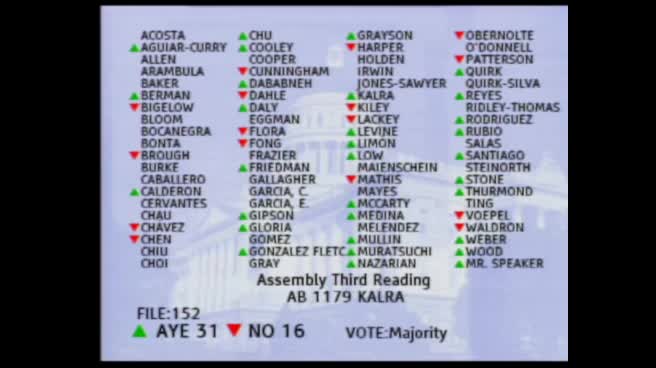 2MIN
Assembly Floor
 1H
Assembly Standing Committee on Appropriations
 3MIN