AB 1444: Livermore Amador Valley Transit Authority: demonstration project.
- Session Year: 2017-2018
- House: Assembly
- Latest Version Date: 2017-10-12
Existing law permits the operation of an autonomous vehicle on public roads for testing purposes if, among other requirements, a driver is seated in the drivers seat and is capable of taking immediate manual control of the vehicle in the event of an autonomous technology failure or other emergency.
Existing law, notwithstanding the above provision, until 180 days after the operative date of regulations promulgated by the Department of Motor Vehicles to allow testing of autonomous vehicles without a driver in the vehicle, authorizes the Contra Costa Transportation Authority to conduct a pilot project for the testing of autonomous vehicles that do not have a driver seated in the drivers seat and are not equipped with a steering wheel, a brake pedal, or an accelerator if the testing is conducted only at specified locations and the autonomous vehicle operates at speeds of less than 35 miles per hour. Existing law requires the authority or a private entity, or a combination of the 2, to obtain an instrument of insurance, surety bond, or proof of self-insurance in an amount of $5,000,000 prior to the start of testing of any autonomous vehicle on or across a public road and would require evidence of the insurance, surety bond, or proof of self-insurance to be provided to the Department of Motor Vehicles in the form and manner required by the department. Existing law requires the authority or a private entity, or a combination of the 2, to provide the department with a detailed description of the testing program, as specified. Existing law requires the operator of the autonomous vehicle technology to disclose what personal information concerning a pilot project participant is collected by an autonomous vehicle. Existing law authorizes the department to require data collection for evaluating the safety of the vehicles, as provided.
This bill would authorize the Livermore Amador Valley Transit Authority, in accordance with substantially similar conditions, to conduct a shared autonomous vehicle demonstration project for the testing of autonomous vehicles that do not have a driver seated in the drivers seat and are not equipped with a steering wheel, a brake pedal, or an accelerator, as specified. The bill would prohibit the authority from conducting the demonstration project if the department has adopted specified regulations by December 31, 2017.
This bill would make these provisions inoperative on May 1, 2018, and would repeal them as of January 1, 2019.
Existing law permits the operation of an autonomous vehicle on public roads for testing purposes if, among other requirements, a driver is seated in the drivers seat and is capable of taking immediate manual control of the vehicle in the event of an autonomous technology failure or other emergency.
Existing law, notwithstanding the above provision, until 180 days after the operative date of regulations promulgated by the Department of Motor Vehicles to allow testing of autonomous vehicles without a driver in the vehicle, authorizes the Contra Costa Transportation Authority to conduct a pilot project for the testing of autonomous vehicles that do not have a driver seated in the drivers seat and are not equipped with a steering wheel, a brake pedal, or an accelerator if the testing is conducted only at specified locations and the autonomous vehicle operates at speeds of less than 35 miles per hour. Existing law requires the authority or a private entity, or a combination of the 2, to obtain an instrument of insurance, surety bond, or proof of self-insurance in an amount of $5,000,000 prior to the start of testing of any autonomous vehicle on or across a public road and would require evidence of the insurance, surety bond, or proof of self-insurance to be provided to the Department of Motor Vehicles in the form and manner required by the department. Existing law requires the authority or a private entity, or a combination of the 2, to provide the department with a detailed description of the testing program, as specified. Existing law requires the operator of the autonomous vehicle technology to disclose what personal information concerning a pilot project participant is collected by an autonomous vehicle. Existing law authorizes the department to require data collection for evaluating the safety of the vehicles, as provided.
This bill would authorize the Livermore Amador Valley Transit Authority, in accordance with substantially similar conditions, to conduct a shared autonomous vehicle demonstration project for the testing of autonomous vehicles that do not have a driver seated in the drivers seat and are not equipped with a steering wheel, a brake pedal, or an accelerator, as specified. The bill would prohibit the authority from conducting the demonstration project if the department has adopted specified regulations by December 31, 2017.
This bill would make these provisions inoperative on May 1, 2018, and would repeal it as of January 1, 2019.
Existing law permits the operation of an autonomous vehicle on public roads for testing purposes if, among other requirements, a driver is seated in the drivers seat and is capable of taking immediate manual control of the vehicle in the event of an autonomous technology failure or other emergency.
Existing law, notwithstanding the above provision, until 180 days after the operative date of regulations promulgated by the Department of Motor Vehicles to allow testing of autonomous vehicles without a driver in the vehicle, authorizes the Contra Costa Transportation Authority to conduct a pilot project for the testing of autonomous vehicles that do not have a driver seated in the drivers seat and are not equipped with a steering wheel, a brake pedal, or an accelerator if the testing is conducted only at specified locations and the autonomous vehicle operates at speeds of less than 35 miles per hour. Existing law requires the authority or a private entity, or a combination of the 2, to obtain an instrument of insurance, surety bond, or proof of self-insurance in an amount of $5,000,000 prior to the start of testing of any autonomous vehicle on or across a public road and would require evidence of the insurance, surety bond, or proof of self-insurance to be provided to the Department of Motor Vehicles in the form and manner required by the department. Existing law requires the authority or a private entity, or a combination of the 2, to provide the department with a detailed description of the testing program, as specified. Existing law requires the operator of the autonomous vehicle technology to disclose what personal information concerning a pilot project participant is collected by an autonomous vehicle. Existing law requires authorizes the department to require data collection for evaluating the safety of the vehicles, as provided.
This bill would authorize the Livermore Amador Valley Transit Authority, in accordance with substantially similar conditions, to conduct a shared autonomous vehicle demonstration project for the testing of autonomous vehicles that do not have a driver seated in the drivers seat and are not equipped with a steering wheel, a brake pedal, or an accelerator, as specified.
This bill would make these provisions inoperative on May 1, 2018, and would repeal it as of January 1, 2019.
Existing law permits the operation of an autonomous vehicle on public roads for testing purposes if, among other requirements, a driver is seated in the drivers seat and is capable of taking immediate manual control of the vehicle in the event of an autonomous technology failure or other emergency.
Existing law, notwithstanding the above provision, until 180 days after the operative date of regulations promulgated by the Department of Motor Vehicles to allow testing of autonomous vehicles without a driver in the vehicle, authorizes the Contra Costa Transportation Authority to conduct a pilot project for the testing of autonomous vehicles that do not have a driver seated in the drivers seat and are not equipped with a steering wheel, a brake pedal, or an accelerator if the testing is conducted only at specified locations and the autonomous vehicle operates at speeds of less than 35 miles per hour. Existing law requires the authority or a private entity, or a combination of the 2, to obtain an instrument of insurance, surety bond, or proof of self-insurance in an amount of $5,000,000 prior to the start of testing of any autonomous vehicle on or across a public road and would require evidence of the insurance, surety bond, or proof of self-insurance to be provided to the Department of Motor Vehicles in the form and manner required by the department. Existing law requires the authority or a private entity, or a combination of the 2, to provide the department with a detailed description of the testing program, as specified. Existing law requires the operator of the autonomous vehicle technology to disclose what personal information concerning a pilot project participant is collected by an autonomous vehicle. Existing law requires the department to require data collection for evaluating the safety of the vehicles, as provided.
This bill would authorize the Livermore Amador Valley Transit Authority, in accordance with substantially similar conditions, to conduct a shared autonomous vehicle demonstration project for the testing of autonomous vehicles that do not have a driver seated in the drivers seat and are not equipped with a steering wheel, a brake pedal, or an accelerator, as specified.
(a)Notwithstanding Section 38750, the Livermore Amador Valley Transit Authority is authorized to conduct a shared autonomous vehicle (SAV) demonstration project for the testing of autonomous vehicles that do not have a driver seated in the drivers seat and are not equipped with a steering wheel, a brake pedal, or an accelerator, provided the following requirements are met:
(1)The testing shall be conducted only within the City of Dublin and the vehicles may traverse public roads within the area of the demonstration project.
(2)The autonomous vehicle shall operate at speeds of less than 35 miles per hour.
(b)Prior to the start of the testing of an autonomous vehicle that does not have a driver seated in the drivers seat on or across a public road, the Livermore Amador Valley Transit Authority or a private entity, or a combination of the two, shall do both of the following:
(1)Obtain an instrument of insurance, surety bond, or proof of self-insurance in an amount of five million dollars ($5,000,000), and shall provide evidence of the insurance, surety bond, or proof of self-insurance to the Department of Motor Vehicles in the form and manner required by the department.
(2)Submit a detailed description of the testing program to the department. The detailed description shall include all of the following:
(A)Certification that, prior to testing on public roads, the autonomous vehicle has been tested under controlled conditions that simulate, as closely as practicable, the real-world conditions that the autonomous vehicle will be subject to during this demonstration project, and that the Livermore Amador Valley Transit Authority or a private entity, or a combination of the two, has made a reasonable determination that it is safe to operate the autonomous vehicle on public roads under these conditions.
(B)Evidence satisfactory to the department that the local authorities with jurisdiction over the public roads in the designated area approve of the geographic area and environmental, traffic, and speed conditions authorized for purposes of this demonstration project.
(C)Certification that the autonomous vehicle can only operate in autonomous mode in the geographic area and environmental, traffic, and speed conditions authorized in this specific demonstration project.
(D)Certification that this demonstration project complies, or will comply, with National Highway Traffic Safety Administration guidance, if any, on the safe testing, deployment, and operation of autonomous vehicles.
(E)Certification that the autonomous vehicle used in the demonstration project complies with all applicable federal Motor Vehicle Safety Standards, or written evidence that the National Highway Traffic Safety Administration either considers the absence of a steering wheel, a brake pedal, or an accelerator permissible under federal Motor Vehicle Safety Standards or has granted the autonomous vehicle an exemption from compliance with the relevant federal Motor Vehicle Safety Standards.
(F)Identify to the department the autonomous vehicles that are to be tested on public roads during this demonstration project. For each vehicle, the manufacturer shall provide to the department the make, model, and model year of the vehicle, the full vehicle identification number, and the license plate number and the state of issuance.
(G)Certification that the vehicle is equipped with a communication link between the vehicle and a remote operator to provide information on the vehicles location and status and to allow two-way communication between the remote operator and any passengers if the vehicle experiences any failures that would endanger the safety of the vehicles passengers or other road users while operating without a driver.
(H)Certification that the autonomous vehicle is designed to detect and respond to roadway conditions in compliance with all provisions of this code and local regulations applicable to the operation of motor vehicles.
(I)A copy of a law enforcement interaction plan, which includes information that the Livermore Amador Valley Transit Authority or a private entity, or a combination of the two, will provide to the law enforcement agencies whose jurisdiction covers the designated area to instruct those agencies on how to interact with the vehicle in emergency and traffic enforcement situations.
(c)The operator of the autonomous vehicle technology tested pursuant to this section shall disclose to an individual who participates in the demonstration project what personal information, if any, concerning the demonstration project participant is collected by an autonomous vehicle.
(d)For the testing of autonomous vehicles within the designated area, the department may require data collection for evaluating the safety of the vehicles, including, but not limited to, both of the following:
(1)A report to the department of any accident originating from the operation of the autonomous vehicle on a public road that resulted in the damage of property or in bodily injury or death. Accidents shall be reported within 10 days in the form and manner specified by the department pursuant to the regulations adopted by the department under Section 38750.
(2)The submission to the department of an annual report in the form and manner specified by the department pursuant to the regulations adopted under Section 38750 summarizing information on unplanned technology disengagements that occurred while the autonomous vehicle was being tested on public roads. Disengagement means a deactivation of the autonomous mode when a failure of the autonomous technology is detected or when the safe operation of the vehicle required disengagement from the autonomous mode.
(e)This section does not limit the authority of the department to promulgate regulations governing the testing and operation of autonomous vehicles on public roads, with or without the presence of a driver inside the vehicle, pursuant to Section 38750.
(f)It is the intent of the Legislature, in enacting the act that added this section, to address the specific circumstances of the demonstration project proposed by the Livermore Amador Valley Transit Authority. Pursuant to Section 38750, the Department of Motor Vehicles is developing regulations for the testing and operation of autonomous vehicles, and it is not the intent of the Legislature to influence the content of those statewide regulations through the enactment of this section, which is only intended to govern the establishment of one local demonstration project.
(g)The demonstration project authorized by this section shall not be conducted if the department has adopted regulations pursuant to Section 38750 by December 31, 2017, through the proceedings initiated by the department on March 10, 2017, and published in the California Regulatory Notice Register as Notice File No. Z2017-0227-02.
(h)The Livermore Amador Valley Transit Authority shall comply with regulations promulgated by the department to allow testing of autonomous vehicles without a driver in the vehicle.
(i)This section shall become inoperative on May 1, 2018, and, as of January 1, 2019, is repealed.
(a)Notwithstanding Section 38750, the Livermore Amador Valley Transit Authority is authorized to conduct a shared autonomous vehicle (SAV) demonstration project for the testing of autonomous vehicles that do not have a driver seated in the drivers seat and are not equipped with a steering wheel, a brake pedal, or an accelerator, provided the following requirements are met:
(1)The testing shall be conducted only within the City of Dublin and the vehicles may traverse public roads within the area of the demonstration project.
(2)The autonomous vehicle shall operate at speeds of less than 35 miles per hour.
(b)Prior to the start of the testing of an autonomous vehicle that does not have a driver seated in the drivers seat on or across a public road, the Livermore Amador Valley Transit Authority or a private entity, or a combination of the two, shall do both of the following:
(1)Obtain an instrument of insurance, surety bond, or proof of self-insurance in an amount of five million dollars ($5,000,000), and shall provide evidence of the insurance, surety bond, or proof of self-insurance to the Department of Motor Vehicles in the form and manner required by the department.
(2)Submit a detailed description of the testing program to the department. The detailed description shall include all of the following:
(A)Certification that, prior to testing on public roads, the autonomous vehicle has been tested under controlled conditions that simulate, as closely as practicable, the real-world conditions that the autonomous vehicle will be subject to during this demonstration project, and that the Livermore Amador Valley Transit Authority or a private entity, or a combination of the two, has made a reasonable determination that it is safe to operate the autonomous vehicle on public roads under these conditions.
(B)Evidence satisfactory to the department that the local authorities with jurisdiction over the public roads in the designated area approve of the geographic area and environmental, traffic, and speed conditions authorized for purposes of this demonstration project.
(C)Certification that the autonomous vehicle can only operate in autonomous mode in the geographic area and environmental, traffic, and speed conditions authorized in this specific demonstration project.
(D)Certification that this demonstration project complies, or will comply, with National Highway Traffic Safety Administration guidance, if any, on the safe testing, deployment, and operation of autonomous vehicles.
(E)Certification that the autonomous vehicle used in the demonstration project complies with all applicable federal Motor Vehicle Safety Standards, or written evidence that the National Highway Traffic Safety Administration either considers the absence of a steering wheel, a brake pedal, or an accelerator permissible under federal Motor Vehicle Safety Standards or has granted the autonomous vehicle an exemption from compliance with the relevant federal Motor Vehicle Safety Standards.
(F)Identify to the department the autonomous vehicles that are to be tested on public roads during this demonstration project. For each vehicle, the manufacturer shall provide to the department the make, model, and model year of the vehicle, the full vehicle identification number, and the license plate number and the state of issuance.
(G)Certification that the vehicle is equipped with a communication link between the vehicle and a remote operator to provide information on the vehicles location and status and to allow two-way communication between the remote operator and any passengers if the vehicle experiences any failures that would endanger the safety of the vehicles passengers or other road users while operating without a driver.
(H)Certification that the autonomous vehicle is designed to detect and respond to roadway conditions in compliance with all provisions of this code and local regulations applicable to the operation of motor vehicles.
(I)A copy of a law enforcement interaction plan, which includes information that the Livermore Amador Valley Transit Authority or a private entity, or a combination of the two, will provide to the law enforcement agencies whose jurisdiction covers the designated area to instruct those agencies on how to interact with the vehicle in emergency and traffic enforcement situations.
(c)The operator of the autonomous vehicle technology tested pursuant to this section shall disclose to an individual who participates in the demonstration project what personal information, if any, concerning the demonstration project participant is collected by an autonomous vehicle.
(d)For the testing of autonomous vehicles within the designated area, the department may require data collection for evaluating the safety of the vehicles, including, but not limited to, both of the following:
(1)A report to the department of any accident originating from the operation of the autonomous vehicle on a public road that resulted in the damage of property or in bodily injury or death. Accidents shall be reported within 10 days in the form and manner specified by the department pursuant to the regulations adopted by the department under Section 38750.
(2)The submission to the department of an annual report in the form and manner specified by the department pursuant to the regulations adopted under Section 38750 summarizing information on unplanned technology disengagements that occurred while the autonomous vehicle was being tested on public roads. Disengagement means a deactivation of the autonomous mode when a failure of the autonomous technology is detected or when the safe operation of the vehicle required disengagement from the autonomous mode.
(e)This section does not limit the authority of the department to promulgate regulations governing the testing and operation of autonomous vehicles on public roads, with or without the presence of a driver inside the vehicle, pursuant to Section 38750.
(f)It is the intent of the Legislature, in enacting the act that added this section, to address the specific circumstances of the demonstration project proposed by the Livermore Amador Valley Transit Authority. Pursuant to Section 38750, the Department of Motor Vehicles is developing regulations for the testing and operation of autonomous vehicles, and it is not the intent of the Legislature to influence the content of those statewide regulations through the enactment of this section, which is only intended to govern the establishment of one local demonstration project.
(g)The demonstration project authorized by this section shall not be conducted if the department has adopted regulations pursuant to Section 38750 by December 31, 2017. 2017, through the proceedings initiated by the department on March 10, 2017, and published in the California Regulatory Notice Register as Notice File No. Z2017-0227-02.
(h)The Livermore Amador Valley Transit Authority shall comply with regulations promulgated by the department to allow testing of autonomous vehicles without a driver in the vehicle.
(i)This section shall become inoperative on May 1, 2018, and, as of January 1, 2019, is repealed.
(a)Notwithstanding Section 38750, the Livermore Amador Valley Transit Authority is authorized to conduct a shared autonomous vehicle (SAV) demonstration project for the testing of autonomous vehicles that do not have a driver seated in the drivers seat and are not equipped with a steering wheel, a brake pedal, or an accelerator, provided the following requirements are met:
(1)The testing shall be conducted only within the City of Dublin and the vehicles may traverse public roads within the area of the demonstration project.
(2)The autonomous vehicle shall operate at speeds of less than 35 miles per hour.
(b)Prior to the start of the testing of an autonomous vehicle that does not have a driver seated in the drivers seat on or across a public road, the Livermore Amador Valley Transit Authority or a private entity, or a combination of the two, shall do both of the following:
(1)Obtain an instrument of insurance, surety bond, or proof of self-insurance in an amount of five million dollars ($5,000,000), and shall provide evidence of the insurance, surety bond, or proof of self-insurance to the Department of Motor Vehicles in the form and manner required by the department.
(2)Submit a detailed description of the testing program to the department. The detailed description shall include all of the following:
(A)Certification that, prior to testing on public roads, the autonomous vehicle has been tested under controlled conditions that simulate, as closely as practicable, the real-world conditions that the autonomous vehicle will be subject to during this demonstration project, and that the Livermore Amador Valley Transit Authority or a private entity, or a combination of the two, has made a reasonable determination that it is safe to operate the autonomous vehicle on public roads under these conditions.
(B)Evidence satisfactory to the department that the local authorities with jurisdiction over the public roads in the designated area approve of the geographic area and environmental, traffic, and speed conditions authorized for purposes of this demonstration project.
(C)Certification that the autonomous vehicle can only operate in autonomous mode in the geographic area and environmental, traffic, and speed conditions authorized in this specific demonstration project.
(D)Certification that this demonstration project complies, or will comply, with National Highway Traffic Safety Administration guidance, if any, on the safe testing, deployment, and operation of autonomous vehicles.
(E)Certification that the autonomous vehicle used in the demonstration project complies with all applicable federal Motor Vehicle Safety Standards, or written evidence that the National Highway Traffic Safety Administration either considers the absence of a steering wheel, a brake pedal, or an accelerator permissible under federal Motor Vehicle Safety Standards or has granted the autonomous vehicle an exemption from compliance with the relevant federal Motor Vehicle Safety Standards.
(F)Identify to the department the autonomous vehicles that are to be tested on public roads during this demonstration project. For each vehicle, the manufacturer shall provide to the department the make, model, and model year of the vehicle, the full vehicle identification number, and the license plate number and the state of issuance.
(G)Certification that the vehicle is equipped with a communication link between the vehicle and a remote operator to provide information on the vehicles location and status and to allow two-way communication between the remote operator and any passengers if the vehicle experiences any failures that would endanger the safety of the vehicles passengers or other road users while operating without a driver.
(H)Certification that the autonomous vehicle is designed to detect and respond to roadway conditions in compliance with all provisions of this code and local regulations applicable to the operation of motor vehicles.
(I)A copy of a law enforcement interaction plan, which includes information that the Livermore Amador Valley Transit Authority or a private entity, or a combination of the two, will provide to the law enforcement agencies whose jurisdiction covers the designated area to instruct those agencies on how to interact with the vehicle in emergency and traffic enforcement situations.
(c)The operator of the autonomous vehicle technology tested pursuant to this section shall disclose to an individual who participates in the demonstration project what personal information, if any, concerning the demonstration project participant is collected by an autonomous vehicle.
(d)For the testing of autonomous vehicles within the designated area, the department may require data collection for evaluating the safety of the vehicles, including, but not limited to, both of the following:
(1)A report to the department of any accident originating from the operation of the autonomous vehicle on a public road that resulted in the damage of property or in bodily injury or death. Accidents shall be reported within 10 days in the form and manner specified by the department pursuant to the regulations adopted by the department under Section 38750.
(2)The submission to the department of an annual report in the form and manner specified by the department pursuant to the regulations adopted under Section 38750 summarizing information on unplanned technology disengagements that occurred while the autonomous vehicle was being tested on public roads. Disengagement means a deactivation of the autonomous mode when a failure of the autonomous technology is detected or when the safe operation of the vehicle required disengagement from the autonomous mode.
(e)This section does not limit the authority of the department to promulgate regulations governing the testing and operation of autonomous vehicles on public roads, with or without the presence of a driver inside the vehicle, pursuant to Section 38750.
(f)It is the intent of the Legislature, in enacting the act that added this section, to address the specific circumstances of the demonstration project proposed by the Livermore Amador Valley Transit Authority. Pursuant to Section 38750, the Department of Motor Vehicles is developing regulations for the testing and operation of autonomous vehicles, and it is not the intent of the Legislature to influence the content of those statewide regulations through the enactment of this section, which is only intended to govern the establishment of one local demonstration project.
(g)The demonstration project authorized by this section shall not be conducted if the department has adopted regulations pursuant to Section 38750 by December 31, 2017.
(g)(h)The Livermore Amador Valley Transit Authority shall comply with regulations promulgated by the department to allow testing of autonomous vehicles without a driver in the vehicle.
(h)(i)This section shall become inoperative on May 1, 2018, and, as of January 1, 2019, is repealed.
(a)Notwithstanding Section 38750, the Livermore Amador Valley Transit Authority is authorized to conduct a shared autonomous vehicle (SAV) demonstration project for the testing of autonomous vehicles that do not have a driver seated in the drivers seat and are not equipped with a steering wheel, a brake pedal, or an accelerator, provided the following requirements are met:
(1)The testing shall be conducted only within the City of Dublin and the vehicles may traverse public roads within the area of the demonstration program. project.
(2)The autonomous vehicle shall operate at speeds of less than 35 miles per hour.
(b)Prior to the start of the testing of an autonomous vehicle that does not have a driver seated in the drivers seat on or across a public road, the Livermore Amador Valley Transit Authority or a private entity, or a combination of the two, shall do both of the following:
(1)Obtain an instrument of insurance, surety bond, or proof of self-insurance in an amount of five million dollars ($5,000,000), and shall provide evidence of the insurance, surety bond, or proof of self-insurance to the Department of Motor Vehicles in the form and manner required by the department.
(2)Submit a detailed description of the testing program to the department. The detailed description shall include all of the following:
(A)Certification that, prior to testing on public roads, the autonomous vehicle has been tested under controlled conditions that simulate, as closely as practicable, the real-world conditions that the autonomous vehicle will be subject to during this demonstration project, and that the Livermore Amador Valley Transit Authority or a private entity, or a combination of the two, has made a reasonable determination that it is safe to operate the autonomous vehicle on public roads under these conditions.
(B)Evidence satisfactory to the department that the local authorities with jurisdiction over the public roads in the designated area approve of the geographic area and environmental, traffic, and speed conditions authorized for purposes of this demonstration project.
(C)Certification that the autonomous vehicle can only operate in autonomous mode in the geographic area and environmental, traffic, and speed conditions authorized in this specific pilot demonstration project.
(D)Certification that this demonstration project complies, or will comply, with National Highway Traffic Safety Administration guidance, if any, on the safe testing, deployment, and operation of autonomous vehicles.
(E)Certification that the autonomous vehicle used in the demonstration project complies with all applicable federal Motor Vehicle Safety Standards, or written evidence that the National Highway Traffic Safety Administration either considers the absence of a steering wheel, a brake pedal, or an accelerator permissible under federal Motor Vehicle Safety Standards or has granted the autonomous vehicle an exemption from compliance with the relevant federal Motor Vehicle Safety Standards.
(F)Identify to the department the autonomous vehicles that are to be tested on public roads during this demonstration project. For each vehicle, the manufacturer shall provide to the department the make, model, and model year of the vehicle, the full vehicle identification number, and the license plate number and the state of issuance.
(G)Certification that the vehicle is equipped with a communication link between the vehicle and a remote operator to provide information on the vehicles location and status and to allow two-way communication between the remote operator and any passengers if the vehicle experiences any failures that would endanger the safety of the vehicles passengers or other road users while operating without a driver.
(H)Certification that the autonomous vehicle is designed to detect and respond to roadway conditions in compliance with all provisions of this code and local regulations applicable to the operation of motor vehicles.
(I)A copy of a law enforcement interaction plan, which includes information that the Livermore Amador Valley Transit Authority or a private entity, or a combination of the two, will provide to the law enforcement agencies whose jurisdiction covers the designated area to instruct those agencies on how to interact with the vehicle in emergency and traffic enforcement situations.
(c)The operator of the autonomous vehicle technology tested pursuant to this section shall disclose to an individual who participates in the demonstration project what personal information, if any, concerning the demonstration project participant is collected by an autonomous vehicle.
(d)For the testing of autonomous vehicles within the designated area, the department may require data collection for evaluating the safety of the vehicles, including, but not limited to, both of the following:
(1)A report to the department of any accident originating from the operation of the autonomous vehicle on a public road that resulted in the damage of property or in bodily injury or death. Accidents shall be reported within 10 days in the form and manner specified by the department pursuant to the regulations adopted by the department under Section 38750.
(2)The submission to the department of an annual report in the form and manner specified by the department pursuant to the regulations adopted under Section 38750 summarizing information on unplanned technology disengagements that occurred while the autonomous vehicle was being tested on public roads. Disengagement means a deactivation of the autonomous mode when a failure of the autonomous technology is detected or when the safe operation of the vehicle required disengagement from the autonomous mode.
(e)This section does not limit the authority of the department to promulgate regulations governing the testing and operation of autonomous vehicles on public roads, with or without the presence of a driver inside the vehicle, pursuant to Section 38750.
(f)It is the intent of the Legislature, in enacting the act that added this section, to address the specific circumstances of the demonstration project proposed by the Livermore Amador Valley Transit Authority. Pursuant to Section 38750, the Department of Motor Vehicles is developing regulations for the testing and operation of autonomous vehicles, and it is not the intent of the Legislature to influence the content of those statewide regulations through the enactment of this section, which is only intended to govern the establishment of one local demonstration project.
(g)The Livermore Amador Valley Transit Authority shall comply with regulations promulgated by the department to allow testing of autonomous vehicles without a driver in the vehicle. On January 1 following the operative date of those regulations, this section is repealed, unless a later enacted statute, that is enacted before that January 1, deletes or extends that date.
(h)This section shall become inoperative on May 1, 2018, and, as of January 1, 2019, is repealed.
(a)Notwithstanding Section 38750, the Livermore Amador Valley Transit Authority is authorized to conduct a shared autonomous vehicle (SAV) demonstration project for the testing of autonomous vehicles that do not have a driver seated in the drivers seat and are not equipped with a steering wheel, a brake pedal, or an accelerator, provided the following requirements are met:
(1)The testing shall be conducted only within the City of Dublin and the vehicles may traverse public roads within the area of the demonstration program.
(2)The autonomous vehicle shall operate at speeds of less than 35 miles per hour.
(b)Prior to the start of the testing of an autonomous vehicle that does not have a driver seated in the drivers seat on or across a public road, the Livermore Amador Valley Transit Authority or a private entity, or a combination of the two, shall do both of the following:
(1)Obtain an instrument of insurance, surety bond, or proof of self-insurance in an amount of five million dollars ($5,000,000), and shall provide evidence of the insurance, surety bond, or proof of self-insurance to the Department of Motor Vehicles in the form and manner required by the department.
(2)Submit a detailed description of the testing program to the department. The detailed description shall include all of the following:
(A)Certification that, prior to testing on public roads, the autonomous vehicle has been tested under controlled conditions that simulate, as closely as practicable, the real-world conditions that the autonomous vehicle will be subject to during this demonstration project, and that the Livermore Amador Valley Transit Authority or a private entity, or a combination of the two, has made a reasonable determination that it is safe to operate the autonomous vehicle on public roads under these conditions.
(B)Evidence satisfactory to the department that the local authorities with jurisdiction over the public roads in the designated area approve of the geographic area and environmental, traffic, and speed conditions authorized for purposes of this demonstration project.
(C)Certification that the autonomous vehicle can only operate in autonomous mode in the geographic area and environmental, traffic, and speed conditions authorized in this specific pilot project.
(D)Certification that this demonstration project complies, or will comply, with National Highway Traffic Safety Administration guidance, if any, on the safe testing, deployment, and operation of autonomous vehicles.
(E)Certification that the autonomous vehicle used in the demonstration project complies with all applicable federal Motor Vehicle Safety Standards, or written evidence that the National Highway Traffic Safety Administration either considers the absence of a steering wheel, a brake pedal, or an accelerator permissible under federal Motor Vehicle Safety Standards or has granted the autonomous vehicle an exemption from compliance with the relevant federal Motor Vehicle Safety Standards.
(F)Identify to the department the autonomous vehicles that are to be tested on public roads during this demonstration project. For each vehicle, the manufacturer shall provide to the department the make, model, and model year of the vehicle, the full vehicle identification number, and the license plate number and the state of issuance.
(G)Certification that the vehicle is equipped with a communication link between the vehicle and a remote operator to provide information on the vehicles location and status and to allow two-way communication between the remote operator and any passengers if the vehicle experiences any failures that would endanger the safety of the vehicles passengers or other road users while operating without a driver.
(H)Certification that the autonomous vehicle is designed to detect and respond to roadway conditions in compliance with all provisions of this code and local regulations applicable to the operation of motor vehicles.
(I)A copy of a law enforcement interaction plan, which includes information that the Livermore Amador Valley Transit Authority or a private entity, or a combination of the two, will provide to the law enforcement agencies whose jurisdiction covers the designated area to instruct those agencies on how to interact with the vehicle in emergency and traffic enforcement situations.
(c)The operator of the autonomous vehicle technology tested pursuant to this section shall disclose to an individual who participates in the demonstration project what personal information, if any, concerning the demonstration project participant is collected by an autonomous vehicle.
(d)For the testing of autonomous vehicles within the designated area, the department may require data collection for evaluating the safety of the vehicles, including, but not limited to, both of the following:
(1)A report to the department of any accident originating from the operation of the autonomous vehicle on a public road that resulted in the damage of property or in bodily injury or death. Accidents shall be reported within 10 days in the form and manner specified by the department pursuant to the regulations adopted by the department under Section 38750.
(2)The submission to the department of an annual report in the form and manner specified by the department pursuant to the regulations adopted under Section 38750 summarizing information on unplanned technology disengagements that occurred while the autonomous vehicle was being tested on public roads. Disengagement means a deactivation of the autonomous mode when a failure of the autonomous technology is detected or when the safe operation of the vehicle required disengagement from the autonomous mode.
(e)This section does not limit the authority of the department to promulgate regulations governing the testing and operation of autonomous vehicles on public roads, with or without the presence of a driver inside the vehicle, pursuant to Section 38750.
(f)It is the intent of the Legislature, in enacting the act that added this section, to address the specific circumstances of the demonstration project proposed by the Livermore Amador Valley Transit Authority. Pursuant to Section 38750, the Department of Motor Vehicles is developing regulations for the testing and operation of autonomous vehicles, and it is not the intent of the Legislature to influence the content of those statewide regulations through the enactment of this section, which is only intended to govern the establishment of one local demonstration project.
(g)The Livermore Amador Valley Transit Authority shall comply with regulations promulgated by the department to allow testing of autonomous vehicles without a driver in the vehicle. On January 1 following the operative date of those regulations, this section is repealed, unless a later enacted statute, that is enacted before that January 1, deletes or extends that date.
|
Date
|
Status
|
|---|---|
| Oct 12, 2017 | Chaptered by Secretary of State - Chapter 719, Statutes of 2017. |
| Oct 12, 2017 | Approved by the Governor. |
| Sep 12, 2017 | Enrolled and presented to the Governor at 2:30 p.m. |
| Sep 5, 2017 | Senate amendments concurred in. To Engrossing and Enrolling. (Ayes 60. Noes 11.). |
| Aug 31, 2017 | In Assembly. Concurrence in Senate amendments pending. May be considered on or after September 2 pursuant to Assembly Rule 77. |
| Aug 31, 2017 | Read third time. Passed. Ordered to the Assembly. |
| Jul 11, 2017 | Read second time. Ordered to third reading. |
| Jul 10, 2017 | From committee: Be ordered to second reading pursuant to Senate Rule 28.8. |
| Jun 28, 2017 | From committee: Do pass and re-refer to Com. on APPR. (Ayes 12. Noes 0.) (June 27). Re-referred to Com. on APPR. |
| Jun 20, 2017 | In committee: Hearing postponed by committee. |
| Jun 20, 2017 | From committee chair, with author's amendments: Amend, and re-refer to committee. Read second time, amended, and re-referred to Com. on T. & H. |
| Jun 8, 2017 | Referred to Com. on T. & H. |
| May 30, 2017 | In Senate. Read first time. To Com. on RLS. for assignment. |
| May 30, 2017 | Read third time. Passed. Ordered to the Senate. (Ayes 54. Noes 13. Page 1790.) |
| May 11, 2017 | Read second time. Ordered to third reading. |
| May 10, 2017 | From committee: Do pass. (Ayes 12. Noes 1.) (May 10). |
| May 3, 2017 | Re-referred to Com. on APPR. |
| May 2, 2017 | Read second time and amended. |
| May 1, 2017 | From committee: Amend, and do pass as amended and re-refer to Com. on APPR. (Ayes 10. Noes 0.) (April 26). |
| Apr 18, 2017 | From committee: Do pass and re-refer to Com. on C. & C. (Ayes 9. Noes 1.) (April 17). Re-referred to Com. on C. & C. |
| Apr 6, 2017 | Re-referred to Com. on TRANS. |
| Apr 5, 2017 | From committee chair, with author's amendments: Amend, and re-refer to Com. on TRANS. Read second time and amended. |
| Mar 13, 2017 | Referred to Coms. on TRANS. and C. & C. |
| Feb 19, 2017 | From printer. May be heard in committee March 21. |
| Feb 17, 2017 | Read first time. To print. |
|
Date
|
Description
|
Location
|
Votes
|
|
|---|---|---|---|---|
| Sep 5, 2017 | AB 1444 BAKER Concurrence in Senate Amendments | Assembly Floor |
Passed |
|
| Aug 31, 2017 | Assembly 3rd Reading AB1444 Baker et al. By Hill | Senate Floor |
Passed |
|
| Jun 27, 2017 | Do pass, but first be re-referred to the Committee on [Appropriations] | Senate Standing Committee on Transportation and Housing |
Passed |
|
| May 30, 2017 | AB 1444 BAKER Assembly Third Reading | Assembly Floor |
Passed |
|
| May 10, 2017 | Do pass. | Assembly Standing Committee on Appropriations |
Passed |
|
| Apr 26, 2017 | Do pass as amended and be re-referred to the Committee on [Appropriations] | Assembly Standing Committee on Communications and Conveyance |
Passed |
|
| Apr 17, 2017 | Do pass and be re-referred to the Committee on [Communications and Conveyance] | Assembly Standing Committee on Transportation |
Passed |
This list shows positions taken on this bill by organizations on the date displayed, which is linked to the original source.
Positions by individuals are not included.
CONCURRENCE IN SENATE AMENDMENTS
CSA1 Bill Id:AB 1444
Author:(Baker)
As Amended Ver:June 20, 2017
Majority vote
ASSEMBLY: | 54-13 | (May 30, 2017) | SENATE: | 37-1 | (August 31, 2017) |
Original Committee Reference: TRANS.
SUMMARY: Authorizes the Livermore Amador Valley Transit Authority (LAVTA) to conduct a demonstration project for the testing of autonomous vehicles without a driver in the driver's seat under specific conditions.
The Senate amendments clarify a reference to pending Department of Motor Vehicles (DMV) regulations.
AS PASSED BY THE ASSEMBLY, this bill:
- Authorized LAVTA to conduct a shared autonomous vehicle demonstration project for the testing of autonomous vehicles not equipped with a steering wheel, a brake pedal, an accelerator, or an operator.
- Limited the venue for the demonstration project to the City of Dublin and limited the operating speed of the autonomous vehicle involved in the project to 35 miles per hour.
- Required LAVTA to obtain and provide to DMV proof of insurance and a detailed description of the testing program prior to testing an autonomous vehicle without an operator on a public road, and required the description to include specific certifications relating to the demonstration project's technical specifications and compliance with applicable laws.
- Required the operator of the autonomous vehicle technology to disclose to an individual who participates in the pilot project what personal information, if any, concerning the demonstration project participant is collected by an autonomous vehicle.
- Authorized DMV to require the submission of information and data regarding the testing of autonomous vehicles in the demonstration project, including a report of any accident involving the autonomous vehicles and an annual report summarizing information on unplanned autonomous technology disengagements, pursuant to existing law.
- Provided that this bill does not limit the authority of DMV to promulgate regulations governing the testing and operation of autonomous vehicles on public roads, with or without the presence of a driver inside the vehicle, pursuant to existing law.
- Declared the intent of the Legislature is not to influence the development of regulations by DMV for the testing and operation of autonomous vehicles pursuant to existing law.
- Provided that the demonstration project shall not be conducted if DMV adopts regulations relating to autonomous vehicles pursuant to existing law by December 31, 2017, required LAVTA to comply with existing DMV regulations relating to autonomous vehicles, and provided that the provisions of this bill are inoperative on May 1, 2018.
FISCAL EFFECT: According to the Senate Appropriations Committee, pursuant to Senate Rule 28.8, negligible state costs.
COMMENTS: In response to arguments for the traffic safety benefits of increasingly automated vehicle technology, the Legislature passed and Governor Brown signed legislation requiring DMV to adopt regulations for the operation of autonomous vehicles on California's public roads in 2012 (SB 1298 (Padilla), Chapter 570, Statutes of 2012). The rollout of DMV's regulations was separated into two stages: regulations for insurance requirements for the purposes of testing autonomous vehicles and regulations for the full deployment of autonomous vehicles on California roads for non-testing purposes. Both sets of regulations were required to be adopted by January 1, 2015. DMV adopted testing regulations on May 19, 2014, and submitted proposed regulations for non-testing purposes for public comment on March 10, 2017. The public comment period ended on April 24, 2017, and DMV anticipates adopting finalized regulations before the end of 2017.
The original legislation directing DMV to adopt regulations for the operation of autonomous vehicles requires the presence of an operator inside the vehicle and the ability of the operator to take over control of the vehicle from the autonomous technology through the use of the brake, the accelerator pedal, or the steering wheel, although DMV can authorize the operation of vehicles without these features subject to whatever additional requirements DMV deems necessary to ensure the safe operation of these vehicles. DMV's proposed regulations for the deployment of autonomous vehicles currently include standards and requirements for autonomous vehicles that do not have an operator inside the vehicle.
Last year, Governor Brown signed AB 1592 (Bonilla), Chapter 814, Statutes of 2016, which allowed the Contra Costa Transportation Authority (CCTA) to conduct a pilot project for the testing of autonomous vehicles without a driver in the vehicle under specific conditions. That pilot is separate from the framework for testing autonomous vehicles that DMV has developed.
This bill would authorize LAVTA to conduct a demonstration project in the City of Dublin under similar parameters and conditions to the CCTA pilot. The vehicles LAVTA intends to use in the demonstration project are small shuttles with a capacity of 12 persons and a fully-laden weight of approximately 6,000 pounds. According to the author, this bill is required to ensure that California remains "on the cutting edge of transportation technology and a potential hotbed for investment, development, and new jobs."
While DMV has not yet finalized its regulations for the deployment of autonomous vehicles, the proposed regulations would allow for the testing of the vehicles contemplated for LAVTA's demonstration project without additional legislative authorization. Because the DMV regulations will not be adopted until later this year and will not take effect for 120 days after they are adopted, the author intends to give LAVTA the authority to start their demonstration pilot as soon as possible. The bill's sunset date of May 1, 2018, will require LAVTA to conform with the DMV regulations after they have gone into effect.
Committee concerns: By creating a carve-out for a specific agency, this bill could continue a problematic precedent for other entities seeking to receive authorization for their own special projects outside of the existing and future DMV framework for autonomous vehicles.
Analysis Prepared by: Justin Behrens / TRANS. / (916) 319-2093 FN: 0001124
Date of Hearing: April 26, 2017
ASSEMBLY COMMITTEE ON COMMUNICATIONS AND CONVEYANCE
Miguel Santiago, Chair
ABPCA Bill Id:AB 1444 (
Author:Baker) – As Amended Ver:April 5, 2017
SUBJECT: Livermore Amador Valley Transit Authority: demonstration project
SUMMARY: Authorizes Livermore Amador Valley Transit Authority (LAVTA) to conduct a demonstration project for the testing of autonomous vehicles (AVs) without a driver seated in the driver’s seat under specified conditions. Specifically, this bill:
- Authorizes LAVTA to conduct a shared AV demonstration project for the testing of AVs that do not have a driver seated in the driver’s seat and are not equipped with a steering wheel, a brake pedal, or an accelerator, as specified.
- Requires the testing to be conducted only within the City of Dublin and authorizes the vehicles to traverse public roads within the area of the demonstration project.
- Requires the specified AV to operate at speeds of less than 35 miles per hour.
- Requires LAVTA or a private entity, or a combination of the two, prior to the start of the testing of an AV that does not have a driver seated in the driver’s seat on or across a public road, to do both of the following:
- Obtain an instrument of insurance, surety bond, or proof of self-insurance in an amount of $5 million, and provide evidence of the insurance, surety bond, or proof of self-insurance to the Department of Motor Vehicles (DMV) in the form and manner required by the department; and,
- Submit a detailed description of the testing program to DMV. The detailed description shall include all of the following:
- Certification that, prior to testing on public roads, the AV has been tested under controlled conditions that simulate, as closely as practicable, the real-world conditions that the AV will be subject to during this demonstration project, and that LAVTA or a private entity, or a combination of the two, has made a reasonable determination that it is safe to operate the AV on public roads under these conditions;
- Evidence satisfactory to DMV that the local authorities with jurisdiction over the public roads in the designated area approve of the geographic area and environmental, traffic, and speed conditions authorized for purposes of this demonstration project;
- Certification that the AV can only operate in autonomous mode in the geographic area and environmental, traffic, and speed conditions authorized in this specific demonstration project;
- Certification that the demonstration project complies, or will comply, with National Highway Traffic Safety Administration guidance, if any, on the safe testing, deployment, and operation of AVs;
- Certification that the AV used in the demonstration project complies with all applicable federal Motor Vehicle Safety Standards, or written evidence that the National Highway Traffic Safety Administration either considers the absence of a steering wheel, a brake pedal, or an accelerator permissible under federal Motor Vehicle Safety Standards or has granted the AV an exemption from compliance with the relevant federal Motor Vehicle Safety Standards;
- Identify to DMV the AVs that are to be tested on public roads during this demonstration project. Requires, for each vehicle, the manufacturer to provide to DMV the make, model, and model year of the vehicle, the full vehicle identification number, and the license plate number and the state of issuance;
- Certification that the vehicle is equipped with a communication link between the vehicle and a remote operator to provide information on the vehicle’s location and status and to allow two-way communication between the remote operator and any passengers if the vehicle experiences any failures that would endanger the safety of the vehicle’s passengers or other road users while operating without a driver;
- Certification that the AV is designed to detect and respond to roadway conditions in compliance with all provisions of this code and local regulations applicable to the operation of motor vehicles; and,
- A copy of a law enforcement interaction plan, which includes information that LAVTA or a private entity, or a combination of the two, will provide to the law enforcement agencies whose jurisdiction covers the designated area to instruct those agencies on how to interact with the vehicle in emergency and traffic enforcement situations.
- Requires the specified operator of the AV technology tested to disclose to an individual who participates in the demonstration project what personal information, if any, concerning the demonstration project participant is collected by an AV.
- Authorizes DMV, for the testing of AVs within the designated area, to require data collection for evaluating the safety of the vehicles, including, but not limited to, both of the following:
- A report to DMV of any accident originating from the operation of the AV on a public road that resulted in the damage of property or in bodily injury or death. Requires accidents to be reported within 10 days in the form and manner specified by DMV pursuant to the specified regulations adopted by DMV; and,
- The submission to DMV of an annual report in the form and manner specified by the DMV pursuant to specified regulations summarizing information on unplanned technology disengagements that occurred while the AV was being tested on public roads. Defines “disengagement” to mean a deactivation of the autonomous mode when a failure of the autonomous technology is detected or when the safe operation of the vehicle required disengagement from the autonomous mode.
- Requires LAVTA to comply with regulations promulgated by DMV to allow testing of AVs without a driver in the vehicle.
- Sunsets the provisions of the bill on May 1, 2018, and, repeals it as of January 1, 2019.
EXISTING LAW:
- Authorizes DMV to suspend, cancel, or revoke the registration of a vehicle or a certificate of ownership, registration card, license plate, or permit under specified circumstances, including when DMV determines that a registered vehicle is mechanically unfit or unsafe to be operated or moved upon the highways. (Vehicle Code (VEH) Section 8800)
- Requires CHP to prepare and on request supply to police departments, coroners, sheriffs, and other suitable agencies or individuals, specified forms for accident reports, which reports shall call for sufficiently detailed information to disclose with reference to a traffic accident the cause, conditions then existing, and the persons and vehicles involved. (VEH Section 2407)
- Requires CHP to tabulate and authorizes it to analyze all accident reports and publish annually or at more frequent intervals statistical information based thereon as to the number and location of traffic accidents, as well as other information relating to traffic accident prevention. (VEH Section 2408)
- Requires the driver of a motor vehicle who is in any manner involved in an accident originating from the operation of the motor vehicle on a street or highway, or is involved in a specified reportable off-highway accident, that has resulted in damage to the property of any one person in excess of $1,000, or in bodily injury, or in the death of any person to report the accident, within 10 days after the accident, either personally or through an insurance agent, broker, or legal representative, on a form approved by CHP, as specified. (VEH Section 16000)
- Defines “autonomous vehicle” to mean any vehicle equipped with autonomous technology that has been integrated into that vehicle. Specifies that a AV does not include a vehicle that is equipped with one or more collision avoidance systems, including, but not limited to, electronic blind spot assistance, automated emergency braking systems, park assist, adaptive cruise control, lane keep assist, lane departure warning, traffic jam and queuing assist, or other similar systems that enhance safety or provide driver assistance, but are not capable, collectively or singularly, of driving the vehicle without the active control or monitoring of a human operator. (VEH Section 38750)
- Authorizes an AV to operate on public roads for testing purposes by a driver who possesses the proper class of license for the type of vehicle being operated if specified requirements are met. (VEH Section 38750)
- Prohibits an AV from operating on public roads until the manufacturer submits an application to DMV, and that application is approved by DMV pursuant to the specified regulations adopted by the DMV. (VEH Section 38750)
- Requires DMV, as soon as practicable, but no later than January 1, 2015, to adopt regulations setting forth requirements for the specified submission of evidence of insurance, surety bond, or self-insurance, and the submission and approval of an application to operate an specified AV. (VEH Section 38750)
- Requires DMV’s AV regulations to include any testing, equipment, and performance standards, in addition to those established, as specified, that DMV concludes are necessary to ensure the safe operation of AVs on public roads, with or without the presence of a driver inside the vehicle. (VEH Section 38750)
- Requires DMV to approve an application submitted by a manufacturer, as specified, if it finds that the applicant has submitted all information and completed testing necessary to satisfy DMV that the AVs are safe to operate on public roads and the applicant has complied with all requirements specified in the specified regulations adopted by the department. (VEH Section 38750)
- Authorizes DMV, for an application seeking approval for AVs capable of operating without the presence of a driver inside the vehicle, to impose additional requirements it deems necessary to ensure the safe operation of those vehicles, and may require the presence of a driver in the driver’s seat of the vehicle if it determines, based on its specified review, that such a requirement is necessary to ensure the safe operation of those vehicles on public roads. (VEH Section 38750)
- Authorizes the Contra Costa Transportation Authority (CCTA) to conduct a pilot project for the testing of AVs that do not have a driver seated in the driver’s seat and are not equipped with a steering wheel, a brake pedal, or an accelerator under specified conditions. (VEH Section 38755)
FISCAL EFFECT: Unknown. This bill is keyed fiscal by Legislative Counsel.
COMMENTS:
- Authors Statement: According to the author, “In order for California to remain on the cutting edge of transportation technology and a potential hotbed for investment, development, and new jobs, it is imperative that the State continues to support the growth of testing programs that advance autonomous vehicle technology. The author intends to authorize [LAVTA] to conduct a pilot project for the testing of autonomous vehicles not equipped with a steering wheel, brake pedal, accelerator or operator in the City of Dublin.”
- Background: California law regulates different modes of passenger transportation for compensation. The California Public Utilities Commission is responsible for the permitting and regulation of passenger carriers, such as shuttles and tour buses, as well as limousines and household goods carriers. The DMV is responsible for the registration of motor vehicles and CHP is responsible for certain vehicle inspections and patrol over California highways.
Over the past few years, California has seen the rapid development of automotive technology. This means that within the next decade, partially and fully automated vehicles are nearing a point in which widespread deployment becomes a reality. Deployment of AVs has the potential to transform personal mobility and safety. In 2015, over 35,000 people died on US roadways, of those, 94% of crashes can be tied to human error. Automated driving has the potential to decrease the number of crashes tied to human choices and behavior. In addition, AVs opens new doors and opportunities for a new class of people and communities, such as people with disabilities, the elderly, or low-income. AVs have the potential to transform how cities, and the state, think about urban planning and public transit, as well as energy use and pollution.
Although, the rise of new technology is inevitable, in order for the state to keep pace, society must find a balance between the development of emerging technology and the unknown socioeconomic impacts and safety concerns. Essential to safe deployment and reassuring the public about the impact of AVs is rigorous testing conducted in collaboration between the public and private sector to ensure that sufficient data is available to determine safe performance in order for policymakers to make informed decisions over the speed of which AVs are deployed on our public roads.
- DMV Autonomous Vehicle Regulations: In 2012, the Legislature passed SB 1298 (Padilla) Chapter 570, Statutes of 2012, which established conditions for the operation of AVs upon public roadways. SB 1298 required DMV to adopt regulations for the operation of AVs by January 1, 2015. The DMV rolled out its regulation in two stages. In the first stage, DMV established regulations for insurance requirements for the purposes of testing AVs , while stage two established regulations for the full deployment of AVs for non-testing purposes. Although, the DMV adopted testing regulations by May 2014, it is still finalizing regulations for non-testing purposes. The DMV has submitted proposed regulations for non-testing purposes in March 2017 for public comment. The DMV anticipates adopting finalized regulations before the end of 2017. The final regulations will not take effect for 120 days after they have been adopted.
- AV Testing Exemptions: In 2016, the Legislature passed AB 1592 (Bonilla), Chapter 814, Statutes of 2016, which allowed CCTA to conduct a pilot project for the testing of AVs that do not have a driver seated in the driver’s seat under specified conditions. CCTA intends to test vehicles at the GoMentum Station, located at the former Concord Naval Weapons Stations, before testing the transportation of employees at the Bishop Ranch business park in San Ramon.
The original legislation directing DMV to adopt AV regulations included several requirements for the operation of AVs, including requiring the presence of an operator inside the vehicle and the ability of the operator to take control of the vehicle from the autonomous technology through the use of the brake, accelerator pedal, or steering wheel. In addition, DMV has authority to authorize the operation of vehicles without such features subject to requirements that DMV deems necessary to ensure the safe operation of such vehicles. The DMVs current proposed regulations for the deployment of AVs include standards and requirements for AVs that do not have an operator inside the vehicle.
This bill would authorize LAVTA to conduct a demonstration project for the testing of AVs without a driver seated in the driver’s seat under specified conditions. LAVTA intends to use small shuttles with a capacity of 12 people and fully-laden weight of approximately 6,000 pounds. The bill requires the AVs to operate at speeds of less than 35 miles per hour.
While the DMV has not finalized its regulation for the deployment of AVs, the proposed regulations would allow for the testing of vehicles contemplated by the LAVTA demonstration project established under this bill. In addition, this bill would require LAVTA to comply with regulations promulgated by DMV to allow testing of AVs without a driver in the vehicle once they are adopted. Although DMV anticipates adopting final regulations by the end of 2017, the intent of this bill is to give LAVTA the authority to start demonstration pilot project as soon as possible in case there is any further delay by DMV.
The author may wish to consider an amendment to implement the bill only if DMV has not adopted AV regulations by December 31, 2017.
- Suggested Amendment:
38756 (x) This section shall become operative only if the department has not adopted regulations related to autonomous vehicles by December 31, 2017.
- Arguments in Support: According to LAVTA, “On March 10, 2017, [DMV] released draft regulations regarding the testing of [AVs]. AB 1444 (Baker) is aligned with the draft DMV regulations, and supports safe testing of low-speed, multi-passenger, electric [AVs] at GoMentum Station and in the City of Dublin in a project area designated by LAVTA. Testing allows the transit agency to fully test integration of another mode with the mass transit system, an essential step to the exploration of new first/last mile connections.”
- Arguments in Opposition: According to California Teamsters Public Affairs Council, “AB 1444 would establish a yet another demonstration project for autonomous cars, this one on city streets within the City of Dublin under the auspices of [LAVTA]. The vehicles would be fully autonomous, with no driver, no steering wheel, and no effective way to stop the vehicle in the event of an accident. We feel that it is time to put the brakes on the rapid speed with which policy makers are embracing the introduction of [AVs] without any plan whatsoever for dealing with the economic damage that will be caused by the loss of millions of jobs as a result. Proponents of automation admit that millions of jobs will be lost, some estimating that by 2030, ten million transportation jobs will be lost due to introduction for [AVs]. This does not take into account the permanent loss of jobs in other sectors of the economy from other forms of automation.”
- Related Legislation: AB 87 (Ting) of 2017 requires DMV to revoke the registration for the vehicle if it determines that an AV is being operated in violation of specified requirements. Status: Pending in the Assembly Committee on Transportation.
AB 399 (Grayson) of 2017 authorizes CCTA to conduct a pilot project for the testing of AVs that do not have a driver seated in the driver’s seat and are not equipped with a steering wheel, a brake pedal, or an accelerator if the testing is conducted only at specified locations and the AV operates at speeds of less than 35 miles per hour, for an additional 12 months. Status: Pending in the Assembly Committee on Transportation.
AB 623 (Rodriguez) of 2017 requires the operator of an AV to follow existing motor vehicle accident reporting requirements, and requires CHP or any other peace officer to specify an AV was involved in the traffic collision in any manner. Status: Pending in the Assembly Committee on Communications and Conveyance.
AB 1141 (Berman) of 2017 require DMV, to adopt regulations, in consultation with the Department of Transportation and CHP, setting forth standards for the testing of AVs used to transport freight by September 30, 2018, as specified. Status: Pending in the Assembly Committee on Communications and Conveyance.
AB 1160 (Bonta) of 2017 expands the definition of AV to also include any vehicle equipped with technology that makes it capable of operation that meets the definitions of Levels 3, 4, or 5 of the Society of Automotive Engineers’ “Taxonomy and Definitions for Terms Related to On-Road Motor Vehicle Automated Driving Systems, Standard J3016.” Status: Pending in the Assembly Committee on Communications and Conveyance.
SB 251 (Cannella) of 2017 authorizes the County of Merced to conduct a pilot project for the testing of AVs without a driver in the driver’s seat under specified conditions. Status: Pending in the Senate Committee on Transportation and Housing.
- Prior Legislation: AB 1592 (Bonilla) of 2016 authorizes CCTA to conduct a pilot project for the testing of AVs under specific conditions. Status: Chaptered by the Secretary of State, Chapter 814, Statutes of 2016.
SB 1298 (Padilla) of 2012 establishes conditions for the operation of AVs upon public roadways. Status: Chaptered by the Secretary of State, Chapter 570, Statutes of 2012.
- Double-referral: This bill is double referred, having been previously heard by the Assembly Committee on Transportation on April 17, 2017 and approved on a 9-1 vote.
REGISTERED SUPPORT / OPPOSITION:
Support
Alameda County Transportation Commission
Livermore Amador Valley Transit Authority
Opposition
California Conference Board of the Amalgamated Transit Union
California Conference of Machinists
California Teamsters Public Affairs Council
Analysis Prepared by: Edmond Cheung / C. & C. / (916) 319-2637
Office of Senate Floor Analyses (916) 651-1520 Fax: (916) 327-4478 | AB |
THIRD READING
Bill No: AB 1444
:
SENATE TRANS. & HOUSING COMMITTEE: 12-0, 6/27/17
AYES: Beall, Cannella, Allen, Atkins, Bates, Gaines, McGuire, Mendoza, Morrell, Roth, Wieckowski, Wiener
NO VOTE RECORDED: Skinner
SENATE APPROPRIATIONS COMMITTEE: Senate Rule 28.8
ASSEMBLY FLOOR: 54-13, 5/30/17 - See last page for vote
SOURCE: Livermore Amador Valley Transit Authority
DIGEST:
This bill authorizes the Livermore Amador Valley Transit Authority (LAVTA) to conduct a demonstration project for the testing of autonomous vehicles (AVs) without a driver seated in the driver’s seat under specified conditions.
Existing law:
- Authorizes an AV to operate on public roads for testing purposes by a driver who possesses the proper class of license for the type of vehicle being operated if specified requirements are met.
- Prohibits an AV from operating on public roads until the manufacturer submits an application to the Department of Motor Vehicles (DMV), and that application is approved by DMV pursuant to the specified regulations adopted by the DMV.
- Authorizes DMV, for an application seeking approval for AVs capable of operating without the presence of a driver inside the vehicle, to impose additional requirements it deems necessary to ensure the safe operation of those vehicles.
- Authorizes the Contra Costa Transportation Authority to conduct a pilot project for the testing of AVs that do not have a driver seated in the driver’s seat and are not equipped with a steering wheel, a brake pedal, or an accelerator under specified conditions.
- Requires DMV, as soon as practicable, but no later than January 1, 2015, to adopt regulations setting forth requirements for the specified submission of evidence of insurance, surety bond, or self-insurance, and the submission and approval of an application to operate an specified AV.
This bill:
- Authorizes LAVTA to conduct a demonstration project for the testing of AVs without a driver seated in the driver’s seat and that are not equipped with a steering wheel, a brake pedal or an accelerator, provided that the testing shall be conducted only within the City of Dublin, and the AV shall operate at speeds of less than 35 miles per hour.
- Requires that, prior to the start of the demonstration project, LAVTA or a private entity, or both, shall obtain $5 million of insurance or proof of self-insurance, and submit a detailed description of the testing program to the DMV which shall include:
- Evidence that the local authorities with jurisdiction over the public roads in the designated area approve of the demonstration project.
- Certification that the demonstration project complies with the relevant guidance from the National Highway Traffic Safety Administration.
- Certification that the AVs used comply with all applicable federal Motor Vehicle Safety Standards, as specified.
- Certification that the AV is equipped with a communication link between the vehicle and a remote operator to provide information on the vehicle status and to allow two-way communication between the remote operator and any passengers.
- A copy of a law enforcement interaction plan.
- Requires the AV operator to disclose to participating individuals the personal information, if any that is being collected by the AV.
- Provides that the demonstration project shall not be conducted if the DMV has adopted final AV regulations by December 31, 2017.
- Becomes inoperative on May 1, 2018, and, as of January 1, 2019, is repealed.
Comments
- Purpose. The author introduced this bill because she believes that the state must support the growth of AV testing programs. Otherwise, California will be at risk of losing innovation opportunities to other states and countries, according to the author.
- Who? LAVTA was established in 1985 under a Joint Powers Agreement to provide public transit in the cities of Dublin, Livermore, Pleasanton, and in unincorporated areas of Alameda County. It has a seven member board comprised of elected officials, two each from the governing body of the three member cities and one county supervisor. LAVTA provides fixed route bus service throughout its territory connecting with BART, the ACE train, and the Central Contra County Transportation Authority. It is one of the first California transit agencies to experiment with using Transportation Network Companies and taxis to supplement its services.
- Similar prior legislation. In 2016 Assemblymember Bonilla carried similar legislation (AB 1592, Chapter 814), which was chaptered, authorizing driverless AV testing in two specific areas in Contra Costa County. In that case the trial had little overlap with public streets. Most of the AV activity was on grounds closed to the public or on private property, with the consent of the property owner. This bill is potentially much more expansive than the Bonilla legislation in that it potentially encompasses the entire city of Dublin, which is about 15 square miles with a population of close to 60,000 located in Alameda County. Unlike the Bonilla legislation, this bill does not have the support of local law enforcement, though this bill does require support from the affected local jurisdiction before the pilot program can begin, as well as other requirements to ensure the safety of the vehicles and the public.
- Just around the corner. The DMV has missed its statutory deadline for issuing AV regulations, but progress is being made and the pace has picked up. Draft regulations were issued in December 2015, revised draft regulations were issued in September 2016, proposed regulations were issued in March 2017, and public comment on those regulations was received through April. Final regulations will likely be issued later this year for final review by the Office of Administrative Law. Because the DMV will likely complete its regulations before the end of this year, the self-limiting clause in this bill will take likely take effect, making this bill inapplicable.
- Which future? That AVs are in our future seems inevitable. But whether that future is a Jetson’s fantasy of effortless, clean mobility or a dystopian nightmare of clogged streets and widespread un- and under-employment is less clear. AVs can potentially transform/disrupt the transportation sector, but much more thought needs to go into understanding how that technology effects congestion, greenhouse gas emissions, employment, and land use.
FISCAL EFFECT: Appropriation: Fiscal Com.: Local:
Livermore Amador Valley Transit Authority (source)
Alameda County Transportation Commission
Bay Area Rapid Transit District
League of California Cities
Metropolitan Transportation Commission
OPPOSITION: (Verified 7/10/17)
California Conference Board of the Amalgamated Transit Union
California Conference of Machinists
California Teamsters Public Affairs Council
ASSEMBLY FLOOR: 54-13, 5/30/17
AYES: Acosta, Aguiar-Curry, Travis Allen, Arambula, Baker, Berman, Bigelow, Bocanegra, Caballero, Calderon, Chávez, Chiu, Cooley, Cunningham, Dababneh, Dahle, Daly, Flora, Fong, Friedman, Gallagher, Cristina Garcia, Eduardo Garcia, Gray, Grayson, Harper, Holden, Jones-Sawyer, Kiley, Lackey, Levine, Low, Maienschein, Mathis, Mayes, McCarty, Medina, Melendez, Mullin, Nazarian, Obernolte, O'Donnell, Patterson, Quirk-Silva, Ridley-Thomas, Rubio, Salas, Santiago, Steinorth, Mark Stone, Voepel, Weber, Wood, Rendon
NOES: Brough, Cervantes, Frazier, Gipson, Gomez, Gonzalez Fletcher, Irwin, Kalra, Muratsuchi, Quirk, Thurmond, Ting, Waldron
NO VOTE RECORDED: Bloom, Bonta, Burke, Chau, Chen, Choi, Chu, Cooper, Eggman, Gloria, Limón, Reyes, Rodriguez
7/12/17 9:34:38
**** END ****
SENATE COMMITTEE ON TRANSPORTATION AND HOUSING
Senator Jim Beall, Chair
2017 - 2018 Regular
Bill No: Hearing Date: 6/27/17
Author: | Baker | ||
Version: | 6/20/2017 | ||
Urgency: | No | Fiscal: | Yes |
Consultant: | Randy Chinn | ||
SUBJECT:
DIGEST: This bill authorizes the Livermore Amador Valley Transit Authority (LAVTA) to conduct a demonstration project for the testing of autonomous vehicles (AVs) without a driver seated in the driver’s seat under specified conditions.
ANALYSIS:
Existing law:
- Authorizes an AV to operate on public roads for testing purposes by a driver who possesses the proper class of license for the type of vehicle being operated if specified requirements are met.
- Prohibits an AV from operating on public roads until the manufacturer submits an application to the Department of Motor Vehicles (DMV), and that application is approved by DMV pursuant to the specified regulations adopted by the DMV.
- Authorizes DMV, for an application seeking approval for AVs capable of operating without the presence of a driver inside the vehicle, to impose additional requirements it deems necessary to ensure the safe operation of those vehicles.
- Authorizes the Contra Costa Transportation Authority (CCTA) to conduct a pilot project for the testing of AVs that do not have a driver seated in the driver’s seat and are not equipped with a steering wheel, a brake pedal, or an accelerator under specified conditions.
- Requires DMV, as soon as practicable, but no later than January 1, 2015, to adopt regulations setting forth requirements for the specified submission of evidence of insurance, surety bond, or self-insurance, and the submission and approval of an application to operate an specified AV.
This bill:
Authorizes the Livermore Amador Valley Transit Authority (LAVTA) to conduct a demonstration project for the testing of autonomous vehicles (AVs) without a driver seated in the driver’s seat and that are not equipped with a steering wheel, a brake pedal or an accelerator, provided that the testing shall be conducted only within the City of Dublin, and the AV shall operate at speeds of less than 35 miles per hour.
- Requires that, prior to the start of the demonstration project, the LAVTA or a private entity, or both, shall obtain $5 million of insurance or proof of self-insurance, and submit a detailed description of the testing program to the DMV which shall include:
- evidence that the local authorities with jurisdiction over the public roads in the designated area approve of the demonstration project
- certification that the demonstration project complies with the relevant guidance from the National Highway Traffic Safety Administration
- certification that the AVs used comply with all applicable federal Motor Vehicle Safety Standards, as specified
- certification that the AV is equipped with a communication link between the vehicle and a remote operator to provide information on the vehicle status and to allow two-way communication between the remote operator and any passengers
- a copy of a law enforcement interaction plan
- Requires the AV operator to disclose to participating individuals the personal information, if any that is being collected by the AV.
- Provides that the demonstration project shall not be conducted if the DMV has adopted final AV regulations by December 31, 2017.
- Becomes inoperative on May 1, 2018 and, as of January 1, 2019, is repealed.
COMMENTS:
- Purpose. The author introduced this bill because she believes that the State must support the growth of AV testing programs. Otherwise, California will be at risk of losing innovation opportunities to other states and countries.
- Who? LAVTA was established in 1985 under a Joint Powers Agreement to provide public transit in the cities of Dublin, Livermore, Pleasanton, and in unincorporated areas of Alameda County. It has a seven member board comprised of elected officials, two each from the governing body of the three member cities and one county supervisor. LAVTA provides fixed route bus service throughout its territory connecting with BART, the ACE train, and the Central Contra County Transportation Authority. It is one of the first California transit agencies to experiment with using Transportation Network Companies and taxis to supplement its services.
- Similar Prior Legislation. In 2016 Assemblymember Bonilla carried similar legislation (AB 1592), which was chaptered, authorizing driverless AV testing in two specific areas in Contra Costa County. In that case the trial had little overlap with public streets. Most of the AV activity was on grounds closed to the public or on private property, with the consent of the property owner. This bill is potentially much more expansive than the Bonilla legislation in that it potentially encompasses the entire city of Dublin, which is about 15 square miles with a population of close to 60,000 located in Alameda County. Unlike the Bonilla legislation, this bill does not have the support of local law enforcement, though the bill does require support from the affected local jurisdiction before the pilot program can begin, as well as other requirements to ensure the safety of the vehicles and the public.
- Just Around the Corner. The DMV has missed its statutory deadline for issuing AV regulations, but progress is being made and the pace has picked up. Draft regulations were issued in December 2015, revised draft regulations were issued in September 2016, proposed regulations were issued in March 2017, and public comment on those regulations was received through April. Final regulations will likely be issued later this year for final review by the Office of Administrative Law. Because the DMV will likely complete its regulations before the end of this year, the self-limiting clause in this bill will take likely take effect, making this bill inapplicable.
- Which Future? That AVs are in our future seems inevitable. But whether that future is a Jetson’s fantasy of effortless, clean mobility or a dystopian nightmare of clogged streets and widespread un- and under-employment is less clear. AVs can potentially transform/disrupt the transportation sector, but much more thought needs to go into understanding how that technology effects congestion, greenhouse gas emissions, employment, and land use.
Related Legislation:
AB 623 (Rodriguez, 2017) — requires the operator of an AV to follow existing motor vehicle accident reporting requirements, and requires CHP or any other peace officer to specify an AV was involved in the traffic collision in any manner. This bill is pending in the Senate Transportation and Housing Committee.
AB 1160 (Bonta, 2017) — expands the definition of AV to also include any vehicle equipped with technology that makes it capable of operation that meets the definitions of Levels 3, 4, or 5 of the Society of Automotive Engineers’ “Taxonomy and Definitions for Terms Related to On-Road Motor Vehicle Automated Driving Systems, Standard J3016.” This bill is pending in the Senate Transportation and Housing Committee.
AB 1592 (Bonilla, 2016) — authorizes Contra Costa Transportation Authority to conduct a pilot project for the testing of AVs under specific conditions. This bill was chaptered by the Secretary of State, Chapter 814, Statutes of 2016.
AB 1298 (Padilla, 2012) — establishes conditions for the operation of AVs upon public roadways. This bill was chaptered by the Secretary of State, Chapter 570, Statutes of 2012.
Assembly Votes:
Floor: 54-13
Appropriations: 12-1
Communications and Conveyance: 10-0
Transportation: 9-1
FISCAL EFFECT: Appropriation: No Fiscal Com.: Yes Local: No
POSITIONS: (Communicated to the committee before noon on Wednesday,
June 21, 2017.)
SUPPORT:
Livermore Amador Valley Transit Authority (sponsor)
Alameda County Transportation Commission
Bay Area Rapid Transit District
League of California Cities
Metropolitan Transportation Commission
OPPOSITION:
California Conference Board of the Amalgamated Transit Union
California Conference of Machinists
California Teamsters Public Affairs Council
-- END --
ASSEMBLY THIRD READING
ATR Bill Id:AB 1444
Author:(Baker)
As Amended Ver:May 2, 2017
Majority vote
Committee | Votes | Ayes | Noes |
Transportation | 9-1 | Fong, Aguiar-Curry, Baker, Berman, Bocanegra, Friedman, Harper, Medina, Nazarian | Frazier |
Communications | 10-0 | Santiago, Obernolte, Dababneh, Eduardo Garcia, Holden, Lackey, Low, Maienschein, Patterson, Wood | |
Appropriations | 12-1 | Bigelow, Bloom, Bocanegra, Calderon, Chau, Eggman, Fong, Friedman, Gallagher, Eduardo Garcia, Gray, Obernolte | Gonzalez Fletcher |
SUMMARY: Authorizes the Livermore Amador Valley Transit Authority (LAVTA) to conduct a demonstration project for the testing of autonomous vehicles without a driver in the driver's seat under specific conditions. Specifically, this bill:
- Authorizes LAVTA to conduct a shared autonomous vehicle demonstration project for the testing of autonomous vehicles not equipped with a steering wheel, a brake pedal, an accelerator, or an operator.
- Limits the venue for the demonstration project to the City of Dublin, including public roads within the area of the demonstration program.
- Limits the operating speed of the autonomous vehicle involved in the demonstration project to 35 miles per hour.
- Requires LAVTA to obtain and provide to the Department of Motor Vehicles (DMV) proof of insurance and a detailed description of the testing program prior to testing an autonomous vehicle without an operator on a public road.
- Requires the detailed description of the testing program to include specific certifications relating to the demonstration project's technical specifications and compliance with applicable laws.
- Requires the operator of the autonomous vehicle technology to disclose to an individual who participates in the pilot project what personal information, if any, concerning the demonstration project participant is collected by an autonomous vehicle.
- Authorizes DMV to require the submission of information and data regarding the testing of autonomous vehicles in the demonstration project, including a report of any accident involving the autonomous vehicles and an annual report summarizing information on unplanned autonomous technology disengagements, pursuant to existing law.
- Provides that this bill does not limit the authority of DMV to promulgate regulations governing the testing and operation of autonomous vehicles on public roads, with or without the presence of a driver inside the vehicle, pursuant to existing law.
- Declares the intent of the Legislature is not to influence the development of regulations by DMV for the testing and operation of autonomous vehicles pursuant to existing law.
- Provides that the demonstration project shall not be conducted if DMV adopts regulations pursuant to existing law relating to autonomous vehicles by December 31, 2017.
- Requires LAVTA to comply with regulations promulgated by DMV to allow testing of autonomous vehicles without a driver in the vehicle, and provides that the provisions of this bill are inoperative on May 1, 2018.
FISCAL EFFECT: According to the Assembly Appropriations Committee, minor and absorbable costs to DMV to receive information that LAVTA would be required to submit prior to beginning the pilot program.
COMMENTS: In response to arguments for the traffic safety benefits of increasingly automated vehicle technology, the Legislature passed and Governor Brown signed legislation requiring DMV to adopt regulations for the operation of autonomous vehicles on California's public roads in 2012 [SB 1298 (Padilla), Chapter 570, Statutes of 2012]. The rollout of DMV's regulations was separated into two stages: regulations for insurance requirements for the purposes of testing autonomous vehicles and regulations for the full deployment of autonomous vehicles on California roads for non-testing purposes. Both sets of regulations were required to be adopted by January 1, 2015. DMV adopted testing regulations on May 19, 2014, and submitted proposed regulations for non-testing purposes for public comment on March 10, 2017. The public comment period ended on April 24, 2017, and DMV anticipates adopting finalized regulations before the end of 2017.
The original legislation directing DMV to adopt regulations for the operation of autonomous vehicles requires the presence of an operator inside the vehicle and the ability of the operator to take over control of the vehicle from the autonomous technology through the use of the brake, the accelerator pedal, or the steering wheel, although DMV can authorize the operation of vehicles without these features subject to whatever additional requirements DMV deems necessary to ensure the safe operation of these vehicles. DMV's proposed regulations for the deployment of autonomous vehicles currently include standards and requirements for autonomous vehicles that do not have an operator inside the vehicle.
Last year, Governor Brown signed AB 1592 (Bonilla), Chapter 814, Statutes of 2016, which allowed the Contra Costa Transportation Authority (CCTA) to conduct a pilot project for the testing of autonomous vehicles without a driver in the vehicle under specific conditions. That pilot is separate from the framework for testing autonomous vehicles that DMV has developed.
This bill would authorize LAVTA to conduct a demonstration project in the City of Dublin under similar parameters and conditions to the CCTA pilot. The vehicles LAVTA intends to use in the demonstration project are small shuttles with a capacity of 12 persons and a fully-laden weight of approximately 6,000 pounds. According to the author, this bill is required to ensure that California remains "on the cutting edge of transportation technology and a potential hotbed for investment, development, and new jobs."
While DMV has not yet finalized its regulations for the deployment of autonomous vehicles, the proposed regulations would allow for the testing of the vehicles contemplated for LAVTA's demonstration project without additional legislative authorization. Because the DMV regulations will not be adopted until later this year and will not take effect for 120 days after they are adopted, the author intends to give LAVTA the authority to start their demonstration pilot as soon as possible. The bill's sunset date of May 1, 2018, will require LAVTA to conform with the DMV regulations after they have gone into effect.
Committee concerns: By creating a carve-out for a specific agency, this bill could continue a problematic precedent for other entities seeking to receive authorization for their own special projects outside of the existing and future DMV framework for autonomous vehicles.
This bill provides that the demonstration project shall not take place if DMV adopts regulations pursuant to Vehicle Code Section 38750 by December 31, 2017. The testing regulations adopted by DMV three years ago on May 19, 2014, were adopted pursuant to Vehicle Code Section 38750, meaning this bill's demonstration project would already be prohibited from being conducted, even if this bill were signed into law.
Please see the policy committee analysis for full discussion of this bill.
Analysis Prepared by: Justin Behrens / TRANS. / (916) 319-2093 FN: 0000324
Date of Hearing: May 10, 2017
ASSEMBLY COMMITTEE ON APPROPRIATIONS
Lorena Gonzalez Fletcher, Chair
ABPCA Bill Id:AB 1444
Author:(Baker) – As Amended Ver:May 2, 2017
Policy Committee: | Transportation | Vote: | 9 - 1 |
Communications and Conveyance | 10 - 0 |
Urgency: No State Mandated Local Program: No Reimbursable: No
SUMMARY:
This bill authorizes the Livermore Amador Valley Transit Authority (LAVTA) to conduct a demonstration project through May 1, 2018, for the testing of autonomous vehicles (AVs) without a driver in the driver’s seat, in the City of Dublin, and under specific conditions. This bill also requires certain information be submitted to the Department of Motor Vehicles (DMV) prior to beginning the pilot. In addition, this bill only allows LAVTA to conduct the pilot if the DMV has not adopted its anticipated regulations relating to AVs by the end of 2017.
FISCAL EFFECT:
Minor and absorbable costs to DMV to receive information that LAVTA would be required to submit prior to beginning the pilot program.
COMMENTS:
- Background. SB 1298 (Padilla) Chapter 570, Statutes of 2012, establishes conditions for the operation of AVs upon public roadways. SB 1298 required DMV to adopt regulations for the operation of AVs by January 1, 2015. DMV has developed these required regulations in two phases. First, in May 2014, DMV adopted regulations for the purposes of testing AVs, which includes requiring an operator in the vehicle capable of taking control of the vehicle if necessary. The second set of regulations addresses the full deployment of AVs beyond testing purposes, including AVs that do not have an operator or driver. This second set of regulations was submitted for public comment by DMV in March 2017. DMV anticipates adopting finalized regulations before the end of 2017, with the final regulations taking effect 120 days after they have been adopted.
- Purpose. This bill would allow LAVTA to being a pilot program for driverless AVs prior to the anticipated date when the DMV regulations would go into effect. According to the author, “Current regulations under AB 1298 do not authorize the operation of autonomous vehicles without a steering wheel, brake pedal, accelerator, and operator on public roads, even if they intersect private property. For California to remain on the cutting edge of transportation technology and a potential hotbed for investment, development, and new jobs, it is imperative that the State continues to support the growth of testing programs that advance autonomous vehicle technology.”
Analysis Prepared by: Jessica Peters / APPR. / (916) 319-2081
Date of Hearing: April 17, 2017
ASSEMBLY COMMITTEE ON TRANSPORTATION
Jim Frazier, Chair
ABPCA Bill Id:AB 1444 (
Author:Baker) – As Amended Ver:April 5, 2017
SUBJECT: Livermore Amador Valley Transit Authority: demonstration project
SUMMARY: Authorizes the Livermore Amador Valley Transit Authority (LAVTA) to conduct a demonstration project for the testing of autonomous vehicles without a driver in the driver’s seat under specific conditions. Specifically, this bill:
- Authorizes LAVTA to conduct a shared autonomous vehicle demonstration project for the testing of autonomous vehicles not equipped with a steering wheel, a brake pedal, an accelerator, or an operator.
- Limits the venue for the demonstration project to the City of Dublin, including public roads within the area of the demonstration program.
- Limits the operating speed of the autonomous vehicle involved in the demonstration project to 35 miles per hour.
- Requires LAVTA to obtain and provide to the Department of Motor Vehicles (DMV) proof of insurance and a detailed description of the testing program prior to testing an autonomous vehicle without an operator on a public road.
- Requires the detailed description of the testing program to include specific certifications relating to the demonstration project’s technical specifications and compliance with applicable laws.
- Requires the operator of the autonomous vehicle technology to disclose to an individual who participates in the pilot project what personal information, if any, concerning the demonstration project participant is collected by an autonomous vehicle.
- Authorizes DMV to require the submission of information and data regarding the testing of autonomous vehicles in the demonstration project, including a report of any accident involving the autonomous vehicles and an annual report summarizing information on unplanned autonomous technology disengagements, pursuant to existing law.
- Provides that this bill does not limit the authority of DMV to promulgate regulations governing the testing and operation of autonomous vehicles on public roads, with or without the presence of a driver inside the vehicle, pursuant to existing law.
- Declares the intent of the Legislature is not to influence the development of regulations by DMV for the testing and operation of autonomous vehicles pursuant to existing law.
- Requires LAVTA to comply with regulations promulgated by DMV to allow testing of autonomous vehicles without a driver in the vehicle, and provides that the provisions of this bill are inoperative on May 1, 2018.
EXISTING LAW:
- Authorizes the operation of autonomous vehicles on public roads for testing purposes under certain circumstances specified in regulations adopted by DMV.
- Prohibits the operation of autonomous vehicles on public roads for non-testing purposes unless the manufacturer of the vehicles submits an application to DMV that is approved pursuant to DMV regulations.
- Requires DMV, by January 1, 2015, to adopt regulations setting forth requirements for the application to operate autonomous vehicles on public roads for non-testing purposes.
- Requires the application submitted to DMV for the operation of autonomous vehicles on public roads for non-testing purposes to include a certification from the manufacturer that the vehicle allows the operator to take control through the use of the brake, the accelerator pedal, or the steering wheel.
- Requires DMV to approve an application submitted by a manufacturer for the operation of autonomous vehicles for non-testing purposes if DMV finds that the applicant has submitted all information and completed testing necessary to satisfy DMV that the autonomous vehicles are safe to operate on public roads and the applicant has complied with all requirements specified in DMV regulations.
- Authorizes DMV to impose additional requirements it deems necessary to ensure the safe operation of autonomous vehicles if those vehicles are capable of operating without the presence of a driver inside the vehicle, including the presence of a driver in the driver’s seat of the vehicle, if DMV determines that such a requirement is necessary to ensure the safe operation of those vehicles on public roads.
- Requires DMV to notify the Legislature of the receipt and approval of an application from a manufacturer seeking to operate autonomous vehicles capable of operating without the presence of a driver inside the vehicle on public roads for non-testing purposes.
- Authorizes the Contra Costa Transportation Authority (CCTA) to conduct a pilot project for the testing of autonomous vehicles without a driver in the vehicle under specific conditions, until 180 days after DMV adopts regulations for the operation of autonomous vehicles without a driver in the vehicle and requires the testing of autonomous vehicles by CCTA to conform to those regulations on that date.
FISCAL EFFECT: Unknown
COMMENTS: In response to arguments for the traffic safety benefits of increasingly automated vehicle technology, the Legislature passed and Governor Brown signed legislation requiring DMV to adopt regulations for the operation of autonomous vehicles on California’s public roads in 2012 [SB 1298 (Padilla), Chapter 570, Statutes of 2012]. The rollout of DMV’s regulations was separated into two stages: regulations for insurance requirements for the purposes of testing autonomous vehicles and regulations for the full deployment of autonomous vehicles on California roads for non-testing purposes. Both sets of regulations were required to be adopted by January 1, 2015. DMV adopted testing regulations on May 19, 2014, and submitted proposed regulations for non-testing purposes for public comment on March 10, 2017. The public comment period will end on April 24, 2017, and DMV anticipates adopting finalized regulations before the end of 2017.
The original legislation directing DMV to adopt regulations for the operation of autonomous vehicles requires the presence of an operator inside the vehicle and the ability of the operator to take over control of the vehicle from the autonomous technology through the use of the brake, the accelerator pedal, or the steering wheel, although DMV can authorize the operation of vehicles without these features subject to whatever additional requirements DMV deems necessary to ensure the safe operation of these vehicles. DMV’s proposed regulations for the deployment of autonomous vehicles currently include standards and requirements for autonomous vehicles that do not have an operator inside the vehicle.
Last year, Governor Brown signed AB 1592 (Bonilla), Chapter 814, Statutes of 2016, which allowed CCTA to conduct a pilot project for the testing of autonomous vehicles without a driver in the vehicle under specific conditions. That pilot is separate from the framework for testing autonomous vehicles that DMV has developed.
This bill would authorize LAVTA to conduct a demonstration project under similar parameters and conditions in the City of Dublin. The vehicles LAVTA intends to use in the demonstration project are small shuttles with a capacity of 12 persons and a fully-laden weight of approximately 6,000 pounds. According to the author, this bill is required to ensure that California remains “on the cutting edge of transportation technology and a potential hotbed for investment, development, and new jobs.”
While DMV has not yet finalized its regulations for the deployment of autonomous vehicles, the proposed regulations would allow for the testing of the vehicles contemplated for LAVTA’s demonstration project without additional legislative authorization. Because the DMV regulations will not be adopted until later this year and will not take effect for 120 days after they are adopted, the author intends to give LAVTA the authority to start their demonstration pilot as soon as possible. The bill’s sunset date of May 1, 2018, will require LAVTA to conform with the DMV regulations after they have gone into effect.
Committee concerns: As was noted as a committee concern for AB 1592, by creating a carve-out for a specific agency, this bill could continue a problematic precedent for other entities seeking to receive authorization for their own special projects outside of the existing and future DMV framework for autonomous vehicles.
Double referral: This bill will be referred to the Assembly Communications and Conveyance Committee should it pass out of this committee.
Related legislation: SB 251 (Cannella) would authorize the County of Merced to conduct as pilot project for the testing of autonomous vehicles without a driver in the driver’s seat under specific conditions. SB 251 is awaiting in the Senate Transportation and Housing Committee.
Previous legislation: AB 1592 (Bonilla), Chapter 814, Statutes of 2016, authorizes CCTA to conduct a pilot project for the testing of autonomous vehicles without a driver in the driver’s seat under specific conditions.
AB 2258 (Fox) of 2014, would have authorized the City of Lancaster to research and develop autonomous public buses. AB 2258 was referred to this committee but returned to the Chief Clerk without a hearing.
SB 1298 (Padilla), Chapter 570, Statutes of 2012, established conditions for the operation of autonomous vehicles upon public roadways.
REGISTERED SUPPORT / OPPOSITION:
Support
Alameda County Transportation Commission
Livermore Amador Valley Transit Authority
Opposition
TechNet
Analysis Prepared by: Justin Behrens / TRANS. /
Discussed in Hearing
 43SEC
Assembly Floor
 1MIN
Senate Floor
 5MIN
Senate Standing Committee on Transportation and Housing
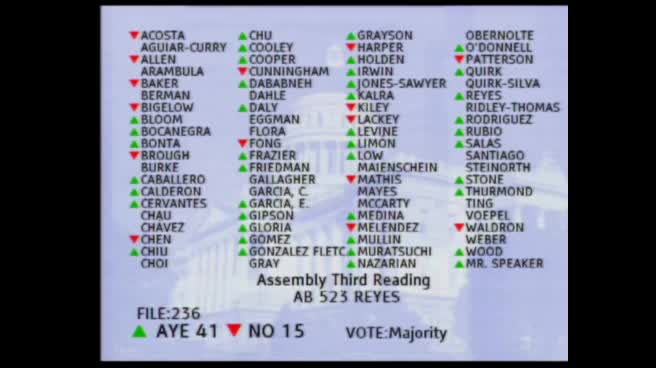 3MIN
Assembly Floor
 3MIN
Assembly Standing Committee on Appropriations
 16MIN
Assembly Standing Committee on Communications and Conveyance
 16MIN
Assembly Standing Committee on Transportation
Bill Author

Bill Co-Author(s):
