AB 1619: Sexual assault: statutes of limitations on civil actions.
- Session Year: 2017-2018
- House: Assembly
- Latest Version Date: 2018-09-30
Existing law provides that in a civil action for recovery of damages suffered as a result of domestic violence, the time for commencement of the action shall be the later of within 3 years from the date of the last act of domestic violence by the defendant against the plaintiff or within 3 years from the date the plaintiff discovers or reasonably should have discovered that an injury or illness resulted from an act of domestic violence by the defendant against the plaintiff.
This bill would set the time for commencement of any civil action for recovery of damages suffered as a result of sexual assault, as defined, where the assault occurred on or after the plaintiffs 18th birthday, to the later of within 10 years from the date of the last act, attempted act, or assault with intent to commit an act, of sexual assault by the defendant against the plaintiff or within 3 years from the date the plaintiff discovers or reasonably should have discovered that an injury or illness resulted from an act, attempted act, or assault with intent to commit an act, of sexual assault by the defendant against the plaintiff.
Existing law, the California Private Postsecondary Education Act of 2009, provides, among other things, for student protections and regulatory oversight of private postsecondary institutions in the state. The act is enforced by the Bureau for Private Postsecondary Education within the Department of Consumer Affairs. The act requires the bureau to adopt by regulation minimum operating standards for institutions that are subject to the acts provisions. Under existing federal law, in order to be eligible for funding under the federal Higher Education Act Title IV student assistance programs, an educational program must lead to a degree at a nonprofit or public institution or it must prepare students for gainful employment in a recognized occupation. Existing federal law establishes debt-to-earnings rates to determine whether a gainful employment program prepares students for gainful employment in a recognized occupation.This bill would require the bureau to prohibit institutions that are subject to the acts provisions from enrolling new students in an educational program that receives a fail rating for 2 out of 3 consecutive years, or receives a combination of zone or fail ratings for 4 consecutive years, based on the federal debt-to-earnings rates. The bill would prohibit these institutions from reestablishing enrollment of new students in a fail or zone educational program that it discontinued voluntarily, reestablishing enrollment of new students in an educational program that is out-of-compliance under the federal debt-to-earnings rates, or establishing enrollment of new students in an educational program that is substantially similar to the discontinued or out-of-compliance program, until 3 years has passed. The bill would authorize institutions with an educational program that receives a fail or zone rating under the federal debt-to-earnings rates to file an alternate earnings appeal.Existing law, the California Private Postsecondary Education Act of 2009, provides, among other things, for student protections and regulatory oversight of private postsecondary institutions in the state. The act is enforced by the Bureau for Private Postsecondary Education within the Department of Consumer Affairs. The act requires the bureau to adopt by regulation minimum operating standards for institutions that are subject to the acts provisions. Under existing federal law, in order to be eligible for funding under the federal Higher Education Act Title IV student assistance programs, an educational program must lead to a degree at a nonprofit or public institution or it must prepare students for gainful employment in a recognized occupation. Existing federal law establishes debt-to-earnings rates to determine whether a gainful employment program prepares students for gainful employment in a recognized occupation.
This bill would require the bureau to prohibit institutions that are subject to the acts provisions from enrolling new students in an educational program that receives a fail rating for 2 out of 3 consecutive years, or receives a combination of zone or fail ratings for 4 consecutive years, based on the federal debt-to-earnings rates. The bill would prohibit these institutions from reestablishing enrollment of new students in a fail or zone educational program that it discontinued voluntarily, reestablishing enrollment of new students in an educational program that is out-of-compliance under the federal debt-to-earnings rates, or establishing enrollment of new students in an educational program that is substantially similar to the discontinued or out-of-compliance program, until 3 years has passed. The bill would authorize institutions with an educational program that receives a fail or zone rating under the federal debt-to-earnings rates to file an alternate earnings appeal.
Existing law, the California Private Postsecondary Education Act of 2009, provides, among other things, for student protections and regulatory oversight of private postsecondary institutions in the state. The act is enforced by the Bureau for Private Postsecondary Education within the Department of Consumer Affairs. The act requires the bureau to adopt by regulation minimum operating standards for institutions that are subject to the acts provisions. Under existing federal law, in order to be eligible for funding under the federal Higher Education Act Title IV student assistance programs, an educational program must lead to a degree at a nonprofit or public institution or it must prepare students for gainful employment in a recognized occupation. Existing federal law establishes debt-to-earnings rates to determine whether a gainful employment program prepares students for gainful employment in a recognized occupation.
This bill, as of January 1, 2019, would prohibit the bureau from granting an approval to operate to an institution that is offering a gainful employment program that does not meet the federal debt-to-earnings rates, as they read on January 1, 2017. The bill would, as of January 1, 2019, automatically suspend the approval to operate of an institution that is offering a gainful employment program that does not meet federal debt-to-earnings rates, as they read on January 1, 2017, as specified.This bill would require the bureau to prohibit institutions that are subject to the acts provisions from enrolling new students in an educational program that receives a fail rating for 2 out of 3 consecutive years, or receives a combination of zone or fail ratings for 4 consecutive years, based on the federal debt-to-earnings rates.
Existing law, the California Private Postsecondary Education Act of 2009, provides, among other things, for student protections and regulatory oversight of private postsecondary institutions in the state. The act is enforced by the Bureau for Private Postsecondary Education within the Department of Consumer Affairs. The act requires the bureau to adopt by regulation minimum operating standards for institutions that are subject to the acts provisions. Under existing federal law, in order to be eligible for funding under the federal Higher Education Act Title IV student assistance programs, an educational program must lead to a degree at a nonprofit or public institution or it must prepare students for gainful employment in a recognized occupation. Existing federal law establishes debt-to-earnings rates to determine whether a gainful employment program prepares students for gainful employment in a recognized occupation.
This bill, as of January 1, 2019, would prohibit the bureau from granting an approval to operate to an institution that is offering a gainful employment program that does not meet the federal debt-to-earnings rates, as they read on January 1, 2017. The bill would, as of January 1, 2019, automatically suspend the approval to operate of an institution that is offering a gainful employment program that does not meet federal debt-to-earnings rates, as they read on January 1, 2017, as specified.
(a)In any civil action for recovery of damages suffered as a result of sexual assault, where the assault occurred on or after the plaintiffs 18th birthday, the time for commencement of the action shall be the later of the following:
(1)Within 10 years from the date of the last act, attempted act, or assault with the intent to commit an act, of sexual assault by the defendant against the plaintiff.
(2)Within three years from the date the plaintiff discovers or reasonably should have discovered that an injury or illness resulted from an act, attempted act, or assault with the intent to commit an act, of sexual assault by the defendant against the plaintiff.
(b)As used in this section, sexual assault means any of the crimes described in Section 243.4, 261, 262, 264.1, 286, 288a, or 289 of the Penal Code, assault with the intent to commit any of those crimes, or an attempt to commit any of those crimes.
(c)This section applies to any action described in subdivision (a) that is commenced on or after January 1, 2019.
(a)In any civil action for recovery of damages suffered as a result of sexual assault, where the assault occurred on or after the plaintiffs 18th birthday, the time for commencement of the action shall be the later of the following:
(1)Within 10 years from the date of the last act, attempted act, or assault with the intent to commit an act, of sexual assault by the defendant against the plaintiff.
(2)Within three years from the date the plaintiff discovers or reasonably should have discovered that an injury or illness resulted from an act, attempted act, or assault with the intent to commit an act, of sexual assault by the defendant against the plaintiff.
(b)As used in this section, sexual assault means any of the crimes described in Section 243.4, 261, 262, 264.1, 286, 288a, or 289 of the Penal Code, assault with the intent to commit any of those crimes, or an attempt to commit any of those crimes.
(c)This section applies to any action described in subdivision (a) that is commenced on or after January 1, 2019, to any action described in subdivision (a) that is filed prior to January 1, 2019, and still pending on that date, and to any action or causes of action described in subdivision (a) that would have been barred by the laws, including the period of limitations, in effect prior to January 1, 2019, thereby reviving those causes of action which had lapsed or technically expired under the law existing prior to January 1, 2019. Nothing in this section is intended to revive actions or causes of action as to which there has been a final adjudication on the merits prior to January 1, 2019. Termination of a prior action on the basis of the statute of limitations does not constitute a final adjudication on the merits. 2019.
(a)In any civil action for recovery of damages suffered as a result of sexual assault, where the assault occurred on or after the plaintiffs 18th birthday, the time for commencement of the action shall be the later of the following:
(1)Within 10 years from the date of the last act, attempted act, or assault with the intent to commit an act, of sexual assault by the defendant against the plaintiff.
(2)Within three years from the date the plaintiff discovers or reasonably should have discovered that an injury or illness resulted from an act, attempted act, or assault with the intent to commit an act, of sexual assault by the defendant against the plaintiff.
(b)As used in this section, sexual assault means any of the crimes described in Section 243.4, 261, 262, 264.1, 286, 288a, or 289 of the Penal Code, assault with the intent to commit any of those crimes, or an attempt to commit any of those crimes.
(c)This section applies to any action described in subdivision (a) that is commenced on or after January 1, 2019, to any action described in subdivision (a) that is filed prior to January 1, 2019, and still pending on that date, and to any action or causes of action described in subdivision (a) that would have been barred by the laws, including the period of limitations, in effect prior to January 1, 2019, thereby reviving those causes of action which had lapsed or technically expired under the law existing prior to January 1, 2019. Nothing in this section is intended to revive actions or causes of action as to which there has been a final adjudication on the merits prior to January 1, 2019. Termination of a prior action on the basis of the statute of limitations does not constitute a final adjudication on the merits.
SECTION 1.(a)The Legislature finds and declares all of the following:(1)On July 1, 2015, the federal regulations took effect.(2)Through the regulatory process, the United States Department of Education established debt-to-earnings rates based on the typical loan debt and earnings of students who previously completed a gainful employment (GE) program.(3)Two debt-to-earnings rates are calculated pursuant to the federal regulations, one based on annual earnings and one based on discretionary income.(4)The two rates described in paragraph (3) are calculated for each GE program as a measure of the ability of graduates of the GE program to reasonably repay their student loan debt.(5)For the annual earnings rate, the numerator is the calculated annual loan payment amount, which is an estimate of the annual loan repayment amount based on the median educational debt of the members of the cohort, and the denominator is the higher of the cohorts mean or median earnings.(6)The discretionary income rate uses the same annual loan payment amount in the numerator as the annual earnings rate, but the denominator is the higher of the mean or median earnings minus 150 percent of the poverty guideline.(7)To maintain federal Title IV financial aid eligibility, GE programs are required to meet minimum standards for the debt-to-earnings rates of their graduates and are provided a pass, zone, or fail rating.(8)The pass rating is given to GE programs whose graduates have annual loan payments less than or equal to 8 percent of total earnings, or less than or equal to 20 percent of discretionary income.(9)The zone rating is given to GE programs whose graduates have annual loan payments greater than 8 percent but less than or equal to 12 percent of total earnings, or greater than 20 percent but less than or equal to 30 percent of discretionary income.(10)The fail rating is given to GE programs whose graduates have annual loan payments greater than 12 percent of total earnings, and greater than 30 percent of discretionary income.(11)The current federal regulations have been reviewed and upheld in their entirety by two different federal courts and affirmed by the United States Court of Appeals, District of Columbia Circuit.(b)It is the intent of the Legislature to continue the student protections in the federal regulations by applying the federal debt-to-earnings rates to California law.(c)For purposes of this section, the following terms have the following meanings:(1)Debt-to-earnings rates are the rates established in the federal regulations.(2)Federal regulations mean the federal gainful employment regulations established in Part 668 of Chapter VI of Subtitle B of Title 34 of the Code of Federal Regulations.(3)Gainful employment program or GE program has the same meaning as the term is defined for purposes of the federal regulations.SEC. 2.Section 94885.6 is added to the Education Code, to read:94885.6.(a)The bureau shall prohibit an institution that is not exempt from this chapter from enrolling new students in an educational program that receives a fail rating for two out of three consecutive years, or receives a combination of zone or fail ratings for four consecutive years, based on the federal debt-to-earnings rates. If an educational program receives a fail or zone rating under the federal debt-to-earnings rates, an institution may file an alternate earnings appeal.(b)An institution shall not reestablish enrollment of new students in a fail or zone educational program that it discontinued voluntarily, reestablish enrollment of new students in an educational program that is out-of-compliance under the federal debt-to-earnings rates, or establish enrollment of new students in an educational program that is substantially similar to the discontinued or out-of-compliance program, until three years has passed.(c)The bureau shall adopt regulations as necessary to implement this section, including regulations to obtain data if the United States Department of Education no longer releases the federal debt-to-earnings rates.(d)For purposes of this section, the following terms have the following meanings:(1)Alternate earnings appeal has the same meaning as the term is described for purposes of the federal regulations.(2)Debt-to-earnings rates are the rates established in the federal regulations.(3)Fail rating has the same meaning as the term is described for purposes of the federal regulations.(4)Federal regulations mean the federal gainful employment regulations established in Part 668 of Chapter VI of Subtitle B of Title 34 of the Code of Federal Regulations, as those regulations read on January 1, 2017.(5)Zone rating has the same meaning as the term is described for purposes of the federal regulations.(a)The Legislature finds and declares all of the following:
(1)On July 1, 2015, the federal regulations took effect.
(2)Through the regulatory process, the United States Department of Education established debt-to-earnings rates based on the typical loan debt and earnings of students who previously completed a gainful employment (GE) program.
(3)Two debt-to-earnings rates are calculated pursuant to the federal regulations, one based on annual earnings and one based on discretionary income.
(4)The two rates described in paragraph (3) are calculated for each GE program as a measure of the ability of graduates of the GE program to reasonably repay their student loan debt.
(5)For the annual earnings rate, the numerator is the calculated annual loan payment amount, which is an estimate of the annual loan repayment amount based on the median educational debt of the members of the cohort, and the denominator is the higher of the cohorts mean or median earnings.
(6)The discretionary income rate uses the same annual loan payment amount in the numerator as the annual earnings rate, but the denominator is the higher of the mean or median earnings minus 150 percent of the poverty guideline.
(7)To maintain federal Title IV financial aid eligibility, GE programs are required to meet minimum standards for the debt-to-earnings rates of their graduates and are provided a pass, zone, or fail rating.
(8)The pass rating is given to GE programs whose graduates have annual loan payments less than or equal to 8 percent of total earnings, or less than or equal to 20 percent of discretionary income.
(9)The zone rating is given to GE programs whose graduates have annual loan payments greater than 8 percent but less than or equal to 12 percent of total earnings, or greater than 20 percent but less than or equal to 30 percent of discretionary income.
(10)The fail rating is given to GE programs whose graduates have annual loan payments greater than 12 percent of total earnings, and greater than 30 percent of discretionary income.
(11)The current federal regulations have been reviewed and upheld in their entirety by two different federal courts and affirmed by the United States Court of Appeals, District of Columbia Circuit.
(b)It is the intent of the Legislature to continue the student protections in the federal regulations by applying the federal debt-to-earnings rates to California law.
(c)For purposes of this section, the following terms have the following meanings:
(1)Debt-to-earnings rates are the rates established in the federal regulations.
(2)Federal regulations mean the federal gainful employment regulations established in Part 668 of Chapter VI of Subtitle B of Title 34 of the Code of Federal Regulations.
(3)Gainful employment program or GE program has the same meaning as the term is defined for purposes of the federal regulations.
SEC. 2.Section 94885.6 is added to the Education Code, to read:94885.6.(a)The bureau shall prohibit an institution that is not exempt from this chapter from enrolling new students in an educational program that receives a fail rating for two out of three consecutive years, or receives a combination of zone or fail ratings for four consecutive years, based on the federal debt-to-earnings rates. If an educational program receives a fail or zone rating under the federal debt-to-earnings rates, an institution may file an alternate earnings appeal.
(b)An institution shall not reestablish enrollment of new students in a fail or zone educational program that it discontinued voluntarily, reestablish enrollment of new students in an educational program that is out-of-compliance under the federal debt-to-earnings rates, or establish enrollment of new students in an educational program that is substantially similar to the discontinued or out-of-compliance program, until three years has passed.
(b)(c)The bureau shall adopt regulations as necessary to implement this section, including regulations to obtain data if the United States Department of Education no longer releases the federal debt-to-earnings rates.
(c)(d)For purposes of this section, the following terms have the following meanings:
(1)Alternate earnings appeal has the same meaning as the term is described for purposes of the federal regulations.
(1)(2)Debt-to-earnings rates are the rates established in the federal regulations.
(2)(3)Fail rating has the same meaning as the term is described for purposes of the federal regulations.
(3)(4)Federal regulations mean the federal gainful employment regulations established in Part 668 of Chapter VI of Subtitle B of Title 34 of the Code of Federal Regulations, as those regulations read on January 1, 2017.
(4)(5)Zone rating has the same meaning as the term is described for purposes of the federal regulations.
(a)The Legislature finds and declares all of the following:
(1)On July 1, 2015, the federal regulations took effect.
(2)Through the regulatory process, the United States Department of Education established debt-to-earnings rates based on the typical loan debt and earnings of students who previously completed a gainful employment (GE) program.
(3)Two debt-to-earnings rates are calculated pursuant to the federal regulations, one based on annual earnings and one based on discretionary income.
(4)The two rates described in paragraph (3) are calculated for each GE program as a measure of the ability of graduates of the GE program to reasonably repay their student loan debt.
(5)For the annual earnings rate, the numerator is the calculated annual loan payment amount, which is an estimate of the annual loan repayment amount based on the median educational debt of the members of the cohort, and the denominator is the higher of the cohorts mean or median earnings.
(6)The discretionary income rate uses the same annual loan payment amount in the numerator as the annual earnings rate, but the denominator is the higher of the mean or median earnings minus 150 percent of the poverty guideline.
(7)To maintain federal Title IV financial aid eligibility, GE programs are required to meet minimum standards for the debt-to-earnings rates of their graduates and are provided a pass, zone, or fail rating.
(8)The pass rating is given to GE programs whose graduates have annual loan payments less than or equal to 8 percent of total earnings, or less than or equal to 20 percent of discretionary income.
(9)The zone rating is given to GE programs whose graduates have annual loan payments greater than 8 percent but less than or equal to 12 percent of total earnings, or greater than 20 percent but less than or equal to 30 percent of discretionary income.
(10)The fail rating is given to GE programs whose graduates have annual loan payments greater than 12 percent of total earnings, and greater than 30 percent of discretionary income.
(11)The current federal regulations have been reviewed and upheld in their entirety by two different federal courts and affirmed by the United States Court of Appeals, District of Columbia Circuit.
(b)It is the intent of the Legislature to continue the student protections in the federal regulations by applying the federal debt-to-earnings rates to California law.
(c)For purposes of this section, the following terms have the following meanings:
(1)Debt-to-earnings rates are the rates established in the federal regulations.
(2)Federal regulations mean the federal gainful employment regulations established in Part 668 of Chapter VI of Subtitle B of Title 34 of the Code of Federal Regulations.
(3)Gainful employment program or GE program has the same meaning as the term is defined for purposes of the federal regulations.
SECTION 1.SEC. 2.Section 94885.6 is added to the Education Code, to read:94885.6.(a)As of January 1, 2019, the The bureau shall not grant an approval to operate to prohibit an institution that is offering a gainful employment program that does not meet is not exempt from this chapter from enrolling new students in an educational program that receives a fail rating for two out of three consecutive years, or receives a combination of zone or fail ratings for four consecutive years, based on the federal debt-to-earnings rates established in Part 668 of Chapter VI of Subtitle B of Title 34 of the Code of Federal Regulations, as it read on January 1, 2017. rates.
(b)An institution with an approval to operate as of January 1, 2019, that is offering a gainful employment program that does not meet the federal debt-to-earnings rates established in Part 668 of Chapter VI of Subtitle B of Title 34 of the Code of Federal Regulations, as it read on January 1, 2017, shall have its approval to operate automatically suspended. The bureau shall issue an order suspending the institution and that suspension shall not be lifted until the institutions gainful employment program is no longer offered or meets the federal debt-to-earnings rates established in Part 668 of Chapter VI of Subtitle B of Title 34 of the Code of Federal Regulations, as it read on January 1, 2017. A suspended institution shall not enroll new students in any of its degree programs, and shall execute a teach-out plan for its enrolled students.(c)(b)The bureau shall adopt regulations as necessary to implement this section. section, including regulations to obtain data if the United States Department of Education no longer releases the federal debt-to-earnings rates.
(c)For purposes of this section, the following terms have the following meanings:
(1)Debt-to-earnings rates are the rates established in the federal regulations.
(2)Fail rating has the same meaning as the term is described for purposes of the federal regulations.
(3)Federal regulations mean the federal gainful employment regulations established in Part 668 of Chapter VI of Subtitle B of Title 34 of the Code of Federal Regulations, as those regulations read on January 1, 2017.
(4)Zone rating has the same meaning as the term is described for purposes of the federal regulations.
(a)As of January 1, 2019, the bureau shall not grant an approval to operate to an institution that is offering a gainful employment program that does not meet the federal debt-to-earnings rates established in Part 668 of Chapter VI of Subtitle B of Title 34 of the Code of Federal Regulations, as it read on January 1, 2017.
(b)An institution with an approval to operate as of January 1, 2019, that is offering a gainful employment program that does not meet the federal debt-to-earnings rates established in Part 668 of Chapter VI of Subtitle B of Title 34 of the Code of Federal Regulations, as it read on January 1, 2017, shall have its approval to operate automatically suspended. The bureau shall issue an order suspending the institution and that suspension shall not be lifted until the institutions gainful employment program is no longer offered or meets the federal debt-to-earnings rates established in Part 668 of Chapter VI of Subtitle B of Title 34 of the Code of Federal Regulations, as it read on January 1, 2017. A suspended institution shall not enroll new students in any of its degree programs, and shall execute a teach-out plan for its enrolled students.
(c)The bureau shall adopt regulations as necessary to implement this section.
|
Date
|
Status
|
|---|---|
| Sep 30, 2018 | Chaptered by Secretary of State - Chapter 939, Statutes of 2018. |
| Sep 30, 2018 | Approved by the Governor. |
| Sep 10, 2018 | Enrolled and presented to the Governor at 3:30 p.m. |
| Aug 29, 2018 | Senate amendments concurred in. To Engrossing and Enrolling. |
| Aug 28, 2018 | From committee: That the Senate amendments be concurred in. (Ayes 9. Noes 0.) (August 28). |
| Aug 24, 2018 | Re-referred to Com. on JUD. pursuant to Assembly Rule 77.2. |
| Aug 22, 2018 | In Assembly. Concurrence in Senate amendments pending. May be considered on or after August 24 pursuant to Assembly Rule 77. |
| Aug 22, 2018 | Read third time. Passed. Ordered to the Assembly. |
| Aug 20, 2018 | Read second time. Ordered to third reading. |
| Aug 17, 2018 | From committee: Amend, and do pass as amended. (Ayes 6. Noes 0.) (August 16). |
| Aug 6, 2018 | In committee: Referred to APPR. suspense file. |
| Jun 27, 2018 | From committee: Do pass and re-refer to Com. on APPR. (Ayes 7. Noes 0.) (June 26). Re-referred to Com. on APPR. |
| Jun 20, 2018 | Re-referred to Coms. on JUD. and APPR. |
| Jun 12, 2018 | Withdrawn from committee. |
| Jun 11, 2018 | From committee chair, with author's amendments: Amend, and re-refer to committee. Read second time, amended, and re-referred to Com. on ED. |
| Jul 5, 2017 | In committee: Set, first hearing. Hearing canceled at the request of author. |
| Jun 28, 2017 | In committee: Set, first hearing. Failed passage. Reconsideration granted. |
| Jun 14, 2017 | Referred to Coms. on ED. and B., P. & E.D. |
| Jun 5, 2017 | In Senate. Read first time. To Com. on RLS. for assignment. |
| Jun 1, 2017 | Read third time. Passed. Ordered to the Senate. (Ayes 57. Noes 15. Page 2075.) |
| May 30, 2017 | Read second time and amended. Ordered returned to second reading. |
| May 26, 2017 | From committee: Amend, and do pass as amended. (Ayes 12. Noes 4.) (May 26). |
| May 17, 2017 | In committee: Set, first hearing. Referred to APPR. suspense file. |
| Apr 26, 2017 | From committee: Do pass and re-refer to Com. on APPR. (Ayes 9. Noes 1.) (April 25). Re-referred to Com. on APPR. |
| Apr 18, 2017 | Re-referred to Com. on HIGHER ED. |
| Apr 17, 2017 | From committee chair, with author's amendments: Amend, and re-refer to Com. on HIGHER ED. Read second time and amended. |
| Mar 16, 2017 | Referred to Com. on HIGHER ED. |
| Feb 19, 2017 | From printer. May be heard in committee March 21. |
| Feb 17, 2017 | Read first time. To print. |
|
Date
|
Description
|
Location
|
Votes
|
|
|---|---|---|---|---|
| Aug 29, 2018 | AB 1619 BERMAN Concurrence in Senate Amendments | Assembly Floor |
Passed |
|
| Aug 28, 2018 | With recommendation: That Senate amendments be concurred in. | Assembly Standing Committee on Judiciary |
Passed |
|
| Aug 22, 2018 | Assembly 3rd Reading AB1619 Berman et al. By Leyva | Senate Floor |
Passed |
|
| Aug 16, 2018 | Do pass as amended | Senate Standing Committee on Appropriations |
Passed |
|
| Aug 6, 2018 | Placed on suspense file | Senate Standing Committee on Appropriations |
Passed |
|
| Jun 26, 2018 | Do pass, but first be re-referred to the Committee on [Appropriations] | Senate Standing Committee on Judiciary |
Passed |
|
| Jun 28, 2017 | [First] hearing set for [06-28-2017]: Failed passage in Committee. Reconsideration granted | Senate Standing Committee on Education |
Passed |
|
| Jun 28, 2017 | Do pass, but first be re-referred to the Committee on [Business, Professions and Economic Development] | Senate Standing Committee on Education |
Failed |
|
| Jun 1, 2017 | AB 1619 BERMAN Assembly Third Reading | Assembly Floor |
Passed |
|
| May 26, 2017 | Do pass as amended. | Assembly Standing Committee on Appropriations |
Passed |
|
| Apr 25, 2017 | Do pass and be re-referred to the Committee on [Appropriations] | Assembly Standing Committee on Higher Education |
Passed |
This list shows positions taken on this bill by organizations on the date displayed, which is linked to the original source.
Positions by individuals are not included.
CONCURRENCE IN SENATE AMENDMENTS
CSA2 Bill Id:AB 1619
Author:(Berman)
As Amended Ver:August 17, 2018
Majority vote
ASSEMBLY: |
| (June 1, 2017) | SENATE: | 39-0 | (August 22, 2018) |
(vote not relevant)
COMMITTEE VOTE: | 9-0 | (August 28, 2018) | RECOMMENDATION: | concur |
(Jud.)
Original Committee Reference: HIGHER ED.
SUMMARY: Extends the statute of limitations for any civil action for recovery of damages suffered as a result of sexual assault. Specifically, this bill:
- Establishes a statute of limitations specific to sexual assault or attempted sexual assault that occurred on or after a plaintiff's 18th birthday. Specifically provides that the time for commencement of such action is the later of the following:
- Within 10 years from the date of the last act, attempted act, or assault with the intent to commit an act, of sexual assault; or
- Within three years from the date the plaintiff discovers or reasonably should have discovered that an injury or illness resulted from an act, attempted act, or assault with the intent to commit an act, of sexual assault.
- Provides that this new statute of limitations applies to any applicable action that is commenced on or after January 1, 2019.
The Senate amendments delete the Assembly version of this bill, and instead extend the statute of limitations for any civil action for recovery of damages suffered as a result of sexual assault, where the assault occurred on or after the plaintiff's 18th birthday, as specified.
EXISTING LAW:
- Provides that an action for assault, battery, or injury to, or for the death of, an individual caused by the wrongful act or neglect of another may be commenced within two years. (Code of Civil Procedure Section 335.1. All further statutory references are to this code unless otherwise noted.)
- Generally provides that the time for commencing a civil action for damages is within two years of the injury or death caused by the wrongful act or neglect of another. (Section 340.)
- Provides that the time for commencing a civil action based on injuries resulting from childhood sexual abuse, as defined, is eight years after the plaintiff reaches majority (i.e., until 26 years of age) or within three years of the date the plaintiff discovers or reasonably should have discovered that the psychological injury or illness occurring after the age of majority was caused by the abuse, whichever occurs later. (Section 340.1(a).)
- Provides that a civil action may be commenced within 10 years of the date on which a defendant is discharged from parole, against a defendant convicted of a felony offense, including rape, forced sodomy, forced oral copulation, lewd or lascivious acts against a child under 14, rape in concert, or any act of sexual penetration that is non-consensual. (Section 340.3(b).)
FISCAL EFFECT: Unknown
COMMENTS: Sexual assault and sexual harassment are issues that are at the forefront of current social, political, and legal discussions. This bill, like many others introduced this session, responds to recent revelations of sexual assault across the nation and world. The "Me Too" and "Time's Up" movements have brought awareness to numerous incidents of sexual violence, many of which occurred years ago and are thus no longer eligible for legal recourse due to the fact that the statute of limitations has expired. Specifically, this measure seeks to extend the statute of limitations for an adult to bring a civil action for recovery of damages suffered as a result of sexual assault from the current two year statute to ten years.
The Legislature has the power to create, extend, and change statutes of limitation as it deems appropriate. The policy behind statutes of limitations provides that they "are designed to promote justice by preventing surprises through the revival of claims that have been allowed to slumber until evidence has been lost, memories have faded, and witnesses have disappeared. The theory is that even if one has a just claim it is unjust not to put the adversary on notice to defend within the period of limitation and the right to be free of stale claims in time comes to prevail over the right to prosecute them." (3 Witkin, California Procedure Section 433, 4th Ed.)
Nonetheless, courts have acknowledged that "the need for repose is not so overarching that the Legislature cannot by express legislative provision allow certain actions to be brought at any time, and it has occasionally done so." (Duty v. Abex Corp (1989) 214 Cal.App.3rd 742, 749, citations omitted.) The United States Supreme Court has long held that:
Statutes of limitation find their justification in necessity and convenience rather than in logic. They represent expedients, rather than principles. . . . They are by definition arbitrary, and their operation does not discriminate against the just and the unjust claim, or the avoidable or unavoidable delay... Their shelter has never been regarded as what now is called a "fundamental right"... [T]he history of pleas of limitation shows them to be good only by legislative grace and to be subject to a relatively large degree of legislative control. (Chase Securities Corp. v. Donaldson (1945) 325 U.S. 304, 314.)
Statutes of limitations reflect the reality that, over time, documents are lost or destroyed, witnesses' memories fade, and evidence erodes. However, the current laws regarding the statute of limitations for sexual assault claims reflect another reality, namely that victims often have difficulty coming forward soon after the abuse for a variety of reasons, including threats, shame, self-blame, lack of trust, and fear.
Analysis Prepared by: Sandra Nakagawa / JUD. / (916) 319-2334 FN: 0004923 FN:
Date of Hearing: August 28, 2018
ASSEMBLY COMMITTEE ON JUDICIARY
Mark Stone, Chair
ABPCA Bill Id:AB 1619
Author:(Berman) – As Amended Ver:August 17, 2018
FOR CONCURRENCE
SUBJECT: SEXUAL ASSAULT: STATUTES OF LIMITATION ON CIVIL ACTIONS
KEY ISSUE: IN ORDER TO ENSURE THAT VICTIMS OF SEXUAL ASSAULT HAVE A FAIR AND FULL OPPORTUNITY TO RECOVER DAMAGES FOR THEIR INJURIES, SHOULD THE STATUTE OF LIMITATIONS FOR SEXUAL ASSAULT CIVIL ACTIONS BE EXTENDED FROM TWO YEARS TO TEN YEARS AND SHOULD A DELAYED DISCOVERY PROVISION BE ADDED TO EXISTING LAW?
SYNOPSIS
Despite the potential lifetime of damage that victims of sexual assault can endure and the time it may take victims to recognize their injuries and be willing to face their attackers, the state’s current statute of limitations restricts the time for bringing an action to recover for damages caused by sexual assault to two years following the assault. According to the bill’s sponsor, the Association of California Sexual Assault Forensic Examiners (Cal SAFE), survivors of sexual assault often need more than two years to process and engage with the legal system to seek civil restitution. Currently the statute of limitations for sexual assault of an adult is two years. This bill would increase the statute of limitations for recovering damages for sexual assault to ten years from the date of the last act, attempted act, or assault with the intent to commit an act. Supporters of the measure include health organizations, victims’ groups, Consumer Attorneys of California, and others. The CSAC Excess Insurance Authority and the California Association of Joint Powers Authorities are in opposition to the bill and raise concerns about defending against old claims and the possibility that this measure would incentive victims to delay bringing claims forward.
SUMMARY: Extends the statute of limitations for any civil action for recovery of damages suffered as a result of sexual assault and adds a delayed discovery provision. Specifically, this bill:
- Establishes a statute of limitations specific to sexual assault or attempted sexual assault that occurs on or after a plaintiff’s 18th birthday. Specifically provides that the time for commencement of such action is the later of the following:
- Within 10 years from the date of the last act, attempted act, or assault with the intent to commit an act, of sexual assault, as defined; or
- Within three years from the date the plaintiff discovers or reasonably should have discovered that an injury or illness resulted from an act, attempted act, or assault with the intent to commit an act, of sexual assault, as defined.
- Provides that this new statute of limitations applies to any applicable action that is commenced on or after January 1, 2019.
EXISTING LAW:
- Provides that an action for assault, battery, or injury to, or for the death of, an individual caused by the wrongful act or neglect of another may be commenced within two years. (Code of Civil Procedure Section 335.1. All further statutory references are to this code unless otherwise noted.
- Generally provides that the time for commencing a civil action for damages is within two years of the injury or death caused by the wrongful act or neglect of another. (Section 340.)
- Provides that the time for commencing a civil action based on injuries resulting from childhood sexual abuse, as defined, is eight years after the plaintiff reaches majority (i.e., until 26 years of age) or within three years of the date the plaintiff discovers or reasonably should have discovered that the psychological injury or illness occurring after the age of majority was caused by the abuse, whichever occurs later. (Section 340.1 (a).)
- Provides that a civil action may be commenced within 10 years of the date on which a defendant is discharged from parole, against a defendant convicted of a felony offense, including rape, forced sodomy, forced oral copulation, lewd or lascivious acts against a child under 14, rape in concert, or any act of sexual penetration that is non-consensual. (Section 340.3 (b).)
FISCAL EFFECT: Unknown
COMMENTS: Sexual assault and sexual harassment are issues that are at the forefront of current social, political, and legal discussions. This bill, like many others introduced this session, responds to recent revelations of sexual assault across the nation and world. The “Me Too” and “Time’s Up” movements have brought awareness to numerous incidents of sexual violence, many of which occurred years ago and are thus no longer eligible for legal recourse due to the fact that the statute of limitations has expired. Specifically, this measure seeks to extend the statute of limitations for an adult to bring a civil action for recovery of damages suffered as a result of sexual assault from the current two years to ten years, with additional time for discovery of the injuries connected to the assault.
Background on Sexual Assault under Existing Law. The Civil Code elaborates that each person is entitled to the “right of protection from bodily restraint or harm, from personal insult, [and] from defamation.” (Civil Code Section 43.) This extends the protection to the individual not only from discrimination by the state, but a protection against the actions of any person which harm them. Writes the author:
According to the Centers for Disease Control and Prevention, one in three women and one in six men experienced sexual violence at some point in their lives. Many sexual assault survivors suffer from physical injuries and mental health conditions such as post-traumatic stress disorder and depression. There is also a significant financial cost after a sexual assault. According to the National Sexual Violence Resource Center, the lifetime cost of rape per sexual assault survivor is $122,461.
The Legislature has a long history of increasing protections for sexual assault survivors, including extending the statute of limitations for civil damages for child sexual abuse and felony offenses such as rape. AB 1619 would necessarily extend to 10 years the statute of limitations for sexual assault survivors to recover damages that result from a sexual assault. The current two-year statute of limitations simply does not provide sexual assault survivors adequate time to heal from the physical and emotional trauma of a sexual assault and prepare for a civil case.
The Legislature has the power to create, extend, and change statutes of limitation as it deems appropriate. The policy behind statutes of limitations provides that they "are designed to promote justice by preventing surprises through the revival of claims that have been allowed to slumber until evidence has been lost, memories have faded, and witnesses have disappeared. The theory is that even if one has a just claim it is unjust not to put the adversary on notice to defend within the period of limitation and the right to be free of stale claims in time comes to prevail over the right to prosecute them." (3 Witkin, California Procedure Section 433, 4th Ed.)
Nonetheless, courts have acknowledged that "the need for repose is not so overarching that the Legislature cannot by express legislative provision allow certain actions to be brought at any time, and it has occasionally done so." (Duty v. Abex Corp (1989) 214 Cal.App.3rd 742, 749, citations omitted.) The United States Supreme Court has long held that:
Statutes of limitation find their justification in necessity and convenience rather than in logic. They represent expedients, rather than principles. . . . They are by definition arbitrary, and their operation does not discriminate against the just and the unjust claim, or the avoidable or unavoidable delay . . . . Their shelter has never been regarded as what now is called a "fundamental right" . . . . [T]he history of pleas of limitation shows them to be good only by legislative grace and to be subject to a relatively large degree of legislative control. (Chase Securities Corp. v. Donaldson (1945) 325 U.S. 304, 314.)
Statutes of limitations reflect the reality that, over time, documents are lost or destroyed, witnesses’ memories fade, and evidence erodes. However, the current laws regarding the statute of limitations for sexual assault claims reflect another reality, namely that victims often have difficulty coming forward soon after the abuse for a variety of reasons, including threats, shame, self-blame, lack of trust, and fear.
ARGUMENTS IN SUPPORT: The Association of California Sexual Assault Forensic Examiners, sponsors of the bill, writes:
Examiners have specialized knowledge to address immediate and long-term medical needs, identify injuries, collect evidence, and provide testimony in a compassionate, trauma-informed manner. Critical to this care, is the understanding that the emotional trauma following sexual assault does not present the same in all survivors and may lead to a delay in seeking medical or legal assistance. The time a survivor needs to process and recover from their assault, enough to engage with the legal system, can take months and even years, certainly longer than the two years currently allowable for many survivors to seek civil restitution.
Whether a criminal case is filed or not, survivors of sexual assault may also turn to the civil court for recovery of costs related to medical and non-medical needs, which are required for healing. If a survivor awaits the outcome of a criminal case to initiate civil proceedings, they may find their search for justice blocked, if the two years have passed. Given the potential lifetime costs a survivor may face, both immediate and long-term, the option to recover damages through the civil court is critical. The loss of this option is punitive and possibly injurious to the survivor.
ARGUMENTS IN OPPOSITION: While proponents advocate for a longer statute of limitations, the CSAC Excess Insurance Authority and the California Association of Joint Powers Authorities writes in opposition to the bill in a joint letter, noting:
Rather than encourage individuals to bring complaints of sexual assault to light as soon as possible so that the matter can be investigated and remedied (if remediation is appropriate), this bill encourages the possible waiting of up to 10 years for an individual to file a lawsuit. While the bill will provide additional time for victims to file claims, it will also likely discourage the timely reporting of claims. If a person over 18 has been subjected to sexual assault, they are aware of the incident immediately and still have up to two years thereafter to file a lawsuit against the perpetrator.
Though it is theoretically possible that a victim of sexual assault could intentionally delay bringing a claim forward due to the increased statute of limitations this bill would provide for, this scenario seems highly unlikely. Understanding the statute of limitations in such cases would require familiarity with recent changes to state law and, out of the many factors that influence an individual’s decision on whether or not to bring a claim forward, it is far more reasonable to assume their own comfort with discussing the assault, their understanding of the extent of the injuries caused by the assault, and whether they had access to legal resources would be bigger factors in shaping their decision to bring an action.
Related Pending Legislation: AB 334 (Cooper, 2017) would extend the statute of limitations for any civil action for recovery of damages suffered as a result of sexual assault, where the assault occurred on or after the plaintiff’s 18th birthday. This measure is currently in the Senate Committee on Public Safety.
AB 3120 (Gonzalez Fletcher, 2018) would expand the definition of childhood sexual abuse, which would instead be referred to as childhood sexual assault. It would further increase the time limit for commencing an action for recovery of damages suffered as a result of childhood sexual assault to 22 years from the date the plaintiff attains the age of majority or within 5 years of the date the plaintiff discovers or reasonably should have discovered that the psychological injury or illness occurring after the age of majority was caused by sexual assault, whichever is later. This bill is currently on the Senate floor.
Prior Legislation: SB 1053 (Beall), Chap. 153, Stats. 2018, exempts claims of childhood sexual abuse against a local public entity, which are already exempt from the Government Tort Claims Act early presentation of claims procedures, from being governed by procedures prescribed in any charter, ordinance, or regulation adopted by the local public entity; and states that this is declarative of existing law.
AB 1312 (Gonzalez Fletcher), Chap. 692, Stats. 2017, requires law enforcement and medical professionals to provide victims of sexual assault with written notification of their rights. Additionally, the bill expands rights to victims of sexual assault, as provided.
SB 1334 (Stone, 2016) would have required a health care practitioner who provides medical services to a patient who discloses that he or she is seeking treatment due to being the victim of assaultive or abusive conduct, to make a report to a law enforcement agency. This bill was held on the Senate Appropriations Committee Suspense File.
AB 107 (Corbett), Chap. 148, Stats. 2013, repealed a January 1, 2014, sunset date authorizing the use of federal VAWA grant funds to cover the costs of the medical evidentiary examination portion of medical examinations of sexual assault victims.
SB 534 (Corbett), Chap. 360, Stats. 2011, among other things, authorized the use of federal VAWA grant funds for medical forensic examinations of sexual assault victims until January 1, 2014, and set a limit of $300 for the sexual assault medical evidentiary examination.
SB 1887 (McPherson), Chap. 633, Stats. 2002, provided that an action for damages against a defendant based upon the defendant’s commission of a felony offense for which the defendant has been convicted may be commenced within 10 years of the date on which the defendant is discharged from parole if the conviction was for any of certain serious felonies, as defined, except as specified.
SB 1779 (Burton), Chap. 149, Stats. 2002, provided that actions for childhood sexual abuse may be commenced on or after the plaintiff’s 26th birthday if the person or entity against whom the action is commenced knew, had reason to know, or was otherwise on notice, of any unlawful sexual conduct by an employee, volunteer, representative, or agent, and failed to take reasonable steps, and implement reasonable safeguards, to avoid future acts of unlawful sexual conduct.
REGISTERED SUPPORT / OPPOSITION:
Support
Association of California Sexual Assault Forensic Examiners (Cal SAFE) (sponsor)
Alameda Health System – Highland Hospital
California Coalition Against Sexual Assault
California Sexual Assault Investigators Association
Circle of Safe-T, Inc.
Consumer Attorneys of California
Crime Victims United of California
Enloe Medical Center
Forensic Nurse Specialists, Inc.
Los Angeles County + University of Southern California Medical Center, Violence Intervention Program
Santa Barbara County District Attorney
Opposition
California Association of Joint Powers Authorities
CSAC Excess Insurance Authority
Analysis Prepared by: Sandra Nakagawa / JUD. / (916) 319-2334
CONCURRENCE IN SENATE AMENDMENTS
CSA1 Bill Id:AB 1619
Author:(Berman)
As Amended Ver:August 17, 2018
Majority vote
ASSEMBLY: |
| (June 1, 2017) | SENATE: | 39-0 | (August 22, 2018) |
(vote not relevant)
Original Committee Reference: HIGHER ED.
SUMMARY: Extends the statute of limitations for any civil action for recovery of damages suffered as a result of sexual assault. Specifically, this bill:
- Establishes a statute of limitations specific to sexual assault or attempted sexual assault that occurred on or after a plaintiff's 18th birthday. Specifically provides that the time for commencement of such action is the later of the following:
- Within 10 years from the date of the last act, attempted act, or assault with the intent to commit an act, of sexual assault; or
- Within three years from the date the plaintiff discovers or reasonably should have discovered that an injury or illness resulted from an act, attempted act, or assault with the intent to commit an act, of sexual assault.
- Provides that this new statute of limitations applies to any applicable action that is commenced on or after January 1, 2019.
The Senate amendments delete the Assembly version of this bill, and instead extend the statute of limitations for any civil action for recovery of damages suffered as a result of sexual assault, where the assault occurred on or after the plaintiff's 18th birthday, as specified.
EXISTING LAW:
- Provides that an action for assault, battery, or injury to, or for the death of, an individual caused by the wrongful act or neglect of another may be commenced within two years. (Code of Civil Procedure Section 335.1. All further statutory references are to this code unless otherwise noted.)
- Generally provides that the time for commencing a civil action for damages is within two years of the injury or death caused by the wrongful act or neglect of another. (Section 340.)
- Provides that the time for commencing a civil action based on injuries resulting from childhood sexual abuse, as defined, is eight years after the plaintiff reaches majority (i.e., until 26 years of age) or within three years of the date the plaintiff discovers or reasonably should have discovered that the psychological injury or illness occurring after the age of majority was caused by the abuse, whichever occurs later. (Section 340.1(a).)
- Provides that a civil action may be commenced within 10 years of the date on which a defendant is discharged from parole, against a defendant convicted of a felony offense, including rape, forced sodomy, forced oral copulation, lewd or lascivious acts against a child under 14, rape in concert, or any act of sexual penetration that is non-consensual. (Section 340.3(b).)
FISCAL EFFECT: Unknown
COMMENTS: Sexual assault and sexual harassment are issues that are at the forefront of current social, political, and legal discussions. This bill, like many others introduced this session, responds to recent revelations of sexual assault across the nation and world. The "Me Too" and "Time's Up" movements have brought awareness to numerous incidents of sexual violence, many of which occurred years ago and are thus no longer eligible for legal recourse due to the fact that the statute of limitations has expired. Specifically, this measure seeks to extend the statute of limitations for an adult to bring a civil action for recovery of damages suffered as a result of sexual assault from the current two year statute to ten years.
The Legislature has the power to create, extend, and change statutes of limitation as it deems appropriate. The policy behind statutes of limitations provides that they "are designed to promote justice by preventing surprises through the revival of claims that have been allowed to slumber until evidence has been lost, memories have faded, and witnesses have disappeared. The theory is that even if one has a just claim it is unjust not to put the adversary on notice to defend within the period of limitation and the right to be free of stale claims in time comes to prevail over the right to prosecute them." (3 Witkin, California Procedure Section 433, 4th Ed.)
Nonetheless, courts have acknowledged that "the need for repose is not so overarching that the Legislature cannot by express legislative provision allow certain actions to be brought at any time, and it has occasionally done so." (Duty v. Abex Corp (1989) 214 Cal.App.3rd 742, 749, citations omitted.) The United States Supreme Court has long held that:
Statutes of limitation find their justification in necessity and convenience rather than in logic. They represent expedients, rather than principles. . . . They are by definition arbitrary, and their operation does not discriminate against the just and the unjust claim, or the avoidable or unavoidable delay . . . . Their shelter has never been regarded as what now is called a "fundamental right" . . . . [T]he history of pleas of limitation shows them to be good only by legislative grace and to be subject to a relatively large degree of legislative control. (Chase Securities Corp. v. Donaldson (1945) 325 U.S. 304, 314.)
Statutes of limitations reflect the reality that, over time, documents are lost or destroyed, witnesses' memories fade, and evidence erodes. However, the current laws regarding the statute of limitations for sexual assault claims reflect another reality, namely that victims often have difficulty coming forward soon after the abuse for a variety of reasons, including threats, shame, self-blame, lack of trust, and fear.
Analysis Prepared by: Sandra Nakagawa / JUD. / (916) 319-2334 FN: 0004559
Office of Senate Floor Analyses (916) 651-1520 Fax: (916) 327-4478 | AB |
THIRD READING
Bill No: AB 1619
:
PRIOR VOTES NOT RELEVANT
SENATE JUDICIARY COMMITTEE: 7-0, 6/26/18
AYES: Jackson, Moorlach, Anderson, Hertzberg, Monning, Stern, Wieckowski
SENATE APPROPRIATIONS COMMITTEE: 6-0, 8/16/18
AYES: Portantino, Beall, Bradford, Hill, Nielsen, Wiener
NO VOTE RECORDED: Bates
SOURCE: Association of California Sexual Assault Forensic Examiners
DIGEST:
This bill extends the statute of limitation for any civil action for recovery of damages suffered as a result of sexual assault, where the assault occurred on or after the plaintiff’s 18th birthday, as specified.
Existing law:
- Provides that an action for assault, battery, or injury to, or for the death of, an individual caused by the wrongful act or neglect of another may be commenced within two years. (Code Civ. Proc. Sec. 335.1.)
- Provides that a civil action may be commenced within 10 years of the date on which the defendant is discharged from parole, if against a defendant convicted of a felony offense, including rape, forced sodomy, forced oral copulation, lewd or lascivious acts against a child under 14, rape in concert, or any act of sexual penetration that is non-consensual. (Code Civ. Proc. Sec. 340.3(b).)
- Provides that in an action for the recovery of damages suffered as a result of childhood sexual abuse, the time for commencement of the action shall be within eight years of the date the plaintiff attains the age of majority or within three years of the date the plaintiff discovers or reasonably should have discovered that psychological injury or illness occurring after the age of majority that was caused by the sexual abuse, whichever is the later, but in no case after the victim’s 26th birthday. (Code Civ. Proc. Sec. 340.1.)
This bill:
- Provides for a statute of limitations specific to sexual assault or attempted sexual assault that occurred on or after the plaintiff’s 18th birthday. Specifically, under this bill the time for commencement of the action would be the later of the following:
- Within 10 years from the date of the last act, attempted act, or assault with the intent to commit an act, of sexual assault; or
- Within three years from the date the plaintiff discovers or reasonably should have discovered that an injury or illness resulted from an act, attempted act, or assault with the intent to commit an act, of sexual assault.
- Provides for this new statute of limitations to apply to any applicable action that is commenced on or after January 1, 2019.
Background
California has led the nation in enacting progressive legislation in support of survivors of sexual assault. The Legislature passed SB 967 (De León & Jackson, Chapter 748) in 2014 to require California’s public institutions of higher education to adopt a policy concerning sexual assault, domestic violence, dating violence, and stalking in order to receive state funds for student financial assistance. SB 967 further motivated California’s colleges and universities to provide resources for students affected by sexual assault, domestic violence, dating violence, and stalking. The Legislature also has a long history of increasing protections offered to survivors, such as increasing the time in which a criminal action may be commenced pursuant to rape and other non-consensual acts, extending the statute of limitations for civil damages relating to sexual abuse of a minor, and increasing the statute of limitations for specified felony offenses, including rape. (SB 1887, McPherson, Chapter 633, Statutes of 2002; AB 538, Campos, Chapter 465, Statutes of 2015; and SB 1779, Burton, Chapter 149, Statutes of 2002.)
This bill extends protections to survivors by increasing the statute of limitations for recovery of damages suffered as a result of sexual assault. Specifically, this bill provides that for a sexual assault that occurred on or after a survivor’s 18th birthday, the time for commencement of the action would be the later of:
- Within 10 years from the date of the last act, attempted act, or assault with the intent to commit an act, of sexual assault; or
- Within three years from the date the plaintiff discovers or reasonably should have discovered that an injury or illness resulted from an act, attempted act, or assault with intent to commit an act, of sexual assault.
The changes to the statute of limitations apply to any action that is commenced on or after January 1, 2019.
Comments
The author writes:
According to the Centers for Disease Control and Prevention, one in three women and one in six men experienced sexual violence at some point in their lives. Many sexual assault survivors suffer from physical injuries and mental health conditions such as post-traumatic stress disorder and depression. There is also a significant financial cost after a sexual assault. According to the National Sexual Violence Resource Center, the lifetime cost of rape per sexual assault survivor is $122,461.
The Legislature has a long history of increasing protections for sexual assault survivors, including extending the statute of limitations for civil damages for child sexual abuse and felony offenses such as rape. AB 1619 would necessarily extend to 10 years the statute of limitations for sexual assault survivors to recover damages that result from a sexual assault. The current two-year statute of limitations simply does not provide sexual assault survivors adequate time to heal from the physical and emotional trauma of a sexual assault and prepare for a civil case.
The Association of California Sexual Assault Forensic Examiners, sponsors of this bill, writes:
Examiners have specialized knowledge to address immediate and long-term medical needs, identify injuries, collect evidence, and provide testimony in a compassionate, trauma-informed manner. Critical to this care, is the understanding that the emotional trauma following sexual assault does not present the same in all survivors and may lead to a delay in seeking medical or legal assistance. The time a survivor needs to process and recover from their assault, enough to engage with the legal system, can take months and even years, certainly longer than the two years currently allowable for many survivors to seek civil restitution.
Whether a criminal case is filed or not, survivors of sexual assault may also turn to the civil court for recovery of costs related to medical and non-medical needs, which are required for healing. If a survivor awaits the outcome of a criminal case to initiate civil proceedings, they may find their search for justice blocked, if the two years have passed. Given the potential lifetime costs a survivor may face, both immediate and long-term, the option to recover damages through the civil court is critical. The loss of this option is punitive and possibly injurious to the survivor.
FISCAL EFFECT: Appropriation: Fiscal Com.: Local:
According to the Senate Appropriations Committee, there are unknown, potentially-significant workload cost pressures to the court to adjudicate cases filed within the expanded statute of limitations that otherwise would have been time barred. While the superior courts are not funded on a workload basis, an increase in workload could result in delayed court services and would put pressure on the General Fund to fund additional staff and resources. For example, the 2018 Budget Act appropriated $64 million from the General Fund to backfill continued reduction in fine and penalty revenue for trial court operations. (General Fund-Trial Court Trust Fund)
Association of California Sexual Assault Forensic Examiners (source)
California Coalition Against Sexual Assault
California Sexual Assault Investigators Association
OPPOSITION: (Verified 8/21/18)
California Association of Joint Powers Authorities
CSAC Excess Insurance Authority
8/21/18 17:54:20
**** END ****
SENATE COMMITTEE ON APPROPRIATIONS
Senator Anthony Portantino, Chair
2017 - 2018 Regular Session
AB 1619 (Berman) - Sexual assault: statutes of limitation on civil actions
Version: June 11, 2018 | Policy Vote: ED. 7 - 0, ED. 3 - 2, JUD. 7 - 0 |
Urgency: No | Mandate: No |
Hearing Date: August 16, 2018 | Consultant: Shaun Naidu |
Bill Summary:
AB 1619 would extend the statute of limitations for civil actions seeking damages suffered as a result of sexual assault, where the assault occurred on or after the plaintiff’s eighteenth birthday.
*********** ANALYSIS ADDENDUM – SUSPENSE FILE ***********
The following information is revised to reflect amendments
adopted by the committee on August 16, 2018
Fiscal Impact:
Unknown, potentially-significant workload cost pressures to the court to adjudicate cases filed within the expanded statute of limitations that otherwise would have been time barred. While the superior courts are not funded on a workload basis, an increase in workload could result in delayed court services and would put pressure on the General Fund to fund additional staff and resources. For example, the 2018 Budget Act appropriated $64 million from the General Fund to backfill continued reduction in fine and penalty revenue for trial court operations. (General Fund*)
*Trial Court Trust Fund
Author Amendments:
Strike retroactivity provision.
-- END --
SENATE COMMITTEE ON APPROPRIATIONS
Senator Anthony Portantino, Chair
2017 - 2018 Regular Session
AB 1619 (Berman) - Sexual assault: statutes of limitation on civil actions
Version: June 11, 2018 | Policy Vote: JUD. 7 - 0 |
Urgency: No | Mandate: No |
Hearing Date: August 6, 2018 | Consultant: Shaun Naidu |
This bill meets the criteria for referral to the Suspense File.
Bill Summary:
AB 1619 would extend the statute of limitations for civil actions seeking damages suffered as a result of sexual assault, where the assault occurred on or after the plaintiff’s eighteenth birthday.
Fiscal Impact:
Unknown, potentially-significant workload cost pressures to the court to adjudicate cases filed within the expanded statute of limitations that otherwise would have been time barred. While the superior courts are not funded on a workload basis, an increase in workload could result in delayed court services and would put pressure on the General Fund to fund additional staff and resources. For example, the 2018 Budget Act appropriated $64 million from the General Fund to backfill continued reduction in fine and penalty revenue for trial court operations. (General Fund*)
*Trial Court Trust Fund
Background:
According to the analysis of this bill by the Senate Committee on Judiciary:
[U]nder California law, civil actions, without exception, can only be commenced within the periods prescribed, after the cause of action shall have accrued, unless where, in special cases, a different limitation is prescribed by statute. (Code Civ. Proc. Sec. 312.) Currently, most civil actions (not involving recovery of real property) are generally subject to one to four year statutes of limitations. These include civil actions for assault, battery, wrongful death, professional malpractice, fraud, libel, slander, or false imprisonment. (See e.g. Code Civ. Proc. Sec. 335 et seq.) In limited instances, the state also provides for a ten year statute of limitations. (See e.g. Code Civ. Proc. Sec. 337.15, 340.3, 337.5.) Additionally, where no specific statute of limitations is assigned to a particular type of relief, a four year statute of limitations generally applies. (Code Civ. Proc. Sec. 343.) Certain exceptions have been made that recognize the specific difficulties posed for some victims to bring their claims within those shorter statutes of limitations. For example, California law was amended in recent years to provide for a five year statute of limitations for victims of human trafficking. This statute of limitations for a victim of human trafficking is eight years upon reaching the age of majority if the victim was a trafficked minor. Similarly, victims of childhood sexual abuse have specifically been provided an eight year statute of limitation from the date the plaintiff attains the age of majority or within three years of the date the plaintiff discovers or reasonably should have discovered that psychological injury or illness occurring after the age of majority was caused by the sexual abuse. (See Civ. Code Sec. 52.5 and Code Civ. Proc. Sec. 340.1, respectively.)
A 10 year statute of limitations is in place for bringing claims against defendants who have been convicted of specified serious felonies. Specifically, under existing law, Code of Civil Procedure Section 340.3, the general time for commencing a tort action for damages based upon the defendant’s commission of a felony offense for which the person has been convicted is generally within one year after the judgment of conviction is pronounced. In response to the invalidation of the state’s “Son of Sam” law by the California Supreme Court in Keenan v. Superior Court (2002) 27 Cal.4th 413, that section was amended in 2002 to create an exception to allow a tort action to be filed against a defendant based upon his or her commission of a qualifying “serious felony” (which includes felonies such as murder, attempted murder; kidnapping; rape; or attempt to commit any felony punishable by death or imprisonment in the state prison for life) for up to 10 years after the defendant has been discharged from parole, except under certain circumstances.
Proposed Law:
This bill would extend the time to commence a civil action for recovery of damages suffered as a result of sexual assault, where the assault occurred on or after the plaintiff’s eighteenth birthday, to the later of either of the following:
- Within ten years from the date of the last act, attempted act, or assault with intent to commit an act, of sexual assault by the defendant against the plaintiff.
- Within three years from the date the plaintiff discovers or reasonably should have discovered that an injury or illness resulted from an act, attempted act, or assault with intent to commit an act, of sexual assault by the defendant against the plaintiff.
This measure would allow for the revival of a lapsed action or cause of action of sexual assault that otherwise would have been time barred under the existing statute of limitations, so long as there has not been a final adjudication on the merits before January 1, 2019.
AB 1619 would define “sexual assault” for the purpose of claims for which the statute of limitations would be extended by this bill to mean the crimes of sexual battery, spousal or non-spousal rape (done individually or in concert with another person), sexual penetration (done individually or in concert with another person), sodomy, oral copulation, assault with the intent to commit any of those crimes, or an attempt to commit any of those crimes.
Related Legislation:
AB 334 (Cooper, 2017) would have extended the statute of limitation for any civil action for recovery of damages suffered as a result of sexual assault, where the assault occurred on or after the plaintiff’s eighteenth birthday, as specified. It also would have made a number of changes to existing law regarding sexual assault forensic medical examinations (SAFMEs), including the reimbursement rate for SAFMEs of survivors who do not aid or otherwise participate with law enforcement. AB 334 was never heard in the Senate Committee on Public Safety.
SB 1053 (Beall, Ch. 153, Stats. 2018) exempted claims of childhood sexual abuse against a local public entity, which are already exempt from the Government Tort Claims Act early presentation of claims procedures, from being governed by procedures prescribed in any charter, ordinance, or regulation adopted by the local public entity. It stated that AB 1053 was declarative of existing law.
AB 3120 (Gonzalez Fletcher, 2018) would extend the civil statute of limitations for childhood sexual assault by fourteen years, revives, for three years, old claims, and increases certain penalties for childhood sexual assault. AB 3120 is pending referral to this Committee.
Staff Comments:
The workload impact of this bill to the court will depend on how many civil actions are filed after the current statute of limitations but within the extended statute of limitations for sexual assault claims. While it is unknown how many actions would be filed within the expanded time period ultimately, it costs the court a little over $2,600, on average, in personnel and resources to adjudicate a limited civil case and a little over $11,600 in personnel and resources to adjudicate an unlimited civil case. These costs take into consideration the time from when a petition or motion is received by the court, processing and calendaring by the clerks, any hearings presided over by a judicial officer, and the finalizing of the outcome by the clerk. It does not include the salaries of judges or the cost of sheriff-provided court security. If this bill led to more than nineteen limited civil cases or more than four unlimited civil cases in one year that otherwise would have been time barred because of the current statute of limitations, the workload cost pressures of this bill to the court would surpass the Suspense File threshold.
-- END --
Senator Hannah-Beth Jackson, Chair
2017-2018 Regular Session
Bill No: AB 1619 (Author:Berman)
Version: June 11, 2018
Hearing Date: June 26, 2018
Fiscal: No
Urgency: No
Consultant: MEC
SUBJECT
Sexual assault: statutes of limitation on civil actions.
DESCRIPTION
This bill would extend the statute of limitation for any civil action for recovery of damages suffered as a result of sexual assault, where the assault occurred on or after the plaintiff’s 18th birthday, as specified.
BACKGROUND
California has led the nation in enacting progressive legislation in support of survivors of sexual assault. The Legislature passed SB 967 (De León & Jackson, Ch. 748, Stats. 2014), in 2014 to require California’s public institutions of higher education to adopt a policy concerning sexual assault, domestic violence, dating violence, and stalking in order to receive state funds for student financial assistance. SB 967 further motivated California’s colleges and universities to provide resources for students affected by sexual assault, domestic violence, dating violence, and stalking. The Legislature also has a long history of increasing protections offered to survivors, such as increasing the time in which a criminal action may be commenced pursuant to rape and other non-consensual acts, extending the statute of limitations for civil damages relating to sexual abuse of a minor, and increasing the statute of limitations for specified felony offenses, including rape. (SB 1887 (McPherson, Ch. 633, Stats. 2002); AB 538 (Campos, Ch. 465, Stats. 2015); SB 1779 (Burton, Ch. 149, Stats. 2002).)
This bill seeks to extend protections to survivors by increasing the statute of limitations for recovery of damages suffered as a result of sexual assault. Specifically, this bill would provide that for a sexual assault that occurred on or after a survivor’s 18th birthday, the time for commencement of the action would be the later of:
- within 10 years from the date of the last act, attempted act, or assault with the intent to commit an act, of sexual assault;
- within three years from the date the plaintiff discovers or reasonably should have discovered that an injury or illness resulted from an act, attempted act, or assault with intent to commit an act, of sexual assault.
The changes to the statute of limitations would apply to any action that is commenced on or after January 1, 2019; that was filed prior to January 1, 2019, and still pending on January 1, 2019; or to any action or causes of action that would have been barred by the laws, including the period of limitations, in effect prior to January 1, 2019, thereby reviving those causes of action which had lapsed or technically expired under the law existing prior to January 1, 2019. This bill also would provide that these new statute of limitations provisions are not intended to revive actions or causes of action where there has been a final adjudication on the merits prior to January 1, 2019. And, the bill clarifies that termination of a prior action on the basis of the statute of limitations does not constitute a final adjudication on the merits.
CHANGES TO EXISTING LAW
Existing law provides that an action for assault, battery, or injury to, or for the death of, an individual caused by the wrongful act or neglect of another may be commenced within two years. (Code Civ. Proc. Sec. 335.1.)
Existing law provides that a civil action may be commenced within 10 years of the date on which the defendant is discharged from parole, if against a defendant convicted of a felony offense, including rape, forced sodomy, forced oral copulation, lewd or lascivious acts against a child under 14, rape in concert, or any act of sexual penetration that is non-consensual. (Code Civ. Proc. Sec. 340.3(b).)
Existing law provides that in an action for the recovery of damages suffered as a result of childhood sexual abuse, the time for commencement of the action shall be within eight years of the date the plaintiff attains the age of majority or within three years of the date the plaintiff discovers or reasonably should have discovered that psychological injury or illness occurring after the age of majority that was caused by the sexual abuse, whichever is the later, but in no case after the victim’s 26th birthday. (Code Civ. Proc. Sec. 340.1.)
This bill would provide for a statute of limitations specific to sexual assault or attempted sexual assault that occurred on or after the plaintiff’s 18th birthday. Specifically, under this bill the time for commencement of the action would be the later of the following:
- within 10 years from the date of the last act, attempted act, or assault with the intent to commit an act, of sexual assault; or
- within three years from the date the plaintiff discovers or reasonably should have discovered that an injury or illness resulted from an act, attempted act, or assault with the intent to commit an act, of sexual assault.
This bill would provide for this new statute of limitations to apply to any applicable action that is commenced on or after January 1, 2019, actions that are filed prior to January 1, 2019, but still pending on that date, and to actions that would have been barred by the laws, including the period of limitations, in effect prior to January 1, 2019, thereby reviving those causes of action which had lapsed or technically expired under the law existing prior to January 1, 2019.
COMMENT
- Stated need for this bill
According to the Author:
According to the Centers for Disease Control and Prevention, one in three women and one in six men experienced sexual violence at some point in their lives. Many sexual assault survivors suffer from physical injuries and mental health conditions such as post-traumatic stress disorder and depression. There is also a significant financial cost after a sexual assault. According to the National Sexual Violence Resource Center, the lifetime cost of rape per sexual assault survivor is $122,461.
The Legislature has a long history of increasing protections for sexual assault survivors, including extending the statute of limitations for civil damages for child sexual abuse and felony offenses such as rape. AB 1619 would necessarily extend to 10 years the statute of limitations for sexual assault survivors to recover damages that result from a sexual assault. The current two-year statute of limitations simply does not provide sexual assault survivors adequate time to heal from the physical and emotional trauma of a sexual assault and prepare for a civil case.
The Association of California Sexual Assault Forensic Examiners, sponsors of the bill, writes:
Examiners have specialized knowledge to address immediate and long-term medical needs, identify injuries, collect evidence, and provide testimony in a compassionate, trauma-informed manner. Critical to this care, is the understanding that the emotional trauma following sexual assault does not present the same in all survivors and may lead to a delay in seeking medical or legal assistance. The time a survivor needs to process and recover from their assault, enough to engage with the legal system, can take months and even years, certainly longer than the two years currently allowable for many survivors to seek civil restitution.
Whether a criminal case is filed or not, survivors of sexual assault may also turn to the civil court for recovery of costs related to medical and non-medical needs, which are required for healing. If a survivor awaits the outcome of a criminal case to initiate civil proceedings, they may find their search for justice blocked, if the two years have passed. Given the potential lifetime costs a survivor may face, both immediate and long-term, the option to recover damages through the civil court is critical. The loss of this option is punitive and possibly injurious to the survivor.
- Statute of limitations for sexual assault
A statute of limitations is a requirement to commence legal proceedings (either civil or criminal) within a specific period of time. Statutes of limitations are tailored to the cause of action at issue – for example, cases involving injury must be brought within two years from the date of injury, cases relating to written contracts must be brought four years from the date the contract was broken, and, as commonly referenced in the media, there is no statute of limitations for murder. Although it may appear unfair to bar actions after the statute of limitations has lapsed, the limitations period serves important policy goals that help to preserve both the integrity of our legal system and the due process rights of individuals. The purpose of statutes of limitations is to prevent the assertion of stale claims and, ultimately, “to promote justice by preventing surprises through the revival of claims that have been allowed to slumber until evidence is lost, memories have faded, and witnesses have disappeared.” (3 Witkin Cal. Proc. Actions Sec. 433.)
Regarding the role and importance of statutes of limitation, the governor wrote in his veto message of SB 131 (Beall, 2013), which would have changed the statute of limitations for childhood sexual abuse:
Statutes of limitation reach back to Roman law and were specifically enshrined in the English common law by the Limitations Act of 1623. Ever since, and in every state, including California, various limits have been imposed on the time when lawsuits may still be initiated. Even though valid and profoundly important claims are at stake, all jurisdictions have seen fit to bar actions after a lapse of years.
The reason for such a universal practice is one of fairness. There comes a time when an individual or organization should be secure in the reasonable expectation that past acts are indeed in the past and not subject to further lawsuits. With the passage of time, evidence may be lost or disposed of, memories fade and witnesses move away or die.
Accordingly, under California law, civil actions, without exception, can only be commenced within the periods prescribed, after the cause of action shall have accrued, unless where, in special cases, a different limitation is prescribed by statute. (Code Civ. Proc. Sec. 312.) Currently, most civil actions (not involving recovery of real property) are generally subject to one to four year statutes of limitations. These include civil actions for assault, battery, wrongful death, professional malpractice, fraud, libel, slander, or false imprisonment. (See e.g. Code Civ. Proc. Sec. 335 et seq.) In limited instances, the state also provides for a ten year statute of limitations. (See e.g. Code Civ. Proc. Sec. 337.15, 340.3, 337.5.) Additionally, where no specific statute of limitations is assigned to a particular type of relief, a four year statute of limitations generally applies. (Code Civ. Proc. Sec. 343.) Certain exceptions have been made that recognize the specific difficulties posed for some victims to bring their claims within those shorter statutes of limitations. For example, California law was amended in recent years to provide for a five year statute of limitations for victims of human trafficking. This statute of limitations for a victim of human trafficking is eight years upon reaching the age of majority if the victim was a trafficked minor. Similarly, victims of childhood sexual abuse have specifically been provided an eight year statute of limitation from the date the plaintiff attains the age of majority or within three years of the date the plaintiff discovers or reasonably should have discovered that psychological injury or illness occurring after the age of majority was caused by the sexual abuse. (See Civ. Code Sec. 52.5 and Code Civ. Proc. Sec. 340.1, respectively.)
A 10 year statute of limitations is in place for bringing claims against defendants who have been convicted of specified serious felonies. Specifically, under existing law, Code of Civil Procedure Section 340.3, the general time for commencing a tort action for damages based upon the defendant’s commission of a felony offense for which the person has been convicted is generally within one year after the judgment of conviction is pronounced. In response to the invalidation of the state’s “Son of Sam” law by the California Supreme Court in Keenan v. Superior Court (2002) 27 Cal.4th 413, that section was amended in 2002 to create an exception to allow a tort action to be filed against a defendant based upon his or her commission of a qualifying “serious felony” (which includes felonies such as murder, attempted murder; kidnapping; rape; or attempt to commit any felony punishable by death or imprisonment in the state prison for life) for up to 10 years after the defendant has been discharged from parole, except under certain circumstances.
The nature of sexual assault arguably supports the need for a longer statute of limitations for survivors to be able to raise their claims. While recovering from sexual assault, many survivors do not have the capacity to also pursue civil remedies. As stated by the author, the “current two-year statute of limitations simply does not provide sexual assault survivors adequate time to heal from the physical and emotional trauma of a sexual assault and prepare for a civil case.” Researchers are learning more about the aftermath of sexual assault. As more information about the potential for post-traumatic stress syndrome (PTSD), depression, and other mental health complications in sexual assault survivors is unveiled, it is clear that two years does not provide victims with the time needed to heal from the trauma of sexual assault. (Statistics about Sexual Violence (2015), National Sexual Violence Resource Center <http://www.nsvrc.org/sites/default/files/publications _nsvrc_factsheet_media-packet_statistics-about-sexual-violence_0.pdf> [as of June 6, 2017].) By providing victims the later of 10 years or within 3 years from when the plaintiff discovers or reasonably should have discovered an injury or illness that resulted from the sexual assault, this bill would provide victims with a timeframe that is more respectful of the violence they have endured and the trauma that has resulted.
This bill would bring the statute of limitations more in line with the 10 year statute of limitations for bringing civil actions against defendants who have been convicted of specified serious felonies rather than subjecting victims of sexual assault to the same two year statute of limitations that applies to claims against a defendant who has committed assault or battery.
Support: California Coalition Against Sexual Assault; California Sexual Assault Investigators Association
Opposition: None Known
HISTORY
Source: Association of California Sexual Assault Forensic Examiners
Related Pending Legislation:
AB 334 (Cooper, 2017) would extend the statute of limitation for any civil action for recovery of damages suffered as a result of sexual assault, where the assault occurred on or after the plaintiff’s 18th birthday, as specified. This bill would also make a number of changes to existing law regarding sexual assault forensic medical examinations (SAFMEs), including the reimbursement rate for SAFMEs of survivors who do not aid or otherwise participate with law enforcement. This bill is currently in the Senate Committee on Public Safety.
SB 1053 (Beall, 2018) would exempt claims of childhood sexual abuse against a local public entity, which are already exempt from the Government Tort Claims Act early presentation of claims procedures, from being governed by procedures prescribed in any charter, ordinance, or regulation adopted by the local public entity; and would state that this is declarative of existing law. This bill is currently on the Assembly floor.
AB 3120 (Gonzalez Fletcher, 2018) would extend the civil statute of limitations for childhood sexual assault by 14 years, revives, for three years, old claims, and increases certain penalties for childhood sexual assault. This bill is currently in the Senate Committee on Judiciary.
Prior Legislation:
AB 1312 (Gonzalez Fletcher, Ch. 692, Stats. 2017) requires law enforcement and medical professionals to provide victims of sexual assault with written notification of their rights. Additionally the bill expands rights to victims of sexual assault, as provided.
SB 1334 (Stone, 2016) would have required a health care practitioner who provides medical services to a patient who discloses that he or she is seeking treatment due to being the victim of assaultive or abusive conduct, to make a report to a law enforcement agency. This bill was held on the Senate Appropriations Committee Suspense File.
AB 107 (Corbett, Ch. 148, Stats. 2013) repealed a January 1, 2014, sunset date authorizing the use of federal VAWA grant funds to cover the costs of the medical evidentiary examination portion of medical examinations of sexual assault victims.
SB 534 (Corbett, Ch. 360, Stats. 2011) among other things, authorized the use of federal VAWA grant funds for medical forensic examinations of sexual assault victims until January 1, 2014, and set a limit of $300 for the sexual assault medical evidentiary examination.
SB 1887 (McPherson, Ch. 633, Stats. 2002) provided that an action for damages against a defendant based upon the defendant’s commission of a felony offense for which the defendant has been convicted may be commenced within 10 years of the date on which the defendant is discharged from parole if the conviction was for any of certain serious felonies, as defined, except as specified.
SB 1779 (Burton, Ch. 149, Stats. 2002) provided that those actions may be commenced on or after the plaintiff’s 26th birthday if the person or entity against whom the action is commenced knew, had reason to know, or was otherwise on notice, of any unlawful sexual conduct by an employee, volunteer, representative, or agent, and failed to take reasonable steps, and implement reasonable safeguards, to avoid future acts of unlawful sexual conduct.
Prior Vote:
Senate Education Committee (Ayes 7, Noes 0)
Senate Education Committee (Ayes 3, Noes 2)
Assembly Floor (Ayes 57, Noes 15)
Assembly Appropriations Committee (Ayes 12, Noes 4)
Assembly Higher Education Committee (Ayes 9, Noes 1)
**************
SENATE COMMITTEE ON EDUCATION
Senator Benjamin Allen, Chair
2017 - 2018 Regular
Bill No: Hearing Date: June 28, 2017
Author: | Berman | ||
Version: |
| ||
Urgency: | Fiscal: | ||
Consultant: | |||
Subject:
NOTE: This bill has been referred to the Committees on Education and Business, Professions and Economic Development. A "do pass" motion should include referral to the Committee on Business, Professions and Economic Development.
SUMMARY
This bill requires the Bureau for Private Postsecondary Education (BPPE) to prohibit an institution that is subject to the provisions of the Private Postsecondary Education Act (Act) of 2009 from enrolling new students in an educational program that receives a fail rating or a combination of zone and fail ratings, based on the federal debt-to-earnings rates specified under federal gainful employment regulations.
BACKGROUND
Existing law:
State Law.
- Establishes the Private Postsecondary Education Act of 2009 (Act) and requires BPPE, within the Department of Consumer Affairs (DCA) to, in part, review, investigate and approve private postsecondary institutions (or institutions), programs and courses of instruction pursuant to the Act and authorizes BPPE to take formal actions against an institution/school to ensure compliance with the Act and even seek closure of an institution/school if determined necessary.
- Requires unaccredited degree granting institutions to be accredited by an accrediting agency recognized by the United States Department of Education by 2020.
- Provides for specified disclosures and enrollment agreements for students, requirements for cancellations, withdrawals and refunds, and that the BPPE shall administer the Student Tuition Recovery Fund (STRF) to provide refunds to students affected by the possible closure of an institution/school. (Education Code § 94800 et. seq.)
Federal Law.
- In order to be eligible for funding under the federal Higher Education Act Title IV student assistance programs, an educational program must lead to a degree at a nonprofit or public institution or it must prepare students for gainful employment in a recognized occupation. (20 U.S.C. 1001 et seq.)
- Establishes debt-to-earnings rates to determine whether a gainful employment program prepares students for gainful employment in a recognized occupation. (34 CFR Part 668 et seq.)
ANALYSIS
This bill:
- Requires the Bureau for Private Postsecondary Education to prohibit an institution that is not exempt from the Private Postsecondary Education Act (Act) of 2009 from enrolling new students in an educational program that receives a fail rating for two out of three consecutive years, or receives a combination of zone or fail ratings for four consecutive years, based on the federal debt-to-earnings rates.
- Authorizes an institution to file an alternate earnings appeal if an educational program receives a fail or zone rating under the federal debt-to-earnings rates.
- Prohibits an institution from all of the following:
- Reestablishing enrollment of new students in a fail or zone educational
program that it discontinued voluntarily.
- Reestablishing enrollment of new students in an educational program that
is out-of-compliance under the federal debt-to-earnings rates.
- Establish enrollment of new students in an education an educational
program that is substantively similar to the discontinued or out-of-compliance program, until three years has passed.
- Requires the Bureau to adopt regulations as necessary to implement the provisions in this bill, including regulations to obtain data if the United States Department of Education (USDE) no longer releases the federal debt-to-earnings rates.
- Defines all of the following terms for purposes of this bill:
- "Alternate earnings appeal" has the same meaning as the term is
described for the purposes of federal regulations.
- "Debt-to-earnings rates" are the rates established in the federal
regulations.
- "Fail rating" has the same meaning as the term is described for purposes
of the federal regulations.
- "Federal regulations" mean the federal gainful employment regulations
established in Part 668 of Chapter VI of Subtitle B of Title 34 of the Code of Federal Regulations, as those regulations read on January 1, 2017.
- "Zone rating" has the same meaning as the term is described for purposes
of the federal regulations.
- "Gainful employment program" or "GE program" has the same meaning as
the term is defined for purposes of the federal regulations.
- States that it is the intent of the Legislature to continue the student protections in the federal regulations by applying the federal debt-to-earnings rates to California law.
STAFF COMMENTS
- Need for the bill. On July 1, 2015, the federal gainful employment regulation (established in Part 668 of Chapter VI of Subtitle B of Title 34 of the Code of Federal Regulations) took effect to protect students and increase accountability of low-performing career training programs at our higher education institutions. However, on June 14 of this year, the Trump administration announced that it will convene a negotiated rulemaking committee to rewrite the gainful employment regulation. According to the author, due to the recent actions of the current administration “there is a serious concern that poor performing programs will endure to the detriment of students. Eliminating reasonable oversight and accountability is a mistake that students should not be made to pay for again.”
This bill seeks to lift the existing federal regulation and apply it to institutions operating in California for the purpose of enrolling new students in an educational program.
- Federal gainful employment regulations. To qualify for federal student aid, federal law requires that most for-profit programs and certificate programs at private non-profit and public institutions prepare students for "gainful employment in a recognized occupation." These regulations distinguish programs that provide affordable training that lead to well-paying jobs from programs that leave students with poor earnings prospects and high amounts of debt. The regulations support greater accountability for colleges by requiring institutions to provide key information on program costs, whether students graduate, how much they earn, and how much debt they may accumulate. These required standard disclosures are intended to empower students to compare across career college programs when searching for and selecting a program.
As a component of the gainful employment regulations, the U.S. Department of Education established a debt-to-earnings ratio based on the typical loan debt and the earnings of students who previously completed the program. Additionally, to maintain Title IV federal financial aid eligibility, programs are required to meet minimum standards for the debt-to earnings rates of their graduates and are provided the following three ratings:
- Pass – Programs whose graduates have annual loan payments less than or equal to 8 percent of total earnings or less than or equal to 20 percent of discretionary income.
- Zone – Programs whose graduates have annual loan payments greater than 8 percent but less than or equal to 12 percent of total earnings or greater than 20 percent but less than or equal to 30 percent of discretionary income (neither pass nor fail).
- Fail – Programs whose graduates have annual loan payments greater than 12 percent of total earnings and greater than 30 percent of discretionary income.
A program becomes ineligible for Title IV federal financial aid funding if the program receives a fail rating for two out of the three consecutive years or has a combination of zone or fail ratings for four consecutive years. Consistent with the federal requirement, this bill holds the specified intuitions to a similar standard—do not receive a fail rating for two out of three consecutive years, or receive a combination of zone or fail ratings for four consecutive years. However, unlike the federal rules which were established for the purpose of qualifying for federal financial aid, this bill requires institutions to meet the requirements in order to enroll new students into a program. Staff notes, for purposes of qualifying for financial aid California has created a standard (i.e. a cohort default rate threshold) independent of the federal gainful employment rule.
- Related action by the Trump administration. The U.S. Department of Education recently announced that it was delaying and renegotiating the gainful employment rule established under the Obama administration on for-profit school. The gainful employment rule, already in effect, penalizes schools when graduates’ loan payments exceed a set percentage of their earnings. This rule affects both programs at private postsecondary schools and non-degree programs at many community colleges. Addressing the need to review the gainful employment regulations, the department cited the overly burdensome and confusing reporting responsibilities for schools and non-degree programs.
The department will appoint a rule-making committee to renegotiate the rule, a process that can stretch out for months as federal agencies seek public input via hearings and testimony from stakeholders and advocates. The gainful employment rule, having already gone into effect, must still be enforced while under reconsideration, but it is unclear whether the department will enforce the regulation.
- Employment information currently required by the state. Current law requires an institution regulated by the Bureau for Private Postsecondary Education (Bureau) to provide a prospective student with a School Performance Fact Sheet containing information on completion rates, job placement rates, license examination passage rates and salary or wage information, among other things, each rate is based on a formula outlined in statute:
- Job placement rate is calculated by dividing the number of graduates employed in the field by the number of graduates available for employment for each program.
- Completion rate is calculated by dividing the number of on-time graduates by the number of students available for graduation.
- License examination passage rates for the immediately preceding two years is calculated by dividing the number of graduates who pass the exam by the number of graduates who take the licensing exam the first time after completing the education program.
- Salary and Wage information, consisting of the total number of graduates employed in the field and the annual wages or salaries of those graduates.
In addition to disclosing the above information to students, this bill requires intuitions to meet the specified debt-to-earnings thresholds for graduates in each program.
- Data availability? In the event that the US Department of Education fails to produce the data needed to determine the debt to earnings rates, this bill requires the Bureau to adopt regulations as necessary to implement the provisions in this bill. However, it’s unclear if the Bureau has the capacity to undertake such a task.
SUPPORT
AMVETS-Department of California
California Association of County Veterans Service Officers
California Council of Chapters
CALPIRG
Center for Public Interest Law
Children’s Advocacy Institute
Education Trust-West
Institute for College Access and Success
Military Child Education Coalition
Military Officers Association of America
Public Counsel
Public Law Center
SEIU California
Student Veterans of America
Veteran’s Legal Clinic
Vietnam Veterans of America-California State Council
OPPOSITION
American Career College
Bridgepoint Education
California Association of Private Postsecondary Schools
California Coalition of Accredited Career Schools
Institute for Business and Technology
Professional Beauty Federation of California
University of Phoenix
West Cost University
-- END --
ASSEMBLY THIRD READING
ATR Bill Id:AB 1619
Author:(Berman)
As Amended Ver:May 30, 2017
Majority vote
Committee | Votes | Ayes | Noes |
Higher Education | 9-1 | Medina, Arambula, Bloom, Irwin, Levine, Low, Quirk-Silva, Santiago, Weber | Choi |
Appropriations | 12-4 | Gonzalez Fletcher, Bloom, Bocanegra, Bonta, Calderon, McCarty, Quirk, Friedman, Eduardo Garcia, Gray, Muratsuchi, Reyes | Bigelow, Brough, Gallagher, Obernolte |
SUMMARY: Requires the Bureau for Private Postsecondary Education (BPPE) to prohibit institutions that are subject to the provisions of the Private Postsecondary Education Act (Act) of 2009 from enrolling new students in an educational program that receives a fail rating for two out of three consecutive years, or receives a combination of zone or fail ratings for four consecutive years, based on the federal debt-to-earnings rates. Specifically, this bill:
- Requires the BPPE to prohibit an institution that is not exempt from the Act from enrolling new students in an educational program that receives a fail rating for two out of three consecutive years, or receives a combination of zone or fail ratings for four consecutive years, based on the federal debt-to-earnings rates.
- Authorizes an institution to file an alternate earnings appeal if an educational program receives a fail or zone rating under the federal debt-to-earnings rates.
- Stipulates that an institution shall not reestablish enrollment of new students in a fail or zone educational program that it discontinued voluntarily, reestablish enrollment of new students in an educational program that is out-of-compliance under the federal debt-to-earnings rates, or establish enrollment of new students in an education an educational program that is substantively similar to the discontinued or out-of-compliance program, until three years has passed.
- Requires the Bureau to adopt regulations as necessary to implement this section, including regulations to obtain data if the United States Department of Education (USDE) no longer releases the federal debt-to-earnings rates.
- Defines the following:
- "Alternate earnings appeal" has the same meaning as the term is described for the purposes of federal regulations.
- "Debt-to-earnings rates" are the rates established in the federal regulations;
- "Fail rating" has the same meaning as the term is described for purposes of the federal regulations;
- "Federal regulations" mean the federal gainful employment regulations established in Part 668 of Chapter VI of Subtitle B of Title 34 of the Code of Federal Regulations, as those regulations read on January 1, 2017;
- "Zone rating" has the same meaning as the term is described for purposes of the federal regulations; and,
- "Gainful employment program" or "GE program" has the same meaning as the term is defined for purposes of the federal regulations.
- States that it is the intent of the Legislature to continue the student protections in the federal regulations by applying the federal debt-to-earnings rates to California law.
FISCAL EFFECT: Approximately $92,000 (special funds) to the BPPE in fiscal year 2018-19, and $84,000 (special funds) annually. This estimate assumes the U.S. Department of Education continues to share the public debt-to-earning rates. If this information is unavailable, the BPPE will need additional information technology resources and staff, likely in the millions. Unknown costs to the Attorney General's (AG) Office. The BPPE will report formal institutions that are not in compliance to the AG.
COMMENTS: Background. On July 1, 2015, the federal gainful employment regulation took effect to protect students and increase accountability of low-performing career training programs at our higher education institutions. The federal USDE's gainful employment regulation enforces the federal Higher Education Act's requirement that all career training programs receiving Title IV federal student aid "prepare students for gainful employment in a recognized occupation."
The gainful employment rule applies to all sectors of higher education: public, non-profit, and for-profit. Specifically, programs under the federal gainful employment regulation include: all Title IV eligible degree and non-degree programs at for-profit institutions and Title IV eligible non-degree programs (e.g., certificate and diploma programs) at public and non-profit institutions.
Gainful employment rules were enacted, in part, out of dramatically increased debt taken on by students. Over the last ten years, student loan debt has tripled from $450 billion to nearly $1.4 trillion. In a letter to Congress sent by 20 state attorneys general in February of 2017, it was noted that "…a major driver of this increase has been for-profit colleges. Of the top 25 schools where students hold the most student loan debt, over half were for-profit schools in 2014. This is up from only one for-profit institution in the top 25 in 2000."
In addition to driving the increase in student loan borrowing, for-profit institutions also have significantly more loan defaults than other types of institutions. Since 2013, for-profit institutions accounted for 35% of all federal student loan defaults, but enrolled just 27% of all borrowers. Many for-profit schools are almost entirely dependent on federal grants and loans.
The aforementioned letter noted that, "…in December 2016, the U.S. Department of Education found that nearly 200 for-profit schools derive more than 90% of their income from federal sources…The list of State Attorney General investigations and enforcement actions against for-profit colleges is long, including actions against: American Career Institute; Ashford University/Bridgepoint Education, Inc.; Corinthian Colleges, Inc.; Career Education Corporation; Education Management Corporation; Daymar College; DeVry University; ITT Tech; National College of Kentucky; and Westwood Colleges, among others."
Gainful employment components. The gainful employment regulation has two components: accountability and transparency. The accountability component distinguishes between programs that provide affordable training that leads to well-paying jobs and those that do not based on debt-to-earnings rates of their graduates.
Through the regulatory process, the federal Department of Education established a debt-to-earnings ratio based on the typical loan debt and the earnings of students who previously completed the program. Two debt-to-earnings ratios are calculated, one based on annual earnings and one based on discretionary income. The two rates are calculated for each program as a measure of the ability of graduates of the program to reasonably repay their student debt.
For the Annual Earnings Rate, the numerator is the calculated annual loan payment amount (an estimate of the annual loan repayment amount based on the median educational debt of the members of the cohort). The denominator is the higher of the cohort's mean or median earnings.
The Discretionary Income Rate uses the same annual loan payment amount in the numerator as the Annual Earnings Rate but the denominator is the higher of the mean or median earnings minus 150% of the poverty guideline.
To maintain Title IV federal financial aid eligibility, programs are required to meet minimum standards for the debt-to-earnings rates of their graduates and are provided the following three ratings: 1) "Pass" – Programs whose graduates have annual loan payments less than or equal to 8% of total earnings or less than or equal to 20% of discretionary income, 2) "Zone" – Programs whose graduates have annual loan payments greater than 8% but less than or equal to 12% of total earnings or greater than 20% but less than or equal to 30% of discretionary income (neither pass nor fail), and Fail – Programs whose graduates have annual loan payments greater than 12% of total earnings and greater than 30% of discretionary income.
A program becomes ineligible for Title IV federal financial aid funding if the program receives a fail rating for two out of three consecutive years or has a combination of zone or fail ratings for four consecutive years. This allows a probationary period where institutions are given the opportunity to improve their failing or in the zone programs. The gainful employment regulation has no impact on student eligibility for federal grants and loans, but affects only which programs are eligible.
The transparency component requires institutions to provide key consumer information to prospective students such as what the typical graduate earns, how much debt they have, and what share of students graduate and find employment in the specified field. Potential ineligibility for programs that receive zone or fail ratings also triggers disclosure to current and prospective students.
Gainful employment status. On January 9th of this year, the USDE released its first debt-to-earnings rates for career training programs and identified over 800 programs with a fail rating that are in potential danger of losing federal financial aid funding. Ninety eight percent of those programs that received a fail rating are offered by for-profit institutions.
On March 6th of this year the acting Assistant Secretary for Postsecondary Education announced a three-month delay in the implementation of the gainful employment regulation and said that "This action is taken to allow the Department to further review the [gainful employment] regulations and their implementation." The author of this legislation contends that "…this delay has confirmed fears that the Trump administration will not enforce the existing gainful employment regulation and may even try to repeal it."
Purpose. The author writes that "Now that the Trump administration has signaled that they are delaying enforcement of the federal gainful employment rules, there is a serious concern that poor performing programs will endure to the detriment of students. Eliminating reasonable oversight and accountability is a mistake that students should not be made to pay for again. We cannot forget the harm caused by Corinthian Colleges to tens of thousands of their students. Government regulations and sanctions such as the gainful employment regulation arrived too late for these students."
"Therefore the gainful employment regulation is too important to be rolled back. Too often, students in career training programs are charged excessive costs, but do not get the career
training they paid for. In many cases, students have been drawn to these programs because of confusing or misleading information. Many receive poor quality training, often for low-wage jobs or in occupations where there are few job opportunities. Many students are also drowning in debt at graduation and end up in default."
"The intent of AB 1619 would be to lift the existing federal regulation and apply it to California law. The intent is not to be more burdensome to institutions, but merely ask them to comply with what is already in effect. While California cannot take away federal financial aid, a way we are able to enforce the gainful employment regulation is [BPPE]."
Arguments in support. The Center for Public Interest Law and the Veterans Clinic write that, "…last month, we were part of a coalition of 53 advocacy groups who sent a letter urging congress to uphold gainful employment regulations along with other regulations, to prevent waste, fraud, and abuse in higher education. The federal gainful employment regulation has already had a significant positive impact. The mere threat of sanctions under this regulation prompted many colleges to eliminate their worst performing programs, to freeze tuition and implement other reforms to improve outcomes for their graduates. Delaying, weakening, or repealing the gainful employment regulation would lead to a new race to the bottom as unscrupulous schools compete to enroll as many students as possible without regard to the quality of training, the student's preparation, or job prospects."
The Institute for College Access and Success believes that "…the goal of the gainful employment rule is to prompt colleges to improve their program offerings, so that programs are not routinely leaving students with debt that they cannot reasonably repay. These issues are particularly salient for California, as Californians have been disproportionately harmed by for-profit institutions that fail to deliver on their promises to students. The vast majority of students affected by the closure of Corinthian Colleges in 2015 were enrolled in California campuses of Heald, Everest, or Wyotech Colleges. The majority of students enrolled at Westwood College – a troubled for-profit college chain that stopped enrolling new students in late 2015 – were enrolled in California campuses. Of the 56 campuses of Marinello Schools of Beauty, which closed its doors unannounced in 2016, 39 were located in California…enabling AB 1619 to move forward will allow for conversations about how to best protect Californians to continue, irrespective of federal law, and we are committed to working with the author's office to ensure the bill's provisions are appropriate and workable for California."
Arguments in opposition. The opposition raised several points of concern regarding the design and implementation of AB 1619. The California Coalition of Accredited Career Schools notes that "…the fundamental flaw under AB 1619, is that the proposal assumes the Bureau of Private Postsecondary Education (BPPE) can attain data and perform calculations in the same manner as the U.S. Department of Education currently performs. This is a huge misgiving and one the author seems to recognize. There is no logistical way the Bureau could undertake this enormous task. Again, the Department collects the federal data made available through [the Social Security Administration] and through institutions and conducts their analysis. This mandate would place unnecessary, costly and insurmountable task on an already thin Bureau."
Opposition groups share an overarching concern that this bill is premature, with the University of Phoenix, noting that "…to date, there has been no evidence to suggest that the new Administration is going to eliminate the GE regulations. In fact, recent reporting delays were entirely ministerial in nature to ensure that institutions had an opportunity to appeal calculations before reporting final numbers and also to give the Department of Education time to an as yet developed reporting matrix."
Data availability. Staff notes that the data necessary for BPPE to enforce the provisions of this bill is currently available for use. In the event that GE is suspended or repealed, an alternate method of collecting data would be necessary to enforce the provisions of this bill. This bill provides for the promulgation of regulations specifically in the event that the necessary data is no longer available.
Legitimate fear? As noted by the opposition, the Trump Administration has not suspended or repealed GE regulations, and the ongoing delay of implementation has been characterized as an administrative necessity. While no action has been taken on GE that would scale back the provisions already enacted, a broad concern about the strength of federal regulations seems to be well founded.
The Washington post wrote in February of 2017 that, "President Trump has embarked on the most aggressive campaign against government regulation in a generation, joining with Republican lawmakers to roll back rules already on the books and limit the ability of federal regulators to impose new ones. After just a few weeks in office, the new administration is targeting dozens of Obama-era policies, using both legislative and executive tactics. The fallout is already rippling across the federal bureaucracy and throughout the U.S. economy, affecting how dentists dispose of mercury fillings, how schools meet the needs of poor and disabled students, and whether companies reject mineral purchases that fuel one of the world's bloodiest conflicts."
Staff also notes that the U.S. Representative Virginia Foxx, Chairwoman of the House Education committee, said in an interview with Inside Higher Ed that the GE regulations were among the "…onerous rules and regulations…" that congress would "… do everything we can to roll back …".
Analysis Prepared by: Kevin J. Powers / HIGHER ED. / (916) 319-3960 FN: 0000820
Date of Hearing: May 17, 2017
ASSEMBLY COMMITTEE ON APPROPRIATIONS
Lorena Gonzalez Fletcher, Chair
ABPCA Bill Id:AB 1619
Author:(Berman) – As Amended Ver:April 17, 2017
Policy Committee: | Higher Education | Vote: | 9 - 1 |
|
| ||
|
|
Urgency: No State Mandated Local Program: No Reimbursable: No
SUMMARY:
This bill requires the Bureau for Private Postsecondary Education (BPPE) to prohibit institutions that are subject to the provisions of the Private Postsecondary Education Act (Act) of 2009 from enrolling new students in an educational program that receives a fail rating for two out of three consecutive years, or receives a combination of zone or fail ratings for four consecutive years, based on the federal debt-to-earnings rates.
FISCAL EFFECT:
- Approximately $92,000 (special funds) to the BPPE in fiscal year 2018-19, and $84,000 (special funds) annually. This estimate assumes the U.S. Department of Education continues to share the public debt-to-earning rates. If this information is unavailable, the BPPE will need additional information technology resources and staff, likely in the millions.
- Unknown costs to the Attorney General’s (AG) Office. The BPPE will report formal institutions that are not in compliance to the AG.
COMMENTS:
- Background and Purpose. On July 1, 2015, the federal gainful employment regulation took effect to protect students and increase accountability of low-performing career training programs at our higher education institutions. The federal U.S. Department of Education’s (USDE) gainful employment (GE) regulation enforces the federal Higher Education Act’s requirement that all career training programs receiving Title IV federal student aid “prepare students for gainful employment in a recognized occupation.” The Act requires unaccredited degree granting institutions to be accredited by an accrediting agency recognized by the USDE by 2020. The Act also provides for specified disclosures and enrollment agreements for students, requirements for cancellations, withdrawals and refunds, and for the BPPE to administer the Student Tuition Recovery Fund (STRF) to provide refunds to students affected by the possible closure of an institution/school.
GE rules were enacted, in part, out of dramatically increased debt taken on by students. In a letter to Congress sent by 20 state attorney generals in February of 2017, it was noted that “...a major driver of this increase has been for-profit colleges. Of the top 25 schools where students hold the most student loan debt, over half were for-profit schools in 2014.” In addition to driving the increase in student loan borrowing, for-profit institutions also have significantly more loan defaults than other types of institutions. Since 2013, for-profit institutions accounted for 35% of all federal student loan defaults, but enrolled just 27% of all borrowers. Many for-profit schools are almost entirely dependent on federal grants and loans.
On January 9, 2017, the USDE released its first debt-to-earnings rates for career training programs and identified over 800 programs with a fail rating that are in potential danger of losing federal financial aid funding. Ninety eight percent of those programs that received a fail rating are offered by for-profit institutions. The author writes that “Now that the Trump Administration has signaled that they are delaying enforcement of the federal gainful employment rules, there is a serious concern that poor performing programs will endure to the detriment of students. Eliminating reasonable oversight and accountability is a mistake that students should not be made to pay for again. We cannot forget the harm caused by Corinthian Colleges to tens of thousands of their students. Government regulations and sanctions such as the gainful employment regulation arrived too late for these students….Therefore the gainful employment regulation is too important to be rolled back…The intent of AB 1619 would be to lift the existing federal regulation and apply it to California law. The intent is not to be more burdensome to institutions, but merely ask them to comply with what is already in effect. While California cannot take away federal financial aid, a way we are able to enforce the gainful employment regulation is [BPPE].”
- Related Legislation. AB 1611 (McCarty) requires certain debt-dependent institutions to submit information to the BPPE upon the repeal or suspension of specified federal regulations, and requires the BPPE to take certain regulatory actions. The bill will be heard concurrently in the Assembly Appropriations Committee.
Analysis Prepared by: Daisy Gonzales / APPR. / (916) 319-2081
Date of Hearing: April 25, 2017
ASSEMBLY COMMITTEE ON HIGHER EDUCATION
Jose Medina, Chair
ABPCA Bill Id:AB 1619 (
Author:Berman) – As Amended Ver:April 17, 2017
SUBJECT: Private postsecondary education
SUMMARY: Requires the Bureau for Private Postsecondary Education (BPPE) to prohibit institutions that are subject to the provisions of the Private Postsecondary Education Act (Act) of 2009 from enrolling new students in an educational program that receives a fail rating for two out of three consecutive years, or receives a combination of zone or fail ratings for four consecutive years, based on the federal debt-to-earnings rates. Specifically, this bill:
- Requires the BPPE to prohibit an institution that is not exempt from the Act from enrolling new students in an educational program that receives a fail rating for two out of three consecutive years, or receives a combination of zone or fail ratings for four consecutive years, based on the federal debt-to-earnings rates.
- Requires the Bureau to adopt regulations as necessary to implement this section, including regulations to obtain data if the United States Department of Education (USDE) no longer releases the federal debt-to-earnings rates.
- Defines the following:
- “Debt-to-earnings rates” are the rates established in the federal regulations;
- “Fail rating” has the same meaning as the term is described for purposes of the federal regulations;
- “Federal regulations” mean the federal gainful employment regulations established in Part 668 of Chapter VI of Subtitle B of Title 34 of the Code of Federal Regulations, as those regulations read on January 1, 2017;
- “Zone rating” has the same meaning as the term is described for purposes of the federal regulations; and,
- “Gainful employment program” or “GE program” has the same meaning as the term is defined for purposes of the federal regulations.
- States that it is the intent of the Legislature to continue the student protections in the federal regulations by applying the federal debt-to-earnings rates to California law.
- Finds and declares the following:
- On July 1, 2015, the federal regulations took effect;
- Through the regulatory process, the USDE established debt-to-earnings rates based on the typical loan debt and earnings of students who previously completed a gainful employment (GE) program;
- Two debt-to-earnings rates are calculated pursuant to the federal regulations, one based on annual earnings and one based on discretionary income;
- The two rates as specified are calculated for each GE program as a measure of the ability of graduates of the GE program to reasonably repay their student loan debt;
- For the annual earnings rate, the numerator is the calculated annual loan payment amount, which is an estimate of the annual loan repayment amount based on the median educational debt of the members of the cohort, and the denominator is the higher of the cohort’s mean or median earnings;
- The discretionary income rate uses the same annual loan payment amount in the numerator as the annual earnings rate, but the denominator is the higher of the mean or median earnings minus 150 percent of the poverty guideline;
- To maintain federal Title IV financial aid eligibility, GE programs are required to meet minimum standards for the debt-to-earnings rates of their graduates and are provided a pass, zone, or fail rating;
- The pass rating is given to GE programs whose graduates have annual loan payments less than or equal to 8 percent of total earnings, or less than or equal to 20 percent of discretionary income;
- The zone rating is given to GE programs whose graduates have annual loan payments greater than 8 percent but less than or equal to 12 percent of total earnings, or greater than 20 percent but less than or equal to 30 percent of discretionary income;
- The fail rating is given to GE programs whose graduates have annual loan payments greater than 12 percent of total earnings, and greater than 30 percent of discretionary income; and,
- The current federal regulations have been reviewed and upheld in their entirety by two different federal courts and affirmed by the United States Court of Appeals, District of Columbia Circuit.
EXISTING LAW: Establishes the Act until January 1, 2017, and requires BPPE, within the Department of Consumer Affairs (DCA) to, in part, review, investigate and approve private postsecondary institutions (or institutions), programs and courses of instruction pursuant to the Act and authorizes BPPE to take formal actions against an institution/school to ensure compliance with the Act and even seek closure of an institution/school if determined necessary. The Act requires unaccredited degree granting institutions to be accredited by an accrediting agency recognized by the USDE by 2020. The Act also provides for specified disclosures and enrollment agreements for students, requirements for cancellations, withdrawals and refunds, and that the BPPE shall administer the Student Tuition Recovery Fund (STRF) to provide refunds to students affected by the possible closure of an institution/school. (Education Code Section 94800 et. seq.)
Federal Law.
- In order to be eligible for funding under the federal Higher Education Act Title IV student assistance programs, an educational program must lead to a degree at a nonprofit or public institution or it must prepare students for gainful employment in a recognized occupation. (20 U.S.C. 1001 et seq.)
- Establishes debt-to-earnings rates to determine whether a gainful employment program prepares students for gainful employment in a recognized occupation. (34 CFR Part 668 et seq.)
FISCAL EFFECT: Unknown
COMMENTS: Background. On July 1, 2015, the federal gainful employment regulation took effect to protect students and increase accountability of low-performing career training programs at our higher education institutions. The federal USDE’s gainful employment regulation enforces the federal Higher Education Act’s requirement that all career training programs receiving Title IV federal student aid “prepare students for gainful employment in a recognized occupation.”
The gainful employment rule applies to all sectors of higher education: public, non-profit, and for-profit. Specifically, programs under the federal gainful employment regulation include: all Title IV eligible degree and non-degree programs at for-profit institutions and Title IV eligible non-degree programs (e.g., certificate and diploma programs) at public and non-profit institutions.
Gainful employment rules were enacted, in part, out of dramatically increased debt taken on by students. Over the last ten years, student loan debt has tripled from $450 billion to nearly $1.4 trillion. In a letter to Congress sent by 20 state attorneys general in February of 2017, it was noted that “…a major driver of this increase has been for-profit colleges. Of the top 25 schools where students hold the most student loan debt, over half were for-profit schools in 2014. This is up from only one for-profit institution in the top 25 in 2000.”
In addition to driving the increase in student loan borrowing, for-profit institutions also have significantly more loan defaults than other types of institutions. Since 2013, for-profit institutions accounted for 35% of all federal student loan defaults, but enrolled just 27% of all borrowers. Many for-profit schools are almost entirely dependent on federal grants and loans.
The aforementioned letter noted that, “…in December 2016, the U.S. Department of Education found that nearly 200 for-profit schools derive more than 90% of their income from federal sources…The list of State Attorney General investigations and enforcement actions against for-profit colleges is long, including actions against: American Career Institute; Ashford University/Bridgepoint Education, Inc.; Corinthian Colleges, Inc.; Career Education Corporation; Education Management Corporation; Daymar College; DeVry University; ITT Tech; National College of Kentucky; and Westwood Colleges, among others.”
Gainful employment components. The gainful employment regulation has two components: accountability and transparency. The accountability component distinguishes between programs that provide affordable training that leads to well-paying jobs and those that do not based on debt-to-earnings rates of their graduates.
Through the regulatory process, the federal Department of Education established a debt-to-earnings ratio based on the typical loan debt and the earnings of students who previously completed the program. Two debt-to-earnings ratios are calculated, one based on annual earnings and one based on discretionary income. The two rates are calculated for each program as a measure of the ability of graduates of the program to reasonably repay their student debt.
For the Annual Earnings Rate, the numerator is the calculated annual loan payment amount (an estimate of the annual loan repayment amount based on the median educational debt of the members of the cohort). The denominator is the higher of the cohort’s mean or median earnings.
The Discretionary Income Rate uses the same annual loan payment amount in the numerator as the Annual Earnings Rate but the denominator is the higher of the mean or median earnings minus 150% of the poverty guideline.
To maintain Title IV federal financial aid eligibility, programs are required to meet minimum standards for the debt-to-earnings rates of their graduates and are provided the following three ratings: 1) “Pass” – Programs whose graduates have annual loan payments less than or equal to 8% of total earnings or less than or equal to 20% of discretionary income, 2) “Zone” – Programs whose graduates have annual loan payments greater than 8% but less than or equal to 12% of total earnings or greater than 20% but less than or equal to 30% of discretionary income (neither pass nor fail), and Fail – Programs whose graduates have annual loan payments greater than 12% of total earnings and greater than 30% of discretionary income.
A program becomes ineligible for Title IV federal financial aid funding if the program receives a fail rating for two out of three consecutive years or has a combination of zone or fail ratings for four consecutive years. This allows a probationary period where institutions are given the opportunity to improve their failing or in the zone programs. The gainful employment regulation has no impact on student eligibility for federal grants and loans, but affects only which programs are eligible.
The transparency component requires institutions to provide key consumer information to prospective students such as what the typical graduate earns, how much debt they have, and what share of students graduate and find employment in the specified field. Potential ineligibility for programs that receive zone or fail ratings also triggers disclosure to current and prospective students.
Gainful employment status. On January 9th of this year, the USDE released its first debt-to-earnings rates for career training programs and identified over 800 programs with a fail rating that are in potential danger of losing federal financial aid funding. Ninety eight percent of those programs that received a fail rating are offered by for-profit institutions.
On March 6th of this year the acting Assistant Secretary for Postsecondary Education announced a three-month delay in the implementation of the gainful employment regulation and said that “This action is taken to allow the Department to further review the [gainful employment] regulations and their implementation.” The author of this legislation contends that “…this delay has confirmed fears that the Trump administration will not enforce the existing gainful employment regulation and may even try to repeal it.”
Purpose. The author writes that “Now that the Trump administration has signaled that they are delaying enforcement of the federal gainful employment rules, there is a serious concern that poor performing programs will endure to the detriment of students. Eliminating reasonable oversight and accountability is a mistake that students should not be made to pay for again. We cannot forget the harm caused by Corinthian Colleges to tens of thousands of their students. Government regulations and sanctions such as the gainful employment regulation arrived too late for these students.”
“Therefore the gainful employment regulation is too important to be rolled back. Too often, students in career training programs are charged excessive costs, but do not get the career
training they paid for. In many cases, students have been drawn to these programs because of confusing or misleading information. Many receive poor quality training, often for low-wage jobs or in occupations where there are few job opportunities. Many students are also drowning in debt at graduation and end up in default.”
“The intent of AB 1619 would be to lift the existing federal regulation and apply it to California law. The intent is not to be more burdensome to institutions, but merely ask them to comply with what is already in effect. While California cannot take away federal financial aid, a way we are able to enforce the gainful employment regulation is [BPPE].”
Arguments in support. The Center for Public Interest Law and the Veterans Clinic write that, “…last month, we were part of a coalition of 53 advocacy groups who sent a letter urging congress to uphold gainful employment regulations along with other regulations, to prevent waste, fraud, and abuse in higher education. The federal gainful employment regulation has already had a significant positive impact. The mere threat of sanctions under this regulation prompted many colleges to eliminate their worst performing programs, to freeze tuition and implement other reforms to improve outcomes for their graduates. Delaying, weakening, or repealing the gainful employment regulation would lead to a new race to the bottom as unscrupulous schools compete to enroll as many students as possible without regard to the quality of training, the student’s preparation, or job prospects.”
The Institute for College Access and Success believes that “…the goal of the gainful employment rule is to prompt colleges to improve their program offerings, so that programs are not routinely leaving students with debt that they cannot reasonably repay. These issues are particularly salient for California, as Californians have been disproportionately harmed by for-profit institutions that fail to deliver on their promises to students. The vast majority of students affected by the closure of Corinthian Colleges in 2015 were enrolled in California campuses of Heald, Everest, or Wyotech Colleges. The majority of students enrolled at Westwood College – a troubled for-profit college chain that stopped enrolling new students in late 2015 – were enrolled in California campuses. Of the 56 campuses of Marinello Schools of Beauty, which closed its doors unannounced in 2016, 39 were located in California…enabling AB 1619 to move forward will allow for conversations about how to best protect Californians to continue, irrespective of federal law, and we are committed to working with the author’s office to ensure the bill’s provisions are appropriate and workable for California.”
Arguments in opposition. The opposition raised several points of concern regarding the design and implementation of AB 1619. The California Coalition of Accredited Career Schools notes that “…the fundamental flaw under AB 1619, is that the proposal assumes the Bureau of Private Postsecondary Education (BPPE) can attain data and perform calculations in the same manner as the U.S. Department of Education currently performs. This is a huge misgiving and one the author seems to recognize. There is no logistical way the Bureau could undertake this enormous task. Again, the Department collects the federal data made available through [the Social Security Administration] and through institutions and conducts their analysis. This mandate would place unnecessary, costly and insurmountable task on an already thin Bureau.”
The California Association of Private Postsecondary Schools notes that the provisions of this measure goes beyond those in current federal regulations, writing that “…your measure would prohibit an institution from operating an education program indefinitely in California if it fails to meet the U.S. Department of Education Gainful Employment (GE) rules. This permanent ban is inconsistent with Federal law, which allows a failed program to continue albeit without Title IV eligibility. Federal GE also allows a school to make improvements and reapply for eligibility whereas your bill institutes a permanent ban.”
The above groups share an overarching concern that this bill is premature, with the University of Phoenix, noting that “…to date, there has been no evidence to suggest that the new Administration is going to eliminate the GE regulations. In fact, recent reporting delays were entirely ministerial in nature to ensure that institutions had an opportunity to appeal calculations before reporting final numbers and also to give the Department of Education time to an as yet developed reporting matrix.”
Policy considerations. Staff notes that the penalties of this legislation are more stringent than those detailed the federal GE regulations, though the multi-year process detailed above in “gainful employment components” is the same. In order for a program to no longer enroll new students, that program must fail for two consecutive years (where annual loan payments are greater than 12% of total earnings and greater than 30% of discretionary income), or have a combination of “zone” and “fail” rating over four consecutive years.
The provisions of this bill also do not contain an appeals process for the affected intuition. Yet, given that 98% of the programs that earned a “fail” rating in the GE number published in January were from private postsecondary institutions, and given California’s recent history with institutions like the Corinthian Colleges or the Marinello Schools of Beauty closing their doors, the committee may wish to consider if an appeals process should be warranted at all.
Data availability. Staff notes that the data necessary for BPPE to enforce the provisions of this bill is currently available for use. In the event that GE is suspended or repealed, an alternate method of collecting data would be necessary to enforce the provisions of this bill. AB 1619 provides for the promulgation of regulations specifically in the event that the necessary data is no longer available. To note, a bill under consideration in this committee, AB 1611 (McCarty), would provide a method for the collection of student data that would be implemented upon the suspension or repeal of federal GE regulations.
Legitimate fear? As noted by the opposition, the Trump Administration has not suspended or repealed GE regulations, and the ongoing delay of implementation has been characterized as an administrative necessity. While no action has been taken on GE that would scale back the provisions already enacted, a broad concern about the strength of federal regulations seems to be well founded.
The Washington post wrote in February of 2017 that, “President Trump has embarked on the most aggressive campaign against government regulation in a generation, joining with Republican lawmakers to roll back rules already on the books and limit the ability of federal regulators to impose new ones. After just a few weeks in office, the new administration is targeting dozens of Obama-era policies, using both legislative and executive tactics. The fallout is already rippling across the federal bureaucracy and throughout the U.S. economy, affecting how dentists dispose of mercury fillings, how schools meet the needs of poor and disabled students, and whether companies reject mineral purchases that fuel one of the world’s bloodiest conflicts.”
Staff also notes that the U.S. Representative Virginia Foxx, Chairwoman of the House Education committee, said in an interview with Inside Higher Ed that the GE regulations were among the “…onerous rules and regulations…” that congress would “… do everything we can to roll back …”.
REGISTERED SUPPORT / OPPOSITION:
Support
CALPIRG
Center for Public Interest Law
Children’s Advocacy Institute
Consumer Federation of California
Consumers Union
East Bay Community Law Center
Housing and Economic Rights Advocates
Military Child Education Coalition
Public Counsel
Public Law Center
SEIU California
The Education Trust–West
The Institute for College Access & Success
Veteran’s Legal Clinic
Opposition
American Career College
California Association of Private Postsecondary Schools
California Coalition of Accredited Career Schools
Institute for Business & Technology
Professional Beauty Federation of California
University of Phoenix
West Coast University
Analysis Prepared by: Kevin J. Powers / HIGHER ED. / (916) 319-3960
Discussed in Hearing
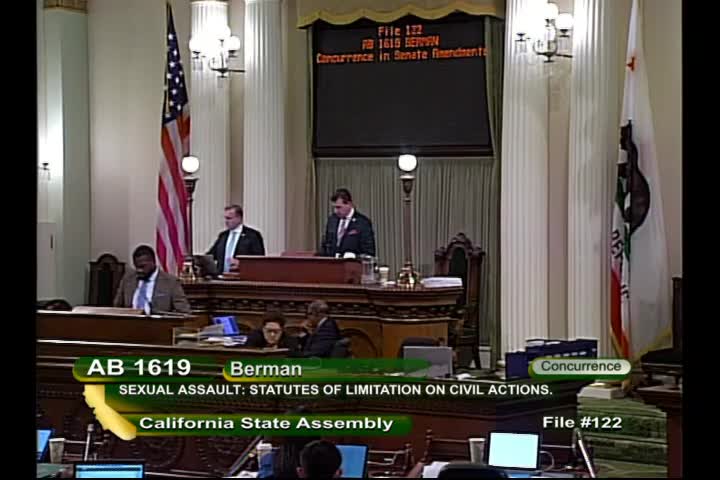 1MIN
Assembly Floor
 7MIN
Assembly Standing Committee on Judiciary
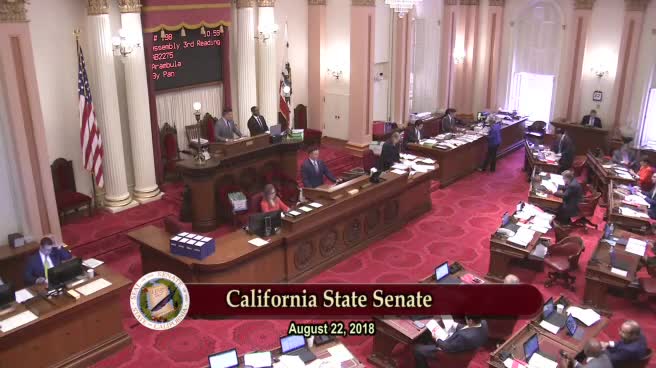 3MIN
Senate Floor
 1H
Senate Standing Committee on Appropriations
 32MIN
Senate Standing Committee on Education
 1MIN
Assembly Floor
 1H
Assembly Standing Committee on Appropriations
 20MIN
Assembly Standing Committee on Higher Education
Bill Author