AB 1654: Labor Code Private Attorneys General Act of 2004: construction industry.
- Session Year: 2017-2018
- House: Assembly
- Latest Version Date: 2018-09-19
The Labor Code Private Attorneys General Act of 2004 authorizes an aggrieved employee to bring a civil action to recover specified civil penalties, that would otherwise be assessed and collected by the Labor and Workforce Development Agency, on behalf of the employee and other current or former employees for the violation of certain provisions affecting employees. The act requires the employee to follow prescribed procedures before bringing an action and establishes alternate procedures for specific categories of violations. The act requires, except as provided, that 75% of the civil penalties recovered by aggrieved employees be distributed to the Labor and Workforce Development Agency for enforcement of labor laws and for education of employers and employees about their rights and responsibilities, and 25% be distributed to the aggrieved employees.
This bill would except from the act an employee in the construction industry, as defined, with respect to work performed under a valid collective bargaining agreement in effect any time before January 1, 2025, that contains certain provisions, including, among others, a grievance and binding arbitration procedure to redress violations that authorizes the arbitrator to award otherwise available remedies. The bill would authorize the exception until the collective bargaining agreement expires or until January 1, 2028, whichever is earlier, and would repeal the bills provisions on January 1, 2028.
The Labor Code Private Attorneys General Act of 2004 authorizes an aggrieved employee to bring a civil action to recover specified civil penalties, penalties that would otherwise be assessed and collected by the Labor and Workforce Development Agency, on behalf of the employee and other current or former employees for the violation of certain provisions affecting employees. The act requires the employee to follow prescribed procedures before bringing an action and establishes alternate procedures for specific categories of violations. The act requires, except as provided, that 75% of the civil penalties recovered by aggrieved employees be distributed to the Labor and Workforce Development Agency for enforcement of labor laws and for education of employers and employees about their rights and responsibilities, and 25% be distributed to the aggrieved employees.
This bill would except from the act an employee in the construction industry, as defined, with respect to work performed under a valid collective bargaining agreement, if the agreement provides for certain terms of employment, prohibits violations otherwise redressable pursuant to the act, provides agreement in effect any time before January 1, 2025, that contains certain provisions, including, among others, a grievance and binding arbitration procedure to redress violations, expressly and unambiguously waives the act, and violations that authorizes the arbitrator to award otherwise available remedies. The bill would authorize the exception until the collective bargaining agreement expires or until January 1, 2028, whichever is earlier, and would repeal the bills provisions on January 1, 2028.
The Labor Code Private Attorneys General Act of 2004 authorizes an aggrieved employee to bring a civil action to recover specified civil penalties, that would otherwise be assessed and collected by the Labor and Workforce Development Agency, on behalf of the employee and other current or former employees for the violation of certain provisions affecting employees. The act requires the employee to follow prescribed procedures before bringing an action and establishes alternate procedures for specific categories of violations. The act requires, except as provided, that 75% of the civil penalties recovered by aggrieved employees be distributed to the Labor and Workforce Development Agency for enforcement of labor laws and for education of employers and employees about their rights and responsibilities, and 25% be distributed to the aggrieved employees.
This bill would except from the act an employee in the construction industry, as defined, with respect to work performed under a valid collective bargaining agreement, if the agreement provides for certain terms of employment, prohibits violations otherwise redressable pursuant to the act, provides a grievance and binding arbitration procedure to redress violations, expressly and unambiguously waives the act, and authorizes the arbitrator to award otherwise available remedies.
Existing law requires the state to achieve a 20% reduction in urban per capita water use in California by December 31, 2020. Existing law requires agricultural water suppliers to prepare and adopt agricultural water management plans with specified components on or before December 31, 2012, and to update those plans on or before December 31, 2015, and on or before December 31 every 5 years thereafter. Existing law sets forth various findings and declarations related to water conservation.This bill would state the intent of the Legislature to enact legislation necessary to help make water conservation a California way of life.Existing law requires the state to achieve a 20% reduction in urban per capita water use in California by December 31, 2020. Existing law requires agricultural water suppliers to prepare and adopt agricultural water management plans with specified components on or before December 31, 2012, and to update those plans on or before December 31, 2015, and on or before December 31 every 5 years thereafter. Existing law sets forth various findings and declarations related to water conservation.
This bill would state the intent of the Legislature to enact legislation necessary to help make water conservation a California way of life.
(1)Existing law, the Urban Water Management Planning Act, requires every public and private urban water supplier that directly or indirectly provides water for municipal purposes to prepare and adopt an urban water management plan and to update its plan once every 5 years on or before December 31 in years ending in 5 and zero, except as specified. This bill would require the update of a plan on or before July 1, in years ending in one and 6. The bill would require each urban retail water supplier to report annually by June 15 to the Department of Water Resources the status of its water supplies for that year and whether the supplies will be adequate to meet projected customer demand, as prescribed. The bill would require the urban retail water supplier to implement the appropriate responses as described in its water shortage contingency analysis if the urban retail water supplier reports that all available water supplies for the applicable water year will not be adequate to meet projected customer demand. The bill would require the urban retail water supplier to continue to implement the mandatory demand reduction measures described in its water shortage contingency analysis until certain conditions have changed to the point that the urban retail water supplier finds that it is able to meet projected customer demand over the next 12 months without continued implementation of the measures. The bill would require an urban retail water supplier to file a certain report with the department by the 15th day of each month during a period that the urban retail water supplier is implementing mandatory demand reduction measures. The bill would require the department to establish an electronic portal through which an urban retail water supplier is required to provide these reports to the department and would require the department to provide the State Water Resources Control Board with access to the reports and data.(2)The act requires an adopted plan to include certain components, including, among other things, an identification and quantification of the existing and planned sources of water available to the supplier over 5-year increments, a description of the reliability of the water supply and vulnerability to seasonal or climatic shortage for an average water year, single-dry water year, and multiple-dry water years, and quantification of distribution system water loss for each of the 5 years preceding the plan update.This bill would add to the requirements of a plan a description of how an emergency supply has been established to increase water supply reliability during times of shortage and how the supply is in addition to the supplies that the agency draws upon during nonshortage times, if an emergency supply, as defined, is identified as an existing or planned source of water available to the urban retail water supplier. The bill would require a description of the reliability and vulnerability for 5 consecutive years consisting of a repeat of the 5 consecutive historic driest years experienced by the urban retail water supplier, except as provided, rather than multiple-dry water years. The bill would specify that distribution system water loss to be included in the plan is potable distribution system water loss. The bill would specify that potable reuse, recycled water, and desalination are considered fully reliable.(3)The act requires the department, in consultation with the California Urban Water Conservation Council, to convene an independent technical panel to provide information and recommendations to the department and the Legislature on new demand management measures, technologies, and approaches. The act requires the panel to report to the Legislature no later than January 1, 2010, and every 5 years thereafter, and requires the department to review the report and include in the final report to the Legislature recommendations and comments. The act deems an urban water supplier that is a member of the council and in compliance with the provisions of a certain memorandum to be in compliance with certain requirements relating to including water demand management measures in a plan.This bill would delete these provisions.(4)The act requires that the plan provide an urban water shortage contingency analysis that includes certain elements, including an estimate of the minimum water supply available during each of the following 3 water years based on the driest 3-year historic sequence for the agencys water supply.This bill would revise the elements included within an analysis.(5)The California Constitution declares the policy that the water resources of the state be put to beneficial use to the fullest extent of which they are capable, that the waste or unreasonable use or unreasonable method of use of water be prevented, and that the conservation of such waters is to be exercised with a view to the reasonable and beneficial use of the waters in the interest of the people and for the public welfare. Existing law requires the department and the board to take all appropriate proceedings or actions to prevent waste, unreasonable use, unreasonable method of use, or unreasonable method of diversion of water in this state.This bill would prohibit an urban water supplier, during a statewide drought, local drought, or water shortage, from being required to reduce its use or reliance on any water supply available for its use and identified in its plan or from being required to take additional actions beyond those specified in its water shortage contingency analysis for the level of water shortage, as specified.(1)Existing law, the Urban Water Management Planning Act, requires every public and private urban water supplier that directly or indirectly provides water for municipal purposes to prepare and adopt an urban water management plan and to update its plan once every 5 years on or before December 31 in years ending in 5 and zero, except as specified.
This bill would require the update of a plan on or before July 1, in years ending in one and 6. The bill would require each urban retail water supplier to report annually by June 15 to the Department of Water Resources the status of its water supplies for that year and whether the supplies will be adequate to meet projected customer demand, as prescribed. The bill would require the urban retail water supplier to implement the appropriate responses as described in its water shortage contingency analysis if the urban retail water supplier reports that all available water supplies for the applicable water year will not be adequate to meet projected customer demand. The bill would require the urban retail water supplier to continue to implement the mandatory demand reduction measures described in its water shortage contingency analysis until certain conditions have changed to the point that the urban retail water supplier finds that it is able to meet projected customer demand over the next 12 months without continued implementation of the measures. The bill would require an urban retail water supplier to file a certain report with the department by the 15th day of each month during a period that the urban retail water supplier is implementing mandatory demand reduction measures. The bill would require the department to establish an electronic portal through which an urban retail water supplier is required to provide these reports to the department and would require the department to provide the State Water Resources Control Board with access to the reports and data.
(2)The act requires an adopted plan to include certain components, including, among other things, an identification and quantification of the existing and planned sources of water available to the supplier over 5-year increments, a description of the reliability of the water supply and vulnerability to seasonal or climatic shortage for an average water year, single-dry water year, and multiple-dry water years, and quantification of distribution system water loss for each of the 5 years preceding the plan update.
This bill would add to the requirements of a plan a description of how an emergency supply has been established to increase water supply reliability during times of shortage and how the supply is in addition to the supplies that the agency draws upon during nonshortage times, if an emergency supply, as defined, is identified as an existing or planned source of water available to the urban retail water supplier. The bill would require a description of the reliability and vulnerability for 5 consecutive years consisting of a repeat of the 5 consecutive historic driest years experienced by the urban retail water supplier, except as provided, rather than multiple-dry water years. The bill would specify that distribution system water loss to be included in the plan is potable distribution system water loss. The bill would specify that potable reuse, recycled water, and desalination are considered fully reliable.
(3)The act requires the department, in consultation with the California Urban Water Conservation Council, to convene an independent technical panel to provide information and recommendations to the department and the Legislature on new demand management measures, technologies, and approaches. The act requires the panel to report to the Legislature no later than January 1, 2010, and every 5 years thereafter, and requires the department to review the report and include in the final report to the Legislature recommendations and comments. The act deems an urban water supplier that is a member of the council and in compliance with the provisions of a certain memorandum to be in compliance with certain requirements relating to including water demand management measures in a plan.
This bill would delete these provisions.
(4)The act requires that the plan provide an urban water shortage contingency analysis that includes certain elements, including an estimate of the minimum water supply available during each of the following 3 water years based on the driest 3-year historic sequence for the agencys water supply.
This bill would revise the elements included within an analysis.
(5)The California Constitution declares the policy that the water resources of the state be put to beneficial use to the fullest extent of which they are capable, that the waste or unreasonable use or unreasonable method of use of water be prevented, and that the conservation of such waters is to be exercised with a view to the reasonable and beneficial use of the waters in the interest of the people and for the public welfare. Existing law requires the department and the board to take all appropriate proceedings or actions to prevent waste, unreasonable use, unreasonable method of use, or unreasonable method of diversion of water in this state.
This bill would prohibit an urban water supplier, during a statewide drought, local drought, or water shortage, from being required to reduce its use or reliance on any water supply available for its use and identified in its plan or from being required to take additional actions beyond those specified in its water shortage contingency analysis for the level of water shortage, as specified.
(1)Existing law, the Urban Water Management Planning Act, requires every public and private urban water supplier that directly or indirectly provides water for municipal purposes to prepare and adopt an urban water management plan and to update its plan once every 5 years on or before December 31 in years ending in 5 and zero, except as specified.
This bill would require the update of a plan on or before July 1, in years ending in one and 6. The bill would require each urban retail water supplier to report annually by June 15 to the Department of Water Resources the status of its water supplies for that year and whether the supplies will be adequate to meet projected customer demand, as prescribed. The bill would require the urban retail water supplier to implement the appropriate responses as described in its water shortage contingency analysis if the urban retail water supplier reports that all available water supplies for the applicable water year will not be adequate to meet projected customer demand. The bill would require the urban retail water supplier to continue to implement the mandatory demand reduction measures described in its water shortage contingency analysis until certain conditions have changed to the point that the urban retail water supplier finds that it is able to meet projected customer demand over the next 12 months without continued implementation of the measures. The bill would require an urban retail water supplier to file a certain report with the department by the 15th day of each month during a period that the urban retail water supplier is implementing mandatory demand reduction measures. The bill would require the department to establish an electronic portal through which an urban retail water supplier is required to provide these reports to the department and would require the department to provide the State Water Resources Control Board with access to the reports and data.
(2)The act requires an adopted plan to include certain components, including, among other things, an identification and quantification of the existing and planned sources of water available to the supplier over 5-year increments, a description of the reliability of the water supply and vulnerability to seasonal or climatic shortage for an average water year, single-dry water year, and multiple-dry water years, and quantification of distribution system water loss for each of the 5 years preceding the plan update.
This bill would add to the requirements of a plan a description of how an emergency supply has been established to increase water supply reliability during times of shortage and how the supply is in addition to the supplies that the agency draws upon during nonshortage times, if an emergency supply, as defined, is identified as an existing or planned source of water available to the urban retail water supplier. The bill would require a description of the reliability and vulnerability for 5 consecutive years consisting of a repeat of the 5 consecutive historic driest years experienced by the urban retail water supplier, except as provided, rather than multiple-dry water years. The bill would specify that distribution system water loss to be included in the plan is potable distribution system water loss.
(3)The act requires the department, in consultation with the California Urban Water Conservation Council, to convene an independent technical panel to provide information and recommendations to the department and the Legislature on new demand management measures, technologies, and approaches. The act requires the panel to report to the Legislature no later than January 1, 2010, and every 5 years thereafter, and requires the department to review the report and include in the final report to the Legislature recommendations and comments. The act deems an urban water supplier that is a member of the council and in compliance with the provisions of a certain memorandum to be in compliance with certain requirements relating to including water demand management measures in a plan.
This bill would delete these provisions.
(4)The act requires that the plan provide an urban water shortage contingency analysis that includes certain elements, including an estimate of the minimum water supply available during each of the following 3 water years based on the driest 3-year historic sequence for the agencys water supply.
This bill would revise the elements included within an analysis.
(5)The California Constitution declares the policy that the water resources of the state be put to beneficial use to the fullest extent of which they are capable, that the waste or unreasonable use or unreasonable method of use of water be prevented, and that the conservation of such waters is to be exercised with a view to the reasonable and beneficial use of the waters in the interest of the people and for the public welfare. Existing law requires the department and the board to take all appropriate proceedings or actions to prevent waste, unreasonable use, unreasonable method of use, or unreasonable method of diversion of water in this state.
This bill would prohibit an urban water supplier, during a statewide drought, local drought, or water shortage, from being required to reduce its use or reliance on any water supply available for its use and identified in its plan or from being required to take additional actions beyond those specified in its water shortage contingency analysis for the level of water shortage, as specified.
Existing law requires the state to achieve a 20% reduction in urban per capita water use in California by December 31, 2020. Existing law requires agricultural water suppliers to prepare and adopt agricultural water management plans with specified components on or before December 31, 2012, and to update those plans on or before December 31, 2015, and on or before December 31 every 5 years thereafter. Existing law sets forth various findings and declarations related to water conservation.This bill would make a nonsubstantive change in those findings and declarations.Existing law requires the state to achieve a 20% reduction in urban per capita water use in California by December 31, 2020. Existing law requires agricultural water suppliers to prepare and adopt agricultural water management plans with specified components on or before December 31, 2012, and to update those plans on or before December 31, 2015, and on or before December 31 every 5 years thereafter. Existing law sets forth various findings and declarations related to water conservation.
This bill would make a nonsubstantive change in those findings and declarations.
(a)This part shall not apply to an employee in the construction industry with respect to work performed under a valid collective bargaining agreement in effect any time before January 1, 2025, that expressly provides for the wages, hours of work, and working conditions of employees, premium wage rates for all overtime hours worked, and for the employee to receive a regular hourly pay rate of not less than 30 percent more than the state minimum wage rate, and the agreement does all of the following:
(1)Prohibits all of the violations of this code that would be redressable pursuant to this part, and provides for a grievance and binding arbitration procedure to redress those violations.
(2)Expressly waives the requirements of this part in clear and unambiguous terms.
(3)Authorizes the arbitrator to award any and all remedies otherwise available under this code, provided that nothing in this section authorizes the award of penalties under this part that would be payable to the Labor and Workforce Development Agency.
(b)Except for a civil action under Section 2699, nothing in this section precludes an employee from pursuing any other civil action against an employer, including, but not limited to, an action for a violation of the California Fair Employment and Housing Act (Part 2.8 (commencing with Section 12900) of Division 3 of Title 2 of the Government Code), Title VII of the Civil Rights Act of 1964 (Public Law 88-352), or any other prohibition of discrimination or harassment.
(c)The exception provided by this section shall expire on the date the collective bargaining agreement expires or on January 1, 2028, whichever is earlier.
(d)For purposes of this section, employee in the construction industry means an employee performing work associated with construction, including work involving alteration, demolition, building, excavation, renovation, remodeling, maintenance, improvement, repair work, and any other work as described by Chapter 9 (commencing with Section 7000) of Division 3 of the Business and Professions Code, and other similar or related occupations or trades.
(e)This section shall remain in effect only until January 1, 2028, and as of that date is repealed.
(a)This part shall not apply to an employee in the construction industry with respect to work performed under a valid collective bargaining agreement if the agreement in effect any time before January 1, 2025, that expressly provides for the wages, hours of work, and working conditions of employees, premium wage rates for all overtime hours worked, and for the employee to receive a regular hourly pay rate of not less than 30 percent more than the state minimum wage rate, and the agreement does all of the following:
(1)Prohibits all of the violations of this code that would be redressable pursuant to this part, and provides for a grievance and binding arbitration procedure to redress those violations.
(2)Expressly waives the requirements of this part in clear and unambiguous terms.
(3)Authorizes the arbitrator to award any and all remedies otherwise available under this code. code, provided that nothing in this section authorizes the award of penalties under this part that would be payable to the Labor and Workforce Development Agency.
(b)Except for a civil action under Section 2699, nothing in this section precludes an employee from pursuing any other civil action against an employer, including, but not limited to, an action for a violation of the California Fair Employment and Housing Act (Part 2.8 (commencing with Section 12900) of Division 3 of Title 2 of the Government Code), Title VII of the Civil Rights Act of 1964 (Public Law 88-352), or any other prohibition of discrimination or harassment.
(c)The exception provided by this section shall expire on the date the collective bargaining agreement expires or on January 1, 2028, whichever is earlier.
(b)(d)For purposes of this section, employee in the construction industry means an employee performing work associated with construction, including work involving alteration, demolition, building, excavation, renovation, remodeling, maintenance, improvement, repair work, and any other work as described by Chapter 9 (commencing with Section 7000) of Division 3 of the Business and Professions Code, and other similar or related occupations or trades.
(e)This section shall remain in effect only until January 1, 2028, and as of that date is repealed.
(a)This part shall not apply to an employee in the construction industry with respect to work performed under a valid collective bargaining agreement if the agreement expressly provides for the wages, hours of work, and working conditions of employees, premium wage rates for all overtime hours worked, and for the employee to receive a regular hourly pay rate of not less than 30 percent more than the state minimum wage rate, and the agreement does all of the following:
(1)Prohibits all of the violations of this code that would be redressable pursuant to this part, and provides for a grievance and binding arbitration procedure to redress those violations.
(2)Expressly waives the requirements of this part in clear and unambiguous terms.
(3)Authorizes the arbitrator to award any and all remedies otherwise available under this code.
(b)For purposes of this section, employee in the construction industry means an employee performing work associated with construction, including work involving alteration, demolition, building, excavation, renovation, remodeling, maintenance, improvement, repair work, and any other work as described by Chapter 9 (commencing with Section 7000) of Division 3 of the Business and Professions Code, and other similar or related occupations or trades.
(a)This part shall not apply to an employee in the construction industry with respect to work performed under a valid collective bargaining agreement if the agreement expressly provides for the wages, hours of work, and working conditions of employees, premium wage rates for all overtime hours worked, and for the employee to receive a regular hourly pay rate of not less than 30 percent more than the state minimum wage rate, and the agreement does all of the following:
(1)Prohibits all the violations of this code that would be redressable pursuant to this part, and provides for a grievance and binding arbitration procedure to redress those violations.
(2)Expressly waives the requirements of this part in clear and unambiguous terms.
(3)Authorizes the arbitrator to award any and all remedies otherwise available under this code.
(b)For purposes of this section, employee in the construction industry means an employee performing work associated with construction, including work involving alteration, demolition, building, excavation, renovation, remodeling, maintenance, improvement, repair work, and any other work as described by Chapter 9 (commencing with Section 7000) of Division 3 of the Business and Professions Code, and other similar or related occupations or trades.
SECTION 1.It is the intent of the Legislature to enact legislation necessary to help make water conservation a California way of life.It is the intent of the Legislature to enact legislation necessary to help make water conservation a California way of life.
All matter omitted in this version of the bill appears in the bill as amended in the Senate, July 3, 2017. (JR11)The following definitions govern the construction of this part:
(a)Water shortage contingency analysis means the component of an urban water management plan described in Section 10632.
(b)Urban retail water supplier has the meaning provided in Section 10608.12.
(c)Urban water supplier has the meaning provided in Section 10617.
(d)Urban wholesale water supplier has the meaning provided in Section 10608.12.
10609.510609.5.(a)In addition to and separate from the urban water management plans required pursuant to Part 2.6 (commencing with Section 10610), by June 15 of each year an urban retail water supplier shall report to the department the status of its water supplies for that year and whether the supplies will be adequate to meet projected customer demand. demand over the next 12 months.
(b)(1)If an urban retail water supplier reports pursuant to subdivision (a) that all available water supplies for the applicable water year will not be adequate to meet projected customer demand, the urban retail water supplier shall implement the appropriate responses as described in its water shortage contingency analysis. If demand is projected to exceed all available supply sources and mandatory water demand reduction measures are required, the annual report shall describe the water supply shortage stage and the measures that the supplier will take to reduce water demand consistent with its water shortage contingency analysis.
(2)If an urban retail water supplier determines that it cannot meet demands with all available water suppliers supplies and is required to implement mandatory water demand reduction measures as described in its water shortage contingency analysis pursuant to paragraph (1), the urban retail water supplier shall do both of the following:
(A)Continue to implement the mandatory demand reduction measures as described in its water shortage contingency analysis until hydrologic, water supply, or other conditions have changed to the point that the supplier finds that it will be able to meet projected customer demand over the next 12 months without continued implementation of the mandatory demand reduction measures.
(B)During the period that the urban retail water supplier is implementing the mandatory demand reductions measures described in its water shortage contingency analysis, the supplier shall file a report with the department by the 15th day of each month that describes how the supplier is implementing the measures.
(3)If an urban retail water supplier reports pursuant to subdivision (a) that supplies are adequate to meet projected customer demand, the urban retail water supplier, at its sole discretion, may declare any stage of its water shortage contingency analysis to balance supply and demand through the augmentation of supplies or to encourage water demand reduction as a precautionary measure. If an urban retail water supplier declares a stage of its water shortage contingency analysis pursuant to this paragraph, the urban retail water supplier shall not have an additional obligation to report to the department on the implementation of its plan.
(c)Multiple urban retail water suppliers within the same hydrologic region may file a joint report with the department if those urban retail water suppliers water supplies are interrelated and if each urban retail water supplier determines that a joint report most accurately reflects the condition of their respective water supplies. Regardless of whether a joint report is submitted, an urban retail water supplier may submit an individual report to the department.
(d)An urban wholesale water supplier shall provide its urban retail agencies water suppliers with information on the status of the urban wholesale water suppliers water supplies annually so that an urban retail water supplier reliant on the wholesale supply has sufficient data to comply with subdivision (a). An urban retail water supplier shall provide an its urban wholesale water supplier with information regarding its estimated annual demand for water from each wholesaler annually. An urban retail water supplier and its urban wholesale water suppliers shall meet and determine the process and dates by which they will comply with the requirements of this subdivision.
(e)An urban water supplier shall not be required to comply with any requirement in Part 2.6 (commencing with Section 10610) for any action taken or report made pursuant to this section. An action taken or report made pursuant to this section shall not be considered part of, amendments to, or changes to, an urban water management plan.
(f)The department shall establish an electronic portal through which suppliers shall provide the reports required by this section. The department shall provide the board with access to the reports and data submitted through the portal.
SEC. 2.Section 10613.5 is added to the Water Code, to read:10613.5.Emergency supply means a water supply identified in the urban water management plan of an urban water supplier that has been developed to increase an urban water suppliers water supply reliability during times of shortage, including, but not limited to, unplanned service disruptions, and is in addition to the water supplies that the agency draws upon during nonshortage times to meet water demands within its service area.
SEC. 3.Section 10621 of the Water Code is amended to read:10621.(a)Each urban water supplier shall update its plan at least once every five years on or before July 1, in years ending in one and six.
(b)Every urban water supplier required to prepare a plan pursuant to this part shall, at least 60 days before the public hearing on the plan required by Section 10642, notify any city or county within which the supplier provides water supplies that the urban water supplier will be reviewing the plan and considering amendments or changes to the plan. The urban water supplier may consult with, and obtain comments from, any city or county that receives notice pursuant to this subdivision.
(c)The amendments to, or changes in, the plan shall be adopted and filed in the manner set forth in Article 3 (commencing with Section 10640).
SEC. 4.Section 10631 of the Water Code is amended to read:10631.A plan shall be adopted in accordance with this chapter that shall do all of the following:
(a)Describe the service area of the supplier, including current and projected population, climate, and other demographic factors affecting the suppliers water management planning. The projected population estimates shall be based upon data from the state, regional, or local service agency population projections within the service area of the urban water supplier and shall be in five-year increments to 20 years or as far as data is available.
(b)Identify and quantify, to the extent practicable, the existing and planned sources of water available to the supplier over the same five-year increments described in subdivision (a).
(1)If groundwater is identified as an existing or planned source of water available to the supplier, all of the following information shall be included in the plan:
(A)A copy of any groundwater management plan adopted by the urban water supplier, including plans adopted pursuant to Part 2.75 (commencing with Section 10750), or any other specific authorization for groundwater management.
(B)A description of any groundwater basin or basins from which the urban water supplier pumps groundwater. For basins that a court or the board has adjudicated the rights to pump groundwater, a copy of the order or decree adopted by the court or the board and a description of the amount of groundwater the urban water supplier has the legal right to pump under the order or decree. For basins that have not been adjudicated, information as to whether the department has identified the basin or basins as overdrafted or has projected that the basin will become overdrafted if present management conditions continue, in the most current official departmental bulletin that characterizes the condition of the groundwater basin, and a detailed description of the efforts being undertaken by the urban water supplier to eliminate the long-term overdraft condition.
(C)A detailed description and analysis of the location, amount, and sufficiency of groundwater pumped by the urban water supplier for the past five years. The description and analysis shall be based on information that is reasonably available, including, but not limited to, historic use records.
(D)A detailed description and analysis of the amount and location of groundwater that is projected to be pumped by the urban water supplier. The description and analysis shall be based on information that is reasonably available, including, but not limited to, historic use records.
(2)If an emergency supply is identified as an existing or planned source of water available to the supplier, the supplier shall describe how the supply has been established to increase water supply reliability during times of shortage and how the supply is in addition to the supplies that the agency draws upon during nonshortage times to meet water demands within its service area.
(c)(1)Describe the reliability of the water supply and vulnerability to seasonal or climatic shortage, to the extent practicable, and provide data for each of the following:
(A)An average water year.
(B)A single-dry water year.
(C)Five consecutive dry years consisting of a repeat of the five consecutive historic driest years that the urban water supplier has experienced, unless the urban water supplier finds that a shorter multiple-year dry period would more severely impact its water supplies, in which case the urban water supplier shall use that shorter period.
(2)For any water source that may not be available at a consistent level of use, given specific legal, environmental, water quality, or climatic factors, describe plans to supplement or replace that source with alternative sources or water demand management measures, to the extent practicable.
(d)Describe the opportunities for exchanges or transfers of water on a short-term or long-term basis.
(e)(1)Quantify, to the extent records are available, past and current water use, over the same five-year increments described in subdivision (a), and projected water use, identifying the uses among water use sectors, including, but not necessarily limited to, all of the following uses:
(A)Single-family residential.
(B)Multifamily.
(C)Commercial.
(D)Industrial.
(E)Institutional and governmental.
(F)Landscape.
(G)Sales to other agencies.
(H)Saline water intrusion barriers, groundwater recharge, or conjunctive use, or any combination thereof.
(I)Agricultural.
(J)Potable distribution system water loss.
(2)The water use projections shall be in the same five-year increments described in subdivision (a).
(3)(A)The potable distribution system water loss shall be quantified for each of the five years preceding the plan update.
(B)The potable distribution system water loss quantification shall be reported in accordance with a worksheet approved or developed by the department through a public process. The water loss quantification worksheet shall be based on the water system balance methodology developed by the American Water Works Association.
(4)(A)If available and applicable to an urban water supplier, water use projections may display and account for the water savings estimated to result from adopted codes, standards, ordinances, or transportation and land use plans identified by the urban water supplier, as applicable to the service area.
(B)To the extent that an urban water supplier reports the information described in subparagraph (A), an urban water supplier shall do both of the following:
(i)Provide citations of the various codes, standards, ordinances, or transportation and land use plans utilized in making the projections.
(ii)Indicate the extent that the water use projections consider savings from codes, standards, ordinances, or transportation and land use plans. Water use projections that do not account for these water savings shall be noted of that fact.
(f)Provide a description of the suppliers water demand management measures. This description shall include all of the following:
(1)(A)For an urban retail water supplier, as defined in Section 10608.12, a narrative description that addresses the nature and extent of each water demand management measure implemented over the past five years. The narrative shall describe the water demand management measures that the supplier plans to implement to achieve its water use targets pursuant to Section 10608.20.
(B)The narrative pursuant to this paragraph shall include descriptions of the following water demand management measures:
(i)Water waste prevention ordinances.
(ii)Metering.
(iii)Conservation pricing.
(iv)Public education and outreach.
(v)Programs to assess and manage potable distribution system real loss.
(vi)Water conservation program coordination and staffing support.
(vii)Other demand management measures that have a significant impact on water use as measured in gallons per capita per day, including innovative measures, if implemented.
(2)For an urban wholesale water supplier, as defined in Section 10608.12, a narrative description of the items in clauses (ii), (iv), (vi), and (vii) of subparagraph (B) of paragraph (1), and a narrative description of its distribution system asset management and wholesale supplier assistance programs.
(g)Include a description of all water supply projects and water supply programs that may be undertaken by the urban water supplier to meet the total projected water use, as established pursuant to subdivision (a) of Section 10635. The urban water supplier shall include a detailed description of expected future projects and programs that the urban water supplier may implement to increase the amount of the water supply available to the urban water supplier in average, single-dry, and multiple-dry water years. an average water year, a single-dry water year, and, in accordance with subparagraph (C) of paragraph (1) of subdivision (c), five consecutive dry years or a shorter multiple-year dry period. The description shall identify specific projects and include a description of the increase in water supply that is expected to be available from each project. The description shall include an estimate with regard to the implementation timeline for each project or program.
(h)Describe the opportunities for development of desalinated water, including, but not limited to, ocean water, brackish water, and groundwater, as a long-term supply.
(i)An urban water supplier that relies upon a wholesale agency for a source of water shall provide the wholesale agency with water use projections from that agency for that source of water in five-year increments to 20 years or as far as data is available. The wholesale agency shall provide information to the urban water supplier for inclusion in the urban water suppliers plan that identifies and quantifies, to the extent practicable, the existing and planned sources of water as required by subdivision (b), available from the wholesale agency to the urban water supplier over the same five-year increments, and during various water-year types in accordance with subdivision (c). An urban water supplier may rely upon water supply information provided by the wholesale agency in fulfilling the plan informational requirements of subdivisions (b) and (c).
SEC. 5.Section 10631.7 of the Water Code is repealed.SEC. 6.Section 10632 of the Water Code is amended to read:10632.The plan shall provide an urban water shortage contingency analysis that includes each of the following elements that are within the authority of the urban water supplier:
(a)Anticipated stages of action to be undertaken by the urban water supplier in response to water supply shortages, including up to a 50 percent reduction in water supply, and an outline of specific water supply conditions that would trigger each stage.
(b)Communications strategies to inform customers, state agencies, elected officials, and others whenever water supply shortage conditions require the implementation of the stages of action described in subdivision (a).
(c)Anticipated actions to be undertaken by the urban water supplier to prepare for, and implement during, a catastrophic interruption of water supplies including, but not limited to, a regional power outage, an earthquake, or other disaster.
(d)Additional anticipated mandatory prohibitions against specific water use practices during water shortages.
(e)Anticipated actions to balance water supply and demand for each water supply shortage stage, including the use of emergency supplies, demand reduction methods, reoperation, or any combination of these actions. Each urban water supplier may use any type of consumption reduction, reoperation approach, or supply augmentation methods in its water shortage contingency analysis that would balance supply and demand, are appropriate for its area, and have the ability to successfully respond to each water supply shortage stage. If an urban water supplier has established an emergency supply, the supplier shall include in the description of actions to be taken when the emergency supply will be used to balance water supply and demand, and the quantity of water from the emergency supply that is planned to be used. An emergency supply designated for use during a water supply shortage shall be fully available for use by the supplier during a shortage and its use shall be at the sole discretion of the urban water supplier.
(f)Anticipated processes for monitoring and ensuring compliance by customers with mandatory prohibitions against specific water use practices and mechanisms to enforce compliance. The analysis shall include a description of the urban water suppliers established method to identify and discourage excessive water use as required by Sections 366 and 367.
(g)An analysis of the impacts of each of the actions and conditions described in subdivisions (a) to (f), inclusive, on the revenues and expenditures of the urban water supplier, and proposed measures to overcome those impacts, such as the development of reserves and rate adjustments.
(h)A description of the water suppliers source of authority for implementing the water shortage actions, as identified in subdivision (e), including any adopted resolutions or ordinances.
SEC. 7.Section 10635 of the Water Code is amended to read:10635.(a)Every urban water supplier shall include, as part of its urban water management plan, an assessment of the reliability of its water service to its customers during normal, dry, and multiple dry water years. This water supply and demand assessment shall compare the total water supply sources available to the water supplier with the total projected water use over the next 20 years, in five-year increments, for a normal water year, a single dry water year, and, in accordance with subparagraph (C) of paragraph (1) of subdivision (c) of Section 10631, five consecutive dry years or a shorter multiple-year dry period. The water service reliability assessment shall be based upon the information compiled pursuant to Section 10631, including available data from state, regional, or local agency population projections within the service area of the urban water supplier. Potable reuse, recycled water, and desalination are considered fully reliable.
(b)The urban water supplier shall provide that portion of its urban water management plan prepared pursuant to this article to any city or county within which it provides water supplies no later than 60 days after the submission of its urban water management plan.
(c)Nothing in this article is intended to create a right or entitlement to water service or any specific level of water service.
(d)Nothing in this article is intended to change existing law concerning an urban water suppliers obligation to provide water service to its existing customers or to any potential future customers.
SEC. 8.Section 10658 is added to the Water Code, to read:10658.(a)It is the intent of the Legislature in enacting this section to do all of the following:
(1)Encourage continued investment in water supply reliability and diversification.
(2)Incentivize new and protect existing local investments made by urban water suppliers in drought resiliency and drought resilient supplies in order to better prepare local communities and the state for drought and times of shortage.
(3)Incentivize new and protect existing local investments in water recycling and potable reuse.
(4)Encourage urban water suppliers and local agencies to develop emergency supplies, including storage of flood flows in water banks throughout the state, to better protect California from the effects of drought.
(5)Encourage urban water suppliers and local agencies to take steps to prepare for the effects of climate change.
(6)Ensure that urban water suppliers have adequate supplies or take appropriate measures to reduce demand during times of drought.
(b)During a statewide drought, local drought, or water shortage, an urban water supplier shall not be required to reduce its use or reliance on any water supply available for its use and identified in its urban water management plan, or be required to take additional actions beyond those specified in its water shortage contingency analysis for the level of shortage that is anticipated in the annual report required by Section 10609 or the level of shortage that it is currently experiencing, whichever is greater.
(c)Nothing in this section limits, constrains, or otherwise modifies the authorities of the Governor under Chapter 7 (commencing with Section 8550) of Division 1 of Title 2 of the Government Code.
The following definitions govern the construction of this part:
(a)Water shortage contingency analysis means the component of an urban water management plan described in Section 10632.
(b)Urban retail water supplier has the meaning provided in Section 10608.12.
(c)Urban water supplier has the meaning provided in Section 10617.
(d)Urban wholesale water supplier has the meaning provided in Section 10608.12.
10609.5(a)In addition to and separate from the urban water management plans required pursuant to Part 2.6 (commencing with Section 10610), by June 15 of each year an urban retail water supplier shall report to the department the status of its water supplies for that year and whether the supplies will be adequate to meet projected customer demand.
(b)(1)If an urban retail water supplier reports pursuant to subdivision (a) that all available water supplies for the applicable water year will not be adequate to meet projected customer demand, the urban retail water supplier shall implement the appropriate responses as described in its water shortage contingency analysis. If demand is projected to exceed all available supply sources and mandatory water demand reduction measures are required, the annual report shall describe the water supply shortage stage and the measures that the supplier will take to reduce water demand consistent with its water shortage contingency analysis.
(2)If an urban retail water supplier determines that it cannot meet demands with all available water suppliers and is required to implement mandatory water demand reduction measures as described in its water shortage contingency analysis pursuant to paragraph (1), the urban retail water supplier shall do both of the following:
(A)Continue to implement the mandatory demand reduction measures as described in its water shortage contingency analysis until hydrologic, water supply, or other conditions have changed to the point that the supplier finds that it will be able to meet projected customer demand over the next 12 months without continued implementation of the mandatory demand reduction measures.
(B)During the period that the urban retail water supplier is implementing the mandatory demand reductions measures described in its water shortage contingency analysis, the supplier shall file a report with the department by the 15th day of each month that describes how the supplier is implementing the measures.
(3)If an urban retail water supplier reports pursuant to subdivision (a) that supplies are adequate to meet projected customer demand, the urban retail water supplier, at its sole discretion, may declare any stage of its water shortage contingency analysis to balance supply and demand through the augmentation of supplies or to encourage water demand reduction as a precautionary measure. If an urban retail water supplier declares a stage of its water shortage contingency analysis pursuant to this paragraph, the urban retail water supplier shall not have an additional obligation to report to the department on the implementation of its plan.
(c)Multiple urban retail water suppliers within the same hydrologic region may file a joint report with the department if those urban retail water suppliers water supplies are interrelated and if each urban retail water supplier determines that a joint report most accurately reflects the condition of their respective water supplies. Regardless of whether a joint report is submitted, an urban retail water supplier may submit an individual report to the department.
(d)An urban wholesale water supplier shall provide its retail agencies with information on the status of the urban wholesale water suppliers water supplies annually so that an urban retail water supplier reliant on the wholesale supply has sufficient data to comply with subdivision (a). An urban retail water supplier shall provide an urban wholesale water supplier with information regarding its estimated annual demand for water from each wholesaler annually. An urban retail water supplier and its urban wholesale water suppliers shall meet and determine the process and dates by which they will comply with the requirements of this subdivision.
(e)An urban water supplier shall not be required to comply with any requirement in Part 2.6 (commencing with Section 10610) for any action taken or report made pursuant to this section. An action taken or report made pursuant to this section shall not be considered part of, amendments to, or changes to, an urban water management plan.
(f)The department shall establish an electronic portal through which suppliers shall provide the reports required by this section. The department shall provide the board with access to the reports and data submitted through the portal.
SEC. 2.Section 10613.5 is added to the Water Code, to read:10613.5.Emergency supply means a water supply identified in the urban water management plan of an urban water supplier that has been developed to increase an urban water suppliers water supply reliability during times of shortage, including, but not limited to, unplanned service disruptions, and is in addition to the water supplies that the agency draws upon during nonshortage times to meet water demands within its service area.
SEC. 3.Section 10621 of the Water Code is amended to read:10621.(a)Each urban water supplier shall update its plan at least once every five years on or before December 31, July 1, in years ending in five and zero, except as provided in subdivisions (d) and (e). one and six.
(b)Every urban water supplier required to prepare a plan pursuant to this part shall, at least 60 days before the public hearing on the plan required by Section 10642, notify any city or county within which the supplier provides water supplies that the urban water supplier will be reviewing the plan and considering amendments or changes to the plan. The urban water supplier may consult with, and obtain comments from, any city or county that receives notice pursuant to this subdivision.
(c)The amendments to, or changes in, the plan shall be adopted and filed in the manner set forth in Article 3 (commencing with Section 10640).
(d)Each urban water supplier shall update and submit its 2015 plan to the department by July 1, 2016.(e)Each urban water supplier shall update and submit its 2020 plan to the department by July 1, 2021.SEC. 4.Section 10631 of the Water Code is amended to read:10631.A plan shall be adopted in accordance with this chapter that shall do all of the following:
(a)Describe the service area of the supplier, including current and projected population, climate, and other demographic factors affecting the suppliers water management planning. The projected population estimates shall be based upon data from the state, regional, or local service agency population projections within the service area of the urban water supplier and shall be in five-year increments to 20 years or as far as data is available.
(b)Identify and quantify, to the extent practicable, the existing and planned sources of water available to the supplier over the same five-year increments described in subdivision (a). If
(1)If groundwater is identified as an existing or planned source of water available to the supplier, all of the following information shall be included in the plan:
(1)(A)A copy of any groundwater management plan adopted by the urban water supplier, including plans adopted pursuant to Part 2.75 (commencing with Section 10750), or any other specific authorization for groundwater management.
(2)(B)A description of any groundwater basin or basins from which the urban water supplier pumps groundwater. For basins that a court or the board has adjudicated the rights to pump groundwater, a copy of the order or decree adopted by the court or the board and a description of the amount of groundwater the urban water supplier has the legal right to pump under the order or decree. For basins that have not been adjudicated, information as to whether the department has identified the basin or basins as overdrafted or has projected that the basin will become overdrafted if present management conditions continue, in the most current official departmental bulletin that characterizes the condition of the groundwater basin, and a detailed description of the efforts being undertaken by the urban water supplier to eliminate the long-term overdraft condition.
(3)(C)A detailed description and analysis of the location, amount, and sufficiency of groundwater pumped by the urban water supplier for the past five years. The description and analysis shall be based on information that is reasonably available, including, but not limited to, historic use records.
(4)(D)A detailed description and analysis of the amount and location of groundwater that is projected to be pumped by the urban water supplier. The description and analysis shall be based on information that is reasonably available, including, but not limited to, historic use records.
(2)If an emergency supply is identified as an existing or planned source of water available to the supplier, the supplier shall describe how the supply has been established to increase water supply reliability during times of shortage and how the supply is in addition to the supplies that the agency draws upon during nonshortage times to meet water demands within its service area.
(c)(1)Describe the reliability of the water supply and vulnerability to seasonal or climatic shortage, to the extent practicable, and provide data for each of the following:
(A)An average water year.
(B)A single-dry water year.
(C)Multiple-dry water years.(C)Five consecutive dry years consisting of a repeat of the five consecutive historic driest years that the urban water supplier has experienced, unless the urban water supplier finds that a shorter multiple-year dry period would more severely impact its water supplies, in which case the urban water supplier shall use that shorter period.
(2)For any water source that may not be available at a consistent level of use, given specific legal, environmental, water quality, or climatic factors, describe plans to supplement or replace that source with alternative sources or water demand management measures, to the extent practicable.
(d)Describe the opportunities for exchanges or transfers of water on a short-term or long-term basis.
(e)(1)Quantify, to the extent records are available, past and current water use, over the same five-year increments described in subdivision (a), and projected water use, identifying the uses among water use sectors, including, but not necessarily limited to, all of the following uses:
(A)Single-family residential.
(B)Multifamily.
(C)Commercial.
(D)Industrial.
(E)Institutional and governmental.
(F)Landscape.
(G)Sales to other agencies.
(H)Saline water intrusion barriers, groundwater recharge, or conjunctive use, or any combination thereof.
(I)Agricultural.
(J)Distribution Potable distribution system water loss.
(2)The water use projections shall be in the same five-year increments described in subdivision (a).
(3)(A)For the 2015 urban water management plan update, the distribution system water loss shall be quantified for the most recent 12-month period available. For all subsequent updates, the The potable distribution system water loss shall be quantified for each of the five years preceding the plan update.
(B)The potable distribution system water loss quantification shall be reported in accordance with a worksheet approved or developed by the department through a public process. The water loss quantification worksheet shall be based on the water system balance methodology developed by the American Water Works Association.
(4)(A)If available and applicable to an urban water supplier, water use projections may display and account for the water savings estimated to result from adopted codes, standards, ordinances, or transportation and land use plans identified by the urban water supplier, as applicable to the service area.
(B)To the extent that an urban water supplier reports the information described in subparagraph (A), an urban water supplier shall do both of the following:
(i)Provide citations of the various codes, standards, ordinances, or transportation and land use plans utilized in making the projections.
(ii)Indicate the extent that the water use projections consider savings from codes, standards, ordinances, or transportation and land use plans. Water use projections that do not account for these water savings shall be noted of that fact.
(f)Provide a description of the suppliers water demand management measures. This description shall include all of the following:
(1)(A)For an urban retail water supplier, as defined in Section 10608.12, a narrative description that addresses the nature and extent of each water demand management measure implemented over the past five years. The narrative shall describe the water demand management measures that the supplier plans to implement to achieve its water use targets pursuant to Section 10608.20.
(B)The narrative pursuant to this paragraph shall include descriptions of the following water demand management measures:
(i)Water waste prevention ordinances.
(ii)Metering.
(iii)Conservation pricing.
(iv)Public education and outreach.
(v)Programs to assess and manage potable distribution system real loss.
(vi)Water conservation program coordination and staffing support.
(vii)Other demand management measures that have a significant impact on water use as measured in gallons per capita per day, including innovative measures, if implemented.
(2)For an urban wholesale water supplier, as defined in Section 10608.12, a narrative description of the items in clauses (ii), (iv), (vi), and (vii) of subparagraph (B) of paragraph (1), and a narrative description of its distribution system asset management and wholesale supplier assistance programs.
(g)Include a description of all water supply projects and water supply programs that may be undertaken by the urban water supplier to meet the total projected water use, as established pursuant to subdivision (a) of Section 10635. The urban water supplier shall include a detailed description of expected future projects and programs that the urban water supplier may implement to increase the amount of the water supply available to the urban water supplier in average, single-dry, and multiple-dry water years. The description shall identify specific projects and include a description of the increase in water supply that is expected to be available from each project. The description shall include an estimate with regard to the implementation timeline for each project or program.
(h)Describe the opportunities for development of desalinated water, including, but not limited to, ocean water, brackish water, and groundwater, as a long-term supply.
(i)For purposes of this part, urban water suppliers that are members of the California Urban Water Conservation Council shall be deemed in compliance with the requirements of subdivision (f) by complying with all the provisions of the Memorandum of Understanding Regarding Urban Water Conservation in California, dated December 10, 2008, as it may be amended, and by submitting the annual reports required by Section 6.2 of that memorandum.(j)(i)An urban water supplier that relies upon a wholesale agency for a source of water shall provide the wholesale agency with water use projections from that agency for that source of water in five-year increments to 20 years or as far as data is available. The wholesale agency shall provide information to the urban water supplier for inclusion in the urban water suppliers plan that identifies and quantifies, to the extent practicable, the existing and planned sources of water as required by subdivision (b), available from the wholesale agency to the urban water supplier over the same five-year increments, and during various water-year types in accordance with subdivision (c). An urban water supplier may rely upon water supply information provided by the wholesale agency in fulfilling the plan informational requirements of subdivisions (b) and (c).
SEC. 5.Section 10631.7 of the Water Code is repealed.10631.7.The department, in consultation with the California Urban Water Conservation Council, shall convene an independent technical panel to provide information and recommendations to the department and the Legislature on new demand management measures, technologies, and approaches. The panel shall consist of no more than seven members, who shall be selected by the department to reflect a balanced representation of experts. The panel shall have at least one, but no more than two, representatives from each of the following: retail water suppliers, environmental organizations, the business community, wholesale water suppliers, and academia. The panel shall be convened by January 1, 2009, and shall report to the Legislature no later than January 1, 2010, and every five years thereafter. The department shall review the panel report and include in the final report to the Legislature the departments recommendations and comments regarding the panel process and the panels recommendations.SEC. 6.Section 10632 of the Water Code is amended to read:10632.(a)The plan shall provide an urban water shortage contingency analysis that includes each of the following elements that are within the authority of the urban water supplier:
(1)Stages(a)Anticipated stages of action to be undertaken by the urban water supplier in response to water supply shortages, including up to a 50 percent reduction in water supply, and an outline of specific water supply conditions that are applicable to would trigger each stage.
(2)An estimate of the minimum water supply available during each of the next three water years based on the driest three-year historic sequence for the agencys water supply.(b)Communications strategies to inform customers, state agencies, elected officials, and others whenever water supply shortage conditions require the implementation of the stages of action described in subdivision (a).
(3)Actions(c)Anticipated actions to be undertaken by the urban water supplier to prepare for, and implement during, a catastrophic interruption of water supplies including, but not limited to, a regional power outage, an earthquake, or other disaster.
(4)Additional, mandatory prohibitions against specific water use practices during water shortages, including, but not limited to, prohibiting the use of potable water for street cleaning.(5)Consumption reduction methods in the most restrictive stages. Each urban water supplier may use any type of consumption reduction methods in its water shortage contingency analysis that would reduce water use, are appropriate for its area, and have the ability to achieve a water use reduction consistent with up to a 50 percent reduction in water supply.(6)Penalties or charges for excessive use, where applicable.(d)Additional anticipated mandatory prohibitions against specific water use practices during water shortages.
(e)Anticipated actions to balance water supply and demand for each water supply shortage stage, including the use of emergency supplies, demand reduction methods, reoperation, or any combination of these actions. Each urban water supplier may use any type of consumption reduction, reoperation approach, or supply augmentation methods in its water shortage contingency analysis that would balance supply and demand, are appropriate for its area, and have the ability to successfully respond to each water supply shortage stage. If an urban water supplier has established an emergency supply, the supplier shall include in the description of actions to be taken when the emergency supply will be used to balance water supply and demand, and the quantity of water from the emergency supply that is planned to be used. An emergency supply designated for use during a water supply shortage shall be fully available for use by the supplier during a shortage and its use shall be at the sole discretion of the urban water supplier.
(f)Anticipated processes for monitoring and ensuring compliance by customers with mandatory prohibitions against specific water use practices and mechanisms to enforce compliance. The analysis shall include a description of the urban water suppliers established method to identify and discourage excessive water use as required by Sections 366 and 367.
(7)(g)An analysis of the impacts of each of the actions and conditions described in paragraphs (1) to (6), subdivisions (a) to (f), inclusive, on the revenues and expenditures of the urban water supplier, and proposed measures to overcome those impacts, such as the development of reserves and rate adjustments.
(8)A draft water shortage contingency resolution or ordinance.(h)A description of the water suppliers source of authority for implementing the water shortage actions, as identified in subdivision (e), including any adopted resolutions or ordinances.
(9)A mechanism for determining actual reductions in water use pursuant to the urban water shortage contingency analysis.(b)Commencing with the urban water management plan update due July 1, 2016, for purposes of developing the water shortage contingency analysis pursuant to subdivision (a), the urban water supplier shall analyze and define water features that are artificially supplied with water, including ponds, lakes, waterfalls, and fountains, separately from swimming pools and spas, as defined in subdivision (a) of Section 115921 of the Health and Safety Code.SEC. 7.Section 10635 of the Water Code is amended to read:10635.(a)Every urban water supplier shall include, as part of its urban water management plan, an assessment of the reliability of its water service to its customers during normal, dry, and multiple dry water years. This water supply and demand assessment shall compare the total water supply sources available to the water supplier with the total projected water use over the next 20 years, in five-year increments, for a normal water year, a single dry water year, and multiple dry water years. and, in accordance with subparagraph (C) of paragraph (1) of subdivision (c) of Section 10631, five consecutive dry years or a shorter multiple-year dry period. The water service reliability assessment shall be based upon the information compiled pursuant to Section 10631, including available data from state, regional, or local agency population projections within the service area of the urban water supplier.
(b)The urban water supplier shall provide that portion of its urban water management plan prepared pursuant to this article to any city or county within which it provides water supplies no later than 60 days after the submission of its urban water management plan.
(c)Nothing in this article is intended to create a right or entitlement to water service or any specific level of water service.
(d)Nothing in this article is intended to change existing law concerning an urban water suppliers obligation to provide water service to its existing customers or to any potential future customers.
SEC. 8.Section 10658 is added to the Water Code, to read:10658.(a)It is the intent of the Legislature in enacting this section to do all of the following:
(1)Encourage continued investment in water supply reliability and diversification.
(2)Incentivize new and protect existing local investments made by urban water suppliers in drought resiliency and drought resilient supplies in order to better prepare local communities and the state for drought and times of shortage.
(3)Incentivize new and protect existing local investments in water recycling and potable reuse.
(4)Encourage local agencies to develop emergency supplies, including storage of flood flows in water banks throughout the state, to better protect California from the effects of drought.
(5)Encourage local agencies to take steps to prepare for the effects of climate change.
(6)Ensure that urban water suppliers have adequate supplies or take appropriate measures to reduce demand during times of drought.
(b)During a statewide drought, local drought, or water shortage, an urban water supplier shall not be required to reduce its use or reliance on any water supply available for its use and identified in its urban water management plan, or be required to take additional actions beyond those specified in its water shortage contingency analysis for the level of shortage that is anticipated in the annual report required by Section 10609 or the level of shortage that it is currently experiencing, whichever is greater.
SECTION 1.Section 10608 of the Water Code is amended to read:10608.The Legislature finds and declares all of the following:(a)Water is a public resource that the California Constitution protects against waste and unreasonable use.(b)A growing population, climate change, and the need to protect and grow Californias economy while protecting and restoring our fish and wildlife habitats make it essential that the state manage its water resources as efficiently as possible.(c)Diverse regional water supply portfolios will increase water supply reliability and reduce dependence on the Delta.(d)Reduced water use through conservation provides significant energy and environmental benefits, and can help protect water quality, improve streamflows, and reduce greenhouse gas emissions.(e)The success of state and local water conservation programs to increase efficiency of water use is best determined on the basis of measurable outcomes related to water use or efficiency.(f)Improvements in technology and management practices offer the potential for increasing water efficiency in California over time, providing an essential water management tool to meet the need for water for urban, agricultural, and environmental uses.(g)The Governor has called for a 20 percent per capita reduction in urban water use statewide by 2020.(h)The factors used to formulate water use efficiency targets can vary significantly from location to location based on factors including weather, patterns of urban and suburban development, and past efforts to enhance water use efficiency.(i)Per capita water use is a valid measure of a water providers efforts to reduce urban water use within its service area. However, per capita water use is less useful for measuring relative water use efficiency between different water providers. Differences in weather, historical patterns of urban and suburban development, and density of housing in a particular location need to be considered when assessing per capita water use as a measure of efficiency.The Legislature finds and declares all of the following:
(a)Water is a public resource that the California Constitution protects against waste and unreasonable use.
(b)Growing A growing population, climate change, and the need to protect and grow Californias economy while protecting and restoring our fish and wildlife habitats make it essential that the state manage its water resources as efficiently as possible.
(c)Diverse regional water supply portfolios will increase water supply reliability and reduce dependence on the Delta.
(d)Reduced water use through conservation provides significant energy and environmental benefits, and can help protect water quality, improve streamflows, and reduce greenhouse gas emissions.
(e)The success of state and local water conservation programs to increase efficiency of water use is best determined on the basis of measurable outcomes related to water use or efficiency.
(f)Improvements in technology and management practices offer the potential for increasing water efficiency in California over time, providing an essential water management tool to meet the need for water for urban, agricultural, and environmental uses.
(g)The Governor has called for a 20 percent per capita reduction in urban water use statewide by 2020.
(h)The factors used to formulate water use efficiency targets can vary significantly from location to location based on factors including weather, patterns of urban and suburban development, and past efforts to enhance water use efficiency.
(i)Per capita water use is a valid measure of a water providers efforts to reduce urban water use within its service area. However, per capita water use is less useful for measuring relative water use efficiency between different water providers. Differences in weather, historical patterns of urban and suburban development, and density of housing in a particular location need to be considered when assessing per capita water use as a measure of efficiency.
|
Date
|
Status
|
|---|---|
| Sep 19, 2018 | Chaptered by Secretary of State - Chapter 529, Statutes of 2018. |
| Sep 19, 2018 | Approved by the Governor. |
| Sep 11, 2018 | Enrolled and presented to the Governor at 4:30 p.m. |
| Aug 31, 2018 | Senate amendments concurred in. To Engrossing and Enrolling. |
| Aug 29, 2018 | Joint Rule 62(a), file notice suspended. |
| Aug 29, 2018 | Re-referred to Com. on L. & E. pursuant to Assembly Rule 77.2. |
| Aug 28, 2018 | In Assembly. Concurrence in Senate amendments pending. May be considered on or after August 30 pursuant to Assembly Rule 77. |
| Aug 28, 2018 | Read third time. Passed. Ordered to the Assembly. |
| Aug 27, 2018 | Read second time. Ordered to third reading. |
| Aug 24, 2018 | Read third time and amended. Ordered to second reading. |
| Aug 20, 2018 | Read second time. Ordered to third reading. |
| Aug 17, 2018 | From committee: Amend, and do pass as amended. (Ayes 5. Noes 2.) (August 16). |
| Aug 6, 2018 | In committee: Referred to APPR. suspense file. |
| Jun 28, 2018 | From committee: Do pass and re-refer to Com. on APPR. (Ayes 4. Noes 1.) (June 27). Re-referred to Com. on APPR. |
| Jun 27, 2018 | From committee: Do pass and re-refer to Com. on L. & I.R. (Ayes 5. Noes 2.) (June 26). Re-referred to Com. on L. & I.R. |
| Jun 20, 2018 | Re-referred to Coms. on JUD. and L. & I.R. |
| Jun 18, 2018 | From committee chair, with author's amendments: Amend, and re-refer to committee. Read second time, amended, and re-referred to Com. on RLS. |
| Jul 17, 2017 | Withdrawn from committee. |
| Jul 12, 2017 | Read second time and amended. Re-referred to Com. on APPR. |
| Jul 11, 2017 | From committee: Amend, and do pass as amended and re-refer to Com. on APPR. (Ayes 9. Noes 0.) (July 11). |
| Jul 3, 2017 | From committee chair, with author's amendments: Amend, and re-refer to committee. Read second time, amended, and re-referred to Com. on N.R. & W. |
| Jun 14, 2017 | Referred to Com. on N.R. & W. |
| Jun 1, 2017 | In Senate. Read first time. To Com. on RLS. for assignment. |
| May 31, 2017 | Read third time. Passed. Ordered to the Senate. (Ayes 72. Noes 1. Page 1993.) |
| May 26, 2017 | From committee: Do pass. (Ayes 16. Noes 0.) (May 26). |
| May 10, 2017 | In committee: Set, first hearing. Referred to APPR. suspense file. |
| Apr 26, 2017 | From committee: Do pass and re-refer to Com. on APPR. (Ayes 15. Noes 0.) (April 25). Re-referred to Com. on APPR. |
| Mar 29, 2017 | Re-referred to Com. on W.,P., & W. |
| Mar 28, 2017 | From committee chair, with author's amendments: Amend, and re-refer to Com. on W.,P., & W. Read second time and amended. |
| Mar 27, 2017 | Referred to Com. on W.,P., & W. |
| Feb 19, 2017 | From printer. May be heard in committee March 21. |
| Feb 17, 2017 | Read first time. To print. |
|
Date
|
Description
|
Location
|
Votes
|
|
|---|---|---|---|---|
| Aug 31, 2018 | AB 1654 Rubio Concurrence in Senate Amendments | Assembly Floor |
Passed |
|
| Aug 31, 2018 | With recommendation: That Senate amendments be concurred in. | Assembly Standing Committee on Labor and Employment |
Passed |
|
| Aug 28, 2018 | Assembly 3rd Reading AB1654 Rubio et al. By Hertzberg | Senate Floor |
Passed |
|
| Aug 16, 2018 | Do pass as amended | Senate Standing Committee on Appropriations |
Passed |
|
| Aug 6, 2018 | Placed on suspense file | Senate Standing Committee on Appropriations |
Passed |
|
| Jun 27, 2018 | Do pass, but first be re-referred to the Committee on [Appropriations] | Senate Standing Committee on Labor and Industrial Relations |
Passed |
|
| Jun 26, 2018 | Do pass, but first be re-referred to the Committee on [Labor and Industrial Relations] | Senate Standing Committee on Judiciary |
Passed |
|
| Jul 11, 2017 | Do pass as amended, but first amend, and re-refer to the Committee on [Appropriations] | Senate Standing Committee on Natural Resources and Water |
Passed |
|
| May 31, 2017 | AB 1654 RUBIO Assembly Third Reading | Assembly Floor |
Passed |
|
| May 26, 2017 | Do pass. | Assembly Standing Committee on Appropriations |
Passed |
|
| Apr 25, 2017 | Do pass and be re-referred to the Committee on [Appropriations] | Assembly Standing Committee on Water, Parks, and Wildlife |
Passed |
This list shows positions taken on this bill by organizations on the date displayed, which is linked to the original source.
Positions by individuals are not included.
Date of Hearing: August 31, 2018
ASSEMBLY COMMITTEE ON LABOR AND EMPLOYMENT
Tony Thurmond, Chair
ABPCA Bill Id:AB 1654 (
Author:Rubio) – As Amended Ver:August 24, 2018
SUBJECT: Labor Code Private Attorneys General Act of 2004: construction industry
SUMMARY: Exempts construction workers from the Private Attorneys General Act (PAGA) who are covered by a collective bargaining agreement, if that agreement expressly provides for, among other things, a grievance and binding arbitration procedure to redress violations that would have been remedied under PAGA. Specifically, this bill:
- Exempts an employee in the construction industry from the provisions of PAGA if the employee is covered by a collective bargaining agreement in effect any time before January 1, 2025, and does the following:
- Provides for a grievance and binding arbitration procedure to redress violations that would be redressable under PAGA.
- Expressly waives the requirements of PAGA in clear and unambiguous terms.
- Authorizes an arbitrator to award any and all remedies otherwise available under PAGA except for the award of penalties that would be payable to the Labor and Workforce Development Agency (LWDA).
- Provides that employees are not precluded from pursuing any other civil action against an employer for actions in violation of the California Fair Employment and Housing Act, Title VII of the Civil Rights Act of 1964, or any other prohibition of discrimination or harassment.
- Provides that the exception to PAGA shall expire on the date the collective bargaining agreement expires or on January 1, 2028, whichever is earlier.
- Defines an employee in the construction industry as an employee performing work associated with construction, including work involving alteration, demolition, building, excavation, renovation, remodeling, maintenance, improvement, repair work, and other work as specified.
- Provides that the bill’s provisions shall remain in effect until January 1, 2028, and thereafter, are repealed.
EXISTING LAW:
- Establishes the Private Attorneys General Act (PAGA) of 2004, which authorizes an aggrieved employee to bring a civil action to recover specified civil penalties that would otherwise be assessed and collected by the LWDA, on behalf of the employee and other current or former employees for certain violations of the Labor Code.
- Requires the aggrieved employee to follow prescribed procedures before bringing an action under PAGA, including but not limited to, giving written notice to both the LWDA and the employer of the provisions of the Code allegedly violated as well as facts supporting the claim.
- Requires that the LWDA provide written notice to the employer and the aggrieved employee or representative as to whether it intends to investigate the alleged violation within 60-65 calendar days of the postmark date of the written notice.
- Provides that, in the event the LWDA decides to investigate the alleged violation, it has up to 180 calendar days to investigate and cite the employer.
- Provides, with certain exceptions, the following distribution of civil penalties under PAGA: 75% to be distributed to the LWDA for enforcement of labor laws and for education of employers and employees about their rights and responsibilities, and 25% to be distributed to the aggrieved employees.
- Requires superior court review and approval of any settlement under PAGA.
FISCAL EFFECT: According to the Senate Appropriations Committee, this bill would have minimal administrative costs to the Department of Industrial Relations (DIR). However, by moving disputes from the courts to arbitration, the state would experience an unknown, potentially significant annual reduction in penalty revenue (Special Fund).
COMMENTS: According to the author, “PAGA is a complex legal process that has led to the unintended consequence of significant legal abuse. PAGA, in effect, encourages class action type lawsuits over minor employment issues because once a PAGA lawsuit has been filed, the employee (or class) plaintiff is suing on behalf of the state and the issues involved are no longer subject to arbitration. The threat of extended litigation, including wide-ranging discovery allowed when prosecuting civil claims in court, on behalf of an entire class of workers provides enormous pressure on employers to settle claims regardless of the validity of those claims.”
The author further states, “this bill would commit PAGA claims arising in the building and construction industry to the grievance and arbitration machinery of a collective bargaining agreement (‘CBA’) maintained by employers and [a] union in that industry so long as the CBA expressly provides for…” key provisions such as a grievance and binding arbitration procedure.
In addition, “under Section 203(d) of the Labor Management Relations Act, resolution of labor disputes pursuant to collective bargaining agreements has been ‘declared to be the desirable method for settlement of grievance disputes arising over the application or interpretation of an existing collective-bargaining agreement.’ This bill carries forth this Congressional intent by using the well-established process to [resolve] disputes under PAGA.”
In support of the bill, the California Conference of Carpenters state, “while PAGA is a powerful tool for unrepresented workers because it allows direct litigation by workers, it has resulted in unintended consequences that actually undermine workers most important workplace protection, a Collective Bargaining Agreement (CBA). CBA’s, authorized by the National Labor Relations Act in 1935, provide well-developed grievance/arbitration procedures for the resolution of workplace disputes…They are effective and fair to workers and employers because they are mutually agreed upon with a relative ‘balance of power’ between employees and employers.”
General Background on PAGA
PAGA was enacted pursuant to SB 796 (Dunn), Chapter 906, Statutes of 2003, and went into effect on January 1, 2004. SB 796 assigned civil fines to violations of numerous Labor Code provisions, which previously included prohibitions or criminal fines only. It also authorized the filing of civil actions to recover civil penalties by aggrieved workers acting as an attorney general.
The next year, PAGA was further refined by SB 1809 (Dunn), Chapter 221, Statutes of 2004. SB 1809 significantly revised the provisions of PAGA by enacting specified procedural and administrative requirements that must be met prior to bringing a private action to recover civil penalties. SB 1809 essentially enacted three different procedural requirements depending on the type of violation, including: occupational safety and health violations, “serious” Labor Code violations, and notice to cure violations that are not considered serious or related to occupational safety and health.
The provisions of SB 1809 also expanded judicial review of PAGA claims by requiring courts to review and approve any penalties sought as part of a proposed settlement agreement, and those settlement provisions concerning health and safety violations. In addition, courts were authorized to award a lesser amount if doing otherwise would result in an award that is unjust, arbitrary and oppressive, or confiscatory.
SB 1809 also provided that no action shall be brought for a posting, notice, agency reporting, or filing requirement, except as specified.
Finally, SB 1809 appropriated $150,000 from the General Fund to the LWDA for the purposes of implementing its provisions, and changed the prior penalty formula to provide that 75 percent of most civil penalties recovered pursuant to PAGA shall go to the LWDA for labor law enforcement and education.
Recent PAGA Reform
In 2015, the Governor signed AB 1506 (R. Hernández), Chapter 445, Statutes of 2015, which provides an employer with the right to cure a violation of failing to provide its employees with a wage statement containing the inclusive dates of the pay period and the name and address of the legal entity that is the employer.
In 2016, a budget trailer bill, SB 836 (Committee on Budget), Chapter 31, Statutes of 2016, made further revisions to PAGA and increased enforcement funding for the Labor Commissioner. SB 836 requires a copy of a proposed settlement to be submitted to the LWDA at the same time that it is submitted to a court, and requires parties to provide the LWDA with a copy of the court’s judgement. SB 836 also extends various timelines, including the period for the LWDA to review new cases from 30 to 60 days and the time period for the LWDA to notify parties of its intent to investigate a violation from 33 to 65 days. It also provided the LWDA with an option to send a notice to extend the 120 day time limit for investigating and citing the employer by an additional 60 days and sunsets this 60 day extension on July 1, 2021. SB 836 included a $75 filing fee for new case notices and any employer response to such notices, and required online filing of all items submitted to the LWDA.
Prior and Related Legislation
AB 2016 (Fong) of 2018. Modifies the procedures for bringing a civil action under PAGA, what violations may be cured, the timeline for curing those violations, and the remedies available to aggrieved employees. This measure died in this Committee.
AB 281 (Salas) of 2017. Would have extended the period of time in which an employer may cure PAGA violations of the Labor Code from 33 to 65 calendar days. This measure died in this Committee.
AB 1429 (Fong) of 2017. This measure would have limited the violations for which an aggrieved employee is authorized to bring a civil action under PAGA and would have required the employee to follow specified procedures before bringing an action. The bill would have capped the civil penalties recoverable under PAGA to $10,000 per claimant and would have excluded the recovery of filing fees by a successful claimant. The bill would have also required the superior court to review any penalties sought as part of a settlement agreement under PAGA. The measure died in this Committee without a hearing.
AB 1430 (Fong) of 2017. Would have revised PAGA to require the LWDA, after receiving notification of an alleged PAGA violation, to investigate the alleged violation and either issue a citation or determine if there is a reasonable basis for a civil action. The bill would have authorized an aggrieved employee to commence an action upon receipt of notice from the LWDA that there is a reasonable basis for a civil action, or if the LWDA fails to provide timely notification or any notification, as specified. The measure died in this Committee without a hearing.
SB 836 (Committee on Budget), Chapter 31, Statutes of 2016. Among other things, this budget trailer bill makes several changes to PAGA, including an extension of the time period for the LWDA to review and investigate PAGA claims. SB 836 also requires a copy of the proposed settlement of a PAGA claim to be submitted to the LWDA at the same time that it is submitted to a court, and requires parties to provide the LWDA with a copy of the court’s judgement.
AB 1506 (R. Hernández), Chapter 445, Statutes of 2015. Provides an employer with the right to cure a violation of failing to provide its employees with a wage statement containing the inclusive dates of the pay period and the name and address of the legal entity that is the employer.
SB 1255 (Wright), Chapter 843, Statutes of 2012. Provides a statutory definition of what constitutes “suffering injury” for purposes of recovering damages pursuant to the itemized wage statement requirements, including failure by the employer to provide a wage statement or failure to provide accurate or complete information regarding other specified items.
SB 899 (Poochigian), Chapter 34, Statutes of 2004. Exempted workers compensation provisions of the Labor Code from enforcement through PAGA.
SB 1809 (Dunn), Chapter 221, Statutes of 2004. Significantly amended PAGA by enacting specified procedural and administrative requirements that must be met prior to bringing a private action to recover civil penalties for Labor Code violations.
SB 796 (Dunn), Chapter 906, Statutes of 2003. Established a process whereby an aggrieved employee can bring a civil action to recover specified civil penalties that would otherwise be assessed and collected by the LWDA, on behalf of the employee and other current or former employees for certain violations of the Labor Code.
REGISTERED SUPPORT / OPPOSITION:
Support
Air Conditioning Sheet Metal Association
Associated General Contractors, CA Chapters
California Conference of Carpenters
California Legislative Conference of the Plumbing, Heating and Piping Industry
California Sheet Metal and Air Conditioning, National Association
Construction Employers Association
District Council of Iron Workers of California
Northern California Allied Trades
Southern California Contractors Association
State Building and Construction Trades Council
United Contractors
Wall and Ceiling Alliance
Western Wall & Ceiling Contractors Association
Opposition
Associated Builders and Contractors of Northern California
Central California Chapters of Associated Builders and Contractors
Plumbing-Heating-Cooling Contractors Association of California
San Diego Chapters of Associated Builders and Contractors
Southern California Chapters of Associated Builders and Contractors
Western Electrical Contractors Association
Analysis Prepared by: Megan Lane / L. & E. /
CONCURRENCE IN SENATE AMENDMENTS
CSA2 Bill Id:AB 1654
Author:(Rubio)
As Amended Ver:August 24, 2018
Majority vote
ASSEMBLY: |
| (May 31, 2017) | SENATE: | 25-11 | (August 28, 2018) |
(vote not relevant)
COMMITTEE VOTE: | 7-0 | (August 31, 2018) | RECOMMENDATION: | concur |
(L. & E.)
Original Committee Reference: W. P. & W.
SUMMARY: Exempts construction workers from the Private Attorneys General Act (PAGA) who are covered by a collective bargaining agreement, if that agreement expressly provides for, among other things, a grievance and binding arbitration procedure to redress violations that would have been remedied under PAGA.
The Senate amendments delete the prior version of the bill, and instead:
- Exempt an employee in the construction industry from the provisions of PAGA if the employee is covered by a collective bargaining agreement in effect any time before January 1, 2025, and does the following:
- Provides for a grievance and binding arbitration procedure to redress violations that would be redressable under PAGA.
- Expressly waives the requirements of PAGA in clear and unambiguous terms.
- Authorizes an arbitrator to award any and all remedies otherwise available under PAGA except for the award of penalties that would be payable to the Labor and Workforce Development Agency (LWDA).
- Provide that employees are not precluded from pursuing any other civil action against an employer for actions in violation of the California Fair Employment and Housing Act, Title VII of the Civil Rights Act of 1964, or any other prohibition of discrimination or harassment.
- Provide that the exception to PAGA shall expire on the date the collective bargaining agreement expires or on January 1, 2028, whichever is earlier.
- Define an employee in the construction industry as an employee performing work associated with construction, including work involving alteration, demolition, building, excavation, renovation, remodeling, maintenance, improvement, repair work, and other work as specified.
- Provide that the bill's provisions shall remain in effect until January 1, 2028, and thereafter, are repealed.
EXISTING LAW:
- Establishes the Private Attorneys General Act (PAGA) of 2004, which authorizes an aggrieved employee to bring a civil action to recover specified civil penalties that would otherwise be assessed and collected by the LWDA, on behalf of the employee and other current or former employees for certain violations of the labor code.
- Requires the employee to follow prescribed procedures before bringing an action under PAGA, including but not limited to, giving written notice to both the LWDA and the employer of the provisions of the code allegedly violated as well as facts supporting the claim.
- Provides, with certain exceptions, the following distribution of civil penalties under PAGA: 75% to be distributed to the LWDA for enforcement of labor laws and for education of employers and employees about their rights and responsibilities, and 25% to be distributed to the aggrieved employees.
- Requires superior court review and approval of any settlement under PAGA.
FISCAL EFFECT: According to the Senate Appropriations Committee, this bill would have minimal administrative costs to the Department of Industrial Relations (DIR). However, by moving disputes from the courts to arbitration, the state would experience an unknown, potentially significant annual reduction in penalty revenue (Special Fund).
COMMENTS: According to the author, "PAGA is a complex legal process that has led to the unintended consequence of significant legal abuse. PAGA, in effect, encourages class action type lawsuits over minor employment issues because once a PAGA lawsuit has been filed, the employee (or class) plaintiff is suing on behalf of the state and the issues involved are no longer subject to arbitration. The threat of extended litigation, including wide-ranging discovery allowed when prosecuting civil claims in court, on behalf of an entire class of workers provides enormous pressure on employers to settle claims regardless of the validity of those claims."
The author further states, "this bill would commit PAGA claims arising in the building and construction industry to the grievance and arbitration machinery of a collective bargaining agreement ('CBA') maintained by employers and [a] union in that industry so long as the CBA expressly provides for…" key provisions such as a grievance and binding arbitration procedure.
In addition, "under Section 203(d) of the Labor Management Relations Act, resolution of labor disputes pursuant to collective bargaining agreements has been 'declared to be the desirable method for settlement of grievance disputes arising over the application or interpretation of an existing collective-bargaining agreement.' This bill carries forth this Congressional intent by using the well-established process to [resolve] disputes under PAGA."
Analysis Prepared by: Megan Lane / L. & E. / (916) 319-2091 FN: 0005210
CONCURRENCE IN SENATE AMENDMENTS
CSA1 Bill Id:AB 1654
Author:(Rubio)
As Amended Ver:August 24, 2018
Majority vote
ASSEMBLY: |
| (May 31, 2018) | SENATE: | 25-11 | (August 28, 2018) |
(vote not relevant)
Original Committee Reference: L. & E.
SUMMARY: Exempts construction workers from the Private Attorneys General Act (PAGA) who are covered by a collective bargaining agreement, if that agreement expressly provides for, among other things, a grievance and binding arbitration procedure to redress violations that would have been remedied under PAGA.
The Senate amendments
Delete the prior version of this bill, and instead:
- Exempt an employee in the construction industry from the provisions of PAGA if the employee is covered by a collective bargaining agreement in effect any time before January 1, 2025, and does the following:
- Provides for a grievance and binding arbitration procedure to redress violations that would be redressable under PAGA.
- Expressly waives the requirements of PAGA in clear and unambiguous terms.
- Authorizes an arbitrator to award any and all remedies otherwise available under PAGA except for the award of penalties that would be payable to the Labor and Workforce Development Agency (LWDA).
- Provide that employees are not precluded from pursuing any other civil action against an employer for actions in violation of the California Fair Employment and Housing Act, Title VII of the Civil Rights Act of 1964, or any other prohibition of discrimination or harassment.
- Provide that the exception to PAGA shall expire on the date the collective bargaining agreement expires or on January 1, 2028, whichever is earlier.
- Define an employee in the construction industry as an employee performing work associated with construction, including work involving alteration, demolition, building, excavation, renovation, remodeling, maintenance, improvement, repair work, and other work as specified.
- Provide that the bill's provisions shall remain in effect until January 1, 2028, and thereafter, are repealed.
EXISTING LAW:
- Establishes the Private Attorneys General Act (PAGA) of 2004, which authorizes an aggrieved employee to bring a civil action to recover specified civil penalties that would otherwise be assessed and collected by the LWDA, on behalf of the employee and other current or former employees for certain violations of the labor code.
- Requires the employee to follow prescribed procedures before bringing an action under PAGA, including but not limited to, giving written notice to both the LWDA and the employer of the provisions of the code allegedly violated as well as facts supporting the claim.
- Provides, with certain exceptions, the following distribution of civil penalties under PAGA: 75% to be distributed to the LWDA for enforcement of labor laws and for education of employers and employees about their rights and responsibilities, and 25% to be distributed to the aggrieved employees.
- Requires superior court review and approval of any settlement under PAGA.
FISCAL EFFECT: According to the Senate Appropriations Committee, this bill would have minimal administrative costs to the Department of Industrial Relations (DIR). However, by moving disputes from the courts to arbitration, the state would experience an unknown, potentially significant annual reduction in penalty revenue (Special Fund).
COMMENTS: According to the author, "PAGA is a complex legal process that has led to the unintended consequence of significant legal abuse. PAGA, in effect, encourages class action type lawsuits over minor employment issues because once a PAGA lawsuit has been filed, the employee (or class) plaintiff is suing on behalf of the state and the issues involved are no longer subject to arbitration. The threat of extended litigation, including wide-ranging discovery allowed when prosecuting civil claims in court, on behalf of an entire class of workers provides enormous pressure on employers to settle claims regardless of the validity of those claims."
The author further states, "this bill would commit PAGA claims arising in the building and construction industry to the grievance and arbitration machinery of a collective bargaining agreement ('CBA') maintained by employers and [a] union in that industry so long as the CBA expressly provides for…" key provisions such as a grievance and binding arbitration procedure.
In addition, "under Section 203(d) of the Labor Management Relations Act, resolution of labor disputes pursuant to collective bargaining agreements has been 'declared to be the desirable method for settlement of grievance disputes arising over the application or interpretation of an existing collective-bargaining agreement.' This bill carries forth this Congressional intent by using the well-established process to [resolve] disputes under PAGA."
Analysis Prepared by: Megan Lane / L. & E. / (916) 319-2091 FN: 0005095
Office of Senate Floor Analyses (916) 651-1520 Fax: (916) 327-4478 | AB |
THIRD READING
Bill No: AB 1654
Amended: 8/24/18 in Senate
PRIOR VOTES NOT RELEVANT
SENATE JUDICIARY COMMITTEE: 5-2, 6/26/18
AYES: Jackson, Hertzberg, Monning, Stern, Wieckowski
NOES: Moorlach, Anderson
SENATE LABOR & IND. REL. COMMITTEE: 4-1, 6/27/18
AYES: Lara, Jackson, Mitchell, Wieckowski
NOES: Stone
SENATE APPROPRIATIONS COMMITTEE: 5-2, 8/16/18
AYES: Portantino, Beall, Bradford, Hill, Wiener
NOES: Bates, Nielsen
SOURCE: California Conference of Carpenters
DIGEST:
This bill exempts workers in the construction industry from the ability to pursue a civil action for an alleged violation of Labor Law protections if the worker is covered by a collective bargaining agreement, as specified.
Senate Floor Amendments of 8/24/18 (1) clarify that the penalties authorized through an arbitration does not include penalties to the Labor and Workforce Development Agency; (2) clarify that the provisions of this measure do not apply to civil actions under the California Fair Employment and Housing Act (FEHA) or any other anti-discrimination or harassment provisions; (3) provide that the exception from civil actions for an alleged violation of Labor Law protections expires on the date that a collective bargaining agreement expires, but no later than January 1, 2028; and (4) repeal the provisions of this measure on January 1, 2028.
Existing law:
- Establishes a comprehensive set of protections for employees, including a time-sure minimum wage, meal and rest periods, overtime, prevailing wages on public works projects, and a broad series of occupational health and safety protective orders. (Labor Code §§201, 226.7, 246, 511, 512, 1182.12, 1771, & 6300)
- Provides that there is a rebuttable presumption that a worker performing services for which a contractor’s license is required, or who is performing such services for a person who is required to obtain such a license, is an employee rather than an independent contractor. (Labor Code §2750.5)
- Establishes the Private Attorneys General Act (PAGA) of 2004, which permits aggrieved employees to a pursue civil action in where the Labor Code provides that a violation of the law triggers a civil penalty to be assessed and collected by the Labor and Workforce Development Agency or any of its departments, divisions, commissions, boards, agencies, or employees. In order to file a PAGA action, the following requirements must be met:
- The aggrieved employee or representative must give written notice by online filing with the Labor and Workforce Development Agency and by certified mail to the employer of the specific provisions of this code alleged to have been violated, including the facts and theories to support the alleged violation.
- The California Labor and Workforce Development Agency (Agency) must notify the employer and the aggrieved employee or representative by certified mail whether it does or does not intend to investigate the alleged violation within 60-65 calendar days of the postmark date of the notice.
- If the Agency decides to investigate the alleged violation, it has up to 180 calendar days to investigate and cite the employer.
If the Agency declines to investigate or issue a citation, the aggrieved employee or representative may then file a PAGA claim. (Labor Code §§2699-2699.5)
This bill:
- Excludes an employee in the construction industry from the provisions of PAGA if the employee is covered by a valid collective bargaining agreement that does the following:
- Prohibits all the violations of the Labor Code that would be redressable pursuant to PAGA, and provides for a grievance and binding arbitration procedure to redress those violations.
- Expressly waives the requirements of PAGA in clear and unambiguous terms.
- Authorizes the arbitrator to award any and all remedies otherwise available under the Labor Code, except for penalties due to the Labor Agency through PAGA.
- Defines “employee in the construction industry” as an employee performing work associated with construction, including work involving alteration, demolition, building, excavation, renovation, remodeling, maintenance, improvement, repair work, and any other work described in the Contractors’ State License Law, as well as other similar or related occupations or trades.
- Excludes Fair Employment and Housing Act suits and similar anti-discrimination lawsuits from the provisions of this bill.
- Provides that the exception from civil actions for an alleged violation of Labor Law protections expires on the date that a collective bargaining agreement expires or January 1, 2028, whichever is earlier.
- Repeals the provisions of this measure on January 1, 2028.
Comments
- Need for this bill?
The author states the following:
“The California Private Attorneys General Act (Labor Code Sections 2698-2699.5), also known as PAGA, authorizes an employee to bring an action for civil penalties on behalf of the state against his or her employer for Labor Code violations committed against the employee and fellow employees. This bill would commit PAGA claims arising in the building and construction industry to the grievance and arbitration machinery of a collective bargaining agreement (“CBA”) maintained by employers and union in that industry so long as that CBA expressly provides for:
- Wages, hours of work, working conditions, premium wage rates for overtime, and
- Provides an hourly wage of not less than 30% more than the minimum wage, and
- Provides a grievance and binding arbitration procedure to redress violations, and
- Expressly waives the requirements of CA PAGA in clear and unambiguous terms, and
- Authorizes the arbitrator to award any and all remedies otherwise available under the CA PAGA.
…
PAGA was a well-intended law that gives workers the power to fight unscrupulous employers directly through the court system when the Labor Commissioner lacks the resources to enforce but it has, in many cases, become another form of litigation abuse by unscrupulous lawyers… There is a system already in place, for construction trades, Collective Bargaining Agreements (CBA), which can address legal and job site disputes in the construction trade industry. …
Expanding this existing legal exemption process in the private-sector already granted to officially recognized Collective Bargaining Agreements (CBA) to include the resolution of disputes currently covered under the Private Attorney General Act statutes will further encourage the resolution of workplace disputes through the process of private-sector collective bargaining and reduce cumbersome, costly litigation.”
2) A Brief Discussion on the Development of the Private Attorneys General Act (PAGA):
Fifteen years ago, this Legislature first heard SB 796 (Dunn, Chapter 906, Statutes of 2003), which created what we now know today as the Private Attorneys General Act (PAGA). Today, PAGA fills a unique niche in the political realm as a “four letter word”, much like the California Environmental Quality Act (CEQA). However, what is sometimes forgotten is the context in which PAGA came to be.
Specifically, as was discussed in the 2003 Senate Labor Committee and Senate Judiciary Committee analyses, many stakeholders noted that the California Labor and Workforce Development Agency’s budget had not kept up with the growth of California’s economy. This was in part by design: under Governor George Deukmejian, Cal-OSHA positions were slashed and all hiring was frozen in 1983, and then Cal-OSHA was actually abolished until court action and a ballot initiative brought Cal-OSHA back into existence in 1988. Under Governor Pete Wilson, hiring freezes and limited resources for labor law enforcement was the norm. By the time Governor Gray Davis assumed office in 1998, labor law enforcement had been deprioritized for sixteen years.
Moreover, the impact of this neglect has had a very long tail. To this day, staffing level ratios at Cal-OSHA remain three times lower than both Washington and Oregon, and California employs more Fish and Wildlife wardens than Cal-OSHA inspectors. It is only in the recent history of the current administration that the Department of Industrial Relations, under former Director Christine Baker, began to show significant movement towards hiring additional staff and improving labor law enforcement for all Californians.
In 2003, PAGA was launched by the Legislature as a bold attempt to address this neglect by giving workers the chance to pursue their claims in a manner that was not dependent on budgetary pressures, changes in administration, or available state resources. Today, as California enters a period of political transition and face the potential of an economic recession in the foreseeable future, AB 1654 asks the Legislature to consider the future of PAGA and its applicability to the construction industry. Senators may wish to consider to what degree past is prologue for the future of California’s workers and labor law enforcement.
FISCAL EFFECT: Appropriation: Fiscal Com.: Local:
According to the Senate Appropriations Committee analysis, would have minimal administrative costs to the Department of Industrial Relations (DIR). However, by moving disputes from the courts to arbitration, the state would experience an unknown, potentially significant annual reduction in penalty revenue (Special Fund).
California Conference of Carpenters (source)
Air Conditioning Sheet Metal Association
Associated General Contractors
California Chapters of the National Electrical Contractors Association
California Legislative Conference of Plumbing, Heating and Piping Association
California Sheet Metal and Air Conditioning Contractors, National Association
Construction Employers Association
District Council of Iron Workers of the State of California
National California Allied Trades
Northern California Carpenters Regional Council
Southern California Contractors Association
State Building and Construction Trades Council of California
United Contractors
Wall and Ceiling Alliance
Western Wall & Ceiling Contractors Association
OPPOSITION: (Verified 8/24/18)
Associated Builders and Contractors of Northern California
California Rural Legal Assistance Foundation
Central California Chapters of Associated Builders and Contractors
Plumbing-Heating-Cooling Contractors Association of California
San Diego Chapters of Associated Builders and Contractors
Southern California Chapters of Associated Builders and Contractors
Western Electrical Contractors Association
ARGUMENTS IN SUPPORT: The California Conference of Carpenters, the sponsors of AB 1654, argue the following in support:
“This bill waives the California Private Attorneys General Act (Labor Code Sections 2698-2699.5), known as PAGA, within the Construction Industry for those employees and employers that are covered by a Collective Bargaining Agreement (CBA) when that agreement expressly provides for:
- Wages, hours of work, working conditions, premium wage rates for overtime, and
- Provides an hourly wage of not less than 30% more than the minimum wage, and
- Provides a grievance and binding arbitration procedure to redress violations, and
- Expressly waives the requirements of CA PAGA in clear and unambiguous terms, and
- Authorizes the arbitrator to award any and all remedies otherwise available under the CA PAGA.
PAGA provides an employee the opportunity to represent themselves and “other current or former employees” encouraging class action type lawsuits over minor employment issues because once a PAGA lawsuit has been filed the employee (or class) plaintiff is in effect suing on behalf of the state and the issues involved are no longer subject to arbitration. While well intended to protect aggrieved employees, it is a complex legal process that has led to the unintended consequence of significant legal abuse. The threat of extended litigation on behalf of an entire class of workers provides enormous pressure on employers to settle claims regardless of the validity of those claims, which of course leads to further potential litigation.
Attorneys representing workers sue employers for Labor Code violations by limiting their complaints to those arising under PAGA. These “stand-alone PAGA suits” allow those attorneys to represent all employees potentially affected by the alleged Labor Code violations and to conduct wide-ranging discovery allowed when prosecuting civil claims in court.
We believe the remedy for PAGA lawsuit abuse, for those parties that maintain CBA’s in the construction industry, lies within the procedures authorized by the National Labor Relations Act (NLRA) embodied in those agreements. CBA’s are fair to workers and employers because they are mutually agreed upon with a relative “balance of power” between employees and employers and policed by unions to ensure that signatory employers are abiding not only with the terms of those CBA’s but any and all applicable law. These mutually agreed upon grievance/arbitration procedures provide an effective private forum to resolve contract and legal disputes without resorting to litigation.
Similar exemptions have been granted in state Labor law by this legislature when CBA’s specifically provide a remedy for the same violations through the grievance/arbitration process and chooses to waive the state-law remedy, such as:
- sick leave,
- meal and rest period,
- overtime,
- work-week and vacation time requirements.
In fact, the NLRA waives a worker’s right to strike, and an employer’s right to lock-out their workers, while a CBA is in force.
Encouraging peaceful settlement of difficult labor-management workforce issues through the mechanism of Collective Bargaining has been the law of the land since passage of the NLRA in 1935. It provides a private sector process to resolve disputes, improve working conditions, and enhance productivity without costly litigation. We believe AB 1654 adds immeasurably to that original mission.”
ARGUMENTS IN OPPOSITION: The Consumer Attorneys of California, writing in opposition, argue the following:
“One of the main reasons PAGA was enacted was because, prior to its enactment, the state did not have the time or resources to enforce its strict employment laws against egregious violators. PAGA answered that problem by “deputizing” millions of California workers to step in the state’s shoes and enforce its strict penalties against unscrupulous employers who profit from ripping off their employees. Before now, no employer or industry was spared from the watchful and protective eye of PAGA, because all employees were potential enforcers of California’s basic wage protections. AB 1654 would change that for millions of workers in the construction industry, because under the Bill, none of them would be able to bring a PAGA action against wage abuses. If the main purpose behind PAGA was to make enforcement easier, 1654 would end that for construction workers, who would have to rely on their unions - who specialize in collective bargaining and not California law and the rights it affords workers – to enforce their rights under PAGA.
AB 1654 would not just impact construction workers. Instead, due to the Bill’s broad definition of “employee in the construction industry,” any occupation that could be considered “associated with construction” would come under it….
This overly broad definition potentially encompasses many more industries than what most would consider a construction worker. For instance, a truck driver delivering construction materials could very easily be considered “associated with construction” and would have no rights under PAGA. Likewise, workers in plants that manufacture construction materials could be construed as being “associated with construction” and therefore unable to enforce California’s wage protections under PAGA. This unwieldy definition of the types of employees who will be covered under the bill not only indicates a much further impact than the construction industry. The overly broad definition will result in trial and appellate courts being clogged with litigation over what employees are covered under the Bill.
AB 1654 is also unconstitutional on its face. In Livadas v. Bradshaw, 512 U.S. 107 (1994), the United States Supreme Court unanimously ruled that California’s then existing policy of refusing to process Labor Commissioner wage and hour complaints if a claimant was a unionized employee was preempted by federal law. The court expressly rejected the view that unionized employees could be deprived of a statutory right simply because the claim could be brought pursuant to the grievance procedure of a collective bargaining agreement. The court stressed that it is fundamentally unfair for a worker to be deprived of a right to pursue claim that California law make nonwaivable.
Under federal labor law, unions are not required to bring claims—even claims the union believes are valid—on behalf of workers. The union may reject filing the claim because of operational reasons, such as not wanting to spend the money to pursue the claim, because they feel they have filed too many grievances in the recent past, or because they did not wish to antagonize the employer in negotiations. Thus, under this bill, the union can expunge a valid claim of an individual worker that every other worker has an individual right to file.
…
AB 1654 does nothing more than strip unionized employees of their right to enforce wage and hour violations in court, leaving them with a remedy that they do not control, and which is not obligatory on the part of the labor union.”
8/27/18 19:26:54
**** END ****
Office of Senate Floor Analyses (916) 651-1520 Fax: (916) 327-4478 | AB |
THIRD READING
Bill No: AB 1654
Amended: 8/17/18 in Senate
PRIOR VOTES NOT RELEVANT
SENATE JUDICIARY COMMITTEE: 5-2, 6/26/18
AYES: Jackson, Hertzberg, Monning, Stern, Wieckowski
NOES: Moorlach, Anderson
SENATE LABOR & IND. REL. COMMITTEE: 4-1, 6/27/18
AYES: Lara, Jackson, Mitchell, Wieckowski
NOES: Stone
SENATE APPROPRIATIONS COMMITTEE: 5-2, 8/16/18
AYES: Portantino, Beall, Bradford, Hill, Wiener
NOES: Bates, Nielsen
SOURCE: California Conference of Carpenters
DIGEST:
This bill exempts workers in the construction industry from the ability to pursue a civil action for an alleged violation of Labor Law protections if the worker is covered by a collective bargaining agreement, as specified.
Existing law:
- Establishes a comprehensive set of protections for employees, including a time-sure minimum wage, meal and rest periods, overtime, prevailing wages on public works projects, and a broad series of occupational health and safety protective orders.
(Labor Code §§201, 226.7, 246, 511, 512, 1182.12, 1771, & 6300) - Provides that there is a rebuttable presumption that a worker performing services for which a contractor’s license is required, or who is performing such services for a person who is required to obtain such a license, is an employee rather than an independent contractor. (Labor Code §2750.5)
- Establishes the Private Attorneys General Act (PAGA) of 2004, which permits aggrieved employees to a pursue civil action in where the Labor Code provides that a violation of the law triggers a civil penalty to be assessed and collected by the Labor and Workforce Development Agency or any of its departments, divisions, commissions, boards, agencies, or employees. In order to file a PAGA action, the following requirements must be met:
- The aggrieved employee or representative must give written notice by online filing with the Labor and Workforce Development Agency and by certified mail to the employer of the specific provisions of this code alleged to have been violated, including the facts and theories to support the alleged violation.
- The California Labor and Workforce Development Agency (Agency) must notify the employer and the aggrieved employee or representative by certified mail whether it does or does not intend to investigate the alleged violation within 60-65 calendar days of the postmark date of the notice.
- If the Agency decides to investigate the alleged violation, it has up to 180 calendar days to investigate and cite the employer.
If the Agency declines to investigate or issue a citation, the aggrieved employee or representative may then file a PAGA claim. (Labor Code §§2699-2699.5)
This bill:
- Excludes an employee in the construction industry from the provisions of PAGA if the employee is covered by a valid collective bargaining agreement that does the following:
- Prohibits all the violations of the Labor Code that would be redressable pursuant to PAGA, and provides for a grievance and binding arbitration procedure to redress those violations.
- Expressly waives the requirements of PAGA in clear and unambiguous terms.
- Authorizes the arbitrator to award any and all remedies otherwise available under the Labor Code, except for penalties due to the Labor Agency through PAGA.
- Defines “employee in the construction industry” as an employee performing work associated with construction, including work involving alteration, demolition, building, excavation, renovation, remodeling, maintenance, improvement, repair work, and any other work described in the Contractors’ State License Law, as well as other similar or related occupations or trades.
- Excludes Fair Employment and Housing Act suits and similar anti-discrimination lawsuits from the provisions of this bill.
Comments
- Need for this bill?
The author states the following:
“The California Private Attorneys General Act (Labor Code Sections 2698-2699.5), also known as PAGA, authorizes an employee to bring an action for civil penalties on behalf of the state against his or her employer for Labor Code violations committed against the employee and fellow employees. This bill would commit PAGA claims arising in the building and construction industry to the grievance and arbitration machinery of a collective bargaining agreement (“CBA”) maintained by employers and union in that industry so long as that CBA expressly provides for:
- Wages, hours of work, working conditions, premium wage rates for overtime, and
- Provides an hourly wage of not less than 30% more than the minimum wage, and
- Provides a grievance and binding arbitration procedure to redress violations, and
- Expressly waives the requirements of CA PAGA in clear and unambiguous terms, and
- Authorizes the arbitrator to award any and all remedies otherwise available under the CA PAGA.
…
PAGA was a well-intended law that gives workers the power to fight unscrupulous employers directly through the court system when the Labor Commissioner lacks the resources to enforce but it has, in many cases, become another form of litigation abuse by unscrupulous lawyers… There is a system already in place, for construction trades, Collective Bargaining Agreements (CBA), which can address legal and job site disputes in the construction trade industry. …
Expanding this existing legal exemption process in the private-sector already granted to officially recognized Collective Bargaining Agreements (CBA) to include the resolution of disputes currently covered under the Private Attorney General Act statutes will further encourage the resolution of workplace disputes through the process of private-sector collective bargaining and reduce cumbersome, costly litigation.”
2) A Brief Discussion on the Development of the Private Attorneys General Act (PAGA):
Fifteen years ago, this Legislature first heard SB 796 (Dunn, Chapter 906, Statutes of 2003), which created what we now know today as the Private Attorneys General Act (PAGA). Today, PAGA fills a unique niche in the political realm as a “four letter word”, much like the California Environmental Quality Act (CEQA). However, what is sometimes forgotten is the context in which PAGA came to be.
Specifically, as was discussed in the 2003 Senate Labor Committee and Senate Judiciary Committee analyses, many stakeholders noted that the California Labor and Workforce Development Agency’s budget had not kept up with the growth of California’s economy. This was in part by design: under Governor George Deukmejian, Cal-OSHA positions were slashed and all hiring was frozen in 1983, and then Cal-OSHA was actually abolished until court action and a ballot initiative brought Cal-OSHA back into existence in 1988. Under Governor Pete Wilson, hiring freezes and limited resources for labor law enforcement was the norm. By the time Governor Gray Davis assumed office in 1998, labor law enforcement had been deprioritized for sixteen years.
Moreover, the impact of this neglect has had a very long tail. To this day, staffing level ratios at Cal-OSHA remain three times lower than both Washington and Oregon, and California employs more Fish and Wildlife wardens than Cal-OSHA inspectors. It is only in the recent history of the current administration that the Department of Industrial Relations, under former Director Christine Baker, began to show significant movement towards hiring additional staff and improving labor law enforcement for all Californians.
In 2003, PAGA was launched by the Legislature as a bold attempt to address this neglect by giving workers the chance to pursue their claims in a manner that was not dependent on budgetary pressures, changes in administration, or available state resources. Today, as California enters a period of political transition and face the potential of an economic recession in the foreseeable future, AB 1654 asks the Legislature to consider the future of PAGA and its applicability to the construction industry. Senators may wish to consider to what degree past is prologue for the future of California’s workers and labor law enforcement.
FISCAL EFFECT: Appropriation: Fiscal Com.: Local:
According to the Senate Appropriations Committee analysis, would have minimal administrative costs to the Department of Industrial Relations (DIR). However, by moving disputes from the courts to arbitration, the state would experience an unknown, potentially significant annual reduction in penalty revenue (Special Fund).
California Conference of Carpenters (source)
Air Conditioning Sheet Metal Association
Associated General Contractors
California Chapters of the National Electrical Contractors Association
California Legislative Conference of Plumbing, Heating and Piping Association
California Sheet Metal and Air Conditioning Contractors, National Association
Construction Employers Association
District Council of Iron Workers of the State of California
National California Allied Trades
Northern California Carpenters Regional Council
Southern California Contractors Association
State Building and Construction Trades Council of California
United Contractors
Wall and Ceiling Alliance
Western Wall & Ceiling Contractors Association
OPPOSITION: (Verified 8/16/18)
Associated Builders and Contractors of Northern California
California Rural Legal Assistance Foundation
Central California Chapters of Associated Builders and Contractors
Consumer Attorneys of California
Plumbing-Heating-Cooling Contractors Association of California
San Diego Chapters of Associated Builders and Contractors
Southern California Chapters of Associated Builders and Contractors
Western Electrical Contractors Association
ARGUMENTS IN SUPPORT: The California Conference of Carpenters, the sponsors of AB 1654, argue the following in support:
“This bill waives the California Private Attorneys General Act (Labor Code Sections 2698-2699.5), known as PAGA, within the Construction Industry for those employees and employers that are covered by a Collective Bargaining Agreement (CBA) when that agreement expressly provides for:
- Wages, hours of work, working conditions, premium wage rates for overtime, and
- Provides an hourly wage of not less than 30% more than the minimum wage, and
- Provides a grievance and binding arbitration procedure to redress violations, and
- Expressly waives the requirements of CA PAGA in clear and unambiguous terms, and
- Authorizes the arbitrator to award any and all remedies otherwise available under the CA PAGA.
PAGA provides an employee the opportunity to represent themselves and “other current or former employees” encouraging class action type lawsuits over minor employment issues because once a PAGA lawsuit has been filed the employee (or class) plaintiff is in effect suing on behalf of the state and the issues involved are no longer subject to arbitration. While well intended to protect aggrieved employees, it is a complex legal process that has led to the unintended consequence of significant legal abuse. The threat of extended litigation on behalf of an entire class of workers provides enormous pressure on employers to settle claims regardless of the validity of those claims, which of course leads to further potential litigation.
Attorneys representing workers sue employers for Labor Code violations by limiting their complaints to those arising under PAGA. These “stand-alone PAGA suits” allow those attorneys to represent all employees potentially affected by the alleged Labor Code violations and to conduct wide-ranging discovery allowed when prosecuting civil claims in court.
We believe the remedy for PAGA lawsuit abuse, for those parties that maintain CBA’s in the construction industry, lies within the procedures authorized by the National Labor Relations Act (NLRA) embodied in those agreements. CBA’s are fair to workers and employers because they are mutually agreed upon with a relative “balance of power” between employees and employers and policed by unions to ensure that signatory employers are abiding not only with the terms of those CBA’s but any and all applicable law. These mutually agreed upon grievance/arbitration procedures provide an effective private forum to resolve contract and legal disputes without resorting to litigation.
Similar exemptions have been granted in state Labor law by this legislature when CBA’s specifically provide a remedy for the same violations through the grievance/arbitration process and chooses to waive the state-law remedy, such as:
- sick leave,
- meal and rest period,
- overtime,
- work-week and vacation time requirements.
In fact, the NLRA waives a worker’s right to strike, and an employer’s right to lock-out their workers, while a CBA is in force.
Encouraging peaceful settlement of difficult labor-management workforce issues through the mechanism of Collective Bargaining has been the law of the land since passage of the NLRA in 1935. It provides a private sector process to resolve disputes, improve working conditions, and enhance productivity without costly litigation. We believe AB 1654 adds immeasurably to that original mission.”
ARGUMENTS IN OPPOSITION: The Consumer Attorneys of California, writing in opposition, argue the following:
“One of the main reasons PAGA was enacted was because, prior to its enactment, the state did not have the time or resources to enforce its strict employment laws against egregious violators. PAGA answered that problem by “deputizing” millions of California workers to step in the state’s shoes and enforce its strict penalties against unscrupulous employers who profit from ripping off their employees. Before now, no employer or industry was spared from the watchful and protective eye of PAGA, because all employees were potential enforcers of California’s basic wage protections. AB 1654 would change that for millions of workers in the construction industry, because under the Bill, none of them would be able to bring a PAGA action against wage abuses. If the main purpose behind PAGA was to make enforcement easier, 1654 would end that for construction workers, who would have to rely on their unions - who specialize in collective bargaining and not California law and the rights it affords workers – to enforce their rights under PAGA.
AB 1654 would not just impact construction workers. Instead, due to the Bill’s broad definition of “employee in the construction industry,” any occupation that could be considered “associated with construction” would come under it….
This overly broad definition potentially encompasses many more industries than what most would consider a construction worker. For instance, a truck driver delivering construction materials could very easily be considered “associated with construction” and would have no rights under PAGA. Likewise, workers in plants that manufacture construction materials could be construed as being “associated with construction” and therefore unable to enforce California’s wage protections under PAGA. This unwieldy definition of the types of employees who will be covered under the bill not only indicates a much further impact than the construction industry. The overly broad definition will result in trial and appellate courts being clogged with litigation over what employees are covered under the Bill.
AB 1654 is also unconstitutional on its face. In Livadas v. Bradshaw, 512 U.S. 107 (1994), the United States Supreme Court unanimously ruled that California’s then existing policy of refusing to process Labor Commissioner wage and hour complaints if a claimant was a unionized employee was preempted by federal law. The court expressly rejected the view that unionized employees could be deprived of a statutory right simply because the claim could be brought pursuant to the grievance procedure of a collective bargaining agreement. The court stressed that it is fundamentally unfair for a worker to be deprived of a right to pursue claim that California law make nonwaivable.
Under federal labor law, unions are not required to bring claims—even claims the union believes are valid—on behalf of workers. The union may reject filing the claim because of operational reasons, such as not wanting to spend the money to pursue the claim, because they feel they have filed too many grievances in the recent past, or because they did not wish to antagonize the employer in negotiations. Thus, under this bill, the union can expunge a valid claim of an individual worker that every other worker has an individual right to file.
…
AB 1654 does nothing more than strip unionized employees of their right to enforce wage and hour violations in court, leaving them with a remedy that they do not control, and which is not obligatory on the part of the labor union.”
8/20/18 19:24:40
**** END ****
SENATE COMMITTEE ON APPROPRIATIONS
Senator Anthony Portantino, Chair
2017 - 2018 Regular Session
AB 1654 (Rubio) - Labor Code Private Attorneys General Act of 2004: construction industry
Version: June 18, 2018 | Policy Vote: N.R. & W. 9 - 0, JUD. 5 - 2, L. & I.R. 4 - 1 |
Urgency: No | Mandate: No |
Hearing Date: August 16, 2018 | Consultant: Robert Ingenito |
Bill Summary:
AB 1654 would exempt workers in the construction industry from the ability to pursue a civil action for an alleged violation of Labor Law protections if the worker is covered by a collective bargaining agreement (CBA).
*********** ANALYSIS ADDENDUM – SUSPENSE FILE ***********
The following information is revised to reflect amendments
adopted by the committee on August 16, 2018
Fiscal Impact:
This bill would have minimal administrative costs to the Department of Industrial Relations (DIR). However, by moving disputes from the courts to arbitration, the state would experience an unknown, potentially significant annual reduction in penalty revenue (Special Fund).
Committee Amendments:
Add a coauthor.
-- END --
SENATE COMMITTEE ON APPROPRIATIONS
Senator Anthony Portantino, Chair
2017 - 2018 Regular Session
AB 1654 (Rubio) - Labor Code Private Attorneys General Act (PAGA) of 2004: construction industry
Version: June 18, 2018 | Policy Vote: JUD. 5 - 2, L. & I.R. 4 - 1 |
Urgency: No | Mandate: No |
Hearing Date: August 6, 2018 | Consultant: Robert Ingenito |
This bill meets the criteria for referral to the Suspense File.
Bill Summary:
AB 1654 would exempt workers in the construction industry from the ability to pursue a civil action for an alleged violation of Labor Law protections if the worker is covered by a collective bargaining agreement (CBA).
Fiscal Impact:
This bill would have minimal administrative costs to the Department of Industrial Relations (DIR). However, by moving disputes from the courts to arbitration, the state would experience an unknown, potentially significant annual reduction in penalty revenue (Special Fund).
Background:
Under current law, employers must comply with specific requirements with respect to areas such as employee wages, hours, breaks, and working conditions. For example, the Labor Code specifies the state minimum hourly wage, when employees must receive overtime pay, when meal and rest breaks must be provided, what information must be included on pay stubs, and what steps employers must take to provide a safe and healthy workplace.
Common violations of the Labor Code include not paying overtime, failing to pay the minimum wage, delayed payment, and unreimbursed business expenses. Although employers are responsible for providing unpaid wages to employees when the employer has violated a wage law, some Labor Code violations also include additional penalties that employers must pay. For example, there is a $250 penalty for each pay period the state’s minimum wage is not met. These penalties are assessed by state agencies, typically paid to the State, and are designed to improve compliance with labor law by making violations costly for employers.
One option for employees seeking unpaid wages is to file a wage claim with the Labor Commissioner’s Office, which enforces state laws related to pay, hours, meal and rest breaks, employee classification, and payroll recordkeeping. In 2016, employees filed approximately 32,000 wage claims. When an employee files a claim with the Labor Commissioner’s Office, its staff holds an informal conference with the employee and employer to resolve the dispute. If it cannot be resolved informally, a formal administrative hearing is held and a final determination is made. Either party may appeal the final determination to the courts. For non-wage technical violations, such as incomplete pay stubs, employees cannot submit wage claims and therefore must directly file a lawsuit against their employer in court. They can also file a lawsuit against their employer for wage-related violations as an alternative to filing a claim with the Labor Commissioner.
Prior to 2004, employees could seek unpaid wages from their employer by filing a lawsuit in court to recover the wages, as is the case today. However, they could not seek the additional penalties in these cases because only state agencies were authorized to assess penalties. This changed in 2004 when the State enacted PAGA, which allows employees to sue their employers to collect a share of penalties associated with the violations. The intent of PAGA is to improve enforcement of the State’s labor laws by offering an alternative to state-led enforcement that could be used, for example, when the Labor Commissioner lacks the resources to enforce fully all alleged Labor Code violations.
Unlike penalties collected by the Labor Commissioner, penalties paid under PAGA are distributed 75 percent to the State (to be used for labor law enforcement activities) and 25 percent to the affected employees. In 2016-17, the state received about $20 million in PAGA-related penalties. These payment amounts received by the state have grown notably in recent years.
Proposed Law:
This bill would exclude an employee in the construction industry, as defined, from the provisions of PAGA if the employee is covered by a valid CBA that does the following: (1) prohibits all the violations of the Labor Code that would be redressable pursuant to PAGA, and provides for a grievance and binding arbitration procedure to redress those violations, (2) expressly waives the requirements of PAGA in clear and unambiguous terms, and (3) authorizes the arbitrator to award any and all remedies otherwise available under the Labor Code.
Related Legislation:
SB 796 (Dunn, Chapter 906, Statutes of 2003), created PAGA.
Staff Comments:
This measure would reduce state trial court workload by reducing the number of lawsuits. Resources freed up by the reduction would likely be redirected to other trial court activities.
Under this measure, the State would likely receive reduced PAGA penalties because fewer cases would be filed and because the cases that would be filed would likely represent fewer employees and therefore fewer penalty assessments than under current law. The magnitude is unknown, but could potentially exceed the Committee’s Suspense threshold.
The measure would likely increase the number of wage claims received by the Labor Commissioner because some employees who would have been plaintiffs in PAGA lawsuits may instead file wage claims. As a result, the Labor Commissioner’s Office could require additional resources to adjudicate this new workload. On the other hand, fewer PAGA notices would need to be reviewed and investigated by state staff if a reduced number of PAGA lawsuits are filed each year. These newly available staff resources could potentially be redirected to other priorities. These effects would be offsetting to some degree. Overall, the measure likely would have a minor net impact on state administrative costs related to labor law enforcement. To the extent that there are net costs, such costs would likely be funded by fees on employers.DIR notes that the bill would not result in any additional cost or workload to the State. It is difficult to estimate the number of PAGA claims against unionized construction employers that potentially would be diverted into arbitration under this proposal. Additionally, according to DIR, the fiscal impact in terms of loss of penalties due to the LWDA would be impossible to estimate because it would depend on the specific details of each claim, including the magnitude of the violation, its likelihood of success, and the remedies awarded. DIR’s recently created PAGA Unit receives approximately 6,000 new PAGA claim notices annually; however, the proportion that would fall under the bill’s scope is unknown, but likely to be quite small, and the PAGA Unit does not have robust statistical data about the specific type of cases that would be covered under this bill.
-- END --
Senator Hannah-Beth Jackson, Chair
2017-2018 Regular Session
Bill No: AB 1654 (Author:Rubio)
Version: June 18, 2018
Hearing Date: June 26, 2018
Fiscal: Yes
Urgency: No
Consultant: TSG
SUBJECT
Labor Code Private Attorneys General Act of 2004: construction industry
DESCRIPTION
The California Private Attorneys General Act (PAGA) provides a mechanism for employees to sue their employers on behalf of themselves and similarly situated co-workers for violations of the state’s labor laws. This bill would exempt a construction industry employer from PAGA lawsuits for work performed under a collective bargaining agreement, so long as that agreement contains certain specified terms, including a process for arbitrating grievances and the availability of all the remedies that are otherwise available under PAGA.
BACKGROUND
The California Private Attorneys General Act, or “PAGA,” authorizes employees to sue their employers on behalf of the state for Labor Code violations committed against an employee and the employee’s co-workers. (Lab. Code Secs. 2698-2699.5.) In PAGA lawsuits, the employee plaintiff acts as a stand-in for the Labor Commissioner. To take on this role, however, the employee plaintiff in a PAGA lawsuit must first notify the Labor Commissioner of the case. If the Labor Commissioner fails or refuses to bring the case within 60 days, then the employee may proceed privately. If the employee plaintiff then prevails in the PAGA lawsuit, the plaintiff gets to keep 25 percent of any resulting penalties while the remaining 75 percent goes to the state. (Lab. Code Sec. 2699(i).) The prevailing plaintiff’s attorney may also recover attorney fees. (Lab. Code Sec. 2699(g).)
In this way, PAGA acts as a force multiplier for the Labor Commissioner. Alone, the Labor Commissioner does not have sufficient capacity to enforce all Labor Code violations across the state. PAGA incentivizes aggrieved employees and their attorneys to bring cases that the Labor Commissioner otherwise could not. (Arias v. Superior Court (2009) 46 Cal.4th 969, 980-981.) As a result, PAGA achieves much broader enforcement of California Labor Code violations, and fear of exposure to liability under PAGA spurs greater compliance with California’s legal protections for workers.
Critics of PAGA, however, contend that its powers can easily be abused, especially by what they view as unscrupulous plaintiffs’ attorneys. In the hands of these attorneys, these critics assert, PAGA enables “gotcha” lawsuits in which employers find themselves tied up in expensive litigation and confronting significant penalties and attorney’s fees awards for what they feel are very technical or trivial violations, at best.
From the point of view of employers who prefer to arbitrate labor disputes rather than defending them in civil court, PAGA presents yet another problem: the California Supreme Court has held that, under existing law, employee plaintiffs cannot be forced to arbitrate PAGA claims. (Iskanian v. CLS Transportation Los Angeles, LLC (2014) 59 Cal.4th 348, 387–388.)
This bill would exempt employers in the construction industry from PAGA lawsuits for any work performed under a collective bargaining agreement containing specified terms. To qualify for the PAGA exemption, the collective bargaining agreement would have to include:
- provisions governing wages, hours of work, working conditions, and premium wage rates for overtime;
- an hourly wage of not less than 30 percent more than the minimum wage;
- an express waiver of PAGA in clear and unambiguous terms;
- a grievance and binding arbitration procedure to redress violations; and
- authorization for an arbitrator to award any and all remedies otherwise available under PAGA.
The proposal is prompted by recent lawsuits against construction industry employers that these employers view as abuses of PAGA. (See Comment 3, below, for examples of the alleged problem.)
CHANGES TO EXISTING LAW
Existing law, as part of the California Private Attorneys General Act, establishes that any provision of the Labor Code that provides for a civil penalty to be assessed and collected by the Labor and Workforce Development Agency for a violation of this code, may, as an alternative, be recovered through a civil action brought by an aggrieved employee on behalf of that employee and other current or former employees, after exhausting specified procedures giving the Labor Commissioner the opportunity to litigate the matter first. (Lab. Code Sec. 2699(a).)
Existing law imposes graduate civil penalties, based on the size of the employers, for violations of all Labor Code provisions except those for which a civil penalty is otherwise specifically provided. (Lab. Code Sec. 2699(f).)
Existing law entitles any employee who prevails in any action shall be entitled to an award of reasonable attorney’s fees and costs. (Lab. Code Sec. 2699(g).)
Existing law provides that, with specified exceptions, civil penalties recovered by an aggrieved employee under PAGA shall be distributed as follows: 75 percent to the Labor and Workforce Development Agency for enforcement of labor laws, including the administration of this part, and for education of employers and employees about their rights and responsibilities under this code, to be continuously appropriated to supplement and not supplant the funding to the agency for those purposes; and 25 percent to the aggrieved employees. (Lab. Code Sec. 2699(i).)
Existing law requires superior court review and approval of any PAGA settlement. (Lab. Code Sec. 2699(l)(2).)
Existing law requires an aggrieved employee to provide notice to the Labor Commissioner of the employee’s intent to file the PAGA lawsuit. If the Labor Commissioner does not indicate, within 65 days, that it will investigate the case, then the aggrieved employee may proceed to file the PAGA case. (Lab. Code Sec. 2699.3(a).)
This bill would make PAGA inapplicable to employees in the construction industry with respect to work performed under a valid collective bargaining agreement, so long as the agreement:
- expressly provides for the wages, hours of work, and working conditions of employees, premium wage rates for all overtime hours worked, and for the employee to receive a regular hourly pay rate of not less than 30 percent more than the state minimum wage rate;
- prohibits all the violations of this code that would be redressable pursuant to PAGA;
- provides for a grievance and binding arbitration procedure to redress those violations;
- expressly waives rights to proceed under PAGA in clear and unambiguous terms; and
- authorizes the arbitrator to award any and all remedies otherwise available under the Labor Code.
This bill would define “employee in the construction industry” to mean an employee performing work associated with construction, including work involving alteration, demolition, building, excavation, renovation, remodeling, maintenance, improvement, repair work, and any other work requiring a contractors license, and other similar or related occupations or trades.
COMMENT
1. Stated need for the bill
According to the author:
AB 1654 would exempt workers from Private Attorney General Act (PAGA) claims arising in the building and construction industry to the grievance and arbitration machinery of a collective bargaining agreement (“CBA”) maintained by employers and union in that industry so long as that CBA expressly provides for certain conditions. Expanding this existing legal exemption process in the private-sector already granted to officially recognized CBAs to include the resolution of disputes currently covered under the PAGA statutes will further encourage the resolution of workplace disputes through the process of private-sector collective bargaining and reduce cumbersome, costly litigation.
As sponsor of the bill, the California Conference of Carpenters writes:
Attorneys representing workers sue employers for Labor Code violations by limiting their complaints to those arising under PAGA. These “stand-alone PAGA suits” allow those attorneys to represent all employees potentially affected by the alleged Labor Code violations and to conduct wide-ranging discovery allowed when prosecuting civil claims in court.
We believe the remedy for the unintended consequences of PAGA, for those parties that maintain CBA’s in the construction industry, lies within the procedures authorized by the National Labor Relations Act (NLRA) embodied in those agreements. CBA’s are fair to workers and employers because they are mutually agreed upon with a relative “balance of power” between employees and employers and policed by unions to ensure that signatory employers are abiding not only with the terms of those CBA’s but any and all applicable law. These mutually agreed upon grievance/arbitration procedures provide an effective private forum to resolve contract and legal disputes without resorting to litigation.
Similar exemptions have been granted in state Labor law by this Legislature when CBA’s specifically provide a remedy for the same violations through the grievance/arbitration process and chooses to waive the state-law remedy, such as:
• sick leave,
• meal and rest period,
• overtime,
• work-week and vacation time requirements
• In fact, the NLRA waives a worker’s right to strike, and an employer’s right to lock-out their workers, while a CBA is in force.
Encouraging peaceful settlement of difficult labor-management workforce issues through the mechanism of Collective Bargaining has been the law of the land since passage of the NLRA in 1935. It provides a private sector process to resolve disputes, improve working conditions, and enhance productivity without costly litigation.
In support of the bill, the State Building and Construction Trades Council of California writes:
Similar to other construction industry specific laws, such as the optional alternative dispute resolution process within workers’ compensation statutes, this bill would expressly provide that the use of the alternative procedure is just an option for the union and employer association negotiating the CBA. This would not be forced arbitration imposed by employers on individual, unrepresented workers but a mutually agreed upon alternative to costly and time-consuming litigation in which the union would be able to represent all its members and a mutually agreed upon arbitrator could award full relief to all workers, just as the CBA grievance/arbitration procedures resolves other disputes in a fair and efficient manner.
Our industry is plagued with underground economy contractors who routinely violate laws aimed at protecting workers, consumers, and the general public. Laws that provide our unions and our employers with the freedom to negotiate alternative dispute resolution procedures, if they wish to do so, can free up court resources to deal with claims by workers who lack union representation.
2. Concerns expressed about the bill
In opposition to the bill, Legal Aid at Work writes:
Among other violations of the California Labor Code, the construction industry is rampant with wage theft. In fact, over 13% of citations issued by the Bureau of Field Enforcement in the 2015-2016 fiscal year were issued to employers in the construction industry. PAGA was enacted with the purpose of allowing individuals the authority to enforce their rights through private actions against employers who violate the law. Previously, California lacked the resources to enforce the protections afforded to employees. Depriving workers in this industry of their right to pursue claims under PAGA would be a gross disservice to a community of workers who are already vulnerable to wage theft.
The construction industry is heavily subcontracted; in fact, many employers hire day laborers and other low-wage workers. Many construction workers we see at our clinics are not paid all the wages they are owed or are sometimes not paid at all. It is not uncommon for workers to have to work long hours without receiving meal or rest breaks, much less pay for overtime and double time hours worked. Without a private right of action for many construction workers, it would be increasingly difficult to correct injustices and cause positive change in that industry.
In further opposition to the bill, the Northern California Chapter of Associated Builders and Contractors, Inc., writes:
This bill provides construction worker unions under a collective bargaining agreement – who use arbitration agreements to resolve employee disputes – an exemption from Private Attorney General Act (PAGA) lawsuits. Unfortunately, under this bill, employees who work for private non-union construction companies would not receive the same treatment. Arbitration is a legal, fair, and efficient method of resolving disputes – and we think it’s great that the unions choose to use it rather than lawsuits, which can be more costly for both sides. However, we think that both union and non union construction employers should be treated equally under the law so we must oppose this bill unless it is amended to allow any construction employer who utilizes arbitration to also be exempt from PAGA lawsuits.
In further opposition to the bill, the Consumer Attorneys of California write:
Before now, no employer or industry was spared from the watchful and protective eye of PAGA, because all employees were potential enforcers of California’s basic wage protections. AB 1654 would change that for millions of workers in the construction industry, because under the Bill, none of them would be able to bring a PAGA action against wage abuses. If the main purpose behind PAGA was to make enforcement easier, 1654 would end that for construction workers, who would have to rely on their unions - who specialize in collective bargaining and not California law and the rights it affords workers – to enforce their rights under PAGA. […]
AB 1654 does nothing more than strip unionized employees of their right to enforce wage and hour violations in court, leaving them with a remedy that they do not control, and which is not obligatory on the part of the labor union.
3. Example of the purported problem this bill is intended to address
The proponents of this bill state that it is needed in order to protect construction industry employers from frivolous lawsuits brought under PAGA. As an example of such a suit, the author cites the following:
For instance, Shields v. Security Paving Company, Los Angeles Superior Court Case No. BC492828 involved a PAGA claim that was filed in 2012 against a signatory contract and which was litigated over several years. After a bench trial, the superior court judge returned a nominal $50 PAGA award for the plaintiff. The judge also denied his request for attorneys fees because the relief he obtained was so small that he did not qualify as a prevailing party under PAGA. In the meantime, the contractor spent inordinate amounts of attorneys fees in defending against this $50 case, and will spend more in defending against an appeal the plaintiff has filed.
4. Effect on pending litigation?
As the foregoing example illustrates, the impetus for this bill is PAGA lawsuits against union construction employers; lawsuits that the construction employers regard as frivolous, costly, and time-consuming – for themselves and the courts. The proponents of the bill imply that a number of PAGA lawsuits are pending that would, from the proponents’ perspective, fit this description.
Historically, this Committee has generally tried to avoid legislation that would interfere with pending litigation. This bill does not appear to do so. Absent an express statement declaring otherwise, statutes are generally presumed to apply prospectively, only. (Quarry v. Doe I (Quarry) (2012) 53 Cal.4th 945.) Accordingly, if enacted, this bill would presumably not apply to any pending PAGA litigation. In other words, pending PAGA cases presumably could not be dismissed or removed to arbitration based on enactment of this bill, since that would involve retroactive application of the statute.
5. Broad definition of construction industry
The bill would cover employees “in the construction industry.” The bill’s definition of “employee in the construction industry” reads quite broadly, however. It says that any “employee in the construction industry” is someone “performing work associated with construction, including work involving alteration, demolition, building, excavation, renovation, remodeling, maintenance, improvement, repair work, and any other work [requiring a contractor’s license] and other similar or related occupations or trades.” (Emphasis added.) If the bill is enacted in its present form, it seems likely that employers in quite a few sectors of the economy might try to argue that they are “associated with” construction or that their occupation is “similar or related” to construction, thus giving them the ability to circumvent PAGA through the provisions of this bill.
6. The camel’s nose under the PAGA tent?
The immediate impact of this bill is limited to the construction industry. Its longer term policy implications may not be. The justification provided for the PAGA exemption proposed by this bill is that some construction industry employers have been recently targeted by frivolous PAGA lawsuits. It is not hard to imagine employers in many other sectors making the same argument. Defendants frequently feel that the lawsuits against them are frivolous, just as plaintiffs frequently feel that their cause is righteous. If this bill is enacted, therefore, other industries are likely to seek from the Legislature the same treatment that this bill would give to construction.
With that in mind, a key policy question presented by this bill is whether there is sound basis for distinguishing the construction industry from other sectors of the economy in relation to the application of PAGA. If not, it may be difficult, from a policy point of view, to rationalize denying future requests for PAGA exemptions under similar circumstances.
Relatedly, a number of opponents of this bill dislike it precisely because it does not, in their view, go far enough in undermining PAGA. The exemption from PAGA proposed by this bill would apply only to union construction employers. Non-union construction employers feel equally aggrieved by PAGA and argue that any PAGA exemption should extend to them as well.
7. Prior efforts at PAGA “reform”
Since it was enacted in 2004, there have been repeated legislative efforts to “reform” PAGA, several of which have been enacted. For example, in its letter of opposition to this bill, California Rural Legal Assistance Foundation cites several recent changes to PAGA that add mandatory court approval of settlements, extend periods of time for administrative review of potential PAGA claims, and create a PAGA unit within the LWDA to scrutinize ‘abusive’ PAGA law-suits. These efforts to modify PAGA have come in response to the same complaints that motivate this bill: defendant employers have maintained since PAGA’s inception that its is subject to abuse and that plaintiffs’ attorneys use it to “shake down” employers for minor, ministerial violations of the law.
One can quarrel over whether these lawsuits are truly trivial. Things like record-keeping requirements, for instance, arguably serve important underlying purposes related to transparency, accountability, and notice. Moreover, PAGA is by no means limited to technical Labor Code issues. It can be used for very serious, very non-trivial violations of the Labor Code like wage theft, for example. This bill would exempt construction employers operating under a collective bargaining agreement from all PAGA lawsuits, not just those alleging violations of the more technical aspects of the Labor Code.
Assuming that many PAGA lawsuits are trivial, however, another key question for the Committee to consider is whether the best policy response to that problem is carving out an exemption to PAGA or whether it might be better to engage in further efforts to reform PAGA itself. Further refinement to PAGA could cut down on lawsuits involving more technical violations of the Labor Code, while still maintaining PAGA as a powerful deterrent against more serious workplace abuses.
8. Would the proposed arbitration alternative provide equivalent protections for workers?
This bill would exempt construction employers from PAGA lawsuits arising out of work performed by an employee when that employee is covered by a collective bargaining agreement with certain specified terms. From the point of view of the proponents of this bill, it is carefully designed to avoid the pitfalls of PAGA while still guaranteeing worker protections. The employees to whom the bill would apply would lose their ability to proceed under PAGA, but only, the proponents assert, under circumstances offering sufficiently equivalent safeguards. Thus, there is no need to worry about a diminution in worker rights protection.
As to the substance of the laws, this appears to be true. The bill itself requires that the applicable collective bargaining agreement has to allow for all the same penalties that would otherwise be available in a PAGA lawsuit; otherwise, the employer is not PAGA exempt.
Procedurally, however, it is less clear that workers would have equivalent rights under this bill to what they now enjoy under PAGA. Under this bill, the collective bargaining agreement would have to allow for a grievance and arbitration procedure. Unlike administrative proceedings or civil court, arbitration is generally confidential, meaning that there would be no way for other workers or the general public to find out about violations taking place. The California Employment Lawyers Association writes, in opposition to the bill, that it would “limit enforcement of important workplace safety and labor laws by forcing claims into an arbitral forum… that can keep unfair and unsafe business practices confidential.”
Critics of arbitration point out other procedural limitations in comparison to civil litigation. Among other things, discovery is typically more restricted, there are no requirements about what credentials the arbitrator must process, and there is no mechanism for appeal. These are, of course, some of the very things that can make arbitration more efficient and less costly than civil litigation but, in the eyes of critics, at least, they are also among the things that make arbitration less protective of workers’ rights.
Concerns about arbitration are compounded by the fact that there are very few regulations or legal standards imposed on arbitrators or their decisions. Regardless of the level or type of mistake, or even misconduct, by the arbitrator, the grounds on which a court will allow judicial review of an arbitrator’s decision are extremely narrow. (See Moncharsh v. Heily & Blase (1992) 3 Cal.4th 1 (holding that a court is not permitted to vacate an arbitration award based on errors of law by the arbitrator, except for certain narrow exceptions).)
In this regard, California Rural Legal Assistance Foundation, Inc., writes in opposition to the bill: “[a]lthough the bill purports to offer construction workers comparable PAGA protections (only enforceable through mandatory arbitration, we might add), we question whether an arbitrator could, in fact, ‘award any and all remedies otherwise available under this code.’”
The Consumer Attorneys of California (CAOC) also question whether grievance and arbitration procedures through the union would protect workers to the same degree as PAGA. In opposition to the bill, CAOC writes:
Under federal labor law, unions are not required to bring claims—even claims the union believes are valid—on behalf of workers. The union may reject filing the claim because of operational reasons, such as not wanting to spend the money to pursue the claim, because they feel they have filed too many grievances in the recent past, or because they did not wish to antagonize the employer in negotiations. Thus, under this bill, the union can expunge a valid claim of an individual worker that every other worker has an individual right to file.
9. Preemption considerations
In addition to the policy implications raised by this bill, there is the possibility that what the bill proposes to achieve is preempted by federal law, since it arguably interferes with construction employees’ rights to collective action under Section 7 of the National Labor Relations Act (NLRA). (29 U.S.C. 157.)
In Livadas v. Bradshaw, California Labor Commissioner (1994) 512 U.S. 107, the U.S. Supreme Court concluded that Section 7 of the NLRA preempts state policies that force employees to choose between having their rights under the Labor Code enforced or exercising the right to enter into a collective bargaining agreement. (Id. at 117.) The case involved a then-existing Labor Commission policy of refusing to hear worker claims under the Labor Code if the worker was covered by a collective bargaining agreement. At the time, PAGA had not yet been enacted.
In Iskanian v. CLS Transportation Los Angeles, LLC (2014) 59 Cal.4th 348, the California Supreme Court ruled that an employee contract in which the employee waives the right to bring a PAGA lawsuit cannot be enforced, at least as to certain claims, since an employee plaintiff in a PAGA suit is acting on behalf of the Labor Commissioner, and the Labor Commissioner is not a party to the employment contract.
The Iskanian rule rests on interpretation of the PAGA statute, the Legislature could presumably carve an exception by enacting a another statute exempting certain types of contracts from PAGA. That is precisely what this bill would do for construction companies utilizing labor covered by a collective bargaining agreement. Yet, since the result of carving out that exception is to force employees to choose between enforcement of their Labor Code rights under PAGA and their right to collectively bargain, such a move may be preempted by the Livadas rule.
There is also the question of whether and how the U.S. Supreme Court’s recent ruling in the Epic Systems suite of cases might affect the analysis. (Epic Systems Corp. v. Lewis (May 21, 2018, No. 16–285) 584 U.S. ___; 2018 WL 2292444; decided together with Ernst & Young LLP et al. v. Morris et al. (No. 16–300); and National Labor Relations Board v. Murphy Oil USA, Inc., et al. (No. 16–307).) In those cases, the high court concluded that Section 7 of the NLRA’s protection of “concerted action” by workers does not prevent enforcement of agreements waiving the right to proceed on a class action basis.
Since the Livadas holding was also rooted in the effect of Section 7 of the NLRA, the Court’s decision in Epic Systems possibly raises questions about the scope of the Livadas decision. On the one hand, while PAGA claims are not class actions as such, they share certain representational qualities with class actions. On the other hand, the underlying situation in Livadas was different from that in Epic Systems: the former involved a state policy that had the effect of unilaterally enforcing arbitration agreements, while the latter had more to do with whether a worker could try to opt out of a class action waiver.
In the very short time given to this Committee to analyze the bill, it is not possible to parse out these issues as fully as they deserve. The bill was gutted and amended without prior notice on June 18, 2018, and referred to this Committee on June 20, 2018. Suffice it to say that, if enacted, this bill would likely be challenged in court on preemption grounds and that there is a possibility that its provisions would be struck down on that basis.
Support: ACSMA; California Legislative Conference of the Plumbing, Heating, and Piping Industry; CAL SMACNA; Construction Employers’ Association; District Council of Iron Workers of the State of California; NCAT; NECA; Security Paving Company, Inc.; Southern California Contractors Association; State Building and Construction Trades Council of California; United Contractors; Wall and Ceiling Alliance; Western Wall and Ceiling Contractors Association
Opposition: Associated Builders and Contractors - San Diego, Southern California, Northern California, and Central California Chapters; California Employment Lawyers Association; California Rural Legal Assistance Foundation, Inc.; Consumer Attorneys of California; Legal Aid at Work; Plumbing-Heating-Cooling Contractors Association of California; Western Electrical Contractors Association
HISTORY
Source: California Conference of Carpenters
Related Pending Legislation: AB 3080 (Gonzalez-Fletcher, 2018) would prohibit employers from requiring new hires or continuing employees to sign waivers of their rights, claims, or forums of dispute resolution, including, but not limited to, mandatory arbitration agreements. The bill would also prohibit retaliation against employees who refuse to sign such agreements. AB 3080 is currently pending consideration before the Senate Committee on Labor and Industrial Relations.
Prior Legislation:
SB 836 (Committee on Budget and Fiscal Review, Ch. 31, Stats. 2016) imposed a fee for submitting notices of intent to file PAGA claims with the Labor Commissioner.
AB 1506 (Roger Hernández, Ch. 445, Stats. 2015) provided an employer with the right to cure a violation of the requirement that an employer provide its employees with the inclusive dates of the pay period and the name and address of the legal entity that is the employer before an employee may bring a civil action under PAGA.
SB 796 (Dunn, Ch. 906, Stats. 2003) enacted the Labor Code Private Attorneys General Act, allowing private employees to step into the shoes of the Labor Commissioner for purposes of enforcing Labor Code violations.
Prior Vote: This bill was gutted and amended on June 18, 2018. All prior votes are therefore irrelevant to the present content of the bill.
**************
SENATE COMMITTEE ON LABOR AND INDUSTRIAL RELATIONS
Senator Ricardo Lara, Chair
2017 - 2018 Regular
Bill No: AB 1654 Hearing Date: June 27, 2018
Author: | Rubio | ||
Version: | June 18, 2018 | ||
Urgency: | No | Fiscal: | Yes |
Consultant: | Gideon Baum | ||
Subject: Labor Code Private Attorneys General Act of 2004: construction industry
KEY ISSUE
Should the Legislature exempt workers in the construction industry from the ability to pursue a civil action for an alleged violation of Labor Law protections if the worker is covered by a collective bargaining agreement, as specified?
ANALYSIS
Existing law:
- Establishes a comprehensive set of protections for employees, including a time-sure minimum wage, meal and rest periods, overtime, prevailing wages on public works projects, and a broad series of occupational health and safety protective orders.
(Labor Code §§201, 226.7, 246, 511, 512, 1182.12, 1771, & 6300) - Provides that there is a rebuttable presumption that a worker performing services for which a contractor’s license is required, or who is performing such services for a person who is required to obtain such a license, is an employee rather than an independent contractor. (Labor Code §2750.5)
- Establishes the Private Attorneys General Act (PAGA) of 2004, which permits aggrieved employees to a pursue civil action in where the Labor Code provides that a violation of the law triggers a civil penalty to be assessed and collected by the Labor and Workforce Development Agency or any of its departments, divisions, commissions, boards, agencies, or employees. In order to file a PAGA action, the following requirements must be met:
- The aggrieved employee or representative must give written notice by online filing with the Labor and Workforce Development Agency and by certified mail to the employer of the specific provisions of this code alleged to have been violated, including the facts and theories to support the alleged violation.
- The California Labor and Workforce Development Agency (Agency) must notify the employer and the aggrieved employee or representative by certified mail whether it does or does not intend to investigate the alleged violation within 60-65 calendar days of the postmark date of the notice.
- If the Agency decides to investigate the alleged violation, it has up to 180 calendar days to investigate and cite the employer.
If the Agency declines to investigate or issue a citation, the aggrieved employee or representative may then file a PAGA claim. (Labor Code §§2699-2699.5)
This bill:
- Excludes an employee in the construction industry from the provisions of PAGA if the employee is covered by a valid collective bargaining agreement that does the following:
- Prohibits all the violations of the Labor Code that would be redressable pursuant to PAGA, and provides for a grievance and binding arbitration procedure to redress those violations.
- Expressly waives the requirements of PAGA in clear and unambiguous terms.
- Authorizes the arbitrator to award any and all remedies otherwise available under the Labor Code.
- Defines “employee in the construction industry” as an employee performing work associated with construction, including work involving alteration, demolition, building, excavation, renovation, remodeling, maintenance, improvement, repair work, and any other work described in the Contractors’ State License Law, as well as other similar or related occupations or trades.
COMMENTS
1. Need for this bill?
The author states the following:
“The California Private Attorneys General Act (Labor Code Sections 2698-2699.5), also known as PAGA, authorizes an employee to bring an action for civil penalties on behalf of the state against his or her employer for Labor Code violations committed against the employee and fellow employees. This bill would commit PAGA claims arising in the building and construction industry to the grievance and arbitration machinery of a collective bargaining agreement (“CBA”) maintained by employers and union in that industry so long as that CBA expressly provides for:
- Wages, hours of work, working conditions, premium wage rates for overtime, and
- Provides an hourly wage of not less than 30% more than the minimum wage, and
- Provides a grievance and binding arbitration procedure to redress violations, and
- Expressly waives the requirements of CA PAGA in clear and unambiguous terms, and
- Authorizes the arbitrator to award any and all remedies otherwise available under the CA PAGA.
…
PAGA was a well-intended law that gives workers the power to fight unscrupulous employers directly through the court system when the Labor Commissioner lacks the resources to enforce but it has, in many cases, become another form of litigation abuse by unscrupulous lawyers… There is a system already in place, for construction trades, Collective Bargaining Agreements (CBA), which can address legal and job site disputes in the construction trade industry. …
Expanding this existing legal exemption process in the private-sector already granted to officially recognized Collective Bargaining Agreements (CBA) to include the resolution of disputes currently covered under the Private Attorney General Act statutes will further encourage the resolution of workplace disputes through the process of private-sector collective bargaining and reduce cumbersome, costly litigation.”
Additionally, the author cites two cases of problematic behavior: Shields v. Security Paving Company, Los Angeles Superior Court Case No. BC492828 (2017) and Wawock v. CSI Electrical Contractors, Los Angeles Superior Court Case No. BC492586 (2017).
Shields involved a PAGA claim that was filed in 2012 against a union contractor and was litigated over several years. After a bench trial, the Superior Court judge issued a $50 PAGA award for the plaintiff and no attorney fees. According to the author, however, the contractor was forced to spend significant funds in attorneys fees to defend against this case, and will spend more in defending against an appeal the plaintiff has filed.
Wawock involved a PAGA claim that was filed in 2016, alleging unpaid minimum wages, faulty wage stubs, and other labor law violations. When the case was settled about a year later, the aggrieved worker was awarded $5,000. His attorneys were awarded $360,000 in attorney’s fees and $15,000 in attorney costs. The other members of the settlement class received $2,500. The sponsor points to the discrepancy between what was paid to the attorneys and what was paid to the aggrieved worker to suggest that the PAGA process is being abused to benefit attorneys, rather than workers.
2. A Brief Discussion on the Development of the Private Attorneys General Act (PAGA):
Fifteen years ago, this Committee first heard SB 796 (Dunn), Chapter 906, Statutes of 2003, which created what we now know today as the Private Attorneys General Act (PAGA). Today, PAGA fills a unique niche in the political realm as a “four letter word”, much like the California Environmental Quality Act (CEQA). However, what is sometimes forgotten is the context in which PAGA came to be.
Specifically, as was noted in the 2003 Senate Labor Committee and Senate Judiciary Committee analyses, many stakeholders noted that the California Labor and Workforce Development Agency’s budget had not kept up with the growth of California’s economy. This was in part by design: under Governor George Deukmejian, Cal-OSHA positions were slashed and all hiring was frozen in 1983, and then Cal-OSHA was actually abolished until court action and a ballot initiative brought Cal-OSHA back into existence in 1988. Under Governor Pete Wilson, hiring freezes and limited resources for labor law enforcement was the norm. By the time Governor Gray Davis assumed office in 1998, labor law enforcement had been deprioritized for sixteen years.
Moreover, the impact of this neglect has had a very long tail. To this day, staffing level ratios at Cal-OSHA remain three times lower than both Washington and Oregon, and California employs more Fish and Wildlife wardens than Cal-OSHA inspectors. It is only in the recent history of the current administration that the Department of Industrial Relations, under former Director Christine Baker, began to show significant movement towards hiring additional staff and improving labor law enforcement for all Californians.
In 2003, PAGA was launched by the Legislature as a bold attempt to address this neglect by giving workers the chance to pursue their claims in a manner that was not dependent on budgetary pressures, changes in administration, or available state resources. Today, as California enters a period of political transition and face the potential of an economic recession in the foreseeable future, AB 1654 asks the Legislature to consider the future of PAGA and its applicability to the construction industry. Committee members may wish to consider to what degree past is prologue for the future of California’s workers and labor law enforcement.
3. Proponent Arguments:
The California Conference of Carpenters, the sponsors of AB 1654, argue the following in support:
“This bill waives the California Private Attorneys General Act (Labor Code Sections 2698-2699.5), known as PAGA, within the Construction Industry for those employees and employers that are covered by a Collective Bargaining Agreement (CBA) when that agreement expressly provides for:
- Wages, hours of work, working conditions, premium wage rates for overtime, and
- Provides an hourly wage of not less than 30% more than the minimum wage, and
- Provides a grievance and binding arbitration procedure to redress violations, and
- Expressly waives the requirements of CA PAGA in clear and unambiguous terms, and
- Authorizes the arbitrator to award any and all remedies otherwise available under the CA PAGA.
PAGA provides an employee the opportunity to represent themselves and “other current or former employees” encouraging class action type lawsuits over minor employment issues because once a PAGA lawsuit has been filed the employee (or class) plaintiff is in effect suing on behalf of the state and the issues involved are no longer subject to arbitration. While well intended to protect aggrieved employees, it is a complex legal process that has led to the unintended consequence of significant legal abuse. The threat of extended litigation on behalf of an entire class of workers provides enormous pressure on employers to settle claims regardless of the validity of those claims, which of course leads to further potential litigation.
Attorneys representing workers sue employers for Labor Code violations by limiting their complaints to those arising under PAGA. These “stand-alone PAGA suits” allow those attorneys to represent all employees potentially affected by the alleged Labor Code violations and to conduct wide-ranging discovery allowed when prosecuting civil claims in court.
We believe the remedy for PAGA lawsuit abuse, for those parties that maintain CBA’s in the construction industry, lies within the procedures authorized by the National Labor Relations Act (NLRA) embodied in those agreements. CBA’s are fair to workers and employers because they are mutually agreed upon with a relative “balance of power” between employees and employers and policed by unions to ensure that signatory employers are abiding not only with the terms of those CBA’s but any and all applicable law. These mutually agreed upon grievance/arbitration procedures provide an effective private forum to resolve contract and legal disputes without resorting to litigation.
Similar exemptions have been granted in state Labor law by this legislature when CBA’s specifically provide a remedy for the same violations through the grievance/arbitration process and chooses to waive the state-law remedy, such as:
- sick leave,
- meal and rest period,
- overtime,
- work-week and vacation time requirements
- In fact, the NLRA waives a worker’s right to strike, and an employer’s right to lock-out their workers, while a CBA is in force.
Encouraging peaceful settlement of difficult labor-management workforce issues through the mechanism of Collective Bargaining has been the law of the land since passage of the NLRA in 1935. It provides a private sector process to resolve disputes, improve working conditions, and enhance productivity without costly litigation. We believe AB 1654 adds immeasurably to that original mission.”
4. Opponent Arguments:
The Consumer Attorneys of California, writing in opposition, argue the following:
“One of the main reasons PAGA was enacted was because, prior to its enactment, the state did not have the time or resources to enforce its strict employment laws against egregious violators. PAGA answered that problem by “deputizing” millions of California workers to step in the state’s shoes and enforce its strict penalties against unscrupulous employers who profit from ripping off their employees. Before now, no employer or industry was spared from the watchful and protective eye of PAGA, because all employees were potential enforcers of California’s basic wage protections. AB 1654 would change that for millions of workers in the construction industry, because under the Bill, none of them would be able to bring a PAGA action against wage abuses. If the main purpose behind PAGA was to make enforcement easier, 1654 would end that for construction workers, who would have to rely on their unions - who specialize in collective bargaining and not California law and the rights it affords workers – to enforce their rights under PAGA.
AB 1654 would not just impact construction workers. Instead, due to the Bill’s broad definition of “employee in the construction industry,” any occupation that could be considered “associated with construction” would come under it….
This overly broad definition potentially encompasses many more industries than what most would consider a construction worker. For instance, a truck driver delivering construction materials could very easily be considered “associated with construction” and would have no rights under PAGA. Likewise, workers in plants that manufacture construction materials could be construed as being “associated with construction” and therefore unable to enforce California’s wage protections under PAGA. This unwieldy definition of the types of employees who will be covered under the bill not only indicates a much further impact than the construction industry. The overly broad definition will result in trial and appellate courts being clogged with litigation over what employees are covered under the Bill.
AB 1654 is also unconstitutional on its face. In Livadas v. Bradshaw, 512 U.S. 107 (1994), the United States Supreme Court unanimously ruled that California’s then existing policy of refusing to process Labor Commissioner wage and hour complaints if a claimant was a unionized employee was preempted by federal law. The court expressly rejected the view that unionized employees could be deprived of a statutory right simply because the claim could be brought pursuant to the grievance procedure of a collective bargaining agreement. The court stressed that it is fundamentally unfair for a worker to be deprived of a right to pursue claim that California law make nonwaivable.
Under federal labor law, unions are not required to bring claims—even claims the union believes are valid—on behalf of workers. The union may reject filing the claim because of operational reasons, such as not wanting to spend the money to pursue the claim, because they feel they have filed too many grievances in the recent past, or because they did not wish to antagonize the employer in negotiations. Thus, under this bill, the union can expunge a valid claim of an individual worker that every other worker has an individual right to file.
…
AB 1654 does nothing more than strip unionized employees of their right to enforce wage and hour violations in court, leaving them with a remedy that they do not control, and which is not obligatory on the part of the labor union.”
5. Prior Legislation:
SB 796 (Dunn), Chapter 906, Statutes of 2003, was discussed above.
SUPPORT
California Conference of Carpenters (Sponsor)
District Council of Iron Workers of the State of California
Northern California Carpenters Regional Council
OPPOSITION
Associated Builders and Contractors of Northern California
California Rural Legal Assistance Foundation
Central California Chapters of Associated Builders and Contractors
Consumer Attorneys of California
Plumbing-Heating-Cooling Contractors Association of California
San Diego Chapters of Associated Builders and Contractors
Southern California Chapters of Associated Builders and Contractors
Western Electrical Contractors Association
-- END --
SENATE COMMITTEE ON NATURAL RESOURCES AND WATER
Senator Robert Hertzberg, Chair
2017 - 2018 Regular
Bill No: AB Hearing Date: July 11, 2017
Author: | Rubio | ||
Version: | July 3, 2017 Amended | ||
Urgency: | No | Fiscal: | Yes |
Consultant: | Dennis O'Connor | ||
Subject: Water shortage: urban water management planning
BACKGROUND AND EXISTING LAW
- The Urban Water Management Act requires urban water suppliers to produce an urban water management plan (UWMP) in years ending in 0 and 5 (except for 2015, where the deadline was extended to July 1, 2016). Among other requirements, urban water management plans are to describe and evaluate sources of supply, reasonable and practical efficient uses, reclamation, and demand management activities. Plans are also to include a water shortage contingency analysis, and a strategy and time schedule for implementation of the plan. The act requires the Department of Water Resources (DWR), by July 1, 2017, to provide a report to the legislature a report summarizing and evaluating the UWMPs submitted in 2016.
- In May of 2016 Governor Edmund G. Brown Jr. signed Executive Order (B‐37‐16) (EO) that updated the drought emergency declaration, and directed state agencies to take specific additional actions. The EO contains four objectives and 13 items to be implemented by the State Agencies. They are, in brief:
- Use Water More Wisely
- The State Water Resources Control Board (Water Board) shall adjust emergency water conservation regulations through the end of January 2017 in recognition of the differing water supply conditions across the state.
- DWR shall work with the Water Board to develop new water use targets as part of a permanent framework for urban water agencies, as specified.
- DWR and the Water Board shall permanently require urban water suppliers to issue a monthly report on their water usage, amount of conservation achieved, and any enforcement efforts.
- Eliminate Water Waste
- The Water Board shall permanently prohibit practices that waste potable water.
- The Water Board and DWR shall direct actions to minimize water system leaks that waste large amounts of water.
- The Water Board and DWR shall direct urban and agricultural water suppliers to accelerate their data collection, improve water system management, and prioritize capital projects to reduce water waste.
- The California Energy Commission shall certify innovative water conservation and water loss detection and control technologies that also increase energy efficiency.
- Strengthen Local Drought Resilience
- DWR shall strengthen requirements for urban Water Shortage Contingency Plans, which urban water agencies are required to maintain.
- DWR shall consult with urban water suppliers, local governments, environmental groups, and other partners to update requirements for Water Shortage Contingency Plans.
- For areas not covered by a Water Shortage Contingency Plan, DWR shall work with counties to facilitate improved drought planning for small water suppliers and rural communities.
- Improve Agricultural Water Use Efficiency And Drought Planning
- DWR shall work with the California Department of Food and Agriculture (CDFA) to update existing requirements for Agricultural Water Management Plans to ensure that these plans identify and quantify measures to increase water efficiency in their service area and to adequately plan for periods of limited water supply.
- DWR shall permanently require the completion of Agricultural Water Management Plans by water suppliers with over 10,000 irrigated acres of land.
- DWR, together with the CDFA, shall consult with agricultural water suppliers, local governments, agricultural producers, environmental groups and other partners to update requirement for Agricultural Water Management Plans.
- Use Water More Wisely
- Beginning in June 2016, the administration had a series of meetings and workshops with key interest groups to develop specific proposals for implementing the EO. In April 2017, the administration released a report titled “Making Water Conservation a California Way of Life: Implementing Executive Order B-37-16.” That report, often referred to as “the framework,” makes specific recommendations for long‐term improvements to water supply management that support water conservation. The report divides its recommendations into two main categories and eight sub-categories, as follows:
- Directives Implemented Within Existing Authorities
- Emergency water conservation regulations for 2017.
- Monthly reporting and permanent prohibition of wasteful practices.
- Reduce water supplier leaks and water losses.
- Certification of innovative technologies for water conservation and energy efficiency.
- Recommendations that Require New and Expanded Authorities to Implement
- New water use targets based on strengthened standards.
- Water shortage contingency plans.
- Drought planning for small water suppliers and rural communities.
- Agricultural water management plans.
- Directives Implemented Within Existing Authorities
The recommendations under b) are the subject of the various water conservation and planning bills.
PROPOSED LAW
This bill would:
- Require each urban retail water supplier to report annually to DWR the status of its water supplies for that year and whether the supplies will be adequate to meet projected customer demand.
- Require the supplier to implement the appropriate responses as described in its water shortage contingency analysis if the supplier reports that available water supplies for the applicable water year will not be adequate to meet projected customer demand.
- Require the supplier to continue to implement the mandatory demand reduction measures described in its water shortage contingency analysis until the supplier is able to meet projected customer demand over the next 12 months without continued implementation of the measures.
- Require a supplier to file monthly reports with DWR during a period that the supplier is implementing mandatory demand reduction measures.
- Add to the requirements of a plan a description of how an emergency supply has been established to increase water supply reliability during times of shortage and how the supply is in addition to the supplies that the agency draws upon during nonshortage times, if an emergency supply is identified as an existing or planned source of water available to the urban retail water supplier.
- Require a description of the reliability and vulnerability for 5 consecutive years consisting of a repeat of the 5 consecutive historic driest years experienced by the urban retail water supplier, except as provided, rather than multiple-dry water years. The bill would specify that distribution system water loss to be included in the plan is potable distribution system water loss. The bill would also specify that potable reuse, recycled water, and desalination are considered fully reliable.
- Delete obsolete provisions of the UWMP Act.
- Revise provisions for urban water shortage contingency plans.
- Prohibit an urban water supplier, during a statewide drought, local drought, or water shortage, from being required to reduce its use or reliance on any water supply available for its use and identified in its plan or from being required to take additional actions beyond those specified in its water shortage contingency analysis for the level of water shortage, as specified.
ARGUMENTS IN SUPPORT
A coalition of urban water agencies write, “AB 1654 would enhance existing reporting and drought response requirements, as called for by Governor Brown. Under the bill, urban retail water suppliers (“water suppliers”) would report annually to the Department of Water Resources on the status of their water supplies for that year and whether supplies will be adequate to meet projected customer demand. If supplies are not adequate to meet demand, the water supplier would be required to implement the appropriate responses as described in their water shortage contingency analysis.”
“AB 1654 would also prohibit a water supplier from being required to reduce its use or reliance on any water supply available beyond the steps specified in its water shortage contingency analysis. This provision is critically important as it protects water suppliers’ and their customers’ investments in resilient water supply sources. As proposed to be amended by the author, AB 1654 will clearly provide that it does not limit, constrain, or otherwise modify the authorities of the Governor under the California Emergency Services Act.”
ARGUMENTS IN OPPOSITION
According to a coalition of environmental and social justice organizations, “This bill fails to heed some of the key lessons from the recent drought that are captured by the state agency framework report, “Making Water Conservation a California Way of Life,” which was the result of a lengthy stakeholder process.
AB 1654 diverges from the framework report by ignoring the recommendation that water suppliers should adopt uniform shortage stages within their water shortage contingency plans. With uniform shortage stages, a Stage 1 shortage would represent a 10 percent shortage for all suppliers, a Stage 2 would represent a 20 percent shortage, etc. The lack of consistency among water shortage contingency plans in 2014 was a major impediment for the administration, state agencies, and the public to understand actions being taken by water suppliers to respond to the drought emergency. While the specific actions to respond to a water shortage are still determined locally, uniform stages would provide much-needed consistency among plans, thereby improving communication statewide and providing assurance that water suppliers are taking concrete action to respond to a water shortage.
Our most significant concern with AB 1654 is the prohibition against any additional conservation requirements during a drought or other water shortage emergency. Within the span of three years, California has experienced two of the hottest, driest years on record as well as the wettest year on record. This dramatic fluctuation underscores the importance of robust drought preparedness and state flexibility to determine the appropriate response.
We understand that the bill may be amended to clarify that the Governor would continue to have authority to reduce demand during a drought emergency; however, the amended language could still serve to impede the implementation of future emergency regulations by state agencies. Mandatory conservation has been required only once and under exceptional circumstances, i.e., during the worst drought in modern history and only after an underwhelming response to calls for voluntary conservation. We believe that tying the state’s hands with AB 1654 is unnecessary and, more importantly, could have unforeseen consequences during future emergencies.”
COMMENTS
What Problem(s) Are We Solving? It’s not exactly clear. The Legislature has put in statute a number of requirements for reports that assess the effectiveness of various water planning efforts. These include a report by DWR, due July 1, 2017, summarizing and evaluating the UWMPs submitted in 2016. The report is also to assess progress towards achieving the 20X2020 goal. DWR has not produced that report. One purpose of the report is to identify problems with or potential improvements to the governing statutes for these plans. Without the reports, the Legislature has to rely on anecdotal evidence of problems with the statutes.
While we don’t know what problems we are trying to solve, we do know what the administration believes the solution is: It is the EO, amplified by the framework, as interpreted by their proposed trailer bill language. One challenge with the approach so far is that people look at the various aspects of the proposal and infer what problem must have triggered this solution. Unfortunately, people seem to be drawing different conclusions of what all is in the problem set. It is no wonder, then, that different groups have apparently disparate perspectives on what the appropriate legislative response is.
Purpose of UWMPs. The requirements for UWMPs have evolved over the years, from a simple planning document in the 1980s, to an evaluation of water available for new development in the early 2000s, to plans to meet 20X2020 standards in the 2010s. The plans have served a number of purposes over the years, but they have generally failed in two ways.
One, they tend to give a layperson a poor understanding of the overall condition of the agency – there rarely is simple description of how much water the agency has on a reliable basis, how much it needs for the foreseeable future, what its plan is for meeting those needs, and other challenges facing the district. The other problem is that it is seemingly impossible to compare one UWMP to another. Virtually every cycle, someone tries to aggregate all the Metropolitan Water District of Southern California’s (MWD) member agencies’ UWMPs to compare to MWD’s UWMP. Staff has yet to hear of a truly successful effort.
DWR produces guidelines for producing UWMPs, and then mostly uses a check-off system to ensure UWMPs include all the necessary elements. Because DWR uses guidelines, instead of regulations, agencies have broad discretion in developing their UWMPs. If one of the evolving purposes of UWMPs is to allow comparison of one agency’s relative performance on, for example, drought planning to another’s, then greater consistency in data and presentation is necessary. This may mean that we shift from a guideline based direction for water agencies to a more regulatory like process.
Status Of Water Supplies. The bill requires an urban water supplier report to DWR the status of its water supplies for that year and whether the supplies will be adequate to meet projected customer demand over the next 12 months. While such information would undoubtable be helpful in the midst of a multi-year drought, it is not clear what utility it would have to the State in a normal or wet water year.
Emergency Water Supplies. This bill introduces into urban water management planning the concept of emergency water supplies. These are defined as a water supply identified in the UWMP that has been developed to increase an urban water supplier’s water supply reliability during times of shortage. If an UWMP identifies an emergency supply, the UWMP must describe how the supply has been established to increase water supply reliability during times of shortage and how the supply is in addition to the supplies that the agency draws upon during nonshortage times to meet water demands within its service area.
Further, if an UWMP identifies an emergency supply, the water shortage contingency analysis is required to describe the actions to be taken when the emergency supply are being used to balance water supply and demand, and the quantity of water from the emergency supply that is planned to be used. An emergency supply designated for use during a water supply shortage would be considered to be fully available for use by the supplier during a shortage and its use shall be at the sole discretion of the urban water supplier.
Water Shortage Contingency Analysis. This bill would provide that during a statewide drought, local drought, or water shortage, an urban water supplier could not be required to reduce its use or reliance on any water supply available for its use and identified in its urban water management plan, or be required to take additional actions beyond those specified in its water shortage contingency analysis. However, the bill would also provide that this provision does not limit, constrain, or otherwise modify the authorities of the Governor under California Emergency Services Act.
It is not clear what this provision does. During periods of declared emergency, the Governor has broad discretion under the Emergency Services Act to temporarily suspend laws and regulations as necessary. This bill says it is not changing any of those authorities. Absent a declared emergency, it is not clear what power or authority the Water Board or any other agency might have that would allow it to compel a water agency to take actions beyond those in its water shortage contingency analysis.
Role of Recycled Water & All Other “Drought Proof” Supplies. This bill, like many of the other related bills (see below), has special provisions regarding the treatment of recycled water in urban water management. For example, this bill would deem potable reuse, recycled water, and desalination as fully reliable. Apparently, these provisions are intended to encourage investment in recycled water.
Recycled water can be an important component in a water management portfolio. It provides a near drought-proof supply that can help stretch otherwise drought impacted supplies. But, it is not inexpensive, and it is hardly the only such resource. Other hydrologically independent supplies include ocean and brackish water desalination, treatment/reuse of contaminated groundwater, groundwater stored in designated accounts in sustainably managed groundwater basins, and other dry year and emergency supplies of water. To the extent this bill gives special treatment to recycled water, it should give similar treatment to these other hydrologically independent sources of water.
Compliance. Current law does not require DWR to evaluate UWMPs for completeness, consistency with the requirements under statutes, or functionality. Nor does it require DWR to inform water agencies of any deficiencies in their reports, nor provide consequences for not curing such deficiencies, beyond ineligibility for some state funding. (See below). This bill does not change this.
Penalties. Under current law, an urban water supplier that does not prepare, adopt, and submit its UWMP to DWR in accordance with the Urban Water Management Planning Act, is ineligible to receive funding from Proposition 204 (1996) or Proposition 13 (2000) bond acts. This should probably be revised to make such agencies ineligible for any state funding.
Drafting Errors. This bill includes a number of drafting errors, including incorrect cross-references, out of sequence definitions, questionable code placement, etc. Legislative Counsel did correct a number of the problems, but additional detail is warranted.
Related Bills:
AB 869 (Rubio) – would exclude the curtailment of use of recycled water from the definition of conservation. In this committee, pulled by the author.
AB 968 (Rubio) – would establish new 2025 water use efficiency requirements for urban retail water suppliers. Held in Assembly Appropriations Committee.
AB 1323 (Weber) – if a statute is not chaptered in the 2017–18 Regular Session that establishes water conservation targets and long-term drought contingency planning for urban water suppliers, this bill would require DWR to convene a stakeholder workgroup by February 1, 2018, to recommend new water use targets for urban water suppliers.
AB 1654 (Rubio) – would revise the provisions governing urban water management plans. Set to be heard in this committee on 7/11/17.
AB 1667 (Friedman) – would require the Water Board to adopt long-term standards for urban water conservation and water use by May 20, 2021; would revise the provisions governing urban water management plans; and would revise the provisions governing agricultural water management plans. Set to be heard in this committee on 7/11/17.
AB 1668 (Friedman) – would revise the provisions governing urban water management plans. Set to be heard in this committee on 7/11/17.
AB 1669 (Friedman) – would require the Water Board to adopt long-term standards for urban water conservation and water use by May 20, 2021. Held in Assembly Appropriations Committee.
Plan To Move Forward. Assemblymembers Friedman and Rubio are each carrying bills that, between the two, seem to represent the opposite ends of the spectrum of ideas about how to implement the framework. As a first step towards developing a single proposal, the committee may wish to move AB 1654 (Rubio) and AB 1668 (Friedman) forward as shells, move AB 1323 (Weber) in its current form as a Plan B, and hold the rest of the bills.
SUGGESTED AMENDMENT: Delete existing language and replace with the following:
“It is the intent of the legislature to enact legislation necessary to help make water conservation a California way of life.”
SUPPORT
Association of California Water Agencies
Bella Vista Water District
Calaveras County Water District
Calaveras County Water District
CalDesal
California Municipal Utilities Association
California Professional Association of Specialty Contractors
California Special Districts Association
California Water Association
Camrosa Water District
CA‐NV American Water Works Association
Carmichael Water District
Casitas Municipal Water District
Citrus Heights Water District
City of Anaheim
City of Buena Park
City of Eureka
City of Fairfield
City of Fountain Valley
City of Fullerton
City of Garden Grove
City of Huntington Beach
City of Newport Beach
City of Poway
City of Roseville
City of Sacramento Department of Utilities
City of San Diego Public Utilities Department
City of Santa Ana
City of Santa Rosa
City of Seal Beach
City of Tustin
City of Yuba City
Coachella Valley Water District
Contra Costa Water District
Cucamonga Valley Water District
Desert Water Agency
East Bay Municipal Utility District (If Amended)
East Orange County Water District
East Valley Water District
Eastern Municipal Water District
Eastern Municipal Water District
El Dorado Irrigation District
El Toro Water District
Fallbrook Public Utility District
Helix Water District
Humboldt Bay Municipal Water District
Humboldt Community Services District
Indian Wells Valley Water District
Irvine Ranch Water District
Laguna Beach County Water District
Las Virgenes Municipal Water District
League of California Cities
Long Beach Water Department
McKinleyville Community Services District
Mesa Water District
Metropolitan Water District of Southern California
Monte Vista Water District
Monterey Peninsula Water Management District
Mountain Counties Water Resources Assoc.
Olivenhain Municipal Water District
Orange County Business Council
Orange County Water District
Placer County Water Agency
Regional Water Authority
Rincon Del Diablo Municipal Water District
Rio Linda/Elverta CWD
Rowland Water District
Rural County Representatives of California
San Diego County Water Authority
San Diego Regional Chamber
San Francisco Public Utilities Commission
San Juan Water District
Santa Margarita Water District
Scotts Valley Water District
Serrano Water District
Sweetwater Authority
Three Valleys Municipal Water District
Trabuco Canyon Water District
Upper San Gabriel Valley Municipal Water District
Vallecitos Water District
Valley Center Municipal Water District
Walnut Valley Water District
Western Municipal Water District
Yorba Linda Water District
Zone 7 Water Agency
OPPOSITION
Amigos de Los Rios
Association of Professional Landscape Designers
Audubon California
California Coastal Protection Network
California Coastkeeper Alliance
Clean Water Action
Climate Resolve
Coastal Environmental Rights Foundation
Community Water Center
Endangered Habitats League
Environmental Coalition for Water Justice
Environmental Water Caucus
Foothill Conservancy
Friends of the River
Golden West Women Flyfishers
Heal the Bay
Humboldt Baykeeper
Klamath Riverkeeper
Los Angeles Waterkeeper
Mono Lake Committee
Monterey Coastkeeper & The Otter Project
Natural Resources Defense Council
OC Coastkeeper & Inland Empire Waterkeeper
Pacific Institute
Russian Riverkeeper
San Diego Coastkeeper
Santa Barbara Channelkeeper
Seventh Generation Advisors
Sierra Club California
Southern CA Watershed Alliance
Surfrider Foundation
Surfrider Foundation West LA/Malibu Chapter
SYRCL & Yuba River Waterkeeper
The Nature Conservancy
The River Project
TreePeople
Trust for Public Lands
Union of Concerned Scientists
Wholly H2O
-- END --
ASSEMBLY THIRD READING
ATR Bill Id:AB 1654
Author:(Rubio)
As Amended Ver:March 28, 2017
Majority vote
Committee | Votes | Ayes | Noes |
Water | 15-0 | Eduardo Garcia, Gallagher, Bigelow, Choi, Chu, Friedman, Gloria, Bocanegra, Harper, Levine, Mathis, Rubio, Salas, Thurmond, Wood | |
Appropriations | 16-0 | Gonzalez Fletcher, Bigelow, Bloom, Bocanegra, Bonta, Brough, Calderon, McCarty, Quirk, Fong, Friedman, Gallagher, Eduardo Garcia, Gray, Obernolte, Reyes |
|
SUMMARY: Creates a new drought response plan by recasting the requirements of a water shortage contingency analysis (WSCA), and creates a new annual water supply reporting requirement for urban water suppliers. Specifically, this bill:
- Prohibits, during a drought or water shortage, an urban water supplier from being required to reduce its use or reliance on any water supply available for its use or be required to take additional actions beyond those specified in its WSCA for the greater level of shortage that the urban water supplier reports or is experiencing.
- Defines an "emergency supply" as water supply identified in the urban water management plan (UWMP) of an urban water supplier that has been developed to increase an urban water supplier's water supply reliability during times of shortage. If an emergency supplier is identified as a source of water for an urban water supplier, requires the supplier to describe in its UWMP how the emergency supply has been established to increase water supply reliability during times of shortage and how the supply is, in addition to, the supplies drawn upon during nonshortage times.
- Requires, by June 15 of each year, an urban retail water supplier to report to the Department of Water Resources (DWR) if its water supplies will be adequate to meet projected customer demand. Requires a series of actions, as specified, based on the urban retail water supplier's WSCA, if the urban retail water supplier reports that available water supplies will not be adequate to meet projected customer demand. Does not consider the reports to be part of an UWMP.
- Requires an urban retail water supplier that reports water supplies will not be adequate to meet projected customer demand, to describe the water supply shortage stage and the measures the water supplier will take to reduce water demand.
- If an urban retail supplier is required under its WSCA to implement mandatory water demand reduction measures, it shall report on the implementation of those measures to the DWR by the 15th day of each month, and continue to implement the mandatory measures until the supplier finds that it will meet projected customer demand over the next 12 months
- Allows multiple urban retail suppliers in the same hydrologic region to file a joint report. Also requires an urban wholesale water supplier to provide its retail agencies with information on the status of the urban wholesale water supplier's water supplies annually.
- Specifies that an UWMP provide data on reliability of an urban water suppliers' supply for the five consecutive historic driest years, or a shorter period if it had a more severe impact on supplies. Limits the required projected water use analysis in an UWMP on distribution to only potable distribution.
- Alters the existing elements in a WSCA in numerous ways as specified.
- States the intent to encourage continued investment in water supply reliability and diversification, incentivize new and protect existing drought resilient supplies, incentivize new and protect existing investments in water recycling, encourage development of emergency supplies, encourage preparation for the effects of climate change, ensure adequate supplies or take appropriate measures to reduce demand during drought.
- Strikes obsolete portions of existing law related to the California Urban Water Conservation Council.
EXISTING LAW:
- Defines an "urban water supplier" as a supplier, either publicly or privately owned, providing water for municipal purposes either directly or indirectly to more than 3,000 customers or supplying more than 3,000 acre-feet of water annually.
- Requires every urban water supplier to prepare and adopt an UWMP. Requires the UWMP be updated at least once every five years on or before December 31, in years ending in five and zero.
- Makes an urban water supplier that does not prepare, adopt, and submit an UWMP, ineligible to receive drought assistance from the state until the UWMP is submitted.
- Requires UWMPs to include an assessment that describes the reliability of water supply to its customers and vulnerability to seasons or climatic shortage in an average water year, a single-dry water year, and multiple-dry water years.
- Requires the UWMPs provide an urban WSCA. Requires the WSCA to include stages of action to be taken in response to water supply shortages, including up to a 50% reduction in water supply.
- Requires the WSCA to include an estimate of minimum water supply available during each of the next three water years based on the driest three-year historic sequence. Requires the WSCA to include actions to be undertaken during a catastrophic interruption of water supplies. Requires the WSCA to include mandatory prohibitions of water use. Requires the WSCA to include consumption reduction methods to achieve a water use reduction consistent with up to a 50 percent reduction in water supply. Requires the WSCA to include an analysis of the impacts of the implementation of actions in the WSCA on revenues and expenditures of the water supplier.
- Requires the DWR to submit a report to the Legislature summarizing the status of adopted UWMPs by July 1, 2017, for UWMPs due in 2015.
FISCAL EFFECT: According to the Assembly Appropriations Committee:
- Increased DWR costs of $150,000 (General Fund) to update guidance documents.
- Minor, absorbable State Water Resources Control Board (SWRCB) costs.
COMMENTS: California experienced the worst drought in modern times from 2012-2016, with the first four years having been estimated to be the driest four-year period in the last 450 years. While the most recent drought was historic, current climate change models predict that severe drought will become a more common occurrence in the future.
The drought had significant impacts on the environment, agricultural water supply, and urban water supply. The years 2014 and 2015 were two of the driest years on record. During the drought, the State Water Project and federal Central Valley Project, which supply water to more than 25 million Californians and 3 million acres of agricultural land, provided limited water deliveries with approximately 15% and zero deliveries, respectively, in 2015.
For the first time in the state's history, the Governor issued an executive order in April of 2015, requiring SWRCB to implement mandatory restrictions to achieve a 25% statewide reduction in urban potable use, over 2013 levels of use. There are approximately 410 urban water suppliers that serve approximately 90% of the population of the state.
In May of 2015, the SWRCB adopted an emergency regulation placing each urban water supplier in a conservation tier ranging between 4% and 36%. In May of 2016, the SWRCB adopted an emergency regulation that replaced the percentage reduction requirement with a localized "stress test" requiring urban water suppliers to ensure a three-year supply of water to their customers under drought conditions. The "stress test" requirement mandated monthly reporting by water suppliers to the SWRCB. For the most part, all actions associated with the 2012-2016 drought were ended when the Governor declared the drought emergency over on April 7, 2017.
The actions taken by the SWRCB in 2015 and 2016 were criticized by some as not recognizing past efforts to use water more efficiently, not supporting investments in drought resilient supply, and in some instances not being applied in a way that would produce water savings that could reasonably benefit other regions of the state. The 2016 "stress test" approach was also criticized as not being a meaningful enough step to prevent shortages should 2017 have become another dry year. There was widespread agreement that there could be a better approach moving forward for how the state prepares for and responds to future drought.
In May of 2016, the Governor issued an executive order on "Making Water Conservation a Way of Life." In broad terms the executive order initiated a public process of five state departments, notably the DWR and the SWRCB, to develop a conservation framework that would advance long-term water use efficiency and develop a meaningful drought response tool.
There is widespread agreement that progress must be made in the areas of long-term water use efficiency and drought response, but there is not yet consensus on the specific requirements that will best achieve progress in each area.
Currently, there are five policy bills and a budget trailer bill that directly relate to long-term efficiency and drought response. These "Making Water Conservation a Way of Life" bills take different approaches to the development of long-term efficiency and drought response policy. Because long-term efficiency impacts what the future drought response will be, the two subjects are closely related but are addressed separately in the different bills. There is disagreement among the stakeholder community as to whether the policy should be heard through the legislative process or be addressed in a budget trailer bill. There is also disagreement over the extent to which the policies should be developed in legislation or through the regulatory process.
This bill is one approach, of several, to strengthen drought response. The general framework of all of the approaches to strengthen drought response is to require urban water suppliers to apply a more stringent test of reliability of water supply in UWMPs and create triggered stages of response to a projected or current water shortage. Beyond that general framework, this bill differs from other approaches in several significant ways.
This bill creates a new category of water supply, an emergency supply, which can be identified as an existing or planned source of water in an UWMP. An emergency supply must be a supply that is in addition to supplies used during non-shortage times. Specifically calling out emergency supply will encourage investment in emergency supplies. As defined, any supply that is available to a water supplier that is not used during non-shortage times will qualify as an emergency supply. This means that virtually any source of supply will be eligible, including desalination, recycled water, and groundwater banking.
This bill changes what is required of a WSCA in several ways. It requires triggers for anticipated stages of action, communication strategies associated with those stages, anticipated actions to balance water supply and demand for each stage, anticipated process for ensuring compliance with prohibitions, and a description of the authority for implementing actions.
This bill requires a new annual report from water suppliers to DWR on the ability of the water supplier to meet demand. If the report shows that supplies cannot meet demand, this will trigger other actions, including possibly implementing mandatory reductions identified in the WSCA and monthly reporting to DWR. This is similar to the "stress test" reporting that had been required by SWRCB in 2016, with the significant difference that actions as the result of the report are predetermined.
Analysis Prepared by: Ryan Ojakian / W., P., & W. / (916) 319-2096 FN: 0000583
Date of Hearing: May 10, 2017
ASSEMBLY COMMITTEE ON APPROPRIATIONS
Lorena Gonzalez Fletcher, Chair
ABPCA Bill Id:AB 1654
Author:(Rubio) – As Amended Ver:March 28, 2017
Policy Committee: | Water, Parks and Wildlife | Vote: | 15 - 0 |
|
| ||
|
|
Urgency: No State Mandated Local Program: No Reimbursable: No
SUMMARY:
This bill creates a new drought response plan by recasting the requirements of a water shortage contingency analysis (WSCA), and creates a new annual water supply reporting requirement for urban water suppliers. Specifically, this bill:
- Prohibits, during a drought or water shortage, an urban water supplier from being required to reduce its use or reliance on any water supply available for its use, or be required to take additional actions beyond those specified in its WSCA for the greater level of shortage that the urban water supplier reports or is experiencing.
- Requires an urban retail water supplier that reports water supplies will not be adequate to meet projected customer demand, to describe the water supply shortage stage and the measures the water supplier will take to reduce water demand.
- If an urban retail supplier is required under its WSCA to implement mandatory water demand reduction measures, it is required to report on the implementation of those measures to the DWR by the 15th day of each month, and continue to implement the mandatory measures until the supplier finds that it will meet projected customer demand over the next 12 months
- Alters the existing elements in a WSCA in numerous ways as specified.
FISCAL EFFECT:
- Increased DWR costs of $150,000 (GF) to update guidance documents.
- Minor, absorbable State Water Resources Control Board (SWRCB) costs.
COMMENTS:
- Purpose. This bill creates a new process of reporting and planning for drought response by a local water supplier and prohibits a water supplier that meets the requirements of that planning and drought response process from being required to take any additional drought response requirements.
- Background. California experienced the worst drought in modern times from 2012-2016, with the first four years having been estimated to be the driest four-year period in the last 450 years. While the most recent drought was historic, current climate change models predict that severe drought will become a more common occurrence in the future.
The drought had significant impacts on the environment, agricultural water supply, and urban water supply. The years 2014 and 2015 were two of the driest years on record. During the drought, the State Water Project and federal Central Valley Project, which supply water to more than 25 million Californians and 3 million acres of agricultural land, provided limited water deliveries with approximately 15% and zero deliveries respectively in 2015.
In January of 2014, the Governor issued an executive order declaring a drought state of emergency and requesting a voluntary 20% reduction in urban potable water use. For the first time in the state’s history, the Governor issued an executive order in April of 2015, requiring SWRC to implement mandatory restrictions to achieve a 25% statewide reduction in urban potable use, over 2013 levels of use. There are approximately 410 urban water suppliers that serve approximately 90% of the population of the state.
In May of 2015, SWRCB adopted an emergency regulation placing each urban water supplier in a conservation tier ranging between 4% and 36%. In May of 2016, SWRCB adopted an emergency regulation that replaced the percentage reduction requirement with a localized “stress test” requiring urban water suppliers to ensure a three-year supply of water to their customers under drought conditions. The “stress test” requirement mandated monthly reporting by water suppliers to the SWRCB. For the most part, all actions associated with the 2012-2106 drought were ended when the Governor declared the drought emergency over on April 7, 2017.
The actions taken by the SWRCB in 2015 and 2016 were criticized by some as not recognizing past efforts to use water more efficiently, not supporting investments in drought resilient supply, and in some instances not being applied in a way that would produce water savings that could reasonably benefit other regions of the state. The 2016 “stress test” approach was also criticized as not being a meaningful enough step to prevent shortages should 2017 have become another dry year. There was widespread agreement that there could be a better approach moving forward for how the state prepares for and responds to future drought.
In May of 2016, the Governor issued an executive order on “Making Water Conservation a Way of Life.” In broad terms the executive order initiated a public process of five state departments, notably the DWR and the SWRCB, to develop a conservation framework that would advance long-term water use efficiency and develop a meaningful drought response tool.
- Progressing but No Consensus. While there is widespread agreement that progress must be made in the areas of long-term water use efficiency and drought response, there is not yet consensus on the specific requirements that will best achieve progress in each area.
Currently, there are seven policy bills and a budget trailer bill that directly relate to long-term efficiency and drought response. These “Making Water Conservation a Way of Life” bills take several different approaches to the development of long-term efficiency and drought response policy. Because long-term efficiency impacts what the future drought response will be, the two subjects are closely related but are generally addressed separately in the different bills. There is disagreement among the stakeholder community as to whether the policy should be heard through the legislative process or be addressed in a budget trailer bill. There is also disagreement over the extent to which the policies should be developed in legislation or through the regulatory process.
This bill is one approach, of several, to strengthen drought response. The general framework of all of the approaches to strengthen drought response is to require urban water suppliers to apply a more stringent test of reliability of water supply in UWMPs and create triggered stages of response to a projected or current water shortage. Beyond that general framework, this bill differs from other approaches in several significant ways.
This bill creates a new category of water supply, an emergency supply, which can be identified as an existing or planned source of water in an UWMP. An emergency supply must be a supply that is in addition to supplies used during non-shortage times. Specifically calling out emergency supply will encourage investment in emergency supplies. As defined, any supply that is available to a water supplier that is not used during non-shortage times will qualify as an emergency supply. This means that virtually any source of supply will be eligible, including desalination, recycled water, and groundwater banking.
This bill changes what is required of a WSCA in several ways. It requires triggers for anticipated stages of action, communication strategies associated with those stages, anticipated actions to balance water supply and demand for each stage, anticipated process for ensuring compliance with prohibitions, and a description of the authority for implementing actions.
This bill requires a new annual report from water suppliers to DWR on the ability of the water supplier to meet demand. If the report shows that supplies cannot meet demand, this will trigger other actions, including possibly implementing mandatory reductions identified in the WSCA and monthly reporting to DWR. This is similar to the “stress test” reporting that had been required by SWRCB in 2016, with the significant difference that actions as the result of the report are predetermined.
- Related Legislation. AB 1668 (Friedman) creates new drought response requirements for urban water suppliers. The bill is pending in this Committee.
Analysis Prepared by: Jennifer Galehouse / APPR. / (916) 319-2081
Date of Hearing: April 25, 2017
ASSEMBLY COMMITTEE ON WATER, PARKS, AND WILDLIFE
Eduardo Garcia, Chair
ABPCA Bill Id:AB 1654 (
Author:Rubio) – As Amended Ver:March 28, 2017
SUBJECT: Water shortage: urban water management planning
SUMMARY: Creates a new drought response plan by recasting the requirements of a water shortage contingency analysis (WSCA), and creates a new annual water supply reporting requirement for urban water suppliers. Specifically, this bill:
- Prohibits, during a drought or water shortage, an urban water supplier from being required to reduce its use or reliance on any water supply available for its use or be required to take additional actions beyond those specified in its WSCA for the greater level of shortage that the urban water supplier reports or is experiencing.
- Defines an “emergency supply” as water supply identified in the urban water management plan (UWMP) of an urban water supplier that has been developed to increase an urban water supplier’s water supply reliability during times of shortage. If an emergency supplier is identified as a source of water for an urban water supplier, requires the supplier to describe in its UWMP how the emergency supply has been established to increase water supply reliability during times of shortage and how the supply is, in addition to, the supplies drawn upon during nonshortage times.
- Requires, by June 15 of each year, an urban retail water supplier to report to the Department of Water Resources (DWR) if its water supplies will be adequate to meet projected customer demand. Requires a series of actions, as specified, based on the urban retail water supplier’s water shortage contingency analysis (WSCA), if the urban retail water supplier reports that available water supplies will not be adequate to meet projected customer demand. Does not consider the reports to be part of an UWMP.
- Requires an urban retail water supplier that reports water supplies will not be adequate to meet projected customer demand, to describe the water supply shortage stage and the measures the water supplier will take to reduce water demand.
- If an urban retail supplier is required under its WSCA to implement mandatory water demand reduction measures, it shall report on the implementation of those measures to the DWR by the 15th day of each month, and continue to implement the mandatory measures until the supplier finds that it will meet projected customer demand over the next 12 months
- Allows multiple urban retail suppliers in the same hydrologic region to file a joint report. Also requires an urban wholesale water supplier to provide its retail agencies with information on the status of the urban wholesale water supplier’s water supplies annually.
- Specifies that an UWMP provide data on reliability of an urban water suppliers’ supply for the five consecutive historic driest years, or a shorter period if it had a more severe impact on supplies. Limits the required projected water use analysis in an UWMP on distribution to only potable distribution.
- Alters the existing elements in a WSCA specifically by,
- Anticipated stages with water supply conditions that would trigger each stage.
- Communications strategies to inform customers, state agencies, elected officials, and others whenever water supply shortage conditions require the implementation of the stages of action.
- Additional anticipated mandatory prohibitions against specific water use practices during water shortages.
- Anticipated actions to balance water supply and demand for each water supply shortage stage, that are appropriate for the urban water suppliers’ area, and have the ability to successfully respond to each water supply shortage stage. This will include a description of the use of an emergency supply.
- Anticipated processes for monitoring and ensuring compliance by customers with mandatory prohibitions.
- A description of the water supplier’s source of authority for implementing the water shortage action.
- Eliminating the requirement to provide consumption reduction methods for the most restrictive stages.
- Eliminating the requirement to provide a mechanism for determining actual reductions in water use.
- Eliminating the requirement to analyze and define water feature that are artificially supplied with water.
- States it is the intent to encourage continued investment in water supply reliability and diversification, incentivize new and protect existing drought resilient supplies, incentivize new and protect existing investments in water recycling, encourage development of emergency supplies, encourage preparation for the effects of climate change, ensure adequate supplies or take appropriate measures to reduce demand during drought.
- Strikes obsolete portions of existing law related to the California Urban Water Conservation Council.
EXISTING LAW:
- Defines an “urban water supplier” as a supplier, either publicly or privately owned, providing water for municipal purposes either directly or indirectly to more than 3,000 customers or supplying more than 3,000 acre-feet of water annually.
- Requires every urban water supplier to prepare and adopt an urban water management plan (UWMP). Requires the UWMP be updated at least once every five years on or before December 31, in years ending in five and zero.
- Does not apply the California Environmental Quality Act (CEQA) to the preparation and adoption of UWMPs. Allows an urban water supplier to recover in its rates the costs incurred from preparing an UWMP. Makes an urban water supplier that does not prepare, adopt, and submit an UWMP, ineligible to receive drought assistance from the state until the UWMP is submitted.
- Requires UWMPs to describe the service area of the supplier, including, in five-year increments to 20 years, current and project population, climate, and other demographic factors affecting the supplier’s water management plan. Requires UWMPs to identify and quantify existing and planned sources of water available to the supplier, in five-year increments to 20 years.
- Requires UWMPs to include an assessment that describes the reliability of water supply to its customers and vulnerability to seasons or climatic shortage in an average water year, a single-dry water year, and multiple-dry water years.
- Requires UWMPs to quantify past and current water use, and projected water use, by sector, as specified, in five-year increments to 20 years. Water use projections may account for water savings.
- Requires UWMPs to provide a description of the supplier’s demand management measures, as specified.
- Requires UWMPs to include a description of all water supply projects and water supply programs that may meet the total projected water use.
- Requires the UWMPs provide an urban water shortage contingency analysis (WSCA). Requires the WSCA to include stages of action to be taken in response to water supply shortages, including up to a 50 percent reduction in water supply.
- Requires the WSCA to include an estimate of minimum water supply available during each of the next three water years based on the driest three-year historic sequence. Requires the WSCA to include actions to be undertaken during a catastrophic interruption of water supplies. Requires the WSCA to include mandatory prohibitions of water use. Requires the WSCA to include consumption reduction methods to achieve a water use reduction consistent with up to a 50 percent reduction in water supply. Requires the WSCA to include an analysis of the impacts of the implementation of actions in the WSCA on revenues and expenditures of the water supplier.
- Requires the DWR to submit a report to the Legislature summarizing the status of adopted UWMPs by July 1, 2017, for UWMPs due in 2015.
FISCAL EFFECT: Unknown.
COMMENTS: Creates a new process of reporting and planning for drought response by a local water supplier. Prohibits a water supplier that meets the requirements of that planning and drought response process from being required to take any additional drought response requirements.
Author’s Statement.
AB 1654 will enhance drought planning, preparation, and reporting by water suppliers. The bill will provide the state with the information needed to assess water supply conditions statewide, so that state agencies can respond appropriately. AB 1654 will also protect and incentivize local investments in resilient water supplies that are available during drought by providing that a supplier shall not be required to reduce its use of water supplies if they are available for use and identified in the suppliers’ plan.
Background. Water Shortage Response In the Recent Drought. California experienced the worst drought in modern times from 2012-2016, with the first four years having been estimated to be the driest four-year period in the last 450 years. While the most recent drought was historic, current climate change models predict that severe drought will become a more common occurrence in the future.
The drought had significant impacts on the environment, agricultural water supply, and urban water supply. 2014 and 2015 were two of the driest years on record. During the drought, the State Water Project and federal Central Valley Project, which supply water to more than 25 million Californians and 3 million acres of agricultural land, provided limited water deliveries with approximately 15 percent and zero deliveries respectively in 2015.
In January of 2014, the Governor issued an executive order declaring a drought state of emergency and requesting a voluntary 20% reduction in urban potable water use. For the first time in the state’s history, the Governor issued an executive order in April of 2015, requiring the State Water Resources Control Board (SWRCB) implement mandatory restrictions to achieve a 25% statewide reduction in urban potable use, over 2013 levels of use. There are approximately 410 urban water suppliers that serve approximately 90 percent of the population of the state.
In May of 2015, the SWRCB adopted an emergency regulation placing each urban water supplier in a conservation tier ranging between 4% and 36%. In May of 2016, the SWRCB adopted an emergency regulation that replaced the percentage reduction requirement with a localized “stress test” requiring urban water suppliers to ensure a three-year supply of water to their customers under drought conditions. The “stress test” requirement mandated monthly reporting by water suppliers to the SWRCB. For the most part, all actions associated with the 2012-2106 drought were ended when the Governor declared the drought emergency over on April 7, 2017.
Lessons Learned From the Drought. The response to the drought was unprecedented because the severity of the drought was unprecedented. It was evident, from the necessity to have an emergency response, that the water supply system was not as prepared as it needed to be for a drought of the severity experienced in 2012-2016. There is widespread agreement that the SWRCB having to step in on an emergency basis is not an ideal plan for drought response. There is also widespread recognition that climate change will cause the drought of 2012-2016 to become a more typical event in the future.
The actions taken by the SWRCB in 2015 and 2016, were criticized by some, as not recognizing past efforts to use water more efficiently, supporting investments in drought resilient supply, and in some instances not being applied in a way that would produce water savings that could reasonably benefit other regions of the state. The 2016 “stress test” approach was also criticized as not being a meaningful enough step to prevent shortages should 2017 have become another dry year. There was widespread agreement that there could be a better approach moving forward for how the state is prepared for and responds to future drought.
In May of 2016, the Governor issued an executive order on “making water conservation a way of life.” In broad terms the executive order initiated a public process of five state departments, notably the DWR and the SWRCB, to develop a conservation framework that would advance long-term water use efficiency and develop a meaningful drought response tool.
Specifically in relation to drought response, the May 2016 executive order required the DWR to strengthen the requirements for drought response. It required that a WSCA include adequate actions to respond to droughts lasting at least five years, and that the WSCA remain customized for local conditions while also allowing for them to be quickly utilized during drought.
Progressing but No Consensus. While there is widespread agreement that progress must be made in the areas of long-term water use efficiency and drought response, there is not yet consensus on the specific requirements that will best achieve progress in each area. As of this writing, there are seven policy bills and a budget trailer bill that directly relate to long-term efficiency and drought response. These “making water conservation a way of life” bills take several different approaches to the development of long-term efficiency and drought response policy. Because long-term efficiency impacts what future drought response will be, the two subjects are closely related but are generally addressed separately in the different bills. There is disagreement among the stakeholder community as to whether the policy should be heard through the legislative process or be addressed in a budget trailer bill. There is also disagreement over the extent to which the policies should be developed in legislation or through the regulatory process.
This bill is one approach, of several, to strengthen drought response. The general framework of all of the approaches to strengthen drought response is to require urban water suppliers to apply a more stringent test of reliability of water supply in UWMPs and create triggered stages of response to a projected or current water shortage. Beyond that general framework, this bill differs from other approaches in several significant ways.
No further actions can be required. Under this bill, if an urban water supplier meets water shortage response requirements, as defined in the bill, then the urban water supplier cannot be required to reduce use of available supplies and cannot be required to take any additional actions. This provision would provide an urban water supplier with certainty as to what required drought response will be. Providing certainty on required drought response would encourage greater investment in local supplies.
It is important to note that under existing law urban water suppliers must engage in a public process in adopting plans and submit those plans to the DWR, but there is limited ability for the DWR or the state to require adjustments to the plans. It is also important to note that the state has many responsibilities and authorities when it comes to preserving access to quality drinking water. The SWRCB in particular is charge with maintaining water rights and water quality with responsibility to ensure drinking water standards are met. Those responsibilities and authorities exist irrespective of drought response. It is not clear how the language in the bill would affect those authorities, but would seem to say that urban water suppliers who meet water shortage response requirements could not be required by the SWRCB to meet drinking water standards in times of drought.
This provision would apply under all circumstances where urban water suppliers that are meeting the shortage response requirements, irrespective of if those requirements are effective at meeting a shortage. This would provide certainty in required response for urban water supplies, but it could also ultimately leave each urban water supplier on their own in their ability to meet water shortages and preserve drinking water quality.
Emergency Supply. This bill creates a new category of water supply, an emergency supply, which can be identified as an existing or planned source of water in an UWMP. An emergency supply must be a supply that is in addition to supplies used during nonshortage times. Specifically calling out emergency supply will encourage investment in emergency supplies. As defined any supply that is available to a water supplier that is not used during nonshortage times would qualify as an emergency supply. This would mean that virtually any source of supply would be eligible including desalination, recycled water, and groundwater banking.
Recrafted WSCA requirements. This bill changes what is required of a WSCA in several ways. It requires triggers for anticipated stages of action, communication strategies associated with those stages, anticipated actions to balance water supply and demand for each stage, anticipated process for ensuring compliance with prohibitions, and a description of the authority for implementing actions.
These new requirements are not particularly descriptive or prescriptive, and leave discretion to urban water suppliers as to how to they will be met. Ideally urban water suppliers will always meet demand, as that is their primary function. However, the long-term efficiency and drought response policy is being debated because the potential for water agencies to not meet demand in the 2012-2016 drought was real. The language in the bill says anticipated stages in response to water supply shortage, including up to a 50 percent reduction. This, for example, could mean two stages a shortage of something less than 50 percent and a shortage of 50 percent or greater. Some local water suppliers were required to implement a mandatory 36 percent reduction in 2015. While some local water suppliers of their own volition imposed more stringent requirements, there have not been widespread or sustained mandatory reductions in the 30, 40, 50, or greater percent. How the new WSCA requirements imposed under this bill would hold up to greater mandatory percentage reductions and over longer periods of time is not known, and likely cannot be known until tested in a future severe drought.
New Water Supply Reporting. The bill would implement a new annual report from water suppliers to the DWR on the ability of the water supplier to meet demand. If the report shows that supplies cannot meet demand, this will trigger other actions, including possibly implementing mandatory reductions identified in the WSCA and monthly reporting to DWR. This is similar to the “stress test” reporting that had been required by SWRCB in 2016, with the significant difference that actions as the result of the report are predetermined.
Prior and Related Legislation.
AB 1668 (Friedman), 2017, would create new drought response requirements for urban water suppliers. The bill will be heard in this committee on April 25, 2017.
AB 2661 (Khels), Chapter 355, Statutes of 1990, updated UWMPs to include a WSCA.
Supporting Arguments. California’s recent drought demonstrated the need for improvements in how water suppliers and the state plan for, as well as respond to, exceptionally dry conditions. Water agencies agree that smart, thoughtful enhancements to the state’s drought planning laws can make California more drought resilient. This bill will ensure that water suppliers are prepared to reduce demand through water conservation measures during times of drought. This bill would improve urban water management planning by requiring water suppliers to describe and analyze the reliability of their water supplies in greater detail. This bill would also enhance existing requirements for the WSCA. The addition of these elements to water shortage contingency planning will ensure that urban water suppliers have detailed action plans in place so that their communities and state agencies understand how water shortage situations will be addressed and can measure the appropriateness of local agency’s response to a shortage against those plans. Reporting of local water supply information each year will allow the state to better identify water suppliers that are experiencing actual water shortages, as well as understand which agencies are well prepared to deal with drought conditions. A targeted state response can be more effective than the statewide emergency mandates that did not benefit from comprehensive local water supply assessments. This bill will help California become more drought resilient by protect and encourage local investment in resilient water supplies through ensuring that a water supplier would not be required to reduce its use or reliance on any water supply identified in its UWMP. This bill would put into place better drought planning and preparation and allows local agencies to carry out those plans.
Opposing Arguments. This bill would prohibit an urban water supplier during a statewide drought, local drought, or water shortage, from being require to reduce its use or reliance on any water supply available for its use. The bill diverges from the “making water conservation a California way of life” framework most significantly in that it does not require water suppliers to use uniform shortage stages in water shortage contingency plans. Opponents anticipate that the preparation of more robust water shortage contingency plans will reduce the need for future mandatory conservation measures, given the uncertainty of California climate and the fact that we cannot fully anticipate what conditions our state might experience, it would be irresponsible to tie the hands of our state leadership.
REGISTERED SUPPORT / OPPOSITION:
Support
Alameda County Water District
Amador Water Agency
Anaheim Public Utilities
Association of California Water Agencies
Bay Area Water Supply and Conservation Agency
Bella Vista Water District
Calaveras County Water District
CalDesal
California Municipal Utilities Association
California Special Districts Association
California Water Association
Camrosa Water District
CA-NV Section of the American Water Works Association
Carlsbad Municipal Water District
Carmichael Water District
Casitas Municipal Water District
Citrus Heights Water District
City of Anaheim
City of Arcata
City of Buena Park
City of Eureka
City of Fairfield
City of Fountain Valley
City of Fullerton
City of Garden Grove
City of Huntington Beach
City of Newport Beach
City of Oceanside
City of Poway
City of Roseville
City of Sacramento
City of Sacramento Department of Utilities
City of San Diego
City of San Diego Public Utilities Department
City of Santa Ana
City of Santa Cruz Water Department
City of Santa Rosa
City of Seal Beach
City of Shasta Lake
City of Tustin
City of Yuba City
Coachella Valley Water District
Contra Costa Water District
Cucamonga Valley Water District
Del Paso Manor Water District
Desert Water Agency
East Orange County Water District
East Valley Water District
Eastern Municipal Water District
El Dorado Irrigation District
El Toro Water District
Elsinore Valley Municipal Water District
Fallbrook Public Utility District
Greater Eureka Chamber Of Commerce, The
Helix Water District
Humboldt Bay Municipal Water District
Humboldt Community Services District
Indian Wells Valley Water District
Irvine Ranch Water District (Sponsor)
Jurupa Community Services District
Kern County Water Agency
Laguna Beach County Water District
Lakeside Water District
Las Virgenes Municipal Water District
Long Beach Water Department
Mckinleyville Community Services District
Mesa Water District
Metropolitan Water District of Southern California, The
Monte Vista Water District
Monterey Peninsula Water Management District
Mountain Counties Water Resources Association
North Marin Water District
Northern California Chamber Alliance
Olivenhain Municipal Water District
Orange County Water District
Otay Water District
Padre Dam Municipal Water District
Placer County Water Agency
Public Water Agencies Group
Regional Water Authority (Sponsor)
Rincon del Diablo Municipal Water District
Rio Linda/Elverta CWD
Sacramento Suburban Water District
San Diego County Water Authority
San Francisco Public Utilities Commission
San Gorgonio Pass Water Agency
San Juan Water District
Santa Margarita Water District
Scotts Valley Water District
Serrano Water District
Sonoma-Marin Saving Water Partnership
South Tahoe Public Utility District
Sweetwater Authority
Three Valleys Municipal Water District
Trabuco Canyon Water District
Vallecitos Water District
Valley Center Municipal Water District
Walnut Valley Water District
Western Municipal Water District
Yorba Linda Water District
Zone 7 Water Agency
Opposition
Amigos de los Rios
California Coastal Protection Network
California Coastkeeper Alliance
Clean Water Action
Coastal Environmental Rights Foundation
Climate Resolve
Endangered Habitats League
Los Angeles Waterkeeper
Mono Lake Committee
Natural Resources Defense Council
Sierra Club
Surfrider Foundation
SYRCL & Yuba River Waterkeeper
Wholly H2O
Analysis Prepared by: Ryan Ojakian / W., P., & W. /
Discussed in Hearing
 2MIN
Assembly Standing Committee on Labor and Employment
 4MIN
Assembly Floor
 12MIN
Senate Floor
 1H
Senate Standing Committee on Appropriations
 11MIN
Senate Standing Committee on Labor and Industrial Relations
 1MIN
Assembly Floor
 1H
Assembly Standing Committee on Appropriations
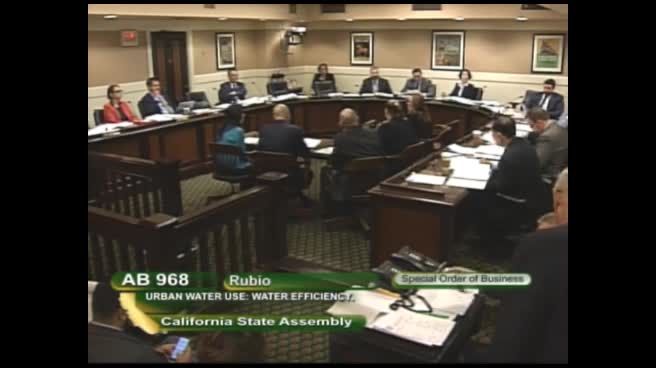 11MIN
Assembly Standing Committee on Water, Parks, and Wildlife


Bill Co-Author(s):





