AB 1669: Urban water conservation standards and use reporting.
- Session Year: 2017-2018
- House: Assembly
- Latest Version Date: 2017-04-18
(1)Existing law requires the state to achieve a 20% reduction in urban per capita water use in California by December 31, 2020. Existing law requires each urban retail water supplier to develop urban water use targets and an interim urban water use target, as specified.
This bill would require the State Water Resources Control Board, in consultation with the Department of Water Resources, to adopt long-term standards for urban water conservation and water use by May 20, 2021. The bill would authorize the board, in consultation with the department, to adopt interim standards for urban water conservation and water use by emergency regulation. The bill would require the board, before adopting an emergency regulation, to provide at least 60 days for the public to review and comment on the proposed regulation and would require the board to hold a public hearing. The bill would authorize a court or public entity to hold a person civilly liable in an amount not to exceed $10,000 for a violation of a regulation adopted under these provisions, unless the regulation provides otherwise.
The bill would also authorize the board to issue a regulation or informational order requiring a distributor of a public water supply to submit information relating to water production, water use, or water conservation.
(2)Existing law establishes procedures for reconsideration and amendment of specified decisions and orders of the board. Existing law authorizes any party aggrieved by a specified decision or order of the board to file, not later than 30 days from the date of final board action, a petition for writ of mandate for judicial review of the decision or order.
This bill would apply these procedures to decisions and orders of the board issued pursuant to the provisions described in paragraph (1), including existing provisions and those added by this bill.
(3)Existing law authorizes the board to issue a cease and desist order in response to a violation or threatened violation of certain requirements, including specified emergency regulations adopted by the board. Under existing law, a person who violates a cease and desist order of the board may be liable for each day in which the violation occurs, as specified. Revenue generated from these penalties is deposited in the Water Rights Fund. The moneys in the Water Rights Fund are available, upon appropriation by the Legislature, for, among other things, the administration of the boards water rights program.
This bill would authorize the board to issue a cease and desist order in response to a violation or threatened violation of any regulation adopted by the board.
Existing law requires the state to achieve a 20% reduction in urban per capita water use on or before December 31, 2020, and to make incremental progress toward that state target by reducing urban per capita water use by at least 10% on or before December 31, 2015.This bill, on or before January 1, 2019, would require the State Water Resources Control Board, in consultation with the Department of Water Resources and other appropriate state agencies, to establish and adopt a process to increase urban water use efficiency through incremental urban water use efficiency standards and in that regard to establish an urban water use efficiency standard to be achieved by urban water suppliers by January 1, 2025. The bill would require the state board to review and consider updates to the urban water use efficiency standard every 5 years.Existing law requires the state to achieve a 20% reduction in urban per capita water use on or before December 31, 2020, and to make incremental progress toward that state target by reducing urban per capita water use by at least 10% on or before December 31, 2015.
This bill, on or before January 1, 2019, would require the State Water Resources Control Board, in consultation with the Department of Water Resources and other appropriate state agencies, to establish and adopt a process to increase urban water use efficiency through incremental urban water use efficiency targets standards and in that regard to establish an urban water use efficiency target standard to be achieved by the state urban water suppliers by January 1, 2025. The bill would require the state board to update its review and consider updates to the urban water use efficiency target standard every 5 years.
Existing law requires the state to achieve a 20% reduction in urban per capita water use on or before December 31, 2020, and to make incremental progress toward that state target by reducing urban per capita water use by at least 10% on or before December 31, 2015.
This bill, on or before January 1, 2019, would require the State Water Resources Control Board, in consultation with the Department of Water Resources and other appropriate state agencies, to establish and adopt a process to increase urban water use efficiency through incremental urban water use efficiency targets and in that regard to establish an urban water use efficiency target to be achieved by the state by January 1, 2025. The bill would require the state board to update its urban water use efficiency target every 5 years.
(a)From and after the publication or posting of any ordinance or resolution pursuant to Section 376, a violation of a requirement of a water conservation program adopted pursuant to Section 376 is a misdemeanor. A person convicted under this subdivision shall be punished by imprisonment in the county jail for not more than 30 days, or by a fine not exceeding one thousand dollars ($1,000), or by both.
(b)A court or public entity may hold a person civilly liable in an amount not to exceed ten thousand dollars ($10,000) for a violation of any of the following:
(1)An ordinance or resolution adopted pursuant to Section 376.
(2)An emergency A regulation adopted by the board under Section 1058.5, 1058.5 or Chapter 9 (commencing with Section 10609) of Part 2.55 of Division 6, unless the board regulation provides that it cannot be enforced under this section. section or provides for a lesser applicable penalty.
(c)Commencing on the 31st day after the public entity notified a person of a violation described in subdivision (b), the person additionally may be civilly liable in an amount not to exceed ten thousand dollars ($10,000) plus five hundred dollars ($500) for each additional day on which the violation continues.
(d)Remedies prescribed in this section are cumulative and not alternative, except that no liability shall be recoverable under this section for any violation of paragraph (2) of subdivision (b) if the board has filed a complaint pursuant to Section 1846 alleging the same violation.
(e)A public entity may administratively impose the civil liability described in subdivisions (b) and (c) after providing notice and an opportunity for a hearing. The public entity shall initiate a proceeding under this subdivision by a complaint issued pursuant to Section 377.5. The public entity shall issue the complaint at least 30 days before the hearing on the complaint and the complaint shall state the basis for the proposed civil liability order.
(f)(1)In determining the amount of civil liability to assess, a court or public entity shall take into consideration all relevant circumstances, including, but not limited to, the nature and persistence of the violation, the extent of the harm caused by the violation, the length of time over which the violation occurs, and any corrective action taken by the violator.
(2)The civil liability calculated pursuant to paragraph (1) for the first violation of subdivision (b) by a residential water user shall not exceed one thousand dollars ($1,000) except in extraordinary situations where the court or public entity finds all of the following:
(A)The residential user had actual notice of the requirement found to be violated.
(B)The conduct was intentional.
(C)The amount of water involved was substantial.
(g)Civil liability imposed pursuant to this section shall be paid to the public entity and expended solely for the purposes of this chapter.
(h)An order setting administrative civil liability shall become effective and final upon issuance of the order and payment shall be made. Judicial review of any final order shall be pursuant to Section 1094.5 of the Code of Civil Procedure.
(i)In addition to the remedies prescribed in this section, a public entity may enforce water use limitations established by an ordinance or resolution adopted pursuant to this chapter, or as otherwise authorized by law, by a volumetric penalty in an amount established by the public entity.
SEC. 2.Section 1058.5 of the Water Code is amended to read:1058.5.(a)This section applies to any emergency regulation adopted by the board for which the board makes both of the following findings:
(1)The emergency regulation is adopted to prevent the waste, unreasonable use, unreasonable method of use, or unreasonable method of diversion, of water, to promote water recycling or water conservation, to require curtailment of diversions when water is not available under the diverters priority of right, or in furtherance of any of the foregoing, to require reporting of diversion or use or the preparation of monitoring reports.
(2)The emergency regulation is adopted in response to conditions which exist, or are threatened, in a critically dry year immediately preceded by two or more consecutive below normal, dry, or critically dry years or during a period for which the Governor has issued a proclamation of a state of emergency under the California Emergency Services Act (Chapter 7 (commencing with Section 8550) of Division 1 of Title 2 of the Government Code) based on drought conditions.
(b)Notwithstanding Sections 11346.1 and 11349.6 of the Government Code, any findings of emergency adopted by the board, in connection with the adoption of an emergency regulation under this section, are not subject to review by the Office of Administrative Law.
(c)An emergency regulation adopted by the board under this section may remain in effect for up to 270 days, one year, as determined by the board, and is deemed repealed immediately upon a finding by the board that due to changed conditions it is no longer necessary for the regulation to remain in effect. An emergency regulation adopted by the board under this section may be renewed if the board determines that the conditions specified in paragraph (2) of subdivision (a) are still in effect.
(d)In addition to any other applicable civil or criminal penalties, any person or entity who violates a regulation adopted by the board pursuant to this section is guilty of an infraction punishable by a fine of up to five hundred dollars ($500) for each day in which the violation occurs.
(e)(1)Notwithstanding subdivision (b) of Section 1551 or subdivision (e) of Section 1848, a civil liability imposed under Chapter 12 (commencing with Section 1825) of Part 2 of Division 2 by the board or a court for a violation of an emergency conservation regulation adopted pursuant to this section shall be deposited, and separately accounted for, in the Water Rights Fund. Funds deposited in accordance with this subdivision shall be available, upon appropriation, for water conservation activities and programs.
(2)For purposes of this subdivision, an emergency conservation regulation means an emergency regulation that requires an end user of water, a water retailer, or a water wholesaler to conserve water or report to the board on water conservation. Water conservation includes restrictions or limitations on particular uses of water or a reduction in the amount of water used or served, but does not include curtailment of diversions when water is not available under the diverters priority of right or reporting requirements related to curtailments.
SEC. 3.Section 1120 of the Water Code is amended to read:1120.This chapter applies to any decision or order issued under this part or Section 275, Part 2 (commencing with Section 1200), Part 2 (commencing with Section 10500) of Division 6, Part 2.55 (commencing with Section 10608) of Division 6, or Chapter 11 (commencing with Section 10735) of Part 2.74 of Division 6, Article 7 (commencing with Section 13550) of Chapter 7 of Division 7, or the public trust doctrine.
SEC. 4.Section 1831 of the Water Code is amended to read:1831.(a)When the board determines that any person is violating, or threatening to violate, any requirement described in subdivision (d), the board may issue an order to that person to cease and desist from that violation.
(b)The cease and desist order shall require that person to comply forthwith or in accordance with a time schedule set by the board.
(c)The board may issue a cease and desist order only after notice and an opportunity for hearing pursuant to Section 1834.
(d)The board may issue a cease and desist order in response to a violation or threatened violation of any of the following:
(1)The prohibition set forth in Section 1052 against the unauthorized diversion or use of water subject to this division.
(2)Any term or condition of a permit, license, certification, or registration issued under this division.
(3)Any decision or order of the board issued under this part, Section 275, Chapter 9 (commencing with Section 10609) of Part 2.55 of Division 6, or Chapter 11 (commencing with Section 10735) of Part 2.74 of Division 6, or Article 7 (commencing with Section 13550) of Chapter 7 of Division 7, in which decision or order the person to whom the cease and desist order will be issued, or a predecessor in interest to that person, was named as a party directly affected by the decision or order.
(4)A regulation adopted under Section 1058.5. by the board.
(5)Any extraction restriction, limitation, order, or regulation adopted or issued under Chapter 11 (commencing with Section 10735) of Part 2.74 of Division 6.
(6)Any diversion or use of water for cannabis cultivation if any of the following applies:
(A)A license is required, but has not been obtained, under Article 6 (commencing with Section 19331) of Chapter 3.5 of Division 8 of the Business and Professions Code.
(B)The diversion is not in compliance with an applicable limitation or requirement established by the board or the Department of Fish and Wildlife under Section 13149.
(C)The diversion or use is not in compliance with a requirement imposed under subdivision (d) or (e) of Section 19332.2 of the Business and Professions Code.
(e)This article does not alter the regulatory authority of the board under other provisions of law.
SEC. 5.Section 10608.20 of the Water Code is amended to read:10608.20.(a)(1)Each urban retail water supplier shall develop urban water use targets and an interim urban water use target by July 1, 2011. Urban retail water suppliers may elect to determine and report progress toward achieving these targets on an individual or regional basis, as provided in subdivision (a) of Section 10608.28, and may determine the targets on a fiscal year or calendar year basis.
(2)It is the intent of the Legislature that the urban water use targets described in paragraph (1) cumulatively result in a 20-percent reduction from the baseline daily per capita water use by December 31, 2020.
(b)An urban retail water supplier shall adopt one of the following methods for determining its urban water use target pursuant to subdivision (a):
(1)Eighty percent of the urban retail water suppliers baseline per capita daily water use.
(2)The per capita daily water use that is estimated using the sum of the following performance standards:
(A)For indoor residential water use, 55 gallons per capita daily water use as a provisional standard. Upon completion of the departments 2016 report to the Legislature pursuant to Section 10608.42, this standard may be adjusted by the Legislature by statute.
(B)For landscape irrigated through dedicated or residential meters or connections, water efficiency equivalent to the standards of the Model Water Efficient Landscape Ordinance set forth in Chapter 2.7 (commencing with Section 490) of Division 2 of Title 23 of the California Code of Regulations, as in effect the later of the year of the landscapes installation or 1992. An urban retail water supplier using the approach specified in this subparagraph shall use satellite imagery, site visits, or other best available technology to develop an accurate estimate of landscaped areas.
(C)For commercial, industrial, and institutional uses, a 10-percent reduction in water use from the baseline commercial, industrial, and institutional water use by 2020.
(3)Ninety-five percent of the applicable state hydrologic region target, as set forth in the states draft 20x2020 Water Conservation Plan (dated April 30, 2009). If the service area of an urban water supplier includes more than one hydrologic region, the supplier shall apportion its service area to each region based on population or area.
(4)A method that shall be identified and developed by the department, through a public process, and reported to the Legislature no later than December 31, 2010. The method developed by the department shall identify per capita targets that cumulatively result in a statewide 20-percent reduction in urban daily per capita water use by December 31, 2020. In developing urban daily per capita water use targets, the department shall do all of the following:
(A)Consider climatic differences within the state.
(B)Consider population density differences within the state.
(C)Provide flexibility to communities and regions in meeting the targets.
(D)Consider different levels of per capita water use according to plant water needs in different regions.
(E)Consider different levels of commercial, industrial, and institutional water use in different regions of the state.
(F)Avoid placing an undue hardship on communities that have implemented conservation measures or taken actions to keep per capita water use low.
(c)If the department adopts a regulation pursuant to paragraph (4) of subdivision (b) that results in a requirement that an urban retail water supplier achieve a reduction in daily per capita water use that is greater than 20 percent by December 31, 2020, an urban retail water supplier that adopted the method described in paragraph (4) of subdivision (b) may limit its urban water use target to a reduction of not more than 20 percent by December 31, 2020, by adopting the method described in paragraph (1) of subdivision (b).
(d)The department shall update the method described in paragraph (4) of subdivision (b) and report to the Legislature by December 31, 2014. An urban retail water supplier that adopted the method described in paragraph (4) of subdivision (b) may adopt a new urban daily per capita water use target pursuant to this updated method.
(e)An urban retail water supplier shall include in its urban water management plan due in 2010 pursuant to Part 2.6 (commencing with Section 10610) the baseline daily per capita water use, urban water use target, interim urban water use target, and compliance daily per capita water use, along with the bases for determining those estimates, including references to supporting data.
(f)When calculating per capita values for the purposes of this chapter, an urban retail water supplier shall determine population using federal, state, and local population reports and projections.
(g)An urban retail water supplier may update its 2020 urban water use target in its 2015 urban water management plan required pursuant to Part 2.6 (commencing with Section 10610).
(h)(1)The department, through a public process and in consultation with the California Urban Water Conservation Council, shall develop technical methodologies and criteria for the consistent implementation of this part, including, but not limited to, both of the following:
(A)Methodologies for calculating base daily per capita water use, baseline commercial, industrial, and institutional water use, compliance daily per capita water use, gross water use, service area population, indoor residential water use, and landscaped area water use.
(B)Criteria for adjustments pursuant to subdivisions (d) and (e) of Section 10608.24.
(2)The department shall post the methodologies and criteria developed pursuant to this subdivision on its Internet Web site, and make written copies available, by October 1, 2010. An urban retail water supplier shall use the methods developed by the department in compliance with this part.
(i)(1)The department shall adopt regulations for implementation of the provisions relating to process water in accordance with subdivision (l) of Section 10608.12, subdivision (e) of Section 10608.24, and subdivision (d) of Section 10608.26.
(2)The initial adoption of a regulation authorized by this subdivision is deemed to address an emergency, for purposes of Sections 11346.1 and 11349.6 of the Government Code, and the department is hereby exempted for that purpose from the requirements of subdivision (b) of Section 11346.1 of the Government Code. After the initial adoption of an emergency regulation pursuant to this subdivision, the department shall not request approval from the Office of Administrative Law to readopt the regulation as an emergency regulation pursuant to Section 11346.1 of the Government Code.
(j)(1)An urban retail water supplier is granted an extension to July 1, 2011, for adoption of an urban water management plan pursuant to Part 2.6 (commencing with Section 10610) due in 2010 to allow the use of technical methodologies developed by the department pursuant to paragraph (4) of subdivision (b) and subdivision (h). An urban retail water supplier that adopts an urban water management plan due in 2010 that does not use the methodologies developed by the department pursuant to subdivision (h) shall amend the plan by July 1, 2011, to comply with this part.
(2)An urban wholesale water supplier whose urban water management plan prepared pursuant to Part 2.6 (commencing with Section 10610) was due and not submitted in 2010 is granted an extension to July 1, 2011, to permit coordination between an urban wholesale water supplier and urban retail water suppliers.
(k)Nothing in this part limits the authority of the board to adopt standards for water conservation that are in addition to, or exceed, the standards provided under this part.
SEC. 6.Chapter 9 (commencing with Section 10609) is added to Part 2.55 of Division 6 of the Water Code, to read:9.Urban Water Conservation Standards and Use Reporting10609.(a)The board, in consultation with the department, shall adopt long-term standards for urban water conservation and water use by May 20, 2021. The standards shall include, but are not limited to, standards for all of the following:
(1)Indoor residential water use.
(2)Outdoor irrigation in connection with domestic, industrial, institutional, or commercial water use.
(3)Industrial, institutional, and commercial water use.
(b)The board, in consultation with the department, may adopt interim standards for urban water conservation and water use pending the adoption of long-term standards pursuant to subdivision (a). The board, in consultation with the department, may update the interim standards as it determines to be reasonably necessary for purposes of this section, except that the board may not set new or revised standards under this subdivision after the board adopts long-term standards pursuant to subdivision (a) or May 20, 2021, whichever occurs first.
(c)(1)Long-term standards, and any amendments to those standards, adopted by the board pursuant to subdivision (a) shall be adopted in accordance with the regular rulemaking process provided for in Chapter 3.5 (commencing with Section 11340) of Part 1 of Division 3 of Title 2 of the Government Code.
(2)(A)Except for long-term standards, and any amendment to those standards, adopted pursuant to subdivision (a), regulations adopted by the board pursuant to this chapter, and any amendment or subsequent adjustment to those regulations, shall be adopted by the board as emergency regulations, in accordance with Chapter 3.5 (commencing with Section 11340) of Part 1 of Division 3 of Title 2 of the Government Code. The adoption of regulations pursuant to this paragraph shall be deemed an emergency and shall be considered by the Office of Administrative Law as necessary for the immediate preservation of the public peace, health, safety, and general welfare. Notwithstanding Chapter 3.5 (commencing with Section 11340) of Part 1 of Division 3 of Title 2 of the Government Code, an emergency regulation adopted by the board pursuant to this paragraph shall remain in effect until revised by the board.
(B)Before adopting an emergency regulation pursuant to this paragraph, the board shall provide at least 60 days for the public to review and comment on the proposed regulation and shall hold a public hearing.
(d)Notwithstanding Section 15300.2 of Title 14 of the California Code of Regulations, an action of the board taken under this chapter shall be deemed to be a Class 8 action, within the meaning of Section 15308 of Title 14 of the California Code of Regulations, if the action does not involve relaxation of existing water conservation or water use standards.
10609.2.The board may issue a regulation or informational order requiring a distributor of a public water supply, as that term is used in Section 350, to submit information relating to water production, water use, or water conservation.
SECTION 1.Section 10608.18 is added to the Water Code, to read:10608.18.On or before January 1, 2019, the board, in consultation with the department and other appropriate state agencies, shall establish and adopt a process to increase urban water use efficiency through incremental urban water use efficiency standards and in that regard shall establish an urban water use efficiency standard to be achieved by urban water suppliers by January 1, 2025. Every five years, the board shall review and consider updates to the urban water use efficiency standard for the upcoming five years.On or before January 1, 2019, the board, in consultation with the department and other appropriate state agencies, shall establish and adopt a process to increase urban water use efficiency through incremental urban water use efficiency standards and in that regard shall establish an urban water use efficiency standard to be achieved by urban water suppliers by January 1, 2025. Every five years, the board shall review and consider updates to the urban water use efficiency standard for the upcoming five years.
SECTION 1.Section 10608.51 is added to the Water Code, to read:10608.51.On or before January 1, 2019, the board, in consultation with the department and other appropriate state agencies, shall establish and adopt a process to increase urban water use efficiency through incremental urban water use efficiency targets and in that regard shall establish an urban water use efficiency target to be achieved by the state by January 1, 2025. Every five years, the board shall update its urban water use efficiency target for the upcoming five years.On or before January 1, 2019, the board, in consultation with the department and other appropriate state agencies, shall establish and adopt a process to increase urban water use efficiency through incremental urban water use efficiency targets and in that regard shall establish an urban water use efficiency target to be achieved by the state by January 1, 2025. Every five years, the board shall update its urban water use efficiency target for the upcoming five years.
|
Date
|
Status
|
|---|---|
| Feb 1, 2018 | From committee: Filed with the Chief Clerk pursuant to Joint Rule 56. |
| Jan 31, 2018 | Died pursuant to Art. IV, Sec. 10(c) of the Constitution. |
| May 26, 2017 | In committee: Held under submission. |
| May 10, 2017 | In committee: Set, first hearing. Referred to APPR. suspense file. |
| Apr 26, 2017 | From committee: Do pass and re-refer to Com. on APPR. (Ayes 9. Noes 6.) (April 25). Re-referred to Com. on APPR. |
| Apr 19, 2017 | Re-referred to Com. on W.,P., & W. |
| Apr 18, 2017 | From committee chair, with author's amendments: Amend, and re-refer to Com. on W.,P., & W. Read second time and amended. |
| Mar 23, 2017 | Re-referred to Com. on W.,P., & W. |
| Mar 22, 2017 | From committee chair, with author's amendments: Amend, and re-refer to Com. on W.,P., & W. Read second time and amended. |
| Mar 16, 2017 | Referred to Com. on W.,P., & W. |
| Feb 19, 2017 | From printer. May be heard in committee March 21. |
| Feb 17, 2017 | Read first time. To print. |
|
Date
|
Description
|
Location
|
Votes
|
|
|---|---|---|---|---|
| Apr 25, 2017 | Do pass and be re-referred to the Committee on [Appropriations] | Assembly Standing Committee on Water, Parks, and Wildlife |
Passed |
This list shows positions taken on this bill by organizations on the date displayed, which is linked to the original source.
Positions by individuals are not included.
Date of Hearing: May 10, 2017
ASSEMBLY COMMITTEE ON APPROPRIATIONS
Lorena Gonzalez Fletcher, Chair
ABPCA Bill Id:AB 1669
Author:(Friedman) – As Amended Ver:April 18, 2017
Policy Committee: | Water, Parks and Wildlife | Vote: | 9 - 6 |
|
| ||
|
|
Urgency: No State Mandated Local Program: No Reimbursable: No
SUMMARY:
This bill requires the State Water Resources Control Board (SWRCB), in consultation with the Department of Water Resources (DWR), to adopt long-term standards for urban water conservation and water use by May 20, 2021. Specifically, this bill:
- Requires the long-term standard to include indoor residential water use, outdoor irrigation water use, as specified, and industrial, institutional and commercial water use.
- Allows the SWRCB, in consultation with the DWR, to adopt and update interim standards for urban water conservation and water use. Prohibits the SWRCB from setting new or revised standards after the board adopts long-term standards.
- Requires the long-term standards be adopted in accordance with the regular rulemaking process. Requires the interim standards and any amendments or adjustments to those regulations be adopted as emergency regulations.
- Provides that a person who violates a long-term standard regulation may be held civilly liable for up to $10,000.
- Extends a drought or water waste emergency regulation adopted by the SWRCB from 270 days to one year.
- Allows any decision or order allowed under existing urban water conservation law and under the long-term standards that could be adopted under this bill to be subject to judicial review.
- Allows the SWRCB to issue a cease and desist order to a person violating or threatening to violate a long-term standard that could be adopted under this bill.
FISCAL EFFECT:
- Increased annual ongoing SWRCB GF costs of $670,000 for the development of long-term regulations.
- Unknown DWR costs (GF), likely in the $6.5 to $7 million range to range to develop standards, performance measures, and provide technical assistance.
COMMENTS:
- Purpose. According to the author, "California needs a new framework for water use efficiency standards that is fair and flexible and addresses each of the concerns expressed by water suppliers regarding the state’s previous conservation efforts. The new standards should recognize that each community has unique water needs and savings potential, but require everyone to do their part to ensure there is enough water to go around. They need to go beyond the existing 20 percent by 2020 requirement, because the latest research demonstrates that our potential for affordably realizing efficiency gains is much greater than it was when that legislation was enacted 7 years ago." This bill is identical to the recently released budget Trailer Bill Language.
- Background. California experienced the worst drought in modern times from 2012-2016, with the first four years having been estimated to be the driest four-year period in the last 450 years. While the most recent drought was historic, current climate change models predict that severe drought will become a more common occurrence in the future.
The drought had significant impacts on the environment, agricultural water supply, and urban water supply. The years 2014 and 2015 were two of the driest years on record. During the drought, the State Water Project and federal Central Valley Project, which supply water to more than 25 million Californians and 3 million acres of agricultural land, provided limited water deliveries with approximately 15% and zero deliveries respectively in 2015.
In January of 2014, the Governor issued an executive order declaring a drought state of emergency and requesting a voluntary 20% reduction in urban potable water use. For the first time in the state’s history, the Governor issued an executive order in April of 2015, requiring SWRC to implement mandatory restrictions to achieve a 25% statewide reduction in urban potable use, over 2013 levels of use. There are approximately 410 urban water suppliers that serve approximately 90% of the population of the state.
In May of 2015, SWRCB adopted an emergency regulation placing each urban water supplier in a conservation tier ranging between 4% and 36%. In May of 2016, SWRCB adopted an emergency regulation that replaced the percentage reduction requirement with a localized “stress test” requiring urban water suppliers to ensure a three-year supply of water to their customers under drought conditions. The “stress test” requirement mandated monthly reporting by water suppliers to the SWRCB. For the most part, all actions associated with the 2012-2106 drought were ended when the Governor declared the drought emergency over on April 7, 2017.
The actions taken by the SWRCB in 2015 and 2016 were criticized by some as not recognizing past efforts to use water more efficiently, not supporting investments in drought resilient supply, and in some instances not being applied in a way that would produce water savings that could reasonably benefit other regions of the state. The 2016 “stress test” approach was also criticized as not being a meaningful enough step to prevent shortages should 2017 have become another dry year. There was widespread agreement that there could be a better approach moving forward for how the state prepares for and responds to future drought.
In May of 2016, the Governor issued an executive order on “Making Water Conservation a Way of Life.” In broad terms the executive order initiated a public process of five state departments, notably the DWR and the SWRCB, to develop a conservation framework that would advance long-term water use efficiency and develop a meaningful drought response tool.
- Progressing but No Consensus. While there is widespread agreement that progress must be made in the areas of long-term water use efficiency and drought response, there is not yet consensus on the specific requirements that will best achieve progress in each area.
Currently, there are seven policy bills and a budget trailer bill that directly relate to long-term efficiency and drought response. These “Making Water Conservation a Way of Life” bills take several different approaches to the development of long-term efficiency and drought response policy. Because long-term efficiency impacts what the future drought response will be, the two subjects are closely related but are generally addressed separately in the different bills. There is disagreement among the stakeholder community as to whether the policy should be heard through the legislative process or be addressed in a budget trailer bill. There is also disagreement over the extent to which the policies should be developed in legislation or through the regulatory process.
- Policy Through Regulation. This bill gives SWRCB broad authority to develop long-term standards for urban water conservation and water use without Legislative input.
Existing law excludes recycled water from water budget calculation on water use reduction. AB 968 (Rubio) and AB 869 (Rubio) will continue that exemption. There have been other proposals that would require recycled water to be treated the same as all other sources of water. The “Making Water Conservation a Way of Life” Report treated recycled water as something between the level of efficiency required for other potable sources of water and exempting it. This bill is silent on how the regulations could treat recycled water, but appears to leave the development of the standard solely up to the SWRCB in consultation with the DWR. Recycled water is an evolving source of water.
Existing law allows for adjustments to be made from the target. AB 968 (Rubio) establishes a different adjustment from target process. This bill leaves the question of the inclusion of adjustments solely up to SWRCB.
- Related Legislation. AB 968 (Rubio) establishes a new 2025 water use efficiency requirement for urban retail water suppliers. This bill is pending in this Committee.
AB 1323 (Weber), requires a stakeholder workgroup to be convened no later than February 1, 2018, to develop, evaluate, and recommend proposals for establishing new water use targets for urban water suppliers. This bill is pending in this Committee.
AB 869 (Rubio), 2017, excludes recycled water from the calculation of any water use or water efficiency target established after 2020. This bill is pending in this Committee.
Analysis Prepared by: Jennifer Galehouse / APPR. / (916) 319-2081
Date of Hearing: April 25, 2017
ASSEMBLY COMMITTEE ON WATER, PARKS, AND WILDLIFE
Eduardo Garcia, Chair
ABPCA Bill Id:AB 1669 (
Author:Friedman) – As Amended Ver:April 18, 2017
SUBJECT: Urban water conservation standards and use reporting
SUMMARY: Requires the State Water Resources Control Board (SWRCB) in consultation with the Department of Water Resources (DWR) to adopt long-term standards for urban water conservation and water use by May 20, 2021. Specifically, this bill:
- Specifies that the long-term standard shall include indoor residential water use, outdoor irrigation water use, as specified; and industrial, institutional and commercial water use.
- Allows the SWRCB, in consultation with the DWR, to adopt and update interim standards for urban water conservation and water use. Prohibits the SWRCB from setting new or revised standards after the board adopts long-term standards.
- Requires the long-term standards be adopted in accordance with the regular rulemaking process. Requires the interim standards and any amendments or adjustments to those regulations be adopted as emergency regulations.
- Provides that a person who violates a long-term standard regulation may be held civilly liable in an amount not to exceed ten thousand dollars.
- Extends a drought or water waste emergency regulation adopted by the SWRCB from 270 days to one year.
- Allows any decision or order allowed under existing urban water conservation law and under the long-term standards that could be adopted under this bill to be subject to judicial review.
- Allows the SWRCB to issue a cease and desist order to a person violating or threatening to violate a long-term standard that could be adopted under this bill.
EXISTING LAW:
- Declares that because of the conditions prevailing in this state, the general welfare requires that the water resources of the state be put to beneficial use to the fullest extent of which they are capable, and that the waste or unreasonable use or unreasonable method of use of water be prevented, and that the conservation of such waters is to be excercised with a view to the reasonable and beneficial use thereof in the interest of the people and for the public welfare.
- Requires a 20 percent reduction in urban per capita water use on or before December 31, 2020.
- Requires each urban retail water supplier to develop an urban water use target based on one of the following methods:
- Water use of 80 percent of the urban retail water supplier’s baseline per capita water use.
- A water budget based on indoor use, outdoor use, and commercial, industrial and institutional uses.
- Water use of 95 percent of the applicable state hydrologic region target.
- A method developed by the DWR.
- Defines “base daily per capita water use” as the average of gross water use over a period of time that is no longer than 15 continuous years and no shorter than five continuous years beginning no earlier than December 31, 1989, and ending no later than December 31, 2010. Establishes the standard period to be the 10 continuous years from December 31, 2004, through December 31, 2010. Allows five additional years for an urban water supplier that meets at least 10 percent of its 2008 retail demand through recycled water.
- Defines “gross water use” as the total volume of water entering the distribution system of an urban retail water supplier, excluding among other things, recycled water.
- Defines “recycled water” as water, which as a result of treatment of waste, is suitable for a direct beneficial use that would not otherwise occur, that is used to offset potable demand.
- Requires the SWRCB to adopt rules requiring an urban retail water suppliers to meet performance standards for the volume of water loss no later than July 1, 2020.
FISCAL EFFECT: Unknown.
COMMENTS: Requires the SWRCB, in consultation with the DWR, to adopt long-term standards for urban water conservation and water use by May 20, 2021.
Author’s Statement.
Water powers California’s economy, sustains our communities, and nourishes our environment. But we can no longer take it for granted. California's water supply is under intense pressure from climate change, increasing population and aging infrastructure. The financial demands from communities around the state for additional water and wastewater infrastructure currently exceed the available state and federal budgetary resources. Thus, it is essential that all California communities use existing water supplies as efficiently as possible.
The “20x2020” Water Conservation Act of 2009, established the need for long term conservation goals and set a statewide goal of reducing urban water demand by 20 percent by 2020. The implementation of “20x2020” also highlighted concerns about the fairness of applying a singular target to water suppliers with diverse local climates, land uses, and past investments in conservation. Additionally, percentage reduction targets, like those required by 20x2020 and the 2015 emergency regulations by the State Water Resources Control Board, work to reduce overall water use, but don’t ensure water is being used efficiently.
California needs a new framework for water use efficiency standards that is fair and flexible and addresses each of the concerns expressed by water suppliers regarding the state’s previous conservation efforts. The new standards should recognize that each community has unique water needs and savings potential, but require everyone to do their part to ensure there is enough water to go around. They need to go beyond the existing 20 percent by 2020 requirement, because the latest research demonstrates that our potential for affordably realizing efficiency gains is much greater than it was when that legislation was enacted 7 years ago.
Governor Brown recognizes the need to strengthen standards for the next round of water use targets as detailed in the public review draft report, “Making Water Conservation a California Way of Life: Implementing Executive Order B-37-16” (November 2016), that was prepared by state agencies in response to his Executive Order B-37-16 from May 2016.
An urban conservation framework needs to be based on local control and local conditions. Each water supplier should have a customized water use target that takes microclimates and land use into account. Targets should be based on strengthened standards in three areas: indoor residential water use, outdoor irrigation for all customers, and water distribution system leaks. Once the local target has been set, water suppliers will be able to decide how to meet it.
Background. Water Shortage Response In the Recent Drought. California experienced the worst drought in modern times from 2012-2016, with the first four years having been estimated to be the driest four-year period in the last 450 years. While the most recent drought was historic, current climate change models predict that severe drought will become a more common occurrence in the future.
The drought had significant impacts on the environment, agricultural water supply, and urban water supply. 2014 and 2015 were two of the driest years on record. During the drought, the State Water Project and federal Central Valley Project, which supply water to more than 25 million Californians and 3 million acres of agricultural land, provided limited water deliveries with approximately 15% and zero deliveries respectively in 2015.
In January of 2014, the Governor issued an executive order declaring a drought state of emergency and requesting a voluntary 20% reduction in urban potable water use. For the first time in the state’s history, the Governor issued an executive order in April of 2015, requiring the State Water Resources Control Board (SWRCB) implement mandatory restrictions to achieve a 25% statewide reduction in urban potable use, over 2013 levels of use. There are approximately 410 urban water suppliers that serve approximately 90 percent of the population of the state.
In May of 2015, the SWRCB adopted an emergency regulation placing each urban water supplier in a conservation tier ranging between 4% and 36%. In May of 2016, the SWRCB adopted an emergency regulation that replaced the percentage reduction requirement with a localized “stress test” requiring urban water suppliers to ensure a three-year supply of water to their customers under drought conditions. The “stress test” requirement mandated monthly reporting by water suppliers to the SWRCB. For the most part, all actions associated with the 2012-2106 drought were ended when the Governor declared the drought emergency over on April 7, 2017.
Lessons Learned From the Drought. The response to the drought was unprecedented because the severity of the drought was unprecedented. It was evident, from the necessity to have an emergency response, that the water supply system was not as prepared as it needed to be for a drought of the severity experienced in 2012-2016. There is widespread agreement that the SWRCB having to step in on an emergency basis is not an ideal plan for drought response. There is also widespread recognition that climate change will cause the drought of 2012-2016 to become a more typical event in the future.
The actions taken by the SWRCB in 2015 and 2016, were criticized by some, as not recognizing past efforts to use water more efficiently, supporting investments in drought resilient supply, and in some instances not being applied in a way that would produce water savings that could reasonably benefit other regions of the state. The 2016 “stress test” approach was also criticized as not being a meaningful enough step to prevent shortages should 2017 have become another dry year. There was widespread agreement that there could be a better approach moving forward for how the state is prepared for and responds to future drought.
In May of 2016, the Governor issued an executive order on “making water conservation a way of life.” In broad terms the executive order initiated a public process of five state departments, notably the DWR and the SWRCB, to develop a conservation framework that would advance long-term water use efficiency and develop a meaningful drought response tool.
Specifically in relation to drought response, the May 2016 executive order required the DWR to strengthen the requirements for drought response. It required that a WSCA include adequate actions to respond to droughts lasting at least five years, and that the WSCA remain customized for local conditions while also allowing for them to be quickly utilized during drought.
Progressing but No Consensus. While there is widespread agreement that progress must be made in the areas of long-term water use efficiency and drought response, there is not yet consensus on the specific requirements that will best achieve progress in each area. As of this writing, there are seven policy bills and a budget trailer bill that directly relate to long-term efficiency and drought response. These “making water conservation a way of life” bills take several different approaches to the development of long-term efficiency and drought response policy. Because long-term efficiency impacts what future drought response will be, the two subjects are closely related but are generally addressed separately in the different bills. There is disagreement among the stakeholder community as to whether the policy should be heard through the legislative process or be addressed in a budget trailer bill. There is also disagreement over the extent to which the policies should be developed in legislation or through the regulatory process.
With the latest amendments, this bill closely aligns with the approach in the budget trailer bill on long-term efficiency. This bill is one approach, of several, to strengthen long-term water use efficiency. The general framework of all of the approaches to strengthen long-term efficiency is to require a baseline of water use that must be met, but permits the urban water supplier flexibility in how to meet that baseline. Beyond that general framework, this bill and the budget trailer bill differs from other approaches in several significant ways.
Policy Through Regulation. This bill would give the SWRCB broad authority to develop long-term standards for urban water conservation and water use. It would subject those standards to a potential court challenge. It, however does not put the legislature in the position of developing this significant water use policy. Where important and difficult questions would not be developed and resolved in the legislative process.
What Target Should be the Target? The current “20X2020” provided four options. Notably, AB 968 (Rubio), would maintain and enhance three of those options. The administration in the report it issued on “making water conservation a way of life”, selected one option the water budget option. The water budget in that report would be based on a standard indoor use statewide; a variable, outdoor water use standard depending on the local climate; and water loss through leaks. It would leave it to individual water suppliers to meet the budget. The language in this bill is similar to what was in the “making water conservation a way of life” report, but appears to include a required standard for industrial, institutional, and commercial water use. Water suppliers have questioned how outdoor standards will be developed, and have asked that the basis for those standards be validated prior to an outdoor standard being implemented. The industrial, institutional, and commercial use standard is not developed in the “making water conservation a way of life” report and questions remain if a water budget approach can work in this sector or if best practices would be more appropriate. AB 968 (Rubio) would require a task force to recommend water efficient measures for various segments of the industrial, institutional, and commercial water use sector.
How Should Recycled Water be Treated? Existing law excludes recycled water from water budget calculation on water use reduction. AB 968 (Rubio) and AB 869 (Rubio) would continue that exemption. There have been other proposals that would require recycled water to be treated the same as all other sources of water. The “making water conservation a way of life” plan treated recycled water as something between the level of efficiency required for other potable sources of water and exempting it. This bill is silent on how the regulations could treat recycled water, but would appear to leave the development of the standard solely up to the SWRCB in consultation with the DWR. Recycled water is an evolving source of water. The SWRCB, this year, will be coming out with uniform standards for the augmentation of surface water reservoirs with recycled water, and AB 574 (Quirk), 2017, would require the next step for recycled water becoming a potable source of water by December 31, 2021.
Adjustments to the Target? The existing “20x2020” law allows for adjustments to be made from the target. AB 968 (Rubio), 2017, would establish a different adjustment from target process. This bill would leave the questions of the inclusion of adjustments solely up to the water board.
Prior and Related Legislation.
- SB 7 x7 (Steinberg), Chapter 4, Statutes of 2009, Seventh Extraordinary Session, requires the state to achieve a 20 percent reduction in urban per capita water use by December 31, 2020, and promotes expanded development of sustainable water supplies at the regional level.
- AB 968 (Rubio), 2017, establishes a new 2025 water use efficiency requirement for urban retail water suppliers.
- AB 1323 (Weber), 2017, requires a stakeholder workgroup to be convened no later than February 1, 2018, to develop, evaluate, and recommend proposals for establishing new water use targets for urban water suppliers.
- AB 869 (Rubio), 2017, excludes recycled water from the calculation of any water use or water efficiency target established after 2020.
- AB 574 (Quirk), 2017, establishes new definitions for the use of recycled water and requires the SWRCB to develop uniform criteria for raw water augmentation of recycled water by December 31, 2021.
Supporting Arguments. As California grapples with the impacts of climate change on our water supply, it is imperative that we do all we can to use our existing supplies efficiently. This bill provides a long-term water efficiency plan for California’s future. While this bill does not explicitly address recycled water, it is critical to include recycled water use in targets. This bill reflects a fair and equitable approach to setting water use targets. It incorporates local conditions, including population and climate. And since it focuses on efficient use of water rather than arbitrary percentage reductions, water suppliers effectively receive credit for their precious investments in efficiency.
Opposing Arguments. Opponents maintain that policy as far-reaching and consequential as California’s long-term water use must be vetted through the full legislative process. Opponents do not support the authority this bill would grant the SWRCB in setting long-term water use standards. It is the proper role of the legislature at this time to craft long-term water use standards.
REGISTERED SUPPORT / OPPOSITION:
Support
California Coastkeeper Alliance
Ceres
Climate Resolve
Community Water Center
Environmental Justice Coalition for Water
Natural Resources Defense Council
Pacific Institute
WaterNow Alliance
Opposition
Association of California Water Agencies
Desert Water Agency
East Valley Water District
El Dorado Irrigation District
Analysis Prepared by: Ryan Ojakian / W., P., & W. /
Discussed in Hearing
 1H
Assembly Standing Committee on Appropriations
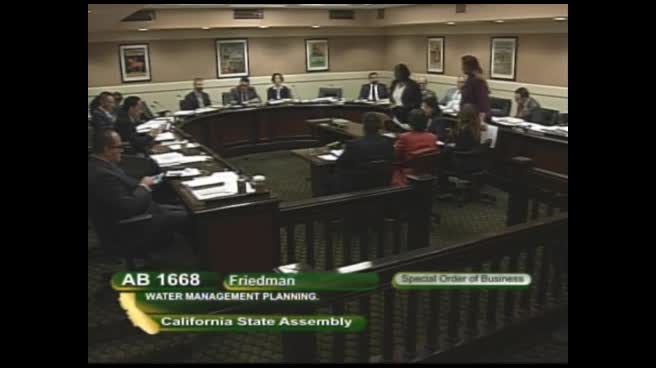 26MIN
Assembly Standing Committee on Water, Parks, and Wildlife
Bill Author

Bill Co-Author(s):
