AB 1734: Income taxes: credits: motion pictures.
- Session Year: 2017-2018
- House: Assembly
- Latest Version Date: 2018-05-25
The Personal Income Tax Law and the Corporation Tax Law allow various credits against the taxes imposed by those laws, including motion picture credits for taxable years beginning on or after January 1, 2016, to be allocated by the California Film Commission on or after July 1, 2015, and before July 1, 2020, subject to a computation and ranking of applicants based on a jobs ratio. Existing law allows the credit for the taxable year in which the commission issues a credit certificate for the qualified motion picture for the applicable percentage of all qualified expenditures, as defined, paid or incurred by the qualified taxpayer in all taxable years for that qualified motion picture. Existing law limits the aggregate amount of these credits allocated in each fiscal year to $330 million, through and including the 201920 fiscal year. year, except as provided. Existing law also requires an applicant for the credit to file an application that contains certain information.
This bill would establish similar credits under the Personal Income Tax Law and the Corporation Tax Law for taxable years beginning on or after January 1, 2020, to be allocated by the California Film Commission on or after July 1, 2020, and before July 1, 2025, except as provided. This bill would allow a credit in an amount equal to 20% or 25% of qualified expenditures up to $100,000,000, for the production of a qualified motion picture in this state, with additional credit amounts allowed, including for amounts equal to specified qualified expenditures and qualified wages relating to original photography outside the Los Angeles zone, as specified.
This bill would limit the aggregate amount of these new credits to be allocated in each fiscal year to $330 million plus the amount of any unused credit amounts for preceding fiscal years and attributable to existing motion picture credits, as specified. additional specified amounts. The bill, subject to a computation and ranking of applicants based on the jobs ratio, as defined, would require the California Film Commission to allocate credit amounts subject to specified categories of qualified motion pictures in 2 or more allocation periods per fiscal year beginning on or after July 1, 2020, and issue credit certificates. The bill would additionally require an applicant for the credit to include in the application the applicants written policy against unlawful harassment, as specified.
Existing law, for taxable years beginning on or after January 1, 2016, in lieu of the credits authorized under the Personal Income Tax Law and the Corporation Tax Law for qualified motion pictures described above, also allows application of the credit amount against qualified state sales and use taxes, as provided.
This bill, for taxable years beginning on or after January 1, 2020, in lieu of the credits authorized under the Personal Income Tax Law and the Corporation Tax Law for qualified motion pictures described above, would allow application of the credit amount against qualified state sales and use taxes, as provided.
This bill would take effect immediately as a tax levy.
The Personal Income Tax Law and the Corporation Tax Law allow various credits against the taxes imposed by those laws, including motion picture credits for taxable years beginning on or after January 1, 2016, to be allocated by the California Film Commission on or after July 1, 2015, and before July 1, 2020, subject to a computation and ranking of applicants based on a jobs ratio. Existing law allows the credit for the taxable year in which the commission issues a credit certificate for the qualified motion picture for the applicable percentage of all qualified expenditures, as defined, paid or incurred by the qualified taxpayer in all taxable years for that qualified motion picture. Existing law limits the aggregate amount of these credits allocated in each fiscal year to $330 million, through and including the 201920 fiscal year. Existing law also requires an applicant for the credit to file an application that contains certain information.
This bill would establish similar credits under the Personal Income Tax Law and the Corporation Tax Law for taxable years beginning on or after January 1, 2020, to be allocated by the California Film Commission on or after July 1, 2020, and before July 1, 2025, except as provided. This bill would allow a credit in an amount equal to 20% or 25% of qualified expenditures up to $100,000,000, for the production of a qualified motion picture in this state, with additional credit amounts allowed, including for amounts equal to specified qualified expenditures and qualified wages relating to original photography outside the Los Angeles zone, as specified.
This bill would limit the aggregate amount of these new credits to be allocated in each fiscal year to $330 million plus the amount of any unused credit amounts for preceding fiscal years and attributable to existing motion picture credits, as specified. The bill, subject to a computation and ranking of applicants based on the jobs ratio, as defined, would require the California Film Commission to allocate credit amounts subject to specified categories of qualified motion pictures in 2 or more allocation periods per fiscal year beginning on or after July 1, 2020, and issue credit certificates. The bill would additionally require an applicant for the credit to include in the application the applicants written policy against unlawful harassment, as specified.
Existing law, for taxable years beginning on or after January 1, 2016, in lieu of the credits authorized under the Personal Income Tax Law and the Corporation Tax Law for qualified motion pictures described above, also allows application of the credit amount against qualified state sales and use taxes, as provided.
This bill, for taxable years beginning on or after January 1, 2020, in lieu of the credits authorized under the Personal Income Tax Law and the Corporation Tax Law for qualified motion pictures described above, would allow application of the credit amount against qualified state sales and use taxes, as provided.
This bill would take effect immediately as a tax levy.
The Personal Income Tax Law and the Corporation Tax Law allow various credits against the taxes imposed by those laws, including motion picture credits for taxable years beginning on or after January 1, 2016, to be allocated by the California Film Commission on or after July 1, 2015, and before July 1, 2020, subject to a computation and ranking of applicants based on a jobs ratio. Existing law allows the credit for the taxable year in which the commission issues a credit certificate for the qualified motion picture for the applicable percentage of all qualified expenditures, as defined, paid or incurred by the qualified taxpayer in all taxable years for that qualified motion picture. Existing law limits the aggregate amount of these credits allocated in each fiscal year to $330 million, through and including the 201920 fiscal year.
This bill would establish similar credits under the Personal Income Tax Law and the Corporation Tax Law for taxable years beginning on or after January 1, 2020, to be allocated by the California Film Commission on or after July 1, 2020, and before July 1, 2025, except as provided. This bill would allow a credit in an amount equal to 20% or 25% of qualified expenditures up to $100,000,000, for the production of a qualified motion picture in this state, with additional credit amounts allowed, including for amounts equal to specified qualified expenditures and qualified wages relating to original photography outside the Los Angeles zone, as specified.
This bill would limit the aggregate amount of these new credits to be allocated in each fiscal year to $330 million plus the amount of any unused credit amounts for preceding fiscal years and attributable to existing motion picture credits, as specified. The bill, subject to a computation and ranking of applicants based on the jobs ratio, as defined, would require the California Film Commission to allocate credit amounts subject to specified categories of qualified motion pictures in 2 or more allocation periods per fiscal year beginning on or after July 1, 2020, and issue credit certificates.
This bill would take effect immediately as a tax levy.
The Personal Income Tax Law and the Corporation Tax Law allow various credits against the taxes imposed by those laws, including motion picture credits for taxable years beginning on or after January 1, 2016, to be allocated by the California Film Commission on or after July 1, 2015, and before July 1, 2020, subject to a computation and ranking of applicants based on a jobs ratio. Existing law allows the credit for the taxable year in which the commission issues a credit certificate for the qualified motion picture for the applicable percentage of all qualified expenditures, as defined, paid or incurred by the qualified taxpayer in all taxable years for that qualified motion picture. Existing law limits the aggregate amount of these credits allocated in each fiscal year to $330 million, through and including the 201920 fiscal year.
This bill would establish similar credits under the Personal Income Tax Law and the Corporation Tax Law for taxable years beginning on or after January 1, 2020, to be allocated by the California Film Commission on or after July 1, 2020, and before July 1, 2025, except as provided. This bill would allow a credit in an amount equal to 20% or 25% of qualified expenditures up to $100,000,000, for the production of a qualified motion picture in this state, with additional credit amounts allowed, including for amounts equal to specified qualified expenditures and qualified wages relating to original photography outside the Los Angeles zone, as specified.
This bill would limit the aggregate amount of these new credits to be allocated in each fiscal year to $330 million plus the amount of any unused credit amounts for preceding fiscal years and attributable to existing motion picture credits, as specified. The bill, subject to a computation and ranking of applicants based on the jobs ratio, as defined, would require the California Film Commission to allocate credit amounts subject to specified categories of qualified motion pictures in 2 or more allocation periods per fiscal year beginning on or after July 1, 2020, and issue credit certificates.
This bill would take effect immediately as a tax levy.
The Personal Income Tax Law and the Corporation Tax Law allow various credits against the taxes imposed by those laws, including motion picture credits for taxable years beginning on or after January 1, 2016, to be allocated by the California Film Commission on or after July 1, 2015, and before July 1, 2020, subject to a computation and ranking of applicants based on a jobs ratio. Existing law allows the credit for the taxable year in which the commission issues a credit certificate for the qualified motion picture for the applicable percentage of all qualified expenditures, as defined, paid or incurred by the qualified taxpayer in all taxable years for that qualified motion picture. Existing law limits the aggregate amount of these credits allocated in each fiscal year to $330 million, through and including the 201920 fiscal year. This bill would allow and extend the allocation of those credits through and including an unspecified fiscal year, and would limit the aggregate amount of those credits allocated in each fiscal year to an unspecified amount. The bill would require the commission to allocate those credits before an unspecified date. This bill would take effect immediately as a tax levy.The Personal Income Tax Law and the Corporation Tax Law allow various credits against the taxes imposed by those laws, including motion picture credits for taxable years beginning on or after January 1, 2016, to be allocated by the California Film Commission on or after July 1, 2015, and before July 1, 2020, subject to a computation and ranking of applicants based on a jobs ratio. Existing law allows the credit for the taxable year in which the commission issues a credit certificate for the qualified motion picture for the applicable percentage of all qualified expenditures, as defined, paid or incurred by the qualified taxpayer in all taxable years for that qualified motion picture. Existing law limits the aggregate amount of these credits allocated in each fiscal year to $330 million, through and including the 201920 fiscal year.
This bill would allow and extend the allocation of those credits through and including an unspecified fiscal year, and would limit the aggregate amount of those credits allocated in each fiscal year to an unspecified amount. The bill would require the commission to allocate those credits before an unspecified date.
This bill would take effect immediately as a tax levy.
(a)For the purposes of this section:
(1)Qualified taxpayer means a person who is a qualified taxpayer within the meaning of paragraph (17) of subdivision (b) of Section 17053.85, 17053.95, 23685, or 23695, or paragraph (19) of subdivision (b) of Section 17053.98 or 23698.
(2)Affiliate means a qualified taxpayers affiliated corporation that has been assigned any portion of the credit amount by the qualified taxpayer pursuant to subdivision (c) of Section 23685, subdivision (c) of Section 23695, or subdivision (c) of Section 23698.
(3)Credit amount means an amount equal to the tax credit amount that would otherwise be allowed to a qualified taxpayer pursuant to Section 17053.85, 17053.95, 17053.98, 23685, 23695, or 23698, but for the election made pursuant to this section.
(4)Production period means the production period as defined in paragraph (12) of subdivision (b) of Section 17053.85, 17053.95, 23685, or 23695, or in paragraph (14) of subdivision (b) of Section 17053.98 or 23698.
(5)(A)Qualified sales and use taxes means any state sales and use taxes imposed by Part 1 (commencing with Section 6001), on the operative date of the act adding this section.
(B)Notwithstanding subparagraph (A), qualified sales and use taxes does not mean taxes imposed by Section 6051.2, 6051.5, 6201.2, 6201.5, Part 1.5 (commencing with Section 7200), Part 1.6 (commencing with Section 7251), or Section 35 of Article XIII of the California Constitution.
(b)(1)A qualified taxpayer may, in lieu of claiming the credit allowed by Section 17053.85, 17053.95, 17053.98, 23685, 23695, or 23698, make an irrevocable election to apply the credit amount against qualified sales and use taxes imposed on the qualified taxpayer in accordance with this section.
(2)An affiliate may, in lieu of claiming the assigned portion of the credit allowed by Section 23685, 23695, or 23698, make an irrevocable election to apply the assigned portion of the credit amount against qualified sales and use taxes imposed on the affiliate in accordance with this section.
(c)(1)A qualified taxpayer or affiliate shall submit to the California Department of Tax and Fee Administration an irrevocable election, in a form as prescribed by the California Department of Tax and Fee Administration, which shall include, but not be limited to, the following information:
(A)Representation that the claimant is a qualified taxpayer or an affiliate.
(B)Statement of the dates on which the production period began and ended.
(C)The credit amount, and if an affiliate, the portion of the credit amount assigned to it and documentation supporting the assignment of that portion of the credit amount.
(D)The amount of qualified sales and use taxes the claimant remitted to the California Department of Tax and Fee Administration during the period commencing on the first day of the calendar quarter commencing immediately before the beginning of the production period, and ending on the date the claimant was required to file its most recent sales and use tax return with the California Department of Tax and Fee Administration.
(E)A copy of the credit certificate issued pursuant to subparagraph (C) of paragraph (2) of subdivision (g) of Section 17053.85 or 23685 or subparagraph (D) of paragraph (3) of subdivision (g) of Section 17053.95, 17053.98, 23695, or 23698.
(2)The election shall be filed on or before the date on which the qualified taxpayer or affiliate would first be allowed to claim a credit pursuant to Section 17053.85, 17053.95, 17053.98, 23685, 23695, or 23698 on its tax return.
(d)(1)The claimant may elect to obtain a refund of qualified sales and use taxes paid during the period described in subparagraph (D) of paragraph (1) of subdivision (c). If the claimant elects to obtain a refund of qualified sales and use taxes, the claimant shall file a claim for refund with the irrevocable election described in subdivision (c). The refund amount shall not exceed, for a qualified taxpayer, the credit amount, or for an affiliate, the portion of the credit amount assigned to it.
(2)No interest shall be paid on any amount refunded or credited pursuant to paragraph (1).
(e)If the claimant does not elect to obtain a refund or in the case where the credit amount, or assigned portion, exceeds the amount of its claim for refund for the qualified sales and use taxes, the claimant may, for the reporting periods in the five years following the last reporting period as described in subparagraph (D) of paragraph (1) of subdivision (c), offset any remaining credit amount, or assigned portion, against the qualified sales and use taxes imposed during those reporting periods.
(f)Section 6961 shall apply to any refund, or part thereof, that is erroneously made and any credit, or part thereof, that is erroneously allowed pursuant to this section.
(g)The California Department of Tax and Fee Administration shall provide an annual listing to the Franchise Tax Board, in a form and manner agreed upon by the California Department of Tax and Fee Administration and the Franchise Tax Board, of the qualified taxpayers, or affiliates that have been assigned a portion of the credit allowed under Section 23685 pursuant to subdivision (c) of Section 23685, Section 23695 pursuant to subdivision (c) of Section 23695, or Section 23698 pursuant to subdivision (c) of Section 23698, who, during the year, have made an irrevocable election pursuant to this section and the credit amount, or portion of the credit amount, claimed by each qualified taxpayer or affiliate.
(h)The California Department of Tax and Fee Administration may prescribe rules and regulations for the administration of this section.
SEC. 2.Section 17053.98 is added to the Revenue and Taxation Code, to read:17053.98.(a)(1)For taxable years beginning on or after January 1, 2020, there shall be allowed to a qualified taxpayer a credit against the net tax, as defined in Section 17039, subject to a computation and ranking by the California Film Commission in subdivision (g) and the allocation amount categories described in subdivision (i), in an amount equal to 20 percent or 25 percent, whichever is the applicable credit percentage described in paragraph (4), of the qualified expenditures for the production of a qualified motion picture in California. A credit shall not be allowed under this section for any qualified expenditures for the production of a motion picture in California if a credit has been claimed for those same expenditures under Section 17053.85 or 17053.95.
(2)Except as otherwise provided in this section, the credit shall be allowed for the taxable year in which the California Film Commission issues the credit certificate pursuant to subdivision (g) for the qualified motion picture, but in no instance prior to July 1, 2020, and shall be for the applicable percentage of all qualified expenditures paid or incurred by the qualified taxpayer in all taxable years for that qualified motion picture.
(3)The amount of the credit allowed to a qualified taxpayer shall be limited to the amount specified in the credit certificate issued to the qualified taxpayer by the California Film Commission pursuant to subdivision (g).
(4)For purposes of paragraphs (1) and (2), the applicable credit percentage shall be:
(A)Twenty percent of the qualified expenditures attributable to the production of a qualified motion picture in California, including, but not limited to, a feature, up to one hundred million dollars ($100,000,000) in qualified expenditures, or a television series that relocated to California that is in its second or subsequent years of receiving a tax credit allocation pursuant to this section, Section 17053.85, or Section 17053.95.
(B)Twenty-five percent of the qualified expenditures attributable to the production of a qualified motion picture in California where the qualified motion picture is a television series that relocated to California in its first year of receiving a tax credit allocation pursuant to this section.
(C)Twenty-five percent of the qualified expenditures, up to ten million dollars ($10,000,000), attributable to the production of a qualified motion picture that is an independent film.
(D)Additional credits shall be allowed for the production of a qualified motion picture whose applicable credit percentage is determined pursuant to subparagraph (A), in an aggregate amount not to exceed 5 percent of the qualified expenditures under that subparagraph, as follows:
(i)(I)Five percent of qualified expenditures, excluding qualified wages described in subparagraph (E), relating to original photography outside the Los Angeles zone.
(II)For purposes of this clause and subparagraph (E):
(ia)Applicable period means the period that commences with preproduction and ends when original photography concludes. The applicable period includes the time necessary to strike a remote location and return to the Los Angeles zone.
(ib)Los Angeles zone means the area within a circle 30 miles in radius from Beverly Boulevard and La Cienega Boulevard, Los Angeles, California, and includes Agua Dulce, Castaic, including Castaic Lake, Leo Carrillo State Beach, Ontario International Airport, Piru, and Pomona, including the Los Angeles County Fairgrounds. The Metro-Goldwyn-Mayer, Inc. Conejo Ranch property is within the Los Angeles zone.
(ic)Original photography includes principal photography and reshooting original footage.
(id)Qualified expenditures relating to original photography outside the Los Angeles zone means amounts paid or incurred during the applicable period for tangible personal property purchased or leased and used or consumed outside the Los Angeles zone and relating to original photography outside the Los Angeles zone and qualified wages paid for services performed outside the Los Angeles zone and relating to original photography outside the Los Angeles zone.
(ii)Five percent of the qualified expenditures relating to qualified visual effects attributable to the production of a qualified motion picture in California.
(E)(i)Notwithstanding subparagraph (D), an amount equal to 10 percent of qualified wages paid for services performed relating to original photography outside of the Los Angeles zone to qualified individuals who reside in California but outside the Los Angeles zone shall be allowed as an additional credit for the production of a qualified motion picture whose applicable credit percentage is determined pursuant to subparagraph (A).
(ii)Notwithstanding subparagraph (D), an amount equal to 5 percent of qualified wages paid for services performed relating to original photography outside of the Los Angeles zone to qualified individuals who reside in California but outside the Los Angeles zone shall be allowed as an additional credit for the production of a qualified motion picture whose applicable credit percentage is determined pursuant to subparagraph (B) or (C).
(b)For purposes of this section:
(1)Ancillary product means any article for sale to the public that contains a portion of, or any element of, the qualified motion picture.
(2)Budget means an estimate of all expenses paid or incurred during the production period of a qualified motion picture. It shall be the same budget used by the qualified taxpayer and production company for all qualified motion picture purposes.
(3)Clip use means a use of any portion of a motion picture, other than the qualified motion picture, used in the qualified motion picture.
(4)Credit certificate means the certificate issued by the California Film Commission pursuant to subparagraph (D) of paragraph (3) of subdivision (g).
(5)(A)Employee fringe benefits means the amount allowable as a deduction under this part to the qualified taxpayer involved in the production of the qualified motion picture, exclusive of any amounts contributed by employees, for any year during the production period with respect to any of the following:
(i)Employer contributions under any pension, profit-sharing, annuity, or similar plan.
(ii)Employer-provided coverage under any accident or health plan for employees.
(iii)The employers cost of life or disability insurance provided to employees.
(B)Any amount treated as wages under clause (i) of subparagraph (A) of paragraph (21) shall not be taken into account under this paragraph.
(6)Independent film means a motion picture with a minimum budget of one million dollars ($1,000,000) that is produced by a company that is not publicly traded and publicly traded companies do not own, directly or indirectly, more than 25 percent of the producing company.
(7)Jobs ratio means the amount of qualified wages paid to qualified individuals divided by the amount of tax credit, not including any additional credit allowed pursuant to subparagraphs (D) and (E) of paragraph (4) of subdivision (a), as computed by the California Film Commission. For the purposes of the calculation of the jobs ratio only, 70 percent of qualified expenditures for visual effects paid to third party vendors for work performed in California shall be deemed to be qualified wages paid to a qualified individual.
(8)Licensing means any grant of rights to distribute the qualified motion picture, in whole or in part.
(9)New use means any use of a motion picture in a medium other than the medium for which it was initially created.
(10)Pilot for a new television series means the initial episode produced for a proposed television series.
(11)(A)Postproduction means the final activities in a qualified motion pictures production, including editing, foley recording, automatic dialogue replacement, sound editing, scoring, music track recording by musicians and music editing, beginning and end credits, negative cutting, negative processing and duplication, the addition of sound and visual effects, sound mixing, film-to-tape transfers, encoding, and color correction.
(B)Postproduction does not include the manufacture or shipping of release prints or their equivalent.
(12)Preproduction means the process of preparation for actual physical production which begins after a qualified motion picture has received a final firm agreement of financial commitment, or is greenlit, with, for example, the establishment of a dedicated production office, the hiring of key crew members, and includes, but is not limited to, activities that include location scouting and execution of contracts with vendors of equipment and stage space.
(13)Principal photography means the phase of production during which the motion picture is actually shot, as distinguished from preproduction and postproduction.
(14)Production period means the period beginning with preproduction and ending upon completion of postproduction.
(15)Qualified entity means a personal service corporation as defined in Section 269A(b)(1) of the Internal Revenue Code, a payroll services corporation, or any entity receiving qualified wages with respect to services performed by a qualified individual.
(16)Qualified expenditures means amounts paid or incurred for tangible personal property purchased or leased, and used, within this state in the production of a qualified motion picture and payments, including qualified wages, for services performed within this state in the production of a qualified motion picture.
(17)(A)Qualified individual means any individual who performs services during the production period in an activity related to the production of a qualified motion picture.
(B)Qualified individual shall not include either of the following:
(i)Any individual related to the qualified taxpayer as described in subparagraph (A), (B), or (C) of Section 51(i)(1) of the Internal Revenue Code.
(ii)Any 5-percent owner, as defined in Section 416(i)(1)(B) of the Internal Revenue Code, of the qualified taxpayer.
(18)(A)Qualified motion picture means a motion picture that is produced for distribution to the general public, regardless of medium, that is one of the following:
(i)A feature with a minimum production budget of one million dollars ($1,000,000).
(ii)A miniseries consisting of two or more episodes, each longer than 40 minutes of running time, exclusive of commercials, that is produced in California, with a minimum production budget of one million dollars ($1,000,000) per episode.
(iii)A new television series of episodes longer than 40 minutes each of running time, exclusive of commercials, that is produced in California, with a minimum production budget of one million dollars ($1,000,000) per episode.
(iv)An independent film.
(v)A television series that relocated to California.
(vi)A pilot for a new television series that is longer than 40 minutes of running time, exclusive of commercials, that is produced in California, and with a minimum production budget of one million dollars ($1,000,000).
(B)To qualify as a qualified motion picture, all of the following conditions shall be satisfied:
(i)At least 75 percent of the principal photography days occur wholly in California or 75 percent of the production budget is incurred for payment for services performed within the state and the purchase or rental of property used within the state.
(ii)Production of the qualified motion picture is completed within 30 months from the date on which the qualified taxpayers application is approved by the California Film Commission. For purposes of this section, a qualified motion picture is completed when the process of postproduction has been finished.
(iii)The copyright for the motion picture is registered with the United States Copyright Office pursuant to Title 17 of the United States Code.
(iv)Principal photography of the qualified motion picture commences after the date on which the application is approved by the California Film Commission, but no later than 180 days after the date of that approval if the qualified motion picture has a budget with qualified expenditures of less than one hundred million dollars ($100,000,000), and no later than 240 days after the date of that approval in the case of a qualified motion picture with a budget of qualified expenditures with at least one hundred million dollars ($100,000,000), unless death, disability, or disfigurement of the director or of a principal cast member; an act of God, including, but not limited to, fire, flood, earthquake, storm, hurricane, or other natural disaster; terrorist activities; or government sanction has directly prevented a productions ability to begin principal photography within the prescribed 180- or 240-day commencement period.
(C)For the purposes of subparagraph (A), in computing the total wages paid or incurred for the production of a qualified motion picture, all amounts paid or incurred by all persons or entities that share in the costs of the qualified motion picture shall be aggregated.
(D)Qualified motion picture shall not include commercial advertising, music videos, a motion picture produced for private noncommercial use, such as weddings, graduations, or as part of an educational course and made by students, a news program, current events or public events program, talk show, game show, sporting event or activity, awards show, telethon or other production that solicits funds, reality television program, clip-based programming if more than 50 percent of the content is comprised of licensed footage, documentaries, variety programs, daytime dramas, strip shows, one-half hour (air time) episodic television shows, or any production that falls within the recordkeeping requirements of Section 2257 of Title 18 of the United States Code.
(19)(A)Qualified taxpayer means a taxpayer who has paid or incurred qualified expenditures, participated in the Career Readiness requirement in Section 17053.95, and has been issued a credit certificate by the California Film Commission pursuant to subdivision (g).
(B)In the case of any pass-thru entity, the determination of whether a taxpayer is a qualified taxpayer under this section shall be made at the entity level and any credit under this section is not allowed to the pass-thru entity, but shall be passed through to the partners or shareholders in accordance with applicable provisions of Part 10 (commencing with Section 17001) or Part 11 (commencing with Section 23001). For purposes of this paragraph, pass-thru entity means any entity taxed as a partnership or S corporation.
(20)Qualified visual effects means visual effects where at least 75 percent or a minimum of ten million dollars ($10,000,000) of the qualified expenditures for the visual effects is paid or incurred in California.
(21)(A)Qualified wages means all of the following:
(i)Any wages subject to withholding under Division 6 (commencing with Section 13000) of the Unemployment Insurance Code that were paid or incurred by any taxpayer involved in the production of a qualified motion picture with respect to a qualified individual for services performed on the qualified motion picture production within this state.
(ii)The portion of any employee fringe benefits paid or incurred by any taxpayer involved in the production of the qualified motion picture that are properly allocable to qualified wage amounts described in clauses (i), (iii), and (iv).
(iii)Any payments made to a qualified entity for services performed in this state by qualified individuals within the meaning of paragraph (17).
(iv)Remuneration paid to an independent contractor who is a qualified individual for services performed within this state by that qualified individual.
(B)Qualified wages shall not include any of the following:
(i)Expenses, including wages, related to new use, reuse, clip use, licensing, secondary markets, or residual compensation, or the creation of any ancillary product, including, but not limited to, a soundtrack album, toy, game, trailer, or teaser.
(ii)Expenses, including wages, paid or incurred with respect to acquisition, development, turnaround, or any rights thereto.
(iii)Expenses, including wages, related to financing, overhead, marketing, promotion, or distribution of a qualified motion picture.
(iv)Expenses, including wages, paid per person per qualified motion picture for writers, directors, music directors, music composers, music supervisors, producers, and performers, other than background actors with no scripted lines.
(22)Residual compensation means supplemental compensation paid at the time that a motion picture is exhibited through new use, reuse, clip use, or in secondary markets, as distinguished from payments made during production.
(23)Reuse means any use of a qualified motion picture in the same medium for which it was created, following the initial use in that medium.
(24)Secondary markets means media in which a qualified motion picture is exhibited following the initial media in which it is exhibited.
(25)Television series that relocated to California means a television series, without regard to episode length or initial media exhibition, with a minimum production budget of one million dollars ($1,000,000) per episode, that filmed at least 75 percent of principal photography days in its most recent season outside of California or has filmed all seasons outside of California and for which the taxpayer certifies that the credit provided pursuant to this section is the primary reason for relocating to California.
(26)Visual effects means the creation, alteration, or enhancement of images that cannot be captured on a set or location during live action photography and therefore is accomplished in postproduction. It includes, but is not limited to, matte paintings, animation, set extensions, computer-generated objects, characters and environments, compositing (combining two or more elements in a final image), and wire removals. Visual effects does not include fully animated projects, whether created by traditional or digital means.
(c)(1)Notwithstanding any other law, a qualified taxpayer may sell any credit allowed under this section that is attributable to an independent film, as defined in paragraph (6) of subdivision (b), to an unrelated party.
(2)The qualified taxpayer shall report to the Franchise Tax Board prior to the sale of the credit, in the form and manner specified by the Franchise Tax Board, all required information regarding the purchase and sale of the credit, including the social security or other taxpayer identification number of the unrelated party to whom the credit has been sold, the face amount of the credit sold, and the amount of consideration received by the qualified taxpayer for the sale of the credit.
(3)In the case where the credit allowed under this section exceeds the net tax, the excess credit may be carried over to reduce the net tax in the following taxable year, and succeeding eight taxable years, if necessary, until the credit has been exhausted.
(4)A credit shall not be sold pursuant to this subdivision to more than one taxpayer, nor may the credit be resold by the unrelated party to another taxpayer or other party.
(5)A party that has acquired tax credits under this subdivision shall be subject to the requirements of this section.
(6)In no event may a qualified taxpayer assign or sell any tax credit to the extent the tax credit allowed by this section is claimed on any tax return of the qualified taxpayer.
(7)In the event that both the taxpayer originally allocated a credit under this section by the California Film Commission and a taxpayer to whom the credit has been sold both claim the same amount of credit on their tax returns, the Franchise Tax Board may disallow the credit of either taxpayer, so long as the statute of limitations upon assessment remains open.
(8)Chapter 3.5 (commencing with Section 11340) of Part 1 of Division 3 of Title 2 of the Government Code does not apply to any standard, criterion, procedure, determination, rule, notice, or guideline established or issued by the Franchise Tax Board pursuant to this subdivision.
(9)Subdivision (g) of Section 17039 shall not apply to any credit sold pursuant to this subdivision.
(10)For purposes of this subdivision, the unrelated party or parties that purchase a credit pursuant to this subdivision shall be treated as a qualified taxpayer pursuant to paragraph (1) of subdivision (a).
(d)(1)No credit shall be allowed pursuant to this section unless the qualified taxpayer provides the following to the California Film Commission:
(A)Identification of each qualified individual.
(B)The specific start and end dates of production.
(C)The total wages paid.
(D)The total amount of qualified wages paid to qualified individuals.
(E)The copyright registration number, as reflected on the certificate of registration issued under the authority of Section 410 of Title 17 of the United States Code, relating to registration of claim and issuance of certificate. The registration number shall be provided on the return claiming the credit.
(F)The total amounts paid or incurred to purchase or lease tangible personal property used in the production of a qualified motion picture.
(G)Information to substantiate its qualified expenditures.
(H)Information required by the California Film Commission under regulations promulgated pursuant to subdivision (g) necessary to verify the amount of credit claimed.
(I)Documentation verifying completion of the Career Readiness requirement.
(J)Documentation verifying that the qualified taxpayer paid a fee as described in subdivision (e).
(2)(A)Based on the information provided in paragraph (1), the California Film Commission shall recompute the jobs ratio previously computed in subdivision (g) and compare this recomputed jobs ratio to the jobs ratio that the qualified taxpayer previously listed on the application submitted pursuant to subdivision (g).
(B)(i)If the California Film Commission determines that the jobs ratio has been reduced by more than 10 percent for a qualified motion picture, the California Film Commission shall reduce the amount of credit allowed by an equal percentage, unless the qualified taxpayer demonstrates, and the California Film Commission determines, that reasonable cause exists for the jobs ratio reduction.
(ii)If the California Film Commission determines that the jobs ratio has been reduced by more than 20 percent for a qualified motion picture, the California Film Commission shall not accept an application described in subdivision (g) from that qualified taxpayer or any member of the qualified taxpayers controlled group for a period of not less than one year from the date of that determination, unless the qualified taxpayer demonstrates, and the California Film Commission determines, that reasonable cause exists for the jobs ratio reduction.
(C)For the purposes of this paragraph, reasonable cause means unforeseen circumstances beyond the control of the qualified taxpayer, such as, but not limited to, the cancellation of a television series prior to the completion of the scheduled number of episodes or other similar circumstances as determined by the California Film Commission in regulations to be adopted pursuant to subdivision (e).
(e)(1)(A)Subject to the Administrative Procedure Act (Chapter 3.5 (commencing with Section 11340) of Part 1 of Division 3 of Title 2 of the Government Code), the California Film Commission shall adopt rules and regulations to implement a pilot Career Pathways Training program including a fee to be paid by the qualified taxpayer, if the qualified taxpayer receives a credit under this section, to fund technical skills training to individuals from underserved communities for entry into film and television industry jobs. The California Film Commission shall (i) identify a not-for-profit fiscal agent with direct relationships to industry skills training programs to manage the funds; and (ii) engage labor-management jointly administered training programs with skills training focused on the entertainment industry to implement the program with California Film Commission approval and oversight. With regard to the Career Readiness requirement in Section 17053.95, the California Film Commission shall identify training and public service opportunities that may include, but not be limited to, hiring interns, public service announcements, and community outreach shall continue. The California Film Commission may prescribe rules and regulations to carry out the purposes of this section, including, subparagraph (D) of paragraph (4) of subdivision (a) and clause (iv) of subparagraph (D) of paragraph (2) of subdivision (g), and including any rules and regulations necessary to establish procedures, processes, requirements, application fee structure, and rules identified in or required to implement this section, including credit and logo requirements and credit allocation procedures over multiple fiscal years where the qualified taxpayer is producing a series of features that will be filmed concurrently.
(B)Notwithstanding any other law, prior to preparing a notice of proposed action pursuant to Section 11346.4 of the Government Code and prior to making any revision to the proposed regulation other than a change that is nonsubstantial or solely grammatical in nature, the Governors Office of Business and Economic Development shall first approve the proposed regulation or proposed change to a proposed regulation regarding allocating the credit pursuant to subdivision (i), computing the jobs ratio as described in subdivisions (d) and (g), and defining reasonable cause pursuant to subparagraph (C) of paragraph (2) of subdivision (d).
(2)(A)Implementation of this section for the 202021 fiscal year is deemed an emergency and necessary for the immediate preservation of the public peace, health, and safety, or general welfare and, therefore, the California Film Commission is hereby authorized to adopt emergency regulations to implement this section during the 202021 fiscal year in accordance with the rulemaking provisions of the Administrative Procedure Act (Chapter 3.5 (commencing with Section 11340) of Part 1 of Division 3 of Title 2 of the Government Code).
(B)Nothing in this paragraph shall be construed to require the Governors Office of Business and Economic Development to approve emergency regulations adopted pursuant to this paragraph.
(3)The California Film Commission shall not be required to prepare an economic impact analysis pursuant to the Administrative Procedure Act (Chapter 3.5 (commencing with Section 11340) of Part 1 of Division 3 of Title 2 of the Government Code) with regard to any rules and regulations adopted pursuant to this subdivision.
(f)If the qualified taxpayer fails to provide the copyright registration number as required in subparagraph (E) of paragraph (1) of subdivision (d), the credit shall be disallowed and assessed and collected under Section 19051 until the procedures are satisfied.
(g)For purposes of this section, the California Film Commission shall do the following:
(1)Subject to the requirements of subparagraphs (A) through (E), inclusive, of paragraph (2), on or after July 1, 2020, and before July 1, 2025, in two or more allocation periods per fiscal year, allocate tax credits to applicants.
(2)(A)Establish a procedure for applicants to file with the California Film Commission a written application, on a form jointly prescribed by the California Film Commission and the Franchise Tax Board for the allocation of the tax credit. The application shall include, but not be limited to, the following information:
(i)The budget for the motion picture production.
(ii)The number of production days.
(iii)A financing plan for the production.
(iv)The diversity of the workforce employed by the applicant, including, but not limited to, the ethnic and racial makeup of the individuals employed by the applicant during the production of the qualified motion picture, to the extent possible.
(v)All members of a combined reporting group, if known at the time of the application.
(vi)Financial information, if available, including, but not limited to, the most recently produced balance sheets, annual statements of profits and losses, audited or unaudited financial statements, summary budget projections or results, or the functional equivalent of these documents of a partnership or owner of a single member limited liability company that is disregarded pursuant to Section 23038. The information provided pursuant to this clause shall be confidential and shall not be subject to public disclosure.
(vii)The names of all partners in a partnership not publicly traded or the names of all members of a limited liability company classified as a partnership not publicly traded for California income tax purposes that have a financial interest in the applicants qualified motion picture. The information provided pursuant to this clause shall be confidential and shall not be subject to public disclosure.
(viii)The amount of qualified wages the applicant expects to pay to qualified individuals.
(ix)The amount of tax credit the applicant computes the qualified motion picture will receive, applying the applicable credit percentages described in paragraph (4) of subdivision (a).
(x)A statement establishing that the tax credit described in this section is a significant factor in the applicants choice of location for the qualified motion picture. The statement shall include information about whether the qualified motion picture is at risk of not being filmed or specify the jurisdiction or jurisdictions in which the qualified motion picture will be located in the absence of the tax credit. The statement shall be signed by an officer or executive of the applicant.
(xi)The applicants written policy against unlawful harassment, including, but not limited to, sexual harassment, which includes procedures for reporting and investigating harassment claims, a phone number for an individual who will be responsible for receiving harassment claims, and a statement that the company will not retaliate against an individual who reports harassment. The applicant shall also indicate how the policy will be distributed to employees and include a summary of education training resources, including the prohibition against, and prevention and correction of, sexual harassment and remedies available.
(xii)Any other information deemed relevant by the California Film Commission or the Franchise Tax Board.
(B)Establish criteria, consistent with the requirements of this section, for allocating tax credits.
(C)Determine and designate applicants who meet the requirements of this section.
(D)(i)For purposes of allocating the credit amounts subject to the categories described in subdivision (i) in any fiscal year, the California Film Commission shall do all of the following:
(ii)For each allocation date and for each category, list each applicant from highest to lowest according to the jobs ratio as computed by the California Film Commission.
(iii)Subject to the applicable credit percentage, allocate the credit to each applicant according to the highest jobs ratio, working down the list, until the credit amount is exhausted.
(iv)Pursuant to regulations adopted pursuant to subdivision (e), the California Film Commission may increase the jobs ratio by up to 25 percent if a qualified motion picture increases economic activity in California according to criteria developed by the California Film Commission that would include, but not be limited to, such factors as, the amount of the production and postproduction spending in California, the utilization of scoring musicians in California, and other criteria measuring economic impact in California as determined by the California Film Commission.
(v)Notwithstanding any other provision, any television series, relocating television series, or any new television series based on a pilot for a new television series that has been approved and issued a credit allocation by the California Film Commission under this section, Section 23698, 17053.95, 23695, 17053.85, or 23685 shall be issued a credit for each subsequent season, for the life of that television series whenever credits are allocated within a fiscal year.
(E)Subject to the annual cap and the allocation credit amounts based on categories described in subdivision (i), allocate an aggregate amount of credits under this section and Section 23698, and allocate any carryover of unallocated or unused credits from prior years and Sections 17053.85, 17053.95, 23685, and 23695, and the amount of any credits reduced pursuant to paragraph (2) of subdivision (d).
(3)Certify tax credits allocated to qualified taxpayers.
(A)Establish a verification procedure for the amount of qualified expenditures paid or incurred by the applicant, including, but not limited to, updates to the information in subparagraph (A) of paragraph (2) of subdivision (g).
(B)Establish audit requirements that shall be satisfied before a credit certificate may be issued by the California Film Commission.
(C)(i)Establish a procedure for a qualified taxpayer to report to the California Film Commission, prior to the issuance of a credit certificate, the following information:
(I)If readily available, a list of the states, provinces, or other jurisdictions in which any member of the applicants combined reporting group in the same business unit as the qualified taxpayer that, in the preceding calendar year, has produced a qualified motion picture intended for release in the United States market. For purposes of this clause, qualified motion picture shall not include any episodes of a television series that were complete or in production prior to July 1, 2020.
(II)Whether a qualified motion picture described in subclause (I) was awarded any financial incentive by the state, province, or other jurisdiction that was predicated on the performance of primary principal photography or postproduction in that location.
(ii)The California Film Commission may provide that the report required by this subparagraph be filed in a single report provided on a calendar year basis for those qualified taxpayers that receive multiple credit certificates in a calendar year.
(D)Issue a credit certificate to a qualified taxpayer upon completion of the qualified motion picture reflecting the credit amount allocated after qualified expenditures have been verified and the jobs ratio computed under this section. The amount of credit shown on the credit certificate shall not exceed the amount of credit allocated to that qualified taxpayer pursuant to this section.
(4)Obtain, when possible, the following information from applicants that do not receive an allocation of credit:
(A)Whether the qualified motion picture that was the subject of the application was completed.
(B)If completed, in which state or foreign jurisdiction was the primary principal photography completed.
(C)Whether the applicant received any financial incentives from the state or foreign jurisdiction to make the qualified motion picture in that location.
(5)Provide the Legislative Analysts Office, upon request, any or all application materials or any other materials received from, or submitted by, the applicants, in electronic format when available, including, but not limited to, information provided pursuant to clauses (i) to (xi) inclusive, of subparagraph (A) of paragraph (2).
(6)The information provided to the California Film Commission pursuant to this section shall constitute confidential tax information for purposes of Article 2 (commencing with Section 19542) of Chapter 7 of Part 10.2.
(7)Notwithstanding any other provision, if on July 1, 2025, the California Film Commission determines that credits allocated under this section and Section 23698 remain unused and have not been added to credit amounts available for allocation under a successor section or sections, the California Film Commission may continue to make allocations of the unused credits pursuant to the terms of this section and Section 23698 until such time as the unused credits are fully utilized.
(h)(1)The California Film Commission shall annually provide the Legislative Analysts Office, the Franchise Tax Board, and the California Department of Tax and Fee Administration with a list of qualified taxpayers and the tax credit amounts allocated to each qualified taxpayer by the California Film Commission. The list shall include the names and taxpayer identification numbers, including taxpayer identification numbers of each partner or shareholder, as applicable, of the qualified taxpayer.
(2)(A)Notwithstanding paragraph (6) of subdivision (g), the California Film Commission shall annually post on its Internet Web site and make available for public release the following:
(i)A table which includes all of the following information: a list of qualified taxpayers and the tax credit amounts allocated to each qualified taxpayer by the California Film Commission, the number of production days in California the qualified taxpayer represented in its application would occur, the number of California jobs that the qualified taxpayer represented in its application would be directly created by the production, and the total amount of qualified expenditures expected to be spent by the production.
(ii)A narrative staff summary describing the production of the qualified taxpayer as well as background information regarding the qualified taxpayer contained in the qualified taxpayers application for the credit.
(B)Nothing in this subdivision shall be construed to make the information submitted by an applicant for a tax credit under this section a public record.
(3)The California Film Commission shall provide each city and county in California with an instructional guide that includes, but is not limited to, a review of best practices for facilitating motion picture production in local jurisdictions, resources on hosting and encouraging motion picture production, and the California Film Commissions Model Filming Ordinance. The California Film Commission shall maintain on its Internet Web site a list of initiatives by locality that encourage motion picture production in regions across the state. The list shall be distributed to each approved applicant for the program to highlight local jurisdictions that offer incentives to facilitate film production.
(i)(1)(A)The aggregate amount of credits that may be allocated for a fiscal year pursuant to this section and Section 23698 is three hundred thirty million dollars ($330,000,000), plus any amount described in subparagraph (B), (C), (D), or (E) in credits for the 202021 fiscal year and each fiscal year thereafter, through and including the 202425 fiscal year, except as provided in paragraph (7) of subdivision (g).
(B)The unused allocation credit amount, if any, for the preceding fiscal year.
(C)The amount of previously allocated credits not certified.
(D)The amount of any credits reduced pursuant to paragraph (2) of subdivision (d).
(E)That portion of any unused allocation credit amount, if any, attributable to Section 17053.85, 17053.95, 23685, or 23695 available for that fiscal year in a manner as determined by regulations promulgated by the California Film Commission.
(2)(A)Notwithstanding the foregoing, the California Film Commission shall allocate the credit amounts subject to the following categories:
(i)Independent films with qualified expenditures of ten million dollars ($10,000,000) or less shall be allocated 4.8 percent of the amount specified in paragraph (1). Independent films with qualified expenditures in excess of ten million dollars ($10,000,000) shall be allocated 3.2 percent of the amount specified in paragraph (1).
(ii)Features shall be allocated 35 percent of the amount specified in paragraph (1).
(iii)A relocating television series shall be allocated 17 percent of the amount specified in paragraph (1).
(iv)A new television series, pilots for a new television series, miniseries, and recurring television series shall be allocated 40 percent of the amount specified in paragraph (1).
(B)(i)Within any allocation period for credits to a relocating television series, any unused amount shall be reallocated to the category described in clause (iv) of subparagraph (A) and, if any unused amount remains, reallocated in the next allocation period for credits to a relocating television series.
(ii)Notwithstanding clause (i), within any fiscal year, any unused amount within any category in any allocation period may be reallocated to another category in a subsequent allocation period as may be determined by regulations promulgated by the California Film Commission.
(C)With respect to a relocating television series issued a credit in a subsequent year pursuant to clause (v) of subparagraph (D) of paragraph (2) of subdivision (g), that subsequent credit amount shall be allowed from the allocation amount described in clause (iv) of subparagraph (A).
(3)Any act that reduces the amount that may be allocated pursuant to paragraph (1) constitutes a change in state taxes for the purpose of increasing revenues within the meaning of Section 3 of Article XIIIA of the California Constitution and may be passed by not less than two-thirds of all Members elected to each of the two houses of the Legislature.
(j)The California Film Commission shall have the authority to allocate tax credits in accordance with this section and in accordance with any regulations prescribed pursuant to subdivision (e) upon adoption.
(k)Section 41 shall not apply to the credit allowed by this section.
SEC. 3.Section 23698 is added to the Revenue and Taxation Code, to read:23698.(a)(1)For taxable years beginning on or after January 1, 2020, there shall be allowed to a qualified taxpayer a credit against the tax, as defined in Section 23036, subject to a computation and ranking by the California Film Commission in subdivision (g) and the allocation amount categories described in subdivision (i), in an amount equal to 20 percent or 25 percent, whichever is the applicable credit percentage described in paragraph (4), of the qualified expenditures for the production of a qualified motion picture in California. A credit shall not be allowed under this section for any qualified expenditures for the production of a motion picture in California if a credit has been claimed for those same expenditures under Section 23685 or 23695.
(2)Except as otherwise provided in this section, the credit shall be allowed for the taxable year in which the California Film Commission issues the credit certificate pursuant to subdivision (g) for the qualified motion picture, but in no instance prior to July 1, 2020, and shall be for the applicable percentage of all qualified expenditures paid or incurred by the qualified taxpayer in all taxable years for that qualified motion picture.
(3)The amount of the credit allowed to a qualified taxpayer shall be limited to the amount specified in the credit certificate issued to the qualified taxpayer by the California Film Commission pursuant to subdivision (g).
(4)For purposes of paragraphs (1) and (2), the applicable credit percentage shall be:
(A)Twenty percent of the qualified expenditures attributable to the production of a qualified motion picture in California, including, but not limited to, a feature, up to one hundred million dollars ($100,000,000) in qualified expenditures, or a television series that relocated to California that is in its second or subsequent years of receiving a tax credit allocation pursuant to this section, Section 23685, or Section 23695.
(B)Twenty-five percent of the qualified expenditures attributable to the production of a qualified motion picture in California where the qualified motion picture is a television series that relocated to California in its first year of receiving a tax credit allocation pursuant to this section.
(C)Twenty-five percent of the qualified expenditures, up to ten million dollars ($10,000,000), attributable to the production of a qualified motion picture that is an independent film.
(D)Additional credits shall be allowed for the production of a qualified motion picture whose applicable credit percentage is determined pursuant to subparagraph (A), in an aggregate amount not to exceed 5 percent of the qualified expenditures under that subparagraph, as follows:
(i)(I)Five percent of qualified expenditures, excluding qualified wages described in subparagraph (E), relating to original photography outside the Los Angeles zone.
(II)For purposes of this clause and subparagraph (E):
(ia)Applicable period means the period that commences with preproduction and ends when original photography concludes. The applicable period includes the time necessary to strike a remote location and return to the Los Angeles zone.
(ib)Los Angeles zone means the area within a circle 30 miles in radius from Beverly Boulevard and La Cienega Boulevard, Los Angeles, California, and includes Agua Dulce, Castaic, including Castaic Lake, Leo Carrillo State Beach, Ontario International Airport, Piru, and Pomona, including the Los Angeles County Fairgrounds. The Metro-Goldwyn-Mayer, Inc. Conejo Ranch property is within the Los Angeles zone.
(ic)Original photography includes principal photography and reshooting original footage.
(id)Qualified expenditures relating to original photography outside the Los Angeles zone means amounts paid or incurred during the applicable period for tangible personal property purchased or leased and used or consumed outside the Los Angeles zone and relating to original photography outside the Los Angeles zone and qualified wages paid for services performed outside the Los Angeles zone and relating to original photography outside the Los Angeles zone.
(ii)Five percent of the qualified expenditures relating to qualified visual effects attributable to the production of a qualified motion picture in California.
(E)(i)Notwithstanding subparagraph (D), an amount equal to 10 percent of qualified wages paid for services performed relating to original photography outside of the Los Angeles zone to qualified individuals who reside in California but outside the Los Angeles zone shall be allowed as an additional credit for the production of a qualified motion picture whose applicable credit percentage is determined pursuant to subparagraph (A).
(ii)Notwithstanding subparagraph (D), an amount equal to 5 percent of qualified wages paid for services performed relating to original photography outside of the Los Angeles zone to qualified individuals who reside in California but outside the Los Angeles zone shall be allowed as an additional credit for the production of a qualified motion picture whose applicable credit percentage is determined pursuant to subparagraph (B) or (C).
(b)For purposes of this section:
(1)Ancillary product means any article for sale to the public that contains a portion of, or any element of, the qualified motion picture.
(2)Budget means an estimate of all expenses paid or incurred during the production period of a qualified motion picture. It shall be the same budget used by the qualified taxpayer and production company for all qualified motion picture purposes.
(3)Clip use means a use of any portion of a motion picture, other than the qualified motion picture, used in the qualified motion picture.
(4)Credit certificate means the certificate issued by the California Film Commission pursuant to subparagraph (D) of paragraph (3) of subdivision (g).
(5)(A)Employee fringe benefits means the amount allowable as a deduction under this part to the qualified taxpayer involved in the production of the qualified motion picture, exclusive of any amounts contributed by employees, for any year during the production period with respect to any of the following:
(i)Employer contributions under any pension, profit-sharing, annuity, or similar plan.
(ii)Employer-provided coverage under any accident or health plan for employees.
(iii)The employers cost of life or disability insurance provided to employees.
(B)Any amount treated as wages under clause (i) of subparagraph (A) of paragraph (21) shall not be taken into account under this paragraph.
(6)Independent film means a motion picture with a minimum budget of one million dollars ($1,000,000) that is produced by a company that is not publicly traded and publicly traded companies do not own, directly or indirectly, more than 25 percent of the producing company.
(7)Jobs ratio means the amount of qualified wages paid to qualified individuals divided by the amount of tax credit, not including any additional credit allowed pursuant to subparagraphs (D) and (E) of paragraph (4) of subdivision (a), as computed by the California Film Commission. For the purposes of the calculation of the jobs ratio only, 70 percent of qualified expenditures for visual effects paid to third party vendors for work performed in California shall be deemed to be qualified wages paid to a qualified individual.
(8)Licensing means any grant of rights to distribute the qualified motion picture, in whole or in part.
(9)New use means any use of a motion picture in a medium other than the medium for which it was initially created.
(10)Pilot for a new television series means the initial episode produced for a proposed television series.
(11)(A)Postproduction means the final activities in a qualified motion pictures production, including editing, foley recording, automatic dialogue replacement, sound editing, scoring, music track recording by musicians and music editing, beginning and end credits, negative cutting, negative processing and duplication, the addition of sound and visual effects, sound mixing, film-to-tape transfers, encoding, and color correction.
(B)Postproduction does not include the manufacture or shipping of release prints or their equivalent.
(12)Preproduction means the process of preparation for actual physical production which begins after a qualified motion picture has received a final firm agreement of financial commitment, or is greenlit, with, for example, the establishment of a dedicated production office, the hiring of key crew members, and includes, but is not limited to, activities that include location scouting and execution of contracts with vendors of equipment and stage space.
(13)Principal photography means the phase of production during which the motion picture is actually shot, as distinguished from preproduction and postproduction.
(14)Production period means the period beginning with preproduction and ending upon completion of postproduction.
(15)Qualified entity means a personal service corporation as defined in Section 269A(b)(1) of the Internal Revenue Code, a payroll services corporation, or any entity receiving qualified wages with respect to services performed by a qualified individual.
(16)Qualified expenditures means amounts paid or incurred for tangible personal property purchased or leased, and used, within this state in the production of a qualified motion picture and payments, including qualified wages, for services performed within this state in the production of a qualified motion picture.
(17)(A)Qualified individual means any individual who performs services during the production period in an activity related to the production of a qualified motion picture.
(B)Qualified individual shall not include either of the following:
(i)Any individual related to the qualified taxpayer as described in subparagraph (A), (B), or (C) of Section 51(i)(1) of the Internal Revenue Code.
(ii)Any 5-percent owner, as defined in Section 416(i)(1)(B) of the Internal Revenue Code, of the qualified taxpayer.
(18)(A)Qualified motion picture means a motion picture that is produced for distribution to the general public, regardless of medium, that is one of the following:
(i)A feature with a minimum production budget of one million dollars ($1,000,000).
(ii)A miniseries consisting of two or more episodes, each longer than 40 minutes of running time, exclusive of commercials, that is produced in California, with a minimum production budget of one million dollars ($1,000,000) per episode.
(iii)A new television series of episodes longer than 40 minutes each of running time, exclusive of commercials, that is produced in California, with a minimum production budget of one million dollars ($1,000,000) per episode.
(iv)An independent film.
(v)A television series that relocated to California.
(vi)A pilot for a new television series that is longer than 40 minutes of running time, exclusive of commercials, that is produced in California, and with a minimum production budget of one million dollars ($1,000,000).
(B)To qualify as a qualified motion picture, all of the following conditions shall be satisfied:
(i)At least 75 percent of the principal photography days occur wholly in California or 75 percent of the production budget is incurred for payment for services performed within the state and the purchase or rental of property used within the state.
(ii)Production of the qualified motion picture is completed within 30 months from the date on which the qualified taxpayers application is approved by the California Film Commission. For purposes of this section, a qualified motion picture is completed when the process of postproduction has been finished.
(iii)The copyright for the motion picture is registered with the United States Copyright Office pursuant to Title 17 of the United States Code.
(iv)Principal photography of the qualified motion picture commences after the date on which the application is approved by the California Film Commission, but no later than 180 days after the date of that approval if the qualified motion picture has a budget with qualified expenditures of less than one hundred million dollars ($100,000,000), and no later than 240 days after the date of that approval in the case of a qualified motion picture with a budget of qualified expenditures with at least one hundred million dollars ($100,000,000), unless death, disability, or disfigurement of the director or of a principal cast member; an act of God, including, but not limited to, fire, flood, earthquake, storm, hurricane, or other natural disaster; terrorist activities; or government sanction has directly prevented a productions ability to begin principal photography within the prescribed 180- or 240-day commencement period.
(C)For the purposes of subparagraph (A), in computing the total wages paid or incurred for the production of a qualified motion picture, all amounts paid or incurred by all persons or entities that share in the costs of the qualified motion picture shall be aggregated.
(D)Qualified motion picture shall not include commercial advertising, music videos, a motion picture produced for private noncommercial use, such as weddings, graduations, or as part of an educational course and made by students, a news program, current events or public events program, talk show, game show, sporting event or activity, awards show, telethon or other production that solicits funds, reality television program, clip-based programming if more than 50 percent of the content is comprised of licensed footage, documentaries, variety programs, daytime dramas, strip shows, one-half hour (air time) episodic television shows, or any production that falls within the recordkeeping requirements of Section 2257 of Title 18 of the United States Code.
(19)(A)Qualified taxpayer means a taxpayer who has paid or incurred qualified expenditures, participated in the Career Readiness requirement in Section 23695, and has been issued a credit certificate by the California Film Commission pursuant to subdivision (g).
(B)(i)In the case of any pass-thru entity, the determination of whether a taxpayer is a qualified taxpayer under this section shall be made at the entity level and any credit under this section is not allowed to the pass-thru entity, but shall be passed through to the partners or shareholders in accordance with applicable provisions of Part 10 (commencing with Section 17001) or Part 11 (commencing with Section 23001). For purposes of this paragraph, pass-thru entity means any entity taxed as a partnership or S corporation.
(ii)In the case of an S corporation, the credit allowed under this section shall not be used by an S corporation as a credit against a tax imposed under Chapter 4.5 (commencing with Section 23800) of Part 11 of Division 2.
(20)Qualified visual effects means visual effects where at least 75 percent or a minimum of ten million dollars ($10,000,000) of the qualified expenditures for the visual effects is paid or incurred in California.
(21)(A)Qualified wages means all of the following:
(i)Any wages subject to withholding under Division 6 (commencing with Section 13000) of the Unemployment Insurance Code that were paid or incurred by any taxpayer involved in the production of a qualified motion picture with respect to a qualified individual for services performed on the qualified motion picture production within this state.
(ii)The portion of any employee fringe benefits paid or incurred by any taxpayer involved in the production of the qualified motion picture that are properly allocable to qualified wage amounts described in clauses (i), (iii), and (iv).
(iii)Any payments made to a qualified entity for services performed in this state by qualified individuals within the meaning of paragraph (17).
(iv)Remuneration paid to an independent contractor who is a qualified individual for services performed within this state by that qualified individual.
(B)Qualified wages shall not include any of the following:
(i)Expenses, including wages, related to new use, reuse, clip use, licensing, secondary markets, or residual compensation, or the creation of any ancillary product, including, but not limited to, a soundtrack album, toy, game, trailer, or teaser.
(ii)Expenses, including wages, paid or incurred with respect to acquisition, development, turnaround, or any rights thereto.
(iii)Expenses, including wages, related to financing, overhead, marketing, promotion, or distribution of a qualified motion picture.
(iv)Expenses, including wages, paid per person per qualified motion picture for writers, directors, music directors, music composers, music supervisors, producers, and performers, other than background actors with no scripted lines.
(22)Residual compensation means supplemental compensation paid at the time that a motion picture is exhibited through new use, reuse, clip use, or in secondary markets, as distinguished from payments made during production.
(23)Reuse means any use of a qualified motion picture in the same medium for which it was created, following the initial use in that medium.
(24)Secondary markets means media in which a qualified motion picture is exhibited following the initial media in which it is exhibited.
(25)Television series that relocated to California means a television series, without regard to episode length or initial media exhibition, with a minimum production budget of one million dollars ($1,000,000) per episode, that filmed at least 75 percent of principal photography days in its most recent season outside of California or has filmed all seasons outside of California and for which the taxpayer certifies that the credit provided pursuant to this section is the primary reason for relocating to California.
(26)Visual effects means the creation, alteration, or enhancement of images that cannot be captured on a set or location during live action photography and therefore is accomplished in postproduction. It includes, but is not limited to, matte paintings, animation, set extensions, computer-generated objects, characters and environments, compositing (combining two or more elements in a final image), and wire removals. Visual effects does not include fully animated projects, whether created by traditional or digital means.
(c)(1)Notwithstanding subdivision (i) of Section 23036, in the case where the credit allowed by this section exceeds the taxpayers tax liability computed under this part, a qualified taxpayer may elect to assign any portion of the credit allowed under this section to one or more affiliated corporations for each taxable year in which the credit is allowed. For purposes of this subdivision, affiliated corporation has the meaning provided in subdivision (b) of Section 25110, as that section was amended by Chapter 881 of the Statutes of 1993, as of the last day of the taxable year in which the credit is allowed, except that 100 percent is substituted for more than 50 percent wherever it appears in the section, and voting common stock is substituted for voting stock wherever it appears in the section.
(2)The election provided in paragraph (1):
(A)May be based on any method selected by the qualified taxpayer that originally receives the credit.
(B)Shall be irrevocable for the taxable year the credit is allowed, once made.
(C)May be changed for any subsequent taxable year if the election to make the assignment is expressly shown on each of the returns of the qualified taxpayer and the qualified taxpayers affiliated corporations that assign and receive the credits.
(D)Shall be reported to the Franchise Tax Board, in the form and manner specified by the Franchise Tax Board, along with all required information regarding the assignment of the credit, including the corporation number, the federal employer identification number, or other taxpayer identification number of the assignee, and the amount of the credit assigned.
(3)(A)Notwithstanding any other law, a qualified taxpayer may sell any credit allowed under this section that is attributable to an independent film, as defined in paragraph (6) of subdivision (b), to an unrelated party.
(B)The qualified taxpayer shall report to the Franchise Tax Board prior to the sale of the credit, in the form and manner specified by the Franchise Tax Board, all required information regarding the purchase and sale of the credit, including the social security or other taxpayer identification number of the unrelated party to whom the credit has been sold, the face amount of the credit sold, and the amount of consideration received by the qualified taxpayer for the sale of the credit.
(4)In the case where the credit allowed under this section exceeds the tax, the excess credit may be carried over to reduce the tax in the following taxable year, and succeeding eight taxable years, if necessary, until the credit has been exhausted.
(5)A credit shall not be sold pursuant to this subdivision to more than one taxpayer, nor may the credit be resold by the unrelated party to another taxpayer or other party.
(6)A party that has been assigned or acquired tax credits under this subdivision shall be subject to the requirements of this section.
(7)In no event may a qualified taxpayer assign or sell any tax credit to the extent the tax credit allowed by this section is claimed on any tax return of the qualified taxpayer.
(8)In the event that both the taxpayer originally allocated a credit under this section by the California Film Commission and a taxpayer to whom the credit has been sold both claim the same amount of credit on their tax returns, the Franchise Tax Board may disallow the credit of either taxpayer, so long as the statute of limitations upon assessment remains open.
(9)Chapter 3.5 (commencing with Section 11340) of Part 1 of Division 3 of Title 2 of the Government Code does not apply to any standard, criterion, procedure, determination, rule, notice, or guideline established or issued by the Franchise Tax Board pursuant to this subdivision.
(10)Subdivision (i) of Section 23036 shall not apply to any credit sold pursuant to this subdivision.
(11)For purposes of this subdivision:
(A)An affiliated corporation or corporations that are assigned a credit pursuant to paragraph (1) shall be treated as a qualified taxpayer pursuant to paragraph (1) of subdivision (a).
(B)The unrelated party or parties that purchase a credit pursuant to paragraphs (3) to (10), inclusive, shall be treated as a qualified taxpayer pursuant to paragraph (1) of subdivision (a).
(d)(1)No credit shall be allowed pursuant to this section unless the qualified taxpayer provides the following to the California Film Commission:
(A)Identification of each qualified individual.
(B)The specific start and end dates of production.
(C)The total wages paid.
(D)The total amount of qualified wages paid to qualified individuals.
(E)The copyright registration number, as reflected on the certificate of registration issued under the authority of Section 410 of Title 17 of the United States Code, relating to registration of claim and issuance of certificate. The registration number shall be provided on the return claiming the credit.
(F)The total amounts paid or incurred to purchase or lease tangible personal property used in the production of a qualified motion picture.
(G)Information to substantiate its qualified expenditures.
(H)Information required by the California Film Commission under regulations promulgated pursuant to subdivision (g) necessary to verify the amount of credit claimed.
(I)Documentation verifying completion of the Career Readiness requirement.
(J)Documentation verifying that the qualified taxpayer paid a fee as described in subdivision (e).
(2)(A)Based on the information provided in paragraph (1), the California Film Commission shall recompute the jobs ratio previously computed in subdivision (g) and compare this recomputed jobs ratio to the jobs ratio that the qualified taxpayer previously listed on the application submitted pursuant to subdivision (g).
(B)(i)If the California Film Commission determines that the jobs ratio has been reduced by more than 10 percent for a qualified motion picture, the California Film Commission shall reduce the amount of credit allowed by an equal percentage, unless the qualified taxpayer demonstrates, and the California Film Commission determines, that reasonable cause exists for the jobs ratio reduction.
(ii)If the California Film Commission determines that the jobs ratio has been reduced by more than 20 percent for a qualified motion picture, the California Film Commission shall not accept an application described in subdivision (g) from that qualified taxpayer or any member of the qualified taxpayers controlled group for a period of not less than one year from the date of that determination, unless the qualified taxpayer demonstrates, and the California Film Commission determines, that reasonable cause exists for the jobs ratio reduction.
(C)For the purposes of this paragraph, reasonable cause means unforeseen circumstances beyond the control of the qualified taxpayer, such as, but not limited to, the cancellation of a television series prior to the completion of the scheduled number of episodes or other similar circumstances as determined by the California Film Commission in regulations to be adopted pursuant to subdivision (e).
(e)(1)(A)Subject to the Administrative Procedure Act (Chapter 3.5 (commencing with Section 11340) of Part 1 of Division 3 of Title 2 of the Government Code), the California Film Commission shall adopt rules and regulations to implement a pilot Career Pathways Training program including a fee to be paid by the qualified taxpayer, if the qualified taxpayer receives a credit under this section, to fund technical skills training to individuals from underserved communities for entry into film and television industry jobs. The California Film Commission shall (i) identify a not-for-profit fiscal agent with direct relationships to industry skills training programs to manage the funds; and (ii) engage labor-management jointly administered training programs with skills training focused on the entertainment industry to implement the program with California Film Commission approval and oversight. With regard to the Career Readiness requirement in Section 23695, the California Film Commission shall identify training and public service opportunities that may include, but not be limited to, hiring interns, public service announcements, and community outreach shall continue. The California Film Commission may prescribe rules and regulations to carry out the purposes of this section, including, subparagraph (D) of paragraph (4) of subdivision (a) and clause (iv) of subparagraph (D) of paragraph (2) of subdivision (g), and including any rules and regulations necessary to establish procedures, processes, requirements, application fee structure, and rules identified in or required to implement this section, including credit and logo requirements and credit allocation procedures over multiple fiscal years where the qualified taxpayer is producing a series of features that will be filmed concurrently.
(B)Notwithstanding any other law, prior to preparing a notice of proposed action pursuant to Section 11346.4 of the Government Code and prior to making any revision to the proposed regulation other than a change that is nonsubstantial or solely grammatical in nature, the Governors Office of Business and Economic Development shall first approve the proposed regulation or proposed change to a proposed regulation regarding allocating the credit pursuant to subdivision (i), computing the jobs ratio as described in subdivisions (d) and (g), and defining reasonable cause pursuant to subparagraph (C) of paragraph (2) of subdivision (d).
(2)(A)Implementation of this section for the 202021 fiscal year is deemed an emergency and necessary for the immediate preservation of the public peace, health, and safety, or general welfare and, therefore, the California Film Commission is hereby authorized to adopt emergency regulations to implement this section during the 202021 fiscal year in accordance with the rulemaking provisions of the Administrative Procedure Act (Chapter 3.5 (commencing with Section 11340) of Part 1 of Division 3 of Title 2 of the Government Code).
(B)Nothing in this paragraph shall be construed to require the Governors Office of Business and Economic Development to approve emergency regulations adopted pursuant to this paragraph.
(3)The California Film Commission shall not be required to prepare an economic impact analysis pursuant to the Administrative Procedure Act (Chapter 3.5 (commencing with Section 11340) of Part 1 of Division 3 of Title 2 of the Government Code) with regard to any rules and regulations adopted pursuant to this subdivision.
(f)If the qualified taxpayer fails to provide the copyright registration number as required in subparagraph (E) of paragraph (1) of subdivision (d), the credit shall be disallowed and assessed and collected under Section 19051 until the procedures are satisfied.
(g)For purposes of this section, the California Film Commission shall do the following:
(1)Subject to the requirements of subparagraphs (A) through (E), inclusive, of paragraph (2), on or after July 1, 2020, and before July 1, 2025, in two or more allocation periods per fiscal year, allocate tax credits to applicants.
(2)(A)Establish a procedure for applicants to file with the California Film Commission a written application, on a form jointly prescribed by the California Film Commission and the Franchise Tax Board for the allocation of the tax credit. The application shall include, but not be limited to, the following information:
(i)The budget for the motion picture production.
(ii)The number of production days.
(iii)A financing plan for the production.
(iv)The diversity of the workforce employed by the applicant, including, but not limited to, the ethnic and racial makeup of the individuals employed by the applicant during the production of the qualified motion picture, to the extent possible.
(v)All members of a combined reporting group, if known at the time of the application.
(vi)Financial information, if available, including, but not limited to, the most recently produced balance sheets, annual statements of profits and losses, audited or unaudited financial statements, summary budget projections or results, or the functional equivalent of these documents of a partnership or owner of a single member limited liability company that is disregarded pursuant to Section 23038. The information provided pursuant to this clause shall be confidential and shall not be subject to public disclosure.
(vii)The names of all partners in a partnership not publicly traded or the names of all members of a limited liability company classified as a partnership not publicly traded for California income tax purposes that have a financial interest in the applicants qualified motion picture. The information provided pursuant to this clause shall be confidential and shall not be subject to public disclosure.
(viii)The amount of qualified wages the applicant expects to pay to qualified individuals.
(ix)The amount of tax credit the applicant computes the qualified motion picture will receive, applying the applicable credit percentages described in paragraph (4) of subdivision (a).
(x)A statement establishing that the tax credit described in this section is a significant factor in the applicants choice of location for the qualified motion picture. The statement shall include information about whether the qualified motion picture is at risk of not being filmed or specify the jurisdiction or jurisdictions in which the qualified motion picture will be located in the absence of the tax credit. The statement shall be signed by an officer or executive of the applicant.
(xi)The applicants written policy against unlawful harassment, including, but not limited to, sexual harassment, which includes procedures for reporting and investigating harassment claims, a phone number for an individual who will be responsible for receiving harassment claims, and a statement that the company will not retaliate against an individual who reports harassment. The applicant shall also indicate how the policy will be distributed to employees and include a summary of education training resources, including the prohibition against, and prevention and correction of, sexual harassment and remedies available.
(xii)Any other information deemed relevant by the California Film Commission or the Franchise Tax Board.
(B)Establish criteria, consistent with the requirements of this section, for allocating tax credits.
(C)Determine and designate applicants who meet the requirements of this section.
(D)(i)For purposes of allocating the credit amounts subject to the categories described in subdivision (i) in any fiscal year, the California Film Commission shall do all of the following:
(ii)For each allocation date and for each category, list each applicant from highest to lowest according to the jobs ratio as computed by the California Film Commission.
(iii)Subject to the applicable credit percentage, allocate the credit to each applicant according to the highest jobs ratio, working down the list, until the credit amount is exhausted.
(iv)Pursuant to regulations adopted pursuant to subdivision (e), the California Film Commission may increase the jobs ratio by up to 25 percent if a qualified motion picture increases economic activity in California according to criteria developed by the California Film Commission that would include, but not be limited to, such factors as, the amount of the production and postproduction spending in California, the utilization of scoring musicians in California, and other criteria measuring economic impact in California as determined by the California Film Commission.
(v)Notwithstanding any other provision, any television series, relocating television series, or any new television series based on a pilot for a new television series that has been approved and issued a credit allocation by the California Film Commission under this section, Section 17053.98, 17053.85, 17053.95, 23685, or 23695 shall be issued a credit for each subsequent season, for the life of that television series whenever credits are allocated within a fiscal year.
(E)Subject to the annual cap and the allocation credit amounts based on categories described in subdivision (i), allocate an aggregate amount of credits under this section and Section 17053.98, and allocate any carryover of unallocated or unused credits from prior years and Sections 17053.85, 17053.95, 23685, and 23695, and the amount of any credits reduced pursuant to paragraph (2) of subdivision (d).
(3)Certify tax credits allocated to qualified taxpayers.
(A)Establish a verification procedure for the amount of qualified expenditures paid or incurred by the applicant, including, but not limited to, updates to the information in subparagraph (A) of paragraph (2) of subdivision (g).
(B)Establish audit requirements that shall be satisfied before a credit certificate may be issued by the California Film Commission.
(C)(i)Establish a procedure for a qualified taxpayer to report to the California Film Commission, prior to the issuance of a credit certificate, the following information:
(I)If readily available, a list of the states, provinces, or other jurisdictions in which any member of the applicants combined reporting group in the same business unit as the qualified taxpayer that, in the preceding calendar year, has produced a qualified motion picture intended for release in the United States market. For purposes of this clause, qualified motion picture shall not include any episodes of a television series that were complete or in production prior to July 1, 2020.
(II)Whether a qualified motion picture described in subclause (I) was awarded any financial incentive by the state, province, or other jurisdiction that was predicated on the performance of primary principal photography or postproduction in that location.
(ii)The California Film Commission may provide that the report required by this subparagraph be filed in a single report provided on a calendar year basis for those qualified taxpayers that receive multiple credit certificates in a calendar year.
(D)Issue a credit certificate to a qualified taxpayer upon completion of the qualified motion picture reflecting the credit amount allocated after qualified expenditures have been verified and the jobs ratio computed under this section. The amount of credit shown on the credit certificate shall not exceed the amount of credit allocated to that qualified taxpayer pursuant to this section.
(4)Obtain, when possible, the following information from applicants that do not receive an allocation of credit:
(A)Whether the qualified motion picture that was the subject of the application was completed.
(B)If completed, in which state or foreign jurisdiction was the primary principal photography completed.
(C)Whether the applicant received any financial incentives from the state or foreign jurisdiction to make the qualified motion picture in that location.
(5)Provide the Legislative Analysts Office, upon request, any or all application materials or any other materials received from, or submitted by, the applicants, in electronic format when available, including, but not limited to, information provided pursuant to clauses (i) to (xi) inclusive, of subparagraph (A) of paragraph (2).
(6)The information provided to the California Film Commission pursuant to this section shall constitute confidential tax information for purposes of Article 2 (commencing with Section 19542) of Chapter 7 of Part 10.2.
(7)Notwithstanding any other provision, if on July 1, 2025, the California Film Commission determines that credits allocated under this section and Section 17053.98 remain unused and have not been added to credit amounts available for allocation under a successor section or sections, the California Film Commission may continue to make allocations of the unused credits pursuant to the terms of this section and Section 17053.98 until such time as the unused credits are fully utilized.
(h)(1)The California Film Commission shall annually provide the Legislative Analysts Office, the Franchise Tax Board, and the California Department of Tax and Fee Administration with a list of qualified taxpayers and the tax credit amounts allocated to each qualified taxpayer by the California Film Commission. The list shall include the names and taxpayer identification numbers, including taxpayer identification numbers of each partner or shareholder, as applicable, of the qualified taxpayer.
(2)(A)Notwithstanding paragraph (6) of subdivision (g), the California Film Commission shall annually post on its Internet Web site and make available for public release the following:
(i)A table which includes all of the following information: a list of qualified taxpayers and the tax credit amounts allocated to each qualified taxpayer by the California Film Commission, the number of production days in California the qualified taxpayer represented in its application would occur, the number of California jobs that the qualified taxpayer represented in its application would be directly created by the production, and the total amount of qualified expenditures expected to be spent by the production.
(ii)A narrative staff summary describing the production of the qualified taxpayer as well as background information regarding the qualified taxpayer contained in the qualified taxpayers application for the credit.
(B)Nothing in this subdivision shall be construed to make the information submitted by an applicant for a tax credit under this section a public record.
(3)The California Film Commission shall provide each city and county in California with an instructional guide that includes, but is not limited to, a review of best practices for facilitating motion picture production in local jurisdictions, resources on hosting and encouraging motion picture production, and the California Film Commissions Model Filming Ordinance. The California Film Commission shall maintain on its Internet Web site a list of initiatives by locality that encourage motion picture production in regions across the state. The list shall be distributed to each approved applicant for the program to highlight local jurisdictions that offer incentives to facilitate film production.
(i)(1)(A)The aggregate amount of credits that may be allocated for a fiscal year pursuant to this section and Section 17053.98 is three hundred thirty million dollars ($330,000,000), plus any amount described in subparagraph (B), (C), (D), or (E) in credits for the 202021 fiscal year and each fiscal year thereafter, through and including the 202425 fiscal year, except as provided in paragraph (7) of subdivision (g).
(B)The unused allocation credit amount, if any, for the preceding fiscal year.
(C)The amount of previously allocated credits not certified.
(D)The amount of any credits reduced pursuant to paragraph (2) of subdivision (d).
(E)That portion of any unused allocation credit amount, if any, attributable to Section 17053.85, 17053.95, 23685, or 23695 available for that fiscal year in a manner as determined by regulations promulgated by the California Film Commission.
(2)(A)Notwithstanding the foregoing, the California Film Commission shall allocate the credit amounts subject to the following categories:
(i)Independent films with qualified expenditures of ten million dollars ($10,000,000) or less shall be allocated 4.8 percent of the amount specified in paragraph (1). Independent films with qualified expenditures in excess of ten million dollars ($10,000,000) shall be allocated 3.2 percent of the amount specified in paragraph (1).
(ii)Features shall be allocated 35 percent of the amount specified in paragraph (1).
(iii)A relocating television series shall be allocated 17 percent of the amount specified in paragraph (1).
(iv)A new television series, pilots for a new television series, miniseries, and recurring television series shall be allocated 40 percent of the amount specified in paragraph (1).
(B)(i)Within any allocation period for credits to a relocating television series, any unused amount shall be reallocated to the category described in clause (iv) of subparagraph (A) and, if any unused amount remains, reallocated in the next allocation period for credits to a relocating television series.
(ii)Notwithstanding clause (i), within any fiscal year, any unused amount within any category in any allocation period may be reallocated to another category in a subsequent allocation period as may be determined by regulations promulgated by the California Film Commission.
(C)With respect to a relocating television series issued a credit in a subsequent year pursuant to clause (v) of subparagraph (D) of paragraph (2) of subdivision (g), that subsequent credit amount shall be allowed from the allocation amount described in clause (iv) of subparagraph (A).
(3)Any act that reduces the amount that may be allocated pursuant to paragraph (1) constitutes a change in state taxes for the purpose of increasing revenues within the meaning of Section 3 of Article XIIIA of the California Constitution and may be passed by not less than two-thirds of all Members elected to each of the two houses of the Legislature.
(j)The California Film Commission shall have the authority to allocate tax credits in accordance with this section and in accordance with any regulations prescribed pursuant to subdivision (e) upon adoption.
(k)Section 41 shall not apply to the credit allowed by this section.
SEC. 4.This act provides for a tax levy within the meaning of Article IV of the California Constitution and shall go into immediate effect.
(a)For the purposes of this section:
(1)Qualified taxpayer means a person who is a qualified taxpayer within the meaning of paragraph (17) of subdivision (b) of Section 17053.85, 17053.95, 23685, or 23695. 23695, or paragraph (19) of subdivision (b) of Section 17053.98 or 23698.
(2)Affiliate means a qualified taxpayers affiliated corporation that has been assigned any portion of the credit amount by the qualified taxpayer pursuant to subdivision (c) of Section 23685 or 23685, subdivision (c) of Section 23695. 23695, or subdivision (c) of Section 23698.
(3)Credit amount means an amount equal to the tax credit amount that would otherwise be allowed to a qualified taxpayer pursuant to Section 17053.85, 17053.95, 17053.98, 23685, or 23695 23695, or 23698, but for the election made pursuant to this section.
(4)Production period means the production period as defined in paragraph (12) of subdivision (b) of Section 17053.85, 17053.95, 23685, or 23695. 23695, or in paragraph (14) of subdivision (b) of Section 17053.98 or 23698.
(5)(A)Qualified sales and use taxes means any state sales and use taxes imposed by Part 1 (commencing with Section 6001), on the operative date of the act adding this section.
(B)Notwithstanding subparagraph (A), qualified sales and use taxes does not mean taxes imposed by Section 6051.2, 6051.5, 6201.2, 6201.5, Part 1.5 (commencing with Section 7200), Part 1.6 (commencing with Section 7251), or Section 35 of Article XIII of the California Constitution.
(b)(1)A qualified taxpayer may, in lieu of claiming the credit allowed by Section 17053.85, 17053.95, 17053.98, 23685, or 23695 23695, or 23698, make an irrevocable election to apply the credit amount against qualified sales and use taxes imposed on the qualified taxpayer in accordance with this section.
(2)An affiliate may, in lieu of claiming the assigned portion of the credit allowed by Section 23685 or 23695, 23685, 23695, or 23698, make an irrevocable election to apply the assigned portion of the credit amount against qualified sales and use taxes imposed on the affiliate in accordance with this section.
(c)(1)A qualified taxpayer or affiliate shall submit to the board California Department of Tax and Fee Administration an irrevocable election, in a form as prescribed by the board, California Department of Tax and Fee Administration, which shall include, but not be limited to, the following information:
(A)Representation that the claimant is a qualified taxpayer or an affiliate.
(B)Statement of the dates on which the production period began and ended.
(C)The credit amount, and if an affiliate, the portion of the credit amount assigned to it and documentation supporting the assignment of that portion of the credit amount.
(D)The amount of qualified sales and use taxes the claimant remitted to the board California Department of Tax and Fee Administration during the period commencing on the first day of the calendar quarter commencing immediately before the beginning of the production period, and ending on the date the claimant was required to file its most recent sales and use tax return with the board. California Department of Tax and Fee Administration.
(E)A copy of the credit certificate issued pursuant to subparagraph (C) of paragraph (2) of subdivision (g) of Section 17053.85 or 23685 or subparagraph (D) of paragraph (3) of subdivision (g) of Section 17053.95 or 23695. 17053.95, 17053.98, 23695, or 23698.
(2)The election shall be filed on or before the date on which the qualified taxpayer or affiliate would first be allowed to claim a credit pursuant to Section 17053.85, 17053.95, 17053.98, 23685, or 23695 23695, or 23698 on its tax return.
(d)(1)The claimant may elect to obtain a refund of qualified sales and use taxes paid during the period described in subparagraph (D) of paragraph (1) of subdivision (c). If the claimant elects to obtain a refund of qualified sales and use taxes, the claimant shall file a claim for refund with the irrevocable election described in subdivision (c). The refund amount shall not exceed, for a qualified taxpayer, the credit amount, or for an affiliate, the portion of the credit amount assigned to it.
(2)No interest shall be paid on any amount refunded or credited pursuant to paragraph (1).
(e)If the claimant does not elect to obtain a refund or in the case where the credit amount, or assigned portion, exceeds the amount of its claim for refund for the qualified sales and use taxes, the claimant may, for the reporting periods in the five years following the last reporting period as described in subparagraph (D) of paragraph (1) of subdivision (c), offset any remaining credit amount, or assigned portion, against the qualified sales and use taxes imposed during those reporting periods.
(f)Section 6961 shall apply to any refund, or part thereof, that is erroneously made and any credit, or part thereof, that is erroneously allowed pursuant to this section.
(g)The board California Department of Tax and Fee Administration shall provide an annual listing to the Franchise Tax Board, in a form and manner agreed upon by the board California Department of Tax and Fee Administration and the Franchise Tax Board, of the qualified taxpayers, or affiliates that have been assigned a portion of the credit allowed under Section 23685 pursuant to subdivision (c) of Section 23685 or 23685, Section 23695 pursuant to subdivision (c) of Section 23695, or Section 23698 pursuant to subdivision (c) of Section 23698, who, during the year, have made an irrevocable election pursuant to this section and the credit amount, or portion of the credit amount, claimed by each qualified taxpayer or affiliate.
(h)The board California Department of Tax and Fee Administration may prescribe rules and regulations for the administration of this section.
SECTION 1.SEC. 2.Section 17053.98 is added to the Revenue and Taxation Code, to read:17053.98.(a)(1)For taxable years beginning on or after January 1, 2020, there shall be allowed to a qualified taxpayer a credit against the net tax, as defined in Section 17039, subject to a computation and ranking by the California Film Commission in subdivision (g) and the allocation amount categories described in subdivision (i), in an amount equal to 20 percent or 25 percent, whichever is the applicable credit percentage described in paragraph (4), of the qualified expenditures for the production of a qualified motion picture in California. A credit shall not be allowed under this section for any qualified expenditures for the production of a motion picture in California if a credit has been claimed for those same expenditures under Section 17053.85 or 17053.95.
(2)Except as otherwise provided in this section, the credit shall be allowed for the taxable year in which the California Film Commission issues the credit certificate pursuant to subdivision (g) for the qualified motion picture, but in no instance prior to July 1, 2020, and shall be for the applicable percentage of all qualified expenditures paid or incurred by the qualified taxpayer in all taxable years for that qualified motion picture.
(3)The amount of the credit allowed to a qualified taxpayer shall be limited to the amount specified in the credit certificate issued to the qualified taxpayer by the California Film Commission pursuant to subdivision (g).
(4)For purposes of paragraphs (1) and (2), the applicable credit percentage shall be:
(A)Twenty percent of the qualified expenditures attributable to the production of a qualified motion picture in California, including, but not limited to, a feature, up to one hundred million dollars ($100,000,000) in qualified expenditures, or a television series that relocated to California that is in its second or subsequent years of receiving a tax credit allocation pursuant to this section, Section 17053.85, or Section 17053.95.
(B)Twenty-five percent of the qualified expenditures attributable to the production of a qualified motion picture in California where the qualified motion picture is a television series that relocated to California in its first year of receiving a tax credit allocation pursuant to this section.
(C)Twenty-five percent of the qualified expenditures, up to ten million dollars ($10,000,000), attributable to the production of a qualified motion picture that is an independent film.
(D)Additional credits shall be allowed for the production of a qualified motion picture whose applicable credit percentage is determined pursuant to subparagraph (A), in an aggregate amount not to exceed 5 percent of the qualified expenditures under that subparagraph, as follows:
(i)(I)Five percent of qualified expenditures, excluding qualified wages described in subparagraph (E), relating to original photography outside the Los Angeles zone.
(II)For purposes of this clause and subparagraph (E):
(ia)Applicable period means the period that commences with preproduction and ends when original photography concludes. The applicable period includes the time necessary to strike a remote location and return to the Los Angeles zone.
(ib)Los Angeles zone means the area within a circle 30 miles in radius from Beverly Boulevard and La Cienega Boulevard, Los Angeles, California, and includes Agua Dulce, Castaic, including Lake Castaic, Castaic Lake, Leo Carrillo State Beach, Ontario International Airport, Piru, and Pomona, including the Los Angeles County Fairgrounds. The Metro Goldwyn Mayer, Metro-Goldwyn-Mayer, Inc. Conejo Ranch property is within the Los Angeles zone.
(ic)Original photography includes principal photography and reshooting original footage.
(id)Qualified expenditures relating to original photography outside the Los Angeles zone means amounts paid or incurred during the applicable period for tangible personal property purchased or leased and used or consumed outside the Los Angeles zone and relating to original photography outside the Los Angeles zone and qualified wages paid for services performed outside the Los Angeles zone and relating to original photography outside the Los Angeles zone.
(ii)Five percent of the qualified expenditures relating to qualified visual effects attributable to the production of a qualified motion picture in California.
(E)(i)Notwithstanding subparagraph (D), an amount equal to 10 percent of qualified wages paid for services performed relating to original photography outside of the Los Angeles zone to qualified individuals who reside in California but outside the Los Angeles zone shall be allowed as an additional credit for the production of a qualified motion picture whose applicable credit percentage is determined pursuant to subparagraph (A).
(ii)Notwithstanding subparagraph (D), an amount equal to 5 percent of qualified wages paid for services performed relating to original photography outside of the Los Angeles zone to qualified individuals who reside in California but outside the Los Angeles zone shall be allowed as an additional credit for the production of a qualified motion picture whose applicable credit percentage is determined pursuant to subparagraph (B) or (C).
(b)For purposes of this section:
(1)Ancillary product means any article for sale to the public that contains a portion of, or any element of, the qualified motion picture.
(2)Budget means an estimate of all expenses paid or incurred during the production period of a qualified motion picture. It shall be the same budget used by the qualified taxpayer and production company for all qualified motion picture purposes.
(3)Clip use means a use of any portion of a motion picture, other than the qualified motion picture, used in the qualified motion picture.
(4)Credit certificate means the certificate issued by the California Film Commission pursuant to subparagraph (D) of paragraph (3) of subdivision (g).
(5)(A)Employee fringe benefits means the amount allowable as a deduction under this part to the qualified taxpayer involved in the production of the qualified motion picture, exclusive of any amounts contributed by employees, for any year during the production period with respect to any of the following:
(i)Employer contributions under any pension, profit-sharing, annuity, or similar plan.
(ii)Employer-provided coverage under any accident or health plan for employees.
(iii)The employers cost of life or disability insurance provided to employees.
(B)Any amount treated as wages under clause (i) of subparagraph (A) of paragraph (21) shall not be taken into account under this paragraph.
(6)Independent film means a motion picture with a minimum budget of one million dollars ($1,000,000) that is produced by a company that is not publicly traded and publicly traded companies do not own, directly or indirectly, more than 25 percent of the producing company.
(7)Jobs ratio means the amount of qualified wages paid to qualified individuals divided by the amount of tax credit, not including any additional credit allowed pursuant to subparagraph (D) subparagraphs (D) and (E) of paragraph (4) of subdivision (a), as computed by the California Film Commission. For the purposes of the calculation of the jobs ratio only, 70 percent of qualified expenditures for visual effects paid to third party vendors for work performed in California shall be deemed to be qualified wages paid to a qualified individual.
(8)Licensing means any grant of rights to distribute the qualified motion picture, in whole or in part.
(9)New use means any use of a motion picture in a medium other than the medium for which it was initially created.
(10)Pilot for a new television series means the initial episode produced for a proposed television series.
(11)(A)Postproduction means the final activities in a qualified motion pictures production, including editing, foley recording, automatic dialogue replacement, sound editing, scoring, music track recording by musicians and music editing, beginning and end credits, negative cutting, negative processing and duplication, the addition of sound and visual effects, sound mixing, film-to-tape transfers, encoding, and color correction.
(B)Postproduction does not include the manufacture or shipping of release prints or their equivalent.
(12)Preproduction means the process of preparation for actual physical production which begins after a qualified motion picture has received a final agreement of financial commitment, or is greenlit, with, for example, the establishment of a dedicated production office, the hiring of key crew members, and includes, but is not limited to, activities that include location scouting and execution of contracts with vendors of equipment and stage space.
(13)Principal photography means the phase of production during which the motion picture is actually shot, as distinguished from preproduction and postproduction.
(14)Production period means the period beginning with preproduction and ending upon completion of postproduction.
(15)Qualified entity means a personal service corporation as defined in Section 269A(b)(1) of the Internal Revenue Code, a payroll services corporation, or any entity receiving qualified wages with respect to services performed by a qualified individual.
(16)Qualified expenditures means amounts paid or incurred for tangible personal property purchased or leased, and used, within this state in the production of a qualified motion picture and payments, including qualified wages, for services performed within this state in the production of a qualified motion picture.
(17)(A)Qualified individual means any individual who performs services during the production period in an activity related to the production of a qualified motion picture.
(B)Qualified individual shall not include either of the following:
(i)Any individual related to the qualified taxpayer as described in subparagraph (A), (B), or (C) of Section 51(i)(1) of the Internal Revenue Code.
(ii)Any 5-percent owner, as defined in Section 416(i)(1)(B) of the Internal Revenue Code, of the qualified taxpayer.
(18)(A)Qualified motion picture means a motion picture that is produced for distribution to the general public, regardless of medium, that is one of the following:
(i)A feature with a minimum production budget of one million dollars ($1,000,000).
(ii)A miniseries consisting of two or more episodes, each longer than 40 minutes of running time, exclusive of commercials, that is produced in California, with a minimum production budget of one million dollars ($1,000,000) per episode.
(iii)A new television series of episodes longer than 40 minutes each of running time, exclusive of commercials, that is produced in California, with a minimum production budget of one million dollars ($1,000,000) per episode.
(iv)An independent film.
(v)A television series that relocated to California.
(vi)A pilot for a new television series that is longer than 40 minutes of running time, exclusive of commercials, that is produced in California, and with a minimum production budget of one million dollars ($1,000,000).
(B)To qualify as a qualified motion picture, all of the following conditions shall be satisfied:
(i)At least 75 percent of the principal photography days occur wholly in California or 75 percent of the production budget is incurred for payment for services performed within the state and the purchase or rental of property used within the state.
(ii)Production of the qualified motion picture is completed within 30 months from the date on which the qualified taxpayers application is approved by the California Film Commission. For purposes of this section, a qualified motion picture is completed when the process of postproduction has been finished.
(iii)The copyright for the motion picture is registered with the United States Copyright Office pursuant to Title 17 of the United States Code.
(iv)Principal photography of the qualified motion picture commences after the date on which the application is approved by the California Film Commission, but no later than 180 days after the date of that approval if the qualified motion picture has a budget with qualified expenditures of less than one hundred million dollars ($100,000,000), and no later than 240 days after the date of that approval in the case of a qualified motion picture with a budget of qualified expenditures with at least one hundred million dollars ($100,000,000), unless death, disability, or disfigurement of the director or of a principal cast member; an act of God, including, but not limited to, fire, flood, earthquake, storm, hurricane, or other natural disaster; terrorist activities; or government sanction has directly prevented a productions ability to begin principal photography within the prescribed 180- or 240-day commencement period.
(C)For the purposes of subparagraph (A), in computing the total wages paid or incurred for the production of a qualified motion picture, all amounts paid or incurred by all persons or entities that share in the costs of the qualified motion picture shall be aggregated.
(D)Qualified motion picture shall not include commercial advertising, music videos, a motion picture produced for private noncommercial use, such as weddings, graduations, or as part of an educational course and made by students, a news program, current events or public events program, talk show, game show, sporting event or activity, awards show, telethon or other production that solicits funds, reality television program, clip-based programming if more than 50 percent of the content is comprised of licensed footage, documentaries, variety programs, daytime dramas, strip shows, one-half hour (air time) episodic television shows, or any production that falls within the recordkeeping requirements of Section 2257 of Title 18 of the United States Code.
(19)(A)Qualified taxpayer means a taxpayer who has paid or incurred qualified expenditures, participated in the Career Readiness requirement in Section 17053.95, and has been issued a credit certificate by the California Film Commission pursuant to subdivision (g).
(B)In the case of any pass-thru entity, the determination of whether a taxpayer is a qualified taxpayer under this section shall be made at the entity level and any credit under this section is not allowed to the pass-thru entity, but shall be passed through to the partners or shareholders in accordance with applicable provisions of Part 10 (commencing with Section 17001) or Part 11 (commencing with Section 23001). For purposes of this paragraph, pass-thru entity means any entity taxed as a partnership or S corporation.
(20)Qualified visual effects means visual effects where at least 75 percent or a minimum of ten million dollars ($10,000,000) of the qualified expenditures for the visual effects is paid or incurred in California.
(21)(A)Qualified wages means all of the following:
(i)Any wages subject to withholding under Division 6 (commencing with Section 13000) of the Unemployment Insurance Code that were paid or incurred by any taxpayer involved in the production of a qualified motion picture with respect to a qualified individual for services performed on the qualified motion picture production within this state.
(ii)The portion of any employee fringe benefits paid or incurred by any taxpayer involved in the production of the qualified motion picture that are properly allocable to qualified wage amounts described in clauses (i), (iii), and (iv).
(iii)Any payments made to a qualified entity for services performed in this state by qualified individuals within the meaning of paragraph (17).
(iv)Remuneration paid to an independent contractor who is a qualified individual for services performed within this state by that qualified individual.
(B)Qualified wages shall not include any of the following:
(i)Expenses, including wages, related to new use, reuse, clip use, licensing, secondary markets, or residual compensation, or the creation of any ancillary product, including, but not limited to, a soundtrack album, toy, game, trailer, or teaser.
(ii)Expenses, including wages, paid or incurred with respect to acquisition, development, turnaround, or any rights thereto.
(iii)Expenses, including wages, related to financing, overhead, marketing, promotion, or distribution of a qualified motion picture.
(iv)Expenses, including wages, paid per person per qualified motion picture for writers, directors, music directors, music composers, music supervisors, producers, and performers, other than background actors with no scripted lines.
(22)Residual compensation means supplemental compensation paid at the time that a motion picture is exhibited through new use, reuse, clip use, or in secondary markets, as distinguished from payments made during production.
(23)Reuse means any use of a qualified motion picture in the same medium for which it was created, following the initial use in that medium.
(24)Secondary markets means media in which a qualified motion picture is exhibited following the initial media in which it is exhibited.
(25)Television series that relocated to California means a television series, without regard to episode length or initial media exhibition, with a minimum production budget of one million dollars ($1,000,000) per episode, that filmed at least 75 percent of principal photography days in its most recent season outside of California or has filmed all seasons outside of California and for which the taxpayer certifies that the credit provided pursuant to this section is the primary reason for relocating to California.
(26)Visual effects means the creation, alteration, or enhancement of images that cannot be captured on a set or location during live action photography and therefore is accomplished in postproduction. It includes, but is not limited to, matte paintings, animation, set extensions, computer-generated objects, characters and environments, compositing (combining two or more elements in a final image), and wire removals. Visual effects does not include fully animated projects, whether created by traditional or digital means.
(c)(1)Notwithstanding any other law, a qualified taxpayer may sell any credit allowed under this section that is attributable to an independent film, as defined in paragraph (6) of subdivision (b), to an unrelated party.
(2)The qualified taxpayer shall report to the Franchise Tax Board prior to the sale of the credit, in the form and manner specified by the Franchise Tax Board, all required information regarding the purchase and sale of the credit, including the social security or other taxpayer identification number of the unrelated party to whom the credit has been sold, the face amount of the credit sold, and the amount of consideration received by the qualified taxpayer for the sale of the credit.
(3)In the case where the credit allowed under this section exceeds the net tax, the excess credit may be carried over to reduce the net tax in the following taxable year, and succeeding eight taxable years, if necessary, until the credit has been exhausted.
(4)A credit shall not be sold pursuant to this subdivision to more than one taxpayer, nor may the credit be resold by the unrelated party to another taxpayer or other party.
(5)A party that has acquired tax credits under this subdivision shall be subject to the requirements of this section.
(6)In no event may a qualified taxpayer assign or sell any tax credit to the extent the tax credit allowed by this section is claimed on any tax return of the qualified taxpayer.
(7)In the event that both the taxpayer originally allocated a credit under this section by the California Film Commission and a taxpayer to whom the credit has been sold both claim the same amount of credit on their tax returns, the Franchise Tax Board may disallow the credit of either taxpayer, so long as the statute of limitations upon assessment remains open.
(8)Chapter 3.5 (commencing with Section 11340) of Part 1 of Division 3 of Title 2 of the Government Code does not apply to any standard, criterion, procedure, determination, rule, notice, or guideline established or issued by the Franchise Tax Board pursuant to this subdivision.
(9)Subdivision (g) of Section 17039 shall not apply to any credit sold pursuant to this subdivision.
(10)For purposes of this subdivision, the unrelated party or parties that purchase a credit pursuant to this subdivision shall be treated as a qualified taxpayer pursuant to paragraph (1) of subdivision (a).
(d)(1)No credit shall be allowed pursuant to this section unless the qualified taxpayer provides the following to the California Film Commission:
(A)Identification of each qualified individual.
(B)The specific start and end dates of production.
(C)The total wages paid.
(D)The total amount of qualified wages paid to qualified individuals.
(E)The copyright registration number, as reflected on the certificate of registration issued under the authority of Section 410 of Title 17 of the United States Code, relating to registration of claim and issuance of certificate. The registration number shall be provided on the return claiming the credit.
(F)The total amounts paid or incurred to purchase or lease tangible personal property used in the production of a qualified motion picture.
(G)Information to substantiate its qualified expenditures.
(H)Information required by the California Film Commission under regulations promulgated pursuant to subdivision (g) necessary to verify the amount of credit claimed.
(I)Documentation verifying completion of the Career Readiness requirement.
(J)Documentation verifying that the qualified taxpayer paid a fee as described in subdivision (e).
(2)(A)Based on the information provided in paragraph (1), the California Film Commission shall recompute the jobs ratio previously computed in subdivision (g) and compare this recomputed jobs ratio to the jobs ratio that the qualified taxpayer previously listed on the application submitted pursuant to subdivision (g).
(B)(i)If the California Film Commission determines that the jobs ratio has been reduced by more than 10 percent for a qualified motion picture, the California Film Commission shall reduce the amount of credit allowed by an equal percentage, unless the qualified taxpayer demonstrates, and the California Film Commission determines, that reasonable cause exists for the jobs ratio reduction.
(ii)If the California Film Commission determines that the jobs ratio has been reduced by more than 20 percent for a qualified motion picture, the California Film Commission shall not accept an application described in subdivision (g) from that qualified taxpayer or any member of the qualified taxpayers controlled group for a period of not less than one year from the date of that determination, unless the qualified taxpayer demonstrates, and the California Film Commission determines, that reasonable cause exists for the jobs ratio reduction.
(C)For the purposes of this paragraph, reasonable cause means unforeseen circumstances beyond the control of the qualified taxpayer, such as, but not limited to, the cancellation of a television series prior to the completion of the scheduled number of episodes or other similar circumstances as determined by the California Film Commission in regulations to be adopted pursuant to subdivision (e).
(e)(1)(A)Subject to the Administrative Procedure Act (Chapter 3.5 (commencing with Section 11340) of Part 1 of Division 3 of Title 2 of the Government Code), the California Film Commission shall adopt rules and regulations to implement a pilot Career Pathways Training program including a fee to be paid by the qualified taxpayer, if the qualified taxpayer receives a credit under this section, to fund technical skills training to individuals from underserved communities for entry into film and television industry jobs. The California Film Commission shall (i) identify a not-for-profit fiscal agent with direct relationships to industry skills training programs to manage the funds; and (ii) engage labor-management jointly administered training programs with skills training focused on the entertainment industry to implement the program with California Film Commission approval and oversight. With regard to the Career Readiness requirement in Section 17053.95 by which 17053.95, the California Film Commission shall identify training and public service opportunities that may include, but not be limited to, hiring interns, public service announcements, and community outreach shall continue. The California Film Commission may prescribe rules and regulations to carry out the purposes of this section, including, subparagraph (D) of paragraph (4) of subdivision (a) and clause (iv) of subparagraph (D) of paragraph (2) of subdivision (g), and including any rules and regulations necessary to establish procedures, processes, requirements, application fee structure, and rules identified in or required to implement this section, including credit and logo requirements and credit allocation procedures over multiple fiscal years where the qualified taxpayer is producing a series of features that will be filmed concurrently.
(B)Notwithstanding any other law, prior to preparing a notice of proposed action pursuant to Section 11346.4 of the Government Code and prior to making any revision to the proposed regulation other than a change that is nonsubstantial or solely grammatical in nature, the Governors Office of Business and Economic Development shall first approve the proposed regulation or proposed change to a proposed regulation regarding allocating the credit pursuant to subdivision (i), computing the jobs ratio as described in subdivisions (d) and (g), and defining reasonable cause pursuant to subparagraph (C) of paragraph (2) of subdivision (d).
(2)(A)Implementation of this section for the 202021 fiscal year is deemed an emergency and necessary for the immediate preservation of the public peace, health, and safety, or general welfare and, therefore, the California Film Commission is hereby authorized to adopt emergency regulations to implement this section during the 202021 fiscal year in accordance with the rulemaking provisions of the Administrative Procedure Act (Chapter 3.5 (commencing with Section 11340) of Part 1 of Division 3 of Title 2 of the Government Code).
(B)Nothing in this paragraph shall be construed to require the Governors Office of Business and Economic Development to approve emergency regulations adopted pursuant to this paragraph.
(3)The California Film Commission shall not be required to prepare an economic impact analysis pursuant to the Administrative Procedure Act (Chapter 3.5 (commencing with Section 11340) of Part 1 of Division 3 of Title 2 of the Government Code) with regard to any rules and regulations adopted pursuant to this subdivision.
(f)If the qualified taxpayer fails to provide the copyright registration number as required in subparagraph (E) of paragraph (1) of subdivision (d), the credit shall be disallowed and assessed and collected under Section 19051 until the procedures are satisfied.
(g)For purposes of this section, the California Film Commission shall do the following:
(1)Subject to the requirements of subparagraphs (A) through (E), inclusive, of paragraph (2), on or after July 1, 2020, and before July 1, 2025, in two or more allocation periods per fiscal year, allocate tax credits to applicants.
(2)(A)Establish a procedure for applicants to file with the California Film Commission a written application, on a form jointly prescribed by the California Film Commission and the Franchise Tax Board for the allocation of the tax credit. The application shall include, but not be limited to, the following information:
(i)The budget for the motion picture production.
(ii)The number of production days.
(iii)A financing plan for the production.
(iv)The diversity of the workforce employed by the applicant, including, but not limited to, the ethnic and racial makeup of the individuals employed by the applicant during the production of the qualified motion picture, to the extent possible.
(v)All members of a combined reporting group, if known at the time of the application.
(vi)Financial information, if available, including, but not limited to, the most recently produced balance sheets, annual statements of profits and losses, audited or unaudited financial statements, summary budget projections or results, or the functional equivalent of these documents of a partnership or owner of a single member limited liability company that is disregarded pursuant to Section 23038. The information provided pursuant to this clause shall be confidential and shall not be subject to public disclosure.
(vii)The names of all partners in a partnership not publicly traded or the names of all members of a limited liability company classified as a partnership not publicly traded for California income tax purposes that have a financial interest in the applicants qualified motion picture. The information provided pursuant to this clause shall be confidential and shall not be subject to public disclosure.
(viii)The amount of qualified wages the applicant expects to pay to qualified individuals.
(ix)The amount of tax credit the applicant computes the qualified motion picture will receive, applying the applicable credit percentages described in paragraph (4) of subdivision (a).
(x)A statement establishing that the tax credit described in this section is a significant factor in the applicants choice of location for the qualified motion picture. The statement shall include information about whether the qualified motion picture is at risk of not being filmed or specify the jurisdiction or jurisdictions in which the qualified motion picture will be located in the absence of the tax credit. The statement shall be signed by an officer or executive of the applicant.
(xi)The applicants written policy against unlawful harassment, including, but not limited to, sexual harassment, which includes procedures for reporting and investigating harassment claims, a phone number for an individual who will be responsible for receiving harassment claims, and a statement that the company will not retaliate against an individual who reports harassment. The applicant shall also indicate how the policy will be distributed to employees and include a summary of education training resources, including the prohibition against, and prevention and correction of, sexual harassment and remedies available.
(xi)(xii)Any other information deemed relevant by the California Film Commission or the Franchise Tax Board.
(B)Establish criteria, consistent with the requirements of this section, for allocating tax credits.
(C)Determine and designate applicants who meet the requirements of this section.
(D)(i)For purposes of allocating the credit amounts subject to the categories described in subdivision (i) in any fiscal year, the California Film Commission shall do all of the following:
(ii)For each allocation date and for each category, list each applicant from highest to lowest according to the jobs ratio as computed by the California Film Commission.
(iii)Subject to the applicable credit percentage, allocate the credit to each applicant according to the highest jobs ratio, working down the list, until the credit amount is exhausted.
(iv)Pursuant to regulations adopted pursuant to subdivision (e), the California Film Commission may increase the jobs ratio by up to 25 percent if a qualified motion picture increases economic activity in California according to criteria developed by the California Film Commission that would include, but not be limited to, such factors as, the amount of the production and postproduction spending in California, the utilization of scoring musicians in California, and other criteria measuring economic impact in California as determined by the California Film Commission.
(v)Notwithstanding any other provision, any television series, relocating television series, or any new television series based on a pilot for a new television series that has been approved and issued a credit allocation by the California Film Commission under this section, Section 23698, 17053.95, 23695, 17053.85, or 23685 shall be issued a credit for each subsequent season, for the life of that television series whenever credits are allocated within a fiscal year.
(E)Subject to the annual cap and the allocation credit amounts based on categories described in subdivision (i), allocate an aggregate amount of credits under this section and Section 23698, and allocate any carryover of unallocated or unused credits from prior years and Sections 17053.85, 17053.95, 23685, and 23695, and the amount of any credits reduced pursuant to paragraph (2) of subdivision (d).
(3)Certify tax credits allocated to qualified taxpayers.
(A)Establish a verification procedure for the amount of qualified expenditures paid or incurred by the applicant, including, but not limited to, updates to the information in subparagraph (A) of paragraph (2) of subdivision (g).
(B)Establish audit requirements that shall be satisfied before a credit certificate may be issued by the California Film Commission.
(C)(i)Establish a procedure for a qualified taxpayer to report to the California Film Commission, prior to the issuance of a credit certificate, the following information:
(I)If readily available, a list of the states, provinces, or other jurisdictions in which any member of the applicants combined reporting group in the same business unit as the qualified taxpayer that, in the preceding calendar year, has produced a qualified motion picture intended for release in the United States market. For purposes of this clause, qualified motion picture shall not include any episodes of a television series that were complete or in production prior to July 1, 2020.
(II)Whether a qualified motion picture described in subclause (I) was awarded any financial incentive by the state, province, or other jurisdiction that was predicated on the performance of primary principal photography or postproduction in that location.
(ii)The California Film Commission may provide that the report required by this subparagraph be filed in a single report provided on a calendar year basis for those qualified taxpayers that receive multiple credit certificates in a calendar year.
(D)Issue a credit certificate to a qualified taxpayer upon completion of the qualified motion picture reflecting the credit amount allocated after qualified expenditures have been verified and the jobs ratio computed under this section. The amount of credit shown on the credit certificate shall not exceed the amount of credit allocated to that qualified taxpayer pursuant to this section.
(4)Obtain, when possible, the following information from applicants that do not receive an allocation of credit:
(A)Whether the qualified motion picture that was the subject of the application was completed.
(B)If completed, in which state or foreign jurisdiction was the primary principal photography completed.
(C)Whether the applicant received any financial incentives from the state or foreign jurisdiction to make the qualified motion picture in that location.
(5)Provide the Legislative Analysts Office, upon request, any or all application materials or any other materials received from, or submitted by, the applicants, in electronic format when available, including, but not limited to, information provided pursuant to clauses (i) to (xi) inclusive, of subparagraph (A) of paragraph (2).
(6)The information provided to the California Film Commission pursuant to this section shall constitute confidential tax information for purposes of Article 2 (commencing with Section 19542) of Chapter 7 of Part 10.2.
(7)Notwithstanding any other provision, if on July 1, 2025, the California Film Commission determines that credits allocated under this section and Section 23698 remain unused and have not been added to credit amounts available for allocation under a successor section or sections, the California Film Commission may continue to make allocations of the unused credits pursuant to the terms of this section and Section 23698 until such time as the unused credits are fully utilized.
(h)(1)The California Film Commission shall annually provide the Legislative Analysts Office, the Franchise Tax Board, and the board California Department of Tax and Fee Administration with a list of qualified taxpayers and the tax credit amounts allocated to each qualified taxpayer by the California Film Commission. The list shall include the names and taxpayer identification numbers, including taxpayer identification numbers of each partner or shareholder, as applicable, of the qualified taxpayer.
(2)(A)Notwithstanding paragraph (6) of subdivision (g), the California Film Commission shall annually post on its Internet Web site and make available for public release the following:
(i)A table which includes all of the following information: a list of qualified taxpayers and the tax credit amounts allocated to each qualified taxpayer by the California Film Commission, the number of production days in California the qualified taxpayer represented in its application would occur, the number of California jobs that the qualified taxpayer represented in its application would be directly created by the production, and the total amount of qualified expenditures expected to be spent by the production.
(ii)A narrative staff summary describing the production of the qualified taxpayer as well as background information regarding the qualified taxpayer contained in the qualified taxpayers application for the credit.
(B)Nothing in this subdivision shall be construed to make the information submitted by an applicant for a tax credit under this section a public record.
(3)The California Film Commission shall provide each city and county in California with an instructional guide that includes, but is not limited to, a review of best practices for facilitating motion picture production in local jurisdictions, resources on hosting and encouraging motion picture production, and the California Film Commissions Commissions Model Film Filming Ordinance. The California Film Commission shall maintain on its Internet Web site a list of initiatives by locality that encourage motion picture production in regions across the state. The list shall be distributed to each approved applicant for the program to highlight local jurisdictions that offer incentives to facilitate film production.
(i)(1)(A)The aggregate amount of credits that may be allocated for a fiscal year pursuant to this section and Section 23698 is three hundred thirty million dollars ($330,000,000), plus any amount described in subparagraph (B), (C), (D), or (E) in credits for the 202021 fiscal year and each fiscal year thereafter, through and including the 202425 fiscal year, except as provided in paragraph (7) of subdivision (g).
(B)The unused allocation credit amount, if any, for the preceding fiscal year.
(C)The amount of previously allocated credits not certified.
(D)The amount of any credits reduced pursuant to paragraph (2) of subdivision (d).
(E)That portion of any unused allocation credit amount, if any, attributable to Section 17053.85, 17053.95, 23685, or 23695 available for that fiscal year in a manner as determined by regulations promulgated by the California Film Commission.
(2)(A)Notwithstanding the foregoing, the California Film Commission shall allocate the credit amounts subject to the following categories:
(i)Independent films with qualified expenditures of ten million dollars ($10,000,000) or less shall be allocated 4.8 percent of the amount specified in paragraph (1). Independent films with qualified expenditures in excess of ten million dollars ($10,000,000) shall be allocated 3.2 percent of the amount specified in paragraph (1).
(ii)Features shall be allocated 35 percent of the amount specified in paragraph (1).
(iii)A relocating television series shall be allocated 17 percent of the amount specified in paragraph (1).
(iv)(A)A new television series, pilots for a new television series, miniseries, and recurring television series shall be allocated 40 percent of the amount specified in paragraph (1).
(B)(i)Within any allocation period for credits to a relocating television series, any unused amount shall be reallocated to the category described in clause (iv) of subparagraph (A) and, if any unused amount remains, reallocated in the next allocation period for credits to a relocating television series.
(ii)Notwithstanding clause (i), within any fiscal year, any unused amount within any category in any allocation period may be reallocated to another category in a subsequent allocation period as may be determined by regulations promulgated by the California Film Commission.
(C)With respect to a relocating television series issued a credit in a subsequent year pursuant to clause (v) of subparagraph (D) of paragraph (2) of subdivision (g), that subsequent credit amount shall be allowed from the allocation amount described in clause (iv) of subparagraph (A).
(3)Any act that reduces the amount that may be allocated pursuant to paragraph (1) constitutes a change in state taxes for the purpose of increasing revenues within the meaning of Section 3 of Article XIIIA of the California Constitution and may be passed by not less than two-thirds of all Members elected to each of the two houses of the Legislature.
(j)The California Film Commission shall have the authority to allocate tax credits in accordance with this section and in accordance with any regulations prescribed pursuant to subdivision (e) upon adoption.
(k)Section 41 shall not apply to the credit allowed by this section.
SEC. 2.SEC. 3.Section 23698 is added to the Revenue and Taxation Code, to read:23698.(a)(1)For taxable years beginning on or after January 1, 2020, there shall be allowed to a qualified taxpayer a credit against the tax, as defined in Section 23036, subject to a computation and ranking by the California Film Commission in subdivision (g) and the allocation amount categories described in subdivision (i), in an amount equal to 20 percent or 25 percent, whichever is the applicable credit percentage described in paragraph (4), of the qualified expenditures for the production of a qualified motion picture in California. A credit shall not be allowed under this section for any qualified expenditures for the production of a motion picture in California if a credit has been claimed for those same expenditures under Section 23685 or 23695.
(2)Except as otherwise provided in this section, the credit shall be allowed for the taxable year in which the California Film Commission issues the credit certificate pursuant to subdivision (g) for the qualified motion picture, but in no instance prior to July 1, 2020, and shall be for the applicable percentage of all qualified expenditures paid or incurred by the qualified taxpayer in all taxable years for that qualified motion picture.
(3)The amount of the credit allowed to a qualified taxpayer shall be limited to the amount specified in the credit certificate issued to the qualified taxpayer by the California Film Commission pursuant to subdivision (g).
(4)For purposes of paragraphs (1) and (2), the applicable credit percentage shall be:
(A)Twenty percent of the qualified expenditures attributable to the production of a qualified motion picture in California, including, but not limited to, a feature, up to one hundred million dollars ($100,000,000) in qualified expenditures, or a television series that relocated to California that is in its second or subsequent years of receiving a tax credit allocation pursuant to this section, Section 23685, or Section 23695.
(B)Twenty-five percent of the qualified expenditures attributable to the production of a qualified motion picture in California where the qualified motion picture is a television series that relocated to California in its first year of receiving a tax credit allocation pursuant to this section.
(C)Twenty-five percent of the qualified expenditures, up to ten million dollars ($10,000,000), attributable to the production of a qualified motion picture that is an independent film.
(D)Additional credits shall be allowed for the production of a qualified motion picture whose applicable credit percentage is determined pursuant to subparagraph (A), in an aggregate amount not to exceed 5 percent of the qualified expenditures under that subparagraph, as follows:
(i)(I)Five percent of qualified expenditures, excluding qualified wages described in subparagraph (E), relating to original photography outside the Los Angeles zone.
(II)For purposes of this clause and subparagraph (E):
(ia)Applicable period means the period that commences with preproduction and ends when original photography concludes. The applicable period includes the time necessary to strike a remote location and return to the Los Angeles zone.
(ib)Los Angeles zone means the area within a circle 30 miles in radius from Beverly Boulevard and La Cienega Boulevard, Los Angeles, California, and includes Agua Dulce, Castaic, including Lake Castaic, Castaic Lake, Leo Carrillo State Beach, Ontario International Airport, Piru, and Pomona, including the Los Angeles County Fairgrounds. The Metro Goldwyn Mayer, Metro-Goldwyn-Mayer, Inc. Conejo Ranch property is within the Los Angeles zone.
(ic)Original photography includes principal photography and reshooting original footage.
(id)Qualified expenditures relating to original photography outside the Los Angeles zone means amounts paid or incurred during the applicable period for tangible personal property purchased or leased and used or consumed outside the Los Angeles zone and relating to original photography outside the Los Angeles zone and qualified wages paid for services performed outside the Los Angeles zone and relating to original photography outside the Los Angeles zone.
(ii)Five percent of the qualified expenditures relating to qualified visual effects attributable to the production of a qualified motion picture in California.
(E)(i)Notwithstanding subparagraph (D), an amount equal to 10 percent of qualified wages paid for services performed relating to original photography outside of the Los Angeles zone to qualified individuals who reside in California but outside the Los Angeles zone shall be allowed as an additional credit for the production of a qualified motion picture whose applicable credit percentage is determined pursuant to subparagraph (A).
(ii)Notwithstanding subparagraph (D), an amount equal to 5 percent of qualified wages paid for services performed relating to original photography outside of the Los Angeles zone to qualified individuals who reside in California but outside the Los Angeles zone shall be allowed as an additional credit for the production of a qualified motion picture whose applicable credit percentage is determined pursuant to subparagraph (B) or (C).
(b)For purposes of this section:
(1)Ancillary product means any article for sale to the public that contains a portion of, or any element of, the qualified motion picture.
(2)Budget means an estimate of all expenses paid or incurred during the production period of a qualified motion picture. It shall be the same budget used by the qualified taxpayer and production company for all qualified motion picture purposes.
(3)Clip use means a use of any portion of a motion picture, other than the qualified motion picture, used in the qualified motion picture.
(4)Credit certificate means the certificate issued by the California Film Commission pursuant to subparagraph (D) of paragraph (3) of subdivision (g).
(5)(A)Employee fringe benefits means the amount allowable as a deduction under this part to the qualified taxpayer involved in the production of the qualified motion picture, exclusive of any amounts contributed by employees, for any year during the production period with respect to any of the following:
(i)Employer contributions under any pension, profit-sharing, annuity, or similar plan.
(ii)Employer-provided coverage under any accident or health plan for employees.
(iii)The employers cost of life or disability insurance provided to employees.
(B)Any amount treated as wages under clause (i) of subparagraph (A) of paragraph (21) shall not be taken into account under this paragraph.
(6)Independent film means a motion picture with a minimum budget of one million dollars ($1,000,000) that is produced by a company that is not publicly traded and publicly traded companies do not own, directly or indirectly, more than 25 percent of the producing company.
(7)Jobs ratio means the amount of qualified wages paid to qualified individuals divided by the amount of tax credit, not including any additional credit allowed pursuant to subparagraph (D) subparagraphs (D) and (E) of paragraph (4) of subdivision (a), as computed by the California Film Commission. For the purposes of the calculation of the jobs ratio only, 70 percent of qualified expenditures for visual effects paid to third party vendors for work performed in California shall be deemed to be qualified wages paid to a qualified individual.
(8)Licensing means any grant of rights to distribute the qualified motion picture, in whole or in part.
(9)New use means any use of a motion picture in a medium other than the medium for which it was initially created.
(10)Pilot for a new television series means the initial episode produced for a proposed television series.
(11)(A)Postproduction means the final activities in a qualified motion pictures production, including editing, foley recording, automatic dialogue replacement, sound editing, scoring, music track recording by musicians and music editing, beginning and end credits, negative cutting, negative processing and duplication, the addition of sound and visual effects, sound mixing, film-to-tape transfers, encoding, and color correction.
(B)Postproduction does not include the manufacture or shipping of release prints or their equivalent.
(12)Preproduction means the process of preparation for actual physical production which begins after a qualified motion picture has received a final agreement of financial commitment, or is greenlit, with, for example, the establishment of a dedicated production office, the hiring of key crew members, and includes, but is not limited to, activities that include location scouting and execution of contracts with vendors of equipment and stage space.
(13)Principal photography means the phase of production during which the motion picture is actually shot, as distinguished from preproduction and postproduction.
(14)Production period means the period beginning with preproduction and ending upon completion of postproduction.
(15)Qualified entity means a personal service corporation as defined in Section 269A(b)(1) of the Internal Revenue Code, a payroll services corporation, or any entity receiving qualified wages with respect to services performed by a qualified individual.
(16)Qualified expenditures means amounts paid or incurred for tangible personal property purchased or leased, and used, within this state in the production of a qualified motion picture and payments, including qualified wages, for services performed within this state in the production of a qualified motion picture.
(17)(A)Qualified individual means any individual who performs services during the production period in an activity related to the production of a qualified motion picture.
(B)Qualified individual shall not include either of the following:
(i)Any individual related to the qualified taxpayer as described in subparagraph (A), (B), or (C) of Section 51(i)(1) of the Internal Revenue Code.
(ii)Any 5-percent owner, as defined in Section 416(i)(1)(B) of the Internal Revenue Code, of the qualified taxpayer.
(18)(A)Qualified motion picture means a motion picture that is produced for distribution to the general public, regardless of medium, that is one of the following:
(i)A feature with a minimum production budget of one million dollars ($1,000,000).
(ii)A miniseries consisting of two or more episodes, each longer than 40 minutes of running time, exclusive of commercials, that is produced in California, with a minimum production budget of one million dollars ($1,000,000) per episode.
(iii)A new television series of episodes longer than 40 minutes each of running time, exclusive of commercials, that is produced in California, with a minimum production budget of one million dollars ($1,000,000) per episode.
(iv)An independent film.
(v)A television series that relocated to California.
(vi)A pilot for a new television series that is longer than 40 minutes of running time, exclusive of commercials, that is produced in California, and with a minimum production budget of one million dollars ($1,000,000).
(B)To qualify as a qualified motion picture, all of the following conditions shall be satisfied:
(i)At least 75 percent of the principal photography days occur wholly in California or 75 percent of the production budget is incurred for payment for services performed within the state and the purchase or rental of property used within the state.
(ii)Production of the qualified motion picture is completed within 30 months from the date on which the qualified taxpayers application is approved by the California Film Commission. For purposes of this section, a qualified motion picture is completed when the process of postproduction has been finished.
(iii)The copyright for the motion picture is registered with the United States Copyright Office pursuant to Title 17 of the United States Code.
(iv)Principal photography of the qualified motion picture commences after the date on which the application is approved by the California Film Commission, but no later than 180 days after the date of that approval if the qualified motion picture has a budget with qualified expenditures of less than one hundred million dollars ($100,000,000), and no later than 240 days after the date of that approval in the case of a qualified motion picture with a budget of qualified expenditures with at least one hundred million dollars ($100,000,000), unless death, disability, or disfigurement of the director or of a principal cast member; an act of God, including, but not limited to, fire, flood, earthquake, storm, hurricane, or other natural disaster; terrorist activities; or government sanction has directly prevented a productions ability to begin principal photography within the prescribed 180- or 240-day commencement period.
(C)For the purposes of subparagraph (A), in computing the total wages paid or incurred for the production of a qualified motion picture, all amounts paid or incurred by all persons or entities that share in the costs of the qualified motion picture shall be aggregated.
(D)Qualified motion picture shall not include commercial advertising, music videos, a motion picture produced for private noncommercial use, such as weddings, graduations, or as part of an educational course and made by students, a news program, current events or public events program, talk show, game show, sporting event or activity, awards show, telethon or other production that solicits funds, reality television program, clip-based programming if more than 50 percent of the content is comprised of licensed footage, documentaries, variety programs, daytime dramas, strip shows, one-half hour (air time) episodic television shows, or any production that falls within the recordkeeping requirements of Section 2257 of Title 18 of the United States Code.
(19)(A)Qualified taxpayer means a taxpayer who has paid or incurred qualified expenditures, participated in the Career Readiness requirement in Section 23695, and has been issued a credit certificate by the California Film Commission pursuant to subdivision (g).
(B)(i)In the case of any pass-thru entity, the determination of whether a taxpayer is a qualified taxpayer under this section shall be made at the entity level and any credit under this section is not allowed to the pass-thru entity, but shall be passed through to the partners or shareholders in accordance with applicable provisions of Part 10 (commencing with Section 17001) or Part 11 (commencing with Section 23001). For purposes of this paragraph, pass-thru entity means any entity taxed as a partnership or S corporation.
(ii)In the case of an S corporation, the credit allowed under this section shall not be used by an S corporation as a credit against a tax imposed under Chapter 4.5 (commencing with Section 23800) of Part 11 of Division 2.
(20)Qualified visual effects means visual effects where at least 75 percent or a minimum of ten million dollars ($10,000,000) of the qualified expenditures for the visual effects is paid or incurred in California.
(21)(A)Qualified wages means all of the following:
(i)Any wages subject to withholding under Division 6 (commencing with Section 13000) of the Unemployment Insurance Code that were paid or incurred by any taxpayer involved in the production of a qualified motion picture with respect to a qualified individual for services performed on the qualified motion picture production within this state.
(ii)The portion of any employee fringe benefits paid or incurred by any taxpayer involved in the production of the qualified motion picture that are properly allocable to qualified wage amounts described in clauses (i), (iii), and (iv).
(iii)Any payments made to a qualified entity for services performed in this state by qualified individuals within the meaning of paragraph (17).
(iv)Remuneration paid to an independent contractor who is a qualified individual for services performed within this state by that qualified individual.
(B)Qualified wages shall not include any of the following:
(i)Expenses, including wages, related to new use, reuse, clip use, licensing, secondary markets, or residual compensation, or the creation of any ancillary product, including, but not limited to, a soundtrack album, toy, game, trailer, or teaser.
(ii)Expenses, including wages, paid or incurred with respect to acquisition, development, turnaround, or any rights thereto.
(iii)Expenses, including wages, related to financing, overhead, marketing, promotion, or distribution of a qualified motion picture.
(iv)Expenses, including wages, paid per person per qualified motion picture for writers, directors, music directors, music composers, music supervisors, producers, and performers, other than background actors with no scripted lines.
(22)Residual compensation means supplemental compensation paid at the time that a motion picture is exhibited through new use, reuse, clip use, or in secondary markets, as distinguished from payments made during production.
(23)Reuse means any use of a qualified motion picture in the same medium for which it was created, following the initial use in that medium.
(24)Secondary markets means media in which a qualified motion picture is exhibited following the initial media in which it is exhibited.
(25)Television series that relocated to California means a television series, without regard to episode length or initial media exhibition, with a minimum production budget of one million dollars ($1,000,000) per episode, that filmed at least 75 percent of principal photography days in its most recent season outside of California or has filmed all seasons outside of California and for which the taxpayer certifies that the credit provided pursuant to this section is the primary reason for relocating to California.
(26)Visual effects means the creation, alteration, or enhancement of images that cannot be captured on a set or location during live action photography and therefore is accomplished in postproduction. It includes, but is not limited to, matte paintings, animation, set extensions, computer-generated objects, characters and environments, compositing (combining two or more elements in a final image), and wire removals. Visual effects does not include fully animated projects, whether created by traditional or digital means.
(c)(1)Notwithstanding subdivision (i) of Section 23036, in the case where the credit allowed by this section exceeds the taxpayers tax liability computed under this part, a qualified taxpayer may elect to assign any portion of the credit allowed under this section to one or more affiliated corporations for each taxable year in which the credit is allowed. For purposes of this subdivision, affiliated corporation has the meaning provided in subdivision (b) of Section 25110, as that section was amended by Chapter 881 of the Statutes of 1993, as of the last day of the taxable year in which the credit is allowed, except that 100 percent is substituted for more than 50 percent wherever it appears in the section, and voting common stock is substituted for voting stock wherever it appears in the section.
(2)The election provided in paragraph (1):
(A)May be based on any method selected by the qualified taxpayer that originally receives the credit.
(B)Shall be irrevocable for the taxable year the credit is allowed, once made.
(C)May be changed for any subsequent taxable year if the election to make the assignment is expressly shown on each of the returns of the qualified taxpayer and the qualified taxpayers affiliated corporations that assign and receive the credits.
(D)Shall be reported to the Franchise Tax Board, in the form and manner specified by the Franchise Tax Board, along with all required information regarding the assignment of the credit, including the corporation number, the federal employer identification number, or other taxpayer identification number of the assignee, and the amount of the credit assigned.
(3)(A)Notwithstanding any other law, a qualified taxpayer may sell any credit allowed under this section that is attributable to an independent film, as defined in paragraph (6) of subdivision (b), to an unrelated party.
(B)The qualified taxpayer shall report to the Franchise Tax Board prior to the sale of the credit, in the form and manner specified by the Franchise Tax Board, all required information regarding the purchase and sale of the credit, including the social security or other taxpayer identification number of the unrelated party to whom the credit has been sold, the face amount of the credit sold, and the amount of consideration received by the qualified taxpayer for the sale of the credit.
(4)In the case where the credit allowed under this section exceeds the tax, the excess credit may be carried over to reduce the tax in the following taxable year, and succeeding eight taxable years, if necessary, until the credit has been exhausted.
(5)A credit shall not be sold pursuant to this subdivision to more than one taxpayer, nor may the credit be resold by the unrelated party to another taxpayer or other party.
(6)A party that has been assigned or acquired tax credits under this subdivision shall be subject to the requirements of this section.
(7)In no event may a qualified taxpayer assign or sell any tax credit to the extent the tax credit allowed by this section is claimed on any tax return of the qualified taxpayer.
(8)In the event that both the taxpayer originally allocated a credit under this section by the California Film Commission and a taxpayer to whom the credit has been sold both claim the same amount of credit on their tax returns, the Franchise Tax Board may disallow the credit of either taxpayer, so long as the statute of limitations upon assessment remains open.
(9)Chapter 3.5 (commencing with Section 11340) of Part 1 of Division 3 of Title 2 of the Government Code does not apply to any standard, criterion, procedure, determination, rule, notice, or guideline established or issued by the Franchise Tax Board pursuant to this subdivision.
(10)Subdivision (i) of Section 23036 shall not apply to any credit sold pursuant to this subdivision.
(11)For purposes of this subdivision:
(A)An affiliated corporation or corporations that are assigned a credit pursuant to paragraph (1) shall be treated as a qualified taxpayer pursuant to paragraph (1) of subdivision (a).
(B)The unrelated party or parties that purchase a credit pursuant to paragraphs (3) to (10), inclusive, shall be treated as a qualified taxpayer pursuant to paragraph (1) of subdivision (a).
(d)(1)No credit shall be allowed pursuant to this section unless the qualified taxpayer provides the following to the California Film Commission:
(A)Identification of each qualified individual.
(B)The specific start and end dates of production.
(C)The total wages paid.
(D)The total amount of qualified wages paid to qualified individuals.
(E)The copyright registration number, as reflected on the certificate of registration issued under the authority of Section 410 of Title 17 of the United States Code, relating to registration of claim and issuance of certificate. The registration number shall be provided on the return claiming the credit.
(F)The total amounts paid or incurred to purchase or lease tangible personal property used in the production of a qualified motion picture.
(G)Information to substantiate its qualified expenditures.
(H)Information required by the California Film Commission under regulations promulgated pursuant to subdivision (g) necessary to verify the amount of credit claimed.
(I)Documentation verifying completion of the Career Readiness requirement.
(J)Documentation verifying that the qualified taxpayer paid a fee as described in subdivision (e).
(2)(A)Based on the information provided in paragraph (1), the California Film Commission shall recompute the jobs ratio previously computed in subdivision (g) and compare this recomputed jobs ratio to the jobs ratio that the qualified taxpayer previously listed on the application submitted pursuant to subdivision (g).
(B)(i)If the California Film Commission determines that the jobs ratio has been reduced by more than 10 percent for a qualified motion picture, the California Film Commission shall reduce the amount of credit allowed by an equal percentage, unless the qualified taxpayer demonstrates, and the California Film Commission determines, that reasonable cause exists for the jobs ratio reduction.
(ii)If the California Film Commission determines that the jobs ratio has been reduced by more than 20 percent for a qualified motion picture, the California Film Commission shall not accept an application described in subdivision (g) from that qualified taxpayer or any member of the qualified taxpayers controlled group for a period of not less than one year from the date of that determination, unless the qualified taxpayer demonstrates, and the California Film Commission determines, that reasonable cause exists for the jobs ratio reduction.
(C)For the purposes of this paragraph, reasonable cause means unforeseen circumstances beyond the control of the qualified taxpayer, such as, but not limited to, the cancellation of a television series prior to the completion of the scheduled number of episodes or other similar circumstances as determined by the California Film Commission in regulations to be adopted pursuant to subdivision (e).
(e)(1)(A)Subject to the Administrative Procedure Act (Chapter 3.5 (commencing with Section 11340) of Part 1 of Division 3 of Title 2 of the Government Code), the California Film Commission shall adopt rules and regulations to implement a pilot Career Pathways Training program including a fee to be paid by the qualified taxpayer, if the qualified taxpayer receives a credit under this section, to fund technical skills training to individuals from underserved communities for entry into film and television industry jobs. The California Film Commission shall (i) identify a not-for-profit fiscal agent with direct relationships to industry skills training programs to manage the funds; and (ii) engage labor-management jointly administered training programs with skills training focused on the entertainment industry to implement the program with California Film Commission approval and oversight. With regard to the Career Readiness requirement in Section 23695, the California Film Commission shall identify training and public service opportunities that may include, but not be limited to, hiring interns, public service announcements, and community outreach shall continue. The California Film Commission may prescribe rules and regulations to carry out the purposes of this section, including, subparagraph (D) of paragraph (4) of subdivision (a) and clause (iv) of subparagraph (D) of paragraph (2) of subdivision (g), and including any rules and regulations necessary to establish procedures, processes, requirements, application fee structure, and rules identified in or required to implement this section, including credit and logo requirements and credit allocation procedures over multiple fiscal years where the qualified taxpayer is producing a series of features that will be filmed concurrently.
(B)Notwithstanding any other law, prior to preparing a notice of proposed action pursuant to Section 11346.4 of the Government Code and prior to making any revision to the proposed regulation other than a change that is nonsubstantial or solely grammatical in nature, the Governors Office of Business and Economic Development shall first approve the proposed regulation or proposed change to a proposed regulation regarding allocating the credit pursuant to subdivision (i), computing the jobs ratio as described in subdivisions (d) and (g), and defining reasonable cause pursuant to subparagraph (C) of paragraph (2) of subdivision (d).
(2)(A)Implementation of this section for the 202021 fiscal year is deemed an emergency and necessary for the immediate preservation of the public peace, health, and safety, or general welfare and, therefore, the California Film Commission is hereby authorized to adopt emergency regulations to implement this section during the 202021 fiscal year in accordance with the rulemaking provisions of the Administrative Procedure Act (Chapter 3.5 (commencing with Section 11340) of Part 1 of Division 3 of Title 2 of the Government Code).
(B)Nothing in this paragraph shall be construed to require the Governors Office of Business and Economic Development to approve emergency regulations adopted pursuant to this paragraph.
(3)The California Film Commission shall not be required to prepare an economic impact analysis pursuant to the Administrative Procedure Act (Chapter 3.5 (commencing with Section 11340) of Part 1 of Division 3 of Title 2 of the Government Code) with regard to any rules and regulations adopted pursuant to this subdivision.
(f)If the qualified taxpayer fails to provide the copyright registration number as required in subparagraph (E) of paragraph (1) of subdivision (d), the credit shall be disallowed and assessed and collected under Section 19051 until the procedures are satisfied.
(g)For purposes of this section, the California Film Commission shall do the following:
(1)Subject to the requirements of subparagraphs (A) through (E), inclusive, of paragraph (2), on or after July 1, 2020, and before July 1, 2025, in two or more allocation periods per fiscal year, allocate tax credits to applicants.
(2)(A)Establish a procedure for applicants to file with the California Film Commission a written application, on a form jointly prescribed by the California Film Commission and the Franchise Tax Board for the allocation of the tax credit. The application shall include, but not be limited to, the following information:
(i)The budget for the motion picture production.
(ii)The number of production days.
(iii)A financing plan for the production.
(iv)The diversity of the workforce employed by the applicant, including, but not limited to, the ethnic and racial makeup of the individuals employed by the applicant during the production of the qualified motion picture, to the extent possible.
(v)All members of a combined reporting group, if known at the time of the application.
(vi)Financial information, if available, including, but not limited to, the most recently produced balance sheets, annual statements of profits and losses, audited or unaudited financial statements, summary budget projections or results, or the functional equivalent of these documents of a partnership or owner of a single member limited liability company that is disregarded pursuant to Section 23038. The information provided pursuant to this clause shall be confidential and shall not be subject to public disclosure.
(vii)The names of all partners in a partnership not publicly traded or the names of all members of a limited liability company classified as a partnership not publicly traded for California income tax purposes that have a financial interest in the applicants qualified motion picture. The information provided pursuant to this clause shall be confidential and shall not be subject to public disclosure.
(viii)The amount of qualified wages the applicant expects to pay to qualified individuals.
(ix)The amount of tax credit the applicant computes the qualified motion picture will receive, applying the applicable credit percentages described in paragraph (4) of subdivision (a).
(x)A statement establishing that the tax credit described in this section is a significant factor in the applicants choice of location for the qualified motion picture. The statement shall include information about whether the qualified motion picture is at risk of not being filmed or specify the jurisdiction or jurisdictions in which the qualified motion picture will be located in the absence of the tax credit. The statement shall be signed by an officer or executive of the applicant.
(xi)The applicants written policy against unlawful harassment, including, but not limited to, sexual harassment, which includes procedures for reporting and investigating harassment claims, a phone number for an individual who will be responsible for receiving harassment claims, and a statement that the company will not retaliate against an individual who reports harassment. The applicant shall also indicate how the policy will be distributed to employees and include a summary of education training resources, including the prohibition against, and prevention and correction of, sexual harassment and remedies available.
(xi)(xii)Any other information deemed relevant by the California Film Commission or the Franchise Tax Board.
(B)Establish criteria, consistent with the requirements of this section, for allocating tax credits.
(C)Determine and designate applicants who meet the requirements of this section.
(D)(i)For purposes of allocating the credit amounts subject to the categories described in subdivision (i) in any fiscal year, the California Film Commission shall do all of the following:
(ii)For each allocation date and for each category, list each applicant from highest to lowest according to the jobs ratio as computed by the California Film Commission.
(iii)Subject to the applicable credit percentage, allocate the credit to each applicant according to the highest jobs ratio, working down the list, until the credit amount is exhausted.
(iv)Pursuant to regulations adopted pursuant to subdivision (e), the California Film Commission may increase the jobs ratio by up to 25 percent if a qualified motion picture increases economic activity in California according to criteria developed by the California Film Commission that would include, but not be limited to, such factors as, the amount of the production and postproduction spending in California, the utilization of scoring musicians in California, and other criteria measuring economic impact in California as determined by the California Film Commission.
(v)Notwithstanding any other provision, any television series, relocating television series, or any new television series based on a pilot for a new television series that has been approved and issued a credit allocation by the California Film Commission under this section, Section 17053.98, 17053.85, 17053.95, 23685, or 23695 shall be issued a credit for each subsequent season, for the life of that television series whenever credits are allocated within a fiscal year.
(E)Subject to the annual cap and the allocation credit amounts based on categories described in subdivision (i), allocate an aggregate amount of credits under this section and Section 17053.98, and allocate any carryover of unallocated or unused credits from prior years and Sections 17053.85, 17053.95, 23685, and 23695, and the amount of any credits reduced pursuant to paragraph (2) of subdivision (d).
(3)Certify tax credits allocated to qualified taxpayers.
(A)Establish a verification procedure for the amount of qualified expenditures paid or incurred by the applicant, including, but not limited to, updates to the information in subparagraph (A) of paragraph (2) of subdivision (g).
(B)Establish audit requirements that shall be satisfied before a credit certificate may be issued by the California Film Commission.
(C)(i)Establish a procedure for a qualified taxpayer to report to the California Film Commission, prior to the issuance of a credit certificate, the following information:
(I)If readily available, a list of the states, provinces, or other jurisdictions in which any member of the applicants combined reporting group in the same business unit as the qualified taxpayer that, in the preceding calendar year, has produced a qualified motion picture intended for release in the United States market. For purposes of this clause, qualified motion picture shall not include any episodes of a television series that were complete or in production prior to July 1, 2020.
(II)Whether a qualified motion picture described in subclause (I) was awarded any financial incentive by the state, province, or other jurisdiction that was predicated on the performance of primary principal photography or postproduction in that location.
(ii)The California Film Commission may provide that the report required by this subparagraph be filed in a single report provided on a calendar year basis for those qualified taxpayers that receive multiple credit certificates in a calendar year.
(D)Issue a credit certificate to a qualified taxpayer upon completion of the qualified motion picture reflecting the credit amount allocated after qualified expenditures have been verified and the jobs ratio computed under this section. The amount of credit shown on the credit certificate shall not exceed the amount of credit allocated to that qualified taxpayer pursuant to this section.
(4)Obtain, when possible, the following information from applicants that do not receive an allocation of credit:
(A)Whether the qualified motion picture that was the subject of the application was completed.
(B)If completed, in which state or foreign jurisdiction was the primary principal photography completed.
(C)Whether the applicant received any financial incentives from the state or foreign jurisdiction to make the qualified motion picture in that location.
(5)Provide the Legislative Analysts Office, upon request, any or all application materials or any other materials received from, or submitted by, the applicants, in electronic format when available, including, but not limited to, information provided pursuant to clauses (i) to (xi) inclusive, of subparagraph (A) of paragraph (2).
(6)The information provided to the California Film Commission pursuant to this section shall constitute confidential tax information for purposes of Article 2 (commencing with Section 19542) of Chapter 7 of Part 10.2.
(7)Notwithstanding any other provision, if on July 1, 2025, the California Film Commission determines that credits allocated under this section and Section 17053.98 remain unused and have not been added to credit amounts available for allocation under a successor section or sections, the California Film Commission may continue to make allocations of the unused credits pursuant to the terms of this section and Section 17053.98 until such time as the unused credits are fully utilized.
(h)(1)The California Film Commission shall annually provide the Legislative Analysts Office, the Franchise Tax Board, and the board California Department of Tax and Fee Administration with a list of qualified taxpayers and the tax credit amounts allocated to each qualified taxpayer by the California Film Commission. The list shall include the names and taxpayer identification numbers, including taxpayer identification numbers of each partner or shareholder, as applicable, of the qualified taxpayer.
(2)(A)Notwithstanding paragraph (6) of subdivision (g), the California Film Commission shall annually post on its Internet Web site and make available for public release the following:
(i)A table which includes all of the following information: a list of qualified taxpayers and the tax credit amounts allocated to each qualified taxpayer by the California Film Commission, the number of production days in California the qualified taxpayer represented in its application would occur, the number of California jobs that the qualified taxpayer represented in its application would be directly created by the production, and the total amount of qualified expenditures expected to be spent by the production.
(ii)A narrative staff summary describing the production of the qualified taxpayer as well as background information regarding the qualified taxpayer contained in the qualified taxpayers application for the credit.
(B)Nothing in this subdivision shall be construed to make the information submitted by an applicant for a tax credit under this section a public record.
(3)The California Film Commission shall provide each city and county in California with an instructional guide that includes, but is not limited to, a review of best practices for facilitating motion picture production in local jurisdictions, resources on hosting and encouraging motion picture production, and the California Film Commissions Commissions Model Film Filming Ordinance. The California Film Commission shall maintain on its Internet Web site a list of initiatives by locality that encourage motion picture production in regions across the state. The list shall be distributed to each approved applicant for the program to highlight local jurisdictions that offer incentives to facilitate film production.
(i)(1)(A)The aggregate amount of credits that may be allocated for a fiscal year pursuant to this section and Section 17053.98 is three hundred thirty million dollars ($330,000,000), plus any amount described in subparagraph (B), (C), (D), or (E) in credits for the 202021 fiscal year and each fiscal year thereafter, through and including the 202425 fiscal year, except as provided in paragraph (7) of subdivision (g).
(B)The unused allocation credit amount, if any, for the preceding fiscal year.
(C)The amount of previously allocated credits not certified.
(D)The amount of any credits reduced pursuant to paragraph (2) of subdivision (d).
(E)That portion of any unused allocation credit amount, if any, attributable to Section 17053.85, 17053.95, 23685, or 23695 available for that fiscal year in a manner as determined by regulations promulgated by the California Film Commission.
(2)(A)Notwithstanding the foregoing, the California Film Commission shall allocate the credit amounts subject to the following categories:
(i)Independent films with qualified expenditures of ten million dollars ($10,000,000) or less shall be allocated 4.8 percent of the amount specified in paragraph (1). Independent films with qualified expenditures in excess of ten million dollars ($10,000,000) shall be allocated 3.2 percent of the amount specified in paragraph (1).
(ii)Features shall be allocated 35 percent of the amount specified in paragraph (1).
(iii)A relocating television series shall be allocated 17 percent of the amount specified in paragraph (1).
(iv)A new television series, pilots for a new television series, miniseries, and recurring television series shall be allocated 40 percent of the amount specified in paragraph (1).
(B)(i)Within any allocation period for credits to a relocating television series, any unused amount shall be reallocated to the category described in clause (iv) of subparagraph (A) and, if any unused amount remains, reallocated in the next allocation period for credits to a relocating television series.
(ii)Notwithstanding clause (i), within any fiscal year, any unused amount within any category in any allocation period may be reallocated to another category in a subsequent allocation period as may be determined by regulations promulgated by the California Film Commission.
(C)With respect to a relocating television series issued a credit in a subsequent year pursuant to clause (v) of subparagraph (D) of paragraph (2) of subdivision (g), that subsequent credit amount shall be allowed from the allocation amount described in clause (iv) of subparagraph (A).
(3)Any act that reduces the amount that may be allocated pursuant to paragraph (1) constitutes a change in state taxes for the purpose of increasing revenues within the meaning of Section 3 of Article XIIIA of the California Constitution and may be passed by not less than two-thirds of all Members elected to each of the two houses of the Legislature.
(j)The California Film Commission shall have the authority to allocate tax credits in accordance with this section and in accordance with any regulations prescribed pursuant to subdivision (e) upon adoption.
(k)Section 41 shall not apply to the credit allowed by this section.
SEC. 3.SEC. 4.This act provides for a tax levy within the meaning of Article IV of the California Constitution and shall go into immediate effect.
(a)(1)For taxable years beginning on or after January 1, 2020, there shall be allowed to a qualified taxpayer a credit against the net tax, as defined in Section 17039, subject to a computation and ranking by the California Film Commission in subdivision (g) and the allocation amount categories described in subdivision (i), in an amount equal to 20 percent or 25 percent, whichever is the applicable credit percentage described in paragraph (4), of the qualified expenditures for the production of a qualified motion picture in California. A credit shall not be allowed under this section for any qualified expenditures for the production of a motion picture in California if a credit has been claimed for those same expenditures under Section 17053.85 or 17053.95.
(2)Except as otherwise provided in this section, the credit shall be allowed for the taxable year in which the California Film Commission issues the credit certificate pursuant to subdivision (g) for the qualified motion picture, but in no instance prior to July 1, 2020, and shall be for the applicable percentage of all qualified expenditures paid or incurred by the qualified taxpayer in all taxable years for that qualified motion picture.
(3)The amount of the credit allowed to a qualified taxpayer shall be limited to the amount specified in the credit certificate issued to the qualified taxpayer by the California Film Commission pursuant to subdivision (g).
(4)For purposes of paragraphs (1) and (2), the applicable credit percentage shall be:
(A)Twenty percent of the qualified expenditures attributable to the production of a qualified motion picture in California, including, but not limited to, a feature, up to one hundred million dollars ($100,000,000) in qualified expenditures, or a television series that relocated to California that is in its second or subsequent years of receiving a tax credit allocation pursuant to this section, Section 17053.85, or Section 17053.95.
(B)Twenty-five percent of the qualified expenditures attributable to the production of a qualified motion picture in California where the qualified motion picture is a television series that relocated to California in its first year of receiving a tax credit allocation pursuant to this section.
(C)Twenty-five percent of the qualified expenditures, up to ten million dollars ($10,000,000), attributable to the production of a qualified motion picture that is an independent film.
(D)Additional credits shall be allowed for the production of a qualified motion picture whose applicable credit percentage is determined pursuant to subparagraph (A), in an aggregate amount not to exceed 5 percent of the qualified expenditures under that subparagraph, as follows:
(i)(I)Five percent of qualified expenditures, excluding qualified wages described in subparagraph (E), relating to original photography outside the Los Angeles zone.
(II)For purposes of this clause and subparagraph (E):
(ia)Applicable period means the period that commences with preproduction and ends when original photography concludes. The applicable period includes the time necessary to strike a remote location and return to the Los Angeles zone.
(ib)Los Angeles zone means the area within a circle 30 miles in radius from Beverly Boulevard and La Cienega Boulevard, Los Angeles, California, and includes Agua Dulce, Castaic, including Lake Castaic, Leo Carrillo State Beach, Ontario International Airport, Piru, and Pomona, including the Los Angeles County Fairgrounds. The Metro Goldwyn Mayer, Inc. Conejo Ranch property is within the Los Angeles zone.
(ic)Original photography includes principal photography and reshooting original footage.
(id)Qualified expenditures relating to original photography outside the Los Angeles zone means amounts paid or incurred during the applicable period for tangible personal property purchased or leased and used or consumed outside the Los Angeles zone and relating to original photography outside the Los Angeles zone and qualified wages paid for services performed outside the Los Angeles zone and relating to original photography outside the Los Angeles zone.
(ii)Five percent of the qualified expenditures relating to qualified visual effects attributable to the production of a qualified motion picture in California.
(E)Notwithstanding subparagraph (D), an amount equal to 10 percent of qualified wages paid for services performed relating to original photography outside of the Los Angeles zone to qualified individuals who reside in California but outside the Los Angeles zone shall be allowed as an additional credit for the production of a qualified motion picture whose applicable credit percentage is determined pursuant to subparagraph (A).
(b)For purposes of this section:
(1)Ancillary product means any article for sale to the public that contains a portion of, or any element of, the qualified motion picture.
(2)Budget means an estimate of all expenses paid or incurred during the production period of a qualified motion picture. It shall be the same budget used by the qualified taxpayer and production company for all qualified motion picture purposes.
(3)Clip use means a use of any portion of a motion picture, other than the qualified motion picture, used in the qualified motion picture.
(4)Credit certificate means the certificate issued by the California Film Commission pursuant to subparagraph (D) of paragraph (3) of subdivision (g).
(5)(A)Employee fringe benefits means the amount allowable as a deduction under this part to the qualified taxpayer involved in the production of the qualified motion picture, exclusive of any amounts contributed by employees, for any year during the production period with respect to any of the following:
(i)Employer contributions under any pension, profit-sharing, annuity, or similar plan.
(ii)Employer-provided coverage under any accident or health plan for employees.
(iii)The employers cost of life or disability insurance provided to employees.
(B)Any amount treated as wages under clause (i) of subparagraph (A) of paragraph (21) shall not be taken into account under this paragraph.
(6)Independent film means a motion picture with a minimum budget of one million dollars ($1,000,000) that is produced by a company that is not publicly traded and publicly traded companies do not own, directly or indirectly, more than 25 percent of the producing company.
(7)Jobs ratio means the amount of qualified wages paid to qualified individuals divided by the amount of tax credit, not including any additional credit allowed pursuant to subparagraph (D) of paragraph (4) of subdivision (a), as computed by the California Film Commission. For the purposes of the calculation of the jobs ratio only, 70 percent of qualified expenditures for visual effects paid to third party vendors for work performed in California shall be deemed to be qualified wages paid to a qualified individual.
(8)Licensing means any grant of rights to distribute the qualified motion picture, in whole or in part.
(9)New use means any use of a motion picture in a medium other than the medium for which it was initially created.
(10)Pilot for a new television series means the initial episode produced for a proposed television series.
(11)(A)Postproduction means the final activities in a qualified motion pictures production, including editing, foley recording, automatic dialogue replacement, sound editing, scoring, music track recording by musicians and music editing, beginning and end credits, negative cutting, negative processing and duplication, the addition of sound and visual effects, sound mixing, film-to-tape transfers, encoding, and color correction.
(B)Postproduction does not include the manufacture or shipping of release prints or their equivalent.
(12)Preproduction means the process of preparation for actual physical production which begins after a qualified motion picture has received a final agreement of financial commitment, or is greenlit, with, for example, the establishment of a dedicated production office, the hiring of key crew members, and includes, but is not limited to, activities that include location scouting and execution of contracts with vendors of equipment and stage space.
(13)Principal photography means the phase of production during which the motion picture is actually shot, as distinguished from preproduction and postproduction.
(14)Production period means the period beginning with preproduction and ending upon completion of postproduction.
(15)Qualified entity means a personal service corporation as defined in Section 269A(b)(1) of the Internal Revenue Code, a payroll services corporation, or any entity receiving qualified wages with respect to services performed by a qualified individual.
(16)Qualified expenditures means amounts paid or incurred for tangible personal property purchased or leased, and used, within this state in the production of a qualified motion picture and payments, including qualified wages, for services performed within this state in the production of a qualified motion picture.
(17)(A)Qualified individual means any individual who performs services during the production period in an activity related to the production of a qualified motion picture.
(B)Qualified individual shall not include either of the following:
(i)Any individual related to the qualified taxpayer as described in subparagraph (A), (B), or (C) of Section 51(i)(1) of the Internal Revenue Code.
(ii)Any 5-percent owner, as defined in Section 416(i)(1)(B) of the Internal Revenue Code, of the qualified taxpayer.
(18)(A)Qualified motion picture means a motion picture that is produced for distribution to the general public, regardless of medium, that is one of the following:
(i)A feature with a minimum production budget of one million dollars ($1,000,000).
(ii)A miniseries consisting of two or more episodes, each longer than 40 minutes of running time, exclusive of commercials, that is produced in California, with a minimum production budget of one million dollars ($1,000,000) per episode.
(iii)A new television series of episodes longer than 40 minutes each of running time, exclusive of commercials, that is produced in California, with a minimum production budget of one million dollars ($1,000,000) per episode.
(iv)An independent film.
(v)A television series that relocated to California.
(vi)A pilot for a new television series that is longer than 40 minutes of running time, exclusive of commercials, that is produced in California, and with a minimum production budget of one million dollars ($1,000,000).
(B)To qualify as a qualified motion picture, all of the following conditions shall be satisfied:
(i)At least 75 percent of the principal photography days occur wholly in California or 75 percent of the production budget is incurred for payment for services performed within the state and the purchase or rental of property used within the state.
(ii)Production of the qualified motion picture is completed within 30 months from the date on which the qualified taxpayers application is approved by the California Film Commission. For purposes of this section, a qualified motion picture is completed when the process of postproduction has been finished.
(iii)The copyright for the motion picture is registered with the United States Copyright Office pursuant to Title 17 of the United States Code.
(iv)Principal photography of the qualified motion picture commences after the date on which the application is approved by the California Film Commission, but no later than 180 days after the date of that approval if the qualified motion picture has a budget with qualified expenditures of less than one hundred million dollars ($100,000,000), and no later than 240 days after the date of that approval in the case of a qualified motion picture with a budget of qualified expenditures with at least one hundred million dollars ($100,000,000), unless death, disability, or disfigurement of the director or of a principal cast member; an act of God, including, but not limited to, fire, flood, earthquake, storm, hurricane, or other natural disaster; terrorist activities; or government sanction has directly prevented a productions ability to begin principal photography within the prescribed 180- or 240-day commencement period.
(C)For the purposes of subparagraph (A), in computing the total wages paid or incurred for the production of a qualified motion picture, all amounts paid or incurred by all persons or entities that share in the costs of the qualified motion picture shall be aggregated.
(D)Qualified motion picture shall not include commercial advertising, music videos, a motion picture produced for private noncommercial use, such as weddings, graduations, or as part of an educational course and made by students, a news program, current events or public events program, talk show, game show, sporting event or activity, awards show, telethon or other production that solicits funds, reality television program, clip-based programming if more than 50 percent of the content is comprised of licensed footage, documentaries, variety programs, daytime dramas, strip shows, one-half hour (air time) episodic television shows, or any production that falls within the recordkeeping requirements of Section 2257 of Title 18 of the United States Code.
(19)(A)Qualified taxpayer means a taxpayer who has paid or incurred qualified expenditures, participated in the Career Readiness requirement in Section 17053.95, and has been issued a credit certificate by the California Film Commission pursuant to subdivision (g).
(B)In the case of any pass-thru entity, the determination of whether a taxpayer is a qualified taxpayer under this section shall be made at the entity level and any credit under this section is not allowed to the pass-thru entity, but shall be passed through to the partners or shareholders in accordance with applicable provisions of Part 10 (commencing with Section 17001) or Part 11 (commencing with Section 23001). For purposes of this paragraph, pass-thru entity means any entity taxed as a partnership or S corporation.
(20)Qualified visual effects means visual effects where at least 75 percent or a minimum of ten million dollars ($10,000,000) of the qualified expenditures for the visual effects is paid or incurred in California.
(21)(A)Qualified wages means all of the following:
(i)Any wages subject to withholding under Division 6 (commencing with Section 13000) of the Unemployment Insurance Code that were paid or incurred by any taxpayer involved in the production of a qualified motion picture with respect to a qualified individual for services performed on the qualified motion picture production within this state.
(ii)The portion of any employee fringe benefits paid or incurred by any taxpayer involved in the production of the qualified motion picture that are properly allocable to qualified wage amounts described in clauses (i), (iii), and (iv).
(iii)Any payments made to a qualified entity for services performed in this state by qualified individuals within the meaning of paragraph (17).
(iv)Remuneration paid to an independent contractor who is a qualified individual for services performed within this state by that qualified individual.
(B)Qualified wages shall not include any of the following:
(i)Expenses, including wages, related to new use, reuse, clip use, licensing, secondary markets, or residual compensation, or the creation of any ancillary product, including, but not limited to, a soundtrack album, toy, game, trailer, or teaser.
(ii)Expenses, including wages, paid or incurred with respect to acquisition, development, turnaround, or any rights thereto.
(iii)Expenses, including wages, related to financing, overhead, marketing, promotion, or distribution of a qualified motion picture.
(iv)Expenses, including wages, paid per person per qualified motion picture for writers, directors, music directors, music composers, music supervisors, producers, and performers, other than background actors with no scripted lines.
(22)Residual compensation means supplemental compensation paid at the time that a motion picture is exhibited through new use, reuse, clip use, or in secondary markets, as distinguished from payments made during production.
(23)Reuse means any use of a qualified motion picture in the same medium for which it was created, following the initial use in that medium.
(24)Secondary markets means media in which a qualified motion picture is exhibited following the initial media in which it is exhibited.
(25)Television series that relocated to California means a television series, without regard to episode length or initial media exhibition, with a minimum production budget of one million dollars ($1,000,000) per episode, that filmed at least 75 percent of principal photography days in its most recent season outside of California or has filmed all seasons outside of California and for which the taxpayer certifies that the credit provided pursuant to this section is the primary reason for relocating to California.
(26)Visual effects means the creation, alteration, or enhancement of images that cannot be captured on a set or location during live action photography and therefore is accomplished in postproduction. It includes, but is not limited to, matte paintings, animation, set extensions, computer-generated objects, characters and environments, compositing (combining two or more elements in a final image), and wire removals. Visual effects does not include fully animated projects, whether created by traditional or digital means.
(c)(1)Notwithstanding any other law, a qualified taxpayer may sell any credit allowed under this section that is attributable to an independent film, as defined in paragraph (6) of subdivision (b), to an unrelated party.
(2)The qualified taxpayer shall report to the Franchise Tax Board prior to the sale of the credit, in the form and manner specified by the Franchise Tax Board, all required information regarding the purchase and sale of the credit, including the social security or other taxpayer identification number of the unrelated party to whom the credit has been sold, the face amount of the credit sold, and the amount of consideration received by the qualified taxpayer for the sale of the credit.
(3)In the case where the credit allowed under this section exceeds the net tax, the excess credit may be carried over to reduce the net tax in the following taxable year, and succeeding eight taxable years, if necessary, until the credit has been exhausted.
(4)A credit shall not be sold pursuant to this subdivision to more than one taxpayer, nor may the credit be resold by the unrelated party to another taxpayer or other party.
(5)A party that has acquired tax credits under this subdivision shall be subject to the requirements of this section.
(6)In no event may a qualified taxpayer assign or sell any tax credit to the extent the tax credit allowed by this section is claimed on any tax return of the qualified taxpayer.
(7)In the event that both the taxpayer originally allocated a credit under this section by the California Film Commission and a taxpayer to whom the credit has been sold both claim the same amount of credit on their tax returns, the Franchise Tax Board may disallow the credit of either taxpayer, so long as the statute of limitations upon assessment remains open.
(8)Chapter 3.5 (commencing with Section 11340) of Part 1 of Division 3 of Title 2 of the Government Code does not apply to any standard, criterion, procedure, determination, rule, notice, or guideline established or issued by the Franchise Tax Board pursuant to this subdivision.
(9)Subdivision (g) of Section 17039 shall not apply to any credit sold pursuant to this subdivision.
(10)For purposes of this subdivision, the unrelated party or parties that purchase a credit pursuant to this subdivision shall be treated as a qualified taxpayer pursuant to paragraph (1) of subdivision (a).
(d)(1)No credit shall be allowed pursuant to this section unless the qualified taxpayer provides the following to the California Film Commission:
(A)Identification of each qualified individual.
(B)The specific start and end dates of production.
(C)The total wages paid.
(D)The total amount of qualified wages paid to qualified individuals.
(E)The copyright registration number, as reflected on the certificate of registration issued under the authority of Section 410 of Title 17 of the United States Code, relating to registration of claim and issuance of certificate. The registration number shall be provided on the return claiming the credit.
(F)The total amounts paid or incurred to purchase or lease tangible personal property used in the production of a qualified motion picture.
(G)Information to substantiate its qualified expenditures.
(H)Information required by the California Film Commission under regulations promulgated pursuant to subdivision (g) necessary to verify the amount of credit claimed.
(I)Documentation verifying completion of the Career Readiness requirement.
(J)Documentation verifying that the qualified taxpayer paid a fee as described in subdivision (e).
(2)(A)Based on the information provided in paragraph (1), the California Film Commission shall recompute the jobs ratio previously computed in subdivision (g) and compare this recomputed jobs ratio to the jobs ratio that the qualified taxpayer previously listed on the application submitted pursuant to subdivision (g).
(B)(i)If the California Film Commission determines that the jobs ratio has been reduced by more than 10 percent for a qualified motion picture, the California Film Commission shall reduce the amount of credit allowed by an equal percentage, unless the qualified taxpayer demonstrates, and the California Film Commission determines, that reasonable cause exists for the jobs ratio reduction.
(ii)If the California Film Commission determines that the jobs ratio has been reduced by more than 20 percent for a qualified motion picture, the California Film Commission shall not accept an application described in subdivision (g) from that qualified taxpayer or any member of the qualified taxpayers controlled group for a period of not less than one year from the date of that determination, unless the qualified taxpayer demonstrates, and the California Film Commission determines, that reasonable cause exists for the jobs ratio reduction.
(C)For the purposes of this paragraph, reasonable cause means unforeseen circumstances beyond the control of the qualified taxpayer, such as, but not limited to, the cancellation of a television series prior to the completion of the scheduled number of episodes or other similar circumstances as determined by the California Film Commission in regulations to be adopted pursuant to subdivision (e).
(e)(1)(A)Subject to the Administrative Procedure Act (Chapter 3.5 (commencing with Section 11340) of Part 1 of Division 3 of Title 2 of the Government Code), the California Film Commission shall adopt rules and regulations to implement a pilot Career Pathways Training program including a fee to be paid by the qualified taxpayer, if the qualified taxpayer receives a credit under this section, to fund technical skills training to individuals from underserved communities for entry into film and television industry jobs. The California Film Commission shall (i) identify a not-for-profit fiscal agent with direct relationships to industry skills training programs to manage the funds; and (ii) engage labor-management jointly administered training programs with skills training focused on the entertainment industry to implement the program with California Film Commission approval and oversight. With regard to the Career Readiness requirement in Section 17053.95 by which the California Film Commission shall identify training and public service opportunities that may include, but not be limited to, hiring interns, public service announcements, and community outreach shall continue. The California Film Commission may prescribe rules and regulations to carry out the purposes of this section, including, subparagraph (D) of paragraph (4) of subdivision (a) and clause (iv) of subparagraph (D) of paragraph (2) of subdivision (g), and including any rules and regulations necessary to establish procedures, processes, requirements, application fee structure, and rules identified in or required to implement this section, including credit and logo requirements and credit allocation procedures over multiple fiscal years where the qualified taxpayer is producing a series of features that will be filmed concurrently.
(B)Notwithstanding any other law, prior to preparing a notice of proposed action pursuant to Section 11346.4 of the Government Code and prior to making any revision to the proposed regulation other than a change that is nonsubstantial or solely grammatical in nature, the Governors Office of Business and Economic Development shall first approve the proposed regulation or proposed change to a proposed regulation regarding allocating the credit pursuant to subdivision (i), computing the jobs ratio as described in subdivisions (d) and (g), and defining reasonable cause pursuant to subparagraph (C) of paragraph (2) of subdivision (d).
(2)(A)Implementation of this section for the 202021 fiscal year is deemed an emergency and necessary for the immediate preservation of the public peace, health, and safety, or general welfare and, therefore, the California Film Commission is hereby authorized to adopt emergency regulations to implement this section during the 202021 fiscal year in accordance with the rulemaking provisions of the Administrative Procedure Act (Chapter 3.5 (commencing with Section 11340) of Part 1 of Division 3 of Title 2 of the Government Code).
(B)Nothing in this paragraph shall be construed to require the Governors Office of Business and Economic Development to approve emergency regulations adopted pursuant to this paragraph.
(3)The California Film Commission shall not be required to prepare an economic impact analysis pursuant to the Administrative Procedure Act (Chapter 3.5 (commencing with Section 11340) of Part 1 of Division 3 of Title 2 of the Government Code) with regard to any rules and regulations adopted pursuant to this subdivision.
(f)If the qualified taxpayer fails to provide the copyright registration number as required in subparagraph (E) of paragraph (1) of subdivision (d), the credit shall be disallowed and assessed and collected under Section 19051 until the procedures are satisfied.
(g)For purposes of this section, the California Film Commission shall do the following:
(1)Subject to the requirements of subparagraphs (A) through (E), inclusive, of paragraph (2), on or after July 1, 2020, and before July 1, 2025, in two or more allocation periods per fiscal year, allocate tax credits to applicants.
(2)(A)Establish a procedure for applicants to file with the California Film Commission a written application, on a form jointly prescribed by the California Film Commission and the Franchise Tax Board for the allocation of the tax credit. The application shall include, but not be limited to, the following information:
(i)The budget for the motion picture production.
(ii)The number of production days.
(iii)A financing plan for the production.
(iv)The diversity of the workforce employed by the applicant, including, but not limited to, the ethnic and racial makeup of the individuals employed by the applicant during the production of the qualified motion picture, to the extent possible.
(v)All members of a combined reporting group, if known at the time of the application.
(vi)Financial information, if available, including, but not limited to, the most recently produced balance sheets, annual statements of profits and losses, audited or unaudited financial statements, summary budget projections or results, or the functional equivalent of these documents of a partnership or owner of a single member limited liability company that is disregarded pursuant to Section 23038. The information provided pursuant to this clause shall be confidential and shall not be subject to public disclosure.
(vii)The names of all partners in a partnership not publicly traded or the names of all members of a limited liability company classified as a partnership not publicly traded for California income tax purposes that have a financial interest in the applicants qualified motion picture. The information provided pursuant to this clause shall be confidential and shall not be subject to public disclosure.
(viii)The amount of qualified wages the applicant expects to pay to qualified individuals.
(ix)The amount of tax credit the applicant computes the qualified motion picture will receive, applying the applicable credit percentages described in paragraph (4) of subdivision (a).
(x)A statement establishing that the tax credit described in this section is a significant factor in the applicants choice of location for the qualified motion picture. The statement shall include information about whether the qualified motion picture is at risk of not being filmed or specify the jurisdiction or jurisdictions in which the qualified motion picture will be located in the absence of the tax credit. The statement shall be signed by an officer or executive of the applicant.
(xi)Any other information deemed relevant by the California Film Commission or the Franchise Tax Board.
(B)Establish criteria, consistent with the requirements of this section, for allocating tax credits.
(C)Determine and designate applicants who meet the requirements of this section.
(D)(i)For purposes of allocating the credit amounts subject to the categories described in subdivision (i) in any fiscal year, the California Film Commission shall do all of the following:
(ii)For each allocation date and for each category, list each applicant from highest to lowest according to the jobs ratio as computed by the California Film Commission.
(iii)Subject to the applicable credit percentage, allocate the credit to each applicant according to the highest jobs ratio, working down the list, until the credit amount is exhausted.
(iv)Pursuant to regulations adopted pursuant to subdivision (e), the California Film Commission may increase the jobs ratio by up to 25 percent if a qualified motion picture increases economic activity in California according to criteria developed by the California Film Commission that would include, but not be limited to, such factors as, the amount of the production and postproduction spending in California California, the utilization of scoring musicians in California, and other criteria measuring economic impact in California as determined by the California Film Commission.
(v)Notwithstanding any other provision, any television series, relocating television series, or any new television series based on a pilot for a new television series that has been approved and issued a credit allocation by the California Film Commission under this section, Section 23698, 17053.95, 23695, 17053.85, or 23685 shall be issued a credit for each subsequent season, for the life of that television series whenever credits are allocated within a fiscal year.
(E)Subject to the annual cap and the allocation credit amounts based on categories described in subdivision (i), allocate an aggregate amount of credits under this section and Section 23698, and allocate any carryover of unallocated or unused credits from prior years and Sections 17053.85, 17053.95, 23685, and 23695, and the amount of any credits reduced pursuant to paragraph (2) of subdivision (d).
(3)Certify tax credits allocated to qualified taxpayers.
(A)Establish a verification procedure for the amount of qualified expenditures paid or incurred by the applicant, including, but not limited to, updates to the information in subparagraph (A) of paragraph (2) of subdivision (g).
(B)Establish audit requirements that shall be satisfied before a credit certificate may be issued by the California Film Commission.
(C)(i)Establish a procedure for a qualified taxpayer to report to the California Film Commission, prior to the issuance of a credit certificate, the following information:
(I)If readily available, a list of the states, provinces, or other jurisdictions in which any member of the applicants combined reporting group in the same business unit as the qualified taxpayer that, in the preceding calendar year, has produced a qualified motion picture intended for release in the United States market. For purposes of this clause, qualified motion picture shall not include any episodes of a television series that were complete or in production prior to July 1, 2020.
(II)Whether a qualified motion picture described in subclause (I) was awarded any financial incentive by the state, province, or other jurisdiction that was predicated on the performance of primary principal photography or postproduction in that location.
(ii)The California Film Commission may provide that the report required by this subparagraph be filed in a single report provided on a calendar year basis for those qualified taxpayers that receive multiple credit certificates in a calendar year.
(D)Issue a credit certificate to a qualified taxpayer upon completion of the qualified motion picture reflecting the credit amount allocated after qualified expenditures have been verified and the jobs ratio computed under this section. The amount of credit shown on the credit certificate shall not exceed the amount of credit allocated to that qualified taxpayer pursuant to this section.
(4)Obtain, when possible, the following information from applicants that do not receive an allocation of credit:
(A)Whether the qualified motion picture that was the subject of the application was completed.
(B)If completed, in which state or foreign jurisdiction was the primary principal photography completed.
(C)Whether the applicant received any financial incentives from the state or foreign jurisdiction to make the qualified motion picture in that location.
(5)Provide the Legislative Analysts Office, upon request, any or all application materials or any other materials received from, or submitted by, the applicants, in electronic format when available, including, but not limited to, information provided pursuant to clauses (i) to (xi) inclusive, of subparagraph (A) of paragraph (2).
(6)The information provided to the California Film Commission pursuant to this section shall constitute confidential tax information for purposes of Article 2 (commencing with Section 19542) of Chapter 7 of Part 10.2.
(7)Notwithstanding any other provision, if on July 1, 2025, the California Film Commission determines that credits allocated under this section and Section 23698 remain unused and have not been added to credit amounts available for allocation under a successor section or sections, the California Film Commission may continue to make allocations of the unused credits pursuant to the terms of this section and Section 23698 until such time as the unused credits are fully utilized.
(h)(1)The California Film Commission shall annually provide the Legislative Analysts Office, the Franchise Tax Board, and the board with a list of qualified taxpayers and the tax credit amounts allocated to each qualified taxpayer by the California Film Commission. The list shall include the names and taxpayer identification numbers, including taxpayer identification numbers of each partner or shareholder, as applicable, of the qualified taxpayer.
(2)(A)Notwithstanding paragraph (6) of subdivision (g), the California Film Commission shall annually post on its Internet Web site and make available for public release the following:
(i)A table which includes all of the following information: a list of qualified taxpayers and the tax credit amounts allocated to each qualified taxpayer by the California Film Commission, the number of production days in California the qualified taxpayer represented in its application would occur, the number of California jobs that the qualified taxpayer represented in its application would be directly created by the production, and the total amount of qualified expenditures expected to be spent by the production.
(ii)A narrative staff summary describing the production of the qualified taxpayer as well as background information regarding the qualified taxpayer contained in the qualified taxpayers application for the credit.
(B)Nothing in this subdivision shall be construed to make the information submitted by an applicant for a tax credit under this section a public record.
(3)The California Film Commission shall provide each city and county in California with an instructional guide that includes, but is not limited to, a review of best practices for facilitating motion picture production in local jurisdictions, resources on hosting and encouraging motion picture production, and the California Film Commissions Model Film Ordinance. The California Film Commission shall maintain on its Internet Web site a list of initiatives by locality that encourage motion picture production in regions across the state. The list shall be distributed to each approved applicant for the program to highlight local jurisdictions that offer incentives to facilitate film production.
(i)(1)(A)The aggregate amount of credits that may be allocated for a fiscal year pursuant to this section and Section 23698 is three hundred thirty million dollars ($330,000,000), plus any amount described in subparagraph (B), (C), (D), or (E) in credits for the 202021 fiscal year and each fiscal year thereafter, through and including the 202425 fiscal year, except as provided in paragraph (7) of subdivision (g).
(B)The unused allocation credit amount, if any, for the preceding fiscal year.
(C)The amount of previously allocated credits not certified.
(D)The amount of any credits reduced pursuant to paragraph (2) of subdivision (d).
(E)That portion of any unused allocation credit amount, if any, attributable to Section 17053.85, 17053.95, 23685, or 23695 available for that fiscal year in a manner as determined by regulations promulgated by the California Film Commission.
(2)(A)Notwithstanding the foregoing, the California Film Commission shall allocate the credit amounts subject to the following categories:
(i)Independent films with qualified expenditures of ten million dollars ($10,000,000) or less shall be allocated 4.8 percent of the amount specified in paragraph (1). Independent films with qualified expenditures in excess of ten million dollars ($10,000,000) shall be allocated 3.2 percent of the amount specified in paragraph (1).
(ii)Features shall be allocated 35 percent of the amount specified in paragraph (1).
(iii)A relocating television series shall be allocated 17 percent of the amount specified in paragraph (1).
(iv)(A)A new television series, pilots for a new television series, miniseries, and recurring television series shall be allocated 40 percent of the amount specified in paragraph (1).
(B)(i)Within any allocation period for credits to a relocating television series, any unused amount shall be reallocated to the category described in clause (iv) of subparagraph (A) and, if any unused amount remains, reallocated in the next allocation period for credits to a relocating television series.
(ii)Notwithstanding clause (i), within any fiscal year, any unused amount within any category in any allocation period may be reallocated to another category in a subsequent allocation period as may be determined by regulations promulgated by the California Film Commission.
(C)With respect to a relocating television series issued a credit in a subsequent year pursuant to clause (v) of subparagraph (D) of paragraph (2) of subdivision (g), that subsequent credit amount shall be allowed from the allocation amount described in clause (iv) of subparagraph (A).
(3)Any act that reduces the amount that may be allocated pursuant to paragraph (1) constitutes a change in state taxes for the purpose of increasing revenues within the meaning of Section 3 of Article XIIIA of the California Constitution and may be passed by not less than two-thirds of all Members elected to each of the two houses of the Legislature.
(j)The California Film Commission shall have the authority to allocate tax credits in accordance with this section and in accordance with any regulations prescribed pursuant to subdivision (e) upon adoption.
(k)Section 41 shall not apply to the credit allowed by this section.
SEC. 2.Section 23698 is added to the Revenue and Taxation Code, to read:23698.(a)(1)For taxable years beginning on or after January 1, 2020, there shall be allowed to a qualified taxpayer a credit against the tax, as defined in Section 23036, subject to a computation and ranking by the California Film Commission in subdivision (g) and the allocation amount categories described in subdivision (i), in an amount equal to 20 percent or 25 percent, whichever is the applicable credit percentage described in paragraph (4), of the qualified expenditures for the production of a qualified motion picture in California. A credit shall not be allowed under this section for any qualified expenditures for the production of a motion picture in California if a credit has been claimed for those same expenditures under Section 23685 or 23695.
(2)Except as otherwise provided in this section, the credit shall be allowed for the taxable year in which the California Film Commission issues the credit certificate pursuant to subdivision (g) for the qualified motion picture, but in no instance prior to July 1, 2020, and shall be for the applicable percentage of all qualified expenditures paid or incurred by the qualified taxpayer in all taxable years for that qualified motion picture.
(3)The amount of the credit allowed to a qualified taxpayer shall be limited to the amount specified in the credit certificate issued to the qualified taxpayer by the California Film Commission pursuant to subdivision (g).
(4)For purposes of paragraphs (1) and (2), the applicable credit percentage shall be:
(A)Twenty percent of the qualified expenditures attributable to the production of a qualified motion picture in California, including, but not limited to, a feature, up to one hundred million dollars ($100,000,000) in qualified expenditures, or a television series that relocated to California that is in its second or subsequent years of receiving a tax credit allocation pursuant to this section, Section 23685, or Section 23695.
(B)Twenty-five percent of the qualified expenditures attributable to the production of a qualified motion picture in California where the qualified motion picture is a television series that relocated to California in its first year of receiving a tax credit allocation pursuant to this section.
(C)Twenty-five percent of the qualified expenditures, up to ten million dollars ($10,000,000), attributable to the production of a qualified motion picture that is an independent film.
(D)Additional credits shall be allowed for the production of a qualified motion picture whose applicable credit percentage is determined pursuant to subparagraph (A), in an aggregate amount not to exceed 5 percent of the qualified expenditures under that subparagraph, as follows:
(i)(I)Five percent of qualified expenditures, excluding qualified wages described in subparagraph (E), relating to original photography outside the Los Angeles zone.
(II)For purposes of this clause and subparagraph (E):
(ia)Applicable period means the period that commences with preproduction and ends when original photography concludes. The applicable period includes the time necessary to strike a remote location and return to the Los Angeles zone.
(ib)Los Angeles zone means the area within a circle 30 miles in radius from Beverly Boulevard and La Cienega Boulevard, Los Angeles, California, and includes Agua Dulce, Castaic, including Lake Castaic, Leo Carrillo State Beach, Ontario International Airport, Piru, and Pomona, including the Los Angeles County Fairgrounds. The Metro Goldwyn Mayer, Inc. Conejo Ranch property is within the Los Angeles zone.
(ic)Original photography includes principal photography and reshooting original footage.
(id)Qualified expenditures relating to original photography outside the Los Angeles zone means amounts paid or incurred during the applicable period for tangible personal property purchased or leased and used or consumed outside the Los Angeles zone and relating to original photography outside the Los Angeles zone and qualified wages paid for services performed outside the Los Angeles zone and relating to original photography outside the Los Angeles zone.
(ii)Five percent of the qualified expenditures relating to qualified visual effects attributable to the production of a qualified motion picture in California.
(E)Notwithstanding subparagraph (D), an amount equal to 10 percent of qualified wages paid for services performed relating to original photography outside of the Los Angeles zone to qualified individuals who reside in California but outside the Los Angeles zone shall be allowed as an additional credit for the production of a qualified motion picture whose applicable credit percentage is determined pursuant to subparagraph (A).
(b)For purposes of this section:
(1)Ancillary product means any article for sale to the public that contains a portion of, or any element of, the qualified motion picture.
(2)Budget means an estimate of all expenses paid or incurred during the production period of a qualified motion picture. It shall be the same budget used by the qualified taxpayer and production company for all qualified motion picture purposes.
(3)Clip use means a use of any portion of a motion picture, other than the qualified motion picture, used in the qualified motion picture.
(4)Credit certificate means the certificate issued by the California Film Commission pursuant to subparagraph (D) of paragraph (3) of subdivision (g).
(5)(A)Employee fringe benefits means the amount allowable as a deduction under this part to the qualified taxpayer involved in the production of the qualified motion picture, exclusive of any amounts contributed by employees, for any year during the production period with respect to any of the following:
(i)Employer contributions under any pension, profit-sharing, annuity, or similar plan.
(ii)Employer-provided coverage under any accident or health plan for employees.
(iii)The employers cost of life or disability insurance provided to employees.
(B)Any amount treated as wages under clause (i) of subparagraph (A) of paragraph (21) shall not be taken into account under this paragraph.
(6)Independent film means a motion picture with a minimum budget of one million dollars ($1,000,000) that is produced by a company that is not publicly traded and publicly traded companies do not own, directly or indirectly, more than 25 percent of the producing company.
(7)Jobs ratio means the amount of qualified wages paid to qualified individuals divided by the amount of tax credit, not including any additional credit allowed pursuant to subparagraph (D) of paragraph (4) of subdivision (a), as computed by the California Film Commission. For the purposes of the calculation of the jobs ratio only, 70 percent of qualified expenditures for visual effects paid to third party vendors for work performed in California shall be deemed to be qualified wages paid to a qualified individual.
(8)Licensing means any grant of rights to distribute the qualified motion picture, in whole or in part.
(9)New use means any use of a motion picture in a medium other than the medium for which it was initially created.
(10)Pilot for a new television series means the initial episode produced for a proposed television series.
(11)(A)Postproduction means the final activities in a qualified motion pictures production, including editing, foley recording, automatic dialogue replacement, sound editing, scoring, music track recording by musicians and music editing, beginning and end credits, negative cutting, negative processing and duplication, the addition of sound and visual effects, sound mixing, film-to-tape transfers, encoding, and color correction.
(B)Postproduction does not include the manufacture or shipping of release prints or their equivalent.
(12)Preproduction means the process of preparation for actual physical production which begins after a qualified motion picture has received a final agreement of financial commitment, or is greenlit, with, for example, the establishment of a dedicated production office, the hiring of key crew members, and includes, but is not limited to, activities that include location scouting and execution of contracts with vendors of equipment and stage space.
(13)Principal photography means the phase of production during which the motion picture is actually shot, as distinguished from preproduction and postproduction.
(14)Production period means the period beginning with preproduction and ending upon completion of postproduction.
(15)Qualified entity means a personal service corporation as defined in Section 269A(b)(1) of the Internal Revenue Code, a payroll services corporation, or any entity receiving qualified wages with respect to services performed by a qualified individual.
(16)Qualified expenditures means amounts paid or incurred for tangible personal property purchased or leased, and used, within this state in the production of a qualified motion picture and payments, including qualified wages, for services performed within this state in the production of a qualified motion picture.
(17)(A)Qualified individual means any individual who performs services during the production period in an activity related to the production of a qualified motion picture.
(B)Qualified individual shall not include either of the following:
(i)Any individual related to the qualified taxpayer as described in subparagraph (A), (B), or (C) of Section 51(i)(1) of the Internal Revenue Code.
(ii)Any 5-percent owner, as defined in Section 416(i)(1)(B) of the Internal Revenue Code, of the qualified taxpayer.
(18)(A)Qualified motion picture means a motion picture that is produced for distribution to the general public, regardless of medium, that is one of the following:
(i)A feature with a minimum production budget of one million dollars ($1,000,000).
(ii)A miniseries consisting of two or more episodes, each longer than 40 minutes of running time, exclusive of commercials, that is produced in California, with a minimum production budget of one million dollars ($1,000,000) per episode.
(iii)A new television series of episodes longer than 40 minutes each of running time, exclusive of commercials, that is produced in California, with a minimum production budget of one million dollars ($1,000,000) per episode.
(iv)An independent film.
(v)A television series that relocated to California.
(vi)A pilot for a new television series that is longer than 40 minutes of running time, exclusive of commercials, that is produced in California, and with a minimum production budget of one million dollars ($1,000,000).
(B)To qualify as a qualified motion picture, all of the following conditions shall be satisfied:
(i)At least 75 percent of the principal photography days occur wholly in California or 75 percent of the production budget is incurred for payment for services performed within the state and the purchase or rental of property used within the state.
(ii)Production of the qualified motion picture is completed within 30 months from the date on which the qualified taxpayers application is approved by the California Film Commission. For purposes of this section, a qualified motion picture is completed when the process of postproduction has been finished.
(iii)The copyright for the motion picture is registered with the United States Copyright Office pursuant to Title 17 of the United States Code.
(iv)Principal photography of the qualified motion picture commences after the date on which the application is approved by the California Film Commission, but no later than 180 days after the date of that approval if the qualified motion picture has a budget with qualified expenditures of less than one hundred million dollars ($100,000,000), and no later than 240 days after the date of that approval in the case of a qualified motion picture with a budget of qualified expenditures with at least one hundred million dollars ($100,000,000), unless death, disability, or disfigurement of the director or of a principal cast member; an act of God, including, but not limited to, fire, flood, earthquake, storm, hurricane, or other natural disaster; terrorist activities; or government sanction has directly prevented a productions ability to begin principal photography within the prescribed 180- or 240-day commencement period.
(C)For the purposes of subparagraph (A), in computing the total wages paid or incurred for the production of a qualified motion picture, all amounts paid or incurred by all persons or entities that share in the costs of the qualified motion picture shall be aggregated.
(D)Qualified motion picture shall not include commercial advertising, music videos, a motion picture produced for private noncommercial use, such as weddings, graduations, or as part of an educational course and made by students, a news program, current events or public events program, talk show, game show, sporting event or activity, awards show, telethon or other production that solicits funds, reality television program, clip-based programming if more than 50 percent of the content is comprised of licensed footage, documentaries, variety programs, daytime dramas, strip shows, one-half hour (air time) episodic television shows, or any production that falls within the recordkeeping requirements of Section 2257 of Title 18 of the United States Code.
(19)(A)Qualified taxpayer means a taxpayer who has paid or incurred qualified expenditures, participated in the Career Readiness requirement in Section 23695, and has been issued a credit certificate by the California Film Commission pursuant to subdivision (g).
(B)(i)In the case of any pass-thru entity, the determination of whether a taxpayer is a qualified taxpayer under this section shall be made at the entity level and any credit under this section is not allowed to the pass-thru entity, but shall be passed through to the partners or shareholders in accordance with applicable provisions of Part 10 (commencing with Section 17001) or Part 11 (commencing with Section 23001). For purposes of this paragraph, pass-thru entity means any entity taxed as a partnership or S corporation.
(ii)In the case of an S corporation, the credit allowed under this section shall not be used by an S corporation as a credit against a tax imposed under Chapter 4.5 (commencing with Section 23800) of Part 11 of Division 2.
(20)Qualified visual effects means visual effects where at least 75 percent or a minimum of ten million dollars ($10,000,000) of the qualified expenditures for the visual effects is paid or incurred in California.
(21)(A)Qualified wages means all of the following:
(i)Any wages subject to withholding under Division 6 (commencing with Section 13000) of the Unemployment Insurance Code that were paid or incurred by any taxpayer involved in the production of a qualified motion picture with respect to a qualified individual for services performed on the qualified motion picture production within this state.
(ii)The portion of any employee fringe benefits paid or incurred by any taxpayer involved in the production of the qualified motion picture that are properly allocable to qualified wage amounts described in clauses (i), (iii), and (iv).
(iii)Any payments made to a qualified entity for services performed in this state by qualified individuals within the meaning of paragraph (17).
(iv)Remuneration paid to an independent contractor who is a qualified individual for services performed within this state by that qualified individual.
(B)Qualified wages shall not include any of the following:
(i)Expenses, including wages, related to new use, reuse, clip use, licensing, secondary markets, or residual compensation, or the creation of any ancillary product, including, but not limited to, a soundtrack album, toy, game, trailer, or teaser.
(ii)Expenses, including wages, paid or incurred with respect to acquisition, development, turnaround, or any rights thereto.
(iii)Expenses, including wages, related to financing, overhead, marketing, promotion, or distribution of a qualified motion picture.
(iv)Expenses, including wages, paid per person per qualified motion picture for writers, directors, music directors, music composers, music supervisors, producers, and performers, other than background actors with no scripted lines.
(22)Residual compensation means supplemental compensation paid at the time that a motion picture is exhibited through new use, reuse, clip use, or in secondary markets, as distinguished from payments made during production.
(23)Reuse means any use of a qualified motion picture in the same medium for which it was created, following the initial use in that medium.
(24)Secondary markets means media in which a qualified motion picture is exhibited following the initial media in which it is exhibited.
(25)Television series that relocated to California means a television series, without regard to episode length or initial media exhibition, with a minimum production budget of one million dollars ($1,000,000) per episode, that filmed at least 75 percent of principal photography days in its most recent season outside of California or has filmed all seasons outside of California and for which the taxpayer certifies that the credit provided pursuant to this section is the primary reason for relocating to California.
(26)Visual effects means the creation, alteration, or enhancement of images that cannot be captured on a set or location during live action photography and therefore is accomplished in postproduction. It includes, but is not limited to, matte paintings, animation, set extensions, computer-generated objects, characters and environments, compositing (combining two or more elements in a final image), and wire removals. Visual effects does not include fully animated projects, whether created by traditional or digital means.
(c)(1)Notwithstanding subdivision (i) of Section 23036, in the case where the credit allowed by this section exceeds the taxpayers tax liability computed under this part, a qualified taxpayer may elect to assign any portion of the credit allowed under this section to one or more affiliated corporations for each taxable year in which the credit is allowed. For purposes of this subdivision, affiliated corporation has the meaning provided in subdivision (b) of Section 25110, as that section was amended by Chapter 881 of the Statutes of 1993, as of the last day of the taxable year in which the credit is allowed, except that 100 percent is substituted for more than 50 percent wherever it appears in the section, and voting common stock is substituted for voting stock wherever it appears in the section.
(2)The election provided in paragraph (1):
(A)May be based on any method selected by the qualified taxpayer that originally receives the credit.
(B)Shall be irrevocable for the taxable year the credit is allowed, once made.
(C)May be changed for any subsequent taxable year if the election to make the assignment is expressly shown on each of the returns of the qualified taxpayer and the qualified taxpayers affiliated corporations that assign and receive the credits.
(D)Shall be reported to the Franchise Tax Board, in the form and manner specified by the Franchise Tax Board, along with all required information regarding the assignment of the credit, including the corporation number, the federal employer identification number, or other taxpayer identification number of the assignee, and the amount of the credit assigned.
(3)(A)Notwithstanding any other law, a qualified taxpayer may sell any credit allowed under this section that is attributable to an independent film, as defined in paragraph (6) of subdivision (b), to an unrelated party.
(B)The qualified taxpayer shall report to the Franchise Tax Board prior to the sale of the credit, in the form and manner specified by the Franchise Tax Board, all required information regarding the purchase and sale of the credit, including the social security or other taxpayer identification number of the unrelated party to whom the credit has been sold, the face amount of the credit sold, and the amount of consideration received by the qualified taxpayer for the sale of the credit.
(4)In the case where the credit allowed under this section exceeds the tax, the excess credit may be carried over to reduce the tax in the following taxable year, and succeeding eight taxable years, if necessary, until the credit has been exhausted.
(5)A credit shall not be sold pursuant to this subdivision to more than one taxpayer, nor may the credit be resold by the unrelated party to another taxpayer or other party.
(6)A party that has been assigned or acquired tax credits under this subdivision shall be subject to the requirements of this section.
(7)In no event may a qualified taxpayer assign or sell any tax credit to the extent the tax credit allowed by this section is claimed on any tax return of the qualified taxpayer.
(8)In the event that both the taxpayer originally allocated a credit under this section by the California Film Commission and a taxpayer to whom the credit has been sold both claim the same amount of credit on their tax returns, the Franchise Tax Board may disallow the credit of either taxpayer, so long as the statute of limitations upon assessment remains open.
(9)Chapter 3.5 (commencing with Section 11340) of Part 1 of Division 3 of Title 2 of the Government Code does not apply to any standard, criterion, procedure, determination, rule, notice, or guideline established or issued by the Franchise Tax Board pursuant to this subdivision.
(10)Subdivision (i) of Section 23036 shall not apply to any credit sold pursuant to this subdivision.
(11)For purposes of this subdivision:
(A)An affiliated corporation or corporations that are assigned a credit pursuant to paragraph (1) shall be treated as a qualified taxpayer pursuant to paragraph (1) of subdivision (a).
(B)The unrelated party or parties that purchase a credit pursuant to paragraphs (3) to (10), inclusive, shall be treated as a qualified taxpayer pursuant to paragraph (1) of subdivision (a).
(d)(1)No credit shall be allowed pursuant to this section unless the qualified taxpayer provides the following to the California Film Commission:
(A)Identification of each qualified individual.
(B)The specific start and end dates of production.
(C)The total wages paid.
(D)The total amount of qualified wages paid to qualified individuals.
(E)The copyright registration number, as reflected on the certificate of registration issued under the authority of Section 410 of Title 17 of the United States Code, relating to registration of claim and issuance of certificate. The registration number shall be provided on the return claiming the credit.
(F)The total amounts paid or incurred to purchase or lease tangible personal property used in the production of a qualified motion picture.
(G)Information to substantiate its qualified expenditures.
(H)Information required by the California Film Commission under regulations promulgated pursuant to subdivision (g) necessary to verify the amount of credit claimed.
(I)Documentation verifying completion of the Career Readiness requirement.
(J)Documentation verifying that the qualified taxpayer paid a fee as described in subdivision (e).
(2)(A)Based on the information provided in paragraph (1), the California Film Commission shall recompute the jobs ratio previously computed in subdivision (g) and compare this recomputed jobs ratio to the jobs ratio that the qualified taxpayer previously listed on the application submitted pursuant to subdivision (g).
(B)(i)If the California Film Commission determines that the jobs ratio has been reduced by more than 10 percent for a qualified motion picture, the California Film Commission shall reduce the amount of credit allowed by an equal percentage, unless the qualified taxpayer demonstrates, and the California Film Commission determines, that reasonable cause exists for the jobs ratio reduction.
(ii)If the California Film Commission determines that the jobs ratio has been reduced by more than 20 percent for a qualified motion picture, the California Film Commission shall not accept an application described in subdivision (g) from that qualified taxpayer or any member of the qualified taxpayers controlled group for a period of not less than one year from the date of that determination, unless the qualified taxpayer demonstrates, and the California Film Commission determines, that reasonable cause exists for the jobs ratio reduction.
(C)For the purposes of this paragraph, reasonable cause means unforeseen circumstances beyond the control of the qualified taxpayer, such as, but not limited to, the cancellation of a television series prior to the completion of the scheduled number of episodes or other similar circumstances as determined by the California Film Commission in regulations to be adopted pursuant to subdivision (e).
(e)(1)(A)Subject to the Administrative Procedure Act (Chapter 3.5 (commencing with Section 11340) of Part 1 of Division 3 of Title 2 of the Government Code), the California Film Commission shall adopt rules and regulations to implement a pilot Career Pathways Training program including a fee to be paid by the qualified taxpayer, if the qualified taxpayer receives a credit under this section, to fund technical skills training to individuals from underserved communities for entry into film and television industry jobs. The California Film Commission shall (i) identify a not-for-profit fiscal agent with direct relationships to industry skills training programs to manage the funds; and (ii) engage labor-management jointly administered training programs with skills training focused on the entertainment industry to implement the program with California Film Commission approval and oversight. With regard to the Career Readiness requirement in Section 23695, the California Film Commission shall identify training and public service opportunities that may include, but not be limited to, hiring interns, public service announcements, and community outreach shall continue. The California Film Commission may prescribe rules and regulations to carry out the purposes of this section, including, subparagraph (D) of paragraph (4) of subdivision (a) and clause (iv) of subparagraph (D) of paragraph (2) of subdivision (g), and including any rules and regulations necessary to establish procedures, processes, requirements, application fee structure, and rules identified in or required to implement this section, including credit and logo requirements and credit allocation procedures over multiple fiscal years where the qualified taxpayer is producing a series of features that will be filmed concurrently.
(B)Notwithstanding any other law, prior to preparing a notice of proposed action pursuant to Section 11346.4 of the Government Code and prior to making any revision to the proposed regulation other than a change that is nonsubstantial or solely grammatical in nature, the Governors Office of Business and Economic Development shall first approve the proposed regulation or proposed change to a proposed regulation regarding allocating the credit pursuant to subdivision (i), computing the jobs ratio as described in subdivisions (d) and (g), and defining reasonable cause pursuant to subparagraph (C) of paragraph (2) of subdivision (d).
(2)(A)Implementation of this section for the 202021 fiscal year is deemed an emergency and necessary for the immediate preservation of the public peace, health, and safety, or general welfare and, therefore, the California Film Commission is hereby authorized to adopt emergency regulations to implement this section during the 202021 fiscal year in accordance with the rulemaking provisions of the Administrative Procedure Act (Chapter 3.5 (commencing with Section 11340) of Part 1 of Division 3 of Title 2 of the Government Code).
(B)Nothing in this paragraph shall be construed to require the Governors Office of Business and Economic Development to approve emergency regulations adopted pursuant to this paragraph.
(3)The California Film Commission shall not be required to prepare an economic impact analysis pursuant to the Administrative Procedure Act (Chapter 3.5 (commencing with Section 11340) of Part 1 of Division 3 of Title 2 of the Government Code) with regard to any rules and regulations adopted pursuant to this subdivision.
(f)If the qualified taxpayer fails to provide the copyright registration number as required in subparagraph (E) of paragraph (1) of subdivision (d), the credit shall be disallowed and assessed and collected under Section 19051 until the procedures are satisfied.
(g)For purposes of this section, the California Film Commission shall do the following:
(1)Subject to the requirements of subparagraphs (A) through (E), inclusive, of paragraph (2), on or after July 1, 2020, and before July 1, 2025, in two or more allocation periods per fiscal year, allocate tax credits to applicants.
(2)(A)Establish a procedure for applicants to file with the California Film Commission a written application, on a form jointly prescribed by the California Film Commission and the Franchise Tax Board for the allocation of the tax credit. The application shall include, but not be limited to, the following information:
(i)The budget for the motion picture production.
(ii)The number of production days.
(iii)A financing plan for the production.
(iv)The diversity of the workforce employed by the applicant, including, but not limited to, the ethnic and racial makeup of the individuals employed by the applicant during the production of the qualified motion picture, to the extent possible.
(v)All members of a combined reporting group, if known at the time of the application.
(vi)Financial information, if available, including, but not limited to, the most recently produced balance sheets, annual statements of profits and losses, audited or unaudited financial statements, summary budget projections or results, or the functional equivalent of these documents of a partnership or owner of a single member limited liability company that is disregarded pursuant to Section 23038. The information provided pursuant to this clause shall be confidential and shall not be subject to public disclosure.
(vii)The names of all partners in a partnership not publicly traded or the names of all members of a limited liability company classified as a partnership not publicly traded for California income tax purposes that have a financial interest in the applicants qualified motion picture. The information provided pursuant to this clause shall be confidential and shall not be subject to public disclosure.
(viii)The amount of qualified wages the applicant expects to pay to qualified individuals.
(ix)The amount of tax credit the applicant computes the qualified motion picture will receive, applying the applicable credit percentages described in paragraph (4) of subdivision (a).
(x)A statement establishing that the tax credit described in this section is a significant factor in the applicants choice of location for the qualified motion picture. The statement shall include information about whether the qualified motion picture is at risk of not being filmed or specify the jurisdiction or jurisdictions in which the qualified motion picture will be located in the absence of the tax credit. The statement shall be signed by an officer or executive of the applicant.
(xi)Any other information deemed relevant by the California Film Commission or the Franchise Tax Board.
(B)Establish criteria, consistent with the requirements of this section, for allocating tax credits.
(C)Determine and designate applicants who meet the requirements of this section.
(D)(i)For purposes of allocating the credit amounts subject to the categories described in subdivision (i) in any fiscal year, the California Film Commission shall do all of the following:
(ii)For each allocation date and for each category, list each applicant from highest to lowest according to the jobs ratio as computed by the California Film Commission.
(iii)Subject to the applicable credit percentage, allocate the credit to each applicant according to the highest jobs ratio, working down the list, until the credit amount is exhausted.
(iv)Pursuant to regulations adopted pursuant to subdivision (e), the California Film Commission may increase the jobs ratio by up to 25 percent if a qualified motion picture increases economic activity in California according to criteria developed by the California Film Commission that would include, but not be limited to, such factors as, the amount of the production and postproduction spending in California California, the utilization of scoring musicians in California, and other criteria measuring economic impact in California as determined by the California Film Commission.
(v)Notwithstanding any other provision, any television series, relocating television series, or any new television series based on a pilot for a new television series that has been approved and issued a credit allocation by the California Film Commission under this section, Section 17053.98, 17053.85, 17053.95, 23685, or 23695 shall be issued a credit for each subsequent season, for the life of that television series whenever credits are allocated within a fiscal year.
(E)Subject to the annual cap and the allocation credit amounts based on categories described in subdivision (i), allocate an aggregate amount of credits under this section and Section 17053.98, and allocate any carryover of unallocated or unused credits from prior years and Sections 17053.85, 17053.95, 23685, and 23695, and the amount of any credits reduced pursuant to paragraph (2) of subdivision (d).
(3)Certify tax credits allocated to qualified taxpayers.
(A)Establish a verification procedure for the amount of qualified expenditures paid or incurred by the applicant, including, but not limited to, updates to the information in subparagraph (A) of paragraph (2) of subdivision (g).
(B)Establish audit requirements that shall be satisfied before a credit certificate may be issued by the California Film Commission.
(C)(i)Establish a procedure for a qualified taxpayer to report to the California Film Commission, prior to the issuance of a credit certificate, the following information:
(I)If readily available, a list of the states, provinces, or other jurisdictions in which any member of the applicants combined reporting group in the same business unit as the qualified taxpayer that, in the preceding calendar year, has produced a qualified motion picture intended for release in the United States market. For purposes of this clause, qualified motion picture shall not include any episodes of a television series that were complete or in production prior to July 1, 2020.
(II)Whether a qualified motion picture described in subclause (I) was awarded any financial incentive by the state, province, or other jurisdiction that was predicated on the performance of primary principal photography or postproduction in that location.
(ii)The California Film Commission may provide that the report required by this subparagraph be filed in a single report provided on a calendar year basis for those qualified taxpayers that receive multiple credit certificates in a calendar year.
(D)Issue a credit certificate to a qualified taxpayer upon completion of the qualified motion picture reflecting the credit amount allocated after qualified expenditures have been verified and the jobs ratio computed under this section. The amount of credit shown on the credit certificate shall not exceed the amount of credit allocated to that qualified taxpayer pursuant to this section.
(4)Obtain, when possible, the following information from applicants that do not receive an allocation of credit:
(A)Whether the qualified motion picture that was the subject of the application was completed.
(B)If completed, in which state or foreign jurisdiction was the primary principal photography completed.
(C)Whether the applicant received any financial incentives from the state or foreign jurisdiction to make the qualified motion picture in that location.
(5)Provide the Legislative Analysts Office, upon request, any or all application materials or any other materials received from, or submitted by, the applicants, in electronic format when available, including, but not limited to, information provided pursuant to clauses (i) to (xi) inclusive, of subparagraph (A) of paragraph (2).
(6)The information provided to the California Film Commission pursuant to this section shall constitute confidential tax information for purposes of Article 2 (commencing with Section 19542) of Chapter 7 of Part 10.2.
(7)Notwithstanding any other provision, if on July 1, 2025, the California Film Commission determines that credits allocated under this section and Section 17053.98 remain unused and have not been added to credit amounts available for allocation under a successor section or sections, the California Film Commission may continue to make allocations of the unused credits pursuant to the terms of this section and Section 17053.98 until such time as the unused credits are fully utilized.
(h)(1)The California Film Commission shall annually provide the Legislative Analysts Office, the Franchise Tax Board, and the board with a list of qualified taxpayers and the tax credit amounts allocated to each qualified taxpayer by the California Film Commission. The list shall include the names and taxpayer identification numbers, including taxpayer identification numbers of each partner or shareholder, as applicable, of the qualified taxpayer.
(2)(A)Notwithstanding paragraph (6) of subdivision (g), the California Film Commission shall annually post on its Internet Web site and make available for public release the following:
(i)A table which includes all of the following information: a list of qualified taxpayers and the tax credit amounts allocated to each qualified taxpayer by the California Film Commission, the number of production days in California the qualified taxpayer represented in its application would occur, the number of California jobs that the qualified taxpayer represented in its application would be directly created by the production, and the total amount of qualified expenditures expected to be spent by the production.
(ii)A narrative staff summary describing the production of the qualified taxpayer as well as background information regarding the qualified taxpayer contained in the qualified taxpayers application for the credit.
(B)Nothing in this subdivision shall be construed to make the information submitted by an applicant for a tax credit under this section a public record.
(3)The California Film Commission shall provide each city and county in California with an instructional guide that includes, but is not limited to, a review of best practices for facilitating motion picture production in local jurisdictions, resources on hosting and encouraging motion picture production, and the California Film Commissions Model Film Ordinance. The California Film Commission shall maintain on its Internet Web site a list of initiatives by locality that encourage motion picture production in regions across the state. The list shall be distributed to each approved applicant for the program to highlight local jurisdictions that offer incentives to facilitate film production.
(i)(1)(A)The aggregate amount of credits that may be allocated for a fiscal year pursuant to this section and Section 17053.98 is three hundred thirty million dollars ($330,000,000), plus any amount described in subparagraph (B), (C), (D), or (E) in credits for the 202021 fiscal year and each fiscal year thereafter, through and including the 202425 fiscal year, except as provided in paragraph (7) of subdivision (g).
(B)The unused allocation credit amount, if any, for the preceding fiscal year.
(C)The amount of previously allocated credits not certified.
(D)The amount of any credits reduced pursuant to paragraph (2) of subdivision (d).
(E)That portion of any unused allocation credit amount, if any, attributable to Section 17053.85, 17053.95, 23685, or 23695 available for that fiscal year in a manner as determined by regulations promulgated by the California Film Commission.
(2)(A)Notwithstanding the foregoing, the California Film Commission shall allocate the credit amounts subject to the following categories:
(i)Independent films with qualified expenditures of ten million dollars ($10,000,000) or less shall be allocated 4.8 percent of the amount specified in paragraph (1). Independent films with qualified expenditures in excess of ten million dollars ($10,000,000) shall be allocated 3.2 percent of the amount specified in paragraph (1).
(ii)Features shall be allocated 35 percent of the amount specified in paragraph (1).
(iii)A relocating television series shall be allocated 17 percent of the amount specified in paragraph (1).
(iv)A new television series, pilots for a new television series, miniseries, and recurring television series shall be allocated 40 percent of the amount specified in paragraph (1).
(B)(i)Within any allocation period for credits to a relocating television series, any unused amount shall be reallocated to the category described in clause (iv) of subparagraph (A) and, if any unused amount remains, reallocated in the next allocation period for credits to a relocating television series.
(ii)Notwithstanding clause (i), within any fiscal year, any unused amount within any category in any allocation period may be reallocated to another category in a subsequent allocation period as may be determined by regulations promulgated by the California Film Commission.
(C)With respect to a relocating television series issued a credit in a subsequent year pursuant to clause (v) of subparagraph (D) of paragraph (2) of subdivision (g), that subsequent credit amount shall be allowed from the allocation amount described in clause (iv) of subparagraph (A).
(3)Any act that reduces the amount that may be allocated pursuant to paragraph (1) constitutes a change in state taxes for the purpose of increasing revenues within the meaning of Section 3 of Article XIIIA of the California Constitution and may be passed by not less than two-thirds of all Members elected to each of the two houses of the Legislature.
(j)The California Film Commission shall have the authority to allocate tax credits in accordance with this section and in accordance with any regulations prescribed pursuant to subdivision (e) upon adoption.
(k)Section 41 shall not apply to the credit allowed by this section.
SEC. 3.This act provides for a tax levy within the meaning of Article IV of the California Constitution and shall go into immediate effect.
REVISIONS: HeadingLine 3.(a)(1)For taxable years beginning on or after January 1, 2020, there shall be allowed to a qualified taxpayer a credit against the net tax, as defined in Section 17039, subject to a computation and ranking by the California Film Commission in subdivision (g) and the allocation amount categories described in subdivision (i), in an amount equal to 20 percent or 25 percent, whichever is the applicable credit percentage described in paragraph (4), of the qualified expenditures for the production of a qualified motion picture in California. A credit shall not be allowed under this section for any qualified expenditures for the production of a motion picture in California if a credit has been claimed for those same expenditures under Section 17053.85 or 17053.95.
(2)Except as otherwise provided in this section, the credit shall be allowed for the taxable year in which the California Film Commission issues the credit certificate pursuant to subdivision (g) for the qualified motion picture, but in no instance prior to July 1, 2020, and shall be for the applicable percentage of all qualified expenditures paid or incurred by the qualified taxpayer in all taxable years for that qualified motion picture.
(3)The amount of the credit allowed to a qualified taxpayer shall be limited to the amount specified in the credit certificate issued to the qualified taxpayer by the California Film Commission pursuant to subdivision (g).
(4)For purposes of paragraphs (1) and (2), the applicable credit percentage shall be:
(A)Twenty percent of the qualified expenditures attributable to the production of a qualified motion picture in California, including, but not limited to, a feature, up to one hundred million dollars ($100,000,000) in qualified expenditures, or a television series that relocated to California that is in its second or subsequent years of receiving a tax credit allocation pursuant to this section, Section 17053.85, or Section 17053.95.
(B)Twenty-five percent of the qualified expenditures attributable to the production of a qualified motion picture in California where the qualified motion picture is a television series that relocated to California in its first year of receiving a tax credit allocation pursuant to this section.
(C)Twenty-five percent of the qualified expenditures, up to ten million dollars ($10,000,000), attributable to the production of a qualified motion picture that is an independent film.
(D)Additional credits shall be allowed for the production of a qualified motion picture whose applicable credit percentage is determined pursuant to subparagraph (A), in an aggregate amount not to exceed 5 percent of the qualified expenditures under that subparagraph, as follows:
(i)(I)Five percent of qualified expenditures, excluding qualified wages described in subparagraph (E), relating to original photography outside the Los Angeles zone.
(II)For purposes of this clause and subparagraph (E):
(ia)Applicable period means the period that commences with preproduction and ends when original photography concludes. The applicable period includes the time necessary to strike a remote location and return to the Los Angeles zone.
(ib)Los Angeles zone means the area within a circle 30 miles in radius from Beverly Boulevard and La Cienega Boulevard, Los Angeles, California, and includes Agua Dulce, Castaic, including Lake Castaic, Leo Carrillo State Beach, Ontario International Airport, Piru, and Pomona, including the Los Angeles County Fairgrounds. The Metro Goldwyn Mayer, Inc. Conejo Ranch property is within the Los Angeles zone.
(ic)Original photography includes principal photography and reshooting original footage.
(id)Qualified expenditures relating to original photography outside the Los Angeles zone means amounts paid or incurred during the applicable period for tangible personal property purchased or leased and used or consumed outside the Los Angeles zone and relating to original photography outside the Los Angeles zone and qualified wages paid for services performed outside the Los Angeles zone and relating to original photography outside the Los Angeles zone.
(ii)Five percent of the qualified expenditures relating to qualified visual effects attributable to the production of a qualified motion picture in California.
(E)Notwithstanding subparagraph (D), an amount equal to 10 percent of qualified wages paid for services performed relating to original photography outside of the Los Angeles zone to qualified individuals who reside in California but outside the Los Angeles zone shall be allowed as an additional credit for the production of a qualified motion picture whose applicable credit percentage is determined pursuant to subparagraph (A).
(b)For purposes of this section:
(1)Ancillary product means any article for sale to the public that contains a portion of, or any element of, the qualified motion picture.
(2)Budget means an estimate of all expenses paid or incurred during the production period of a qualified motion picture. It shall be the same budget used by the qualified taxpayer and production company for all qualified motion picture purposes.
(3)Clip use means a use of any portion of a motion picture, other than the qualified motion picture, used in the qualified motion picture.
(4)Credit certificate means the certificate issued by the California Film Commission pursuant to subparagraph (D) of paragraph (3) of subdivision (g).
(5)(A)Employee fringe benefits means the amount allowable as a deduction under this part to the qualified taxpayer involved in the production of the qualified motion picture, exclusive of any amounts contributed by employees, for any year during the production period with respect to any of the following:
(i)Employer contributions under any pension, profit-sharing, annuity, or similar plan.
(ii)Employer-provided coverage under any accident or health plan for employees.
(iii)The employers cost of life or disability insurance provided to employees.
(B)Any amount treated as wages under clause (i) of subparagraph (A) of paragraph (21) shall not be taken into account under this paragraph.
(6)Independent film means a motion picture with a minimum budget of one million dollars ($1,000,000) that is produced by a company that is not publicly traded and publicly traded companies do not own, directly or indirectly, more than 25 percent of the producing company.
(7)Jobs ratio means the amount of qualified wages paid to qualified individuals divided by the amount of tax credit, not including any additional credit allowed pursuant to subparagraph (D) of paragraph (4) of subdivision (a), as computed by the California Film Commission. For the purposes of the calculation of the jobs ratio only, 70 percent of qualified expenditures for visual effects paid to third party vendors for work performed in California shall be deemed to be qualified wages paid to a qualified individual.
(8)Licensing means any grant of rights to distribute the qualified motion picture, in whole or in part.
(9)New use means any use of a motion picture in a medium other than the medium for which it was initially created.
(10)Pilot for a new television series means the initial episode produced for a proposed television series.
(11)(A)Postproduction means the final activities in a qualified motion pictures production, including editing, foley recording, automatic dialogue replacement, sound editing, scoring, music track recording by musicians and music editing, beginning and end credits, negative cutting, negative processing and duplication, the addition of sound and visual effects, sound mixing, film-to-tape transfers, encoding, and color correction.
(B)Postproduction does not include the manufacture or shipping of release prints or their equivalent.
(12)Preproduction means the process of preparation for actual physical production which begins after a qualified motion picture has received a final agreement of financial commitment, or is greenlit, with, for example, the establishment of a dedicated production office, the hiring of key crew members, and includes, but is not limited to, activities that include location scouting and execution of contracts with vendors of equipment and stage space.
(13)Principal photography means the phase of production during which the motion picture is actually shot, as distinguished from preproduction and postproduction.
(14)Production period means the period beginning with preproduction and ending upon completion of postproduction.
(15)Qualified entity means a personal service corporation as defined in Section 269A(b)(1) of the Internal Revenue Code, a payroll services corporation, or any entity receiving qualified wages with respect to services performed by a qualified individual.
(16)Qualified expenditures means amounts paid or incurred for tangible personal property purchased or leased, and used, within this state in the production of a qualified motion picture and payments, including qualified wages, for services performed within this state in the production of a qualified motion picture.
(17)(A)Qualified individual means any individual who performs services during the production period in an activity related to the production of a qualified motion picture.
(B)Qualified individual shall not include either of the following:
(i)Any individual related to the qualified taxpayer as described in subparagraph (A), (B), or (C) of Section 51(i)(1) of the Internal Revenue Code.
(ii)Any 5-percent owner, as defined in Section 416(i)(1)(B) of the Internal Revenue Code, of the qualified taxpayer.
(18)(A)Qualified motion picture means a motion picture that is produced for distribution to the general public, regardless of medium, that is one of the following:
(i)A feature with a minimum production budget of one million dollars ($1,000,000).
(ii)A miniseries consisting of two or more episodes, each longer than 40 minutes of running time, exclusive of commercials, that is produced in California, with a minimum production budget of one million dollars ($1,000,000) per episode.
(iii)A new television series of episodes longer than 40 minutes each of running time, exclusive of commercials, that is produced in California, with a minimum production budget of one million dollars ($1,000,000) per episode.
(iv)An independent film.
(v)A television series that relocated to California.
(vi)A pilot for a new television series that is longer than 40 minutes of running time, exclusive of commercials, that is produced in California, and with a minimum production budget of one million dollars ($1,000,000).
(B)To qualify as a qualified motion picture, all of the following conditions shall be satisfied:
(i)At least 75 percent of the principal photography days occur wholly in California or 75 percent of the production budget is incurred for payment for services performed within the state and the purchase or rental of property used within the state.
(ii)Production of the qualified motion picture is completed within 30 months from the date on which the qualified taxpayers application is approved by the California Film Commission. For purposes of this section, a qualified motion picture is completed when the process of postproduction has been finished.
(iii)The copyright for the motion picture is registered with the United States Copyright Office pursuant to Title 17 of the United States Code.
(iv)Principal photography of the qualified motion picture commences after the date on which the application is approved by the California Film Commission, but no later than 180 days after the date of that approval if the qualified motion picture has a budget with qualified expenditures of less than one hundred million dollars ($100,000,000), and no later than 240 days after the date of that approval in the case of a qualified motion picture with a budget of qualified expenditures with at least one hundred million dollars ($100,000,000), unless death, disability, or disfigurement of the director or of a principal cast member; an act of God, including, but not limited to, fire, flood, earthquake, storm, hurricane, or other natural disaster; terrorist activities; or government sanction has directly prevented a productions ability to begin principal photography within the prescribed 180- or 240-day commencement period.
(C)For the purposes of subparagraph (A), in computing the total wages paid or incurred for the production of a qualified motion picture, all amounts paid or incurred by all persons or entities that share in the costs of the qualified motion picture shall be aggregated.
(D)Qualified motion picture shall not include commercial advertising, music videos, a motion picture produced for private noncommercial use, such as weddings, graduations, or as part of an educational course and made by students, a news program, current events or public events program, talk show, game show, sporting event or activity, awards show, telethon or other production that solicits funds, reality television program, clip-based programming if more than 50 percent of the content is comprised of licensed footage, documentaries, variety programs, daytime dramas, strip shows, one-half hour (air time) episodic television shows, or any production that falls within the recordkeeping requirements of Section 2257 of Title 18 of the United States Code.
(19)(A)Qualified taxpayer means a taxpayer who has paid or incurred qualified expenditures, participated in the Career Readiness requirement in Section 17053.95, and has been issued a credit certificate by the California Film Commission pursuant to subdivision (g).
(B)In the case of any pass-thru entity, the determination of whether a taxpayer is a qualified taxpayer under this section shall be made at the entity level and any credit under this section is not allowed to the pass-thru entity, but shall be passed through to the partners or shareholders in accordance with applicable provisions of Part 10 (commencing with Section 17001) or Part 11 (commencing with Section 23001). For purposes of this paragraph, pass-thru entity means any entity taxed as a partnership or S corporation.
(20)Qualified visual effects means visual effects where at least 75 percent or a minimum of ten million dollars ($10,000,000) of the qualified expenditures for the visual effects is paid or incurred in California.
(21)(A)Qualified wages means all of the following:
(i)Any wages subject to withholding under Division 6 (commencing with Section 13000) of the Unemployment Insurance Code that were paid or incurred by any taxpayer involved in the production of a qualified motion picture with respect to a qualified individual for services performed on the qualified motion picture production within this state.
(ii)The portion of any employee fringe benefits paid or incurred by any taxpayer involved in the production of the qualified motion picture that are properly allocable to qualified wage amounts described in clauses (i), (iii), and (iv).
(iii)Any payments made to a qualified entity for services performed in this state by qualified individuals within the meaning of paragraph (17).
(iv)Remuneration paid to an independent contractor who is a qualified individual for services performed within this state by that qualified individual.
(B)Qualified wages shall not include any of the following:
(i)Expenses, including wages, related to new use, reuse, clip use, licensing, secondary markets, or residual compensation, or the creation of any ancillary product, including, but not limited to, a soundtrack album, toy, game, trailer, or teaser.
(ii)Expenses, including wages, paid or incurred with respect to acquisition, development, turnaround, or any rights thereto.
(iii)Expenses, including wages, related to financing, overhead, marketing, promotion, or distribution of a qualified motion picture.
(iv)Expenses, including wages, paid per person per qualified motion picture for writers, directors, music directors, music composers, music supervisors, producers, and performers, other than background actors with no scripted lines.
(22)Residual compensation means supplemental compensation paid at the time that a motion picture is exhibited through new use, reuse, clip use, or in secondary markets, as distinguished from payments made during production.
(23)Reuse means any use of a qualified motion picture in the same medium for which it was created, following the initial use in that medium.
(24)Secondary markets means media in which a qualified motion picture is exhibited following the initial media in which it is exhibited.
(25)Television series that relocated to California means a television series, without regard to episode length or initial media exhibition, with a minimum production budget of one million dollars ($1,000,000) per episode, that filmed at least 75 percent of principal photography days in its most recent season outside of California or has filmed all seasons outside of California and for which the taxpayer certifies that the credit provided pursuant to this section is the primary reason for relocating to California.
(26)Visual effects means the creation, alteration, or enhancement of images that cannot be captured on a set or location during live action photography and therefore is accomplished in postproduction. It includes, but is not limited to, matte paintings, animation, set extensions, computer-generated objects, characters and environments, compositing (combining two or more elements in a final image), and wire removals. Visual effects does not include fully animated projects, whether created by traditional or digital means.
(c)(1)Notwithstanding any other law, a qualified taxpayer may sell any credit allowed under this section that is attributable to an independent film, as defined in paragraph (6) of subdivision (b), to an unrelated party.
(2)The qualified taxpayer shall report to the Franchise Tax Board prior to the sale of the credit, in the form and manner specified by the Franchise Tax Board, all required information regarding the purchase and sale of the credit, including the social security or other taxpayer identification number of the unrelated party to whom the credit has been sold, the face amount of the credit sold, and the amount of consideration received by the qualified taxpayer for the sale of the credit.
(3)In the case where the credit allowed under this section exceeds the net tax, the excess credit may be carried over to reduce the net tax in the following taxable year, and succeeding eight taxable years, if necessary, until the credit has been exhausted.
(4)A credit shall not be sold pursuant to this subdivision to more than one taxpayer, nor may the credit be resold by the unrelated party to another taxpayer or other party.
(5)A party that has acquired tax credits under this subdivision shall be subject to the requirements of this section.
(6)In no event may a qualified taxpayer assign or sell any tax credit to the extent the tax credit allowed by this section is claimed on any tax return of the qualified taxpayer.
(7)In the event that both the taxpayer originally allocated a credit under this section by the California Film Commission and a taxpayer to whom the credit has been sold both claim the same amount of credit on their tax returns, the Franchise Tax Board may disallow the credit of either taxpayer, so long as the statute of limitations upon assessment remains open.
(8)Chapter 3.5 (commencing with Section 11340) of Part 1 of Division 3 of Title 2 of the Government Code does not apply to any standard, criterion, procedure, determination, rule, notice, or guideline established or issued by the Franchise Tax Board pursuant to this subdivision.
(9)Subdivision (g) of Section 17039 shall not apply to any credit sold pursuant to this subdivision.
(10)For purposes of this subdivision, the unrelated party or parties that purchase a credit pursuant to this subdivision shall be treated as a qualified taxpayer pursuant to paragraph (1) of subdivision (a).
(d)(1)No credit shall be allowed pursuant to this section unless the qualified taxpayer provides the following to the California Film Commission:
(A)Identification of each qualified individual.
(B)The specific start and end dates of production.
(C)The total wages paid.
(D)The total amount of qualified wages paid to qualified individuals.
(E)The copyright registration number, as reflected on the certificate of registration issued under the authority of Section 410 of Title 17 of the United States Code, relating to registration of claim and issuance of certificate. The registration number shall be provided on the return claiming the credit.
(F)The total amounts paid or incurred to purchase or lease tangible personal property used in the production of a qualified motion picture.
(G)Information to substantiate its qualified expenditures.
(H)Information required by the California Film Commission under regulations promulgated pursuant to subdivision (g) necessary to verify the amount of credit claimed.
(I)Documentation verifying completion of the Career Readiness requirement.
(J)Documentation verifying that the qualified taxpayer paid a fee as described in subdivision (e).
(2)(A)Based on the information provided in paragraph (1), the California Film Commission shall recompute the jobs ratio previously computed in subdivision (g) and compare this recomputed jobs ratio to the jobs ratio that the qualified taxpayer previously listed on the application submitted pursuant to subdivision (g).
(B)(i)If the California Film Commission determines that the jobs ratio has been reduced by more than 10 percent for a qualified motion picture, the California Film Commission shall reduce the amount of credit allowed by an equal percentage, unless the qualified taxpayer demonstrates, and the California Film Commission determines, that reasonable cause exists for the jobs ratio reduction.
(ii)If the California Film Commission determines that the jobs ratio has been reduced by more than 20 percent for a qualified motion picture, the California Film Commission shall not accept an application described in subdivision (g) from that qualified taxpayer or any member of the qualified taxpayers controlled group for a period of not less than one year from the date of that determination, unless the qualified taxpayer demonstrates, and the California Film Commission determines, that reasonable cause exists for the jobs ratio reduction.
(C)For the purposes of this paragraph, reasonable cause means unforeseen circumstances beyond the control of the qualified taxpayer, such as, but not limited to, the cancellation of a television series prior to the completion of the scheduled number of episodes or other similar circumstances as determined by the California Film Commission in regulations to be adopted pursuant to subdivision (e).
(e)(1)(A)Subject to the Administrative Procedure Act (Chapter 3.5 (commencing with Section 11340) of Part 1 of Division 3 of Title 2 of the Government Code), the California Film Commission shall adopt rules and regulations to implement a pilot Career Pathways Training program including a fee to be paid by the qualified taxpayer, if the qualified taxpayer receives a credit under this section, to fund technical skills training to individuals from underserved communities for entry into film and television industry jobs. The California Film Commission shall (i) identify a not-for-profit fiscal agent with direct relationships to industry skills training programs to manage the funds; and (ii) engage labor-management jointly administered training programs with skills training focused on the entertainment industry to implement the program with California Film Commission approval and oversight. With regard to the Career Readiness requirement in Section 17053.95 by which the California Film Commission shall identify training and public service opportunities that may include, but not be limited to, hiring interns, public service announcements, and community outreach shall continue. The California Film Commission may prescribe rules and regulations to carry out the purposes of this section, including, subparagraph (D) of paragraph (4) of subdivision (a) and clause (iv) of subparagraph (D) of paragraph (2) of subdivision (g), and including any rules and regulations necessary to establish procedures, processes, requirements, application fee structure, and rules identified in or required to implement this section, including credit and logo requirements and credit allocation procedures over multiple fiscal years where the qualified taxpayer is producing a series of features that will be filmed concurrently.
(B)Notwithstanding any other law, prior to preparing a notice of proposed action pursuant to Section 11346.4 of the Government Code and prior to making any revision to the proposed regulation other than a change that is nonsubstantial or solely grammatical in nature, the Governors Office of Business and Economic Development shall first approve the proposed regulation or proposed change to a proposed regulation regarding allocating the credit pursuant to subdivision (i), computing the jobs ratio as described in subdivisions (d) and (g), and defining reasonable cause pursuant to subparagraph (C) of paragraph (2) of subdivision (d).
(2)(A)Implementation of this section for the 202021 fiscal year is deemed an emergency and necessary for the immediate preservation of the public peace, health, and safety, or general welfare and, therefore, the California Film Commission is hereby authorized to adopt emergency regulations to implement this section during the 202021 fiscal year in accordance with the rulemaking provisions of the Administrative Procedure Act (Chapter 3.5 (commencing with Section 11340) of Part 1 of Division 3 of Title 2 of the Government Code).
(B)Nothing in this paragraph shall be construed to require the Governors Office of Business and Economic Development to approve emergency regulations adopted pursuant to this paragraph.
(3)The California Film Commission shall not be required to prepare an economic impact analysis pursuant to the Administrative Procedure Act (Chapter 3.5 (commencing with Section 11340) of Part 1 of Division 3 of Title 2 of the Government Code) with regard to any rules and regulations adopted pursuant to this subdivision.
(f)If the qualified taxpayer fails to provide the copyright registration number as required in subparagraph (E) of paragraph (1) of subdivision (d), the credit shall be disallowed and assessed and collected under Section 19051 until the procedures are satisfied.
(g)For purposes of this section, the California Film Commission shall do the following:
(1)Subject to the requirements of subparagraphs (A) through (E), inclusive, of paragraph (2), on or after July 1, 2020, and before July 1, 2025, in two or more allocation periods per fiscal year, allocate tax credits to applicants.
(2)(A)Establish a procedure for applicants to file with the California Film Commission a written application, on a form jointly prescribed by the California Film Commission and the Franchise Tax Board for the allocation of the tax credit. The application shall include, but not be limited to, the following information:
(i)The budget for the motion picture production.
(ii)The number of production days.
(iii)A financing plan for the production.
(iv)The diversity of the workforce employed by the applicant, including, but not limited to, the ethnic and racial makeup of the individuals employed by the applicant during the production of the qualified motion picture, to the extent possible.
(v)All members of a combined reporting group, if known at the time of the application.
(vi)Financial information, if available, including, but not limited to, the most recently produced balance sheets, annual statements of profits and losses, audited or unaudited financial statements, summary budget projections or results, or the functional equivalent of these documents of a partnership or owner of a single member limited liability company that is disregarded pursuant to Section 23038. The information provided pursuant to this clause shall be confidential and shall not be subject to public disclosure.
(vii)The names of all partners in a partnership not publicly traded or the names of all members of a limited liability company classified as a partnership not publicly traded for California income tax purposes that have a financial interest in the applicants qualified motion picture. The information provided pursuant to this clause shall be confidential and shall not be subject to public disclosure.
(viii)The amount of qualified wages the applicant expects to pay to qualified individuals.
(ix)The amount of tax credit the applicant computes the qualified motion picture will receive, applying the applicable credit percentages described in paragraph (4) of subdivision (a).
(x)A statement establishing that the tax credit described in this section is a significant factor in the applicants choice of location for the qualified motion picture. The statement shall include information about whether the qualified motion picture is at risk of not being filmed or specify the jurisdiction or jurisdictions in which the qualified motion picture will be located in the absence of the tax credit. The statement shall be signed by an officer or executive of the applicant.
(xi)Any other information deemed relevant by the California Film Commission or the Franchise Tax Board.
(B)Establish criteria, consistent with the requirements of this section, for allocating tax credits.
(C)Determine and designate applicants who meet the requirements of this section.
(D)(i)For purposes of allocating the credit amounts subject to the categories described in subdivision (i) in any fiscal year, the California Film Commission shall do all of the following:
(ii)For each allocation date and for each category, list each applicant from highest to lowest according to the jobs ratio as computed by the California Film Commission.
(iii)Subject to the applicable credit percentage, allocate the credit to each applicant according to the highest jobs ratio, working down the list, until the credit amount is exhausted.
(iv)Pursuant to regulations adopted pursuant to subdivision (e), the California Film Commission may increase the jobs ratio by up to 25 percent if a qualified motion picture increases economic activity in California according to criteria developed by the California Film Commission that would include, but not be limited to, such factors as, the amount of the production and postproduction spending in California and other criteria measuring economic impact in California as determined by the California Film Commission.
(v)Notwithstanding any other provision, any television series, relocating television series, or any new television series based on a pilot for a new television series that has been approved and issued a credit allocation by the California Film Commission under this section, Section 23698, 17053.95, 23695, 17053.85, or 23685 shall be issued a credit for each subsequent season, for the life of that television series whenever credits are allocated within a fiscal year.
(E)Subject to the annual cap and the allocation credit amounts based on categories described in subdivision (i), allocate an aggregate amount of credits under this section and Section 23698, and allocate any carryover of unallocated or unused credits from prior years and Sections 17053.85, 17053.95, 23685, and 23695, and the amount of any credits reduced pursuant to paragraph (2) of subdivision (d).
(3)Certify tax credits allocated to qualified taxpayers.
(A)Establish a verification procedure for the amount of qualified expenditures paid or incurred by the applicant, including, but not limited to, updates to the information in subparagraph (A) of paragraph (2) of subdivision (g).
(B)Establish audit requirements that shall be satisfied before a credit certificate may be issued by the California Film Commission.
(C)(i)Establish a procedure for a qualified taxpayer to report to the California Film Commission, prior to the issuance of a credit certificate, the following information:
(I)If readily available, a list of the states, provinces, or other jurisdictions in which any member of the applicants combined reporting group in the same business unit as the qualified taxpayer that, in the preceding calendar year, has produced a qualified motion picture intended for release in the United States market. For purposes of this clause, qualified motion picture shall not include any episodes of a television series that were complete or in production prior to July 1, 2020.
(II)Whether a qualified motion picture described in subclause (I) was awarded any financial incentive by the state, province, or other jurisdiction that was predicated on the performance of primary principal photography or postproduction in that location.
(ii)The California Film Commission may provide that the report required by this subparagraph be filed in a single report provided on a calendar year basis for those qualified taxpayers that receive multiple credit certificates in a calendar year.
(D)Issue a credit certificate to a qualified taxpayer upon completion of the qualified motion picture reflecting the credit amount allocated after qualified expenditures have been verified and the jobs ratio computed under this section. The amount of credit shown on the credit certificate shall not exceed the amount of credit allocated to that qualified taxpayer pursuant to this section.
(4)Obtain, when possible, the following information from applicants that do not receive an allocation of credit:
(A)Whether the qualified motion picture that was the subject of the application was completed.
(B)If completed, in which state or foreign jurisdiction was the primary principal photography completed.
(C)Whether the applicant received any financial incentives from the state or foreign jurisdiction to make the qualified motion picture in that location.
(5)Provide the Legislative Analysts Office, upon request, any or all application materials or any other materials received from, or submitted by, the applicants, in electronic format when available, including, but not limited to, information provided pursuant to clauses (i) to (xi) inclusive, of subparagraph (A) of paragraph (2).
(6)The information provided to the California Film Commission pursuant to this section shall constitute confidential tax information for purposes of Article 2 (commencing with Section 19542) of Chapter 7 of Part 10.2.
(7)Notwithstanding any other provision, if on July 1, 2025, the California Film Commission determines that credits allocated under this section and Section 23698 remain unused and have not been added to credit amounts available for allocation under a successor section or sections, the California Film Commission may continue to make allocations of the unused credits pursuant to the terms of this section and Section 23698 until such time as the unused credits are fully utilized.
(h)(1)The California Film Commission shall annually provide the Legislative Analysts Office, the Franchise Tax Board, and the board with a list of qualified taxpayers and the tax credit amounts allocated to each qualified taxpayer by the California Film Commission. The list shall include the names and taxpayer identification numbers, including taxpayer identification numbers of each partner or shareholder, as applicable, of the qualified taxpayer.
(2)(A)Notwithstanding paragraph (6) of subdivision (g), the California Film Commission shall annually post on its Internet Web site and make available for public release the following:
(i)A table which includes all of the following information: a list of qualified taxpayers and the tax credit amounts allocated to each qualified taxpayer by the California Film Commission, the number of production days in California the qualified taxpayer represented in its application would occur, the number of California jobs that the qualified taxpayer represented in its application would be directly created by the production, and the total amount of qualified expenditures expected to be spent by the production.
(ii)A narrative staff summary describing the production of the qualified taxpayer as well as background information regarding the qualified taxpayer contained in the qualified taxpayers application for the credit.
(B)Nothing in this subdivision shall be construed to make the information submitted by an applicant for a tax credit under this section a public record.
(3)The California Film Commission shall provide each city and county in California with an instructional guide that includes, but is not limited to, a review of best practices for facilitating motion picture production in local jurisdictions, resources on hosting and encouraging motion picture production, and the California Film Commissions Model Film Ordinance. The California Film Commission shall maintain on its Internet Web site a list of initiatives by locality that encourage motion picture production in regions across the state. The list shall be distributed to each approved applicant for the program to highlight local jurisdictions that offer incentives to facilitate film production.
(i)(1)(A)The aggregate amount of credits that may be allocated for a fiscal year pursuant to this section and Section 23698 is three hundred thirty million dollars ($330,000,000), plus any amount described in subparagraph (B), (C), (D), or (E) in credits for the 202021 fiscal year and each fiscal year thereafter, through and including the 202425 fiscal year, except as provided in paragraph (7) of subdivision (g).
(B)The unused allocation credit amount, if any, for the preceding fiscal year.
(C)The amount of previously allocated credits not certified.
(D)The amount of any credits reduced pursuant to paragraph (2) of subdivision (d).
(E)That portion of any unused allocation credit amount, if any, attributable to Section 17053.85, 17053.95, 23685, or 23695 available for that fiscal year in a manner as determined by regulations promulgated by the California Film Commission.
(2)(A)Notwithstanding the foregoing, the California Film Commission shall allocate the credit amounts subject to the following categories:
(i)Independent films with qualified expenditures of ten million dollars ($10,000,000) or less shall be allocated 4.8 percent of the amount specified in paragraph (1). Independent films with qualified expenditures in excess of ten million dollars ($10,000,000) shall be allocated 3.2 percent of the amount specified in paragraph (1).
(ii)Features shall be allocated 35 percent of the amount specified in paragraph (1).
(iii)A relocating television series shall be allocated 17 percent of the amount specified in paragraph (1).
(iv)(A)A new television series, pilots for a new television series, miniseries, and recurring television series shall be allocated 40 percent of the amount specified in paragraph (1).
(B)(i)Within any allocation period for credits to a relocating television series, any unused amount shall be reallocated to the category described in clause (iv) of subparagraph (A) and, if any unused amount remains, reallocated in the next allocation period for credits to a relocating television series.
(ii)Notwithstanding clause (i), within any fiscal year, any unused amount within any category in any allocation period may be reallocated to another category in a subsequent allocation period as may be determined by regulations promulgated by the California Film Commission.
(C)With respect to a relocating television series issued a credit in a subsequent year pursuant to clause (v) of subparagraph (D) of paragraph (2) of subdivision (g), that subsequent credit amount shall be allowed from the allocation amount described in clause (iv) of subparagraph (A).
(3)Any act that reduces the amount that may be allocated pursuant to paragraph (1) constitutes a change in state taxes for the purpose of increasing revenues within the meaning of Section 3 of Article XIIIA of the California Constitution and may be passed by not less than two-thirds of all Members elected to each of the two houses of the Legislature.
(j)The California Film Commission shall have the authority to allocate tax credits in accordance with this section and in accordance with any regulations prescribed pursuant to subdivision (e) upon adoption.
(k)Section 41 shall not apply to the credit allowed by this section.
SEC. 2.Section 23698 is added to the Revenue and Taxation Code, to read:23698.(a)(1)For taxable years beginning on or after January 1, 2020, there shall be allowed to a qualified taxpayer a credit against the tax, as defined in Section 23036, subject to a computation and ranking by the California Film Commission in subdivision (g) and the allocation amount categories described in subdivision (i), in an amount equal to 20 percent or 25 percent, whichever is the applicable credit percentage described in paragraph (4), of the qualified expenditures for the production of a qualified motion picture in California. A credit shall not be allowed under this section for any qualified expenditures for the production of a motion picture in California if a credit has been claimed for those same expenditures under Section 23685 or 23695.
(2)Except as otherwise provided in this section, the credit shall be allowed for the taxable year in which the California Film Commission issues the credit certificate pursuant to subdivision (g) for the qualified motion picture, but in no instance prior to July 1, 2020, and shall be for the applicable percentage of all qualified expenditures paid or incurred by the qualified taxpayer in all taxable years for that qualified motion picture.
(3)The amount of the credit allowed to a qualified taxpayer shall be limited to the amount specified in the credit certificate issued to the qualified taxpayer by the California Film Commission pursuant to subdivision (g).
(4)For purposes of paragraphs (1) and (2), the applicable credit percentage shall be:
(A)Twenty percent of the qualified expenditures attributable to the production of a qualified motion picture in California, including, but not limited to, a feature, up to one hundred million dollars ($100,000,000) in qualified expenditures, or a television series that relocated to California that is in its second or subsequent years of receiving a tax credit allocation pursuant to this section, Section 23685, or Section 23695.
(B)Twenty-five percent of the qualified expenditures attributable to the production of a qualified motion picture in California where the qualified motion picture is a television series that relocated to California in its first year of receiving a tax credit allocation pursuant to this section.
(C)Twenty-five percent of the qualified expenditures, up to ten million dollars ($10,000,000), attributable to the production of a qualified motion picture that is an independent film.
(D)Additional credits shall be allowed for the production of a qualified motion picture whose applicable credit percentage is determined pursuant to subparagraph (A), in an aggregate amount not to exceed 5 percent of the qualified expenditures under that subparagraph, as follows:
(i)(I)Five percent of qualified expenditures, excluding qualified wages described in subparagraph (E), relating to original photography outside the Los Angeles zone.
(II)For purposes of this clause and subparagraph (E):
(ia)Applicable period means the period that commences with preproduction and ends when original photography concludes. The applicable period includes the time necessary to strike a remote location and return to the Los Angeles zone.
(ib)Los Angeles zone means the area within a circle 30 miles in radius from Beverly Boulevard and La Cienega Boulevard, Los Angeles, California, and includes Agua Dulce, Castaic, including Lake Castaic, Leo Carrillo State Beach, Ontario International Airport, Piru, and Pomona, including the Los Angeles County Fairgrounds. The Metro Goldwyn Mayer, Inc. Conejo Ranch property is within the Los Angeles zone.
(ic)Original photography includes principal photography and reshooting original footage.
(id)Qualified expenditures relating to original photography outside the Los Angeles zone means amounts paid or incurred during the applicable period for tangible personal property purchased or leased and used or consumed outside the Los Angeles zone and relating to original photography outside the Los Angeles zone and qualified wages paid for services performed outside the Los Angeles zone and relating to original photography outside the Los Angeles zone.
(ii)Five percent of the qualified expenditures relating to qualified visual effects attributable to the production of a qualified motion picture in California.
(E)Notwithstanding subparagraph (D), an amount equal to 10 percent of qualified wages paid for services performed relating to original photography outside of the Los Angeles zone to qualified individuals who reside in California but outside the Los Angeles zone shall be allowed as an additional credit for the production of a qualified motion picture whose applicable credit percentage is determined pursuant to subparagraph (A).
(b)For purposes of this section:
(1)Ancillary product means any article for sale to the public that contains a portion of, or any element of, the qualified motion picture.
(2)Budget means an estimate of all expenses paid or incurred during the production period of a qualified motion picture. It shall be the same budget used by the qualified taxpayer and production company for all qualified motion picture purposes.
(3)Clip use means a use of any portion of a motion picture, other than the qualified motion picture, used in the qualified motion picture.
(4)Credit certificate means the certificate issued by the California Film Commission pursuant to subparagraph (D) of paragraph (3) of subdivision (g).
(5)(A)Employee fringe benefits means the amount allowable as a deduction under this part to the qualified taxpayer involved in the production of the qualified motion picture, exclusive of any amounts contributed by employees, for any year during the production period with respect to any of the following:
(i)Employer contributions under any pension, profit-sharing, annuity, or similar plan.
(ii)Employer-provided coverage under any accident or health plan for employees.
(iii)The employers cost of life or disability insurance provided to employees.
(B)Any amount treated as wages under clause (i) of subparagraph (A) of paragraph (21) shall not be taken into account under this paragraph.
(6)Independent film means a motion picture with a minimum budget of one million dollars ($1,000,000) that is produced by a company that is not publicly traded and publicly traded companies do not own, directly or indirectly, more than 25 percent of the producing company.
(7)Jobs ratio means the amount of qualified wages paid to qualified individuals divided by the amount of tax credit, not including any additional credit allowed pursuant to subparagraph (D) of paragraph (4) of subdivision (a), as computed by the California Film Commission. For the purposes of the calculation of the jobs ratio only, 70 percent of qualified expenditures for visual effects paid to third party vendors for work performed in California shall be deemed to be qualified wages paid to a qualified individual.
(8)Licensing means any grant of rights to distribute the qualified motion picture, in whole or in part.
(9)New use means any use of a motion picture in a medium other than the medium for which it was initially created.
(10)Pilot for a new television series means the initial episode produced for a proposed television series.
(11)(A)Postproduction means the final activities in a qualified motion pictures production, including editing, foley recording, automatic dialogue replacement, sound editing, scoring, music track recording by musicians and music editing, beginning and end credits, negative cutting, negative processing and duplication, the addition of sound and visual effects, sound mixing, film-to-tape transfers, encoding, and color correction.
(B)Postproduction does not include the manufacture or shipping of release prints or their equivalent.
(12)Preproduction means the process of preparation for actual physical production which begins after a qualified motion picture has received a final agreement of financial commitment, or is greenlit, with, for example, the establishment of a dedicated production office, the hiring of key crew members, and includes, but is not limited to, activities that include location scouting and execution of contracts with vendors of equipment and stage space.
(13)Principal photography means the phase of production during which the motion picture is actually shot, as distinguished from preproduction and postproduction.
(14)Production period means the period beginning with preproduction and ending upon completion of postproduction.
(15)Qualified entity means a personal service corporation as defined in Section 269A(b)(1) of the Internal Revenue Code, a payroll services corporation, or any entity receiving qualified wages with respect to services performed by a qualified individual.
(16)Qualified expenditures means amounts paid or incurred for tangible personal property purchased or leased, and used, within this state in the production of a qualified motion picture and payments, including qualified wages, for services performed within this state in the production of a qualified motion picture.
(17)(A)Qualified individual means any individual who performs services during the production period in an activity related to the production of a qualified motion picture.
(B)Qualified individual shall not include either of the following:
(i)Any individual related to the qualified taxpayer as described in subparagraph (A), (B), or (C) of Section 51(i)(1) of the Internal Revenue Code.
(ii)Any 5-percent owner, as defined in Section 416(i)(1)(B) of the Internal Revenue Code, of the qualified taxpayer.
(18)(A)Qualified motion picture means a motion picture that is produced for distribution to the general public, regardless of medium, that is one of the following:
(i)A feature with a minimum production budget of one million dollars ($1,000,000).
(ii)A miniseries consisting of two or more episodes, each longer than 40 minutes of running time, exclusive of commercials, that is produced in California, with a minimum production budget of one million dollars ($1,000,000) per episode.
(iii)A new television series of episodes longer than 40 minutes each of running time, exclusive of commercials, that is produced in California, with a minimum production budget of one million dollars ($1,000,000) per episode.
(iv)An independent film.
(v)A television series that relocated to California.
(vi)A pilot for a new television series that is longer than 40 minutes of running time, exclusive of commercials, that is produced in California, and with a minimum production budget of one million dollars ($1,000,000).
(B)To qualify as a qualified motion picture, all of the following conditions shall be satisfied:
(i)At least 75 percent of the principal photography days occur wholly in California or 75 percent of the production budget is incurred for payment for services performed within the state and the purchase or rental of property used within the state.
(ii)Production of the qualified motion picture is completed within 30 months from the date on which the qualified taxpayers application is approved by the California Film Commission. For purposes of this section, a qualified motion picture is completed when the process of postproduction has been finished.
(iii)The copyright for the motion picture is registered with the United States Copyright Office pursuant to Title 17 of the United States Code.
(iv)Principal photography of the qualified motion picture commences after the date on which the application is approved by the California Film Commission, but no later than 180 days after the date of that approval if the qualified motion picture has a budget with qualified expenditures of less than one hundred million dollars ($100,000,000), and no later than 240 days after the date of that approval in the case of a qualified motion picture with a budget of qualified expenditures with at least one hundred million dollars ($100,000,000), unless death, disability, or disfigurement of the director or of a principal cast member; an act of God, including, but not limited to, fire, flood, earthquake, storm, hurricane, or other natural disaster; terrorist activities; or government sanction has directly prevented a productions ability to begin principal photography within the prescribed 180- or 240-day commencement period.
(C)For the purposes of subparagraph (A), in computing the total wages paid or incurred for the production of a qualified motion picture, all amounts paid or incurred by all persons or entities that share in the costs of the qualified motion picture shall be aggregated.
(D)Qualified motion picture shall not include commercial advertising, music videos, a motion picture produced for private noncommercial use, such as weddings, graduations, or as part of an educational course and made by students, a news program, current events or public events program, talk show, game show, sporting event or activity, awards show, telethon or other production that solicits funds, reality television program, clip-based programming if more than 50 percent of the content is comprised of licensed footage, documentaries, variety programs, daytime dramas, strip shows, one-half hour (air time) episodic television shows, or any production that falls within the recordkeeping requirements of Section 2257 of Title 18 of the United States Code.
(19)(A)Qualified taxpayer means a taxpayer who has paid or incurred qualified expenditures, participated in the Career Readiness requirement in Section 23695, and has been issued a credit certificate by the California Film Commission pursuant to subdivision (g).
(B)(i)In the case of any pass-thru entity, the determination of whether a taxpayer is a qualified taxpayer under this section shall be made at the entity level and any credit under this section is not allowed to the pass-thru entity, but shall be passed through to the partners or shareholders in accordance with applicable provisions of Part 10 (commencing with Section 17001) or Part 11 (commencing with Section 23001). For purposes of this paragraph, pass-thru entity means any entity taxed as a partnership or S corporation.
(ii)In the case of an S corporation, the credit allowed under this section shall not be used by an S corporation as a credit against a tax imposed under Chapter 4.5 (commencing with Section 23800) of Part 11 of Division 2.
(20)Qualified visual effects means visual effects where at least 75 percent or a minimum of ten million dollars ($10,000,000) of the qualified expenditures for the visual effects is paid or incurred in California.
(21)(A)Qualified wages means all of the following:
(i)Any wages subject to withholding under Division 6 (commencing with Section 13000) of the Unemployment Insurance Code that were paid or incurred by any taxpayer involved in the production of a qualified motion picture with respect to a qualified individual for services performed on the qualified motion picture production within this state.
(ii)The portion of any employee fringe benefits paid or incurred by any taxpayer involved in the production of the qualified motion picture that are properly allocable to qualified wage amounts described in clauses (i), (iii), and (iv).
(iii)Any payments made to a qualified entity for services performed in this state by qualified individuals within the meaning of paragraph (17).
(iv)Remuneration paid to an independent contractor who is a qualified individual for services performed within this state by that qualified individual.
(B)Qualified wages shall not include any of the following:
(i)Expenses, including wages, related to new use, reuse, clip use, licensing, secondary markets, or residual compensation, or the creation of any ancillary product, including, but not limited to, a soundtrack album, toy, game, trailer, or teaser.
(ii)Expenses, including wages, paid or incurred with respect to acquisition, development, turnaround, or any rights thereto.
(iii)Expenses, including wages, related to financing, overhead, marketing, promotion, or distribution of a qualified motion picture.
(iv)Expenses, including wages, paid per person per qualified motion picture for writers, directors, music directors, music composers, music supervisors, producers, and performers, other than background actors with no scripted lines.
(22)Residual compensation means supplemental compensation paid at the time that a motion picture is exhibited through new use, reuse, clip use, or in secondary markets, as distinguished from payments made during production.
(23)Reuse means any use of a qualified motion picture in the same medium for which it was created, following the initial use in that medium.
(24)Secondary markets means media in which a qualified motion picture is exhibited following the initial media in which it is exhibited.
(25)Television series that relocated to California means a television series, without regard to episode length or initial media exhibition, with a minimum production budget of one million dollars ($1,000,000) per episode, that filmed at least 75 percent of principal photography days in its most recent season outside of California or has filmed all seasons outside of California and for which the taxpayer certifies that the credit provided pursuant to this section is the primary reason for relocating to California.
(26)Visual effects means the creation, alteration, or enhancement of images that cannot be captured on a set or location during live action photography and therefore is accomplished in postproduction. It includes, but is not limited to, matte paintings, animation, set extensions, computer-generated objects, characters and environments, compositing (combining two or more elements in a final image), and wire removals. Visual effects does not include fully animated projects, whether created by traditional or digital means.
(c)(1)Notwithstanding subdivision (i) of Section 23036, in the case where the credit allowed by this section exceeds the taxpayers tax liability computed under this part, a qualified taxpayer may elect to assign any portion of the credit allowed under this section to one or more affiliated corporations for each taxable year in which the credit is allowed. For purposes of this subdivision, affiliated corporation has the meaning provided in subdivision (b) of Section 25110, as that section was amended by Chapter 881 of the Statutes of 1993, as of the last day of the taxable year in which the credit is allowed, except that 100 percent is substituted for more than 50 percent wherever it appears in the section, and voting common stock is substituted for voting stock wherever it appears in the section.
(2)The election provided in paragraph (1):
(A)May be based on any method selected by the qualified taxpayer that originally receives the credit.
(B)Shall be irrevocable for the taxable year the credit is allowed, once made.
(C)May be changed for any subsequent taxable year if the election to make the assignment is expressly shown on each of the returns of the qualified taxpayer and the qualified taxpayers affiliated corporations that assign and receive the credits.
(D)Shall be reported to the Franchise Tax Board, in the form and manner specified by the Franchise Tax Board, along with all required information regarding the assignment of the credit, including the corporation number, the federal employer identification number, or other taxpayer identification number of the assignee, and the amount of the credit assigned.
(3)(A)Notwithstanding any other law, a qualified taxpayer may sell any credit allowed under this section that is attributable to an independent film, as defined in paragraph (6) of subdivision (b), to an unrelated party.
(B)The qualified taxpayer shall report to the Franchise Tax Board prior to the sale of the credit, in the form and manner specified by the Franchise Tax Board, all required information regarding the purchase and sale of the credit, including the social security or other taxpayer identification number of the unrelated party to whom the credit has been sold, the face amount of the credit sold, and the amount of consideration received by the qualified taxpayer for the sale of the credit.
(4)In the case where the credit allowed under this section exceeds the tax, the excess credit may be carried over to reduce the tax in the following taxable year, and succeeding eight taxable years, if necessary, until the credit has been exhausted.
(5)A credit shall not be sold pursuant to this subdivision to more than one taxpayer, nor may the credit be resold by the unrelated party to another taxpayer or other party.
(6)A party that has been assigned or acquired tax credits under this subdivision shall be subject to the requirements of this section.
(7)In no event may a qualified taxpayer assign or sell any tax credit to the extent the tax credit allowed by this section is claimed on any tax return of the qualified taxpayer.
(8)In the event that both the taxpayer originally allocated a credit under this section by the California Film Commission and a taxpayer to whom the credit has been sold both claim the same amount of credit on their tax returns, the Franchise Tax Board may disallow the credit of either taxpayer, so long as the statute of limitations upon assessment remains open.
(9)Chapter 3.5 (commencing with Section 11340) of Part 1 of Division 3 of Title 2 of the Government Code does not apply to any standard, criterion, procedure, determination, rule, notice, or guideline established or issued by the Franchise Tax Board pursuant to this subdivision.
(10)Subdivision (i) of Section 23036 shall not apply to any credit sold pursuant to this subdivision.
(11)For purposes of this subdivision:
(A)An affiliated corporation or corporations that are assigned a credit pursuant to paragraph (1) shall be treated as a qualified taxpayer pursuant to paragraph (1) of subdivision (a).
(B)The unrelated party or parties that purchase a credit pursuant to paragraphs (3) to (10), inclusive, shall be treated as a qualified taxpayer pursuant to paragraph (1) of subdivision (a).
(d)(1)No credit shall be allowed pursuant to this section unless the qualified taxpayer provides the following to the California Film Commission:
(A)Identification of each qualified individual.
(B)The specific start and end dates of production.
(C)The total wages paid.
(D)The total amount of qualified wages paid to qualified individuals.
(E)The copyright registration number, as reflected on the certificate of registration issued under the authority of Section 410 of Title 17 of the United States Code, relating to registration of claim and issuance of certificate. The registration number shall be provided on the return claiming the credit.
(F)The total amounts paid or incurred to purchase or lease tangible personal property used in the production of a qualified motion picture.
(G)Information to substantiate its qualified expenditures.
(H)Information required by the California Film Commission under regulations promulgated pursuant to subdivision (g) necessary to verify the amount of credit claimed.
(I)Documentation verifying completion of the Career Readiness requirement.
(J)Documentation verifying that the qualified taxpayer paid a fee as described in subdivision (e).
(2)(A)Based on the information provided in paragraph (1), the California Film Commission shall recompute the jobs ratio previously computed in subdivision (g) and compare this recomputed jobs ratio to the jobs ratio that the qualified taxpayer previously listed on the application submitted pursuant to subdivision (g).
(B)(i)If the California Film Commission determines that the jobs ratio has been reduced by more than 10 percent for a qualified motion picture, the California Film Commission shall reduce the amount of credit allowed by an equal percentage, unless the qualified taxpayer demonstrates, and the California Film Commission determines, that reasonable cause exists for the jobs ratio reduction.
(ii)If the California Film Commission determines that the jobs ratio has been reduced by more than 20 percent for a qualified motion picture, the California Film Commission shall not accept an application described in subdivision (g) from that qualified taxpayer or any member of the qualified taxpayers controlled group for a period of not less than one year from the date of that determination, unless the qualified taxpayer demonstrates, and the California Film Commission determines, that reasonable cause exists for the jobs ratio reduction.
(C)For the purposes of this paragraph, reasonable cause means unforeseen circumstances beyond the control of the qualified taxpayer, such as, but not limited to, the cancellation of a television series prior to the completion of the scheduled number of episodes or other similar circumstances as determined by the California Film Commission in regulations to be adopted pursuant to subdivision (e).
(e)(1)(A)Subject to the Administrative Procedure Act (Chapter 3.5 (commencing with Section 11340) of Part 1 of Division 3 of Title 2 of the Government Code), the California Film Commission shall adopt rules and regulations to implement a pilot Career Pathways Training program including a fee to be paid by the qualified taxpayer, if the qualified taxpayer receives a credit under this section, to fund technical skills training to individuals from underserved communities for entry into film and television industry jobs. The California Film Commission shall (i) identify a not-for-profit fiscal agent with direct relationships to industry skills training programs to manage the funds; and (ii) engage labor-management jointly administered training programs with skills training focused on the entertainment industry to implement the program with California Film Commission approval and oversight. With regard to the Career Readiness requirement in Section 23695, the California Film Commission shall identify training and public service opportunities that may include, but not be limited to, hiring interns, public service announcements, and community outreach shall continue. The California Film Commission may prescribe rules and regulations to carry out the purposes of this section, including, subparagraph (D) of paragraph (4) of subdivision (a) and clause (iv) of subparagraph (D) of paragraph (2) of subdivision (g), and including any rules and regulations necessary to establish procedures, processes, requirements, application fee structure, and rules identified in or required to implement this section, including credit and logo requirements and credit allocation procedures over multiple fiscal years where the qualified taxpayer is producing a series of features that will be filmed concurrently.
(B)Notwithstanding any other law, prior to preparing a notice of proposed action pursuant to Section 11346.4 of the Government Code and prior to making any revision to the proposed regulation other than a change that is nonsubstantial or solely grammatical in nature, the Governors Office of Business and Economic Development shall first approve the proposed regulation or proposed change to a proposed regulation regarding allocating the credit pursuant to subdivision (i), computing the jobs ratio as described in subdivisions (d) and (g), and defining reasonable cause pursuant to subparagraph (C) of paragraph (2) of subdivision (d).
(2)(A)Implementation of this section for the 202021 fiscal year is deemed an emergency and necessary for the immediate preservation of the public peace, health, and safety, or general welfare and, therefore, the California Film Commission is hereby authorized to adopt emergency regulations to implement this section during the 202021 fiscal year in accordance with the rulemaking provisions of the Administrative Procedure Act (Chapter 3.5 (commencing with Section 11340) of Part 1 of Division 3 of Title 2 of the Government Code).
(B)Nothing in this paragraph shall be construed to require the Governors Office of Business and Economic Development to approve emergency regulations adopted pursuant to this paragraph.
(3)The California Film Commission shall not be required to prepare an economic impact analysis pursuant to the Administrative Procedure Act (Chapter 3.5 (commencing with Section 11340) of Part 1 of Division 3 of Title 2 of the Government Code) with regard to any rules and regulations adopted pursuant to this subdivision.
(f)If the qualified taxpayer fails to provide the copyright registration number as required in subparagraph (E) of paragraph (1) of subdivision (d), the credit shall be disallowed and assessed and collected under Section 19051 until the procedures are satisfied.
(g)For purposes of this section, the California Film Commission shall do the following:
(1)Subject to the requirements of subparagraphs (A) through (E), inclusive, of paragraph (2), on or after July 1, 2020, and before July 1, 2025, in two or more allocation periods per fiscal year, allocate tax credits to applicants.
(2)(A)Establish a procedure for applicants to file with the California Film Commission a written application, on a form jointly prescribed by the California Film Commission and the Franchise Tax Board for the allocation of the tax credit. The application shall include, but not be limited to, the following information:
(i)The budget for the motion picture production.
(ii)The number of production days.
(iii)A financing plan for the production.
(iv)The diversity of the workforce employed by the applicant, including, but not limited to, the ethnic and racial makeup of the individuals employed by the applicant during the production of the qualified motion picture, to the extent possible.
(v)All members of a combined reporting group, if known at the time of the application.
(vi)Financial information, if available, including, but not limited to, the most recently produced balance sheets, annual statements of profits and losses, audited or unaudited financial statements, summary budget projections or results, or the functional equivalent of these documents of a partnership or owner of a single member limited liability company that is disregarded pursuant to Section 23038. The information provided pursuant to this clause shall be confidential and shall not be subject to public disclosure.
(vii)The names of all partners in a partnership not publicly traded or the names of all members of a limited liability company classified as a partnership not publicly traded for California income tax purposes that have a financial interest in the applicants qualified motion picture. The information provided pursuant to this clause shall be confidential and shall not be subject to public disclosure.
(viii)The amount of qualified wages the applicant expects to pay to qualified individuals.
(ix)The amount of tax credit the applicant computes the qualified motion picture will receive, applying the applicable credit percentages described in paragraph (4) of subdivision (a).
(x)A statement establishing that the tax credit described in this section is a significant factor in the applicants choice of location for the qualified motion picture. The statement shall include information about whether the qualified motion picture is at risk of not being filmed or specify the jurisdiction or jurisdictions in which the qualified motion picture will be located in the absence of the tax credit. The statement shall be signed by an officer or executive of the applicant.
(xi)Any other information deemed relevant by the California Film Commission or the Franchise Tax Board.
(B)Establish criteria, consistent with the requirements of this section, for allocating tax credits.
(C)Determine and designate applicants who meet the requirements of this section.
(D)(i)For purposes of allocating the credit amounts subject to the categories described in subdivision (i) in any fiscal year, the California Film Commission shall do all of the following:
(ii)For each allocation date and for each category, list each applicant from highest to lowest according to the jobs ratio as computed by the California Film Commission.
(iii)Subject to the applicable credit percentage, allocate the credit to each applicant according to the highest jobs ratio, working down the list, until the credit amount is exhausted.
(iv)Pursuant to regulations adopted pursuant to subdivision (e), the California Film Commission may increase the jobs ratio by up to 25 percent if a qualified motion picture increases economic activity in California according to criteria developed by the California Film Commission that would include, but not be limited to, such factors as, the amount of the production and postproduction spending in California and other criteria measuring economic impact in California as determined by the California Film Commission.
(v)Notwithstanding any other provision, any television series, relocating television series, or any new television series based on a pilot for a new television series that has been approved and issued a credit allocation by the California Film Commission under this section, Section 17053.98, 17053.85, 17053.95, 23685, or 23695 shall be issued a credit for each subsequent season, for the life of that television series whenever credits are allocated within a fiscal year.
(E)Subject to the annual cap and the allocation credit amounts based on categories described in subdivision (i), allocate an aggregate amount of credits under this section and Section 17053.98, and allocate any carryover of unallocated or unused credits from prior years and Sections 17053.85, 17053.95, 23685, and 23695, and the amount of any credits reduced pursuant to paragraph (2) of subdivision (d).
(3)Certify tax credits allocated to qualified taxpayers.
(A)Establish a verification procedure for the amount of qualified expenditures paid or incurred by the applicant, including, but not limited to, updates to the information in subparagraph (A) of paragraph (2) of subdivision (g).
(B)Establish audit requirements that shall be satisfied before a credit certificate may be issued by the California Film Commission.
(C)(i)Establish a procedure for a qualified taxpayer to report to the California Film Commission, prior to the issuance of a credit certificate, the following information:
(I)If readily available, a list of the states, provinces, or other jurisdictions in which any member of the applicants combined reporting group in the same business unit as the qualified taxpayer that, in the preceding calendar year, has produced a qualified motion picture intended for release in the United States market. For purposes of this clause, qualified motion picture shall not include any episodes of a television series that were complete or in production prior to July 1, 2020.
(II)Whether a qualified motion picture described in subclause (I) was awarded any financial incentive by the state, province, or other jurisdiction that was predicated on the performance of primary principal photography or postproduction in that location.
(ii)The California Film Commission may provide that the report required by this subparagraph be filed in a single report provided on a calendar year basis for those qualified taxpayers that receive multiple credit certificates in a calendar year.
(D)Issue a credit certificate to a qualified taxpayer upon completion of the qualified motion picture reflecting the credit amount allocated after qualified expenditures have been verified and the jobs ratio computed under this section. The amount of credit shown on the credit certificate shall not exceed the amount of credit allocated to that qualified taxpayer pursuant to this section.
(4)Obtain, when possible, the following information from applicants that do not receive an allocation of credit:
(A)Whether the qualified motion picture that was the subject of the application was completed.
(B)If completed, in which state or foreign jurisdiction was the primary principal photography completed.
(C)Whether the applicant received any financial incentives from the state or foreign jurisdiction to make the qualified motion picture in that location.
(5)Provide the Legislative Analysts Office, upon request, any or all application materials or any other materials received from, or submitted by, the applicants, in electronic format when available, including, but not limited to, information provided pursuant to clauses (i) to (xi) inclusive, of subparagraph (A) of paragraph (2).
(6)The information provided to the California Film Commission pursuant to this section shall constitute confidential tax information for purposes of Article 2 (commencing with Section 19542) of Chapter 7 of Part 10.2.
(7)Notwithstanding any other provision, if on July 1, 2025, the California Film Commission determines that credits allocated under this section and Section 17053.98 remain unused and have not been added to credit amounts available for allocation under a successor section or sections, the California Film Commission may continue to make allocations of the unused credits pursuant to the terms of this section and Section 17053.98 until such time as the unused credits are fully utilized.
(h)(1)The California Film Commission shall annually provide the Legislative Analysts Office, the Franchise Tax Board, and the board with a list of qualified taxpayers and the tax credit amounts allocated to each qualified taxpayer by the California Film Commission. The list shall include the names and taxpayer identification numbers, including taxpayer identification numbers of each partner or shareholder, as applicable, of the qualified taxpayer.
(2)(A)Notwithstanding paragraph (6) of subdivision (g), the California Film Commission shall annually post on its Internet Web site and make available for public release the following:
(i)A table which includes all of the following information: a list of qualified taxpayers and the tax credit amounts allocated to each qualified taxpayer by the California Film Commission, the number of production days in California the qualified taxpayer represented in its application would occur, the number of California jobs that the qualified taxpayer represented in its application would be directly created by the production, and the total amount of qualified expenditures expected to be spent by the production.
(ii)A narrative staff summary describing the production of the qualified taxpayer as well as background information regarding the qualified taxpayer contained in the qualified taxpayers application for the credit.
(B)Nothing in this subdivision shall be construed to make the information submitted by an applicant for a tax credit under this section a public record.
(3)The California Film Commission shall provide each city and county in California with an instructional guide that includes, but is not limited to, a review of best practices for facilitating motion picture production in local jurisdictions, resources on hosting and encouraging motion picture production, and the California Film Commissions Model Film Ordinance. The California Film Commission shall maintain on its Internet Web site a list of initiatives by locality that encourage motion picture production in regions across the state. The list shall be distributed to each approved applicant for the program to highlight local jurisdictions that offer incentives to facilitate film production.
(i)(1)(A)The aggregate amount of credits that may be allocated for a fiscal year pursuant to this section and Section 17053.98 is three hundred thirty million dollars ($330,000,000), plus any amount described in subparagraph (B), (C), (D), or (E) in credits for the 202021 fiscal year and each fiscal year thereafter, through and including the 202425 fiscal year, except as provided in paragraph (7) of subdivision (g).
(B)The unused allocation credit amount, if any, for the preceding fiscal year.
(C)The amount of previously allocated credits not certified.
(D)The amount of any credits reduced pursuant to paragraph (2) of subdivision (d).
(E)That portion of any unused allocation credit amount, if any, attributable to Section 17053.85, 17053.95, 23685, or 23695 available for that fiscal year in a manner as determined by regulations promulgated by the California Film Commission.
(2)(A)Notwithstanding the foregoing, the California Film Commission shall allocate the credit amounts subject to the following categories:
(i)Independent films with qualified expenditures of ten million dollars ($10,000,000) or less shall be allocated 4.8 percent of the amount specified in paragraph (1). Independent films with qualified expenditures in excess of ten million dollars ($10,000,000) shall be allocated 3.2 percent of the amount specified in paragraph (1).
(ii)Features shall be allocated 35 percent of the amount specified in paragraph (1).
(iii)A relocating television series shall be allocated 17 percent of the amount specified in paragraph (1).
(iv)A new television series, pilots for a new television series, miniseries, and recurring television series shall be allocated 40 percent of the amount specified in paragraph (1).
(B)(i)Within any allocation period for credits to a relocating television series, any unused amount shall be reallocated to the category described in clause (iv) of subparagraph (A) and, if any unused amount remains, reallocated in the next allocation period for credits to a relocating television series.
(ii)Notwithstanding clause (i), within any fiscal year, any unused amount within any category in any allocation period may be reallocated to another category in a subsequent allocation period as may be determined by regulations promulgated by the California Film Commission.
(C)With respect to a relocating television series issued a credit in a subsequent year pursuant to clause (v) of subparagraph (D) of paragraph (2) of subdivision (g), that subsequent credit amount shall be allowed from the allocation amount described in clause (iv) of subparagraph (A).
(3)Any act that reduces the amount that may be allocated pursuant to paragraph (1) constitutes a change in state taxes for the purpose of increasing revenues within the meaning of Section 3 of Article XIIIA of the California Constitution and may be passed by not less than two-thirds of all Members elected to each of the two houses of the Legislature.
(j)The California Film Commission shall have the authority to allocate tax credits in accordance with this section and in accordance with any regulations prescribed pursuant to subdivision (e) upon adoption.
(k)Section 41 shall not apply to the credit allowed by this section.
SEC. 3.This act provides for a tax levy within the meaning of Article IV of the California Constitution and shall go into immediate effect.
All matter omitted in this version of the bill appears in the bill as introduced in the Assembly, January 3, 2018. (JR11)(a)(1)For taxable years beginning on or after January 1, 2016, there shall be allowed to a qualified taxpayer a credit against the net tax, as defined in Section 17039, subject to a computation and ranking by the California Film Commission in subdivision (g) and the allocation amount categories described in subdivision (i), in an amount equal to 20 percent or 25 percent, whichever is the applicable credit percentage described in paragraph (4), of the qualified expenditures for the production of a qualified motion picture in California. A credit shall not be allowed under this section for any qualified expenditures for the production of a motion picture in California if a credit has been claimed for those same expenditures under Section 17053.85.
(2)Except as otherwise provided in this section, the credit shall be allowed for the taxable year in which the California Film Commission issues the credit certificate pursuant to subdivision (g) for the qualified motion picture, but in no instance prior to July 1, 2016, and shall be for the applicable percentage of all qualified expenditures paid or incurred by the qualified taxpayer in all taxable years for that qualified motion picture.
(3)The amount of the credit allowed to a qualified taxpayer shall be limited to the amount specified in the credit certificate issued to the qualified taxpayer by the California Film Commission pursuant to subdivision (g).
(4)For purposes of paragraphs (1) and (2), the applicable credit percentage shall be:
(A)Twenty percent of the qualified expenditures attributable to the production of a qualified motion picture in California, including, but not limited to, a feature, up to one hundred million dollars ($100,000,000) in qualified expenditures, or a television series that relocated to California that is in its second or subsequent years of receiving a tax credit allocation pursuant to this section or Section 17053.85.
(B)Twenty-five percent of the qualified expenditures attributable to the production of a qualified motion picture in California where the qualified motion picture is a television series that relocated to California in its first year of receiving a tax credit allocation pursuant to this section.
(C)Twenty-five percent of the qualified expenditures, up to ten million dollars ($10,000,000), attributable to the production of a qualified motion picture that is an independent film.
(D)Additional credits shall be allowed to a qualified motion picture whose applicable credit percentage is determined pursuant to subparagraph (A), in an aggregate amount not to exceed 5 percent of the qualified expenditures under that subparagraph, as follows:
(i)(I)Five percent of qualified expenditures relating to original photography outside the Los Angeles zone.
(II)For purposes of this clause:
(ia)Applicable period means the period that commences with preproduction and ends when original photography concludes. The applicable period includes the time necessary to strike a remote location and return to the Los Angeles zone.
(ib)Los Angeles zone means the area within a circle 30 miles in radius from Beverly Boulevard and La Cienega Boulevard, Los Angeles, California, and includes Agua Dulce, Castaic, including Lake Castaic, Leo Carillo Carrillo State Beach, Ontario International Airport, Piru, and Pomona, including the Los Angeles County Fairgrounds. The Metro Goldwyn Mayer, Inc. Conejo Ranch property is within the Los Angeles zone.
(ic)Original photography includes principal photography and reshooting original footage.
(id)Qualified expenditures relating to original photography outside the Los Angeles zone means amounts paid or incurred during the applicable period for tangible personal property purchased or leased and used or consumed outside the Los Angeles zone and relating to original photography outside the Los Angeles zone and qualified wages paid for services performed outside the Los Angeles zone and relating to original photography outside the Los Angeles zone.
(ii)Five percent of the qualified expenditures relating to music scoring and music track recording by musicians attributable to the production of a qualified motion picture in California.
(iii)Five percent of the qualified expenditures relating to qualified visual effects attributable to the production of a qualified motion picture in California.
(b)For purposes of this section:
(1)Ancillary product means any article for sale to the public that contains a portion of, or any element of, the qualified motion picture.
(2)Budget means an estimate of all expenses paid or incurred during the production period of a qualified motion picture. It shall be the same budget used by the qualified taxpayer and production company for all qualified motion picture purposes.
(3)Clip use means a use of any portion of a motion picture, other than the qualified motion picture, used in the qualified motion picture.
(4)Credit certificate means the certificate issued by the California Film Commission pursuant to subparagraph (C) of paragraph (3) of subdivision (g).
(5)(A)Employee fringe benefits means the amount allowable as a deduction under this part to the qualified taxpayer involved in the production of the qualified motion picture, exclusive of any amounts contributed by employees, for any year during the production period with respect to any of the following:
(i)Employer contributions under any pension, profit-sharing, annuity, or similar plan.
(ii)Employer-provided coverage under any accident or health plan for employees.
(iii)The employers cost of life or disability insurance provided to employees.
(B)Any amount treated as wages under clause (i) of subparagraph (A) of paragraph (21) shall not be taken into account under this paragraph.
(6)Independent film means a motion picture with a minimum budget of one million dollars ($1,000,000) that is produced by a company that is not publicly traded and publicly traded companies do not own, directly or indirectly, more than 25 percent of the producing company.
(7)Jobs ratio means the amount of qualified wages paid to qualified individuals divided by the amount of tax credit, not including any additional credit allowed pursuant to subparagraph (D) of paragraph (4) of subdivision (a), as computed by the California Film Commission.
(8)Licensing means any grant of rights to distribute the qualified motion picture, in whole or in part.
(9)New use means any use of a motion picture in a medium other than the medium for which it was initially created.
(10)Pilot for a new television series means the initial episode produced for a proposed television series.
(11)(A)Postproduction means the final activities in a qualified motion pictures production, including editing, foley recording, automatic dialogue replacement, sound editing, scoring, music track recording by musicians and music editing, beginning and end credits, negative cutting, negative processing and duplication, the addition of sound and visual effects, sound mixing, film-to-tape transfers, encoding, and color correction.
(B)Postproduction does not include the manufacture or shipping of release prints or their equivalent.
(12)Preproduction means the process of preparation for actual physical production which begins after a qualified motion picture has received a firm agreement of financial commitment, or is greenlit, with, for example, the establishment of a dedicated production office, the hiring of key crew members, and includes, but is not limited to, activities that include location scouting and execution of contracts with vendors of equipment and stage space.
(13)Principal photography means the phase of production during which the motion picture is actually shot, as distinguished from preproduction and postproduction.
(14)Production period means the period beginning with preproduction and ending upon completion of postproduction.
(15)Qualified entity means a personal service corporation as defined in Section 269A(b)(1) of the Internal Revenue Code, a payroll services corporation, or any entity receiving qualified wages with respect to services performed by a qualified individual.
(16) Qualified expenditures means amounts paid or incurred for tangible personal property purchased or leased, and used, within this state in the production of a qualified motion picture and payments, including qualified wages, for services performed within this state in the production of a qualified motion picture.
(17)(A)Qualified individual means any individual who performs services during the production period in an activity related to the production of a qualified motion picture.
(B)Qualified individual shall not include either of the following:
(i)Any individual related to the qualified taxpayer as described in subparagraph (A), (B), or (C) of Section 51(i)(1) of the Internal Revenue Code.
(ii)Any 5-percent owner, as defined in Section 416(i)(1)(B) of the Internal Revenue Code, of the qualified taxpayer.
(18)(A)Qualified motion picture means a motion picture that is produced for distribution to the general public, regardless of medium, that is one of the following:
(i)A feature with a minimum production budget of one million dollars ($1,000,000).
(ii)A movie of the week or miniseries with a minimum production budget of five hundred thousand dollars ($500,000).
(iii)A new television series of episodes longer than 40 minutes each of running time, exclusive of commercials, that is produced in California, with a minimum production budget of one million dollars ($1,000,000) per episode.
(iv)An independent film.
(v)A television series that relocated to California.
(vi)A pilot for a new television series that is longer than 40 minutes of running time, exclusive of commercials, that is produced in California, and with a minimum production budget of one million dollars ($1,000,000).
(B)To qualify as a qualified motion picture, all of the following conditions shall be satisfied:
(i)At least 75 percent of the principal photography days occur wholly in California or 75 percent of the production budget is incurred for payment for services performed within the state and the purchase or rental of property used within the state.
(ii)Production of the qualified motion picture is completed within 30 months from the date on which the qualified taxpayers application is approved by the California Film Commission. For purposes of this section, a qualified motion picture is completed when the process of postproduction has been finished.
(iii)The copyright for the motion picture is registered with the United States Copyright Office pursuant to Title 17 of the United States Code.
(iv)Principal photography of the qualified motion picture commences after the date on which the application is approved by the California Film Commission, but no later than 180 days after the date of that approval unless death, disability, or disfigurement of the director or of a principal cast member, an act of God, including, but not limited to, fire, flood, earthquake, storm, hurricane, or other natural disaster, terrorist activities, or government sanction has directly prevented a productions ability to begin principal photography within the prescribed 180-day commencement period.
(C)For the purposes of subparagraph (A), in computing the total wages paid or incurred for the production of a qualified motion picture, all amounts paid or incurred by all persons or entities that share in the costs of the qualified motion picture shall be aggregated.
(D)Qualified motion picture shall not include commercial advertising, music videos, a motion picture produced for private noncommercial use, such as weddings, graduations, or as part of an educational course and made by students, a news program, current events or public events program, talk show, game show, sporting event or activity, awards show, telethon or other production that solicits funds, reality television program, clip-based programming if more than 50 percent of the content is comprised of licensed footage, documentaries, variety programs, daytime dramas, strip shows, one-half hour (air time) episodic television shows, or any production that falls within the recordkeeping requirements of Section 2257 of Title 18 of the United States Code.
(19)(A)Qualified taxpayer means a taxpayer who has paid or incurred qualified expenditures, participated in the Career Readiness requirement, and has been issued a credit certificate by the California Film Commission pursuant to subdivision (g).
(B)In the case of any pass-thru entity, the determination of whether a taxpayer is a qualified taxpayer under this section shall be made at the entity level and any credit under this section is not allowed to the pass-thru entity, but shall be passed through to the partners or shareholders in accordance with applicable provisions of Part 10 (commencing with Section 17001) or Part 11 (commencing with Section 23001). For purposes of this paragraph, pass-thru entity means any entity taxed as a partnership or S corporation.
(20)Qualified visual effects means visual effects where at least 75 percent or a minimum of ten million dollars ($10,000,000) of the qualified expenditures for the visual effects is paid or incurred in California.
(21)(A)Qualified wages means all of the following:
(i)Any wages subject to withholding under Division 6 (commencing with Section 13000) of the Unemployment Insurance Code that were paid or incurred by any taxpayer involved in the production of a qualified motion picture with respect to a qualified individual for services performed on the qualified motion picture production within this state.
(ii)The portion of any employee fringe benefits paid or incurred by any taxpayer involved in the production of the qualified motion picture that are properly allocable to qualified wage amounts described in clauses (i), (iii), and (iv).
(iii)Any payments made to a qualified entity for services performed in this state by qualified individuals within the meaning of paragraph (17).
(iv)Remuneration paid to an independent contractor who is a qualified individual for services performed within this state by that qualified individual.
(B)Qualified wages shall not include any of the following:
(i)Expenses, including wages, related to new use, reuse, clip use, licensing, secondary markets, or residual compensation, or the creation of any ancillary product, including, but not limited to, a soundtrack album, toy, game, trailer, or teaser.
(ii)Expenses, including wages, paid or incurred with respect to acquisition, development, turnaround, or any rights thereto.
(iii)Expenses, including wages, related to financing, overhead, marketing, promotion, or distribution of a qualified motion picture.
(iv)Expenses, including wages, paid per person per qualified motion picture for writers, directors, music directors, music composers, music supervisors, producers, and performers, other than background actors with no scripted lines.
(22)Residual compensation means supplemental compensation paid at the time that a motion picture is exhibited through new use, reuse, clip use, or in secondary markets, as distinguished from payments made during production.
(23)Reuse means any use of a qualified motion picture in the same medium for which it was created, following the initial use in that medium.
(24)Secondary markets means media in which a qualified motion picture is exhibited following the initial media in which it is exhibited.
(25)Television series that relocated to California means a television series, without regard to episode length or initial media exhibition, with a minimum production budget of one million dollars ($1,000,000) per episode, that filmed its most recent season outside of California or has filmed all seasons outside of California and for which the taxpayer certifies that the credit provided pursuant to this section is the primary reason for relocating to California.
(26)Visual effects means the creation, alteration, or enhancement of images that cannot be captured on a set or location during live action photography and therefore is accomplished in postproduction. It includes, but is not limited to, matte paintings, animation, set extensions, computer-generated objects, characters and environments, compositing (combining two or more elements in a final image), and wire removals. Visual effects does not include fully animated projects, whether created by traditional or digital means.
(c)(1)Notwithstanding any other law, a qualified taxpayer may sell any credit allowed under this section that is attributable to an independent film, as defined in paragraph (6) of subdivision (b), to an unrelated party.
(2)The qualified taxpayer shall report to the Franchise Tax Board prior to the sale of the credit, in the form and manner specified by the Franchise Tax Board, all required information regarding the purchase and sale of the credit, including the social security or other taxpayer identification number of the unrelated party to whom the credit has been sold, the face amount of the credit sold, and the amount of consideration received by the qualified taxpayer for the sale of the credit.
(3)In the case where the credit allowed under this section exceeds the net tax, the excess credit may be carried over to reduce the net tax in the following taxable year, and succeeding five taxable years, if necessary, until the credit has been exhausted.
(4)A credit shall not be sold pursuant to this subdivision to more than one taxpayer, nor may the credit be resold by the unrelated party to another taxpayer or other party.
(5)A party that has acquired tax credits under this subdivision shall be subject to the requirements of this section.
(6)In no event may a qualified taxpayer assign or sell any tax credit to the extent the tax credit allowed by this section is claimed on any tax return of the qualified taxpayer.
(7)In the event that both the taxpayer originally allocated a credit under this section by the California Film Commission and a taxpayer to whom the credit has been sold both claim the same amount of credit on their tax returns, the Franchise Tax Board may disallow the credit of either taxpayer, so long as the statute of limitations upon assessment remains open.
(8)Chapter 3.5 (commencing with Section 11340) of Part 1 of Division 3 of Title 2 of the Government Code does not apply to any standard, criterion, procedure, determination, rule, notice, or guideline established or issued by the Franchise Tax Board pursuant to this subdivision.
(9)Subdivision (g) of Section 17039 shall not apply to any credit sold pursuant to this subdivision.
(10)For purposes of this subdivision, the unrelated party or parties that purchase a credit pursuant to this subdivision shall be treated as a qualified taxpayer pursuant to paragraph (1) of subdivision (a).
(d)(1)No credit shall be allowed pursuant to this section unless the qualified taxpayer provides the following to the California Film Commission:
(A)Identification of each qualified individual.
(B)The specific start and end dates of production.
(C)The total wages paid.
(D)The total amount of qualified wages paid to qualified individuals.
(E)The copyright registration number, as reflected on the certificate of registration issued under the authority of Section 410 of Title 17 of the United States Code, relating to registration of claim and issuance of certificate. The registration number shall be provided on the return claiming the credit.
(F)The total amounts paid or incurred to purchase or lease tangible personal property used in the production of a qualified motion picture.
(G)Information to substantiate its qualified expenditures.
(H)Information required by the California Film Commission under regulations promulgated pursuant to subdivision (g) necessary to verify the amount of credit claimed.
(I)Provides documentation verifying completion of the Career Readiness requirement.
(2)(A)Based on the information provided in paragraph (1), the California Film Commission shall recompute the jobs ratio previously computed in subdivision (g) and compare this recomputed jobs ratio to the jobs ratio that the qualified taxpayer previously listed on the application submitted pursuant to subdivision (g).
(B)(i)If the California Film Commission determines that the jobs ratio has been reduced by more than 10 percent for a qualified motion picture other than an independent film, the California Film Commission shall reduce the amount of credit allowed by an equal percentage, unless the qualified taxpayer demonstrates, and the California Film Commission determines, that reasonable cause exists for the jobs ratio reduction.
(ii)If the California Film Commission determines that the jobs ratio has been reduced by more than 20 percent for a qualified motion picture other than an independent film, the California Film Commission shall not accept an application described in subdivision (g) from that qualified taxpayer or any member of the qualified taxpayers controlled group for a period of not less than one year from the date of that determination, unless the qualified taxpayer demonstrates, and the California Film Commission determines, that reasonable cause exists for the jobs ratio reduction.
(C)If the California Film Commission determines that the jobs ratio has been reduced by more than 30 percent for an independent film, the California Film Commission shall reduce the amount of credit allowed by an equal percentage, plus 10 percent of the amount of credit that would otherwise have been allowed, unless the qualified taxpayer demonstrates, and the California Film Commission determines, that reasonable cause exists for the jobs ratio reduction.
(D)For the purposes of this paragraph, reasonable cause means unforeseen circumstances beyond the control of the qualified taxpayer, such as, but not limited to, the cancellation of a television series prior to the completion of the scheduled number of episodes or other similar circumstances as determined by the California Film Commission in regulations to be adopted pursuant to subdivision (e).
(e)(1)(A)Subject to the Administrative Procedure Act (Chapter 3.5 (commencing with Section 11340) of Part 1 of Division 3 of Title 2 of the Government Code), the California Film Commission shall adopt rules and regulations to implement a Career Readiness requirement by which the California Film Commission shall identify training and public service opportunities that may include, but not be limited to, hiring interns, public service announcements, and community outreach and may prescribe rules and regulations to carry out the purposes of this section, including, subparagraph (D) of paragraph (4) of subdivision (a) and clause (iv) of subparagraph (D) of paragraph (2) of subdivision (g), and including any rules and regulations necessary to establish procedures, processes, requirements, application fee structure, and rules identified in or required to implement this section, including credit and logo requirements and credit allocation procedures over multiple fiscal years where the qualified taxpayer is producing a series of features that will be filmed concurrently.
(B)Notwithstanding any other law, prior to preparing a notice of proposed action pursuant to Section 11346.4 of the Government Code and prior to making any revision to the proposed regulation other than a change that is nonsubstantial or solely grammatical in nature, the Governors Office of Business and Economic Development shall first approve the proposed regulation or proposed change to a proposed regulation regarding allocating the credit pursuant to subdivision (i), computing the jobs ratio as described in subdivisions (d) and (g), and defining reasonable cause pursuant to subparagraph (E) of paragraph (2) of subdivision (d).
(2)(A)Implementation of this section for the 201516 fiscal year is deemed an emergency and necessary for the immediate preservation of the public peace, health, and safety, or general welfare and, therefore, the California Film Commission is hereby authorized to adopt emergency regulations to implement this section during the 201516 fiscal year in accordance with the rulemaking provisions of the Administrative Procedure Act (Chapter 3.5 (commencing with Section 11340) of Part 1 of Division 3 of Title 2 of the Government Code).
(B)Nothing in this paragraph shall be construed to require the Governors Office of Business and Economic Development to approve emergency regulations adopted pursuant to this paragraph.
(3)The California Film Commission shall not be required to prepare an economic impact analysis pursuant to the Administrative Procedure Act (Chapter 3.5 (commencing with Section 11340) of Part 1 of Division 3 of Title 2 of the Government Code) with regard to any rules and regulations adopted pursuant to this subdivision.
(f)If the qualified taxpayer fails to provide the copyright registration number as required in subparagraph (E) of paragraph (1) of subdivision (d), the credit shall be disallowed and assessed and collected under Section 19051 until the procedures are satisfied.
(g)For purposes of this section, the California Film Commission shall do the following:
(1)Subject to the requirements of subparagraphs (A) through (E), inclusive, of paragraph (2), on or after July 1, 2015, and before July 1, 2016, in one or more allocation periods per fiscal year, allocate tax credits to applicants.
(2)On or after July 1, 2016, and before July 1, 2020, ____, in two or more allocation periods per fiscal year, allocate tax credits to applicants.
(A)Establish a procedure for applicants to file with the California Film Commission a written application, on a form jointly prescribed by the California Film Commission and the Franchise Tax Board for the allocation of the tax credit. The application shall include, but not be limited to, the following information:
(i)The budget for the motion picture production.
(ii)The number of production days.
(iii)A financing plan for the production.
(iv)The diversity of the workforce employed by the applicant, including, but not limited to, the ethnic and racial makeup of the individuals employed by the applicant during the production of the qualified motion picture, to the extent possible.
(v)All members of a combined reporting group, if known at the time of the application.
(vi)Financial information, if available, including, but not limited to, the most recently produced balance sheets, annual statements of profits and losses, audited or unaudited financial statements, summary budget projections or results, or the functional equivalent of these documents of a partnership or owner of a single member limited liability company that is disregarded pursuant to Section 23038. The information provided pursuant to this clause shall be confidential and shall not be subject to public disclosure.
(vii)The names of all partners in a partnership not publicly traded or the names of all members of a limited liability company classified as a partnership not publicly traded for California income tax purposes that have a financial interest in the applicants qualified motion picture. The information provided pursuant to this clause shall be confidential and shall not be subject to public disclosure.
(viii)The amount of qualified wages the applicant expects to pay to qualified individuals.
(ix)The amount of tax credit the applicant computes the qualified motion picture will receive, applying the applicable credit percentages described in paragraph (4) of subdivision (a).
(x)A statement establishing that the tax credit described in this section is a significant factor in the applicants choice of location for the qualified motion picture. The statement shall include information about whether the qualified motion picture is at risk of not being filmed or specify the jurisdiction or jurisdictions in which the qualified motion picture will be located in the absence of the tax credit. The statement shall be signed by an officer or executive of the applicant.
(xi)Any other information deemed relevant by the California Film Commission or the Franchise Tax Board.
(B)Establish criteria, consistent with the requirements of this section, for allocating tax credits.
(C)Determine and designate applicants who meet the requirements of this section.
(D)(i)For purposes of allocating the credit amounts subject to the categories described in subdivision (i) in any fiscal year, the California Film Commission shall do all of the following:
(ii)For each allocation date and for each category, list each applicant from highest to lowest according to the jobs ratio as computed by the California Film Commission.
(iii)Subject to the applicable credit percentage, allocate the credit to each applicant according to the highest jobs ratio, working down the list, until the credit amount is exhausted.
(iv)Pursuant to regulations adopted pursuant to subdivision (e), the California Film Commission may increase the jobs ratio by up to 25 percent if a qualified motion picture increases economic activity in California according to criteria developed by the California Film Commission that would include, but not be limited to, such factors as, the amount of the production and postproduction spending in California, the utilization of production facilities in California, and other criteria measuring economic impact in California as determined by the California Film Commission.
(v)Notwithstanding any other provision, any television series, relocating television series, or any new television series based on a pilot for a new television series that has been approved and issued a credit allocation by the California Film Commission under this section, Section 23695, 17053.85, or 23685 shall be issued a credit for each subsequent year, for the life of that television series whenever credits are allocated within a fiscal year.
(E)Subject to the annual cap and the allocation credit amounts based on categories described in subdivision (i), allocate an aggregate amount of credits under this section and Section 23695, and allocate any carryover of unallocated credits from prior years and the amount of any credits reduced pursuant to paragraph (2) of subdivision (d).
(3)Certify tax credits allocated to qualified taxpayers.
(A)Establish a verification procedure for the amount of qualified expenditures paid or incurred by the applicant, including, but not limited to, updates to the information in subparagraph (A) of paragraph (2) of subdivision (g).
(B)Establish audit requirements that must be satisfied before a credit certificate may be issued by the California Film Commission.
(C)(i)Establish a procedure for a qualified taxpayer to report to the California Film Commission, prior to the issuance of a credit certificate, the following information:
(I)If readily available, a list of the states, provinces, or other jurisdictions in which any member of the applicants combined reporting group in the same business unit as the qualified taxpayer that, in the preceding calendar year, has produced a qualified motion picture intended for release in the United States market. For purposes of this clause, qualified motion picture shall not include any episodes of a television series that were complete or in production prior to July 1, 2016.
(II)Whether a qualified motion picture described in subclause (I) was awarded any financial incentive by the state, province, or other jurisdiction that was predicated on the performance of primary principal photography or postproduction in that location.
(ii)The California Film Commission may provide that the report required by this subparagraph be filed in a single report provided on a calendar year basis for those qualified taxpayers that receive multiple credit certificates in a calendar year.
(D)Issue a credit certificate to a qualified taxpayer upon completion of the qualified motion picture reflecting the credit amount allocated after qualified expenditures have been verified and the jobs ratio computed under this section. The amount of credit shown in the credit certificate shall not exceed the amount of credit allocated to that qualified taxpayer pursuant to this section.
(4)Obtain, when possible, the following information from applicants that do not receive an allocation of credit:
(A)Whether the qualified motion picture that was the subject of the application was completed.
(B)If completed, in which state or foreign jurisdiction was the primary principal photography completed.
(C)Whether the applicant received any financial incentives from the state or foreign jurisdiction to make the qualified motion picture in that location.
(5)Provide the Legislative Analysts Office, upon request, any or all application materials or any other materials received from, or submitted by, the applicants, in electronic format when available, including, but not limited to, information provided pursuant to clauses (i) to (xi) inclusive, of subparagraph (A) of paragraph (2).
(6)The information provided to the California Film Commission pursuant to this section shall constitute confidential tax information for purposes of Article 2 (commencing with Section 19542) of Chapter 7 of Part 10.2.
(h)(1)The California Film Commission shall annually provide the Legislative Analysts Office, the Franchise Tax Board, and the board with a list of qualified taxpayers and the tax credit amounts allocated to each qualified taxpayer by the California Film Commission. The list shall include the names and taxpayer identification numbers, including taxpayer identification numbers of each partner or shareholder, as applicable, of the qualified taxpayer.
(2)(A)Notwithstanding paragraph (6) of subdivision (g), the California Film Commission shall annually post on its Internet Web site and make available for public release the following:
(i)A table which includes all of the following information: a list of qualified taxpayers and the tax credit amounts allocated to each qualified taxpayer by the California Film Commission, the number of production days in California the qualified taxpayer represented in its application would occur, the number of California jobs that the qualified taxpayer represented in its application would be directly created by the production, and the total amount of qualified expenditures expected to be spent by the production.
(ii)A narrative staff summary describing the production of the qualified taxpayer as well as background information regarding the qualified taxpayer contained in the qualified taxpayers application for the credit.
(B)Nothing in this subdivision shall be construed to make the information submitted by an applicant for a tax credit under this section a public record.
(3)The California Film Commission shall provide each city and county in California with an instructional guide that includes, but is not limited to, a review of best practices for facilitating motion picture production in local jurisdictions, resources on hosting and encouraging motion picture production, and the California Film Commissions Model Film Ordinance. The California Film Commission shall maintain on its Internet Web site a list of initiatives by locality that encourage motion picture production in regions across the state. The list shall be distributed to each approved applicant for the program to highlight local jurisdictions that offer incentives to facilitate film production.
(i)(1)(A)The aggregate amount of credits that may be allocated for a fiscal year pursuant to this section and Section 23695 is the applicable amount described in the following, plus any amount described in subparagraph (B), (C), or (D):
(i)Two hundred thirty million dollars ($230,000,000) in credits for the 201516 fiscal year.
(ii)Three hundred thirty million dollars ($330,000,000) ____ in credits for the 201617 fiscal year and each fiscal year thereafter, through and including the 201920 ____ fiscal year.
(B)The unused allocation credit amount, if any, for the preceding fiscal year.
(C)The amount of previously allocated credits not certified.
(D)The amount of any credits reduced pursuant to paragraph (2) of subdivision (d).
(2)(A)Notwithstanding the foregoing, the California Film Commission shall allocate the credit amounts subject to the following categories:
(i)Independent films shall be allocated 5 percent of the amount specified in paragraph (1).
(ii)Features shall be allocated 35 percent of the amount specified in paragraph (1).
(iii)A relocating television series shall be allocated 20 percent of the amount specified in paragraph (1).
(iv)A new television series, pilots for a new television series, movies of the week, miniseries, and recurring television series shall be allocated 40 percent of the amount specified in paragraph (1).
(B)Within 60 days after the allocation period, any unused amount within a category or categories shall be first reallocated to the category described in clause (iv) of subparagraph (A) and, if any unused amount remains, reallocated to another category or categories with a higher demand as determined by the California Film Commission.
(C)Notwithstanding the foregoing, the California Film Commission may increase or decrease an allocation amount in subparagraph (A) by 5 percent, if necessary, due to the jobs ratio, the number of applications, or the allocation credit amounts available by category compared to demand.
(D)With respect to a relocating television series issued a credit in a subsequent year pursuant to clause (v) of subparagraph (D) of paragraph (2) of subdivision (g), that subsequent credit amount shall be allowed from the allocation amount described in clause (iv) of subparagraph (A).
(3)Any act that reduces the amount that may be allocated pursuant to paragraph (1) constitutes a change in state taxes for the purpose of increasing revenues within the meaning of Section 3 of Article XIIIA of the California Constitution and may be passed by not less than two-thirds of all Members elected to each of the two houses of the Legislature.
(j)The California Film Commission shall have the authority to allocate tax credits in accordance with this section and in accordance with any regulations prescribed pursuant to subdivision (e) upon adoption.
SEC. 2.Section 23695 of the Revenue and Taxation Code is amended to read:23695.(a)(1)For taxable years beginning on or after January 1, 2016, there shall be allowed to a qualified taxpayer a credit against the tax, as defined in Section 23036, subject to a computation and ranking by the California Film Commission in subdivision (g) and the allocation amount categories described in subdivision (i), in an amount equal to 20 percent or 25 percent, whichever is the applicable credit percentage described in paragraph (4), of the qualified expenditures for the production of a qualified motion picture in California. A credit shall not be allowed under this section for any qualified expenditures for the production of a motion picture in California if a credit has been claimed for those same expenditures under Section 23685.
(2)Except as otherwise provided in this section, the credit shall be allowed for the taxable year in which the California Film Commission issues the credit certificate pursuant to subdivision (g) for the qualified motion picture, but in no instance prior to July 1, 2016, and shall be for the applicable percentage of all qualified expenditures paid or incurred by the qualified taxpayer in all taxable years for that qualified motion picture.
(3)The amount of the credit allowed to a qualified taxpayer shall be limited to the amount specified in the credit certificate issued to the qualified taxpayer by the California Film Commission pursuant to subdivision (g).
(4)For purposes of paragraphs (1) and (2), the applicable credit percentage shall be:
(A)Twenty percent of the qualified expenditures attributable to the production of a qualified motion picture in California, including, but not limited to, a feature, up to one hundred million dollars ($100,000,000) in qualified expenditures, or a television series that relocated to California that is in its second or subsequent years of receiving a tax credit allocation pursuant to this section or Section 23685.
(B)Twenty-five percent of the qualified expenditures attributable to the production of a qualified motion picture in California where the qualified motion picture is a television series that relocated to California in its first year of receiving a tax credit allocation pursuant to this section.
(C)Twenty-five percent of the qualified expenditures, up to ten million dollars ($10,000,000), attributable to the production of a qualified motion picture that is an independent film.
(D)Additional credits shall be allowed to a qualified motion picture whose applicable credit percentage is determined pursuant to subparagraph (A), in an aggregate amount not to exceed 5 percent of the qualified expenditures under that subparagraph, as follows:
(i)(I)Five percent of qualified expenditures relating to original photography outside the Los Angeles zone.
(II)For purposes of this clause:
(ia)Applicable period means the period that commences with preproduction and ends when original photography concludes. The applicable period includes the time necessary to strike a remote location and return to the Los Angeles zone.
(ib)Los Angeles zone means the area within a circle 30 miles in radius from Beverly Boulevard and La Cienega Boulevard, Los Angeles, California, and includes Agua Dulce, Castaic, including Lake Castaic, Leo Carillo Carrillo State Beach, Ontario International Airport, Piru, and Pomona, including the Los Angeles County Fairgrounds. The Metro Goldwyn Mayer, Inc. Conejo Ranch property is within the Los Angeles zone.
(ic)Original photography includes principal photography and reshooting original footage.
(id)Qualified expenditures relating to original photography outside the Los Angeles zone means amounts paid or incurred during the applicable period for tangible personal property purchased or leased and used or consumed outside the Los Angeles zone and relating to original photography outside the Los Angeles zone and qualified wages paid for services performed outside the Los Angeles zone and relating to original photography outside the Los Angeles zone.
(ii)Five percent of the qualified expenditures relating to music scoring and music track recording by musicians attributable to the production of a qualified motion picture in California.
(iii)Five percent of the qualified expenditures relating to qualified visual effects attributable to the production of a qualified motion picture in California.
(b)For purposes of this section:
(1)Ancillary product means any article for sale to the public that contains a portion of, or any element of, the qualified motion picture.
(2)Budget means an estimate of all expenses paid or incurred during the production period of a qualified motion picture. It shall be the same budget used by the qualified taxpayer and production company for all qualified motion picture purposes.
(3)Clip use means a use of any portion of a motion picture, other than the qualified motion picture, used in the qualified motion picture.
(4)Credit certificate means the certificate issued by the California Film Commission pursuant to subparagraph (C) of paragraph (3) of subdivision (g).
(5)(A)Employee fringe benefits means the amount allowable as a deduction under this part to the qualified taxpayer involved in the production of the qualified motion picture, exclusive of any amounts contributed by employees, for any year during the production period with respect to any of the following:
(i)Employer contributions under any pension, profit-sharing, annuity, or similar plan.
(ii)Employer-provided coverage under any accident or health plan for employees.
(iii)The employers cost of life or disability insurance provided to employees.
(B)Any amount treated as wages under clause (i) of subparagraph (A) of paragraph (21) shall not be taken into account under this paragraph.
(6)Independent film means a motion picture with a minimum budget of one million dollars ($1,000,000) that is produced by a company that is not publicly traded and publicly traded companies do not own, directly or indirectly, more than 25 percent of the producing company.
(7)Jobs ratio means the amount of qualified wages paid to qualified individuals divided by the amount of tax credit, not including any additional credit allowed pursuant to subparagraph (D) of paragraph (4) of subdivision (a), as computed by the California Film Commission.
(8)Licensing means any grant of rights to distribute the qualified motion picture, in whole or in part.
(9)New use means any use of a motion picture in a medium other than the medium for which it was initially created.
(10)Pilot for a new television series means the initial episode produced for a proposed television series.
(11)(A)Postproduction means the final activities in a qualified motion pictures production, including editing, foley recording, automatic dialogue replacement, sound editing, scoring, music track recording by musicians and music editing, beginning and end credits, negative cutting, negative processing and duplication, the addition of sound and visual effects, sound mixing, film-to-tape transfers, encoding, and color correction.
(B)Postproduction does not include the manufacture or shipping of release prints or their equivalent.
(12)Preproduction means the process of preparation for actual physical production which begins after a qualified motion picture has received a firm agreement of financial commitment, or is greenlit, with, for example, the establishment of a dedicated production office, the hiring of key crew members, and includes, but is not limited to, activities that include location scouting and execution of contracts with vendors of equipment and stage space.
(13)Principal photography means the phase of production during which the motion picture is actually shot, as distinguished from preproduction and postproduction.
(14)Production period means the period beginning with preproduction and ending upon completion of postproduction.
(15)Qualified entity means a personal service corporation as defined in Section 269A(b)(1) of the Internal Revenue Code, a payroll services corporation, or any entity receiving qualified wages with respect to services performed by a qualified individual.
(16)Qualified expenditures means amounts paid or incurred for tangible personal property purchased or leased, and used, within this state in the production of a qualified motion picture and payments, including qualified wages, for services performed within this state in the production of a qualified motion picture.
(17)(A)Qualified individual means any individual who performs services during the production period in an activity related to the production of a qualified motion picture.
(B)Qualified individual shall not include either of the following:
(i)Any individual related to the qualified taxpayer as described in subparagraph (A), (B), or (C) of Section 51(i)(1) of the Internal Revenue Code.
(ii)Any 5-percent owner, as defined in Section 416(i)(1)(B) of the Internal Revenue Code, of the qualified taxpayer.
(18)(A)Qualified motion picture means a motion picture that is produced for distribution to the general public, regardless of medium, that is one of the following:
(i)A feature with a minimum production budget of one million dollars ($1,000,000).
(ii)A movie of the week or miniseries with a minimum production budget of five hundred thousand dollars ($500,000).
(iii)A new television series of episodes longer than 40 minutes each of running time, exclusive of commercials, that is produced in California, with a minimum production budget of one million dollars ($1,000,000) per episode.
(iv)An independent film.
(v)A television series that relocated to California.
(vi)A pilot for a new television series that is longer than 40 minutes of running time, exclusive of commercials, that is produced in California, and with a minimum production budget of one million dollars ($1,000,000).
(B)To qualify as a qualified motion picture, all of the following conditions shall be satisfied:
(i)At least 75 percent of the principal photography days occur wholly in California or 75 percent of the production budget is incurred for payment for services performed within the state and the purchase or rental of property used within the state.
(ii)Production of the qualified motion picture is completed within 30 months from the date on which the qualified taxpayers application is approved by the California Film Commission. For purposes of this section, a qualified motion picture is completed when the process of postproduction has been finished.
(iii)The copyright for the motion picture is registered with the United States Copyright Office pursuant to Title 17 of the United States Code.
(iv)Principal photography of the qualified motion picture commences after the date on which the application is approved by the California Film Commission, but no later than 180 days after the date of that approval unless death, disability, or disfigurement of the director or of a principal cast member, an act of God, including, but not limited to, fire, flood, earthquake, storm, hurricane, or other natural disaster, terrorist activities, or government sanction has directly prevented a productions ability to begin principal photography within the prescribed 180-day commencement period.
(C)For the purposes of subparagraph (A), in computing the total wages paid or incurred for the production of a qualified motion picture, all amounts paid or incurred by all persons or entities that share in the costs of the qualified motion picture shall be aggregated.
(D)Qualified motion picture shall not include commercial advertising, music videos, a motion picture produced for private noncommercial use, such as weddings, graduations, or as part of an educational course and made by students, a news program, current events or public events program, talk show, game show, sporting event or activity, awards show, telethon or other production that solicits funds, reality television program, clip-based programming if more than 50 percent of the content is comprised of licensed footage, documentaries, variety programs, daytime dramas, strip shows, one-half hour (air time) episodic television shows, or any production that falls within the recordkeeping requirements of Section 2257 of Title 18 of the United States Code.
(19)(A)Qualified taxpayer means a taxpayer who has paid or incurred qualified expenditures, participated in the Career Readiness requirement, and has been issued a credit certificate by the California Film Commission pursuant to subdivision (g).
(B)(i)In the case of any pass-thru entity, the determination of whether a taxpayer is a qualified taxpayer under this section shall be made at the entity level and any credit under this section is not allowed to the pass-thru entity, but shall be passed through to the partners or shareholders in accordance with applicable provisions of Part 10 (commencing with Section 17001) or Part 11 (commencing with Section 23001). For purposes of this paragraph, pass-thru entity means any entity taxed as a partnership or S corporation.
(ii)In the case of an S corporation, the credit allowed under this section shall not be used by an S corporation as a credit against a tax imposed under Chapter 4.5 (commencing with Section 23800) of Part 11 of Division 2.
(20)Qualified visual effects means visual effects where at least 75 percent or a minimum of ten million dollars ($10,000,000) of the qualified expenditures for the visual effects is paid or incurred in California.
(21)(A)Qualified wages means all of the following:
(i)Any wages subject to withholding under Division 6 (commencing with Section 13000) of the Unemployment Insurance Code that were paid or incurred by any taxpayer involved in the production of a qualified motion picture with respect to a qualified individual for services performed on the qualified motion picture production within this state.
(ii)The portion of any employee fringe benefits paid or incurred by any taxpayer involved in the production of the qualified motion picture that are properly allocable to qualified wage amounts described in clauses (i), (iii), and (iv).
(iii)Any payments made to a qualified entity for services performed in this state by qualified individuals within the meaning of paragraph (17).
(iv)Remuneration paid to an independent contractor who is a qualified individual for services performed within this state by that qualified individual.
(B)Qualified wages shall not include any of the following:
(i)Expenses, including wages, related to new use, reuse, clip use, licensing, secondary markets, or residual compensation, or the creation of any ancillary product, including, but not limited to, a soundtrack album, toy, game, trailer, or teaser.
(ii)Expenses, including wages, paid or incurred with respect to acquisition, development, turnaround, or any rights thereto.
(iii)Expenses, including wages, related to financing, overhead, marketing, promotion, or distribution of a qualified motion picture.
(iv)Expenses, including wages, paid per person per qualified motion picture for writers, directors, music directors, music composers, music supervisors, producers, and performers, other than background actors with no scripted lines.
(22)Residual compensation means supplemental compensation paid at the time that a motion picture is exhibited through new use, reuse, clip use, or in secondary markets, as distinguished from payments made during production.
(23)Reuse means any use of a qualified motion picture in the same medium for which it was created, following the initial use in that medium.
(24)Secondary markets means media in which a qualified motion picture is exhibited following the initial media in which it is exhibited.
(25)Television series that relocated to California means a television series, without regard to episode length or initial media exhibition, with a minimum production budget of one million dollars ($1,000,000) per episode, that filmed its most recent season outside of California or has filmed all seasons outside of California and for which the taxpayer certifies that the credit provided pursuant to this section is the primary reason for relocating to California.
(26)Visual effects means the creation, alteration, or enhancement of images that cannot be captured on a set or location during live action photography and therefore is accomplished in postproduction. It includes, but is not limited to, matte paintings, animation, set extensions, computer-generated objects, characters and environments, compositing (combining two or more elements in a final image), and wire removals. Visual effects does not include fully animated projects, whether created by traditional or digital means.
(c)(1)Notwithstanding subdivision (i) of Section 23036, in the case where the credit allowed by this section exceeds the taxpayers tax liability computed under this part, a qualified taxpayer may elect to assign any portion of the credit allowed under this section to one or more affiliated corporations for each taxable year in which the credit is allowed. For purposes of this subdivision, affiliated corporation has the meaning provided in subdivision (b) of Section 25110, as that section was amended by Chapter 881 of the Statutes of 1993, as of the last day of the taxable year in which the credit is allowed, except that 100 percent is substituted for more than 50 percent wherever it appears in the section, and voting common stock is substituted for voting stock wherever it appears in the section.
(2)The election provided in paragraph (1):
(A)May be based on any method selected by the qualified taxpayer that originally receives the credit.
(B)Shall be irrevocable for the taxable year the credit is allowed, once made.
(C)May be changed for any subsequent taxable year if the election to make the assignment is expressly shown on each of the returns of the qualified taxpayer and the qualified taxpayers affiliated corporations that assign and receive the credits.
(D)Shall be reported to the Franchise Tax Board, in the form and manner specified by the Franchise Tax Board, along with all required information regarding the assignment of the credit, including the corporation number, the federal employer identification number, or other taxpayer identification number of the assignee, and the amount of the credit assigned.
(3)(A)Notwithstanding any other law, a qualified taxpayer may sell any credit allowed under this section that is attributable to an independent film, as defined in paragraph (6) of subdivision (b), to an unrelated party.
(B)The qualified taxpayer shall report to the Franchise Tax Board prior to the sale of the credit, in the form and manner specified by the Franchise Tax Board, all required information regarding the purchase and sale of the credit, including the social security or other taxpayer identification number of the unrelated party to whom the credit has been sold, the face amount of the credit sold, and the amount of consideration received by the qualified taxpayer for the sale of the credit.
(4)In the case where the credit allowed under this section exceeds the tax, the excess credit may be carried over to reduce the tax in the following taxable year, and succeeding five taxable years, if necessary, until the credit has been exhausted.
(5)A credit shall not be sold pursuant to this subdivision to more than one taxpayer, nor may the credit be resold by the unrelated party to another taxpayer or other party.
(6)A party that has been assigned or acquired tax credits under this subdivision shall be subject to the requirements of this section.
(7)In no event may a qualified taxpayer assign or sell any tax credit to the extent the tax credit allowed by this section is claimed on any tax return of the qualified taxpayer.
(8)In the event that both the taxpayer originally allocated a credit under this section by the California Film Commission and a taxpayer to whom the credit has been sold both claim the same amount of credit on their tax returns, the Franchise Tax Board may disallow the credit of either taxpayer, so long as the statute of limitations upon assessment remains open.
(9)Chapter 3.5 (commencing with Section 11340) of Part 1 of Division 3 of Title 2 of the Government Code does not apply to any standard, criterion, procedure, determination, rule, notice, or guideline established or issued by the Franchise Tax Board pursuant to this subdivision.
(10)Subdivision (i) of Section 23036 shall not apply to any credit sold pursuant to this subdivision.
(11)For purposes of this subdivision:
(A)An affiliated corporation or corporations that are assigned a credit pursuant to paragraph (1) shall be treated as a qualified taxpayer pursuant to paragraph (1) of subdivision (a).
(B)The unrelated party or parties that purchase a credit pursuant to paragraphs (3) to (10), inclusive, shall be treated as a qualified taxpayer pursuant to paragraph (1) of subdivision (a).
(d)(1)No credit shall be allowed pursuant to this section unless the qualified taxpayer provides the following to the California Film Commission:
(A)Identification of each qualified individual.
(B)The specific start and end dates of production.
(C)The total wages paid.
(D)The total amount of qualified wages paid to qualified individuals.
(E)The copyright registration number, as reflected on the certificate of registration issued under the authority of Section 410 of Title 17 of the United States Code, relating to registration of claim and issuance of certificate. The registration number shall be provided on the return claiming the credit.
(F)The total amounts paid or incurred to purchase or lease tangible personal property used in the production of a qualified motion picture.
(G)Information to substantiate its qualified expenditures.
(H)Information required by the California Film Commission under regulations promulgated pursuant to subdivision (g) necessary to verify the amount of credit claimed.
(I)Provides documentation verifying completion of the Career Readiness requirement.
(2)(A)Based on the information provided in paragraph (1), the California Film Commission shall recompute the jobs ratio previously computed in subdivision (g) and compare this recomputed jobs ratio to the jobs ratio that the qualified taxpayer previously listed on the application submitted pursuant to subdivision (g).
(B)(i)If the California Film Commission determines that the jobs ratio has been reduced by more than 10 percent for a qualified motion picture other than an independent film, the California Film Commission shall reduce the amount of credit allowed by an equal percentage, unless the qualified taxpayer demonstrates, and the California Film Commission determines, that reasonable cause exists for the jobs ratio reduction.
(ii)If the California Film Commission determines that the jobs ratio has been reduced by more than 20 percent for a qualified motion picture other than an independent film, the California Film Commission shall not accept an application described in subdivision (g) from that qualified taxpayer or any member of the qualified taxpayers controlled group for a period of not less than one year from the date of that determination, unless the qualified taxpayer demonstrates, and the California Film Commission determines, that reasonable cause exists for the jobs ratio reduction.
(C)If the California Film Commission determines that the jobs ratio has been reduced by more than 30 percent for an independent film, the California Film Commission shall reduce the amount of credit allowed by an equal percentage, plus 10 percent of the amount of credit that would otherwise have been allowed, unless the qualified taxpayer demonstrates, and the California Film Commission determines, that reasonable cause exists for the jobs ratio reduction.
(D)For the purposes of this paragraph, reasonable cause means unforeseen circumstances beyond the control of the qualified taxpayer, such as, but not limited to, the cancellation of a television series prior to the completion of the scheduled number of episodes or other similar circumstances as determined by the California Film Commission in regulations to be adopted pursuant to subdivision (e).
(e)(1)(A)Subject to the Administrative Procedure Act (Chapter 3.5 (commencing with Section 11340) of Part 1 of Division 3 of Title 2 of the Government Code), the California Film Commission shall adopt rules and regulations to implement a Career Readiness requirement by which the California Film Commission shall identify training and public service opportunities that may include, but not be limited to, hiring interns, public service announcements, and community outreach and may prescribe rules and regulations to carry out the purposes of this section, including, subparagraph (D) of paragraph (4) of subdivision (a) and clause (iv) of subparagraph (D) of paragraph (2) of subdivision (g), and including any rules and regulations necessary to establish procedures, processes, requirements, application fee structure, and rules identified in or required to implement this section, including credit and logo requirements and credit allocation procedures over multiple fiscal years where the qualified taxpayer is producing a series of features that will be filmed concurrently.
(B)Notwithstanding any other law, prior to preparing a notice of proposed action pursuant to Section 11346.4 of the Government Code and prior to making any revision to the proposed regulation other than a change that is nonsubstantial or solely grammatical in nature, the Governors Office of Business and Economic Development shall first approve the proposed regulation or proposed change to a proposed regulation regarding allocating the credit pursuant to subdivision (i), computing the jobs ratio as described in subdivisions (d) and (g), and defining reasonable cause pursuant to subparagraph (E) of paragraph (2) of subdivision (d).
(2)(A)Implementation of this section for the 201516 fiscal year is deemed an emergency and necessary for the immediate preservation of the public peace, health, and safety, or general welfare and, therefore, the California Film Commission is hereby authorized to adopt emergency regulations to implement this section during the 201516 fiscal year in accordance with the rulemaking provisions of the Administrative Procedure Act (Chapter 3.5 (commencing with Section 11340) of Part 1 of Division 3 of Title 2 of the Government Code).
(B)Nothing in this paragraph shall be construed to require the Governors Office of Business and Economic Development to approve emergency regulations adopted pursuant to this paragraph.
(3)The California Film Commission shall not be required to prepare an economic impact analysis pursuant to the Administrative Procedure Act (Chapter 3.5 (commencing with Section 11340) of Part 1 of Division 3 of Title 2 of the Government Code) with regard to any rules and regulations adopted pursuant to this subdivision.
(f)If the qualified taxpayer fails to provide the copyright registration number as required in subparagraph (E) of paragraph (1) of subdivision (d), the credit shall be disallowed and assessed and collected under Section 19051 until the procedures are satisfied.
(g)For purposes of this section, the California Film Commission shall do the following:
(1)Subject to the requirements of subparagraphs (A) through (E), inclusive, of paragraph (2), on or after July 1, 2015, and before July 1, 2016, in one or more allocation periods per fiscal year, allocate tax credits to applicants.
(2)On or after July 1, 2016, and before July 1, 2020, ____, in two or more allocation periods per fiscal year, allocate tax credits to applicants.
(A)Establish a procedure for applicants to file with the California Film Commission a written application, on a form jointly prescribed by the California Film Commission and the Franchise Tax Board for the allocation of the tax credit. The application shall include, but not be limited to, the following information:
(i)The budget for the motion picture production.
(ii)The number of production days.
(iii)A financing plan for the production.
(iv)The diversity of the workforce employed by the applicant, including, but not limited to, the ethnic and racial makeup of the individuals employed by the applicant during the production of the qualified motion picture, to the extent possible.
(v)All members of a combined reporting group, if known at the time of the application.
(vi)Financial information, if available, including, but not limited to, the most recently produced balance sheets, annual statements of profits and losses, audited or unaudited financial statements, summary budget projections or results, or the functional equivalent of these documents of a partnership or owner of a single member limited liability company that is disregarded pursuant to Section 23038. The information provided pursuant to this clause shall be confidential and shall not be subject to public disclosure.
(vii)The names of all partners in a partnership not publicly traded or the names of all members of a limited liability company classified as a partnership not publicly traded for California income tax purposes that have a financial interest in the applicants qualified motion picture. The information provided pursuant to this clause shall be confidential and shall not be subject to public disclosure.
(viii)The amount of qualified wages the applicant expects to pay to qualified individuals.
(ix)The amount of tax credit the applicant computes the qualified motion picture will receive, applying the applicable credit percentages described in paragraph (4) of subdivision (a).
(x)A statement establishing that the tax credit described in this section is a significant factor in the applicants choice of location for the qualified motion picture. The statement shall include information about whether the qualified motion picture is at risk of not being filmed or specify the jurisdiction or jurisdictions in which the qualified motion picture will be located in the absence of the tax credit. The statement shall be signed by an officer or executive of the applicant.
(xi)Any other information deemed relevant by the California Film Commission or the Franchise Tax Board.
(B)Establish criteria, consistent with the requirements of this section, for allocating tax credits.
(C)Determine and designate applicants who meet the requirements of this section.
(D)(i)For purposes of allocating the credit amounts subject to the categories described in subdivision (i) in any fiscal year, the California Film Commission shall do all of the following:
(ii)For each allocation date and for each category, list each applicant from highest to lowest according to the jobs ratio as computed by the California Film Commission.
(iii)Subject to the applicable credit percentage, allocate the credit to each applicant according to the highest jobs ratio, working down the list, until the credit amount is exhausted.
(iv)Pursuant to regulations adopted pursuant to subdivision (e), the California Film Commission may increase the jobs ratio by up to 25 percent if a qualified motion picture increases economic activity in California according to criteria developed by the California Film Commission that would include, but not be limited to, such factors as, the amount of the production and postproduction spending in California, the utilization of production facilities in California, and other criteria measuring economic impact in California as determined by the California Film Commission.
(v)Notwithstanding any other provision, any television series, relocating television series, or any new television series based on a pilot for a new television series that has been approved and issued a credit allocation by the California Film Commission under this section, Section 17053.95, 17053.85, or 23685 shall be issued a credit for each subsequent year, for the life of that television series whenever credits are allocated within a fiscal year.
(E)Subject to the annual cap and the allocation credit amounts based on categories described in subdivision (i), allocate an aggregate amount of credits under this section and Section 17053.95, and allocate any carryover of unallocated credits from prior years and the amount of any credits reduced pursuant to paragraph (2) of subdivision (d).
(3)Certify tax credits allocated to qualified taxpayers.
(A)Establish a verification procedure for the amount of qualified expenditures paid or incurred by the applicant, including, but not limited to, updates to the information in subparagraph (A) of paragraph (2) of subdivision (g).
(B)Establish audit requirements that must be satisfied before a credit certificate may be issued by the California Film Commission.
(C)(i)Establish a procedure for a qualified taxpayer to report to the California Film Commission, prior to the issuance of a credit certificate, the following information:
(I)If readily available, a list of the states, provinces, or other jurisdictions in which any member of the applicants combined reporting group in the same business unit as the qualified taxpayer that, in the preceding calendar year, has produced a qualified motion picture intended for release in the United States market. For purposes of this clause, qualified motion picture shall not include any episodes of a television series that were complete or in production prior to July 1, 2016.
(II)Whether a qualified motion picture described in subclause (I) was awarded any financial incentive by the state, province, or other jurisdiction that was predicated on the performance of primary principal photography or postproduction in that location.
(ii)The California Film Commission may provide that the report required by this subparagraph be filed in a single report provided on a calendar year basis for those qualified taxpayers that receive multiple credit certificates in a calendar year.
(D)Issue a credit certificate to a qualified taxpayer upon completion of the qualified motion picture reflecting the credit amount allocated after qualified expenditures have been verified and the jobs ratio computed under this section. The amount of credit shown in the credit certificate shall not exceed the amount of credit allocated to that qualified taxpayer pursuant to this section.
(4)Obtain, when possible, the following information from applicants that do not receive an allocation of credit:
(A)Whether the qualified motion picture that was the subject of the application was completed.
(B)If completed, in which state or foreign jurisdiction was the primary principal photography completed.
(C)Whether the applicant received any financial incentives from the state or foreign jurisdiction to make the qualified motion picture in that location.
(5)Provide the Legislative Analysts Office, upon request, any or all application materials or any other materials received from, or submitted by, the applicants, in electronic format when available, including, but not limited to, information provided pursuant to clauses (i) to (xi) inclusive, of subparagraph (A) of paragraph (2).
(6)The information provided to the California Film Commission pursuant to this section shall constitute confidential tax information for purposes of Article 2 (commencing with Section 19542) of Chapter 7 of Part 10.2.
(h)(1)The California Film Commission shall annually provide the Legislative Analysts Office, the Franchise Tax Board, and the board with a list of qualified taxpayers and the tax credit amounts allocated to each qualified taxpayer by the California Film Commission. The list shall include the names and taxpayer identification numbers, including taxpayer identification numbers of each partner or shareholder, as applicable, of the qualified taxpayer.
(2)(A)Notwithstanding paragraph (6) of subdivision (g), the California Film Commission shall annually post on its Internet Web site and make available for public release the following:
(i)A table which includes all of the following information: a list of qualified taxpayers and the tax credit amounts allocated to each qualified taxpayer by the California Film Commission, the number of production days in California the qualified taxpayer represented in its application would occur, the number of California jobs that the qualified taxpayer represented in its application would be directly created by the production, and the total amount of qualified expenditures expected to be spent by the production.
(ii)A narrative staff summary describing the production of the qualified taxpayer as well as background information regarding the qualified taxpayer contained in the qualified taxpayers application for the credit.
(B)Nothing in this subdivision shall be construed to make the information submitted by an applicant for a tax credit under this section a public record.
(3)The California Film Commission shall provide each city and county in California with an instructional guide that includes, but is not limited to, a review of best practices for facilitating motion picture production in local jurisdictions, resources on hosting and encouraging motion picture production, and the California Film Commissions Model Film Ordinance. The California Film Commission shall maintain on its Internet Web site a list of initiatives by locality that encourage motion picture production in regions across the state. The list shall be distributed to each approved applicant for the program to highlight local jurisdictions that offer incentives to facilitate film production.
(i)(1)(A)The aggregate amount of credits that may be allocated for a fiscal year pursuant to this section and Section 17053.95 is the applicable amount described in the following, plus any amount described in subparagraph (B), (C), or (D):
(i)Two hundred thirty million dollars ($230,000,000) in credits for the 201516 fiscal year.
(ii)Three hundred thirty million dollars ($330,000,000) ____ in credits for the 201617 fiscal year and each fiscal year thereafter, through and including the 201920 ____ fiscal year.
(B)The unused allocation credit amount, if any, for the preceding fiscal year.
(C)The amount of previously allocated credits not certified.
(D)The amount of any credits reduced pursuant to paragraph (2) of subdivision (d).
(2)(A)Notwithstanding the foregoing, the California Film Commission shall allocate the credit amounts subject to the following categories:
(i)Independent films shall be allocated 5 percent of the amount specified in paragraph (1).
(ii)Features shall be allocated 35 percent of the amount specified in paragraph (1).
(iii)A relocating television series shall be allocated 20 percent of the amount specified in paragraph (1).
(iv)A new television series, pilots for a new television series, movies of the week, miniseries, and recurring television series shall be allocated 40 percent of the amount specified in paragraph (1).
(B)Within 60 days after the allocation period, any unused amount within a category or categories shall be first reallocated to the category described in clause (iv) of subparagraph (A) and, if any unused amount remains, reallocated to another category or categories with a higher demand as determined by the California Film Commission.
(C)Notwithstanding the foregoing, the California Film Commission may increase or decrease an allocation amount in subparagraph (A) by 5 percent, if necessary, due to the jobs ratio, the number of applications, or the allocation credit amounts available by category compared to demand.
(D)With respect to a relocating television series issued a credit in a subsequent year pursuant to clause (v) of subparagraph (D) of paragraph (2) of subdivision (g), that subsequent credit amount shall be allowed from the allocation amount described in clause (iv) of subparagraph (A).
(3)Any act that reduces the amount that may be allocated pursuant to paragraph (1) constitutes a change in state taxes for the purpose of increasing revenues within the meaning of Section 3 of Article XIII A of the California Constitution and may be passed by not less than two-thirds of all Members elected to each of the two houses of the Legislature.
(j)The California Film Commission shall have the authority to allocate tax credits in accordance with this section and in accordance with any regulations prescribed pursuant to subdivision (e) upon adoption.
SEC. 3.This act provides for a tax levy within the meaning of Article IV of the California Constitution and shall go into immediate effect.
|
Date
|
Status
|
|---|---|
| Jun 7, 2018 | Referred to Com. on GOV. & F. |
| May 31, 2018 | In Senate. Read first time. To Com. on RLS. for assignment. |
| May 30, 2018 | Read third time. Passed. Ordered to the Senate. |
| May 29, 2018 | Read second time. Ordered to third reading. |
| May 25, 2018 | Joint Rule 62(a), file notice suspended. |
| May 23, 2018 | In committee: Set, first hearing. Referred to APPR. suspense file. |
| May 15, 2018 | From committee: Do pass and re-refer to Com. on APPR. (Ayes 9. Noes 0.) (May 14). Re-referred to Com. on APPR. |
| May 2, 2018 | Re-referred to Com. on REV. & TAX. |
| May 1, 2018 | From committee chair, with author's amendments: Amend, and re-refer to Com. on REV. & TAX. Read second time and amended. |
| Apr 17, 2018 | Coauthors revised. |
| Apr 16, 2018 | Re-referred to Com. on A.,E.,S.,T., & I.M. |
| Apr 12, 2018 | From committee chair, with author's amendments: Amend, and re-refer to Com. on A.,E.,S.,T., & I.M. Read second time and amended. |
| Apr 10, 2018 | Re-referred to Com. on A.,E.,S.,T., & I.M. |
| Apr 9, 2018 | From committee chair, with author's amendments: Amend, and re-refer to Com. on A.,E.,S.,T., & I.M. Read second time and amended. |
| Jan 16, 2018 | Referred to Coms. on A.,E.,S.,T., & I.M. and REV. & TAX. |
| Jan 4, 2018 | From printer. May be heard in committee February 3. |
| Jan 3, 2018 | Read first time. To print. |
|
Date
|
Description
|
Location
|
Votes
|
|
|---|---|---|---|---|
| May 30, 2018 | AB 1734 CALDERON Assembly Third Reading | Assembly Floor |
Passed |
|
| May 25, 2018 | Do pass as amended. | Assembly Standing Committee on Appropriations |
Passed |
|
| May 14, 2018 | Do pass and be re-referred to the Committee on [Appropriations] | Assembly Standing Committee on Revenue and Taxation |
Passed |
|
| Apr 17, 2018 | Do pass and be re-referred to the Committee on [Revenue and Taxation] | Assembly Standing Committee on Arts, Entertainment, Sports, Tourism, and Internet Media |
Passed |
This list shows positions taken on this bill by organizations on the date displayed, which is linked to the original source.
Positions by individuals are not included.
ASSEMBLY THIRD READING
ATR Bill Id:AB 1734
Author:()
As Amended Ver:
Majority vote
Committee | Votes | Ayes | Noes |
Arts | 7-0 | Chu, Waldron, Acosta, Chiu, Friedman, Medina, Nazarian | |
Revenue & Taxation | 9-0 | Burke, Brough, Bonta, Chu, Gray, McCarty, Mullin, Quirk, Voepel | |
Appropriations | 15-1 | Gonzalez Fletcher, Bigelow, Bloom, Bonta, Calderon, Carrillo, Chau, Eggman, Fong, Friedman, Eduardo Garcia, Nazarian, Obernolte, Quirk, Reyes | Gallagher |
SUMMARY: This bill would establish motion picture tax credits similar to those in existing law, to be allocated by the California Film Commission (CFC) on or after July 1, 2020, and before July 1, 2025, subject to an annual cap of $330,000,000, plus the amount of any unused credit amounts for preceding fiscal years, as specified, for 20% or 25% of qualified expenditures up to $100,000,000, for the production of a qualified motion picture in this state, as defined.
Specifically, this bill:
- Establishes a film and television tax credit program (CFTTCP), extending for five years the requirement in law that the CFC annually issue tax credits to qualifying motion picture productions, as specified, beginning on or after January 1, 2020, to be allocated before July 1, 2025, as specified.
- Caps the aggregate amount of new credits allocated by the CFC in each fiscal year to $330,000, plus the amount of any unused credits for preceding years attributable to existing motion pictures, as specified.
- Declares that the credit shall be 20% of the qualified expenditures attributable to the production of a qualified motion picture in California, including, but not limited to:
- A feature with a minimum production budget of $1 million.
- A television series that relocated to California, as defined, that is in its second or subsequent years of receiving a tax credit allocation
- Declares that the credit shall be 25% of the qualified expenditures attributable to the production of a qualified motion picture in California where the qualified motion picture is a television series that relocated to California in its first year of receiving a tax credit allocation pursuant to this section.
- Declares that the credit shall be 25% of the qualified expenditures, up to 10 million dollars ($10,000,000), attributable to the production of a qualified motion picture that is an independent film.
- Requires the CFC to increase the applicable percentage by 5%, not to exceed a maximum of 25%, under the following circumstances:
- If the qualified motion picture incurred or paid the qualified expenditures relating to original photography outside the Los Angeles zone. Provides the following definitions with regard to original photography:
- "Applicable period" means the period that commences with preproduction and ends when original photography concludes. The applicable period includes the time necessary to strike a remote location and return to the Los Angeles zone.
- "Los Angeles zone" means the area within a circle 30 miles in radius from Beverly
- If the qualified motion picture incurred or paid the qualified expenditures relating to original photography outside the Los Angeles zone. Provides the following definitions with regard to original photography:
Boulevard and La Cienaga Boulevard, Los Angeles, California, and includes Agua Dulce, Castaic, including Lake Castaic, Leo Carrillo State Beach, Ontario International Airport, Piru, and Pomona, including the Los Angeles County Fairgrounds. The Metro Goldwyn Mayer, Inc. Conejo Ranch property is within the Los Angeles zone.
- "Original photography" includes principal photography and reshooting original footage.
- "Qualified expenditures relating to original photography outside the Los Angeles zone" means amounts paid or incurred during the applicable period for tangible personal property used or consumed outside the Los Angeles zone and relating to original photography outside the Los Angeles zone and qualified wages paid for services performed outside the Los Angeles zone and relating to original photography outside the Los Angeles zone.
- Five percent of the qualified expenditures relating to music scoring and music track recording by musicians attributable to the production of a qualified motion picture in California.
- Five percent of the qualified expenditures relating to qualified visual effects attributable to the production of a qualified motion picture in California.
- Notwithstanding the 25% cap (#6 above), an amount equal to 10% of qualified wages paid for services performed relating to original photography outside of the Los Angeles zone to qualified individuals who reside in California but outside the Los Angeles zone shall be allowed as an additional credit for the production of a qualified motion picture.
- Contains the following definitions:
- "Qualified motion picture" means a motion picture that is produced for distribution to the general public, regardless of medium, that is one of the following:
- A feature with a minimum production budget of one million dollars ($1,000,000).
- A miniseries consisting of two or more episodes, each longer than 40 minutes of running time, exclusive of commercials, that is produced in California, with a minimum production budget of one million dollars ($1,000,000) per episode.
- A new television series of episodes longer than 40 minutes each of running time, exclusive of commercials, that is produced in California, with a minimum production budget of one million dollars ($1,000,000) per episode.
- An independent film.
- A television series that relocated to California.
- A pilot for a new television series that is longer than 40 minutes of running time, exclusive of commercials, that is produced in California, and with a minimum production budget of one million dollars ($1,000,000).
- "Postproduction" means the final activities in a qualified motion picture's production, including editing, foley recording, automatic dialogue replacement, sound editing, scoring, music track recording by musicians and music editing, beginning and end credits, negative cutting, negative processing and duplication, the addition of sound and visual effects, sound mixing, film-to-tape transfers, encoding, and color correction.
- "Independent film" means a motion picture with a minimum budget of one million dollars ($1,000,000) that is produced by a company that is not publicly traded and publicly traded companies do not own, directly or indirectly, more than 25% of the producing company.
- "Jobs ratio" means the amount of qualified wages paid to qualified individuals divided by the amount of tax credit, as specified and computed by the California Film Commission. For the purposes of the calculation of the jobs ratio only, 70% of qualified expenditures for visual effects paid to third party vendors for work performed in California shall be deemed to be qualified wages paid to a qualified individual.
- "Qualified motion picture" means a motion picture that is produced for distribution to the general public, regardless of medium, that is one of the following:
- Allows the California Film Commission to increase the jobs ratio by up to 25% if a qualified motion picture increases economic activity in California according to criteria developed by the California Film Commission that would include, but not be limited to, such factors as, the amount of the production and postproduction spending in California, the utilization of scoring musicians in California, and other criteria measuring economic impact in California as determined by the Film Commission.
- Requires the CFC to audit final submissions for tax credits and compare the jobs ratio figures contained in original tax credit applications to those actual qualified expenditures, and provides for discrepancies as under existing law, except Independent films would be treated equally.
- Requires that the California Film Commission shall adopt rules and regulations to implement a pilot Career Pathways Training program including a fee to be paid by the qualified taxpayer to fund technical skills training to individuals from underserved communities for entry into film and television industry jobs, as specified.
- Would additionally require an applicant for the credit to include in the application the applicant's written policy against unlawful harassment, as specified.
- Allows application of the credit amount against qualified state sales and use taxes, as provided, for taxable years beginning on or after January 1, 2020, in lieu of the credits authorized under the Personal Income Tax Law and the Corporation Tax Law for qualified motion pictures described above.
- Make various technical changes.
FISCAL EFFECT: According to the Assembly Appropriation Committee, there is an Annual General Fund (GF) revenue loss of $27 million in 2021-22, $90 million in 2022-23, and $140 million in 2023-24.
COMMENTS: According to the author, "Hollywood has long been synonymous with movie and TV production, but since the late 1990s, other states and countries have lured production out of California with generous tax breaks. In an effort to restore California's competitive advantage for film and TV production and to bring jobs home, AB 183(Gatto), Chapter 413, Statutes of 2014, implemented a five-year production tax incentive for feature films and TV series, capped at $330 million annually. California's film tax credit has a proven track record of creating and retaining jobs in the film industry.… The current program sunsets in two years, on June 30, 2020. Due to the complexity of motion picture and television production, decisions regarding shoot locations are made often a year or more in advance. Motion picture and television productions need the certainty of the California Film and Television tax credit program in order to consider California as a location in their production planning. The middle-class jobs, which pay above average wages and benefits, as well as the positive economic impact generated by robust film and TV production, depend upon those decisions."
California's film tax credit program: Responding to the proliferation of financial incentives offered by other states, California adopted its first film and television production tax credit program in 2009. [SBx3 15 (Calderon), Chapter 17, Statutes of 2009, Third Extraordinary Session, and ABx3 15, (Krekorian), Chapter 10, Statutes of 2009, Third Extraordinary Session.] Originally, the program was scheduled to sunset after FY 2013-14, but was extended by the Legislature in 2011 for one additional year – through FY 2014-15. [AB 1069 (Fuentes), Chapter 731, Statutes of 2011.] In 2012, it was further extended for two additional years – through FY 2016-17. [AB 2026 (Fuentes), Chapter 841, Statutes of 2012.]
Between FYs 2009-10 and 2016-17, this program provided $100 million per year, for a total of up to $800 million in tax credits. For most projects, the individual credit amount was equal to 20% of qualified expenditures. Television series relocating to California from other jurisdictions and independent film productions qualified for a more generous 25% credit.
Demand for the original tax credit exceeded the $100 million available in every year of the program's existence. The California Film Commission, which was charged with administering the program, accepted applications on a first-come, first-served basis. After the program's first year, however, most applications were submitted on the first day of each application period. As a result, the California Film Commission used a random selection process – often referred to as a "lottery" – to determine the order in which applications received on the same day would be processed.
AB 2026 (Fuentes), Chapter 841, Statutes of 2012, required the Legislative Analyst's Office (LAO) to prepare a report on the film tax credit, focusing specifically on the program's administration and economic effects. The report was published in September 2016, finding that with $800 million in tax credits offered under the original program, after accounting for the adjustments, the LAO estimated that roughly $4.5 billion of the $6.1 billion in total production spending by tax credit recipients was additional spending in the state's economy attributable to the film tax credit program.
AB 1839 (Gatto), Chapter 413, Statutes of 2014, replaced the original film tax credit with an expanded credit program, referred to by many as the "Film Tax Credit 2.0". The new program allocated up to $330 million annually through FY 2019-20, and authorized a wider range of film and television projects to apply, using a new a weighted rating system for allocation of grants. The LAO report on that version of the film tax credit program is due July 1, 2019.
Please see the policy committee analysis for a full discussion of the measure.
Analysis Prepared by: Dana Mitchell/ A.,E.,S.,T., & I.M. / (916) 319-3450 FN: 0003281
Date of Hearing: May 23, 2018
ASSEMBLY COMMITTEE ON APPROPRIATIONS
Lorena Gonzalez Fletcher, Chair
ABPCA Bill Id:AB 1734
Author:(Calderon) – As Amended Ver:May 1, 2018
Policy Committee: | Arts, Entertainment, Sports, Tourism, and Internet Media | Vote: | 7 - 0 |
Revenue and Taxation | 9 - 0 | ||
|
|
Urgency: No State Mandated Local Program: No Reimbursable: No
SUMMARY:
This bill extends California’s Film and Television Tax Credit Program, with numerous modifications, for five additional fiscal years. Specifically, this bill:
- Deletes the additional credit currently available for 5% of qualified expenditures relating to music scoring and music track recording and instead authorizes the California Film Commission to consider the use of scoring musicians when deciding whether to increase the jobs ratio by up to 25% for a qualified motion picture's contribution to economic activity in California.
- Allows for an additional credit worth 10% of qualified wages paid for original photography services outside of the Los Angeles zone for the production of a qualified motion picture whose applicable credit percentage is 20%. For a production whose applicable credit percentage is 25%, this additional credit is worth 5% of qualified wages.
- Implements a pilot Career Pathways Training program to fund technical skills training to individuals from underserved communities for entry into film and television industry jobs.
- Makes modifications to the types of productions that qualify for a credit, including deleting “movie of the week” or miniseries with a minimum production budget of $500,000 and adding a miniseries consisting of two or more episodes with a minimum production budget of $1 million per episode.
- Modifies the share of aggregate credits going to specific productions as follows: a) 4.8% to independent films with qualified expenditures of $10 million or less; b) 3.2% to independent films with qualified expenditures in excess of $10 million; c) 35% to features; d) 17% to a relocating television series; and e) 40% to a new television series, pilots, miniseries, or recurring television series.
- Makes other assorted changes to the administration of the Film and Television Tax Credit Program.
FISCAL EFFECT:
Annual General Fund (GF) revenue loss of $27 million in 2021-22, $90 million in 2022-23, and $140 million in 2023-24.
COMMENTS:
- California’s Film and Television Tax Credit Program. AB 1839 (Gatto), Chapter 413, Statutes of 2014, revamped the tax credit program adopted in 2009. AB 1839 increased the allowable amount of allocated credits, from $100 million to $330 million, through 2019-20, and authorized a wider range of film and television projects to apply for the program. Moreover, AB 1839 changed how credits were allocated by implementing a “job ratio” score rather than through a random allocation.
The value of the available tax credit depends on the type, and location, of production. Specifically, the allowable tax credit percentages are:
- 20% of qualified expenditures attributable to the production of a qualified motion picture, including a feature, of up to $100 million in qualified expenditures, or a television series that relocated to California that is already receiving a tax credit allocation. For these productions, an additional credit worth up to 5% of qualified expenditures is available for expense related to original photography outside of the Los Angeles zone, music scoring and music track recording, or qualified visual effects work.
- 25% of the qualified expenditures for the production of a television series that relocated to California in its first year of receiving a tax credit allocation.
- 25% of the qualified expenditures, up to $10 million, attributable to the production of a qualified motion picture that is an independent film.
- Purpose. According to the author, AB 1734 will improve upon the existing Film and Television Tax Credit Program and help continue California’s competitive advantage in the industry. AB 1734 adds additional incentives for the use of California musicians for film and television scoring as well as provides additional credits to productions that film outside of Los Angeles, and the bill also creates career training program to help train a new generation of workers in the industry.
- Related legislation. AB 2936 (Nazarian), of the 2017-18 Legislative Session, which extends the allocation of existing film tax credits through FY 2024-25, is also being heard in this committee today. SB 951 (Mitchell), of the 2017-18 Legislative Session, establishes similar film tax credits for taxable years beginning on or after January 1, 2020, as does SB 832 (Portantino). Both SB 951 and SB 832 are pending on the Senate Appropriation Committee’s Suspense File.
- Sales and use tax option. Under current law, a taxpayer may opt to apply the Film and Television Tax Credit
- against their sales-and-use-tax liability.
- To date, the California Department of Fee and Tax Administration has refunded 39 claims for a cumulative $53 million to qualified taxpayers. Thus, the revenue estimates cites above may differ based on the number of taxpayers that instead opt to reduce their sales-and-use-tax liability instead of using the credit against their personal income tax liability.
Analysis Prepared by: Luke Reidenbach / APPR. / (916) 319-2081
Date of Hearing: May 14, 2018
ASSEMBLY COMMITTEE ON REVENUE AND TAXATION
Autumn R. Burke, Chairwoman
ABPCA Bill Id:AB 1734 (
Author:Calderon) – As Amended Ver:May 1, 2018
Majority vote. Tax levy. Fiscal committee.
SUBJECT: Income taxes: credits: motion pictures
SUMMARY: Extends the film and television production tax credit program, with numerous modifications, for five additional fiscal years (FYs). Specifically, this bill modifies the existing film tax credit program as follows:
- Deletes the "uplift" credit currently available for 5% of qualified expenditures relating to music scoring and music track recording by musicians attributable to the production of a qualified motion picture in California.
- Provides that an amount equal to 10% of qualified wages paid for services performed relating to original photography outside of the Los Angeles zone to qualified individuals who reside in California but outside the Los Angeles zone shall be allowed as an additional credit for the production of a qualified motion picture whose applicable credit percentage is 20%.
- Provides that an amount equal to 5% of qualified wages paid for services performed relating to original photography outside of the Los Angeles zone to qualified individuals who reside in California but outside the Los Angeles zone shall be allowed as an additional credit for the production of a qualified motion picture whose applicable credit percentage is 25%.
- Provides that, for the purposes of calculating the jobs ratio only, 70% of qualified expenditures for visual effects paid to third party vendors for work performed in California shall be deemed to be qualified wages paid to a qualified individual.
- Modifies the definition of a "qualified motion picture" by:
- Deleting a movie of the week or miniseries with a minimum production budget of $500,000; and,
- Adding a miniseries consisting of two or more episodes, each longer than 40 minutes of running time, exclusive of commercials, that is produced in California, with a minimum production budget of $1 million per episode.
- Extends, from 180 days to 240 days, the period within which principal photography must begin following the California Film Commission's approval of an application, but only for qualified motion pictures "with a budget of qualified expenditures with at least" $100 million.
- Modifies the definition of a "television series that relocated to California". Currently, this term is defined as a television series, as specified, that filmed its most recent season outside of California. This definition would specifically be modified to require the series to have filmed at least 75% of principal photography days in its most recent season outside of California, as specified.
- Extends the tax credit's carry forward provisions by allowing a taxpayer to carry unused credit amounts over for nine years instead of six.
- Requires qualified taxpayers to provide the California Film Commission with documentation verifying payment of a fee for a newly-established pilot Career Pathways Training program (discussed below).
- Deletes the special penalty provisions applicable to independent films following the California Film Commission's re-computation of the jobs ratio.
- Implements a pilot Career Pathways Training program, including a fee to be paid by the qualified taxpayer, if the qualified taxpayer receives a credit, to fund technical skills training to individuals from underserved communities for entry into film and television industry jobs. For purposes of this program, the California Film Commission is charged with:
- Identifying a not-for-profit fiscal agent with direct relationships to industry skills training programs to manage the funds; and,
- Engaging labor-management jointly administered training programs with skills training focused on the entertainment industry to implement the program with California Film Commission approval and oversight.
- Requires credit applications to include the applicant's written policy against unlawful harassment, including, but not limited to, sexual harassment, which includes procedures for reporting and investigating harassment claims, a phone number for an individual who will be responsible for receiving harassment claims, and a statement that the company will not retaliate against an individual who reports harassment. Applicants shall also indicate how the policy will be distributed to employees and include a summary of education training resources, including the prohibition against, and prevention and correction of, sexual harassment and remedies available.
- Authorizes the California Film Commission to consider the use of scoring musicians in California when deciding whether to increase the jobs ratio by up to 25% for a qualified motion picture's contribution to economic activity in California.
- Provides that, notwithstanding any other provision, if on July 1, 2025, the California Film Commission determines that credits allocated under the program remain unused and have not been added to credit amounts available for allocation under a successor program, the California Film Commission may continue to make allocations of the unused credits pursuant to the terms of this bill until such time as the unused credits are fully utilized.
- Caps the aggregate amount of credits that may be allocated for a FY to $330 million, plus any amount described below, for FYs 2020-21 through and including FY 2024-25:
- The unused allocation credit amount, if any, for the preceding FY;
- The amount of previously allocated credits not certified;
- The amount of credits otherwise reduced, as specified; and,
- That portion of any unused allocation credit amount, if any, attributable to prior film tax credit programs.
- Modifies the existing allocation category amounts as follows:
- Independent films with qualified expenditures of $10 million or less shall be allocated 4.8% of the aggregate credit amount;
- Independent films with qualified expenditures in excess of $10 million shall be allocated 3.2% of the aggregate credit amount;
- Features shall be allocated 35% of the aggregate credit amount;
- A relocating television series shall be allocated 17% of the aggregate credit amount; and,
- A new television series, pilots for a new television series, miniseries, and recurring television series shall be allocated 40% of the aggregate credit amount.
- Provides that Revenue and Taxation Code (R&TC) Section 41 shall not apply to this credit.
EXISTING LAW:
- Allows various tax credits under both the Personal Income Tax Law and the Corporation Tax Law. These credits are generally designed to encourage socially beneficial behavior or to provide relief to taxpayers who incur specified expenses.
- Requires any bill authorizing a new credit to contain all of the following:
- Specific goals, purposes, and objectives that the tax credit will achieve;
- Detailed performance indicators for the Legislature to use when measuring whether the tax credit meets the goals, purposes, and objectives stated in the bill; and,
- Data collection requirements to enable the Legislature to determine whether the tax credit is meeting, failing to meet, or exceeding those specific goals, purposes, and objectives. The requirements shall include the specific data and baseline measurements to be collected and remitted in each year the credit is in effect, for the Legislature to measure the change in performance indicators, and the specific taxpayers, state agencies, or other entities required to collect and remit data. (R&TC Section 41.)
- Allows a credit to a "qualified taxpayer" equal to 20% or 25%, as applicable, of "qualified expenditures" for the production of a "qualified motion picture" in California.
- Defines a "qualified taxpayer" as a taxpayer who has:
- Paid or incurred "qualified expenditures";
- Participated in the Career Readiness requirement; and,
- Been issued a credit certificate by the California Film Commission.
- Defines "qualified expenditures" as amounts paid or incurred for tangible personal property purchased or leased, and used, within this state in the production of a "qualified motion picture" and payments, including "qualified wages", for services performed within this state in the production of a "qualified motion picture".
- Defines a "qualified motion picture" as a motion picture that is produced for distribution to the general public, regardless of medium, that is one of the following:
- A feature with a minimum production budget of $1million;
- A movie of the week or miniseries with a minimum production budget of $500,000;
- A new television series of episodes longer than 40 minutes each of running time, exclusive of commercials, that is produced in California, with a minimum production budget of $1 million per episode;
- An independent film;
- A television series that relocated to California; and,
- A pilot for a new television series that is longer than 40 minutes of running time, exclusive of commercials, that is produced in California, and with a minimum production budget of $1 million.
- Specifies that, to qualify as a "qualified motion picture" all of the following conditions must be satisfied:
- At least 75% of the principal photography days occur wholly in California or 75% of the production budget is incurred for payment for services performed within the state and the purchase or rental of property used within the state;
- Production of the qualified motion picture is completed within 30 months of the date on which the qualified taxpayer's application is approved by the California Film Commission;
- The copyright for the motion picture is registered with the United States Copyright Office pursuant to Title 17 of the United States Code; and,
- Principal photography of the qualified motion picture begins after the date on which the application is approved by the California Film Commission, but no later than 180 days after the date of that approval unless death, disability, or disfigurement of the director or of a principal cast member, an act of God, terrorist activities, or government sanction has directly prevented a production's ability to begin principal photography within the prescribed 180-day commencement period.
- Defines "qualified wages" to mean all of the following:
- Any wages subject to withholding under Unemployment Insurance Code Section 13000 et seq. that were paid or incurred by any taxpayer involved in the production of a qualified motion picture with respect to a "qualified individual" for services performed on the qualified motion picture production within this state;
- The portion of any employee fringe benefits paid or incurred by any taxpayer involved in the production of the qualified motion picture that are properly allocable to qualified wage amounts, as specified;
- Any payments made to a "qualified entity" for services performed in this state by "qualified individuals", as specified; and,
- Remuneration paid to an independent contractor who is a "qualified individual" for services performed within this state by that "qualified individual".
- Excludes certain expenses from the definition of "qualified wages", including expenses paid per person per qualified motion picture for writers, directors, music directors, music composers, music supervisors, producers, and performers, other than background actors with no scripted lines.
- Defines a "qualified individual" as any individual, except as specified, who performs services during the production period in an activity related to the production of a qualified motion picture.
- Defines a "qualified entity" as a personal service corporation as defined in Internal Revenue Code Section 269A(b)(1), a payroll services corporation, or any entity receiving qualified wages with respect to services performed by a qualified individual.
- Species that, except as otherwise provided, the credit shall be allowed for the taxable year in which the California Film Commission issues the credit certificate for the qualified motion picture and shall be for the applicable percentage of all qualified expenditures paid or incurred by the qualified taxpayer in all taxable years for that qualified motion picture.
- Provides that the amount of the credit allowed to a qualified taxpayer shall be limited to the amount specified in the credit certificate issued to the qualified taxpayer by the California Film Commission.
- Provides that the applicable credit percentage shall be:
- 20% of the qualified expenditures attributable to the production of a qualified motion picture in California, including a feature, up to $100 million in qualified expenditures, or a television series that relocated to California that is in its second or subsequent years of receiving a tax credit allocation;
- 25% of the qualified expenditures attributable to the production of a qualified motion picture in California where the qualified motion picture is a television series that relocated to California in its first year of receiving a tax credit allocation; and,
- 25% of the qualified expenditures, up to $10 million, attributable to the production of a qualified motion picture that is an independent film.
- Allows additional credits to a qualified motion picture whose applicable credit percentage is 20%, in an aggregate amount not to exceed 5% of the qualified expenditures, as follows:
- 5% of qualified expenditures relating to original photography outside the Los Angeles zone, as defined;
- 5% of the qualified expenditures relating to music scoring and music track recording by musicians attributable to the production of a qualified motion picture in California; and,
- 5% of the qualified expenditures relating to qualified visual effects attributable to the production of a qualified motion picture in California.
- Authorizes a qualified taxpayer to sell any credit that is attributable to an independent film to an unrelated party.
- Provides that in cases where the credit amount exceeds the taxpayer's tax liability, the excess credit amount may be carried over to reduce the taxpayer's tax liability in the following taxable year, and succeeding five taxable years, if necessary, until the credit has been exhausted.
- Requires the California Film Commission to do the following:
- Establish a procedure for applicants to file with the California Film Commission a written application for the allocation of the tax credit. The application must include numerous items of information including the budget for the motion picture production, the number of production days, a financing plan, the diversity of the workforce employed by the applicant, the amount of qualified wages the applicant expects to pay to qualified individuals, and a statement establishing that the tax credit is a significant factor in the applicant's choice of location;
- For each allocation date and for each category, list each applicant from highest to lowest according to a jobs ratio computed by the California Film Commission;
- Subject to the applicable credit percentage, allocate the credit to each applicant according to the highest jobs ratio, working down the list, until the credit amount is exhausted; and,
- Certify tax credits allocated to qualified taxpayers.
- Caps the aggregate amount of credits that may be allocated per FY to $330 million for FY 2016-17 and each FY thereafter, through and including FY 2019-20, as specified.
- Requires the California Film Commission to allocate the credit amounts subject to the following categories:
- Independent films shall be allocated 5% of the total;
- Features shall be allocated 35% of the total;
- Relocating television series shall be allocated 20% of the total; and,
- The remaining 40% shall be allocated to new television series, pilots, movies of the week, miniseries, and recurring television series.
FISCAL EFFECT: The Franchise Tax Board estimates that this bill will reduce General Fund revenues by $27 million in FY 2021-22, by $90 million in FY 2022-23, and by $140 million in FY 2023-24. This estimate does not, however, include credit amounts applied against sales and use tax liabilities, as authorized under existing law.
COMMENTS:
- The author has provided the following statement in support of this bill:
Few industries are more indelibly tied to a location than the entertainment industry is to California. Our state has long been internationally celebrated as home of the entertainment industry, having established itself as a film-making locale by the early 1900s. This industry creates hundreds of thousands of good paying, middle-class jobs and billions in economic activity throughout California each year, and hopefuls still flock to the area with dreams of being 'discovered.' Unfortunately, since the late 1990s, other states and countries have lured production out of California with generous tax breaks. In those years of runaway production, California suffered massive losses of jobs, revenue, investment and the erosion of the film industry. The toll on workers and families was immense as film crew members traveled to other states following work, leaving behind their families, or faced unemployment at home.
In an effort to combat production flight, in 2009, the Legislature passed the California Film and Television Tax Credit Program to promote film production and create and retain jobs in California. The program was further improved upon in 2014 with the implementation of AB 1839. The second version of the Film Tax Credit was better targeted and more robust. It replaced the old lottery system with a jobs ratio rating system, whereby applications are ranked based upon the number of jobs created and other economic factors, and provided special incentives to lure television programs back to the state. California's film tax credit has a proven track record of creating and retaining jobs in the film industry. In fact, according to the Film Commission, California's motion picture employment increased 12.38% from 162,300 jobs in 2015 to 182,400 in 2016.
The production tax credit incentivizes the creation of the good, middle-class "below-the-line" jobs for workers who do technical work: creating props, building sets, applying make-up, finding locations and all the work behind the scenes that makes production possible. The benefits extend beyond the thousands employed in film and television production, to the ancillary businesses that serve the production sites and teams, such as the caterers, hotels, set construction companies, restaurants, etc. Further, the state as a whole benefits, as the tax revenue generated from filming helps to pay for teachers, police officers and infrastructure throughout California.
AB 1734 will improve upon the existing program by further incentivizing the use of California musicians for film and television scoring, as well as providing additional credit to productions that film outside of Los Angeles to ensure that the entire state is a beneficiary. Finally, AB 1734 will create a career training program focused on underserved communities in our state. This career training program will create the next generation of well-paid, highly-skilled workers in our local economies, and make sure that California's filmmaking workforce remains at the forefront of the industry, while being more representative of our state's diverse population.
AB 1734 will continue to restore California's competitive advantage for film and TV production and to bring jobs back to California, thus ensuring that this vibrant, foundational industry remains part of California's legacy.
- This bill is supported by the California Labor Federation, which notes the following:
AB 1734 ensures the growth of [a] strong motion picture industry that creates career jobs for Californians. By extending the current program, this bill makes sure that productions will continue to make long-term plans to shoot in California. Union members and their families, businesses large and small, local communities, and the California economy are direct beneficiaries of this important program.
These are not high paid actors and directors the credit has helped. The film tax credit is based on the creation of below-the-line jobs – working on sets, doing lighting, technical work, hauling props, doing makeup, selecting costumes, and setting up locations. The impact of the film tax credit is clear – workers have returned home to California from other states and have enough work to support themselves and their families and put money back in their local economies.
The film tax credit is one of the few tax breaks in California that has the appropriate accountability measures to make sure it is effective. The credit is capped, allocated by the Film Tax Commission, has a sunset, and is only awarded when qualified wages are paid for below-the-line jobs.
- This bill is opposed by the California Teachers Association, which notes the following:
CTA opposes any reduction in revenue to the State's General Fund which would reduce Proposition 98 funding. During the most recent recession, K-12 education received over $20 billion in cuts, a figure that does not include the cuts that the California Community Colleges, CSU, and the UC systems faced. While we have experienced tremendous growth and a rebound in California's economy, the memory of the drastic cuts that were taken upon the backs of our educators and students remain fresh. Why would the Legislature consider measures that take away revenues from the General Fund as we are warned continually that the next recession is just around the corner?
The list of independent research on this topic is plentiful, and most of them reach the same conclusion: film tax credits are not proven to prevent runaway productions and they are a drain on scarce public funds.
- Committee Staff Comments:
- The motion picture industry in California: The motion picture business is, in many respects, a quintessential California industry. The industry employs roughly 145,000 individuals in this state.[1] In 2015, more than one-half of domestic film and television production and post-production employment were located in California. The industry, however, is heavily concentrated in Southern California, with approximately 90% of these California jobs located in Los Angeles County alone.
Despite its historical ties to California, the motion picture industry is inherently mobile. As such, a number of other states (and foreign governments) have established public subsidies to attract film productions. States have done so in the hopes of developing a regional industry and stimulating film-related tourism. Louisiana was the first state to adopt tax incentives for film and television production in 1992. (National Conference of State Legislatures, State Film Production Incentives and Programs, February 5, 2018.) Ten years later, Louisiana expanded its program and the state's film industry began to experience significant growth. (Id.) By 2009, 44 states, along with Puerto Rico and Washington D.C., offered incentives for film and television productions.[2] (Id.) While filmmakers obviously consider a host of factors in deciding where to shoot, it would appear that the availability of financial incentives plays a role in many site selection decisions.
- California's first film tax credit program: Responding to the proliferation of financial incentives offered by other states, California adopted its first film and television production tax credit program in 2009. [SBx3 15 (Calderon), Chapter 17, Statutes of 2009, Third Extraordinary Session, and ABx3 15, (Krekorian), Chapter 10, Statutes of 2009, Third Extraordinary Session.] Originally, the program was scheduled to sunset after FY 2013-14, but was extended by the Legislature in 2011 for one additional year – through FY 2014-15. [AB 1069 (Fuentes), Chapter 731, Statutes of 2011.] In 2012, it was further extended for two additional years – through FY 2016-17. [AB 2026 (Fuentes), Chapter 841, Statutes of 2012.]
Between FYs 2009-10 and 2016-17, this program provided $100 million per year, for a total of up to $800 million in tax credits. For most projects, the individual credit amount was equal to 20% of qualified expenditures. Television series relocating to California from other jurisdictions and independent film productions qualified for a more generous 25% credit.
Demand for the original tax credit exceeded the $100 million available in every year of the program's existence. The California Film Commission, which was charged with administering the program, accepted applications on a first-come, first-served basis. After the program's first year, however, most applications were submitted on the first day of each application period. As a result, the California Film Commission used a random selection process – often referred to as a "lottery" – to determine the order in which applications received on the same day would be processed.
- The Legislative Analyst's Office weighs in: AB 2026 (Fuentes), Chapter 841, Statutes of 2012, required the Legislative Analyst's Office (LAO) to prepare a report on the film tax credit, focusing specifically on the program's administration and economic effects. The LAO report was published in September 2016, and contained a number of important findings.
The LAO estimated that, overall, the $800 million in tax credits offered under the original program could be tied to production expenses of roughly $6.1 billion in California over the entire life of the program. The LAO, however, made several adjustments to this $6.1 billion estimate to determine roughly how much represented new spending resulting from the tax credit and how much would have occurred in California regardless of whether or not the tax credit program existed:
- California writing and editing (reduction of $0.5 billion): The LAO report noted that film and television productions all over the world obtain various specialized goods and services from California companies. In addition, many film and television scriptwriters live in California and rarely need to travel to the actual production site. Finally, when a film is shot on-location in another state, some or all of the post-production work may be done in California. As such, the LAO made the rough estimate that about $0.5 billion in total production spending by projects that received a tax credit (i.e., about 8% of total production spending) might have occurred in California even had those projects filmed elsewhere. For this reason, the LAO did not consider this to be new spending in the state's economy resulting from the tax credit program.
- Windfall tax benefits (reduction of $1.5 billion): The LAO report notes that some projects receiving a film tax credit would have been made in California even without a financial subsidy. In such cases, the credit essentially operates as a "windfall" benefit. Windfall benefits occur with most, if not all, tax credit programs, but are generally difficult to quantify. The LAO's modeling estimated that, overall, roughly one-third of the projects receiving a tax credit would have been made in California even had they not been allocated a credit. As such, the LAO estimated that roughly $1.5 billion of the total estimated production spending represented windfall benefits and not new spending on film production.
- Projects receiving tax credits more likely to be made (addition of $0.4 billion): According to the LAO, it appears that receiving a tax credit allocation could have had a small but discernable effect on whether or not a project was completed at all. Specifically, the LAO estimated that if the California Film Commission allocated a credit, the project was about 5% more likely to be completed, compared to projects that were initially placed on a waitlist. This, in turn, increased the estimate of total spending in California resulting from the first tax credit program by roughly $0.4 billion.
After accounting for the adjustments described above, the LAO estimated that roughly $4.5 billion of the $6.1 billion in total production spending by tax credit recipients was additional spending in the state's economy attributable to the film tax credit program.
The LAO also noted that in addition to new direct spending in the state's economy, the film tax credit program also resulted in indirect and induced economic effects. Specifically, new film and television production spending supported additional economic activity throughout California. For example, film industry workers hired on these productions likely spent some of their income to purchase additional goods and services from California businesses. Additionally, businesses that supplied these productions may have been able to expand their operations. The LAO went on to note:
The economic ripple effects from the initial increase in new production spending are called indirect economic effects. These indirect economic effects also subsequently induced additional effects in the state's economy. For example, when a new employee is hired by a business that supports film productions, that individual will then spend some of his or her income to buy more household goods and services than they would have otherwise.
The LAO concluded its general economic analysis, however, by noting that all actions have opportunity costs. As such, the LAO noted that any economic analysis of the film tax credit must also account for two types of opportunity costs: (i) the $800 million in foregone state tax revenue that the government would have used for other purposes; and, (ii) the fact that the billions of dollars in new motion picture production spending used some workers and materials that other industries would have otherwise used. With respect to the first category of opportunity costs, the LAO found that "[t]hese opportunity costs are unknown and reduce, perhaps significantly, the net economic effect of the first film tax credit program." The LAO concluded as follows:
[W]e believe that the first film tax credit program increased spending on motion picture production by roughly $4.5 billion. Indirect and induced economic effects further increased economic activity here by an additional amount, perhaps roughly equal to the new direct motion picture production spending. However, economic opportunity costs likely offset the increased economic activity significantly.
- The Film Tax Credit 2.0: AB 1839 (Gatto), Chapter 413, Statutes of 2014, replaced the original film tax credit with an expanded credit program, referred to by many as the "Film Tax Credit 2.0". The new program allocated up to $330 million annually through FY 2019-20, and authorized a wider range of film and television projects to apply for the program.
The Film Tax Credit 2.0 was designed, in part, to improve some of the perceived issues with the first program. As noted above, under the first tax credit program, most credits were allocated randomly rather than on the basis of objective criteria. Instead of allocating credits on a first-come, first-served basis, the Film Tax Credit 2.0 program uses a "jobs ratio" score and allocates credits to the highest scoring applications.
- This bill: This bill, in turn, would enact the third generation of the film tax credit program. First and foremost, this bill extends the program's operation for an additional five FYs through FY 2024-25. This bill also makes a number of substantive and technical modifications to the existing program. For example, this bill:
- Deletes the "uplift" credit currently available for 5% of qualified expenditures relating to music scoring and music track recording attributable to the production of a qualified motion picture in California. Instead, this bill authorizes the California Film Commission to consider the use of scoring musicians in California when deciding whether to increase an applicant's jobs ratio by up to 25% for the picture's anticipated economic impact. Industry representatives hope that this modification will more effectively incentivize applicants to focus on California-based music scoring;
- Allows an additional credit based on qualified wages paid for services relating to original photography outside the Los Angeles zone. Such wages must be paid to qualified individuals who reside in California but outside the Los Angeles area. Industry representatives hope that this additional incentive will ensure that the program's benefits are also felt outside of the Los Angeles area, where the film and television industry has historically been concentrated;
- Implements a pilot Career Pathways Training program to fund technical skills training for individuals from underserved communities to enter into film and television industry jobs;
- Requires credit applications to include the applicant's written policy against unlawful harassment, including sexual harassment; and,
- Extends the tax credit's carry forward provisions by allowing a taxpayer to carry forward unused credit amounts over nine years instead of six.
- Is this good public policy? Some critics question the wisdom of enacting industry-specific tax benefits, which tend to pit state against state and encourage a proverbial "race to the bottom". For this reason, the LAO has generally argued that such industry-specific inducements represent poor tax policy. That said, the LAO has also acknowledged that California's adoption of a film tax credit was understandable in light of the actions taken by other states to lure productions away from Hollywood. In addition, the program contains many provisions to guard against some of the pitfalls that attend other tax expenditure programs. Unlike most other credits, the film tax credit program is capped annually, allowing the Legislature to weigh the program against other budgetary priorities and determine the state's maximum financial exposure. The credit is also allocated on a competitive basis by the California Film Commission which, by most accounts, has done a very good job administering the program. Finally, it would appear that this credit program is well-targeted. The LAO report estimated that roughly one-third of credit recipients would have likely filmed in California even absent a financial incentive. While it is hard to know for certain, this likely represents a relatively low amount of "windfall" when compared to other tax credit programs.
- Stand by for the LAO? Legislation enacted in 2012 required the LAO to prepare a report on the film tax credit by January 1, 2016. The report was submitted in September 2016, and contained a detailed analysis of the first tax credit program. The Legislature, however, enacted the expanded Film Tax Credit 2.0 in 2014, before the report's release. It would appear that a similar pattern is now playing itself out. The 2014 legislation called on the LAO to review and report on the updated film tax credit and to release its findings by July 1, 2019. In an ideal world, the Legislature would have time to review these findings before deciding whether to extend or modify a very generous credit program.
- Related legislation:
- AB 2936 (Nazarian) would extend the allocation of existing film tax credits through FY 2024-25. AB 2936 is set to be heard by this Committee Today.
- SB 951 (Mitchell) would establish similar film tax credits for taxable years beginning on or after January 1, 2020, to be allocated by the California Film Commission on or after July 1, 2020, and before July 1, 2025, except as provided. SB 951 is on the Senate Appropriations Committee's Suspense File.
- SB 832 (Portantino) would establish similar film tax credits for taxable years beginning on or after January 1, 2020, to be allocated by the California Film Commission on or after July 1, 2020, and before July 1, 2025, except as provided. SB 832 is on the Senate Appropriations Committee's Suspense File.
- This bill: This bill, in turn, would enact the third generation of the film tax credit program. First and foremost, this bill extends the program's operation for an additional five FYs through FY 2024-25. This bill also makes a number of substantive and technical modifications to the existing program. For example, this bill:
REGISTERED SUPPORT / OPPOSITION:
Support
Affiliated Property Craftspersons Local 44
Art Directors Guild
Association of Talent Agents
California Chamber of Commerce
California Film & Television Production Alliance
California IATSE Council
California Labor Federation
California State Council of Laborers
California Teamsters Public Affairs Council
California Travel Association
City and County of San Francisco
City of Santa Monica
Code Entertainment
County of Placer
Costume Designers Guild, Local 892
Entertainment Union Coalition
Film Commissioner for the Placer-Lake Tahoe Film Office
FilmL.A.
Film Liaison for the Solano County Film Office
Film Liaisons in California Statewide
Humboldt-Del Norte Film Commission
IATSE Local 16
IATSE Local 18
IATSE Local 44 Affiliated Property Craftspersons
IATSE Local 80
IATSE Local 504
IATSE Local 600
IATSE Local 695
IATSE Local 705
IATSE Local 729 Motion Picture Set Painters & Sign-Writers
IATSE Local 857 Treasurers & Ticket Sellers
IATSE Local 871 Script Supervisors/Continuity, Coordinators, Accountants & Allied Production Specialists Guild
IATSE Local 884
Make-Up Artists and Hair Stylists Guild Local 706
Motion Picture Association of America
Sacramento Film Commissioner
Screen Actors Guild-American Federation of Television and Radio Artists, AFL-CIO
Shasta County Film Commissioner
ShivHans Pictures
Studio Electrical Lighting Technicians Local 728
Studio Utility Employees Local 724
Teamsters
Teamsters Local 399
University of Southern California's Thornton School of Music
Valley Industry and Commerce Association
1 individual
Opposition
California Teachers Association
Analysis Prepared by: M. David Ruff / REV. & TAX. / (916) 319-2098
This figure is from 2016, when the Legislative Analyst's Office published its report on the original film tax credit program. ↑
The popularity of these programs has decreased in recent years. In 2018, only 31 states, Washington D.C., Puerto Rico, and the U.S. Virgin Islands continue to maintain film incentive programs. ↑
Date of Hearing: April 17, 2018
ASSEMBLY COMMITTEE ON ARTS, ENTERTAINMENT, SPORTS, TOURISM, AND INTERNET MEDIA
Kansen Chu, Chair
ABPCA Bill Id:AB 1734 (
Author:Calderon) – As Amended Ver:April 12, 2018
SUBJECT: Income taxes: credits: motion pictures.
SUMMARY: This bill would establish motion picture tax credits similar to those in existing law, to be allocated by the California Film Commission (CFC) on or after July 1, 2020, and before July 1, 2025, subject to an annual cap of $330,000,000, plus the amount of any unused credit amounts for preceding fiscal years, as specified, for 20% or 25% of qualified expenditures up to $100,000,000, for the production of a qualified motion picture in this state, as defined.
Specifically, this bill:
- Establishes a film and television tax credit program (CFTTCP), extending for five years the requirement in law that the CFC annually issue tax credits to qualifying motion picture productions, as specified, beginning on or after January 1, 2020, to be allocated before July 1, 2025, as specified.
- Caps the aggregate amount of new credits allocated by the CFC in each fiscal year to $330,000, plus the amount of any unused credits for preceding years attributable to existing motion pictures, as specified.
- Declares that the credit shall be 20% of the qualified expenditures attributable to the production of a qualified motion picture in California, including, but not limited to:
- A feature with a minimum production budget of one million dollars ($1,000,000).
- A television series that relocated to California, as defined, that is in its second or subsequent years of receiving a tax credit allocation
- Declares that the credit shall be 25% of the qualified expenditures attributable to the production of a qualified motion picture in California where the qualified motion picture is a television series that relocated to California in its first year of receiving a tax credit allocation pursuant to this section.
- Declares that the credit shall be 25% of the qualified expenditures, up to ten million dollars ($10,000,000), attributable to the production of a qualified motion picture that is an independent film.
- Requires the CFC to increase the applicable percentage by 5%, not to exceed a maximum of 25%, under the following circumstances:
- If the qualified motion picture incurred or paid the qualified expenditures relating to original photography outside the Los Angeles zone. Provides the following definitions with regard to original photography:
- “Applicable period” means the period that commences with preproduction and ends when original photography concludes. The applicable period includes the time necessary to strike a remote location and return to the Los Angeles zone.
- “Los Angeles zone” means the area within a circle 30 miles in radius from Beverly
- If the qualified motion picture incurred or paid the qualified expenditures relating to original photography outside the Los Angeles zone. Provides the following definitions with regard to original photography:
Boulevard and La Cienaga Boulevard, Los Angeles, California, and includes Agua
Dulce, Castaic, including Lake Castaic, Leo Carrillo State Beach, Ontario International Airport, Piru, and Pomona, including the Los Angeles County Fairgrounds. The Metro Goldwyn Mayer, Inc. Conejo Ranch property is within the Los Angeles zone.
- “Original photography” includes principal photography and reshooting original footage.
- “Qualified expenditures relating to original photography outside the Los Angeles zone” means amounts paid or incurred during the applicable period for tangible personal property used or consumed outside the Los Angeles zone and relating to original photography outside the Los Angeles zone and qualified wages paid for services performed outside the Los Angeles zone and relating to original photography outside the Los Angeles zone.
- Five percent of the qualified expenditures relating to music scoring and music track recording by musicians attributable to the production of a qualified motion picture in California.
- Five percent of the qualified expenditures relating to qualified visual effects attributable to the production of a qualified motion picture in California.
- Notwithstanding the 25% cap (#6 above), an amount equal to 10% of qualified wages paid for services performed relating to original photography outside of the Los Angeles zone to qualified individuals who reside in California but outside the Los Angeles zone shall be allowed as an additional credit for the production of a qualified motion picture.
- Contains the following definitions:
- “Qualified motion picture” means a motion picture that is produced for distribution to the general public, regardless of medium, that is one of the following:
- A feature with a minimum production budget of one million dollars ($1,000,000).
- A miniseries consisting of two or more episodes, each longer than 40 minutes of running time, exclusive of commercials, that is produced in California, with a minimum production budget of one million dollars ($1,000,000) per episode.
- A new television series of episodes longer than 40 minutes each of running time, exclusive of commercials, that is produced in California, with a minimum production budget of one million dollars ($1,000,000) per episode.
- An independent film.
- A television series that relocated to California.
- A pilot for a new television series that is longer than 40 minutes of running time, exclusive of commercials, that is produced in California, and with a minimum production budget of one million dollars ($1,000,000).
- “Postproduction” means the final activities in a qualified motion picture’s production, including editing, foley recording, automatic dialogue replacement, sound editing, scoring, music track recording by musicians and music editing, beginning and end credits, negative cutting, negative processing and duplication, the addition of sound and visual effects, sound mixing, film-to-tape transfers, encoding, and color correction.
- “Independent film” means a motion picture with a minimum budget of one million dollars ($1,000,000) that is produced by a company that is not publicly traded and publicly traded companies do not own, directly or indirectly, more than 25% of the producing company.
- “Jobs ratio” means the amount of qualified wages paid to qualified individuals divided by the amount of tax credit, as specified and computed by the California Film Commission. For the purposes of the calculation of the jobs ratio only, 70% of qualified expenditures for visual effects paid to third party vendors for work performed in California shall be deemed to be qualified wages paid to a qualified individual.
- “Qualified motion picture” means a motion picture that is produced for distribution to the general public, regardless of medium, that is one of the following:
- Allows the California Film Commission to increase the jobs ratio by up to 25% if a qualified motion picture increases economic activity in California according to criteria developed by the California Film Commission that would include, but not be limited to, such factors as, the amount of the production and postproduction spending in California, the utilization of scoring musicians in California, and other criteria measuring economic impact in California as determined by the Film Commission.
- Requires the CFC to audit final submissions for tax credits and compare the jobs ratio figures contained in original tax credit applications to those actual qualified expenditures, and provides for discrepancies as under existing law, except Independent films would be treated equally.
- Requires that the California Film Commission shall adopt rules and regulations to implement a pilot Career Pathways Training program including a fee to be paid by the qualified taxpayer to fund technical skills training to individuals from underserved communities for entry into film and television industry jobs, as specified.
- Make various technical changes.
EXISTING LAW:
- Establishes a film and television tax credit program (CFTTCP), extending through Fiscal Years (FYs) 2019-20, as follows.
- Provides the aggregate amount of new credits issued under the film tax credit program to be allocated in each FY is $230 million for the 2015-16 FY and $330 million per FY thereafter, (note that when the $230 million is added to the $100 million provided in prior law for the 2015-16 FY, the available funds for all future years is $330 million.
- Provides that credits shall be issued in two or more allocation cycles in amounts and in the order generated through a computation and ranking of applicants based on a ratio formula of the number of jobs created to the tax credit amount, as defined.
- Requires the CFC to allocate the credit amounts subject to the following categories in order to insure like productions compete against each other under the jobs ratio formula:
- Independent films shall be allocated 5%.
- Features shall be allocated 35%.
- A relocating television series shall be allocated 20%.
- A new television series, pilots for a new television series, movies of the week, miniseries, and recurring television series shall be allocated 40%.
- Requires applicants to include a statement which declares that the tax credit is a significant factor in the applicant's choice of location for the qualified motion picture.
- Provides that a relocating series which has a minimum production budget of at least $1 million per episode is eligible for film tax credits.
- Declares ongoing series to be eligible for the film tax credits.
- Ensures any television series, relocating television series, or any new television series based on a pilot that was issued a credit a place at the top of the queue for allocations for the life of that television series, as provided.
- Requires the CFC to audit final submissions for tax credits and compare the jobs ratio figures contained in original tax credit applications to those actual qualified expenditures, and provides for discrepancies as follows:
- If the CFC finds a reduction in actual qualified expenditures of no more than 10% they shall reduce the amount of credit allowed by an equal percentage, with limited exception for reasonable cause, as provided.
- In addition, if the CFC finds a reduction in actual qualified expenditures by more than 20%, the CFC shall not accept an application from that qualified taxpayer for one year, with exceptions for reasonable cause, as provided.
- Independent films would be treated differently, with any reduction of 30% or more in actual qualified expenditures reducing the amount of credit allowed by an equal percentage, plus subjecting them to a penalty of 10% of the difference in requested tax credit allowance and actual expenditures, with exceptions for reasonable cause, as provided.
- Requires that or before July 1, 2019, the Legislative Analyst’s Office (LAO) shall provide to the Assembly Revenue and Taxation Committee, the Senate Governance and Finance Committee, and the public a report evaluating the economic effects and administration of the tax credits allowed, as provided.
FISCAL EFFECT: Unknown. This measure is keyed fiscal by the Legislative Counsel
COMMENTS:
- Author and supporters statement of need for legislation: According to the author, "Hollywood has long been synonymous with movie and TV production, but since the late 1990s, other states and countries have lured production out of California with generous tax breaks. In an effort to restore California’s competitive advantage for film and TV production and to bring jobs home, AB 1839 (2014) implemented a five-year production tax incentive for feature films and TV series, capped at $330 million annually. California’s film tax credit has a proven track record of creating and retaining jobs in the film industry. …The current program sunsets in two years, on June 30, 2020. Due to the complexity of motion picture and television production, decisions regarding shoot locations are made often a year or more in advance. Motion picture and television productions need the certainty of the California Film and Television tax credit program in order to consider California as a location in their production planning. The middle-class jobs, which pay above average wages and benefits, as well as the positive economic impact generated by robust film and TV production, depend upon those decisions."
The California Teamsters Public Affairs Council is typical of labor supporters' rationale when they say, "Prior to the passage of the first production tax credit in 2014, the industry had witnessed continual erosion of filming in California and the transfer of production to other states and countries, to the point where we wondered whether California would retain its preeminence in the industry. Our members were forced to work out of state at great cost to their families or were outright unable to find work. Our rosters were closed to new, younger people entering the industry, as there were insufficient jobs for existing members let alone young people just starting their careers. …In just four short years, the situation has completely turned around, due in large measure to the impact of the film and television production tax credit. By the end of 2017, $700 million in credits had been awarded to more than 130 film and television productions, returning an estimated $5.1 billion to the California economy. This included nearly $2 billion in wages to 'below the line' workers. This has allowed our rosters to be opened for the first time in years, allowing a younger, more diverse workforce to enter the industry."
California Labor Federation adds, "These are not high paid actors and directors the credit has helped. The film tax credit is based on the creation of below-the-line jobs – working on sets, doing lighting, technical work, hauling props, doing makeup, selecting costumes, and setting up locations. The impact of the film tax credit is clear – workers have returned home to California from other states and have enough work to support themselves and their families and put money back in their local economies."
The California Film and Television Alliance stresses in their support, "Your legislation is a job creator for the members of the California Film & Television Production Alliance whose economic vitality depends on a strong motion picture industry in California." They point to the 41,000 cast and crew jobs created by the CFTTCP, and $5.1 billion in direct spending attributed to the program as the basis for their support. "By extending the current program, AB 1734 ensures that production decisions to shoot in California will continue unabated. Our members and their families, our businesses large and small, our local communities, and the California economy are the direct beneficiaries."
Independent studios and producers are also in support, based upon the financial certainty the tax credit program offers, "The costs of filmmaking is an expensive business, and very risky in the current environment where less people are going to movie theaters. Tax credits help us mitigate the risks and take our net costs to an affordable place. Without a tax credit in California, we are forced to take our films and all the jobs associated with filmmaking (hundreds even on independent films) to another state that does offer credits." In addition, President of Production of ShivHans Pictures adds, "As the daughter of a small business owner, I also know the importance of keeping film in California and the impact that has on all industries. Film crews purchase from local businesses (from real estate to office supplies to restaurants, hotels, home goods stores to gas stations) and cause a ripple effect by the influx of cash into a community."
Building on the local economy concept for support of AB 1734, local film commissioners also support the measure, for similar reasons as those stated by the Humboldt- Del Norte Film Commissioner, who writes to say, "film and TV production takes place all over our state. It is not just a Los Angeles-based business. Wherever a film crew uses locations, it purchases what it needs from a diverse array of local businesses as well as paying for permits, location site fees, hiring police and fire safety officers and more. Spending takes place at hotels, gas stations, restaurants, hardware stores, gyms, beauty salons, department stores, and party rentals. And productions frequently hire local residents as crew and background extras." Placer-Lake Tahoe Film Office, and on behalf of Placer County adds, "The benefits of the current program are truly statewide - regardless of where these productions are filmed in the state - because the substantial taxes they generate help fund critical state programs championed by legislators from all over California."
- Opposition: The California Teachers Association (CTA) opposes AB 1734 stating, "CTA opposes any reduction in revenue to the State's General Fund which would reduce Proposition 98 funding. During the most recent recession, K-12 education received over $20 billion in cuts, a figure that does not include the cuts that the California Community Colleges, CSU and the UC systems faced. Why would the Legislature consider measures that take away revenues from the General Fund as we are warned continually that the next recession is just around the corner?
"CTA has been on record opposing tax credits for its own members (Teacher Tax Credits). Tax credits for special interest groups, corporations, and others have, over the last decade, depleted our General Fund of billions of dollars. California cannot afford to continue giving away tax credits that deplete the General Fund, because this hurts funding for our schools."
- Background:
- Original film production tax credit program: In 2009, the Legislature approved, and Governor Schwarzenegger signed, the California Film & Television Tax Credit Program (Film Tax Credit Program) as a part of the 2009 Budget plan to promote film production and to create and retain jobs in California [SBX3 15 (Calderon), Chapter 17, Statutes of 2009-10 Third Extraordinary Session, and ABX3 15, (Krekorian), Chapter 10, Statutes of 2009-10 Third Extraordinary Session].
Under that program the CFC allocated $100 million in credits for qualified production expenditures annually - $10 million of which was set aside for qualified production expenditures incurred by independent films. Qualified taxpayers are allowed a credit against income and/or sales and use taxes, based upon qualified expenditures. Credits are not refundable, and only tax credits that are issues to an “independent film” are transferrable to an unrelated party.
Qualified expenditures are costs that must be incurred in the State of California. They include crew and staff salaries, wages and benefits (not including wages and benefits paid to writers, directors, music directors/composers/producers, and actors), cost of rental facilities and equipment, and costs such as lodging, food, wardrobe and construction.
b) California Film & Television Tax Credit Program 2.0: In 2014 the Film Tax Credit Program was renewed and recast under AB 1839 (Gatto-Bocanegra), referred to as CFTTP 2.0, with an increased allocation amount and revamped structure.
That bill created a tax credit for qualified expenditures on and after January 1, 2016, subject to a $230 million cap in the first year (2015-16) and $330 million aggregate annual cap for each FY from the 2016-17 FY through and including the 2019-20 FY. In addition, it replaced the once a year lottery allocation process for distribution of credits to instead provide that credits would be issued in two or more allocation cycles in amounts and in the order generated through a computation and ranking of applicants based on a ratio formula of the number of jobs created to the tax credit amount, as defined. In order to prevent gaming of the lottery system, CFTTCP 2.0 requires the CFC to audit final submissions for tax credits and compare the jobs ratio figures contained in original tax credit applications to those actual qualified expenditures, and provides grant reductions and penalties for discrepancies. Finally, CFTTCP 2.0 required that or before July 1, 2019, the Legislative Analyst’s Office (LAO) shall provide a report evaluating the economic effects and administration of the tax credits granted under the program.
4) Legislative and Oversight Hearings of Arts, Entertainment, Sports, Tourism & Internet Media (AEST&IM) and Revenue & Taxation Committees:
a) The issue of film production tax credits has come before this committee many times, in many years, in many versions. (Please see, Comment 4 below). The Committee has also studied this issue extensively, both alone and with the Committee on Revenue and Taxation. For instance, on March 21, 2011, a Joint Oversight Hearing of the Assembly AEST&IM and the Assembly Revenue and Taxation Committees was held on, "California's Film Credit Under the Spotlight: A Review of the Film and Television Tax Credit Program." This was followed by the Revenue and Taxation Committee Oversight Hearing on “Assessing Tax Expenditure Programs in Light of California's Fiscal Challenges" on February 22, 2012, where the Film Tax Credit was again analyzed. On October 9, 2013, yet another Joint Oversight Hearing of the Assembly AEST&IM and the Assembly Revenue and Taxation Committees was held, entitled "A Review of the California Film Tax Program."
The topics of discussion in the many hearings followed the same general themes; the destructive and widespread impacts of run-away production on the entertainment industry and California economy; the overall effectiveness of the CFTTCP on retaining film and television production jobs in California, and later; whether the program was structured in the best way to capture and retain big budget as well as small Independent productions, along with incentives for returning television productions and musical scoring work to California, with suggestions for improvement. (For a more in depth summary of earlier Oversight Hearings on this topic, please see the Arts, Entertainment, Sports, Tourism & Internet Media Committee Analysis of AB 1839 [Gatto-Bocanegra], March 25, 2013).
b) CFTTCP 2.0. More recently, this Committee, along with the Committee on Revenue and Taxation, held an Informational Hearing on February 24, 2017, entitled, "The Secondary Impact of California's Film and Television Tax Credit Program: Diversity?" The key question raised within this hearing is how the state can best use its leverage as the provider of tax incentives to ensure that all communities benefit from the jobs and economic opportunity generated by tax credit programs such as the CFTTCP.
(Note on salaries, only "below the line salaries" are considered as qualified expenditures under the CTTCP, not "above the line.” The following from Wikipedia explains the differences between the two:
"Above-the-line" refers to the list of individuals who guide and influence the creative direction, process, and voice of a given narrative in a film and related expenditures. These roles can include but are not limited to the screenwriter, producer, director, and actors.
"Often, the term is used for matters related to the film's production budget. Above-the-line expenditures reflect the expected line item compensation for an official above-the-line member's role in a given film project. These expenditures are usually set, negotiated, spent and/or promised before principal photography begins. They include rights to secure the material on which the screenplay is based, production rights to the screenplay, compensation for the screenwriter, producer, director, principal actors and other cost-related line items such as assistants for the producers, director or actors.
"The distinction originates from the early studio days when the budget top-sheet would literally have a line separating the above-the-line and below-the-line costs.
"Below-the-line" crew typically work for hourly wages, as opposed to a set wage, or negotiated contractual wage on the front, or back end of any given project. These set workers are responsible for a number of many other unsung, and demanding tasks that must be completed to achieve the common goal of creating a film, or television program.
"Below-the-line crew refers to everybody else including: Art director, Best boy electric and grip, Boom operator, Camera operator, Costume designer, Composer and musicians, Dolly grip, Film editor, Gaffer, Graphic artist, Hair stylist, Key grip, Make-up artist, Production assistant, Script supervisor (continuity), Set construction, Sound engineer, Stage manager (television), Truck driver, Unit production manager, Video control broadcast engineering (television), Visual effects editor, and others.")
As the jobs targeted by the CFTTCP in the program's jobs ratio and qualified production targets are "below the line jobs" it is often difficult just by watching programming and movies to determine just who is benefitting from the credits. The CFTTCP has a hiring diversity survey, which requires the CFC to collect information on, "The diversity of the workforce employed by the applicant, including, but not limited to, the ethnic and racial makeup of the individuals employed by the applicant during the production of the qualified motion picture, to the extent possible."
Testimony of Amy Lemisch, executive director of the California Film Commission, showed that, "African-Americans got only 4% of the below-the-line jobs created during the first phase of California’s film tax incentives program, Asian-Americans got only 2% of the below-the-line jobs, and Native Americans got 1%, and women only got 29% of those jobs. She noted that Hispanics fared considerably better, landing 11% of the below-the-line jobs.
"White workers got 65% of the jobs, and “other” got 17%. She noted that of the women employed in below-the-line positions on the films and TV shows that received tax credits in the first phase of the incentives program, 56% were white. Asian-American women, at 11%, got more than Hispanic (5%) and African American women (5%) combined. Native Americans got 1% and “other” got 20%. Data was not yet available, Lemisch said, for the second phase of the incentives program, which kicked in a year and a half before the hearing." (California Explores Expansion of State Tax Credits to Include Incentives for Women and Minorities, Robb, February 24, 2017, http://deadline.com/2017/02/california-film-commission-hearing-state-tax-credits-1201974333/)
To try and answer the challenge of how best to expand the benefits under the CFTTCP to all communities, a large component of the hearing was focused on the expanded employment opportunities provided by the retention and expansion of the film and television industries brought about through the CFTTCP 2.0, and who benefitted by these new opportunities. Within that discussion, the committees reviewed the CFTTCP Career Readiness program.
The CFC’s October 2016 Progress Report included a review of the Career Readiness program; “A substantial addition to Program 2.0 is the 'Career Readiness' requirement. All accepted applicants must participate in career-based learning and training programs that have been approved by the CFC. The structure for participation was developed based on extensive collaboration with the California Department of Education and the California Community Colleges Chancellor’s Office. The CFC is also engaged in outreach to non-profits and other organizations involved in linked-learning opportunities for high school and post-high school students, such as The Los Angeles Fund for Public Education (LAFund) and Veterans in Film & Television (VFT).”
As explained in the White Paper presented as part of the background materials for the Joint Informational Hearing, “The Secondary Impact of California's Film and Television Tax Credit Program: Diversity?” there are many ways applicants can meet this requirement:
- Paid Internship – provide high school or community college students either: i) three paid internship positions with a minimum of 75 hours each, or ii) a combination of internships with a minimum of 75 hours per student and a total of 225 hours overall. Internship experience should include hands-on work assignments with industry professionals.
- Classroom Workshop – provide high school or community college students at least eight hours of classroom workshops or demonstrations on aspects of the film industry, including set operations, post-production, and technical crafts.
- Studio Employment and Professional Skills Tour – provide high school or community college students at least eight hours of studio employment and professional skills tours, which may include set visits or tours of wardrobe, art, and editorial departments.
- Faculty Externship – provide at least eight hours of continuing education for faculty to observe set operations, post-production, and other specialized departments.
- Financial Contribution – provide a financial contribution, based on 0.25 % of the applicant's estimated tax credit allocation with a minimum of $5,000 and maximum of $12,000, to a local education agency or higher education institution specializing in arts, media, and entertainment career-oriented programs.
"According to the CFC’s October 2016 Progress Report, many applicants have satisfied the Career Readiness requirement by providing paid internships or making a financial contribution to high school or community college funds. High school funds have provided scholarships to the 2016 California State Summer School for the Arts, a rigorous month-long training program for high school students in visual and performing arts, creative writing, animation, and film in preparation for a career in the arts and entertainment industries. Community college funds have been used to provide paid internships for students studying arts, media, or entertainment."
5) Prior and related legislation:
- AB 2936 (Nazarian), would extend the sunset for the existing film tax credit program through and including the 2024-25 fiscal year. Status: currently pending before the committee.
- AB 1664 (Bocanegra and Calderon), would require the California Film Commission (CFC) to develop a workforce development program, as described, consistent with the Career Readiness requirement in the (CFTTCP). Status: currently pending before the Senate Business, Professions & Economic Development Committee.
- SB 951 (Mitchell), is substantially similar to AB 1734 (Calderon) currently under consideration. Status: currently pending before the Senate Government and Finance Committee.
- AB 1839 (Gatto & Bocanegra), Chapter 413, Statutes of 2014, Income taxes: qualified motion pictures, created a tax credit for qualified expenditures for the production of qualified motion pictures in California for taxable years beginning on or after January 1, 2016, and authorized the California Film Commission (CFC) to administer the program and allocate the tax credits, subject to a $230 million cap in the first year (2015-16) and $330 million dollar aggregate annual cap for each fiscal year from the 2016-17 fiscal year through and including the 2019-20 fiscal year.
- AB 286 (Nazarian), of the 2013-14 Legislative Session, would have expanded the definition of qualified motion pictures under the film tax program by removing the cap on the production budget for feature films and would limit the amount of qualified expenditures to $75 million. This bill additionally would have revised the amount of credits allocated by the CFC per fiscal year for a qualifying television series, as specified, to provide that the minimum production budget threshold is met by allowing aggregation of two fiscal years expenditures. AB 286 was returned to the Chief Clerk pursuant to Joint Rule 56.
- AB 1189 (Nazarian), of the 2013-14 Legislative Session, would have extended for five years the requirement that the CFC annually allocate tax credits to qualifying motion pictures, as specified, through the 2021-22 fiscal year and would also extend and increase the limit on the aggregate amount of credits that may be allocated through the 2021-22 fiscal year. AB 1189 was returned to the Chief Clerk pursuant to Joint Rule 56.
- AB 1435 (Gatto), of the 2013-14 Legislative Session, would have removed the sunset provisions, thus extending the credit indefinitely, revise the limit on the aggregate amount of credits that may be allocated in a fiscal year, revise how the credit amount is determined for specified qualified motion pictures, provide that credit amount for television series shall be 20% of qualified expenditures, provide that the credit amounts may be increased based on specified criteria, for a television series and for specified productions that perform postproduction in the state, and make various additional changes to the CFTTC program. AB 1435 was held by this committee.
- AB 2026 (Fuentes), Chapter 841, Statutes of 2012, extended the film production tax credit program for two years, until 2017, under terms which are substantially similar to the measure under current consideration.
- SB 1197 (Ron Calderon), Chapter 840, Statutes of 2012, extended the film production tax credit program for one year, until 2015, under terms which are substantially similar to the measure under current consideration. Chaptered out by AB 2026 (above).
- AB 1069 (Fuentes), Chapter 731, Statutes of 2011, extended the film production tax credit program for one year, until 2015, under terms which are substantially similar to the measure under current consideration.
- SB 1197 (Calderon), of the 2009-10 Legislative Session, deleted the fiscal year limitation on the existing film production tax credit. SB 1197 was held in Senate Revenue & Taxation Committee without a hearing.
- SBX8 55 (Calderon), of the 2009-10 Legislative Session, deleted the fiscal year limitation in the existing production tax credit. SB X8 55 was held in Senate Rules Committee without a hearing.
- ABX3 15 (Krekorian), Chapter 10, Statutes of the 2009-10 Third Extraordinary Session, established a five year $500M tax credit for qualified expenditures on qualified productions. Limited allocations to $100M/year.
- AB 855 (Krekorian), of the 2009-10 Legislative Session, established a film production tax credit. AB 855 was held at the Assembly Desk.
- AB 1696 (Bass), of the 2007-08 Legislative Session, established a financial assistance program within the CFC to encourage filming motion pictures and commercials in California and requires the Business, Transportation & Housing Agency to report the economic impact of this program by December, 2011. AB 1696 failed passage on the Senate Floor.
- SB 359 (Runner), of the 2007-08 Legislative Session, mega tax credit bill which included motion picture production credit. Part of State Budget negotiations. Created a credit for a percentage of the wages paid of amounts paid to purchase or lease tangible personal property in conjunction with the production of a qualified motion picture. The credit is certified and allocated by the CFC. The bill also allows the credit to be claimed against the sales and use tax liability of the company in lieu of the franchise or income tax liability. Finally, the bill allows the credit to be carried over until exhausted. SB 359 was held in the Senate Revenue and Taxation Committee.
- AB 832 (Bass), of the 2007-08 Legislative Session, created unfunded grant program administered by the CFC to encourage filming motion pictures and commercials in California. AB 832 was held on the Assembly Appropriations Committee Suspense File.
- SB 740 (Calderon), of the 2007-08 Legislative Session, created a film production credit equal to 100% of the direct revenues attributable to the production or 125% of the revenues of the productions in a TV series that relocated to California or an independent film as defined. SB 740 was held in Senate Revenue & Taxation Committee without a hearing.
- AB 777 (Nunez), of the 2005-06 Legislative Session, authorized qualified motion picture tax credit in an amount equal to 12% of the qualified production for qualified wages paid with an additional 3% for qualified motion pictures. Created refundable credit. AB 777 was held in Senate Revenue & Taxation Committee without a hearing.
- SB 58 (Murray), of the 2005-06 Legislative Session, granted a refundable income or corporation tax credit equal to 15% of the amount of qualified wages paid and qualified property purchased in the production of a qualified motion picture. SB 58 was held in Senate Revenue & Taxation Committee.
- AB 261 (Koretz), of the 2005-06 Legislative Session, re-established funding for the Film California First Program. AB 261 was a gut and amend out in the Assembly Rules Committee and became a transportation bill.
- AB 1830 (Cohn), of the 2003-04 Legislative Session, authorized tax credits between 2006 and 2012 in an amount equal to 15% of qualified wages paid or incurred for services performed, with respect to the production of each qualified motion picture. AB 1830 was held in this Committee without a hearing.
- AB 1277 (Cohn), Chapter 662, Statutes of 2003, transferred administrative authority over the CFC to the Business, Transportation & Housing Agency. This bill also created the Film California First Fund, administered by the CFC, which provided for reimbursements to local governments for their costs in issuing permits for local filming of motion pictures. In the last two state budget cycles, no General Fund monies have been appropriated to operate this program.
- AB 2410 (Frommer), Chapter 1042, Statutes of 2002, required the CFC to report annually the number of motion picture starts that occurred within the State of California. The bill also required EDD to research and maintain data on film industry employment, to determine the economic impact of the film industry, to monitor film industry employment and activity and competing states and countries, to examine the ethnic diversity and representation of minorities in the entertainment industry, to review the effect of federal, state and local laws on the filmed entertainment industry and to report that information to the legislature biannually, provided that funds are appropriated by the legislature in the annual Budget Act for these purposes.
- AB 2747 (Wesson), of the 2001-02 Legislative Session, provided a tax incentive to produce motion pictures within California. Would offer tax credits to productions with a total cost of qualified wages between $200,000 and $10 million for 15-25% of wages paid to qualified individuals during the taxable year with respect to qualified motion picture production depending on the area. For each motion picture, the maximum amount of wages per qualified individual that could be taken into account when computing the credit was $25,000. AB 2747 failed passage in the Senate Appropriations Committee.
- SB 2061 (Schiff), Chapter 700, Statutes of 2000, created the State Theatrical Arts Resources (STAR) partnership which offers surplus State property to filmmakers, where unused State properties, such as health facilities and vacant office structures, are available at no charge or "almost free" to filmmakers.
- AB 358 (Wildman & Kuehl), of the 1999-2000 Legislative Session, provided a refundable income and corporation tax credit for 10% of eligible wages paid for motion pictures and TV programs produced in California. AB 358 was held on the Senate Appropriations Committee Suspense File.
- AB 484 (Kuehl), Chapter 699, Statutes of 1999, created the Film California First program, housed at the California Film Commission to reimburse certain film costs incurred by a qualified production company when filming on public property, but which is currently unfunded.
6) Double referral: Should this bill pass out of this committee, it will be re-referred to the Assembly Committee on Revenue and Taxation.
REGISTERED SUPPORT / OPPOSITION:
Support
21st Century Fox
Association of Talent Agents
Blum House Productions
California Chamber of Commerce
California Film & Television Production Alliance
California Labor Federation
California Teamsters Public Affairs Council
California Travel Association
City of Los Angeles
City of Santa Monica
CODE Entertainment
Directors Guild of America, Inc.
Entertainment Union Coalition
Film L.A.
Film Liaisons In California Statewide
Film Shasta
Humboldt-Del Norte Film Commission
Independent Network Driving Innovative Entertainment
Laborers’ International Union of North America
Local 399 – Studio Transportation Drivers
Local 724 – Studio Utility Employees
Motion Picture Association of America, Inc.
NBCUniversal
Placer-Lake Tahoe Film Office
Producers Guild of America
Sacramento Film Commission
San Francisco Office of Economic and Workforce Development
Screen Actors Guild-American Federation of Television and Radio Artist
ShivHans Pictures
The Walt Disney Company
UCSThornton, School of Music
Valley Industry and Commerce Association
Warner Brothers Entertainment Inc.
WWE Studios
International Alliance of Theatrical Stage Employees (IATSE)
California IATSE Council
IATSE Local 16 –San Francisco Bay Area
IATSE Local 44 – Affiliated Property Craftpersons
IATSE Local 80 – Film and Television Technicians
IATSE Local 504 – Stagehands
IATSE Local 600 – International Cimematographers Guild
IATSE Local 695 – Production Sound Technicians, Television Engineers, Video Assist Technicians & Studio Projectionists
IATSE Local 705 – Motion Picture Costumers
IATSE Local 706 – Make-up Artists and Hair Stylists Guild
IATSE Local 728 – Studio Electrical Lighting Technicians
IATSE Local 729 – Motion Picture Set Painters and Sign-Writers
IATSE Local 800 – Art Directors Guild
IATSE Local 857 – Treasurers & Ticket Sellers
IATSE Local 871 – Script Supervisors/Continuity, Coordinators, Accountants & Allied Production Specialist Guild
IATSE Local 884 – Studio Teacher/Welfare Workers
IATSE Local 892 – Costume Designer, Assistant Costume Designers and Illustrators
Opposition
California Teachers Association
Analysis Prepared by: Dana Mitchell / A.,E.,S.,T., & I.M. / (916) 319-3450
Discussed in Hearing
 25MIN
Assembly Floor
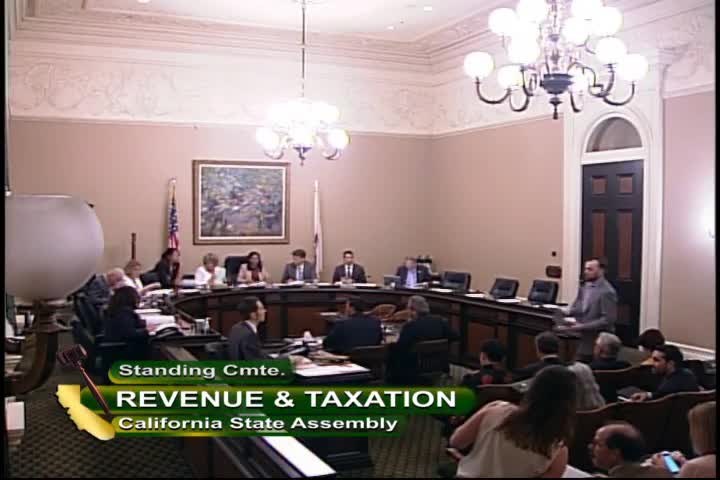 20MIN
Assembly Standing Committee on Revenue and Taxation
 49MIN