AB 1739: Nonprobate transfers: revocable transfer on death deeds.
- Session Year: 2017-2018
- House: Assembly
- Latest Version Date: 2018-07-09
Existing law governs the execution, revocation, and effectiveness of a revocable transfer on death deed, defined as an instrument that makes a donative transfer of property to a named beneficiary that operates on the transferors death, and remains revocable until the transferors death. Existing law establishes a statutory form of revocable transfer on death deed that must be notarized and signed under penalty of perjury by the transferor and recorded with the county recorder, as specified. Existing law requires that subsequent pages of that form include common questions regarding the use of the form. Existing law requires that, in order to be effective, a revocable transfer on death deed must be recorded on or before 60 days after the date it was executed.
This bill would provide that the requirement of recordation described above does not require the recordation of the pages of the statutory form that include the common questions about the use of the form, and a failure to record those pages does not affect the effectiveness of a revocable transfer on death deed. The bill would apply these provisions to revocable transfer on death deeds executed before, on, or after the effective date of these provisions, as specified.
This bill would declare that it is to take effect immediately as an urgency statute.
Existing law governs the execution, revocation, and effectiveness of a revocable transfer on death deed, defined as an instrument that makes a donative transfer of property to a named beneficiary that operates on the transferors death, and remains revocable until the transferors death. Existing law establishes a statutory form of revocable transfer on death deed that must be notarized and signed under penalty of perjury by the transferor and recorded with the county recorder, as specified. Existing law requires that subsequent pages of that form include common questions regarding the use of the form. Existing law requires that, in order to be effective, a revocable transfer on death deed must be recorded on or before 60 days after the date it was executed.
This bill would provide that the requirement of recordation described above does not require the recordation of the pages of the statutory form that include the common questions about the use of the form, and a failure to record those pages does not affect the effectiveness of a revocable transfer on death deed. The bill would apply these provisions to all revocable transfer on death deeds executed in accordance with applicable law, regardless of whether the deed was executed before, on, or after the effective date of these provisions. provisions, as specified.
This bill would declare that it is to take effect immediately as an urgency statute.
Existing law governs the execution, revocation, and effectiveness of a revocable transfer on death deed, defined as an instrument that makes a donative transfer of property to a named beneficiary that operates on the transferors death, and remains revocable until the transferors death. Existing law establishes a statutory form of revocable transfer on death deed that must be notarized and signed under penalty of perjury by the transferor and recorded with the county recorder, as specified. Existing law requires that subsequent pages of that form include common questions regarding the use of the form. Existing law requires that, in order to be effective, a revocable transfer on death deed must be recorded on or before 60 days after the date it was executed.
This bill would provide that the requirement of recordation described above does not require the recordation of the pages of the statutory form that include the common questions about the use of the form, and a failure to record those pages does not affect the effectiveness of a revocable transfer on death deed. The bill would apply these provisions to all revocable transfer on death deeds executed in accordance with applicable law, regardless of whether the deed was executed before, on, or after the effective date of these provisions.
This bill would declare that it is to take effect immediately as an urgency statute.
(a)A revocable transfer on death deed is not effective unless the deed is recorded on or before 60 days after the date it was executed.
(b)The transferor is not required to deliver a revocable transfer on death deed to the beneficiary during the transferors life.
(c)The beneficiary is not required to accept a revocable transfer on death deed from the transferor during the transferors life.
(d)(1)Subdivision (a) does not require the recordation of the Common Questions language that is specified in subdivision (b) of Section 5642. The failure to record that part of the statutory form has no effect on the effectiveness of a revocable transfer on death deed.
(2)(A)This subdivision applies to a revocable transfer on death deed executed on or after the effective date of the act that added this subdivision.
(B)This subdivision applies to a revocable transfer on death deed executed before the effective date of the act that added this subdivision only if the transferor was alive on the effective date of the act that added this subdivision.
SEC. 2.This act is an urgency statute necessary for the immediate preservation of the public peace, health, or safety within the meaning of Article IV of the California Constitution and shall go into immediate effect. The facts constituting the necessity are:
In order to clarify an ambiguity in existing law regarding transfers upon death at the earliest possible time, it is necessary that this statute take effect immediately.
(a)A revocable transfer on death deed is not effective unless the deed is recorded on or before 60 days after the date it was executed.
(b)The transferor is not required to deliver a revocable transfer on death deed to the beneficiary during the transferors life.
(c)The beneficiary is not required to accept a revocable transfer on death deed from the transferor during the transferors life.
(d)(1)Subdivision (a) does not require the recordation of the Common Questions language that is specified in subdivision (b) of Section 5642. The failure to record that part of the statutory form has no effect on the effectiveness of a revocable transfer on death deed. This subdivision applies to all revocable transfer on death deeds executed pursuant to this part, regardless of whether the revocable transfer on death deed was executed before, on, or after the effective date of the act that added this subdivision.
(2)(A)This subdivision applies to a revocable transfer on death deed executed on or after the effective date of the act that added this subdivision.
(B)This subdivision applies to a revocable transfer on death deed executed before the effective date of the act that added this subdivision only if the transferor was alive on the effective date of the act that added this subdivision.
SEC. 2.This act is an urgency statute necessary for the immediate preservation of the public peace, health, or safety within the meaning of Article IV of the California Constitution and shall go into immediate effect. The facts constituting the necessity are:
In order to clarify an ambiguity in existing law regarding transfers upon death at the earliest possible time, it is necessary that this statute take effect immediately.
(a)A revocable transfer on death deed is not effective unless the deed is recorded on or before 60 days after the date it was executed.
(b)The transferor is not required to deliver a revocable transfer on death deed to the beneficiary during the transferors life.
(c)The beneficiary is not required to accept a revocable transfer on death deed from the transferor during the transferors life.
(d)Subdivision (a) does not require the recordation of the Common Questions language that is specified in subdivision (b) of Section 5642. The failure to record that part of the statutory form has no effect on the effectiveness of a revocable transfer on death deed. This subdivision applies to all revocable transfer on death deeds executed pursuant to this part, regardless of whether the revocable transfer on death deed was executed before, on, or after the effective date of the act that added this subdivision.
SEC. 2.This act is an urgency statute necessary for the immediate preservation of the public peace, health, or safety within the meaning of Article IV of the California Constitution and shall go into immediate effect. The facts constituting the necessity are:
In order to clarify an ambiguity in existing law regarding transfers upon death at the earliest possible time, it is necessary that this statute take effect immediately.
|
Date
|
Status
|
|---|---|
| Jul 9, 2018 | Chaptered by Secretary of State - Chapter 65, Statutes of 2018. |
| Jul 9, 2018 | Approved by the Governor. |
| Jun 29, 2018 | Enrolled and presented to the Governor at 3 p.m. |
| Jun 25, 2018 | In Assembly. Ordered to Engrossing and Enrolling. |
| Jun 25, 2018 | Read third time. Urgency clause adopted. Passed. Ordered to the Assembly. |
| Jun 14, 2018 | Read second time. Ordered to Consent Calendar. |
| Jun 13, 2018 | From committee: Do pass. To Consent Calendar. (Ayes 7. Noes 0.) (June 12). |
| Apr 19, 2018 | Referred to Com. on JUD. |
| Apr 5, 2018 | In Senate. Read first time. To Com. on RLS. for assignment. |
| Apr 5, 2018 | Read third time. Urgency clause adopted. Passed. Ordered to the Senate. |
| Mar 21, 2018 | Read second time. Ordered to third reading. |
| Mar 20, 2018 | From committee: Do pass. (Ayes 10. Noes 0.) (March 20). |
| Mar 7, 2018 | Re-referred to Com. on JUD. |
| Mar 6, 2018 | From committee chair, with author's amendments: Amend, and re-refer to Com. on JUD. Read second time and amended. |
| Feb 7, 2018 | In committee: Set, first hearing. Hearing canceled at the request of author. |
| Jan 16, 2018 | Referred to Com. on JUD. |
| Jan 4, 2018 | From printer. May be heard in committee February 3. |
| Jan 3, 2018 | Read first time. To print. |
|
Date
|
Description
|
Location
|
Votes
|
|
|---|---|---|---|---|
| Jun 25, 2018 | Consent Calendar AB1739 Chau Urgency Clause | Senate Floor |
Passed |
|
| Jun 12, 2018 | Do pass and be ordered to the Consent Calendar | Senate Standing Committee on Judiciary |
Passed |
|
| Apr 5, 2018 | AB 1739 CHAU Third Reading Urgency | Assembly Floor |
Passed |
|
| Mar 20, 2018 | Do pass. | Assembly Standing Committee on Judiciary |
Passed |
This list shows positions taken on this bill by organizations on the date displayed, which is linked to the original source.
Positions by individuals are not included.
Office of Senate Floor Analyses (916) 651-1520 Fax: (916) 327-4478 | AB 1739 |
CONSENT
Bill No: AB 1739
Amended: 3/6/18 in Assembly
SENATE JUDICIARY COMMITTEE: 7-0, 6/12/18
AYES: Jackson, Moorlach, Anderson, Hertzberg, Monning, Stern, Wieckowski
ASSEMBLY FLOOR: 70-0, 4/5/18 - See last page for vote
SUBJECT: Nonprobate transfers: revocable transfer on death deeds
DIGEST:
This bill clarifies that the “Common Questions” language in the statutory form for a revocable transfer on death (TOD) deed need not be recorded along with the deed portion of the form. This bill is an urgency measure and takes effect immediately upon enactment.
Existing law:
- Governs the use of a revocable TOD deed made by a transferor who dies on or after January 1, 2016, whether the deed was executed or recorded before, on, or after January 1, 2016. (Prob. Code Sec. 5600 et seq.)
- Defines a revocable TOD deed as an instrument that does all of the following:
- makes a donative transfer of real property to a named beneficiary;
- operates on the transferor’s death; and
- remains revocable until the transferor’s death. (Prob. Code Sec. 5614(a).)
- Provides that an owner who has the capacity to contract may make a revocable TOD deed of the property, which must identify the beneficiary by name, be signed by the transferor, and duly notarized. (Prob. Code Secs. 5620, 5622 & 5624.)
- Provides that a revocable TOD deed is not effective unless the deed is recorded on or before 60 days after the date it was executed. (Prob. Code Sec. 5626(a).)
- Requires a revocable TOD deed to be substantially in a particular form, and prescribes the instructions and information that must be recorded on the first page of the form. (Prob. Code Sec. 5642(a).) Existing law requires that subsequent pages of the form contain prescribed “COMMON QUESTIONS ABOUT THE USE OF THIS FORM” (“Common Questions”). (Prob. Code Sec. 5642(a).)
This bill:
- Clarifies that the prescribed “Common Questions” language need not be recorded along with a revocable TOD deed, and provides that the failure to record that part of the form has no effect on the effectiveness of a revocable TOD deed.
- Takes effect immediately upon enactment as an urgency measure, and provides that the above changes apply to a revocable TOD deed executed: (1) on or after the effective date of the bill; or (2) before the effective date of the bill, if the transferor was alive on the effective date.
Background
In 2015, AB 139 (Gatto, Chapter 293, Statutes of 2015) was enacted to create a five-year pilot program that enables owners of certain real property to transfer their property on death without having to undergo the costly process of seeking professional advice in crafting a trust or allowing the property to pass through probate proceedings. Among other things, that bill also provided for a standard form to make implementation of the revocable TOD deed easier for title companies and county recorders.
Probate Code Section 5642 governs the statutory revocable TOD deed form. Subdivision (a) of that section requires that the first page of the form contain all of the operative information and authentication necessary to effectively convey real property, including: the transferor’s information; a description of the property to be transferred; the beneficiary’s information; a warning indicating that the transferor should read all of the information on the other pages of the form and consider seeking an attorney; and a section for notarization.
Subdivision (b) of Section 5642 governs the remainder of the form, which consists of “Common Questions.” This portion of the form is purely informational, and requires no personal information or signatures. A sampling of those questions includes:
WHAT DOES THE TOD DEED DO? When you die, the identified property will transfer to your named beneficiary without probate. The TOD deed has no effect until you die. You can revoke it at any time.
CAN I USE THIS DEED TO TRANSFER BUSINESS PROPERTY? This deed can only be used to transfer (1) a parcel of property that contains one to four residential dwelling units, (2) a condominium unit, or (3) a parcel of agricultural land of 40 acres or less, which contains a single-family residence.
HOW DO I USE THE TOD DEED? Complete this form. Have it notarized. RECORD the form in the county where the property is located. The form MUST be recorded on or before 60 days after the date you sign it or the deed has no effect.
IS THE “LEGAL DESCRIPTION” OF THE PROPERTY NECESSARY? Yes.
HOW DO I FIND THE “LEGAL DESCRIPTION” OF THE PROPERTY? This information may be on the deed you received when you became an owner of the property. This information may also be available in the office of the county recorder for the county where the property is located. If you are not absolutely sure, consult an attorney.
HOW DO I “RECORD” THE FORM? Take the completed and notarized form to the county recorder for the county in which the property is located. Follow the instructions given by the county recorder to make the form part of the official property records.
Some confusion has arisen regarding whether the “Common Questions” portion of the form must be included along with the portion containing the operative information, in order for a revocable TOD deed to be validly recorded and become effective on the death of the transferor. This uncertainty could cast a cloud on the title of property on the death of the transferor or even result in the invalidation of some revocable TOD deeds, potentially transferring the property to someone other than the intended beneficiary.
In response to this issue, the California Law Revision Commission has provided the following recommendation:
The FAQ page provides beneficial information to persons who are considering executing an RTODD. It explains the legal consequences and limitations of the RTODD, and gives instructions on how to successfully execute one. A person who carefully reads the FAQ will make a more informed choice about whether to proceed and will be less likely to make a procedural mistake.
Theoretically, requiring recordation of the FAQ would increase the likelihood that a transferor will see the FAQ and have an opportunity to read it. This could reduce the incidence of error and misuse.
However, that possible benefit seems to be outweighed by the severity of the harm that could result if recordation of the FAQ is required as a precondition for the validity of an RTODD. No matter how prominently the statutory form warns that recordation of the FAQ is required, it seems inevitable that some transferors would erroneously fail to record the FAQ. That technical error, which would not be directly related to the effect of the RTODD or the transferor’s intentions, would result in the invalidation of an otherwise valid RTODD. This would defeat the transferor’s clearly expressed intentions.
For that reason, the Commission recommends that the law be revised to make clear that recordation of the FAQ is not required. That rule should be made retroactive, to remove any doubt about the validity of an RTODD that was recorded, without the FAQ, before the new law goes into effect. (CLRC, Revocable Transfer on Death Deed: Recordation (April 2017), p. 2.)
This bill is the vehicle for that recommended change.
FISCAL EFFECT: Appropriation: No Fiscal Com.: No Local: No
Conference of California Bar Associations
Howard Jarvis Taxpayers Association
OPPOSITION: (Verified 6/12/18)
None received
ARGUMENTS IN SUPPORT: The author writes:
AB 1739 would expressly provide that recordation of the FAQ page of the statutory [Revocable Transfer on Death Deed] form is not required and that the failure to record the FAQ page has no effect on the validity of an RTODD. This rule would apply retroactively, to any RTODD that has not yet operated. Because of the seriousness of the problems addressed by this bill, it is an urgency measure.
ASSEMBLY FLOOR: 70-0, 4/5/18
AYES: Acosta, Aguiar-Curry, Arambula, Baker, Berman, Bigelow, Bloom, Bonta, Brough, Burke, Caballero, Calderon, Carrillo, Cervantes, Chau, Chávez, Chen, Chiu, Choi, Chu, Cooley, Cooper, Cunningham, Dahle, Daly, Eggman, Flora, Fong, Frazier, Friedman, Gallagher, Eduardo Garcia, Gipson, Gloria, Gray, Grayson, Harper, Holden, Irwin, Jones-Sawyer, Kalra, Kiley, Lackey, Levine, Limón, Low, Maienschein, Mathis, Mayes, McCarty, Medina, Melendez, Muratsuchi, Nazarian, Obernolte, Patterson, Quirk, Quirk-Silva, Reyes, Rodriguez, Rubio, Salas, Santiago, Mark Stone, Thurmond, Ting, Voepel, Waldron, Weber, Rendon
NO VOTE RECORDED: Travis Allen, Cristina Garcia, Gonzalez Fletcher, Mullin, O'Donnell, Steinorth, Wood
Prepared by: Josh Tosney / JUD. / (916) 651-4113
6/15/18 10:19:36
**** END ****
Senator Hannah-Beth Jackson, Chair
2017-2018 Regular Session
Bill No: AB 1739 (Author:Chau)
Version: March 6, 2018
Hearing Date: June 12, 2018
Fiscal: No
Urgency: Yes
Consultant: JDT
SUBJECT
Nonprobate transfers: revocable transfer on death deeds
DESCRIPTION
This bill would clarify that the “Common Questions” language in the statutory form for a revocable transfer on death deed need not be recorded along with the deed portion of the form. This bill is an urgency measure and would take effect immediately upon enactment.
BACKGROUND
A revocable transfer on death deed, also known as a revocable TOD deed, is a deed of real property that designates a beneficiary to receive the property when the transferor dies. A revocable TOD deed enables a homeowner to deed the property directly to a desired beneficiary without the expense of a trust or a probate proceeding.
Following the California Law Revision Commission’s recommendation to adopt legislation providing for revocable TOD deeds and a few failed attempts at legislation, the Legislature passed AB 139 (Gatto, Ch. 293, Stats. 2015) as a five-year pilot program with a charge to the CLRC to study the effectiveness of these instruments. To be effective, existing law requires a revocable TOD deed to be, among other things, duly notarized and recorded with a county recorder within 60 days of its execution, using a prescribed form that contains all of the requisite information and authentication for conveyance of property on the first page. The form also contains a series of “Common Questions” on subsequent pages.
Some confusion has arisen as to whether a duly recorded revocable TOD deed must contain, in addition to the page that deeds the property, the pages containing the “Common Questions” language. The CLRC has sponsored this bill in order to clarify this point and forestall inadvertent invalidations of revocable TOD deeds. This bill would expressly state that the “Common Questions” language need not be recorded along with a revocable TOD deed, and that the failure to record that part of the form has no effect on the effectiveness of a revocable TOD deed. The bill would additionally specify that it applies to revocable TOD deeds executed after the effective date of the bill, as well as to revocable TOD deeds executed before the effective date, if the transferor was alive after the effective date of the bill.
This bill is an urgency measure and would take effect immediately upon enactment.
CHANGES TO EXISTING LAW
Existing law governs the use of a revocable TOD deed made by a transferor who dies on or after January 1, 2016, whether the deed was executed or recorded before, on, or after January 1, 2016. (Prob. Code Sec. 5600 et seq.)
Existing law defines a revocable TOD deed as an instrument that does all of the following:
- makes a donative transfer of real property to a named beneficiary;
- operates on the transferor’s death; and
- remains revocable until the transferor’s death. (Prob. Code Sec. 5614(a).)
Existing law provides that an owner who has the capacity to contract may make a revocable TOD deed of the property, which must identify the beneficiary by name, be signed by the transferor, and duly notarized. (Prob. Code Secs. 5620, 5622 & 5624.)
Existing law provides that a revocable TOD deed is not effective unless the deed is recorded on or before 60 days after the date it was executed. (Prob. Code Sec. 5626(a).)
Existing law requires a revocable TOD deed to be substantially in a particular form, and prescribes the instructions and information that must be recorded on the first page of the form. (Prob. Code Sec. 5642(a).) Existing law requires that subsequent pages of the form contain prescribed “COMMON QUESTIONS ABOUT THE USE OF THIS FORM” (“Common Questions”). (Prob. Code Sec. 5642(a).)
This bill would clarify that the prescribed “Common Questions” language need not be recorded along with a revocable TOD deed, and would provide that the failure to record that part of the form has no effect on the effectiveness of a revocable TOD deed.
This bill, which would take effect immediately upon enactment as an urgency measure, would provide that the above changes apply to a revocable TOD deed executed: (1) on or after the effective date of the bill; or (2) before the effective date of the bill, if the transferor was alive on the effective date.
COMMENT
1. Stated need for the bill
The author writes:
AB 1739 would expressly provide that recordation of the FAQ page of the statutory [Revocable Transfer on Death Deed] form is not required and that the failure to record the FAQ page has no effect on the validity of an RTODD. This rule would apply retroactively, to any RTODD that has not yet operated. Because of the seriousness of the problems addressed by this bill, it is an urgency measure.
2. CLRC study recommending legislation enabling the use of revocable TOD deeds
In 2006, the CLRC issued a study that recommended the adoption of legislation enabling the use of revocable TOD deeds in California. (CLRC, Recommendation: Revocable Transfer On Death (TOD) Deed (Oct. 2006).) At the time, nine other states statutorily recognized these instruments for conveying real property without using a trust or going through a probate proceeding. The CLRC found that, while these instruments were relatively novel and data on their effectiveness was scant, practitioners generally responded positively to these instruments. The CLRC concluded that the benefits of a low-cost, efficient method of conveying real property outweighed concerns about the potential for fraud and abuse.
The CLRC concluded as follows:
The nonprobate revolution has largely bypassed real property. Nearly all other significant assets, including life insurance, securities, bank accounts, and pension plans, pass commonly by beneficiary designation outside the probate system. Real property is the last major holdout, although substantial amounts of real property pass by right of survivorship under joint tenancy or community property or under a trust. It has been observed that ownership of real property is the factor most likely to determine whether a death will lead to a probate proceeding.
California law does not adequately deal with the many types of nonprobate transfer and their consequences. Comprehensive treatment of the area is necessary, much as Missouri has done with its nonprobate transfer law and as the Uniform Probate Code has done with creditor rights issues. But the need for comprehensive treatment of nonprobate transfer law should not be cause for delay in considering the concept of the revocable TOD deed on its merits.
Having surveyed existing transfer devices and reviewed the experience in other jurisdictions, and having considered the legal incidents of the revocable TOD deed, the Law Revision Commission recommends adoption of the device in California […]. (Id., at pp. 211-212.)
3. Confusion regarding the statutory revocable TOD deed form
In 2015, AB 139 was enacted to create a five-year pilot program that enables owners of certain real property to transfer their property on death without having to undergo the costly process of seeking professional advice in crafting a trust or allowing the property to pass through probate proceedings. Among other things, that bill also provided for a standard form to make implementation of the revocable TOD deed easier for title companies and county recorders.
Probate Code Section 5642 governs the statutory revocable TOD deed form. Subdivision (a) of that section requires that the first page of the form contain all of the operative information and authentication necessary to effectively convey real property, including: the transferor’s information; a description of the property to be transferred; the beneficiary’s information; a warning indicating that the transferor should read all of the information on the other pages of the form and consider seeking an attorney; and a section for notarization.
Subdivision (b) of Section 5642 governs the remainder of the form, which consists of “Common Questions.” This portion of the form is purely informational, and requires no personal information or signatures. A sampling of those questions includes:
WHAT DOES THE TOD DEED DO? When you die, the identified property will transfer to your named beneficiary without probate. The TOD deed has no effect until you die. You can revoke it at any time.
CAN I USE THIS DEED TO TRANSFER BUSINESS PROPERTY? This deed can only be used to transfer (1) a parcel of property that contains one to four residential dwelling units, (2) a condominium unit, or (3) a parcel of agricultural land of 40 acres or less, which contains a single-family residence.
HOW DO I USE THE TOD DEED? Complete this form. Have it notarized. RECORD the form in the county where the property is located. The form MUST be recorded on or before 60 days after the date you sign it or the deed has no effect.
IS THE “LEGAL DESCRIPTION” OF THE PROPERTY NECESSARY? Yes.
HOW DO I FIND THE “LEGAL DESCRIPTION” OF THE PROPERTY? This information may be on the deed you received when you became an owner of the property. This information may also be available in the office of the county recorder for the county where the property is located. If you are not absolutely sure, consult an attorney.
HOW DO I “RECORD” THE FORM? Take the completed and notarized form to the county recorder for the county in which the property is located. Follow the instructions given by the county recorder to make the form part of the official property records.
Some confusion has arisen regarding whether the “Common Questions” portion of the form must be included along with the portion containing the operative information, in order for a revocable TOD deed to be validly recorded and become effective on the death of the transferor. This uncertainty could cast a cloud on the title of property on the death of the transferor or even result in the invalidation of some revocable TOD deeds, potentially transferring the property to someone other than the intended beneficiary.
In response to this issue, the CLRC has provided the following recommendation:
The FAQ page provides beneficial information to persons who are considering executing an RTODD. It explains the legal consequences and limitations of the RTODD, and gives instructions on how to successfully execute one. A person who carefully reads the FAQ will make a more informed choice about whether to proceed and will be less likely to make a procedural mistake.
Theoretically, requiring recordation of the FAQ would increase the likelihood that a transferor will see the FAQ and have an opportunity to read it. This could reduce the incidence of error and misuse.
However, that possible benefit seems to be outweighed by the severity of the harm that could result if recordation of the FAQ is required as a precondition for the validity of an RTODD. No matter how prominently the statutory form warns that recordation of the FAQ is required, it seems inevitable that some transferors would erroneously fail to record the FAQ. That technical error, which would not be directly related to the effect of the RTODD or the transferor’s intentions, would result in the invalidation of an otherwise valid RTODD. This would defeat the transferor’s clearly expressed intentions.
For that reason, the Commission recommends that the law be revised to make clear that recordation of the FAQ is not required. That rule should be made retroactive, to remove any doubt about the validity of an RTODD that was recorded, without the FAQ, before the new law goes into effect. (CLRC, Revocable Transfer on Death Deed: Recordation (April 2017), p. 2.)
This bill is the vehicle for that recommended change.
Support: Conference of California Bar Associations; Howard Jarvis Taxpayers Association
Opposition: None
HISTORY
Source: California Law Revision Commission
Related Pending Legislation: AB 3004 (Kiley) would make various changes to the statutory provisions governing revocable TOD deeds. It is currently being considered in the Assembly.
Prior Legislation: AB 139 (Gatto, Ch. 293, Stats. 2015) established a five-year pilot program for revocable TOD deeds. See Comment 3.
Prior Vote:
Assembly Floor (Ayes 70, Noes 0)
Assembly Judiciary Committee (Ayes 10, Noes 0)
**************
ASSEMBLY THIRD READING
ATR Bill Id:
Author:(Chau)
As Amended Ver:March 6, 2018
2/3 vote. Urgency
Committee | Votes | Ayes | Noes |
Judiciary | 10-0 | Mark Stone, Calderon, Berman, Obernolte, Gonzalez Fletcher, Holden, Kalra, Kiley, Maienschein, Reyes |
|
SUMMARY: Provides that the "Common Questions" portion of the revocable transfer on death deed (RTDD) statutory form is not required to be recorded with the revocable transfer on death deed (RTDD). Specifically, this bill:
- Provides that "Common Questions" portion of the RTDD statutory form is not required to be recorded with the RTDD. Provides that failure to record that portion of the RTDD has no effect on the effectiveness of the RTDD.
- Provides that 1) applies to: a) all RTDDs executed on or after the effective date of this legislation; and b) all RTDDs executed before the effective date of this legislation provided the transferor is alive on that date.
- Takes effect immediately as an urgency matter in order to clarify an ambiguity in the law regarding the RTDD.
EXISTING LAW:
- Allows an interest in certain residential real property to be transferred on death by recording an RTDD signed and acknowledged by the record owner of the property, with the capacity to contract, and designating a beneficiary or beneficiaries. The deed transfers ownership of that property interest upon the death of the owner. The pilot program is effective for any RTDD made by a transferor who dies on or after January 1, 2016, regardless of when the RTDD was executed or recorded. No RTDD may be executed on or after January 1, 2021, but any RTDD properly executed before that date remains valid and may be revoked after that date. (Probate Code Section 5600 et seq. Unless stated otherwise, all further statutory references are to that code.)
- Provides that an RTDD does not affect any ownership rights during the transferor's lifetime, nor does it convey any rights to the beneficiary or the beneficiary's creditors during the transferor's lifetime. Provides that an RTDD is not effective until the transferor's death. (Section 5650.)
- Provides a statutory form RTDD and requires that an RTDD must be in a substantially similar form. The statutory deed includes information to the transferor, including explaining how the RTDD works, how it is effectuated, and some of its consequences through the form's "Common Questions About the Use of This Form." (Section 5642.)
- Provides that an RTDD operates on the transferor's death and remains revocable until the transferor's death. (Section 5614.)
- Provides that property subject to an RTDD is still part of the transferor's estate for purposes of Medi-Cal eligibility and will be subject to Medi-Cal reimbursement claims. Property subject to an RTDD is subject to claims from the transferor's secured and unsecured creditors. Allows the beneficiary to avoid unsecured claims by returning the property to the transferor's estate. (Sections 5670-76.)
- Permits contest of the RTDD for, among other things, lack of capacity to transfer, transfer to a disqualified person, fraud, duress, and undue influence. (Sections 5690-96.)
- Requires the California Law Revision Commission (CLRC) to study the effects of the RTDD and make recommendations to the Legislature by January 1, 2020. (AB 139 (Gatto), Chapter 293, Statutes of 2015, Section 21). Requires the CLRC, as part of its study, to address whether it is feasible and appropriate to expand the RTDD to include 1) transfers of stock cooperatives or other common interest developments and 2) transfers to a trust or other legal entity. (AB 1779 (Gatto), Chapter 179, Statutes of 2016, Section 1.)
FISCAL EFFECT: None
COMMENTS: For nearly a decade, a number of legislators tried to create a simplified process to transfer real property outside of probate and without use of a trust. (AB 250 (DeVore) of 2007), AB 724 (DeVore), of 2010, AB 699 (Wagner) of 2011). All of those efforts were unsuccessful until 2015's AB 139 (Gatto), Chapter. 293, Stats. 2015), which finally established a five-year pilot program allowing owners of real property, until January 1, 2021, to transfer their property upon death, outside the normal probate procedure, through a written instrument known as a "revocable transfer upon death deed" (RTDD). Because of significant concerns about the effect of the RTDD and its likelihood of creating confusion, impact on Medi-Cal reimbursement and, most importantly, creation of a new opportunity for fraud and elder abuse, the bill was limited to transfers of only certain property, and the beneficiaries and how they take the property was similarly limited to keep the program as uncomplicated as possible to truly help those who are likely house-rich, but otherwise have no need for broader estate planning. In addition, that legislation limited the impact to just a five-year pilot with directions for the CLRC to study the impact of the RTDD and report its findings and recommendations back to the Legislature by January 1, 2020.
While conducting its review of the RTDD, the CLRC found an ambiguity that could result in an otherwise valid, properly executed and recorded RTDD being invalidated. The statutory scheme for the RTDD contains a statutory form, and a requirement that either the statutory form, or another form deed that is "substantially similar" to the statutory form, must be used. The statutory form includes the actual form that must be completed on the first page and then, on additional page(s), a series of questions and answers explaining how the RTDD works and how to execute it, as well as some issues to be considered when deciding whether to use an RTDD. Some RTDDs have been recorded with the additional page(s) questions and answers included, but other RTDDs apparently have been recorded without those Q&A additional pages. The CLRC recommends that the law be clarified to ensure that RTDDs recorded without the additional pages are still valid. This bill does just that.
This bill seeks to correct a problem detected by the CLRC that could result in some RTDDs being inadvertently invalidated. As discussed above, the CLRC is now studying the pilot RTDD project in California. In conducting the study, the CLRC discovered a significant potential flaw in the statutory form. Existing law governing RTDDs requires that the statutory form RTDD, or another document that is substantially similar to the statutory form, be used and recorded to be effective. The statutory form includes the actual form that must be completed on the first page and then, on additional page(s), a series of questions and answers explaining how the RTDD works and how to execute it, as well as some issues to be considered when deciding whether to use the RTDD. While the RTDD must be recorded to be effective, the statute is unclear as to whether the recording mandate includes the Q&A pages. It appears that to date, some RTDDs have been recorded with the questions and answers page(s) included, but other RTDDs have been recorded without those Q&A page(s).
The CLRC succinctly sets out the problem with this uncertainty regarding recording of the Q&A page(s):
It is not entirely clear whether the provision that requires recordation of an RTODD [RTDD] only requires recordation of the deed page, or instead requires recordation of both the deed and FAQ pages.
Any uncertainty on that point could cause serious problems. First, if a court construes the statute as requiring recordation of the FAQ, any RTODD that was recorded without the FAQ could be invalidated. The property would then presumably be subject to probate, exactly what the transferor intended to avoid by executing an RTODD. Furthermore, the property could transfer to someone other than the intended beneficiary (by operation of an otherwise inapplicable will or rules of intestate succession).
Even if the failure to record an FAQ does not invalidate an RTODD, it could cast a problematic cloud on the title of property conveyed by an RTODD. If there is any uncertainty as to the validity of such an RTODD, the beneficiary may be unable to obtain title insurance. In that situation, the beneficiary may need to pursue a quiet title action in order to obtain clear title. This judicial proceeding would add cost and delay, which the transferor specifically intended to avoid through execution of an instrument that would transfer the property on death outside of probate. (CLRC, Revocable Transfer on Death Deed: Recordation 1-2 (April 2017).)
This bill proposes to correct these problems by specifically providing that the Q&A portion of the RTDD form need not be recorded with the transfer portion of the deed and that failure to record that portion of the document has no effect on the deed's effectiveness. This bill applies to all RTDDs executed on or after the effective date of this bill. It also applies to RTDDs executed before this bill's effective date, but only if the transferor is still alive. By limiting retroactive application of this bill to RTDDs where the transferor is still alive, this bill only applies to transfer deeds that are not yet effective, since RTDDs are only effective upon the death of the transferor and can be revoked any time before that. This limitation on this bill's retroactive application ensures that this bill does not in any way impact an already operative RTDD. This bill also, rightly, is an urgency measure to immediately remove the uncertainty and ensure that all properly executed and recorded RTDDs are recognized. And while the solution set forth in this bill may theoretically keep some individuals executing an RTDD from being fully informed about the transfer, it is far preferable than invalidating otherwise valid transfers, and having the property go through the probate process and potentially being transferred to someone that the transferor did not intend.
Analysis Prepared by: Leora Gershenzon / JUD. / (916) 319-2334 FN: 0002621
Date of Hearing: March 20, 2018
ASSEMBLY COMMITTEE ON JUDICIARY
Mark Stone, Chair
ABPCA Bill Id:AB 1739
Author:(Chau) – As Amended Ver:March 6, 2018
SUBJECT: Nonprobate revocable transfer on death deed: STATUTORY FORM
KEY ISSUE: SHOULD THE LAW BE CLARIFIED, as recommended by the CALIFORNIA LAW REVISION Commission, TO REQUIRE THAT ONLY THE ACTUAL FORM PART OF A REVOCABLE TRANSFER ON DEATH DEED BE RECORDED AND NOT THE COMMONLY ASKED QUESTIONS PORTION OF THE DOCUMENT in order TO PREVENT OTHERWISE VALIDLY EXECUTED AND RECORDED TRANSFERs from BEing invalidated?
SYNOPSIS
For ten years, a number of legislators have tried to create a simplified process to transfer real property outside of probate and without the use of a trust. (AB 250 (DeVore, 2007), AB 724 (DeVore, 2009-10), AB 699 (Wagner, 2011).) All of those efforts were unsuccessful until 2015's AB 139 (Gatto, Chap. 293), which finally established a five-year pilot program that allows owners of real property, until January 1, 2021, to transfer their property upon death, outside the normal probate procedure, through a written instrument known as a "revocable transfer upon death deed” (RTDD). Given concerns about misuse of the RTDD, the Legislature directed the California Law Revision Commission (CLRC) to study the RTDD pilot program and to report back to the Legislature by January 1, 2020 on how the program is operating.
As part of its study, the CLRC uncovered an ambiguity with the statutory form used for an RTDD that could raise questions as to the validity of what a transferor may believe is a properly executed and recorded RTDD. The RTDD form includes the actual form that must be completed on the first page and then, on additional page(s), a series of questions and answers explaining how the RTDD works and how to execute it, as well as some issues to be considered when deciding whether to use the RTDD to transfer property. Apparently, some RTDDs have been recorded with the additional page(s) questions and answers included, but other RTDDs have been recorded without those Q&A page(s). The CLRC recommends that the law be clarified to ensure that an RTDD recorded without the additional pages is still valid. This urgency bill does just that and states that it applies to all RTDDs, including those executed before the effective date of this legislation as long as the transferor is alive on that date.
This bill is opposed by the California Land Title Association, which opposed the original RTDD bills, continues to oppose their use in California, and believes that this bill makes the use of RTDDS “even more problematic” for transferors. The bill is supported by the Conference of California Bar Associations, which argues that the bill supports the original RTDD legislation and the alternative would be "unfair, unnecessarily complicated, unnecessarily expensive, and potentially disastrous to those persons who already have recorded" RTDDs without the Q&A pages and to their beneficiaries.
SUMMARY: Provides that the "Common Questions" portion of the revocable transfer on death deed (RTDD) statutory form is not required to be recorded with the revocable transfer on death deed (RTDD). Specifically, this bill:
- Provides that "Common Questions" portion of the RTDD statutory form is not required to be recorded with the RTDD. Provides that failure to record that portion of the RTDD has no effect on the effectiveness of the RTDD.
- Provides that 1) applies to: (a) all RTDDs executed on or after the effective date of this legislation; and (b) all RTDDs executed before the effective date of this legislation provided the transferor is alive on that date.
- Takes effect immediately as an urgency matter in order to clarify an ambiguity in the law regarding the RTDD.
EXISTING LAW:
- Allows an interest in certain residential real property to be transferred on death by recording an RTDD signed and acknowledged by the record owner of the property, with the capacity to contract, and designating a beneficiary or beneficiaries. The deed transfers ownership of that property interest upon the death of the owner. The pilot program is effective for any RTDD made by a transferor who dies on or after January 1, 2016, regardless of when the RTDD was executed or recorded. No RTDD may be executed on or after January 1, 2021, but any RTDD properly executed before that date remains valid and may be revoked after that date. (Probate Code Section 5600 et seq. Unless stated otherwise, all further statutory references are to that code.)
- Provides that an RTDD does not affect any ownership rights during the transferor's lifetime, nor does it convey any rights to the beneficiary or the beneficiary's creditors during the transferor's lifetime. Provides that an RTDD is not effective until the transferor's death. (Section 5650.)
- Provides a statutory form RTDD and requires that an RTDD must be in a substantially similar form. The statutory deed includes information to the transferor, including explaining how the RTDD works, how it is effectuated, and some of its consequences through the form's "Common Questions About the Use of This Form." (Section 5642.)
- Provides that an RTDD operates on the transferor’s death and remains revocable until the transferor’s death. (Section 5614.)
- Provides that property subject to an RTDD is still part of the transferor's estate for purposes of Medi-Cal eligibility and will be subject to Medi-Cal reimbursement claims. Property subject to an RTDD is subject to claims from the transferor's secured and unsecured creditors. Allows the beneficiary to avoid unsecured claims by returning the property to the transferor's estate. (Sections 5670-76.)
- Permits contest of the RTDD for, among other things, lack of capacity to transfer, transfer to a disqualified person, fraud, duress, and undue influence. (Sections 5690-96.)
- Requires the CLRC to study the effects of the RTDD and make recommendations to the Legislature by January 1, 2020. (AB 139 (Gatto), Chap. 293, Stats. 2015, Section 21.) Requires the CLRC, as part of its study, to address whether it is feasible and appropriate to expand the RTDD to include 1) transfers of stock cooperatives or other common interest developments and 2) transfers to a trust or other legal entity. (AB 1779 (Gatto), Chap. 179, Stats. 2016, Section 1.)
FISCAL EFFECT: As currently in print this bill is keyed non-fiscal.
COMMENTS: For nearly a decade, a number of legislators tried to create a simplified process to transfer real property outside of probate and without use of a trust. (AB 250 (DeVore, 2007), AB 724 (DeVore, 2009-10), AB 699 (Wagner, 2011).) All of those efforts were unsuccessful until 2015's AB 139 (Gatto, Chap. 293, Stats. 2015), which finally established a five-year pilot program allowing owners of real property, until January 1, 2021, to transfer their property upon death, outside the normal probate procedure, through a written instrument known as a "revocable transfer upon death deed" (RTDD). Because of significant concerns about the effect of the RTDD and its likelihood of creating confusion, impact on Medi-Cal reimbursement and, most importantly, creation of a new opportunity for fraud and elder abuse, the bill was limited to transfers of only certain property, and the beneficiaries and how they take the property was similarly limited to keep the program as uncomplicated as possible to truly help those who are likely house-rich, but otherwise have no need for broader estate planning. In addition, that legislation limited the impact to just a five-year pilot with directions for the California Law Revision Commission to study the impact of the RTDD and report its findings and recommendations back to the Legislature by January 1, 2020.
While conducting its review of the RTDD, the CLRC found an ambiguity that could result in an otherwise valid, properly executed and recorded RTDD being invalidated. The statutory scheme for the RTDD contains a statutory form, and a requirement that either the statutory form, or another form deed that is "substantially similar" to the statutory form, must be used. The statutory form includes the actual form that must be completed on the first page and then, on additional page(s), a series of questions and answers explaining how the RTDD works and how to execute it, as well as some issues to be considered when deciding whether to use an RTDD. Some RTDDs have been recorded with the additional page(s) questions and answers included, but other RTDDs apparently have been recorded without those Q&A additional pages. The CLRC recommends that the law be clarified to ensure that RTDDs recorded without the additional pages are still valid. This bill does just that.
In support of the bill, the author writes that "[u]nder existing law, it is not entirely clear whether the recording requirement applies to the “FAQ” page that is part of the statutory [RTDD] form. Ambiguity on that point is a serious problem. At worst, it could lead to the invalidation of an otherwise valid deed, simply because the transferor failed to record the FAQ."
Initial California Law Revision Commission Study: As directed by the Legislature, the CLRC conducted an initial study to determine whether an RTDD should be statutorily created in California. (CLRC, Recommendation: Revocable Transfer On Death (TOD) Deed (Oct. 2006).) At the time of that initial study, nine other states, including Colorado, New Mexico, Ohio and Wisconsin, statutorily recognized RTDDs. The CLRC's investigation revealed minor difference between the states' RTDDs and found that practitioners generally liked having the option of the RTDD. However, most of the statutes were too new to provide evidence of their effectiveness or of their susceptibility to misuse or abuse. In recommending creation of an RTDD in California, the CLRC balanced the generally positive, although quite limited, experience of other states and the need for a simple, low-cost method of conveying real property with the very real concerns that an RTDD could be abused and could help facilitate fraud on the transferor or his or her intended beneficiaries and, because it is so simple to use, it could be used inappropriately, without advice of counsel. In order to address some of these well-founded concerns, the CLRC recommended that California undertake a comprehensive review of all non-probate transfers and their consequences. However, in the interim, the CLRC recommended that California establish a carefully crafted RTDD.
Legislation allowed for use of RTDDs and created a statutory form with instructions for easy use without an attorney. After a decade of attempts, 2015's AB 139 established a five-year pilot program allowing owners of certain real property, until January 1, 2021, to transfer their property upon death, outside the normal probate procedure, through a written RTDD. That bill also created a statutory RTDD form to help ensure that property owners who do not seek legal counsel may be able to successfully transfer property through use of an RTDD. The statutory form also makes implementation of the RTDD easier for title companies. An RTDD only operates on the transferor’s death and remains fully revocable until the transferor’s death. (Section 5614.) In addition, the statutory deed informs transferors of their rights and the rights of their beneficiaries, and explains some of the pitfalls of the RTDD through its "Common Questions About the Use of This Form" section. (Section 5642.) The actual transfer deed appears on the first page of the form and the "Common Questions" section is required to be on the "subsequent" pages of the form.
When the RTDD was initially approved in 2015, there was concern that the RTDD might have the unintended consequence of steering persons away from legal assistance that they may need, and therefore that bill was appropriately limited and a CLRC study required. It is unclear what role lawyers will play in the execution and recording of these RTDDs. On the one hand, one author of a previous version of the bill suggests that the reform might allow real property owners to avoid lawyers altogether through the simple recording of a beneficiary deed. On the other hand, the primary criticism of the “trust mills” is that they minimize the role of lawyers, through the use of prefabricated trusts, when the input of a lawyer’s expertise is often necessary. The State Bar's Conference of Delegates passed a resolution in response to the original RTDD bill, expressing concern that, in creating yet another “probate avoidance” device, the bill may have the unintended consequence of steering people away from needed legal assistance that can avoid unforeseen problems in estate planning. A simplified RTDD can also make it easier to commit financial abuse. Seniors could sign without realizing what they were signing or its consequences.
In recognition of the risks associated with an RTDD, AB 139 directed the CLRC to study the effect of the RTDD in California and report back to the Legislature by January 1, 2020. The report must address, among other things: (1) whether the revocable transfer on death deed is working effectively; (2) whether the revocable transfer on death deed is subject to misuse or misunderstanding; (3) what changes should be made to the revocable transfer on death deed or the law associated with the deed to improve its effectiveness and to avoid misuse or misunderstanding; and (4) whether the revocable transfer on death deed has been used to perpetuate financial abuse on property owners and, if so, how the law associated with the deed should be changed to minimize this abuse.
AB 139 also contained a January 1, 2021 sunset. RTDDs executed before that time would remain valid, but RTDDs executed after that date will not be valid. This sunset, together with the study by CLRC, helps minimize risks of abuse or misuse associated with the RTDD, but may not prevent such risks during the five years that RTDDs would be valid in California.
This bill seeks to correct a problem detected by the CLRC that could result in some RTDDs being inadvertently invalidated. As discussed above, the CLRC is now studying the pilot RTDD project in California. In conducting the study, the CLRC discovered a significant potential flaw in the statutory form. Existing law governing RTDDs requires that the statutory form RTDD, or another document that is substantially similar to the statutory form, be used and recorded to be effective. The statutory form includes the actual form that must be completed on the first page and then, on additional page(s), a series of questions and answers explaining how the RTDD works and how to execute it, as well as some issues to be considered when deciding whether to use the RTDD. While the RTDD must be recorded to be effective, the statute is unclear as to whether the recording mandate includes the Q&A pages. It appears that to date, some RTDDs have been recorded with the questions and answers page(s) included, but other RTDDs have been recorded without those Q&A page(s).
The CLRC succinctly sets out the problem with this uncertainty regarding recording of the Q&A page(s):
It is not entirely clear whether the provision that requires recordation of an RTODD [RTDD] only requires recordation of the deed page, or instead requires recordation of both the deed and FAQ pages.
Any uncertainty on that point could cause serious problems. First, if a court construes the statute as requiring recordation of the FAQ, any RTODD that was recorded without the FAQ could be invalidated. The property would then presumably be subject to probate, exactly what the transferor intended to avoid by executing an RTODD. Furthermore, the property could transfer to someone other than the intended beneficiary (by operation of an otherwise inapplicable will or rules of intestate succession).
Even if the failure to record an FAQ does not invalidate an RTODD, it could cast a problematic cloud on the title of property conveyed by an RTODD. If there is any uncertainty as to the validity of such an RTODD, the beneficiary may be unable to obtain title insurance. In that situation, the beneficiary may need to pursue a quiet title action in order to obtain clear title. This judicial proceeding would add cost and delay, which the transferor specifically intended to avoid through execution of an instrument that would transfer the property on death outside of probate. (CLRC, Revocable Transfer on Death Deed: Recordation 1-2 (April 2017).)
This bill proposes to correct these problems by specifically providing that the Q&A portion of the RTDD form need not be recorded with the transfer portion of the deed and that failure to record that portion of the document has no effect on the deed's effectiveness. The bill applies to all RTDDs executed on or after the effective date of this bill. It also applies to RTDDs executed before the bill's effective date, but only if the transferor is still alive. By limiting retroactive application of the bill to RTDDs where the transferor is still alive, this bill only applies to transfer deeds that are not yet effective, since RTDDs are only effective upon the death of the transferor and can be revoked any time before that. This limitation on the bill's retroactive application ensures that the bill does not in any way impact an already operative RTDD. The bill also, rightly, is an urgency measure to immediately remove the uncertainty and ensure that all properly executed and recorded RTDDs are recognized. And while the solution set forth in the bill may theoretically keep some individuals executing an RTDD from being fully informed about the transfer, it is far preferable than invalidating otherwise valid transfers, and having the property go through the probate process and potentially being transferred to someone that the transferor did not intend.
California Land Title Association Continues to Oppose the Use of RTDDs in California and Opposes This Bill as Well. The California Land Title Association (CLTA) vigorously opposed the original RTDD establishment bills and opposes this bill as well, based in large part on the RTDDs’ “potential for fraud and unintended misuse.” CLTA writes that their members “have seen a disproportionately large number of the RTODDs executed improperly without the FAQs attached, creating potential clouds on the title of real property and resulting in deeds that cannot be relied upon by subsequent buyers and lenders.” CLTA is concerned that the grantee of an improperly executed and recorded RTDD “will often find that they cannot transfer, refinance, or sell the granted real property until the real property is probated.” Even though this bill actually clears up recording requirements and, thereby, helps clear title for RTDDs, CLTA remains opposed:
While we understand the allure of allowing improperly-recorded RTODDs (such as those without FAQs) to be considered valid retroactively, we believe that such an approach would be a very bad idea.
Either the RTODDs were executed properly with the FAQs up until now making them potentially invalid, or they were not. Attempting to retroactively legitimize RTODDs by statute would likely have little or no effect on how attorneys, lenders, title companies or consumers view them and may create the impression that faulty RTODDs are now valid to the detriment of a future grantee. . . .
Furthermore, CLTA views the current requirement that the FAQs be recorded with the RTODD as one of the few essential provisions of the RTODD law. While CLTA has always considered RTODDs to provide a magnet for potential fraud against unsophisticated grantors, especially seniors, we consider the FAQs –when recorded—to provide some buffer against fraud and improper vesting of title via the RTODD. In short, the FAQs provide a bit of a roadmap for unsophisticated users of the RTODDs.
While this bill applies retroactively, it only applies to RTDDs executed prior to the bill's effective date if the transferor is a still alive. Prior to the transferor's death, the RTDD is not yet operative and is fully revocable. This ensures that there is no retroactive change to a property's ownership and ensures that there can be no constitutional question as to who may own the property. However, CLTA still objects because it will be impossible from the chain of title to determine, for RTDDs recorded without FAQs attached, if the transferor was alive on the bill’s effective date.
In contrast to the arguments by the CLTA, the Conference of California Bar Associations, a strong proponent of RTDDs, states that "requiring the recording of the FAQ - would be unfair, unnecessarily complicated, unnecessarily expensive, and potentially disastrous to those persons who already have recorded RTODDs without the FAQ and to their beneficiaries.”
REGISTERED SUPPORT / OPPOSITION:
Support
Conference of California Bar Associations
Howard Jarvis Taxpayers Association
Opposition
California Land Title Association
Analysis Prepared by: Leora Gershenzon / JUD. / (916) 319-2334
Discussed in Hearing
View Older Hearings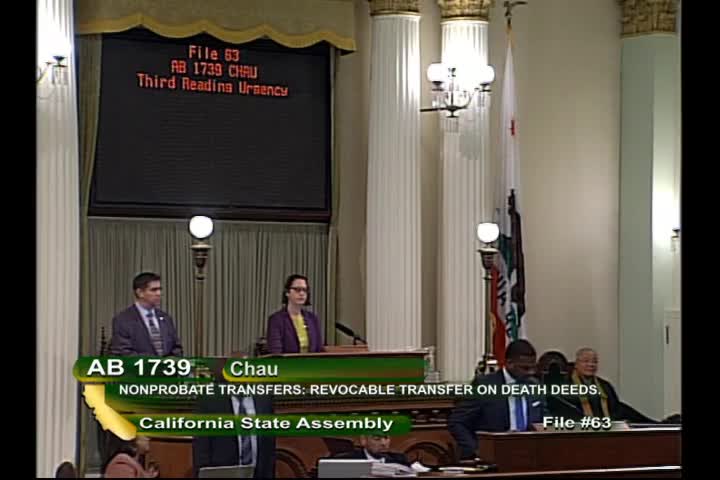
Bill Author

Bill Co-Author(s):