AB 1760: Parking: emergency vehicles.
- Session Year: 2017-2018
- House: Assembly
- Latest Version Date: 2018-01-04
Existing law, the Davis-Stirling Common Interest Development Act, defines and regulates common interest developments. Existing law includes provisions that limit the authority of the managing association of a common interest development, or the governing documents, as defined, to regulate the use of a members separate interest.
This bill would make a prohibition or restriction in the governing documents relating to parking, including, but not limited to, onstreet parking, void and unenforceable with respect to an emergency vehicle owned or under the control of a member.
(a) A prohibition or restriction in the governing documents relating to parking, including, but not limited to, onstreet parking, shall be void and unenforceable with respect to an emergency vehicle owned or under the control of a member.
(b)The following definitions apply for purposes of this section:
(1)Emergency vehicle means a vehicle described in Section 165 of the Vehicle Code.
(2)Governing documents include, but are not limited to, the conditions, covenants, and restrictions of the common interest development, and the bylaws, rules, and regulations of the association.
|
Date
|
Status
|
|---|---|
| Jun 6, 2018 | From committee: Without further action pursuant to Joint Rule 62(a). |
| May 8, 2018 | In committee: Set, final hearing. Failed passage. |
| Apr 23, 2018 | In committee: Hearing postponed by committee. |
| Apr 3, 2018 | In committee: Set, second hearing. Hearing canceled at the request of author. |
| Mar 12, 2018 | In committee: Set, first hearing. Hearing canceled at the request of author. |
| Feb 5, 2018 | Referred to Com. on JUD. |
| Jan 5, 2018 | From printer. May be heard in committee February 4. |
| Jan 4, 2018 | Read first time. To print. |
|
Date
|
Description
|
Location
|
Votes
|
|
|---|---|---|---|---|
| May 8, 2018 | Do pass. | Assembly Standing Committee on Judiciary |
Passed |
This list shows positions taken on this bill by organizations on the date displayed, which is linked to the original source.
Positions by individuals are not included.
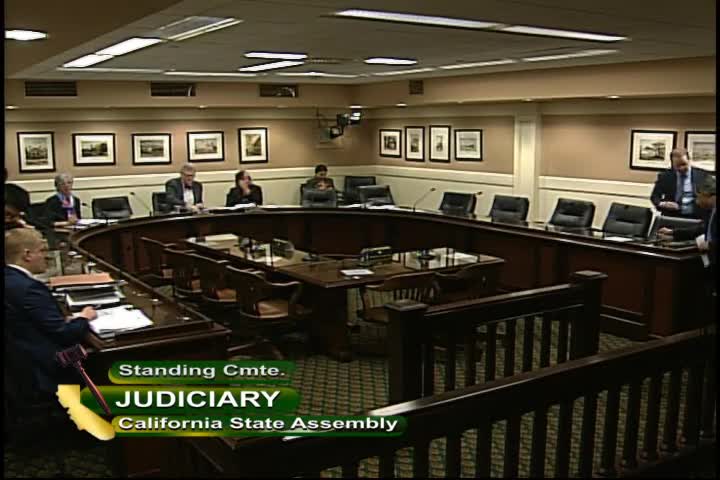
Date of Hearing: May 8, 2018
ASSEMBLY COMMITTEE ON JUDICIARY
Mark Stone, Chair
ABPCA Bill Id:AB 1760
Author:(Frazier) – As Introduced Ver:January 4, 2018
SUBJECT: COMMON INTEREST DEVELOPMENTS: PARKING RESTRICTIONS: EMERGENCY VEHICLES
KEY ISSUES:
- SHOULD homeownerS associations be prohibited from enforcing any restrictions whatsoever on parking of an emergency vehicle by a resident within the common interest development where they live, even when there is no practical or safe place to park such a vehicle?
- should the resident be able to park the emergency vehicle wherever they want, without having to observe a no-street parking policy or designated-space policy enforceable by the homeowners association against every other resident driving a non-emergency vehicle, even if it is not safe?
- SHOULD THIS BILL INSTEAD BE AMENDED TO ALLOW HOMEOWNER ASSOCIATIONS TO IMPOSE REASONABLE RESTRICTIONS FOR PARKING OF EMERGENCY VEHICLES, AS SPECIFIED, AS LONG AS THEY DO NOT EFFECTIVELY PROHIBIT OR UNREASONABLY RESTRICT SUCH PARKING?
SYNOPSIS
As currently in print, this bill ensures that the governing documents of a common interest development (CID) may not contain any prohibition or restriction on parking an emergency vehicle that is owned or operated by an individual homeowner within the CID. If the board of the homeowners association (HOA) adopts any restriction, even a reasonable restriction, "relating to parking" of an emergency vehicle owned by a resident of the CID, this bill would declare that restriction void and unenforceable by operation of law. The author contends this is necessary to protect public safety and ensure that first responders who live in CIDs can park their emergency vehicles as close as possible to their front door, so as to minimize response times in an emergency should they have to respond while at home with the vehicle parked outside. The current version of the bill is supported by firefighters, peace officers, sheriffs and other first responders who would benefit from not being subject to any HOA restriction on parking of emergency vehicles.
The bill is opposed by the Community Associations Institute (CAI) who represents HOAs. They contend that the bill as currently drafted is overbroad, far too inflexible, and ignores the practical reality that HOA boards must regularly fashion conditions, covenants, and restrictions (CCRs) in their governing documents that seek reasonable solutions to the problems facing their particular CID and members. They contend the current bill ignores reasonable restrictions that account for the size, layout, and other limitations of the property itself, and leaves no discretion to the HOA board in favor of a policy that applies a one-size-fits-all solution to a problem that demands flexibility and recognition of individualized circumstances.
The Committee questions whether this bill, as currently worded, actually furthers public safety. For reasons discussed in the analysis, the Committee may wish to recommend that the author replace the current contents of the bill with a set of amendments proposed by the Committee. These proposed amendments attempt to strike a balance that allows HOAs to develop reasonable rules for parking in the particular development that they govern, but would make void and unenforceable any provision of the CID's governing documents that effectively prohibit or restrict the parking of an emergency vehicle. Opponents state they would remove their opposition to the bill if the proposed amendments are adopted by the author.
SUMMARY: Prohibits homeowners associations from enforcing any prohibition or restriction relating to parking of an emergency vehicle, as defined, that is owned or under the control of a member of the association. Specifically, this bill:
- Establishes that a prohibition or restriction in the governing documents relating to parking, including, but not limited to, on-street parking, shall be void and unenforceable with respect to an emergency vehicle owned or under the control of a member.
- Defines "emergency vehicle" to mean a vehicle described in Section 165 of the Vehicle Code.
EXISTING LAW:
- Permits the governing board of a homeowners association to adopt operating rules that apply generally to the management and operation of the common interest development or the conduct of the business and affairs of the association, provided that the rules are within the authority of the board to make, do not conflict with the association's articles, bylaws, or governing law, and are reasonable. (Civil Code Sections 4340 and 4350.)
- Provides specified limits to the authority of an association or the governing documents to regulate the use of a member’s separate interest, including provisions relating to the display of signs, the installation of solar energy systems, racial restrictions, and modification to property to accommodate a disability. (Civil Code Section 4700 et seq.)
- Defines "emergency vehicle" to mean any of the following:
- Any publicly owned and operated ambulance, lifeguard, or lifesaving equipment or any privately owned or operated ambulance licensed by the Commissioner of the California Highway Patrol to operate in response to emergency calls.
- Any publicly owned vehicle operated by a federal, state, or local agency, department, or district employing peace officers, as defined, for use by those officers in the performance of their duties, or any forestry or fire department of any public agency or fire department organized, as provided.
- Any vehicle owned by the state, or any bridge and highway district, and equipped and used either for fighting fires, or towing or servicing other vehicles, caring for injured persons, or repairing damaged lighting or electrical equipment.
- Any state-owned vehicle used in responding to emergency fire, rescue, or communications calls and operated either by the Office of Emergency Services or by any public agency or industrial fire department to which the Office of Emergency Services has assigned the vehicle.
- Any vehicle owned or operated by any department or agency of the United States government when the vehicle is used in responding to emergency fire, ambulance, or lifesaving calls or is actively engaged in law enforcement work.
- Any vehicle for which an authorized emergency vehicle permit has been issued by the Commissioner of the California Highway Patrol. (Vehicle Code Section 165.)
FISCAL EFFECT: As currently in print this bill is keyed non-fiscal.
COMMENTS: This bill seeks to address to what extent a homeowners association should be able to restrict a resident owner from parking an emergency vehicle that the resident uses for work (to respond to emergencies) in front of the resident's home where it is most quickly accessible in an emergency. HOAs often have voted to adopt policies prohibiting or restricting on-street parking in the CID, and typically provide designated "off-street" parking spots to residents instead, pursuant to their governing documents and rules.
According to the author, these policies potentially compromise public safety and should be banned. The author states:
Emergency work is unpredictable and response time, by even one minute, can mean life or death for a person in need. Often times, emergency personnel are issued work vehicles, equipped with life-saving and triage equipment, which they are assigned to take home for use in on-call emergency situations. Many of these officers live in neighborhoods that are part of a homeowners’ association and implement as part of their Covenants, Conditions & Restrictions (CC&Rs) restrictions on parking. These restrictions on parking impact emergency personnel from being able to respond effectively to an on-call emergency situation in their service area. Moreover, having quickly accessible emergency vehicles makes the HOA community safer overall.
The safety of our communities as a whole is a top priority for the state and local governments throughout California. As more police and firefighters choose to live in communities with homeowners’ associations, we must ensure that the boards of those HOAs cannot impede the effectiveness of our public safety officers to respond to emergencies. In some instances, an HOA has required home owners to park a take-home emergency vehicle blocks away from their home, effectively increasing the time to access life-saving equipment.
AB 1760 will limit HOAs from enforcing any CC&Rs on emergency vehicles so emergency personnel can ensure the greatest public benefit and respond to calls in the timeliest fashion possible.
Background on common interest developments. CIDs are multi-unit communities characterized by the following: (1) separate ownership of individual residential units coupled with an undivided interest in common property; (2) covenants, conditions, and restrictions (CC&Rs) that limit the use of both separate interests and common property; and (3) management of common property and enforcement of restrictions by a homeowners association (HOA). Under the Davis-Stirling Act, which sets forth general rules governing common interest developments, each individual CID is subject to rules and regulations set forth by the HOA’s “governing documents." These governing documents include the recorded declaration and any other documents, such as bylaws, operating rules of the association, or articles of incorporation that govern the operation of the association.
CIDs are governed by volunteer boards of directors who are elected by the members of the HOA and who are responsible for interpreting the governing documents and state law. Except when CIDs are first developed, no state agency provides ongoing oversight to these communities. In order to amend the governing documents, an HOA must follow the procedure outlined in their governing documents, or if the governing documents are silent, the process provided in state law. State law and most governing documents require that a majority of members vote to approve an amendment to the governing documents.
An increasing proportion of Californians now live in CIDs—by some accounts between one-fourth and one-third of all Californians—and it is likely CIDs represent the majority of new housing being built in the state. Furthermore, the governing documents of CIDs typically contain many restrictions over aspects of use, appearance, and transferability of interest of the property. It is important to note that while all CIDs and their boards are subject to identical governance procedures and limitations on their authority, as specified in the Davis-Stirling Act, the physical and environmental characteristics of each CID are unique and may differ widely from location to location. For that reason, it is prudent when passing laws that change CID governance procedures, or that alter the scope of the authority of the board, to preserve a certain amount of flexibility into the board's decision-making process so that the board can craft rules and regulations that take into account the special characteristics of that particular CID.
The current bill is inflexible, leaving no discretion to the HOA board. As currently in print, this bill ensures that the HOA's governing documents may not contain any prohibition or restrictions on parking an emergency vehicle that is owned or operated by an individual homeowner within the CID. If the board adopts any restriction, even a reasonable restriction, "relating to parking" of an emergency vehicle owned by a member of the HOA, this bill would declare that restriction void and unenforceable by operation of law. The problem with that inflexible approach is that it is overbroad and ignores the practical reality that HOA boards must regularly fashion conditions, covenants, and restrictions (CCRs) in their governing documents that makes sense for their particular CID and their members. While the current language of the bill would certainly accomplish the author's goal of allowing residents to park their emergency vehicles wherever they choose without being told that they can't do that by the HOA, it raises a host of other concerns and issues which call into question whether this bill would actually achieve the author's intent of enhancing public safety.
The current bill ignores reasonable restrictions that account for the size, layout, and other limitations of the property itself. Some CIDs consist of single family homes where every house has its own garage and driveway, with wide streets that allow for street parking. Some CIDs consist of townhomes, four- to eight-unit buildings clustered around cul-de-sacs with narrow lanes between the different townhomes. Street parking may or may not exist, depending on the layout of the streets. Each home may have one or more private garage spaces, or there may be covered, designated parking spaces around the perimeter of the buildings. There typically will be a satellite parking lot within the development for vehicles that cannot be accommodated next to a particular residence. In urban areas, a high-rise skyscraper may be organized as a CID, with its own homeowners association. In such a property, there is no street parking at all, and the available parking may be extremely limited and completely underground in a garage.
One of the problems with this bill is that it does not contemplate the variety of physical characteristics that must be considered by different HOAs in attempting to craft parking rules that make sense for their property and their members. It attempts to impose a blanket, one-size-fits-all parking rule upon all CIDs without allowing the board to come up with reasonable restrictions that account for these physical characteristics, as well as the needs of its members. What does it even mean for the HOA board of the Millennium Towers in downtown San Francisco to have no ability to enforce any restriction "relating to parking" for that property—a 60-story residential tower with a one-square-block footprint on public streets not controlled by the HOA?
The Community Associations Institute (CAI) opposes the bill as currently drafted, highlighting other related issues:
AB 1760 as introduced prohibits any reasonable restrictions an Association may place on the parking of an emergency vehicle. Parking in most Associations, especially condominiums, is extremely limited. Simply allowing any emergency vehicle to park in any parking spot, regardless of another owner's right, would create significant issues within an association. Furthermore the definition of emergency vehicle in AB 1760 would allow for a broad range of vehicles, many of which could be too large for a typical association and could create damage to streets.
Is this bill really needed to further public safety? As a preliminary matter, the Committee has asked for data, testimonial, or any other evidence demonstrating that the bill addresses a real problem with existing law, and particularly, if it addresses a problem of statewide concern. To this point, Committee staff has not been provided any evidence that HOAs in California are employing parking policies that are impacting public safety by hindering sufficient response times. The Committee has not received any data of how common it is for first responders in California to have to take home emergency vehicles generally; how many of them live in CIDs; how many of those report being impacted by allegedly onerous parking restrictions; or any evidence that the decrease in response time presumably facilitated by this bill will help further public safety in any meaningful way. Instead, it is our understanding that the bill was introduced in response to a specific parking dispute between an individual constituent and his HOA.
The bill is supported by several associations representing first responders, including fire chiefs, ambulance drivers, peace officers, and sheriffs. They contend the bill is needed to further public safety by reducing the response time of first responders who have an emergency vehicle at home and live in a CID, subject to HOA parking rules. For example, the California Fire Chiefs Association and the Fire Districts Association of California write:
AB 1760 would prohibit a homeowners’ association from restricting parking of an emergency vehicle that is under the control of a resident member of the association. In many cases, it is essential for fire officials to have quick access to their vehicles in order to be on-call to respond immediately to emergencies. Cutting down response time by minutes can be the difference between life or death for a person in need. AB 1760 would follow Colorado law, which recognizes the need for emergency vehicles to be instantly accessible to first responders in common interest communities.
While the bill may theoretically result in decreasing response times to emergencies, that in itself does not demonstrate the need for the bill, or that existing law is insufficient to ensure public safety. Building a new fire station within every five block radius of the city, or installing a new fire hydrant on every street corner would also theoretically decrease response times, but it is not evident that existing law and existing response times are insufficient to protect public safety.
In addition, the California Ambulance Association (CAA) states:
Emergency medical services (EMS) personnel, along with law enforcement and fire, are routinely allowed home-retention of their emergency response vehicles. Typically, EMS responders at the supervisory level are issued a vehicle equipped with emergency lights and sirens, which allows them to respond to a life-threatening situation from any location, including from their home. Responders with home-retention privileges are expected to rapidly respond to an emergency, if called upon. It is impractical to garage these vehicles at a residence because of size/clearances, and parking it off the street may very well delay response times – causing harm to those with a time-sensitive, life-threatening emergency.
Although CAA implicitly rejects an HOA rule calling for an ambulance or emergency vehicle to be parked in a designated parking space, or other location other than the street immediately in front of the owner's home, as somehow "causing harm" to those in an emergency, it fails to account for situations where there is no acceptable space to park the vehicle that does not cause its own safety problems. In the case of a condominium where there is no "street parking" in front of a person's 10th floor unit, where is the ambulance to be parked? In the case of a CID where multiunit townhomes are laid out in narrow cul-de-sacs, where is the vehicle to be parked on the street that itself does not block access to fire engines and other vehicles that may need access in an emergency? The answers to these questions are largely unforeseeable and depend on the layout and individual factors of the CID itself—which is why opponents like CAI believe a better policy is to allow homeowner associations to craft reasonable restrictions that, while not prohibiting emergency vehicles from being parked within the CID altogether, strike a balance between the owner's need for quick access to the emergency vehicle and other practical and logistical concerns that the other members of the CID may have. Unfortunately, the current bill does not allow any balance of needs, and subjects all other concerns by the HOA and other residents to a rule prohibiting any restriction whatsoever "relating to parking" an emergency vehicle.
Proposed amendments balance the need for quick access to emergency vehicles with the safety of all residents of a CID. For all of the above reasons, the Committee may wish to recommend that the author replace the current contents of the bill with the amendments set out below. The Committee's proposed amendments attempt to strike a balance that allows HOAs, exercising their current authority, to develop reasonable rules for parking in the particular development that they govern. These amendments make void and unenforceable any provision of the CID's governing documents that effectively prohibits or restricts the parking of an emergency vehicle, but at the same time allow an HOA to impose reasonable parking restrictions, as specified.
Add Section 4721 of the Civil Code to read:
(a) For the purposes of this section, "emergency vehicle" means a vehicle that is either a firefighting, law enforcement, ambulance, or emergency medical services vehicle and the emergency vehicle bears an official emblem or other visible designation of the emergency service agency.
(b) Any provision of a governing document, as defined in Section 4150, shall be void and unenforceable if it effectively prohibits or unreasonably restricts the parking of an emergency vehicle within the common interest development.
(c)(1) This section does not apply to governing document provisions that impose reasonable restrictions on the use of available parking spaces by emergency vehicles.
(2) For purposes of this section, "reasonable restrictions" are restrictions that do the following:
(A) Prohibit emergency vehicles with a gross vehicle weight rating of 11,500 pounds or more;
(B) Require the member to provide written documentation to the board, from the emergency service agency, that the emergency vehicle is required to be brought to the separate interest within the common interest development as a condition of employment;
(C) Allow the board to designate a parking location for emergency vehicles;
(D) Permit the board to prohibit street parking of the emergency vehicle where it cannot be accomplished without obstructing emergency access or interfering with the reasonable needs of other owners or occupants to use their streets, driveways, and resident and guest parking spaces within the common interest development.
(3) This section shall not prohibit an association from applying governing document provisions that require emergency vehicles be parked within the separate interest or exclusive use common area owned or assigned to the member.
Proposed amendments allow HOAs to adopt reasonable parking restrictions for emergency vehicles. The proposed amendments reflect certain aspects of "reasonable restrictions" that were discussed with the author's office in prior negotiations on the bill, and in several instances are modeled after the Colorado statute cited by the author and proponents. (CO Rev. Stat § 38-33.3.106.5 (2016).) First, the definition of emergency vehicle is narrowed to firefighting, law enforcement, ambulance, or emergency medical service vehicles, and the amendments provide that reasonable restrictions may prohibit any vehicle weighing over 11,500 pounds. Like the Colorado statute, the proposed amendments would require the emergency vehicle to bear an official emblem or other visible designation of the emergency service agency, to allow neighbors and HOA officials to readily identify a parked vehicle that qualifies under these provisions. Like Colorado, the proposed amendments also require written documentation from the emergency services agency that the vehicle is required to be brought home by the resident as a condition of employment (and not just for the convenience of the resident even when the resident is not required to respond to emergencies while parked at home).
To address the concern that street parking of the emergency vehicle could in itself obstruct emergency access, the proposed amendments allow the board to prohibit street parking of the emergency vehicle where it cannot be accomplished without obstructing emergency access or interfering with the reasonable needs of other owners or occupants to use their streets, driveways, and resident and guest parking spaces within the common interest development.
Previous instances of establishing reasonable restrictions. On previous bills introduced in the Legislature, homeowners associations have argued that any bill that seeks to restrict an HOA's governing documents intrudes upon the existing process of self-governance by members that is a central characteristic of HOAs. They have pointed out on occasion that when a separate interest in a common interest development is purchased, the buyer agrees to abide by the governing documents of the HOA, which of course can always be amended by a vote of the association. It could be argued here that any bill that bypasses the voting process takes away the collective voice of the other homeowners of the association who may have legitimate reasons for supporting a no-street parking policy in their neighborhood.
The Committee notes that, notwithstanding the authority for self-governance provided to HOAs by the Davis-Stirling Act, the Legislature over the years also has seen fit to modify or limit that authority when thought appropriate to further other important public policy goals. For example, the Legislature approved and the Governor signed SB 209 (Corbett), Chap. 121, Stats. 2011, to promote the ownership of electric vehicles and the reduction in pollution, among other things. Specifically, SB 209 rendered void and unenforceable any provision of an HOA's governing documents that effectively prohibits or restricts the installation or use of an electrical vehicle charging station by an individual owner, as specified. Like that measure, the Committee's proposed amendments here reinforce the idea that HOAs retain authority to impose reasonable restrictions, in this case upon parking of emergency vehicles, but they may not adopt rules that would prohibit or effectively prohibit such parking altogether. Similar examples of legislated restrictions upon the authority of HOAs to prohibit certain practices are scattered through the Civil Code, including with respect to installation of solar energy systems (Section 714), installation of satellite dishes or antennas (Section 4725), ownership of pets (Section 4715), and rental of the property to tenants (Section 4740), among others.
Although Governor Brown signed SB 209 (2011), it should also be noted that he expressed concern in his signing message that the new law could be interpreted "to permit individual homeowners to unreasonably use or occupy common areas" and that further legislation should be pursued "that clearly protects the right of the CID to establish reasonable rules for any use of common areas for charging stations." The governor's expression of concern on SB 209 caused the same author to introduce SB 880 the following year—a bill to further clarify the right of the HOA to establish reasonable restrictions.
REGISTERED SUPPORT / OPPOSITION:
Support (current version of the bill)
California Ambulance Association
California Association of Highway Patrolmen
California Fire Chiefs Association
California State Sheriffs' Association
Fire Districts Association
Peace Officers Research Association of California
Opposition (current version of the bill)
Community Associations Institute of California
Analysis Prepared by: Anthony Lew / JUD. / (916) 319-2334
Bill Author

Bill Co-Author(s):