AB 1761: Employee safety: hotel workers.
- Session Year: 2017-2018
- House: Assembly
- Latest Version Date: 2018-07-02
Existing law, the California Occupational Safety and Health Act of 1973, requires, among other things, that an employer provide for the safety of its employees. Existing law requires an employer to provide and use safety devices and safeguards reasonably adequate to render the employment and place of employment safe.
This bill would require, among other things, that a hotel employer, as defined, provide its employees, as defined, with a panic button, as specified, in order to summon immediate assistance when working alone in the guestroom. The bill would require a hotel employer to post a specified notice in each guestroom regarding these provisions. The bill would require a hotel employer to provide paid time off to an employee who is the victim of assault in order to contact the police, a counselor, medical professional, or an attorney. The bill would require a hotel employer to provide reasonable accommodations to an employee who has been subjected to an act of violence, sexual assault, or sexual harassment by a guest, as specified. The bill would require a hotel employer, upon request of an employee, to contact law enforcement to report an act constituting a crime and to cooperate in the investigation. The bill would prohibit a hotel employer from discriminating or retaliating against an employee who reasonably uses a panic button, reports a specified act, requests time off, reasonable accommodations under these provisions. The bill would establish a minimum standard of protection for these employees and would authorize the enactment and enforcement of more protective policies.
The bill would impose a specified civil penalty on hotel employers for violations of its provisions and would provide legislative findings in support of its provisions.
Existing law, the California Occupational Safety and Health Act of 1973, requires, among other things, that an employer provide for the safety of its employees. Existing law requires an employer to provide and use safety devices and safeguards reasonably adequate to render the employment and place of employment safe.
This bill would require, among other things, that a hotel employer, as defined, provide its employees, as defined, with a panic button, as specified, in order to summon immediate assistance when working alone in the guestroom. The bill would require a hotel employer to post a specified notice in each guestroom regarding these provisions. The bill would require a hotel employer to provide paid time off to an employee who is the victim of assault in order to contact the police, a counselor, medical professional, or an attorney. The bill would require a hotel employer to provide reasonable accommodations to an employee who has been subjected to an act of violence, sexual assault, or sexual harassment by a guest, as specified. The bill would require a hotel employer, upon request of an employee, to contact law enforcement to report an act constituting a crime and to cooperate in the investigation. The bill would prohibit a hotel employer from discriminating or retaliating against an employee who reasonably uses a panic button, reports a specified act, requests time off, reasonable accommodations under these provisions. The bill would establish a minimum standard of protection for these employees and would authorize the enactment and enforcement of more protective policies.
The bill would impose an unspecified a specified civil penalty on hotel employers for violations of its provisions and would provide legislative findings in support of its provisions.
Existing law, the California Occupational Safety and Health Act of 1973, requires, among other things, that an employer provide for the safety of its employees. Existing law requires an employer to provide and use safety devices and safeguards reasonably adequate to render the employment and place of employment safe.
This bill would require, among other things, that a hotel employer, as defined, provide its employees, as defined, with a panic button, as specified, in order to summon immediate assistance when working alone in the guestroom. The bill would require a hotel employer to compile and maintain a list, for a period of 5 years, of guests who have been alleged to have committed an act of violence or harassment against employees at that hotel, as specified, and to decline service, for a period of 3 years, to any person on that list. The bill would require a hotel employer to notify an employee assigned to work in the room of any person who appears on the list and to post a specified notice in each guestroom regarding these provisions. The bill would require a hotel employer to provide paid time off to an employee who is the victim of assault in order to contact the police, a counselor, medical professional, or an attorney. The bill would require a hotel employer to provide reasonable accommodations to an employee who has been subjected to an act of violence, sexual assault, or sexual harassment by a guest, as specified. The bill would require a hotel employer, upon request of an employee, to contact law enforcement to report an act constituting a crime and to cooperate in the investigation. The bill would prohibit a hotel employer from discriminating or retaliating against an employee who reasonably uses a panic button, reports a specified act, requests time off, reasonable accommodations under these provisions. The bill would establish a minimum standard of protection for these employees and would authorize the enactment and enforcement of more protective policies.
The bill would impose an unspecified civil penalty on hotel employers for violations of its provisions and would provide legislative findings in support of its provisions.
Existing law, the California Occupational Safety and Health Act of 1973, requires, among other things, that an employer provide for the safety of its employees. Existing law requires an employer to provide and use safety devices and safeguards reasonably adequate to render the employment and place of employment safe.
This bill would require, among other things, that a hotel employer, as defined, provide its employees employees, as defined, with a panic button, as specified, in order to summon assistance when working alone in the guestroom. The bill would require a hotel employer to compile and maintain a list list, for a period of 5 years, of guests who have been alleged to have committed an act of violence or harassment against employees at that hotel, as specified, and to decline service service, for a period of 3 years, to any person on that list for a period of 3 years. list. The bill would require a hotel employer to notify an employee assigned to work in the room of any person who appears on the list and to post a specified notice in each guestroom regarding these provisions. The bill would require a hotel employer to provide paid time off to an employee who is the victim of assault in order to contact the police, a counselor, or an attorney. The bill would establish a minimum standard of protection for these employees and would authorize the enactment and enforcement of more protective policies.
The bill would impose an unspecified civil penalty on hotel employers for violations of its provisions and would provide legislative findings in support of its provisions.
Existing law, the California Occupational Safety and Health Act of 1973, requires, among other things, that an employer provide for the safety of its employees. Existing law requires an employer to provide and use safety devices and safeguards reasonably adequate to render the employment and place of employment safe.
This bill would require, among other things, that a hotel employer, as defined, provide its employees with a panic button, as specified, in order to summon assistance when working alone in the guestroom. The bill would require a hotel employer to compile and maintain a list of guests who have been alleged to have committed an act of violence or harassment against employees at that hotel, as specified, and to decline service to any person on that list for a period of 3 years. The bill would require a hotel employer to notify an employee assigned to work in the room of any person who appears on the list and to post a specified notice in each guestroom regarding these provisions. The bill would require a hotel employer to provide paid time off to an employee who is the victim of assault in order to contact the police, a counselor, or an attorney.
The bill would impose an unspecified civil penalty on hotel employers for violations of its provisions and would provide legislative findings in support of its provisions.
The Legislature finds and declares:
(a)It is the intent of this measure to protect hotel employees from violent assault, including sexual assault, and sexual harassment, and to enable those employees to speak out when they experience harassment or assault on the job.
(b)Hotel employees are often asked to work alone in hotel rooms, which sometimes may be occupied, placing them at risk of violent assault, including sexual assault, and sexual harassment.
SEC. 2.Section 6403.7 is added to the Labor Code, to read:6403.7.(a)A hotel employer shall do all of the following:
(1)Provide employees working alone in a guestroom with a panic button, free of charge. The employee may use the panic button, and cease work, if the employee reasonably believes there is an ongoing crime, harassment, or other emergency happening in the employees presence. The hotel employer shall develop an appropriate protocol, including any necessary training, for how staff, security, and management shall respond when a panic button is activated. The protocol shall be calculated to ensure an immediate on-scene response to the greatest extent possible.
(2)Post a notice on the back of each guestroom door with the heading, The Law Protects Hotel Housekeepers and Other Employees from Sexual Assault and Harassment. The notice shall be printed in no less than 18-point type and state that panic buttons are provided to hotel employees assigned to work alone in guestrooms, including housekeepers, room servers, and other employees.
(b)If an employee informs the hotel employer that the employee has been subjected to an act of violence, sexual assault, or sexual harassment by a guest, then the hotel employer shall do the following:
(1)Provide the employee with paid time off to contact law enforcement, seek injunctive or other legal relief, contact an attorney, or seek medical treatment, counseling, or other services for any physical or mental injuries resulting from the act of violence, sexual assault, or sexual harassment. As a condition of taking time off for purposes of this paragraph, the employee shall give the employer reasonable advance notice of the employees intention to take time off, unless the advance notice is not feasible. When an unscheduled absence occurs, the hotel employer shall not take an adverse action against the employee if the employee, within a reasonable time, provides documentation showing that the absence was for a reason set forth in this paragraph.
(2)Provide, upon request by the employee, reasonable accommodations for an employee who has been subjected to an act of violence, sexual assault, or sexual harassment by a guest. Reasonable accommodations may include, but are not limited to, transfer, reassignment, modified schedule, or any other reasonable adjustment to a job structure, workplace facility, or work requirement.
(3)Upon request of the employee, report the act committed against the employee to law enforcement and to cooperate in any law enforcement investigation, if the act constitutes a crime.
(4)Comply with any other obligations required by any applicable local, state, or federal law, including, but not limited to, the requirement to investigate all reports of workplace harassment and to take appropriate corrective actions, as provided in subdivisions (j) and (k) of Section 12940 of the Government Code.
(c)A hotel employer shall not discharge or in any manner discriminate or retaliate against an employee who reasonably uses a panic button, reports an act of violence, sexual assault, or sexual harassment, takes time off, or requests reasonable accommodations as provided by this section. The protections provided by this subdivision are in addition to any protections against retaliation provided under Section 98.6, 98.7, or 1102.5. 1102.5 of this code, or subdivision (h) of Section 12940 of the Government Code.
(d)For purposes of this section, the following terms have the following definitions:
(1)Employee means an individual who, in any particular workweek, performs at least two hours of work for a hotel employer. Employee also includes a subcontracted worker.
(2)Hotel employer means a person, including a corporate officer or executive, who directly or indirectly, including through the services of a temporary staffing service or agency, employs or exercises control over the wages, hours, or working conditions of employees at a hotel, motel, bed and breakfast inn, or similar transient lodging establishment as defined in Section 1865 of the Civil Code and includes any contracted, leased, or sublet premises connected to or operated in conjunction with the purpose of the lodging establishment.
(3)Panic button means an emergency contact device that an employee can use to summon immediate on-scene assistance from another employee, security personnel, or representative of the hotel employer.
(e)In lieu of any other penalty provided by Chapter 4 (commencing with Section 6423), a hotel employer that violates this section shall be subject to a civil penalty of one hundred dollars ($100) for each day that the violation continues, not to exceed one thousand dollars ($1,000).
(f)This section establishes a minimum standard to protect against violence or sexual harassment of all hotel employees in this state, unless not subject to this section, and is in addition to, and supplementary to, any other federal, state, or local law or ordinance, or any rule or regulation issued thereunder. A city, county, or city and county shall have the power to adopt laws or ordinances, and rules and regulations thereunder, establishing antiviolence and antiharassment standards for hotel employees within their jurisdictions. Antiviolence and antiharassment standards for hotel employees established by applicable federal, state, or local law or ordinance, or any rule or regulation issued thereunder, which are more favorable to hotel employees than the minimum standards applicable under this section, or any rule or regulation issued hereunder, shall not be affected by this section and those other laws, rules, or regulations, and shall have full force and effect and may be enforced as provided by law.
The Legislature finds and declares:
(a)It is the intent of this measure to protect hotel employees from violent assault, including sexual assault, and sexual harassment, and to enable those employees to speak out when they experience harassment or assault on the job.
(b)Hotel employees are often asked to work alone in hotel rooms, which sometimes may be occupied, placing them at risk of violent assault, including sexual assault, and sexual harassment.
SEC. 2.Section 6403.7 is added to the Labor Code, to read:6403.7.(a)A hotel employer shall do all of the following:
(1)Provide employees working alone in a guestroom with a panic button, free of charge. The employee may use the panic button, and cease work, if the employee reasonably believes there is an ongoing crime, harassment, or other emergency happening in the employees presence. The hotel employer shall develop an appropriate protocol, including any necessary training, for how staff, security, and management shall respond when a panic button is activated. The protocol shall be calculated to ensure an immediate on-scene response to the greatest extent possible.
(2)Post a notice on the back of each guestroom door with the heading, The Law Protects Hotel Housekeepers and Other Employees from Sexual Assault and Harassment. The notice shall be printed in no less than 18-point type and state that panic buttons are provided to hotel employees assigned to work alone in guestrooms, including housekeepers, room servers, and other employees.
(b)If an employee informs the hotel employer that the employee has been subjected to an act of violence, sexual assault, or sexual harassment by a guest, then the hotel employer shall do the following:
(1)Provide the employee with paid time off to contact law enforcement, seek injunctive or other legal relief, contact an attorney, or seek medical treatment, counseling, or other services for any physical or mental injuries resulting from the act of violence, sexual assault, or sexual harassment. As a condition of taking time off for purposes of this paragraph, the employee shall give the employer reasonable advance notice of the employees intention to take time off, unless the advance notice is not feasible. When an unscheduled absence occurs, the hotel employer shall not take an adverse action against the employee if the employee, within a reasonable time, provides documentation showing that the absence was for a reason set forth in this paragraph.
(2)Provide, upon request by the employee, reasonable accommodations for an employee who has been subjected to an act of violence, sexual assault, or sexual harassment by a guest. Reasonable accommodations may include, but are not limited to, transfer, reassignment, modified schedule, or any other reasonable adjustment to a job structure, workplace facility, or work requirement.
(3)Upon request of the employee, report the act committed against the employee to law enforcement and to cooperate in any law enforcement investigation, if the act constitutes a crime. This paragraph does not prevent a hotel employer from reporting a criminal act to law enforcement without the consent of, or a request by, the employee.
(4)Comply with any other obligations required by any applicable local, state, or federal law, including, but not limited to, the requirement to investigate all reports of workplace harassment and to take appropriate corrective actions, as provided in subdivisions (j) and (k) of Section 12940 of the Government Code.
(c)A hotel employer shall not discharge or in any manner discriminate or retaliate against an employee who reasonably uses a panic button, reports an act of violence, sexual assault, or sexual harassment, takes time off, or requests reasonable accommodations as provided by this section. The protections provided by this subdivision are in addition to any protections against retaliation provided under Section 98.6, 98.7, or 1102.5.
(d)For purposes of this section, the following terms have the following definitions:
(1)Employee means an individual who, in any particular workweek, performs at least two hours of work for a hotel employer. Employee also includes a subcontracted worker.
(2)Hotel employer means a person, including a corporate officer or executive, who directly or indirectly, including through the services of a temporary staffing service or agency, employs or exercises control over the wages, hours, or working conditions of employees at a hotel, motel, bed and breakfast inn, or similar transient lodging establishment as defined in Section 1865 of the Civil Code and includes any contracted, leased, or sublet premises connected to or operated in conjunction with the purpose of the lodging establishment.
(3)Panic button means an emergency contact device that an employee can use to summon immediate on-scene assistance from another employee, security personnel, or representative of the hotel employer.
(e)In lieu of any other penalty provided by Chapter 4 (commencing with Section 6423), a hotel employer that violates this section shall be subject to a civil penalty not to exceed ____ dollars ($____) for each day that the violation continues. of one hundred dollars ($100) for each day that the violation continues, not to exceed one thousand dollars ($1,000).
(f)This section establishes a minimum standard to protect against violence or sexual harassment of all hotel employees in this state, unless not subject to this section, and is in addition to, and supplementary to, any other federal, state, or local law or ordinance, or any rule or regulation issued thereunder. A city, county, or city and county shall have the power to adopt laws or ordinances, and rules and regulations thereunder, establishing antiviolence and antiharassment standards for hotel employees within their jurisdictions. Antiviolence and antiharassment standards for hotel employees established by applicable federal, state, or local law or ordinance, or any rule or regulation issued thereunder, which are more favorable to hotel employees than the minimum standards applicable under this section, or any rule or regulation issued hereunder, shall not be affected by this section and those other laws, rules, or regulations, and shall have full force and effect and may be enforced as provided by law.
The Legislature finds and declares:
(a)It is the intent of this measure to protect hotel employees from violent assault, including sexual assault, and sexual harassment, and to enable those employees to speak out when they experience harassment or assault on the job.
(b)Hotel employees are often asked to work alone in hotel rooms, which sometimes may be occupied, placing them at risk of violent assault, including sexual assault, and sexual harassment.
SEC. 2.Section 6403.7 is added to the Labor Code, to read:6403.7.(a)A hotel employer shall do all of the following:
(1)Provide employees working alone in a guestroom with a panic button, free of charge. The employee may use the panic button, and cease work, if the employee reasonably believes there is an ongoing crime, harassment, or other emergency happening in the employees presence. The hotel employer shall develop an appropriate protocol, including any necessary training, for how staff, security, and management shall respond when a panic button is activated. The protocol shall be calculated to ensure an immediate on-scene response to the greatest extent possible.
(2)Record any accusations that the hotel employer receives indicating that a guest has committed an act of violence or sexual harassment toward an employee. The hotel employer shall compile and maintain a list of all guests accused of such conduct for a period of five years from the date of the first accusation, during which time the employer shall retain any written documents related to the accusations.(3)Decline service, for a period of three years, to any guest on the list described in paragraph (2) when the accusation is supported by a statement made under penalty of perjury or other evidence.(4)Notify an employee assigned to work alone in guestrooms, prior to starting work, of any guest on the list described in paragraph (2) who is staying at the hotel, and warn that employee to exercise caution when entering that guests room.(5)(2)Post a notice on the back of each guestroom door with the heading, The Law Protects Hotel Housekeepers and Other Employees from Sexual Assault and Harassment. The notice shall be printed in no less than 18-point type and state that panic buttons are provided to hotel employees assigned to work alone in guestrooms, including housekeepers, room servers, and other employees.
(b)An employee who informs a hotel employer of an act of violence by a guest shall have the following rights:(1)Upon request by the employee, receive a transfer to a different floor or work area for the duration of the guests stay at the hotel.(2)Receive paid time off to contact the police, provide a police statement, and contact a counselor or attorney of the employees choosing.(3)With the employees consent, the employer shall report the incident to the police and cooperate with the investigation.(b)If an employee informs the hotel employer that the employee has been subjected to an act of violence, sexual assault, or sexual harassment by a guest, then the hotel employer shall do the following:
(1)Provide the employee with paid time off to contact law enforcement, seek injunctive or other legal relief, contact an attorney, or seek medical treatment, counseling, or other services for any physical or mental injuries resulting from the act of violence, sexual assault, or sexual harassment. As a condition of taking time off for purposes of this paragraph, the employee shall give the employer reasonable advance notice of the employees intention to take time off, unless the advance notice is not feasible. When an unscheduled absence occurs, the hotel employer shall not take an adverse action against the employee if the employee, within a reasonable time, provides documentation showing that the absence was for a reason set forth in this paragraph.
(2)Provide, upon request by the employee, reasonable accommodations for an employee who has been subjected to an act of violence, sexual assault, or sexual harassment by a guest. Reasonable accommodations may include, but are not limited to, transfer, reassignment, modified schedule, or any other reasonable adjustment to a job structure, workplace facility, or work requirement.
(3)Upon request of the employee, report the act committed against the employee to law enforcement and to cooperate in any law enforcement investigation, if the act constitutes a crime. This paragraph does not prevent a hotel employer from reporting a criminal act to law enforcement without the consent of, or a request by, the employee.
(4)Comply with any other obligations required by any applicable local, state, or federal law, including, but not limited to, the requirement to investigate all reports of workplace harassment and to take appropriate corrective actions, as provided in subdivisions (j) and (k) of Section 12940 of the Government Code.
(c)A hotel employer shall not discharge or in any manner discriminate or retaliate against an employee who reasonably uses a panic button, reports an act of violence, sexual assault, or sexual harassment, takes time off, or requests reasonable accommodations as provided by this section. The protections provided by this subdivision are in addition to any protections against retaliation provided under Section 98.6, 98.7, or 1102.5.
(c)(d)For purposes of this section, the following terms have the following definitions:
(1)Employee means an individual who, in any particular workweek, performs at least two hours of work for a hotel employer and is not in a managerial or supervisory role. employer. Employee also includes a subcontracted worker.
(2)Hotel employer means a person, including a corporate officer or executive, who directly or indirectly, including through the services of a temporary staffing service or agency, employs or exercises control over the wages, hours, or working conditions of employees at a hotel, motel, bed and breakfast inn, or similar transient lodging establishment as defined in Section 1865 of the Civil Code and includes any contracted, leased, or sublet premises connected to or operated in conjunction with the purpose of the lodging establishment.
(3)Panic button means an emergency contact device that an employee can use to summon immediate on-scene assistance from another employee, security personnel, or representative of the hotel employer.
(d)(e)In lieu of any other penalty provided by Chapter 4 (commencing with Section 6423), a hotel employer that violates this section shall be subject to a civil penalty not to exceed ____ dollars ($____) for each day that the violation continues.
(e)(f)This section establishes a minimum standard to protect against violence or sexual harassment of all hotel employees in this state, unless not subject to this section, and is in addition to, and supplementary to, any other federal, state, or local law or ordinance, or any rule or regulation issued thereunder. A city, county, or city and county shall have the power to adopt laws or ordinances, and rules and regulations thereunder, establishing antiviolence and antiharassment standards for hotel employees within their jurisdictions. Antiviolence and antiharassment standards for hotel employees established by applicable federal, state, or local law or ordinance, or any rule or regulation issued thereunder, which are more favorable to hotel employees than the minimum standards applicable under this section, or any rule or regulation issued hereunder, shall not be affected by this section and those other laws, rules, or regulations, and shall have full force and effect and may be enforced as provided by law.
The Legislature finds and declares:
(a)It is the intent of this measure to protect hotel employees from violent assault, including sexual assault, and sexual harassment, and to enable those employees to speak out when they experience harassment or assault on the job.
(b)Hotel employees are often asked to work alone in hotel rooms, which sometimes may be occupied, placing them at risk of violent assault, including sexual assault, and sexual harassment.
SEC. 2.Section 6403.7 is added to the Labor Code, to read:6403.7.(a)A hotel employer shall do all of the following:
(1)Provide employees working alone in a guestroom with a panic button, free of charge. The employee may use the panic button, and cease work, if the employee reasonably believes there is an ongoing crime, harassment, or other emergency happening in the employees presence.
(2)Record any accusations that the hotel employer receives indicating that a guest has committed an act of violence or sexual harassment toward an employee. The hotel employer shall compile and maintain a list of all guests accused of such conduct for a period of five years from the date of the first accusation, during which time the employer shall retain any written documents related to the accusations.
(3)Decline service, for a period of three years, to any guest on the list described in paragraph (2) when the accusation is supported by a statement made under penalty of perjury or other evidence.
(4)Notify an employee assigned to work alone in guestrooms, prior to starting work, of any guest on the list described in paragraph (2) who is staying at the hotel, and warn that employee to exercise caution when entering that guests room.
(5)Post a notice on the back of each guestroom door with the heading, The Law Protects Hotel Housekeepers and Other Employees from Violent Sexual Assault and Sexual Harassment. The notice shall be printed in no less than 18-point type and state that panic buttons are provided to hotel employees assigned to work alone in guestrooms, including housekeepers, room servers, and other employees.
(b)An employee who informs an a hotel employer of an act of violence by a guest shall have the following rights:
(1)Upon request by the employee, receive a transfer to a different floor or work area for the duration of the guests stay at the hotel.
(2)Receive paid time off to contact the police, provide a police statement, and contact a counselor or attorney of the employees choosing.
(3)With the employees consent, the employer shall report the incident to the police and cooperate with the investigation.
(c)For purposes of this section, the following terms have the following definitions:
(1)Employee means an individual who, in any particular workweek, performs at least two hours of work for a hotel employer and is not in a managerial or supervisory role. Employee also includes a subcontracted worker.
(2)Hotel employer means a person, including a corporate officer or executive, who directly or indirectly, including through the services of a temporary staffing service or agency, employs or exercises control over the wages, hours, or working conditions of employees at a hotel, motel, bed and breakfast inn, or similar transient lodging establishment as defined in Section 1865 of the Civil Code. Code and includes any contracted, leased, or sublet premises connected to or operated in conjunction with the purpose of the lodging establishment.
(3)Panic button means an emergency contact device that an employee can use to summon immediate on-scene assistance from another employee, security personnel, or representative of the hotel employer.
(d)In lieu of any other penalty provided by Chapter 4 (commencing with Section 6423), a hotel employer that violates this section shall be subject to a civil penalty not to exceed ____ dollars ($____) for each day that the violation continues.
(e)This section establishes a minimum standard to protect against violence or sexual harassment of all hotel employees in this state, unless not subject to this section, and is in addition to, and supplementary to, any other federal, state, or local law or ordinance, or any rule or regulation issued thereunder. A city, county, or city and county shall have the power to adopt laws or ordinances, and rules and regulations thereunder, establishing antiviolence and antiharassment standards for hotel employees within their jurisdictions. Antiviolence and antiharassment standards for hotel employees established by applicable federal, state, or local law or ordinance, or any rule or regulation issued thereunder, which are more favorable to hotel employees than the minimum standards applicable under this section, or any rule or regulation issued hereunder, shall not be affected by this section and those other laws, rules, or regulations, and shall have full force and effect and may be enforced as provided by law.
The Legislature finds and declares:
(a)It is the intent of this measure to protect hotel employees from violent assault, including sexual assault, and sexual harassment, and to enable those employees to speak out when they experience harassment or assault on the job.
(b)Hotel employees are often asked to work alone in hotel rooms, which sometimes may be occupied, placing them at risk of violent assault, including sexual assault, and sexual harassment.
SEC. 2.Section 6403.7 is added to the Labor Code, to read:6403.7.(a)A hotel employer shall do all of the following:
(1)Provide employees working alone in a guestroom with a panic button, free of charge. The employee may use the panic button, and cease work, if the employee reasonably believes there is an ongoing crime, harassment, or other emergency happening in the employees presence.
(2)Record any accusations that the hotel employer receives indicating that a guest has committed an act of violence or sexual harassment toward an employee. The hotel employer shall compile and maintain a list of all guests accused of such conduct for a period of five years from the date of the first accusation, during which time the employer shall retain any written documents related to the accusations.
(3)Decline service, for a period of three years, to any guest on the list described in paragraph (2) when the accusation is supported by a statement made under penalty of perjury or other evidence.
(4)Notify an employee assigned to work alone in guestrooms, prior to starting work, of any guest on the list described in paragraph (2) who is staying at the hotel, and warn that employee to exercise caution when entering that guests room.
(5)Post a notice on the back of each guestroom door with the heading, The Law Protects Hotel Housekeepers and Other Employees from Violent Assault and Sexual Harassment. The notice shall be printed in no less than 18-point type and state that panic buttons are provided to hotel employees assigned to work alone in guestrooms, including housekeepers, room servers, and other employees.
(b)An employee who informs an employer of an act of violence by a guest shall have the following rights:
(1)Upon request by the employee, receive a transfer to a different floor or work area for the duration of the guests stay at the hotel.
(2)Receive paid time off to contact the police, provide a police statement, and contact a counselor or attorney of the employees choosing.
(3)With the employees consent, the employer shall report the incident to the police and cooperate with the investigation.
(c)For purposes of this section, the following terms have the following definitions:
(1)Employee means an individual who, in any particular workweek, performs at least two hours of work for a hotel employer and is not in a managerial or supervisory role.
(2)Hotel employer means a person, including a corporate officer or executive, who directly or indirectly, including through the services of a temporary staffing service or agency, employs or exercises control over the wages, hours, or working conditions of employees at a hotel, motel, bed and breakfast inn, or similar transient lodging establishment as defined in Section 1865 of the Civil Code.
(3)Panic button means an emergency contact device that an employee can use to summon immediate on-scene assistance from another employee, security personnel, or representative of the hotel employer.
(d)In lieu of any other penalty provided by Chapter 4 (commencing with Section 6423), a hotel employer that violates this section shall be subject to a civil penalty not to exceed ____ dollars ($____) for each day that the violation continues.
|
Date
|
Status
|
|---|---|
| Aug 16, 2018 | In committee: Held under submission. |
| Aug 6, 2018 | In committee: Referred to APPR. suspense file. |
| Jul 2, 2018 | Read second time and amended. Re-referred to Com. on APPR. |
| Jun 28, 2018 | From committee: Amend, and do pass as amended and re-refer to Com. on APPR. (Ayes 4. Noes 1.) (June 27). |
| Jun 20, 2018 | From committee: Do pass and re-refer to Com. on L. & I.R. (Ayes 4. Noes 1.) (June 19). Re-referred to Com. on L. & I.R. |
| Jun 13, 2018 | Referred to Coms. on JUD., L. & I.R. and APPR. |
| Jun 4, 2018 | In Senate. Read first time. To Com. on RLS. for assignment. |
| May 31, 2018 | Read third time. Passed. Ordered to the Senate. |
| May 25, 2018 | Read third time and amended. Ordered to third reading. |
| May 10, 2018 | Read second time. Ordered to third reading. |
| May 9, 2018 | Read second time and amended. Ordered returned to second reading. |
| May 8, 2018 | From committee: Amend, and do pass as amended. (Ayes 8. Noes 1.) (May 8). |
| May 2, 2018 | From committee: Do pass and re-refer to Com. on JUD. (Ayes 5. Noes 1.) (May 2). Re-referred to Com. on JUD. |
| Apr 24, 2018 | Re-referred to Com. on L. & E. |
| Apr 23, 2018 | From committee chair, with author's amendments: Amend, and re-refer to Com. on L. & E. Read second time and amended. |
| Mar 22, 2018 | Referred to Coms. on L. & E. and JUD. |
| Jan 5, 2018 | From printer. May be heard in committee February 4. |
| Jan 4, 2018 | Read first time. To print. |
|
Date
|
Description
|
Location
|
Votes
|
|
|---|---|---|---|---|
| Aug 6, 2018 | Placed on suspense file | Senate Standing Committee on Appropriations |
Passed |
|
| Jun 27, 2018 | Do pass as amended, but first amend, and re-refer to the Committee on [Appropriations] | Senate Standing Committee on Labor and Industrial Relations |
Passed |
|
| Jun 19, 2018 | Do pass, but first be re-referred to the Committee on [Labor and Industrial Relations] | Senate Standing Committee on Judiciary |
Passed |
|
| May 31, 2018 | AB 1761 MURATSUCHI Assembly Third Reading | Assembly Floor |
Passed |
|
| May 8, 2018 | Do pass as amended. | Assembly Standing Committee on Judiciary |
Passed |
|
| May 2, 2018 | Do pass and be re-referred to the Committee on [Judiciary] | Assembly Standing Committee on Labor and Employment |
Passed |
This list shows positions taken on this bill by organizations on the date displayed, which is linked to the original source.
Positions by individuals are not included.
SENATE COMMITTEE ON
Senator Anthony Portantino, Chair
2017 - 2018 Regular Session
AB 1761 (Muratsuchi) - Employee safety: hotel workers
Version: | Policy Vote: |
Urgency: | Mandate: |
Hearing Date: | Consultant: |
This bill meets the criteria for referral to the Suspense File.
Bill Summary:
AB 1761 would require hotel employers, as defined, to (1) provide their employees who work alone in guestrooms with a panic button to be used in case of emergency, and (2) develop protocols and training to respond to the activation of a panic button.
Fiscal Impact:
The Department of Industrial Relations (DIR) indicates that it would incur costs of $425,000 for each of the first two years, and ongoing costs of $810,000 annually thereafter, to implement the provisions of the bill (Labor Enforcement and Compliance Fund).
Background:
Employees in certain professions, including farm workers, janitors, and hotel workers, have an increased risk of sexual harassment and sexual violence. Workers in these industries often depend on their earnings to support themselves and their families with little or no accumulated savings. Consequently, these workers are highly financially dependent on maintaining these jobs. Moreover, workers in these sectors are frequently undocumented, which gives perpetrators a mechanism for intimidating or blackmailing the workers into submission and silence. Finally, the nature of many of the jobs in these industries require working in isolation, away from bystanders who might intervene and witnesses who might report what is happening.
Proposed Law:
This bill would, among other things, do the following:
- Define “Hotel employer” to mean a person, including a corporate officer or executive, who directly or indirectly, including through the services of a temporary staffing service or agency, employs or exercises control over the wages, hours, or working conditions of employees at a hotel, motel, bed and breakfast inn, or similar transient lodging establishment, further defined in Section 1865 of the Civil Code. Also includes any contracted, leased, or sublet premises connected to or operated in conjunction with the purpose of the lodging establishment.
- Define “Employee” to mean an individual who, in any particular workweek, performs at least two hours of work for a hotel employer and includes subcontracted workers.
- Define “Panic button” to mean an emergency contact device that an employee can use to summon immediate on-scene assistance from another employee, security personnel, or representative of the hotel employer.
- Require that hotel employers provide employees working alone in a guestroom with a panic button, free of charge. The employee may use the panic button, and cease work, if the employee reasonably believes there is an ongoing crime, harassment, or other emergency happening in the employee’s presence. The hotel employer shall develop an appropriate protocol, including any necessary training, for how staff, security, and management shall respond when a panic button is activated. The protocol shall be calculated to ensure an immediate on-scene response to the greatest extent possible.
- Require that hotel employers post a notice on the back of each guestroom door with the heading, “The Law Protects Hotel Housekeepers and Other Employees from Sexual Assault and Harassment.” The notice shall be printed in no less than 18-point type and state that panic buttons are provided to hotel employees assigned to work alone in guestrooms, including housekeepers, room servers, and other employees.
- Require hotel employers to provide the employee with paid time off to contact law enforcement, seek injunctive or other legal relief, contact an attorney, or seek medical treatment, counseling, or other services for any physical or mental injuries resulting from the act of violence, sexual assault, or sexual harassment. As a condition of taking this time off, the employee shall give the employer reasonable advance notice of the employee’s intention to take time off, unless the advance notice is not feasible.
- Require hotel employers to provide, upon request by the employee, reasonable accommodations for an employee who has been subjected to an act of violence, sexual assault, or sexual harassment by a guest, including, but not limited to, transfer, reassignment, modified schedule, or any other reasonable adjustment to a job structure, workplace facility, or work requirement.
- Require hotel employers, upon request of an employee, to report an act of violence, sexual assault or sexual harassment committed against that employee to law enforcement and to cooperate in any law enforcement investigation, if the act constitutes a crime.
- State that a hotel employer that violates any of the provisions of this bill would be subject to a civil penalty of $100 for each day that the violation continues, not to exceed $1,000.
- Allow a city, county, or city and county to adopt laws or ordinances, and rules and regulations establishing antiviolence and anti-harassment standards for hotel employees within their jurisdictions. Any of these rules or regulations which are more favorable to hotel employees than the minimum standards applicable under this bill shall not be affected by this section and shall have full force and effect.
Related Legislation:
AB 3081 (Gonzalez Fletcher) would expand protected leave for victims of sexual harassment, stalking or sexual assault to members of the victim’s family in order to care for a loved one who is a victim of one of these crimes. Additionally, it would expand anti-harassment and anti-discrimination training requirements. The bill is currently pending in this Committee.
Staff Comments:
This bill would enact a set of requirements for employers in the hotel and lodging industry, where, according to a study done in Chicago, 58 percent of housekeepers said they have been sexually harassed by a guest and 49 percent reported having had guests answer the door naked.
In particular, the bill would require such employers to provide their employees with “panic buttons,” meaning a small device that workers can carry with them and that can be used to summon assistance quickly in the event of a crime, harassment, or other emergency. The bill would also mandate a set of protocols associated with use of the panic buttons. Finally, the bill would set forth assistance and accommodations that hotel employers would have to offer to their workers in the event that the worker becomes a victim of a crime, sexual harassment, or sexual violence in the workplace.
The Office of the Legislative Counsel has keyed this bill “non-fiscal.” However, the purview of this Committee, pursuant to Joint Rule 10.5, is to review and analyze bills that would, among other things, result in a substantial expenditure of state money. Thus, even though AB 1761 was keyed “non-fiscal,” the Committee requested the bill to examine the extent to which it might potentially increase both workload and state costs.
DIR indicates that the bill would result in increased administrative costs. Specifically, DIR estimates the cost would be $425,000 each of the first two years for rulemaking by Cal/OSHA and for enforcement by its Division of Labor Standards and Enforcement (DLSE). Ongoing costs, for enforcement by both DLSE and the Division of Occupational Safety and Health would be $810,000.
-- END --
SENATE COMMITTEE ON LABOR AND INDUSTRIAL RELATIONS
Senator Ricardo Lara, Chair
2017 - 2018 Regular
Bill No: AB 1761 Hearing Date: June 27, 2018
Author: | Muratsuchi | ||
Version: | May 25, 2018 | ||
Urgency: | No | Fiscal: | No |
Consultant: | Jake Ferrera | ||
Subject: Employee safety: hotel workers.
KEY ISSUE
Should the Legislature require hotel employers, as defined, to provide their employees who work alone in guestrooms with a panic button to be used in case of emergency, as well as develop protocols and training to respond to the activation of a panic button?
ANALYSIS
Existing law
- Establishes the Fair Employment and Housing Act (FEHA), which prohibits any employer, labor organization, employment agency, apprenticeship training program or any training program leading to employment from harassing an employee, an applicant, an unpaid intern or volunteer, or a person providing services pursuant to a contract based on a protected category. (Government Code §12940)
- States that harassment of an employee, an applicant, an unpaid intern or volunteer, or a person providing services pursuant to a contract by an employee, other than an agent or supervisor, shall be unlawful if the entity, or its agents or supervisors, knows or should have known of this conduct and fails to take immediate and appropriate corrective action. (Government Code §12940)
- States that an employer may also be responsible for the acts of nonemployees, with respect to sexual harassment of employees, applicants, unpaid interns or volunteers, or persons providing services pursuant to a contract in the workplace, if the employer, or its agents or supervisors, knows or should have known of the conduct and fails to take immediate and appropriate corrective action. In reviewing cases involving the acts of nonemployees, the extent of the employer’s control and any other legal responsibility that the employer may have with respect to the conduct of those nonemployees shall be considered. An entity shall take all reasonable steps to prevent harassment from occurring. Loss of tangible job benefits shall not be necessary in order to establish harassment. (Government Code §12940)
- Requires that employers furnish and use safety devices and safeguards and adopt and use practices, means, methods, operations, and processes which are reasonably adequate to protect the life, safety, and health of employees. (Labor Code §6401)
- Defines “Hotel” to mean any hotel, motel, bed and breakfast inn, or other similar transient lodging establishment. Does not include any residential hotel, which is defined to mean any building containing six or more guestrooms which are occupied or intended to be occupied by guests whose primary residence is the residential hotel.
(Civil Code §1865 and Health and Safety Code §50519)
- Prohibits an employer with 25 or more employees from discharging, or in any manner discriminating or retaliating against, an employee who is a victim of domestic violence, sexual assault, or stalking for taking time off from work. (Labor Code §230.1)
- Allows an employee to use vacation, personal leave, or compensatory time off that is otherwise available to the employee for the purposes of dealing with physical or psychological problems arising out of domestic violence, sexual assault, or stalking.
(Labor Code §230.1)
- Establishes the Private Attorneys General Act and allows an aggrieved employee to recover a civil penalty normally assessed and collected by the Labor and Workforce Development Agency through a civil action. (Labor Code §2699)
This Bill
- Defines “Hotel employer” to mean a person, including a corporate officer or executive, who directly or indirectly, including through the services of a temporary staffing service or agency, employs or exercises control over the wages, hours, or working conditions of employees at a hotel, motel, bed and breakfast inn, or similar transient lodging establishment, further defined in Section 1865 of the Civil Code. Also includes any contracted, leased, or sublet premises connected to or operated in conjunction with the purpose of the lodging establishment.
- Defines “Employee” to mean an individual who, in any particular workweek, performs at least two hours of work for a hotel employer and includes subcontracted workers.
- Defines “Panic button” to mean an emergency contact device that an employee can use to summon immediate on-scene assistance from another employee, security personnel, or representative of the hotel employer.
- Requires that hotel employers provide employees working alone in a guestroom with a panic button, free of charge. The employee may use the panic button, and cease work, if the employee reasonably believes there is an ongoing crime, harassment, or other emergency happening in the employee’s presence. The hotel employer shall develop an appropriate protocol, including any necessary training, for how staff, security, and management shall respond when a panic button is activated. The protocol shall be calculated to ensure an immediate on-scene response to the greatest extent possible.
- Requires that hotel employers post a notice on the back of each guestroom door with the heading, “The Law Protects Hotel Housekeepers and Other Employees from Sexual Assault and Harassment.” The notice shall be printed in no less than 18-point type and state that panic buttons are provided to hotel employees assigned to work alone in guestrooms, including housekeepers, room servers, and other employees.
- Requires hotel employers to provide the employee with paid time off to contact law enforcement, seek injunctive or other legal relief, contact an attorney, or seek medical treatment, counseling, or other services for any physical or mental injuries resulting from the act of violence, sexual assault, or sexual harassment. As a condition of taking this time off, the employee shall give the employer reasonable advance notice of the employee’s intention to take time off, unless the advance notice is not feasible.
- Requires hotel employers to provide, upon request by the employee, reasonable accommodations for an employee who has been subjected to an act of violence, sexual assault, or sexual harassment by a guest, including, but not limited to, transfer, reassignment, modified schedule, or any other reasonable adjustment to a job structure, workplace facility, or work requirement.
- Requires hotel employers, upon request of an employee, to report an act of violence, sexual assault or sexual harassment committed against that employee to law enforcement and to cooperate in any law enforcement investigation, if the act constitutes a crime.
- States that a hotel employer that violates any of the provisions of this bill would be subject to a civil penalty of $100 for each day that the violation continues, not to exceed $1,000.
- Allows a city, county, or city and county to adopt laws or ordinances, and rules and regulations establishing antiviolence and antiharassment standards for hotel employees within their jurisdictions. Any of these rules or regulations which are more favorable to hotel employees than the minimum standards applicable under this bill shall not be affected by this section and shall have full force and effect.
COMMENTS
1. Need for this bill?
According to the Author:
“The Centers for Disease Control and Prevention reports that in the U.S., 1 in 3 women experience some form of sexual violence and 23 million women have been the victim of rape or attempted rape at some point in their lifetime. In the U.S. over 7 million women work in the leisure and hospitality industry and in a recent survey, 1 in 3 experienced sexual harassment at work. This is unacceptable and more must be done to protect women from sexual assault and harassment.
Recognizing the vulnerability that many hotel workers face, many worker advocates have asked that hotel workers be equipped with panic buttons in case of an emergency. Once the panic button is pressed, immediate assistance from another employee or security would be summoned to assist the individual. Several municipalities, including the cities of Seattle and Chicago, have passed local ordinances requiring hotels to equip their workers with panic buttons to protect these workers.”
AB 1761 is intended to help protect hotel employees from sexual harassment and sexual assault. The panic button, carried by the employee, can be used if the employee needs urgent assistance.
2. Staff Comments
Creating a Pathway to Compliance
Employer stakeholders have pointed out some concerns surrounding certain provisions contained in this bill. These include:
- They argue against the requirement to post a sign on the back of the door, which could simply be ignored by guests and could open employers up to lawsuits if a single room is missing a potentially ineffective sign.
- Section 2 (f) allows local governments to adopt their own “more favorable” regulations pertaining to hotel employee safety standards under this bill, provided that they otherwise comply with the minimum standards established by the provisions of AB 1761. While it is important to allow local governments to retain a certain degree of independence in tailoring regulations to meet their unique needs, this language could create a system where there are significantly different standards from one municipality to the next.
- Differing standards are not only confusing and costly for employers operating in multiple cities or counties, they also represent a potential safety hazard for employees that work in multiple cities who now must remember several different methods for calling for emergency assistance or protocols for responding to an emergency.
The author could consider continuing to work with stakeholders to make sure there is a pathway for employers to comply with the law, while also ensuring that worker safety standards are being prioritized and followed.
Differing Standards of Leave
Existing law allows employees who are the victims of sexual assault, stalking or domestic violence to utilize vacation or personal leave time to attend to their physical and mental health, but does not provide that this leave is paid. Since this bill specifically ensures that leave utilized by hotel employees would be paid, this could potentially create an inconsistent standard where a hotel employee who is a victim of sexual harassment or sexual assault would be entitled to paid leave, but the victim of rape or domestic violence in another industry would not. If this bill becomes law, the Legislature may need to revisit the issue of paid leave and the impact that this inconsistency might have on the employees and employers of California.
Individual Liability of Hotel Management
Stakeholders have noted that Section 2 (d) (2) contains a definition of “hotel employer” that is vague enough that there are concerns about an individual hotel manager being held legally responsible for a violation under the provisions of this bill. This was not the intent of the bill and the author’s office has committed to continuing to work with stakeholders to resolve these issues going forward.
Senate Judiciary Amendments
The author’s office previously committed to amendments in the Senate Judiciary Committee to be taken in this committee. The amendments are to clarify that anti-retaliation measures contained in this bill are to be in addition to any protections granted by subdivision (h) of Government Code Section 12940.
3. Proponent Arguments:
Proponents argue that hotel employees deserve to feel safe when they are doing their job. Hotel maids often work in situations that put them at risk of sexual assault or harassment, with no ability to call for help in an emergency situation. This measure protects hotel employees from sexual assaults and harassment from hotel guests by requiring hotel employers to provide a panic button to their employees in order to summon assistance in an emergency situation.
4. Opponent Arguments:
Opponents argue that in providing protection from sexual assault and harassment to hotel employees working alone, AB 1761 creates unworkable requirements for paid leave, workplace accommodation and allows for a patchwork of state and local rules. They point out that certain provisions could lead to ever-changing requirements for new and different equipment, as well as new and different protocols for compliance. This lack of conformity and predictability creates costly equipment purchase requirements and administrative burdens that many employers across the state cannot afford to comply with.
5. Double Referral
This bill has been double referred and was previously heard and passed by the Senate Judiciary Committee.
6. Prior Legislation:
AB 1978 (Gonzalez) – Chaptered 2016 expanded record-keeping requirements and anti-harassment and discrimination training for janitorial employers.
7. Pending Legislation:
AB 3081 (Gonzalez) – Pending in Senate Rules expands protected leave for victims of sexual harassment, stalking or sexual assault to members of the victim’s family in order to care for a loved one who is a victim of one of these crimes. Additionally expanded anti-harassment and anti-discrimination training requirements.
AB 3082 (Gonzalez) – Pending in Senate Rules requires the State Department of Social Services to develop a program policy to address the issue of sexual harassment of In-Home Social Service providers.
SUPPORT
American Federation of State, County and Municipal Employees, AFL-CIO
California Labor Federation, AFL-CIO
Consumer Attorneys of California
UNITE-HERE, AFL-CIO
OPPOSITION
American Resort Development Association
Asian American Hotel Owners Association
California Association of Boutique & Breakfast Inns
California Attractions and Parks Association
California Chamber of Commerce
California Hotel & Lodging Association
California Lodging Industry Association
California Travel Association
Chambers of Commerce Alliance of Ventura & Santa Barbara Counties
Greater Irvine Chamber of Commerce
Greater Riverside Chambers of Commerce
Murrieta/Wildomar Chambers of Commerce
National Federation of Independent Business
Orange County Business Council
Professional Association Innkeepers International
Redondo Beach Chamber of Commerce
Sacramento Hotel Association
Santa Ana Chamber of Commerce
South Bay Association of Chambers of Commerce
Southwest California Legislative Council
Torrance Area Chamber of Commerce
-- END --
Senator Hannah-Beth Jackson, Chair
2017-2018 Regular Session
Bill No: AB 1761 (Author:Muratsuchi)
Version: May 25, 2018
Hearing Date: June 19, 2018
Fiscal: No
Urgency: No
Consultant: TSG
SUBJECT
Employee safety: hotel workers
DESCRIPTION
This bill would require the operators of hotels and other transient lodging establishments to implement a series of policies designed to protect their workers from becoming victims of a crime, sexual assault, or sexual harassment, as well as to provide workers with the time-off and reasonable accommodations they may need if they do become victims. Most notably, the bill would require such employers to provide their employees with a “panic button” -- a device designed to summon immediate on-site assistance in the event of an emergency.
BACKGROUND
The #MeToo movement has shed light on the ongoing prevalence of sexual harassment and sexual violence in the American workplace. As the many stories have demonstrated clearly, no industry is immune from the problem. At the same time, however, employees in certain professions are particularly vulnerable. Farm workers, janitors, and hotel workers, in particular, have a heightened risk.
There are a number of reasons for this greater vulnerability. Workers in these industries often depend on their earnings to support themselves and their families with little or no savings to fall back on. As a result, these workers are highly financially dependent on maintaining these jobs. A large fraction of the workers in these sectors are undocumented,[1] which gives perpetrators a mechanism for intimidating or blackmailing the workers into submission and silence. Finally, the nature of many of the jobs in these industries requires working in isolation, away from bystanders who might intervene and witnesses who might report what is happening.
In an attempt to address the epidemic of sexual harassment and sexual violence that has plagued farmworkers and janitors, California has enacted specialized training and other requirements designed to curb those abuses. (See Prior Related Legislation, below.) This bill would enact a set of requirements for employers in the hotel and lodging industry, where, according to a study done in Chicago, 58 percent of housekeepers said they have been sexually harassed by a guest and 49 percent reported having had guests answer the door naked, have had guests expose themselves before them, or having had guests flash them.[2]
In particular, the bill would require such employers to provide their employees with “panic buttons,” meaning a small device that workers can carry with them and that can be used to summon assistance quickly in the event of a crime, harassment, or other emergency. The bill would also mandate a set of protocols associated with use of the panic buttons. Finally, the bill would set forth assistance and accommodations that hotel employers would have to offer to their workers in the event that the worker becomes a victim of a crime, sexual harassment, or sexual violence in the workplace.
CHANGES TO EXISTING LAW
Existing law prohibits an employer from discharging, or discriminating or retaliating against, an employee who is a victim of domestic violence, assault, or stalking and who takes time off from work to obtain any relief, including injunctive relief, to ensure the health, safety, or welfare of the victim or his or her child. It also specifies that, as a condition of taking time off, the employee shall give the employer reasonable advance notice of intent to take time off, unless advance notice is not feasible. When an unscheduled absence occurs, the employer shall not take any action against the employee if the employee, within a reasonable period of time after the absence, provides specified documentation to the employer. (Lab. Code Sec. 230(c) and (d).)
Existing law prohibits an employer from discharging, or discriminating or retaliating against, an employee because of the employee's status as a victim of domestic violence, sexual assault, or stalking, as specified, and requires an employer to make reasonable workplace accommodations for an employee who is a victim of domestic violence, sexual assault, or stalking. An employee who works for an employer with more than 25 employees may take time off for related but additional reasons, as specified. (Lab. Code Secs. 230(e) and (f) and 230.1.)
Existing law prohibits an employer from discharging or otherwise discriminating, retaliating, or taking any adverse action against any employee or applicant for employment because the employee or applicant engaged in certain protected conduct. It also provides that an aggrieved employee is entitled to reinstatement and reimbursement for lost wages or benefits caused by the employer’s violation. It further requires the employee to file a complaint with DLSE within six months of the date that the violation occurred and sets forth the process by which complaints will be investigated and remedied, however, any rights and remedies provided by these provisions do not preclude an employee from pursuing any other right or remedy under any other law. (Lab. Code Secs. 98.6 and 98.7.)
Existing law prohibits an employer, or any person acting on behalf of the employer, from retaliating against an employee for disclosing information to a government or law enforcement agency, to a person with authority over the employee or another employee who has the authority to investigate, discover, or correct the violation or noncompliance, or for providing information to, or testifying before, any public body conducting an investigation, hearing, or inquiry, if the employee has reasonable cause to believe that the information discloses a violation of state or federal statute, or any local, state, or federal rule or regulation, regardless of whether disclosing the information is part of the employee’s job duties. It also specifies penalties for a violation of this provision. (Lab. Code Sec. 1102.5.)
Existing law requires an employer to provide specified notices about sexual harassment to all employees and requires an employer with fifty or more employees to provide sexual harassment prevention training, as specified. (Gov. Code Secs. 12950 and 12950.1.)
This bill would require, among other things, that a hotel employer, as defined, provide its employees with a panic button, as specified, in order to summon immediate assistance when working alone in a guest’s room.
This bill would require a hotel employer to post a specified notice in each guestroom indicating, among other things, that employees are equipped with panic buttons.
This bill would require a hotel employer to provide paid time off to an employee who is the victim of assault in order to contact the police, a counselor, medical professional or an attorney.
This bill would require a hotel employer to provide reasonable accommodations to an employee who has been subjected to an act of violence, sexual assault, or sexual harassment by a guest, as specified.
This bill would require a hotel employer, upon request of an employee, to contact law enforcement to report an act constituting a crime and to cooperate in the investigation.
This bill would prohibit a hotel employer from discriminating or retaliating against an employee who reasonably uses a panic button, reports a specified act, requests time off, or other reasonable accommodations under these provisions.
This bill would establish a minimum standard of protection for these employees and would authorize the enactment and enforcement of more protective policies.
This bill would impose a civil penalty on hotel employers of $100 for each day that a hotel employer violates these provisions, not to exceed $1000.
COMMENT
1. Stated need for the bill
According to the author:
Recognizing the vulnerability that many hotel workers face, many worker advocates have asked that hotel workers be equipped with panic buttons in case of an emergency. Once the panic button is pressed, immediate assistance from another employee or security would be summoned to assist the individual. Several municipalities, including the cities of Seattle and Chicago, have passed local ordinances requiring hotels to equip their workers with panic buttons to protect these workers. The bill is an important step to help protect hotel employees from sexual harassment and sexual assault.
In support of the bill, the California Labor Federation writes:
After nearly a year of sexual harassment scandals dominating the news, the focus has final shifted to low-wage workers. As with all labor violations, sexual harassment is most pervasive in low-wage industries, like janitorial, hospitality, and agriculture. These workers, largely immigrant women, face not only harassment but widespread sexual assault working in jobs where they are isolated, working at night, or in private rooms. [ …] It is essential that the MeToo Movement result in real changes in working conditions, particularly for the most vulnerable workers.
2. Concerns expressed about the bill
In opposition to the bill, unless amended, the California Chamber of Commerce and 20 co-signatories write:
[I]n providing protection from sexual harassment and assault to hotel employees working along, the bill creates additional unworkable requirements for paid leave, workplace accommodation and allows for a patchwork of state and local rules.
The Chamber and its co-signatories go on to propose several amendments to the bill. In summary form those proposed amendments would:
- delete the provision in the bill requiring posting of a notice on the back of guestroom doors advising guests that hotel workers are equipped with panic buttons;
- make any time off provided under the bill unpaid, rather than paid;
- limit the duration of reasonable accommodations to hotel workers who have been harassed to the time in which the perpetrating guest remains on the premises; and
- make the provisions of the bill preempt any local ordinance that purports to regulate the same matters.
3. Paid or unpaid leave?
Existing law allows employees to take time off to deal with law enforcement, medical, therapeutic, and other matters related to being a victim of domestic violence, sexual assault, or stalking, and protects them against employer retaliation for doing so. (Lab. Code Secs. 230 and 230.1.) This time off is not necessarily paid, though the employee may use accrued time such as sick leave and vacation days for this purpose.
In contrast, this bill would make time off taken by a hotel worker to address the impacts of sexual harassment that occurred at the hotel paid time off. In their opposition to this aspect of the bill, the Chamber and its co-signatories contrast this provision against the unpaid time off in existing law and question why such a distinction should be drawn.
One possible response is that Labor Code Sections 230 and 230.1 are applicable to situations that do not necessarily have anything to do with work. In contrast, the potential exposure to sexual harassment while working in hotel rooms is part and parcel of the job required of the hotel worker by the employer. Thus, requiring paid time off to address the impacts of sexual harassment recognizes employer responsibility for the conditions of the workplace, whereas Labor Code Sections 230 and 230.1 recognize that employees may need time away from work to deal with things unrelated to the workplace. In other words, the things covered by Labor Code Sections 230 and 230.1 are not attributable to the employer in the same way that sexual harassment of hotel workers by hotel guests is.
4. Anti-retaliation provisions
This bill includes a number of anti-retaliation provisions. Under the bills terms, workers could not be punished for reasonable use of the panic button or for requesting accommodations when they have been a victim of a crime, sexual violence or sexual harassment. The specific anti-retaliation provisions in the bill are in addition to general anti-retaliation laws that are already on the books. In fact, the bill explicitly references those existing statutes, though it does not mention the anti-retaliation provisions in the Fair Employment and Housing Act as, arguably, it should.
The #MeToo movement has been an object lesson in the critical importance of anti-retaliation provisions. Victim after victim has indicated that fear of retaliation is what kept them from speaking out. That dynamic is not limited to sexual harassment: in general, worker protections are of limited value if employees are afraid to utilize them for fear that they will lose their jobs or otherwise be retaliated against if they do.
5. Duration of reasonable accommodations
The Chamber and its co-signatories suggest that the length of time that a hotel employer should have to provide reasonable accommodations under this bill should be limited to the duration of the offending guest’s stay on the premises. Providing reasonable accommodations can disrupt aspects of workflow: a requested change in schedule, for example requires rearrangement of other people’s schedule to cover shifts. It makes sense, therefore, that the Chamber and its co-signatories would want to place outside limitations on how long hotels and other places of lodging would have to provide reasonable accommodations. Arguably, however, sufficient limitation is already provided by the modifier “reasonable” in the phrase reasonable accommodation. Employers can always refuse an accommodation request that is not reasonable. Connecting what is reasonable to the length of time the guest is there, however, may not always make sense. For example, a hotel worker who has been assaulted by a guest in a particular room of the hotel might understandably request not to have to return to that same room for some time, even after the guest has left.
6. Some local jurisdictions already require panic buttons
The cities of Chicago and Seattle, as well as the County of Sacramento, have all enacted local requirements that hotels provide their workers with devices to summon assistance in the case of emergency. All of these ordinances came into effect within the past two years, and there do not appear to have been any studies on their impact thus far.
This bill explicitly states that its provisions would constitute minimum standards, meaning that the Sacramento County ordinance would be unaffected and other local California jurisdictions would be free to innovate in this area, so long as local laws met or exceeded the level of protection that this bill would provide.
The opposition to this bill feels strongly that permitting local jurisdictions to enact additional protections would make for a patchwork of laws. Some of the hotels are chains that operate across jurisdictions. Having different laws applicable at each location might make compliance more burdensome. On the other hand, permitting local jurisdictions to pursue their own policies may result in innovation and facilitate the process of figuring out what practices and protocols will best deter sexual harassment in the context of hotels and other forms of lodging.
7. The problem of dealing with conduct that is not yet, legally speaking, harassment
The bill empowers hotel workers to utilize their panic buttons and to receive certain accommodations if they have been the victim of “sexual harassment,” among other things. The bill itself does not define what constitutes “sexual harassment,” so presumably, the legal definition used more generally would apply.
People often use the term “harassment,” colloquially, to refer to conduct that, legally speaking, does not meet the legal standard to qualify as “harassment,” because the unwelcome, discriminatory conduct is neither “severe or pervasive” in light of the totality of the circumstances. (Miller v. Department of Corrections (2005) 36 Cal.4th 446, 462.) If a hotel guest is leering at a hotel worker and making comments that make the worker feel intimidated, uncomfortable, or threatened, would it be appropriate for the hotel worker to activate the panic button? No crime has been committed, no assault has taken place, and under current case law, the hotel guest’s actions might not meet the “severe or pervasive” legal standard that defines harassment, even though the employee feels threatened and intimidated by the situation.
The bill seems to account for such situations, however, because it states that the hotel workers would be within their right to activate the panic button based on “reasonable belief” that harassment is taking place.
8. Another approach or best practice?
If not the law, then best employment practices at hotels might include some way for hotel workers to summon backup in situations that are uncomfortable, but have not yet risen to the level of causing panic. The workers at one Oakland restaurant, for example, have developed an innovative color-coding approach for dealing with customers whose behavior makes them uncomfortable:
Yellow refers to a creepy vibe or unsavory look. Orange means comments with sexual undertones, such as certain compliments on a worker’s appearance. Red signals overtly sexual comments or touching, or repeated incidents in the orange category after being told the comments were unwelcome.
When a staff member has a harassment problem, they report the color — “I have an orange at table five” — and the manager is required to take a specific action. If red is reported, the customer is ejected from the restaurant. Orange means the manager takes over the table. With a yellow, the manager must take over the table if the staff member chooses. In all cases, the manager’s response is automatic, no questions asked.[3]
In addition to panic buttons, implementation of such a system at places of lodging could help head off inappropriate guest behavior before it escalates into the sort of problems for which a panic button is required. According to the Oakland restaurant:
In the years since implementation, customer harassment has ceased to be a problem. Reds are nearly nonexistent, as most sketchy customers seem to be derailed at yellow or orange. We found that most customers test the waters before escalating and that women have a canny sixth sense for unwanted attention. When reds do occur, our employees are empowered to act decisively.
The color system is elegant because it prevents women from having to relive damaging stories and relieves managers of having to make difficult judgment calls about situations that might not seem threatening based on their own experiences. The system acknowledges the differences in the ways men and women experience the world, while creating a safe workplace.
9. Proposed Amendments
In order to address the issues set forth in the analysis, above, the author has offered to incorporate amendments into the bill that would:
- include a reference to the anti-retaliation provisions of FEHA.
The specific amendments are as follows:
Amendment 1
On page 4, in line 7, strike out “or 1102.5.” and insert:
1102.5, or subdivision (h) of Government Code Section 12940.
Support: AFSCME; California Labor Federation; Consumer Attorneys of California; UNITE HERE, AFL-CIO
Opposition: American Resort Development Association; Asian American Hotel Owners Association; California Association of Boutique and Breakfast Inns; California Attractions and Parks Association; California Chamber of Commerce; California Hotel and Lodging Association; California Lodging Industry Association; California Travel Association; Chambers of Commerce Alliance of Ventura & Santa Barbara Counties; Greater Irvine Chamber of Commerce; Greater Riverside Chambers of Commerce; Murrieta/Wildomar Chambers of Commerce; National Federation of Independent Business; Orange County Business Council; Professional Association Innkeepers International; Redondo Beach Chamber of Commerce; Sacramento Hotel Association; Santa Ana Chamber of Commerce; South Bay Association of Chambers of Commerce; Southwest California Legislative Council; Torrance Area Chamber of Commerce
HISTORY
Source: Author
Related Pending Legislation:
SB 1223 (Galgiani, 2018) would direct the California Department of Industrial Relations to develop a harassment and discrimination prevention policy and training standard for use by employers in the construction industry. SB 1223 is currently pending policy committee referral in the Assembly.
SB 1300 (Jackson, 2018) would, among other proposed changes to the Fair Employment and Housing Act, expand the pool of employers required to provide sexual harassment prevention training from all those with 50 or more employees and to all those with five or more employees. SB 1300 would require such training for all employees, not just supervisors. SB 1300 is currently pending policy committee referral in the Assembly.
AB 2079 (Gonzalez-Fletcher, 2018) would require the development of peer-to-peer programs to conduct sexual harassment prevention training in the janitorial sector. AB 2079 is currently pending consideration before the Senate Labor and Industrial Relations Committee.
AB 3081 (Gonzalez-Fletcher, 2018) would, among other things, prohibit discrimination or retaliation against employees who are victims of sexual harassment or because the employee takes time off to obtain help for themselves or a family member who has been a victim of sexual harassment. The bill would also require an employer to provide reasonable safety accommodations for a victim of sexual harassment at work. AB 3081 is currently pending consideration in the Senate Committee on Judiciary.
AB 3082 (Gonzalez-Fletcher, 2018) would require the department, in consultation with interested stakeholders, to develop a program policy to address the issue of sexual harassment of In Home Support Services providers. AB 3082 is currently pending consideration in the Senate Committee on Human Services.
Prior Legislation:
SB 295 (Monning, Ch. 424, Stats. 2017) strengthened enforcement options and penalties for farm labor contractors who fail to provide the required sexual harassment prevention training to their farmworker employees.
AB 1978 (Gonzalez-Fletcher, Ch. 373, Stats. 2016) mandated development of biennial, in-person sexual harassment prevention training for all employees in the janitorial industry.
SB 1087 (Monning, Ch. 750, Stats. 2014) made it mandatory for farm labor contractors to provide at least two hours of sexual harassment prevention training annually to their supervisory employees and at least an hour of sexual harassment prevention training to all other employees.
AB 2264 (Speier, Stats. 1992, Ch. 908) added Section 12950 to the Government Code, requiring: DFEH to amend its poster regarding workplace discrimination to include information on the illegality of sexual harassment; employers to put up this poster in a prominent and accessible location; and employers to distribute to each employee a DFEH information sheet on sexual harassment or equivalent content.
Prior Vote:
Assembly Floor (Ayes 48, Noes 18)
Assembly Judiciary Committee (Ayes 8, Noes 1)
Assembly Labor and Employment Committee (Ayes 5, Noes 1)
**************
Passel and Cohn, Industries of Unauthorized Immigrant Workers (Nov. 3, 2016) Pew Research Center <http://www.pewhispanic.org/2016/11/03/industries-of-unauthorized-immigrant-workers/> (as of June 15, 2018). ↑
UNITE HERE Local 1, Hands Off, Pants On: Sexual Harassment in Chicago’s Hospitality Industry (July 2016) <https://www.handsoffpantson.org/wp-content/uploads/HandsOffReportWeb.pdf> (as of June 13, 2018). ↑
Wade, I’m a Female Chef. Here’s How My Restaurant Dealt with Harassment from Customers. (March 29, 2018) Washington Post <https://www.washingtonpost.com/opinions/how-my-restaurant-successfully-dealt-with-harassment-from-customers/2018/03/29/3d9d00b8-221a-11e8-badd-7c9f29a55815_story.html?noredirect=on&utm_term=.cff44899d8dc> (as of June 9, 2018). ↑
ASSEMBLY THIRD READING
ATR Bill Id:AB 1761
Author:(Muratsuchi, et al.)
As Amended Ver:May 25, 2018
Majority vote
Committee | Votes | Ayes | Noes |
Labor | 5-1 | Thurmond, Gonzalez Fletcher, Jones-Sawyer, Kalra, McCarty | Flora |
Judiciary | 8-1 | Mark Stone, Chau, Chiu, Gonzalez Fletcher, Holden, Kalra, Maienschein, Reyes | Kiley |
SUMMARY: Establishes additional protections from sexual harassment, sexual assault and acts of violence for hotel employees. Specifically, this bill:
- Requires, among other things, that a hotel employer, as defined, provide its employees with a panic button, as specified, in order to summon immediate assistance when working alone in the guestroom.
- Requires a hotel employer to post a specified notice in each guestroom regarding these provisions.
- Requires a hotel employer to provide paid time off to an employee who is the victim of assault in order to contact the police, a counselor, medical professional or an attorney.
- Requires a hotel employer to provide reasonable accommodations to an employee who has been subjected to an act of violence, sexual assault, or sexual harassment by a guest as specified.
- Requires a hotel employer, upon request of an employee, to contact law enforcement to report an act constituting a crime and to cooperate in the investigation.
- Prohibits a hotel employer from discriminating or retaliating against an employee who reasonably uses a panic button, reports a specified act, requests time off, or reasonable accommodations under these provisions.
- Establishes a minimum standard of protection for these employees and would authorize the enactment and enforcement of more protective policies.
- Imposes a civil penalty on hotel employers of $100 for each day that a hotel employer violates these provisions, not to exceed $1000.
FISCAL EFFECT: None. This bill is keyed non fiscal by the Legislative Counsel.
COMMENTS: According to the author, "Recognizing the vulnerability that many hotel workers face, many worker advocates have asked that hotel workers be equipped with panic buttons in case of an emergency. Once the panic button is pressed, immediate assistance from another employee or security would be summoned to assist the individual. Several municipalities, including the cities of Seattle and Chicago, have passed local ordinances requiring hotels to equip their workers with panic buttons to protect these workers."
The author continues, "The bill is an important step to help protect hotel employees from sexual harassment and sexual assault. The panic button, carried by the employee, can be used if the employee needs urgent assistance."
Arguments in Support
UNITE-HERE, AFL-CIO (American Federation of Labor & Congress of Industrial Organizations), a union representing hotel workers, writes that "violence direct against room cleaners is a very real problem in the hotel industry and this bill will create worker safety standards that will help ensure that hotels are free from violence and harassment by guests."
The Consumer Attorneys of California (CAOC) believes that this bill "is needed to provide protection to hotel employees due to the unique vulnerability created by their employment. Hotel employees are often isolated with guests while performing their work, which creates a heightened risk of sexual harassment and assault. Several cities, such as Seattle and Chicago, have recognized these increased risks and passed local ordinances requiring employers to provide panic buttons to employees." CAOC concludes that this bill will "help to ensure that hotel employees are protected from sexual assault and harassment by minimizing their exposure to dangerous guests and providing a means to request assistance in case of an emergency."
Arguments in Opposition
The California Hotel and Lodging Association (CHLA), writing on behalf of itself and other associations representing the hotel and related hospitality industries opposes this measure. First, CHLA argues that "employee safety is a top priority in our industry" and that its members already require training and employ other preventive measures to address all safety risks faced by its employees. However, CHLA argues that a "mandate requiring panic buttons for all employees working alone in guest rooms could require complex technological solutions for implementing these devices that are vast and in a nascent stage of development." CHLA claims that complying with this bill, therefore, would require "restricting the current sexual harassment training and prevention program" that is required by the Department of Fair Employment and Housing. Additionally, CHLA claims that "under state law, hotels are already liable for harassment by guests." Therefore, this bill "exposes employers to further liability associated with adopting panic button technology that is still experimental, underdeveloped, and potentially faulty."
Additionally, CHLA opposes the required room signage warning guests that employees are armed with safety devices. CHLA argues that this is "unwise, as the signs inform guests of employee safety procedures, giving potential perpetrators the opportunity to disarm hotel employees before a device is used."
The California Chamber of Commerce and several local and regional Chambers of Commerce, opposes this bill for reasons similar to those articulated above, with the addition of opposition to the provisions of the bill that "create a new paid leave requirement."
Analysis Prepared by: Jennifer Richard / L. & E. / (916) 319-2091 FN: 0003014
ASSEMBLY THIRD READING
ATR Bill Id:AB 1761
Author:(Muratsuchi, et al.)
As Amended Ver:May 9, 2018
Majority vote
Committee | Votes | Ayes | Noes |
Labor | 5-1 | Thurmond, Gonzalez Fletcher, Jones-Sawyer, Kalra, McCarty | Flora |
Judiciary | 8-1 | Mark Stone, Chau, Chiu, Gonzalez Fletcher, Holden, Kalra, Maienschein, Reyes | Kiley |
SUMMARY: Establishes additional protections from sexual harassment, sexual assault and acts of violence for hotel employees. Specifically, this bill:
- Requires, among other things, that a hotel employer, as defined, provide its employees with a panic button, as specified, in order to summon immediate assistance when working alone in the guestroom.
- Requires a hotel employer to post a specified notice in each guestroom regarding these provisions.
- Requires a hotel employer to provide paid time off to an employee who is the victim of assault in order to contact the police, a counselor, medical professional or an attorney.
- Requires a hotel employer to provide reasonable accommodations to an employee who has been subjected to an act of violence, sexual assault, or sexual harassment by a guest as specified.
- Requires a hotel employer, upon request of an employee, to contact law enforcement to report an act constituting a crime and to cooperate in the investigation.
- Prohibits a hotel employer from discriminating or retaliating against an employee who reasonably uses a panic button, reports a specified act, requests time off, or reasonable accommodations under these provisions.
- Establishes a minimum standard of protection for these employees and would authorize the enactment and enforcement of more protective policies.
- Imposes an unspecified civil penalty on hotel employers for each day that a hotel employer violates these provisions.
FISCAL EFFECT: None. This bill is keyed non fiscal by the Legislative Counsel.
COMMENTS: According to the author, "Recognizing the vulnerability that many hotel workers face, many worker advocates have asked that hotel workers be equipped with panic buttons in case of an emergency. Once the panic button is pressed, immediate assistance from another employee or security would be summoned to assist the individual. Several municipalities, including the cities of Seattle and Chicago, have passed local ordinances requiring hotels to equip their workers with panic buttons to protect these workers."
The author continues, "The bill is an important step to help protect hotel employees from sexual harassment and sexual assault. The panic button, carried by the employee, can be used if the employee needs urgent assistance."
Arguments in Support
UNITE-HERE, AFL-CIO, a union representing hotel workers, writes that "violence direct against room cleaners is a very real problem in the hotel industry and this bill will create worker safety standards that will help ensure that hotels are free from violence and harassment by guests."
The Consumer Attorneys of California (CAOC) believes that this bill "is needed to provide protection to hotel employees due to the unique vulnerability created by their employment. Hotel employees are often isolated with guests while performing their work, which creates a heightened risk of sexual harassment and assault. Several cities, such as Seattle and Chicago, have recognized these increased risks and passed local ordinances requiring employers to provide panic buttons to employees." CAOC concludes that this bill will "help to ensure that hotel employees are protected from sexual assault and harassment by minimizing their exposure to dangerous guests and providing a means to request assistance in case of an emergency."
Arguments in Opposition
The California Hotel and Lodging Association (CHLA), writing on behalf of itself and other associations representing the hotel and related hospitality industries opposes this measure. First, CHLA argues that "employee safety is a top priority in our industry" and that its members already require training and employ other preventive measures to address all safety risks faced by its employees. However, CHLA argues that a "mandate requiring panic buttons for all employees working alone in guest rooms could require complex technological solutions for implementing these devices that are vast and in a nascent stage of development." CHLA claims that complying with this bill, therefore, would require "restricting the current sexual harassment training and prevention program" that is required by the Department of Fair Employment and Housing. Additionally, CHLA claims that "under state law, hotels are already liable for harassment by guests." Therefore, this bill "exposes employers to further liability associated with adopting panic button technology that is still experimental, underdeveloped, and potentially faulty."
Additionally, CHLA opposes the required room signage warning guests that employees are armed with safety devices. CHLA argues that this is "unwise, as the signs inform guests of employee safety procedures, giving potential perpetrators the opportunity to disarm hotel employees before a device is used."
The California Chamber of Commerce and several local and regional Chambers of Commerce, opposes this bill for reasons similar to those articulated above, with the addition of opposition to the provisions of the bill that "create a new paid leave requirement."
Analysis Prepared by: Jennifer Richard / L. & E. / (916) 319-2091 FN: 0002911
Date of Hearing: May 8, 2018
ASSEMBLY COMMITTEE ON JUDICIARY
Mark Stone, Chair
ABPCA Bill Id:AB 1761
Author:(Muratsuchi) – As Amended Ver:April 23, 2018
SUBJECT: Employee safety: hotel workers
KEY ISSUES:
- Should hotel owners be required to provide "Panic Buttons" to hotel employees who work alone in a guest room so that employees can summon assistance in an emergency?
- Should hotel owners maintain a list of guests who have been accused of committing acts of violence, sexual assault, or sexual harassment against employees, and then deny service to guests on that list for a period of three years?
- should a bill that requires hotels to deny service to guests accused of committing an act of violence or sexual HARASSMENT also provide the guest with a procedure for contesting the accusation?
- should hotel employees who report an act of violence by a guest have the right to paid time off to contact police, seek legal help, or obtain counseling?
- Should an employer be required to obtain the consent of an employee who reports AN act of violence before the employer can report the incident to the police?
- Should this bill be amended to ensure that it does not inadvertently provide hotel employees with fewer rights than they have under existing law, and in particular should the bill expressly prohibit retaliation against an employee for exercising rights under this bill?
SYNOPSIS
While the #MeToo movement focused public attention on the problem of sexual harassment in such high profile environments as Hollywood, journalism, and the California Legislature, the women most vulnerable to sexual assault and sexual harassment are seemingly low-paid working women – and especially immigrant women and women of color – who toil out-of-sight, or perhaps simply out-of-mind, as nighttime janitors, housekeepers, and farmworkers. This well-intentioned but apparently still developing bill attempts to provide greater protections for one especially vulnerable group of workers: women who clean hotel rooms and sometimes find themselves alone in hotel rooms with strangers. First, the bill requires hotel employers to provide employees working alone in a guest room with a "panic button" or similar device that could summon immediate on-site assistance in an emergency. The bill provides employees who report an "act of violence" by a guest with certain rights, including the right to request reassignment during the guest's stay at the hotel; the right to paid time off in order to contact law enforcement, an attorney, or a counselor; and the right to require the employer, with the employee's consent, to report the incident to the police and cooperate with any investigation. As detailed in the analysis, some of these provisions are incomplete, internally inconsistent, and weaker than what the author apparently intends. But they are fixable. More controversially, this bill requires a hotel to maintain a list of guests who have been accused of an act of violence, sexual assault, or sexual harassment against an employee. An accused guest would be denied service at the hotel for three years and would remain on the list for a period of five years. Because this measure requires hotel owners to deny service to accused guests, without giving them a right to be heard or to challenge the accusation, this aspect of the bill creates serious due process concerns.
Although the Committee suggested several amendments to the author to address policy and drafting issues, the author opted not to take those amendments. Unfortunately, in the Committee's view, the bill in print is untenable. Therefore, the Committee analysis will recommend several amendments that the author is strongly urged to accept.
The bill is supported by UNITE HERE, AFL-CIO, and the Consumer Attorneys of California. It is opposed by the California Chamber of Commerce, a number of local and regional Chambers of Commerce, and the hotel and lodging industry. The bill recently passed out of the Assembly Labor and Employment Committee on a 5-1 vote, apparently with an understanding that the bill's significant and obvious problems would be addressed in this Committee.
SUMMARY: Requires hotel owners to take several steps to better protect hotel employees from acts of violence, sexual assault, and sexual harassment. Specifically, this bill:
- States the Legislature's intent to protect hotel employees from violent assault, including sexual assault, and sexual harassment, and to enable those employees to speak out when they experience harassment or assault on the job.
- Requires hotel employers to do all of the following:
- Provide employees who work alone in a guestroom with a panic button, free of charge, which the employee may use, and cease work, if the employee reasonably believes there is an ongoing crime, harassment, or other emergency happening in the employee's presence. Defines "panic button" as an emergency contact device that an employee can use to summon immediate on-scene assistance from another employee, security personnel, or a representative of the hotel employer.
- Record accusations that the employer receives indicating that a guest has committed an act of violence or sexual harassment toward an employee and compile and maintain a list of guests so accused for a period of five years. Specifies that the hotel shall deny service for a period of three years to any person on the list if the accusation is supported by a statement made under penalty of perjury or other evidence.
- Notify an employee assigned to work alone in guestrooms about any guest who is on the list described above and warn that employee to exercise caution when entering that guest's room.
- Post a notice on the door of each room noting that the law protects hotel employees from sexual assault and harassment and that each hotel employee is provided with panic buttons.
- Provides that an employee who informs a hotel employer of an act of violence by a guest shall have the following rights:
- Receive a transfer to a different floor or work area for the duration of the guest's stay at the hotel.
- Receive paid time off to contact the police, provide a police statement, and contact a counselor or attorney of the employee's choosing.
- Require the employer to report the incident to the police and cooperate with the investigation if the employee consents to reporting the incident.
- Defines "employee" to mean an individual who performs at least two hours of work per week for a hotel employer and who is not in a managerial or supervisory role. Specifies that an employee also includes a subcontracted worker.
EXISTING LAW:
- Prohibits an employer from discharging, or discriminating or retaliating against, an employee who is a victim of domestic violence, assault, or stalking and who takes time off from work to obtain any relief, including injunctive relief, to ensure the health, safety, or welfare of the victim or his or her child. Specifies that, as a condition of taking time off, the employee shall give the employer reasonable advance notice of intent to take time off, unless advance notice is not feasible. When an unscheduled absence occurs, the employer shall not take any action against the employee if the employee, within a reasonable period of time after the absence, provides specified documentation to the employer. (Labor Code Section 230 (c)-(d).)
- Prohibits an employer from discharging, or discriminating or retaliating against, an employee because of the employee's status as a victim of domestic violence, sexual assault, or stalking, as specified, and requires an employer to make reasonable workplace accommodations for an employee who is a victim of domestic violence, sexual assault, or stalking. An employee who works for an employer with more than 25 employees may take time off for related but additional reasons, as specified. (Labor Code Sections 230 (e)-(f) and 230.1.)
- Prohibits an employer from discharging or otherwise discriminating, retaliating, or taking any adverse action against any employee or applicant for employment because the employee or applicant engaged in certain protected conduct. Provides that an aggrieved employee is entitled to reinstatement and reimbursement for lost wages or benefits caused by the employer's violation. Requires the employee to file a complaint with DLSE within six months of the date that the violation occurred and sets forth the process by which complaints will be investigated and remedied. Specifies, however, that any rights and remedies provided by these provisions do not preclude an employee from pursuing any other right or remedy under any other law. (Labor Code Sections 98.6 and 98.7.)
- Prohibits an employer, or any person acting on behalf of the employer, from retaliating against an employee for disclosing information to a government or law enforcement agency, to a person with authority over the employee or another employee who has the authority to investigate, discover, or correct the violation or noncompliance, or for providing information to, or testifying before, any public body conducting an investigation, hearing, or inquiry, if the employee has reasonable cause to believe that the information discloses a violation of state or federal statute, or any local, state, or federal rule or regulation, regardless of whether disclosing the information is part of the employee's job duties. Specifies penalties for a violation of this provision. (Labor Code Section 1102.5.)
- Requires an employer to provide specified notices about sexual harassment to all employees and requires an employer with fifty or more employees to provide sexual harassment prevention training, as specified. (Government Code Sections 12950 and 12950.1.)
FISCAL EFFECT: As currently in print this bill is keyed non-fiscal.
COMMENTS: While the Me Too Movement focused public attention on the problem of sexual harassment in such high profile environments such as Hollywood, journalism, and the California Legislature, the women most vulnerable to sexual assault and sexual harassment are low-paid working women – and especially immigrant women and women of color – who toil out-of-sight, or perhaps simply out-of-mind, as nighttime janitors, housekeepers, and farmworkers. These employees often lack the resources to seek legal remedy or even the ability to draw attention to their situation, or they understandably fear retaliation if they report the abuse.
This well-intentioned bill attempts to provide greater protections for one particularly vulnerable group of workers: women who clean hotel rooms and who sometimes find themselves alone in hotel rooms with strangers. The bill attempts to provide this protection in three ways: First, the bill requires hotel employers to provide employees who work alone in guestrooms with a "panic button" that will allow them to summon help when necessary. Second, the bill requires hotel employers to create a list of guests who have been accused of sexually assaulting or harassing an employee and refuse service to those guests for a period of three years. Third, the bill gives employees who report "an act of violence" to the hotel employer certain rights, including the right to request reassignment to a different floor or work area while the guests is staying in the hotel and to take paid time off in order to contact police, consult with an attorney, or obtain counseling.
Conceptually, this bill is difficult to oppose. Who could deny that hotel workers should be protected against violent assault and sexual harassment by guests, or that they should be given necessary time off if victimized by such acts? Who could argue that guests who actually commit such acts have a right to continued service at that hotel? Unfortunately, for the reasons discussed below, the bill is poorly drafted and internally inconsistent; its implications are not fully considered. The remainder of this analysis will identify some of these problems and suggests amendments that the author is strongly encouraged to accept. While the suggested amendments urge the removal of the "blacklist" provision, the other amendments are intended to clarify and strengthen a well-intentioned bill that addresses a critically important matter.
"Blacklist" Provision Likely Violates Due Process and Privacy Rights: Based upon the letters of opposition and the testimony before the Assembly Labor and Employment Committee, the most controversial provisions of this bill, by far, are those which require to the hotel employer to maintain a list (a "blacklist" as opponents refer to it) of any guest who has been accused of committing "an act of violence or sexual harassment against an employee." The hotel employer must decline service, for a period of three years, to any guest on the list if the accusation is supported by a statement made under penalty of perjury "or other evidence." What the "other evidence" would include is not specified. Because the employer must maintain the list for five years, even though service is only declined for three years, there could be a period of two years during which a person is on the list but could still be a guest of the hotel. Although it is not entirely clear from the language of the bill, this two-year period apparently explains the provision in the bill that requires the employer to notify an employee that a particular guest is on the list and "warn that employee to exercise caution when entering the room."
Clearly, a guest who commits acts of violence, sexual assault, or sexual harassment against a hotel employee has no right to continued service at a private hotel. However, because under this measure the state is requiring the hotel to deny service – as opposed to the hotel voluntarily denying service – the bill arguably violates the due process rights of accused guests. The bill provides no mechanism for a guest to challenge his or her placement on the list and the resulting denial of service. While the bill provides that the guest will only be placed on the list if the accusation is based on a sworn statement "or other evidence," it denies the guest what is probably the most fundamental element of due process: a right to be heard. The guest's right to due process is not satisfied by requiring the accusation to be made under penalty of perjury. It is certainly not satisfied by requiring that accusation be supported "by other evidence" when the "other evidence" is not defined. Finally, the fact that the list is created, maintained, and enforced by a private entity does not mean that the bill does not violate the due process clause of the 14th amendment, which requires a "state actor." If the hotel maintained and enforced a list on its own volition, this would not violate the due process clause because there is no state actor. But where the state requires a private hotel to maintain and enforce the list, there is undoubtedly a state actor.
In addition to due process concerns, the bill also raises potential privacy concerns because it places no limit on how the hotel uses the list. Because people often have similar names, an effective list would need to require additional information from the guest, such as a residential address or credit card number, to determine if the "Tom Clark" checking into the hotel is the same "Tom Clark" on the list. The bill does not place any parameters on what additional information the list will contain or how the list may be used. For example, could the list be provided to law enforcement upon request? Could it be provided to a newspaper if a prominent public figure or politician were on the list?
There is no obvious amendment that could address these considerable due process and privacy concerns. The due process concerns could probably only be addressed by providing the guest with an opportunity to be heard and a means of challenging placement on the list. However, it is unclear who would evaluate the challenge or what criteria would apply. Hotels are generally not equipped to hear testimony or adjudicate disputes between conflicting parties.
For all of the above reasons, the Committee urges the author to strike the provision of the bill that requires hotels to compile and maintain a list of accused guests and to deny service to those guests for a period of three years. (A complete list of proposed amendments appears at the end of this analysis.)
Bill Should Specify Proper Employer Response to use of Panic Button: The bill requires an employer to provide an employee with a "panic button" that may be used "if the employee reasonably believes there is an ongoing crime, harassment, or other emergency happening in the employee's presence." However, the bill does not specify the employer's responsibilities once the device is used. To be sure, the bill defines a "panic button" as an "emergency contact device" that an employee can use "to summon immediate on-scene assistance" from another employee, security personnel, or a representative of the employer. Thus the definition, but not the substantive part of the bill, implies that the response should be "immediate" and that the employer should instruct employees, security personnel, or management on how to respond when a panic button is activated. However, what is merely suggested in the definitional section should be explicit in the substantive provision. Therefore, the Committee recommends adding the following language to the paragraph containing the panic button requirement: "The employer shall develop an appropriate protocol, including any necessary training, for how staff, security, and management shall respond when a panic button is activated. The protocol shall be calculated to ensure an immediate on-scene response to the extent feasible given available staff and the size of the facility."
Employee "Rights" are Incomplete, Inconsistent, and Potentially Counterproductive: Subdivision (b) of the bill print (page 3, lines 10-17) is very problematic as drafted. This subdivision proclaims that any employee who informs a hotel employer "of an act of violence" by a guest shall have certain enumerated "rights." To begin, this subdivision only applies where the guest has committed "an act of violence," even though the other provisions of the bill protect workers against acts of violence, including sexual assaults, as well as "sexual harassment," which is not necessarily included within the scope of an "act of violence." Thus, it is unclear whether the omission of "sexual harassment" in subdivision (b) was intentional or an oversight. Nonetheless, as drafted, the "rights" afforded under this subdivision would not protect an employee who reported sexual harassment that fell short of an act of violence.
In addition, the preliminary language in subdivision (b) is unclear in another way: it applies to any employee who "informs" the hotel employer about an act of violence, which may or may not be the victim of the act of violence. Yet, the rights listed immediately below this language appear to apply to the employee who was the victim of the violence. If read literally, an employee who reports that a fellow employee was the victim of an act of violence would be entitled to time off and reassignment, while the actual victim would be entitled to none of this.
Paragraph (1) was subdivision (b) provides that an employee who reports an act of violence by a guest may, upon request, "receive a transfer to a different floor or work area for the duration of the guest's stay at the hotel." To put it mildly, this is an odd provision. If a guest committed "an act of violence" against an employee, that guest would presumably be asked to leave the premises, or even reported to the police and arrested. Yet this bill assumes that the guest's stay at the hotel will continue for some time after the act of violence and that the employer's only required response is to assign the employee to a different floor or work area. If the guest stays, presumably some other unlucky employee will be assigned to clean that room.
Paragraph (2) of subdivision (b) provides that an employee who informs the employer about an act of violence committed by a guest is entitled to paid time off to contact the police, provide a police statement, and contact a counselor or attorney of the employee's choosing. The bill does not specify how much time the employee may take off. And as noted above, if read literally paid time off would be available to the employee who reported the act of violence but not necessary to the employee who was subject to the violence.
Paragraph (3) of subdivision (b) provides that, "with the employee's consent," the employer "shall" report the incident (i.e. an act of violence) to the police and cooperate with the investigation. However, because an "act of violence" would likely be a crime, it is not clear why an employer would need the employee's "consent" in order to report a crime on the employer's property. Indeed, in some instances the hotel may be required to report the crime. In any case, even if an employer is free to report a violent crime or not, the right to report the crime should not require the consent of the employee who informs the employer about the crime. The apparent intent of this "consent" requirement is to protect an employee who wants to maintain privacy or is undocumented. If this is the intent it is laudable, but generally it is the policy of the state to encourage persons to report crimes, especially violent crimes. Conditioning someone's ability to report a crime on the consent of another person seems contrary to that policy. Indeed, the Chicago study on sexual assault of hotel workers, a study cited by the proponents of this bill, noted that these cases are already underreported. Furthermore, there could be circumstances where a victim would be unable to consent, because of unavailability or incapacity, a possibility unaccounted for by the bill in print.
Perhaps what is the most problematic aspect of the list of employee "rights" provided by this bill is that, in some instances, this bill would provide hotel employees with fewer rights than they have under existing law. For example, Labor Code Section 230 already entitles an employee who is a victim of domestic violence, sexual assault, or stalking to time off work; it requires the employer to provide "reasonable accommodations" to an employee who is a victim of domestic violence, sexual assault, or stalking; and it prohibits an employer from retaliating against or taking any other adverse action because of the employee's status as a victim or because the employee exercises any rights under Section 230. Labor Section 230.1 provides additional grounds for time off in workplaces with more than 25 employees. To the extent that an act of violence against the employee constituted a "sexual assault," the employee would already be protected by the arguably stronger and more comprehensive rights afforded under Section 230 and Section 230.1. In addition, two bills previously heard earlier this session by this Committee – AB 2366 (Bonta) and AB 3081 (Gonzalez-Fletcher) – would extend these protections to victims of sexual harassment, as well as victims of domestic violence, sexual assault, or stalking.
Under standard rules of statutory construction, enumerating certain rights can create a presumption that the rights listed are exhaustive unless the language of the statute provides otherwise. One of the most relevant and important rights afforded to employees under other statutes is the right to be free from retaliation from engaging in any protected conduct or rights granted under law. (See Labor Code Sections 98.6, 98.7, and 1102.5.) The bill in print does not expressly protect against retaliation for an employee who reasonably uses a panic button, reports acts of violence or sexual harassment, or requests reassignment or time off provided by this bill. While it is possible that an employee facing retaliation could find protection in some one of these other provisions of the law, the protection against retaliation should be made explicit in this bill.
For the reasons suggested above, the Committee recommends that subdivision (b) of the bill be recast as a set of requirements imposed upon the employer (as opposed to a set of possibly incomplete rights granted to the employee). The Committee suggests that the employer's obligation to grant time off, or make reasonable accommodations to a victim of violence or sexual harassment, correspond to the criteria set forth in Labor Code Sections 230 and 230.1. Along with anti-retaliatory provisions in Labor Code Sections 98.6, 98.7, and 1102.5, these other statutes should be specifically referenced to ensure that any rights or obligations created by this bill are in addition to those provided by the other statutes. In addition, the bill should specify that where the guest commits an act of sexual harassment, any requirements or protections provided by this bill are in addition to those provided in the Fair Employment and Housing Act, which, among other things, requires employers to investigate complaints of sexual harassment, whether committed by employees or nonemployees, and to take corrective action.
Definition of Employee: The bill defines an "employee" to mean a person who performs at least two hours of work per week in a hotel and "who is not in a managerial or supervisory role." It is not clear why managers would be left unprotected by this bill. To be sure, the bill is primarily concerned with women who clean the rooms, but managers may also find themselves alone with a guest, whether in a guestroom or elsewhere, and should be afforded similar protections. Moreover, in some smaller hotels, a manger or supervisor may also perform room cleaning services on occasion. Therefore, absent some compelling reason to exclude employees in a managerial or supervisory role, the Committee recommends that the definition of employee be amended to remove that exclusion.
Appropriateness of Paid Leave in Light of Other Existing Statutes: Finally, this bill requires that hotel employees be granted "paid" leave in order to contact police or obtain counseling or legal services. However, the existing statutes (discussed above) that provide time off from work for employees who are victims of domestic violence, sexual assault, or stalking does not provide "paid" time off. Instead, it allows workers to use accrued time, such as sick days or vacation days. It is unclear why a hotel worker who experienced sexual harassment should receive paid leave, while a victim of rape or domestic violence in some other occupation would only be entitled to unpaid leave. Moreover, if the author decides that it is important for the time off be paid, then he might consider some limitation on the amount of time off permitted. The amendments listed below maintain the requirement that the employee receive paid leave. However, if the bill moves forward, the author may wish to consider whether this is appropriate.
Other policy considerations: If the bill moves forward the author may wish to consider two other changes to this bill, although these probably involve broader policy questions that cannot be resolved in this Committee today and therefore are not included among the proposed amendments. First, the bill (both in print and as proposed to be amended) only applies to acts committed by a guest. It does not apply to acts committed by fellow employees. However, employees who work alone in hotel rooms may also be at risk of sexual assault or sexual harassment by fellow employees, including managerial and supervisory employees. Expanding the bill to include acts committed by fellow employees might raise different issues, such as the proper actions to take against the fellow employee and the extent to which this may already be covered by existing laws. Nonetheless, it is an idea worth considering. Second, the bill only applies to hotel workers. However, while hotel workers face unique risks and dangers, it is not unreasonable to assume that there are other workers who find themselves similarly isolated and vulnerable and who could benefit from the provisions of this bill. Finally, the bill only protects employees from "sexual" harassment, but not other forms of harassment, such as harassment based on some other protected characteristic such as race or gender identity. If the bill moves forward, the author may wish to protect employees against any form of harassment.
Other Jurisdictions that Have Adopted Similar Protections for Hotel Employees: Although the Committee is not aware of any state that has enacted legislation similar to this bill, at least three local jurisdictions have adopted ordinances that provide similar protections. Ordinances enacted in Sacramento County and the City of Chicago in 2018 and 2017, respectively, require hotels to provide employees with "panic buttons" or some similar type of notification device. The Chicago ordinance also includes an anti-retaliation provision, which the bill under consideration lacks in its current form. Neither of these local measures requires hotels to maintain a list of accused guests or to deny them service. However, Seattle's Initiative Measure 124 is a wide-ranging measure enacted in 2016 to regulate many aspects of the hotel and lodging industry. That measure includes a blacklist provision that is nearly identical to this bill. Measure 124 is currently facing a legal challenge in large part because the blacklist provisions allegedly violate the due process rights of guests. The trial court ruled that hotel owners who brought the suit did not have standing to challenge the blacklist on due process grounds; only a guest who had been placed on the list would have standing. Because the trial court found that the plaintiff lacked standing, it did not rule on whether the blacklist violated due process rights. That decision has been appealed and, to the best of the Committee's knowledge, the appellate court has not yet issued an opinion.
PROPOSED COMMITTEE AMENDMENTS: For the reasons detailed above, the Committee urges the author to take the following amendments:
- On page 2, line 15, at the end of the sentence insert:
The employer shall develop an appropriate protocol, including any necessary training, for how staff, security, and management shall respond when a panic button is activated. The protocol shall be calculated to ensure an immediate on-scene response to the greatest extent possible.
- On page 2 delete lines 16 through 27 and on page 3 delete lines 1-2. And on page 3, line 3, change (5) to (2). [This amendment eliminates the blacklist provision.]
- On page 3 delete lines 10 through 19 and insert the following:
(b) If an employee informs the employer that the employee has been subjected to an act of violence, sexual assault, or sexual harassment by a guest, then the employer shall do the following:
- Provide the employee with paid time off to contact law enforcement, seek injunctive or other legal relief, contact an attorney, or seek medical treatment, counseling, or other services for any physical or mental injuries resulting from the act of violence, sexual assault, or sexual harassment. As a condition of taking time off for purposes of this paragraph, the employee shall give the employer reasonable advance notice of the employee's intention to take time off, unless the advance notice is not feasible. When an unscheduled absence occurs the employer shall not take an adverse action against the employee if the employee, within a reasonable time, provides documentation showing that the absence was for a reason set forth in this paragraph.
- Provide, upon request by the employee, reasonable accommodations for an employee who has been subjected to an act of violence, sexual assault, or sexual harassment by a guest. Reasonable accommodations may include, but are not limited to, transfer, reassignment, modified schedule, or any other reasonable adjustment to a job structure, workplace facility, or work requirement.
- Upon request of the employee, report the act committed against the employee to law enforcement and to cooperate in any law enforcement investigation, if the act constitutes a crime. This paragraph does not prevent an employer from reporting a criminal act to law enforcement without the consent of, or a request by, the employee.
- Comply with any other obligations required by any applicable local, state, or federal law including, but not limited to, the requirement to investigate all reports of workplace harassment and take appropriate corrective actions, as provided in subdivisions (j) and (k) of Section 12940 of the Government Code.
(c) An employer shall not discharge or in any manner discriminate or retaliate against an employee who reasonably uses a panic button, reports an act of violence, sexual assault, or sexual harassment, takes time off, or requests a reasonable accommodations as provided by this section. The protections provided by this subdivision are in addition to any protections against retaliation provided under Sections 98.6, 98.7, or 1102.5.
- On page 3 line 20 change (c) to (d)
- On page 3 line 24 delete "and is not in a managerial or supervisory role"
ARGUMENTS IN SUPPORT: According to the author, "Hotel employees deserve to feel safe when they are doing their job. We have heard much about the danger for hotel maids, who often work in situations that put them at risk of sexual assault or harassment." The author believes that AB 1761 "protects hotel employees from sexual assaults and harassment from hotel guests by requiring hotel employers to provide a panic button to their employees in order to summon assistance in an emergency situation."
The Consumer Attorneys of California (CAOC) believes that this bill "is needed to provide protection to hotel employees due to the unique vulnerability created by their employment. Hotel employees are often isolated with guests while performing their work, which creates a heightened risk of sexual harassment and assault. Several cities, such as Seattle and Chicago, have recognized these increased risks and passed local ordinances requiring employers to provide panic buttons to employees." CAOC concludes that AB 1761 will "help to ensure that hotel employees are protected from sexual assault and harassment by minimizing their exposure to dangerous guests and providing a means to request assistance in case of an emergency."
UNITE-HERE, AFL-CIO, a union representing hotel workers, writes that "violence direct against room cleaners is a very real problem in the hotel industry and this bill will create worker safety standards that will help ensure that hotels are free from violence and harassment by guests."
ARGUMENTS IN OPPOSITION: The California Hotel and Lodging Association (CHLA), writing on behalf of itself and other associations representing the hotel and related hospitality industries, makes three objections to this bill. First, CHLA argues that "employee safety is a top priority in our industry" and that its members already require training and employ other preventive measures to address all safety risks faced by its employees. However, CHLA argues that a "mandate requiring panic buttons for all employees working alone in guest rooms could require complex technological solutions for implementing these devices that are vast and in a nascent stage of development." CHLA claims that complying with this bill, therefore, would require "restricting the current sexual harassment training and prevention program" that is required by the Department of Fair Employment and Housing. Additionally, CHLA claims that "under state law, hotels are already liable for harassment by guests." Therefore, AB 1761 "exposes employers to further liability association with adopting panic button technology that is still experimental, underdeveloped, and potentially faulty."
Second, CHLA argues that the blacklist provisions of this bill would require "hotel employees to step outside of the service industry into a pseudo law enforcement position." For example, CHLA notes that this bill prevents the hotel from providing any services to persons on the list. Because hotels often provide other services and facilities – such as bars, restaurants, and coffee shops – employees would be required to check all patrons against the list and refuse service to those who are on the list. In addition, CHLA argues that the blacklist raises "due process and privacy concerns. . . The guest has no recourse once on the list [and] there is no due process and no opportunity for defense (if they even know that they are blacklisted in the first place." CHLA argues that the blacklist could expose hotel employers to "possible litigation for guests being blacklisted without just cause. The list could also be used for nefarious purposes, potentially damaging a guest's reputation."
Third, CHLA opposes the required room signage warning guests that employees are armed with safety devices. CHLA argues that this is "unwise, as the signs inform guests of employee safety procedures, giving potential perpetrators the opportunity to disarm hotel employees before a device is used."
The California Chamber of Commerce and several local and regional Chambers of Commerce, opposes this bill for the reasons articulated above. The California Chamber of Commerce, however, also objects to the provisions of the bill that "create a new paid leave requirement
REGISTERED SUPPORT / OPPOSITION:
Support
California Labor Federation
Consumer Attorneys of California
UNITE HERE, AFL-CIO
Opposition
American Resort Development Association
Asian American Hotel Owners Association
California Association of Boutique and Breakfast Inns
California Attractions and Parks Association
California Chamber of Commerce
California Hotel and Lodging Association
California Travel Association
Murrieta Chamber of Commerce
Professional Association Innkeepers International
Redondo Beach Chamber of Commerce
Sacramento Hotel Association
Santa Ana Chamber of Commerce
South Bay Association of Chambers of Commerce
Wildomar Chamber of Commerce
Analysis Prepared by: Thomas Clark / JUD. / (916) 319-2334
Date of Hearing: May 2, 2018
ASSEMBLY COMMITTEE ON LABOR AND EMPLOYMENT
Tony Thurmond, Chair
ABPCA Bill Id:AB 1761 (
Author:Muratsuchi) – As Amended Ver:April 23, 2018
SUBJECT: Employee safety: hotel workers
SUMMARY: Establishes additional protections from sexual harassment and acts of violence for hotel employees. Specifically, this bill:
- Requires, among other things, that a hotel employer, as defined, provide its employees with a panic button, as specified, in order to summon assistance when working alone in the guestroom.
- Requires a hotel employer to compile and maintain for five years a list of guests alleged to have committed an act of violence or harassment against employees at that hotel.
- Requires a hotel employer to decline service to any person on that list for a period of three years when the accusation is supported by a statement written under penalty of perjury or other evidence.
- Requires a hotel employer to notify an employee assigned to work in the room of any person who appears on the list.
- Requires a hotel employer to post a specified notice in each guestroom regarding these provisions.
- Requires a hotel employer to provide an employee who is the victim of assault by a guest paid time off for the purpose of contacting the police, a counselor, or an attorney.
- Establishes an unspecified penalty for each day that a hotel employer violates these provisions.
EXISTING LAW:
- Requires, pursuant to the California Occupational Safety and Health Act of 1973, among other things, that an employer provide for the safety of its employees. Requires an employer to provide and use safety devices and safeguards reasonably adequate to render the place of employment safe.
- Prohibits an employer from discharging, or discriminating or retaliating against, an employee who is a victim of domestic violence, sexual assault, or stalking and who takes time off from work to obtain, or attempt to obtain, any relief to help ensure the health, safety, or welfare of the victim or his or her child.
- Prohibits in all workplaces, pursuant to the Fair Employment and Housing Act (FEHA), harassment based on a protected category against an employee, an applicant, an unpaid intern or volunteer, or a contractor.
FISCAL EFFECT: None
COMMENTS: According to the author, “Recognizing the vulnerability that many hotel workers face, many worker advocates have asked that hotel workers be equipped with panic buttons in case of an emergency. Once the panic button is pressed, immediate assistance from another employee or security would be summoned to assist the individual. Several municipalities, including the cities of Seattle and Chicago, have passed local ordinances requiring hotels to equip their workers with panic buttons to protect these workers.”
The author continues, “The bill is an important step to help protect hotel employees from sexual harassment and sexual assault. The panic button, carried by the employee, can be used if the employee needs urgent assistance.”
Local Government Panic Button Ordinances
Sacramento
Earlier this year the Sacramento County Board of Supervisors passed the Sacramento County Hotel Worker Protection Act of 2018. The ordinance requires Sacramento County hotel and motel operators to provide housekeepers with a panic button or notification device which can be used to call for help if the employee reasonably believes that there is sexual harassment occurring in the employee's presence. The ordinance does not require hotel and motel operators to use a specific type of device, as long as it can be used quickly and easily to create a noise loud enough to alert others to the employee's location. The ordinance also requires the subject hotel or motel to develop, maintain and comply with a written sexual harassment policy. This ordinance applies to hotels or motels with 25 or more rooms which would apply to 24 of the County's hotels and motels.
Chicago
In 2017, the Chicago City Council passed the Hotel Workers Sexual Harassment Ordinance, otherwise known as the "Hands Off Pants On" ordinance to provide hospitality workers greater protections against sexual harassment and assault. The ordinance requires all hotels in the city to adopt a panic button system and an anti-sexual harassment policy. The ordinance (revising section 4-6-180 of the Chicago Municipal Code) requires hotels in Chicago to equip all employees who work alone in guest rooms or restrooms with a "panic button" or other notification device. The device must be designed to alert and summon hotel security or management for help in the event the employee reasonably believes that an ongoing crime, sexual harassment, sexual assault or other emergency is occurring in the employee's presence. These portable panic buttons or other notification devices must be provided at no cost to covered employees by July 1, 2018.
Under the provisions of the ordinance, it is also unlawful for hotels to retaliate against employees for reasonably using a panic button or notification device, or otherwise disclosing, reporting, or testifying about any violation of the ordinance. Employees can file complaints alleging violations of the ordinance with the Chicago Commission on Human Relations. Hotels found to have committed two or more violations of the ordinance in any 12-month period are subject to having their license suspended or revoked by the city. Additionally, hotels may face between $250 and $500 in daily fines for each violation of the ordinance.
Seattle
In 2016, Initiative Measure 124, regulating labor relations in the hotel industry, was passed by popular vote. Among other provisions, the initiative requires hotels with 60 or more rooms to issue "panic buttons" to employees who work alone in guest rooms. Hotels are required to keep lists of guests accused of assault or harassment for five years from the date of the last accusation involving any given guest. All relevant documents must be retained for the same period. Any guest accused of assault, sexual assault, or sexual harassment must be banned from the hotel for a minimum of three years. A mere accusation is sufficient to require a ban. No investigation is required and there is no provision for appeals. Workers must be given paid time off to make a police report and be given the option to work in a different area of the hotel. Police may only be contacted with the permission of the worker. Hotels are required to warn guests about these rules with a placard written in a large font placed on the interior side of their guest room doors.
Third Party Sexual Harassment Protections under FEHA
Under FEHA, sexual harassment is a prohibited form of sex discrimination. There are two types of workplace sexual harassment:
- “Quid pro quo” (Latin for “this for that”) sexual harassment is when a job, promotion, or other work benefit is conditioned on the employee’s submission to sexual advances or other conduct based on sex.
- “Hostile work environment” sexual harassment is when unwelcome comments or conduct based on sex unreasonably interfere with an employee’s work performance or create an intimidating, hostile or offensive work environment. To be unlawful, the hostile work environment harassment must be severe or pervasive, which means it alters the conditions of employment and creates an abusive work environment.
Employers are responsible for ensuring a harassment-free workplace for their employees, regardless of whether the harasser is a co-worker, manager or a third-party, such as a hotel guest.
Time off for Sexual Assault Victims under Current Law
The Labor Code currently prohibits any employer from discharging, or discriminating or retaliating against, an employee who is a victim of domestic violence, sexual assault, or stalking and who takes time off from work to obtain, or attempt to obtain, any relief to help ensure the health, safety, or welfare of the victim or the victim’s child. This relief and services may include, but is not limited, to a temporary restraining order, restraining order or other injunctive relief.
In addition to these requirements, an employer with 25 or more employees is also prohibited from discharging, or discriminating or retaliating against an employee who is a victim of domestic violence, sexual assault, or stalking who takes time off to obtain specified services or counseling. These services and counseling may include, but is not limited to medical attention for injuries caused by the assault, psychological counseling or safety planning.
Under current law an employee may take unpaid leave for these specified purposes or use vacation, personal leave, or compensatory time off that is otherwise available to the employee under the applicable terms of employment, unless otherwise provided by a collective bargaining agreement.
Sexual Violence and Harassment Prevention for Property Service Employees
A 2016 law mandated the Department of Labor Standards Enforcement (DLSE), with the assistance of an advisory committee, to establish a biennial in-person sexual violence and harassment prevention training requirement for employees and employers in the property service industry. In developing the training requirements, the advisory group was to consider the sexual harassment prevention training requirements mandated under the FEHA. The advisory committee was required to propose training standards by January 1, 2018.
Beginning July 1, 2018 and until the sexual violence and harassment prevention training requirement are approved, janitorial service employers must provide all covered workers a copy of the Department of Fair Employment and Housing (DFEH) pamphlet on sexual harassment (DFEH-185). Beginning January 1, 2020, all new applications for registration and renewal of registration as a janitorial service employer must comply with the sexual violence and harassment prevention training requirements developed by the DLSE.
Policy Considerations
As the bill advances there are several questions that the author may wish to consider.
Definitions
- What does the author mean by “an act of violence"? As the bill advances, the author should define this term. If by act of violence the author means sexual assault, the bill should be amended to reflect this and define sexual assault similar to Labor Code Sections 230 and 230.1.
- What does the author mean by “sexual harassment”? Does the author mean sexual harassment that would be actionable under the provisions of the FEHA? As the bill advances, the author should define what is meant by sexual harassment.
- As currently drafted the definition of “employee” excludes managers and supervisors. That means that supervisors and managers working alone will not be given panic buttons nor will they be granted paid time off to contact the police, provide a police statement or contact an attorney or counselor, if they are the victim of a violent assault. Additionally, hotel employers will not be required by this measure to decline service for a period of three years to a guest that sexually harasses or assaults a manager or supervisory employee. What is the policy justification for excluding this class of employee?
Rights of Hotel Employees Who Inform Hotel Employers of an Act of Violence by a Guest
As currently drafted the bill provides an employee who informs a hotel employer of “an act of violence by a guest” with certain rights including: a) Upon request by the employee, receive a transfer to a different floor or work area for the duration of the guest’s stay at the hotel. b) Receive paid time off to contact the police, provide a police statement, and contact a counselor or attorney of the employee’s choosing.
- As drafted this bill provides the employee who informs the employer of misconduct with certain rights, but not necessarily the victim of the misconduct. If the author’s intention is to provide the rights to the victim of misconduct, this should be clarified in the bill.
- If a guest is alleged to have committed an act of violence, such as a sexual assault, against a hotel employee, is simply transferring the victim, at the victim’s request, to another floor or area of the hotel during the guest’s stay the appropriate response? How will the hotel ensure the safety of other hotel employees during the remaining duration of the guest’s stay at the hotel?
- Why does the paid leave to “contact the police, provide a police statement, and contact a counselor or attorney” only apply to a hotel employee who has been assaulted by a guest, but not to a hotel employee who has been assaulted by a supervisor or other hotel worker?
- When an unscheduled absence occurs in order for the employee to exercise their rights under this bill, should the employer be permitted to request certification similar to that found in Labor Code Section 230?
- Should a hotel employee who exercises their rights under these provisions be protected from retaliation from their employer? If so, this should be made explicit in the bill.
Debarment of Hotel Guests
As currently drafted, this measure requires hotel employers to compile and maintain a list of all guests accused of an act of violence or sexual harassment toward an employee and to keep individuals on that list for five years from the date of the accusation. When the accusation is supported by a statement made under penalty of perjury or other evidence, the hotel employer must decline service for a period of three years.
As noted in the opposition arguments, there are significant concerns about the provisions of this bill that mandate that a hotel employer withhold service from guests on this list. Not only is there concern that the measure provides no opportunities to refute false or erroneous accusations, there are concerns about how a hotel employer would implement the debarment, which as currently drafted would also apply to guests in the hotel bar or restaurant, attending a conference on site and to those guests in a room registered under another name, such as a spouse.
Arguments in Support
The Consumer Attorneys of California write in support, “This bill is needed to provide protection to hotel employees due to the unique vulnerability created by their employment. Hotel employees are often isolated with guests while performing their work, which creates a heightened risk of sexual harassment and assault.” They continue, “This measure would help to ensure that hotel employees are protected from sexual assault and harassment by minimizing their exposure to dangerous guests and providing a means to request assistance in case of emergency.”
UNITE-HERE, writes in support, “Violence directed against room cleaners is a very real problem in the hotel industry and this bill will create worker safety standards that will help insure that hotels are free from violence and harassment by guests.”
Arguments in Opposition
California Hotel and Lodging Association (CHLA) writes in opposition, “The potential for mistakes and abuse regarding this proposal is significant, especially because the hotels are allowed no opportunity to determine whether there was actually any wrongdoing, and guests are allowed no opportunity to refute the allegations. The “blacklist” provisions require hotels to punish people (by placing them on a list and denying some of them accommodations) without any opportunity to investigate the allegations. The blacklist requirement further forces hotels to damage the reputations of accused guests, and expose them to public shame, without making any assessment of the truth of the accusations. Most importantly, the blacklist provision creates a significant risk that people will be mistakenly or wrongfully accused without any opportunity to respond to clear their names and denied public accommodations as a result.”
CHLA asserts, “Not only is the harm from false or erroneous accusations serious, it is also a very real concern that the blacklisting provision could be abused or misused.” CHLA argues, “The proposed blacklist and debarment provisions also are likely to give rise to civil rights and discrimination claims against hotel employers under California public accommodation statutes, such as the Unruh Civil Rights Act (Civil Code § 51). It is not inconceivable that an employee may make a false claim against a hotel guest for a discriminatory reason. Due to the mandatory nature of the proposal’s blacklist and debarment provisions, the hotel would be required to bar the hotel guest and would therefore be subjecting itself to claims of violations of state civil rights statutes.”
Finally, CHLA asserts, “these provisions are unnecessary as California’s Fair Employment and Housing Act (FEHA) already makes employers liable for sexual harassment committed by non-employees (such as hotel guests). Specifically, FEHA makes employers responsible for sexual harassment committed by non-employees where the employer “knows or should have known of the conduct and failed to take immediate and appropriate corrective action.” Government Code § 12940(j)(1). In addition, under FEHA, to be actionable, the conduct must be severe or pervasive enough that a reasonable person would consider the conduct intimidating, hostile, or abusive. For good and obvious reasons, isolated incidents that are not extremely serious will not arise to the level of illegality. As the current law stands now an employer is required to take all reasonable steps to prevent harassment from occurring. Under the law, employers may be liable for punitive and emotional distress damages as a result of third-party harassment. Therefore, hotel employers are already liable under certain circumstances for sexual harassment by guests and have a strong incentive to deal with such issues promptly and effectively in order to avoid liability. The blacklist and debarment provisions of the proposed legislation are therefore unnecessary. Additionally, the Legislature will likely cause harm by regulating in an area of the law that already exists, thereby creating inconsistencies and ambiguities in the law.”
The California Chamber of Commerce (Chamber) writes in opposition that this measure, “denies hotel guests due process, by requiring hotels to create a blacklist of guests who have been accused, yet not proven, to have engaged in inappropriate behavior towards hotel employees, and precludes the hotel from allowing those guests on the blacklist to enter their properties for three years.”
The Chamber asserts, “We take the safety and well-being of our employees very seriously. Respectfully, we disagree with the proposed approach to address the safety of employees working alone in guest rooms in lodging establishments. Current law requires all places of employment – including hotels - to have an Illness & Injury Prevention Program (IIPP) that addresses all safety risks of the job. As such, hotel employers assess the risks of working alone in guest rooms, and develop procedures and processes to minimize those risks to the extent possible.”
The Chamber continues, “Creating a list of hotel guests to be banned from service at a hotel for three years without any due process for the guest is completely unworkable for our hoteliers and their guests. Furthermore, in many situations, the enforcement of withholding service from guests on this list would be impossible. For example, guests in the hotel bar or restaurant, attending a conference on site, and in guest rooms registered under another name - such as a spouse, represent situations in which the hotel is unable to enforce a ‘no service’ requirement, but would be subject to a civil penalty for providing service.”
Finally, the Chamber argues, “Furthermore, the bill creates a new paid leave requirement for employees to contact police, provide a police statement, and contact a counselor or attorney. Current law, Labor Code Sections 230, 230.1 along with paid sick leave, allow employees to use available time off for these purposes without retaliation. A new paid leave requirement is unnecessary.”
Prior and Related Legislation
AB 3082 (Gonzalez Fletcher) of 2018 would require the Department of Social Services to establish a program to address sexual harassment of providers of in-home supportive services and to report on outcomes of this program to the Legislature. Pending in Assembly Appropriations.
AB 3081 (Gonzalez Fletcher) of 2018. Would provide additional protections from discrimination and retaliation against an employee who is a victim of sexual harassment and, among other provisions, requires additional sexual harassment prevention training and the creation of a resource hotline for victims of sexual harassment. Pending in Assembly Appropriations.
AB 2366 (Bonta) of 2018. Would extend permitted time off protections for domestic violence, sexual assault and stalking victims to victims of sexual harassment and to the immediate family members providing support to victims of sexual harassment, domestic violence, sexual assault and stalking. Pending in Assembly Appropriations.
AB 2079 (Gonzalez Fletcher) of 2018 creates the Janitor Survivor Empowerment Act, which adds additional requirements to the sexual violence and harassment training standards for janitorial service workers. Pending in Assembly Appropriations.
AB 1978 (Gonzalez) Chapter 373, Statutes of 2016 created a registration process for janitorial employers and requires sexual harassment and violence prevention training for janitorial workers.
SB 400 (Jackson) Chapter 759, Statutes of 2014. Expanded the protections given to victims of domestic violence and sexual assault who take time off to obtain relief (such as a temporary restraining order) to victims of stalking. Prohibited an employer from discharging, retaliating or discriminating against an employee because of his/her known status as a victim of domestic violence, sexual assault, or stalking, as specified. Required an employer to provide reasonable accommodation for an employee who is a victim of domestic violence, sexual assault, or stalking, as specified.
AB 2195 (Corbett) Chapter 275, Statutes of 2002, extended existing protections against adverse employment actions taken against victims of domestic violence who take time off from work, as specified, to victims of sexual assault.
AB 2357 (Honda) Chapter 487, Statutes of 2000, prohibited employers from discharging or discriminating against any employee who takes time off work to receive specified social services related to domestic violence.
REGISTERED SUPPORT / OPPOSITION:
Support
Consumer Attorneys of California
UNITE HERE
Opposition
California Chamber of Commerce
California Hotel and Lodging Association
Murrietta/Wildomar Chambers of Commerce
Redondo Beach Chamber of Commerce
Santa Ana Chamber of Commerce
South Bay Association of Chambers of Commerce
Southwest California Legislative Council
Torrance Area Chamber of Commerce
Analysis Prepared by: Jennifer Richard / L. & E. /
Discussed in Hearing
 1H
Senate Standing Committee on Appropriations
 30MIN
Senate Standing Committee on Judiciary
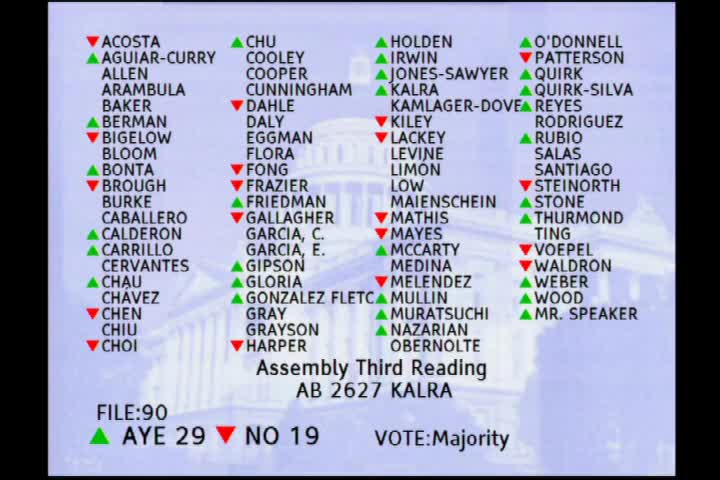 5MIN
Assembly Floor
 58SEC
Assembly Floor
 22MIN
Assembly Standing Committee on Judiciary
 50MIN
Assembly Standing Committee on Labor and Employment



Bill Co-Author(s):





