AB 180: Medi-Cal.
- Session Year: 2017-2018
- House: Assembly
- Latest Version Date: 2018-09-05
(1)Existing law establishes the Medi-Cal program, which is administered by the State Department of Health Care Services, under which qualified low-income individuals receive health care services. The Medi-Cal program is, in part, governed and funded by federal Medicaid program provisions. Existing law provides that federally qualified health center (FQHC) services and rural health clinic (RHC) services are covered benefits under the Medi-Cal program to be reimbursed, to the extent that federal financial participation is obtained, to providers on a per-visit basis.
This bill would, on or before March 1, 2019, require the department to establish a stakeholder process to assist the department in developing guidance for a FQHC or RHC to determine whether a payment would constitute an incentive payment that is prohibited from being reimbursed. The bill would further require the department to issue the guidance developed pursuant to the stakeholder process on or before July 1, 2019, and apply the guidance only to all FQHC and RHC payments starting on and after that issuance date. The bill would authorize the department to seek necessary federal approvals and require the department to promulgate regulations to implement these provisions.
(2)This bill would declare that it is to take effect immediately as an urgency statute.
Existing law establishes the Medi-Cal program, which is administered by the State Department of Health Care Services, under which qualified low-income individuals receive health care services. The Medi-Cal program is, in part, governed and funded by federal Medicaid program provisions. Existing law requires the department to develop and prepare one or more reports issued on at least a quarterly basis and make the reports public within 30 days for the purpose of informing the California Health and Human Services Agency, the California Health Benefit Exchange, the Legislature, and the public about the enrollment process for all insurance affordability programs. Existing law further requires the department to collect the data for these reports pursuant to specified administrative procedures.This bill would instead require these ongoing reports to be issued on at least a biannual basis and be made public within 90, rather than 30, days. The bill would further require the data within the reports to be aggregated and calculated on at least a quarterly basis. The bill would delete the requirement for the department to collect the data pursuant to the specified administrative procedures.Existing law provides for the California Childrens Services (CCS) program, which is a statewide program that provides medically necessary services for physically handicapped children whose parents are unable to pay for those services. Existing law authorizes the department to establish, no sooner than July 1, 2017, a Whole Child Model program, under which managed care plans served by a county organized health system or Regional Health Authority in designated counties would provide CCS program services to Medi-Cal-eligible CCS children and youth. Existing law requires the department to contract with an independent entity that has experience in performing robust program evaluations to conduct an evaluation to assess Medi-Cal managed care plan performance and the outcomes and experience of CCS-eligible children and youth participating in the Whole Child Model program. Existing law requires the department to provide a report on the results of that evaluation by January 1, 2021.This bill would instead require the department to provide that report by January 1, 2021, or 3 years from the date when all counties in which the department is authorized to establish the Whole Child Model program are fully operational under the program, whichever is later.Existing law establishes the Medi-Cal program, which is administered by the State Department of Health Care Services, under which qualified low-income individuals receive health care services. The Medi-Cal program is, in part, governed and funded by federal Medicaid program provisions. Existing law requires the department to develop and prepare one or more reports issued on at least a quarterly basis and make the reports public within 30 days for the purpose of informing the California Health and Human Services Agency, the California Health Benefit Exchange, the Legislature, and the public about the enrollment process for all insurance affordability programs. Existing law further requires the department to collect the data for these reports pursuant to specified administrative procedures.
This bill would instead require this report these ongoing reports to be issued on at least a biannual basis and would make a conforming change. be made public within 90, rather than 30, days. The bill would further require the data within the reports to be aggregated and calculated on at least a quarterly basis. The bill would delete the requirement for the department to collect the data pursuant to the specified administrative procedures.
Existing law provides for the California Childrens Services (CCS) program, which is a statewide program that provides medically necessary services for physically handicapped children whose parents are unable to pay for those services. Existing law authorizes the department to establish, no sooner than July 1, 2017, a Whole Child Model program, under which managed care plans served by a county organized health system or Regional Health Authority in designated counties would provide CCS program services to Medi-Cal-eligible CCS children and youth. Existing law requires the department to contract with an independent entity that has experience in performing robust program evaluations to conduct an evaluation to assess Medi-Cal managed care plan performance and the outcomes and experience of CCS-eligible children and youth participating in the Whole Child Model program. Existing law requires the department to provide a report on the results of that evaluation by January 1, 2021.
This bill would instead require the department to provide that report by January 1, 2021, or 3 years from the date when all counties in which the department is authorized to establish the Whole Child Model program are fully operational under the program, whichever is later.
Existing law provides for establishes the Medi-Cal program, which is administered by the State Department of Health Care Services, under which qualified low-income individuals receive health care services. The Medi-Cal program is, in part, governed and funded by federal Medicaid program provisions. Existing law requires the department to develop and prepare one or more reports issued on at least a quarterly basis for the purpose of informing the California Health and Human Services Agency, the California Health Benefit Exchange, the Legislature, and the public about the enrollment process for all insurance affordability programs.
This bill would instead require this report to be issued on at least a biannual basis and would make a conforming change.
Existing law provides for the California Childrens Services (CCS) program, which is a statewide program that provides medically necessary services for physically handicapped children whose parents are unable to pay for those services. Existing law authorizes the department to establish, no sooner than July 1, 2017, a Whole Child Model program, under which managed care plans served by a county organized health system or Regional Health Authority in designated counties would provide CCS program services to Medi-Cal-eligible CCS children and youth. Existing law requires the department to contract with an independent entity that has experience in performing robust program evaluations to conduct an evaluation to assess Medi-Cal managed care plan performance and the outcomes and experience of CCS-eligible children and youth participating in the Whole Child Model program. Existing law requires the department to provide a report on the results of that evaluation by January 1, 2021.
This bill would instead require the department to provide that report by January 1, 2021, or 3 years from the date when all counties in which the department is authorized to establish the Whole Child Model program are fully operational under the program, whichever is later.
Existing law provides for the Medi-Cal program, which is administered by the State Department of Health Care Services, under which qualified low-income individuals receive health care services. The Medi-Cal program is, in part, governed and funded by federal Medicaid program provisions. Existing law requires the department to develop and prepare one or more reports issued on at least a quarterly basis for the purpose of informing the California Health and Human Services Agency, the California Health Benefit Exchange, the Legislature, and the public about the enrollment process for all insurance affordability programs.
This bill would instead require this report to be issued on at least a biannual basis and would make a conforming change.
(a)It is the intent of the Legislature that quality incentive payments are excluded from wraparound payment calculation when federally qualified health center (FQHC) or rural health clinic (RHC) services are partially reimbursed by a third-party payer, as consistent with Section 405.2469(a)(2) of Title 42 of the Code of Federal Regulations, Section 14132.100 of the Welfare and Institutions Code, and the federal Centers for Medicare and Medicaid Services (CMS) guidance, and that these payments must meet any other federal prospective payment system requirements.
(b)It is the intent of the Legislature that the State Department of Health Care Services issue guidance on what constitutes an incentive payment by a process that collaborates with stakeholders that include, among others, FQHCs, RHCs, and health plans.
(c)It is the intent of the Legislature that the guidance on incentive payments will drive improvements in quality of care by encouraging FQHCs, RHCs, and health plans to partner on developing incentive programs that further the intent of the Medi-Cal delivery system toward the triple aim of improving health outcomes, improving patient experience, and reducing the per capita cost of care.
SEC. 2.Section 14132.103 is added to the Welfare and Institutions Code, to read:14132.103.(a)(1)On or before March 1, 2019, the State Department of Health Care Services shall establish a stakeholder process to assist the department in developing guidance for a federally qualified health center (FQHC) or rural health clinic (RHC) to determine whether a payment would constitute an incentive payment that is prohibited from being included in the calculation of supplemental payments during the reconciliation process.
(2)The stakeholder process shall include, but not be limited to, the department conducting at least two meetings with stakeholders. The stakeholders shall include, but not be limited to, representatives from FQHCs and RHCs, public hospitals, and health plans, including local health plans. The department shall include at least two representatives of FQHCs and RHCs from rural areas in the stakeholder process.
(b)On or before July 1, 2019, the department shall issue the guidance developed pursuant to the stakeholder process set forth in subdivision (a). The department shall publish the guidance on its Internet Web site.
(c)On and after the date the department issued the guidance pursuant to subdivision (b), the department shall use the guidance for FQHC and RHC reconciliation, and shall not apply the guidance to FQHC and RHC reconciliations for any date prior to that issuance date. For any date prior to the date the department issued the guidance pursuant to subdivision (b), FQHC and RHC payments received as part of a quality improvement incentive program, including risk pools, withholds, and bonuses per Section 405.2469(a)(2) of Title 42 of the Code of Federal Regulations, shall not be included in the reconciliation.
(d)The department may seek any necessary federal approvals for the guidance on incentive payments developed pursuant to this section.
(e)Nothing in this bill shall be construed to require an FQHC or RHC to participate in any quality incentive payment arrangement with a third-party payer.
(f)Notwithstanding Chapter 3.5 (commencing with Section 11340) of Part 1 of Division 3 of Title 2 of the Government Code, the department may implement, interpret, or make specific this section by means of all-county letters, plan letters, plan or provider bulletins, or similar instructions without taking regulatory action. The department shall adopt regulations by July 1, 2021, in accordance with the requirements of Chapter 3.5 (commencing with Section 11340) of Part 1 of Division 3 of Title 2 of the Government Code.
SEC. 3.This act is an urgency statute necessary for the immediate preservation of the public peace, health, or safety within the meaning of Article IV of the California Constitution and shall go into immediate effect. The facts constituting the necessity are:
To ensure that federally qualified health centers (FQHCs) and rural health clinics (RHCs) are able to timely participate in the pay for performance program consistent with federal authorization, and to provide necessary clarity to FQHCs or RHCs when the State Department of Health Care Services performs audits of FQHCs or RHCs, it is necessary for this act to take effect immediately.
SECTION 1.Section 14094.18 of the Welfare and Institutions Code is amended to read:14094.18.(a)(1)The department shall contract with an independent entity that has experience in performing robust program evaluations to conduct an evaluation to assess Medi-Cal managed care plan performance and the outcomes and the experience of CCS-eligible children and youth participating in the Whole Child Model program, including access to primary and specialty care, and youth transitions from Whole Child Model program to adult Medi-Cal coverage.(2)The department shall provide a report on the results of this evaluation required pursuant to this section to the Legislature by January 1, 2021, or three years from the date when all counties described in Section 14094.5 are fully operational under the Whole Child Model program pursuant to this article, whichever is later. A report submitted to the Legislature pursuant to this subdivision shall be submitted in compliance with Section 9795 of the Government Code.(b)The evaluation required by this section, at a minimum, shall evaluate the performance of the plans participating in the Whole Child Model program as compared to the performance of the CCS program prior to the implementation of the Whole Child Model program in those same counties. The evaluation shall evaluate whether the inclusion of CCS services in a managed care delivery system improves access to care, quality of care, and the patient experience by analyzing all of the following, and when possible, disaggregating the results, based on the childs or youths race, ethnicity, and primary language spoken at home:(1)Access to specialty and primary care, and in particular, utilization of CCS-paneled providers.(2)The type and location of CCS services and the extent to which CCS services are provided in-network compared to out of network.(3)Utilization rates of inpatient admissions, outpatient services, durable medical equipment, behavioral health services, home health, pharmacy, and other ancillary services.(4)Patient and family satisfaction.(5)Appeals and grievances, including the number of petitions to the plan to extend the continuity of care period for durable medical equipment and CCS providers, the results of those appeals, whether any subsequent appeals were made to the department, and the results of those appeals to the department.(6)Authorization of CCS-eligible services.(7)Network and provider participation, including participation of pediatricians, pediatric specialists, and pediatric subspecialists, by specialty and subspecialty.(8)The ability of a child or youth who ages out of CCS and remains in the same Medi-Cal managed care plan to retain his or her existing providers, to the extent possible or known.(c)The evaluation required by this section shall also evaluate managed care plans participating in the Whole Child Model program as compared to the CCS program in counties where CCS services are not incorporated into managed care, and collect appropriate data to evaluate all of the following:(1)The rate of new CCS enrollment in each county.(2)The percentage of CCS-eligible children and youth with a diagnosis requiring a referral to a CCS special care center who have been seen by a CCS special care center.(3)The percentage of CCS children and youth discharged from a hospital who had at least one followup contact or visit within 28 days after discharge.(4)Appeals and grievances.(d)The department shall consult with stakeholders, including, but not limited to, the Whole Child Model program stakeholder advisory group, regarding the scope and structure of the review.SEC. 2.Section 14102.5 of the Welfare and Institutions Code is amended to read:14102.5.(a)The department shall, in collaboration with the Exchange, the counties, consumer advocates, and the Statewide Automated Welfare System consortia, develop and prepare one or more reports that shall be issued on at least a biannual basis and shall be made publicly available within 90 days following the end of each reporting period, for the purpose of informing the California Health and Human Services Agency, the Exchange, the Legislature, and the public about the enrollment process for all insurance affordability programs. The data within the reports shall be aggregated and calculated on at least a quarterly basis. The reports shall comply with federal reporting requirements and shall, at a minimum, include the following information, to be derived from, as appropriate depending on the data element, CalHEERS, MEDS, or the Statewide Automated Welfare System:(1)For applications received for insurance affordability programs through any venue, all of the following:(A)The number of applications received through each venue.(B)The number of applicants included on those applications.(C)Applicant demographics, including, but not limited to, gender, age, race, ethnicity, and primary language.(D)The disposition of applications, including all of the following:(i)The number of eligibility determinations that resulted in an approval for coverage.(ii)The program or programs for which the individuals in clause (i) were determined eligible.(iii)The number of applications that were denied for any coverage and the reason or reasons for the denials.(E)The number of days for eligibility determinations to be completed.(2)With regard to health plan selection, all of the following:(A)The health plans that are selected by applicants enrolled in an insurance affordability program, reported by the program.(B)The number of Medi-Cal enrollees who do not select a health plan but are defaulted into a plan.(3)For annual redeterminations conducted for beneficiaries, all of the following:(A)The number of redeterminations processed.(B)The number of redeterminations that resulted in continued eligibility for the same insurance affordability program.(C)The number of redeterminations that resulted in a change in eligibility to a different insurance affordability program.(D)The number of redeterminations that resulted in a finding of ineligibility for any program and the reason or reasons for the findings of ineligibility.(E)The number of days for redeterminations to be completed.(4)With regard to disenrollments not related to a redetermination of eligibility, all of the following:(A)The number of beneficiary disenrollments.(B)The reasons for the disenrollments.(C)The number of disenrollments that are caused by an individual disenrolling from one insurance affordability program and enrolling into another.(5)The number of applications for insurance affordability programs that were filed with the help of an assister or navigator.(6)The total number of grievances and appeals filed by applicants and enrollees regarding eligibility for insurance affordability programs, the basis for the grievance, and the outcomes of the appeals.(b)The department shall collect the information necessary for these reports and develop these reports using data obtained from the Statewide Automated Welfare System, CalHEERS, MEDS, and any other appropriate state information management systems.(c)For purposes of this section, the following definitions shall apply:(1)CalHEERS means the California Healthcare Eligibility, Enrollment, and Retention System developed under Section 15926.(2)Exchange means the California Health Benefit Exchange established pursuant to Title 22 (commencing with Section 100500) of the Government Code.(3)Statewide Automated Welfare System means the system developed pursuant to Section 10823.(4)MEDS means the Medi-Cal Eligibility Data System that is maintained by the department.(a)(1)The department shall contract with an independent entity that has experience in performing robust program evaluations to conduct an evaluation to assess Medi-Cal managed care plan performance and the outcomes and the experience of CCS-eligible children and youth participating in the Whole Child Model program, including access to primary and specialty care, and youth transitions from Whole Child Model program to adult Medi-Cal coverage.
(2)The department shall provide a report on the results of this evaluation required pursuant to this section to the Legislature by January 1, 2021, or three years from the date when all counties described in Section 14094.5 are fully operational under the Whole Child Model program pursuant to this article, whichever is later. A report submitted to the Legislature pursuant to this subdivision shall be submitted in compliance with Section 9795 of the Government Code.
(b)The evaluation required by this section, at a minimum, shall evaluate the performance of the plans participating in the Whole Child Model program as compared to the performance of the CCS program prior to the implementation of the Whole Child Model program in those same counties. The evaluation shall evaluate whether the inclusion of CCS services in a managed care delivery system improves access to care, quality of care, and the patient experience by analyzing all of the following, and when possible, disaggregating the results, based on the childs or youths race, ethnicity, and primary language spoken at home:
(1)Access to specialty and primary care, and in particular, utilization of CCS-paneled providers.
(2)The type and location of CCS services and the extent to which CCS services are provided in-network compared to out of network.
(3)Utilization rates of inpatient admissions, outpatient services, durable medical equipment, behavioral health services, home health, pharmacy, and other ancillary services.
(4)Patient and family satisfaction.
(5)Appeals and grievances, including the number of petitions to the plan to extend the continuity of care period for durable medical equipment and CCS providers, the results of those appeals, whether any subsequent appeals were made to the department, and the results of those appeals to the department.
(6)Authorization of CCS-eligible services.
(7)Network and provider participation, including participation of pediatricians, pediatric specialists, and pediatric subspecialists, by specialty and subspecialty.
(8)The ability of a child or youth who ages out of CCS and remains in the same Medi-Cal managed care plan to retain his or her existing providers, to the extent possible or known.
(c)The evaluation required by this section shall also evaluate managed care plans participating in the Whole Child Model program as compared to the CCS program in counties where CCS services are not incorporated into managed care, and collect appropriate data to evaluate all of the following:
(1)The rate of new CCS enrollment in each county.
(2)The percentage of CCS-eligible children and youth with a diagnosis requiring a referral to a CCS special care center who have been seen by a CCS special care center.
(3)The percentage of CCS children and youth discharged from a hospital who had at least one followup contact or visit within 28 days after discharge.
(4)Appeals and grievances.
(d)The department shall consult with stakeholders, including, but not limited to, the Whole Child Model program stakeholder advisory group, regarding the scope and structure of the review.
SEC. 2.Section 14102.5 of the Welfare and Institutions Code is amended to read:14102.5.(a)The department shall, in collaboration with the Exchange, the counties, consumer advocates, and the Statewide Automated Welfare System consortia, develop and prepare one or more reports that shall be issued on at least a biannual basis and shall be made publicly available within 30 90 days following the end of each reporting period, for the purpose of informing the California Health and Human Services Agency, the Exchange, the Legislature, and the public about the enrollment process for all insurance affordability programs. The data within the reports shall be aggregated and calculated on at least a quarterly basis. The reports shall comply with federal reporting requirements and shall, at a minimum, include the following information, to be derived from, as appropriate depending on the data element, CalHEERS, MEDS, or the Statewide Automated Welfare System:
(1)For applications received for insurance affordability programs through any venue, all of the following:
(A)The number of applications received through each venue.
(B)The number of applicants included on those applications.
(C)Applicant demographics, including, but not limited to, gender, age, race, ethnicity, and primary language.
(D)The disposition of applications, including all of the following:
(i)The number of eligibility determinations that resulted in an approval for coverage.
(ii)The program or programs for which the individuals in clause (i) were determined eligible.
(iii)The number of applications that were denied for any coverage and the reason or reasons for the denials.
(E)The number of days for eligibility determinations to be completed.
(2)With regard to health plan selection, all of the following:
(A)The health plans that are selected by applicants enrolled in an insurance affordability program, reported by the program.
(B)The number of Medi-Cal enrollees who do not select a health plan but are defaulted into a plan.
(3)For annual redeterminations conducted for beneficiaries, all of the following:
(A)The number of redeterminations processed.
(B)The number of redeterminations that resulted in continued eligibility for the same insurance affordability program.
(C)The number of redeterminations that resulted in a change in eligibility to a different insurance affordability program.
(D)The number of redeterminations that resulted in a finding of ineligibility for any program and the reason or reasons for the findings of ineligibility.
(E)The number of days for redeterminations to be completed.
(4)With regard to disenrollments not related to a redetermination of eligibility, all of the following:
(A)The number of beneficiary disenrollments.
(B)The reasons for the disenrollments.
(C)The number of disenrollments that are caused by an individual disenrolling from one insurance affordability program and enrolling into another.
(5)The number of applications for insurance affordability programs that were filed with the help of an assister or navigator.
(6)The total number of grievances and appeals filed by applicants and enrollees regarding eligibility for insurance affordability programs, the basis for the grievance, and the outcomes of the appeals.
(b)The department shall collect the information necessary for these reports and develop these reports using data obtained from the Statewide Automated Welfare System, CalHEERS, MEDS, and any other appropriate state information management systems.
(c)For purposes of this section, the following definitions shall apply:
(1)CalHEERS means the California Healthcare Eligibility, Enrollment, and Retention System developed under Section 15926.
(2)Exchange means the California Health Benefit Exchange established pursuant to Title 22 (commencing with Section 100500) of the Government Code.
(3)Statewide Automated Welfare System means the system developed pursuant to Section 10823.
(4)MEDS means the Medi-Cal Eligibility Data System that is maintained by the department.
(d)Notwithstanding Chapter 3.5 (commencing with Section 11340) of Part 1 of Division 3 of Title 2 of the Government Code, the department, without taking any further regulatory action, shall implement, interpret, or make specific this section by means of all-county letters, plan letters, plan or provider bulletins, or similar instructions until the time regulations are adopted. Thereafter, the department shall adopt regulations in accordance with the requirements of Chapter 3.5 (commencing with Section 11340) of Part 1 of Division 3 of Title 2 of the Government Code. Beginning six months after the effective date of this section, and notwithstanding Section 10231.5 of the Government Code, the department shall provide a status report to the Legislature on a semiannual basis until regulations have been adopted.(a)(1)The department shall contract with an independent entity that has experience in performing robust program evaluations to conduct an evaluation to assess Medi-Cal managed care plan performance and the outcomes and the experience of CCS-eligible children and youth participating in the Whole Child Model program, including access to primary and specialty care, and youth transitions from Whole Child Model program to adult Medi-Cal coverage.
(2)The department shall provide a report on the results of this evaluation required pursuant to this section to the Legislature by no later than January 1, 2021. January 1, 2021, or three years from the date when all counties described in Section 14094.5 are fully operational under the Whole Child Model program pursuant to this article, whichever is later. A report submitted to the Legislature pursuant to this subdivision shall be submitted in compliance with Section 9795 of the Government Code.
(b)The evaluation required by this section, at a minimum, shall evaluate the performance of the plans participating in the Whole Child Model program as compared to the performance of the CCS program prior to the implementation of the Whole Child Model program in those same counties. The evaluation shall evaluate whether the inclusion of CCS services in a managed care delivery system improves access to care, quality of care, and the patient experience by analyzing all of the following, and when possible, disaggregating the results, based on the childs or youths race, ethnicity, and primary language spoken at home:
(1)Access to specialty and primary care, and in particular, utilization of CCS-paneled providers.
(2)The type and location of CCS services and the extent to which CCS services are provided in-network compared to out of network.
(3)Utilization rates of inpatient admissions, outpatient services, durable medical equipment, behavioral health services, home health, pharmacy, and other ancillary services.
(4)Patient and family satisfaction.
(5)Appeals and grievances, including the number of petitions to the plan to extend the continuity of care period for durable medical equipment and CCS providers, the results of those appeals, whether any subsequent appeals were made to the department, and the results of those appeals to the department.
(6)Authorization of CCS-eligible services.
(7)Network and provider participation, including participation of pediatricians, pediatric specialists, and pediatric subspecialists, by specialty and subspecialty.
(8)The ability of a child or youth who ages out of CCS and remains in the same Medi-Cal managed care plan to retain his or her existing providers, to the extent possible or known.
(c)The evaluation required by this section shall also evaluate managed care plans participating in the Whole Child Model program as compared to the CCS program in counties where CCS services are not incorporated into managed care, and collect appropriate data to evaluate all of the following:
(1)The rate of new CCS enrollment in each county.
(2)The percentage of CCS-eligible children and youth with a diagnosis requiring a referral to a CCS special care center who have been seen by a CCS special care center.
(3)The percentage of CCS children and youth discharged from a hospital who had at least one followup contact or visit within 28 days after discharge.
(4)Appeals and grievances.
(d)The department shall consult with stakeholders, including, but not limited to, the Whole Child Model program stakeholder advisory group, regarding the scope and structure of the review.
SECTION 1.SEC. 2.Section 14102.5 of the Welfare and Institutions Code is amended to read:14102.5.(a)The department shall, in collaboration with the Exchange, the counties, consumer advocates, and the Statewide Automated Welfare System consortia, develop and prepare one or more reports that shall be issued on at least a biannual basis and shall be made publicly available within 30 days following the end of each reporting period, for the purpose of informing the California Health and Human Services Agency, the Exchange, the Legislature, and the public about the enrollment process for all insurance affordability programs. The reports shall comply with federal reporting requirements and shall, at a minimum, include the following information, to be derived from, as appropriate depending on the data element, CalHEERS, MEDS, or the Statewide Automated Welfare System:
(1)For applications received for insurance affordability programs through any venue, all of the following:
(A)The number of applications received through each venue.
(B)The number of applicants included on those applications.
(C)Applicant demographics, including, but not limited to, gender, age, race, ethnicity, and primary language.
(D)The disposition of applications, including all of the following:
(i)The number of eligibility determinations that resulted in an approval for coverage.
(ii)The program or programs for which the individuals in clause (i) were determined eligible.
(iii)The number of applications that were denied for any coverage and the reason or reasons for the denials.
(E)The number of days for eligibility determinations to be completed.
(2)With regard to health plan selection, all of the following:
(A)The health plans that are selected by applicants enrolled in an insurance affordability program, reported by the program.
(B)The number of Medi-Cal enrollees who do not select a health plan but are defaulted into a plan.
(3)For annual redeterminations conducted for beneficiaries, all of the following:
(A)The number of redeterminations processed.
(B)The number of redeterminations that resulted in continued eligibility for the same insurance affordability program.
(C)The number of redeterminations that resulted in a change in eligibility to a different insurance affordability program.
(D)The number of redeterminations that resulted in a finding of ineligibility for any program and the reason or reasons for the findings of ineligibility.
(E)The number of days for redeterminations to be completed.
(4)With regard to disenrollments not related to a redetermination of eligibility, all of the following:
(A)The number of beneficiary disenrollments.
(B)The reasons for the disenrollments.
(C)The number of disenrollments that are caused by an individual disenrolling from one insurance affordability program and enrolling into another.
(5)The number of applications for insurance affordability programs that were filed with the help of an assister or navigator.
(6)The total number of grievances and appeals filed by applicants and enrollees regarding eligibility for insurance affordability programs, the basis for the grievance, and the outcomes of the appeals.
(b)The department shall collect the information necessary for these reports and develop these reports using data obtained from the Statewide Automated Welfare System, CalHEERS, MEDS, and any other appropriate state information management systems.
(c)For purposes of this section, the following definitions shall apply:
(1)CalHEERS means the California Healthcare Eligibility, Enrollment, and Retention System developed under Section 15926.
(2)Exchange means the California Health Benefit Exchange established pursuant to Title 22 (commencing with Section 100500) of the Government Code.
(3)Statewide Automated Welfare System means the system developed pursuant to Section 10823.
(4)MEDS means the Medi-Cal Eligibility Data System that is maintained by the department.
(d)Notwithstanding Chapter 3.5 (commencing with Section 11340) of Part 1 of Division 3 of Title 2 of the Government Code, the department, without taking any further regulatory action, shall implement, interpret, or make specific this section by means of all-county letters, plan letters, plan or provider bulletins, or similar instructions until the time regulations are adopted. Thereafter, the department shall adopt regulations in accordance with the requirements of Chapter 3.5 (commencing with Section 11340) of Part 1 of Division 3 of Title 2 of the Government Code. Beginning six months after the effective date of this section, and notwithstanding Section 10231.5 of the Government Code, the department shall provide a status report to the Legislature on a semiannual basis until regulations have been adopted.
(a)The department shall, in collaboration with the Exchange, the counties, consumer advocates, and the Statewide Automated Welfare System consortia, develop and prepare one or more reports that shall be issued on at least a quarterly biannual basis and shall be made publicly available within 30 days following the end of each quarter, reporting period, for the purpose of informing the California Health and Human Services Agency, the Exchange, the Legislature, and the public about the enrollment process for all insurance affordability programs. The reports shall comply with federal reporting requirements and shall, at a minimum, include the following information, to be derived from, as appropriate depending on the data element, CalHEERS, MEDS, or the Statewide Automated Welfare System:
(1)For applications received for insurance affordability programs through any venue, all of the following:
(A)The number of applications received through each venue.
(B)The number of applicants included on those applications.
(C)Applicant demographics, including, but not limited to, gender, age, race, ethnicity, and primary language.
(D)The disposition of applications, including all of the following:
(i)The number of eligibility determinations that resulted in an approval for coverage.
(ii)The program or programs for which the individuals in clause (i) were determined eligible.
(iii)The number of applications that were denied for any coverage and the reason or reasons for the denials.
(E)The number of days for eligibility determinations to be completed.
(2)With regard to health plan selection, all of the following:
(A)The health plans that are selected by applicants enrolled in an insurance affordability program, reported by the program.
(B)The number of Medi-Cal enrollees who do not select a health plan but are defaulted into a plan.
(3)For annual redeterminations conducted for beneficiaries, all of the following:
(A)The number of redeterminations processed.
(B)The number of redeterminations that resulted in continued eligibility for the same insurance affordability program.
(C)The number of redeterminations that resulted in a change in eligibility to a different insurance affordability program.
(D)The number of redeterminations that resulted in a finding of ineligibility for any program and the reason or reasons for the findings of ineligibility.
(E)The number of days for redeterminations to be completed.
(4)With regard to disenrollments not related to a redetermination of eligibility, all of the following:
(A)The number of beneficiary disenrollments.
(B)The reasons for the disenrollments.
(C)The number of disenrollments that are caused by an individual disenrolling from one insurance affordability program and enrolling into another.
(5)The number of applications for insurance affordability programs that were filed with the help of an assister or navigator.
(6)The total number of grievances and appeals filed by applicants and enrollees regarding eligibility for insurance affordability programs, the basis for the grievance, and the outcomes of the appeals.
(b)The department shall collect the information necessary for these reports and develop these reports using data obtained from the Statewide Automated Welfare System, CalHEERS, MEDS, and any other appropriate state information management systems.
(c)For purposes of this section, the following definitions shall apply:
(1)CalHEERS means the California Healthcare Eligibility, Enrollment, and Retention System developed under Section 15926.
(2)Exchange means the California Health Benefit Exchange established pursuant to Title 22 (commencing with Section 100500) of the Government Code.
(3)Statewide Automated Welfare System means the system developed pursuant to Section 10823.
(4)MEDS means the Medi-Cal Eligibility Data System that is maintained by the department.
(d)Notwithstanding Chapter 3.5 (commencing with Section 11340) of Part 1 of Division 3 of Title 2 of the Government Code, the department, without taking any further regulatory action, shall implement, interpret, or make specific this section by means of all-county letters, plan letters, plan or provider bulletins, or similar instructions until the time regulations are adopted. Thereafter, the department shall adopt regulations in accordance with the requirements of Chapter 3.5 (commencing with Section 11340) of Part 1 of Division 3 of Title 2 of the Government Code. Beginning six months after the effective date of this section, and notwithstanding Section 10231.5 of the Government Code, the department shall provide a status report to the Legislature on a semiannual basis until regulations have been adopted.
(e)This section shall become operative on January 1, 2014.|
Date
|
Status
|
|---|---|
| Sep 26, 2018 | Vetoed by Governor. |
| Sep 11, 2018 | Enrolled and presented to the Governor at 4:30 p.m. |
| Aug 31, 2018 | In Assembly. Concurrence in Senate amendments pending. |
| Aug 31, 2018 | Read third time. Passed. Ordered to the Assembly. |
| Aug 30, 2018 | Read second time. Ordered to third reading. |
| Aug 29, 2018 | From committee: Do pass. (Ayes 6. Noes 0.) (August 29). |
| Aug 22, 2018 | Re-referred to Com. on HEALTH. |
| Aug 21, 2018 | Joint Rules 61 and 62 suspended. |
| Aug 16, 2018 | Re-referred to Com. on RLS. pursuant to Senate Rule 29.10(c). |
| Aug 15, 2018 | From inactive file. |
| Aug 21, 2017 | Ordered to inactive file at the request of Senator Hernandez. |
| Jul 11, 2017 | Read second time. Ordered to third reading. |
| Jul 10, 2017 | From committee: Be ordered to second reading pursuant to Senate Rule 28.8. |
| Jun 22, 2017 | From committee: Do pass and re-refer to Com. on APPR. (Ayes 9. Noes 0.) (June 21). Re-referred to Com. on APPR. |
| Jun 1, 2017 | Re-referred to Com. on HEALTH. |
| May 26, 2017 | From committee chair, with author's amendments: Amend, and re-refer to committee. Read second time, amended, and re-referred to Com. on RLS. |
| May 18, 2017 | From committee chair, with author's amendments: Amend, and re-refer to Com. on RLS. Read second time and amended. |
| May 18, 2017 | Referred to Com. on RLS. |
| May 4, 2017 | In Senate. Read first time. To Com. on RLS. for assignment. |
| May 4, 2017 | Read third time. Passed. Ordered to the Senate. (Ayes 76. Noes 0. Page 1388.) |
| Apr 27, 2017 | Read second time. Ordered to Consent Calendar. |
| Apr 26, 2017 | From committee: Do pass. To Consent Calendar. (Ayes 16. Noes 0.) (April 26). |
| Apr 19, 2017 | From committee: Do pass and re-refer to Com. on APPR. with recommendation: To Consent Calendar. (Ayes 15. Noes 0.) (April 18). Re-referred to Com. on APPR. |
| Jan 30, 2017 | Referred to Com. on HEALTH. |
| Jan 19, 2017 | From printer. May be heard in committee February 18. |
| Jan 18, 2017 | Read first time. To print. |
|
Date
|
Description
|
Location
|
Votes
|
|
|---|---|---|---|---|
| Aug 31, 2018 | Assembly 3rd Reading AB180 Wood et al. By McGuire Urgency Clause | Senate Floor |
Passed |
|
| Aug 31, 2018 | AB 180 Wood Concurrence - Urgency Added | Assembly Floor |
Passed |
|
| Aug 29, 2018 | Do pass | Senate Standing Committee on Appropriations |
Passed |
|
| Aug 22, 2018 | Do pass, but first be re-referred to the Committee on [Appropriations] | Senate Standing Committee on Health |
Passed |
|
| Jun 21, 2017 | Do pass, but first be re-referred to the Committee on [Appropriations] | Senate Standing Committee on Health |
Passed |
|
| May 4, 2017 | AB 180 WOOD Consent Calendar Second Day Regular Session | Assembly Floor |
Passed |
|
| Apr 26, 2017 | Do pass. To Consent Calendar. | Assembly Standing Committee on Appropriations |
Passed |
|
| Apr 18, 2017 | Do pass and be re-referred to the Committee on [Appropriations] with recommendation: To Consent Calendar | Assembly Standing Committee on Health |
Passed |
This list shows positions taken on this bill by organizations on the date displayed, which is linked to the original source.
Positions by individuals are not included.
GOVERNOR'S VETO
GV Bill Id:AB 180
Author:(Wood)
As Enrolled Ver:September 11, 2018
2/3 vote
ASSEMBLY: | (May 4, 2017) | SENATE: | 39-0 | (August 31, 2018) |
(vote not relevant)
ASSEMBLY: | 80-0 | (August 31, 2018) |
|
|
|
Original Committee Reference: HEALTH
SUMMARY: Requires the Department of Health Care Services (DHCS) to establish a stakeholder process to assist DHCS in developing guidance for a federally qualified health center (FQHC) or rural health clinic (RHC) to determine whether a payment would constitute an incentive payment that is prohibited from being included in the calculation of supplemental payments during the reconciliation process. Includes an urgency to ensure the provisions of this bill take effect immediately upon enactment.
The Senate amendments delete the Assembly-approved version of this bill, and instead:
- Require DHCS to establish a stakeholder process to develop guidance for FQHCs or RHCs to determine whether a payment would constitute an incentive payment that is prohibited from being included in the calculation of supplemental payments during the reconciliation process.
- Require the stakeholder process to include, but not be limited to, DHCS conducting at least two meetings with stakeholders. Require the stakeholders to include, but not be limited to, representatives from FQHCs and RHCs, public hospitals, and health plans, including local health plans. Require DHCS to include at least two representatives of FQHCs or RHCS from rural areas in the stakeholder process.
- Require DHCS, on or before July 1, 2019, to issue the guidance developed pursuant to the stakeholder process, and to publish the guidance on its Internet Website.
- Require DHCS, on and after the date DHCS issued the guidance, to use the guidance for FQHC and RHC reconciliation, and not apply the guidance to FQHC and RHC reconciliations for any date prior to that issuance date. Prohibit including in the reconciliation, for any date prior to the date DHCS issued the guidance, FQHC and RHC payments received as part of a quality improvement incentive program, including risk pools, withholds, and bonuses, as specified.
- Permit DHCS to seek any necessary federal approvals for the guidance on incentive payments developed under this bill.
- Provide that this bill shall not be construed to require an FQHC or RHC to participate in any quality incentive payment arrangement with a third-party payer.
- Authorize DHCS to implement, interpret, or make specific this bill by means of all-count letter, plan letters, plan or provider bulletins, or similar instructions without taking regulatory action. Require DHCS to adopt regulations by July 1, 2021, as specified.
EXISTING LAW:
- Provides under federal regulations (42 Code of Federal Regulations Section (CFR) 405.2469) that any financial incentives provided to FQHCs under their Medicare Advantage contracts, such as risk pool payments, bonuses, or withholds are prohibited from being included in the calculation of supplemental payments due to the FQHC
- Establishes the Medi-Cal program as California's Medicaid program, administered by DHCS, which provides comprehensive health care coverage for low-income individuals. FQHC and RHC services are covered benefits under the Medi-Cal program.
- Requires FQHCs and RHCs to be reimbursed on a per-visit basis. Defines a "visit" as a face-to-face encounter between an FQHC or RHC patient and specified health care providers. Medi-Cal payments to FQHCs and RHCs are made under what is known as the Prospective Payment System (PPS).
- Requires, if FQHC or RHC services are partially reimbursed by a third-party payer (such as a managed care entity), DHCS to reimburse an FQHC or RHC for the difference between its per-visit PPS rate and receipts from other plans or programs on a contract-by-contract basis and not in the aggregate. Requires managed care financial incentive payments that are required by federal law to be excluded from this calculation.
- Requires DHCS to administer a program to ensure that total payments to FQHCs and RHCs operating as managed care subcontractors comply with federal law. Requires FQHCs and RHCs subcontracting with Medi-Cal managed care plans (MCPs) to seek supplemental reimbursement from DHCS through a per visit fee-for-service billing system whereby the FQHC and RHC submits to DHCS for approval a rate differential calculated to reflect the amount necessary to reimburse the FQHC or RHC for the difference between the payment the center received from the managed care health plan and either the interim rate established by DHCS based on the center's or clinic's reasonable cost or the center's PPS rate. This DHCS payment to the FQHC or RHC is referred to as the "wrap around" payment.
FISCAL EFFECT: According to the Senate Appropriations Committee, the following estimate includes a wide fiscal range, as the bill's direct and immediate costs are related to the implementation of the stakeholder process, and out-year costs are driven by the stakeholder process' potential recommendations for how DHCS determines an incentive payment.
- Limited-term administrative workload for DHCS (possibly 1.0 Associate Governmental Program Analyst, around $120,000 General Fund (GF)/federal funds) to convene the stakeholder process and assist in drafting guidance.
- Ongoing cost-pressure (likely up to tens of millions GF/federal funds) on the current payment system, depending on how DHCS defines the scope of an incentive payment following the stakeholder process. Incentive payments could be significant and frequent, or low and one-time.
Based on a DHCS May 2018 estimate, there are projected to be between 17 million to 20 million visits for 1,061 FQHCs, 279 RHCs, and for the 26 cost-based reimbursement clinics from 2016 to 2018. At the time of the analysis, it was unclear of the 20 million visits, how many could be attributable to only FQHCs and RHCs. Absent knowing the actual cost of the incentive payment (currently, ranges from a few cents per member per month to $9.45 per member per month, if not more), or number of visits for which an incentive payment is made above the actual PPS rate, there are indeterminate state cost pressures (likely tens of millions, GF/federal funds).
COMMENTS: According to the author, this bill is necessary to provide guidance and consistency in the reconciliation process for FQHCs and RHCs that participate in the pay-for-performance (P4P) program. Community clinics like Anderson Valley Health Center (AVHC) has participated in the P4P program administered by Partnership Health Plan in an effort to improve health outcomes for patients in important areas such as diabetic care, cancer screening, behavioral health and substance abuse screening and advanced care planning. However, AVHC (and potentially other community clinics) has been informed by DHCS during the reconciliation process that these P4P payments will be calculated as part of the wrap around payments calculation, thus requiring AVHC to repay all these payments to DHCS. AVHC and other community clinics have detrimentally relied on federal authorization and guidance in agreeing to participate in the P4P program. DHCS has never issued any guidance on what is allowed or disallowed in the P4P program. This lack of guidance will continue to penalize FQHCs that have participated in these quality incentive payments and would deter additional clinics from participating. Clinics are willing to work with DHCS on coming up with guidance/criteria on what is included or prohibited in the calculation of these payments during the reconciliation process. This also indicates that protracted and expensive process of appealing DHCS's determination on these payments is putting administrative burden and expense on these clinics that are serving the most vulnerable population, and in AVHC's case, the only clinic that provides services in the area that it operates.
- Background. FQHCs and RHCs serve a significant portion of the uninsured and underinsured in California. These community clinics are open-door providers that treat patients on a sliding scale fee structure and provide services regardless of a patient's ability to pay. There are approximately 1,040 FQHCs and approximately 283 RHCs in California. All FQHCs, and a majority of the RHCs, are either non-profit community clinics or government entities. Because these clinics are safety net providers, their continued survival depends heavily on the stability and adequacy of revenues from the Medi-Cal program. FQHCs and RHCs are paid by Medi-Cal on a "per visit" basis in an amount equal to the clinic's cost of delivering services. Essentially, DHCS calculates the annual cost of care provided by each clinic and divides the total by the number of visits to determine a per visit rate. The number of Medi-Cal reimbursed FQHC visits has increased from 5.9 million in 2008 to 11.9 million in 2014.
Reimbursement to FQHCs and RHCs is governed by both state and federal law. For MCP patients, DHCS reimburses FQHCs and RHCs for the difference between its per-visit PPS rate and the payment made by the plan. This payment is known as a "wrap around" payment. The Medi-Cal managed care wrap-around rate was established to reimburse providers for the difference between their PPS rate and their Medi-Cal managed care reimbursement rate. The rationale for the enhanced reimbursement is to ensure that FQHCs and RHCs do not use federal grants intended for the uninsured and special needs population to back-fill for potentially below-cost Medicare or Medi-Cal rates. The mean and median PPS rate paid to an FQHC ($207.98 and $182.23 respectively) and an RHC ($159.73 and $141.98 respectively) is considerably higher than the most common primary care visit fee-for-service reimbursement rates in Medi-Cal. The Congressional purpose in establishing FQHC and RHC payment provisions in federal law was to ensure federal Section 330 grant funds were not used to cover the cost of serving Medicaid patients. Because FQHCs and RHCs are required to receive a cost-of-living adjustment to their rates (under the Medicare Economic Index) and because of their role in providing primary care access to the Medi-Cal population, FQHCs and RHCs have been exempted from the various Medi-Cal rate reductions enacted in 2008-2011.
- Managed care incentive payments. The amount an FQHC and a RHC is reimbursed by DHCS for the difference between its per-visit PPS rate and the payment made by the MCP is known as a "wrap around" payment. For example, if an FQHC had a PPS rate of $150, and the health plan paid the FQHC a rate of $60 for a visit, the wrap around payment from DHCS would be $90. The Medi-Cal managed care wrap-around rate was established to comply with state and federal requirements for reimbursement to an FQHC or RHC for the difference between their PPS rate and their Medi-Cal managed care reimbursement.
On September 27, 2000, the Centers for Medicare and Medicaid Services (CMS) issued a State Medicaid Director letter on financial incentive paid by plans to FQHCs. CMS stated Medicaid managed care organizations frequently use their own funds to include financial incentives in their contracts with subcontracting providers. Financial incentives provide the subcontractor with an incentive to reduce unnecessary utilization of services or otherwise reduce patient costs. Such incentives may be negative, such as withholding a portion of the capitation payments. If utilization goals are not satisfied, the subcontractor foregoes the withheld amount in whole or part. Incentives may also be positive, such as a bonus that is paid if desired utilization outcomes are achieved.
In both cases, CMS stated it believed these incentive amounts (whether positive or negative) are separate from the plan's payment for services provided under the subcontract, do not include any additional federal funding, and should not be included in the state's calculation of supplemental payments due the FQHC/RHC. Inclusion of incentive amounts (whether positive or negative) in calculating supplemental payments would negate the financial impact the incentive is designed to provide, because the FQHC/RHC would get the same total amount of money, regardless of whether it met the utilization or other goals set by the plan. For this reason, CMS determined that the state's quarterly supplemental payment obligation should be determined using the baseline payment under the contract for services being provided, without regard to the effects of financial incentives that are linked to utilization outcomes or other reductions in patient costs.
- Incentive payments and San Mateo decision. On April 27, 2018, the Superior Court in Sacramento issued a ruling on the issue of P4P in the case of County of San Mateo v. Director of the California Department of Health Care Services. This case was brought to the Court after an administrative law judge ruled that P4P payments should not have been included in making the supplemental payment calculations.
The County of San Mateo operates the San Mateo Medical Center (SMMC) as a public hospital and an FQHC. Health Plan of San Mateo (HPSM) is a managed care plan that contracts with various providers in San Mateo county to provide services to Medi-Cal beneficiaries, and one of its contracted providers is SMMC. To afford further incentive to its providers to administer routine care, HPSM offers a P4P where additional payments were given to provider for certain routine services. SMMC could receive additional payment under the P4P for services such as offering extended office hours, performing annual child welfare visits or women's exams; completing an asthma action plan for asthma patients, offering a diabetes program and performing postpartum exam by an obstetrics physician. If SMMC complete any of these additional activities, it received a payment based on either a flat dollar amount per item, or a percentage of the SMMC's capitation payment. During the reconciliation or audit process performed by DHCS, the P4P payments that SMMC received from HPSM were calculated as part of the wrap around payment, and disallowed all the P4P payments SMMC received.
In ruling for DHCS, the Court acknowledge that "the P4P payments are constructed are garden-variety payments that augment the capitated payment." The Court adopted DHCS's interpretation of the 2000 CMS letter discussed above where financial incentives only qualify for exclusion if they set out specific targets, performance measures, or outcomes that must be met and serve to "reduce unnecessary utilization of services or otherwise reduce patient costs."
The effect of the San Mateo ruling and the distinction between quality incentive payments and financial incentives is to dis-incentivize FQHC and RHC participation in quality incentive programs because any additional funds the center might receive from a plan for meeting quality-related performance targets will be reduced through the reconciliation process. In the example above, if an FQHC had a PPS rate of $150, and the health plan paid the FQHC a rate of $60 for a visit, the wrap around payment from DHCS would be $90. If the FQHC received a quality incentive payment of $10 for the visit, that amount would be deducted from the $90 wrap around payment, resulting in the FQHC receiving $150 instead of $160.
- Related legislation. SB 456 (Pan) of the current legislative session would have required compensation paid to an FQHC or RHC for services that follow the patient (as defined) to be supplemental to, and separate from, the FQHC or RHC's PPS rate and not subject to reconciliation or to any reduction. SB 456 passed from the Assembly Appropriations Committee suspense file but was later amended to address another subject matter.
AB 2029 (Eduardo Garcia) of the current legislative session would have required the methodology of the FQHC and RHC adjusted per-visit rate to exclude a per-visit payment limitation and a provider productivity standard. Required, to the extent required under federal law, the FQHC and RHS adjusted per-visit rate to include direct costs, administrative costs, and costs related to FQHC and RHC services rendered outside of the respective facility, consistent with guidance issued by CMS and the federal Health Resources and Services Administration. Required Medi-Cal managed care incentive payments to be excluded from the wrap around payment calculation when FQHC or RHC services are partially reimbursed by a MCP. AB 2029 was held on the Senate Appropriations Committee suspense file.
- Support. AVHC, an FQHC located in Mendocino County and the sponsor of this bill, states that this bill is necessary to provide much needed clarification from DHCS regarding the exclusion of quality incentive payments from the health center's annual PPS reconciliation. AVHC states that it received a determination for its 2013-14 PPS reconciliation in May 2018, and this determination had two audit adjustments that went against long-standing federal guidance by including quality incentive payments in its reconciliation in the amount of $24,708, resulting in a net loss and balance owed back to the state by AVHC. AVHC indicates it has filed a formal appeal and has an initial hearing in October 2018, and the impact and determination of this hearing, as well as the success of this bill, will have an enormous impact on AVHC and its fellow FQHCs and the programs they are able to support with quality incentive funds.
CaliforniaHealth+ Advocates writes in support that this bill will clarify state law regarding the exclusion of quality incentive payments from the wraparound payment calculation when earned by FQHCs and RHCs under Medi-Cal managed care quality incentive programs. CaliforniaHealth+ Advocates writes that, in recent years, incentive payments – including P4P payments – have become an important tool in the Medicare and Medicaid environments to support innovative and timely access to care. MCPs throughout the state have adopted them widely, and FQHCs and RHCs have benefited from these additional investments, and have used these additional funds to improve care and address operational needs. Recently, DHCS Audits and Investigations Unit began aggressively, and inconsistently, using the standard audit process to propose audit adjustments that incorporate these incentive payments, thereby recouping the payments years after the fact. With some health centers receiving millions of dollars in incentive payments, these actions are placing an administrative and financial burden on health centers, creating uncertainty among plan partners and risk destabilizing health centers' ability to provide high quality, comprehensive care to Medi-Cal members across the state.
- Opposition. The Department of Finance opposes this bill because it would likely result in increased General Fund costs for reimbursement to clinics, and because DHCS already has the administrative authority to provide additional guidance to clinics through all plan letters.
This bill was substantially amended in the Senate and the Assembly-approved version of this bill was deleted. This bill, as amended in the Senate, is inconsistent with Assembly actions and the provisions of this bill, as amended in the Senate, have not been heard in an Assembly policy committee.
I am returning the following bills without my signature.
AB 180
SB 275
SB 707
Each of these bills requires the Department of Health Care Services to establish a stakeholder process to deliberate and advise the department on an issue with Medi-Cal.
Not every problem with Medi-Cal needs or deserves a public stakeholder process. The department regularly collaborates with stakeholders including interested organizations, experts, partners and colleagues. I am confident it will continue to do so.
Analysis Prepared by: Rosielyn Pulmano / HEALTH / (916) 319-2097 FN: 0005355
CONCURRENCE IN SENATE AMENDMENTS
CSA1 Bill Id:AB 180
Author:(Wood)
As Amended Ver:August 15, 2018
2/3 vote. Urgency
ASSEMBLY: | 76-0 | (May 4, 2017) | SENATE: | 39-0 | (August 31, 2018) |
Original Committee Reference: HEALTH
SUMMARY: Requires the Department of Health Care Services (DHCS) to establish a stakeholder process to assist DHCS in developing guidance for a federally qualified health center (FQHC) or rural health clinic (RHC) to determine whether a payment would constitute an incentive payment that is prohibited from being included in the calculation of supplemental payments during the reconciliation process. Includes an urgency to ensure the provisions of this bill take effect immediately upon enactment.
The Senate amendments delete the Assembly-approved version of this bill, and instead:
- Require DHCS to establish a stakeholder process to develop guidance for FQHCs or RHCs to determine whether a payment would constitute an incentive payment that is prohibited from being included in the calculation of supplemental payments during the reconciliation process.
- Require the stakeholder process to include, but not be limited to, DHCS conducting at least two meetings with stakeholders. Require the stakeholders to include, but not be limited to, representatives from FQHCs and RHCs, public hospitals, and health plans, including local health plans. Require DHCS to include at least two representatives of FQHCs or RHCS from rural areas in the stakeholder process.
- Require DHCS, on or before July 1, 2019, to issue the guidance developed pursuant to the stakeholder process, and to publish the guidance on its Internet Website.
- Require DHCS, on and after the date DHCS issued the guidance, to use the guidance for FQHC and RHC reconciliation, and not apply the guidance to FQHC and RHC reconciliations for any date prior to that issuance date. Prohibit including in the reconciliation, for any date prior to the date DHCS issued the guidance, FQHC and RHC payments received as part of a quality improvement incentive program, including risk pools, withholds, and bonuses, as specified.
- Permit DHCS to seek any necessary federal approvals for the guidance on incentive payments developed under this bill.
- Provide that this bill shall not be construed to require an FQHC or RHC to participate in any quality incentive payment arrangement with a third-party payer.
- Authorize DHCS to implement, interpret, or make specific this bill by means of all-count letter, plan letters, plan or provider bulletins, or similar instructions without taking regulatory action. Require DHCS to adopt regulations by July 1, 2021, as specified.
EXISTING LAW:
- Provides under federal regulations (42 Code of Federal Regulations Section (CFR) 405.2469) that any financial incentives provided to FQHCs under their Medicare Advantage contracts, such as risk pool payments, bonuses, or withholds are prohibited from being included in the calculation of supplemental payments due to the FQHC
- Establishes the Medi-Cal program as California's Medicaid program, administered by DHCS, which provides comprehensive health care coverage for low-income individuals. FQHC and RHC services are covered benefits under the Medi-Cal program.
- Requires FQHCs and RHCs to be reimbursed on a per-visit basis. Defines a "visit" as a face-to-face encounter between an FQHC or RHC patient and specified health care providers. Medi-Cal payments to FQHCs and RHCs are made under what is known as the Prospective Payment System (PPS).
- Requires, if FQHC or RHC services are partially reimbursed by a third-party payer (such as a managed care entity), DHCS to reimburse an FQHC or RHC for the difference between its per-visit PPS rate and receipts from other plans or programs on a contract-by-contract basis and not in the aggregate. Requires managed care financial incentive payments that are required by federal law to be excluded from this calculation.
- Requires DHCS to administer a program to ensure that total payments to FQHCs and RHCs operating as managed care subcontractors comply with federal law. Requires FQHCs and RHCs subcontracting with Medi-Cal managed care plans (MCPs) to seek supplemental reimbursement from DHCS through a per visit fee-for-service billing system whereby the FQHC and RHC submits to DHCS for approval a rate differential calculated to reflect the amount necessary to reimburse the FQHC or RHC for the difference between the payment the center received from the managed care health plan and either the interim rate established by DHCS based on the center's or clinic's reasonable cost or the center's PPS rate. This DHCS payment to the FQHC or RHC is referred to as the "wrap around" payment.
FISCAL EFFECT: According to the Senate Appropriations Committee, the following estimate includes a wide fiscal range, as the bill's direct and immediate costs are related to the implementation of the stakeholder process, and out-year costs are driven by the stakeholder process' potential recommendations for how DHCS determines an incentive payment.
- Limited-term administrative workload for DHCS (possibly 1.0 Associate Governmental Program Analyst, around $120,000 General Fund (GF)/federal funds) to convene the stakeholder process and assist in drafting guidance.
- Ongoing cost-pressure (likely up to tens of millions GF/federal funds) on the current payment system, depending on how DHCS defines the scope of an incentive payment following the stakeholder process. Incentive payments could be significant and frequent, or low and one-time.
Based on a DHCS May 2018 estimate, there are projected to be between 17 million to 20 million visits for 1,061 FQHCs, 279 RHCs, and for the 26 cost-based reimbursement clinics from 2016 to 2018. At the time of the analysis, it was unclear of the 20 million visits, how many could be attributable to only FQHCs and RHCs. Absent knowing the actual cost of the incentive payment (currently, ranges from a few cents per member per month to $9.45 per member per month, if not more), or number of visits for which an incentive payment is made above the actual PPS rate, there are indeterminate state cost pressures (likely tens of millions, GF/federal funds).
COMMENTS: According to the author, this bill is necessary to provide guidance and consistency in the reconciliation process for FQHCs and RHCs that participate in the pay-for-performance (P4P) program. Community clinics like Anderson Valley Health Center (AVHC) has participated in the P4P program administered by Partnership Health Plan in an effort to improve health outcomes for patients in important areas such as diabetic care, cancer screening, behavioral health and substance abuse screening and advanced care planning. However, AVHC (and potentially other community clinics) has been informed by DHCS during the reconciliation process that these P4P payments will be calculated as part of the wrap around payments calculation, thus requiring AVHC to repay all these payments to DHCS. AVHC and other community clinics have detrimentally relied on federal authorization and guidance in agreeing to participate in the P4P program. DHCS has never issued any guidance on what is allowed or disallowed in the P4P program. This lack of guidance will continue to penalize FQHCs that have participated in these quality incentive payments and would deter additional clinics from participating. Clinics are willing to work with DHCS on coming up with guidance/criteria on what is included or prohibited in the calculation of these payments during the reconciliation process. This also indicates that protracted and expensive process of appealing DHCS's determination on these payments is putting administrative burden and expense on these clinics that are serving the most vulnerable population, and in AVHC's case, the only clinic that provides services in the area that it operates.
- Background. FQHCs and RHCs serve a significant portion of the uninsured and underinsured in California. These community clinics are open-door providers that treat patients on a sliding scale fee structure and provide services regardless of a patient's ability to pay. There are approximately 1,040 FQHCs and approximately 283 RHCs in California. All FQHCs, and a majority of the RHCs, are either non-profit community clinics or government entities. Because these clinics are safety net providers, their continued survival depends heavily on the stability and adequacy of revenues from the Medi-Cal program. FQHCs and RHCs are paid by Medi-Cal on a "per visit" basis in an amount equal to the clinic's cost of delivering services. Essentially, DHCS calculates the annual cost of care provided by each clinic and divides the total by the number of visits to determine a per visit rate. The number of Medi-Cal reimbursed FQHC visits has increased from 5.9 million in 2008 to 11.9 million in 2014.
Reimbursement to FQHCs and RHCs is governed by both state and federal law. For MCP patients, DHCS reimburses FQHCs and RHCs for the difference between its per-visit PPS rate and the payment made by the plan. This payment is known as a "wrap around" payment. The Medi-Cal managed care wrap-around rate was established to reimburse providers for the difference between their PPS rate and their Medi-Cal managed care reimbursement rate. The rationale for the enhanced reimbursement is to ensure that FQHCs and RHCs do not use federal grants intended for the uninsured and special needs population to back-fill for potentially below-cost Medicare or Medi-Cal rates. The mean and median PPS rate paid to an FQHC ($207.98 and $182.23 respectively) and an RHC ($159.73 and $141.98 respectively) is considerably higher than the most common primary care visit fee-for-service reimbursement rates in Medi-Cal. The Congressional purpose in establishing FQHC and RHC payment provisions in federal law was to ensure federal Section 330 grant funds were not used to cover the cost of serving Medicaid patients. Because FQHCs and RHCs are required to receive a cost-of-living adjustment to their rates (under the Medicare Economic Index) and because of their role in providing primary care access to the Medi-Cal population, FQHCs and RHCs have been exempted from the various Medi-Cal rate reductions enacted in 2008-2011.
- Managed care incentive payments. The amount an FQHC and a RHC is reimbursed by DHCS for the difference between its per-visit PPS rate and the payment made by the MCP is known as a "wrap around" payment. For example, if an FQHC had a PPS rate of $150, and the health plan paid the FQHC a rate of $60 for a visit, the wrap around payment from DHCS would be $90. The Medi-Cal managed care wrap-around rate was established to comply with state and federal requirements for reimbursement to an FQHC or RHC for the difference between their PPS rate and their Medi-Cal managed care reimbursement.
On September 27, 2000, the Centers for Medicare and Medicaid Services (CMS) issued a State Medicaid Director letter on financial incentive paid by plans to FQHCs. CMS stated Medicaid managed care organizations frequently use their own funds to include financial incentives in their contracts with subcontracting providers. Financial incentives provide the subcontractor with an incentive to reduce unnecessary utilization of services or otherwise reduce patient costs. Such incentives may be negative, such as withholding a portion of the capitation payments. If utilization goals are not satisfied, the subcontractor foregoes the withheld amount in whole or part. Incentives may also be positive, such as a bonus that is paid if desired utilization outcomes are achieved.
In both cases, CMS stated it believed these incentive amounts (whether positive or negative) are separate from the plan's payment for services provided under the subcontract, do not include any additional federal funding, and should not be included in the state's calculation of supplemental payments due the FQHC/RHC. Inclusion of incentive amounts (whether positive or negative) in calculating supplemental payments would negate the financial impact the incentive is designed to provide, because the FQHC/RHC would get the same total amount of money, regardless of whether it met the utilization or other goals set by the plan. For this reason, CMS determined that the state's quarterly supplemental payment obligation should be determined using the baseline payment under the contract for services being provided, without regard to the effects of financial incentives that are linked to utilization outcomes or other reductions in patient costs.
- Incentive payments and San Mateo decision. On April 27, 2018, the Superior Court in Sacramento issued a ruling on the issue of P4P in the case of County of San Mateo v. Director of the California Department of Health Care Services. This case was brought to the Court after an administrative law judge ruled that P4P payments should not have been included in making the supplemental payment calculations.
The County of San Mateo operates the San Mateo Medical Center (SMMC) as a public hospital and an FQHC. Health Plan of San Mateo (HPSM) is a managed care plan that contracts with various providers in San Mateo county to provide services to Medi-Cal beneficiaries, and one of its contracted providers is SMMC. To afford further incentive to its providers to administer routine care, HPSM offers a P4P where additional payments were given to provider for certain routine services. SMMC could receive additional payment under the P4P for services such as offering extended office hours, performing annual child welfare visits or women's exams; completing an asthma action plan for asthma patients, offering a diabetes program and performing postpartum exam by an obstetrics physician. If SMMC complete any of these additional activities, it received a payment based on either a flat dollar amount per item, or a percentage of the SMMC's capitation payment. During the reconciliation or audit process performed by DHCS, the P4P payments that SMMC received from HPSM were calculated as part of the wrap around payment, and disallowed all the P4P payments SMMC received.
In ruling for DHCS, the Court acknowledge that "the P4P payments are constructed are garden-variety payments that augment the capitated payment." The Court adopted DHCS's interpretation of the 2000 CMS letter discussed above where financial incentives only qualify for exclusion if they set out specific targets, performance measures, or outcomes that must be met and serve to "reduce unnecessary utilization of services or otherwise reduce patient costs."
The effect of the San Mateo ruling and the distinction between quality incentive payments
and financial incentives is to dis-incentivize FQHC and RHC participation in quality incentive programs because any additional funds the center might receive from a plan for meeting quality-related performance targets will be reduced through the reconciliation process. In the example above, if an FQHC had a PPS rate of $150, and the health plan paid the FQHC a rate of $60 for a visit, the wrap around payment from DHCS would be $90. If the FQHC received a quality incentive payment of $10 for the visit, that amount would be deducted from the $90 wrap around payment, resulting in the FQHC receiving $150 instead of $160.
- Related legislation. SB 456 (Pan) of the current legislative session would have required compensation paid to an FQHC or RHC for services that follow the patient (as defined) to be supplemental to, and separate from, the FQHC or RHC's PPS rate and not subject to reconciliation or to any reduction. SB 456 passed from the Assembly Appropriations Committee suspense file but was later amended to address another subject matter.
AB 2029 (Eduardo Garcia) of the current legislative session would have required the methodology of the FQHC and RHC adjusted per-visit rate to exclude a per-visit payment limitation and a provider productivity standard. Required, to the extent required under federal law, the FQHC and RHS adjusted per-visit rate to include direct costs, administrative costs, and costs related to FQHC and RHC services rendered outside of the respective facility, consistent with guidance issued by CMS and the federal Health Resources and Services Administration. Required Medi-Cal managed care incentive payments to be excluded from the wrap around payment calculation when FQHC or RHC services are partially reimbursed by a MCP. AB 2029 was held on the Senate Appropriations Committee suspense file.
- Support. AVHC, an FQHC located in Mendocino County and the sponsor of this bill, states that this bill is necessary to provide much needed clarification from DHCS regarding the exclusion of quality incentive payments from the health center's annual PPS reconciliation. AVHC states that it received a determination for its 2013-14 PPS reconciliation in May 2018, and this determination had two audit adjustments that went against long-standing federal guidance by including quality incentive payments in its reconciliation in the amount of $24,708, resulting in a net loss and balance owed back to the state by AVHC. AVHC indicates it has filed a formal appeal and has an initial hearing in October 2018, and the impact and determination of this hearing, as well as the success of this bill, will have an enormous impact on AVHC and its fellow FQHCs and the programs they are able to support with quality incentive funds.
CaliforniaHealth+ Advocates writes in support that this bill will clarify state law regarding the exclusion of quality incentive payments from the wraparound payment calculation when earned by FQHCs and RHCs under Medi-Cal managed care quality incentive programs. CaliforniaHealth+ Advocates writes that, in recent years, incentive payments – including P4P payments – have become an important tool in the Medicare and Medicaid environments to support innovative and timely access to care. MCPs throughout the state have adopted them widely, and FQHCs and RHCs have benefited from these additional investments, and have used these additional funds to improve care and address operational needs. Recently, DHCS Audits and Investigations Unit began aggressively, and inconsistently, using the standard audit process to propose audit adjustments that incorporate these incentive payments, thereby recouping the payments years after the fact. With some health centers receiving millions of dollars in incentive payments, these actions are placing an administrative and financial burden on health centers, creating uncertainty among plan partners and risk destabilizing health centers' ability to provide high quality, comprehensive care to Medi-Cal members across the state.
- Opposition. The Department of Finance opposes this bill because it would likely result in increased General Fund costs for reimbursement to clinics, and because DHCS already has the administrative authority to provide additional guidance to clinics through all plan letters.
This bill was substantially amended in the Senate and the Assembly-approved version of this bill was deleted. This bill, as amended in the Senate, is inconsistent with Assembly actions and the provisions of this bill, as amended in the Senate, have not been heard in an Assembly policy committee.
Analysis Prepared by: Rosielyn Pulmano / HEALTH / (916) 319-2097 FN: 0005164
Office of Senate Floor Analyses (916) 651-1520 Fax: (916) 327-4478 | AB |
THIRD READING
Bill No: AB 180
Amended: 8/15/18 in Senate
PRIOR VOTES NOT RELEVANT
SENATE HEALTH COMMITTEE: 9-0, 8/22/18
AYES: Pan, Nguyen, Beall, Hernandez, Leyva, Mitchell, Monning, Nielsen, Roth
SENATE APPROPRIATIONS COMMITTEE: 6-0, 8/29/18
AYES: Portantino, Bates, Beall, Hill, Nielsen, Wiener
NO VOTE RECORDED: Bradford
SOURCE: Anderson Valley Health Center
DIGEST:
This bill requires the Department of Health Care Services (DHCS) to establish a stakeholder process to assist DHCS in developing guidance for a federally qualified health clinic (FQHC) or rural health clinic (RHC) in to determining whether a payment would constitute an incentive payment that is prohibited from being included in the calculation of supplemental payments during the reconciliation process. Requires DHCS to use the guidance for FQHC and RHC reconciliation. Prohibits, for any date prior to the date DHCS issued the guidance, FQHC and RHC payments received as part of a quality improvement incentive program, including risk pools, withholds, and bonuses from being included in the reconciliation.
Senate Floor Amendments of 8/15/18 delete the previous version of this bill, which dealt with two required reports by DHCS, and insert the above described provision.
Existing law:
- Establishes the Medi-Cal program as California’s Medicaid program, administered by DHCS, which provides comprehensive health care coverage for low-income individuals. FQHC and RHC services are covered benefits under the Medi-Cal program. [WIC §14000, et seq. §14132, 42 U.S.C. §1396d]
- Requires FQHCs and RHCs to be reimbursed on a per-visit basis. Defines a “visit” as a face-to-face encounter between an FQHC or RHC patient and specified health care providers. Medi-Cal payments to FQHCs and RHCs are made under what is known as the Prospective Payment System (PPS). [WIC §14132.100]
- Requires, if FQHC or RHC services are partially reimbursed by a third-party payer (such as a managed care entity), DHCS to reimburse an FQHC or RHC for the difference between its per-visit PPS rate and receipts from other plans or programs on a contract-by-contract basis and not in the aggregate. Requires managed care financial incentive payments that are required by federal law to be excluded from this calculation. [WIC §14132.100]
- Requires DHCS to administer a program to ensure that total payments to FQHCs and RHCs operating as managed care subcontractors comply with federal law. Requires FQHCs and RHCs subcontracting with Medi-Cal managed care plans to seek supplemental reimbursement from DHCS through a per visit fee-for-service billing system whereby the FQHC and RHC submits to DHCS for approval a rate differential calculated to reflect the amount necessary to reimburse the FQHC or RHC for the difference between the payment the center received from the managed care health plan and either the interim rate established by DHCS based on the center’s or clinic’s reasonable cost or the center’s PPS rate. This DHCS payment to the FQHC or RHC is referred to as the “wrap around” payment. [WIC §14087.325]
This bill:
- Requires DHCS to establish a stakeholder process to assist DHCS in developing guidance for a FQHC or RHC to determine whether a payment would constitute an incentive payment that is prohibited from being included in the calculation of supplemental payments during the reconciliation process.
- Requires the stakeholder process to include, but not be limited to, DHCS conducting at least two meetings with stakeholders. Requires the stakeholders to include, but not be limited to, representatives from FQHCs and RHCs, public hospitals, and health plans, including local health plans. Requires DHCS to include at least two representatives of FQHCs and RHCs from rural areas.
- Requires DHCS, on or before July 1, 2019, to issue the guidance developed pursuant to the stakeholder process, and to publish the guidance on its website.
- Requires DHCS, on and after the date DHCS issued the guidance, to use the guidance for FQHC and RHC reconciliation. Prohibits DHCS from applying the guidance to FQHC and RHC reconciliations for any date prior to that issuance date.
- Prohibits, for any date prior to the date DHCS issued the guidance, FQHC and RHC payments received as part of a quality improvement incentive program, including risk pools, withholds, and bonuses per a specified provision of federal Medicare regulation from being included in the reconciliation.
- Permits DCHS to seek any necessary federal approvals for the guidance on incentive payments developed pursuant to this bill.
- Prohibits this bill from being construed to require an FQHC or RHC to participate in any quality incentive payment arrangement with a third-party payer.
- Permits DHCS to implement, interpret or make specific this bill by means of all-county letters, plan letters, plan or provider bulletins or similar instructions without the adoption of regulations. Requires DHCS to adopt regulations by July 1, 2021 in accordance with the Administrative Procedure Act.
- Contains an urgency clause that will make this bill effective upon enactment.
- States legislative intent that quality incentive payments are excluded from the wraparound payment calculation when FQHC or RHC services are partially reimbursed by a third-party payer, that DHCS issue guidance on what constitutes an incentive payment by a process that collaborates with stakeholders, and that the incentive payment guidance will drive improvements in quality of care.
Comments
- Author’s statement. According to the author, this bill is necessary to provide guidance and consistency in the reconciliation process for FQHCs and RHCs that participate in the pay-for-performance (P4P) program. Community clinics like Anderson Valley Health Center (AVHC) has participated in the P4P program administered by Partnership Health Plan in an effort to improve health outcomes for patients in important areas such as diabetic care, cancer screening, behavioral health and substance abuse screening and advanced care planning. However, AVHC (and potentially other community clinics) has been informed by DHCS during the reconciliation process that these P4P payments will be calculated as part of the wrap around payments calculation, thus requiring AVHC to repay all these payments to DHCS. AVHC and other community clinics have detrimentally relied on federal authorization and guidance in agreeing to participate in the P4P program. DHCS has never issued any guidance on what is allowed or disallowed in the P4P program. This lack of guidance will continue to penalize FQHCs that have participated in these quality incentive payments and would deter additional clinics from participating. Clinics are willing to work with DHCS on coming up with guidance/criteria on what is included/prohibited in the calculation of these payments during the reconciliation process. The protracted and expensive process of appealing DHCS’s determination on these payments is putting an administrative burden and expense on these clinics that are serving the most vulnerable population, and in AVHC’s case, the only clinic that provides services in the area that it operates.
- Managed care incentive payments. The amount an FQHC and a RHC is reimbursed by DHCS plan for the difference between its per-visit PPS rate and the payment made by the Medi-Cal managed care plan is known as a “wrap around” payment. For example, if an FQHC had a PPS rate of $150, and the health plan paid the FQHC a rate of $60 for a visit, the wrap around payment from DHCS would be $90. The Medi-Cal managed care wrap-around rate was established to comply with state and federal requirements for reimbursement to an FQHC or RHC for the difference between their PPS rate and their Medi-Cal managed care reimbursement.
On September 27, 2000, the Centers for Medicare and Medicaid Services (CMS) issued a State Medicaid Director letter on financial incentive paid by plans to FQHCs. CMS stated Medicaid managed care organizations frequently use their own funds to include financial incentives in their contracts with subcontracting providers. Financial incentives provide the subcontractor with an incentive to reduce unnecessary utilization of services or otherwise reduce patient costs. Such incentives may be negative, such as withholding a portion of the capitation payments. If utilization goals are not satisfied, the subcontractor foregoes the withheld amount in whole or part. Incentives may also be positive, such as a bonus that is paid if desired utilization outcomes are achieved.
In both cases, CMS stated it believed these incentive amounts (whether positive or negative) are separate from the plan’s payment for services provided under the subcontract, do not include any additional federal funding, and should not be included in the state’s calculation of supplemental payments due the FQHC/RHC. Inclusion of incentive amounts (whether positive or negative) in calculating supplemental payments would negate the financial impact the incentive is designed to provide, because the FQHC/RHC would get the same total amount of money, regardless of whether it met the utilization or other goals set by the plan. For this reason, CMS determined that the state's quarterly supplemental payment obligation should be determined using the baseline payment under the contract for services being provided, without regard to the effects of financial incentives that are linked to utilization outcomes or other reductions in patient costs. - Incentive payments and San Mateo decision. An April 2018 Sacramento Superior Court decision ruling in County of San Mateo v. Director of the California Department of Health Care Services adversely impacted the wrap around payment amounts paid to FQHCs receiving quality incentive payments from plans. Health Plan of San Mateo (HPSM is the county organized health system plan for Medi-Cal beneficiaries) had a P4P program, in which the plan made additional payments to its providers for certain activities, such as offering extended office hours, billing correctly, performing annual teen well visits and women’s health exams, performing initial health assessments and other activities. One of the HPSM’s providers was San Mateo Medical Center, a public hospital and FQHC. If the Center completed any of these additional activities, it received a payment based on either a flat dollar amount or a percentage of the Center’s capitation payment. When a DHCS auditor performed the PPS reconciliation review, the auditor included the P4P payments in the amount the Center received from the HPSM, which resulted in a substantially lower wrap around payment from DHCS than the Center had calculated it would receive.
An initial Administrative Law Judge proposed decision granted San Mateo County’s appeal that the that P4P payments should not have been included in the wrap around payment calculation. However, DHCS rejected the proposed decision, and on January 2017, issued a final decision denying the appeal via an alternative decision by the Chief Administrative Law Judge, finding that the P4P payments did not fit the definition of “financial incentives” for purposes of excluding the payments from the calculation of the wrap around payments. On appeal, a Sacramento Superior Court denied San Mateo’s request for a writ of administrative mandate, finding that the P4P payments do not qualify as a financial incentive.
The effect of the San Mateo ruling and the distinction between quality incentive payments and financial incentives is to dis-incentivize FQHC and RHC participation in quality incentive programs because any additional funds the center might receive from a plan for meeting quality-related performance targets will be reduced through the reconciliation process. For example, if an FQHC had a PPS rate of $150, and the health plan paid the FQHC a rate of $60 for a visit, the wrap around payment from DHCS would be $90. If the FQHC received a quality incentive payment of $10 for the visit, that amount would be deducted from the $90 wrap around payment, resulting in the FQHC receiving $150 instead of $160.
FISCAL EFFECT: Appropriation: Fiscal Com.: Local:
According to the Senate Appropriations Committee, staff notes the following estimate includes a wide fiscal range, as the bill’s direct and immediate costs are related to the implementation of the stakeholder process, and out-year costs are driven by the stakeholder process’ potential recommendations for how DHCS is to calculate an incentive payment.
- Limited-term administrative workload for DHCS (possibly 1.0 Associate Governmental Program Analyst around $120,000 GF/federal fund) to convene the stakeholder process and assist in drafting guidance.
- Ongoing cost-pressure (likely up to tens of millions General Fund/federal fund), depending on how DHCS defines the scope of an incentive payment following the stakeholder process. Incentive payments could be significant and frequent, or low and one-time.
Anderson Valley Health Center (source)
Baechtel Creek Medical Clinic
Borrego Health
California Health+ Advocates
North Coast Clinics Network
Partnership Health Plan of California
Redwoods Rural Health Center
West County Health Centers
OPPOSITION: (Verified 8/28/18)
Department of Finance
ARGUMENTS IN SUPPORT: This bill is sponsored by Anderson Valley Health Care, an FQHC located in Mendocino County, to provide much needed clarification from DHCS regarding the exclusion of quality incentive payments from health center’s annual PPS reconciliation. AVHC writes that it received a determination for its 2013-14 PPS reconciliation in May 2018, and this determination had two audit adjustments that went against long-standing federal guidance by including quality incentive payments in its reconciliation in the amount of $24,708, resulting in a net loss and balance owed back to the state by AVHC. AVHC indicates it has filed a formal appeal and has an initial hearing in October 2018, and the impact and determination of this hearing, as well as the success of this bill, will have an enormous impact on AVHC and its fellow FQHCs and the programs they are able to support with quality incentive funds.
CaliforniaHealth+ Advocates writes in support that this bill will clarify state law regarding the exclusion of quality incentive payments from the wraparound payment calculation when earned by FQHCs and RHCs under Medi-Cal managed care quality incentive programs. CaliforniaHealth+ Advocates writes that, in recent years, incentive payments – including P4P payments – have become an important tool in the Medicare and Medicaid environments to support innovative and timely access to care. Medi-Cal managed care plans throughout the state have adopted them widely, and FQHCs and RHCs have benefited from these additional investments, and have used these additional funds to improve care and address operational needs. Recently, DHCS Audits and Investigations Unit have begun aggressively, and inconsistently, using the standard audit process to propose audit adjustments that incorporate these incentive payments, thereby recouping the payments years after the fact. With some health centers receiving millions of dollars in incentive payments, these actions are placing an administrative and financial burden on health centers, creating uncertainty among plan partners and risk destabilizing health centers’ ability to provide high quality, comprehensive care to Medi-Cal members across the state.
ARGUMENTS IN OPPOSITION: The Department of Finance writes that it is opposed to this bill because it would likely result in increased General Fund costs for reimbursement to clinics, and because DHCS already has the administrative authority to provide additional guidance to clinics through All Plan letters.
8/30/18 18:26:36
**** END ****
SENATE COMMITTEE ON APPROPRIATIONS
Senator Anthony Portantino, Chair
2017 - 2018 Regular Session
AB 180 (Wood) - Medi-Cal
Version: August 15, 2018 | Policy Vote: HEALTH 9 - 0 |
Urgency: Yes | Mandate: No |
Hearing Date: August 29, 2018 | Consultant: Samantha Lui |
This bill meets the criteria for referral to the Suspense File.
Bill Summary:
An urgency measure to require the Department of Health Care Services (DHCS) to establish a stakeholder process that would assist in developing guidance to determine whether a payment would constitute an incentive payment that is prohibited from being included in the calculation of supplemental payments during the reconciliation process for a federally qualified health clinic (FQHC) or rural health clinic (RHC). Requires DHCS, on and after the date DHCS issued the guidance, to use the guidance for FQHC and RHC reconciliation. Prohibits DHCS from applying the guidance to FQHC and RHC reconciliations for any date prior to that issuance date. Prohibits, for any date prior to the date DHCS issued the guidance, FQHC and RHC payments received as part of a quality improvement incentive program, including risk pools, withholds, and bonuses from being included in the reconciliation.
Fiscal Impact:
Staff notes the following estimate includes a wide fiscal range, as the bill’s direct and immediate costs are related to the implementation of the stakeholder process, and out-year costs are driven by the stakeholder process’ potential recommendations for how DHCS determines an incentive payment.
- Limited-term administrative workload for DHCS (possibly 1.0 Associate Governmental Program Analyst, around $120,000 GF/federal fund) to convene the stakeholder process and assist in drafting guidance.
- Ongoing cost-pressure (likely up to tens of millions General Fund/federal fund) on the current payment system, depending on how DHCS defines the scope of an incentive payment following the stakeholder process. Incentive payments could be significant and frequent, or low and one-time.
Based on DHCS May 2018 estimate, there are projected to be between 17 million to 20 million visits for 1,061 FQHCs, 279 RHCs, and for the 26 cost-based reimbursement clinics from 2016 to 2018. At the time of the analysis, it was unclear of the 20 million visits, how many could be attributable to only FQHCs and RHCs. Absent knowing the actual cost of the incentive payment (currently, ranges from a few cents per member per month to $9.45 per member per month, if not more), or number of visits for which an incentive payment is made above the actual PPS rate, there are indeterminate state cost pressures (likely tens of millions, GF/federal fund).
Background:
FQHCs and RHCs provide primary care (and some provide dental and behavioral health services).State and federal law govern Medi-Cal reimbursement [on a cost-based per-visit rate, known as the prospective payment system (PPS)] to FQHCs and RHCs. For Medi-Cal managed care plan patients, DHCS reimburses FQHCs and RHCs for the difference between its per-visit PPS rate and the payment made by the plan. This payment is known as a “wrap around” payment. The Medi-Cal managed care wrap-around rate was established to reimburse providers for the difference between their PPS rate and their Medi-Cal managed care reimbursement rate. The mean and median PPS rate paid to an FQHC ($207.98 and $182.23, respectively), and a RHC ($159.73 and $141.9, respectively) is higher than the most common primary care visit fee-for-service reimbursement rates in Medi-Cal. For Medi-Cal managed care plan patients, DHCS is required to reimburse an FQHC and a RHC for the difference between its per-visit PPS rate and the payment made by the Medi-Cal managed care plan. This payment is known as a “wraparound” payment.
On September 27, 2000, the Centers for Medicare and Medicaid (CMS) issued a State Medicaid Director letter, which stated that incentive amounts are separate from the plan’s payment for services provided under the subcontract, do not include any additional federal funding, and should not be included in the state’s calculation of supplemental payments due the FQHC/RHC. CMS determined that the state's quarterly supplemental payment obligation should be determined using the baseline payment under the contract for services being provided, without regard to the effects of financial incentives that are linked to utilization outcomes or other reductions in patient costs.
At issue is the recent April 2018 County of San Mateo v. Department of Health Care Services, which found that “pay for performance (P4P) programs” do not qualify as a financial incentive. The Health Plan of San Mateo had a P4P program, which made additional payments to its providers, such as the San Mateo Medical Center, for certain activities, such as offering extended office hours, billing correctly, performing annual teen well visits and women’s health exams, performing initial health assessments and other activities. When a DHCS auditor performed the PPS reconciliation review on the San Mateo Medical Center, a public hospital and FQHC, the auditor included the P4P payments in the amount the Center received, which resulted in a substantially lower wraparound payment than expected.
An initial Administrative Law Judge proposed decision granted San Mateo County’s appeal that the that P4P payments should not have been included in to wraparound payment calculation. However, DHCS rejected the proposed decision, and on January 2017, issued a final decision denying the appeal via an alternative decision by the Chief Administrative Law Judge, finding that the P4P payments did not fit the definition of “financial incentives” for purposes of excluding the payments from the calculation of the wrap around payments.
There is concern that the County of San Mateo ruling distinguishes quality incentive payments and financial incentives to and calls into question any quality-related performance targets that could be reduced through the reconciliation process.
Proposed Law:
The bill includes the following provisions, among others:
Stakeholder process. By March 1, 2019, DHCS must establish a stakeholder process to assist the department in developing guidance for a federally qualified health center (FQHC) or rural health clinic (RHC) to determine whether a payment would constitute an incentive payment that is prohibited from being included in the calculation of supplemental payments during the reconciliation process.
The stakeholder process must include, but not be limited to, the department conducting at least two meetings with stakeholders. The stakeholders must include, but not be limited to, representatives from FQHCs and RHCs, public hospitals, and health plans, including local health plans. The department shall include at least two representatives of FQHCs and RHCs from rural areas in the stakeholder process.
Guidance issuance. By July 1, 2019, the department must issue the guidance developed pursuant to the stakeholder process and publish the guidance on its Internet Web site.
On and after the date of the guidance being issued, DHCS must use the guidance for FQHC and RHC reconciliation, and is prohibited from applying the guidance to FQHC and RHC reconciliations for any date prior to that issuance date.
For any date prior to the date the department issued the guidance, FQHC and RHC payments received as part of a quality improvement incentive program, including risk pools, withholds, and bonuses, as specified, must not be included in the reconciliation.
Federal approvals. The bill authorizes DHCS to seek any necessary federal approvals for the guidance on incentive payments developed.
Urgency provisions. The bill provides that an urgency statute is necessary to ensure that FQHCs and RHCs are able to timely participate in the pay for performance program consistent with federal authorization, and to provide necessary clarity when DHCS performs audits of FQHCs or RHCs.
Additional provisions.
- Provides that the bill must not be construed to require an FQHC or RHC to participate in any quality incentive payment arrangement with a third-party payer.
- Authorizes DHCS to implement, interpret, or make specific this section with all-county letters, plan letters, plan or provider bulletins, or similar instructions without taking regulatory action.
- Requires DHCS to adopt regulations by July 1, 2021, according to state statute.
Related Legislation:
- SB 456 (Pan, 2017) would authorize a FQHC or RHC to enter into an agreement with a public or private entity to provide services that follow the patient. The bill is on the Assembly Floor.
- SB 1125 (Atkins, 2018) would require Medi-Cal reimbursement for a maximum of two visits taking place on the same day at a single location of an FQHC and RHC to be reimbursed when the patient has a medical visit and a mental health visit or a dental visit on the same day. SB 1125 is on the Assembly Floor.
- AB 2029 (E. Garcia, 2018) would have required the methodology of the FQHC and RHC adjusted per-visit rate to exclude a per-visit payment limitation and a provider productivity standard; would have required, to the extent required under federal law, the FQHC and RHS adjusted per-visit rate to include direct costs, administrative costs, and costs related to FQHC and RHC services rendered outside of the respective facility, consistent with specified federal guidance; and would have required that Medi-Cal managed care incentive payments be excluded from the wrap around payment calculation when FQHC or RHC services are partially reimbursed by a Medi-Cal managed care plan. AB 2029 was held under submission on the Senate Appropriations Committee suspense file.
- AB 2428 (Gonzalez Fletcher, 2018) would allow a FQHC or RHC that adds an additional physical plant to its primary care license to elect to have the Medi-Cal reimbursement rate for each new plant be billed at and reimbursed at the same rate as the FQHC or RHC. AB 2384 is on the Senate Floor.
- AB 2576 (Aguiar-Curry, 2018) would require, during or 90-days following a state of emergency, Medi-Cal to reimburse for telehealth, telephone, and all Medi-Cal covered benefit services that are otherwise reimbursable to an enrolled community clinic but were provided somewhere other than on the enrolled community clinic’s premises (“four walls”). AB 2576 is on the Senate Floor.
- SB 323 (Mitchell, Chapter 540, Statutes of 2017), among other provisions, authorizes FQHCs and RHCs to provide Drug Medi-Cal services pursuant to the terms of a mutually agreed upon contract entered into between the FQHC or RHC and the county or county designee, or DHCS, as specified, and would set forth the reimbursement requirements for these services.
- SB 1427 (Chesbro, 2008) would have allowed an FQHC to bill the Medi-Cal program for FQHC services delivered in locations other than the FQHC’s site or sites by a provider who is an employee or a contracted member of the staff of the FQHC if specified requirements were met, including that the FQHC services are provided in the offsite location, rather than at the FQHC’s site or sites, for health or medical reasons. Governor Brown vetoed the bill and directed DHCS to “work with stakeholders and the Legislature on statutory changes to provide FQHCs flexibility to bill for services provided outside the site, while maintaining appropriate controls to protect program integrity, and ensuring health centers will continue operating within licensing laws and regulations.”
-- END --
SENATE COMMITTEE ON HEALTH
Senator Dr. Richard Pan, Chair
BILL NO: AB 180
AUTHOR: | Wood | ||
VERSION: | August 15, 2018 | ||
HEARING DATE: | August 22, 2017 | ||
CONSULTANT: | Scott Bain | ||
PURSUANT TO SENATE RULE 29.10 (c)
SUBJECT: Medi-Cal
SUMMARY:
Requires the Department of Health Care Services (DHCS to establish a stakeholder process to assist DHCS in developing guidance for a federally qualified health clinic (FQHC) or rural health clinic (RHC) in to determining whether a payment would constitute an incentive payment that is prohibited from being included in the calculation of supplemental payments during the reconciliation process. Requires DHCS to use the guidance for FQHC and RHC reconciliation. Prohibits, for any date prior to the date DHCS issued the guidance, FQHC and RHC payments received as part of a quality improvement incentive program, including risk pools, withholds, and bonuses from being included in the reconciliation.
Existing law:
- Establishes the Medi-Cal program as California’s Medicaid program, administered by the Department of Health Care Services (DHCS), which provides comprehensive health care coverage for low-income individuals. FQHC and RHC services are covered benefits under the Medi-Cal program. [WIC §14000, et seq. §14132, 42 U.S.C. §1396d]
- Requires FQHCs and RHCs to be reimbursed on a per-visit basis. Defines a “visit” as a face-to-face encounter between an FQHC or RHC patient and specified health care providers. Medi-Cal payments to FQHCs and RHCs are made under what is known as the Prospective Payment System (PPS). [WIC §14132.100]
- Requires, if FQHC or RHC services are partially reimbursed by a third-party payer (such as a managed care entity), DHCS to reimburse an FQHC or RHC for the difference between its per-visit PPS rate and receipts from other plans or programs on a contract-by-contract basis and not in the aggregate. Requires managed care financial incentive payments that are required by federal law to be excluded from this calculation. [WIC §14132.100]
- Requires DHCS to administer a program to ensure that total payments to FQHCs and RHCs operating as managed care subcontractors comply with federal law. Requires FQHCs and RHCs subcontracting with Medi-Cal managed care plans to seek supplemental reimbursement from DHCS through a per visit fee-for-service billing system whereby the FQHC and RHC submits to DHCS for approval a rate differential calculated to reflect the amount necessary to reimburse the FQHC or RHC for the difference between the payment the center received from the managed care health plan and either the interim rate established by DHCS based on the center’s or clinic’s reasonable cost or the center’s PPS rate. This DHCS payment to the FQHC or RHC is referred to as the “wrap around” payment. [WIC §14087.325]
This bill:
- Requires DHCS to establish a stakeholder process to assist DHCS in developing guidance for a FQHC or RHC to determine whether a payment would constitute an incentive payment that is prohibited from being included in the calculation of supplemental payments during the reconciliation process.
- Requires the stakeholder process to include, but not be limited to, DHCS conducting at least two meetings with stakeholders. Requires the stakeholders to include, but not be limited to, representatives from FQHCs and RHCs, public hospitals, and health plans, including local health plans. Requires DHCS to include at least two representatives of FQHCs and RHCs from rural areas.
- Requires DHCS, on or before July 1, 2019, to issue the guidance developed pursuant to the stakeholder process, and to publish the guidance on its website.
- Requires DHCS, on and after the date DHCS issued the guidance, to use the guidance for FQHC and RHC reconciliation. Prohibits DHCS from applying the guidance to FQHC and RHC reconciliations for any date prior to that issuance date.
- Prohibits, for any date prior to the date DHCS issued the guidance, FQHC and RHC payments received as part of a quality improvement incentive program, including risk pools, withholds, and bonuses per a specified provision of federal Medicare regulation from being included in the reconciliation.
- Permits DCHS to seek any necessary federal approvals for the guidance on incentive payments developed pursuant to this bill.
- Prohibits this bill from being construed to require an FQHC or RHC to participate in any quality incentive payment arrangement with a third-party payer.
- Permits DHCS to implement, interpret or make specific this bill by means of all-county letters, plan letters, plan or provider bulletins or similar instructions without the adoption of regulations. Requires DHCS to adopt regulations by July 1, 2021 in accordance with the Administrative Procedure Act.
- Contains an urgency clauses that will make this bill effective upon enactment.
- States legislative intent that quality incentive payments are excluded from the wraparound payment calculation when FQHC or RHC services are partially reimbursed by a third-party payer, that DHCS issue guidance on what constitutes an incentive payment by a process that collaborates with stakeholders, and that the incentive payment guidance will drive improvements in quality of care.
FISCAL EFFECT:
This bill has not been analyzed by a fiscal committee.
PRIOR VOTES:
Not relevant.
COMMENTS:
- Author’s statement. According to the author, this bill is necessary to provide guidance and consistency in the reconciliation process for FQHCs and RHCs that participate in the pay-for-performance (P4P) program. Community clinics like Anderson Valley Health Center (AVHC) has participated in the P4P program administered by Partnership Health Plan in an effort to improve health outcomes for patients in important areas such as diabetic care, cancer screening, behavioral health and substance abuse screening and advanced care planning. However, AVHC (and potentially other community clinics) has been informed by DHCS during the reconciliation process that these P4P payments will be calculated as part of the wrap around payments calculation, thus requiring AVHC to repay all these payments to DHCS. AVHC and other community clinics have detrimentally relied on federal authorization and guidance in agreeing to participate in the P4P program. DHCS has never issued any guidance on what is allowed or disallowed in the P4P program. This lack of guidance will continue to penalize FQHCs that have participated in these quality incentive payments and would deter additional clinics from participating. Clinics are willing to work with DHCS on coming up with guidance/criteria on what is included/prohibited in the calculation of these payments during the reconciliation process. The protracted and expensive process of appealing DHCS’s determination on these payments is putting an administrative burden and expense on these clinics that are serving the most vulnerable population, and in AVHC’s case, the only clinic that provides services in the area that it operates.
- Background on FQHCs and RHCs. FQHCs and RHCs provide primary care (and some provide dental and behavioral health services), and are a core component of the Medi-Cal program. There are approximately 1,040 FQHCs and approximately 283 RHCs in California. The number of FQHCs has grown significantly. In 2006, there were 476 FQHC service sites, which grew to 1007 in 2015. As the number of FQHC service sites has expanded and as Medi-Cal enrollment has grown, the number of Medi-Cal reimbursed FQHC visits has also increased, increasing 5.9 million in 2008 to 11.9 million in 2014.
Medi-Cal reimbursement to FQHCs and RHCs is governed by state and federal law. Medicaid payment rules for FQHCs differ from those for other providers. For example, federal law requires payments to be reasonable and related to the cost of furnishing services, to be calculated on a per visit basis, to be increased by the percentage increase in the Medicare Economic Index for primary care services, and adjusted to take into account any increase or decrease in the scope of services furnished by the center or clinic during that fiscal year. The mean and median PPS rate paid to an FQHC ($207.98 and $182.23 respectively) and an RHC ($159.73 and $141.98 respectively) is considerably higher than the most common primary care visit fee-for-service reimbursement rates in Medi-Cal. The Congressional purpose in establishing FQHC and RHC payment provisions in federal was to ensure federal Section 330 grant funds were not used to cover the cost of serving Medicaid patients. Because FQHCs and RHCs are required to receive a cost-of-living adjustment to their rates (under the Medicare Economic Index) and because of their role in providing primary care access to the Medi-Cal population, FQHCs and RHCs have been exempted from the various Medi-Cal rate reductions enacted in 2008-2011. - Managed care incentive payments. The amount an FQHC and a RHC is reimbursed by DHCS plan for the difference between its per-visit PPS rate and the payment made by the Medi-Cal managed care plan is known as a “wrap around” payment. For example, if an FQHC had a PPS rate of $150, and the health plan paid the FQHC a rate of $60 for a visit, the wrap around payment from DHCS would be $90. The Medi-Cal managed care wrap-around rate was established to comply with state and federal requirements for reimbursement to an FQHC or RHC for the difference between their PPS rate and their Medi-Cal managed care reimbursement.
On September 27, 2000, the Centers for Medicare and Medicaid Services (CMS) issued a State Medicaid Director letter on financial incentive paid by plans to FQHCs. CMS stated Medicaid managed care organizations frequently use their own funds to include financial incentives in their contracts with subcontracting providers. Financial incentives provide the subcontractor with an incentive to reduce unnecessary utilization of services or otherwise reduce patient costs. Such incentives may be negative, such as withholding a portion of the capitation payments. If utilization goals are not satisfied, the subcontractor foregoes the withheld amount in whole or part. Incentives may also be positive, such as a bonus that is paid if desired utilization outcomes are achieved.
In both cases, CMS stated it believed these incentive amounts (whether positive or negative) are separate from the plan’s payment for services provided under the subcontract, do not include any additional federal funding, and should not be included in the state’s calculation of supplemental payments due the FQHC/RHC. Inclusion of incentive amounts (whether positive or negative) in calculating supplemental payments would negate the financial impact the incentive is designed to provide, because the FQHC/RHC would get the same total amount of money, regardless of whether it met the utilization or other goals set by the plan. For this reason, CMS determined that the state's quarterly supplemental payment obligation should be determined using the baseline payment under the contract for services being provided, without regard to the effects of financial incentives that are linked to utilization outcomes or other reductions in patient costs. - Incentive payments and San Mateo decision. An April 2018 Sacramento Superior Court decision ruling in County of San Mateo v. Director of the California Department of Health Care Services adversely impacted the wrap around payment amounts paid to FQHCs receiving quality incentive payments from plans. Health Plan of San Mateo (HPSM is the county organized health system plan for Medi-Cal beneficiaries) had a P4P program, in which the plan made additional payments to its providers for certain activities, such as offering extended office hours, billing correctly, performing annual teen well visits and women’s health exams, performing initial health assessments and other activities. One of the HPSM’s providers was San Mateo Medical Center, a public hospital and FQHC. If the Center completed any of these additional activities, it received a payment based on either a flat dollar amount or a percentage of the Center’s capitation payment. When a DHCS auditor performed the PPS reconciliation review, the auditor included the P4P payments in the amount the Center received from the HPSM, which resulted in a substantially lower wrap around payment from DHCS than the Center had calculated it would receive.
An initial Administrative Law Judge proposed decision granted San Mateo County’s appeal that the that P4P payments should not have been included in the wrap around payment calculation. However, DHCS rejected the proposed decision, and on January 2017, issued a final decision denying the appeal via an alternative decision by the Chief Administrative Law Judge, finding that the P4P payments did not fit the definition of “financial incentives” for purposes of excluding the payments from the calculation of the wrap around payments. On appeal, a Sacramento Superior Court denied San Mateo’s request for a writ of administrative mandate, finding that the P4P payments do not qualify as a financial incentive.
The effect of the San Mateo ruling and the distinction between quality incentive payments and financial incentives is to dis-incentivize FQHC and RHC participation in quality incentive programs because any additional funds the center might receive from a plan for meeting quality-related performance targets will be reduced through the reconciliation process. For example, if an FQHC had a PPS rate of $150, and the health plan paid the FQHC a rate of $60 for a visit, the wrap around payment from DHCS would be $90. If the FQHC received a quality incentive payment of $10 for the visit, that amount would be deducted from the $90 wrap around payment, resulting in the FQHC receiving $150 instead of $160. - Related legislation. SB 456 (Pan) would require compensation paid to an FQHC or RHC for services that follow the patient (as defined) to be supplemental to, and separate from, the FQHC or RHC’s PPS rate and not subject to a reconciliation or to any reduction. SB 456 passed from the Assembly Appropriations Committee suspense file by a 12-0 vote on August 16, 2018.
AB 2029 (Eduardo Garcia) requires the methodology of the FQHC and RHC adjusted per-visit rate to exclude a per-visit payment limitation and a provider productivity standard. Requires, to the extent required under federal law, the FQHC and RHS adjusted per-visit rate to include direct costs, administrative costs, and costs related to FQHC and RHC services rendered outside of the respective facility, consistent with guidance issued by CMS and the federal Health Resources and Services Administration. Requires Medi-Cal managed care incentive payments to be excluded from the wrap around payment calculation when FQHC or RHC services are partially reimbursed by a Medi-Cal managed care plan. AB 2029 was held on the Senate Appropriations Committee suspense file.
AB 2576 (Aguiar-Curry) would require, during or immediately following a state of emergency, Medi-Cal to reimburse for telehealth, telephone, and all Medi-Cal covered benefit services that are otherwise reimbursable to an enrolled community clinic but that are provided somewhere other than on the enrolled community clinic’s premises, including, but not limited to, services provided at a temporary shelter, a patient’s home, or any location other than the location identified on the primary care clinic license or in the provider master file, if the services are provided somewhere located within the boundaries of the emergency proclamation. AB 2576 passed from the Senate Appropriations Committee suspense file by a 7-0 vote of on August 16, 2018.
- Support. This bill is sponsored by Anderson Valley Health Care (AVHC), an FQHC located in Mendocino County, to provide much needed clarification from DHCS regarding the exclusion of quality incentive payments from health center’s annual PPS reconciliation. AVHC writes that it received a determination for its 2013-14 PPS reconciliation in May 2018, and this determination had two audit adjustments that went against long-standing federal guidance by including quality incentive payments in its reconciliation in the amount of $24,708, resulting in a net loss and balance owed back to the state by AVHC. AVHC indicates it has filed a formal appeal and has an initial hearing in October 2018, and the impact and determination of this hearing, as well as the success of this bill, will have an enormous impact on AVHC and its fellow FQHCs and the programs they are able to support with quality incentive funds.
CaliforniaHealth+ Advocates writes in support that this bill will clarify state law regarding the exclusion of quality incentive payments from the wraparound payment calculation when earned by FQHCs and RHCs under Medi-Cal managed care quality incentive programs. CaliforniaHealth+ Advocates writes that, in recent years, incentive payments – including P4P payments – have become an important tool in the Medicare and Medicaid environments to support innovative and timely access to care. Medi-Cal managed care plans throughout the state have adopted them widely, and FQHCs and RHCs have benefited from these additional investments, and have used these additional funds to improve care and address operational needs. Recently, DHCS Audits and Investigations Unit have begun aggressively, and inconsistently, using the standard audit process to propose audit adjustments that incorporate these incentive payments, thereby recouping the payments years after the fact. With some health centers receiving millions of dollars in incentive payments, these actions are placing an administrative and financial burden on health centers, creating uncertainty among plan partners and risk destabilizing health centers’ ability to provide high quality, comprehensive care to Medi-Cal members across the state.
SUPPORT AND OPPOSITION:
Support: Anderson Valley Health Care (sponsor)
CaliforniaHealth+ Advocates
Health Alliance of Northern California
Mendocino Coast Clinics
North Coast Clinics Network
Partnership HealthPlan of California
Redwoods Rural Health Center
West County Health Centers
One Individual
Oppose: None received
-- END --
Office of Senate Floor Analyses (916) 651-1520 Fax: (916) 327-4478 | AB |
THIRD READING
Bill No: AB 180
:
SENATE HEALTH COMMITTEE: 9-0, 6/21/17
AYES: Hernandez, Nguyen, Atkins, Leyva, Mitchell, Monning, Newman, Nielsen, Roth
SENATE APPROPRIATIONS COMMITTEE: Senate Rule 28.8
ASSEMBLY FLOOR: 76-0, 5/4/17 (Consent) - See last page for vote
DIGEST:
This bill requires the Department of Health Care Services (DHCS) to report semi-annually regarding the enrollment process for Medi-Cal and Covered California, instead of quarterly in existing law. Requires DHCS to provide a report on the California Childrens Services’ (CCS) Whole Child Model (WCM) by the later of January 1, 2021, or three years from the date when all counties in which DHCS is authorized to establish the WCM program are fully operational, instead of by January 1, 2021, under existing law.
Existing law:
- Requires DHCS, in collaboration with Covered California and other entities, to develop and prepare one or more reports issued on at least a quarterly basis and made publicly available within 30 days following the end of each reporting period, about the enrollment process for all insurance affordability programs such as Medi-Cal and Covered California.
- Establishes the CCS Program to provide specified medical care and therapy services to children with eligible conditions.
- Allows DHCS to establish a WCM for children enrolled in both CCS and Medi-Cal in 21 counties served by four county organized health systems, instead of the existing arrangement in most counties where CCS services are “carved out” from the Medi-Cal managed care plan. Continues the CCS carve out in the remaining 37 counties until January 1, 2022, and when the evaluation required by 4) below has been completed.
- Requires DHCS to contract with an independent entity to conduct an evaluation to assess Medi-Cal managed care plan performance and the outcomes and the experience of CCS-eligible children and youth participating in the WCM program. Requires DHCS to provide a report on the results of this evaluation to the Legislature by January 1, 2021.
This bill:
- Requires DHCS to report semi-annually regarding the enrollment process for Medi-Cal and Covered California, instead of quarterly in existing law. Continues to require data within the reports to be aggregated and calculated on at least a quarterly basis.
- Requires the DHCS report to be issued 90 days following the end of each reporting period, instead of 30 days following the end of the quarter in existing law.
- Repeals authority for DHCS to implement the reporting requirements through the use of all plan letters, all county letters or similar instructions without having to adopt regulations pursuant to the Administrative Procedures Act.
- Requires DHCS to provide a report on the CCS WCM by the later of January 1, 2021, or three years from the date when all counties in which DHCS is authorized to establish the WCM program are fully operational, instead of by January 1, 2021, under existing law.
Comments
- Author’s statement. According to the author, this bill revises the timeline for DHCS to provide a report on the CCS WCM from January 1, 2021, to January 1, 2021, or three years from the date when all counties in which DHCS is authorized to establish the WCM program are fully operational. In addition, this bill changes from quarterly to semi-annually the requirement to submit enrollment reports relating to Medi-Cal and Covered California enrollees but requires these reports to be aggregated and calculated on at least a quarterly basis.
FISCAL EFFECT: Appropriation: Fiscal Com.: Local:
American Academy of Pediatrics – California
Apoyo de Padres Para Padres
California Children’s Hospital Association
California Chronic Care Coalition
California Down Syndrome Advocacy Coalition
California Hepatitis C Task Force
Children Now
Children’s Specialty Care Coalition
Cystic Fibrosis Foundation
Down Syndrome Information Alliance
Epilepsy California
Health Access California
Hemophilia Council of California
International Foundation for Autoimmune Arthritis
March of Dimes
Western Center on Law & Poverty
OPPOSITION: (Verified 7/11/17)
None received
ARGUMENTS IN SUPPORT: Western Center on Law & Poverty (WCLP) writes in support that it has worked with DHCS on the evaluation of every report, and WCLP is aware that the report requires considerably more resources than was envisioned when the enabling legislation was drafted, and it has discussed with DHCS ways that the underlying data could be made available on an on-going basis through the California Health and Human Services Open Data Portal.
Multiple groups involved with children’s health care and the CCS program including the California Children’s Hospital Association (CCHA) write in support of the CCS change made by this bill. CCHA writes that at the time SB 586 of last session was signed into law, DHCS had announced that implementation of the model would begin in July of 2017. In January, however, the Governor announced that implementation of the WCM would be delayed for a year, until at least 2018. CCHA argues this bill will ensure that the evaluation of the model is synchronized with the implementation timetable, so that there is sufficient data available to allow the Legislature to determine whether the approach should be expanded statewide.
ASSEMBLY FLOOR: 76-0, 5/4/17
AYES: Acosta, Aguiar-Curry, Arambula, Baker, Berman, Bloom, Bocanegra, Bonta, Brough, Burke, Caballero, Calderon, Cervantes, Chau, Chávez, Chen, Chiu, Choi, Chu, Cooley, Cooper, Cunningham, Dababneh, Dahle, Daly, Eggman, Flora, Fong, Frazier, Friedman, Gallagher, Eduardo Garcia, Gipson, Gloria, Gomez, Gonzalez Fletcher, Gray, Grayson, Harper, Holden, Irwin, Jones-Sawyer, Kalra, Kiley, Lackey, Levine, Limón, Low, Maienschein, Mathis, Mayes, McCarty, Medina, Melendez, Mullin, Muratsuchi, Nazarian, Obernolte, O'Donnell, Quirk, Quirk-Silva, Reyes, Ridley-Thomas, Rodriguez, Rubio, Salas, Santiago, Steinorth, Mark Stone, Thurmond, Ting, Voepel, Waldron, Weber, Wood, Rendon
NO VOTE RECORDED: Travis Allen, Bigelow, Cristina Garcia, Patterson
7/12/17 9:03:07
**** END ****
SENATE COMMITTEE ON HEALTH
Senator Ed Hernandez, O.D., Chair
BILL NO: AB 180
AUTHOR: | Wood | ||
VERSION: | May 26, 2017 | ||
HEARING DATE: | June 21, 2017 | ||
CONSULTANT: | Scott Bain | ||
SUBJECT: Medi-Cal
SUMMARY:
Requires the Department of Health Care Services (DHCS) to report semi-annually regarding the enrollment process for Medi-Cal and Covered California, instead of quarterly in existing law. Requires DHCS to provide a report on the California Childrens Services’ Whole Child Model by the later of January 1, 2021, or three years from the date when all counties in which DHCS is authorized to establish the Whole Child Model program are fully operational, instead of by January 1, 2021 under existing law.
Existing law:
- Requires DHCS, in collaboration with Covered California and other entities, to develop and prepare one or more reports issued on at least a quarterly basis and made publicly available within 30 days following the end of each reporting period, about the enrollment process for all insurance affordability programs such as Medi-Cal and Covered California.
- Establishes the California Children’s Services (CCS) Program to provide specified medical care and therapy services to children with eligible conditions.
- Allows DHCS to establish a Whole Child Model (WCM) for children enrolled in both CCS and Medi-Cal in 21 counties served by four county organized health systems, instead of the existing arrangement in most counties where CCS services are “carved out” from the Medi-Cal managed care plan. Continues the CCS carve out in the remaining 37 counties until January 1, 2022 and when the evaluation required by 4) below has been completed.
- Requires DHCS to contract with an independent entity to conduct an evaluation to assess Medi-Cal managed care plan performance and the outcomes and the experience of CCS-eligible children and youth participating in the WCM program. Requires DHCS to provide a report on the results of this evaluation to the Legislature by January 1, 2021.
This bill:
- Requires DHCS to report semi-annually regarding the enrollment process for Medi-Cal and Covered California, instead of quarterly in existing law. Continues to require data within the reports to be aggregated and calculated on at least a quarterly basis.
- Requires the DHCS report to be issued 90 days following the end of each reporting period, instead of 30 days following the end of the quarter in existing law.
- Repeals authority for DHCS to implement the reporting requirements through the use of all plan letters, all county letters or similar instructions without having to adopt regulations pursuant to the Administrative Procedures Act.
- Requires DHCS to provide a report on the CCS WCM by the later of January 1, 2021, or three years from the date when all counties in which DHCS is authorized to establish the Whole Child Model program are fully operational, instead of by January 1, 2021 under existing law.
FISCAL EFFECT:
According to the Assembly Appropriations Committee analysis of the previous version of this bill, negligible state costs.
PRIOR VOTES:
Assembly Floor: | 76 - 0 |
Assembly Appropriations Committee: | 16 - 0 |
Assembly Health Committee: | 15 - 0 |
COMMENTS:
- Author’s statement. According to the author, this bill revises the timeline for DHCS to provide a report on the CCS Whole Child Model from January 1, 2021 to January 1, 2021 or three years from the date when all counties in which DHCS is authorized to establish the WCM program are fully operational. In addition, this bill changes from quarterly to semi-annually the requirement to submit enrollment reports relating to Medi-Cal and Covered California enrollees but requires these reports to be aggregated and calculated on at least a quarterly basis.
- AB X1 1 quarterly report. SB X1 1 (Hernandez and Steinberg, Chapter 4, Statutes of 2013) and AB X1 1 (J. Perez, Chapter 3, Statutes of 2013), implemented the Medi-Cal expansion, benefit and enrollment changes necessary to implement the Medicaid expansion under the federal Affordable Care Act (ACA). In addition to expanding Medi-Cal eligibility to additional low-income adults and parents, the ACA made a number of changes that made it easier to enroll and remain enrolled in Medicaid. AB X1 1 required a quarterly report to the Legislature on ACA-related enrollment from DHCS. The report is due 30 days after the end of the quarter. The reports are required to include all the following:
- Data on the number of applicants and individuals applying for coverage through Covered California and Medi-Cal, applicant demographics, and the disposition of the applications;
- Data on the number of individuals whose coverage is being redetermined (coverage must generally be redetermined annually), whose coverage continues, and how long redetermination took for completion;
- Data and information on individuals disenrolling from coverage, or switching from Medi-Cal to Covered California, or vice versa;
- Data on the number of individuals selecting a Medi-Cal managed care plan;
- Data on the number of applications for Medi-Cal and Covered California that were filed with the help of an assister or navigator; and,
- Data on the total number of grievances and appeals filed by applicants and enrollees regarding eligibility for Medi-Cal and Covered California, the basis for the grievance, and the outcomes of the appeals.
DHCS indicates the quarterly reporting requirement has not provided sufficient time for it to validate data for inclusion in the report. DHCS indicates staff working to pull the data reports do not have sufficient time to perform due diligence to ensure data quality, identify root causes of data anomalies, and resolve problems in their respective systems within the current reporting timeframes, and that this workload has led to the reports being provided past their statutorily required due date.
- CCS WCM evaluation. SB 586 required an evaluation of the WCM that, at a minimum, evaluates the performance of the Medi-Cal managed care plans participating in the WCM program, as compared to the performance of the CCS program prior to the implementation of the WCM in those same counties. This evaluation is tied to the “carve out” date in existing law in that the carve out continues until January 1, 2022 and when the required evaluation is furnished. The evaluation must also evaluate whether the inclusion of CCS services in a managed care delivery system improves access to care, quality of care, and the patient experience by analyzing all of the following, and when possible, disaggregating the results, based on the child’s or youth’s race, ethnicity, and primary language spoken at home:
- Access to specialty and primary care, and in particular, utilization of CCS-paneled providers;
- The type and location of CCS services and the extent to which CCS services are provided in-network compared to out of network;
- Utilization rates of inpatient admissions, outpatient services, durable medical equipment, behavioral health services, home health, pharmacy, and other ancillary services;
- Patient and family satisfaction;
- Appeals and grievances, including the number of petitions to the plan to extend the continuity of care period for durable medical equipment and CCS providers, the results of those appeals, whether any subsequent appeals were made to the department, and the results of those appeals to DHCS;
- Authorization of CCS-eligible services;
- Network and provider participation, including participation of pediatricians, pediatric specialists, and pediatric subspecialists, by specialty and subspecialty; and,
- The ability of a child or youth who ages out of CCS and remains in the same Medi-Cal managed care plan to retain his or her existing providers, to the extent possible or known.
The required evaluation must also evaluate managed care plans participating in the WMC program as compared to the CCS program in counties where CCS services are “carved out,” and collect appropriate data to evaluate all of the following:
- The rate of new CCS enrollment in each county;
- The percentage of CCS-eligible children and youth with a diagnosis requiring a referral to a CCS special care center who have been seen by a CCS special care center;
- The percentage of CCS children and youth discharged from a hospital who had at least one follow-up contact or visit within 28 days after discharge; and,
- Appeals and grievances.
- Related legislation. SB 152 (Hernandez) is identical to this bill.
- Prior legislation. SB 586 (Hernandez, Chapter 625, Statutes of 2016) allows DHCS to establish a WCM model for children enrolled in both Medi-Cal and CCS Program in 21 counties served by four county organized health systems, instead of the existing arrangement in most counties where CCS services are “carved out” from the Medi-Cal managed care plan. SB 586 continues the CCS carve out in the remaining 37 counties until January 1, 2022 and when the required evaluation has been completed.
- Support. Western Center on Law & Poverty writes in support that it has worked with DHCS on the evaluation of every report, and WCLP is aware that the report requires considerably more resources than was envisioned when the enabling legislation was drafted, and it has discussed with DHCS ways that the underlying data could be made available on an on-going basis through the California Health and Human Services Open Data Portal.
Multiple groups involved with children’s health care and the CCS program including the California Children’s Hospital Association (CCHA) write in support of the CCS change made by this bill. CCHA writes that at the time SB 586 of last session was signed into law, DHCS had announced that implementation of the model would begin in July of 2017. In January, however, the Governor announced that implementation of the Whole Child Model would be delayed for a year, until at least 2018. CCHA argues this bill will ensure that the evaluation of the model is synchronized with the implementation timetable, so that there is sufficient data available to allow the Legislature to determine whether the approach should be expanded statewide.
SUPPORT AND OPPOSITION:
Support: American Academy of Pediatrics – California
Apoyo de Padres Para Padres
California Children’s Hospital Association
California Children’s Hospital Association
California Chronic Care Coalition
California Down Syndrome Advocacy Coalition
California Hepatitis C Task Force
Children Now
Children’s Specialty Care Coalition
Cystic Fibrosis Foundation
Down Syndrome Information Alliance
Epilepsy California
Health Access California
Hemophilia Council of California
International Foundation for Autoimmune Arthritis
March of Dimes
Western Center on Law and Poverty
Oppose: None received
-- END --
Date of Hearing: April 18, 2017
ASSEMBLY COMMITTEE ON HEALTH
Jim Wood, Chair
ABPCA Bill Id:AB 180
Author:(Wood) – As Introduced Ver:January 18, 2017
SUBJECT: Medi-Cal.
SUMMARY: Changes from quarterly to semi-annually the requirement for submission of enrollment reports relating to Medi-Cal and Covered California enrollees which are made publicly available and submitted by the Department of Health Care Services (DHCS), as specified.
EXISTING LAW:
- Establishes the Medi-Cal program to provide comprehensive health benefits to low-income individuals who meet specified eligibility criteria.
- Requires DHCS, in collaboration with Covered California and other entities, to develop and prepare one or more reports issued on at least a quarterly basis and made publicly available within 30 days following the end of each reporting period, about the enrollment process for all insurance affordability programs such as Medi-Cal and Covered California.
FISCAL EFFECT: This bill has not yet been analyzed by a fiscal committee.
COMMENTS:
- PURPOSE OF THIS BILL. According to the author, this bill changes the frequency of DHCS reporting regarding the enrollment process for Medi-Cal and Covered California from quarterly to semi-annually. This change is at the request of DHCS as it indicates the quarterly reporting requirement has not provided sufficient time for it to validate data for inclusion in the report, and this workload has led to the reports being provided past their statutorily required due date.
- BACKGROUND. SB X1 1 (Hernandez and Steinberg), Chapter 4, Statutes of 2013-14 First Extraordinary Session, and AB X1 1 (John A. Perez), Chapter 3, Statutes of 2013-14 First Extraordinary Session, implemented the Medi-Cal expansion, benefit and enrollment changes necessary to implement the Medicaid expansion under the federal Patient Protection and Affordable Care Act (ACA). In addition to expanding Medi-Cal eligibility to additional low-income adults and parents, the ACA made a number of changes that made it easier to enroll and remain enrolled in Medicaid. AB X1 1 required quarterly reports to the Legislature on ACA-related enrollment from DHCS, due 30 days after the end of the quarter. The reports are required to include all the following:
- Data on the number of applicants and individuals applying for coverage through Covered California and Medi-Cal, applicant demographics, and the disposition of the applications;
- Data on the number of individuals whose coverage is being redetermined (coverage must generally be redetermined annually), whose coverage continues, and how long redetermination took for completion;
- Data and information on individuals disenrolling from coverage, or switching from Medi-Cal to Covered California, or vice versa;
- Data on the number of individuals selecting a Medi-Cal managed care plan;
- Data on the number of applications for Medi-Cal and Covered California that were filed with the help of an assister or navigator; and,
- Data on the total number of grievances and appeals filed by applicants and enrollees regarding eligibility for Medi-Cal and Covered California, the basis for the grievance, and the outcomes of the appeals.
DHCS indicates the quarterly reporting requirement has not provided sufficient time for it to validate data for inclusion in the report. DHCS indicates staff working to pull the data reports do not have sufficient time to perform due diligence to ensure data quality, identify root causes of data anomalies, and resolve problems in their respective systems within the current reporting timeframes, and that this workload has led to the reports being provided past their statutorily required due date.
- SUPPORT. The Western Center on Law and Poverty states that this bill ensures that specific data production requirements are in line with the current needs of stakeholders without overly burdening DHCS. Health Access California indicates that this bill will help better inform stakeholders about the enrollment process for all insurance affordability programs.
- RELATED LEGISLATION. SB 152 (Hernandez), among other provisions, requires DHCS to provide a report on the California Children’s Services’ Whole Child Model by the later of January 1, 2021, or three years from the date when all counties in which DHCS is authorized to establish the Whole Child Model program are fully operational, instead of by January 1, 2021 under existing law. This bill is pending in Senate Appropriations.
REGISTERED SUPPORT / OPPOSITION:
Support
Health Access California
Western Center on Law and Poverty
Opposition
None on file.
Analysis Prepared by: Rosielyn Pulmano / HEALTH / (916) 319-2097
Date of Hearing: April 26, 2017
ASSEMBLY COMMITTEE ON APPROPRIATIONS
Lorena Gonzalez Fletcher, Chair
ABPCA Bill Id:AB 180
Author:(Wood) – As Introduced Ver:January 18, 2017
Policy Committee: | Health | Vote: | 15 - 0 |
|
| ||
|
|
Urgency: No State Mandated Local Program: No Reimbursable: No
SUMMARY:
This bill changes the frequency of an enrollment report for health insurance affordability programs published by the Department of Health Care Services (DHCS) from quarterly to biannual.
FISCAL EFFECT:
Negligible state costs.
COMMENTS:
Purpose and Background. This bill changes the frequency of DHCS reporting on eligibility and enrollment for Medi-Cal and Covered California from quarterly to biannual. The author explains DHCS requested the change, indicating quarterly reporting leaves insufficient time to validate data, leading to late reports. The reports include data on applications for health insurance affordability programs, demographics of applicants, disposition of applications, processing times, disenrollments, and grievances and appeals for eligibility issues.
Analysis Prepared by: Lisa Murawski / APPR. / (916) 319-2081
Discussed in Hearing
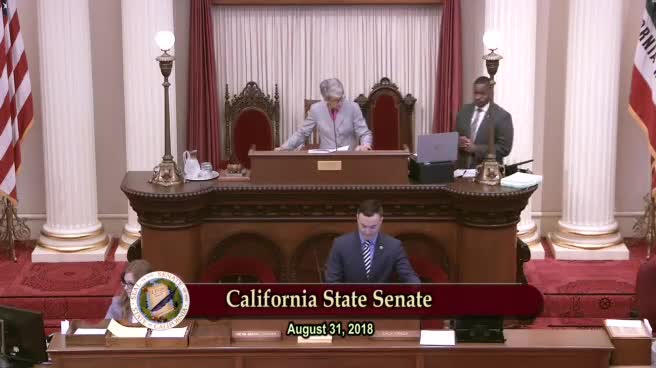 1MIN
Senate Floor
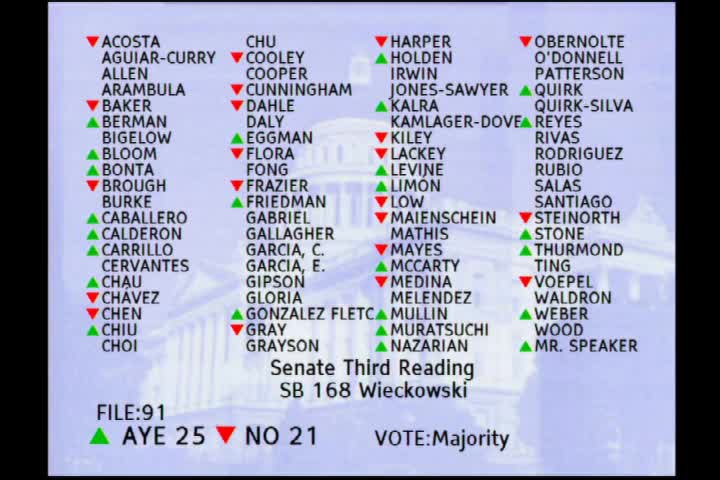 1MIN
Assembly Floor
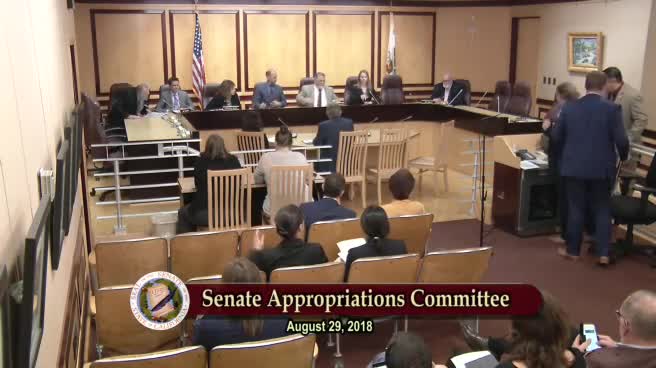 4MIN
Senate Standing Committee on Appropriations
 3MIN
Senate Standing Committee on Health
Bill Author