AB 1803: Postsecondary education: career placement and job search services for graduates.
- Session Year: 2017-2018
- House: Assembly
- Latest Version Date: 2018-01-10
Existing law establishes the California Community Colleges, under the administration of the Board of Governors of the California Community Colleges, the California State University, under the administration of the Trustees of the California State University, the University of California, under the administration of the Regents of the University of California, independent institutions of higher education, and private postsecondary educational institutions as the segments of postsecondary education in this state.
This bill would require a public or private institution of higher education that offers a baccalaureate degree program, provides career placement and job search services to students, and receives state funds for student financial assistance to provide career placement and job search services to a person for five years after the person receives a baccalaureate degree at the institution.
Any public or private institution of higher education that offers a baccalaureate degree program, provides career placement and job search services to students, and receives state funds for student financial assistance shall provide the same level of career placement and job search services to any person who has received a baccalaureate degree at that institution for five years after the person receives his or her baccalaureate degree. The services shall be provided at no cost to the person.
|
Date
|
Status
|
|---|---|
| May 25, 2018 | In committee: Held under submission. |
| Apr 11, 2018 | In committee: Set, first hearing. Referred to APPR. suspense file. |
| Mar 14, 2018 | From committee: Do pass and re-refer to Com. on APPR. (Ayes 13. Noes 0.) (March 13). Re-referred to Com. on APPR. |
| Jan 22, 2018 | Referred to Com. on HIGHER ED. |
| Jan 11, 2018 | From printer. May be heard in committee February 10. |
| Jan 10, 2018 | Read first time. To print. |
|
Date
|
Description
|
Location
|
Votes
|
|
|---|---|---|---|---|
| Mar 13, 2018 | Do pass and be re-referred to the Committee on [Appropriations] | Assembly Standing Committee on Higher Education |
Passed |
This list shows positions taken on this bill by organizations on the date displayed, which is linked to the original source.
Positions by individuals are not included.
Date of Hearing: April 11, 2018
ASSEMBLY COMMITTEE ON APPROPRIATIONS
Lorena Gonzalez Fletcher, Chair
ABPCA Bill Id:AB 1803
Author:(Choi) – As Introduced Ver:January 10, 2018
Policy Committee: | Higher Education | Vote: | 13 - 0 |
Urgency: No State Mandated Local Program: No Reimbursable: No
SUMMARY: This bill requires a public or private institution of higher education that offers a baccalaureate degree program, provides career placement and job search services to students, and receives state funds for student financial assistance to provide career placement and job search services to graduates for five years after they have received a baccalaureate degree at the institution. The institution is to provide these services at no cost to graduates.
FISCAL EFFECT:
- Ongoing annual General Fund costs to California State University (CSU) campuses of approximately $3.2 million to support additional staff and one-time General Fund costs of approximately $350,000 for materials and staff training. CSU notes that the types of career services provided to graduates would differ somewhat from the services they provide to current students.
- Ongoing annual General Fund costs to University of California (UC) campuses of roughly $2.5 million to support additional staff and revise and expand existing contracts with vendors providing career services (for example, online career resources). UC notes that this estimate accounts for revenues lost from the fees the UC charges alumni for career services.
- Potential Proposition 98 General Fund costs after summer of 2020 to 15 California Community College (CCC) districts that participate in a pilot program that allows certain CCCs to award baccalaureate degrees. (Potential costs would begin after 2020 because this is the first year students would graduate from the pilot program.) These costs would not be a reimbursable state mandate because community college districts elected to participate in the pilot program.
- Unknown costs to certain private institutions. The state would not be required to reimburse these costs, for reasons described below.
COMMENTS:
- Purpose. According to the author: The outcome expected if this bill passes is that recent graduates will be able to get the resources they need to be better equipped for their job search. We also anticipate the number of low-income students using these services to increase due to these services being made free for a period of time following graduation.
- CCC Baccalaureate Pilot Program. The CCC baccalaureate degree pilot program began in fall 2016 and is to sunset July 1, 2023, with a Legislative Analyst’s Office report on the outcomes of the pilot program due July 1, 2022. The first class of the pilot would likely graduate in the summer of 2020. Because it is unclear whether CCCs will grant bachelor’s degrees in the longer term, the author may wish to consider whether CCCs participating in the pilot should be required to offer the services prescribed by this bill.
- Costs to Private Institutions. This bill likely would create costs for certain private institutions to provide expanded job placement services. However, this would not create a reimbursable state mandate for these entities because the state does not reimburse costs for private institutions.
- Staff Comments. Currently, some campuses offer free job services to alumni, such as networking events, and some campuses offer job services, such as resume building and counseling, to alumni for a small fee.
Analysis Prepared by: Natasha Collins / APPR. / (916) 319-2081
Date of Hearing: March 13, 2018
ASSEMBLY COMMITTEE ON HIGHER EDUCATION
Jose Medina, Chair
ABPCA Bill Id:AB 1803 (
Author:Choi) – As Introduced Ver:January 10, 2018
SUBJECT: Postsecondary education: career placement and job search services for graduates
SUMMARY: Requires a public or private institution of higher education that offers a baccalaureate degree program, provides career placement and job search services to students, and receives state funds for student financial assistance to provide career placement and job search services to a person for five years after the person receives a baccalaureate degree at the institution, at no cost to the person.
EXISTING LAW:
- Establishes the California Community Colleges, under the administration of the Board of Governors of the California Community Colleges, the California State University, under the administration of the Trustees of the California State University, the University of California, under the administration of the Regents of the University of California, independent institutions of higher education, and private postsecondary educational institutions as the segments of postsecondary education in this state. (Education Code (EC) Section 66010, et seq.)
- Requires institutions regulated under the Bureau for Private Postsecondary Education (BPPE) to publish their School Performance Fact Sheet, which include the job placement rate, calculated by dividing the number of graduates employed in the field by the number of graduates available for employment for each program that is either (1) designed, or advertised, to lead to a particular career, or (2) advertised or promoted with any claim regarding job placement. (EC Section 94929.5.)
Federal Law
- Establishes that, in order to be eligible for funding under the federal Higher Education Act Title IV student assistance programs, an educational program must lead to a degree at a nonprofit or public institution or it must prepare students for gainful employment in a recognized occupation. (20 U.S.C. 1001, et seq.)
- Establishes debt-to-earnings rates to determine whether a gainful employment program prepares students for gainful employment in a recognized occupation. (34 CFR Part 668, et seq.)
FISCAL EFFECT: Unknown
COMMENTS: Purpose. The author has introduced this bill in order to provide baccalaureate degree recipients with an extended access to career readiness job placement support. According to the author's office, "…this bill will require colleges offering baccalaureate degrees to extend the career services they currently offer, such as interview preparation and resume editing, to graduates of that school within five years following their graduation. The outcome expected if this bill passes is that recent graduates will be able to get the resources they need to be better equipped for their job search. We also anticipate the number of low-income students using these services to increase due to these services being made free for a period of time following graduation. This bill does not mandate all institutions of higher education to provide career services, but rather provides parity between current students and recent graduates in access to services that are already offered."
The author cites a 2017 Gallup poll of 32,000 students across 43 public and private universities nationwide which found that only 60% of undergraduate students have ever visited a college career center or used any of their center’s online resources. Of students utilizing their career centers, the poll found that more than half use resume and job search services, while less than 25% use other services such as skills assessments and mock interviews during their senior year.
Federal Gainful Employment requirements. Tracking job placement and post-graduate employment has long been a requirement for for-profit institutions in California. State law requires for-profit institutions regulated under the BPPE to publish their job placement rates for programs designed, or advertised, to lead to a particular career - or advertised or promoted with any claim regarding job placement - on a School Performance Fact Sheet.
In order to be eligible for funding under federal Higher Education Act Title IV student assistance programs, an educational program must lead to a degree at a non-profit or public institution or it must prepare students for "gainful employment in a recognized occupation." Therefore, with very few exceptions, any non-degree program offered by non-profit or public institutions and all educational programs offered at for-profit institutions must lead to gainful employment.
Debt-to-Earnings rates (D/E rates) were established to determine whether a gainful employment (GE) program prepares students for gainful employment in a recognized occupation. A D/E rate is based on the typical loan debt and earnings of a cohort of the program’s former students who completed the program, usually those who completed during a two-year period concluding two years prior to the D/E rate calculation year. This delay is to account for the ramping up of the students’ earnings upon completion of the program.
Two D/E rates, the Annual Earnings Rate and the Discretionary Income Rate, are calculated for each program as a measure of the ability of program completers to reasonably repay the educational debt incurred for their attendance in the program. Annual Earnings Rates of less than or equal to 8% are considered passing rates. Annual Earnings Rates greater than 8% but less than or equal to 12% are zone rates, and Annual Earnings Rates greater than 12% are failing rates. For the Discretionary Income Rate, rates less than or equal to 20% are passing rates, rates greater than 20% but less than or equal to 30% are zone rates, and rates greater than 30% are failing rates.
The U.S. Department of Education is currently conducting negotiated rulemaking to potentially recraft GE regulations. U.S. Secretary of Education Betsy DeVos has said that the “…current rules would unfairly and arbitrarily limit students' ability to pursue certain types of higher education and career training programs.”
Concerns. While not yet taking a formal position on this bill, the segments have expressed concern regarding the ramifications of expanding the scope of their career placement and job services.
The California Community College Chancellor’s Office (CCCCO) notes that their baccalaureate degree pilot programs are selected and approved, in part, because the program must demonstrate an employment need in their local communities. Furthermore, as stipulated in SB 850 (Block, 2014) “…information on the place of employment of students and the subsequent job placement of graduates” will be included in the final Legislative Analyst Office (LAO) report on the pilot program, which is due to the Governor and the Legislature on or before July 1, 2022. The CCCCO notes that the baccalaureate degree pilot program has a sunset date of January 1, 2024.
Given the workforce justification required for inclusion in the baccalaureate degree pilot program and given the pending LAO report and possible sunset of the pilot program, moving forward, the author may wish to consider removing community colleges from the requirements of this bill.
CSU and UC have both expressed concerns regarding the requirement to provide career placement and job search services to a person for five years after the person receives a baccalaureate degree. It was noted that employers recruiting from campuses are usually looking for recent graduates for entry-level positions, not employees with several years of experience. CSU noted that their current career center staffs are trained to serve new college graduates, and that alumni more than one year out of school have different needs.
CSU and UC also note workload implications that would result from this proposed expansion of services. The additional five years of available time could as much as double workload and staffing budgets, according to CSU, and providing assistance over such a long period could pull staff away from supporting existing students. UC noted that, while their they support the spirit of the bill, an expansion such as that proposed in this legislation would require existing staff to “…develop job listings and employer partnerships for early career professionals, deliver specialized training or dedicate staff to service the unique needs of young professionals, expand programs and grow industry networks.”
Policy Issue. Students should be able to reasonably expect that their higher education institution is able and willing to help them cross the bridge from college to the workplace. California’s for-profit institutions are expected to report on the job placement of their students in programs that explicitly or implicitly advertise job placement. Though public and non-profit schools are not held to that same reporting standard, students attend baccalaureate degree programs, in part, because they believe that education is likely to help them to succeed in the workforce. On February 6, 2018 the Assembly Higher Education Committee and the Assembly Budget Subcommittee #2 held a hearing titled “Closing the Degree Gap.” The first line of the background paper from that hearing notes that “California needs dramatic growth in postsecondary degrees awarded to meet future state workforce needs and to boost workers into better-paying and more stable employment.”
Yet, as outlined above, the segments raise important concerns regarding a long-term expansion of career placement and job search services. Particularly striking is the fact that the job placement needs of recent graduates are different than those of graduates that have spent several years in the workplace. Without the ability for a student to be charged a reasonable fee, the cost of providing professional development and additional staffing would fall on the segments and, ultimately, the state.
REGISTERED SUPPORT / OPPOSITION:
Support
None on file.
Opposition
None on file.
Analysis Prepared by: Kevin J. Powers / HIGHER ED. / (916) 319-3960
Discussed in Hearing
 3MIN
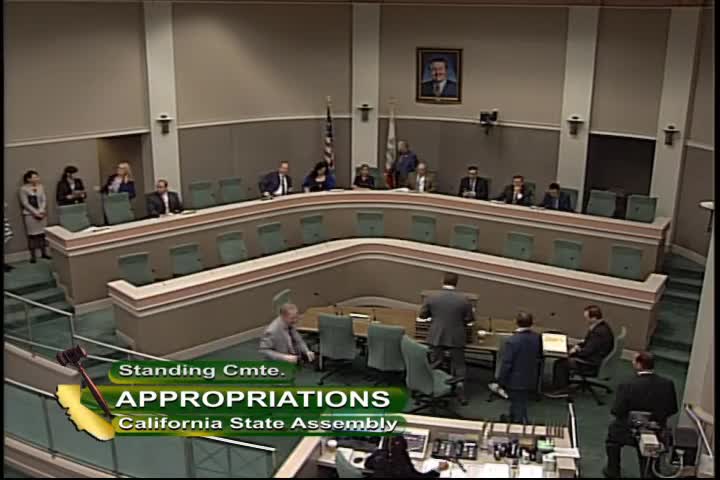
Assembly Standing Committee on Appropriations
 7MIN
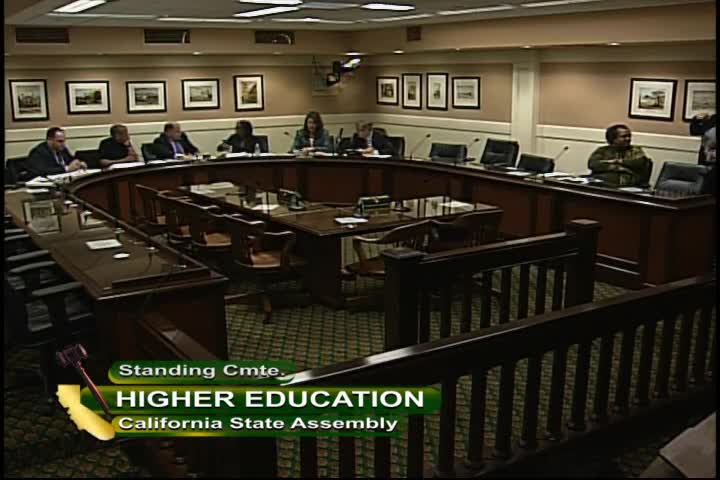
Assembly Standing Committee on Higher Education
57SEC
Assembly Standing Committee on Higher Education
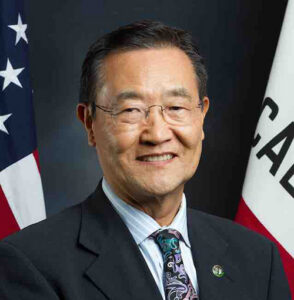
Bill Author
Bill Co-Author(s):