AB 1870: Employment discrimination: limitation of actions.
- Session Year: 2017-2018
- House: Assembly
- Latest Version Date: 2018-08-31
Existing law, the California Fair Employment and Housing Act, makes specified employment and housing practices unlawful, including discrimination against or harassment of employees and tenants, among others. Existing law authorizes a person claiming to be aggrieved by an alleged unlawful practice to file a complaint with the Department of Fair Employment and Housing within one year from the date upon which the unlawful practice occurred, unless otherwise specified.
This bill would extend the above-described period to 3 years for complaints alleging employment discrimination, as specified. The bill would make conforming changes in provisions that grant a person allegedly aggrieved by an unlawful practice who first obtains knowledge of the facts of the alleged unlawful practice after the expiration of the limitations period, as specified.
This bill would state that its changes shall not be interpreted to revive lapsed claims.
Existing law, the California Fair Employment and Housing Act, makes specified employment and housing practices unlawful, including discrimination against or harassment of employees and tenants, among others. Existing law authorizes a person claiming to be aggrieved by an alleged unlawful practice to file a complaint with the Department of Fair Employment and Housing within one year from the date upon which the unlawful practice occurred, unless otherwise specified.
This bill would extend the above-described period to 3 years for which for complaints alleging unlawful employment or housing practices may be filed with the department, as specified. discrimination, as specified. The bill would make conforming changes in provisions that grant a person allegedly aggrieved by an unlawful practice who first obtains knowledge of the facts of the alleged unlawful practice after the expiration of the limitations period, as specified.
This bill would state that its changes shall not be interpreted to revive lapsed claims.
Existing law, the California Fair Employment and Housing Act, makes specified employment and housing practices unlawful, including discrimination against or harassment of employees and tenants, among others. Existing law authorizes a person claiming to be aggrieved by an alleged unlawful practice to file a complaint with the Department of Fair Employment and Housing within one year from the date upon which the unlawful practice occurred, unless otherwise specified.
This bill would extend the period to 3 years for which complaints alleging unlawful employment or housing practices may be filed with the department, as specified.
(a)This article governs the procedure for the prevention and elimination of practices made unlawful pursuant to Article 1 (commencing with Section 12940) of Chapter 6.
(b)Any person claiming to be aggrieved by an alleged unlawful practice may file with the department a verified complaint, in writing, that shall state the name and address of the person, employer, labor organization, or employment agency alleged to have committed the unlawful practice complained of, and that shall set forth the particulars thereof and contain other information as may be required by the department. The director or the directors authorized representative may in like manner, on that persons own motion, make, sign, and file a complaint.
(c)Any employer whose employees, or some of them, refuse or threaten to refuse to cooperate with this part may file with the department a verified complaint asking for assistance by conciliation or other remedial action.
(d)A complaint alleging a violation of Section 51, 51.5, 51.7, 54, 54.1, or 54.2 of the Civil Code, shall not be filed after the expiration of one year from the date upon which the alleged unlawful practice or refusal to cooperate occurred. A complaint alleging any other violation of Article 1 (commencing with Section 12940) of Chapter 6 shall not be filed after the expiration of three years from the date upon which the unlawful practice or refusal to cooperate occurred. However, the filing periods set forth by this section may be extended as follows:
(1)For a period of time not to exceed 90 days following the expiration of the applicable filing deadline, if a person allegedly aggrieved by an unlawful practice first obtained knowledge of the facts of the alleged unlawful practice during the 90 days following the expiration of the applicable filing deadline.
(2)For a period of time not to exceed one year following a rebutted presumption of the identity of the persons employer under Section 12928, in order to allow a person allegedly aggrieved by an unlawful practice to make a substitute identification of the actual employer.
(3)For a period of time, not to exceed one year from the date the person aggrieved by an alleged violation of Section 51.7 of the Civil Code becomes aware of the identity of a person liable for the alleged violation, but in no case exceeding three years from the date of the alleged violation if during that period the aggrieved person is unaware of the identity of any person liable for the alleged violation.
(4)For a period of time not to exceed one year from the date that a person allegedly aggrieved by an unlawful practice attains the age of majority.
SEC. 2.This bill shall not be interpreted to revive lapsed claims.
(a)This article governs the procedure for the prevention and elimination of practices made unlawful pursuant to Article 1 (commencing with Section 12940) of Chapter 6.
(b)Any person claiming to be aggrieved by an alleged unlawful practice may file with the department a verified complaint, in writing, that shall state the name and address of the person, employer, labor organization, or employment agency alleged to have committed the unlawful practice complained of, and that shall set forth the particulars thereof and contain other information as may be required by the department. The director or the directors authorized representative may in like manner, on that persons own motion, make, sign, and file a complaint.
(c)Any employer whose employees, or some of them, refuse or threaten to refuse to cooperate with this part may file with the department a verified complaint asking for assistance by conciliation or other remedial action.
(d)A complaint alleging a violation of Section 51, 51.5, 51.7, 54, 54.1, or 54.2 of the Civil Code, shall not be filed after the expiration of one year from the date upon which the alleged unlawful practice or refusal to cooperate occurred, except that this period may be extended as follows: occurred. A complaint alleging any other violation of Article 1 (commencing with Section 12940) of Chapter 6 shall not be filed after the expiration of three years from the date upon which the unlawful practice or refusal to cooperate occurred. However, the filing periods set forth by this section may be extended as follows:
(1)For a period of time not to exceed three years from the date upon which the alleged unlawful practice or refusal to cooperate occurred for alleged violations of Article 1 (commencing with Section 12940) of Chapter 6, if the allegations are based on employment discrimination. (2)(1)For a period of time not to exceed 90 days following the expiration of the applicable filing deadline, if a person allegedly aggrieved by an unlawful practice first obtained knowledge of the facts of the alleged unlawful practice after the expiration of one year, or three years as described in paragraph (1), from the date of their occurrence. practice during the 90 days following the expiration of the applicable filing deadline.
(3)(2)For a period of time not to exceed one year following a rebutted presumption of the identity of the persons employer under Section 12928, in order to allow a person allegedly aggrieved by an unlawful practice to make a substitute identification of the actual employer.
(4)(3)For a period of time, not to exceed one year from the date the person aggrieved by an alleged violation of Section 51.7 of the Civil Code becomes aware of the identity of a person liable for the alleged violation, but in no case exceeding three years from the date of the alleged violation if during that period the aggrieved person is unaware of the identity of any person liable for the alleged violation.
(5)(4)For a period of time not to exceed one year from the date that a person allegedly aggrieved by an unlawful practice attains the age of majority.
SEC. 2.This bill shall not be interpreted to revive lapsed claims.
(a)This article governs the procedure for the prevention and elimination of practices made unlawful pursuant to Article 1 (commencing with Section 12940) of Chapter 6.
(b)Any person claiming to be aggrieved by an alleged unlawful practice may file with the department a verified complaint, in writing, that shall state the name and address of the person, employer, labor organization, or employment agency alleged to have committed the unlawful practice complained of, and that shall set forth the particulars thereof and contain other information as may be required by the department. The director or the directors authorized representative may in like manner, on that persons own motion, make, sign, and file a complaint.
(c)Any employer whose employees, or some of them, refuse or threaten to refuse to cooperate with this part may file with the department a verified complaint asking for assistance by conciliation or other remedial action.
(d)A complaint shall not be filed after the expiration of three years one year from the date upon which the alleged unlawful practice or refusal to cooperate occurred, except that this period may be extended as follows:
(1)For a period of time not to exceed three years from the date upon which the alleged unlawful practice or refusal to cooperate occurred for alleged violations of Article 1 (commencing with Section 12940) of Chapter 6, if the allegations are based on employment discrimination.
(1)(2)For a period of time not to exceed 90 days following the expiration of those three years, the applicable filing deadline, if a person allegedly aggrieved by an unlawful practice first obtained knowledge of the facts of the alleged unlawful practice after the expiration of three years one year, or three years as described in paragraph (1), from the date of their occurrence.
(2)(3)For a period of time not to exceed one year following a rebutted presumption of the identity of the persons employer under Section 12928, in order to allow a person allegedly aggrieved by an unlawful practice to make a substitute identification of the actual employer.
(3)(4)For a period of time, not to exceed one year from the date the person aggrieved by an alleged violation of Section 51.7 of the Civil Code becomes aware of the identity of a person liable for the alleged violation, but in no case exceeding three years from the date of the alleged violation if during that period the aggrieved person is unaware of the identity of any person liable for the alleged violation.
(4)(5)For a period of time not to exceed one year from the date that a person allegedly aggrieved by an unlawful practice attains the age of majority.
SEC. 2.Section 12980 of the Government Code is amended to read:12980.This article governs the procedure for the prevention and elimination of discrimination in housing made unlawful pursuant to Article 2 (commencing with Section 12955) of Chapter 6.(a)Any person claiming to be aggrieved by an alleged violation of Section 12955, 12955.1, or 12955.7 may file with the department a verified complaint in writing that shall state the name and address of the person alleged to have committed the violation complained of, and that shall set forth the particulars of the alleged violation and contain any other information required by the department.The filing of a complaint and pursuit of conciliation or remedy under this part shall not prejudice the complainants right to pursue effective judicial relief under other applicable laws, but if a civil action has been filed under Section 52 of the Civil Code, the department shall terminate proceedings upon notification of the entry of final judgment unless the judgment is a dismissal entered at the complainants request.(b)The Attorney General or the director may, in a like manner, make, sign, and file complaints citing practices that appear to violate the purpose of this part or any specific provisions of this part relating to housing discrimination.No complaint may be filed after the expiration of three years from the date upon which the alleged violation occurred or terminated.(c)The department may thereupon proceed upon the complaint in the same manner and with the same powers as provided in this part in the case of an unlawful practice, except that where the provisions of this article provide greater rights and remedies to an aggrieved person than the provisions of Article 1 (commencing with Section 12960), the provisions of this article shall prevail.(d)Upon the filing of a complaint, the department shall serve notice upon the complainant of the time limits, rights of the parties, and choice of forums provided for under the law.(e)The department shall commence proceedings with respect to a complaint within 30 days of filing of the complaint.(f)An investigation of allegations contained in any complaint filed with the department shall be completed within 100 days after receipt of the complaint, unless it is impracticable to do so. If the investigation is not completed within 100 days, the complainant and respondent shall be notified, in writing, of the departments reasons for not doing so.(g)Upon the conclusion of each investigation, the department shall prepare a final investigative report containing all of the following:(1)The names of any witnesses and the dates of any contacts with those witnesses.(2)A summary of the dates of any correspondence or other contacts with the aggrieved persons or the respondent.(3)A summary of witness statements.(4)Answers to interrogatories.(5)A summary description of other pertinent records.A final investigative report may be amended if additional evidence is later discovered.(h)If a civil action is not brought by the department within 100 days after the filing of a complaint, or if the department earlier determines that no civil action will be brought, the department shall promptly notify the person claiming to be aggrieved. This notice shall, in any event, be issued no more than 30 days after the date of the determination or 30 days after the date of the expiration of the 100-day period, whichever date first occurs. The notice shall indicate that the person claiming to be aggrieved may bring a civil action under this part against the person named in the verified complaint within the time period specified in Section 12989.1. The notice shall also indicate, unless the department has determined that no civil action will be brought, that the person claiming to be aggrieved has the option of continuing to seek redress for the alleged discrimination through the procedures of the department if the person does not desire to file a civil action. The superior courts of the State of California shall have jurisdiction of these actions, and the aggrieved person may file in these courts. The action may be brought in any county in the state in which the violation is alleged to have been committed, or in the county in which the records relevant to the alleged violation are maintained and administered, but if the defendant is not found within that county, the action may be brought within the county of the defendants residence or principal office. A copy of any complaint filed pursuant to this part shall be served on the principal offices of the department. The remedy for failure to send a copy of a complaint is an order to do so. In a civil action brought under this section, the court, in its discretion, may award to the prevailing party reasonable attorneys fees.(i)All agreements reached in settlement of any housing discrimination complaint filed pursuant to this section shall be made public, unless otherwise agreed by the complainant and respondent, and the department determines that the disclosure is not required to further the purposes of the act.(j)All agreements reached in settlement of any housing discrimination complaint filed pursuant to this section shall be agreements between the respondent and complainant, and shall be subject to approval by the department.SEC. 2.This bill shall not be interpreted to revive lapsed claims.
(a)This article governs the procedure for the prevention and elimination of practices made unlawful pursuant to Article 1 (commencing with Section 12940) of Chapter 6.
(b)Any person claiming to be aggrieved by an alleged unlawful practice may file with the department a verified complaint, in writing, that shall state the name and address of the person, employer, labor organization, or employment agency alleged to have committed the unlawful practice complained of, and that shall set forth the particulars thereof and contain other information as may be required by the department. The director or the directors authorized representative may in like manner, on that persons own motion, make, sign, and file a complaint.
(c)Any employer whose employees, or some of them, refuse or threaten to refuse to cooperate with this part may file with the department a verified complaint asking for assistance by conciliation or other remedial action.
(d)No A complaint may shall not be filed after the expiration of one year three years from the date upon which the alleged unlawful practice or refusal to cooperate occurred, except that this period may be extended as follows:
(1)For a period of time not to exceed 90 days following the expiration of that year, those three years, if a person allegedly aggrieved by an unlawful practice first obtained knowledge of the facts of the alleged unlawful practice after the expiration of one year three years from the date of their occurrence.
(2)For a period of time not to exceed one year following a rebutted presumption of the identity of the persons employer under Section 12928, in order to allow a person allegedly aggrieved by an unlawful practice to make a substitute identification of the actual employer.
(3)For a period of time, not to exceed one year from the date the person aggrieved by an alleged violation of Section 51.7 of the Civil Code becomes aware of the identity of a person liable for the alleged violation, but in no case exceeding three years from the date of the alleged violation if during that period the aggrieved person is unaware of the identity of any person liable for the alleged violation.
(4)For a period of time not to exceed one year from the date that a person allegedly aggrieved by an unlawful practice attains the age of majority.
SEC. 2.Section 12980 of the Government Code is amended to read:12980.This article governs the procedure for the prevention and elimination of discrimination in housing made unlawful pursuant to Article 2 (commencing with Section 12955) of Chapter 6.
(a)Any person claiming to be aggrieved by an alleged violation of Section 12955, 12955.1, or 12955.7 may file with the department a verified complaint in writing that shall state the name and address of the person alleged to have committed the violation complained of, and that shall set forth the particulars of the alleged violation and contain any other information required by the department.
The filing of a complaint and pursuit of conciliation or remedy under this part shall not prejudice the complainants right to pursue effective judicial relief under other applicable laws, but if a civil action has been filed under Section 52 of the Civil Code, the department shall terminate proceedings upon notification of the entry of final judgment unless the judgment is a dismissal entered at the complainants request.
(b)The Attorney General or the director may, in a like manner, make, sign, and file complaints citing practices that appear to violate the purpose of this part or any specific provisions of this part relating to housing discrimination.
No complaint may be filed after the expiration of one year three years from the date upon which the alleged violation occurred or terminated.
(c)The department may thereupon proceed upon the complaint in the same manner and with the same powers as provided in this part in the case of an unlawful practice, except that where the provisions of this article provide greater rights and remedies to an aggrieved person than the provisions of Article 1 (commencing with Section 12960), the provisions of this article shall prevail.
(d)Upon the filing of a complaint, the department shall serve notice upon the complainant of the time limits, rights of the parties, and choice of forums provided for under the law.
(e)The department shall commence proceedings with respect to a complaint within 30 days of filing of the complaint.
(f)An investigation of allegations contained in any complaint filed with the department shall be completed within 100 days after receipt of the complaint, unless it is impracticable to do so. If the investigation is not completed within 100 days, the complainant and respondent shall be notified, in writing, of the departments reasons for not doing so.
(g)Upon the conclusion of each investigation, the department shall prepare a final investigative report containing all of the following:
(1)The names of any witnesses and the dates of any contacts with those witnesses.
(2)A summary of the dates of any correspondence or other contacts with the aggrieved persons or the respondent.
(3)A summary of witness statements.
(4)Answers to interrogatories.
(5)A summary description of other pertinent records.
A final investigative report may be amended if additional evidence is later discovered.
(h)If a civil action is not brought by the department within 100 days after the filing of a complaint, or if the department earlier determines that no civil action will be brought, the department shall promptly notify the person claiming to be aggrieved. This notice shall, in any event, be issued no more than 30 days after the date of the determination or 30 days after the date of the expiration of the 100-day period, whichever date first occurs. The notice shall indicate that the person claiming to be aggrieved may bring a civil action under this part against the person named in the verified complaint within the time period specified in Section 12989.1. The notice shall also indicate, unless the department has determined that no civil action will be brought, that the person claiming to be aggrieved has the option of continuing to seek redress for the alleged discrimination through the procedures of the department if the person does not desire to file a civil action. The superior courts of the State of California shall have jurisdiction of these actions, and the aggrieved person may file in these courts. The action may be brought in any county in the state in which the violation is alleged to have been committed, or in the county in which the records relevant to the alleged violation are maintained and administered, but if the defendant is not found within that county, the action may be brought within the county of the defendants residence or principal office. A copy of any complaint filed pursuant to this part shall be served on the principal offices of the department. The remedy for failure to send a copy of a complaint is an order to do so. In a civil action brought under this section, the court, in its discretion, may award to the prevailing party reasonable attorneys fees.
(i)All agreements reached in settlement of any housing discrimination complaint filed pursuant to this section shall be made public, unless otherwise agreed by the complainant and respondent, and the department determines that the disclosure is not required to further the purposes of the act.
(j)All agreements reached in settlement of any housing discrimination complaint filed pursuant to this section shall be agreements between the respondent and complainant, and shall be subject to approval by the department.
REVISIONS: HeadingLine 3.|
Date
|
Status
|
|---|---|
| Sep 30, 2018 | Vetoed by Governor. |
| Sep 6, 2018 | Enrolled and presented to the Governor at 3 p.m. |
| Aug 29, 2018 | Senate amendments concurred in. To Engrossing and Enrolling. |
| Aug 27, 2018 | In Assembly. Concurrence in Senate amendments pending. May be considered on or after August 29 pursuant to Assembly Rule 77. |
| Aug 27, 2018 | Read third time. Passed. Ordered to the Assembly. |
| Aug 22, 2018 | Read second time. Ordered to third reading. |
| Aug 21, 2018 | Read third time and amended. Ordered to second reading. |
| Aug 20, 2018 | Read second time. Ordered to third reading. |
| Aug 17, 2018 | From committee: Amend, and do pass as amended. (Ayes 5. Noes 1.) (August 16). |
| Jul 2, 2018 | In committee: Referred to APPR. suspense file. |
| Jun 20, 2018 | From committee: Do pass and re-refer to Com. on APPR. (Ayes 5. Noes 2.) (June 19). Re-referred to Com. on APPR. |
| Jun 7, 2018 | Referred to Com. on JUD. |
| May 30, 2018 | In Senate. Read first time. To Com. on RLS. for assignment. |
| May 29, 2018 | Read third time. Passed. Ordered to the Senate. |
| May 25, 2018 | From committee: Do pass. (Ayes 12. Noes 1.) (May 25). |
| May 2, 2018 | In committee: Set, first hearing. Referred to APPR. suspense file. |
| Apr 19, 2018 | Coauthors revised. |
| Mar 22, 2018 | Referred to Com. on L. & E. |
| Jan 13, 2018 | From printer. May be heard in committee February 12. |
| Jan 12, 2018 | Read first time. To print. |
|
Date
|
Description
|
Location
|
Votes
|
|
|---|---|---|---|---|
| Aug 29, 2018 | AB 1870 REYES Concurrence in Senate Amendments | Assembly Floor |
Passed |
|
| Aug 27, 2018 | Assembly 3rd Reading AB1870 Reyes et al. By Leyva | Senate Floor |
Passed |
|
| Aug 16, 2018 | Do pass as amended | Senate Standing Committee on Appropriations |
Passed |
|
| Jul 2, 2018 | Placed on suspense file | Senate Standing Committee on Appropriations |
Passed |
|
| Jun 19, 2018 | Do pass, but first be re-referred to the Committee on [Appropriations] | Senate Standing Committee on Judiciary |
Passed |
|
| May 29, 2018 | AB 1870 REYES Assembly Third Reading | Assembly Floor |
Passed |
|
| May 25, 2018 | Do pass. | Assembly Standing Committee on Appropriations |
Passed |
|
| Apr 18, 2018 | Do pass and be re-referred to the Committee on [Appropriations] | Assembly Standing Committee on Labor and Employment |
Passed |
This list shows positions taken on this bill by organizations on the date displayed, which is linked to the original source.
Positions by individuals are not included.
GOVERNOR'S VETO
GV Bill Id:AB 1870
Author:(Reyes, et al.)
As Enrolled Ver:September 6, 2018
2/3 vote
ASSEMBLY: | 57-4 | (May 29, 2018) | SENATE: | 25-10 | (August 27, 2018) |
ASSEMBLY: | 61-9 | (August 29, 2018) |
|
|
Original Committee Reference: L. & E.
SUMMARY: Increases the filing period with the Department of Fair Employment and Housing (DFEH) for complaints of unlawful employment practices from one to three years.
The Senate amendments:
- Limit the extension of the filing period to only complaints alleging employment discrimination.
- State that the bill shall not be interpreted to revive lapsed claims.
EXISTING LAW:
- Makes specified employment and housing practices unlawful, including discrimination against or harassment of employees and tenants, among others.
- Authorizes a person claiming to be aggrieved by an alleged unlawful practice to file a complaint with the DFEH within one year from the date the unlawful practice occurred, unless extended by specified circumstances.
FISCAL EFFECT: According to the Senate Appropriations Committee, unknown, potentially-major costs to DFEH to investigate and litigate new claims as a result of an increase in new complaints being brought to the department. If complaints increase by 2.5%, additional costs to DFEH would be in the range of $700,000 to $800,000 annually. (General Fund)
Unknown reduction in federal dollars to support certain employment discrimination charges. (Federal funds)
COMMENTS: According to the author, "Extending the time to file a claim with the DFEH will allow parties additional time to resolve grievances outside of court, without feeling compelled to file a claim in order to meet the short filing deadline. Most other types of harm have longer filing deadlines. For example, the time for filing an action for personal injury in California is two years; actions for fraud are three years; and contract disputes have a four-year time window. Victims of harassment and discrimination should have time to file their claims with the Department commensurate with other types of civil actions, especially in light of the common barriers that exist, including trauma and a lack of awareness of their rights."
This bill extends the deadline to file a complaint with the Department of Fair Employment and Housing from one year to three years for the employment provisions of the Fair Employment and Housing Act.
Employees who have experienced harassment or discrimination in the workplace should have every opportunity to have their complaints investigated. I believe, however, that the current filing deadline--which has been in place since 1963 – not only encourages prompt resolution while memories and evidence are fresh, but also ensures that unwelcome behavior is promptly reported and halted.
Analysis Prepared by: Megan Lane / L. & E. / (916) 319-2091 FN: 0005310
CONCURRENCE IN SENATE AMENDMENTS
CSA1 Bill Id:AB 1870
Author:(Reyes, et al.)
As Amended Ver:August 21, 2018
Majority vote
ASSEMBLY: | 57-4 | (May 29, 2018) | SENATE: | 25-10 | (August 27, 2018) |
Original Committee Reference: L. & E.
SUMMARY: Increases the filing period with the Department of Fair Employment and Housing (DFEH) for complaints of unlawful employment practices from one to three years.
The Senate amendments:
- Limit the extension of the filing period to only complaints alleging employment discrimination.
- State that the bill shall not be interpreted to revive lapsed claims.
EXISTING LAW:
- Makes specified employment and housing practices unlawful, including discrimination against or harassment of employees and tenants, among others.
- Authorizes a person claiming to be aggrieved by an alleged unlawful practice to file a complaint with the DFEH within one year from the date the unlawful practice occurred, unless extended by specified circumstances.
FISCAL EFFECT: According to the Senate Appropriations Committee, unknown, potentially-major costs to DFEH to investigate and litigate new claims as a result of an increase in new complaints being brought to the department. If complaints increase by 2.5%, additional costs to DFEH would be in the range of $700,000 to $800,000 annually. (General Fund)
Unknown reduction in federal dollars to support certain employment discrimination charges. (Federal funds)
COMMENTS: According to the author, "Extending the time to file a claim with the DFEH will allow parties additional time to resolve grievances outside of court, without feeling compelled to file a claim in order to meet the short filing deadline. Most other types of harm have longer filing deadlines. For example, the time for filing an action for personal injury in California is two years; actions for fraud are three years; and contract disputes have a four-year time window. Victims of harassment and discrimination should have time to file their claims with the Department commensurate with other types of civil actions, especially in light of the common barriers that exist, including trauma and a lack of awareness of their rights."
Analysis Prepared by: Megan Lane / L. & E. / (916) 319-2091 FN: 0004601
Office of Senate Floor Analyses (916) 651-1520 Fax: (916) 327-4478 | AB |
THIRD READING
Bill No: AB 1870
:
SENATE JUDICIARY COMMITTEE: 5-2, 6/19/18
AYES: Jackson, Hertzberg, Monning, Stern, Wieckowski
NOES: Moorlach, Anderson
SENATE APPROPRIATIONS COMMITTEE: 5-1, 8/16/18
AYES: Portantino, Beall, Bradford, Hill, Wiener
NOES: Nielsen
NO VOTE RECORDED: Bates
ASSEMBLY FLOOR: 57-4, 5/29/18 - See last page for vote
SUBJECT: Employment discrimination: limitation of actions
SOURCE: California Employment Lawyers Association
Consumer Attorneys of California
Equal Rights Advocates
DIGEST:
This bill extends the deadline for filing a complaint with the Department of Fair Employment and Housing (DFEH) about a violation of the employment protections in the Fair Employment and Housing Act (FEHA) from one year after the date of the violation to three years after the date of the violation.
Senate Floor Amendments of 8/21/18 redraft the bill’s provisions regarding the extension of the deadline for filing complaints about employment-related FEHA violations to clarify that they do not apply to complaints brought under the Civil Code.
Existing law:
- Makes specified employment and housing practices unlawful, pursuant to the California Fair Employment and Housing Act (FEHA), including discrimination, harassment, or retaliation against employees, among other things. (Gov. Code Sec. 12940 et seq.)
- Requires a person claiming to be aggrieved by an alleged unlawful employment practice to file a complaint with the Department of Fair Employment and Housing (DFEH) within one year from the date the unlawful practice occurred, unless extended by specified circumstances. (Gov. Code Sec. 12960(d).)
This bill:
- Extends the deadline for filing a complaint with DFEH about a violation of the employment protections in FEHA from one year after the date of the violation to three years after the date of the violation.
- Does not revive lapsed claims.
Among many other things, the #MeToo movement has shed light on the fact that it often takes time, courage, and support for victims of sexual harassment and sexual violence to feel comfortable making public allegations against the perpetrator of their abuse. Voices from the #MeToo movement have articulated a number of reasons for this delay. Some victims need time to process before they fully grasp what has happened to them. Some victims only realize what happened when other victims come forward and a pattern of abusive behavior becomes evident. Some victims immediately know they have been harassed or assaulted, but are not immediately ready to confront their perpetrator. Many victims fear retaliation if they do come forward.
While the #MeToo movement has brought attention to these dynamics, their effect is not limited to sexual harassment. Victims of all forms of discrimination and harassment may be initially unclear about what happened, unaware of their rights, or reluctant to take on the perpetrator.
Under current California law, victims of employment discrimination, harassment, and related retaliation generally have one year from the time of the most recent incident to file an administrative complaint with DFEH. (Gov. Code Sec. 12960.) While this relatively short deadline protects the rights of defendants by helping to ensure that evidence is still around and that witnesses’ memories are still fresh, it is arguably out of touch with the experience of victims. The author and sponsors of this bill believe that, as a result, this short administrative statute of limitations acts to prevent some victims from pursuing justice for what was done to them. At the same time, the short statute of limitations can act to allow perpetrators to evade accountability for their actions.
This bill extends the statute of limitations for filing a complaint involving employment discrimination, harassment, or retaliation under FEHA from one year to three years.
Comments
Policy considerations behind setting a statute of limitations
Statutes of limitation serve a variety of purposes. Legal scholars Tyler Ochoa and Andrew Wistrich have explained that, in broad strokes, these legal deadlines promote legal repose, minimize the deterioration of evidence, reward diligence, encourage prompt enforcement of substantive law, avoid retroactive application of contemporary standards, and reduce the overall volume of litigation.[1]
With these policy considerations in mind, the California School Boards Association opposes this bill, writing:
Extending the statute of limitations from one to three years for allegedly unlawful employment and housing practices would expose school employers to significant litigation with considerable costs. By requiring claims to be filed within one year from the date of the alleged unlawful employment practice, existing law ensures claims will be resolved while evidence and witnesses are still available. Extending the time to pursue a claim would allow claims to become stale and make it harder to track down witnesses with reliable memories, hurting an employer’s ability to defend against a case and DFEH’s ability to properly investigate a claim.
On the other hand, short statutes of limitation run contrary to other fundamental public policy concerns. Most notably, public policy favors adjudicating legal claims on their merits, rather than on arbitrary deadlines. (Id.) Arguably, this policy consideration is especially important in the context of civil rights matters such as those covered by FEHA. Unlike a contract dispute or personal injury matter, upholding civil rights is not merely a matter of private concern and assessing relative liability between parties. The public has a deep interest in seeing that civil rights violations get addressed, since core democratic principles like equality before the law and access to opportunity for all lie in the balance.
Moreover, as the #MeToo movement has illustrated, there are valid reasons why the victim of a civil rights violation may be slower to recognize what happened, or initially less inclined to take action than is the case for other types of action. A slip and fall victim, for instance, or someone who has been stiffed on a contract, need not take the possibility of retaliation into account in the same way that workers making allegations of civil rights violations must. Civil rights violations can also be more difficult to detect initially: the first woman invited to interview in a hotel room where the prospective employer appears in a bathrobe may wonder if she just got the timing wrong or somehow gave a misleading impression. The seventh – assuming she finds out about the prior six – would not. Some of this problem is addressed by the legal doctrine that, where a cause of action “relates back” to prior incidents, the statute of limitations runs from the last incident, but that doctrine would not address every situation.
For these reasons, the opposition’s assertion that this bill could expose employers to 1,600 additional “potentially invalid” sexual harassment claims each year might just as accurately be restated as an acknowledgement that the current statute of limitations denies the victims of 1,600 “potentially valid” sexual harassment claims their opportunity to seek justice.
Comparable statutes of limitation in California
Compared to the statutes of limitation for most other types of legal claims in California, the one year deadline for filing an administrative complaint under FEHA is rather short. A few other causes of action have one year statutes of limitation, including defamation (Code Civ. Proc. Sec. 340(c)) and professional malpractice (Code Civ. Proc. Secs. 340.5 and 340.6). For most civil causes of action, however, the deadline to file is longer. For example, California law gives people two years to file an action for personal injury (Code Civ. Proc. Sec. 335.1), three years to submit a case for fraud (Code Civ. Proc. Sec. 338(d).), and four years for breach of a written contract. (Code Civ. Proc. Sec. 337.)
FISCAL EFFECT: Appropriation: Fiscal Com.: Local:
According to the Senate Appropriations Committee:
- Unknown, potentially-major costs to DFEH to investigate and litigate new claims as a result of an increase in new complaints being brought to the department. If complaints increase by 2.5 percent, additional costs to DFEH would be in the range of $700,000 to $800,000 annually. (General Fund)
- Unknown reduction in federal dollars to support certain employment discrimination charges. (Federal funds)
California Employment Lawyers Association (co-source)
Consumer Attorneys of California (co-source)
Equal Rights Advocates (co-source)
Insurance Commissioner Dave Jones
American Civil Liberties Union of California Center for Advocacy and Policy
Anti-Defamation League
California Conference Board of the Amalgamated Transit Union
California Conference of Machinists
California Teamsters Public Affairs Council
California Women’s Law Center
City of Emeryville
Courage Campaign
Engineers and Scientists of California, Local 20
Feminist Majority
Futures Without Violence
International Longshore & Warehouse Union
Jockeys’ Guild
Legal Aid at Work
Mujeres Unidas y Activas
Nevada County Citizens for Choice
Oakland City Council
Professional and Technical Engineers, Local 21
Santa Monica Commission on the Status of Women
Screen Actors Guild - American Federation of Television and Radio Artists
The Caucus for Producers, Writers & Directors
The Church State Council
UNITE-HERE, AFL-CIO
Utility Workers of America
Voices for Progress
Women Lawyers of Sacramento
Women’s Foundation of California
Five individuals
OPPOSITION: (Verified 8/17/18)
Associated Builders and Contractors Association, Inc. – Central California Chapter
Associated Builders and Contractors Association, Inc. – Northern California Chapter
Associated Builders and Contractors Association, Inc. – San Diego Chapter
Associated Builders and Contractors Association, Inc. – Southern California
Associated General Contractors
Brea Chamber of Commerce
Building Owners and Managers Association
California Ambulance Association
California Apartment Association
California Association for Health Services at Home
California Association of Joint Powers Authorities
California Association of Winegrape Growers
California Building Industry Association
California Business Properties Association
California Chamber of Commerce
California Hotel and Lodging Association
California Landscape Contractors Association
California League of Food Producers
California Restaurant Association
California Retailers Association
California School Boards Association
California State Association of Counties
Camarillo Chamber of Commerce
Commercial Real Estate Development Association – NAIOP
CSAC Excess Insurance Authority
El Dorado Irrigation District
Family Business Association of California
Greater Coachella Valley Chamber of Commerce
Greater San Fernando Valley Chamber of Commerce
International Council of Shopping Centers
National Federation of Independent Business
North Orange County Chamber
Official Police Garages of Los Angeles
Plumbing-Heating-Cooling Contractors Association of California
Rancho Cordova Chamber of Commerce
Santa Maria Valley Chamber of Commerce
Wine Institute
ARGUMENTS IN SUPPORT: According to the author, “Victims of harassment and discrimination should have time to file their claims with the Department commensurate with other types of civil actions, especially in light of the common barriers that exist, including trauma and a lack of awareness of their rights.”
As co-sponsor of the bill, the Consumer Attorneys of California write, “Most low wage workers who suffered harassment or discrimination are not aware of their legal rights and do not know that that they are time barred if they do not file with the DFEH within a year. By the time they realize harassment is against the law, they are usually past the time to file or close to having their statute expire. […]Extending the time to file a claim with the DFEH will allow parties additional time to resolve grievances outside of court, without feeling compelled to file a claim in order to meet the short filing deadline. […] Victims of harassment and discrimination should have time to file their claims with the Department commensurate with other types of civil actions, especially in light of the common barriers that exist, including trauma and a lack of awareness of their rights.”
As co-sponsor of the bill, Equal Rights Advocates writes:
Victims of sexual harassment face myriad obstacles to filing a claim within one year of the harassment. They often do not immediately come forward because they are afraid of retaliation by their harasser and/or employer, which could result in adverse employment actions against them, including job loss. Some victims also fail to come forward right away due to the effect of the trauma they have experienced and/or because they think they will not be believed.
Low wage earners, such as janitorial workers, restaurant workers, and farmworkers, are especially harmed by the short filing time, as they are often unaware of their legal rights and such industries have higher rates of sexual harassment. Many low wage workers who have suffered harassment and/or other forms of discrimination are not aware of the fact that such conduct is illegal and do not know that they are time barred from bringing a claim if they do not file with the DFEH within one year. By the time workers realize that the harassment they experienced is against the law, they are often past the time to file…
ARGUMENTS IN OPPOSITION: In opposition to the bill, unless amended, the California Chamber of Commerce and 32 co-signatories write:
While AB 1870 is being promoted as an anti-sexual harassment bill, it actually has a broad, sweeping effect on all housing and employment harassment, discrimination, and retaliation complaints. […]If the statute of limitations is tripled for FEHA complaints, the employer will not have the ability to eradicate the inappropriate behavior in a timely and efficient manner. […] Extending the statute of limitations will reduce the motivation for the victims to quickly come forward. If the employer is not made aware of the harassing or discriminatory conduct, it cannot take the appropriate remedial measures necessary. Thus, the current statute of limitations not only protects the victims, but also protects future victims from repeat offenders… […]
As a result of this bill, the total number of complaints could triple to over 70,000, the number of claims dismissed due to lack of evidence could triple to over 12,000, and the number of sexual harassment claims could be over 1,600. This dramatic increase would not only burden the state agency, but also expose California employers to significant and costly litigation for potentially invalid claims.
For these reasons, we respectfully request that AB 1870 be amended to only apply to sexual harassment claims because that is the impetus for the bill. Additionally, we request the bill be amended to apply prospectively as the bill should not re-open claims that have expired under existing law. [Citations omitted.]
ASSEMBLY FLOOR: 57-4, 5/29/18
AYES: Acosta, Aguiar-Curry, Arambula, Baker, Berman, Bloom, Bonta, Burke, Caballero, Calderon, Carrillo, Cervantes, Chau, Chiu, Chu, Cooley, Dahle, Daly, Eggman, Friedman, Cristina Garcia, Eduardo Garcia, Gipson, Gloria, Gonzalez Fletcher, Grayson, Holden, Irwin, Jones-Sawyer, Kalra, Kamlager-Dove, Lackey, Levine, Limón, Low, Maienschein, McCarty, Medina, Mullin, Muratsuchi, Nazarian, O'Donnell, Quirk, Quirk-Silva, Reyes, Rodriguez, Rubio, Salas, Santiago, Mark Stone, Thurmond, Ting, Voepel, Waldron, Weber, Wood, Rendon
NOES: Bigelow, Chávez, Kiley, Obernolte
NO VOTE RECORDED: Travis Allen, Brough, Chen, Choi, Cooper, Cunningham, Flora, Fong, Frazier, Gallagher, Gray, Harper, Mathis, Mayes, Melendez, Patterson, Steinorth
Prepared by: Timothy Griffiths / JUD. / (916) 651-4113
8/22/18 17:13:33
Tyler T. Ochoa and Andrew Wistrich, The Puzzling Purposes of Statutes of Limitation, 28 Pac.L.J. 453 (1997). ↑
Office of Senate Floor Analyses (916) 651-1520 Fax: (916) 327-4478 | AB |
THIRD READING
Bill No: AB 1870
:
SENATE JUDICIARY COMMITTEE: 5-2, 6/19/18
AYES: Jackson, Hertzberg, Monning, Stern, Wieckowski
NOES: Moorlach, Anderson
SENATE APPROPRIATIONS COMMITTEE: 5-1, 8/16/18
AYES: Portantino, Beall, Bradford, Hill, Wiener
NOES: Nielsen
NO VOTE RECORDED: Bates
ASSEMBLY FLOOR: 57-4, 5/29/18 - See last page for vote
SUBJECT: Employment discrimination: limitation of actions
SOURCE: California Employment Lawyers Association
Consumer Attorneys of California
Equal Rights Advocates
DIGEST:
This bill extends the statute of limitations for filing a complaint about a violation of the employment protections in the Fair Employment and Housing Act from one year after the date of the violation to three years after the date of the violation.
Existing law:
- Makes specified employment and housing practices unlawful, pursuant to the California Fair Employment and Housing Act (FEHA), including discrimination, harassment, or retaliation against employees, among other things. (Gov. Code Sec. 12940 et seq.)
- Requires a person claiming to be aggrieved by an alleged unlawful employment practice to file a complaint with the Department of Fair Employment and Housing (DFEH) within one year from the date the unlawful practice occurred, unless extended by specified circumstances. (Gov. Code Sec. 12960(d).)
This bill:
- Extends the deadline for filing complaints with DFEH for unlawful employment practices to three years.
- Does not revive lapsed claims.
Among many other things, the #MeToo movement has shed light on the fact that it often takes time, courage, and support for victims of sexual harassment and sexual violence to feel comfortable making public allegations against the perpetrator of their abuse. Voices from the #MeToo movement have articulated a number of reasons for this delay. Some victims need time to process before they fully grasp what has happened to them. Some victims only realize what happened when other victims come forward and a pattern of abusive behavior becomes evident. Some victims immediately know they have been harassed or assaulted, but are not immediately ready to confront their perpetrator. Many victims fear retaliation if they do come forward.
While the #MeToo movement has brought attention to these dynamics, their effect is not limited to sexual harassment. Victims of all forms of discrimination and harassment may be initially unclear about what happened, unaware of their rights, or reluctant to take on the perpetrator.
Under current California law, victims of employment discrimination, harassment, and related retaliation have one year from the time of the most recent incident to make a legal claim. (Gov. Code Sec. 12960.) While this relatively short deadline protects the rights of defendants by helping to ensure that evidence is still around and that witnesses’ memories are still fresh, it is arguably out of touch with the experience of victims. The author and sponsors of this bill believe that, as a result, the short statute of limitations acts to prevent some victims from pursuing justice for what was done to them. At the same time, the short statute of limitations can act to allow perpetrators to evade accountability for their actions.
This bill extends the statute of limitations for filing a complaint involving employment discrimination, harassment, or retaliation under FEHA from one year to three years.
Comments
Policy considerations behind setting a statute of limitations
Statutes of limitation serve a variety of purposes. Legal scholars Tyler Ochoa and Andrew Wistrich have explained that, in broad strokes, these legal deadlines promote legal repose, minimize the deterioration of evidence, reward diligence, encourage prompt enforcement of substantive law, avoid retroactive application of contemporary standards, and reduce the overall volume of litigation.[1]
With these policy considerations in mind, the California School Boards Association opposes this bill, writing:
Extending the statute of limitations from one to three years for allegedly unlawful employment and housing practices would expose school employers to significant litigation with considerable costs. By requiring claims to be filed within one year from the date of the alleged unlawful employment practice, existing law ensures claims will be resolved while evidence and witnesses are still available. Extending the time to pursue a claim would allow claims to become stale and make it harder to track down witnesses with reliable memories, hurting an employer’s ability to defend against a case and DFEH’s ability to properly investigate a claim.
On the other hand, short statutes of limitation run contrary to other fundamental public policy concerns. Most notably, public policy favors adjudicating legal claims on their merits, rather than on arbitrary deadlines. (Id.) Arguably, this policy consideration is especially important in the context of civil rights matters such as those covered by FEHA. Unlike a contract dispute or personal injury matter, upholding civil rights is not merely a matter of private concern and assessing relative liability between parties. The public has a deep interest in seeing that civil rights violations get addressed, since core democratic principles like equality before the law and access to opportunity for all lie in the balance.
Moreover, as the #MeToo movement has illustrated, there are valid reasons why the victim of a civil rights violation may be slower to recognize what happened, or initially less inclined to take action than is the case for other types of action. A slip and fall victim, for instance, or someone who has been stiffed on a contract, need not take the possibility of retaliation into account in the same way that workers making allegations of civil rights violations must. Civil rights violations can also be more difficult to detect initially: the first woman invited to interview in a hotel room where the prospective employer appears in a bathrobe may wonder if she just got the timing wrong or somehow gave a misleading impression. The seventh – assuming she finds out about the prior six – would not. Some of this problem is addressed by the legal doctrine that, where a cause of action “relates back” to prior incidents, the statute of limitations runs from the last incident, but that doctrine would not address every situation.
For these reasons, the opposition’s assertion that this bill could expose employers to 1,600 additional “potentially invalid” sexual harassment claims each year might just as accurately be restated as an acknowledgement that the current statute of limitations denies the victims of 1,600 “potentially valid” sexual harassment claims their opportunity to seek justice.
Comparable statutes of limitation in California
Compared to the statutes of limitation for most other types of legal claims in California, the one year deadline for filing a FEHA claim is rather short. A few other causes of action have one year statutes of limitation, including defamation (Code Civ. Proc. Sec. 340(c)) and professional malpractice (Code Civ. Proc. Secs. 340.5 and 340.6). For most civil causes of action, however, the deadline to file is longer. For example, California law gives people two years to file an action for personal injury (Code Civ. Proc. Sec. 335.1), three years to submit a case for fraud (Code Civ. Proc. Sec. 338(d).), and four years for breach of a written contract. (Code Civ. Proc. Sec. 337.)
FISCAL EFFECT: Appropriation: Fiscal Com.: Local:
According to the Senate Appropriations Committee:
- Unknown, potentially-major costs to DFEH to investigate and litigate new claims as a result of an increase in new complaints being brought to the department. If complaints increase by 2.5 percent, additional costs to DFEH would be in the range of $700,000 to $800,000 annually. (General Fund)
- Unknown reduction in federal dollars to support certain employment discrimination charges. (Federal funds)
California Employment Lawyers Association (co-source)
Consumer Attorneys of California (co-source)
Equal Rights Advocates (co-source)
Insurance Commissioner Dave Jones
American Civil Liberties Union of California Center for Advocacy and Policy
Anti-Defamation League
California Conference Board of the Amalgamated Transit Union
California Conference of Machinists
California Teamsters Public Affairs Council
California Women’s Law Center
City of Emeryville
Courage Campaign
Engineers and Scientists of California, Local 20
Feminist Majority
Futures Without Violence
International Longshore & Warehouse Union
Jockeys’ Guild
Legal Aid at Work
Mujeres Unidas y Activas
Nevada County Citizens for Choice
Oakland City Council
Professional and Technical Engineers, Local 21
Santa Monica Commission on the Status of Women
Screen Actors Guild - American Federation of Television and Radio Artists
The Caucus for Producers, Writers & Directors
The Church State Council
UNITE-HERE, AFL-CIO
Utility Workers of America
Voices for Progress
Women Lawyers of Sacramento
Women’s Foundation of California
Five individuals
OPPOSITION: (Verified 8/17/18)
Associated Builders and Contractors Association, Inc. – Central California Chapter
Associated Builders and Contractors Association, Inc. – Northern California Chapter
Associated Builders and Contractors Association, Inc. – San Diego Chapter
Associated Builders and Contractors Association, Inc. – Southern California
Associated General Contractors
Brea Chamber of Commerce
Building Owners and Managers Association
California Ambulance Association
California Apartment Association
California Association for Health Services at Home
California Association of Joint Powers Authorities
California Association of Winegrape Growers
California Building Industry Association
California Business Properties Association
California Chamber of Commerce
California Hotel and Lodging Association
California Landscape Contractors Association
California League of Food Producers
California Restaurant Association
California Retailers Association
California School Boards Association
California State Association of Counties
Camarillo Chamber of Commerce
Commercial Real Estate Development Association – NAIOP
CSAC Excess Insurance Authority
El Dorado Irrigation District
Family Business Association of California
Greater Coachella Valley Chamber of Commerce
Greater San Fernando Valley Chamber of Commerce
International Council of Shopping Centers
National Federation of Independent Business
North Orange County Chamber
Official Police Garages of Los Angeles
Plumbing-Heating-Cooling Contractors Association of California
Rancho Cordova Chamber of Commerce
Santa Maria Valley Chamber of Commerce
Wine Institute
ARGUMENTS IN SUPPORT: According to the author, “Victims of harassment and discrimination should have time to file their claims with the Department commensurate with other types of civil actions, especially in light of the common barriers that exist, including trauma and a lack of awareness of their rights.”
As co-sponsor of the bill, the Consumer Attorneys of California write, “Most low wage workers who suffered harassment or discrimination are not aware of their legal rights and do not know that that they are time barred if they do not file with the DFEH within a year. By the time they realize harassment is against the law, they are usually past the time to file or close to having their statute expire. […]Extending the time to file a claim with the DFEH will allow parties additional time to resolve grievances outside of court, without feeling compelled to file a claim in order to meet the short filing deadline. […] Victims of harassment and discrimination should have time to file their claims with the Department commensurate with other types of civil actions, especially in light of the common barriers that exist, including trauma and a lack of awareness of their rights.”
As co-sponsor of the bill, Equal Rights Advocates writes:
Victims of sexual harassment face myriad obstacles to filing a claim within one year of the harassment. They often do not immediately come forward because they are afraid of retaliation by their harasser and/or employer, which could result in adverse employment actions against them, including job loss. Some victims also fail to come forward right away due to the effect of the trauma they have experienced and/or because they think they will not be believed.
Low wage earners, such as janitorial workers, restaurant workers, and farmworkers, are especially harmed by the short filing time, as they are often unaware of their legal rights and such industries have higher rates of sexual harassment. Many low wage workers who have suffered harassment and/or other forms of discrimination are not aware of the fact that such conduct is illegal and do not know that they are time barred from bringing a claim if they do not file with the DFEH within one year. By the time workers realize that the harassment they experienced is against the law, they are often past the time to file…
ARGUMENTS IN OPPOSITION: In opposition to the bill, unless amended, the California Chamber of Commerce and 32 co-signatories write:
While AB 1870 is being promoted as an anti-sexual harassment bill, it actually has a broad, sweeping effect on all housing and employment harassment, discrimination, and retaliation complaints. […]If the statute of limitations is tripled for FEHA complaints, the employer will not have the ability to eradicate the inappropriate behavior in a timely and efficient manner. […] Extending the statute of limitations will reduce the motivation for the victims to quickly come forward. If the employer is not made aware of the harassing or discriminatory conduct, it cannot take the appropriate remedial measures necessary. Thus, the current statute of limitations not only protects the victims, but also protects future victims from repeat offenders… […]
As a result of this bill, the total number of complaints could triple to over 70,000, the number of claims dismissed due to lack of evidence could triple to over 12,000, and the number of sexual harassment claims could be over 1,600. This dramatic increase would not only burden the state agency, but also expose California employers to significant and costly litigation for potentially invalid claims.
For these reasons, we respectfully request that AB 1870 be amended to only apply to sexual harassment claims because that is the impetus for the bill. Additionally, we request the bill be amended to apply prospectively as the bill should not re-open claims that have expired under existing law. [Citations omitted.]
ASSEMBLY FLOOR: 57-4, 5/29/18
AYES: Acosta, Aguiar-Curry, Arambula, Baker, Berman, Bloom, Bonta, Burke, Caballero, Calderon, Carrillo, Cervantes, Chau, Chiu, Chu, Cooley, Dahle, Daly, Eggman, Friedman, Cristina Garcia, Eduardo Garcia, Gipson, Gloria, Gonzalez Fletcher, Grayson, Holden, Irwin, Jones-Sawyer, Kalra, Kamlager-Dove, Lackey, Levine, Limón, Low, Maienschein, McCarty, Medina, Mullin, Muratsuchi, Nazarian, O'Donnell, Quirk, Quirk-Silva, Reyes, Rodriguez, Rubio, Salas, Santiago, Mark Stone, Thurmond, Ting, Voepel, Waldron, Weber, Wood, Rendon
NOES: Bigelow, Chávez, Kiley, Obernolte
NO VOTE RECORDED: Travis Allen, Brough, Chen, Choi, Cooper, Cunningham, Flora, Fong, Frazier, Gallagher, Gray, Harper, Mathis, Mayes, Melendez, Patterson, Steinorth
8/20/18 9:57:50
Tyler T. Ochoa and Andrew Wistrich, The Puzzling Purposes of Statutes of Limitation, 28 Pac.L.J. 453 (1997). ↑
SENATE COMMITTEE ON APPROPRIATIONS
Senator Anthony Portantino, Chair
2017 - 2018 Regular Session
AB 1870 (Reyes) - Employment discrimination: unlawful employment practices
Version: January 12, 2018 | Policy Vote: JUD. 5 - 2 |
Urgency: No | Mandate: No |
Hearing Date: August 16, 2018 | Consultant: Shaun Naidu |
Bill Summary:
AB 1870 would extend from one to three years the statute of limitations in which the Department of Fair Employment and Housing (DFEH) may file a complaint related to unlawful employment or housing practices.
*********** ANALYSIS ADDENDUM – SUSPENSE FILE ***********
The following information is revised to reflect amendments
adopted by the committee on August 16, 2018
Fiscal Impact:
- Unknown, potentially-major costs to DFEH to investigate and litigate new claims as a result of an increase in new complaints being brought to the department. If complaints increase by 2.5 percent, additional costs to DFEH would be in the range of $700,000 to $800,000 annually. (General Fund)
- Unknown reduction in federal dollars to support certain employment discrimination charges. (Federal funds)
Author Amendments:
Limit the three-year filing deadline to only specified employment discrimination allegations.
-- END --
SENATE COMMITTEE ON APPROPRIATIONS
Senator Anthony Portantino, Chair
2017 - 2018 Regular Session
AB 1870 (Reyes) - Employment discrimination: unlawful employment practices
Version: January 12, 2018 | Policy Vote: JUD. 5 - 2 |
Urgency: No | Mandate: No |
Hearing Date: July 2, 2018 | Consultant: Shaun Naidu |
This bill meets the criteria for referral to the Suspense File.
Bill Summary:
AB 1870 would extend from one to three years the statute of limitations in which the Department of Fair Employment and Housing (DFEH) may file a complaint related to unlawful employment or housing practices.
Fiscal Impact:
- Unknown, potentially-major costs to DFEH to investigate and litigate new claims as a result of an increase in new complaints being brought to the department. If complaints increase by 5 percent, additional costs to DFEH would be in the range of $1.4 to $1.6 million annually. (General Fund)
- Unknown reduction in federal dollars to support certain employment discrimination charges. (Federal funds)
Background:
The California Fair Employment and Housing Act makes specified employment and housing practices unlawful, including discrimination against or harassment of employees and tenants, among other things. A person claiming to be aggrieved by an alleged unlawful employment practice must file a complaint with DFEH within one year from the date the unlawful practice occurred, unless extended by specified circumstances. Similarly, a person claiming to be aggrieved by an alleged unlawful housing practice must file a complaint with the department within one year from the date the unlawful practice occurred, unless extended by specified circumstances.
Proposed Law:
See Bill Summary.
Related Legislation:
AB 2946 (Kalra, 2018) would extend from six months to three years the period within which complaints of workplace retaliation for exercising a right under the jurisdiction of the Labor Commissioner may be brought to the Division of Labor Standards Enforcement. It also would allow the court to award reasonable attorney’s fees to a successful plaintiff. AB 2946 failed passage on the Assembly floor.
Staff Comments:
In certain scenarios, the Equal Employment Opportunity Commission (EEOC) contracts with DFEH for dual-filed employment discrimination cases, and DFEH receives federal dollars for these cases. Because the deadline for dual-filing with the EEOC is 300 days, AB 1870 may result in claims ineligible for dual-filing and therefore reduce federal subsidies.
-- END --
Senator Hannah-Beth Jackson, Chair
2017-2018 Regular Session
Bill No: AB 1870 (Author:Reyes)
Version: January 12, 2018
Hearing Date: June 19, 2018
Fiscal: Yes
Urgency: No
Consultant: TSG
SUBJECT
Employment discrimination: unlawful employment practices
DESCRIPTION
This bill would extend the statute of limitations for filing a complaint about a violation of the Fair Employment and Housing Act from one year from the date of the violation to three years.
BACKGROUND
Among many other things, the #MeToo movement has shed light on the fact that it often takes time, courage, and support for victims of sexual harassment and sexual violence to feel comfortable making public allegations against their perpetrator. Voices from the #MeToo movement have articulated a number of reasons for this delay. Some victims need time to process before they fully grasp what has happened to them. Some victims only realize what happened when other victims come forward and a pattern of abusive behavior becomes evident. Some victims immediately know they have been harassed or assaulted, but are not immediately ready to confront their perpetrator. Many victims fear retaliation if they do come forward.
While the #MeToo movement has brought attention to these dynamics, their effect is not limited to sexual harassment. Victims of all forms of discrimination and harassment may be initially unclear about what happened, unaware of their rights, or reluctant to take on the perpetrator.
Under current California law, victims of discrimination, harassment, and related retaliation have one year from the time of the most recent incident to make a legal claim in both the housing and employment contexts. (Gov. Code Sec. 12960.) While this relatively short deadline protects the rights of defendants by helping to ensure that evidence is still around and that witnesses’ memories are still fresh, it is arguably out of touch with the experience of victims. The author and sponsors of this bill believe that, as a result, the short statute of limitations acts to prevent some victims from pursuing justice for what was done to them. At the same time, the short statute of limitations can act to allow perpetrators to evade accountability for their actions.
This bill would extend the statute of limitations for filing a complaint of discrimination, harassment, or retaliation under California’s Fair Employment and Housing Act from one year to three years.
CHANGES TO EXISTING LAW
Existing law, the California Fair Employment and Housing Act, makes specified employment and housing practices unlawful, including discrimination against or harassment of employees and tenants, among other things. (Gov. Code Sec. 12900 et seq.)
Existing law requires a person claiming to be aggrieved by an alleged unlawful employment practice to file a complaint with the DFEH within one year from the date the unlawful practice occurred, unless extended by specified circumstances. (Gov. Code Sec. 12960(d).)
Existing law requires a person claiming to be aggrieved by an alleged unlawful housing practice to file a complaint with the DFEH within one year from the date the unlawful practice occurred, unless extended by specified circumstances. (Gov. Code Sec. 12980(b).)
This bill would extend the deadline for filing complaints with the Department of Fair Employment and Housing (DFEH) for unlawful employment or housing practices to three years.
COMMENT
1. Stated need for the bill
According to the author:
Victims of harassment and discrimination should have time to file their claims with the Department commensurate with other types of civil actions, especially in light of the common barriers that exist, including trauma and a lack of awareness of their rights.
As co-sponsor of the bill, the Consumer Attorneys of California write:
Most low wage workers who suffered harassment or discrimination are not aware of their legal rights and do not know that that they are time barred if they do not file with the DFEH within a year. By the time they realize harassment is against the law, they are usually past the time to file or close to having their statute expire. […]Extending the time to file a claim with the DFEH will allow parties additional time to resolve grievances outside of court, without feeling compelled to file a claim in order to meet the short filing deadline. […] Victims of harassment and discrimination should have time to file their claims with the Department commensurate with other types of civil actions, especially in light of the common barriers that exist, including trauma and a lack of awareness of their rights.
As co-sponsor of the bill, Equal Rights Advocates writes:
Victims of sexual harassment face myriad obstacles to filing a claim within one year of the harassment. They often do not immediately come forward because they are afraid of retaliation by their harasser and/or employer, which could result in adverse employment actions against them, including job loss. Some victims also fail to come forward right away due to the effect of the trauma they have experienced and/or because they think they will not be believed.
Low wage earners, such as janitorial workers, restaurant workers, and farmworkers, are especially harmed by the short filing time, as they are often unaware of their legal rights and such industries have higher rates of sexual harassment. Many low wage workers who have suffered harassment and/or other forms of discrimination are not aware of the fact that such conduct is illegal and do not know that they are time barred from bringing a claim if they do not file with the DFEH within one year. By the time workers realize that the harassment they experienced is against the law, they are often past the time to file…
2. Concerns expressed about the bill
In opposition to the bill unless amended, the California Chamber of Commerce and 32 co-signatories write:
While AB 1870 is being promoted as an anti-sexual harassment bill, it actually has a broad, sweeping effect on all housing and employment harassment, discrimination, and retaliation complaints. […]If the statute of limitations is tripled for FEHA complaints, the employer will not have the ability to eradicate the inappropriate behavior in a timely and efficient manner. […] Extending the statute of limitations will reduce the motivation for the victims to quickly come forward. If the employer is not made aware of the harassing or discriminatory conduct, it cannot take the appropriate remedial measures necessary. Thus, the current statute of limitations not only protects the victims, but also protects future victims from repeat offenders… […]
As a result of this bill, the total number of complaints could triple to over 70,000, the number of claims dismissed due to lack of evidence could triple to over 12,000, and the number of sexual harassment claims could be over 1,600. This dramatic increase would not only burden the state agency, but also expose California employers to significant and costly litigation for potentially invalid claims.
For these reasons, we respectfully request that AB 1870 be amended to only apply to sexual harassment claims because that is the impetus for the bill. Additionally, we request the bill be amended to apply prospectively as the bill should not re-open claims that have expired under existing law. [Citations omitted.]
3. Policy considerations behind setting a statute of limitations
Statutes of limitation serve a variety of purposes. Legal scholars Tyler Ochoa and Andrew Wistrich have explained that, in broad strokes, these legal deadlines promote legal repose, minimize the deterioration of evidence, reward diligence, encourage prompt enforcement of substantive law, avoid retroactive application of contemporary standards, and reduce the overall volume of litigation.[1]
With these policy considerations in mind, the California School Boards Association opposes this bill, writing:
Extending the statute of limitations from one to three years for allegedly unlawful employment and housing practices would expose school employers to significant litigation with considerable costs. By requiring claims to be filed within one year from the date of the alleged unlawful employment practice, existing law ensures claims will be resolved while evidence and witnesses are still available. Extending the time to pursue a claim would allow claims to become stale and make it harder to track down witnesses with reliable memories, hurting an employer’s ability to defend against a case and DFEH’s ability to properly investigate a claim.
On the other hand, short statutes of limitation run contrary to other fundamental public policy concerns. Most notably, public policy favors adjudicating legal claims on their merits, rather than on arbitrary deadlines. (Id.) Arguably, this policy consideration is especially important in the context of civil rights matters such as those covered by FEHA. Unlike a contract dispute or personal injury matter, upholding civil rights is not merely a matter of private concern and assessing relative liability between parties. The public has a deep interest in seeing that civil rights violations get addressed, since core democratic principles like equality before the law and access to opportunity for all lie in the balance.
Moreover, as the #MeToo movement has illustrated, there are valid reasons why the victim of a civil rights violation may be slower to recognize what happened, or initially less inclined to take action than is the case for other types of action. A slip and fall victim, for instance, or someone who has been stiffed on a contract, need not take the possibility of retaliation into account in the same way that workers and tenants making allegations of civil rights violations must. Civil rights violations can also be more difficult to detect initially: the first woman invited to interview in a hotel room where the prospective employer appears in a bathrobe may wonder if she just got the timing wrong or somehow gave a misleading impression. The seventh – assuming she finds out about the prior six – would not. Some of this problem is addressed by the legal doctrine that, where a cause of action “relates back” to prior incidents, the statute of limitations runs from the last incident, but this
For these reasons, the opposition’s assertion that this bill could expose employers to 1,600 additional “potentially invalid” sexual harassment claims each year might just as accurately be restated as an acknowledgement that the current statute of limitations denies the victims of 1,600 “potentially valid” sexual harassment claims their opportunity to seek justice.
4. Comparable statutes of limitation in California
Compared to the statutes of limitation for most other types of legal claims in California, the one year deadline for filing a FEHA claim is rather short. A few other causes of action have one year statutes of limitation, including defamation (Code Civ. Proc. Sec. 340(c)) and professional malpractice (Code Civ. Proc. Secs. 340.5 and 340.6). For most civil causes of action, however, the deadline to file is longer. For example, California law gives people two years to file an action for personal injury (Code Civ. Proc. Sec. 335.1), three years to submit a case for fraud (Code Civ. Proc. Sec. 338(d).), and four years for breach of a written contract. (Code Civ. Proc. Sec. 337.)
In their April 11, 2018 letter to the Assembly Committee on Labor and Employment, the California Chamber of Commerce and its co-signatories conceded that a two year statute of limitation for claims under FEHA would be “consistent with similar tortious causes of action.”
Support: American Civil Liberties Union of California Center for Advocacy and Policy; Anti-Defamation League; California Conference Board of the Amalgamated Transit Union; California Conference of Machinists; California Employment Lawyers Association; California Teamsters Public Affairs Council; California Women’s Law Center; The Caucus for Producers, Writers & Directors Courage Campaign; The City of Emeryville; The Church State Council; Engineers and Scientists of California, Local 20; Feminist Majority; Futures Without Violence; International Longshore & Warehouse Union; Jockeys’ Guild; Dave Jones, Insurance Commissioner; Legal Aid at Work; Mujeres Unidas y Activas; Nevada County Citizens for Choice; Oakland City Council; Professional and Technical Engineers, Local 21; Santa Monica Commission on the Status of Women; Screen Actors Guild - American Federation of Television and Radio Artists; UNITE-HERE, AFL-CIO; Utility Workers of America; Voices for Progress; Women’s Foundation of California; Women Lawyers of Sacramento; five individuals
Opposition: Associated Builders and Contractors Association, Inc. – Northern California Chapter; Associated Builders and Contractors Association, Inc. – Central California Chapter; Associated Builders and Contractors Association, Inc. – San Diego Chapter; Associated Builders and Contractors Association, Inc. – Southern California; Associated General Contractors; Brea Chamber of Commerce; Building Owners and Managers Association; California Ambulance Association; California Apartment Association; California Association for Health Services at Home; California Association of Joint Powers Authorities; California Association of Winegrape Growers; California Building Industry Association; California Business Properties Association; California Chamber of Commerce; California Hotel and Lodging Association; California Landscape Contractors Association; California League of Food Producers; California Restaurant Association; California Retailers Association; California School Boards Association; California State Association of Counties; Camarillo Chamber of Commerce; Commercial Real Estate Development Association – NAIOP; CSAC Excess Insurance Authority; El Dorado Irrigation District; Family Business Association of California; Greater Coachella Valley Chamber of Commerce; Greater San Fernando Valley Chamber of Commerce; International Council of Shopping Centers; National Federation of Independent Business; North Orange County Chamber; Official Police Garages of Los Angeles; Plumbing-Heating-Cooling Contractors Association of California; Rancho Cordova Chamber of Commerce; Santa Maria Valley Chamber of Commerce; Wine Institute
HISTORY
Source: California Employment Lawyers Association; Consumer Attorneys of California; Equal Rights Advocates
Related Pending Legislation: AB 2946 (Kalra, 2018) would extend the filing period with the Division of Labor Standards Enforcement to three years for complaints of workplace retaliation for exercising a right under the jurisdiction of the Labor Commissioner.
Prior Legislation: None known
Prior Vote:
Assembly Floor (Ayes 57, Noes 4)
Assembly Appropriations Committee (Ayes 12, Noes 1)
Assembly Labor and Employment Committee (Ayes 6, Noes 0)
**************
Tyler T. Ochoa and Andrew Wistrich, The Puzzling Purposes of Statutes of Limitation, 28 Pac.L.J. 453 (1997). ↑
ASSEMBLY THIRD READING
ATR Bill Id:AB 1870
Author:(Reyes, et al.)
As Introduced Ver:January 12, 2018
Majority vote
Committee | Votes | Ayes | Noes |
Labor | 6-0 | Thurmond, Flora, Gonzalez Fletcher, Jones-Sawyer, Kalra, McCarty | |
Appropriations | 12-1 | Gonzalez Fletcher, Bloom, Bonta, Calderon, Carrillo, Chau, Eggman, Friedman, Eduardo Garcia, Nazarian, Quirk, Reyes | Bigelow |
SUMMARY: Extends the filing period with the Department of Fair Employment and Housing (DFEH) for complaints of unlawful employment or housing practices to three years.
EXISTING LAW:
- Makes specified employment and housing practices unlawful, including discrimination against or harassment of employees and tenants, among others.
- Authorizes a person claiming to be aggrieved by an alleged unlawful practice to file a complaint with the DFEH within one year from the date the unlawful practice occurred, unless extended by specified circumstances.
FISCAL EFFECT: According to the Assembly Appropriations Committee, unknown fiscal effect on DFEH as a result of an increase in new complaints. If complaints increase by 5%, additional costs for DFEH would be in the range of $1.4 to $1.6 million annually.
A reduction in federal dollars to support certain employment discrimination charges. In certain scenarios, the Equal Employment Opportunity Commission (EEOC) contracts with DFEH for dual-filed employment discrimination cases, and DFEH receives federal dollars for these cases. Because the deadline for dual-filing with the EEOC is 300 days, AB 1870 may result in claims ineligible for dual-filing and therefore federal subsidies.
COMMENTS: According to the author, "The California Fair Employment and Housing Act (FEHA) is designed to protect employees from workplace harassment, discrimination, and retaliation due to protected characteristics such as sex and gender, sexual orientation, gender identity, race, age, religion, disability and more…Under current law (Government Code Section 12960) a victim of harassment must file a claim with the (DFEH) within one year from the date of the last incident of harassment. The FEHA requires employers to take reasonable steps to prevent and correct wrongful (harassing, discriminatory, retaliatory) behavior in the workplace."
The author further argues "Extending the time to file a claim with the DFEH will allow parties additional time to resolve grievances outside of court, without feeling compelled to file a claim in order to meet the short filing deadline. Most other types of harm have longer filing deadlines. For example, the time for filing an action for personal injury in California is two years; actions for fraud are three years; and contract disputes have a four-year time window. Victims of harassment and discrimination should have time to file their claims with the Department commensurate with other types of civil actions, especially in light of the common barriers that exist, including trauma and a lack of awareness of their rights."
A sponsor of the bill, the California Employment Lawyers Association (CELA), argues that low-wage workers would especially benefit from a longer filing period. CELA states "Most low-wage workers who have suffered harassment or discrimination are not aware of their legal rights and do not know that they are time-barred if they do not file with the DFEH within a year. In addition, low-wage workers often face greater risks of retaliation when filing legal claims and may have to wait until they are more economically secure before filing their claim."
The Anti-Defamation League states in support, that they recognize "the emotional, psychological, and physiological trauma workplace harassment can cause to victims, which can understandably deter them from filing harassment claims within the current law's one year statute of limitation. Individuals may be targeted not only because of their gender, but also because of their real or perceived inclusion in a number of protected classes, such as gender identity, religion, and sexual orientation."
A group of employer organizations, including the California Chamber of Commerce, are opposed unless amended. They argue that the bill should be amended to provide a two year statute of limitations for sexual harassment claims only. They argue that without these amendments, "the total number of complaints could triple to over 70,000, the number of claims dismissed due to lack of evidence could triple to over 12,000, and the number of sexual harassment claims could be over 1,600. This dramatic increase would not only burden the state agency, but also expose California employers to significant and costly litigation for potentially invalid claims."
Related Legislation
AB 2946 (Kalra) of the current legislative session would extend the filing period with the Division of Labor Standards Enforcement to three years for complaints of workplace retaliation for exercising a right under the jurisdiction of the Labor Commissioner.
Analysis Prepared by: Megan Lane / L. & E. / (916) 319-2091 FN: 0003094
Date of Hearing: May 2, 2018
ASSEMBLY COMMITTEE ON APPROPRIATIONS
Lorena Gonzalez Fletcher, Chair
ABPCA Bill Id:AB 1870
Author:(Reyes) – As Introduced Ver:January 12, 2018
Policy Committee: | Labor and Employment | Vote: | 6 - 0 |
|
| ||
|
|
Urgency: No State Mandated Local Program: No Reimbursable: No
SUMMARY:
This bill extends to three years the filing period with the Department of Fair Employment and Housing (DFEH) for complaints of unlawful employment or housing practices.
FISCAL EFFECT:
- Unknown fiscal effect on DFEH as a result of an increase in new complaints. If complaints increase by 5%, additional costs for DFEH would be in the range of $1.4 to $1.6 million annually.
- A reduction in federal dollars to support certain employment discrimination charges. In certain scenarios, the Equal Employment Opportunity Commission (EEOC) contracts with DFEH for dual-filed employment discrimination cases, and DFEH receives federal dollars for these cases. Because the deadline for dual-filing with the EEOC is 300 days, AB 1870 may result in claims ineligible for dual-filing and therefore federal subsidies.
COMMENTS:
- Background and purpose. Under current law, a complaint alleging unlawful employment practices or housing discrimination must be filed within one year of the incident occurring. According to the author, AB 1870 will allow parties additional time to resolve grievances outside of court without feeling compelled to file a claim to meet the short filing deadline. Supporters also argue that low-wage workers who have suffered harassment or discrimination are not always aware of their rights or the time restrictions, and AB 1870 will grant additional flexibility for these workers.
- Opposition. The California Chamber of Commerce and other employer organizations are opposed to AB 1870 unless it is amended. These groups argue that AB 1870 should be limited to a two-year statute of limitations for sexual harassment claims only.
- Related legislation. AB 2946 (Kalra), of the 2017-18 Legislative Session, extends the filing period with the Division of Labor Standards Enforcement to three years for complaints of workplace retaliation for exercising a right under the jurisdiction of the Labor Commissioner. AB 2946 is pending in this committee.
Analysis Prepared by: Luke Reidenbach / APPR. / (916) 319-2081
Date of Hearing: April 18, 2018
ASSEMBLY COMMITTEE ON LABOR AND EMPLOYMENT
Tony Thurmond, Chair
ABPCA Bill Id:AB 1870 (
Author:Reyes) – As Introduced Ver:January 12, 2018
SUBJECT: Employment discrimination: unlawful employment practices
SUMMARY: Extends the filing period with the Department of Fair Employment and Housing (DFEH) for complaints of unlawful employment or housing practices to three years.
EXISTING LAW:
- Makes specified employment and housing practices unlawful, including discrimination against or harassment of employees and tenants, among others.
- Authorizes a person claiming to be aggrieved by an alleged unlawful practice to file a complaint with the DFEH within one year from the date the unlawful practice occurred, unless extended by specified circumstances.
FISCAL EFFECT: Unknown
COMMENTS: According to the author, “The California Fair Employment and Housing Act (FEHA) is designed to protect employees from workplace harassment, discrimination, and retaliation dues to protected characteristics such as sex and gender, sexual orientation, gender identity, race, age, religion, disability and more…Under current law (Government Code Section 12960) a victim of harassment must file a claim with the (DFEH) within one year from the date of the last incident of harassment. The FEHA requires employers to take reasonable steps to prevent and correct wrongful (harassing, discriminatory, retaliatory) behavior in the workplace.”
The author further argues “Extending the time to file a claim with the DFEH will allow parties additional time to resolve grievances outside of court, without feeling compelled to file a claim in order to meet the short filing deadline. Most other types of harm have longer filing deadlines. For example, the time for filing an action for personal injury in California is two years; actions for fraud are three years; and contract disputes have a four-year time window. Victims of harassment and discrimination should have time to file their claims with the Department commensurate with other types of civil actions, especially in light of the common barriers that exist, including trauma and a lack of awareness of their rights.”
A sponsor of the bill, the California Employment Lawyers Association (CELA), argues that low-wage workers would especially benefit from a longer filing period. CELA states “Most low-wage workers who have suffered harassment or discrimination are not aware of their legal rights and do not know that they are time-barred if they do not file with the DFEH within a year. In addition, low-wage workers often face greater risks of retaliation when filing legal claims and may have to wait until they are more economically secure before filing their claim.”
The Anti-Defamation League states in support, that they recognize “the emotional, psychological, and physiological trauma workplace harassment can cause to victims, which can understandably deter them from filing harassment claims within the current law’s one year statute of limitation. Individuals may be targeted not only because of their gender, but also because of their real or perceived inclusion in a number of protected classes, such as gender identity, religion, and sexual orientation.”
A group of employer organizations, including the California Chamber of Commerce, are opposed unless amended. They argue that the bill should be amended to provide a two year statute of limitations for sexual harassment claims only. They argue that without these amendments, “the total number of complaints could triple to over 70,000, the number of claims dismissed due to lack of evidence could triple to over 12,000, and the number of sexual harassment claims could be over 1,600. This dramatic increase would not only burden the state agency, but also expose California employers to significant and costly litigation for potentially invalid claims.”
Related Legislation
AB 2946 (Kalra) of 2018 would extend the filing period with the Division of Labor Standards Enforcement to three years for complaints of workplace retaliation for exercising a right under the jurisdiction of the Labor Commissioner.
REGISTERED SUPPORT / OPPOSITION:
Support
American Civil Liberties Union of California Center for Advocacy and Policy
Anti-Defamation League
CA Conference Board of the Amalgamated Transit Union
CA Conference of Machinists
California Employment Lawyers Association
California Teamsters Public Affairs Council
Consumer Attorneys of California (cosponsor)
Engineers and Scientists of CA, Local 20
Equal Rights Advocates (sponsor)
International Longshore & Warehouse Union
Jockeys' Guild
Legal Aid at Work
Professional and Technical Engineers, Local 21
SAF-AFTRA
The Caucus for Producers, Writers & Directors
Utility Workers of America
Women's Foundation of California
Oppose Unless Amended
California Chamber of Commerce
Associated Builders and Contractors Association, Inc. – Northern California Chapter
Associated Builders and Contractors Association, Inc. – Central California Chapter
Associated Builders and Contractors Association, Inc. – San Diego Chapter
Associated Builders and Contractors Association, Inc. – Southern California
Associated General Contractors
Brea Chamber of Commerce
Building Owners and Managers Association
California Ambulance Association
California Apartment Association
California Association for Health Services at Home
California Association of Joint Powers Authorities
California Association of Winegrape Growers
California Building Industry Association
California Business Properties Association
California Hotel and Lodging Association
California League of Food Producers
California Restaurant Association
California Retailers Association
California State Association of Counties
Camarillo Chamber of Commerce
Commercial Real Estate Development Association – NAIOP
El Dorado Irrigation District
Family Business Association of California
Greater Coachella Valley Chamber of Commerce
Greater San Fernando Valley Chamber of Commerce
International Council of Shopping Centers
National Federation of Independent Business
North Orange County Chamber
Official Police Garages of Los Angeles
Plumbing-Heating-Cooling Contractors Association of California
Rancho Cordova Chamber of Commerce
Santa Maria Valley Chamber of Commerce
Wine Institute
Analysis Prepared by: Megan Lane / L. & E. /
Discussed in Hearing
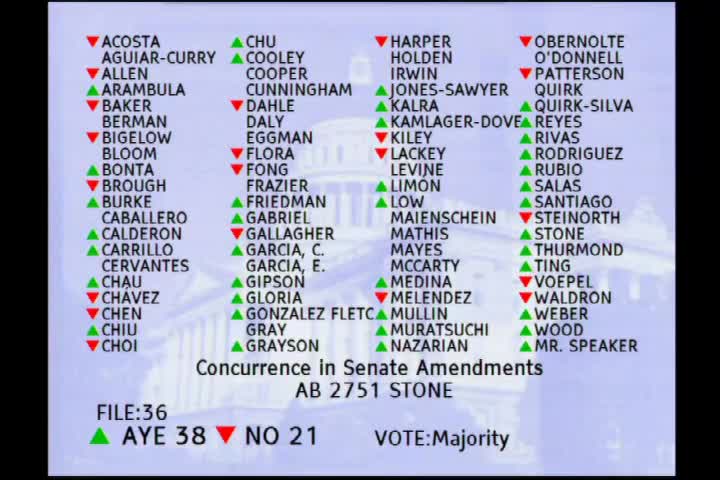 2MIN
Assembly Floor
 2MIN
Senate Floor
 1H
Senate Standing Committee on Appropriations
 22MIN
Senate Standing Committee on Judiciary
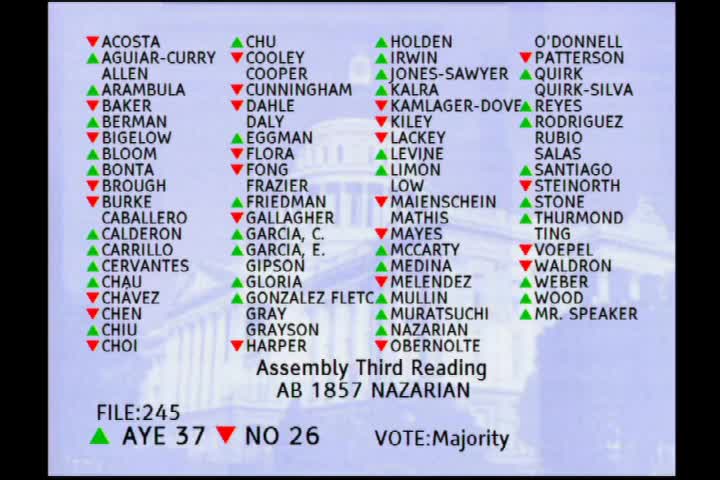 2MIN
Assembly Floor
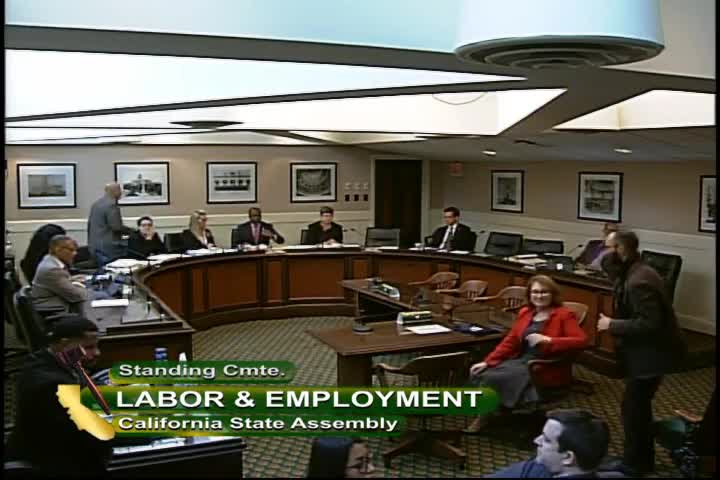 19MIN


















