AB 189: School curriculum: model curriculum: service learning.
- Session Year: 2017-2018
- House: Assembly
- Latest Version Date: 2017-09-13
Existing law requires the Instructional Quality Commission to develop, and for the State Board of Education to adopt, modify, or revise, a model curriculum in ethnic studies.
This bill would require the commission to develop, and the state board to adopt, reject, or modify, a model curriculum for pupils in grades 9 to 12, inclusive, in service learning, as defined, for voluntary use by educators. The bill would require the model curriculum to incorporate evidence-based and applied instructional practices for developing service learning skills, and to identify the ways in which the model curriculum aligns with, and is supportive of, the common core state standards.
The bill, if the state board adopts the model curriculum through prescribed procedures conducted in accordance with a specified timeline, would then require the Superintendent of Public Instruction to post the model curriculum on its Internet Web site for use on a voluntary basis by educators. The bill, beginning in the school year immediately following adoption of the model curriculum by the state board, would encourage local educational agencies and charter schools to use the model curriculum to provide instruction in service learning. The bill would specify that these provisions would become operative only if an appropriation of sufficient funds for its purposes is enacted in the annual Budget Act or another statute.
Existing law requires the Instructional Quality Commission to develop, and for the State Board of Education to adopt, modify, or revise, a model curriculum in ethnic studies.
This bill would require the commission to develop, and the state board to adopt, reject, or modify, a model curriculum for pupils in grades 9 to 12, inclusive, in service learning, as defined, for voluntary use by educators. The bill would require the model curriculum to incorporate evidence-based and applied instructional practices for developing service learning skills, and to identify the ways in which the model curriculum aligns with, and is supportive of, the common core state standards.
The bill, if the state board adopts the model curriculum through prescribed procedures conducted in accordance with a specified timeline, would then require the Superintendent of Public Instruction to post the model curriculum on its Internet Web site for use on a voluntary basis by educators. The bill, beginning in the school year immediately following adoption of the model curriculum by the state board, would encourage local educational agencies and charter schools to use the model curriculum to provide instruction in service learning.
The bill would require, in the event that a school district opts to provide instruction in service learning, that the governing board of the school district, with the active involvement of parents, school administrators, teachers, and pupils, adopt alternative means for pupils to complete the prescribed course of study, as specified.Existing law requires the Instructional Quality Commission to develop, and for the State Board of Education to adopt, modify, or revise, a model curriculum in ethnic studies.
This bill would require the commission to develop, and the state board to adopt, reject, or modify, a model curriculum for pupils in grades 9 to 12, inclusive, in service learning, as defined, for voluntary use by educators. The bill would require the model curriculum to incorporate evidence-based and applied instructional practices for developing service learning skills, and to identify the ways in which the model curriculum aligns with, and is supportive of, the common core state standards.
The bill, if the state board adopts the model curriculum through prescribed procedures conducted in accordance with a specified timeline, would then require the Superintendent of Public Instruction to post the model curriculum on its Internet Web site for use on a voluntary basis by educators. The bill, beginning in the school year immediately following adoption of the model curriculum by the state board, would encourage local educational agencies and charter schools to use the model curriculum to provide instruction in service learning.
The bill would require, in the event that a school district opts to provide instruction in service learning, that the governing board of the school district, with the active involvement of parents, school administrators, teachers, and pupils, adopt alternative means for pupils to complete the prescribed course of study, as specified.
(1)Existing law establishes a system of public elementary and secondary schools in this state, and authorizes local educational agencies throughout the state to operate schools and provide instruction to pupils in kindergarten and grades 1 to 12, inclusive. Existing law prescribes the course of study a pupil is required to complete while in grades 9 to 12, inclusive, in order to receive a diploma of graduation from high school. These requirements include the completion of 3 courses in social studies, including one-year courses in United States history and geography and world history, culture, and geography, and one-semester courses in American government and economics.This bill would express legislative findings and declarations relating to service learning. The bill would additionally require, commencing with the high school class graduating during the 202324 school year, and for the high school classes graduating in each subsequent school year, at least one of the courses completed by a pupil to satisfy the graduation requirements referenced above to have a service learning component. The bill would define service learning for this purpose.The bill would require the Superintendent of Public Instruction, in consultation with the Instructional Quality Commission, to develop curriculum standards for courses that incorporate a service learning component in order to satisfy the requirements of this bill. The bill would require the Superintendent to consult with leaders of community organizations, pupils, parents, classroom teachers, school administrators, postsecondary educators, representatives of business and industry, and other persons with knowledge or experience the Superintendent deems appropriate to the task of developing these curriculum standards. The bill would require the Superintendent to submit these proposed curriculum standards to the State Board of Education on or before March 1, 2020, and the state board to adopt or reject curriculum standards that incorporate a service learning component into courses on or before July 1, 2020.If the state board adopts these proposed curriculum standards, the bill would require the component of courses that satisfies the graduation requirements enacted by this bill to be aligned to those standards. To the extent the implementation of these curriculum standards would impose new duties on school districts, this bill would impose a state-mandated local program.(2)The California Constitution requires the state to reimburse local agencies and school districts for certain costs mandated by the state. Statutory provisions establish procedures for making that reimbursement.This bill would provide that, if the Commission on State Mandates determines that the bill contains costs mandated by the state, reimbursement for those costs shall be made pursuant to the statutory provisions noted above.(1)Existing law establishes a system of public elementary and secondary schools in this state, and authorizes local educational agencies throughout the state to operate schools and provide instruction to pupils in kindergarten and grades 1 to 12, inclusive. Existing law prescribes the course of study a pupil is required to complete while in grades 9 to 12, inclusive, in order to receive a diploma of graduation from high school. These requirements include the completion of 3 courses in social studies, including one-year courses in United States history and geography and world history, culture, and geography, and one-semester courses in American government and economics.
This bill would express legislative findings and declarations relating to service learning. The bill would additionally require, commencing with the high school class graduating during the 202223 202324 school year, and for the high school classes graduating in each subsequent school year, at least one of the courses completed by a pupil to satisfy the graduation requirements referenced above to have a service learning component. The bill would define service learning for this purpose.
The bill would require the Superintendent of Public Instruction Instruction, in consultation with the Instructional Quality Commission, to develop curriculum standards for courses that incorporate a service learning component in order to satisfy the requirements of this bill. The bill would require the Superintendent to consult with leaders of community organizations, pupils, parents, classroom teachers, school administrators, postsecondary educators, representatives of business and industry, and other persons with knowledge or experience the Superintendent deems appropriate to the task of developing these curriculum standards. The bill would require the Superintendent to submit these proposed curriculum standards to the State Board of Education on or before March 1, 2019, 2020, and for the state board to adopt or reject curriculum standards that incorporate a service learning component into courses on or before July 1, 2019. 2020.
If the state board adopts these proposed curriculum standards, the bill would require the curriculum standards to be implemented by school districts, commencing with the 201920 school year, as a component of courses in order to satisfy that satisfies the graduation requirements enacted by this bill. bill to be aligned to those standards. To the extent the implementation of these curriculum standards would impose new duties on school districts, this bill would impose a state-mandated local program.
(2)The California Constitution requires the state to reimburse local agencies and school districts for certain costs mandated by the state. Statutory provisions establish procedures for making that reimbursement.
This bill would provide that, if the Commission on State Mandates determines that the bill contains costs mandated by the state, reimbursement for those costs shall be made pursuant to the statutory provisions noted above.
(1)Existing law establishes a system of public elementary and secondary schools in this state, and authorizes local educational agencies throughout the state to operate schools and provide instruction to pupils in kindergarten and grades 1 to 12, inclusive. Existing law prescribes the course of study a pupil is required to complete while in grades 9 to 12, inclusive, in order to receive a diploma of graduation from high school. These requirements include the completion of 3 courses in social studies, including one-year courses in United States history and geography and world history, culture, and geography, and one-semester courses in American government and economics.
This bill would express legislative findings and declarations relating to service learning. The bill would additionally require, commencing with the high school class graduating during the 202223 school year, and for the high school classes graduating in each subsequent school year, at least one of the courses completed by a pupil to satisfy the graduation requirements referenced above to have a service learning component. The bill would define service learning for this purpose.
The bill would require the Superintendent of Public Instruction to develop curriculum standards for courses that incorporate a service learning component in order to satisfy the requirements of this bill. The bill would require the Superintendent to consult with leaders of community organizations, pupils, parents, classroom teachers, school administrators, postsecondary educators, representatives of business and industry, and other persons with knowledge or experience the Superintendent deems appropriate to the task of developing these curriculum standards. The bill would require the Superintendent to submit these proposed curriculum standards to the State Board of Education on or before March 1, 2019, and for the state board to adopt or reject curriculum standards that incorporate a service learning component into courses on or before July 1, 2019.
If the state board adopts these proposed curriculum standards, the bill would require the curriculum standards to be implemented by school districts, commencing with the 201920 school year, as a component of courses in order to satisfy the graduation requirements enacted by this bill. To the extent the implementation of these curriculum standards would impose new duties on school districts, this bill would impose a state-mandated local program.
(2)The California Constitution requires the state to reimburse local agencies and school districts for certain costs mandated by the state. Statutory provisions establish procedures for making that reimbursement.
This bill would provide that, if the Commission on State Mandates determines that the bill contains costs mandated by the state, reimbursement for those costs shall be made pursuant to the statutory provisions noted above.
The Legislature finds and declares all of the following:
(a)California has been a national leader in promoting service and volunteerism, including support for youth service and the conservation corps, service learning, and statewide mentor initiatives.
(b)Service learning is a powerful instructional strategy for improving the educational performance of pupils, along with contributing to the development of character, values, self-esteem, civic responsibility, and knowledge of local community issues and concerns.
(c)This act is based on the results of numerous research studies that identify the following benefits associated with pupils who engage in high-quality service learning programs infusing well-planned service activity into the school curriculum, including, but not necessarily limited to, all of the following:
(1)Pupil academic achievement increases, as demonstrated by higher standardized test scores and by higher grade point averages.
(2)Pupils are less likely to drop out of school.
(3)Pupils are less likely to have discipline problems, or to engage in behaviors that lead to pregnancy or arrest.
(4)Pupils are likely to maintain higher attendance rates in school.
(5)Pupils are more likely to develop a sense of civic responsibility and an ethic of service in their communities.
(6)Pupils report greater acceptance of cultural diversity and show increased awareness of cultural differences, including positive attitudes toward helping others.
(7)Pupils show increases in measures of personal and social responsibility, perceive themselves to be more socially competent, and are more likely to increase their sense of self-esteem and self-efficacy.
(d)This act is intended to promote volunteer service performed by pupils, since research has demonstrated many positive outcomes of pupil volunteer service, including, but not necessarily limited to, all of the following:
(1)Senior pupils who are engaged in volunteer work, whether through school or on their own, are likely to have significantly higher civics assessment scale scores than pupils who did not participate in volunteer work, as reported by the National Assessment of Educational Progress in 1998.
(2)Community leaders report that service learning partnerships help build more positive community attitudes toward youth.
(3)Schools that support service learning and community service are more likely to have positive relationships with their communities.
SEC. 2.Section 51221.1 is added to the Education Code, to read:51221.1.(a)(1)The Instructional Quality Commission shall develop, and the state board shall adopt, reject, or modify, a model curriculum for pupils in grades 9 to 12, inclusive, in service learning, for voluntary use by educators. The model curriculum shall incorporate evidence-based and applied instructional practices for developing service learning skills, and shall identify the ways in which the model curriculum aligns with, and is supportive of, the common core state standards.
(2)For purposes of this section, service learning is defined as follows:
(A)It is a method through which pupils or participants learn and develop through active participation in thoughtfully organized service that: (i) is conducted in, and meets the needs of, a community; (ii) is coordinated with a secondary school and with the community; and (iii) helps foster civic responsibility.
(B)It is a method that: (i) is integrated into, and enhances, the standards-based academic curriculum of the pupils; and (ii) provides structured time for the pupils or participants to reflect on the service experience.
(b)The model curriculum in service learning shall provide model lessons and activities for each grade level, and identify supporting instructional materials for use in its implementation.
(c)In developing the model curriculum under this section, the Superintendent shall consult with leaders of community organizations, pupils, parents, classroom teachers, school administrators, postsecondary educators, representatives of business and industry, and other persons with knowledge or experience the Superintendent deems appropriate to the task of developing the model curriculum. The persons the Superintendent consults with pursuant to this section shall represent, as much as feasible, the diverse regions and socioeconomic communities of this state.
(d)The Instructional Quality Commission shall hold a minimum of two public hearings in order for the public to provide input on the service learning model curriculum. The public hearings and meetings required by this subdivision shall be held pursuant to the Bagley-Keene Open Meeting Act (Article 9 (commencing with Section 11120) of Chapter 1 of Part 1 of Division 3 of Title 2 of the Government Code).
(e)On or before December 31, 2020, the Instructional Quality Commission shall submit to the state board the service learning model curriculum.
(f)On or before March 31, 2021, the state board shall adopt, reject, or modify the model curriculum in service learning submitted by the Instructional Quality Commission, at a subsequent public meeting.
(g)If the state board modifies the model curriculum in service learning submitted by the Instructional Quality Commission, the state board shall explain, in writing, the reasons for the modifications to the Governor and the appropriate fiscal and policy committees of the Legislature.
(h)If the state board modifies the service learning model curriculum, the state board shall, in a meeting conducted pursuant to the Bagley-Keene Open Meeting Act (Article 9 (commencing with Section 11120) of Chapter 1 of Part 1 of Division 3 of Title 2 of the Government Code), provide written reasons for its revisions. The state board shall not adopt the service learning model curriculum at the same meeting it provides its written reasons, but, instead, shall adopt these revisions at a subsequent meeting conducted no later than July 31, 2021.
(i)If the state board rejects the service learning model curriculum, the state board shall transmit to the Superintendent, the Governor, and the appropriate policy and fiscal committees of the Legislature a specific written explanation of the reasons for the rejection of the model curriculum presented by the Superintendent.
(j)Following the adoption of the model curriculum in service learning, the Superintendent shall post the model curriculum on its Internet Web site for use on a voluntary basis by educators.
(k)Subject to an appropriation for this purpose in the Budget Act or other statute, the department shall create an online professional development module that instructs educators on the use of the service learning model curriculum, and shall make this module available at no cost on its Internet Web site for voluntary use by educators.
(l)Beginning in the school year following the adoption of the model curriculum in service learning, local educational agencies and charter schools are encouraged to use the model curriculum to provide instruction in service learning.
(m)This section shall become operative only if an appropriation of sufficient funds for its purposes is enacted in the annual Budget Act or another statute.
The Legislature finds and declares all of the following:
(a)California has been a national leader in promoting service and volunteerism, including support for youth service and the conservation corps, service learning, and statewide mentor initiatives.
(b)Service learning is a powerful instructional strategy for improving the educational performance of pupils, along with contributing to the development of character, values, self-esteem, civic responsibility, and knowledge of local community issues and concerns.
(c)This act is based on the results of numerous research studies that identify the following benefits associated with pupils who engage in high-quality service learning programs infusing well-planned service activity into the school curriculum, including, but not necessarily limited to, all of the following:
(1)Pupil academic achievement increases, as demonstrated by higher standardized test scores and by higher grade point averages.
(2)Pupils are less likely to drop out of school.
(3)Pupils are less likely to have discipline problems, or to engage in behaviors that lead to pregnancy or arrest.
(4)Pupils are likely to maintain higher attendance rates in school.
(5)Pupils are more likely to develop a sense of civic responsibility and an ethic of service in their communities.
(6)Pupils report greater acceptance of cultural diversity and show increased awareness of cultural differences, including positive attitudes toward helping others.
(7)Pupils show increases in measures of personal and social responsibility, perceive themselves to be more socially competent, and are more likely to increase their sense of self-esteem and self-efficacy.
(d)This act is intended to promote volunteer service performed by pupils, since research has demonstrated many positive outcomes of pupil volunteer service, including, but not necessarily limited to, all of the following:
(1)Senior pupils who are engaged in volunteer work, whether through school or on their own, are likely to have significantly higher civics assessment scale scores than pupils who did not participate in volunteer work, as reported by the National Assessment of Educational Progress in 1998.
(2)Community leaders report that service learning partnerships help build more positive community attitudes toward youth.
(3)Schools that support service learning and community service are more likely to have positive relationships with their communities.
SEC. 2.Section 51221.1 is added to the Education Code, to read:51221.1.(a)(1)The Instructional Quality Commission shall develop, and the state board shall adopt, reject, or modify, a model curriculum for pupils in grades 9 to 12, inclusive, in service learning, for voluntary use by educators. The model curriculum shall incorporate evidence-based and applied instructional practices for developing service learning skills, and shall identify the ways in which the model curriculum aligns with, and is supportive of, the common core state standards.
(2)For purposes of this section, service learning is defined as follows:
(A)It is a method through which pupils or participants learn and develop through active participation in thoughtfully organized service that: (i) is conducted in, and meets the needs of, a community; (ii) is coordinated with a secondary school and with the community; and (iii) helps foster civic responsibility.
(B)It is a method that: (i) is integrated into, and enhances, the standards-based academic curriculum of the pupils; and (ii) provides structured time for the pupils or participants to reflect on the service experience.
(b)The model curriculum in service learning shall provide model lessons and activities for each grade level, and identify supporting instructional materials for use in its implementation.
(c)In developing the curriculum standards model curriculum under this section, the Superintendent shall consult with leaders of community organizations, pupils, parents, classroom teachers, school administrators, postsecondary educators, representatives of business and industry, and other persons with knowledge or experience the Superintendent deems appropriate to the task of developing these curriculum standards. the model curriculum. The persons the Superintendent consults with pursuant to this section shall represent, as much as feasible, the diverse regions and socioeconomic communities of this state.
(d)The Instructional Quality Commission shall hold a minimum of two public hearings in order for the public to provide input on the service learning model curriculum. The public hearings and meetings required by this subdivision shall be held pursuant to the Bagley-Keene Open Meeting Act (Article 9 (commencing with Section 11120) of Chapter 1 of Part 1 of Division 3 of Title 2 of the Government Code).
(e)On or before December 31, 2020, the Instructional Quality Commission shall submit to the state board the service learning model curriculum.
(f)On or before March 31, 2021, the state board shall adopt, reject, or modify the model curriculum in service learning submitted by the Instructional Quality Commission, at a subsequent public meeting.
(g)If the state board modifies the model curriculum in service learning submitted by the Instructional Quality Commission, the state board shall explain, in writing, the reasons for the modifications to the Governor and the appropriate fiscal and policy committees of the Legislature.
(h)If the state board modifies the service learning model curriculum, the state board shall, in a meeting conducted pursuant to the Bagley-Keene Open Meeting Act (Article 9 (commencing with Section 11120) of Chapter 1 of Part 1 of Division 3 of Title 2 of the Government Code), provide written reasons for its revisions. The state board shall not adopt the service learning model curriculum at the same meeting it provides its written reasons, but, instead, shall adopt these revisions at a subsequent meeting conducted no later than July 31, 2021.
(i)If the state board rejects the service learning model curriculum, the state board shall transmit to the Superintendent, the Governor, and the appropriate policy and fiscal committees of the Legislature a specific written explanation of the reasons for the rejection of the model curriculum presented by the Superintendent.
(j)Following the adoption of the model curriculum in service learning, the Superintendent shall post the model curriculum on its Internet Web site for use on a voluntary basis by educators.
(k)Subject to an appropriation for this purpose in the Budget Act or other statute, the department shall create an online professional development module that instructs educators on the use of the service learning model curriculum, and shall make this module available at no cost on its Internet Web site for voluntary use by educators.
(l)Beginning in the school year following the adoption of the model curriculum in service learning, local educational agencies and charter schools are encouraged to use the model curriculum to provide instruction in service learning.
(m)In the event that a school district opts to provide instruction in service learning, the governing board of the school district, with the active involvement of parents, school administrators, teachers, and pupils, shall adopt alternative means for pupils to complete the prescribed course of study that may include practical demonstration of skills and competencies, supervised work experience or other outside school experience, career technical education classes offered in high schools, courses offered by regional occupational centers or programs, interdisciplinary study, independent study, and credit earned at a postsecondary educational institution. Requirements for graduation and specified alternative modes for completing the prescribed course of study shall be made available to pupils, parents, and the public.The Legislature finds and declares all of the following:
(a)California has been a national leader in promoting service and volunteerism, including support for youth service and the conservation corps, service learning, and statewide mentor initiatives.
(b)Service learning is a powerful instructional strategy for improving the educational performance of pupils, along with contributing to the development of character, values, self-esteem, civic responsibility, and knowledge of local community issues and concerns.
(c)This act is based on the results of numerous research studies that identify the following benefits associated with pupils who engage in quality high-quality service learning programs infusing well-planned service activity into the school curriculum, including, but not necessarily limited to, all of the following:
(1)Pupil academic achievement increases, as demonstrated by higher standardized test scores and by higher grade point averages.
(2)Pupils are less likely to drop out of school.
(3)Pupils are less likely to have discipline problems, or to engage in behaviors that lead to pregnancy or arrest.
(4)Pupils are likely to maintain higher attendance rates in school.
(5)Pupils are more likely to develop a sense of civic responsibility and an ethic of service in their communities.
(6)Pupils report greater acceptance of cultural diversity and show increased awareness of cultural differences, including positive attitudes toward helping others.
(7)Pupils show increases in measures of personal and social responsibility, perceive themselves to be more socially competent, and are more likely to increase their sense of self-esteem and self-efficacy.
(d)This act is intended to promote volunteer service performed by pupils, since research has demonstrated many positive outcomes of pupil volunteer service, including, but not necessarily limited to, all of the following:
(1)Senior pupils who are engaged in volunteer work, whether through school or on their own, are likely to have significantly higher civics assessment scale scores than pupils who did not participate in volunteer work work, as reported by the National Assessment of Educational Progress in 1998.
(2)Community leaders report that service learning partnerships help build more positive community attitudes toward youth.
(3)Schools that support service learning and community service are more likely to have positive relationships with their community. communities.
SEC. 2.Section 51221.1 is added to the Education Code, to read:51221.1.(a)(1)The Instructional Quality Commission shall develop, and the state board shall adopt, reject, or modify, a model curriculum for pupils in grades 9 to 12, inclusive, in service learning, for voluntary use by educators. The model curriculum shall incorporate evidence-based and applied instructional practices for developing service learning skills, and shall identify the ways in which the model curriculum aligns with, and is supportive of, the common core state standards.
(2)For purposes of this section, service learning is defined as follows:
(A)It is a method through which pupils or participants learn and develop through active participation in thoughtfully organized service that: (i) is conducted in, and meets the needs of, a community; (ii) is coordinated with a secondary school and with the community; and (iii) helps foster civic responsibility.
(B)It is a method that: (i) is integrated into, and enhances, the standards-based academic curriculum of the pupils; and (ii) provides structured time for the pupils or participants to reflect on the service experience.
(b)The model curriculum in service learning shall provide model lessons and activities for each grade level, and identify supporting instructional materials for use in its implementation.
(c)In developing the curriculum standards under this section, the Superintendent shall consult with leaders of community organizations, pupils, parents, classroom teachers, school administrators, postsecondary educators, representatives of business and industry, and other persons with knowledge or experience the Superintendent deems appropriate to the task of developing these curriculum standards. The persons the Superintendent consults with pursuant to this section shall represent, as much as feasible, the diverse regions and socioeconomic communities of this state.
(d)The Instructional Quality Commission shall hold a minimum of two public hearings in order for the public to provide input on the service learning model curriculum. The public hearings and meetings required by this subdivision shall be held pursuant to the Bagley-Keene Open Meeting Act (Article 9 (commencing with Section 11120) of Chapter 1 of Part 1 of Division 3 of Title 2 of the Government Code).
(e)On or before December 31, 2020, the Instructional Quality Commission shall submit to the state board the service learning model curriculum.
(f)On or before March 31, 2021, the state board shall adopt, reject, or modify the model curriculum in service learning submitted by the Instructional Quality Commission, at a subsequent public meeting.
(g)If the state board modifies the model curriculum in service learning submitted by the Instructional Quality Commission, the state board shall explain, in writing, the reasons for the modifications to the Governor and the appropriate fiscal and policy committees of the Legislature.
(h)If the state board modifies the service learning model curriculum, the state board shall, in a meeting conducted pursuant to the Bagley-Keene Open Meeting Act (Article 9 (commencing with Section 11120) of Chapter 1 of Part 1 of Division 3 of Title 2 of the Government Code), provide written reasons for its revisions. The state board shall not adopt the service learning model curriculum at the same meeting it provides its written reasons, but, instead, shall adopt these revisions at a subsequent meeting conducted no later than July 31, 2021.
(i)If the state board rejects the service learning model curriculum, the state board shall transmit to the Superintendent, the Governor, and the appropriate policy and fiscal committees of the Legislature a specific written explanation of the reasons for the rejection of the model curriculum presented by the Superintendent.
(j)Following the adoption of the model curriculum in service learning, the Superintendent shall post the curriculum on its Internet Web site for use on a voluntary basis by educators.
(k)Subject to an appropriation for this purpose in the Budget Act or other statute, the department shall create an online professional development module that instructs educators on the use of the service learning model curriculum, and shall make this module available at no cost on its Internet Web site for voluntary use by educators.
(l)Beginning in the school year following the adoption of the model curriculum in service learning, local educational agencies and charter schools are encouraged to use the model curriculum to provide instruction in service learning.
(m)In the event that a school district opts to provide instruction in service learning, the governing board of the school district, with the active involvement of parents, school administrators, teachers, and pupils, shall adopt alternative means for pupils to complete the prescribed course of study that may include practical demonstration of skills and competencies, supervised work experience or other outside school experience, career technical education classes offered in high schools, courses offered by regional occupational centers or programs, interdisciplinary study, independent study, and credit earned at a postsecondary educational institution. Requirements for graduation and specified alternative modes for completing the prescribed course of study shall be made available to pupils, parents, and the public.
SEC. 2.Section 51221.1 is added to the Education Code, to read:51221.1.(a)The Superintendent, in consultation with the Instructional Quality Commission, shall develop curriculum standards for courses that incorporate a service learning component in order to satisfy the requirements of paragraph (3) of subdivision (a) of Section 51225.3. In developing the curriculum standards under this section, the Superintendent shall consult with leaders of community organizations, pupils, parents, classroom teachers, school administrators, postsecondary educators, representatives of business and industry, and other persons with knowledge or experience the Superintendent deems appropriate to the task of developing these curriculum standards. The persons the Superintendent consults with pursuant to this section shall represent, as much as feasible, the diverse regions and socioeconomic communities of this state.(b)(1)The Superintendent shall submit the proposed curriculum standards developed under subdivision (a) to the state board for its review on or before March 1, 2020. The state board shall adopt or reject curriculum standards that incorporate a service learning component into courses on or before July 1, 2020. If the state board adopts the proposed curriculum standards, the component of courses that satisfies the requirements of paragraph (3) of subdivision (a) of Section 51225.3 shall be aligned to those standards.(2)If the state board rejects the curriculum standards proposed under this subdivision, the state board shall submit a written explanation of the reasons why the proposed curriculum standards were rejected to the Superintendent, the Legislature, and the Governor.SEC. 3.Section 51225.3 of the Education Code, as amended by Section 2 of Chapter 888 of the Statutes of 2014, is amended to read:51225.3.(a)A pupil shall complete coursework in accordance with all of the following while in grades 9 to 12, inclusive, in order to receive a diploma of graduation from high school:(1)At least the following numbers of courses in the subjects specified, each course having a duration of one year, unless otherwise specified:(A)Three courses in English.(B)Two courses in mathematics. If the governing board of a school district requires more than two courses in mathematics for graduation, the governing board of the school district may award a pupil up to one mathematics course credit pursuant to Section 51225.35.(C)Two courses in science, including biological and physical sciences.(D)Three courses in social studies, including United States history and geography; world history, culture, and geography; a one-semester course in American government and civics; and a one-semester course in economics.(E)One course in visual or performing arts or foreign language. For purposes of satisfying the requirement specified in this subparagraph, a course in American Sign Language shall be deemed a course in foreign language.(F)Two courses in physical education, unless the pupil has been exempted pursuant to the provisions of this code.(2)Other coursework requirements adopted by the governing board of the school district.(3)(A)Commencing with the high school class graduating during the 202324 school year, and for the high school classes graduating in each subsequent school year, at least one of the courses completed by a pupil to satisfy the requirements of this subdivision shall have a service learning component.(B)For purposes of this subdivision, service learning is defined as follows:(i)It is a method through which pupils or participants learn and develop through active participation in thoughtfully organized service that: (I) is conducted in, and meets the needs of, a community; (II) is coordinated with a secondary school and with the community; and (III) helps foster civic responsibility.(ii)It is a method that: (I) is integrated into, and enhances, the standards-based academic curriculum of the pupils; and (II) provides structured time for the pupils or participants to reflect on the service experience.(b)The governing board of the school district, with the active involvement of parents, administrators, teachers, and pupils, shall adopt alternative means for pupils to complete the prescribed course of study that may include practical demonstration of skills and competencies, supervised work experience or other outside school experience, career technical education classes offered in high schools, courses offered by regional occupational centers or programs, interdisciplinary study, independent study, and credit earned at a postsecondary educational institution. Requirements for graduation and specified alternative modes for completing the prescribed course of study shall be made available to pupils, parents, and the public.(c)If a pupil completed a career technical education course that met the requirements of subparagraph (E) of paragraph (1) of subdivision (a) of Section 51225.3, as amended by the act adding this section, before the inoperative date of that section, that course shall be deemed to fulfill the requirements of subparagraph (E) of paragraph (1) of subdivision (a) of this section.(d)This section shall become operative upon the date that Section 51225.3, as amended by the act adding this section, becomes inoperative.SEC. 4.If the Commission on State Mandates determines that this act contains costs mandated by the state, reimbursement to local agencies and school districts for those costs shall be made pursuant to Part 7 (commencing with Section 17500) of Division 4 of Title 2 of the Government Code.The Legislature finds and declares all of the following:
(a)California has been a national leader in promoting service and volunteerism, including support for youth service and the conservation corps, service learning, and statewide mentor initiatives.
(b)Service learning is a powerful instructional strategy for improving the educational performance of pupils, along with contributing to the development of character, values, self-esteem, civic responsibility, and knowledge of local community issues and concerns.
(c)This act is based on the results of numerous research studies that identify the following benefits associated with pupils who engage in quality service learning programs infusing well-planned service activity into the school curriculum, including, but not necessarily limited to, all of the following:
(1)Pupil academic achievement increases, as demonstrated by higher standardized test scores and by higher grade point averages.
(2)Pupils are less likely to drop out of school.
(3)Pupils are less likely to have discipline problems, or to engage in behaviors that lead to pregnancy or arrest.
(4)Pupils are likely to maintain higher attendance rates in school.
(5)Pupils are more likely to develop a sense of civic responsibility and an ethic of service in their communities.
(6)Pupils report greater acceptance of cultural diversity and show increased awareness of cultural differences, including positive attitudes toward helping others.
(7)Pupils show increases in measures of personal and social responsibility, perceive themselves to be more socially competent, and are more likely to increase their sense of self-esteem and self-efficacy.
(d)This act is intended to promote volunteer service performed by pupils, since research has demonstrated many positive outcomes of pupil volunteer service, including, but not necessarily limited to, all of the following:
(1)Senior pupils who are engaged in volunteer work, whether through school or on their own, are likely to have significantly higher civics assessment scale scores than pupils who did not participate in volunteer work as reported by the National Assessment of Educational Progress in 1998.
(2)Community leaders report that service learning partnerships help build more positive community attitudes toward youth.
(3)Schools that support service learning and community service are more likely to have positive relationships with their community.
SEC. 2.Section 51221.1 is added to the Education Code, to read:51221.1.(a)The Superintendent Superintendent, in consultation with the Instructional Quality Commission, shall develop curriculum standards for courses that incorporate a service learning component in order to satisfy the requirements of paragraph (3) of subdivision (a) of Section 51225.3. In developing the curriculum standards under this section, the Superintendent shall consult with leaders of community organizations, pupils, parents, classroom teachers, school administrators, postsecondary educators, representatives of business and industry, and other persons with knowledge or experience the Superintendent deems appropriate to the task of developing these curriculum standards. The persons the Superintendent consults with pursuant to this section shall represent, as much as feasible, the diverse regions and socioeconomic communities of this state.
(b)(1)The Superintendent shall submit the proposed curriculum standards developed under subdivision (a) to the state board for its review on or before March 1, 2019. 2020. The state board shall adopt or reject curriculum standards that incorporate a service learning component into courses on or before July 1, 2019. 2020. If the state board adopts the proposed curriculum standards, the curriculum standards shall be implemented by school districts, commencing with the 201920 school year, as a the component of courses in order to satisfy that satisfies the requirements of paragraph (3) of subdivision (a) of Section 51225.3. 51225.3 shall be aligned to those standards.
(2)If the state board rejects the curriculum standards proposed under this subdivision, the state board shall submit a written explanation of the reasons why the proposed curriculum standards were rejected to the Superintendent, the Legislature, and the Governor.
SEC. 3.Section 51225.3 of the Education Code, as amended by Section 2 of Chapter 888 of the Statutes of 2014, is amended to read:51225.3.(a)A pupil shall complete coursework in accordance with all of the following while in grades 9 to 12, inclusive, in order to receive a diploma of graduation from high school:
(1)At least the following numbers of courses in the subjects specified, each course having a duration of one year, unless otherwise specified:
(A)Three courses in English.
(B)Two courses in mathematics. If the governing board of a school district requires more than two courses in mathematics for graduation, the governing board of the school district may award a pupil up to one mathematics course credit pursuant to Section 51225.35.
(C)Two courses in science, including biological and physical sciences.
(D)Three courses in social studies, including United States history and geography; world history, culture, and geography; a one-semester course in American government and civics; and a one-semester course in economics.
(E)One course in visual or performing arts or foreign language. For purposes of satisfying the requirement specified in this subparagraph, a course in American Sign Language shall be deemed a course in foreign language.
(F)Two courses in physical education, unless the pupil has been exempted pursuant to the provisions of this code.
(2)Other coursework requirements adopted by the governing board of the school district.
(3)(A)Commencing with the high school class graduating during the 202223 202324 school year, and for the high school classes graduating in each subsequent school year, at least one of the courses completed by a pupil to satisfy the requirements of this subdivision shall have a service learning component.
(B)For purposes of this subdivision, service learning is defined as follows:
(i)It is a method through which pupils or participants learn and develop through active participation in thoughtfully organized service that: (I) is conducted in, and meets the needs of, a community; (II) is coordinated with a secondary school and with the community; and (III) helps foster civic responsibility.
(ii)It is a method that: (I) is integrated into, and enhances, the standards-based academic curriculum of the pupils; and (II) provides structured time for the pupils or participants to reflect on the service experience.
(b)The governing board of the school district, with the active involvement of parents, administrators, teachers, and pupils, shall adopt alternative means for pupils to complete the prescribed course of study that may include practical demonstration of skills and competencies, supervised work experience or other outside school experience, career technical education classes offered in high schools, courses offered by regional occupational centers or programs, interdisciplinary study, independent study, and credit earned at a postsecondary educational institution. Requirements for graduation and specified alternative modes for completing the prescribed course of study shall be made available to pupils, parents, and the public.
(c)If a pupil completed a career technical education course that met the requirements of subparagraph (E) of paragraph (1) of subdivision (a) of Section 51225.3, as amended by the act adding this section, before the inoperative date of that section, that course shall be deemed to fulfill the requirements of subparagraph (E) of paragraph (1) of subdivision (a) of this section.
(d)This section shall become operative upon the date that Section 51225.3, as amended by the act adding this section, becomes inoperative.
SEC. 4.If the Commission on State Mandates determines that this act contains costs mandated by the state, reimbursement to local agencies and school districts for those costs shall be made pursuant to Part 7 (commencing with Section 17500) of Division 4 of Title 2 of the Government Code.
The Legislature finds and declares all of the following:
(a)California has been a national leader in promoting service and volunteerism, including support for youth service and the conservation corps, service learning, and statewide mentor initiatives.
(b)Service learning is a powerful instructional strategy for improving the educational performance of pupils, along with contributing to the development of character, values, self-esteem, civic responsibility, and knowledge of local community issues and concerns.
(c)This act is based on the results of numerous research studies that identify the following benefits associated with pupils who engage in quality service learning programs infusing well-planned service activity into the school curriculum, including, but not necessarily limited to, all of the following:
(1)Pupil academic achievement increases, as demonstrated by higher standardized test scores and by higher grade point averages.
(2)Pupils are less likely to drop out of school.
(3)Pupils are less likely to have discipline problems, or to engage in behaviors that lead to pregnancy or arrest.
(4)Pupils are likely to maintain higher attendance rates in school.
(5)Pupils are more likely to develop a sense of civic responsibility and an ethic of service in their communities.
(6)Pupils report greater acceptance of cultural diversity and show increased awareness of cultural differences, including positive attitudes toward helping others.
(7)Pupils show increases in measures of personal and social responsibility, perceive themselves to be more socially competent, and are more likely to increase their sense of self-esteem and self-efficacy.
(d)This act is intended to promote volunteer service performed by pupils, since research has demonstrated many positive outcomes of pupil volunteer service, including, but not necessarily limited to, all of the following:
(1)Senior pupils who are engaged in volunteer work, whether through school or on their own, are likely to have significantly higher civics assessment scale scores than pupils who did not participate in volunteer work as reported by the National Assessment of Educational Progress in 1998.
(2)Community leaders report that service learning partnerships help build more positive community attitudes toward youth.
(3)Schools that support service learning and community service are more likely to have positive relationships with their community.
SEC. 2.Section 51221.1 is added to the Education Code, to read:51221.1.(a)The Superintendent shall develop curriculum standards for courses that incorporate a service learning component in order to satisfy the requirements of paragraph (3) of subdivision (a) of Section 51225.3. In developing the curriculum standards under this section, the Superintendent shall consult with leaders of community organizations, pupils, parents, classroom teachers, school administrators, postsecondary educators, representatives of business and industry, and other persons with knowledge or experience the Superintendent deems appropriate to the task of developing these curriculum standards. The persons the Superintendent consults with pursuant to this section shall represent, as much as feasible, the diverse regions and socioeconomic communities of this state.
(b)(1)The Superintendent shall submit the proposed curriculum standards developed under subdivision (a) to the state board for its review on or before March 1, 2019. The state board shall adopt or reject curriculum standards that incorporate a service learning component into courses on or before July 1, 2019. If the state board adopts the proposed curriculum standards, the curriculum standards shall be implemented by school districts, commencing with the 201920 school year, as a component of courses in order to satisfy the requirements of paragraph (3) of subdivision (a) of Section 51225.3.
(2)If the state board rejects the curriculum standards proposed under this subdivision, the state board shall submit a written explanation of the reasons why the proposed curriculum standards were rejected to the Superintendent, the Legislature, and the Governor.
SEC. 3.Section 51225.3 of the Education Code, as amended by Section 2 of Chapter 888 of the Statutes of 2014, is amended to read:51225.3.(a)A pupil shall complete coursework in accordance with all of the following while in grades 9 to 12, inclusive, in order to receive a diploma of graduation from high school:
(1)At least the following numbers of courses in the subjects specified, each course having a duration of one year, unless otherwise specified:
(A)Three courses in English.
(B)Two courses in mathematics. If the governing board of a school district requires more than two courses in mathematics for graduation, the governing board of the school district may award a pupil up to one mathematics course credit pursuant to Section 51225.35.
(C)Two courses in science, including biological and physical sciences.
(D)Three courses in social studies, including United States history and geography; world history, culture, and geography; a one-semester course in American government and civics; and a one-semester course in economics.
(E)One course in visual or performing arts or foreign language. For purposes of satisfying the requirement specified in this subparagraph, a course in American Sign Language shall be deemed a course in foreign language.
(F)Two courses in physical education, unless the pupil has been exempted pursuant to the provisions of this code.
(2)Other coursework requirements adopted by the governing board of the school district.
(3)(A)Commencing with the high school class graduating during the 202223 school year, and for the high school classes graduating in each subsequent school year, at least one of the courses completed by a pupil to satisfy the requirements of this subdivision shall have a service learning component.
(B)For purposes of this subdivision, service learning is defined as follows:
(i)It is a method through which pupils or participants learn and develop through active participation in thoughtfully organized service that: (I) is conducted in, and meets the needs of, a community; (II) is coordinated with a secondary school and with the community; and (III) helps foster civic responsibility.
(ii)It is a method that: (I) is integrated into, and enhances, the standards-based academic curriculum of the pupils; and (II) provides structured time for the pupils or participants to reflect on the service experience.
(b)The governing board, board of the school district, with the active involvement of parents, administrators, teachers, and pupils, shall adopt alternative means for pupils to complete the prescribed course of study that may include practical demonstration of skills and competencies, supervised work experience or other outside school experience, career technical education classes offered in high schools, courses offered by regional occupational centers or programs, interdisciplinary study, independent study, and credit earned at a postsecondary educational institution. Requirements for graduation and specified alternative modes for completing the prescribed course of study shall be made available to pupils, parents, and the public.
(c)If a pupil completed a career technical education course that met the requirements of subparagraph (E) of paragraph (1) of subdivision (a) of Section 51225.3, as amended by the act adding this section, before the inoperative date of that section, that course shall be deemed to fulfill the requirements of subparagraph (E) of paragraph (1) of subdivision (a) of this section.
(d)This section shall become operative upon the date that Section 51225.3, as amended by the act adding this section, becomes inoperative.
SEC. 4.If the Commission on State Mandates determines that this act contains costs mandated by the state, reimbursement to local agencies and school districts for those costs shall be made pursuant to Part 7 (commencing with Section 17500) of Division 4 of Title 2 of the Government Code.
|
Date
|
Status
|
|---|---|
| Jan 12, 2018 | Stricken from file. |
| Jan 3, 2018 | Consideration of Governor's veto pending. |
| Oct 9, 2017 | Vetoed by Governor. |
| Sep 18, 2017 | Enrolled and presented to the Governor at 4 p.m. |
| Sep 11, 2017 | Senate amendments concurred in. To Engrossing and Enrolling. |
| Sep 6, 2017 | In Assembly. Concurrence in Senate amendments pending. May be considered on or after September 8 pursuant to Assembly Rule 77. |
| Sep 6, 2017 | Read third time. Passed. Ordered to the Assembly. |
| Sep 5, 2017 | Read second time. Ordered to third reading. |
| Sep 1, 2017 | From committee: Amend, and do pass as amended. (Ayes 5. Noes 1.) (September 1). |
| Jul 17, 2017 | In committee: Referred to APPR. suspense file. |
| Jul 5, 2017 | From committee: Do pass and re-refer to Com. on APPR. (Ayes 5. Noes 1.) (July 5). Re-referred to Com. on APPR. |
| Jun 15, 2017 | From committee chair, with author's amendments: Amend, and re-refer to committee. Read second time, amended, and re-referred to Com. on ED. |
| Jun 14, 2017 | Referred to Com. on ED. |
| Jun 1, 2017 | In Senate. Read first time. To Com. on RLS. for assignment. |
| May 31, 2017 | Read third time. Passed. Ordered to the Senate. (Ayes 60. Noes 13. Page 1952.) |
| May 30, 2017 | Read second time and amended. Ordered returned to second reading. |
| May 26, 2017 | From committee: Amend, and do pass as amended. (Ayes 12. Noes 5.) (May 26). |
| Apr 5, 2017 | In committee: Set, first hearing. Referred to APPR. suspense file. |
| Mar 28, 2017 | Re-referred to Com. on APPR. |
| Mar 27, 2017 | Read second time and amended. |
| Mar 23, 2017 | From committee: Amend, and do pass as amended and re-refer to Com. on APPR. (Ayes 5. Noes 2.) (March 15). |
| Jan 30, 2017 | Referred to Com. on ED. |
| Jan 20, 2017 | From printer. May be heard in committee February 19. |
| Jan 19, 2017 | Read first time. To print. |
|
Date
|
Description
|
Location
|
Votes
|
|
|---|---|---|---|---|
| Sep 11, 2017 | AB 189 LOW Concurrence in Senate Amendments | Assembly Floor |
Passed |
|
| Sep 6, 2017 | Assembly 3rd Reading AB189 Low By Portantino | Senate Floor |
Passed |
|
| Sep 1, 2017 | Do pass as amended | Senate Standing Committee on Appropriations |
Passed |
|
| Jul 17, 2017 | Placed on suspense file | Senate Standing Committee on Appropriations |
Passed |
|
| Jul 5, 2017 | Do pass, but first be re-referred to the Committee on [Appropriations] | Senate Standing Committee on Education |
Passed |
|
| May 31, 2017 | AB 189 LOW Assembly Third Reading | Assembly Floor |
Passed |
|
| May 26, 2017 | Do pass as amended. | Assembly Standing Committee on Appropriations |
Passed |
|
| Mar 15, 2017 | Do pass as amended and be re-referred to the Committee on [Appropriations] | Assembly Standing Committee on Education |
Passed |
This list shows positions taken on this bill by organizations on the date displayed, which is linked to the original source.
Positions by individuals are not included.
GOVERNOR'S VETO
GV Bill Id:AB 189
Author:(Low)
As Enrolled Ver:September 13, 2017
2/3 vote
ASSEMBLY: | 60-13 | (May 31, 2017) | SENATE: | 31-7 | (September 6, 2017) |
ASSEMBLY: | 64-10 | (September 11, 2017) |
Original Committee Reference: ED.
SUMMARY: Requires the Instructional Quality Commission (IQC) to develop a model curriculum on service-learning for pupils in grades ninth to 12th grade, for voluntary use by educators.
The Senate amendments:
- Delete a requirement that, in the event that a school district opts to provide instruction in service learning, the governing board of the school district adopt alternative means for students to complete the prescribed course of study.
- Make the provisions of the measure operative only if an appropriation for its purposes is provided in the annual Budget Act or another statute.
FISCAL EFFECT: According to the Senate Appropriations Committee,
- While the bill's provisions would be contingent upon an appropriation in the budget for this purpose, the California Department of Education estimates one-time General Fund costs of approximately $1,036,000 to develop the model curriculum in service learning over a three-year period. These costs would support an advisory committee (volunteers), a review of supplemental instructional resources, and curriculum experts. This estimate also includes the development of the online professional development module, which is subject to an appropriation.
- Unknown local cost pressure for local educational agencies (LEAs) serving grades 9-12 to offer elective courses in services learning based on the model curriculum prescribed by this bill. To implement a new course, LEAs may need to hire new teachers, provide professional development for existing teachers, and purchase instructional materials. These costs would not be reimbursable by the state.
COMMENTS:
Need for the bill. The author's office states, "Service-learning is a powerful instructional strategy for improving the educational performance of pupils, while contributing to the development of character, values, self-esteem, civic responsibility, and knowledge of local community issues and concerns. Like community service, service-learning requires students to serve their communities. Service-learning, however, takes community service one step further by incorporating the service experiences of students directly into their school work.
While some school districts in California incorporate community service or service-learning into the high school curriculum and require it for graduation, there is a missed opportunity for students in other districts that do not integrate service-learning into their educational experience.
According to a 1998 report from the National Assessment of Educational Progress (NAEP), senior pupils who are engaged in volunteer work, whether through school or on their own, are likely to have significantly higher civic assessment scale scores than pupils who did not participate in volunteer work. The date of the study is significant in that it was the last time NAEP tested students' progress in civics.
Young people who recall their civic learning experiences are more likely to vote, know about the [United States] U.S. political system, and continue to be engaged in their community. AB 189 will revitalize quality civic and service-learning experiences in the classroom and shape our students to become active and informed citizens of our state."
Service-learning supports academic achievement, narrows achievement gap. A 2011 meta-analysis of 62 studies involving 11,837 students found that, compared to controls, students who participated in service-learning programs demonstrate significant gains in five outcome areas: attitudes toward self, attitudes toward school and learning, civic engagement, social skills, and academic performance. The analysis also found that following certain recommended practices—linking to curriculum, community involvement, and reflection—were associated with better outcomes. A 2005 analysis of 217,000 student surveys found that "service [service-learning was not measured] of only one hour per week among lower-income students was related to significant reduction of the gap in achievement-related assets between higher and lower-income students."
This bill would establish a model curriculum in service learning for adoption by the State Board of Education.
I believe this bill is unnecessary. The Instructional Quality Commission carefully considered the subject of service learning when it was updating the History-Social Science Framework and embedded it throughout the curriculum framework that the State Board of Education subsequently adopted.
The appendix also includes a section "Practice Civic Engagement: Service Learning in the History-Social Science Framework."
Analysis Prepared by: Tanya Lieberman / ED. / (916) 319-2087 FN: 0002442
CONCURRENCE IN SENATE AMENDMENTS
CSA1 Bill Id:AB 189
Author:(Low)
As Amended Ver:September 1, 2017
Majority vote
ASSEMBLY: | 60-13 | (May 31, 2017) | SENATE: | 31-7 | (September 6, 2017) |
Original Committee Reference: ED.
SUMMARY: Requires the Instructional Quality Commission (IQC) to develop a model curriculum on service-learning for pupils in grades 9th to 12th grade, for voluntary use by educators.
The Senate amendments:
- Delete a requirement that, in the event that a school district opts to provide instruction in service learning, the governing board of the school district adopt alternative means for students to complete the prescribed course of study.
- Make the provisions of the measure operative only if an appropriation for its purposes is provided in the annual Budget Act or another statute.
FISCAL EFFECT: According to the Senate Appropriations Committee,
- While the bill's provisions would be contingent upon an appropriation in the budget for this purpose, the California Department of Education estimates one-time General Fund costs of approximately $1,036,000 to develop the model curriculum in service learning over a three-year period. These costs would support an advisory committee (volunteers), a review of supplemental instructional resources, and curriculum experts. This estimate also includes the development of the online professional development module, which is subject to an appropriation.
- Unknown local cost pressure for local educational agencies (LEAs) serving grades 9-12 to offer elective courses in services learning based on the model curriculum prescribed by this bill. To implement a new course, LEAs may need to hire new teachers, provide professional development for existing teachers, and purchase instructional materials. These costs would not be reimbursable by the state.
COMMENTS:
Need for the bill. The author's office states, "Service-learning is a powerful instructional strategy for improving the educational performance of pupils, while contributing to the development of character, values, self-esteem, civic responsibility, and knowledge of local community issues and concerns. Like community service, service-learning requires students to serve their communities. Service-learning, however, takes community service one step further by incorporating the service experiences of students directly into their school work.
"While some school districts in California incorporate community service or service-learning into the high school curriculum and require it for graduation, there is a missed opportunity for students in other districts that do not integrate service-learning into their educational experience.
According to a 1998 report from the National Assessment of Educational Progress (NAEP), senior pupils who are engaged in volunteer work, whether through school or on their own, are likely to have significantly higher civic assessment scale scores than pupils who did not participate in volunteer work. The date of the study is significant in that it was the last time NAEP tested students' progress in civics.
"Young people who recall their civic learning experiences are more likely to vote, know about the [United States] U.S. political system, and continue to be engaged in their community. AB 189 will revitalize quality civic and service-learning experiences in the classroom and shape our students to become active and informed citizens of our state."
Service-learning supports academic achievement, narrows achievement gap. A 2011 meta-analysis of 62 studies involving 11,837 students found that, compared to controls, students who participated in service-learning programs demonstrate significant gains in five outcome areas: attitudes toward self, attitudes toward school and learning, civic engagement, social skills, and academic performance. The analysis also found that following certain recommended practices—linking to curriculum, community involvement, and reflection—were associated with better outcomes. A 2005 analysis of 217,000 student surveys found that "service [service-learning was not measured] of only one hour per week among lower-income students was related to significant reduction of the gap in achievement-related assets between higher and lower-income students."
Analysis Prepared by: Tanya Lieberman / ED. / (916) 319-2087 FN: 0001794
Office of Senate Floor Analyses (916) 651-1520 Fax: (916) 327-4478 | AB |
THIRD READING
Bill No: AB 189
:
SENATE EDUCATION COMMITTEE: 5-1, 7/5/17
AYES: Allen, Wilk, Galgiani, Leyva, Pan
NOES: Vidak
NO VOTE RECORDED: Mendoza
SENATE APPROPRIATIONS COMMITTEE: 5-1, 9/1/17
AYES: Lara, Beall, Bradford, Hill, Wiener
NOES: Nielsen
NO VOTE RECORDED: Bates
ASSEMBLY FLOOR: 60-13, 5/31/17 - See last page for vote
DIGEST:
This bill requires the Instructional Quality Commission (IQC) to develop, and the State Board of Education (SBE) to adopt, reject, or modify, a model curriculum on service-learning for pupils in grades 9th to12th grade, for voluntary use by educators.
Existing law:
- Establishes requirements for graduation from high school, including: three courses in English; two courses in mathematics; two courses in science; three courses in social studies; one course in visual or performing arts, foreign language, or career technical education; and two courses in physical education. (Education Code § 51225.3)
- Requires that, of the three courses in social studies, two must be year-long courses in United States history and geography, and in world history, culture, and geography, and that the remaining two are a one-semester courses in American government and civics, and a one-semester course in economics. (EC § 51225.3)
- Establishes the IQC as an advisory body to the SBE on matters related to curriculum, instructional materials, and content standards. (EC § 33530 et seq.)
This bill requires the IQC to develop, and the SBE to adopt, reject, or modify, a model curriculum on service-learning for pupils in grades 9th to 12th grade, for voluntary use by educators. Specifically, this bill:
- Defines “service learning” as a method:
- Through which pupils or participants learn and develop through active participation in thoughtfully organized service that:
- Is conducted in, and meets the needs of, a community.
- Is coordinated with a secondary school and with the community.
- Helps foster civic responsibility.
- That is integrated into, and enhances the standards-based academic curriculum of the pupils and provides structured time for the pupils or participants to reflect on the service experience.
- Through which pupils or participants learn and develop through active participation in thoughtfully organized service that:
- Requires the model curriculum to:
- Incorporate evidence-based and applied instructional practices for developing service learning skills.
- Identify the ways in which the model curriculum aligns with, and is supportive of, the Common Core State Standards.
- Provide model lessons and activities for each grade level, and identify supporting instructional materials for use in its implementation.
- Requires the Superintendent of Public Instruction (SPI), in developing the curriculum standards related to the model curriculum, to consult with leaders of community organizations, pupils, parents, classroom teachers, school administrators, postsecondary educators, representatives of business and industry, and other persons with knowledge or experience the SPI deems appropriate to the task of developing these curriculum standards, and requires those persons, as much as feasible, to represent the diverse regions and socioeconomic communities of the state.
- Requires the IQC to hold a minimum of two public hearings in order for the public to provide input on the model curriculum, held pursuant to the Bagley-Keene Open Meeting Act.
- Requires, on or before December 31, 2020, the IQC to submit to the SBE the model curriculum.
- Requires, on or before March 31, 2021, the SBE to adopt, reject, or modify the model curriculum, at a subsequent public meeting.
- Provides for the following if the SBE modifies the model curriculum:
- Requires the SBE to explain in writing to the Governor and the appropriate fiscal and policy committees of the Legislature the reasons for the modifications.
- Requires the SBE to provide written reasons at a public meeting for the modifications.
- Prohibits the SBE from adopting the model curriculum at that same hearing.
- Requires the SBE to adopt the modified model curriculum at a subsequent hearing by no later than July 31, 2021.
- Requires, if the SBE rejects the model curriculum, that it transmit to the SPI, the Governor, and the appropriate policy and fiscal committees of the Legislature a specific written explanation of the reasons for the rejection of the model curriculum.
- Requires the SPI, following the adoption of the model curriculum in service learning, to post the curriculum on its Internet website for use on a voluntary basis by educators.
- Requires the California Department of Education (CDE), subject to an appropriation for this purpose in the Budget Act or other statute, to create an online professional development module which instructs educators on the use of the model curriculum, and to make this module available at no cost on its Web site for voluntary use by educators.
- Encourages local educational agencies and charter schools to use the curriculum to provide instruction in service learning beginning in the school year following the adoption of the model curriculum.
- Specifies that its provisions become operative only if an appropriation of sufficient fund for its purposes is enacted in the annual Budget Act or another statute.
Comments
- Need for the bill. According to the author, “Service learning is a powerful instructional strategy for improving the educational performance of pupils, along with contributing to the development of character, values, self-esteem, civic responsibility, and knowledge of local community issues and concerns. Like community service, service learning requires students to serve their communities. Service learning, however, takes community service one step further by incorporating the service experiences of students directly into their school work.
Recognizing the need for civic and service-learning in our state, Chief Justice Tani Cantil-Sakauye and Superintendent of Public Instruction Tom Torlakson formed the California Task Force on K-12 Civic Learning in 2013 to assess civic education in schools. It found that too often the emphasis in the classroom is on memorization rather than participatory skills and experiential learning. Many classes did not assess whether students are prepared for their roles and responsibilities as citizens or the degree to which schools provide students with learning opportunities that achieve civic outcomes.
Young people who recall their civic learning experiences are more likely to vote, know about the U.S. political system, and continue to be engaged in their community. AB 189 will revitalize quality civic and service-learning experiences in the classroom and shape our students to become active and informed citizens of our state.”
- CalServe program eliminated. From 1990 to 2012, the CDE operated the CalServe program, using federal funds from the Learn and Serve program of the Corporation for National and Community Service. CalServe provided funding to California’s county offices of education, districts, and schools to support the statewide implementation of service-learning. Federal funding for Learn and Serve America was eliminated from the 2011–12 budget, which eliminated CalServe's partnerships. Some participating school districts have continued to use service-learning as an instructional method.
- Some districts have a volunteer or service-learning graduation requirement. Nothing in current law prevents school districts from implementing service learning programs. Current law also allows school districts to develop local graduation requirements in addition to those required by the state. While the state does not collect data on service-learning courses or community service graduation requirements, many school districts have local service-learning or community service graduation requirements. These vary in terms of time requirements and integration with coursework. Some districts with such requirements included:
- Los Angeles Unified School District requires a service-learning experience of all high school students, measured by an approved project, not a number of hours served.
- Culver City Unified School District requires 60 hours of service-learning for graduation.
- Placentia-Yorba Linda Unified School District requires 40 hours of community service for graduation.
- San Jose Unified School District requires certification of a minimum of 40 hours of community service for graduation (10 hours per year of enrollment).
4) Service-learning vs. community service/volunteering. Service-learning is often confused with volunteering or community service. Service-learning is distinguished from volunteering or community service in that it connects service with structured opportunities to learn from the experience. The federal Learn and Serve program of the Corporation for National and Community Service defined service-learning as “a teaching and learning strategy that integrates meaningful community service with instruction and reflection to enrich the learning experience, teach civic responsibility, and strengthen communities.” This bill defines service-learning consistent with the definition used in the Edward M. Kennedy Serve America Act of 2009.
5) Service-learning supports academic achievement, narrows achievement gap. A 2011 meta-analysis of 62 studies involving 11,837 students published in the Journal of Experiential Education found that, compared to controls, students who participated in service-learning programs demonstrate significant gains in five outcome areas: attitudes toward self, attitudes toward school and learning, civic engagement, social skills, and academic performance. The analysis also found that following certain recommended practices—linking to curriculum, community involvement, and reflection—were associated with better outcomes.
Related/Prior Legislation
AB 24 (Eggman, 2017) establishes a State Seal of Civic Engagement, to be affixed to the diploma of qualifying high school graduates, based on a demonstration of excellence in civic education and participation. AB 24 is pending in the Assembly for concurrence.
AB 1689 (Low, 2015-16 Regular Session) would have required, beginning with the high school class of 2022-23, that at least one of the courses required for graduation include a service-learning component. The bill would have defined service-learning and also required the SPI to develop curriculum standards for courses that incorporate a service-learning component. AB 1689 was held in the Assembly Appropriations Committee.
AB 524 (Low, 2015-16 Regular Session) would have required, beginning with the high school class of 2020-21, that at least one of the courses required for graduation include a service-learning component. The bill would have defined service-learning and also required the SPI to develop curriculum standards for courses that incorporate a service-learning component. AB 524 was held in the Assembly Appropriations Committee.
AB 1911 (Wesson and Hertzberg, Regular 1999-2000 Regular Session) would have required school districts offering grades 9-12 to offer students the opportunity to enroll in courses that include service-learning activities for credit toward graduation. AB 1911 was held in the Senate Appropriations Committee.
FISCAL EFFECT: Appropriation: Fiscal Com.: Local:
According to the Senate Appropriations Committee, “While the bill’s provisions would be contingent on appropriation in the budget for this purpose, the CDE estimates one-time General Fund costs of approximately $1,036,000 to develop the model curriculum in service learning over a three-year period. These costs would support an advisory committee (volunteers), a review of supplemental instructional resources, and curriculum experts. This estimate also includes the development of the online professional development module, which is subject to an appropriation.”
Additionally, “Unknown local cost pressure for local educational agencies (LEAs) serving grades 9-12 to offer elective courses in services learning, based on the model curriculum prescribed by this bill. To implement a new course, LEAs may need to hire new teachers, provide professional development for existing teachers, and purchase instructional materials. These costs would not be reimbursable by the state.”
California Secretary of State Alex Padilla
California Catholic Conference
California Commission on Aging
California Council for the Social Studies
California School Boards Association
California State PTA
Santa Clara County Office of Education
None received
ASSEMBLY FLOOR: 60-13, 5/31/17
AYES: Aguiar-Curry, Arambula, Baker, Berman, Bloom, Bocanegra, Bonta, Brough, Burke, Caballero, Calderon, Cervantes, Chau, Chiu, Chu, Cooley, Cooper, Cunningham, Dababneh, Daly, Frazier, Friedman, Eduardo Garcia, Gipson, Gloria, Gomez, Gonzalez Fletcher, Gray, Grayson, Holden, Irwin, Jones-Sawyer, Kalra, Kiley, Lackey, Levine, Limón, Low, Maienschein, McCarty, Mullin, Muratsuchi, Nazarian, O'Donnell, Quirk, Quirk-Silva, Reyes, Ridley-Thomas, Rodriguez, Rubio, Salas, Santiago, Steinorth, Mark Stone, Thurmond, Ting, Waldron, Weber, Wood, Rendon
NOES: Acosta, Travis Allen, Bigelow, Chávez, Dahle, Fong, Gallagher, Harper, Mathis, Mayes, Obernolte, Patterson, Voepel
NO VOTE RECORDED: Chen, Choi, Eggman, Flora, Cristina Garcia, Medina, Melendez
9/2/17 13:37:30
**** END ****
SENATE COMMITTEE ON APPROPRIATIONS
Senator Ricardo Lara, Chair
2017 - 2018 Regular Session
AB 189 (Low) - School curriculum: model curriculum: service learning
Version: June 15, 2017 | Policy Vote: ED. 5 - 1 |
Urgency: No | Mandate: No |
Hearing Date: September 1, 2017 | Consultant: Lenin Del Castillo |
Bill Summary:
This bill requires the Instructional Quality Commission (IQC) to develop, and the State Board of Education (SBE) to adopt, reject, or modify, a model curriculum on service-learning for pupils in grades 9th to12th grade, for voluntary use by educators.
*********** ANALYSIS ADDENDUM – SUSPENSE FILE ***********
The following information is revised to reflect amendments
adopted by the committee on September 1, 2017
Fiscal Impact:
- While the bill’s provisions would be contingent upon an appropriation in the budget for this purpose, the California Department of Education estimates one-time General Fund costs of approximately $1,036,000 to develop the model curriculum in service learning over a three-year period. These costs would support an advisory committee (volunteers), a review of supplemental instructional resources, and curriculum experts. This estimate also includes the development of the online professional development module, which is subject to an appropriation.
- Unknown local cost pressure for local educational agencies (LEAs) serving grades 9-12 to offer elective courses in services learning based on the model curriculum prescribed by this bill. To implement a new course, LEAs may need to hire new teachers, provide professional development for existing teachers, and purchase instructional materials. These costs would not be reimbursable by the state.
Committee Amendments:
Provide that the development of the model curriculum would be contingent upon an appropriation in the budget or other legislation for this purpose.
-- END --
SENATE COMMITTEE ON
Senator Ricardo Lara, Chair
2017 - 2018 Regular Session
AB 189 (Low) - School curriculum: model curriculum: service learning
Version: | Policy Vote: |
Urgency: | Mandate: |
Hearing Date: | Consultant: |
This bill meets the criteria for referral to the Suspense File.
Bill Summary:
This bill requires the Instructional Quality Commission (IQC) to develop, and the State Board of Education (SBE) to adopt, reject, or modify, a model curriculum on service-learning for pupils in grades 9th to12th grade, for voluntary use by educators.
Fiscal Impact:
- The California Department of Education estimates one-time General Fund costs of approximately $1,036,000 to develop the model curriculum in service learning over a three-year period. These costs would support an advisory committee (volunteers), a review of supplemental instructional resources, and curriculum experts. This estimate also includes the development of the online professional development module, which is subject to an appropriation.
- Unknown local cost pressure for local educational agencies (LEAs) serving grades 9-12 to offer elective courses in services learning based on the model curriculum prescribed by this bill. To implement a new course, LEAs may need to hire new teachers, provide professional development for existing teachers, and purchase instructional materials. These costs would not be reimbursable by the state.
Background:
Existing law establishes requirements for graduation from high school, including: three courses in English; two courses in mathematics; two courses in science; three courses in social studies; one course in visual or performing arts, foreign language, or career technical education; and two courses in physical education. Of the three courses in social studies, two must be year-long courses in United States history and geography, and in world history, culture, and geography, and that the remaining two are a one-semester courses in American government and civics, and a one-semester course in economics.
The IQC is an advisory body to the SBE on matters related to curriculum, instructional materials, and content standards.
Proposed Law:
This bill requires the IQC to develop, and the State Board of Education (SBE) to adopt, reject, or modify, a model curriculum on service-learning for pupils in grades 9th to 12th grade, for voluntary use by educators.
This bill defines “service learning” as a method through which pupils or participants learn and develop through active participation in thoughtfully organized service that: is conducted in, and meets the needs of, a community; is coordinated with a secondary school and with the community; and helps foster civic responsibility. Further, “service learning” is a method that is integrated into, and enhances, the standards-based academic curriculum of the pupils and provides structured time for the pupils or participants to reflect on the service experience.
This bill requires the model curriculum to:
- Incorporate evidence-based and applied instructional practices for developing service learning skills.
- Identify the ways in which the model curriculum aligns with, and is supportive of, the Common Core State Standards.
- Provide model lessons and activities for each grade level, and identify supporting instructional materials for use in its implementation.
This bill requires the Superintendent of Public Instruction (SPI), in developing the curriculum standards related to the model curriculum, to consult with leaders of community organizations, pupils, parents, classroom teachers, school administrators, postsecondary educators, representatives of business and industry, and other persons with knowledge or experience the SPI deems appropriate to the task of developing these curriculum standards, and requires those persons, as much as feasible, to represent the diverse regions and socioeconomic communities of the state. Further, this bill requires the Instructional Quality Commission (IQC) to hold a minimum of two public hearings in order for the public to provide input on the model curriculum, held pursuant to the Bagley-Keene Open Meeting Act. It requires, on or before December 31, 2020, the IQC to submit the model curriculum to the State Board of Education (SBE) who would then be required, on or before March 31, 2021, to adopt, reject, or modify the model curriculum, at a subsequent public meeting.
If the SBE modifies the model curriculum, it shall to explain in writing to the Governor and the appropriate fiscal and policy committees of the Legislature the reasons for the modifications. The SBE would also be required to provide written reasons at a public meeting for the modifications, but would be prohibited from adopting the model curriculum at that same hearing. This bill requires the SBE to adopt the modified model curriculum at a subsequent hearing by no later than July 31, 2021.
This bill provides that, if the SBE rejects the model curriculum, that it transmit to the SPI, the Governor, and the appropriate policy and fiscal committees of the Legislature a specific written explanation of the reasons for the rejection of the model curriculum. It requires the SPI, following the adoption of the model curriculum in service learning, to post the curriculum on its Internet website for use on a voluntary basis by educators.
Further, this bill requires the CDE, subject to an appropriation for this purpose in the Budget Act or other statute, to create an online professional development module which instructs educators on the use of the model curriculum, and to make this module available at no cost on its website for voluntary use by educators. It also encourages LEAs to use the curriculum to provide instruction in service learning beginning in the school year following the adoption of the model curriculum.
Related Legislation:
AB 24 (Eggman, 2017) would establish a State Seal of Civic Engagement, to be affixed to the diploma of qualifying high school graduates, based on a demonstration of excellence in civic education and participation. AB 24 is pending on the Senate Floor.
AB 1689 (Low, 2016) would have required, beginning with the high school class of 2022-23, that at least one of the courses required for graduation include a service-learning component. The bill would have defined service-learning and also required the Superintendent of Public Instruction (SPI) to develop curriculum standards for courses that incorporate a service-learning component. AB 1689 was held in the Assembly Appropriations Committee.
AB 524 (Low, 2015), similar to AB 1689 (Low, 2016) would have required, beginning with the high school class of 2020-21, that at least one of the courses required for graduation include a service-learning component. This bill was held in the Assembly Appropriations Committee.
-- END --
SENATE COMMITTEE ON EDUCATION
Senator Benjamin Allen, Chair
2017 - 2018 Regular
Bill No: Hearing Date: July 5, 2017
Author: | Low | ||
Version: |
| ||
Urgency: | Fiscal: | ||
Consultant: | |||
Subject:
SUMMARY
This bill requires the Instructional Quality Commission (IQC) to develop, and the State Board of Education (SBE) to adopt, reject, or modify, a model curriculum on service-learning for pupils in grades 9th to12th grade, for voluntary use by educators.
BACKGROUND
Existing law:
1) Establishes requirements for graduation from high school, including: three courses in English; two courses in mathematics; two courses in science; three courses in social studies; one course in visual or performing arts, foreign language, or career technical education; and two courses in physical education. (Education Code § 51225.3)
2) Requires that, of the three courses in social studies, two must be year-long courses in United States history and geography, and in world history, culture, and geography, and that the remaining two are a one-semester courses in American government and civics, and a one-semester course in economics. (EC § 51225.3)
3) Establishes the IQC as an advisory body to the SBE on matters related to curriculum, instructional materials, and content standards. (EC § 33530 et seq.)
ANALYSIS
This bill requires the IQC to develop, and the State Board of Education (SBE) to adopt, reject, or modify, a model curriculum on service-learning for pupils in grades 9th to 12th grade, for voluntary use by educators. Specifically, this bill:
1) Defines “service learning” as a method:
a) Through which pupils or participants learn and develop through active participation in thoughtfully organized service that:
(i) Is conducted in, and meets the needs of, a community.
(ii) Is coordinated with a secondary school and with the community.
(iii) Helps foster civic responsibility.
b) That is integrated into, and enhances, the standards-based academic curriculum of the pupils and provides structured time for the pupils or participants to reflect on the service experience.
2) Requires the model curriculum to:
a) Incorporate evidence-based and applied instructional practices for developing service learning skills.
b) Identify the ways in which the model curriculum aligns with, and is supportive of, the Common Core State Standards.
c) Provide model lessons and activities for each grade level, and identify supporting instructional materials for use in its implementation.
3) Requires the Superintendent of Public Instruction (SPI), in developing the curriculum standards related to the model curriculum, to consult with leaders of community organizations, pupils, parents, classroom teachers, school administrators, postsecondary educators, representatives of business and industry, and other persons with knowledge or experience the SPI deems appropriate to the task of developing these curriculum standards, and requires those persons, as much as feasible, to represent the diverse regions and socioeconomic communities of the state.
4) Requires the Instructional Quality Commission (IQC) to hold a minimum of two public hearings in order for the public to provide input on the model curriculum, held pursuant to the Bagley-Keene Open Meeting Act.
5) Requires, on or before December 31, 2020, the IQC to submit to the State Board of Education (SBE) the model curriculum.
6) Requires, on or before March 31, 2021, the SBE to adopt, reject, or modify the model curriculum, at a subsequent public meeting.
7) If the SBE modifies the model curriculum:
a) Requires the SBE to explain in writing to the Governor and the appropriate fiscal and policy committees of the Legislature the reasons for the modifications.
b) Requires the SBE to provide written reasons at a public meeting for the modifications.
c) Prohibits the SBE from adopting the model curriculum at that same hearing.
d) Requires the State Board of Education (SBE) to adopt the modified model curriculum at a subsequent hearing by no later than July 31, 2021.
8) Requires, if the SBE rejects the model curriculum, that it transmit to the Superintendent of Public Instruction (SPI), the Governor, and the appropriate policy and fiscal committees of the Legislature a specific written explanation of the reasons for the rejection of the model curriculum.
9) Requires the SPI, following the adoption of the model curriculum in service learning, to post the curriculum on its Internet website for use on a voluntary basis by educators.
10) Requires the California Department of Education (CDE), subject to an appropriation for this purpose in the Budget Act or other statute, to create an online professional development module which instructs educators on the use of the model curriculum, and to make this module available at no cost on its website for voluntary use by educators.
11) Encourages local educational agencies and charter schools to use the curriculum to provide instruction in service learning beginning in the school year following the adoption of the model curriculum.
STAFF COMMENTS
- Need for the bill. According to the author, “Service learning is a powerful instructional strategy for improving the educational performance of pupils, along with contributing to the development of character, values, self-esteem, civic responsibility, and knowledge of local community issues and concerns. Like community service, service learning requires students to serve their communities. Service learning, however, takes community service one step further by incorporating the service experiences of students directly into their school work.
Recognizing the need for civic and service-learning in our state, Chief Justice Tani Cantil-Sakauye and Superintendent of Public Instruction Tom Torlakson formed the California Task Force on K-12 Civic Learning in 2013 to assess civic education in schools. It found that too often the emphasis in the classroom is on memorization rather than participatory skills and experiential learning. Many classes did not assess whether students are prepared for their roles and responsibilities as citizens or the degree to which schools provide students with learning opportunities that achieve civic outcomes.
Young people who recall their civic learning experiences are more likely to vote, know about the U.S. political system, and continue to be engaged in their community. AB 189 will revitalize quality civic and service-learning experiences in the classroom and shape our students to become active and informed citizens of our state.”
2) CalServe program eliminated. From 1990 to 2012, the CDE operated the CalServe program, using federal funds from the Learn and Serve program of the Corporation for National and Community Service. CalServe provided funding to California’s county offices of education, districts, and schools to support the statewide implementation of service-learning. Federal funding for Learn and Serve America was eliminated from the 2011–12 budget, which eliminated CalServe's partnerships. Some participating school districts have continued to use service-learning as an instructional method.
3) Some districts have a volunteer or service-learning graduation requirement. Nothing in current law prevents school districts from implementing service learning programs. Current law also allows school districts to develop local graduation requirements in addition to those required by the state. While the state does not collect data on service-learning courses or community service graduation requirements, many school districts have local service-learning or community service graduation requirements. These vary in terms of time requirements and integration with coursework. Some districts with such requirements included:
• Los Angeles Unified School District requires a service-learning experience of all high school students, measured by an approved project, not a number of hours served.
• Culver City Unified School District requires 60 hours of service-learning for graduation.
• Placentia-Yorba Linda Unified School District requires 40 hours of community service for graduation.
• San Jose Unified School District requires certification of a minimum of 40 hours of community service for graduation (10 hours per year of enrollment).
4) Service-learning vs. community service/volunteering. Service-learning is often confused with volunteering or community service. Service-learning is distinguished from volunteering or community service in that it connects service with structured opportunities to learn from the experience. The federal Learn and Serve program of the Corporation for National and Community Service defined service-learning as “a teaching and learning strategy that integrates meaningful community service with instruction and reflection to enrich the learning experience, teach civic responsibility, and strengthen communities.” This bill defines service-learning consistent with the definition used in the Edward M. Kennedy Serve America Act of 2009.
5) Service-learning supports academic achievement, narrows achievement gap. A 2011 meta-analysis of 62 studies involving 11,837 students published in the Journal of Experiential Education found that, compared to controls, students who participated in service-learning programs demonstrate significant gains in five outcome areas: attitudes toward self, attitudes toward school and learning, civic engagement, social skills, and academic performance. The analysis also found that following certain recommended practices—linking to curriculum, community involvement, and reflection—were associated with better outcomes.
6) Related and prior legislation. AB 24 (Eggman, 2017) would establish a State Seal of Civic Engagement, to be affixed to the diploma of qualifying high school graduates, based on a demonstration of excellence in civic education and participation. AB 24 is pending on the Senate Floor.
AB 1689 (Low, 2015-16 Regular Session), would have required, beginning with the high school class of 2022-23, that at least one of the courses required for graduation include a service-learning component. The bill would have defined service-learning and also required the Superintendent of Public Instruction (SPI) to develop curriculum standards for courses that incorporate a service-learning component. AB 1689 was held in the Assembly Appropriations Committee.
AB 524 (Low, 2015-16 Regular Session), AB 524 would have required, beginning with the high school class of 2020-21, that at least one of the courses required for graduation include a service-learning component. The bill would have defined service-learning and also required the SPI to develop curriculum standards for courses that incorporate a service-learning component. This bill was held in the Assembly Appropriations Committee.
AB 1911 (Wesson and Hertzberg, 1999-2000) Regular Session, would have required school districts offering grades 9-12 to offer students the opportunity to enroll in courses that include service-learning activities for credit toward graduation. AB 1911 was held in the Senate Appropriations Committee.
SUPPORT
California Catholic Conference
California Commission on Aging
California Council for the Social Studies
California Secretary of State Alex Padilla
California School Boards Association
California State PTA
Santa Clara County Office of Education
OPPOSITION
None Received
-- END --
ASSEMBLY THIRD READING
ATR Bill Id:AB 189
Author:(Low)
As Amended Ver:May 30, 2017
Majority vote
Committee | Votes | Ayes | Noes |
Education | 5-2 | O'Donnell, Gloria, McCarty, Thurmond, Weber | Chávez, Kiley |
Appropriations | 12-5 | Gonzalez Fletcher, Bloom, Bocanegra, Bonta, Calderon, McCarty, Quirk, Friedman, Eduardo Garcia, Gray, Muratsuchi, Reyes | Bigelow, Brough, Fong, Gallagher, Obernolte |
SUMMARY: Requires the Instructional Quality Commission (IQC) to develop a model curriculum on service-learning for pupils in grades 9th to 12th grade, for voluntary use by educators. Specifically, this bill:
- Requires the IQC to develop, and the State Board of Education (SBE) to adopt, reject, or modify, a model curriculum for pupils in grades 9th to 12th grade on service learning, for voluntary use by educators.
- Requires the model curriculum to:
- incorporate evidence-based and applied instructional practices for developing service learning skills
- identify the ways in which the model curriculum aligns with, and is supportive of, the Common Core State Standards
- provide model lessons and activities for each grade level, and identify supporting instructional materials for use in its implementation
- Requires the Superintendent of Public Instruction (SPI), in developing the curriculum standards related to the model curriculum, to consult with leaders of community organizations, pupils, parents, classroom teachers, school administrators, postsecondary educators, representatives of business and industry, and other persons with knowledge or experience the SPI deems appropriate to the task of developing these curriculum standards. Requires that the persons with whom the SPI consults, as much as feasible, represent the diverse regions and socioeconomic communities of the state.
- Requires the IQC to hold a minimum of two public hearings in order for the public to provide input on the model curriculum, held pursuant to the Bagley-Keene Open Meeting Act.
- Requires, on or before December 31, 2020, the IQC to submit to the SBE the model curriculum.
- Requires, on or before March 31, 2021, the SBE to adopt, reject, or modify the model curriculum, at a subsequent public meeting.
- Requires that, if the SBE modifies the model curriculum, the SBE explain, in writing, the reasons for the modifications to the Governor and the appropriate fiscal and policy committees of the Legislature, and provide written reasons for the modifications, and adopt the model curriculum at a separate meeting, no later than July 31, 2021.
- Requires that, if the SBE rejects the model curriculum, it transmit to the SPI, the Governor, and the appropriate policy and fiscal committees of the Legislature a specific written explanation of the reasons for the rejection of the model curriculum.
- Requires the SPI, following the adoption of the model curriculum in service learning, to post the curriculum on its Internet website for use on a voluntary basis by educators.
- Subject to an appropriation for this purpose in the Budget Act or other statute, requires the CDE to create an online professional development module which instructs educators on the use of the model curriculum, and to make this module available at no cost on its website for voluntary use by educators.
- Encourages LEAs and charter schools to use the curriculum to provide instruction in service learning beginning in the school year following the adoption of the curriculum.
- Defines "service learning" as follows:
- a method through which pupils or participants learn and develop through active participation in thoughtfully organized service that is conducted in, and meets the needs of, a community; is coordinated with a secondary school and with the community; and helps foster civic responsibility
- a method that is integrated into, and enhances, the standards-based academic curriculum of the pupils; and provides structured time for the pupils or participants to reflect on the service experience.
- Requires that, in the event that the governing board of a school district opts to provide instruction in service learning, the school district, with the active involvement of parents, administrators, teachers, and pupils, adopt alternative means for students to complete the prescribed course of study that may include practical demonstration of skills and competencies, supervised work experience or other outside school experience, career technical education classes offered in high schools, courses offered by regional occupational centers or programs, interdisciplinary study, independent study, and credit earned at a postsecondary educational institution.
- Requires that requirements for graduation and specified alternative modes for completing the prescribed course of study be made available to pupils, parents, and the public.
FISCAL EFFECT: According to the Assembly Appropriations Committee, one-time administrative costs of approximately $460,000 in Proposition 98/General Fund (GF) to the California Department of Education to develop model curriculum in service learning. No reimbursable state mandate costs, as school districts are only encouraged to use the model curriculum.
COMMENTS:
Need for the bill. The author’s office states, "Service-learning is a powerful instructional strategy for improving the educational performance of pupils, while contributing to the development of character, values, self-esteem, civic responsibility, and knowledge of local community issues and concerns. Like community service, service-learning requires students to serve their communities. Service-learning, however, takes community service one step further by incorporating the service experiences of students directly into their school work.
While some school districts in California incorporate community service or service-learning into the high school curriculum and require it for graduation, there is a missed opportunity for students in other districts that do not integrate service-learning into their educational experience.
According to a 1998 report from the National Assessment of Educational Progress (NAEP), senior pupils who are engaged in volunteer work, whether through school or on their own, are likely to have significantly higher civic assessment scale scores than pupils who did not participate in volunteer work. The date of the study is significant in that it was the last time NAEP tested students’ progress in civics.
Young people who recall their civic learning experiences are more likely to vote, know about the [United States] U.S. political system, and continue to be engaged in their community. AB 189 will revitalize quality civic and service-learning experiences in the classroom and shape our students to become active and informed citizens of our state."
Service-learning supports academic achievement, narrows achievement gap. A 2011 meta-analysis of 62 studies involving 11,837 students found that, compared to controls, students who participated in service-learning programs demonstrate significant gains in five outcome areas: attitudes toward self, attitudes toward school and learning, civic engagement, social skills, and academic performance. The analysis also found that following certain recommended practices—linking to curriculum, community involvement, and reflection—were associated with better outcomes. A 2005 analysis of 217,000 student surveys found that "service [service-learning was not measured] of only one hour per week among lower-income students was related to significant reduction of the gap in achievement-related assets between higher and lower-income students."
Analysis Prepared by: Tanya Lieberman / ED. / (916) 319-2087 FN: 0000766
Date of Hearing: April 5, 2017
ASSEMBLY COMMITTEE ON APPROPRIATIONS
Lorena Gonzalez Fletcher, Chair
ABPCA Bill Id:AB 189
Author:(Low) – As Amended Ver:March 27, 2017
Policy Committee: | Education | Vote: | 5 - 2 |
|
|
Urgency: No State Mandated Local Program: Yes Reimbursable: Yes
SUMMARY:
This bill requires, beginning with the high school class of 2023-24, that at least one of the courses required to complete for graduation include a service-learning component, and requires the Superintendent of Public Instruction (SPI) to develop curriculum standards for service-learning. Specifically, this bill:
- Requires that, in developing the curriculum standards, the SPI consult with specified individuals, including leaders of community organizations, students, parents, classroom teachers, school administrators, postsecondary educators, representatives of business and industry.
- Requires the SPI to develop curriculum standards for courses that incorporate a service-learning component by March 1, 2020.
- Requires the SBE to adopt or reject the standards by July 1, 2020.
- Requires that, if the SBE rejects the standards, the SBE submit a written explanation of the reasons why the standards were rejected to the SPI, the Legislature, and the Governor.
FISCAL EFFECT:
- Approximately $26 million, in Proposition 98/General Fund (GF) state mandated reimbursable costs, to incorporate a service learning component into high school classes. Per pupil costs for service learning programs range from $14 to $1,700 per pupil. Assuming an average per pupil cost of $52, and enrollment of approximately 498,000 for grade 12, statewide costs would be approximately $26 million. This estimate assumes the use of existing staff. School districts may need to hire a service learning program coordinator, if existing contracts do not allow for an existing teacher to assume this work, which could lead to additional costs.
- One-time administrative costs over $460,000 GF for the California Department of Education (CDE) to develop curriculum standards for courses that incorporate service learning. Costs include stakeholder advisory group meetings, contracting with a primary standards writer, and other associated staffing costs. This cost does not reflect potential ongoing costs related to modifying the existing frameworks, professional development activities, assessments or the provision of resources for districts through CDE's website.
COMMENTS:
- Purpose. The author states, “Service-learning is a powerful instructional strategy for improving the educational performance of pupils, while contributing to the development of character, values, self-esteem, civic responsibility, and knowledge of local community issues and concerns. Like community service, service-learning requires students to serve their communities. Service-learning, however, takes community service one step further by incorporating the service experiences of students directly into their school work.”
- Background. Existing law establishes the Instructional Quality Commission as an advisory body to the SBE on matters related to curriculum, instructional materials, and content standards. Currently, requirements for graduation from high school include: three courses in English; two courses in mathematics; two courses in science; three courses in social studies; one course in visual or performing arts, foreign language, or career technical education; and two courses in physical education.
- Staff Comments. Nothing in current law prevents school districts from implementing service learning programs. Current law allows school districts to develop local graduation requirements in addition to those required by the state. The policy committee report notes that many school districts have local service-learning or volunteer graduation requirements, including LAUSD, Culver City Unified, Paramount Unified School District, San Jose Unified School District and Placentia-Yorba Linda Unified School District. This bill will require all school districts to implement service-learning as a condition of graduation. If the Commission on State Mandates determines the activities in this bill are a state mandated activity, districts could submit cost claims for reimbursement exceeding $26 million Prop 98/GF.
- Previous Legislation. AB 1689 (Low) of the 2015-16 Session, a bill identical to this one, was held in this committee’s suspense file.
Analysis Prepared by: Daisy Gonzales / APPR. / (916) 319-2081
Date of Hearing: March 15, 2017
ASSEMBLY COMMITTEE ON EDUCATION
Patrick O'Donnell, Chair
ABPCA Bill Id:AB 189 (
Author:Low) – As Introduced Ver:January 19, 2017
SUBJECT: School curriculum: coursework for high school graduation: service learning
SUMMARY: Requires, beginning with the high school class of 2022-23, that at least one of the courses required to completed by a by a student prior to graduation include a service-learning component, and requires the Superintendent of Public Instruction (SPI) to develop curriculum standards for service-learning. Specifically, this bill:
- Makes findings and declarations relative to the importance of service-learning as a means of improving educational performance, developing character, values, self-esteem, civic responsibility, and knowledge of local community issues and concerns.
- Requires the SPI to develop curriculum standards for courses that incorporate a service-learning component.
- Requires that, in developing the curriculum standards, the SPI consult with specified individuals, including leaders of community organizations, students, parents, classroom teachers, school administrators, postsecondary educators, representatives of business and industry. Requires that this consultation process reflect, to the extent feasible, the diverse regions and socioeconomic communities of the state.
- Requires the SPI to submit the standards to the State Board of Education (SBE) by March 1, 2019.
- Requires the SBE to adopt or reject the standards by July 1, 2019.
- Requires that districts implement the SBE-adopted standards by the 2019-20 school year.
- Requires that, if the SBE rejects the standards, the SBE submit a written explanation of the reasons why the standards were rejected to the SPI, the Legislature, and the Governor.
- Requires that, commencing with the high school class of 2022-23, at least one of the courses completed by a student to meet graduation requirements has a service-learning component.
- Defines service-learning as method through which pupils or participants learn and develop through active participation in thoughtfully organized service that is conducted in, and meets the needs of, a community, is coordinated with a secondary school and with the community; and helps foster civic responsibility.
- States that service-learning is a method that is integrated into, and enhances, the standards-based academic curriculum of the pupils, and provides structured time for the students or participants to reflect on the service experience.
EXISTING LAW:
- Establishes requirements for graduation from high school, including: three courses in English; two courses in mathematics; two courses in science; three courses in social studies; one course in visual or performing arts, foreign language, or career technical education; and two courses in physical education.
- Requires that, of the three courses in social studies, two must be year-long courses in United States history and geography, and in world history, culture, and geography, and that the remaining two are a one-semester courses in American government and civics, and a one-semester course in economics.
- Establishes the Instructional Quality Commission as an advisory body to the SBE on matters related to curriculum, instructional materials, and content standards.
FISCAL EFFECT: The Office of Legislative Counsel has keyed this bill as a state-mandated local program.
COMMENTS:
Need for the bill. The author’s office states, “Service-learning is a powerful instructional strategy for improving the educational performance of pupils, while contributing to the development of character, values, self-esteem, civic responsibility, and knowledge of local community issues and concerns. Like community service, service-learning requires students to serve their communities. Service-learning, however, takes community service one step further by incorporating the service experiences of students directly into their school work.
While some school districts in California incorporate community service or service-learning into the high school curriculum and require it for graduation, there is a missed opportunity for students in other districts that do not integrate service-learning into their educational experience.
According to a 1998 report from the National Assessment of Educational Progress (NAEP), senior pupils who are engaged in volunteer work, whether through school or on their own, are likely to have significantly higher civic assessment scale scores than pupils who did not participate in volunteer work. The date of the study is significant in that it was the last time NAEP tested students’ progress in civics.
Recognizing the need for civic and service-learning in our state, Chief Justice Tani Cantil-Sakauye and Superintendent of Public Instruction Tom Torlakson formed the California Task Force on K-12 Civic Learning in 2013 to assess civic education in schools. It found that too often the emphasis in the classroom is on memorization rather than participatory skills and experiential learning. Many classes did not assess whether students are prepared for their roles and responsibilities as citizens or the degree to which schools provide students with learning opportunities that achieve civic outcomes.
Young people who recall their civic learning experiences are more likely to vote, know about the U.S. political system, and continue to be engaged in their community. AB 189 will revitalize quality civic and service-learning experiences in the classroom and shape our students to become active and informed citizens of our state.”
Service-learning vs. community service/volunteering. Service-learning is often confused with volunteering or community service. Service-learning is distinguished from volunteering or community service in that it connects service with structured opportunities to learn from the experience. The federal Learn and Serve program of the Corporation for National and Community Service defined service-learning as “a teaching and learning strategy that integrates meaningful community service with instruction and reflection to enrich the learning experience, teach civic responsibility, and strengthen communities.” This bill defines service-learning consistent with the definition used in the Edward M. Kennedy Serve America Act of 2009.
Service-learning supports academic achievement, narrows achievement gap. A 2011 meta-analysis of 62 studies involving 11,837 students found that, compared to controls, students who participated in service-learning programs demonstrate significant gains in five outcome areas: attitudes toward self, attitudes toward school and learning, civic engagement, social skills, and academic performance. The analysis also found that following certain recommended practices—linking to curriculum, community involvement, and reflection—were associated with better outcomes. A 2005 analysis of 217,000 student surveys found that “service [service-learning was not measured] of only one hour per week among lower-income students was related to significant reduction of the gap in achievement-related assets between higher and lower-income students.”
Nationally, community service increasing but service-learning declining. A 2008 national study published by the Corporation for National and Community Service found that “while school-based community service remains robust, the substantial growth in service-learning documented by federally funded studies conducted in 1979 and 1999 has not continued. In fact, the 2008 survey reveals a reversal of that trend, with the percentage of schools with service-learning declining from 32 percent in 1999 to 24 percent in 2008.” The study attributed that trend, in part, to the higher value placed on service as a means to promote civic behaviors than academic engagement. The study concluded, “When faced with budget constraints and state curriculum requirements, many schools are likely to place service activities outside of the curriculum and use methods other than service-learning in the classroom.”
CalServe program eliminated. From 1990 to 2012, the California Department of Education (CDE) operated the CalServe program, using federal funds from the Learn and Serve program of the Corporation for National and Community Service. CalServe provided funding to California’s county offices of education, districts, and schools to support the statewide implementation of service-learning. Federal funding for Learn and Serve America was eliminated from the 2011–12 budget, which eliminated CalServe's partnerships. Some participating school districts have continued to use service-learning as an instructional method.
Some districts have a volunteer or service-learning graduation requirement. While the state does not collect data on service-learning courses or community service graduation requirements, many school districts have local service-learning or community service graduation requirements. These vary in terms of time requirements and integration with coursework. As of 2015 (requirements may since have changed), some districts with such requirements included:
- Los Angeles Unified School District requires a service-learning experience of all high school students, measured by an approved project, not a number of hours served.
- Culver City Unified School District requires 60 hours of service-learning for graduation.
- Paramount Unified School District requires 30 hours of community service for graduation, starting with this year’s graduating class.
- Placentia-Yorba Linda Unified School District requires 40 hours of community service for graduation.
- San Jose Unified School District requires certification of a minimum of 40 hours of community service for graduation.
Service-learning in other states. According to the Education Commission of the States, Maryland is the only state with a service-learning graduation requirement. The District of Columbia also has such a requirement. Maryland’s service-learning requirement was instituted in 1992, and requires students to either complete seventy-five hours of student service that includes preparation, action, and reflection components, or a locally-designed program in student service that has been approved by the State Superintendent of Schools.
Twenty-two other states offer credit toward graduation for service-learning or community service. Some states have created service-learning elective courses, and others offer a half or full credits for service that meets certain criteria. A few states encourage or explicitly permit districts to offer service-learning as part of required coursework or as a graduation requirement.
Service learning in new History-Social Science curriculum framework: California’s new History – Social Science Framework, adopted by the SBE in July, 2016, contains several recommendations that schools incorporate service-learning into their coursework.
The framework contains an appendix titled “Practicing Civic Engagement: Service Learning in the History-Social Science Framework,” which provides definitions, examples, and reasons for encouraging service learning in the curriculum.
In the 12th grade “Principles of American Democracy” section, the framework suggests “…service-learning projects with civic outcomes provide students with hands-on experiences with the political process and government,” as well as a “service-learning project in which students identify local problems or issues of concern; research and analyze them in terms of causes and effects and multiple points of view; identify, discuss, and evaluate public policies relating to the issues, including interacting with public officials; and construct a project to address it or a multimedia presentation to educate about it.”
Is service-learning on this scale feasible now? In order to create meaningful opportunities for students to serve and learn from the experience, teachers must engage in thoughtful curriculum and service placement design. Doing this for the 400,000 annual graduates of California schools is a significant task, especially at a time when schools are managing many complex changes to curriculum, instruction, accountability, and school finance. The Committee may wish to consider if school districts can reasonably meet the requirements of this bill given the many other changes occurring at the state and local level.
Recommended amendments: Staff recommends the following amendments to adjust the timelines and requirements of the bill:
- Change the date by which the standards must be submitted to the SBE to March 1, 2020, and the date by which they must be adopted to July 1, 2020.
- Require that the standards be developed in consultation with the IQC.
- Delete the requirement that LEAs implement the standards by the 2019-20 school year.
- Change the graduating class to which the bill applies to the class of 2023-24.
- Add a requirement that, if the SBE adopts the service-learning standards, the service-learning component of the courses which are to be required be aligned to those standards.
Related and prior legislation. AB 24 (Eggman) of this Session would establish a State Seal of Civic Engagement, to be affixed to the diploma of qualifying high school graduates, based on a demonstration of excellence in civic education and participation.
AB 1689 (Low) of the 2015-16 Session, a bill identical to this one, would have required, beginning with the high school class of 2022-23, that at least one of the courses required for graduation include a service-learning component. The bill would have defined service-learning and also required the SPI to develop curriculum standards for courses that incorporate a service-learning component. This bill was held in the Assembly Appropriations Committee.
AB 524 (Low) of the 2015-16 Session, a bill nearly identical to this one, would have required, beginning with the high school class of 2020-21, that at least one of the courses required for graduation include a service-learning component. The bill would have defined service-learning and also required the SPI to develop curriculum standards for courses that incorporate a service-learning component. This bill was held in the Assembly Appropriations Committee.
AB 1911 (Wesson and Hertzberg) of the 1999-2000 Session, as heard by this Committee, would have required school districts offering grades 9 - 12 to offer students the opportunity to enroll in courses that include service-learning activities for credit toward graduation. This bill was held in the Senate Appropriations Committee.
REGISTERED SUPPORT / OPPOSITION:
Support
California Commission on Aging
California Council for the Social Studies
California School Boards Association (if amended)
California Secretary of State Alex Padilla
California State PTA
Opposition
None on file
Analysis Prepared by: Tanya Lieberman / ED. / (916) 319-2087
Discussed in Hearing
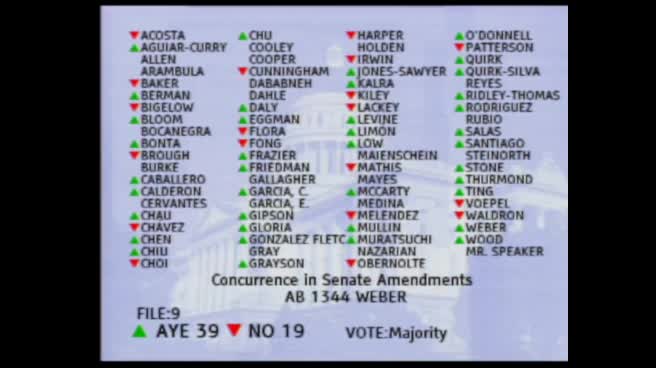 50SEC
Assembly Floor
 2MIN
Senate Floor
 1H
Senate Standing Committee on Appropriations
 5MIN
Senate Standing Committee on Education
 36SEC
Assembly Floor
 1H
Assembly Standing Committee on Appropriations
 8MIN
Assembly Standing Committee on Education
Bill Author

Bill Co-Author(s):