AB 19: Community colleges: California College Promise.
- Session Year: 2017-2018
- House: Assembly
- Latest Version Date: 2017-10-13
Existing law establishes the California Community Colleges, under the administration of the Board of Governors of the California Community Colleges, as one of the segments of public postsecondary education in this state. Existing law authorizes the establishment of community college districts under the administration of community college governing boards, and authorizes these districts to provide instruction at community college campuses throughout the state. Existing law requires community college district governing boards to charge students an enrollment fee of $46 per unit per semester. Existing law requires the board of governors to waive this fee for students meeting prescribed requirements.
This bill would establish the California College Promise, to be administered by the Chancellor of the California Community Colleges, which shall distribute funding, upon appropriation by the Legislature, to each community college meeting prescribed requirements to be used to, among other things, accomplish specified policy goals and waive fees for one academic year for first-time students who are enrolled in 12 or more semester units or the equivalent at the college and complete and submit either a Free Application for Federal Student Aid or a California Dream Act application.
Existing law establishes the California Community Colleges, under the administration of the Board of Governors of the California Community Colleges, as one of the segments of public postsecondary education in this state. Existing law authorizes the establishment of community college districts under the administration of community college governing boards, and authorizes these districts to provide instruction at community college campuses throughout the state. Existing law requires community college district governing boards to charge students an enrollment fee of $46 per unit per semester. Existing law requires the board of governors to waive this fee for students meeting prescribed requirements.
This bill, contingent upon the enactment of an appropriation for purposes of the bill in the annual Budget Act or another statute, and except as provided, would, in the event that the governing board of a community college district opts to participate and meets specified requirements, waive the enrollment fee, for one academic year, for first-time community college students at the district who enroll in 12 or more semester units or the equivalent, as specified, and complete and submit either a Free Application for Federal Student Aid or a California Dream Act application. The bill would require each participating community college district that has offsetting local revenues that exceed the funding calculated pursuant to the districts budget formula to annually report to the Chancellor of the California Community Colleges the amount of these fee waivers granted for that fiscal year, as specified.This bill would establish the California College Promise, to be administered by the Chancellor of the California Community Colleges, which shall distribute funding, upon appropriation by the Legislature, to each community college meeting prescribed requirements to be used to, among other things, accomplish specified policy goals and waive fees for one academic year for first-time students who are enrolled in 12 or more semester units or the equivalent at the college and complete and submit either a Free Application for Federal Student Aid or a California Dream Act application.
Existing law establishes the California Community Colleges, under the administration of the Board of Governors of the California Community Colleges, as one of the segments of public postsecondary education in this state. Existing law authorizes the establishment of community college districts under the administration of community college governing boards, and authorizes these districts to provide instruction at community college campuses throughout the state. Existing law requires community college district governing boards to charge students an enrollment fee of $46 per unit per semester. Existing law requires the board of governors to waive this fee for students meeting prescribed requirements.
IfThis bill, contingent upon the enactment of an appropriation for purposes of the bill in the annual Budget Act or another statute, and except as provided, would, in the event that the governing board of a community college district opts to participate and meets specified requirements, the bill would, except as provided, waive the enrollment fee, for one academic year, for first-time community college students at the district who enroll in 12 or more semester units or the equivalent, as specified, and complete and submit either a Free Application for Federal Student Aid or a California Dream Act application. The bill would require each participating community college district that has offsetting local revenues that exceed the funding calculated pursuant to the districts budget formula to annually report to the chancellor Chancellor of the California Community Colleges the amount of these fee waivers granted for that fiscal year, as specified.
Existing law establishes the California Community Colleges, under the administration of the Board of Governors of the California Community Colleges, as one of the segments of public postsecondary education in this state. Existing law authorizes the establishment of community college districts under the administration of community college governing boards, and authorizes these districts to provide instruction at community college campuses throughout the state. Existing law requires community college district governing boards to charge students an enrollment fee of $46 per unit per semester. Existing law requires the board of governors to waive this fee for students meeting prescribed requirements.
ThisIf the governing board of a community college district meets specified requirements, the bill would, except as provided, waive the fee, for one academic year, for first-time community college students at the district who enroll in 12 or more semester units or the equivalent, as specified, and complete and submit either a Free Application for Federal Student Aid or a California Dream Act application. The bill would require each district that has offsetting local revenues that exceed the funding calculated pursuant to the districts budget formula to annually report to the chancellor the amount of these fee waivers granted for that fiscal year, as specified. To the extent the bill would impose new duties on community college districts, it would constitute a state-mandated local program.
The California Constitution requires the state to reimburse local agencies and school districts for certain costs mandated by the state. Statutory provisions establish procedures for making that reimbursement.This bill would provide that, if the Commission on State Mandates determines that the bill contains costs mandated by the state, reimbursement for those costs shall be made pursuant to the statutory provisions noted above.Existing law establishes the California Community Colleges, under the administration of the Board of Governors of the California Community Colleges, as one of the segments of public postsecondary education in this state. Existing law authorizes the establishment of community college districts under the administration of community college governing boards, and authorizes these districts to provide instruction at community college campuses throughout the state. Existing law requires community college district governing boards to charge students an enrollment fee of $46 per unit per semester. Existing law requires the board of governors to waive this fee for students meeting prescribed requirements.
This bill would, except as provided, waive the fee, for one academic year, for first-time community college students who enroll in 12 or more semester units or the equivalent, as specified. specified, and complete and submit either a Free Application for Federal Student Aid or a California Dream Act application. The bill would require each district that has offsetting local revenues that exceed the funding calculated pursuant to the districts budget formula to annually report to the chancellor the amount of these fee waivers granted for that fiscal year, as specified. To the extent the bill would impose new duties on community college districts, it would constitute a state-mandated local program.
The California Constitution requires the state to reimburse local agencies and school districts for certain costs mandated by the state. Statutory provisions establish procedures for making that reimbursement.
This bill would provide that, if the Commission on State Mandates determines that the bill contains costs mandated by the state, reimbursement for those costs shall be made pursuant to the statutory provisions noted above.
Existing law establishes the California Community Colleges, under the administration of the Board of Governors of the California Community Colleges, as one of the segments of public postsecondary education in this state. Existing law authorizes the establishment of community college districts under the administration of community college governing boards, and authorizes these districts to provide instruction at community college campuses throughout the state. Existing law requires community college district governing boards to charge students an enrollment fee of $46 per unit per semester. Existing law requires the board of governors to waive this fee for students meeting prescribed requirements.
This bill would, except as provided, waive the fee, for one academic year, for first-time community college students who enroll in 12 or more semester units or the equivalent, as specified. To the extent the bill would impose new duties on community college districts, it would constitute a state-mandated local program. The bill would require each district that has offsetting local revenues that exceed the funding calculated pursuant to the districts budget formula to annually report to the chancellor the amount of these fee waivers granted for that fiscal year, as specified. To the extent the bill would impose new duties on community college districts, it would constitute a state-mandated local program.
The California Constitution requires the state to reimburse local agencies and school districts for certain costs mandated by the state. Statutory provisions establish procedures for making that reimbursement.
This bill would provide that, if the Commission on State Mandates determines that the bill contains costs mandated by the state, reimbursement for those costs shall be made pursuant to the statutory provisions noted above.
Existing law establishes the California Community Colleges, under the administration of the Board of Governors of the California Community Colleges, as one of the segments of public postsecondary education in this state. Existing law authorizes the establishment of community college districts under the administration of community college governing boards, and authorizes these districts to provide instruction at community college campuses throughout the state. Existing law requires community college district governing boards to charge students an enrollment fee of $46 per unit per semester. Existing law requires the board of governors to waive this fee for students meeting prescribed requirements.
This bill would would, except as provided, waive the fee, for one academic year, for first-time community college students who enroll in 12 or more semester units or the equivalent, as specified. To the extent the bill would impose new duties on community college districts, it would constitute a state-mandated local program.
The California Constitution requires the state to reimburse local agencies and school districts for certain costs mandated by the state. Statutory provisions establish procedures for making that reimbursement.
This bill would provide that, if the Commission on State Mandates determines that the bill contains costs mandated by the state, reimbursement for those costs shall be made pursuant to the statutory provisions noted above.
Existing law establishes the California Community Colleges, under the administration of the Board of Governors of the California Community Colleges, as one of the segments of public postsecondary education in this state. Existing law authorizes the establishment of community college districts under the administration of community college governing boards, and authorizes these districts to provide instruction at community college campuses throughout the state. Existing law requires community college district governing boards to charge students an enrollment fee of $46 per unit per semester. Existing law requires the board of governors to waive this fee for students meeting prescribed requirements, which include meeting specified minimum academic and progress standards adopted by the board of governors. requirements.
This bill would waive the fee, for one academic year, for first-time community college students meeting the minimum academic and progress standards who enroll in 12 or more semester units or the equivalent, as specified. To the extent the bill would impose new duties on community college districts, it would constitute a state-mandated local program.
The California Constitution requires the state to reimburse local agencies and school districts for certain costs mandated by the state. Statutory provisions establish procedures for making that reimbursement.
This bill would provide that, if the Commission on State Mandates determines that the bill contains costs mandated by the state, reimbursement for those costs shall be made pursuant to the statutory provisions noted above.
Existing law establishes the California Community Colleges, under the administration of the Board of Governors of the California Community Colleges, as one of the segments of public postsecondary education in this state. Existing law authorizes the establishment of community college districts under the administration of community college governing boards, and authorizes these districts to provide instruction at community college campuses throughout the state. Existing law requires community college district governing boards to charge students an enrollment fee of $46 per unit per semester. Existing law provides for the waiver of this fee under certain circumstances, including, among others, that the student either (1) at the time of enrollment is a recipient under the Temporary Assistance for Needy Families program, the Supplemental Security Income/State Supplementary Payment Program, or a general assistance program, (2) demonstrates eligibility according to income standards established by regulation of the board of governors, or (3) demonstrates financial need in accordance with methodology set forth in federal law or regulation for determining the expected family contribution of students seeking aid. requires the board of governors to waive this fee for students meeting prescribed requirements, which include meeting specified minimum academic and progress standards adopted by the board of governors.
This bill would lower the amount of unmet financial need a student needs to demonstrate to qualify for a fee waiver to at least $1. waive the fee, for one academic year, for first-time community college students meeting the minimum academic and progress standards who enroll in 12 or more semester units or the equivalent, as specified. To the extent the bill would impose new duties on community college districts, it would constitute a state-mandated local program.
The California Constitution requires the state to reimburse local agencies and school districts for certain costs mandated by the state. Statutory provisions establish procedures for making that reimbursement.
This bill would provide that, if the Commission on State Mandates determines that the bill contains costs mandated by the state, reimbursement for those costs shall be made pursuant to the statutory provisions noted above.
Existing law establishes the California Community Colleges, under the administration of the Board of Governors of the California Community Colleges, as one of the segments of public postsecondary education in this state. Existing law authorizes the establishment of community college districts under the administration of community college governing boards, and authorizes these districts to provide instruction at community college campuses throughout the state. Existing law requires community college district governing boards to charge students an enrollment fee of $46 per unit per semester. Existing law provides for the waiver of this fee under certain circumstances, including, among others, that the student either (1) at the time of enrollment is a recipient under the Temporary Assistance for Needy Families program, the Supplemental Security Income/State Supplementary Payment Program, or a general assistance program, (2) demonstrates eligibility according to income standards established by regulation of the board of governors, or (3) demonstrates financial need in accordance with methodology set forth in federal law or regulation for determining the expected family contribution of students seeking aid.
This bill would lower the amount of unmet financial need a student needs to demonstrate to qualify for a fee waiver to at least $1. To the extent the bill would impose new duties on community college districts, it would constitute a state-mandated local program.
The California Constitution requires the state to reimburse local agencies and school districts for certain costs mandated by the state. Statutory provisions establish procedures for making that reimbursement.
This bill would provide that, if the Commission on State Mandates determines that the bill contains costs mandated by the state, reimbursement for those costs shall be made pursuant to the statutory provisions noted above.
(a)The California College Promise is hereby established, to be administered by the Chancellor of the California Community Colleges.
(b)(1)Upon appropriation by the Legislature, the chancellor shall distribute funding to community college districts to fund colleges that satisfy the requirements of this article.
(2)(A)The chancellor shall establish a funding formula that advances the goals outlined in Section 76396.1.
(B)It is the intent of the Legislature that sufficient funding be allocated to each community college to waive all student fees pursuant to subdivision (b) of Section 76396.3.
(C)The funding formula established pursuant to subparagraph (A) shall, for funding appropriated for this article in excess of the funding determined pursuant to subparagraph (B), include, but not be limited to, both of the following factors:
(i)Number of full-time equivalent students at a community college.
(ii)Number of students at a community college who satisfy the requirements to receive federal Pell Grants and the requirements in Section 68130.5.
(c)For purposes of this article, chancellor means the Chancellor of the California Community Colleges.
76396.1.It is the intent of the Legislature that the California College Promise support the California Community Colleges in accomplishing all of the following goals:
(a)Increasing the number and percentage of high school students who are prepared for and attend college directly from high school and increasing the percentage of high school graduates who are placed directly into transfer-level mathematics and English courses at a community college.
(b)Increasing the percentage of students who earn associate degrees or career technical education certificates that prepare them for in-demand jobs and increasing the percentage of students who report being employed in their field of study.
(c)Increasing the percentage of students who successfully transfer from a community college to the California State University or the University of California and increasing the percentage of students who graduate from college with a baccalaureate degree.
(d)Reducing and eliminating regional achievement gaps and achievement gaps for students from groups that are underrepresented at the California Community Colleges, including, but not limited to, underrepresented students, low-income students, students who are current or former foster youth, students with disabilities, formerly incarcerated students, undocumented students, students meeting the requirements of Assembly Bill 540 of the 20012002 Regular Session of the Legislature, and students who are veterans.
76396.2.The requirements for participation in the California College Promise shall advance the goals outlined in Section 76396.1 and shall include all of the following:
(a)Partnering with one or more local educational agencies to establish an Early Commitment to College Program that is consistent with the intent of Article 6.3 (commencing with Section 54710) of Chapter 9 of Part 29 of Division 4 of Title 2 to provide K12 students and families assistance that includes, but is not limited to, learning about college opportunities, visiting campuses, taking and completing college preparatory courses, and applying for college and financial aid.
(b)Partnering with one or more local educational agencies to support and improve high school student preparation for college and reduce postsecondary remediation through practices that may include, but shall not be limited to, small learning communities, concurrent enrollment, and other evidence-based practices.
(c)Utilizing evidence-based assessment and placement practices at the community college that include multiple measures of student performance, which shall include, among other measures, overall grade point averages, including grades in high school courses, and using evidence-based practices to improve outcomes for underprepared students.
(d)Participating in the California Community College Guided Pathways Grant Program established pursuant to Part 54.81 (commencing with Section 88920) in order to clarify the academic path for students, help students enter a pathway, help students stay on an academic path, and ensure students are learning.
(e)Maximizing student access to need-based financial aid by leveraging the Board of Governors fee waiver established under Section 76300, commonly known as the California Promise Grant, ensuring students complete the Free Application for Federal Student Aid, Cal Grant application, or Dream Act application, and participating in a federal loan program authorized under Title IV of the federal Higher Education Act of 1965, as amended (20 U.S.C. Sec. 1070 et seq.). On or before January 1, 2018, a community college that does not participate in the federal loan program shall be provisionally eligible to participate in the California College Promise for one calendar year. The community college shall comply with the federal loan participation requirements in order to participate in the California College Promise on or after January 1, 2019.
76396.3.(a)A community college that has been certified by the chancellor as meeting the requirements established under Section 76396.2 shall receive funding pursuant to Section 76396.
(b)The community college may use funding appropriated pursuant to this article to waive some or all of the fees for first-time community college students who are enrolled at the college full time, and complete and submit either a Free Application for Federal Student Aid or a California Dream Act application. A fee waiver that a student receives pursuant to this subdivision shall only be for one academic year and fees shall only be waived for the summer term and each semester or quarter of that year in which the student maintains full-time status. A fee waiver provided pursuant to this subdivision shall not be available to a student who is charged a tuition fee pursuant to Section 76140.
(c)For purposes of this section, the following terms have the following meanings:
(1)Full time means 12 or more semester units or the equivalent.
(2)One academic year means the total of the summer term that immediately precedes the first semester or quarter of the fall term, and the two consecutive semesters or three quarters that immediately follow that summer term. Each semester or quarter is approximately the same length.
(d)It is the intent of the Legislature that funding provided to support the California College Promise be used by the community college to advance the goals outlined in Section 76396.1.
76396.4.The board of governors may adopt regulations implementing this section.
SECTION 1.Section 76300.6 is added to the Education Code, to read:76300.6.(a)(1)Contingent upon the enactment of an appropriation for purposes of this section in the annual Budget Act or another statute, if the governing board of a community college district meets the requirements of paragraph (5), that governing board shall waive the fee requirements of Section 76300 for any first-time community college student who is enrolled at the district full time, and completes and submits either a Free Application for Federal Student Aid or a California Dream Act application. A fee waiver that a student receives pursuant to this section shall only be for one academic year, and shall only be waived for the summer term and each semester or quarter of that year in which the student maintains full-time status. A fee waiver provided pursuant to this section shall not be available to a student who is charged a tuition fee pursuant to Section 76140.(2)For purposes of this section, the following terms have the following meanings:(A)Full time means 12 or more semester units or the equivalent.(B)One academic year means the total of the summer term that immediately precedes the first semester or quarter of the fall term, and the two consecutive semesters or three quarters that immediately follow that summer term. Each semester or quarter is approximately the same length.(3)Each participating community college district that has offsetting local revenues that exceed the funding calculated pursuant to the districts budget formula shall annually report to the chancellor the amount of fee waivers granted for that fiscal year pursuant to this subdivision. In computing the amount of fee waivers, the district shall exclude fee waivers for all students who are eligible for a fee waiver pursuant to subdivisions (g) to (j), inclusive, of Section 76300.(4)All community college districts, including districts described in paragraph (3), shall be eligible for state funds provided to support the implementation of this section. Notwithstanding any other law, if insufficient state funds are available to cover the additional cost of waivers provided pursuant to this subdivision, the shortfall shall be borne by all community college districts, including districts described in paragraph (3), based on the number of waivers provided pursuant to this section.(5)In order for the fee requirements of Section 76300 to be waived for a student under this section, the governing board of the community college district shall partner with one or more school districts and one or more California State University or University of California campuses, if appropriate, to establish or expand a program that includes all of the following practices and principles:(A)Partnering with one or more school districts to establish an Early Commitment to College Program that is consistent with the intent of Article 6.3 (commencing with Section 54710) of Chapter 9 of Part 29 of Division 4 of Title 2 to provide K12 students and families assistance that includes, but is not limited to, learning about college opportunities, visiting campuses, taking and completing college preparatory courses, and applying for college and financial aid.(B)Partnering with one or more school districts to support and improve high school student preparation for college and reduce postsecondary remediation through practices that may include, but are not limited to, small learning communities, concurrent enrollment, and other evidence-based practices.(C)Utilizing evidence-based placement and student assessment indicators at the community college district that include multiple measures of student performance, which may include, among others, grades in high school courses, overall grade point averages, results from common assessments, and input from counselors.(D)Providing students who are enrolled at the community college district with access to courses, including, but not limited to, priority registration, and allowing them to register for a full academic year of courses at once, in order to keep them on track to graduate, transfer to a public postsecondary university, or earn a career technical education certificate in California.(E)Providing outreach to students who are enrolled at a community college within the community college district regarding the Associate Degrees for Transfer and the California Community College Transfer Entitlement Cal Grant program.(6)The governing board of a community college district that opts to participate in the program established by this section shall submit to the chancellors office a plan for implementing a college promise program pursuant to this section. The chancellors office shall than make a determination as to whether the community college district has met the criteria set forth in paragraph (5).(b)It is the intent of the Legislature that sufficient funds be provided to support the provision of a fee waiver for every student who demonstrates eligibility pursuant to this section.(a)(1)Contingent upon the enactment of an appropriation for purposes of this section in the annual Budget Act or another statute, if the governing board of a community college district meets the requirements of paragraph (5), that governing board shall waive the fee requirements of Section 76300 for any first-time community college student who is enrolled at the district full time, and completes and submits either a Free Application for Federal Student Aid or a California Dream Act application. A fee waiver that a student receives pursuant to this section shall only be for one academic year, and shall only be waived for the summer term and each semester or quarter of that year in which the student maintains full-time status. A fee waiver provided pursuant to this section shall not be available to a student who is charged a tuition fee pursuant to Section 76140.
(2)For purposes of this section, the following terms have the following meanings:
(A)Full time means 12 or more semester units or the equivalent.
(B)One academic year means the total of the summer term that immediately precedes the first semester or quarter of the fall term, and the two consecutive semesters or three quarters that immediately follow that summer term. Each semester or quarter is approximately the same length.
(3)Each participating community college district that has offsetting local revenues that exceed the funding calculated pursuant to the districts budget formula shall annually report to the chancellor the amount of fee waivers granted for that fiscal year pursuant to this subdivision. In computing the amount of fee waivers, the district shall exclude fee waivers for all students who are eligible for a fee waiver pursuant to subdivisions (g) to (j), inclusive, of Section 76300.
(4)All community college districts, including districts described in paragraph (3), shall be eligible for state funds provided to support the implementation of this section. Notwithstanding any other law, if insufficient state funds are available to cover the additional cost of waivers provided pursuant to this subdivision, the shortfall shall be borne by all community college districts, including districts described in paragraph (3), based on the number of waivers provided pursuant to this section.
(5)In order for the fee requirements of Section 76300 to be waived for a student under this section, the governing board of the community college district shall partner with one or more school districts and one or more California State University or University of California campuses, if appropriate, to establish or expand a program that includes all of the following practices and principles:
(A)Partnering with one or more school districts to establish an Early Commitment to College Program that is consistent with the intent of Article 6.3 (commencing with Section 54710) of Chapter 9 of Part 29 of Division 4 of Title 2 to provide K12 students and families assistance that includes, but is not limited to, learning about college opportunities, visiting campuses, taking and completing college preparatory courses, and applying for college and financial aid.
(B)Partnering with one or more school districts to support and improve high school student preparation for college and reduce postsecondary remediation through practices that may include, but are not limited to, small learning communities, concurrent enrollment, and other evidence-based practices.
(C)Utilizing evidence-based placement and student assessment indicators at the community college district that include multiple measures of student performance, which may include, among others, grades in high school courses, overall grade point averages, results from common assessments, and input from counselors.
(D)Providing students who are enrolled at the community college district with access to courses, including, but not limited to, priority registration, and allowing them to register for a full academic year of courses at once, in order to keep them on track to graduate, transfer to a public postsecondary university, or earn a career technical education certificate in California.
(E)Providing outreach to students who are enrolled at a community college within the community college district regarding the Associate Degrees for Transfer and the California Community College Transfer Entitlement Cal Grant program.
(6)The governing board of a community college district that opts to participate in the program established by this section shall submit to the chancellors office a plan for implementing a college promise program pursuant to this section. The chancellors office shall than make a determination as to whether the community college district has met the criteria set forth in paragraph (5).
(b)It is the intent of the Legislature that sufficient funds be provided to support the provision of a fee waiver for every student who demonstrates eligibility pursuant to this section.
All matter omitted in this version of the bill appears in the bill as amended in the Senate July 3, 2017. (JR11)(a)The governing board of each community college district shall charge each student a fee pursuant to this section.
(b)(1)The fee prescribed by this section shall be forty-six dollars ($46) per unit per semester, effective with the summer term of the 2012 calendar year.
(2)The board of governors shall proportionately adjust the amount of the fee for term lengths based upon a quarter system, and also shall proportionately adjust the amount of the fee for summer sessions, intersessions, and other short-term courses. In making these adjustments, the board of governors may round the per unit fee and the per term or per session fee to the nearest dollar.
(c)For the purposes of computing apportionments to community college districts pursuant to Section 84750.5, the board of governors shall subtract, from the total revenue owed to each district, 98 percent of the revenues received by districts from charging a fee pursuant to this section.
(d)The board of governors shall reduce apportionments by up to 10 percent to any district that does not collect the fees prescribed by this section.
(e)The fee requirement does not apply to any of the following:
(1)Students enrolled in the noncredit courses designated by Section 84757.
(2)California State University or University of California students enrolled in remedial classes provided by a community college district on a campus of the University of California or a campus of the California State University, for whom the district claims an attendance apportionment pursuant to an agreement between the district and the California State University or the University of California.
(3)Students enrolled in credit contract education courses pursuant to Section 78021, if the entire cost of the course, including administrative costs, is paid by the public or private agency, corporation, or association with which the district is contracting and if these students are not included in the calculation of the full-time equivalent students (FTES) of that district.
(f)The governing board of a community college district may exempt special part-time students admitted pursuant to Section 76001 from the fee requirement.
(g)(1)The fee requirements of this section shall be waived for any student who meets both of the following requirements:
(A)Meets minimum academic and progress standards adopted by the board of governors, which fulfill the requirements outlined in this paragraph and paragraphs (2) to (5), inclusive. Any minimum academic and progress standards adopted pursuant to this section shall be uniform across all community college districts and campuses. These standards shall not include a maximum unit cap, and community college districts and colleges shall not impose requirements for fee waiver eligibility other than the minimum academic and progress standards adopted by the board of governors and the requirements of subparagraph (B).
(B)Meets one of the following criteria:
(i)At the time of enrollment, is a recipient of benefits under the Temporary Assistance for Needy Families program, the Supplemental Security Income/State Supplementary Payment Program, or a general assistance program.
(ii)Demonstrates eligibility according to income standards established by regulations of the board of governors.
(iii)Demonstrates financial need in accordance with the methodology set forth in federal law or regulation for determining the expected family contribution of students seeking financial aid.
(iv)At the time of enrollment, is a homeless youth as defined in subdivision (b) of Section 66025.9.
(2)(A)The board of governors, in consultation with students, faculty, and other key stakeholders, shall consider all of the following in the development and adoption of minimum academic and progress standards pursuant to subparagraph (A) of paragraph (1):
(i)Minimum uniform academic and progress standards that do not unfairly disadvantage financially needy students in pursuing their education.
(ii)Criteria for reviewing extenuating circumstances and granting appeals that, at a minimum, take into account and do not penalize a student for circumstances outside his or her control, such as reductions in student support services or changes to the economic situation of the student.
(iii)A process for reestablishing fee waiver eligibility that provides a student with a reasonable opportunity to continue or resume his or her enrollment at a community college.
(B)To ensure that students are not unfairly impacted by the requirements of subparagraph (A) of paragraph (1), the board of governors shall establish a reasonable implementation period that commences no sooner than one year from adoption of the minimum academic and progress standards, or any subsequent changes to these standards, pursuant to subparagraph (A) of paragraph (1) and that is phased in to provide students adequate notification of this requirement and information about available support resources.
(3)It is the intent of the Legislature that minimum academic and progress standards adopted pursuant to subparagraph (A) of paragraph (1) be implemented only as campuses develop and implement the student support services and interventions necessary to ensure no disproportionate impact to students based on ethnicity, gender, disability, or socioeconomic status. The board of governors shall consider the ability of community college districts to meet the requirements of this paragraph before adopting minimum academic and progress standards, or any subsequent changes to these standards, pursuant to subparagraph (A) of paragraph (1).
(4)It is the intent of the Legislature to ensure that a student shall not lose fee waiver eligibility without a community college campus first demonstrating a reasonable effort to provide a student with adequate notification and assistance in maintaining his or her fee waiver eligibility. The board of governors shall adopt regulations to implement this paragraph that ensure all of the following:
(A)Students are provided information about the available student support services to assist them in maintaining fee waiver eligibility.
(B)Community college district policies and course catalogs reflect the minimum academic and progress standards adopted pursuant to subparagraph (A) of paragraph (1) and that appropriate notice is provided to students before the policies are put into effect.
(C)A student does not lose fee waiver eligibility unless he or she has not met minimum academic and progress standards adopted pursuant to subparagraph (A) of paragraph (1) for a period of no less than two consecutive academic terms.
(5)The board of governors shall provide notification of a proposed action to adopt regulations pursuant to this subdivision to the appropriate policy and fiscal committees of the Legislature in accordance with the requirements of paragraph (1) of subdivision (a) of Section 70901.5. This notification shall include, but not be limited to, all of the following:
(A)The proposed minimum academic and progress standards and information detailing how the requirements of paragraphs (1) to (4), inclusive, have been or will be satisfied.
(B)How many students may lose fee waiver eligibility by ethnicity, gender, disability, and, to the extent relevant data is available, by socioeconomic status.
(C)The criteria for reviewing extenuating circumstances, granting appeals, and reestablishing fee waiver eligibility pursuant to paragraph (2).
(h)The fee requirements of this section shall be waived for any student who, at the time of enrollment, is a dependent or surviving spouse who has not remarried, of any member of the California National Guard who, in the line of duty and while in the active service of the state, was killed, died of a disability resulting from an event that occurred while in the active service of the state, or is permanently disabled as a result of an event that occurred while in the active service of the state. Active service of the state, for the purposes of this subdivision, refers to a member of the California National Guard activated pursuant to Section 146 of the Military and Veterans Code.
(i)The fee requirements of this section shall be waived for any student who is the surviving spouse or the child, natural or adopted, of a deceased person who met all of the requirements of Section 68120.
(j)The fee requirements of this section shall be waived for any student in an undergraduate program, including a student who has previously graduated from another undergraduate or graduate program, who is the dependent of any individual killed in the September 11, 2001, terrorist attacks on the World Trade Center and the Pentagon or the crash of United Airlines Flight 93 in southwestern Pennsylvania, if that dependent meets the financial need requirements set forth in Section 69432.7 for the Cal Grant A Program and either of the following applies:
(1)The dependent was a resident of California on September 11, 2001.
(2)The individual killed in the attacks was a resident of California on September 11, 2001.
(k)A determination of whether a person is a resident of California on September 11, 2001, for purposes of subdivision (j) shall be based on the criteria set forth in Chapter 1 (commencing with Section 68000) of Part 41 of Division 5 for determining nonresident and resident tuition.
(l)(1)Dependent, for purposes of subdivision (j), is a person who, because of his or her relationship to an individual killed as a result of injuries sustained during the terrorist attacks of September 11, 2001, qualifies for compensation under the federal September 11th Victim Compensation Fund of 2001 (Title IV (commencing with Section 401) of Public Law 107-42).
(2)A dependent who is the surviving spouse of an individual killed in the terrorist attacks of September 11, 2001, is entitled to the waivers provided in this section until January 1, 2013.
(3)A dependent who is the surviving child, natural or adopted, of an individual killed in the terrorist attacks of September 11, 2001, is entitled to the waivers under subdivision (j) until that person attains 30 years of age.
(4)A dependent of an individual killed in the terrorist attacks of September 11, 2001, who is determined to be eligible by the California Victim Compensation Board, is also entitled to the waivers provided in this section until January 1, 2013.
(m)(1)The If the governing board of a community college district meets the requirements in paragraph (5), the fee requirements of this section shall be waived for any first-time community college student who is enrolled at the district full time, and completes and submits either a Free Application for Federal Student Aid or a California Dream Act application. A fee waiver that a student receives pursuant to this subdivision shall only be for one academic year and shall only be waived for the summer term and each semester or quarter of that year in which the student maintains full-time status. A fee waiver provided pursuant to this subdivision shall not be available to a student who is charged a tuition fee pursuant to Section 76140.
(2)For purposes of this subdivision, the following terms have the following meanings:
(A)Full time means 12 or more semester units or the equivalent.
(B)One academic year means the total of the summer term that immediately precedes the first semester or quarter of the fall term, and the two consecutive semesters or three quarters that immediately follow that summer term. Each semester or quarter is approximately the same length.
(3)Each district that has offsetting local revenues that exceed the funding calculated pursuant to the districts budget formula shall annually report to the chancellor the amount of fee waivers granted for that fiscal year pursuant to this subdivision. In computing the amount of fee waivers, the district shall exclude fee waivers for all students who are eligible for a fee waiver pursuant to subdivisions (g) to (j), inclusive.
(4)All districts, including districts described in paragraph (3), shall be eligible for state funds provided to support the implementation of this subdivision. Notwithstanding any other law, if insufficient state funds are available to cover the additional cost of waivers provided pursuant to this subdivision, the shortfall shall be borne by all districts, including districts described in paragraph (3), based on the number of waivers provided pursuant to this subdivision.
(5)In order for the fee requirements of this section to be waived for a student under this subdivision, the governing board of the community college district shall partner with one or more school districts and one or more California State University or University of California campuses, if appropriate, to establish or expand a program that includes all of the following practices and principles:
(A)Partnering with one or more school districts to establish an Early Commitment to College Program that is consistent with the intent of Article 6.3 (commencing with Section 54710) of Chapter 9 of Part 29 of Division 4 of Title 2 to provide K12 students and families assistance that includes, but is not limited to, learning about college opportunities, visiting campuses, taking and completing college preparatory courses, and applying for college and financial aid.
(B)Partnering with one or more school districts to support and improve high school student preparation for college and reduce postsecondary remediation through practices that may include, but are not limited to, small learning communities, concurrent enrollment, and other evidence-based practices.
(C)Utilizing evidence-based placement and student assessment indicators at the community college district that include multiple measures of student performance, which may include, among others, grades in high school courses, overall grade point averages, results from common assessments, and input from counselors.
(D)Providing students who are enrolled at the community college district with access to courses, including, but not limited to, priority registration, and allowing them to register for a full academic year of courses at once, in order to keep them on track to graduate, transfer to a public postsecondary university, or earn a career technical education certificate in California.
(E)Providing outreach to students who are enrolled at a community college within the community college district regarding the Associate Degrees for Transfer and the California Community College Transfer Entitlement Cal Grant program.
(n)(1)It is the intent of the Legislature that sufficient funds be provided to support the provision of a fee waiver for every student who demonstrates eligibility pursuant to subdivisions (g) to (j), inclusive, and subdivision (m).
(2)From funds provided in the annual Budget Act, the board of governors shall allocate to community college districts, pursuant to this subdivision, an amount equal to 2 percent of the fees waived pursuant to subdivisions (g) to (j), inclusive. From funds provided in the annual Budget Act, the board of governors shall allocate to community college districts, pursuant to this subdivision, an amount equal to ninety-one cents ($0.91) per credit unit waived pursuant to subdivisions (g) to (j), inclusive. It is the intent of the Legislature that funds provided pursuant to this subdivision be used to support the determination of financial need and delivery of student financial aid services, on the basis of the number of students for whom fees are waived. It also is the intent of the Legislature that the funds provided pursuant to this subdivision directly offset mandated costs claimed by community college districts pursuant to Commission on State Mandates consolidated Test Claims 99-TC-13 (Enrollment Fee Collection) and 00-TC-15 (Enrollment Fee Waivers). Funds allocated to a community college district for determination of financial need and delivery of student financial aid services shall supplement, and shall not supplant, the level of funds allocated for the administration of student financial aid programs during the 199293 fiscal year.
(o)The board of governors shall adopt regulations implementing this section.
SEC. 2.If the Commission on State Mandates determines that this act contains costs mandated by the state, reimbursement to local agencies and school districts for those costs shall be made pursuant to Part 7 (commencing with Section 17500) of Division 4 of Title 2 of the Government Code.(a)The governing board of each community college district shall charge each student a fee pursuant to this section.
(b)(1)The fee prescribed by this section shall be forty-six dollars ($46) per unit per semester, effective with the summer term of the 2012 calendar year.
(2)The board of governors shall proportionately adjust the amount of the fee for term lengths based upon a quarter system, and also shall proportionately adjust the amount of the fee for summer sessions, intersessions, and other short-term courses. In making these adjustments, the board of governors may round the per unit fee and the per term or per session fee to the nearest dollar.
(c)For the purposes of computing apportionments to community college districts pursuant to Section 84750.5, the board of governors shall subtract, from the total revenue owed to each district, 98 percent of the revenues received by districts from charging a fee pursuant to this section.
(d)The board of governors shall reduce apportionments by up to 10 percent to any district that does not collect the fees prescribed by this section.
(e)The fee requirement does not apply to any of the following:
(1)Students enrolled in the noncredit courses designated by Section 84757.
(2)California State University or University of California students enrolled in remedial classes provided by a community college district on a campus of the University of California or a campus of the California State University, for whom the district claims an attendance apportionment pursuant to an agreement between the district and the California State University or the University of California.
(3)Students enrolled in credit contract education courses pursuant to Section 78021, if the entire cost of the course, including administrative costs, is paid by the public or private agency, corporation, or association with which the district is contracting and if these students are not included in the calculation of the full-time equivalent students (FTES) of that district.
(f)The governing board of a community college district may exempt special part-time students admitted pursuant to Section 76001 from the fee requirement.
(g)(1)The fee requirements of this section shall be waived for any student who meets both of the following requirements:
(A)Meets minimum academic and progress standards adopted by the board of governors, which fulfill the requirements outlined in this paragraph and paragraphs (2) to (5), inclusive. Any minimum academic and progress standards adopted pursuant to this section shall be uniform across all community college districts and campuses. These standards shall not include a maximum unit cap, and community college districts and colleges shall not impose requirements for fee waiver eligibility other than the minimum academic and progress standards adopted by the board of governors and the requirements of subparagraph (B).
(B)Meets one of the following criteria:
(i)At the time of enrollment, is a recipient of benefits under the Temporary Assistance for Needy Families program, the Supplemental Security Income/State Supplementary Payment Program, or a general assistance program.
(ii)Demonstrates eligibility according to income standards established by regulations of the board of governors.
(iii)Demonstrates financial need in accordance with the methodology set forth in federal law or regulation for determining the expected family contribution of students seeking financial aid.
(iv)At the time of enrollment, is a homeless youth as defined in subdivision (b) of Section 66025.9.
(2)(A)The board of governors, in consultation with students, faculty, and other key stakeholders, shall consider all of the following in the development and adoption of minimum academic and progress standards pursuant to subparagraph (A) of paragraph (1):
(i)Minimum uniform academic and progress standards that do not unfairly disadvantage financially needy students in pursuing their education.
(ii)Criteria for reviewing extenuating circumstances and granting appeals that, at a minimum, take into account and do not penalize a student for circumstances outside his or her control, such as reductions in student support services or changes to the economic situation of the student.
(iii)A process for reestablishing fee waiver eligibility that provides a student with a reasonable opportunity to continue or resume his or her enrollment at a community college.
(B)To ensure that students are not unfairly impacted by the requirements of subparagraph (A) of paragraph (1), the board of governors shall establish a reasonable implementation period that commences no sooner than one year from adoption of the minimum academic and progress standards, or any subsequent changes to these standards, pursuant to subparagraph (A) of paragraph (1) and that is phased in to provide students adequate notification of this requirement and information about available support resources.
(3)It is the intent of the Legislature that minimum academic and progress standards adopted pursuant to subparagraph (A) of paragraph (1) be implemented only as campuses develop and implement the student support services and interventions necessary to ensure no disproportionate impact to students based on ethnicity, gender, disability, or socioeconomic status. The board of governors shall consider the ability of community college districts to meet the requirements of this paragraph before adopting minimum academic and progress standards, or any subsequent changes to these standards, pursuant to subparagraph (A) of paragraph (1).
(4)It is the intent of the Legislature to ensure that a student shall not lose fee waiver eligibility without a community college campus first demonstrating a reasonable effort to provide a student with adequate notification and assistance in maintaining his or her fee waiver eligibility. The board of governors shall adopt regulations to implement this paragraph that ensure all of the following:
(A)Students are provided information about the available student support services to assist them in maintaining fee waiver eligibility.
(B)Community college district policies and course catalogs reflect the minimum academic and progress standards adopted pursuant to subparagraph (A) of paragraph (1) and that appropriate notice is provided to students before the policies are put into effect.
(C)A student does not lose fee waiver eligibility unless he or she has not met minimum academic and progress standards adopted pursuant to subparagraph (A) of paragraph (1) for a period of no less than two consecutive academic terms.
(5)The board of governors shall provide notification of a proposed action to adopt regulations pursuant to this subdivision to the appropriate policy and fiscal committees of the Legislature in accordance with the requirements of paragraph (1) of subdivision (a) of Section 70901.5. This notification shall include, but not be limited to, all of the following:
(A)The proposed minimum academic and progress standards and information detailing how the requirements of paragraphs (1) to (4), inclusive, have been or will be satisfied.
(B)How many students may lose fee waiver eligibility by ethnicity, gender, disability, and, to the extent relevant data is available, by socioeconomic status.
(C)The criteria for reviewing extenuating circumstances, granting appeals, and reestablishing fee waiver eligibility pursuant to paragraph (2).
(h)The fee requirements of this section shall be waived for any student who, at the time of enrollment, is a dependent or surviving spouse who has not remarried, of any member of the California National Guard who, in the line of duty and while in the active service of the state, was killed, died of a disability resulting from an event that occurred while in the active service of the state, or is permanently disabled as a result of an event that occurred while in the active service of the state. Active service of the state, for the purposes of this subdivision, refers to a member of the California National Guard activated pursuant to Section 146 of the Military and Veterans Code.
(i)The fee requirements of this section shall be waived for any student who is the surviving spouse or the child, natural or adopted, of a deceased person who met all of the requirements of Section 68120.
(j)The fee requirements of this section shall be waived for any student in an undergraduate program, including a student who has previously graduated from another undergraduate or graduate program, who is the dependent of any individual killed in the September 11, 2001, terrorist attacks on the World Trade Center and the Pentagon or the crash of United Airlines Flight 93 in southwestern Pennsylvania, if that dependent meets the financial need requirements set forth in Section 69432.7 for the Cal Grant A Program and either of the following applies:
(1)The dependent was a resident of California on September 11, 2001.
(2)The individual killed in the attacks was a resident of California on September 11, 2001.
(k)A determination of whether a person is a resident of California on September 11, 2001, for purposes of subdivision (j) shall be based on the criteria set forth in Chapter 1 (commencing with Section 68000) of Part 41 of Division 5 for determining nonresident and resident tuition.
(l)(1)Dependent, for purposes of subdivision (j), is a person who, because of his or her relationship to an individual killed as a result of injuries sustained during the terrorist attacks of September 11, 2001, qualifies for compensation under the federal September 11th Victim Compensation Fund of 2001 (Title IV (commencing with Section 401) of Public Law 107-42).
(2)A dependent who is the surviving spouse of an individual killed in the terrorist attacks of September 11, 2001, is entitled to the waivers provided in this section until January 1, 2013.
(3)A dependent who is the surviving child, natural or adopted, of an individual killed in the terrorist attacks of September 11, 2001, is entitled to the waivers under subdivision (j) until that person attains 30 years of age.
(4)A dependent of an individual killed in the terrorist attacks of September 11, 2001, who is determined to be eligible by the California Victim Compensation Board, is also entitled to the waivers provided in this section until January 1, 2013.
(m)(1)The fee requirements of this section shall be waived for any first-time community college student who is enrolled full time. time, and completes and submits either a Free Application for Federal Student Aid or a California Dream Act application. A fee waiver that a student receives pursuant to this subdivision shall only be for one academic year and shall only be waived for the summer term and each semester or quarter of that year in which the student maintains full-time status. A fee waiver provided pursuant to this subdivision shall not be available to a student who is charged a tuition fee pursuant to Section 76140.
(2)For purposes of this subdivision, the following terms have the following meanings:
(A)Full time means 12 or more semester units or the equivalent.
(B)One academic year means the total of the summer term that immediately precedes the first semester or quarter of the fall term, and the two consecutive semesters or three quarters that immediately follow that summer term. Each semester or quarter is approximately the same length.
(3)Each district that has offsetting local revenues that exceed the funding calculated pursuant to the districts budget formula shall annually report to the chancellor the amount of fee waivers granted for that fiscal year pursuant to this subdivision. In computing the amount of fee waivers, the district shall exclude fee waivers for all students that who are eligible for a fee waiver pursuant to subdivisions (g) to (j), inclusive.
(4)All districts, including districts described in paragraph (3), shall be eligible for state funds provided to support the implementation of this subdivision. Notwithstanding any other law, if insufficient state funds are available to cover the additional cost of waivers provided pursuant to this subdivision, the shortfall shall be borne by all districts, including districts described in paragraph (3), based on the number of waivers provided pursuant to this subdivision.
(n)(1)It is the intent of the Legislature that sufficient funds be provided to support the provision of a fee waiver for every student who demonstrates eligibility pursuant to subdivisions (g) to (j), inclusive, and subdivision (m).
(2)From funds provided in the annual Budget Act, the board of governors shall allocate to community college districts, pursuant to this subdivision, an amount equal to 2 percent of the fees waived pursuant to subdivisions (g) to (j), inclusive. From funds provided in the annual Budget Act, the board of governors shall allocate to community college districts, pursuant to this subdivision, an amount equal to ninety-one cents ($0.91) per credit unit waived pursuant to subdivisions (g) to (j), inclusive. It is the intent of the Legislature that funds provided pursuant to this subdivision be used to support the determination of financial need and delivery of student financial aid services, on the basis of the number of students for whom fees are waived. It also is the intent of the Legislature that the funds provided pursuant to this subdivision directly offset mandated costs claimed by community college districts pursuant to Commission on State Mandates consolidated Test Claims 99-TC-13 (Enrollment Fee Collection) and 00-TC-15 (Enrollment Fee Waivers). Funds allocated to a community college district for determination of financial need and delivery of student financial aid services shall supplement, and shall not supplant, the level of funds allocated for the administration of student financial aid programs during the 199293 fiscal year.
(o)The board of governors shall adopt regulations implementing this section.
SEC. 2.If the Commission on State Mandates determines that this act contains costs mandated by the state, reimbursement to local agencies and school districts for those costs shall be made pursuant to Part 7 (commencing with Section 17500) of Division 4 of Title 2 of the Government Code.
(a)The governing board of each community college district shall charge each student a fee pursuant to this section.
(b)(1)The fee prescribed by this section shall be forty-six dollars ($46) per unit per semester, effective with the summer term of the 2012 calendar year.
(2)The board of governors shall proportionately adjust the amount of the fee for term lengths based upon a quarter system, and also shall proportionately adjust the amount of the fee for summer sessions, intersessions, and other short-term courses. In making these adjustments, the board of governors may round the per unit fee and the per term or per session fee to the nearest dollar.
(c)For the purposes of computing apportionments to community college districts pursuant to Section 84750.5, the board of governors shall subtract, from the total revenue owed to each district, 98 percent of the revenues received by districts from charging a fee pursuant to this section.
(d)The board of governors shall reduce apportionments by up to 10 percent to any district that does not collect the fees prescribed by this section.
(e)The fee requirement does not apply to any of the following:
(1)Students enrolled in the noncredit courses designated by Section 84757.
(2)California State University or University of California students enrolled in remedial classes provided by a community college district on a campus of the University of California or a campus of the California State University, for whom the district claims an attendance apportionment pursuant to an agreement between the district and the California State University or the University of California.
(3)Students enrolled in credit contract education courses pursuant to Section 78021, if the entire cost of the course, including administrative costs, is paid by the public or private agency, corporation, or association with which the district is contracting and if these students are not included in the calculation of the full-time equivalent students (FTES) of that district.
(f)The governing board of a community college district may exempt special part-time students admitted pursuant to Section 76001 from the fee requirement.
(g)(1)The fee requirements of this section shall be waived for any student who meets both of the following requirements:
(A)Meets minimum academic and progress standards adopted by the board of governors, which fulfill the requirements outlined in this paragraph and paragraphs (2) to (5), inclusive. Any minimum academic and progress standards adopted pursuant to this section shall be uniform across all community college districts and campuses. These standards shall not include a maximum unit cap, and community college districts and colleges shall not impose requirements for fee waiver eligibility other than the minimum academic and progress standards adopted by the board of governors and the requirements of subparagraph (B).
(B)Meets one of the following criteria:
(i)At the time of enrollment, is a recipient of benefits under the Temporary Assistance for Needy Families program, the Supplemental Security Income/State Supplementary Payment Program, or a general assistance program.
(ii)Demonstrates eligibility according to income standards established by regulations of the board of governors.
(iii)Demonstrates financial need in accordance with the methodology set forth in federal law or regulation for determining the expected family contribution of students seeking financial aid.
(iv)At the time of enrollment, is a homeless youth as defined in subdivision (b) of Section 66025.9.
(2)(A)The board of governors, in consultation with students, faculty, and other key stakeholders, shall consider all of the following in the development and adoption of minimum academic and progress standards pursuant to subparagraph (A) of paragraph (1):
(i)Minimum uniform academic and progress standards that do not unfairly disadvantage financially needy students in pursuing their education.
(ii)Criteria for reviewing extenuating circumstances and granting appeals that, at a minimum, take into account and do not penalize a student for circumstances outside his or her control, such as reductions in student support services or changes to the economic situation of the student.
(iii)A process for reestablishing fee waiver eligibility that provides a student with a reasonable opportunity to continue or resume his or her enrollment at a community college.
(B)To ensure that students are not unfairly impacted by the requirements of subparagraph (A) of paragraph (1), the board of governors shall establish a reasonable implementation period that commences no sooner than one year from adoption of the minimum academic and progress standards, or any subsequent changes to these standards, pursuant to subparagraph (A) of paragraph (1) and that is phased in to provide students adequate notification of this requirement and information about available support resources.
(3)It is the intent of the Legislature that minimum academic and progress standards adopted pursuant to subparagraph (A) of paragraph (1) be implemented only as campuses develop and implement the student support services and interventions necessary to ensure no disproportionate impact to students based on ethnicity, gender, disability, or socioeconomic status. The board of governors shall consider the ability of community college districts to meet the requirements of this paragraph before adopting minimum academic and progress standards, or any subsequent changes to these standards, pursuant to subparagraph (A) of paragraph (1).
(4)It is the intent of the Legislature to ensure that a student shall not lose fee waiver eligibility without a community college campus first demonstrating a reasonable effort to provide a student with adequate notification and assistance in maintaining his or her fee waiver eligibility. The board of governors shall adopt regulations to implement this paragraph that ensure all of the following:
(A)Students are provided information about the available student support services to assist them in maintaining fee waiver eligibility.
(B)Community college district policies and course catalogs reflect the minimum academic and progress standards adopted pursuant to subparagraph (A) of paragraph (1) and that appropriate notice is provided to students before the policies are put into effect.
(C)A student does not lose fee waiver eligibility unless he or she has not met minimum academic and progress standards adopted pursuant to subparagraph (A) of paragraph (1) for a period of no less than two consecutive academic terms.
(5)The board of governors shall provide notification of a proposed action to adopt regulations pursuant to this subdivision to the appropriate policy and fiscal committees of the Legislature in accordance with the requirements of paragraph (1) of subdivision (a) of Section 70901.5. This notification shall include, but not be limited to, all of the following:
(A)The proposed minimum academic and progress standards and information detailing how the requirements of paragraphs (1) to (4), inclusive, have been or will be satisfied.
(B)How many students may lose fee waiver eligibility by ethnicity, gender, disability, and, to the extent relevant data is available, by socioeconomic status.
(C)The criteria for reviewing extenuating circumstances, granting appeals, and reestablishing fee waiver eligibility pursuant to paragraph (2).
(h)The fee requirements of this section shall be waived for any student who, at the time of enrollment, is a dependent or surviving spouse who has not remarried, of any member of the California National Guard who, in the line of duty and while in the active service of the state, was killed, died of a disability resulting from an event that occurred while in the active service of the state, or is permanently disabled as a result of an event that occurred while in the active service of the state. Active service of the state, for the purposes of this subdivision, refers to a member of the California National Guard activated pursuant to Section 146 of the Military and Veterans Code.
(i)The fee requirements of this section shall be waived for any student who is the surviving spouse or the child, natural or adopted, of a deceased person who met all of the requirements of Section 68120.
(j)The fee requirements of this section shall be waived for any student in an undergraduate program, including a student who has previously graduated from another undergraduate or graduate program, who is the dependent of any individual killed in the September 11, 2001, terrorist attacks on the World Trade Center and the Pentagon or the crash of United Airlines Flight 93 in southwestern Pennsylvania, if that dependent meets the financial need requirements set forth in Section 69432.7 for the Cal Grant A Program and either of the following applies:
(1)The dependent was a resident of California on September 11, 2001.
(2)The individual killed in the attacks was a resident of California on September 11, 2001.
(k)A determination of whether a person is a resident of California on September 11, 2001, for purposes of subdivision (j) shall be based on the criteria set forth in Chapter 1 (commencing with Section 68000) of Part 41 of Division 5 for determining nonresident and resident tuition.
(l)(1)Dependent, for purposes of subdivision (j), is a person who, because of his or her relationship to an individual killed as a result of injuries sustained during the terrorist attacks of September 11, 2001, qualifies for compensation under the federal September 11th Victim Compensation Fund of 2001 (Title IV (commencing with Section 401) of Public Law 107-42).
(2)A dependent who is the surviving spouse of an individual killed in the terrorist attacks of September 11, 2001, is entitled to the waivers provided in this section until January 1, 2013.
(3)A dependent who is the surviving child, natural or adopted, of an individual killed in the terrorist attacks of September 11, 2001, is entitled to the waivers under subdivision (j) until that person attains 30 years of age.
(4)A dependent of an individual killed in the terrorist attacks of September 11, 2001, who is determined to be eligible by the California Victim Compensation Board, is also entitled to the waivers provided in this section until January 1, 2013.
(m)(1)The fee requirements of this section shall be waived for any first-time community college student who is enrolled full time. A fee waiver that a student receives pursuant to this subdivision shall only be for one academic year and shall only be waived for the summer term and each semester or quarter of that year in which the student maintains full-time status. A fee waiver provided pursuant to this subdivision shall not be available to a student who is charged a tuition fee pursuant to Section 76140.
(2)For purposes of this subdivision, the following terms have the following meanings:
(A)Full time means 12 or more semester units or the equivalent.
(B)One academic year means the total of the summer term that immediately precedes the first semester or quarter of the fall term, and the two consecutive semesters or three quarters that immediately follow that summer term. Each semester or quarter is approximately the same length.
(3)Each district that has offsetting local revenues that exceed the funding calculated pursuant to the districts budget formula shall annually report to the chancellor the amount of fee waivers granted for that fiscal year pursuant to this subdivision. In computing the amount of fee waivers, the district shall exclude fee waivers for all students that are eligible for a fee waiver pursuant to subdivisions (g) to (j), inclusive.
(4)All districts, including districts described in paragraph (3), shall be eligible for state funds provided to support the implementation of this subdivision. Notwithstanding any other law, if insufficient state funds are available to cover the additional cost of waivers provided pursuant to this subdivision, the shortfall shall be borne by all districts, including districts described in paragraph (3), based on the number of waivers provided pursuant to this subdivision.
(n)(1)It is the intent of the Legislature that sufficient funds be provided to support the provision of a fee waiver for every student who demonstrates eligibility pursuant to subdivisions (g) to (j), inclusive. inclusive, and subdivision (m).
(2)From funds provided in the annual Budget Act, the board of governors shall allocate to community college districts, pursuant to this subdivision, an amount equal to 2 percent of the fees waived pursuant to subdivisions (g) to (j), inclusive. From funds provided in the annual Budget Act, the board of governors shall allocate to community college districts, pursuant to this subdivision, an amount equal to ninety-one cents ($0.91) per credit unit waived pursuant to subdivisions (g) to (j), inclusive. It is the intent of the Legislature that funds provided pursuant to this subdivision be used to support the determination of financial need and delivery of student financial aid services, on the basis of the number of students for whom fees are waived. It also is the intent of the Legislature that the funds provided pursuant to this subdivision directly offset mandated costs claimed by community college districts pursuant to Commission on State Mandates consolidated Test Claims 99-TC-13 (Enrollment Fee Collection) and 00-TC-15 (Enrollment Fee Waivers). Funds allocated to a community college district for determination of financial need and delivery of student financial aid services shall supplement, and shall not supplant, the level of funds allocated for the administration of student financial aid programs during the 199293 fiscal year.
(o)The board of governors shall adopt regulations implementing this section.
SEC. 2.If the Commission on State Mandates determines that this act contains costs mandated by the state, reimbursement to local agencies and school districts for those costs shall be made pursuant to Part 7 (commencing with Section 17500) of Division 4 of Title 2 of the Government Code.
(a)The governing board of each community college district shall charge each student a fee pursuant to this section.
(b)(1)The fee prescribed by this section shall be forty-six dollars ($46) per unit per semester, effective with the summer term of the 2012 calendar year.
(2)The board of governors shall proportionately adjust the amount of the fee for term lengths based upon a quarter system, and also shall proportionately adjust the amount of the fee for summer sessions, intersessions, and other short-term courses. In making these adjustments, the board of governors may round the per unit fee and the per term or per session fee to the nearest dollar.
(c)For the purposes of computing apportionments to community college districts pursuant to Section 84750.5, the board of governors shall subtract, from the total revenue owed to each district, 98 percent of the revenues received by districts from charging a fee pursuant to this section.
(d)The board of governors shall reduce apportionments by up to 10 percent to any district that does not collect the fees prescribed by this section.
(e)The fee requirement does not apply to any of the following:
(1)Students enrolled in the noncredit courses designated by Section 84757.
(2)California State University or University of California students enrolled in remedial classes provided by a community college district on a campus of the University of California or a campus of the California State University, for whom the district claims an attendance apportionment pursuant to an agreement between the district and the California State University or the University of California.
(3)Students enrolled in credit contract education courses pursuant to Section 78021, if the entire cost of the course, including administrative costs, is paid by the public or private agency, corporation, or association with which the district is contracting and if these students are not included in the calculation of the full-time equivalent students (FTES) of that district.
(f)The governing board of a community college district may exempt special part-time students admitted pursuant to Section 76001 from the fee requirement.
(g)(1)The fee requirements of this section shall be waived for any student who meets both of the following requirements:
(A)Meets minimum academic and progress standards adopted by the board of governors, which fulfill the requirements outlined in this paragraph and paragraphs (2) to (5), inclusive. Any minimum academic and progress standards adopted pursuant to this section shall be uniform across all community college districts and campuses. These standards shall not include a maximum unit cap, and community college districts and colleges shall not impose requirements for fee waiver eligibility other than the minimum academic and progress standards adopted by the board of governors and the requirements of subparagraph (B).
(B)Meets one of the following criteria:
(i)At the time of enrollment, is a recipient of benefits under the Temporary Assistance for Needy Families program, the Supplemental Security Income/State Supplementary Payment Program, or a general assistance program.
(ii)Demonstrates eligibility according to income standards established by regulations of the board of governors.
(iii)Demonstrates financial need in accordance with the methodology set forth in federal law or regulation for determining the expected family contribution of students seeking financial aid.
(iv)At the time of enrollment, is a homeless youth as defined in subdivision (b) of Section 66025.9.
(2)(A)The board of governors, in consultation with students, faculty, and other key stakeholders, shall consider all of the following in the development and adoption of minimum academic and progress standards pursuant to subparagraph (A) of paragraph (1):
(i)Minimum uniform academic and progress standards that do not unfairly disadvantage financially needy students in pursuing their education.
(ii)Criteria for reviewing extenuating circumstances and granting appeals that, at a minimum, take into account and do not penalize a student for circumstances outside his or her control, such as reductions in student support services or changes to the economic situation of the student.
(iii)A process for reestablishing fee waiver eligibility that provides a student with a reasonable opportunity to continue or resume his or her enrollment at a community college.
(B)To ensure that students are not unfairly impacted by the requirements of subparagraph (A) of paragraph (1), the board of governors shall establish a reasonable implementation period that commences no sooner than one year from adoption of the minimum academic and progress standards, or any subsequent changes to these standards, pursuant to subparagraph (A) of paragraph (1) and that is phased in to provide students adequate notification of this requirement and information about available support resources.
(3)It is the intent of the Legislature that minimum academic and progress standards adopted pursuant to subparagraph (A) of paragraph (1) be implemented only as campuses develop and implement the student support services and interventions necessary to ensure no disproportionate impact to students based on ethnicity, gender, disability, or socioeconomic status. The board of governors shall consider the ability of community college districts to meet the requirements of this paragraph before adopting minimum academic and progress standards, or any subsequent changes to these standards, pursuant to subparagraph (A) of paragraph (1).
(4)It is the intent of the Legislature to ensure that a student shall not lose fee waiver eligibility without a community college campus first demonstrating a reasonable effort to provide a student with adequate notification and assistance in maintaining his or her fee waiver eligibility. The board of governors shall adopt regulations to implement this paragraph that ensure all of the following:
(A)Students are provided information about the available student support services to assist them in maintaining fee waiver eligibility.
(B)Community college district policies and course catalogs reflect the minimum academic and progress standards adopted pursuant to subparagraph (A) of paragraph (1) and that appropriate notice is provided to students before the policies are put into effect.
(C)A student does not lose fee waiver eligibility unless he or she has not met minimum academic and progress standards adopted pursuant to subparagraph (A) of paragraph (1) for a period of no less than two consecutive academic terms.
(5)The board of governors shall provide notification of a proposed action to adopt regulations pursuant to this subdivision to the appropriate policy and fiscal committees of the Legislature in accordance with the requirements of paragraph (1) of subdivision (a) of Section 70901.5. This notification shall include, but not be limited to, all of the following:
(A)The proposed minimum academic and progress standards and information detailing how the requirements of paragraphs (1) to (4), inclusive, have been or will be satisfied.
(B)How many students may lose fee waiver eligibility by ethnicity, gender, disability, and, to the extent relevant data is available, by socioeconomic status.
(C)The criteria for reviewing extenuating circumstances, granting appeals, and reestablishing fee waiver eligibility pursuant to paragraph (2).
(h)The fee requirements of this section shall be waived for any student who, at the time of enrollment, is a dependent or surviving spouse who has not remarried, of any member of the California National Guard who, in the line of duty and while in the active service of the state, was killed, died of a disability resulting from an event that occurred while in the active service of the state, or is permanently disabled as a result of an event that occurred while in the active service of the state. Active service of the state, for the purposes of this subdivision, refers to a member of the California National Guard activated pursuant to Section 146 of the Military and Veterans Code.
(i)The fee requirements of this section shall be waived for any student who is the surviving spouse or the child, natural or adopted, of a deceased person who met all of the requirements of Section 68120.
(j)The fee requirements of this section shall be waived for any student in an undergraduate program, including a student who has previously graduated from another undergraduate or graduate program, who is the dependent of any individual killed in the September 11, 2001, terrorist attacks on the World Trade Center and the Pentagon or the crash of United Airlines Flight 93 in southwestern Pennsylvania, if that dependent meets the financial need requirements set forth in Section 69432.7 for the Cal Grant A Program and either of the following applies:
(1)The dependent was a resident of California on September 11, 2001.
(2)The individual killed in the attacks was a resident of California on September 11, 2001.
(k)A determination of whether a person is a resident of California on September 11, 2001, for purposes of subdivision (j) shall be based on the criteria set forth in Chapter 1 (commencing with Section 68000) of Part 41 of Division 5 for determining nonresident and resident tuition.
(l)(1)Dependent, for purposes of subdivision (j), is a person who, because of his or her relationship to an individual killed as a result of injuries sustained during the terrorist attacks of September 11, 2001, qualifies for compensation under the federal September 11th Victim Compensation Fund of 2001 (Title IV (commencing with Section 401) of Public Law 107-42).
(2)A dependent who is the surviving spouse of an individual killed in the terrorist attacks of September 11, 2001, is entitled to the waivers provided in this section until January 1, 2013.
(3)A dependent who is the surviving child, natural or adopted, of an individual killed in the terrorist attacks of September 11, 2001, is entitled to the waivers under subdivision (j) until that person attains 30 years of age.
(4)A dependent of an individual killed in the terrorist attacks of September 11, 2001, who is determined to be eligible by the California Victim Compensation Board, is also entitled to the waivers provided in this section until January 1, 2013.
(m)(1)The fee requirements of this section shall be waived for any first-time community college student who is enrolled full time. A fee waiver that a student receives pursuant to this section subdivision shall only be for one academic year and shall only be waived for the summer term and each semester or quarter of that year in which the student maintains full-time status. A fee waiver provided pursuant to this subdivision shall not be available to a student who is charged a tuition fee pursuant to Section 76140.
(2)For purposes of this subdivision, the following terms have the following meanings:
(A)Full time means 12 or more semester units or the equivalent.
(B)One academic year means the total of the summer term that immediately precedes the first semester or quarter of the fall term, and the two consecutive semesters or three quarters that immediately follow that summer term. Each semester or quarter is approximately the same length.
(n)(1)It is the intent of the Legislature that sufficient funds be provided to support the provision of a fee waiver for every student who demonstrates eligibility pursuant to subdivisions (g) to (j), inclusive.
(2)From funds provided in the annual Budget Act, the board of governors shall allocate to community college districts, pursuant to this subdivision, an amount equal to 2 percent of the fees waived pursuant to subdivisions (g) to (j), inclusive. From funds provided in the annual Budget Act, the board of governors shall allocate to community college districts, pursuant to this subdivision, an amount equal to ninety-one cents ($0.91) per credit unit waived pursuant to subdivisions (g) to (j), inclusive. It is the intent of the Legislature that funds provided pursuant to this subdivision be used to support the determination of financial need and delivery of student financial aid services, on the basis of the number of students for whom fees are waived. It also is the intent of the Legislature that the funds provided pursuant to this subdivision directly offset mandated costs claimed by community college districts pursuant to Commission on State Mandates consolidated Test Claims 99-TC-13 (Enrollment Fee Collection) and 00-TC-15 (Enrollment Fee Waivers). Funds allocated to a community college district for determination of financial need and delivery of student financial aid services shall supplement, and shall not supplant, the level of funds allocated for the administration of student financial aid programs during the 199293 fiscal year.
(o)The board of governors shall adopt regulations implementing this section.
SEC. 2.If the Commission on State Mandates determines that this act contains costs mandated by the state, reimbursement to local agencies and school districts for those costs shall be made pursuant to Part 7 (commencing with Section 17500) of Division 4 of Title 2 of the Government Code.
(a)The governing board of each community college district shall charge each student a fee pursuant to this section.
(b)(1)The fee prescribed by this section shall be forty-six dollars ($46) per unit per semester, effective with the summer term of the 2012 calendar year.
(2)The board of governors shall proportionately adjust the amount of the fee for term lengths based upon a quarter system, and also shall proportionately adjust the amount of the fee for summer sessions, intersessions, and other short-term courses. In making these adjustments, the board of governors may round the per unit fee and the per term or per session fee to the nearest dollar.
(c)For the purposes of computing apportionments to community college districts pursuant to Section 84750.5, the board of governors shall subtract, from the total revenue owed to each district, 98 percent of the revenues received by districts from charging a fee pursuant to this section.
(d)The board of governors shall reduce apportionments by up to 10 percent to any district that does not collect the fees prescribed by this section.
(e)The fee requirement does not apply to any of the following:
(1)Students enrolled in the noncredit courses designated by Section 84757.
(2)California State University or University of California students enrolled in remedial classes provided by a community college district on a campus of the University of California or a campus of the California State University, for whom the district claims an attendance apportionment pursuant to an agreement between the district and the California State University or the University of California.
(3)Students enrolled in credit contract education courses pursuant to Section 78021, if the entire cost of the course, including administrative costs, is paid by the public or private agency, corporation, or association with which the district is contracting and if these students are not included in the calculation of the full-time equivalent students (FTES) of that district.
(f)The governing board of a community college district may exempt special part-time students admitted pursuant to Section 76001 from the fee requirement.
(g)(1)The fee requirements of this section shall be waived for any student who meets both of the following requirements:
(A)Meets minimum academic and progress standards adopted by the board of governors, which fulfill the requirements outlined in this paragraph and paragraphs (2) to (5), inclusive. Any minimum academic and progress standards adopted pursuant to this section shall be uniform across all community college districts and campuses. These standards shall not include a maximum unit cap, and community college districts and colleges shall not impose requirements for fee waiver eligibility other than the minimum academic and progress standards adopted by the board of governors and the requirements of subparagraph (B).
(B)Meets one of the following criteria:
(i)At the time of enrollment, is a recipient of benefits under the Temporary Assistance for Needy Families program, the Supplemental Security Income/State Supplementary Payment Program, or a general assistance program.
(ii)Demonstrates eligibility according to income standards established by regulations of the board of governors.
(iii)Demonstrates financial need in accordance with the methodology set forth in federal law or regulation for determining the expected family contribution of students seeking financial aid.
(iv)At the time of enrollment, is a homeless youth as defined in subdivision (b) of Section 66025.9.
(v)(I)Is a first-time community college student who is enrolled full time. A fee waiver that a student receives for meeting the requirements of subparagraph (A) and this clause shall only be for one academic year and shall only be waived for the summer term and each semester or quarter of that year in which the student maintains full-time status.(II)For purposes of this clause, the following terms have the following meanings:(ia)Full time means 12 or more semester units or the equivalent.(ib)One academic year means the total of the summer term that immediately precedes the first semester or quarter of the fall term, and the two consecutive semesters or three quarters that immediately follow that summer term. Each semester or quarter is approximately the same length.(2)(A)The board of governors, in consultation with students, faculty, and other key stakeholders, shall consider all of the following in the development and adoption of minimum academic and progress standards pursuant to subparagraph (A) of paragraph (1):
(i)Minimum uniform academic and progress standards that do not unfairly disadvantage financially needy students in pursuing their education.
(ii)Criteria for reviewing extenuating circumstances and granting appeals that, at a minimum, take into account and do not penalize a student for circumstances outside his or her control, such as reductions in student support services or changes to the economic situation of the student.
(iii)A process for reestablishing fee waiver eligibility that provides a student with a reasonable opportunity to continue or resume his or her enrollment at a community college.
(B)To ensure that students are not unfairly impacted by the requirements of subparagraph (A) of paragraph (1), the board of governors shall establish a reasonable implementation period that commences no sooner than one year from adoption of the minimum academic and progress standards, or any subsequent changes to these standards, pursuant to subparagraph (A) of paragraph (1) and that is phased in to provide students adequate notification of this requirement and information about available support resources.
(3)It is the intent of the Legislature that minimum academic and progress standards adopted pursuant to subparagraph (A) of paragraph (1) be implemented only as campuses develop and implement the student support services and interventions necessary to ensure no disproportionate impact to students based on ethnicity, gender, disability, or socioeconomic status. The board of governors shall consider the ability of community college districts to meet the requirements of this paragraph before adopting minimum academic and progress standards, or any subsequent changes to these standards, pursuant to subparagraph (A) of paragraph (1).
(4)It is the intent of the Legislature to ensure that a student shall not lose fee waiver eligibility without a community college campus first demonstrating a reasonable effort to provide a student with adequate notification and assistance in maintaining his or her fee waiver eligibility. The board of governors shall adopt regulations to implement this paragraph that ensure all of the following:
(A)Students are provided information about the available student support services to assist them in maintaining fee waiver eligibility.
(B)Community college district policies and course catalogs reflect the minimum academic and progress standards adopted pursuant to subparagraph (A) of paragraph (1) and that appropriate notice is provided to students before the policies are put into effect.
(C)A student does not lose fee waiver eligibility unless he or she has not met minimum academic and progress standards adopted pursuant to subparagraph (A) of paragraph (1) for a period of no less than two consecutive academic terms.
(5)The board of governors shall provide notification of a proposed action to adopt regulations pursuant to this subdivision to the appropriate policy and fiscal committees of the Legislature in accordance with the requirements of paragraph (1) of subdivision (a) of Section 70901.5. This notification shall include, but not be limited to, all of the following:
(A)The proposed minimum academic and progress standards and information detailing how the requirements of paragraphs (1) to (4), inclusive, have been or will be satisfied.
(B)How many students may lose fee waiver eligibility by ethnicity, gender, disability, and, to the extent relevant data is available, by socioeconomic status.
(C)The criteria for reviewing extenuating circumstances, granting appeals, and reestablishing fee waiver eligibility pursuant to paragraph (2).
(h)The fee requirements of this section shall be waived for any student who, at the time of enrollment, is a dependent or surviving spouse who has not remarried, of any member of the California National Guard who, in the line of duty and while in the active service of the state, was killed, died of a disability resulting from an event that occurred while in the active service of the state, or is permanently disabled as a result of an event that occurred while in the active service of the state. Active service of the state, for the purposes of this subdivision, refers to a member of the California National Guard activated pursuant to Section 146 of the Military and Veterans Code.
(i)The fee requirements of this section shall be waived for any student who is the surviving spouse or the child, natural or adopted, of a deceased person who met all of the requirements of Section 68120.
(j)The fee requirements of this section shall be waived for any student in an undergraduate program, including a student who has previously graduated from another undergraduate or graduate program, who is the dependent of any individual killed in the September 11, 2001, terrorist attacks on the World Trade Center and the Pentagon or the crash of United Airlines Flight 93 in southwestern Pennsylvania, if that dependent meets the financial need requirements set forth in Section 69432.7 for the Cal Grant A Program and either of the following applies:
(1)The dependent was a resident of California on September 11, 2001.
(2)The individual killed in the attacks was a resident of California on September 11, 2001.
(k)A determination of whether a person is a resident of California on September 11, 2001, for purposes of subdivision (j) shall be based on the criteria set forth in Chapter 1 (commencing with Section 68000) of Part 41 of Division 5 for determining nonresident and resident tuition.
(l)(1)Dependent, for purposes of subdivision (j), is a person who, because of his or her relationship to an individual killed as a result of injuries sustained during the terrorist attacks of September 11, 2001, qualifies for compensation under the federal September 11th Victim Compensation Fund of 2001 (Title IV (commencing with Section 401) of Public Law 107-42).
(2)A dependent who is the surviving spouse of an individual killed in the terrorist attacks of September 11, 2001, is entitled to the waivers provided in this section until January 1, 2013.
(3)A dependent who is the surviving child, natural or adopted, of an individual killed in the terrorist attacks of September 11, 2001, is entitled to the waivers under subdivision (j) until that person attains 30 years of age.
(4)A dependent of an individual killed in the terrorist attacks of September 11, 2001, who is determined to be eligible by the California Victim Compensation Board, is also entitled to the waivers provided in this section until January 1, 2013.
(m)(1)The fee requirements of this section shall be waived for any first-time community college student who is enrolled full time. A fee waiver that a student receives pursuant to this section shall only be for one academic year and shall only be waived for the summer term and each semester or quarter of that year in which the student maintains full-time status.
(2)For purposes of this subdivision, the following terms have the following meanings:
(A)Full time means 12 or more semester units or the equivalent.
(B)One academic year means the total of the summer term that immediately precedes the first semester or quarter of the fall term, and the two consecutive semesters or three quarters that immediately follow that summer term. Each semester or quarter is approximately the same length.
(m)(n)(1)It is the intent of the Legislature that sufficient funds be provided to support the provision of a fee waiver for every student who demonstrates eligibility pursuant to subdivisions (g) to (j), inclusive.
(2)From funds provided in the annual Budget Act, the board of governors shall allocate to community college districts, pursuant to this subdivision, an amount equal to 2 percent of the fees waived pursuant to subdivisions (g) to (j), inclusive. From funds provided in the annual Budget Act, the board of governors shall allocate to community college districts, pursuant to this subdivision, an amount equal to ninety-one cents ($0.91) per credit unit waived pursuant to subdivisions (g) to (j), inclusive. It is the intent of the Legislature that funds provided pursuant to this subdivision be used to support the determination of financial need and delivery of student financial aid services, on the basis of the number of students for whom fees are waived. It also is the intent of the Legislature that the funds provided pursuant to this subdivision directly offset mandated costs claimed by community college districts pursuant to Commission on State Mandates consolidated Test Claims 99-TC-13 (Enrollment Fee Collection) and 00-TC-15 (Enrollment Fee Waivers). Funds allocated to a community college district for determination of financial need and delivery of student financial aid services shall supplement, and shall not supplant, the level of funds allocated for the administration of student financial aid programs during the 199293 fiscal year.
(n)(o)The board of governors shall adopt regulations implementing this section.
SEC. 2.If the Commission on State Mandates determines that this act contains costs mandated by the state, reimbursement to local agencies and school districts for those costs shall be made pursuant to Part 7 (commencing with Section 17500) of Division 4 of Title 2 of the Government Code.
(a)The governing board of each community college district shall charge each student a fee pursuant to this section.
(b)(1)The fee prescribed by this section shall be forty-six dollars ($46) per unit per semester, effective with the summer term of the 2012 calendar year.
(2)The board of governors shall proportionately adjust the amount of the fee for term lengths based upon a quarter system, and also shall proportionately adjust the amount of the fee for summer sessions, intersessions, and other short-term courses. In making these adjustments, the board of governors may round the per unit fee and the per term or per session fee to the nearest dollar.
(c)For the purposes of computing apportionments to community college districts pursuant to Section 84750.5, the board of governors shall subtract, from the total revenue owed to each district, 98 percent of the revenues received by districts from charging a fee pursuant to this section.
(d)The board of governors shall reduce apportionments by up to 10 percent to any district that does not collect the fees prescribed by this section.
(e)The fee requirement does not apply to any of the following:
(1)Students enrolled in the noncredit courses designated by Section 84757.
(2)California State University or University of California students enrolled in remedial classes provided by a community college district on a campus of the University of California or a campus of the California State University, for whom the district claims an attendance apportionment pursuant to an agreement between the district and the California State University or the University of California.
(3)Students enrolled in credit contract education courses pursuant to Section 78021, if the entire cost of the course, including administrative costs, is paid by the public or private agency, corporation, or association with which the district is contracting and if these students are not included in the calculation of the full-time equivalent students (FTES) of that district.
(f)The governing board of a community college district may exempt special part-time students admitted pursuant to Section 76001 from the fee requirement.
(g)(1)The fee requirements of this section shall be waived for any student who meets all both of the following requirements:
(A)Meets minimum academic and progress standards adopted by the board of governors, which fulfill the requirements outlined in this paragraph and paragraphs (2) to (5), inclusive. Any minimum academic and progress standards adopted pursuant to this section shall be uniform across all community college districts and campuses. These standards shall not include a maximum unit cap, and community college districts and colleges shall not impose requirements for fee waiver eligibility other than the minimum academic and progress standards adopted by the board of governors and the requirements of subparagraph (B).
(B)Meets one of the following criteria:
(i)At the time of enrollment, is a recipient of benefits under the Temporary Assistance for Needy Families program, the Supplemental Security Income/State Supplementary Payment Program, or a general assistance program.
(ii)Demonstrates eligibility according to income standards established by regulations of the board of governors.
(iii)Demonstrates financial need in accordance with the methodology set forth in federal law or regulation for determining the expected family contribution of students seeking financial aid.
(iv)At the time of enrollment, is a homeless youth as defined in subdivision (b) of Section 66025.9.
(v)(I)Is a first-time community college student who is enrolled full time. A fee waiver that a student receives for meeting the requirements of subparagraph (A) and this clause shall only be for one academic year and shall only be waived for the summer term and each semester or quarter of that year in which the student maintains full-time status.
(II)For purposes of this clause, the following terms have the following meanings:
(ia)Full time means 12 or more semester units or the equivalent.
(ib)One academic year means the total of the summer term that immediately precedes the first semester or quarter of the fall term, and the two consecutive semesters or three quarters that immediately follow that summer term. Each semester or quarter is approximately the same length.
(2)(A)The board of governors, in consultation with students, faculty, and other key stakeholders, shall consider all of the following in the development and adoption of minimum academic and progress standards pursuant to subparagraph (A) of paragraph (1):
(i)Minimum uniform academic and progress standards that do not unfairly disadvantage financially needy students in pursuing their education.
(ii)Criteria for reviewing extenuating circumstances and granting appeals that, at a minimum, take into account and do not penalize a student for circumstances outside his or her control, such as reductions in student support services or changes to the economic situation of the student.
(iii)A process for reestablishing fee waiver eligibility that provides a student with a reasonable opportunity to continue or resume his or her enrollment at a community college.
(B)To ensure that students are not unfairly impacted by the requirements of subparagraph (A) of paragraph (1), the board of governors shall establish a reasonable implementation period that commences no sooner than one year from adoption of the minimum academic and progress standards, or any subsequent changes to these standards, pursuant to subparagraph (A) of paragraph (1) and that is phased in to provide students adequate notification of this requirement and information about available support resources.
(3)It is the intent of the Legislature that minimum academic and progress standards adopted pursuant to subparagraph (A) of paragraph (1) be implemented only as campuses develop and implement the student support services and interventions necessary to ensure no disproportionate impact to students based on ethnicity, gender, disability, or socioeconomic status. The board of governors shall consider the ability of community college districts to meet the requirements of this paragraph before adopting minimum academic and progress standards, or any subsequent changes to these standards, pursuant to subparagraph (A) of paragraph (1).
(4)It is the intent of the Legislature to ensure that a student shall not lose fee waiver eligibility without a community college campus first demonstrating a reasonable effort to provide a student with adequate notification and assistance in maintaining his or her fee waiver eligibility. The board of governors shall adopt regulations to implement this paragraph that ensure all of the following:
(A)Students are provided information about the available student support services to assist them in maintaining fee waiver eligibility.
(B)Community college district policies and course catalogs reflect the minimum academic and progress standards adopted pursuant to subparagraph (A) of paragraph (1) and that appropriate notice is provided to students before the policies are put into effect.
(C)A student does not lose fee waiver eligibility unless he or she has not met minimum academic and progress standards adopted pursuant to subparagraph (A) of paragraph (1) for a period of no less than two consecutive academic terms.
(5)The board of governors shall provide notification of a proposed action to adopt regulations pursuant to this subdivision to the appropriate policy and fiscal committees of the Legislature in accordance with the requirements of paragraph (1) of subdivision (a) of Section 70901.5. This notification shall include, but not be limited to, all of the following:
(A)The proposed minimum academic and progress standards and information detailing how the requirements of paragraphs (1) to (4), inclusive, have been or will be satisfied.
(B)How many students may lose fee waiver eligibility by ethnicity, gender, disability, and, to the extent relevant data is available, by socioeconomic status.
(C)The criteria for reviewing extenuating circumstances, granting appeals, and reestablishing fee waiver eligibility pursuant to paragraph (2).
(h)The fee requirements of this section shall be waived for any student who, at the time of enrollment, is a dependent or surviving spouse who has not remarried, of any member of the California National Guard who, in the line of duty and while in the active service of the state, was killed, died of a disability resulting from an event that occurred while in the active service of the state, or is permanently disabled as a result of an event that occurred while in the active service of the state. Active service of the state, for the purposes of this subdivision, refers to a member of the California National Guard activated pursuant to Section 146 of the Military and Veterans Code.
(i)The fee requirements of this section shall be waived for any student who is the surviving spouse or the child, natural or adopted, of a deceased person who met all of the requirements of Section 68120.
(j)The fee requirements of this section shall be waived for any student in an undergraduate program, including a student who has previously graduated from another undergraduate or graduate program, who is the dependent of any individual killed in the September 11, 2001, terrorist attacks on the World Trade Center and the Pentagon or the crash of United Airlines Flight 93 in southwestern Pennsylvania, if that dependent meets the financial need requirements set forth in Section 69432.7 for the Cal Grant A Program and either of the following applies:
(1)The dependent was a resident of California on September 11, 2001.
(2)The individual killed in the attacks was a resident of California on September 11, 2001.
(k)A determination of whether a person is a resident of California on September 11, 2001, for purposes of subdivision (j) shall be based on the criteria set forth in Chapter 1 (commencing with Section 68000) of Part 41 of Division 5 for determining nonresident and resident tuition.
(l)(1)Dependent, for purposes of subdivision (j), is a person who, because of his or her relationship to an individual killed as a result of injuries sustained during the terrorist attacks of September 11, 2001, qualifies for compensation under the federal September 11th Victim Compensation Fund of 2001 (Title IV (commencing with Section 401) of Public Law 107-42).
(2)A dependent who is the surviving spouse of an individual killed in the terrorist attacks of September 11, 2001, is entitled to the waivers provided in this section until January 1, 2013.
(3)A dependent who is the surviving child, natural or adopted, of an individual killed in the terrorist attacks of September 11, 2001, is entitled to the waivers under subdivision (j) until that person attains 30 years of age.
(4)A dependent of an individual killed in the terrorist attacks of September 11, 2001, who is determined to be eligible by the California Victim Compensation and Government Claims Board, is also entitled to the waivers provided in this section until January 1, 2013.
(m)(1)It is the intent of the Legislature that sufficient funds be provided to support the provision of a fee waiver for every student who demonstrates eligibility pursuant to subdivisions (g) to (j), inclusive.
(2)From funds provided in the annual Budget Act, the board of governors shall allocate to community college districts, pursuant to this subdivision, an amount equal to 2 percent of the fees waived pursuant to subdivisions (g) to (j), inclusive. From funds provided in the annual Budget Act, the board of governors shall allocate to community college districts, pursuant to this subdivision, an amount equal to ninety-one cents ($0.91) per credit unit waived pursuant to subdivisions (g) to (j), inclusive. It is the intent of the Legislature that funds provided pursuant to this subdivision be used to support the determination of financial need and delivery of student financial aid services, on the basis of the number of students for whom fees are waived. It also is the intent of the Legislature that the funds provided pursuant to this subdivision directly offset mandated costs claimed by community college districts pursuant to Commission on State Mandates consolidated Test Claims 99-TC-13 (Enrollment Fee Collection) and 00-TC-15 (Enrollment Fee Waivers). Funds allocated to a community college district for determination of financial need and delivery of student financial aid services shall supplement, and shall not supplant, the level of funds allocated for the administration of student financial aid programs during the 199293 fiscal year.
(n)The board of governors shall adopt regulations implementing this section.
(o)This section shall become operative on May 1, 2012, only if subdivision (b) of Section 3.94 of the Budget Act of 2011 is operative.SEC. 2.If the Commission on State Mandates determines that this act contains costs mandated by the state, reimbursement to local agencies and school districts for those costs shall be made pursuant to Part 7 (commencing with Section 17500) of Division 4 of Title 2 of the Government Code.
SECTION 1.(a)It is the intent of the Legislature to establish a California Affordability Promise to ensure more Californians have the opportunity to access and afford community college in California.(b)The Legislature finds and declares all of the following:(1)The California Community Colleges Board of Governors Enrollment Fee Waiver Program offsets tuition and fees for more than 60 percent of full-time community college students and nearly half of all community college students, with the only requirements being that students demonstrate financial need and meet reasonable academic progress standards.(2)Despite the many strengths of the fee waiver program, eligibility is currently limited to students with a minimum need of one thousand one hundred four dollars ($1,104).(c)It is the intent of the Legislature to ensure all Californians with financial need are eligible for an enrollment fee waiver at the California Community Colleges.SEC. 2.Section 76300 of the Education Code, as amended by Section 6 of Chapter 432 of the Statutes of 2016, is amended to read:76300.(a)The governing board of each community college district shall charge each student a fee pursuant to this section.(b)(1)The fee prescribed by this section shall be forty-six dollars ($46) per unit per semester, effective with the summer term of the 2012 calendar year.(2)The board of governors shall proportionately adjust the amount of the fee for term lengths based upon a quarter system, and also shall proportionately adjust the amount of the fee for summer sessions, intersessions, and other short-term courses. In making these adjustments, the board of governors may round the per unit fee and the per term or per session fee to the nearest dollar.(c)For the purposes of computing apportionments to community college districts pursuant to Section 84750.5, the board of governors shall subtract, from the total revenue owed to each district, 98 percent of the revenues received by districts from charging a fee pursuant to this section.(d)The board of governors shall reduce apportionments by up to 10 percent to any district that does not collect the fees prescribed by this section.(e)The fee requirement does not apply to any of the following:(1)Students enrolled in the noncredit courses designated by Section 84757.(2)California State University or University of California students enrolled in remedial classes provided by a community college district on a campus of the University of California or a campus of the California State University, for whom the district claims an attendance apportionment pursuant to an agreement between the district and the California State University or the University of California.(3)Students enrolled in credit contract education courses pursuant to Section 78021, if the entire cost of the course, including administrative costs, is paid by the public or private agency, corporation, or association with which the district is contracting and if these students are not included in the calculation of the full-time equivalent students (FTES) of that district.(f)The governing board of a community college district may exempt special part-time students admitted pursuant to Section 76001 from the fee requirement.(g)(1)The fee requirements of this section shall be waived for any student who meets all of the following requirements:(A)Meets minimum academic and progress standards adopted by the board of governors, which fulfill the requirements outlined in this paragraph and paragraphs (2) to (5), inclusive. Any minimum academic and progress standards adopted pursuant to this section shall be uniform across all community college districts and campuses. These standards shall not include a maximum unit cap, and community college districts and colleges shall not impose requirements for fee waiver eligibility other than the minimum academic and progress standards adopted by the board of governors and the requirements of subparagraph (B).(B)Meets one of the following criteria:(i)At the time of enrollment, is a recipient of benefits under the Temporary Assistance for Needy Families program, the Supplemental Security Income/State Supplementary Payment Program, or a general assistance program.(ii)Demonstrates eligibility according to income standards established by regulations of the board of governors.(iii)Demonstrates financial need of at least one dollar ($1) in accordance with the methodology set forth in federal law or regulation for determining the expected family contribution of students seeking financial aid.(iv)At the time of enrollment, is a homeless youth as defined in subdivision (b) of Section 66025.9.(2)(A)The board of governors, in consultation with students, faculty, and other key stakeholders, shall consider all of the following in the development and adoption of minimum academic and progress standards pursuant to subparagraph (A) of paragraph (1):(i)Minimum uniform academic and progress standards that do not unfairly disadvantage financially needy students in pursuing their education.(ii)Criteria for reviewing extenuating circumstances and granting appeals that, at a minimum, take into account and do not penalize a student for circumstances outside his or her control, such as reductions in student support services or changes to the economic situation of the student.(iii)A process for reestablishing fee waiver eligibility that provides a student with a reasonable opportunity to continue or resume his or her enrollment at a community college.(B)To ensure that students are not unfairly impacted by the requirements of subparagraph (A) of paragraph (1), the board of governors shall establish a reasonable implementation period that commences no sooner than one year from adoption of the minimum academic and progress standards, or any subsequent changes to these standards, pursuant to subparagraph (A) of paragraph (1) and that is phased in to provide students adequate notification of this requirement and information about available support resources.(3)It is the intent of the Legislature that minimum academic and progress standards adopted pursuant to subparagraph (A) of paragraph (1) be implemented only as campuses develop and implement the student support services and interventions necessary to ensure no disproportionate impact to students based on ethnicity, gender, disability, or socioeconomic status. The board of governors shall consider the ability of community college districts to meet the requirements of this paragraph before adopting minimum academic and progress standards, or any subsequent changes to these standards, pursuant to subparagraph (A) of paragraph (1).(4)It is the intent of the Legislature to ensure that a student shall not lose fee waiver eligibility without a community college campus first demonstrating a reasonable effort to provide a student with adequate notification and assistance in maintaining his or her fee waiver eligibility. The board of governors shall adopt regulations to implement this paragraph that ensure all of the following:(A)Students are provided information about the available student support services to assist them in maintaining fee waiver eligibility.(B)Community college district policies and course catalogs reflect the minimum academic and progress standards adopted pursuant to subparagraph (A) of paragraph (1) and that appropriate notice is provided to students before the policies are put into effect.(C)A student does not lose fee waiver eligibility unless he or she has not met minimum academic and progress standards adopted pursuant to subparagraph (A) of paragraph (1) for a period of no less than two consecutive academic terms.(5)The board of governors shall provide notification of a proposed action to adopt regulations pursuant to this subdivision to the appropriate policy and fiscal committees of the Legislature in accordance with the requirements of paragraph (1) of subdivision (a) of Section 70901.5. This notification shall include, but not be limited to, all of the following:(A)The proposed minimum academic and progress standards and information detailing how the requirements of paragraphs (1) to (4), inclusive, have been or will be satisfied.(B)How many students may lose fee waiver eligibility by ethnicity, gender, disability, and, to the extent relevant data is available, by socioeconomic status.(C)The criteria for reviewing extenuating circumstances, granting appeals, and reestablishing fee waiver eligibility pursuant to paragraph (2).(h)The fee requirements of this section shall be waived for any student who, at the time of enrollment, is a dependent or surviving spouse who has not remarried, of any member of the California National Guard who, in the line of duty and while in the active service of the state, was killed, died of a disability resulting from an event that occurred while in the active service of the state, or is permanently disabled as a result of an event that occurred while in the active service of the state. Active service of the state, for the purposes of this subdivision, refers to a member of the California National Guard activated pursuant to Section 146 of the Military and Veterans Code.(i)The fee requirements of this section shall be waived for any student who is the surviving spouse or the child, natural or adopted, of a deceased person who met all of the requirements of Section 68120.(j)The fee requirements of this section shall be waived for any student in an undergraduate program, including a student who has previously graduated from another undergraduate or graduate program, who is the dependent of any individual killed in the September 11, 2001, terrorist attacks on the World Trade Center and the Pentagon or the crash of United Airlines Flight 93 in southwestern Pennsylvania, if that dependent meets the financial need requirements set forth in Section 69432.7 for the Cal Grant A Program and either of the following applies:(1)The dependent was a resident of California on September 11, 2001.(2)The individual killed in the attacks was a resident of California on September 11, 2001.(k)A determination of whether a person is a resident of California on September 11, 2001, for purposes of subdivision (j) shall be based on the criteria set forth in Chapter 1 (commencing with Section 68000) of Part 41 of Division 5 for determining nonresident and resident tuition.(l)(1)Dependent, for purposes of subdivision (j), is a person who, because of his or her relationship to an individual killed as a result of injuries sustained during the terrorist attacks of September 11, 2001, qualifies for compensation under the federal September 11th Victim Compensation Fund of 2001 (Title IV (commencing with Section 401) of Public Law 107-42).(2)A dependent who is the surviving spouse of an individual killed in the terrorist attacks of September 11, 2001, is entitled to the waivers provided in this section until January 1, 2013.(3)A dependent who is the surviving child, natural or adopted, of an individual killed in the terrorist attacks of September 11, 2001, is entitled to the waivers under subdivision (j) until that person attains 30 years of age.(4)A dependent of an individual killed in the terrorist attacks of September 11, 2001, who is determined to be eligible by the California Victim Compensation Board, is also entitled to the waivers provided in this section until January 1, 2013.(m)(1)It is the intent of the Legislature that sufficient funds be provided to support the provision of a fee waiver for every student who demonstrates eligibility pursuant to subdivisions (g) to (j), inclusive.(2)From funds provided in the annual Budget Act, the board of governors shall allocate to community college districts, pursuant to this subdivision, an amount equal to 2 percent of the fees waived pursuant to subdivisions (g) to (j), inclusive. From funds provided in the annual Budget Act, the board of governors shall allocate to community college districts, pursuant to this subdivision, an amount equal to ninety-one cents ($0.91) per credit unit waived pursuant to subdivisions (g) to (j), inclusive. It is the intent of the Legislature that funds provided pursuant to this subdivision be used to support the determination of financial need and delivery of student financial aid services, on the basis of the number of students for whom fees are waived. It also is the intent of the Legislature that the funds provided pursuant to this subdivision directly offset mandated costs claimed by community college districts pursuant to Commission on State Mandates consolidated Test Claims 99-TC-13 (Enrollment Fee Collection) and 00-TC-15 (Enrollment Fee Waivers). Funds allocated to a community college district for determination of financial need and delivery of student financial aid services shall supplement, and shall not supplant, the level of funds allocated for the administration of student financial aid programs during the 199293 fiscal year.(n)The board of governors shall adopt regulations implementing this section.SEC. 3.If the Commission on State Mandates determines that this act contains costs mandated by the state, reimbursement to local agencies and school districts for those costs shall be made pursuant to Part 7 (commencing with Section 17500) of Division 4 of Title 2 of the Government Code.(a)It is the intent of the Legislature to establish a California Affordability Promise to ensure more Californians have the opportunity to access and afford community college in California.
(b)The Legislature finds and declares all of the following:
(1)The California Community Colleges Board of Governors Enrollment Fee Waiver Program offsets tuition and fees for more than 60 percent of full-time community college students and nearly half of all community college students, with the only requirements being that students demonstrate financial need and meet reasonable academic progress standards.
(2)Despite the many strengths of the fee waiver program, eligibility is currently limited to students with a minimum need of one thousand one hundred four dollars ($1,104).
(c)It is the intent of the Legislature to ensure all Californians with financial need are eligible for an enrollment fee waiver at the California Community Colleges.
SEC. 2.Section 76300 of the Education Code, as amended by Section 6 of Chapter 432 of the Statutes of 2016, is amended to read:76300.(a)The governing board of each community college district shall charge each student a fee pursuant to this section.
(b)(1)The fee prescribed by this section shall be forty-six dollars ($46) per unit per semester, effective with the summer term of the 2012 calendar year.
(2)The board of governors shall proportionately adjust the amount of the fee for term lengths based upon a quarter system, and also shall proportionately adjust the amount of the fee for summer sessions, intersessions, and other short-term courses. In making these adjustments, the board of governors may round the per unit fee and the per term or per session fee to the nearest dollar.
(c)For the purposes of computing apportionments to community college districts pursuant to Section 84750.5, the board of governors shall subtract, from the total revenue owed to each district, 98 percent of the revenues received by districts from charging a fee pursuant to this section.
(d)The board of governors shall reduce apportionments by up to 10 percent to any district that does not collect the fees prescribed by this section.
(e)The fee requirement does not apply to any of the following:
(1)Students enrolled in the noncredit courses designated by Section 84757.
(2)California State University or University of California students enrolled in remedial classes provided by a community college district on a campus of the University of California or a campus of the California State University, for whom the district claims an attendance apportionment pursuant to an agreement between the district and the California State University or the University of California.
(3)Students enrolled in credit contract education courses pursuant to Section 78021, if the entire cost of the course, including administrative costs, is paid by the public or private agency, corporation, or association with which the district is contracting and if these students are not included in the calculation of the full-time equivalent students (FTES) of that district.
(f)The governing board of a community college district may exempt special part-time students admitted pursuant to Section 76001 from the fee requirement.
(g)(1)The fee requirements of this section shall be waived for any student who meets all of the following requirements:
(A)Meets minimum academic and progress standards adopted by the board of governors, which fulfill the requirements outlined in this paragraph and paragraphs (2) to (5), inclusive. Any minimum academic and progress standards adopted pursuant to this section shall be uniform across all community college districts and campuses. These standards shall not include a maximum unit cap, and community college districts and colleges shall not impose requirements for fee waiver eligibility other than the minimum academic and progress standards adopted by the board of governors and the requirements of subparagraph (B).
(B)Meets one of the following criteria:
(i)At the time of enrollment, is a recipient of benefits under the Temporary Assistance for Needy Families program, the Supplemental Security Income/State Supplementary Payment Program, or a general assistance program.
(ii)Demonstrates eligibility according to income standards established by regulations of the board of governors.
(iii)Demonstrates financial need of at least one dollar ($1) in accordance with the methodology set forth in federal law or regulation for determining the expected family contribution of students seeking financial aid.
(iv)At the time of enrollment, is a homeless youth as defined in subdivision (b) of Section 66025.9.
(2)(A)The board of governors, in consultation with students, faculty, and other key stakeholders, shall consider all of the following in the development and adoption of minimum academic and progress standards pursuant to subparagraph (A) of paragraph (1):
(i)Minimum uniform academic and progress standards that do not unfairly disadvantage financially needy students in pursuing their education.
(ii)Criteria for reviewing extenuating circumstances and granting appeals that, at a minimum, take into account and do not penalize a student for circumstances outside his or her control, such as reductions in student support services or changes to the economic situation of the student.
(iii)A process for reestablishing fee waiver eligibility that provides a student with a reasonable opportunity to continue or resume his or her enrollment at a community college.
(B)To ensure that students are not unfairly impacted by the requirements of subparagraph (A) of paragraph (1), the board of governors shall establish a reasonable implementation period that commences no sooner than one year from adoption of the minimum academic and progress standards, or any subsequent changes to these standards, pursuant to subparagraph (A) of paragraph (1) and that is phased in to provide students adequate notification of this requirement and information about available support resources.
(3)It is the intent of the Legislature that minimum academic and progress standards adopted pursuant to subparagraph (A) of paragraph (1) be implemented only as campuses develop and implement the student support services and interventions necessary to ensure no disproportionate impact to students based on ethnicity, gender, disability, or socioeconomic status. The board of governors shall consider the ability of community college districts to meet the requirements of this paragraph before adopting minimum academic and progress standards, or any subsequent changes to these standards, pursuant to subparagraph (A) of paragraph (1).
(4)It is the intent of the Legislature to ensure that a student shall not lose fee waiver eligibility without a community college campus first demonstrating a reasonable effort to provide a student with adequate notification and assistance in maintaining his or her fee waiver eligibility. The board of governors shall adopt regulations to implement this paragraph that ensure all of the following:
(A)Students are provided information about the available student support services to assist them in maintaining fee waiver eligibility.
(B)Community college district policies and course catalogs reflect the minimum academic and progress standards adopted pursuant to subparagraph (A) of paragraph (1) and that appropriate notice is provided to students before the policies are put into effect.
(C)A student does not lose fee waiver eligibility unless he or she has not met minimum academic and progress standards adopted pursuant to subparagraph (A) of paragraph (1) for a period of no less than two consecutive academic terms.
(5)The board of governors shall provide notification of a proposed action to adopt regulations pursuant to this subdivision to the appropriate policy and fiscal committees of the Legislature in accordance with the requirements of paragraph (1) of subdivision (a) of Section 70901.5. This notification shall include, but not be limited to, all of the following:
(A)The proposed minimum academic and progress standards and information detailing how the requirements of paragraphs (1) to (4), inclusive, have been or will be satisfied.
(B)How many students may lose fee waiver eligibility by ethnicity, gender, disability, and, to the extent relevant data is available, by socioeconomic status.
(C)The criteria for reviewing extenuating circumstances, granting appeals, and reestablishing fee waiver eligibility pursuant to paragraph (2).
(h)The fee requirements of this section shall be waived for any student who, at the time of enrollment, is a dependent or surviving spouse who has not remarried, of any member of the California National Guard who, in the line of duty and while in the active service of the state, was killed, died of a disability resulting from an event that occurred while in the active service of the state, or is permanently disabled as a result of an event that occurred while in the active service of the state. Active service of the state, for the purposes of this subdivision, refers to a member of the California National Guard activated pursuant to Section 146 of the Military and Veterans Code.
(i)The fee requirements of this section shall be waived for any student who is the surviving spouse or the child, natural or adopted, of a deceased person who met all of the requirements of Section 68120.
(j)The fee requirements of this section shall be waived for any student in an undergraduate program, including a student who has previously graduated from another undergraduate or graduate program, who is the dependent of any individual killed in the September 11, 2001, terrorist attacks on the World Trade Center and the Pentagon or the crash of United Airlines Flight 93 in southwestern Pennsylvania, if that dependent meets the financial need requirements set forth in Section 69432.7 for the Cal Grant A Program and either of the following applies:
(1)The dependent was a resident of California on September 11, 2001.
(2)The individual killed in the attacks was a resident of California on September 11, 2001.
(k)A determination of whether a person is a resident of California on September 11, 2001, for purposes of subdivision (j) shall be based on the criteria set forth in Chapter 1 (commencing with Section 68000) of Part 41 of Division 5 for determining nonresident and resident tuition.
(l)(1)Dependent, for purposes of subdivision (j), is a person who, because of his or her relationship to an individual killed as a result of injuries sustained during the terrorist attacks of September 11, 2001, qualifies for compensation under the federal September 11th Victim Compensation Fund of 2001 (Title IV (commencing with Section 401) of Public Law 107-42).
(2)A dependent who is the surviving spouse of an individual killed in the terrorist attacks of September 11, 2001, is entitled to the waivers provided in this section until January 1, 2013.
(3)A dependent who is the surviving child, natural or adopted, of an individual killed in the terrorist attacks of September 11, 2001, is entitled to the waivers under subdivision (j) until that person attains 30 years of age.
(4)A dependent of an individual killed in the terrorist attacks of September 11, 2001, who is determined to be eligible by the California Victim Compensation and Government Claims Board, is also entitled to the waivers provided in this section until January 1, 2013.
(m)(1)It is the intent of the Legislature that sufficient funds be provided to support the provision of a fee waiver for every student who demonstrates eligibility pursuant to subdivisions (g) to (j), inclusive.
(2)From funds provided in the annual Budget Act, the board of governors shall allocate to community college districts, pursuant to this subdivision, an amount equal to 2 percent of the fees waived pursuant to subdivisions (g) to (j), inclusive. From funds provided in the annual Budget Act, the board of governors shall allocate to community college districts, pursuant to this subdivision, an amount equal to ninety-one cents ($0.91) per credit unit waived pursuant to subdivisions (g) to (j), inclusive. It is the intent of the Legislature that funds provided pursuant to this subdivision be used to support the determination of financial need and delivery of student financial aid services, on the basis of the number of students for whom fees are waived. It also is the intent of the Legislature that the funds provided pursuant to this subdivision directly offset mandated costs claimed by community college districts pursuant to Commission on State Mandates consolidated Test Claims 99-TC-13 (Enrollment Fee Collection) and 00-TC-15 (Enrollment Fee Waivers). Funds allocated to a community college district for determination of financial need and delivery of student financial aid services shall supplement, and shall not supplant, the level of funds allocated for the administration of student financial aid programs during the 199293 fiscal year.
(n)The board of governors shall adopt regulations implementing this section.
(o)This section shall become operative on May 1, 2012, only if subdivision (b) of Section 3.94 of the Budget Act of 2011 is operative.SEC. 3.If the Commission on State Mandates determines that this act contains costs mandated by the state, reimbursement to local agencies and school districts for those costs shall be made pursuant to Part 7 (commencing with Section 17500) of Division 4 of Title 2 of the Government Code.
|
Date
|
Status
|
|---|---|
| Oct 13, 2017 | Chaptered by Secretary of State - Chapter 735, Statutes of 2017. |
| Oct 13, 2017 | Approved by the Governor. |
| Sep 20, 2017 | Enrolled and presented to the Governor at 4:30 p.m. |
| Sep 13, 2017 | Assembly Rule 77(a) suspended. |
| Sep 13, 2017 | In Assembly. Concurrence in Senate amendments pending. May be considered on or after September 15 pursuant to Assembly Rule 77. |
| Sep 12, 2017 | Read third time. Passed. Ordered to the Assembly. |
| Sep 11, 2017 | Read second time. Ordered to third reading. |
| Sep 8, 2017 | Read third time and amended. Ordered to second reading. |
| Sep 5, 2017 | Read second time. Ordered to third reading. |
| Sep 1, 2017 | From committee: Amend, and do pass as amended. (Ayes 5. Noes 2.) (September 1). |
| Aug 21, 2017 | In committee: Referred to APPR. suspense file. |
| Jul 12, 2017 | From committee: Do pass and re-refer to Com. on APPR. (Ayes 7. Noes 0.) (July 12). Re-referred to Com. on APPR. |
| Jul 3, 2017 | From committee chair, with author's amendments: Amend, and re-refer to committee. Read second time, amended, and re-referred to Com. on ED. |
| Jun 27, 2017 | From committee chair, with author's amendments: Amend, and re-refer to committee. Read second time, amended, and re-referred to Com. on ED. |
| Jun 19, 2017 | In committee: Hearing postponed by committee. |
| Jun 14, 2017 | Referred to Com. on ED. |
| Jun 1, 2017 | In Senate. Read first time. To Com. on RLS. for assignment. |
| May 31, 2017 | Read third time. Passed. Ordered to the Senate. (Ayes 56. Noes 18. Page 1986.) |
| May 30, 2017 | Read second time and amended. Ordered returned to second reading. |
| May 26, 2017 | From committee: Amend, and do pass as amended. (Ayes 12. Noes 5.) (May 26). |
| Apr 26, 2017 | In committee: Set, first hearing. Referred to APPR. suspense file. |
| Apr 3, 2017 | Re-referred to Com. on APPR. |
| Mar 30, 2017 | Read second time and amended. |
| Mar 29, 2017 | From committee: Amend, and do pass as amended and re-refer to Com. on APPR. (Ayes 9. Noes 3.) (March 28). |
| Mar 20, 2017 | Re-referred to Com. on HIGHER ED. |
| Mar 16, 2017 | From committee chair, with author's amendments: Amend, and re-refer to Com. on HIGHER ED. Read second time and amended. |
| Mar 14, 2017 | In committee: Hearing postponed by committee. |
| Mar 1, 2017 | Re-referred to Com. on HIGHER ED. |
| Feb 28, 2017 | From committee chair, with author's amendments: Amend, and re-refer to Com. on HIGHER ED. Read second time and amended. |
| Jan 19, 2017 | Referred to Com. on HIGHER ED. |
| Dec 6, 2016 | From printer. May be heard in committee January 5. |
| Dec 5, 2016 | Read first time. To print. |
|
Date
|
Description
|
Location
|
Votes
|
|
|---|---|---|---|---|
| Sep 13, 2017 | AB 19 Santiago Concurrence in Senate Amendments | Assembly Floor |
Passed |
|
| Sep 12, 2017 | Assembly 3rd Reading AB19 Santiago et al. By Hernandez | Senate Floor |
Passed |
|
| Sep 1, 2017 | Do pass as amended | Senate Standing Committee on Appropriations |
Passed |
|
| Aug 21, 2017 | Placed on suspense file | Senate Standing Committee on Appropriations |
Passed |
|
| Jul 12, 2017 | Do pass, but first be re-referred to the Committee on [Appropriations] | Senate Standing Committee on Education |
Passed |
|
| May 31, 2017 | AB 19 SANTIAGO Assembly Third Reading | Assembly Floor |
Passed |
|
| May 26, 2017 | Do pass as amended. | Assembly Standing Committee on Appropriations |
Passed |
|
| Mar 28, 2017 | Do pass as amended and be re-referred to the Committee on [Appropriations] | Assembly Standing Committee on Higher Education |
Passed |
This list shows positions taken on this bill by organizations on the date displayed, which is linked to the original source.
Positions by individuals are not included.
CONCURRENCE IN SENATE AMENDMENTS
CSA1 Bill Id:AB 19
Author:(Santiago, et al.)
As Amended Ver:September 8, 2017
Majority vote
ASSEMBLY: | 56-18 | (May 31, 2017) | SENATE: | 31-7 | (September 12, 2017) |
Original Committee Reference: HIGHER ED.
SUMMARY: Establishes, under the administration of the California Community Colleges (CCC) Chancellor, the California College Promise.
The Senate amendments:
- Authorize the CCC Chancellor, upon appropriation by the Legislature, to distribute funding to community college districts to fund CCCs that meet the requirements of the established promise program.
- Require the CCC Chancellor to establish a funding formula that advances the goals of the promise program; ensuring that the formula factors in the number of full-time equivalent students (FTES) at a CCC and the number of students at a CCC who satisfy the requirements to receive federal Pell Grants.
- Require, as condition to participate in the promise program, the following:
- Partnering with one or more local educational agencies (LEAs) to establish an Early Commitment to College Program that will provide secondary and postsecondary students and their families assistance that, in part, includes learning about college opportunities, completing college preparatory courses, and applying for college and financial aid;
- Partnering with one or more LEAs to support and improve high school student preparation for college and reduce postsecondary remediation through practices that may include, in part, small learning communities and concurrent enrollment;
- Utilizing evidence-based assessment and placement practices at the CCC that include multiple measures of student performance;
- Participating in the California Community College Guided Pathways Grant Program; and,
- Maximizing student access to need-based financial aid by leveraging the Board of Governors (BOG) fee waiver;
- Authorize community colleges participating in the promise program, and receiving funds for said purpose from the CCC Chancellor, to use funds to waive some or all of the fees for first-time community college students who are enrolled at the college full-time, and complete and submit either a Free Application for Federal Student Financial Aid (FAFSA) or a California Dream Act application.
- Require the fee waiver in number four above, to only be for one academic year. Fees shall only be waived for the summer term and each semester or quarter of that year in which the student maintains full-time status.
- Declare the Legislature’s intent that funding to support the promise program be used by the CCC to advance the goals of the program.
- Define:
- "Full-time" to mean 12 or more semester units or the equivalent; and,
- "One academic year" to mean the total of the summer term that immediately precedes the first semester or quarter of the fall term, and the two consecutive semesters or three-quarters that immediately follow that summer term. Each semester or quarter is approximately the same length.
- Authorize the CCC BOG to adopt regulations regarding the created promise program.
EXISTING LAW:
- Establishes a $46/unit fee for students at the CCC, and waivers of such (Education Code (EC) Section 76300).
- Provides for a waiver of fees for certain types of students, including:
- Students enrolled in specified public benefit programs;
- Homeless students;
- Those with household incomes below certain thresholds established by the CCC BOG or with demonstrated financial need, pursuant to federal law;
- Dependents or surviving spouses of California National Guard members, either killed or who died from a permanent disability, as a result of service to the state;
- Surviving spouse or child of a California law enforcement officer or firefighter killed in the performance of active law enforcement or fire suppression duties or who died as a result of performing those duties;
- The dependent of any California resident killed in the September 11, 2001 terrorist attacks;
- The child of a United States military veteran who has a service-connected disability or was killed in action or died of a service-connected disability; and,
- The child of a recipient of the Congressional Medal of Honor (EC Section 66025.3).
- Provides funding through state apportionments, pursuant to provisional language in the annual budget act, to offset districts' loss of fee revenue due to the BOG waiver.
- Provides Cal Grant B Entitlement awards to students meeting specified income and asset thresholds, having at least a 2.0 GPA and applying either the year they graduate from high school or the following year. Awardees are entitled to a living allowance and tuition and fee assistance. Awards for first-year students are limited to an allowance for books and living expenses ($1,678). In the second and subsequent years, the award also provides tuition and fee support.
- Establishes the Full-Time Student Success Grant, which supplements the Cal Grant B access award by $300 per semester for each CCC student enrolled in 12 or more units. This ongoing program was established in the 2015-16 Budget Act (AB 93 (Weber), Chapter 10).
FISCAL EFFECT: According to the Senate Appropriations Committee, "While the provisions of the bill would be subject to an appropriation, the Chancellor's Office estimates that waiving the fees for first-time students for an entire year would cost approximately $31.1 million in Proposition 98 General Fund. This estimate assumes that an additional 19,000 community college students would qualify for a fee waiver, which is based on the number of resident students enrolled in 2014-15 who met the requirements of this bill and did not receive a fee waiver. To the extent that additional students elect to enroll at the community colleges as a result of this measure, the estimate would be higher."
COMMENTS: Purpose. According to the author, "California faces an estimated shortage of one million college-educated workers needed to sustain the state's workforce. The bill is motivated by the multiple promise programs proposed or enacted across the U.S. [United States]. These proposals have prompted extensive debate across the nation on college access and affordability. Realizing the benefits of such programs, many community college districts throughout California and across the U.S. have implemented local Promise Programs. These programs have been demonstrated to expand access to financial, promote equity, increase enrollment, improve academic performances and boost college completion rates."
The requirements established by this measure extend the provision of fee waivers to a first-time community college student enrolled full-time within a CCC district that enters into local partnership agreements as specified.
Background. Over the 2015-16 academic year, the CCC served about 2.3 million students, with about 1.6 million students enrolling in each of the fall 2015 and spring 2016 semesters. For that same year, about one million students, or 43% of all students, received a BOG fee waiver—an equivalent of $800 million in waived fees. The vast majority of students receiving a BOG waiver do so because of limited family income or demonstrated financial need. Specifically, the income limit is less than or equal to 150%of federal poverty guidelines, and varies with family size. For a family of four, the limit is currently $36,375. Likewise, a student who submits the FAFSA and demonstrates at least $1,104 (24 units times $46/unit) of financial need—based on a complex formula that determines a family's expected contribution toward the student's cost of college—is eligible for the BOG waiver. Under this criterion, a student from a family of four with income up to $85,000 would be eligible for the fee waiver.
Around 30 percent of CCC students who enrolled during the fall 2015 semester (470,000) or the spring 2016 semester (430,000) took 12 or more units. This would include first-time students as well as continuing and returning students. Another 15% of students (about 240,000) took more than nine but less than 12 units.
Who Benefits from This Bill? In addition to those who already qualify for a BOG fee waiver, this bill waives fees for those students enrolled for the first time in the community college system and who take at least 12 units per semester. This new waiver would only be available for a newly enrolled student's first full academic year of attendance, which would include a summer term, if the new student chose to attend in the summer, and then the immediately following fall and spring semesters. (For campuses on a quarter system, it would include the immediately following fall, winter, and spring terms.)
Based on data provided by the Chancellor's Office of the CCC, for the 2014-15 academic year, about 19,000 first-time CCC students who did not receive a fee waiver – either because they did not qualify or did not apply – enrolled in at least 24 units during that year. While there are limitations in this data, it can be assumed that a majority of these students likely enrolled in at least 12 units during each of the fall and spring semesters. Under this bill, these students would have automatically received a fee waiver for their first full year of attendance. Since this new fee waiver would be available to all newly-enrolled full-time CCC students, this benefit would generally accrue to students who are less needy (including those from affluent families), compared to full-time students who currently qualify for a BOG fee waiver. Notably, the new fee waiver benefit would disproportionately assist those at campuses with relatively larger shares of non-needy students who attend school full time. To note, about one-third of the 19,000 students referenced above attended just 12 of the system's 113 campuses, which constitute only about 18% of total CCC enrollment.
Additionally, to the students who attended full-time for two semesters, more than 10,000 other first-time CCC students enrolled in at least 12 units in their first semester, and would have received the fee waiver for this semester. Some of these students may not have enrolled in at least 12 units in their second semester and others may not have first enrolled until the spring semester, thus either group would only be eligible for one semester of fee waiver under this bill.
Other Impacts. While the above discussion represents the most easily quantifiable impact of this bill, there would likely be other impacts. For example, the opportunity to obtain a fee waiver in return for full-time enrollment might induce additional first-time students to take a full course load. As mentioned earlier, last year almost a quarter-million students were, in general, only one course short of meeting the 12-unit qualifying threshold of this bill. Based on the proportion of students in the system that are first-time students (about 17%), the number who may see this new benefit as a sufficient incentive to full-time enrollment might approach the low tens of thousands.
In addition to promoting full-time enrollment, the ability of districts to provide the public with the simple message that students' first-year of community college could include no fees may spur additional enrollment demand of both part-time and full-time students, many of which would be eligible for fee waivers, either under the existing eligibility criteria or under this bills requirements.
AB 19 and College Promise Programs? In general, College Promise programs are partnerships seeking to align local K-12 school districts, community colleges, and public universities by providing clear pathways for students to achieve their educational goals. Such programs seek to improve college readiness, access, and the overall success of participants. Some community college districts in California, along with their school district and university partners, already have promise programs, and many other programs are in the planning stages.
As part of the 2016-17 Budget Act, the Legislature provided $15 million in one-time competitive grants for establishing or expanding CCC promise programs. A budget trailer bill, AB 1741 (Rodriguez), was the implementing legislation for the grant program. Upon receiving and evaluating grant applications, the CCCCO, which is administering the program, recommended 14 districts to receive grants of either $1.5 million (for multiple colleges within a district) or $750,000 (for single-campus districts or for a single campus within a multi-college district). These grants were awarded by the BOG earlier this year. As determined by the CCCCO and the BOG, the successful applicants were those districts who best demonstrated how their promise program would meet the following goals:
- Increase the number and percentage of high school students within the region who are prepared for and attend college directly from high school.
- Increase the percentage of high school graduates within the region who are placed in college-level Math and English at a public postsecondary university in California.
- Increase the percentage of students from the region who: earn associate degrees or career technical education certificates; successfully transfer from a community college to UC or CSU; graduate with a bachelor's degree.
- Reduce and eliminate achievement gaps for students from groups that are underrepresented in postsecondary education.
Though not a program requirement, district applications were also given additional consideration if able to identify local public and private sources of funding to develop a sustainable program and/or to leverage new or existing sources of local and state funding to better align efforts to improve student success.
Analysis Prepared by: Jeanice Warden / HIGHER ED. / (916) 319-3960 FN: 0002220
Office of Senate Floor Analyses (916) 651-1520 Fax: (916) 327-4478 | AB |
THIRD READING
Bill No: AB 19
Amended: 9/8/17 in Senate
SENATE EDUCATION COMMITTEE: 7-0, 7/12/17
AYES: Allen, Wilk, Galgiani, Leyva, Mendoza, Pan, Vidak
SENATE APPROPRIATIONS COMMITTEE: 5-2, 9/1/17
AYES: Lara, Beall, Bradford, Hill, Wiener
NOES: Bates, Nielsen
ASSEMBLY FLOOR: 56-18, 5/31/17 - See last page for vote
DIGEST:
This bill establishes the California College Promise, to be administered by the Chancellor of the California Community Colleges which shall distribute funding, upon appropriation by the Legislature, to each community college meeting the specified requirements to be used to accomplish certain goals and waive the $46 per unit fee for one academic year for first-time students.
Senate Floor Amendments of 9/8/17 recast the bill’s provisions to establish a new article under Chapter 2 of Part 47 of Divisions 7 of Title 3 of the Education Code known as the California College Promise. The amendments also modify the process for the distribution of funds designated for the College Promise Program and requires advancement certain goals as a condition for program participation.
Existing law:
- Establishes a $46/unit fee for students at the California Community College (CCC). Existing law also requires a waiver of these fees (Board of Governors (BOG) fee waiver) for students who meet specified income requirements based on any of the following criteria:
- At the time of enrollment, the student is a recipient of benefits under the Temporary Assistance for Needy Families program, the Supplemental Security Income/State Supplementary Payment Program, or a general assistance program.
- Demonstrates eligibility according to income standards established by regulations of the BOG.
- Demonstrates financial need in accordance with the methodology set forth in federal law or regulation for determining the expected family contribution of students seeking financial aid. (Education Code § 76300)
- Provides, additionally, for waiver of fees for certain types of students, including:
- Students enrolled in specified public benefit programs.
- Homeless students.
- Dependents or surviving spouses of California National Guard members, either killed or who died from a permanent disability, as a result of service to the state.
- Surviving spouse or child of a California law enforcement officer or firefighter killed in the performance of active law enforcement or fire suppression duties or who died as a result of performing those duties.
- The dependent of any California resident killed in the September 11, 2001, terrorist attacks.
- The child of a United States military veteran who has a service-connected disability or was killed in action or died of a service-connected disability. (EC § 66025.3.)
- The child of a recipient of the Congressional Medal of Honor. (EC § 66025.3.)
- Provides funding through state apportionments, pursuant to provisional language in the annual budget act, to offset districts’ loss of fee revenue due to the BOG waiver.
- Provides Cal Grant B Entitlement awards to students meeting specified income and asset thresholds, having at least a 2.0 GPA and applying either the year they graduate from high school or the following year. Awardees are entitled to a living allowance and tuition and fee assistance. Awards for first-year students are limited to an allowance for books and living expenses ($1,678). In the second and subsequent years, the award also provides tuition and fee support. (EC § 69435)
- Establishes the Full-Time Student Success Grant, which supplements the Cal Grant B access award by $300 per semester for each CCC student enrolled in 12 or more units. This ongoing program was established in the 2015-16 Budget Act (AB 93, Weber).
This bill:
- Establishes the California College Promise, to be administered by the Chancellor of the CCCs.
- Requires the Chancellor, upon appropriation by the Legislature, to distribute funding to community college districts to fund colleges that satisfy the requirements outlined in this bill.
- Requires the Chancellor to establish a funding formula as described, that advances the specified goals and include, but not be limited to, both of the following factors:
- Number of full-time equivalent students at a community college.
- Number of students at a community college who satisfy the requirements to receive federal Pell Grants and the requirements established in Section 68130.5.
- Declares the Legislature’s intent that the California College Promise support the CCCs in accomplishing all of the following goals:
- Increasing the number and percentage of high school students who are prepared for and attend college directly from high school and increasing the percentage of high school graduates who are placed directly into transfer-level mathematics and English courses at a community college.
- Increasing the percentage of students who earn associate degrees or career technical education certificates that prepare them for in demand jobs and increasing the percentage of students who report being employed in their field of study.
- Increasing the percentage of students who successfully transfer from a community college to the California State University or the University of California and increasing the percentage of students who graduate from college with a baccalaureate degree.
- Reducing and eliminating regional achievement gaps and achievement gaps for student groups that are underrepresented at the CCCs.
- Requires, as a condition for participating in the California College Promise, a community college to advance the goals outlined above in 4) and include all of the following:
- Partnering with one or more local educational agencies to establish an Early Commitment to College program that is consistent with existing law to provide K-12 students and families assistance that includes, but is not limited to, learning about college opportunities, visiting campuses, taking and completing college preparatory courses, and applying for college and financial aid.
- Partnering with one or more local educational agencies to support and improve high school student preparation for college and reduce postsecondary remediation.
- Utilizing evidence-based assessment and placement practices at the community college that include multiple measures of student performance.
- Participating in the California Community College Guided Pathways Grant Program established under current law.
- Maximize student access to need-based financial aid as specified.
- Provides for funding to be distributed to a community college that has been certified by the Chancellor as meeting the requirements established by the provisions of this bill.
- Authorizes a community college eligible to participate in the program to use funding appropriated to waive for one academic year some or all of the fees for first-time community college students who are enrolled at the college full-time, and submit either a Free Application for Federal Student Aid or a California Dream Act application.
- Specifies that the fee waiver only be waived for the summer term and each semester or quarter of the year in which the student maintains full-time status.
- Specifies that the fee waiver is not available to students subject to out-of-state tuition fees.
- Authorizes the board of governors to adopt regulations implementing the California College Promise, as specified.
- Declares the Legislature’s intent to appropriate sufficient funds to be allocated to each community college to waive all student fees and that funding provided to support the California College Promise be used by the community college to advance the specified goals.
- Defines various terms for the purposes of this bill.
Comments
- Rationale for the bill. According to the author, “California faces an estimated shortage of one million college-educated workers needed to sustain the state’s workforce. The bill is motivated by the multiple promise programs proposed or enacted across the U.S. These proposals have prompted extensive debate across the nation on college access and affordability. Realizing the benefits of such programs, many community college districts throughout California and across the U.S. have implemented local Promise Programs. These programs have been demonstrated to expand access to financial, promote equity, increase enrollment, improve academic performances and boost college completion rates.” The requirements established by the bill extend the provision of fee waivers to a first-time community college student enrolled full-time within a CCC district that enters into local partnership agreements as specified.
- Existing tuition-free program at CCCs. Unlike other states, California has had a tuition-free program since 1984. Under current law, The BOG Fee Waiver is available specifically for low-income students at CCCs. The BOG Fee Waiver will waive the per-unit enrollment fee (currently $46) at any community college throughout the state. A full-time or part-time community college student who is a California resident, or to be exempt from non-resident fees under AB 540, has financial need based on federal review, receives Temporary Assistance for Needy Families, the Supplemental Security Income/State Supplementary Payment, General Assistance, or meet the specified income standards may qualify for the waiver for the BOG Fee Waiver. Students may apply for a BOG Fee Waiver at any time and receive it for as long as they are eligible to take courses, there is no minimum credit requirement and the fee waiver is applied to any course for which a student must pay the enrollment fee.
- Who benefits from the proposed waiver program? This bill establishes a fee waiver program based on a student’s full-time enrollment. The only criteria to be met are that students complete a Free Application for Federal Student Aid application, met enrollment requirements (i.e. first-time, full-time) and attend a CCC district that partners with a school district or four-year public university. Traditionally, the state has supported need-based financial aid. As drafted, this bill would extend a new fee waiver for one year to all qualifying recipients without any determination of financial need. Since low-income students already qualify for the BOG Fee Waiver, the new waiver proposed in this bill is likely to provide the greatest benefit to students who are less needy and/or those that have the ability to pay.
FISCAL EFFECT: Appropriation: Fiscal Com.: Local:
According to the Senate Appropriations Committee, “While the provisions of the bill would be subject to an appropriation, the Chancellor’s Office estimates that waiving the fees for first-time students for an entire year would cost approximately $31.1 million in Proposition 98 General Fund. This estimate assumes that an additional 19,000 community college students would qualify for a fee waiver, which is based on the number of resident students enrolled in 2014-15 who met the requirements of this bill and did not receive a fee waiver. To the extent that additional students elect to enroll at the community colleges as a result of this measure, the estimate would be higher.”
Lieutenant Governor Gavin Newsom
American Federation of State, County and Municipal Employees
California Alternative Payment Program Association
California Federation of Teachers
California Nurses Association
California Teachers Association
Children’s Defense Fund
Central City Association of Los Angeles
Faculty Association of California Community College
Long Beach City College
Los Angeles Community College District
Los Rios Community College Districts
North Orange Community College District
Peralta Community College Districts
San Bernardino Community College District
San Diego Community College District
San Francisco Community College District
San José Evergreen Community College District
Santa Monica College
None received
ASSEMBLY FLOOR: 56-18, 5/31/17
AYES: Aguiar-Curry, Arambula, Berman, Bloom, Bocanegra, Bonta, Burke, Caballero, Calderon, Cervantes, Chau, Chiu, Chu, Cooley, Cooper, Dababneh, Daly, Frazier, Friedman, Cristina Garcia, Eduardo Garcia, Gipson, Gloria, Gomez, Gonzalez Fletcher, Gray, Grayson, Holden, Irwin, Jones-Sawyer, Kalra, Lackey, Levine, Limón, Low, Maienschein, McCarty, Medina, Mullin, Muratsuchi, Nazarian, O'Donnell, Quirk, Quirk-Silva, Reyes, Ridley-Thomas, Rodriguez, Rubio, Salas, Santiago, Mark Stone, Thurmond, Ting, Weber, Wood, Rendon
NOES: Acosta, Travis Allen, Baker, Bigelow, Brough, Chávez, Dahle, Flora, Fong, Gallagher, Harper, Kiley, Mathis, Mayes, Obernolte, Patterson, Voepel, Waldron
NO VOTE RECORDED: Chen, Choi, Cunningham, Eggman, Melendez, Steinorth
9/11/17 12:35:08
**** END ****
Office of Senate Floor Analyses (916) 651-1520 Fax: (916) 327-4478 | AB |
THIRD READING
Bill No: AB 19
Amended: 9/1/17 in Senate
SENATE EDUCATION COMMITTEE: 7-0, 7/12/17
AYES: Allen, Wilk, Galgiani, Leyva, Mendoza, Pan, Vidak
SENATE APPROPRIATIONS COMMITTEE: 5-2, 9/1/17
AYES: Lara, Beall, Bradford, Hill, Wiener
NOES: Bates, Nielsen
ASSEMBLY FLOOR: 56-18, 5/31/17 - See last page for vote
DIGEST:
This bill requires, contingent upon an appropriation, community college districts to waive the $46 per unit fee for one academic year for any first-time student who is enrolled full-time at a community college.
Existing law:
- Establishes a $46/unit fee for students at the California Community College (CCC). Existing law also requires a waiver of these fees (Board of Governors (BOG) fee waiver) for students who meet specified income requirements based on any of the following criteria:
- At the time of enrollment, the student is a recipient of benefits under the Temporary Assistance for Needy Families program, the Supplemental Security Income/State Supplementary Payment Program, or a general assistance program.
- Demonstrates eligibility according to income standards established by regulations of the BOG.
- Demonstrates financial need in accordance with the methodology set forth in federal law or regulation for determining the expected family contribution of students seeking financial aid. (Education Code § 76300)
- Provides, additionally, for waiver of fees for certain types of students, including:
- Students enrolled in specified public benefit programs.
- Homeless students.
- Dependents or surviving spouses of California National Guard members, either killed or who died from a permanent disability, as a result of service to the state.
- Surviving spouse or child of a California law enforcement officer or firefighter killed in the performance of active law enforcement or fire suppression duties or who died as a result of performing those duties.
- The dependent of any California resident killed in the September 11, 2001, terrorist attacks.
- The child of a United States military veteran who has a service-connected disability or was killed in action or died of a service-connected disability. (EC § 66025.3.)
- The child of a recipient of the Congressional Medal of Honor. (EC § 66025.3.)
- Provides funding through state apportionments, pursuant to provisional language in the annual budget act, to offset districts’ loss of fee revenue due to the BOG waiver.
- Provides Cal Grant B Entitlement awards to students meeting specified income and asset thresholds, having at least a 2.0 GPA and applying either the year they graduate from high school or the following year. Awardees are entitled to a living allowance and tuition and fee assistance. Awards for first-year students are limited to an allowance for books and living expenses ($1,678). In the second and subsequent years, the award also provides tuition and fee support. (EC § 69435)
- Establishes the Full-Time Student Success Grant, which supplements the Cal Grant B access award by $300 per semester for each CCC student enrolled in 12 or more units. This ongoing program was established in the 2015-16 Budget Act (AB 93, Weber).
This bill:
- Requires community college districts, contingent upon an appropriation, to waive the $46 per unit fee for one academic year for any first-time CCC students who meet all of the following requirements:
- Be a first-time student.
- Enrolled full-time (12 units or more).
- Complete and submit either a Free Application for Federal Student Aid or a California Dream Act application.
- Enrolled at a CCC district that partners with one or more school districts and one or more California State University or University of California campuses to establish or expand a program the adheres to certain practices and principles relative to student preparation for college and/or transfer to a public postsecondary university.
- Specifies that the fee waiver only be waived for the summer term and each semester or quarter of the year in which the student maintains full-time status.
- Specifies that the fee waiver is not available to students subject to out-of-state tuition fees.
- Clarifies that students at basic aid districts are eligible for the fee waiver, and requires these districts to annually report the number of fee waivers granted.
- Provides that all districts are to be eligible for state funds provided to support the implementation of this bill’s provisions.
- Requires districts to cover the remaining shortfall, if insufficient state funds are available to cover the additional cost of waivers.
- Requires the governing board of a community college district that opts to participate in the program established by this section to submit to the Chancellor’s office a plan for implementing a college promise program. This bill requires the Chancellor’s office to make a determination as to whether the community college district has met the criteria established by the bill’s provisions.
- Declares the Legislature’s intent to appropriate sufficient funds to support the provision of a fee waiver for every student who demonstrates eligibility for the new fee waiver program.
- Defines “defines one academic year” to mean the total of the summer term that immediately precedes the first semester or quarter of the fall term, and the two consecutive semesters or three-quarters that immediately follow that summer term.
- Rationale for the bill. According to the author, “California faces an estimated shortage of one million college-educated workers needed to sustain the state’s workforce. The bill is motivated by the multiple promise programs proposed or enacted across the U.S. These proposals have prompted extensive debate across the nation on college access and affordability. Realizing the benefits of such programs, many community college districts throughout California and across the U.S. have implemented local Promise Programs. These programs have been demonstrated to expand access to financial, promote equity, increase enrollment, improve academic performances and boost college completion rates.” The requirements established by the bill extend the provision of fee waivers to a first-time community college student enrolled full-time within a CCC district that enters into local partnership agreements as specified.
- Existing tuition-free program at CCCs. Unlike other states, California has had a tuition-free program since 1984. Under current law, The BOG Fee Waiver is available specifically for low-income students at CCCs. The BOG Fee Waiver will waive the per-unit enrollment fee (currently $46) at any community college throughout the state. A full-time or part-time community college student who is a California resident, or to be exempt from non-resident fees under AB 540, has financial need based on federal review, receives Temporary Assistance for Needy Families, the Supplemental Security Income/State Supplementary Payment, General Assistance, or meet the specified income standards may qualify for the waiver for the BOG Fee Waiver. Students may apply for a BOG Fee Waiver at any time and receive it for as long as they are eligible to take courses, there is no minimum credit requirement and the fee waiver is applied to any course for which a student must pay the enrollment fee.
- Who benefits from the proposed waiver program? This bill establishes a fee waiver program based on a student’s full-time enrollment. The only criteria to be met are that students complete a Free Application for Federal Student Aid application, met enrollment requirements (i.e. first-time, full-time) and attend a CCC district that partners with a school district or four-year public university. Traditionally, the state has supported need-based financial aid. As drafted, this bill would extend a new fee waiver for one year to all qualifying recipients without any determination of financial need. Since low-income students already qualify for the BOG Fee Waiver, the new waiver proposed in this bill is likely to provide the greatest benefit to students who are less needy and/or those that have the ability to pay.
- The price of college is more than tuition. College costs include the fees that pay for a student’s education. In addition, students incur attendance costs for books, supplies and living expenses. According to the California Student Aid Commission, “non-tuition” costs exceed $18,000 annually for CCC students living independently. Research by, The Institute for College Access & Success (TICAS) reveals a student’s ability to pay the full cost of attendance is an important factor in his or her success. As such, a student who cannot afford to fully cover access costs such as textbooks, transportation, food, and housing may make choices that undermine their ability to complete their education. For example, they may need to work more hours at the expense of studying. In response to this need, the state has increased efforts to provide additional aid specifically to CCC students to cover living expense.
- CCC students not likely to borrow. California falls below the national average in student loan debt for students attending any public and nonprofit college. According to a recent report by the Legislative Analyst’s Office, students attending CCCs are far less likely to borrow than their peers at four-year institutions, with only two percent taking out loans each year, borrowing an average $5,000. TICAS also notes that most Californians who leave public colleges with debt already attended college tuition-free and non-tuition costs (i.e. living expenses and materials) are the main driver of student borrowing.
- State tackling college affordability and completion for CCC by addressing non-tuition cost. In recent years, the state invested in various programs to assist low-income students with non-tuition costs and several initiatives are underway at community colleges to address student success and timely completion some of which including, the Associate Degree for Transfer, Student Success and Support, Student Success for Basic Skills and Strong Workforce programs.
Citing current efforts related to improving student success programs and services, the 2017-18 Budget Act provides additional resources for implementation of Guided Pathways to support community colleges to develop an integrated, institution‑wide approach to student success. The initiative is meant to implement systemic change at each college to do the following: improve student knowledge of what course to take to meet their completion objectives, monitor student progress toward completion, and develop clear learning outcomes for students. The expectation is to improve completion rates, reduce-time-to degree and increase California students’ employment opportunities.
In addition to these programmatic changes, an eligible student may now receive up to $4,270 annually for living expenses:
- Cal Grant B access award provides students who meet the income and GPA (at least 2.0) requirements an annual allowance of $1,670.
- Full-Time Student Success (FTSS) grant provides an annual supplemental award of $600 to Cal Grant B and C recipients who are enrolled full-time (12 units or more).
- Completion Grant, established by SB 85 (Committee on Budget, Chapter 23, and Statutes of 2017) provides a grant award of $2,000 annually to FTSS recipients who complete 15 units within an academic year.
- College Promise programs. Promise programs are innovative partnerships that connect local K-12, community college and four-year university segments to provide clear pathways for students to follow and achieve their degree. The districts involved in the program also work together to ensure that the curriculum is aligned and that a student will graduate high school having completed all of the requirements to enter college. Successful programs such as Long Beach College Promise also engage city entities, local non-profits and businesses to establish fully-rounded partnerships to invest in student success. Some promise programs use local dollars to provide tuition relief to all students others administer programs without tuition waivers. This bill requires the waiver of fees in a CCC district that establishes partnership similar to a College Promise program.
- Comparable programs in other states? Promise programs vary substantially, but they tend to offer some form of free college tuition based on student residency. Some also include student support or assistance programs, such as mentoring. Oregon and Tennessee are entitlements, available to all students regardless of whether they have the capacity to pay for college on their own. According to proponents, the fee waiver program proposed by this bill is intended to mirror the success of the Oregon and Tennessee promise programs. However, key differences between California and those two states reveal the unique local needs each respective state.
- Rate of enrollment is relatively low in Tennessee and Oregon. In both Tennessee and Oregon young adults are less likely than those in other states to enroll in college. According the National Center of Educational Statistics, In Tennessee 39.4 percent and in Oregon 38.2 percent of 18-24 year olds enrolled compared to a national average of 42.5 percent and 47.1 percent in California.
- CCC Tuition lowest in the country. CCCs have the lowest tuition in the country and is one-third of the tuition charge at Tennessee and Oregon community colleges. Additionally, neither Tennessee nor Oregon had state or institutional aid program that matched California’s BOG Fee waiver program prior to the enactment of their free college tuition program. As such, tuition does not pose the same affordability challenge in California, as in the other states.
- Non-tuition costs barrier to college affordability in California. As mention in comment #4 of this analysis, non-tuition costs make-up the majority of student costs in this state and in response to this need California recently invested in student aid programs to address this need. Policy trade-offs. According to the Chancellor’s Office, of the 2.1 million CCC students, 50 percent of the total population and 70 percent of full-time students receive a BOG fee waiver. Since the inception of the program, more than 5.1 million students (1984-2015) have been exempted from fees and the state has invested more than $5 billion in the program. This bill’s provisions are contingent upon an appropriation from the annual Budget Act or another statute. Using general fund monies for this purpose could mean a reduction in the amount of funding available for other legislative priorities.
FISCAL EFFECT: Appropriation: Fiscal Com.: Local:
According to the Senate Appropriations Committee, “While the provisions of the bill would be subject to an appropriation, the Chancellor’s Office estimates that waiving the fees for first-time students for an entire year would cost approximately $31.1 million in Proposition 98 General Fund. This estimate assumes that an additional 19,000 community college students would qualify for a fee waiver, which is based on the number of resident students enrolled in 2014-15 who met the requirements of this bill and did not receive a fee waiver. To the extent that additional students elect to enroll at the community colleges as a result of this measure, the estimate would be higher.”
Lieutenant Governor Gavin Newsom
American Federation of State, County and Municipal Employees
California Alternative Payment Program Association
California Federation of Teachers
California Nurses Association
California Teachers Association
Children’s Defense Fund
Central City Association of Los Angeles
Faculty Association of California Community College
Long Beach City College
Los Angeles Community College District
Los Rios Community College Districts
North Orange Community College District
Peralta Community College Districts
San Bernardino Community College District
San Diego Community College District
San Francisco Community College District
San José Evergreen Community College District
Santa Monica College
None received
ASSEMBLY FLOOR: 56-18, 5/31/17
AYES: Aguiar-Curry, Arambula, Berman, Bloom, Bocanegra, Bonta, Burke, Caballero, Calderon, Cervantes, Chau, Chiu, Chu, Cooley, Cooper, Dababneh, Daly, Frazier, Friedman, Cristina Garcia, Eduardo Garcia, Gipson, Gloria, Gomez, Gonzalez Fletcher, Gray, Grayson, Holden, Irwin, Jones-Sawyer, Kalra, Lackey, Levine, Limón, Low, Maienschein, McCarty, Medina, Mullin, Muratsuchi, Nazarian, O'Donnell, Quirk, Quirk-Silva, Reyes, Ridley-Thomas, Rodriguez, Rubio, Salas, Santiago, Mark Stone, Thurmond, Ting, Weber, Wood, Rendon
NOES: Acosta, Travis Allen, Baker, Bigelow, Brough, Chávez, Dahle, Flora, Fong, Gallagher, Harper, Kiley, Mathis, Mayes, Obernolte, Patterson, Voepel, Waldron
NO VOTE RECORDED: Chen, Choi, Cunningham, Eggman, Melendez, Steinorth
9/4/17 12:33:26
**** END ****
SENATE COMMITTEE ON APPROPRIATIONS
Senator Ricardo Lara, Chair
2017 - 2018 Regular Session
AB 19 (Santiago) - Community colleges: enrollment fee waiver
Version: July 3, 2017 | Policy Vote: ED. 7 - 0 |
Urgency: No | Mandate: No |
Hearing Date: September 1, 2017 | Consultant: Lenin Del Castillo |
Bill Summary:
This bill, contingent upon an appropriation, requires community college districts to waive the $46 per unit fee for one academic year for any first-time student who is enrolled full-time at a community college.
*********** ANALYSIS ADDENDUM – SUSPENSE FILE ***********
The following information is revised to reflect amendments
adopted by the committee on September 1, 2017
Fiscal Impact:
While the provisions of the bill would be subject to an appropriation, the Chancellor’s Office estimates that waiving the fees for first-time students for an entire year would cost approximately $31.1 million in Proposition 98 General Fund. This estimate assumes that an additional 19,000 community college students would qualify for a fee waiver, which is based on the number of resident students enrolled in 2014-15 who met the requirements of this bill and did not receive a fee waiver. To the extent that additional students elect to enroll at the community colleges as a result of this measure, the estimate would be higher.
Author Amendments:
Provide that the bill’s requirement to waive fees for first-time students enrolled full-time would be subject to an appropriation for this purpose.
-- END --
SENATE COMMITTEE ON APPROPRIATIONS
Senator Ricardo Lara, Chair
2017 - 2018 Regular Session
AB 19 (Santiago) - Community colleges: enrollment fee waiver
Version: July 3, 2017 | Policy Vote: ED. 7 - 0 |
Urgency: No | Mandate: No |
Hearing Date: August 21, 2017 | Consultant: Lenin Del Castillo |
This bill meets the criteria for referral to the Suspense File.
Bill Summary:
This bill requires community college districts to waive the $46 per unit fee for one academic year for any first-time student who is enrolled full-time at a community college.
Fiscal Impact:
The Chancellor’s Office estimates that waiving the fees for first-time students for an entire year would cost approximately $31.1 million in Proposition 98 General Fund. The reduction in fee revenues essentially reduces overall funding provided to the community colleges. This estimate assumes that an additional 19,000 community college students would qualify for a fee waiver, which is based on the number of resident students enrolled in 2014-15 who met the requirements of this bill and did not receive a fee waiver. To the extent that additional students elect to enroll at the community colleges as a result of this measure, the estimate would be higher.
Background:
Existing law establishes a $46/unit fee for students at the CCC. Existing law also requires a waiver of these fees (Board of Governors fee waiver) for students who meet specified income requirements based on any of the following criteria:
- At the time of enrollment, the student is a recipient of benefits under the Temporary Assistance for Needy Families program, the Supplemental Security Income/State Supplementary Payment Program, or a general assistance program.
- Demonstrates eligibility according to income standards established by regulations of the BOG.
- Demonstrates financial need in accordance with the methodology set forth in federal law or regulation for determining the expected family contribution of students seeking financial aid. (Education Code § 76300)
Existing law also provides for waiver of fees for certain types of students, including, students enrolled in specified public benefit programs, homeless students, and dependents or surviving spouses of California National Guard members, either killed or who died from a permanent disability, as a result of service to the state.
Existing law provides that funding through state apportionments, pursuant to provisional language in the annual budget act, to offset districts' loss of fee revenue due to the Board of Governors waiver.
Proposed Law:
This bill waives for one academic year the $46/unit fee for any first-time students who are enrolled full-time (12 units or more), complete and submit either a Free Application for Federal Student Aid or a California Dream Act application, and are enrolled at a district that partners with one or more school districts and one or more California State University or University of California campuses to establish or expand a program the adheres to certain practices and principles relative to student preparation for college and/or transfer to a public postsecondary university.
This bill specifies that the fee waiver only be waived for the summer term and each semester or quarter of the year in which the student maintains full-time status and that the fee waiver is not available to students subject to out-of-state tuition fees.
Further, this bill clarifies that students at basic aid districts are eligible for the fee waiver, and requires these districts to annually report the number of fee waivers granted.
This bill provides that all districts are to be eligible for state funds provided to support the implementation of this bill’s provisions and requires districts to cover the remaining shortfall, if insufficient state funds are available to cover the additional cost of waivers.
This bill declares the Legislature’s intent to appropriate sufficient funds to support the provision of a fee waiver for every student who demonstrates eligibility for the new fee waiver program.
Finally, this bill defines “defines one academic year” to mean the total of the summer term that immediately precedes the first semester or quarter of the fall term, and the two consecutive semesters or three-quarters that immediately follow that summer term.
-- END --
SENATE COMMITTEE ON EDUCATION
Senator Benjamin Allen, Chair
2017 - 2018 Regular
Bill No: Hearing Date: July 12, 2017
Author: | Santiago | ||
Version: |
| ||
Urgency: | Fiscal: | ||
Consultant: | |||
Subject:
SUMMARY
This bill waives for one academic year the $46/unit California Community College (CCC) student fee for any first-time student who is enrolled full-time at a college within a CCC district that meets specified requirements.
BACKGROUND
Existing law:
- Establishes a $46/unit fee for students at the CCC. Existing law also requires a waiver of these fees (Board of Governors (BOG) fee waiver) for students who meet specified income requirements based on any of the following criteria:
- At the time of enrollment, the student is a recipient of benefits under the Temporary Assistance for Needy Families program, the Supplemental Security Income/State Supplementary Payment Program, or a general assistance program.
- Demonstrates eligibility according to income standards established by regulations of the BOG.
- Demonstrates financial need in accordance with the methodology set forth in federal law or regulation for determining the expected family contribution of students seeking financial aid. (Education Code § 76300)
- Additionally, provides for waiver of fees for certain types of students, including:
- Students enrolled in specified public benefit programs;
- Homeless students;
- Dependents or surviving spouses of California National Guard members, either killed or who died from a permanent disability, as a result of service to the state.
- Surviving spouse or child of a California law enforcement officer or firefighter killed in the performance of active law enforcement or fire suppression duties or who died as a result of performing those duties.
- The dependent of any California resident killed in the September 11, 2001, terrorist attacks.
- The child of a United States military veteran who has a service-connected disability or was killed in action or died of a service-connected disability. (EC § 66025.3.)
- The child of a recipient of the Congressional Medal of Honor. (EC § 66025.3.)
- Provides funding through state apportionments, pursuant to provisional language in the annual budget act, to offset districts' loss of fee revenue due to the Board of Governors (BOG) waiver.
- Provides Cal Grant B Entitlement awards to students meeting specified income and asset thresholds, having at least a 2.0 GPA and applying either the year they graduate from high school or the following year. Awardees are entitled to a living allowance and tuition and fee assistance. Awards for first-year students are limited to an allowance for books and living expenses ($1,678). In the second and subsequent years, the award also provides tuition and fee support. (EC § 69435)
- Establishes the Full-Time Student Success Grant, which supplements the Cal Grant B access award by $300 per semester for each California Community College (CCC) student enrolled in 12 or more units. This ongoing program was established in the 2015-16 Budget Act (AB 93, Weber).
ANALYSIS
This bill:
- Waives for one academic year the $46/unit fee for any CCC students who meet all of the following requirements:
- Be a first-time student.
- Enrolled full-time (12 units or more).
- Complete and submit either a Free Application for Federal Student Aid or
a California Dream Act application
- Enrolled at a CCC district that partners with
one or more school districts and one or more California State University or University of California campuses to establish or expand a program the adheres to certain practices and principles relative to student preparation for college and/or transfer to a public postsecondary university.
- Specifies that the fee waiver only be waived for the summer term and each semester or quarter of the year in which the student maintains full-time status.
- Specifies that the fee waiver is not available to students subject to out-of-state tuition fees.
- Clarifies that students at basic aid districts are eligible for the fee waiver, and requires these districts to annually report the number of fee waivers granted.
- Provides that all districts are to be eligible for state funds provided to support the implementation of this bill’s provisions.
- Requires districts to cover the remaining shortfall, if insufficient state funds are available to cover the additional cost of waivers.
- Declares the Legislature’s intent to appropriate sufficient funds to support the provision of a fee waiver for every student who demonstrates eligibility for the new fee waiver program.
- Defines “defines one academic year” to mean the total of the summer term that immediately precedes the first semester or quarter of the fall term, and the two consecutive semesters or three-quarters that immediately follow that summer term.
STAFF COMMENTS
- Rationale for the bill. According to the author, “California faces an estimated shortage of one million college-educated workers needed to sustain the state’s workforce. The bill is motivated by the multiple promise programs proposed or enacted across the U.S. These proposals have prompted extensive debate across the nation on college access and affordability. Realizing the benefits of such programs, many community college districts throughout California and across the U.S. have implemented local Promise Programs. These programs have been demonstrated to expand access to financial, promote equity, increase enrollment, improve academic performances and boost college completion rates.”
The requirements established by the bill extend the provision of fee waivers to a first-time community college student enrolled full-time within a California Community College (CCC) district that enters into local partnership agreements as specified.
- Existing tuition-free program at CCCs. Unlike other states, California has had a tuition-free program since 1984. Under current law, The Board of Governors (BOG) Fee Waiver is available specifically for low-income students at CCCs. The BOG Fee Waiver will waive the per-unit enrollment fee (currently $46) at any community college throughout the state. A full-time or part-time community college student who is a California resident, or to be exempt from non-resident fees under AB 540, has financial need based on federal review, receives Temporary Assistance for Needy Families (TANF), the Supplemental Security Income/State Supplementary Payment, General Assistance, or meet the specified income standards may qualify for the waiver for the BOG Fee Waiver. Students may apply for a BOG Fee Waiver at any time and receive it for as long as they are eligible to take courses, there is no minimum credit requirement and the fee waiver is applied to any course for which a student must pay the enrollment fee.
- Who benefits from the proposed waiver program? This bill establishes a fee waiver program based on a student’s full-time enrollment. The only criteria to be met are that students complete a Free Application for Federal Student Aid (FAFSA) application, met enrollment requirements (i.e. first-time, full-time) and attend a California Community College (CCC) district that partners with a school district or four-year public university. Traditionally, this committee has supported need-based financial aid. As drafted, this bill would extend a new fee waiver for one year to all qualifying recipients without any determination of financial need. Since low-income students already qualify for the Board of Governors (BOG) Fee Waiver, the new waiver proposed in this bill is likely to provide the greatest benefit to students who are less needy and/or those that have the ability to pay. Should aid be allocated specifically to students with high levels of need rather than as an entitlement to all students?
- The price of college is more than tuition. College costs include the fees that pay for a student’s education. In addition, students incur attendance costs for books, supplies and living expenses. According to the California Student Aid Commission, “non-tuition” costs exceed $18,000 annually for CCC students living independently. Research by, The Institute for College Access & Success (TICAS) reveals a student’s ability to pay the full cost of attendance is an important factor in his or her success. As such, a student who cannot afford to fully cover access costs such as textbooks, transportation, food, and housing may make choices that undermine their ability to complete their education. For example, they may need to work more hours at the expense of studying. In response to this need, the state has increased efforts to provide additional aid specifically to CCC students to cover living expense.
- CCC students not likely to borrow. California falls below the national average in student loan debt for students attending any public and nonprofit college. According to a recent report by the Legislative Analyst’s Office, students attending CCCs are far less likely to borrow than their peers at four-year institutions, with only 2 percent taking out loans each year, borrowing an average $5,000. TICAS also notes that most Californians who leave public colleges with debt already attended college tuition-free and non-tuition costs (i.e. living expenses and materials) are the main driver of student borrowing.
- State tackling college affordability and completion for CCC by addressing non-tuition cost. In recent years, the state invested in various programs to assist low-income students with non-tuition costs and several initiatives are underway at community colleges to address student success and timely completion some of which including, the Associate Degree for Transfer, Student Success and Support, Student Success for Basic Skills and Strong Workforce programs.
Citing current efforts related to improving student success programs and services, the 2017-18 Budget Act provides additional resources for implementation of Guided Pathways to support community colleges to develop an integrated, institution‑wide approach to student success. The initiative is meant to implement systemic change at each college to do the following: improve student knowledge of what course to take to meet their completion objectives, monitor student progress toward completion, and develop clear learning outcomes for students. The expectation is to improve completion rates, reduce-time-to degree and increase California students’ employment opportunities.
In addition to these programmatic changes, an eligible student may now receive up to $4,270 annually for living expenses:
- Cal Grant B access award provides students who meet the income and GPA (at least 2.0) requirements an annual allowance of $1,670.
- Full-Time Student Success grant provides an annual supplemental award of $600 to Cal Grant B and C recipients who are enrolled full-time (12 units or more).
- Completion Grant, established by SB 85 (Committee on Budget, Chapter 23, and Statutes of 2017) provides a grant award of $2,000 annually to Full-Time Student Success recipients who complete 15 units within an academic year.
- College Promise programs. Promise programs are innovative partnerships that connect local K-12, community college and four-year university segments to provide clear pathways for students to follow and achieve their degree. The districts involved in the program also work together to ensure that the curriculum is aligned and that a student will graduate high school having completed all of the requirements to enter college. Successful programs such as Long Beach College Promise also engage city entities, local non-profits and businesses to establish fully-rounded partnerships to invest in student success. Some promise programs use local dollars to provide tuition relief to all students others administer programs without tuition waivers.
This bill requires the waiver of fees in a California Community College (CCC) district that establishes partnership similar to a College Promise program. However, the bill is silent on who determines whether a district meets specified requirements. Should this measure move forward the author may wish to consider amending the bill to require approval from the Community College Chancellor’s Office as to whether a district has met the requirements for establishing local partnerships that address student preparation for college and/or transfer to a public postsecondary university as outlined by this bill.
- Comparable programs in other states? Promise programs vary substantially, but they tend to offer some form of free college tuition based on student residency. Some also include student support or assistance programs, such as mentoring. Oregon and Tennessee are entitlements, available to all students regardless of whether they have the capacity to pay for college on their own. According to proponents, the fee waiver program proposed by this bill is intended to mirror the success of the Oregon and Tennessee promise programs. However, key differences between California and those two states reveal the unique local needs each respective state.
- Rate of enrollment is relatively low in Tennessee and Oregon. In both Tennessee and Oregon young adults are less likely than those in other states to enroll in college. According the National Center of Educational Statistics, In Tennessee 39.4 percent and in Oregon 38.2 percent of 18-24 year olds enrolled compared to a national average of 42.5 percent and 47.1 percent in California.
- California Community College Tuition lowest in the country. California Community Colleges have the lowest tuition in the country and is one-third of the tuition charge at Tennessee and Oregon community colleges. Additionally, neither Tennessee nor Oregon had state or institutional aid program that matched California’s Board of Governors (BOG) Fee waiver program prior to the enactment of their free college tuition program. As such, tuition does not pose the same affordability challenge in California, as in the other states.
- Non-tuition costs barrier to college affordability in California. As mention in comment #4 of this analysis, non-tuition costs make-up the majority of student costs in this state and in response to this need California recently invested in student aid programs to address this need.
Notably, the Oregon legislature is seeking to adjust their free college plan by instituting an income cap so as to prioritize waivers for those with the greatest need.
- Policy trade-offs. According to the Chancellor’s Office, of the 2.1 million CCC students, 50 percent of the total population and 70 percent of full-time students receive a BOG fee waiver. Since the inception of the program, more than 5.1 million students (1984-2015) have been exempted from fees and the state has invested more than $5 billion in the program.
The Assembly Appropriations Committee estimates that the provisions of this bill would result in over 19,054 additional students becoming eligible for a fee waiver, at a cost of about $31.6 million in General Fund/Prop 98 annually. Using general fund monies for this purpose could mean a reduction in the amount of funding available for other legislative priorities.
The committee may wish to consider:
- Is the provision of a benefit that exceeds a student’s calculated need the state’s highest priority for general fund apportionments to the community colleges?
- Would the expanded tuition relief proposed by this bill come at the expense of efforts to expand other financial aid programs to address the total cost of attendance?
- How could this impact student with the greatest financial need?
- Basic aid districts. A “basic aid district” or “excess tax school entity” is a district that does not receive state general fund apportionment because local property tax revenues and student fees provide sufficient funding to cover their general apportionment funding without additional state dollars. There are currently six basic aid community college districts: San Jose Evergreen, West Valley Mission, Mira Costa, San Mateo, Marin and South Orange. Sierra Community College district is near the basic aid threshold. Basic aid districts do not currently receive reimbursement for Board of Governors (BOG) Fee Waiver recipients; this bill would establish a system where basic aid Community College districts would continue to be ineligible for BOG fee waiver reimbursement for low-income students but would receive reimbursement for the new category of fee waiver eligibility (non-need based). The committee may wish to consider whether it is reasonable to establish separate fee waiver reimbursement policies for programs that serve a different population of students?
SUPPORT
American Federation of State County and Municipal Employees
California Alternative Payment Program Association
California Federation of Teachers
California Nurses Association
California Teachers Association
Children’s Defense Fund
Central City Association of Los Angeles
Faculty Association of California Community College
Lieutenant Governor, Gavin Newsome
Long Beach City College
Los Angeles Community College District
Los Rios Community College Districts
North Orange Community College District
Peralta Community College Districts
San Bernardino Community College District
San Diego Community College District
San Francisco Community College District
San José Evergreen Community College District
Santa Monica College
OPPOSITION
None received
-- END --
ASSEMBLY THIRD READING
ATR Bill Id:AB 19
Author:(Santiago, et al.)
As Amended Ver:March 30, 2017
Majority vote
Committee | Votes | Ayes | Noes |
Higher Education | 9-3 | Medina, Arambula, Bloom, Irwin, Levine, Low, Quirk-Silva, Santiago, Weber | Baker, Choi, Kiley |
Appropriations | 12-5 | Gonzalez Fletcher, Bloom, Bocanegra, Bonta, Calderon, McCarty, Quirk, Friedman, Eduardo Garcia, Gray, Muratsuchi, Reyes | Bigelow, Brough, Fong, Gallagher, Obernolte |
SUMMARY:
- Waives the $46/unit California Community College (CCC) student fee for every newly-enrolled student for one academic year, providing they attend full time by taking at least 12 units per semester. The fee waiver would cover the summer term immediately preceding the fall semester or quarter and two consecutive semesters or three consecutive quarters immediately thereafter.
- Stipulates that this fee waiver is not available to students who are subject to out-of-state tuition charges.
- Clarifies that students at basic aid districts are eligible for the fee waiver, and requires these districts to annually report the number of fee waivers granted.
EXISTING LAW:
- Establishes a $46/unit fee for students at the CCC, and waivers of such. (Education Code (EC) Section 76300.)
- Provides for a waiver of fees for certain types of students, including:
- Students enrolled in specified public benefit programs;
- Homeless students;
- Those with household incomes below certain thresholds established by the CCC Board of Governors (BOG) or with demonstrated financial need, pursuant to federal law.
- Dependents or surviving spouses of California National Guard members, either killed or who died from a permanent disability, as a result of service to the state.
- Surviving spouse or child of a California law enforcement officer or firefighter killed in the performance of active law enforcement or fire suppression duties or who died as a result of performing those duties.
- The dependent of any California resident killed in the September 11, 2001 terrorist attacks.
- The child of a United States military veteran who has a service-connected disability or was killed in action or died of a service-connected disability. (EC Section 66025.3.)
- The child of a recipient of the Congressional Medal of Honor. (EC Section 66025.3.)
- Provides funding through state apportionments, pursuant to provisional language in the annual budget act, to offset districts' loss of fee revenue due to the BOG waiver.
- Provides Cal Grant B Entitlement awards to students meeting specified income and asset thresholds, having at least a 2.0 GPA and applying either the year they graduate from high school or the following year. Awardees are entitled to a living allowance and tuition and fee assistance. Awards for first-year students are limited to an allowance for books and living expenses ($1,678). In the second and subsequent years, the award also provides tuition and fee support.
- Establishes the Full-Time Student Success Grant, which supplements the Cal Grant B access award by $300 per semester for each CCC student enrolled in 12 or more units. This ongoing program was established in the 2015-16 Budget Act (AB 93 (Weber), Chapter 10).
FISCAL EFFECT: According to the Assembly Appropriations Committee, approximately $31.6 million General Fund (GF)/Prop 98 annually, with the potential for additional costs should this bill create an increased incentive for more students to enroll and attend full-time. By applying the enrollment requirements of this bill and accounting for students who currently receive a Board of Governors (BOG) fee waiver, to the most recent Community College Chancellor's data (2014-15 academic year), an additional 19,084 students would have qualified for this new waiver.
COMMENTS:
Purpose. The author believes that the fee waiver offered in this bill will incentivize more individuals to enroll in the CCC and to attend college full-time. This will in turn offer opportunities for additional financial aid, reduce both the time it takes these students to complete their educational goals and the total cost of their college education, and will allow them to more quickly take advantage of their CCC credential.
Background. Over the 2015-16 academic year, the CCC served about 2.3 million students, with about 1.6 million students enrolling in each of the fall 2015 and spring 2016 semesters. For that same year, about one million students, or 43% of all students, received a BOG fee waiver—an equivalent of $800 million in waived fees. The vast majority of students receiving a BOG waiver do so because of limited family income or demonstrated financial need. Specifically, the income limit is less than or equal to 150% of federal poverty guidelines, and varies with family size. For a family of four, the limit is currently $36,375. Likewise, a student who submits the Free Application for Federal Student Aid (FAFSA) and demonstrates at least $1,104 (24 units times $46/unit) of financial need—based on a complex formula that determines a family's expected contribution toward the student's cost of college—is eligible for the BOG waiver. Under this criterion, a student from a family of four with income up to $85,000 would be eligible for the fee waiver.
Around 30% of CCC students who enrolled during the fall 2015 semester (470,000) or the spring 2016 semester (430,000) took 12 or more units. This would include first-time students as well as continuing and returning students. Another 15% of students (about 240,000) took more than 9 but less than 12 units.
Who Benefits from This Bill? In addition to those who already qualify for a BOG fee waiver, this bill waives fees for those students enrolled for the first time in the community college system and who take at least 12 units per semester. This new waiver would only be available for a newly enrolled student's first full academic year of attendance, which would include a summer term, if the new student chose to attend in the summer, and then the immediately following fall and spring semesters. (For campuses on a quarter system, it would include the immediately following fall, winter, and spring terms.)
Based on data provided by the Chancellor's Office of the CCC, for the 2014-15 academic year, about 19,000 first-time CCC students who did not receive a fee waiver – either because they did not qualify or did not apply – enrolled in at least 24 units during that year. While there are limitations in this data, it can be assumed that a majority of these students likely enrolled in at least 12 units during each of the fall and spring semesters. Under this bill, these students would have automatically received a fee waiver for their first full year of attendance. Since this new fee waiver would be available to all newly-enrolled full-time CCC students, this benefit would generally accrue to students who are less needy (including those from affluent families), compared to full-time students who currently qualify for a BOG fee waiver. Notably, the new fee waiver benefit would disproportionately assist those at campuses with relatively larger shares of non-needy students who attend school full time. In fact, about one-third of the 19,000 students referenced above attended just 12 of the system's 113 campuses, which constitute only about 18% of total CCC enrollment.
In addition to the students who attended full-time for two semesters, more than 10,000 other first-time CCC students enrolled in at least 12 units in their first semester, and would have received the fee waiver for this semester. Some of these students may not have enrolled in at least 12 units in their second semester and others may not have first enrolled until the spring semester, thus either group would only be eligible for one semester of fee waiver under this bill.
Other Impacts. While the above discussion represents the most easily quantifiable impact of this bill, there would likely be other impacts. For example, the opportunity to obtain a fee waiver in return for full-time enrollment might induce additional first-time students to take a full course load. As mentioned earlier, last year almost a quarter-million students were, in general, only one course short of meeting the 12-unit qualifying threshold of this bill. Based on the proportion of students in the system that are first-time students (about 17%), the number who may see this new benefit as a sufficient incentive to full-time enrollment might approach the low tens of thousands.
In addition to promoting full-time enrollment, the ability of districts to provide the public with the simple message that students' first-year of community college could include no fees may spur additional enrollment demand of both part-time and full-time students, many of which would be eligible for fee waivers, either under the existing eligibility criteria or under AB 19 requirements.
AB 19 and College Promise Programs? In general, College Promise programs are partnerships seeking to align local K-12 school districts, community colleges, and public universities by providing clear pathways for students to achieve their educational goals. Such programs seek to improve college readiness, access, and the overall success of participants. Some community college districts in California, along with their school district and university partners, already have promise programs, and many other programs are in the planning stages.
As part of the 2016-17 Budget Act, the Legislature provided $15 million in one-time competitive grants for establishing or expanding CCC promise programs. A budget trailer bill, AB 1741 (Rodriguez), was the implementing legislation for the grant program. Upon receiving and evaluating grant applications, the CCC Chancellor's Office, which is administering the program, recommended 14 districts to receive grants of either $1.5 million (for multiple colleges within a district) or $750,000 (for single-campus districts or for a single campus within a multi-college district). These grants were awarded by the BOG last week. As determined by the Chancellor's Office and the BOG, the successful applicants were those districts who best demonstrated how their promise program would meet the following goals:
- Increase the number and percentage of high school students within the region who are prepared for and attend college directly from high school.
- Increase the percentage of high school graduates within the region who are placed in college-level Math and English at a public postsecondary university in California.
- Increase the percentage of students from the region who: earn associate degrees or career technical education certificates; successfully transfer from a community college to UC or CSU; graduate with a bachelor's degree.
- Reduce and eliminate achievement gaps for students from groups that are underrepresented in postsecondary education.
Though not a program requirement, district applications were also given additional consideration if able to identify local public and private sources of funding to develop a sustainable program and/or to leverage new or existing sources of local and state funding to better align efforts to improve student success.
Proponents of this bill have described the bill as a promise program. Since the bill guarantees a one-year fee waiver to any first-time full-time student, in essence the bill is providing a promise to any prospective CCC student who elects to meet these requirements. This bill, however, does not encompass the many elements of the promise programs as discussed above, and therefore is not accurately characterized in this context.
Budget Action. The Assembly's version of the 2017-18 budget, which is before the budget conference committee, incorporates the policy and associated funding of this bill.
Analysis Prepared by: Chuck Nicol / HIGHER ED. / (916) 319-3960 FN: 0000813
Date of Hearing: April 26, 2017
ASSEMBLY COMMITTEE ON APPROPRIATIONS
Lorena Gonzalez Fletcher, Chair
ABPCA Bill Id:AB 19
Author:(Santiago) – As Amended Ver:March 30, 2017
Policy Committee: | Higher Education | Vote: | 9 - 3 |
|
| ||
|
|
Urgency: No State Mandated Local Program: Yes Reimbursable: Yes
SUMMARY:
This bill creates a new fee waiver for California residents by waiving the $46/unit California Community College (CCC) student fee for every newly-enrolled California-resident student for one academic year, providing they attend full time by taking at least 12 units per semester.
FISCAL EFFECT:
Approximately $31.6 million General Fund (GF)/Prop 98 annually, with the potential for additional costs should this bill create an increased incentive for more students to enroll and attend full-time. By applying the enrollment requirements of this bill and accounting for students who currently receive a Board of Governors (BOG) fee waiver, to the most recent Community College Chancellor’s data (2014-2015 school year), an additional 19,084 students would have qualified for this new waiver. Waiving an entire year for each student would cost $31.6 million.
Potential reimbursable costs to the Community College Districts for granting this new fee waiver. The Commission on State Mandates has ruled that waiving student fees under a new fee waiver requires a higher level of service and could be claimed as a reimbursable mandate.
COMMENTS:
- Purpose. The author believes that the fee waiver offered in AB 19 will incentivize more individuals to enroll in the CCC and to attend college full-time. This will in turn offer opportunities for additional financial aid, reduce both the time it takes these students to complete their educational goals and the total cost of their college education, and will allow them to more quickly take advantage of their CCC credential.
- Background. Over the 2015-16 academic year, the CCC served about 2.3 million students, with about 1.6 million students enrolling in each of the fall 2015 and spring 2016 semesters. For that same year, about one million students, or 43% of all students, received a BOG fee waiver—an equivalent of $800 million in waived fees. The vast majority of students receiving a BOG waiver do so because of limited family income or demonstrated financial need. Specifically, the income limit is less than or equal to 150% of federal poverty guidelines, and varies with family size. For a family of four, the limit is currently $36,375. Likewise, a student who submits the Free Application for Federal Student Aid (FAFSA) and demonstrates at least $1,104 (24 units times $46/unit) of financial need—based on a complex formula that determines a family's expected contribution toward the student's cost of college—is eligible for the BOG waiver. Under this criterion, a student from a family of four with income up to $85,000 would be eligible for the fee waiver.
- Staff Comments. On March 14, 2017 the Assembly Budget Subcommittee #2 on Education Finance adopted placeholder trailer bill language similar to this bill. The “Community College Promise Program” language would waive community college fees for all full-time students in their first year. Since this new fee waiver would be available to all newly-enrolled full-time CCC students, this benefit would impact students who are less needy (including those from affluent families), compared to full-time students who currently qualify for a BOG fee waiver. This new fee waiver would also disproportionately assist campuses with relatively larger shares of non-needy students who already attend school full time.
Analysis Prepared by: Daisy Gonzales / APPR. / (916) 319-2081
Date of Hearing: March 28, 2017
ASSEMBLY COMMITTEE ON HIGHER EDUCATION
Jose Medina, Chair
ABPCA Bill Id:AB 19 (
Author:Santiago) – As Amended Ver:March 16, 2017
SUBJECT: Community colleges: enrollment fee waiver
SUMMARY: Waives the $46/unit California Community College (CCC) student fee for every newly-enrolled student for one academic year, providing they attend full time by taking at least 12 units per semester. The fee waiver would cover the summer term immediately preceding the fall semester or quarter and two consecutive semesters or three consecutive quarters immediately thereafter.
EXISTING LAW:
- Establishes a $46/unit fee for students at the CCC, and waivers of such. (Education Code (EC) Section 76300.)
- Provides for a waiver of fees for certain types of students, including:
- Students enrolled in specified public benefit programs;
- Homeless students;
- Those with household incomes below certain thresholds established by the CCC Board of Governors (BOG) or with demonstrated financial need, pursuant to federal law.
- Dependents or surviving spouses of California National Guard members, either killed or who died from a permanent disability, as a result of service to the state.
- Surviving spouse or child of a California law enforcement officer or firefighter killed in the performance of active law enforcement or fire suppression duties or who died as a result of performing those duties.
- The dependent of any California resident killed in the September 11, 2001 terrorist attacks.
- The child of a United States military veteran who has a service-connected disability or was killed in action or died of a service-connected disability. (EC Sect. 66025.3.)
- The child of a recipient of the Congressional Medal of Honor. (EC Sect. 66025.3.)
- Provides funding through state apportionments, pursuant to provisional language in the annual budget act, to offset districts' loss of fee revenue due to the BOG waiver.
- Provides Cal Grant B Entitlement awards to students meeting specified income and asset thresholds, having at least a 2.0 GPA and applying either the year they graduate from high school or the following year. Awardees are entitled to a living allowance and tuition and fee assistance. Awards for first-year students are limited to an allowance for books and living expenses ($1,678). In the second and subsequent years, the award also provides tuition and fee support.
- Establishes the Full-Time Student Success Grant, which supplements the Cal Grant B access award by $300 per semester for each CCC student enrolled in 12 or more units. This ongoing program was established in the 2015-16 Budget Act (AB 93, Weber).
FISCAL EFFECT: Based on enrollment data for 2014-15 on number of students who met the enrollment requirements of this bill and who did not already receive a BOG fee waiver, the CCC Chancellor's Office estimates annual General Fund (Prop 98) costs of about $31 million. To the extent the opportunity for a fee waiver would provide an incentive for more students not otherwise eligible for a fee waiver to enroll and attend full-time, these annual costs would increase. (Note: This estimate reflects a recommended amendment discussed further below.)
COMMENTS:
Purpose. The author believes that the fee waiver offered in AB 19 will incentivize more individuals to enroll in the CCC and to attend college full-time. This will in turn offer opportunities for additional financial aid, reduce both the time it takes these students to complete their educational goals and the total cost of their college education, and will allow them to more quickly take advantage of their CCC credential.
Background. Over the 2015-16 academic year, the CCC served about 2.3 million students, with about 1.6 million students enrolling in each of the fall 2015 and spring 2016 semesters. For that same year, about one million students, or 43% of all students, received a BOG fee waiver—an equivalent of $800 million in waived fees. The vast majority of students receiving a BOG waiver do so because of limited family income or demonstrated financial need. Specifically, the income limit is less than or equal to 150% of federal poverty guidelines, and varies with family size. For a family of four, the limit is currently $36,375. Likewise, a student who submits the Free Application for Federal Student Aid (FAFSA) and demonstrates at least $1,104 (24 units times $46/unit) of financial need—based on a complex formula that determines a family's expected contribution toward the student's cost of college—is eligible for the BOG waiver. Under this criterion, a student from a family of four with income up to $85,000 would be eligible for the fee waiver.
Around 30% of CCC students who enrolled during the fall 2015 semester (470,000) or the spring 2016 semester (430,000) took 12 or more units. This would include first-time students as well as continuing and returning students. Another 15% of students (about 240,000) took more than 9 but less than 12 units.
Who Benefits from This Bill? In addition to those who already qualify for a BOG fee waiver, AB 19 waives fees for those students enrolled for the first time in the community college system and who take at least 12 units per semester. This new waiver would only be available for a newly enrolled student's first full academic year of attendance, which would include a summer term, if the new student chose to attend in the summer, and then the immediately following fall and spring semesters. (For campuses on a quarter system, it would include the immediately following fall, winter, and spring terms.)
Based on data provided by the Chancellor's Office of the CCC, for the 2014-15 academic year, about 19,000 first-time CCC students who did not receive a fee waiver—either because they did not qualify or did not apply—enrolled in at least 24 units during that year. While there are limitations in this data, it can be assumed that a majority of these students likely enrolled in at least 12 units during each of the fall and spring semesters. Under this bill, these students would have automatically received a fee waiver for their first full year of attendance. Since this new fee waiver would be available to all newly-enrolled full-time CCC students, this benefit would generally accrue to students who are less needy (including those from affluent families), compared to full-time students who currently qualify for a BOG fee waiver. Notably, the new fee waiver benefit would disproportionately assist those at campuses with relatively larger shares of non-needy students who attend school full time. In fact, about one-third of the 19,000 students referenced above attended just 12 of the system's 113 campuses, which constitute only about 18% of total CCC enrollment.
In addition to the students who attended full-time for two semesters, more than 10,000 other first-time CCC students enrolled in at least 12 units in their first semester, and would have received the fee waiver for this semester. Some of these students may not have enrolled in at least 12 units in their second semester and others may not have first enrolled until the spring semester, thus either group would only be eligible for one semester of fee waiver under AB 19.
Other Impacts. While the above discussion represents the most easily quantifiable impact of this bill, there would likely be other impacts. For example, the opportunity to obtain a fee waiver in return for full-time enrollment might induce additional first-time students to take a full course load. As mentioned earlier, last year almost a quarter-million students were, in general, only one course short of meeting the 12-unit qualifying threshold of this bill. Based on the proportion of students in the system that are first-time students (about 17%), the number who may see this new benefit as a sufficient incentive to full-time enrollment might approach the low tens of thousands.
In addition to promoting full-time enrollment, the ability of districts to provide the public with the simple message that students' first-year of community college could include no fees may spur additional enrollment demand of both part-time and full-time students, many of which would be eligible for fee waivers, either under the existing eligibility criteria or under AB 19 requirements.
AB 19 and College Promise Programs? In general, College Promise programs are partnerships seeking to align local K-12 school districts, community colleges, and public universities by providing clear pathways for students to achieve their educational goals. Such programs seek to improve college readiness, access, and the overall success of participants. Some community college districts in California, along with their school district and university partners, already have promise programs, and many other programs are in the planning stages.
As part of the 2016-17 Budget Act, the Legislature provided $15 million in one-time competitive grants for establishing or expanding CCC promise programs. A budget trailer bill, AB 1741 (Rodriguez), was the implementing legislation for the grant program. Upon receiving and evaluating grant applications, the CCC Chancellor's Office, which is administering the program, recommended 14 districts to receive grants of either $1.5 million (for multiple colleges within a district) or $750,000 (for single-campus districts or for a single campus within a multi-college district). These grants were awarded by the BOG last week. As determined by the Chancellor's Office and the BOG, the successful applicants were those districts who best demonstrated how their promise program would meet the following goals:
- Increase the number and percentage of high school students within the region who are prepared for and attend college directly from high school.
- Increase the percentage of high school graduates within the region who are placed in college-level Math and English at a public postsecondary university in California.
- Increase the percentage of students from the region who: earn associate degrees or career technical education certificates; successfully transfer from a community college to UC or CSU; graduate with a bachelor's degree.
- Reduce and eliminate achievement gaps for students from groups that are underrepresented in postsecondary education.
Though not a program requirement, district applications were also given additional consideration if able to identify local public and private sources of funding to develop a sustainable program and/or to leverage new or existing sources of local and state funding to better align efforts to improve student success.
Proponents of AB 19 have described the bill as a promise program. Since the bill guarantees a one-year fee waiver to any first-time full-time student, in essence the bill is providing a promise to any prospective CCC student who elects to meet these requirements. This bill, however, does not encompass the many elements of the promise programs as discussed above, and therefore is not accurately characterized in this context.
Issues for Committee Consideration.
- Should there be any income limit to qualify for the AB 19 fee waiver? Though they already receive the existing BOG fee waiver, many low-income CCC students still struggle with the other costs of college attendance. Should additional CCC Proposition 98 resources be directed to these students rather than the generally less-needy students who are most likely to benefit from AB 19?
- To align more with the promise program model, should the fee waiver in AB 19 be limited only to those students who enter community college directly out of high school?
Recommended Amendments. The bill should be amended to clarify that out-of-state students enrolled in community colleges would not be eligible for the AB 19 fee waiver. A technical amendment is also needed.
Recent Assembly Budget Action. On March 14, the Assembly Budget Subcommittee #2 adopted the policy of AB 19 for inclusion in the 2017-18 state budget, including budget trailer bill language to be developed as the budget process continues.
REGISTERED SUPPORT / OPPOSITION:
Support
American Federation of State, County, and Municipal Employees (AFSCME), AFL-CIO
California Alternative Program Payment Association (CAPPA)
California Nurses Association (CNA)
Children's Defense Fund-California
Faculty Association of the California Community Colleges (FACCC)
Long Beach City College
Los Angeles Community College District (sponsor)
Los Rios Community College District (sponsor)
Lt. Gov. Gavin Newsom
Peralta Community College District (sponsor)
San Bernardino Community College District
San Diego Community College District (sponsor)
San Francisco Community College District (sponsor)
Santa Monica College
Opposition
None on file.
Analysis Prepared by: Chuck Nicol / HIGHER ED. / (916) 319-3960
Discussed in Hearing
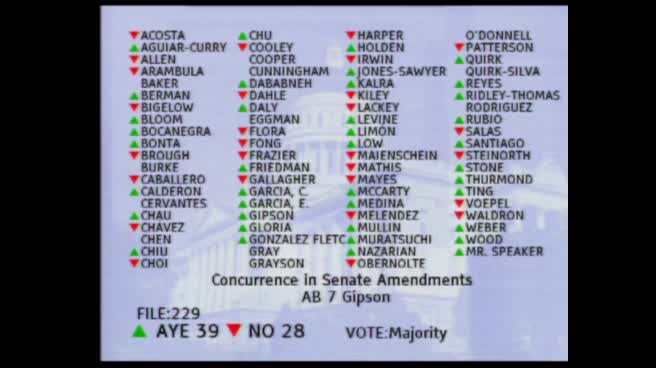 5MIN
Assembly Floor
 3MIN
Senate Floor
 1H
Senate Standing Committee on Appropriations
 11MIN
Senate Standing Committee on Education
 2MIN
Assembly Floor
 1H
Assembly Standing Committee on Appropriations
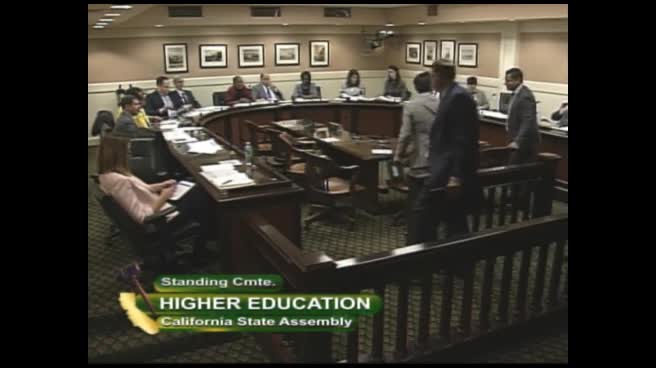 21MIN