AB 1904: Income taxes: credits: apprenticeships.
- Session Year: 2017-2018
- House: Assembly
- Latest Version Date: 2018-03-15
The Personal Income Tax Law and the Corporation Tax Law allow various credits against the taxes imposed by those laws. Existing law provides for the establishment of apprenticeship programs in various trades, to be approved by the Chief of the Division of Apprenticeship Standards in any trade in the state or in a city or trade area whenever the apprentice training needs justify the establishment.
This bill, for taxable years beginning on or after January 1, 2019, and before January 1, 2023, would allow a credit against the taxes imposed under those tax laws in an amount equal to $1 for each hour a registered apprentice worked in the taxable year, up to $1,000 each for up to 10 registered apprentices, as defined, trained by the taxpayer in the taxable year. This bill would provide that the credit would have an aggregate cap of $10,000,000 for each calendar year. This bill would require the Division of Apprenticeship Standards in the Department of Industrial Relations, among other things, to establish a procedure for taxpayers, in the form and manner jointly prescribed by the Division of Apprenticeship Standards and the Franchise Tax Board, to apply and receive a certificate for purposes of the credit. This bill would also require the Division of Apprenticeship Standards to prepare reports for each of the 5 calendar years beginning on January 1, 2020, and before January 1, 2025, containing specified information relating to the credits, to be submitted to the Assembly and Senate Appropriations Committees, the Assembly Revenue and Taxation Committee, and the Senate Governance and Finance Committee on or before March 1 of the following calendar year, commencing March 1, 2021.
This bill would take effect immediately as a tax levy.
The Personal Income Tax Law and the Corporation Tax Law allow various credits against the taxes imposed by those laws. Existing law provides for the establishment of apprenticeship programs in various trades, to be approved by the Chief of the Division of Apprenticeship Standards in any trade in the state or in a city or trade area whenever the apprentice training needs justify the establishment.
This bill, for taxable years beginning on or after January 1, 2019, and before January 1, 2023, would allow a credit against the taxes imposed under those tax laws in an amount equal to $1 for each hour a registered apprentice worked in the taxable year, up to $1,000 each for up to 10 registered apprentices, as defined, trained by the taxpayer in the taxable year. This bill would provide that the credit would have an aggregate cap of $10,000,000 for each calendar year. This bill would require the Division of Apprenticeship Standards in the Department of Industrial Relations, among other things, to establish a procedure for taxpayers, in the form and manner jointly prescribed by the Division of Apprenticeship Standards and the Franchise Tax Board, to apply and receive a certificate for purposes of the credit. This bill would also require the Division of Apprenticeship Standards to prepare reports for each of the 5 calendar years beginning on January 1, 2020, and before January 1, 2025, containing specified information relating to the credits, to be submitted to the Assembly and Senate Appropriations Committees, the Assembly Revenue and Taxation Committee, and the Senate Governance and Finance Committee on or before March 1 of the following calendar year, commencing March 1, 2021.
This bill would take effect immediately as a tax levy.
(a)The Division of Apprenticeship Standards shall prepare reports on the apprenticeship income tax credits allowed under Sections 17053.14 and 23668 of the Revenue and Taxation Code. The reports shall be for each of the five calendar years beginning on January 1, 2020, and before January 1, 2025, and shall include, but not be limited to, the following information:
(1)The number of companies or businesses taking advantage of the apprenticeship income tax credit.
(2)The number of apprentices participating in the apprenticeship programs and the number of apprentices who completed an apprenticeship program which was the basis of the apprenticeship income tax credits allowed under Sections 17053.14 and 23668 of the Revenue and Taxation Code.
(3)The number of apprentice program graduates hired by the taxpayer after the apprenticeship training was completed for which the taxpayer was allowed a credit under Sections 17053.14 and 23668 of the Revenue and Taxation Code for training that apprentice.
(4)Information on the employment status of individuals who have completed an apprenticeship to the extent the information is available.
(5)The fiscal impact of the apprenticeship income tax credits.
(6)(A)The number of apprentices that would have been admitted to an apprenticeship program irrespective of the apprenticeship income tax credits and the number of apprentices admitted into that apprenticeship program specifically because of the apprenticeship income tax credits.
(B)A taxpayer claiming apprenticeship income tax credits under Section 17053.14 or 23668 of the Revenue and Taxation Code shall report to the Division of Apprenticeship standards the information required by subparagraph (A).
(b)This The report required by subdivision (a) shall be submitted to the Assembly and Senate Appropriations Committees, the Assembly Revenue and Taxation Committee, and the Senate Governance and Finance Committee on or before March 1 of the following calendar year, commencing March 1, 2021.
(c)This section shall be repealed on January 1, 2026.
SEC. 2.Section 17053.14 is added to the Revenue and Taxation Code, to read:17053.14.(a)For each taxable year beginning on or after January 1, 2019, and before January 1, 2023, there shall be allowed a credit against the net tax, as defined in Section 17039, in an amount equal to one dollar ($1) for each hour a registered apprentice worked during the taxable year, up to one thousand dollars ($1,000), for each registered apprentice trained by the taxpayer in the taxable year, not to exceed 10 registered apprentices per taxable year.
(b)For purposes of this section, registered apprentice means an individual who meets all of the following requirements:
(1)Is 16 years of age or older at the time of application into the program.
(2)Meets one of the following requirements:
(A)Has not obtained a high school diploma and is enrolled in high school or a General Education Development test preparation program.
(B)Has obtained a high school diploma or General Education Development credential while participating in the apprenticeship.
(3)Is trained by the taxpayer through an apprenticeship program that meets all of the following requirements:
(A)The apprenticeship program is approved by the Chief of the Division of Apprenticeship Standards pursuant to Chapter 4 (commencing with Section 3070) of Division 3 of the Labor Code and is also registered with the Office of Apprenticeship at the United States Department of Labor.
(B)The program is provided pursuant to an apprenticeship agreement as described in Section 3077 of the Labor Code.
(C)The minimum term in hours for the program is 2,000 hours.
(c)(1)(A)A credit shall only be allowed under this section for the taxable year if the taxpayer has received the certificate described in subparagraph (B) from the Division of Apprenticeship Standards in the Department of Industrial Relations. A certificate is required for each taxable year. The taxpayer shall provide a copy of the certificate to the Franchise Tax Board upon request.
(B)The Division of Apprenticeship Standards shall do all of the following:
(i)Establish a procedure for taxpayers, in the form and manner jointly prescribed by the Division of Apprenticeship Standards and the Franchise Tax Board, to apply and receive a certificate for purposes of this section.
(ii)Verify that the taxpayer is training during the taxable year an individual that meets the requirements to be a registered apprentice as described in subdivision (b).
(iii)Provide the taxpayer with a certificate for the registered apprentice. The certificate shall contain the name of the taxpayer and the name of the apprentice, a brief description of the apprenticeship, the primary location of the apprenticeship, and any other information the Division of Apprenticeship Standards or the Franchise Tax Board deems relevant.
(iv)Annually provide the Franchise Tax Board with a list of the names of the taxpayers that received certificates and the names of the registered apprentices of the taxpayer. The list may also contain any other information from the certificates.
(v)Inform the Franchise Tax Board if the Division of Apprenticeship Standards has knowledge that the training of a registered apprentice is terminated prior to the completion of the apprenticeship program after the taxpayer has received a certificate.
(2)The Division of Apprenticeship Standards may adopt rules and regulations as reasonably necessary to effectuate this subdivision, but shall consult with the Franchise Tax Board.
(d)In the case where the credit allowed by this section exceeds the net tax, the excess may be carried over to reduce the net tax in the following year, and succeeding four years, if necessary, until the credit is exhausted.
(e)The Franchise Tax Board may prescribe rules, guidelines, or procedures necessary or appropriate to carry out the purposes of this section, except as otherwise specified in subdivision (c).
(f)(1)Except as provided in paragraph (2), if the training of a registered apprentice is terminated prior to the completion of the apprenticeship program, any unused carryover of the credit shall be canceled and any previously claimed credit that reduced net tax shall be recaptured by increasing the tax imposed by this part for the taxable year in which the training is terminated.
(2)Paragraph (1) shall not apply if the training of a registered apprentice was terminated due to any of the following:
(A)The registered apprentice voluntarily leaves the apprenticeship program.
(B)The registered apprentice, before the end of the completion of the apprenticeship program described in paragraph (3) of subdivision (b), becomes disabled and unable to perform the services of that program, unless that disability is removed before the close of the period of that program and the taxpayer fails to offer reinstatement to the program for that apprentice.
(C)The training of a registered apprentice was terminated due to the misconduct, as defined in Sections 1256-30 to 1256-43, inclusive, of Title 22 of the California Code of Regulations, of that apprentice.
(D)The training of a registered apprentice was terminated due to a substantial reduction in the trade or business operations of the taxpayer.
(g)A deduction otherwise allowed under this part for any amount paid or incurred by the qualified taxpayer in training a registered apprentice as a trade or business expense shall be reduced by the amount of the credit allowed by this section.
(h)The aggregate amount of credits allowed under this section and Section 23668 shall not exceed ten million dollars ($10,000,000) for each calendar year.
(i)This section shall remain in effect only until December 1, 2023, and as of that date is repealed.
SEC. 3.Section 19560.3 is added to the Revenue and Taxation Code, to read:19560.3.(a)The Franchise Tax Board shall provide the Division of Apprenticeship Standards in the Department of Industrial Relations with any information necessary to prepare the report required pursuant to Section 3073.7 of the Labor Code.
(b)This section shall be repealed on January 1, 2026.
SEC. 4.Section 23668 is added to the Revenue and Taxation Code, to read:23668.(a)For each taxable year beginning on or after January 1, 2019, and before January 1, 2023, there shall be allowed a credit against the tax, as defined in Section 23036, in an amount equal to one dollar ($1) for each hour a registered apprentice worked during the taxable year, up to one thousand dollars ($1,000) for each registered apprentice trained by the taxpayer in the taxable year, not to exceed 10 registered apprentices per taxable year.
(b)For purposes of this section, registered apprentice means an individual who meets all of the following requirements:
(1)Is 16 years of age or older at the time of application into the program.
(2)Meets one of the following requirements:
(A)Has not obtained a high school diploma and is enrolled in high school or a General Education Development test preparation program.
(B)Has obtained a high school diploma or General Education Development credential while participating in the apprenticeship.
(3)Is trained by the taxpayer through an apprenticeship program that meets all of the following requirements:
(A)The apprenticeship program is approved by the Chief of the Division of Apprenticeship Standards pursuant to Chapter 4 (commencing with Section 3070) of Division 3 of the Labor Code and is also registered with the Office of Apprenticeship at the United States Department of Labor.
(B)The program is provided pursuant to an apprenticeship agreement as described in Section 3077 of the Labor Code.
(C)The minimum term in hours for the program is 2,000 hours.
(c)(1)(A)A credit shall only be allowed under this section for the taxable year if the taxpayer has received the certificate described in subparagraph (B) from the Division of Apprenticeship Standards in the Department of Industrial Relations. A certificate is required for each taxable year. The taxpayer shall provide a copy of the certificate to the Franchise Tax Board upon request.
(B)The Division of Apprenticeship Standards shall do all of the following:
(i)Establish a procedure for taxpayers, in the form and manner jointly prescribed by the Division of Apprenticeship Standards and the Franchise Tax Board, to apply and receive a certificate for purposes of this section.
(ii)Verify that the taxpayer is training during the taxable year an individual that meets the requirements to be a registered apprentice as described in subdivision (b).
(iii)Provide the taxpayer with a certificate for the registered apprentice. The certificate shall contain the name of the taxpayer and the name of the apprentice, a brief description of the apprenticeship, the primary location of the apprenticeship, and any other information the Division of Apprenticeship Standards or the Franchise Tax Board deems relevant.
(iv)Annually provide the Franchise Tax Board with a list of the names of the taxpayers that received certificates and the names of the registered apprentices of the taxpayer. The list may also contain any other information from the certificates.
(v)Inform the Franchise Tax Board if the Division of Apprenticeship Standards has knowledge that the training of a registered apprentice is terminated prior to the completion of the apprenticeship program after the taxpayer has received a certificate.
(2)The Division of Apprenticeship Standards may adopt rules and regulations as reasonably necessary to effectuate this subdivision, but shall consult with the Franchise Tax Board.
(d)In the case where the credit allowed by this section exceeds the tax, the excess may be carried over to reduce the tax in the following year, and succeeding four years, if necessary, until the credit is exhausted.
(e)The Franchise Tax Board may prescribe rules, guidelines, or procedures necessary or appropriate to carry out the purposes of this section, except as otherwise specified in subdivision (c).
(f)(1)Except as provided in paragraph (2), if the training of a registered apprentice is terminated prior to the completion of the apprenticeship program, any unused carryover of the credit shall be canceled and any previously claimed credit that reduced tax shall be recaptured by increasing the tax imposed by this part for the taxable year in which the training is terminated.
(2)Paragraph (1) shall not apply if the training of a registered apprentice was terminated due to any of the following:
(A)The registered apprentice voluntarily leaves the apprenticeship program.
(B)The registered apprentice, before the end of the completion of the apprenticeship program described in paragraph (3) of subdivision (b), becomes disabled and unable to perform the services of that program, unless that disability is removed before the close of the period of that program and the taxpayer fails to offer reinstatement to the program for that apprentice.
(C)The training of a registered apprentice was terminated due to the misconduct, as defined in Sections 1256-30 to 1256-43, inclusive, of Title 22 of the California Code of Regulations, of that apprentice.
(D)The training of a registered apprentice was terminated due to a substantial reduction in the trade or business operations of the taxpayer.
(g)A deduction otherwise allowed under this part for any amount paid or incurred by the qualified taxpayer in training a registered apprentice as a trade or business expense shall be reduced by the amount of the credit allowed by this section.
(h)The aggregate amount of credits allowed under this section and Section 17053.14 shall not exceed ten million dollars ($10,000,000) for each calendar year.
(i)This section shall remain in effect only until December 1, 2023, and as of that date is repealed.
SEC. 5.This act provides for a tax levy within the meaning of Article IV of the California Constitution and shall go into immediate effect.
(a)The Division of Apprenticeship Standards shall prepare reports on the apprenticeship income tax credits allowed under Sections 17053.14 and 23668 of the Revenue and Taxation Code. The reports shall be for each of the five calendar years beginning on January 1, 2020, and before January 1, 2025, and shall include, but not be limited to, the following information:
(1)The number of companies or businesses taking advantage of the apprenticeship income tax credit.
(2)The number of apprentices participating in the apprenticeship programs and the number of apprentices who completed an apprenticeship program which was the basis of the apprenticeship income tax credits allowed under Sections 17053.14 and 23668 of the Revenue and Taxation Code.
(3)The number of apprentice program graduates hired by the taxpayer after the apprenticeship training was completed for which the taxpayer was allowed a credit under Sections 17053.14 and 23668 of the Revenue and Taxation Code for training that apprentice.
(4)Information on the employment status of individuals who have completed an apprenticeship to the extent the information is available.
(5)The fiscal impact of the apprenticeship income tax credits.
(b)This report shall be submitted to the Assembly and Senate Appropriations Committees, the Assembly Revenue and Taxation Committee, and the Senate Governance and Finance Committee on or before March 1 of the following calendar year, commencing March 1, 2021.
(c)This section shall be repealed on January 1, 2026.
SEC. 2.Section 17053.14 is added to the Revenue and Taxation Code, to read:17053.14.(a)For each taxable year beginning on or after January 1, 2019, and before January 1, 2023, there shall be allowed a credit against the net tax, as defined in Section 17039, in an amount equal to one dollar ($1) for each hour a registered apprentice worked during the taxable year, up to one thousand dollars ($1,000), for each registered apprentice trained by the taxpayer in the taxable year, not to exceed 10 registered apprentices per taxable year.
(b)For purposes of this section, registered apprentice means an individual who meets all of the following requirements:
(1)Is 16 years of age or older at the time of application into the program.
(2)Meets one of the following requirements:
(A)Has not obtained a high school diploma and is enrolled in high school or a General Education Development test preparation program.
(B)Has obtained a high school diploma or General Education Development credential while participating in the apprenticeship.
(3)Is trained by the taxpayer through an apprenticeship program that meets all of the following requirements:
(A)The apprenticeship program is approved by the Chief of the Division of Apprenticeship Standards pursuant to Chapter 4 (commencing with Section 3070) of Division 3 of the Labor Code and is also registered with the Office of Apprenticeship at the United States Department of Labor.
(B)The program is provided pursuant to an apprenticeship agreement as described in Section 3077 of the Labor Code.
(C)The minimum term in hours for the program is 2,000 hours.
(c)(1)(A)A credit shall only be allowed under this section for the taxable year if the taxpayer has received the certificate described in subparagraph (B) from the Division of Apprenticeship Standards in the Department of Industrial Relations. A certificate is required for each taxable year. The taxpayer shall provide a copy of the certificate to the Franchise Tax Board upon request.
(B)The Division of Apprenticeship Standards shall do all of the following:
(i)Establish a procedure for taxpayers, in the form and manner jointly prescribed by the Division of Apprenticeship Standards and the Franchise Tax Board, to apply and receive a certificate for purposes of this section.
(ii)Verify that the taxpayer is training during the taxable year an individual that meets the requirements to be a registered apprentice as described in subdivision (b).
(iii)Provide the taxpayer with a certificate for the registered apprentice. The certificate shall contain the name of the taxpayer and the name of the apprentice, a brief description of the apprenticeship, the primary location of the apprenticeship, and any other information the Division of Apprenticeship Standards or the Franchise Tax Board deems relevant.
(iv)Annually provide the Franchise Tax Board with a list of the names of the taxpayers that received certificates and the names of the registered apprentices of the taxpayer. The list may also contain any other information from the certificates.
(v)Inform the Franchise Tax Board if the Division of Apprenticeship Standards has knowledge that the training of a registered apprentice is terminated prior to the completion of the apprenticeship program after the taxpayer has received a certificate.
(2)The Division of Apprenticeship Standards may adopt rules and regulations as reasonably necessary to effectuate this subdivision, but shall consult with the Franchise Tax Board.
(d)In the case where the credit allowed by this section exceeds the net tax, the excess may be carried over to reduce the net tax in the following year, and succeeding four years, if necessary, until the credit is exhausted.
(e)The Franchise Tax Board may prescribe rules, guidelines, or procedures necessary or appropriate to carry out the purposes of this section, except as otherwise specified in subdivision (c).
(f)(1)Except as provided in paragraph (2), if the training of a registered apprentice is terminated prior to the completion of the apprenticeship program, any unused carryover of the credit shall be canceled and any previously claimed credit that reduced net tax shall be recaptured by increasing the tax imposed by this part for the taxable year in which the training is terminated.
(2)Paragraph (1) shall not apply if the training of a registered apprentice was terminated due to any of the following:
(A)The registered apprentice voluntarily leaves the apprenticeship program.
(B)The registered apprentice, before the end of the completion of the apprenticeship program described in paragraph (3) of subdivision (b), becomes disabled and unable to perform the services of that program, unless that disability is removed before the close of the period of that program and the taxpayer fails to offer reinstatement to the program for that apprentice.
(C)The training of a registered apprentice was terminated due to the misconduct, as defined in Sections 1256-30 to 1256-43, inclusive, of Title 22 of the California Code of Regulations, of that apprentice.
(D)The training of a registered apprentice was terminated due to a substantial reduction in the trade or business operations of the taxpayer.
(g)A deduction otherwise allowed under this part for any amount paid or incurred by the qualified taxpayer in training a registered apprentice as a trade or business expense shall be reduced by the amount of the credit allowed by this section.
(h)The aggregate amount of credits allowed under this section and Section 23668 shall not exceed ten million dollars ($10,000,000) for each calendar year.
(i)This section shall remain in effect only until December 1, 2023, and as of that date is repealed.
SEC. 3.Section 19560.3 is added to the Revenue and Taxation Code, to read:19560.3.(a)The Franchise Tax Board shall provide the Division of Apprenticeship Standards in the Department of Industrial Relations with any information necessary to prepare the report required pursuant to Section 3073.7 of the Labor Code.
(b)This section shall be repealed on January 1, 2026.
SEC. 4.Section 23668 is added to the Revenue and Taxation Code, to read:23668.(a)For each taxable year beginning on or after January 1, 2019, and before January 1, 2023, there shall be allowed a credit against the tax, as defined in Section 23036, in an amount equal to one dollar ($1) for each hour a registered apprentice worked during the taxable year, up to one thousand dollars ($1,000) for each registered apprentice trained by the taxpayer in the taxable year, not to exceed 10 registered apprentices per taxable year.
(b)For purposes of this section, registered apprentice means an individual who meets all of the following requirements:
(1)Is 16 years of age or older at the time of application into the program.
(2)Meets one of the following requirements:
(A)Has not obtained a high school diploma and is enrolled in high school or a General Education Development test preparation program.
(B)Has obtained a high school diploma or General Education Development credential while participating in the apprenticeship.
(3)Is trained by the taxpayer through an apprenticeship program that meets all of the following requirements:
(A)The apprenticeship program is approved by the Chief of the Division of Apprenticeship Standards pursuant to Chapter 4 (commencing with Section 3070) of Division 3 of the Labor Code and is also registered with the Office of Apprenticeship at the United States Department of Labor.
(B)The program is provided pursuant to an apprenticeship agreement as described in Section 3077 of the Labor Code.
(C)The minimum term in hours for the program is 2,000 hours.
(c)(1)(A)A credit shall only be allowed under this section for the taxable year if the taxpayer has received the certificate described in subparagraph (B) from the Division of Apprenticeship Standards in the Department of Industrial Relations. A certificate is required for each taxable year. The taxpayer shall provide a copy of the certificate to the Franchise Tax Board upon request.
(B)The Division of Apprenticeship Standards shall do all of the following:
(i)Establish a procedure for taxpayers, in the form and manner jointly prescribed by the Division of Apprenticeship Standards and the Franchise Tax Board, to apply and receive a certificate for purposes of this section.
(ii)Verify that the taxpayer is training during the taxable year an individual that meets the requirements to be a registered apprentice as described in subdivision (b).
(iii)Provide the taxpayer with a certificate for the registered apprentice. The certificate shall contain the name of the taxpayer and the name of the apprentice, a brief description of the apprenticeship, the primary location of the apprenticeship, and any other information the Division of Apprenticeship Standards or the Franchise Tax Board deems relevant.
(iv)Annually provide the Franchise Tax Board with a list of the names of the taxpayers that received certificates and the names of the registered apprentices of the taxpayer. The list may also contain any other information from the certificates.
(v)Inform the Franchise Tax Board if the Division of Apprenticeship Standards has knowledge that the training of a registered apprentice is terminated prior to the completion of the apprenticeship program after the taxpayer has received a certificate.
(2)The Division of Apprenticeship Standards may adopt rules and regulations as reasonably necessary to effectuate this subdivision, but shall consult with the Franchise Tax Board.
(d)In the case where the credit allowed by this section exceeds the tax, the excess may be carried over to reduce the tax in the following year, and succeeding four years, if necessary, until the credit is exhausted.
(e)The Franchise Tax Board may prescribe rules, guidelines, or procedures necessary or appropriate to carry out the purposes of this section, except as otherwise specified in subdivision (c).
(f)(1)Except as provided in paragraph (2), if the training of a registered apprentice is terminated prior to the completion of the apprenticeship program, any unused carryover of the credit shall be canceled and any previously claimed credit that reduced tax shall be recaptured by increasing the tax imposed by this part for the taxable year in which the training is terminated.
(2)Paragraph (1) shall not apply if the training of a registered apprentice was terminated due to any of the following:
(A)The registered apprentice voluntarily leaves the apprenticeship program.
(B)The registered apprentice, before the end of the completion of the apprenticeship program described in paragraph (3) of subdivision (b), becomes disabled and unable to perform the services of that program, unless that disability is removed before the close of the period of that program and the taxpayer fails to offer reinstatement to the program for that apprentice.
(C)The training of a registered apprentice was terminated due to the misconduct, as defined in Sections 1256-30 to 1256-43, inclusive, of Title 22 of the California Code of Regulations, of that apprentice.
(D)The training of a registered apprentice was terminated due to a substantial reduction in the trade or business operations of the taxpayer.
(g)A deduction otherwise allowed under this part for any amount paid or incurred by the qualified taxpayer in training a registered apprentice as a trade or business expense shall be reduced by the amount of the credit allowed by this section.
(h)The aggregate amount of credits allowed under this section and Section 17053.14 shall not exceed ten million dollars ($10,000,000) for each calendar year.
(i)This section shall remain in effect only until December 1, 2023, and as of that date is repealed.
SEC. 5.This act provides for a tax levy within the meaning of Article IV of the California Constitution and shall go into immediate effect.
|
Date
|
Status
|
|---|---|
| May 25, 2018 | In committee: Held under submission. |
| Apr 4, 2018 | In committee: Set, first hearing. Referred to suspense file. |
| Mar 19, 2018 | Re-referred to Com. on APPR. |
| Mar 15, 2018 | Read second time and amended. |
| Mar 14, 2018 | From committee: Amend, and do pass as amended and re-refer to Com. on APPR. (Ayes 6. Noes 0.) (March 12). |
| Feb 5, 2018 | Referred to Com. on REV. & TAX. |
| Jan 23, 2018 | From printer. May be heard in committee February 22. |
| Jan 22, 2018 | Read first time. To print. |
|
Date
|
Description
|
Location
|
Votes
|
|
|---|---|---|---|---|
| Mar 12, 2018 | Do pass as amended and be re-referred to the Committee on [Appropriations] | Assembly Standing Committee on Revenue and Taxation |
Passed |
This list shows positions taken on this bill by organizations on the date displayed, which is linked to the original source.
Positions by individuals are not included.
Date of Hearing: April 4, 2018
ASSEMBLY COMMITTEE ON APPROPRIATIONS
Lorena Gonzalez Fletcher, Chair
ABPCA Bill Id:AB 1904
Author:(Cervantes) – As Amended Ver:March 15, 2018
Policy Committee: | Revenue and Taxation | Vote: | 6 - 0 |
|
| ||
|
|
Urgency: No State Mandated Local Program: No Reimbursable: No
SUMMARY:
This bill creates a Personal Income Tax (PIT) and Corporation Tax (CT) credit for the hiring and training of registered apprentices. Specifically, this bill:
- Allows, for taxable tears 2019 through 2022, a PIT and CT credit worth up to $1,000 per registered apprentice trained per year, not to exceed 10 apprentices per year. No more than $10 million in aggregate credits can be allocated per year.
- Defines a registered apprentice as someone who is at least 16 years old and currently enrolled in high school or a General Education Development (GED) test preparation program or who has received a high school diploma or GED credential while participating in the apprenticeship.
- Requires the Division of Apprenticeship Standards (DAS) to develop a procedure for taxpayers to apply and receive certification in order to receive the tax credit and to prepare reports on the use, effectiveness, and costs of this program.
FISCAL EFFECT:
- Annual General Fund revenue loss of $90,000 in 2018-19, $250,000 in 2019-20, and $250,000 in 2020-21. No more than $10 million in aggregate credits may be allocated in any given year, but it is unlikely that this cap will be reached.
- Annual special fund costs of approximately $470,000 for DAS to issue its required report, develop procedures, respond to inquiries, and work with employers to develop qualifying programs.
COMMENTS:
- Background and purpose. California has a relatively robust program to develop standards for and promote apprenticeships. The Division of Apprenticeship Standards (DAS) administers apprenticeship law and enforces standards for the hours, wages, working conditions, and the specific skills required for state certification as a journeyperson in an apprenticeable occupation. As of December 2017, there were 80,500 apprentices working statewide.
According to the author, AB 1904 will support robust apprenticeship programs. The author notes that these programs strengthen an individual’s likelihood of securing permanent employment, and this bill will provide an incentive for employers to seek out apprentices.
- Fiscal implications of tax expenditures. Existing law allows for various tax expenditures such as credits, deductions, exclusions, and exemptions for particular taxpayer groups. These features of the tax code can result in significant state costs through foregone tax revenue and, in many cases, policymakers have little control over the revenue loss that occurs in any given year. As a result, many tax expenditure bills now include provisions designed to give the Legislature more control over costs. Examples of such provisions include placing a sunset date or making a bill’s provisions contingent upon a separate budget appropriation. AB 1904 includes a sunset date and requires DAS to report on the program’s costs and effectiveness.
- Other recent legislation. This bill creates a tax credit similar to AB 361 (Cervantes), of the 2017-18 Legislative Session, which was held on this committee’s Suspense File. However, one key difference is that this bill applies only to those apprentices who lack a high school diploma or who received a diploma or GED certificate while they were an apprentice. According to the Franchise Tax Board (FTB) analysis of this bill, only 6,600 of current registered apprentices lack a high school diploma.
In addition to 2017’s AB 361 (Cervantes), there have been a number of bills aiming to expand apprenticeship programs through tax credits. AB 151 (Rodriguez), of the 2015-16 Legislative Session, and AB 1569 (Rodriguez), of the 2013-14 Legislative Session, each would have created tax credit programs similar to this bill’s, and both were held on this committee’s Suspense File.
- Narrowed scope and program inefficiency. This bill’s narrowed scope means that this tax credit program is more targeted and results in far less revenue loss than previous iterations. However, it also means that the costs associated with implementing and running the program are likely to exceed the tax benefit granted to employers. The FTB estimates that revenue loss from this bill is expected to reach $250,000 a year, while DAS’ administrative expenses are expected to be about $470,000 a year.
Analysis Prepared by: Luke Reidenbach / APPR. / (916) 319-2081
Date of Hearing: March 12, 2018
ASSEMBLY COMMITTEE ON REVENUE AND TAXATION
Autumn R. Burke, Chairwoman
ABPCA Bill Id:AB 1904 (
Author:Cervantes) – As Introduced Ver:January 22, 2018
Majority vote. Tax levy. Fiscal committee.
SUBJECT: Income taxes: credits: apprenticeships
SUMMARY: Provides a temporary tax credit of up to $1,000 under both the Personal Income Tax (PIT) and the Corporation Tax (CT) laws for each registered apprentice trained by the taxpayer in the taxable year. Specifically, this bill:
- Allows a tax credit to a taxpayer, for each taxable year beginning on or after January 1, 2019, and before January 1, 2023, in an amount equal to $1 for each hour a registered apprentice worked during the taxable year, up to $1,000 for each registered apprentice trained by the taxpayer in the taxable year.
- Defines a "registered apprentice" as an individual who meets all of the following requirements:
- Is 16 years of age or older at the time of application into the program;
- Meets one of the following requirements:
- Has not obtained a high school diploma and is enrolled in high school or a General Education Development (GED) test preparation program; or,
- Has obtained a high school diploma or GED credential while participating in the apprenticeship; and,
- Has not obtained a high school diploma and is enrolled in high school or a General Education Development (GED) test preparation program; or,
- Is trained by the taxpayer through an apprenticeship program, as specified.
- Is 16 years of age or older at the time of application into the program;
- Requires an apprenticeship program to meet all of the following conditions:
- The program must be approved by the Chief of the Division of Apprenticeship Standards (DAS) and be registered with the Office of Apprenticeship at the United States (U.S.) Department of Labor;
- The apprenticeship program must be provided pursuant to an apprenticeship agreement, as specified; and,
- The minimum term in hours for the apprenticeship program must be 2,000 hours.
- Specifies that the apprenticeship tax credit is allowed only if the taxpayer has received a certificate from the DAS.
- Requires the taxpayer claiming the apprenticeship tax credit to obtain a certificate for each taxable year and provide a copy of the certificate to the Franchise Tax Board (FTB) upon request.
- Provides that a deduction otherwise allowed for any amount paid or incurred by the qualified taxpayer in training a registered apprentice as a trade or business expense must be reduced by the amount of the credit allowed by this bill.
- Requires the DAS to do all of the following:
- Establish a procedure for taxpayers, in the form and manner jointly prescribed by the DAS and the FTB, to apply and receive a certificate;
- Verify that the taxpayer is training an individual who meets the requirements of a registered apprentice during the taxable year, as provided;
- Provide the taxpayer with a certificate for the registered apprentice;
- Annually provide the FTB with a list of the names of taxpayers that received certificates and the names of registered apprentices. The list may also contain other information included on the certificates;
- Inform the FTB if the DAS has knowledge that the training of a registered apprentice is terminated prior to the completion of the apprenticeship program, after the taxpayer has received a certificate.
- Prepare a report on the apprenticeship tax credit for each of the five calendar years beginning on January 1, 2020, and before January 1, 2025, and include in the report all of the following information:
- The number of companies or businesses taking advantage of the apprenticeship income tax credit;
- The number of apprentices participating in the apprenticeship programs and the number of apprentices who completed an apprenticeship program that was the basis of the apprenticeship tax credit;
- The number of apprentice program graduates hired by the taxpayer after the apprenticeship training was completed for which the taxpayer was allowed a credit for training that apprentice;
- Information on the employment status of individuals who have completed an apprenticeship to the extent the information is available; and,
- The fiscal impact of the apprenticeship tax credits.
- The number of companies or businesses taking advantage of the apprenticeship income tax credit;
- Submit an annual report on the apprenticeship tax credits to the Assembly and Senate Appropriations Committees, the Assembly Committee on Revenue and Taxation, and the Senate Governance and Finance Committee on or before March 1 of the calendar year, commencing with March 1, 2021.
- Establish a procedure for taxpayers, in the form and manner jointly prescribed by the DAS and the FTB, to apply and receive a certificate;
- Authorizes the DAS, in consultation with the FTB, to adopt rules and regulations as reasonably necessary to effectuate the implementation of the apprenticeship tax credit.
- Authorizes the FTB to prescribe rules, guidelines, or procedures necessary or appropriate to carry out the purposes of the apprenticeship tax credit provisions.
- Requires the FTB to provide DAS with any information necessary to prepare the reports on the apprenticeship tax credit, as specified.
- Allows a taxpayer to carry forward the apprenticeship tax credit to the following tax year, and succeeding four years, if necessary, until the credit is exhausted.
- Provides that any unused carryover of the apprenticeship tax credits shall be canceled and any previously claimed credit that reduced the taxpayer's tax shall be recaptured, as specified, if the training of a registered apprentice is terminated prior to the completion of the apprenticeship program, unless any of the following applies:
- The registered apprentice voluntarily leaves the apprenticeship program;
- The registered apprentice, before the completion of the apprenticeship program, becomes disabled and unable to perform, as specified, unless that disability is removed prior to the close of the apprenticeship program and the taxpayer fails to offer reinstatement to the program for that apprentice;
- The training of a registered apprentice was terminated due to the apprentice's misconduct, as specified; or,
- The training of a registered apprentice was terminated due to a substantial reduction in the trade or business operations of the taxpayer.
- The registered apprentice voluntarily leaves the apprenticeship program;
- Prevents the aggregate amount of credits from exceeding $10 million for each calendar year.
- Takes effect immediately as a tax levy.
EXISTING LAW allows various tax credits designed to influence taxpayer behavior or to provide tax relief for taxpayers who incur certain expenses. These credits are created to incentivize taxpayers to engage in certain activities that taxpayers may not undertake in the absence of the credit.
FISCAL EFFECT: The FTB estimates that this bill will result in an annual revenue loss of $90,000 in fiscal year (FY) 2018-19, and $250,000 in the FY 2019-20, and $250,000 in FY 2020-21.
COMMENTS:
- The author has provided the following statement in support of this bill:
A robust apprenticeship program within any company serves as a mechanism for both employers and apprentices to integrate real-world instruction and mentoring into an effective training model. The trust and development that is instilled between these partnerships strengthens an individual’s likelihood of securing permanent employment. Finding tools to incentivize employers to take advantage of the up incoming workforce is a key component to training and maintaining a middle and high-skilled workforce.
- Committee Staff Comments:
- What Does this Bill Do? This bill proposes to create an income tax credit for four taxable years – from January 1, 2019, until January 1, 2023 - for employers who have established an eligible apprenticeship program approved by the DAS and registered with the Office of Apprenticeship at the U.S. Department of Labor. Thus, this bill would subsidize the cost of training youth at the work site, up to $1,000 annually per each registered apprentice trained by the taxpayer. Only specified individuals who are 16 years of age or older would qualify as "registered apprentices." Generally, an individual must be enrolled in high school or a GED test preparation program. In order to claim the apprenticeship tax credit, a taxpayer must receive a certificate from the DAS for each taxable year in which the taxpayer intends to claim the credit. The taxpayer must ensure that a registered apprentice completes the training program; otherwise, the credit claimed by the taxpayer may be subject to recapture. However, the recapture provisions will not apply in cases where a registered apprentice left the program voluntarily; was unable to perform, as required by the program, due to acquired disability; or was terminated for misconduct or due to a substantial reduction in the trade or business operations of the taxpayer.
- Annual Reporting: This bill would require the DAS to prepare an annual report regarding the effectiveness of the apprenticeship tax credit, including the number of companies and apprentices participating in the program, the number of apprentices hired after the apprenticeship, and the fiscal impact of the apprenticeship tax credit, among other types of information. The annual report will be delivered to the Legislature for review. In addition to the information currently required, the Committee may wish to also require that employers specify how many apprentices would have been admitted to the apprenticeship program irrespective of the credit and how many were admitted into the program specifically because of the credit.
- Disconnected Youth: According to the report[1] released by Measure America, a project of the Social Science Research Council, one in every seven Americans between the ages of 16 and 24 (or about 5.8 million people) is neither working nor in school. The highest rate of youth disconnection among the country's most populous 25 metro areas was found in the Inland Empire: nearly one in every five young people, or 117,000 of approximately 620,000 teens and young adults. The national disconnection rate was 14.6%.
Among the factors associated with youth disconnection are high rates of poverty and unemployment, low levels of educational attainment, and high rates of disconnection identified over a decade ago. While youth disconnection is a complex problem with no easy solution, the new approaches identified by the U.S. Department of Labor show great promise. The key component of the overall strategy is a focus on job readiness and training. Apprenticeship programs allow people to obtain on-the-job experience and move into gainful employment. According to the U.S. Department of Labor, some 37,000 program sponsors signed up for the Registered Apprenticeship program in the United States, representing over one-quarter million employers, industries and companies. The training programs serve a diverse population, including minorities, women, youth, and dislocated workers. - The 21st Century Registered Apprenticeship Program: The National Apprenticeship Act of 1937 (also known as the Fitzgerald Act) established the national Registered Apprenticeship system, offering a training model for diverse industry sectors that combines on-the-job learning, classroom instruction, and mentoring.[2] Apprentices earn paychecks while in training and employers are assured of a valuable and competent workforce. Equally important, the program offers "career pathways leading to industry recognized credentials, giving employers an avenue to elevate the competencies of their workers, and giving workers and their families opportunities for advancement and increased earnings as skills and expertise are acquired."[3]
Either the U.S. Department of Labor's Office of Apprenticeship or a State Apprenticeship Agency approved by the Secretary of Labor for federal purposes administers the National Apprenticeship Act. The program is sponsored by an individual business or an employer association and may be partnered with a labor organization through a collective bargaining agreement. Sponsors identify the minimum applicable qualifications and credentials. Programs range from one to six years, with an average of four years. For each year of the apprenticeship, the apprentice will normally receive 2,000 hours of on-the-job training and a recommended minimum of 144 hours of related classroom instruction.[4]
The Registered Apprenticeship Program is primarily funded by industry, allowing the opportunity for the public sector "to leverage the significant investments made by the private sector in this industry-driven model." The U.S. does not provide incentives to potential sponsors to utilize the Registered Apprenticeship program.[5] According to a recent evaluation, the social benefits of Registered Apprenticeship are much larger than the social cost, where participants had substantially higher earnings than did nonparticipants.[6] According the Report, the net social benefits of the Registered Apprenticeship program have important implications for states, regions, and local communities - enhanced worker productivity and skill levels; increased worker earnings; a larger revenue base; and reduced utilization of government-provided assistance, such as unemployment compensation and food stamps. - California Apprenticeship Programs: Apprenticeship in California dates back to the Shelly-Maloney Apprenticeship Labor Standards Act of 1939. Currently, California has the largest apprenticeship system in the nation. Apprenticeship programs are offered in occupations that meet specific state-approved standards, registered with and approved by the DAS. There are over 800 apprenticeable occupations in California across a variety of industry sectors. The bulk of registered apprenticeship programs are in the construction sector - at present, about two-thirds of California's apprentices are in training in building and construction trades and occupations. However, there are significant numbers of apprentices in training as barbers, cosmetologists, firefighters, machinists, auto mechanics and public safety officers among the DAS's over 600 approved apprenticeship program sponsors.
Generally, wages and benefits are paid to registered apprentices by employers participating in the apprenticeship programs, but apprenticeship program educational funding (RSI or "Montoya Funds") are appropriated annually in the State Budget Act from Proposition 98 funds. The appropriations are made to the California Department of Education (CDE) and the California Community College Chancellor's Office. The funds are then disbursed to high school districts, Regional Occupational Centers and Programs, and community college districts that contract with apprenticeship program sponsors. The CDE supports approximately 35 regional and occupational centers offering apprenticeship programs for a specified length of time, usually three to five years, and include on-the-job training and classroom related and supplemental instruction.
In 2015, DAS received training fund contributions totaling $11,034,372 from contractors working on public works jobs.[7] Of that amount, $2,736,127 was distributed as training funds to approved apprenticeship programs in the building and construction occupations.[8] The remainder was used to fund apprenticeship activities and enforcement.
As of December 31, 2017, there were 80,464 active apprentices in California.[9] Women represented 6% of active apprenticeships, and minorities represented 64.5% of active apprenticeships.[10] - Will the Proposed Tax Credit Increase Apprentice Enrollment? Many states and local communities have been actively "innovating 'on the ground,' incubating and scaling strategies and models that highlight Registered Apprenticeship's critical role in meeting complex 21st century workforce needs."[11] Some states have enacted business tax credits and employed utilization agreements, project labor agreements, and other strategies to expand Registered Apprenticeship.[12] Several states, including Arkansas, Connecticut, Michigan, Missouri, Rhode Island and Virginia, have established Youth Apprenticeship Tax Credit programs. In July 2000, the National Conference of State Legislatures (NCSL) reviewed school-to-career apprenticeship tax credit programs. The NCSL found that most states lacked sufficient data to analyze their credit's impact on apprenticeship enrollment. However, the State of Arkansas showed a 10% increase in the number of apprentices after the passage of the tax credit. Similarly, South Carolina has seen a 680% increase in the number of employers sponsoring apprentices since the implementation of an apprenticeship program in 2007, which includes a state tax credit of $1,000 for every apprentice that a business hires and $700,000 in direct state funding annually, among other subsidies.[13]
Although well intentioned, this bill represents an attempt to use the tax code to accomplish a public policy objective that may be better addressed through a direct outlay of state funds. As noted by the California Budget Project, nearly two-thirds of the projected 2020 labor force is already past high-school age, and meeting the needs of working adults requires changes in the areas that include financial aid policies; supportive services, such as child care and transportation; new approaches to teaching and curriculum design; and flexibility in the scheduling of classes.[14] It was also suggested that one promising strategy for addressing both the needs of workers and employers is employment and training programs that target a specific industry and work to meet its local labor market needs.[15] Would a stand-alone tax credit be sufficient to improve the state's workforce and to ensure that the state's workers have the skills needed to compete in the global marketplace? The Committee may wish to consider whether increased funding to existing apprenticeship programs would be a more efficient approach to achieve these goals. - Credit vs. Deduction: Existing law already provides a tax incentive, in the form of a deduction for business expenses, for wages and benefits paid to employees. A tax credit is more valuable because it lowers the tax liability dollar-for-dollar. A deduction decreases the taxpayer's taxable income; the value of a deduction depends on one's tax bracket. For example, if a taxpayer is in the 25% bracket, a $1,000 deduction would lower the taxpayer's tax bill by $250. In contrast, a $1,000 credit decreases the tax liability by the full $1,000, regardless of the tax bracket. Thus, the value of a tax credit is the same, regardless of the tax rate and, therefore, it is generally more appealing to taxpayers. In fact, the credit proposed by this bill may be so great that it may incentivize employers to hire an apprentice instead of an employee. Could this bill potentially result in an increased number of apprentices at the expense of full-time employees?
- Related Legislation: AB 361 (Cervantes), of the 2017-18 Legislative Session, was substantially similar and would have created a tax credit in an amount equal to $1,000 for each registered apprentice. AB 361 was held on the Assembly Committee on Appropriations' Suspense File.
- Prior Legislation:
- AB 151 (Rodriguez), of the 2015-16 Legislative Session, would have created a tax credit in an amount equal to $2,000 for each registered apprentice. AB 151 was held on the Assembly Committee on Appropriations' Suspense File.
- AB 1569 (Rodriguez), of the 2013-14 Legislative Session, was substantially similar to this bill. AB 1569 was held on the Assembly Committee on Appropriations' Suspense File.
REGISTERED SUPPORT / OPPOSITION:
Support
None on file
Opposition
None on file
Analysis Prepared by: Ken Conlan/Carlos Anguiano / REV. & TAX. / (916) 319-2098
"Halve the Gap by 2030: Youth Disconnection in America’s Cities." ↑
21st Century Registered Apprenticeship: Outeducate, Outbuild, Outinnovate, A shared Vision for Increasing Opportunity, Innovation, and Competitiveness for American Workers and Employers, Report from the Secretary of Labor's Advisory Committee on Apprenticeship, January 2013 (the “Report”). ↑
Id., p. 4 ↑
Id., p. 13 ↑
Id., p.10 ↑
An Effectiveness Assessment and Cost-benefit Analysis of Registered Apprenticeship in 10 states, Mathematica Policy Research. ↑
State of California, Department of Industrial Relations, Division of Apprenticeship Standards 2015 Legislative Report, p.6 ↑
Id. ↑
California Apprenticeship Council Newsletter, 1st Quarter 2018, p.3 ↑
Id. ↑
The Report, p. 21. ↑
Ibid. ↑
Innovations in Apprenticeship, Center for American Progress, S. Steinberg and E. Gurwitz, September 2014, pp. 13-14. ↑
California Budget Project, Mapping California's Workforce Development System: A guide to Workforce Development Programs in California, 2009. ↑
Id. ↑
Discussed in Hearing
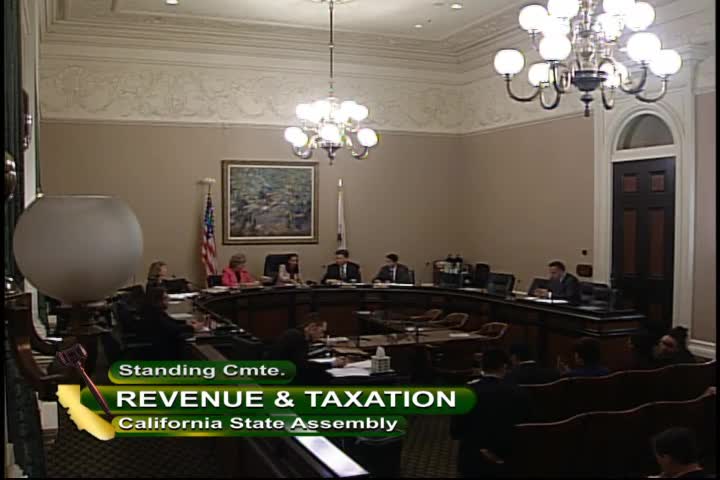 5MIN
Assembly Standing Committee on Revenue and Taxation
Bill Author

Bill Co-Author(s):