AB 1951: Pupil assessments: Pathways to College Act.
- Session Year: 2017-2018
- House: Assembly
- Latest Version Date: 2018-09-04
Existing law establishes the California Assessment of Student Performance and Progress (CAASPP) as the statewide system of pupil assessments under which certain assessments are required or authorized to be administered in public schools, as specified, including a consortium summative assessment in English language arts and mathematics for grades 3 to 8, inclusive, and grade 11 that measures content standards adopted by the State Board of Education.
This bill would require, pursuant to specified provisions of the federal Elementary and Secondary Education Act, the Superintendent of Public Instruction to approve a nationally recognized high school assessment that a local educational agency, as defined, may, at its own discretion, administer, if the alternative assessment is approved by the local educational agencys governing board or body in a public meeting, commencing with the 202021 school year, and each school year thereafter, in lieu of the consortium summative assessment in English language arts and mathematics for grade 11.
The bill would require a nationally recognized high school assessment approved by the Superintendent to meet specified requirements, would authorize the Superintendent to require the publisher of that assessment to provide documentation that the assessment meets or exceeds these requirements, and would require the Superintendent, if he or she determines that the assessment does not meet these requirements, to inform the assessments publisher in writing of specific deficiencies and changes needed to meet these requirements. The bill would authorize a governing board of a local educational agency that is part of a consortium of local educational agencies to enter into a cooperative contract with a publisher for the purposes of providing an assessment, as provided. To the extent permitted by the United States Department of Education, the bill would deem certain nationally recognized high school assessments to meet these requirements, and would require the Superintendent to approve these assessments for selection by a local educational agency. The bill would require the state board to amend the state plan required pursuant to federal law to account for the authorization for local educational agencies to use an alternate assessment pursuant to the bills provisions, if required by federal law.
The bill would require a local educational agency that administers a nationally recognized high school assessment to comply with specified requirements, would require the Superintendent to apportion to the local educational agency the lesser of the actual cost of administering the alternative assessment, as specified, and the amount that would have been apportioned to the local educational agency if it had administered the consortium summative assessment in English language arts and mathematics for grade 11. The bill would state that a local educational agency may administer only one nationally recognized high school assessment in lieu of the consortium summative assessment in English language arts and mathematics for grade 11.
The bill would make these provisions inoperative 5 years after the first school year in which a local educational agency is able to exercise the authority to administer the alternative assessment, as specified, and would repeal these provisions as of the following January 1. The bill would require the Superintendent to inform the Legislative Counsel within 30 days of when this 5 year condition has been satisfied and post that determination on its Internet Web site.
The bill would require the State Department of Education to ensure that local educational agencies comply with specified requirements, concerning the alternative assessment, that apply in connection with the summative assessments under CAASPP, including that grade 11 pupils, or parents or legal guardians of those pupils, may request results from the alternative assessment.
Existing law requires the Superintendent to prepare and submit, and subsequently post on the Internet Web site of the department, an annual report to the state board containing an analysis of the results and test scores of the summative assessments administered under the CAASPP.
This bill would require the Superintendent to include the results and test scores of the alternative assessment in that annual report.
Existing law establishes the California Assessment of Student Performance and Progress (CAASPP) as the statewide system of pupil assessments under which certain assessments are required or authorized to be administered in public schools, as specified, including a consortium summative assessment in English language arts and mathematics for grades 3 to 8, inclusive, and grade 11 that measures content standards adopted by the State Board of Education.
This bill would require, pursuant to specified provisions of the federal Elementary and Secondary Education Act, the Superintendent of Public Instruction to approve a nationally recognized high school assessment that a local educational agency, as defined, may, at its own discretion, administer, if the alternative assessment is approved by the local educational agencys governing board or body in a public meeting, commencing with the 202021 school year, and each school year thereafter, in lieu of the consortium summative assessment in English language arts and mathematics for grade 11.
The bill would require a nationally recognized high school assessment approved by the Superintendent to meet specified requirements, would authorize the Superintendent to require the publisher of that assessment to provide documentation that the assessment meets or exceeds these requirements, and would require the Superintendent, if he or she determines that the assessment does not meet these requirements, to inform the assessments publisher in writing of specific deficiencies and changes needed to meet these requirements. The bill would authorize a governing board of a local educational agency that is part of a consortium of local educational agencies to enter into a cooperative contract with a publisher for the purposes of providing an assessment, as provided. To the extent permitted by the United States Department of Education, the bill would deem certain nationally recognized high school assessments to meet these requirements, and would require the Superintendent to approve these assessments for selection by a local educational agency. The bill would require the state board to amend the state plan required pursuant to federal law to account for the authorization for local educational agencies to use an alternate assessment pursuant to the bills provisions, if required by federal law.
The bill would require a local educational agency that administers a nationally recognized high school assessment to comply with specified requirements, would require the Superintendent to apportion to the local educational agency the lesser of the actual cost of administering the alternative assessment, as specified, and the amount that would have been apportioned to the local educational agency if it had administered the consortium summative assessment in English language arts and mathematics for grade 11. The bill would state that a local educational agency may administer only one nationally recognized high school assessment in lieu of the consortium summative assessment in English language arts and mathematics for grade 11.
The bill would make these provisions inoperative 5 years after the first school year in which a local educational agency is able to exercise the authority to administer the alternative assessment, as specified, and would repeal these provisions as of the following January 1. The bill would require the Superintendent to inform the Legislative Counsel within 30 days of when this 5 year condition has been satisfied and post that determination on its Internet Web site.
The bill would require the State Department of Education to ensure that local educational agencies comply with specified requirements, concerning the alternative assessment, that apply in connection with the summative assessments under CAASPP, including that grade 11 pupils, or parents or legal guardians of those pupils, may request results from the alternative assessment.
Existing law requires the department to prepare and submit, and subsequently post on its Internet Web site, an annual report to the state board containing an analysis of the results and test scores of the summative assessments administered under the CAASPP.
This bill would require the department to include the results and test scores of the alternative assessment in that annual report.
Existing law establishes the California Assessment of Student Performance and Progress (CAASPP) as the statewide system of pupil assessments under which certain assessments are required or authorized to be administered in public schools, as specified, including a consortium summative assessment in English language arts and mathematics for grades 3 to 8, inclusive, and grade 11 that measures content standards adopted by the State Board of Education.
This bill would require, pursuant to specified provisions of the federal Elementary and Secondary Education Act, the Superintendent of Public Instruction to approve a nationally recognized high school assessment that a local educational agency, as defined, may, at its own discretion, administer, if the alternative assessment is approved by the local educational agencys governing board or body in a public meeting, commencing with the 202021 school year, and each school year thereafter, in lieu of the consortium summative assessment in English language arts and mathematics for grade 11.
The bill would require a nationally recognized high school assessment approved by the Superintendent to meet specified requirements, would authorize the Superintendent to require the publisher of that assessment to provide documentation that the assessment meets or exceeds these requirements, and would require the Superintendent, if he or she determines that the assessment does not meet these requirements, to inform the assessments publisher in writing of specific deficiencies and changes needed to meet these requirements. The To the extent permitted by the United States Department of Education, the bill would deem certain nationally recognized high school assessments to meet these requirements, and would require the Superintendent to approve these assessments for selection by a local educational agency. The bill would require the state board to amend the state plan required pursuant to federal law to account for the authorization for local educational agencies to use an alternate assessment pursuant to the bills provisions, if required by federal law.
The bill would require a local educational agency that administers a nationally recognized high school assessment to comply with specified requirements, would require the Superintendent to apportion to the local educational agency the lesser of the actual cost of administering the alternative assessment, as specified, and the amount that would have been apportioned to the local educational agency if it had administered the consortium summative assessment in English language arts and mathematics for grade 11. The bill would state that a local educational agency may administer only one nationally recognized high school assessment in lieu of the consortium summative assessment in English language arts and mathematics for grade 11.
The bill would make these provisions inoperative 5 years after the first school year in which a local educational agency is able to exercise the authority to administer the alternative assessment, as specified, and would repeal these provisions as of the following January 1. The bill would require the Superintendent to inform the Legislative Counsel within 30 days of when this 5 year condition has been satisfied and post that determination on its Internet Web site.
The bill would require the State Department of Education to ensure that local educational agencies comply with specified requirements, concerning the alternative assessment, that apply in connection with the summative assessments under CAASPP, including that grade 11 pupils, or parents or legal guardians of those pupils, may request results from the alternative assessment.
Existing law requires the department to prepare and submit, and subsequently post on its Internet Web site, an annual report to the state board containing an analysis of the results and test scores of the summative assessments administered under the CAASPP.
This bill would require the department to include the results and test scores of the alternative assessment in that annual report.
Existing law establishes the California Assessment of Student Performance and Progress (CAASPP) as the statewide system of pupil assessments under which certain assessments are required or authorized to be administered in public schools, as specified, including a consortium summative assessment in English language arts and mathematics for grades 3 to 8, inclusive, and grade 11 that measures content standards adopted by the State Board of Education.
This bill would require, pursuant to specified provisions of the federal Elementary and Secondary Education Act, the Superintendent of Public Instruction to approve a nationally recognized high school assessment that a local educational agency, as defined, may, at its own discretion, administer, if the alternative assessment is approved by the local educational agencys governing board or body in a public meeting, commencing with the 201920 202021 school year, and each school year thereafter, in lieu of the consortium summative assessment in English language arts and mathematics for grade 11.
The bill would require a nationally recognized high school assessment approved by the Superintendent to meet specified requirements, would authorize the Superintendent to require the publisher of that assessment to provide documentation that the assessment meets or exceeds these requirements, and would require the Superintendent, if he or she determines that the assessment does not meet these requirements, to inform the assessments publisher in writing of specific deficiencies and changes needed to meet these requirements. The bill would deem certain nationally recognized high school assessments to meet these requirements, and would require the Superintendent to approve these assessments for selection by a local educational agency.
The bill would require a local educational agency that administers a nationally recognized high school assessment to comply with specified requirements, would require the Superintendent to apportion to the local educational agency the lesser of the actual cost of administering the alternative assessment, as specified, and the amount that would have been apportioned to the local educational agency if it had administered the consortium summative assessment in English language arts and mathematics for grade 11. The bill would state that a local educational agency may administer only one nationally recognized high school assessment in lieu of the consortium summative assessment in English language arts and mathematics for grade 11.
The bill would require the State Department of Education to ensure that local educational agencies comply with specified requirements, concerning the alternative assessment, that apply in connection with the summative assessments under CAASPP, including that grade 11 pupils, or parents or legal guardians of those pupils, may request results from the alternative assessment.
Existing law requires the department to prepare and submit, and subsequently post on its Internet Web site, an annual report to the state board containing an analysis of the results and test scores of the summative assessments administered under the CAASPP.
This bill would require the department to include the results and test scores of the alternative assessment in that annual report.
Existing law establishes the California Assessment of Student Performance and Progress (CAASPP) as the statewide system of pupil assessments under which certain assessments are required or authorized to be administered in public schools, as specified, including a consortium summative assessment in English language arts and mathematics for grades 3 to 8, inclusive, and grade 11 that measures content standards adopted by the state board. State Board of Education.
This bill would require, pursuant to specified provisions of the federal Elementary and Secondary Education Act, the Superintendent of Public Instruction to approve a nationally recognized high school assessment that a local educational agency, as defined, may, at its own discretion, administer, if the alternative assessment is approved by the local educational agencys governing board or body in a public meeting, commencing with the 201920 school year, and each school year thereafter, in lieu of the consortium summative assessment in English language arts and mathematics for grade 11.
The bill would require a nationally recognized high school assessment approved by the Superintendent to meet specified requirements, would authorize the Superintendent to require the publisher of that assessment to provide documentation that the assessment meets or exceeds these requirements, and would require the Superintendent, if he or she determines that the assessment does not meet these requirements, to inform the assessments publisher in writing of specific deficiencies and changes needed to meet these requirements. The bill would deem certain nationally recognized high school assessments to meet these requirements, and would require the Superintendent to approve these assessments for selection by a local educational agency.
The bill would require a local educational agency that administers a nationally recognized high school assessment to comply with specified requirements, would require the Superintendent to apportion to the local educational agency the lesser of the actual cost of administering the alternative assessment, as specified, and the amount that would have been apportioned to the local educational agency if it had administered the consortium summative assessment in English language arts and mathematics for grade 11. The bill would state that a local educational agency may administer only one nationally recognized high school assessment in lieu of the consortium summative assessment in English language arts and mathematics for grade 11.
The bill would require the State Department of Education to ensure that local educational agencies comply with specified requirements, concerning the alternative assessment, that apply in connection with the summative assessments under CAASPP, including that grade 11 pupils, or parents or legal guardians of those pupils, may request results from the alternative assessment.
Existing law requires the department to prepare and submit, and subsequently post on its Internet Web site, an annual report to the state board containing an analysis of the results and test scores of the summative assessments administered under the CAASPP.
This bill would require the department to include the results and test scores of the alternative assessment in that annual report.
Existing law establishes the California Assessment of Student Performance and Progress (CAASPP) as the statewide system of pupil assessments under which certain assessments are required or authorized to be administered in public schools, as specified, including a consortium summative assessment in English language arts and mathematics for grades 3 to 8, inclusive, and grade 11 that measures content standards adopted by the state board.
This bill would require, pursuant to specified provisions of the federal Elementary and Secondary Education Act, the Superintendent of Public Instruction to approve a nationally recognized high school assessment that a local educational agency, as defined, may, at its own discretion, administer, commencing with the 201920 school year, and each school year thereafter, in lieu of the consortium summative assessment in English language arts and mathematics for grade 11.
The bill would require a nationally recognized high school assessment approved by the Superintendent to meet specified requirements, would authorize the Superintendent to require the publisher of that assessment to provide documentation that the assessment meets or exceeds these requirements, and would require the Superintendent, if he or she determines that the assessment does not meet these requirements, to inform the assessments publisher in writing of specific deficiencies and changes needed to meet these requirements. The bill would deem certain nationally recognized high school assessments to meet these requirements, and would require the Superintendent to approve these assessments for selection by a local educational agency.
The bill would require a local educational agency that administers a nationally recognized high school assessment to comply with specified requirements, would require the Superintendent to apportion to the local educational agency the lesser of the actual cost of administering the alternative assessment, as specified, and the amount that would have been apportioned to the local educational agency if it had administered the consortium summative assessment in English language arts and mathematics for grade 11. The bill would state that a local educational agency may administer only one nationally recognized high school assessment in lieu of the consortium summative assessment in English language arts and mathematics for grade 11.
(a)The Superintendent shall prepare and submit, and subsequently post on the Internet Web site of the department, an annual report to the state board containing an analysis of the results and test scores of the summative assessments administered pursuant to Sections 60640 and 60640.5. The Superintendent shall notify the state board and the appropriate policy and fiscal committees of the Legislature that the annual report is available on the Internet Web site of the department.
(b)The Superintendent shall post a periodic update on the implementation of the California Assessment of Student Performance and Progress on the Internet Web site of the department, and notify the state board and the appropriate policy and fiscal committees of the Legislature that the update is available on the Internet Web site of the department.
SEC. 2.Section 60640.5 is added to the Education Code, to read:60640.5.(a)This section shall be known, and may be cited, as the Pathways to College Act.
(b)(1)Pursuant to Section 1111(b)(2)(H) of the federal Elementary and Secondary Education Act (20 U.S.C. Sec. 6301 et seq.), no later than 30 days after the Superintendent determines that a nationally recognized high school assessment satisfies the requirements of subdivision (c), the Superintendent shall approve one or more nationally recognized high school assessments that a local education agency may, at its own discretion, administer, pursuant to subdivision (f), commencing with the 202021 school year, and each school year thereafter, in lieu of the assessment required pursuant to paragraph (1) of subdivision (b) of Section 60640.
(2)(A)A governing board of a local educational agency that is part of a consortium of local educational agencies may enter into a cooperative contract with a publisher for the purposes of providing an assessment pursuant to paragraph (1).
(B)A local educational agency that chooses to administer an assessment pursuant to paragraph (1) may utilize the terms of a contract with a publisher that has been entered into by another district for purposes of providing the assessment.
(c)A nationally recognized high school assessment approved by the Superintendent pursuant to paragraph (1) of subdivision (b) shall meet all of the following requirements:
(1)Align with the academic content standards adopted by the state board pursuant to Section 60605, and address the depth and breadth of those standards.
(2)Be at least as rigorous as the assessment required pursuant to paragraph (1) of subdivision (b) of Section 60640.
(3)Meet the requirements of Sections 200.2(b), 200.5(a), and 200.6 of Title 34 of the Code of Federal Regulations, to ensure appropriate accommodations for English learners and pupils with disabilities, including pupils identified pursuant to Section 602 of the federal Individuals with Disabilities Education Act, Section 504 of the federal Rehabilitation Act of 1973, and Title II of the federal Americans with Disabilities Act of 1990.
(4)Produce valid and reliable data on pupil academic achievement with respect to all high school pupils and each subgroup of high school pupils in the local education agency.
(5)Produce disaggregated scores based on English proficiency status, gender, ethnicity, socioeconomic disadvantage, foster care status, and special education designation.
(6)Produce individual pupil scores that can be linked to scores from the California Assessment of Student Performance and Progress (CAASPP) assessments.
(7)Ensure that the use of appropriate accommodations by a pupil with disabilities or an English learner does not deny the opportunity of any pupil to participate in the assessment or deny any pupil of any benefit from participating in the assessment that is afforded to pupils without disabilities or pupils who are not English learners.
(8)Satisfy the peer review requirements specified in Section 1111(a)(4) of the federal Elementary and Secondary Education Act (20 U.S.C. Sec. 6301 et seq.), as required by Section 1111(b)(2)(H)(iii)(II) of the federal Elementary and Secondary Education Act (20 U.S.C. Sec. 6301 et seq.).
(d)(1)The Superintendent may require a publisher of a nationally recognized high school assessment that is being considered for his or her approval pursuant to subdivision (b) to provide documentation that the assessment meets or exceeds the requirements of subdivision (c).
(2)If the Superintendent determines that a nationally recognized high school assessment being considered for his or her approval pursuant to subdivision (b) does not meet the requirements of subdivision (c), the Superintendent shall inform the publisher of the assessment in writing of the specific deficiencies and changes needed to meet the requirements of subdivision (c).
(e)Only to the extent permitted by the United States Department of Education, a nationally recognized high school assessment that has been approved for use by any state that has adopted the Common Core State Standards and that meets federal requirements under Section 1111(b)(2)(H) of the federal Elementary and Secondary Education Act (20 U.S.C. Sec. 6301 et seq.) shall be deemed to have met the requirements of subdivisions (c) and (d) and shall be approved by the Superintendent pursuant to subdivision (b).
(f)(1)A local educational agency may administer an assessment approved pursuant to paragraph (1) of subdivision (b), instead of the assessment required pursuant to paragraph (1) of subdivision (b) of Section 60640, only if use of the alternative assessment has been approved by the local educational agencys governing board or body at a public meeting.
(2)Before a local educational agency may administer an assessment pursuant to paragraph (1), the state board shall amend the state plan required pursuant to Section 1111 of the federal Elementary and Secondary Education Act (20 U.S.C. Sec. 6301 et seq.) to account for the authorization for local educational agencies to use an alternate assessment pursuant to this section, if required by federal law.
(g)A local education agency that administers a nationally recognized high school assessment pursuant to subdivision (b) shall do all of the following:
(1)Notify the Superintendent, and the parents and legal guardians of its pupils entering grade 11, at the beginning of each school year during which the assessment will be administered to those pupils, that it will be administering an assessment that is different from the assessment required pursuant to paragraph (1) of subdivision (b) of Section 60640.
(2)Administer the assessment free of charge to all pupils in grade 11, except for those pupils who opt out pursuant to Section 60615, and as provided in paragraph (3).
(3)Pursuant to Section 1412(a)(16) of Title 20 of the United States Code, administer the assessment to individuals with exceptional needs, as defined in Section 56026, with appropriate accommodations, where necessary, and provide an alternate assessment to individuals with exceptional needs who are unable to participate in testing, even with accommodations.
(4)Administer the assessment to English learner pupils with appropriate accommodations, where necessary. To the extent permissible under federal law, recently arrived English learner pupils shall be exempt from taking the alternative assessment in English language arts.
(5)Report scores and pupil participation data to the department in a manner prescribed by the Superintendent.
(h)The Superintendent shall apportion to a local education agency that administers a nationally recognized high school assessment pursuant to subdivision (b), in lieu of the assessment required pursuant to paragraph (1) of subdivision (b) of Section 60640, the lesser of the following:
(1)The actual cost of administering the nationally recognized high school assessment, including, but not necessarily limited to, administering and scoring the assessment and reporting results of the assessment to the Superintendent.
(2)The amount that would have been apportioned to the local education agency if it had administered the assessment required pursuant to paragraph (1) of subdivision (b) of Section 60640.
(i)A local education agency may administer only one nationally recognized high school assessment in lieu of the assessment required pursuant to paragraph (1) of subdivision (b) of Section 60640. This subdivision shall not be construed to prohibit a local education agency that does not administer a nationally recognized high school assessment pursuant to this section from administering one or more assessments in addition to the assessment required pursuant to paragraph (1) of subdivision (b) of Section 60640.
(j)For purposes of this section, a local education agency means a school district, county office of education, or charter school.
(k)(1)This section shall become inoperative five years after the first school year in which a local educational agency is able to exercise the authority granted to it pursuant to subdivision (b), and as of the following January 1, is repealed.
(2)The Superintendent shall inform the Legislative Counsel within 30 days of when the conditions of paragraph (1) have been satisfied, and post that determination on the departments Internet Web site.
SEC. 3.Section 60641 of the Education Code is amended to read:60641.(a)The department shall ensure that local educational agencies comply with each of the following requirements:
(1)The achievement tests provided for in Section 60640 or 60640.5 are scheduled to be administered to all pupils, inclusive of pupils enrolled in charter schools and exclusive of pupils exempted pursuant to Section 60640, during the period prescribed in subdivision (b) of Section 60640.
(2)For assessments that produce valid individual pupil results, the individual results of each pupil tested pursuant to Sections 60640 and 60640.5 shall be reported, in writing, to the parent or guardian of the pupil. The report shall include a clear explanation of the purpose of the test, the score of the pupil, and the intended use by the local educational agency of the test score. This subdivision does not require teachers or other local educational agency personnel to prepare individualized explanations of the test score of each pupil. It is the intent of the Legislature that nothing in this section shall preclude a school or school district from meeting the reporting requirement by the use of electronic media formats that secure the confidentiality of the pupil and the pupils results. State agencies or local educational agencies shall not use a comparison resulting from the scores and results of the California Assessment of Student Performance and Progress (CAASPP) assessments, or the alternative assessment administered pursuant to Section 60640.5, and the assessment scores and results from assessments that measured previously adopted content standards.
(3)(A)For assessments that produce valid individual pupil results, the individual results of each pupil tested pursuant to Sections 60640 and 60640.5 also shall be reported to the school and teachers of a pupil. The local educational agency shall include the test results of a pupil in his or her pupil records. However, except as provided in this section and Section 60607, personally identifiable pupil test results only may be released with the permission of either the pupils parent or guardian if the pupil is a minor, or the pupil if the pupil has reached the age of majority or is emancipated.
(B)Notwithstanding subparagraph (A) and pursuant to subdivision (c) of Section 60607, a pupil or his or her parent or guardian may authorize the release of individual pupil results to a postsecondary educational institution for the purpose of credit, placement, determination of readiness for college-level coursework, or admission.
(4)The districtwide, school-level, and grade-level results of the CAASPP in each of the grades designated pursuant to Section 60640, and the districtwide and school-level results of the alternative assessment administered pursuant to Section 60640.5, but not the score or relative position of any individually ascertainable pupil, shall be reported to the governing board of the school district at a regularly scheduled meeting, and the countywide, school-level, and grade-level results for classes and programs under the jurisdiction of the county office of education shall be similarly reported to the county board of education at a regularly scheduled meeting.
(b)The state board shall adopt regulations that outline a calendar for delivery and receipt of summative assessment results at the pupil, school, grade, district, county, and state levels. The calendar shall include delivery dates to the department and to local educational agencies. The calendar for delivery shall provide for the timely return of assessment results, and consider the amount of paper-and-pencil administered assessments and number of items requiring hand scoring. The calendar shall also ensure that individual assessment results are reported to local educational agencies within eight weeks of receipt by the contractor for scoring.
(c)Aggregated, disaggregated, or group scores or reports that include the results of the CAASPP assessments or the alternate assessment administered pursuant to Section 60640.5 inclusive of the reports developed pursuant to Section 60630, shall not be publicly reported to any party other than the school or local educational agency where the pupils were tested, if the aggregated, disaggregated, or group scores or reports are comprised of 10 or fewer individual pupil assessment results. Exclusive of the reports developed pursuant to Section 60630, in no case shall any group score or report be displayed that would deliberately or inadvertently make the score or performance of any individual pupil or teacher identifiable.
(d)The department shall ensure that pupils in grade 11, or parents or legal guardians of those pupils, may request results from grade 11 assessments administered as part of the CAASPP or the alternative assessment administered pursuant to Section 60640.5 for the purpose of determining credit, placement, or readiness for college-level coursework be released to a postsecondary educational institution.
(a)The Superintendent shall prepare and submit, and subsequently post on the Internet Web site of the department, an annual report to the state board containing an analysis of the results and test scores of the summative assessments administered pursuant to Section Sections 60640 and 60640.5. The Superintendent shall notify the state board and the appropriate policy and fiscal committees of the Legislature that the annual report is available on the Internet Web site of the department.
(b)The Superintendent shall post a periodic update on the implementation of the California Assessment of Student Performance and Progress on the Internet Web site of the department, and notify the state board and the appropriate policy and fiscal committees of the Legislature that the update is available on the Internet Web site of the department.
SEC. 2.Section 60640.5 is added to the Education Code, to read:60640.5.(a)This section shall be known, and may be cited, as the Pathways to College Act.
(b)Pursuant to Section 1111(b)(2)(H) of the federal Elementary and Secondary Education Act (20 U.S.C. Sec. 6301 et seq.), no later than ____ 30 days after the Superintendent determines that a nationally recognized high school assessment satisfies the requirements of subdivision (c), the Superintendent shall approve one or more nationally recognized high school assessments that a local education agency may, at its own discretion, administer, pursuant to subdivision (f), commencing with the 202021 school year, and each school year thereafter, in lieu of the assessment required pursuant to paragraph (1) of subdivision (b) of Section 60640.
(c)A nationally recognized high school assessment approved by the Superintendent pursuant to subdivision (b) shall meet all of the following requirements:
(1)Align with the academic content standards adopted by the state board pursuant to Section 60605, and address the depth and breadth of those standards.
(2)Be at least as rigorous as the assessment required pursuant to paragraph (1) of subdivision (b) of Section 60640.
(3)Meet the requirements of Sections 200.2(b), 200.5(a), and 200.6 of Title 34 of the Code of Federal Regulations, to ensure appropriate accommodations for English learners and pupils with disabilities, including pupils identified pursuant to Section 602 of the federal Individuals with Disabilities Education Act, Section 504 of the federal Rehabilitation Act of 1973, and Title II of the federal Americans with Disabilities Act of 1990.
(4)Produce valid and reliable data on pupil academic achievement with respect to all high school pupils and each subgroup of high school pupils in the local education agency.
(5)Produce disaggregated scores based on English proficiency status, gender, ethnicity, socioeconomic disadvantage, foster care status, and special education designation.
(6)Produce individual pupil scores that can be linked to scores from the California Assessment of Student Performance and Progress (CAASPP) assessments.
(7)Ensure that the use of appropriate accommodations by a pupil with disabilities or an English learner does not deny the opportunity of any pupil to participate in the assessment or deny any pupil of any benefit from participating in the assessment that is afforded to pupils without disabilities or pupils who are not English learners.
(8)Satisfy the peer review requirements specified in Section 1111(a)(4) of the federal Elementary and Secondary Education Act (20 U.S.C. Sec. 6301 et seq.), as required by Section 1111(b)(2)(H)(iii)(II) of the federal Elementary and Secondary Education Act (20 U.S.C. Sec. 6301 et seq.).
(d)(1)The Superintendent may require a publisher of a nationally recognized high school assessment that is being considered for his or her approval pursuant to subdivision (b) to provide documentation that the assessment meets or exceeds the requirements of subdivision (c).
(2)If the Superintendent determines that a nationally recognized high school assessment being considered for his or her approval pursuant to subdivision (b) does not meet the requirements of subdivision (c), the Superintendent shall inform the publisher of the assessment in writing of the specific deficiencies and changes needed to meet the requirements of subdivision (c).
(e)A Only to the extent permitted by the United States Department of Education, a nationally recognized high school assessment that has been approved for use by any state that has adopted the Common Core State Standards and that meets federal requirements under Section 1111(b)(2)(H) of the federal Elementary and Secondary Education Act (20 U.S.C. Sec. 6301 et seq.) shall be deemed to have met the requirements of subdivisions (c) and (d) and shall be approved by the Superintendent pursuant to subdivision (b).
(f)(1)A local educational agency may administer an assessment approved pursuant to subdivision (b), instead of the assessment required pursuant to paragraph (1) of subdivision (b) of Section 60640, only if use of the alternative assessment has been approved by the local educational agencys governing board or body at a public meeting.
(2)Before a local educational agency may administer an assessment pursuant to paragraph (1), the state board shall amend the state plan required pursuant to Section 1111 of the federal Elementary and Secondary Education Act (20 U.S.C. Sec. 6301 et seq.) to account for the authorization for local educational agencies to use an alternate assessment pursuant to this section, if required by federal law.
(g)A local education agency that administers a nationally recognized high school assessment pursuant to subdivision (b) shall do all of the following:
(1)Notify the Superintendent, and the parents and legal guardians of its pupils entering grade 11, at the beginning of each school year during which the assessment will be administered to those pupils, that it will be administering an assessment that is different from the assessment required pursuant to paragraph (1) of subdivision (b) of Section 60640.
(2)Administer the assessment free of charge to all pupils in grade 11, except for those pupils who opt out pursuant to Section 60615, and as provided in paragraph (3).
(3)Pursuant to Section 1412(a)(16) of Title 20 of the United States Code, administer the assessment to individuals with exceptional needs, as defined in Section 56026, with appropriate accommodations, where necessary, and provide an alternate assessment to individuals with exceptional needs who are unable to participate in testing, even with accommodations.
(4)Administer the assessment to English learner pupils with appropriate accommodations, where necessary. To the extent permissible under federal law, recently arrived English learner pupils shall be exempt from taking the alternative assessment in English language arts.
(5)Report scores and pupil participation data to the department in a manner prescribed by the Superintendent.
(h)The Superintendent shall apportion to a local education agency that administers a nationally recognized high school assessment pursuant to subdivision (b), in lieu of the assessment required pursuant to paragraph (1) of subdivision (b) of Section 60640, the lesser of the following:
(1)The actual cost of administering the nationally recognized high school assessment, including, but not necessarily limited to, administering and scoring the assessment and reporting results of the assessment to the Superintendent.
(2)The amount that would have been apportioned to the local education agency if it had administered the assessment required pursuant to paragraph (1) of subdivision (b) of Section 60640.
(i)A local education agency may administer only one nationally recognized high school assessment in lieu of the assessment required pursuant to paragraph (1) of subdivision (b) of Section 60640. This subdivision shall not be construed to prohibit a local education agency that does not administer a nationally recognized high school assessment pursuant to this section from administering one or more assessments in addition to the assessment required pursuant to paragraph (1) of subdivision (b) of Section 60640.
(j)For purposes of this section, a local education agency means a school district, county office of education, or charter school.
(k)(1)This section shall become inoperative five years after the first school year in which a local educational agency is able to exercise the authority granted to it pursuant to subdivision (b), and as of the following January 1, is repealed.
(2)The Superintendent shall inform the Legislative Counsel within 30 days of when the conditions of paragraph (1) have been satisfied, and post that determination on the departments Internet Web site.
SEC. 3.Section 60641 of the Education Code is amended to read:60641.(a)The department shall ensure that local educational agencies comply with each of the following requirements:
(1)The achievement tests provided for in Section 60640 or 60640.5 are scheduled to be administered to all pupils, inclusive of pupils enrolled in charter schools and exclusive of pupils exempted pursuant to Section 60640, during the period prescribed in subdivision (b) of Section 60640.
(2)For assessments that produce valid individual pupil results, the individual results of each pupil tested pursuant to Sections 60640 and 60640.5 shall be reported, in writing, to the parent or guardian of the pupil. The report shall include a clear explanation of the purpose of the test, the score of the pupil, and the intended use by the local educational agency of the test score. This subdivision does not require teachers or other local educational agency personnel to prepare individualized explanations of the test score of each pupil. It is the intent of the Legislature that nothing in this section shall preclude a school or school district from meeting the reporting requirement by the use of electronic media formats that secure the confidentiality of the pupil and the pupils results. State agencies or local educational agencies shall not use a comparison resulting from the scores and results of the California Assessment of Student Performance and Progress (CAASPP) assessments, or the alternative assessment administered pursuant to Section 60640.5, and the assessment scores and results from assessments that measured previously adopted content standards.
(3)(A)For assessments that produce valid individual pupil results, the individual results of each pupil tested pursuant to Sections 60640 and 60640.5 also shall be reported to the school and teachers of a pupil. The local educational agency shall include the test results of a pupil in his or her pupil records. However, except as provided in this section and Section 60607, personally identifiable pupil test results only may be released with the permission of either the pupils parent or guardian if the pupil is a minor, or the pupil if the pupil has reached the age of majority or is emancipated.
(B)Notwithstanding subparagraph (A) and pursuant to subdivision (c) of Section 60607, a pupil or his or her parent or guardian may authorize the release of individual pupil results to a postsecondary educational institution for the purpose of credit, placement, determination of readiness for college-level coursework, or admission.
(4)The districtwide, school-level, and grade-level results of the CAASPP in each of the grades designated pursuant to Section 60640, and the districtwide and school-level results of the alternative assessment administered pursuant to Section 60640.5, but not the score or relative position of any individually ascertainable pupil, shall be reported to the governing board of the school district at a regularly scheduled meeting, and the countywide, school-level, and grade-level results for classes and programs under the jurisdiction of the county office of education shall be similarly reported to the county board of education at a regularly scheduled meeting.
(b)The state board shall adopt regulations that outline a calendar for delivery and receipt of summative assessment results at the pupil, school, grade, district, county, and state levels. The calendar shall include delivery dates to the department and to local educational agencies. The calendar for delivery shall provide for the timely return of assessment results, and consider the amount of paper-and-pencil administered assessments and number of items requiring hand scoring. The calendar shall also ensure that individual assessment results are reported to local educational agencies within eight weeks of receipt by the contractor for scoring.
(c)Aggregated, disaggregated, or group scores or reports that include the results of the CAASPP assessments or the alternate assessment administered pursuant to Section 60640.5 inclusive of the reports developed pursuant to Section 60630, shall not be publicly reported to any party other than the school or local educational agency where the pupils were tested, if the aggregated, disaggregated, or group scores or reports are comprised of 10 or fewer individual pupil assessment results. Exclusive of the reports developed pursuant to Section 60630, in no case shall any group score or report be displayed that would deliberately or inadvertently make the score or performance of any individual pupil or teacher identifiable.
(d)The department shall ensure that pupils in grade 11, or parents or legal guardians of those pupils, may request results from grade 11 assessments administered as part of the CAASPP or the alternative assessment administered pursuant to Section 60640.5 for the purpose of determining credit, placement, or readiness for college-level coursework be released to a postsecondary educational institution.
(a)The Superintendent shall prepare and submit, and subsequently post on the Internet Web site of the department, an annual report to the state board containing an analysis of the results and test scores of the summative assessments administered pursuant to Section Sections 60640 and 60640.5. The Superintendent shall notify the state board and the appropriate policy and fiscal committees of the Legislature that the annual report is available on the Internet Web site of the department.
(b)The Superintendent shall post a periodic update on the implementation of the California Assessment of Student Performance and Progress on the Internet Web site of the department, and notify the state board and the appropriate policy and fiscal committees of the Legislature that the update is available on the Internet Web site of the department.
SEC. 2.Section 60640.5 is added to the Education Code, to read:60640.5.(a)This section shall be known, and may be cited, as the Pathways to College Act.
(b)Pursuant to Section 1111(b)(2)(H) of the federal Elementary and Secondary Education Act (20 U.S.C. Sec. 6301 et seq.), no later than ____ the Superintendent shall approve one or more nationally recognized high school assessments that a local education agency may, at its own discretion, administer, pursuant to subdivision (f), commencing with the 201920 202021 school year, and each school year thereafter, in lieu of the assessment required pursuant to paragraph (1) of subdivision (b) of Section 60640.
(c)A nationally recognized high school assessment approved by the Superintendent pursuant to subdivision (b) shall meet all of the following requirements:
(1)Align with the academic content standards adopted by the state board pursuant to Section 60605, and address the depth and breadth of those standards.
(2)Be at least as rigorous as the assessment required pursuant to paragraph (1) of subdivision (b) of Section 60640.
(3)Meet the requirements of Sections 200.2(b), 200.5(a), and 200.6 of Title 34 of the Code of Federal Regulations. Regulations, to ensure appropriate accommodations for English learners and pupils with disabilities, including pupils identified pursuant to Section 602 of the federal Individuals with Disabilities Education Act, Section 504 of the federal Rehabilitation Act of 1973, and Title II of the federal Americans with Disabilities Act of 1990.
(4)Produce valid and reliable data on pupil academic achievement with respect to all high school pupils and each subgroup of high school pupils in the local education agency.
(5)Produce disaggregated scores based on English proficiency status, gender, ethnicity, socioeconomic disadvantage, foster care status, and special education designation.
(6)Produce individual pupil scores that can be linked to scores from the California Assessment of Student Performance and Progress (CAASPP) assessments.
(7)Ensure that the use of appropriate accommodations by a pupil with disabilities or an English learner does not deny the opportunity of any pupil to participate in the assessment or deny any pupil of any benefit from participating in the assessment that is afforded to pupils without disabilities or pupils who are not English learners.
(d)(1)The Superintendent may require a publisher of a nationally recognized high school assessment that is being considered for his or her approval pursuant to subdivision (b) to provide documentation that the assessment meets or exceeds the requirements of subdivision (c).
(2)If the Superintendent determines that a nationally recognized high school assessment being considered for his or her approval pursuant to subdivision (b) does not meet the requirements of subdivision (c), the Superintendent shall inform the publisher of the assessment in writing of the specific deficiencies and changes needed to meet the requirements of subdivision (c).
(e)A nationally recognized high school assessment that has been approved for use by any state that has adopted the Common Core State Standards and that meets federal requirements under Section 1111(b)(2)(H) of the federal Elementary and Secondary Education Act (20 U.S.C. Sec. 6301 et seq.) shall be deemed to have met the requirements of subdivisions (c) and (d) and shall be approved by the Superintendent pursuant to subdivision (b).
(f)A local educational agency may administer an assessment approved pursuant to subdivision (b), instead of the assessment required pursuant to paragraph (1) of subdivision (b) of Section 60640, only if use of the alternative assessment has been approved by the local educational agencys governing board or body at a public meeting.
(g)A local education agency that administers a nationally recognized high school assessment pursuant to subdivision (b) shall do all of the following:
(1)Notify the Superintendent, and the parents and legal guardians of its pupils entering grade 11, at the beginning of each school year during which the assessment will be administered to those pupils, that it will be administering an assessment that is different from the assessment required pursuant to paragraph (1) of subdivision (b) of Section 60640.
(2)Administer the assessment free of charge to all pupils in grade 11, except for those pupils who opt out pursuant to Section 60615, and as provided in paragraph (3).
(3)Pursuant to Section 1412(a)(16) of Title 20 of the United States Code, administer the assessment to individuals with exceptional needs, as defined in Section 56026, with appropriate accommodations, where necessary, and provide an alternate assessment to individuals with exceptional needs who are unable to participate in testing, even with accommodations.
(4)Administer the assessment to English learner pupils with appropriate accommodations, where necessary. To the extent permissible under federal law, recently arrived English learner pupils shall be exempt from taking the alternative assessment in English language arts.
(5)Report scores and pupil participation data to the department in a manner prescribed by the Superintendent.
(h)The Superintendent shall apportion to a local education agency that administers a nationally recognized high school assessment pursuant to subdivision (b), in lieu of the assessment required pursuant to paragraph (1) of subdivision (b) of Section 60640, the lesser of the following:
(1)The actual cost of administering the nationally recognized high school assessment, including, but not necessarily limited to, administering and scoring the assessment and reporting results of the assessment to the Superintendent.
(2)The amount that would have been apportioned to the local education agency if it had administered the assessment required pursuant to paragraph (1) of subdivision (b) of Section 60640.
(i)A local education agency may administer only one nationally recognized high school assessment in lieu of the assessment required pursuant to paragraph (1) of subdivision (b) of Section 60640. This subdivision shall not be construed to prohibit a local education agency that does not administer a nationally recognized high school assessment pursuant to this section from administering one or more assessments in addition to the assessment required pursuant to paragraph (1) of subdivision (b) of Section 60640.
(j)For purposes of this section, a local education agency means a school district, county office of education, or charter school.
SEC. 3.Section 60641 of the Education Code is amended to read:60641.(a)The department shall ensure that local educational agencies comply with each of the following requirements:
(1)The achievement tests provided for in Sections Section 60640 and or 60640.5 are scheduled to be administered to all pupils, inclusive of pupils enrolled in charter schools and exclusive of pupils exempted pursuant to Section 60640, during the period prescribed in subdivision (b) of Section 60640.
(2)For assessments that produce valid individual pupil results, the individual results of each pupil tested pursuant to Sections 60640 and 60640.5 shall be reported, in writing, to the parent or guardian of the pupil. The report shall include a clear explanation of the purpose of the test, the score of the pupil, and the intended use by the local educational agency of the test score. This subdivision does not require teachers or other local educational agency personnel to prepare individualized explanations of the test score of each pupil. It is the intent of the Legislature that nothing in this section shall preclude a school or school district from meeting the reporting requirement by the use of electronic media formats that secure the confidentiality of the pupil and the pupils results. State agencies or local educational agencies shall not use a comparison resulting from the scores and results of the California Assessment of Student Performance and Progress (CAASPP) assessments, or the alternative assessment administered pursuant to Section 60640.5, and the assessment scores and results from assessments that measured previously adopted content standards.
(3)(A)For assessments that produce valid individual pupil results, the individual results of each pupil tested pursuant to Sections 60640 and 60640.5 also shall be reported to the school and teachers of a pupil. The local educational agency shall include the test results of a pupil in his or her pupil records. However, except as provided in this section and Section 60607, personally identifiable pupil test results only may be released with the permission of either the pupils parent or guardian if the pupil is a minor, or the pupil if the pupil has reached the age of majority or is emancipated.
(B)Notwithstanding subparagraph (A) and pursuant to subdivision (c) of Section 60607, a pupil or his or her parent or guardian may authorize the release of individual pupil results to a postsecondary educational institution for the purpose of credit, placement, determination of readiness for college-level coursework, or admission.
(4)The districtwide, school-level, and grade-level results of the CAASPP in each of the grades designated pursuant to Section 60640, and the districtwide and school-level results of the alternative assessment administered pursuant to Section 60640.5, but not the score or relative position of any individually ascertainable pupil, shall be reported to the governing board of the school district at a regularly scheduled meeting, and the countywide, school-level, and grade-level results for classes and programs under the jurisdiction of the county office of education shall be similarly reported to the county board of education at a regularly scheduled meeting.
(b)The state board shall adopt regulations that outline a calendar for delivery and receipt of summative assessment results at the pupil, school, grade, district, county, and state levels. The calendar shall include delivery dates to the department and to local educational agencies. The calendar for delivery shall provide for the timely return of assessment results, and consider the amount of paper-and-pencil administered assessments and number of items requiring hand scoring. The calendar shall also ensure that individual assessment results are reported to local educational agencies within eight weeks of receipt by the contractor for scoring.
(c)Aggregated, disaggregated, or group scores or reports that include the results of the CAASPP assessments or the alternate assessment administered pursuant to Section 60640.5 inclusive of the reports developed pursuant to Section 60630, shall not be publicly reported to any party other than the school or local educational agency where the pupils were tested, if the aggregated, disaggregated, or group scores or reports are comprised of 10 or fewer individual pupil assessment results. Exclusive of the reports developed pursuant to Section 60630, in no case shall any group score or report be displayed that would deliberately or inadvertently make the score or performance of any individual pupil or teacher identifiable.
(d)The department shall ensure that pupils in grade 11, or parents or legal guardians of those pupils, may request results from grade 11 assessments administered as part of the CAASPP or the alternative assessment administered pursuant to Section 60640.5 for the purpose of determining credit, placement, or readiness for college-level coursework be released to a postsecondary educational institution.
(a)The Superintendent shall prepare and submit, and subsequently post on the Internet Web site of the department, an annual report to the state board containing an analysis of the results and test scores of the summative assessments administered pursuant to Section 60640. Sections 60640 and 60640.5. The Superintendent shall notify the state board and the appropriate policy and fiscal committees of the Legislature that the annual report is available on the Internet Web site of the department.
(b)The Superintendent shall post a periodic update on the implementation of the California Assessment of Student Performance and Progress on the Internet Web site of the department, and notify the state board and the appropriate policy and fiscal committees of the Legislature that the update is available on the Internet Web site of the department.
SECTION 1.SEC. 2.Section 60640.5 is added to the Education Code, to read:60640.5.(a)This section shall be known, and may be cited, as the Pathways to College Act.
(b)Pursuant to Section 1111(b)(2)(H) of the federal Elementary and Secondary Education Act (20 U.S.C. Sec. 6301 et seq.), no later than ____ the Superintendent shall approve one or more nationally recognized high school assessments that a local education agency may, at its own discretion, administer, pursuant to subdivision (f), commencing with the 201920 school year, and each school year thereafter, in lieu of the assessment required pursuant to paragraph (1) of subdivision (b) of Section 60640.
(c)A nationally recognized high school assessment approved by the Superintendent pursuant to subdivision (b) shall meet all of the following requirements:
(1)Align with the academic content standards adopted by the state board pursuant to Section 60605, and address the depth and breadth of those standards.
(2)Be as equally rigorous as, or more rigorous than, at least as rigorous as the assessment required pursuant to paragraph (1) of subdivision (b) of Section 60640.
(3)Meet the requirements of Sections 200.2(b), 200.5(a), and 200.6 of Title 34 of the Code of Federal Regulations.
(4)Produce valid and reliable data on pupil academic achievement with respect to all high school pupils and each subgroup of high school pupils in the local education agency.
(5)Produce disaggregated scores based on English proficiency status, gender, ethnicity, socioeconomic disadvantage, foster care status, and special education designation.
(6)Produce individual pupil scores that can be linked to scores from the California Assessment of Student Performance and Progress (CAASPP) assessments.
(5)(7)Ensure that the use of appropriate accommodations by a pupil with disabilities or an English learner does not deny the opportunity of any pupil to participate in the assessment or deny any pupil of any benefit from participating in the assessment that is afforded to pupils without disabilities or pupils who are not English learners.
(d)(1)The Superintendent may require a publisher of a nationally recognized high school assessment that is being considered for his or her approval pursuant to subdivision (b) to provide documentation that the assessment meets or exceeds the requirements of subdivision (c).
(2)If the Superintendent determines that a nationally recognized high school assessment being considered for his or her approval pursuant to subdivision (b) does not meet the requirements of subdivision (c), the Superintendent shall inform the publisher of the assessment in writing of the specific deficiencies and changes needed to meet the requirements of subdivision (c).
(e)A nationally recognized high school assessment that has been adopted approved for use by any state that has adopted the Common Core State Standards and that meets federal requirements under Section 1111(b)(2)(H) of the federal Elementary and Secondary Education Act (20 U.S.C. Sec. 6301 et seq.) shall be deemed to have met the requirements of subdivisions (c) and (d) and shall be approved by the Superintendent pursuant to subdivision (b).
(f)A local educational agency may administer an assessment approved pursuant to subdivision (b), instead of the assessment required pursuant to paragraph (1) of subdivision (b) of Section 60640, only if use of the alternative assessment has been approved by the local educational agencys governing board or body at a public meeting.
(f)(g)A local education agency that administers a nationally recognized high school assessment pursuant to subdivision (b) shall do all of the following:
(1)Notify the Superintendent, and the parents and legal guardians of its pupils entering grade 11, at the beginning of each school year during which the assessment will be administered to those pupils, that it will be administering an assessment that is different from the assessment required pursuant to paragraph (1) of subdivision (b) of Section 60640.
(2)Administer the assessment free of charge to all pupils in grade 11, except for those pupils who opt out pursuant to Section 60615, and as provided in paragraph (3).
(3)Administer Pursuant to Section 1412(a)(16) of Title 20 of the United States Code, administer the assessment to individuals with exceptional needs, as defined in Section 56026, with appropriate accommodations, where necessary, and provide an alternate assessment to individuals with exceptional needs who are unable to participate in testing, even with accommodations, as required pursuant to subdivision (k) of Section 60640. accommodations.
(4)Administer the assessment to English learner pupils with appropriate accommodations, where necessary. To the extent permissible under federal law, recently arrived English learner pupils shall be exempt from taking the alternative assessment in English language arts.
(4)(5)Report scores and pupil participation data to the department in a manner prescribed by the Superintendent.
(g)(h)The Superintendent shall apportion to a local education agency that administers a nationally recognized high school assessment pursuant to subdivision (b), in lieu of the assessment required pursuant to paragraph (1) of subdivision (b) of Section 60640, the lesser of the following:
(1)The actual cost of administering the nationally recognized high school assessment, including, but not necessarily limited to, administering and scoring the assessment and reporting results of the assessment to the Superintendent.
(2)The amount that would have been apportioned to the local education agency if it had administered the assessment required pursuant to paragraph (1) of subdivision (b) of Section 60640.
(h)(i)A local education agency may administer only one nationally recognized high school assessment in lieu of the assessment required pursuant to paragraph (1) of subdivision (b) of Section 60640. This subdivision shall not be construed to prohibit a local education agency that does not administer a nationally recognized high school assessment pursuant to this section from administering one or more assessments in addition to the assessment required pursuant to paragraph (1) of subdivision (b) of Section 60640.
(i)(j)For purposes of this section, a local education agency means a school district, county office of education, or charter school.
SEC. 3.Section 60641 of the Education Code is amended to read:60641.(a)The department shall ensure that local educational agencies comply with each of the following requirements:
(1)The achievement tests provided for in Section Sections 60640 and 60640.5 are scheduled to be administered to all pupils, inclusive of pupils enrolled in charter schools and exclusive of pupils exempted pursuant to Section 60640, during the period prescribed in subdivision (b) of Section 60640.
(2)For assessments that produce valid individual pupil results, the individual results of each pupil tested pursuant to Section Sections 60640 and 60640.5 shall be reported, in writing, to the parent or guardian of the pupil. The report shall include a clear explanation of the purpose of the test, the score of the pupil, and the intended use by the local educational agency of the test score. This subdivision does not require teachers or other local educational agency personnel to prepare individualized explanations of the test score of each pupil. It is the intent of the Legislature that nothing in this section shall preclude a school or school district from meeting the reporting requirement by the use of electronic media formats that secure the confidentiality of the pupil and the pupils results. State agencies or local educational agencies shall not use a comparison resulting from the scores and results of the California Assessment of Student Performance and Progress (CAASPP) assessments assessments, or the alternative assessment administered pursuant to Section 60640.5, and the assessment scores and results from assessments that measured previously adopted content standards.
(3)(A)For assessments that produce valid individual pupil results, the individual results of each pupil tested pursuant to Section Sections 60640 and 60640.5 also shall be reported to the school and teachers of a pupil. The local educational agency shall include the test results of a pupil in his or her pupil records. However, except as provided in this section and Section 60607, personally identifiable pupil test results only may be released with the permission of either the pupils parent or guardian if the pupil is a minor, or the pupil if the pupil has reached the age of majority or is emancipated.
(B)Notwithstanding subparagraph (A) and pursuant to subdivision (c) of Section 60607, a pupil or his or her parent or guardian may authorize the release of individual pupil results to a postsecondary educational institution for the purpose of credit, placement, determination of readiness for college-level coursework, or admission.
(4)The districtwide, school-level, and grade-level results of the CAASPP in each of the grades designated pursuant to Section 60640, and the districtwide and school-level results of the alternative assessment administered pursuant to Section 60640.5, but not the score or relative position of any individually ascertainable pupil, shall be reported to the governing board of the school district at a regularly scheduled meeting, and the countywide, school-level, and grade-level results for classes and programs under the jurisdiction of the county office of education shall be similarly reported to the county board of education at a regularly scheduled meeting.
(b)The state board shall adopt regulations that outline a calendar for delivery and receipt of summative assessment results at the pupil, school, grade, district, county, and state levels. The calendar shall include delivery dates to the department and to local educational agencies. The calendar for delivery shall provide for the timely return of assessment results, and consider the amount of paper-and-pencil administered assessments and number of items requiring hand scoring. The calendar shall also ensure that individual assessment results are reported to local educational agencies within eight weeks of receipt by the contractor for scoring.
(c)Aggregated, disaggregated, or group scores or reports that include the results of the CAASPP assessments, assessments or the alternate assessment administered pursuant to Section 60640.5 inclusive of the reports developed pursuant to Section 60630, shall not be publicly reported to any party other than the school or local educational agency where the pupils were tested, if the aggregated, disaggregated, or group scores or reports are comprised of 10 or fewer individual pupil assessment results. Exclusive of the reports developed pursuant to Section 60630, in no case shall any group score or report be displayed that would deliberately or inadvertently make the score or performance of any individual pupil or teacher identifiable.
(d)The department shall ensure that pupils in grade 11, or parents or legal guardians of those pupils, may request results from grade 11 assessments administered as part of the CAASPP or the alternative assessment administered pursuant to Section 60640.5 for the purpose of determining credit, placement, or readiness for college-level coursework be released to a postsecondary educational institution.
(a)This section shall be known, and may be cited, as the Pathways to College Act.
(b)Pursuant to Section 1111(b)(2)(H) of the federal Elementary and Secondary Education Act (20 U.S.C. Sec. 6301 et seq.), no later than ____ the Superintendent shall approve one or more nationally recognized high school assessments that a local education agency may, at its own discretion, administer, commencing with the 201920 school year, and each school year thereafter, in lieu of the assessment required pursuant to paragraph (1) of subdivision (b) of Section 60640.
(c)A nationally recognized high school assessment approved by the Superintendent pursuant to subdivision (b) shall meet all of the following requirements:
(1)Align with the academic content standards adopted by the state board pursuant to Section 60605, and address the depth and breadth of those standards.
(2)Be as equally rigorous as, or more rigorous than, the assessment required pursuant to paragraph (1) of subdivision (b) of Section 60640.
(3)Meet the requirements of Sections 200.2(b), 200.5(a), and 200.6 of Title 34 of the Code of Federal Regulations.
(4)Produce valid and reliable data on pupil academic achievement with respect to all high school pupils and each subgroup of high school pupils in the local education agency.
(5)Ensure that the use of appropriate accommodations by a pupil with disabilities or an English learner does not deny the opportunity of any pupil to participate in the assessment or deny any pupil of any benefit from participating in the assessment that is afforded to pupils without disabilities or pupils who are not English learners.
(d)(1)The Superintendent may require a publisher of a nationally recognized high school assessment that is being considered for his or her approval pursuant to subdivision (b) to provide documentation that the assessment meets or exceeds the requirements of subdivision (c).
(2)If the Superintendent determines that a nationally recognized high school assessment being considered for his or her approval pursuant to subdivision (b) does not meet the requirements of subdivision (c), the Superintendent shall inform the publisher of the assessment in writing of the specific deficiencies and changes needed to meet the requirements of subdivision (c).
(e)A nationally recognized high school assessment that has been adopted for use by any state that has adopted the Common Core State Standards and that meets federal requirements under Section 1111(b)(2)(H) of the federal Elementary and Secondary Education Act (20 U.S.C. Sec. 6301 et seq.) shall be deemed to have met the requirements of subdivisions (c) and (d) and shall be approved by the Superintendent pursuant to subdivision (b).
(f)A local education agency that administers a nationally recognized high school assessment pursuant to subdivision (b) shall do all of the following:
(1)Notify the Superintendent, and the parents and legal guardians of its pupils entering grade 11, at the beginning of each school year during which the assessment will be administered to those pupils, that it will be administering an assessment that is different from the assessment required pursuant to paragraph (1) of subdivision (b) of Section 60640.
(2)Administer the assessment free of charge to all pupils in grade 11, except for those pupils who opt out pursuant to Section 60615, and as provided in paragraph (3).
(3)Administer the assessment to individuals with exceptional needs, as defined in Section 56026, with appropriate accommodations, where necessary, and provide an alternate assessment to individuals with exceptional needs who are unable to participate in testing, even with accommodations, as required pursuant to subdivision (k) of Section 60640.
(4)Report scores to the department in a manner prescribed by the Superintendent.
(g)The Superintendent shall apportion to a local education agency that administers a nationally recognized high school assessment pursuant to subdivision (b), in lieu of the assessment required pursuant to paragraph (1) of subdivision (b) of Section 60640, the lesser of the following:
(1)The actual cost of administering the nationally recognized high school assessment, including, but not necessarily limited to, administering and scoring the assessment and reporting results of the assessment to the Superintendent.
(2)The amount that would have been apportioned to the local education agency if it had administered the assessment required pursuant to paragraph (1) of subdivision (b) of Section 60640.
(h)A local education agency may administer only one nationally recognized high school assessment in lieu of the assessment required pursuant to paragraph (1) of subdivision (b) of Section 60640. This subdivision shall not be construed to prohibit a local education agency that does not administer a nationally recognized high school assessment pursuant to this section from administering one or more assessments in addition to the assessment required pursuant to paragraph (1) of subdivision (b) of Section 60640.
(i)For purposes of this section, a local education agency means a school district, county office of education, or charter school.
|
Date
|
Status
|
|---|---|
| Sep 28, 2018 | Vetoed by Governor. |
| Sep 10, 2018 | Enrolled and presented to the Governor at 3:30 p.m. |
| Aug 29, 2018 | Senate amendments concurred in. To Engrossing and Enrolling. |
| Aug 27, 2018 | In Assembly. Concurrence in Senate amendments pending. May be considered on or after August 29 pursuant to Assembly Rule 77. |
| Aug 27, 2018 | Read third time. Passed. Ordered to the Assembly. |
| Aug 23, 2018 | Read second time. Ordered to third reading. |
| Aug 22, 2018 | Read third time and amended. Ordered to second reading. |
| Aug 21, 2018 | Ordered to special consent calendar. |
| Aug 17, 2018 | From committee: Do pass. (Ayes 7. Noes 0.) (August 16). |
| Aug 6, 2018 | In committee: Referred to APPR. suspense file. |
| Jun 27, 2018 | Read second time and amended. Re-referred to Com. on APPR. |
| Jun 26, 2018 | From committee: Amend, and do pass as amended and re-refer to Com. on APPR. (Ayes 6. Noes 0.) (June 20). |
| Jun 7, 2018 | Referred to Com. on ED. |
| May 31, 2018 | In Senate. Read first time. To Com. on RLS. for assignment. |
| May 30, 2018 | Read third time. Passed. Ordered to the Senate. |
| May 29, 2018 | Read second time. Ordered to third reading. |
| May 25, 2018 | From committee: Amend, and do pass as amended. (Ayes 12. Noes 0.) (May 25). |
| May 2, 2018 | In committee: Set, first hearing. Referred to APPR. suspense file. |
| Apr 12, 2018 | From committee: Do pass and re-refer to Com. on APPR. (Ayes 6. Noes 0.) (April 11). Re-referred to Com. on APPR. |
| Apr 4, 2018 | Re-referred to Com. on ED. |
| Apr 3, 2018 | From committee chair, with author's amendments: Amend, and re-refer to Com. on ED. Read second time and amended. |
| Feb 8, 2018 | Referred to Com. on ED. |
| Jan 30, 2018 | From printer. May be heard in committee March 1. |
| Jan 29, 2018 | Read first time. To print. |
|
Date
|
Description
|
Location
|
Votes
|
|
|---|---|---|---|---|
| Aug 29, 2018 | AB 1951 O'DONNELL Concurrence in Senate Amendments | Assembly Floor |
Passed |
|
| Aug 27, 2018 | Assembly 3rd Reading AB1951 O'Donnell et al. By Allen | Senate Floor |
Passed |
|
| Aug 16, 2018 | Do pass | Senate Standing Committee on Appropriations |
Passed |
|
| Aug 6, 2018 | Placed on suspense file | Senate Standing Committee on Appropriations |
Passed |
|
| Jun 20, 2018 | Do pass as amended, but first amend, and re-refer to the Committee on [Appropriations] | Senate Standing Committee on Education |
Passed |
|
| May 30, 2018 | AB 1951 O'DONNELL Assembly Third Reading | Assembly Floor |
Passed |
|
| May 25, 2018 | Do pass as amended. | Assembly Standing Committee on Appropriations |
Passed |
|
| Apr 11, 2018 | Do pass and be re-referred to the Committee on [Appropriations] | Assembly Standing Committee on Education |
Passed |
This list shows positions taken on this bill by organizations on the date displayed, which is linked to the original source.
Positions by individuals are not included.
GOVERNOR'S VETO
GV Bill Id:AB 1951
Author:(O'Donnell)
As Enrolled Ver:September 10, 2018
2/3 vote
ASSEMBLY: | 75-0 | (May 30, 2018) | SENATE: | 38-0 | (August 27, 2018) |
ASSEMBLY: | 79-0 | (August 29, 2018) |
|
|
Original Committee Reference: ED.
SUMMARY: Requires the Superintendent of Public Instruction (SPI) to approve one or more nationally recognized high school assessments that a local education agency (LEA) may, at its own discretion, administer in lieu of the grade 11 Smarter Balanced Summative Assessment (SBAC), commencing with the 2020-21 school year. Requires the alternative assessment to meet specified state and federal requirements regarding the following:
- Reliability and validity.
- Compatibility with the California accountability system.
- Alignment with state-adopted curriculum content standards.
- Accommodations for English learners and special education students.
- Rigor
- The reporting of scores, including scores disaggregated by English proficiency status, gender, ethnicity, socioeconomic disadvantage, foster care status, and special education designation.
The Senate amendments
- Require the SPI to approve an alternative assessment within 30 of determining that it meets all state and federal requirements.
- Clarify that an alternative assessment must satisfy federal peer review requirement prior to approval.
- Provide that an alternative assessment that has been approved for use in another state that has adopted the Common Core State Standards be approved for use in California only to the extent permitted by the United States (U.S.) Department of Education.
- Provide that, before a LEA may administer an alternative assessment in lieu of the SBAC, the State Board of Education shall amend the state plan required by the federal Every Student Succeeds Act to account for the use of the alternative assessment, if required by federal law.
- Authorize an LEA that is part of a consortium of LEAs to enter into a cooperative contract with a publisher for the purposes of providing an alternative assessment and to utilize the terms of a contract with a publisher that has been entered into by another LEA for purposes of providing the assessment.
- Add a sunset date of five years after the first year in which a LEA is able to administer the alternative assessment and require the SPI to notify Legislative Counsel of when that condition has been met.
EXISTING LAW: Requires LEAs to administer the SBAC in grades 3 through 8, inclusive, and in grade 11.
FISCAL EFFECT: According to the Senate Appropriations Committee:
- California Department of Education (CDE) estimates ongoing General Fund costs of $543,000 beginning in the 2019-20 fiscal year, $893,000 in 2020-21, and up to $1.3 million in 2021-22 to comply with this measure. While the bill requires the SPI to approve any nationally recognized high school assessment that has been approved for use by any state that has adopted the CCSS and meets applicable federal requirements, the CDE does not believe it is authorized to approve an assessment for use in California based on another state's approval. Therefore these costs assume various activities necessary to meet requirements of the Federal Peer Review for two assessments. These costs also assume workload to redesign and analyze the state's existing accountability system to integrate the new assessments.
- By requiring LEAs to accept the lesser of the cost of administering the SAT or ACT or the amount that would have been apportioned to the LEA had it administered the SBAC, this bill would essentially allow LEAs to continue to receive the current apportionment amount of $4 per student. The cost to administer the SAT or ACT is significantly more than this amount ($45 per student) so LEAs would need to absorb the additional costs within existing resources if they elect to administer these assessments. According to CDE, currently there are LEAs representing about 20 percent of 11th grade enrollment that administer the SAT or ACT to all students in 11th grade or support using the test as an alternative to the SBAC.
- The CDE does not believe there will be any contract savings to the state even if all 11th graders took the SAT or ACT in lieu of the SBAC since the state's existing contract with the test vendor is capped at 1 million students. CDE indicates that last year more than 3.3 million students were tested, and the vendor would still have to administer, score, analyze and report the assessments for students in grades three through eight even if this measure were to pass. The state's current annual contract amount with the vendor is $9.55 million.
COMMENTS:
Background. The SBAC is a computer-assisted assessment in English and language arts and mathematics that is administered in grades 3 through 8, inclusive, and grade 11. SBAC scores are used as part of the state's accountability system, in particular the school dashboard, which uses SBAC scores along with other state and local performance measures to evaluate school and district performance. All LEAs are required to administer the SBAC assessments to all students except those who opt out (as permitted by existing state law) and special education students who qualify for an alternative assessment. The SBAC is an untimed test, which means students can take as long as they need to complete it. The Smarter Balanced consortium estimates that it takes an 11th grader an average of 7.5 hours to complete the exam, although some may take longer. This is longer than a typical school day.
Reason for the bill. The purpose of this bill is to allow LEAs to administer an alternative assessment to the SBAC, as permitted by federal law. Many school districts in California have been administering either the ACT or SAT in addition to the SBAC in 11th grade, because they find they are more meaningful to students and encourage students to think about postsecondary education who otherwise may not have done so. The ACT and SAT are nationally-normed tests that are used for college admission purposes. Both are timed tests: the ACT takes 2 hours and 55 minutes, and the SAT takes 3 hours and 50 minutes. Districts that administer both tests also are seeking to reduce total test-taking time by having the ability to offer an assessment in lieu of the SBAC.
Federal law. Federal law, the Every Student Succeeds Act (ESSA), authorizes states to approve a nationally recognized high school assessment that LEAs may administer in lieu of the existing state-wide assessment (which is the SBAC for California), provided the alternative assessment meets or exceeds strict requirements. Federal regulations define "nationally recognized high school assessment" to mean "an assessment of high school students' knowledge and skills that is administered in multiple States and is recognized by institutions of higher education in those or other States for the purposes of entrance or placement into courses in postsecondary education or training programs." ESSA gives states discretion in offering this flexibility, but requires states to first establish that the approved alternative assessment meets the following requirements:
- Is aligned with the state academic standards
- Addresses the depth and breadth of those standards
- Is equivalent to or more rigorous than the stateside assessment it is replacing in terms of the following:
- The coverage of academic content;
- The difficulty of the assessment;
- The overall quality of the assessment; and
- And other aspects of the assessment that the state may establish
- Meets all federal requirements that apply to the statewide assessment
- Produces valid and reliable data on student academic achievement with respect to all high school students and each subgroup on high school students in the LEA that:
- Are comparable to achievement data produced by the statewide assessment (i.e., SBAC);
- Are expressed in terms consistent with the states academic achievement standards; and
- Provide unbiased, rational, and consistent differentiation among schools within the state for the purpose of the state accountability system.
- In addition, the state must also:
- Ensure that the use of appropriate accommodations by a student with disabilities or an English learner does not deny the opportunity of any student to participate in the assessment or deny any of the benefits from participation in the assessment that are afforded to students without disabilities or who are not English learners; and
- Submit evidence to the U.S. Department of Education that demonstrates that each alternative assessment meets the requirements of the federal peer review guidance.
- In addition to imposing requirements on state, federal law also requires LEAs that select to use the alternative assessment to:
- Notify all parents of high school students it serves:
- That the LEA intends to use an alternative assessment in place of the SBAC in grade 11;
- How parents and, as appropriate, students may provide meaningful input regarding the LEAs request; and
- Of any effect of such a request on the LEA's instructional program.
- Provide an opportunity for meaningful consultation to all public charter schools whose students would be included in such assessments.
All of these federal requirements are incorporated into this bill by reference and, in some cases, explicitly.
Accommodations for English learners and students with exceptional needs. Consistent with federal and state law, this bill requires the alternative assessment to provide appropriate accommodations for English learners and special education students, including students eligible under both IDEA and Section 504. Special education students would be allowed to take the California Alternative Assessment if their IEP provides for it. Federal regulations require accommodations to be appropriate, not identical to the accommodations provided for the SBAC. In fact, because the SBAC is a computer-assisted test and the SAT and ACT are paper and pencil tests, it is not possible to provide identical accommodations. For example, an accommodation provided via a drop-down menu of a computer-assisted does not apply to a paper and pencil test. As with the SBAC, recently arrived English learners (within the last 12 months) are exempt from the test. However, by grade 11, the vast majority of English learners have been reclassified as English proficient and do not qualify for accommodations.
Alignment with California's content standards. Consistent with federal law, this bill requires the alternative assessment to be aligned with California's curriculum content standards, which are based on the Common Core State Standards (CCSS). However, alignment is never perfect, even for the SBAC. California is one of 15 states that administer the SBAC, although according to Education Week, only eight states administer the SBAC in grade 11. All of these states have adopted the CCSS, but all of these states have also modified those standards to meet local needs and priorities. However, the SBAC does not differ from state to state. This means there will always be some amount of "misalignment" between the SBAC and each state's content standards, and the areas of misalignment will vary from state to state.
The same will hold true for an alternative test, which federal law requires to be a test that is offered in multiple states. However, the College Board, which publishes the SAT, indicates that studies have shown that the alignment between the SAT and the CCSS is comparable to the alignment between the SBAC and the CCSS.
Compatibility with California's school accountability system. Consistent with federal law, this bill requires an alternative test to produce scores that are comparable to student academic achievement data for all high school students and each subgroup of high school students produced by the statewide assessment at each academic achievement level. In addition, this bill requires LEAs that use the alternative test in lieu of the SBAC to report scores to the CDE in a manner determined by the SPI. This is intended to ensure further that scores from an alternative test can be blended into the state accountability framework.
How the SAT compares with the SBAC. The Long Beach Unified School Districts (LBUSD) has been administering the SAT and the SBAC to 11th graders for several years. According to information provided by the author's office, "The LBUSD found that pupil performance on the SAT correlates almost identically with the performance on the CAASPP assessment." Specifically, the same percentage (49%) of 11th graders met or exceeded benchmarks on both English language arts tests, while 28% of 11th graders met or exceeded benchmarks on the SBAC math, compared with 29% on the SAT math test.
A study by Policy Analysis for California Education (PACE) found that the SAT and SBAC are equally predictive of first- and second-year college grade point averages.[1] This study compared the effectiveness of three assessments—high school grade point average (HSGPA), the SAT, and the SBAC—in predicting how well California State University students do in their first and second years of college. HSGPA is a better predictor than either the SAT or the SBAC in predicting first- and second-year college GPAs, and the SAT and SBAC are similar, "if not identical," predictors. This is an indication that the SAT and SBAC measure very similar academic achievement levels and abilities.
This bill requires the Superintendent of Public Instruction to approve one or more nationally recognized high school assessments that a local school may administer in lieu of the state-administered high school summative assessment, commencing with the 2019-20 school year.
Since 2010, California has eliminated standardized testing in grades 9 and 10 and the high school exit exam. While I applaud the author's efforts to improve student access to college and reduce "testing fatigue" in grade 11, I am not convinced that replacing the state's high school assessment with the Scholastic Aptitude Test or American College Test achieves that goal.
Our K-12 system and our public universities are now discussing the possible future use of California's grade 11 state assessment for college admission purposes. This is a better approach to improving access to college for under-represented students and reducing "testing fatigue".
Analysis Prepared by: Rick Pratt / ED. / (916) 319-2087 FN: 0005316
Michael Kurlaender, et al. "Predicting College Success: How Do Different High School Assessments Measure Up?" PACE, March 2018. ↑
CONCURRENCE IN SENATE AMENDMENTS
CSA1 Bill Id:AB 1951
Author:(O'Donnell)
As Amended Ver:August 22, 2018
Majority vote
ASSEMBLY: | 75-0 | (May 30, 2018) | SENATE: | 38-0 | (August 27, 2018) |
Original Committee Reference: ED.
SUMMARY: Requires the Superintendent of Public Instruction (SPI) to approve one or more nationally recognized high school assessments that a local education agency (LEA) may, at its own discretion, administer in lieu of the grade 11 Smarter Balanced Summative Assessment (SBAC), commencing with the 2020-21 school year. Requires the alternative assessment to meet specified state and federal requirements regarding the following:
- Reliability and validity.
- Compatibility with the California accountability system.
- Alignment with state-adopted curriculum content standards.
- Accommodations for English learners and special education students.
- Rigor
- The reporting of scores, including scores disaggregated by English proficiency status, gender, ethnicity, socioeconomic disadvantage, foster care status, and special education designation.
The Senate amendments
- Require the SPI to approve an alternative assessment within 30 of determining that it meets all state and federal requirements.
- Clarify that an alternative assessment must satisfy federal peer review requirement prior to approval.
- Provide that an alternative assessment that has been approved for use in another state that has adopted the Common Core State Standards be approved for use in California only to the extent permitted by the United States (U.S.) Department of Education.
- Provide that, before a LEA may administer an alternative assessment in lieu of the SBAC, the State Board of Education shall amend the state plan required by the federal Every Student Succeeds Act to account for the use of the alternative assessment, if required by federal law.
- Authorize an LEA that is part of a consortium of LEAs to enter into a cooperative contract with a publisher for the purposes of providing an alternative assessment and to utilize the terms of a contract with a publisher that has been entered into by another LEA for purposes of providing the assessment.
- Add a sunset date of five years after the first year in which a LEA is able to administer the alternative assessment and require the SPI to notify Legislative Counsel of when that condition has been met.
EXISTING LAW: Requires LEAs to administer the SBAC in grades 3 through 8, inclusive, and in grade 11.
FISCAL EFFECT: According to the Senate Appropriations Committee:
- CDE estimates ongoing General Fund costs of $543,000 beginning in the 2019-20 fiscal year, $893,000 in 2020-21, and up to $1.3 million in 2021-22 to comply with this measure. While the bill requires the SPI to approve any nationally recognized high school assessment that has been approved for use by any state that has adopted the CCSS and meets applicable federal requirements, the CDE does not believe it is authorized to approve an assessment for use in California based on another state's approval. Therefore these costs assume various activities necessary to meet requirements of the Federal Peer Review for two assessments. These costs also assume workload to redesign and analyze the state's existing accountability system to integrate the new assessments.
- By requiring LEAs to accept the lesser of the cost of administering the Scholastic Assessment Test (SAT) or American College Testing (ACT) or the amount that would have been apportioned to the LEA had it administered the SBAC, this bill would essentially allow LEAs to continue to receive the current apportionment amount of $4 per student. The cost to administer the SAT or ACT is significantly more than this amount ($45 per student) so LEAs would need to absorb the additional costs within existing resources if they elect to administer these assessments. According to CDE, currently there are LEAs representing about 20 percent of 11th grade enrollment that administer the SAT or ACT to all students in 11th grade or support using the test as an alternative to the SBAC.
- The CDE does not believe there will be any contract savings to the state even if all 11th graders took the SAT or ACT in lieu of the SBAC since the state's existing contract with the test vendor is capped at 1 million students. CDE indicates that last year more than 3.3 million students were tested, and the vendor would still have to administer, score, analyze and report the assessments for students in grades three through eight even if this measure were to pass. The state's current annual contract amount with the vendor is $9.55 million.
COMMENTS:
Background. The SBAC is a computer-assisted assessment in English and language arts and mathematics that is administered in grades 3 through 8, inclusive, and grade 11. SBAC scores are used as part of the state's accountability system, in particular the school dashboard, which uses SBAC scores along with other state and local performance measures to evaluate school and district performance. All LEAs are required to administer the SBAC assessments to all students except those who opt out (as permitted by existing state law) and special education students who qualify for an alternative assessment. The SBAC is an untimed test, which means students can take as long as they need to complete it. The Smarter Balanced consortium estimates that it takes an 11th grader an average of 7.5 hours to complete the exam, although some may take longer. This is longer than a typical school day.
Reason for the bill. The purpose of this bill is to allow LEAs to administer an alternative assessment to the SBAC, as permitted by federal law. Many school districts in California have been administering either the ACT or SAT in addition to the SBAC in 11th grade, because they find they are more meaningful to students and encourage students to think about postsecondary education who otherwise may not have done so. The ACT and SAT are nationally-normed tests that are used for college admission purposes. Both are timed tests: the ACT takes 2 hours and 55 minutes, and the SAT takes 3 hours and 50 minutes. Districts that administer both tests also are seeking to reduce total test-taking time by having the ability to offer an assessment in lieu of the SBAC.
Federal law. Federal law, the Every Student Succeeds Act (ESSA), authorizes states to approve a nationally recognized high school assessment that LEAs may administer in lieu of the existing state-wide assessment (which is the SBAC for California), provided the alternative assessment meets or exceeds strict requirements. Federal regulations define "nationally recognized high school assessment" to mean "an assessment of high school students' knowledge and skills that is administered in multiple States and is recognized by institutions of higher education in those or other States for the purposes of entrance or placement into courses in postsecondary education or training programs." ESSA gives states discretion in offering this flexibility, but requires states to first establish that the approved alternative assessment meets the following requirements:
- Is aligned with the state academic standards
- Addresses the depth and breadth of those standards
- Is equivalent to or more rigorous than the stateside assessment it is replacing in terms of the following:
- The coverage of academic content;
- The difficulty of the assessment;
- The overall quality of the assessment; and
- And other aspects of the assessment that the state may establish
- Meets all federal requirements that apply to the statewide assessment
- Produces valid and reliable data on student academic achievement with respect to all high school students and each subgroup on high school students in the LEA that:
- Are comparable to achievement data produced by the statewide assessment (i.e., SBAC);
- Are expressed in terms consistent with the states academic achievement standards; and
- Provide unbiased, rational, and consistent differentiation among schools within the state for the purpose of the state accountability system.
In addition, the state must also:
- Ensure that the use of appropriate accommodations by a student with disabilities or an English learner does not deny the opportunity of any student to participate in the assessment or deny any of the benefits from participation in the assessment that are afforded to students without disabilities or who are not English learners; and
- Submit evidence to the U.S. Department of Education that demonstrates that each alternative assessment meets the requirements of the federal peer review guidance.
In addition to imposing requirements on state, federal law also requires LEAs that select to use the alternative assessment to:
- Notify all parents of high school students it serves:
- That the LEA intends to use an alternative assessment in place of the SBAC in grade 11;
- How parents and, as appropriate, students may provide meaningful input regarding the LEAs request; and
- Of any effect of such a request on the LEA's instructional program.
- Provide an opportunity for meaningful consultation to all public charter schools whose students would be included in such assessments.
All of these federal requirements are incorporated into this bill by reference and, in some cases, explicitly.
Accommodations for English learners and students with exceptional needs. Consistent with federal and state law, this bill requires the alternative assessment to provide appropriate accommodations for English learners and special education students, including students eligible under both IDEA and Section 504. Special education students would be allowed to take the California Alternative Assessment if their IEP provides for it. Federal regulations require accommodations to be appropriate, not identical to the accommodations provided for the SBAC. In fact, because the SBAC is a computer-assisted test and the SAT and ACT are paper and pencil tests, it is not possible to provide identical accommodations. For example, an accommodation provided via a drop-down menu of a computer-assisted does not apply to a paper and pencil test. As with the SBAC, recently arrived English learners (within the last 12 months) are exempt from the test. However, by grade 11, the vast majority of English learners have been reclassified as English proficient and do not qualify for accommodations.
Alignment with California's content standards. Consistent with federal law, this bill requires the alternative assessment to be aligned with California's curriculum content standards, which are based on the Common Core State Standards (CCSS). However, alignment is never perfect, even for the SBAC. California is one of 15 states that administer the SBAC, although according to Education Week, only eight states administer the SBAC in grade 11. All of these states have adopted the CCSS, but all of these states have also modified those standards to meet local needs and priorities. However, the SBAC does not differ from state to state. This means there will always be some amount of "misalignment" between the SBAC and each state's content standards, and the areas of misalignment will vary from state to state.
The same will hold true for an alternative test, which federal law requires to be a test that is offered in multiple states. However, the College Board, which publishes the SAT, indicates that studies have shown that the alignment between the SAT and the CCSS is comparable to the alignment between the SBAC and the CCSS.
Compatibility with California's school accountability system. Consistent with federal law, this bill requires an alternative test to produce scores that are comparable to student academic achievement data for all high school students and each subgroup of high school students produced by the statewide assessment at each academic achievement level. In addition, this bill requires LEAs that use the alternative test in lieu of the SBAC to report scores to the CDE in a manner determined by the SPI. This is intended to ensure further that scores from an alternative test can be blended into the state accountability framework.
How the SAT compares with the SBAC. The Long Beach Unified School Districts (LBUSD) has been administering the SAT and the SBAC to 11th graders for several years. According to information provided by the author's office, "The LBUSD found that pupil performance on the SAT correlates almost identically with the performance on the CAASPP assessment." Specifically, the same percentage (49%) of 11th graders met or exceeded benchmarks on both English language arts tests, while 28% of 11th graders met or exceeded benchmarks on the SBAC math, compared with 29% on the SAT math test.
A study by Policy Analysis for California Education (PACE) found that the SAT and SBAC are equally predictive of first- and second-year college grade point averages.[1] This study compared the effectiveness of three assessments – high school grade point average (HSGPA), the SAT, and the SBAC – in predicting how well California State University students do in their first and second years of college. HSGPA is a better predictor than either the SAT or the SBAC in predicting first- and second-year college GPAs, and the SAT and SBAC are similar, "if not identical," predictors. This is an indication that the SAT and SBAC measure very similar academic achievement levels and abilities.
Analysis Prepared by: Rick Pratt / ED. / (916) 319-2087 FN: 0004956
Michael Kurlaender, et al. "Predicting College Success: How Do Different High School Assessments Measure Up?" PACE, March 2018. ↑
Office of Senate Floor Analyses (916) 651-1520 Fax: (916) 327-4478 | AB |
THIRD READING
Bill No: AB 1951
:
SENATE EDUCATION COMMITTEE: 6-0, 6/20/18
AYES: Allen, Wilk, Galgiani, McGuire, Pan, Vidak
NO VOTE RECORDED: Leyva
SENATE APPROPRIATIONS COMMITTEE: 7-0, 8/16/18
AYES: Portantino, Bates, Beall, Bradford, Hill, Nielsen, Wiener
ASSEMBLY FLOOR: 75-0, 5/30/18 - See last page for vote
SOURCE: California School Boards Association
DIGEST:
This bill requires the Superintendent of Public Instruction (SPI) to approve one or more nationally recognized high school assessments that a local education agency (LEA) may, at its own discretion, administer in lieu of the grade 11 Smarter Balanced Summative Assessment (SBAC), commencing with the 2020-21 school year.
Senate Floor Amendments of 8/22/18 authorize the governing board of an LEA that is part of a consortium of LEAs to enter into a cooperative contract with a publisher for purposes of providing a nationally recognized high school assessment in lieu of the grade 11 SBAC, and authorize an LEA to use the terms of a contract with another publisher that has been entered into with another district.
ANALYSIS: Existing law establishes the California Assessment of Student Performance and Progress, which consists of, among other exams, the SBAC, which assesses English language arts and mathematics, and requires the SBAC to be administered in grades 3 through 8, inclusive, and grade 11. (Education Code § 60640)
This bill requires the SPI to approve one or more nationally recognized high school assessments that a LEA may, at its own discretion, administer in lieu of the grade 11 SBAC, commencing with the 2020-21 school year. Specifically, this bill:
- Requires the SPI, pursuant to authority granted to the state pursuant to the federal Elementary and Secondary Education Act, to approve, within 30 days after the SPI determines that a nationally recognized high school assessment satisfies specified requirements, one or more nationally recognized high school assessments that a LEA may administer at its own discretion, commencing with the 2020–21 school year, in lieu of the SBAC.
- Requires a nationally recognized high school assessment approved by the SPI to meet all of the following requirements:
- Align with the academic content standards adopted by the State Board of Education (SBE) and address the depth and breadth of those standards.
- Be at least as rigorous as the consortium summative assessment in English language arts and mathematics for grade 11 that measures content standards adopted by the SBE, as required by the California Assessment of Student Performance and Progress (CAASPP).
- Satisfy federal regulations to ensure appropriate accommodations for English learners and pupils with disabilities, including pupils identified pursuant to the federal Individuals with Disabilities Education Act, the federal Rehabilitation Act of 1973, and the federal Americans with Disabilities Act of 1990.
- Produce valid and reliable data on pupil academic achievement with respect to all high school pupils and each subgroup of high school pupils in the LEA.
- Produce disaggregated scores based on English proficiency status, gender, ethnicity, socioeconomic disadvantage, foster care status, and special education designation.
- Produce individual pupil scores that can be linked to scores from the CAASPP assessments.
- Ensure that the use of appropriate accommodations by a pupil with disabilities or an English learner does not deny the opportunity of any pupil to participate in the assessment or deny any pupil of any benefit from participating in the assessment that is afforded to pupils without disabilities or pupils who are not English learners.
- Satisfy the peer review requirements specified federal law.
- Authorizes the SPI to require a publisher of a nationally recognized high school assessment that is being considered for approval to provide documentation that the assessment meets or exceeds the requirements of 2) above.
- Requires the SPI, if he or she determines that a nationally recognized high school assessment being considered approval does not meet the requirements of 2) above, to inform the publisher of the assessment in writing of the specific deficiencies and changes needed to meet those requirements.
- Requires the SPI, to extent permitted by the U.S. Department of Education, to approve any nationally recognized high school assessment that has been approved for use by any state that has adopted the Common Core State Standards (CCSS) and that meets applicable federal requirements under the federal Elementary and Secondary Education Act.
- Authorizes a LEA to administer an approved assessment instead of the grade 11 SBAC, only if the use of the alternative assessment has been approved by the LEA’s governing board or body at a public meeting.
- Requires the SBE, before a LEA may administer the assessment, to amend the state plan required pursuant to federal law to account for the authorization, if required by federal law.
- Requires a LEA that administers a nationally recognized high school assessment to do all of the following:
- Notify the SPI, and the parents and legal guardians of its pupils entering grade 11, at the beginning of each school year during which the assessment will be administered to those pupils, that it will be administering an assessment that is different from 11th grade SBAC.
- Administer the assessment free of charge to all pupils in grade 11, except for those pupils who opt out, as authorized by law.
- Administer the assessment to individuals with exceptional needs with appropriate accommodations, where necessary, and provide an alternate assessment to individuals with exceptional needs who are unable to participate in testing, even with accommodations.
- Administer the assessment to English learner pupils with appropriate accommodations, where necessary. To the extent permissible under federal law, recently arrived English learner pupils shall be exempt from taking the alternative assessment in English language arts.
- Report scores and pupil participation data to the California Department of Education (CDE) in a manner prescribed by the SPI.
- Requires the SPI to apportion to a LEA that administers an approved nationally recognized high school assessment in lieu of the 11th grade SBAC, the lesser of the following:
- The actual cost of administering the nationally recognized high school assessment, including, but not necessarily limited to, administering and scoring the assessment and reporting results of the assessment to the SPI.
- The amount that would have been apportioned to the LEA if it had administered 11th grade SBAC.
- Authorizes a LEA to administer only one nationally recognized high school assessment in lieu of the grade 11 SBAC, but does not prohibit a LEA that does not administer such an assessment from administering one or more assessments in addition to the grade 11 SBAC.
- Defines a “LEA” to mean a school district, county office of education, or charter school.
- Requires the CDE to ensure that LEAs comply with each of the following requirements if they administer nationally recognized high school assessment, which are also applicable to the 11th grade SBAC:
- That the test be administered to all pupils.
- That the individual results of each student be reported, in writing, to the parent or guardian of the pupil. The report is required to include a clear explanation of the purpose of the test, the score of the student, and the intended use by the LEA of the test score.
- That state agencies and LEAs not use a comparison resulting from the scores and results of the test and the assessment scores and results from assessments that measured previously adopted content standards (STAR Testing).
- That valid individual student results also be reported to the school and teachers of a student, and that LEA include the test results of a pupil in his or her student records.
- That the districtwide and school-level results of the test, but not the score or relative position of any individually ascertainable student, be reported to the governing board of the school district at a regularly scheduled meeting, and the countywide, school-level, and grade-level results for classes and programs under the jurisdiction of the county office of education shall be similarly reported to the county board of education at a regularly scheduled meeting.
- That the aggregated, disaggregated, or group scores or reports not be publicly reported to any party other than the school or LEA where the students were tested, if the aggregated, disaggregated, or group scores or reports are comprised of 10 or fewer individual student assessment results.
- That students in grade 11, or parents or legal guardians of those students, may request results from the test for the purpose of determining credit, placement, or readiness for college-level coursework be released to a postsecondary educational institution.
- Authorizes the governing board of an LEA that is part of a consortium of LEAs to enter into a cooperative contract with a publisher for the purposes of providing a nationally recognized high school assessment in lieu of the grade 11 SBAC.
- Authorizes an LEA to chooses to administer a nationally recognized high school assessment in lieu of the grade 11 SBAC to utilize the terms of a contract with a publisher that has been entered into with another district for purposes of providing the assessment.
- Requires the SPI to prepare and submit, and subsequently post on the Internet Web site of the department, an annual report to the state board containing an analysis of the results and test scores of the test.
- Makes its provisions inoperative five years after the first school year in which a LEA is able to exercise the authority granted to it by the SPI, and requires the SPI to inform the Legislative Counsel within 30 days of when those conditions have been satisfied, and to post that determination on the department’s Internet Web site.
Comments
- Need for the bill. According to the author, “In an effort to increase college-attendance rates, over 30 school districts, including Long Beach Unified School District (LBUSD), Fresno USD, Oakland USD, and San Jose USD administer college entrance exams to 11th grade pupils free of charge.
“Administering the exam during the school day removes a barrier to college attendance for students who may not otherwise have access to the exam or take it on their own.
“More school districts throughout the state are requesting local control and flexibility when it comes to assessing students in grade 11 so they can choose assessments that are meaningful to their high school students, provide actionable institutional data to teachers and reduce testing time”
- Grade 11 SBAC. According to The Smarter Balanced Assessment Consortium, the SBAC “is a valid, fair, and reliable approach to student assessment that provides educators, students and parents meaningful results with actionable data to help students succeed.” Its assessment system is aligned to the Common Core State Standards, which serve as the basis for California’s academic content standards. The SBAC is a computer-assisted assessment in English and language arts and mathematics that is administered in grades 3 through 8, inclusive, and grade 11, and is untimed, with an average of 7.5 hours to complete the exam.
- The SAT and ACT exams. The SAT and ACT are commonly administered college admissions exams. The SAT includes a Reading Test, Writing and Language Test, and a Math Test. There is also an option SAT Essay. The ACT contains four multiple-choice tests—English, mathematics, reading, and science—and an optional writing test. Both are timed, paper exams.
- Federal authorization for alternate assessment. Federal law, the Every Student Succeeds Act, authorizes states to approve a nationally recognized high school assessment that LEAs may administer in lieu of the existing state-wide assessment (which is the Smarter Balanced Assessment for California), provided the alternative assessment meets or exceeds strict requirements.
- SBAC and accountability. SBAC scores are used as part of the state's accountability system. Importantly, the grade 11 SBAC score is not included in the Academic Indicator at this point in time. Instead, it is used as a component of the College and Career Indicator. However, in April the SBE, in an effort to gain federal approval for the state plan for purposes of the federal Every Student Succeeds Act, amended and resubmitted that state plan to include grade 11 SBAC as part of the Academic Indicator. The U.S. Department of Education approved the state plan July.
- Alignment between SAT/ACT and state standards. This bill requires that the nationally recognized high school assessment approved by the SPI to be aligned with the academic content standards adopted by the SBE and to address the depth and breadth of those standards. The College Board indicates that studies have shown that the alignment between the SAT and the CCSS is comparable to the alignment between the SBAC and the CCSS.
(NOTE: Refer to the Senate Education Committee analysis for detailed background.)
FISCAL EFFECT: Appropriation: Fiscal Com.: Local:
According to the Senate Appropriations Committee, CDE estimates ongoing General Fund costs of $543,000 beginning in the 2019-20 fiscal year, $893,000 in 2020-21, and up to $1.3 million in 2021-22 to comply with this measure. While the bill requires the SPI to approve any nationally recognized high school assessment that has been approved for use by any state that has adopted the CCSS and meets applicable federal requirements, the CDE does not believe it is authorized to approve an assessment for use in California based on another state’s approval. Therefore these costs assume various activities necessary to meet requirements of the Federal Peer Review for two assessments. These costs also assume workload to redesign and analyze the state’s existing accountability system to integrate the new assessments.
By requiring LEAs to accept the lesser of the cost of administering the SAT or ACT or the amount that would have been apportioned to the LEA had it administered the SBAC, this bill would essentially allow LEAs to continue to receive the current apportionment amount of $4 per student. The cost to administer the SAT or ACT is significantly more than this amount ($45 per student) so LEAs would need to absorb the additional costs within existing resources if they elect to administer these assessments. According to CDE, currently there are LEAs representing about 20 percent of 11th grade enrollment that administer the SAT or ACT to all students in 11th grade or support using the test as an alternative to the SBAC.
The CDE does not believe there will be any contract savings to the state even if all 11th graders took the SAT or ACT in lieu of the SBAC since the state’s existing contract with the test vendor is capped at 1 million students. CDE indicates that last year more than 3.3 million students were tested, and the vendor would still have to administer, score, analyze and report the assessments for students in grades three through eight even if this measure were to pass. The state’s current annual contract amount with the vendor is $9.55 million.
California School Boards Association (source)
Association of California School Administrators
AVID Center
Brea Olinda Unified School District
California Association of Latino Superintendents and Administrators
California Association of Suburban School Districts
California Federation of Teachers
Central San Diego Black Chamber of Commerce
Central Valley Education Coalition
Chico Unified School District
City of Long Beach
Compton Unified School District
Corona-Norco Unified School District
Glendale Unified School District
Jurupa Unified School District
Las Virgenes Unified School District
Long Beach Unified School District
Los Alamitos Unified School District
Los Gatos-Saratoga Union High School District
McFarland Unified School District
Mountain View Los Altos High School District
Novato Unified School District
Oakland Unified School District
Ontario-Montclair School District
Orcutt Academy High School
Oxnard Union High School District
Palo Alto Unified School District
Palos Verdes Peninsula Unified School District
Paramount Unified School District
Partnership for Los Angeles Schools
Pasadena Unified School District
Riverside County Superintendent of Schools
Sacramento City Unified School District
San Bernardino County District Advocates for Better Schools
San Diego Unified School District
San Francisco Unified School District
San Jose Unified School District
San Juan Unified School District
Santa Clara County Office of Education
Saratoga High School
Small School Districts’ Association
Torrance Unified School District
Tustin Unified School District
Val Verde Unified School District
OPPOSITION: (Verified 8/17/18)
State Superintendent of Public Instruction Tom Torlakson
California Teachers Association
Children NOW
Disability Rights California
ASSEMBLY FLOOR: 75-0, 5/30/18
AYES: Acosta, Aguiar-Curry, Travis Allen, Arambula, Baker, Berman, Bigelow, Bloom, Bonta, Brough, Burke, Caballero, Calderon, Carrillo, Cervantes, Chau, Chávez, Chen, Chiu, Choi, Chu, Cooley, Cunningham, Daly, Eggman, Flora, Fong, Frazier, Friedman, Gallagher, Cristina Garcia, Eduardo Garcia, Gipson, Gloria, Gonzalez Fletcher, Gray, Grayson, Harper, Holden, Irwin, Jones-Sawyer, Kalra, Kiley, Lackey, Levine, Limón, Low, Maienschein, Mathis, Mayes, McCarty, Medina, Melendez, Mullin, Muratsuchi, Nazarian, Obernolte, O'Donnell, Patterson, Quirk, Quirk-Silva, Reyes, Rodriguez, Rubio, Salas, Santiago, Steinorth, Mark Stone, Thurmond, Ting, Voepel, Waldron, Weber, Wood, Rendon
NO VOTE RECORDED: Cooper, Dahle, Kamlager-Dove
8/23/18 16:08:27
**** END ****
SENATE COMMITTEE ON APPROPRIATIONS
Senator Anthony Portantino, Chair
2017 - 2018 Regular Session
AB 1951 (O'Donnell) - Pupil assessments: Pathways to College Act
Version: June 27, 2018 | Policy Vote: ED. 6 - 0 |
Urgency: No | Mandate: No |
Hearing Date: August 6, 2018 | Consultant: Lenin Del Castillo |
This bill meets the criteria for referral to the Suspense File.
Bill Summary:
This bill requires the Superintendent of Public Instruction (SPI) to approve, by an unspecified date, one or more nationally recognized high school assessments that a local education agency (LEA) may, at its own discretion, administer in lieu of the grade 11 Smarter Balanced Summative Assessment, commencing with the 2019-20 school year.
Fiscal Impact:
- The California Department of Education (CDE) estimates ongoing General Fund costs of $543,000 beginning in the 2019-20 fiscal year, $893,000 in 2020-21, and up to $1.3 million in 2021-22 to comply with this measure. While the bill requires the SPI to approve any nationally recognized high school assessment that has been approved for use by any state that has adopted the Common Core State Standards and meets applicable federal requirements, the CDE does not believe it is authorized to approve an assessment for use in California based on another state’s approval. Therefore these costs assume various activities necessary to meet requirements of the Federal Peer Review for two assessments. These costs also assume workload to redesign and analyze the state’s existing accountability system to integrate the new assessments.
- By requiring LEAs to accept the lesser of the cost of administering the SAT or ACT or the amount that would have been apportioned to the LEA had it administered the SBAC, this bill would essentially allow LEAs to continue to receive the current apportionment amount of $4 per student. The cost to administer the SAT or ACT is significantly more than this amount ($45 per student) so LEAs would need to absorb the additional costs within existing resources if they elect to administer these assessments. According to CDE, currently there are LEAs representing about 20 percent of 11th grade enrollment that administer the SAT or ACT to all students in 11th grade or support using the test as an alternative to the SBAC.
- The CDE does not believe there will be any contract savings to the state even if all 11th graders took the SAT or ACT in lieu of the SBAC since the state’s existing contract with the test vendor is capped at 1 million students. CDE indicates that last year more than 3.3 million students were tested, and the vendor would still have to administer, score, analyze and report the assessments for students in grades three through eight even if this measure were to pass. The state’s current annual contract amount with the vendor is $9.55 million.
Background:
Existing law establishes the California Assessment of Student Performance and Progress (CAASPP), which consists of the following assessments:
- The Smarter Balanced Assessments Consortium (SBAC), which assesses English language arts and mathematics.
- The California Alternative Assessment, which may be administered only to special education students as required by their Individualized Education Program.
- The California Science Tests, which will be field tested in the spring on 2018.
Existing law requires the SBAC to be administered in grades 3 through 8, inclusive, and grade 11. Its assessment system is aligned to the Common Core State Standards, which serve as the basis for California’s academic content standards. The SBAC is a computer-assisted assessment in English and language arts and mathematics that is administered in grades 3 through 8, inclusive, and grade 11, and is untimed, with an average of 7.5 hours to complete the exam. All LEAs are required to administer the SBAC assessments to all students except those who opt out (as permitted by existing state law) and special education students who qualify for an alternative assessment.
The SBAC’s summative assessments “determine students’ progress toward college and career readiness in English language arts/literacy and math. These are given at the end of the school year and consist of two parts: a computer adaptive test and a performance task.
The SAT and ACT are commonly administered college admissions exams. The SAT includes a Reading Test, Writing and Language Test, and a Math Test. There is also an option SAT Essay. According to the College Board, “In the Reading Test, students will encounter questions like those asked in a lively, thoughtful, evidence-based discussion.” The Reading Test measures command of evidence, words in context, and analysis in History/Social Studies and in Science. The Writing and Language Test asks students “to be an editor and improve passages that were written especially for the test—and that include deliberate errors.” The Writing and Language Test also measures command of evidence, words in context, and analysis in History/Social Studies and in Science. Finally, the Math Test “covers a range of math practices, with an emphasis on problem solving, modeling, using tools strategically, and using algebraic structure.” The Math Test measures fluency, conceptual understanding, and applications. The redesigned SAT Essay “asks you to use your reading, analysis, and writing skills.” The SAT is a timed, paper exam.
The ACT Exam test scores reflect what students have learned throughout high school and provide colleges and universities with excellent information for recruiting, advising, placement, and retention.” The ACT contains four multiple-choice tests—English, mathematics, reading, and science—and an optional writing test. According to ACT, “these tests are designed to measure skills that are most important for success in postsecondary education and that are acquired in secondary education. The ACT English test measures understanding of the conventions of standard English, production of writing, and knowledge of language. The ACT mathematics test assesses the skills students typically acquire in courses taken through grade 11.
The ACT reading test measures reading comprehension. The ACT science test measures the interpretation, analysis, evaluation, reasoning, and problem-solving skills required in the natural sciences. The optional ACT writing test is an essay test that measures writing skills taught in high school English classes and entry level college composition courses.” The ACT is a timed, paper exam.
Proposed Law:
This bill requires the SPI, pursuant to authority granted to the state pursuant to the federal Elementary and Secondary Education Act, to approve, no later than 30 days after determining a nationally recognized high school assessment satisfies specified requirements, one or more nationally recognized high school assessments that an LEA may administer at its own discretion, commencing with the 2020–21 school year, in lieu of the consortium summative assessment in English language arts and mathematics for grade 11 that measures content standards adopted by the State Board of Education (SBE), as required by the CAASPP.
This bill requires a nationally recognized high school assessment approved by the SPI to meet specified requirements, including that the assessment align with the academic content standards adopted by the SBE and address the depth and breadth of those standards and be at least as rigorous as the consortium summative assessment in English language arts and mathematics for grade 11 that measures content standards adopted by the SBE, as required by the CAASPP. It shall also satisfy federal regulations to ensure appropriate accommodations for English learners and pupils with disabilities, including pupils identified pursuant to the federal Individuals with Disabilities Education Act, the federal Rehabilitation Act of 1973, and the federal Americans with Disabilities Act of 1990, and satisfy the peer review requirements pursuant to federal law, as specified.
Other provisions of the bill would:
- Authorize the SPI to require a publisher of a nationally recognized high school assessment that is being considered for approval to provide documentation that the assessment meets or exceeds these requirements.
- Require the SPI, if he or she determines that a nationally recognized high school assessment being considered approval does not meet the requirements, to inform the publisher of the assessment in writing of the specific deficiencies and changes needed to meet those requirements.
- Require the SPI to approve any nationally recognized high school assessment that has been approved for use by any state that has adopted the Common Core State Standards and that meets applicable federal requirements under the federal Elementary and Secondary Education Act only to the extent permitted by the United States Department of Education.
- Authorize an LEA to administer an approved assessment instead of the grade 11 Smarter Balanced Summative Assessment, only if the use of the alternative assessment has been approved by the LEA’s governing board or body at a public meeting. Before an LEA may administer this assessment, the State Board of Education shall amend the state plan to account for this authorization, as specified.
- Specify requirements for an LEA that administers a nationally recognized high school assessment, including notifying the SPI and the parents and legal guardians of its pupils entering grade 11, at the beginning of each school year during which the assessment will be administered to those pupils, that it will be administering an assessment that is different from 11th grade Smarter Balanced Assessment and administering the assessment free of charge to all pupils in grade 11, except for those pupils who opt out, as authorized by law.
- Require the SPI to apportion to an LEA that administers an approved nationally recognized high school assessment in lieu of the 11th grade Smarter Balanced Assessment, the lesser of the actual cost of administering the nationally recognized high school assessment, including, but not necessarily limited to, administering and scoring the assessment and reporting results of the assessment to the SPI and the amount that would have been apportioned to the local education agency if it had administered 11th grade Smarter Balanced Assessment.
- Authorize an LEA to administer only one nationally recognized high school assessment in lieu of the grade 11 Smarter Balanced Summative Assessment, but not prohibit an LEA that does not administer such an assessment from administering one or more assessments in addition to the grade 11 Smarter Balanced Summative Assessment.
- Provide that these provisions shall become inoperative five years after the first school year in which an LEA is able to exercise this authority to administer a nationally recognized assessment, as specified.
- Require the CDE to ensure that LEAs comply with specified requirements if they administer nationally recognized high school assessment, which are also applicable to the 11th grade Smarter Balanced Assessment.
- Require the SPI to prepare and submit, and subsequently post on the Internet Web site of the department, an annual report to the state board containing an analysis of the results and test scores of the test.
Related Legislation:
AB 3233 (Kiley, 2018) authorizes an LEA, it if administers a nationally recognized high school assessment to all grade 11 students, as authorizes by the federal Every Student Succeeds Act, to include those results on the California School Dashboard as a local academic indicator. This bill is also scheduled to be heard by this Committee on August 6, 2018.
AB 1602 (O’Donnell, 2017) would have established the Alternative Grade 11 Assessment Pilot Program to allow participating districts to administer an assessment other than the grade 11 SBAC. AB 1602 was held in the Assembly Appropriations Committee.
Staff Comments:
While this bill requires the SPI to approve any nationally recognized high school assessment that has been approved for use by any state that has adopted the Common Core State Standards and meets applicable federal requirements, the CDE does not believe it is authorized to approve an assessment for use in California based on another state’s approval. One of the requirements to use an alternate assessment is that the assessment must go through a federally mandated peer review process to ensure that it satisfies all of the federal requirements identified above. As stated in a U.S. Department of Education letter to State Assessment Directors, dated May 15, 2017, “the state must establish the criteria and undertake its review of the nationally recognized high school assessment before it may offer the opportunity for an LEA to select that assessment… Prior to any LEA use of nationally recognized assessment in lieu of Statewide assessments, States must submit evidence to the Department demonstrating that any such assessment meets the peer review requirements under section 1111(a)(4) of the ESEA and receive feedback that the nationally recognize assessment meets or substantially meets the requirements in the state and regulations.”
-- END --
SENATE COMMITTEE ON EDUCATION
Senator Benjamin Allen, Chair
2017 - 2018 Regular
Bill No: AB 1951 Hearing Date: June 20, 2018
Author: | O'Donnell | ||
Version: | May 25, 2018 | ||
Urgency: | No | Fiscal: | Yes |
Consultant: | Brandon Darnell | ||
Subject: Pupil assessments: Pathways to College Act.
SUMMARY
This bill requires the Superintendent of Public Instruction (SPI) to approve, by an unspecified date, one or more nationally recognized high school assessments that a local education agency may, at its own discretion, administer in lieu of the grade 11 Smarter Balanced Summative Assessment, commencing with the 2019-20 school year.
BACKGROUND
Existing law:
1) Establishes the California Assessment of Student Performance and Progress, which consists of the following assessments:
a) The Smarter Balanced Assessments Consortium, which assesses English language arts and mathematics.
b) The California Alternative Assessment, which may be administered only to special education students as required by their Individualized Education Program.
c) The California Science Tests, which will be field tested in the spring on 2018. (Education Code Section 60640)
2) Requires the SBAC to be administered in grades 3 through 8, inclusive, and grade 11. (EC Section 60640)
ANALYSIS
This bill requires the SPI to approve, by an unspecified date, one or more nationally recognized high school assessments that a local education agency may, at its own discretion, administer in lieu of the 11th grade Smarter Balanced Assessment, commencing with the 2020-21 school year. Specifically, this bill:
1) Requires the SPI, pursuant to authority granted to the state pursuant to the federal Elementary and Secondary Education Act, to approve, by an unspecified date, one or more nationally recognized high school assessments that a local education agency may administer at its own discretion, commencing with the 2020–21 school year, in lieu of the consortium summative assessment in English language arts and mathematics for grade 11 that measures content standards adopted by the State Board of Education (SBE), as required by the California Assessment of Student Performance and Progress (CAASPP).
2) Requires a nationally recognized high school assessment approved by the SPI to meet all of the following requirements:
a) Align with the academic content standards adopted by the State Board of Education and address the depth and breadth of those standards.
b) Be at least as rigorous as the consortium summative assessment in English language arts and mathematics for grade 11 that measures content standards adopted by the SBE, as required by the CAASPP
c) Satisfy federal regulations to ensure appropriate accommodations for English learners and pupils with disabilities, including pupils identified pursuant to the federal Individuals with Disabilities Education Act, the federal Rehabilitation Act of 1973, and the federal Americans with Disabilities Act of 1990.
d) Produce valid and reliable data on pupil academic achievement with respect to all high school pupils and each subgroup of high school pupils in the local education agency.
e) Produce disaggregated scores based on English proficiency status, gender, ethnicity, socioeconomic disadvantage, foster care status, and special education designation.
f) Produce individual pupil scores that can be linked to scores from the CAASPP assessments.
g) Ensure that the use of appropriate accommodations by a pupil with disabilities or an English learner does not deny the opportunity of any pupil to participate in the assessment or deny any pupil of any benefit from participating in the assessment that is afforded to pupils without disabilities or pupils who are not English learners.
3) Authorizes the Superintendent of Public Instruction (SPI) to require a publisher of a nationally recognized high school assessment that is being considered for approval to provide documentation that the assessment meets or exceeds the requirements of (2) above.
4) Requires the SPI, if he or she determines that a nationally recognized high school assessment being considered approval does not meet the requirements of (2) above, to inform the publisher of the assessment in writing of the specific deficiencies and changes needed to meet those requirements.
5) Requires the SPI to approve any nationally recognized high school assessment that has been approved for use by any state that has adopted the Common Core State Standards and that meets applicable federal requirements under the federal Elementary and Secondary Education Act.
6) Authorizes a local educational agency to administer an approved assessment instead of the grade 11 Smarter Balanced Summative Assessment, only if the use of the alternative assessment has been approved by the local educational agency’s governing board or body at a public meeting.
7) Requires a local education agency that administers a nationally recognized high school assessment to do all of the following:
a) Notify the Superintendent of Public Instruction (SPI), and the parents and legal guardians of its pupils entering grade 11, at the beginning of each school year during which the assessment will be administered to those pupils, that it will be administering an assessment that is different from 11th grade Smarter Balanced Assessment.
b) Administer the assessment free of charge to all pupils in grade 11, except for those pupils who opt out, as authorized by law.
c) Administer the assessment to individuals with exceptional needs with appropriate accommodations, where necessary, and provide an alternate assessment to individuals with exceptional needs who are unable to participate in testing, even with accommodations.
d) Administer the assessment to English learner pupils with appropriate accommodations, where necessary. To the extent permissible under federal law, recently arrived English learner pupils shall be exempt from taking the alternative assessment in English language arts.
e) Report scores and pupil participation data to the California Department of Education in a manner prescribed by the SPI.
8) Requires the SPI to apportion to a local education agency that administers an approved nationally recognized high school assessment in lieu of the 11th grade Smarter Balanced Assessment, the lesser of the following:
a) The actual cost of administering the nationally recognized high school assessment, including, but not necessarily limited to, administering and scoring the assessment and reporting results of the assessment to the SPI.
b) The amount that would have been apportioned to the local education agency if it had administered 11th grade Smarter Balanced Assessment.
9) Authorizes a local education agency to administer only one nationally recognized high school assessment in lieu of the grade 11 Smarter Balanced Summative Assessment, but does not prohibit a local education agency that does not administer such an assessment from administering one or more assessments in addition to the grade 11 Smarter Balanced Summative Assessment.
10) Defines a “local education agency” to mean a school district, county office of education, or charter school.
11) Requires the California Department of Education to ensure that local educational agencies (LEAs) comply with each of the following requirements if they administer nationally recognized high school assessment, which are also applicable to the 11th grade Smarter Balanced Assessment:
a) That the test be administered to all pupils.
b) That the individual results of each student be reported, in writing, to the parent or guardian of the pupil. The report is required to include a clear explanation of the purpose of the test, the score of the student, and the intended use by the LEA of the test score.
c) That state agencies and LEAs not use a comparison resulting from the scores and results of the test and the assessment scores and results from assessments that measured previously adopted content standards (STAR Testing).
d) That valid individual student results also be reported to the school and teachers of a student, and that LEA include the test results of a pupil in his or her student records.
e) That the districtwide and school-level results of the test, but not the score or relative position of any individually ascertainable student, be reported to the governing board of the school district at a regularly scheduled meeting, and the countywide, school-level, and grade-level results for classes and programs under the jurisdiction of the county office of education shall be similarly reported to the county board of education at a regularly scheduled meeting.
f) That the aggregated, disaggregated, or group scores or reports not be publicly reported to any party other than the school or local educational agency where the students were tested, if the aggregated, disaggregated, or group scores or reports are comprised of 10 or fewer individual student assessment results.
g) That students in grade 11, or parents or legal guardians of those students, may request results from the test for the purpose of determining credit, placement, or readiness for college-level coursework be released to a postsecondary educational institution.
12) Requires the Superintendent of Public Instruction to prepare and submit, and subsequently post on the Internet Web site of the department, an annual report to the state board containing an analysis of the results and test scores of the test.
STAFF COMMENTS
1) Need for the bill. According to the author, “In an effort to increase college-attendance rates, over 30 school districts, including Long Beach Unified School District (LBUSD), Fresno USD, Oakland USD, and San Jose USD administer college entrance exams to 11th grade pupils free of charge.
Administering the exam during the school day removes a barrier to college attendance for students who may not otherwise have access to the exam or take it on their own.
The LBUSD found that pupil performance on the SAT correlates almost identically with the performances on the California Assessment of Student Performance and Progress (CAASPP) assessment. For example, 49% of 11th graders met or exceeded benchmarks on both SAT and the CAASPP English language arts assessments, and 28% met or exceeded the benchmark on the SAT math.
Federal law allows states, beginning in the 2017-18 school year, to authorize local educational agencies (LEAs) to administer a nationally recognized high school assessment in place of the state’s high school assessment. In fact, other states, including Connecticut, Delaware, Illinois, Maine, and Michigan, have received approval from the U.S. Department of Education to administer the SAT for federal accountability purposes, in place of a state adopted assessment program.
More school districts throughout the state are requesting local control and flexibility when it comes to assessing students in grade 11 so they can choose assessments that are meaningful to their high school students, provide actionable institutional data to teachers and reduce testing time”
2) Grade 11 Smarter Balanced Assessment (SBAC). According to The Smarter Balanced Assessment Consortium, the SBAC “is a valid, fair, and reliable approach to student assessment that provides educators, students and parents meaningful results with actionable data to help students succeed.” Its assessment system is aligned to the Common Core State Standards, which serve as the basis for California’s academic content standards. The SBAC is a computer-assisted assessment in English and language arts and mathematics that is administered in grades 3 through 8, inclusive, and grade 11, and is untimed, with an average of 7.5 hours to complete the exam. All LEAs are required to administer the SBAC assessments to all students except those who opt out (as permitted by existing state law) and special education students who qualify for an alternative assessment.
The SBAC’s summative assessments “determine students’ progress toward college and career readiness in English language arts/literacy and math. These are given at the end of the school year and consist of two parts: a computer adaptive test and a performance task. The summative assessments:
- Accurately describe both student achievement (how much students know at the end of the year) and student growth (how much students have improved since the previous year) to inform program evaluation and school, district, and state accountability systems.
- Include writing at every grade and ask students to solve multi-step, real-world problems in mathematics.
- Capitalize on the strengths of computer adaptive testing: efficient and precise measurement with a quick turnaround of results.
3) The SAT and ACT exams. The SAT and ACT are commonly administered college admissions exams.
The SAT includes a Reading Test, Writing and Language Test, and a Math Test. There is also an option SAT Essay. According to the College Board, “In the Reading Test, students will encounter questions like those asked in a lively, thoughtful, evidence-based discussion.” The Reading Test measures command of evidence, words in context, and analysis in History/Social Studies and in Science. The Writing and Language Test asks students “to be an editor and improve passages that were written especially for the test—and that include deliberate errors.” The Writing and Language Test also measures command of evidence, words in context, and analysis in History/Social Studies and in Science. Finally, the Math Test “covers a range of math practices, with an emphasis on problem solving, modeling, using tools strategically, and using algebraic structure.” The Math Test measures fluency, conceptual understanding, and applications. The redesigned SAT Essay “asks you to use your reading, analysis, and writing skills.” The SAT is a timed, paper exam.
According to the ACT, The ACT Exam “test scores reflect what students have learned throughout high school and provide colleges and universities with excellent information for recruiting, advising, placement, and retention.” The ACT contains four multiple-choice tests—English, mathematics, reading, and science—and an optional writing test. According to ACT, “these tests are designed to measure skills that are most important for success in postsecondary education and that are acquired in secondary education. The ACT English test measures understanding of the conventions of standard English, production of writing, and knowledge of language. The ACT mathematics test assesses the skills students typically acquire in courses taken through grade 11.
The ACT reading test measures reading comprehension. The ACT science test measures the interpretation, analysis, evaluation, reasoning, and problem-solving skills required in the natural sciences. The optional ACT writing test is an essay test that measures writing skills taught in high school English classes and entry level college composition courses.” The ACT is a timed, paper exam.
4) Long Beach Unified School District’s (LBUSD) waiver request. LBUSD submitted a letter to the president of the State Board of Education (SBE) on January 17, 2017, requesting a waiver to permit the district to administer the SAT instead of the grade 11 Smarter Balanced Summative Assessment for the 2016-17 school year. The district received a reply jointly signed by the Superintendent of Public Instruction and the SBE president stating that the statutory provisions
requiring the administration of all (California Assessment of Student Performance and Progress) CAASPP assessments are not waivable. In their letter to Long Beach Unified School District (LBUSD), the Superintendent of Public Instruction (SPI) and State Board of Education (SBE) president identified the following concerns with the district's request:
• The SAT may not be aligned to the common core state standards.
• The SAT does not provide a reliable and valid measurement across the entire spectrum of pupil performance (for example it is not designed to measure performance at the low end of the spectrum well), which could leave the district open to lawsuits based on discrimination.
• The SAT does not offer disabled students the same set of supports and accommodations as the CAASPP assessments.
• The SAT does not report results on the same scale as the CAASPP assessments.
• Not administering the CAASPP assessment could result in the loss of federal funds.
• The College Board, which publishes the SAT, has different requirements regarding data ownership and pupil privacy.
LBUSD submitted another waiver request for the 2017-18 school year and was again denied.
5) Federal authorization for alternate assessment. Federal law, the Every Student Succeeds Act (ESSA), authorizes states to approve a nationally recognized high school assessment that local education agencies (LEAs) may administer in lieu of the existing state-wide assessment (which is the Smarter Balanced Assessment for California), provided the alternative assessment meets or exceeds strict requirements. Federal regulations define "nationally recognized high school assessment" to mean "an assessment of high school students' knowledge and skills that is administered in multiple States and is recognized by institutions of higher education in those or other States for the purposes of entrance or placement into courses in postsecondary education or training programs." ESSA gives states discretion in offering this flexibility, but requires states to first establish that the approved alternative assessment meets the following requirements:
- Is aligned with the state academic standards.
- Addresses the depth and breadth of those standards.
- Is equivalent to or more rigorous than the stateside assessment it is replacing in terms of the following:
- The coverage of academic content;
- The difficulty of the assessment;
- The overall quality of the assessment; and
- And other aspects of the assessment that the state may establish
- Meets all federal requirements that apply to the statewide assessment.
- Produces valid and reliable data on student academic achievement with respect to all high school students and each subgroup on high school students in the local education agency (LEA) that:
- Are comparable to achievement data produced by the statewide assessment (i.e., SBAC);
- Are expressed in terms consistent with the states academic achievement standards; and
- Provide unbiased, rational, and consistent differentiation among schools within the state for the purpose of the state accountability system.
In addition, the state must also:
- Ensure that the use of appropriate accommodations by a student with disabilities or an English learner does not deny the opportunity of any student to participate in the assessment or deny any of the benefits from participation in the assessment that are afforded to students without disabilities or who are not English learners; and
- Submit evidence to the U. S. Department of Education that demonstrates that each alternative assessment meets the requirements of the federal peer review guidance.
In addition to imposing requirements on state, federal law also requires LEAs that select to use the alternative assessment to:
- Notify all parents of high school students it serves:
- That the LEA intends to use an alternative assessment in place of the SBAC in grade 11;
- How parents and, as appropriate, students may provide meaningful input regarding the LEAs request; and
- Of any effect of such a request on the LEA's instructional program.
- Provide an opportunity for meaningful consultation to all public charter schools whose students would be included in such assessments.
All of these federal requirements are incorporated into this bill by reference and, in some cases, explicitly.
6) Smarter Balanced Summative Assessments (SBAC) and Accountability. SBAC scores are used as part of the state's accountability system, in particular the school dashboard, which uses SBAC scores along with other state and local performance measures to evaluate school and district performance. According to the California Department of Education, “he Academic Indicator is based on the results of the Smarter Balanced Summative Assessments for English language arts/literacy (ELA) and mathematics results and applies only to local educational agencies (LEAs) and schools with grades three through eight. Performance will be calculated and reported separately for ELA and mathematics. At the January 2017 SBE meeting, the SBE approved the "Distance from Level 3 (DF3)" methodology which measures how far (or the distance) each student is from the Level 3 (i.e., Standard Met) Smarter Balanced performance level. Each student’s score is compared to Level 3, and all distance results are then averaged to produce a school- and student-group-level average scale score. The results will show, on average, the needed improvement to bring the average student score to Level 3 or the extent to which the average student score meets or exceeds Level 3. Using scale scores, rather than a percentage of students performing at or above Standard Met, provides a more comprehensive picture of how all students at the school are performing on the Smarter Balanced assessments.”
Importantly, the grade 11 SBAC score is not included in the Academic Indicator at this point in time. Instead, it is used as a component of the College and Career Indicator. However, in April the State Board of Education (SBE), in an effort to gain federal approval for the state plan for purposes of the federal Every Student Succeeds Act, amended and resubmitted that state plan to include Grade 11 SBAC as part of the Academic Indicator. The U.S. Department of Education has still not approved the state plan, but grade 11 SBAC results would be included in the Academic indicator for English language arts and math for the 2018 Dashboard, unless the SBE elects to use this indicator only for school identification under the Every Student Succeeds Act (ESSA). Additionally, the SPI and the President of the SBE, in their October 31, 2017 letter to Long Beach Unified School District (LBUSD) denying its waiver request for the 2016-17 school year, they stated that “The ESSA mandates that the Stated Educational Agency State Plan require all local educational agencies (LEAs) to administer the same academic assessment to measure student achievement for the purpose of accountability. Each LEA must assure that it will comply with the State Plan irrespective of Title I participation. LBUSD’s intent to offer a different assessment, in lieu of the state’s designated assessment, will put it out of compliance with federal law as it pertains to assessment and accountability. In addition, if an LEA does not give the grade eleven Smarter Balanced Summative Assessment, it will negatively impact its College/Career Indicator in the California School Dashboard.” In light of the apparent conflict between California’s state plan and the authority afforded under ESSA, staff recommends that the bill amended to include a requirement for the SBE to amend the state plan to account for the authorization provided for in the bill, if required by the U.S. Department of Education, as shown below:
“(f)(2) Before a local educational agency may administer an assessment pursuant to paragraph (1), the State Board shall amend that state plan required pursuant to Section 1111 of the federal Elementary and Secondary Education Act (20 U.S.C. Sec. 6301 et seq.) to account for the authorization for local educational agencies to use an alternate assessment pursuant to this section, as required by federal law..”
7) Peer Review. As noted above, one of the requirements to use an alternate assessment is that the assessment must go through a federally mandated peer review process to ensure that it satisfies all of the federal requirements identified above. As stated in a U.S. Department of Education (USDOE) letter to State Assessment Directors, dated May 15, 2017, “the state must establish the criteria and undertake its review of the nationally recognized high school assessment before it may offer the opportunity for an local education agency (LEA) to select that assessment… Prior to any LEA use of nationally recognized assessment in lieu of Statewide assessments, States must submit evidence to the Department demonstrating that any such assessment meets the peer review requirements under section 1111(a)(4) of the ESEA and receive feedback that the nationally recognize assessment meets or substantially meets the requirements in the state and regulations.”
This bill does not contain an explicit peer review requirement. Accordingly, staff recommends that the bill be amended to include an explicit requirement that the state undertake the peer review process before the Superintendent approves one or more nationally recognized high school assessments, as shown below:
“(c)(8) Satisfy the peer review requirements specified in Section 1111(a)(4) of the federal Elementary and Secondary Education Act (20 U.S.C. Sec. 6301 et seq.), as required by Section 1111(b)(2)(H)(iii)(II) of the federal Elementary and Secondary Education Act (20 U.S.C. Sec. 6301 et seq.).”
Additionally, the bill does contain a provision that requires the state to substitute another state’s peer review process for its own if the other state has approved a nationally recognized high school assessment, that state has adopted the common core state standards, and it meets the federal requirements identified above. However, it is not clear that is allowable under federal law. In the same letter to State Assessment Directors from the USDOE dated May 15, 2017, the USDOE stated that the “Department recognizes that may have conducted a peer review of a nationally recognized high school test prior to a State selecting that test for this flexibility. In such a case, State may be able to leverage the prior peer review for submission of the nationally recognized high school test. However, a prior peer review of a particular nationally recognized national assessment that resulted in a determination that such assessment met or substantially met peer review requirements relative to a State’s challenging academic standards may not mean that assessment would meet the requirements for another state. For example, if two states have different challenging academic standards, a single assessment may not adequately address both sets of standards.”
Staff recommends that the bill be amended to allow this authorization specified in subdivision (e) only to the extent permitted by the U.S. Department of Education (USDOE).
To date, only two states have been approved to offer local education agencies (LEAs) the flexibility to offer a nationally recognized high school assessment: North Dakota and Oklahoma. In both instances each state was temporarily approved without peer review having been completed, but both are required to complete peer review before their temporary approval may be extended.
Conversely, the committee may wish to consider, or, as the bill moves forward, the author may wish to consider whether it would be appropriate in light of California’s unique characteristics and more consistent with the intent of the flexibility afforded by federal law, to delete subdivision (e) completely from the bill and ensure that the only circumstance in which a California LEA would be afforded the flexibility to administer a nationally recognized high school assessment instead of the statewide assessment is if that assessment has undergone a peer review assessment specific to California, despite the cost saving that this provision would afford the state.
8) Alignment between SAT/ACT and state standards. This bill requires that the nationally recognized high school assessment approved by the Superintendent to be aligned with the academic content standards adopted by the State Board of Education and to address the depth and breadth of those standards. As previously noted, California’s English language arts and mathematics academic content standards are based on the Common Core State Standards (CCSS). As noted in the Assembly Education Committee’s analysis, California is one of 15 states that administer the Smarter Balanced Summative Assessments (SBAC), although according to Education Week, only eight states administer the SBAC in grade 11. All of these states have adopted the CCSS, but all of these states have also modified those standards to meet local needs and priorities. However, the SBAC does not differ from state to state. This means there will always be some amount of "misalignment" between the SBAC and each state's content standards, and the areas of misalignment will vary from state to state. The same will hold true for an alternative test, which federal law requires to be a test that is offered in multiple states. However, the College Board, which publishes the SAT, indicates that studies have shown that the alignment between the SAT and the CCSS is comparable to the alignment between the SBAC and the CCSS.
Conversely, a March 2018 brief from Achieve states: “In 2017, Achieve conducted an independent alignment study of the ACT with the Common Core State Standards. Achieve used an evaluation approach adapted from a methodology based on the Council of Chief State School Officers’ (CCSSO) Criteria for Procuring and Evaluating Large Scale Assessments. Overall, Achieve’s review of the ACT found significant weaknesses across both ELA (comprising the Reading, Writing, and Essay tests) and mathematics for both content and depth. In ELA, fewer than 50 percent of items reviewed were judged to be aligned to the claimed Common Core State Standards. For example, many items that claimed to measure writing standards did not ask students to produce writing, as indicated in the state’s content standards. The ACT emphasized some aspects of reading text critically and language skills as well as real-world activities, but did not require students to demonstrate their abilities to write in different modes (argumentative, expository/nonfiction, and narrative), use text-based evidence in support of their writing, or focus on the vocabulary words most appropriate to high school. In mathematics, fewer than half of items on the assessment were judged to be aligned to the claimed Common Core mathematical content standards for high school. This finding, while low, may be less surprising given that ACT, in its technical documentation, indicates that 40-43 percent of mathematics items are designed to measure pre-8th grade mathematics content.”
However, The Long Beach Unified School Districts (LBUSD) has been administering the SAT and the Smarter Balanced Summative Assessments (SBAC) to 11th graders for several years. According to information provided by the author's office, "The LBUSD found that pupil performance on the SAT correlates almost identically with the performance on the CAASPP assessment." Specifically, the same percentage (49 percent) of 11th graders met or exceeded benchmarks on both English language arts tests, while 28 percent of 11th graders met or exceeded benchmarks on the SBAC math, compared with 29 percent on the SAT math test. Additionally, A study by Policy Analysis for California Education (PACE) found that the SAT and SBAC are equally predictive of first- and second-year college grade point averages. This study compared the effectiveness of three assessments—high school grade point average (HSGPA), the SAT, and the SBAC—in predicting how well California State University students do in their first and second years of college. HSGPA is a better predictor than either the SAT or the SBAC in predicting first- and second-year college GPAs, and the SAT and SBAC are similar, "if not identical," predictors. This is an indication that the SAT and SBAC measure very similar academic achievement levels and abilities.
9) Other considerations for the committee.
ACCOMMODATIONS: Consistent with federal law, this bill requires the federally recognized high school assessment that the Superintendent of Public Instruction would approve to ensure appropriate accommodations for English learners and pupils with disabilities, including pupils identified pursuant to Section 602 of the federal Individuals with Disabilities Education Act, Section 504 of the federal Rehabilitation Act of 1973, and Title II of the federal Americans with Disabilities Act of 1990. Additionally, the bill would also require, as federal law requires, that the use of appropriate accommodations by a pupil with disabilities or an English learner does not deny the opportunity of any pupil to participate in the assessment or deny any pupil of any benefit from participating in the assessment that is afforded to pupils without disabilities or pupils who are not English learners. Federal regulations require accommodations to be appropriate, not identical to the accommodations provided for the SBAC. In fact, because the SBAC is a computer-assisted test and the SAT and ACT are paper and pencil tests, it is not possible to provide identical accommodations. For example, an accommodation provided via a drop-down menu of a computer-assisted does not apply to a paper and pencil test. Additionally, SBAC questions are available in multiple languages so that students may read test questions in the language of their choice.
It is important to note that in order for accommodations for the SAT or ACT to afford those students who are accommodated with the full benefit of the exam, those accommodations must be approved through the College Board or the ACT, as applicable, not by the local education agency (LEA). As noted on the SAT website, “Accommodations must be approved by the College Board’s Services for Students with Disabilities for students taking the SAT. Scores will be canceled if accommodations are used without College Board approval. As the bill moves forward, the author may wish to consider specifying the manner in which the bill’s requirements for accommodations will be implemented.
STUDENT PRIVACY: According to the Technical Assistance on Student Privacy for State and Local Educational Agencies When Administering College Admissions Examinations, published by the Privacy Technical Assistance Center (PTAC) within the U.S. Department of Education, the PTAC makes the following recommendations to state and local educational agencies when contracting with testing companies:
1) Ensure that the contract with the testing companies specifies the FERPA exception under which personally identifiable information from students’ education records is to be disclosed to the testing company.
2) Include specific prohibitions in the contract governing unauthorized use of personally identifiable information and redisclosure of personally identifiable information from education records (including biographic or demographic information provided by the state or local educational agency and the students’ test scores or test score ranges) without written consent of the parent or eligible student.
3) Include specific requirement on how the testing companies should safeguard student personally identifiable information.
4) Include any additional requirements that may be mandated by the state.
COSTS: According to the Assembly Appropriations Committee, “This bill requires LEAs to accept the lesser of the cost of administering the ACT or SAT or the amount that would have been apportioned to the local education agency if it had administered the SBAC. Because ACT and SAT each cost about $45 per student and the SBAC costs $4 per student, LEAs would receive $4 per student. LEAs opting to provide the ACT or SAT would need to cover additional costs to administer those assessments.” However, as noted by the author, approximately 30 LEAs currently pay the full cost for their students to take the ACT or SAT, in addition to take the grade 11 Smarter Balanced Summative Assessments (SBAC).
In light of these additional considerations implicated by the bill, staff recommends that the bill be amended to include a 5-year sunset provision from the first school
year in which an local education agency (LEA) is able to administer a nationally recognized high school assessment instead of the grade 11 SBAC, as shown below:
“(k)(1) This section shall become inoperative five years after the first school year in which a local educational agency is able to exercise the authority granted to it pursuant to subdivision (e), and as of the following January 1, is repealed.
(2) The Superintendent shall inform the Legislative Counsel within 30 days of when the conditions of paragraph (1) have been satisfied, and post that determination on the department’s website.”
This amendment allows time for several administrations of a nationally recognized high school assessment instead of the statewide assessment, if an local education agency (LEA) elects to do so. Those administrations should provide sufficient opportunity for LEAs and the state to see if issues relating to accommodations, alignment to content standards, accountability, privacy, or any other potential issues come to pass. The Legislature would then have additional information to determine whether the benefits afforded by this flexibility are sufficient to continue its authorization, or if additional revisions might be needed.
10) Unspecified date. This bill currently includes an unspecified date by which the Superintendent is required to approve a nationally recognized high school assessment. Staff recommends that the bill be amended to include a timeline, shown below:
“(b) Pursuant to Section 1111(b)(2)(H) of the federal Elementary and Secondary Education Act (20 U.S.C. Sec. 6301 et seq.), no later than ____ 30 days after the Superintendent determines that a nationally recognized high school assessment satisfies the requires of subdivision (c), the Superintendent shall approve one or more nationally recognized high school assessments that a local education agency may, at its own discretion, administer, pursuant to subdivision (f), commencing with the 2020–21 school year, and each school year thereafter, in lieu of the assessment required pursuant to paragraph (1) of subdivision (b) of Section 60640.”
11) Related and previous legislation. AB 3233 (Kiley, 2018) Requires Grade 11 performance standards for the academic indicator on the California School Dashboard to incorporate results from the Smarter Balanced Summative Assessments (SBAC), and authorizes a Local Education Agency, it if administers a nationally recognized high school assessment to all grade 11 students, as authorizes by the federal Every Student Succeeds Act, to include those results on the California School Dashboard as a local academic indicator.
AB 1602 (O’Donnell, 2017) would have established the Alternative Grade 11 Assessment Pilot Program to allow participating districts to administer an assessment other than the grade 11 SBAC. AB 1602 was held in the Assembly Appropriations Committee.
SUPPORT
Association of California School Administrators
AVID Center
Brea Olinda Unified School District
California Association of Latino Superintendents and Administrators
California Association of Suburban School Districts
California Federation of Teachers
California School Boards Association
Central San Diego Black Chamber of Commerce
Central Valley Education Coalition
Chico Unified School District
City of Long Beach
Compton Unified School District
Corona-Norco Unified School District
Jurupa Unified School District
Las Virgenes Unified School District
Long Beach Unified School District
Los Alamitos Unified School District
Los Gatos-Saratoga Union High School District
McFarland Unified School District
Mountain View Los Altos High School District
Oakland Unified School District
Orcutt Academy High School
Oxnard Union High School District
Palo Alto Unified School District
Palos Verdes Peninsula Unified School District
Paramount Unified School District
Partnership for Los Angeles Schools
Riverside County Superintendent of Schools
Sacramento City Unified School District
San Bernardino County District Advocates for Better Schools
San Diego Unified School District
San Francisco Unified School District
San Jose Unified School District
San Juan Unified School District
Santa Clara County Office of Education
Saratoga High School
Small School Districts’ Association
Torrance Unified School District
Tustin Unified School District
Val Verde Unified School District
OPPOSITION
State Superintendent of Public Instruction Tom Torlakson
California Teachers Association
Children NOW
Disability Rights California
-- END --
ASSEMBLY THIRD READING
ATR Bill Id:
Author:(O'Donnell)
As Amended Ver:May 25, 2018
Majority vote
Committee | Votes | Ayes | Noes |
Education | 6-0 | O'Donnell, Kiley, Kalra, McCarty, Thurmond, Weber | |
Appropriations | 12-0 | Gonzalez Fletcher, Bloom, Bonta, Calderon, Carrillo, Chau, Eggman, Friedman, Eduardo Garcia, Nazarian, Quirk, Reyes |
|
SUMMARY: Requires the California Department of Education (CDE) to approve one or more nationally recognized high school assessments that a local education agency (LEA) may administer in lieu of the Smarter Balanced Assessment Consortium (SBAC) assessment in grade 11, commencing with the 2020-21 school year. It also requires CDE to provide funding to an LEA choosing to administer the alternative assessment that is the lesser of the costs of the SBAC or the alternative assessment. The bill specifies that the scores on the alternative assessment will be included as part of the state’s existing accountability system.
FISCAL EFFECT: According to the Assembly Appropriations Committee:
- About $1.5 million in one-time Proposition 98 General Fund (GF) over a five-year period for CDE to contract for validation of alternative assessments.
- One-time GF costs of about $200,000 for each of the 2021-22 and 2022-23 fiscal years for CDE to hire staff to produce technical guides, communicate with LEAs on the new options, and respond to LEA questions.
- Ongoing annual costs of about $260,000 in Proposition 98 GF for CDE to contract for ongoing monitoring and review of LEAs' applications to use alternative assessments.
- Ongoing annual GF costs of about $150,000 beginning in the 2021-22 fiscal year for CDE to hire staff to include the alternative assessment into the state's existing accountability system and then to annually monitor its inclusion.
COMMENTS:
Purpose. This bill allows LEAs to administer an alternative assessment to the SBAC, as permitted by federal law. Many school districts in California administer either the ACT or SAT in addition to the SBAC to students in 11th grade. The ACT and SAT are nationally-normed tests used for college admission purposes. Some districts indicate administering the ACT or SAT encourages their students to apply for college. The districts also report students find these test scores more meaningful than the SBAC scores. They also indicate giving both the ACT or SAT and the SBAC is time consuming.
SBAC Assessments. As a condition of receiving federal education funding, federal law requires states to assess students in English language arts and math in grades three through eight and at least once from grades 10 through 12. To do this, California uses the SBAC, a computer-assisted assessment in English and language arts and mathematics administered in grades three through eight, and in grade 11. In addition to meeting federal requirements, SBAC scores are part of the state's accountability system. All LEAs are required to administer the SBAC assessments to all students except those who opt out and special education students who qualify for a different assessment. LEAs receive $4 for each student who took at least one SBAC exam during the previous year (costing $12.8 million statewide).
Compliance with state and federal assessment requirements. This bill requires the alternative assessment(s) to comply with all state and federal requirements regarding appropriate accommodations for students with disabilities and English learners. Any alternative assessment must also comply with all other state and federal requirements, including, but not limited to, alignment with state-adopted curriculum content standards, validity and reliability, and the manner in which scores are reported to parents.
LEAs Administer SBAC and ACT or SAT. Some LEAs administer both the SBAC and another assessment, free of charge, to all of their 11th grade students. The other assessment LEAs administer is typically the ACT or SAT. According to CDE, LEAs representing about 20% of 11th grade enrollment either already administer the ACT and SAT to all students in 11th grade or support using the test as an alternative to the SBAC. LEAs typically cover the costs of these assessments with their Local Control Funding Formula general purpose funds. The tests cost about $45 per student. SBAC estimates that it takes an 11th grader an average of 7.5 hours to complete the exam, although some students may take longer. There is no limit on the time a student may spend taking the SBAC. Both the ACT and SAT limit the time a student may spend on the tests. ACT allows two hours and 55 minutes, and the SAT allows three hours and 50 minutes. This bill would reduce total testing time by allowing districts to administer another assessment instead of, rather than in addition to, the SBAC.
State Accountability. The state's accountability system is known as the California School Dashboard. The Dashboard provides information about student outcomes in various areas, including performance on assessments, graduation rates, and the portion of students who are college and career ready. This bill adds ACT or SAT outcomes to the assessment performance indicators and to the college and career readiness indicator. (Because some LEAs would continue to use SBAC as their assessment, some LEAs indicators would consider SBAC while others would consider ACT or SAT.) Outcomes can be viewed by school district and school and separated by student subgroup. The state is currently developing a system to support districts identified as having performance issues.
Assessment Validation. Federal law authorizes states to seek a waiver to allow LEAs to administer a nationally recognized high school assessment in lieu of the existing state-wide assessment, provided the alternative assessment meets or exceeds strict requirements. Federal law requires states to validate the assessments individually through a peer-review process, which can take several years.
Analysis Prepared by: Rick Pratt / ED. / (916) 319-2087 FN: 0003288
Date of Hearing: May 2, 2018
ASSEMBLY COMMITTEE ON APPROPRIATIONS
Lorena Gonzalez Fletcher, Chair
ABPCA Bill Id:AB 1951
Author:(O'Donnell) – As Amended Ver:April 3, 2018
Policy Committee: | Education | Vote: | 6 - 0 |
|
| ||
|
|
Urgency: No State Mandated Local Program: No Reimbursable: No
SUMMARY: This bill requires the California Department of Education (CDE) to approve one or more nationally recognized high school assessments that a local education agency (LEA) may administer in lieu of the Smarter Balanced Assessment Consortium (SBAC) assessment in grade 11, commencing with the 2019-20 school year. It also requires CDE to provide funding to an LEA choosing to administer the alternative assessment that is the lesser of the costs of the SBAC or the alternative assessment. The bill specifies that the scores on the alternative assessment will be included as part of the state’s existing accountability system.
FISCAL EFFECT:
1) About $1.5 million in one-time Proposition 98 General Fund (GF) over a five-year period for CDE to contract for validation of alternative assessments. (Assumes the state validates two assessments—the ACT and SAT.)
2) One-time GF costs of about $200,000 for each of the 2021-22 and 2022-23 fiscal years for CDE to hire staff to produce technical guides, communicate with LEAs on the new options, and respond to LEA questions. Also includes costs for eliciting expert guidance on including the new assessment in the state’s accountability system.
3) Ongoing annual costs of about $260,000 in Proposition 98 GF for CDE to contract for ongoing monitoring and review of LEAs’ applications to use alternative assessments.
4) Ongoing annual GF costs of about $150,000 beginning in the 2021-22 fiscal year for CDE to hire staff to include the alternative assessment into the state’s existing accountability system and then to annually monitor its inclusion.
COMMENTS:
- Purpose. This bill allows LEAs to administer an alternative assessment to the SBAC, as permitted by federal law. Many school districts in California administer either the ACT or SAT in addition to the SBAC to students in 11th grade. The ACT and SAT are nationally-normed tests used for college admission purposes. Some districts indicate administering the ACT or SAT encourages their students to apply for college. The districts also report students find these test scores more meaningful than the SBAC scores. They also indicate giving both the ACT or SAT and the SBAC is time consuming.
- SBAC Assessments. As a condition of receiving federal education funding, federal law requires states to assess students in English language arts and math in grades three through eight and at least once from grades 10 through 12. To do this, California uses the SBAC, a computer-assisted assessment in English and language arts and mathematics administered in grades three through eight, and in grade 11. In addition to meeting federal requirements, SBAC scores are part of the state's accountability system. All LEAs are required to administer the SBAC assessments to all students except those who opt out and special education students who qualify for a different assessment. LEAs receive $4 for each student who took at least one SBAC exam during the previous year (costing $12.8 million statewide).
- LEAs Administer SBAC and ACT or SAT. Some LEAs administer both the SBAC and another assessment, free of charge, to all of their 11th grade students. The other assessment LEAs administer is typically the ACT or SAT. According to CDE, LEAs representing about 20% of 11th grade enrollment either already administer the ACT and SAT to all students in 11th grade or support using the test as an alternative to the SBAC. LEAs typically cover the costs of these assessments with their Local Control Funding Formula general purpose funds. The tests cost about $45 per student. SBAC estimates that it takes an 11th grader an average of 7.5 hours to complete the exam, although some students may take longer. There is no limit on the time a student may spend taking the SBAC. Both the ACT and SAT limit the time a student may spend on the tests. ACT allows 2 hours and 55 minutes, and the SAT allows 3 hours and 50 minutes.
- Cost to Administer SBAC Versus ACT or SAT. This bill requires LEAs to accept the lesser of the cost of administering the ACT or SAT or the amount that would have been apportioned to the local education agency if it had administered the SBAC. Because ACT and SAT each cost about $45 per student and the SBAC costs $4 per student, LEAs would receive $4 per student. LEAs opting to provide the ACT or SAT would need to cover additional costs to administer those assessments.
- State Accountability. The state’s accountability system is known as the California School Dashboard. The Dashboard provides information about student outcomes in various areas, including performance on assessments, graduation rates, and the portion of students who are college and career ready. This bill would add ACT or SAT outcomes to the assessment performance indicators and to the college and career readiness indicator. (Because some LEAs would continue to use SBAC as their assessment, some LEAs indicators would consider SBAC while others would consider ACT or SAT.) Outcomes can be viewed by school district and school and separated by student subgroup. The state is currently developing a system to support districts identified as having performance issues.
- Assessment Validation. Federal law authorizes states to seek a waiver to allow LEAs to administer a nationally recognized high school assessment in lieu of the existing state-wide assessment, provided the alternative assessment meets or exceeds strict requirements. Federal law requires states to validate the assessments individually through a peer-review process, which can take several years.
- Timing Issues. This bill allows LEAs to begin administering the ACT or SAT in lieu of the SBAC for 11th grade students beginning in the 2019-20 school year. The CDE indicates it is unlikely either assessment would be validated for use before the 2021-22 school year.
Analysis Prepared by: Natasha Collins / APPR. / (916) 319-2081
Date of Hearing: April 11, 2018
ASSEMBLY COMMITTEE ON EDUCATION
Patrick O'Donnell, Chair
ABPCA Bill Id:AB 1951 (
Author:O'Donnell) – As Amended Ver:April 3, 2018
SUBJECT: Pupil assessments: Pathways to College Act
SUMMARY: Establishes the Pathways to College Act, which requires the Superintendent of Public Instruction (SPI) to approve one or more nationally recognized high school assessments that a local education agency (LEA) may administer in lieu of the Smarter Balanced assessment (SBAC) in grade 11, commencing with the 2019-20 school year. Specifically, this bill:
- Requires the SPI to approve one or more nationally recognized high school assessments that a LEA may administer in lieu of the SBAC in grade 11, commencing with the 2019-20 school year.
- Requires the nationally recognized alternative assessment to meet all of the following requirements:
- Be aligned with the academic content standards approved by the State Board of Education (SBE);
- Be at least as rigorous as the SBAC;
- Meet federal requirements that currently apply to the SBAC, including:
- Be designed to be valid and accessible for use by the widest possible range of students, including students with disabilities and students with limited English proficiency;
- Be valid and reliable for the purposes of the assessment;
- Meet nationally recognized professional and technical standards;
- Involve multiple up-to-date measures of student academic achievement;
- Objectively measure student achievement without evaluating or assessing personal or family beliefs and attitudes;
- Allow results to be disaggregated by major racial/ethnic groups, English proficiency status, migrant status, students with disabilities, and economically disadvantaged students; and
- Provide appropriate accommodations for students with special needs.
- Able to produce valid and reliable data on pupil academic achievement with respect to all high school pupils and each subgroup of high school pupils in the local education agency;
- Allow results to be disaggregated by foster care status, in addition to the groups required by federal law; and
- Ensure that the use of appropriate accommodations by a pupil with disabilities or an English learner does not deny the opportunity of any pupil to participate in the assessment or deny any pupil of any benefit from participating in the assessment that is afforded to pupils without disabilities or pupils who are not English learners.
- Authorizes the API to require a publisher of a nationally recognized high school assessment that is being considered for his or her approval as an alternative assessment to provide documentation that the assessment meets or exceeds the requirements for approval.
- Provides that, if the SPI determines that a nationally recognized high school assessment being considered for his or her approval does not meet the requirements for approval, then he or she shall inform the publisher of the assessment in writing of the specific deficiencies and changes needed to meet the requirements.
- Provides that a nationally recognized high school assessment that has been approved for use by any state that has adopted the Common Core State Standards and that meets relevant federal requirements shall be deemed to have met the requirements for approval and shall be approved by the SPI as an alternative assessment.
- Authorizes a LEA to administer an alternative assessment instead of the SBAC only if the use of the alternative assessment has been approved by the LEA's governing board or body at a public meeting.
- Requires a LEA that administers an alternative assessment to do all of the following:
- Notify the SPI, and the parents and legal guardians of its pupils entering grade 11, at the beginning of each school year during which the assessment will be administered to those pupils, that it will be administering an assessment that is different from the SBAC;
- Administer the assessment free of charge to all pupils in grade 11, except for those pupils who exercise their existing right to opt out of the assessment;
- Administer the assessment to individuals with exceptional needs with appropriate accommodations, where necessary, and provide an alternate assessment to individuals with exceptional needs who are unable to participate in testing, even with accommodations;
- Administer the assessment to English learner pupils with appropriate accommodations, where necessary. To the extent permissible under federal law, recently arrived English learner pupils shall be exempt from taking the alternative assessment in English language arts; and
- Report scores and pupil participation data to the department in a manner prescribed by the Superintendent.
- Requires the SPI to apportion to a LEA that administers an alternative assessment in lieu of the SBAC the lesser of the following:
- The actual cost of administering the alternative assessment, including, but not necessarily limited to, administering and scoring the assessment and reporting results of the assessment to the Superintendent; or
- The amount that would have been apportioned to the local education agency if it had administered the SBAC.
- Provides that a LEA may administer only one alternative to the SBAC; however, this shall not be construed to prohibit a LEA that does not administer an alternative assessment in lieu of the SBAC from administering one or more assessments in addition to the SBAC.
- Requires LEAs that administer an alternative assessment in lieu of the SBAC to comply with each of the following:
- Schedule the alternative assessment to be administered to all students, except those exempted, as specified, in the same manner as the SBAC;
- Report individual student results to parents and guardians, students, and teachers, in the same manner as the SBAC;
- Prohibit the comparison of scores from the alternative assessment with the results from assessments aligned to previously adopted content standards, in the same manner as the SBAC; and
- Prohibit the score or relative position of an individually ascertainable student from being reported to the governing board, in the same manner as the SBAC.
- Prohibits the disclosure or display of scores in a manner that would make the score or performance of any individual student or teacher identifiable, except as permitted by parents or legal guardians to determine credit, placement, or readiness for college-level coursework by a postsecondary educational institution.
- Defines "local education agency" to mean a school district, county office of education, or charter school.
EXISTING LAW:
- Establishes the California Assessment of Student Performance and Progress (CAASPP), which consists of the following assessments:
- The SBAC, which assesses English language arts and mathematics;
- The California Alternative Assessment, which may be administered only to special education students as required by their Individualized Education Program.
- The California Science Tests, which will be field tested in the spring on 2018.
- Requires the SBAC to be administered in grades 3 through 8, inclusive, and grade 11.
FISCAL EFFECT: Unknown
COMMENTS:
Background. The SBAC is a computer-assisted assessment in English and language arts and mathematics that is administered in grades 3 through 8, inclusive, and grade 11. SBAC scores are used as part of the state's accountability system, in particular the school dashboard, which uses SBAC scores along with other state and local performance measures to evaluate school and district performance. All LEAs are required to administer the SBAC assessments to all students except those who opt out (as permitted by existing state law) and special education students who qualify for an alternative assessment. The SBAC is an untimed test, which means students can take as long as they need to complete it. The Smarter Balanced consortium estimates that it takes an 11th grader an average of 7.5 hours to complete the exam, although some may take longer. This is longer than a typical school day.
Reason for the bill. The purpose of this bill is to allow LEAs to administer an alternative assessment to the SBAC, as permitted by federal law. Many school districts in California have been administering either the ACT or SAT in addition to the SBAC in 11th grade, because they find they are more meaningful to students and encourage students to think about postsecondary education who otherwise may not have done so. The ACT and SAT are nationally-normed tests that are used for college admission purposes. Both are timed tests: the ACT takes 2 hours and 55 minutes, and the SAT takes 3 hours and 50 minutes. Districts that administer both tests also are seeking to reduce total test-taking time by having the ability to offer an assessment in lieu of the SBAC.
Federal law. Federal law, the Every Student Succeeds Act (ESSA), authorizes states to approve a nationally recognized high school assessment that LEAs may administer in lieu of the existing state-wide assessment (which is the SBAC for California), provided the alternative assessment meets or exceeds strict requirements. Federal regulations define "nationally recognized high school assessment" to mean "an assessment of high school students' knowledge and skills that is administered in multiple States and is recognized by institutions of higher education in those or other States for the purposes of entrance or placement into courses in postsecondary education or training programs." ESSA gives states discretion in offering this flexibility, but requires states to first establish that the approved alternative assessment meets the following requirements:
- Is aligned with the state academic standards
- Addresses the depth and breadth of those standards
- Is equivalent to or more rigorous than the stateside assessment it is replacing in terms of the following:
- The coverage of academic content;
- The difficulty of the assessment;
- The overall quality of the assessment; and
- And other aspects of the assessment that the state may establish
- Meets all federal requirements that apply to the statewide assessment
- Produces valid and reliable data on student academic achievement with respect to all high school students and each subgroup on high school students in the LEA that:
- Are comparable to achievement data produced by the statewide assessment (i.e., SBAC);
- Are expressed in terms consistent with the states academic achievement standards; and
- Provide unbiased, rational, and consistent differentiation among schools within the state for the purpose of the state accountability system.
In addition, the state must also:
- Ensure that the use of appropriate accommodations by a student with disabilities or an English learner does not deny the opportunity of any student to participate in the assessment or deny any of the benefits from participation in the assessment that are afforded to students without disabilities or who are not English learners; and
- Submit evidence to the U. S. Department of Education that demonstrates that each alternative assessment meets the requirements of the federal peer review guidance.
In addition to imposing requirements on state, federal law also requires LEAs that select to use the alternative assessment to:
- Notify all parents of high school students it serves:
- That the LEA intends to use an alternative assessment in place of the SBAC in grade 11;
- How parents and, as appropriate, students may provide meaningful input regarding the LEAs request; and
- Of any effect of such a request on the LEA's instructional program.
- Provide an opportunity for meaningful consultation to all public charter schools whose students would be included in such assessments.
All of these federal requirements are incorporated into this bill by reference and, in some cases, explicitly.
Accommodations for English learners and students with exceptional needs. Consistent with federal and state law, this bill requires the alternative assessment to provide appropriate accommodations for English learners and special education students, including students eligible under both IDEA and Section 504. Special education students would be allowed to take the California Alternative Assessment if their IEP provides for it. Federal regulations require accommodations to be appropriate, not identical to the accommodations provided for the SBAC. In fact, because the SBAC is a computer-assisted test and the SAT and ACT are paper and pencil tests, it is not possible to provide identical accommodations. For example, an accommodation provided via a drop-down menu of a computer-assisted does not apply to a paper and pencil test. As with the SBAC, recently arrived English learners (within the last 12 months) are exempt from the test. However, by grade 11, the vast majority of English learners have been reclassified as English proficient and do not qualify for accommodations.
Alignment with California's content standards. Consistent with federal law, this bill requires the alternative assessment to be aligned with California's curriculum content standards, which are based on the Common Core State Standards (CCSS). However, alignment is never perfect, even for the SBAC. California is one of 15 states that administer the SBAC, although according to Education Week, only eight states administer the SBAC in grade 11. All of these states have adopted the CCSS, but all of these states have also modified those standards to meet local needs and priorities. However, the SBAC does not differ from state to state. This means there will always be some amount of "misalignment" between the SBAC and each state's content standards, and the areas of misalignment will vary from state to state.
The same will hold true for an alternative test, which federal law requires to be a test that is offered in multiple states. However, the College Board, which publishes the SAT, indicates that studies have shown that the alignment between the SAT and the CCSS is comparable to the alignment between the SBAC and the CCSS.
Compatibility with California's school accountability system. Consistent with federal law, this bill requires an alternative test to produce scores that are comparable to student academic achievement data for all high school students and each subgroup of high school students produced by the statewide assessment at each academic achievement level. In addition, this bill requires LEAs that use the alternative test in lieu of the SBAC to report scores to the CDE in a manner determined by the SPI. This is intended to ensure further that scores from an alternative test can be blended into the state accountability framework.
Other states. According to Education Week, eight states use the SBAC and 26 use either the SAT or ACT in grade 11 as the statewide assessment for federal accountability purposes. According to the author's office, five states—Connecticut, Delaware, Illinois, Maine, and Michigan—have received approval from the U. S. Department of Education to allow LEAs to administer the SAT in lieu of the statewide test. This bill attempts to leverage the actions of other states by providing that, if an alternative test has been approved for use in another state that has also adopted the CCSS, then it shall be approved in California. Approval for use in another state is an indication that the assessment has met or exceeds the federal standards required by this bill.
How the SAT compares with the SBAC. The Long Beach Unified School Districts (LBUSD) has been administering the SAT and the SBAC to 11th graders for several years. According to information provided by the author's office, "The LBUSD found that pupil performance on the SAT correlates almost identically with the performance on the CAASPP assessment." Specifically, the same percentage (49%) of 11th graders met or exceeded benchmarks on both English language arts tests, while 28% of 11th graders met or exceeded benchmarks on the SBAC math, compared with 29% on the SAT math test.
A study by Policy Analysis for California Education (PACE) found that the SAT and SBAC are equally predictive of first- and second-year college grade point averages.[1] This study compared the effectiveness of three assessments—high school grade point average (HSGPA), the SAT, and the SBAC—in predicting how well California State University students do in their first and second years of college. HSGPA is a better predictor than either the SAT or the SBAC in predicting first- and second-year college GPAs, and the SAT and SBAC are similar, "if not identical," predictors. This is an indication that the SAT and SBAC measure very similar academic achievement levels and abilities.
Arguments in support. Supporters argue that administering either the SAT or ACT to all 11th graders during the school day removes a barrier to college attendance for students who may not otherwise have access to the test or take it on their own. Similarly, it results in some students aspiring to attend a college or university who otherwise would not have done so. Although LEAs may administer the SAT or ACT in addition to the SBAC, this adds to total testing time, with a corresponding reduction in instructional time.
Since the SBAC is administered at the end of the 11th grade, results are not received until the beginning of the senior year. This is of little or no use to students who need to improve their performance to be college or career ready. By contrast, many, if not most, districts that administer the SAT or ACT also administer preliminary versions of the tests in grades 9 and/or 10. This provides early feedback that students can use to identify areas of needed improvement and take advantage of programs to raise their scores. Grade 9 or 10 versions of the SBAC are not available for this purpose.
In addition, the SAT and ACT are more meaningful for students, because they have implications for college admission. (SBAC results are not used by colleges and universities for admission purposes.) As such, students are likely to take the test more seriously, which makes the results a better indicator of school and district performance than SBAC scores.
Arguments in opposition. Opponents are concerned that an alternative assessment will have insufficient accommodations for English learners and special education students. They argue that tests like the SAT and ACT "are notorious for denying accommodations requests." Alternatively, opponents argue that, if accommodations are provided, it may invalidate the SAT or ACT scores for college admission purposes.
Opponents also argue that the SAT and ACT are designed to measure college readiness, while the SBAC is designed to measure high school achievement, and one test cannot substitute for the other. They are also concerned that an alternative test may not be sufficiently aligned to the state's content standards, so scores from an alternative test could not be used for state accountability purposes.
REGISTERED SUPPORT / OPPOSITION:
Support
California School Boards Association (Sponsor)
Association of California School Administrators
AVID Center
Brea Olinda Unified School District
California Association of Latino Superintendents and Administrators
California Association of Suburban School Districts
California Federation of Teachers
Central San Diego Black Chamber of Commerce
Central Valley Education Coalition
Chico Unified School District
City of Long Beach
Corona-Norco Unified School District
Jurupa Unified School District
Las Virgenes Unified School District
Long Beach Unified School District
Los Alamitos Unified School District
Los Gatos-Saratoga Union High School District
McFarland Unified School District
Mountain View Los Altos High School District
Oakland Unified School District
Orcutt Academy High School
Oxnard Union High School District
Palo Alto Unified School District
Paramount Unified School District
Partnership For Los Angeles Schools
San Bernardino County District Advocates for Better Schools
San Diego Unified School District
San Francisco Unified School District
San Jose Unified School District
San Juan Unified School District
Santa Clara County Office of Education
Saratoga High School
Small School Districts’ Association
Tustin Unified School District
Val Verde Unified School District
Opposition
California Teachers Association
Superintendent of Public Instruction Tom Torlakson
Analysis Prepared by: Rick Pratt / ED. / (916) 319-2087
Michael Kurlaender, et al. "Predicting College Success: How Do Different High School Assessments Measure Up?" PACE, March 2018. ↑
Discussed in Hearing
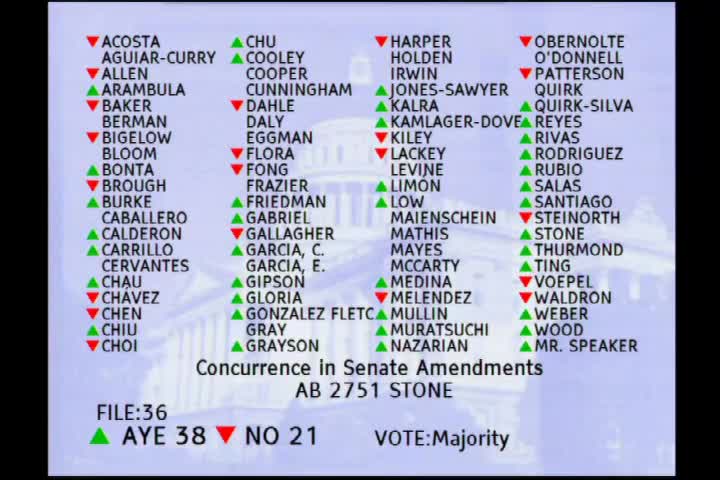 1MIN
Assembly Floor
 3MIN
Senate Floor
 1H
Senate Standing Committee on Appropriations
 43MIN
Senate Standing Committee on Education
 3MIN
Assembly Floor
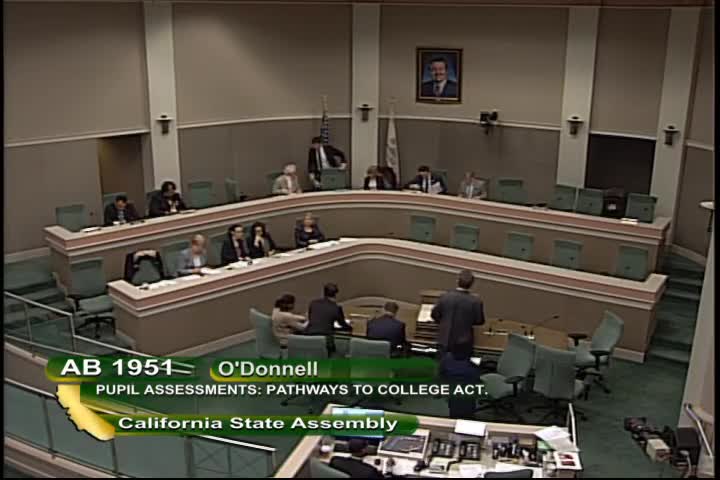 37MIN
Assembly Standing Committee on Education
Bill Author




