AB 1952: Social services: access to food.
- Session Year: 2017-2018
- House: Assembly
- Latest Version Date: 2018-06-26
Existing law provides for the federal Supplemental Nutrition Assistance Program (SNAP), administered in California as CalFresh, under which each county distributes nutrition assistance benefits provided by the federal government to eligible households. Existing state law authorizes a county to deliver CalFresh benefits through the use of an electronic benefits transfer (EBT) acceptance system.
Existing law, until January 1, 2022, encourages the Regents of the University of California, requires the Trustees of the California State University, and authorizes the Board of Governors of the California Community Colleges, to designate as a hunger-free campus each of the institutions respective campuses that meet specified criteria, including having a campus employee designated to help ensure that students have the information they need to enroll in CalFresh.
This bill would require the State Department of Social Services, the State Department of Public Health, the State Department of Education, and the Department of Food and Agriculture, to develop a plan to end hunger. The bill would require the State Department of Social Services to serve as the lead agency for the development of the plan. The bill would require the plan to be distributed to the Legislature no later than January 1, 2020, and would establish criteria for the plan, including that the plan establish a budget of $11,500,000, contingent upon an appropriation in the annual Budget Act or other measure, for the Department of Food and Agriculture to support local food hub efforts. The bill would also require the plan to request the Regents of the University of California, and direct the Trustees of the California State University and the Board of Governors of the California Community Colleges, to develop systems that allow EBT cards to be used on their respective campuses, and present a report to the Assembly Select Committee on Campus Climate on the progress that has been made, by July 1, 2019.
Existing law provides for the federal Supplemental Nutrition Assistance Program (SNAP), administered in California as CalFresh, under which each county distributes nutrition assistance benefits provided by the federal government to eligible households. Existing state law authorizes a county to deliver CalFresh benefits through the use of an electronic benefits transfer (EBT) acceptance system.
Existing law, until January 1, 2022, encourages the Regents of the University of California, requires the Trustees of the California State University, and authorizes the Board of Governors of the California Community Colleges, to designate as a hunger-free campus each of the institutions respective campuses that meet specified criteria, including having a campus employee designated to help ensure that students have the information they need to enroll in CalFresh.
This bill would require the State Department of Social Services, the State Department of Public Health, the State Department of Education, and the Department of Food and Agriculture, to develop a plan to end hunger. The bill would require the plan to be distributed to the Legislature no later than January 1, 2020, and would establish criteria for the plan, including that the plan establish a budget of $11,500,000, contingent upon an appropriation in the annual Budget Act or other measure, for the Department of Food and Agriculture to support local food hub efforts. The bill would also require the plan to request the Regents of the University of California, and direct the Trustees of the California State University and the Board of Governors of the California Community Colleges, to develop systems that allow EBT cards to be used on their respective campuses, and present a report to the Assembly Select Committee on Campus Climate on the progress that has been made, by March July 1, 2019.
Existing law provides for the federal Supplemental Nutrition Assistance Program (SNAP), administered in California as CalFresh, under which each county distributes nutrition assistance benefits provided by the federal government to eligible households. Existing state law authorizes a county to deliver CalFresh benefits through the use of an electronic benefits transfer (EBT) acceptance system.
Existing law, until January 1, 2022, encourages the Regents of the University of California, and requires the Trustees of the California State University University, and authorizes the Board of Governors of the California Community Colleges, to designate as a hunger-free campus each of the institutions respective campuses that meet specified criteria, including having a campus employee designated to help ensure that students have the information they need to enroll in CalFresh.
This bill would require the State Department of Social Services, the State Department of Public Health, the State Department of Education, and the Department of Food and Agriculture, to develop a plan to end hunger. The bill would require the plan to be distributed to the Legislature no later than January 1, 2020, and would establish criteria for the plan, including that the plan establish a budget of $11,500,000, contingent upon an appropriation in the annual Budget Act or other measure, for the Department of Food and Agriculture to support local food hub efforts. The bill would also require the plan to request the Regents of the University of California, and direct the Trustees of the California State University and the Board of Governors of the California Community Colleges, to develop systems that allow EBT cards to be used on their respective campuses, and present a report to the Assembly Select Committee on Campus Climate on the progress that has been made, by March 1, 2019.
Existing law provides for the federal Supplemental Nutrition Assistance Program (SNAP), administered in California as CalFresh, under which each county distributes nutrition assistance benefits provided by the federal government to eligible households. Existing state law authorizes a county to deliver CalFresh benefits through the use of an electronic benefits transfer (EBT) acceptance system.
Existing law, until January 1, 2022, encourages the Regents of the University of California, and requires the Trustees of the California State University and the Board of Governors of the California Community Colleges, to designate as a hunger-free campus each of the institutions respective campuses that meet specified criteria, including having a campus employee designated to help ensure that students have the information they need to enroll in CalFresh.
This bill would require the State Department of Social Services, the State Department of Public Health, the State Department of Education, and the Department of Food and Agriculture, to develop a plan to end hunger. The bill would require the plan to be distributed to the Legislature no later than January 1, 2020, and would establish criteria for the plan, including that the plan request the Regents of the University of California, and direct the Trustees of the California State University and the Board of Governors of the California Community Colleges, to develop systems that allow EBT cards to be used on their respective campuses, and present a report to the Assembly Select Committee on Campus Climate on the progress that has been made, by March 1, 2019.
Existing law provides the federal Supplemental Nutrition Assistance Program (SNAP), administered in California as CalFresh, under which each county distributes nutrition assistance benefits provided by the federal government to eligible households. Existing state law authorizes a county to deliver CalFresh benefits through the use of an electronic benefits transfer (EBT) acceptance system.
Existing law, until January 1, 2022, encourages the Regents of the University of California, and requires the Trustees of the California State University and the Board of Governors of the California Community Colleges, to designate as a hunger-free campus each of the institutions respective campuses that meet specified criteria, including having a campus employee designated to help ensure that students have the information they need to enroll in CalFresh.
This bill would require the State Department of Social Services, the State Department of Public Health, the State Department of Education, and the Department of Food and Agriculture, to develop a plan to end hunger. The bill would require the plan to be distributed to the Legislature no later than January 1, 2020, and would establish criteria for the plan, including that the plan request the Regents of the University of California, and direct the Trustees of the California State University and the Board of Governors of the California Community Colleges, to develop systems that allow EBT cards to be used on their respective campuses, and present a report to the Assembly Select Committee on Campus Climate on the progress that has been made, by March 1, 2019.
This act shall be known, and may be cited, as the Envision a Hunger-Free California Act of 2018.
SEC. 2.The Legislature hereby finds and declares all of the following:
(a)Access to adequate, nutritious food benefits the health and welfare of all Californians at every income level.
(b)Over one-third of the vegetables and two-thirds of the fruits and nuts grown in the United States come from California, but in many communities throughout the state there is limited access to quality food, which negatively affects those living at or near the poverty line, cash-poor college graduates, working families, single parents, and disadvantaged communities.
(c)Californias diverse geography and demographics unfortunately increase the likelihood of food deserts, as defined by the United States Department of Food and Agriculture, that limit food access for hundreds of thousands of California residents, and this results in poor health outcomes.
(d)High-cost and congested areas of the state also experience limited access to food and often provide few opportunities for food businesses to relocate to those food-poor areas.
(e)California should take steps to ensure access to adequate, nutritious food in all communities across the state.
(f)The food insecurity rate is the percentage of a states population that experience limited or uncertain access to adequate healthy food at some point during the year. People who experience food insecurity often have to reduce the quality or variety of their diet, and sometimes experience hunger. Californias food insecurity rate is 12.5 percent.
(g)Food insecurity is primarily a symptom of poverty, and poverty is substantially higher among Latinos and other communities of color.
(h)Research in child brain development has shown that even one experience of hunger as a child can impact the health and mental well-being of a person into their adult years. Research has similarly demonstrated the long-term academic and economic consequences of how hunger limits a persons life chances.
(i)Hunger, food insecurity, and lack of healthy food choices contribute to our states high childhood obesity rate. Californias childhood obesity rate is 16.6 percent for children who are two to four years of age, inclusive, and are beneficiaries of the Special Supplemental Nutrition Program for Women, Infants, and Children, also known as WIC. The obesity rate is 31.2 percent for children in California who are 10 to 17 years of age, inclusive, and the current obesity rate for high school pupils in California is 13.9 percent.
(j)Lack of adequate healthy food options increases the likelihood and impact of diabetes and prediabetes. Care and treatment cost an estimated $37.1 billion in California each year and affect almost 15 million Californians, limiting their life possibilities.
(k)The Legislature is calling on all partners to make eradication of hunger and food insecurity in our bountiful state a priority and work with us to collectively envision and enact a future without hunger.
(l)The Legislature resolves to support a process by which all food system stakeholders will be engaged and collaborate at the local, regional, and state levels to remove barriers to adequate, nutritious food choices and ensure that a vibrant and sustainable food system is available across all communities statewide.
SEC. 3.Section 10001.5 is added to the Welfare and Institutions Code, to read:10001.5.The department, the State Department of Public Health, the State Department of Education, and the Department of Food and Agriculture, in consultation with a robust stakeholder group, shall jointly develop a plan to end hunger. The department shall serve as the lead agency for the development of the plan. The plan shall be distributed to the Legislature no later than January 1, 2020, in accordance with Section 9795 of the Government Code. The plan shall, at a minimum, do all of the following:
(a)Identify food deserts, as defined by the United States Department of Agriculture, and make maps of food deserts available online.
(b)Identify barriers in bringing retailers to certain locations, such as those in food deserts. These barriers may include, but are not limited to, certain city zoning ordinances, restrictive covenants, the requirements imposed by the California Environmental Quality Act (CEQA) process, the limitations of the public transportation system, and other restrictions imposed in order to protect public safety.
(c)Identify infrastructure needs to develop food hubs and consult with the Department of General Services in order to conduct an inventory of state-owned property that would be suitable for food hub locations.
(d)Explore methods to use new and existing resources to develop a food hub infrastructure and to utilize county fairgrounds as food hub locations.
(e)Establish a budget of eleven million five hundred thousand dollars ($11,500,000) contingent on an appropriation in the annual Budget Act or another measure, for the Department of Food and Agriculture to identify grant opportunities, with a priority given to regional planning connection strategy models between rural and urban areas demonstrating economic development, job benefits, and greenhouse gas emission reductions. The Department of Food and Agriculture is authorized to use these funds to support other local food hub efforts, taking into consideration the need in the community and geographic diversity.
(f)Identify and facilitate stakeholder engagement, including representatives from impacted communities.
(g)Make recommendations for improving food access, including funding.
(h)Include a plan, which shall be presented to the director, the Director of Public Health, the Superintendent of Public Instruction, and the Secretary of Food and Agriculture Agriculture, by July 1, 2019, to encourage the use of an electronic benefits transfer (EBT) system at farmers markets and retailers in a food desert, or at a retailer that can ship to a food desert, for the purchase of fruits and vegetables.
(i)Include a plan, which shall be presented to the Legislature by July 1, 2019, for statewide universal school feeding programs, prioritizing schools with the neediest populations, including a summer lunch EBT program serving children in food deserts who cannot access feeding sites in the event the federal government does not act. The plan shall be submitted in compliance with Section 9795 of the Government Code. The plan shall identify a system for measuring outcomes that include, but are not limited to, all of the following:
(1)Increased time spent in school through enrollment, attendance, and reduced dropout rates.
(2)Increased cognition and improved learning.
(3)Improved healthcare outcomes and fewer days of school missed due to illness.
(j)(1)Request the Regents of the University of California, and direct the Trustees of the California State University and the Board of Governors of the California Community Colleges, to develop systems that allow EBT cards to be used on their respective campuses, and prepare and present to the Assembly Select Committee on Campus Climate a report on the progress that has been made, by July 1, 2019.
(2)The requirement to submit a report under this subdivision shall be inoperative on January 1, 2023.
This act shall be known, and may be cited, as the Envision a Hunger-Free California Act of 2018.
SEC. 2.The Legislature hereby finds and declares all of the following:
(a)Access to adequate, nutritious food benefits the health and welfare of all Californians at every income level.
(b)Over one-third of the vegetables and two-thirds of the fruits and nuts grown in the United States come from California, but in many communities throughout the state there is limited access to quality food, which negatively affects those living at or near the poverty line, cash-poor college graduates, working families, single parents, and disadvantaged communities.
(c)Californias diverse geography and demographics unfortunately increase the likelihood of food deserts, as defined by the United States Department of Food and Agriculture, that limit food access for hundreds of thousands of California residents, and this results in poor health outcomes.
(d)High-cost and congested areas of the state also experience limited access to food and often provide few opportunities for food businesses to relocate to those food-poor areas.
(e)California should take steps to ensure access to adequate, nutritious food in all communities across the state.
(f)The food insecurity rate is the percentage of a states population that experience limited or uncertain access to adequate healthy food at some point during the year. People who experience food insecurity often have to reduce the quality or variety of their diet, and sometimes experience hunger. Californias food insecurity rate is 12.5 percent.
(g)Food insecurity is primarily a symptom of poverty, and poverty is substantially higher among Latinos and other communities of color.
(h)Research in child brain development has shown that even one experience of hunger as a child can impact the health and mental well-being of a person into their adult years. Research has similarly demonstrated the long-term academic and economic consequences of how hunger limits a persons life chances.
(i)Hunger, food insecurity, and lack of healthy food choices contribute to our states high childhood obesity rate. Californias childhood obesity rate is 16.6 percent for children who are two to four years of age, inclusive, and are beneficiaries of the Special Supplemental Nutrition Program for Women, Infants, and Children, also known as WIC. The obesity rate is 31.2 percent for children in California who are 10 to 17 years of age, inclusive, and the current obesity rate for high school pupils in California is 13.9 percent.
(j)Lack of adequate healthy food options increases the likelihood and impact of diabetes and prediabetes. Care and treatment cost an estimated $37.1 billion in California each year and affect almost 15 million Californians, limiting their life possibilities.
(k)The Legislature is calling on all partners to make eradication of hunger and food insecurity in our bountiful state a priority and work with us to collectively envision and enact a future without hunger.
(l)The Legislature resolves to support a process by which all food system stakeholders will be engaged and collaborate at the local, regional, and state levels to remove barriers to adequate, nutritious food choices and ensure that a vibrant and sustainable food system is available across all communities statewide.
SEC. 3.Section 10001.5 is added to the Welfare and Institutions Code, to read:10001.5.The department, the State Department of Public Health, the State Department of Education, and the Department of Food and Agriculture, in consultation with a robust stakeholder group, shall jointly develop a plan to end hunger. The plan shall be distributed to the Legislature no later than January 1, 2020, in accordance with Section 9795 of the Government Code. The plan shall, at a minimum, do all of the following:
(a)Identify food deserts, as defined by the United States Department of Agriculture, and make maps of food deserts available online.
(b)Identify barriers in bringing retailers to certain locations, such as those in food deserts. These barriers may include, but are not limited to, certain city zoning ordinances, restrictive covenants, the requirements imposed by the California Environmental Quality Act (CEQA) process, the limitations of the public transportation system, and other restrictions imposed in order to protect public safety.
(c)Identify infrastructure needs to develop food hubs and consult with the Department of General Services in order to conduct an inventory of state-owned property that would be suitable for food hub locations.
(d)Explore methods to use new and existing resources to develop a food hub infrastructure and to utilize county fairgrounds as food hub locations.
(e)Establish a budget of eleven million five hundred thousand dollars ($11,500,000) contingent on an appropriation in the annual Budget Act or another measure, for the Department of Food and Agriculture to identify grant opportunities, with a priority given to regional planning connection strategy models between rural and urban areas demonstrating economic development, job benefits, and greenhouse gas emission reductions. The Department of Food and Agriculture is authorized to use these funds to support other local food hub efforts, taking into consideration the need in the community and geographic diversity.
(f)Identify and facilitate stakeholder engagement, including representatives from impacted communities.
(g)Make recommendations for improving food access, including funding.
(h)Include a plan, which shall be presented to the director by May director, the Director of Public Health, the Superintendent of Public Instruction, and the Secretary of Food and Agriculture by July 1, 2019, to encourage the use of an electronic benefits transfer (EBT) system at farmers markets and retailers in a food desert, or at a retailer that can ship to a food desert, for the purchase of fruits and vegetables.
(i)Include a plan, which shall be presented to the Legislature by May July 1, 2019, for statewide universal school feeding programs, prioritizing schools with the neediest populations, including a summer lunch EBT program serving children in food deserts who cannot access feeding sites in the event the federal government does not act. The plan shall be submitted in compliance with Section 9795 of the Government Code. The plan shall identify a system for measuring outcomes that include, but are not limited to, all of the following:
(1)Increased time spent in school through enrollment, attendance, and reduced dropout rates.
(2)Increased cognition and improved learning.
(3)Improved healthcare outcomes and fewer days of school missed due to illness.
(j)(1)Request the Regents of the University of California, and direct the Trustees of the California State University and the Board of Governors of the California Community Colleges, to develop systems that allow EBT cards to be used on their respective campuses, and prepare and present to the Assembly Select Committee on Campus Climate a report on the progress that has been made, by March July 1, 2019.
(2)The requirement to submit a report under this subdivision shall be inoperative on January 1, 2023.
REVISIONS: HeadingLine 4.This act shall be known, and may be cited, as the Envision a Hunger-Free California Act of 2018.
SEC. 2.The Legislature hereby finds and declares all of the following:
(a)Access to adequate, nutritious food benefits the health and welfare of all Californians at every income level.
(b)California produces about 25 percent of the worlds food, Over one-third of the vegetables and two-thirds of the fruits and nuts grown in the United States come from California, but in many communities throughout the state there is limited access to quality food, which negatively affects those living at or near the poverty line, cash-poor college graduates, working families, single parents, and disadvantaged communities.
(c)Californias diverse geography and demographics unfortunately increase the likelihood of food deserts, as defined by the United States Department of Food and Agriculture, that limit food access for hundreds of thousands of California residents, and this results in poor health outcomes.
(d)High-cost and congested areas of the state also experience limited access to food and often provide few opportunities for food businesses to relocate to those food-poor areas.
(e)California should take steps to ensure access to adequate, nutritious food in all communities across the state.
(f)The food insecurity rate is the percentage of a states population that experience limited or uncertain access to adequate healthy food at some point during the year. People who experience food insecurity often have to reduce the quality or variety of their diet, and sometimes experience hunger. Californias food insecurity rate is 12.5 percent.
(g)Food insecurity is primarily a symptom of poverty, and poverty is substantially higher among Latinos and other communities of color.
(h)Research in child brain development has shown that even one experience of hunger as a child can impact the health and mental well-being of a person into their adult years. Research has similarly demonstrated the long-term academic and economic consequences of how hunger limits a persons life chances.
(i)Hunger, food insecurity insecurity, and lack of healthy food choices contribute to our states high childhood obesity rate. Californias childhood obesity rate is 16.6 percent for children who are two to four years of age, inclusive, and are beneficiaries of the Special Supplemental Nutrition Program for Women, Infants, and Children, also known as WIC. The obesity rate is 31.2 percent for children in California who are 10 to 17 years of age, inclusive, and the current obesity rate for high school pupils in California is 13.9 percent.
(j)Lack of adequate healthy food options increases the likelihood and impact of diabetes and prediabetes. Care and treatment cost an estimated $37.1 billion in California each year and affect almost 15 million Californians, limiting their life possibilities.
(k)The Legislature is calling on all partners to make eradication of hunger and food insecurity in our bountiful state a priority and work with us to collectively envision and enact a future without hunger.
(l)The Legislature resolves to support a process by which all food system stakeholders will be engaged and collaborate at the local, regional, and state levels to remove barriers to adequate, nutritious food choices and ensure that a vibrant and sustainable food system is available across all communities statewide.
SEC. 3.Section 10001.5 is added to the Welfare and Institutions Code, to read:10001.5.The department, the State Department of Public Health, the State Department of Education, and the Department of Food and Agriculture, in consultation with a robust stakeholder group, shall jointly develop a plan to end hunger. The plan shall be distributed to the Legislature no later than January 1, 2020, in accordance with Section 9795 of the Government Code. The plan shall, at a minimum, do all of the following:
(a)Identify food deserts, as defined by the United States Department of Agriculture, and make maps of food deserts available online.
(b)Identify barriers in bringing retailers to certain locations, such as those in food deserts. These barriers may include, but are not limited to, certain city zoning ordinances, restrictive covenants, the requirements imposed by the California Environmental Quality Act (CEQA) process, the limitations of the public transportation system, and other restrictions imposed in order to protect public safety.
(c)Identify infrastructure needs to develop food hubs and consult with the Department of General Services in order to conduct an inventory of state-owned property that would be suitable for food hub locations.
(d)Explore methods to use new and existing resources to develop a food hub infrastructure and to utilize county fairgrounds as food hub locations.
(e)Establish a budget of ____ dollars ($____), eleven million five hundred thousand dollars ($11,500,000) contingent on an appropriation in the annual Budget Act or another measure, for the Department of Food and Agriculture to identify grant opportunities, with a priority given to regional planning connection strategy models between rural and urban areas demonstrating economic development, job benefits, and greenhouse gas emission reductions. The Department of Food and Agriculture is authorized to use these funds to support other local food hub efforts, taking into consideration the need in the community and geographic diversity.
(f)Identify and facilitate stakeholder engagement, including representatives from impacted communities.
(g)Make recommendations for improving food access, including funding.
(h)Include a plan, which shall be presented to the director by May 1, 2019, to encourage the use of an electronic benefits transfer (EBT) system at farmers markets and retailers in a food desert, or at a retailer that can ship to a food desert, for the purchase of fruits and vegetables.
(i)Include a plan, which shall be presented to the Legislature by May 1, 2019, for statewide universal school feeding programs, prioritizing schools with the neediest populations, including a summer lunch EBT program serving children in food deserts who cannot access feeding sites in the event the federal government does not act. The plan shall be submitted in compliance with Section 9795 of the Government Code. The plan shall identify a system for measuring outcomes that include, but are not limited to, all of the following:
(1)Increased time spent in school through enrollment, attendance, and reduced dropout rates.
(2)Increased cognition and improved learning.
(3)Improved healthcare outcomes and fewer days of school missed due to illness.
(j)(1)Request the Regents of the University of California, and direct the Trustees of the California State University and the Board of Governors of the California Community Colleges, to develop systems that allow EBT cards to be used on their respective campuses, and prepare and present to the Assembly Select Committee on Campus Climate a report on the progress that has been made, by March 1, 2019.
(2)The requirement to submit a report under this subdivision shall be inoperative on January 1, 2023.
This act shall be known, and may be cited, as the Envision a Hunger-Free California Act of 2018.
SEC. 2.The Legislature hereby finds and declares all of the following:
(a)Access to adequate, nutritious food benefits the health and welfare of all Californians at every income level.
(b)California produces about 25 percent of the worlds food, but in many communities throughout the state there is limited access to quality food, which negatively affects those living at or near the poverty line, cash-poor college graduates, working families, single parents, and disadvantaged communities.
(c)Californias diverse geography and demographics unfortunately increase the likelihood of food deserts, as defined by the United States Department of Food and Agriculture, that limit food access for hundreds of thousands of California residents, and this results in poor health outcomes.
(d)High-cost and congested areas of the state also experience limited access to food and often provide few opportunities for food businesses to relocate to those food-poor areas.
(e)California should take steps to ensure access to adequate, nutritious food in all communities across the state.
(f)The food insecurity rate is the percentage of a states population that experience limited or uncertain access to adequate healthy food at some point during the year. People who experience food insecurity often have to reduce the quality or variety of their diet, and sometimes experience hunger. Californias food insecurity rate is 12.5 percent.
(g)Food insecurity is primarily a symptom of poverty, and poverty is substantially higher among Latinos and other communities of color.
(h)Research in child brain development has shown that even one experience of hunger as a child can impact the health and mental well-being of a person into their adult years. Research has similarly demonstrated the long-term academic and economic consequences of how hunger limits a persons life chances.
(i)Hunger, food insecurity and lack of healthy food choices contribute to our states high childhood obesity rate. Californias childhood obesity rate is 16.6 percent for children who are two to four years of age, inclusive, and are beneficiaries of the Special Supplemental Nutrition Program for Women, Infants, and Children, also known as WIC. The obesity rate is 31.2 percent for children in California who are 10 to 17 years of age, inclusive, and the current obesity rate for high school pupils in California is 13.9 percent.
(j)Lack of adequate healthy food options increases the likelihood and impact of diabetes and prediabetes. Care and treatment cost an estimated $37.1 billion in California each year and affect almost 15 million Californians, limiting their life possibilities.
(k)The Legislature is calling on all partners to make eradication of hunger and food insecurity in our bountiful state a priority and work with us to collectively envision and enact a future without hunger.
(l)The Legislature resolves to support a process by which all food system stakeholders will be engaged and collaborate at the local, regional, and state levels to remove barriers to adequate, nutritious food choices and ensure that a vibrant and sustainable food system is available across all communities statewide.
SEC. 3.The State Department of Social Services, the State Department of Public Health, the State Department of Education, and the Department of Food and Agriculture, in consultation with a robust stakeholder group, shall jointly develop a plan to end hunger. The plan shall be distributed to the Legislature no later than January 1, 2020, in accordance with Section 9795 of the Government Code. The plan shall, at a minimum, do all of the following:(a)Identify food deserts, as defined by the United States Department of Food and Agriculture, and make maps of food deserts available online.(b)Identify barriers in bringing retailers to certain locations, such as those in food deserts. These barriers may include, but are not limited to, certain city zoning ordinances, restrictive covenants, the requirements imposed by the California Environmental Quality Act (CEQA) process, the limitations of the public transportation system, and other restrictions imposed in order to protect public safety.(c)Identify infrastructure needs to develop food hubs and consult with the Department of General Services in order to conduct an inventory of state-owned property that would be suitable for food hub locations.(d)Explore methods to use new and existing resources to develop a food hub infrastructure and to utilize county fairgrounds as food hub locations.(e)Establish a budget of ____ dollars ($____), contingent on an appropriation in the annual Budget Act or another measure, for the Department of Food and Agriculture to identify grant opportunities, with a priority given to regional planning connection strategy models between rural and urban areas demonstrating economic development, job benefits, and green house gas emission reductions. The Department of Food and Agriculture is authorized to use these funds to support other local food hub efforts, taking into consideration the need in the community and geographic diversity. (f)Identify and facilitate stakeholder engagement, including representatives from impacted communities.(g)Make recommendations for improving food access, including funding.(h)Include a plan, which shall be presented to the Director of Social Services by May 1, 2019, to encourage the use of electronic benefits transfer (EBT) at farmers markets and retailers in a food desert, or a retailer that can ship to a food desert, for the purchase of fruits and vegetables.(i)Include a plan, which shall be presented to the Legislature by May 1, 2019, for statewide universal school feeding programs, prioritizing schools with the neediest populations, including a summer lunch EBT program serving children in food deserts who cannot access feeding sites in the event the federal government does not act. The plan shall be submitted in compliance with Section 9795 of the Government Code. The plan shall identify a system for measuring outcomes that include, but are not limited to, all of the following:(1)Increased time spent in school through enrollment, attendance, and reduced dropout rates.(2)Increased cognition and improved learning.(3)Improved healthcare outcomes and fewer days of school missed due to illness.(j)(1)Request the Regents of the University of California, and direct the Trustees of the California State University and the Board of Governors of the California Community Colleges, to develop systems that allow EBT cards to be used on their respective campuses, and prepare and present to the Assembly Select Committee on Campus Climate a report on the progress that has been made, by March 1, 2019.(2)The requirement to submit a report under this subdivision shall be inoperative on January 1, 2023.SEC. 3.Section 10001.5 is added to the Welfare and Institutions Code, to read:10001.5.The department, the State Department of Public Health, the State Department of Education, and the Department of Food and Agriculture, in consultation with a robust stakeholder group, shall jointly develop a plan to end hunger. The plan shall be distributed to the Legislature no later than January 1, 2020, in accordance with Section 9795 of the Government Code. The plan shall, at a minimum, do all of the following:
(a)Identify food deserts, as defined by the United States Department of Agriculture, and make maps of food deserts available online.
(b)Identify barriers in bringing retailers to certain locations, such as those in food deserts. These barriers may include, but are not limited to, certain city zoning ordinances, restrictive covenants, the requirements imposed by the California Environmental Quality Act (CEQA) process, the limitations of the public transportation system, and other restrictions imposed in order to protect public safety.
(c)Identify infrastructure needs to develop food hubs and consult with the Department of General Services in order to conduct an inventory of state-owned property that would be suitable for food hub locations.
(d)Explore methods to use new and existing resources to develop a food hub infrastructure and to utilize county fairgrounds as food hub locations.
(e)Establish a budget of ____ dollars ($____), contingent on an appropriation in the annual Budget Act or another measure, for the Department of Food and Agriculture to identify grant opportunities, with a priority given to regional planning connection strategy models between rural and urban areas demonstrating economic development, job benefits, and greenhouse gas emission reductions. The Department of Food and Agriculture is authorized to use these funds to support other local food hub efforts, taking into consideration the need in the community and geographic diversity.
(f)Identify and facilitate stakeholder engagement, including representatives from impacted communities.
(g)Make recommendations for improving food access, including funding.
(h)Include a plan, which shall be presented to the director by May 1, 2019, to encourage the use of an electronic benefits transfer (EBT) system at farmers markets and retailers in a food desert, or a retailer that can ship to a food desert, for the purchase of fruits and vegetables.
(i)Include a plan, which shall be presented to the Legislature by May 1, 2019, for statewide universal school feeding programs, prioritizing schools with the neediest populations, including a summer lunch EBT program serving children in food deserts who cannot access feeding sites in the event the federal government does not act. The plan shall be submitted in compliance with Section 9795 of the Government Code. The plan shall identify a system for measuring outcomes that include, but are not limited to, all of the following:
(1)Increased time spent in school through enrollment, attendance, and reduced dropout rates.
(2)Increased cognition and improved learning.
(3)Improved healthcare outcomes and fewer days of school missed due to illness.
(j)(1)Request the Regents of the University of California, and direct the Trustees of the California State University and the Board of Governors of the California Community Colleges, to develop systems that allow EBT cards to be used on their respective campuses, and prepare and present to the Assembly Select Committee on Campus Climate a report on the progress that has been made, by March 1, 2019.
(2)The requirement to submit a report under this subdivision shall be inoperative on January 1, 2023.
This act shall be known, and may be cited, as the Envision a Hunger-Free California Act of 2018.
SEC. 2.The Legislature hereby finds and declares all of the following:
(a)Access to adequate, nutritious food benefits the health and welfare of all Californians at every income level.
(b)California produces about 25 percent of the worlds food, but in many communities throughout the state there is limited access to quality food, which negatively affects those living at or near the poverty line, cash-poor college graduates, working families, single parents, and disadvantaged communities.
(c)Californias diverse geography and demographics unfortunately increase the likelihood of food deserts, as defined by the United States Department of Food and Agriculture, that limit food access for hundreds of thousands of California residents, and this results in poor health outcomes.
(d)High-cost and congested areas of the state also experience limited access to food and often provide few opportunities for food businesses to relocate to those food-poor areas.
(e)California should take steps to ensure access to adequate, nutritious food in all communities across the state.
(f)The food insecurity rate is the percentage of a states population that experience limited or uncertain access to adequate healthy food at some point during the year. People who experience food insecurity often have to reduce the quality or variety of their diet, and sometimes experience hunger. Californias food insecurity rate is 12.5 percent.
(g)Food insecurity is primarily a symptom of poverty, and poverty is substantially higher among Latinos and other communities of color.
(h)Research in child brain development has shown that even one experience of hunger as a child can impact the health and mental well-being of a person into their adult years. Research has similarly demonstrated the long-term academic and economic consequences of how hunger limits a persons life chances.
(i)Hunger, food insecurity and lack of healthy food choices contribute to our states high childhood obesity rate. Californias childhood obesity rate is 16.6 percent for children who are two to four years of age, inclusive, and are beneficiaries of the Special Supplemental Nutrition Program for Women, Infants, and Children, also known as WIC. The obesity rate is 31.2 percent for children in California who are 10 to 17 years of age, inclusive, and the current obesity rate for high school pupils in California is 13.9 percent.
(j)Lack of adequate healthy food options increases the likelihood and impact of diabetes and prediabetes. Care and treatment cost an estimated $37.1 billion in California each year and affect almost 15 million Californians, limiting their life possibilities.
(k)The Legislature is calling on all partners to make eradication of hunger and food insecurity in our bountiful state a priority and work with us to collectively envision and enact a future without hunger.
(l)The Legislature resolves to support a process by which all food system stakeholders will be engaged and collaborate at the local, regional, and state levels to remove barriers to adequate, nutritious food choices and ensure that a vibrant and sustainable food system is available across all communities statewide.
SEC. 3.The State Department of Social Services, the State Department of Public Health, the State Department of Education, and the Department of Food and Agriculture, in consultation with a robust stakeholder group, shall jointly develop a plan to end hunger. The plan shall be distributed to the Legislature no later than January 1, 2020, in accordance with Section 9795 of the Government Code. The plan shall, at a minimum, do all of the following:
(a)Identify food deserts, as defined by the United States Department of Food and Agriculture, and make maps of food deserts available online.
(b)Identify barriers in bringing retailers to certain locations, such as those in food deserts. These barriers may include, but are not limited to, certain city zoning ordinances, restrictive covenants, the requirements imposed by the California Environmental Quality Act (CEQA) process, the limitations of the public transportation system, and other restrictions imposed in order to protect public safety.
(c)Identify infrastructure needs to develop food hubs and consult with the Department of General Services in order to conduct an inventory of state-owned property that would be suitable for food hub locations.
(d)Explore methods to use new and existing resources to develop a food hub infrastructure and to utilize county fairgrounds as food hub locations.
(e)Establish a budget of ____ dollars ($____), contingent on an appropriation in the annual Budget Act or another measure, for the Department of Food and Agriculture to identify grant opportunities, with a priority given to regional planning connection strategy models between rural and urban areas demonstrating economic development, job benefits, and green house gas emission reductions. The Department of Food and Agriculture is authorized to use these funds to support other local food hub efforts, taking into consideration the need in the community and geographic diversity.
(f)Identify and facilitate stakeholder engagement, including representatives from impacted communities.
(g)Make recommendations for improving food access, including funding.
(h)Include a plan, which shall be presented to the Director of Social Services by May 1, 2019, to encourage the use of electronic benefits transfer (EBT) at farmers markets and retailers in a food desert, or a retailer that can ship to a food desert, for the purchase of fruits and vegetables.
(i)Include a plan, which shall be presented to the Legislature by May 1, 2019, for statewide universal school feeding programs, prioritizing schools with the neediest populations, including a summer lunch EBT program serving children in food deserts who cannot access feeding sites in the event the federal government does not act. The plan shall be submitted in compliance with Section 9795 of the Government Code. The plan shall identify a system for measuring outcomes that include, but are not limited to, all of the following:
(1)Increased time spent in school through enrollment, attendance, and reduced dropout rates.
(2)Increased cognition and improved learning.
(3)Improved healthcare outcomes and fewer days of school missed due to illness.
(j)(1)Request the Regents of the University of California, and direct the Trustees of the California State University and the Board of Governors of the California Community Colleges, to develop systems that allow EBT cards to be used on their respective campuses, and prepare and present to the Assembly Select Committee on Campus Climate a report on the progress that has been made, by March 1, 2019.
(2)The requirement to submit a report under this subdivision shall be inoperative on January 1, 2023.
|
Date
|
Status
|
|---|---|
| Aug 16, 2018 | In committee: Held under submission. |
| Jul 2, 2018 | In committee: Referred to APPR. suspense file. |
| Jun 26, 2018 | From committee chair, with author's amendments: Amend, and re-refer to committee. Read second time, amended, and re-referred to Com. on APPR. |
| Jun 19, 2018 | From committee: Do pass and re-refer to Com. on APPR. (Ayes 4. Noes 0.) (June 19). Re-referred to Com. on APPR. |
| Jun 13, 2018 | From committee: Do pass and re-refer to Com. on AGRI. (Ayes 6. Noes 0.) (June 12). Re-referred to Com. on AGRI. |
| Jun 7, 2018 | Referred to Coms. on HUMAN S. and AGRI. |
| May 30, 2018 | In Senate. Read first time. To Com. on RLS. for assignment. |
| May 29, 2018 | Read third time. Passed. Ordered to the Senate. |
| May 25, 2018 | From committee: Do pass. (Ayes 16. Noes 0.) (May 25). |
| May 16, 2018 | In committee: Set, first hearing. Referred to APPR. suspense file. |
| Apr 26, 2018 | Coauthors revised. |
| Apr 16, 2018 | Re-referred to Com. on AGRI. |
| Apr 12, 2018 | Read second time and amended. |
| Apr 11, 2018 | From committee: Amend, and do pass as amended and re-refer to Com. on AGRI. with recommendation: To Consent Calendar. (Ayes 7. Noes 0.) (April 10). |
| Apr 3, 2018 | Re-referred to Com. on HUM. S. |
| Apr 2, 2018 | From committee chair, with author's amendments: Amend, and re-refer to Com. on HUM. S. Read second time and amended. |
| Mar 20, 2018 | Re-referred to Com. on HUM. S. |
| Mar 19, 2018 | From committee chair, with author's amendments: Amend, and re-refer to Com. on HUM. S. Read second time and amended. |
| Mar 15, 2018 | Referred to Coms. on HUM. S. and AGRI. |
| Jan 30, 2018 | From printer. May be heard in committee March 1. |
| Jan 29, 2018 | Read first time. To print. |
|
Date
|
Description
|
Location
|
Votes
|
|
|---|---|---|---|---|
| Jul 2, 2018 | Placed on suspense file | Senate Standing Committee on Appropriations |
Passed |
|
| Jun 19, 2018 | Do pass, but first be re-referred to the Committee on [Appropriations] | Senate Standing Committee on Agriculture |
Passed |
|
| Jun 12, 2018 | Do pass, but first be re-referred to the Committee on [Agriculture] | Senate Standing Committee on Human Services |
Passed |
|
| May 29, 2018 | AB 1952 MAYES Assembly Third Reading | Assembly Floor |
Passed |
|
| May 25, 2018 | Do pass. | Assembly Standing Committee on Appropriations |
Passed |
|
| Apr 25, 2018 | Do pass and be re-referred to the Committee on [Appropriations] with recommendation: To Consent Calendar | Assembly Standing Committee on Agriculture |
Passed |
|
| Apr 10, 2018 | Do pass as amended, and be re-referred to the Committee on [Agriculture] with recommendation: To Consent Calendar | Assembly Standing Committee on Human Services |
Passed |
This list shows positions taken on this bill by organizations on the date displayed, which is linked to the original source.
Positions by individuals are not included.
SENATE COMMITTEE ON
Senator Anthony Portantino, Chair
2017 - 2018 Regular Session
AB 1952 (Mayes) - Social services: access to food
Version: | Policy Vote: |
Urgency: | Mandate: |
Hearing Date: | Consultant: |
This bill meets the criteria for referral to the Suspense File.
Bill Summary:
AB 1952 would establish the Envision a Hunger-Free California Act of 2018, which would require the California Department of Social Services (CDSS), The Department of Public Health (DPH), the Department of Education (CDE) and the California Department of Food and Agriculture (CDFA) to develop a plan to end hunger and require the plan to include identification of barriers to food access, and for CDSS to serve as the lead agency for the development of the plan. This bill would also require the plan to be presented to the Legislature no later than January 1, 2020.
Fiscal Impact:
- This bill requires the plan to establish a budget of $11.5 million, contingent on an appropriation in the annual Budget Act, therefore creating future cost pressure to fund the plan. (GF)
- Estimated costs for CDFA of $164,000 in FY 2018-19, $312,000 in FY 2019-20, and $156,000 in FY 2020-21 for additional resources to administer the grant program including initiating the program, distributing funds, and closing out grants.
- Estimated costs to CDSS of $129,000 in the first year and ongoing costs of $116,000 per year for increased workload to lead the development of the plan, including coordinating the effort, facilitating meetings, and other duties. (GF) Unknown, likely minor costs to the remaining affected departments to jointly develop a plan.
- Minor and absorbable costs to the California State University (CSU), the California Community Colleges (CCC), and the University of California (UC) (should the UC choose to participate) to fulfill the reporting requirements.
- Potential future cost pressure to CSU, CCC, and UC to bring EBT access to additional campuses.
Background:
The United States Department of Agriculture (USDA) defines food insecure households as those that are uncertain of having, or unable to acquire, at some time during the year, enough food to meet the needs of all their members because they had insufficient money or other resources for food. According to the California Association of Food Banks, one in eight Californians and one in five children struggles with food insecurity. Insufficient income to regularly purchase food is the leading cause of food insecurity, but access to healthy food is also impacted by proximity, variety, quality, and affordability.
There is growing evidence of the negative impact hunger has on student participation and student wellbeing, making students less likely to perform well in college and potentially forcing them to drop out. Students may qualify for CalFresh if they are enrolled at least half-time in regular curriculum at an “institution of higher education” in which the regular curriculum meets the standard requirements for graduation or certification in a particular field of study. They must also meet certain other criteria, unless the student qualifies for an exemption. Examples of qualifying criteria include students who are enrolled in certain job training programs, are caring for young children, are older than 50, or receiving CalWORKs benefits.
There are several government-funded food assistance programs designed to address the nutrition needs of its citizens, the largest of which is SNAP. The federal SNAP program (which operates as CalFresh in California) provides qualified low-income households with EBT cards which are used to purchase food and seeds or plants that grow food for human consumption. CalFresh is administered by CDSS at the state level and California’s 58 counties are responsible for administering the program at the local level. CalFresh benefits are 100% federally funded and national eligibility standards and benefit levels are established by the federal government.
California received over $5 million from the federal Food Insecurity Nutrition Incentive (FINI) matching grant program in 2017. Those funds support projects that increase the purchase of fruits and vegetables among low-income SNAP recipients by providing financial incentives at the point of purchase at farmers markets, supermarkets, convenience stores, and retail food stores. The California Nutrition Incentive Matching Grant Program (CNIP) collects matching funds from FINI and other public and private sources, to encourage the purchase and consumption of California fresh fruits, nuts, and vegetables by nutrition benefit clients, including CalFresh recipients. There are a number of locally operated healthy food incentive programs that receive FINI and/or CNIP operating at farmers markets and local grocery stores throughout California.
Proposed Law:
This bill would establish the Envision a Hunger-Free California Act of 2018. Specifically, this bill would require CDSS, DPH, CDE, and CDFA to consult with a stakeholder group to jointly develop a plan to end hunger and require CDSS to serve as the lead agency for the development of the plan. This bill would require the plan to be distributed to the Legislature no later than January 1, 2020, as specified, and to do the following:
- Identify food deserts, as defined by the USDA, and make maps of food deserts available online;
- Identify certain barriers, as specified, to bringing retailers to certain locations;
- Identify infrastructure needs to develop food hubs and work with the Department of General Services to create an inventory of state-owned property that would be suitable for food hub locations;
- Explore methods to use new and existing resources to develop food hub infrastructure and to utilize county fairgrounds as food hub locations;
- Establish a budget of $11,500,000, contingent upon an appropriation in the Budget Act, for CDFA to identify grant opportunities prioritizing models that demonstrate economic development, job benefits, and greenhouse gas emission reductions, as specified;
- Identify and facilitate stakeholder engagement, including representatives from impacted communities;
- Make recommendations for improving food access, including funding;
- Include a plan, to be presented to the director of CDSS, DPH, the Superintendent of Public instruction, and the Secretary of Food and Agriculture no later than July 1, 2019, to encourage the use of an EBT system at farmers' markets, or a retailer that can ship to a food desert, in order to purchase fruits and vegetables;
- Include a plan, to be presented to the Legislature no later than July 1, 2019, for statewide universal school feeding programs, prioritizing schools with the neediest populations, as specified, and further requires the plan to identify a system for measuring certain outcomes, as specified;
- Request the Regents of the UC, and direct the Trustees of the CSU and the Board of Governors of the CCC, to develop systems that allow EBT cards to be used on campuses, and prepare and present a progress report to the Assembly Select Committee on Campus Climate by July 1, 2019, and repeal these reporting requirements on January 1, 2023.
Related Legislation:
SB 900 (Wiener, 2018) would establish the California Fruit and Vegetable EBT Pilot Project and corresponding grant program and requires the CDSS to include within the EBT system a supplemental benefit mechanism that allows authorized retailers to deliver and redeem supplemental CalFresh benefits, as specified. This bill is pending in the Assembly Human Services Committee.
AB 2360 (Rodriguez, 2018) would require CDFA, in collaboration with CDE, Strategic Growth Council, and other relevant entities and experts, to establish guidelines and best practices by January 1, 2020, for food banks and school districts to create partnerships that increase access to fresh produce for pupils in grades K-12. This bill is pending in the Senate Appropriations Committee.
AB 2335 (Ting, 2018) would create a grant program to help small stores located in food deserts purchase a refrigeration unit, with the requirement that the store use the refrigeration unit to carry a greater stock of fresh fruits and vegetables. This bill is pending in the Senate Appropriations Committee.
AB 164 (Arambula, 2017), would have given CDSS flexibility to provide nutrition benefits for specific populations as of July 1, 2018. It was held in the Senate Appropriations Committee.
AB 2054 (Thurmond), 2016, would have required the California Health and Human Services Agency to designate an entity to design and implement an SEBTC system to deliver nutrition assistance to children during periods when school is out of session. It was held in the Senate Appropriations Committee.
AB 1321 (Ting, Chapter, 442, Statutes of 2015) created the Nutrition Incentive Matching Grant Program to collect matching funds from a federal grant program and other public and private sources, to encourage the purchase and consumption of California fresh fruits, nuts, and vegetables by nutrition benefit clients, including CalFresh recipients. The Budget Act of 2016 included $5 million for the program.
-- END --
SENATE COMMITTEE ON AGRICULTURE
Senator Cathleen Galgiani, Chair
2017 - 2018 Regular
Bill No: AB 1952 Hearing Date: 6/19/18
Author: | Mayes | ||
Version: | 4/12/18 | ||
Urgency: | No | Fiscal: | Yes |
Consultant: | Reichel Everhart | ||
Subject: Social services: access to food
SUMMARY
:
This bill creates the Envision a Hunger-Free California Act (EHF) of 2018. The bill requires the California departments of Social Services (DSS), Public Health (DPH), Education (CDE), and Food and Agriculture (CDFA) to develop a plan to end hunger.
BACKGROUND AND EXISTING LAW
:
Supplemental Nutrition Service Assistance Program (SNAP): A federal program that provides nutrition assistance to millions of eligible, low-income individuals and families. SNAP works with state agencies, nutrition educators, and neighborhood and faith-based organizations to ensure those eligible for nutrition assistance apply for and are informed of the benefits available to them.
National School Lunch Program (NSLP): Under the United States Department of Agriculture, the NSLP is a federally assisted meal program in public and nonprofit private schools and residential child care programs. It provides for a nutritionally balanced, low-cost or free lunch to children during the school day.
The Special Supplemental Nutrition Program for Women, Infants, and Children (WIC): Provides federal grants to states for supplemental foods, health care referrals, and nutrition education for low-income pregnant, breastfeeding, and non-breastfeeding postpartum women, and to infants and children up to age five who are found to be at nutritional risk.
CalFresh Program: Under the California Department of Social Services, CalFresh provides nutritional assistance to low-income people who meet the federal eligibility requirements.
Electronic Benefits Transfer (EBT) Act: Establishes the EBT system to provide benefits to those eligible to receive public assistance benefits such as CalWORKs and CalFresh. Existing law allows certified farmer’s markets (CFM) to accept benefits via a payment card that is compatible to the EBT system to purchase fresh fruits and vegetables.
Nutrition Incentive Matching Grant Program (NIMG): Under the Office of Farm to Fork, NIMG requires the Office of Farm to Fork to encourage the purchase of healthy, California-grown fresh fruits and vegetables by nutrition-benefit clients.
PROPOSED LAW
:
This bill:
- Creates the EHF Act of 2018 and makes legislative findings and declarations related to food access, food insecurity, and hunger in California.
- Requires DSS, DPH, CDE, and CDFA to consult with a stakeholder group to jointly develop a plan to end hunger. The bill requires the plan to be submitted to the legislature no later than January 1, 2020.
- Requires the plan do all of the following:
- Identify food deserts, as defined by the United States Department of Agriculture (USDA), and make maps of food deserts available online.
- Identify certain barriers, as specified, to bringing retailers to certain locations.
- Identify infrastructure needs to develop food hubs and work to create, as specified, an inventory of state-owned property that would be suitable for food hub locations.
- Explore methods to use new and existing resources to develop food hub infrastructure and to utilize county fairgrounds as food hub locations.
- Establish a budget of $11,500,000, contingent upon an appropriation in the budget act, for CDFA to identify grant opportunities for certain models that demonstrate economic development, job benefits, and greenhouse gas emission reductions, as specified.
- Identify and facilitate stakeholder engagement, including representatives from impacted communities.
- Make recommendations for improving food access, including funding.
- Include a plan, to be presented to the directors of DSS, DPH, CDE and CDFA no later than July 1, 2019, to encourage the use of an electronic benefits transfer (EBT) system at farmers’ markets, or a retailer that can ship to a food desert, in order to purchase fruits and vegetables.
- Include a plan, to be presented to the Legislature no later than July 1, 2019, for statewide universal school feeding programs that prioritizes the schools with the neediest populations. The plan shall identify a system for measuring certain outcomes, as specified.
- Request the Regents of the University of California and direct the Trustees of the California State University and the Board of Governors of the California Community Colleges to develop systems that allow EBT cards to be used on campuses, and prepare and present a progress report to the Assembly Select Committee on Campus Climate by July 1, 2019, and repeal these reporting requirements on January 1, 2023.
ARGUMENTS IN SUPPORT:
According to the author, this bill provides grant funds that prioritize regional planning connection strategy models between rural and urban areas demonstrating economic development, job benefits, and greenhouse gas emission reductions. In addition, it will provide the forum for officials whose administrative policy making impacts various parts of the food system to hear from stakeholders within the system, reimagine the way things work, and launch an action plan that will improve the distribution of fresh produce to help low-income consumers access food; so that one day, we will be a hunger-free California.
The sponsors of the bill assert that four million Californians struggle to prevent hunger every day. While SNAP and CalFresh in California are critical in the defense against hunger, SNAP still only provides less than $2.00 per meal, which the National Institute of Medicine states is less than what is needed to attain a healthy diet. The sponsors find it troubling that Californians are going hungry while our state produces about 25% of the world’s food.
ARGUMENTS IN OPPOSITION:
None received
COMMENTS
:
California’s over 77,000 farms and ranches produce more than 400 commodities and over half of the nation’s fruits and nuts. About one-quarter of what California produces is exported around the world. According to the California Association of Food Banks, one in eight Californians and one in five children struggle with a lack of access to food needed to be healthy, also known as food insecurity.
RELATED LEGISLATION
:
AB 2335 (Ting) of 2018 would create a grant program to help small stores located in food deserts (urban areas where it is difficult to purchase fresh, healthy food and snacks) to purchase necessary refrigeration units in order to provide their community with fresh produce. This bill is scheduled to be heard in this committee on June 19, 2018.
AB 2360 (Rodriguez) of 2018 would require CDFA, in collaboration with CDE, Strategic Growth Council, and other relevant entities and experts, to establish guidelines and best practices by January 1, 2020, for food banks and school districts to create partnerships that increase access to fresh produce for pupils in grades K-12. This bill is scheduled to be in this committee on June 19, 2018.
PRIOR ACTIONS
:
Senate Human Services Committee: | 6 - 1 |
Assembly Floor: | 77 - 0 |
Assembly Appropriations Committee: | 16 - 0 |
Assembly Human Services Committee: | 7 - 0 |
SUPPORT
:
California Association of Food Banks (Sponsor)
Coalition of California Welfare Rights Organizations (Sponsor)
Western Center on Law and Poverty (Sponsor)
Alameda County Community Food Bank
California Academy of Nutrition and Dietetics
California Alternative Payment Program Association
California Catholic Conference, Inc.
Children’s Defense Fund – California
Feeding San Diego
Food Bank of Contra Costa and Solano
Food for People, the Food Bank for Humboldt County
Jewish Family Service of Los Angeles
National Association of Social Workers, California Chapter
No Kid Hungry
Orange County Food Access Coalition
Plenty
Public Interest Law Project
Riverside County Board of Supervisors
Sacramento Area Council of Governments
San Francisco Food Security Task Force
United Ways of California
OPPOSITION
:
None received
-- END --
SENATE COMMITTEE ON HUMAN SERVICES
Senator Wiener, Chair
2017 - 2018 Regular
Bill No: AB 1952
Author: | Mayes | ||
Version: | April 12, 2018 | Hearing Date: | June 12, 2108 |
Urgency: | No | Fiscal: | Yes |
Consultant: | Taryn Smith | ||
Subject: Social services: access to food.
SUMMARY
This bill establishes the Envision a Hunger-Free California Act of 2018, which requires the California Department of Social Services (CDSS), the Department of Public Health (DPH), Department of Education (CDE), and the California Department of Food and Agriculture (CDFA) to develop a plan to end hunger and requires the plan to include identification of barriers to food access, among other things. Further requires the plan to be presented to the Legislature no later than January 1, 2020.
ABSTRACT
Existing law:
- Establishes under federal law the Supplemental Nutrition Assistance Program (SNAP) pursuant to the Food Stamp Act of 1964 and establishes, in California statute, the CalFresh program to administer the provision of federal SNAP benefits to families and individuals meeting program criteria, as specified. (7 U.S.C. 2011 et seq., WIC 18900 et seq.)
- Establishes the National School Lunch Program, and school participation requirements. (42 U.S.C. 1751 et seq.)
- Establishes the Special Supplemental Nutrition Program for Women, Infants, and Children (WIC), which provides federal grants to states for supplemental foods, health care referrals, and nutrition education for low-income, pregnant, breastfeeding, and non-breastfeeding postpartum women, and to infants and children up to age five who are found to be at nutritional risk. (7 C.F.R. 246)
- Creates the federal Food Insecurity Nutrition Incentive (FINI) Grant Program, which supports projects to increase the purchase of fruits and vegetables among low-income consumers participating in the SNAP by providing incentives at the point of purchase. (7 U.S.C. 7517(b)(2))
- Establishes the Electronic Benefits Transfer (EBT) Act, and defines the EBT system as the program designed to provide benefits to those eligible to receive public assistance benefits, such as CalFresh. (WIC 10065 et seq.)
- Establishes in California statute the CalFresh program to administer the provisions of federal SNAP benefits to low-income families and individuals meeting specified criteria. (WIC 18900 et seq.)
- States the Legislative findings and declarations that flea markets, farmers’ markets, and certified farmers’ markets are important sources of low-cost produce for Californians in need of food assistance and further permits an interested collective group or association of produce sellers that is Food and Nutrition Service authorized and actively participating in produce sales in a specified market may initiate and operate an EBT acceptance system on behalf of its members, to the extent and manner allowed by federal law and regulation, as specified. (WIC 10072.1)
- Creates the CalFood Program to provide food and funding for the provision of emergency food to food banks whose ongoing primary function is to facilitate the distribution of food to low-income households. (WIC 18995)
- Establishes the Nutrition Incentive Matching Grant program that "matches" or doubles the amount of benefits that SNAP recipients can spend at certified farmers’ markets to purchase fresh fruits and vegetables. (FAC 49010 et seq.)
This bill:
- Establishes the Envision a Hunger-Free California Act of 2018 and makes Legislative findings and declarations related to food access, food insecurity, and hunger in California.
- Requires CDSS, DPH, CDE, and CDFA to consult with a stakeholder group to jointly develop a plan to end hunger.
- Requires the plan to be distributed to the Legislature no later than January 1, 2020, as specified, and to do all of the following:
- Identify food deserts, as defined by the United States Department of Agriculture (USDA), and make maps of food deserts available online;
- Identify certain barriers, as specified, to bringing retailers to certain locations;
- Identify infrastructure needs to develop food hubs and work with the Department of General Services to create an inventory of state-owned property that would be suitable for food hub locations;
- Explore methods to use new and existing resources to develop food hub infrastructure and to utilize county fairgrounds as food hub locations;
- Establish a budget of $11,500,000, contingent upon an appropriation in the Budget Act, for CDFA to identify grant opportunities prioritizing models that demonstrate economic development, job benefits, and greenhouse gas emission reductions, as specified;
- Identify and facilitate stakeholder engagement, including representatives from impacted communities;
- Make recommendations for improving food access, including funding;
- Include a plan, to be presented to the director of CDSS, DPH, the Superintendent of Public instruction, and the Secretary of Food and Agriculture no later than July 1, 2019, to encourage the use of an EBT system at farmers' markets, or a retailer that can ship to a food desert, in order to purchase fruits and vegetables;
- Include a plan, to be presented to the Legislature no later than July 1, 2019, for statewide universal school feeding programs, prioritizing schools with the neediest populations, as specified, and further requires the plan to identify a system for measuring certain outcomes, as specified; and
- Requests the Regents of the University of California (UC), and direct the Trustees of the California State University (CSU) and the Board of Governors of the California Community Colleges (CCC), to develop systems that allow EBT cards to be used on campuses, and prepare and present a progress report to the Assembly Select Committee on Campus Climate by July 1, 2019, and repeal these reporting requirements on January 1, 2023.
FISCAL IMPACT
According to the Assembly Committee on Appropriations on May 16, 2018, this bill may result in the following costs:
- Future cost pressures to fund the plan to end hunger. The bill requires the plan to include an $11.5 million budget, contingent on appropriation in the budget, to support this effort;
- Estimated costs of $338,000 General Fund (GF) in fiscal year (FY) 2018-19 and $330,000 (GF) in FY 2019-20 to CDFA to administer the grant program;
- Unknown, likely minor costs to CDSS, CDE, CFDA, and DPH to jointly develop a plan to end hunger. This effort would require participation in stakeholder meetings and developing and preparing a report. The bill does not specify a lead agency to oversee the project. It is assumed that a lead agency would incur additional costs for coordinating the effort, facilitating meetings and other duties;
- Minor and absorbable costs to the CSU and California Community Colleges (CCC) (and UC should it choose to do so) to fulfill the reporting requirement; and
- Potential future cost pressures to CSU and CCC to bring EBT access to additional campuses.
BACKGROUND AND DISCUSSION
Purpose of the bill:
According to the author, AB 1952 provides grant funds that “prioritize regional planning connection strategy models between rural and urban areas demonstrating economic development, job benefits, and greenhouse gas emission reductions.” The bill will also “provide the forum for officials whose administrative policy making impacts various parts of the food system to hear from stakeholders within the system, reimagine the way things work, and to launch an action plan that will improve the distribution of fresh produce and help low-income consumers access food, so that one day, we will be a hunger-free California” the author states.
The author further states, “California can reduce food insecurity among our vulnerable populations. We can deliver nutritious food options for children and poor families, make healthcare cheaper, and increase the earning potential for millions of Californians to lift them out of poverty.”
Food Insecurity
USDA defines food insecure households as those that are uncertain of having, or unable to acquire, at some time during the year, enough food to meet the needs of all their members because they had insufficient money or other resources for food. Food insecure households are not necessarily food insecure all the time. Food insecurity may reflect a household’s need to make trade-offs between important basic needs, such as housing or medical bills, and purchasing nutritionally adequate foods.
Despite the fact that California produces nearly half the nation’s fruits and vegetables, one in eight Californians and one in five children struggles with food insecurity according to the California Association of Food Banks. According to Feeding America, almost 5 million people, almost 2 million of whom were children, in California were food insecure in 2015. Food insecurity is a major risk factor for health problems, including diabetes, obesity, asthma, and anemia. High prices and limited access to fresh fruits and vegetables can restrict the ability of low-income individuals to make healthy food choices. With limited time, funds, and options, people may turn to inexpensive, unhealthy foods that can lead to diabetes, obesity and other negative health outcomes, according to the California Association of Food Banks.
According to the author, food insecurity, can result in low workplace productivity, poor school attendance and performance, as well as myriad physical and mental health issues.
Insufficient income to regularly purchase food is the leading cause of food insecurity, but access to healthy food is also impacted by proximity, variety, quality, and affordability. Individuals who live in food deserts, defined by the USDA as an area in which more than a third of the population lives over a mile from a grocery store, may not have access to food that is proximal or affordable. Separately, individuals who live in or near “food swamps,” defined as an area with a high number of establishments that sell unhealthy food options, such as fast food, may only have access to food that is proximal and affordable, but not high quality.
SNAP/CalFresh
There are several government-funded food assistance programs designed to address the nutrition needs of its citizens, the largest of which is SNAP.
The federal SNAP program (which operates as CalFresh in California) provides qualified low-income households with EBT cards which are used to purchase food and seeds or plants that grow food for human consumption. CalFresh is administered by CDSS at the state level and California’s 58 counties are responsible for administering the program at the local level. CalFresh benefits are 100 percent federally funded and national eligibility standards and benefit levels are established by the federal government.
In 2016, CalFresh served 4.3 million people, 20 percent of whom lived in households with a child. In about half of those cases, the recipient was an older adult or a person with a disability. However, according to the USDA, only about 70 percent of eligible Californians participate in CalFresh.
Evidence shows that CalFresh leads to more food consumption and reduces food insecurity. It also reduces child poverty and child deep poverty. In 2015, CalFresh moved 800,000 Californians out of poverty and reduced child poverty by an average of 4 percentage points (363,000 children statewide), per the Public Policy Institute of California.
CalFresh benefit levels are based on the household size and income after certain deductions. As of October 2017, the average monthly CalFresh benefit was $286 per household and $138 per person. This means a single CalFresh recipient receives less than $5.00 per day to buy food.
Research shows that these federally established benefit levels are inadequate for most families to purchase the food needed to feed the family through the month. According to a study published by Health Affairs, food-purchasing diaries and grocery store receipts demonstrate decreased spending at the end of the month. Each month, SNAP benefits last an average of just two to three weeks.
EBT Cards
CalFresh recipients are issued EBT cards, which are used for the delivery, redemption, and reconciliation of several types of public assistance benefits, including CalFresh. These magnetic strip EBT cards are very similar to ATM cards. Recipients can use EBT cards at approved retail establishments and farmers markets throughout the state. Monthly benefits are credited and subtracted from the card through an automated process.
EBT at Farmers’ Markets
In order to increase access to fresh, nutritious food, the USDA authorizes the use of EBT at farmers markets that receive prior authorization from the USDA Food and Nutrition Services (FNS). Typically, when an individual wants to use SNAP benefits at a farmers market, the market establishes a central POS model, which allows a benefit recipient to purchase scrip or vouchers, often paper or wooden tokens that can then be used to purchase food from market vendors. Nationwide, more than 3,200 farmers’ markets accept EBT. In California approximately 500 farmers’ markets accept EBT.
Healthy Food Incentive Programs
A number of locally operated programs currently provide matching dollars tied to the purchase of fruits and vegetables. These programs are typically funded with a mix of public and private grants.
California received over $5 million from the federal Food Insecurity Nutrition Incentive (FINI) matching grant program in 2017. Those funds support projects that increase the purchase of fruits and vegetables among low-income SNAP recipients by providing financial incentives at the point of purchase at farmers markets, supermarkets, convenience stores, and retail food stores. The California Nutrition Incentive Matching Grant Program (CNIP) collects matching funds from FINI other public and private sources, to encourage the purchase and consumption of California fresh fruits, nuts, and vegetables by nutrition benefit clients, including CalFresh recipients. There are a number of locally operated healthy food incentive programs that receive FINI and/or CNIP operating at farmers markets and local grocery stores throughout California
Food Banks and Food Hubs
California’s network of food banks solicit, store, and distribute donated food to organizations throughout the community, such as food pantries and soup kitchens, which in turn provide food to individuals in need. Nationally, the FNS provides food banks with almost 2 billion pounds of food each year. In California, CalFood provides funds to food banks to purchase food for distribution. Rather than distribution of food to people in the community, a food bank’s primary role is to ensure that smaller entities have adequate and consistent access to distribute the food directly to consumers.
According to USDA’s Regional Food Hub Resource Guide, a food hub is a “business or organization that actively manages the aggregation, distribution, and marking of food products primarily from local and regional producers to strengthen their ability to satisfy whole, retail and institutional demand.” Food hubs make it possible for local or regional producers to gain entry into new and additional markets that would be difficult or impossible to access on their own.
Food hubs vary in form. Some exist in the form of a physical warehouse that collects food, others collect and prepare food for distribution through washing and packaging the food. Still others exist in a virtual format that provides information online for producers to connect with consumers.
While neither food banks nor food hubs, typically distribute food to needy people in the community, they serve the role of proving adequate and constituent supply to those entities that do make the direct to consumer distribution. Food hubs serve the purpose of connecting food producers with buyers, such as schools, hospitals, and corner stores.
Summer EBT for Children (SEBTC)
In 2011, as part of its efforts to end child hunger, FNS created the Summer EBT for Children (SEBTC) program to study the use of EBT technology in the SNAP and WIC programs when providing children and their families with more resources to use at food stores during the summer months.
A summary report issued in May 2016 found that a benefit of $60 per month per child reduced the most severe category of food insecurity among children by one-third, and children in households receiving a $60 benefit consumed 12 percent more fruits and vegetables and 23 percent more whole grains than children in households that did not receive an additional benefit. While the program was not implemented in California, it could serve as a model for any effort to develop school feeding programs.
Student Hunger
There is growing evidence of the negative impact hunger has on student participation and student wellbeing, making students less likely to perform well in college and potentially forcing them to drop out.
- In August of 2017, the Urban Institute issued a national report “Assessing Food Insecurity on Campus,” which found that levels of food insecurity among households with students in four-year colleges and vocational education were 11.2 and 13.5 percent, respectively, in 2015. However, food insecurity among households with students enrolled in two-year colleges averaged 21.2 percent from 2008 to 2014. In 2015, their rate of food insecurity dropped to 13.3 percent[1].
- A February 2015 study commissioned by CSU found that between 12 and 24 percent of students on CSU campuses were food insecure. The study found that barriers to food services include a lack of knowledge about available services, lack of a method for identifying food insecure students, and a lack of knowledge on behalf of the staff and/or faculty about food-insecure students. A study released in 2014 by CSU found that more than half of students (59 percent) were food insecure at some point during the previous year. The study also found that good academic performance was inversely associated with food insecurity.[2]
- In a survey of UC students, 19 percent indicated they had “very low” food security. An additional 23 percent were characterized as having “low” food security. Nearly one-third of food-insecure students said they had difficulty studying because of hunger. About one-fourth said they had to choose between paying for food or educational and housing expenses. Students without consistent access to quality food reported lower grade point averages.[3]
Students may qualify for CalFresh if they are enrolled at least half-time in regular curriculum at an “institution of higher education” in which the regular curriculum meets the standard requirements for graduation or certification in a particular field of study. They must also meet certain other criteria, unless the student qualifies for an exemption. Examples of qualifying criteria include students who are enrolled in certain job training programs, are caring for young children, are older than 50, or receiving CalWORKs benefits.
Recognizing the need to address hunger on higher education campuses, AB 1747 (Weber, Chapter 290, Statutes of 2016) facilitates the expanded use of EBT cards to purchase prepared foods on some public and private postsecondary education institutions via the CalFresh Restaurant Meals Program (RMP). This program allows eligible homeless, disabled, and/or elderly (ages 60 and above) to use CalFresh benefits to purchase hot, prepared food from participating restaurants. However, this program is optional, and not available throughout the state. Counties participating in RMP include Alameda, Los Angeles, Sacramento, San Diego, San Francisco, San Luis Obispo, Santa Clara and Santa Cruz.
Related legislation:
SB 900 (Wiener, 2018) would establish the California Fruit and Vegetable EBT Pilot Project and corresponding grant program and requires the CDSS to include within the EBT system a supplemental benefit mechanism that allows authorized retailers to deliver and redeem supplemental CalFresh benefits, as specified. This bill is awaiting referral in the Assembly.
AB 2360 (Rodriguez, 2018) would require CDFA, in collaboration with CDE, Strategic Growth Council, and other relevant entities and experts, to establish guidelines and best practices by January 1, 2020, for food banks and school districts to create partnerships that increase access to fresh produce for pupils in grades K-12. This bill is scheduled to be heard in Senate Education Committee on June 13, 2018.
AB 2335 (Ting, 2018) would create a grant program to help small stores located in food deserts purchase a refrigeration unit, with the requirement that the store use the refrigeration unit to carry a greater stock of fresh fruits and vegetables. This bill is scheduled to be heard in the Senate Committee on Agriculture on June 19, 2018.
AB 164 (Arambula, 2017), would have given CDSS flexibility to provide nutrition benefits for specific populations as of July 1, 2018. It was held in the Senate Appropriations Committee.
AB 2054 (Thurmond), 2016, would have required the California Health and Human Services Agency to designate an entity to design and implement an SEBTC system to deliver nutrition assistance to children during periods when school is out of session. It was held in the Senate Appropriations Committee.
AB 1321 (Ting, Chapter, 442, Statutes of 2015) created the Nutrition Incentive Matching Grant Program to collect matching funds from a federal grant program and other public and private sources, to encourage the purchase and consumption of California fresh fruits, nuts, and vegetables by nutrition benefit clients, including CalFresh recipients. The Budget Act of 2016 included $5 million for the program.
COMMENTS
Double Referral: This bill has been double-referred. Should this bill pass out of this Committee, it will be referred to the Senate Committee on Agriculture.
Among other things, this bill requires stakeholders to identify barriers to increasing food access in certain communities. Potential barriers identified in the bill include CEQA regulations; restrictive covenants between a tenant and landlord that restrict competitors from entering the area; and city zoning ordinances that might limit the size of parking lots. The bill does not consider increasing CalFresh participation rates as a strategy. The author may wish to consider exploring how the CalFresh program might fit into the bill’s plan to end hunger.
PRIOR VOTES
Assembly Floor: | 77 - 0 |
Assembly Appropriations Committee: | 16 - 0 |
Assembly Human Services Committee: | 7 - 0 |
POSITIONS
Support:
Western Center on Law and Poverty/
Coalition of California Welfare Rights Organizations/
California Association of Food Banks (Co-Sponsor)
Alameda County Food Bank
California Alternative Payment Program Association
California Catholic Conference
County of Riverside
Feeding San Diego
Food for People, The Food Bank of Humboldt County
Jewish Family Service of Los Angeles
No Kid Hungry
Orange Count Food Access Coalition
Plenty
Public Interest Law Project
The Children’s Defense Fund
The Children’s Defense Fund
The Food Bank of Contra Costa and Solano
The Public Interest Law Project
The San Francisco Food Security Task Force
United Ways of California
Oppose:
None received
-- END --
ASSEMBLY THIRD READING
ATR Bill Id:
Author:(Mayes, et al.)
As Amended Ver:April 12, 2018
Majority vote
Committee | Votes | Ayes | Noes |
Human Services | 7-0 | Rubio, Choi, Arambula, Maienschein, Reyes, Mark Stone, Thurmond | |
Agriculture | 10-0 | Caballero, Mathis, Aguiar-Curry, Flora, Gallagher, Gray, Irwin, Jones-Sawyer, Levine, Salas | |
Appropriations | 16-0 | Gonzalez Fletcher, Bigelow, Bloom, Bonta, Calderon, Carrillo, Chau, Eggman, Fong, Friedman, Gallagher, Eduardo Garcia, Nazarian, Obernolte, Quirk, Reyes |
|
SUMMARY: Establishes the Envision a Hunger-Free California Act of 2018, which requires the Department of Social Services (DSS), the Department of Public Health (DPH), Department of Education (CDE), and the Department of Food and Agriculture (CDFA) to develop a plan to end hunger, which shall include identification of barriers to food access, among other elements, and further requires the plan to be presented to the Legislature no later than January 1, 2020.
Specifically, this bill:
- Establishes the Envision a Hunger-Free California Act of 2018 and makes Legislative findings and declarations related to food access, food insecurity, and hunger in California.
- Requires DSS, DPH, CDE, and CDFA to consult with a stakeholder group to jointly develop a plan to end hunger.
- Requires the plan to be distributed to the Legislature no later than January 1, 2020, as specified, and to do all of the following:
- Identify food deserts, as defined by the United States Department of Agriculture (USDA), and make maps of food deserts available online;
- Identify certain barriers, as specified, to bringing retailers to certain locations;
- Identify infrastructure needs to develop food hubs and work with the Department of General Services to create an inventory of state-owned property that would be suitable for food hub locations;
- Explore methods to use new and existing resources to develop food hub infrastructure and to utilize county fairgrounds as food hub locations;
- Establish a budget of $11,500,000, contingent upon an appropriation in the Budget Act, for CDFA to identify grant opportunities prioritizing models that demonstrate economic development, job benefits, and greenhouse gas emission reductions, as specified;
- Identify and facilitate stakeholder engagement, including representatives from impacted communities;
- Make recommendations for improving food access, including funding;
- Include a plan, to be presented to the director of DSS, DPH, the Superintendent of Public instruction, and the Secretary of Food and Agriculture no later than July 1, 2019, to encourage the use of an electronic benefits transfer (EBT) system at farmers' markets, or a retailer that can ship to a food desert, in order to purchase fruits and vegetables;
- Include a plan, to be presented to the Legislature no later than July 1, 2019, for statewide universal school feeding programs, prioritizing schools with the neediest populations, as specified, and further requires the plan to identify a system for measuring certain outcomes, as specified; and
- Request the Regents of the University of California, and direct the Trustees of the California State University and the Board of Governors of the California Community Colleges, to develop systems that allow EBT cards to be used on campuses, and prepare and present a progress report to the Assembly Select Committee on Campus Climate by July 1, 2019, and repeal these reporting requirements on January 1, 2023.
EXISTING LAW:
- Establishes under federal law the Supplemental Nutrition Assistance Program (SNAP) pursuant to the Food Stamp Act of 1964 and establishes, in California statute, the CalFresh program to administer the provision of federal SNAP benefits to families and individuals meeting certain criteria, as specified. (Title 7 United States Code Section (U.S.C. 2011 et seq., Welfare and Institutions Code Section (WIC) 18900 et seq.)
- Establishes the Electronic Benefits Transfer (EBT) Act, and defines the EBT system as the program designed to provide benefits to those eligible to receive public assistance benefits such as CalWORKs and CalFresh. (WIC 10065 et seq.)
- Establishes the National School Lunch Program, and program requirements for schools participating in the program. (Title 42 U.S.C. 1751 et seq.)
- Establishes the Special Supplemental Nutrition Program for Women, Infants, and Children (WIC), which provides federal grants to states for supplemental foods, health care referrals, and nutrition education for low-income, pregnant, breastfeeding, and non-breastfeeding postpartum women, and to infants and children up to age five who are found to be at nutritional risk. (Title 7 Code of Federal Regulations (C.F.R.) 246)
FISCAL EFFECT: According to the Assembly Appropriations Committee on May 16, 2018, this bill may result in the following costs:
- Future cost pressures to fund the plan to end hunger. The bill requires the plan to include an $11.5 million budget, contingent on appropriation in the budget, to support this effort;
- Estimated costs of $338,000 General Fund (GF) in fiscal year (FY) 2018-19 and $330,000 (GF) in FY 2019-20 to DFA to administer the grant program;
- Unknown, likely minor costs to DSS, CDE, CFDA, and DPH to jointly develop a plan to end hunger. This effort would require participation in stakeholder meetings and developing and preparing a report. The bill does not specify a lead agency to oversee the project. It is assumed that a lead agency would incur additional costs for coordinating the effort, facilitating meetings and other duties;
- Minor and absorbable costs to the California State University (CSU) and California Community Colleges (CCC) (and University of California (UC) should it choose to do so) to fulfill the reporting requirement; and
- Potential future cost pressures to CSU and CCC to bring EBT access to additional campuses.
COMMENTS:
Hunger in California: California produces nearly half the nation's fruits and vegetables; however, according to the California Association of Food Banks, one in eight Californians and one in five children struggles with food insecurity. Food insecurity, which is defined as the occasional or constant lack of access to the food a person needs in order to lead a healthy and active lifestyle, can result in low workplace productivity, poor school attendance and performance, as well as myriad physical and mental health issues. Sufficient access to healthy food is characterized by several factors, including: proximity, variety, quality, and affordability. While individuals in more affluent communities may have access to food that meets all four criteria, individuals who live in food deserts, defined by the United States Department of Agriculture (USDA) as an area in which more than a third of the population lives over a mile from a grocery store, may not have access to food that is proximal or affordable, while individuals who live in or near food swamps, defined as an area with a high number of establishments that sell unhealthy food options, such as fast food, may only have access to food that is proximal and affordable, but not high quality. California offers several solutions to address the nutrition needs of its citizens.
CalFresh: Funded entirely by the federal government through the Supplemental Nutrition Assistance Program (SNAP), CalFresh eligibility requirements are set by the USDA for SNAP programs across the country. These requirements include gross and net income tests, work requirements, and documentation requirements. While the maximum allowable gross income is 200% of the Federal Poverty Level (FPL), certain households, including those with elderly or disabled members, are not subject to gross income criteria. Instead, these households must have a net monthly income at or below 100% of the FPL. While federal, state, and county governments share in the administrative costs of CalFresh, the program is administered locally by county human services agencies. According to data provided by DSS, an average of 4.1 million Californians living in 2.0 million households received CalFresh benefits each month in federal fiscal year 2017.
Benefits are made available on a monthly basis for food purchase through an ATM-like electronic benefits (EBT) card. CalFresh benefits, unlike other types of benefits that may be accessed through an EBT card, cannot be withdrawn at point-of-sale (POS) terminals or at ATM machines. Only food items to be prepared and consumed at home, or seeds and plants that can be grown at home to produce food can be purchased using CalFresh benefits. The maximum monthly allotment for a three-person household, as of October 1, 2017, is $504, according to data provided by DSS.
Food banks and food hubs: California's network of food banks solicit, store, and distribute donated food to various entities throughout the community, such as food pantries and soup kitchens, to provide food to individuals in need. Nationally, the USDA Food and Nutrition Service (FNS) provides food banks with almost 2 billion pounds of food each year, and in California, CalFood provides funds to food banks to purchase food for distribution. It should be noted that oftentimes an individual may not receive food directly from a food bank, as a food bank's primary role is to ensure that smaller entities have adequate and consistent access to distribute the food directly to consumers. In a similar role, a food hub is an organization or business that manages the collection, distribution, and marketing of local and regional food. Food hubs vary in form—some exist in the form of a physical warehouse that collects food, others collect and prepare food for distribution through washing and packaging the food, while others exist in a virtual format that provides information online for producers to connect with consumers. In short, while food banks collect food for distribution to smaller entities to distribute food and meals directly to consumers, food hubs serve the purpose of connecting food producers with buyers, such as schools, hospitals, and corner stores.
EBT at farmers' markets: In order to increase access to fresh, nutritious food, the USDA authorizes the use of EBT at farmers markets that receive prior authorization from the USDA FNS. Typically, when an individual wants to use SNAP benefits at a farmers market, the market establishes a central POS model, which allows a benefit recipient to purchase scrip or vouchers, often paper or wooden tokens that can then be used to purchase food from market vendors. Some farmers markets offer Market Match, which is a federally-funded incentive program that doubles the value of CalFresh purchases at participating farmers' markets such that for every dollar in CalFresh scrip that a customer purchases, they are given an extra Market Match dollar that can be spent only on fruits and vegetables.
Summer EBT for Children (SEBTC): In 2011, as part of its efforts to end child hunger, the USDA's FNS created the SEBTC program to study the use of SNAP and Women, Infants, and Children (WIC) EBT technology by providing children and their families with more resources to use at food stores during the summer months. In 2011, the USDA began "proof-of concept" demonstrations in two states, Michigan and Texas, for the WIC model, and in three states, Connecticut, Missouri, and Oregon, for the SNAP model. Each state provided benefits to 2,500 children in the summer of 2011. In 2012, each of the five proof-of-concept states increased operations to reach 5,000 children in new parts of their states. In addition to this, in 2012, five new states and Tribal Organizations implemented SEBTC projects: Cherokee Nation (WIC), Chickasaw Nation (WIC), Nevada (WIC), Delaware (SNAP), and Washington (SNAP). A summary report issued in May 2016 found that a benefit of $60 per month per child reduced the most severe category of food insecurity among children by one-third, and children in households receiving a $60 benefit consumed 12% more fruits and vegetables and 23% more whole grains than children in households that did not receive an additional benefit.
Impacts of certain policies and practices on food access: The provisions of this bill require stakeholders to identify barriers to increasing food access in certain communities. These barriers can include regulations related to the California Environmental Quality Act (CEQA), which requires state and local agencies to identify significant environmental impacts of their actions as well as steps taken to avoid or mitigate those impacts; restrictive covenants, which are agreements between a tenant (such as a grocer) and the landlord at the time the lease is signed that prohibits a landlord from leasing to a grocer's direct competitor when the lease ends; and city zoning ordinances, which may place limitations on the size and location of buildings and the construction of parking lots. While each of these policies and practices may not directly prevent the provision of fresh, healthy food to individuals, the combination of these various regulations, in addition to other social and environmental factors, may contribute to the lack of food availability in certain communities.
Need for this bill: According to the author, "[This bill] provides grant funds that prioritize regional planning connection strategy models between rural and urban areas demonstrating economic development, job benefits, and greenhouse gas emission reductions. In addition, it will provide the forum for officials whose administrative policy making impacts various parts of the food system to hear from stakeholders within the system, reimagine the way things work, and to launch an action plan that will improve the distribution of fresh produce and help low-income consumers access food, so that one day, we will be a hunger-free California.
California can reduce food insecurity among our vulnerable populations. California is home to world-class growing regions, producing nearly half of the nation's fresh produce, but does little to address the limited statewide access to quality food. This affects those near the poverty line, cash poor college graduates, working families, single parents, and communities of color. We can deliver nutritious food options for children and poor families, make healthcare cheaper, and increase the earning potential for millions of Californians to lift them out of poverty.
California's diverse geography and demographics unfortunately promote the prevalence of food deserts that limit access for hundreds of thousands of California residents, and the high health risks associated with them. High-cost and congested areas of the state also experience limited access to quality food and can provide little incentives for food business to relocate to these 'food poor' areas."
Analysis Prepared by: Kelsy Castillo / HUM. S. / (916) 319-2089 FN: 0003191
Date of Hearing: May 16, 2018
ASSEMBLY COMMITTEE ON APPROPRIATIONS
Lorena Gonzalez Fletcher, Chair
ABPCA Bill Id:AB 1952
Author:(Mayes) – As Amended Ver:April 12, 2018
Policy Committee: | Human Services | Vote: | 7 - 0 |
Agriculture | 10 - 0 | ||
|
|
Urgency: No State Mandated Local Program: No Reimbursable: No
SUMMARY:
This bill requires the Department of Social Services (DSS), the Department of Public Health (DPH), the Department of Education (CDE), and the Department of Food and Agriculture (CDFA) to consult with a stakeholder group to jointly develop a plan to end hunger. Specifically, this bill:
- Requires the plan to be distributed to the Legislature no later than January 1, 2020. Among the plan’s required elements:
- Identify food deserts, as defined by the United States Department of Agriculture (USDA), and make maps of food deserts available online.
- Identify infrastructure needs to develop food hubs and work to create, as specified, an inventory of state-owned property that would be suitable for food hub locations.
- Establish a budget of $11.5 million, contingent upon an appropriation in the Budget Act, for CDFA to identify grant opportunities.
- Include a plan, to be presented to the directors of DSS, DPH, CDE, and CDFA no later than July 1, 2019, to encourage the use of an electronic benefits transfer (EBT) system at farmers’ markets or at a retailer that can ship to a food desert, in order to purchase fruits and vegetables.
- Include a plan, to be presented to the Legislature no later than July 1, 2019, for statewide universal school feeding programs, prioritizing schools with the neediest populations.
- Request the Regents of the University of California (UC), and direct the Trustees of the California State University (CSU) and the Board of Governors of the California Community Colleges (CCC), to develop systems that allow EBT cards to be used on campuses and to submit a progress report to the Assembly Select Committee on Campus Climate by July 1, 2019.
FISCAL EFFECT:
- Future cost pressures to fund the plan to end hunger. The bill requires the plan to include an $11.5 million budget, contingent on appropriation in the budget, to support this effort.
- Estimated costs of $338,000 (GF) in FY 2018-19 and $330,000 (GF) in FY 2019-20 to DFA to administer the grant program.
- Unknown, likely minor costs to DSS, CDE, CFDA, and DPH to jointly develop a plan to end hunger. This effort would require participation in stakeholder meetings and developing and preparing a report. The bill does not specify a lead agency to oversee the project. It is assumed that a lead agency would incur additional costs for coordinating the effort, facilitating meetings and other duties.
- Minor and absorbable costs to the CSU and CCC (and UC should it choose to do so) to fulfill the reporting requirement.
- Potential future cost pressures to CSU and CCC to bring EBT access to additional campuses.
COMMENTS:
- Purpose. This bill is intended to reduce food insecurity among vulnerable populations. According to the author:
California is home to world-class growing regions, producing nearly half of the nation’s fresh produce, but does little to address the limited statewide access to quality food. This affects those near the poverty line, cash poor college graduates, working families, single parents, and communities of color. We can deliver nutritious food options for children and poor families, make healthcare cheaper, and increase the earning potential for millions of Californians to lift them out of poverty.
- Background. California produces nearly half the nation’s fruits and vegetables; however, according to the California Association of Food Banks, one in eight Californians and one in five of California’s children struggle with food insecurity. Food insecurity, which is defined as the occasional or constant lack of access to the food a person needs in order to lead a healthy and active lifestyle, can result in low workplace productivity and poor school attendance and performance, as well as myriad physical and mental health issues.
Access to enough healthy food is characterized by several factors, including: proximity, variety, quality, and affordability. Individuals who live in food deserts, defined by USDA as an area in which more than a third of the population lives over a mile from a grocery store, may not have access to food that is proximate or affordable.
California, with the aid of the federal government, has several programs to address issues related to food insecurity, including CalFresh, food banks and food hubs, allowing the use of EBT cards at farmers markets, and Summer EBT for Children (SEBTC).
- Related Legislation.
AB 2360 (Rodriguez), of this legislative session, requires CDFA, in collaboration with CDE, Strategic Growth Council, and other relevant entities and experts, to establish guidelines and best practices by January 1, 2020, for food banks and school districts to create partnerships that increase access to fresh produce for pupils in grades K-12. That bill is pending in this committee.
AB 2335 (Ting), of this legislative session, creates a grant program to help small stores located in food deserts purchase refrigeration units, with the requirement that such a store use the refrigeration unit to carry a greater stock of fresh fruits and vegetables. That bill is pending on this committee’s Suspense File.
Analysis Prepared by: Jennifer Swenson / APPR. / (916) 319-2081
Date of Hearing: April 25, 2018
ASSEMBLY COMMITTEE ON AGRICULTURE
Anna Caballero, Chair
ABPCA Bill Id:AB 1952
Author:(Mayes) – As Amended Ver:April 12, 2018
SUBJECT: Social services: access to food.
SUMMARY: Establishes the Envision a Hunger-Free California Act (EHF Act) of 2018, which requires the Department of Social Services (DSS), the Department of Public Health (DPH), Department of Education (CDE), and the Department of Food and Agriculture (CDFA) to develop a plan to end hunger, which shall include identification of barriers to food access, among other elements, and further requires the plan to be presented to the Legislature no later than January 1, 2020. Specifically, this bill:
- Establishes the EHF Act of 2018 and makes legislative findings and declarations related to food access, food insecurity, and hunger in California.
- Requires DSS, DPH, CDE, and CDFA to consult with a stakeholder group to jointly develop a plan to end hunger.
- Requires the plan to be distributed to the Legislature no later than January 1, 2020, as specified, and do all of the following:
- Identify food deserts, as defined by the United States Department of Agriculture (USDA), and make maps of food deserts available online;
- Identify certain barriers, as specified, to bringing retailers to certain locations;
- Identify infrastructure needs to develop food hubs and work to create, as specified, an inventory of state-owned property that would be suitable for food hub locations;
- Explore methods to use new and existing resources to develop food hub infrastructure and to utilize county fairgrounds as food hub locations;
- Establish a budget of $11,500,000, contingent upon an appropriation in the Budget Act, for CDFA to identify grant opportunities for certain models that demonstrate economic development, job benefits, and greenhouse gas emission reductions, as specified;
- Identify and facilitate stakeholder engagement, including representatives from impacted communities;
- Make recommendations for improving food access, including funding;
- Include a plan, to be presented to the directors of DSS, DPH, CDE and CDFA no later than July 1, 2019, to encourage the use of an electronic benefits transfer (EBT) system at farmers’ markets, or a retailer that can ship to a food desert, in order to purchase fruits and vegetables;
- Include a plan, to be presented to the Legislature no later than July 1, 2019, for statewide universal school feeding programs, prioritizing schools with the neediest populations, as specified, and further requires the plan to identify a system for measuring certain outcomes, as specified; and,
- Request the Regents of the University of California, and direct the Trustees of the California State University and the Board of Governors of the California Community Colleges, to develop systems that allow EBT cards to be used on campuses, and prepare and present a progress report to the Assembly Select Committee on Campus Climate by July 1, 2019, and repeal these reporting requirements on January 1, 2023.
EXISTING LAW:
Federal law:
- Establishes the Supplemental Nutrition Assistance Program (SNAP).
- Establishes the National School Lunch Program, and program requirements for schools participating in the program.
- Establishes the Special Supplemental Nutrition Program for Women, Infants, and Children (WIC), which provides federal grants to states for supplemental foods, health care referrals, and nutrition education for low-income, pregnant, breastfeeding, and non-breastfeeding postpartum women, and to infants and children up to age five who are found to be at nutritional risk.
State Law:
- Establishes the CalFresh program to administer the provision of federal SNAP benefits to families and individuals meeting certain criteria, as specified.
- Establishes the Electronic Benefits Transfer (EBT) Act, and defines the EBT system as the program designed to provide benefits to those eligible to receive public assistance benefits such as CalWORKs and CalFresh.
- Allows Certified Farmers' Market (CFM) to accept EBTs purchasing fresh fruits and vegetables.
- Establishes the Nutrition Incentive Matching Grant program that "matches" or doubles the amount of benefits that SNAP recipients can spend at CFM to purchase fresh fruits and vegetables.
FISCAL EFFECT: Unknown
COMMENTS: California produces nearly half the nation’s fruits and vegetables; however, according to the California Association of Food Banks, one in eight Californians and one in five children struggle with food insecurity. Food insecurity, which is defined as the occasional or constant lack of access to the food a person needs in order to lead a healthy and active lifestyle, can result in low workplace productivity, poor school attendance and performance, as well as myriad physical and mental health issues. It is estimated that 12.5% of Californians are food insecure and one in five children in California are living with food insecurity.
Access to enough healthy food is characterized by several factors, including: proximity, variety, quality, and affordability. Individuals who live in food deserts, defined by USDA as an area in which more than a third of the population lives over a mile from a grocery store, may not have access to food that is proximal or affordable. Individuals that live in food swamps, defined as an area with a high number of establishments that sell unhealthy food options, such as fast food, may only have access to food that is close and inexpensive, but not high quality.
To address issues related to food insecurity, California, with the aid of the federal government, has several long time programs and some more recent programs aimed at a food insecure population living in food deserts or swamps.
- CalFresh: Funded entirely by the federal government through SNAP, CalFresh eligibility requirements are set by USDA for SNAP programs across the country. While federal, state, and county governments share in the administrative costs of CalFresh, the program is administered locally by county human services agencies. According to DSS, an average of 4.1 million Californians living in 2.0 million households received CalFresh benefits each month in federal fiscal year 2017. Benefits are made available on a monthly basis for food purchased through an ATM-like EBT card. CalFresh benefits can only be used to buy food items to be prepared and consumed at home, or seeds and plants that can be grown at home to produce food. The maximum monthly allotment for a three-person household, as of October 1, 2017, is $504.
- Food banks and food hubs: California’s network of food banks solicit, store, and distribute donated food to various entities throughout the community, such as food pantries and soup kitchens, to provide food to individuals in need. CalFood provides funds to food banks to purchase food for distribution. Food hubs vary in form—some exist in the form of a physical warehouse that collects food, others collect and prepare food for distribution through washing and packaging the food, while others exist in a virtual format that provides information online for producers to connect with consumers. The main difference between the two are food banks collect food for distribution to smaller entities to distribute food and meals directly to consumers; food hubs serve the purpose of connecting food producers with buyers, such as schools, hospitals, and corner stores.
- EBT at farmers’ markets: In order to increase access to fresh, nutritious food, USDA authorizes the use of EBT at farmers markets. Some farmers markets offer Market Match, which is a federally-funded incentive program that doubles the value of CalFresh purchases at participating farmers’ markets.
- Summer EBT for Children (SEBTC): In 2011, as part of its efforts to end child hunger, USDA created the SEBTC program to study the use of SNAP and WIC EBT technology by providing children and their families with more resources to use at food stores during the summer months. A summary report issued in May 2016 found that a benefit of $60 per month per child reduced the most severe category of food insecurity among children by one-third, and children in households receiving a $60 benefit consumed 12% more fruits and vegetables and 23% more whole grains than children in households that did not receive an additional benefit.
According to the author, AB 1952 will provide grant funds that prioritize regional planning connection strategy models between rural and urban areas demonstrating economic development, job benefits, and greenhouse gas emission reductions. In addition, it will provide the forum for officials whose administrative policy making impacts various parts of the food system to hear from stakeholders within the system, reimagine the way things work, and to launch an action plan that will improve the distribution of fresh produce and help low-income consumers access food, so that one day, we will be a hunger-free California.
California can reduce food insecurity among our vulnerable populations. California is home to world-class growing regions, producing nearly half of the nation’s fresh produce, but does little to address the limited statewide access to quality food. This affects those near the poverty line, cash poor college graduates, working families, single parents, and communities of color. We can deliver nutritious food options for children and poor families, make healthcare cheaper, and increase the earning potential for millions of Californians to lift them out of poverty.
Supporters point out that California’s diverse geography and demographics unfortunately promote the prevalence of food deserts that limit access for hundreds of thousands of California residents, and the high health risks associated with them. High-cost and congested areas of the state also experience limited access to quality food and can provide little incentives for food business to relocate to these ‘food poor’ areas.
RELATED BILLS:
AB 2360 (Rodriguez) would require CDFA, in collaboration with CDE, Strategic Growth Council, and other relevant entities and experts, to establish guidelines and best practices by January 1, 2020, for food banks and school districts to create partnerships that increase access to fresh produce for pupils in grades K-12.
AB 2335 (Ting) would create a grant program to help small stores located in food deserts purchase a refrigeration unit, with the requirement that the store use the refrigeration unit to carry a greater stock of fresh fruits and vegetables.
REGISTERED SUPPORT / OPPOSITION:
Support
California Association of Food Banks (sponsor)
Coalition of California Welfare Rights Organizations (sponsor)
Western Center on Law and Poverty (sponsor)
Alameda County Community Food Bank
California Academy of Nutrition and Dietetics
California Alternative Payment Program Association
California Catholic Conference
California Medical Association
Children’s Defense Fund, California
Feeding San Diego
Food Bank of Contra Costa and Solano
Jewish Family Service of Los Angeles
National Association of Social Workers, CA Chapter
Public Interest Law Project
Riverside County Board of Supervisors
United Ways of California
Opposition
None on file
Analysis Prepared by: Victor Francovich / AGRI. / (916) 319-2084
Date of Hearing: April 10, 2018
ASSEMBLY COMMITTEE ON HUMAN SERVICES
Blanca Rubio, Chair
ABPCA Bill Id:AB 1952 (
Author:Mayes et al.) – As Amended Ver:April 2, 2018
SUBJECT: Social services: access to food
SUMMARY: Establishes the Envision a Hunger-Free California Act of 2018, which requires the Department of Social Services (DSS), the Department of Public Health (DPH), Department of Education (CDE), and the Department of Food and Agriculture (CDFA) to develop a plan to end hunger, which shall include identification of barriers to food access, among other elements, and further requires the plan to be presented to the Legislature no later than January 1, 2020.
Specifically, this bill:
- Establishes the Envision a Hunger-Free California Act of 2018 and makes Legislative findings and declarations related to food access, food insecurity, and hunger in California.
- Requires DSS, DPH, CDE, and CDFA to consult with a stakeholder group to jointly develop a plan to end hunger.
- Requires the plan to be distributed to the Legislature no later than January 1, 2020, as specified, and do all of the following:
- Identify food deserts, as defined by CDFA, and make maps of food deserts available online;
- Identify certain barriers, as specified, to bringing retailers to certain locations;
- Identify infrastructure needs to develop food hubs and work with the Department of General Services to create an inventory of state-owned property that would be suitable for food hub locations;
- Explore methods to use new and existing resources to develop food hub infrastructure and to utilize county fairgrounds as food hub locations;
- Establish a budget of $11,500,000, contingent upon an appropriation in the Budget Act, for CDFA to identify grant opportunities for certain models that demonstrate economic development, job benefits, and greenhouse gas emission reductions, as specified;
- Identify and facilitate stakeholder engagement, including representatives from impacted communities;
- Make recommendations for improving food access, including funding;
- Include a plan, to be presented to the director of DSS no later than May 1, 2019, to encourage the use of an electronic benefits transfer (EBT) system at farmers’ markets, or a retailer that can ship to a food desert, in order to purchase fruits and vegetables;
- Include a plan, to be presented to the Legislature no later than May 1, 2019, for statewide universal school feeding programs, prioritizing schools with the neediest populations, as specified, and further requires the plan to identify a system for measuring certain outcomes, as specified; and
- Request the Regents of the University of California, and direct the Trustees of the California State University and the Board of Governors of the California Community Colleges, to develop systems that allow EBT cards to be used on campuses, and prepare and present a progress report to the Assembly Select Committee on Campus Climate by March 1, 2019, and repeal these reporting requirements on January 1, 2023.
EXISTING LAW:
- Establishes under federal law the Supplemental Nutrition Assistance Program (SNAP) pursuant to the Food Stamp Act of 1964 and establishes, in California statute, the CalFresh program to administer the provision of federal SNAP benefits to families and individuals meeting certain criteria, as specified. (7 U.S.C. 2011 et seq., WIC 18900 et seq.)
- Establishes the Electronic Benefits Transfer (EBT) Act, and defines the EBT system as the program designed to provide benefits to those eligible to receive public assistance benefits such as CalWORKs and CalFresh. (WIC 10065 et seq.)
- Establishes the National School Lunch Program, and program requirements for schools participating in the program. (42 U.S.C. 1751 et seq.)
- Establishes the Special Supplemental Nutrition Program for Women, Infants, and Children (WIC), which provides federal grants to states for supplemental foods, health care referrals, and nutrition education for low-income, pregnant, breastfeeding, and non-breastfeeding postpartum women, and to infants and children up to age five who are found to be at nutritional risk. (7 C.F.R. 246)
FISCAL EFFECT: Unknown.
COMMENTS:
Hunger in California: California produces nearly half the nation’s fruits and vegetables; however, according to the California Association of Food Banks, one in eight Californians and one in five children struggles with food insecurity. Food insecurity, which is defined as the occasional or constant lack of access to the food a person needs in order to lead a healthy and active lifestyle, can result in low workplace productivity, poor school attendance and performance, as well as myriad physical and mental health issues. Sufficient access to healthy food is characterized by several factors, including: proximity, variety, quality, and affordability. While individuals in more affluent communities may have access to food that meets all four criteria, individuals who live in food deserts, defined by the United States Department of Agriculture (USDA) as an area in which more than a third of the population lives over a mile from a grocery store, may not have access to food that is proximal or affordable, while individuals who live in or near food swamps, defined as an area with a high number of establishments that sell unhealthy food options, such as fast food, may only have access to food that is proximal and affordable, but not high quality. California offers several solutions to address the nutrition needs of its citizens.
CalFresh: Funded entirely by the federal government through the Supplemental Nutrition Assistance Program (SNAP), CalFresh eligibility requirements are set by the USDA for SNAP programs across the country. These requirements include gross and net income tests, work requirements, and documentation requirements. While the maximum allowable gross income is 200% of the Federal Poverty Level (FPL), certain households, including those with elderly or disabled members, are not subject to gross income criteria. Instead, these households must have a net monthly income at or below 100% of the FPL. While federal, state, and county governments share in the administrative costs of CalFresh, the program is administered locally by county human services agencies. According to data provided by DSS, an average of 4.1 million Californians living in 2.0 million households received CalFresh benefits each month in federal fiscal year 2017.
Benefits are made available on a monthly basis for food purchase through an ATM-like electronic benefits (EBT) card. CalFresh benefits, unlike other types of benefits that may be accessed through an EBT card, cannot be withdrawn at point-of-sale (POS) terminals or at ATM machines. Only food items to be prepared and consumed at home, or seeds and plants that can be grown at home to produce food can be purchased using CalFresh benefits. The maximum monthly allotment for a three-person household, as of October 1, 2017, is $504, according to data provided by DSS.
Food banks and food hubs: California’s network of food banks solicit, store, and distribute donated food to various entities throughout the community, such as food pantries and soup kitchens, to provide food to individuals in need. Nationally, the USDA Food and Nutrition Service (FNS) provides food banks with almost 2 billion pounds of food each year, and in California, CalFood provides funds to food banks to purchase food for distribution. It should be noted that oftentimes an individual may not receive food directly from a food bank, as a food bank’s primary role is to ensure that smaller entities have adequate and consistent access to distribute the food directly to consumers. In a similar role, a food hub is an organization or business that manages the collection, distribution, and marketing of local and regional food. Food hubs vary in form—some exist in the form of a physical warehouse that collects food, others collect and prepare food for distribution through washing and packaging the food, while others exist in a virtual format that provides information online for producers to connect with consumers. In short, while food banks collect food for distribution to smaller entities to distribute food and meals directly to consumers, food hubs serve the purpose of connecting food producers with buyers, such as schools, hospitals, and corner stores.
EBT at farmers’ markets: In order to increase access to fresh, nutritious food, the USDA authorizes the use of EBT at farmers markets that receive prior authorization from the USDA FNS. Typically, when an individual wants to use SNAP benefits at a farmers market, the market establishes a central POS model, which allows a benefit recipient to purchase scrip or vouchers, often paper or wooden tokens that can then be used to purchase food from market vendors. Some farmers markets offer Market Match, which is a federally-funded incentive program that doubles the value of CalFresh purchases at participating farmers’ markets such that for every dollar in CalFresh scrip that a customer purchases, they are given an extra Market Match dollar that can be spent only on fruits and vegetables.
Summer EBT for Children (SEBTC): In 2011, as part of its efforts to end child hunger, the USDA’s FNS created the SEBTC program to study the use of SNAP and Women, Infants, and Children (WIC) EBT technology by providing children and their families with more resources to use at food stores during the summer months. In 2011, the USDA began “proof-of concept” demonstrations in two states, Michigan and Texas, for the WIC model, and in three states, Connecticut, Missouri, and Oregon, for the SNAP model. Each state provided benefits to 2,500 children in the summer of 2011. In 2012, each of the five proof-of-concept states increased operations to reach 5,000 children in new parts of their states. In addition to this, in 2012, five new states and Tribal Organizations implemented SEBTC projects: Cherokee Nation (WIC), Chickasaw Nation (WIC), Nevada (WIC), Delaware (SNAP), and Washington (SNAP). A summary report issued in May 2016 found that a benefit of $60 per month per child reduced the most severe category of food insecurity among children by one-third, and children in households receiving a $60 benefit consumed 12% more fruits and vegetables and 23% more whole grains than children in households that did not receive an additional benefit.
Impacts of certain policies and practices on food access: The provisions of this bill require stakeholders to identify barriers to increasing food access in certain communities. These barriers can include regulations related to the California Environmental Quality Act (CEQA), which requires state and local agencies to identify significant environmental impacts of their actions as well as steps taken to avoid or mitigate those impacts; restrictive covenants, which are agreements between a tenant (such as a grocer) and the landlord at the time the lease is signed that prohibits a landlord from leasing to a grocer’s direct competitor when the lease ends; and city zoning ordinances, which may place limitations on the size and location of buildings and the construction of parking lots. While each of these policies and practices may not directly prevent the provision of fresh, healthy food to individuals, the combination of these various regulations, in addition to other social and environmental factors, may contribute to the lack of food availability in certain communities.
Need for this bill: According to the author, “[This bill] provides grant funds that prioritize regional planning connection strategy models between rural and urban areas demonstrating economic development, job benefits, and greenhouse gas emission reductions. In addition, it will provide the forum for officials whose administrative policy making impacts various parts of the food system to hear from stakeholders within the system, reimagine the way things work, and to launch an action plan that will improve the distribution of fresh produce and help low-income consumers access food, so that one day, we will be a hunger-free California.
California can reduce food insecurity among our vulnerable populations. California is home to world-class growing regions, producing nearly half of the nation’s fresh produce, but does little to address the limited statewide access to quality food. This affects those near the poverty line, cash poor college graduates, working families, single parents, and communities of color. We can deliver nutritious food options for children and poor families, make healthcare cheaper, and increase the earning potential for millions of Californians to lift them out of poverty.
California’s diverse geography and demographics unfortunately promote the prevalence of food deserts that limit access for hundreds of thousands of California residents, and the high health risks associated with them. High-cost and congested areas of the state also experience limited access to quality food and can provide little incentives for food business to relocate to these ‘food poor’ areas.”
Recommended amendments: In order to ensure the feasibility of certain reporting deadlines, committee staff recommends the following amendments:
- Beginning on line 5 of page 5 of the bill, make the following amendments:
5
(h) Include a plan, which shall be presented to the director, the director of the Department of Public Health, the director of the Department of Education, and the director of the Department of Food and Agriculture by
6
May July 1, 2019, to encourage the use of an electronic benefits transfer
7
(EBT) system at farmers’ markets and retailers in a food desert,
8
or at a retailer that can ship to a food desert, for the purchase of
9
fruits and vegetables.
10
(i) Include a plan, which shall be presented to the Legislature
11
by May July 1, 2019, for statewide universal school feeding programs,
12
prioritizing schools with the neediest populations, including a
13
summer lunch EBT program serving children in food deserts who
14
cannot access feeding sites in the event the federal government
15
does not act. The plan shall be submitted in compliance with
16
Section 9795 of the Government Code. The plan shall identify a
17
system for measuring outcomes that include, but are not limited
18
to, all of the following:
19
(1) Increased time spent in school through enrollment,
20
attendance, and reduced dropout rates.
21
(2) Increased cognition and improved learning.
22
(3) Improved healthcare outcomes and fewer days of school
23
missed due to illness.
24
(j) (1) Request the Regents of the University of California, and
25
direct the Trustees of the California State University and the Board
26
of Governors of the California Community Colleges, to develop
27
systems that allow EBT cards to be used on their respective
28
campuses, and prepare and present to the Assembly Select
29
Committee on Campus Climate a report on the progress that has
30
been made, by March July 1, 2019.
PRIOR LEGISLATION:
H.R. 1276 (Adams), 2017, federal legislation also known as the Closing the Meal Gap of 2017, would increase the minimum SNAP benefit, require benefits to be calculated using a low-cost food plan and modifies the requirements for calculating household income for purposes of determining SNAP eligibility. It is currently in the House Agriculture Committee.
H.R. 1078 (Davis), 2017, federal legislation that would exclude the basic allowance for housing for a member of a uniformed service from any income, assets, or resources calculations for purposes of determining eligibility for federal supplemental nutrition programs. It is currently in the House Armed Services Committee and the House Agriculture Committee.
AB 164 (Arambula), 2017, would have given DSS flexibility to provide nutrition benefits for specific populations as of July 1, 2018. It was held in the Senate Appropriations Committee.
AB 2054 (Thurmond), 2016, would have required the California Health and Human Services Agency to designate an entity to design and implement an SEBTC system to deliver nutrition assistance to children during periods when school is out of session. It was held in the Senate Appropriations Committee.
H.R. 2642 (Lucas), P.L. 113-79, 2014, federal legislation known as the Agriculture Reform and Risk Management Act of 2014, or Farm Bill, authorized nutrition and agriculture programs in the United States for the years of 2014-2018.
DOUBLE REFERRAL. This bill has been double-referred. Should this bill pass out of this committee, it will be referred to the Assembly Agricultural Committee.
REGISTERED SUPPORT / OPPOSITION:
Support
Alameda County Community Food Bank
California Academy of Nutrition and Dietetics
California Alternative Payment Program Association
California Catholic Conference
California Association of Food Banks, sponsor
Children’s Defense Fund, CA
Coalition of California Welfare Rights Organizations, sponsor
Feeding San Diego
Food Bank of Contra Costa and Solano
Jewish Family Service of Los Angeles
National Association of Social Workers, CA Chapter
United Ways of California
Western Center on Law and Poverty, sponsor
Opposition
None on file.
Analysis Prepared by: Kelsy Castillo / HUM. S. / (916) 319-2089
Discussed in Hearing
 1H
Senate Standing Committee on Appropriations
 8MIN
Senate Standing Committee on Agriculture
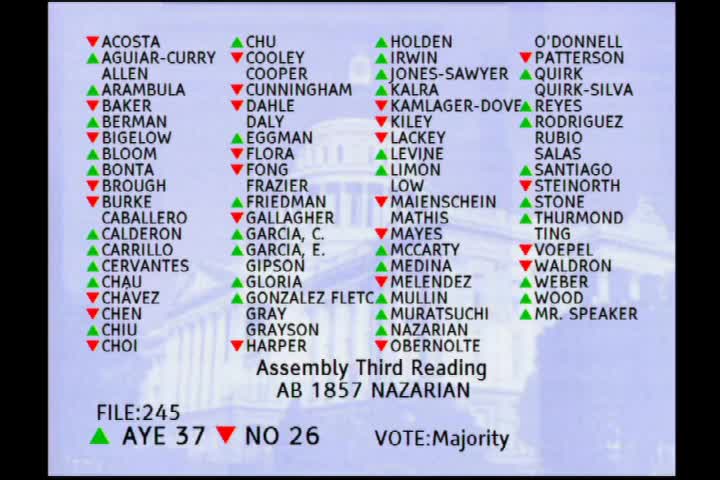 1MIN
Assembly Floor



Bill Co-Author(s):






